CMYK
Monday, 8 June, 2020 I 16 Shawwal-ul-Mubarak, 1441 I Rs 15.00 I Vol X No 339 I 12 Pages I Islamabad Edition
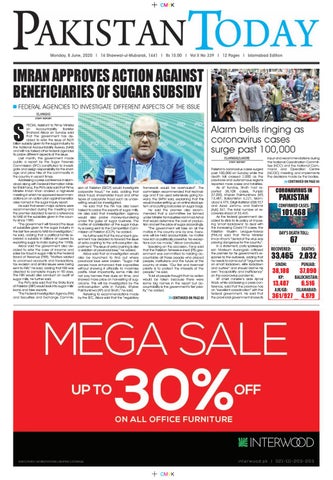
imran aPProves aCtion against benefiCiaries of sugar subsidy g
FederAl Agencies to investigAte diFFerent Aspects oF the issue ISLAMABAD
s
STAFF REPORT
peciAl Assistant to prime Minister on Accountability Barrister shahzad Akbar on sunday said that the government has decided to refer the issue of rs29 billion subsidy given to the sugar industry to the national Accountability Bureau (nAB) and will has tasked other federal agencies to probe different aspects of the issue. last month, the government made public a report by the sugar Forensic commission (sFc) constituted to investigate and assign responsibility for the shortage and price hike of the commodity in the country in recent times. Addressing a press conference in islamabad along with Federal information Minister shibli Faraz, the pM’s aide said that prime Minister imran Khan chaired a high-level meeting in which he approved recommendations on an action plan against beneficiaries named in the sugar inquiry report. he said that seven major actions were recommended during the meeting and the premier decided to send a reference to nAB of the subsidies given in the country since 1985. “the government will forward the issue of subsidies given to the sugar industry in the last five years to nAB for investigation,” he said, adding that a political family received a subsidy in billions of rupees by exporting sugar to india during the 1990s. Akbar said the government also decided to refer the case of income and sales tax fraud in sugar mills to the Federal Board of revenue (FBr). “Matters related to unnamed accounts and transactions, tax evasion and similar issues were being sent to FBr,” he said, adding that FBr was directed to complete inquiry in 90 days. the FBr would also conduct an audit of sugar mills, he further said. the pM’s aide said that the state Bank of pakistan (sBp) would look into sugar mills’ loans and fake exports. “the Federal investigation Agency (FiA) and securities and exchange commis-
Alarm bells ringing as coronavirus cases surge past 100,000 ISLAMABAD/LAHORE STAFF REPORT
sion of pakistan (secp) would investigate corporate fraud,” he said, adding that stock fraud, shareholder fraud and other types of corporate fraud such as underwriting would be investigated. he said that the FiA has also been tasked to probe the exports of sugar mills. he also said that investigation agency would also probe money-laundering under the guise of sugar business. the matter of cartelisation of the sugar industry is being sent to the competition commission of pakistan (ccp), he added. he further said that the incumbent government has decided to forward the issue of extra crushing to the anti-corruption department. “the issue of extra crushing is also a violation of provincial laws,” he added. Akbar said that an investigation would also be launched to find out where provincial laws were broken. “sugar mill owners have enhanced their capacities without showing it officially to maximise profits. Most importantly, some mills did not pay farmers their dues on time, and showed more price on harvesting of sugarcane. this will be investigated by the anti-corruption units in punjab, Khyber pakhtunkhwa (Kp) and sindh,” he said. referring to recommendations made by the sFc, Akbar said that the “regulatory
framework would be overhauled”. the commission recommended that technology and it be used extensively going forward, the sApM said, explaining that this would involve setting up an online stock system and putting barcodes on sugar bags. he said the premier also recommended that a committee be formed under Minister for industries hammad Azhar that would determine the cost of production and set the price of sugar accordingly. “the government will take on all the mafias in the country one by one. everyone will be held accountable, no matter how rich or politically powerful. no exceptions can be made,” Akbar concluded. speaking on the occasion, Faraz said that the pakistan tehreek-e-insaf (pti) government was committed to holding accountable all those people who placed people, institutions and the future of the country at stake. “our first and foremost priority is to protect the interests of the people,” he said. “A lot of people thought that no action would be taken because there were some big names in the report but accountability is the government’s first priority,” he added.
CONTINUED ON PAGE 03
CMYK
pakistan’s coronavirus cases surged past 100,000 on sunday while the death toll crossed 2,000 as the provinces and autonomous regions reported more cases and fatalities. As of sunday, sindh had reported 38,108 cases, punjab 37,090, Khyber pakhtunkhwa (Kp) 13,487, Balochistan 6,221, islamabad 4,979, gilgit-Baltistan (gB) 927 and Azad Jammu and Kashmir (AJK) 361. the total number of recoveries stood at 33,465. As the federal government decided to stick to its policy of imposing ‘smart lockdowns’ to deal with the increasing covid-19 cases, the pakistan Muslim league-nawaz (pMl-n) said that prime Minister imran Khan’s “denial of the virus was proving dangerous for the country”. in a statement, party spokesperson Marriyum Aurangzeb criticsed the premier for his government’s response to the outbreak, adding that he needs to come out of “arguments on smart lockdown, elite lockdown and curfew” and should blame his own “incapability and inefficiency” on the coronavirus pandemic. Kp chief minister’s aide Ajmal Wazir, while addressing a press conference, said that the province has an “excellent coordination” with the federal government. he said that the provincial government shares its
input and recommendations during the national coordination committee (ncc) and the national command and operation centre (ncoc) meeting and implements the decisions made by the bodies.
CONTINUED ON PAGE 03
Coronavirus in
Pakistan
CONFIRMED CASES:
101,468
DAY'S DEATH TOLL:
67
RECOVERED:
DEATHS:
SINDH:
PUNJAB:
33,465 2,032 38,108
37,090
KP:
BALOCHISTAN:
AJK/GB:
ISLAMABAD:
13,487 361/927
6,516
4,979
02
Monday, 8 June, 2020
NEWS
PM TellS PUnjaB, KP To SlaSh non-develoPMenTal exPendiTUreS ISLAMABAD
P
STAFF REPORT
RIME Minister Imran Khan on Sunday told the governments of Punjab and Khyber Pakhtunkhwa (KP) to cut their non-development expenditures like the federal government, and to create job opportunities in urban areas hit hard by the coronavirus pandemic. The prime minister said that due to the Covid-19 pandemic, the economic situation worldwide was unusual. The upcoming fiscal budget would be presented in this extraordinary situation and it requires that non-development expenditures should be curtailed whereas development expenditures should be enhanced, he added. The prime minister said this while chairing a high-level meeting on the proposed fiscal budgets of Punjab and KP for the year 2020-21.
IMRAN TELLS PROVINCES TO PRIORITISE JOB CREATION IN UPCOMING BUDGET The meeting was attended by Foreign Minister Makhdoom Shah Mahmood Qureshi, Minister for Information Senator Shibli Faraz, Minister for Industries Muhammad Hammad Azhar, Minister for Planning Asad Umar, PM’s Advisors Dr Abdul Hafeez Shaikh, Abdul Razak Dawood, Dr Ishrat Hussain, Syed Zulfiqar Abbas Bukhari, Lieutenant General (r) Asim Saleem Bajwa, Punjab Chief Minister Sardar Usman Buzdar, KP Chief Minister Mahmood Khan, Punjab Finance Minister Makhdoom Hashim Jawan Bakht, KP Finance Minister Taimur Salim Jhagra and other senior officials. During the meeting, the economic teams of chief ministers of Punjab and KP
presented detailed briefings on the revenue, expenditures and priorities contained in their respective proposed fiscal budgets for the year 2020-21. Addressing the meeting, the prime minister underlined the need for specially prioritising those projects which would create employment opportunities and move the wheels of economy rapidly. For ensuring private sector’s participation to meet the national and provincial development requirements, he also emphasised on the need for facilitation of private sector to accomplish projects under the public private partnership. He further also directed the provincial governments to specially focus on the devel-
opment of industrial and agricultural sectors. The premier was briefed on the priorities being given in the proposed budgets regarding the special economic zones and promotion of agricultural sector.
The prime minister directed the provincial governments to pay special attention on the upgradation projects of health sector, so that the general public could get quality health services.
PPP announces MPC to address ‘conspiracy’ against provincial autonomy NEWS DESK The Pakistan People’s Party (PPP) has started contacting other political parties for a multi-party conference (MPC) in Karachi in the coming weeks to address a number of issues, including safeguarding 18th Amendment from an alleged conspiracy against provincial autonomy, administrative changes the National Finance Commission (NFC) and the government’s response towards coronavirus outbreak and locust attack, a local news outlet reported on Sunday. The party has already contacted leaders from the Pakistan Muslim League-Nawaz (PML-N), Jamiat Ulema-eIslam-Fazl (JUI-F), Jamaat-e-Islami (JI) and Awami National Party (ANP) and will send formal invitations to leaders from political and nationalist parties in Sindh. Earlier, PPP Sindh President Nisar Khuhro said that the objective of the MPC would be to highlight the inad-
US blogger served notice over rape allegations ISLAMABAD STAFF REPORT
The Pakistan People’s Party (PPP) senior leader Senator A. Rehman Malik on Sunday through his lawyer Ch: Abdur Rehman Bajwa served a “defamation notice to US citizen Cynthia D. Ritchie over false, frivolous and baseless allegation of rape” against him. Senator A. Rehman Malik has strongly rejected all allegations against him and has termed those a pack of lies to damage his national and international reputation. He said that he is fighting for the honour and respect of his leader Shaheed Mohtarma Benazir Bhutto who sacrificed her life for the nation and he can face such kinds of hundreds of false and fabricated allegations in this fight. He said that he has been continuously receiving life threats and arrest for his vocal statements against the government but the opponents must know that he is never afraid of jails as he has already seen even the death cels. He said, “When my opponents found nothing against me they began my character assassination”. He said that my conscience is clear and on time, he will be exposing the conspirators behind Shaheed Mohtarma Benazir Bhutto and his character assassination and will show them the mirror.
equate response of the federal government to the locust attack, among other issues. He also lashed out at the federal government for its proposed administrative changes to the NFC. “The federal government is unable to tolerate the fact that the provinces receive more in the NFC than the Centre,” he said. “The Centre wants to weaken the provinces financially by reducing their NFC share,” he alleged. He said that the Sindh government will never accept any NFC award that will end up reducing its financial share, arguing that the 18th amendment mandated that provincial shares in the NFC award can never be reduced. “We reject the autocratic thinking of the prime minister in this regard,” he said. Khuhro said that it was unfortunate that the Pakistan Tehreek-e-Insaf (PTI) government was constantly undermining the provincial governments. He said that the Centre must realise that only a satisfied provincial unit can lead to a satisfied federal unit.
Cynthia Ritchie doubles down on accusations AMERICAN BLOGGER REVEALS MORE DETAILS ABOUT ENCOUNTERS WITH ACCUSED PPP STALWARTS NEWS DESK American blogger Cynthia Ritchie on Sunday doubled down on accusation and claimed that she had been harassed by multiple political leaders during her time in Pakistan. In an interview with a local news outlet, she revealed detailed of alleged harassment by Pakistan People’s Party (PPP) stalwarts Yousaf Raza Gillani, Makhdoom Shahabuddin and Rehman Malik. She said that after Osama bin Laden was killed, Malik, who was the interior minister at the time, asked her to visit the minister’s enclave to discuss her visa. She added that she agreed because some officials told her that “real busi-
ness is done out of the office”. Cynthia said that when she visited the minister’s enclave, she was welcomed with flowers and was offered a drink. “About a drink and a half into my visit, I felt dizzy and the next thing I remember is he getting me to sit down and I was in his bed,” she claimed. She also claimed that Malik’s driver helped her dress up and told her that they wanted her to distance herself from the NGO she was working in since it was run by Azam Swati’s daughter and the politician had recently joined the Pakistan Tehreek-e-Insaf (PTI). She said that the driver put 2,000 pounds into the car with her and made her take it with her. She added that the Malik also gifted her a phone which was used to spy on her. She said that she was also harassed by the Pakistan Muslim LeagueNawaz (PML-N) and they stole her ‘Emerging Pakistan’ idea. She further said that the Muttahida Qaumi Movement (MQM) had been more civil and she has more respect for them than she has for the PPP. Responding to a question, Cynthia denied working for intelligence agencies. When the interviewer contacted Gillani and Shahabuddin, both denied the allegations.
Covid-19: Strengthened KTH rises to occasion PESHAWAR APP
The Khyber Teaching Hospital (KTH), a leading public sector hospital in Peshawar, has been strengthened in terms of healthcare services, equipment, faculty and medicines to combat Covid-19. Located opposite to the University of Peshawar on the historic route leading up to Khyber Pass, the hospital has been playing a pivotal role since its inception to provide quality healthcare services to patients of Khyber Pakhtunkhwa and even from Afghanistan. Dealing successfully with the emergencies of the devastating earthquake of 2005 and 2010 floods, war against terrorism, dengue fever or the current coronavirus pandemic, the hospital has always risen to the occasion. Established in 1976, the KTH has been strengthened due to the health reforms introduced by the PTI government under the Medical Teaching Institutions (MTI) Reforms Act 2015. The reforms have remained highly productive and their trickle-down positive effects have become more visible now when the country was fighting against coronavirus pandemic.
Following the promulgation of MTI Act 2015, the hospital was providing health services 24/7 to deal emergency and routine cases besides providing medical care to the patients of coronavirus. After the Act, operation theaters are being used for 14 hours and teaching staff is now available in premises of the hospital for minimum 14 hours due to Institutional Based Practice (IBP). Prior to the act, KTH used to close at about 2:00p.m with only emergency services running. Talking to APP, Director KTH, Dr Zafar Afridi said that 1,300 beds and 56 ventilators were available in the hospital against which 55 beds and 25 ventilators were reserved for Covid-19 patients. He said every bed was connected with central supply oxygen besides facilities of portable ultrasound, digital X-rays and portable dialysis machines. According to official documents, as many as 2,359,475 patients were examined at Out Patient Department (OPD) and 2,150,488 at Accident and Emergency Department (A&ED) from January 1, 2015, to December 2019 against 1,139,253 including 496,026 at OPD and 643,227 at Casualty with no facilities of evening and morning OPDs as well as IBP prior to the act. Around 76,000 patients were admitted only in 2018 against 77,910
per annum before the legislation. For the first time, bed managers were introduced, which improved bed occupancy to around 95 percent. While, Blood bank was handed over to haematologists to ensure safe blood transfusion to patients. The laboratories of KTH and Khyber Medical College (KMC) were merged and sub-divided to histopathology, microbiology, chemical pathology, haemotology and each station was headed by a concerned specialist professor. Similarly, neurosurgery, urology, rheumatology, endocrinology, gestroenterology and psychology department were created. Human resource management information (HMIS) was introduced for computerization of employees’ data. Besides, supply chain department was established to ensure a smooth supply of goods to hospitals besides setting up of quality assurance department to ensure delivery of safe services. Inventory control management system to cope with flow of supplies, receiving goods and satellite pharmacy were established at KTH. Prior to reforms, A&ED had faced acute shortage of staff and equipment with no triage facility and patients were diverted to clinics. The patients took a sigh of relief
CMYK
when A&ED were made fully operational and equipped with triage after the reforms. Medical and surgical Intensive Care Units (ICUs) were now fully equipped with full time teaching staff having ventilators and others essential life saving equipment. Dr Zafar Afridi said a state-of-the-art laboratory has been set up at KTH where tests’ reports of Covid-19 were handed over to patients within three days. He said a scientific filtration plant has been setup for recycling of air transmitted from hospital to open atmosphere to ensure clean air to the residents. Free medicines and food services were being provided to COVID-19 patients till their discharge, he added. A total of 1,196,659 laboratory tests were performed with generation of Rs 30,416,326 revenue after the act against conducting 2,64,291 tests generating Rs7,238,820 revenue prior of the reforms. The hospital revenue has increased to record Rs. 125,136,454 after promulgation of MTI act 2015 against Rs 70,973,166 prior to it. In terms of radiological services, a total of 61,737 digital X-rays, 58,469 routine Xrays and 98,184 ultrasounds were performed generating Rs 20,077,358 after the reforms Act. The computerization of medical records
Transport to resume in Balochistan on Monday ISLAMABAD STAFF REPORT
The Balochistan government on Sunday allowed transporters to run inter-provincial and intercity transport with immediate effect in the province, a private news channel reported. Public transport was suspended in Balochistan after the province went into lockdown on March 24. The move was aimed at stemming the spread of the coronavirus. According to a notification issued by the provincial home department, buses and vans will have to be disinfected through spray before they leave the stations, and passengers will be checked before boarding the bus with the help of a thermal gun. The passengers, drivers and conductors will have to wear face masks and 18-seat vans will carry only 10 passengers. Only three people will be allowed to travel in a taxi. The notification warned that the decision to allow the resumption of public transport could be withdrawn if the SOPs are violated.
of patients was under process that would enable patients to see their laboratory reports online anywhere in Pakistan. The KP government has already released Rs 700 million for renovation of hospital on March 14, 2016 as share of KTH under an umbrella project approved on June 17, 2015 at a cost of Rs 1770 million for all MTIs in the province. About 78 per cent work on the basement was completed and 1,00,000 square feet area was recovered and brought under proper use. Regarding the replacement of the old HVAC system project, KP Government has transferred Rs 500 million to KTH in January 2017 and a number of schemes were completed including old AC plant, basement, operation theater, four wards on first floor and HVAC plant room. Work on 300 beds in the new accident and emergency department with approved cost of Rs 1312.072 million was completed on August 31, 2018 and 98 per cent progress was achieved. Major work completed includes internal and external plasting, plumbing and sanitary, floors ceiling, internal electrification etc. Likewise, work on purchase of equipment costing Rs 2714 million project was initiated on December 14, 2017 and different life saving equipment including CT scan machine were purchased. The process for a new MRI and other essential equipment against the release of Rs 800 million was under progress for the hospital.
Monday, 8 June, 2020
PPP SeeKS CCi MeeTing on PSM iSSUe GHANI SAYS SINDH GOVT WILL RESIST ALL UNILATERAL DECISIONS REGARDING STEEL MILLS KARACHI
a
STAFF REPORT
FEW days after the federal government decided to layoff over 9,000 Pakistan Steel Mills, the Pakistan People’s Party (PPP) warned the government that it would resist any move to sack the PSM employees while urging for a Council of Common Interests meeting to resolve the issue. “Not only will the PPP condemn any attempt to sack the 9,500 steel mills workers but we will practically stand with them to oppose this move,” said Sindh Education Minister Saeed Ghani during a press conference. “We will resist this. We will stand with
these workers and neither will we leave them helpless nor will we let them be fired,” he added. The PPP leader categorically rejected allegations that the party was guilty of ensuring its own workers were hired in the PSM. “This perception is totally wrong,” he said. “I can say this with absolute surety that the PPP, from 2008-2013, did not have one person hired in the steel mills,” noted Ghani. “However, there was this one thing that we did. And we did not do this with the steel mills alone but with various other institutions. The PPP government regularised workers that were on contract, which is according to the constitution,” he added. Ghani said that the workers who were fired were appointed in the steel mills in
imran approves action against beneficiaries of sugar subsidy
1996-2008. “These were not PPP’s appointees. To say that they were hired by the party is wrong,” he said. “It would have been easier for us to dismiss those people, create vacancies and then hire our own people. We did not do that.” Ghani said that the government of Sindh was the owner of the land on which the PSM was built. The PPP leader noted that the total land acquired by the steel mills was 19,000 acres. “The government of Sindh is the true owner of this land,” he said. “If the federal government takes any decision without the [Council of Common Interests] CCI’s approval or without taking Sindh government into confidence, we will resist it,” he stressed. During his press conference, Ghani touched upon the allegations made by US blogger Cynthia D Ritchie, who had accused former interior minister Rehman Malik of rape and former prime minister Yousuf Raza Gilani of ‘manhandling’ her several years ago.
CoNtINuED fRoM PAgE 01 He further that the farmers would benefit from the action that would be taken and efforts would be made to retrieve money that was looted. The inquiry report had revealed names of many bigwigs, including Jahangir Tareen, the former secretary-general of the ruling PTI and a close confidant of the prime minister, who had allegedly benefitted from the crisis. On Saturday, the Pakistan Muslim LeagueNawaz (PML-N) had questioned the ‘quiet’ departure of PTI senior leader Tareen for London despite being a prime suspect in the sugar scam. Shortly after Akbar’s press conference on Sunday, PML-N spokesperson Marriyum Aurangzeb, in an apparent reference to Jahangir Tareen, said that the government was preaching accountability after helping powerful “ATMs” flee the country. She urged the prime minister to not stage a play after helping to fill the pockets of the powerful. “Only Imran Khan sahib is involved in the sugar crisis. His house at Zaman Park was built using the money from cheeni chori,” she said. She added that the prime minister and Punjab Chief Minister Usman Buzdar should also be presented before the public. “Because of Imran’s cheeni chori, the people have to buy sugar for Rs90 per kilogramme. The NAB-Niazi nexus will probe Imran’s theft, there is no bigger joke than this. Those who are risking the country’s future and economy are using the slogan of self-accountability,” she added. The only purpose of forming the commission was to save PM Imran and Punjab CM Buzdar, she further said.
ISLAMABAD STAFF REPORT
Special Assistant to Prime Minister on Health, Dr Zafar Mirza Sunday said that 74 per cent of those who died of Covid-19 in Pakistan were above 50 years of age and most of them had previous underlying health conditions. Giving the latest statistics about the corona situation in the country, Dr Mirza during a media briefing, further said that it is heartening to note that number of corona negative
persons is increasing. He said 23,100 tests were conducted in the last 24 hours, in which 4,969 people were found positive. This is equivalent to 21.4 percent of those whose tests were held. He said total of 683,608 people have been tested so far in the country. He said that 34 percent people, who were found corona positive, have completely recovered and resumed their normal activities of life. He said a slightly over 5,000 people are admitted in various hos-
He said that the country was “blessed” to have Imran Khan as the prime minister amid a pandemic. “If, God forbid, any of these people were in power right now; well their track record is before everyone,” he said. In Punjab, as the cases continued to increased, the local police and law-enforcement agencies started using stun batons against those flouting the standard operating procedures (SOPs) devised to curb the virus spread. Reportedly, the stun batons were procured and provided on the orders of the concerned authorities to ensure that peo-
pitals of the country, with 262 on ventilators. He said that 75 per cent of ventilators have not been in use so far. He said there is no shortage of bed, ventilator, or any other facility for Covid-19 patients. He said the government has decided to strictly monitor the compliance with standard operating procedures (SOPs) to protect people against Covid-19 and warned that action would be taken against those who do not observe the SOPs. Mirza said that wearing face masks is mandatory and no leniency will be tolerated in this regard. He said that using face mask is very important against Covid-19 as it can help stop the spread of disease by 40 to 60 per cent.
Govt briefs rescue officials on Covid-19 strategy ISLAMABAD STAFF REPORT
The National Command and Operation Center (NCOC) on Sunday held a video conference with the heads of various emergency services operating in provinces with regard to the COVID-19 situation in the country. The video conference was attended by the representatives of the Edhi Foundation, Cheepa Foundation, DG Metropolitan Corporation Islamabad (MCI), DG 1122 Punjab, Balochistan, Gilgit-Baltistan (GB) and Azad Jammu and Kashmir (AJK). The NCOC briefed the emergency services representatives of the availability of health facilities, beds, and ventilators at hospitals. The relief officials were also informed about the mechanism of emer-
gency services and the Resources Management System developed by the NCOC. The relief agencies were intimated that 15,479 hospitals have been attached to the system. The participants of the conference were also briefed about the newly launched Pak-Nigehban App. The chief executive officer of the National Information Board of Information Technology Shabahat Ali Shah said that Pak-Nigehban App will allow users to see availability of beds/vents and capacity/usage in real-time at various health centers across the country. Rescue workers will be able to check-in a patient to nearby healthcare facilities with the help of the app, Shah added. He also said that the application features will also allow users to locate the nearest laboratory with coronavirus testing capacity.
Alarm bells ringing as coronavirus cases surge past 100,000 CoNtINuED fRoM PAgE 01
“I would urge all the media channels of Pakistan, that an issue is being created to malign the political leadership of Pakistan,” he said. “You can put it in writing. If we create pomp and show about it, then today it is the PPP, tomorrow it will be another party and then so on. Maybe, those who are blowing trumpets about it, they can also [fall victim to it].” He warned the federal government by saying that people were aware of the ‘activities’ of those who were in power. “If they [federal government ministers] think they can be happy over false allegations regarding others, then they will have to face true allegations against themselves. Then, they will not be able to rid themselves of it,” added Ghani. In response to a question, he angrily said that Cynthia had not revealed any confidential information about the PPP. “We have forgotten about the locusts, we have forgotten about the coronavirus, we have forgotten about poverty, we have forgotten about unemployment, we have forgotten about the
Underlying health conditions behind 74pc of Covid-19 deaths, says Mirza PM’S AIDE SAYS OVER 5,000 PEOPLE ADMITTED IN HOSPITALS SO FAR, 262 ON VENTILATORS
ple stay indoors and follow the SOPs if they go out in public. Meanwhile, newly-released data revealed that the NCOC allocated and issued 250 additional ventilators –32 per cent of the total stock – during the last week through the National Disaster Management Authority (NDMA) to overcome challenges in critical care. 72 ventilators were issued to Punjab, 52 each to Sindh and KP, 20 to Balochistan and 10 each to AJK and GB and 34 to ICT. In Faisalabad, as of Sunday, 150 ventilators were available, and out of those, 57 were allocated for coronavirus treatment and only five were occupied. In La-
hore, the number of available ventilators was 793, out of which 214 were allocated for coronavirus patients and 77 were occupied. In Multan and Rawalpindi, 150 and 229 ventilators were available, respectively. In Karachi, the number of available ventilators was 461, including 136 set aside for coronavirus patients. In Hyderabad, the number of available ventilators was 50, out of which 20 were specified for coronavirus patients. In Peshawar, 171 ventilators were available, out of which 75 were allocated for Covid-19 patients, with 47 of these occupied. In Abbottabad, the number of
NEWS
available ventilators was 25, out of which, 12 were allocated for coronavirus patients and four occupied so far. In Quetta, the number of available ventilators was 61, out of which 29 were allocated for coronavirus patients. In Gilgit, 26 ventilators were available, out of which five were allocated for coronavirus and one is occupied. In Mirpur, the number of available ventilators was 11 and all were allocated for Covid-19. In Muzaffarabad, the number of available ventilators was 28, out of which 18 are allocated for coronavirus. In Islamabad, 246 ventilators were available, including 92 allocated for coronavirus patients, with 13 of these occupied. Earlier, Special Assistant to the Prime Minister on National Health Services Dr Zafar Mirza said that 75 per cent beds in Intensive Care Units (ICUs) of hospitals were unoccupied and available for Covid-19 patients.
03
economy. We are running the baseless and false allegations of a woman in our headlines,” said Ghani. In response to another question, the PPP leader said that Cynthia’s allegations were a “pre-planned strategy to malign Pakistan’s political leadership”. He said that the allegations were being posed by a woman whose “character was dubious”. “At times, she is in Israel, at times in India. A foreigner comes here and tries to be more patriotic than you and me. How can it be?” he asked.
29 health workers have died of Covid-19 in Pakistan so far ISLAMABAD: Frontline health workers continue to suffer from the coronavirus pandemic as 3,088 of them have so far tested positive for Covid-19 in Pakistan and 29 have died of the disease. According to reports, the figures have been provided to the National Health Ministry in a report prepared by National Institute of Health (NIH) Islamabad. “Out of total infected health workers, 1,815 of them are doctors,” it said, adding that 412 nurses and 861 other paramedical staff have also contracted Covid-19. The reports said that 1,703 healthcare workers were self-isolated in their homes while 255 of them were being treated at the hospitals. “Some 251 of the health workers admitted to hospitals are said to be in stable condition,” it said as overall 1,101 of them have recovered from the infection thus far. The report said that 29 health workers have died of the virus in the country. STAFF REPORT
nBP fails to increase ex-employees' pension in two decades ISLAMABAD: The National Bank of Pakistan has failed to increase the pension of thousands of its retired employees despite the passage of two decades. Sources said that the government has not made any annual increase in pension of the retired employees since January 1999 despite the fact, NBP on every month deducts pension from the ‘salary’ of its employees to boost the pension fund account. Presently, there are 11,500 pensioners of NBP, including 3500 widows of deceased pensioners. As per the cabinet division notification, the government has declared NBP as an autonomous body that is under the control of the Finance Division. Sources said that retired employees of ZTBL as well as SBP are getting annual increases in their pension every year but NBP employees are being deprived of such perks. Sources said that the total impact of pensioners liability from 1999 to 2019 is only Rs11bn as stated in bank documents. In addition to this, the total balance in the pension fund account is approximately Rs60 billion, and the bank also earns an annual profit of Rs6bn through investments made by the said fund. Sources said that the bank had reduced the pension rate from 70 per cent to 35 per cent and later fixed it at 50 per cent. The NBP revised the pay scale of staff during the period from January 1, 1993, to December 31, 2009, only once in January 1999, sources said. Sources said that the federal government has revised the pay scale of government employees including employees of autonomous as well as semi-autonomous four times during the said period. In addition to this, the government increased the salaries in these 14 years by more than 200 per cent but the 70 per cent pension rate was kept intact. They also said that the total assets of the bank are 3,124bn in which profit before provisioning is 42bn. Similarly, the profit before tax was 28bn whereas profit after tax was 15bn during the financial year 2019. SHAHZAD PARACHA
04 ISLAMABAD
Monday, 8 June, 2020
PRAyER TImINgS
WEATHER UPDATES MONDAY
350C
250C
TUESDAY
360C
240C
WEDNESDAY
380C
250C
PeoPle Defy viruS SoPS, throng cAPitAl'S Picnic SPotS ISLAMABAD
A
APP
LARGE number of people thronged tourists spots of the federal capital for picnic on weekend, defying the SOPs (Standard Operating Procedures) devised by the local administration to stem the coronavirus spread. Brushing off the ‘stay at home’ slogan promoted across the world to do away with the global pandemic, hundreds of the resi-
dents of twin cities of Islamabad and Rawalpindi turned to picnic spots on cars, motorbikes and cabs, activating traffic wardens to intervene. Shahdara and Margalla Hills were the prime targets of the visitors where a huge rush was being witnessed on Saturday and Sunday. “Shahdara stream is a major source of attraction for tourists in hot summer and is witnessing a huge rush on this weekend. It seems local authorities are not properly activated to enforce lockdown,” Vice Chair-
man Union Council Malpur Raja Nadeem, expressed his concern over the situation. He said the town's residents being at the isolated location were feeling protected but this public mobility may expose the area to an outbreak of the pandemic. “Majority of the visitors are without masks and a significant number of youngsters taking bath in the stream water and there was no adherence to the guidelines against virus, putting their own and others’ lives at risk” he regretted. A local Abdul Qudoos also complained
about the traffic mess at Shahdara road saying, “Usually it takes 20 to 30 minutes to reach my home in Shahdara town but today it took me almost one hour to reach.” Abdul Jabbar, a visitor who has come with his family at Margalla Hills, said people got frustrated after staying at home for the last two or three months. “My children who used to visit most often in normalcy insisted me to go for outing and we are trying to keep a fair distance to ensure our safety” he tried to justify his move when asked why has he exposed his family to the
Sindh government has two faces — one for us, the other for public: Wazir ISLAMABAD STAFF REPORT
Shangla Police arrest smugglers, seize drugs SHANGLA APP
Shangla Police, in a successful operation against the alleged drug dealers, on Sunday foiled an attempt of smuggling drugs worth millions of rupees and arrested the smugglers here on Sunday. According to details, in a join operation on the directives of DPO Shangla Malik Ijaz, SHO Aloch Shangla Muhammad Pervez and SHO Martong Liaquat Ali Khan, local police foiled attempts to smuggle hashish worth millions of rupees and arrested three drug smugglers and notorious gangs during operations at different places. The Police also recovered high quality cannabis was being smuggled from Buner district through secret mountain routes to various areas, especially Kabulgram. SHO Alwach Police Station Mohammad Pervez along with police personnel setup roadblocks at various places along the difficult and secret mountain routes connecting Jumbal check post with other areas. Alleged drug smugglers and notorious drug dealer Fawad Ali son of Shafiqul Rehman were arrested during a blockade at Jumbal check post. Akhtar Mohammad son of Taus resident of Kabulgram was arrested and more than 1000 grams of cannabis was recovered from his possession and a case was registered against him in Alwach Police Station. Alias Badruddin son of Amanullah Khan arrested and more than 500 grams of cannabis recovered from his possession with SHO Martong Liaqat Ali tightened the grip against drug dealers. Irfan Khan alias Badruddin was arrested and a large quantity of cannabis was recovered from his possession. On the occasion, District Police Officer Shangla Malik Ijaz inspected the performance of SHO Aloch Police Station and SHO Martung Police Station and appreciated them on a successful operation. DPO Shangla said that no stone should be left unturned in eradicating drug menace and all available resources should be utilized to bring these drug dealers to justice.
Advisor to Chief Minister Khyber Pakhtunkhwa on Information and Public Relations Ajmal Khan Wazir has said that Sindh government says one thing in meetings and another on public forums. “In meetings of National Coordination Committee chaired by the prime minister, Sindh chief minister gets maximum time for discussion,” he said, adding that the Sindh government’s logic was not understandable as to why they start unwarranted criticism when they come out of meetings. Briefing the media at the Civil Secretariat Itlaa Cell, he advised Bilawal Zardari to focus on Sindh province and no need to worry about Khyber Pakhtunkhwa as here the recovery rate is better than Sindh. "Corona cases are being treated in Khyber Pakhtunkhwa in accordance with WHO guidelines and bodies of those passed away due in the province are now being handed over to their families while such bodies are also included in the coronavirus list," Ajmal added. He said that Corona cases were not being concealed in Khyber Pakhtunkhwa adding that Initially, Corona's testing capacity in the province was only 20, which has now been increased to about 2,800. Ajmal Wazir said that seventh consignment of safety equipment to 49 hospital of the province has been provided to equip the doctors and paramedics fighting against COVID 19 pandemic. Safety equipment consists of: 52,315 N-95 masks, 26522 KN-95 masks, 485 D-95, 430000 face masks are provided along with 7925 protective suits,18244 surgical gowns, 21185 Caps, 21000 shoe covers, 10330 pair of surgical gloves, 3475 face shield and 1135
protective goggles. The Advisor for information further said that district administration was taking action against those who were creating artificial shortage of flour in the province. He said that both district administration and food department were taking stern action against those who sell flour at a higher rate than the fixed rate adding that Chief Minister Mehmood Khan had issued clear orders to take strict action against those who were creating artificial inflation. Ajmal Wazir said that similar operations were being carried out across the province against artificial shortage of petrol and non-compliance of SOPs. Regarding the situation arising out of the lockdown, he said that the government was providing the best relief package to the people under the Ehsaas Emergency Cash Program in the lockdown adding that this was a transparent project in the history of the country which was appreciated internationally. He said that the Department of Agriculture, Relief and District Administration was in action to eradi-
cate the locusts in the province adding that both the corona and locust arrangements were being monitored by chief minister. Regarding the repatriation of overseas Pakistanis, he said that the opposition should not worry about overseas, they were close to the heart of Prime Minister Imran Khan. "Overseas arrivals from Bacha Khan International Airport is in progress. Since February 1 to March 20, 81524 passengers have arrived at Peshawar Airport on 478 regular flights which have been screened besides these 4,675 passengers have also arrived at Peshawar Airport on 23 special flights from April 15 to May 28. Ajmal Wazir further said that crackdown was also started against the violators of SOPs. A total of 33,001 inspections have been carried out across the province where a total of 3,553 businesses have been fined and 811 businesses have been sealed,while Rs.1704262 have been deposited in the provincial treasury so far in terms of fines. Besides this pumps that do not provide petrol have also been sealed.
‘Service providers at Panahgah given lectures on corona preventive measures’ ISLAMABAD APP
With the daily wage earners started to return twin cities of Rawalpindi and Islamabad in search of livelihood, the management of ‘Panahgah’ (shelter homes) has put in place a scaling-upstrategy to save its dwellers from contracting the coronavirus (COVID-19) through extensive sensitization on the preventive measures. “Soon after the Eid-ul-Fitr vacations, we rolled out a comprehensive strategy under the ‘Keep Panahgahs Clean’ campaign to promote hygienic habits among the residents, who are at the high risk of catching the coronavirus,” Prime Minister’s Focal Person on Shelter Homes Naseem ur Rehman told the media here at the ‘G-9 Shelter Home’ during his routine
inspection visit. He said the shelter homes management along with the local administration had started lecturing to the facilities’ service providers on the precautionary measures which were imperative to keep the virus at bay. To a question, the focal person said some six ‘Panahgah’ at the twin cities of Rawalpindi and Islamabad had more than 30 staffers who were being educated regularly so that the health messages could be delivered to the dwellers by them in a face to face interaction. He said large size radios had also been installed at the shelter homes to convey the health messages to the residents directly. Special programmes were being broadcast on the specific radio channels to enhance their awareness level against the contagion, he added.
Naseem said the management took the Eid-ul-Fitr vacations as an ample opportunity to improve the basic services at the ‘Panah gahs’ as almost all the migrant workers moved to their cities to spend the religious festival with their families. “During the vacation, we boosted our efforts to transform the shelter homes into a place which promotes healthy lifestyle apart from providing food and shelter.” Naseem said multiple initiatives had been taken to make the shelter homes clean and green places under the vision of Prime Minister Imran Khan. Disinfection of all the facilities had been made sure to prevent the pandemic outbreak at the places, he added. He said teams were deputed at shelter homes to hold face to face interaction with
its dwellers and sensitize them about the precautions required for preventing the virus spread. “With the help of a Strengthening Participatory Organization, we have installed at least three hand-washing booths at each ‘Panah gah’of Islamabad including Bhara Kahu and others to ensure their safety from the coronavirus.” “In the prevailing situation, handwashing booths at the ‘Panah gahs’ will work as a critical equipment in combating the deadly virus which has devoured several lives across the world,” the focal person remarked. He said all the shelter homes in Rawalpindi and Islamabad had been provided medical supplies after the migrant daily wage earners had started returning to the two cities in search of employment.
FAJR SUNRISE
ZUHR
ASR MAGHRIB ISHA
3:16
12:06
3:51
4:57
7:16
8:58
pandemic. “Our schools are closed for the last two months so we need some recreation so I insisted my father to visit the place for a change,” Jabbar’s ten-year-old son told, looking a bit excited and feared as well, said. Commenting on the situation, Deputy Commissioner Islamabad Hamza Shafqaat told APP that the administration had not opened any picnic spot of the federal capital. All-out efforts were being made to ensure implementation on the SoPs to curb the coronavirus spread. “The administration is monitoring the public mobility and teams would be dispatched at the earliest to restrict public gatherings at tourist attraction sites,” the deputy commissioner assured after indication of the rush at the tourist resorts, especially Shahdara. He said people must take the virus seriously as some 600 positive cases of coronavirus were being reported in Islamabad every day.
KP Agriculture Department to experiment eco-friendly method to fight fruit flies PESHAWAR: The Agricultural Research Institute Peshawar has initiated a project on an experimental basis to protect citrus fruit orchards from fruit fly attacks using eco-friendly means. The project aims to increase fruit production, conserve the environment and protect humans from harmful effects of unsafe chemicals and pesticides. The Rs44.084 million worth project has been made the part of this year's annual development program, which will initially be implemented in three districts of Peshawar, Nowshera and Swat. Younas Khan, the project in-charge and Senior Research Officer at the Agricultural Research told Profit that traps have been imported from Australia and initially planted in orange orchards. “With these traps, researchers use chemicals that attract bees. The bees which sit on the trap die when they come in contact with the chemical,” he said. He added that these traps would also protect people from the harmful effects of pesticides. Recently, the Provincial Assembly was informed that the increase in the number of cancer patients in Malakand Division was due to the spraying of chemicals on peaches and other fruits in the area. The Department of Agriculture currently uses eight traps which costs Rs16,000 compared to spraying pesticides which cost more. AZIZ BUNERI
35 new coronavirus cases take tally to 396 in AJK MUZAFFARABAD: Azad Jammu and Kashmir (AJK) government has reported 35 more COVID-19 positive cases on Sunday afternoon taking the total number of patient to 396 out of which 8 had been died and 195 had recovered so far. According to a press release issued by health department, 25 new cases have been reported from Muzaffarabad city, 4 from Bhimber district and 6 from Sudhonoti (Plundari) district while 5 patients have been discharge during the 24 hours from different hospitals after recovery. Majority of patients are under treatment at three facilities in Muzaffarabad 79, DHQ Hatian Balla 5, CMH Rawalakot 11, DHQ Bagh 27 DHQ Sudhunoti 15, 23 at two facilities in Mirpur, 23 at DHQ Bhimber, 9 at DHQ Kotli and one at THQ Dodial. APP
1,000 kites confiscated, two arrested RAWALPINDI: Rawalpindi Police in an operation on Sunday confiscated 1,000 kites and arrested two kite sellers. According to police spokesman, Morgah police raided and confiscated 1,000 kites and strings rolls from kite sellers Ibrahim and Munsif. Police have registered separate case against both of them and started investigation.City Police Officer (CPO) Muhammad Ahsan Younas said strict action would be taken against the kite flying and said that no one would be allowed to violate rule of law and made it clear that ban of kite flying strictly implemented. APP
Monday, 8 June, 2020
NEWS
05
Punjab fights Covid-19
Lahore Javed Younas
C
oronavirus has left the whole world in torment. Countries all over the world are trying hard to contain this disease using all their available resources, however, they have so far been unable to overcome this menace. Coronavirus patients’ number has exceeded six million all over the world, whereas fatalities have reached more than 383,000. in Pakistan, total number of corona patients are around 89,000 and almost 1,830 people have fallen prey to this deadly disease. Experets opinine that only by keeping social distances we can prevent its outbreak. People are being asked to stay at home. if they have to go out, they must take preventive measures like covering their face by masks and using sanitizers. They have also been asked to keep six feet distance from others. But, unluckily, people have not changed their lifestyle and habits and taking it so light. some of them even making fun of it. Markets and roads are witnessing the same rush. if we do not change our habits and lifestyle, the state of affairs can go worse. Governemnt is continuelusly warning people that they must comply with the lockdown directions. it is beyond doubt that government alone cannot fight this disease. in order to achieve this goal, people will have to act upon the advices and comply with the directions issued by the government from time to time. if people are safe and sound they can earn their living, but if they fall prey to this disease and cannot survive, their jobs and business are useless. so the prevailing situation requires us to take precautionary and preventive measures. Coronavirus has changed the whole world. This disease has enhanced social distancing. it is a famous saying that man is a social animal and cannot live alone. But now it is being preached that people should keep social distancing. Meeting, shaking hands, and hugging like acts are being discouraged now. are this not a necessary outcome of our evil deeds? all those social evils which are forbidden by any religion, have been adopted by us. in every religion, nudity, vulgarity, rape and wine have been declared sins, but all these evils are being committed by human beings. To justify our personal lust, arguments are sought and advanced. usurping rights, injustice with oppressed, hoarding, bribery and delayed justice are other such social evils which are now part of our society. When there is no difference between Halal and Haram, law of nature becomes active and there is destruction everywhere. it is beyond doubt that lockdown affected the poor and daily wagers very badly. on directions by Prime Minister imran Khan, Punjab Chief Minister sardar usman Buzdar started Ehsaas Kifalat Programme which is the biggest project of the province. under this programme, poor families are being given rs12,000/- monthly. Chief Minister usman Buzdar is personally monitoring this programme. Ehsaas Kifalat Programme is a splendid welfare plan, which is helping the poor to make their both ends meet. The real chalenge the government is facing is to extend help to the right and deserving people and keep it transparent. Keeping this in mind and to ensure the same, the chief minister has made flury of visits to Dipalpur, Chishtian, Toba Tek singh, Gojra, Head Tremu, sheikhupura, narowal, rawalpindi and many other areas. The CM is monitoring
the distribution of monetary help among the poor and the needy. it is a quality of CM Buzdar that he is doing his work quietly and not advertising his welfare works like the previous rulers did. Buzdar does not like advertisement of such acts. as far as the provision of medical facilties to citizens and preventive measures from Covid-19 are concerned, Buzdar government has taken timely and effective steps. Chief Minister sardar usman Buzdar has granted approval for establishment of four more laboratories for diagnosis of Covid-19 patients in the province. CM Buzdar has said that in the first phase, Labs will be set up in sialkot and sargodha while in second phase new laboratories will be established in rahim Yar Khan and Gujrat. While asking the Health Department to take immediate steps for setting up new Labs in sialkot and sargodha, he said that two labs had been upgraded in Punjab and three new were already completed. He said upgradation of TB Control Programme and institute of Public Health Labs had been completed. He revealed that new Labs had also been set up in allied Hospital Faisalabad, nishtar Hospital Multan and Tehsil Headquarters Hospital Wazirabad. He said Punjab had attained 4500 tests per day capacity. The CM told that three new labs in Bahawalpur, Dera Ghazi Khan and rawalpindi will become functional in next few days. He said doing business while shutters down will not be allowed. He said violation of Punjab infectious Diseases (Prevention and Control) ordinance 2020 will not be tolerated and such shops will be sealed and challaned. in ramazan, however, milk shops and Tandoors remained open during sehri time. He said industries violating soPs will be proceeded against under relevant laws. a meeting cabinet committee for prevention of Corona disease was held under CM usman Buzdar in chair at CM’s office. in the meeting, medical facilities being provided to the corona patients were reviewed. issues relating to provision of PPEs to medical and para medical staff were also came under discussion. steps taken for smart and partial lockdown were also reviewed. Chief Minister sardar usman Buzdar has said in his tweet that government is going to start smart sampling in the province. He said a committee comprising prominent experts will be established in light of results received after smart sampling to evolve future strategy. He said at
the outset attention were paid towards testing of the people kept at Quarantine Centres, but now, when the burden burden on the system is less and testing capacity is high, we can better judge presence of virus in local community through smart sampling. During this whole episode abilities of CM Buzdar have come to the fore. He has emerged more successful and more powerful after every political crisis. CM Buzdar, through his character and administrative decisions, has nullified all objections raised by powerful quarters and now they are stunned over his performance. CM Buzdar avoids being prominent and never tries to talk tall about politics. after outbreak of coronavirus hoarders and traders selling things on exorbitant rates bacame active and they hoarded commodities relating to Covid-19 disease like masks, sanitizers, chlorine and detol amd started selling them on their own prices. a box of masks with price almost rs150-200 was selling at rs1000. Prices of all other daily use items were also made dearer. it added to the woes of common man. Monitoring the situation closely, Buzdar government again took a big step and promulgated The Punjab Prevention of Hoarding ordinance 2020 in the province underwhich the hoarders would get three years in prison as punishment and price of 50 percent consficated items would be added to the national kitty. The ordinance said: “any dealer who is found to hoard any scheduled articles shall be guilty of an offence punishable with simple imprisonment up to three (3) years and fine equivalent to 50 per cent of the value of the scheduled articles involved in the case.” under the ordinance, the relevant officer can, on the basis of his knowledge, can check godown of any dealer without warrant. The dealer would be bound to produce all record of his production, export, import, stock, sale and distribution. The ordinance says every dealer would be bound to provide information regarding production, import, export, purchase, stock, sale or distribution of any of the scheduled articles to the deputy commissioner who can inspect and/or verify the books, registers and premises. CM usman Buzdar said his government had issued the ordinance to take stern action against people creating articial crisis by hoarding commodities. under this ordinance people will be liable to be proceeded against hoarding medicines, flour, sugar, pulses, tea, edible oil, fish, eggs, milk, meat, face masks, sanitizers, surgical gloves, chemical used to make fertilizers, agri medicines, potatoes, onion, tomatoes and other items. The ordinance 2020 also provides rewards for informers in case their information leads to conviction of a hoarder where 10 per cent of the auction proceeds of the hoarded articles will be given to the informer as reward. under the ordinance, hoarding will be a non-bailable offence. Minster for industries aslam iqbal has said that Punjab is the only province which has collected data of essential items through maping. Hoarder will be the person who will not declare his articles. Punjab government has also taken actions against hoarders under the previous act. From January first till 22nd april, essential items like sugar, flour, Ghee, rice, red chilli, pulses, cooking oil, and Gurr worth rs 2914.14 million were confiscated
and sold on government fixed rates. islam strictly borbids mixing of impurities, lying and weighing less. such acts have been strongly disliked. on an occasion, Holy Prophet (PBuH) said a true trader will wake up with martyrs on judgement day. on another occasion the Holy Prophet (PBuH) said, “Hoarders are sinners, Likewise people weighing less will have to face garave punishment.” it goes without saying that Punjab government government under leadership of Chief Minister usman Buzdar taking comprehensive and positive steps for welfare of the people and he is emerging as a very good administrator in the province. The environment at BsL level-3 lab is kept clean by virtue of low air pressure. Micro and molecular biologists work round the clock at Central PCr Lab. samples for the corona tests are brought in from different areas to the lab via cold chain transport, while results of these tests are sent to the concerned hospital online within six to seven hours. ‘The Mist Queen’, a special vehicle for spraying disinfectants, and designed on the instructions of Punjab Chief Minister sardar usman Buzdar, gave a practical demonstration at the Chief Minister’s House. only rs0.2 million have been spent on its manufacturing. speaking on the occasion, Buzdar said the vehicle would be used to disinfect main roads and markets. “Eight such vehicles have been manufactured to disinfect Lahore’s crowded areas. These vehicles would be handed over to 455 local governments of Punjab in phases,” the CM said, and added LWMC and rescue 1122 were jointly spraying disinfectants in the provincial capital. He further said that the Punjab government would continue to take steps for the elimination of the coronavirus. secretary local bodies on the occasion said following ‘The Mist Queen’, the department would also introduce ‘The Mist Cannon’. Meanwhile, distribution of rs12,000 to each family under the prime minister’s ihsas Kifalat Programme is underway. around 0.7 million families in Punjab will benefit from this programme. around three lakh, 16 thousand families received the amounts on the first two days of the programme while 481 camps have been set up for the purpose across the province. Punjab Chief Minister sardar usman Buzdar made whirlwind tours to several Punjab cities such as Mandi Bahauddin, Gujjer Khan and rawalpindi, and inspected distribution of financial aid under the ihsas Kifalat Programme.
The chief minister also visited the field hospitals and reviewed the arrangements made there for the treatment of patients. He not only inspected the camps set up for the distribution of amounts, but himself handed cash to the deserving women. speaking to the recipients on the occasion, Buzdar said the government had launched a transparent programme for providing relief to the poor segments of the society during the lockdown. “never in the history of the country, such a brisk and transparent financial aid distribution programme has been introduced,” he claimed. The CM vowed not to let dearth of resources stand in the way of provision of relief to the downtrodden segments of the society. He told that he was himself overseeing the programme. He said all necessary arrangements had been made at the centres for the deserving people. “social distancing has been ensured at these centres,” he said, and added, “People’s cooperation is required if coronavirus is to be defeated.” The chief minister said six centres had been set up at Mandi Bahauddin, and added that in all, 63, 236 deserving people in the district would be provided financial aid. He further said that the distribution of financial aid would continue till the end of the current month. “similarly, around rs88 crores would be distributed among the needy people in Gujranwala division,” he informed. Buzdar said 207 centres had been set up in the division for the purpose. He said that temperatures of people were checked visiting the centres for receiving the amounts. Punjab Chief Minister usman Buzdar also visited one such centre housed in a school in Gujjer Khan, and reviewed the distribution of cash. People present at the centre on the occasion expressed their satisfaction with the mode of distribution of money, and praised the government efforts. Talking to the chief minister on the occasion, people termed distribution of rs12,000 to each family a big relief in the current situation. Buzdar said 4,966 people would be handed cash at this centre in the first phase. When the chief minister inquired from the deserving women seated in the waiting area about the arrangements made at the centre, they expressed their satisfaction. The CM later distributed sanitizers among the women. Buzdar, on the occasion, vowed to ensure transparency in ihsas Kifalat Programme. after having done with his visits to Mandi Bahauddin and Gujjer Khan, the chief minister went to rawalpindi where he visited 130-bed special field hospital housed in sports Complex, which the Punjab government has built for the coronavirus patients in a record period of time. He went round different departments. speaking on the occasion, the CM said following Lahore a special field hospital had been built in rawalpindi as well. He said the capacity of the hospital could be enhanced from 130 to 300-bed. He said that not only all necessary facilities had been provided at the hospital for the treatment of patients but arrangements had also been made for the comfort of doctors and the paramedical staff. “a nursing station has been built inside the hospital,” Buzdar said, and added, “The patients will be kept in isolation at the hospital.” The chief minister informed that the hospital had been affiliated with the rawalpindi institute of Cardiology. He said the best way to stay safe from the Covid-19 was to stay at home. The CM also went to red Crescent Corona Care Field Hospital during his visit to rawalpindi and went round its different departments.
Monday, 8 June, 2020
06 COMMENT
Knee on the World’s Neck
The pandemic grows worse
A new thesis creating a new synthesis?
A flawed policy
T
he easing of the lockdown has been proclaimed as a ‘smart lockdown’ by no less than Prime Minister Imran Khan, who has also taken a bow for introducing the concept to the rest of the world. The only problem is that the policy does not seem to have succeeded, if measured in terms of the number of new infections recorded, or in terms of the number of deaths, in the previous 24 hours. Saturday witnessed 97 deaths, and 4734 new infections, both new records. In the last week or so, every passing day brings a new record both of deaths and of new infections. The ‘smart lockdown’ of Mr Khan’s imagination includes a strict adherence to the new SOPs, which include the wearing of masks in public, as well as the maintenance of social distancing in both workplace and social situations. It is perhaps unfortunate that the Prime Minister personally does not set an example of either in public, and apparently feels no compunction in being photographed in this. even from his cricketing days, he would have learnt that public figures are role models. This counts even more when someone is in politics, and is even more so for the Prime Minister. When the Prime Minister is seen in public violating a policy he himself has set, he can well imagine the message he is sending to the very person he is appealing to, the ordinary citizen. The unseemly haste to ease the lockdown, even though the curve of new infections had not been flattened, nor had testing facilities been put in place for a vigorous testing-contact tracing-retesting programme, makes it seem as if the populace has been left to fend for itself. It appears that the government has not got any ideas left on how to tackle the crisis, whether it is the one of health, or that of the economy, and therefore it wants the ordinary citizen to fend for himself, whether it is for his life, if he catches the dread disease; or for his livelihood, if he stays healthy. Mr Khan should not forget that he has to face an election by 2023 at the latest, and the pandemic is traumatic enough for the voter to remember when exercising his franchise.
Humayun GauHar
C
hange is constant. Once it takes place, it can never be reversed. Philosophers used to wonder how change takes place and why. Unable to find the answer, they assumed a static world, which was absurd. It was not until hegel appeared on the scene that a reason for change emerged. hegel said that change is inherent. at the same time, there is a thesis and antithesis. The two interact, synthesise and transcend the situation with a new thesis emerging immediately and simultaneously an antithesis. and the process goes on. It is the process that causes conflict, which is how things change. hegel called this process the dialectic. Of course hegel was talking in terms of not the secular but the metaphysical. We can take a liberty and call it the cosmic dialectic. appeared Karl Marx who was talking more in terms of the secular and the worldly. he too wondered how and why things change and society changes. he picked up hegel’s dialectic and said that conflict was inherent. There was a thesis and an antithesis which clashed not synthesized and a new situation appeared. and so on. It led to change. The conflict that Marx was talking about was basically class conflict, which means the worker and the mill owner, the peasant and the landlord. Society would then change from the feudal to the industrial; there would be a workers revolution and everything would end up belonging to the State. after this, would arrive utopia. Well, it did not happen like this because Marx did not see the emergence of trade unions and joint stock companies. nor did he know that Vladimir Ilyich Lenin would hijack his ideas and lead a minority in Russia called the Bolsheviks to overthrow the majority called the Mensheviks. It was a coup which he called a revolution. There was wholesale nationaliza-
The girl and the parrots The killing threw into relief a greater issue
Of our gravy train
T
he killing of an eight-year-old girl, Zahra, in Rawalpindi for releasing a pair of prize parrots has shed a harsh light on a very common practice: child labour. a child of only eight, having to work is a shame for a society that decries the failure to get children into school. That the murder took place can perhaps be understood, though neither excused nor forgiven. Such a small child is bound to make mistakes. also, the balance of power is more likely to be with the adult, even if one ignores the advantages conferred by greater wealth and social status. It is another matter that the offence (in this case of letting parrots escape) is not capital. even if the employer does not kill the employee, there will be violence. For every death, as in the present case, many, many more children will have suffered violence at the hands of those responsible for them. The problem is essentially one of poverty. Parents may not find it possible to feed their children, let alone give them an education. They then put them out to work. It may be work to help them in the field or the shop, or even at home in the case of little girls, but they are usually given over to another. In the case of boys, they are apprenticed to a trade, in that of girls, they are sent out to be domestics. In both cases, not only do they cease to be a pecuniary responsibility for their parents, but their salaries contribute to the household income. It is time that legislation is carried out, and the government must commit itself to ensuring the implementation of any such laws. There must be an ensuring that children do not have to work at an age when they should be in school; in the case of Zahra, barely starting school. The number of such cases is on the rise, and the government must ensure there is no repetition, not just of murder, as in Zahra’s case, but even of torture, as was committed recently in the neighbouring city of Islamabad by a judge and his wife.
Breaking the status quo moHib asad
T
he term which is the title of this piece is defined as a position in which a person or group receives excessive and unjustified money or advantages with little or no effort. One does not have to look far to identify suchlike entities in Pakistan. So kindly consider the following; at the time of the partition of the sub-continent, there also was a large transfer of population across the for-the-first-time-created borders. Large numbers left their hearths and homes, by compulsion or choice and resettled. In the areas which became Pakistan vast land and properties were owned by the Sikh and hindus. Most migrated to Bharat. Properties left vacant were occupied by locals. Later the government brought a system whereby occupiers were conferred ownership though a document called “Permanent Transfer Deed” (PTD) By 1950, Pakistan had a class of urban nouveau riche, and new additions to the existing feudal classes. So Pakistan’s gravy train journey took off. Bharat, on the other hand, abolished large land holdings through the Zamindari abolition act in 1950. They destroyed the Princely states and the feudal classes by one master-stroke. The PTD was the passport to the get-rich-overnight syndrome which got under the skin of the Pakistani and now seems to be part of their psyche. any short cut— ethical or immoral, licit or criminal, decent or vulgar, straight or bent does not matter as long as it makes an easy buck. The banker who launders billions, or my grocer who knowingly sells me a rotten apple come from the same place—share the same elation at having duped the system—and me! how droll! This national obsession for making a quick buck was well and truly systematized by the urban elite and the feudal classes in the 1973 Constitution which is now the engine of the gravy train. This clever document was dreamt up by a group of civil and military elite who had recently presided over the dismemberment of the country. It solidifies and cements the so called “elite capture” of this country by the feudal classes. It created a bicameral legislature, a judiciary not accountable to the people, and a bureaucracy sub-
Dedicated to the legacy of the late Hameed Nizami
Arif Nizami Editor Aziz-ud-Din Ahmad
Umar Aziz
Asher John
Joint Editor
Executive Editor
Deputy Editor
Lahore – Ph: 042-36300938, 042-36375965
tion, collectivization of land to increase agricultural output and build lumbering new factories to make armaments because the Second World War and hitler had descended upon the country. This was all the brainchild of Stalin along with the people who were his fellow travellers. In so doing, Stalin destroyed the revolution to save the revolution. It could not last because according to the Marxist process, Russia did not enter into the industrial stage but went straight from feudalism to socialism. Capitalism was overthrown but sadly replaced by State capitalism. Rights of workers and ordinary citizens were trampled as increasingly the Communist Party became a hardened bureaucracy. They tried to spread their revolution to other countries already having created an empire out of Central asian states and stupidly annexed afghanistan, which nobody has been able to conquer and subjugate from the Iranians to the British to the Russians. all were vanquished and left diminished. It was like the last straw and the Soviet Union soon collapsed The latest attempt at afghan annexation was by the United States of america. after 20 years of death and destruction, america is finally leaving in defeat and disgrace with its tail between its legs and once again, Pakistan will be left to pick up the pieces. The Soviet Union started cracking up after its afghan defeat. The United States now looks to be cracking up after its afghan defeat. Cracking up could take many forms─ a rearrangement of the State, a rearrangement of policy, a rearrangement of even ideology, the downfall of capitalism in its most naked form as practiced in america. Time will tell. But one thing is obvious─ the defeat in afghanistan put paid to the USSR. The defeat in afghanistan could contribute to america’s break up. Many commentators are unbelievably writing articles with frightening titles. One is American Breakup: secession is much closer than we think and its sub-heading is The States with the most active secession movements are progressive and want to escape from a federal government they think too conservative. It is written by F.h Buckley of george Mason University in The Spectator and his book, ‘The Looming threat of a National Breakup’ is available. he says in the article that, “The United States is ripe for secession. across the world, established states have divided in two or are staring down secession movements. great Britain became a wee bit less great with Irish independence, and now the Scots seem to be rethinking the act of Union (1707). Czechoslovakia is no more and the former Soviet Union is just that: former. go down the list and there are secession groups in nearly every country. and are we to think that, almost alone in the world, we’re immune from this?” he says that america is, “less united today than we’ve been at any time since the Civil War, divided by politics, religion and culture.” Slavery was perhaps the strongest aspect of amer-
I
Karachi – Ph: 021-35381208-9
I
servient to politicians. a majority of members of the national assembly did not secure the majority of votes in their seat, but are first across the line kinds. They do not represent the popular will. In a multi-party system legislature as on ground, the national assembly is an imbroglio of conflicting ideologies. The judiciary in the name of judicial independence acts as a sealed-from-thepublic entity and by now there is a cynical disconnect between the two. The bureaucracy through imposition of various laws and rules is reduced to being a hand-maiden of the politicians. The 1973 Law, amended twenty-two times is more scissor-and-paste than a clearly enunciated document now. The leadership generated by this document has bankrupted the country fifteen times since 1980. The ongoing Covid-19 disaster has the potential to push Pakistan into a failed state. The oligarchy which took control of the country courtesy the 1973 Law acted quickly to create a large gravy bucket for themselves and their cronies by nationalizing banks, industry, education, and the taxation system. Pakistan became a one-man show thence on. With the judiciary in their sway, the bureaucracy destroyed by the take-away of security of tenure, and a legislature which was window dressing at best ( one amendment to the Constitution was passed in three minutes) the stage was firmly set for appropriation of pelf and privilege by the rulers. The ‘elite capture’ was set to gallop. The get-rich-overnight dream was given reality for a small coterie of individuals who took over the top of the corruption pyramid. In all fairness, though, it’s not only the ruling oligarchy which benefited. The break-down of institutional controls over criminal behavior gave rise to various mafias, among them the energy, sugar, cement, food-grain, water supply, and land sectors. So today, the thousands of employees of the ‘state owned enterprises’ are also riding the gravy train. as stated earlier, Pakistan has had to go to the IMF fifteen times since 1980, hat in hand as a bankrupt nation, while many of the oligarchs have become exceedingly wealthy. The show goes on. But, three new factors are changing the equation in the last few years. Firstly, the electronic media, peopled by bright men with roots in the middle class, who have seen their parents struggle to make ends meet while the upper class of the time wallowed in stolen luxury, are
Islamabad – Ph: 051-2204545
I
Web: www.pakistantoday.com.pk
I
ican culture, weaker in the north. The slaves may finally have been freed but only in the legal sense. They struggled for their civil rights and got them on paper. Their leader, Martin Luther King Jr was assassinated in his prime. But these are only on paper. In reality, an african is still looked at askance with a high degree of suspicion and is killed at the slightest suspicion, even if he is totally innocent. The african is not american but sub-american. This is racist prejudice and american is not alone in harbouring it and not just against africans. Most countries have a disgustingly high level of racism. not to veer too far afield, we Pakistanis looked upon the Bengalis of east Pakistan in much the same way and paid heavily for it. Secession is nothing new. We have all seen it many times. Pakistan seceded from united India to make an independent country. east Pakistan seceded from Pakistan to make it Bangladesh. The break-up of the Soviet Union led to the emergence of some 15 new states. South Sudan just happened and the Muslims of Sudan were separated from the Christians. and the United Kingdom is facing break up with the Scots, the northern Irish and the Welsh harking for secession. In fact, the United Kingdom itself seceded from the european Union which they call Brexit. and so the process goes on and america is not immune from it. The latest upheaval was triggered by the wanton killing of one black american called george Floyd at the hands of a white policeman. The country erupted in protests, some violent that are still ongoing. The most powerful man in the world, hid cowering in his bunker in fright along with his family. Shades of hitler in his bunker. george Floyd has become a metaphor that could prove to be the last straw that could lead to the eventual break-up of america into many different independent states which are self sufficient. I gave the example of California in my last article. The process may not be very fast but this last great superpower could follow the pattern of the Soviet Union. george Floyd was killed by the white policeman’s knee pressing onto his neck and was asphyxiated. america calls itself, ‘the Policeman of the World.’ This ‘policeman’ has had its knee on the neck of the world since World War II. They have annihilated afghanistan; they have decimated Iraq and Syria to mention just three. Does it need saying that they all happened to be Muslim countries? The earliest decimation that happened at White america’s hands was that of the native americans whom they called ‘Red Indians.’ Racism and prejudice has been instilled in american children with games like ‘Cowboys and Indians,’ a book called ‘Uncle Tom’s Cabin.’ even today, Clint eastwood films like Dirty Harry lionize the rampant policeman. They only have themselves to blame. america created many instruments to colonise and subjugate the world (the most obvious of which are the World Bank, the IMF and their institutions), and trapped Third World Countries in chains of debt. The time has come for these chains to be broken. The agenda of the freedom of the blacks is still incomplete. god willing, it will complete soon. Humayun Gauhar can be reached at: humayun.gauhar786@gmail.com
angry. They have influence with public opinion and passionately wish to change the status quo. They have set out to slaughter all the hitherto holy cows. Secondly, the populist activism of the higher courts is now non-negotiable. Top judges are vigilant and much empathic to the public weal. Their interventions are swift and irresistible. For the first time in the social history of the country the elite are being put in their place wherever they break the law. Differential application of law between social classes is weakening. Thirdly it is the personal chemistry of Imran Khan. Top cricketing captains have the most analytical and swiftly reactive minds. They have the ability to process data quickly, use their resources optimally, and put the opposition into a losing mindset. Pakistani cricket has had only two really world-class skippers, abdul hafeez Kardar was the first, and Imran Khan is the second. So Imran Khan has brought to the job of Prime Minister a top strategist’s brain honed over many matches. he was dealt a weak hand by the country, and has not had much good news since, but he is attempting to put as many holes in the gravy bucket as he can, despite roadblocks after barriers erected by investigators, prosecutors, and the courts. The resistance is wondrous. no closure ever happens in this blighted land –all issues hang on and on. The PM plods on, and the only support he has in the public is a portion of the media. Surrounded by carpetbaggers of all styles, who attempt to frustrate him intermittently, he has still managed to set the ball rolling. his tenacity is not at all a surprise as he is most unlikely to be interested in the gravy himself; his sons belong to the 1% club which owns 50% of the planet’s wealth; as heirs to one of europe’s richest ‘old money’ fortunes. These three factors, if they continue to work on the same page, have the potential to take the bottom out of the gravy-bucket. Let’s see. Right-thinking people sometimes wonder why many of the gravy-eaters forget three basic homilies. One, that the shroud has no pockets; two, that no fortune, however great, knows a third generation; and three, that the mills of god grind slowly but they grind exceeding small. One final thought. The opposition to Imran Khan may like to recall an old rule of cricket. The skipper can declare an ongoing innings closed at any time. That is his exclusive power; once exercised, cannot be over-ruled even by the umpires. Top cricketing captains are also brilliant tacticians. Mohib Asad is a freelance columnist
Email: editorial@pakistantoday.com.pk
Monday, 8 June, 2020
COMMENT 07 Editor’s mail Send your letters to: Letters to Editor, Pakistan Today, 4-Shaarey Fatima Jinnah, Lahore, Pakistan. E-mail: letters@pakistantoday.com.pk Letters should be addressed to Pakistan Today exclusively
Covid-19 impacts global poverty levels
The bright light The judiciary is about to decide the Qazi Faez Isa case Isa but rather will settle the pedestal upon which in mala fides. The bright light is all set to take the superior judiciary will stand in the future. The the government into the corridors of darkness case has swiftly taken a turn towards institutional with no olive branch available to be extended. conflict as much as The only way forward we’d like to think otherto wriggle out of the wise. It is a veiled round situation is to withdraw two of the conflicts bethe references at this The ball is in the actual court stage or else, be ready tween the judiciary and the establishment with, to face the brunt of a now. It is for these robed the first being the united institution. The Iftikhar Chaudhry turn of the decade is gentlemen to decide the episode. While both ingoing to, hopefully, stitutions will come out take a new turn of course of the judicial ship of this, eventually, the events in the harrowed going forward. Will they affirm past of the judiciary. federal government, it appears, will be thrown The doctrine of necesthe deliverance of under the bus as collatsity will probably be eral. Warnings of reperindependent verdicts or else, abandoned in this case. cussions in case of mala as far as the political condone muffling of dissent fide being established setup is concerned, the syed Kaswar Gardezi have already been isdoctrine of necessity alat its inception sued. ways remains an option The government however, an introduchILe the year, 2020, has brought led by its man of action tion of the said doctrine about its fair share of setbacks is under heavy burden to go after judges of the and surprises, it appears that to discharge the onus of the queries being shot superior judiciary will be disastrous for the inthere will be more than one rea- towards them. The bench has turned hostile to- stitution, almost suicidal for the future judges. sons why this year will be wards the federal government owing to its inas I opined in an earlier column, the Justice marked in the annals of history. The Qazi Faez ability to stand its ground and defend its actions. Isa case is the real test for the judiciary as opIsa case, which had slowed down owing to the Questions regarding illegal surveillance of posed to any other branch of the state. It is for pandemic, has picked up pace again. Seemingly, judges remain at the forefront. Probably the them to steer the course going forward which the full court appears to be in the mood to decide members of the bench feel the heat closer to will govern the functioning of the judiciary in the matter before hanging their robes for the home that they now consider it prudent to delve the future. There is no hiding from the widely summer vacations. into these questions. The constitution of the as- believed notion of the Faizabad judgement being In the words of Mr Justice Qazi Faez Isa, the sets Recovery Unit (aRU) and its mandate to in- the prick in the functioning of other branches of government’s ‘tout’ has stepped down to plead quire into judges of the superior judiciary is also the state. a decision against Mr Justice Isa would on behalf of the federal government. The bench at the forefront. any decision against the federal give rise to even wilder allegations of judicial which till now appears government will most manipulation, the sort from which it would be to have been divided likely target the aRU difficult for the judiciary to turn away from. The seems to be unifying as the frontline soldier allegations are already in place. What matters is around one question; in this tirade against the how the Supreme Court tackles them. As I opined in an earlier targeting of judges. The judiciary. Observations tilting in favour of Jusvery aptly put questions The bright light be- tice Isa may paint a picture for what is about to column, the Justice Isa case is by Mr Justice Munib hind the filing of these be the conclusion. even the remarks stating that akhtar have narrowed the real test for the judiciary as references has also a mere discrepancy in tax returns does not sufdown the government’s been inquired upon, fice to constitute misconduct is very important opposed to any other branch of probably to affix re- and has far reaching implications. It reflects the hopes of putting forward a widespread deIn the af- mindset being harbored at the moment. In spite the state. It is for them to steer sponsibility. bate in a bid to confuse termath of the of all these remarks and observations, the crux and divide the bench. the course going forward which Covid-19 lockdown, it of the matter remains focused on the ultimate deThe stance being taken appears that the bench cision that is being rendered and the way the will govern the functioning of by the government has has united as an institu- Supreme Court deals with different aspects of been nipped in the bud The far reaching the case, treading upon the fine lines of targeting the judiciary in the future. There tion. by the intellectual consequences of the de- judges and judicial accountability. a toe across judge from Karachi cision have been com- either side would have huge detractors. is no hiding from the widely who till now appeared prehended in its truer hopefully, the case will be concluded before to be leaning towards believed notion of the Faizabad form. The fate of Mr the start of the summer vacations however, it is the other side of the Justice Isa is the fate of unlikely that any short order will be announced judgement being the prick in spectrum. even the retall has been dilated and it may well be months before we see the acrospective effect of the upon by the judges, it tual judgement being delivered. The ball is in the the functioning of other anti-money laundering so appears. actual court now. It is for these robed gentlemen laws and any hopes of amidst the de- to decide the course of the judicial ship going branches of the state. the government to plorable handing of the forward. Will they affirm the deliverance of incatch Justice Isa in coronavirus crisis, the dependent verdicts or else, condone muffling of them has been shunned. federal government dissent at its inception? What started on a needs to brace itself for notion of judicial accountability, it has found the ill-advised filing of these references. The Syed Kaswar Gardezi is a lawyer and a higher purpose to it. The decision on these peti- Supreme Court is gearing up to come hard on columnist. He can be contacted at tions will not only decide the fate of Mr Justice the federal government for its references rooted kaswargardezi@gmail.com
W
SInCe the arrival of the Kovid-19 in December last year, the global death toll has crossed the 300,000 mark, with expectations rising over time. however, the ultimate number of people who are infected by the epidemic will greatly reduce the number of people who die from the virus. In view of this, the virus is not able to adequately capture the previous numbers of people suffering from hunger, poverty, disease and violence. according to World Bank estimates, Kovid-19 is expected to be the first increase in world poverty since 1998. While it is difficult to ascertain the exact magnitude of poverty against the current theme of this devastating epidemic in this developed period, recent estimates suggest that by 2020, 40-60 million people worldwide will be driven into extreme poverty. Using the poverty line of 90 1.90 per day, the share of the world’s population living in poverty is estimated to rise from 8.2% to 8.6%, a huge increase from 632 to 665 million people. The United nations (Un) estimates that more than half a billion people are in deep depression, and developing countries need $ 2.5 trillion to escape poverty. Prior to the arrival of the coronavirus, forecasts prepared by the World economic Forum predicted that global poverty would fall from 8.1% to 7.8%. Therefore, it is disappointing to see that those who have previously been able to escape the ravages of poverty have now escalated due to the onset of this epidemic. These numbers are of concern to marginal populations who are more likely to die of starvation than those who are infected. The situation of scarcity and vulnerability is worse in areas where the virus has the most damaging effect and the highest proportion of the population living close to the international poverty line. The International Monetary Fund (IMF) projects that economies shrink to six percent in developed countries, while developing countries have a one percent deficit.Since the majority of the world’s population lives near the poverty line in developing countries, they are more vulnerable to the virus, even in cases where the virus is not as harmful to health as sub-Saharan africa. QASiM RAHEEM islamabad
Herd immunity The government lifted the lockdown on May 9, about two weeks before eidul Fitr. Transport and most businesses have re-opened but cinemas, theatres and schools remain closed. There has been growing debate among experts globally on whether populous developing nations can afford comprehensive social distancing measures to contain the coronavirus while avoiding economic ruin. Some officials have suggested “herd immunity” could contain the virus, a situation where enough people in a population have developed immunity to an infection to be able to effectively stop that disease from spreading. however, the World health Organisation (WhO) has warned countries that have “lax measures” in place against counting on herd immunity to halt the spread of Covid-19. Yet even those advocating rolling back strict lockdowns in developing nations are alarmed at the teeming crowds in Pakistan’s streets, shopping malls and mosques, the ramping up of domestic flights, and the movement of millions of people for the eid holiday. In my opinion, smarter strategy would be to allow people out for core economic and public health activities, rather than a total relaxation of rules. “There should still be complete bans on religious gatherings and social gatherings those are things for which we need to see much better. ZiLL-E-HuMA Rawalpindi
Water pollution aS reported by UnICeF and Meta-Meta, waterborne diseases have been the cause of a mortality rate as high as 128/1,000 per year and about 230,000 infants (below the age of 5 years) in Pakistan expire annually due to waterborne diseases. This specifies that water pollution is one of the major threats to public health in Pakistan. Drinking water sources contaminated with toxic metals, pesticides and coliforms throughout the country as the range of drinking water quality restrictions set by the World health Organization (WhO) are frequently violated. Improper disposal of municipal and industrial wastes, poor drinking water supply systems, poor sanitary, disinfection practices and lack of water filtration are the major causes of microbial and other hazardous contamination of drinking water in the country. In addition, a lack of public awareness and feeble implementation of environmental laws further aggravate the problem. To stop further deterioration of water quality, improvement of existing quality and to protect the public from widespread waterborne diseases; there is an urgent need for implementation of preventive measures e.g. proper sewage treatment and management, avoid direct dumping into the water system, proper deposition of trash, insist on using environmentally safe products, practice tree planting, practice organic farming, etc TAQDEES ZAFAR islamabad
Centre vs Sindh IT is nothing new to tell you that the whole world and specifically our beloved country Pakistan is suffering from COVID-19 pandemic, but a rope pulling is going on between the Federal and the Sindh government. During this tenure after spreading of corona virus members of both parties(PTI and PPP)or spokespersons used to criticize on the policies of each other and sometimes they have personal verbal attacks on a daily basis.This is very careless behavior of these few responsible elected people. as PM Imran Khan said that we cannot afford further complete lock down and it’s a best step in these days when our economy is continuously degrading and daily wagers have nothing to eat.every one has a right to criticize others’ point of view in a polite way and one should criticize constructively. But this is not the time to give threats to each other on national and international media during press conferences. During this atmosphere of pandemic these elected members of both national and provincial assemblies should spend their all efforts and time to do best for Pakistani nation, to motivate the patients and to give them courage and hope for better health.Only through this way we can save precious lives of our citizens. Stay united. Stay strong. MuHAMMAD iKHLAS KHAN Rawalpindi
Monday, 8 June, 2020
08 WORLD VIEW
Can ameriCa’s divisive president survive november’s eleCtion ONE PULITZER-WINNING REPORTER SAYS HE'S SET TO WIN
DailY Mail, UK
a
DaViD KaY JohNsToN
FTER the anarchic and deeply troubling scenes of recent days, many will surely conclude that, in overwhelming numbers, the American people will kick Donald Trump out of the White House in November's election. What else could we do? Our country is in flames, with peaceful protesters being tear-gassed and struck with police batons amid looting and lawlessness. Twelve major cities have declared curfews, 17,000 troops have been activated, governors in at least 24 states called in the National Guard and more than 11,000 people have been arrested since the sickening footage first emerged of a white police officer pinning an unarmed black man, George Floyd, to the ground by kneeling on his neck, resulting in his death. And if all that weren't bad enough, we have the world's worst tally of coronavirus deaths, at well over 100,000 - approaching double the number of Americans killed in the Vietnam War. Millions of people have lost their jobs already, and millions more are expected to join them in a recession - even a depression - following the pandemic. Little wonder that many of Trump's most ardent supporters are subdued on the subject of 'four more years'. But I have studied Trump for 32 years, having first met him in 1988 when I investigated his casino operations in Atlantic City and uncovered his friendships with the Mafia. I know the man, his motivations and his modus operandi well. Let me tell you that it would be a huge mistake to assume he has lost the 2020 election. In fact, there are many reasons to believe that what is happening now will deliver him that second term. Critical as I have long been of him, I've always admired his ability to convince millions of people that he is a modern Midas, a 'very stable genius', to use his own phrase — and the only person who can save America. That these claims are nonsense doesn't matter as long as enough
people believe them. Despite his many flaws, Trump is remarkably resilient. To retain the White House, he faces three challenges. First, he must persuade Americans that China is responsible for the coronavirus deaths, and feckless state governors and local mayors — rather than his own chaotic administration — mishandled the pandemic. If fatalities, as expected, are falling after the summer, he will benefit. Should a reliable treatment have emerged by then, this will help further. Second, the social unrest needs to recede — as it will in the weeks to come. Trump will claim it was his tough lawand-order policies that crushed the violence that erupted after Mr Floyd's death and simultaneously reassure voters he is concerned about abusive policing. His third challenge is the economy. This is the easiest one for him. Even with more than a quarter of American workers on jobless benefits — and after a slightly uptick in employment numbers — Trump can argue the fastest way to revive the economy is to cut taxes further and jettison yet more business regulations. Most of the big corporations don't want the Democrats back in power, with the prospect of higher taxes and more red tape. They can help him now by announcing expansion plans and job-hire schemes, promising even more if he wins in November. Meeting these challenges is achievable. And it is of a pattern with a man whose life has been characterised by turning setbacks that would destroy the careers and reputations of anyone else into triumphs. Trump never admits error. His late mentor, the notorious political fixer and mafia consigliere Roy Cohn (who was disbarred as a lawyer for trying to defraud his own client), taught him to attack law enforcement and make them the bad guys. Whenever a judge rules against him, Trump calls the jurist a bigot, an idiot, corrupt or a 'hater'. The President understands that millions of white Americans never embraced the civil rights movement. Sadly, too many still wish they could put minorities 'back in their place'. They don't want to sit next to an Asian on a plane, work alongside a Latino, and God forbid having to report to a black female boss! Trump delights these fans by denouncing 'political correctness'. He's particularly brilliant in attacking this taboo, building support among those who demand the freedom to use racial, religious and gender slurs. He also champions the peculiar American right that prevails in some states to walk
around with military assault rifles slung over a shoulder and handguns holstered on the hip: a right that has been extensively displayed during recent protests against lockdowns and social distancing. In this year's election, Democrats expect heavily armed Trump supporters to mass near polling places where those who oppose the President will vote. Their message will be clear — and some voters will be too intimidated to cast ballots. Trump is also pushing hard to block postal voting in certain states, a process he uses personally but insists is rife with fraud. His campaign is currently lobbying for postal voting in states where the process might benefit him, but against it in states he risks losing. All this makes him a formidable candidate in 2020. Then there is his core appeal. His feral nature - his speech and bearing a world away from most politicians and statesmen - chimes with people who'd never dream of reading manifestos or the detailed plans of presidential candidates. Rejecting the bureaucratese of Washington DC's politicos, he endlessly repeats crude slogans. Where his 2016 opponent Hillary Clinton - and his predecessor as President, Barack Obama - used sophisticated language, Trump gives his supporters chants: 'Lock Her Up!' 'Build the Wall!' and, of course: 'Make America Great Again.' When he cries, 'I love the poorly educated,' the same people applaud him, despite the slur. He has long positioned himself as the champion of the Forgotten Man and that will not change in November. Denied his beloved rallies in sports stadiums because of coronavirus, he is now using Twitter and his combative press conferences to keep feeding lines to his 'base'. His appalling brilliance lies in the fact that no other candidate has so tapped into the disappointment, heartbreak and fury many poorer Americans feel from being endlessly squeezed, having watched their manufacturing jobs go to China and their pay-packets shrink as the billionaire class — of which he noisily claims to be a member — has only grown richer. The ordinary voters do not scrutinise economic data. Yet they hear Trump brag incessantly that he has built the world's greatest economy. Jobs, he insists, were becoming more plentiful on his watch until the virus struck, and wages had started rising in real terms. He even made the preposterous and unsubstantiated claim that his over-promoted daughter Ivanka had created '14 million jobs
The deadliest nations for Covid-19
YaleGlobal Joseph Chamie
Covid-19 presents many unknowns – and why the populations of 11 wealthy developed countries in Western Europe and North America experience the world’s deadliest mortality rates remains a mystery. In the absence of a widely available vaccine, resolving that mystery may prove instructive on deciding how best to address this pandemic and those likely to occur in the future. Just five countries account for nearly twothirds of all Covid-19 deaths: the United States, followed by the United Kingdom, Italy, France and Spain. The coronavirus experience of the United States, particularly noteworthy, is worthy of in-depth analysis. The United States, representing 4 percent of the world’s population, accounts for 28 percent of global Covid-19 deaths and 29 percent of reported coronavirus cases. In striking contrast, China and India, each representing 18 percent of the world’s population, account, for 1 percent each of all Covid-19 deaths worldwide and 1 per-
cent and 3 percent, respectively, of reported cases. An initial explanation for the large differentials in Covid-19 mortality rates among countries emphasized differences in sampling and national reporting. Some public-health analysts initially suspected that many governments underreported and undercounted deaths. Some governments may have deliberately underreported Covid-19 deaths for political reasons. For example, while its neighbors report thousands of coronavirus infections and hundreds of resulting deaths, North Korea reports zero cases. In Belarus, the country’s president declared at the end of April that his country had no confirmed cases and, unlike neighboring governments, imposed no restrictions on the population. By the end of May, Belarus reported about 43,000 confirmed cases and 235 deaths. In other countries, undercounting of Covid-19 deaths was largely a combination of misdiagnosis, testing shortages and shortcomings in the collection and reporting of vital statistics. Most countries, with Belgium the notable exception, report only those Covid-19 deaths that take place in hospitals or when a test confirms coronavirus infection. One analysis of 25 countries covering recent months found at least 87,000 more people died during the coronavirus pandemic than the official Covid-19 death counts report. In many countries, including the United States, Indonesia and Mexico, deaths and burials proceed with no testing of the deceased to determine infection. Most observers conclude that Covid-19 deaths have indeed been underreported. However, comparative analyses of available data suggest that this is an unlikely explanation for the deadliest Covid-19 rates.
Covid-19 deaths are heavily concentrated among the elderly, especially those in longterm care facilities. In the United States and Sweden, for example, those over age 65 account for no less than 80 percent of the coronavirus deaths. With this in mind, public health analysts initially theorized that comparatively older age structures of countries offered an explanation. Reported data, however, are not consistent with that explanation. A simple comparison of Italy and Japan, two countries with similar age structures and high life expectancies, finds Italy’s Covid-19 death rate close to 80 times greater than Japan’s, 551 versus 7 deaths per million, respectively. Another proposed explanation for deadliest Covid-19 rates targeted high levels of population density and urbanization. Again, available data do not support that proposition. Countries with similar or higher population densities, such as Israel, Japan, Republic of Korea and Singapore, have substantially lower Covid-19 death rates than the countries with the deadliest rates. Similarly, while New York, Paris and London are devastated, other large metropolitan areas such as Bangkok, Baghdad, New Delhi and Lagos are substantially less affected. Comparisons among neighboring countries with similar climate conditions also provide little insight to explain differences in Covid-19 death rates. Germany’s death rate, for example, is about a quarter of the rate of France and the Netherlands. The death rate in Iran is nearly 20 times larger than Iraq’s rate, 93 versus 5 per million population. Lockdowns, social-distancing, facemasks, tracing contacts, case isolation and related measures have reportedly been effective in re-
— and going up'. That would be nearly a tenth of all jobs in America. So even though many of his supporters might admit that, perhaps, they are no better off than they were four years ago, they can nonetheless believe that having a Democrat in the White House would be worse. Demographics also favour him: at the last election, Hillary Clinton won among voters aged between 18 and 39, and Trump won among those over 40. Those older Americans account for more than 70 per cent of the voting-age population and are more likely to cast ballots than younger people. Thanks in large part to Trump, America is now more polarised, especially by generation, than at any time its recent history. On social media here, many complain that family gatherings have become impossible because of irreconcilable differences of opinion about the President. Trump also benefits from a psychological phenomenon that has received scientific scrutiny in recent years. People are stubborn in their beliefs. Studies show most of us double down on them, even after being shown clear evidence that the facts do not support our convictions. Once Trump wins a voter, he seems to have an unbreakable hold on them: why else would his approval ratings have barely budged throughout his term? All his life, Trump has always enjoyed stunning success in damage avoidance, and not only when he cheats on his wives. He dodged any fallout in the 1980s when both his personal helicopter pilot and the provider of his fleet of casino aircraft, were caught running an international drug-trafficking ring. Trump continued to employ the pilot after he had been indicted, later urging the judge to impose a lenient sentence. Three decades ago, his lawyers negotiated an extraordinary private settlement in which his empire shed a total $3 billion debt — over $800 million of which he had personally guaranteed — without being forced, as he would normally be expected to, to declare personal bankruptcy. That was followed by four corporate bankruptcies when he was CEO of a casino company — even as it paid him at least $83 million. In 2005, I received by post the only Trump federal tax return the public has ever seen. I believe he sent it to me — an investigative journalist specialising in economics and tax issues — only because it showed a huge income for that year of $153 million. Following my reports on the subject, the New York Times launched its own investigation into Trump's financial affairs, uncovering mountains of business records and finding,
ducing Covid-19 death rates in many countries. However, some countries that avoided nationwide lockdowns and social-distancing requirements, such as Myanmar and Cambodia, report comparatively low death rates. One possible explanation is that the coronavirus arrived in those places at a later date and death rates may still rise. In addition, several European countries, such as Sweden and to a lesser extent the Netherlands, perhaps aiming to achieve “herd immunity,” minimized restrictions, banning gatherings of 50 or more, yet permitting restaurants and bars to remain open while relying on citizens to self-regulate. To date, those countries have achieved lower Covid-19 death rates than countries with more stringent lockdowns and social-distancing measures, such as Belgium, Italy and Spain. In addition, Sweden reports that by the beginning of May more than a quarter of the 2 million people residing in the country’s capital, Stockholm, had been infected by the coronavirus. The Swedes and the Dutch argue that their decisions on how to deal with the coronavirus pandemic are preferable to the policies of nearby European countries whose governments now struggle on how to maintain safety while reducing restrictions, transition from lockdowns and restart depressed economies. The experiences of Denmark, Finland and Norway suggest that early lockdowns may have prevented excess deaths. Those three Scandinavian countries announced nationwide lockdowns in early March before registering any coronavirus deaths. Consequently, at the end of May their numbers of coronavirus deaths per million were a fraction of the comparatively high death rates in Sweden and the Netherlands. Public health experts propose various explanations for the enormous differences in Covid-19 death rates. Virtually all of them come with cautions, provisos and puzzling counterevidence that undermine their sound-
among other things, that 'President Trump participated in dubious tax schemes in the 1990s'. For the rest of us, any one of these lemons would have barred a future political career. Sitting today in the Oval Office, it's clear Trump concocted the ultimate lemonade. He also benefits from deep fractures in the Democratic Party, which is torn between progressives who want European-style benefits such as universal health care, and corporatefriendly Democrats such as Joe Biden, the presumptive nominee, who is tarnished with sleaze allegations. Finally, in Trump's favour, there is the peculiar way American presidents are elected. Trump is the fourth president out of 45 who lost the popular vote — the total number of votes cast nationally — but won the White House anyway. Presidents are voted in not by the citizens of the country as a whole, but by 'electors' in each state, through a process called the Electoral College. America's 'founding fathers' designed the system in this way because they feared that the rabble might one day choose a madman or a zealot: it was a backstop against mob rule. The Electoral College favours under-populated rural states —which tend to vote Republican — against more populous urban ones, whose allegiances are more likely Democrat. Put simply, your vote goes further in Wyoming (population 572,000) than in California (40 million). Unfortunately, the arrangement does not work perfectly, which is why a man like Trump, who has no respect for our Constitution or for democracy, can win office even when most Americans do not want him there. Come November, I expect Trump to lose the popular vote by up to 16 million ballots. Despite this, he will secure a second term if he wins just 270 of the 538 Electoral College votes. (In 2016, he won 304.) Suddenly, his approval rating of 43 per cent doesn't seem quite so fatal. The Great Gatsby author F. Scott Fitzgerald famously wrote that 'there are no second acts in American lives'. Trump's biography gives the lie to that. That he succeeds when he should fail is testament to his extraordinary skills as a con artist, easily the most successful the world has ever known. New York gangster John Gotti, boss of the Gambino crime family with whom Trump's father did business, became known as 'the Teflon Don' because nothing would stick to him: he was acquitted at three major criminal trials having participated, it later emerged, in witness intimidation and jury tampering. Though he is not a criminal like Gotti, Donald Trump's unsinkable reputation shows he is a Teflon Don for our own era. Deceptions, lies and near-treasonous acts of disloyalty such as saying he trusts Vladimir Putin over American intelligence agencies merely slide off him. The lesson for November's election is clear. Don't — for a single moment — write him off. David Cay Johnston is the author of The Making Of Donald Trump and Editor -InChief of DCReport.org ness. Cursory analysis suggests there may be no simple, single explanation for why the populations of wealthy developed countries in Western Europe and North America experience the world’s highest Covid-19 mortality rates. Instead, the answer to that mystery is likely a complex combination of critical factors, with the most prominent as follows: In addition to the enormous country differences in Covid-19 death rates, the numbers of deaths, approaching 400,000, continue to mount daily as the disease spreads around the planet. In the absence of a worldwide available vaccine, for which many countries race to discover, a significant proportion of world population could become infected – up to 70 percent to achieve herd immunity, which is unlikely to be achieved any time soon – and more than 50 million could succumb to Covid-19. Unfortunately, the worst of the pandemic may be ahead. Most countries are relaxing policies of lockdowns and social isolation, understandably trying to revitalize depressed economies and return to normal lifestyles. Without use of social distancing, facemasks and other safeguards, however, public health experts anticipate a resurgence later this year, as was tragically experienced in the deadly 1918 influenza pandemic. Without question, Covid-19 is exacting heavy demographic, social and economic tolls worldwide. Perhaps the only consolation emerging from the current pandemic is that it has made the world’s population of men, women and children considerably more cognizant and sensitive to the value of good health, the precariousness of human life, the essentiality of social and communal interactions, the capriciousness of death, and the interconnectedness of humanity. Joseph Chamie is an independent consulting demographer and a former director of the United Nations Population Division.
Monday, 8 June, 2020
BUSINESS 09
IS Bol TV GuIlTy oR only a VICTIm of mEDIa PolITICS? KArAchI
I
BABAr JAved KhAn
N three separate lawsuits filed with the Sindh High Court, Labaik Pvt Limited is being sued for a collective $16 million for violation of Section 22 (1) of the Electronic Media (Programmes and Advertisements) Code of Conduct, 2015. As a parent company to a diploma mill and BOL TV, Labaik Pvt Limited is facing charges from the two most powerful men in Pakistan’s advertising industry and one of the largest advertising agencies. The suits are in response to what appear to be three separate hit pieces aired by BOL TV on February 3rd, March 5th, and May 20th. The plaintiffs include Fouad Hussain, the former CEO of GroupM, Raihan Ali Merchant, the chairman of Z2C, and Blitz Advertising, with petitions filed on February 7th, February 28th, and March 26th, respectively. The plaintiffs are seeking Rs500 million, Rs1.5 billion, and Rs650 million in damages respectively - totaling Rs2.65 billion ($16.02 million). “As far as the damages are concerned, its practice here to usually quote this unrealistic amount,” said Fahad Sultan, Barrister-at-law at Sultan&Sultan. “But this amount is not awarded usually because you have to substantiate and break down the damages which you are claiming. Courts don’t award that much because people can not show that they have actually incurred such losses due to defamation. Courts do award them damages, however, they are much less than the actual amount claimed.” Sources shared that BOL TV aired the alleged hit pieces after years of failing to secure advertising business from GroupM, Z2C, and Blitz Advertising, with the agencies unwilling to do so due to the strained relationship between BOL TV and both Pakistan Electronic Media Regulatory Authority (PEMRA) and Pakistan Broadcasters Association (PBA). “Kantar does not carry [BOL network] ratings, hence the channel cannot get busi-
BOL TV’S PARENT COMPANY FACES $16M DEFAMATION LAWSUIT FROM PAKISTAN’S LARGEST ADVERTISING AGENCIES ness out of these agencies,” a media auditor told Profit. “There is no justification [to clients] when the channel is not on Kantar ratings is the first step for a channel to be selected in a media plan.” In addition, media planners while talking to Profit claimed that the connection between BOL TV and an ousted diploma mill is still a cause of discomfort for decisionmakers in the industry, with the channel repeatedly violating PEMRA guidelines for alleged hate speech, defamation, questioning religious beliefs, and vulgar content. As such, international and local advertisers are allegedly hesitant to advertise with a channel that lacks the endorsement of PEMRA and PBA, and airs content that potentially violates brand safety protocols - which the CMO Council says can result in brands being guilty-by-association. Shortly after PEMRA revoked licenses for both BOL TV and BOL Entertainment in 2017, all other TV channels decided to print ads of PBA in their own group newspapers across Pakistan detailing the list of charges against BOL TV and Labaik Pvt Limited. Earlier this year, BOL TV was fined Rs1 million, after the host of a BOL TV programme engaged female contestants with “inappropriate and vulgar conversation.” The Islamabad High Court banned the programme from airing again and barred the host from being assigned any future roles. Advertisers alleged that such repeated violations of brand safety standards, refusal to cooperate with the industry’s trade body, and reluctance to adhere to the regulator has meant that media planners are expressly asked to remove all broadcast and digital channels under Labaik Pvt Limited from consideration during the creation of media schedules. Seasoned media planners told Profit that the first step for BOL Network to be considered for media plans is to be rated by Kantar, whose software is used by MediaLogic. With
ECC ignored advice of Petroleum Division on preempting supply shortage of petroleum products The Economic Coordination Committee (ECC) of the Senate is to blame for the current shortage of petroleum products as it rejected a new price mechanism proposed by the Petroleum Division, according to sources quoted by Business Recorder, Currently, refineries are allowed to fix ex-refinery sales prices of petroleum products on a monthly basis that is subject to the condition that the ex-refinery price cannot be more than the Pakistan State Oil’s (PSO) average actual landed import price of the previous month. According to the report, the current system based on PSO’s last month procurement disincentives OMC’s in times where there is volatility in the market. As a result, OMC’s opt to let their inventories run dry instead of importing it on unfavorable margins. Therefore, OMCs were reluctant to import when the margin was unfavorable and instead let the inventory run dry leading to a supply crisis at the national level. The new pricing mechanism proposed by the Petroleum Division to ECC on May 30th would have based the ex-refinery price on the average of fortnightly/monthly Platts price plus premium and would have been used to determine the selling price for both refineries and OMC’s. Moreover, it would have reduced the price risk from 30 days to 15 days incentivising OMC’s to import petroleum products at current PSO rates to avoid inventory losses. Earlier, the Petroleum Division, in its letter sent recently to the OGRA chairperson, warned against the hoarding of petroleum products, saying that OMCs may curtail supplies to their retail outlets “in order to acquire financial gain of expected price increase of petroleum products effective from 1st July 2020”. It further asked OGRA to deploy vigilance teams across the country to verify OMCs’ stocks at depots/terminals/retail outlets so that uninterrupted suppliers to retail outlets could be ensured. Earlier, in a letter dated 28th May, OGRA had requested Hydrocarbon Development Institute of Pakistan (HDIP) to physically check and confirm on an urgent basis the availability of petrol and diesel with all OMCs, retail outlets and refineries. OGRA had also asked the HDIP director general to urgently start inspection and verify petroleum products’ availability at depots of OMCs, retail outlets and refineries storage, and submit a report in this regard latest by June 3, 2020. According to sources, OGRA had also directed OMCs to provide depot-wise sales and stock data of the past three months (March, April, May 2020) and had warned OMCs that in case of failure to provide the above information/confirmation within the stipulated time, legal action would be initiated against them as per law. In order to provide relief to the consumers amid Covid-19, the government on Sunday had reduced the price of petrol by Rs7.06 per litre. Petrol price was slashed from Rs81.58 per litre to Rs74.52 per litre, while that of kerosene oil was reduced from Rs47.44 per litre to Rs35.56 per litre, whereas the price of light diesel oil was lowered from Rs47.51 to Rs38.14. However, prices of highspeed diesel had witnessed a nominal increase of Rs0.05, from Rs80.10 per litre to Rs80.15 per litre. As per the finance ministry, the government had decided to extend further relief in petroleum prices to the public “despite the global trend of increasing POL prices”. Monitoring report
decades of relationships built with the ARY, GEO, and HUM TV, industry spectators said that BOL has no chance of breaking into the market without the blessing of the big three. Attempts to legitimize Bol tV And Bol entertAinment: Sources shared that after rejecting the low ratings tabulated by MediaLogic pertaining to BOL TV and BOL Entertainment, Labaik Pvt Limited in mid-2017 launched MediaVoir, its own media ratings and rankings company, positioned as providing accurate television viewership data and trends. Comparing itself to Media Bank, The Media Trackers, and MediaLogic, the rating agency claims to offer accurate results and greater insights at a lower price. According to PEMRA, MediaVoir is PEMRA Accredited TV Rating Company alongside MediaLogic, Breeo International, The Media Trackers, and Din Industries. One of the requirements for eligibility from PEMRA is that applicants must not be holding, directly or indirectly, any broadcast media license or a landing rights permission from the authority, which evidence suggests is violated by MediaVoir due to its connections with Labaik Pvt Limited. The connection between Labaik Pvt Limited and MediaVoir is evidenced by repeated attempts to prop up shows operated across the BOL channel network. On Linkedin, the three profiles that mention MediaVoir, claim to have worked on the project while working at BOL TV. In a May 2017 video, the rating agency ranked Samaa News at fifth place with a 0.61 rating, Geo News at fourth place with a 0.87 rating, Dunya News in third place with a 1.03 rating, ARY News in second place with a 1.16 rating, and BOL TV in first place with a 2.49 rating. the other side: Shortly after the channel was announced BOL TV published a press release in 2015 alleging that a cartel
of TV channels was collectively conspiring against the network. That BOL was able to lure away key employees of competing channels, including talent behind the camera, was the beginning of what the Labaik Pvt Ltd network believes “a coordinated smear campaign against the disruptor”. The press release names and blames former executives of the Jang Group, Pakistan's largest media group, for using guerilla tactics to defame the network in its infancy and for publishing - what BOL refers to as - baseless op-eds that would raise suspicions on the channel’s origins and intentions. The release includes a statement from the Intellectual Property Organization (IPO) of Pakistan that disproves claims by the Independent Media Corporation (IMC), the parent company of the Jang Group, over ownership of the BOL trademark. The fact-finding report from the IPO concluded that the certificate of registration submitted by the IMC was unsigned and was the result of forgery. BOL concludes that the above are documented instances wherein the IMC has either tried to dissuade advertisers and agencies from offering the Labaik Pvt Ltd network any business or tried to create hurdles for the channel to operate. BOL’s defiance of the PBA and PEMRA is also believed to be part of its conclusion that the trade association and regulator are working in tandem with the IMC. Meanwhile, talking to Profit, a senior media official argued that no private advertising agency or media buying house, or any other unofficial body, should have the authority to manipulate the market. “PEMRA should be the sole authority to take action against any media organization it deems unfit. If PEMRA has allowed BOL to operate then what right does an advertising agency have to ban release of advertisements to the channel. Stopping advertisements on flimsy grounds is a bad precedent and can also be used by outside powers to curb the freedom of the media.” defAmAtion suits AgAinst tV chAnnels: Talking to Profit, Sultan shared that there are two forms of defamation, Criminal under Section 499 PPC and
Exporters set to capitalise on PPE market ISLAMABAD App
The exporters of textiles and Personal Protective Equipment’s (PPEs) have welcomed the government’s decision of allowing exports of all PPE items, saying that the decision would provide them new opportunities in the international market. “This decision would provide local exporters a huge opportunity to achieve their export targets which were badly affected due to the COVID-19 pandemic,” the Federation of Pakistan Chamber of Commerce and Industry (FPCCI) President Mian Anjum Nisar told APP on Sunday. Meanwhile, Faisalabad Women Chamber of Commerce and Industry (FWCCI) President Qurrat-ul-Ain also appreciated the government decision of allowing exports of PPEs. “We need to explore emerging markets, European Union (EU), Middle East, Central Asia and the African region as potential markets to increase the country's exports,” Qurrat-ul-Ain said. Advisor to the Prime Minister
on Commerce and Investment Abdul Razak Dawood, in his tweet on Sunday, urged local exporters to exploit huge opportunities by exporting PPE items in potential global markets. The advisor emphasized upon the need for exploiting huge opportunities of increasing exports in the health and safety products like PPE including protective masks, gloves, sanitizer, clothing, helmets, goggles and other garments or more innovative equipment designed for protection from COVID-19 pandemic. “A ban was imposed on export of PPE vide an SRO dated March 24, 2020, which is now being lifted after consultations
among all stakeholders’ he said. “I have received information that some exporters have already obtained large orders for face masks from the United States, Canada and EU,” he added. However, the proposal faced some criticism as the country's medical professionals and other front-line workers still lack proper access to PPEs and other protective equipment. Ahmad Nawaz Sukhera, the former Commerce Division Secretary tweeted on May 21, pointing out that demand from countries' own medics and paramedics should be fulfilled before the companies start to export PPE.
Civil under the Defamation Ordinance. “For [the] criminal section one has to prove that the person ‘intended’ to defame the person, while in civil even negligent statements would suffice, as long as there was defamation and its published,” he said. “Now as a defendant, you have certain defences to such a claim. Either you reject it at all, saying you didn’t do any ‘libel’ or ‘slander’ or you say that it’s a fact/truth, in that case freedom of speech is also going to play its part.” As per the High Court of Sindh case directory, several defamation cases have been filed against TV channels by businessmen and politicians, with unclear outcomes based on public data. The latest suit comes from Roshan Ali Kanasro and Waliullah Bhutto against Abb Tak News TV Channel for a report alleging that the Manzoor Kanasro, the Director General of Cultural Department and his brother director Roshan Ali Kanasro have acquired foreign properties of billions of rupees through money laundering using a contractor named Waliullah Bhutto. Sultan said that the in-house legal teams at media houses are either dealing with notices from PEMRA, trademark infringement notices, or with these defamation notices. “Most of these cases don’t usually go on till the end of the trial to get a judgment. If the defendant feels like they have made a mistake and don’t want to pay the lawyers and/or risk their reputation by fighting it out in court they usually settle it outside the court,” he added. Sultan said that the burden is on the plaintiff to prove that the loss in revenue incurred was ‘directly attributable’ to the defamation, however, the loss of goodwill is very difficult to quantify. Babar Khan Javed is an advertising reporter for The Profit, covering the ATL, BTL, and digital ecosystem, including the stakeholders that control demand and supply. He can be reached on babar.khan@pakistantoday.com.pk with details about media/creative/digital briefs, future projects, management changes, client wins/losses, and everything in between.
Govt considering fixed Rs20 per litre GST on petroleum products As oil prices decline in the international market, the government in a bid to protect its revenues is considering setting the General Sales Tax (GST) on petroleum products at a fixed rate of Rs20 per litre. According to a report published by Express Tribune, if the government gives the go ahead consumers will be subject to a minimum tax of Rs50 per litre including the Rs20 per litre GST and Rs30 per litre petroleum levy. Currently, the government charges a 17% GST on every litre of petroleum products, but due to the drop in prices in international and domestic markets the government's revenues have been adversely affected. According to the report, the shift to Rs20 per litre GST would guarantee a minimum of Rs320 billion per annum revenue for the government at current consumption levels. The proposal that is reportedly being backed by the Finance Adviser Dr Abdul Hafeez Shaikh has also faced opposition from some quarters on the basis that it would add inflationary pressure and overburden the consumers. Oil prices in the international market have plummeted due to the global Covid-19 pandemic while the International Monetary Fund has forecasted that they would remain below $44 a barrel by the end of 2022 due to decreased demand. Monitoring report
Government to increase focus on healthcare in upcoming budget The government is set to finalise the outlay for the federal budget 2020-21 on June 8 in a meeting of the National Economic Council (ECC) chaired by the Prime Minister Imran Khan. The finalised outlay is expected to be fine tuned on Tuesday in a meeting of the federal cabinet. Additionally, the National Economic Council (NEC) is set to finalise the outlay of national development budget and Gross Domestic Product (GDP) growth targets for the next financial year in consultation with provincial governments on Wednesday, June 10. As per reports, the government is expected to
increase allocation for the up-gradation of hospitals and provision of all kinds of instruments and increase allocation to the Ehsaas Programme in a bid to to effectively fight the Covid-19 pandemic and bring relief to economically vulnerable segments of the society. The current loss to Gross Domestic Product (GDP) is estimated to be Rs2.6 trillion which will be deliberated further in the meeting to be held tomorrow that will also brainstorm measures to minimize losses to the economy. According to reports the Federal Board of Revenue (FBR) faces a shortfall in tax collection due to
the economic slump caused by COVID-19. FBR’s overall tax collection for the fiscal year ending June 30, 2020 is estimated at Rs3,908 billion compared to its target of Rs5,500 billion. Additionally, the IMF has asked the government to eradicate additional grants as it leads to distortions in the budgeted amounts. Earlier, the Annual Plan Coordination Committee (APCC) had recommended the national development budget at Rs1,319 billion with federal Public Sector Development Programme (PSPD) at Rs536 billion and provincial development outlay at Rs783 billion. Monitoring report
Monday, 8 June, 2020
10 FOREIGN NEWS
Calm prevails over Washington's biggest george Floyd protest WASHINGTON D.C.
t
SPAIN, ITALY JOIN WAVE OF ANTI-RACISM RALLIES
AGENCIES
ENS of thousands of demonstrators amassed in Washington and other US cities on Saturday demanding an end to racism and brutality by law enforcement, as protests sparked by George Floyd’s fatal encounter with Minneapolis police stretched into the 12th day. A Lincoln Memorial rally and march to the White House marked the largest outpouring yet of protests nationwide since video footage emerged showing Floyd, an unarmed black man in handcuffs, lying face down and struggling to breathe as a white police officer knelt on his neck. Demonstrators rallied on Saturday in numerous urban centers – among them New York, Atlanta, Philadelphia, Chicago, Los Angeles, San Francisco, Boston and Miami – as well as in small, rural communities across the country. “It feels like I get to be a part of history and a part of the group of people who are trying to change the world for everyone,” said Jamilah Muahyman, a Washington resident at a demonstration near the White House. One of the more surprising Black Lives Matter rallies was a gathering of 150 to 200 people in the East Texas town of Vidor, notorious for its long associations with the Ku Klux Klan. Floyd’s May 25 death has sparked a storm of protests and civil strife in the midst of the coronavirus pandemic, thrusting the highly charged debate over racial justice back to the forefront of the political agenda five months before the November 3 US presidential election. With the notable exception of Seattle, where police used flash-bang grenades in a
confrontation with demonstrators in the city’s Capitol Hill district, Saturday’s protests, on the whole, took on a relaxed tone compared with those of recent days. The week began with sporadic episodes of arson, looting and vandalism in several cities that authorities and activists have blamed largely on outside instigators and criminal elements. Police have at times resorted to heavyhanded tactics as they sought to enforce curfews in some cities, including New York and Washington, where baton-swinging officers in riot gear dispersed otherwise orderly crowds. Those clashes have only galvanized the focus of the protests into a broader quest for reform of the criminal justice system and its treatment of ethnic minorities. “I’m just hoping that we really get some
change from what’s going on. People have been kneeling and protesting and begging for a long time, and enough is enough,” said Katrina Fernandez, 42, a protester near the front of the White House. “We can’t take much more.” The intensity of protests over the past week began to ebb on Wednesday after prosecutors in Minneapolis had arrested all four police officers implicated in Floyd’s death. Derek Chauvin, the white officer seen pinning Floyd’s neck to the ground for nearly nine minutes as Floyd repeatedly groaned “I can’t breathe” was charged with second-degree murder. LARGEST RALLY YET: But Saturday marked the largest demonstration over Floyd’s killing to date. Crowds numbering in the tens of thousands converged on the nation’s capital, de-
spite health risks posed by the coronavirus, though official estimates of the turnout were unavailable. The rallies in Washington, as elsewhere, were notable for drawing racially mixed crowds. “Especially as a white person, I benefit from the status quo, and so not showing up and actively working to deconstruct institutional racism makes me complicit,” said Michael Drummond, 40, a government employee, explaining his reason for taking part. Hundreds of miles to the south, in Floyd’s birthplace of Raeford, North Carolina, hundreds lined up at a church to pay their respects during a public viewing of Floyd’s body prior to a private memorial service for family members. Floyd’s funeral is scheduled for Tuesday in Houston, where he lived before relocating to the Minneapolis area. In New York, a large crowd of protesters crossed the Brooklyn Bridge into lower Manhattan on Saturday afternoon, marching up a largely deserted Broadway. Thousands of others gathered in Harlem near the northwest corner of Central Park to march downtown, about 100 blocks, to the city’s Washington Square Park. In Philadelphia, demonstrators gathered on the steps of Philadelphia Art Museum steps chanting, “No justice, No peace.” Others marched along Benjamin Franklin Parkway, through John F. Kennedy Plaza, and around Philadelphia City Hall. On the West Coast, protesters briefly blocked traffic on San Francisco’s Golden Gate Bridge as motorists honked in solidarity. RACISM KNOWS NO BORDERS: Chanting for justice, thousands of protesters rallied in the streets of Spain and Italy on Sunday joining a wave of global demonstrations sparked by the death of African American George Floyd at the hands of US police.
Several thousand people massed on Sunday outside the US embassy in Madrid, repeating “I cannot breathe”, Floyd’s last words as he was asphyxiated by the officer, and demanding racial justice. “Racism knows no borders,” said Leinisa Seemdo, a 26-year-old Spanish translator from Cape Verde. “In all the countries where I have lived, I have experienced discrimination because of the colour of my skin.” At a police cordon, they knelt in silence in a gesture against racism first made by American football player Colin Kaepernick in 2016. Rome’s Piazza del Popolo (“People’s Plaza”) also fell silent for eight minutes — around the time Floyd was pinned down by the white police — with thousands of people taking a knee in memory of Floyd, their fists in the air. “We can’t breathe,” shouted the crowd, after the collective silence. “It’s really hard to live here,” said Senegalese migrant Morikeba Samate, 32, one of the thousands to have arrived in Italy after risking the perilous crossing across the Mediterranean. Opposition to that wave of migration buoyed the far-right in Italy and elsewhere in Europe, creating a culture of mistrust those in the crowd said needed to end. In Barcelona, in the north of the country, hundreds of demonstrators filled Sant Jaume square in front of the regional government headquarters. Other demonstrations were planned during the day in Copenhagen, Brussels, Glasgow and London, where on Saturday a peaceful demonstration of thousands of people erupted into scuffles. Tens of thousands of Australians on Saturday defied Prime Minister Scott Morrison’s call to “find a better way”, there were marches in France, and protesters in Britain ignored officials warning against large gatherings. As countries begin to emerge from lockdowns, governments are struggling to balance people’s need to express anger against the risks of protests spreading cases of the disease that has killed nearly 400,000 worldwide.
India touts ‘good signs’ in talks as China Sweden didn’t lock down, but vows not to give up ‘an inch’ of territory economy to plunge anyway
NEW DELHI/BEIJING AGENCIES
While China’s ruling Communist Party’s mouthpiece vowed not to give up even “an inch” of its territory, Indian officials touted “good signs” on Sunday after the first round of high-level military talks between New Delhi and its regional rival Beijing to resolve the month-long border standoff ended without an official statement from either side. Citing sources, the Times of India revealed the Indian officials were satisfied with the “positive trajectory” in a bid to resolve the confrontation. The two countries are “taking incremental steps to resolve the disputes at four points in eastern Ladakh,” Hindustan Times reported, quoting officials. According to the Hindustan Times, the seven-hour-long meeting, held at the Border Personnel Meeting Point in Maldo on the Chinese side of the Line of Actual Control (LAC) in eastern Ladakh,
was the first meeting at the level of lieutenant generals of the two armies. From the Indian side, Lt Gen Harinder Singh, the Leh-based 14 Corps Commander, led a 10-member team. While the Chinese delegation was led by South Xinjiang Military District Commander Major General Liu Lin. There was, however, no official word on the result of the meeting. A spokesperson for the Indian army confirmed that New Delhi and Beijing continue to remain engaged through the established military and diplomatic channels to address the current situation in the border areas. Saturday’s meeting took place after 12 rounds of talks between local commanders of the two armies and three rounds of discussions at the level of major general-rank officials could not produce any tangible outcome, Eurasiantimes reported, citing sources. Sources quoted by Times of India claim that the meeting was “positive”
and could ultimately lead to the restoration of status quo in the valley, with both India and China removing soldiers and heavy military equipment from Pangong Tso, Gogra-Hot Springs area and Galwan Valley region in a phased manner. Prior to the meeting, India’s Ministry of External Affairs (MEA) had issued a statement stressing diplomatic channels as a way to peacefully resolve the border tension in the Ladakh region. Senior officials of the government echoed similar voices as they interacted with the Chinese counterparts via video call. Multiple reports emerging prior the meeting suggested that the Indian delegation will press for the restoration of status quo ante in Galwan Valley, Pangong Tso and Gogra in eastern Ladakh, oppose huge build-up of Chinese troops in the region and ask China not to resist the development of infrastructure by India on its side of the de-facto border. According to the Global Times, China’s ruling party’s mouthpiece, analysts in Beijing agreed on resolving the matter peacefully. While they said that they want “good-neighbourly relations” with New Delhi, they also said that Beijing will not give up “an inch” of territory. China also warned India to not be “fooled” by Washington as the US is only trying to “serve its own strategic interest”. “Washington is keen on placing a wedge between countries and drawing countries to its own side. But this serves the US’ strategic pressure on China, instead of other countries’ geopolitical interests,” it said. India and China have been engaged in a standoff in Ladakh for a month now. The situation in eastern Ladakh deteriorated after around 250 Chinese and Indian soldiers were engaged in a violent face-off on May 5 and 6. The incident in Pangong Tso was followed by a similar incident in North Sikkim on May 9. Since then, both countries have been involved in a massive troop build-up and have ramped up construction of military infrastructure in the area. Arms and ammunition also have been brought in with the air force of both countries patrolling the border. To many, the standoff is reminiscent of Doklam in 2017.
CMYK
STOCKHOLM AGENCIES
Unlike most countries, Sweden never locked down during the coronavirus pandemic, largely keeping businesses operating, but the economy appears to be taking a hard hit nonetheless. Under the Scandinavian country’s controversial approach to the virus, cafes, bars, restaurants and most businesses remained open, as did schools for under-16s, with people urged to follow social distancing and hygiene guidelines. Whatever hope there may have been that this policy would soften the economic blow now seems dashed. “As in most of the world, there will be a record decline for the Swedish economy in Q2,” SEB bank economist Olle Holmgren said. A LONG TIME: A rebound was likely in the latter part of the year, but “we expect it to take a long time before the situation normalises,” he told AFP. To be fair, Swedish officials insist their strategy was always aimed at public health, and never specifically at saving the economy. The idea was to make sure hospitals could keep pace with the outbreak and protect the elderly and at-risk groups. Sweden has succeeded at the former, but admitted failure at the latter, with more than threequarters of virus deaths occurring among nursing home residents and those receiving care at home. “When we have decided what measures to take to stop the virus from spreading, we have not had any economic considerations. We have followed the advice of our (public health) experts
on this issue,” Finance Minister Magdalena Andersson told reporters in late May. Still, authorities acknowledge that keeping businesses open was also part of a broader public health consideration, as high unemployment and a weak economy typically lead to poorer public health. Sweden, a country of 10.3 million, had reported 4,639 COVID-19 deaths as of Friday. That gives it one of the world’s highest virus mortality rates, with 459.3 deaths per million inhabitants — four times more than neighbouring Denmark and 10 times more than Norway, which both imposed stricter confinement measures. At first Sweden’s export-heavy economy seemed to be doing okay, with GDP actually growing by 0.1 percent in the first quarter. But now the country is expected to follow the same path as most of Europe, with its economy shrinking for the full-year 2020 and unemployment soaring. EXPORT-BASED ECONOMY: Sweden’s sharp downturn is largely explained by its dependence on exports, which account for around 50 percent of GDP. “70 percent of Swedish exports go to the EU. Shutdowns in Germany, the United Kingdom and so on are expected to hit Swedish exports considerably,” the government said. In March, some of the country’s biggest companies, such as automaker Volvo Cars and truckmaker Scania, halted production in Sweden. This was not because of local restrictions, but because of problems with supply chains in Europe and the rest of the world. Their activities have since resumed.
Monday, 8 June, 2020
SPORTS 11
Man City faCe CritiCal appeal against two-season european ban MANCHESTER
M
AGENCIES
ANCHESTER City’s appeal against a two-year ban from European competition will be heard by the Court of Arbitration for Sport (CAS) from Monday in a case of wide-reaching repercussions. City are accused of overstating sponsorship revenue to hide that they had not complied with UEFA’s financial fair play (FFP) rules between 2012 and 2016 and were also handed a 30 million euro ($34 million, £27 million) fine. UEFA’s case was prompted when Ger-
man magazine Der Spiegel published a series of leaked emails in 2018 that purported to show how City manufactured extra sponsorship revenue from a series of companies with connections to the club’s Abu Dhabibased owner Sheikh Mansour. Under the Sheikh’s ownership, City’s fortunes have been transformed from perennially living in the shadow of local rivals Manchester United to winning four Premier League titles in the past eight years. However, billions of investment in players and managers has not yet been able to deliver the club’s first ever Champions League title. City are still involved in this season’s competition and will be allowed to compete
should the 2019/20 edition of Champions League return in August no matter the outcome of the appeal. FINANCIAL HIT: But a two-season ban from the competition would represent a huge blow to the club’s prestige, finances and hope of hanging onto manager Pep Guardiola and key players like Kevin de Bruyne and Raheem Sterling.”Two years would be long. One year is something I might be able to cope with,” De Bruyne told Het Laatste Nieuws last month. City banked 93 million euros from prize money and television rights alone by reaching the quarter-finals of last season’s Champions League. The added loss of gate receipts and commercial revenue would make it extremely difficult for the club to meet FFP regulations in the future without cutting costs.
UFC superstar Conor McGregor announces retirement NEW YORK AGENCIES
Mixed martial arts superstar Conor McGregor announced his retirement from the sport on Sunday. The two-division Ultimate Fighting Championship (UFC) World Champion said his fighting days were over in a Twitter message posted on his verified account, alongside a picture of the Irishman with his mother, Margaret. “Hey guys I’ve decided to retire from fighting. Thank you all for the amazing memories! What a ride it’s been!” he wrote. “Here is a picture of myself and my mother in Las Vegas post one of my World title wins! Pick the home of your dreams Mags I love you! Whatever you desire it’s yours.” The controversial fighter, nicknamed “The Notorious”, previously announced his retirement from the sport in March last year after being battered into submission by arch-rival Khabib Nurmagomedov in October 2018. In April 2016 he also said he was retiring with a now-famous tweet: “I have
decided to retire young. Thanks for the cheese. Catch ya’s later.” His last appearance in the octagon was in January after a 15 month-absence when he knocked out American Donald “Cowboy” Cerrone in a ruthless 40-second destruction in Las Vegas.
The 31-year-old, an icon of the UFC, is no stranger to controversy and hit the headlines last year for an attack on an older man in a Dublin bar that was captured in a viral video. McGregor, one of the most popular fighters in MMA history, has a record of 22-4 and was the first UFC fighter to hold two championship belts at the same time. He achieved that feat in 2016 when he stopped Eddie Alvarez in a lightweight title fight, adding it to his featherweight title. That triumph was followed by a loss to boxing great Floyd Mayweather in a cross-combat superfight in 2017, his loss to Nurmagomedov, announcements of retirements and returns to fighting. UFC president Dana White paid tribute to McGregor after the conclusion of UFC 250 in Las Vegas early Sunday morning. “If Conor McGregor feels he wants to retire, you know my feelings about retirement, you should absolutely do it,” White said at the post-event press conference. “I love Conor. There’s a handful of people that have made this really fun for me, and he’s one of them.”
Sammy alleges racist abuse while playing IPL SPORTS DESK Former West Indies captain Darren Sammy has alleged that he was at the receiving end of a racial slur, “kalu” (a black person), while playing for Sunrisers Hyderabad in the Indian Premier League (IPL), The Indian Express . “I just learnt what that ‘kalu’ meant when I played for Sunrisers in the IPL. They call me and Perera by that name. I thought it meant strong Stallion. My previous post tells me something different and I’m angry,” Sammy posted on Instagram on Saturday. His earlier post read: “Oh so that’s what that meant when they called me and @tp_perera kalu in India when we played for Sunrisers. I just thought they were calling me [a] strong black man […] I’m more piss[ed] (sic) now.” Sammy has already taken his protest to the International Cricket Council (ICC), urging the game’s global body to open its eyes and speak up against racism. Sammy is probably the first cricketer to put the ICC in the line of fire, as the #BlackLivesMatter campaign gathers steam by the day. “@ICC and all the other boards are you guys not seeing what’s happening to ppl like me? Are you not gonna speak against the social injustice against my kind. This is not only about America. This happens every day #BlackLivesMatter now is not the time to be silent. I wanna hear u,” Sammy, who played 38 Tests, 126 ODIs and 68 T20 Internationals, had tweeted. Sammy’s follow-up tweet said: “For
too long black people have suffered. I’m all the way in St Lucia and I’m frustrated If you see me as a teammate then you see #GeorgeFloyd Can you be part of the change by showing your support. #BlackLivesMatter”. George Floyd, a 46-year-old African-American, died on May 25 in Minneapolis after Derek Chauvin, a white policeman, knelt on his neck for nearly nine minutes. The #BlackLivesMatter protest exploded in America after that incident. A lot of sportspersons, including cricketers from all over the world, have caught the sound of the explosion and lent their support to the protest.
Chris Gayle, too, has raised his voice against racism in cricket. “I have travelled the globe and experience racial remarks towards me because I am black, believe me, the list goes on,” Gayle wrote in his Instagram story. On Saturday, Sachin Tendulkar quoted Nelson Mandela and posted on Twitter: “Nelson Mandela once said, ‘Sport has the power to change the world. It has the power to unite the world in a way that little else does.’ Wise words.” The ICC, on its part, maintained that they have zero tolerance towards racism or homophobia, and the offenders could even be punished with a life ban.
CMYK
City have steadfastly refuted UEFA’s allegations. “Based on our experience and our perception, this seems to be less about justice and more about politics,” said CEO of the City Football Group Ferran Soriano. UEFA has been under pressure, most publicly from La Liga president Javier Tebas, to impose a harder line on clubs backed by states, like City and Qatari-owned Paris Saint-Germain. European football’s governing body also have plenty riding on the case. Lose the appeal and the future of UEFA’s FFP regulations will be called into question. PREMIER LEAGUE IMPACT: The hearing will be held by videoconference due to coronavirus restrictions from Monday to Wednesday. If no verdict is immediately announced after the hearing, the decision “could be
made during the month of July,” said Matthieu Reeb, secretary general of CAS. Even if City’s appeal to CAS fails, the English champions could present a further appeal before the Swiss Federal Court. A delayed outcome would leave a cloud hanging over the return of the Premier League season. City seem certain to secure Champions League qualification on the field with a 12point lead over fifth-placed Manchester United. If they are excluded, fifth would be good enough for the riches of next season’s Champions League, which are all the more valuable during the economic crisis caused by coronavirus. Just six points separate United from Crystal Palace in 11th leaving plenty to play for in the final nine games of the season once the Premier League restarts on June 17.
Ex-athletics chief Diack faces court over corruption
PARIS AGENCIES
Lamine Diack, the disgraced former head of athletics’ world governing body, goes on trial in Paris on Monday facing a potential 10year prison sentence on charges of accepting millions of dollars to cover up Russian doping tests. Diack, the Senegalese who was in charge of the International Association of Athletics Federations (now World Athletics), between 1999 and 2015, is charged with “giving and receiving bribes”, “breach of trust” and “organised money laundering”, and is expected to attend court. The prosecution alleges that Diack, who turns 87 on Sunday, obtained $1.5 million of Russian funds to help back Macky Sall’s campaign for the 2012 Senegal presidential election — which he won — in exchange for the IAAF’s anti-doping arm covering up or delaying offences by 23 Russians. The aim, prosecutors will say, was to allow the Russians to compete in the 2012 London Olympics and the 2013 World Athletics Championships in Moscow. The trial, following a four-year investigation by the French Financial Prosecutor’s Office, was originally scheduled to start on January 13, and the charges carry not only a maximum sentence of 10 years’ prison but also a heavy fine. Also appearing in court will be Habib Cisse, Diack’s former legal advisor, who is suspected of having acted as an intermediary between the then-IAAF and Russian athletics and having received hundreds of thousands of dollars. The former IAAF antidoping chief Gabriel Dolle will also be there, accused of “receiving bribes” amounting to 190,000 euros. Both are French. SON’S ‘CENTRAL ROLE’: Missing from the trial, however, will be Diack’s son Papa Massata Diack, who handled lucrative contracts for the IAAF. He was implicated through a payment of 450,000 euros from Russian runner Liliya Shobukhova, allegedly to have her blood passport case delayed in order to compete in the 2012 Olympic marathon, as revealed by
German TV station ARD in 2014. Diack junior is accused of playing a “central role” in the network of corruption and is charged with “money laundering”, “giving bribes” and “aiding the receiving of bribes”. The deal that prosecutors say helped fund the 2012 presidential election campaign of Diack senior’s friend Sall also allegedly smoothed the way for negotiations with Russian sponsors and broadcasters before the Moscow world championships. Together, the Diacks are suspected of being at the heart of a web of corruption. The case is being pursued by the French authorities because the alleged money-laundering happened in France. Lamine Diack has been forbidden to leave France since the investigation began. Papa Massata Diack has been holed up in his native Senegal, out of reach of the French authorities. Papa Massata Diack was, however, questioned in Dakar in November over accusations against him and his father as part of a separate Senegalese investigation, a source told AFP. He has refused to leave Senegal and despite two international arrest warrants issued by France, the Senegalese authorities have said they will not extradite him. The case is due to run for six days. It was postponed in January because of procedural problems and could be held up again. On Monday morning, the court will hear a request from Antoine Beauquier, Papa Massata Diack’s Paris lawyer, for another postponement, because Diack junior’s other two lawyers, while willing to travel to Paris, cannot leave Dakar because of coronavirus travel restrictions. The scandal that the trial touches on led to Russia being banned from competing in several international competitions over state-sponsored doping between 2011 and 2015. Despite being reinstated by other sports federations, Russia is still banned from competing as a nation by World Athletics. Two other defendants are expected to be absent from the trial in Paris. Valentin Balakhnichev, a former head of the Russian athletics federation and IAAF treasurer, is accused of “giving and receiving bribes” and “aggravated money-laundering”.
Monday, 8 June, 2020
NEWS
ViRuS deaThS appRoach 400,000 aS oil pRoduceRS exTend ouTpuT cuTS
lyari building collapse leaves one dead, multiple wounded KARACHI STAFF REPORT
PARIS
T
AGENCIES
HE global death toll from the coronavirus neared 400,000 on Sunday with fatalities accelerating in Latin America, as oilproducing countries agreed to extend output cuts to offset a collapse in prices caused by the pandemic. Brazil now has the world’s thirdhighest death toll from the virus, but President Jair Bolsonaro has threatened to leave the World Health Organization (WHO) over “ideological bias”, following the example of the United States. He is among those arguing that the economic damage lockdowns are causing is worse than the virus itself — and the oil industry has been hit particularly hard. OPEC agreed on Saturday to extend an April deal to cut production through July, aiming to foster a recovery in oil prices after they were pummelled by slumps in demand caused by virus restrictions. Governments are also increasingly focused on repairing the economic damage, and even hard-hit European countries are now opening their borders and allowing people to return to work. But gloomy data from Asia’s two largest economies highlighted the long road to recovery. China reported a plunge in foreign trade on the back of subdued consumer demand and weakness in key overseas markets. Analysts say a deeper downturn in exports is looming for the world’s manufacturing powerhouse, where the virus first emerged late last year. Factories in India are also struggling
to restart because of labour shortages, as the country slowly emerges from a strict nationwide lockdown that sent millions of migrant labourers back to their farflung home villages. EU TO REOPEN BORDERS: In Europe, badly-hit countries slowly continued on a path toward a post-pandemic normal, also seeking to revive key tourist sectors in time for the summer. The European Union said it could reopen borders to travellers from outside the region in early July, after some countries within the bloc re-opened to European visitors. In France, the Palace of Versailles reopened without the US and Chinese tourists that usually make up a third of its visitors. The country also marked the anniversary of the 1944 D-Day landings with a fraction of the big crowds seen in previ-
Govt considering fixed Rs20 per litre GST on petroleum products As oil prices decline in the international market, the government in a bid to protect its revenues is considering setting the General Sales Tax (GST) on petroleum products at a fixed rate of Rs20 per litre. According to a report published by Express Tribune, if the government gives the go ahead consumers will be subject to a minimum tax of Rs50 per litre including the Rs20 per litre GST and Rs30 per litre petroleum levy. Currently, the government charges a 17% GST on every litre of petroleum products, but due to the drop in prices in international and domestic markets the government's revenues have been adversely affected. According to the report, the shift to Rs20 per litre GST would guarantee a minimum of Rs320 billion per annum revenue for the government at current consumption levels. The proposal that is reportedly being backed by the Finance Adviser Dr Abdul Hafeez Shaikh has also faced opposition from some quarters on the basis that it would add inflationary pressure and overburden the consumers. Oil prices in the international market have plummeted due to the global Covid-19 pandemic while the International Monetary Fund has forecasted that they would remain below $44 a barrel by the end of 2022 due to decreased demand. NEWS DESK
Manufacturing, services report negative growth while agriculture thrives ISLAMABAD SHAHZAD PARACHA
Due to the adverse impact of the Covid-19 pandemic, manufacturing and service sector have reported a negative growth of -5.6 percent and -0.6 percent during the fiscal year 2019-20 compared to a growth of -0.7 percent and 3.8% respectively in the preceding year whereas agriculture reported a growth of 2.7% compared to just 0.6% in the previous year. Despite improved energy supply and better security situation in the country, a constant increase in cost of energy and cost of working capital due to twofold increase in interest rate since May 2018 had an adverse impact on the cost of production. On the other hand, falling tourism revenues, lower mobility in the transport sector, lockdown inflicted complete cessation of trading activities, closure of education, event management and community services, and major burden on the financial sector because of falling interest rates and business financing have contributed to the shrinking of the service sector as a whole.
ous years, owing to strict social distancing restrictions. Elsewhere, the golf’s Asian Tour became the latest international body to announce plans for a restart, after the
pandemic threw the world sports calendar into disarray. Play is expected to resume in September, although organisers said lingering flight restrictions may force competitors to travel without support staff. Signs that life was beginning a return to normal in Europe and Asia were tempered by the bleak numbers streaming in from Latin America. Brazil’s death toll passed 35,000 as Bolsonaro echoed criticism of the WHO by Trump, who has said the US will defund the organisation because it is too close to China. “The United States left the WHO, and we’re studying that, in the future. Either the WHO works without ideological bias, or we leave, too,” the far-right leader told journalists. Tolls are also rising sharply in Mexico, Peru and Ecuador, while in Chile, deaths have risen by more than 50 per cent in the past week.
At least one person died and four were injured when a residential multi-storied building collapsed in Lyari on Sunday night. According to a statement by the Karachi police office all four that were injured, including a woman and a child, have been taken to Civil Hospital for medical treatment. An emergency has been declared in local hospitals. Rescue sources said the five-storied residential building collapsed in densely populated Street-3, Liaqat Colony. They said many people are feared trapped under the debris. However, local volunteers and rescue agencies reached the area to start rescue work. Police said the building was in dilapidated condition and notices had already issued to its residents to vacate the building.
SAUDI CORONAVIRUS CASES EXCEED 100,000 DUBAI: The number of coronavirus cases in Saudi Arabia exceeded 100,000 on Sunday following a rise in new infections over the past ten days. The Saudi Ministry of Health reported 3,045 new cases on Sunday, taking the total to 101,914, with 712 deaths. The number of new daily cases exceeded 3,000 for the first time on Saturday. The country of 30 million people recorded its first COVID19 infection on March 2. Health authorities said in April the virus could eventually infect between 10,000 and 200,000 people in Saudi Arabia. The kingdom topped 50,000 cases on May 16. Saudi Arabia’s numbers are the highest in the six-nation Gulf Cooperation Council (GCC), which have recorded 272,625 cases and 1,406 deaths. Coronavirus infections in the energy producing region had initially been linked to travel. But despite taking early measures to combat the virus, Gulf states have seen a spread among low-income migrant workers living in cramped quarters, prompting authorities to ramp up testing. AGENCIES
investments decline while savings increase amid high inflation iNvestmeNt-to-gdp ratio has decliNed duriNg the last three years from 17.3 perceNt iN 2017-18 to 15.4 perceNt iN 2019-20
NatioNal saviNgs have improved to 13.9 perceNt of gdp from 10.8 perceNt iN 2018-19
headliNe NatioNal cpi averaged 11.2 perceNt duriNg July-april 201920 compared to 6.5 perceNt iN the comparable period of last year ISLAMABAD SHAHZAD PARACHA
The country’s investment-toGDP ratio has declined during the last three years from 17.3 percent in 2017-18 to 15.4 percent in 2019-20 while national savings increased to 13.9 percent of GDP compared to 10.8 percent in 2018-19. According to reports, both domestic and Foreign Direct Investment (FDI) contributed to this downslide in investment. The downward sliding investment has detrimental effects on future productive capacity of the economy and growth prospects. Public sector investment has inched up to 3.8 percent of Gross Domestic Product from 3.7 percent last year, while private sector in-
vestment declined from 10.3 percent of GDP in 2018-19 to 10 percent in 2019-20. On the other hand, national savings have improved to 13.9 percent of GDP from 10.8 percent in 2018-19. Pakistan’s reliance on foreign savings has decreased as marginal increase in investment is compensated with increase in national savings. Moreover, underlying inflationary pressures largely led by food inflation and supported by upward adjustment of utility prices kept headline inflation high during the year. Core inflation both in rural and urban areas remained more or less stable reflecting the impact of stabilization policies. During the first 10 months of this fiscal year, headline na-
tional Consumer Price Index (CPI) remained in the double digit and peaked at 14.6 percent in January 2020 before deceleration started in February 2020. Headline national CPI averaged 11.2 percent during July-April 2019-20 compared to 6.5 percent in the comparable period of last year. Food inflation remained high at 14.9 percent compared to 3.9 percent last year whereas nonfood inflation inched up from 8.3 percent last year to 8.9 percent. Spike in non-core components also impacted slight upward adjustment in core inflation from 7.2 percent last year to 7.7 percent this year. CPI inflation in April 2020 turned into single digit at 8.5 percent.
Gen Bajwa, Khalilzad discuss afghan peace RAWALPINDI STAFF REPORT
Ambassador Zalmay Khalilzad, US Special Representative for Afghan Reconciliation called on General Qamar Javed Bajwa, Chief of Army Staff (COAS) on Sunday. During the meeting matters of mutual interest, overall regional security situation including Afghan refugees issue/Afghan reconciliation process and Pak-Afghan border management were discussed. Both shared steps taken in this regard and agreed to continue working towards mutually agreed goals.
Bilawal expresses concerns over deteriorating law and order situation in Balochistan ISLAMABAD STAFF REPORT
Pakistan People’s Party (PPP) Chairman Bilawal Bhutto-Zardari on Sunday expressed concerns over the deteriorating law and order situation in Balochistan. “In these extraordinary times when the whole country is falling victim to a disastrous immunity policy, the least that a provincial government can do is to keep law and order under control and not make itself controversial on that front,” said the PPP chief. He said that if the authorities had acted promptly and arrested the culprits of this tragedy immediately, there would have been no outrage and protests throughout the province. “Citizens only took to the streets once it was obvious that the authorities were not interested in prosecuting and bringing perpetrators of such heinous crime to justice,” he added. The PPP chairman said that the suffering of young Bramsh is beyond imagination. “Mere words cannot heal her wounds. No child – no matter how young or old – should have to bear the loss of a mother. The least we can do is punish the culprits. If there is no justice and if her mother’s killers remain free, it will be a grave injustice to young Bramsh,” he said. He said that the Baloch have been through agony over the decades due to injustices. “The PPP tried its best to resolve some issues through the 18th Amendment. But such tragedies highlight the apathy of the authorities towards the Baloch. We must make them answerable,” he said.
Government to increase focus on healthcare in upcoming budget The government is set to finalise the outlay for the federal budget 2020-21 on June 8 in a meeting of the National Economic Council (ECC) chaired by the Prime Minister Imran Khan. The finalised outlay is expected to be fine tuned on Tuesday in a meeting of the federal cabinet. Additionally, the National Economic Council (NEC) is set to finalise the outlay of national development budget and Gross Domestic Product (GDP) growth targets
for the next financial year in consultation with provincial governments on Wednesday, June 10. As per reports, the government is expected to increase allocation for the upgradation of hospitals and provision of all kinds of instruments and increase allocation to the Ehsaas Programme in a bid to to effectively fight the Covid-19 pandemic and bring relief to economically vulnerable segments of the society. The current loss to Gross Domestic
Product (GDP) is estimated to be Rs2.6 trillion which will be deliberated further in the meeting to be held tomorrow that will also brainstorm measures to minimize losses to the economy. According to reports the Federal Board of Revenue (FBR) faces a shortfall in tax collection due to the economic slump caused by COVID-19. FBR’s overall tax collection for the fiscal year ending June 30, 2020 is estimated at Rs3,908 billion compared to its target of
Published by Arif Nizami at Plot # 7, Al-Baber Centre, F/8 Markaz, Islamabad. Ph: 051-2204545. Email: newsroom@pakistantoday.com.pk
Rs5,500 billion. Additionally, the IMF has asked the government to eradicate additional grants as it leads to distortions in the budgeted amounts. Earlier, the Annual Plan Coordination Committee (APCC) had recommended the national development budget at Rs1,319 billion with federal Public Sector Development Programme (PSPD) at Rs536 billion and provincial development outlay at Rs783 billion. NEWS DESK