Tuesday, 7 September, 2021 I 29 Muharram, 1443 I Rs 15.00 I Vol XII No 68 I 12 Pages I Karachi Edition
army ‘has always defeated the enemy’s Plots and blaCk-handed taCtiCs’: Coas g
President Alvi sAys PAkistAn comPletely rejects illegAl indiAn occuPAtion of kAshmir
C
News Desk
hief of Army staff general Qamar javed Bajwa said on monday asserted that the Pakistan Army was a “shield” for the nation that has helped push back against the attacks and covert tactics of its enemies, as well as helping the country persevere. Addressing a ceremony at the general headquarters on the occasion of defence day, the army chief said: “We have no doubt that the relationship between Pakistan Army and the nation is the strong shield that has always defeated the enemy’s plots and blackhanded tactics against Pakistan and this unity has always made us persevere.” the army chief also said that the armed forces were keeping a keen eye on developments in Afghanistan, where he said the situation provided an opportunity to establish peace and stability but at the same time it could also prove to be an indication of further difficulties and threats. “We are desirous of the protection and progress of our Afghan neighbours and expect that the big powers of the region and the world, including the un, will play a positive role for establishing peace in Afghanistan,” he emphasised. moreover, he stated that the army
was dependent on the public’s support in order to achieve success, or it may be like a “wall of sand” as it had been in Pakistan’s neighbouring country. “this is why the army’s success is dependent to a large extent on the people’s support,” he added. on the occasion, the coAs highlighted the use of “non-traditional means” of attack by the enemies of the country, including propaganda and modern technology to spread misinformation and weaken the society’s ideological boundaries. “it is a moment of reflection for all of us that some people are being used by anti-state elements. this is called hybrid or fifth-generation war [in common language]. its purpose is to make Pakistan’s roots hollow and damage the country’s unity. inshAllah, we will never let these negative objectives succeed.” in such a “difficult and complex” situation, he said, there was a need to further strengthen the relationship of mutual trust, love and fraternity between the Pakistan armed forces and the nation. gen Bajwa stressed that everyone should be aware of the reality that “there is no more room for any kind of extremism or violence on this land,” and that no individual or group aside from the armed forces and law-enforcement
Coronavirus in
Pakistan
CONFIRMED CASES:
1,182,918
agencies would be allowed to display weapons or use them. moreover, “no individual or group will be allowed to blackmail the state on the basis of area, ethnicity, ideology or religion,” he said. however, he said that they were ready to deal with all internal and external threats, adding “if any enemy wants to fight us, it will find us ready at every moment and on every front”. the army chief called upon the nation to work to make Pakistan “progressive, peaceful and a modern islamic and welfare state”. “Pakistan’s strength and preservation are in democracy. to make it more stable, we will have to follow the principles of following the constitution, justice, tolerance and equality,” he said, adding that “negative attitudes like criticism for the sake of criticism, hatred and intoler-
ance” should be discouraged. “if Pakistan has to progress, we will have to bury our ego and self-interest. […] And according to [former] us president john f. kennedy, ‘do not ask what the country can do for you, ask what you can do for the country.'” he also stressed the need to focus on the areas of education, health, infrastructure development, population control and climate change. President Arif Alvi, chairman joint chiefs of staff committee general nadeem raza, federal ministers, leader of opposition in the national Assembly shehbaz sharif and other senior civil and military officials are in attendance. in his address, President Alvi said that Pakistan completely rejected the illegal occupation of kashmir by india including all of its illegal steps, particularly, the
DAY'S DEATH TOLL:
NEW CASES:
57
3,613
RECOVERED:
DEATHS:
1,064,319 26,232 SINDH:
PUNJAB:
438,327
403,157
KPK:
BALOCHISTAN:
165,200 AJK/GB: 32,824/10,051
32,403 ISLAMABAD:
100,956
CONTINUED ON PAGE 03
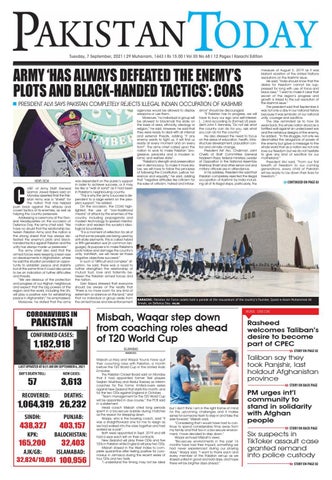
KARACHI: Pakistan Air Force cadets hold a parade at the mausoleum of the country's founder, Quaid-e-Azam Muhammad Ali Jinnah, on Defence Day. ONLINE
Misbah, Waqar step down from coaching roles ahead of T20 World Cup IsLAMABAD misbah-ul-haq and Waqar younis have quit their coaching roles with Pakistan, a month before the t20 World cup in the united Arab emirates. the Pakistan cricket Board said on monday that it had appointed former test players saqlain mushtaq and Abdul razzaq as interim coaches for the home limited-overs series against new Zealand that starts this month, and for the two t20s against england in october. “team management for the t20 World cup will be appointed in due course,” the PcB said in a statement. head coach misbah cited long periods spent in a bio-secure bubble during matches as the reason for stepping down. Waqar, who is the bowling coach, said “it was a straightforward one for me to resign as we had walked into the roles together and had worked as a pair”. Both were appointed in sept. 2019 and still had a year each left on their contracts. new Zealand will play three odis and five t20s in Pakistan while england will play two t20s. misbah stayed in the West indies to complete quarantine after testing positive for coronavirus in jamaica during the recent series of four t20s and two tests. “i understand the timing may not be ideal
MORE INSIDE
Rasheed welcomes Taliban’s desire to become part of CPEC STORY ON PAGE 02
AgENcIEs
LAST UPDATED AT 8:31 AM ON SEPTEMBER 6, 2021
measure of August 5, 2019 as it was blatant violation of the united nations resolutions on the kashmir issue. he said, “india should know that the desire for freedom cannot be suppressed for long with use of force and black laws.” “i want to make it clear that secret of this region’s progress and growth is linked to the just resolution of the kashmir issue.” the president said that september 6 was not only a day in our national history because it was symbolic of our national unity, courage and sacrifice. the day reminded as to how 56 years back, the whole nation stood as a fortified wall against an undeclared war and the nefarious designs of the enemy, he added. “in this struggle, not only we decimated the arrogance of power of the enemy but gave a message to the whole world that as a nation we not only love our freedom but we do not hesitate to give any kind of sacrifice for our motherland.” President Alvi said, “from our first breath of freedom to our coming generations, every child of Pakistan will be ready to lay down their lives for freedom.”
taliban say they took Panjshir, last holdout Afghanistan province STORY ON BACK PAGE
but i don’t think i am in the right frame of mind for the upcoming challenges and it makes sense for someone fresh to step in and take the side forward,” misbah said. “considering that i would have had to continue to spend considerable time away from my family and that too in a bio-secure environment, i have decided to step down.” Waqar echoed misbah’s views. “Bio-secure environments in the past 16 months have had their impact, something we had never experienced during our playing days,” Waqar said. “i want to thank each and every member of the Pakistan set-up as we stayed united in good and bad days, and hope there will be brighter days ahead.”
PM urges int’l community to stand in solidarity with Afghan people STORY ON BACK PAGE
six suspects in tiktoker assault case granted remand into police custody STORY ON PAGE 02
02
Tuesday, 7 September, 2021
KARACHI
NEWS
RASHEEd wElCOMES TAlIBAN’S dESIRE TO BECOME PART Of CPEC
I
NewS DeSK
NTERIOR Minister Sheikh Rasheed Ahmed has welcomed the Taliban’s desire to become part of the multibillion-dollar China-Pakistan Economic Corridor project, reported Radio Pakistan. Talking to the media persons in Islamabad on Monday, he said the CPEC is the jugular vein of Pakistan, and the friendship between Pakistan and China is higher than in the Himalayas. “Pakistan is proud of its friendship with China and if the Taliban hold similar views, then it is really good,” he said, terming the
Taliban’s desire to become part of the project as “encouraging”, saying “it is good” if the Taliban’s views about China were similar to that of Pakistan. It bears mentioning that the Taliban had on Saturday also described China as its “most important partner”, saying Afghanistan looks to Beijing to rebuild the country and exploit its rich copper deposits as the war-ravaged country faces widespread hunger and fears of an economic collapse. Taliban spokesperson Zabihullah Mujahid had said the group supports China’s One Belt, One Road initiative that seeks to link China with Africa, Asia and Europe through an enormous network of ports,
Court seeks response in Noor murder ISLAMABAD Staff RePoRt
The Islamabad High Court on Monday issued notices to the respondents in the murder of the daughter of a former ambassador. Noor Mukadam, 27, was found murdered at the residence of one Zahir Zakir in Sector F-7/4 of Islamabad in July. Zakir, widely believed to be the killer, was arrested the same day for his purported involvement in the gruesome incident. A first information report registered on the complaint of Ambassador Shaukat Ali Mukadam, Mukadam’s father, nominated Zakir under Section 302 (premeditated murder) of the Pakistan Penal Code. The directive was issued during the bail petition filed by Zakir Jaffer, father of the suspect. During the proceeding, the counsel for Zakir requested the court to nullify a sessions court’s decision to deny bail to Jaffer and his spouse, Asmat Adamjee, and grant him bail until a verdict was announced. Subsequently, the court adjourned the hearing until next week. Last month, the police had disclosed the DNA test and fingerprints of the accused showed his involvement in the murder. They said that photogrammetry tests conducted on a video in which Mukadam was seen making efforts to save her life and being chased by the accused confirmed that it was genuine. The footage had been sent to the Punjab Forensic Science Agency in Lahore to confirm its authenticity. Meanwhile, a district and sessions court in Islamabad adjourned the hearing in the bail petitions of the gardener, Jan Muhammad, and domestic help, Jameel, of Zakir in the case until September 11. The two are detained in Adiala Jail on judicial remand. Additional Sessions Judge Sheikh Muhammad Sohail heard the application.
Overseas Ministry proposes three officer names for EOBI chairman slot
railways, roads and industrial parks. The interior minister said that those who perpetrated recent suicide attacks in Gwadar and Mastung had come from Afghanistan. He said the Afghans have assured that they will not allow their land to be used against Pakistan. He said Pakistan desires peace and stability in Afghanistan. He said the progress of Pakistan and Afghanistan is interlinked. Two boys were killed and four others, including a Chinese national, injured when a suicide bomber blew himself up targeting a vehicle carrying Chinese nationals in Gwadar on Aug 20, while four people had lost their lives and 20 were injured on Sunday in a suicide attack near a checkpost
on Mastung Road in Quetta. Rasheed also said that India had 68 training camps in Afghanistan, which are now dysfunctional. The minister reiterated that Pakistan supported peace, development and prosperity in Afghanistan, saying “the peace in the two countries is interlinked.” Responding to another question, Rasheed said Pakistan would take decisions about its side of Torkham, Chaman, while the Taliban had the authority to make decisions on their side. He, however, added that the [Pakistan] government would decide about those who were coming into the country without documents.
Six suspects in TikToker assault case granted remand into police custody NewS DeSK A Lahore court on Monday granted the physical remand of six suspects of the Minar-e-Pakistan assault case to police custody, it emerged. The six suspects were identified by the victim during an identity parade at Lahore’s Camp Jail on September 1. A total of 160 suspects, in groups of 20, were presented before the victim out of which she recognised six of them. All six men were jailed in separate cells, and police had earlier informed that they would be presented
before the court for a physical remand. The police had arrested the suspects by tracing them through geo-fencing and face matching technology. Earlier on Friday, a court released 98 out of the total 104 suspects that have so far been taken in for the Minar-e-Pakistan assault case after TikToker Aisha Akram could only identify six of them during the court proceedings. At the outset of the hearing, the police produced 98 suspected individuals before Judicial Magistrate Hassan Sarfaraz Cheema. The police informed the court that the suspects had been taken into custody for manhandling TikToker
Aisha Akram inside the Greater Iqbal Park (Minar-ePakistan) on Independence Day. “Akram identified only six out of the 104 suspects presented during an identity parade,” maintained the police. At this, the court dismissed the 98 suspects, directing the police to release them. Meanwhile, the Punjab deputy inspector-general said that the suspects identified by the victim are the fundamental characters involved in the incident. He said that all the 400 men nominated as suspects in the First Information Report are not involved in the case. However, the investigation is underway and other culprits will also be arrested soon, he added at the time.
Celebration of Defence Day is to protect Pakistan’s geography, ideology, democracy: Bilawal KARACHI INP
Pakistan Peoples Party (PPP) Chairman Bilawal BhuttoZardari has said that the sacrifices of the martyrs, the unwavering determination of the soldiers and the invincible unity of the people of Pakistan is our strength and the guarantee of our bright future. In his message issued on Defence Day, the PPP chairman said that the struggle of PPP is to make Pakistan stronger to strongest. Greeting the nation on Defence Day of Pakistan, Bilawal said that the befitting celebration of Defence Day of Pakistan is to protect geography, its ideology and democracy. The PPP chairman pointed out that it was
nation’s first-elected prime minister Zulfikar Ali Bhutto who gifted the nuclear programme and his daughter former prime minister Benazir Bhutto who gave missile technology programme to ensure stronger defence of the country. Bilawal said that all those soldiers who laid down their lives while defending Pakistan would remain unforgettable heroes in the national history. “On this Defence Day, I, on behalf of entire nation, assure the families of our martyred heroes sincere support and sympathies,” he added. He further said that he salutes all those the civil citizens who have made exemplary sacrifices in the war against terrorism and extremism. Bilawal pledged to follow the ideology of the country in the light of philosophy of Quaid-e-Azam Mohammad Ali Jinnah to ensure an impregnable defence.
ISLAMABAD Shahzad PaRacha
The Ministry of Overseas Pakistanis and Human Resource Development has proposed three officer names for the chairman of Employees Old-Age Benefits Institution slot (EOBI). Sources said that the Ministry of OP&HRD has proposed the names Shakeel Ahmad Mangnejo, Humair Karim and Syed Ataur Rehman. The federal cabinet on Tuesday is likely to give approval of the name of Pakistan National Shipping Corporation Chairman Shakeel Ahmad Mangnejo as EOBI chairman for the period of one year or till the appointment of chairman through competitive process whichever is earlier, sources added. The Establishment Division, on the direction of the Prime Minister Secretariat, furnished these officers’ names for posting to run the affairs of the ministry. It is pertinent to note that the slot of EOBI chairman has been vacant since February 2021 after the retirement of the last chairman. The ministry had given the look after charge to grade 20 Director-General HR of EOBI however he cannot make strategic decisions. Sources in the ministry told this scribe that leaving EOBI as regular chairman might affect the very health of the institution as the department is at a critical juncture so the overseas ministry had asked the PM Office to post an officer for an interim period to run the affairs of the ministry.
PM approves posting of new chief secretary, Punjab IGP ISLAMABAD
He said Afghans had assured their territory would not be used against Pakistan, while the latter also made the same assurance to its neighbours. “However, in this country, there is BLA, Daesh and other terrorist organisations, but our Army has the capacity to deal with them effectively,” the minister added. When asked about the visit of ISI DG to Kabul, Rasheed responded that Gen Faiz dominated Indian media for two days. “It seemed as if he visited Delhi instead of Kabul,” he said. He insisted that Afghanistan was going to be the cynosure of world politics in days to come.
NAB seeks more time to present evidence in Sindh CM case ISLAMABAD INP
An Islamabad accountability court heard the alleged fake bank accounts and money laundering reference against Sindh CM Murad Ali Shah on Monday. Judge Syed Asghar Ali adjourned the hearing after Investigation Officer (IO) said he had to present details of the properties of the accused Muhammad Ali. The judge of accountability court said if all the accused are present then indict them today but the Murad Ali Shah advocate pleaded that most of the pages are missing from the reference volume which were provided to them. The accountability court summoned the investigating officer in NAB reference.
Sindh Chief Minister Murad Ali Shah talking to media persons outside the accountability court said he saluted all the martyrs and Ghazis of the 1965 war. Murad Ali Shah said, “The investigating officer of NAB was not present in the court in today’s hearing. There are 66 volumes in this reference out of which four volumes were not provided,” he told media persons. The pandemic has spread a lot and Pakistan has not yet been removed from the UK’s red list authorities are not satisfied with the situation and statistics of coronavirus in Pakistan. He said Sindh has a very strict protocol in the province and his administration always provides all the details while making the decisions as per the NCOC guidelines.
ECP reserves verdict over holding local body elections in Sindh
MIaN abRaR
NewS DeSK
Prime Minister Imran Khan has approved appointments of new chief secretary and Punjab inspector general of the police. According to informed sources, the prime minister gave approval of the new postings during a meeting with Punjab Chief Minister Usman Buzdar ended. According to sources, Kamran Ali Afzal will be the chief secretary while Rao Sardar will be the Punjab IGP. According to sources, the prime minister approved the appointment of both the officers. The Establishment Division will issue the notification today after formal approval from the cabinet. Kamran Ali Afzal is currently the federal secretary industries while Rao Sardar is the Punjab Safe Cities Authority MD.
A bench of the Election Commission of Pakistan (ECP) on Monday reserved its decision over the local government elections in Sindh after arguments. Earlier, a three-member bench of the ECP during the hearing pertaining to delay of local government polls in Sindh observed that holding local government elections is the responsibility of the provincial government. “The Supreme Court has given its verdict with regard to the local bodies polls in 2015, but the provincial government delaying to fulfill its constitutional responsibility,” the ECP panel remarked. “Sindh government had earlier presented its condition of the Census results for local boy elections and after
release of the census results it has expressed new reservations,” the bench observed. “The federation as well as the provinces are bound to hold local government elections,” the bench further observed. The election commission also instructed the provincial government to provide details of the number of union councils, maps and other data to the commission. Adviser to Sindh Chief Minister Murtaza Wahab said the provincial government had reservations over the census results published on May 6 after approval by the Council of Common Interests and pointed out that the province could lodge its reservations and an appeal under the constitution had been filed with the federal government.
NAB creates hurdles in development of country: Ahsan Iqbal NewS DeSK Pakistan Muslim League-Nawaz (PML-N) leader Ahsan Iqbal on Monday said that false cases are being filed just to take revenge from political opponents. Talking to media persons, Ahsan Iqbal said that NAB destroyed already functional projects and created hurdles in development of the country but no one is holding government accountable for massive increase in prices of petrol, gas, electricity and medicines. The PML-N leader further said that Rs2.5 billion were spent on Narowal Sports City but the anti-graft watchdog showed cost of Rs6 billion. Iqbal added that NAB has lost its credibility and pointed out that only one month is left in retirement of chairman of the bureau but government has not started any consultation with the opposition.
SHC seeks progress report in reopening of May 12 mayhem cases NewS DeSK The Sindh High Court (SHC) on Monday heard the case related to reopening the cases regarding the May 12, 2007, mayhem, which claimed at least 50 lives in Karachi. The court heard a case regarding the investigation into the reopening of 65 cases regarding May 12, carnage. The additional prosecutor general Ali Haider Saleem appeared before the SHC in today’s hearing. During today’s hearing, the AIG Karachi sought time from the court to submit a progress report into the reopening of the cases. The govt counsel said that the applicant named Iqbal Kazmi has expired, to which the SHC bench, ordered the concerned SHO to submit a death certificate. Later, the court adjourned the hearing of the case until October 4 Around 50 people were killed and over 100 wounded in attacks on rallies organised by members of political parties and legal fraternity who had attempted to receive the then deposed chief justice of Pakistan, Iftikhar Mohammad Chaudhry, at the Karachi airport ahead of a lawyers’ gathering. Justice Chaudhry was forced to fly back to Islamabad after having been restricted to the airport for nine hours. MQM’s Waseem Akhtar was home adviser to the Sindh chief minister at the time.
Tuesday, 7 September, 2021
KARACHI
Government ensurinG rule of lAw to AttrAct foreiGn investment, Promote tourism: Pm ISLAMABAD
P
app
RIME Minister Imran Khan said the government was struggling to establish the rule of law in the country to attract foreign investment and promote tourism. “We are fighting a battle to reform the system. No country can prosper sans rule of law. Many countries with sufficient resources are suffering poverty just for the absence of rule of law,” the prime minister said while addressing the groundbreaking ceremony of a hotel Monday. The hotel will be built and operated under a brand of Hilton — an American hospitality company. It will be built on land belonging to Galiyat Development Authority and leased to a local hospitality business. With this project, Hilton is entering Pakistan after more than four decades showing confidence in the government for its friendly policies to attract foreign investment. The prime minister, who earlier unveiled the plaque and also planted a sapling under the government’s Billion Tree Tsunami programme, said the opposition criticised the government because they did not want the establishment of rule of law.
They take advantage of the corrupt system which does not let foreign investment come to the country, he declared. He said the country was moving ahead with a record sale of cars and growth of large scale manufacturing this year. The prime minister said nine million overseas Pakistanis were earning more than the combined income of 220 million population, but unfortunately, their potential was never tapped. The previous governments only thought of their own benefits and survival instead of public welfare, he added. He said wealth creation was the dire need that would ultimately generate jobs, enhance tax collection and lead to the repayment of foreign debts. He said in order to attract investment from overseas Pakistanis, it was essential to introduce incentives and ensure protection as they had earlier lost trust due to corrupt practices in the country. He said Pakistan’s exports would reach $30 billion this year, whereas Singapore had touched the $300 billion mark and Malaysia $200 billion. Imran said efforts should be made to attract investment from overseas Pakistanis unless the exports reached the desired level. He said owing to the Khyber Pakhtunkhwa government’s efforts for the promotion of tourism, the
poverty level declined the fastest among all provinces as had also been recognised by the United Nations. He said the construction of a hotel in Nathia Gali would attract more investment and promote high-end tourism and skiing. He said the construction of hotels would follow the development of resorts and skiing facilities. He said Pakistan had also great potential for skiing owing to prolonged snowy conditions. The prime minister said the KP government had introduced zoning regulations in the province to provide land for hotels and resorts at low cost comparing the private sector. On the occasion, Mumtaz Muslim, an overseas Pakistani investor constructing the hotel, said he had left the country in 2004 following threats, but having impressed by Prime Minister Imran Khan’s dream of Naya Pakistan, he had decided to invest again in the country. He said the Hilton had returned to Pakistan after 42 years, which would prove to be a step forward for the promotion of tourism. He said the project would cost $25 million and take three years to complete besides creating about 600 jobs. He also proposed the government to offer public lands for hotels and industries for an enhanced lease period of 99 years.
Army ‘has always defeated the enemy’s plots and black-handed tactics’: COAS ContInueD froM pAge 01 Another lesson which our enemy learnt from the war of 1965 was that in a challenging time, the whole Pakistani nation and the Pakistani armed force had an unremitting and exemplary relationship, he continued. “Whether the war is of 17 days or 70 years, conventional or non conventional, our enemy cannot weaken our traditions and resolve for sacrifice.” He said that the jawans of army, navy and air force had always defended the freedom and security of Pakistan with their blood. “Their sacrifices of lives not only protected future of our coming generations but made the nation proud for all times to come.” While remembering the unforgettable sacrifices of the armed forces, the President said, “We remember the day of September 6 with a new determination and we from the core of our heart pay tribute to the great sons of the soul and families for their strength of feelings of patriotism for the country. “No doubt martyrs are our pride and our crown.” ‘INDIA WILL HAVE TO GIVE KASHMIR ITS RIGHT TO SELF-DETERMINATION’: India will have to give the people of occupied Kashmir the free exercise of the right to self-determination, embodied in a dozen outstanding United Nations Security Council resolutions, Prime Minister Imran Khan said on Monday. “On our part, we will continue to expose the real face of a radicalised India”, he said in his message on the occasion of Defence Day. The nation marked Defense and Martyrs Day to pay tributes to the soldiers who lost their lives for the defence of the country in its second war imposed on it by its archrival India. The fighting between the two neighbours took place between August and September
before ending on September 22 with an UN-sponsored ceasefire. The day dawned with a 31-gun salute in Islamabad and a 21-gun salute in all four provincial capitals, Radio Pakistan said. Special prayers and recitation of the Holy Quran were also held in mosques across the country for the martyrs, who sacrificed their lives in the war against terrorism. The prime minister said due to the proactive diplomacy of his government, the international community was now convinced that the persecution of minorities across India and the atrocities unleashed on the people of Kashmir must end forthwith. “The saner international elements do recognise our role for peace,” he said. He, however, reiterated that “our desire for peace must not be misconstrued as weakness rather it must be reciprocated for sake of economic wellbeing and public’s prosperity in the entire region”. Imran observed nations come out stronger and harder in the face of challenges. “Pakistan and its people stood out too […] strong and resolute when the enemy in the 1965 War challenged our existence.” He recalled that when India on September 6, 56 years ago, declared a war against Pakistan, the whole nation came out in support of its defenders — the military — and many started a march towards the border to fight the enemy with bare hands. “Such a display of national unity galvanised the armed forces in their fearless fight against the enemy, an act which has no parallel in history.” “The prime minister said the gallant soldiers and officers, pilots and sailors proved to the world that they were ever ready to defend every inch of the homeland at all costs.” “They fought bravely, without caring for their own lives, and defended the frontiers by offering supreme
sacrifice,” he said. “This magnificent day, September 6, comes every year to allow us to pay tributes in particular to our heroes, the ghazis and martyred, and the members of the gallant armed forces overall, who have always been nation’s hope and pride.” “We salute the valiant sons of soil for laying down their precious lives in defence of their country. We pay homage to the families of Shuhada for sacrificing their loved ones in the defence of the motherland,” Imran said. “As we remember this day, the enemy has not accepted [our] peaceful coexistence since the creation of Pakistan — be it 1948, 1965, 1971 wars — the two decades-long war against terror, creating disturbances and sponsoring terrorism inside Pakistan or new waves of propaganda through cyber warfare and spyware.” He pointed out that unfortunately, in the past, India, using Afghanistan’s soil, consistently perpetrated terrorism against Pakistan to create unrest. “On this day, we not only condemn those involved in such heinous acts [of militancy] but also pay special tributes to our valiant military who have rendered invaluable sacrifices for our motherland”, he said. “The world must hold India accountable for its rogue behaviour.” “We commend the proactive and timely response of our security forces […] India today stands exposed before the world for its bid to hamper peace in the region, especially inside Pakistan.” “My message on this day to the valiant armed forces is that: together we have come a long way in the struggle to make Pakistan’s defence strong and impregnable”, he added. The prime minister said the resilient nation and battle-hardened troops have time and again proved they are capable of defending the country and ready to meet any eventuality.
NCOC daily report: 3,613 new cases, 57 deaths from Covid-19 ISLAMABAD Staff RepoRt
Pakistan on Sunday reported 3,613 new Covid-19 cases, the National Command and Operation Centre said on Monday.
The NCOC, a department leading campaign against the pandemic, said the number of overall confirmed cases had risen to 1,182,918, including 1,064,319 recoveries. The number of active cases has risen to 92,367 who are under treatment across the country, including 5,606 in a critical situation.
According to the NCOC, 57 people died of the virus on Sunday, increasing the overall death toll to 26,232. Sindh is the most affected province of the country in terms of the number of cases with 438,327 infections followed by Punjab which has reported 403,157 cases.
India, Pakistan veterans see slim chance of full-scale war ISLAMABAD anadolu agency
Military veterans from India and Pakistan foresee a slim chance of a full-fledged war between the two nuclear neighbors, dubbing it an “inconceivable” idea on the 56th anniversary of the 1965 war. They also called for “political engagement” to resolve long-pending disputes, including the Kashmir issue. Retired Lt. Gen. H.S. Panag, an Indian war veteran, who participated in the 1971 war as a young captain against Pakistan, observed that the “nuclear factor” massively diminished the chances of a full-scale war. “In 1998, both countries became nuclear powers. Now nuclear nations don’t fight a full-scale war, because nuclear capabilities come into play at some point in time and Pakistan has been practicing nuclear brinkmanship to its advantage,” Panag told Anadolu Agency while
accusing Islamabad of waging a “proxy war” in the occupied Kashmir region. “Wars and conflicts continue between nations and they never end […] but in the modern era with nuclear weapons, the concept of an all-out war is over. It no longer can take place,” he said. “What can happen is, below the threshold of war and there are also limits to that.” Stating that India has also refrained from attacking Pakistan because of the same reason, he said Pakistan “cannot be decisively defeated by India.” Echoing Panag’s views, retired Lt. Gen. Talat Masood, who participated in two wars against India, in 1965 and 1971, also rejected the possibility of a fullfledged war even if the nuclear factor is kept aside. “Yes, nuclear capability is a factor but if even they are not nuclear, it would make no sense to go into fullfledged war in this era,” Masood, who served in an
armoured division that took part in a fierce tank battle on the eastern borders in the 1965 war, told Anadolu Agency. The battle, involving hundreds of tanks from both sides, took place at Chawinda village that sits on the Pakistan-India border near northeastern Sialkot district, is considered the second greatest tank battle after World War II. “(In case of an all-out war) You will push your country back 15 – 20 years, apart from alienating yourself from the international community. Things will get harder for your people, the economy will be shattered and matters will be complicated further,” he said. It is not a “sensible” and “conceivable” idea that the two countries will make a “blunder” to go into a war, he added. Retired Major Ikram Sehgal, who was an aviation pilot in post-1965 war skirmishes along the border between then East Pakistan, now Bangladesh, and India and six years later in the 1971 war, also ruled out the chances of an all-out war.
NEWS
03
9 deAd And 984 injured in 916 roAd Accidents in PunjAb newS DeSk The Punjab Emergency Service (Rescue1122) responded to 916 Road Traffic Crashes (RTCs) in all 37 districts of Punjab during last 24 hours. In these RTCs, nine people died, whereas 984 were injured. Out of this, 616 people were seriously injured who were shifted to different hospitals. Whereas, 368 minor injured victims were treated at the incident site by Rescue Medical Teams, thus reducing the burden of hospitals. In a majority of accidents, (67 percent) motorbikes were involved, therefore effective enforcement of traffic laws and lane discipline are essential to reduce this increasing number of Road Traffic Crashes. Further, the analysis showed that 402 drivers, 51 underage drivers, 108 pedestrians, and 483 passengers were among the victims of these road traffic crashes. The statistics show that 241 RTCs were reported in Lahore which affected 242 persons placing the Provincial Capital at top of the list followed by 65 in Multan with 67 victims, and at third 59 RTCS in Faisalabad with 67 victims. The details further reveal that 993 victims were affected by road traffic crashes — 803 males and 190 females — while the age group of the victims shows that 189 were under 18 years of age, 525 were between 18 and 40 years and rest of the 279 victims were reported above 40 years of age. According to the data 771 motorbikes, 107 auto-rickshaws, 77 motorcars, 33 vans, 06 passenger buses, 28 trucks and 119 other types of auto vehicles and slow-moving carts were involved in aforesaid road traffic accidents.
Armed forces Pakistan’s pride, their sacrifices matchless, says church leader LAHore Staff RepoRt
September 6 marks the day when we honour the supreme sacrifices made by our gallant armed forces to safeguard the integrity and dignity of our beloved homeland in the face of a hostile and much stronger enemy, said the presiding bishop of the Church of Pakistan. In a statement on the occasion, CoP Moderator/President Bishop Dr Azad Marshall said that our martyrs had written new chapters of virtuous deeds and heroic acts in 1965, and their glorious legacy was being upheld today by our armed forces who had successfully countered both internal and external threats to the country. “The entire Pakistani nation, irrespective of their faith, caste and creed, stand firmly behind our armed forces and we want the world to know that we will never compromise on our sovereignty, security and national integrity,” he said. Bishop Marshall said that the spirit of Sept 6 had made the nation stand firm and steadfast against all odds. “It is this spirit that has kept us defiant and resilient against all forces conspiring against our great country. We are committed to securing peace, but we are also prepared to thwart any internal or external plots against Pakistan,” he added. The senior church leader said that members of the religious minorities, particularly Christians, had played a major role in the defence of the motherland and laid down their lives to protect its sanctity. “The heroic deeds and valour shown by our Christian heroes in all three wars fought with India is a testament of our selfless love for our country. Even today a large number of Christians and other non-Muslims are serving in the armed forces and security agencies and their services to the motherland are second to none,” he said. He said that the entire Pakistani Christian community was standing firm behind their armed forces under the able leadership of General Qamar Javed Bajwa and other services chiefs. “I commend our armed forces and security agencies for their relentless efforts towards exposing the enemies carrying out covert activities against Pakistan and we assure them of our complete support and cooperation,” he added. “We are always at the beck and call of our military and civilian leadership and will never hesitate in rendering our services in the national interest of Pakistan,” he concluded.
“An all-out war means, it may turn into a nuclear conflict. And in that case, the winner and the loser will stand nowhere,” Sehgal said to Anadolu Agency. Brig. M. P. S. Bajwa, an army veteran who commanded an Indian brigade during the 1999 Kargil skirmish against Pakistan, said, “It is very unlikely because both countries are nuclear-armed and they apparently have realized it is not an option.” POLITIcAL ENGAGEMENT: The 17-day war that began September 6, 1965, was an escalation of irregular fighting that started regarding Kashmir, a sore point between the two countries ever since partition in 1947. The war eventually ended with a draw, following a peace agreement, brokered by the then-prime minister of the now-defunct Soviet Union in Tashkent, the capital of Uzbekistan. Nonetheless, both countries declared victory. Pakistan, since then, has been celebrating September 6 as Defense Day. Insisting that another war will further complicate matters, Masood sees a “political engagement” as the only option to resolve longsmoldering disputes between the two nuclear-armed neighbors.
Tuesday, 7 September, 2021
04 NEWS
KARACHI
PSX ShedS 38 POiNTS ahead OF MSCi review KARACHI
T
TLTP
HE Pakistan Stock Exchange (PSX) remained range-bound on Monday ahead of the MSCI review decision on Tuesday (today), with the benchmark kSE-100 Index shedding 38.95 points (-0.08 percent) to close at 46,918.52 points. MSCI Inc, the world’s largest index provider, on June 25 proposed reclassifying the MSCI Pakistan Index from emerging to frontier markets as the Pakistani equity market has not met all necessary requirements. The index compiler began consultation with market participants on August 31 and will announce the decision on September 7 (today). The market opened on a positive note and remained positive for most part of the session. The kSE-100 Index moved in a range of 198.4 points, showing an intraday high of 47,087.3 points and an intraday low of 46,888.9 points. Among other indices, the kSE All Share Index gained 18.29 points (+0.06 percent) to close at 32,221.05 points, while All Share Islamic Index gained 16.86 points (+0.07 percent) to close at 23,404.95 points. A total of 382 companies traded
shares in the stock exchange, out of them shares of 164 closed up, shares of 203 closed down while shares of 15 companies remained unchanged. Out of 96 traded companies in the kSE-100 Index, 37 closed up, 57 closed down, while two remained unchanged. The overall market volumes decreased by 47.13 million to 417.85 million shares. Total volume traded for the kSE-100 Index was 94.85 million shares. The number of total trades increased by 265 to 124,365, while the value traded decreased by rs0.20 billion to rs12.03 billion. The market capitalisation increased by rs4.53 billion. Among scrips, TPL topped the volumes with 59.67 million shares, fol-
TrOkE can occur after a sudden disruption of blood supply to a part of the brain, sometimes causing a loss of ability to move particular parts of the body [Face, arm, leg], inability to see or speak and sudden change in balance. There are three types of stroke that require immediate recognition. (1) Ischemic stroke: A blood clot forms and blocks the artery in the brain. (2) Hemorrhagic Stroke: It occurs when a brain blood vessel ruptures. (3) Transient Ischemic Attack [TIA]: It is a warning that ischemic stroke is impending because of narrowing of blood vessel causing flow disruption. Globally, Stroke affects 33 million individuals every year with two-thirds of all strokes occurring in the developing countries. Over the last few decades, the burden of stroke has been increasing worldwide, especially in developing countries. In a developing country like Pakistan, the prevalence and incidence of stroke is not exactly known largely because of lack of healthcare data collection and availability. Unfortunately, health epidemiology is not an established field in developing countries. review of the reported case series from the medical literature pertaining to stroke incidence in Pakistan, it is apparent that Pakistan likely has the world’s highest rate of stroke per capita. In a small series of stroke patients from Islamabad, the crude age-and sex-adjusted stroke incidence was found to be 95 per 100,000 persons per year during the years 2000 to 2016, with the highest incidence of 584,000 of 650,000 noted among individuals aged 75 to 85. However, ground reality speaks completely otherwise where we see younger age groups of either gender experiencing stroke. Higher prevalence of diabetes and hypertension starting at younger ages amongst the population could be a potential reason for the age disparity and stroke onset in Pakistan. Lack of access to a national standardized ambulance transport service across the country considerably adds to patient morbidity & mortality in patients with neurological time barred emergencies.In developing country like Pakistan, we see ‘It’s God’s Will’ mindset at most hospitals and patient only receives basic medical management [Blood pressure, diabetes etc.] and are left to luck. Lack of National standardized Emergency Transport System contributes to worsening in Morbidity and Mortality when it comes to treating time barred emergencies like Acute Stroke/ Neuro Trauma, Heart attacks etc. Unlike Pakistan, all over the world, there is only one Emergency room/Department concept as all specialties [Medicine, Surgery, Neurosurgery, Neurology, Cardiology etc.] are available under one roof to deal with any emergency in a timely fashion. Frequently, more than one organ is affected and having all specialists in the Emergency Department yields better patient outcomes. We frequently see patients going with strokes to Cardiology specific institutes only to be told later that the symptoms are stroke specific and not heart. But by then it’s too late to offer any acute stroke specific therapies. Similarly, brain related fatal complications frequently take place following acute cardiac problems / procedures and no neurologists or neurosurgeons are available within the cardiac center to provide immediate treatment. The overall death rate from stroke in industrialized countries among people over age 65 years is about 10%12%. Improved preventive medicine and utilization of aggressive acute stroke interventions and therapies have in recent decades, led to a steady decline in stroke incidence in most developed nations since 1970. In developed countries, stroke incidence, its associated morbidity & mortality is constantly declining because of robust stroke awareness and aggressive therapies administered within the acute period. Creating more stroke survivors has been the mantra in the developed world compared to ‘Its God Will’ approach in developing countries.
S
lowed by SErFr (35.74 million) and TELE (31.01 million). Stocks that contributed significantly to the volumes include TPL, SErFr, TELE, WTL and ANL, which formed over 40 percent of total volumes. The sector wise, the index was let down by fertilizer with 32 points, cement with 30 points, refinery with 16 points, engineering with 12 points and investment banks/ investment companies/ securities companies with 9 points. The most points taken off the index were by ENGrO which stripped the index of 20 points followed by UBL with 18 points, HBL with 15 points, SEArL with 13 points and LUCk with 11 points.
The sectors propping up the index were miscellaneous with 35 points, technology & communication with 27 points, oil & gas exploration companies with 18 points, commercial banks with 7 points and chemical with 6 points. The most points added to the index were by PSEL which contributed 35 points followed by MEBL with 28 points, MArI with 19 points, SYS with 18 points and BAHL with 12 points. The market gurus are divided over the outcome of the MSCI review and are not unanimous about the downgrade impact on foreign portfolio investment. Some think that a potential downgrade to MSCI FM will be positive for the market in the long run. Pakistan fits well in the FM space, both in terms of size and stage of economic development, they argued. They said Pakistan would have a higher weight in FM and could attract more inflows than currently in EM. Meanwhile, in its report on Monday trading, Pearl Securities said that investors were concerned about the swelling trade deficit, lower cement despatches in August, depreciation of Pakistan rupee against the US dollar, and supply chain disruption resulting in cost pressure for the industries, and these were the prime reasons behind lacklustre activity during the day.
Tayaba Organisation raises over 2m in Pakistan’s first ever NFT fundraiser
Tayaba Organization is a non-profit focused on the issue of water scarcity and accessibility in Pakistan, and become the first Pakistani NGO and one of the first globally to implement the innovative block chain-based NFT technology for fundraising purposes in the charity sector. It launched and auctioned a limited collection of NFTs primarily to raise much needed awareness for its water accessibility initiative. This represents a unique and tangible use-case as it gains more acceptance across the world. The fundraising campaign immediately gained traction on Instagram with an increasing number of people showing interest in the initiative due to its creativity and technological ingenuity. Tayaba Organisation, is envisaged as a catalyst for introducing affordable solutions to address water scarcity in Pakistan along with associated problems of non-existent or poor water infrastructure. To tackle this problem, Tayaba Organisation offers an innovative solution called the ‘H2O (Help-2-Others) wheel’, till date having positively impacted over 50,000 underserved and marginalised people with a grave identified water need. Tayaba Organisation was founded by Bilal Bin Saqib. Leveraging learnings after graduating with a Master’s in Social Innovation and Entrepreneurship from the London School of Economics, Bilal’s social work has not just received a Points of Light Award and acknowledgment by PM Boris Johnson for the charity’s impact, but he has also previously featured in the Forbes 30 Under 30 list in recognition of Social Entrepreneurship through Tayaba. PRESS RELEASE
With a stroke, time lost is brain lost
Stroke is also a leading cause of long-term disability. Three quarters of all strokes occur in people age 65 or older, and the risk of stroke doubles each decade after age 55. Acute Ischemic Stroke (AIS) treatment has been revolutionized in the last two decades with the increasing use of Intravenous Thrombolysis (IVT) and with the advent of Endovascular therapy (EVT). AIS treatment and outcome are time dependent and in the developed countries time saving measures are being implemented at every step of the treatment chain. These changes have resulted in lower treatment time’s in-hospital and excellent outcomes if stroke patients are treated within the Golden Hour i.e. treated within 60 minutes of symptom onset. It is really good news that nearly 80 percent of strokes are preventable. Stroke is described as a “brain attack,” and is different from heart attacks. Brain Attacks [ischemic stroke] are predominantly painless while heart attacks present with severe chest pain. This difference should be recognized by both the patient and public at large so that the brain attack patient is transported to a dedicated Neurology department capable of treating acute strokes. Ischemic strokes are the most common variety, caused by a blockage of blood flow to the brain due to which brain cells near the blockage to die within minutes. If an acute evolving stroke is not treated within the first 6 hours of its onset, 2 [two] million neurons [brain cells] die every minute during stroke evolution. On an average ischemic stroke evolution can last up to 10 [ten] hours. Both types of strokes [ischemic & hemorrhagic] are serious and require immediate medical care. A number of myths surround strokes, their causes and treatments. Many people think that strokes only affect older adults or that they are not treatable. The reality is that strokes can happen to anyone at any time, and proven treatments are available –But only if a stroke victim receives medical attention quickly and at the right medical facility. The approach that you do not have to go to see a neurologist/doctor if stroke symptoms go away is the most dangerous myth associated with the Stroke. Temporary stroke symptoms are called transient ischemic attacks, or TIAs, and serve as an important warning sign prior to an actual stroke – a warning that
CMYK
needs to be taken seriously. Some call TIAs “mini strokes,” and they precede nearly 15 percent of actual strokes. During a stroke, the part of the body controlled by the area of the brain experiencing the stroke stops functioning. Warning signs include sudden numbness or weakness of the face, arm or leg– especially on one side of the body. Other symptoms include confusion, trouble speaking or understanding. The victim may have trouble seeing out of one or both eyes, and they may have difficulty walking or maintaining balance. A sudden, very severe headache might also be a sign of a stroke if there is no other cause. If you think your loved one or friend might be having a stroke, remember the Acronyms; “B.E.F.A.S.T & F.A.S.T” Balance: Ask the person if they are experiencing any balance issues or dizziness? Eyes: Ask the person if they are having trouble with vision. Face: Ask the person to smile. Does the side of the face drop? Arms: Ask the person to raise both arms. Does one arm drift downward? Or is one arm difficult to raise up? Speech: Ask the person to repeat a simple phrase. Is speech slurred? Time: With any of these signs, call 1122 immediately. Using an ambulance with sirens saves valuable time. Seek medical attention quickly if there is any suspicion of stroke. We, here at Services Hospital Lahore, have the motto “Stroke isn’t the End of Story – It’s just a Beginning”. Do not wait for symptoms to improve or worsen, instead note the time and call 1122 or area ambulance service immediately. A clot-busting medicine called IV [intravenous] tPA[tissue Plasminogen Activator] can be used for patients experiencing an ischemic stroke–but it must be given intravenously within 0-3 hours of stroke symptom onset. The bottom line is that immediate medical attention is critical to improving the chances for stroke survival and lowering the chances for complications. Department of Neurology at the Services Hospital, Lahore has Acute Stroke Service line that provides 24×7 Stroke Care and does administer the clot busting tPA if patient arrives within the stipulated time frame [0-3 Hours] of symptom onset and meets the inclusion criteria. An Acute Stroke patient once identified has to undergo emergent CT Brain and some essential blood tests before being considered for clot busting medication administration. Hence, the earlier the stroke is identified, the earlier the treatment can start. Studies have shown, that earlier treatment shows significant improvement compared to those who come late to Emergency Department/hospital. Some patients might also be eligible for a catheterbased procedures [Thrombectomy, Aspiration] to remove the blood clot, or other procedures to open up arteries narrowed by fatty deposits which reduces the chance of another stroke. Nothing is better than Prevention. Preventing the first
stroke or a recurrent stroke requires controlling modifiable lifestyle risk factors such as being overweight, smoking, physical inactivity, excessive alcohol use, intake of energy drinks and sodas and illicit drug use (cocaine, amphetamines, heroin etc.). Medical risk factors–many of which are directly related to lifestyle– include high blood pressure, high cholesterol, diabetes, sleep apnea and cardiovascular disease. Controlling high blood pressure and diabetes are the most important things that can be done to prevent strokes. Thus, exercising, managing stress, maintaining a healthy weight, limiting sodium, sugar and alcohol intake, and taking prescribed medications are critical. Doctors might also prescribe preventative medications like antiplatelet drugs, anticoagulants, and cholesterol-lowering drugs, diabetes medications, CPAP machines for sleep apnea, and smoking cessation aids can also play a role. For hemorrhagic strokes (brain bleeds), the risk factors are very similar, with high blood pressure being the leading cause. Head injuries, bleeding disorders and blood thinners are also additional causes. Catheters or surgery can be used to repair aneurysms or other vascular malformations associated with hemorrhagic strokes, and non-invasive stereotactic radiosurgery is also an option in certain cases. After a stroke, recovery and rehabilitation efforts focus on restoring function to permit a return to independence. Physical, occupational, speech and cognitive therapy all play an important role in recovery and minimizing complications. Modifying risk factors to minimize the chance of another stroke is also very important. At the Department of Neurology, Services Hospital Lahore, patients are managed in dedicated Neurocritical Unit followed by both In-Patient & OutPatient rehabilitation. State of the Art Neurocritical & Neuro rehab units have been established to help patients transition back to community with minimum to no dependence. So while all strokes– large or small–should be taken seriously and acted on quickly, the good news is that they can be preventable and treatable. Remember -Acute Ischemic Stroke Is a Treatable Condition. “Stroke isn’t the End of Story – It’s just a Beginning”. Prof Dr Qasim Bashir is a heads the Neurology department at Services Institute of Medical Sciences. He is US Board Certified in General Neurology, Vascular Neurology, Neurocritical Care & holds C.A.S.T [USA] Neuroendovascular Surgery Accreditation. He has also served as President of Pakistan Stroke Society.)
Tuesday, 7 September, 2021
KARACHI
NEWS
Court orders FBR to appoint a bold officer for investigation of tax fraud ISLAMABAD SHAHZAD PARACHA
The Customs Court has ordered the Federal Board of Revenue (FBR) to appoint a bold officer for the investigation of tax fraud. The Special Judge Customs, Taxation and anti-smuggling Karachi in its order ordered the FBR Chief Commissioner, Inland Revenue to himself look into the matter and entrust the investigation to those bold, honest as well as efficient persons who would not try to hide responsible officers of the department in the tax fraud for a logical and legal conclusion of the cases. The special Judge Sadaf Asif in her order mentioned that the Directorate of Intelligence & Investigation (1R) Karachi has lodged many FIRs regarding tax fraud and in these FIRS this Court received an Interim Charge-sheet. On receiving the Interim Charge-sheets, this Court asked the investigation Officers to explain that if the alleged offence is pertaining to the year 2012 why there is an inordinate delay and Inaction on the part of the department In addition, why is there no nomination of the responsible officer of the department involved in these cases of tax fraud? There is no explanation available for not nominating a sanctioning Officer of the department. In these cases, the department has also challenged the federal ombudsman order before the President of Pakistan which has also been dismissed on 27.02.2020. There were specific directions in the Federal Ombudsman's Order for the nomination of the responsible Officer in these cases and also directed the Chief Commissioner-IR, RT0-11, Karachi to identify the officials/officers who failed to thoroughly securitize the claims of RP, and to recover the inadmissible input tax claimed/adjusted and take disciplinary action against them; The ombudsman was also directed to initiate appropriate action including criminal proceedings leading to the prosecution of RP and recovery of amount swindled from public exchequer through claiming fraudulent refund/inadmissible input tax within 45 days. Now submission of the Charge-Sheets by not nominating the responsible Officer of the department amounts to throwing dust in the eyes of the Court. Let this Order be sent to the Chief Commissioner, Inland Revenue, to himself look into the matter and entrust the investigation to those bold, honest & efficient persons who would not try to hide responsible officers of the department in the Tax fraud for logical & legal conclusion of the cases.
Text Book Publishers Association President Fawaz Niaz addresses a ceremony. ZUBAIR MEHFOOZ
ISLAMABAD
w
GHULAM ABBAS
HILE the construction industry is represented by the Association of Builders and Developers of Pakistan (ABAD) asks government to take action against cement manufacturers and steel makers for increasing prices of their products, the steel industry has rejected the claims saying it was builders who have increased prices of apartments and homes manifolds during the past few years. ABAD in a recent stamen had claimed that stern action should be taken against the cement manufacturers who had formed a cartel to control the price of the input. Besides, it said the continuous increase in prices of cement and steel bars would badly damage the construction industry and jeopardise progress on the Naya Pakistan Housing Scheme. However, rejecting the association’s claims, the Pakistan Association of Large Steel Producers (PALSP) said on Monday that the statement regarding the increase in the prices of rebars in the country was irresponsible and a conspiracy against PM’s Naya Pakistan Housing Project. Officials of PALSP claim that the Naya Pakistan Housing Scheme (NPHS) and the set of incentives given to the construction industry were visionary initiatives taken by the honourable PM to provide affordable housing and churn the economy. However, the
05
EConomy IS In A StAtE oF GRowth: tARIn ISLAMABAD
F
STAFF REPORT
EDERAL Minister for Finance and Revenue Shaukat Tarin has said that the economy is in a state of growth. He made these remarks while presiding over a meeting to review the trade balance situation at the Finance Division. Federal Minister for Economic Affairs Division Omar Ayub Khan, Secretary Commerce, Secretary M/o Information Technology, Secretary Finance Division, Governor State Bank of Pakistan Dr Reza Baqir, Executive Director General BOI and other senior officers participated in the meeting.
Adviser for Commerce Abdul Razak Dawood participated through a video link. Secretary Commerce briefed the participants about the trade balance situation over the last two months. Considering the expansion in economic activity, the import of one-time items like a vaccine for COVID-19 as well as increased demand for raw materials have resulted in increasing imports during July and August 2021. In his remarks, the Finance Minister stated that the economy is in a state of growth. As the economy registered a growth rate of 4 per cent during FY2021, there is an increased demand for imports. As long as the trade deficit is within a sustainable level, it will stimulate economic recovery, he added.
The Finance Minister stressed upon the Ministry of Commerce to conduct sensitivity analysis and build scenarios for effective forecasting both in imports as well as exports for each month of the year. In his concluding remarks, the Finance Minister said that the prudent policies adopted by the present government have stimulated economic recovery amid the COVID-19 pandemic. The economy is heading in the right direction. The enhanced revenue collection along with improved ratings (Business Confidence Index and by international credit rating agencies) indicate that the economy has gained momentum and is geared towards inclusive and sustainable economic growth.
Financial crisis of OMCs worsens ISLAMABAD AHMAD AHMADANI
Faced with a serious financial crisis, the Oil Marketing Companies (OMCs) have requested the government to take measures to help address the issues of OMCs which operate under-regulated margins of less than three per cent of the sales price. According to sources, the financial crisis of the OMCs have worsened and the multinational companies (MNCs) which are operating in the country are either considering or on the verge of exit as nothing positive seems to be coming out of the prevailing situation. “OMCs has recently sent a letter to Oil and Gas Regulatory Authority (OGRA) and Petroleum Division, and raised their serious concerns besides floating some suggestions for consideration of the government to help address the issues of OMCs,” said sources. They added that if the government does not pay due heed to the worsening financial issues of OMCs and it does not introduce a separate policy to help address OMCs issues then multinational OMCs might leave the country and shut down their businesses in the country while local OMCs are already about to close their businesses while stateowned Pakistan State Oil (PSO cannot fill the gap due to certain reasons. As per sources, the government is relying on PSO to fill the gap, however, due to the high level of ever-increasing circular debt, the PSO cannot fill the gap of the failure/closure of private OMCs which carries a high risk of fuel shortage in an already precarious situation. “OMCs have been facing financial crisis mainly owing to exchange loss, less margin, and heavy inventory loss due to COVID-19,” said sources. Sharing suggestions of OMCs for solving their financial constraints, sources said that the government should support the industry and introduce much-needed reforms so that the industry gets back to normal and to avoid investors shying away from the industry as a whole. Like the refinery policy,
the government should bring a separate policy for OMCs to help address its issues, including but not limited to related to investment in infrastructure, revision of margins, phased deregulation. It is also learnt from sources that the current situation in the mid to long term will adversely impact foreign direct investments, infrastructure development; investment in transport; building storage and maintaining an adequate stock level that may compromise the availability of adequate stock and would result in frequent fuel shortages. Ongoing investigations have cautioned the banks in extending credit to OMCs which operate a highly capital intensive business model. The situation has become much more precarious due to a potential default situation of Rs.58bn related to an OMC, said sources. Sources further informed that OMCs have been operating under regulated margins which is less than three per cent of the sales price and with a turnover tax of 0.75pc on gross receipt (rather OMCs margins) and ensures OMC pay turnover tax in case of loss (effective tax rate is higher in turnover tax regime). In the last 3 years from 2018 until 2020, the OMCs have incurred significant exchange losses due to the devaluation of PKR versus USD. It is worth mentioning that Oil Marketing Companies (OMCs) have been struggling for survival. The oil industry is heavily regulated as the Government and OGRA have strong control over the oil industry. OGRA is watching the strategic and critical aspects of the sector and monitors the petroleum products/prices. The government through the Ministry of Energy (Petroleum Division) manages, controls & approves a) supply/demand planning, b) determination of shortfall & import quantities, c) allowance of permission to import, d) allocation of local refineries production and e) approval of timing of imports. Prices, margins and product procurement is regulated, controlled and managed by the government through OGRA and the Ministry of Energy (Petroleum Division).
USAID, KP Govt working to complete $6181m infrastructure programme ISLAMABAD STAFF REPORT
The United States Agency for International Development (USAID) has been working with the provincial government of Khyber Pakhtunkhwa (KP) government to complete the largest infrastructure program, with an estimated cost of $6181 million. As per the details, the KP government, in cooperation with USAID has been doing remarkable work restoring the vast network of roads in the province. The project has turned out to be a welcomed improvement for travellers and commercial transportation in the area. The 62km DI Khan-Tank Road, which includes the Tank Bypass is also a result of USAID’s enormous cooperation. The road was inaugurated by General Raheel Sharif on September 16, 2015. Not long ago, travellers spent close to four hours from one end of the roadway to the other. Now, that same distance can be completed in approximately 40 minutes, thanks to the USAID improvements. The highly significant road not only helps durable peace in the tribal areas but in the fields of education, health, information and prosperity in the newly merged districts in KPK. Furthermore, the economic activities have increased in the area with the construction of this imperative road. The two-lane carriageway highway project reduced travelling time, resulting in better transportation, which helps promote trade and industry in the region. The project also facilitates a major overhaul of educational and medical facilities in the area and an improved standard of living for the inhabitants of the area.
Steelmakers, ABAD at loggerhead over prices of construction materials biggest barrier to affordable housing is the real estate builders and developers themselves. Prices of homes, apartments and office spaces – particularly in urban areas, have increased significantly over the past few years due to an increasing appetite of real estate developers for high margins. With some of the highest net profit and return on equity margins across industries, the need of the hour is government regulation to fix the pricing of various categories of real estate projects whether it be residential or commercial development. “Since there is very little transparency in the real estate development sector, the government needs to audit the income tax contribution of such lucrative ventures. After a huge amnesty given to the builders and developers to whiten the black money, further oversight from the government needs to ensure that un-accounted and un-declared wealth (black money) is not being used moving forward,” the steel manufacturers said. According to a statement issued by PALSP on Monday the year, 2021 witnessed an extraordinary increase in the price of rebars worldwide which has been as a result of a shortage of raw material/ scrap due to
Covid 19 related factors as well as due to increasing in demand of steel globally. However, even though the cost of input increased drastically, still, the steel sector of Pakistan has been providing rebars at a price that is less or in some cases equal to countries like China, Turkey, the US, UK and the CIS states who are leading steel producers. The steel sector has been absorbing the increasing cost of inputs by reducing its net margins that hover around 4 to 5 per cent recently. In the FYs 2018-2020, major players declared losses and many smaller ones went out of business. The year 2021 provided a little bit of relief due to an increase in demand for steel; however, the steel sector is fighting for survival. PALSP represents the documented & transparent steel sector comprising the most credible players of the steel sector. Over the period ranging from August 2020 to August 2021, scrap prices (C&F Karachi) had shot up from $ 299 to $ 530, accounting for a 79pc increase in raw material cost. Electricity cost, a major input for steel producers, over the same period also jumped 37pc from PKR 13 to PKR 20. Similarly, RLNG has increased by 90pc over the past year and fer-
CMYK
roalloys, also a raw material used for steel making, have jumped up by 58pc. All such factors have forced steel manufacturers the world over to increase prices while absorbing some of the impacts that are apparent in the meagre industry margins of 4-5pc. “However, the good news is that the sudden hike of raw material prices is a sort of bubble, created by supply chain disruptions that create a shortage of metal scrap in the global market. As global trade starts to recover and make its way back to a normal level of efficiency, the supply side of the raw material could once again come back to pre-Covid levels, resulting in a normalization of prices. Due to the fragmented and highly competitive nature of the steel industry in Pakistan, having over 400 steel units re-rolling primarily steel bars, the normalization of raw material prices will automatically be translated and domestic steel prices will come down,” PALSP said. According to the association, looking to the future, if steel demand is to grow at 8pc per year, Pakistan will need to double steel production in the next 10 years to keep pace with a growing economy. How-
ever, with such meagre profitability and an array of tariff and tax anomalies, who would like to invest in the steel sector? The government must create a long-term roadmap that provides a facilitating and progressive environment for investment in the steel sector which is the backbone of our country’s economy. Earlier ABAD had claimed that cement and steel manufacturers have begun raising prices of inputs as soon as construction activities took off following the announcement of incentives for the sector by Prime Minister Imran Khan last year. Chairman ABAD Fayyaz Ilyas had termed the increase in cement and steel prices a conspiracy against the construction industry. Citing figures, Ilyas said that steel bars were sold for Rs110,000 per ton in November 2020, however, the price now soared to Rs178,500, which depicted an increase of more than Rs68,000. On the other hand, cement manufacturers also hiked prices to Rs680 per 50kg bag, he said, adding that the two commodities constituted 60pc of the total cost of a high-rise building while the proportion amounted to 30-40pc for residential houses.
Tuesday, 7 September, 2021
06 COMMENT
The easiest way to mislead oneself
Looking for a shortcut to power After Zardari, Bilawal woos electables
A
ftEr putting up an appearance at PDM’s rally in Karachi, the disunited PML-N leadership has confined itself to talk shows or interviews on private tV channels. there has been no attempt to interact with the masses through public meetings. for the time being the party has transited from confrontation to conciliation without officially announcing it. Meanwhile PPP chairman Bilawal Bhutto Zardari is on a weeklong campaign in South Punjab to recruit the ‘eletcables’. the idea is to put up a show of strength aimed at convincing the local elite that the PPP still has pockets of support thus encouraging them to join the party. In his speeches Bilawal reminded the audience that under Benazir Bhutto and Asif Ali Zardari, PPP governments provided jobs and kept prices of commodities under control while during the PtI tenure there is rampant unemployment, poverty and shrinking purchasing power. Bilawal also claimed, not without justification, that BB was the first national leader that wanted to carve out the South Punjab province. Keeping in view the next elections where the PPP will have to contend with the PML-N also, Bilawal claimed that the PtI-led government would have been overthrown with a no-confidence motion had his party not been “misled and deceived” by the leadership of the PDM. With an eye on the electables, Bilawal predicted that the next government in the country would be formed by his party, and the new premier will be a “jiyala”, so come and join it. Bilawal Bhutto Zardari being the first major political leader to visit Dera Ghazi Khan in recent months, the PPP’s workers’ convention in the city turned into a large public gathering. Bilawal’s cavalcade received a warm welcome on Muzaffargarh Bypass also. Bilawal’s tone and tenor remained the same in Multan despite the response being somewhat frosty. Here he managed to induct into party an exhausted crew of politicians that included two PML-Q men, an MQM ticket holder and a spiritual leader. In June this year Asif Al Zardari had spent eight days in Lahore waiting for electables from Punjab coming to join his party. He managed to get not a single person. Will his more energetic heir succeed in obtaining the Holy Grail remains to be seen.
Or how not to reason
HASAN AFTAB SAEED
H
AVING done a lot of debating on and off internet forums for twenty-five years now, I have a fair idea about the various ways people tend to mislead themselves and others, sometimes by design and sometimes unconsciously. One of these ways is to cite the most foolish argument from the ‘other’ side – one can always find such arguments – followed by asserting how that is beneath the consideration of any sensible person. this is very gratifying for the ego, for it is always reassuring to be periodically reminded that one is in the right (again). But the reassurance is misleading because short of countering the best argument from the most intelligent representatives of the other side, one neither validates one’s own position nor demonstrates the weakness of its antithesis. Only by rebutting the best arguments from one’s opponents can one hope to make any real progress. Unfortunately, way too many people resort to scoring cheap points instead. this is especially the case when it comes to debates on religion. It is usually done by ignoring intelligent arguments and focusing only on those that can easily be shown to be faulty. Even those discussions that start on a reasonable footing too often tend to lose their way sooner or later. A typical debate of this sort proceeds somewhat as follows: It starts with somebody questioning the wisdom behind (say) a Quranic verse. One responds to the objection, to which there are further objections, and so on. So far so good, because the discussion revolves around the contents of the Quran, whose authority every Muslim recognizes and acknowledges. Suddenly, if the objector feels that things are going off-script – that is, the desired result is unlikely to ensue – he suddenly switches track and comes up with this argument: ‘But the
Election reform Bulldozing amendments through parliament will be counterproductive
I
t seems the PtI government is in an unholy haste to provide legal cover to its election reform plan, the primary component of which is the introduction of Electronic Voting Machines (EVMs) and allowing overseas Pakistanis to participate in elections remotely through ‘Ivoting’. the opposition is questioning the government’s motives behind bringing about such sweeping changes to the electoral process, alleging it is part of an elaborate plan to rig the 2023 general elections. Even the Election Commission of Pakistan (ECP) is not fully convinced that introducing EVMs is the best approach towards free and fair elections. the required amendments that will have to be made to the Election Act 2017, need to pass through parliament and it is the upper house where the PtI government will face a challenge as it does not have the required numbers to defeat the collective opposition. Perhaps this is why Senate Chairman Sadiq Sanjrani, after receiving a lot of flak from the PPP, has brought back lawmaker Mustafa Nawaz Khokhar to the Senate Standing Committee on Parliamentary Affairs weeks after moving him to another panel without his consent, but at the same time has included Samina Mumtaz Zehri of the Balochistan Awami Party, which skews the numbers in favor of the PtI at the committee level. It is very unlikely that the government will fail to pass these amendments as it always has the option of calling a joint session of both houses to make sure it has the requisite numbers to succeed. It is unfortunate that such sweeping changes are being brought to one of the most important democratic exercises that takes place in the country without the necessary discussion and debate in parliament and will most likely be bulldozed thorough, just like various previous bills have been during the past three years where bipartisan consensus was completely absent. the ECP must also give its nod of approval for these measures to be undertaken. Being a regulatory authority independent of the executive and the body that will have to make the use of EVMs and I-voting safe, fair and free of controversy, it is a major stakeholder. the government would therefore do well to provide an honest unbiased opportunity to both the opposition and ECP to voice their concerns and address them. Otherwise, the PtI’s endeavor to reform the election process will be thoroughly counterproductive, creating more problems for themselves rather than others.
SANiA AriF
O
N August 12, a Christian couple in Haripur alleged that their underage-14-year-olddaughter has been kidnapped and forcibly converted to Islam. the parents further said the minor has been married to a Muslim boy in Shah Mansoor town of the Swabi district. In a written complaint and video message, the parents of the girl, Noreen Maseeh and francis Maseeh, residents of the Mubeen Banda of Ghazi tehsil of Haripur District stated, “Our daughter is a student of 9th class and she was preparing for exams in the house, when she went missing around 12.45am on August 11.” the parents accused a local boy named Zulqarnain, and a local Pakistan tehreek-e-Insaf (PtI) leader Akhtar Shah over the abduction. the parents also claimed that after the kidnapping, they approached Shah, however, the PtI leader said the girl has married Zulrqarnain after converting to Islam. then the issue reached another PtI leader from the party’s minority wing, Peter Neroz Gill. He raised the issue, claiming that the girl is underage and was forced to convert to Islam for marriage. He stated the cleric who solemnized the marriage, changed the girl’s age from 14 to 17. Gill blasted the local police for not registering the case earlier and for delaying it by nine days. “Had the police taken action without delay, the girl would have been saved from falling into wrong hands,” he says. the court has shifted the girl to a Darul Aman (Shelter Home), while her alleged kidnappers, both the son and father have been sent to jail. During the hearing the girl told the court that she married the Muslim boy “without any coercion or temptation” and she wanted to live with her husband. Observers say incidents of forced conversions have increased in Pakistan. According to Peoples Commission of Minorities’ right and the Centre for Social Justice data, there have been 156 incidents of
Founding Editor
Yousaf Nizami Umar Aziz
Joint Editor
Joint Editor
Executive Editor
Lahore – Ph: 042-36300938, 042-36375965
Members of all groups (which include the various brands of theists) are equally guilty of nitpicking exceedingly silly arguments from their opponents, blasting them to smithereens, and feeling smug on a job well done.
Forced conversions continue unhindered
Arif Nizami (Late)
M. A. Niazi
only for the purpose of attacking it. that is so because intelligent people on either side (whatever their views on the issue) know better. If you want to condemn Marxism, by all means do so; but make sure you object to the doctrines of Marx and Engels, and not some keyboard warrior’s arguments, who has no clue what Marxism stands for. If you want to invalidate relativity, refute its recognized sources, not what some science enthusiast on the internet may have to say on the subject. If you want to find fault with Islam, attack its sources rather than what some mullah preaches in some obscure mosque in a village. relying on a creed’s best and most reliable sources, for acceptance as well as refutation, is a principle that holds equally for intra-faith discussions. there is no dearth of such discussions between the different schools of thought among the Muslims, most of which leave a great deal to be desired. therefore, if a Salafi wants to criticise Sufism, it is not good enough for him to attack the teachings of some Sufi practitioner named Kaku Shah or rodday Shah managing some shrine, although the temptation to do so could be considerable. to criticize Sufism, he must make it a point to consider nothing but the best Sufi sources – leaders whom the rest of the Sufi community recognizes as such, and which therefore owns their arguments: Imam Ghazali, Ibn Arabi, or Shah Waliullah, for example. If he wants to make any real progress, that is. The author is a connoisseur of music, literature, and food (but not drinks). He can be reached at www.facebook.com/hasanaftabsaeed
Another minor Christian girl victimised
Dedicated to the legacy of late Hameed Nizami
Editor Aziz-ud-Din Ahmad
Muslims/Mullahs say that [insert something particularly silly here].’ Which is usually true because some Muslims conceivably say (and do) such things and worse. the question though is, has that got anything to do with Islam. Also, of what value is such a ‘victory’ in debate? the above is just an example. Muslims by no means constitute the only demographic that finds itself on the receiving end of this tactic. Members of all groups (which include the various brands of theists) are equally guilty of nit-picking exceedingly silly arguments from their opponents, blasting them to smithereens, and feeling smug on a job well done. What is more, you are certain to find all sorts of people that make up the numbers of any group you can think of, equipped with arguments ranging from the sublime to the ridiculous, with everything in between. this is what makes the life of the nit-pickers so easy. the flawed reasoning behind this sort of attitude is the deliberate or unconscious lumping together of all people holding a particular opinion. for instance, consider a man who has his reasons to believe in the One God. He is supposed to give an account of his belief; that is, he must be able to respond to any objections on his position. However, he is in no way supposed to justify the broad range of arguments put forward by everybody claiming to be a monotheist. He does not hold anybody’s brief but his own. therefore, when a cleric opines that the increase in the occurrence of earthquakes can be explained by the prevalence of abortions, it is only a wastage of time on the part of the so-called pro-choice folks to dignify the ‘argument’ by quoting it, even if it is
I
Karachi – Ph: 021-35381208-9
I
reported forced conversions, taken place between 2013 and 2019. As per the same report, the vast majority of these girls are minor as young as 12 years old. A Human rights Commission of Pakistan (HrCP) report cites an annual 1,000 forced conversions stating that a vast majority of these aren’t reported. Legal experts point to the fact that Pakistan is signatory of Universal Declaration of Human rights which states that the freedom of religion includes the right to change of one’s religion, however, without coercion. Meanwhile, European Court of Human rights has also given some guidance regarding the distinction between coerced conversion and permissible conversion. As per the case law, it is illegal to exploit a position of power to convert. However, analysts say the legal system of Pakistan is extremely discriminatory, especially against the women from minorities. Experts also point towards a loophole that girls cannot convert back because it is prohibited in Islam and hence barred by Pakistani law. furthermore, observers say that in most of these cases, the girls don’t speak to parents directly, after they “elope” and also are not allowed to meet their “infidel” families. Experts aren’t optimistic about the future, espe-
Islamabad – Ph: 051-2204545
cially in the aftermath of religious clerics and political parties having expressed reservations on the draft of anti-forced conversion bill. During a meeting, held on August 25, 2021 at Ministry of religious Affairs, the religious clerics warned the government that the bill cannot be implemented in its current shape. the verdict was given without any member of religious minorities being invited for the meeting. Along with other reservations, the clerics expressed serious concerns over the minimum age of conversion. As per the insiders, it was pointed out that minimum age of 18 years for conversion is incorrect. “this age bracket was contrary to the draft domestic violence bill that was currently with the law ministry,” said one cleric. Another said: “When parents cannot even scold their children under the domestic violence bill, so can they stop their children from embracing Islam?” the bill’s draft stated that person who forces someone to change the religion can face between 5 to 10 years in jail and a fine from rs100,000 to rs200,000. Meanwhile, the age of the person willing to convert will be determined by the child’s birth certificate, school enrolment certificate or Nadra Bform. “Only in the absence of such forms the child’s age may be determined on the basis of a medical examination,” the draft added.
As per the case law, it is illegal to exploit a position of power to convert. However, analysts say the legal system of Pakistan is extremely discriminatory, especially against the women from minorities. Experts also point towards a loophole that girls cannot convert back because it is prohibited in Islam and hence barred by Pakistani law.
I
Web: www.pakistantoday.com.pk
I
The writer is a freelance columnist
Email: editorial@pakistantoday.com.pk
Tuesday, 7 September, 2021
COMMENT 07 Editor’s mail Send your letters to: Letters to Editor, Pakistan today, 4-Shaarey Fatima Jinnah, Lahore, Pakistan. e-mail: letters@pakistantoday.com.pk Letters should be addressed to Pakistan today exclusively
Pakistan and Bangladesh Economic ties
The Taliban’s takeover of Afghanistan And the prospects for women’s rights
HuDA rAzA
T
HE taliban’s stunning takeover of Afghanistan’s capital, Kabul, was an immense shock to nations around the world. In a matter of weeks, 20 years of history have been reversed at a pace nobody might have anticipated. Just days after the U.S. military pulled out of Afghanistan, the taliban took control of key cities and installed themselves in the presidential palace in Kabul – in spite of thousands of U.S. troops and enormous assets. Although the taliban’s recent detente with the Afghan people, the terror and fear are still evident in their eyes and an urgent debate is centered on how they will treat women. Even before the taliban’s takeover, there was an explicit debate in the international media and organizations like the United Nations (UN) about the imminent danger posed by the taliban’s rule to women’s rights in Afghanistan. therefore, the taliban’s takeover is just like a tom and Jerry game. And for Afghan women, this game is harrowing. the religion of Islam obligates its followers to respect the rights of women and children. there are specific provisions in Islam that define the rights of women in areas such as marriage, divorce, education, property rights, etc. Considering the taliban’s historical records on human rights, they came to power in 1996; their interpretation of Islam was too rigid to be endorsed even by Islamic countries. Only Pakistan, Saudi Arabia, and the United Arab Emirates recognized their rule, while internationally they were condemned for the massacres and brutal treatment of Afghan civilians. the taliban’s rule was identified by the enforcement of the harsh form of Shariah Law, which they believed was in the best interest of women, but in reality, this was devoid of any respect for human rights in general and women’s rights in particular. the assault on the prestige of women instantly began after they came to power. their rule was barbaric and autocratic. they brought engendered radicalism in their society regarding women’s rights. Women had virtually no rights; they were denied education and employment and were forced to comply with strict dress codes. full-face covering became mandatory in public, and women were not allowed to leave their homes without a male relative. their freedom was curtailed for ages. On the whole, society was influenced by this semi-fundamentalist militia, who did their utmost to brutalize and punish those who did not obey their edicts. As of now, it seems like the behavior of today’s taliban has changed over the last two
decades; rather, they now appear to be more disciplined, experienced, and vigilant. According to H.A. Hellyer, a senior fellow at the Center for Middle East Policy in Brookings, today is “a completely new situation,” so things are expected to be different. He added that “the taliban will be dealing with a new Afghanistan compared to the one of the 90s, with different roles that already apply to women and other groups.” Apparently, the taliban says it has changed as it is preparing to lead the country again. At their first press conference in Kabul, the taliban spokesman, Zabihullah Mujahid, was asked by a female journalist, “there are many concerns about women being allowed to work, about girls being able to continue to go to school. What assurances can you give to women and girls that their rights will be protected?” to which he replied, “the Islamic Emirate is committed to women’s rights under Sharia law. Our women have equal rights; they will work shoulder to shoulder with us. We want to assure the international community that there will be no discrimination against women, but, of course, within our religious framework.” the taliban have granted amnesty to those who have collaborated with foreigners earlier and have called on women and other minorities to join their government. Barely 24 hours after the taliban took power, a brave female journalist returned to the anchor’s desk in her studio and interviewed a taliban spokesman. Apparently, after years of war, trust is hard to come by. Millions of Afghans who lived through the 1990s taliban regime remember the taliban’s tough governing rules. the women of Afghanistan are terrified; they are not induced by the taliban’s assurances. Many women now stay indoors, afraid to go out again; women lawmakers fear for their lives. Women journalists fear that they may be targeted by the taliban. An Afghan journalist, Gulalai Karimi, said in an interview that it is quite tense in the government these days; we do not want to lose the rights we have earned over the last two decades. Whereas, we can see various events in the country reported by the BBC and CNN female journalists wearing a burqa without being abused, injured, or stopped, which shows that the taliban respects the Islamic dress code of women while allowing them to work and educate themselves unrestricted. It seems that the past has served as a template for the taliban group, and they are trying to present themselves as more moderate than they were in the 1990s by improving society economically, socially, and politically, but within the boundaries set by Islamic Shariah. Yet, people continue to wonder if this is the case for real. Many Afghans and world leaders are skeptical because if we analyze through the
lens of instrumentalism, it propounds that elites manipulate and politicize situations and use them as instruments to achieve their goals. So, by bringing about these changes, it seems like the taliban are trying to legitimize their rule. Public legitimacy is important to hold on to for an extended period. thus, legitimacy is the most important thing for them to rule right now, because they can’t go against people who, having lived through democracy, are quite hard to be governed. Also, this time they want broader recognition from the international community, which they lacked previously in the 1990s. the world expresses concerns over the changed behavior of the taliban towards women, with apprehensions that the leniency towards women may just be a tactic to normalize their estranged relations with the global community. Afghan women, who had never known an Afghanistan under taliban rule, reckoned with what this new era meant for their own lives. What comes next for women in Afghanistan after the taliban takeover? thus, only the days ahead can truly reveal what will and will not prevail in Afghanistan, especially about women. Although the taliban have asserted the freedom of women as per Islamic rules, in reciprocal to that, they have banned girls from taking education jointly with boys. female lecturers would be allowed to teach only female students, but not male ones, describing it as the “root of all evils in society”. Still, there remains a ubiquitous fear that they will reinstate their infamous system of gender segregation that prevailed in the late 1990s. Experts suggest that Afghan women will push forward no matter what. the only question is how bad it will get for them: Will the taliban go back to beating women with sticks who would resist and challenge the status quo? Will they force girls to marry taliban fighters? Will they forbid them from going to work or school, college or university? Will they jail women who break their rules? right now, the answer seems to be no, because the taliban 2.0 understands the demands of the 21st century. If they want to develop their relations with the international community and earn recognition, delivering on human rights is inevitable. If they repeat and follow the same strategy they followed two decades ago, then besides a tragic end to the freedom of Afghan women, the taliban will find it hard to run longer in Kabul and offset the multipronged socioeconomic, political, and security challenges in the days to follow. therefore, we can only hope that sanity among the taliban will prevail and Afghan women will continue to have a bright future under a taliban-led inclusive government.
It seems that the past has served as a template for the Taliban group, and they are trying to present themselves as more moderate than they were in the 1990s by improving society economically, socially, and politically, but within the boundaries set by Islamic Shariah.
The writer is a student of international relations at the national Defence university, islamabad.
tWO south Asian counties with Muslim majority are trying to reduce gap that other countries has taken advantage of. Pakistan and Bangladesh are making a push to build diplomatic, economic, cultural ties that could upend decades of historic arrangements in the region. Number of developments have been made for diplomatic ties. for instance, as Bangladesh PM Haseena sent Haribhanga mangoes as a gift to Imran khan which is a sign of development in terms of relations. Almost half of the population of South Asia is under poverty. It is sad that many South Asian countries are seen to prefer distant countries as trade partners instead of their closest neighboring economies. A 2018 study by the World Bank strongly argues that regional cooperation in South Asia can power the entire region to grow faster and improve Standards of living. It has been estimated that in 2015, the trade between Bangladesh and Pakistan has a potential to be valued at $1,376M. but instead of it only $837M. was recorded. It is because of the gap between trade potential and actual trade which is attributed to the gap in bilateral trade between Pakistan and Bangladesh. Hence it is stated that a stronger regional cooperation for sustainable peace and prosperity can be achieved through the improvement of bilateral ties and people to people exchange. the reason for enhancing bilateral trade with neighboring countries can be explained by the price hike of onion in Bangladesh in 2019 which reached at tK 300(USD 3.54). Onion prices were hiked at a hike because of Indian government banned export of onions to Bangladesh. to bring down the price of Onion, Bangladesh started to import onions from other countries like China, Pakistan, turkey and Uzbekistan. It was an important lesson for Bangladesh from the price hike of onions, that not depending solely on one country for any essential item, and enhancing bilateral relations with neighboring countries is a must to curb the price of essentials. Currently, Bangladesh’s volume of exports to Pakistan is very small. It is as small as $72 million which is just 0.2% of her total export. And import from Pakistan is small as well which is $784 million and it is just 1.3% of Bangladesh’s overall imports. And from Pakistan’s side it is 3.3%. trade between both countries are on only a few things like textile fiber, paper yarn and woven fabrics. Other major exports are tobacco, Cotton, apparel and clothing accessories which constitutes nearly 90% of Bangladesh’s imports from Pakistan. Bangladesh and Pakistan should sign a bilateral free trade Agreement. the reconciliation process between two countries, indubitably, is a welcome step. there is dire need for policy shifts by both governments to resolve the old issues in an expeditious manner to meet new challenges posed by the emerging world order. Mujeeb-ur-rahMan Lahore
A closer look at Jinnah’s vision of Pakistan tHIS year we are celebrating 75th birthday anniversary of Pakistan, but what Jinnah envisioned for Pakistan as a state remains a distant dream. the debate about the nature and character of the Pakistani state has never been more intense than it is today. Some still voice the demand for a theocratic state while others argue that religion has nothing to do with the business of state. Since Jinnah did not write a book or monograph, the main clues to his thinking are to be found in his speeches. Let us clear some fog about Jinnah’s vision of Pakistan through his speeches. the first speech was delivered on 11th August 1947 when the first Constituent Assembly elected him as their first President and the second on 14th August, which is now celebrated as Independence Day in Pakistan. If we put together these two of Jinnah’s speeches in crucial month of August 1947 we can glimpse his vision for the state he had created. the most significant and most moving speech was the one given on 11th August as it was outpouring of ideas on the state and the nature of society. On 11th August Jinnah said to his people “you are free: you are free to go to your temples, you are free to go to your mosques or to any other places of worship in this state of Pakistan. You may belong to any religion or caste or creed, that has nothing to do with the fundamental principle that we are all citizens and equal citizens of one state; Now I think we should keep that in front of us as our ideal and you will find that in course of time, Hindus would cease to be Hindus, and Muslims would cease to be Muslims, not in religious sense because that is the personal faith of each individual but in the political sense as the citizen of the state”. from this powerful passage comes a vision of a brave new world. the words were Jinnah’s: the thought and belief were an inheritance from the Prophet (SAW) who said thirteen centuries before that “all men are equal in the eyes of God and your lives and properties are all scared and in case you should attack each other’s life and property. today I trample under my feet all distinctions of caste, color and nationality”. this is the vision of an Islamic society which would be equitable, compassionate, and tolerant, and from which the poison of corruption, nepotism, mismanagement and inefficiency would be eradicated. If Pakistanis could follow these ideals, Jinnah would be confident of the future. Jinnah specifically did not want a theocratic state run by mullahs. Jinnah made his position clear in a broadcast to the people of the United States of America recorded in february, 1948 : In any case Pakistan is not going to be a theocratic state to be ruled by priest with a divine mission. We have non- Muslims- Hindus, Christians and Parsee- but they are all Pakistanis. they will enjoy the same rights and privileges as any other citizen and will play their rightful part in the affairs of Pakistan. Acceptance of minorities in the statements of Jinnah is also very significant as he had regularly reminded his Muslim audience of what Islam maintains. He said, ‘our own history and our Prophet have given the clearest proof that non- Muslims have been treated not only justly and fairly but generously’. Unfortunately, in today’s Pakistan there is an extreme discrimination on the basis of religion and there are certain laws which are instrumentalised by the religious lot and by sectarian and violent groups. there are centers of intolerance against minorities. therefore, we need to keep our Quaid’s legacy alive and endeavor to achieve a state of affairs consistent with his ideals, principles and vision that constitutes Jinnah’s Pakistan. Mian rauf Lahore
Tuesday, 7 September, 2021
08 WORLD VIEW
WhAt dIffErEncE dId 9/11 MAkE?
Project syNdicAte
t
JOSEPH S NYE, JR
HE terrorist attacks of September 11, 2001, were a horrific shock. Images of trapped victims leaping from the twin towers are indelible, and the intrusive security measures introduced in the wake of the attacks have long since become a fact of life. But skeptics doubt that it marked a turning point in history. they note that the immediate physical damage was far from fatal to American power. It is estimated that the United States’ GDP growth dropped by three percentage points in 2001, and insurance claims for damages eventually totaled over $40 billion – a small fraction of what was then a $10 trillion economy. And the nearly
3,000 people killed in New York, Pennsylvania, and Washington, DC, when the al-Qaeda hijackers turned four aircraft into cruise missiles was a small fraction of US travel fatalities that year. While accepting these facts, my guess is that future historians will regard 9/11 as a date as important as the Japanese attack on Pearl Harbor on December 7, 1941. the surprise attack on the US naval base in Hawaii killed some 2,400 American military personnel and destroyed or damaged 19 naval craft, including eight battleships. In both cases, however, the main effect was on public psychology. For years, President Franklin D. Roosevelt had tried to alert Americans to the Axis threat but had failed to overcome isolationism. All that changed with Pearl Harbor. In the 2000 presidential election, George W. Bush advocated a humble foreign policy and warned against the temptations of nation-building. After the shock of 9/11, he declared a “global war on terror” and invaded both Afghanistan and Iraq. Given the proclivities of top members of his administration, some say a clash with Iraq’s then-dictator, Saddam Hussein, was predictable in any case, but not its manner or cost. What 9/11 illustrates is that terrorism is about psychology, not damage. terrorism is like theatre. With their powerful military, Americans believe that “shock and awe” comes from massive bombardment. For terrorists, shock and awe comes from the drama more than the number of deaths caused by their attacks. Poisons might kill more people, but explosions get the visuals. the constant replay of the falling twin towers on the world’s television sets was Osama bin Laden’s coup. terrorism can also be compared to jujitsu, in which a weak adversary turns the power of a larger player
Online abuse kicked off long ago. So where are social media’s referees?
el PAis
W
NAYANA PRAKASH
HILE England soccer fans may have been crushed by a last-minute Euro final defeat on July 11, it is perhaps the aftermath of the match which will linger in people’s memories. Following England’s loss, racist abuse online was targeted specifically at Bukayo Saka, Jadon Sancho and Marcus Rashford, Black British players who missed penalties during the match’s final moments. Slurs ranged from repeated and dehumanizing use of the monkey emoji to calls for the players to “go back home,” reflecting the anti-immigration sentiments that are rife worldwide. the incident lit a fire under an issue already debated by many: what can social media platforms do about racism online? And why aren’t they doing more? Without trying to absolve tech companies, we need to be clear on a few points. First things first: this isn’t (solely) a technology problem. Governments across Europe are increasingly right-wing and hostile towards immigrants – or those perceived as being ‘outsiders.’ Few sports reflect this so clearly as soccer. there are numerous appalling incidents of racism in European soccer; Black players are verbally abused on the pitch and on social media depressingly often. Despite recent problems, the English Premier League is still seen by many as a ‘good example’ of a league making important changes to its approach to abuse against players. Yet even in England, there is a twisted irony to figures such as British Prime Minister Boris Johnson and Home Secretary Priti Patel condemning racist abuse, when it is the politics they practice which have helped engender hatred. How can racist ideology be successfully challenged in sport when it is being peddled on the streets by numerous European governments? Social media companies themselves do little to challenge these sentiments, as we have seen previously in examples all over the world. Delayed moderating action in the aftermath of major events such as the Euros is unacceptable when racism in soccer is so predictable. Facebook, twitter and Instagram should have been well-prepared for this and responded far more quickly to reports of abuse. It has also been observed that social media platforms’ existing policies against hate speech allow for many loopholes and exploitations. Instagram CEO Adam Mosseri admitted that the company made moderation ‘mistakes,’ and that the issue has since been “addressed.” this seems unconvincing when the
mistakes have been repeated so many times before. Indeed, Facebook’s previous commitment to “free speech” came at the heavy cost of allowing misinformation and violent speech to proliferate on the platform. Facebook’s history of removing racist content is not a favorable one; how, then, are we meant to trust such companies to effectively moderate racist abuse? technology may not have created racism, but by allowing such content on their platforms, tech firms reveal their complicity in allowing it to fester and spread. Despite significant challenges, there is positive change afoot. the European Union’s upcoming Digital Services Act specifically addresses hate speech and racism. It seeks to hold Big tech accountable in many ways, although there are already criticisms about items missing from the Act and other ways in which it may overreach its remit. Nevertheless, it does represent a crucial step forward in bringing EU countries to the same page on dealing with racism, abuse and misinformation. In the UK, on the other hand, numerous people incensed by the recent examples of abuse are campaigning to make ID a requirement for opening a social media account. there are many reasons why this is a slippery slope to venture down, and such proposed solutions show the difficulty of tackling online abuse without affecting the freedoms of Internet users. In Spanish soccer, the Lances del Juego argument is invoked to mean that what happens on the pitch, stays on the pitch. tensions run high, and things may be said in the heat of the moment. Yet abuse cannot be localized in this way. Racism does not happen ‘here’ or ‘there;’ it is an ever-fixed reality that refuses to disappear, regardless of where one might be. We need to stop thinking of social media platforms like Facebook, Instagram and twitter as being separate from the so-called offline ‘real world.’ Our lives are increasingly digitally mediated, such that there is no clear distinction between online and offline; racism on social media simply reflects the racism of European society. We must strive to moderate social media and remove hate speech – and those who generate it – in order to send an important message about the type of welcoming spaces that we want to create. In working to create these spaces, platforms are aided not only by the work of numerous organizations fighting online abuse, but by the heroism and outspokenness of soccer players such as Marcus Rashford, who refuse to be silenced by abusers. What measures institutions take against online harassment in soccer will no doubt have an impact on the way other sports treat racism in their ranks, especially as we enter the Olympics season. the English soccer team may have lost the Euros, but they have shown remarkable allyship and solidarity with the wider cause of anti-racism in their unified criticism of the abuse their players have experienced. It’s high time that social media companies and European governments – as well as other European soccer leagues – supported them in their noble fight to show racism the red card. Nayana Prakash is a PhD researcher at the Oxford Internet Institute (OII) at Oxford University, writing primarily on gender and technology in India.
against itself. While the 9/11 attacks killed several thousand Americans, the “endless wars” that the US subsequently launched killed many more. Indeed, the damage done by al-Qaeda pales in comparison to the damage America did to itself. By some estimates, nearly 15,000 US military personnel and contractors were killed in the wars that followed 9/11, and the economic cost exceeded $6 trillion. Add to this the number of foreign civilians killed and refugees created, and the costs grow even more enormous. the opportunity costs were also large. When President Barack Obama tried to pivot to Asia – the fastest-growing part of the world economy – the legacy of the global war on terror kept the US mired in the Middle East. Despite these costs, some say that the US achieved its goal: there has not been another major terrorist attack on the US homeland on the scale of 9/11. Bin Laden and many of his top lieutenants were killed, and Saddam Hussein was removed (though his connection to 9/11 was always dubious). Alternatively, a case can be made that bin Laden succeeded, particularly if we consider that his beliefs included the value of religious martyrdom. the jihadist movement is fragmented, but it has spread to more countries, and the taliban have returned to power in Afghanistan – ironically, just before the 9/11 anniversary that President Joe Biden originally set as the target date for withdrawing US troops. It is too early to assess the long-term effects of the US withdrawal from Afghanistan. the short-term effects of the chaotic exit are costly, but in the long term, Biden may come to be seen as correct to forswear the effort at nation-building in a country divided by mountains and tribes and united mainly by opposition to foreigners.
Leaving Afghanistan will allow Biden to focus on his grand strategy of balancing the rise of China. For all the damage done to US soft power by the chaotic manner of the exit from Afghanistan, Asia has its own longstanding balance of power in which countries like Japan, India, and Vietnam do not wish to be dominated by China and welcome an American presence. When one considers that within 20 years of America’s traumatic exit from Vietnam, the US was welcome in that country as well as the region, Biden’s overall strategy makes sense. At the same time, 20 years after 9/11, the problem of terrorism remains, and terrorists may feel emboldened to try again. If so, the task for US leaders is to develop an effective counter-terrorism strategy. Its core must be to avoid falling into terrorists’ trap by doing great damage to ourselves. Leaders must plan to manage the psychological shocks at home and abroad. Imagine what the world would be like if Bush had avoided the tempting rallying cry of a global war on terror and responded to 9/11 by carefully selected military strikes combined with good intelligence and diplomacy. Or, if he had gone into Afghanistan, imagine that he had withdrawn after six months, even if that had involved negotiating with the despised taliban. Looking forward, when the next terrorist attacks come, will presidents be able to channel public demand for revenge by precise targeting, explaining the trap that terrorists set, and focusing on creating resilience in US responses? that is the question Americans should be asking, and that their leaders should be addressing. Joseph S. Nye, Jr. is Dean Emeritus of Harvard University’s John F. Kennedy School of Government.
Why the Middle East no longer trusts America
ArAb News
I
HAFED AL-GHWELL
t will take a while for the dust of America’s hasty retreat from Afghanistan to settle, especially considering the hefty price tag for a nation-building project that was always doomed to fail, but the unceremonious end to a two-decade adventure will affect just about every corner of the Arab world. A battered and diminished Washington will find it even more challenging to exert influence in a region that has been, for decades, a major focus of its foreign policy since the end of the Second World War. Any modicum of authority the White House still had in the region is now in tatters. the Afghanistan debacle is no mere instance of yet another nation’s tumble with fate after exceeding the scope of its mission, and prolonging the stay in a perennially fragile, conflict-prone area. Afghanistan — and by extension, Iraq — came to symbolize the culmination of what should have been a decisive global counterterrorism campaign marked by devastating demonstrations of hard power, and soft power mostly via muddled efforts at post-conflict nation building. It went well beyond deployments of men, munitions and money in pursuit of narrow objectives. the “War on terror” was as much a forceful demonstration of America’s enduring commitment to the region, and the lengths it was willing to go in pursuit of its democratization ideals. Some will argue that the writing was already in the sand, considering the diminishing returns from what had become a runaway misadventure. to them, America’s departure had long become a matter of “when,” not “if.” All that was lacking was a political window of opportunity. Of course, pundits and opinion columnists will beg to differ. Regardless, the timing of President Biden’s fateful decision will always be a matter of debate, depending on which side of the political fence one falls. What is not up for discussion is the air of foreboding now descending on a region quickly being reshaped by intensifying rivalries and selfserving encroachments from Beijing and Moscow. there is ample justification for Biden’s critics to wonder whether the collapse of American credibility will accelerate an Al-Qaeda or Daesh re-emergence. Others fear a reinvented seemingly moderate taliban has learned how conciliatory overtures and diplomatic doublespeak can earn them friends in the unlikeliest of places, such as Iran. In other parts of the Arab world, Afghanistan was never a zero-sum game, and what was lacking was not America’s absence, but an enduring self-sustaining strategy. With the last entanglement now being a revived Joint Comprehensive
Plan of Action to curb Iran’s nuclear program, it is likely Washington will find it even more challenging to corral support and cooperation among partners no longer convinced that the White House will stick to its commitments. For them, impassioned speeches by US presidents or the high-level summits they spawn are no longer credible signs of enduring American interest. the only way to trust Washington is to gauge which foreign policy outcomes will deliver the most political dividend ahead of congressional or presidential elections. However, the American public has been largely supportive of the Afghanistan pullout, and of the US lowering its profile abroad in favor of solutions for domestic woes. these realities complicate the State Department’s agenda, especially the parts guided by a Biden-Blinken worldview that US leadership should be about fostering multilateral engagements, and persuading partners, allies and adversaries to talk rather than make war. Unfortunately, the US can only go so far if even its staunchest allies are not convinced of the longevity of its commitments past the next elections, dooming efforts across the Middle East and North Africa aimed at forging peace, countering terrorism, and facilitating regional integration. take for instance the Maghreb, where Morocco and Algeria are frequently at odds about the Western Sahara, and compete for dominance over parts of North Africa and the Sahel. Both countries enjoy strong ties to Washington, and are capable allies in efforts to contain Al-Qaeda and Daesh offshoots in the Maghreb, and to disrupt networks financing terrorism via trafficking and weapons flows from Libya to extremist groups in and south of the Sahara. Now, however, Morocco and Algeria are again at loggerheads, and without America’s counterbalancing presence, cooperation against shared threats will probably crumble. the same applies in Libya, where US-led efforts have maintained some momentum in peace-building efforts and dialogue between conflicting interests. However, should the December elections fail to materialize, or deliver an outcome that makes civil war inevitable, the US will eschew deeper entanglements. After all, Biden would prefer to avoid another decade-long fallout, as happened after the misguided 2011 NAtO intervention, for which he had a front-row seat. this same story runs on repeat throughout the region, from Sudan to Somalia, the Levant, and the Gulf, where seemingly entrenched US interests are quickly losing their permanence. Saudi Arabia, Iraq, Jordan, and the UAE must accept a pared-down US presence, with hundreds of troops, aircraft and air defense systems withdrawn in what some suspect is an effort to placate Iran ahead of an agreement to revive the nuclear deal. Surprisingly, the Biden administration is betting on a rekindled JCPOA as the focal point of constructive US reengagement in a region where most Americans are simply too indifferent and too fatigued to care. Obtaining Ebrahim Raisi’s signature on any sort of agreement may score some points for an administration largely on the defensive about Afghanistan at home. Abroad, however, it remains to be seen just how well the US can salvage its mangled reputation from the wreckage of the Afghanistan exit. What is left, after all, is an increasingly distrustful regional audience forced to come to terms with just how much Washington is prepared to undo in service of its pivot to Indo-China. to them, what lies ahead is a dark future poisoned by two decades of costly failures, and the new reality of a distant America no longer interested in policing the world. Hafed Al-Ghwell is a senior fellow with the Foreign Policy Institute at the John Hopkins University School of Advanced International Studies.
Tuesday, 7 September, 2021
KARACHI
CCoTL diReCTs To AudiT deeMed duTY CoLLeCTed BY ReFineRies ISLAMABAD
C
PETROLEUM DIVISION ASKS MDS OF SIX REFINERIES TO SUBMIT DETAILS OF DEEMED DUTY WITHIN TWO DAYS
AHMAD AHMADANI
ABINET Committee on Transport and Logistics (CCoTL) has directed the petroleum division to carry out an audit of the deemed duty collected by petroleum refineries for their up-gradation and the petroleum division asked refineries to submit details within two days. Directorate General of Oil, Ministry of Energy (Petroleum Division), in a letter dated 6th September 2021 to the managing directors (MDs) of six refineries (Pak-Arab
Refinery Limited, Byco Petroleum Ltd., Attock Refinery Limited, National Refinery Limited, Pakistan Refinery Limited, ENAR Petroleum Refining Facility Ltd.) has asked to provide a yearly breakup of deemed duty collected by each refinery and its utilization since its inception. Also, reports of audits of deemed duty conducted by 3rd party or government auditors from its inception. “Above information/reply should be fur-
FBR asks realtors to help meet FATF conditions
nished within two (2) days, enabling this division to onward submission to CCoE of the Cabinet. Further, the soft copy of the requisite information in MS-Excel format may also be e-mailed at “ dirfpoil@gmail.com”, in addition to the hard copy,” said the petroleum division’s letter. Earlier, the CCoTL, in a decision dated 01-09-2021, had directed the petroleum division to place the matter of deemed duty be-
fore the CCoE (Cabinet Committee on Energy) in its next meeting with the yearly breakup of duty collected by each refinery and its utilization since its inception. According to sources, collection of the deemed duty has so far remained a controversial subject for the refineries. Many believed that the refineries had received billions of rupees, but they did not invest in plant upgrades. It is pertinent to mention that the Cabinet
Country’s exports increase in previous month: Razak Dawood
ISLAMABAD
ISLAMABAD
STAFF REPORT
APP
The Fede¬ral Board of Revenue has sought cooperation of real estate associations all over the country to meet requirements of the Financial Action Task Force (FATF) in relation to non-financial businesses and professions to combat money laundering and financing of terrorism. A meeting in this regard was held with the real estate associations from all over Pakistan at Federal Board of Revenue, HQ. The meeting was presided over by FBR Chairman Dr Muhammad Ashfaq Ahmed and attended by DNFBPs DG Mohammad Iqbal. Chairman and president of the Federation of Realtors Pakistan, Ejaz Khan and Sardar Tahir, and office bearers from the real estate associations from all the provinces participated in the meeting. The FBR chairman apprised the participants about the FATF requirements in relation to DNFBPs and stressed upon collective and continued efforts by FBR and Real Estate Agents to combat money laundering and financing of terrorism. It was decided that FBR would soon issue a shorter version of guidelines and a simplified Customer Due Diligence (CDD) in English and Urdu languages. The number of questions in the questionnaire will be reduced as far as possible and made available to real estate agents in Urdu. FBR director general of Non-Financial Businesses and Professions (DNFPs) Mohammad Iqbal responded to questions of the association members, assuring them that bureau would continue facilitating the DNFPs for compliance. He said FBR teams would visit offices of real estate associations for assistance in filling out the questionnaires. The inspections will continue to be undertaken in coordination with real estate agents in a courteous manner, and FBR will also remain engaged with realtors through its committee for addressing any issues. Afterwards, the session was opened for discussion wherein the representatives of real estate sector apprised FBR of their issues and asked questions in relation to implementation of FBR Regulations.
Adviser to Prime Minister on Commerce and Investment, Abdul Razak Dawood on Monday said that the country’s exports of different sectors including textiles and agriculture increased in August 2021. In a tweet, he said that during the month of August 2021 the exports of home textiles, men’s garments, cotton fabric, rice, jerseys, fruits, vegetables and T-shirts increased as compared to August 2020. The exports of surgical instruments,
fish and fish products, cement, tents and canvas and wood and articles of wood decreased during the same period, he said. The adviser said that in terms of geographical spread, the exports to the United States, China, the United Kingdom, The Netherlands, Germany and Spain increased while those to Afghanistan, Denmark, South Korea, Indonesia, Singapore and the Czech Republic decreased during Aug 2021 as compared to the corresponding period of last year. He said the exports of services during July 2021 increased by 6.4 per cent to USD 483 million as compared to USD 454 million during July 2020.
Khusro invites Japanese automobile companies to work with Pakistani market ISLAMABAD APP
Federal Minister for Industries and Production, Makhdum Khusro Bakhtyar on Monday invited Japanese automobile companies to Pakistan for exploring potential of exporting automobile parts to other countries. He said this while meeting with Ambassador of Japan to Pakistan, Kuinori Matsuda to discuss the bilateral cooperation in different potential areas including automobile sector, said in a news release issued here. During the meeting, both shared the key areas of cooperation in industrial sector and modernisation of local engineering industry. The minister discussed the business opportunities for Japanese automobiles
Pakistan’s existing economic environment provides an excellent opportunity for Japanese companies to investment in mobile phone manufacturing. The ambassador shed light on mutual cooperation between JICA and Ministry of Industries and Production to enhance export base and suggested bilateral forum for issuance of certificates for international standards of export goods like auto parts, tyres, chemicals, IT and communications and enhancement of engineering development skills. The meeting ended on a high note that mutual cooperation between Pakistan and Japan would be extended in light of new auto, SME and existing mobile manufacturing policies and improved ease-of-doing-business steps taken by government of Pakistan for industrial sector.
companies under the new auto policy focusing on localisation and making the auto sector export-oriented. He said these incremental steps would revolutionised the automobile industry of the country by connecting it to global supply chain and distribution channels. During interaction, the minister highlighted the setting up of Karachi Industrial Park on 1,500 acres of PSM land, adding that the project would provide an opportunity to foreign investors including Japanese companies to gain foothold in the Pakistani market as well as abroad by capitalising on cheap labor and port location. Furthermore, the minister apprised the ambassador on mobile device manufacturing policy. He said the new policy has started bearing fruits and
Saudi Arabia crude oil price cut for Asia shows demand concerns LAUNCESTON AGENCIES
Saudi Arabia has cut the price of crude oil for October delivery to its customers in Asia by more than the market expected, a sign that demand in the world’s top-importing region remains tepid. Saudi Aramco, the state-controlled oil giant, said in a statement on Sept. 5 that the official selling price (OSP) for its benchmark Arab Light crude for delivery to Asia would be lowered by $1.30 a barrel to a premium of $1.70 a barrel over the average of Oman and Dubai crude prices. This was a much deeper price cut than the market expected, with a Reuters survey of refiners in Asia prior to the announcement forecasting a reduction of just 20-40 US cents a barrel in the OSP for Arab Light. The larger-than-expected cut for Asia wasn’t extended to other regions, with the world’s largest crude exporter keeping OSPs for northwest Europe and the United States unchanged from September. The reduction in Aramco’s crude
BUSINESS 09
prices for its customers in Asia, which take about two-thirds of the kingdom’s exports, is likely driven by several factors, including the weak recovery in the region’s oil demand, the easing of OPEC+ output restrictions and a Saudi desire to regain market share. Asia’s crude demand recovered a little in August, with Refinitiv Oil Research estimating crude imports by the region at 23.24 million barrels per day (bpd), up from 22.61 million bpd in July. However, it’s worth noting that even the increase in August leaves Asia’s crude imports well below levels that prevailed earlier this year, with the first four months of the year all being above 24 million bpd, and February topping 25 million bpd. The modest gain in August imports was driven by India, Japan and South Korea, the region’s biggest crude buyers behind China. India’s imports rose to 3.85 million bpd in August from July’s 3.55 million bpd, while Japan’s jumped to 2.63 million bpd from 2.08 million bpd, and South
Korea’s rose to 2.64 million bpd from 2.52 million bpd in July. China was the weak spot, with August purchases dropping to 9.51 million bpd from 9.75 million bpd in July, as the world’s biggest crude importer continued to use up stockpiles acquired cheaply during last year’s price crash, and independent refiners kept out of the market amid import quota restrictions. SAUDI BALANCING ACT: It’s likely that China’s crude imports will recover in coming months, partly as a result of excess inventories being drawn down, but also cheaper crude and increased supply from OPEC+ will tempt the return of buyers. The OPEC+ group of exporters, which counts Saudi Arabia and Russia as its biggest producers, has agreed to increase its output by 400,000 bpd from August to December, easing its restrictions that had taken some 7.7 million bpd from global supply. With higher output in coming months, it’s likely that Aramco will be trying to encourage crude buyers in Asia to buy oil
under term contracts, rather than go to the spot market in search of cheaper deals. In recent months it has been cheaper for Asian refiners to buy spot cargoes from Russia and West African producers such as Angola and Nigeria than it has been to take term cargoes from Middle Eastern producers. China imported 1.7 million bpd from Saudi Arabia in August, up from 1.58 million bpd in July, according to Refinitiv. But it’s worth noting that this is still well below levels above 2 million bpd that prevailed prior to the coronavirus pandemic hitting first China and then the global economy early in 2020. It’s likely that Aramco wants to see China and other customers in Asia return to taking full term volumes, and a lower OSP will help in that regard. The Saudis are also likely taking the view that Asia’s oil demand will start to recover toward the end of this year, but this will depend on the trajectory of the current coronavirus outbreaks in many of the region’s countries, and how quickly economies fully reopen.
Committee on Energy (CCOE) had earlier raised several questions over the proposed Refinery Policy 2021 and the major question was how much deemed duty the oil refineries had collected and what was the total investment in upgrading the projects out of the total receipts. In response to the observations of the CCoE, the Petroleum Division, in a meeting held on August 20, 2021, had recalled that deemed duty (tariff protection) was introduced post-abolition of the guaranteed return formula (10-40 per cent) in 2002 to run the refineries on a self-financing basis, offsetting losses and expanding/ upgrading. A 10pc tariff protection was introduced for diesel and 6pc for JP-4, kerosene, and light diesel oil. However, in 2007-08, the tariff protection was limited to diesel and was slashed to 7.5pc, effectively reducing the tariff protection to around 2pc for the overall production slate. And, since then, the refineries have invested capital expenditure of Rs200 billion against the collection of deemed duty.
Petroleum, coal exports witness record 253pc increase in 1MFY22 ISLAMABAD APP
The exports of petroleum and coal during the first month of FY2021-22 (1MFY22) grew by 252.96 per cent as compared to the exports of the corresponding period of last year. During the period under review, petroleum and coal worth $29,405 were exported as compared to the exports of $8,331 during the same period last year (1MFY21). According to data released by the Pakistan Bureau of Statistics (PBS), the exports of petroleum crude worth $28,283 were exported showing a growth of 100 per cent, as compared to no exports in the corresponding period last year. Meanwhile, the exports of petroleum products decreased by 40.38 per cent, as POL products worth $1,112 were exported in 1MFY22 as compared to the exports of $1,882 during 1MFY21.
Request to offer banking services only to vaccinated citizens MONITOrINg rEpOrT On Sunday the Sindh government requested the National Command and Operation Centre (NCOC) in a letter to make Covid-19 vaccination certificates mandatory for people getting services at banks and post offices. This request was made by the provincial government to curb the spread of Covid-19. The health department suggested that banks and post officers should only provide services to those citizens who have National Database and Registration Authority (NADRA) vaccination cards. Moreover, the health department also asked the home department to ensure that customers in hotels and restaurants are providing vaccination cards. The COVID-19 standard operating procedures (SOPs) issued for restaurants and hotels clearly state that only vaccinated citizens are allowed to dine in.
Hydropower to be added in renewable energy category MONITOrINg rEpOrT The National Electric Power Regulatory Authority (NEPRA) has directed the power sector entities to immediately include hydroelectric power in the definition and scope of renewable energy. The managing director of the Private Power & Infrastructure Board (PPIB) and chief executive officer of the Alternative Energy Development Board (ARDB) asked the managing director of the National Transmission & Despatch Company (NTDC) to include hydroelectric power in the renewable energy category. Nepra Chairman Tauseef H. Farooqi had desired to make necessary amendments in all relevant documents and include hydropower in the scope of upcoming ARE (Alternate and Renewable Energy. The ex-power minister Omar Ayub Khan had promised that hydropower would be included in the ARE category, however, the change did not happen.
Tuesday, 7 September, 2021
10 FOREIGN NEWS
KARACHI
GuiNea coup LeadeR BaRS foReiGN tRaveL foR GoveRNmeNt officiaLS CONAKRY
G
REUTERS
UINEAN government officials are barred from leaving the country until further notice and a curfew imposed in mining areas has been lifted, the leader of an army unit which ousted President Alpha Conde said on Monday. Colonel Mamady Doumbouya - a former French legionnaire officer - told a gathering of Conde's ministers, including the prime minister and top government officials, that they should also hand back their official vehicles. "There will be no witch hunt," he said a day after the coup which drew international condemnation and threats of sanctions. The takeover in the West African nation that holds the world's largest bauxite reserves, an ore used to produce aluminium, sent prices of the metal sky-rocketing to a 10-year high on Monday over fears of further supply disruption in the downstream market. There was no indica-
West cries foul as Belarus protest leader Kolesnikova sentenced to 11 years KYIV REUTERS
Maria Kolesnikova, one of the leaders of mass street protests against Belarusian President Alexander Lukashenko last year, was sentenced to 11 years in prison on Monday, leading to an outcry from Western countries. Kolesnikova, 39, had been detained after ripping up her passport to prevent Belarusian security forces from deporting her in a standoff at the Ukrainian border in September. The musicianturned-politician became one of the faces of the mass opposition movement during the August 2020 presidential election, which the protesters say was rigged to extend Lukashenko's grip on power. Lukashenko, who has denied electoral fraud, has been in office in the former Soviet republic since 1994 and has faced fresh Western sanctions since launching a violent crackdown on his opponents. Kolesnikova and another senior opposition figure, Maxim Znak, were charged with extremism and trying to seize power illegally. Both denied wrongdoing and Kolesnikova called the charges absurd. Znak was sentenced to 10 years in prison. Both prisoners will appeal the verdict, Znak's lawyer told reporters. The European Union denounced the verdict, while Britain's foreign minister called it an assault on defenders of democracy. read more "The EU deplores the continuous blatant disrespect by the Minsk regime of the human rights and fundamental freedoms of the people of Belarus," the European Union's spokesperson said in a statement. Belarus has denied committing human rights abuses and portrayed the protesters as bent on violent revolution, backed by foreign powers. Footage from the Sputnik Belarus channel showed the two prisoners in a glass cage ahead of the verdict. Kolesnikova raised her handcuffed hands to make her trademark heart sign and smiled for the cameras. Exiled opposition figure Sviatlana Tsikhanouskaya wrote on Twitter that: "Maria & Maksim are the heroes for Belarusians. The regime wants us to see them crushed & exhausted. But look - they are smiling & dancing." "They know - we will release them much earlier than these 11 years. Their terms shouldn't frighten us – Maksim and Maria wouldn't want this," she added. The trial, which began last month, was closed to the public on national security grounds. The circumstances of the case, the investigators and the witnesses were not disclosed. Dozens of people came to the court building on Monday, according to several videos circulating on social media.
Nord Stream 2 gas pipeline to start operating in days: Russia's Lavrov MOSCOW REUTERS
Russian Foreign Minister Sergei Lavrov said on Monday the Nord Stream 2 gas pipeline will start operating in the next few days, Interfax news agency reported. The $11-billion Nord Stream 2 project is expected to double the capacity of the existing Nord Stream pipeline across the Baltic Sea and allow Russia to bypass Ukraine when piping gas to Europe.
tion of such disruption yet. Light traffic resumed, and some shops reopened around the main administrative district of Kaloum in Conakry which witnessed heavy gunfire throughout Sunday as the special forces battled soldiers loyal to Conde. A military spokesman said on television that land air borders had also been reopened. However, uncertainty remains. While the army unit appeared to have Conde in detention, telling the West African nation on state television that they had dissolved the government and constitution, other branches of the army are yet to publicly comment. read more Doumbouya said on state television on Sunday that "poverty and endemic corruption" had driven his forces to remove Conde from office. The apparent coup has been met by condemnation from some of Guinea's strongest allies. The United Nations quickly denounced the takeover, and both the African Union and West Africa's regional bloc have threatened sanctions.
In an overnight statement, the U.S. State Department said that violence and extra-constitutional measures could erode Guinea's prospects for stability and prosperity. "These actions could limit the ability of the United States and Guinea's other international partners to support the country," the statement said. Regional experts say however that unlike in landlocked Mali where neighbours and partners were able to pressure a junta there after a coup, leverage on the military in Guinea could be limited because it is not landlocked, also because it is not a member of the West African currency union. Although mineral wealth has fuelled economic growth during Conde's reign, few citizens significantly benefited, contributing to pent-up frustration among millions of jobless youths. Despite an overnight curfew, the headquarters of Conde's presidential guard was looted by people who made off with rice, cans of oil, air conditioners and mattresses, a Reuters correspondent said.
Several Palestinians escape Israeli prison AGENCIES Six Palestinians broke out of an Israeli prison Monday through a tunnel dug beneath a sink, triggering a massive manhunt for the group that includes a prominent ex-militant. The Israel Prison Service said an alert was sounded around 3:00 am (0000 GMT) by locals who spotted “suspicious figures” outside the Gilboa prison in the country’s north. The group includes Zakaria Zubeidi, a former militant leader from the flashpoint city of Jenin in the occupied West Bank, the IPS confirmed in a statement. In footage that recalled the iconic 1994 prison escape film “The Shawshank Redemption”, the service released a video which showed agents inspecting a narrow tunnel beneath a sink and another showing a hole just outside the prison walls. Gilboa—which opened in 2004 during the second Palestinian intifada, or up-
rising—is a high security site where hundreds of Palestinians are detained among other inmates. The prison service said all those held at Gilboa over “security offences” are being relocated in case additional escape tunnels have been dug beneath the facility. Police, the army and agents from Israel’s Shin Bet internal security agency joined the search, which included aerial surveillance vehicles, officials said. Sniffer dogs were deployed and checkpoints set up in the area surrounding Gilboa. The army had in particular deployed heavily at a crossing point from Israel to Jenin governorate, checking identities of all Palestinian workers seeking to cross, an AFP reporter said. The army said its forces were “prepared and deployed” in the West Bank as part of the operation. The jail break occurred hours before Israel begins its High Holiday season,
starting with Jewish New Year which begins at sundown. Israeli Prime Minister Naftali Bennett called the escape “a serious event that required a comprehensive effort by all of the security services”. The premier was "receiving regular updates regarding the search efforts for the terrorists", said a statement. GAZA GROUPS CHEER: The five others who escaped were accused of planning or carrying out attacks on Israelis. Hamas, the Islamist group that controls the Israeli blockaded Gaza Strip, called the escape “a heroic act and a victory for the will and determination of our heroic detainees”. Islamic Jihad, one of Gaza’s most powerful armed groups after Hamas, lauded the jail break as “a powerful blow to the occupation forces”. Zubeidi was the former head of the Al-Aqsa Martyrs’ Brigades and a well known figure among Palestinians and Is-
raelis. He was arrested over “terror allegations” in 2019 in a West Bank village near Ramallah. He had faced charges in the past from the Palestinian Authority for taking part in a shooting attack on the residence of Jenin governor Qaddura Musa in 2002. Musa died after suffering a heart attack during the incident, and Palestinian security forces arrested dozens of people, including Zubeidi, shortly afterwards. Zubeidi in 2007 agreed to lay down his arms and went on to help found Jenin’s Freedom Theatre. In 2011, the theatre’s well-known Israeli-Palestinian director Juliano MerKhamis was gunned down in Jenin’s refugee camp, in an attack that remains unsolved. Unrest has also spiked in Jenin in recent weeks. A gun battle broke out last month as Israeli forces came under fire while looking for suspects, leaving four Palestinians dead.
Japan minister Kono popular with voters for PM, may get heavyweight backing: media TOKYO REUTERS
Taro Kono, Japan's minister in charge of fighting COVID-19 and a top choice of voters for Japanese prime minister, may also pick up the backing of a popular ruling party heavyweight in the race for party leader, broadcaster TV Asahi said on Monday. Prime Minister Yoshihide Suga's shock Friday announcement he was stepping down has thrown a ruling Liberal Democratic Party (LDP) leadership race set for Sept. 29 wide open, with an array of candidates - including two women - considering runs. The LDP's majority in parliament guarantees the winner will become prime minister. Former foreign minister Fumio Kishida, 64, is the only candidate to throw his hat into the ring so far. Kono has yet to formally declare his candidacy but media reports say his intention to run is strengthening. Former defence minister Shigeru Ishiba, who is popular among LDP grassroots members, is considering backing Kono instead of running himself, TV Asahi reported, without citing sources or further details - a move that could significantly increase Kono's chances of winning. Kono sidestepped the issue at a Monday news conference on Japan's vaccination drive, saying only that in the case he did run he would make sure it had no impact on his current duties, including a vaccine rollout in a nation where not quite half have been fully inoculated. Ishiba, 64, had such strong support among rank-andfile party members in the past that he defeated Suga's predecessor Shinzo Abe in the first round of a 2012 leadership race. He lost in a later round, when only lawmakers could vote, and has since lost two more leadership contests. Two public opinion polls over the past few days have said Kono is the top choice of voters to assume the premiership, with 23% telling the Yomiuri Shimbun daily in a poll published Monday that they favoured him. But he
was just a hair ahead of Ishiba at 21%. A former foreign and defence minister, the 58-year-old Kono, educated at Georgetown University and a fluent English speaker, has built a popular following among young voters with an active social media presence in two languages and 2.3 million followers on his Japanese page alone. Kono has long been a favoured candidate among voters for prime minister and has made no secret of wanting the job, but party elders are wary of him for his outspokenness and reputation as a maverick. Others feel he is still too young for the job, though media reported at the weekend he had secured Suga's backing. Kishida was seen as the likely heir when Abe quit last year due to illness, his low-key, soft-spoken style typically lands him low in voter surveys - such as the Yomiuri's, in which he trailed at only 12%.
Unlike last year's leadership race, when Suga emerged the winner, this time ordinary party members at the prefectural level will also be able to vote, making the outcome harder to predict. Potential candidates spent a busy weekend meeting with other lawmakers, sounding them out for support, media said. Each needs to gather 20 supporters by Sept 17 to become a formal candidate, with the vote on Sept 29. Should the results be close, a second round would be held with only lawmakers allowed to vote. Abe's actions are being closely watched since he, as Japan's longest-serving prime minister, still retains influence in the party's two largest factions and among conservative lawmakers. Japanese media has reported that Abe will be backing former internal affairs minister Sanae Takaichi, who hopes to become Japan's first woman prime minister. But Mon-
Tuesday, 7 September, 2021
SPORTS 11
KARACHI
HAMeed HOlds FIRM As englAnd lOOk tO ROOt In IndIA tHRIlleR LONDON
H
AFP
ASEEB Hameed defied India as England looked to captain fantastic Joe Root to lead them to a dramatic victory in the fourth Test at the Oval on Monday. England were 131-2 at lunch on the final day, needing a further 237 runs to reach a victory target of 368, with an absorbing five-match series on a knife-edge at 1-1. Haseeb Hameed was 62 not out, having been reprieved on 55 when Mohammed Siraj dropped a simple catch in the London sunshine. Root, bidding to become just the second England batsman to score hundreds in four successive Tests, was unbeaten on eight. England lost two wickets in the session after resuming on 77-0, Rory Burns falling
for 50 on his Surrey home ground before Dawid Malan was needlessly run out. The most England have made to win in the fourth innings of a Test is 362-9, requiring 359, against Australia at Headingley in 2019. But Ben Stokes, whose unbeaten century took England to that thrilling onewicket win two years ago, is not playing in this series while the all-rounder takes a mental health break from all cricket. And no side have made more to win in the fourth innings of a Test at the Oval than England's 263-9 against Australia way back in 1902. Play, in front of a capacity crowd, resumed with Burns 31 not out and Hameed 43 not out on a pitch that was still a generally good one on which to bat. The pair had denied India an early breakthrough late Sunday after the tourists had piled up 466 in their second innings.
Rishabh Pant and Shardul Thakur had shared a partnership of exactly 100 after Rohit Sharma had built the foundation for a big total with 127, the opener's first Test century outside of India. One of the many intriguing sub-plots was whether England would be able to tire India's quicks in the same way the tourists' batsmen had done to the hosts' pace attack during a second innings that lasted for more than 11 energy-sapping hours. India had again omitted off-spinner Ravichandran Ashwin, a bowler with 413 Test wickets to his name but yet to feature this series, with the pressure now on left-arm spinner Ravindra Jadeja to perform on a wearing Oval pitch taking turn. THAKUR STRIKES: Pacemen Umesh Yadav and Jasprit Bumrah opened the attack on Monday, with the pair both bowling a significantly fuller length and straighter line than they had in the 32 overs that England
had batted on Sunday. However, it was all-rounder Thakur -who already has two fifties with the bat in the match -- who made the breakthrough. With just his fourth ball of the innings, and one delivery after Burns had completed a fifty to take England to 100, Thakur's excellent leg-cutter to the left-hander took the outside edge and was caught by wicketkeeper Pant.
Bottas to leave Mercedes and race for Alfa Romeo in 2022 LONDON REUTERS
Valtteri Bottas will leave Mercedes and race for Ferrari-powered Alfa Romeo in a multi-year deal from 2022, the Swissbased Formula One team said in a statement on Monday. The Finn's departure clears the way for George Russell, 23, to leave Williams and join seven times world champion Lewis Hamilton at Mercedes in an all-British line-up. "A new chapter in my racing career is opening," said Bottas, a nine-times grand prix winner, who will replace retiring compatriot and 2007 world champion Kimi Raikkonen. "I am relishing the opportunity to help lead the team forward up the grid, especially with the new regulations in 2022 giving the team a chance to make a leap in performance. "I'm grateful for the trust the team has put in me and I cannot wait to repay their faith: I'm as hungry as ever to race for results and, when the time comes, for wins." Bottas, 32, joined Mercedes from Williams in 2017 after the abrupt retirement of 2016 world champion Nico Rosberg and he said he was proud of what he had achieved alongside Hamilton. "It has been a privilege and a great sporting challenge
to work with Lewis, and the harmony in our relationship played a big part in the constructors' championships we won as team mates," he said. Mercedes have won the last seven drivers' and constructors' championships. Alfa boss Frederic Vasseur, who worked with Bottas when the Finn was coming through the junior series, said the driver had shown he was a strong team player.
"Valtteri has been an integral part of a team that rewrote the history books and he has four constructors’ world titles to his name: he is the right driver to help Alfa Romeo Racing make a step forward towards the front of the grid," he said. "I’m really looking forward to seeing him put his ability to work for the good of the team." Mercedes paid tribute to the Finn, without any mention of his replacement. "This hasn't been an easy process or a straightforward decision for us," said team boss Toto Wolff. "Valtteri has done a fantastic job over the past five seasons and he has made an essential contribution to our success and to our growth. "Together with Lewis, he has built a benchmark partnership between two team-mates in the sport, and that has been a valuable weapon in our championship battles and pushed us to achieve unprecedented success." Wolff said Bottas, a calm and straightforward personality who gets on well with Hamilton, would have deserved to stay with Mercedes. "When the time comes, he will leave us with huge goodwill from every single member of the team, and he will forever be part of the Mercedes family," said the Austrian.
FIFA 'regrets' chaos at abandoned Brazil v Argentina match LAUSANNE AFP
FIFA said Monday it regretted the chaotic scenes that preceded the suspension of the World Cup qualifier between Brazil and Argentina and a decision on possible disciplinary action would be taken "in due course". The match at Sao Paulo's Neo Quimica Arena on Sunday was halted when Brazilian health officials ran onto the pitch seven minutes after kick-off, triggering a melee involving team officials and players from both sides. The officials intervened just hours after health authorities in Brazil said four England-based players in Argentina's squad should be placed in "immediate quarantine" for breaching Covid-19 protocols. "FIFA regrets the scenes preceding the suspension of the match between Brazil and Argentina for the CONMEBOL qualifiers of the FIFA World Cup 2022 which prevented millions of fans from enjoying a match between two of the most important football nations in the world," football's world governing body said in a statement. "The first match official reports have been sent to FIFA. This information will be analysed by the competent disciplinary bodies and a decision will be taken in due course," FIFA added. Brazil's National Health Surveillance Agency (ANVISA) said the Argentinian Premier League players -Giovani Lo Celso and Cristian Romero of Tottenham, and
REUTERS
The U.S. Open is on track for a record number of five-set matches in the men's draw and American Frances Tiafoe says Roger Federer and Rafa Nadal have a lot to do with that -- even though they are not even playing at Flushing Meadows this year. World number one Novak Djokovic is the sole representative of the 'Big Three' of men's tennis, with Federer and Nadal ruled out due to injury. With 11 matches still to go in the men's draw, this year's tournament has already seen 33 matches reach a fifth set, the most at the hardcourt major since 2004 when 34
Alcaraz youngest in Open era to reach men's QF at Flushing Meadows NEW YORK REUTERS
Carlos Alcaraz became the youngest player in the Open era to reach the quarter-finals of the men's tournament at Flushing Meadows after the 18-yearold Spaniard beat Germany's Peter Gojowczyk 5-7 6-1 5-7 6-2 6-0 on Sunday. Alcaraz, who is 18 years and four months old, is eight days younger than Andre Agassi when the American reached the 1988 U.S. Open quarter-finals and semi-finals, according to U.S. Open stats. The Spaniard is also the youngest to reach this stage in New York since Brazilian Thomaz Koch in 1963, five years before the sport turned professional, when the tournament was known as the U.S. Championships. "It's really tough to play these kind of matches, to play fifth sets," Alcaraz told reporters. "I hope to play more second weeks, to play more quarter-finals of Grand Slams. I didn't expect to play (in the) quarter-finals here." Gojowczyk, 14 years older than Alcaraz and playing in the fourth round of a major for the first time, made a bright start to edge the first set, but was hampered by an injury to his thigh and took a medical timeout midway through the fourth. The German fought hard but faded badly as the match wore on, labouring behind the baseline as Alcaraz closed out the match with a bagel in the decider, sealing victory in three hours, 31 minutes when Gojowczyk sent a forehand sailing long. Alcaraz smashed 35 winners and seven aces while winning 15 points at the net, feeding off the energy of the vocal crowd on Grandstand, while his opponent ended the match with a whopping 84 unforced errors. "In the first sets I thought that I reached my limit physically and mentally. I think the crowd was really, really important for me in this situation," Alcaraz added. "I felt the energy of the crowd pushing me up... without the crowd, it couldn't be possible to be here."
Rahane’s slump not a concern yet, says India batting coach Aston Villa's Emiliano Martinez and Emiliano Buendia - had given "false information" when they entered Brazil. Romero, Lo Celso and Martinez were all in Argentina's starting line-up for Sunday's game, prompting the intervention of ANVISA officials. In scenes of confusion on the pitch, Argentina captain Lionel Messi and his teammates left the field while Brazil's squad began a practice game.
After the game was abandoned, Messi criticised the intervention of the Brazilian officials. "We've been here for three days, why are you doing this just now?" he said on Argentina's TyC network. Argentina coach Lionel Scaloni told reporters that "at no time were we told that they could not play the game". The Argentina team arrived back in Buenos Aires early Monday.
Absence of Federer, Nadal extra motivation at US Open, says Tiafoe NEW YORK
Hameed completed a 123-ball fifty -- his fourth in five Tests -- before, seemingly losing concentration, he mistimed a needless slog-sweep off Jadeja only for Siraj to drop a routine catch at mid-on. But Malan, fortunate not to be lbw playing no shot to Jadeja on a tight "umpire's call" review decision, fell for five when he was beaten by substitute Mayank Agarwal's throw from cover to Pant.
matches went to five. Tiafoe, who lost to Felix Auger-Aliassime on Sunday, said players saw the absence of Federer and Nadal as an opportunity to go deep into the tournament. "I definitely think guys are trying extra hard, because there is no Roger, Rafa," the 23-year-old American told reporters. "I see guys foaming in the mouth, pretty funny to watch, I'm in the locker room cracking up. "You have (Andreas) Seppi, like 37, playing 15-13 in the fifth (set tiebreaker). What's that about? Crazy. "His 19th U.S. Open, he's putting his heart on the line. He's probably not doing that if he plays Rafa the second round, probably, like, 'I'm done'. "It's unreal."
This year's tournament is already tied with the 1980 and 1983 editions with seven fifth-set tiebreakers, the most since the U.S. Open started using tiebreaks in 1970. As many as 10 players have come back to win after losing the first two sets, also tied for the most with the 1974 and 2012 tournaments. "Coming in this U.S. Open we knew it was going to be intense. We knew there was going to be lots at stake," said Auger-Aliassime. "On the one hand we have Novak trying to achieve history and we have guys that now have multiple Grand Slam finals ... all these guys that are really hungry, and myself, to be in the big stage and to win these type of tournaments."
LONDON REUTERS
Ajinkya Rahane’s place in the India Test squad has come into question following a string of low scores in England but batting coach Vikram Rathour said they were not overly worried about the vice captain’s form slump. Rahane has a combined 109 runs from seven innings in the ongoing series against England, eight fewer than number eight Shardul Thakur scored in the fourth Test alone. Former Test player VVS Laxman echoed comments in Indian media suggesting Rahane should be dropped before the final Test in Manchester but Rathour said the middle-order batsman would come good if he got the right support. “When you are playing cricket for a such a long time you will have phases where you will not get runs,” Rathour said after Sunday’s play at the Oval. “That is the time as a team we need to back them and support them as much as we can. “We are hoping that Ajinkya will get back into form and he will still play a major role in the Indian team’s batting. I don’t think we have arrived to that point that it should become a concern.” Rahane, who led India to a series victory in Australia earlier this year when regular captain Virat Kohli was on paternity leave, has now gone 20 innings without a Test hundred.
Tuesday, 7 September, 2021
PrAyer Timings
NEWS
FAJR SUNRISE
ZUHR
ASR MAGHRIB ISHA
4:57
12:31
5:00
6:15
6:46
8:03
AIR FORCE DAY
HeroeS of PAKiSTAn Air forCe NewS DeSK
Rashid Minhas shaheed, nh:
B
oRN in Karachi on February 17, 1951, Rashid Minhas spent his early childhood in Lahore and later shifted to Rawalpindi and then back to Karachi. Minhas joined the Pakistan Air Force Academy in Risalpur as a flying cadet at the age of 17 and graduated from the academy as a general duty pilot in 1971. on August 20, 1971, Rashid got ready to take off for his solo flight in a T-33 jet trainer. He started his engines and completed the checks. As Minhas was taxiing towards the runway, his instructor pilot, came on the taxiway and signalled him to stop. Thinking that his instructor might want to give some last-minute instructions, Minhas stopped the aircraft. The instructor forced his way into the rear cockpit and seized controls of the aircraft; the jet took off and turned towards India. Soon the radio at Masroor Control Tower became alive and Minhas informed that he was being hijacked. The air controller requested him to resend his message and confirm that it was a hijacking. The events that followed later were the tale of great courage and patriotism. In the air, Minhas struggled physically to wrest control; each man tried to overpower the other through technically linked flight controls. The instructor wanted him to fly to India; however, the determined Rashid was not ready for it. The ferocious struggle con-
tinued for minutes and as the aircraft neared the Indian border, Rashid Minhas knew what he was supposed to do. He knew that the honour of his country was far greater than his life. Some 32 miles (51km) from the Indian border, Rashid Minhas deliberately put the aircraft nose down and that made the jet crashed near Thatta. Minhas was awarded the Nishan-e-Haider for his bravery and became the youngest PAF officer to receive the highest valour award. MM alaM: Legendary war hero MM Alam’s record of shooting down five Indian war planes in less than a minute remains unbeaten. Alam, nicknamed as ‘Little Dragon’ popularly, while piloting an F-86 Sabre, shot down five Indian war planes in less than a minute during 1965 Pak-India war and altogether, downed nine war planes in
the aerial fighting. MM Alam was the first ever fighter pilot for PAF, listed on top in the hall of famers list at the PAF Museum in Karachi. Alam is considered as a national hero for Pakistan, most significantly, for his remarkable show of brilliance in the war of 1965 he was awarded the ‘Sitara-eJurat’ and also the BAR medal, private news channel reported. The war hero was born on July 6, 1935, in Calcutta, India and was the eldest of 11 siblings. No one in his family before him had been part of the military, and in fact, he joined the armed forces against his father’s will. In 1965, when India started war in the late mist dark night, Alam who was the first commanding officer of the first squadron of Assaults Mirage III, took his F-86 Sabre jet plane equipped with AIM-9 sidewinder missiles and fly over the skies of Sargodha to defeat the enemies who
entered in Pakistani Air Space. Here, MM Alam made the unforgettable history by knocking down nine Indian Fighter Jets ‘Hawker Hunters’ in air to air combat despite Hawker Hunter superiority over F-86. He shot down as he sets an unbeaten world record by downing five Indian aircraft in thirty seconds. Alam announced to the radar controller that he had shot down nine IAF aircraft and when Radio Pakistan announced his brilliance, people of Pakistan started rising the slogans of "Allahu Akbar". The Air Force legend was battling illness since December 2012, and was admitted to Pakistan Naval Station Shifa Hospital in Karachi. After a protracted illness, Alam died in Karachi on March 18, 2013. He was 77. He retired in 1982 as an Air Commodore. hassan siddiqi and nauMan ali Khan: Pakistan and India rare were involved in
PCB recalls Asif Ali, Khushdil Shah for T20 World Cup
Taliban say they took Panjshir, last holdout Afghanistan province KABUL The AssociATed Press
The Taliban said on Monday they have taken control of Panjshir province north of Kabul, the last holdout of anti-Taliban forces in the country and the only province the Taliban had not seized during their blitz across Afghanistan last month. Thousands of Taliban fighters overran eight districts of Panjshir overnight, according to witnesses from the area who spoke on condition of anonymity, fearing for their safety. Taliban spokesman Zabihullah Mujahid issued a statement, saying Panjshir was now under the control of Taliban fighters. “We tried our best to solve the problem through negotiations, and they rejected talks and then we had to send our forces to fight,” Mujahid later told a press conference in Kabul. The anti-Taliban forces had been led by the former vice president, Amrullah Saleh, and also the son of the iconic anti-Taliban fighter Ahmad Shah Massoud who was killed just days before the 9/11 terrorist attacks in the United States. Meanwhile, in northern Balkh province, at least four planes chartered to evacuate several hundred people seeking to escape the Taliban’s takeover of Afghanistan have been unable to leave the country for days, officials said Sunday, with conflicting accounts emerging about why the flights weren’t able to take off as pressure ramps up on the US to help those left behind to flee. An Afghan official at the airport in the city of Mazar-e-Sharif, the provincial capital, said that the would-be passengers were Afghans, many of whom did not have passports or visas, and thus were unable to leave the country. Speaking on condition of anonymity because he was not authorized to talk to
ISLAMABAD
Panjshir resistance leader calls for ‘national uprising for freedom’ in Afghanistan Ahmad Massoud — leader of Afghan opposition group National Resistance Front (NRF) on Monday called for a “national uprising” against the Taliban. In an audio message sent to the media, the leader of the resistance movement in Afghanistan’s Panjshir Valley said: “Wherever you are, inside or outside, I call on you to begin a national uprising for the dignity, freedom and prosperity of our country.” The statement comes after Talban claimed that they have gained complete control over the Panjshir province. Taliban spokesperson Zabihullah Mujahid Monday said the group has taken complete control of the Panjshir province after intense clashes between the group and National Resistance Front (NRF) broke out over the last couple of days in the contested valley. Pictures on social media showed Taliban members standing outside the gate of the Panjshir provincial governor’s compound. However, the claim was contested by the resistance forces in Panjshir, that said that reports of the Taliban taking complete control of the restive valley were “untrue.” “NRF forces are stationed at all key positions on the valley to continue the battle,” said the resistance forces. “The struggle for justice, freedom will continue against the Taliban and their partners.” AFP reporters, he said they had left the airport while the situation was being sorted out. The top Republican on the US House Foreign Affairs Committee, however, said that the group included Americans and they were sitting on the planes, but the Taliban were not letting them take off, effectively “holding them hostage.” Rep. Michael McCaul of Texas told “Fox News Sunday” that American citizens and Afghan interpreters were being kept on six planes. McCaul did not say where that information came from and it was not immediately possible to reconcile the two accounts. The final days of America’s 20-year war in Afghanistan were marked by a harrowing airlift at Kabul’s airport to evacuate tens of thousands of people — Americans and their allies — who feared what
a rare aerial engagement which had ignited fears of an all-out conflict. The dogfight on February 27 ended with Pakistan shooting down two Indian warplanes and capturing an Indian pilot, who was returned to New Delhi on Friday. Squadron Leader Hassan Siddiqui and Wing Commander Nauman Ali Khan were revealed to be the two pilots. Tensions escalated between the two countries as India without any evidence blamed Pakistan for the Pulwama attack in which at least 40 Indian paramilitary soldiers were killed. Indian Air Force jets on February 26 violated Pakistan's airspace and were forced to return owing to the "timely response" of the PAF. on February 27, PAF shot down two Indian warplanes in Pakistan's airspace and captured Indian pilot Abhinandan Varthaman who was released on March 1 as a "peace gesture".
the future would hold, given the Taliban’s history of repression, particularly of women. When the last American troops pulled out on Aug. 30, though, many were left behind. The US promised to continue working with the new Taliban rulers to get those who want to leave out, and the militants pledged to allow anyone with the proper legal documents to leave. Experts had doubted that resistance to the Taliban in Panjshir, the last holdout province, could succeed long-term despite the area’s geographical advantage. Nestled in the towering Hindu Kush mountains, the Panjshir Valley has a single narrow entrance. Local fighters held off the Soviets there in the 1980s and also the Taliban a decade later under the leadership of Massoud.
The AssociATed Press
Pakistan has recalled power-hitters Asif Ali and Khushdil Shah for next month’s cricket T20 World Cup. The selectors named a 15-member squad on Monday that will also play five-match home series against New Zealand later this month and a two-match series against England before flying out to the United Arab Emirates for the T20 World Cup.“We have tried to cover all our bases by catering for the modern-day brand of T20 cricket that will be required to perform strongly in the ICC Men’s T20 World Cup,” chief selector Muhammad Wasim said in a statement. The selectors have kept confidence in Asif, who played last of his 29 T20 internationals against Zimbabwe in April. The middle-order batter averages 25.4 with a strike rate of 121.65 but has been struggling for runs lately. He is competing in the Caribbean Premier League but has scored just 32 runs in five matches. Left-handed batsman Khushdil averages 21 in nine T20s and has not played for Pakistan since an outing against South Africa at Lahore in February. While acknowledging the fact that both batsmen do not have outstanding numbers, Wasim said that they were the best available for selection.“They are the best in the available pool of middle-order batsmen and we remain confident that they will provide us solutions to our middle-order difficulties through solid performances,” Wasim said. Asif and Khushdil “will compliment Babar Azam, Mohammad Hafeez, Mohammad Rizwan and Shoaib Maqsood. In Imad Wasim, Mohammad Nawaz and Shadab Khan, we have three top-quality spinners who are equally good with the bat and outstanding in the field.” Pakistan has dropped all-rounder Faheem Ashraf, former captain Sarfaraz Ahmed, opening batsman Sharjeel Khan and fast bowler Arshad Iqbal, who were part of Pakistan’s squads in the last series against England and the West Indies. Legspinner Usman Qadir, opening batter Fakhar Zaman and fast bowler Shahnawaz Dahani will travel with the team to the UAE as reserve players.
PM urges int’l community to stand in solidarity with Afghan people ITALIAN FM, COAS BAJWA DISCUSS AFGHANISTAN SITUATION ISLAMABAD sTAFF rePorT
Prime Minister Imran Khan on Monday stressed that the international community must stand in solidarity with the Afghan people, undertake positive engagement, and create incentives for ensuring sustainable peace, stability and economic development in Afghanistan. The prime minister said Pakistan had suffered enormously due to protracted conflict and instability in Afghanistan. “As such, a peaceful, secure and stable Afghanistan was in the best interest of Pakistan as well as regional countries,” he said while talking to Italy’s Foreign Minister
Luigi Di Maio who called on him. During the meeting, views were exchanged on the latest developments in Afghanistan as well as bilateral relations, said a press release of PM office media wing. The prime minister noted that at this critical juncture it was vital to stabilize the security situation in Afghanistan, take steps to consolidate peace, and preclude any mass exodus of refugees. In this context, preventing humanitarian crisis and stabilizing the economy were the most urgent priorities. In the bilateral context, prime minister Imran Khan said Italy was a vital partner for Pakistan and stressed for the importance of enhanced collaboration in diverse areas, in-
cluding trade and investments, defence, and people-to-people contacts. He also highlighted that the large Pakistani diaspora in Italy constituted a strong bridge between the two countries. Foreign minister Luigi Di Mario thanked Pakistan for facilitation of its evacuation operations. He underscored Italy’s commitment to enhance bilateral cooperation in diverse fields. The Italian foreign minister also conveyed invitation to the prime minister to visit Italy. The prime minister, on the occasion, also extended invitation to Italian Prime Minister Mario Draghi to visit Pakistan. Separately, Italian Foreign Minister Maio called on Army chief General Qamar Javed Bajwa in Rawalpindi.
During the meeting, matters of mutual interest, regional security, current situation in Afghanistan and collaboration in humanitarian assistance for Afghanistan were discussed. General Bajwa said Pakistan values its relations with Italy and earnestly looks forward to enhance mutually beneficial multi-domain relations based on common interest. The visiting dignitary appreciated Pakistan’s role in Afghan situation and its efforts for regional stability and pledged to play their role for further improvement in diplomatic cooperation with Pakistan at all levels. Maio is the fourth foreign minister from a Western country to arrive in Pakistan in less than a week in the backdrop of the formation of a much-debated, but delayed, government in Kabul. Prior to his visit, Domonic Raab of the
UK, Heiko Maas of Germany and Sigrid Kaag of the Netherlands had arrived to discuss the latest development in the country torn by decades of war. Italy over the weekend announced its plan to move its embassy in Kabul to Doha city of Qatar, the latest indication of Western diplomats setting up permanently outside Afghanistan in the wake of the Taliban takeover. The announcement followed earlier signals that Western countries and the European Union, which have closed their missions in Kabul, may use the Gulf state as an offshore hub for their diplomatic relations with Afghanistan. Pakistan, China, Iran, Russia and Turkey have kept their embassies in Afghanistan’s capital open, increasing their opportunities to directly influence a new government, which is in the process of being formed.
Published by Arif Nizami at Plot No 66-C, 1st Floor, 21st Commercial Street, Phase-II (Extension), DHA Karachi and printed at Ibn-e-Hassan Printing Press, Hockey Stadium, Karachi, for PT Print (Pvt) Limited. Ph: 021-35381208-9. Email: newsroom@pakistantoday.com.pk