Wednesday, 16 March, 2022 I 12 Shaʽban, 1443 I Rs 15.00 I Vol XII No 257 I 12 Pages I Islamabad Edition
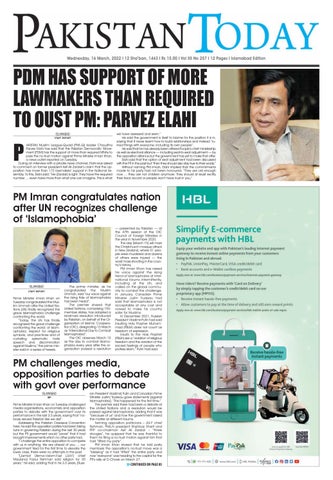
PDM has suPPort of More lawMakers than requireD to oust PM: Parvez elahi ISLAMABAD staff report
P
AKISTAN Muslim League-Quaid (PML-Q) leader Chaudhry Parvez Elahi has said that the Pakistan Democratic Movement (PDM) has the support of more than required MNAs to pass the no-trust motion against Prime Minister Imran Khan, a news outlet reported on Tuesday. During an interview with a private news channel, Elahi was asked to comment on former president Asif Ali Zardari’s claim that the opposition has more than 172 lawmakers’ support in the National Assembly. To this, Elahi said: “He (Zardari) is right. They have the required number … even have more than what one can imagine. This is what
we have assessed and seen.” He said the government is itself to blame for the position it is in, saying that it never learnt how to build relationships and instead “ruined things with everyone, including its own people”. He said that he has already been offered Punjab’s chief ministership as well as electoral alliance — including seat-to-seat adjustment — by the opposition alliance but the government has yet to make that offer. Elahi said that the option of seat adjustment had been discussed with the PTI in the past but “then they should also stay true to their words.” Without naming PM Imran, Elahi implied that the commitments made to his party had not been honoured. “They are old enough now … they are not children anymore. They should at least rectify their track record or people won’t have trust in you.”
PM Imran congratulates nation after UN recognizes challenge of ‘Islamophobia’
ISLAMABAD staff report
Prime Minister Imran Khan on Tuesday congratulated the Muslim Ummah after the United Nations (UN) finally recognized the grave Islamophobia challenge confronting the world. “Today, the UN has finally recognized the grave challenge confronting the world: of Islamophobia, respect for religious symbols, and practices and of curtailing systematic hate speech and discrimination against Muslims,” the prime minister said in a series of tweets.
The prime minister, as he congratulated the Muslim Ummah, said “our voice against the rising tide of Islamophobia has been heard”. The premier shared that United Nations, comprising 193member states, has adopted a landmark resolution introduced by Pakistan, on behalf of the Organisation of Islamic Cooperation (OIC), designating 15 March as “International Day to Combat Islamophobia”. The OIC observes March 15 as the day to combat Islamophobia every year after the organisation passed a resolution
— presented by Pakistan — at the 47th session of the OIC Council of Foreign Ministers in the year in November 2020. The day (March 15) will mark the Christchurch mosque attack in New Zealand, where 51 people were murdered and dozens of others were injured — the worst mass shooting in the country’s history. PM Imran Khan has raised his voice against the rising trend of Islamophobia at international forums intermittently, including at the UN, and called on the global community to combat the challenge. In January, Canadian Prime Minister Justin Trudeau had said that Islamophobia is not acceptable at any cost and vowed to make his country safer for Muslims. In December 2021, Russian President Vladimir Putin had said insulting Holy Propher Muhammad (PBUH) does not count as freedom of expression. Insults to the Holy Prophet (PBUH) are a “violation of religious freedom and the violation of the sacred feelings of people who profess Islam,” Putin had said.
PM challenges media, opposition parties to debate with govt over performance ISLAMABAD inp
Prime Minister Imran Khan on Tuesday challenged media organisations, economists and opposition parties to debate with the government over its performance in the last 3.5 years, saying that “nobody served Pakistan like we did”. Addressing the Pakistan Overseas Convention here, he said the opposition parties had been taking turns in governing Pakistan during the last 30 years but the PTI government would “prove” that it had brought improvements which no other party had. “I challenge the entire opposition to compete with us in anything. We are ahead of you … our government tried for the first time to elevate the lower class, there were no attempts in the past. “[Jamiat Ulema-i-Islam-Fazl (JUI-F) chief Maulana] Fazlur Rehman sold religion for 30 years,” he said, adding that in his 3.5 years, [Russ-
ian President Vladimir] Putin and [Canadian Prime Minister Justin] Trudeau gave statements [against Islamophobia]. “This happened for the first time.” The premier said there had been a debate at the United Nations and a resolution would be passed against Islamophobia, adding that it was “because of us” and how the government raised the matter at different forums. Terming opposition politicians – JUI-F chief Rehman, PML-N president Shehbaz Sharif and PPP co-chairman Asif Ali Zardari – “three stooges”, he quipped that he was thankful to them for filing a no-trust motion against him that had “lifted my party”. PM Imran Khan shared that he told party members the opposition’s no-trust move was a “blessing” as it had “lifted” the entire party and now “everyone” was heading to the capital for the PTI’s rally at D-Chowk on March 27.
CONTINUED ON PAGE 05
02
Wednesday, 16 March, 2022 | ISLAMABAD
NEWS
NO-cONFIDeNce mOTION agaINST ImRaN wIll FaIl: QuReShI ISLAMABAD
F
Staff RepoRt
OREIGN Minister Shah Mahmood Qureshi said the no-confidence motion moved against the prime minister will face defeat in the Parliament. The motion seeking the ouster of Imran Khan was submitted to the office of National Assembly Speaker Asad Qaiser on Tuesday. It accused him of mismanaging the economy and poor governance in the toughest challenge he has faced since taking power in August 2018. Talking to the reporters in Islamabad on Tuesday, the foreign minister said there is chaos in the ranks of opposition parties since
‘No indication’ India missile fire was deliberate: State Department WASHINGTON/ISLAMABAD Staff RepoRt
Days after Islamabad rejected New Delhi’s decision to hold an internal inquiry into a missile India “accidentally” fired into Pakistan’s territory and demanded a joint probe, the United States said it has “no indication” to believe the incident was “anything other than an accident”. “The [State] Department has no indication that this incident was anything other than an accident, and we refer you to the Indian Ministry of Defence for any follow-up to their statement on the matter,” said its spokesperson, Ned Price, when asked by Jahanzaib Ali, Washington correspondent of ARY News, to comment during a daily press briefing. Last Friday, India confirmed it had accidentally fired the missile because of a “technical malfunction” during routine maintenance, giving its version of events after Pakistan warned New Delhi of “unpleasant consequences.” An official Indian statement explained that “in the course of a routine maintenance, a technical malfunction led to the accidental firing of a missile.” It noted New Delhi had taken a “serious view and ordered a high-level” investigation into the incident. However, the following day, Pakistan rejected the Indian decision to hold an internal inquiry and, instead, demanded a joint probe into the incident, calling on the international community to play a role. “Such a serious matter cannot be addressed with the simplistic explanation proffered by the Indian authorities,” the Foreign Office said in a statement. “Pakistan demands a joint probe to accurately establish the facts surrounding the incident,” it added. Pakistan has also demanded clarifications from India over its safety mechanism to prevent accidental missile launches, and whether it was appropriately handled by its armed forces. In June last year, police in India arrested seven people and seized 6.4 kilogrammes of uranium from their possession, marking the second time in less than a month that authorities have captured a large quantity of radioactive material from unauthorised persons. Asked to comment, Price said he wasn’t “familiar with that particular incident”. “What I would say is that nuclear safety around the world, especially in […] nuclear-armed countries, it is always a conversation that is ongoing.”
they do not have the required numbers to remove Khan. With the help of several smaller parties, the ruling Pakistan Tehreek-e-Insaf (PTI) party holds a narrow majority in the National Assembly. It has 179 seats in the 342member House, only seven more than required for a simple majority. If none of the MPs from the ranks of the prime minister’s allies or the PTI vote against him, he will likely succeed. However, the PTI is currently facing a split because of an internal revolt by some members. The opposition, on the other hand, has 162 members and needs a simple majority of 172 to topple the government. Should Khan fail to win approval, the parliament will have to choose a new prime
minister. Qureshi said the unholy alliance of the opposition will not last and will shatter soon as their ideology and destination both are different. He said the government will face the noconfidence motion in a constitutional, political and democratic manner. Qureshi said we have held successful public gatherings in Mandi Bahuddin, Mailsi, Lower Dir and Hafizabad in which the people expressed their solidarity with Khan. He said a public gathering to be held at D-Chowk on March 27 will be peaceful in which the prime minister will put his case in the court of the public. He revealed that Khan wants to share some things with the nation to gain their confidence and the public gathering is “not
a protest like the other political parties [are holding].” Opposition leaders say Khan has lost public support as he struggles with high inflation, a rising current account deficit and depleting foreign reserves. Khan vowed to fight any move to unseat him. “Whatever they do, I’m ready for that,” he told a gathering in Islamabad. Khan has responded to economic problems with cuts in fuel and electricity prices, while rejecting calls to step down and warning the opposition of unspecified consequences if they force a vote of noconfidence. Both the opposition and Khan’s party are riven by factions. Khan won a confidence vote last year by six votes.
ECC approves Rs8.2bn Ramzan relief package ISLAMABAD Staff RepoRt
The Economic Coordination Committee (ECC) of the federal cabinet has approved the Ramzan Relief Package, involving a subsidy of Rs8.2 billion, to provide relief to the people during the upcoming holy month. Minister for Finance and Revenue Shaukat Tarin presided over the ECC meeting on Tuesday. The Ministry of Industries and Production presented a summary for the Ramzan Relief Package. The ECC approved in principle the Ramzan Relief Package for the whole population of the country rather than only 20 million households registered with Ehsaas Rashan Riyat Programme with directions to frame a procedural mechanism for limiting the interventions by each family. The Ministry of Economic Affairs submitted a summary on G-20 Debt Service Suspension Initiative (DSSI). The ECC allowed the Ministry of Economic Affairs to sign 15 debt rescheduling agreements with various credit countries, finalised under Debt Service Suspension Initiative (DSSI). To address the concerns of Pakistan State Oil (PSO) and other oil marketing companies (OMCs) over mechanism of payment of price differential claims (PDC), the Petroleum Division submitted a summary
on revised mechanism with the change to the previously approved mechanism that the PDC will be applicable on sale of petroleum products rather than on procurement of products. The ECC approved the proposal with allocation of additional Rs11.73 billion as supplementary grant to meet the expenditure on payment of PDC up to 31st March 2022. The ECC approved the proposal of Petroleum Division regarding issuance of sovereign guarantee amounting to Rs21 billion in favour of M/s Faysal Bank Limited at considerably lower mark up rate for the remaining tenor of the loan i.e 4 and ½ years along with issuance of letter of comfort for new finance agreement with respect to the pipeline infrastructure development project LNG-II. On a proposal of the Petroleum Division for reallocation of OGDCL’s Jhal Magsi gas to SSGC, the ECC allowed reallocation of 15 MMCFD Jhal Magsi gas to SSGC. SSGC would carry out the project of gasification of Jhal Magsi town and would embark the required gas out of the proposed allocation. The injection of this gas will help mitigate SSGC’s gas demand-supply deficit. On another proposal of the Petroleum Division for allocation of gas from Mari (deep) gas reservoir to M/s SNGPL, the ECC approved in principle up to 110
India’s ‘dismissive’ stance on missile issue ‘worrisome’: NSA Moeed Yusuf STAff RepORT National Security Adviser Moeed Yusuf called on Tuesday India’s “indifferent and dismissive” approach to the firing of a missile inside Pakistan last week “worrisome”, after New Delhi said for the second time that the launch of the projectile across the border was “accidental”. The incident had taken place on March 9, when the Air Defence Operations Centre of the Pakistan Air Force had picked up what was then identified as an “high-speed flying object” inside the territory. “From its initial course, the object suddenly manoeuvred towards Pakistani territory and violated Pakistan’s air space, ultimately falling near Mian Channu at 6:50pm,” Inter-Services Public Relations (ISPR) Director General Maj Gen Babar Iftikhar had shared during a press briefing a day later and called for an explanation from India. Subsequently, the Indian defence ministry had expressed regret over the incident, terming it “accidental” and attributing it to a “technical malfunction”. Pakistan, however, demanded further explanation, calling India’s stance on the matter “simplistic”. The country also called for a joint probe into the incident. Following these developments, Indian Defence Minister Rajnath Singh told his country’s parliament today that New Delhi was conducting a review of its standing operating procedures for operations, maintenance and inspection of weapons systems after the March 9 incident. “We attach the highest priority to the safety and security of our weapon systems. If any shortcoming is found, it would be immediately rectified,” Rajnath Singh said, repeating India’s earlier stance that the
missile was launched accidentally during routine maintenance and inspection. NSA Yusuf pointed out today that the “claim” made by India for the second time was a “simplistic explanation without evidence” that “is insufficient and should be unacceptable to the world”. In a series of tweets, he said, “We remind India and the world that this was a highly sophisticated supersonic missile which could have caused loss of life in Pakistan and resulted in escalation between two nuclear-armed countries.” “Once again, everyone must see for themselves which is the responsible state,” he added. “We all know that such incidents can easily escalate — history is full of such instances.” The NSA said that Pakistan had once again acted responsibly during the episode to avoid any escalation, “exactly how we acted in 2019 when we shot down intruding Indian fighter planes after India tried to bomb us”. “We even voluntarily returned their downed pilot to avoid escalation, Yusuf recalled. The NSA further said the world should realise that “escalatory actions by India are a pattern, not an exception”. “This is a classic character of an irresponsible and untrustworthy state when it comes to [the] handling of such sensitive weapon systems,” he added. He highlighted that India’s “continued demonstration of lack of adequate safety and security protocols of their high-end weapons systems raises serious questions that remain unanswered” by Delhi. “Their indifferent and dismissive approach after the incident is even more worrisome,” the NSA said, adding that “only a transparent joint probe can address the many unanswered questions about this so-called mistake”.
MMCFD gas from Mari deep (Goru-B) gas reservoir allocation to SNGPL till 30-06-2024 on firm basis with direction for the determination of price mechanism of gas. The Ministry of National Food Security & Research submitted a summary regarding intervention price for Cotton 2022-23 Crop. In order to revive cotton production in the country, bring stability in the domestic market and assure fair return to the farmers, the ECC allowed Rs5,700/40 kg threshold intervention price of seed-cotton. The ECC further allowed initially procuring two million bales of cotton at intervention price with direction that quantity would be reviewed on a monthly basis. The ECC also approved a technical supplementary grant amounting to Rs200 million to Pakistan Military Accounts Department (PMAD) for conversion of pensioners to direct credit system. The ECC also approved a technical supplementary grant of Rs3,500 million in favour of the Higher Education Commission for the Project titled ‘Pak University of Engineering and Emerging Technologies (PUEET)’. The meeting was attended by Minister for National Food Security Syed Fakhar Imam, Planning Minister Asad Umar, Minister for Economic Affairs Omar Ayub Khan, Minister for Industries and Production Khusro Bakhtiar, Energy Minister Hammad Azhar, Adviser to the PM on Commerce & Investment Abdul Razak Dawood, federal secretaries and other senior officials.
Third computer ballot for POS Prize scheme held at FBR ISLAMABAD Staff RepoRt
Continuing with the monthly computer ballot for its innovative POS Prize Scheme, Federal Board of Revenue successfully organised a third successive lucky draw at FBR Headquarters Islamabad, this evening. In addition to 1007 lucky winners winning prizes worth 53 Million, another 10 individuals won prizes of Rs 100,000 each, sponsored by Metro Stores Pakistan for its valued customers. This has taken the winners list to 1017, winning prizes worth Rs.54 Million. Addressing on the occasion, Chairman FBR/ Secretary Revenue Division Dr Muhammad Ashfaq Ahmed reiterated that for the past few years, FBR had been vigorously pursuing its drive for digitization, transparency, and automation not only to document the economy but also to plug revenue leakages through a transparent tax system. He further emphasized that FBR will continue to maximize tax compliance through various innovative initiatives including the POS Prize Scheme. The annual business turnover of the retail sector in Pakistan was about Rs. 20 Trillion but only around 20% was visible to FBR for tax compliance. This innovative Prize Scheme was launched to digitally monitor the sales made by Tier-1 Retailers across Pakistan to ensure that tax collected from customers was safely deposited into state exchequer, he concluded. It is pertinent to mention that in February, about 2,60,833 invoices were verified by customers who shopped from outlets integrated with FBR POS System as against 153,000 in January 2022.
ATC acquits top PTI leadership in 2014 case ISLAMABAD Staff RepoRt
An anti-terrorism court (ATC) in Islamabad acquitted President Dr Arif Alvi and top leadership of the ruling Pakistan Tehreek-e-Insaf (PTI) party in the 2014 mob storming of Parliament House. Announcing the decision, Judge Mohammad Ali Warraich acquitted Foreign Minister Shah Mehmood Qureshi,
Minister for Planning and Development Asad Umar, Minister for Defence Pervez Khattak, Khyber Pakhtunkhwa Minister for Labour and Culture Shaukat Ali Yousafzai, Senator Ejaz Chaudhry and disgruntled members Jahangir Tareen and Aleem Khan, among others. It is noteworthy that Prime Minister Imran Khan, who was also nominated in the case, was acquitted by an antiterrorism court in October 2020.
The court reserved its verdict in February after as many as 11 suspects, including the ministers and Tareen, moved the applications seeking their acquittal in the case under Section 265-K of the criminal procedure code (CrPC). The prosecution had not objected to the requests for acquittal. On September 1, 2014, hundreds of protesters belonging to the PTI and
Pakistan Awami Tehreek (PAT) of Tahir ul-Qadri stormed the Parliament House and PTV headquarters and forced its staff to take two of the state broadcaster’s flagship channels — PTV News and PTV World — off the air. The protesters were also charged with attacking government properties including the Parliament House building. Another case was related to the attack on then-Islamabad SSP (Operations) Asmatullah Junejo during the protest sit-in in Islamabad seeking the resignation of deposed prime minister Nawaz Sharif.
Wednesday, 16 March, 2022 | ISLAMABAD
TaRIN DIRecTS FBR TO Take STePS FOR SeTTlemeNT OF SaleS Tax ISSueS OF The PhaRmaceuTIcal INDuSTRy ISLAMABAD
F
Staff RepoRt
EDERAL Minister for Finance and Revenue Shaukat Tarin has directed the Chairman Federal Board of Revenue to take possible steps for the settlement of sales tax issues of the pharmaceutical industry. The Finance minister on Tuesday held a meeting with a delegation of Pakistan Pharmaceuticals Association headed by its chairman Qazi Manzoor at the Finance Division. Chairman FBR and senior officers from FBR and Finance Division attended the meeting. In the follow-up meeting, Chairman PPMA thanked the Finance Minister for addressing the problems being faced by the Pharmaceutical manufacturers and further apprised the chair of the pending issues related to refund of sales tax on APIs.
Finance Minister Shaukat Tarin said that the government is fully committed to address the issues of the Pharmaceutical industry and provide maximum support to them. He listened to their issues keenly and assured them to resolve their issues. The Finance Minister further directed Chairman FBR to take possible steps for the settlement of the issues of the pharmaceutical industry related to Sales Tax on APIs in coordination with the representatives of the Pharma Industry. The Chairman FBR also briefed the meeting on the steps being taken by the FBR for the resolution of the key issues being faced by the Pharma Industry and mechanism to settle the remaining issue related to refund of sales tax on APIs. The PPMA delegation thanked the Finance Minister for making efforts in addressing the issues of the industry.
Across China: A Pakistan student’s take on Two Sessions meeting NANNING Xinhua
The annual sessions of China’s top legislature and political advisory body, which concluded on Friday, have attracted a special foreign follower this year: Jahan Shair Jalal, a Pakistan-national student in China. Having lived in the country for more than five years, Jahan Shair Jalal is no stranger to the “two sessions.” He is a medical student at the Guangxi University of Chinese Medicine in south China’s Guangxi Zhuang Autonomous Region and works as an intern at a local hospital. During his internship in Guangxi, Jalal found that China’s extensive medical insurance coverage has enabled those from remote areas to enjoy relatively good medical resources. “China is vast and has a large population, and the local conditions vary from place to place across the country. But the Chinese government has always been devoted to managing its medical resources based on reasonable allocation,” said Jalal. A wide range of topics with regard to people’s livelihoods were discussed at the annual gathering, and this year, Jahan Shair Jalal noticed several specific suggestions and proposals from China’s lawmakers and political advisors. Wei Qin, a deputy to the 13th National People’s
Pakistan ships humanitarian assistance package to ukraine ISLAMABAD Staff RepoRt
Pakistan on Tuesday transported humanitarian assistance for the people of Ukraine. The relief items were handed over to Ukrainian Ambassador by Foreign Minister Shah Mahmood Qureshi. Two special C-130 flights are being sent to deliver more than 15 tons of humanitarian assistance items for the Ukrainian people. The humanitarian assistance package included a emergency medicines, electro-medical equipment, winter bedding and food items. The shipment was transported on the request of the Government of Ukraine. Speaking on the occasion, the Foreign Minister said that Pakistan has always acted promptly alongside international community for responding to international calls for assistance during conflicts and calamities, as a responsible and peace loving nation. He said this gesture shows that Pakistan is a peace loving nation and we urge both the countries to show restraint to save precious human lives.
Congress (NPC), proposed the establishment of an administration bureau for rare-disease services, while Ding Jie, a member of the 13th National Committee of the Chinese People’s Political Consultative Conference (CPPCC), advised the joint development of a medical insurance mechanism for rare-disease medicine. Jalal is glad to see efforts being made to better protect and treat patients suffering from rare diseases, some of which have already been implemented. Aside from improvements related to medical care, the Pakistani student is impressed at how the voices of ordinary people are listened to and their concerns addressed. He cited the rights and welfare of delivery workers as a good example. Since coming to China, Jahan Shair Jalal has got
into the habit of ordering his meals via mobile applications. He is amazed at the popularity of online food delivery and the efficiency of the services. “In my country, only a few big chain restaurants and the courier industry would offer similar jobs. But in China, it’s no exaggeration to say that almost everything can be delivered to your doorstep.” “The voices and rights protection of ordinary workers such as delivery guys are taken seriously by the ‘two sessions,'” said the young man. He said that he read about how an NPC deputy’s personal experience on the topic inspired her to make a worthwhile proposal at the “two sessions.” In 2019, Huang Chao got her car scratched by a passing delivery man, and during her interactions with the man, she learned more about their working conditions and concerns. After over a year’s research on the relevant circumstances, Huang made a proposal to the “two sessions” for more comprehensive regulations aimed at better protecting delivery workers. In July 2021, Huang’s suggestion was partly taken up by relevant departments, and an official guideline on safeguarding the rights and interests of workers in new forms of employment was released. “After graduation, I would like to take what I have seen and learnt in China back to Pakistan so that more people know about China and can learn from its successful experience.”
Man kills three family members over property dispute in Gujrat GUJRAT Staff RepoRt
In a triple murder case, accused Safdar Hussain killed his two nieces and a sister-in-law over a property dispute in Gujrat. Per details, Safdar killed Shakeela Munawar, wife of his real brother who is based in Saudi Arabia, along with a nephew Abdul Rashan, 12 and two nieces Ayesha, 10, and Maryam, 7, in a
property dispute in Shampur area of Kakrali police station. A heavy contingent of Police reached the spot and arrested accused Safdar Hussain. Punjab Forensic Science Agency team has collected evidence from the crime scene. According to the police spokesperson, IG Punjab, taking notice of the tragic incident of murder, has called for a report from RPO Gujranwala and DPO Gujrat.
Indonesia, Malaysia agree to cement trade ties with Pakistan ISLAMABAD Staff RepoRt
Pakistan and Indonesia have agreed to further strengthen bilateral ties covering political trade, and economic matters. The understanding came during a telephonic conversation between Foreign Minister Shah Mahmood Qureshi and Indonesian Foreign Minister Ms Retno Marsudi, said a press statement issued on Tuesday. The two sides exchanged views on a wide range of topics of mutual interest. Both foreign ministers also agreed to enhance cooperation at the United Nations, ASEAN, OIC and other multilateral fora.
The two foreign ministers agreed to remain engaged on issues of common interest, both bilateral and multilateral. The Indonesian foreign minister extended a cordial invitation to Qureshi to visit Indonesia. Accepting the invitation, the foreign minister agreed to visit Indonesia at a mutually convenient date. Separately, Foreign Minister Qureshi held a telephone discussion with his Malaysian counterpart YB Dato’ Sri Saifuddin Abdulla. The two foreign ministers exchanged views on a wide range of issues of mutual interest including bilateral ties covering political, trade and economic matters, as well as cooperation at the multilateral fora.
NEWS
03
eaD to sign 15 debt rescheduling agreements worth $395.96mn SHAHzAD pARAcHA The Economic Coordination Committee (ECC) of the cabinet allowed the Ministry of Economic Affairs to sign 15 debt rescheduling agreements worth $395.96 million with a number of credit countries under Debt Service Suspension Initiative (DSSI). The meeting of ECC was held under the chair of Federal Minister for Finance and Revenue Shaukat Tarin. Economic Affairs Division (EAD) has negotiated 15 agreements with Italy, Japan, Uk, Austria, France, Korea, Netherland, Sweden, Switzerland and Saudi Arabia, debt worth $395.96 million will be suspended for January to June 2021 period. It is pertinent to note that the G-20 finance ministries in their meeting held in April 2020 announced debt relief for IDA eligible countries to mitigate the socio economic impact of Covid-19, known as DSSI-1. The ECC in its meeting held on May 20, 2020 approved the proposal and authorized EAD to apply for debt relief and proceed with signing of MoI with creditor countries. The EAD informed the ECC that 31 debt rescheduling agreements with 19 creditor countries worth $1.6 billion have been signed and negotiations for finalization of debt rescheduling agreements with UAE are currently underway. According to the finance ministry handout, the EAD submitted a summary on G-20 Debt Service Suspension Initiative. The ECC allowed the Ministry of Economic Affairs to sign 15 debt rescheduling agreements with various credit countries, finalized under Debt Service Suspension Initiative (DSSI).
hBl hosts lt. general Nigar Johar hI(m) in celebration of International women’s Day pReSS ReLeASe Karachi, Pakistan: HBL commemorated International Women’s Day 2022 by inviting Lieutenant General Nigar Johar HI(M) to a session on 14 March 2022 at HBL Tower, Karachi. Lt. General Nigar is the first and only woman in the Pakistan Armed Forces to have reached the rank of a Lt. General and is also the only woman since partition to have commanded an armed forces hospital in the country. The session was attended by over 70 women staff from a cross-section of the bank, including many who are a part of the senior management. Muhammad Aurangzeb, President & CEO, and the senior leadership team of the bank were also present at the session. Lt. General Nigar spoke at length about her life journey, breaking biases in the professional field, and the unwavering support she received from her family, specifically her father, mother and husband. Her advice to all women in the professional field was to work hard towards their dreams and believe in themselves. She emphasized that empowerment starts with one’s self, women need to take charge of their own lives, establish their own identity and stand up to all the challenges as they continue to work side by side with their men counterparts. She also spoke about the need to have diversity not just in numbers but in managerial positions of leadership.
04
Wednesday, 16 March, 2022 | ISLAMABAD
NEWS
Sheikh RaSheed SayS ‘UmpiRe StandS with no one bUt pakiStan’
i
NEwS DESk
NTERIOR Minister Sheikh Rasheed Ahmad on Tuesday said that “the umpire stands with Pakistan and those who care for Pakistan are convincing them to resolve the matters through understanding.” “They are the supporters of democracy and they are thinking about Pakistan. They stand with no one but Pakistan,” Rasheed said while addressing a press conference in Lahore. He said the Opposition created confusion in the last four years and now it’s just one year left in the next general elections. “Opposition lacks wisdom […] but all
these imperialist maggots would meet their end after reaching D-Chowk,” he said The minister went on to say that the government will try to control the situation at DChowk and if it couldn’t, then it is up to the Opposition. However, he warned that the Opposition would face a loss if any incident takes place at the D-Chowk. “Imran Khan’s rule is not going anywhere. Four years of his tenure [as the prime minister] have been completed and he will complete the remaining one year by hook or by crook,” Rasheed said. Commenting on the political situation in Punjab, the minister said that he is not aware of provincial politics as he doesn’t do politics there. Moreover, Rasheed said that the
Sindh governor, mps call on pm to express confidence ISLAMABAD Staff RepoRt
Sindh Governor Imran Ismail and a delegation of Pakistan Tehreek-e-Insaf (PTI) MPs from the province called on Prime Minister Imran Khan Tuesday to express confidence in his leadership. Senator Saifullah Abro, Faheem Khan, Attaullah, Haleem Adil Shaikh, Ali Junejo, Syed Afandi, Sidra Taimur and Riaz Ahmed were included in the delegation. Minister for Maritime Affairs Ali Haider Zaidi was also present during the meeting. Political issues were discussed during the meeting.
Victim recalls traumatised moments of Christchurch mosque attack LAHORE anadolu agency
Pakistani-born Ambreen Naeem, who lost her husband Naeem Rashid and son Talha three years ago in a New Zealand mosque attack, is now devoting time to propagate peace and teachings of Islam. Speaking to Anadolu Agency coinciding the third anniversary of the terrorist attack at mosques in Christchurch in New Zealand, which is being observed on Tuesday, Naeem said she has been helping victims of the horrible incident. “The Whanau Trust was established by the government to help the victims of that horrible incident. This year, we observed Islamic awareness week from March 5-14 in which we conducted seminars and workshops to help people understand true values of Islam,” she said. Recalling the incident, Naeem told Anadolu Agency on the phone from Christchurch that she was traumatised after learning the incident, but was hopeful that her husband and son will be safe. “It was a regular Friday for us and Rashid was asking who will pick them up after the prayer … He was always in the mosque before the Friday congregation,” she said. “When I got to know about the attack I was traumatised and hoped that my husband and my son will either be safe or just injured. But at night when we went to the hospital and couldn’t find their names on the list of the injured, we knew that we had lost them.” The attacker was arrested shortly afterwards when he tried to escape from the crime scene. Based on the manifesto he had published online before the attack, the media reports described him as a white supremacist. “The media has a huge responsibility when it comes to the portrayal of negative characters. By showing Muslims the villain or terrorist, they are creating and sowing hate in the minds of people against our community. To counter that image, we have started educating people about Holy Quran and Islam,” said Naeem. Bravery award: The attacker live-streamed his acts in the mosque in which it can be seen that Rashid was trying to stop him even after getting injured. That gave time to others to escape. “For his bravery the government awarded him … all his life my husband stood up for his values and always helped the people. My son, who was with him at that time, was also very brave and kind,” she said. Rashid, along with his family, moved to New Zealand from Lahore in 2011 to pursue a doctorate. After the attack, the family stayed in the island country and decided to serve Rashid’s legacy and spread awareness about their religion. “I am living with my two sons at the moment … after Rashid, I have to be there for them,” said Naeem. “He always told me: ‘If you face any difficulty always turn to the Holy Quran and ask Allah to guide you.’ Now one of my sons has graduated in engineering, and the youngest one is still studying. I went to Lahore once, but could not visit again due to the coronavirus pandemic.” Even as the attacker was convicted and sentenced for life, Naeem said attacks on Muslims have not stopped.
last week of March would be important for the country. “Maulana Fazlur Rehman should understand that the politics of Maula Jatt won’t work, therefore, he should come to Islamabad on March 23 and the government will provide him complete security,” he said, adding that he himself would be responsible if anyone is stopped from proceeding to the D-Chowk. He said that the Opposition doesn’t have enough numbers and bids are being made in the market, adding that “sell-outs” only face humiliation, as they can never succeed. Urging the Opposition to rethink their moves he said: “Please don’t push the country towards anarchy and the consequences will be irreversible,” Rasheed said.
PIA reduces airfare for Umrah pilgrims APP Pakistan International Airlines (PIA) has announced a reduction in airfare to Jeddah and Madinah for Umrah pilgrims. According to PIA, return fares from Pakistan to Madinah and Jeddah have been slashed to Rs95,628, down from more than Rs100,000 previously. The fare of PK9759 flights from Lahore to Jeddah and PK9741 flights from Islamabad to Jeddah have been slashed, according to the PIA. PK 9731 from Karachi to Jeddah and PK 9735 from Peshawar to Jeddah fares have also been cut by Rs5,000. The Hajj Policy 2022 would be unveiled after signing an agreement with the Saudi Ministry of Hajj and Umrah, an official said last week. “It is good news for all Muslims that the Saudi government opened Hajj for foreign pilgrims across the world after a two-year hiatus,” an official of the Ministry of Religious Affairs and Interfaith Harmony told APP. He said the Hajj policy would be designed as per the revised pilgrims’ quota — expected to be announced soon by the Saudi government. The official said the ministry was taking all anticipatory measures for a smooth operation of Hajj 2022. He said the ministry had floated tenders for the procurement of 40,000 doses each of Meningococcal (Meningitis ACYW-135) and Quadrivalent/Tetravalent Seasonal Influenza vaccines.
The ministry has also invited expression of interest from the scheduled banks to collect applications of the intending pilgrims for Hajj, the official said. Similarly, talks are underway with private airlines for the transportation of the pilgrims to Saudi Arabia and back to Pakistan. Earlier, the Ministry of Religious Affairs and Interfaith Harmony had issued a public alert urging the intending pilgrims not to submit their hard-earned money to any private Hajj tour operator until the Hajj Policy 2022 was officially announced. After taking notice of public complaints, it said
some private tour operators were garnering money from intending pilgrims, but it had not authorised any individuals, banks, Hajj group organisers or agents to receive Hajj applications and collect money on behalf of the ministry. The ministry urged the masses to be careful of fraudsters, who were deceiving them in the name of Hajj. It warned of strict action against those allegedly involved in this illegal practice. Saudi authorities, in 2020, restricted the annual spiritual activities as part of stringent measures to prevent the spread of the deadly COVID-19.
BRI cooperation with China ‘transformational’ for Pakistan: ambassador BEIJING Xinhua
Cooperation with China under the framework of the Belt and Road Initiative (BRI) “has transformed Pakistan’s economic landscape,” Islamabad’s ambassador in Beijing Moin ul-Haque said. In an interview with Xinhua, Haque spoke highly of the construction of the China-Pakistan Economic Corridor (CPEC), a flagship project of BRI, saying it is “transformational” for his entire country. Besides the Gwadar Port, which he said has become the crown jewel of the CPEC, Haque also lauded the ecofriendly Orange Line metro train in Lahore, the first of its kind in Pakistan, which officially opened for traffic in October 2020. “You see the metro train, it is a world-class, high-quality public transport system. In Lahore, people have this very efficient, very modern and affordable transport system,” he said. According to Haque, BRI projects have benefited the Pakistani people through job creation, improving livelihoods, eradicating poverty and upgrading remote areas. Infrastructure development and energy upgrades have “helped change the
economic, social and industrial landscape of Pakistan,” said Haque. So far, more than 70,000 jobs have been created thanks to BRI cooperation, stressed Haque, adding that according to his government’s forecast, another half a million direct and indirect jobs will be created in the next five to seven years. He further elaborated that “all these philosophies and dimensions of BRI directly contribute to the 17 SDGs (Sustainable Development Goals).” The 17 SDGs were adopted by all United Nations member states in 2015, as part of the 2030 Agenda for Sustainable Development, which include no poverty, zero hunger, good health and well-being, and others. Being a witness to the signing of a series of BRI cooperation agreements between Pakistan and China, the ambassador also shared with Xinhua his personal experiences. He recalled the difficult nights when the temperature was as high as 40 degrees celsius, the light went out and the fan stopped working due to power shortage, and one could not sleep. Thanks to BRI projects, frequent power outages in peak season are now a thing of the past, he said. The ambassador told Xinhua that his country is seeking more cooperation
with China on industry modernization and information technology (IT) since Pakistan began working on its special technology zones. In September last, Pakistan and China established a joint working group on information technology at the 10th
Joint Cooperation Committee meeting of the CPEC. Since assuming ambassadorship in Beijing in 2020, Haque has visited Z-park on several occasions, also known as China’s Silicon Valley, to see how Pakistan can learn from the Chinese side in IT technology, artificial intelligence, 5G, robotics and cloud computing. In February, Pakistan’s Special Technology Zones Authority and China’s Zhongguancun “Belt and Road” Industrial Promotion Association signed a letter of intent to promote high-quality science and technological exchanges between the two countries. “It’s just the beginning,” Haque said, expecting closer cooperation among research institutions and universities. “We want to see more cooperation in this area.” Noting the Covid-19 pandemic has caused an unprecedented global economic impact, the diplomat called for collective effort, international solidarity and cooperation to address which he said is the biggest challenge faced by humanity in a long time. “The BRI has played, is playing and is going to play a very important role for stabilizing the economies of the world and bringing countries together for tackling challenges like Covid-19,” said Haque.
Wednesday, 16 March, 2022 | ISLAMAbAd
nEWS
05
SC adjourNS Vawda’S Plea agaINSt dISqualIfICatIoN tIll aPrIl
t
news desk
HE Supreme Court on Tuesday adjourned the hearing of a petition filed by former Senator Faisal Vawda against his disqualification till the first week of April. A three-member SC bench, comprising Chief Justice Umar Ata Bandial, Justice Syed Mansoor Ali Shah and Justice Ayesha A Malik, heard the case filed by Vawda against the Election Commission of Pakistan (ECP) for disqualifying him for
PM challenges media, opposition parties to debate with govt over performance continued from page 01 “I was thinking of how the country changed suddenly in 10 days, inflation was forgotten and my entire party was lifted.” All the opposition politicians used to call each other corrupt, he said, thanking them for coming together so the nation could see that “if they are the ones to save Pakistan, it is better to drown with Imran Khan”. The prime Minister said that PTI had risen from the grassroots which is why the opposition parties could not compete with it. “This is a difficult time and people are facing difficulties due to inflation but they (the opposition) misunderstood and thought people had forgotten about their corruption and they fell into the captain’s trap,” he said, asserting that the opposition would “fail” not only in making the no-confidence resolution successful but also in the upcoming general elections. Addressing overseas Pakistanis, he said he was aware of their difficulties and contributions, adding that they were also “pained” when they see their country is not progressing and its leaders are instead looting money and building palaces in London. Prime Minister Imran then again criticised the opposition, alleging that they were afraid of angering the West and losing their looted money the same way that Russian oligarchs were – referring to sanctions imposed by Western countries on assets of Russian citizens following the invasion of Ukraine. “You saw the Pakistani prime minister sitting before [former United States president Barack] Obama and kanpain taang rahi hain. They are afraid of angering the West … because they know [those countries] can catch their money laundering whenever they want.” The premier said 100 drone strikes had been conducted in Pakistan during the governments of Nawaz Sharif and Zardari and PTI leaders had staged sit-ins to protest but “they had no shame”. “You (Nawaz and Zardari) should have at least said that no law in the world allows anyone to play the role of judge, jury and executioner,” he said, stressing “never have I been anti-America, anti-Britain, anti-India”. Only an uneducated man would be against a country, he elaborated, adding that he was against their policies. “I was against the war on terror from day one and I will remain so.” He also mentioned India’s “Hindutva” policy, expressing the wish that a “better government” comes to power in the neighbouring country that would grant rights to Kashmiris. The premier said the government had given overseas Pakistanis the right to vote because they were an “asset”, adding that they should also contest elections and participate in the country’s politics because the country was “running on their remittances”. “I have told my missions and ambassadors to make life easier for overseas Pakistanis,” he said.
life over submission of false statements. During the course of proceedings, the court refused to restrain the ECP from issuing a notification regarding PPP candidate Nisar Khuhro’s victory on the seat that had fallen vacant after Vawda’s disqualification. Chief Justice Bandial said the victory of the candidate on the seat left vacant by Vawda is temporary. He said that there are consequences of filing fake affidavits and violating the code of conduct. He said the court would review the clause
Govt cannot prevent lawmakers from voting on no-trust motion: Abbasi Zahir moves IHC against conviction in Noor Mukadam case news desk
news desk Former prime minister Shahid Khaqan Abbasi on Tuesday said that the incumbent government cannot stop the lawmakers from voting on no-trust motion against Prime Minister Imran Khan and asked the PTI to ensure support of 172 lawmakers in the National Assembly instead of gathering one million people in Islamabad, according to a news outlet. “Even a million people will not be able to stop the no-confidence motion. I dare prime minister and the federal ministers to stop [the lawmakers] from attending the assembly session,” he challenged. He accused the National Accountability
Bureau (NAB) of pressuring opposition members after they submitted no-confidence motion in the lower house of parliament. “Mockery of accountability is underway in the country. Our members have been receiving notices from NAB since filing noconfidence motion,” he added. He asked the NAB chairman to stop interfering in the matter of no-confidence by issuing notices to opposition leaders. “The government is taking to the streets instead of [facing no-trust motion] in parliament shows that the government has already collapsed,” he added. He also warned the prime minister against issuing threats to opposition leaders saying that it will cost him [PM Imran] dearly.
IPO holds consultative session for joining Lisbon Agreement LAHORE: Intellectual Property Organization (IPO) held a consultative session for joining Lisbon Agreement (Geneva Act) for international registration of Geographical Indications (GIs). Chief WTO, Industry, Commerce, Investment and Skills Development Department Punjab Nazia Jabeen told that after signing Lis-
bon agreement, Pakistan would be able to register its GIs in more than 100 countries with a single application and indigenous products will get premium prices in international market. “Our national products like Basmati rice, Hunza apricot , Chaunsa mango will be introduced as national brands,” she added. Pakistan has already enacted the Geo-
graphical Indications (Registration and Protection) Act, 2020 since 31 March 2020. There are 65 notified GIs of Pakistan. Industry,Commerce, Investment and Skills Development Department Punjab(ICI&SDD) is registrant of three products: Kamalia Khaddar, Multan Blue Pottery, Multan woven cotton bed sheets since 28th August, 2021. pr
ECP imposes Rs50,000 fine on Swati for violating code of conduct news desk The Election Commission of Pakistan (ECP) has slapped Federal Minister for Railways Azam Khan Swati with a fine of Rs50,000 for running the election campaign for a candidate of the Mansehra city council in the second phase of local government polls, a news outlet reported on Tuesday. According to the report, the ECP has directed the minister to submit the receipt of the notice by March 17 for violating the com-
mission’s code of conduct. The fine was imposed by Dis-
used by the election commission to sack the former senator. The ECP lawyer sought time to submit a response in the case, adding that the notice was received a day ago and time is required to write a response. During the last hearing on March 1, the apex court had turned down Vawda’s request to suspend the ECP’s decision regarding his lifetime disqualification under Article 62(1)(f) of the constitution. It had also turned down his counsel’s request to put the March 9 Senate seat election on hold.
trict Election Commissioner Hayatullah Jan Marwat.
In case of repeated violation, the case will be forwarded to the ECP for further action. Last week, the ECP had issued a notice to Swati and directed him to explain his position. According to the notice, “the minister threatened voters with fund denial if they did not vote for Kamal Saleem, a candidate for the Mansehra city council.” The notice also mentioned that “no public office holder or elected member shall use state resources to campaign for any candidate.”
cmYk
Zahir Jaffer, who was convicted of Noor Muqadam’s murder and awarded death penalty, on Tuesday filed an appeal in the Islamabad High Court (IHC) against his conviction, according to a news outlet. Last month, a local court in Islamabad had sentenced Zahir to death for the murder of Noor after a trial of over four months. Co-accused Jan Muhammad and Muhammad Iftikhar, the gardener and security guard at Zahir’s house, were sentenced to 10 years in prison each. However, Zahir’s parents, Zakir Jaffer and Ismat Adamjee, and a domestic helper, Jamil, as well as six other suspects in the case were acquitted from the charge of abetment. On Tuesday, IHC bench members Justice Amir Farooq and Justice Sardar Ijaz Ishaq heard the appeal, during which Advocate Shah Khawar appeared in the court on behalf of Noor’s father, Shaukat Muqadam. The high court also sought the trial court’s records on the appeal against the acquittal of nine accused in the case. “Now that an appeal against the conviction of the main accused has been filed, the court seeks all documents of the trial court in the murder case,” Justice Farooq said. Earlier on March 12, an appeal was filed in the IHC against the acquittal of nine accused in the case.
06-07 Comments - 16th March 2022_Layout 1 3/15/2022 10:12 PM Page 1
Wednesday, 16 March, 2022
06 COMMENT
Musings on the end of my BlackBerry
Don’t prolong the crisis Put the resolution to vote
I
NFoRMATIoN Minister Fawad Choudhy has announced that the PTI will stage a “mammoth” public meeting at D-Chowk on March 27 that will change the politics of the country and end the game of the three major opposition parties. He promised to gather one million people in front of Parliament House where the National Assembly is to vote over the no-confidence move to dislodge PM Imran Khan. The announcement came after a meeting of the PTI’s core committee presided over by the PM. PTI leader Amir Mehmood Kiani observed that MNAs will have to pass through the rally of one million people before and after casting their votes. In a politically charged environment Kiyani’s words carry a grim message indicating that the legislators coming to support the no-confidence move could be jeered at, pushed around or harmed physically. This is unacceptable as it amounts to using force to dissuade lawmakers from exercising their constitutional right. The ill-advised move has led the opposition to counter it with its own march on Islamabad with the aim of staging a sit-in which could continue till the completion of the voting process in the National Assembly. The government has paved the way for a confrontation that could spread to other parts of the country as well. The parties in power are supposed to enforce the law instead of encouraging mobs to influence parliamentary proceedings and threaten lawmakers. This would strengthen the view that the PM has decided to bring down the entire system if he is removed through a legitimate no-confidence move. According to the PDM, it has given a call to the public to gather in Islamabad to express solidarity with Parliament, democracy and the Constitution. There is a need to stop the confrontation that could lead to violence. The government has yet to confirm the dates of summoning the National Assembly session and of voting on no-confidence motion. This can prolong the crisis. The way out is to immediately summon the National Assembly session and put the resolution to vote in accordance with the Constitution.
Washington Watch
A
Dr James J Zogby
T the end of February, my blackberry Curve died. It didn’t actually die, but it might as well be dead, because my blackberry only operates on 3G and my phone provider has ended 3G service. As a result, my device turns on and I can still type on it, but because it can’t connect, what I type can’t be sent anywhere. For years my family and friends warned me that this day would come, but I ignored them because I simply couldn’t imagine life without my Curve. Without exaggeration, it had become a part of my life. For the last 13 years, I had spent the better part of each day typing on it. I wrote drafts of my last two books on my blackberry. on most afternoons you could find me either in lafayette Park or seated at my favorite Washington restaurant hunched over my little friend clicking away either on my weekly column, a polling report, or a briefing memo for my office. There’s even a rather large oil painting hanging in the Davidson College library of me sitting on the steps of the college’s guest house writing my weekly column. As of last month, I’ve been writing my weekly column for 30 years. because I had never learned to
Accidental missile launch
F
olloWING India’s missile misadventure that could’ve ended in disaster, possible creating a serious diplomatic crisis, the uSA has weighed in on the matter and its response, expectedly, is tone deaf and needlessly heavily in favor of Delhi. In the absence of a detailed inquiry, the uSA stating unequivocally that this cannot be anything but an accident is a biased statement stemming from its less than cordial current relations with Islamabad. Alternatively, China has taken a much more nuanced stance, encouraging both countries to hold talks and a joint probe into the ‘accidental’ missile firing should be held. It is quite understandable why Pakistan would like to join the enquiry into the straying of an Indian brahMos missile into Pakistan. For one, Pakistan had no means of knowing that the missile was not carrying a nuclear payload until it landed near Mian Channu. It is also fortunate that it landed in an empty area, and not in a built-up area. It is also fortunate that its path did not cross that of any civilian airliner. These pieces of good fortune cannot be ascribed to any wisdom or prudence, but were the result of mere chance. Such incidents must be avoided, because the other side might respond aggressively. A joint investigation would lead to a means of developing procedures for the two countries to follow in the event of such accidents. As it is, the ‘mistake’ provided a check of the PAF’s and the Pakistan Army’s ability to respond. It would not be beyond India to fire off an expensive blank as a test. Presumably the swift and professional response of both will have shown India that any aggression will be met appropriately. Pakistan and India have a host of outstanding issues that can only be addressed and resolved through meaningful dialogue. That Pakistan is prepared to hold such talks and India continues to attach unjustifiable preconditions to any such deliberations to take place means that the resistance to normalization of relations is one-sided. Afterall, any departure from the bJP’s baseless narrative of Pakistan being a sponsor of cross border terrorism, which feeds the xenophobic mindset that is increasingly prevalent in India,would be politically damaging for the ruling party.
asaDullah raisani
D
ouble standards are not something new in global politics. Major powers often opt for them in order to pursue their interests. For instance, the invasions of Iraq and Afghanistan by the West are justified in their view while the invasion of ukraine is a grave sin and they will not forgive Vladimir Putin for that. In this regard, Russia`s invasion of ukraine has drawn all kinds of attention recently. From media outlets to kitchen cabinets, Russia-ukraine War is the talk of the town. However, ukraine is suffering from something that is a routine in Kashmir, Palestine, Syria, and many other parts of the Middle east and North Africa (MeNA). Where the Indian and the Israeli atrocities do not get much attention as Putin’s adventurism is getting. The reasons can be either, two or all of the following; a) What is happening in ukraine is unfair, while what is going on in MeNA is fair; b) Putin is a common villain for the West; c) ukraine is a european nation and non-european lives do not matter or matter less Most significantly, the promised ‘New World order’ which was promised to be a ‘liberal World order’ is turning out to be an unfulfilled promise. Whether ‘never again’ was for particular nations or for every nation on earth, is another question to be pondered upon, in depth. If ‘never again’ and ‘new world order’ are meant for everyone then why is Israel`s apartheid backed by the mightiest capital of the world and the lives of the people of Afghanistan, Kashmir, and war-torn MeNA do not get the due attention? Why are these nations and their people forgotten? Different standards for different nations – is this not hypocrisy? Nelson Mandela rightly thanked the West in this regard when he claims in his autobiography, Long Walk to Freedom that that were sanctions from the West that compelled the white South Africans to give up apartheid there. The sanctions were mainly economic and oil-related. For instance, then uS President Jimmy Carter banned all exports to the South
Arif Nizami (Late) Founding Editor
Yousaf Nizami Umar Aziz
Joint Editor
Joint Editor
Executive Editor
Lahore – Ph: 042-36300938, 042-36375965
The writer is President of the Arab American Institute
Some oppression is less visible than others
Dedicated to the legacy of late Hameed Nizami
M. A. Niazi
the past three decades you’ve founded and run a number of policy organizations. How have changes in technology impacted your work?” My brain exploded as I thought back to how, from the time we began the Palestine Human Rights Campaign in the mid-1970s until now, we had shifted from manual typewriters and mimeograph machines to computers and mass emails. And then came mobile phones and then the blackberry- which my wife, eileen, called “your office in your pocket” - meaning that, to her dismay, our vacations could be interrupted at any time for work, overseas calls, or media interviews. Printed newsletters gave way to websites and then to multiple social media platforms. I began writing my weekly column in 1992 and was fortunate that it was picked up by newspapers in several Arab countries. I’ve described how I wrote my columns, but more important to the matter under discussion was how we sent it to partner papers. using the fax machine, which was still in its early stages of development, we faxed it to each one - a process which took hours to complete. Now we email - an instantaneous transfer of information to multiple addresses with a single click. Changing technology has clearly made communication easier, but the results are mixed. back in the 1970s when we sent out a fundraising mailing to 3,000 recipients, that blurry mimeographed solicitation would generate 600 responses. Today, an email to 30,000 will likely not do as well. Receiving a letter in the mail was a rarity back then and so it was opened and read. Now, with too many emails, most are never even opened. Newsletters were devoured, now we struggle to find ways to draw supporters to our websites and platforms. but it is the world in which we live and to which we must adapt. That’s why I’m typing this on my iPhone and then will send it off for editing and formatting to my computer and then to my newspaper. I’m going to miss my blackberry, just as I missed my legal pads and pencils. but I’ll keep writing as long as I can, have a newspaper that will carry my work, and have readers who care to read my musings.
Forgotten Nations
Joint probe and talks on other issues logical way forward
Editor Aziz-ud-Din Ahmad
use a typewriter, and using the computer keyboard felt awkward and uncomfortable, for the first 17 years, I hand wrote my weekly pieces and passed them on to my assistant who deciphered my scratching, typed them up, and sent them out. because I was writing all the time, I had developed preferences that made my writing easier. The legal pads couldn’t have too smooth a surface and the lead in the pencils couldn’t be too soft or too hard. back then, I had been using a blackberry for emails for a few years and had become adept at it. Then one Friday, I found myself in a Chicago airport, flights home had been cancelled because of bad weather and my column was not yet finished. because there wasn’t a fax machine available at the airport, I had no way to send my hand-written piece to my office. I, therefore, translated my own near-indecipherable writing to my blackberry and emailed it to my office. My assistant sarcastically wrote back “Welcome to the 21st century!” I was hooked and never looked back. over the years, I got better working on my little Curve. by the end, I was doing an 800-word piece in just about an hour. I had become so addicted to my blackberry that when the company announced that they would no longer be manufacturing the Curve, my office ordered 4 back-up devices. When AT&T announced that it was phasing out 3G and that blackberrys would no longer operate - I didn’t want to believe it and so ignored the warnings until that fateful day when the system completely died. but life does go on. I’m typing this piece on my iPhone. It’s my second column on this device - a bit awkward, but after more than a decade on the Curve, my thumbs do know where to go. I miss the feel of the keys and the handy working of the cursor, but I’m doing it and feeling almost fully a part of the second decade of the 21st century. This issue of how changes in technology have impacted our work has intrigued me since the mid2000s when I was at Dartmouth College delivering their “Rockefeller lecture.” After I spoke, a professor approached asking if I would speak to his class the next morning. When I arrived, I discovered that it was a course on social organization and the question he posed to me was “I notice from your biography that
I
Karachi – Ph: 021-35381208-9
I
African military and police. Moreover, under section 309 (a) (uS Sanctions against South Africa 1886) import of uranium, coal, and textiles was prohibited from South Africa. besides, anti-apartheid activism also drew international attention towards Mandela. Without sanctions and active activism, the African National Congress, Mandela, and many other South Africans collectively, were unable to end apartheid previously despite adopting almost all sorts of methods to get rid of the white supremacy in their country. Why can’t the West and other powerful states repeat the same against Israel? Gaza is an open-air prison, as acknowledged by many but the cruel jailer of this prison is backed by Washington, which is ironic. Why can;t the standards which suit ending apartheid in South Africa and deterring Putin`s adventurism, be implemented against Israel to end apartheid and racism in Palestine? Similarly, curfews and atrocities in the Indian occupied Kashmir since the bharatiya Janata Party (bJP) led government stripped the special status of the valley, are a routine in Kashmir. Sometimes, even for months, the Indian government floods the occupied valley with troops and cuts off the internet. According to Jeffrey Gettleman, “For decades, the region has been racked by unrest, rebellion, warfare, and bloodshed.” If the West cannot place sanctions against India, it can at least compel India to choose diplomacy to settle the dispute of the internationally recognized disputed territory of Kashmir, a dispute that India prefers to settle through guns and troops, not through talks and mediation. While indifference of the international community has made Kashmir another forgotten nation. Mehdi Hassan puts it right in this regard when he asked Shashi Tharoor after one of Tharoor`s arguments demanding an apology from britain, for oppressing the people of the sub-continent during the colonial years. He asked Tharoor, “Don`t you worry though, that one day in the years to come an independent Kashmir may ask India for similar reparations and a similar apology based on the same line of argument you advanced there based on the fact that
Islamabad – Ph: 051-2204545
the Indian government, Indian armed forces raked violence, havoc destruction in Jammu and Kashmir in recent decades?” There are a number of such examples that need due attention. unfortunately, the interests of certain states are not in favour of equality and peace for all. A lot can be done in this regard if there is a serious will and commitment for global peace. A little tweak in the corridors of the policymakers, particularly in the West as they matter much in today’s world order, can change a lot and can fulfill the promise of a new world order based on liberalism and peace. However, it seems like the West is not in favor of liberal ideals for all as it is only willing to take measures when it suits its agenda. For instance, it took less than a week for the International Crime Court (ICC) to open an investigation into alleged Russian war crimes in ukraine. In contrast, the war crimes of George W. bush, Tony blair, and NATo (North Atlantic Treaty organization) in Afghanistan, Yemen and Syria, and India`s war crimes in Kashmir, have not troubled the ICC in decades. These different attitudes only add fuel to the fire, the fire which has been burning in the global South for decades now. These double standards of the West or of pioneers of the promised ‘new world order’ can generate and increase genuine grievances in many minds and hearts. unjust attitudes and behaviors will only increase hatred followed by violence, which is a challenge for broader peace. The right to live and to peace are paramount rights of every human being on earth. Without peace, no other right can be ensured to humankind. ukraine and ukrainians` lives surely matter, as much as every nation on earth and its nationals` lives matter. The resistance faced by Russia today, should be faced by every such nation that does not respect human rights. because be it Palestine, Kashmir, or ukraine, occupations are not justified whatsoever and should be deterred and opposed with the same kind of force that Russia faces today.
The right to live and to peace are paramount rights of every human being on Earth. Without peace, no other right can be ensured to humankind. Ukraine and Ukrainians` lives surely matter, as much as every nation on Earth and its nationals` lives matter.
I
Web: www.pakistantoday.com.pk
I
The writer is a Research Assistant at Balochistan Think Tank Network (BTTN) at BUITEMS, Quetta.
Email: editorial@pakistantoday.com.pk
06-07 Comments - 16th March 2022_Layout 1 3/15/2022 10:12 PM Page 2
Wednesday, 16 March, 2022
COMMENT 07 Editor’s mail Send your letters to: Letters to Editor, Pakistan Today, 4-Shaarey Fatima Jinnah, Lahore, Pakistan. E-mail: letters@pakistantoday.com.pk Letters should be addressed to Pakistan Today exclusively
Let’s embrace humanity!
How does the Myanmar coup jeopardize regional security? Why military rule cannot remain an internal affair
mehJabin bhanu
A
lMoST 30 years have passed since the official end of the Cold War, but the world has not been able to come out of the tensions and political-military polarization. The battle then was between the ideological and the now defunct uSSR and the uSA. And the main battlefield was eastern europe. under the changed circumstances, China has risen to compete with the uSA, and the conflict has spread indirectly and directly from Afghanistan, the epicentre of the conflict, through the South China Sea to the vast waters of the Asia-Pacific and coastal countries. As a result, the bay of bengal and adjoining countries have also come to the fore in terms of geopolitical strategy. In addition to the uS global agenda for democratization and human rights, China’s financial stimulus measures are also gaining momentum in order to expand the sphere of influence in the country. Against this backdrop, the military coup that took place in Myanmar exactly one year ago has attracted special attention not only in that country but also internationally and regionally. The military coup in Myanmar was a shock to the current world order. Myanmar’s military junta not only ousted elected leader Aung San Suu Kyi in early 2021 amid a global pandemic crisis, but also locked down the country’s critical areas of democracy, rule of law and human rights. on 1 February 1 2021, Myanmar’s leader Suu Kyi, the government and the ruling NlD’s top leaders were arrested and power was seized by Army Chief Senior General Min Aung Hlaing. Suu Kyi’s party won a landslide victory in the November 2020 elections. Military intervention immediately undermines democratic achievements and the rights of the people. Surprisingly, the people of the country have been seen playing a more progressive role than the international response and resistance. For the first time, effective resistance has emerged among the people of Myanmar, tired of the experience of long military rule. This has turned into a series of armed rebellions, albeit at a lower level in the experience of the last one year. The post-coup protests by anti-junta democrats were the biggest chapter in the country’s history, with the military junta in a tough position to suppress them ruthlessly with bullets and guns.
but despite the violence, the movement turned violent, with many analysts describing the situation as “Myanmar’s civil war.” The protesters had to pay a high price for the repression of the army. Yet they are not going away. According to various observer agencies, about 1,500 people have been killed so far by security forces, and about 8,800 have been detained. In addition, an unknown number of victims have been tortured and disappeared. More than 0.3 million people have been evicted from their homes in army raids in several villages in search of the roots of resistance. The brutal crackdown on the Rohingya in Myanmar, as well as other ethnic minorities, continues with the harshest consequences of the suppression of the democratic movement in a short span of one year, spreading panic like a blazing flame of regional peace, security and stability. other consequences of the army’s seizure of power are also significant. The non-cooperation movement against the junta has affected transport, banks and various government agencies. An economy devastated by the coronavirus has slowed further. The fight against the coronavirus was abandoned for months as the government health system collapsed. Higher education in Myanmar has also been disrupted by class boycotts or arrests of teachers and students sympathetic to the protests. In fact, the level of resistance that developed was beyond the reach of the military government. In the first few days after the coup, it generally tried to quell the protests. The generals refused to implement any major changes. They claim that only Suu Kyi has been removed from power. even then there were huge protests in that country. They have been ruthlessly suppressed. In this way, people have turned onto the path of armed struggle. The army has used the same ruthless tactics in rural areas to suppress protests, which have been carried out in the border areas against minorities through inhumane, ethnic-genocide. urban protests have escalated to avoid the repression of the junta. Rural areas have also become places of conflict. local militias are waging guerrilla war against the junta. The people of Myanmar have declared that democracy is the last word, not military rule. Although Myanmar emerged as an independent republic from british rule in 1948 in the spirit of anti-colonial democracy, it has been under military and dictatorial rule for most of the last 63 years. In 1972, General Ne Win overthrew unu’s government in a military coup and
abolished Myanmar’s democratic federal system, nationalizing the economy in the name of “socialism of its own.” And the country’s independent media was banned by establishing a one-party system of government called the Socialist Program Party. With the military coup of 1962, the country was completely taken over by the army. From 1962 to 2021, Myanmar occasionally tasted democracy, but it was a ‘shadow democracy’ wrapped around the military’s power. Myanmar’s civil rights, human rights and the dignity of minorities have been trampled underfoot by this militarism and the boot of Myanmar’s military. Military rule in the name of amending the Constitution. The devastating effects of the Myanmar incident are being felt in India as well as in bangladesh. Recent political upheavals have also been a source of concern for regional security. According to a report by Reuters on June 10, 2021, thousands of Myanmarese have fled to Mizoram, Manipur and Nagaland in India. So far, about 16,000 people have taken refuge in these areas. The largest numbers of people have taken refuge in the dense forests along the Tiao River in Mizoram, where pro-democracy fighters are also reported to be present. It is known that there were various terrorist groups in this region from the east. There are also fears that these terrorist groups could use the refugees to carry out various activities. Myanmar’s refugee problem could pose a new threat to India’s regional security as well as border security, militancy and the resumption of diplomatic relations between India and Myanmar. The ongoing crisis in Myanmar has begun to ignite on the border with neighbouring Thailand. Myanmar’s military says thousands of villagers have fled their homes and sought refuge in Thailand following airstrikes in the state of Karen. When Thailand initially tried to repatriate them, they took refuge in the jungle on the banks of the Salween River, near the Thai border. occasionally, Karen National union (KNu) forces clashed with the army. KNu members have been trying to use the Thai border in various ways to carry out their activities, which is a major concern for Thailand’s security. Myanmar’s one-year experience of military rule has put peace, security and stability in the region at risk, as have violations of democracy, human rights and the rule of law inside the country. Moreover, the confluence of countries in South and Southeast Asia poses an extreme security risk.
Myanmar’s one-year experience of military rule has put peace, security and stability in the region at risk, as have violations of democracy, human rights and the rule of law inside the country. Moreover, the confluence of countries in South and Southeast Asia poses an extreme security risk
The writer is a freelance columnist
We live in a society with variant degrees of concepts and ideologies, public and private empires, unequal distribution of wealth, and a cultural potpourri with diverse beliefs and practices bound by sentimentality or sensibility. Whenever our beloved country faces some outer dilemma, be it a cricket game with our pugnacious neighbours, or natural disasters like earthquakes, we all come together and become one. The most hospitable nation is also a quintessential philanthropist. 98 percent of Pakistanis contribute to charitable causes despite 39 percent of them living in poverty. The urban population has its list of problems; housing, sewerage, pollution, traffic, safety, etc., and villages have their issues; where people are still questioning polio drops, accessibility to resources is limited, hospitals and schools are also miles away. Women’s education is still grilled by some quarters of our society and working women’s lives are more like mini battles each day, juggling between house and work, judgments and appreciations. Caught in a vicious cycle of socioeconomic problems, we need to make ‘helping others’ more systematic and collaborative. AAA Associates, through its Yusaeid Foundation, reinforces the vision that to add optimism and productivity to our community, we need to take along the underprivileged and grow with them. being a socially responsible business, it consciously integrates into the segments that work for the prosperity of our society, endeavours from arranging Free Medical Camp at Khaplu, Skardu, or launching First Free Mobile Restaurant in the twin cities to feed the starving, and starting Ramadan Ration Drive to take charge and lead its way. AAA Associates, by helping visually impaired persons to raise their voices for a productive space in society or distributing wheelchairs among people with disabilities, likes to take everyone along in the journey of success. The government has a lot on its plate and a huge responsibility to sort internal issues while tackling the pressure of the ‘economy in debt’, and challenging foreign relations. It navigates through and has established welfare services to eradicate social inequalities. The government alone is unable to fully employ the massive welfare measures required for the populace even with the remarkable ehsaas Programme and Sehat Insaf Cards. Many renowned non-governmental organisations (NGos) therefore, also work to sort these issues by providing welfare humanitarian aid, setting up educational resources, enabling health facilities, etc. Given the limited capacity of the government, it is significant for not-for-profit NGos to influence change in our country’s growth and advancement. living our self-driven lives sometimes, we forget to see through the blinkers and show kindness and empathy for the lives around us. The philanthropic initiatives by the NGos, businesses and individuals are bound to uplift the downtrodden strata of society and change the social fabric while sharing the burden of government. let our sentiments drive us to dive into responsibility, rather than sentimentality and lead our country on the road to social change and development. MARYAM NAWAZ KAYANI ISLAMABAD
A brave woman THRouGH your esteemed columns, I wish to pay tribute to begum Ra’ana liaquat Ali Khan on her birth anniversary. Indeed, world history is the biography of great men. The people who achieve eminence in their life are the role models for generations. Ra’ana liaquat Ali Khan is one among them. She was born on February 13, 1905, and died on June 13, 1990. She was a Muslim by choice and commitment. She was 46 when her husband was assassinated in 1951. Neither Ra’ana nor liaquat Ali Khan had any movable or immovable property in Pakistan or anywhere else. unlike others, they did not claim compensation for their valuable property left in India on the eve of partition of the subcontinent but gifted their huge estate to the government of Pakistan for opening a diplomatic mission in New Delhi. The salary of her husband as the Prime Minister was the only source of income for their livelihood which was discontinued on his sad demise. In such circumstances, one could understand her financial difficulties to survive. Ra’ana liaquat Ali Khan was the symbol of courage, determination, and dedication. She preferred to join government service instead of relying on a family pension. This unique quality of Ra’ana liaquat is most inspiring. She was the second lady in the Muslim world who had founded and organised a women association ‘APWA’ which had played a significant role in the empowerment of women in Pakistan. As a visionary, she initiated several projects to empower the womenfolk in the country like the Women National Guard, cottage industry and colleges of Home economics. The Women Naval Reserve was also established in the Pakistan Navy at her suggestion. She successfully undertook diplomatic assignments in europe and Africa. She firmly believed in decolonization and as such, she supported the egyptian claim of the right to the Swiss Canal. During the Swiss crisis in 1956, in her diplomatic dispatch to Pakistan’s foreign office from Hague, she opposed Pakistan’s role of siding the british, French and Israeli forces of aggression on egypt and urged her government to support the nationalization of the Swiss Canal. She played a memorable role in promoting democratic norms as the first-ever female governor of a province in the country. Her contribution to patronizing academic and extracurricular activities in public sector universities of the province as the Chancellor is also historic. The uN Human Rights Award was also conferred on her in recognition of her contribution to human rights and civil liberties in 1978. She can rightly be described as ‘The Pioneer of Women Movement’ in the third world. MAHFOOZ UN NABI KHAN KARACHI
Another World War? RuSSIA has deployed over 130,000 troops to the ukrainian border. As a result, security fears in ukraine and the rest of the Western world have grown. ukraine is joining NATo, and Russia will be unable to accept this development. As a result, they’ve dispatched troops to the region in order to exert pressure on europe to prevent ukraine from joining the eu. This has spurred the united States and other european countries to support ukraine by giving weaponry, soldiers, and supplies, either because they are truly concerned, as seen by the fact that Russia annexed Crimea in ukraine in 2014, or because they are just opposed to Russia. Is Russia truly concerned about ukraine joining NATo, or is this just another ruse to attract support at home? let us see how things turn out. MAKHDOOM MOHAMMAD SHOZAB HASANABDAL
08 WORLD VIEW 16th March 22_Layout 1 3/15/2022 9:58 PM Page 1
Wednesday, 16 March, 2022
08 WORLD VIEW
NATO, The firefighTer-ArsONisT AS THE RUSSIA-UKRAINE CONFLICT HEATS UP, THE BLOC IS NOW PORTRAYING ITSELF AS A FIRST RESPONDER TO THE FLAMES IT HELPED TO FAN
rt/rachelmarSden.com rachel marSden
T
he French have a wonderful term: the firefighter-arsonist. It’s used to describe a person or entity that lights a match and creates a firestorm, only to subsequently rush and put out the flames to heroic applause and accolades. At this stage of the conflict in Ukraine, it’s hard to imagine a better term for NATO. There’s currently a concerted effort underway within the transatlantic alliance to portray the conflict in Ukraine as a Russia-Ukraine standoff unrelated to NATO. except that the US-led West, of which NATO is key pillar, was largely responsible for not only the ignition of the conflict, but also for amassing the tinder in the form of “foreign aid” to civil society groups known for mobilizing public opinion against Russia, for delivering weapons, for ear-bending public officials with promises of NATO or european Union integration, and for its clandestine training of anti-Russian neo-Nazi proxy fighters. The Canadian military is currently investigating how on earth its personnel allegedly became involved in the last of those endeavours, despite being warned as early as 2015
before the training operation began. The whole idea of clandestine operations is that NATO’s footprint is reduced along with its visibility. It’s mission accomplished in that sense, apparently, since there’s no denying that many people honestly believe the thrust of NATO Secretary General Jens Stoltenberg’s statement in a March 8 press conference that “We do not seek conflict with Russia.” You’re joking, right? My, but how things seem to have changed for the better over the past two weeks – at least rhetorically – since this conflict popped off militarily. Because, prior to that, the entire raison d’être of NATO since the Cold War had been to relentlessly promote anti-Russian sentiment in the West while continuing to arm country after country with weapons that inched ever closer to the Russian border in spite of promises the alliance wouldn’t expand eastward. But NATO’s aggressive posture now, thankfully, appears to be starting to shift towards de-escalation. This may be the wisest thing it has done in its entire existence – not that there’s much competition in that regard. But here’s hoping that it continues. It’s always good news when a party involved in a conflict backs down from requests to set off World War III, as was the case when Ukrainian President Volodymyr Zelen-
sky asked NATO to establish a no-fly zone over Ukraine – which is not a member of the bloc, despite it being treated by the US State Department as its guesthouse – and NATO had at least enough survival sense to refuse. The measure would have mandated that NATO shoot down any Russian fighter jet over Ukraine, which would have been considered an act of war against Russia itself. Zelensky’s seeming realisation that NATO membership is far-fetched is also a sign of a return to reality for his NATO cheerleaders. “I have cooled down regarding this question a long time ago after we understood that ... NATO is not prepared to accept Ukraine,” Zelensky said in an ABC News interview that aired on Monday. That realisation should be the beginning of a codified sovereign and neutral positioning of Ukraine between eastern and Western interests – something Zelensky’s deputy chief of staff, Ihor Zhovkva, reportedly confirmed to now be on the negotiating table, according to Bloomberg. It’s also a favourable sign that when Poland offered to send its MiG-29 fighter jets to Ukraine via an American airbase in Germany, Washington rejected the offer. With NATO member hungary having refused weapons transit to Ukraine, that leaves just Poland for transit into Ukraine. Let that be another test of NATO’s newfound spirit of de-escalation.
People’s right to know vs official secrecy Star, BangladeSh
T
he Information Commission of Bangladesh delivered a muchawaited decision on March 8, 2022, and a much-needed shot in the arm of the right to information (RTI) regime in Bangladesh. The commission displayed objectivity in applying a key aspect of the law— that which pertains to the government’s legitimate need to exclude some sensitive information from disclosure to the public. The decision related to a complaint case dealt with by the Information Commission earlier in the year. It arose from an RTI request of a Bangladesh national to the police authority for some statistics on the application of the Digital Security Act (DSA). The police denied the request, arguing that disclosure of the requested information would obstruct enforcement of law, incite offence, endanger public security, impede judicial process, and affect investigation. Provisions of Section 7 of the Right to Information (RTI) Act, which provided for such exemptions to public authorities, were cited. The complainant challenged this contention and argued that the exemptions did not apply to his request, as he had simply asked for official statistics, much of which was already available in the public domain. In its decision on March 8, the Information Commission concurred with his position. We cited the case in our column when the commission’s decision was still pending. As we await the release of the full text now, we fervently hope that it lays out the respective arguments of the two sides, provides an indepth analysis of the legal issues raised by them, and explains the reasoning behind the commission’s decision. Such an exposition will be immensely helpful to inform the public about different aspects of the non-disclosure provisions of the law, and how their misuse could undermine its fundamental objectives. The need for such understanding applies to all sides. It must be realised that the RTI Act makes a clear distinction between two categories of information available with the public authorities. The first category includes those that are important to assess transparency and accountability in their work, and the second comprises those that are exempted from disclosure under Section 7 of the RTI Act to safeguard public interest. Obviously, RTI users are more inclined to see most information available with public bodies as belonging to the first category. On the contrary, the designated officers of public bodies dealing with RTI requests are naturally inclined to see them as belonging to the second category, and thus susceptible to refusal. It is important, therefore, for the two sides to understand the extent, scope and ra-
tionale of the exemption clauses provided under the law, and avoid any possible impasse. To facilitate such understanding, it may be best to group the 20 subsections of the law’s Section 7 into broad categories, based on the objectives they seek to safeguard. here is our take: i) Information related to national security, integrity and sovereignty; ii) Information related to foreign policy and relations with other countries; iii) Information related to the national economic interest and other relevant issues; iv) Information related to law enforcement and judicial processes; v) Information related to trade secrets and commercial confidentiality; vi) Information related to the privacy of individuals; and vii) Information related to the cabinet decisions and similar other documents. There are, of course, many sub-layers within these categories. however, little effort has been made so far by the civil society or the Information Commission to help users unpeel the various layers of the subsections. Closer attention would reveal, inter alia, an intrinsic mechanism to apply a “harm test” for their application. They require public officials to consider whether any public interest may be harmed through the disclosure of a requested information. If not, there should be no bar to its disclosure. Some exemptions are also qualified and not absolute. The designated officers must bear all these in mind while making a decision on an RTI request. It is important to underline that the RTI Act is one of the most valuable laws of the land for promoting active engagement of citizens in the affairs of the state. however, so far, participation has been limited, with a few exceptions, to the less privileged sections of our population. This must change. There are many aspects of the law that call for a more mature understanding, which are often beyond the grasp of less trained citizens. hopefully, the publicity surrounding the case under consideration will draw the attention of our civil society leaders. There is a particular need for social and political science scholars and researchers to assess the progress of the RTI Act in Bangladesh, with a more specific focus on the challenges faced. A particular challenge relates to the application of Section 7 of the RTI Act. A good beginning would be to undertake research on the application of the exemption clauses over the years to deny disclosure of information, and assess their justification. It would call for close cooperation between the civil society and the Information Commission. The latter has paved the way with its recent decision, which will enhance its image in the eyes of RTI users, inculcate greater introspection among public officials, and contribute to an increased confidence in the law. Shamsul Bari and Ruhi Naz are chairman and RTI coordinator, respectively, of the Research Initiatives, Bangladesh (RIB).
Rachel Marsden is a columnist, political strategist and host of an independently produced French-language program that airs on Sputnik France.
Africa’s coup wave
CAN THE FORMER TRIUMPH? ShamSul Bari and ruhi naz
So, what else could be contributing to Western officials’ change of heart? While NATO member countries – especially those in the european Union – have recently been keen to sanction and restrict anything that moves and remotely resembles something Russian, the economic hangover is starting to settle in already. German Chancellor Olaf Scholz now admits that europe has “deliberately exempted” energy supplies from Russia from sanctions. “At the moment, europe’s supply of energy for heat generation, mobility, power supply, and industry cannot be secured in any other way,” he added. “It is therefore of essential importance for the provision of public services and the daily lives of our citizens.” The eU is now saying it will find other suppliers – eventually. But, in the meantime, energy prices have skyrocketed, with no end to their increase in sight. Many in Washington were, of course, rubbing their hands at the dream of replacing Russia as The eU’s energy provider – which constituted the entire interest in sanctioning the Nord Stream 2 gas pipeline between Germany and Russia into oblivion – but the infrastructure required would take years to put in place, according to experts. So, it’s not like Washington is going to be able to capitalise on any of this before blowback from the conflict irreparably harms europe. The West’s insistence on playing with matches around a tinderbox has already led to an unwelcome backdraft for citizens everywhere, including their own. here’s hoping they can pass quickly to the firehose sequence by toning down their belligerence and genuinely attempting to secure peace.
Project Syndicate raBah arezki
A
T the end of the 1980s, political liberalisation swept across Africa, seemingly indicating that it was the continent’s turn to embark on history’s inexorable march towards democracy. Some commentators argued that, by increasing the legitimacy of African governments, political reform contributed to the subsequent decline in military coups. But since the start of 2021, a string of military takeovers in West and Central Africa, in Chad, Mali, Guinea and Burkina Faso, as well as a recent attempted coup in Guinea-Bissau, has seemingly turned back the clock. International and regional organisations routinely advocate democratisation and condemn coups. But recent developments should prompt reflection about whether touting democratisation as the sole solution for fragile states is sufficient. In particular, the spate of recent coups highlights the fragility of democratisation in countries that are at an early stage of economic development and, perhaps more importantly, face major security challenges. The popular protests that erupted in many parts of Africa in 2021 partly reflected the growing alienation of young people, who aspire to better living conditions and economic opportunities. Social media have made Africa’s youth increasingly aware of how bad their situation is, relative to their peers elsewhere, fueling grievances over poor governance, growing insecurity, and deteriorating economic conditions. Too many young Africans lose their lives by embarking on a dangerous journey to europe in an effort to escape the constraints they face at home. Significantly, the military coups have occurred against the backdrop of civilian governments’ failure to stop terrorism. The 2011 NATO-led military intervention in Libya continues to cast a long shadow over security in the Sahel. And the growing security concerns of populations there and in other parts of Africa that have been hit by terrorist attacks make the exclusive focus on democratisation seem naive. In addition to causing loss of life, these attacks have led to population displacement, including across still-porous borders in some parts of the continent. The economic cost of terrorism in Africa, in terms of lost income and reduced investment, is estimated to be over $10 bil-
ACCORDING TO AN AFROBAROMETER SURVEY, 65 PER CENT OF AFRICANS THINK THE CONTINENT’S GOVERNMENTS DO A POOR JOB OF FIGHTING CORRUPTION THE ECONOMIC COST OF TERRORISM IN AFRICA, IN TERMS OF LOST INCOME AND REDUCED INVESTMENT, IS ESTIMATED TO BE OVER $10 BILLION PER YEAR, AGGRAVATING VULNERABLE POPULATIONS’ HARDSHIP AND SEVERELY TESTING THE ABILITY OF CIVILIAN GOVERNMENTS TO MEET DEVELOPMENT GOALS lion per year, aggravating vulnerable populations’ hardship and severely testing the ability of civilian governments to meet development goals. Moreover, in several African countries, the military have complained that rampant corruption is depriving them of the necessary resources to fight insurgencies. According to an Afrobarometer survey, 65 per cent of Africans think the continent’s governments do a poor job of fighting corruption. Besides their greater security expertise, military officials are sometimes also perceived as being more disciplined than corrupt civilian political elites. But while surveys show that Africans tend to trust the military, they reject military rule. Military leaders’ past involvement in politics has often become entrenched, owing to rents from land, oil, mining, or telecoms. And ending military rule is generally much more difficult than ousting a civilian government in an election. A further complicating factor is widespread foreign involvement in Africa’s security sector, including by former colonial powers such as France and the United Kingdom. Foreign forces that have established military bases on the continent or signed agreements to fight insurgencies have increasingly aroused the hostility of young nationalists. Many African leaders have played a populist game by appealing to such sentiments, although some, such as the deposed leaders of Burkina Faso and Guinea, have lost legitimacy because of their inability to fix governance problems, including in the security sector. New players such as Russia have come to the fore by assisting African governments in fighting insurgencies or wars. That aid also is likely to come with strings
attached. But while many question the sustainability of a regional security model where foreign actors substitute for domestic players, military involvement in politics is not the answer. The increasing frequency of military coups is a symptom of the shortcomings of democratisation in Africa’s poorest countries, where elections have failed to produce legitimate governments capable of delivering security and development. Where institutions are weak, elections alone will not make leaders accountable. For democracy to have a chance, it needs to be much more prescriptive in terms of commensurate improvements in governments’ capacity to ensure security and development. And the real test of benevolent leadership lies in its attachment to meritocracy, so that countries’ capacity to respond to their citizens needs and preferences improves over time. To succeed, African democracies must combine high meritocratic standards with results-based frameworks. Parliamentary democracies are not among the countries in Africa which have experienced coups, and their political institutions enable them to gain public support for a renewed focused on results, perhaps through pre-agreed performance indicators that are reported transparently to citizens. Unless and until African countries embrace such an approach, the continent’s coup wave will continue to rise. Rabah Arezki, former chief economist and vice president at the African Development Bank and former chief economist of the World Bank’s Middle East and North Africa Region, is a senior fellow at Harvard Kennedy School.
Wednesday, 16 March, 2022 | ISLAMABAD
NEWS
corporate corner
KARACHI: The control room of BQPS-III erupted in celebration today as KE successfully completed the first firing of its generation unit of 450 MW, a major milestone in the addition of energy for the city of Karachi. The ‘first firing’ is akin to turning on the ignition on a new engine; in the case of BQPS-III, this engine is capable of energizing approximately 150,000 homes. Achieving this stage requires extensive and rigorous testing of the complete equipment, which KE’s Generation teams had been conducting in coordination with its project partners Harbin Electric and Siemens AG. pr
KARACHI: More than one hundred thousand people in Karachi to benefit from the newly inaugurated water filtration plant at Pak Colony Karachi. Eugene Willemsen PepsiCo CEO Africa, Middle East and South Asia inaugurated the water filtration facility that was commissioned with the help of the international non-government organization, WaterAid, with funding from PepsiCo Foundation, the philanthropic arm of PepsiCo. Country Director WaterAid Pakistan, Arif Jabbar was present at the inauguration ceremony. pr
utility Stores Corporation achieves milestone in eRP deployment Utility Stores Corporation of Pakistan has successfully achieved a milestone in ERP deployment by uploading the inventory of its stores and warehouses during the last three days successfully. Inventory enrollment process was diligently supervised across Pakistan, for which the stores operations had to be halted. The digitalization of operations will improve demand and supply as well as increase customer convenience. Some striking features of the online inventory system include smooth inventory management, ease of decision making, better demand and supply management, it will further ameliorate preparation and implementation of modern SOPs and ease the formulation of strategies to improve the overall performance of the organization through reports. This digital transformation shall revolutionize the shopping process at USC, which will also further facilitate in provision of Ehsaas Rashan Riyat Discount programme along with government subsidies on five basic commodities including sugar, ghee, flour, pulses and rice. Utility Stores Corporation management remains committed to provide quality and affordable goods to its customers. pr
Port qasim Authority and Miss Med Marine Shipyad turkey sign a contract for Construction of tug boat at Islamabad Port Qasim Authority and M/s Med Marine Shipyard Turkey signed a contract for supply and construction of one Conventional Twin-screw Buoy Tender (Tug Boat) at the tender cost of US$ 9.149 million at Ministry of Maritime Affairs Islamabad. The Buoy tender will be constructed & delivered to PQA within a period of 15 months. PQA advertised tender in December 2020 against which 3 bidders participated in procurement process. As a result of evaluation, Miss Med Marine was declared successful lowest evaluated bidder as PPRA rules. The second and third lowest bidders were comparatively exorbitant in price from 1st lowest bidder and had quoted US$ 15.436 million & US$ 18.079 million respectively. The contract signing was witnessed by the Federal Minister for Maritime Affairs & H.E. Ihsan Kamal, Turkish Ambassador to Pakistan as well as other officers of Maritime Affairs and PQA. pr
NePRA holds a webinar on “How to avoid excessive load shedding in the country” ISLAMABAD: NEPRA held a webinar at NEPRA Headquarters, Islamabad to discuss the ideas/proposals for avoiding excessive load shedding in the country. During the event, various reasons behind such load shedding and its possible solutions were discussed at length. Faisalabad Electric Supply Company (FESCO) was invited to share best practices adopted by them with the other Distribution Companies (DISCOs). Besides this, two market experts, Mr. Mujahid Islam Billah & Mr. Shareef Ansari, were also invited to put light on this burning issue. Chairman NEPRA, Mr. Tauseef H. Farooqi in his keynote address emphasized that good governance, customer orientation & change of mindset in DISCOs is need of the hour to provide reliable, sustainable & uninterrupted power supply to the consumers. He further shed light on targeted solutions for the betterment of consumers. The Webinar was also attended by Member NEPRA, Mr. Maqsood Anwar Khan, NEPRA Professionals and Participants from DISCOs and K-Electric (KE). The Webinar concluded after detailed Question & Answer session. pr
09
9tH PPAF AMtul RAqeeb AwARDS ACkNowleDGe eFFoRtS oF woMeN CHANGe-MAkeRS ISLAMABAD
P
pr
AKISTAN Poverty Alleviation Fund (PPAF) organized the 9th Amtul Raqeeb Awards ceremony to recognise the services of female community leaders for playing exceptional roles in various PPAF’s community development initiatives. This award has been conferred upon seven recipients, whose contribution to PPAF-supported communities in self-advancement and socio-economic development of their respective areas. Pakistan Poverty Alleviation Fund (PPAF) organised the “9th PPAF Amtul Raqeeb Awards” to acknowledge the exceptional contributions of women in PPAF-supported community institutions across Pakistan. This year the award highlighted the work of seven women champions including Isharat Mai (Dera Ghazi Khan, Punjab), Mariam Kanwal (Dera Ghazi Khan, Punjab), Naveeda Jehangir (Lower Kohistan, KP), Razia Bibi (Sujawal, Sindh), Rukhshanda Kokab (Ra-
janpur, Sindh) Shabana Ikhtiar (Islamabad) and Sumitra Bai (Tharparkar, Sindh) for bringing positive transformation not only to their lives but also to the lives of communities especially during the difficult time of pandemic. While receiving the awards, the awardees shared their stories and appreciated PPAF and its partner organisations for enabling their progress. While addressing the ceremony, Mr Nadir Gul Barech, COO at PPAF, asserted that, “I’m immensely proud today of all these empowered women who are serving their communities and transforming so many lives around them. Their stories symbolise strength and commitment, and the drive to bring about positive change in the society. At PPAF, 50% of those actively participating in progress of this country are women, who contribute tremendously. We are working hard to enable livelihoods generation, provision of assets, interest free loans, infrastructure, and health and education facilities for women across the rural areas of Pakistan. Together, we will do more to encourage more women to bring about
exceptional yet sustainable progress in the society.” Amongst those who received the award is Ms Razia Bibi from district Sujawal who worked day and night to get 35 women from her village organisation (VO) registered while securing birth registration certificates for 150 newborn babies. Despite being differently abled, she proved to be a mentor and leader to other women in her area during the pandemic. Another awardee, Ms Sumitra Bai who hails from district Tharparkar in Sindh, led an exceptional awareness campaign in the area leading to zero COVID-19 positive cases reported in her area. Ms Naima Ansari, President and the founding member of Islamabad Women Chamber of Commerce and Industry (IWCCI), while sharing thoughts at the occasion, said that it is matter of immense pleasure that the the women and girls across Pakistan are making their marks in every field of life. The examples these resilient women are setting would lead to a much-needed socio-economic development of the underserved areas. I have an unshakeable belief that women
Japanese Calendar Exhibition held at QAU Mr. Wada Mitsuhiro, Japanese Ambassador to Pakistan, and Prof. Dr. Muhammad Ali, Vice Chancellor, Quaid-i-Azam University (QAU) inaugurated the Japanese Calendar Exhibition here at Central Library, QAU. The event was organized by the Embassy of Japan in collaboration with the MEXT Alumni Association of Pakistan (MAAP) and Directorate of Students’ Affairs, QAU. While addressing the inaugural ceremony, the Japanese Ambassador said that the Japanese calendar exhibition is an annual cultural event organized as part of celebration of the 70th anniversary of the establishment of diplomatic relations between Japan and Pakistan. He said the calendars on display portray various subjects of Japanese art, culture, heritage, and lifestyle. The Ambassador said events like this would help to strengthen peopleto-people contact and bilateral relations between both nations. In his vote of thanks Prof. Dr. Muhammad Ali, Vice Chancellor, Quaid-i-Azam University lauded the efforts of the organ-
are a lot better than men. It’s women that change the status quo and if they don’t, then the men are going nowhere.” Ms Rabia Fajer, Executive Director at Pakistan Alliance for Girls Education (PAGE) said while speaking to the awardees said, “the women of Pakistan played exceptional role during the pandemic despite bearing most of the brunt of this unprecedented situation. She added further that this role of resilient women of Pakistan has revived our hopes for a better tomorrow. PPAF instituted the award in recognition of courage of Amtul Raqeeb, a programme officer at PPAF’s partner organization Balochistan Rural Support Programme (BRSP), Quetta. Amtul was killed, along with two other colleagues, on the way back to Quetta after performing her duties in Mastung on January 24, 2011. Her immense contribution in capacity building of local traditional birth attendants resulted in a significant reduction of the mother-child mortality rate in the inaccessible regions of Balochistan.
Rise in temperature – NDMA Issues Heatwave Alert, Departments to take precautionary measures ISLAMABAD: Owing to persistent high pressure in the upper atmosphere, likely rise in day temperatures in various parts of the country, during the current week i.e. from 14 (Monday) till 20 March 2022 (Sunday) is predicted by Pakistan Met Department. PDMAs, SDMA, GBDMA and ICT administration have been directed to ensure precautionary measures, alert medical services and rescue departments to maintain requisite facilities such as heat stroke centres. PDMAs/ DDMAs have also been instructed to coordinate with relevant departments for issuance of necessary guidance to the travelers regarding over pressure in tyres and overheating of vehicles General public is also advised to avoid unnecessary exposure to sunlight. pr
izers. He urged the students to learn how Nations and advanced economies thrive. He said the accomplishments of the Japanese Nation in the field of science and technology are commendable. Earlier, Prof. Dr. Zabta Khan Shinwari, president of MAAP, briefed the audience regarding the objectives of the event and the role of MAAP in
strengthening the existing bilateral relations and future cooperation with Japan. He also identified and shared the opportunities of study in Japanese institutions with students. Prof. Dr. Muhammad Ishtiaq Ali, Director Academics, Dr. Mariam Anees, Director Students’ Affairs, a large number of students, faculty, and staff attend the inaugural ceremony. pr
Electricity bills defaulters of Lyari staged protest outside KE'S head office KARACHI pr
On Tuesday afternoon, roughly 100 residents from high-defaulting areas of Lyari staged a protest outside KE’s Head Office. These protestors belong to those few areas of Lyari where recovery ratio on electricity bills is less than 20% while outstanding dues have reached over PKR 520 million. K-Electric’s spokesperson while clarifying the matter said, “There is an absolutely baseless perception being created that whole Lyari is affected
because of this temporary power cut. There are approximately 1067 Pole-Mounted Transformers (PMTs) while only 18 of them are temporary shut down because of chronic non-payment of dues. K-Electric has set up multiple facilitation camps in those areas and offered generous discounts to the residents but they did not cooperate despite given assurance by area representatives numerous times. Furthermore, when KE’s teams visited those areas to gently remind them about clearing their dues, they were harassed and fake FIRs were registered against them.”
Gas theft – SSGC’s raids and prosecution of miscreants acting as a major deterrence Since 2017, SSGC has intensified its efforts against the menace of gas theft through coordinated raids and prosecution as per Gas (Theft Control and Recovery) Act 2016. This was stated by Brigadier ( R) Mohammad Abuzar, DG (Security Services and Counter Gas Theft Control Operations-CGTO) SSGC during an awareness session held at KASBIT Institute of Technology. The session was an initiative of the gas utility which is aimed at bringing into fore natural gas related issues directly to its customers through discussion and dialogue. In his presentation, DG (SS and CGTO) reiterated that since the inception of the Company’s CGTO Department in 2017, the Company has been constantly creating deterrence against gas theft, a major factor behind Unaccounted-for-Gas (UFG) or line losses. SSGC is doing so by effectively using the Operational, Prosecution and Intelligence wings of Counter Gas Theft Operations Department by conducting regular raids against domestic, commercial and industrial customers and then prosecuting the miscreants in accordance with Gas Act 2016. pr
Wednesday, 16 March, 2022 | ISLAMABAD
10 FOREIGN NEWS Indian politicians, journalists find court’s decision to uphold hijab ban ‘disappointing, violation of rights’ An Indian high court upheld a ban on the hijab in Karnataka classrooms on Tuesday, weeks after the edict stoked violent protests and renewed fears of discrimination against the country’s Muslim minority. Karnataka state was on edge for several weeks after a small group of girls in their late teens were prevented from wearing the garment on school grounds at the end of last year. Demonstrations snowballed across the state and police used tear gas to disperse angry crowds as more schools imposed their own bans and radical Hindu groups staged boisterous counter-demonstrations. AFP
IndIa says revIewIng procedures after accIdental fIrIng of mIssIle Into paKIstan neW DeLHi
I
ReuteRs
NDIA is reviewing its standard operating procedures for weapons systems and will immediately fix any shortcomings after accidentally launching a missile into Pakistan last week, its defence minister said on Tuesday. Pakistan said it was not satisfied and reiterated a demand for a joint investigation into the incident by the nuclear-armed arch-rivals. Although tensions between Pakistan and India have calmed in recent months, military experts have previously warned against the possibility of accidents or miscalculations by the neighbours, who
have fought three wars. The missile, released around 7:00 pm last Wednesday during routine maintenance and inspection, landed in Pakistan without causing any casualties, India’s Defence Minister Rajnath Singh told parliament. “We attach the highest priority to the safety and security of our weapon systems,” Singh said in the first public statement by an Indian official on the incident first reported by Pakistan Army on Thursday. “I would also like to state that a review of the standard operating procedures for operations, maintenance and inspections is being conducted,” Singh added. Foreign Minister Shah Mahmood Qureshi said at a news conference the
statement was “incomplete and insufficient”. “Pakistan cannot be satisfied by the explanation given, and I reject it,” he said, adding that Islamabad wanted a joint probe. Pakistan has demanded New Delhi give details about the safety mechanisms in place to prevent accidental missile launches and asked the international community to help maintain regional stability. China urged the two countries to set up a reporting mechanism to avoid such incidents and share information, said Zhao Lijian, a spokesman at its foreign ministry. “Pakistan and India are both important countries in South Asia, bearing responsibilities for maintaining regional
security and stability,” he told reporters on Monday. While Pakistan appreciated China’s statement, Qureshi said the US State Department spokesperson had “skirted the issue” a day earlier and had not taken a position on the matter, which he stressed could have led to war. He added he had written to the UN Security Council too, but said the international community was not taking the matter seriously enough. Delivering short statements in both houses of India’s parliament, Singh said the safety procedures and protocols for the country’s missile systems were of the highest standard and reviewed periodically.
China says will continue to play a constructive role in Ukraine crisis Agencies Chinese State Councilor and Foreign Minister Wang Yi has said that China will continue to play a constructive role in easing tensions, promoting peace talks and preventing humanitarian crisis. Yi made these remarks while discussing the Ukraine conflict with his Indonesian counterpart Retno Marsudi in a phone conversation. Wang also stressed that the European Union, NATO and Russia the need to engage in dialogue on an equal footing, and establish a balanced, effective and sustainable security framework to achieve long-term stability in Europe. On her part, Marsudi said that Indonesia insists on respecting other countries’ sovereignty and territorial integrity. She also called for an early end to the military conflict and encouraged relevant
parties to hold dialogues to de-escalate the situation and prevent a humanitarian crisis. The two diplomats also said that the two sides should work together and push bilateral relations to a new level. Ukraine crisis resUlt of heightened secUrity frictions in eUrope over years: Wang Wang also spoke with his Spanish counterpart Jose Manuel Albares, where the Chinese official stressed China’s “objective and just position” on the Ukraine issue. The Ukraine crisis is the result of the accumulation and intensification of security frictions in Europe over the years, Wang said, slamming those who are creating disinformation on China’s position. China encourages Russia and Ukraine to achieve a ceasefire through peace talks, he added.
Albares expressed his hope that the conflict in Ukraine will be put to an end as soon as possible through dialogue while calling on China to play an active
China urges U.S. to fully clarify biological military activities
role in promoting peace. The Spanish diplomat also congratulated China on its successful holding the Beijing Winter Olympic Games.
India court upholds Karnataka state’s ban on hijab, says it is not essential to Islam Agencies
Agencies
PID (I) 6508/21
A Chinese Foreign Ministry spokesperson has urged the United States to act responsibly and provide a thorough clarification regarding its biological military activities. Spokesperson Zhao Lijian said at a daily press briefing that the United States should also stop standing alone in obstructing the establishment of a Biological Weapons Convention verification regime. “This will help restore the international community’s confidence in the U.S.’ fulfillment of its international obligations and strengthen global biosecurity,” he said. “Biological military activities in Ukraine are the common concern of the international community,” Zhao said, citing information already disclosed about U.S. participation in and funding of biological laboratories in Ukraine that hold lethal pathogens. The United States has always claimed to be “open and transparent,” Zhao said. “If the
concerns are truly ‘disinformation,’ why doesn’t the United States release detailed materials to prove its innocence?” Zhao also asked how the United States spent its funding of $200 million in biolabs, what kind of research it conducted on pathogens, and why it refuses to open up the biolabs for independent investigations by international experts, among other questions. “The U.S. responses so far have been selfcontradictory and perplexing,” Zhao said. For decades, the United States readily pointed the finger at others and accused others of noncompliance, saying that they should accept verification and even resorting to sanctions and military operations, he said, adding that when it comes to the United States itself, it refuses verification and tries to muddle through. “This is typical double standard. Moreover, given the credibility of the United States, it is very difficult for it to win the trust of the international community,” Zhao said.
An Indian court on Tuesday upheld a ban on the hijab in class in the state of Karnataka, observing that the headscarf was not essential to Islam, several Indian media outlets reported. The ruling might have a bearing in the rest of the country that has a big Muslim minority. “Prescription of uniform is a reasonable restriction on fundamental rights,” a three-judge bench headed by Karnataka High Court Chief Justice Ritu Raj Awasthi said. The court had on Feb 10 told students not to wear any religious clothing until it delivers a verdict on petitions seeking to overturn a ban on hijabs. The dispute began in January when a government-run school in Karnataka’s Udupi district barred students wearing hijabs from entering classrooms, triggering protests by Muslims who said they were being deprived of their fundamental rights to education and religion. That led to counterprotests by Hindu students wearing saffron shawls, a colour closely associated with that religion and favoured by Hindu nationalists. More schools in the state followed with similar bans and the state’s top court disallowed students from wearing hijab and any religious clothing pending a verdict. Ahead of the verdict, the Karnataka government banned large gatherings for a week in state capital Bengaluru to maintain public peace and order, and declared a holiday on Tuesday in schools and colleges in Udupi. The hijab is worn by many Muslim women to maintain modesty or as a religious symbol, often seen as not just a bit of clothing but something mandated by their faith. Hijab restrictions have surfaced elsewhere, including France, which in 2004 banned them in schools. But in India, where Muslims make up 14 per cent of the country’s 1.4 billion people, the hijab has historically been neither prohibited nor limited in public spheres. Women donning the headscarf is common across the country, which has religious freedom enshrined in its national charter with the secular state as a cornerstone. Some rights activists have voiced concerns that the ban could increase Islamophobia. Violence and hate speech against Muslims have increased under Prime Minister Narendra Modi’s governing Hindu nationalist party, which also governs Karnataka state.
Wednesday, 16 March, 2022 | ISLAMABAD
BABAr AzAm CreAteS hIStory wIth A ton AGAInSt AuStrALIA In fourth InnInGS
P
NEWs DEsK
AKISTAN captain and marquee batsman Babar Azam has finally reached triple digits in Test cricket after February 2020. Babar Azam’s century against Australia in the fourth innings is the firstever Test hundred by a Pakistan captain on home soil. In addition to that, Azam is now also the second Pakistan captain after Younis Khan to have ever scored a century in the fourth innings of a Test match. Younis Khan was the first Pakistani captain to have achieved the record back
in 2007 against India in Kolkata. Moreover, Babar’s partnership with impressive Abdullah Shafique has also seen a record being broken. The current partnership between Babar and Abdullah of 171 runs is the highest-ever partnership for any wicket against an Australian side. Furthermore, both batters survived 358 balls, which is also the highest-ever by an Asian pair in the fourth innings of a Test match against Australia. As the fourth day came to a close, Pakistan finished in a commanding position of 192-2 and require 314 runs from the last day’s play with 8 wickets in hand.
PCB chairman hopes to make HBL PSL as big as IPL NEWs DEsK Pakistan Cricket Board (PCB) Chairman Ramiz Raja has revealed that the cricketing body is working to expand the HBL Pakistan Super League (PSL) into a competition large enough to rival the cash-rich Indian Premier League (IPL) and transform a struggling national women’s team into a winning unit, a news outlet reported on Tuesday. According to the report, the chairman, while speaking at the National
Stadium on Monday, talked about hosting top-tier teams such as Australia and England in triangular events, expanding the HBL Pakistan Super League (PSL) into a competition large enough to rival the Indian Premier League, and rebuilding a failing national women’s team into a successful unit. He also announced intentions to transform Pakistan’s cricketing landscape through the addition of worldclass pitches, international coaches, and state-of-the-art facilities.
Indian kabaddi player shot dead during tournament NEW DELHI Agencies
A prominent Indian athlete has been shot and killed
after returning to the country from his home in Britain to organise a Kabaddi tournament, police told AFP Tuesday. Kabaddi – which roughly translates to “holding
hands” – is a tag-meets-rugby contact sport widely believed to have originated in the South Asian nation thousands of years ago. Footage widely shared on social media showed the body of Sandeep Nangal – known as “gladiator” in the circles of the locally popular contact sport – with visible gunshot wounds on his face and chest. The 37-year-old represented India in overseas kabaddi contests, according to local media, and had settled in the United Kingdom but travelled to his hometown to help stage a competition. “He was shot with around 20-25 bullets when he was overseeing the tournament matches and was declared dead when his body reached the nearest hospital,” Punjab state police officer Parminder Singh told AFP by phone. “We are in the hunt to nab the attackers and have launched an investigation into the whole episode.” Kabaddi underwent a glitzy makeover in 2014 when players were auctioned, like in the hugely successful Indian Premier League cricket tournament, with businesses and Bollywood stars paying big money to recruit players for franchise teams.
SPORTS 11
PCB set to rename Lahore’s Gaddafi Stadium NEWs DEsK The Pakistan Cricket Board (PCB) is set to rename the historical stadium of Lahore after almost five decades. The Gaddafi Stadium Lahore was named in honor of former Libyan President Muammar Gaddafi. The iconic stadium of Lahore was initially named Lahore Stadium at the time of its construction in 1959. Later in 1974, the stadium was renamed by the Prime Minister of that time Zulfiqar Ali Bhutto as Gaddafi Stadium after the former Libyan President visited Lahore and gave a speech in favor of Pakistan’s right to pursue nuclear weapons at the Organization of Islamic Conference. However, the purpose of changing the stadium name is purely financial and not political. However, there were several attempts to change the stadium’s name in the past after Gaddafi was forced out of power, but the name was unchanged as it had no association with the political leader. The PCB chairman Ramiz Raza told ESPNcricinfo that the board was negotiating with multiple sponsors for a while. One with the highest bid will win the right to have the stadium renamed after them. “We acquired the services of YouGov to estimate the brand worth of our stadium and how much sponsorship deals would be worth,” Ramiz said. National Stadium in Karachi and other major stadiums of the country will be renamed once sponsors are in line. “That’s not just true of the Gaddafi Stadium, but also the NSK and others. We’ve been working towards this for a while, and the response from sponsors has been satisfactory. Once we finalize a deal [for Lahore], the name Gaddafi will go completely, with a sponsor’s name replacing it,” Ramiz concluded.
Ample sports strengthen youth's mental and physical ability: Isphanyar Bhandara RAWALPINDI Pr
Chairman Murree Brewery Company Isphanyar Bhandarahas said that sports help in developing the mental and physical abilities of the youth. This builds their character along with improving patience and courage in their personalities, because self-confidence in a person can play an important role in the country’s development. He added that the players are assets of the nation and play an important role in promoting sports for the formation of a healthy society. He expressed his views while talking to reporters after distributing prizes in the successful team at the 118th MP Bhandara Memorial Polo Cup Final in Rawalpindi. Six teams participated in the pilot event. In the final FC KPK Team scored 9 goals to beat PAF team by 5 goals. Ambassador of Czech Republic Tomas Swetanka was the Chief Guest of this event. He appreciated the efforts of the Murree Brewery team for the promotion sports event went on to say that the inaugural M.P. Bhandara Memorial Polo Tournament was held in 1904.
Nadal says players should be ready for heckling after Osaka exit NEW YORK AFP
Rafael Nadal on Monday expressed sympathy for Naomi Osaka following her tearful exit at Indian Wells, but believes players should learn to deal with hostile fans. Four-time Grand Slam champion Osaka was reduced to tears by a heckler on Saturday as she crashed out of the tournament in a straight sets defeat to Veronika Kudermetova. It was another uncomfortable moment for Osaka, who put mental health in the spotlight last year after revealing she had suffered from depression. Speaking after his 7-5, 6-3 third round win over England’s Dan Evans on Monday, Nadal said he felt sorry for Osaka, who was subjected
to a taunt of “Naomi, you suck” during her loss on Saturday. However the 21-time Grand Slam king said he believes that players should learn to be ready for hostile atmospheres. Asked for his opinion about athletes being subjected to negative comments from the crowd, Nadal replied: “These kinds of questions are tough to answer. “The easy answer for me is ‘I feel terrible about what happened, that never should happen.'” However, Nadal added, “in the real world”, abuse from spectators happens. “Even if is terrible to hear from that, we need to be prepared for that, no?” he said. “We need to resist these kind of issues that can happen when you are exposed to the people, no? “I understand that probably
Naomi, suffered a lot with these, probably kind of issues that she has, mental (health) issues. The only thing that I wish her is recover well from that and wish her all the very best. “But the life, nothing is perfect in this life, no? We need to be ready for adversities.” Nadal’s comments echoed remarks from Scottish star Andy Murray, who was asked about Osaka following his singles exit on Sunday. “Obviously I feel for Naomi, that obviously it upset her a lot,” said Murray. “But it’s always been something that’s been part of sport, I guess, as well. So you have to, I guess, be prepared for that in some ways and be able to tolerate it because it does happen regularly across all sports.”
Wednesday, 16 March, 2022
prayer timings
NEWS
Bajwa EMPhaSISES UNIFIED rESPoNSE to CoUNtEr MISINForMatIoN LAHORE
a
staff report
RMy Chief Gen. Qamar Javed Bajwa emphasised that misinformation and propaganda campaigns by inimical forces threaten national cohesion which must be identified and countered collectively through a unified response. The army chief was addressing the induction ceremony of SH-15 artillery guns in the Artillery Corps during his day-long visit to Lahore on Monday, according to an Inter-Services Public Relations (ISPR) press release. Gen. Bajwa expressed satisfaction with the induction of the latest weaponry
to meet future challenges on the battlefield.
4 FC personnel martyred, 10 injured in Sibi IED blast nEws dEsk At least four Frontier Corps (FC) personnel were martyred and 10 other personnel were injured in a blast on an FC convoy in the Sangan area of Quetta’s Sibi district on Tuesday, officials said. Sibi Assistant Commissioner Sana Mahjabeen stated that the blast was caused by an improvised explosive device (IED). She said among the 10 injured personnel, the condition of six was critical, and they were being treated at Sibi’s Combined Military Hospital. Meanwhile, Adviser to the Balochistan Chief Minister on Home Mir Zia Langove condemned the incident and said in a statement that the injured FC personnel should be provided the best medical treatment. He also expressed grief over deaths caused by the blast. “Terrorists are making failed attempts at sabotaging peace in Balochistan through such cowardly acts,” he said. Separately, Balochistan government spokesperson Farah Azeem Shah also condemned the incident and expressed sorrow over the loss of lives. In a statement, she said the sacrifices of the martyred FC personnel would not go to waste, and that it was the government’s top priority to “implement the mission of martyrs who laid their lives” for the country’s security. “The sacrifices of martyrs will surely bear fruit and the sinister designs of [our] enemies will fail,” the spokesperson added. She said the role of security forces in ensuring peace in Balochistan had been “exemplary”, adding that “anti-Pakistan forces were trying to sabotage peace in Balochistan.” The blast on the FC convoy comes a week after a suicide bomber struck along the route of President Arif Alvi’s motorcade in Sibi, claiming the lives of six security personnel and leaving 22 others, including 19 law enforcers, injured. The suicide bomber had blown himself up near a government rest house on Jail Road after the motorcade of President Alvi and other VIPs passed through the area on their return from the concluding ceremony of the annual Sibi festival held at Sibi Stadium.
“Induction of these ‘most modern
guns’ with increased range, battlefield mobility and accuracy will assuredly enhance operational preparedness of Pakistan Army,” he said. Later in the day, he also visited Lahore University of Management Sciences (LUMS) to address a ceremony. On his arrival at the university, Gen. Bajwa was received by Vice Chancellor Arshad Ahmad and members of the faculty. While interacting with students and faculty of LUMS, he appreciated the role and contributions of LUMS in preparing future leaders of Pakistan. The army chief said: “Pakistan is blessed with dynamic and talented youth. Human resource development, innovation and technological advancements are vital for progress.”
No-confidence move: Opposition to approach IHC for govt lawmakers’ right to vote nEws dEsk The opposition parties have decided to approach the Islamabad High Court (IHC) with a request to restrain the government from adopting possible coercive tactics to stop its lawmakers from exercising their right to vote in favour of the no-trust motion against Prime Minister Imran Khan. The petition will be filed by the secretaries of the Pakistan Peoples Party (PPP), Jamiat Ulema-e-IslamFazl (JUI-F), and the Pakistan Muslim League-Nawaz (PML-N) on Wednesday. The voting on the noconfidence motion is likely to take place on March 28. The united opposition front submitted a no-confidence motion on March 8, against the chief executive, pinning its hopes for the success of the motion on the estranged members of the ruling party and its allies. After filing the motion against the premier last week, the opposition spent the past few weeks reaching out to the government’s allies – it now claims to have enough votes.
The government, on the other hand, has intensified efforts to woo its allies to thwart the no-trust move. Similarly, the ruling party has also planned to stop its lawmakers from attending the session, warning potential defectors of disqualification and rejecting their votes cast against the party head. In a presser last week, Minister for Interior Sheikh Rashid had said those Pakistan Tehreek-e-Insaf (PTI) lawmakers who will cross the floor to vote against the premier will be disqualified by the speaker. He had said the speaker has the power to disqualify lawmakers over possible defection. At the time of the passage of the 18th Amendment, all political parties decided to give the power to the speaker to stop horse-trading, Rashid had claimed. “No one can challenge the ruling of the speaker.” He had further said those PTI lawmakers who sold their vote for money will also face “political encirclement” by the PTI workers who would be gathered outside the Parliament House on the day of the vote.
All followers of Imran will gather outside the National Assembly to express solidarity, he had added. On the day of the no-trust vote likely to take place on March 28, the PTI has decided to hold a millionstrong gathering outside Parliament House in a bid to support its leader Imran Khan and to apparently deter the party MNAs from coming to the lower house to cast votes. PTI leader Amir Kiani a day earlier said that the lawmakers on the day of the voting “will have to pass through the rally of one million people” to cast their vote on the no-confidence motion against Imran. The possibility of some ruling PTI lawmakers voting in favour of the no-confidence motion has generated a debate over the applicability of the defection clause. Adviser to PM on Parliamentary Affairs Dr Babar Awan, during a programme on a TV channel, said that the National Assembly speaker has the authority to pass exclusive ruling, restraining MNAs from casting their votes in violation of directive issued by the party head.
Shujaat urges govt, opposition to call off jalsas in ‘national interest’ LAHORE staff report
Former prime minister and Pakistan Muslim League-Quaid (PML-Q) President Chaudhry Shujaat Hussain requested the government and the opposition to call off the power shows they are holding in Islamabad later this month. In a statement on Tuesday, Hussain appealed to both sides to immediately cancel their gatherings in the best interest of the country. The veteran politician argued the prevailing political and economic situation in the country could not bear the dangerous confrontation. The former prime minister opined the inflationstricken public were worried about the government and opposition’s rallies, and the politics of numbers.
He maintained: “The opposition does politics of public rallies but it’s surprising to see that the government is also resorting to match opposition’s public gatherings which is not its cup of tea.” He said this political hostility could lead to such political chaos and crisis in Pakistan which would benefit its internal and external enemies. Hussain said both sides should not show their workers the path which leads to politics of provocation. “Adopt democratic way to take part in the voting on no-trust motion and not make it an issue of their ego,” he added. He declared that PML-Q has always adopted politics of national interest. “The people who have called us liars have forgotten the sacrifices which had made for the country,” he said.
Fajr SuNrISe
ZuHr
aSr MagHrIb ISHa
5:01
12:18
3:41
6:23
6:13
7:36
Pakistan urges UNSC to press India on holding joint-probe on missile fiasco: FM Pakistan on Tuesday urged the United Nations Security Council (UNSC) to press India for conducting a joint probe into the March 9 missile fiasco and rejected New Dehli’s move to hold an internal ‘inquiry’. The Foreign Minister Shah Mahmood Qureshi urged the body in a letter written to UNSC President for March Ambassador Lana Zaki Nusseibeh (UAE), and Secretary-General Antonio Guterres. On March 11, India admitted that it accidentally fired a missile into Pakistan and ordered a high-level court of inquiry into the incident that could have led to a major disaster or misunderstanding between the two nuclear-armed neighbours. “On March 9, 2022, in the course of routine maintenance, a technical malfunction led to the accidental firing of a missile,” read a statement issued by the Indian defence ministry in New Delhi. “The Government of India has taken a serious view and ordered a high-level Court of Enquiry,” it further said. In the letter, the FM said that “such a serious matter cannot be addressed with the simplistic explanation proffered by the Indian authorities”. The FM further shared Pakistan’s concerns and demands about the violation of Pakistani airspace by India’s “super-sonic missile”. “Pakistan strongly condemns this blatant violation of its airspace in contravention of international aviation safety protocols,” the letter stated. “Such irresponsible incidents are also reflective of India’s disregard for air safety and callous approach towards regional peace and stability.” “This missile incident is consistent with India’s irresponsible conduct and deserves to be addressed by the international community and especially the Security Council, with the sense of alarm and urgency which it deserves,” FM Qureshi further wrote in the letter. Qureshi’s letter is also being circulated as an official document of the 15-member Council under two agenda items, “The responsibility of the Security Council in the maintenance of international peace and security” and “The India-Pakistan Question.” The foreign minister further stated that the Indian missile not only caused damage to civilian property but also put at risk human lives on the ground in Pakistan. He added that it could have resulted in a massive accident causing civilian casualties. “Given the short distances and response times in the Pakistan-India theatre, any misinterpretation by either side of each other’s military actions could lead to responses with grave consequences for the region and indeed for the whole world, especially in a nuclearized environment,” the Qureshi said. In the letter, the country’s top diplomat also drew the world’s attention to India’s “persistent aggressive and irresponsible” actions, its massive arms build-up as well as its offensive military doctrines and force postures which pose an ever-present threat to peace, security and stability in South Asia. Noting the press statement issued by the Indian Press Information Bureau’s Defence Wing regretting the “accidental firing” of the missile into Pakistani territory due to “technical malfunction” and the decision to hold an internal Court of Inquiry, the foreign minister called on India to explain the measures and procedures in place to prevent accidental missile launches and the particular circumstances of this incident; the type and specifications of the missile that fell in Pakistani territory, and the flight path/trajectory of the accidentally launched missile and how it ultimately turned and entered into Pakistan. Qureshi further asked whether the missile was equipped with a self-destruct mechanism, why did it fail to actualise and whether Indian missiles were kept primed for launch even under routine maintenance. Furthermore, the foreign minister asked, “why did India fail to inform Pakistan immediately about the accidental launch of the missile and waited to acknowledge it until Pakistan announced the incident and sought clarification”? “Given the profound level of incompetence, India needs to explain if the missile was indeed handled by its armed forces or some rogue elements?” the FM stated. app
Military top brass says India’s ‘accidental’ missile firing could have acted as ‘trigger’ RAwALPIndI staff report
The Corps Commanders’ Conference warned on Tuesday that the “accidental” firing of a missile by India could have acted as a “trigger” that would have “seriously” endangered regional peace and strategic stability. According to a statement by the InterServices Public Relations (ISPR), Chief of Army Staff General Qamar Javed Bajwa chaired the 248th Corps Commanders’ Conference at the General Headquarters (GHQ) in Rawalpindi. The military’s media wing said that the forum was given a comprehensive briefing
on important global and regional developments, the internal security situation in the country, and progress on the western border management regime. The ISPR said that the country’s top military brass expressed “concern” regarding recent “accidental missile firing” by New Delhi. The conference was of the view that the accident, as claimed by India, could have resulted in a major disaster. The forum emphasised that despite New Delhi’s acknowledgement of the incident, “relevant international forums must take a serious view of the incident and subject the safety and security protocols of Indian strategic assets to deliberate oversight”.
“Such dangerous incidents can act as a trigger and seriously endanger regional peace and strategic stability,” said the forum. The conference was held after India had claimed last week that it had accidentally fired a missile into Pakistan because of a “technical malfunction” during routine maintenance. “On 9 March 2022, in the course of a routine maintenance, a technical malfunction led to the accidental firing of a missile,” the Indian government had said in a statement. The statement came a day after DirectorGeneral of ISPR Major General Babar Iftikhar revealed that an Indian projectile had entered the Pakistani airspace and fell near
Mian Channu in Khanewal district, causing some damage to the surrounding areas. Briefing journalists about the incident, the DG ISPR said: “At 6:43pm [on Wednesday], a high-speed flying object was picked up inside the Indian territory by the Air Defence Operation Centre of the Pakistan Airforce.” “From its initial course, the object suddenly manoeuvred towards the Pakistani territory and violated Pakistan’s airspace [before] ultimately falling near Mian Channu at 6:50pm.” He had said that when the projectile fell, it damaged some civilian property. “Thankfully, no loss or injury to human life was caused.” Apart from the India’s “accidental” mis-
Published by Arif Nizami at Plot # 7, Al-Baber Centre, F/8 Markaz, Islamabad, for PT Print (Pvt) Limited. Ph: 051-2204545. Email: newsroom@pakistantoday.com.pk
sile firing, the conference also reviewed the internal situation of the country. The ISPR said that the army chief lauded the successful ongoing counter-terrorism operations in the country. The forum also expressed resolve to take all requisite measures to ensure security of the country. The military’s media wing said that the army chief directed that comprehensive security measures should be taken for the “peaceful conduct” of the OIC council of foreign ministers meeting and Pakistan Day parade. “COAS appreciated operational preparedness of the formations and emphasised on mission oriented training,” said the ISPR.