Tuesday, 15 June, 2021 I 4 Dhul-Qadah, 1442 I Rs 15.00 I Vol XI No 345 I 12 Pages I Islamabad Edition
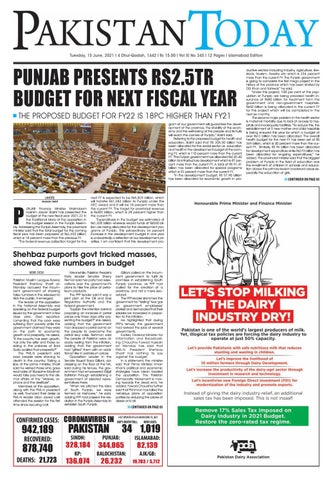
Punjab Presents rs2.5tr budget for next fiscal year g
The proposed budgeT for fY22 is 18pc higher Than fY21 gram of our government will guarantee the development of the province, the stability of the economy and the well-being of the people and its fruits will reach the corners of punjab,” bakht said. referring to the proposed budget for health and education, bakht said that rs 205.50 billion has been allocated for the social sector i.e. education and health in the development budget of the coming fY, which is 110 percent more than the current fY. “The punjab government has allocated rs145.40 billion for infrastructure development which is 87 percent more than the current fY. a total of rs 91.41 billion has been allocated for special programs which is 92 percent more than the current fY. “in the development budget, rs 57.90 billion has been allocated for economic growth in pro-
LAHORe
P
Shahab Omer
unJab finance Minister Makhdoom hashim Jawan bakht has presented the budget of the new fiscal year 2021-22 in the traditional blare of the opposition in the budget session in the punjab assembly. addressing the punjab assembly, the provincial minister said that the total budget for the coming fiscal year has been proposed at rs2,653 billion, which is 18 percent more than the previous fY. “The federal revenue collection target for the
next fY is expected to be rs5,829 billion, which will transfer rs1,684 billion to punjab under the nfc award and it will be 18 percent more than the current fY. The target for provincial revenue is rs405 billion, which is 28 percent higher than the current fY. “expenditures in the budget are estimated at rs1,428 billion whereas record funds of rs560 billion are being allocated for the development programs of punjab. This extraordinary 66 percent increase in the development budget in one year is undoubtedly a reflection of our development priorities. i am confident that this development pro-
Shehbaz purports govt tricked masses, showed fake numbers in budget News Desk pakistan Muslim League-nawaz president shehbaz sharif on Monday accused the incumbent government of showing false numbers in the released to trick the public, it emerged. The leader of the opposition in the national assembly was speaking on the federal budget issued by the government a few days prior, geo reported. Lamenting that the poor were suffering from poverty while the government claimed they were on the path to economic growth and prosperity, he asked, “if the country has seen growth, has only the elite and those residing in the palaces of bani gala availed that prosperity?” The pML-n president said poor people were starving to death in the country. Taking a jibe at the prime minister, sharif said he wished those who gave examples of riyasat-e-Madinah would take pay heed to the dismal affairs of the “widows, orphans and the destitute”. Members of the opposition, along with the pML-n president as well, thumped their desks as pML-n leader Mian Javed Latif attended the session for the first time since securing bail.
Meanwhile, pakistan people’s party leader senator sherry reman said her party had reservations over the government’s plans to hike the price of petroleum products. The ppp leader said it was a joint plan of the oil and gas regulatory authority and the federal government. “explain the intention behind proposing an increase in petrol prices only three days after presenting the budget?” she asked, adding that the government had dropped a petrol bomb on the people to overcome the petrol levy crisis. rehman said the people of pakistan were already reeling from the inflation, adding that the government had “gifted” them with an additional hike in petroleum prices. opposition Leader in the senate Yousaf raza gillani, addressing on the floor of the na, said during his tenure, the government had empowered gilgit baltistan through establishing a government of elected representatives there. “When we pitched the idea of south punjab, we were termed as insincere,” he said, adding ppp had passed the resolution in the punjab assembly to establish south punjab.
CONFIRMED CASES: coronavirus in
942,189 RECOVERED:
Pakistan SINDH:
gillani called on the incumbent government to fulfil its promises in establishing south punjab province, as ppp had called for the creation of a province, and not a mere secretariat. The ppp leader slammed the government for “testing” tear gas on government employees’ protest and demanded that their salaries be increased in proportion to the inflation. he highlighted that during ppp’s tenure, the government had revived the jobs of several governments. earlier, federal Minister for information and broadcasting chaudhr y fawad hussain on Monday has said that pML-n president shehbaz sharif has nothing to say against the budget. in a statement, the minister said that prime Minister imran Khan’s political and economic strategies have clean bowled the opposition. The pakistan democratic Movement is moving towards the dead end, he added. fawad chaudhry further said that pM imran has failed the nefarious plans of opposition parties by reducing the prices of diesel and oil.
CONTINUED ON PAGE 05 LAST UPDATED AT 6:34 AM ON JUNE 14, 2021
DAY'S DEATH TOLL:
NEW CASES:
34 1,019
PUNJAB:
ISLAMABAD: AJK/GB:
878,740
328,184
344,065
DEATHS: 21,723
KP:
136,074
BALOCHISTAN:
26,232
82,139
19,783 / 5,712
ductive sectors including industry, agriculture, livestock, tourism, forestry etc which is 234 percent more than the current fY. The punjab government is going to complete the first mega project in the history of the province which has been started by dg Khan and sahiwal,” he said. “under this project, 100 per cent of the population of punjab are being provided health insurance of rs80 billion for treatment from the government and non-government hospitals. rs60 billion is being allocated in the current fY for this project which will be completed in the next six months. The second major problem in the health sector is maternal mortality due to lack of access to hospitals and inadequate facilities. “To reduce this, the establishment of 5 new mother and child hospitals is being ensured this year for which a budget of over rs12 billion has been allocated. The overall health budget for the next fY has been set at rs 369 billion, which is 30 percent more than the current fY. similarly, rs 96 billion has been allocated for development expenditure while rs273 billion has been allocated for ongoing expenditures,” he added. The provincial minister said that the biggest problem of punjab in the field of education was the enrollment of children in schools and education above the primary level in backward areas especially the education of girls.
CONTINUED ON PAGE 05
02
Tuesday, 15 June, 2021
ISLAMABAD
NEWS
SC turnS down requeSt to halt anti-enCroaChment drive along KaraChi drainS KARACHI
r
Staff RePoRt
evoKINg its stay order on the anti-encroachment drive along with gujjar and orangi drains, the Supreme Court on Monday ordered Karachi Metropolitan Corporation to continue the drive along the
drains ahead of monsoon season. The case related to the removal of encroachments along with the drain was taken by a bench headed by Chief Justice Justice gulzar Ahmed at the apex court’s Karachi registry. At the outset of the hearing, the counsel for KMC said that the work on the expansion of gujjar and orangi drains was underway
on the court orders, but the antiencroachment tribunal has stopped them from razing the leased houses. Sindh advocate general apprised the court that Rs20,000 per month rent would be given to the affectees of the drive. on the occasion, the top judge asked who is responsible for leasing the land around these drains? “Sindh government is
responsible for leasing the land of drain,” said the judge. The counsel for the affectees, Faisal Siddiqui, said that the lease was given by the Karachi Development Authority and KMC. Six thousand affectees of the antiencroachment drive should be given alternate residence, he added. The bench wondered how can it give
relief to the people occupying the stateowned land? “This is a matter related to “China cutting” and all the lease documents are fake, the top judge declared. Later, the court revoking the stay order and ordered the KMC to continue its drive along the drains for the expansion. The SC also turned down the request of the affectees for compensation.
Shaukat tarin lashes out at Khaqan abbasi News desK Finance Minister Shaukat Tarin on Monday lashed out at Pakistan Muslim League-Nawaz senior leader and former prime minister Shahid Khaqan Abbasi over the latter’s accusations of the government presenting manipulated figures in its budget for the next fiscal year. Speaking to Pakistan Today editor Arif Nizami in Channel 92’s programme ‘Ho Kya Raha Hai?’, the finance minister said that Tarin said that he is saddened because he has worked with them a lot and they are accusing him of lying in the budget. “Shahid Khaqan Abbasi sahab, you may or may not lie, but Shaukat Tarin does not lie,” he said. “You can say there are some deficits and you can debate or disagree with some assumptions but saying Shaukat Tarin is lying, I think this is not acceptable. This is below the belt.” The finance minister said that Abbasi should come face to face and talk. “I’m ready, bring this issue to a forum then we’ll talk business,” he said. “Speak professionally.” Speaking about the government’s social packages in the budget, he questioned whether they are for the rich as well. He said that the opposition is worried because for the first time a government has come up with an approach to uplift the poor. Responding to accusations of numbers not adding up, he gave a breakdown for the PML-N senior leader.
aC summons Zardari in alleged illegal transaction case on June 29
ISLAMABAD: Prime Minister Imran Khan meets Islamabad Traffic Police Head Constable Qaiser Shakeel and praises his conscientiousness in performing his duty despite being injured. INP
PM tasks spokespersons to create awareness about budget 2021-22 IslAmAbAd aPP
IslAmAbAd INP
The accountability court No 3 in Islamabad on Monday summoned former president and Pakistan Peoples Party Co-chairman Asif Ali Zardari on June 29th in an alleged illegal transaction of Rs8 billion in a fake bank accounts case. Judge Asghar Ali of the AC also summoned former president’s alleged front man Mushtaq Ahmad. The judge said Zardari would be provided with a copy of the reference on arrival following which date would be fixed for indicting him in the case. The prosecutor for the National Accountability Bureau also appeared before the court during the day’s proceedings. earlier, the Supreme Court of Pakistan has delisted a case, filed by former president Asif Ali Zardari and his sister Faryal Talpur for transfer of graft cases against them to Sindh from Islamabad, owing to the non-availability of a judge on the bench. The apex court had fixed the hearing for the case on May 25. However, the court has delisted the case due to the reason that a judge on the bench, Justice Umar Ata Bandial, is not available on the date. The case was to be heard by a three-member special bench headed by Justice Umar Ata Bandial and comprising Justice Ijaz Ul Ahsan and Justice Sajjad Ali Shah on May 25. Both leaders of PPP have reached out to the apex court to get their cases transferred to the province from Islamabad as the latter is facing a single reference against her while the former is facing trial in five NAB references. The SC had issued notices for the hearing to the NAB and other respondents in the case. on November 3, Zardari had approached the top court, requesting the court to transfer the graft cases filed against him by the NAB from Islamabad’s courts to similar courts in Karachi where he lives. He had stated in his plea that he cannot appear in accountability courts in Islamabad due to his illness as he was suffering from various ailments and had been critically ill. He had said the cases were being heard in Islamabad courts despite the fact that all the accused persons, witnesses and documents were from Karachi. During a previous hearing, Asif Zardari’s lawyer Farooq H Naek had contended that it is his client’s right to file a plea for transfer of a case under the NAB law, which could not be taken away by the court through the verdict. Justice Bandial had noted that the cases were filed in Islamabad by the NAB on the basis of various accusations. He had said the corruption watchdog filed the references in Islamabad on the court order.
Prime Minister Imran Khan intends to take on “elements creating misunderstandings on the budget”, tasking spokespersons to create awareness about it. The premier, presiding over a meeting of the spokespersons of the PTI Monday, expressed satisfaction by saying that Pakistan’s economy was not only stable but was also moving towards development. The federal budget for the fiscal year 2021-22 was based on development, with an aim to further strengthen economic stability and promote the important sectors of the economy, he said. The prime minister said during the pandemic — which hit economies across the world and created economic problems — Pakistan achieved economic stability due to the government’s successful strategy. Federal ministers, special assistants to the PM, party
leaders, and spokespersons attended the meeting during which the country’s situation especially the “peopleoriented” development budget presented by the government, the measures to provide relief to masses, and speeding up the development process, were discussed. Party leaders congratulated the prime minister and the government’s economic team for presenting a “balanced and people-friendly budget which was positive for all segments of the society”. Pointing towards the present government’s important measures, the prime minister said that the objective behind focusing on programmes like Kamyab Jawan, Health Card, 10 Billion Tree Tsunami, promotion of science and technology, poverty alleviation, creating employment opportunities, was to effectively check the challenges faced by the country. He said the incumbent government has been fully striving to present the new budget which proved “a ray of hope for every segment of the society”.
Sindh allows to open businesses for six days a week as positvity ratio declines KARACHI INP
Sindh government on Monday allowed the resumption of business activities in the province for six days a week, following the National Command and operation Centre decision in this regard. The decision was made in the meeting of the Sindh Covid-19 Task Force, headed by Chief Minister Murad Ali Ali Shah. “The business closure will be ensured as per the decision of the NCoC,” the chief minister said adding that the businesses will remain close on Sunday in the province while allowed to continue their activities for six days in a week as per the Covid standard operating procedures. The chief minister also took notice of the report regarding the issuance of vaccine certificate without the immunisation process
and directed the Sindh inspector general and home department to take strict action against the concerned person. “No negligence and corruption will be tolerated during Covid vaccination drive,” he said. The task force meeting also made it mandatory for people acquiring driving licenses to get themselves vaccinated before getting hold of the document. He further shared that the Covid positivity ratio has declined to 4.5 percent in the province with Karachi reporting a positivity ratio of 9.5 percent, followed by 5.65 percent in Hyderabad. “The pressure on hospitals is releasing now,” Murad Ali Shah said. “We have tested 37105 passengers at Karachi airport on June 12 and 80 of them tested positive for the virus,” Murad Ali Shah said, adding that so far 50 passengers who had tested positive during screening at Karachi
airport have recovered. Moreover, the Sindh government has decided to allow on-campus academic activities of classes six to eight with a 50 percent attendance at a time from Tuesday, Sindh education Minister Saeed ghani said. Taking to Twitter after a meeting of the Covid Task Force headed by Chief Minister Syed Murad Ali Shah, Saeed ghani said that the classes of sixth to eighth grade would resume from Tuesday, and in case of further improvement in Covid situation, the primary classes will begin from June 21. He, however, said that the entire staff of the school had to get themselves vaccinated before the resumption of classes. It is pertinent to mention here that the Sindh government announced to reopen educational institutions for classes nine and above from June 7 with strict observance of SoPs. “Sindh Corona Task Force has decided to reopen educational institutions of Sindh for class 9th and above from 7th June (Tuesday) with strict SoPs. All staff must be get vaccinated,” Saeed ghani tweeted.
Bilawal says budget to unleash tsunami of inflation
ISLAMABAD: Pakistan Peoples Party chief Bilawal Bhutto-Zardari on Monday declared that the budget was prepared by officials from the International Monetary Fund who handed it to Prime Minister Imran Khan, lamenting that it would unleash a tsunami of inflation. In a statement, Bilawal lamented that without deliberating on it, the budget was presented in the National Assembly. He said that on every page of the financial plan, a recipe of economic murder of people had been scribbled. He said the secrecy and stealth of the prime minister of imposing billions of rupees in indirect taxes had been caught. He foresaw a new tsunami of inflation gathering with the budget. Bilawal said billions of rupees in new taxes had been levied on items of daily use which would definitely unleash a wave of inflation. He said after the imposition of levy, petrol price would increase by Rs20 per litre and by levying indirect taxes on sugar, its price would surge by Rs7 per kilogram. He vowed to defeat the government’s endeavour to impose indirect taxes on the public. The PPP chief said as the companies would impose a 17 percent levy on crude oil and liquefied natural gas, the prices of petrol and gas are bound to hike, and people have to bear this burden. He regretted that owing to the Covid-19 pandemic and ensuing restrictions, when the people started shopping online, the government put a sales tax on online shopping too. He said it was tragic that the overseas Pakistanis were sending remittances which are more than the country’s exports to help their unemployed relatives in Pakistan. Staff RePoRt
Tuesday, 15 June, 2021
ISLAMABAD
NEWS
03
IMRAn AdvoCAtES ACtIon AgAInSt hAtE-MongERIng SItES ISLAMABAD
P
app
RIME Minister Imran Khan has called for strict action against the websites fanning the flames of hate to divide humanity, and urged the Muslim world to present their case at international forums and help the world better understand Islam. The prime minister — in an interview with the CBC’s chief political correspondent Rosemary Barton aired late on Sunday, also broadcasted by Pakistan Television — said the use of terms like “Islamic extremism” and “Islamic radicalism” started following the 1988 publication of Salman Rushdie’s
book The Satanic Verses and then the 9/11 attacks. Imran said the use of the term “Islamic radicals” shows as if there was something wrong with the religion which turned its followers radical. Contrarily, terrorism has no religion as extremists were found in every society, he observed. He said the Muslims living in western countries, not the Muslim states, suffered at the hands of a rising tide of Islamophobia and called for bridging the gap by improving the understanding of Islam. “Everyone is shocked in [Pakistan] because we saw the family picture, and so a family being targeted like that has had a deep impact in Pakistan,” Imran said. The prime minister said the recent wave of terrorism attack on Muslim communities
in Western societies demanded a heightened focus on online radicalisation. Following the tragic killing of a Pakistan-origin family in the London city of Ontario in an Islamophobic attack, Imran took to his Twitter handle to express his grief. “Saddened to learn of the killing of a Muslim Pakistani-origin Canadian family in London, Ontario,” he wrote. He said the recurrent acts of terrorism revealed the growing tide of Islamophobia in the West. “Islamophobia needs to be countered holistically by the international community,” he stressed. Imran told Barton that he had also raised the issue with Canadian Prime Minister Justin Trudeau, describing him as a leader who understood the importance of fighting
online hate and Islamophobia. The prime minister then urged other leaders of the Western nations to make such a commitment. “The world leaders, whenever they decide upon taking action, this will be dealt with,” he opined. Imran reiterated that there was not enough motivation to act against Islamophobia, and that some leaders in the Western countries, in fact, did not understand this phenomenon and the gravity of the situation. He further said that he “mostly agrees” with Trudeau and his position on religious extremism, but also expressed concern with some domestic regulations in Canada that he expressed apprehension were contributing to Islamophobia.
NCOC daily update: Lowest daily Covid-19 cases since February ISLAMABAD Staff RepoRt
The nation on Sunday registered 1,019 new Covid-19 cases, the lowest singleday figure since February, the National Command and Operation Center said on Monday. The government portal had registered 958 cases on February 15. According to the NCOC, a
department leading the campaign against the pandemic, the total caseload had risen to 942,189, which include 878,740 recovered patients. The total active cases have dropped to 41,726 by more than 26,000 cases during the last 30 days, according to the NCOC data which showed 2,676 patients are still in critical condition. The NCOC also said the pandemic
IRSA refutes Sindh’s uneven water distribution claim ISLAMABAD Staff RepoRt
Indus River System Authority chairman on Monday dispelled the impression of Sindh receiving an uneven portion of water, insisting that the water distributary body allocates the due share of water to each province. Rao Irshad Ali Khan, in a statement, said that every province was given its due share of water. The body does not allocate less or more water to any province, he said, adding that the Sindh government’s claim of receiving little portion of water was incorrect. He said IRSA kept the water apportionment record of all the provinces and federating units, adding that Sindh was given 71,000 cusec water as per its due share. While Punjab is being given 96,000 cusec water. Irshad said the measurement of water shortage was equally divided and shared by Punjab and Sindh. The portion of water supply to every province alters after every 10 days, he informed. PPP Vice President Sherry Rehman said that IRSA decreases the water share of Sindh after making an excuse of water shortage in the river. In a tweet, Sherry said that rivers do not face water shortage during the summer season. It’s not a matter of water shortage, rather it’s a matter of water apportionment, she insisted. Sherry further said apart from Sindh, Balochistan, too, has complaints against IRSA. She claimed that the federal government wanted to create a new water issue. IRSA had reduced Sindh’s water portion by 15 percent to 20 percent, she said, adding that it was a violation of the 1991 Water Accord.
Pakistan, Egypt discuss defence cooperation CAIRO anadolu agency
Egypt’s President Abdel Fattah al-Sisi and Joint Chiefs of Staff Committee chief Gen Nadeem Raza discussed security and military cooperation between the two countries on Sunday. According to a statement by the Egyptian presidency, al-Sisi and Gen Raza discussed “strengthening bilateral cooperation between the two countries in a number of fields, especially the security and military fields”. They also discussed developments across the Middle East and agreed to coordinate to preserve regional peace and combat terrorism. Gen Raza arrived in Cairo for an official visit on Sunday. The Pakistan and Egyptian air forces held their first joint military exercise, Sky Guardians 1, in Egypt on May 26.
killed 34 people on Sunday, raising the overall death toll to 21,723. Punjab has continued to be the worst-hit region with 344,065 infections and 10,516 deaths caused by the pandemic, followed by Sindh where 328,184 infected people were confirmed and 5,243 of them lost their lives. Earlier this month, the government lifted several lockdown curbs, allowing
schools, restaurants, beaches and hair salons to reopen. However, classes below ninth grade will remain suspended until further orders. More than 8.13 million people have received their first doses, while more than 2.8 million have been fully vaccinated, according to NCOC data. The government plans to vaccinate 70 million people by the end of the year.
Rural areas to be brought at par with developed counterparts: Firdous LAHORe app
Special Assistant to Punjab Chief Minister on Information and Broadcast Firdous Ashiq Awan on Monday said that the provincial budget would be in accordance with the aspiration of people, and would bring neglected areas at par with their developed counterparts. The sustainable development of every city and human development are the main targets to be achieved in the budget, she said while speaking to a news station. She also hailed the federal government for presenting what she said was a people-friendly budget in which special relief has been provided to the deprived segment of society. She said the Punjab government would follow the foot steps of federal government and present a similar
budget, which would usher in an era of progress and development in the province. She said government employees were also being provided relief and their salaries were being increased in the budget. Awan said that the budget was a reflection of the party’s manifesto, which would open the doors of progress and prosperity in Punjab, adding that we have determined our priorities while remaining within our resources. Responding to a question, she said: “We would get opposition’s suggestions regarding issues of public, adding that priority would be given to education, infrastructure and transport sectors besides ensuring the provision of clean drinking water as well as the development of other social sectors. Awan said the facility of healthcare cards would be extended to the entire province by year-end as well.
He described Bill 21 — which bars some teachers, lawyers, police officers and others in the public sphere from wearing religious symbols on the job, including the hijab worn by Muslim women, kippahs worn by Jewish men, and turbans worn by Sikhs — as a form of “secular extremism” that led to intolerance especially against Muslims. “You want humans to basically be free to express the way they want to be, as long as it doesn’t cause pain and hurt to other human beings,” he emphasised. Imran wondered as to why it is an issue if someone covers their head or grows a beard. “People objecting to Hijab and beard is quite bizarre for me. In liberal democracies, why this is [still] an issue,” he questioned.
FouR FC tRooPS MARtyREd In tERRoRISt AttACK In QuEttA RAwALPINDI online
Four Frontier Crops troops embraced martyrdom in a terrorist attack on Marget-Quetta Road. According to a press release issued by the Inter-Services Public Relations (ISPR) on Monday, the martyred troops were deployed on the security of Marget Mines. The suspected terrorists used an improvised explosive device in the attack. The martyred troops are Junior Commissioned Officer of FC Balochistan, Subedar Sardar Ali Khan, a resident of Village Wanda Lungar Kel, Lakki Marwat; Sepoy Musaddaf Hussain, a resident of Chak-272 EB, Vehari; Sepoy Muhammad Anwar, a resident of Wanda Talgi, DI Khan and Sepoy Awais Khan, a resident of Village Bandal, District Neelum. A large scale area clearance operation by Balochistan FC to hunt the terrorists was underway, the press release stated. Such cowardly acts by inimical elements cannot sabotage the hard earned peace and prosperity in Balochistan, the ISPR said, adding that security forces are determined to neutralise their nefarious designs even at the cost of blood and lives.
President explains PM’s change of stance over Kashmir NewS DeSk
Primary, middle schools closed in KP as temperatures soar PeSHAwAR app
The Elementary and Secondary Education Department of Khyber Pakhtunkhwa on Monday directed all primary and middle-level schools to take a summer vacation from Tuesday amid a heatwave that has swept the province. The notification said that all the primary and middle schools in summer zones would remain close until further orders while in winter zones, schools from primary to higher secondary levels would remain open. According to Minister for Education Shahram Khan
Tarakai, in few hot areas of winter zones and union councils, the primary and middle schools will also remain closed until further orders. The education officers of the concerned districts will notify the areas. However, in summer zones, Tarakai said all the primary and middle schools would remain closed. For the students in classes 9-12, the educational institutions will remain open, the notification said. However, only those subjects for which examination would be conducted will be taught. The notification further read that it would be implemented at all public and private sector schools.
PM wants early finalisation of mechanism for targeted subsidies ISLAMABAD tltp
Prime Minister Imran Khan has directed the authorities concerned to finalise the new mechanism for providing targeted subsidies to vulnerable segments of the society at the earliest so that it could be formally launched next month. The prime minister said this on Monday while speaking at a briefing on the new system being devised to provide subsidies to the weaker segments of the society by the government. He said that under the targeted subsidy, the deserving segments of the society will be provided financial assistance for purchasing essential commodities. For this purpose, he added, the government is committed to providing all financial resources. Appreciating the officials concerned for preparing a mechanism to provide targeted subsidy, he said equal subsidy to both the rich and the poor is not only wastage of the government resources but it also deprives the deserving ones. Special Assistant on Poverty Alleviation and Social Protection Sania Nishtar told the meeting that Ehsaas Survey has been done by ninety-two percent and it will be completed by the end of this month. The meeting was apprised that the purpose of
introducing a targeted subsidy system is to provide financial assistance to millions of people in purchase of essential commodities. The PM appreciated the efforts and directed to complete the survey soon. The session was attended by Finance Minister Shaukat Tarin, PM’s Advisor on Revenue Waqar Masood, President of National Bank of Pakistan Arif Usmani and others. Separately, chairing a meeting to review progress in the anti-Covid-19 vaccination drive on Monday, Prime Minister Imran Khan expressed satisfaction over the drive in the country. The prime minister stressed the need for timely vaccination and adherence to the standard operating procedures to prevent the spread of pandemic. He called for collective efforts by institutions and people to avert the Indian-like situation due to the pandemic. The meeting was apprised that the number of vaccination centres has been doubled and mobile teams have been increased from 48 to 600. The meeting was also informed that over 10 million citizens have so far been vaccinated, which is a significant milestone. Furthermore, the public and private organisations are also ensuring vaccination of their staff. “All government, semi-government and private institutions are working towards ensuring 100 percent vaccination of their employees,” the session was informed.
President Dr Arif Alvi defended Prime Minister Imran Khan’s apparent change of statements on Kashmir and stressed that it was not a U-turn; instead, insisting that a leader must change their stance as per the situation. During an exclusive interview on DawnNewsTV show ‘Live with Adil Shahzeb’ at the presidential office, Alvi said: “At times, people term a shift as a U-turn, but one should change their judgement according to changing situations and new reasons.” Prime Minister Imran had last month said that Pakistan normalising relations with India unless it restored Kashmir’s semiautonomy would be a major “betrayal” to the people of occupied Kashmir. Earlier this month, he said in an interview with Reuters that Pakistan was ready to restart talks with India if Delhi provided a roadmap towards restoring the previous status of occupied Kashmir. During the interview, the president said it was not justified for a leader to see their spoken words as written in stone, adding that the key was not to compromise on the principles. “Even I have reviewed many of my life’s decisions,” the president remarked. Alvi said Prime Minister Imran was the one who could judge better considering the “evolving situation”, citing the developments in Afghanistan and new international alliances. The president said India had committed a “foolish” act of internationalising the Kashmir issue by revoking the region’s status and oppressing its people. Asked about the mistrust between the government and the opposition on the plan to introduce Electronic Voting Machines, President Alvi said he invited the entire opposition to come and examine the technology but to no avail. “Just a fear is being created that this EVM will be hacked or [there will be some] wrongdoing because it will not only have ballot papers but the electronic system to make the count,” he said, explaining that the reason for this was to place a double check on the process. Alvi said he thought the process of accountability needed to be made tougher. “Those who have been in power for decades need to be held accountable,” he said. Praising the performance of the National Accountability Bureau, the president said even the opposition now said “cases of government personalities must be sent to [NAB]”, which he said meant the accountability watchdog was doing its job right. Alvi also defended sending the reference against Supreme Court Justice Qazi Faiz Isa to the Supreme Judicial Council. “I think it was handled in a better way,’’ he said.
04
Tuesday, 15 June, 2021
ISLAMABAD
NEWS
Youngster killed, three injured in firing over children’s dispute LAHORE INP
A youngster was killed and three others were injured in firing of police constable over children’s dispute at Lajpat Road in Lahore on Monday. According to details, children of Constable Waseem, serving as driver in Police Respond Unit, clashed with children of a neighbour but other senior neighbours resolved the issue. However, the accused kept the grievance in mind and sprayed bullets at opponents while they were present outside their house in the street. As a result of firing, 21-year-old Zain was killed on the spot while Amjad, Mohibullah and Atif were injured. The accused fled the scene. The dead body of the victim and the injured were shifted to hospital and police, after registering a case against the culprit, started raids for his arrest.
two killed, 17 injured in coach-truck collision MIRPUR MATHELO INP LAHORE: Punjab Chief Minister Sardar Usman Buzdar speaks to media after the conclusion of budget session of Punjab Assembly. ZUBAIR MEHFOOZ
sc orders deMolition of pavilion end club in karachi NEWS DESK The Supreme Court of Pakistan (SCP) has directed the Karachi administration to raze the Pavilion End Club and end all commercial activities on an amusement park in Gulshan-i-Iqbal, Dawn News reported on Monday. According to the report, a three-member bench, headed by Chief Justice Gulzar Ahmed, noted that the Aladin Park was converted into Pavilion End Club and membership was being offered against fees along with other commercial activities, and directed the Karachi administrator to immediately demolish the club and end other commercial activities on the park's premises. The court also directed to file a compliance report within two days. During the hearing of a separate case, the apex court vacated all the stay orders stopping anti-encroachment drive in the port city and issued directives to the Karachi Metropolitan Corporation (KMC) to restart work to widen Gujjar Nullah and Orangi Nullah ahead of monsoon season.
The KMC counsel submitted that the work on the expansion of Gujar and Orangi nullahs was underway in pursuance of the top court orders, but the anti-encroachment tribunal has stopped them from razing the leased houses. The chief law officer of Sindh apprised the bench that a total of Rs20,000 per month rent would be given to the affectees of the nullahs. To which, the chief justice observed who is responsible for leasing the nullahs, saying the Sindh government is responsible for leasing the land of drain. As the affectees of the Gujar and Orangi nullahs antiencroachment operation protested outside the court premises and demanded a 'house for a house', the apex court annulled all restraining orders against the anti-encroachment drive. Besides, the court dismissed the dwellers' plea against the anti-encroachment drive and request for compensation, observing how the court can give relief to the people occupying the state’s land. Counsel for the affectees, Faisal Siddiqui, apprised the bench that KDA, Katchi Abadi Department and
KMC have granted the lease of the houses, saying the top court has not given any order to build a road around the canals as the decision of the SC is being misinterpreted in this regard. “It is all a matter of China cutting. If the land is government-owned, how can relief be given to the affectees?" Chief Justice Gulzar Ahmed inquired. "Don't know how these leases were given. This land is not the land of the affectees." Advocate Siddiqui submitted that the leases of houses belonging to the rich should also be checked to which a member of the bench Justice Ijazul Ahsan plainly observed that the counsel should take the leases to the concerned department and prove these. In another case, the chief justice observed that people in Tharparkar are desperate for a drop of water even today. “Not a single reserve plant was installed but Rs1500 million were spent,” he added. “What plan does the government have?” the chief justice asked the Advocate General, observing that the situation is getting worse.
Two people were killed and 17 others, including women and children, were injured in collision between passenger coach and a truck on Monday. According to details, a Lahore bound passenger coach coming from Karachi collided with a truck on National Highway near Mirpur Mathelo. Truck driver Muhammad Jameel and a passenger were killed in the accident while 17 others, including women and children, were injured. The bodies and injured were shifted to DHQ Hospital Mirpur Mathelo where four people with critical wounds were referred to Rahim Yar Khan. The police impounded both vehicles and after registering a case into the incident started an investigation.
Man killed, another injured in Quetta firing QUETTA INP
One person was killed and another injured in firing of unknown armed men in the provincial capital on Monday. Police said that unidentified culprits opened fire at two people near Sariab Mill in suburbs of Quetta. As a result of firing, one person Hamza Ababki was killed on the spot and another was injured. The attackers fled the scene. The body and injured were shifted to Sheikh Zayed Hospital. Police said that reasons behind the firing could not be ascertained, however, a case has been registering against unknown assailants and investigation was underway.
UNHCR’s assistance strengthens public health facilities in KP PESHAWAR APP
In an effort to improve public health services, UNHCR, the UN Refugee Agency rehabilitated and enhanced 11 Basic Health Units and Rural Health Centres in Khyber Pakhtunkhwa. Strategic investments have been made in the largest refugee-hosting districts under the Refugee Affected and Hosting Areas (RAHA) programme. In Kohat district, this project worth Rs70 million would benefit thousands of patients – Pakistanis and Afghan refugees. The 11 health facilities have been provided with additional labour rooms, medical equipment, furniture as well as recovery rooms, waiting areas, latrines and boundary walls. As part of the UNHCR’s Global Strategy for Sustainable Energy, which promotes the transition to clean, renewable energy in refugee settlements and hosting areas, UNHCR also installed solar panels to ensure an uninterrupted power supply to maternity wards. Training of paramedical staff was also provided. A ceremony held in Kohat district on Monday to inaugurate these facilities. The head of UNHCR’s Sub-Office in Peshawar, Bernard Inkoom, KP additional secretary health, Fazal Akbar, and additional director general health Dr Ikramullah Khan, officials from the Commissionerate for Afghan Refugees, KP, and district health authorities were also present. “The government has very limited resources, but with UNHCR’s support, we are strengthening our public health system, particularly in densely populated areas. Health is important for everyone – refugees and the communities hosting them. With the strong and ongoing cooperation between UNHCR and Department of Health in Khyber Pakhtunkhwa, we will overcome challenges posed by Pan-
demic in health sector,” said Akbar. Speaking on the occasion, Inkoom highlighted how investments into the public health sector aimed to reduce the burden in the Government of Pakistan, it’s absorption capacity and the quality of Health Services provided. “These health facilities aim to promote peaceful coexistence and ensure that health care continues to be generously provided to all people, regardless of nationality or status.” “I am thankful to all stakeholders and International community who joined hands with UNHCR since the pandemic landed in Pakistan”. UNHCR has been working hand in hand with the Government of Pakistan in Khyber-Pakhtunkhwa to contribute to the overall effort to minimize the spread and impact until the pandemic is over,” Inkoom noted. Ikramullah, appreciated the work of UNHCR for undertaking life-saving initiative and equipping these facilities to provide mother and child healthcare service on 24/7 basis. He expressed his gratitude to UNHCR for their continued support to the government’s primary, secondary and tertiary health institutions where a significant number of Afghan patients are also receiving the services. Speaking on the occasion, District Health Officer Sameen Shah said, “It’s a dream come true, the assistance provided by UNHCR would support services in Kohat to help the most disadvantaged mothers, newborns and children.” Since 2009, a total of 12.4 million people including 85 percent Pakistanis and 15 percent Afghan refugees have been benefited through the Refugee Affected and Hosting Areas Programme, UNHCR supported the implementation of 4,300 projects in the areas of education, health, infrastructure, livelihoods as well as water and sanitation across the country.
LAHORE: Pakistan Muslim League-Nawaz MPA Hina Pervaiz Butt protests against Punjab’s budget for fiscal year 2021-22. ZUBAIR MEHFOOZ
Tuesday, 15 June, 2021
ISLAMABAD
FeDeral gOvt allOcateS rS202bn FOr KP DevelOPment PrOgramme PESHAWAR
t
AZIZ BUNERI
He federal government has allocated Rs148.26 billion for 111 development projects in Khyber Pakhtunkhwa (KP) for its 2021-22 (FY22) development programme. According to details, a total of Rs24 billion has been included for tribal districts. The government has sanctioned more than Rs202.26bn out of the total Public Sector Development Program (PSDP) of Rs900 billion, which is 22.4 per cent of the total programme. Under PSDP FY22, Rs1.80bn has
been allocated for 128 MW Kayal Khurd Hydropower Project, Rs56.51bn for Dasu Hydropower Project, Rs2.70bn for 106 megawatt Golan Gol Hydropower Project in Chitral, Rs1.90bn for expansion for fourth extension of Tarbela hydropower project and Rs8.15bn for fifth expansion project, Rs1.86bn for rehabilitation of 242 MW Warsak Hydroelectric Power Station. Similarly, Rs100mn were allocated for improvement of irrigation system in Swabi, Rs601m for construction of 20 small dams in the province, Rs300m for construction of Khattak Banda Dam in Shakardara Kohat, Rs350mn for construc-
Dr Shahzad terms budget fulfillment of ‘One Pakistan not two’ promise ISLAMABAD: Leader of the House in the Senate Dr Shahzad Waseem on Monday termed budget fulfillment of promise made by Pakistan Tehreek Insaf (PTI) in its elections manifesto with the nation that ‘one Pakistan not two’. Taking part in the budget debate, he congratulated Prime Minister Imran Khan and his economic team for announcing an outstanding budget for next fiscal year 2021-22. He said despite the several challenges, a pro-people budget was presented which would bring progress and prosperity in the country, adding that it was based on the growth and particularly on the growth of poor segment of the country. Leader of the house said that before 2008, the country economic situation was far better, adding that Pakistan Still Mills and Pakistan International Airline were also profitable organizations. He said soon after 2008, the economic crisis was resurfaced in the country and many institutions were ruined economically. He said previous regimes had left serious economic threats. APP
tion of Mukh Banda Dam in Karak, Rs602mn for construction of Pezo Dam in Lakki Marwat, Rs400m for Kandal dam, Rs855m for construction of small dam in Mansehra, Rs300m for Tanda Dam Kohat, Rs3bn for Kurram Tangi Dam North Waziristan, Rs5.50bn for Mohmand Dam, Rs400m for Baran Dam in Bannu, Rs100m for improvement of irrigation system in KP, Rs100m for remodeling the Warsak Canal system, Rs736m for power supply to Hattar economic Zone, and Rs878m for power supply to Rashkai Special economic Zone (SeZ). Further, Rs39mn has been allocated for construction work at Chitral Airport,
Rs1bn for construction of Garm Chashma Road, Rs513m for expo Center in Peshawar, Rs8bn for construction of motorway from Hakla to DI Khan, Rs940m for construction of road from Peshawar to Dara Adamkhel, Rs4bn for rehabilitation of Bannu Road and Rs8.54bn for Khyber Pass economic corridor. Sources in the planning department said that although the federal government has included these projects in the PSDP for the new fiscal year, but the cost will increase manifold due to the lack of funds. The officials said that the PSDP also includes projects which were the part PSDPs for the last many years.
KP CM for CRBC project to be on ground by next year TERMS CRBC PROJECT OF VITAL IMPORTANCE FOR FOOD SECURITY OF PROVINCE PESHAWAR STAFF REPORT
Khyber Pakhtunkhwa (KP) Chief Minister (CM) Mahmood Khan has termed Chashma Right Bank Lift Canal (CRBC) project of vital importance for the food security of the province, and directed the quarters concerned to complete the project’s prerequisites by March 2022, so that the project could be put on ground next year. He was chairing a meeting regarding progress on mega developmental projects held here the other day at Chief Minister House Peshawar. Senior officials of Urban Development, Revenue, Planning & Development, Communications & Works, finance, irrigation, and other relevant departments attended the
meeting. The meeting was informed that under the public-private partnership mode execution of 22 different mega projects was planned including Peshawar D.I. Khan Motorway, acquisition of land for Dir Motorway and other important projects. It was told that schemes for beautification and uplift of different cities, establishment of public parks, infrastructure development, establishment of Tehsil complexes on need basis, construction of roads were proposed for inclusion in next ADP. It was further told that a separate scheme was proposed for urban development in the newly merged districts adding that concerned deputy commissioners would present a comprehensive plan in consultation with the relevant departments to this effect which would be
implemented on priority. Similarly, construction and rehabilitation of rural approach roads in merged areas would also be the part of the upcoming ADP. Keeping in view the provincial government’s priorities for accelerated development of agriculture sector, all the schemes planned under agriculture transformation plan were also being included in the ADP of next fiscal year whereas a separate scheme has been proposed for agriculture transformation in merged areas. The authorities also told the meeting that a project regarding development of new tourists sites in the province would be included, adding that work was in full swing on establishing play grounds in seven merged districts whereas a new scheme for establishing new grounds has also been proposed.
NEWS
05
Shehbaz purports govt tricked masses, showed fake numbers in budget ContinuEd fRom PAgE 01 earlier, Fawad Chaudhry alleged that all the decisions regarding Sindh province are being taken in Bilawal House. Addressing a press conference, the minister said that Sindh Chief Minister Murad Ali Shah has no authority to decide on any issue. There was nothing mentioned in the Constitution related to Governor Raaj, he told. Fawadsuggested holding elections of local governments in Sindh. He further criticized PML-N for rejecting everything without analyzing the situation. Moreover, an accountability court in Lahore on Monday granted Pakistan Muslim League-Nawaz president Shehbaz Sharif exemption from personal appearance in Ramazan Sugar Mills and Ashiana-eIqbal cases. The court adjourned the hearing of both cases until July 8. The leader of the opposition in the National Assembly submitted an application in the court stating that he couldn’t turn up before it as he was in Islamabad to take part in the ongoing budget session in the lower house of Parliament. He, therefore, requested the court to grant him exemption from personal appearance. On April 23, Shehbaz Sharif was released from Lahore’s Kot Lakhpat Jail after a full bench of the Lahore High Court granted him post-arrest bail in a money laundering reference. He was released from prison after nearly seven months. A three-member bench headed by Justice Ali Baqar Najafi and comprising Justice Aalia Neelum and Justice Syed Shahbaz Ali Rizvi announced a unanimous verdict, granting bail to Shehbaz. It is noteworthy that the larger bench was constituted after a two-member bench gave a split decision and the matter was forwarded to Lahore High Court Chief Justice Muhammad Qasim Khan.
Punjab presents Rs2.5tr budget for next fiscal year ContinuEd fRom PAgE 01 “To this end, 577 primary and elementary level schools in 22 districts of Punjab are being given the status of middle and high schools under the Insaf School Program so that parents who drop out of school due to distance from home after primary level ensure free education at least till matriculation. “For this purpose, Rs6.80 billion is being provided in the education budget from which at least 4 million students will benefit. establishment of 8 universities in Pakpattan, Rajanpur, Gujranwala, Attock, Hafizabad, DG Khan, Nankana Sahib, Bhakkar, Layyah, Multan and Sialkot to provide higher education facility to every district in the field of higher education and it is proposed to allocate Rs1.20 billion for this purpose,” he said. “A world-class applied engineering and technology university is being constructed in Sialkot with the cooperation of Austria at a total cost of Rs17 billion which will prove to be an important milestone in the field of technical education. In a show of devotion and love for the Holy Prophet (PBUH), a block of Rs834 million has been set aside for Mercy Scholarships which will help the needy students in their educational expenses. The total education budget has been set at Rs442 billion, which is 13 percent more than last year. Rs54.22 billion has been allocated for development expenditure while Rs388 billion has been allocated for ongoing expenditure,” Bakht explained. The provincial minister further said that a separate secretariat with 55 administrative and 11 financial powers has been set up in South Punjab to address administrative shortcomings. “Development funds of Rs189 billion have been allocated for South Punjab in the next FY. The Punjab government is proposing to allocate a hefty amount of about Rs1 billion for the development of Cholistani areas in South Punjab, under which roads will be constructed for access to drinking water reservoirs and Cholistani area. “In addition, it is proposed to allocate Rs150 million for locust control in Cholistan and rainfed areas. Ongoing projects supported by Development Partners include completion of assets worth over Rs2.34 billion under the South Punjab Poverty Allevi-
ation Program which includes the transfer of assets including the construction of low-cost houses for poor women, technical skills and provision of goats will be completed. An amount of Rs15 billion is being allocated for the completion of projects under the Community Development Program in Punjab. “These projects will not only strengthen human development but also increase the human capital and reaffirm the commitment of the government of Pakistan to international organizations under the SDGs. The unbalanced distribution of resources during the ten years of the previous government has affected not only South Punjab but also most of the districts of Central Punjab have been underdeveloped,” Bakht said. “The District Development Program of Rs295 billion in the Annual Development Program for the next FY will improve the provision of services as per requirement in 36 districts of Punjab without any allocation in the next two years. Under the project, development works related to construction and repair of roads, supply and drainage, basic education and health in backward areas will be carried out which will raise the living standards of the people and create new employment opportunities for which future financial Rs99 billion has been allocated in the annual budget,” he said. Bakht further said that in view of the central and commercial importance of Lahore, a significant amount of Rs28.3 billion is being allocated for development projects in the budget for the next FY and under this mega infrastructure projects will be implemented in the city. “Considering the severe water shortage in Lahore, a Surface Water Treatment Plant is being set up for which more than Rs1.5 billion is proposed to be allocated in the next fiscal year. Our government is going to start the construction of a state-of-the-art 1,000bed hospital this year. A special package of Rs10 billion for economic development in the development program of the next FY is a link in this chain. With this special package of Rs10 billion, the Punjab Government has decided to continue the tax relief provided for business rehabilitation and development in the current financial year as well as in the next FY,” Bakht explained. “For this purpose, a comprehensive
package of Rs51 billion has been allocated in the budget under which the rate of stamp duty on taxes will be maintained at 1 percent by the Board of Revenue. The Rs40 billion concession will be aimed at encouraging new investment in the construction sector. The Punjab sales tax rate on more than 25 services which was decreased from 16 percent to 5 percent in the current FY will be maintained in the next FY as well. “These services include small hotels and guest houses, wedding halls, lawns, venues and awning services and cadres, IT services, tour operators, gyms, property dealers, rent a car service, cable TV operators, Treatment of Textile and Leather, agricultural Commodity related agents, Auditing, Accounting & Tax Consultancy Services, Photography and Parking Services.” “Similarly, proposals are being made to reduce sales tax on ten more services from 16 percent to 5 percent in the next FY and these new services include beauty parlours, fashion designers, home chefs, architects, laundries and dry cleaners, supplies of machinery, warehouses, dress designers and rental bulldozers. It is proposed to reduce the tax rate on call centres from 19.5 percent to 16 percent,” Bakht added. “In the current FY, the tax rate for cash payments for restaurants was 16 percent while for credit or debit card payments it was 5 percent. This not only helped in documenting the economy but also made the move much appreciated by the people. It is also proposed to increase the tax rate on payments through mobile wallet and QR code to 5 percent for the next FY. Under the excise, Taxation and Narcotics Control Department, property tax will be paid in two instalments in the next FY as well as in the current FY. “It is proposed to limit the surcharge penalty on property tax and motor vehicle tax to only the last two quarters of the next financial year. To encourage the purchase and sale of electric vehicles to control environmental pollution, electric vehicle registration fees and token fees will be reduced by 50 percent and 75 percent respectively,” he said. “In view of the importance of industry and trade in economic development, projects like Allama Iqbal Industrial City Faisalabad, Bahawalpur and Industrial estate in Sialkot
and Quaid-e-Azam Business Park Sheikhupura covering an area of 2800 acres are under construction. “Development works in Faisalabad and Lahore industrial estates will be completed on priority basis. To achieve such objectives, funds of RS 3.5 billion are being provided to boost economic and industrial activities. Sialkot Tannery Zone is being set up at a cost of Rs50 crore in collaboration with the Sialkot Chamber of Commerce and Industry for which Rs35 crore is being allocated in the next FY. Loans are being provided on easy terms under the Punjab employment Program at a total cost of Rs10 billion,” he informed. The provincial minister said that the government was setting up a model bazaar authority under which model bazaars would be set up in all major cities of Punjab and a significant amount of Rs1.5 billion would be allocated for this purpose next year. “The government is launching a comprehensive road construction, repair and expansion plan from next FY. Under this project, 1769 development schemes worth Rs380 billion will be launched across the province under which construction, repair and extension of 13,000 km long roads will be completed. A significant amount of Rs58 billion is being allocated for this purpose. The federal government has agreed to provide financial resources for a comprehensive program of construction and expansion of modern highways in the province. “For which, funds of Rs39 billion have been allocated in the next fiscal year. In addition, a CM Road Rehabilitation Program worth Rs8 billion is being launched under which the construction and rehabilitation work of dilapidated roads of the province will be completed. In total, a record amount of Rs105 billion will be spent on road construction, expansion and rehabilitation projects in the province next year. The Punjab government is introducing the Peri-Urban Housing Scheme in the next financial year under which an average house will be available at a cost of Rs1.4 million. “Under this project, funds of Rs3 billion have been allocated for infrastructure development. Similarly, under the Naya Pakistan Housing Program, we are providing Rs1 billion, which will enable people to build
houses in a manner developed in collaboration with private developers. In addition, funds of Rs22.44 billion are being provided for the provision of modern infrastructure and civic amenities in the cities of Punjab,” Bakht said. “In the next financial year, the development budget of the Department of Agriculture is proposed to be increased from Rs7.75 billion to Rs31.50 billion with a historic increase of 306 percent. Subsidies on purchase of fertilizers, seeds and pesticides, crop insurance, provision of loans on easy terms from Rs5.82 billion to reduce the cost of farmer’s prosperity and crop production. “It is proposed to allocate a total of Rs5 billion for livestock and dairy development and to allocate a total of Rs4 billion for the tree planting sector. A hefty sum of Rs4.5 billion has been allocated for the Punjab Social Protection Authority which will benefit 460,000 people. More than Rs12 billion has been allocated for the Punjab ehsas program next year with the cooperation of the federal government, which will benefit another 700,000 people,” he added. “The Punjab government has taken special steps to promote religious tourism and more than RS 2 billion is being allocated in this regard. In the development program for the financial year 2021-22, a budget of Rs1.25 billion has been proposed for the Punjab Tourism Department. A special block of Rs8 billion is being set up in the budget for the next financial year to maintain law and order,” he said. Speaking about the salaries of government employees, the provincial minister said that the salaries of all government employees would be increased by 10 percent. “However, the salaries of more than 721,000 government employees from Grade 1 to Grade 19 who have not been given any additional allowance package before are being increased by another 25 percent in terms of Special Allowance. It is also proposed to increase the pension of retired employees by 10 percent. The daily wagers of the country have always been closest to our hearts so it is not possible for us to ignore them. In the budget for the next FY, the minimum wage of our labour is being increased from 17,500 per month to 20,000 per month,” he concluded.
Tuesday, 15 June, 2021
06 COMMENT
Marriage, morals, and Malala
Budgetary politics In PMLN’s heartland
I
T appears from the Punjab Budget that the PTI government wants to provide considerable relief to the otherwise restive province. The upcoming year’s aDP is 77.5pc higher than the earlier rs310bn programme. The budget focuses on massive development of roads infrastructure, industry, social sector, health, education and public welfare. The health sector has been allocated rs 94 billion with promises of more hospitals and universal health insurance in the province by the year end. an amount of rs51bn has been reserved for education sector whereas the agriculture sector would have a development share of rs35bn—almost double of the ongoing fiscal year. The government is notorious for lacking the capacity to consume a major portion of the development budget. But even if it manages to spend a fair portion the allocations, this would create large number of jobs for construction labour, school teachers, doctors and paramedical staff. So far the PTI govt had little to show for its performance in Punjab. The people faced an unending hike in electricity charges and petrol price while commodities of daily consumption becoming too costly forced the poor to cut down on food items at the expense of their health. The government was widely criticised for increasing poverty and unemployment. The PTI government had no explanation for its lack of performance other than blaming the previous governments for the country’s ills. as time passed the explanation failed to satisfy many. Budget 2021-22 would create a soft corner for the govt among a fraction of the vastly estranged population of the province. It would also generate hope in some that the government might take other pro-people actions if allowed another term. Meanwhile the government’s army of official spokespersons would as usual make a mountain of a molehill. With huge development funds promised to the legislators of the ruling alliance, all attended the pre-budge dinner hosted by PM Buzdar. all the allies and erstwhile dissenters promised to get the budget passed. earlier a delegation comprising a handful of PML-N and PPP malcontents also called on the CM to ensure support for the budget. Those who benefit from the budget would not be impressed by former PM abbasi’s comment that “the budget is based on lies”. It remains to be seen however if those who gain from the budget are in thousands or millions.
The old debate revisited
HASAN AFTAB SAEED
H
ave you been spending unhealthy lengths of time on social media arguing with humanists on forums managed by them? are you looking for a way to cut down on internet time, but do not want to be thought of as a coward fleeing the battlefield? If so, look no further and let me tell you about an honourable way of getting kicked out of these forums. all you need to do is post this simple thought on one of these pages: ‘Sex outside of marriage is exploitative of women even if they are not conscious of it.’ This works every single time. Having lost count of the number of social media groups that have banned me for posting this, I know what I am talking about. Talking of marriage and morals, Malala Yousafzai is back in news after her comment about having no idea why couples must sign marriage papers instead of simply staying in partnerships. Mr Yousafzai was quick to issue the standard clarification, that his daughter’s comments were taken out of context. Malala’s fans are expected to love her even more after this last statement from her, while her detractors are hardly going to fall in love with her after the clarification. So, I have no idea why Mr Yousafzai is even bothering. Forgetting Malala for a moment, let us focus on the issue. The marriage vs. partnership (or ‘relationship’)
Need to formulate a code of conduct
T
N Burki
E
verY day as the land greets the morning sun, Mehmood, a farmer hailing from Bajaur district, would wrap a faded-peach scarf on his head and trudge towards his cattle to plough the wheat field. Mehmood has lived a tough life, like most people from the Merged areas. Having one too many mouths to feed, his tired hands needed an overhaul, an efficient way to farm and earn a livelihood. He had a tractor but maintaining it often came at the cost of his family going hungry. Machinery was not the answer to his problems. relief strategies to provide support to struggling farmers like Mehmood in the Merged areas were not reaping the kind of results the Khyber Pakhtunkhwa government had anticipated. To streamline its efforts and boost development in the region, the government has decided to mull over implementing a new planning tool with the technical support of Merged areas Governance Project (MaGP) of United Nations Development Programme (UNDP), called the Programming approaches/analytics and Measures Framework (PaMframe). The MaGP has a track record in bringing out innovations that question why things are done the way they are done to find room for improvement. Kalsoom rehman, who works as a planning officer at the agriculture engineering Department, said that the PaMframe has given the government’s traditional planning process for development projects a new vision. “earlier, the planning process began with a top-down approach, meaning a development project would be introduced in the hope it would secure multiple benefits for the public. Sometimes, the results that we had hoped for would materialize. Other times, they would not,” rehman said. “We realized that simply buying tractors was not going to help the agricultural department meet its long-term goals such as increasing food production and generating sustained income for farmers,” she added. “There were many layers to the problems farmers in the Merged areas faced. First, we need to specify on which piece of land the harvest is going to take place, and that would only be achieved once a land dispute is settled. Then, we would look into what crop would be most suitable for that area, management of water resources and what capital investment would the farmer require instead of just putting in an order for tractors.” Tractors on their own is no solution. Bushra aslam, an MaGP associate working on the
Dedicated to the legacy of the late Hameed Nizami
Arif Nizami Editor Joint Editor
Umar Aziz Executive Editor
Lahore – Ph: 042-36300938, 042-36375965
For a long time, the movement of ‘civilization’ has been such that economic implications have constantly been pushing the age of marriage upwards, with a corresponding increase in acceptance of premarital relations as a norm in more and more circles. Men being men, they believe that the arrangement suits them just fine.
The author is a connoisseur of music, literature, and food (but not drinks). He can be reached at www.facebook.com/hasanaftabsaeed
Development in Merged Areas to get a makeover as KP Govt reengineers planning framework
He parties currently in opposition claim that they are united against the ruling PTI-led coalition. at one point they formed the Pakistan Democratic Movement, believing that time had come to launch a movement to overthrow the PTI government. as each one of the two major opposition parties has its own programme and is keen to come to power on its own or by forming an alliance with like-minded parties, the PPP and PML-N have long history of contending with each other even while in opposition. The opposition alliance is always temporary. even when forming an alliance the parties know that once the govt is overthrown they will be competing against one another to form the next government. This often creates problems even during the alliance. There were attempts by both the PPP and PML-N to develop special relations with the smaller parties in the alliance and in the case of the former to hobnob with the smaller parties in the ruling alliance also. The PML-N developed closer relations with the JUI-F and several other parties within the PDM while the PPP reached an understanding with the aNP as well as with elements in BaP which helped the PPP candidate get the seat of Opposition Leader in Senate. This led to a split in the PDM. The agreement to support PML-N candidate in Na-249 was subsequently disregarded by the PPP which put up its own candidate on the seat and got him elected. The JUI-F is a political rival of the PPP in interior Sindh. The party has now announced a movement against the PPP’s Sindh administration. It has accused CM Murad ali Shah’s administration of corruption, incompetence, bad health policy and allowing the powerful landlords to steal poor farmers’ share of irrigation water. The JUI-F has announced a four stage action programme including protest marches at Larkana, Karachi, and all Sindh districts and finally a march from Ghotki to CM House in Karachi. The JUI-F has also included opposition to the PTI in its protests but the greater emphasis is on confronting the PPP government. With elections nowhere in sight it is irrational on the part of the opposition parties to start fighting against one another.
Managing Editor
is the intensity of the maternal instinct in women that few of them can remain completely sane without becoming mothers. For various reasons, parenthood does not nearly have the same effect on a man’s career that it has on that of a woman. Therefore, for most men the family vs. career question never really arises, which, as a rule, cannot be said about women. The difference that parenthood brings only starts with childbearing, which takes a tremendous toll on the female body. This is followed by the raising of children part that demands a great deal more energy from the mother than from the father. It is not for nothing that nature has put an age limit on women conceiving. Men, on the other hand, can become fathers till much later. These are facts of life that must be faced, however unpleasant on unfair they may sound. For a long time, the movement of ‘civilization’ has been such that economic implications have constantly been pushing the age of marriage upwards, with a corresponding increase in acceptance of premarital relations as a norm in more and more circles. Men being men, they believe that the arrangement suits them just fine. even in the most traditional societies the average age of tying the knot is likely to increase further, and with it the ‘convenience’ that free love brings. It is a safe bet that men will not be complaining about it. From the look of things, neither will more and more women. But that will not mean that the practice is not to the detriment of both parties, especially women because they have a whole lot more to lose than men.
Blueprint for success
Opposition vs opposition
Yousaf Nizami Aziz-ud-Din Ahmad
debate is an old one. Of course, it cuts no ice with the humanists if they are told that premarital sexual relations are prohibited by the almighty. What do they care about such prohibitions when they do not believe in the almighty in the first place? They grant that extramarital relations are wrong, there being an aggrieved party (the spouse); but they see nothing wrong with consensual premarital sex. They fail to realize that premarital habits have a way of spilling over into married life. another shortcoming of the humanists’ position concerns their axiom that a person is entitled to do with her body whatever she pleases so long as she does not harm anybody. This sounds reasonable until one recognises that it is entirely possible for a woman to harm herself without being conscious of the fact. Consent alone does not preclude an activity from being damaging to a woman. any mention of this troubles the humanists immensely – champions of human rights that they are. So, whenever you bring this up you get to read some amusing responses, before getting banned. It is very disconcerting for men on these forums to even entertain the idea that they could be guilty of exploiting women. So they reject it out of hand. Some of them try to laugh it away but their performance is not the least bit convincing. and they know it, hence the banning routine. Women on these forums deny being exploited even more emphatically. One woman was so livid at the suggestion that she told me that far from being exploited, it was she who had exploited many men sexually. I have heard some curious arguments in support of questionable practices, but none stranger than this one. Malala may not have noticed it, but men and women are very different physically. The differences in their emotions and psyches are even greater. Such
I
Karachi – Ph: 021-35381208-9
I
PaMframes strategy, explained this new planning tool essentially strengthens linkages between the various government departments and evens out socio-economic development across the sectors. “For example, if the government wants to construct a school, it first needs to define the number of students that could be enrolled before planning the blue-print of the building. The government would also plan for number of teachers that would be needed to ensure quality education. It would then also need to plan for the power consumption and other capital investment to maintain the school’s daily operations,” she said. “Simply erecting a school building would not improve the literacy rate in the region, and for that, several departments need to work together,” she added. PaMframes center what needs to be achieved rather than what can be sanctioned. aslam further explained that PaMframes allows for improved visibility and effective communication between all the line departments involved to uplift a sector, be it education, health, or agriculture. Simplifying the puzzle: The idea of PaMframe came from a provincial cabinet meeting earlier this year when a conversation started about monitoring the progress across the developing sectors in Merged areas. Policy makers wanted to ensure the government’s monetary investments were being utilized for the interventions in the most efficient manner to reap the desired growth on the grassroots level. “In another two or three months, we will have a framework (PaMFrame) that will helps us have a clearer picture about where the taxpayers’ money is going,” said Shakeel Qadir Khan, the KP additional chief secretary. “We will also be able to quantify the outcomes of the various development projects across sectors.” “Our current planning system is largely focused on launching a bunch of development projects and setting implementation targets. But what the system lacks is the ability to to measure the impact of our development portfolio,” the additional chief secretary added.
Islamabad – Ph: 051-2204545
“employing the PaMframe approach will provide the provincial government an opportunity for the departments to define what is needed for a successful implementation of the project as well as measure its output effectively,” he added. The integration of the PaMframes within the system has been distinguished as a major step forward to streamline the planning of development schemes and initiatives of the provincial government. “If we look at the labor market abroad, there are more people from KP working abroad in comparison to Punjab but the remittance it received is many times higher than that of KP because people are more aware about the banking and remittance system,” said Muhammad Islam afridi of the KP Higher education Department. “Our department’s long-term goal is to provide quality higher education at an affordable cost. PaMframe will allow for us to identify the gaps that exist in achieving that goal and how to achieve those in a more tangible manner,” he added. additionally, with the PaMframe planning tool, the government will be able to scan development projects more rigorously while deliberating on the allocation of funds for that initiative. “This model is an excellent initiative to overcome spending money on certain activities that are duplicative, because it incorporates the input of all stakeholders and parties responsible for an efficient implementation,” said Nasir Ghafoor Khan, the chief engineer at the Department of Irrigation. “We are able to identify and fill in the gaps that were often not taken into consideration in the planning phase, and boost socio-economic condition of Merged areas.” With the PaMframes in place, planning will now not just be about allocations for schools, but the holistic allocations required for meaningful education that creates change. and for every sector it is applied to, the results will similarly be transformative.
With the PAMframes in place, planning will now not just be about allocations for schools, but the holistic allocations required for meaningful education that creates change. And for every sector it is applied to, the results will similarly be transformative.
I
Web: www.pakistantoday.com.pk
I
The writer is a freelance journalist from South Waziristan.
Email: editorial@pakistantoday.com.pk
Tuesday, 15 June, 2021
COMMENT 07 Editor’s mail Send your letters to: Letters to Editor, Pakistan today, 4-Shaarey Fatima Jinnah, Lahore, Pakistan. E-mail: letters@pakistantoday.com.pk Letters should be addressed to Pakistan today exclusively
Do you know what’s more fatal than CoviD?
Political instability and Pakistan Causes and possible remedies Bakhtawar rakhshani
P
olitical instability has created a disturbing image for Pakistan globally. throughout the history of Pakistan, one can experience a completely chaotic condition in Pakistan’s political system; particularly, after the 2013 controversial elections which brought Nawaz Sharif into power. the Nawaz regime was in a complicated quagmire which resulted in a fumbling economy and pushed democracy into long-lasting fallout. Ultimately, the Nawaz regime came to its downfall given the fact that he was not sincere to the nation and proved to be involved in money laundering. Since then, an environment of ebb and flow has been cultivated in the structure of the political system of Pakistan. in this article, i will bring the possible scenarios which lead to political instability within a state. Further, how an unstable political structure split the masses on various grounds, put a halt to economic and social growth, and depicts a weak picture of a state on a global forum. a stumbling and segmented political organisation is one of the root causes of an unstable political condition that is being faced by every government in Pakistan. on the other hand, weak political parties compelled every government to seek help from the coalition to come into power. consequently, every government puts all efforts into satisfying all its coalition parties and stays under constant force. Furthermore, it also becomes a tough job for the government to formulate domestic and foreign policies as it demands the support of all masses within a party. it has been claimed that unless there are collective efforts from all individuals within a party, a stabilized political system can not be achieved. it should be also stated that incompetent governors also contribute to an unstable political scenario. the role of a leader is significant; especially, in the case of Pakistan where multiple ethnicities and sects are existing. Undoubtedly, when all the masses of a state are not served equally and show dissatisfaction with the performance of the authorities, a sense of identity crisis gets shaped within a state and people from different communities start holding negative sentiments for the ruling party; as a result, people no longer have faith in institutions and run after their interests. Eventually, a segmented society gets formed where every sect prefers its
benefits rather than the state. the identity crises can be described in several ways in a political system. it is linked with the enthusiasms of patriots and the will of people who reside in a common region. Whenever there is a sudden change in the cycle of the political chain, the question of identity crisis emerges. “When a community guides that it had once unquestionably accepted as physical and psychological definitions of its collective self are no longer acceptable under new territorial conditions” (Samuel, 1971). However, in this regard, the example of East Pakistan can not be disregarded. Not only East Pakistan but also the alarming circumstances in Balochistan and Sindh are too enough to prove the adverse effects of an identity crisis. However, when there is no check and balance within the party, it gets failed to gain the support and belief of the masses. Moreover, religious ethics parties play the role of fuel and bring more disasters in an already fragile environment. these religious sects split the society and exploit their sentiments for their profits. it can be well explained by the current political situation in Pakistan how the opposition played the card of emotions while visiting the Hazara community and Baloch protesters. an unstabilized political condition gives birth to numerous socio-economic problems. it shapes a blurred image of a state in the global forum. consequently, other countries reluctant to make a partnership with a country that is suffering from a scattered political party and such countries remain in constant backwardness same as Pakistan. the fumbling and destabilized Democratic regimes have portraited a dark future for the people of Pakistan. the country has already lost its East wing due to political instability and continuously suffering from the emerging tension among the unities. at the moment, Balochistan and Khyber Pakhtoonkhwah are the most vulnerable regions where the effects of political instability can be felt immensely.
A stumbling and segmented political organisation is one of the root causes of an unstable political condition that is being faced by every government in Pakistan. On the other hand, weak political parties compelled every government to seek help from the coalition to come into power.
another challenge that is being faced by Pakistan because of the unstable criteria in politics is misleading the issue of terrorism. it is making it impossible to bring effective solutions and policies for the long-lasting issue of terrorism. the ongoing weak domestic circumstances because of the internal and external attacks have wholly destroyed the economy of the country and closed the door for foreign investors. it has emerged as a huge challenge for Pakistan to handle international pressure and deal with internal questions such as collapsing economy, grievances of masses, and losing the support of the nation for the government and military. a nation can never step on the ladder of prosperity until it is politically balanced as the prosperity of a nation along with the growth of the economy and health of society wholly depends on the stability of the political system. to formulate a stable political system, Pakistan requires competent leaders who can bring all the sects of society to one table. Moreover, the government needs to establish a strong belief among the people and serve them equally to make them feel contented as being a part of the nation. as a result, all sects of society exert their energy for the betterment of the nation. once the different ethics of the society are satisfied with the state, a sense of harmony will take place among the people. in this context, Pakistan has to learn from countries that have maintained a stable political set-up such as china, Egypt, and Zchecoslvac. Undoubtedly, establishing an organized political set-up is never an easy task for any state; especially, for a country like Pakistan where people of different cultures and religions exist. it mainly reflects on the working of the government and its ruling party. Political instability is a deep-rooted issue in Pakistan that has shaken the leg of the economy, interrupted social growth, and distributed people on various grounds. However, improper working of political parties, inefficient leadership, and dismemberment of unites are the main contributors to a paralyzed political set-up. as a result, Pakistan is going through multiple issues such as dissatisfaction among the people, a fragile economy, and threats from external and internal forces. on the whole, a critical analysis is required for generating a stable political scenario in Pakistan and it is only possible when the government and opposition put all the arguments aside and work collectively for the development of the nation and serve people rather than favoring their interests. However, looking at the current state of politics in Pakistan, one can not dream of a stabilized political system at all.
The identity crises can be described in several ways in a political system. It is linked with the enthusiasms of patriots and the will of people who reside in a common region. Whenever there is a sudden change in the cycle of the political chain, the question of identity crisis emerges.
The author is a student from School of Intensive Teaching (SIT) Hub, Balochistan
aS in many countries the corona virus lockdown has been swayed off, the new practice of wearing discarded face masks and gloves is posing another threat to the human health and the global environment. Decades of hardworking turning consumers away from single-use plastics went down the drain with the compulsory usage of the discarded face mask. Before covid-19 hit the world it kind of felt like the world was waking up to the harm of plastics. across the globe many groundbreaking piece of legislation banning all kinds of single-use plastics were about to pass but then corona virus hit and everything took a sudden turn. covid 19 has left its mark on individuals, families and nations as a whole and it will take a long time to regain the momentum with which we are moving forward in our lives. along with humans, it also affects nature. For the time being, when we were all confined to our homes and working or learning from there, the consumption levels of natural gas and other fossil fuels fell down quite a lot and it did show some impacts on the environment in the form of decreased levels of co2, ozone depletion has also to some extent decreased and overall a better air quality was observed. Many of the natural habitats recovered as well when humans weren’t poking around. But when we see at the larger picture of this whole situation that we were in for almost one and a half year, then it displays even more concerning points. Face masking is now a legal requirement in many public sector around the world but before its mandatory use, masks were causing litter problems on land and at sea. Promoting wearing masks as an easy way to control the spread of pandemic has dramatically increased the production of disposable masks. We have been using disposable masks, gloves and plastics extensively since corona virus swept the world with its deadly onslaught. We have been using disposable masks, gloves and plastics extensively since the corona virus succeeded in its deadly attacks around the world but despite knowing the outcomes of the disposable masks and gloves, the UN agencies and its partners spread it all over the world. Without better disposal practices, an environmental disaster is looming. Most masks are made of long-lasting plastic, and if discarded, they can rot in the environment for hundreds of thousands of years. Plastic breaks down into smaller pieces and over time more and more small debris spreads in nature, small particles are basically a long-lasting polymer that can accumulate in food chains, each with the potential to carry chemicals and bacteria up the food chain and potentially even into humans. this huge consumption will show their effects in the near future and when that time approaches slowly, it will be much worse than what we have seen. Government and authorities have no plans for the environmental crisis in coming years that will follow this pandemic which is yet to come to an end. the covid-19 pandemic was just one part of the picture and if we do not let nature follow its course and play our part in recovering our environment’s health then who knows how many pandemics are waiting for us along the road. AHmEd HASSAn ISlAmABAd
vaccine is expected tHE third covid-19 wave has victimized the population of Pakistan again. and it is causing again the death of many individual. on the other hands, the government of Pakistan is working upon a vaccine of covid-19 to be provided to all provinces but unfortunately, it is yet not given. therefore i request the government of Pakistan that work to provide the vaccine to all provinces very soon. dIlSHAd murAd KEcH
G7 meeting GroUP of Seven leaders called on china to respect human rights in its Xinjiang region, allow Hong Kong a high degree of autonomy and refrain from any unilateral action that could destabilise the East and South china Seas, according to a draft version of the G7 summit communique seen by reuters. the re-emergence of china as a leading global power is considered to be one of the most significant geopolitical events of recent times, alongside the 1991 fall of the Soviet Union that ended the cold War. But the return of china as a global power has unnerved the United States: President Joe Biden casts china as the main strategic competitor and has vowed to confront china’s “economic abuses” and push back against human rights violations. “We will promote our values, including by calling on china to respect human rights and fundamental freedoms, especially in relation to Xinjiang and those rights, freedoms and high degree of autonomy for Hong Kong enshrined in the Sino-British Joint Declaration,” the G7 said in a communique that was almost finalised. Before the G7 criticism emerged, china pointedly cautioned G7 leaders that the days when “small” groups of countries decided the fate of the world were long gone. the G7 also said they underscored “the importance of peace and stability across the taiwan Strait, and encourage the peaceful resolution of cross-Strait issues”. “We remain seriously concerned about the situation in the East and South china Seas and strongly oppose any unilateral attempts to change the status quo and increase tensions. “We also call for a timely, transparent, expert-led, and science-based WHo-convened Phase 2 covid19 origins study including, as recommended by the experts’ report, in china,” the communique said. “the days when global decisions were dictated by a small group of countries are long gone,” a spokesman for the chinese embassy in london said. “We always believe that countries, big or small, strong or weak, poor or rich, are equals, and that world affairs should be handled through consultation by all countries.” Beijing has repeatedly hit back against what it perceives as attempts by Western powers to contain china, and says many major powers are still gripped by an outdated imperial mindset after years of humiliating china. UN experts and rights groups estimate over a million people, mainly Uighurs and other Muslim minorities, have been detained in recent years in a vast system of camps in Xinjiang. china denies all accusations of forced labour or abuse. it initially denied the camps existed, but has since said they are vocational centres and are designed to combat extremism. in late 2019, china said all people in the camps had “graduated”. SoHAIl KHAn lAHorE
Tuesday, 15 June, 2021
08 WORLD VIEW
We cAnnot Afford to turn our bAcks on AfghAnistAn We Cannot ComPletely aBandon afghanistan. it Would Be a disserviCe to our trooPs, to our afghan Partners and, most imPortant, it Would not Be in the us national interest
new York Times
W
RobeRt m Gates
ITHIN a few weeks, the last U.S. troops will leave Afghanistan, ending a military engagement that began 20 years ago this October. More than 2,300 of our finest have been killed, and more than 20,000 were wounded. More than 71,000 Afghan and Pakistani civilians have died as a direct result of the war. We have spent much blood and much treasure. Most Americans just want to close this painful chapter, but we cannot completely abandon Afghanistan. It would be a disservice to our troops, to our Afghan partners and, most important, it would not be in the U.S. national interest. It may be hard to remember now, but it took just two months in late 2001 for the United States to oust the Taliban from Afghanistan and rout Al Qaeda in one of the shortest military campaigns in American history. On the diplomatic front, the Bonn Agreement in December 2001 forged consensus among Afghan factions and international parties on the formation of an interim government in Kabul. It called for the establishment of a “broad-based, gender-sensitive, multiethnic and fully representative government” that avoided corruption and placed armed groups under government control. With such ambitious goals, the seeds of unending war had already been sown. To understand this, keep in mind our early years in Afghanistan. There was a hardnosed aspect to the Bush administration’s de-
termination to remain engaged there. As Mr. Bush’s national security adviser Steve Hadley later told me, there was a strong belief in the administration that the power vacuum in Afghanistan after Soviet troops withdrew in 1989 created the conditions for civil war and then for the Taliban taking power. The administration thought that if the United States left Afghanistan after ousting the Taliban, that would probably lead again to a vacuum and the return of the extremists. The difference was that, in contrast to the early 1990s, at the end of 2001 there was agreement among Afghan factions and the international community on the path forward. The passage of time has obscured the fact that things actually went pretty well in Afghanistan between 2002 and 2005. Schools were opened to girls, women participated in both businesses and the political process, and a relatively free and open media quickly emerged. Levels of violence throughout the country were relatively low, and conditions improved to the point that many refugees returned home. The United States failed to see, however, that the Taliban, in the years after their expulsion in 2001, had gathered in Pakistan and reconstituted their military forces. They began to infiltrate back into eastern and southern Afghanistan — unhindered. The level of violence increased steadily in 2005 and 2006, a trend worsened dramatically by a deal made by President Pervez Musharraf of Pakistan with Pakistani tribal leaders in the fall of 2006. Even as the United States, allied and Afghan forces tried to deal with the deteriorating security situation — which included the deployment of ever larger numbers of troops between 2007 and 2010 — the corruption, incompetence and infighting among officials in Kabul, the provinces and the districts left many ordinary Afghans indifferent, or hostile, to the government. The massive influx of U.S. dollars for assistance pro-
grams, construction and contractors, together with the deeply rooted and extensive narcotics trade, turbocharged corruption. It even extended to Afghan security forces: Promotions were for sale, officers stole troops’ wages and weapons appeared on the black market. Of course, many Afghan soldiers fought courageously to protect their country from the Taliban. But for many other Afghan soldiers, there was simply little motivation. In late 2009, when President Barack Obama announced the surge in forces that would eventually give way to a phased withdrawal from Afghanistan, I believed — and told our commanders — that if, after five years (and with 100,000 U.S. troops), we couldn’t get Afghan military effectiveness to the point where they could defend the country against the Taliban, we probably never could. U.S. troops carried out virtually every military mission they were given. Soldiers, sailors, airmen and Marines overall fulfilled their duty with courage, skill and honor. We must never forget what they sacrificed — and what they accomplished. They ousted the Taliban and ultimately killed Osama bin Laden. The Taliban may now be resurging, but let’s not forget that since 2001 there has not been another large-scale foreign terrorist attack on the United States. Afghans have also continued to hold elections (though flawed) since 2004. Afghan men continue to enlist in the army and police to fight the Taliban (though many are driven to do so by financial needs). Afghan girls were allowed to get an education and women could participate in public life. There is little doubt the United States made strategic mistakes in Afghanistan. We vastly underestimated the challenge of changing an ancient culture and of nation building in a historically highly decentralized country. We never figured out what to do about the Taliban safe haven in Pakistan. We developed an Afghan military that was
Whither opposition
close the books on this war, we must continue to provide robust economic and multifaceted security assistance to the Afghan government and its people. Militarily, we should encourage the Afghan government to retain or engage contractor support for the Afghan Air Force and other key logistical and operational elements of the Afghan security forces — and we should pay for that support (including private security to protect those contractors). U.S. airstrikes from distant bases might delay Taliban advances on the ground, but they cannot stop them. Only the Afghan government forces can do that. Politically, we should use the new urgency of the Taliban threat to press for the formation of a strong National Unity government including all parties and factions (except the Taliban) and for a reform program covering Afghanistan’s security, economy and politics. Economically, we could establish an international Afghan development fund conditioned on reform or on a peace agreement that includes basic rights for women and a disavowal of terrorists. And we must support in every way that we can those Afghans (such as interpreters) who helped our troops and our embassy, at great risk to themselves and their families. The outcome in Afghanistan still matters in terms of American interests. We turned our backs on Afghanistan after Soviet troops withdrew in 1989; we must not do so again after the last of our troops depart. We must assure the Afghans of our continuing support — and sustain that support — through every means available short of ground troops. The consequences of another Taliban takeover in Kabul would not be limited to the people of Afghanistan. Robert M. Gates served eight presidents, including as the director of central intelligence for President George H.W. Bush. He oversaw the U.S. troop surges in both Iraq and Afghanistan.
Emotion or evidence – liberals crying for National Archives just don’t get Hindutva history
BJP is at a difficult moment. But with Congress’s slide continuing, there’s no national challenger in sight Times of india Fresh rumblings within Congress underscore why a convincing opposition interrogation of BJP remains a nonstarter. Troubles in Rajasthan and Punjab, Jitin Prasada’s defection to BJP, and the party’s never-ending soul search about leadership yet again demonstrate that, nationally, Congress is one of BJP’s key advantages. GOP’s ineffectuality on the national stage is complemented by the inability, thus far, of any regional leader to play a panIndian role. Mamata Banerjee’s frequent jousts with the Modi government are a delight for national political reporters, they are considerably less meaningful when it comes to national political strategy. Neither Trinamool nor her political rhetoric travel well outside Bengal. The irony, for the opposition, is that BJP is far from being at its confident best right now. Covid’s second wave battered India, questions on vaccination abounded, income and job losses are widespread, both the poor and the middle class have been hit, fuel prices look like a gifted batsman’s career average. True, not all of it is Centre’s fault. Opposition-governed states aren’t paragons of governance. But that’s not how national politics works – the party at Centre gets blamed the most. If BJP is not copping most of the blame it’s partly because even in the governing party’s most difficult moment since 2014, there are no opposition figures who can do what BJP in opposition did so effectively mid-way through UPA-2’s term – constant, coordinated criticism and carping. The national political map is also not as saffron as it used to be – another advantage the opposition is unable to leverage. Despite BJP’s dominance of Parliament, state legislatures are nearly evenly split between NDA and non-NDA parties. The sum of all these parts is so much less than the whole because in many states regional parties have grown fighting Congress and state Congress leaders see regional parties as rivals to be beaten, not necessarily as allies in a grand antiBJP national alliance. Still, if Congress were a fighting political unit nationally, the fact that it’s more or less headto-head against BJP in around 150 Lok Sabha seats across nine states (MP, Rajasthan, Karnataka, Chhattisgarh, Gujarat, Assam, Haryana, Uttarakhand and HP) would have given it the heft to effectively lead the opposition. And the opposition should remember, bruised BJP may be, but its current avatar remains an election fighting mean machine. No doubt we will see it deployed in UP next year. How the opposition is planning to fight in UP is a very good question.
largely modeled on our own, with heavy dependence on sophisticated logistics and equipment that the Afghan government is unlikely to be able to sustain without us. President Obama, President Donald Trump and President Biden all wanted to bring American troops back home. They reflect the sentiment of most Americans, who want to put this war behind us. But presidents also have to consider longterm consequences, and the geostrategic realities are such that even though our military forces are leaving, we cannot turn our backs on Afghanistan. Nor can NATO, which is also winding down its presence there. Meanwhile, Taliban forces are on the offensive in the countryside and are raising the level of violence in and around the major cities. Those forces are making steady headway, even with the presence of 2,500-3,500 U.S. troops; the situation doubtless will worsen when the U.S. troops are gone. Despite ongoing negotiations, I do not believe the Taliban will settle for a partial victory or for participation in a coalition government. They want total control, and they still maintain ties with Al Qaeda. Once in power, they may well turn to China for recognition and help, giving Beijing access to their country’s mineral resources and allowing Afghanistan to become another Belt-and-Road link to Iran. Some observers contend that the Taliban, if they regain power, will moderate their policies and ideology in order to gain international recognition and economic assistance. However, the Taliban may be able to obtain both from China and other autocratic nations without tempering the harshness of their rule. And why should we assume they will no longer harbor Al Qaeda and other terrorist groups that seek to target those — above all, the United States — that ousted them from power and have been fighting them for 20 years. Considering the consequences of a Taliban victory and despite the popular desire to
A
Hilal aHmed
S a professional historian, I am deeply concerned about the fate of the National Archives of India, especially the proposed demolition of its Annexe building that contains valuable historical documents. That’s my disclaimer. But I do not support the political diagnosis offered by a section of fellow historians in this case. The argument that the restructuring of the National Archives of India is a strategic move that aims to dismantle the apparatus of evidence-based history in favour of myth-based politics of nationalism is not entirely invalid. But it is over-simplistic and politically counterproductive. This argument stems from the old secular history/communal politics binary that emerged in the early 1990s and eventually led to a series of political disasters, including the demolition of Babri Masjid. In 2021, those old approaches and anxieties may not serve liberal historians well, especially as the construction of history is now following a different methodological impulse and trajectory. The Nehruvian scholars must return to how Jawaharlal Nehru himself viewed history. HINDUTVA PROJECT AND HISTORICAL SOURCES: Hindutva politics, especially in its contemporary form, has posed a serious challenge to all forms of critical thinking and knowledge production. It proposes a new imagination of India’s past that does not merely reject the secular version of Indian history but also offers a completely different meaning of historical evidence
and sources. According to Prime Minister Narendra Modi: “…India’s history is not what we study before examinations…Historians could not see how the society… reacted…As a result…many things of the history were left behind… the soul of any land is represented by the feelings of the people there…Political and military power is temporary, but the public sentiments expressed through art and culture are permanent. Thus, preserving our rich history… is very important for…every Indian.” Evidence-based history is contrasted with feelings, emotions and sentiments of people living in a geographically marked territory. The belief is given priority over evidence/source simply to reassert Hindu victimhood. This is precisely the line of reasoning that Hindutva politics followed in the Babri Masjid case. It does not mean that this Hindutva is not interested in cultivating evidencebased arguments. Quite astonishingly, the pro-Hindutva intellectuals assert that the sources/evidence must be seen as hard-core scientific facts. The purpose of history, according to them, is to offer an objective value-free account of the past. This scientific orientation goes well with the belief-based formulations in an interesting way. Just look at how the Archaeological Survey of India (ASI) ordered digging about two decades ago in Ayodhya and once again at Kashi-Gyanvapi in Varanasi. The Hindutva quest is not to rely just on emotions but to marshal material evidence that serves those emotions. There have been various attempts in recent years to write alternative histories from the Hindutva-oriented point of view. But, these histories are not presented as any kind of authoritative historical accounts. The primary function of these narratives is simply to address a different kind of fact-lovers or rather neutral English-speaking middle class public. There is an interesting division of
labour. The construction of an aggressive emotion-based Hindutva past is meant for the wider public consumption simply to nurture what is jokingly called the WhatsApp University. The so-called neutral ‘scientific-objective’ histories are written to produce a backup—a justificatory argument in favour of Hindutva so as to discredit the idea of critical questioning. Modi, and for that matter other BJP politicians, do not care about historical accuracy; they care more about capturing the popular imagination. They often make factually incorrect comments (for instance, Modi’s claim that he went to jail during the liberation of Bangladesh or his comment on Alexander-Porus war in Bihar). The pro-government authors like Sanjeev Sanyal, Chetan Bhagat, Madhu Kishwar or Surjit Bhalla, who always ask us to be factual and objective, do not react to such statements. Their strategic silence actually contributes to a larger political objective: the invention of a new fixed and permanent history of India based on fluid retellings, which might eventually be observed as a “scientific truth”. SOURCE-OBSESSION VS CRITICAL PERSPECTIVE: Hindutva’s opponents, especially those who describe themselves as liberals, fail to understand the operative mechanism of Hindutva history. They envisage Hindutva’s project entirely as irrational, ahistorical and even unscientific exercise. An impression is created that the historical records are self-explanatory; hence the destruction and/or relocation of these sources would mean the destruction of historical knowledge. The Nehruvian project of history is appreciated as the most objective evidencedbased version of India’s past on these grounds to refute Hindutva. This liberal critique is problematic. The historical documents do not speak for themselves. They become sources only when a framework of history is provided. Nehru was very clear about it. In
1949, when the question of an authoritative and comprehensive history of the freedom movement arose, he wrote: “Everything depends on the individual or individuals who will be put in charge of this work….This requires two qualities at least. One is an emotional and intellectual appreciation of what has taken place and the other is high literary ability…. it seems to me that the first step is to collect material.” (File no. 40(60)/49PMS dated 26 February 1949) Nehru further wrote to Maulana Azad: “I do not want second rate or shoddy work to commemorate our great struggle. Nor do I want a panegyric or a mere record of event. The critical faculty has to be exercised and things seen in perspective…it means a survey of all aspect of national activity during the past two generations and more especially during the last 30 years. That collection would become the nucleus of national museum.” (Note to Education Minister, 26 February 1949) It is clear here that Nehru, unlike many Nehruvians, was not obsessed with sources at the cost of emotions. For him, historical imagination was more important than, if not as, the availability of sources. That might be the reason why he was able to write The Discovery of India during his imprisonment at the Ahmednagar Fort. The liberal critique of Hindutva history suffers from a strange victimhood syndrome. Their intellectual laziness does not allow them to respond to Hindutva with a refined and constructive imagination of India’s inclusive past. They always take refuge in old ideas of India proposed by Nehru, Gandhi and Ambedkar almost 70 years ago to counter Hindutva’s New India. We do not need Nehru’s idea of India anymore. But we really need Nehru’s optimism, his historical method and his adherence to inclusive politics. The author is Associate Professor, CSDS, New Delhi.
Tuesday, 15 June, 2021
BUSINESS 09
ISLAMABAD CORPORATE CORNER
IslAmAbAde: PNS SAIF conducted Passage Exercise (PASSEX) with Italian Navy Ship ITS CARABINIERE in the Gulf of Aden to enhance interoperability and further strengthen bilateral relations between two navies. PNS SAIF is presently on RMSP deployment at North Arabian Sea & Gulf of Aden and is visiting Duqm, Oman in pursuance of cordial relations with regional countries.
KARACHI: Country Group Builders and Developers held the launch ceremony of their recent project, “Country Finance Tower” in Clifton (opposite to Dolmen Mall) on the June 13. The launch was hosted by Country Group Co-Chairman, Rizwan Adhia and CEO Suffyan Adhia where prominent faces included PPP Sindh Minister for Education & Labour Saeed Ghani, Chairman of the Baig Group, Dr Mirza Ikhtiar Baig, along with city developers and leading businessmen. PR
TARIN ORdeRs MAINTeNANCe Of sTRATeGIC ReseRves Of esseNTIAl COMMOdITIes ISLAMABAD
f
STAFF REPORT
EDERAL Minister for Finance and Revenue, Shaukat Tarin, on Monday issued directions to relevant departments to maintain the strategic reserves of essential commodities and ensure timely and appropriate measures to avoid any untoward situation. "Prices of commodities of daily use have a direct impact on the lives of common people," he said, while chairing a meeting of the National Price Monitoring Committee (NPMC) held at the Finance Division.
people," he said. Tarin said that the recently presented federal budget for FY22 is a practical manifestation of the pro poor approach of the government, adding that all departments and organisations should contribute to uplift the lives of the underprivileged. Te secretary Finance briefed the meeting that the weekly SPI decreased by 0.59 per cent during the last week. A week earlier the weekly SPI had declined by 0.61 per cent. It is the third consecutive week that SPI is declining. He further informed that the prices of nine items declined during last week, the prices of 28 items remained stable while the prices of 14 items saw a slight
SBP proposes framework for e-commerce exporters LAHORE STAFF REPORT
KARACHI: Ambassador of Kingdom of Netherlands to Pakistan, Wouter Plomp, visited Friesland Campina Engro Pakistan Limited’s (FCEPL) state of the art manufacturing facility in Sahiwal this week for a guided tour of the dairy plant and farms. PR
The meeting was attended by SPAM on Finance and Revenue, federal minister for National Food Security and Research (NFS&R), secretary Finance Division, all chief secretaries, chief commissioner Islamabad, representatives of Pakistan Bureau of Statistics (PBS), Ministry of Commerce, Ministry of Planning, Development and Special Initiatives, and other relevant departments. Tarin briefed the participants of the meeting that a multi-pronged approach is being followed for this purpose. "Different schemes and incentives have been rolled out and many more are on the cards to uplift the lives of common
The State Bank of Pakistan (SBP) on Monday proposed changes in its regulatory instructions for facilitating Pakistani exporters to sell their products through international digital marketplaces. According to a statement released by the central bank on Monday, the proposed changes are aimed at modernising foreign exchange regulations and promoting ease of doing business (EODB) by simplifying the existing instructions. “The key amendments proposed include a framework for facilitating Pakistani exporters to sell their products through international digital marketplaces including Amazon, eBay and Ali Baba under business to
business to consumer (B2B2C) ecommerce model,” it said. Amendments required in export regulations to implement Pakistan Single Window Project, which would eliminate the requirement of Electronic Form-E, are also part of revised draft, it added. Likewise, the central bank said, in some other areas, regulatory approvals required from State Bank of Pakistan (SBP) have been proposed to be delegated to banks to facilitate the business community. It said the proposed changes are a part of SBP’s broader agenda to revise the existing foreign exchange regulations to align them with the changing market dynamics, business needs and global trade practices. “As a part of this process, 11 chapters (out of 22) of the Foreign Exchange Manual have already been
revised through a consultative process with the banking industry and the business community,” the statement read. “The latest amendments in foreign exchange instructions pertaining to Exports are provided in Chapter 12 of the Foreign Exchange Manual,” it said, adding the document has been placed at SBP’s website. Earlier last month, e-commerce giant Amazon had added Pakistan to its sellers’ list. Announcing the development on Twitter, Adviser to the Prime Minister on Commerce, Textile and Investment Abdul Razzaq Dawood had said: “It is a big accomplishment for our e-commerce and will open up vast opportunities for a new breed of young men and women entrepreneurs. We congratulate everyone involved”.
Bitcoin jumps after Musk says Tesla could use it again REDRETAIL (JV of REDtone Group & ID Mission LLC) and 1 LInk recenly signed an agreement to enable bil payments across retail stores in Pakistan. By virtue of the agreement, REDRETAIL will be assuming the role of bill initiator using 1 LINK’s Bill Payments service (BPS) which is host to over 1,000 billers and enable entities to collect fixed and variable/top-up payments.
MNCs to cut suppliers within by 2025 for failing to curb carbon emissions KARACHI PR
A new study by Standard Chartered reveals that 78 per cent of multinationals (MNCs) will remove suppliers that endanger their carbon transition plan by 2025. According to Carbon Dated, which looks at the risks and opportunities for suppliers in emerging and fast-growing markets as large corporates transition to net zero, MNCs expect to exclude 35 per cent of their current suppliers as they transition away from carbon. Racing against the clock to hit their net-zero carbon goals, MNCs are increasing the pressure on their suppliers to become more sustainable, with companies based in emerging and fast-moving markets facing the biggest challenge. Some 64 per cent of MNCs believe emerging market suppliers will struggle more than developed market suppliers to meet their emission reduction targets, with a further 57 per cent prepared to replace emerging market suppliers with developed market suppliers to aid their transition. MNCs are concerned that emerging market suppliers are failing to keep pace with for two key reasons; insufficient knowledge and inadequate data. Some 56 per cent of MNCs believe that the lack of knowledge among emerging market suppliers (41 per cent for developed market suppliers) is a barrier to decarbonisation.
NEW YORK AGENCIES
Jubilee Life Insurance Head of Bancassurance, Syed Rizwan Aziez, presenting the Jubilee Insurance Safe Hand of the Match award to Iftikhar Ahmed after Islamabad United’s win against Lahore Qalandars in HBL PSL Season 6.
Citi pharma book building starts today KARACHI: Citi Pharma IPO’s book building phase will be held on 15th and 16th June where high net worth individuals and institutional investors will subscribe to 75 per cent of the issue size (54.5 million shares). The book building will start at the floor price of Rs28 per share, including premium of Rs18 per share. Based on the interest from investors during the book building process, the strike price can rise by 40 per cent (Rs39.20 a share), thus helping the company collect Rs2.8 billion. After the book building process, successful bidders will be provisionally allotted 75 per cent of the issue size (54.5 million shares). PR
Khushhali Microfinance Bank strengthening digital stack by newly deployed API gateway KARACHI: Khushhali Microfinance Bank is pleased to announce its recently deployed API Manager/Gateway as part of its strategy to implement a Digital Stack. The API Gateway provides an open API standard-based interfacing mechanism for seamless integration with Fintechs and other partners. The API Gateway is primarily designed to deliver agility, security, monetization, analytics, and overall lifecycle management of APIs using a structured and easy-to-use mechanism. Moreover, through a Developer Portal and Sandbox, which is an integral part of the gateway, fintechs and third party partners can sign up, subscribe, consume and test the bank’s APIs without any human intervention from the bank’s side. PR
Bitcoin hit a two-week peak just shy of $40,000 on Monday, after another weekend reacting to tweets from Tesla boss Elon Musk, who fended off criticism over his market influence and said Tesla sold Bitcoin but may resume transactions using it. Bitcoin has gyrated to Musk’s views for months since Tesla announced a $1.5 billion Bitcoin purchase in February and said it would take the cryptocurrency in payment. He later said the electric car maker would not accept Bitcoin due to concerns over how mining the currency requires high energy use and contributes to climate change. “When there’s confirmation of reasonable (~50 per cent) clean energy usage by miners with positive future trend, Tesla will resume allowing Bitcoin transactions,” Musk said on Twitter on Sunday. Bitcoin rallied more than 9pc after that message, breaking above its 20-day moving average, and it climbed a tiny bit further in Asia to hit $39,838.92. “The market had been going through another round of correction over the weekend … until Elon Musk’s tweet of accepting Bitcoin again for Tesla purchases changed sentiment,” said Bobby Ong, co-founder of crypto analytics website CoinGecko. He said the market was also supported by software company and major Bitcoin-backer MicroStrategy raising half a billion dollars to buy Bitcoin. Bitcoin is up about 33pc this year but has collapsed from a record peak above $60,000 amid a regulatory crackdown in China and Musk’s apparently wavering enthusiasm for it. Telsa stock is down about 30pc since the company’s Bitcoin purchase. Musk’s tweet was made in response to an article based on remarks from Magda Wierzycka, head of cybersecurity firm Syngia, who in a radio interview last week accused him of “price manipulation” and selling a “big part” of his exposure.
upward trend. Tarin said the NPMC should adopt a comprehensive and proactive strategy to minimise the gap of prices between grower and retailers. He said that a reduction in gap will significantly lower the prices of the essential commodities for end users. He further said that the federal bureau of statistics is an independent entity but a committee, with SAPM on Finance and Revenue as chairman, consisting of representatives from all stakeholders including representatives from provinces should engage with the bureau to work out further perfection in data collection mechanism of PBS wherever required.
Chagai to be linked with Gwadar, Afghan border MONITORING REPORT The federal government is planning to connect the mineral-rich Chagai district with Gwadar seaport and neighboring Afghanistan through road networks. As per a report by Dawn that quoted sources in the National Highway Authority (NHA), the newly proposed Nokundi to Mashkel road would be extended to Panjgur district while another proposed road from Dalbandin to Chagai-cum-Ziyarat Balanoshi would be extended to Pak-Afghan border. According to Senate Chairman Sadiq Sanjrani, who belongs to Chagi and also proposed the connectivity projects, the strategically important project which will not only create job opportunities but also make it possible to connect Chagai with Gwadar seaport and the rest of Makran Division. Furthermore, another road was being constructed between Dalbandin and Chagai and Ziyarat Balanoshi would further be expanded to the Afghan border to open new avenues for trade and travel between the two countries.
Parwaaz launches new skilling programmes with ICT, financial services, agri & foods business giants KARACHI: Parwaaz has rapidly built partnerships with the country’s leading businesses to identify their workforce demands and train workers in industry required skills. Most recently, it collaborated with HBL, Systems Limited, Engro Corporation, and Pakistan Agriculture Coalition to upgrade the roles of Farm Managers, Crop Advisors, Cybersecurity Specialists, and Full Stack Developers, under its Agriculture & Foods, Financial Services, and ICT sectors skills incubators. Parwaaz signed four skilling programmes in May with business leaders from companies that are part of Parwaaz’s Future Ready skills incubators, where existing gaps in skills and future job roles are identified. The skilling programs are innovative as they are backed by their relevant industry and provide confirmed jobs to successful program graduates. PR
OGRA seeks Rs4.20 per litre hike in petrol price NEWS DESK The Oil and Gas Regulatory Authority (OGRA) has proposed an upward revision of Rs4.20 in petrol price for the next 15 days from June 16. According to details, OGRA has moved a summary to the Petroleum Division for approval, seeking an increase in petrol prices by Rs4.20 per litre and Rs3.50 per litre hike in diesel prices. It emerged that petroleum levy on petrol and diesel are expected to remain unchanged following the working on petroleum products for a new fortnight. Currently, a levy of Rs4.80 per litre is being charged on petrol and Rs5.14 per litre on diesel.
Tuesday, 15 June, 2021
10 FOREIGN NEWS
ISLAMABAD
‘NATO is criTicAlly impOrTANT fOr Us iNTeresTs,’ BideN Tells AlliANce AT firsT sUmmiT pOsT-TrUmp BRUSSELS
U
AFP
S President Joe Biden warned Monday that NATO must adapt to new challenges posed by China and Russia as he met fellow leaders to renew Washington’s “sacred” bond with its allies. Arriving at NATO headquarters in Brussels for a summit with his 29 counterparts, Biden stressed that the alliance was “critically important” to US security. His first visit as president to the summit has been billed as a renewal of bonds after his predecessor Donald Trump called the US commitment into question. But it is also a moment to renew priorities and strategies for dealing with Moscow and Beijing, novel threats, and NATO’s hasty withdrawal from Afghanistan after years of conflict. “I think that there is a growing recognition over the last couple of years that we have new challenges,” Biden told NATO Secretary General Jens Stoltenberg at bilateral talks ahead of the main summit.
“We have Russia that is not acting in a way that is consistent with what we had hoped, as well as China,” he said. “I want to make it clear: NATO is critically important for US interests in and of itself. If there weren’t one, we’d have to invent it,” he said. And he stressed once again that Article 5 of the NATO treaty—the obligation of members to defend one another, once called into question by Trump— was a “sacred obligation”. The allies were due to agree a statement stressing common ground on securing their withdrawal from Afghanistan, joint responses to cyber attacks and the challenge of a rising China. “We’re not entering a new Cold War and China is not our adversary, not our enemy,” Stoltenberg told reporters as he arrived at NATO headquarters ahead of the leaders. “But we need to address together, as the alliance, the challenges that the rise of China poses to our security.” ERDOGAN TALKS: Looming large at the summit is also the scramble to complete NATO’s hasty withdrawal from Afghanistan after Biden surprised partners by ordering US troops home by September 11.
France’s President Emmanuel Macron met one-on-one with his Turkish counterpart and fellow ally RecepTayyip Erdogan ahead of the summit, and Biden was due to meet him later. On the table will be Ankara’s offer to secure Kabul airport after NATO troops leave—but also concerns in other capitals about Turkey’s own aggressive regional policy. In contrast to Trump, Biden has firmly reasserted American backing for the 72-yearold military alliance—and his administration has been making a show of consulting more with partners. “I welcome the fact that we have a president of the United States who is strongly committed to NATO, to North America and Europe, working together in NATO,” Stoltenberg said. But there remain divisions among the allies on some key issues—including how to deal with China’s rise and how to increase common funding. Partners are concerned about the rush to leave Afghanistan and some question the strategy of an alliance that Macron warned in 2019 was undergoing “brain death”. Other leaders arriving for the talks dis-
missed this phrase, but European leaders stressed that they did not want to be drawn into a US confrontation with China at the cost of focusing on Russia. The summit at NATO’s cavernous Brussels headquarters is set to greenlight a 2030 reform programme. The leaders will agree to rewrite the core “strategic concept” to face a world where cyber attacks, climate change, and new technologies pose new threats. Moscow’s 2014 seizure of Crimea gave renewed purpose to NATO and fellow leaders will be keen to sound Biden out ahead of his Wednesday meeting with Russian President Vladimir Putin. On China, Biden is picking up from where Trump left off by getting NATO to start paying attention to Beijing and is pushing for the alliance to take a tougher line. But National Security Adviser Jake Sullivan, briefing reporters from Air Force One, played down how big a part this would play in the statement. “The language is not going to be inflammatory,” he said. OUT OF AFGHANISTAN: As NATO looks to the future, it is putting one of its
most significant chapters behind it by ending two decades of military involvement in Afghanistan. Allies are patching together plans to try to avert a collapse of Afghan forces when they leave and figuring out how to provide enough security for Western embassies to keep working. Ankara has offered to secure the airport, but insists it would need American support. Stoltenberg said that NATO would continue to fund Afghan forces, train them abroad and provide civilian support to the government once the military mission has ended. And he added, "also some NATO allies are now in direct dialogue, including the United States and Turkey and others, on how to make sure that we can maintain an international airport in Kabul." Stoltenberg said allies are expected to sign off on a new cyber defence policy and to create a fund to help start-ups developing groundbreaking technology. They look set also to rule for the first time that an attack on infrastructure in space—such as satellites—could trigger the bloc’s collective self-defence clause.
Full hospitals in Afghanistan close doors to new patients as Covid-19 surges KABUL REUTERS
The two main hospitals treating people with Covid-19 in Afghanistan have had to close their doors to new patients because of a lack of beds, a senior health official and doctors said on Monday. Afghanistan is grappling with a third wave of the pandemic, with a record number of infections and deaths being reported. "Both Afghan Japan and Ali Jinnah hospitals had to close their doors because they had no more beds or resources," the health official said on condition of anonymity as they were not authorised to speak publicly about the matter. The official said the two hospitals, both
in the capital Kabul, were facing persistent shortages of oxygen and other medical supplies. MirwaisAlizay, deputy health ministry spokesperson, said hospitals had close sometimes due to higher patient numbers but he denied that hospitals were facing serious shortages of supplies, saying issues with oxygen had been solved. MasiNoori, a doctor at Afghan Japan hospital, said it had been closed to new patients for several days because it had run out of beds. Eid Wali, head of Ali Jinnah hospital, said it had to stop taking new patients when its Covid-19 beds were full. It let in new patients as beds become free. "We only have 50 beds for Covid cases, that's the main problem," Wali told Reuters.
Afghanistan reported on Monday 1,804 new Covid-19 cases and 71 deaths from the disease. In all, it has had 93,272 cases and 3,683 deaths but doctors say many cases are likely being missed because of low rates of testing. Human rights group Amnesty International said last week the government needed to immediately procure more oxygen and vaccines. "Afghanistan's Covid-19 case numbers have been steadily increasing," said Zaman Sultani, the group's South Asia researcher. "Without urgent international support to contain this surge, the situation could quickly spiral out of control." The country, with a population believed to be about 36 million, has administered
about 1 million doses of vaccine, largely to front-line health workers and members of the security forces.
Last week, Afghanistan received 700,000 doses of a Covid-19 vaccine made by China's Sinopharm.
Ardern says NZ mosque attack film should focus on Muslim community not her WELLINGTON
man with 39 wives, head of ‘world’s largest family’, dies in india NEW DELHI REUTERS
A 76-year-old man who had 39 wives and 94 children and was said to be the head of the world’s largest family has died in northeast India, the chief minister of his home state said. Ziona Chana, the head of a local Christian sect that allows polygamy, died on Sunday, Zoramthanga, the chief minister of Mizoram and who goes by one name, said in a tweet. With a total of 167 members, the family is the world's largest, according to local media, although this depends on whether you count the grandchildren, of whom Ziona has 33. Winston Blackmore, the head of a polygamous Mormon sect in Canada, has around 150 children from 27 wives — 178 people in total. Ziona lived with his family in a vast, four-storey pink structure with around 100 rooms in Baktawng, a remote village in Mizoram that became a tourist attraction as a result, according to Zoramthanga. The sect, named "Chana", was founded by Ziona's father in 1942 and has a membership of hundreds of families. Ziona married his first wife when he was 17, and claimed he once married ten wives in a single year. They shared a dormitory near his private bedroom, and locals said he liked to have seven or eight of them by his side at all times. Despite his family's huge size, Ziona told Reuters in a 2011 interview he wanted to grow it even further. "I am ready to expand my family and willing to go to any extent to marry," he said. “I have so many people to care for and look after, and I consider myself a lucky man.”
REUTERS
Prime Minister Jacinda Ardern said on Monday that New Zealand’s Muslim community should be the focus of any film about the Christchurch mosque attacks after some people raised objections to a movie focussing on her response to the bloodshed. A film called “They Are Us” is being planned about the attacks on two mosques by a white supremacist gunman on March 15, 2019, in which 51 Muslims were killed, the Hollywood Reporter said last week. The magazine described the film as an “inspirational story” about Ardern’s response to the violence. Ardern’s office said last week she and the government had no involvement with the film. Asked about it at a news conference, she said the Muslim community should be at the centre of any film about the shootings, not her. “This is very raw event for New Zealand and even more so for the community that experienced it,” Ardern said. “I agree that there are stories that at some point should be told from March 15. But they are the stories from our Muslim community so they need to be at the centre of that. I don’t consider mine to be one of the stories that needs to be told,” she said. She said, however, it was not for her to say whether a project should go
ahead or not. The film’s title is drawn from Ardern’s words on the day of the shootings. The 40-year-old leader’s compassionate response united her shocked country and was praised globally. New Zealander Andrew Niccol would write and direct the film, the Hollywood Reporter said. It quoted him as saying it was not so much about
the attacks but Ardern’s handling of it. But some Muslims questioned the plan to make a film when the pain of victims’ families, friends and the wider community was still so raw. They also questioned the plan to focus the film on the prime minister and not the victims. Muslim community advocate Guled Mire told the 1 NEWS network that he thought the film was “distaste-
ful”. “It completely feeds into this white saviour mentality,” he said. Armed with high-capacity semiautomatic weapons, Australian Brenton Tarrant killed the 51 people and injured dozens when he opened fire in the two mosques during Friday prayers in Christchurch. Tarrant was last year sentenced to life in prison without parole.
Tuesday, 15 June, 2021
ISLAMABAD
EurO 2020: NEthErlaNDS wiN FivE-gOal thrillEr agaiNSt ukraiNE, auStria SEE OFF NOrth MacEDONia
SPORTS 11 Du Plessis suffers memory loss after concussion but recovering well ABU DHABI: South Africa batsman Faf du Plessis said he suffered some memory loss after sustaining a concussion during an HBL Pakistan Super League T20 match in Abu Dhabi on Saturday but is confident of making a quick return to action. Du Plessis collided with Quetta Gladiators team mate Mohammad Hasnain while trying to save a boundary in their 61-run defeat to Peshawar Zalmi. The 36-year-old lay prone on the ground while the Gladiators physio attended him before he got up and was taken to hospital. “Thank you everyone for all the messages of support,” du Plessis tweeted on Sunday. “I’m back at the hotel recovering. Have concussion with some memory loss but I will be fine. Hopefully be back on the field soon.” Opener Saim Ayub replaced du Plessis as a concussion substitute. The Gladiators also had to use a concussion substitute in their previous match when West Indies all-rounder Andre Russell was hit on his helmet by a Mohammad Musa bouncer in the match against Islamabad United. Russell was checked over by a physio and was allowed to bat on but was out in the very next ball. He was taken to hospital, with Naseem Shah playing as concussion substitute. REUTERS
French Open done and dusted, Djokovic on track for calendar Slam
AMSTERDAM
D
AFP
ENZEL Dumfries scored a dramatic late winner as the Netherlands marked their long-awaited return to a major tournament with a 3-2 victory over Ukraine in a remarkable Euro 2020 game in Amsterdam on Sunday. Dumfries, the PSV Eindhoven fullback, headed in a cross from substitute Nathan Ake to complete a madcap second half after the home side eased into a twogoal lead and then threw it away. Captain Georginio Wijnaldum and Wout Weghorst both scored before the hour mark in front a raucous crowd at the Johan Cruyff Arena, only for Ukraine to silence the home supporters as Andriy Yarmolenko and Roman Yaremchuk netted to briefly restore parity. Frank de Boer’s side got there in the end and the victory will provide a major lift to the Netherlands after what was their first game at a major competition in seven years. They will now hope to build on it on Thursday against Austria, who beat North Macedonia earlier in Bucharest in the same Group C. It was a brilliant game, and a crowd of around 16,000 created an atmosphere fit for the occasion at the home of Ajax, where supporters held up banners with messages of support for Christian Eriksen following the Denmark star’s cardiac arrest on Saturday. Eriksen made his name at Ajax before moving to Tottenham Hotspur in 2013. After failing to qualify for Euro 2016 or the 2018 World Cup in Russia, the Netherlands were playing their first game at a major competition since beating hosts Brazil 3-0 to claim third place at the 2014 World Cup. They had not won a game at a Euro in almost exactly 13 years, since Klaas-Jan Huntelaar and Robin van Persie netted in a 2-0 win over Romania at Euro 2008.
The emergence of the likes of Frenkie de Jong and Matthijs de Ligt has given supporters of the Oranje new hope for the future. Those supporters were in fine spirits ahead of the game, bedecked in orange as they filled the bars around the ground in the blazing sunshine, thoughts of the pandemic appearing far away. A new-look netHeRlAnDS: Yet Dutch optimism has been tempered by selection problems facing coach De Boer. Juventus defender De Ligt watched this game from the stand as he recovers from a groin injury, his absence added to that of fellow centre-back star Virgil van Dijk who is absent from the tournament with the serious knee injury that cut short his season with Liverpool. Manchester United’s Donny van de Beek withdrew from the squad because of injury and first-choice goalkeeper Jasper Cillessen was left out altogether after testing positive for Covid-19. De Boer has switched to a 3-5-2 formation and he has real stars in Barcelona midfielder Frenkie de Jong as well as Memphis Depay up front. The system has helped Wijnaldum – who will join Paris Saint-Germain from Liverpool after the Euro – develop into a real goal-scoring threat from midfield while Dumfries was a constant threat down the right flank. He should have scored late in the first half when he contrived to put a free header wide, after Ukraine goalkeeper Georgiy Bushchan had produced a fine save to keep out a deflected Wijnaldum volley. The hosts got their reward shortly after the restart when Bushchan turned a dangerous low ball into the box by Dumfries out into the path of Wijnaldum who fired home. Weghorst then lashed in a loose ball that came to him following more havoc wrought by Dumfries, and the Netherlands seemed to be on easy street. Maarten Stekelenburg, at 38 the oldest player ever to represent the Nether-
lands at a major tournament, had not had much to do but then he was beaten in the 75th minute by a brilliant curling strike from Yarmolenko, the West Ham United winger. Yaremchuk then headed in a Ruslan Malinovskyi free-kick and Ukraine – whose build-up to the tournament was overshadowed by a row about patriotic slogans on their shirt which upset Russia – looked set to leave with a draw, but then Dumfries appeared. AUStRIA BeAt noRtH MAceDonIA: Substitutes Michael Gregoritsch and Marko Arnautovic scored late goals as Austria sealed a 3-1 victory over major tournament debutants North Macedonia in their Group C opener. Stefan Lainer put the Austrians ahead early on in Bucharest, but 37year-old captain Goran Pandev levelled before the half-hour mark to become the second-oldest scorer in Euro history and delight the vocal Macedonian fans. But Gregoritsch diverted home the deciding goal 12 minutes from time and Arnautovic added a third to ensure Austria claimed their first-ever European Championship win and struck first blood in a group also containing the Netherlands and Ukraine. “Above all, the substitutions really paid off,” said Austria coach Franco Foda. “Gregoritsch and Arnautovic gave the team a new impulse. Overall I think it was a deserved win.” Austria next visit the Dutch on Thursday, while North Macedonia stay in the Romanian capital to face Ukraine. “There’s no room for disappointment, we have to improve not to repeat the mistakes we’ve done in this game,” said North Macedonia coach Igor Angelovski. “Now we have to prepare for the next game against Ukraine. I cannot not be proud of my players who qualified for this championship. “I feel sorry for the supporters, I’m speechless about the atmosphere they’ve created, I hope we will reward them.” After a bright start by An-
gelovski’s Macedonians on Sunday, Austria struck against the run of play in the 18th minute as right-back Lainer met Marcel Sabitzer’s cross at the back post to volley past goalkeeper Stole Dimitrievski. Lainer celebrated by holding up a shirt with the words “Eriksen stay strong” after Denmark midfielder Christian Eriksen suffered a cardiac arrest in their game against Finland on Saturday. It was the first time Austria had taken the lead in a European Championship game. They quickly threatened a second goal as Sasa Kalajdzic turned Sabitzer’s pass too close to Dimitrievski. But North Macedonia continued to press and levelled in the 28th minute as Austria goalkeeper Daniel Bachmann lost the ball as he slid out to collect it after some comical defending, and Pandev gleefully accepted the gift to slot into an empty net. It was a record-extending 38th goal for the former Inter Milan forward for his country, making him the second-oldest player to net in the tournament after Austrian Ivica Vastic at the age of 38 against Poland in 2008. Foda sent on Arnautovic and Gregoritsch as his side dominated the early stages of the second half, but North Macedonia remained a danger on the break and Boban Nikolov was denied on the hour mark by an onrushing Bachmann. Minutes later it was Austria who almost forged ahead, but Gregoritsch’s header was excellently palmed away by Dimitrievski. Neither side sat back to protect their point, but it was the underdogs who continued to look threatening and Ezgjan Alioski and Eljif Elmas both had efforts well blocked. Austria’s quality shone through in the closing stages, though, as Gregoritsch nipped ahead of Dimitrievski to stab home David Alaba’s low cross. In the 89th minute, Shanghai Port forward Arnautovic ran clear, rounded the goalkeeper and tapped in to give the scoreline a slightly flattering complexion.
PARIS: Novak Djokovic has a real shot at becoming the first man in more than 50 years to win all four Grand Slam titles in a calendar year after the Serb added the French Open to his Australian Open title on Sunday, seven-times major winner Mats Wilander said. The claycourt Grand Slam has been the most difficult major for Djokovic to win, Sunday's victory only his second at Roland Garros, and he heads to Wimbledon next where he is the two-time defending champion. The 34-year-old world No.1 is a force to be reckoned with on hardcourts too, having won a record nine titles in Melbourne and three U.S. Open trophies, making him a favourite to win at Flushing Meadows in September. Djokovic agreed it was possible he could match the achievement of Rod Laver, the last man to win all four singles titles in 1969, and that he could even complete a 'Golden Slam' by adding the Olympic title at the Tokyo Games. read more "We are now heading into the season where we would have to put Novak as the favourite to win Wimbledon most probably, favourite at the U.S. Open because of what he does on hardcourts," Eurosport pundit Wilander said. "So yes, it's on and the way he looks – he looks young, he looks so fresh at the end, he looks scary good and motivated." Djokovic displayed mental strength and physical fitness on Sunday to come back from two sets down and beat Greek 22-year-old Stefanos Tsitsipas after battling for four hours and 11 minutes, the exact time he took to get past 13-time French Open winner Rafa Nadal in the semi-finals less than 48 hours earlier. Mischa Zverev, the brother of world number six Alexander, said Djokovic already looked like he had turned his attention to Wimbledon. "He is a legend, and he is on the way to winning all four in the same year," Zverev said on Eurosport. "I don't know if it's going to happen but his achievement is incredible, especially the way he won today. "I was looking at Novak when they were preparing the trophy ceremony and he looked like he was getting ready for Wimbledon. He was so focused. "I think in his mind already he was thinking about who he was going to play at Wimbledon, how am I going play, I need to get ready with my preparation and recovery – he is a machine." REUTERS
Kashmir Premier League announces player draft date ISLAMABAD PRESS RELEASE
Today at Marriott Hotel, Islamabad, Kashmir Premier League announced the Player Draft Event which is scheduled for 3rd July 2021. This draft will consist of international national, domestic, and emerging players who will participate in the league from 6th to 16th August 2021. In his speech Mr. Shehryar Afridi, Chairman Kashmir Committee highlighted that there is no ambiguity in the launch of KPL. He also stated that both the National and Government of Azad Kashmir have extended their full support towards the league. Today a colorful event was organized by the KPL management joined by honorable
guests including Mr. Shehriyar Afridi, Chairman Kashmir Committee, Mr. Omer Ayub Khan – Federal Minister for Economic Affairs, Mr. Arif Malik, President KPL, Mr. Ch. Shahzad Akhtar, CEO KPL along with the representatives from the franchises. Addressing the event, Federal Minister Mr. Omar Ayub Khan said that Kashmir Premier League is going to be a mega event for the region. It is a message to the world about what is happening in Occupied Kashmir and what is happening in Azad Kashmir on the other hand. Addressing the event, Mr. Shehryar Afridi, Chairman Kashmir Committee said the government of Pakistan and the government of Azad Kashmir are fully supporting the Kashmir Premier League.
There is an opportunity to bring it to the forefront. The effort to hold the KPL has been going on for two and a half years. He said that when the idea of KPL came up, we did not see which political party is in power, we did not make it a political issue. Moreover, Mr. Afridi said that no one knew Wasim Akram and Waqar Younis the two legends of Pakistan but with their hard work and determination they won their place in the top tier in this sport and now KPL is an opportunity for Kashmiri emerging players to show their worth and talent to the world as each team will have 2 Kashmiri origin players in their Playing XI. He said that KPL will be a milestone event that will change the course of the region in terms of tourism and economic development.
CMYK
Mr. Arif Malik, President KPL said that the aim of Kashmir Premier League is to bring out young talent. A new image of Kashmir and Pakistan will be portrayed throughout the globe. After KPL, high-performance center will be set up in Azad Kashmir for the players. Athletes will be trained at the High-Performance Center prior to each season of KPL. Moreover, the President KPL enlightened the event with the 13-year contract with the Azad Kashmir Government regarding the Muzaffarabad Cricket Stadium to conduct the tournament on yearly basis. Mr. Taimoor Khan, Director Cricket Operations said that foreign players will also be included in the drafting of KPL. Dilshan, Herschelle Gibbs, Owais Shah, Tino Best, and
Albie Morkel are among the foreign players in the category. The franchise was given a pick order for the platinum pick through the traditional Khel Pugan Pugai. Bagh Staliions was first in the new Platinum pick, followed by Kotli Lions, Muzaffarabad Tiger came third, Mirpur Royals fourth, Overseas Warriors fifth and Rawalkot Hawks Platinum Pick last. The Kashmir Premier League will be played in Muzaffarabad from August 6th to August 16th, 2021. Rao Omer Hashim, CEO Transgroup and Ehsan Idrees, CEO Blitz enlightened the guests about the partnership of Transgroup and Blitz as Production and Broadcast partner respectively with KPL and their impact in the global showcasing of the event.
Tuesday, 15 June, 2021
PRAyeR timings
NEWS
Pakistan will continue to suPPort intra-afghan talks: Qureshi IsLAMABAD
f
stAFF RePoRt
OREIGN Minister Shah Mahmood Qureshi on Monday assured that Pakistan will continue to play its constructive role for the success of intra-Afghan peace talks, aiming at political reconciliation and an end to decades of violence in the warstricken country. Addressing the inaugural session of the Pakistan-Afghan Bilateral Dialogue in Islamabad, the foreign minister said that Pakistan is now being recognised at the world level as part of the solution, and “not part of the problem”. He reiterated that there is no military solution to the Afghanistan conflict. Qureshi further said a peaceful and
stable Afghanistan is in Pakistan’s interest and that of the whole region. He said Afghan President Ashraf Ghani and a core group would be travelling to Washington soon. “I wish them luck and a good visit but let me spell it down in advance. If the objective of the visit is to start a new blame game and hold Pakistan responsible for all the ills [in Afghanistan] and the lack of [progress in the peace] process, then it will not help,” he said. “It is a shared responsibility and nobody is going to buy it anymore that if things go wrong [then] Pakistan is responsible. We will not take responsibility,” said the foreign minister, adding that Pakistan was “honest and sincere” in building a peace process in Afghanistan. He recalled that Pakistan played a
vital role in the peace agreement between the US and the Taliban in Doha and expressed hope that the intraAfghan negotiations will also lead to sustainable peace. Expressing concerns over the violence in Afghanistan, Qureshi said a reduction in the violence leading to a ceasefire is imperative to move forward. He stressed that both Kabul and the Taliban will have to demonstrate flexibility to reach a settlement. Expressing concerns over the remarks of the Afghanistan vice president and the National Security Adviser against Pakistan, he said the blame game must come to an end as it will not help. The foreign minister said that there are spoilers inside and outside Afghanistan and both the parties
should be fully cognizant of their nefarious designs. He said Pakistan has taken a very clear decision of non-interference and it has no favourites in Afghanistan. He said the government has invited every ethnic group from Afghanistan to Pakistan to discuss peace and stability. He further said Pakistan is doing everything possible for the management of its borders with Afghanistan. He, however, said an increase in the footprints of militant groups such as ISIS in Afghanistan is a matter of concern for Pakistan. Qureshi said Pakistan has been hosting a sizeable number of Afghan refugees for more than three decades and the time has come for their dignified and honourable return to their homeland.
Children pay the price in HIV outbreak in Sindh KARACHI AFP
Since his son was diagnosed with HIV during an outbreak among babies and children, hard-up Shahzado Shar has often been forced to choose between food and medicine. His five-year-old was one of the hundreds who tested positive in 2019 after a whistleblower doctor uncovered a scandal involving the re-use of needles in Sindh. The number of patients quickly swelled and two years later the figure stands at more than 1,500, according to data from the Health Department of Sindh. The country’s largest HIV testing and treatment centre was established in the rural town of Rota Dero in the wake of the disaster, dishing out life-saving anti-retroviral drugs. But affected families must cover further costs arising from the illness themselves. “They tell us to go for further tests in private hospitals, but we don’t have sufficient money,” Shar told AFP, describing how his son continues to suffer from regular fever, abdominal and kidney pain. Around 30 other children are also HIV positive in their small village of Subhani Shar, just a few kilometres
from Rato Dero. The public hospitals, located largely in cities, are often chaotic and inefficient, leaving rural families to rely on private clinics they can seldom afford that are often stuffed with unlicensed doctors. At least 50 children have died since they were diagnosed, said paediatric specialist Fatima Mir, from Aga Khan University in Karachi, who has analysed the data — though she had expected the number to be higher given the malnutrition and poverty among families in the area. Authorities blamed a single physician — a popular child specialist in Rato Dero — for causing the outbreak. Muzaffar Ghangro is currently out on bail, with court hearings repeatedly pushed back, much to the anger of many families. He denies the charges laid against him, saying other doctors have pinned the outbreak on him because of his successful practice. ‘RUTHLESS’ MALPRACTICE: Poor infection control is rife nationwide, and doctors often re-use equipment to cut costs — out of necessity or greed. The doctor who first exposed Sindh’s dirty needle scandal says little has changed since 2019. “Things are as bad as they were at the time of the outbreak,” said whistleblower
Imran Akbar Arbani, who called malpractice in the country “ruthless”. Arbani took his data on the outbreak to local media after discovering an alarming number of babies with HIV in Rato Dero, where he has a private clinic. He said authorities were quick to react at the time, but that discipline has since slipped. “In the first three months, quacks and unauthorised medical practitioners were banned and their clinics were sealed, but they obtained clearance later on,” he said. Rafiq Khanani, a doctor and the president of the Infectious Diseases Society of Pakistan, said regulations were ineffective or routinely ignored. “The regulatory departments exist only on documents and in offices […] practically, they are ineffective.” In the wake of the scandal, the government banned the import of conventional syringes, insisting only on single-use auto-lock needles which cannot be re-deployed. But a Sindh health official who did not want to be named told AFP that many doctors were circumventing the ban and still buying the cheaper models. ‘WE ARE DOOMED’: At Rato Dero’s HIV testing and treatment centre, patients sit facing a television screen churning out healthcare advice in the
local Sindhi language. A frail 20-year-old man sits silently with his father, waiting for the results of a rapid HIV test. Paediatric specialist Fatima Mir said successful mass testing helped to identify victims of the crisis and slow down onward transmissions. But Pakistan now has to go beyond the vital antiretrovirals and offer more rounded care to patients, Ayesha Isani Majeed, the head of the National AIDS Control Programme, told AFP. As the sun sets in Subhani Shar, a mother sits with her daughter draped across her lap, suffering another bout of fever. Hakima Shar says she sometimes forgets to administer the drugs — which can control the virus and help prevent onward transmission — to her four-year-old, who often refuses to take them. “We are very poor […] I wake up with the sun and start working, so who else will give her the medicine regularly?” said the 25-year-old mother, who has also contracted the virus. Many families had never heard of HIV, but now it dominates their lives. “The government doesn’t provide us with antibiotics or multivitamins and we can’t afford to buy them ourselves,” she said. “We are doomed.”
FAJR SUNRISE
ZUHR
ASR MAGHRIB ISHA
3:13
12:08
5:09
4:57
7:20
9:04
calls to boycott Zara after designer’s anti-Palestine tirade NEws DEsK Fast-fashion brand Zara is facing growing calls for a boycott after a designer for the Spanish brand was caught in an anti-Palestine tirade, The New Arab reported. Vanessa Perilman, the head designer for the retailer ’s women’s department, made controversial comments in a private message responding to pro-Palestine posts by a model who later posted the conversation on Instagram. “Maybe if your people were educated then they wouldn’t blow up hospitals and schools that Israel helped to pay for in Gaza,” Perilman wrote to Qaher Harhash, a model from occupied east Jerusalem in Palestine. Vanessa Perliman a head designer at Zara DM’d a young Palestinian model this racist garbage and when she was called out gave a lukewarm apology before deleting all her social media. I emailed Zara to demand that disciplinary action be taken and this was their dismal response. Several healthcare and education facilities were hit by Israeli airstrikes last month during a brutal bombing campaign that killed more than 250 Palestinians, including 67 children, in the besieged Gaza Strip. “Israelis don’t teach children to hate nor throw stones at soldiers as your people do,” Perilman declared. “Also I think its funnny [sic] that your [sic] a model because in reality that is against what the Muslim faith believes in and if you were to come out of the closet in any Muslim country you would be stoned to death,” she went on to say, according to the screenshots shared by Harhash. Perilman has since deleted her Instagram account and other social media pages following a widespread backlash that has also seen pro-Palestine advocates complain to Zara. “It was obvious she apologised because she felt threatened by people messaging her and calling out her ignorance,” Harhash wrote on Instagram on Sunday. “So far, Vanessa hasn’t been fired.” The Jerusalem-born model went on to say the Spanish highstreet brand had asked him to share an apology written by Perilman, which he declined to do. “When certain fashion designers said anti-Semitic things, they were fired from their jobs,” he added. Zara is yet to comment on the controversy, although social media users have shared screenshots of an emailed statement from the retailer claiming the “misunderstanding was clarified and closed”.
Israel’s new government begins, Netanyahu era ends TEL AVIV ReuteRs
The first Israeli government in 12 years not led by Benjamin Netanyahu got down to business on Monday, with the former prime minister shying away from a handover ceremony with successor Naftali Bennett. The right-wing leader’s record run in office ended on Sunday with parliament approving, by a razor-thin majority of 60-59, a new administration led by Bennett, a nationalist whose views mirror Netanyahu’s on many issues. In Tel Aviv, thousands turned out to welcome the result, after four inconclusive elections in two years. “I am here celebrating the end of an era in Israel,” said Erez Biezuner in Rabin Square. “We want them to succeed and to unite us again,” he added, as flag-waving supporters of the new government sang and danced around him. A combative Netanyahu, 71, said he would be back sooner than expected. “If we are destined to go into the opposition, we will do so with our heads held high until we can topple it,” he told parliament before Bennett was sworn in. The traditional handover ceremony was not scheduled at the prime minister’s office,
UNMOVED PALESTINIANS FEAR BENNETT WOULD PURSUE SAME RIGHT-WING AGENDA AS HIS PREDECESSOR
where Netanyahu was expected to meet Bennett later on Monday to brief him on state matters. The last time Netanyahu was unseated as Israel’s leader, in 1999, he ended his first term in office with a glass of wine in his hand and affable words of welcome to then-
Labour party leader Ehud Barak, who defeated him at the polls. “Sour, grumpy, not stately — Trumplike until the final moment,” Yossi Verter, a political affairs commentator, wrote in the left-leaning Haaretz newspaper. Asked why there would be no such
scene now, Topaz Luk, a senior aide to Netanyahu, told Army Radio: “That’s just what happens.” Netanyahu, he said, was “filled with motivation to topple this dangerous government as quickly as possible”. Luk declined to disclose Netanyahu’s comeback strategy, pointing only to the new administration’s slim margin of support in parliament. Luk said the incoming government was receiving briefings from Netanyahu’s diplomatic and security advisers to ensure an orderly handover. After holding its first meeting late on Sunday, Bennett’s new cabinet was invited for a traditional group photograph, showcasing incoming governments, at the official residence of President Reuven Rivlin. UNSEATING NETANYAHU: With little in common other than a desire to unseat Netanyahu, the patchwork coalition of rightwing, centrist, left-wing and Arab parties largely plans to avoid sweeping moves on hot-button issues such as policy towards the Palestinians, and to focus instead on domestic reforms. Palestinians were unmoved by the change of administration, predicting that Bennett, a former defence chief who advocates annexing parts of the occupied West
Published by Arif Nizami at Plot # 7, Al-Baber Centre, F/8 Markaz, Islamabad, for PT Print (Pvt) Limited. Ph: 051-2204545. Email: newsroom@pakistantoday.com.pk
Bank, would pursue the same right-wing agenda as Netanyahu. Under the coalition deal, Bennett, a 49year-old Orthodox Jew and high-tech millionaire, will be replaced as prime minister in 2023 by centrist Yair Lapid, 57, a popular former television host. US President Joe Biden congratulated Bennett and Lapid, saying he looked forward to strengthening the “close and enduring” relationship between the two countries. Addressing parliament on Sunday, Bennett put Biden on notice that he would follow in Netanyahu’s footsteps in opposing any US return to the 2015 Iran nuclear deal abrogated by former President Donald Trump. Netanyahu was Israel’s longest-serving leader, and had served consecutive terms as prime minister since 2009. He used his global stature to resist calls for Palestinian statehood, describing it as a danger to Israel’s security. He sought to bypass the Palestinian issue by forging diplomatic deals with regional Arab states, on the back of shared fears of Iran and its nuclear programme. But he was a divisive figure at home and abroad, weakened by repeated failure to clinch a decisive election victory, and by a corruption trial in which he has denied any wrongdoing.