Tuesday, 13 October, 2020 I 24 Safar, 1442 I Rs 15.00 I Vol XI No 104 I 12 Pages I Lahore Edition
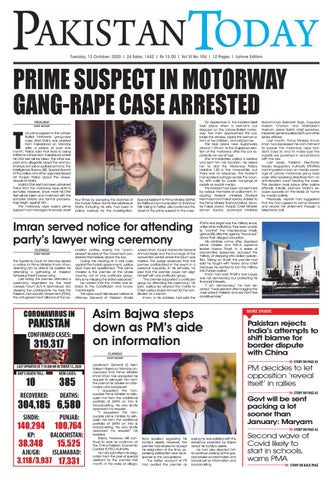
Prime susPect in motorway gang-raPe case arrested FAISALABAD
t
STAFF REPORT
HE prime suspect in the LahoreSialkot Motorway gang-rape case, Abid Malhi, was arrested from Faisalabad on Monday after a period of over one month. Police said that Abid is being shifted to Lahore from Faisalabad where his DNA test will be taken. The other suspect who allegedly raped the woman, Shafqat, is in jail on judicial remand. The Intelligence Bureau (IB), Special Branch of the police and other agencies tipped off Punjab Police about the whereabouts of Malhi. Malhi’s DNA test had been obtained thrice from the motorway rape victim’s samples. However, once more his DNA test will be taken and matched with the samples before any formal proceedings begin against him. The motorway rape case’s prime suspect had managed to evade arrest
four times by escaping the clutches of the Punjab Police. Some five relatives of Malhi, including his wife, had been in police custody for the investigation.
Special Assistant to Prime Minister (SAPM) for Political Communication Dr Shahbaz Gill, taking to Twitter, also confirmed the arrest of the prime suspect in the case.
Imran served notice for attending party’s lawyer wing ceremony ISLAMABAD STAFF REPORT
The Supreme Court on Monday issued a notice to Prime Minister Imran Khan, directing him to attend his position for attending a gathering of Pakistan Tehreek-e-Insaf’s lawyer wing. Last Friday, the premier attended a ceremony organised by the Insaf Lawyers Forum (ILF) in Islamabad. Addressing the participants, he took the Pakistan Democratic Movement (PDM), the anti-government alliance of the op-
position parties, saying the “unemployed” leaders of the movement considered themselves above the law. During the hearing of a civil case against the Punjab government, Justice Qazi Faez Isa questioned: “The prime minister is the premier of the whole country, not of one particular group. Why is he misusing the state’s resources.” He added that the matter was related to the Constitution and fundamental rights. The apex court also issued notices to Attorney General of Pakistan Khalid
coronavirus in
Pakistan
CONFIRMED CASES:
319,317
Jawed Khan, Punjab Advocate General Ahmad Awais and the in-charge of the convention centre where the forum was hosted. The judge observed that the premier participated in the event in a personal capacity. In his remarks, he said that the premier could not align himself with one particular group. “The premier supported a particular group by attending the ceremony,” he said. Justice Isa referred the matter to Chief Justice Gulzar Ahmed for the constitution of a bench. Imran, in his address, had said the
On September 9, the incident itself took place when a woman’s car stopped on the Lahore-Sialkot motorway. Two men approached the car, broke the window, raped the woman in front of her children, and robbed her. This took place near Gujranwala around 1:30 am at the Gujjarpura section of the motorway after the car reportedly ran out of fuel. She immediately called a relative and sent him her location. He asked her to dial the Motorway Police helpline 130 in the meanwhile, but there was no response. The incident had sparked outrage across the country, with calls for public hangings of rapists on social media. The incident had been condemned by various members of parliament, including federal ministers Shafqat Mehmood and Faisal Vawda, Adviser to the Prime Minister Shehzad Akbar, Senator Faisal Javed, Punjab Chief Minister Usman Buzdar, provincial ministers
PDM’s real target was the military since, unlike other institutions, they were unable to “control” the Inter-Services Intelligence (ISI) after the agency “found out” about their alleged corruption. His address came after deposed prime minister and PML-N supreme leader Nawaz Sharif, in a series of provocative speeches, accused the military of stepping into civilian jurisdiction. Taking on Sharif, the premier had said he fought with “every army chief because he wanted to turn the military into Punjab police”. Imran had said Sharif’s real cause was not democracy but protecting his financial interests. “I am democracy,” he had declared. “I was elected after bagging the most votes in Pakistan and won from five constituencies.”
Asim Bajwa steps down as PM’s aide on information ISLAMABAD STAFF REPORT
LAST UPDATED AT 7:10 AM ON OCTOBER 12, 2020
DAY'S DEATH TOLL:
10
RECOVERED:
NEW CASES:
385
DEATHS:
304,185 6,580 SINDH:
PUNJAB:
140,294
100,764
KP:
BALOCHISTAN:
AJK/GB:
ISLAMABAD:
38,348
15,525
3,118/3,937 17,331
Lieutenent General (r) Asim Saleem Bajwa on Monday announced that Prime Minister Imran Khan has accepted his request to relinquish him from the post of his adviser on information and broadcast. I requested the honourable Prime Minister to relinquish me from the additional portfolio of SAPM on Info & broadcasting. He very kindly approved my request. “I requested the honourable prime minister to relinquish me from the additional portfolio of SAPM on Info & broadcasting. He very kindly approved my request,” he tweeted. Bajwa, however, will continue to work as chairman of the China-Pakistan Economic Corridor (CPEC) Authority. He had submitted his resignation from the post of special assistant to the premier last month, in the wake of allega-
Muhammad Basharat Raja, Fayyazul Hassan Chohan and Makhdoom Hasham Jawan Bakht, chief secretary, inspector general police (IGP) and other senior officers. Last month, Prime Minister Imran Khan had expressed his commitment to pursue the motorway rape incident case to and to make sure the culprits are punished in accordance with the law. Last week, Pakistan Electronic Media Regulatory Authority (PEMRA) had imposed a ban on media coverage of Lahore motorway gang rape case after receiving directives from an anti-terrorism court hearing the case. This decision took place after police officials initially blamed Malhi’s escape success on the leaks of name by media outlets. Previously, reports had suggested that the had agreed to come forward and record her statement through a telephonic call.
more inside
Pakistan rejects India’s attempts to shift blame for border dispute with China STORY ON PAGE 03
PM decides to let opposition ‘reveal itself’ in rallies
STORY ON PAGE 03
Govt will be sent packing a lot sooner than January: Maryam
STORY ON PAGE 02
tions levelled regarding his family’s assets. However, the premier had refused to accept his resignation at the time, expressing satisfaction over his response to the accusations. The Twitter account of PTI had quoted the premier as
saying he was satisfied with the evidence provided by Bajwa about his family’s assets. He had also directed him to continue working as the special adviser on information and broadcast on information and broadcasting.
Second wave of Covid likely to start in schools, warns PMA
STORY ON BACK PAGE
02
Tuesday, 13 October, 2020
NEWS
Second wave of covid likely to Start in SchoolS, warnS PMa
a
NEWS DESK S the number of active cases begins to climb faster, the Pakistan Medical Association (PMA) predicts that the second spike of coronavirus will emerge from
schools. This prediction is based on the fact that similar patterns were seen in India, Iran, and the United States, as well as the fact that Pakistan’s positivity ratio recently crossed two per cent nationwide. “Unfortunately, the government’s response so far is limited to the issuance of notifications of Standard Operating Procedures [SOPs], whose implementation is non-existent anywhere including schools,” said the PMA officials while addressing a press conference. Earlier this week, the Federal Minister for Education Shafqat Mahmood on Thursday said that the federal government has no intention to close educational institutions again in spite of fears of the second wave. It seems the PMA officials do not agree with this approach as they said, “The situation on the ground is entirely opposite as no precautions were being observed in schools, which were opened in congested buildings.” While schools remain open, other precautions are being taken. The government is imposing a “smart” lockdown in areas where coronavirus cases are increasing, a notification
POSITIVITY RATE CROSSES 4PC IN KARACHI showed, and these focused lockdowns are in specific areas of Islamabad, Karachi, and Azad Jammu and Kashmir (AJK). Alongside this, federal ministers Fawad Chaudhry, Sheikh Rasheed and Asad Umar on Saturday had issued advisories to the opposition regarding a delay in the Pakistan Democratic Movement (PDM) rallies due to rising Covid-19 cases. Worryingly, Sindh Chief Minister Syed Murad Ali Shah said on Monday while briefing National Coordination Committee (NCC) meeting that the Covid-19 positivity rate has risen above 4 per cent in Karachi in the last five days, urging people to cooperate with the authorities in following coronavirus precautionary measures. “A total of 2,549 people have died of the coronavirus disease in the province so far, while 4808 people are still under treatment as they battle against Covid19,” said CM Murad, adding that the Covid-19 positive rate was recorded at 4.32 per cent in Karachi and 3.24 in Hyderabad in the last five days. He said that the Sindh government has sealed 224 restaurants across the province for violating Covid-19 sops and 20 wedding halls have been fined, 12 sealed while 97 were given a warning. As many as 385 new cases of the
Maryam claims her father is like Quaid, govt on way out Pakistan Muslim League-Nawaz (PML-N) Vice President Maryam Nawaz said that her father is not a traitor and that his questions do not amount to treason, and instead likened him to Quaid-e-Azam Muhammad Ali Jinnah. Maryam said, “Mian sahab’s narrative is exactly the same as Quaid-eAzam’s narrative,” and added that his questions deserve answers. Regarding her father’s return to the country, she said that he would do so as soon as his health was better, as “Nawaz could not have been treated in any hospital in Pakistan”. The PML-N VP also commented on the recent First Information Report (FIR) registered against PML-N leaders, including Shehbaz Sharif. “Shahbaz went to jail because he did not leave his brother alone,” she said. “The Sharifs have always been on one page and will continue to remain so. Those who have tried to cause a rift between the Sharif brothers have always tasted failure.” Furthermore, she clarified that there is no conflict within the PML-N and that Shehbaz merely “had a different approach”. “There is no rift within the PML-N, the entire party stands behind Nawaz Sharif,” she said. NEWS DESK
‘Gujranwala meeting to be decisive blow to selected govt’ Pakistan Muslim League-Nawaz (PML-N) Information Secretary Marriyum Aurangzeb on Monday said that the upcoming public meeting in Gujranwala would be a decisive blow to the “selected” government, adding that the people coming to attend the meeting have offered their passports and CNICs for cancellation before Prime Minister Imran Khan cancels Nawaz Sharif’s passport and CNIC. Talking to party leaders, supporters and workers during preparations for the Gujranwala meeting, Marriyum said the Pakistan Tehreek-e-Insaf (PTI) is “scared” and added that PM Imran can cancel Nawaz’s documents, not his power and influence. Responding to Imran’s statement about not cancelling the Pakistan Democratic Movement (PDM) rally, Marriyum said the premier never held that power in the first place. NEWS DESK
coronavirus surfaced across the country over the past 24 hours, taking the nationally tally of infections to 319,317, said the National Command and Operation Centre (NCOC) on Monday. Furthermore, 10 coronavirus patients died during the previous 24 hours. The total number of people dying of complications caused by the highly contagious disease has reached 6,580. Since the pandemic outbreak, a total of 319,317 cases have been detected so far, including 140,294 in Sindh, 100,764 in Punjab, 38,348 in Khyber Pakhtunkhwa (KP), 15,525 in Balochistan, 17,331 in Islamabad, 3,937 in GilgitBaltistan (GB), and 3,118 in Azad Jammu and Kashmir (AJK). Meanwhile, the tally of active cases of Covid-19 in Balochistan has dropped below 200 cases, a spokesperson of Balochistan Health Department said on Monday. In a statement, the provincial health department said that 49 patients had recovered to health in the last 24 hours and active cases of the novel coronavirus in the province have dropped to 177. Health officials conducted 661 diagnostic tests in 24 hours and detected five positive cases, according to the health department. Total count of coronavirus pos-
itive cases has reached 15,525 with five new infections in Balochistan. The number of recuperated patients across the province is 15,202, the health department said. Overall 146 deaths were reported due to Covid-19 in Balochistan, as no fatality was reported in the last 24 hours, according to the statement. Separately, after a significant decrease in the coronavirus cases in Punjab, the number has started to creep gradually again. A report compiled by the Punjab Primary and Secondary Health Department shows that as many as 670 cases of coronavirus were reported in the first 11 days of October. Earlier in the months of August and September, 25 cases were being reported on a daily basis in the province but now the number has jumped to 60 per day in the first 11 days of the month of October. The report highlights that 16 critical patients of coronavirus are currently under treatment at the government hospitals of the province. Corona Experts Advisory Group Punjab Chairman Professor Mehmood Shaukat said that the number of cases is increasing due to non-compliance with the health-related guidelines designed by the provincial government to control over the spread of the pandemic. Weather change can result in the return of coronavirus, he feared.
Main suspect arrested for rape, murder of two-year-old girl in Charsadda NEWS DESK Police have arrested the main suspect in the rape and murder of a minor girl in Khyber Pakhtunkhwa’s Charsadda district, it emerged on Monday. The chief minister’s adviser on information, Kamran Bangash, and provincial Law Minister Sultan Muhammad Khad confirmed the development at a press conference in Peshawar. On Saturday, the body of a two-and-a-half-yearold girl, Zainab, was found in the fields in Daudzai area of Peshawar, close to Charsadda district. A medical report had confirmed that the minor was sexually assaulted before being stabbed to death.
PM stresses on strict implementation of SoPs to avoid covid-19 spread
“It was a blind case and police resolved the case in a week by arresting the prime accused,” Bangash told reporters. Police have identified the suspect as the victim’s 45-year-old neighbour. Bangash said that the suspect sexually assaulted the two-and-a-half-year-old before killing her and dumping her body in the fields at a distance of two kilometres from the village. District Police Officer Muhammad Shoaib said that the culprit had confessed to the crime during interrogation and officials had also recovered the murder weapon, the victim’s shoes and other belongings on the information provided by the suspect. He said that police were currently investigating
ISLAMABAD: Prime Minister Imran Khan on Monday stressed that donning of masks and adherence to the standard operating procedures (SOPs) should be ensured at all costs to avoid further spread of coronavirus. He was chairing a meeting of the National Coordination Committee on Covid-19. During the meeting, the prime minister said from the facts and figures ascertained from different countries, it was surfaced that during the winter season, coronavirus infection could spread and stressed on the provincial governments to take steps in that regard and devise a strategy. About the purpose of the meeting, PM Imran observed that they wanted to take timely decisions to control the second wave of coronavirus and save the nation from its further harms. The meeting was apprised of the coronavirus situation, testing, ratio of its spread in different parts of the country and increasing number of cases at the global level, PM Office Media Wing said in a press release. The meeting was told that at the international level, the number of coronavirus patients had surged. Compared with those numbers, the coronavirus spread and its damages remained distinctly low in Pakistan due to the blessings of Allah Almighty, and the government’s efforts and effective strategy, it was added. The meeting was further apprised that as per the last six weeks' data, the coronavirus infection was spreading in the country. Smart lockdown was being enforced in different areas of Karachi, Islamabad, and Azad Jammu and Kashmir (AJK). It was suggested that measures should be taken to limit all unnecessary activities, which were not related to certain basic requirements like the economy and education in order to control the second wave of coronavirus. A suggestion regarding the restriction on public gatherings was also presented in the meeting. STAFF REPORT
the incident and the suspect would be presented before the court for his physical remand. The DPO added that more than 350 people were interrogated during the investigation. Speaking to a local news outlet, a police officer investigating the case said that after killing the minor, the suspect informed the prayer leader of a local mosque about the body’s whereabouts. “The suspect informed the prayer leader that he had spotted a body in the fields,” the officer said on condition of anonymity, adding that the prayer leader then informed the family and the police. The murder and rape of the minor had sparked an outcry in the country as politicians, lawyers and civil society groups demanded immediate justice and exemplary punishment for perpetrators of the heinous crime. Several hashtags had also started trending on Twitter to express outrage over unabated cases of abuse and murder of children in the country. Photos of the two-yearold’s body were circulated on social media with many users comparing the incident to the 2018 rape and murder of eight-year-old Zainab Amin in Kasur.
Qureshi commends media’s role in exposing India NEWS DESK Foreign Minister Shah Mahmood Qureshi acknowledged the role the media has played in showing on a global level how Pakistan’s perspective towards the Kashmir issue, and how the tone of world leaders is “different” now when talking about Pakistan. The above was said at the Vision FO event in Islamabad on Monday, where he added that the world was looking more critically towards India thanks to the narrative building. This successful effort in countering smear campaigns and untoward labels of terrorism meant that the world was no longer “blindly” buying the Indian narrative. “Today the international press is not buying the Indian narrative blindly. They question [instead],” he said, adding that it was because of the Foreign Office’s (FO) role in the “global battle of percep-
tion” that such an achievement was possible. The minister remarked on how global leaders had also acknowledged the efforts of Pakistan in keeping the peace in both the Kashmir issue, and in the Afghan peace talks. “The United States’ narrative [regarding Pakistan], at least on Afghanistan, is also very different today,” he said. Speaking on the Afghan issue, he remarked, “Now, through successive narrative building, Pakistan is being viewed as the solution, not the problem. That is the qualitative change that has come about.” Furthermore, he added how Afghan peacemaker Abdullah Abdullah was “never very soft” on Pakistan in the past, his tone during his recent visit to Islamabad was also “very different”. The foreign minister said that to deal with the challenges of foreign diplomacy,
“we need to improve our communication with the world”. Citing an example to highlight the importance of building a narrative, he said that India had “cleverly and cunningly” turned the Kashmiris’ right to self-determination into terrorism. As a result of this narrative, he added, innocent Kashmiris were being accused of terrorism even though they were being oppressed. “Unless we counter this narrative, our international image cannot be corrected. And you saw that through narrative building, Pakistan achieved success,” he noted, adding that media had played its part in convincing the world that 70,000 Pakistanis had been lost to terrorism, and as such, Pakistan would never sponsor terrorism. He spoke about a dedicated cell that works to “counter the Indian propaganda” about the August 5 invasion of
Kashmir. Stressing the need for promoting digital diplomacy in projecting the positive image of the country, the minister said that the success of modern diplomacy is impossible without the robust engagement of media with the Foreign Office (FO). He said that a “toolkit” would be needed for 21st century diplomacy. “The international press is now more critical [of India] … due to the narrative built by Pakistan,” he said. Qureshi said that in order for Pakistan to successfully fight international arbitration cases, the FO’s legal division was being strengthened through recruitment on vacant posts and efforts were being made to increase its interaction with the law ministry. Furthermore, he also talked about the steps being taken to use the Institute of Strategic Studies as the research arm of the FO.
Tuesday, 13 October, 2020
NEWS
PakiStan rejectS india’S atteMPtS to Shift blaMe for border diSPute with china
P
NEWS DESK
AKISTAN on Monday rejected the “malicious Indian propaganda” propagated by Indian Defence Minister Rajnath Singh who claimed that the border disputes are being forged by Pakistan and China. In a statement, the Foreign Office (FO) dubbed Singh’s statements as “unfounded insinuations” and as “another manifestation of the Indian government’s incurable obsession with Pakistan”. FO added that India forms disputes itself, and then flees instead of resolving them peacefully. Furthermore, it stated that India lacked self-awareness regarding the Bharatiya Janata Party’s (BJP) “self-serving narrative”. Pakistan advised the Indian government to “seriously consider course correction by giving up its aggressive
agenda and peacefully resolving disputes with neighbours”. Earlier on Monday, Indian Defence Minister Singhahd had attempted to shift the blame of the border disputes onto Pakistan and China during the virtual inauguration of 44 bridges built near India’s borders, including the borders of occupied Kashmir, Ladakh, Arunachal Pradesh, Himachal Pradesh, Sikkim, Uttarakhand and Indian Punjab. “First Pakistan, and now also by China, as if a border dispute is being created under a mission. We have a border of about 7,000 kilometres with these countries, where the tension remains,” he said on the occasion. Furthermore, the Indian defence minister had claimed that these bridges are meant only for “strategic needs” and for “the development of the nation”. “Our armed forces personnel are deployed in large numbers in areas where
no compromise to be made in action against smuggling of food commodities: PM ISLAMABAD: Prime Minister Imran Khan said on Monday that smuggling of food commodities is a menace to the country's economy and poses a threat to national food security, adding that there would be "no concession or compromise on action against smuggling". PM Imran said this while presiding over a high-level meeting to review progress on prevention of smuggling of food commodities. He directed all relevant departments to submit reports on the prevention of smuggling and action taken against those involved in the act after every 15 days so that progress in this regard may be continuously monitored. Earlier, the provincial chief secretaries apprised Imran Khan on the situation of wheat production, harvesting and overall situation. The meeting also reviewed the prices of basic commodities, with the provincial chief secretaries briefing the premier in detail about the steps taken to bring down food inflation. STAFF REPORT
transport is not available throughout the year,” Singh added. “You are well aware of the situation created along our northern and eastern borders,” Singh said in his virtual address. According to NDTV, these bridges are meant to enable the movement of troops and transporting weapons. These bridges, along with the Himalayan tunnel opened last week by Indian Prime Minister Narendra Modi, would drastically reduce the time needed to transport troops to the country’s remote Chinese border. Tensions have been rising between the Asian neighbours due to India’s annexation of Kashmir since August 5 last year, its numerous Line of Control (LoC) violations, and its border disputes with China, particularly in the Ladakh region. The latest deadlock began in May
and in June escalated to the deadliest violence between the sides in decades. China had not given details of casualties, but India reported that 20 soldiers were killed. Meanwhile, the Indian army has committed at least 2,340 ceasefire violations along the Line of Control (LoC) so far this year, resulting in the martyrdom of 18 people and serious injuries to 187 others, according to data provided by the Foreign Office. Pakistan has often raised the issue of India’s actions on the international forum, most notably at Prime Minister Imran Khan’s speech at the 75th United Nations General Assembly (UNGA). Both China and Pakistan were among the first countries to strongly condemn India’s annexation of the disputed region, raising it at international forums including the United Nations Security Council (UNSC).
Sindh says SC order bars it from providing security to ‘unauthorised’ persons KARACHI STAFF REPORT
The Sindh government on Monday excused for the misprovision of security to Maulana Adil Khan, the Karachibased religious scholar who was gunned down on Saturday, saying its hands were tied by a 2018 judgement of the Supreme Court (SC). Khan, the head of Jamia Farooqia, was killed in a suspected targetted attack apparently to fuel the sectarian gulf in the country. Following the tragic incident, many pointed toward the lack of police protection for the cleric. Commenting on the incident, Sindh Education Minister Saeed Ghani, while addressing a press conference, recalled Maulana Adil’s son had mentioned security once during a meeting with provincial ministers and that the matter was discussed once more after a meeting at the Chief Minister’s Office. “When he was assassinated, I checked whether he had been provided with security, and if not, the reasons behind it,” Ghani said, adding that he found that just two policemen had been deputed at the seminary in Shah Faisal Colony. Ghani then went on to say that an order issued by the former chief justice Saqib Nisar had become a “problem” for the provincial govern-
ment in providing adequate security to Maulana Adil. In 2018, the then chief justice Saqib Nisar had ordered the withdrawal of security from unauthorised persons across the country, following which provinces were asked by the apex court to devise a mechanism to provide security to those entitled. In response, threat assessment committees were formed in all federating units tasked with assessing and providing security to those deemed entitled. “The formation of the threat assessment committee [following the SC order] has created a lot of hurdles for us. The government and the chief minister no longer have the power to order security for a particular person,” Ghani said during his presser. “But the government is blamed when such incidents occur,” he added, referring to the cleric’s assassination. Ghani said that the powers to deploy security resources should rest with the government so that similar incidents can be prevented in the future. “If the committee was not there, then maybe we could have given Maulana Adil the security he required within an hour.” Ghani also called for the inclusion of Minister for Railways Sheikh Rasheed Ahmad in the investigation regarding Maulana Adil’s assassination because the latter had warned of terror attacks in the country just hours before the gun attack on the cleric.
03
PM urges religious scholars to continue promoting islamic values ISLAMABAD: Prime Minister Imran Khan has expressed confidence that religious scholars will continue to play their pivotal role in the promotion of Islamic values, and for meeting contemporary challenges while keeping sectarianism in check across the country. The prime minister was talking to prominent religious personalities from Khyber Pakhtunkhwa (KP) on Monday. The premier stressed that it is important to use the social, cultural and religious values of Islamic society to meet the contemporary challenges. In this regard, religious scholars have an important role. He noted that religious scholars have always fulfilled the responsibility of guiding the nation and the government in difficult times. PM Imran was confident that the religious scholars would continue to support the government’s efforts against Covid-19 and provide the needed guidance to the people on how to stay safe during the pandemic. Meanwhile, a delegation of the National Commission for Minorities (NCM), headed by Chairman Chela Ram Kewlani, called on the premier. Talking to the delegation, PM Imran called for collective efforts to foil the sordid designs of antistate elements bent upon instigating chaos in the country under the garb of religion. He said that interfaith harmony is the need of the hour. He hoped that the NCM would play its role in this regard. PM Imran said that the government is committed to protecting the constitutional and legal rights of the minorities’ community. STAFF REPORT
PM decides to let opposition ‘reveal itself’ in rallies ISLAMABAD: The federal government has agreed to let opposition parties hold rallies and processions across the country as the Prime Minister Imran Khan said their real agenda will reveal itself soon. After weeks-long deliberation and confusions over what the future might hold for opposition parties’ movement, the federal cabinet has finally approved opposition’s plans to hold rallies against the government across Pakistan after, it stated, the PM said that holding them back in their futile bid will unnecessarily make them heroes. According to details, the prime minister held a critical huddle to mull over political matters of the country at present, wherein the ministers and assistants recommended to allow opposition parties to hold their rallies. The ruling members suggested to premier that opposition be allowed to bring out their rallies on specific spots while the district authorities in the relevant areas will ensure they follow Covid-19 standard operating procedures (SOPs). A while back, Federal Planning Minister Asad Umar, while elaborating on the federal government’s policy, said that no party including the ruling ones should bring political rallies while the country still struggled with Covid-19 situation. TLTP
04
Tuesday, 13 October, 2020
newS
PetitioNs agaiNst Baldia factory fire verdict adMitted for heariNg KARACHI
t
STAFF REPORT
HE Sindh High Court (SHC) on Monday admitted for hearing separate appeals of five convicts, challenging their sentences in the Baldia factory fire case. An accountability court in Karachi last month sentenced two former Muttahida Qaumi Movement (MQM) activists —
Abdul Rehman alias Bhola, a former sector in-charge of the party’s organisational structure, and Zubair alias Chariya — to death for arson, eight years after the country’s worst industrial fire killed some 264 people and injured 60 others at a garment factory in the metropolis. Last week, the two had moved the high court through their counsels against the sentence, contending the judgement was passed without observing the princi-
ples laid down by the Supreme Court. A two-judge bench of the SHC issued a notice to the prosecutor general and sought the complete record of the case from the ATC that handed down the verdict. The factory’s four gatekeepers — Shahrukh, Fazal Ahmed, Arshad Mehmood and Ali Mohammad — also sought relief. The appellants maintained that the court ignored key evidence while
deciding the case. Abdul and Zubair blamed the factory owners for the fire, saying the factory doors were closed when the fire broke out. The verdict was announced after years of hearings and testimony from at least 400 witnesses. The slow pace of the trial frustrated victims’ families, who accused the police of failing to properly investigate and charge the real culprits.
Naval chief makes courtesy call on PM ISLAMABAD STAFF REPORT
Chief of Naval Staff Admiral Muhammad Amjad Khan Niazi paid a courtesy call on Prime Minister Imran Khan on Monday. The prime minister congratulated Admiral Muhammad Amjad Khan on assuming the office of chief of naval staff and wished him success for his tenure. Admiral Niazi took charge as the new chief of naval staff on Wednesday last. He called on Chief of Army Staff General Qamar Javed Bajwa and Chairman Joint Chiefs of Staff Committee (CJCSC) General Nadeem Raza on last Saturday.
Buzdar inaugurates 115 land record centres across Punjab LAHORE STAFF REPORT
LAHORE: Central Air Command Pakistan Air Force (PAF) Lahore Air Officer Commanding Air Vice Marshal Zafar Aslam presents a souvenir to Punjab Chief Minister Usman Buzdar.
PM working to bring inflation down: Rasheed ISLAMABAD STAFF REPORT
Federal Minister for Railways Sheikh Rasheed Ahmad has said that Prime Minister Imran Khan will bring the inflation down as he is working to resolve the issues
of the country in a befitting manner. Talking to a private news channel, he said that the opposition parties’ anti-government movement aims to disturb the economy and stability in the country. Rashid said that the opposition parties have the right to hold public meetings but
they will not be allowed to take the law in their hands. He expressed fear of terrorism threat and spread of Covid-19 in the country. Rashid said that external forces are engaged in hatching conspiracies against the Pakistan Army and destabilising the country. He said that a group has been taken
into custody from Islamabad. The minister fearing the threat of terrorism said all political leaders including him should take precautionary measures. He assured that the government under the dynamic leadership of Imran Khan will overcome the present-day challenges. To a question, he said that there is a conspiracy and international agenda against China-Pakistan Economic Corridor (CPEC), and ML-1 but both the projects will be completed at all costs.
Punjab Chief Minister Usman Buzdar on Monday inaugurated 115 land record centres at the ‘Qanoongoi’ level to facilitate the masses. Speaking at the inaugural ceremony, the chief minister termed it as a historical step towards provision of land record services in the province. The chief minister also inaugurated satellite land record centres and 20 mobile land centres. Meanwhile, CM Buzdar on Monday summoned a meeting of the Price Control Committee to review the situation of inflation in the province. Buzdar, in his statement, said that artificial inflation cannot be tolerated at any cost. “Will utilise every possible way to provide relief to the masses,” he said. He also directed the concerned authorities for strict monitoring of prices of the daily use items in the market. Earlier, Prime Minister Imran Khan had directed the volunteers of the Tiger Force to regularly check prices of basic commodities like flour, sugar, ghee and lentils in their localities. In a tweet on Sunday, he had asked the volunteers to post the prices on Tiger Force Portal. The prime minister had said that he would meet with the Tiger Force volunteers on next Saturday at the Convention Center in Islamabad.
Sindh links talks over islands issue with PIDAO revocation KARACHI TLTP
The Sindh government on Monday refused to hold talks with the federal government over the matter of Islands ownership until revoking of Pakistan Islands Development Authority Ordinance (PIDAO), 2020. Prime Minister Imran Khan had directed Governor Sindh Imran Ismail to
hold talks with the Pakistan People’s Party’s (PPP) provincial government over the matter. “No talks will be held with the federal government until revoking of the ordinance,” the Sindh government has categorically said, adding that the federal government deceived the provincial government of Sindh by issuing an ordinance over the ownership of the Bundal and Buddo Islands.
On August 30, the president had promulgated the ordinance for establishing the Pakistan Islands Development Authority for the “development and management of islands in internal and territorial waters of Pakistan”. However, the Sindh government on Tuesday withdrew its July 6, 2020 letter in which the Land Utilisation Department had consented to the federal government to take custody of both islands.
“That due to this illegal, unconstitutional and malafide act of the federal government, the Sindh cabinet has decided not to engage with the Federal Government for the purpose of developing the Island and consequently the letter dated 06.07.2020 of Government of Sindh, Land Utilization Department is treated as a nullity,” the department said in a letter withdrawing the previous one.
Foreign financial team suffocating economy: Hamza LAHORE STAFF REPORT
Leader of the Opposition in the Punjab Assembly Hamza Shehbaz on Monday said that Pakistan Democratic Movement (PDM) would get rid of the incumbent government as the people are now calling for it. Addressing a press conference outside the Punjab Assembly, he said, “Prime Minister Imran Khan is a “fascist”, and the conditions in the country
are worse than October 12, 1999.” The opposition leader citing financial experts said that Pakistan’s economy is “suffocating” and that the common people of the country are suffering a similar fate. The Pakistan Muslim League-Nawaz (PML-N) leader said that the financial team of the government has come from abroad and is “unaware” of the ground realities. “How will they know the problems of a cart vendor?” He asked, “What is the use of such a financial team when
the poor people of the country are troubled by inflation?” Slamming the government for banning TikTok and gagging the media, he said that such measures would not resolve Pakistan’s problems. “I am not a fortune teller, but through the Pakistan Democratic Movement’s forum, the people will get rid of this government,” he added. Today, the people are in trouble over wheat prices and the federal minister for food security says he is unaware where
wheat vanished, Hamza said. Despite Prime Minister Imran Khan’s “11 notices” on inflation, it is still increasing. “Life-saving medicines are now out of the common man’s reach,” he added. The government first exports and then imports wheat and sugar, he said. “Where is the mafia?” asked Hamza, claiming: “It is in the federal cabinet. They sit around Prime Minister Imran Khan and give policies. There is a conflict of interest.”
Tuesday, 13 October, 2020
NEWS
05
SBP ANNOuNCeS GOvT’S mArkuP SuBSIdy FOr AFFOrdABLe hOuSING FINANCe I NEWS DESK
N line with its vision of providing affordable housing to the masses, the government will be providing a markup subsidy facility for the construction and purchase of new houses. "This facility will allow individuals, who will be constructing or buying a new house for the first time, to avail bank’s financing at subsidized and affordable markup rates," said a statement issued by the central bank. "This facility will be provided with the administrative support of State Bank of Pakistan as executing partner with government and Naya Pakistan Housing and Development Authority (NAPHDA).” The government has allocated Rs33 billion for payment of markup subsidy for financing over a period of
Power division notifies up to rs2.89 per unit increase in k-electric tariff ISLAMABAD
10 years and has assured continuity of the facility. For this purpose, the SBP and the government have signed a memorandum of understanding. The markup subsidy facility will be available through all banks and is divided in three tiers; financing under Tier I is available for purchase of houses/apartments/flats of up to 5 marla or 125 sq. yards, with maximum covered area of 850 sq. feet and maximum price of Rs3.5 million, under NAPHDA projects. Maximum financing under this Tier is Rs2.7 million with maximum tenor of up to 20 years. Banks will charge maximum markup rate of KIBOR plus 250 basis points. However, the GOP will provide markup subsidy to reduce borrowers’ rate to 5pc for first five years and 7pc for next five years. KIBOR is the Karachi Interbank
CDWP approves eight projects worth Rs36bn ISLAMABAD STAFF REPORT
AHMAD AHMADANI
Electricity consumers of K-Electric will bear up to Rs2.89 per unit hike as the Power Division has issued a notification to this effect. According to the Power Division's notification, "In pursuance of sub-section (7) 31 of the Regulation of Generation, Transmission and Distribution of Electric Power Act, 1997, the federal government is pleased to notify the adjustment in the approved tariff on account of quarterly adjustment with effect from September 1, 2020, as determined and recommended by National Electric Power Regulatory Authority (NEPRA)." It is pertinent to mention that the federal cabinet’s Economic Coordination Committee (ECC), while contemplating a summary moved by the Power Division for the rationalization of eleven quarterly adjustments of KE from July 2016 to March 2019, had approved up to Rs2.89 per unit increase in the entity's tariff from September 1, 2020. A subsidy of Rs4.7 billion was also provided to the entity on account of tariff differential. With this increase, the KE tariff will be at par with other power distribution companies (DISCOs). "The average tariff of K-Electric has now increased to Rs15.70/unit from Rs12.81/unit, which is equivalent to the tariff of the other DISCOs of the country," an insider informed.
Offer Rate that is determined in the interbank market on a daily basis and is used as a benchmark for most of the retail lending by banks. These rates are published on the SBP's website on a daily basis. Meanwhile, financing under Tier-II is also for houses/apartments/flats up to 5 marla or 125 sq. yards with maximum covered area of 850 sq. feet and maximum price of Rs3.5 million. Maximum financing under this Tier is Rs3 million with maximum tenor of up to 20 years. This tier facilitates construction or purchase of housing units by individuals and households who have not applied or qualified for NAPHDA projects. Banks will charge maximum markup rate of KIBOR plus 400 basis points. However, subsidized rate for the borrowers for first 10 years under Tier 2 is the same as that of Tier I. The Tier-III of the facility
The Central Development Working Party (CDWP) on Monday approved eight projects worth Rs36 billion and recommended seven others worth Rs233.014 billion to the Executive Committee of National Economic Council (ECNEC) for consideration. Planning Commission Deputy Chairman Mohammad Jehanzeb Khan chaired the CDWP meeting, which was also attended by senior officials of the Planning Commission and federal ministries/divisions. Representatives of provincial governments participated in the meeting through video link. Projects related to environment, physical planning, transport & communications, water resources and education were presented on the occasion. Among environment-related projects, the CDWP approved the ‘Developing Revenue Linkage between Marmara Research Center, Turkey & Pakistan Meteorological Department Pakistan’ project (worth Rs168.308 million), and referred the ‘Sindh Resilience Project (PDMA Component Phase-II)’ (worth Rs15.3 billion) to ECNEC. Similarly, among physical planning projects, the CDWP approved the ‘Contraction of New Building for Supreme Court Branch Registry in Karachi (Saddar)’ (Rs4.42 billion), and referred ‘Solid Waste Emergency and Efficiency Project’ (Rs17.66 billion) to ECNEC. Two projects related to transport & communications, namely ‘Widening and carpeting Bonni-Buzund-
Torkhow road (28km) in Chitral’ (Rs1.21 billion) and ‘Construction/upgradation of Dirgi Shahbozai to Taunsa Sharif Road’ (Rs8.94 billion) were approved by CDWP. Meanwhile, two position papers related to transport & communications were also presented on the occasion. Both projects, namely ‘Construction of Gwadar Ratodero Road Project M-8’ (Rs38.02 billion) and ‘Upgradation, Widening and Construction of Surab Hoshab Road N-85’ (Rs28.82 billion), were recommended to ECNEC. Likewise, three projects and one position paper related to water resources presented in the meeting. All three projects, titled ‘Flood Protection Sector ProjectIII NFPP-IV’ (Rs95.98 billion), ‘Sindh Resilience Project for Strengthening Flood Embankments & Construction Small Dams’ (Rs23.7 billion) and ‘Construction of 100 Small Dams in Balochistan PackageIII’ (Rs8.87 billion) was referred to ECNEC. The Ministry of Water Resources’ position paper titled, ‘Construction of 100 Small Dams in Balochistan’ (Rs13.51 billion) was also recommended to ECNEC for approval. Lastly, three projects related to the education sector were presented in the meeting. The projects, namely ‘Establishment of National Curriculum Council Secretariat’ (Rs425.10 million), ‘Establishment and Operation of Basic Education Community Schools in the Country’ (Rs7.7 billion) and ‘Improving Human Development Indicators in Pakistan with focus on MDGs relating to Education and six EFA goals’ (Rs4.27 billion) were approved by CDWP.
Petition seeks protection of Pakistani products’ identity ISLAMABAD GHULAM ABBAS
While the government has already taken steps to challenge Indian application for exclusive Geographical Indication (GI) tag for basmati rice before the European Union, a petition has also been filed in the Lahore High Court (LHC) seeking the protection of Intellectual Property (IP) of Pakistani products in international markets. Dissatisfied with the arrangements made by the Ministry of Commerce to protect the copyrights, trademarks and
GI tag of growers, traders and exporters of Pakistani products, petitioner Muhammad Azam Khan, alleged that the concerned ministry and institutions lack the basic requirements for ensuring the rights of the stakeholders. The Ministry of Commerce, Intellectual Property Organisation (IPO) Pakistan and Trade Development Authority of Pakistan (TDAP) have been listed as respondents in the petition. The petitioner has contended that immediate action is required to designate and appoint a registrar of GIs under the GI Act with special emphasis on resolving the currently pending bas-
mati rice issue before the EU as the limitation for opposition expires on December 11, 2020. He contended that immediate steps must be taken to regularise and organise local and international registration. Furthermore, a task force is needed to identify pending issues and safeguard future protection of GIs involving all stakeholders of the various indigenous and local agricultural products and processes. The petition said that the Ministry of Commerce has yet to designate a department or body that will oversee the ownership of the GIs alongside the IPO. The petitioner said that the lack of
action from respondents would certainly result in massive loss of trade name, business, intellectual property, heritage and indigenous processes. This would then turn into massive layoffs, unemployment, and reduced revenue for the government while the country is already in a recession, and such outcomes would further destabilise several industries, he added. He further said that carelessness at this crucial stage could result in loss of competitive advantage of Pakistani agricultural products in the international market and subsequently, result in loss to farmers, producers and traders nationwide.
Transparency Int'l suggests finance ministry to amend foreign currency rules ISLAMABAD GHULAM ABBAS
Suggesting the Ministry of Finance (MoF) to amend the Foreign Currency Rules 2020, the Transparency International Pakistan has warned that the "new rules will render the foreign currency accounts useless". The TIP, in a letter to Adviser to Prime Minister on Finance and Revenue Abdul Hafeez Shaikh on Monday, suggested the ministry to amend the Foreign Currency Rules 2020, following the issuance of a circular by the State Bank regarding promulgation of ‘Protection of Economic Reforms (Amendment) Ordinance 2018' issued by the previous government.
TIP suggested that Section 4 of Foreign Currency Rules 2020 should be amended by another SRO (make immediate amendment and add in Section 4) in the State Bank’s EPD Circular No. 5 of 2018. The TIP noted that the promulgation of Protection of Economic Reforms (Amendment) Ordinance 2018 remained applicable even after the issuance of Foreign Currency Rules, 2020. "Unless the serious dichotomy between the foreign currency rules and the clarifications of the SBP is immediately addressed by the finance ministry, the dent on the confidence of investors and businessmen on Pakistan fiscal policies may suffer irreparable loss," it said. "The section 4 of the rules has essentially rendered
CMYK
the foreign currency accounts useless as these can only be fed from outside Pakistan. This will result in depleting balances, besides forcing citizens to look for alternative sources to meet their genuine needs of foreign currency outside the country." The State Bank, in its circular on October 11, stated that there has been no change in the general or special permissions given by the SBP to individuals under the foreign exchange regulations. According to paragraph four, chapter 6 of the Foreign Exchange Manual, foreign currency accounts can be fed by remittances received from abroad, travelers’ cheques issued outside Pakistan and encashment of securities issued by the government of Pakistan.
promotes affordable housing for middle-income families. This tier allows subsidized financing for construction or purchase of houses/apartments/flats of more than 5 marla (125 sq. yards) and up to 10 marla (250 sq. yards) with maximum covered area from 850 sq. feet to 1,100 sq. feet and maximum price of Rs6 million. Maximum financing under this Tier is Rs5 million with maximum tenor of up to 20 years. Banks will charge maximum markup rate of KIBOR plus 400 basis points. However, GOP will provide markup subsidy to reduce borrowers’ rate to 7pc for first five years and 9pc for next five years. It is expected that introduction of the facility with supply of fresh housing units through concerted efforts of NAPHDA and other stakeholders will help transform Government’s vision into reality.
Pakistan, ITFC sign $386m agreement for import of oil, LNG ISLAMABAD STAFF REPORT
Pakistan has signed a financing agreement amounting to $386 million with the International Islamic Trade Finance Corporation (ITFC), a subsidiary of Islamic Development Bank (IsDB) Group, for import of oil and LNG. According to a press statement issued on Monday, this facility will be utilized by Pakistan State Oil Company Limited, Pak Arab Refinery Limited (PARCO) and Pakistan LNG Limited (PLL). The agreement was signed between the Economic Affairs Division, ITFC and the representatives of PSO, PARCO and Pakistan LNG Limited. The financing agreement provides trade financing amounting to $386 million for a period of one year for import of oil and LNG. ITFC has agreed to provide trade financing of $1.2 billion during the year 2020 for import of oil and LNG by PSO, PARCO and Pakistan LNG Ltd. It may be recalled that this facility is a part of a framework agreement signed with ITFC in April 2018 for a total envelope of $4.5 billion over for a period of three years (2018-2020). Signing of this financing facility will be helpful in financing oil and gas import bills of the country and easing pressure on foreign exchange reserves of the country. During the signing ceremony, both sides voiced hope to work closely with each other for mobilization of socio economic development of the country.
Omar Ayub invites investors to explore open market regime in Pakistan's LNG sector ISLAMABAD STAFF REPORT
Federal Energy Minister Omar Ayub Khan has invited foreign investors to seek huge investment and business opportunities by exploring the open market regime in Pakistan’s LNG sector. The energy minister was addressing the LNG Producer-Consumer Conference 2020, Japan, through a video link. He said that Pakistan had been a gas producing country with daily production of over 4 billion cubic feet per day (BCFD), which was sufficient to meet its demands. However, for the last two decades, Pakistan has been facing shortage of gas supply due to 5pc yearly decline in production and steady growth in demand for the domestic and commercial sector, he added. A foreign currency account of a citizen of Pakistan resident in Pakistan can also be fed with cash foreign currency only if the account holder is a filer as defined in Income Tax Ordinance, 2001. "This is likely to promote hundi/hawala and other malpractices besides serious inconvenience to active tax filers to meet their genuine needs. This restriction on foreign currency accounts will not only encourage malpractices but also encourage undocumented deposits of foreign exchange at homes and in bank lockers," the TIP stated. "In addition, this move may also put a negative impact on the country’s foreign exchange reserves as foreign currency deposits with banks are also a part of the country’s total liquid foreign exchange reserves." The TIP maintained that the restriction may create panic among the foreign currency account holders and they would be reluctant to deposit foreign exchange in their foreign currency accounts and may prefer to save their foreign currency at home or in lockers. It said the decision is also the major departure from the provision made through the Finance Act 2018 that restricted feeding of foreign currency accounts through local purchase to income tax active filers.
Tuesday, 13 October, 2020
06 COMMENT
FATF grey listing
Hoping for a miracle That lands Pakistan into FATF’s white list
T
he government had maligned the opposition for not supporting some of the politically motivated provisions included in its FATF related bills. Government leaders went to the extreme of maintaining that the opposition wanted Pakistan to be relegated to the black list and then put the blame on the PTI government. After the passage of the bills in the joint session of the Parliament, foreign minister Shah Mahmood Qureshi hoped that Pakistan would now be included in FATF’s white list. While many would like this to happen, there are signs that show Pakistan has yet to do more than it has done so far to be declared white. The Asia Pacific Group (APG) on money laundering has issued its first Follow-Up Report (FUP) titled Mutual evaluation of Pakistan (MeP). The report analyses Pakistan’s progress in addressing the technical compliance deficiencies identified in its earlier Mutual evaluation Report (MeR) published in October 2019. The conclusions it draws are worrisome. According to the FUP, during the 2019 MeR Pakistan was compliant on one, non-compliant on four, partially compliant on 26 and largely compliant on nine recommendations. The only progress over the last one year has been graduation on one partially compliant recommendation to compliant status. Pakistan’s progress thus largely remained unchanged: non-compliant on four counts, partially compliant on 25 counts and largely compliant on nine recommendations. Not that the government was not forewarned. In July, the National Assembly’s Standing Committee on Finance and Revenue had reprimanded the government for wasting precious time without making tangible progress on the FATF’s requirements. The Asia Pacific Group’s 12-page report concludes on an unsatisfactory note. “Pakistan will remain in enhanced (expedited) follow up, and will continue to report back to the APG on progress to strengthen its implementation of AML/CFT measures.” What emanates is that the PTI government has been lax in implementing the requirements of the FATF despite knowing that its ineptitude could land the country in the black list. It is time the government stops blaming its own shortcomings on the opposition. It must stop living in a dream world while neglecting its tasks. If Pakistan continues to remain in grey list it is because of the PTI government’s own lack of performance.
A tool to keep pressure on Pakistan Sajjad Shaukat
T
he Financial Action Task Force (FATF) was formed in 1989 by the G7 Summit in Paris to combat the growing problem of money laundering. The task force was charged with studying money laundering trends, monitoring legislative, financial and law enforcement activities taken at the national and international level, reporting on compliance, and issuing recommendations and standards to combat money laundering. Following the September 11 terror attacks in the US in 2001, the mandate of the organisation was expanded. The FATF’s primary policies issued the Forty Recommendations on money laundering from and the Nine Special Recommendations on Terrorism. Financing Terrorism set the international standard for anti-money laundering measures and combating the financing of terrorism and terrorist acts and allowed countries in implementing these principles according to their particular circumstances and constitutional frameworks. The Recommendations cover the criminal justice system and law enforcement, international co-operation, and the financial system and its regulation. The Recommendations are seen globally as the world standard as many countries have made a commitment to put the Forty Recommendations in place. Although FATF’s member-countries are the US and other Western countries, including many Islamic states, yet decisions of the US-led Western countries prevail on the organistion, protecting their own overt and covert interests. As far as Pakistan’s case is concerned, despite implementation of many of the recommendations, FATF has become a tool of keeping pressure on the country. In February 2020, Pakistan was kept in FATF’s Grey list despite meeting 14 out of 27 points given by FATF. The current government has fully grasped significance of putting in place a strong anti-money laundering regime. In this regard, in a joint session of the Parliament, the government on September 16, this year managed to pass three crucial FATF-related laws, while opposition leaders walked out of the Parliament and criticised the government over the passage of the bills. MNA of the ruling party PTI, Faheem Khan tabled the Anti-Terrorism Act (Amendment) Bill, 2020 which was passed without opposition.
PDM’s first outing Gujranwala will set the tone for future rallies
A
FTeR a few revisions in its schedule of activities, the anti-government 11-party opposition alliance dubbed the Pakistan Democratic Movement (PDM) will hold its first rally in Gujranwala this Friday with leaders of all major parties including PPP, PML-N and JUI-F expected to make fiery speeches there. The arrest of one of the central figures of the movement, PML-N president and leader of the opposition in the National Assembly Shehbaz Sharif, just a few weeks prior to the PDM’s first outing is perhaps a message from the government to those who have cases pending with the NAB but are not incarcerated, that they too could meet a similar fate in the coming days, but that remains to be seen. The PTI government has so far not made any direct attempt to cause hindrances in the PDM’s plans but if their actions during the JUI-F’s ‘Azadi March’ last year, where containers were placed on roads to block the procession, is any indication, some blockages can be expected. While Gujranwala’s local administration is yet to give permission for the rally, the opposition parties have already decided on a plan of action if law enforcement agencies are used to obstruct them by encouraging their workers, wherever they may be on the day to block roads. This would be a disastrous outcome and the government would receive most if not all of the blame if something untoward were to happen. however, it seems the government is looking towards another strategy to force PDM into delaying its plans: Covid-19 infections. Federal Minister for Science and Technology Fawad Chaudhry tweeted the other day urging opposition parties to ‘be responsible’ and postpone their rallies for three months amid ‘fears of a second wave of the coronavirus’. Not only is this conveniently self-serving advice but also hypocritical. A few days back Prime Minister Imran Khan attended a public meeting held by the ‘Insaf Lawyers Forum’, an affiliate of the PTI, and will be holding a meeting with his ‘Tiger Force’ members at a convention center in Islamabad later this week as well. While Mr Fawad Chaudhry’s concerns are valid, they are not genuine; the implementation of SOPs must be across the board and not opposition-specific. The government should allow peaceful demonstrations to continue and leave it up to opposition parties to ensure that all their activities are carried out safely with all Covid-19 SOPs being followed.
Biden must convince the other half that he is their ‘guy’
Washington Watch dr jameS j Zogby
T
he single most important issue in this year’s election will be how voters feel about Donald Trump. A recent Pew poll showed that 51% of Trump voters said the major factors determining their vote were Trump’s personality, values, and leadership style, while 56% of Biden voters said that what was motivating them was “voting against Trump.” This election will be about Donald Trump. With all we’ve seen from him and all we’ve learned about him during the past four years, one might reasonably ask, “Why does he still command the fervent support of so many voters?” Two quotes in this week’s New York Times help explain this phenomenon. One was from President Donald Trump; the other was from one of his supporters. When taken together, they help to explain the most important dynamic that is driving this election. The first quote was an excerpt from Trump’s book “The Art of the Deal” in which he writes, “I play to people’s fantasies. People want to believe that something is the biggest and the greatest and the most spectacular. I call it truthful hyperbole. It’s an innocent form of exaggeration – and a very effective form of promotion.” The second came from a Trump supporter at a rally. After noting he couldn’t always understand
Arif Nizami Editor Umar Aziz
Asher John
Joint Editor
Executive Editor
Deputy Editor
Lahore – Ph: 042-36300938, 042-36375965
Sajjad Shaukat writes on international affairs and is author of the book: US vs Islamic Militants, Invisible Balance of Power: Dangerous Shift in International Relations Email: sajjad_logic@yahoo.com
This election is about one thing
Dedicated to the legacy of the late Hameed Nizami
Aziz-ud-Din Ahmad
According to the ATA (Amendment) Bill, 2020, the investigating officer, with the permission of the court, can conduct covert operations to detect terrorism funding, track communications and computer system by applying latest technologies. During his address to the Parliament, Prime Minister Imran Khan said that the opposition’s “attitude” in the session and earlier negotiations on the bills showed that the “interests of [opposition parties] and their leaders are the opposite of Pakistan’s interests”. he elaborated: “Going on the black list would mean sanctions, our economy crashing; we were hoping opposition would jointly pass legislation for FATF because it’s for Pakistan, not [our] personal interest…They used FATF to protect their interests… when they saw we weren’t being blackmailed, they got stuck on money laundering.” he criticised the opposition for suggesting that “money laundering be excluded from NAB [National Accountability] rules”, saying that “if they had nothing to hide, there should be no reason to oppose its inclusion…I want to tell the opposition that we are ready to compromise on everything for the [sake of] the country. But we will not compromise on corruption.” Meanwhile, Islamabad has taken strict action against those organizations proscribed by the US as terrorist organisations, their leaders who were prosecuted as well. In previous meetings; FATF has showed satisfaction over the steps taken by Pakistan, including reforms in State Bank of Pakistan and Securities and exchange Commission of Pakistan. In February 2020, a top official told a renowned newspaper that three separate evaluations currently in progress will determine Pakistan’s possible exit from the grey list of FATF by the mid of October. It is notable that a meeting between Pakistan and Asia-Pacific Joint Group of the Financial Action Task Force was held in Beijing on June 24, 2020. A statement of the Foreign Office (FO) said on June 26, this year that “Pakistan’s case was not taken up by the FATF meeting and it would continue to be on its ‘grey list’ till October. Pakistan remains committed to completing its FATF Action Plan and continues to make progress”. The FO statement added: “This situation was misreported by the Indian media, which claimed that the June 24 plenary kept Pakistan on the grey list for failing to check flow of money to terror groups. Indian Ministry of external Affairs (MeA) too jumped in to exploit the misrepresentation of the situation by claiming that it vindicated Delhi’s stance about Pakistan not taking action against terrorist networks”. The FO rejected the remarks by MeA spokesperson and outrightly dismissed the “fabricated news reports”. It called on FATF members “to take note of
India’s malicious campaign against Pakistan and its attempts to politicise the FATF process.” however, Pakistan has been on the grey list since June 2018. Pakistan’s case was also not discussed at the Paris meeting because of a decision taken by FATF to suspend the ICRG [International Cooperation Review Group] review process for the countries on the grey list. In this respect, Indian attempts and lobbying to blacklist Pakistan foiled after no country supported India’s attempt to blacklist Pakistan. In this connection, on June 25, 2020, while responding to a question on the proceedings, a Chinese foreign ministry spokesperson stated: “Pakistan has made great efforts to strengthen its domestic counterterrorism financing system with visible progress. Its political will and active efforts should be recognised and encouraged by the international community”. Nevertheless, China has also been forcefully lobbing to ensure that Pakistan which is a key ally of Beijing must be taken out from the grey-list. Nonetheless, various anti-Pakistan moves are part of the Indian nefarious designs not only to divert attention from its domestic issues, but also to destabilize Pakistan. hence, some countries such as France, UK and especially India have been calling on Islamabad to take action against the terror groups to avoid ‘Dark Gray’ list status of the FATF. They have long failed to do this. Indian media spreads disinformation that Pakistan may be put on ‘Dark Grey’ list. In fact, Islamabad is confident to avoid any new action by FATF, as it has support from China, Malaysia and Turkey. So far, even countries of the Gulf Cooperation Council (GCC) and Saudi Arabia have also favoured Pakistan. As per official sources, Pakistan should be excluded from grey list and put into green or white list, as in the recent past. Islamabad has made impressive progress on at least 20 out of 27 of FATF action plan points. however, the official sources indicate that the FATF might maintain Pakistan’s grey-list status for an extended period of 6 to 12 months, but in such a scenario, there will be no new action plan. Despite all of this, some US-led Western countries, including India have started hostile propaganda against Pakistan, as it is the only nuclear state in the Islamic World. Besides, China-Pakistan economic Corridor (CPeC) which is part of China’s Belt and Road Initiative (BRI) is rapidly developing. India was openly opposing the CPeC; the US also joined New Delhi. In these terms, FATF is being used as a political tool by India and its allies to keep Pakistan under pressure.
I
Karachi – Ph: 021-35381208-9
I
what the president was saying because the sound system wasn’t working properly, he said, “We could see what he [Trump] saw. We could feel what he felt. We could see the laughter and the joy and the excitement. So the couple of times I couldn’t hear him, that was okay; I knew I was supposed to clap. I don’t know what I was clapping about, but I clapped.” It bears repeating, especially in this age of mass media, that elections are often decided not so much on policy prescriptions and platform proposals as they are on voter’s perceptions. Although health care, the economy, climate change, and abortion are all important concerns, they will not be the decisive factors for many voters in November. While Democrats have published a detailed platform laying out how a Biden Administration will address mosts facing the nation, this year, for the first time in memory, Republicans decided not to produce any platform. Instead, they noted, “the president will run on his record and the promises he kept.” What exactly does that mean? As president, Trump hasn’t kept any of his most prominent 2016 campaign pledges. Back then, he promised to build a “a great big beautiful wall” and that Mexico would pay for it. In the last four years, only a few hundred miles have been built with funds the president siphoned from the Pentagon’s budget. he repeatedly promised to end Obamacare and replace it with the “greatest health care system in the world.” Not only has thatnot happened, but as a result of his administration’s weakening of Obamacare provisions, almost 10 million more Americans are now without health insurance. he promised to “drain the swamp” of lobbyists in government, instead he administrative posts with more special interest lobbyists than any administration in history. And he promised to bring mining and manufacturing jobs back to America. Since he took office, we’ve lost almost one-quarter million manufacturing jobs and seven thousand in mining. In fact, with the exception of pushing through massive tax breaks that benefited the wealthy, appointing conservative judges, and deregulating a range of industry and environmental protections, Trump has done very little of what he promised. These actions certainly can’t explain why he has retained such strong support, especially among white working-class voters.
Islamabad – Ph: 051-2204545
I
Web: www.pakistantoday.com.pk
I
So why does he still have their support? It is because, as the two quotes cited at the beginning of this piece establish, Donald Trump, the effective salesman, intuits what people want to believe. he perfected his pitchman art selling apartments, a range of lifestyle products, exclusive memberships in clubs, and himself. At the 2016 Republican Convention Trump told voters that the problems facing America were so great that only he could fix them. Caught in the whirlwind of social change and financial insecurity, and feeling abandoned by a political system they felt had paid attention to others while ignoring them, many alienated voters needed to believe that Trump would be their champion and make them great again. Four years later, despite the fact that they are no better off than they were before, they are loath to acknowledge that they might have been mistaken. And so they continue to believe, because the alternative is more painful. Abraham Lincoln once famously said, “You can fool some of the people all of the time and all of the people some of the time. But you can’t fool all of the people all of the time.” Our president, it appears, mastered the first part of that saying. Like the bystanders in hans Christian Andersen’s “The emperor’s New Clothes,” some voters may even know they’ve been fooled, but admitting it is hard. And so they defiantly cling to the illusion. This week, the New York Times released an extensive report on over two decades of Donald Trump’s corporate tax filings. What we learn from them is that his companies have been bleeding money for years – losing more than they made. As a result of these massive losses, he paid no taxes in 10 years and in the most recent filings paid a mere $750. his immediate response was to denounce the report “as fake news” – assuming, as he has before, that his supporters would choose to believe him over any media outlet. After all, as he said during the 2016 presidential debates, “I could stand in the middle of 5th Avenue and shoot somebody and I wouldn’t lose voters.” What will be decided, then, in November is whether a majority of alienated white voters will still need to believe in Donald Trump, or if Joe Biden will be able to win their support. To do this, Biden will need to do more than just criticize the current administration, he must provide voters with the confidence that he understands their aspirations and will be responsive to them. Dr James J Zogby is President, Arab American Institute.
Email: editorial@pakistantoday.com.pk
Tuesday, 13 October, 2020
COMMENT 07 Editor’s mail Send your letters to: Letters to Editor, Pakistan Today, 4-Shaarey Fatima Jinnah, Lahore, Pakistan. E-mail: letters@pakistantoday.com.pk Letters should be addressed to Pakistan Today exclusively
The conflict of Azerbaijan and Armenia The conflict of Azerbaijan and Armenia is a serious issue in the world. In 1922 to 1991 the both countries were the part of soviet union. And there conflict risen is Nogrow Kharbala, it has come part of Azerbaijan time of soviet union.The Azerbaijan is a Muslim country. It is worthy and full of nature resources such as oil, golds etc firstly these resources are recognised by Turkey and Iran. even the population of Azerbaijan is high than Armenia.The Armenia population is based on thirty six lack. On the other hand, Nogorow karbala is a place which comes the Precise of Azerbaijan from the separated time of Soviet Union. Unfortunity, there citizens are armeian.In 1981 the war of Armenia and azerbaijan claimed that Armeina said that the Nogorow Kharbala is mine.The reason of it their conflict started.In 1981 their ‘s issue rised about Nogorow kharbala, that time the U N O solved their’s problems and they have Ceasefires in 1984. Futhermore, recently once again Armeina started the war against Azerbaijan and attacking on citizens.It is essential the Muslim countries must take action about it because Armenia attacks are effecting there women and children mentally and physically. ASEEl BohAir TurBAT
Polio still looms
Glittering Lahore ‘In the Company of Strangers’ Fatima Zubair “The imbalance between the rich and the poor is the oldest and most fatal ailment of all republics” — Plutarch
T
IMe keeps varnishing old wisdom with truth. Like wine and hills, the older it gets the better. I have grown up hearing that the elite and the poor are always the same in their disregard for moral uprightness. This used to sound like a priggish coloring of the two social classes. In the backdrop of recent revelations of moral bankruptcy reported on a daily basis both of lower and upper classes on television channels- be it tales of domestic and other forms of molestation, abuse, harassment, victimization of women, children, old and even animals now- I now feel it is true. We need to wake up before the slumber destroys us. While ample evidence of lecherous wretchedness in the poor and downtrodden is shown every day in flashing news, a recent book shows how the elite actually host the show. The money involved adds most traitorous shades to their shady characters. “In the Company of Strangers” by Awais Khan is one such revelation. While we know all to well how financiers operate with these rogue groups, sometimes a story is all it takes to drive a message home with force and credibility. Lahore- a city of secretive glamor, whispering elite and sordid affairs. Precisely, this is where Awais Khan’s debut novel is set. “In the Company of Strangers” is an intricate tale of love and love lost, relationships and betrayal and of course the rising financial chasm between the elite of this country and the lower strata of the society. It does not end there. When asked about the choice of the book title, the author replied that this is the reality of the social crowd in Lahore. While everyone poses to be a confidante of another nobody has anyone’s back. Terrorism has been used to highlight the exploitation of the poor by the rich and powerful in this country. The author zooms out his polaroid to take in the view of greater ground realities at play. In the process care has been taken to expound the complexities of terrorism. One act of violence is not usually identical to another. Intentions, modus operandi and the financiers of these outlawed groups function differently with varied agendas. While reading this book one is instantly struck by the poignancy of each character. Mona, Ali, Bilal and Mir Rabiullah are the major characters steering the plot. Mona is an unhappy wife of Bilal. Bilal is a promiscuous, static character who is busy with the outside world and pays no attention to Mona. This is where the trouble starts. Mona is more dynamic, endorsing
change and liking it. Yet, having a tainted past tion of every kind are the hallmarks. Undershe can show no overt reaction to Bilal’s callous standing of honor and respect starts and ends treatment of her. Wanting to break free from the with currency notes. Bilal is a reflection of umpteen men around pothole of her circumstances, Mona tries to fill her gaps in marital bliss through Ali- a rising us who are into unbridled promiscuity and exmodel in the fashion world. Ali is a white collar pect their wives to accept them as they are. This guy, trying to make ends meet through working, story is a sad reminder of the same, how the two, though he does not really like the fashion indus- Bilal and Mona, unite at the end. This is a mirror to the situation of helplessness of womenfolk as try marked by gross depravity and debauchery. As the novel starts, a bomb blast wrecks the well. They have nowhere else to go once they city and takes away one of the legs of Ali’s get married. even their parents’ home becomes brother, hassan. having left the lecherous world a misnomer of belonging and ownership. of fashion modeling behind, Ali is forced into it Women belong nowhere. As Arundhati Roy says once again by necessity. Mir Rabiullah being a in her exotic second novel, “The Ministry of Utmost happiness” that, non-state actor runs “Our dreams have this terrorist organizabeen doctored. We betion which lures Ali long nowhere. We sail into its web by helping We need to wake up before the unanchored on troubled his brother with a free seas. We may never be prosthetic leg. In return slumber destroys us. While allowed ashore.” Ali goes on to barter The picture of the his soul. In addition Ali ample evidence of lecherous role of extremities that is tasked with killing wretchedness in the poor and this book paints is inthe steel magnate runcredibly powerful. Rening elahi Steel, at downtrodden is shown every ligious extremities as which he succeeds. The day in flashing news, a recent well as an a-religious elahis happen to be binge are equally if not Bilal and Mona’s book shows how the elite more devastating to the friends. As a result, social fabric of a state. Bilal gets involved in actually host the show. The While both are garbs curbing the terrorist money involved adds most and facades, the reality threat in the country. deep down is different. Bilal is now Ali’s next traitorous shades to their While Mir Rabiullah target. When Ali comes shady characters. “In the wears the mask of a reprepared with Mir Raligious leader, he is biullah’s men in his Company of Strangers” by anything but that. his suicide jacket to the personal life is a tale of party, he meets Mona Awais Khan is one such torture, inhumanity, liin a secluded place. revelation. centiousness and There Mona wants to hypocrisy. All of which tell him that she is carreligion denounces. rying his child. At the Yet, he gets away with close of the scene Mona is caught with Ali by Bilal. When she greatly marring the name of religion. On the finds out he is wearing a suicide jacket, she is contrary, the elite and the pressure groups think overwhelmed; with Bilal finding out in the en- they are secular, fair, egalitarian and open. While suing hoopla, she undergoes a miscarriage and this is a nice product to sell, their role and inloses the baby. Ali blows himself into the sea volvement in a mass murdering mechanism in and loses his life. Later Bilal goes on to accom- their country-all for money-defies their claims pany Mona to Ali’s grave and forgives Mona. of owning any such qualities. A rising middle At this point, it might seem to the reader a melo- class alone can promise a balance in our social dramatic snatch from a Star Plus drama of by- disequilibrium; acting as a cushion between the gone days. Also, consequences of females ultra-rich and the excessively needy it can guarindulging into extramarital affairs are far from antee great rewards for Pakistan’s future. Otherthis utopian image. Yet, we do want to hear such wise, torn between the fictional Mona and Ali stories of forgiveness, redemption and benevo- we will keep losing our souls to an unfair world lence. The plot ebbs and flows and each char- on the ground. acter, cascading through their decisions in life, Fatima Zubair is a columnist for Pakistani falls back into its little inevitability and closure. The profligacy of rich parties, and topics dailies and author of “A Child of the New of discourse there are heart breaking at best. Millennium- Stories and Essays from Pakistan” Infidelity, debauchery, dishonesty and corrup- (2015).
POLIO is a viral infection that damages the organs structure and functions as well.The polio is extremely being high in Pakistan. In this year 73 polio cases become seen in Pakistan. In 2019 147 ,in 2018 12 cases reported. 22 cases from KPK, 22 Sindh, 20 from Balochistan, 9 from Punjab. In the same recently in Quetta on Friday another case was reported, because of the campaign suspended for five months polio gets increased 17 in this year. Mostly girls are effected by it.The vaccinater said this statement when they were given vaccines of polio. In Balochistan 13 months old girl belongs to Naseerabad and jhal Magsi district, she was attacked by polio virus. In Singh 36 months old girl belongs to kamber district also attacked by this disease.This is damaging most of the individual life, most of people belong to poor families they are unable to treat them because of poverty. The government must help such people who are suffering from this polio.The prefect doctors and good quality vaccine and medicine the provide for treatment in hospitals as soon as possible. ABidA diljAn TurBAT
Breast cancer BReAST cancer is cancer that forms in the cells of the breasts. After skin cancer, breast cancer diagnosed in different developed countries. It can occur in both men and women, but it’s far more common in women. A number of women are particularly victim of breast cancer and many of them have lost their precious lives. It is a threat for the world wide but, especially Pakistan alone has the highest rate of breast cancer than any other Asian countries. As it is reported in a report approximately 90000 new cases are diagnosed every out of which 40000 died and others are in serious condition. So, the above mentioned facts highlight that without any doubt that breast cancer causes significant death in Pakistan. This is well known that in most rural areas people are affected of Pakistan, because of the traditional culture and other superstitions. It occurs due to lack of knowledge, awareness and other social evils. Doctor found the real picture that breast cancer occurs when some breast cells begin to grow abnormally and they cause breast cancer. In recent the Government of Pakistan has posted a SMS to all of the networks to bring awarenesses in the public in order that they should be safe from this epedimic. So, it is suggest that there is possibilities treatment of breast cancer when women do their scarring test of breast and secondly, the government is requested to bring more awarenesses in public and there must be an organization to give awareness to the people in order to save them from such horrible disease. hAmEEd KArim TurBAT
Child marriage banned The incidents of early child marriage are increasing in Pakistan where 21 percent girls are married without reaching at their legal age. According to WhO in Pakistan, most of such marriages take place in Sindh province where 75 girls and 25 boys are married underaged. especially, such marriages are occuring in tribal and rural areas of the province. Though there is law, provincial and district committees to restrain such marriages in Sindh, no tangible change has effected as yet . To prohibiting such illicit marriages, the provincial and district committees need to play their due part, and maximum awareness has to be raised regarding Sindh Child Marriage Restraint Act 2013 in the whole of the province. riAz AhmAd Soomro ShiKArpur
Justice for all IN Pakistan many cases are pending for missing persons. Some gangs are there which kidnap small kid and take money from their parents and after they will kill them. Some days before unidentified men kidnapped the child and later the body was found hanging from a tree in an orchard. Also the terrorist was involved in series of bomb blast at alamdar. The police has investigated and they had arrested on charges of sexual assault and the murder of an 8 year old boy.It is highly requested to the government of Pakistan that find those all missing persons. The boy who was murdered should get justice and punishment should be hanged publicly. ShAyzAnTh jummAh TurBAT
Tuesday, 13 October, 2020
08 WORLD VIEW
Does the worlD still neeD the west? THE SUN IS SETTING ON THE WEST’S TIME AS THE SELF-APPOINTED DEMOCRACY POLICE OF THE WORLD
AL JAzEErA
F
PATRIcK GATHARA
OR several centuries, the countries of Western Europe and North America, led primarily by the UK and its colonial spawn, the US, have dominated the globe in economic, military and cultural terms. The West has made and remade the world as it saw fit and projected itself as the pinnacle of human achievement. “The developed world” it has vaingloriously referred to itself as, a model of enlightenment for the rest of “underdeveloped” humanity to follow. And the world it built was meant to reinforce this hierarchy. Of course, much of the narrative of enlightenment was little more than myth – a convenient fable to cover up the brutal profiteering off the oppression and ex-
ploitation of other human beings and destruction of their societies. Still, sitting on the porch of its mansion watching over its global plantation, having grown fat off the wealth it had taken from others, the West came to believe its own rhetoric of racial and moral superiority. However, the last four years have done much to draw back the curtain on the hypocrisy that has always lain under the pontification. Countries that just a few years ago were proclaiming the end of history and their triumph as beacons of democracy, liberalism and capitalism – nations that traversed the globe preaching the gospel of good governance, accountability and transparent government to the less fortunate denizens of corrupt, third-world banana republics – have themselves succumbed to the lure of authoritarian, right-wing populism. Gone are the heady days when they sought to enforce democracy through manufactured wars and devastating economic sanctions. Today, democracy seems just as endangered in the US (and in the UK) as it ever was in Kenya and elsewhere. This has of course elicited great
whoops of schadenfreude around the world. Throughout the current US presidential election campaign, and especially in the recent weeks following the tragicomic debate between President Donald Trump and his challenger, Joe Biden, the world has been given a front-row view of the unravelling of a narcissistic, if somewhat psychotic superpower. And it has not been a pretty sight, with violence in the streets, nearly a quarter of a million people dead from the coronavirus, its economy in the toilet, the credibility of its elections and institutions in doubt, and a personality cult around its leader that every passing day feels increasingly familiar to those who have lived under totalitarian dictatorships. “We’re not a democracy” tweeted Republican Senator Mike Lee from Utah following the vice-presidential debate. And the spectre of violent coups, which was once thought to be restricted to “s***hole countries”, has reared its head in the US with the disruption of a right-wing plot to kidnap the Democratic governor of the state of Michigan and overthrow her government. To a varying extent, similar problems
with poor governance, authoritarianism, corruption and institutional decay are present in the UK and in other European countries. It is, however, unlikely that the West will face the same opprobrium and consequences that it has imposed on others whom it has deemed to have fallen by the democratic wayside. No sanctions, asset freezes or travel bans on its rulers, no resolutions condemning them at the UN, no threats of prosecution at international courts. It is unlikely that respected world leaders will be heading to the US to mediate its anticipated election dispute. Still, the evaporation of Western prestige and hubris will have consequences for democracy in other parts of the world. For all their faults and hypocrisies, in much of the “developing” world, Western embassies and NGOs have been allies in the push to democratise governance. So much so that in much of Africa, authoritarian governments still deceptively refer to human rights and democracy as Western, rather than universal, concepts. There is a real danger that with their democratic credentials rubbished by events at home, it will be more difficult for the West to credibly support pro-democracy movements and efforts abroad. That, along with the example set by the likes of Donald Trump and Boris Johnson, may also encourage rulers with an authoritarian bent to take more liberties, calculating
How media has hit the self-destruct button in Arnab’s Republic-vs-other TV channels war A WEAKENED MEDIA AT WAR WITH ITSELF IS IDEAL FOR THE ESTABLISHMENT TO STEP IN. THERE ARE NO ELDER VOICES TO LISTEN TO, NO JUDGE OR REFEREE TO BLOW THE WHISTLE
Print SHEKHAR GUPTA
This is a column sparked by the ugly street brawl that has broken out among TV news channels. Or more precisely, between Arnab Goswami and his Republic on the one hand, and many of the rest on the other. At one level, it’s such a delightful irony that so many channels, or their ‘maharathi’ (stalwart) anchors, with egos larger than their humongous followings, would make common cause over any issue. We know that Arnab divides. But now we know he can also unite the bitterest adversaries if he is the common threat. At the outset, I am not going to tell you who I think is lying or telling the truth. That’s a waste in these polarised times when, once you believe in a person or a leader, you believe everything he says. And anything the other side says must be false. From Donald Trump to Narendra Modi, from Arnab Goswami to Ravish Kumar in our limited connect, that phenomenon rules. And there’s another reason: As school children would say, what goes of my pop (mere baap ka kya jaata hai)? Let these self-styled masters of the universe fight it out. Unfortunately, we can’t be so indifferent. To explain why we can’t be so indifferent, I will tell you a story. An apocryphal one from the era of the mega historical war movies in Hollywood. It seems a producer assembled the largest ever cast of extras for his war scenes, so he’d be hailed as the showman who brought the most realistic war sequences ever to the screen. This is spectacular, his financier told him, but I am not about to pay for all these. How will you pay? Not a problem, said the producer. In the last scene, I will give them real weapons, so they all kill each other. It will be so realistic, and there will be none left alive to pay. Do you see similarities between this and the situation in our news media today? We’re all — the most powerful, popular, the best and worst of us — now caught in this mad battle scene with real weapons. Abusing, cursing and namecalling each other. This has gone on for some time, since we learnt tricks like the best way to counter a rival who scooped a story before you is to start dissing that story right away as fake, motivated, exaggerated etc. Or, you simply steal it and use the ‘exclusive’ tag. The idea of following up on
somebody’s break is now so 20th century, for the losers. We are not talking of just the television channels. This virus is as contagious as Covid19 and the problem is nobody is wearing masks or sanitising either. TV just happens to be the more visible player. It was a matter of time before hostility of the studios, newsrooms, fake and exaggerated claims of ratings, exclusives, super exclusives and the latest, “explosive exclusives”, would spill over to the ground. The entire country has seen, therefore, over the past couple of weeks, reporters and cameramen of rival channels caught in fisticuffs. Studio anchors have run dangerous campaigns against individual reporters of rival channels, never mind if they are women, in a manner that would get a mob interested in a remote heartland village where the story is playing out. Why are you bothered, then, you might ask? In any case, since you told us that story of the producer who gave real weapons to the thousands fighting this most realistic war, let them all kill each other. You can, meanwhile, watch the show from a peepul tree, and suck on sugarcane (as we say in the heartland), or munch popcorn. Good question, and here is the answer. First, from the parochial view of the small demographic of us in the media, it isn’t as if a few hired people are fighting so the rest of us can enjoy as spectators. The news media is an institution, not a show to end in a couple of hours. Second, if you see the state of all media institutions, from the various rival broadcasters’ associations to other societies, ‘clubs’ and even housing cooperatives run by journalists, you’ll find us at each other’s throats. This war is a mass-scale fratricide. We are all the same expendable extras. Third, think about who gave us the weapons. The producers of this bloody movie are the owners, and they aren’t just driven by market economics. The few who might be are, in fact, among the more honourable. But the media’s power is monetisable in many other ways. That is why so many with deep pockets and much larger interests in other sectors buy media companies. They come at a tiny price, give you a great profile, you can receive and see off the prime minister or the chief minister at your annual event, preen on the sofa next to him. Those that matter for your other businesses — ministers, civil servants, even judges — are taking note. You get that immediate rub-off of intangible value, but sizeably more than the economics of your media company. Later, a change of land use for a shopping mall or a residential colony, for example? Contract for building a dam? A couple of mining licences? All these are real examples. The other set of owners and senior journalists see themselves as ‘players’ in politics and the game of power. They have to choose a side
quickly, and almost always the winning side. When you see one television channel under pressure from the police and rival media for allegedly faking its ratings, and within hours, statements appear in its support from the president of the nation’s dominant ruling party and the Union Information & Broadcasting Minister, you know what is at stake. The temptation to be a part of the establishment today is stronger in our media than our dated old notions of questioning it. And, let’s not judge ourselves too harshly. Questioning the establishment no longer has the consequences we were trained to deal with — a phone call from an unhappy minister, a few taunts, even the denial of the odd interview. It now begins with a complete denial of journalistic access, and may end up in visits by the ‘agencies’. And the powers that be also know that if they go after the odd “black sheep” that is stupid enough to stray from the admiring herd, the rest will cheer along. If the owners, whether motivated by financial gain or power, are the ones who gave out the real arms to those enacting this scene — including owner-editors — the government is what all governments are, the tax collector. And, therefore, the guaranteed beneficiary. The more the news media weakens, especially at this juncture of economic ruin with lay offs and wage cuts, the more the owners and journalists weigh their value in terms who they are close to, the more they depend on the state to bail them out of trouble, slow-fry their rival, the faster it pushes us towards institutional destruction. We then have this unfortunate situation where everybody, from the Supreme Court to the central government wants to ‘regulate’ the media. People, aam janta, by and large, are tired and sniggering at us. Of course, the Centre would prefer to deal with the pesky new digital media first. In the Supreme Court, we have talk of setting up eminent members’ committees to regulate the media, because self-regulation isn’t working. How can it, when the media is a raging war within itself? It’s an ideal situation for an establishment to step in. Why should India’s most powerful government in almost four decades miss such an opportunity? It will move in professing the best of intentions, for ‘riot control’, to restore order. What can we do, it would say, when all regulation is shot, your own professional institutions are divided or compromised, and you are all caught in this bloodletting. It is also reading the playbook of the Maharashtra government and Mumbai Police. Our profession has hit the self-destruct button. There are no elder voices to listen to. No Pranab Mukherjee, Bhishma Pitamah, no judge or referee, nobody to blow the whistle. That is what ‘goes of our pops’ in this brutal melee.
that their oppression is unlikely to attract opprobrium or consequences from the West. Nestled in among the dangers are also opportunities for the world to wean itself off the patronising grip of the West. In Africa, for example, the African Union has of late been doing much to try to shed its image as a club for dictators, taking forceful stands against military coups and incumbents who refuse to accede to election outcomes. It still has a long way to go before it can be described as a bastion of democracy but the withdrawal of the West has gifted it an opportunity to demonstrate that it can stand with the people rather than with the rulers. Civil society groups too will now have to look for other benefactors. Already the role for Western embassies in supporting reform movements was much diminished in countries like Kenya compared with what it was 30 years ago. But the reliance on Western governments and organisations for financing continues to be the Achille’s heel of local groups – an easy target for governments when they seek to delegitimise them as agents of foreign interests or to starve them by introducing legal ceilings on how much they can raise. In Kenya, social media, coupled with money transfer apps, have emerged as an effective avenue for local fundraising, one which even the government has not been ashamed to tap into. For NGOs working in the governance space, local donations would not only reduce their vulnerability to nefarious governments but, as a measure of popular endorsement, would arguably increase their clout.
French billionaires seize pandemic opportunities FRANCE IS THE LAND OF WHAT WRITER PASCAL BRUCKNER CALLS “BOLSHEVISM-LITE,” WHERE WEALTH IS PUBLICLY HATED BUT PRIVATELY HOARDED BLOOMBErG LIONEL LAURENT
Of all the world’s billionaires, with the exception of those from China, it is the French who have just enjoyed their most lucrative decade, according to a new UBS/PwC study. LVMH Moet Hennessy Louis Vuitton SE boss Bernard Arnault and his ilk saw their wealth balloon more than fivefold to $443 billion between 2009 and mid-2020, fueled by Asian hunger for French-branded luxury goods and a global real-estate boom fanned by low interest rates. France is the land of what writer Pascal Bruckner calls “Bolshevism-lite,” where wealth is publicly hated but privately hoarded. While the COVID-19 pandemic looks like the start of an altogether less bright decade, the rich are unlikely to let this crisis go to waste. There are new Darwinist divides in the corporate world exposing a kind of gilded inequality at the top of society. Soaring tech businesses can shrug off social distancing while old-school brick-and-mortar firms can’t. Arnault’s fortune year-to-date has fallen by $19 billion as tourism and shopping take a beating, though he remains the fifthrichest man in the world, according to Bloomberg data. L’Oreal SA’s Francoise Bettencourt Meyers now faces stiff competition for her title as the world’s richest woman from Mackenzie Scott, Jeff Bezos’s ex-wife. In France, the coronavirus crisis has prompted the ultra-wealthy to wake up to the need to pitch in more, even in a country where American-style philanthropy is usually viewed as the job of the state. Hermes International donated €20 million ($24 million) to Paris’s hospital association in May; LVMH gave ventilators and manufactured masks. The glare of public opinion can’t be so easily ignored, as the backlash over billionaire donations to help rebuild NotreDame Cathedral last year showed. In this dog-eat-dog world, every small corporate victory counts. Arnault’s most visible bout of COVID-19 opportunism has been to try to walk away from LVMH’s mammoth $16 bil-
lion takeover of U.S. jeweler Tiffany & Co. after a drop in the target’s share price. Even if he fails, he will have bought time. Elsewhere, the plunging value of Altice Europe, the vehicle of telecoms mogul Patrick Drahi, led to the Franco-Israeli billionaire’s offer to take it private at an opportunistically low price of €2.5 billion. The current climate is even offering tycoons the perfect chance to acquire more power and influence via Lagardere SCA, the once-mighty industrial conglomerate that has suffered mixed fortunes as a media-and-retail play under the family heir Arnaud Lagardere. With the company under pressure from activist Amber Capital, France’s billionaires lined up to take a position: Vivendi SA’s Vincent Bollore, Marc Ladreit de Lacharriere and LVMH’s Arnault all bought shares recently, almost doubling Lagardere’s share price in the process. While at first it looked like a defensive whip-round to help Arnaud Lagardere, it’s now increasingly clear that Arnault and Bollore are in a face-off for control. The prize they’re all after? The company owns the grandaddy of glossy magazines, Paris Match, book publisher Hachette and politically influential radio and newspaper brands. Billionaires have always been attracted to media titles, and they already have plenty of sway with President Emmanuel Macron. But the once-in-a-generation profit opportunity of the pandemic comes in the run-up to France’s presidential election in 2022. This all might seem rather quaint compared to the space ambitions of Jeff Bezos and Elon Musk. France’s increasingly Jurassic jet set prefer radio brands to rockets. But that’s partly because the world is getting smaller for all aspiring Parisian elites. If things didn’t work out at home, they might once have dreamed of proptrading in the City of London or launching a start-up in Silicon Valley. But globe-trotting across borders no longer looks quite such a sure thing. The future of French wealth lies in France, and not on Mars.
Tuesday, 13 October, 2020
FOrEIgN rEMIttaNCES tOP $2bN FOr FOurtH MONtH IN a rOw
r
AGENCIES
EMITTANCES from Pakistani workers employed abroad increased to $2.3 billion in September, a 31.2pc rise year-on-year (YoY) and up 9pc compared to the previous month, the country’s central bank said on Monday. Remittances remained above $2 billion for a fourth consecutive month, capping a higher than expected inflow of finances in the first quarter of FY2020-21 for the South Asian nation, which has struggled with current account deficits and a depreciating currency.
“The level of remittances in September was slightly higher than SBP’s projections of $2 billion,” the State Bank of Pakistan (SBP) said in a statement, adding that first quarter figures were 31.1pc higher YoY. The details show that in September, the worker’s inflow from USA stood at $180.35 million, while an amount of $289.3 million was sent from United Kingdom. Similarly from Saudi Arabia, Dubai, Abu Dhabi, Sharjah, Bahrain, Kuwait, Qatar, and Oman, the workers’ inflow was recorded as $665.8 million, $364.1 million, $68.26 million, $68.68 million, and $86.04 million respectively. From European countries, Pakistan received $207.33 million whereas from
Malaysia, the Pakistanis sent $16.8 million from Australia $46.7 million, from Canada $39 million and from Japan, an amount of $7 million was transferred. Multiple factors contributed to the increase, including Pakistan’s crackdown on illegal channels, Samiullah Tariq, head of research and development at Pakistan Kuwait Investment Company, told Reuters. Pakistan’s ability to curb illegal financial transactions, including financing of militant and extremist groups, has been under close scrutiny from international financial watchdog the Financial Action Task Force (FATF), which meets next week in Paris to review the country’s progress on key ac-
Stocks plunge 588 points amid uncertainty over FATF decision KARACHI Bears took charge of the Pakistan Stock Exchange (PSX) on Monday, with the indices failing to sustain gains accumulated in early trade and closing in the red. Global equity markets, on the other hand, displayed a positive trend, whereas crude oil prices slipped lower from the previous close; WTI oil price falling 1.21pc to $40.11 while Brent crude price declining 1.05pc to $42.40. “The market braced the impact of the FATF's Asia Pacific Group decision to maintain Pakistan’s position on ‘Enhanced Follow-up List’, which was primarily an evaluation based on Pakistan’s performance as of February 2020,” said a report issued by AHL Ltd. “The index, which started the day positively, all of a sudden felt quite
heavy to retail investors, who considered it best to book profit and close positions.” MARKET SUMMARY: The benchmark KSE-100 Index started the day on a positive note, recording its intraday high 41,047.46 after gaining 249.03 points. Failing to sustain the gains the index toppled to day’s low of 40,149.78 losing 648.65 pts. It finally settled lower by 588.61 points at 40,209.82. Among other indices, the KMI30 Index plunged 1,099.20 points to end at 64,171.45, while the KSE All Share Index lost 362.66 points to close at 28,511.39. The overall market volumes were recorded at 376.40 million shares (+5pc). Average traded value also increased by 8pc, from $72.8 million to $79 million. Power Cement Ltd (POWER -5.25pc), Hascol Petroleum Ltd (HASCOL -6.35pc) and TRG Pakistan Ltd
(TRG -6.88pc) led the volume chart, exchanging 50.58 million, 41.84 million and 23.44 million shares, respectively. Sectors that pulled the benchmark index lower included oil & gas exploration (-98.30 points), cement (-84.89 points) and banking (72.15 pts). Among the companies, Oil and Gas Development Company Ltd (OGDC -44.96 points), Habib Bank Ltd (HBL -38.17 points) and Hub Power Company Ltd (HUBC -37.86 points) dented the index the most. Shedding 5.20pc from its cumulative market capitalization, the refinery sector ended as the session’s top loser, with Byco Petroleum Pakistan Ltd (BYCO -4.42pc), National Refinery Ltd (NRL -6.22pc), Attock Refinery Ltd (ATRL -6.30pc) and Pakistan Refinery Ltd (PRL -6.14pc) posting significant losses.
KP govt distributes free saplings among Bajaur farmers to promote olive cultivation PESHAWAR aZIZ BUNerI
The Khyber Pakhtunkhwa (KP) Agriculture Department has distributed 9,300 olive saplings free of cost among farmers of Bajaur tribal districts increase olive production. According to details, the provincial agriculture department, in collaboration with the central government's Public Sector Development Programme (PSDP), plans to plant olive trees on 15,000 acres in tribal districts. Of the total, olive will be cultivated on 70 acres in Bajaur this year. It is expected that providing high quality olive groves will double production here in the coming years which will play an active role in improving the country's economy. Project Director Ahmed Saeed told Profit that olive cultivation is currently being carried out in most districts of KP under the PSDP project, including Bajaur, Dir, Nowshera, Swat Mardan, Abbottabad, Mardan and other tribal districts. Saeed, who is an olive expert, said that the farmers are informed from time to time about the type of weather and soil the olive plants require. "Unlike olive oil produced in other parts of the country which have 10pc oil producing potential, Ba-
CORPORATE CORNER
KARACHI: Jubilee Life Insurance, Pakistan’s largest private insurance provider, has entered in an agreement with Ozoned Digital to innovate their digital customer experience. With this partnership, Jubilee Life Insurance will introduce multiple digital interfaces to service their customers. press release
NPMC mulls ways to curb rising inflation
MARKET DAILY
sTaFF repOrT
tion points. “Remittances are consistently increasing due to a combination of factors including limited physical mobility of expats to Pakistani due to Covid-19 resulting in more transfers through official channels,” Tariq said. “Covid-19 test requirement is still there for the Middle East, UK and US, major countries from where remittances come, so people are travelling less,” Saad Hashemy, Executive Director BMA Capital Management, told Reuters. “Despite Covid-19 more good news for our economy,” Prime Minister Imran Khan tweeted on Monday before the central bank released the numbers.
BUSINESS 09
jaur olives have a 20pc oil producing potential," he said. He explained that four types of oils are obtained from olives, priced between Rs1,800 to Rs3,000 per liter in the market, while one tree can produce 20 to 200 liters. “Not only is oil extracted from olives but its leaves are also used for many ailments. So, olive groves can change the destiny of the people of Bajaur in a few years,” the director claimed. According to sources in the Agriculture Department, the department has started a drip irrigation project across the province which will make millions more acres of land cultivable in KP. The officials said that the department has provided oil extraction machines to the olive producing districts of Bajaur, Dir, Mardan, Nowshera, and Abbottabad, which will facilitate landlords to produce oil from olives in their areas. District Agriculture Officer (Extension) Bajaur Zia La Islam Dawar said that the KP Agriculture Department distributes high quality olive plants free of cost to the landlords of Bajaur every year but there had been delays in the distribution this year due to coronavirus otherwise the plants were to be distributed in March. He said that the plants are brought from abroad, especially Turkey and Spain but since all types of arrivals and departures were cut off, therefore, the oil plants could not be brought on time.
Asia Pacific Group retains Pakistan on enhanced follow-up list The Asia-Pacific Group (APG), a regional affiliate of the Financial Action Task Force (FATF) on money laundering and terror financing, has decided to keep Pakistan on its enhanced follow-up list. The APG retained the country on the enhanced follow-up list on recommendations of the Paris-based FATF. It released a 14-page Follow-Up Report (FUR) on Mutual Evaluation of Pakistan showing the country fully complied with two of the 40 FATF recommendations to effectively implement anti-money laundering and combating financing terror (AML/CFT) measures. The country remained partially complaint on 24 recommendations and largely complaint on nine ones. The APG noted that Pakistan is swiftly taking measures to curb terror financing and recently brought in necessary legislation to wipe out the menace of money laundering and terror financing. The APG report would not have bearing on the upcoming plenary session of the FATF slated to be held from October 21 to 23, which would decide whether the country should be retained or stricken off the grey list. The APG’s performance review is based on the country’s performance until February this year on technical recommendations. NeWs DesK
CMYK
ISLAMABAD: A meeting of the National Price Monitoring Committee (NPMC) was held in the Finance Division on Monday to review the prices of essential perishable commodities. Adviser to Prime Minister on Finance Dr Abdul Hafeez Shaikh chaired the meeting, where National Food Security Minister Syed Fakhar Imam, Adviser to PM on Commerce Abdul Razak Dawood, Adviser to PM on Institutional Reforms Dr Ishrat Hussain, Special Assistant to PM on Revenue Dr Waqar Masood, secretaries of NFS&R, planning, industries & production divisions, chief secretaries of Punjab, Sindh, Khuber Pakhtunkhwa and Balochistan, Competition Commission of Pakistan chairperson and representatives of Utility Stores Corp and Pakistan Bureau of Statistics were also present. The NPMC deliberated upon the recent increase in the prices of wheat, sugar and perishable items namely tomatoes, onions, potatoes and chicken, and discussed corrective measures to provide relief to the end consumers. According to officials of the concerned ministries, reasons behind the price hike included gap in supply and demand due to climatic factors, upward trend in international prices and increased profit margin between wholesale and retailers, particularly in metropolitan areas. There was a general consensus that recent rains and Covid-19 have further aggravated the situation. Finance Adviser Abdul Hafeez Shaikh urged all stakeholders to take drastic measures to curb inflation. In this regard, the role of district market committees was emphasised to curb price variation effectively. The chief secretaries were directed to minimize price disparity by streamlining the release of wheat at regular intervals to avoid profiteering. NPMC also reviewed the timeline for import of wheat and sugar to meet domestic demand for the same. The finance adviser was briefed that the total public sector procurement for wheat through government-to-government and the Trading Corporation of Pakistan (TCP) is equal to 1.8 million tonnes based on the demand estimates provided by the provinces and PASSCO. It was also stated that sufficient sugar stocks are available in the country till Nov 2020. Moreover, Hafeez Shaikh directed the Utility Stores Corp to streamline the availability of essential items in order to provide maximum relief to the lowest strata of the society. The adviser expressed confidence that effective and well-concerted actions by the provincial governments and the concerned ministries will help in controlling the menace of inflation. sTaFF repOrT
Indus Motor releases sustainability report for FY20 KARACHI: Indus Motor Company (IMC) has published its 5th Sustainability Report for the financial year 2019-20. It has been developed according to the Global Reporting Initiative (GRI) Standards, a widely recognized framework for sustainability reporting. The report highlights IMC’s contribution to different Sustainable Development Goals (SDGs) addressing the global challenges. Expressing his views, IMC CEO Ali Asghar Jamali said, “We continue enriching lives of our communities through support in education and healthcare, promoting innovation and cleanliness. We fully support workforce volunteering and making a meaningful contribution towards society.” press release
LAHORE: CR-NORINCO has successfully concluded handing over the Orange Line Metro Train (OLMT) project after its completion to Punjab Mass Transit Authority (PMA). The project is the first officially launched urban mass transit project under the CPEC framework. press release
Hamdard Shura calls Single National Curriculum ‘not enough’ to counter education woes KARACHI: Renowned educationist Nargis Alavi has called government’s single curriculum initiative “not enough” to overcome issues and problems of educational sector. Speaking at Shura Hamdard meeting presided by Speaker Justice (r) Haziq-ul-Khairi titled “Single National Curriculum – Concerns & Expectations” at Hamdard Corporate Head Office on 9th October, she said, “Even though single national curriculum is a good move but it could further undermine the performance of reputable educational institutions if imposed without paying much thought. The medium language for teaching should be Urdu as it will be easy for teachers to convey their message to children.” Dr Rizwana Ansari highlighted that country’s educational infrastructure is dilapidated to such extent that it could not even provide basic facilities such as toilets, school building, furniture and books to 23 million school-going children. press release
K-Electric urges energy conservation after heatwave prediction in Karachi KARACHI: The Pakistan Meteorological Department has issued a heatwave alert in Karachi for the next six to eight days. With temperatures expected to go as high as 42 degrees centigrade, K-Electric (KE) has urged its customers to take all necessary precautions and avoid unnecessary excursions or strenuous activities between 11am and 4pm — the "peak heat hours". Since the weather is expected to be "very hot and dry" from 11 to 13 October, KE requests customers to take additional care during the hottest hours by staying hydrated, wearing breathable fabric and ensuring that the head is covered and protected from direct heat and sunlight. As power demand is likely to escalate on account of the heat, the power utility is in contact with its fuel suppliers to ensure consistent supplies essential for optimized power supply. At the same time, the power utility appeals to its customers to consume electricity mindfully and practice energy conservation. press release
OPPO Pakistan launches ‘sleekest’ F17 Pro LAHORE: OPPO has launched the latest OPPO F17 Pro in a first-ever live game show introducing fashionable technology that makes life easier. The event consisted of exciting games where Team VOOC headed by Asim Azhar and Team Design headed by Syra Yousaf battled to win. Both the teams had the support of special crewmates Muneeb Butt and Saboor Aly along with other people rooting for the win of their favourite team. The virtual game show launch was live-streamed on OPPO’s official Facebook and YouTube at 8pm. The most-awaited event had exciting games lined up for both the teams along with the audience making them feel like a part of the launch as they rooted for their favorite team in the comments of the live stream video. The event also allowed the views to win an OPPO F17 Pro and experience the latest technology first-hand. press release
Tuesday, 13 October, 2020
10 FOREIGN NEWS 11 die as boat carrying refugees sinks off tunisia TUNIS: At least 11 people died, including eight women and three children, and seven others were rescued when a boat carrying refugees sank off southern Tunisia, officials said late on Sunday. A police source said the boat carrying 27 people, all African nationals, sank off the coast of the port city of Sfax. Countries in North Africa like Tunisia and Libya are seen as a starting point for migrants and refugees, many of them fleeing wars and hunger, who want to reach Europe via the Mediterranean Sea. More than 620 people are feared to have drowned in the Mediterranean this year – a dangerous sea journey that has killed at least 20,000 since 2014, according to data gathered by the International Organization for Migration (IOM). In recent years, many European countries have hardened their immigration process, drawing condemnation from human rights groups and aid agencies, who have repeatedly pointed out the inadequate response by maritime authorities when alerted of people left adrift in rickety boats. About 17,000 people arrived in Italy and Malta this year by boat from Libya and Tunisia. While the number is a threefold increase compared with 2019, it is still drastically lower compared with the previous year. AGENCIES
switzerland shares bank account data with 66 countries in 2020 BERN: The Alpine nation shared financial account details with 66 partner countries this year as part of a global automatic exchange of information (AEOI) treaty. The Alpine nation includes eight countries associated with the Alpine region, as defined by the Alpine Convention of 1991: Austria, France, Germany, Italy, Liechtenstein, Monaco, Slovenia, and Switzerland. Earlier, the Swiss Federal Tax Administration has revealed that it had provided details of around 3.1 million bank accounts held by foreigners (or those with a fiscal residence abroad) to their countries of origin or residence. Around 8,500 financial institutions like banks, trusts and insurers participated. This is part of an annual exercise since 2017 when Switzerland decided to implement a global agreement aimed at preventing tax evasion. “Identification, account and financial information is exchanged, including name, address, country of residence and tax identification number, as well information concerning the reporting financial institution, account balance and capital income,” said the Federal Tax Administration in a statement. AGENCIES
china’s involvement in sri lankan port not a ‘debt trap’: rajapaksa COLOMBO: The infrastructure project in Hambantota Port that China is involved in is not a “debt trap” set up by China as some have claimed, Sri Lankan President Gotabaya Rajapaksa said, refuting smears made by Western countries. “Many geo-political analysts interpret this project as a ‘debt trap’ set up by China to gain control over Sri Lankan affairs. I want to prove that it is not the case,” Rajapaksa told the visiting Chinese delegation led by senior Chinese diplomat Yang Jiechi. Yang, a member of the Political Bureau of the Central Committee of the Communist Party of China (CPC) and also director of the Office of the Foreign Affairs Commission of the CPC Central Committee, arrived in Sri Lanka for an official visit. Rajapaksa believes the project possesses a vast potential for generating income and employment opportunities for his country. “This large-scale project will help improve the living standards of the people.” In an official statement released after meeting with Yang, the president also said that “constructing a port in Hambantota is an idea of Sri Lanka and not China’s. China offered to fund it.” The president said he looked forward to seeing a visible progress in the Port City project over the next four years. His 13 visits to China have helped him witness the development and progress that China has achieved. He believes similar development can be achieved in his country, especially in rural areas. According to the agreement that Sri Lanka inked with China in 2017, China Merchants Port Holdings, which is entitled to manage the operations of the Hambantota port, owns 70 percent stake of the port while Sri Lanka Ports Authority owns 30 percent, media reported. Western media including The New York Times have labelled China’s involvement in the Hambantota port as a “debt trap.” In an article titled “How China Got Sri Lanka to Cough Up a Port,” The New York Times hyped up the military use of the port. In talks with Yang, Rajapaksa expressed satisfaction over the current state of Sino-Sri Lankan relations, saying China has been a longstanding friend who supported Sri Lanka irrespective of the government in power. AGENCIES
us sanctions block supply of flu vaccine to iran TEHRAN
p
AGENCIES
HARMACEUTICAL firms in three countries have called off trade and stopped delivery of influenza vaccine cargoes to Iran after being informed of the destination of the vaccine, Advisor to Iran’s Health Minister Alireza Wahhabzadeh said, adding that the companies are deterred by the US sanctions. “We had made payments to three countries, but the relevant companies returned the money once they were informed of the destination,” Wahhabzadeh told local media saying, “So, we were forced to go to a fourth country, and this has, hence, caused a delay and undermined our efforts to have the supply of the
needed doses secured.” He expressed hope that during the coming weeks some secondary channels will enable the ministry to supply the needed flu vaccine to the Iranian market. In relevant remarks on Saturday, Iran's Health Minister Saeed Namaki strongly rejected Washington's claim that it has exempted humanitarian trade from sanctions against Iran, stressing that Tehran has been pushed to develop and manufacture all its medical needs, including drugs necessary for treatment of Covid-19 patients. “The Americans have never exempted us from sanctions. One of the biggest lies that the Americans said is that they have exempted medicine from sanctions,” Namaki said, and added, “They have exercised the most savage and unjust sanctions throughout history on us. The worst blood-shedding and cruel regime in the world
EU to sanction Russians over Navalny poisoning, diplomats say LUXEMBOURG AGENCIES
European Union foreign ministers backed a FrancoGerman plan on Monday to impose sanctions on Russians suspected of poisoning Kremlin critic Alexei Navalny with a nerve agent, diplomats said. Berlin and Paris made their proposal at a meeting of EU foreign ministers in Luxembourg. They say they have not had a credible explanation from Moscow for what the Organisation for the Prohibition of Chemical Weapons (OPCW) said was the presence of the banned Soviet-era nerve agent Novichok in Navalny’s body. The speed with which the EU’s two main powers have agreed to push ahead with sanctions suggests a hardening of the bloc’s stance towards Moscow. It took almost a year for the EU to agree sanctions against Russians after a nerve agent attack in 2018 on a former Russian spy in Britain. German Foreign Minister Heiko Maas told reporters as he arrived at the meeting earlier on Monday that Navalny’s poisoning could not “remain without consequences”. “France and Germany propose imposing sanctions on certain people that caught our eye in this respect,” Maas said, without giving any details.
EU diplomats told Reuters there was broad support among the 27 foreign ministers for asset freezes and travel bans on several Russian GRU military intelligence officials. Moscow denies any involvement in Navalny’s poisoning. Senior Russian lawmaker Vladimir Dzhabarov said on Monday that Russia may respond to the EU sanctions symmetrically and repeated Moscow’s line that there was no concrete evidence behind the accusations, Interfax news agency reported. The sanctions are not expected to be approved immediately as legal texts must be prepared and cleared by experts from the 27 EU states. Navalny fell ill on a flight in Siberia on Aug. 20 and was subsequently airlifted to Berlin for treatment. Blood samples taken from him confirmed the presence of a nerve agent from the banned Novichok family, the OPCW said last week. Western governments and the North Atlantic Treaty Organisation have said that Russia must help in investigations or face consequences. Austria’s foreign minister, Alexander Schallenberg, whose country has tended to favour closer ties with Russia, said there could not be a “return to business as usual” and that Moscow had failed to help clear up doubts about the poisoning.
Tajikistan re-elects Rahmon with overwhelming majority DUSHANBE AGENCIES
Tajikistan’s President Emomali Rahmon has been reelected with 90 per cent of the votes in a nationwide poll seen as largely ceremonial. The result, securing Rahmon another seven years in power, was announced by the electoral commission in the capital Dushanbe on Monday. Around 85 per cent of the country’s five million eligible voters handed in their ballots, according to authorities. Four other contenders officially competed in the election, though there was little doubt Rahmon would cling to power. Rahmon, 68, has led the mountainous, former Soviet republic bordering China and Afghanistan for nearly three decades. Having come to power amid a devastating civil war in the early 1990s following Tajikistan’s transition to independence from the Soviet Union, Rahmon has defined himself as the guarantor of the state’s stability. Human Rights Watch described Tajikistan in a recent report as having a “dire human rights situation,” while the Organization for Security and Cooperation
in Europe (OSCE), which independently monitored the vote, has never recognized an election in the country as democratic. Tajikistan is one of the poorest countries in the region, with many people dependent on remittances from relatives abroad, which make up 40 per cent of gross domestic product. While its leaders long claimed Tajikistan was free of the coronavirus, the country has been hard-hit by the pandemic, recording more than 10,000 cases. The win will allow Rahmon to overtake Kazakhstan’s recently retired Nursultan Nazarbayev as the former Soviet Union’s longest-ruling leader. Rahmon, who removed term limits through a 2016 constitutional reform, has been in power since 1992. While disputed ballots in neighbouring Kyrgyzstan and fellow former Soviet republic Belarus have triggered massive upheaval, similar developments appear unlikely in Tajikistan – a Persian-speaking nation of 9.5 million people. But Rahmon and his government face unprecedented challenges after the weakest economy of all Soviet successor states joined others in being battered by the coronavirus pandemic.
Huawei hopes to hold on to Europe's 5G networks amid US pressure DUSSELDORF AGENCIES
Despite US attempts to cut off the world's largest telecom equipment supplier from major markets, Huawei says it can still assist its European customers in developing key 5G infrastructures. Huawei has been locked in an intensifying trade and political spat between the US and China since last year, when it was added to the infamous Entity List that barred American businesses from dealing with the Chinese firm without getting a
special license from the government. The pressure has intensified this year, as Washington blocked companies using American technology from supplying chips to Huawei. The situation has only worsened since August, Huawei's senior European executive noted in an interview to local media. While the major Chinese tech firm denies US spying allegations, the official believes that US lobbying against the firm is merely a price for success as Washington seeks to push out other players in an attempt to dominate the 5G sector. “Nevertheless, we are confident that
we can continue to serve our European customers in the 5G sector because of many preparations and upfront investments with the most advanced technology,” Abraham Liu, Huawei's vice president for Europe, told the outlet. Huawei, which has recently surpassed Samsung to become the world's largest smartphone maker, now fears that US sanctions will bring “great difficulties” to its private customers. According to Liu, some 90 million of European users could face problems without Google's updates for their Android-run Huawei phones and the company
is “still looking for a solution.” Most European countries have been initially reluctant to cave in to US pressure and exclude Huawei from next generation networks on security grounds. While European countries are still trying to find common ground on Huawei, with major powers such as France and Germany still refusing to exclude any particular company from the 5G market, some countries, like the UK, have already made a U-turn in their approach. Earlier this week, telecoms operators Orange and Proximus decided to drop Huawei from building 5G networks in Belgium.
is the team working with Trump.” “We have done a great thing in the country to make the [coronavirus] medicine,” he noted. “We are producing Favipiravir, Remdesivir and other medicines in the country and are even ready for exports,” the minister said, and stressed, “Under the sanctions and despite all difficulties, we have not allowed our people to suffer a lack of access to medicine.” The Iranian health ministry announced on Sunday that 3,822 new cases of coronavirus infection have been identified across the country during the past 24 hours, adding that a record number of 251 patients have passed away during the same period. Washington imposed sanctions on Thursday on 18 Iranian banks and financial institutions who were candid for doing humanitarian trade for Iran.
china to test entire city of Qingdao after covid-19 cases emerge QINGDAO: Authorities in China’s Qingdao said on Monday they would test the city’s entire population of more than nine million people for Covid-19 during next five days, after new cases appeared linked to a hospital treating people who had been confirmed with the disease after returning from overseas. The coastal city, nearly 700km (435 miles) southeast of Beijing, reported six new COVID-19 cases and six asymptomatic cases as of late October 11 with most of the cases linked to the Qingdao Chest Hospital. After the announcement, the National Health Commission (NHC) said mainland China had 21 confirmed Covid-19 cases on October 11, but it did not include any confirmed infections in the city and it was not immediately clear why. The number of new asymptomatic cases, which China does not count as confirmed cases, rose to 32 from 23 a day earlier, the NHC said. It did not offer a breakdown on where the new asymptomatic cases were reported, although it said 29 of these cases involved people returning from overseas. The coronavirus first emerged in the central city of Wuhan late last year, and the city and its surrounding province of Hubei were sealed off after cases surged towards the end of January. Daily Covid-19 cases in mainland China have fallen drastically from those peaks, but the country remains on high alert. Qingdao has already locked down Qingdao Chest Hospital as well as the emergency department of its central hospital. The buildings where those diagnosed with the disease live have also been sealed off as part of the authorities’ containment measures. AGENCIES
uk border force to deploy nets to disable migrant boats LONDON: The UK Home Office's Clandestine Channel Threat Commander, Dan O'Mahoney, is contemplating the use of nets to foul the propellers of migrant boats crossing the English Channel. O'Mahoney said that the new "safe return tactic" was very close to operational deployment, and he said that it closely resembles a tactic trialed by the Royal Navy earlier this year. The nets would be used to disable migrant dinghies' outboard motors, allowing UK forces to bring the passengers on board British patrol boats and return them to the French shores where they originated. The only operational challenge, O'Mahoney said, is that at present "the French won't accept them back to France." Under Home Secretary Priti Patel, the ministry is also said to be contemplating the possibility of housing migrants in a variety of underutilized facilities, including idled passenger ferries, prisons and sites outside of Britain. The options discussed included relocating new arrivals to remote Ascension Island, a British territory located about 1,400 miles off Brazil. (This option has since been discarded due to logistical challenges, according to British media). UK officials say that as many as 400 migrants are arriving in the UK by small boat each day, prompting calls for new methods of deterring or blocking migration. More than 7,000 people have made the crossing to date this year, enabled in part by lower prices and more crowded boats. According to the Home Office, smugglers have been increasing the passenger count on their dinghies in order to keep per-person costs down and attract more business. AGENCIES
Tuesday, 13 October, 2020
haider ali being courted by Big Bash, english county sides Multiple teams from Australia’s Big Bash League and English county championship have shown interest in signing Pakistan’s young batting star Haider Ali for their upcoming seasons, a local news outlet reported on Monday. Haider, 20, is viewed as the brightest young batting star in Pakistan, especially since he became the first Pakistani to score a half century on T20I debut last month. His stock has gone up significantly - something signified by his management being approached by at least two Big Bash and two county teams. Reportedly, Haider turned down the possibility of joining Big Bash teams due to national duty with Pakistan for the New Zealand tour in November and December. The Australian teams wanted him to join by November 19 and, according to sources, it was not possible for Haider to accept the offer as he is likely to be on national duty. However, he is still in contact with county teams and likely to have his first stint in England next summer. Elsewhere, Faheem Ashraf has also received an offer from a BBL team. He is now waiting to hear from the Pakistan Cricket Board if he is needed for the New Zealand tour before giving a final reply to Australian side. AGENCIES
salford city co-owner scholes appointed caretaker manager
SPORTS 11
Petrucci wins 1st French MotoGP, 1st PodiuM For junior Marquez rossi ‘didn’t understand’ why he crashed in MotoGP French GP
LE MANS
i
AGENCIES
TALIAN rider Danilo Petrucci won the French MotoGP for the first time on Sunday (Oct 11), while Spaniard Alex Marquez finished second for his first podium in the absence of his illustrious older brother. Spain’s Pol Espargaro finished third while championship leader Fabio Quartararo placed ninth but the Frenchman extended his lead over Spaniard Joan Mir to 10 points. Six-time world champion Marc Marquez, who had won the past two editions, is not competing against his sibling since fracturing his right arm in the seasonopening race. The 24-year-old Alex started from 18th and the Honda rider made huge
gains late on. But he ran out of time and finished 1.27 seconds behind the Ducati of Petrucci, who mastered the soaking wet conditions well on a drenched Le Mans track for a second career win. Espargaro was 1.71 seconds behind for KTM. Quartararo started from pole position for the third time this season, starting ahead of Ducati’s Jack Miller and Petrucci. But after five laps Quartararo dropped down to 11th on a miserable day for Yamaha, which saw seven-time world champion Valentino Rossi crash on Lap 1 of 26. The Italian veteran was chasing a 200th career podium but his race ended on Turn 3 when he went down. Fortunately for Quartararo, the Suzuki of Mir was even further back in 17th after starting from
Valentino Rossi “didn’t understand” why he crashed on the opening lap of the MotoGP French Grand Prix and called his third-successive non-finish a “great shame”. The Yamaha rider started from 10th and was in the middle of the pack on the run up to the Dunlop chicane on the opening lap of Sunday’s Le Mans race when the rear of his M1 swung round on him. His crash forced Yamaha team-mate Maverick Vinales, Suzuki’s Joan Mir and Aprilia’s Aleix Espargaro to take avoiding action and run through the chicane, while Rossi was unable to rejoin. It marked his third DNF in three races, having crashed out of second in the Catalan GP and retired from the Emilia Romagna GP at Misano following an early fall. “I’m very sad, crashing like this at the first corner is a bad thing,” Rossi said. “I had a good start and I was already in pretty good shape after the [opening] bend. “In the first corner on the left we all entered very calmly, because the conditions were very difficult due to the cold. “I also entered very slowly, but it started behind me and we honestly didn’t understand what happened. “It is a period that I am also quite unlucky I must say, because I have not been able to collect even a point in the last three races even though my performance was not bad, because in practice I have always been quite competitive.” Rossi was not the only rider who suffered a fall which left them perplexed, as Suzuki’s Alex Rins crashed from second on lap 20. Rins had come from 16th on the grid running the medium rear tyre as opposed to the soft the leaders were using, and by lap 11 was into the podium battle. Having taken second when Pramac’s Jack Miller’s bike expired on lap 19, Rins had a “totally unexpected” tumble at the Dunlop chicane on the following tour. “It was a shame; even before the crash it was a great race,” said the Suzuki rider. “It was difficult for the tyres to warm up, it was difficult but we handled it well, I gained several positions and we moved forward. “I had a good feeling with the front tyre, we fought a lot with [Andrea] Dovizioso and Miller. “[Danilo] Petrucci escaped and when Miller’s engine broke, I went forward and I was catching Petrux, [which is] just when I fell. “I was riding well, braking on the spot, it was totally unexpected.” AGENCIES
14th. With 10 laps remaining, Italian rider Andrea Dovizioso led from Petrucci and Miller in a Ducati 1-2-3. Then Alex Rins made a big push and got into second place, but the Spaniard pushed his Suzuki too hard and went off his bike with seven laps remaining. His crash also caused Miller to
fall, and the Australian was visibly angry when he got back to the team garage. Dovizioso finished in fourth spot and Mir was 11th. British riders Cal Crutchlow and Bradley Smith; Spaniard Tito Rabat and Italian Franco Morbidelli also crashed on a track that stayed slippery throughout.
Federer lauds Nadal for matching his record Salford City co-owner Paul Scholes has been appointed caretaker manager following the sacking of Graham Alexander, the English League Two (fourth-tier) club said on Monday. Salford is co-owned by Scholes and his former Manchester United team mates David Beckham, Ryan Giggs, Gary Neville, Nicky Butt and Phil Neville, along with businessman Peter Lim. Scholes, 45, last managed Oldham Athletic in League Two but left in March 2019 after 31 days in charge, citing interference in first team activities from the club’s owner. “Salford City Football Club announces that manager Graham Alexander has left the club with immediate effect,” said a club statement on Monday. “Paul Scholes will act as the interim head coach while the club looks to secure a new manager. Warren Joyce (club’s development manager), currently in isolation, will join Paul once he is able to.” Scholes, who spent his entire playing career at United and played 66 times for England, won 11 Premier League titles, three FA Cups and two Champions League crowns before retiring in 2013. Salford are fifth in the standings after five games and Scholes’ first match will be a trip to Port Vale on Saturday. AGENCIES
AGENCIES Roger Federer saw his men’s record haul of 20 Grand Slam singles titles matched by Rafa Nadal on Sunday and the Swiss great was quick to offer his congratulations to the Spaniard. Nadal crushed Serbia’s world number one Novak Djokovic 6-0 6-2 7-5 to claim a 13th French Open title and move level with Federer for the first time in his career. “I have always had the utmost respect for my friend Rafa as a person and as a champion,” Federer, who already owned four Grand Slam titles when Nadal won his maiden French Open title in 2005, said on Twitter. “As my greatest rival over many years, I believe we have pushed each other to become better players. “Therefore it is a true honour for me to congratulate him on his 20th Grand Slam victory.” Nadal, 34, has lost only two matches at the French Open, racking up his 100th win on Sunday. “It is especially amazing that he has won Roland Garros an incredible 13 times, which is one of the greatest achievements in sport. “I also congratulate his team because nobody can do this alone.” Federer turned 39 in August and missed the U.S. and French Opens while recovering from an injury, but he has vowed to be back at the Australian Open next year. “I hope 20 is just another step on the continuing journey for both of us,” the Swiss said. “Well done Rafa, you deserve it.” Djokovic is third on the list with 17 Grand Slam titles.
Radical plans for Premier League not dead yet despite swift opposition MANCHESTER AGENCIES
Radical proposals to change English football backed by heavyweights Liverpool and Manchester United have been met with swift criticism but Football League (EFL) chairman Rick Parry insists he will push forward with the plan. The proposals would give more power to the big Premier League clubs, reducing it from 20 teams to 18 for the 2022-23 season and scrapping the League Cup and Community Shield. The plans would also see the Premier League commit to providing 25% of the league’s revenue to EFL clubs and a 250 million pounds ($325.58 million) rescue fund to help with the immediate impact of the Covid-19 crisis. The Premier League, the UK government and the Football Supporters’ Association (FSA) were quick out of the blocks to
condemn the plan, which was leaked to the Telegraph on Sunday. But former Liverpool and Premier League CEO Parry, who has so far been the only public face of the plan, insisted that the proposals were by no means dead in the water. “Clearly there will be a huge amount of debate but this is about coming up with a bold plan for the future and if that doesn’t please everybody, frankly, so be it,” he told reporters. Much of the criticism has been focused on the ‘special voting rights’ that would be given to the ‘Big Six’ Premier League clubs — Liverpool, Manchester United, Manchester City, Chelsea, Tottenham Hotspur and Arsenal. POWER GRAB: Oliver Dowden, the UK Culture Minister, who is responsible for sport, said he feared the plans were a power grab by the big clubs and warned of a review of governance of the game if no move was made for Covid-19 relief for the lower leagues.
“They should be getting together to sort the sport out and I am afraid that if we keep having these back-room deals... we will have to look again at the underlying governance of football,” Dowden told Sky News on Monday. He said the government was elected in 2019 with a manifesto commitment to a “fanled review” of football governance. Henry Winter, Chief Football Writer, wrote in The Times: “Everybody can see through what the ‘big six’ are up to, wanting to run English football, ruining the dreams of those who aspire to the heights, diminishing the power of the FA further, and setting the scene for the European Super League.” EFL chief Parry was criticised by name in an unusually strong statement from the Premier League, and the fact that he originally helped create the breakaway league in 1992 was not lost on his critics. “(The ‘Big Six’) want to make the rules, shape the game, decide who gets what, who
CMYK
gets in. And Parry, once again, is their willing accomplice,” wrote Martin Samuel, Chief Sports Writer, in The Daily Mail. However, while the increased power for the ‘Big Six’ was never going to be a vote winner, there could be backing for many other ideas in the wide-ranging plans. “There are parts of the proposal that require negotiation but there is too much good in this plan to dismiss it,” said ex-Manchester United captain Gary Neville, now a Sky Sports pundit and co-owner of League Two (fourth tier) club Salford City. ‘FINANCIAL STABILITY’: Lower division clubs are unlikely to be against the proposal for a one-off 250 million pounds COVID-19 rescue fund for EFL clubs and for 25% of Premier League revenues to be distributed to the EFL, up from the current four percent. The plans also call for an end to the ‘parachute payments’ which help teams relegated from the Premier League for
the following three seasons and which have been criticised for distorting competition in the second tier. Dale Vince, chairman of League Two club Forest Green Rovers, has backed the plans, saying they will bring “financial stability” to the EFL. “Really exciting changes may be in the offing - and we may see greater (financial) sustainability in the top four leagues as a result. I hope so,” he wrote on social media. “Better funding and the end of parachute payments are two big things that come from this plan. Positive changes”. Andy Holt, chairman of League One club Accrington Stanley said he was not ruling out a deal if changes were made to the plans but was sceptical of the increased power for the ‘big six’. “They take control of the pyramid and there’s not a man on earth that can convince me they won’t abuse their position thereafter,” he said. ($1 = 0.7679 pounds)
Tuesday, 13 October, 2020
PrAyEr TImINGS
NEWS
armeNia, azerbaijaN claSh aS ceaSefire failS to Stick
a
AGENCIES
ceasefire between Armenia and Azerbaijan over the disputed Nagorno-Karabakh region was failing to hold on Monday as the two Caucasus rivals exchanged new fire while international mediators were to relaunch efforts for a sustained truce. Armenia and Azerbaijan have for the last two weeks engaged in bitter fighting over Nagorno-Karabakh, a breakaway region of Azerbaijan controlled by Armenians after a 1990s war and whose independence is recognised by no other state. The clashes, the worst since a 1994 ceasefire, have sparked fears of a regional conflict with Turkey backing Azerbaijan, Armenia seeking to pull ex-Soviet ally Russia in on its side and Iran looking on warily. After 11 hours of talks between the Armenian and Azerbaijani foreign ministers in Moscow, the two sides agreed early Saturday to a humanitarian ceasefire. THUMPING ECHOES OF SHELLING: But repeated clashes have so far made a mockery of the truce deal. An AFP correspondent in the Azerbai-
jani town of Barda not far from the front line heard thumping echoes of shelling on Monday morning. In Karabakh’s main city of Stepanakert, an AFP photographer heard the sounds of shelling from the direction of the town of Hadrut. “Armenian armed forces, which did not comply with the humanitarian truce, repeatedly tried to attack the positions of the Azerbaijan army,” the Azerbaijani defence ministry said. It said it had destroyed a “large number of enemy forces” as well as one T-72 tank and three Grad multiple rocket launchers. Armenian defence ministry spokeswoman Shushan Stepanyan said for her part that Azerbaijan was “now intensively shelling the southern front”. Armenia claimed that “the adversary suffered great losses of manpower and military equipment” but did not provide further details. The 1990s war — which ended with the 1994 ceasefire that did not present a long-term solution to the conflict — resulted in the deaths of about 30,000 people. Nearly 500 people, including more than 60 civilians, have been killed in the latest fighting since last month, according to a tally based on tolls given by both
US auction theory pioneers win Nobel economics prize STOCKHOLM AGENCIES
US academics Paul Milgrom and Robert Wilson won the 2020 Nobel Economics on Monday for work on auctions hailed as benefiting buyers and sellers around the world of everything from fishing quotas to aircraft landing slots. Among the insights of the two Stanford University economists is an explanation of how bidders seek to avoid the so-called “winner’s curse” of over-paying, and what happens when bidders gain a better understanding of their rivals’ sense of value. “Auctions are everywhere and affect our everyday lives. This year’s Economic Sciences Laureates, Paul Milgrom and Robert Wilson, have improved auction theory and invented new auction formats, benefiting sellers, buyers and taxpayers around the world,” the Nobel Prize’s official website tweeted. Milgrom and Wilson notably came up with formats for selling interrelated items simultaneously. In 1994, US authorities used one of their auction designs to sell radio frequencies to telecom operators, a move since copied in other countries. Wilson showed that rational bidders tend to place bids below their own best estimate of what he called the “common value” — that is when the value of an item is deemed to be the same for everyone — for fear of paying too much. Milgrom complemented that with theories on “private values” when the perceived value of something differs from bidder to bidder. He demonstrated that an auction format will give the seller higher expected revenue when bidders learn more about each other’s estimated values during the bidding process. Speaking to reporters by telephone, Wilson welcomed the “happy news” of the award and revealed that his own personal experience of auction participation was limited. SKIBOOTS FROM EBAY: “Myself, I have never actively participated in an auction,” Wilson said. “My wife points out that we bought skiboots on eBay – I guess that was an auction.” Milgrom told Reuters that Wilson, who lives across the street from him in Stanford, California, came to knock on his door in the pre-dawn hours to tell him of their shared award because his phone had been on silent mode so he could sleep. Milgrom played down the winner’s curse, saying the main thing was to be aware of it. Asked to cite an example of a client not understanding or trusting a novel auction approach, he said: “Well, if you take a look, for example, we had proposed a design for the C-band auction, the auction of radio spectrum for use in 5G. It was proposed to the Federal Communications Commission, and they decided to do something more traditional instead. So that’s just an example.” Even with all the data available today, bidders are often paying for uncertainty, Milgrom said. “For example, if you were bidding for oil on some tract and you don’t know how much oil is down there. The data isn’t going be available until you’ve drilled or if you’re bidding for radio spectrum and you want to know the value of it, it depends on what future demand is going to be or what’s going to happen with future technology.
sides. The ceasefire negotiated in Moscow had agreed to pause hostilities to exchange prisoners and the bodies of people killed, with Azerbaijani officials insisting it was only going to be a temporary measure that would not halt its campaign. ‘CONTINUED MILITARY ACTIVITIES’: Analysts have long warned that Nagorno-Karabakh was the most combustible of the frozen conflicts left over after the fall of the Soviet Union, with Azerbaijan vowing to regain control of the territory and Armenians insisting they would never cede ground. The EU’s diplomatic chief Josep Borrell said on Sunday he was concerned by “reports of continued military activities, including against civilian targets, as well as civilian casualties” in violation of the ceasefire. The so-far fruitless decadeslong search for a settlement over Karabakh has been overseen by the Minsk Group of world and regional powers chaired by France, Russia and the United States. Armenian Foreign Minister Zohrab Mnatsakanyan was in Moscow on Monday for a visit including meetings with the Minsk Group co-chairs as well as Russian
FAJR SUNRISE
ZUHR
ASR MAGHRIB ISHA
4:43
11:49
3:55
6:04
5:34
6:55
US air StrikeS target talibaN fighterS advaNciNg oN key afghaN city
Foreign Minister Sergei Lavrov. Lavrov lamented at the start of the talks that the ceasefire “was not being fully observed” with fighting continuing. He expressed hope that talks with both sides would allow “the full implementation” of the agreements made in Moscow last week. Renewed fighting has stoked fears of a full-blown war embroiling Turkey, which strongly backs Azerbaijan and has been accused by Paris and Moscow of sending pro-Ankara Syrian militiamen to help Baku. Russia, meanwhile, has a military base in Armenia and counts Yerevan as an ally in the Moscow-led Collective Security Treaty Organisation (CSTO). However, the Kremlin has kept its distance from Armenian encouragement to become involved, saying that the CSTO treaty does not extend to Karabakh. Iran, which has warm relations with Armenia and is wary of Baku’s military cooperation with Israel, has also expressed alarm over the reports of Syrian militia being sent to Azerbaijan. In a statement, the Iranian foreign ministry expressed regret “over the violation of the announced ceasefire”, urging both sides to resume talks.
LASHKAR GAH: The United States launched air strikes against Taliban fighters in Afghanistan’s southern Helmand province, U.S. officials said on Monday, after a largescale offensive saw insurgents take over military bases in the region and close in on a key provincial capital. The strikes, carried out over the last two days, mark a rare military intervention by the United States since it signed an agreement on troop withdrawal with the Taliban in February. The deal provides for the withdrawal of foreign forces from Afghanistan in exchange for security guarantees from the insurgent group, and a pledge to sit down with the Kabul administration to find a peaceful settlement to decades of war. Fighting has continued despite several rounds of peace talks between the Taliban and Afghan government negotiators in the Qatari capital of Doha over the past month. In the last two days, hundreds of Taliban fighters have stormed security checkpoints in Helmand, taking over key areas on the outskirts of the provincial capital of Lashkar Gah. U.S. military spokesman Col. Sonny Leggett said on Twitter that the U.S. air strikes were “consistent with the United States-Taliban agreement”, and that Afghan security forces would continue to be provided with defensive cover. AGENCIES
No deadlock in talks with Taliban: Kabul KABUL AGENCIES
Kabul officials said that negotiations with the Taliban had not reached a stalemate, despite both sides disagreeing on a mechanism for the crucial intra-Afghan talks that end in a month. “One month on since the talks began in Qatar, we have not been able to agree (on the road map for the talks), yes; however the key part is that we still talk formally and informally,” Nader Nadery, a government-appointed negotiator told local media from Doha, Qatar. “None of us (the Taliban and government teams) have said that ‘we have stopped meeting and we will not meet,’ that has not happened, and we are working to meet soon,” he said. The long-delayed negotiations, which began on Sept. 12 in the Qatari capital, are a crucial part of a historic deal signed between Washington and the Taliban in
February this year and include a pledge by US President Donald Trump to withdraw all troops from Afghanistan and work toward ending America’s longest war. Striking an optimistic note, Najia Anwari, a spokesman for the Afghan government’s Peace Ministry in Kabul, said that there “was no deadlock in the talks” and that the peace process “after so many years of war, will always be complicated and would require time.” “We are trying to enter into the negotiations with a good method and hopefully will in the coming days finalize the road map and hammer out the differences of views that have existed between the Taliban and government negotiators,” she told media. However, a source familiar with the matter and requesting anonymity as he was not authorized to speak to the media, said that a “supporting group” comprising mediators and diplomats from foreign countries, based in Qatar, were planning to intervene if no progress was
made in settling the differences that have delayed the start of the main talks so far. A spokesman for the Taliban was unavailable for comment when contacted, says the Qatari media. The intra-Afghan talks coincide with an internal dispute among government leaders in Kabul over the negotiations, as well as the recent escalation in bloody attacks across the country. Government officials have long maintained that the Taliban have stepped up their attacks since the signing of the February accord with the US, and intensified them after the start of the intra-Afghan talks. However, unlike in the past, they “do not publicly take credit for it” now. Examples of high-profile attacks include an assassination attempt on the governor of the eastern Laghman province last week, which killed eight people, and a massive bomb attack outside a government compound in the adjacent Nangarhar province, which
Published by Arif Nizami at Qandeel Printing Press, 4 Queens Road, Lahore, for PT Print (Pvt) Limited. Ph: 042-36300938, 042-36375965. Email: newsroom@pakistantoday.com.pk
CMYK Tuesday, 13 October, 2020
Fatima Group – HelpinG Farmers meet pakistan’s Food security cHallenGes
t
o combat hunger and malnutrition, for a population exceeding 216 million in Pakistan according to The World bank Data, the country will have to strive for creating a self-sufficient agriculture sector. The Economic Survey of Pakistan 2019-2020 states that the sector’s performance is gradually declining and its contribution currently stands at 19.3 percent of GDP. Various factors including climate change effects resulting in rising temperatures, erratic rains, soil erosion, locusts and other pests have further exacerbated the situation which is not only affecting the sector’s performance to fulfill the national nourishment needs but also the economy. The situation can be turned around by the demonstration of economic imagination and adoption of technological innovation to make the agriculture sector sustainable. reducing our dependency on imported goods to produce the highest quality crops, is also directly linked to the sector’s sustainability. There is also a need to emphasize on combining traditional farming methods with innovations in biotechnology and bio-engineering, so as to increase agriculture output in a way which also helps conserve the environment and its natural resources. Pakistan aims to meet all the Sustainable Development Goal (SDG) set by the United Nations’ by 2030 and is highly mo-
tivated to achieve its second goal of ‘zero Hunger’ as well, which involves promoting sustainable agriculture, supporting smallscale farmers and providing equal access to land, technology and markets. The gap between actual and expected yields is mainly bridged by fertilizers and therefore, they hold a key position for the agricultural growth and economic development. Different combinations with nitrate based fertiliz-
ers have the capacity to effectively increase per acre yield, but since Pakistani soil is 100% deficient in nitrogen and 70-80% deficient in Phosphorous which are the major nutrients required for plant growth, therefore the importance of fertilizers transcends other agricultural inputs. The most widely used fertilizers in Pakistan are Di-ammonium Phosphate (DaP) and UrEa, however, most of their vitality is lost when converting ammonical nitrogen to nitrate form for absorption by plants. With the recent research led by Fatima
Group in collaboration with University of agriculture Faisalabad, it was proven that plants directly absorb nitrate form of nitrogen, as available in Calcium ammonium Nitrate (CaN) and Nitrophos (NP), whereas, conversion of ammonical form of nitrogen to nitrate (as in the case of Urea) results in volatilization losses of 30-40% of nitrogen. Furthermore, the soils in Pakistan are alkaline in nature and require acidic fertilizers to retain nutrients. beyond fertilizers, improved seeds, crop protection tools and other technologies also enable farmers to increase their productivity, such as modern irrigation practices, crop management products, mobile technology and modern agricultural machinery. all these factors not only ensure a smooth supply chain in the country, where everyone has equal access to nutritious food, but also exhibits a stable economic outlook. Fatima Group reaffirms this by recognizing and addressing the inter linkages between improved agricultural practices to create a world free from hunger and malnutrition, and the uplift of agri-economy through the uplift of its main constituents i.e. farmers. Fatima Group being one of the fastest growing industrial conglomerates of Pakistan, has been determined to create maximum opportunities for increasing local production through utilization of innovative manufacturing technologies.
Sarsabz Fertilizer hosts 400 farmers from Swabi and Mardan areas to discuss ways of increasing wheat production during Rabi season
S
arSabz Fertilizer recently hosted one of the largest advisory sessions in Swabi in the province of Khyber PakhtunKhuwa (KPK), inviting up to 400 progressive farmers from the areas of Swabi and Mardan, to learn about technical advisory information on how to maximize crop yield of wheat during the upcoming rabi season. This event was part of Sarsabz’s Salam Kissan, Sarsabz Pakistan initiative under the wheat campaign 2020, aimed at supporting the Pakistani farmers towards progress and prosperity. The event was graced by high profile dignitaries and officials from federal and provincial government including Speaker of the National assembly of Pakistan, Mr. asad Qaiser, Special assistant for Industries to Chief Minister KPK, Mr. abdul Karim Khan, Director General agriculture Extension KPK, Mr. abid Kamal, Director General agriculture research KPK, Dr. Masood Jan, Chief National Fertilizer Development Center Islamabad, Mr. abdul Jalil Marwat, as well as other notable opinion makers from the agriculture sector. During the event, Mr. asad Qaiser, Speaker of the National assembly of Pakistan said, “The rapid population growth and the recent shortfalls in the supply of wheat call for timely measures to address them. In this
regard a parliamentary committee has been formed which will focus on the muchneeded agricultural research, devise mechanisms to increase the crop productivity of farmers, formulate ways to disburse subsidy and extend loans on easy terms to the farmers to ensure their prosperity”. He also appreciated Sarsabz Fertilizer for playing a consistent role in enhancing the Country’s wheat production capability to increase national food security. Speaking about the event, Mr. Khurram Javed Maqbool, Director Marketing at Fatima Group said, “The Pakistani soil is deficient in plant nutrients, calcareous and alkaline in nature, but with smart agri-practices, these challenges can be overcome efficiently and crop yield from limited lands can be effectively increased. For this purpose, successful field trials have been carried out at University of agriculture in Faisalabad in the past, and it is now a proven fact that a combination of Sarsabz Calcium ammonium Nitrate (CaN) and Nitrophos (NP) is the most effective approach to increasing crop yield of wheat by up to 10 percent.” The event concluded on a positive note with all the participants agreeing to play a vital role in working towards the prosperity of farmers and maximising Pakistan’s annual wheat production during the upcoming rabi season.
CMYK Tuesday, 13 October, 2020
Ferilisers vital to Food security
F
eRTiLiZeRS are used daily by farmers and families to help crops and gardens grow. Whether for a small garden of flowers and plants, or a large farm with thousands of acres of crops, a wide range of fertilizers have been developed to help different crops grow in different soil and weather conditions. Chemical ingredients help create fertilizers that promote plant growth and are cost effective, too. Commercial and consumer fertilizers are strictly regulated by both individual states and the federal government to ensure that they are safe for the people who use them, people nearby, and the surrounding environment.
With the global population steadily growing, it is important that enough crops are produced each year to provide food, clothing and other agricultural products to people around the world. Crops such as corn, wheat and cotton receive nutrients from the soil they are grown in; various crops deplete soil nutrients in different ways and rates. Some crop growth can deplete soil nutrients after just a few seasons of planting. Fertilizers play an important role in providing crops with the nutrients they need to grow and be harvested for nutritious food. Fertilizers help deliver enough food to feed the world’s population. But they can do even more. a class of fertilizers called micronutrient fertilizers is engineered to enrich
crops with vital nutrients that help support human health. For example, micronutrients such as zinc are important to human nutrition, especially children. according to a united Nations study, much of the world’s grain crops are grown in soil without adequate zinc; offering micronutrient fertilizers to grain crops enriches the grain with an important nutrient. SAFETY INFORMATION: Fertilizers are essential to the security of the world’s food supply, and they must be used properly. The manufacture, sale and transportation of fertilizers is heavily regulated. States have difference regulations and statutes that address fertilizer use and production to protect human health and the environment.
A major contributor to national exchequer, FFC leads Pakistani market with finest quality products and services
F
auiji Fertilizer Company Limited (FFC) was incorporated in 1978 as a joint venture between Fauji Foundation, a charitable trust in Pakistan and Haldor Topsoe a/S of Denmark to set up a urea production facility with capacity of 570 thousand tonnes per annum. Over the years, FFC has grown through reinvestment in fertilizer sector and at present, it is the largest urea manufacturer of the country with an annual production capacity of over 2 million tonnes through its three plants. The company has contributed more than $13 billion to the national exchequer through import substitution of over 56 million tonnes of urea since its inception. Over the last four decades, FFC has instilled a culture of integrity, good governance, transparency and adherence to highest ethical standards, which are evidenced through our unmarred reputation in Pakistan as well as internationally, and is supported by various accolades in financial reporting, philanthropy, good governance and other operational areas. The company is also a pioneer member of iFa’s Protect & Sustain initiative and has secured the highest average score in Pakistan during 2017. Company has secured top position in the iCaP / iCMaP’s best presented reports award for 11 years and is maintaining first position for the seventh consecutive year on the PSX Top 25 Companies list. This is a testament to the skill, ingenuity and exemplary competence of the management in reflecting high standards of transparency, accountability and good governance. With a country centric approach to further relieve import pressures, the company has setup Pakistan’s first and only DaP and granular urea facility; Fauji Fertilizer Bin Qasim Limited (FFBL), with a shareholding of 49.88pc. The products of both companies are marketed through FFC’s well-diversified field force and Pakistan’s largest dealers’ & warehousing network which ensures timely supply to the farming community, besides imparting valuable knowledge on latest farming techniques. The company’s well-recognized ‘Sona’ brand meaning gold, thus signifying the value of its product to the country’s farming community. FFC along with its indigenously produced urea also markets imported fertilizers to cater for nutrient requirements of the farmlands. Product portfolio includes urea (Prilled & Granular), DaP (indigenous & imported), SOP, MOP and micronutrient (Boron & Zinc). Company markets locally produced macro nutrient of FFC & FFBL and imported micro nutrient products under the brand name of “SONa” while marketing of imported macro nutrient products is done under the brand name of “FFC”. FFC has always been a socially responsible corporate entity with a focused approach on providing finest quality products and services to end users. The company started its CSR activities in 1982 by introducing agri-Services department. For that purpose FFC established five State of the art Farm advisory Centers where highly qualified Technical Service Officers are striving for transferring latest agricultural Technology and recommending balanced use of fertilizers. Micro-Nutrient analysis (Zinc, Boron & iron) and Soil/Water testing facilities are also given to farmers free of cost. Fauji Fertilizer Company Ltd. remains committed to play its role in the development of agriculture in Pakistan by marketing high quality fertilizers and transferring latest agriculture technology to the customers in the years to come.
in addition to individual state regulations, the federal government also regulates fertilizer production, use and transport. Fertilizer producers are required to participate in the u.S. Occupational Safety and Health administration’s (OSHa) Process Safety Management Regulation to protect worker safety. in addition to OSHa, the u.S. Department of agriculture, environmental Protection agency, Department of Homeland Security and Department of Transportation all play roles in regulating fertilizers and their production. ammonium nitrate, a good source of nitrogen and ammonium for plants, is an important ingredient in the production of high quality, effective fertilizers. ammonium ni-
trate is produced using anhydrous ammonia, a gas that can become explosive when mixed with air. While this fertilizer is applied safely every day, this feature also means that it can be dangerous in the wrong hands. Fertilizer producers take great care in the safe use and storage of anhydrous ammonia and have implemented safety measures to help prevent or mitigate an incident. Most chemical fertilizers are made by the reaction of an acid with an alkali. Packaged fertilizers also often contain three macronutrients: nitrogen, phosphorous and potassium. ammonium nitrate, a good source of nitrogen and ammonium for plants, is also an important ingredient in the production of high quality, effective fertilizers.