Monday, 12 October, 2020 I 23 Safar, 1442 I Rs 25.00 I Vol XI No 103 I 52 Pages I Lahore Edition
Govt urGes precaution as covid positivity rate inches up g
asad Umar says sUccess is impossible withoUt pUblic cooperation ISLAMABAD
t
staff report
he country’s coronavirus positivity ratio has gone above 2 per cent for the first time in six weeks, said minister for planning, development and special initiatives asad Umar on sunday, emphasising the need to follow precautions against the virus. a day earlier, the national command and operation centre (ncoc) warned about the increasing risks of covid-19 spread. similarly, education minister shafqat mehmood cautioned the public to follow the standard operating procedures, especially regarding large gatherings. “large public gatherings must not take place. these alone can unleash the second wave,” the minister cautioned. however, shafqat had on thursday said that the federal government would not close educational institutions again. “20 million children are out of schools, it is a big challenge to bring them to school, we would utilise all of our resources to educate these children,” he had said during an address to students at batrasi cadet college in mansehra. the district health department in islamabad had recommended that the government impose a “smart” lockdown in areas where coronavirus cases are increasing, a notification showed, and these focused lockdowns are to target street number 38, 44, 45, 46, 47, and 48 and on sawan road adjacent to street 48, in sector g-10/4. in sector i-8/2, street number 25 and 29 have been sealed, while in sector g-9/4, two streets number 85
and 89 have been sealed after coronavirus cases surfaced in the area. the district health authorities had recommended imposing a micro lockdown in these areas in view of the increasing cases of the disease. similarly, from the start of october, the sindh government imposed minilockdowns in different parts of Karachi, including manghopir, creek vista apartment in phase viii of dha and sub-division of saddar. this approach is also being followed in azad Jammu and Kashmir (aJK), particularly in muzaffarabad and rawalakot district, and officials have been directed to come up with comprehensive and effective suggestions within two days, according to an official handout. “mini smart lockdowns have been imposed in Karachi, islamabad and azad Jammu and Kashmir. instructions have been issued to administra-
more inside
AJK premier says he was ‘hurt’ by sedition charges STORY ON PAGE 03
citizens urged to take precautions against upcoming heat wave in Karachi STORY ON PAGE 02
Nagorno-Karabakh truce under severe strain as both sides allege violations STORY ON BACK PAGE in today’s issue
attention Some readers have complained that they are not getting the magazine with their newspaper copy. Please call or WhatsApp us at the following number to register a complaint. Contact: 0307-7338168 irfan.farooq@pakistantoday.com.pk
tions across the country to ensure that precautionary measures are followed. but like in the past, success is impossible without the cooperation of the people,” asad tweeted. Furthermore, federal ministers, including Fawad chaudhry, sheikh rasheed and asad on saturday had issued advisories to the opposition regarding a delay in the pakistan democratic movement (pdm) rallies due to rising covid-19 cases. “i believe political parties should give proof of responsibility and postpone rallies and processions for the next three months. the opposition should also postpone its movement till next year and respect life,” Fawad said in a tweet. the appeals from ministers cane after punjab confirmed 203 new covid-19 infections in the last 24 hours — the first time since august 15 that the province has recorded more
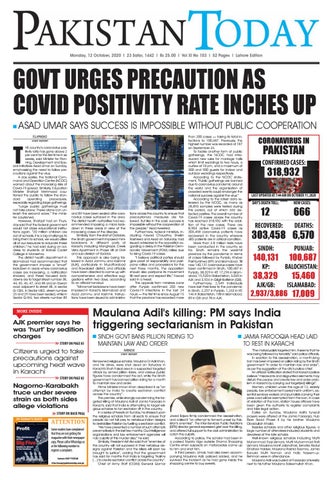
than 200 cases — taking its total infections to 100,687. previously, the highest number was recorded at 187 on september 26. to tackle another form of public gatherings, the ncoc had introduced new rules for marriage halls which limit weddings to two hours, a curfew of 10 pm, and a maximum of 300 and 500 guests for indoor and outdoor weddings respectively. according to the ncoc statement, “public gatherings are banned due to coronavirus pandemic around the world and the organisation of crowded events could endanger the national success against the virus.” according to the latest data released by the ncoc, as many as 28,893 samples were tested during this period, out of which 666 detected positive. the overall number of covid-19 cases across the country has reached 318,932 with the addition of the new cases. there are 8,904 active covid-19 cases as 303,458 coronavirus patients have recovered in the country whereas 483 patients are in critical condition. more than 3.8 million tests have been conducted in the country so far. sindh remains the worst-hit province by the pandemic in terms of cases followed by punjab, Khyber pakhtunkhwa (Kp) and islamabad. till now 140,131 coronavirus cases have been confirmed in sindh, 100,687 in punjab, 38,329 in Kp, 17,296 in islamabad, 15,520 in balochistan, 3,045 in aJK and 3,924 in gilgit-baltistan (gb). Furthermore, 2,549 individuals have lost their lives to the pandemic in sindh, 2,257 in punjab, 1,263 in Kp, 146 in balochistan, 188 in islamabad, 89 in gb and 78 in aJK.
coronavirus in
pakistan
CONFIRMED CASES:
318,932
LAST UPDATED AT 7:44 AM ON OCTOBER 11, 2020
DAY'S DEATH TOLL:
12
RECOVERED:
NEW CASES:
666
DEATHS:
303,458 6,570 SINDH:
PUNJAB:
140,131
100,687
KP:
BALOCHISTAN:
AJK/GB:
ISLAMABAD:
38,329
15,460
2,937/3,886 17,009
Maulana Adil's killing: PM says India triggering sectarianism in Pakistan g
sindh govt bans pillion riding to maintain law and order
g
KARACHI staff report
renowned religious scholar, maulana dr adil Khan, and his driver, were shot dead on saturday in Karachi’s shah Faisal area in a suspected targeted attack by armed pillion riders, and various public figures have condemned the act, while the sindh government has banned pillion riding for a month to maintain law and order. prime minister imran Khan described it as “an attempt by india to create sectarian conflict across the country”. the premier, while strongly condemning the targeted killing of maulana adil of Jamia Farooqia in Karachi, said that india is attempting to target religious scholars to fan sectarian rift in the country. in a series of tweets on sunday, he stressed upon the religious scholars from all sects to ensure that people do not fall prey to nefarious indian designs to destabilise pakistan by fuelling a sectarian conflict. “we have prevented a number of such attempts pre-emptively in the last few months. our intelligence organizations and law enforcement agencies will nab culprits of this murder also,” he said. similarly, president arif alvi said that “enemies of the country will not succeed in their nefarious designs against pakistan and the killers will soon be brought to justice”, adding that the government has said for months that india is targeting “aalims […] to create sectarian conflict across the country”. chief of army staff (coas) general qamar
Javed bajwa firmly condemned the assassination, and called it “an attempt to foment unrest by pakistan’s enemies”. the inter-services public relations (ispr) director general expressed grief over the killing, and offered full support to the civil administration to catch the culprits. according to police, the scholar had been in a parked toyota vigo outside shama shopping centre when suspects on motorcycles came up to him and shot him. a third person, Umair, had also been accompanying maulana adil, policed added, and he survived the incident as he had gone inside the shopping centre to buy sweets.
Jamia Farooqia head laid to rest in Karachi “the motorcyclists targeted him. it seems that he was being followed by terrorists,” said police officials. in reaction to this assassination, a month-long ban has been imposed on pillion riding by the sindh government “in order to maintain law and order”, as per the suggestion of the city’s police chief. an official notification stated that Karachi police believe “miscreants and disgruntled elements may disturb the peace and create law and order problem in Karachi by carrying out target(ed) killings”. women, children under the age of 12, elderly people, law enforcement personnel in uniform, essential services workers and journalists carrying their press card will be exempted from the ban. in case of violation of the ban, station house officers have been given the authority to register complaints and take legal action. earlier on sunday, maulana adil’s funeral prayers were offered at the Jamia Farooqia, hub river road phase ii by his brother maulana obaidullah Khalid. besides scholars and other religious figures, a large number of attendees included students and devotees of the late scholar. well-known religious scholars including mufti muhammad taqi Usmani, mufti muhammad rafi Usmani, maulana hanif Jalandhari, senator abdul ghafoor haideri, maulana rashid soomro, Jamia banuria mufti noman and hafiz naeem-urrehman were in attendance. maulana adil was buried at Farooqia University next to his father maulana saleemullah Khan.
02
Monday, 12 October, 2020
NEWS
zardari taken to hospital for ‘neCessary mediCal tests’
t
NEWS DESK
HE co-chairperson of the Pakistan People’s Party (PPP), Asif Ali Zardari, has been taken to a hospital in Karachi after feeling unwell, it emerged on Sunday. “Former President of Pakistan and PPP [Asif Ali Zardari] was shifted to hospital after feeling unwell late Sunday evening. Doctors are conducting his medical checkup and necessary medical tests,” the PPP said on Twitter. Zardari, who is involved in multiple corruption cases, has been out on bail since last year on medical grounds. The bail was granted by the Islamabad High Court (IHC).
Advocate Farooq H Naek told the court during the bail hearing that the former president “is a chronic patient suffering from multiple ailments”. The lawyer said that his client is a heart patient with three stents in his heart and has a Holter Monitor attached to his chest so that the doctors are able to check and note variations in his heartbeat and blockages in his arteries. “The petitioner is a patient of ischemic heart disease, which means that his heart may have an inadequate supply of blood and oxygen,” he said, adding that the PPP co-chairperson “suffers from various other ailments such as cervical and lumbar spondylosis, sensory and motor neuropathy with impaired proprioception”.
KARACHI STAFF REPORT
UN urged to take cognizance of Kashmiri genocide by India’s fascist regime KASHMIRI JOURNALISTS LAUNCH ‘KASHMIR UPDATE’ MAGAZINE
ISLAMABAD MIAN ABRAR
Human rights activists and parliamentarians from Europe, United Kingdom, Pakistan and Indian Occupied Kashmir (IOK) have asked the United Nations (UN) and other human rights organisations of the world to take note of the ongoing killing spree in Kashmir by the Hindutva regime and take actions to help stop the genocide of Kashmiris. The vow was made at a roundtable conference, titled ‘Reflecting the Hindutva assault on Indian Illegally Occupied Jammu & Kashmir’ and chaired by Shaharyar Khan Afridi, who is the chairman of the Parliamentary Committee on Kashmir. On the occasion, journalists from IOK based in Pakistan also launched a monthly
English language magazine called Kashmir Update to highlight atrocities of the occupying forces in IOK. Afridi denounced the “unabated Indian state-terrorism and extra-judicial killings of innocent Kashmiris in fake ‘encounters’ and so-called ‘cordon-and-search’ operations in the IOK. “Over three hundred Kashmiris, including women and children, have been martyred by the Indian occupation forces during the last one year,” he added. He also said that four more young Kashmiris were martyred in Kulgam and Pulwama districts in IOK on Saturday. He further said that India must recognise that use of brutal force against the Kashmiri people and other methods of subjugation have failed in the past and will not succeed now. “The indigenous resistance movement
of the Kashmiris for their inalienable right to self-determination, as enshrined in the relevant UN Security Council Resolutions, will only become stronger in the face of Indian state-terrorism,” he added. Afridi urged the world community to take cognizance of the aggravating situation in Kashmir valley as any failure on part of the UN may trigger a war between the nuclear neighbours, India and Pakistan, due to the flashpoint issue of Kashmir. Addressing the audience, Senator Mushahid Hussain said that the launching of Kashmir Update would go a long way in projecting the cause of Kashmir. He said that Arundhati Roy has written many articles in international journals to expose the Hindutva regime. He also said that India and Israel were involved in the worst human rights violations with expansionist agenda. He added that India was on the defensive and the international media was exposing the brutal capture of Kashmir. Former high commissioner Nafees Zakaria said that India’s move on August 5, 2019, was another dark chapter in the history of Kashmir. He said that Kashmiris had been suffering for decades and, despite Indian atrocities, the Kashmiri people were fighting for their right to self-determination. The UN needs to bring the human right violation by India to the notice of the world, he added. Former Azad Jammu & Kashmir (AJK) president Sardar Mohammad Yaqoob Khan said that Kashmiris have a long association with the independence movement and they are ready to make any sacrifice for the success of the inde-
pendence movement. He said that Kashmir was on the verge of independence from India so Kashmiris should not be disappointed. Kashmiri leader Professor Nazir Ahmad Shaal said that India had intensified state terrorism in occupied Kashmir in recent times and many young people were being martyred while thousands of people, including the Hurriyat leadership had been imprisoned. He said that the stability of Pakistan was dear to the hearts of Kashmiris and they had high hopes from Pakistan. India had occupied Kashmir in violation of international law and Kashmiri people had been deprived of their basic right to independence since 1947, he pointed out. Leading intellectual and head of Kashmir Media Service, Shaikh Tajmal-ulIslam, said that India’s Hindu extremist and the ruling party was pursuing the Hindutva agenda. He added that the Indian government was taking illegal steps to reduce the proportion of Muslims in the occupied valley. Ghulam Muhammad Safi, convener of the All Parties Hurriyat Conference (APHC) said that the ruling party of India, Bharatiya Janata Party (BJP), was pursuing the Hindutva agenda and it was violating all norms and international laws. Hurriyat Conference leader Mohammad Farooq Rahmani said that India’s Hindutva agenda was anti-human and Indian regime had failed to suppress Kashmiris’ voices despite its oppressive tactics. On the occasion, several members of the European and British parliaments expressed their views through video-link and said that unless India resolves the Kashmir issue in accordance with the aspirations of Kashmiris in its real and historical context, the dream of peace in South Asia would not be realised.
Govt taking all possible measures to alleviate inflation, poverty: Faraz ISLAMABAD APP
Federal Minister for Information and Broadcasting Senator Shibli Faraz on Sunday said that the government was taking all-possible measures to alleviate inflation in order to reduce poverty. "Prime Minister Imran Khan and his team are working efficiently to ensure good governance, rule of law, improve the living standard of the common man and to streamline the system for getting desirous results," he said while talking to
a private news channel. The minister said that the previous governments had left redundant system, fragile economy by taking huge foreign loans, and had given subsidy to mafia on wheat, sugar, etc. which put the country on a downward trajectory. After getting the status of elected government, he said that Pakistan Tehreek-e-Insaf (PTI) government had cleaned up all of the corruption-related mess and initiated its work from zero. "Now everything is heading in the right direction," he said.
Citizens urged to take preCautions against upComing heat wave in karaChi
He appreciated the role of Tiger Force, working along with different administrators, to control the inflation. "They [Tiger Force] check the prices rates of various commodities and edible items to help out the government in tightening the noose around real culprits," he said. He said that the previous government of Pakistan Muslim League-Nawaz (PML-N) had signed expensive agreements of Liquefied Natural Gas (LNG) and electricity which were creating difficulties for the incumbent government.
The Pakistan Meteorological Department (PMD) has predicted a heatwave for the next eight days in Karachi and has warned people to say inside and follow other precautions outlined by the Provincial Disaster Management Authority (PDMA). The Met Office has predicted the peak heat hours would be from 11 am to 4 pm, and PDMA has advised the people to avoid strenuous activity during those hours. People have also been advised to avoid high metabolic food and encouraged to take small, frequent meals instead. Moreover, chrysanthemum tea is known as a cooling herb and can be helpful, as temperatures are expected to hit up to 42°C. Other ways in which people can tackle the heatwave is by wearing proper footwear to avoid getting burnt by hot asphalt, avoid leaving their kids in a hot car, using cotton pillowcases, running cold water over their wrists, and using aloe vera rubs instead of moisturizers. In 2015, 65,000 people that suffered from heatstroke were treated at 50 rehabilitating centres in Karachi’s most affected ─ and densely populated ─ areas. This became known as the deadliest heatwave in 50 years. The notice on the Met Office’s website informs a high-pressure area is expected to be formed in Central Asia which would, in turn, induce the wind to flow from North to Northwest in areas of Sindh, including Karachi. The weather is expected to be “very hot and dry” from October 11-13, with temperatures between 39-42°C during the day. The temperature is expected to drop to 25°C and below during the evenings.
govt to turn inter-sect harmony code into law: Cii chairman ISLAMABAD STAFF REPORT
Council of Islamic Ideology (CII) Chairman Dr Qibla Ayaz has said that federal ministries of law and religious affairs have initiated work to make the code of conduct for inter-sect harmony into a law. The code of conduct was issued at the recently held Paigham-e-Pakistan Conference, which was organised by the CII. Religious leaders belonging to all mainstream schools of religious thought had endorsed a 20point ‘code of conduct’ in the conference to promote inter-sect harmony and end sectarian discord in the country. The CII chairman said that the 20-point code of conduct forbids armed struggle against the state, prohibits suicide attacks and declaring someone infidel. Any person or group could not issue a verdict of infidelity against any group or individual. According to the code, all forms of coercion, armed action against the state, violence and anarchy in the name of enforcing Islam should be considered rebellion. “The proposed law will enhance sentences and some of the offences will become non-bailable”, Dr Ayaz said. “A criteria has been proposed for enforcement of this law, which will help to avoid its misuse.” “I had said earlier that this Muharram will not be a usual month of Muharram, a conspiracy has been hatched to trigger sectarian violence,” Dr Ayaz said. He said that a plot has been made to sabotage the China-Pakistan Economic Corridor (CPEC) and peace in the country. The CII chairman said that recommendations have been sent to curb the incidents of sexual violence and crimes. “The CII has proposed reforms in curriculum and has recommended launching a public awareness campaign,” he said. “The CII has also recommended formation of special courts to deal the cases of sexual violence.”
Monday, 12 October, 2020
NEWS
aJk premier says he was 'hurt' by sedition Charges SAYS HE ‘WILL ARRIVE IN MY GOVERNMENT CAR WITH HANDCUFFS ON’ FOR PROBE MUZAFFARABAD
a
STAFF REPORT
ZAD Jammu and Kashmir (AJK) Prime Minister Raja Farooq Haider on Sunday said that he was ‘hurt’ by the sedition charges in the First Information Report (FIR) lodged against him and other leaders of the Pakistan Muslim League-Nawaz (PML-N). “I was hurt when I got to know about the [sedition] FIR,” he said at a local news programme. “If three-fourths of the PDM’s [Pakistan Democratic Movement] representatives are [Narendra] Modi’s agents, then a question is raised on Pakistan’s existence.” “This FIR is evidence of moral bankruptcy and enmity against the state,” he
03
pakistan condemns unabated indian state terrorism in kashmir ISLAMABAD STAFF REPORT
added. “Even the Mader-e-Millat (Mother of the Nation) was declared a traitor.” The AJK premier further said that incidents like this weaken a nation, but that he would not give up on Pakistan. Farooq claimed that his spirits are still high and that his affiliation with the country would only improve. The AJK prime minister said that his future is connected to Pakistan’s future and that he would live and die here. Farooq said that he had not asked anyone to exclude his name from the FIR, adding that the development was ‘unfortunate’. “If I am summoned for the [sedition] probe, will arrive in my government car with handcuffs on,” he said. “They did not even have the courtesy to apologise to me over a telephone call,”
he said. Farooq claimed that the AJK government would always respect the PM Office, regardless of which person carried the title, but added that such FIRs are a result of Prime Minister Imran Khan saying that the opposition is backed by India. The AJK premier also said that all
plans made at the All-Parties Conference (APC) last month were in accordance with the law. Haider said that he has not decided yet about participating directly in the PDM against the government. “The government of Pakistan has not taken steps according to the people’s expectations after Modi’s August 5 move,” he said.
Pakistan has strongly condemned unabated Indian stateterrorism and extrajudicial killings of innocent Kashmiris in fake encounters and so-called cordon-and-search operations in Indian Occupied Kashmir (IOK). In a statement issued on Sunday, the Foreign Office (FO) called upon the international community, including the United Nations, human rights organisations and the global media, to take full cognizance of the consistently aggravating situation in the occupied Kashmir. It also called for holding India accountable for the egregious human rights violations and war crimes in the occupied territory. The FO urged the world community to work for peaceful resolution of the Jammu and Kashmir dispute in accordance with the relevant United Nations Security Council (UNSC) resolutions and wishes of the Kashmiri people for durable peace and stability of the region. Four young Kashmiris were martyred in Kulgam and Pulwama districts of the occupied valley on Saturday. A 14-year-old boy was seriously injured in the illegal and inhuman military crackdown. Over 300 Kashmiris, including women and children, have been martyred by the Indian occupation forces during the last one year.
samples of 65 taken for dna test in Charsadda rape case CHARSADDA TLTP
Samples of 65 more suspects were taken for a DNA test on Sunday in the rape and murder case of a two-and-ahalf-year-old girl Zainab. Police are investigating the arrested suspects but have not yet been able to find a clue about the culprits behind the felony. A police official said that the police are taking the investigation forward on the basis of evidence collected from the crime scene. The police said that they have not yet received a DNA report of the minor girl. Sources said that they will present the suspects before the court after receiving DNA reports of the suspects. The medical report of the body of the minor victim has confirmed that she was sexually assaulted before being stabbed to death. Earlier, on October 6, the mutilated body of Zainab was found dumped in the fields in the Daudzai area of Peshawar, close to Charsadda. The incident sparked an outcry in the area with the family of the victim demanding immediate arrest of the culprits. Charsadda police have registered a case under abduction, sexual assault and murder sections.
opp following int’l agenda to create unrest in pakistan: rasheed ISLAMABAD: A masked police official stands altert in a street sealed to prevent the spread of Covid-19 as the authorities imposed 'mini' smart lockdowns in various parts of the federal capital. ONLINE
pakistan moving towards non-elite health, education system: president alvi ISLAMABAD STAFF REPORT
President Dr Arif Alvi on Sunday said that Pakistan was moving towards a non-elite health and education system, as both sectors are key in poverty reduction and national development. He said this while retweeting Ehsaas Programme head Dr Sania Nishtar’s call on Twitter for Ehsaas Undergraduate Scholarships applications from students with family income less than Rs45,000. The scholarship, covering tuition fee and living stipend, will provide deserving students an opportunity to study in any of 125 public sector universities. The portal ehsaas.hec.gov.pk is open for applications till October 30, 2020. “All students must spread this so that deserving apply for scholarships in time. More than 50,000 scholarships given last year,” the president remarked.
Imran tasks Tiger Force to check commodities’ prices daily ISLAMABAD STAFF REPORT
Prime Minister Imran Khan has asked the volunteers of the Tiger Force to regularly check the prices of basic commodities like flour, sugar, ghee and lentils in their localities. In a tweet on Sunday, the prime minister asked the volunteers to post the prices on Tiger Force Portal. He said that he will meet with the Tiger Force volunteers on next Saturday at Convention Centre in Islamabad. He added that he will provide guidance and tasks to
youngsters according to the government’s action plan. The premier said that his government will use all the resources at disposal of the state to bring down skyrocketing prices of essential food items in the country from Monday. According to the details, the government has decided to use all resources against inflation in the country. PM Imran has decided to once again use the services of volunteers of Tiger Force for the identification of hoarders and consultations with Special Assistant to Prime Minister on Youth Affairs (SAPM) Usman Dar have been completed.
Bilawal accuses govt of discrediting country, demolishing economy KARACHI STAFF REPORT
Pakistan People’s Party (PPP) Chairman Bilawal Bhutto-Zardari on Sunday lashed out at the Pakistan Tehreek-e-Insaf (PTI) government, saying that it had become a “burden” on the country, hence it should step down before a public revolt. Presiding over a meeting of his party’s Karachi Co-
ordination Committee at Bilawal House, the PPP chief said that the Pakistan Democratic Movement’s (PDM) public meeting on the anniversary of 2007 Karsaz bombing in Karachi would be a referendum against the “puppet regime”. “The Imran [Khan] regime imposed on the people through stolen mandate has destroyed everything in the country and people are fed up with its anti-people policies of promoting unemployment, inflation, diplomatic
ISLAMABAD: Minister for Railways Sheikh Rasheed Ahmed on Sunday said that the opposition was following international agenda to create unrest in Pakistan. In an interview with a private TV channel, he said that the opposition was working on an international agenda for creating instability in the country. Expressing his serious concerns over the agenda of Pakistan Democratic Movement (PDM), he said that opposition’s motives behind public meetings were very dangerous. The minister said that launching protest was the right of every citizen but violating law and order situation anywhere in the country, would not be tolerated. Admitting the facts of high inflation being faced by the common man, he said that Prime Minister Imran Khan was the only leader who could address the issue of inflation. He assured that all-out efforts would be made to control prices of daily use items. Responding to a question about public gatherings, the minister said that opposition wanted to hold public meetings which could cause the spread of coronavirus in the country. He added that any terrorist activity could also occur in public gathering being called by opposition parties in the next few days. APP isolation and the economic assassination of Pakistan,” he said. Bilawal claimed that the PTI regime has no roots among the people, and has been “selected” to demolish and discredit the country and discourage meritocracy in every field. He asked the Karachi Coordination Committee to facilitate the people of the port city in reaching the venue of the public meeting without any hindrance and to organise the democratic workers of PDM for better arrangements. Karachi Coordination Committee Coordinator Waqar Mehdi, PPP Karachi Division President Saeed Ghani, MNA Qadir Patel, Lal Bux Bhutto, Najmi Alam, MPA Sajid Jokhio, Khalid Lateef, Ghulam Mohammad Samoon and others were present during the meeting.
04
Monday, 12 October, 2020
NEWS
Controversy erupts over new Excise DG's appointment PUNJAB PUNCH SHAHAB OMER
T
HE Punjab Excise, Taxation and Narcotics Control (ET&NC) department has always been an attractive office for the provincial and federal bureaucracies, and a big reason for this is the extensive powers of the officers here and the excellent opportunities for corruption. Sources in ET&NC even claim that the illicit income of a junior officer circulates to the bureaucracy of the department and even the staff of the ministry. The officers of this department collect taxes from various businesses, including motor vehicle tax, property tax, marriage hall tax and deposit billions of rupees of revenue in the public treasury annually. While appointments and transfers of senior officers in the department used to take place routinely, there is a sense of unease among the officers of the ET&NC regarding the recent appointment of Saleha Saeed as director general of the department. Saleha was appointed as the DG on September 30 by the Punjab government. Earlier, she had served as assistant commissioner of Lahore Cantonment, deputy commissioner of Hafizabad and deputy commissioner of
Economic indicators reflect stability, development: Aleem LAHORE: Punjab Senior Minister Abdul Aleem Khan has said that economic indicators are a clear reflection of the country’s stability and development. In a statement issued on Sunday, Aleem said that Pakistan, under the dynamic leadership of Prime Minister Imran Khan, has successfully faced various challenges and the country has been put on the path of development and prosperity. He said that increase in exports and the reduction in imports is a welcome development while the uplift of the industrial sector is also increasing, which would increase employment opportunities as well. Aleem said that the prime minister wants to develop the country on a solid basis for which concrete policies with far-reaching results are introduced. He said that despite all the difficulties, the present government is implementing its manifesto expeditiously and the shortcomings of the previous rulers are being addressed. The minister said that there is no importance of negative propaganda and the present government, under the leadership of PM Imran, will complete its term. He asked the party workers to intensify their contacts at the public level and play their full role in solving the problems of the people. He said that the government is using all its resources to solve the local problems of the people and God-willing the development work would be completed rapidly in the next three years. STAFF REPORT
Merit, transparency must be ensured in recruitment of govt employees: KP CM PESHAWAR: Khyber Pakhtunkhwa (KP) Chief Minister Mahmood Khan has directed the provincial Public Service Commission (PSC) to expedite recruitment process of government employees and to ensure merit and transparency in the process. The chief minister issued the directives while presiding over a meeting in Peshawar on Sunday. Khan directed the administrative heads of all departments to send requisitions to the commission on time for speedy recruitment of the employees. The chief minister stressed the need for using Information Technology in the recruitment process to ensure transparency. INP
BRT service to resume from Oct 25: Bangash PESHAWAR: Special Assistant to Chief Minister on Information Kamran Bangash on Sunday said that Bus Rapid Transit (BRT) service will resume operation from October 25 after removal of hardware flaws. Addressing a press conference, he said that repair of buses had no financial implications on the government as the concerned Chinese company is bound by contract to provide the services. He said that BRT was suspended for the safety of passengers after fire eruption incidents on the buses. Bangash said that Khyber Pakhtunkhwa (KP) government has finalised strategy for smooth supply of wheat flour to the people and defeat the flour mafia. He said that development projects have been launched at unprecedented pace in the newly-merged districts (NMDs) to bring them at par with other districts. He also said that government is giving top priority to reconstruction of damaged infrastructure, education and heath to facilitate the local people. He added that opposition was unnerved to see developmental schemes being completed rapidly for public welfare. Bangash said that opposition had nothing left for politics expect gimmicks and propaganda. APP
Lahore. Sources in the Municipal Corporation Lahore (MCL) believe that Saleha had been stationed as Lahore DC for less than a year and that a major reason for her dismissal was her failure of controlling dengue spread and poor waste management in the provincial capital. During her tenure as Lahore DC, she used to hold regular meetings with the officials of Lahore Waste Management Company (LWMC) and also conducted field surveys to control dengue, but it seems that the government was unsatisfied with her performance. Some sources in the MCL also believe that there was no specific reason for removing Saleha, but added that she was removed due to routine transfers, claiming that she is an honest officer and even from the structure of district administration, she did her best to eradicate corruption. Saleha’s appointment as ET&NC DG was challenged in the Lahore High Court (LHC) just a few days after her appointment and the petitioner had taken the position that the Punjab government had removed Masoodul Haq, a BPS-20 officer, and appointed Saleha who is a BPS-19 officer on On Pay Scale (OPS) basis, which was an illegal act According to Punjab Government Civil Servants Act, 1974, and Punjab Government Civil Servants Rules, 1974, a junior officer cannot be promoted to a higher post on OPS basis. According to the petitioner, the Supreme Court (SC)
of Pakistan had also made it clear that no authority could appoint a junior officer to a senior post on OPS basis. Not only that, but the ET&NC Service Rules state that the post of ET&NC DG is of BPS-20 and a BPS-19 officer cannot be appointed to this post. The petitioner also stated that Saleha was a BPS-19 officer and nine directors of ET&NC were already working on regular basis in BPS-19, so how could those nine officers work under their counterpart Saleha? On the other hand, some sources in ET&NC said that Saleha had started giving a tough time to Provincial Secretary ET&NC Wajihullah Kundi and Provincial Minister for ET&NC Hafiz Mumtaz from the first day of her appointment. On her first day in charge, she withdrew the order of posting of Excise and Taxation Officers (ETOs) which were made a day before her posting. According to the sources, Saleha was posted on September 30, 2020, while the former ET&NC DG Masoodul Haq had issued transfer postings and promotions of ETOs before leaving the position under the direction of the provincial government. The transfer postings also included 34 officers who were recently promoted from assistant ETOs to ETOs and that was their first promotion as regular ETOs. However, all the field staff, especially the promoted officers, were discouraged after the withdrawal of orders of their pro-
motion by Saleha. Sources said that the withdrawal of orders by Saleha was illegal and a violation of service rules and those orders had sent a negative message to field staff and subordinates across Punjab from the DG. On October 2, the provincial secretary ET&NC had issued an order to reinstate all the employees working in senior positions under OPS basis to their original posts. However, while enforcing the orders, action has also been initiated against inspectors, clerks and ETOs across the province. Sources revealed that after these orders, junior officers working on senior posts in the department on OPS basis have been given exemption while officers working OPS will be given promoted grade after the promotion committee meeting. Interestingly, Saleha is also working on OPS basis and the department staff is waiting to see if Saleha will also be reverted or the operation will be limited to junior employees only. In ET&NC, appointments and transfers of various DGs have taken place before this, but with the posting of Saleha, reservations are being found among the junior staff. During her tenure as Lahore DC, Saleha had not been able to take any significant steps to eradicate the munshi culture from the Patwar Khanas, but since she is a promising officer, this time she is expected to eradicate the culture of corruption in the ET&NC.
47 profiteers arrested in Punjab as crackdown continues LAHORE STAFF REPORT
To ensure the availability of essential commodities at the prices fixed by the government, a crackdown on profiteers is underway in Punjab and during the current month, 47 persons were arrested and 42 cases were registered, besides the imposition of a fine of about Rs6 million on violators. This was stated during a briefing at a meeting chaired by Punjab Industries Minister Mian Aslam Iqbal at Chief Secretary’s Office. The chief secretary, administrative secretaries of relevant departments and Lahore commissioner
attended the meeting while all the divisional commissioners participated through video-link. The meeting reviewed the prices and availability of essential commodities, especially flour and sugar, the performance of price control magistrates, and strategy to contain prices of eatables. The meeting decided to take unconventional and innovative measures to overcome the issue of price-hike. Speaking at the meeting, the provincial minister said that providing relief to the common man is a priority of the government and no compromise can be made on this important issue. He said that the administrative officers would have to en-
sure the implementation of the fixed rates. He directed that the prices of vegetables and other commodities, including tomatoes and onions, should be closely monitored and the agriculture department must play an active role in ensuring the availability of these items. The chief secretary said that as per the directions of Prime Minister Imran Khan and Chief Minister Usman Buzdar, steps would be taken under a comprehensive strategy to tackle the problem of artificial price-hike, adding that no laxity on part of government officials would be tolerated in this regard. He ordered the officers to step up
crackdown on profiteers, hoarders, and those creating artificial dearness across the province. The chief secretary directed that in order to ensure the availability of flour at fixed prices, the process of supply of subsidised government wheat to the flour mills, its grinding, and supply in the market be fully monitored and action be taken against the mills which do not use for grinding whole wheat provided to them under the government quota. He also issued instructions regarding the display of rate lists at shops and utilising services of Tiger Force for price control measures.
Buzdar urges people to follow SOPs amid pandemic LAHORE STAFF REPORT
Punjab Chief Minister Usman Buzdar has said that precautionary measures are necessary to deal with the coronavirus pandemic, and appealed to the people to follow precautions such as wearing masks in public places, besides maintaining social distance.
In a statement on Sunday, the chief minister warned, “Covid-19 can return back if we do not follow the SOPs [standard operating procedures].” He said that violation of anti-coronavirus SOPs at educational institutes, offices and crowded public places will not be tolerated. He said that during the last 24 hours, 11,185 coronavirus diagnostics
tests were conducted in Punjab. “In the last 24 hours, five coronavirus patients died whereas 203 people were found to be infected with the virus. Out of 100,687 coronavirus patients, 9,6561 have recovered. So far, 1,363,398 coronavirus diagnostics tests have been conducted in Punjab,” he added. Meanwhile, Buzdar also took no-
tice of the shocking incident, wherein a minor girl was molested in the area of Sadar Pindi Bhattian Police Station and sought a report from Gujranwala RPO. The chief minister directed immediate arrest of the accused and ordered initiating legal action against him, besides ensuring justice to the affected family at every cost.
Govt to spend Rs18bn on tackling urbanisation challenges ISLAMABAD APP
The government will spend around Rs18 billion during the current fiscal year for physical planning and housing sector programmes, which would be implemented by various ministries, divisions and departments to address the increasing urbanisation issues and challenges. Pakistan has the highest rate of urbanisation in South Asia and as per the population census of 2017, urbanisation had increased from 32.52 per cent to 36.38 per cent during 1998 to 2017, according to an official document available with APP. However, based on a modified definition of urban settlements, the ratio of urban to rural population could be 40 per cent and even higher, therefore, it was estimated that, by 2025, nearly half of the country’s population would be living in cities, it added. The document said that rapid urbanisation was already stretching cities’ resources in the country. The tremendous challenge of absorbing such a massive number of people in urban areas and providing them with shelter, food, employment, healthcare, education, municipal services and recreation facilities was made more difficult, causing a shortage of urban facilities and resources, skilled manpower and good governance. Despite the challenges, urban areas
demonstrate the immense economic potential to generate growth in the country. The federal government has also announced relief packages for construction and agriculture sectors and a subsidy of Rs30 billion under Naya Pakistan Housing Scheme. The provincial governments also announced relief packages for vulnerable people and exemption in taxes.
In addition, the Naya Pakistan Housing and Development Authority (NAPHDA) had been established for undertaking prime minister’s programme for construction of five million affordable houses to the general public. Special relief package for construction industry had been announced by the government to boost construction activity besides, Establishment of Construction Industry Development Board
(CIDB) to facilitate the construction sector as well as to strengthen the regulatory framework. Besides, the Federal Government Employees Housing Authority (FGEHA) has launched two new projects in Islamabad and Rawalpindi for provision of apartments to the federal government employees under PM’s Naya Pakistan Housing Programme, it said.
Monday, 12 October, 2020
FirSt LoNdoN-LahorE FLight oF BritiSh airwayS to LEavE today LAHORE
t
STAFF REPORT
HE British Airways is all set to operate its first direct flight to Lahore from London on Monday. According to details, a flight carrying 300 passengers on board will fly for Lahore from London’s Heathrow airport. The flight will land at Lahore airport on Tuesday morning.
Arrangements at the Lahore airport have been finalised, whereas UK diplomatic staff and the Civil Aviation Authority (CAA) officials will welcome passengers of the flight. According to a schedule, the airline will operate direct flights from Lahore, Pakistan to London four days a week. All flights will be operated by a Boeing 787 departing from Heathrow Terminal 5, landing into Lahore’s International Airport, according to British Airways.
Fawad addresses SCCi, says govt all out to promote industrial sector
It is pertinent to mention here that Civil Aviation Authority (CAA) on Saturday last allowed the British Airways to operate direct flights from Lahore to London. The Civil Aviation Authority (CAA) has granted permission to British Airways to land at Allama Iqbal International Airport, Lahore, according to a notification. “The approval is stipulated with the condition to review the schedule/slot upon resumption of Pakistan In-
ternational Airlines (PIA) operation to the UK,” the notification said. The aviation authority’s air transportation department has issued a certificate to the flag carrier airline of the United Kingdom (UK). It is pertinent to mention here that British Airways had resumed flight operations to Pakistan in June 2019. Flight operations that were suspended again due to the coronavirus pandemic resumed in August. The airline already flies from Islamabad.
272 trucks carrying onions await clearance at Torkham border
SIALKOT APP
Federal Minister for Science and Technology Fawad Chaudhry has said that the government is focusing on advanced technology to give boost to industrial sector in the country by taking the business community into confidence. He was addressing a meeting of exporters, held at the Sialkot Chamber of Commerce and Industry (SCCI) on Sunday. SCCI President Qaisar Iqbal Baryar, Senior Vice President (SVP) Khurram Aslam Butt, Vice President (VP) Irfan Azizpuri and Executive Committee members also attended the meeting. Fawad said that the government was fully aware of the problems being faced by the business community, saying that all-out sincere efforts were being made for early solution to these problems. The federal minister stressed the need for use of advanced technology to meet the global trade and industrial challenges. He said that the government wanted to boost trade, industrial and export sectors through advanced technology in active collaboration with the business community. "The government will support business community in every matter," he added. He said that effective economic development oriented positive policies were bearing fruit and leading the national economy towards the goal of national economic stability as well. The minister said that Sialkot is an important economic hub and totally export-oriented city of the country. He said that the surgical industry of Sialkot had enough potential to double the surgical exports from existing $400 million. He highly hailed the spirit of Sialkot exporters for establishing mega project of Sialkot international airport on self-help basis. We will facilitate them so that exports can be significantly increased, he added. Fawad hailed the pivotal role of Sialkot exporters in strengthening the national economy by earning foreign exchange to the tune of $2.5 billion annually. SCCI President Qaisar Iqbal Baryar said that Sialkot exporters were the backbone of the national economy, as they had been playing a pivotal role in strengthening national economy by earning precious foreign exchange of $2.5 billion annually. He stressed the need for establishing a Special Economic Zone (SEZ) in Sialkot.
NEWS
05
Setting up 13 SEZs to bring industrial revolution in Punjab: CM Buzdar LAHORE INP
Punjab Chief Minister Usman Buzdar has said that setting up of 13 Special Economic Zones (SEZs) will bring industrial revolution in Punjab, and employment opportunities will be generated especially in south Punjab as there is huge potential for industry and trade in the backward areas. He was talking to former president of Multan Chamber of Commerce and Industries (MCCI) and newly-elected of DG Khan Chamber of Commerce and Industries President Kh Jalaluddin Roomi who called him on Sunday. Matters regarding promotion of industries and trade in south Punjab besides generating employment opportunities were came under discussion during the meeting. The chief minister congratulated Roomi for being elected as the president of DG Khan Chamber of Commerce and Industries. Roomi said that he will promote industries and commerce in DG Khan. Buzdar said that a business-friendly environment has been provided for the business and industrial community. He said that plans have been chalked out to establish a largest industrial zone of the country in Muzaffargarh which will change the economic destiny of the region. The chief minister further stated that land would be provided for the building of chamber of commerce and industries in DG Khan and Punjab Small Industries Corporation will soon be inaugurated in the region as well. Backward areas will bring at par with the developed ones through small and medium industries, he added. Roomi lauded the vision and efforts of the Punjab government for the promotion of industries and trade. He said that exports are being increased due to the provision of business-friendly environment in Punjab. The business community appreciates the coronavirus relief package and other economic initiatives of the Punjab government, he added. Roomi said that DG Khan Chamber of Commerce and Industries will extend full cooperation with the government for the development of social sector in the backward areas of south Punjab. Trader community will also cooperate in the health and education projects of Punjab government in the border areas of Baluchistan in Koh-e-Suleman, he added.
Construction of two more lanes of N-55 starts KARACHI INP
MONITORING REPORT As many as 272 trucks loaded with onions from Afghanistan were awaiting clearance at the Torkham border for entering into Pakistan on Saturday, a local media outlet reported on the same day. According to the details, a few trucks reached the outskirts of Peshawar after travelling a distance of 54km from the Torkham border; however, 272 trucks full of onions were stuck over a distance of four kilometres from the Torkham border gate to Michani Customs Post which was recently made into clearance post to facilitate the clearance of transit goods. The average weight of onions per truck is 35 tonnes, suggesting that some 9,520 tonnes of onions are loaded on these vehicles.
When asked, Customs officials seemed clueless about the hiccup in movement. “We don’t know the reasons for the long queue,” an official told Dawn. “Majority trucks are loaded with onions while some are carrying tomatoes; there are also trucks with onions bound for transit to India via the Wagah border.” “The delay may also be because of non-availability of the required amount,” the official added. According to Customs, the Federal Board of Revenue (FBR) has made a payment system under which agents or importers are required to have a sufficient amount in their accounts for duty payments. At the same time, the Customs department has not removed the provision of additional sales tax of
three per cent which was waived for importers despite the Peshawar High Court’s order (PHC). The importers will have to apply individually and the Customs official will process their cases manually for tax exemption, causing undue delay in clearance. The government charges 17pc sales tax and 2pc income tax on import of onion, while there is 2pc income tax on the import of tomatoes. The only justification that came from the Customs was that Afghan government allowed export of onion cargo trucks in great number on Saturday which lead to congestion on the Pakistani side. It is pertinent to mention here that the shortage of vegetable in the wholesale market has pushed up the price of onion from Rs50 to as high as Rs100 per kg in some cities.
The addition of two lanes to National Highway, N-55, Ratodero-Shikarpur road was formally kicked off early this week, Gwadar Pro reported on Saturday. The project is owned by National Highways Authority (NHA) and contracted by a Chinese enterprise, TIEC (Shaanxi Construction Engineering Group Corporation Limited), one of the top 250 global contractors of ENR in 2020. Located in Shikarpur, Sindh, N-55 is about 43.4 km long. It is the first road infrastructure project in Sindh during the epidemic and the first project to be implemented by the NHA in 2020. Meanwhile, it is reckoned as an important part of the Central Asia Regional Economic Cooperation (CAREC) plan. At the end of August, TIEC won the bid for this project, and it is expected to be completed in 24 months. Xu Wei, the manager of TIEC, said earlier in an interview that during the construction period of this project, TIEC will establish a joint venture with the cooperative enterprises for project management and implementation, and the labour force will mainly be Pakistani local employees. “As a Chinese enterprise which attaches great importance to CPEC, we adhere to localised operation mode.
Imran should have got a Nobel CITy NOTES
t
M A NIAzI
HE politics of the United States is getting stranger with each passing day. Let us ignore how President Donald Trump caught the coronavirus or how the medicines he is been given have possibly made him unfit to perform his duties. Let us just not say that the far-right group of Trump supporters in Michigan have tried to kidnap the governor, and harm her for interfering with their freedoms in the hope that other militias would rise up. And then what? Launch a civil war? The last time the US had a civil war, it was on relatively clear geographical lines, North versus South. This time, it is not so easy to guess. Will the armed forces split, as they did then? Some generals should decide to preserve the national interest, and stop politicians from damaging the country in the face of the threat from Russia/China/Whoever. And while they are at it, they should hold strict accountability.
I wonder who will emerge as the leader of the nation? No baseball player or football player has built a cancer hospital yet, so the job is up for grabs. Meanwhile, there has been discrimination against Pakistan in the awards of the Nobel Prize. I mean, the physics prize went to the persons who developed the black hole theory. Yet no prize was given to Dr Hafeez Shaikh for supervising the black hole that is the Pakistani economy. The award of the medicine prize to the doctor who discovered the hepatitis-C virus was positively insulting. After all, is Pakistan not entitled to the prize by virtue of the number of citizens that are infected? What with the coronavirus, dengue and polio, we seem to have forgotten Hepatitis B and C, which are really scary diseases. So, if you have escaped Covid19, there are a lot of other diseases just waiting to happen to you. Then there’s the surprise of the Literature Prize going to an American woman poet named Glück. The Swedish Academy, which gives the prize, did not do so last year because one of its members was sexually
CMYK
harassing the staff. In a sort of mea culpa, they have given the prize to a woman. Well, I am sure Snoop Dogg and 50 Cent were disappointed, along with other rappers. Rappers have their hopes raised after Bob Dylan got the prize. In its struggle to stay relevant, there was no prize for an African-American, which just goes to show that the Nobel people do not think ‘Black Lives Matter’. The failure of the Swedish Academy to give Imran Khan the Literature Award is disappointing to his opponents. The Pakistan Democratic Movement (PDM) probably thinks he should have got the award for telling the biggest whoppers. Perhaps they believe he should have got it for his United Nations (UN) speeches, which they feel are unforgettable pieces of literature. Actually, those UN speeches should have got him the Peace Prize. If it had not been for Modi, India would have scurried out of Kashmir the next day, while the map should have made the Indian occupying forces just roll over. The Peace Prize was given instead to the World Food Programme as if Imran has
not done enough for world hunger already. And then there is the Economics Prize, which has been given to neither Dr Hafeez Sheikh nor General Qamar Javed Bajwa, whose address to the businessman’s delegation last year was previously overlooked. The Indian authorities are as guilty as the Nobel people of ignoring Pakistan. I mean, who has nobody called the Lahore CCPO to investigate the Hathras gang-rape, which provoked many protests in India. According to the Indian government, Amnesty International tried to misuse these protests to damage India’s standing in the comity of nations, so they banned it. Encouraged, Pakistan banned TikTok, doing what the US did not do. The Hathras case was one of a Dalit girl being assaulted by a gang of upper-caste men, who then killed her. The CCPO Lahore must be lost in admiration at the UP Police, who have got the CM joining them in saying that the girl was not raped. But the UP Police has not explained why the girl made so many mistakes that she was bound to be murdered. For that, they need the personal touch of the Lahore CCPO.
Monday, 12 October, 2020
06 COMMENT
No Army, No Country
Price of food
Why the acknowledgement only at a time of impending crisis?
Army bashing helps only the enemy
P
RIME MINISTER Imran Khan’s announcement that the government would take all necessary steps to bring down the price of food prices is at least an acknowledgement that there is a problem. However, when he said in his Tweet on Saturday that the government would seek the cause, the acknowledgement lost value and became sinister. It lost value because it has become only too clear that the cause of the wheat and sugar price hikes lies at the door of the government itself, because those commodities were exported, causing a shortage in the country, which the government tried strenuously to blame on ‘mafias’ whose hoarding was causing the shortage. The enquiry by the FIA revealed that the sugar shortage had been caused by sugar barons who included Cabinet ministers and advisors. It may well be that Mr Khan’s acceptance that something is wrong, has something to do with the Pakistan Democratic Movement’s (PDM) protest movement which is about to take off. The PDM is relying on the common man’s unease at rising food prices, not to forget the very real suffering that this causes, to make him take part in the protests, which have as their aim the toppling of the government. If there had been a more genuine concern on Mr Khan’s part, he would have shown it earlier, when the situation was easier to control. As it is, there is the well-founded fear that Mr Khan might try to come down with a heavy hand. Hoarding is not the problem, for hoarders have not been brought forth. Even though both commodities are being imported now, prices are still not coming down. Prices may stabilize, but it will be at the present high levels, and the imports will probably not bring prices down. At a time when the World Bank is pressing for an end to remaining price controls, the government cannot very well do the only thing it has not tried, and introduce controls at the retail level. But rationing was a bad idea before, and would be bad today.
Humayun GauHar
A
worrisome trend is now to revile the armed forces in Pakistan. This is cutely called, “fifth generation warfare” or as the Army Chief calls it, “hybrid war.” Recall what Ghazi Salahuddin Ayubi, the Kurd anti-Crusade general of the Muslim armies, said, “The best way to destroy a nation is to make its people disenchanted with their own army.” Was it Churchill who said that if a country doesn’t have an army there will be someone else’s army in your country? This is how the British East India Company crept into India and finally occupied the entire country by exploiting the petty rivalries of local princelings, one against the other. A company for God’s sake! A firm conquered India, dethroned its king and charged him with treason. Treason against whom, one might ask? Why it was treason against the Company, which doesn’t even begin to make sense. It causes complete revulsion. So remember, if you weaken your army or destroy it, you will not have a country. There is much wisdom in what Ayubi and Churchill said. This warfare is being conducted against us by India and other entities. Some of us are luckily live to this threat, but not enough. They have made deep ingress into Pakistani society. Many of our politicians and top leaders sing India’s tune. Many journalists do so too both in print and electronically as also do the socalled scholars with their pockets full of American and British scholarships. They create a subtle resentment against the Army blaming it for all the ills in society and refusing to acknowledge that a lot of them have been caused by bad political management and even bad political intent. The speech that Nawaz Sharif made to the All Parties Conference was, to some, treason. The Army does not clarify its position that the businesses conducted in its name are by the two welfare organisations – the Fauji Foundation and the Army Welfare Trust. The former was started by the British Indian Army and they both were seeded by the welfare accounts of the soldiers whose proceeds are meant to help military widows, veterans and what have you. They are very profitable and the profits go to the trusts to work for the widows, veterans, etc. None of it goes to generals or the Army itself. They are not taxed say the Army’s enemies. Which trusts and welfare organisations, civilian or military, are taxed? Even if they were taxed, let’s face it, they have done a damn sight better job than civilian organisations. Now the Army has realised that competent CEOs are not cut from the same cloth as CEOs from civilian organisations, so it has changed tack and for the first time appointed a retired civilian CEO of competent companies like ENGRO and ICI to head the Fauji Foundation. As too their military subsidiaries like Mari Petroleum. Let us hope and pray that these gentlemen do as well if not better than their Army predecessors, but I wouldn’t bet on it. Because wherever you go, corruption raises its ugly head even in civilian organisations. Corruption is not the preserve of politicians alone. So let’s not play the Indian game
Ban on Tiktok When will the PM learn?
P
RIME MINISTER’S concern over ‘immoral content’ on social media has boiled over into the ban slapped on Tiktok, the popular videostreaming platform. Is it purely a coincidence that this concern with the morals of the nation has coincided with the preparations to launch an anti-government movement by a religious party, and another that is right of centre, if not rightist? Giving Mr Khan credit for the purity of his sentiments, it still leaves behind the question of how effective will this ban be. The recent ban on PUBG had to be lifted, and the YouTube stand-off has not yet faded from memory. In short, Tiktok will not reform itself in the image that Mr Khan wants, which is not even cultural, let alone religious: it is middle-class morality being imposed on the social media. It should also concern not just Mr Khan but the entire PTI that the government of a party that portrayed itself as media-savvy and attuned to the young people of today, should be so active in solving matters by banning them. It should also concern Mr Khan that he has chosen just this moment, when India has also banned Tiktok. This is not because Tiktok has also violated Indian moral sensibilities, but in pursuance of the USA, which has already banned it because of its trade war with China, and while trying to force the company to sell its US operation to an American company. Apart from a needless needling of China, Imran should not forget three sterling contributions of Tiktok: it provided some an income, and that too in these pandemic times; it helped the country get through the pandemic; and it provided a platform to countless young people outside the metropolises who would otherwise have no opportunity to showcase their talents (or to just plain goof off). Social media cannot be untrammelled, but those who want a check on it should seek a solution likely to work, not one that has been shown to fail every time, all the time.
Government must spend to get out of this crisis Dr. Omer JaveD
‘Governments can, and should, restore demand and engineer a smooth return to sustainable growth.’ – ‘Confessions of A Keynesian Heretic’ by Roger Farmer
W
HILE the above statement appeared in a The Financial Times article published in 2013, and is talking about restoring aggregate demand that shrunk as a consequence of the 2008 Global Financial Crisis (GFC), the current pandemic has hurt aggregate demand even more, with greater estimated consequence on economic growth now than at the time of the GFC. Therefore, in the spirit of the Keynesian recipe of a greater role of government that resurrected economic growth from the deep recession of the Great Depression of the 1930s, the current recessionary current needs a similar approach. A limited role of government propounded in decades of neoliberal assault will not provide the needed impetus, especially when private investment has been shell-shocked by the deep uncertainty, and a severely deflated aggregate demand caused by the pandemic. The need for a similar approach has also been recognized by the IMF, where recently unlike its previous stance of pre-pandemic era, the International Monetary Fund (IMF or simply the ‘Fund’) called on governments in advanced countries to take advantage of exceedingly low interest rates, and enhance public investment. In the October edition of semi-annual ‘Fiscal Monitor’ report of the Fund, it indicated in one of the chapters ‘policymakers should ensure that the amount and quality of public investment are such as not to pose risks by overly worsening debt dynamics.’ Moreover, a recent Financial Times article, ‘IMF
Arif Nizami Editor Umar Aziz
Asher John
Joint Editor
Executive Editor
Deputy Editor
Lahore – Ph: 042-36300938, 042-36375965
Humayun Gauhar is a veteran columnist in Pakistan and editor of Blue Chip magazine.
Covid-19, public investment and institutional quality
Dedicated to the legacy of the late Hameed Nizami
Aziz-ud-Din Ahmad
of reviling everything good that the military has done. Talking of Indian games and bowing to the Indian agenda is best left to political leaders. The PML(N) honcho has a sedition case instituted against him precisely for working on the Indian agenda. We will know the merits of this accusation only if the case proceeds, if it does at all. Mujeeb-ur-Rehman was also accused of such sedition in the Agartala Conspiracy Case and look where it got us. So we have to tread very carefully and we have to learn to defeat the enemy with sugar rather than bullets. The Army is blamed for usurping power from time to time and ruling from behind the curtain while there is a civilian government in office elected after a fashion. They forget that a vacuum caused by political failures is perforce filled by the Army because politics does not tolerate a vacuum and the Army is also accused of causing this political failure, whether it is true or not. If you want to rule successfully and rule well, you have to do the job that is assigned to you as politicians, deliver the needs of the people, be good in crisis management (like when Karachi is inundated with rainwater), ensure the supply of essential foodstuff and the wherewithal of life like gas, water, electricity, fuel and so forth, and the Army could not think of intervening. In any case, we have to understand a very important thing: the Pakistan Army is our army and not a foreign army. It is charged in the final analysis, to save the country from any threat that it faces from without or within. The Army is accused of interfering in foreign policy. Well, our foreign policy has improved markedly since Imran Khan became prime minister and if the credit for that goes to the Army, then I say three cheers for the Army. But life is not so simple. Crafting foreign policy, or any policy for that matter, is a multi-institutional exercise and its consequences affect many institutions. Foreign policy is actually a peaceful way of conducting warfare. What do you think President Trump is doing with China through his foreign policy? He is fighting a trade war. He did the same thing with NATO and threatened to pull out if every country didn’t pay its due. That’s foreign policy. He doesn’t call Putin names because he knows that the USA and Russia have to live together in their own spheres. He may also be beholden to Russia but we don’t have proof of that. Look at our track record. Our first coup in 1958 was actually ordered by a civilian President. Before that, the Governor-General had been beseeching General Ayub Khan to take over. He finally did in 1958 after the then civilian President imposed martial law. The civilians had created many problems, the worst of which was that it took them nine years to fashion a constitution in 1956, which was fundamentally anti-democratic. They took so long because they were trying to find a formula by which to deprive the Bengalis of East Pakistan of their majority. And in the end they found it. Denying the will of the majority is war on the concept of democracy and it had to come unstuck. Ayub’s 1962 Constitution had many good features in it but his biggest mistake was an Electoral College of 80,000 people for electing the president. The politicians mainly latched onto that and launched a successful agitation against Ayub. Yahya Khan overthrew the Ayub government by encouraging the insurrection to no small extent. Came the second coup in 1969 when General Yahya Khan took over. He
did some good things initially, like ending the Electoral College and the One Unit, giving the four provinces of West Pakistan their identity back. But he was an alcoholic and alleged womanizer which led a major British newspaper (I think it was The Observer) to say that Pakistan is a country run by pimps and prostitutes. Whilst he was still Army Chief, he told Claire Hollingworth, a correspondent of a British newspaper, that he is the next President of the country. A drunken stupor was blamed for that but actually he was speaking the truth. Yahya also made a beeline for Pakistan’s most popular politician at that time and former foreign minister, Mr Zulfikar Ali Bhutto. He probably felt that he needed Bhutto’s popularity in West Pakistan to counterbalance the majority of East Pakistan. This theory was based on the assumption that Bhutto’s huge vote bank in the four provinces of West Pakistan would counterbalance the huge majority of Mujeeb-ur-Rahman in East Pakistan and he, Yahya, would act as ‘honest broker’ and remain president in the new constitution that was to be forged by the new assembly. He was half right. But he was misled into making this assessment by his incompetent intelligence agencies, particularly the civilian Intelligence Bureau. Mujeeb did sweep the elections in East Pakistan and Bhutto won a majority only in the Punjab and Sind. But in Pakistan as a whole, he was a poor second and should have been leader of the opposition. The elected assembly was actually a Constituent Assembly charged with making a new constitution, which enabled both Yahya and Bhutto to play their Machiavellian games. Bhutto made the rare statement that the country should have two constitutions, two prime ministers and should be jointly ruled by him and Mujeeb, else he would not let the National Assembly meet in Dhaka. This was just the fly in the ointment that Yahya Khan and Bhutto needed. In the meantime, Mujeeb-ur-Rahman and his lieutenants had already made a pact with India. Incredible propaganda was launched against the Pakistan Army which was ruling. Bhutto stopped the Assembly from meeting and East Pakistan revolted. Civil war started and the propagandists exaggerated the human rights abuses by the Army grossly, causing hatred against it. Millions of refugees from East Pakistan descended on India, which gave it the excuse to attack East Pakistan, separated by a thousand miles from West Pakistan. The supply chain was a joke. It’s a long story. East Pakistan became Bangladesh. Bhutto was installed as chief martial law administrator and President of West Pakistan by Yahya Khan and his treacherous junta of generals. He called it “the New Pakistan” (haven’t we heard this before?). The rest is history, which I do not have the space to repeat here. But what happened reinforces Sallahuddin Ayubi’s point of a nation coming to an end when its people are disenchanted with their army. Pakistan’s enemies both without and within are trying to make history repeat itself. But now Pakistan is another country as indeed is India. It will be a huge catastrophe if anybody is stupid enough to launch such an adventure. I know Imran will never fire the first shot unless he has to do so in defence. The world has seen the madness of Modi, and in his craze he might wish to outdo Indira Gandhi herself. Now India is trying to create more Agartalas in Balochistan, Gilgit-Baltistan and Azad Kashmir. So we have to be extra vigilant especially with the enemy within so they do not cave in to the glitter of gold.
I
Karachi – Ph: 021-35381208-9
I
calls on rich nations to boost public investment’ by Chris Giles, quoted the Fund’s deputy director of the fiscal affairs department, Paolo Mauro, where he favoured the move towards greater public investment, and underlined the primacy of making public expenditure in infrastructure as ‘You get a bigger bang for your buck from public investment because investment by private firms is extremely low. The place to start is maintenance, which is very labour intensive and can address crumbling infrastructure. Investment provides an asset for the country and is not wasteful. Right now, we are not at the point of literally trying to stimulate aggregate demand.’ The same approach is needed in developing countries, where aggregate demand has also been badly affected by the pandemic, and many countries here as well have moved into recession. Interest rates in these countries are also on the lower side at the back of lower inflationary trends. Yet unemployment is high, and while businesses privately have curtailed market presence and have delayed expansionary plans in many sectors in these uncertain times– where, God forbid, significant possibilities of a second wave of the pandemic in winters remain likely– it is indeed important that government becomes more proactive in making investments; especially of the sort that are labour intensive, to infuse much-needed strength into aggregate demand, and in turn, aggregate supply, and overall economic growth. Here, while sovereign debt crisis is important to watch out for and avoided, by emerging and frontier economies– where the debt burden of frontier economies has increased from $1 trillion in 2005 to $3.2 trillion recently– but short of that situation, public investment enhancement makes sense even in terms of borrowing where associated costs have been quite low. In this regard, a recent IMF-published article ‘Public investment for the recovery’ by Vitor Gasper, among others, highlighted the importance of public investment in these uncertain and recessionary times, in both ad-
Islamabad – Ph: 051-2204545
I
Web: www.pakistantoday.com.pk
I
vanced and emerging economies,saying, ‘Public investment has a central role to play. Our new Fiscal Monitor shows that increasing public investment in advanced and emerging market economies could help revive economic activity from the sharpest and deepest global economic collapse in contemporary history. It could also create millions of jobs directly in the short term and millions more indirectly over a longer period. Increasing public investment by 1 percent of GDP could strengthen confidence in the recovery and boost GDP by 2.7 percent, private investment by 10 percent, and employment by 1.2 percent if investments are of high quality and if existing public and private debt burdens do not weaken the response of the private sector to the stimulus.’ Having said that, while pilferage of public expenditure is quite low given strong public institutions and relatively more efficient regulatory oversight, a big challenge for developing countries is to improve the quality of institutions so that public investment wastage could be reduced. In this regard, a recently released report of the IMF ‘Well spent: how strong infrastructure governance can end waste in public investment’ highlighted the need for improving the efficiency of public expenditure in terms of losses from happening, saying, ‘Losses and waste in public investment are often systemic. On average, more than one-third of the resources spent on creating and maintaining public infrastructure are lost because of inefficiencies. These inefficiencies are closely linked to poor infrastructure governance– defined as the institutions and frameworks for planning, allocating, and implementing infrastructure investment spending. Estimates suggest that, on average, better infrastructure governance could make up more than half of the observed efficiency losses.’ In that sense, the pandemic could be used an opportunity to fast-track institutional reforms, which are indeed much needed for enhancing the efficiency of public investment. Omer Javed holds PhD in Economics degree from the University of Barcelona, and previously worked at International Monetary Fund. He tweets @omerjaved
Email: editorial@pakistantoday.com.pk
Monday, 12 October, 2020
COMMENT 07 Editor’s mail Send your letters to: Letters to Editor, Pakistan Today, 4-Shaarey Fatima Jinnah, Lahore, Pakistan. E-mail: letters@pakistantoday.com.pk Letters should be addressed to Pakistan Today exclusively
Forced marriages OUR constitution gives citizens the right to marry according to their willingness. Many underage girl’s and women are forced to marry against their consent. Forced marriage and honor killing have become extremely common in our society. It is one of such brutal cases of human rights violence. It occurs when one or both people do not freely consent to marry and they will be subjected to pressure abuse or coercion. There are more than 3,500 reports of forced marriage in the UK.Today there are 15 million people in forced marriage. Most forced before the age of 15 years. The forced marriage is the increased likelihood of domestic violence and abuse and sexual abuse. Anyone forced into marriage faces an increased risk of rape and sexual abuse as they may not wish to consent or may not be the legal age to consent to sexual relationship. I request the government to help take the culprit to task. Mahikan Sarwar kEch
Valuing women
Denying justice ensuring delay How can a judiciary build trust?
akHtar aly kuresHy
T
HERE is no secret that the beautiful word of justice is very attractive and fascinating giving a good hope of welfare and peace for human beings. However, justice concerns itself with the proper ordering of things and persons within a society or state. As a concept it has been subject to philosophical, legal, and theological reflection and to a healthy debate throughout the world. A number of important questions surrounding the system of justice, have been fiercely debated in society. What is justice? What does it demand from individuals and societies? What is the proper distribution of wealth and resources in society: equality, meritocracies, according to status, or some other arrangement? There are numberless possible answers to these questions from divergent perspectives on the political and philosophical spectrum. In one sense, all theories of justice claim that everyone should get what he deserves. Some theories disagree on the basis of the uncivilized attitude of human beings. The main distinction is between theories that argue and are liable to say that all are equal, therefore derive equal accounts of distributive justice, for instance, hard work and merits by which some should have more than others. According to most theories of justice, it is overwhelmingly important, for instance these theories claim that justice is the first virtue of social institutions, as truth is of a system of thought. Justice can be thought of as distinct from and more fundamental than benevolence, charity, mercy, generosity and compassion. Justice has traditionally been associated with concepts of fate, reincarnation or heavenly fate, that is, with a life in accordance with the cosmic plan. The association of justice with fairness has thus been historically and culturally rare and is perhaps chiefly a modern innovation. In contrast to the understandings canvassed so far, justice may be understood as a human creation, rather than a discovery of harmony, divine command, or natural law. This claim can be understood in a number of ways, with a fundamental division between those who argue that justice is a creation of some humans, and those who argue that it is the creation of all humans. In a world where people are interconnected
ing system is the main hindrance to reach the point of justice. All the stakeholders of the judicial system never bothered for this plight of jusbut they disagree, institutions are required to cul- tice. There is a need to have a new tivate ideals of justice. These institutions may be comprehensive judicial policy to follow all justified by their approximate instantiation of courts, particularly the subordinate judiciary, justice, or they may be deeply unjust when com- which is bound to deliver justice in an expedipared with ideal standards. Justice is an ideal tious manner. It will take some time to produce which the world fails to live up to, sometimes good results as presently, we are facing an exdespite good intentions, sometimes disastrously. treme shortage of judges at all levels, whether it The question of institube in the civil courts, tive justice raises issues the district courts and of legitimacy, procemore inconveniently in dure, codification and the Lahore High Court, This situation may be interpretation, which which is 20 judges are are considered by legal less than its sanctioned unintentional on the part of experts and philosophy strength. its stakeholders, but is of law. The High Court Another definition being the highest court bothersome to all who are of justice is that it is an of the province, has to independent investigaseeking justice and who have shoulder a greater burtion of truth. In a courtden to decide appelfailed due to the penetration lants’ cases of the room, lawyers and judges are supposed to whole province as well of corruption in our justice be independently invesas to decide the constitigating the truth of an tutional and corporate system, as the whole social alleged crime by argumatters having more ing the matter and consystem we are suffering is significance and ursidering the available gency. But these days without any justification. evidence. This situation only 40 judges are is more logical and near working who, of Apparently, in the given to the truth that everycourse, are not able to body is in search of juscomplete the work of circumstances the instant tice and seeking the 60 judges; thus the judicial system is not solution of his or her backlog of cases is problems. The state has being increased heavily enforceable in the Lahore the responsibility to deand people are frusliver justice and create trated by the scarcity of High Court until the new an atmosphere of judges. Although, the appointments of judges equality and equity for honorable judges and all citizens. In the modlawyers have sacrificed emerge on the judicial ern world, only the somuch to work till sunciety which can survive down, even then the surface to wash away the or which can be demajority of cases were clared as a good civiinconvenience caused to the left over or adjourned, lized society or a people had no general public, by creating a and welfare state by interchoice except to return national organizations, to their homes without good image of an is one which has the obtaining justice. fair system of justice This situation may independent judiciary which for its citizens. be unintentional on the has te potential to provide This can only be part of its stakeholders, explored by creating but is bothersome to all easy and instant justice to the supremacy of law who are seeking justice and a high respect for and who have failed the citizens of Pakistan who humanity, having the due to the penetration have been disappointed by full moral support of of corruption in our justhe general public and tice system, as the our leaders since long its departments which whole social system we are constitutionally liare suffering is without able to collect evidence any justification. Apthrough a well disciparently, in the given plined and trained staff. Whereas in Pakistan; the circumstances the instant judicial system is not word justice is intact in its symbolic state of def- enforceable in the Lahore High Court until the inition without following the pragmatic se- new appointments of judges emerge on the judiquence, even with the unjustified absence of the cial surface to wash away the inconvenience main ingredient of social justice. The people de- caused to the general public, by creating a good sire to get all comforts and facilities, but they are image of an independent judiciary which has te reluctant to discharge their lawful and moral potential to provide easy and instant justice to duty. the citizens of Pakistan who have been disapA similar situation has been dominating in pointed by our leaders since long. our courts as our judicial system is about to collapse and it would become a great source of exThe writer is an Advocate of the Supreme haustion for the citizens. Nobody is willing to Court of Pakistan, Law Professor, Member of appear as an independent witness before the International Bar Association and former court as the impression of a sluggish and fatigu- Assistant Attorney General for Pakistan.
DUE to our old mindset, females are already derieved from education. If they get it, they are killed in the name of honour. The reason for this is that we are living in men society. In an Islamic state, it was taught to everyone to value female and give them equal rights. Then, why is it easy to rape a girl? Why is it easy to kill a girl? These shows we value males more than females. Humans talk about animals and their right, firstly finish the gap between male and female then try to think about other organisms. Females are treated like animals, it is tragic to say this in an Islamic country, but it is true. If we want to finish this gap, we need the help of the government because public is not going to have any change. rahMatullah Shafiq Makran
Is there any law for children? SIR: Apropos a news a item repeated incidents of child abuse warrant greater action from State, society (October 9, 2020) child abuse and kidnapping are increasing day by day in Pakistan. It really hurt me a lot when I read in this news that a five years old girl was kidnapped, raped and murdered and body was found on a garbage heap in Karachi. However MNA Mehnaz Akber Aziz declared there are 108 laws which are for child rights. Where are the laws that children are being kidnapped, raped, and murdered? Is there any law in Pakistan for children ? If there is , Why children are the victim of sexual abuse? Crimes against children who are innocent rising more in Pakistan. According to Sahil, a NGO worker the number of child sexual abuse cases has increased 14 percent. Since January to June 1,489 cases have been reported of repeated incidents. Among them 53 percent were girls and 47 percent were boys. Children who are the builder of nation are suffering a lot. The government needs to take steps to make country safer for children and also ensure that laws will take speedy action after a crime is committed so that parents of children can dare to inform police for enquiry. fazal turbat
Drug addiction DRUG is any substance that causes a change in an organism physiology. But the conception of drugs can be via inhalation, injections, smoking, ingestion absorption via a patch on the skin and dissolution under the tongue. It is the chemical which damaged the body. Further, drugs change the brain in make it incapable to work. Forsooth, drug addiction is considered a relapsing and relaxation of people. Unfortunately, it is destroying the lives of them. According to UN report and estimated 7.6 million people in Pakistan are drug users but the 78% are male and 22% are female. The number of these addicts is increasing as the rate of 40,000 per year and making Pakistan one of the most drug affected countries in the world. It is not being decreased but day by day being increased. As a fact, and (UNODC) calculated in Pakistan more then 800,000 people users of heroin regularly between 15 and 24 aged. But the number of drug users is particularly high in the Khyber Pakhtunkhwa which is neighbors of Afghanistan,where close to 11 percent of the population is hooked on drugs. Finally, the government should terminate such kind of dangerous things which are in benefit for the nation and save the children’s they are the new generation of the country. najEEb Swali turbat
Darkest city PAKISTAN is facing a major issue in the name of electricity which is needed for everything and to everyone to do something. There are some areas of Pakistan which are facing shortage of electricity like Awaran and now karachi is one of them. Karachi is known the biggest city in the country which is facing shortage of electricity. However, shortage of electricity is a major problem by which people face maximum problems. Worst affected was the port city of Karachi, a city of 20million, where many people spent a sleepless night because of warm and humid weather. Moreover, the city is facing a serious issue that because of power breakdown after heavy rain and some areas ‘s power was restored but still some are without electricity. On the other hand, load shedding is at an time high and helpless citizens are left to crave for every drop of water, at least for 8 to 6 hours load shedding is there. Some areas are worst hit by the crisis including Lyari, Karangi, Landhi, new Karachi and ect. So the government should restore the power immediately to all people of Karachi that they should get electricity. SaMEEr aSlaM awaran
Monday, 12 October, 2020
08 WORLD VIEW
A new theory of western civilisAtion
AtlAntic
A
JUdiTh ShUleViTZ
rOunD 597 AD, Pope Gregory I dispatched an expedition to England to convert the Anglo-Saxon king of Kent and his subjects. The leader of the mission, a monk named Augustine, had orders to shoehorn the new Christians into Church-sanctioned marriages. That meant quashing pagan practices such as polygamy, arranged marriages (Christian matrimony was notionally consensual, hence the formula “I do”), and above all, marriages between relatives, which the Church was redefining as incest. Augustine wasn’t sure who counted as a relative, so he wrote to rome for clarification. A second cousin? A third cousin? Could a man marry his widowed stepmother? He could not. Pope Gregory wrote back to rule out stepmothers and other close kin not related by blood—another example was brothers’ widows. He was lax about second and third cousins; only the children of aunts and uncles were off-limits. By the 11th century, however, you couldn’t get engaged until you’d counted back seven generations, lest you marry a sixth cousin. The taboo against consanguineous family had expanded to include “spiritual kin,” who were, mostly, godparents. (It went without saying that you had to marry a Christian.) Pope Gregory and Augustine’s letters document a moment in a prolonged process— begun in the fourth century—in which the Church clamped down, and intermittently loosened up, on who could marry whom. not until 1983 did Pope John Paul II allow second cousins to wed. You might assume that this curious story of how the Church narrowed the criteria for marriageability would be relegated to a footnote—a very interesting footnote, to be sure—but Joseph Henrich puts the tale at the center of his ambitious theoryof-everything book, The WEIrDest People in the World: How the West Became Psychologically Peculiar and Particularly Prosperous. Consider this the latest addition to the Big History category, popularized by best sellers such as Jared Diamond’s Guns, Germs, and Steel: The Fates of Human Societies and Yuval noah Harari’s Sapiens: A Brief History of Humankind. The outstanding feature of the genre is that it wrangles all of human existence into a volume or two, starting with the first hominids to rise up on their hind legs and concluding with us, cyborg-ish occupants of a networked globe. Big History asks Big Questions and offers quasi-monocausal answers. Why and how did humans conquer the world? Harari asks. Cooperation. What explains differences and inequalities among civilizations? Diamond asks. Environment, which is to say, geography, climate, flora and fauna. Henrich also wants to explain variation among societies, in particular to account for the Western, prosperous kind. Henrich’s first cause is culture, a word meant to be taken very broadly rather than as referring to, say, opera. Henrich, who directs Harvard’s Department of Human Evolutionary Biology, is a cultural evolutionary theorist, which means that he gives cultural inheritance the same weight that traditional biologists give to genetic inheritance. Par-
ents bequeath their DnA to their offspring, but they—along with other influential role models—also transmit skills, knowledge, values, tools, habits. Our genius as a species is that we learn and accumulate culture over time. Genes alone don’t determine whether a group survives or disappears. So do practices and beliefs. Human beings are not “the genetically evolved hardware of a computational machine,” he writes. They are conduits of the spirit, habits, and psychological patterns of their civilization, “the ghosts of past institutions.” One culture, however, is different from the others, and that’s modern WEIrD (“Western, educated, industrialized, rich, democratic”) culture. Dealing in the sweeping statistical generalizations that are the stock-in-trade of cultural evolutionary theorists—these are folks who say “people” but mean “populations”—Henrich draws the contrasts this way: Westerners are hyper-individualistic and hyper-mobile, whereas just about everyone else in the world was and still is enmeshed in family and more likely to stay put. Westerners obsess more about personal accomplishments and success than about meeting family obligations (which is not to say that other cultures don’t prize accomplishment, just that it comes with the package of family obligations). Westerners identify more as members of voluntary social groups—dentists, artists, republicans, Democrats, supporters of a Green Party—than of extended clans. In short, Henrich says, they’re weird. They are also, in the last four words of his acronym, “educated, industrialized, rich, democratic.” And that brings us to Henrich’s Big Question, which is really two linked questions. Starting around 1500 or so, the West became unusually dominant, because it advanced unusually quickly. What explains its extraordinary intellectual, technological, and political progress over the past five centuries? And how did its rise engender the peculiarity of the Western character? Given the nature of the project, it may be a surprise that Henrich aspires to preach humility, not pride. WEIrD people have a bad habit of universalizing from their own particularities. They think everyone thinks the way they do, and some of them (not all, of course) reinforce that assumption by studying themselves. In the run-up to writing the book, Henrich and two colleagues did a literature review of experimental psychology and found that 96 percent of subjects enlisted in the research came from northern Europe, north America, or Australia. About 70 percent of those were American undergraduates. Blinded by this kind of myopia, many Westerners assume that what’s good or bad for them is good or bad for everyone else. Henrich’s ambition is tricky: to account for Western distinctiveness while undercutting Western arrogance. He rests his grand theory of cultural difference on an inescapable fact of the human condition: kinship, one of our species’ “oldest and most fundamental institutions.” Though based on primal instincts— pair-bonding, kin altruism—kinship is a social construct, shaped by rules that dictate whom people can marry, how many spouses they can have, whether they define relatedness narrowly or broadly. Throughout most of human history, certain conditions prevailed: Marriage was generally family-adjacent—Henrich’s term is “cousin marriage”—which thickened the bonds among kin. unilateral lineage (usually through the father) also solidified clans, facilitating the accumulation and intergenerational transfer of property. Higher-order institutions—governments and armies as well as religions—evolved from kin-based institutions. As families scaled up into tribes, chiefdoms, and kingdoms, they didn’t break from the past; they layered new, more complex societies on top of older
forms of relatedness, marriage, and lineage. Long story short, in Henrich’s view, the distinctive flavor of each culture can be traced back to its earlier kinship institutions. The Catholic Church changed all that. As of late antiquity, Europeans still lived in tribes, like most of the rest of the world. But the Church dismantled these kin-based societies with what Henrich calls its “Marriage and Family Program,” or MFP. The MFP was really an anti-marriage and antifamily program. Why did the Church adopt it? From a cultural evolutionary point of view, the why doesn’t matter. In a footnote, Henrich skates lightly over debates about the motivations of Church leaders. But his bottom line is that the “MFP evolved and spread because it ‘worked.’ ” (Henrich’s indifference to individual and institutional intentions is guaranteed to drive historians nuts.) Forced to find Christian partners, Christians left their communities. Christianity’s insistence on monogamy broke extended
households into nuclear families. The Church uprooted horizontal, relational identity, replacing it with a vertical identity oriented toward the institution itself. The Church was stern about its marital policies. Violations were punished by withholding Communion, excommunicating, and denying inheritances to offspring who could now be deemed “illegitimate.” Formerly, property almost always went to family members. The idea now took hold that it could go elsewhere. At the same time, the Church urged the wealthy to ensure their place in heaven by bequeathing their money to the poor— that is, to the Church, benefactor to the needy. In so doing, “the Church’s MFP was both taking out its main rival for people’s loyalty and creating a revenue stream,” Henrich writes. The Church, thus enriched, spread across the globe. Loosened from their roots, people gathered in cities. There they developed “impersonal prosociality”—that is, they bonded with other city folk. They wrote city charters and formed professional guilds. Sometimes they elected leaders, the first inklings of representative democracy. Merchants had to learn to trade with strangers. Success in this new kind of commerce required a good reputation, which entailed new norms, such as impartiality. You couldn’t cheat a stranger and favor relatives and expect to make a go of it. By the time Protestantism came along, people had already internalized an individualist worldview. Henrich calls Protestantism “the WEIrDest religion,” and says it gave a “booster shot” to the process set in motion by the Catholic Church. Integral to the reformation was the idea that faith en-
Billionaire backers BIDEN DOMINATES CALIFORNIA, WHERE HE CAPTURED 84% OF BILLIONAIRE DONORS. TRUMP RULES TEXAS, WHERE HE GOT 88% OF THE SUPPORT Forbes Michela Tindera
Who is giving to Biden? Who is backing Trump? Who is sitting the election out? Forbes’ new interactive tool answers those questions and much more. Billionaires’ fortunes afford them
sweeping influence in our economy (through the companies they run), our society (through the products they develop) and our politics (through the candidates they fund). On the political stage, they’ve never played a bigger role. One billionaire is sitting in the White House, while more than 230 others are spending money to help keep him in the
tailed personal struggle rather than adherence to dogma. Vernacular translations of the Bible allowed people to interpret scripture more idiosyncratically. The mandate to read the Bible democratized literacy and education. After that came the inquiry into Godgiven natural (individual) rights and constitutional democracies. The effort to uncover the laws of political organization spurred interest in the laws of nature—in other words, science. The scientific method codified epistemic norms that broke the world down into categories and valorized abstract principles. All of these psychosocial changes fueled unprecedented innovation, the Industrial revolution, and economic growth. If Henrich’s history of Christianity and the West feels rushed and at times derivative—he acknowledges his debt to Max Weber—that’s because he’s in a hurry to explain Western psychology. The bulk of the book consists of data from many disciplines other than history, including anthropology and cross-cultural psychology, to which he and colleagues have made significant contributions. Their Kinship Intensity Index, for instance, helps them posit a doseresponse relationship between the length of time a population was exposed to the Catholic Church’s Marriage and Family Program and the WEIrDness of its character. Henrich gets amusingly granular in his statistics here. “Each century of Western church exposure cuts the rate of cousin marriage by nearly 60 percent,” he writes. A millennium of the MFP also makes a person less likely to lie in court for a friend— 30 percentile points less likely. Henrich anticipates a quibble about what he calls “the Italian enigma”: Why, if Italy has been Catholic for so long, did northern Italy become a prosperous banking center, while southern Italy stayed poor and was plagued by mafiosi? The answer, Henrich declares, is that southern Italy was never conquered by the Churchbacked Carolingian empire. Sicily remained under Muslim rule and much of the rest of the south was controlled by the Orthodox Church until the papal hierarchy finally assimilated them both in the 11th century. This is why, according to Henrich, cousin marriage in the boot of Italy and Sicily is 10 times higher than in the north, and in most provinces in Sicily, hardly anyone donates blood (a measure of willingness to help strangers), while some northern provinces receive 105 donations of 16-ounce bags per 1,000 people per year. To go further afield: While Europe was first compiling its legal codes, China was punishing crimes committed against relatives more harshly than those against nonrelatives; especially severe penalties were reserved for crimes against one’s elders. As recently as the early 20th century, Chinese fathers could murder sons and get off with a warning; punishments for patricide, by contrast, were strict. Asymmetries like these, Henrich writes, “can be justified on Confucian principles and by appealing to a deep respect for elders,” even if the WEIrD mind finds them disturbing. Henrich’s most consequential—and startling—claim is that WEIrD and nonWEIrD people possess opposing cognitive styles. They think differently. Standing apart from the community, primed to break wholes into parts and classify them, Westerners are more analytical. People from kinship-intensive cultures, by comparison, tend to think more holistically. They focus on relationships rather than categories. Henrich defends this sweeping thesis with several studies, including a test known as the Triad Task. Subjects are shown three images—say, a rabbit, a carrot, and a cat. The goal is to match a “target object”—the rabbit—with a second object. A person who matches the rabbit with the cat classifies: The rabbit and the cat are animals. A person who matches the rabbit with the carrot looks
for relationships between the objects: The rabbit eats the carrot. You have to wonder whether the Triad Task really reflects fundamentally different cognitive bents or differences in subjects’ personal experience. Henrich cites a Mapuche, an indigenous Chilean, who matched a dog with a pig, an “analytic” choice, except the man then explained that he’d done so for a “holistic” reason: because the dog guards the pig. “This makes perfect sense,” Henrich muses. “Most farmers rely on dogs to protect their homes and livestock from rustlers.” Exactly! A Western undergraduate, probably not having grown up with dogs protecting her pigs, sees dogs and pigs as just animals. Henrich is more persuasive when applying his theory of cumulative culture to the evolution of ideas. Democracy, the rule of law, and human rights “didn’t start with fancy intellectuals, philosophers, or theologians,” Henrich writes. “Instead, the ideas formed slowly, piece by piece, as regular Joes with more individualistic psychologies—be they monks, merchants, or artisans—began to form competing voluntary associations” and learned how to govern them. Toppling the accomplishments of Western civilization off their great-man platforms, he erases their claim to be monuments to rationality: Everything we think of as a cause of culture is really an effect of culture, including us. Henrich’s macro-cultural relativism has its virtues. It widens our field of vision as we assess Western values—such as objectivity, free speech, democracy, and the scientific method—that have come under sharp attack. The big-picture approach soars above the reigning paradigms in the study of European history, which have a way of collapsing into narratives of villains and victims. (Henrich forestalls the obvious objections with this jarringly offhand remark: “I’m not highlighting the very real and pervasive horrors of slavery, racism, plunder, and genocide. There are plenty of books on those subjects.”) He refutes genetic theories of European superiority and makes a good case against economic determinism. His quarry are the “enlightened” Westerners—would-be democratizers, globalizers, well-intended purveyors of humanitarian aid—who impose impersonal institutions and abstract political principles on societies rooted in familial networks, and don’t seem to notice the trouble that follows. It should be said, though, that Henrich can make a person feel pretty helpless, with his talk of populations being swept along by cultural riptides that move “outside conscious awareness.” Cultural evolutionary determinism may turn out to be as disempowering as all the other determinisms; a WEIrD reader may feel trapped inside her own prejudices. But perhaps some comfort lies in Henrich’s dazzling if not consistently plausible supply of unintended consequences. Who would have imagined that the Catholic Church would have spawned so many self-involved nonconformists? What else might our curious history yield? Henrich’s social-scientist stance of neutrality may also relieve Westerners of some (one hopes not all) of their burden of guilt. “By highlighting the peculiarities of WEIrD people, I’m not denigrating these populations or any others,” he writes. WEIrDos aren’t all bad; they’re provincial. Henrich offers a capacious new perspective that could facilitate the necessary work of sorting out what’s irredeemable and what’s invaluable in the singular, impressive, and wildly problematic legacy of Western domination.
Oval Office—or kick him out. With the moment in mind, Forbes put together a one-ofa-kind, interactive tracker that shows where America’s richest people have placed bets so far in the 2020 election. Because Trump bucked tradition by filing his reelection papers on the day he took office in 2017, the tracker includes more than three years of donations to the sitting president’s campaign. Some 101 billionaires and their spouses have donated $25.8 million to his campaign and its joint fundraising committees since then. Joe Biden got started much later, launching his campaign in late April 2019. He has made up ground quickly, raising money from 134 billionaires and their spouses, according to an analysis of Federal Election Commission filings. His campaign and its joint fundraising committees
have received $13.4 million directly from billionaires, less than Trump’s. But Biden’s richest backers are putting more money into super-PACs supporting the former vice president, adding at least another $19 million to the effort. Dig into the data, and you’ll see plenty of other trends. For example, more donors for both candidates made their money in finance and investments than any other industry. Beyond Wall Street, however, Biden and Trump’s constituencies diverge. Biden dominates California, where he captured 84% of billionaire donors. Trump rules Texas, where he got 88% of the support. The tool includes some donors who have already made a splash in Washington (Adelson, Soros, Bloomberg) as well as hundreds who haven’t (including Ballmer, Skoll and Broad).
JUDITH SHULEVITZ is the author of The Sabbath World: Glimpses of a Different Order of Time. The Weirdest People in the World: How the West Became Psychologically Peculiar and Particularly Prosperous by Joseph Henrich Farrar, Straus and Giroux.
Monday, 12 October, 2020
BUSINESS 09
No chANGe iN PermissioNs uNDer forex reGuLAtioNs: sBP KARACHI
Private sector set to import LNG before peak winter UGDC CEO CONFIDENT OF GAS SHORTAGE ISSUE BEING RESOLVED SOON
t
MEIRYUM AlI
HE State Bank of Pakistan (SBP) on Sunday issued a clarification on the recently announced federal rules on foreign currency accounts. “There has been no change in the general or special permissions given by the State Bank to individuals under the foreign exchange regulations,” the central bank emphatically stated. In its clarification, the State Bank said that according to paragraph iv, Chapter 6 of the Foreign Exchange Manual, foreign currency accounts can be fed by remittances received from abroad, travellers’ cheques issued outside Pakistan and encashment of securities issued by the government of Pakistan. A foreign currency account of a citizen of Pakistan
resident in Pakistan can also be fed with cash foreign currency only if the account holder is a filer as defined in Income Tax Ordinance, 2001. On October 6, the federal government issued Foreign Currency Accounts Rules, 2020 under the provisions of Protection of Economic Reforms Act, 1992, in a bid to stop money laundering. According to the document, a foreign currency account of an individual may be credited with the remittances received from abroad through a banking channel, except for payment for goods exported from Pakistan. Additionally, payment for services rendered in or from Pakistan, proceeds of securities issued or sold to non-residents, and any foreign exchange borrowed from abroad under any general or special permission of the State Bank, provided that the SBP may issue any general or special permission for credit the account, will also not be allowed.
However, the new rules do allow people in foreign countries to send money to Pakistan in different ways, for example, a foreign currency account may be credited through transfer from another individual foreign currency account. There is also no restriction on cash withdrawal or transfer from the foreign currency account. Despite the differences in the wording between the federal government and the central bank, in its notice, the central bank said, “The recently issued rules aim to provide a regulatory framework for the operation of individual foreign currency accounts. Such a framework represents a continuation of the State Bank of Pakistan’s efforts to strengthen the foreign exchange regime and make it more market-oriented.” The regulator also said it would continue to take steps to facilitate greater use of banking channels for individuals to meet all their foreign exchange needs.
ISLAMABAD APP
A private sector company, which secured gas sales and marketing licence from Oil and Gas Regulatory Authority (OGRA), is all set to start importing Liquefied Natural Gas (LNG) in October and November, supplementing the government efforts to meet the consumers’ increased demand. “We are ready and just waiting for the implementation on legal framework prepared by the government to facilitate private sector in the LNG import, ” Universal Gas Distribution Company (UGDC) Chief Executive Officer (CEO) Ghiyas Abdullah Paracha told APP. He said there were some bureaucratic snags for private import and utilisation of the LNG, which would hopefully be removed at the earliest as the government believed in opening up the energy sector for private sector players. “The UGDCL has planned to import its first LNG shipment in October and November subject to implementation on the legal framework,” Paracha, who is also All Pakistan Compressed Natural Gas Association’s (APCNGA) central chairman, said. Recently, he said, the government had also invited the private sector to use the unutilised and access private capacity of the LNG terminals to ensure improved supply of the gas to consumers in the upcoming winter season. With the private sector import, Paracha expressed confidence that the commodity shortage would be overcome to great extent; besides CNG stations and other industries would continue to operate as per routine. He said it would also help the government saving around Rs97 billion on account of the LNG terminals ‘fixed charges,’ if the private import continued throughout a year. In addition, he said, the government would generate around Rs104 bn revenue in a year after the flow of private sector LNG in transmission network of Sui Southern Gas Company (SSGC) and Sui Northern Gas Pipelines Limited (SNGPL). “The country’s oil import bill would also come down by Rs800 bn,” he said, adding that imported LNG was almost 13 per cent cheaper than the other imported fuel. “We will import our own LNG, inject in the pipelines of the gas companies, supply to CNG stations and other industries and collect bills from our consumers by paying rent to SSGC and SNGP against the utilisation of their transmission network.” The UGDC CEO said it would be a win-win situation for all stakeholders as the private sector would get business and consumers smooth supply of gas throughout the year without any financial involvement of the government. Paracha said the UGDC had signed agreements with 670 CNG stations and some other industrial units for supply of the gas and “We are just looking for implementation on the Legal Framework to start the LNG import.” Meanwhile, the APCNGA welcomed the Economic Coordination Committee’s (ECC) decision with regard to allowing the OGRA to issue licences for setting up new CNG stations after a break of 12 years. The ECC has permitted OGRA to issue new CNG Licenses to Regasified Liquefied Natural Gas (RLNG)-based filling stations. “We are thankful to the government. It is an extremely positive step, which reflected the government’s prudent policy and future vision for the revival of the CNG sector,” Paracha said, adding that the decision would help bring down the country’s oil import bill and create around 1.2 million job opportunities. “With the increased use of CNG in major cities, environmental pollution would also come down drastically,” he concluded.
KP fisheries dept fails to utilise ADP funds in first quarter PESHAWAR AZIZ BUNERI
Bisconni and Snack City CEO Hamid Ismail, PTI MPA Adeel Khan and MQM’s Hashim Raza cut the ribbon WASL water plant in Korangi on Sunday. PRESS RElEASE
Digital banking grows 12pc, paperbased transactions down 10pc in FY20 LAHORE TAIMOOR HASSAN
A total of 905.9 million e-Banking transactions worth Rs65.9 trillion via automated teller machines (ATMs), internet and mobile banking, point of sale (POS) systems and other digital banking channels were processed in the country, growing 4.2 per cent in volume and 12.2pc Year-on-Year (YoY), according to the data released by the State Bank of Pakistan (SBP) on Sunday. On the other hand, 424.6 m transactions of worth Rs131.2 tn were carried out using paper-based instruments such as cheques, pay orders and demand drafts etc., recording a decline of 8.7pc in volume and 10.1pc in value as compared to last year. In the annual Payment Systems Review for Fiscal Year 2019-20, the central bank noted that Pakistan had seen major improvements in the number of transactions through digital means, especially after the start of Covid-19 lockdown period
when the SBP waived all charges on digital fund transfers. The State Bank underlined that significant progress has been observed in the usage of internet banking and mobile banking channels during the last few years, which is evident from the fact that in the last five year, the internet banking transactions have seen compound annualised growth of 31pc, whereas mobile banking transactions have grown by 86pc during the said period. The overall volume and value of financial transactions in the country during FY2019-20 declined by 0.3pc and 1.9pc, respectively. As of end June 2020, the total number of ATMs in the country were 15,612, up by 6pc from last year, accounting for approximately 7.5 ATM touchpoints for a population of 100,000, which is quite low when compared with other countries in the region, including 22 ATMs in India, 9 ATMs in Bangladesh, 14 ATMs in Nepal, and 88 ATMs in Iran per 100,000 population. Furthermore, a turnover of 70.3
m POS transactions valuing Rs364.2 bn was recorded in FY20 as compared to 72.4 m transactions valuing Rs366.2 bn in FY19, showing a YoY decline of 2.9pc by volume and 0.5pc by value of transactions. The number of POS terminals also declined to 49,067 from 56,911 terminals last year. POS transactions have 7.8pc share in the total volume of transactions, with a value share of 0.6pc showing low uptake of merchant onboarding and insignificant usage of debit cards for retail transactions. The central banks had anticipated the decrease in POS transactions due to the impacts of Covid-19 pandemic as most of the shops and markets were closed during the long lockdown period. On the eCommerce side, consumers carried out 10.2 m online transactions of worth Rs34.9 bn on locally registered eCommerce merchants during the year FY20. These transactions showed significant YoY growth of 78.9pc and 33.7pc by volume and value respectively.
The Khyber Pakhtunkhwa (KP) Fisheries Department could not manage to spend a single rupee of the government allocated Rs380 million for various projects during the first three months of the current financial year (FY). It may be mentioned here that Rs111.334 million of the total amount has been released by the finance department. In fact, the department has postponed plans to increase trout fish production across the province despite the availability of funds. According to the KP Finance Department documents, the provincial government has approved the Establishment of Trout fish Villages in Malakand and Hazara Division at the cost of Rs180 m while Rs114.6 m were released for the development of Cold Water Fisheries in KP under the Prime Minister Agriculture Emergency Programme but none of the projects has been started by the fisheries department. Moreover, for the promotion of trout fish farming in Northern areas, the KP Finance Department has released Rs40 million but the fisheries department has yet to start work on the project. According to sources in the Fisheries Department, several important projects have been made part of the annual development programme to increase trout production in different districts of Malakand and Hazara divisions where cold water is available, but due to the incompetence of the fisheries department, no such project could be launched. Critics believe that the cost of projects will increase with the passage of time. Sources state that on one hand, the department is unable to spend funds while on the other, the provincial government is trying to limit hatcheries to one district; and Swat, Dir and Malakand which are suitable for the trout production have been ignored completely. Earlier, the department had set up several hatcheries in Upper Swat to increase trout production but the recent floods destroyed most of them.
UK economy faces ‘perfect storm’ as winter looms LONDON AGENCIES
The UK economy is expected to stall in the coming months — and may even go into reverse — as it faces a triple threat of the COVID-19 second wave, the end of furlough, and Brexit. “Going forward, the UK almost has this perfect storm,” Alejandra Grindal, senior international economist at Ned Davies Research, told Yahoo Finance UK. The UK economy was already weak before the pandemic struck and suffered the biggest economic collapse of any developed
nation during the crisis. Data from the Office for National Statistics, published on Friday, showed a nascent recovery from this collapse lost steam in August. GDP grew by just 2.1% in the month, well below economists’ forecasts and down from 8.7% in June. “The absence of momentum does not bode well,” said Barclays economist Fabrice Montagne. Deceleration is expected to continue in the months ahead. The government is poised to introduce new restrictions to cope with COVID-19, a Brexit deadline looms, and changes to government support schemes could force many onto the dole queue.
“There is further cause for concern ahead,” said Dr Kemar Whyte, a senior economist at the National Institute of Economic and Social Research. NO SUBSTITUTE FOR OPEN ECONOMY: As restrictions ramp up, the government’s flagship job support scheme is coming to an end. The furlough programme will close at the end of October. On Friday, chancellor Rishi Sunak announced new support to help areas hit by local lockdowns. The programme amounts to a local furlough scheme for staff and includes cash grants of up to £3,000 ($3,883) per month for affected businesses.
CMYK
Roger Barker, director of policy at the Institute of Directors, said the extension would “provide a lifeline for many companies and people impacted by the efforts to stop the virus spreading.” But he said there would still be “potential second-order impacts of local lockdowns.” Shutting restaurants will mean lower demand for meat and vegetable suppliers, for example. If those suppliers are based outside of the lockdown area, they won’t be eligible for support. “At the end of the day, no fiscal support will ever be a substitute for an open, functioning economy,” said Adam Marshall, the director general of the British Chamber of
Commerce. The end of furlough creates problems not just for areas hit by local lockdowns, but the wider economy too. The ONS this week estimated that 9% of the workforce remains on furlough. The chancellor has announced a new scheme that will subsidise the wages of parttime workers after furlough as long as their jobs remain viable. But the key word here is viable — many people currently on furlough may find themselves out of work next month as employers judge their jobs are no longer needed. Grindal said the replacement programme was “not going to cover nearly as much people as the furlough scheme.”
Monday, 12 October, 2020
10 FOREIGN NEWS Floods kill 17 people in central Vietnam, next storm due soon HANOI AGENCIES
At least 17 people have been killed by floods in Vietnam’s central provinces in the past week and 13 are still missing, state media said on Sunday as the country braced for another tropical storm. In the next few days, the central region should be prepared for another typhoon, Linfa, which will bring more rains and result in more flooding, state broadcaster Vietnam Television (VTV) reported. Footage broadcast by VTV showed fishermen being rescued by coastguard and helicopters as strong winds battered the central Vietnamese coast in the central province of Quang Tri. Floods have cut food supplies to thousands of people. Around 31,000 people have been displaced and more than 33,000 houses submerged and damaged by floods, according to a government report. Vietnam is prone to destructive storms and flooding due to its long coastline. Natural disasters - predominantly floods and landslides triggered by storms - killed 132 people and injured 207 others in the country last year.
turning local, British PM Johnson to unveil new coronavirus rules LONDON AGENCIES
British Prime Minister Boris Johnson is expected to announce new measures to tackle a growing coronavirus crisis on Monday, moving to work more closely with local leaders from England’s worst affected areas. With Johnson reluctant to repeat a national lockdown that would further hurt a struggling economy, the government is trying to contain a surge in cases, as well as growing anger, in parts of northern and central England. England’s deputy chief medical officer Jonathan Van-Tam described Britain as being at a “tipping point”, saying the spread would soon translate into more deaths and that the country should act now. Robert Jenrick, Britain’s housing minister, refused to detail the new measures the prime minister will announce but said they would focus on local areas. Johnson was expected to speak to ministers later on Sunday. “In addition to the basic simple rules that apply to the whole country, we are designing a framework for those places for where the virus is very strong,” Jenrick told Sky News. “We want the strongest possible working relationship now between central government and local government,” he said, “So it’s right that we take action in those communities and design the measures in conjunction with people who know those places best.” Jenrick said local leaders would be more involved in contact tracing after the robustness of Britain’s test-and-trace system has been repeatedly questioned, and that there would be more guidance on travel. The government, local media said, might also introduce a three tier-system to try to simplify the rules and the messaging, which opposition parties and some in the governing Conservative Party say has been too confusing and might have contributed to rising cases. But with many in northern England having already lived with tightened restrictions for weeks, the government might have to do more to quell growing anger over any new measures. Local leaders said there was a “gulf” with the government on the best steps forward after complaining for months that they were being left out of decision-making by what some called an overly centralised strategy. “We’ve certainly not agreed with them. I think there is probably a large gulf at the moment between us and the government,” Richard Leese, the leader of Manchester City Council, told Times Radio. Labour also urged the government to offer more financial support if businesses were told to close, and that the opposition party would work on offering an alternative package to one announced by finance minister Rishi Sunak on Friday. “What we really want ... is the government to come forward with a package of financial support that enables people to comply with the health restrictions,” Lisa Nandy, Labour’s foreign policy chief, told the BBC’s Andrew Marr show.
IraQI FIghterS Say they haVe halted antI-US attackS BAGHDAD
a
AGENCIES
N array of Iran-backed Iraqi armed groups have suspended rocket attacks on US forces on condition that Iraq’s government present a timetable for the withdrawal of American troops, one of the groups said on
Sunday. A spokesman for Kataib Hezbollah, one of the most powerful Iran-backed groups in Iraq, said the groups were presenting no set deadline, but that if US troops “insisted on staying” they would unleash much more violent attacks. Washington, which is slowly reducing its 5,000 troops in Iraq, threatened last month to shut its embassy unless the Iraqi government reins in Iranaligned groups that have attacked US interests with rockets and roadside bombs. The US warning caused alarm in Iraq, where it was seen as a step towards air strikes, potentially turning Iraq into a battleground in a proxy war between the US and Iran. A broad array of politicians called on the groups to stop provoking the Americans.
“The factions have presented a conditional ceasefire,” Kataib Hezbollah spokesman Mohammed Mohi told Reuters. “It includes all factions of the (anti-US) resistance, including those who have been targeting US forces.” On Saturday, groups calling themselves the “Iraqi Resistance Coordination Commission” published a statement suggesting they would suspend attacks in return for a clear plan for US troops to leave. Mohi did not specify which groups had drafted the statement. He said that the Iraqi government must implement a parliamentary resolution in January calling for foreign troops to withdraw. ROADSIDE BLAST: Iraq is one of the few countries with close ties to both the US and Iran, both of which provided military support to help defeat IS fighters, who were beaten back in a three-year war after seizing a third of Iraq in 2014. Iraqis have long feared their country could become a proxy battleground, especially since Washington killed Tehran’s military mastermind Qasem Soleimani in a drone strike at Baghdad airport in January. Abu Mahdi al-Muhandis, an Iraqi leader of proIran militias, was also killed. Factions that Soleimani
and Muhandis commanded, including Kataib Hezbollah, swore to avenge them. But pro-Iran groups have faced a popular backlash from Iraqis who accuse them of putting the country’s security at risk by attacking the Americans. Mohi said that there was no deadline for the government to expel foreign troops, but “if America insists on staying and doesn’t respect the parliament’s decision then the factions will use all the weapons at their disposal”. He said that rockets fired at US forces and diplomatic compounds were a message, and worse attacks could follow. US officials blame Kataib Hezbollah for dozens of rocket attacks against US installations in Iraq. Kataib Hezbollah denies involvement, and some attacks have been claimed by smaller, little-known groups, though Iraqi officials believe these may be fronts for bigger groups. A roadside blast hit a convoy in southern Iraq on Sunday delivering equipment to the US-led military coalition in the country, damaging a tyre but causing no casualties, the military said. There was no claim of responsibility.
Police in Belarus crack down on protesters, detain dozens ‘Israel would oppose any US F-35 sale to Qatar’
MOSCOW AGENCIES
Security forces in Belarus detained dozens of protesters on Sunday and used force, including water cannon and batons, to break up crowds demanding a new presidential election, TV footage showed. Footage published by local news outlets showed police officers wearing black balaclavas dragging protesters into unmarked black vans and beating protesters with their batons at a rally that drew thousands onto the streets of Minsk, the capital. One sequence showed a police van unleashing a powerful jet of water from a cannon into crowds, visibly pushing them back. Belarus, a former Soviet republic closely allied with Russia, has been rocked by street protests and strikes since authorities announced that veteran leader Alexander Lukashenko had won an Aug. 9 vote by a landslide. People have since taken to the streets every week to demand that Lukashenko step down and allow for a new election to be held. Lukashenko, a former collective farm manager who has been in power since 1994, denies his win was the result of cheating. Security forces have detained more than 13,000 people during a post-election crackdown, some of
whom have been later freed. Lukashenko’s key political opponents are either in jail or have fled abroad. Sunday’s violence followed a meeting Lukashenko held on Saturday in a Minsk jail with detained opposition leaders, an unusual event that prompted some opposition activists to believe he was preparing to make concessions. Police in Minsk said on Sunday they had detained “several dozen” people. Russia’s Interfax news agency reported that around 50 people had been detained and that police had used stun grenades to dispel demonstrators. The United States, the European Union, Britain and Canada have imposed sanctions against a string of senior officials in Belarus accused of fraud and human rights abuses in the wake of the presidential election. Opposition leader Sviatlana Tsikhanouskaya, who is now based in Lithuania, has called for new elections and for all political prisoners to be freed. “We will continue to march peacefully and persistently and demand what is ours: new free and transparent elections,” Tsikhanouskaya wrote on her Telegram channel on Sunday. Similar rallies were held in other cities across the country on Sunday.
Israel would oppose any US sale of advanced F-35 warplanes to Qatar, Israel’s intelligence minister said on Sunday, citing a need to maintain Israeli military superiority in the region. Intelligence Minister Eli Cohen made the comments in response to a Reuters report that Qatar - whose Iran links trouble Israel had submitted a formal request to Washington to buy the Lockheed Martin Corp. stealth jet. The United States consults with Israel on proposed sales of advanced arms to other countries in the region, under a principle of preserving Israel’s “qualitative military edge”. Some such sales have gone ahead over Israeli objections. Asked whether Israel would oppose an F-35 sale to Qatar, Cohen told Army Radio: “The answer is yes. Our security and military superiority in the region are the most significant things for us. Our region has still not turned into Switzerland.” Qatar’s F-35 request follows an August deal in which Washington agreed to consider giving the United Arab Emirates approval to buy the jets in a side deal to a US-brokered agreement normalising ties between Israel and that Gulf power. Israel, which has bought and deployed the F-35, has voiced discomfort at the prospect of UAE also getting the warplane - though the two countries have played up shared concerns about threats from Iran. Qatar, by contrast, maintains ties with Iran as well as with the Palestinian group Hamas, against which Israel has fought three wars in Gaza. But Qatar has also funnelled hundreds of millions of dollars in aid to Gaza, payouts Israel has facilitated in hope of heading off another conflict in the impoverished enclave. AGENCIES
Analysis: North Korea's Kim speaks softly, shows off new military might SEOUL AGENCIES
North Korea’s unprecedented nighttime military parade on Saturday showcased an unusually broad array of new weapons, from a show-stopping “monster” ballistic missile to previously unseen battle tanks. The hardware, likely still in varying stages of development, offered leader Kim Jong Un a chance to show the world his cutting-edge military power while adding practical capabilities to the North Korea’s already formidable nuclear and conventional forces, experts said. Kim is walking a fine line, seeking to increase pressure on the United States to ease
sanctions while not destroying rapport with US President Donald Trump or Pyongyang’s partners in China. “Kim Jong Un’s speech was not threatening to the United States, instead labelling North Korea’s nuclear forces as self-defensive,” said Bruce Klingner, a retired CIA North Korea analyst now at the Heritage Foundation. “The clear message was that, counter to US claims, the North Korean nuclear threat has not been solved.” Video from the parade suggested a huge intercontinental ballistic missile (ICBM) potentially more lethal either because of multiple warheads or a bigger payload, larger missile carriers, a next-generation submarine-launched missile, and advances in con-
ventional weaponry, military analysts said. MULTIPLE WARHEADS? The star of Saturday’s show was a massive, previously unseen ICBM carried on an equally huge “transporter-erector-launcher” (TEL) vehicle with 11 axles. Estimated to be 25 to 26 metres (82 to 85 feet) long and 2.5 to 2.9 metres (8 to 9.5 feet) in diameter, the unidentified missile would be the largest road-mobile ICBM in the world, military analysts said. Given that the Hwasong-15, the largest missile ever test-flown by North Korea, can already target anywhere in the United States, the most likely practical use for the new ICBM would be the ability to carry multiple warheads, said Melissa Hanham, deputy di-
rector of the Open Nuclear Network. It is much cheaper for North Korea to add warheads than for the United States to add interceptors, said Jeffrey Lewis, a missile researcher at the James Martin Center for Nonproliferation Studies (CNS). “If each new North Korean ICBM can carry 3-4 warheads, we would need about 12-16 interceptors for each missile,” he said on Twitter. “The last time the U.S. bought 14 interceptors, it cost $1 billion.” Other analysts said the missile could simply be designed to carry a single, larger warhead. “A bigger warhead doesn’t necessarily mean multiple warheads, a technology I believe North Korea has not secured yet,” said
Kim Dong-yup, a former South Korea Navy officer who is now a professor at Kyungnam University’s Far East Institute in Seoul. MISSILE CARRIERS: Analysts said it was also notable that North Korea appeared to have built the huge new TELs to carry the new missiles. “They have a very limited supply of long TELs they acquired from China,” said another CNS researcher, Dave Schmerler, adding that the lack of vehicles has limited the number of ICBMs that could be deployed. “So the longer TELs we saw were indigenously produced.” But the massive size of the new missile and its carrier also has drawbacks, said Markus Schiller, a missile expert based in
Monday, 12 October, 2020
NADAL wiNS 13tH FreNCH OPeN tO CLAiM reCOrD-equALLiNg 20tH grAND SLAM titLe
S
AgenCIes
PAIN'S Rafael Nadal demolished world number one Novak Djokovic of Serbia 6-0 6-2 7-5 in the French Open final to claim a record-equalling 20th Grand Slam title on Sunday. With his record-improving 13th triumph at Roland Garros, world number two Nadal is now tied with Swiss Roger Federer as the player with the most men's singles major titles. Nadal was the early aggressor as he choked Djokovic to win the opening set in brutal fashion having made only two unforced errors. He then kept a firm grip on a subdued Djokovic in the second set under the roof of court Philippe Chatrier. Djokovic, who was looking to win his 18th Grand Slam title, rebelled in the third set, breaking back for 3-3, only to drop serve on a double fault in the 11th game before Nadal went on to bag his 100th victory at Roland Garros with an ace.
Danish, Hassan help Sindh record thrilling triumph in National T20 Cup KARACHI PPI
Two childhood friends’ Danish Aziz and former Pakistan U19 captain Hassan Khan performed brilliantly to take Sindh from a likely defeat to a thrilling win in National T20 Cup for First XI. Languishing at the fifth spot with a mere two points and four losses in their first five games, Sindh looked destined for another defeat Saturday night at the Rawalpindi Cricket Stadium in their sixth match of the event when they lost their fifth wicket of the big-hitting Azam Khan with only 97 runs on the board
in their chase of 171 runs against the Babar Azam-led Central Punjab. The match was then turned decisively on its head in a stunning sixth wicket partnership of 57 runs in a mere 27 balls between two childhood friends’ man-of-the-match Danish Aziz and former Pakistan U19 captain Hassan Khan. Hassan, who led Pakistan in the ICC U19 Cricket World Cup 2018, stunned both the Central Punjab team and cricket fans with a series of huge sixes which belied his slight frame. The right-hander sealed the fate of the match by hitting fast bowler Ehsan Adil for three sixes in the 17th over of the Sindh innings. Before the start of the over, Sindh needed 37 off
24 balls, Hassan went into the top-gear smoking sixes on the second, fourth and fifth ball of the over as 20 runs were taken of the over. Hassan eventually fell for 36 off a mere 15 balls (two fours, four sixes) but had done enough to make the job easy both for his batting partner Danish and the batsmen to follow as Sindh completed their chase on the first ball of the 20th over with three wickets to spare. Hassan Khan: “When I joined Danish at the crease, we decided to attack to bring the asking rate down. Danish briefed me about the behaviour of the pitch and how we needed to approach the task at hand. We aimed to get at least one boundary per over and score runs in singles or doubles in the rest of the over. “I really enjoyed the flick over square-leg that went for six in that Ehsan Adil over; I was very pleased to play a match winning role and that too in the company of my childhood friend Danish.” Danish remained calm despite losing Hassan and then Anwar Ali, with nine runs required off the last seven balls, Danish hit Ehsan for a six over long-on which proved to be the decisive blow. Sohail Khan scored two runs off the first ball of Waqas Maqsood’s final over of the match before a wide bowled by Waqas finished the match in Sindh’s favour. Danish who scored 59 not out off 32 balls, (five fours, three sixes) was equally pleased with his effort of seeing his side through to victory, like Hassan, he also enjoyed the company of his good friend in the crucial sixth wicket partnership. Danish Aziz: “Hassan and I are childhood friends; we have played a lot of cricket together for Karachi and have represented Pakistan in age-group cricket together. We play a lot of club cricket together and also practiced at the same academy. We know each other’s capabilities and game very well which I feel helped us a great deal out in the middle. I am very pleased that I contributed to my side’s win in a tournament which has a lot of interest and following, I enjoyed all my boundaries but the six against Ehsan Adil in the penultimate over stands out.”
SPORTS 11 Afridi to coach Pakistan’s physically disabled cricketers and head PDCA KARACHI: Former Pakistan captain Pakistan cricket team Shahid Afridi will coach and train Pakistan’s physically disabled cricket team and he has also accepted Pakistan Disabled Cricket Association chairmanship role. The Shahid Afridi Foundation (SAF) has signed an MoU with the Pakistan Disabled Cricket Association to support Pakistan’s physically disabled cricketers. Under this initiative, SAF will provide assistance to PDCA for the betterment of Pakistan’s Physically Disabled Cricketers. SAF Chairman Afridi signed a Memorandum of Understanding on behalf of SAF and Secretary Amiruddin Ansari on behalf of PDCA at his residence. On the occasion, Secretary PDCA Amiruddin Ansari offered the chairmanship of PDCA to the legendary captain of Pakistan cricket team Shahid Afridi. The former captain gladly accepted the offer. Afridi said that the PDCA, despite its limited resources with the supporter of the Pakistan Cricket Board, has rendered exemplary services to the development of physical disability cricket. The former captain further said that steps will be taken to run the PDCA in a more professional manner. The former Pakistani all-rounder called on cricket sponsors to come forward to support these rare cricketers along with other cricketers so that these cricketers can also get their rightful place. Afridi assured that the Shahid Afridi Foundation will fully support the PDCA for the promotion and noble cause of Physically Disabled Cricketers in Pakistan and will work with the PDCA for national and international activities. Secretary PDCA, Amiruddin Ansari congratulated Shahid Afridi on becoming the Chairman of PDCA and thanked the Foundation. Amiruddin Ansari further said that he is very hopeful for the betterment of the disabled cricketers of the country in collaboration with SAF. PPI
Lewis Hamilton ties Michael Schumacher’s record of 91 F1 race wins Lewis Hamilton moved level with Michael Schumacher’s record of 91 Formula One wins with a victory at the Eifel Grand Prix in Nurburg, Germany, on Sunday. Hamilton won comfortably after Mercedes teammate Valtteri Bottas suffered a raceending engine issue. The win increases Hamilton’s lead to 69 points in the championship. After the race, Hamilton was presented with one of Schumacher’s famous red race helmets by the seven-time world champion’s son, Mick. Asked what the gesture and the record meant to him, Hamilton replied: “I don’t even know what to say. “When you grow up watching someone, generally idolised them, in terms of the quality of driver they are but also what they’re able to continuously do year on year, race on race, week on week, with their team. “I don’t think anyone, especially me, thought I’d be anywhere near Michael in terms of records. It’s an incredible honour and it’s going to take some time to get used to. Honestly, as I came into the pit lane that’s only when I realised, I hadn’t even computed it when I crossed the line. I couldn’t have done it without this incredible team pushing behind me and giving it their everything. “A very big thank you and a huge respect to Michael.” By way of comparison, Hamilton reached his current tally on his 261st F1 race start. Schumacher reached the 91-win mark at his 247th start, the 2006 Chinese Grand Prix. The pair are comfortably clear of the next drivers in the record books. After Hamilton and Schumacher, the next drivers on the all-time winners list are Sebastian Vettel (53), Alain Prost (51), Ayrton Senna (41), Fernando Alonso (32), Nigel Mansell (31), Jackie Stewart (27), Jim Clark, Niki Lauda (both 25) and Juan Manuel Fangio (24). Hamilton is also on course to claim a seventh world championship this season, which would move him level with the only remaining significant record in Schumacher’s name. AGENCIES
PCB announces revised itinerary for Zimbabwe series KARACHI PPI
Pakistan will launch its bid to qualify directly for the ICC Men’s Cricket World Cup 2023 by taking on Zimbabwe in the three ICC Men’s Cricket World Cup Super League matches in Rawalpindi on 30 October, 1 and 3 November, the Pakistan Cricket Board confirmed on Sunday. The ICC has introduced the Super League to provide context to ODI cricket and will serve as a qualification for the ICC Men’s Cricket World Cup 2023 with the hosts and other top seven sides automatically booking their spots for the India event. Featuring 13 teams, the 12 Test playing countries and the Netherlands, the Super League will see each side play four home and four away three-match series. The three ODIs were originally sched-
uled for Multan, but have been moved to Rawalpindi due to logistical and operational challenges. The change in the venue also means Lahore will now stage the three Twenty20 Internationals on 7, 8 and 10 November. These matches were initially planned to take place in Rawalpindi. Explaining the changes, PCB Director – International Cricket, Zakir Khan said: “After Multan became unavailable due to logistical and operational reasons, we took the opportunity to revisit the entire schedule and have come up with an itinerary that is suitable for the teams, match officials, broadcasters, event staff and other support agencies. “In the meantime, we are also in regular touch with the Metrological department and seeking their forecast for smog during November. We will continue to liaise with the Met Office and monitor the situation, and, if required, will make necessary changes.
“The availability of Rawalpindi has ensured there is no uncertainty for our ICC Men’s Cricket World Cup Super League matches as we aim to collect maximum points from this series to achieve our target of qualifying directly for the ICC’s pinnacle 50-over event.” Zimbabwe last visited Pakistan in 2015 for three ODIs and two T20Is. However, they now return after international cricket has resumed in Pakistan with full force following the successful tours of Sri Lanka, Bangladesh and the Marylebone Cricket Club (MCC) in the 2019-20 season. In addition to this, HBL Pakistan Super League, for the first time in its young history, was staged in Pakistan until the last four matches were postponed on 17 March due to Covid-19 pandemic. These matches of the fifth edition will be staged in Lahore on 14, 15 and 17 November.
CMYK
Monday, 12 October, 2020
PrAyer TImINgS
NEWS
nagorno-KarabaKh truCe under severe strain as both sides allege violations BAKU
a
AeNCIeS
Russian-brokered humanitarian ceasefire in Nagorno-Karabakh was under severe strain on Sunday a day after it was agreed, with Azerbaijan and Armenia accusing each other of serious violations and crimes against civilians. The ceasefire, clinched after marathon talks in Moscow advocated by President Vladimir Putin, was meant to halt fighting to allow ethnic Armenian forces in Nagorno-Karabakh and Azeri forces to swap prisoners and war dead. The Moscow talks were the first diplomatic contact between the two since fighting over the mountainous enclave erupted on Sept 27, killing hundreds of people. The enclave is internationally recognised as part of Azerbaijan, but is populated and governed by ethnic Armenians.
THE CEASEFIRE MEANT TO HALT FIGHTING TO ALLOW BOTH COUNTRIES TO SWAP PRISONERS AND WAR DEAD Both sides accused one another of breaking the ceasefire almost immediately on Saturday, and Azerbaijan gave the impression in public comments from top officials that it saw it as only a brief and temporary breathing space anyway. On Sunday, Azerbaijan accused Armenia of heavily shelling a residential area in Ganja, its second largest city, in the early hours of the morning, and of hitting an apartment building. The Azeri Prosecutor General’s Office said five people had been killed and 28 wounded in the attack, which it said violated the norms of the Geneva Convention on the protection of civilians. The Armenian defence ministry called the Azeri allegations “an absolute lie” and
accused Azerbaijan of continuing to shell populated areas inside Karabakh, including Stepanakert, the region’s biggest city. A Reuters photographer in Ganja saw rescue workers carrying one dead person from the ruins of a large apartment building on Sunday morning. The structure had been almost levelled. An excavator was clearing the debris. Buildings and cars in the immediate vicinity had also been severely damaged. Reuters could not independently verify Azeri assertions about the number of fatalities. Azerbaijan accused Armenia of also launching an unsuccessful rocket attack on an Azeri hydro-electric power station in Mingachevir. Ethnic Armenian forces in
Karabakh denied the assertion. Arayik Haratyunyan, the leader of ethnic Armenian forces in NagornoKarabakh, described the situation as relatively calm on Sunday morning, but said he did not know how long it would last and that the frontline remained tense. He accused Azeri forces of trying to unsuccessfully take control of the town of Hadrut, and said the process of the two sides exchanging prisoners should have started on Sunday, but that it was unclear if and when that would happen. Renewed fighting in the decades-old conflict has raised fears of a wider war drawing in Turkey, a close ally of Azerbaijan, and Russia, which has a defence pact with Armenia. The clashes have also increased concern about the security of pipelines that carry Azeri oil and gas to Europe. The fighting is the worst since a 1991-94 war that killed about 30,000 people and ended with a ceasefire that has been violated repeatedly.
FAJR SUNRISE
ZUHR
ASR MAGHRIB ISHA
4:42
11:49
3:56
AgeNCIeS
Donald Trump is no longer a transmission risk for Covid-19, his doctor said late on Saturday, as the United States president seeks to put his bout with coronavirus behind him and return to the campaign fray. Trump, trailing his Democratic challenger Joe Biden in opinion polls, addressed supporters from a White House balcony on Saturday afternoon. He urged a crowd of hundreds of largely Black and Latino supporters to help get out the vote in the Nov. 3 election. His physician Sean Conley said in a statement later that Trump had taken a test on Saturday showing he was no longer “a transmission risk to others,” and there was no longer evidence “of actively replicating virus.” The White House had no immediate comment on whether Conley’s statement meant Trump had actually tested negative for the coronavirus. Trump first revealed that he had tested positive on Oct. 2, and spent three days in hospital.
The White House has not disclosed when Trump last tested negative. Trump is eager to get back on the campaign trail after an absence of more than a week. He plans to travel to the key battleground state of Florida on Monday, followed by rallies in Pennsylvania and Iowa on Tuesday and Wednesday, respectively. “I’m feeling great,” he told the crowd. The president’s illness has cast a spotlight on the pandemic, which has infected nearly 7.7 million people in the United States and killed over 213,000. His administration has faced criticism for its handling of the crisis, and for its lax approach to mask-wearing and social distancing in the White House. At least 11 close Trump aides have tested positive for coronavirus. Speaking firmly and with no sign of the raspy throat evident in recent interviews, Trump delivered a shorter-than-usual campaign speech. He attacked Democrats as pursuing a “socialist” or even “Communist” agenda, and hailed his own record in fighting crime and boosting the US economy, while flag-waving supporters cheered and
AgeNCIeS
When miners at Indonesia’s giant Grasberg gold and copper mine started testing positive for coronavirus early in the pandemic, the mountain-top mining complex was quickly locked down with a skeletal staff left in place to maintain production. But as months of travel curbs dragged on, angry workers blockaded the mine for four days in August until the operator – a unit of US miner Freeport McMoRan Inc – relented and let them resume weekly rotations out of the site via a four-hour trek by cable car and bus to towns below. Now the workers are happier, but health experts fear the greater risk of a new outbreak. The tensions expose the balancing act to maintain output at full blast, while containing Covid-19 in mines like Grasberg, the world’s largest gold mine and second-largest copper mine. “We’ve put the priority and the health of our workers and community at the top of our list,” Freeport McMoRan Chief Executive Richard Adkerson told Reuters. “From the outset, we recognized that (Grasberg) was a particularly vulnerable place due to the size of the workforce” of nearly 30,000 people. While Freeport has halted some global operations due to the pandemic, production has continued at the 14,000 foot (4,267 metre) -high Grasberg mine despite Indonesia facing one of the worst coronavirus outbreaks in Southeast Asia.
6:56
NEW DELHI: India’s confirmed coronavirus toll crossed 7 million on Sunday with a number of new cases dipping in recent weeks, even as health experts warn of mask and distancing fatigue setting in. The Health Ministry registered another 74,383 infections in the past 24 hours. India is expected to become the pandemic’s worst-hit country in coming weeks, surpassing the United States, where more than 7.7 million infections have been reported. The ministry also reported 918 additional deaths, taking total fatalities to 108,334. The number of people who have died of Covid-19 has remained relatively low in South and Southeast Asia — from India to Vietnam and Taiwan — compared to European countries and the US, said Dr. Randeep Guleria, a government health expert. “We have been able to keep the curve rise slow, but I do agree that we have not been able to get it to move aggressively down. That’s related to our population density, diversity of our country and socioeconomic challenges in our country,” said Guleria, referring to India’s burgeoning population of nearly 1.4 billion. Some experts say though that India’s death toll may not be reliable because of poor reporting and health infrastructure and inadequate testing. India aims to provide vaccines to 250 million people by July 2021, Health Minister Harsh Vardhan said last week. He said that the government was planning to receive 450 million to 500 million vaccine doses and would ensure “equitable access”. AgeNCIeS
chanted, “We love you.” Democrats and some commentators criticized Saturday’s event for potentially exposing a new batch of supporters to the virus and for using a federal building as an election prop. Asked about it in New Castle, Delaware, Biden said he hoped the president and his supporters were taking precautions. “They should be socially distant and wearing masks,” he said. “It’s the only responsible thing to do.” Trump standing alone at the event, was not wearing a mask as he spoke. In the crowd, most were wearing masks but not following social distancing guidelines. Trump repeated past calls for states to reopen their economies even as new cases hit a two-month high on Friday. A Reuters analysis showed more than 58,000 infections were reported and hospitalizations in the Midwest hit a record for a fifth successive day. Opinion polls show Biden with a substantial lead nationally, although with a narrower advantage in some of the states that may decide the election outcome.
World’s biggest gold mine grapples with Covid-19 SINGAPORE/HOUSTON
5:35
Covid-19 Cases Cross 7m in india as experts warn of ComplaCenCy
Trump seeks to put Covid-19 behind him, get back to election campaign WASHINGTON
6:03
In May, Freeport said it would operate with a “skeletal team” because of a rise in coronavirus cases in the area, including at the workers’ living quarters. Freeport said at the time it was limiting contractors and removing “high-risk” workers but did not specify how many people would be working at the mine. But the lockdown took a psychological toll on the workers stuck above the clouds at the site since April, some of whom said that they were unable to attend funerals of family members. “We were frustrated, we wanted to see our families. So we had to protest,” said a worker, speaking from a dormitory shared with four others. He asked not to be named due to fears of losing his job. Workers who were kept from working the mine were also unhappy because of lost wages. RISK OF SECOND WAVE? Grasberg is located in Papua province’s Mimika regency, which has seen a steady rise in coronavirus cases. As of Oct. 8, there had been 1,902 cases in a population of about 224,000, the second-most infected area in Indonesia’s easternmost province. Five people have died of Covid-19 at the mine with 724 confirmed cases as of Sept. 29, according to Mining Industry Indonesia, the state company holding a majority stake in Freeport Indonesia. Since the protests, workers have returned to a weekly crew-change roster, the local company PT Freeport Indonesia said, with about 400-500 workers leaving and entering the mine daily after temperatures checks and a rapid Covid-19 test.
Published by Arif Nizami at Qandeel Printing Press, 4 Queens Road, Lahore, for PT Print (Pvt) Limited. Ph: 042-36300938, 042-36375965. Email: newsroom@pakistantoday.com.pk