CMYK
Friday, 27 March, 2020 I 02 Shaban, 1441 I Rs 20.00 I Vol X No 268 I 12 Pages I Lahore Edition
COVID-19
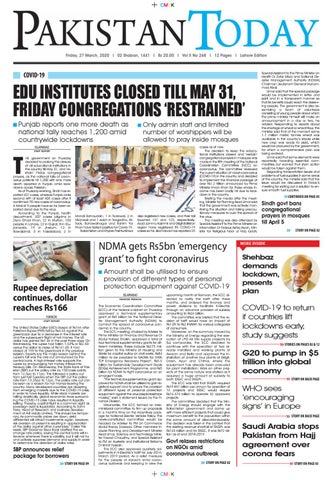
Edu institutEs closEd till May 31, Friday congrEgations ‘rEstrainEd’ g
Punjab reports one more death as national tally reaches 1,200 amid countrywide lockdowns
g
Only admin staff and limited number of worshippers will be allowed to pray inside mosques
ISLAMABAD
t
STAFF REPORT
HE government on Thursday decided to prolong the closure of all educational institutions in the country till May 31, and ‘restrain’ Friday congregational prayers, as the national tally of coronavirus patients hit 1,200 with one more death reported in Punjab amid lockdowns across Pakistan. As of Thursday evening, Sindh has reported 421 cases, whereas Punjab ranks second with at least 405 cases after it confirmed 70 new cases of coronavirus. A total of 9 people have so far been reported dead due to the virus. According to the Punjab health department, 207 cases pilgrims in Dera Ghazi Khan, 22 in Multan, 103 people in Lahore, 22 in Gujrat, 8 in Gujranwala, 19 in Jhelum, 12 in Rawalpindi, 3 in Faisalabad, 2 in
Mandi Bahauddin, 1 in Narowal, 2 in Mianwali and 1 each in Sargodha, Attock, Bahawalnagar and Rahim Yar Khan have tested positive for Covid-19. Balochistan and Khyber Pakhtunkhwa
also registered new cases, and their toll touched 131 and 123, respectively. Azad Jammu Kashmir and Gilgit-Baltistan region have registered 85 COIVD-19 cases so far. Islamabad has reported 25
cases as of now. The decision to keep the educational institutions closed and ‘restrain’ congregational prayers in mosques was made in the fifth meeting of the National Coordination Committee (NCC) on coronavirus. The committee reviewed the current situation of novel coronavirus (COVID-19) in the country and decided to implement the financial package of over Rs1.2 trillion announced by Prime Minister Imran Khan for those whose income has been badly hit due to lockdown in the country. Briefing the media after the meeting, Minister for Planning Asad Umar said that the government was actively monitoring the situation and taking precautionary measures to curb the spread of the virus. The meeting was also attended by Special Assistant to the Prime Minister on Information Dr Firdous Ashiq Awan, Minister for Religious Noor ul Haq Qadri,
NDMA gets Rs5bn ’emergency grant’ to fight coronavirus g
Rupee depreciation continues, dollar reaches Rs166 KARACHI STAFF REPORT
The United States Dollar (USD) closed at Rs166 after Pakistani Rupee (PKR) fell by Rs4.53 against the greenback due to a decrease in the interest rate and the subsequent flight of hot money. The US dollar has gained Rs7.46 in the past three days. On Wednesday, the rupee had fallen 1.63% or Rs2.60 versus the dollar to close at Rs161.60. It had closed at 159 to the greenback in the previous session. Experts say the major reason behind the rupee’s fall was the rate cut announced by the central bank. A high-interest rate supports the rupee by encouraging hot money inflows into treasury bills. On Wednesday, the State Bank of Pakistan (SBP) cut the policy rate by 150 basis points, from 12.5pc to 11pc. This followed a policy cut from just last Tuesday when the SBP cut the policy rate from 13.25pc to 12pc. The policy rate cut can be seen as a reason for hot money leaving the country. Many developed countries are divesting from emerging markets due to the COVID-19 crisis, in order to have liquidity. While stock markets are falling drastically, global economic fears surrounding the COVID-19 crisis have resulted in liquidity selling. Thereby, capital flight is a common sight as sovereign debt is liquidated. According to Sami Tariq, Head of Research and business development at Arif Habib Limited, “This should be temporary. As commodity prices are down, yield differential will attract investments again. However, risk aversion at present is resulting in appreciation of the dollar against other currencies.” Earlier this week, SBP Governor Reza Baqir clarified the exchange rate policy, saying the central bank will intervene whenever there is volatility, but it will not try and actively suppress demand and supply in order to determine the direction of dollar rates.
SBP announces relief package for borrowers STORY ON PAGE 09
Amount shall be utilised to ensure provision of different types of personal protection equipment against COVID-19 ISLAMABAD SHAHZAD PARACHA
The Economic Coordination Committee (ECC) of the federal cabinet on Thursday approved a technical supplementary grant of Rs5 billion for the National Disaster Management Authority (NDMA) to combat the spread of coronavirus pandemic in the country. The ECC meeting, chaired by Adviser to Prime Minister on Finance and Revenue Dr Abdul Hafeez Shaikh, approved a total of four technical supplementary grants for different ministries. These include Rs275 million given to the Ministry of Housing and Works for capital outlay on civil works, Rs84 million to be provided to NADRA for ‘FATA TDP Emergency Recovery Project’, Rs5.5 billion for Sustainable Development Goals (SDGs) Achievement Programme, and Rs5 billion for NDMA to fight coronavirus on an emergent basis. “The technical supplementary grant approved for NDMA shall be utilised to gain logistical support and to ensure the provision of different types of personal protection equipment against the virus (respirators/face masks),” said a statement issued by the Finance Division. Meanwhile, the ECC formed an interministerial committee to firm up proposals in a month’s time on the incentives package for National Electric Vehicle Policy. The newly-constituted committee would be headed by Adviser to PM on Commerce Abdul Razaq Dawood. Other members include Planning and Development Minister Asad Umar, Science and Technology Minister Fawad Chaudhry, and Special Assistant to PM on Austerity and Institutional Reforms Dr Ishrat Hussain. The ECC also approved quarterly adjustments in K-Electric’s tariff for July 2016March 2019 period. As a relief measure for the people of Karachi amid coronavirus outbreak and keeping in view the
upcoming month of Ramzan, the ECC directed to notify the tariff after three months, and ordered the finance and power divisions to facilitate K-Electric through an advance provision of subsidy amounting to Rs26 billion. The committee was briefed that the revision of tariff would have an impact of Rs1.09 to Rs2.89/kWh for various categories of consumers. Moreover, on the summary moved by the Ministry of Energy regarding the execution of LPG Air Mix supply projects by Sui companies, the ECC decided to continue with the operation of two already installed and working plants at Awaran and Bella and approved the installation of another four plants at Gilgit, Drosh, Ayun and Chitral, where the equipment has already been procured for plant installation. Work on other projects of the same nature was stalled as it required a huge amount of subsidy to both SSGC and SNGPL. The ECC was told that SNGPL required Rs19.851 billion per annum for operation of 16 projects and SSGC would require Rs14.474 billion to operate 32 approved projects. The committee decided that the Ministry of Energy should engage with the Balochistan government and come up with more efficient projects that could give maximum benefit to the population within the same amount of allocation/subsidy. The decision was taken in the context that the existing revenue shortfall of SNGPL was Rs143 billion and for SSGC, it was Rs72 billion as of end 2018-2019.
Govt relaxes restrictions on NGOs amid coronavirus outbreak
CMYK
STORY ON PAGE 02
Special Assistant to the Prime Minister on Health Dr Zafar Mirza and National Disaster Management Authority (NDMA) Chairman Lieutenant General Muhammad Afzal. Umar said that the special package would be implemented in letter and spirit and in a transparent manner so that its benefits could reach the deserving people. The government is also assembling a team of volunteers consisting of young people about which the prime minister himself will make an announcement in a day or two, he added. Responding to reports about the shortage of wheat or wheat flour, the minister said that at the moment some 1.7 million metric tonnes wheat was available in the country’s stocks while new crop was ready to yield, which would be procured by the government, for which a comprehensive plan was being evolved. Umar said that some elements were reportedly hoarding essential commodities but warned that stern action would be taken against them. Regarding transportation issues and problems of fuel supplies in some areas of the country, the minister said that the issue would be discussed in Friday’s meeting for sorting out a solution to ensure smooth fuel supplies.
CONTINUED ON PAGE 05
Sindh govt bans congregational prayers in mosques till April 5 STORY ON PAGE 02
more inside
Shehbaz demands lockdown, presents plan
COVID-19 to return if countries lift lockdowns early, study suggests STORIES ON PAGES 02 & 12
G20 to pump in $5 trillion into global economy STORY ON BACK PAGE
WHO sees ‘encouraging signs’ in Europe STORY ON BACK PAGE
Saudi Arabia stops Pakistan from Hajj agreement over corona fears STORY ON PAGE 03
02
Friday, 27 March, 2020
NEWS
shehbaz demands immediate lockdown, presents comprehensive plan PML-N PRESIDENT SUGGESTS USING GOVERNMENT SERVICES TO FACILITATE PEOPLE UNDER LOCKDOWN
LAHORE
p
STAFF REPORT
AKISTAN Muslim LeagueNawaz (PML-N) President Shehbaz Sharif on Thursday once again demanded an immediate lockdown to control coronavirus spread in the country and presented a comprehensive plan to ensure the supply of food, medicine and essential items. In a statement, the National Assembly
(NA) opposition leader said that after the spike in coronavirus cases, it was unavoidable and nonnegotiable to enforce a complete shutdown to contain further spread of the disease. Shehbaz proposed that food and other essential items should be retailed by Utility Stores Corporation (USC) through home delivery ordered via calls and smartphone apps. “Post offices and NLC’s human resource can also be used for this purpose,” he said, adding that freight trains should be
used for transporting these items to different parts of the country at mass scale. He said that the prices of food and essential items should be subsidised using Baitul Maal and Benazir Income Support Programme (BISP). He stressed that all personnel involved in this operation must be provided protective kits and essential precautionary items. Shehbaz paid tribute to the doctors, nurses, paramedical staff, armed forces and rangers for their service to the nation while putting their own lives in harm’s way. He stressed that ensuring the protection of the frontline soldiers in this fight against the pandemic is assurance of the safeguarded lives of the entire nation. He said that the private and corporate sector can also help in this regard. He called for an immediate disinfecting drive through municipal staff across the country and especially in areas with high density of infected cases. He pointed out that the grave situation in Rawalpindi Bara Koh and called for immediate attention to that area.
He renewed his call for inclusion of opposition’s proposals to the insufficient and vague economic package announced by the government. Shehbaz demanded that the Parliamentary Committee on COVID-19 should be upgraded to Parliamentary Monitoring Committee so that it can analyse and ensure effective implementation of the steps and call out dereliction. He also demanded that the Sindh government’s charter of demands should be immediately sent to the federal government and be approved at once. “Meeting of the Council of Common Interest (CCI) must be held on a daily basis and Punjab’s local government should be reinstated immediately,” he said. The PML-N president once again called for the policy rate to be cut by at least 4 per cent. “This is no time for mindless, egomaniacal, arrogant and stubborn tantrums fuelled by vengeance and prejudice,” he said, while calling for sanity, unity and coherence to prevail.
IHC decision to release under-trial prisoners irks govt NEWS DESK The federal government is not happy with the Islamabad High Court (IHC) decision to release at least 408 under-trial prisoners (UTP), with the officials questioning the jurisdiction of the court and the haste shown by the high court regarding the case. A government official quoted by a local media outlet said the decision should have been taken after listening to all parties. “The high court is not empowered to take suo motu notice on any issue under Article 199 of the Constitution,” he added The official wondered why other superior courts had not taken a similar decision
for the prisoners detained in other parts of country if the IHC order was appropriate. As per the official, it was discriminatory that an accused who has allegedly committed an offence in Islamabad Capital Territory receives bail but detainees who were facing similar charges were still behind bars in the rest of the country. He also feared that a security issue might arise in the federal capital after the release of over 400 prisoners. ‘IHC CARES FOR CITIZENS’: The superior bars are appreciating the IHC directives regarding the release of UTPs on bail. “It seems that the only judge performing his duty in the dispensation of justice
nab gets more time to file reference against ahsan iqbal ISLAMABAD: An accountability court on Thursday, while hearing the National Accountability Bureau’s case against Pakistan Muslim League-Nawaz (PML-N) leader Ahsan Iqbal, gave the bureau one-month time to file a reference against the accused in the Narowal Sports City case. Accountability judge Muhammad Bashir conducted the hearing without the suspect as the PML-N leader did not appear in the wake of the coronavirus outbreak. The accountability court had earlier directed the anticorruption watchdog to file reference in the aforementioned case till March 26. The PMLN leader has been alleged of misuse of power in the case. STAFF REPORT
as well as protection of citizens’ rights in the country is Justice Athar Minallah,” Pakistan Bar Council Vice Chairman Abid Saqi said in a written statement. Saqi “welcomed, appreciated and acknowledged the meritorious and highly laudable judicial intervention by Justice Minallah pertaining to prisoners’ rights”. “The IHC CJ’s order to conditionally release 408 prisoners from Adiala Jail and grant bail to prisoners who are facing trial for minor crimes in a bid to avoid the risk of COVID-19 is really an exemplary judicial decision/intervention which needs to be followed by other superior courts of the country,” he added.
ISLAMABAD Foreign Minister Shah Mahmood Qureshi on Thursday held a telephonic conversation with his Bhutanese counterpart Dr Tandi Dorji and discussed ways to counter challenges posed by the coronavirus pandemic. He told the Bhutanese FM that Pakistan considers South Asian Association for Regional Cooperation (SAARC) as an important platform for regional cooperation. He also reiterated Pakistan’s offer to host the SAARC Health Ministers’ Conference to enhance cooperation among member countries and development partners in health sector, with special focus on COVID-19. He proposed that a video conference might be organised in view of the prevailing global health emergency. Bhutanese FM Dorji welcomed the proposal and expressed
KARACHI STAFF REPORT
The Sindh government banned congregational prayers in mosques across the province from March 27, 2020 till April 5, 2020. The announcement was made by Sindh information minister Syed Nasir Hussain Shah. "Only three to five persons will be allowed to offer prayers in mosques," he said. He said that the provincial government had decided to impose a ban on congregational prayers after consulting ulemas belonging to every Islamic school of thought. "The decision was taken after consulting doctors and ulemas," confirmed chief minister Sindh's advisor Murtaza Wahab.He said that mosques will remain open across the province and only five people, including the staff of the mosque, will be able to pray together. Three to five persons will be able to offer Friday prayers in congregation inside the mosque. The decision comes a few hours after federal minister for religious affairs Dr Noor-ul-Haq Qadri announced that the government had decided to 'restrain' congregational prayers in mosques across the country. "It has been decided with consensus that Friday prayers will be 'restrained'," said Federal Minister for Religious Affairs Dr Noor-ul-Haq Qadri during a news conference. "Only mosques' administration staff and a limited number of worshippers will be allowed to pray inside mosques," he added. He clarified that mosques will not be closed but prayers and zikr will continue inside them. Dr Qadri said that the decision had been taken in consultation with ulema belonging to various schools of thought. "Ulema have been told to tell people to pray inside their homes," he said. "It is not only the job of the government to control coronavirus but also of the people." The minister said that various programmes, classes and examinations across various madressahs in Pakistan had been postponed in light of the outbreak.
asad umar replaces shaikh as energy committee head ISLAMABAD
Qureshi offers to host SAARC health ministers’ moot to discuss pandemic STAFF REPORT
sindh govt bans congregational prayers in mosques till april 5
STAFF REPORT
his country’s readiness to participate. Discussing the SAARC COVID-19 Emergency Fund, it was underlined that the fund should be placed under the SAARC secretary general and the modalities for its use must be finalised through consultations. Dilating upon the economic impact of COVID-19 on the developing countries, FM Qureshi underscored the need for debt restructuring of the developing countries to enable them to divert resources towards saving lives. He said that the World Bank (WB) president and International Monetary Fund (IMF) managing director had also raised this issue and in this regard the United Nations Secretary General (UNSC) had also emphasised the need for out-of-box solutions. Appreciating Pakistan’s efforts, Bhutanese FM Dorji underscored that given the unprecedented economic challenges faced by the developing countries due to the pandemic, a serious consideration of the proposed restructuring was critical.
Minister for Planning and Development Asad Umar has been appointed as the new chairman of the Cabinet Committee on Energy, replacing the PM’s Finance Adviser Abdul Hafeez Shaikh. The federal government on Thursday reconstituted the Cabinet Committee on Energy over the directives of Prime Minister Imran Khan. Umar had previously served as the finance minister for about eight months, from Aug 20, 2018, to April 18, 2019. After his removal, he refused the portfolio of petroleum minister but went on to become the planning minister in December last year. Umar was also appointed as the head of the National Assembly Standing Committee on Finance, but he stepped down from the post after being appointed as the federal minister.
Pakistan's charities assist in fight against coronavirus SEVERAL CHARITIES ARE DISTRIBUTION RATIONS, PROVIDING MEDICAL ASSISTANCE AS COUNTRY REMAINS UNDER LOCKDOWN KARACHI AGENCIES
As the country remains under a lockdown to battle a daunting coronavirus outbreak, local charities are playing a role to stem the economic burden on the low-income groups providing them rations and medical assistance. A grinding economic slowdown, a direct result of the global COVID-19 outbreak, has particularly hit nearly 25% of the country’s over 200 million population, which lives below poverty line. Al-Khidmat Foundation, Pakistan’s one of the largest charity organizations, is distributing ration, enough for 15 days, among the families in the low-income areas, in addition to soaps, sanitizers, and face masks across the country. The foundation, which also runs a coun-
trywide chain of charity hospitals, including a modern facility in the southern desert area of Thar, has designated isolation wards to handle the coronavirus cases, which reached almost 1,000 on Wednesday. “Laborers, and daily wages workers are the worst hit, whose livelihood has been badly affected by the coronavirus pandemic. Their immediate worry is [about] food, which we are trying to provide them,” Qazi Sadaruddin, the head of Al-Khidmat’s community services cell, told Anadolu Agency. HELPING POOR UNDER LOCKDOWN: A total of 52 small and big hospitals across the country, he added, had been designated to tackle the coronavirus outbreak, of which two had been taken over by the government’s trained staff. The foundation, which came into the spotlight for its relief operations for the af-
fectees of the 2005 deadly earthquake in Pakistani-administered Kashmir, and 2010, and 2011 floods in the country, said it already had a comprehensive data of needy families. “The advantage we, and other big charity organizations have is that we have been involved in the relief activities for decades. We know where and when rations need to be distributed,” Sadaruddin said, adding “Insha Allah [God willing], no one will die of hunger in Pakistan due to lockdown.” Edhi Foundation, a relief agency founded by the internationally-acclaimed social worker, Abdul Sattar Edhi, is importing coronavirus testing kits, which will be provided to the government and charity hospitals in the country’s remote areas, in addition to distributing rations among needy families. 1,500 AMBULANCES: The charity, which runs a nationwide ambulance service, has made a bulk of its ambulances available to transport the suspected virus patients to the hospitals and quarantine centers across the country.
CMYK
Govt relaxes restrictions on nGos amid coronavirus outbreak ISLAMABAD: The government on Thursday exempted local Non-Governmental Organisations (NGOs) from signing Memorandums of Understanding (MoU) with the Economic Affairs Division (EAD) to utilise foreign economic assistance for a period of six months. The exemption would only be applicable to those NGOs that had applied to EAD for signing of MoUs. It is worth mentioning here that the previous government had approved the policy and had made it mandatory for NGOs to sign MoUs with the government containing information, including project details and details about the geographical area in which it was to be carried out. Currently, 92 NGOs have signed MoUs with the EAD and around 100 organisations’ documents have been distributed to the concerned departments for clearance. STAFF REPORT
“We are working 24/7 to assist the government in battle against coronavirus,” said Faisal Edhi, the foundation’s head. “Our 1,500 ambulances are available 24 hours to transport the suspected patients to the hospitals and quarantines across the country,” he told Anadolu Agency. Saylani Welfare, another countrywide charity, has introduced a mobile phone ap-
plication and telephone service, where needy families can register themselves to get ration and other essential items. Also, volunteers from Alamgir Welfare Trust, Pakistan Islamic Medical Association — a nationwide group of professional doctors — Baitul Salam Trust, and other nongovernmental organizations (NGOs) are assisting the government staff in and outside
Friday, 27 March, 2020
reliGious scholars assure Govt of support in preventinG corona spread ISLAMABAD
p
STAFF REPORT
RESIDENT Dr Arif Alvi on Thursday held a meeting with religious scholars in which it was decided that ‘restricted’ congregational prayers will be held across the country to contain the spread of coronavirus. Minister for Religious Affairs Noorul Haq Qadri also advised the old and sick people to pray at home with their families. President Alvi chaired the meeting at President House. and scholars from all four provinces, Gilgit Baltistan (GB) and Azad Jammu and Kashmir (AJK) attended the meeting through video link from governor houses across the country. Those from Islamabad and Rawalpindi were physically present. According to a statement issued after the meeting, the president highlighted the preventive measures which needed to be taken by the people to stop spreading the disease. “He emphasised that the only solution to the present crisis was to maintain social distancing and act upon the guidelines provided by Islam to cope with such situation,” the statement read. The statement further stated that the ulema assured their complete support and said that they would comply with the instructions given by the government.
omcs asked to cancel oil import orders as demand drops ISLAMABAD: The Ministry of Energy (Petroleum Division) has directed all oil marketing companies and refineries to cancel their planned import of motor gasoline and crude oil, as consumption has dropped significantly due to enforcement of lockdowns by provincial governments. The Petroleum Division’s Directorate General of Oil, in a letter to the Oil Companies Advisory Council (OCDC) CEO, has asked all OMCs to cancel from April 2020 onwards the import of motor gasoline and increase the offtake from refineries so that the operations at refineries are maintained at an adequate level. Similarly, in order to ensure smooth operations of exploration and production companies, the energy ministry has directed the refineries to cancel the import of crude oil. “OCAC is requested to convey the above directions to all OMCs/refineries for strict compliance,” said the Petro Division document available with Pakistan Today. It further informed the OCAC that consumption of motor gasoline has dropped significantly due to enforcement of lockdowns by provincial governments to control the spread of COVID-19. AHMAD AHMADANI
sbp reserves drop $690m to $11.9bn KARACHI: Foreign exchange reserves held by the State Bank of Pakistan (SBP) decreased by $690 million to $11,989.2 million during the week ending March 20, 2020, according to data released by the central bank on Thursday. This decline is attributed primarily to the government’s external debt payments, which amounted to $391 million, Hajj and other official payments, the central bank said. Net foreign reserves, however, marginally increased, from $6,063.4 million to $6,115.9 million. The total liquid foreign reserves held by the country stood at $18,105.1 million. STAFF REPORT
Authorities have held multiple consultations with scholars over whether prayer congregations should continue, as social distancing is vital to curb the spread of the novel coronavirus, which has already infected more than 1,000 people in the country. A large number of people are expected to gather in mosques tomorrow to attend Friday’s congregational prayers. Earlier, President Alvi, through Egypt’s ambassador in Pakistan, had sought guidance from Al-Azhar institution, an authority on Islamic injunctions, for a word on the suspension of congregational prayers at mosques
amid the spike in coronavirus cases. The institution issued an edict on the matter yesterday, in which it stressed that public gatherings, including congregational prayers at mosques, could result in the spread of coronavirus and the governments of Muslim countries had full jurisdiction to cancel such events. The fatwa also emphasised on amending the Azaan (call to prayer) with words ‘Salaat Fi Buyut-e-kum’, meaning ‘pray in your homes’ instead of the usual ‘Hayya Ala Al Salah’ (come to prayer). Also, families within their homes can arrange group prayers, it added.
APTMA seeks early notification of ECC-approved power tariff LAHORE HASSAN NAQVI
All Pakistan Textile Mills Association (APTMA) Punjab Chairman Adil Bashir has urged the government to immediately notify the already approved electricity tariff of 7.5 cents per kWh in order to avert the negative impact of COVID-19 on the textile industry. Taking to this scribe, he recalled that the Economic Coordination Committee (ECC) had earlier this month approved that the five export sectors would be provided electricity at an all-inclusive rate of 7.5 US cents per kWh from January 1, 2019 to June 30, 2020 (retrospectively), and that all the applicable taxes issued from January 1, 2019, till date, which included surcharges, quarterly adjustments, fuel price adjustments, financial cost surcharge and Neelum-Jhelum surcharge, would be adjusted and considered as withdrawn. "Prime Minister Imran Khan had also assured of
freezing the tariff to provide relief to the electricity consumers," he added. Bashir pointed out that the textile industry is facing the problem in payment of bills, as the power distribution companies (DISCOs) are issuing provisional bills while deferring the surcharges in the absence of a notification. "The textile industry is already in disarray because of the cancellation of export orders from around the world. The heavy burden of the salaries of factory workers is another issue the industry would have to cope with. This situation has paralysed the textile sector altogether." He called for immediate government intervention to "bail out" the textile sector. Given its vulnerable situation today, Bashir said the industry should be allowed to pay electricity bills in instalments, adding that the government should, in fact, announce a moratorium for the export-oriented sector until the country is out of the COVID-19 crisis. "The simple issuance of provisional bills by respective DISCOs is not the solution," he added.
PM launches ICT City App for 43 public services ISLAMABAD APP
Prime Minister Imran Khan on Thursday said the government fulfilled another commitment when it launched the ICT City App bringing government directly to people’s doorstep and all city departments together. The prime minister said it had become even more critical during this time of COVID-19 pandemic. “Today my government fulfilled another commitment when I launched the ICT City App bringing government directly to people's doorstep & all city departments together. This has become even more critical during this time of COVID-19 pandemic. As many as 43 different services are being provided online,” the prime minister said in his Twitter message. Imran Khan said this App would end inconvenience caused to the citizens having to wait in long queues and numerous trips to government offices. “After a trial period in Islamabad we will introduce this service in other cities as well,” he added. He said the City App's 43 services included epolicing, emergency services, NIC, domiciles, passports,
imran visits coronavirus isolation centre in islamabad ISLAMABAD: Prime Minister Imran Khan on Thursday paid a visit to an isolation centre in Islamabad, where he was briefed about the arrangements by National Disaster Management Authority (NDMA) Chairman Lieutenant General Muhammad Afzal. The premier also performed the groundbreaking of isolation hospital and infectious diseases treatment centre. Subsequently, General Afzal briefed gave him a briefing on the facility. During his time there, the prime minister offered a special prayer for the welfare of the country. STAFF REPORT
arms licenses, vehicle registration, token tax payments, birth and death certificates and other services. He said the App would also allow rapid response by the administration to shortages of goods including vital medical supplies.
China sending medical experts to help Pakistan fight coronavirus BEIJING APP
Vice Minister of China’s National Health Commission Zeng Yixin announced on Thursday that Beijing will send a team of medical experts to Pakistan to work closely with the health authorities and provide assistance and expertise in their fight against the coronavirus pandemic. “As required by Pakistani side, China is preparing a medical team to visit Pakistan and this team of experts will pay field trips to different localities in Pakistan,” Zeng said while responding to a question by APP at a press conference on China’s cooperation with the international community in fighting COVID-19 held at China’s State Council Information Office. Zeng said the team would be sharing its experience in tackling the disease with their Pakistani counterparts. He added that the Chinese team would also be dis-
cussing other assistance matters. The vice minister said that China immediately shared therapeutic and prevention protocols with Pakistan when COVID-19 hit the country.
“We also shared with Pakistani friends, through video-link, China’s experience in treatment and containment,” he added. Zeng Yixin also said that the Chinese authorities also had a very good
discussion on other issues of Pakistan in wake of the new coronavirus outbreak. Acknowledging Pakistan’s support to China against the coronavirus, Deng Boqing, Vice Chairman of China International Development Cooperation Agency said that as China was fighting the epidemic at home, Pakistan extended great support. Pakistan mobilised all possible medical supplies to support China and that measure had moved numerous Chinese people. Deng said the two countries were facing similar challenges and China was ready to share its experience with Pakistan and provide Pakistan with badly needed medical supplies. “As a matter of fact, we have already provided four batches of assistance to Pakistan in terms of testing kits, protective suits, facial masks, ventilators and other medical supplies,” he said. Deng said for the next stage, the Chinese side also had a plan to provide more urgently needed assistance to Pakistan.
NEWS
03
saudi arabia stops pakistan from hajj agreement over corona fears Saudi Arabia on Thursday asked Pakistan not to draw up a Hajj agreement yet as the kingdom continues its measures to contain the COVID-19 pandemic. In a letter sent to Religious Affairs Minister Noorul Haq Qadri, Saudi Hajj and Umrah Minister Dr Mohammad Saleh bin Taher Benten said that there should be no agreement at this time owing to the lockdown and containment measures against the virus. The kingdom, according to Dr Mohammad Saleh, was continuously monitoring the situation and that it would inform as soon as a marked improvement was observed. Qadri consequently halted work on the upcoming Hajj agreement.Earlier this month, the Ministry of Religious Affairs and Interfaith Harmony had conducted balloting for the government’s Hajj scheme under which almost 100,000 pilgrims were picked to would go to Saudi Arabia to perform the annual pilgrimage later this year. NEWS DESK
parliamentary body to monitor coronavirus, prevention measures ISLAMABAD: A parliamentary committee comprising federal government officials, as well as members of the National Assembly, has been set up to monitor the ongoing COVID-19 coronavirus pandemic, an NA spokesperson said Thursday. The committee, according to the spokesperson, would inspect, monitor, and supervise everything related to the novel coronavirus, as well as its negative impact on the Pakistani economy. It would further review the implementation of the national action plan for the COVID-19 coronavirus and compile recommendations to improve the execution, the spokesperson added. The committee would also set up a sub-committee, which would compile TORs, and submit its report in both the upper and lower houses of the Parliament. Members of the committee include Defence Minister Pervez Khattak, Planning Minister Asad Umar, Foreign Minister Shah Mehmood Qureshi, Railways Minister Sheikh Rashid, Prime Minister’s Finance Adviser Dr Abdul Hafeez Shaikh, and Special Assistant to PM on Health Dr Zafar Mirza. It would also include Azam Khan Swati, Khalid Maqbool Siddiqui, Khawaja Asif, Raja Pervez Ashraf, Chaudhry Tariq Bashir Cheema, Asad Mahmood, Shibli Faraz, Mushahidullah Khan, Muhammad Ali Saif, Maulana Abdul Ghafoor Haideri, Mir Hasil Khan Bizenjo, Sherry Rehman, Usman Khan Kakar, Siraj-ul-Haq, Sitara Ayaz, Dr Jahanzeb Jamaluddin, Syed Muzaffar Hussain Shah, and Aurangzeb Khan. Khalid Hussain Magsi, Akhtar Mengal, Ghous Bux Khan Mahar, Nawabzada Shahzain Bugti, and Ameer Haider Khan Hoti would represent the BAP, BNP-M, GDA, JWP, and the ANP, respectively.
rabbani wants financial transparency through weekly cci meeting Former Senate chairman and Pakistan People’s Party (PPP) leader Raza Rabbani on Thursday urged the government to hold the Council of Common Interests (CCI) meeting every week to ensure transparency in the financial agreements with the global lenders. The PPP leader said the government has approached the International Monetary Fund and the World Bank for more loans to mitigate the disastrous effect of coronavirus on the economy. The former Senate chairman went on to say that the government had previously avoided making the financial agreements public. He said that a session of the Council of Common Interests (CCI) should be held every week, where details of the agreements, transactions and other details should be presented. The progress of the CCI sessions should then be put forth in the parliament, he added. “The government and the National Disaster Management Authority should present weekly reports before the parliament,” said the veteran politician. NEWS DESK
04 LAHORE
Friday, 27 March, 2020
WEATHER UPDATES FRIDAY
270C
180C
SATURDAY
210C
150C
SUNDAY
210C
Punjab govt hiring medical staff on 10Pc increased salaries LAHORE SHAHAB OmER
t
HE Punjab government recruiting doctors and paramedical staff on 10 per cent increased salaries on ad-hoc basis to combat the coronavirus outbreak.
According to documents, the current salary of senior registrar is Rs134,141 and with an increase of 10 per cent, a total amount of Rs147,555 will be given to the newlyappointed senior registrar. Similarly, the current salary of medical officer is Rs115,250 whereas the
newly-hired will be given Rs126,775. Accordingly, the salary of a nurse is Rs58,837 and after 10 per cent increase, newly-hired nurses will be paid Rs64,720. Ad-hoc recruitments would be made against vacant posts of consultants, general cadre doctors (5,979 vacant
seats), paramedics and allied health professionals (5,983 vacant seats) in relaxation of Rule 22 of Punjab Civil Servants (Appointment and Conditions of Service), Rules, 1974, enabling department to bypass requirements such as requisition to selection authority, recruitment against promotion quota seats and newspaper advertisements. Moreover, the department is enabled to recruit services of retired health staff as well and the recruitments shall be for one year or till the pandemic is over. “The cabinet observed that the recruitments being made should be based in law and there should not be any scope for litigation against the government in this regard. It was also to be ensured that the appointments would be temporary and not permanent after being regularized,” a
notification issued in this regard read. Sources inside the Specialized Healthcare and Medical Education (SH&ME) department informed this scribe that SH&ME secretary had informed the cabinet about the requirement of trained healthcare professionals to deal with the pandemic. They said that 50 per cent posts in healthcare facilities were vacant and the government had inducted 14,000 doctors, 600 medical teachers, 1,100 consultants, 4,000 nurses and 5,000 paramedical staff and had taken many pharmacies on board. They added that that despite new hiring, the needs of the province were not being met as there were still many vacant posts which should have been filled before this pandemic.
Ulema advise public to worship indoors LAHORE APP
Leading ulema of the country, in a joint communique issued at the Governor’s House here on Thursday, urged people to stay at their homes and offer five-time prayers inside to protect themselves against the spread of coronavirus pandemic. Earlier, 20 supreme ulema from all schools of thought including Pakistan Ulema Council (PUC) Chairman Maulana Tahir Ashrafi called on Punjab Governor Chaudhry Mohammad Sarwar and discussed the post-coronavirus pandemic situation in the country, the government’s measures, public advisories and role of ulema. Ulema including PUC Chairman Maulana Tahir Ashrafi, Markazi Jamiat Ahl-e-Hadith Chief Senator Proffesor Sajid, Jamia Asharfia Chief Maulana Fazal Rahim, Jamia Naeemia Chief Dr Raghib Hussain Naeemi, Badshahi Mosque’s Khateeb Maulana Abdul Khabeer Azad, Maulana Ghulam Muhammad Sialvi, Maulana Abdul Mulk, Pir Sahibzada Raza Muhammad, Dr Mumtaz-ul-Has-
san Bharvi, Maulana Muhammad Amir, Mufti Ashiq Hussain, Sahibzada Abdul Mustafa, Allama Niaz Hussain Naqvi, Pir Nazim Hussain Shah, Maulana Afzal Hussain Haideri, Maulana Sahibzada Fazal Rahim, Evacuee Trust Property Board (ETPB) Director General Dr Tahir Raza Bokhari, and others met the Punjab governor on the occasion. Provincial Minister for Religious Affairs Pir Syed Saeed-ul-Hassan Shah was also present. The ulema assured the government of their fullest cooperation in the implementation of its advisories regarding safety from coronavirus, and also paid tribute to medical experts, doctors and paramedical staff for their role in the war against coronavirus. Punjab Governor Chaudhry Mohammad Sarwar said that all segments of society were united in the national cause and would save 220 million people from the pandemic together. He said it was necessary for people to stay home because when they came out of their houses then it would be difficult to protect themselves from coronavirus.
150C
PRAyER TimingS FAJR SUNRISE
ZUHR
ASR MAGHRIB ISHA
4:38
12:09
4:33
6:00
6:17
7:39
Covid positive female patient flees hospital LAHORE STAFF REPORT
A confirmed female patient of coronavirus on Thursday fled from the Jinnah Hospital. According to the Medical Superintendent (MS) of the hospital, the 24-year-old female patient was admitted in a high dependency unit of the hospital after she tested positive for COVID-19. The MS said they are sharing her details with the police so that she is brought back to the hospital. Earlier on Tuesday, Punjab police had arrested a person in Lahore for sending his infected employee to his native
village. Punjab police department filed the first sort of case after arresting Tahir Saeed after it emerged that the patient, Umar Farooq, reached Vihari after changing two buses. Umar Farooq, who has tested positive for COVID-19, was working as a cook at Tahir Saeed’s house in Sui Gas Colony area.
Friday, 27 March, 2020
NEWS
MInIstrIes lOCk hOrns OVer fOrMulAtIOn Of AutOMOBIle stAnDArD, eV pOlICy islamaBad
t
GHulAM ABBAS
HE Ministry of Industries and Production (MoIP) is opposing the move of the Ministry of Science & Technology (MoST) to formulate a national-level standard for vehicles being manufactured and assembled in Pakistan. According to insiders, S&T Minister Fawad Chaudhry, during a recent meeting of the federal cabinet, informed that his ministry, through its attached department-
Pakistan Standards and Quality Control Authority (PSQCA)- wanted to introduce the national standard for vehicles. He said that arrangements were being made while consultative meetings were being held with the stakeholders and local assemblers in this regard. Objecting the move, Adviser to Prime Minister on Commerce and Industries Abdul Razak Dawood said the auto industry had serious reservations over the development of new standards. He instead suggested to assign the job to his ministry’s attached department- En-
Bank Alfalah clarifies suspected COVID-19 cases press release Bank Alfalah issued a statement on Thursday regarding the reported suspected COVID-19 cases at its branches. On Wednesday, local TV channel Samaa News reported that a private bank, which the channel did not name, had 23 ‘confirmed’ COVID-19 cases; while an internal Bank Alfalah email thread sent on the same day said there were 23 employees cases ‘suspected’ of having contracted COVID-19. Of those 23 suspected cases, 17 cases were at the Shahdin Manzil branch in Lahore, one of the main branches of the bank in Punjab. In its statement, the bank said that an employee of the Shahdin Manzil branch reported possible flu-like symptoms, and was instructed to selfisolate and seek medical assistance. “The employee is awaiting his test results and we wish him good health and a speedy recovery,” the bank emphasized. The bank also said that the reduced staff present at the Shahdin Manzil branch has also been instructed to practise self-isolation and get medical assistance. This is the protocol that is being followed at all locations across Pakistan. According to the bank, any employee that exhibits flu-like symptoms at any location is being asked to immediately return home and seek medical assistance. The remaining employees of these locations are also being requested to return home and go into selfisolation. This is then followed by a through disinfection and deep cleaning exercise of the premises. Employees are being asked to proactively report to their line managers in case they exhibit any possible flu-like symptoms. The State Bank of Pakistan has allowed banks to remain open across Pakistan, amidst the lockdowns imposed in Sindh, and the partial shutdown imposed in Punjab. Most branches are operating with critical staff only. Bank Alfalah, similarly, has implemented a policy to operate its locations with reduced staff, to minimize risk of exposure to employees or customers. Each location also has a contingency team prepared to take over and ensure continuity.
gineering Development Board (EDB)which is in favour of adopting European Automotive Regulations i.e. WP-29 agreement. During the said meeting, as per insiders, Adviser to Prime Minister on Climate Change Malik Amin Aslam also supported the S&T ministry's move for developing a national standard for vehicles. Sources said Malik Aslam was reportedly supporting the S&T minister since Dawood had earlier opposed the climate change ministry's role in framing the EV policy. Earlier this month, FawadChauhdry, while chairing a meeting with
the auto sector, had given three months to PSQCA and auto sector stakeholders to frame a uniform “automobile standard” in the country. The meeting was attended by representatives of PSQCA, the Pakistan Automotive Manufacturers Association (PAMA), the Pakistan Automobiles Dealers Association (PADA) and EDB. The minister had expressed concerns over the manufacturing of sub-standard vehicles in Pakistan, saying that there were “no checks on the quality and safety of vehicles in the country because standards were not being followed”.
Edu institutes closed till May 31, Friday congregations ‘restrained’ Contunied From page 01
decision had been taken in consultation with ulema belonging to various schools of thought. “Ulema have been told to tell people to pray inside their homes,” he said. “It is not only the job of the government to control coronavirus but also of the people.” The minister said that various programmes, classes and examinations across various madrassas in Pakistan had been postponed in light of the outbreak. ENOUGH PPE SUPPLIES: Special Assistant to Prime Minister on Health Dr Zafar Mirza provided updates with regards to the current Covid-19 cases in the country as well as decisions taken regarding personal protection equipment (PPE) for healthcare workers. Mirza said that after looking at supplies, by April 5, the country would have enough PPE supplies so that doctors, nurses, paramedics handling coronavirus patients won’t face a shortage. He said that large supplies are in process and by April 5, the situation will improve. Additionally, Mirza announced that an expert on infectious diseases Dr Faisal Sultan has been included in the government’s team as the focal point for coronavirus with regards to the health aspect.
VENTILATORS TO INCREASE: National Disaster Management Authority (NDMA) Chairman Lt Gen Muhammad Afzal provided updates on medical supplies in the country. He said that currently the number of intensive care unit beds in Pakistan stands at 19,670. Afzal said that total number of quarantine beds across the country is 162,000. He said that three-star and four-star hotel have been booked for the purpose and five-star hotels will be used as the fourth line of defence. The NDMA chief said that there are 194,000 medical health practitioners in Pakistan, of whom 30,000 work in ICUs. He also shared that these ICU medical practitioners will be provided with a kit, including a gown, masks etc. With regards to ventilators, the NDMA chief said that there were 61 ventilators that were not functioning. He added, however, that the Pakistan Defence Forces had an institution that has offered to repair these. Afzal said that by April 10-15, imported ventilators will increase to 1,000. By April 25, this number will rise to 2,000 to 3,000. He said that by May, it may increase to between 8,000 and 10,000.
Netflix removes high bandwidth streams in Pakistan as demand increases
work efficiency, the statement reads. Earlier, the world’s largest streaming media service had said it would reduce bit rates across all of its streams in Europe, in effect cutting traffic on its European networks by 25pc to preserve the smooth functioning of the internet during the coronavirus crisis. “Our goal is simple: to maintain the quality of service for our members, while supporting ISPs who are facing unprecedented strain on their networks,” the company said in a statement. While partners in regions such as Latin America want the company to reduce its bandwidth as soon as possible, others wanted to continue business as usual, Netflix said. AGENCIES
He said that the medical staff engaged in treating coronavirus patients were the frontline warriors. Umar added that Prime Minister Imran Khan will announce two more “big initiatives” in the coming days, adding that the details of these programmes will be finalised in the next few days. Umar said that representatives of all provinces as well as federal government officials will now work at the National Command Centre in NDMA in order to ensure that all people working on the coronavirus are in one place and can share data, exchange questions. ‘RESTRAINED’ FRIDAY PRAYERS: Addressing the press, Minister for Religious Affairs Dr Noorul Haq Qadri said that it has been decided with a consensus that Friday prayers will be ‘restrained’. “Only mosques’ administration staff and a limited number of worshippers will be allowed to pray inside mosques,” he added. He clarified that mosques will not be closed but prayers and zikr will continue inside them. Dr Qadri said that the
Netflix has removed the highest bandwidth streams in Pakistan, as well as across Europe and United Kingdom, in order to match increased demand. The decision has been taken in order to reduce traffic so that more users can avail the service. In a statement issued on Thursday, Ken Florance, the VP Content Delivery at Netflix, said: “Given the crisis, we’ve developed a way to reduce Netflix’s traffic on telecommunications networks
by 25 per cent while also maintaining the quality of our service. “So, consumers should continue to get the quality that comes with their plan — whether it’s Ultra-High, High or Standard Definition. We believe that this will provide significant relief to congested networks and will be deploying it in Pakistan for the next 30 days,” he added. Despite the cut in high bandwidth streams in the country, Netflix continues to have measures in place to ensure net-
05
IOk repOrts fIrst COrOnAVIrus DeAth neW desK A 65-year-old man infected with COVID-19 in Indian Occupied Kashmir (IOK) died on Thursday, recording the first death in the mountainous region due to the deadly virus, India Today reported. “Sad News : First death due to Coronavirus- 65 years old Male from Hyderpora Srinagar. Four of his contacts also tested positive yesterday,” said Rohit Kansal, Indian government’s spokesman in the region, on Twitter. The man was tested positive for the virus, which also infected 11 people in the region, on Tuesday and died at the main city hospital of the region early in the morning today. The patient hailing from the main city of the region, Srinagar, had returned recently from the Indian capital New Delhi, after participating in a religious gathering attended by people from Indonesia and Malaysia as well. Held Kashmir is under complete lockdown since Aug 5 last year when the Indian government unilaterally scrapped the constitutional clause providing special status to the disputed territory and annexed it. Pakistan has called for the uplifting of restrictions time and again. In her weekly press briefing last week, Foreign Office Spokesperson Aisha Farooqui again called on India to “lift communication blockade on the occupied valley and ensure supplies of essential commodities to contain the spread of the virus and mitigate the suffering of Kashmiris”. “We call upon the Indian government to lift the blockade in the region in order to obtain full information on affected people and provision of essential items and medical supplies to the affected people,” Farooqui said at the time. As of now, at least eight people have tested positive for the coronavirus in the Kashmir region while three have been reported from the Jammu region earlier this month taking the tally to 11. Over 5,000 patients in the region have been kept under strict lockdown, while one has recovered from the virus. Several independent media reports have noted the fear and anxiety prevailing in held Kashmir as the coronavirus situation deteriorates in India and elsewhere in the world. According to Al Jazeera, hospitals have an acute shortage of doctors and paramedics, while its healthcare facilities are insufficient to meet the crisis which has unsettled countries with worldclass medical infrastructure. Apprehensions abound that the first death may be just the “tip of the iceberg” as several hundred people, most of whom had traveled to other countries, were placed under quarantine. The coronavirus emerged in Wuhan, China last December and has spread to at least 175 countries and territories. The WHO has declared the outbreak a pandemic. The number of confirmed cases worldwide has now surpassed 471,700, while the death toll is more than 21,300, and over 114,800 have recovered, according to data compiled by Johns Hopkins University.
Is cash in Pakistan’s economy expected to rise? KaraCHi MEIryuM AlI
In the midst of the COVID-19 pandemic, there has been anecdotal evidence to suggest that demand for cash has increased. Much of this has been fueled by videos and pictures of people withdrawing cash which have circulated online. It makes sense – in times of uncertainty, people are more likely to withdraw cash from banks. Currency circulation may also increase, as the government has announced a Rs1.2 trillion stimulus package, to support both workers and businesses financially. Pakistan Today did a close analysis to see how much of this can be accurately quantified, and to check whether currency circulation in Pakistan has increased. There are two data sources to gauge the current situation. The first is by checking M2 data form of the State Bank of Pakistan, which refers to the money supply in the economy. This includes cash, checking deposits, ‘near money’, or assets that can be quickly converted into cash.
According to State Bank data, the currency circulation as of March 13, stood at Rs5.594 trillion. This is a marginal increase from the week prior, where currency circulation stood at Rs5.553 trillion. Save for a mild dip in February, currency circulation has consistently been on the rise since the start of 2020. At the beginning of January, currency circulation stood at Rs5.333 trillion. Currency circulation crossed the Rs5trillion mark in May 2019, and has consistently stayed above that mark since July 2019. To put those numbers in context – currency circulation crossed the Rs4 trillion mark in the beginning of 2018, the Rs3 trillion mark in March 2016, and stayed consistently above the Rs2 trillion mark since the latter half of 2013. So, can these numbers tell us something? The cash economy in Pakistan has always been strong, and as the numbers suggest, currency circulation has really increased in the last seven years. According to Saad Hashmi, executive director at BMA Capital, both 2019 and
2020 have seen a sharp rise because of the government’s strict taxation and documentation drive, and documentation. Many people preferred to keep cash at home instead of in the bank, to avoid taxation. While this was expected, the recent fiscal announcement of a stimulus package has also put some pressure. Typically, the government borrowed from the private sector, under the IMF rules. But according to Hashmi, that rule may be relaxed due to the extraordinary circumstances of the COVID19 pandemic. In that case, the government could borrow from the central bank – which would result in more money being printed, more M2 and of course, more money in circulation. However, SBP data has a lag of 10 to 12 days for the most recent events, which means that the COVID-19 ‘effect’, if any, will show up in weeks from now, according to most commentators. The second way to gauge cash in the economy is to check bank deposits. According to SBP data, deposits in the last week of February stood at Rs14.815 trillion. This is not only higher than the January figure of
Rs14.672 trillion, but is actually the highest figure recorded stretching back to 2002. However, if you look a little closer, that number dipped in the week right after, to Rs 14.682 trillion, before again climbing to Rs14.760 trillion in the week ending March 13. It is a little more tricky to comment on deposits, or where they will land by the last week of March. According to Faizan Kamran, analyst at Arif Habib Limited, it is difficult to definitively say how cash patterns might change in the coming weeks. “There is a possibility that people may shore up their liquidity in these times but I don’t think it would be as significant to cause a run,” he clarified. Besides, the most important thing to note is that the State Bank of Pakistan has been proactive about making sure that banks during the lockdowns remain open, as banking has been declared an essential service. According to a circular sent out by the SBP on March 23, all bank branches will operate with the “bare minimum” staff to ensure banking services continue, and will be open from Monday to Friday at 10:00 am,
and close at 4:00pm, until further notice. All ATMs will also remain open, along with digital and alternate delivery channels. Perhaps more of a concern is not cash withdrawals, but the fallout due to the low economic activity. “Banks’ concerns would probably be more on the asset side in terms of weak outlook for fresh loan growth due to a fall in economic activity and heightened concerns of credit defaults,” said Kamran. He added that the virus will have an adverse impact on growth momentum in the economy, saying that everyone will be cautious as the uncertainty is too high. Another aspect to consider is the interest rate. As interest rate was higher, more money theoretically, should be parked in banks. In Pakistan, while deposits have increased, State Bank Governor Reza Baqir has noted on multiple occasions that the threat of coming under the tax net is so high, that Pakistanis still withdraw cash. Now that the SBP has cut interest rates in March from 13.25pc to 12.5pc, and then again to 11pc, there might be even more cash circulating in the economy.
Friday, 27 March, 2020
06 COMMENT
Waiting it out
Standoffishness in times of crisis PM must step up to the plate
The coronavirus is changing the world
a
DDreSSIng the parliamentary leaders, Prime Minister Imran Khan urged them to stay united and continue discussion and reassessment of the strategies to tackle the spread of coronavirus. Instead of listening to the views of the leaders of major political parties invited to the video conference, he went offline after concluding his address, showing that he had little interest in national unity or a debate on the strategies to deal with the fast spreading pandemic. This exposed the hollowness of his claim that the government could only meet the challenge through the collective efforts of the nation. Mr Khan was right when he said that a lockdown would cause hardships to a large section of the daily wagers, hawkers and those doing odd jobs to eke out a living. he was also right when he said that stoppage of the goods transport, particularly in the fast approaching harvesting season, would harm the economy. however what one expects from a leader is not a reiteration of problems, but to a finding of solutions. So far, whatever inventiveness has been displayed in dealing with the crisis has come from the Sindh government. after discussing strategies with some half a dozen reputable ngOs to distribute free rations to deserving families, the Sindh government has already set them into motion. Instead of wasting time on complaints about the shortage of equipment for hospitals, the Sindh CM has placed orders for the required material from the provincial resources. The solutions may encounter hurdles, but the mere attempt to put them to trial inspires confidence that the unforeseen hitches would also be taken care of. There is little that one hears from Punjab, the largest province of the country, about new initiatives to alleviate the hardships caused by the lockdown. a perception is fast growing that Chief Minister Usman Buzdar will simply follow in the footsteps of Sindh after waiting for a week. Sindh has already banned all religious gatherings to avoid the spread of coronavirus while the Punjab government has not gone beyond seeking fatwas from religious scholars. One does not expect the PM or the CMs to act as bystanders busy in nitpicking, instead of offering solutions to the problems being faced by the people.
At Penpoint M.A. NIAZI
T
here appears to be more debate on whether the country should go into lockdown since Prime Minister Imran Khan ruled it out, than there was before. however, he has left the matter out, leaving the Sindh government, which his opponents control, to go into lockdown, and the Balochistan government, controlled by allies, has gone into a partial lockdown. The two provinces controlled by his party, KP and Punjab, have not gone into lockdown, but have written to the army for assistance. The army imposed a lockdown. These provinces have not gone for a lockdown, but they have not just shut down schools, but also closed shopping malls, so major sources of a lockdown seem in place. Punjab Chief Minister has said that a lockdown has been imposed, but has also said that ‘things will continue.’ The PM has said that he will not impose a lockdown, because of the fact that so many poor people would not be able to reach work. The flip side of a lockdown is to be seen in Sindh, where so many people need exemptions so that food production and processing does not stop. The cross-purposes seem to be the Punjab government realising that PM Khan had made an error of judgement and tried to palm off such measures as shutting parks as a lockdown. however, PM Khan would like to avoid the kind of restrictions that a lockdown would entail. a lockdown, like that introduced by China at once in Wuhan, as well as in many other cities, or like those going into force all over europe, particularly Italy, France and Spain, requires enforcement. Therefore, it is only as good as the enforcers. The first question that governments imposing a lockdown is what are the chances of law enforcers using it as an opportunity to extract money from violators so as to wink at violations. It should also be noted that crimes will have fallen, and with that policemen’s illegal incomes. One or two healthy persons can’t make a difference, can they? Policemen would come down heavily on the virus if they could see it, and even on obviously sick persons sneezing loudly, and would try to arrest them if they could. But getting a restaurant to shut down instead of staying open just a little while longer can’t
Chinese generosity China begins helping with the coronavirus
Abdul SAttAr rAhujA
C
hange in priorities of nations of the world re-design their economies. In the contemporary era, steady and sound economies are indispensable for political stability. In this world of globalization, the maritime economy or trade plays a crucial and significant role as it assists, transforms and globalizes. The maritime economy is also known as the Blue economy or Ocean economy. This is an important part of the economy as it depends on the ocean for inputs to strengthen and boost production processes, depending on the industry as well as geographical location. Pakistan is situated on such a blessed region where there is both land and sea and a lot of potential of renewable recourses, while the sea is the backbone of Pakistan’s economy. Moreover, Pakistan is located at the centre of the Indian Ocean and is thus a coastal state, that executes 95 percent of its trade through blue water via its ports at Port Qasim, Karachi and gwadar. Maritime affairs enormously increased after the construction of a deep-sea port at gwadar, the development of the China-Pakistan economic Corridor (CPeC) and the taking of an initiative of an easygoing peaceful business policy for renewal of the shipping industry through trade; with shipping
Arif Nizami Editor Umar Aziz
Asher John
Executive Editor
Deputy Editor
Lahore – Ph: 042-36300938, 042-36375965
The writer is a member of staff.
and accept a positive attitude for the betterment of the maritime economy. Pakistan as a developing state has a fragile economy. We must heighten our priority to being the cheapest mode of transport. In the maritime the maritime sector to gain economic benefits. Sooner economy of Pakistan, the navy is an essential ele- or later, we will have to turn towards the sea to dig ment of military power at sea to protect the strategic out its riches to meet the state’s demand. The Territorial Waters and Maritime Zones act, and national interest. above 15 million barrels of crude oil a day are 1976, should be revised. That is why we lag behind shipped right across the Pakistani coast from the gulf. in enjoying various benefits and have failed to acPakistan also has shortest sea access to the Central quire the rights entitled to us under the 1982 Law Of asian states, afghanistan and China. Pakistan is an Sea Convention. We need to focus on the Coastal highway that important littoral state. It not only reflects the pivotal role and potential of the Pakistan maritime economy crosses Ormara, Pasni and godami, which security but also its geo-strategic and geo-military importance. issues like Balochi insurgents. The highway has very good potential but is also Fisheries also play an very unsafe, so unless we important role in Pakistan’s will take action on the secueconomy and it has the carity issue we may not be able pacity to export fish worth to avail this world-class fa$500 million but unfortuA maritime sector cannot be cility. nately because the governto the sea is a diment is not paying attention, built overnight. However, if the vineaccess gift. Sea is the backfish industries are depleting. The importance of the government works on its timely bone of a nation’s economic activity so we must give atmaritime sector must be development, it may help tention to maritime policies. understood. First, Pakistan Our current economic condishould realize land rePakistan become a strong tion should also make us ensources are limited and are getting depleted worldwide maritime nation down the road. rich maritime awareness. It is the right time to generally, and particularly switch from land-oriented in developing countries to sea-oriented thinking. It relative to population. This is important to utilize our takes us towards sea resources Second; Pakistan has the potential of a exclusive economic Zone more. The sea can pro960-km coastline, which is a gateway towards the vide economic prosperity with much lower investriches of the arabian Sea. Thirdly, a maritime na- ment. Maritime power not only includes maritime tion has a position of superiority over land-locked defense but also ports, merchant ships and harcountries, due to better economic opportunities, bours, and related infrastructure. We should give which eventually results in sturdy defence. immediate attention for better results. Further Fourthly, Pakistan is blessed with an exclusive delay means failure in economic development and economic Zone full of resources that cannot be ig- weak defense of our sea borders. The sooner the nored by maritime inattentiveness because the sea nation manages to gain control over the prevailing is the cheapest way of trading. Last, Pakistan has environment, the better it will be for economic staa geostrategic location which gives access to the bility and maritime defense. Doubtless there hunregion so it should serve as a platform for forging dreds of challenges, but once it starts the economy will rise by leaps and bounds. greater unity. a maritime sector cannot be built overnight. Pakistan is a littoral state, with huge maritime potential. however, our decision-makers have a land- however, if the government works on its timely deoriented mindset and focus least on the maritime velopment, it may help Pakistan become a strong sector. now, the time has come that Pakistan tries to maritime nation down the road. make up for years of neglect. To understand maritime Abdul Sattar Rahuja is a freelance columnist affairs, we need to study the subject on the right lines
Pakistan has been blessed with rich sea resources
Dedicated to the legacy of the late Hameed Nizami
Joint Editor
be too dead to continue to be economic actors. The package announced by Prime Minister Imran Khan, imitating packages in the West, included cash for both the housebound and businesses. There was no mention of where the money was coming from. The printing presses? It must not be forgotten that the budgeting exercises are beginning about now, and are made doubly difficult for lack of knowledge about the revenue effects. It is worth remembering that the last global pandemic, the Spanish flu, did not cause as much economic instability even though it had killed as many 50 million people, which is still far more than the number of cases of COVID-19, which had only reached 486,000 by Thursday afternoon, including 117,000 who have recovered. Over 22,000 people had died by then, which is a tragedy, but may not prove much of a spanner in the works. One loophole left has been that of religious gatherings, especially the regular Friday congregations, apart from congregational payers. It may be noted that the really big congregations are on Fridays, in all mosques, and that is when the chances of a spread are greatest. how exactly social distancing is to be maintained in prayer, where there is so much stress on there being no space between the congregants, and how the lockdown will affect them. It is not that Mankind is not used to pandemics. But this one has come after a long time, the century since the Spanish flu. Does COVID-19 compare with the bubonic plague? It was similar in that it too resulted in a virulent form of pneumonia, but it is still claiming lives. The biggest and most consequential attack was the Black Death, which decimated europe in the 14th and 15th centuries, and killed off so many labouring men, that it led to the collapse of the feudal system. It is only if this epidemic leads to the collapse of the system that prevails, that of capitalism, and even it comes to pass, it will remain the subject of debate for a long time. at the moment, all governments and central banks are fighting this fate. however, that is far in the future. For the time being, what we are facing is a lockdown, a self-quarantine, a self—isolation that will break the chain of transmission on which the coronavirus depends. Many will remember it as the biggest crisis of their lives. Many will not, for they will be dead.
Maritime Economy of Pakistan
T
he arrival of much-needed medical equipment, including face masks, protective clothing, testing kits, ventilators and forehead thermometers, from China, donated by Jack Ma and alibaba Foundation, in Pakistan, indicates how firmly the Chinese people stand with the Pakistani in the common struggle against the coronavirus. It also indicates that the onslaught of the coronavirus has been checked in China, where it all started, and now efforts are being turned towards the struggles of other countries with the epidemic. The donation is the first of a series that will see the two Foundations send protective suits, ventilators and thermometers to such asian countries as afghanistan, Bangladesh, Cambodia, Laos, the Maldives, Mongolia, Myanmar, nepal, and Sri Lanka. While the onslaught has been checked in China by the stringent lockdown launched on the authorities, it is far from over. It had had over 81,000 cases up to Thursday morning, and even though 74,000 had recovered (and nearly 3300 had died) almost 4000 were still active. Pakistan has diagnosed 1106 cases by the same time, and just over 1000 active cases. One worrying suspicion is that there are a huge number of undetected cases, and the testing kits from China are particularly welcome, for they will be the sole means of determining whether the epidemic is spreading, and in which direction. The Pakistani authorities might have had their morale raised by this donation, but they should also recognize that Pakistan’s travails are just beginning, and China is helping not just because the two countries share an all-weather friendship, but because it has gone through a harrowing experience itself. It should be a lesson to everyone that Pakistan’s real friends are those who prove of use in this hour of need. While Pakistan is actively seeking debt relief, and the international lending institutions seem to be giving some relief, it should not be forgotten that the lending institutions will probably herd indebted countries and make them do the bidding of the powers that established them. China, on the other hand, has never tried to impose its system or its policies on Pakistan, even though its cooperation with it has been perceptive of Pakistan’s needs.
Aziz-ud-Din Ahmad
hurt, can it? Well, actually it can. The whole point of a lockdown is to break the transmission of the virus from an infected persons to the uninfected. It is the only known way of combating an epidemic. One means of avoiding a lockdown would be to vaccinate all those not affected yet, but as yet there is no vaccine, and thus more basic methods have to be used. One obstacle to a proper lockdown in large metropolitan areas would be slum areas, especially katchi abaadis. The problem with them is they are already too overcrowded for residents to maintain social distancing, which is the most vital component of any anti-epidemic strategy. It does not help that they are likely to lack clean water or sanitation, making their residents likelier to fall sick. If the sickness was to start spreading in those localities, the fatality figures might show a sudden surge, and the medical services might be overwhelmed even faster than initially. The medical services are going to be overwhelmed, and it isn’t a question of if rather than when. It may well be true that a lockdown would mean that a lot of poor people would lose their livelihoods, but if there is no lockdown they could fall sick. They inhabit precisely the kind of neighbourhoods which are such a nightmare to public health officials. They are so crowded that not only are people obliged to live almost on top of each other, but if anyone falls ill, the ambulance finds it a problem to get to their homes. Though death, and the preceding illness, are supposed to be great levellers, it is easier to practise social distancing in the spacious bungalows of the rich than the crowded hovels of the poor. The rich, and even the middleclass, depend on domestic help from the poor, which is why slums have popped next to every elite neighbourhood. If someone in the slums get sick, it only needs for someone who is a domestic help to become a carrier, and the posh locality will also fall victim. US President Donald Trump indicated something of the frustration that is being felt at the measures that have to be taken to combat the spread of the coronavirus when he tweeted that it had to be ensured that the cure was not worse than the disease. even before the problem was over, before the period of lockdown was over, politicians are worrying about the economic effects. There does not seem to be enough realisation that if attempts to keep the economy going are made by allowing contact to continue, a lot of people will
I
Karachi – Ph: 021-35381208-9
I
Islamabad – Ph: 051-2204545
I
Web: www.pakistantoday.com.pk
I
Email: editorial@pakistantoday.com.pk
Friday, 27 March, 2020
COMMENT 07 Editor’s mail Send your letters to: Letters to Editor, Pakistan Today, 4-Shaarey Fatima Jinnah, Lahore, Pakistan. E-mail: letters@pakistantoday.com.pk Letters should be addressed to Pakistan Today exclusively
Fake news on social media I would like to draw your attention towards the fake news on social media. as you can see, it has become a trend nowadays that people on social media tell other fake news on anything to fool others. For example, somebody will say that there were a lot of people at the market or will say that the stores were closed or will say that nobody came to that meeting or the teacher has got sick and cannot conduct a class. Then the next day the other finds out that what was told on social media, it didn’t actually happen at all or somebody tells you that nothing like that happened. The fact is that some people spread fake news for fun to fool others without any reason, this also misguides people. This is nothing more than playing with someone’s life who has no business with you. Social media did help bring people together but also gave rise to many evils that also includes spreading fake news to the people. ZuHAib SHAH Karachi
War of water
Kashmiris desire complete withdrawal of Indian soldiers A survey shows the Kashmiris still want liberation
SultAN M hAlI
W
hILe the world is still grappling to come to terms with the onslaught of COVID-19, India’s lockdown of Kashmir for the last seven months comes to haunt it as all of India is now forced into lockdown because of the coronavirus. India was forced to restore internet after keeping it blocked for over seven months, but a survey conducted by researchers from a University in Kashmir and new York’s Skidmore college, published in The Washington Post and on aljazeera.com find that 91 percent of Kashmiri students surveyed in Indian Occupied Kashmir (IOK) want a complete withdrawal of Indian forces from the region. approximately 600 college and university students were part of the survey conducted by researchers from the university in Kashmir and new York’s Skidmore College in the wake of new Delhi’s decision to revoke the Muslim-majority region’s special status last august. Fearing a backlash against the revocation of articles 370 and 35a of its Constitution and the annexation of IOK into Indian Territory, India rushed tens of thousands additional troops to the region in addition to the more than 500,000 soldiers already stationed there, slapped curfew and suspended the Internet. Indian forces have been suppressing the just struggle for their rights by the Kashmiris for the last seven decades. Ironically, the Un resolutions guarantee a plebiscite for the residents of Kashmir to opt for annexation to either Pakistan or India. The Indian Constitution’s article 370 granted autonomy to the Kashmiris, while article 35a prohibited any non-Kashmiri to acquire property in IOK. By revoking the relevant articles, India has illegally taken control of IOK against the wishes of the Kashmiris and allowed hindu non-Kashmiris from settling down in the disputed territory and changing its demographics. Thus, if a plebiscite does take place, the majority Muslim population of the Valley will be turned into a minority with the influx of illegal hindu settlers, who will vote for IOK to merge with India. new Delhi claims that the military has been deployed to quell the armed rebellion that erupted in 1989. Kashmir is dubbed the most militarized region in the world. human rights organizations, as well as the United nations, have accused Indian forces of carrying out systematic human rights violations against the people of
Kashmir, including widespread killings, torture, Pakistan prevented that. The main stakeholder in the festering sore of rape, and enforced disappearances. according to the survey, which was con- the conflict are the Kashmiris. They demand ducted between October and December 2019, 91 freedom from the yoke of Indian tyranny. The percent of the respondents wanted a complete survey results appear to contradict the hindu nawithdrawal of Indian forces from the region. The tionalist government’s claim that by revoking arsame percentage backed the holding of a refer- ticle 370─ which granted limited autonomy to endum to decide the future status of the Muslim- Kashmir─ it would be able to bring the decadesmajority region; the survey, published in The long conflict to an end by fully integrating KashWashington Post recently, said. While new mir into India. If the Indian hypothesis is given Delhi maintains that the region is an integral part credence, then why has it locked down IOK for of the country, conducting a plebiscite that lets over seven months? The fact is that it wants to Kashmiris choose to accede to either India or suppress any revolt or rebellion. More than Pakistan has been a long-standing demand of 100,000 Kashmiris were martyred since 1989, Kashmiris who, for the most part, consider India when the Kashmiris raised the flag of independence but were brutally crushed by Indian forces. an occupying power. Interestingly, the so-called “four-point forIn 1953, in accordance with the Un resolutions, India’s first Prime Minister Jawaharlal mula” for resolution of the dispute in Kashmir, nehru promised to conduct a plebiscite in Kash- deemed a brainchild of former Pakistani President Pervez Musharraf, remir to resolve the conmains popular with the flict, but it was never young Kashmiri responimplemented. dents to the study, who Both India and Pakexpressed the desire to istan are nuclearAdversity calls for strange see its promulgation. weapons-equipped states The “four-point forand any conflict between bedfellows. The advent of mula” advocates greater the two, who have been COVID-19 prompted Indian regional autonomy, deto war thrice in the last militarization and free 70 years, could end in Prime Minister Narendra Modi movement of people the devastation of the reand goods across the gion. Kashmir is thus a to invite SAARC leaders to a Line of Control─ the de nuclear flashpoint, video conference to seek a facto border that diwhich must be diffused vides Indian and Pakand both antagonists collective strategy to combat istan-administered urged to withdraw from the brink. the threat from the coronavirus. Kashmir─ and a joint India-Pakistan mechaComing back to Pakistan responded positively nism for governance. the survey, mentioned however, this can above, on the question despite Modi having scuttled be seen as a desperate, of seeking Pakistan’s short-term response tosupport in the potential SAARC Summits for three wards India’s unwillresolution of the coningness to engage with flict, 64 percent of parconsecutive years in a bid to the core political issue ticipants responded isolate Pakistan. Modi had been in the region. While repositively, while 79 lations between Islampercent said they browbeating neighbouring abad and new Delhi are would like Western mediators to consider Bangladesh, Bhutan, Sri Lanka at a historical low, especially since India’s Kashmir a central party and Afghanistan into moves in Kashmir last in any negotiations. year, survey responIt may be rememboycotting the SAARC Summit dents were generally bered that in the near hopeful about sustainpast, US President Donable peace in the region. ald Trump and Un Secadversity calls for retary general antónio guterres have offered their services to mediate in strange bedfellows. The advent of COVID-19 the deadlock over Kashmir. Pakistan has wel- prompted Indian Prime Minister narendra Modi comed these offers but India has turned down the to invite SaarC leaders to a video conference to seek a collective strategy to combat the threat peace overtures. The survey results appear to contradict the from the coronavirus. Pakistan responded posihindu nationalist government’s claim that by re- tively despite Modi having scuttled SaarC voking article 370─ which granted limited au- Summits for three consecutive years in a bid to tonomy to Kashmir─ it would be able to bring isolate Pakistan. Modi had been browbeating the decades-long conflict to an end by fully in- neighbouring Bangladesh, Bhutan, Sri Lanka and tegrating Kashmir into India. If anything, the afghanistan into boycotting the SaarC Summit. The survey depicts the aspirations of the resrash Indian action has aggravated the already volatile situation. Last year in February, follow- idents of IOK and it is time India respected the ing a false flag operation at Pulwama, India at- wishes of the Kashmiris. tempted a surgical strike at Balakot, which Sultan M Hali is a retired Group Captain failed, but to which Pakistan retaliated the next morning, shooting down two Indian air Force and author of the book Defence & Diplomacy. fighter aircraft in the melee. a full-fledged nu- Currently he is a columnist, analyst and TV talk clear conflict could have erupted but restraint by show host.
a recent foreign media report has revealed that the Modi-led government of India is planning to stop Pakistan’s share of river water from flowing into Pakistan by the end of this year. Indian authorities are working on a plan to stop 2 TMC of water from the Ujh river, a branch of ravi, flowing through the Kathua district of Indian Occupied Kashmir. Last year, after creating Pulwama drama to frame Pakistan, Modi and his ministers began to threaten Pakistan with water terrorism. Modi has previously claimed that India will block Pakistan’s water supply in the near future. For how long India will threaten us on the bases of water, tomatoes why we are not solving these serious problems and pretend like a beggar who always depends on others. ZAiYAN AHMED KHAN Karachi
Corona fever gLOBaLLY, more than 80,000 people in nearly 50 countries have been infected.nearly 2,800 have died in the worldwide.The overall countries have closed their schools, colleges,universities to keep them safe from the most dangerous virus as well as all countries’ economies are going down due to the coronavirus. Painfully,Saudi arabia is stopping foreign pilgrims from entering the country. It is well clear if the hajj pilgrimage begins in July or will be effected and australia is extending a ban on foreign visitors from mainland in China. Furthermore, our country Pakistan has also been affected so for two causes founded in Pakistan one from Karachi and second in Islamabad actually a huge number of illegal roads exist for traveling to Iran. Many people have been exporting and importing oil from those roads, therefore this reveals in all Pakistan. iNAYAT bARKAT Turbat
Climate woes CLIMaTe change is now the most unpredictable threat to our planet. The earth’s climate has changed over the last century. There is stronger evidence that most of the warming observed in the last 50 years is due to human activities. Because of gas production, temperature’s should continue to rise over the 21st century it’s impact will be severely negative on both mankind and nature. human activities that contribute to climate change include in particular the burning of fossil fuels, agriculture and land use change like deforestation. These cause the emission of carbon dioxide (CO2) the main gas responsible for climate change. and for this possibly many catastrophic changes will be inevitable. The more the greenhouse gases are emitted, the higher the tendency will be for the earth to warm. it will widespread the melting of snow and ice. Serious consequences will be a rise in sea levels that will endanger coastal areas and small islands. Therefore, only reducing emissions of greenhouse gases should reduce the risk of the adverse effects. MAHiKAN SARWAR Kech
Rarity of water supply I write to express my concern regarding helpless thinking you might assist me in waking up the sleeping municipal corporation authorities! Our locality has been facing severe scarcity of water. The problem is quite complex. Our area has not been receiving normal water supply for many months. It is owing to the ever increasing pressure of new colonies mushrooming in the outskirts. The water supply is being given to these new colonies by attaching them to a few water supply facilities. Seems a pity! fundamental amenities become scarce or then have been using it for their own purposes. hence, as a result the water does not come in taps. We requested the Municipal Commissioner to provide a new water facility in our locality but to no avail. The municipal authorities have a quite apathetic attitude towards providing public amenities to people. MiSbAH JAVAiD Karachi
Corona and poverty COrOnaVIrUS becomes a huge problem in the world because it has been destroying and demands the economic of development countries , poor and low economy countries like Pakistan. while more than 5,700 people globally have died and more than 152,400 inflections have been confirmed in dozen of countries. according to world health organization, more than 195 countries corona vir has been being spread morever, Pakistan has been suffering from this disease because of that Pakistan government decided to lockdown the cities and places of Pakistan which is a wonderful decision taken by PTI but it is clear that more than 50 lacks people are working with out being government jobs,like workers shopkeepers and taix drivers who works all the day to feed their families but because of this decision they are facing a huge problems. MAHTAb AbDuLLATiF Turbat
Friday, 27 March, 2020
08 WORLD VIEW
Trump’s reckless rush To reopen TRUMP WAS ASKED IF HE AGREED WITH HIS SURGEON GENERAL THAT THE SITUATION WAS GOING TO GET ‘REALLY BAD.’ SURE, HE SAID, ‘IT’S GOING TO BE BAD’
New yorker
c
amy davidson sorkin
OVID-19 presents a test of leadership but also—because it preys most fiercely on the vulnerable— a test of values, and President Donald Trump, in his press briefing on Monday, showed that he has failed on both counts. Closures had barely been put in place in much of the country; the curtains were still being drawn. But he is tired of it. “Our country wasn’t built to be shut down,” he said, noting the disruption. “We’re not going to let the cure be worse than the problem.” Or, as he put it in a tweet in which he announced that he would soon be reassessing the federal government’s guidance for radical social distancing, “WE CANNOT LET THE CURE BE WORsE THAN THE PROBLEM ITsELF.” The “problem,” in case anyone missed it, is a novel coronavirus rapidly spreading through a population that has no resistance to it. One model shows that it could leave more than two million Americans dead. On Tuesday, on Fox News, Trump said that he wanted the country opened back up and “just raring to go” by Easter—nineteen days from now. Is it the disease or the cure that Trump doesn’t understand? In his briefing, he said that one of his motivations for rushing to reopen the country is new research into the mortality rate—this is “a big factor” for him. And he doesn’t think that the numbers on the table are that big. There had been talk that the rate might be three, four, or five per cent; now it looked like it might be one per cent, or a little less. He might do the math on what one per cent amounts to in a country of more than three hundred million. Think of whatever group of a hundred or more you like— your office, your school, your wedding-invitation or holiday-card list—and
now imagine yourself or someone you love as the one. And that number may not even be right, not even in ideal conditions of limitless medical resources. There is a lot that we don’t know; widespread testing catches presymptomatic and asymptomatic people, which changes the numbers. But one per cent is certainly not likely to be accurate when hospitals are overwhelmed, and people who could be saved die. As Peter Hessler notes in this week’s magazine, according to a report from China, the death rate in much of that country seems to have been about 0.7 per cent, and could be even lower. In Wuhan, which was overwhelmed, it was 5.8 per cent. The statistics show that deaths skew older and toward those with other medical issues. The danger, one hears, is to “the elderly” and those who are “already sick.” There are multiple problems with this assessment. One is that younger people are able to spread the virus, which presents an ethical hazard that one wishes would be as frightening as the danger to one’s health. Another is that Americans are neither as young nor as healthy as they imagine themselves. In New York state, the age at which the deaths begin to rack up has been forty—and that is before the hospitals really start to run out of equipment. Risk factors include things like diabetes, obesity, and heart disease, as well as respiratory ailments, which, not incidentally, are often accompanied or exacerbated by poverty. It’s said that one reason certain social programs don’t get the support they deserve is that every American imagines that he or she is part of the middle class. With the pandemic, perhaps, the problem is that too many can’t conceive of themselves as old or ill. The shock among senators when they heard that one of their colleagues, Rand Paul, had tested positive for covid-19, and that, while he was awaiting his test results, he was seen in the still-open senate gym, is revealing. The list of rules that many senators think they are exempt from apparently includes the germ theory of disease. The ethical hazard should be enough, of course. The most crystalline expression of what Trump was actually asking on Monday came from Dan Patrick, the lieutenant governor of Texas, who told Tucker Carlson, of
Fox News, that his “heart was lifted” by what Trump said. Patrick, who is about to turn seventy, said, “No one reached out to me and said, as a senior citizen, ‘Are you willing to take a chance on your survival in exchange for keeping the America that all America loves for your children and grandchildren?’ ”—that is, the country should be asking older people to let everything reopen in short order, which would allow the disease to spread, and accept that they might die as a result, with a ready, grandparently spirit. (He did say that some could “shelter in place.”) If that was the choice, he was “all in” and thought that “lots of grandparents” would be, too. He spoke of letting everybody else “get back to living” as a “gift” that older people could give the country. It doesn’t even matter that the old (let alone the old with grandchildren) wouldn’t be the only ones asked to be ready to die in order to get commerce humming again. What he was suggesting is not decent; it is not too strong a word to say that it is barbaric. It is the bullying instinct of Trumpism taken to its extreme. such an approach would cost the country something that, unlike restaurant sales, could never be regained. That such a plan could even be mooted reflects the fact that, again, Trump does not understand the cure. The idea of stay-athome orders and closures is to move two different kinds of lines in the flatten-thecurve chart. One is the rate at which cases accelerate; the other is the capacity of the hospital systems, which is not fixed. The time that is bought has to be used to expand hospital capacity. China didn’t just isolate Wuhan and wait for the epidemic to play out there; it furiously built hospitals. This is why Governor Andrew Cuomo, of New York—who has been an exceptional leader in this crisis—has spurred construction of field hospitals in places such as state University of New York campuses and the Javits Center, New York City’s cavernous convention hall. (On Tuesday, Cuomo said that cases in the state were doubling every three days; the curve, he said, wasn’t flattening yet.) That needs to be done in many more places; crucially, the manufacturing of ventilators has to ramp up, too, so that those
hospitals can be effective. The time bought with social distancing and closures can also be used to develop something else that is lacking now: vaccines and treatments. We have those for the flu; we don’t for covid19. The federal government has the power to get working on all those fronts, and yet Trump, for all his supposed entrepreneurial construction experience, has been inert in this regard. He complains that America was not “built” to be shut down; in fact, the country must build if it wants to stay open. The other part of the cure, which encompasses both flattening the curve and reopening for business, is testing. As Aaron E. Carroll, a professor at the Indiana University school of Medicine, and Ashish Jha, a professor of global health at Harvard, laid out in a strong piece for The Atlantic on Monday that called for continued social-distancing measures across the country—what the authors termed a “true national pause”—reopening before a mass testing regime is in place would be catastrophic. (“We still aren’t taking this virus seriously enough,” Carroll and Jha write.) This, and not some vague, culturally defined perception of who is vulnerable and who is not, is the only way to really make sure that cities and towns can begin to come back to life. Indeed, testing is what has allowed south Korea to have more targeted closures. Reopening can happen relatively quickly on these terms, in theory: the problem is that those are not yet the terms on which this country is operating. On Tuesday, the Trump Administration finally implemented the Defense Production Act, to order the manufacture of sixty thousand test kits. That is a pathetically small number, but it’s a start. Now the President should use the D.P.A. to get more ventilators. It may be that Trump conceives “the problem” to be not covid-19 but the Dow Jones Industrial Average. His approach wouldn’t succeed even on those meretricious terms, in part because it almost guarantees a piecemeal response. some local officials are likely to veer from denialism to belated panic as hospital beds suddenly fill up. This will extend the medical and, thus, the economic crisis. One irony here is that Trump, in briefings and in a call with governors over the past few days, punted control to states and local governments, telling them that, although the federal government would be “backing you,” they should largely act on their own. That includes competing with one another for medical supplies. This is a dis-
torted, sophomoric conception of American federalism, which, in its true form, demands firm central action precisely amid crises like these. The federal government also needs to be there as an economic safety net, as people in all parts of the country aren’t able to work. This burden can be shared. There is a leadership vacuum in this country. The Democrats, so far, have not entirely filled it, at least not on a national level, even as they have dutifully offered rejoinders to Trump, championed science, and said and fought for the right things. They still lack a truly rallying voice. On Monday, a few hours before Trump’s press briefing, Joe Biden, the front-runner for the Party’s Presidential nomination, said much that was good and sensible about the crisis. But the address was, at times, halting, and, for Biden, strangely impersonal. The urgent measures that he proposed were generally institutional—invoking the D.P.A., building capacity, getting the stimulus right. And, while there was talk about our shared national spirit, there was not enough emphasis on what individual Americans can and should do now: stay home if they can; don’t travel unnecessarily. Respect guidelines for social distancing—truly, and not in an eyerolling, half-hearted manner. (That approach has left beaches crowded, as well as places such as Brooklyn’s Prospect Park.) Maybe even get comfortable wearing a mask—something that Americans have trouble with. In places such as New York, where, as Dr. Deborah Birx noted at the Monday briefing, the numbers suggest that the virus has been present and circulating for some time, you should assume that you are infected—individuals can have few or even no symptoms, particularly in the early stages—and act accordingly around others outside your household. On Monday, Trump was asked if he agreed with his surgeon General that the situation was going to get “really bad.” sure, he said, “it’s going to be bad.” But the flu was bad, too; and his response has been so good—did everyone remember that he had issued some bans on travellers from China?—and the numbers are “amazing.” The country, he repeated, was “meant to be open.” Trump was not meant for the job of President—we know that. But the rest of the country has a chance to show what it was meant to be. We can make the cure better than the disease. Amy Davidson Sorkin has been a staff writer at The New Yorker since 2014.
In a coronavirus crisis, who deserves a ventilator? EVERYONE WHO 'NEEDS' A VENTILATOR WILL NOT GET ONE. WHEN THERE ARE TWO PATIENTS AND ONE VENTILATOR, THE ONE WITH THE GREATEST SURVIVAL CHANCE SHOULD GET THE VENTILATOR FIRST USA TodAy
A
John La Puma and 16 others
s practicing clinicians, we’ve sometimes had problems getting our patients the care they need. But often, that has been because an insurance company thought it wasn’t “medically necessary.” Does a grandmother with debilitating rheumatoid arthritis need a special pain medication that costs $1,000 a day? Does a hypertensive, seriously obese patient need a gastric bypass operation? We are lucky that about half of people with coronavirus have no symptoms but will become immune, just like most symptomatic people. According to the World Health Organization, 1 in 7 cases require hospitalization and 5% require intensive care with ventilators to survive. But as we can see happening in Italy, France and the United Kingdom, the pandemic is about to expose unprecedented scarcity of U.s. medical resources. It’s a problem that will affect people regardless of insurance or social class. With U.s. shortages of coronavirus tests, swabs and personal protective equipment now, some rationing is already in effect. Very shortly, there will likely be too few critical care resources, from ventilators to ICU beds. studies of clinicians show that when resources are truly scarce, clinicians stay medical in our reasoning. In a 2016 PLOs One study, swiss researchers asked 1,267 respondents who should have access to a hospital bed during an epidemic. Clinicians thought that patients who have the best prognosis — most likely to recover and are youngest — should get beds. But patients and families
saw it differently — in a pandemic, most think that those who are sickest should get beds first. WHO WILL 'LIVE LONGER': In a series of 15 focus groups among 324 people, Johns Hopkins researchers found that over half of health care workers would use “live longer” as the first principle about who gets a ventilator in a pandemic, but barely a quarter of lay people would, preferring “survive current illness.” Few people liked a lottery, or “fewer life stages” or “first come, first served” or “value to others” as the first rationing principle. The Code of Medical Ethics of the American Medical Association refers to the scarcity of “access to ventilators during an influenza pandemic” and rejects allocation policies based on social worth and how difficult treatment is to give, or on how much health care someone has used. The AMA also says medical need comes first — including likelihood and anticipated duration of benefit, and change in quality of life. Quality of life is best self-determined and is about what an individual values, and how an individual assures and maintains that value. Physicians are usually focused on keeping patients alive, regardless of other factors, and often recommend and deploy all available treatment, even if the treatment is undesired or ultimately futile. In a study of 1,818 patients published in The Journal of the American Medical Association just last month, 38% of those admitted to the ICU with Provider Orders for Life-sustaining Treatments (POLsT) forms, which usually seek to limit treatment including resuscitation in case of death, received some of that
treatment anyway. As clinicians, we believe in caring and the right of all individuals to receive the care they choose. We have been well trained in the power of medical science and in the idea of providing the best care to individuals. We have not been well trained to consider community needs, the most effective or economic use of resources, or in the ethical implications of an individualistic approach when there is absolute scarcity. Now, in this pandemic, we need that training. We need to learn and engage the principles of disaster medicine, as did the recent Italian ethics guidelines. We must rely on defined clinical ethical processes and team-based decisions, and consider fairness to others. Fairness does not mean identical treatment — it means that important community goals are served, and that the vulnerable are protected. This is not a time for individualism. SCARCITY RULES: If we are to care fairly for all, scarcity will force us to consider more than pure medical need. stewarding scarce resources is also an ethical duty. Everyone who “needs” a ventilator will not get one. When there are two patients and one ventilator, the one with the greatest survival chance — not the greatest bank account, “social value,” past contribution or place in line — should get the ventilator first. Engaging clinicians in palliative care, clinical ethics consultation and social work will be essential to help make decisions, minimize suffering, and speak with patients and families about these disastrous, necessary choices. scarcity of caring never has to be a medical phenomenon. Let’s get patients a venti-
lator who need it, want it and likely can survive to leave the hospital. Build your immunity, practice good hygiene, take a walk outside in nature safely and avoid unnecessary emergency department visits — so that clinicians will need to make as few of these heart-breaking decisions as possible. This column is written by a group of inaugural Media and Medicine fellows at Harvard Medical school: Dr. John La Puma, author, "Ethics Consultation: A Practical Guide" (Jones and Bartlett, 1994), santa Barbara, California. Dr. Adham sameer A. Bardeesi, Beth Israel Deaconess Medical Center, Boston. Vivian Kobusingye Birchall, Africa2U, Acton, Massachusetts. Dr. Divya Chhabra, Columbia/Cornell New York Presbyterian Child & Adolescent Psychiatry, New York City. Dr. C. Ann Conn,
Advanced Pain Institute, Covington, Louisiana Dr. Alia Galadari, Bordeaux, France. Gillian Gould, Ph.D., The University of Newcastle, Newcastle, Australia. Kimberly Grocher, Weill Cornell Medicine/Fordham University, New York. Dr. Azmatulah Hussaini, Virtua Hospital, Mount Holly, New Jersey. Jacqueline Zhan Fraise, The Clinic, shanghai. Dr. Yolanda Kirkham, University of Toronto, Canada. Dr. Brenda Kubheka, Health IQ Consulting, Johannesburg area, south Africa. Dr. Jules Lipoff, Penn Medicine, Philadelphia. Naila Russell, MedStar Health, Charlotte Hall, Maryland. Dr. Asha Shajahan, Grosse Pointe, Michigan. Dr. Mary Pan Wierusz, Kaiser Permanente, Seattle. Dr. Rose Zacharias, Orilla, Ontario.
Friday, 27 March, 2020
BUSINESS 09
CORPORATE CORNER Ufone collaborates with Pakistan Red Crescent to fight coronavirus ISLAMABAD: Ufone and Pakistan Red Crescent have come together to support the national effort in fighting the coronavirus pandemic, which is showing alarming growth trend in the country. Appreciating that the seriousness of the pandemic is apparently still not being realized by various segments of the society, Ufone will support the Pakistan Red Crescent Society in creating widespread awareness about the disease, and will assist in volunteer registration through its helpline 1030. Speaking about this partnership, Ufone Head of PR & CSR Amir Pasha said, “Ufone shall continue to be the front runner in the fight against Coronavirus. Today we stand united with all our fellow Pakistanis and we will constantly introduce initiatives which would create ease for our people.” prESS rElEaSE
COVID-19: EFU Life extends grace period for premium payment ISLAMABAD: After introducing ‘COVID-19 Care’, the first life insurer in Pakistan to offer complimentary coverage for coronavirus related deaths, EFU Life has announced that it is extending the grace period for premium payments from the standard 30 days to 75 days for all its customers. “We understand the situation faced by our customers, and offering complimentary coverage of Rs100,000 as well as extending the grace period for premiums payment is our small way of trying to help ease our clients’ financial burden,” shared EFU Life CEO Taher Sachak. prESS rElEaSE
FFC announces further cut in urea price With an aim to support the farming community to reduce farm input cost, Fauji Fertilizer Company Ltd (FFC), the largest fertilizer manufacturing and marketing company of Pakistan, was the first to reduce the price of Sona urea by Rs375 per bag on account of waiver of GIDC by the government “Keeping in view the pandemic situation prevailing in the country, FFC believes farmers need to be supported further to ensure food security,” the company said in a stated issued on Thursday. “Despite high cost of production, FFC has further slashed the price of Sona urea by Rs23 per bag. This shows our resolve and commitment to continue the journey towards progress and rendering services to the country.” FFC stated that it stood firm with the farmers in these hard times and promises to stand with them to ensure a prosperous future of Pakistan. BUSINESS DESK
Soneri Bank posts Rs1.9bn profit for 2019 The annual financial statements of Soneri Bank Limited for the year ended 31 December 2019 were approved by the bank’s shareholders in its 28th AGM held simultaneously via videolink in Lahore and Karachi on Thursday. The meeting of the shareholders was chaired by Board Chairman Alauddin Feerasta with President and Chief Executive Officer Mohammad Aftab Manzoor also in attendance. The bank posted a profit before tax (PBT) of Rs3,247 million and profit after tax (PAT) of Rs1,906 million for 2019, as compared to Rs2,905 million and Rs1,784 million in 2018, increasing by 11.78pc and 6.86pc, respectively. The bank’s earnings per share for the year was reported at Rs1.7289. During the meeting, the shareholders approved the final cash dividend for the year ended 31 December 2019 at 10pc i.e. Re1.00 per share, as recommended earlier by the Board of Directors. Briefing the shareholders on the financial results, the CEO mentioned that the bank’s Net Interest Income (NII) improved by 14pc YoY, primarily due to improved volumes as well as spreads. BUSINESS DESK
SBP annOUnCES RELIEF PaCKagE FOR BORROwERS KARACHI
T
MEIrYUM alI
HE State Bank of Pakistan (SBP) and the Pakistan Banks Association (PBA) have announced a relief package, amid growing concerns about the potential economic impact of the COVID–19 pandemic, according to a joint statement released on Thursday. This package is intended for both households, and businesses, which includes microfinance, SMEs, corporates, commercial, retail, and agriculture. Most changes have to do with relaxations for borrowers, and for lenders. The borrowing limits for individuals have been increased for one year. The SBP has relaxed the DBR, or Debt Burden Ratio, for consumer loans from 50 percent to 60 percent. According to the SBP, the capacity
to borrow from banks for individuals is limited by their capacity to bear the burden of debt, defined in terms of a percentage of their income and known as a DBR. The central bank hopes the new measure will allow about 2.3 million individuals to borrow more from banks in this time of need. Banks and DFIs can now defer the payment of principal on loans and advances by one year. Borrowers will have to submit a written request to the banks before June 30 of this year. However, borrowers will have to service the mark-up amount. The deferment of principal will not affect the borrower’s credit history. The total amount of principal coming due over the next year is about Rs4,700 billion. In addition, the regulatory criteria for restructuring of loans have been temporarily relaxed until March 31, 2021. Loans that are rescheduled
within 180 days from the due date of payment will not be treated as defaults. Banks would also not be required to suspend the unrealized mark-up. The SBP has also increased the overall pool of loanable funds available to banks. To do this, the central bank has reduced the capital conservation buffer (CCB) from the current 2.50pc to 1.5pc. This will enable banks to lend an additional amount of around Rs800 billion, an amount equivalent to about 10 percent of their current outstanding loans. The regulatory limit on extension of credit to SMEs has been permanently increased, from Rs 125 million per SME, to Rs180 million. This will allow banks to provide more loans to SMEs, which currently stand at around Rs470 billion. The rationale behind this was that SMEs typically bear the brunt of credit supply contractions during periods of heightened risk aversion.
This relief package was discussed in a meeting between the SBP and the heads of corporate banking on Wednesday. Much of the conversation was a reiteration of points the SBP had made earlier in a meeting with presidents of banks on March 23. The SBP has allowed banks to remain open across Pakistan, amidst the lockdowns imposed in Sindh, and the partial shutdown imposed in Punjab. At least 50pc of all branches must be open, and more branches can open at the discretion of the Bank. Bank timings will be 10:00 a.m. to 4:00 p.m. from Monday to Thursday, and on Friday from 10:00 a.m. to 1:00 p.m. The bank’s call centre and ADC services must be running under all circumstances. Most branches are operating with critical staff only. The SBP has encouraged digital payments and online banking in the last week, in an attempt to get less people to visit bank branches.
Covid-19: kP’s largest wholesale market faces closure PESHAWAR aZIZ BUNErI
PeepalMandi, the largest wholesale market in Khyber Pakhtunkhwa, is giving a deserted look these days owing to the impact of coronavirus outbreak. The traders, whose businesses were already hit from the virus outbreak, are now facing closures since Saudi Arabia has imposed a ban on Umrah. The historical PeepalMandi, which has more than 2,000 shops, supplies goods to all markets of the province. Beside other items, the wholesale market has been famous for prayer mats, handkerchiefs, artificial jewellery,
water bottles, Ihram, soaps, shampoos and prayer beads. Although the area was witness to terrorist activities in the past, business activities had never stopped there. However, the growing fear of coronavirus and ban imposed by the Saudi government has made it almost immposible for the traders to sustain. Traders complain that on the one hand, businesses have closed down due to the Covid-19 fear, while on the other, the Chinese government has shut its border due to which the market is unable to replenish goods and is dependent only on locally manufactured goods.
They said an increase in property and other taxes are also harming their businesses. PeepalMandi Vice President Haji Maqsood said there is a downturn in businesses and traders are facing huge losses. He informed that Umrah pilgrims usually purchased all essential items from the wholesale market, but all prayer-related items have now been shifted to other districts of the province. Naseer, a shopkeeper of the area, told this scribe that for Umrah purposes, an average person used to purchase thousands of rupees worth products from this market. “Due to the virus crisis, there is 90 per cent reduc-
Market Daily
kSe-100 falls flat after 962-point rally KARACHI STaFF rEpOrT
The Pakistan Stock Exchange (PSX) witnissed a highly volatile session on Thursday, as the benchmark KSE-100 Index failed to sustain gains accumulated earlier in the day and closed flat. “The International Monetary Fund and World Bank’s joint statement on suspension/forbearance of outstanding debt for IDA countries (including Pakistan) contributed to the improvement in investor sentiment, besides regulatory measures introduced by the government on account of elimination of CVT on capital market transactions, easing liquidity of AMCs and ban on short selling,” an alalyst at Arif Habib Limited noted. According to media reports, the State Bank of Pakistan has said that it was considering measures to support the virus-hit market. On the other hand, Pakistani Rupee continued with its losing streak on Thursday, with the US Dollar crossing Rs166-mark (a record) intraday. Adding 962.53 points, the KSE-100 Index recorded its intraday high at 28,191.33. However, after remaining upbeat for most part of the day, the index crumbled in the final hour and closed higher by a mere
38.40 points at 27,267.20. Among other indices, the KMI-30 Index ended flat (-6.24 points) at 41,364.54, while the KSE All Share Index lost 87.98 points, settling at 20,043.89. Out of the total traded shares, 138 advanced and 164 declined. The overall market volumes improved from 144.88 million in the last session to 186.70 million, with K-Electric Limited (KEL -1.08pc), Unity Foods Limited (UNITY +2.82pc) and TRG Pakistan Limited (TRG -7.69pc) topping the volume chart. The scripts had exchanged 21.63 million, 15.14 million and 13.28 million shares, respectively. Sectors that drove the KSE-100 Index south included cement (-65.86 points), oil & gas exploration (-31.05 points) and oil & gas marketing (-27.65 points). On the other hand, banking (+97.23 points), fertilizer (+77.42 points) and power generation & distribution (+28.20 points) rescued the index from landing in the red. The cement sector lost -2.23pc from its cumulative market capitalization, with D G Khan Cement Company Limited (DGKC -7.35pc), Lucky Cement Limited (LUCK -2.70pc), Maple Leaf Cement Factory Limited (MLCF -3.29pc) and Kohat Cement Company Limited (KOHC -7.50pc) taking a substantial hit.
tion in sales of Umrah related products,” he added. Another shopkeeper Mohammad Pervez said local traders, who were already affected by terrorism and failed to get any financial relief in the past, have come across the virus that has halted the entire market operations. “Now that the provincial government has locked down the entire province – asking people not to buy stuff for religious purposes – the government should announce a special relief package for traders and shopkeepers of PeepalMandi and withdraw the property tax and increase in electricity bills.
Importers seek PM’s intervention in restoring supply chain at Karachi port KARACHI: Pakistan Chemical & Dyes Merchants Association Chairman Amin YousufBalgamwala on Thursday appealed to the Prime Minister to help withdraw port, banks and late GD filling charges as commercial importers are unable to lift industrial raw materials from the port during the coronavirus-led lockdown. In a news statement, he said the lockdown in the city had piled up imported goods at port, which could affect the raw material supply to industries of textile, pharma and others. PCDMA’s Balgamwala sought an access to the port to lift imported goods. He pointed out that the port and customs are open but due to the lockdown caused by the virus commercial importers are unable to carry their consignments. He said commercial importers are facing port and other charges in terms of container detention charges of shipping companies, demurrage charges of various terminals including KPT, PICT, KICT& SAPTA and late GD filling charges. ppI
eCNeC approves five projects worth over rs82 billion ISLAMABAD app
The Executive Committee of the National Economic Council (ECNEC) approved on Thursday various projects worth over Rs82 billion, including two dams in Balochistan and BRTS Green Line. The approval came at a meeting held with Adviser to the Prime Minister on Finance and Revenue Dr Abdul Hafeez Shaikh in the chair. ECNEC approved the Toiwar/Batozai Storage Dam Project in KillaSaifullah district of Balochistan at the second revised cost of Rs4.9 billion. The Balochistan Irrigation Department will execute the project. The project will provide storage of 95,000 acre feet of water and 16,750 acres of land would be brought under cultivation. Preven-
tion from flood damages and improvement of socio economic conditions are other benefits of the project. The ECNEC directed the government of Balochistan to ensure the completion of the project within revised approved scope and cost. The Naulong Dam project- updated 2nd Revised PC-I, was also accorded an approval in principle to enable the Economic Affairs Division (EAD) to start negotiation with the Asian Development Bank (ADB) for finalizing details of project financing. The ECNEC also directed to constitute a committee under Minister for EAD, Minister for Planning Development and Reforms, Deputy Chairman Privatisation Commission, representative from the Ministry of Water and Power and Government of Balochistan to dis-
cuss the issues related with the preparation of second revised PC-I of the project. The committee will give its input within two weeks time. The ECNCEC also approved operationalisation of Green Line BRTS and installation of integrated intelligent transport system equipmentupdated modified PC-I at the total cost of Rs10.9 billion with Rs53.16 billion as the Foreign Exchange Component (FEC). The project of National Electronic Complex of Pakistan, Phase 1 in H-9/1 sector Islamabad, was also approved at a revised total cost of Rs16.1 billion. Of this total budgeted cost, an amount of Rs 13.4 billion has been provided by China as loan and grant. The project will help in technology acquisition for achievement of self-reliance in research, design and manufacturing in the various fields
including information and communication assurance for e-Governance, early warning systems for disaster management, electronic measures for security of national assets, electronic exploration of natural resources at land and sea, designing and fabrication of integrated circuits and systems on chip, and communication, displays, automation and medical systems. It is expected that the project would be completed by June 2022. Likewise, ECNEC also approved the National Programme for enhancing the command area in barani areas of Pakistan at a total cost of Rs25.345 billion. The project scope includes construction of 2,664 farm ponds for storing rainwater from various sources and installation of solar pumping systems on farm ponds for operation of high efficiency of irri-
gation systems, development of 4,156 dug wells to promote irrigated agriculture, development and improvement of 2,432 watercourses carrying water from various sources for enhancing water conveyance efficiency at farm level and building
other beneficial infrastructures and provision of useful equipment for farm land development, and dualisation and improvement of MandraChakwal Road project (2nd revised) in districts of Rawalpindi and Chakwal at total cost of Rs11.9 billion.
Friday, 27 March, 2020
10 FOREIGN NEWS
Singapore gDp contractS Sharply, in warning for viruS-hit global economy SINGAPORE AGENCIES
Singapore’s economy suffered its biggest contraction since the financial crisis during the first quarter as the coronavirus pandemic escalated, data showed Thursday, an ominous sign of the devastation being inflicted on the global economy. The finance minister meanwhile announced Sg$48 billion (US$33 billion) in fresh stimulus, taking to about Sg$55 billion the amount so far pledged by the
government to help the export-reliant financial hub weather the downturn. One of the world’s most open economies which is viewed as a barometer for the health of global trade, Singapore is now heading for a deep recession this year after shrinking 2.2 percent onyear in January-March. “COVID-19 is like an economic tsunami hitting Singapore’s shores,” said Selena Ling, head of research and strategy at the city-state’s OCBC Bank. Singapore is one of the first
economies to report growth data since the virus outbreak began, and the dismal figures add to signs the world is heading for a deep, painful recession with more than three billion people now under lockdown. Governments and central banks around the world have been unleashing unprecedented measures to battle the fallout from the pandemic, with US Senate leaders agreeing on a $2 trillion deal for the hard-hit American economy. Markets have been in a tailspin as the pandemic accelerates, with more than 20,000 deaths reported worldwide, and all eyes are on data to be released in the US later Thursday expected to show a surge in people applying for jobless benefits. CANARY IN THE MINESHAFT: The Singapore economy’s 2.2 percent contraction was the worst quarterly, on-year figure since 2009 during the financial crisis, the last time the city-state was plunged into recession. Compared with the previous quarter, GDP fell 10.6 percent, as all sectors of the economy were battered, according to advance estimates released by the trade ministry. Announcing the new stimulus package shortly after the growth data’s release, Finance Minister Heng Swee Keat warned Singapore was heading for its worst recession since independence in 1965. “How Singapore manages this, and
whether we emerge stronger from this, will define us as a people and a nation,” he told parliament. The city-state, a travel hub and financial centre, is typically among the first countries to be hit during global crises because of its small and open economy, with ripples then spreading to other export-reliant Asian nations. Singapore’s latest growth data “is like the canary in the mineshaft, and warns of further economic pain to come for other Asian economies”, said OCBC Bank’s Ling. The trade ministry further lowered its GDP forecast for this year, and said it expects the economy to shrink between 1.0 and 4.0 percent. Even before the virus outbreak, Singapore’s economy was already being hammered by the US-China trade war. Singapore normally gives advance estimates before the quarter ends, but the figures do not cover the full period, meaning the revised reading — which will be released later — may be even worse. Like many other places, Singapore has taken steps to contain the pandemic, including banning all foreign arrivals and closing bars and other entertainment venues. But it has reported a relatively low number of cases — 631 infections, with two deaths — and has held off imposing a total lockdown so far.
uS-led forces depart iraqi military base near mosul in drawdown QAYYARA WEST AIRFIELD AGENCIES
Troops with the US-led coalition fighting Islamic State began departing an air base in northern Iraq on Thursday, handing it over fully to the Iraqi military as part of a reduction of foreign forces in the country. The overall drawdown will see coalition forces move into a smaller number of bases and reduce personnel. The coalition has not provided details or numbers. Qayyara air base, south of the city of Mosul where Islamic State declared its caliphate in 2014, is the second base to be handed over to the Iraqis this month. Coalition troops left a base at al-Qaim on the Syrian border last week. “The coalition will operate from fewer locations, but remains committed to supporting our partners in their fight against Daesh (Islamic States),” Brigadier General Vincent Barker of the coalition said in a statement. Coalition officials say the troop cuts and relocation of units into fewer Iraqi bases is because Iraqi forces are mostly capable of containing the threat from leftover Islamic State militants on their own.
Australian terrorist, who killed 51 in two NZ mosques, changes plea to guilty WELLINGTON AGENCIES
Brenton Tarrant, the Australian far-right terrorist who shot dead 51 Muslim worshippers in last year’s mass shooting at two New Zealand mosques, flipped his plea to guilty on Thursday. Prime Minister Jacinda Ardern and the Muslim community expressed relief at the surprise decision, which removes the need for a lengthy trial that authorities feared would be used to spout neo-Nazi propaganda. Tarrant, 29, a self-avowed white supremacist, had previously denied 51 charges of murder, 40 of attempted murder and one of terrorism but reversed his plea in a hurriedly arranged court hearing. “Yes, guilty,” Tarrant told Christchurch High Court via videolink from Auckland Prison as the charges were read out to him. Tarrant, wearing a grey top, stared intently at the camera while making his confession. Neither the former gym instructor from the Australian country town of Grafton nor his lawyers offered any explanation for the change, which makes him New Zealand’s first-ever convicted terrorist. The South Pacific nation does not have the death penalty but Tarrant faces the
prospect of spending the rest of his life behind bars. The terror and murder charges all carry life sentences, setting a minimum non-parole period of 17 years but giving the judge power to imprison without the possibility of release. Prime Minister Ardern said the admission of guilt would provide some relief to the many people whose lives were shattered in the attack. “These guilty pleas and conviction bring accountability for what happened and also save the families who lost loved ones, t hose who were injured, and other witnesses, the ordeal of a trial,” she said. Asked how she reacted upon hearing the news, Ardern replied: “I let out a huge sigh of relief”. Judge Cameron Mander recorded convictions on all charges and said Tarrant would be sentenced at a date yet to be determined. “The guilty pleas represent a very significant step towards bringing finality to this criminal proceeding,” he said. The plea came with New Zealand in its first day of a four-week COVID-19 lockdown. Mander said sentencing would take place “at a time when victims and their families can attend the court in person”. The judge said advance reporting that
Thursday’s hearing was taking place was suppressed in case Tarrant changed his mind at the last minute and maintained his innocence. ‘The right direction’ Tarrant’s trial had been due to start on June 2 and last some six weeks, with police commissioner Mike Bush saying Thursday’s hearing was arranged after the gunman contacted his lawyers on Tuesday. “Police appreciate this news will come as a surprise to the victims and the public, some of whom may have wished to be present in the courtroom,” he said in a statement. Bush said imams from the Al Noor and Linwood mosques, the ones targeted by Tarrant, were among only 17 people allowed in court to hear the revised plea. New Zealand’s small and tight-knit Muslim community welcomed the fact that they would not have to endure a drawn-out trial raking over painful details of the worst mass shooting in the country’s modern history. “I have been praying for him and he has taken the right direction,” Farid Ahmed, whose wife Husna was killed, told TVNZ. “I am pleased he is feeling guilty. It is a good start.” Tarrant armed himself with an arsenal of semi-automatic weapons and attacked the Al Noor mosque first, before moving on to the Linwood prayer center, live-streaming the
killings as he went. His victims were all Muslim and included children, women and the elderly. In a rambling manifesto posted online before the killing spree, Tarrant said he had moved to New Zealand with the specific aim of conducting an atrocity against Muslims. The document said he became radi-
calised while traveling around Europe, although intelligence agencies have so far failed to find any evidence he was working with right-wing extremist groups. His actions prompted Ardern, who has vowed never to say the terrorist’s name, to tighten New Zealand’s gun laws and launch a campaign to curb online extremism.
massive uS economic rescue plan is only the start, experts say WASHINGTON AGENCIES
The US Congress is poised to push through an emergency spending measure unlike any ever seen to help ease the economic damage inflicted by the coronavirus pandemic, but analysts warn it is only a first step. The massive $2 trillion bill is expensive and covers huge swaths of US society. It includes cash payments to most Americans, expanded unemployment insurance and food benefits, loans to small businesses, funds to support overwhelmed hospitals and help for distressed industries like airlines. But even Senate Majority Leader Mitch McConnell seems to acknowledge that it might not be enough to get the economy running again. “This is not even a stimulus package. It is emergency relief,” McConnell said in a statement to the Senate. But with some forecasters predicting a shocking 14 percent contraction of the US economy in the second quarter, as well as a severe global recession this year, economists urge lawmakers to prepare to do more to help cushion the blow for millions who have lost their jobs as huge areas of the economy are forced to shut down. “No, it’s not enough, there will be more.
This is a moving target,” Diane Swonk of Grant Thornton told AFP. “But the good news is, it’s much more broad based, much more multifaceted,” she said of the package. “That’s what we need. And it’s a really good start.” With more than half of the country’s residents under some form of lockdown and the death toll over 800 with at least 60,000 confirmed cases, the world’s largest economy is on life support and emergency treatment is
critical if it is to emerge from the crisis. But it is even more important because unlike other advanced economies, Americans do not have a national healthcare system or national unemployment benefits available to everyone. Those gaps make administering aid a challenge. AVOIDING A DEEPER CRISIS: Democrats and Republicans in the Senate worked through the night to reach an agreement, and are expected to vote on it later Wednesday,
CMYK
after which it must go to the House of Representatives for final approval before President Donald Trump can sign it into law. “It is a good bill. Does it have everything we need? No,” the Senate’s top Democrat Chuck Schumer said. “America needed huge help quickly and I think we have risen to that occasion.” He pointed to what he called “unemployment insurance on steroids,” the expansion of benefits for those who have lost their jobs that increases payments by $600 a week, extends aid by a month to four months, and eliminates a one-week waiting period before benefits begin. And, more critically, it will open the benefits to workers who previously did not qualify, including people who are self-employed and workers in the gig economy. Compared to the $1,200 per-person check from the Treasury, the expanded benefits could provide nearly $11,000 over four months, on top of other payments. But with as many as two million workers filing for jobless benefits for the first time last week, the picture is grim. Economists at the Conference Board warned the US unemployment rate could soar to as high as 15 percent later in the year — far beyond the 10 percent peak hit in October 2009 during the global financial crisis.
“The plan itself is essential to avoid a deeper crisis than what we are going through,” Gregory Daco of Oxford Economics told AFP. “Rather than an economic recovery plan, it is rather a stabilization plan” especially to shore up small and medium businesses, he said. “This plan absolutely had to be put in place to avoid both a major loss of activity but also the historic job losses.” FALLING THROUGH THE CRACKS And even with the expanded jobless benefits, economists worry that millions may fall through the cracks. David Wilcox, a former top advisor to the past three Federal Reserve chiefs, worries the logistics are beyond the scope of the government to manage. The payments, while important, “are not going to reach a bunch of very low income individuals” who do not earn enough to file a tax return and yet make too much too much to receive Social Security benefits, said Wilcox, now at the Peterson Institute for International Economics. The package also provides $150 billion for state and local governments to help cover the costs of the virus response — but Swonk pointed out just three states, including the current US outbreak epicenter New York, have requested $100 billion.
Friday, 27 March, 2020
SPORTS 11
Wimbledon to hold 'emergency meeting' With postponement or cancellation on cards LONDON
W
AGENCIES
IMBLEDON could be postponed or even cancelled after All England Club chiefs called an "emergency meeting" for next week to discuss whether to go ahead with this year's tournament amid the coronavirus outbreak. Wimbledon is set to start in London on June 29, but the continuing spread of the virus has caused havoc with the sporting schedule and the grass-court Grand Slam could be the next major event to be delayed. "The AELTC can confirm that it is continuing a detailed evaluation of all scenarios for The Championships 2020, including postponement and cancellation, as a result of the COVID-19 outbreak," an All England Club statement said on Wednesday. "An emergency meeting of the AELTC Main Board is scheduled for next week, and in preparation we are communicating closely with the LTA, and with the ATP, WTA, ITF and the other Grand Slams." The French Open was the first of this year's three remaining Grand Slams to be postponed due to the virus. Originally scheduled to run from May 24 to June 7, the clay-court tournament was moved to September 20 by the French Tennis Federation in a move that angered
some players. The new date for Roland Garros is just one week after the US Open finishes and clashes with the Laver Cup, the popular exhibition team competition set up by Roger Federer and featuring leading players from Europe and the rest of the world. Wimbledon, whose singles titles were won by Novak Djokovic and Simona Halep last year, is the crown jewel of the sport's four Grand Slams. But moving it deeper into the tennis calender might be tricky after the outcry
over the unilateral French Open switch. Euro 2020 and the Tokyo Olympics have both been put back by a year to allow the health crisis to be resolved. SIGNIFICANT RISK: Pressure is growing on the All England Club to make a decision and organisers have ruled out playing the tournament behind closed doors. "The build for The Championships is due to begin at the end of April," the statement said. "At this time, based on the advice we have received from the public health au-
leeds players and coaches defer wages to save other staff
thorities, the very short window available to us to stage The Championships due to the nature of our surface suggests that postponement is not without significant risk and difficulty. Playing behind closed doors has been formally ruled out." Given it takes two months to get the Wimbledon site ready for the event, a decision needs to be made soon and All England Club chief executive Richard Lewis expects the call will be made at the emergency summit. "The unprecedented challenge presented by the Covid-19 crisis continues to affect our way of life in ways that we could not have imagined, and our thoughts are with all those affected in the UK and around the world," Lewis said. "The single most important consideration is one of public health, and we are determined to act responsibly through the decisions we make. "We are working hard to bring certainty to our plans for 2020 and have convened an emergency meeting of the AELTC main board for next week, at which a decision will be made." The Indian Wells Masters 1000 was the first ATP Tour event to be hit by the impact of the pandemic. The men's and women's tours are currently suspended until June 7, which includes the entire clay-court campaign. "We are in close discussion with all the grass-court events and they remain on the calendar as scheduled at this time," ATP chairman Andrea Gaudenzi said.
Stokes preparing for IPL despite likely virus shutdown
LONDON AGENCIES
England all-rounder Ben Stokes says he is preparing to play in the Indian Premier League, even though he knows the tournament is unlikely to go ahead. Stokes has signed to play for Rajasthan
Royals and is one of 13 English players set to feature in the IPL. But the Twenty20 tournament has already been delayed until April 15 in response to the pandemic and India entered a three-week lockdown in a bid to contain the spread on Wednesday. "At the moment my next competitive
cricket is going to be in the IPL," Stokes told the BBC on Wednesday. "That hasn't changed yet so I have to think I will be playing on April 20." Last week, the England and Wales Cricket Board announced that the English county season would not start until at least the end of May, while England's tour of Sri Lanka was also postponed due to the virus. With IPL chiefs yet to call off or further delay their event, Stokes has to continue to keep himself in shape to play in the unlikely event he is asked to travel to India. "I have to get my head round that I am playing even though in the back of my mind I know I am probably not," he added. "I have to build up and get myself physically in a position that if it does happen I am good to go. "I cannot take three weeks off and expect the body to be ready for April 20 because it doesn't work like
that. It might happen and if it does I don't want to be behind. "There will be a lot of advice given to us and if it was an option to go we will have to take the sensible one." Stokes said England's players were initially shocked when the two-Test Sri Lanka tour was cancelled. But the 28-year-old is well aware it was the right thing to do in the circumstances. "Everyone was shell-shocked for half an hour in the changing room. It was such a weird feeling because we had been there for 10-12 days. We were building up to the first Test and then we were going home," Stokes said. "But when you put everything together in terms of where the world was with the coronavirus, and what was being said on tour, it was the wrong place to be at that time and everyone's health is more important than anything else in the world."
LEEDS: Leeds United's players and coaches, including Argentine manager Marcelo Bielsa, have agreed to defer their wages "for the foreseeable future" to ensure all non-football staff at the club can be paid. Leeds were on the brink of ending a 16-year wait to return to the lucrative Premier League before football was suspended across England until at least April 30 due to the coronavirus pandemic. The club said the lack of income would cost "several million pounds each month". "Leeds United can confirm that the players, coaching staff and senior management team have volunteered to take a wage deferral for the foreseeable future to ensure that all non-football staff at Elland Road and Thorp Arch (training ground) can be paid and the integrity of the business can be maintained during these uncertain times," Leeds said in a statement. "It is important that we all work together to find a way that the club can push through this period and end the season in the way we all hope we can," the statement added. Director of football Victor Orta praised the players' show of unity for the rest of the club's employees. "My players have demonstrated an incredible sense of unity and togetherness and I am proud of their actions," said Orta. "To Marcelo and his staff and all of the players, we thank them for putting our wider team first." Leeds lead the Championship by a point from West Brom, but have a seven-point advantage over thirdplaced Fulham in the race to secure the two automatic promotion places. AGENCIES
spain's female football referees on frontline of coronavirus fight
BARCELONA: "I'm just doing my bit," says Iragartze Fernandez, the part-time referee turned full-time nurse who has swapped the whistle for a face-mask in the hope of helping Spain combat the deadly coronavirus. The 26year-old, who officiates matches in La Liga Iberdrola, the top tier of the women's game, and Segunda B, the third tier of the men's, has been practising as a nurse for five years at the Rekalde Health Centre in Bilbao. But as the relentless spread of the virus has stretched Spain's hospitals to breaking point, Iragartze Fernandez has made her medical role full-time to help manage the rush of patients. "When someone arrives with a cough and a fever, my job is to analyse their symptoms, while wearing full protective equipment," she told AFP. "The risk of us transmitting the disease is high because we are constantly living next to it. That's a very stressful experience because you're always fighting against something you can't see. You're always playing at a disadvantage." AGENCIES
Push T20 World Cup to 2021? Rework WTC? Scrap ODI League? DUBAI AGENCIES
With the COVID-19 pandemic locking the world down, the ICC, like all global sports organisations, has been busy working on contingency plans for their events this year: the men's T20 World Cup, which is scheduled to be hosted in Australia later this year, the ongoing World Test Championship (WTC) and the new ODI League the pathway for teams to qualify for the men's 2023 ODI World Cup - which was scheduled to start from May. ESPNcricinfo understands the ICC has already started jotting down early back-up plans but these aren't concrete yet, as the pandemic remains a fluid situation. But below are some of the options under consideration. WILL THE 2020 T20 WORLD CUP BE CANCELLED? As of now, the ICC is not considering what would be the worst-case scenario. But in the event that the tournament cannot take place this year, a more feasible option could be pushing the event to next year and defer the 2021 edition of the T20 World Cup, which is scheduled in India next October, to 2022. Cricket Australia's chief executive Kevin Roberts sounded optimistic about the event going ahead as per
schedule (in Australia in October-November), but in case it does not, the biggest challenge the organisers could face will be the absence of free space to accommodate the tournament later in the year in Australia. Immediately after the T20 World Cup, Australia are scheduled to host Afghanistan for a one-off Test in late November followed by a four-Test and three-match ODI series against India which is scheduled to stretch until January 2021. Another option the ICC might think of exploring is utilising the gap year that is 2022 which currently does not have an ICC global event. But for that alternative, the ICC along with Cricket Australia and BCCI, the hosting boards for the next two T20 World Cups, would need to sit down and carve out an alternate window which then would need to be synced with the larger Future Tours Programme (FTP). WHAT HAPPENS TO THE WTC? India occupy the top slot on the WTC points table, but a 2-0 defeat in New Zealand recently has thrown the race wide open. But now, many series that form part of the WTC will need to be adjusted and deferred. Bear in mind the first cycle is due to end next March, with the final scheduled at Lord's in June. What happens if there is not enough time to accommodate all the series each of the nine teams are sup-
CMYK
posed to play (six each)? Will the top two teams, in terms of WTC points table currently, play the final when cricket resumes? Or should the WTC model be reworked to restore parity? It will not be easy given several teams have barely played one series so far under the WTC. Should the WTC final then be deferred to allow all teams play equal number of series to stand an equal chance to make the summit? That would have implications for the second edition of the WTC which was meant to be played from 2021-23. More likely, the current FTP, which runs until 2023, will need to be re-looked at in its entirety.
WHAT ABOUT THE CRICKET WORLD CUP SUPER LEAGUE - SCRAP IT? The ODI Super League is scheduled to be played between May 1 this year and March 31, 2022, serving as the qualification pathway for the 2023 World Cup. There are 13 teams, including the 12 Test-playing countries along with Netherlands, who will play eight series over a two-year cycle on a home-and-away basis against mutually-agreed opponents. The Super League was put in place to add context to ODI cricket. The administrators will need to decide if it should be postponed altogether, or reduce the number of series when cricket resumes. The most drastic step, which cannot be ruled out, is doing away with the Super League. In such a scenario the qualification process for the 2023 World Cup would need to be reworked. WHEN WILL THE ICC DECIDE ON THESE MATTERS? There is no cut-off date yet chalked out by the ICC. The issue is listed on the agenda for the ICC quarterly meetings scheduled for May 8 to 10, potentially in Dubai based on government regulations, when the chief executives committee and the ICC board are scheduled to meet in person.
Friday, 27 March, 2020
NEWS
WHO sEEs 'EnCOuraGinG siGns' in EurOPE ITALY REPORTS LOWER RATE OF INFECTION; SPAIN EXTENDS LOCKDOWN DESPITE 'STABILISATION' IN DEATH RATE NEW YORK
T
aGENCiES
HE World Health Organization’s (WHO) European regional director on Thursday saw “encouraging signs” in Europe after Italy reported a lower rate of infections of coronavirus, whereas Spain extended its lockdown for another 15 days amid no letup in cases. WHO’s Hans Kluge told a press conference: “While the situation remains very serious, we are starting to see some encouraging signs. Italy, which has the highest number of cases in the region, has just seen a slightly lower rate of increase, though it is still too early to say that the pandemic is peaking in that country.” He was speaking before Spain also announced a lower rise in deaths. WHO Europe said that to date more than 220,000 cases of COVID-19 had been reported on the continent, along with 11,987 deaths. That means that globally, roughly six out of every 10 cases and seven out of 10 deaths have been reported in Europe, with more than 400,000 confirmed infections worldwide.
RUSSIA SHUT DOWNS MOSCOW US DEATHS SURPASS 1,000 AS AS CASES TOUCH 840 SENATE APPROVES $2TR PACKAGE
As coronavirus has spread across the continent, many European countries have adopted severe measures to curb the outbreak, including imposing lockdown measures and closing businesses and borders, as well as limiting public gatherings. According to Kluge, they will soon be able to determine the degree to which those measures have had an impact. But Kluge also cautioned governments and citizens to be aware of the “new reality” created by the pandemic and prepare for the long-term impact. “This is not going to be a sprint, this is going to be a marathon,” Kluge said. SPAIN REPORTS SLOWER DEATH RATE: Spain announced a further 655 coronavirus fatalities, taking the country’s total to more than 4,000. As the increase is below the daily rise recorded on Wednesday it offers support to the government claims that the rise in deaths in Spain is stabilising. It may be noted here that Spain extended the lockdown by 15 days. IRAN BANS INTER-CITY TRAVEL: Iran has started an intercity travel ban, an Iranian official said in a televised news conference on Thursday, a day after Iran’s government spokesman warned the coun-
try might face a surge of cases in the coronavirus pandemic. Officials have complained that many Iranians ignored appeals to stay at home and cancel travel plans for the Persian New Year holidays that began on March 20. The outbreak has killed 2,234 people in Iran where there have been 29,406 reported cases of the virus so far. “Those who have travelled for the Iranian New Year holidays should immediately return to their cities without making any stops in other cities on their way back home,” said Hossein Zolfaghari, a member of Iran’s national headquarters for fighting the coronavirus. MOSCOW SHUT DOWN: Moscow has announced it will close restaurants, bars, parks, and shops other than grocery stores and pharmacies. It came as Russia posted record growth for confirmed coronavirus cases for the second day in a row. Russia now has 840 cases, a rise of 182 in 24 hours. The Kremlin has halted all international air traffic, both for airlines and charter flights, excluding flights repatriating Russian citizens to the country. US DEATHS EXCEED 1,000: US deaths from the coronavirus pandemic have
topped 1,000. Worldwide, the death toll climbed past 21,000, according to a running count kept by Johns Hopkins University, and the US had 1,046 deaths and nearly 70,000 infections. The US Senate passed a $2.2 trillion emergency relief package marking the biggest rescue deal of its kind in US history. China reported no new locally transmitted cases for the second day in a row. Mainland China did, however, report an increase in the number of new confirmed coronavirus cases, all of which involved travellers arriving from abroad. Almost one in five coronavirus cases in Singapore are among people who travelled from London. INDIA ANNOUNCES STIMULUS PACKAGE: India has announced a 1.7 trillion rupees (£18.9 trillion) economic stimulus plan to millions of people affected by a nationwide lockdown. “We do not want anyone to remain hungry,” said the finance minister. He said the government aims to distribute 5 kilograms of staple foodgrains wheat or rice for each person free of cost, with a kilogram of pulses for every low-income family, helping to feed about 800 million poor people over the next three months.
Pompeo attacks Chinese virus campaign at G7 as Europeans seek cooperation WASHINGTON: US Secretary of State Mike Pompeo said Wednesday that the Group of Seven powers were united in opposing China’s coronavirus “disinformation,” but European allies emphasized cooperation to fight the global pandemic. Foreign ministers from the major industrialized democracies spoke about the crisis by videoconference, scrapping a meeting scheduled in Pittsburgh, but any hope of showing a common front was eroded by the absence of a joint statement. Pompeo, a sharp critic of Beijing who has gone on the offensive over what he calls the “Wuhan virus,” said he shared a common view with the top diplomats of the other G7 countries — Britain, Canada, France, Germany, Italy and Japan. “Every one of the nations that were at that meeting this morning was deeply aware of the disinformation campaign that the Chinese Communist Party is engaged in to try and deflect from what has really taken place,” Pompeo told reporters. Pompeo said that China “has been and continues to be engaged in” a campaign through social media that has included conspiracy theories of US involvement. “This is crazy talk,” he said. A Chinese foreign ministry spokesman infuriated President Donald Trump’s administration by suggesting on Twitter that US troops brought the virus to Wuhan, the metropolis where it was first detected late last year. Scientists widely believe the COVID-19 virus came from a Wuhan meat market that butchered exotic animals. The virus has killed more than 21,000 people globally, but Beijing has appeared to bring it under control and has sent aid overseas — including 40 tons of medical supplies to US ally Italy, which has the world’s highest death toll. aGENCiES
LAHORE: An army personnel stops motorcyclists at a checkpost on Saggian bridge as the city remained under a partial lockdown on Thursday.. Zubair MahfooZ
G20 to pump in $5tr into global economy AGENCIES The G20 nations have resolved to collectively inject $5 trillion into the global economy to combat the disruption caused by the coronavirus pandemic on economies world over. Saudi Arabia, which is the current chair of G20, urged the grouping to form a coordinated response to tackle the global crisis. In a virtual G20 Summit, the member states pledged a “united front” in the fight against the coronavirus pandemic. “We are injecting over $5 trillion into the global economy, as part of targeted fiscal policy, economic measures,
and guarantee schemes to counteract the social, economic and financial impacts of the pandemic,” the leaders said in a statement after an emergency online summit. Besides this, the world leaders also pledged to work swiftly with multilateral bodies such as the International Monetary Fund, the World Health Organisation and regional banks to deploy a “robust” financial package to support developing nations, news agency AFP reported. In his address to the G20 summit, Chinese President Xi Jinping called for an “all-out global war” against novel
coronavirus and proposed tariff cuts and removal of trade barriers to prevent the global economy slipping into recession. Speaking at the emergency G20 Summit on Covid-19 through videoconference, President Xi said the world needs to be resolute in fighting an allout global war against coronavirus which has created an unprecedented health crisis. “This is a virus that respects no borders. The outbreak we are battling is our common enemy. All must work together to build a strongest global network of control and treatment that the world has ever seen,” Xi said.
COViD-19 TO rETurn if COunTriEs lifT lOCkDOWns Early, sTuDy suGGEsTs LONDON aGENCiES
Researchers on Thursday cautioned the world to understand and take note that extending school and work closures in China — the coronavirus’ ground zero — may delay a second wave of infections. With containment measures largely successful and the epidemic’s epicenter now in Europe, China has loosened a two-month lockdown in the city of Wuhan where the new coronavirus is thought to have jumped from wildlife to people late last year. But a study in The Lancet Public Health journal suggested continuing Wuhan’s shutdowns until April would push a potential second wave of COVID-19 — the disease caused by the new virus — until later in the year. That would give health services more time to recover and expand, potentially saving lives. “The city now needs to be really careful to avoid prematurely lifting physical distancing measures, because that could lead to an earlier secondary peak in cases,” said Kiesha Prem, a specialist at the London School of Hygiene & Tropical Medicine (LSHTM), who co-led the research. “If they relax the restrictions gradually, this is likely to both delay and flatten the peak.” The study used mathematical modeling to simulate either extending or relaxing school and workplace closures in Wuhan, a city of 11 million people whose name has become synonymous with the coronavirus for much of the world. By lifting control measures now, a second rush of infections may occur in late August, the analysis suggested. But keeping lockdown measures until April would likely delay a second peak until October — giving healthcare workers a chance to regroup. RESURGENCE FEARS: Those findings were “crucial for policy makers everywhere”, said Tim Colbourn, an expert in global health epidemiology at University College London, who was not directly involved in the study. Stunned by the disease’s rapid spread, governments around the world are trying to replicate China’s draconian lockdown measures while also working out the risk of recurrences once the epidemic peaks have passed in their countries. “Our results won’t look exactly the same in another country,” said Yang Liu, an LSHTM expert who also worked on the research. “But we think one thing probably applies everywhere: physical distancing measures are very useful, and we need to carefully adjust their lifting to avoid subsequent waves of infection … If those waves come too quickly, that could overwhelm health systems.” World Health Organization director-general Tedros Adhanom Ghebreyesus on Wednesday expressed the same view, saying lockdowns were the best way to curb transmission. “The last thing any country needs is to open schools and businesses only to be forced to close them again because of a resurgence,” he said.
Oil prices dip due to shrinking demand fueled by coronavirus lockdown LONDON aGENCiES
Oil prices saw a dip on Thursday, ending three sessions of gains, as movement curbs worldwide to contain the coronavirus destroyed demand and overshadowed expectations that a US $2 trillion emergency stimulus will bolster economic activity. Brent crude LCOc1 futures fell 55 cents, or 1.9%, to $26.84 a barrel by 1055 GMT. West Texas Intermediate (WTI) crude CLc1 futures fell 79 cents, or 3.1%, to $23.70 a barrel. Both contracts are down about 60% this year. “Oil markets received a lift from the US stimulus chatter, but for the most part activity remains rudderless, awash in a sea of oil,” Stephen Innes, market strategist at AxiTrader, said. The US Senate on Wednesday overwhelmingly backed a $2 trillion bill aimed at helping unemployed workers and indus-
tries hurt by the coronavirus epidemic. But with demand disappearing and output rising, the outlook for oil is bleak. Goldman Sachs forecast global oil demand, which stood around 100 million barrels per day (bpd) last year, will fall by 10.5 million bpd in March and 18.7 million bpd in April. For the year, oil consumption is expected to contract by around 4.25 million bpd, the Wall Street bank said. “Global isolation measures are leading to an unprecedented collapse in oil demand,” it said. The weakening demand is leading oil refineries from Texas to Thailand to reduce operating rates. That, in turn, will increase pressure on crude prices that Goldman expects will remain near $20 a barrel in the second quarter. At the same time, the collapse of a supply-cut pact between the Organization of the Petroleum Exporting Countries and other producers led by Russia, known as OPEC+, is set to boost oil supply, with Saudi Arabia
planning to ship more than 10 million bpd from May. Oil stocks are already rising with tanks around the world filling fast despite a 50%-100% jump in leasing costs. Efforts by the United States to persuade Saudi Arabia to limit supplies as its shale oil industry struggles with the price collapse were unlikely have much effect, Dutch bank ING said. “Even if we do see some restraint from the Saudis, the world is still set to see a significant oil surplus over 2Q20, given the demand hit we are currently seeing. This suggests that any potential action would likely only stabilize prices, rather than push the market significantly higher.” US crude inventories rose by 1.6 million barrels last week, the US Energy Information Administration said on Wednesday, marking the ninth straight week of increases. Products supplied, a proxy for US demand, dropped nearly 10% to 19.4 million bpd, EIA data showed.
Published by Arif Nizami at Qandeel Printing Press, 4 Queens Road, Lahore. Ph: 042-36300938, 042-36375965. Email: newsroom@pakistantoday.com.pk