CMYK
Tuesday, 24 March, 2020 I 28 Rajab, 1441 I Rs 20.00 I Vol X No 265 I 12 Pages I Lahore Edition
army To enforce lockdown g
moI aPPRoveS PRovInceS’ RequeSt foR tRooP DePloyment aS numbeR of coRonavIRuS caSeS neaR 900
g
Punjab cm announceS 14Day lockDown, ajk Pm ReStRIctS PublIc movement foR thRee weekS
g
ISPR DG SayS ‘thIS IS the tIme to take touGh anD DIffIcult DecISIonS on an InDIvIDual, famIlIal anD SocIetal baSIS’
LAHORE stAff RepoRt
T
he federal government has summoned the Pakistan army under article 245 to assist the civilian administrations across the country in keeping the citizens indoors, as the number of coronavirus cases across the country neared 900 on monday, prompting partial and complete lockdowns in almost all provinces. the ministry of Interior on monday issued several notifications in this regard approving the requests of all four provinces – Sindh, Punjab, balochistan and khyber-Pakhtunkhwa – and federal territories and azad jammu and kashmir (ajk) for the deployment of armed forces. the nationwide tally of covID-19 patients topped 882 with 394 cases in Sindh; 246 in Punjab, 110 in balochistan; 38 in kP; 71 in Gilgit-baltistan; 15 in Islamabad; and one in ajk with six deaths. the Sindh and ajk governments have imposed a blanked ban on the movement with a few exceptions, besides closing all non-essential markets, offices and shutting transport and educational institutions to limit the interaction of the people to stop community spread of the contagion. In ajk, people will not be allowed to travel or go outside unnecessarily; transport will be suspended; one person from each family will be allowed to go out to purchase food; special passes will be issued to people for travelling in unavoidable circumstances; people will be required to carry their computerised national Identity cards (cnIc) with them if they have to go out in extreme situations; journalists will be issued special passes and emergency services will remain functional. In Punjab, chief minister usman buzdar announced that shopping malls, parks and public spots will be closed for two weeks.
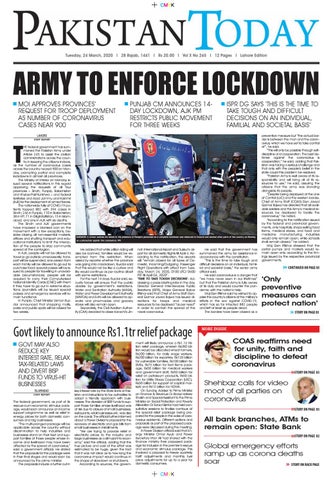
KARACHI: A citizen washes his hands in the presence of Rangers personnel as a complete lockdown was observed in Karachi and several other parts of the country on Monday as a precaution against the coronavirus. ppi
he added that while pillion riding will also be banned, families would be exempted from this restriction. when asked by reporter whether the province was going into a lockdown, buzdar said that this would not be like a curfew and life would continue as per routine albeit with some restrictions. for the next 14 days, buzdar said, security forces will ensure that the public abides by government’s restrictions. water and Sanitation authority (waSa), water and Power Development authority (waPDa) and edhi will be allowed to operate and pharmacies and grocery stores will also remain open. Separately, the civil aviation authority (caa) decided to close karachi’s jin-
nah International airport and Sukkur’s airport for all domestic flights till april 4. according to the notification, the airports will “remain closed for all types of Domestic Incoming/outgoing Passenger flight operations with effect from tuesday, march 24, 2020, 0100 utc/ 0600 PSt till april 04, 2020”. ‘TIME TO TAKE TOUGH DECISIONS’: addressing a press briefing later in the day, Director General Inter-Services Public Relations (ISPR), major General babar Iftikhar said that chief of army Staff General qamar javed bajwa has issued directions for troops and medical resources to be deployed “as per need” in order to contain the spread of the novel coronavirus.
Govt likely to announce Rs1.1tr relief package g
Govt may alSo ReDuce key InteReSt Rate, Relax tax-RelateD lawS anD DIveRt bISP funDS to vIRuS-hIt buSIneSSeS ISLAMABAD stAff RepoRt
the federal government, as part of its rescue-cum-economic stimulus package, would soon announce an income support programme as well as relief in energy prices for both domestic consumers and big businesses. “the multi-pronged package will be applicable across the country without discrimination to help industries and businesses stand on their feet and support families of those people whose income and livelihood may have been affected by the spread of coronavirus,” said a government official. he stated that the proposals for the package were in their final stages and would soon be announced by the prime minister. the proposals include a further cut in
key interest rate by the State bank of Pakistan and instructions to tax authorities to adopt a friendly approach with businesses. the diversion of bISP funds to support those families whose livelihood was at risk due to closure of small businesses, restaurants, retail businesses etc. was also on the cards. the official further informed about a Power Division’s proposal for the recovery of electricity and gas bills from small businesses in installments. “we are trying to provide relief in electricity prices to the industry and large businesses as a stimulant to economy,” said the official, adding that the true picture and cost of the effort was estimated to be huge, given the fact that it was not clear as to how long the coronavirus impact would continue in the shape of slowdown or shutdowns. according to sources, the govern-
ment will likely announce a Rs1.16 trillion relief package, wherein Rs280 billion would be allocated wheat farmers, Rs200 billion, for daily wage workers, Rs200 billion for exporters, Rs120 billion for vulnerable families, Rs100 billion for Smes, Rs75 billion for foot items package, Rs50 billion for medical workers and government staff, Rs50 billion for relief on petroleum products, Rs50 billion for utility Stores corporation (uSc), Rs30 billion for support of capital markets and Rs13 billion for nDma. on Sunday, adviser to Prime minister on finance & Revenue Dr abdul hafeez Shaikh and Special assistant to the Prime minister on Social Protection and Poverty alleviation Dr Sania nishtar had held consultative sessions to finalise contours of the special relief package being prepared for the people in the wake of coronavirus epidemic. Different options and proposals as part of the proposed package were discussed during the meeting. a Power Division official said that energy minister omar ayub and Power Secretary Irfan ali had shared with the finance ministry their proposed package for inclusion in the premier’s rescue and economic stimulus package. this involved a proposal to freeze quarterly tariff adjustments and monthly fuel price adjustments for up to a year for domestic consumers.
CMYK
he said that the government has summoned the army for assistance in accordance with the constitution. “this is the time to take tough and difficult decisions on an individual, familial and societal basis,” the senior army official said. he said coronavirus is a danger that “we have never seen in our lifetimes” but that the Pakistan army is fully aware of its duty and would counter the pandemic with the nation’s help. maj Gen Iftikhar said he wished to apprise the country’s citizens of the military’s efforts in the war against covID-19, which has so far infected 882 people and left at least six people dead. the borders have been closed as a
preventive measure but “the actual border is between the man and the coronavirus, which we have yet to take control of”, he said. “this will only be possible through selfdiscipline and cooperation. the best defense against the coronovirus is cooperation,” he said, adding that Pakistan was facing a serious challenge and that only with the people’s belief in the state could this problem be resolved. “Pakistan army is well aware of its responsibility and will bring all of its resources to use,” he said, assuring the citizens that the army was standing alongside its people. “Despite being deployed at the line of control (loc) and the western border, chief of army Staff (coaS) Gen javed qamar bajwa has directed that all available soldiers and the army’s medical resources be deployed to tackle the coronavirus,” he noted. “according to the notification issued by the federal and provincial governments, only hospitals, shops selling food items, medical stores, and food and medicine manufacturing industries would only remain open, while schools shall remain closed,” he added. maj Gen Iftikhar stressed that the petrol pumps and markets would remain open only according to the timings issued by the respective provincial governments.
CONTINUED ON PAGE 03
‘Only preventive measures can protect nation’ STORY ON PAGE 03
more inside
COAS reaffirms need for unity, faith and discipline to defeat coronavirus STORY ON PAGE 03
Shehbaz calls for video moot of all parties on coronavirus STORY ON PAGE 03
All bank branches, ATMs to remain open: State Bank STORY ON PAGE 02
Global emergency efforts ramp up as corona deaths soar STORY ON BACK PAGE
02
Tuesday, 24 March, 2020
NEWS
All bAnk brAnches, ATMs To reMAin open, sAys sTATe bAnk KARACHI STAFF REPORT
The State Bank of Pakistan (SBP) has said that all bank branches and workplaces will remain open from March 24, according to a circular issued by the central bank on Monday. The branches will operate with the “bare minimum” staff to ensure banking services continue, and will be open from Monday to Friday at 10:00 am, and close at 4:00pm, until further notice. The SBP has taken these measures in light of the COVID-19 pandemic. “The State Bank of Pakistan (SBP) is constantly evaluating the situation and implementing a number of measures to ensure the continuity of banking services during these difficult times,” the central bank said. All ATMs will remain open, along with digital and alternate delivery channels. The SBP has asked banks to be mindful and vig-
ilant of any increased cyber security risks in the current situation. All call centres and Real Time Gross Settlement systems, or fund transfers between banks in real time, will remain functional and all call centers will remain functional. The trade hubs of banks in all major cities will remain operational as well, again with “bare minimum” staff. Staff have been instructed to carry their original computerized National Identity Cards (CNICs), and their service cards, with them at all time. If that is not possible, an employment letter will suffice. Companies that provide cash collection and delivery services can also avail these arrangements. According to the SBP, guidelines issued by the World Health Organization, the federal government, and the provincial governments will be implemented to ensure safety and health of employees. This circular had been part of an ongoing discussion between the SBP and the banking industry over
the weekend, in how to ensure the banking sector remained functional in the midst of the pandemic. Earlier on March 22, the Banking Policy and Regulations Department of the SBP had sent an email to bankers about how to devise a mechanism to provide essential banking services, focusing on certain critical areas. Much of corporate Pakistan has moved to working online, where possible. Fittingly, the conversation between bank CEOs, government officials, SBP employees, and the State Bank Governor Reza Baqir, took place over the video conferring tool ‘Zoom’ earlier on Monday, where the details of the path moving forward were ironed out. These latest steps have been taken in tandem with the SBP curtailing the need for people to physically visit bank branches. On March 18, the SBP had issued new measures to promote digital payments, by waiving all charges on fund transfers in online banking.
Capital market will remain operational today, SECP announces ISLAMABAD STAFF REPORT
The Securities and Exchange Commission of Pakistan (SECP) on Monday announced that all capital market entities would be operational on Tuesday (today). Keeping in view the fact that banks and the stock market are vital instruments of the country’s financial system, the commission claims it has taken necessary measures to ensure continuity of business operations of its Self-Regulatory Organizations (SROs) including the Pakistan Stock Exchange (PSX), the Pakistan Mercantile Exchange (PMEX), the Central Depository Company of Pakistan (CDC) and the National Clearing Company of Pakistan (NCCPL). Given that the Sindh government had announced the provincial lockdown from March 23 upon the SECP’s request, it has included SROs of the Capital Market amongst ‘Essential Services’. To ensure the business continuity and preparedness of the TREC holders and the SROs, SECP conducted a mock trading session in the capital market on Monday. During the mock exercise, all the
Pakistanis stranded at Qatar airport to be brought home: FO
TREC holders were logged in from their respective Disaster Recovery (DR) and remote locations and successfully went through the processes of trading, clearing and settlement. The PSX, NCCPL and CDC teams were providing support services to ensure all activities run efficiently and all TREC holders are equipped for market operations today (Tuesday) onwards as business commences. The Commission added that the Information Technology departments of all SROs and SECP have made ‘Work from Home’ arrangements and connectivity with the trading, clearing, settlement and depository systems of the SROs. “In view of the lock down situation and the remote access arrangements, SECP will announce certain relaxations for the Capital Market stake holders in morning before opening of trading session,” the SECP said in the statement. The SECP advises the TREC holders that the number of staff at office be kept at the minimal and only critical staff be maintained at the official premises. Furthermore, the SECP advises the investors and visitors to stay away from visiting the stock exchange and the TREC holders in view of the current situation.
ISLAMABAD STAFF REPORT
Foreign Office (FO) spokesperson Aisha Farooqui on Monday said that Pakistanis stranded at Qatar airport will be flown back to the country on Monday night. According to Farooqui, the Pakistani embassy in Doha has been working on bringing back the citizens. “A Qatar Airways flight will bring them to Islamabad tonight,” she said. Earlier this month, Qatar had announced to temporarily ban the entry of travelers from 14 countries including Pakistan amid the virus outbreak. The decision met with questions on the future of Pakistani workers in the richest MENA economy (in terms of GDP [PPP] per capita). Subsequently, Islamabad, as part of its safety drive, had temporarily suspended the inbound international flights last week, initially for a period of two weeks.
4 Chinese nationals test positive for corona in Lahore NEWS DESK Four Chinese tested positive for coronavirus out of 19 Chinese nationals who were tested for the virus in Services Hospital late on Sunday. According to a news channel, the Chinese nationals were working on various projects of China-Pakistan Economic Corridor (CPEC). The patients were shifted to isolation ward of the hospital. According to the hospital administration, the Chinese nationals will be kept in isolation ward for a period of 14 days to stop the spread of the virus.
‘March 23 calls for national unity, coherence to curb COVID-19’ ISLAMABAD: Special Assistant to the Prime Minister on Information and Broadcasting (SAPM) Dr Firdous Ashiq Awan Monday said Pakistan day celebrated on March 23 calls the nation to revitalize the same national unity and coherence as expressed eighty years back to curb the pandemic of COVID-19 or coronavirus. Addressing a press conference here, she said Pakistan Day was the bright day of history when the Muslims of subcontinent gained a clear code of life. Firdous said, “Our great leader and founding father Quaid e Azam Mohammad Ali Jinnah and his team after numerous sacrifices and untiring efforts created Pakistan. Today, March 23 proves the credence of two nations theory where minorities of the sub-continent especially Muslims are being mercilessly killed and persecuted. It is the day to salute the vision of Quaid e Azam and our heroes of Pakistan movement.” The SAPM added that currently the country was facing serious challenge of coronavirus which needed to be addressed with same solidarity and unity that was expressed under the leadership of Quaid e Azam Mohammad Ali Jinnah for an independent Muslim state. STAFF REPORT
CMYK
Tuesday, 24 March, 2020
'only prevenTive MeAsures cAn proTecT nATion' NDMA CHIEF SAYS TALKS UNDERWAY WITH CHINESE FIRMS FOR PROCUREMENT OF MEDICAL EQUIPMENT
YUSUF URGES OVERSEAS PAKISTANIS TO POSTPONE HOME RETURN PLANS BAKHTYAR SAYS NO FOOD SHORTAGE IN COUNTRY ISLAMABAD STAFF REPORT
Special Assistant to the Prime Minister on Health Dr Zafar Mirza has emphasised the need for individual and collective action at all levels to overcome the threat of coronavirus in the country. In his daily media briefing along with Minister for National Food Security Khusro Bakhtyar, Special Assistant on National Security, Moeed Yusuf and NDMA Chairman Lt Gen Muhammad Afzal here on Monday, he said the nation can protect itself only by taking preventive measures. Dr Zafar Mirza strictly advised the people against going outside their homes
without any valid reason. He said washing hands with soap for 20 seconds is mandatory for hygiene and cleanliness. Briefing the media persons, Special Assistant Moeed Yusuf said the government is in contact with all airlines and countries where Pakistanis are stranded. He said due to government efforts, Pakistanis stranded in Qatar will reach Pakistan Monday night. Similarly, Pakistanis stuck in UAE will also soon arrive in the country through a special flight. He said some of Pakistanis in Istanbul have been granted further visas and stays in Turkey till the time they are able to travel to Pakistan. He appealed the Pakista-
shehbaz calls for video moot of all parties on coronavirus LAHORE: In light of the country’s current battle with coronavirus, National Assembly Opposition Leader Shehbaz Sharif on Monday called for a video conference of all political parties to discuss the coronavirus pandemic. Shehbaz, who returned to Pakistan on Sunday after spending four months with his ailing brother Nawaz Sharif in London, stated that no political party can deal with such an issue by itself. “The purpose of the video conference is to take all parties on board,” he said. According to PML-N spokesperson Marriyum Aurangzeb, the objective of the meeting is to draw up a strategy to tackle the coronavirus outbreak. The federal government on Sunday approached the opposition parties for a joint strategy against coronavirus, with National Assembly Speaker Asad Qaiser summoning a meeting of the parliamentary leaders of Senate and Lower House to discuss the economic situation and affected cases. The meeting was called on Mar 25 to review the role of the parliament for containing the spread of the pandemic. For the above-mentioned purpose, the government on Sunday started approaching the opposition leaders for talks in a bid to put political differences aside and devise a joint strategy to fight coronavirus. STAFF REPORT
nis overseas to postpone their travel plans to Pakistan for the next two weeks due to prevalent situation. Federal Minister for Food Security Khusro Bakhtyar said there is no food shortage in the country. He said the country has wheat reserves of 1.8 million tons. He said wheat costing 288 billion rupees will be purchased to ensure availability of commodity in the country. He said the country has also sufficient stock of pulses for the next two months. Bakhtyar said the country has more than 200,000 metric tons of edible oil that is sufficient for the use of next two months. Similarly, we have 70,000 tons of rice that is twice the requirement of country. He said Pakistan is self-sufficient in livestock, poultry and milk. Speaking on the occasion, NDMA Chairman Lt Gen Muhammad Afzal said
the authority has been provided all possible funds by the government. He said better screening is being done for passengers of incoming flights. He said personal protective equipment will be provided to all health workers. The chairman NDMA said negotiations are underway with Chinese authorities and companies for procurement of health equipment and funds will be sent to them through Pakistani embassy in China. He said 500,000 masks, including 5,000 N-95, will be received from founder of Ali Baba soon. He expressed hope that 120 ventilators will arrive by Friday next from China. Lt Gen Muhammad Afzal said a Chinese health team will visit Pakistan soon and provide consultancy to health officials in all four provinces.
APNS asks PM to release media dues on priority MEDIA BODY SAYS GRANTING RELIEF TO CRISIS-STRICKEN INDUSTRY WILL ENABLE IT TO PLAY EFFECTIVE ROLE IN SPREADING AWARENESS ABOUT COVID-19 KARACHI STAFF REPORT
The All Pakistan Newspapers Society (APNS) on Monday urged Prime Minister Imran Khan to include payment of media dues in his relief package scheduled to be announced on Tuesday so that the crisis-ridden industry can effectively play its role in creating awareness about the COVID-19. In a statement, APNS President Hameed Haroon and Secretary General Sarmad Ali appealed to the prime minister to instruct the federal and provincial governments of Punjab and
Khyber Pakhtunkhwa (KP) to release the advertising dues of the media amounting to approximately Rs6 billion on priority basis to enable the crisis ridden media industry to effectively play its role in creating awareness about the coronavirus outbreak and combatting fake news. The APNS office bearers stated in their statement that newspapers are an authentic source of information and in these trying times when things are spinning out of control, they are an essential tool to combat fake news and rumour mongering. They requested the prime minister
to announce this as part of the relief package that he intends to announce on Tuesday. “The newspaper industry is going through an acute financial crisis due to a cut in government advertising and delay in payments of advertising dues, they said. COVID-19 is likely to further aggravate this crisis. The gesture of the prime minister to clear the advertising dues will enable newspapers to play their due role in helping the government to fight against the pandemic crisis,” the statement read.
NEWS
03
coAs reaffirms need for unity, faith and discipline to defeat coronavirus RAWALPINDI: Chief of Army Staff (COAS) General Qamar Javed Bajwa on Monday reaffirmed the nation’s resolve to defeat all challenges that Pakistan faces at the moment, including the coronavirus outbreak. “Pakistan Resolution Day symbolises struggle for Pakistan. While paying glowing tribute to our ancestors, we reaffirm our resolve and commitment to defeat all challenges, including COVID-19 pandemic, with faith, unity and selfdiscipline,” the Inter-Services Public Relations (ISPR) quoted the army chief as saying. On Sunday, the top military brass had held a special meeting to discuss the measures taken by the military to support the federal government and provincial government in the fight against the coronavirus. According to the ISPR, the corps commanders had taken part in the meeting via videolink. The commanders had expressed resolved that the army was ready to assist the government in its efforts to contain the pandemic. On Saturday, COAS Bajwa had directed the Pakistan Army to fast-track operations to help out the civil administration as the country grapples with a rapidly spreading coronavirus outbreak. “As a follow up of National Coordination Committee (NCC) meeting on March 20 chaired by the Prime Minister Imran Khan and COAS’ meeting with PM, the COAS directs for stepping up Army’s assistance to civil administration for containment of COVID-19,” the ISPR had said in a statement. STAFF REPORT
Army to enforce lockdown CoNtINuED fRoM pAgE 01 The spokesperson also mentioned that Gen Bajwa had decided to donate one month’s salary to tackle the coronavirus pandemic, while personnel between the ranks of Brig to Lt Gen would donate three days’ worth of their salaries. The personnel below the Col rank and soldiers would donate two and one days’ worth of their salaries, respectively, he added. Maj Gen Iftikhar also urged people to follow the guidelines issued by health authorities and the government. With regard to the Pakistan Day, he said the citizens — the heirs of those who fought for the country’s independence — “face a new challenge, an evil that has taken over the entire world … so much so that even the developed nations seem powerless against COVID-19”. The Army spokesperson added that there was a need for everyone to once again unite with a passion for safe Pakistan. “Today is also a day to remember our Kashmiri brothers and sisters, who, despite being helpless in the face of the worst state-sanctioned terrorism and this natural disaster, are an example of resistance in their fight for the right to self-determination,” he added. “People of the occupied Kashmir will be successful in their struggle,” the army spokesperson added.
Pakistan’s first coronavirus casualty may have passed on virus to thousands 7,000 VILLAGERS HAVE BEEN QUARANTINED TO CONTAIN VIRUS SPREAD pESHAWAR STAFF REPORT
W
HEN Saadat Khan, 50, returned to Pakistan on March 9 from a pilgrimage to Saudi Arabia, he was greeted in his village with a rousing welcome and a grand feast attended by more than 2,000 people, many of whom embraced him warmly. On March 18, less than 10 days later, Khan died at an isolation center for coronavirus patients in the northwestern city of Mardan. He died from COVID-19 the day his test results came back positive. Khan was Pakistan’s first fatality from a disease that is rapidly spreading through the country of 220 million people. The virus has already infected over 317,000 people worldwide, and killed more than 13,000. The number of confirmed cases in Pakistan has soared to more than 750 from 22 last week, largely driven by a wave of pilgrims returning from Iran who Pakistani authorities said were inadequately tested and improperly isolated. At least four people have died from the disease in Pakistan in the past week. Thousands of people now need to undergo the slow process of retesting, and authorities fear the
number of cases could surge in coming days. Health experts say there is a lack of public awareness in Pakistan about the virus and that the cashstrapped government is ill-prepared to tackle its spread. A shortage of quarantine facilities and testing labs have also hampered efforts to effectively deal with high-risk cases. In Sindh, Pakistan’s hardest-hit province, the situation is already grim, said Dr. Naseem Salahuddin, the head of department for infectious diseases at Indus Hospital in Karachi. She said that the few hospitals equipped to handle COVID-19 cases in Karachi are either close to capacity or have shut their doors because they can’t handle the influx of suspected cases. “We’re likely to have a very big outbreak no matter what we do now,” she said. “And we will not be equipped to handle the numbers. There will be breakdowns at many levels.” Better border controls and quarantine measures should have been instituted a lot earlier, she said. “I think the cat’s now out of the bag.” Zafar Mirza, Pakistan’s health minister, who said last week that some of Pakistan’s quarantine facilities had not been “ideal”, did not respond to Reuters’ requests for comment. The provincial health
minister in Khan’s home province of Khyber Pakhtunkhwa also did not respond to a request for comment. Reuters interviewed three doctors involved in the case, as well as four people from Khan’s village, and reviewed medical case notes detailing his travel history. Together, they provide a picture of Khan’s last days, and illustrate why the South Asian nation is rapidly becoming the latest hotbed of the fast-spreading disease. FATEFUL JOURNEY: In late February, Khan flew to Saudi Arabia to visit the holy city of Mecca for Umrah, a religious pilgrimage performed by millions of Muslims from across the world each year. Khan entered the country just before it shut its borders to Umrah pilgrims, in a bid to stem the spread of COVID-19. Khan was in Saudi Arabia for two to three weeks, according to the doctors handling his case and an acquaintance from his village. Medical case notes, provided by one of Khan’s doctors, show that he departed from the kingdom’s Jeddah International Airport on March 8 via flight number PK736, which landed the following day at Peshawar International Airport, in northwest Pakistan. At least two people who knew Khan said he was already ill when he got on the plane and needed assis-
tance on arrival in Pakistan. Despite Pakistan having identified its first confirmed cases of COVID-19 two weeks prior, the case notes state Khan was only asked to fill out a form and did not undergo a medical screening at the Peshawar airport. Khan did not mention any illness, and he would have escaped detection anyway if he had taken fever suppressors, said a Peshawar airport official who asked not to be named. Authorities are also scrambling to trace dozens of other passengers on flight PK736 that night, as well as airport staff who assisted Khan. VILLAGE BANQUET: Khan first visited a district hospital close to his village on March 16, complaining of cough, fever and breathing issues. The doctor diagnosed him as a potential COVID-19 patient and had him tested for the virus. The sample was sent to Islamabad for testing, according to the case notes reviewed by Reuters. While it is unclear if doctors could have forced Khan into quarantine, the case notes indicate he refused to be isolated. Instead, he went home, where he lived with his wife, three sons, two daughters-inlaw, three daughters and four grandchildren. Hospital officials say Khan returned on March 17, when his symptoms intensified. On March 18, test results confirmed he was infected with COVID-19, and he was moved to an isolation center,
where he died the same day. It is the events before his death, though, that have worried medical officials and alarmed many residents of his village. On March 9, Khan was greeted with a mass gathering in his village, as is traditional in Pakistan when someone returns from Umrah. According to local authorities, some 2,000 people were in attendance at the lunch – most of whom embraced Khan. Khan also ran a popular “medical clinic” in his village – though he wasn’t a qualified doctor, say local health officials. As is the case in many rural areas of Pakistan, people with just rudimentary medical knowledge often run such dispensaries to treat patients with ailments like fevers and colds, despite not having any qualifications. Khan had not resumed his practice on returning to Pakistan, but his sons ran it for him while he stayed at home in “self-quarantine,” health officials from the village told Reuters. However, they added, the “selfquarantine” involved his sons staying in the same room as him. The sons in turn also tended to dozens of patients at their father’s clinic during that period. Reuters was unable to speak with anyone in Khan’s family. MASS PANIC: There is mass panic in the village, local residents told Reuters via phone, adding that no one had taken the coronavirus threat
seriously prior to this. “There are hundreds of people believed to have been infected but they are hiding and reluctant to go to hospital,” said Liaqat Ali Shah, a local social worker, adding that villagers feared being ostracized by the community and shunned by healthcare workers. The village, Union Council Mangah, was locked down following Khan’s death, according to an official directive from authorities. A complete lockdown was ordered “with immediate effect and there shall be no entry and no exit,” the order seen by Reuters read. The village of about 7,000 people, has been declared a mass quarantine zone, according to the provincial government, and testing has begun. But residents of Mangah say none of the officials surveying the area have testing kits with them. A medical worker on the ground said test kits were limited so they couldn’t test everyone and were only testing patients displaying symptoms. “There’s a virtual lockdown in the village and movement is restricted,” a school teacher in the village, told Reuters via phone. Despite this, at least four people showing symptoms, including two members of Khan’s family, are now missing and have gone underground, health officials told Reuters. All four had tested positive for COVID-19, the officials said.
04 LAHORE
Tuesday, 24 March, 2020
WEATHER UPDATES TUESDAY
280C
160C
300C
WEDNESDAY
170C
THURSDAY
290C
180C
PRAyER TiMingS FAJR SUNRISE
ZUHR
ASR MAGHRIB ISHA
5:11
12:16
3:32
6:31
6:00
7:21
Panic buying disruPts food, medicines suPPly in city LAHORE
H
SHAHAB OMER
ouRS after Punjab Chief Minister usman Buzdar announced a 14-day partial lockdown of the province to contain CoVID-19, citizens of the provincial capital thronged to their nearest grocery stores and pharmacies to stockpile food and medicines. People from different walks of life informed Pakistan Today that despite the government’s assurance of ensuring consistent food and medicines supply, there is a perception that there would be a shortage of essential commodities in the city in the days to come, therefore, it is wise to stockpile at the earliest. Some citizens said that when they went to their nearby pharmacies or grocery stores to buy some medicines or food rations, respectively, they were surprised to see empty shelves. one citizen particularly expressed disappointment at the way the citizens are reacting to this situation. He said that he had thought that people would behave rather reasonably if the situation became worse in Lahore but he was disappointed to know that he was wrong. He further said that it is rightly said that moments of crises do bring out the worst in people. FEAR AND PANIC: As coronavirus cases
18 new corona cases reported in city LAHORE STAFF REPORT
The coronavirus pandemic is slowly taking over Punjab as 18 new cases were identified in the provincial capital alone during the last 24 hours, Pakistan Today learnt on Monday. According to statistics received by the Primary and Secondary Healthcare Department Punjab (PSHDP), the total coronavirus patients in Punjab are 246 out of whom 177 are Zaireen from Iran while 52 are locals whereas the rest include two from Multan, three from Rawalpindi, four from Gujrat, three from Jhelum, four from Gujranwala and one from Sargodha. The hospitals treating patients in Lahore include Mayo Hospital, Services Hospital, General Hospital and Pakistan Kidney and Liver Institute (PKLI). In Mayo Hospital, 14 cases were confirmed while 13 more were suspected. Similarly, there is one suspected case in each Service and General Hospital while in PKLI, seven patients were confirmed of having coronavirus. The PSHDP spokesperson said that all confirmed patients were under treatment in isolation wards and were separated from other patients. “All the patients are being given proper treatment and facilities. All doctors are on duty and working to the best of their abilities. The public is requested to adopt and follow all precautionary measures and stay at home. It is important to self-isolate yourself rather than interacting with people. Also, avoid going out to public spaces and markets,” he said.
NON-RESIDENTS BARRED FROM ENTERING CANTONMENT AREAS UNLESS THEY HAVE A VALID REASON continue to increase in the province, a sense of fear and uneasiness has gripped the people. At the moment, the citizens can be divided into two categories: those who are taking necessary precautions and those who believe that the virus would not cause them much harm. The former is terrified by the attitude of the latter because they believe the citizens should take collective responsibility for curbing the spread of the virus. Moreover, hours after reports surfaced that the military has cordoned off cantonment areas for the general public, the military clarified that only the residents of the cantonment areas would be able move in and out of the areas freely whereas other citizens would have to show a valid reason for their visit as they wanted to restrict non-essential movement. LOCKDOWN NOTIFICATION: Earlier in the day, CM Buzdar said it would not be lockdown or a curfew of sorts and assured that
medical and grocery stores, fruit and vegetable markets, bakeries, meat and milk shops, as well as pharmacies, would remain open throughout the province. “Similarly, industrial units manufacturing and supplying eatables, medicines, medical equipment and necessary items would not be closed down,” he added. The Punjab government also imposed a ban on pillion riding; however, members of law enforcement agencies and families would be exempted from this ban. The chief minister also said that essential service providers, including the Water And Sanitation Agency (WASA), (WAPDA) and telecom companies, along with Edhi and other welfare organisations, would be permitted to continue their work. To a question, he replied that a committee headed by provincial finance minister would present its recommendations to ameliorate economic difficulties of daily wage earners in a cabinet meeting to be held on Tuesday. He clarified that the government would not impose a curfew or lockdown type situation and that this step was being taken to maintain social distancing. “Doctors, as well as paramedical staff, were frontline soldiers and the decision about their package would be made in the cabinet meeting,” he maintained.
Tuesday, 24 March, 2020
NEWS
Sindh ShuTS down aS GovT STriveS To conTain covid-
GOVT BANS INTRA-CITY PUBLIC TRANSPORT ACROSS PROVINCE 472 ARRESTED DURING FIRST DAY OF LOCKDOWN IN PROVINCE KARACHI
a
STAFF REPORT
COMPlETE lockdown against coronavirus was observed in here in the provincial capital of Sindh as well as in other cities and towns all over the province where roads, bazaars, restaurants, offices and shopping centres were deserted on Monday, marking the first day of the Sindh government’s 15day lockdown. According to the details, all markets and business activities remained suspended with low or no public transport on the roads as Sindh Transport Minister Awais Shah an-
nounced that the lockdown would also include a ban on the movement of all public transport across the province. “Public transport and online-cab services commuting within all cities would remain suspended during the lockdown,” he said. Buses, taxis, rickshaws and online cab services have also been suspended across the province. As the provincial minister asked people to stay at home, the only means of transport left for citizens was private vehicles. Even then, only two people are allowed to travel in a vehicle together, or three in case of a medical emergency. Vowing to win the war against
the pandemic, Shah praised the people for supporting the difficult decisions made by the government in the face of the global pandemic. He disclosed that in the last two days, 300 vehicles have been issued challans, 50 route permits have been cancelled, 20 vehicles have been impounded, one transporter has been booked and more than 12 transporters have been arrested for violating government orders in the crisis situation. Meanwhile, the Civil Aviation Authority (CAA) on Monday decided to close Karachi’s Jinnah International Airport and Sukkur’s airport for all domestic flights from today (Tuesday) till April 4, as a precautionary measure to limit the spread of coronavirus in the country. The airports will remain closed for all types of domestic incoming and outgoing passenger flight operations, with effect from 6am on Tuesday till April 4, said the notification issued by the CAA amid the provincial lockdown. As indisposed people suffered due to being unable to reach hospi-
Bhara Kahu sealed after emergence of six coronavirus cases in area ISLAMABAD
T
STAFF REPORT
HE Islamabad administration on Monday imposed a lockdown in the Bhara Kahu union council after six coronavirus cases were reported in the area. According to the Islamabad administration, 13 suspected cases of coronavirus appeared on Monday from union council Kot Hathyal. According to details, a heavy contingent of police reached the area to impose the lockdown, in addition to directing people through loudspeakers to stay in their respective homes as they would be screened for the virus by health department teams. It is pertinent to mention here that the persons who tested positive for the infection were shifted to the Pakistan Institute of Medical Sciences (PIMS) while seven others have been quarantined at Haji Camp.
The six patients were part of a 13-member Tableeghi Jamaat delegation — including six Kyrgyzstan nationals and seven Pakistanis — that was staying at a mosque in Kot Hathyal. After a man from Kyrgyzstan who was a part of the preaching team tested positive for Covid-19 on Saturday, samples were sent for testing of the other members of the delegation as well.
tals to get examined and treated owing to the unavailability of transport, newspaper hawkers were barred from operating and newspaper stalls were also shut down. According to the police, newspapers are passed from one hand to another which may cause the virus to spread. However, the labour community are among the worst affected by the lockdown. It may be mentioned here that grocery stores, medical stores, vegetable shops and petrol pumps are exempt from the ban. In Karachi, a heavy contingent of Sindh Police and Pakistan Rangers Sindh were seen patrolling the streets while obstacles were also set up at all main thoroughfares and roundabouts to stop people from coming out of their homes. People were only being allowed to get out of the house in case of an emergency. During the first day of lockdown in Sindh as a part of the measures against coronavirus, 472 people were arrested for violating directives issued by the provincial government.
The report said that 72 cases were registered across the province. In Karachi, 222 people were arrested and 33 cases were registered. According to the break down, 16 in South zone, 60 in east and one in the west zone were arrested. Across Sindh, the report said six in Mirpur Khas, eight in Sukkur and 236 were arrested in larkana. In Sindh’s Mirpur Khas, two cases were registered, one in Sukkur and 36 in larkana. As per the report, 13 cases were registered in Karach’s south zone, 19 in the east and one in the west zone against the violators. Sindh government imposed a province-wide lockdown on March 23, as Pakistan continued to report cases of coronavirus. As of Monday, the number of confirmed cases have crossed 800. Provincial Minister Saeed Ghani had said that violators of the lockdown will be arrested by authorities under Section 144 and may be sent to jail. AUTHORISED MEDIA PERSONS EXEMPTED: The Sindh Home Department on Monday said that media persons authorised by the
The test results of five people came out positive on Monday, said Assistant Superintendent Police (ASP) Bhara Kahu Hamza Amanullah.He said tests are also being carried out of the seven other members of the Jamaat, which included a madrassa student. After the confirmation of the cases, the administration locked down Kot Hathyal and deployed police at its entry and exit points. “The entire area has been turned into a quarantine,” ASP Amanullah said in a statement, adding that the district administration will get tests done of the residents of the locality. A spokesperson for the Islamabad police said the Jamaat members who tested positive were quarantined in the mosque they were residing in. ASP Amanullah said all shops in the neighbourhood except grocery stores, milk shops and bakeries have been closed. The Bhara Kahu Bazaar will also be closed once orders in this regard are issued by the district administration, he added. Many foreign delegations had arrived in Pakistan to attend the Tableeghi Jamaat congregation in Raiwind. On Saturday, Gaza’s first two cases of coronavirus were confirmed and according to a diplomat from the strip, both Palestinian men contracted the virus while visiting Pakistan to attend the Raiwind Ijtima.
Sindh CM appeals for relief from Rs3bn debt servicing KARACHI STAFF REPORT
Sindh Chief Minister (CM) Syed Murad Ali Shah has urged the federal government to cease the collection of debt servicing from Sindh government’s resources until the coronavirus pandemic recedes. In this regard, the finance department on Monday wrote a letter to the federal finance secretary to stop debt service payments in view of shortfalls during the pandemic. The federal government collects around Rs3 billion as debt service charges from the Sindh government’s resources each month.Accord-
ing to the Sindh government, there is a serious anticipated shortfall in revenues in view of the pandemic in the near future which is why such collections should be stopped until the situation returns to normal or the danger recedes. Further, the Sindh finance department, on the directives of CM Murad, has released Rs11.2 million for the Expo Field Hospital. The amount, which has been handed over to army authorities who would operate the hospital, would be utilised on the establishment of an office, the procurement of necessary equipment and gadgets, proper care of patients and their food.
05
Information Department have been exempted in view of lockdown against the coronavirus. According to a notification in this regard, it has been decided that all newspaper hawkers and media personnel carrying original Computerised National Identity Card (CNICs) and press ID card issued by their respective organisations (newspapers, FM radio, and TV news channels), will be deemed exempt from the lockdown orders. Media organisations operating in the province have been advised to inform their reporters, cameramen, photographers, news personnel and other essential staff to carry the above identification documents with them while commuting between their homes and place of work. Without these instruments of identification, no media person shall be allowed exemption. It merits to be mentioned here that the tally of the COVID-19 affected patients in Sindh, till filing of this report, stands at 394 whereas the total confirmed cases all over the country now total 875.
Sindh minister Saeed Ghani tests positive for coronavirus
NEWS DESK Sindh Education Minister Saeed Ghani tested positive for coronavirus on Monday. Choosing to reveal the news through his Twitter account, the minister released a public statement video saying that although he felt fine, people who had been in contact with him should be wary. “The previous day I got myself tested for the coronavirus and the results came back positive. However, I am not feeling any of the symptoms of the virus as yet and feel completely fine but people whom I came in contact with with a few days ago to isolate themselves and go into quarantine,” he said. “If your health deteriorates further, please get yourselves checked by a doctor. I consider it my responsibility to inform people so, that those who came into contact with me can also quarantine and self-isolate themselves as I may have transmitted the infection to them,” he concluded. In a tweet, Sindh Governor Imran Ismail announced that he would self-quarantine for 24 hours while his test results were pending. He added that he had recently met Saeed Ghani, while also advising others who had met him to get themselves checked.
Tuesday, 24 March, 2020
06 COMMENT
Unexpected economic challenge
In the line of fire Healthcare workers are the real heroes in this pandemic
Responding to the economic fallout of COVID-19
P
AKISTAn lost its first doctor to the CoVID-19 outbreak yesterday in Gilgit-Baltistan. Dr osama Riaz who was screening pilgrims returning to the country from Pakistan contracted the deadly virus and met his demise within days. Had the necessary protective gear been provided; Dr Riaz’s death could have very well been avoided. A very tense situation now prevails in GB where physicians are threatening to go on strike if equipment is not provided soon. In Italy, Dr Marcello natali died due to shortage of new gloves and masks, taking the total tally of medical professionals dying there to 13. Doctors in the uS are already ringing alarm bells, warning that a shortage of medical supplies that allow medical practitioners to safely attend to patients would be catastrophic. As thousands of healthcare workers across the country continue tirelessly to provide treatment to patients carrying a highly contagious pathogen that has affected close to 900 citizens already, it is up to the federal and provincial governments must make sure that all supplies to protect doctors and nurses from infection are in ample supply. So far, the government has been unable to actively control the spread of the virus due to poor quarantine facilities with the majority of the population not practicing self-isolation as there is no enforced lockdown in place. A welcome sense of direction has been provided by DG ISPR Babar Iftikhar who has asked for the citizenry to cooperate with the army that has been deployed. Bringing people to people contact to a bare minimum across the country is crucial while continuous testing has to be ramped up. This will help in arresting the rapid spread of the disease while identifying those who are affected so that they can be quarantined. Short of this, Pakistan’s already dilapidated, underfunded and ill-equipped healthcare system, will completely collapse under the wave of patients that it simply cannot accommodate. We should learn from countries that have given their respective healthcare systems a fighting chance by doing their job so that the doctors, nurses and all those working in the field of medicine could effectively do theirs. This is the least that we owe to the brave professionals who are in the line of fire, fighting with a sense of duty to save lives at the risk of losing their own.
RuMMaN FaRuqi
G
LoBALLY, Coronavirus could trigger the worst economic crisis since WWII. It has been suggested that unemployment in the uS could jump to 20%, which is close to the level reached during the Great Depression in the 1930s. Similar consequences may happen in other countries, as the economies of the affected countries shut down one by one, posing great risk to the capitalist system, as we know it today. In response to this growing crisis, many countries have put in place massive stimulus packages on a scale unheard of before in history. Likewise, many central banks have lowered interest rates drastically and pumped substantial liquidity into the system to keep their economies afloat. To help countries that get into payment crises, the IMF has set up a uS$ 25 billion Emergency Financing Facility. World Bank and other multilateral development institutions have taken similar action. As far as we know, China is the only country that has not only tackled the spread of Coronavirus with speed, but has also managed to counter some of its damaging effects of the economic consequences. What about Pakistan? Coronavirus is already in Pakistan and is expected to peak soon enough, putting our health service and the economy in serious jeopardy. WHo has issued instructions asking South Asian countries, including Pakistan, to step up their response. The Prime Minister, in his recent speech, was right in underlining the challenges ahead. The government needs to act, and the best way to proceed would be for authority to be delegated to a high-powered working group with a mandate to come up with proposals for protecting the economy and monitoring its implementation. Here we must note that the economy is already in recession, with a growth rate of only 2.1% per annum; there is a risk that if things get worse, it could fall into depression, from which recovery would be long and painful. The first thing to recognize is that for all practical purposes, the ongoing adjustment program negotiated with the Fund recently would be difficult to hold together. It needs to be reviewed quickly, and revised or put on hold temporarily. This could be for a period of up to six months initially, esti-
Remembering the Lahore Resolution
mated to correspond with the Coronavirus cycle. For this, we would need to seek a waiver from the IMF in certain specific areas such as revenue, expenditure and subsidies. We could start immediately with some monetary stimulus by asking the State Bank of Pakistan (SBP), which cut interest rate by 0.75% on Tuesday, to cut the rate further to bring it to 11%. This would have three positive effects: on the budget deficit by lowering interest on government debt; companies, especially SMEs would benefit immediately from increased cash-flow due to lower rates; lowering of interest would also help to stimulate demand when economic activity is declining. The argument that lowering rates could fuel inflationary expectation would not be strong when the economy is contracting due to exogenous shock; growth forecasts have already been downgraded. SBP has another policy instrument at its disposal. If needed, it should not hold back from injecting additional liquidity into the economy on a step-by-step basis as and when required. Central banks in other countries have used such instruments in times of economic meltdown with great effectiveness. We should also expect substantial negative effects on our trade and balance of payments. IMF has projected that world trade will suffer significantly from the effects of Coronavirus on global output. This will very directly hit demand for our exports in uS and European markets, which account for much of our exports of textiles and manufactured goods. We could also see some holding back of remittances, as well as increased capital flight out of the country because of the fall in risk appetite on the part of investors. Both these factors could seriously derail our balance of payments situation. These are anti-cyclical measures, which should help to prevent economic activity, including businesses, from collapsing under financial strain. It is not clear whether the government has taken sufficient account of this possibility. In such an eventuality, Pakistan has the option of approaching the IMF for support through its Emergency Financing Facility, which is set up specifically for this purpose. It is better to be prepared than rush around in a hurry when the situation has become unsustainable. There are a host of other initiatives, which the government should be undertaking. In the first place, it should mobilize sufficient funds for essential expenditures related to tackling Coronavirus. World
Bank and Asian Development Bank has acted quickly to provide Rs 93 billion for CoVID-19 emergency response in Pakistan from their local currency reserves. This would in some part help to cover the cost of necessary medical supplies, including equipment. But this would be insufficient to deal with the scale of the problem we are facing. The government needs to take the initiative to set up a special fund, which could be called the ‘Solidarity Fund’, in line with WHo concept. This should be funded from unutilized government resources such as contingency fund, undisbursed amounts from PSDP, Dam Fund, contributions from private sector sources and voluntary contributions. These funds should be utilized to purchase vital equipment such as ventilators, which are in short supply in Pakistan, and for rapid build-up of sensitive food products like wheat and sugar etc., which are depleting due to panic buying and which could result in unanticipated price hikes. This would affect the poor and even the middle classes directly, at a time when unemployment is expected to creep up. The government should also take steps to reduce tax rates on essential food items and utilities, which are consumed by those in low-income groups. Credit lines should be set up to provide working capital to SMEs and Women’s enterprises that are likely to be most affected by this economic downturn. Benazir Income Support Fund can play a vital role in making cash available directly to the poor. It already has a fairly extensive database to work from. All these actions would mean that the government’s budget deficit target agreed with the IMF would not be met and a waver has to be sought due to exceptional reasons. But this should not be taken as an excuse to go back on the work being done to broaden the tax base by registering non-filers, and to take positive steps towards imposing property tax and land holding tax on large land holdings. The Prime Minister’s proposal for debt relief is an expression of hope, but is unlikely to materialize easily as those who have been involved in debt negotiations would know. At this time what is urgently required is a credible response to the economic emergency and a coordinated approach. The Sindh Chief Minister, Mr. Murad Ali Shah has set a good example for our leadership. The writer is an economist, worked in UNCTAD Geneva & World Bank, WDC
And other threats besides India
T
Laugh until it lasts
WEnTY third March came this year when Pakistan was facing a grave threat for which it had made little preparation over the years. Added to it was the incompetence of the PTI government leading to acts of commission and omission on its part like allowing thousands of pilgrims to cross over from a coronavirus-stricken Iran to Pakistan without making proper preparations for keeping them in the mandatory two-week isolation. For nearly two months the government took no preparatory measures to deal with the challenge. The impact of the coronavirus is now being felt in all the four provinces as well as in AJK and Gilgit-Baltistan. unlike past several years when there used to be military and civilian parades in Islamabad with gun salutes in the federal and provincial capitals, Pakistanis had to spend a somber March 23 amid social distancing and self-isolation. The neighboring India led by a chauvinistic Hindu nationalist administration is faring no better. The military juggernaut created by it to threaten neighboring countries is useless against the virus which is rearing its head in one state after another. The suppliers of deadly military hardware like the uS, France, Germany and united Kingdom, aptly called the merchants of death, are equally powerless to check the advance of the pandemic. There is a need for a realization all over that more funds need to be directed on research aimed at stalling the emergence and spread of new viruses and endemics like Ebola, SARS and Covid-19 that cause tremendous social, political and economic disruption in countries across the world The Lahore Resolution had led to the creation of Pakistan as a separate country in 1947. In December 1946 the Quaid-e-Azam expressed confidence that India and Pakistan “shall then obtain conditions which will enable us to live as good friendly neighbors.” Pakistan and India have several disputes which need to be settled through talks instead of recourse to hostilities. unless they reduce their defense budgets, the two countries cannot get rid of poverty and under development. Climate changes and threats posed by pandemics make it all the more necessary to enter into cooperation rather than fight wars.
In times of a global pandemic, let us traverse the peaks and valleys of laughter
Shah Nawaz Mohal
Y
ou hear the jarring laughter roar through screens big and small. The anchor-cum-comedian-cum-intellectual-cum-clown-cumpsychoanalyst-cum-impossibly funny man has cracked, once again, a joke insanely funny that it has made the audience laugh so hard that they died and were resurrected again for the tenth time in under a minute. And they do it for another hour or two, the next day and the day after it, this week and every other week. We all hear and enjoy the boisterous bits by laughing out loudly and then wait for the next hilarity and since there is no dearth of it, we keep on consuming it mindlessly. The comedian, the clown and the witty lad make us laugh by abusing, ridiculing and mocking the other actor, audience or celebrities, politicians and other famous folks without even realizing that we have become a society whose laughter has become devoid of delight or depth. We hoot when we see someone being made fun of his missing leg, we howl when we hear the fictitious tale of elopement being attributed to someone’s
Dedicated to the legacy of the late Hameed Nizami
Arif Nizami Editor Aziz-ud-Din Ahmad
Umar Aziz
Asher John
Joint Editor
Executive Editor
Deputy Editor
Lahore – Ph: 042-36300938, 042-36375965
I
Karachi – Ph: 021-35381208-9
I
sister, we savor the nasty innuendos, covertly-sexual insinuations and allusions that disparage another human being. We revel every time someone falls, every calamity that has befallen someone else is an opportunity to giggle at as it didn’t choose us to be its victim. our glee, it seems, lies in all things abusive, shallow and horrid. It seems that we have yet to learn or relearn how to laugh with the one who said or did something amusing and witty. The likes of Shakespeare, Shaw, Mushtaq Ahmed Yousafi or Ibn-e-Insha would fail (and have failed) to attract traction as they demand their reader to actively ponder what has been said rather than bombarding the criminally passive hoi polloi with all the trash talk and sheer gobbledygook. A very dear friend once told me a beautiful thing, he said, ‘only the cowards and the ignorant use sarcasm, and if they don’t, people will know that how cowardly ignorant or ignorantly coward they are’. What makes us tick, tells us a lot about ourselves. It divines our dreams; it prefigures our dilemmas. I’ve been an avid reader of Reader’s Digest for more than a decade. They have a segment titled, ‘Laughter-The Best Medicine’ where readers from around the world send jokes or personal life experiences. Most of them are based on comic situations that life tosses our way, or things one finds hard to believe because they are so unexpected. While reading the almost century-old publication, one can’t escape the realization that humor happens to real life ordinary people in real life ordinary situations. Humor is in and around us. All we need is to observe the incidents around us and observe things that shape our lives and be cheery of those interludes that dot our otherwise angst-ridden existences. What came in as a comic relief, peppered here and there, in otherwise serious talk shows has metamorphosed in an immortal monster that keeps on multiplying. Putting comedians in the audience to get an occasional witty comment started as a fad couple of years back. We learned, quite unfortunately, that people love other people be made fun of in all ways grotesque rather than told how things are actually on political front or what great injustice is currently ru-
Islamabad – Ph: 051-2204545
I
Web: www.pakistantoday.com.pk
I
ining the lives of millions. We loathe tragedy as it aims to make its viewer ruminate all things transient and ephemeral. The death of hero tells us that life, no matter what happens or who perishes, marches on. Comedy gives us a breathing space so that we don’t keep on wallowing in the bottomless pit of sorrow and rue. Well, dearest sirs and ma’ams, we’ve lost this sense of proportion. We want every television program to tickle us sadistically so that laughter trickles out every time we sit in front of our beloved idiotbox whose sole mission is to dumb us down to the level where we parrot the juggats we hear to fix a friend who is wearing new tight pair of jeans or recently got married. I went down the memory lane couple of weeks back, when I clicked on an old clip of Zia-Mohyuddin Show on Youtube. His guests were two nurses and Mushtaq Ahmed Yousafi, the ace humorist and last dinosaur of urdu literature. During the whole show, Mr. Yousafi kept on punching his one-liners, making witty observations, asking shrewd questions but not once did he degrade, humiliate or blurt out a sarcastic comment. Mr. Yousafi is alive and writing. However, we don’t find his brand of humour ‘satisfying’ as it does not offer cheap laughs and shallow amusement. TV, dear folks, has become a pacifier for those who find life nothing but a bundle of never-ending boredom. The monotony of existence, we religiously believe, can be best endured when one is either laughing his lungs out, shopping his wits out or dining his pockets out. Two hurrahs for our world that wants us to spend what we’ve earned and parade it in front of folks who failed and feel all haughty and super 'classy' about ourselves. Till better, more sagacious angels of our nature come to the fore and rescue us from a world so dystopian that even the likes of George orwell and Aldous Huxley would be thunderstruck and gawk around for saviors, let us allow the ‘funny people’ to kill our souls, one joke at a time. Shah Nawaz Mohal is a law graduate and journalist based in Islamabad. He can be reached at mshahnawazmohal@gmail.com.
Email: editorial@pakistantoday.com.pk
Tuesday, 24 March, 2020
COMMENT 07 Editor’s mail Send your letters to: Letters to Editor, Pakistan Today, 4-Shaarey Fatima Jinnah, Lahore, Pakistan. E-mail: letters@pakistantoday.com.pk Letters should be addressed to Pakistan Today exclusively
CHAIRPERSon of BISP (Benazir Income Support Programme), Dr. Sania nishtar has taken exception to a mention of her in an oped piece published in these pages titled ‘Apocalypse now’ authored by the editor of this paper, Arif nizami. Part of the article in question reads: ‘The rather bookish, albeit well-meaning chairperson of the BISP Sania nishtar, has been too busy doing a forensic audit to unearth those not entitled, misusing the programme; in the process throwing the baby with the bathwater. There is need not only to increase the outlay for BISP but also to make disbursements on a war footing. ‘ Dr. Sania maintains that, “The BISP disbursement is over Rs 65 billion and there are reasons for the slow disbursement, as I can’t be party to theft. Media stalwarts like your self should support integrity measures”. The author in reply, stands by his valid critique of BISP’s disbursement, adding that no one is questioning Dr. nishtar’s integrity, but disbursing only Rs 27bn in July-Dec period (confirmed by Hafeez Shaikh in a meeting with PM which she did not attend) out of close to Rs 200bn, shows misplaced priorities at best and cold feet and incompetence at worse.
Website for Corona
The killing fields Unethical hunting of endangered animals must stop Syed TaSviR huSaiN
‘C
oME all and sundry, chance of a lifetime! Let’s kill the wretched nilgai, the Black Bucks and the Chinkaras. Guaranteed to be hand fed by us, in their cages and enclosures. Fattened to your hearts desire, and readied for the ‘slaughter’.’ ‘We assure you that these animals will not run away, even if you have fired numerous shots at them.’ ‘We will let you hunt some of them in the Lal Sohanra national Park (unESCo recognized Biospere Reserve) also. We are oblivious to whatever the Civil Society, or the IuCn, or the WWF or even unESCo might have to say about it.’ Wiped out and totally extinct in the wild (in Pakistan), the few that still remain, are confined to zoos and some fenced national Parks. The Black Buck is totally extinct in the wild, whereas there are a few nilgai (maybe 60 to 70 in number) which are scattered in the Indo-Pak border areas. They are listed in the highly endangered category in the IuCn red book, the ultimate guide to the status of any species of animals or birds. Slaughter, and not sport is the word which immediately came to my mind after seeing the advertisement, inviting applications from hunters to kill these beautiful, magnificent creatures of God, but more importantly; rare animals in Pakistan. There is no question about the fact that hunting is a true sport, and humans have hunted wild animals since their creation. The basic ingredients of a hunt are, that the species being sought by the hunter should be wild. But what is hunting? Hunting is the sport of pursuing and killing wild game animals in order to provide food; simply for the thrill of the chase; for the enjoyment of outdoor life; for the challenge it poses in terms of physical fitness, strength and stamina; to test the hunter’s ability as a marksman. People have been hunting since prehistoric times to provide themselves and their families with food, fur, leather, clothing, and the hides of the prey for shelter. With the development of agriculture, domestication, animal husbandry, and eventually manufacturing, hunting gradually diminished in importance, as a means of survival. Because of its challenge and pleasure as a sport however, hunting has remained a popular activity even in modern times. The Black bucks or the nilgai being offered to be killed by the Punjab Wildlife Department have never been in the wild. Most of these semidomestic animals were born, bred and raised inside the enclosure (fenced pen), the Black Bucks at the Lal Sohanra national Park and the nilgai in the Wildlife Complex, Pirowal. They are fed green fodder and a supplemantery diet of grains
twice a day, therefore they are in constant inter- inside their cages, because the Wildlife Departaction with humans, and have lost all fear of ment people could not net them or tranquilize man. In fact, they are quite as tame as the pet dog, them, to be able to bring them out! It was disgusting and a mockery of the sport. or the cow or the goat; raised in your backyard. A native American Chief once said, Let me be very clear on one pount, I am not against hunting! If it is ethical and not being car- ‘Whatever happens to the beasts, soon hapried out in national Parks or Cages, and there is pens to man also’ I know there will be many amongst us, an element of sport in it. Perhaps, at this point of time this is not the main issue. The issue is who will jeer, sneer, and laugh at this concern very simple: Would we term it as hunting or just for wildlife. But one hopes that this might touch a raw nerve in some. Beware and take killing? I have deliberately used the word killing and note, those of you who are engaged in the not the word hunting, because a true wanton destruction of our wildlife, a day will hunter/sportsman would never want to kill do- come when you shall have to answer for these crimes. I am sure that many options are availmestic or even semi-domestic animals! My question to the various actors in this able for providing a suitable environment for drama, namely, The Wildlife & Parks Depart- a sporting trophy hunt, in an ethical manner. ment, Government of Punjab, certain individu- This can be done by selecting the suitable als/experts, conservation and preservation habitat for each species, releasing them ahead organizations/commissions and international of the hunts, so that they can adapt themselves to that particular terrain. foundations, is very simple: There is another Is this fair game? reason for my conAre these Antilopes cern; We are also wild? Will there be the under a moral obligathrill of a fair chase? tion to our coming Is there any challenge in it at all? Wiped out and totally extinct in generations, that we at the least, leave them The Answer: It is the wild (in Pakistan), the few that with what we inherneither of these, it is It is as important simply killing and not still remain, are confined to zoos toited.preserve and protect hunting! The pattern is the and some fenced National Parks. this wealth as anything else that we value, like same. Breed them, reThe Black Buck is totally extinct our culture, our history lease them, kill them! or our natural reA similar hunt of in the wild, whereas there are a sources. Black Bucks was conLet trophy hunting ducted in 2008, with few Nilgai (maybe 60 to 70 in take place in undisastrous results. number) which are scattered in fenced open terrain, Forty male Black where there are good Bucks were caught the Indo-Pak border areas chances of a fair from the Lal Sohanra chase, and the oppurenclosure. Three died tunities for the hunters during this process to test their abilities. two died during transProvided, such hunts portation, one broke are conducted accordits leg. Thirty four were released inside the walled Toba which ing to all established norms and ethics of sport measures 150 by 150 feet. They could only and hunting. BuT, let us not turn our national Parks and walk or sit on the edges of the depression, as there was still some water and slush in the de- Breeding Centres into ‘Killing Fields’ Syed Tasvir Husain pression in the center. There was no shade on sthusain@hotmail.co.uk top, and the animals were exposed to the blaznote: The writer has been engaged in Coning desert sun (where temperatures soar beyond the 50 degrees mark) the whole day long. servation/Preservation projects and programmes since the last 30 years. Worked in collaboration A further five died during this confinement. Two bucks were caught, caged, and later re- with the Cat Action Treasury, Cat Specialist leased in the 'killing fields' per hunter, 15 min- Group IuCn/SSG . Carried out the first ever utes prior to the start of the hunt, the hunters Baluchistan Wildlife Status Survey. Member: were transported to the release site in the Game Conservation & Hunting Association of PakDepartments 4x4s, the animals pointed out to istan, The Field Sports & Conservation Society, them and a shot or shots taken. Some of these WSPA, Convenor : Cholistan Wildlife & Habitat were shot, and a few were unlucky and escaped Conservation Society Black Bucks feeding from to die an even worse, slow and agonizing death Bins placed inside their pens/enclosures Lal Sodue to exposure, hunger and thirst later! no one hanra national Park tried to find out, who was to blame. The writer is a freelance columnist. The hunters were asked to shoot the nilgai
AS corona is extensively discussed in social, electronic, and paper media. The problem is undoubtedly challenging however, being threatened, panic, and anxious may not help coping up the situation. As laymen people believe whatever they were thrown to by overflowing social media tools, therefore, it is an extremely important to make an official and authentic platform nationally and provisionally where information can be pasted and timely updated. These forums will definitely provide a across match for filtering the fake and fabricated piece of information. I humbly wish to notify the authorities to make such an arrangement and propagate through electronic and paper media. ArEEBA KArACHI
Rape culture WE all can see the heart-wrenching condition of our society due to increasing higher number of sexually assaulted cases of children who is under 9 to 13 years old. Being a Muslim it’s the worst ever the condition of our society. not only this after they sex with” little flowers” they brutally killed them. Here are the following reasons why society is covered with this rape culture. Rape culture: is a sociological concept for a setting in which rape is pervasive and normalized due to societal attitudes about gender and sexuality. Behaviors commonly associated with rape culture include victim blaming, slut-shaming, sexual objectification, trivializing rape, denial of widespread rape, refusing to acknowledge the harm caused by sexual violence, or some combination of these. It has been used to describe and explain behavior within social groups, including prison rape and in conflict areas where war rape is used as psychological warfare. Entire societies have been alleged to be rape cultures. The notion of rape culture was developed by second-wave feminists, primarily in the united States, beginning in the 1970s. Critics of the concept dispute the existence or extent of rape culture, arguing that the concept is too narrow or that, although there are cultures where rape is pervasive, the idea of a rape culture can imply that the rapist is not at fault but rather the society that enables rape. There have been many movements that been made in order to address rape culture, such as SlutWalk and Me Too. These movements have helped share people's stories through the use of hashtags which are embodied and connected to rape. Government of Pakistan should take notice on this alienation about rape crime and make a law or give orders to hang those people who commit this sin. SHAHZAIB SHAIKH, Karachi.
Sanitizer in the time of Corona As we all know that coronavirus is spreading rapidly throughout the world. There are 260 confirmed cases of CoVID-19 in Pakistan. The health agency says, Do wash your hands frequently and thoroughly. This is the smartest thing you can do to prevent the spread of viruses. Fear of the coronavirus has led people to stock up on the germ-killing gel, leaving store shelves empty and online retailers with sky-high prices set by those trying to profit on the rush. More is on the way, although it’s not clear how long it will take retailers to restock. Do make sure that if you are able to buy a lesser-known brand of hand sanitizer, it’s made of at least 60% alcohol, as recommended by the Centers for Disease Control and Prevention. (C.D.C.) Do make sure that if you decide to try and make your own hand sanitizer, it also contains at least 60% alcohol. razi rahman Karachi
Fake news on social media I would like to draw your attention towards the fake news on social media. As you can see, it has become a trend nowadays that people on social media tell other fake news on anything to fool others. For example, somebody will say that there were a lot of people at the market or will say that the stores were closed or will say that nobody came to that meeting or the teacher has got sick and cannot conduct a class. Then the next day the other finds out that what was told on social media, it didn’t actually happen at all or somebody tells you that nothing like that happened. The fact is that some people spread fake news for fun to fool others without any reason, this also misguides people. This is nothing more than playing with someone’s life who has no business with you. Social media did help bring people together but also gave rise to many evils that also includes spreading fake news to the people. This trend will derail the young ones from spending their precious time doing something meaningful. Zuhaib Shah Karachi
Tuesday, 24 March, 2020
08 WORLD VIEW
Coronavirus hits markets hard Schwab centre for financial reSearch
s
LIz ANN SoNdeRS, JeffRey KLeINtop ANd KAthy JoNeS
TOCKS have plummeted this month as investors struggled to assess what impact the COVID-19 coronavirus may have on the economy. A U.S. recession is looking increasingly likely, although it’s not clear how deep or long-lasting it might be—if it happens. As of Thursday’s (March 12th) close, the S&P 500 was down 26.7% from its recent peak, firmly putting stocks in a bear market (generally defined as a drop of 20% or more). The number of new COVID-19 cases has continued to rise outside mainland China, prompting some countries to embrace ever-stricter containment efforts—Italy, for example, imposed a nationwide lockdown this past week. In the U.S., authorities in some communities have urged residents to avoid crowded areas, work remotely, self-quarantine, and other measures aimed at containing the virus—all of which could reduce demand in many industries, starting with travel, hospitality and leisure. This has already pressured not only current share prices, but also companies’ future earnings guidance. You can see from the chart that consensus estimates for growth this year have been reduced. Meanwhile, crude oil prices dropped sharply this past week after Saudi Arabia cut its official oil price and boosted production, a move that will flood the market with cheap oil. Brent crude prices tumbled on the news, as you can see in the chart. The oil price decline poses a major threat to the energy industry. Earnings estimates for energy companies—as well as jobs—may be cut, despite the benefit to consumers at the gasoline pump. Also worth noting: Even though
Bloomberg, using daily data as of 3/6/2020. U.S bond yield is represented by the yield on the Bloomberg Barclays U.S. Aggregate Bond Index, and global bond yield is represented by the yield on the Bloomberg Barclays Global Aggregate ex-U.S. Bond Index.
the sector holds a relatively small (3%) weighting in the S&P 500 index, energy companies issue a significant amount of debt, and the sector is a much bigger 11%-12% of the high-yield (or “junk”) bond market. Should the plunge in oil prices continue, many companies will not be able to service their debt, likely causing corporate bond downgrades and defaults that could further weigh on the market and economy. Because of all the unknowns, corporate management and Wall Street analysts’ lenses are just as blurry as everyone else’s. Many companies have simply withdrawn full-year guidance altogether. With both the “E” (earnings) and the “P” (price) in the price-to-earnings (P/E) ratio both dropping, assessing stocks’ valuations has become nearly impossible. TREASURY YIELDS HAVE FALLEN TO RECORD LOWS: Treasury yields have continued to plumb lower as investors seek a safe haven. Yields for all U.S. Treasuries on March 9th dipped below 1%—an unprecedented level—and have stabilized since. We expect central banks and governments to step up efforts to cushion the potential economic blow. The Federal Reserve already cut its benchmark short-term interest rate, the federal funds rate target, by a half-percentage point on March 3rd. However, it is likely to reduce the rate even further— perhaps down to zero—over the next few months. The Fed may also increase the amount of liquidity in the financial system by encouraging foreign banks to use swap lines to make sure there is an ample supply of dollars, possibly while also increasing its holdings of short-term Treasury bills to provide liquidity to the domestic markets (by buying Treasury securities, the Fed injects cash into markets). These steps can help keep the financial system functioning. If the economy goes into a decline, it would not be surprising to see the Fed restart its quantitative easing program, buying longer-duration bonds. However, yields may continue to fall. Compared to other major countries, U.S. Treasury yields are still relatively high. These steps can help mitigate the impact of the expected downturn in the economy this year, but central banks can only do so much. Government intervention in the form of tax cuts and targeted lending to hard-hit industries may also be needed. GLOBAL RECESSION RISK HAS RISEN: Although it’s possible we are entering a global recession, it’s too early to predict the magnitude. In response to the threat posed by COVID-19, the Organization for Economic Cooperation and Development (OECD) lowered its global gross domestic product (GDP) growth forecast recently by a half percentage point, to 2.4% for 2020. Generally speaking, global growth below 2.5% is recessionary. However, the OECD seems to have anticipated only a temporary hit to global growth. It raised its 2021 outlook by 0.3%, with a forecasted rebound beginning in the second half of 2020 and extending into next year. Any rebound in global economic activity could be helped by a flood of fiscal and monetary stimulus. Central banks in the U.S., China, Australia, and Mexico have already cut interest rates. Fiscal stimulus has been added in Italy, Japan, South Korea, and the U.S. More is likely on the way. We have little data so far to gauge the size of the virus’s economic im-
pact, given the short amount of time since the start of the outbreak, as well as the lags in measurement and reporting of economic data. However, we have heard from a lot of companies on the potential impact to earnings. Hundreds have mentioned the impact of the coronavirus in communications with investors since January 20th, when the World Health Organization (WHO) began to track cases of the virus. Initially, the comments by business leaders were primarily that it was too early to tell what the impact on earnings may be. As time has gone on, those comments have been increasingly replaced by downward or upward guidance. While those issuing downward earnings guidance outnumber those raising estimates, it is noteworthy that not all impact has been negative. Downward guidance has been concentrated in the sectors with supply chains linked to Asia: Industrials, Consumer Discretionary, Materials and Information Technology. The Financials and Energy sectors also may begin to see increasing downward guidance, following the Fed rate cut and the plunge in oil prices. Meanwhile, the number of companies citing a positive impact on earnings, or citing no material impact at all (which seems like a positive in this environment), has been highest in the Health Care, Industrials and Financials sectors—although the latter may soon see more downward revisions, as noted above. WHAT TO DO: There is no one-size-fits-all answer for how to respond to an event such as coronavirus. If you’re a younger investor who is saving and investing for a distant goal, such as retirement, the best action to take may be no action at all. If you’ve built a portfolio that matches your time horizon and risk tolerance, and you don’t expect to need money from it anytime soon, it’s usually best to stick to the investing plan you developed when markets were calm. We continue to recommend appropriate portfolio diversification among various asset classes, including stocks and bonds. It’s also a good idea to rebalance your portfolio periodically, to bring it back to your original asset allocation targets However, if you’re in a position where you must sell stocks—for instance, if you’re retired and relying on your portfolio to fund your lifestyle right now—there are steps you can take to minimize the negative impact of selling in a down market, including rebalancing and tax-loss harvesting. Meanwhile, if you’re nearing retirement, having a financial plan is more important than ever. It’s vital at this stage to understand how much risk you can stomach, both emotionally and financially, in any market environment.
At current rate, India can see 30,000 COVID-19 deaths by May, no hospital bed by June
Print RUKMINI S
After the largest single-day increase in the number of novel coronavirus cases in India, it has never been clearer that the pandemic is upon us and the next few weeks are going to throw up a scenario that many still find hard to imagine. From the data we have, here’s a look at the near future, and what the Narendra Modi government needs to do. INDIA IS HITTING A PERIOD OF EXPONENTIAL GROWTH: It took India forty days to reach the first 50 cases, five more days to reach 100 cases, three more days to reach 150 cases and then just two more days to reach 200 cases. From here on, the juggernaut is going to roll fast. The number of confirmed cases in India is now doubling in five days or less, down from six days earlier this month. This puts India in line with trajectories of countries across the world — in the United States, cases are now doubling every two days.
Italy discovered its first case 10 days after South Korea. For another 20 days it had less than 10 cases, even as South Korea’s case count began to rise steadily. But then in a span of one frightening week, Italy’s case count multiplied a hundredfold. Within the next week, South Korea began to flatten the curve, while Italy’s case count continues to skyrocket, completely overwhelming its health system. India needs to try to move its own growth curve away from the Italy trajectory, and fast, with strict implementation of the social distancing measures it has already announced, if not even stricter lockdowns. Moreover, these are only confirmed cases; to ascertain the true number of cases, India will need to ramp up its conservative testing. On Friday, the Modi government took one small step closer to that by expand-
ing testing to those hospitalised with respiratory distress who did not have known contact with a person with foreign travel history. INDIA IS SET FOR AN EXPLOSION OF CASES: At this rate of growth, and assuming the 3.4 per cent fatality rate relative to confirmed cases calculated by the World Health Organization, India is headed for nearly a million confirmed cases by the end of May and over 30,000 deaths. These are conservative estimates. A team of bio-statisticians used predictive modelling and estimated that the number could be even higher, reaching nearly a million cases by 15 May instead. Sudden single-day spikes, or a higher ratio of estimated to confirmed cases — nearly impossible to put a number to in the absence of more widespread testing — could tip these numbers higher, faster. By assum-
ing that there are eight times as many undiscovered as confirmed cases, Indian software entrepreneur Mayank Chhabra estimated over five million cases and over 1.7 lakh deaths by the end of May. Many people do not yet realise the severity of what lies ahead — these numbers are vital, particularly in the context of India where the majority of workers do not have job protections. A compensation package on the lines of the one announced by Kerala will be essential pan-India for the long haul ahead. THIS WILL MEAN HEALTH SYSTEMS WILL BE OVERWHELMED: With a ratio of just 0.5 beds per 1,000 people as of 2017, India’s existing healthcare infrastructure will be swamped in the coming months. At the current rate of growth of confirmed cases, by early June, India will be out of hospital beds. Factoring in usual bed availability and a faster doubling rate, Chhabra estimates India will be out of hospital beds by the end of April. The number of critical care beds and ventilators in India is not officially known, but is believed to be sharply lacking. With ICU beds estimated at 70,000 nationally, if even one out of every 10 cases was to require an ICU bed by the end of May, India would be running at full capacity, if not earlier. Richer countries have struggled, with Italian doctors having to make the impossible decision of choosing who gets a ventilator and who does not, and the army being called in to produce medical supplies. The United States is heading there. Unofficial estimates of the number of ventilators in India stand at around 4,000. Yet, apart from assuring that there are “sufficient ventilators”, the
Modi government has been thin on detail on the ramping up of critical care that it is, or should be, doing. SOME STATES IN PARTICULAR WILL STRUGGLE, HARD: Indian states vary widely in capacity on all counts, including health. The poorest states are also the ones with the weakest capacity to deliver health outcomes. In June 2019, the Niti Aayog’s ranking of states on health found that “the health outcomes of some states are comparable to that of some upper middle-income countries and high-income countries (for example, Neonatal Mortality Rate (NMR) in Kerala is similar to that of Brazil or Argentina), while some other states have health outcomes similar to those of the poorest countries in the world (for example, NMR in Odisha is close to that of Sierra Leone).” Bihar has just one government hospital bed for every 1 lakh people, while Goa has 20. In Italy, in comparison, the rate of infection has now reached 1 in every 1,280 people. Chhattisgarh has 71 per cent vacancies for specialists at district hospitals. Despite an established treatment plan, Uttar Pradesh has a treatment success rate of just 64 per cent for new microbiologically confirmed tuberculosis cases. Just 15 per cent of facilities at Bihar’s First Referral Units were functional. There is no clear sign yet that the Modi government will be able to help these states make up for their lack of health care infrastructure, or, even, that it can be done at this late stage. The time to act was yesterday. The author is a Chennai-based data journalist.
Tuesday, 24 March, 2020
BUSINESS 09
PM’s demand of ‘debt cancellation’ by IFIs lauded BUSINESS DESK
‘Govt ExErCISInG thrEE-PronGED StratEGy to ContaIn CoronavIruS’ ISLAMABAD
Pakistan Industrial and Traders Associations Front (PIAF) has supported Prime Minister Imran Khan’s call on the international finance institutions (IFIs) to write off the debts of vulnerable countries, such as Pakistan, as the coronavirus may shatter the economies of developing countries. PIAF Chairman Mian Nauman Kabir, in a joint statement along with Senior Vice Chairman Nasir Hameed Khan and Vice Chairman Javed Iqbal, said that the world community should think of some sort of a debt write-off for vulnerable countries like Pakistan, as it would at least help them cope with coronavirus outbreak. He called for a high-level ‘anti-debt campaign’ wherein donor countries and international finance institutions could be urged to cancel Pakistan’s foreign debt. Kabir asked the IFIs to extend grants to Pakistan instead of loans. "An immediate debt write-off is required to ensure that the emergency aid does not get consumed in debt repayments." The PIAF chairman feared that if Pakistan witnessed a serious outbreak, then the government’s efforts to revive the economy may go down the drain. He said the government must stand up and say no to international financial institutions and called upon the political forces and civil society organisations to get together for an anti-debt campaign and support the PM in this regard. Kabir noted that in the past 18 months, Pakistan’s external debt and liabilities have increased by over Rs2,440 billion. The government’s domestic debt which was around Rs16.4 trillion in June 2019, which spiraled to Rs21.6 trillion in Dec 2019, a jump of over 25pc in just a year and a half.
SECP relaxes regulatory deadlines amid virus outbreak
a
STAFF REPORT
DVISER to Prime Minister on Finance and Revenue Dr Abdul Hafeez Shaikh said on Monday that the government was working on a threepronged strategy to contain the COVID-19 pandemic, as it was ensuring the provision of healthcare and food at affordable rates besides assisting the business community to run their businesses. He was chairing a meeting with Sindh Governor Imran Ismail and the business community from Karachi through a video-link conference, said a statement issued by the Ministry of Finance. The adviser said the government was faced with a challenging situation with the prime objectives of how to contain the virus, provide healthcare fa-
HAFEEZ SHAIKH SAYS GOVT IS ENSURING THE PROVISION OF FOOD AND HEALTHCARE AT AFFORDABLE RATES, BESIDES ASSISTING BUSINESS COMMUNITY TO RUN THEIR BUSINESSES cilities and essential food items at affordable rates to the common man, and how to provide help and assistance to the business community to run their businesses without a permanent setback to the economy. In this regard, the government was seeking proposals and had been working on them, Shaikh said, adding, “We will soon give a plan that is simple and implementable to meet our objectives.” “Have faith that the government is there to support you,” the adviser told the businessmen and asked them to
look after the daily wagers and workers who were outside the registered regime as helping them was also a social responsibility. Speaking on the occasion, the businessmen, including representatives from the textile sector, pharmaceutical industry, Pakistan Stock Exchange and tourism & hotel industry, gave proposals regarding the issues they had been facing and the assistance they required from the government during the ongoing crisis. The traders requested that they should be enabled to look after their
COVID-19: Govt urged to waive electricity, gas bills for three months
PIDE stresses need for 'cost-effective quarantine policy' LAHORE HASSAN NAQVI
ISLAMABAD INP
To facilitate companies and businesses in dealing with the ongoing COVID-9 pandemic crisis in the country, the Securities and Exchange Commission of Pakistan (SECP) relaxed on Monday the regulatory deadlines under the Companies Act. Using its powers conferred under section 510 of the Companies Act, 2017, the commission has approved following relaxations in relation to compliance with requirements of the Act. All companies which are facing difficulties in timely holding the annual general meeting (AGM) for the year ended on December 31, 2019, are allowed a general extension for a period of 30 days as provided in section 132 of the Act for holding their AGMs. The companies can now hold their AGM for the year ended on December 31, 2019 on or before May 29, 2020. The companies, whose election of directors is due before or in the aforesaid AGM, may file impediment reports with the concerned registrar under section 158 (2) of the Act citing the reasons for delay in holding the election of directors. Accordingly, any statutory return, which is required to be filed on or after 24th March, 2020 may be filed with the concerned registrar with the delay of 30 days of occurrence of any event without any additional filing fee as no penal action shall be taken for the late filing. The SECP’s response to COVID-19 is focused on the health and safety of business workforce all over Pakistan and maintaining the continuity of the economic activity. To ensure health and safety of all SECP team members, the commission has adopted a plan to operate with 50pc workforce from office and 50pc workforce from home on weekly rotational basis, effective from March 24. Especially mothers who use inhouse day care facility and employees with medical conditions have been asked to work from home. The SECP’s Information Technology Department has completed arrangements to facilitate employees for work from home (WFH). Moreover, all such assignments, which are not urgent in nature i.e. trainings and employee engagement activities etc., have been suspended for the time being. All hearings by the Adjudication division would be done through Skype /VC only.
daily wagers in the next two to three months and be provided with an assistance to carry out their businesses with an improvement in their liquidity position. The finance secretary informed the meeting that the Securities and Exchange Commission of Pakistan (SECP) had given a proposal and mechanism to the Sindh government to help ensure trading at the Pakistan Stock Exchange. "The food industry would remain open and continue business as usual and wherever needed, the federal government would have a dialogue with the provincial government to facilitate the business and trader community," he maintained. Sindh Governor Imran Ismail said the government had prepared food bags with the help of the Utility Stores Corporation (USC) for the needy, which would soon be distributed.
LAHORE STAFF REPORT
The Lahore Chamber of Commerce & Industry (LCCI) has urged the government to wave consumers' electricity and gas bills for at least three months in wake of the prevalent economic halt caused by coronavirus outbreak. In a statement issued on Monday, LCCI President Irfan Iqbal Sheikh also asked the property owners to wave off rents for two months. The LCCI president noted that small businesses, employees and daily wagers were facing challenges in terms of livelihoods, as many of them were either not getting any work or were staying home on government's orders. "People are restricted to their homes while businesses
have closed; therefore, the government should facilitate the masses by not charging utility bills for three months." He suggested the government use marriage halls as quarantine centres amid shortage of healthcare facilities. In return, he added, the government should give a three-year tax holiday to the owners of marriage halls. He hoped that the deadline for the renewal of LCCI membership would also be extended in wake of the corona crisis. 'UNIFORM TARIFF': On the other hand, former LCCI vice president and Bund Road Industrial Association Chairman Syed Mahmood Ghaznavi has urged the government to implement "a uniform electricity tariff for all industries". Presiding over a meeting of the association at LCCI,
Ghaznavi said the government has given a tariff of 0.75/cent to the textile sector, "and the same should be given to all industries so as to bring down their input costs". He said that Pakistan would not be able to increase its exports until the government succeeds in reducing the electricity tariff for industries. "It is almost impossible to increase exports unless factories get electricity at affordable rates." Ghaznavi said that the main reason behind Pakistan not achieving its export potential was not only confined to rupee devaluation, as high electricity tariff also hit the industries hard. "Cheap electricity is necessary to remain competitive in the region. Currently, our products are inferior to that of India and Bangladesh," he added.
The Pakistan Institute of Development Economics (PIDE) said on Monday that it is imperative for the government to immediately develop 'a cost-effective quarantine policy' in order to avert the crisis caused by coronavirus. Talking to this scribe, PIDE Vice-Chancellor Dr Nadeemul Haque opined that the current policy "treats people like convicts and gives them no choice or counselling". He said the people must be assured that they will be looked after, and that they should be allowed to have choices. "Those who can afford should be allowed to choose/set up their own quarantine facilities." In its Covid-19 bulletin, prepared by economists Dr Nadeemul Haque, Ghulam Samad, Durr-eNayab and Rabbia Mir, PIDE has suggested the government to ensure that the infected remained separated while their properties were taken care of through effective monitoring. "The government must not put a burden on the system with people who can afford to pay. However, selfquarantine should be adequately regulated, monitored and sanctioned." The economists said that hostels and private hospitals should be encouraged to set up quarantine centres for those who can pay, adding that this would also keep some businesses going. They said mass quarantine facilities should have an appropriate hygienic environment, including complete provision of washrooms, meal boxes, nurses and paramedical staff, and hygienic sanitation. As per the experts, the government could utilise educational institutions, sports' stadiums, forts and expo centres as quarantines across the country with minimal resources base. They suggested the government maintain cultural sensitivity in managing quarantines, especially those linked to females, by providing female staff and honouring their desire for segregation. “Involvement of private contractors and owners could also help contain the cost.” The economists feared that if poorly managed, the policy would neither remain cost-effective nor would it be able to contain the pandemic. They called for effective coordination among government institutions, as that could expedite policy implementations. The economists recommended the government to involve law enforcement agencies (LEAs) in maintaining the protocol of the quarantines and to ensure strict monitoring. They also stressed the need for coordinated awareness by engaging businesses, politicians and public at all levels. "Covid-19 has virtually shut down the world. Pakistan has been slow in response but seems to be catching up as Covid-19 spreads in the country."
Home work triggers demand jump for chips, laptops and network goods SEOUL/TOKYO AGENCIES
With more employees working from home to help slow the spread of the coronavirus, demand is surging for laptops and network peripherals as well as components along the supply chain such as chips, as companies rush to build virtual offices. Many firms have withdrawn earnings forecasts, anticipating a drop in consumer demand and economic slump, but performance at electronics retailers and chipmakers is hinting at benefits from the shift in work culture. Over the past month, governments and companies globally have been advising people to stay safe indoors. Over roughly the same period, South Korea - home of the world’s biggest memory chip maker, Samsung Electronics Co Ltd - on Monday re-
ported a 20pc jump in semiconductor exports. Pointing to further demand, nearly one in three Americans have been ordered to stay home, while Italy - where deaths have hit 5,476 - has banned internal travel. Worldwide, the flu-like virus has infected over 300,000 people and led to almost 15,000 deaths since China first reported the outbreak in December. “With more people working and learning from home during the outbreak, there has been rising demand for internet services ... meaning data centres need bigger pipes to carry the traffic,” said analyst Park Sungsoon at Cape Investment & Securities. A South Korean trade ministry official told Reuters that cloud computing has boosted sales of server chips, “while an increase in telecommuting in the United States and China has also been a main driver of
huge server demand.” In Japan, laptop maker Dynabook reported brisk demand which it partly attributed to companies encouraging teleworking. Rival NEC Corp said it has responded to demand with telework-friendly features such as more powerful embedded speakers. Australian electronics retailer JB Hifi Ltd also said it saw demand “acceleration” in recent weeks from both commercial and retail customers for “essential products they need to respond to and prepare” for the virus, such as devices that support remote working as well as home appliances. CHINA LEAD: China is leading chip demand, analysts said, as cloud service providers such as Alibaba Group Holding Ltd, Tencent Holdings Ltd and Baidu Inc quickly responded to the government’s effort to contain the virus. “Cloud companies
opened their platforms, allowing new and existing customers to use more resources for free to help maintain operations,” said analyst Yih Khai Wong at Canalys. “This set the precedent for technology companies around the world that offer cloudbased services in their response to helping organisations affected by coronavirus.” China’s cloud infrastructure build-up has helped push up chip prices, with spot prices of DRAM chips rising more than 6% since Feb. 20, showed data from price tracker DRAMeXchange. UBS last week forecast average contract prices of DRAM chips to rise as much as 10% in the second quarter from the first, led by a more than 20% jump in server chips. It said it expects DRAM chips to be modestly under supplied until the third quarter of 2021, with demand from server cus-
tomers rising 31% both in 2020 and 2021. SUPPLY DISRUPTION: Concerns over supply disruption has also contributed to a price rise. “You’ve got lots of OEMs and systems integrators in the global market who have intense demand for memory now,” said Andrew Perlmutter, chief strategy officer at ITRenew, a company that buys and reworks used data centre equipment for resale. “Nobody is shutting down their factories - it is still production as normal - but people worry about memory supply in particular, so they want to get out ahead of production.” About 69pc of electronics manufacturers have flagged possible supplier delays averaging three weeks, showed a poll on March 13 by industry trade group IPC International. Half of those polled expected business to normalise by July, and nearly three-quarters pointed to at least October.
Tuesday, 24 March, 2020
10 FOREIGN NEWS
Russia to use mobile phones to tRack people at Risk of coRonaviRus MOSCOW
R
AGENCIES
USSIAN Prime Minister Mikhail Mishustin on Monday gave the authorities five days to develop a system to track people who have come into contact with anyone with coronavirus by using mobile phone geolocation data. Under the new system, people would be sent information if they came into contact with someone who was infected and the same information would be passed on to special regional headquarters set up to fight the pandemic. The Kremlin said the measure was legal and part of measures Russia is taking to try to halt spread of the virus. The measure will trace “citizens who are in contact with patients with new coronavirus infection on the basis of information from cellular operators about the geolocation of a cell phone of a particular person”. This “would allow citizens to be notified (over the phone) if they have been in contact with a person suffering from the new coronavirus, sending relevant messages to inform them of the need for self-isolation…” the communications ministry said in a statement. Russia, which has temporarily
banned the entry of foreigners, has 438 confirmed cases of coronavirus and one virus-related death – less than many European countries. Moscow Mayor Sergei Sobyanin told residents of the capital over 65 and those with chronic illnesses to remain at home. Russia is gradually tightening quarantine rules and readying its healthcare system for more cases. Sobyanin told the elderly and other vulnerable residents to only visit pharmacies and shops if absolutely necessary from Thursday until April 14. STAY AT HOME OR DACHAS :
prison riot kills 23 in colombia as chile enforces virus curfew BOGOTA AGENCIES
Panic over the spread of the coronavirus sparked a prison riot in Colombia that killed 23 inmates on Sunday, as Chile became the latest Latin American country to announce restrictions on movement. Rioting swept through the crowded jail overnight in the Colombian capital Bogota amid rising tensions over the virus in the penitentiary system. Justice Minister Margarita Cabello described the violence as an attempted mass breakout, part of what she said was a coordinated plan with inmates who caused disturbances in 13 jails across the country. The minister rejected accusations by rights groups that the riots were sparked by unsanitary conditions inside a prison system that was woefully unprepared to face the pandemic. A curfew in Chile “will take effect throughout the national territory from 10:00 pm to 05:00 am the next day,” Health Minister Jaime Manalich announced Sunday. The country, which has 632 infections, registered its first death from the pandemic at the weekend. Ecuador, which has seen the region’s second-greatest number of deaths after Brazil, marked its highest daily increase on Sunday, doubling to 14 dead and 789 positive cases. Quito on Sunday ordered the military to take control of the worst-hit province of Guayas in the south-west of the country.
harvey Weinstein tests positive for coronavirus: reports NEW YORK AGENCIES
Disgraced Hollywood mogul Harvey Weinstein has tested positive for the novel coronavirus, US media reported Sunday. Weinstein, 68, is in prison in northern New York state after being sentenced to 23 years in jail for rape and sexual assault. The fallen film producer’s diagnosis was reported Sunday evening by celebrity news website TMZ and local paper the Niagara Gazette. Weinstein’s spokespeople have declined to comment to US media on the subject. The New York State Department of Corrections did not respond when contacted by AFP for confirmation of the reports. Sources told TMZ that Weinstein was one of two inmates to test positive at the high-security Wende Correctional Facility northwest of New York City and that he has had no contact with family or his lawyers since his diagnosis. Prior to his transfer, he stayed at Rikers Island prison and a Manhattan hospital, where he was treated for chest pains. Crowded US prisons have the potential to become hotbeds for coronavirus infections. Last week, guards at Rikers and New York’s Sing Sing prison tested positive for the virus, local media reported.
Where possible, he also advised the elderly to leave the city and stay at their dachas – out-of-town cottages on private plots of land which many Russian families traditionally own. The city, which has 262 confirmed infections out of the total of 438 reported across Russia, will give 4,000 roubles ($49) to all over 65s and people with chronic illnesses. City hall has required mobile phone operators not to switch off phone and internet access for the elderly if their balance hits zero, and temporarily canceled fines for late payment of utility bills.
Moscow has also changed its coronavirus testing system. Samples will no longer be sent to a lab in Siberia for a second round of testing to confirm a positive result received during tests conducted in labs in the capital, the city’s coronavirus response headquarters said in a statement. Russia is also taking steps to prepare its food supply and medical system for a potential upsurge in cases. The government said it had asked the agriculture ministry and other officials to prepare proposals on whether exports of any food, essential products or medicine should be limited. The government also ordered the labor and justice ministries to devise plans to prevent workers from being fired for coronavirus-related reasons, such as self-isolation. “I believe that overall, we have the situation with coronavirus under control,” Mishustin said. “But preparation for more serious challenges is necessary.” Russia’s emergency ministry said in a statement to Reuters that it had suspended non-essential foreign business trips and advised its employees to avoid leaving the country. The interior ministry, which operates Russia’s police force, among other law enforcement agencies, issued a similar order, a document seen by Reuters showed.
Website selling fake coronavirus vaccine shutdown over fraud WASHINGTON AGENCIES
The US Department of Justice announced Sunday it had shut down a website claiming to sell a coronavirus vaccine, in its first act of federal enforcement against fraud in connection with the pandemic. Lawsuits had been filed against the site coronavirusmedicalkit.com, which claimed to sell vaccines for COVID-19, the disease caused by the novel coronavirus, when in fact there is no such vaccine, the Justice Department said in a statement. A Texas federal judge on Saturday ordered the site to shut down, according to the statement. Its homepage, however, was still accessible as of Sunday evening. “Due to the recent outbreak for the Coronavirus (COVID-19) the World Health Organization is giving away vaccine kits. Just pay $4.95 for shipping,” read a statement on the homepage. It was followed by a place to leave bank account information to pay shipping fees. The Justice Department did not specify how many people fell victim
to the scam, but the investigation is ongoing to identify who is behind the fraud and how much money was stolen. The intervention by the federal judiciary system is part of ongoing efforts by US authorities to combat the spread of misinformation that has blossomed since the start of the pandemic. Attorney General Bill Barr last week urged federal prosecutors to make stopping misinformation a priority and called US civilians to report all such abuses to the National
Center for Disaster Fraud. He also warned citizens against a variety of scams including selling fake treatments online, imitating emails from the WHO or the Centers for Disease Control and Prevention (CDC) intended to collect personal data, and asking for donations for imaginary organizations. Simultaneously, the US judicial system is on the warpath to combat price gouging of products such as hand sanitizer or hygienic masks.
emirates reverses decision to suspend all passenger flights DUBAI AGENCIES
Dubai carrier Emirates reversed on Sunday its decision to suspend all passenger flights, shortly after it said it would halt operations from March 25 amid the novel coronavirus outbreak. The airline said it “received requests from governments and customers to support the repatriation of travellers” and will continue to operate passenger flights to 13 destinations, down from its usual 159. Emirates will continue to fly to the United Kingdom, Switzerland, Hong Kong, Thailand, Malaysia, the Philippines, Japan, Singapore, South Korea, Australia, South Africa, the United States and Canada. The announcement was made just hours after a previous statement said the carrier “will have temporarily suspended all its passenger operations” by March 25. “We continue to watch the situation closely, and as soon as things allow, we will reinstate our services,” said the airline’s chairman and CEO, Sheikh Ahmed bin Saeed Al-Maktoum. The United Arab Emirates on Friday announced its first two deaths from the COVID-19 disease, having reported 153 infections so far, of which 38 people have recovered. Maktoum said that, until January this year, the Emirates Group was “doing well” against current financial year targets, but “COVID-19 has brought all that to a sudden and painful halt over the past six weeks”. “The world has literally gone into quarantine due to the COVID-19 outbreak,” he said. Emirates also announced it will slash the basic salaries of a majority of employees by between 25 and 50 percent for three months, but will not cut jobs. “Rather than ask employees to leave the business, we chose to implement a temporary basic salary cut, as we want to protect our workforce,” Maktoum said. “We want to avoid cutting jobs.” Gulf countries have imposed various restrictions to combat the spread of the novel coronavirus pandemic, particularly in the air transport sector.
merkel awaiting coronavirus test result BERLIN AGENCIES
German Chancellor Angela Merkel is awaiting the result of a test to establish whether she has coronavirus after visiting a doctor who has tested positive for the illness, her spokesman said on Monday. “The chancellor is well,” Steffen Seibert said during a regular government news conference. He declined to say when the test results are expected. Merkel went into quarantine on Sunday.
TRAPPED IN PARADISE
Tourists stranded by virus seek visa extensions KUTA AGENCIES
Travelers stranded by coronavirus in some of Southeast Asia’s idyllic tourism hotspots are trying to extend visas as more countries enforce travel restrictions that in some cases make it impossible to go home. The total number of stranded tourists is not known, but scenes of frustration are playing out in several countries. On the Indonesian resort island of Bali – famed for its beaches, terraced rice fields and cultural sites – hundreds of tourists in face masks queued up outside the Ngurah Rai Immigration Office in the tourist area of Kuta seeking legal permission to extend their stay. “We have to stay here as we have no choice,” said Natalie Gisbert, a traveler from New Caledonia, the self-governing French territory in the South Pacific, who said her government was closing airports at home. American visitor Felix Isuk, who works in Singapore, said he thought it was better to stay put in Southeast Asia than to
return to the United States. “In the U.S. there are about 30,000 cases,” Isuk said. “So, I think if things or situation get worse here I’ll go back to Singapore. So that’s the main reason why I’m staying here in Indonesia.” Indonesia has 579 confirmed cases of the new coronavirus that has swept the world, with 49 dead. The island of Bali has reported six of those confirmed cases and two of those deaths. A LITTLE BIT CRAZY: In Thailand, the main immigration center in the capital Bangkok was crowded on Monday with hundreds of tourists and other foreign nationals trying to extend visas before they expired. “I’ve been here since 8.30 a.m.!” one man cried on being told officials could not process his application that afternoon. A long line snaked through the building, and many were told to come back another day. The problems are by no means confined to Bangkok. Rada Sereseanu and her husband, touring Southeast Asia in a camper van, had
CMYK
planned to drive into Myanmar but the German couple find themselves stuck in southern Thailand as the country shuts its land borders. “We thought the situation would get better, but it seems to be getting a little bit crazy,” Sereseanu said by telephone from near the seaside area of Hua Hin. Thailand has seen sharp spikes in
coronavirus cases, bringing its total number of cases to 721 from 147 in the last week. In Vietnam, where the government has announced a ban on all foreigners entering, British ambassador Gareth Ward urged UK citizens to seek the earliest commercial flights and gave an embassy email address to contact.
Tuesday, 24 March, 2020
SPORTS 11
AThleTiCs ChieF CAlls FOr OlympiC delAy As CAnAdA pulls OuT MonTReal
W
Agencies
ORLD Athletics chief Sebastian Coe has called for the Tokyo Olympics to be postponed over the coronavirus pandemic as Canada pulled out of the Games and Japan's prime minister admitted a delay could be "inevitable". Australia also told its athletes to prepare for a Tokyo Olympics in 2021 as expectations grew that the event, scheduled to start on July 24, would be postponed. Japanese and Olympic officials had stuck resolutely to the line that the Summer Games would go ahead on time, but criticism from athletes and sports bodies has swelled to a crescendo in recent days. In a letter to International Olympic Committee president Thomas Bach, written before Sunday's IOC meeting, World Athletics president Coe asked for the Games to be moved. "Whilst we all know that different parts of the world are at different stages of the virus, the unanimous view across all our areas is that an Olympic Games in July this year is neither feasible nor desirable," Coe said in his letter. Prime Minister Shinzo Abe told parliament on Monday that Japan was still committed to a "complete" Games, but conceded "it may become inevitable that we make a decision to postpone". It was the second major concession in a matter of hours after the IOC said "the scenario of postponement" was one of the options under consideration, with a final decision due within four weeks. "Human lives take precedence over everything, including the staging of the Games," the IOC's Bach wrote in an open letter to athletes after emergency talks. "Cancellation would not solve any problem and
would help nobody," Bach added. "Therefore it is not on our agenda." NOT SOLELY ABOUT ATHLETE HEALTH Athletes and sports bodies have become increasingly vocal after restrictions imposed because of COVID-19 wrecked competition schedules and often made training impossible -- and risky. Canada highlighted the dangers to the broader community as they became the first team to withdraw from the Olympics and Paralympics, urging a year's postponement. "This is not solely about athlete health -- it is about public health," the Canadian Olympic Committee said. "With COVID-19 and the associated risks, it is not safe for our athletes, and the health and safety of their families and the broader Canadian community for athletes to continue training towards these Games." Britain's world 200m champion Dina Asher-Smith said the IOC's approach was "irresponsible". "So wait... does this mean that athletes face up to another FOUR weeks of finding ways to fit in training -whilst potentially putting ourselves, coaches, support staff and loved ones at risk just to find out they were going to be postponed anyway?" she tweeted. In his letter, Coe voiced concerns over the issue of competition fairness, with many athletes struggling to train properly, and potential injuries if they have to push themselves harder nearer the Games. "No one wants to see the Olympic Games postponed but as I have said publicly, we cannot hold the event at all costs, certainly not at the cost of athlete safety," he said. CROWDS FLOCK FOR FLAME The IOC is responsible for making any final decision on the Games, and has come under increasing pressure as the coronavirus emergency grows, with more than 14,400 deaths worldwide, according to an AFP tally.
It warned that the logistics of postponing the Games were extremely complicated, with venues potentially unavailable, millions of hotel nights already booked and a packed international sports calendar. However, Australian Olympic officials said "it's clear" that the Tokyo Games cannot go ahead as scheduled and told its athletes to prepare for a year's postponement. US track legend Carl Lewis had earlier became just the latest prominent voice to call for a delay, following similar demands from the American, French and Spanish athletics associations.
Brazil's football clubs oer stadiums to help with coronavirus sick Rio Agencies
Brazil's top football clubs are handing over their stadiums to allow health authorities to turn them into field hospitals and clinics to fight the coronavirus pandemic. With football in the country suspended until further notice, more than half the clubs in Brazil's Serie A have given up their stadiums as authorities in densely populated Sao Paulo and Rio de Janeiro seek to expand hospital capacity to deal with the crisis. Current South American champions Flamengo are giving control of their famous Maracana stadium in Rio de Janeiro to health authorities, said club president Rodolfo Landim. "In this grim moment, I wanted to invite
our great Red and Black nation to renew hope and work for better days. Let us take care of our elders, help those who need it most," Landim wrote in a message to supporters. Authorities in Sao Paulo -- Brazil's biggest city -- said they would install 200 beds in a field hospital at the Pacaembu municipal stadium to relieve pressure on the city's hospitals, while two of the city's big clubs were also lending a hand. Corinthians said they have made their Itaquerao stadium and their training headquarters available "so that the authorities can evaluate how they can be used to combat the spread of the disease". Santos announced that a temporary clinic would be set up in one of the lounges inside its Vila Belmiro stadium.
The virus has already had an impact on the Games, with qualifiers cancelled and events to celebrate the Olympic torch arrival and relay scaled back. Despite the measures, more than 50,000 people flocked to a cauldron displaying the flame in northeastern Japan, raising fears about whether the relay can be held safely. Some waited in a 500-metre (yard) queue for several hours, Japanese media said. "I queued for three hours but watching the Olympic flame was greatly encouraging," a 70-year-old woman told public broadcaster NHK.
Coronavirus 'no joke' Olympic gold medallist van der Burgh warns Johannesburg: Olympic champion swimmer Cameron van der Burgh said Sunday that he had contracted COVID-19, offering insight into how coronavirus infection could affect 2020 Olympic hopefuls. "I have been struggling with Covid-19 for 14 days today," South Africa's van der Burgh wrote on Twitter. "By far the worst virus I have ever endured despite being a healthy individual with strong lungs (no smoking/sport), living a healthy lifestyle and being young (least at risk demographic)." Van der Burgh, the 2012 Olympic 100m breaststroke world champion and former world record-holder, retired from the sport in 2018. A still-fit 31, he remained among those least likely to be severely impacted by the deadly virus. But he said the debilitating effects of the illness were lingering. Agencies
From 'best prepared' to possibly postponed: Tokyo 2020's rocky road Tokyo Agencies
Olympic officials regularly lauded Tokyo as the best prepared host city they had seen. But no one could have planned for the coronavirus pandemic that may now force a postponement of the 2020 Games. And while organisers won praise, a plagiarism scandal, corruption charges and budget woes all clouded the horizon even before the virus outbreak threatened the Games. Here, AFP Sport chronicles the path to what could be the first postponement in Olympic history. 2013: Tears oF JoY TV news presenters burst into tears and thousands of people erupt in screams of delight as the IOC awards the Games to Tokyo in September 2013. With emotions running high, the thoughts of many Japanese turn to the thousands of victims of a devastating earthquake and tsunami in March 2011, with the Olympics seen by some as a golden opportunity to rebuild. Prime Minister Shinzo Abe vows Tokyo will be a "safe pair of hands" with a reputation for efficiency and competence. 2015: sTaDIuM sCraPPeD Embarrassment for Abe as he is forced to tear up blueprints for the proposed national stadium when costs balloon out of control. "I have decided we must go back to the drawing board," a red-faced Abe says in July 2015 after public anger over the $2 bil-
lion price tag which would have made it the world's most expensive stadium. 2015: Logo DroPPeD Scandal follows in September 2015 as the logo for the Games is ditched after accusations of plagiarism. Designer Olivier Debie says the design is stolen from his logo for a Belgian theatre and threatens court action before officials withdraw the emblem, saying it "no longer has public support". 2018: CuTe MasCoTs After the logo disaster, there is relief at the smooth rollout of futuristic mascots for the Olympics and Paralympics, chosen by schoolchildren. Olympic mascot "Miraitowa" -- combining the Japanese words for future and eternity -- is a blue-checked, doe-eyed character with pointy ears, while Paralympic counterpart "Someity" sports pink checks derived from Japan's famous cherry blossoms. 2018: boXIng bLues In an precedented move, the International Olympic Committee strips troubled governing body AIBA of the right to run the boxing competition at the Games over various allegations. There are fears the sport will not feature in the Games, but the IOC opts to organise the boxing tournament itself. 2019: FrenCh Charges AFP/File / Martin BUREAUJapanese Olympic Committee President Tsunekazu Takeda faces charges in France over payments made before Tokyo was awarded the Games
French investigating magistrates in January 2019 charge the former head of Japan's Olympic Committee, Tsunekazu Takeda, as they probe two payments totalling $2.3 million made before and after the Japanese capital was chosen. Takeda says he was "never involved" in any decision-making process over the payment and protests his innocence but he steps down as head of Japan's Olympic Committee. 2019: Marathon move POOL/AFP/File / Kimimasa MAYAMATokyo governor Yuriko Koike was not happy with the IOC's coordination commission boss John Coates After warnings against holding the
CMYK
marathon in the middle of Tokyo's sweltering summer, the IOC springs a surprise in October 2019 by shifting the flagship race to Sapporo, 800 kilometres to the north -- and usually cooler in August. Tokyo 2020 organisers are livid, but city governor Yuriko Koike says she has no choice but to accept the decision. 2019: buDgeT bLoWouT Organisers unveil the final version of their budget in December, with the Games expected to cost $12.6 billion, although Tokyo 2020 and the IOC are still wrangling over the cost of moving the marathon. An audit suggests the national government's part of the overall bill, which
is supposed to be 150 billion yen, is actually nearly 10 times that. Organisers say auditors are counting expenses only tangentially related to the running of the Games. 2019: russIan ban Russia's participation in the Games is thrown into question in December, when anti-doping agency WADA bans the country's athletes for four years from global events including the Olympics over manipulated doping data. Russia vows to appeal, but a hearing in March 2020 is postponed as the new coronavirus spreads globally. 2020: CanCeLLaTIon 'unThInKabLe' By late March, the coronavirus outbreak has been declared a pandemic causing more than 325,000 infections and over 14,400 deaths. Pressure grows for organisers to acknowledge the Games may be hit, but the IOC initially says there is "no need for any drastic decisions", while Tokyo governor Koike calls cancellation "unthinkable". 2020: PosTPoneMenT 'IneVITabLe'? With growing anger from athletes, the IOC says postponement is now a possibility, pledging a decision within four weeks, but warning a delay will be complex. Prime minister Abe tells parliament that "it may become inevitable that we make a decision to postpone". Canada becomes the first country to pull out, citing fears over the virus.
Tuesday, 24 March, 2020
NEWS
GlObal emerGency effOrts ramp up as cOrOna deaths sOar PARIS
G
AGENCIES
LOBAL emergency efforts to slow the coronavirus pandemic ratcheted up Monday with more nations and cities imposing extraordinary lockdowns, as the death toll topped 15,000 and more than one billion people were confined to their homes. From Germany banning gatherings of more than two people, Italy banning travel, New Zealand announcing a four-week lockdown and Hong Kong shutting its borders to all non-residents, the new round of containment efforts highlighted a deepening sense of panic around the world. According to an AFP tally, more than one billion people around the world have now been asked to stay home in line with mandatory or recommended measures rolled out by governments scrambling to slow the tide of the deadly pandemic. The Tokyo Olympics due to start in July looked increasingly likely to be postponed, with Canada pulling out and Australia saying it was preparing for a one-year delay. World Athletics chief Sebastian Coe joined calls for the Games to be postponed after Japan’s prime minister admitted a delay could be “inevitable”. In the United States, President Donald Trump ordered thousands of emergency hospital beds to be set up at coronavirus hotspots as a trillion-dollar economic res-
DEATH TOLL TOPS 15,000, MORE THAN 1BN PEOPLE CONFINED TO THEIR HOMES ACROSS THE WORLD cue package crashed in the Senate. “We’re at war, in a true sense we’re at war,” Trump said. NECESSARY MEASURES: The death toll from the virus surged to more than 15,000, according to an AFP tally Monday, with Europe the new epicentre of the outbreak that first emerged in China late last year. Italy’s world-worst toll from the pandemic approached 5,500 with another 651 deaths reported on Sunday, a day after it surpassed China with the highest number of fatalities. European nations continued to choke people’s movement, with Greece the latest nations to follow Italy, Spain and France in imposing a nationwide lockdown. City streets in Greece normally packed with Monday morning traffic were suddenly deserted as residents stayed inside — leaving the house only for essential trips as long as they carried a document declaring their outings. “It’s a bit of a hassle… but these measures are necessary and we’ll get used to them,” said Athens resident Maria Bourras, who leaves her house regularly to walk her dog. In Germany, Chancellor Angela Merkel on Sunday announced the ban on gatherings of more than two people. She
Oil prices volatile as virus saps demand
did so while in quarantine herself because she had met an infected doctor. BRITS ON THE BEACH: Italy banned travel and shut down a range of industries and businesses Monday, a new wave of restrictions designed to get the country through a vital 10-day stretch in which the rate of deaths and infections is supposed to finally drop. Spain’s prime minister said he would ask parliament to extend a 15-day state of emergency, which bars people from leaving home unless absolutely essential, until April 11. Spain reported another spike in fatalities Monday, bringing its total to 2,182 dead — the third highest in the world after Italy and China. Residents across France, where the death toll jumped to 674, also remained shut in their homes. A curfew was imposed in some regions and the mayor of Paris called for even more drastic confinement measures in a city under lockdown. Meanwhile, Britain inched towards similar measures as Prime Minister Boris Johnson warned the country was a couple of weeks behind registering similar numbers to Italy. Johnson is under pressure to ramp up restrictions after crowds flocked to holiday hotspots and beaches at the weekend, de-
fying social distancing recommendations. GREAT DEPRESSION FEARS: In the United States, more than a third of Americans were under various forms of lockdown, including in New York, Chicago and Los Angeles, but the number of infections nationally has continued to climb. Highlighting the desperation in the world’s biggest economy, the mayor of New York said his city was just 10 days away from running out of ventilators. And a trillion-dollar Senate proposal to revive the US economy failed Sunday after receiving zero support from Democrats, further traumatising investors who are watching stock markets implode worldwide. Asian markets were hammered on Monday, and European stocks dropped four percent at the open before coming off their worst levels at midday. The economic fallout from the virus has sparked fears of a global slump not seen for decades. “This is the biggest economic shock our nation has faced in generations,” Australian Prime Minister Scott Morrison said as he warned the pandemic could lead to a crisis akin to the 1930s Great Depression. MORAL BURDEN: As the pandemic overwhelms hospitals, doctors are having to quickly prioritise patients based on their chances of survival, inflicting a huge moral burden. “We go into medicine to heal people. Not to make choices about who can live,” said Philippe Devos, an anaesthesiologist in Belgium.
Pompeo in Kabul to try to break political deadlock
DOHA AGENCIES
Oil prices were mixed in volatile Asian trade on Monday, but remained at multi-year lows due to the double shock of the coronavirus pandemic and the Saudi-Russia price war. Both main contracts plummeted at the open after a trillion-dollar support package for the American economy crashed to defeat, and virus deaths surged in Europe and the US over the weekend. International benchmark Brent crude was off 2.3 percent in afternoon trade at $26 a barrel, after earlier being down about five percent. US benchmark West Texas Intermediate however was up 1.3 percent at nearly $23 a barrel as traders bought at bargain prices — after having fallen over three percent in earlier deals. Both contracts remain at multi-year lows as lockdowns and travel restrictions to fight the virus hit demand, and top producers Saudi Arabia and Russia engage in a price war. Coronavirus deaths soared across Europe and the United States at the weekend despite heightened restrictions, with the tally jumping to more than 14,700, according to a Johns Hopkins University tracker. Prices also fell after a trillion-dollar Senate proposal to rescue the US economy was defeated because of zero support from Democrats, and with five Republicans absent from the chamber because of virus-related quarantines. The bill had proposed funding for American families, thousands of shuttered or suffering businesses and the nation’s critically under-equipped hospitals.
KABUL AGENCIES
US Secretary of State Mike Pompeo arrived in the Afghan capital Monday to help break a poisonous political deadlock that has further riven the country just as the Taliban are increasing attacks and a rise in coronavirus cases threatens an already-floundering peace process. Afghanistan has been enmeshed in a political crisis since elections last year left the country in disarray due to numerous fraud claims that ultimately saw two men claiming the presidency and holding separate inaugurations. Pompeo was to hold both separate and joint meetings with Afghan President Ashraf Ghani — the election’s official winner — along with his archrival Abdullah Abdullah, who also claims the presidency. “We have tried… for the last
several weeks to try to find the formula and encourage them to come to an agreement,” a senior state department official said, according to a pool report. Pompeo has come “to help push, to encourage and to point out what our expectations are and what that assessment is if they don’t do the right thing”. The top US diplomat was welcomed by special envoy Zalmay Khalilzad — the lead US negotiator in recent talks with the Taliban — after arriving at Kabul airport. The visit comes just a day after the Afghan government and Taliban held their first discussion on prisoner exchanges — a key step in a broader push for peace following a withdrawal deal signed between Washington and the militants. The agreement established a framework for bringing to an end America’s longest war following the invasion of Afghanistan in
2001. Khalilzad tweeted Sunday it was “urgent” to quickly conclude plans for the prisoner swap — as called for in the US pact with the Taliban — with the coronavirus pandemic complicating diplomatic contacts. The deal envisioned the release of up to 5,000 Taliban fighters held by Kabul, and up to 1,000 members of the Afghan government forces in insurgent hands. That was meant to take place before the start of peace talks originally set for March 10 between the government — which was not a party to the negotiations that produced the Doha deal — and the Taliban. After initially refusing to release the Taliban prisoners, Ghani announced that the authorities would free 1,500 insurgents as a “gesture of goodwill” with plans to free another 3,500 prisoners after the talks are underway.
Empty roads mark Pakistan Day amid virus outbreak PRESIDENT ALVI, PM IMRAN, OTHER LEADERS URGE PEOPLE TO STAY INDOORS, ADOPT PREVENTIVE MEASURES AGAINST CORONA LAHORE/ISLAMABAD/KARACHI StAff rEport
The nation celebrated Pakistan Day on Monday in isolation due to the coronavirus outbreak in the country, with the top leadership pledging to fight the pandemic that has claimed more than 15,000 lives across the world. All public gatherings, including the much-anticipated military parade, were postponed as a precautionary measure to curb the spread of the virus. On Monday, Pakistan’s virus toll rose to 875 following the emergence of new cases in several cities. The death from the epidemic currently stands at six with some five recoveries in different parts of the country. ‘UNITY, FAITH, DISCIPLINE’: In his message, President Arif Alvi reiterated Quaid-e-Azam’s slogan of “unity, faith, and discipline”, stating that “there is no better message” for this year’s Pakistan Day. Quoting the nation’s founding father, Alvi said: “There is no better message this president can think of, for March 23, Pakistan Day 2020, than what was said by the founder of Pakistan Quaid-e-Azam Mohammed Ali Jinnah in 1947. My dear Pakistanis, his every word is for YOU and applies to the corona crisis in Pakistan today.” In a separate statement issued by Radio Pakistan, the president maintained that it is the responsibility of all segments of society — including the ulema, the media and political leaders — to play their role in educating the people about precautionary measures. “Doctors and health workers are the first line of defense in this crisis, and the nation salutes them for their unrelenting and selfless endeavors,” he added. IMRAN CALLS FOR CALM AMID VIRUS: Prime Minister Imran Khan urged people to stay calm in the face of the coronavirus outbreak and to take precautionary measures. According to Radio Pakistan, he said: “The nation has the capability to face any ordeal […] we will emerge victorious.” QURESHI REMEMBERS HELD KASHMIR: In a statement, Foreign Minister Shah Mahmood Qureshi stated that Pakistan Day provides the country “an opportunity to reflect on our journey as a nation-state and contemplate about the future”. The coronavirus pandemic is testing the resolve and resilience of nations across the globe, the foreign minister said. “To be able to successfully defeat this common enemy, we need to marshal the same innate virtues. We need to acknowledge and appreciate the tremendous sacrifices and contributions that our health care personnel and others […] our soldiers in the forefront of this war, are making to keep us all safe,” he said. Qureshi added that the nation must also not forget about our Kashmiris brothers and sisters in occupied Kashmir. “With an iron will, and with all the political, diplomatic and moral force at its command, Pakistan will continue to stand by its Kashmiri brethren, till the dawn of self-determination.”
UK calls in army, warns people to stay home or face lockdown LONDON AGENCIES
Britain sent in the army to deliver protective equipment to hospitals on Monday and told people to stay at home and heed warnings over social distancing or the government would bring in more extreme measures to stop the coronavirus spread. With some doctors saying they felt like “cannon fodder”, the government said the military would help ship millions of items of personal protective equipment (PPE) including masks to healthcare workers who have complained of shortages. So far, 281 Britons have died from the coronavirus and, in the last few days, British authorities have rapidly stepped up action to try to limit the spread of the disease and prevent a repeat of the death toll seen in other countries where thousands have died. However, there have been complaints from frontline medical staff about short-
ages of kit, saying they did not feel safe at work. In a letter pleading with Prime Minister Boris Johnson to increase PPE supplies, more than 6,000 frontline doctors said they were being asked to put their lives at risk with out-of-date masks, and low stocks of equipment. Health Secretary Matt Hancock admitted there had been issues but promised action was being taken. He said the army would drive trucks throughout the day and night to get supplies to medical staff. “It’s like a war effort, it is a war against this virus and so the army have been incredibly helpful in getting those logistics so we can get the supplies to protect people on the front line,” he told the BBC, saying the health service now had 12,000 ventilators, 7,000 more than at the start of the crisis. Britain has brought in a series of measures to try to curb the spread of the virus. On Monday, a much-reduced rail service was introduced and jury trials were sus-
pended, coming days after Johnson advised Britons to work from home if possible and ordered the closure of pubs, gyms and leisure centres. ADVICE IGNORED: But advice to stay at
home and avoid social gatherings went unheeded by millions at the weekend who took advantage of sunny weather to flock to parks and beauty spots over the weekend, ignoring instructions to stay 2 metres (6 feet) apart.
Published by Arif Nizami at Qandeel Printing Press, 4 Queens Road, Lahore. Ph: 042-36300938, 042-36375965. Email: newsroom@pakistantoday.com.pk
Emyr Williams, chief executive of the Snowdonia National Park Authority in Wales, said the past 24 hours had been unprecedented. “We have experienced the busiest visitor day in living memory. The area has been overwhelmed with visitors,” he said. The government warned that Britain would face a shutdown with curfews and travel restrictions if people continued to flout the advice. “Well, we’re perfectly prepared to do that if we need to because the objective here is really clear which is to stop the spread of the virus. Of course we will enforce and bring in further strong measures if we need to,” Hancock told Sky News. The government was also pondering whether to close all non-essential retail shops, the BBC’s political editor reported. Some firms have already acted because of slowing demand, with clothing retailer Primark and department store John Lewis saying on Monday they would temporarily close all of their shops.