CMYK
21 March, 2021 I 6 Shaban, 1442 I Rs 25.00 I Vol XI No 262 I 36 Pages I Islamabad Edition
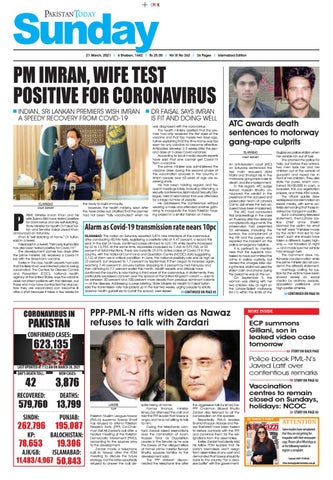
PM IMran, wIfe test PosItIve for coronavIrus g
inDian, sri lankan premiers wish imran a speeDy recovery From coviD-19
ISLAMABAD staff report
P
rime minister imran khan and his wife Bushra Bibi have tested positive for coronavirus and are self-isolating, state minister for health Dr Faisal sultan and senator Faisal Javed khan announced on saturday. khan is “self isolating at home,” Dr sultan said in a tweet. Faisal said in a tweet, “First lady Bushra Bibi has also been tested positive for covid-19.” the development comes two days after the prime minister, 68, received a covid-19 jab with the sinopharm vaccine. earlier in the day, health experts had said that it is likely khan was infected prior to being vaccinated. the centers for Disease control and prevention (cDc), national health agency of the United states, says the vaccine does not infect patients with the disease, but those who may have contracted the virus before they are vaccinated can become ill after a shot because it takes a few weeks for
g
the body to build immunity. however, the health ministry, soon after the news broke out, clarified that the premier had not been “fully vaccinated” when he
coronavIrus In
PakIstan
Dr Faisal says imran is Fit anD Doing well was diagnosed with the coronavirus. the health ministry clarified that the premier had only received the first dose of the vaccine and that too merely two days ago, further explaining that the time frame was too soon for any vaccine to become effective. antibodies develop 2-3 weeks after the second dose of 2-dose covid vaccines. according to local media reports experts have said that one cannot get covid-19 from a vaccine. the prime minister was administered the vaccine dose during the second phase of the vaccination process in the country in which people over 60 years of age are receiving shots. he has been holding regular and frequent meetings lately, including attending a security conference, islamabad security Dialogue, held in islamabad that was attended by a large number of people. he addressed the conference without wearing a mask and attended another gathering to inaugurate the naya pakistan housing project in a similar fashion on Friday.
Alarm as Covid-19 transmission rate nears 10pc ISLAMABAD: the nation on saturday reported 3,876 new infections of the coronavirus after conducting 40,946 tests, registering a positivity ratio of 9.47 percent, a record this year. in the last 24 hours, confirmed cases climbed to 623,135 while deaths increased by 42 to 13,799. at the same time, recoveries increased by 1,446 to 579,760, or 93 percent of total infections. there are currently 29,576 active cases of covid-19 in the country, with the national command and operation centre (ncoc) data suggesting 2,122 of them are in critical condition. in June, the national positivity rate was as high as 23 percent, but dropped to 1.7 percent by september. it then began to increase again, reaching 7.45 percent in January before dropping to 3 percent by mid-February and then climbing to 7.1 percent earlier this month. health experts and officials have confirmed the country is now facing a third wave of the coronavirus. in statements, they particularly expressed concern over the spread of the United kingdom variant — said to be between 30 percent and 100 percent more deadly than previous dominant variants — of the disease. addressing a press briefing, state minister for health Dr Faisal sultan said the transmission rate has jacked up in the last two weeks, urging people to strictly observe health guidelines to curtail the spread. staff report CONTINUED ON PAGE 05
ATC awards death sentences to motorway gang-rape culprits ISLAMABAD staff report
an anti-terrorism court (atc) on saturday sentenced the two main accused, abid malhi and shafqat ali, in the motorway gang-rape case to death and life imprisonment. in this regard, atc judge arshad hussain Bhatta announced the verdict in the presence of the accused and prosecution team at lahore’s camp Jail where the two accused have been imprisoned. the atc had concluded trial proceedings in the case on thursday after the defence completed its arguments. the prosecution had presented 53 witnesses, including the survivor, the complainant of the Fir and the person who reported the incident on the police emergency helpline. it is pertinent to mention here that the suspects confessed to have committed the crime in police custody, but denied the charges later during the trial. malhi had used the stolen cash and phone during the period he was on the run. on september 9, the woman was driving with her two children late at night on the lahore-sialkot motorway (m-11) within the limits of the
PPP-PML-N rifts widen as Nawaz refuses to talk with Zardari
CONFIRMED CASES:
623,135
3,876
RECOVERED:
DEATHS:
579,760 13,799 SINDH:
262,796 KP:
78,653
PUNJAB:
195,087 BALOCHISTAN:
19,306
AJK/GB: ISLAMABAD: 11,483/4,967 50,843
more inside
ECP summons Gillani, son in leaked video case tomorrow police book pml-n’s Javed latif over contentious remarks
NEW CASES:
42
CONTINUED ON PAGE 05
STORY ON BACK PAGE
LAST UPDATED AT 7:12 AM ON MARCH 20, 2021
DAY'S DEATH TOLL:
gujjarpura police station when her vehicle ran out of fuel. she phoned the police for help, but before they arrived, two men took her and her children out of the vehicle at gunpoint and raped her in front of her children. they also stole her purse, which contained rs100,000 in cash, a bracelet, the car registration papers, and three atm cards. the attack quickly drew widespread condemnation on social media, with some activists demanding that those involved be hanged in public. But in a shocking televised statement, then-lahore police chief Umar sheikh blamed the victim for what ‘he felt’ were “mistakes made by the victim that led to her rape”, such she should have taken a different, busier, highway — not travelled at night — and made sure her vehicle had enough fuel. the comment drew nationwide condemnation while the prime minister did not condemn the official’s statement. hashtags calling for justice for the victims have been shared widely on social media by ordinary people, opposition politicians and high-profile athletes.
STORY ON PAGE 02
LAHORE tltp
pakistan muslim league-nawaz (pml-n) supremo nawaz sharif has refused to attend pakistan people’s party (ppp) co-chairman asif ali Zardari’s call after a heated meeting of the pakistan Democratic movement (pmD), according to the sources privy to the development. Zardari made a telephone call to nawaz after the pDm meeting to discuss the future strategy, but the latter reportedly refused to answer the call de-
spite being at home. Former finance minister ishaq Dar attended the call and told the ppp leader that nawaz is angry and he is not willing to talk to him. During the telephonic contact, Zardari raised reservations over the nomination of azam nazeer tarar as opposition leader in the senate as he was the lawyer of the alleged killers of former prime minister Benazir Bhutto, sources familiar to the development said. the ppp stalwart disconnected the telephone line after
the aggressive talk by ishaq Dar. ppp chairman Bilawal Bhutto Zardari also listened to all the conversation on the speaker. reportedly, pml-n leaders shahid khaqan abbasi and pervez rasheed have been tasked to restore contacts with the ppp and convince them for the resignations from the assemblies. earlier, Zardari had clearly told his fellow pDm leaders that his party’s lawmakers won’t resign from assemblies at any cost and demanded that nawaz should fly back to the country “for a decisive battle” with the government.
Vaccination centres to remain closed on Sundays, holidays: NCOC
STORY ON PAGE 03 in today’s issue
attention Some readers have complained that they are not getting the magazine with their newspaper copy. Please call or WhatsApp us at the following number to register a complaint. Contact: 0307-7338168 irfan.farooq@pakistantoday.com.pk
02
Sunday, 21 March, 2021
ISLAMABAD
NEWS
PoLiCE booK PML-N’S JAvED LAtiF ovER CoNtENtiouS REMARKS ABBASI SAYS JAVED HAD NOT UTTERED A SINGLE WORD AGAINST STATE INSTITUTIONS, BUT HE SHOULD STILL APOLOGISE FOR HIS REMARKS LAhOre
P
sTaff RePORT
UNjAB police on Saturday registered a case against Pakistan Muslim League-Nawaz (PML-N) MP javed Latif for “maligning” state institutions during a political talk show. Last week, Latif, while talking to the news channel, said “if anything [bad] happens to Maryam Nawaz, the party will not chant ‘Pakistan khappay [Long live Pakistan]'” — a veiled reference to Pakistan Peoples Party (PPP) co-chairperson Asif Ali
Zardari who raised the slogan after former prime minister Benazir Bhutto’s assassination in 2007, a time when it was feared that separatists in Sindh could capture the anger at the incident. The case against Latif was registered — and included sections 120, 120(B), 153, 153(A), 500, and 500(1)(B) — at the Township police station on the complaint of a Lahore resident, jameel Saleem. Saleem claimed the politician, by making the statements, “threatened” the country’s security, government, and state institutions. The lawmaker, he further said, sowed “seeds of hate” between the PPP and
PML-N workers. The complainant said the MP hurt the public sentiment to spread chaos in the country, thereby, violated the laws. Last Sunday, Punjab Prisons Minister Fayyazul Hassan Chohan vowed to get a case registered against Latif over his remarks. Speaking at a press conference, Chohan said he would file a case against the politicians who he said wanted to prove his loyalties by saying that he would not raise the slogan of “Pakistan khappay“. He lamented that the Election Commission of Pakistan (ECP) had failed to
take action against the legislator. JAVED SHOULD APOLOGISE: ABBASI Separately, PML-N leader Shahid Khaqan Abbasi said javed had not uttered a single word against state institutions, but should still apologise for his remarks. Abbasi was speaking to the media in Karachi when he came to the defence of his colleague. However, he maintained that he did not agree with Latif’s statement.
“I didn’t hear any statement of his against national institutions,” said Abbasi, adding that javed had said he might not be able to say Pakistan khappay if anything happened to party Vice President Maryam Nawaz during a television programme. Abbasi said Latif had uttered the remarks after getting carried away, and that he disagreed with the statement. “He should apologise”.
DALFA Cattle Show starts today at Karachi Expo Centre kArAchI PR
RAWALPINDI: A view of a closed market due to smart lockdown in the city. ONLiNe
Rana Sanaullah criticises PDM decision to postpone long march
Govt may impose smart lockdowns in coming days: Rasheed IsLAMABAd News Desk
news desk Pakistani Muslim League-Nawaz (PML-N) leader Rana Sanaullah has said that the Pakistan Democratic Movement’s (PDM) decision to postpone the long march was wrong, announcing that the march will now be held after Eidul Fitr. “We should have continued the long march, the cancellation of the long march was wrong. But we will sacrifice them [the PTI government] before Eidul Azha,” he said while speaking to the media in Lahore on Saturday. Sanaullah said that PPP was not in favour of resignations and it was thought that maybe PPP avoided resignations because of the Sindh government. “PPP has a stand of its own,” he said, adding that the party had gone to the Central Executive Committee (CEC) while expressing hope that the PDM will reconcile after PPP’s decision. The PML-N leader further said that the parties had suggested resignations to be made from the National Assembly (NA) first.
Interior Minister Sheikh Rasheed has said that it is possible the government may impose strict restrictions and smart lockdowns in the coming days. The minister added however, the decision-makers will also need to assess the impact of such a decision on the poor and working classes. As reports of a nationwide lockdown began to circulate, Rasheed issued a video statement to set the record straight. “I did not say at all that a lockdown will begin on Monday. False reports attributed to me have been circulating,” he said in the statement. He added that he had responded to various channels’ beepers and said that on Monday, in coronavirus hotspots, the National Command and Operation Centre (NCOC) “may consider smart lockdowns”. “I did not speak of a complete, nationwide lockdown
MINISTER SAYS DECISION-MAKERS WILL ALSO NEED TO ASSESS IMPACT OF SUCH A DECISION ON POOR AND WORKING CLASSES at all. So I wish to say to everyone, this is a false report being circulated,” Rasheed stressed. He added that the decision, in any case, will be taken by the NCOC and does not fall under the purview of the interior ministry. Meanwhile, sources in the interior ministry said there is no plan for an immediate lockdown in Islamabad and that any decision in this regard can only be taken on the recommendation of the NCOC.
Govt taking steps to deal with Covid-19 third wave: Shibli IsLAMABAd TLTP
Pakistan Tehreek-e-Insaf (PTI) Senator Shibli Faraz has appealed to the people to strictly comply with Covidrelated standard operating procedures (SOPs). In a tweet on Saturday, Shibli said that the government is taking effective steps to deal with the third wave of Covid19. He said the entire nation prays for the early recovery
of Prime Minister Imran Khan from the disease. Separately in a statement, Shibli said the government is committed to ensure the supply of wheat to the people at low price. He said that fixing the wheat support price at Rs1,800 per forty kilograms is reflective of PM's pro farmer policy. He said development and prosperity of farmers is the mission of the premier.
The "DALFA Cattle Show 2021" will start at the Karachi Expo Centre on Sunday (today) to highlight investment opportunities in the dairy, livestock and agriculture sectors in Pakistan. This is a joint venture initiative of Badar Expo Solutions (BXSS) and Dairy Agriculture Livestock Farmers Association (DALFA). The three-day cattle show will be inaugurated by Sindh Governor Imran Ismail. An international conference is also being organised along with the cattle show in which experts will shed light on the possibilities and challenges in the field of dairy, cattle farming and agriculture as well as provide information on modern technologies and trends. The DALFA Cattle Show will be held in three halls of the Karachi Expo Centre and it will run till Wednesday. The cattle show will feature high-breed cattle, birds and domestic animals, for which a special pavilion has been built. The three-day cattle show will feature a variety of activities, including a cattle beauty competition, flower show, bird and pet competition, an ostrich farm and a variety of fish. According to DALFA Patronin-Chief Harris Mithani, the global economy is under pressure due to the Covid pandemic and every industry is facing challenges, but the demand for good and healthy food has increased significantly due to the importance of boosting immunity. He said that while the outbreak of Covid has made it difficult for the traditional industries to maintain the supply chain due to increasing demand and changing consumer trends, the supply chain of dairy, livestock and agriculture sectors has also been challenged. He said that the DALFA Cattle Show is being organised keeping in view the global trade situation and the possibilities and challenges posed by the Covid outbreak and the seminar to be held along with the exhibition will shed light on the issues affecting livestock. “The dairy and agriculture sectors will be helped to keep abreast of the latest trends while tackling these challenges”, Mithani added. Zohair Naseer, MD Badar Expo Solutions, said this year's cattle show will be more full-fledged than any other show so far in which interesting activities will be organised with investors and farmers for public awareness. Banks and financial Institutions will also participate that will provide farmers with information on government schemes and bank products for raising capital. Noor Ahmed, director of SBP's Agriculture and Microfinance Borrowers of Flood Effects Areas, Nadeem Khanzada, senior joint director of SBP, and some senior officials of commercial banks will also attend the conference. During the two-day conference chaired by Sindh Agriculture University Vice Chancellor Dr Fateh Muhammad Barfat, National Institute of Oceanography’s former DG Dr Nuzhat Khan, Sindh International Trade Centre Director Shabnam Baloch and some others will present papers.
Sunday, 21 March, 2021
ISLAMABAD
VAccINATIoN ceNTreS To reMAIN cLoSed oN SuNdAyS, hoLIdAyS: Ncoc ISLAMABAD
T
TLTP
HE National Command and Operations Centre (NCOC) announced on Saturday that the coronavirus vaccination centres will be closed on Sunday and national holidays like March 23. "All vaccination centres across the country will remain closed on Sundays and national holidays like March 23," said the NCOC in a statement. It advised people not to visit the vaccination centres on Sundays and other public holidays. "This decision is taken to give relief to the vaccine administrators and healthcare workers who are working tirelessly to serve the nation in this time of crisis," said the NCOC. The country's nerve centre in the fight against coronavirus, appreciated the efforts of all the federating units for management of massive vaccination drives across the country. It also saluted the front line healthcare workers especially "those involved in the ongoing vaccination drive'. Currently, Pakistan is vaccinating the country's healthcare workers and people over the age of 60 after launching the vaccination drive on February 2. The country is using the Sinopharm vaccine developed by staterun China National Pharmaceutical
Group, which has shown to be 79 per cent effective. Meanwhile, the country will complete the installation of a modern ultra-cold storage system for Covid-19 vaccines next week. The federal government has taken emergency measures to curb the spread of coronavirus during its third wave in
Pakistan and expedited the installation process of the cold-chain storage system. The ultra-cold chain storage system is being established in 15 cities that will be completed next week. In the federal capital, three ultracold freezers will be installed with one each in the centre of the Expanded
What happens if God forbid a serving PM of Pakistan were to pass away ISLAMABAD news desk
Prime Minister Imran Khan tested positive for Covid19, State Minister for Health Dr Faisal Sultan announced on Saturday, two days after the former received a vaccine jab. The prime minister was administered the vaccine dose during the second phase of the vaccination process in the country in which people over 60 years of age are receiving shots. The fact that the prime minister contracted the disease and is now self-isolating has raised questions about how the government would function without him at a time of global crisis. While he is self-isolating and taking good care of himself as his ministers suggested, what would happen if the prime minister’s case of coronavirus were to become more serious or even incapacitate him and his team?
This is specifically covered in Part 3, chapter 3, note 95 of the 1973 Constitution: In the event of the passing of the prime minister or his office becoming vacant by reason of his ceasing to be a member of the National Assembly, the most senior federal minister shall be called on by the president to perform the functions of the office. The “most senior Federal Minister means the Federal Minister for the time being designated as such by the Prime Minister”. “The cabinet shall continue in office until a new prime minister has been elected and has entered upon his office,” it adds. If the National Assembly is in session at the time of the prime minister’s passing or his office becoming vacant, the House shall forthwith proceed to elect a new head of the government. “If the assembly is not in session, the president shall, for that purpose, summon it to meet within 14 days of the passing of the prime minister, or, as the case may be, of the office becoming vacant,” the law says.
Journalist kidnaped, tortured by unknown people in Islamabad ISLAMABAD BILAL sABRI
Shamim Mehmood, a freelance journalist, was kidnapped from Islamabad’s Sector G-6 and tortured and interrogated for four hours before his release on the Islamabad Express Highway on Saturday, according to an application the victim in the Aabpara police station. The victim filed the application for investigation and prosecution of the accused persons as per the law. He also raised his concerns of life threat in the aftermath of the event. The application stated that as soon as he reached the spot, where his friend Arshad Gill had called him for urgent
discussion, three men with coverings on their faces surrounded him and forcefully put him in a car. “They covered my face with a black cloth and took me in an interrogation room after around 15 minutes’ drive,” he stated. “They took my mobile phone and aggressively interrogated and physically assaulted me before asking different obnoxious questions for around four hours,” the applicant added. “They beat me hard with their hands, foot and sticks and after almost four hours of this repeated exercise, they released me on the Islamabad Express Highway.” He prayed to register a case on account of kidnaping, wrongful confinement and physical hurt.
Tourists barred from entering GB sans Covid-negative report GILGIT sTAFF RePORT
Amid rising Covid-19 cases in the country, tourists visiting Gilgit Baltistan (GB) have been directed to carry a Covid-negative report while entering the area. According to a notification issued on Saturday, the decision was made by the Gilgit Baltistan authorities while keeping in view the prevailing situation which saw a surge in Covid-19 cases in the country. The tourists will only be allowed to enter the Gilgit Baltistan region if they will be carrying a Covidnegative report, the notification said. Earlier on March 12, GB Home Secretary Mohammad Ali Randhawa said
that no new coronavirus case has been reported in Gilgit-Baltistan. Dr Shah Zaman, the focal person for coronavirus in GB, also confirmed that presently there was no Covid-19 patient in the region. He said that all patients of coronavirus in the region had recovered. He said that three coronavirus cases were reported in GB 11 days ago. He said that no new case was reported in the region during the last two days. He said that 300 coronavirus tests were being conducted daily. He added that samples from suspected patients, tourists and travellers were being taken. ”We can’t say that GB is free of coronavirus, however, at this moment there is no active coronavirus case in GB and all patients have recovered,” said Dr Shah Zaman.
Programme on Immunisation (EPI), National Institute of Health (NIH) and Tarlai Rural Health Centre. The specialised freezers will be kept in five cities of Punjab province, including Lahore, Rawalpindi, Faisalabad, Multan and Gujranwala. In Sindh, the freezers will be kept in the port city Karachi and Hyderabad, whereas, in Khyber Pakhtunkhwa (KP), these will be installed in Peshawar, Swat and Abbottabad. The freezers will be installed in Balochistan capital Quetta too. It has been decided to install two ultra-cold freezers in Azad Jammu and Kashmir (AJK)’s Muzaffarabad and Mirpur, as well as one in GilgitBaltistan (GB). The modern ultra-cold freezers for Covid-19 vaccines have been provided by the United Nations International Children’s Emergency Fund (UNICEF). The modern storage containers will be used for storing the Pfizer vaccines which need ultra-low temperatures up to -80 degrees. The cold chain system in Pakistan has a capacity of -20 degrees to store temperature-sensitive commodities. It is pertinent to mention here that Pfizer Covid vaccines are likely to arrive in Pakistan during the next three months.
NEWS
03
Abbasi asks PTI’s Shujra to join PML-N The Pakistan Muslim League-Nawaz (PML-N) has invited Pakistan Tehreek-e-Insaf (PTI) leader Haji Muzaffar Ali Shujra to join its ranks, a private news outlet reported on Saturday. According to the report, a PML-N delegation, comprising former prime minister Shahid Khaqan Abbasi, former minister Miftah Ismail and some others, met Shujra and offered him to join their party. Shujra had joined the ruling PTI in 2018. He had served in the Pakistan People’s Party (PPP) and was a minister in the Sindh cabinet from 2003 to 2018. Separately, Abbasi also met PPP Chief Bilawal Bhutto Zardari to seek his support for the PML-N candidate for NA-249. According to a PPP statement, Abbasi arrived at Bilawal House, Karachi with a delegation of PML-N leaders to discuss political matters. Bilawal told Abbasi that he will consult his party's leadership and respond to the PML-N's request accordingly. news desk
Girl gang-raped in Karachi; two arrested KARACHI: A young girl was allegedly gang-raped by more than four people in Karachi’s Manghopir neighbourhood as police claimed that they have arrested two suspects for their role in the horrific episode. According to police, they found a girl, aged between 22 to 24 years, lying on a Manghopir road. “The Manghopir police station SHO immediately shifted her to a hospital for medical treatment,” SSP West Suhai Aziz said, adding that the girl after gaining consciousness blamed that she was gang-raped by four to five people. The police on the indication of the victim raided a warehouse in Nooruddin Goth and arrested two suspects for their alleged role in the entire episode. “The arrested suspects have admitted to their role in the entire episode,” the SSP West said, adding that the DNA samples of the suspects have been sent to a laboratory for confirmation. TLTP
04
Sunday, 21 March, 2021
ISLAMABAD
NEWS
EvEry district to gEt sEparatE dEvElopMEnt packagE: Buzdar LAHORE
p
TLTP
unjAb Chief Minister Sardar usman buzdar has said that a separate development package for every district is being prepared and the uplift work will be completed on a priority basis.
The chief minister said this during a meeting with provincial ministers and MPAs from different districts, who had called on him on Saturday and apprised him of the problems of their respective constituencies as well as the progress on different ongoing development schemes. The chief minister said that the government will start development projects in
their constituencies keeping in view the public needs and priorities. utilising all resources in specific cities cannot be called development but usurping the rights of backward areas. He said that the PTI government has brought the remote areas into the mainstream. The chief minister said that the former rulers started self-exhibitory projects by
ignoring the priorities of the people, adding that those projects have become a burden on the national exchequer. He further said that the people’s hardearned money was wasted on personal likes and dislikes as the former rulers did not pay any attention to provide basic amenities to the people. The PTI government is implementing the agenda of composite development, maintained the chief minister. “I do not believe in the one man show but in teamwork. Serving people is real politics. I am visiting every area to resolve peoples’ problems,” said buzdar. Those who had called on the chief minister include provincial ministers jahanzaib Khan Khachi and Shaukat Lalika, and MPAs Ali Raza Khan Khakwani, Ghazin Abbasi, umm Al-banin, Wasiq Qayyum
Abbasi and Mamoon Tarar. Separately, buzdar said that the pandemic of coronavirus is getting worse day by day. The citizens will have to show seriousness and everyone will have to perform responsibly. “Make masks an essential part of your life and use it to protect yourself from the coronavirus when you are going out. Avoid visiting markets and bazaars unnecessarily,” he advised the people. He said that following the standard operating procedures (SOPs) is in the best interest of citizens. He warned that there is dire need to take extra preventive measures keeping in view the recent wave of Covid-19. He added that the death toll is also increasing and all necessary steps will be taken to protect the lives of the people.
court defers sanaullah’s indictment in drugs case LAHORE: An anti-narcotics court in Lahore on Saturday deferred the indictment of Pakistan Muslim League nawaz (PML-n) Punjab president Rana Sanaullah Khan in a drug case filed against him by the Anti-narcotics Force (AnF). The court conducted the hearing of the case against wherein the accused and his lawyer Azam nazeer Tarar also appeared. The indictment was deferred by the court until April 3. Tarar told the court the co-accused had developed symptoms of coronavirus, thereby he could not appear. At this, the judge sought the coronavirus report. The defense said the patient was lying in an isolation ward and the report has not been issued yet. The judge said the court is giving one-week time for the submission of the report. Tarar sought more time for the next hearing. The judge remarked that Khan gave statements before the camera that he will slow down proceedings in the case. The counsel said nobody will say something like this as he has now arrived here. Later, the court adjourned the hearing till April 3. In july 2019, the former Punjab law minister was arrested by the AnF Lahore team while he was travelling from Faisalabad to Lahore near the Ravi Toll Plaza on the motorway, claiming to have seized 15-kilogram heroin from his vehicle. A special team of the force had also arrested five others, including the driver and security guards of the PML-n leader. The FIR was lodged under Section 9(C) of the Control of narcotic Substances Act 1997, which carries a death penalty or life imprisonment or a jail term that may extend to 14 years, along with a fine up to Rs1 million. INP
ppp leader, others skip hearing in militancy-related case KARACHI: Former minister and Pakistan Peoples Party (PPP) leader Dr Asim Hussain failed to appear before an anti-terrorism court (ATC) on Saturday in connection with a terror-financing case. Hussain is accused of harbouring and providing medical treatment to militants and criminals at his Karachi hospital on the behest of the three politicians: former Karachi mayor Waseem Akhtar, Anis Kaimkhani and Rauf Siddiqui. Hussain, Abdul Qadir Patel and Kaimkhani submitted applications for exemption from hearing due to several reasons. The counsel for Patel said that his client was unwell and could not appear in court. Hussain’s lawyer said he could not attend the court hearing due to the sensitive condition of his wife. “Kaimkhani has been out of the city, so as he could not appear in the hearing today,” his counsel informed the court. The court ordered all accused to ensure their presence in the next hearing. Summoning more witnesses in the next hearing, the court adjourned the case till April 10. Hussain, a former federal minister and close aide to former president and PPP co-chairperson Asif Ali Zardari, was taken into custody by Sindh Rangers in August 2015. At the time, the Rangers contended that they have credible information regarding Hussain’s involvement in terrorism-related activities as well as embezzlement of funds. INP
KARACHI: Sindh Information Minister Syed Nasir Hussain Shah presents a grant-in-aid cheque worth Rs10 million to CPNE officials in the provincial capital. Pr
LAHORE: Teachers stage a protest for their demands near Club Chowk in the provincial capital. ONLINe
PR decides to expedite work on Islamabad-Istanbul train project NEWS DESK Pakistan Railways has decided to expedite work on the Islamabad-Istanbul train project. This was decided in a meeting chaired by Pakistan Railways Chairman Habibur Rehman Gilani on Saturday to review the ongoing issues pertaining to the operationalisation of the train. The participants of the meeting discussed security, track situation, rolling stock and availability of locomo-
tives for the train. The chairman directed the PR team for Islamabad-Istanbul train to immediately contact the Economic Cooperation Organisation (ECO) Secretariat by removing all hurdles and problems in the launch of the train service. He also directed the railways police and other security agencies to ensure protection of the project when it becomes operational. Meanwhile, Federal Railways Minister Azam Khan Swati has vowed to make Pakistan Railways profitable in the next nine months.
Addressing a news conference on Friday, Swati said that Pakistan Railways would earn Rs30 billion through freight trains, adding that railways and Frontier Works Organisation (FWO) would work together to make the organization efficient. The minister said that strengthening of railways was imperative for overall economic development of the country. "Railways' land in Rawalpindi and Islamabad will be used in public private partnership programmes to generate income."
WCLA restores ladies mosque in Lahore Fort LAHORE Shahab Omer
The Walled City of Lahore Authority (WCLA) has initiated the restoration of a ladies mosque located inside the Lahore Fort and said it the work would be completed in january 2022, Pakistan Today learnt on Saturday. The historic ladies mosque is located at the corner of the Khilwat Khana courtyard at the fort and was meant for the royal ladies of the fort. An official privy to the matter informed this scribe that the ladies mosque was a neglected site, left abandoned for ages due to which it was corroding. “Aging of the site also affected its deterioration and dilapidation”, the officer informed. A tourist guide at the fort, Muhammad Irfan, said that a large number of tourists, as well as citizens, were unaware of the presence of a second ladies’ mosque in the fort. “Many people do not know that there is a ladies mosque inside the Lahore Fort. They are surprised when we tell them during tours,” he said. This was confirmed by Saleem Akhtar, a tourist, who said that he, despite visiting the fort several times and being a Lahori, never knew of the ladies mosque. “I look forward to seeing the area in its restored glory,” he added. WCLA Director Conservation, najam Saquib, said the restoration work included repairing floors, pointing, lime plastering and structural consolidation of the walls
AUTHORITY SAYS FORT WILL BE COMPLETELY RESTORED SOON
Faisal Mosque closed to public as coronavirus cases surge ISLAMABAD TLTP
for which an amount of Rs2.4 million has been allocated by the Punjab government. The authority’s director of conservation promised that the place would be restored with international standards and expertise. “Like other monuments of the fort, this place will also be restored and illuminated,” he said, further expressing optimism and joy that very soon, all the monuments inside the fort will be restored to their original beauty. Speaking to Pakistan Today, WCLA Director General (DG), Kamran Lashari, said that the project is a part of several ongoing conservation projects and it would be an essential addition to the beauty and glory of the fort. “We are trying our best to improve and restore all dilapidated monuments inside the fort. We have successfully restored projects inside the fort including, the Royal Kitchens, barood Khana, Musaman Darwaza, Makatib Khana, the Picture Wall’s western side, Deewan-e-Aam and many others. now, we are speedily moving on with more conservation and restoration projects inside Lahore fort,” Lashari commented. It may be mentioned here that WCLA’s projects have been very appreciated by many heritage experts.
The Islamabad authorities on Saturday closed to the general public the Faisal Mosque as the capital is seeing a surge in coronavirus infections. "Faisal Mosque is being closed down for the general public," Islamabad Additional Deputy Commissioner Rana Waqas Anwar said in a tweet, adding that prayers at the mosque would continue at a "limited scale." Faisal Mosque can accommodate 250,000 worshippers at one time. The mosque's triangular prayer hall alone can squeeze in 100,000 people. It is the largest mosque in South Asia and the fourth largest in the world. Islamabad, a city of nearly 1.2 million, has imposed a series of new restrictions and partial lockdowns in the past few days to stop the spread of coronavirus. At least 747 new Covid-19 cases were reported in the capital in the past 24 hours — over a fifth of the country's new cases and the highest number since the beginning of the outbreak in February last year.
Sunday, 21 March, 2021
ISLAMABAD
NEWS
PM Imran, wife test positive for coronavirus coNtINuED froM pAgE 01 A number of high-profile politicians, including ministers, have tested positive for the contagious disease since it was first detected in the country in February last. Minister for Planning Asad Umar, Minister for Industries and Production Hammad Azhar, Punjab Chief Minister Usman Buzdar, Foreign Minister Shah Mahmood Qureshi, National Assembly Speaker Asad Qaiser, Pakistan Muslim League-Nawaz (PML-N) President Shehbaz Sharif and Pakistan Peoples Party (PPP) Chairperson Bilawal Bhutto-Zardari are among the politicians who contracted the disease so far. Senator Faisal earlier in the day announced that the prime minister will be taking calls from the public again soon. Taking to Twitter, Faisal said a time and date for the second round of calls will be announced soon, adding that the conversations between members of the public and the premier will be broadcast simultaneously on television, radio and digital media. However, the engagement event planned earlier had to be postponed after the prime minister tested positive for the coronavirus. The prime minister had done a similar event earlier in February wherein he took calls from citizens for around 90 minutes. Meanwhile, Indian Prime Minister Narendra Modi and Sri Lankan Prime Minister Mahinda Rajapaksa wished Imran a speedy recovery from coronavirus. The India PM, taking to Twitter, said, “Best wishes to Prime Minister Imran Khan for a speedy recovery from Covid-19.” Rajapaksa said, “Wishing Prime Minister Imran Khan a speedy and full recovery. Our thoughts and prayers are with him during this time of difficulty.” PM’S HEALTH: Later in the day, Dr Faisal said that he has met the premier, who is “fit and doing well”. “The best advice that we could give him was to stay at home, isolate, and rest,” he said, in view of the fact that the premier only has “mild symptoms”. “We are monitoring his clinical parameters and medical treatment will be given to him if required. Right now, there is no need for any treatment as such.” He said the government is in touch with the people, who met with the premier over the last few days. “We will be contact tracing everyone and request all the individuals that met him to isolate themselves,” he added. According to data released by the government, 3,876 people tested positive in the last 24 hours — the highest number of daily infections since early July — taking the total number of infections country past 620,000. There were also 42 more deaths, taking the total to 13,799. The government launched vaccinations for the general public on March 10, starting with elderly people after seeing a poor response from frontline healthcare workers, who expressed concerns about Chinese vaccines. Chinese Sinopharm and CanSinoBio, Oxford-AstraZeneca, and Russia’s Sputnik V vaccines have been approved for emergency use.
ATC awards death sentences to motorway gang-rape culprits coNtINuED froM pAgE 01 Hundreds, mostly women, gathered in Lahore, Karachi, Islamabad, and Peshawar, demanding an apology from Sheikh and justice for the victim. Police arrested the suspects — Shafqat Ali and Abid Malhi — after a prolonged manhunt across the province during which the police detained more than a dozen suspects including the families of the prime suspects. The police report said the accused were traced with the help of a record of their DNA samples, preserved by the Punjab Forensic Science Agency (PFSA). Subsequently, the victim identified the suspects during a police lineup. Reacting to the incident, Prime Minister Imran Khan said he would like convicted rapists to be publicly executed or chemically castrated. In December, President Dr Arif Alvi accorded approval to an anti-rape law ensuring speedy trial of rape cases with women and children as victims and also allow for chemical castration. According to an initial draft, the consent of the convict is not be required for carrying out castration, but it will be the discretion of the judge of the trial court.
05
BUsINess CoMMUNITy exPresses CoNCerNs over ProPoseD ‘MINI-BUDgeT’ ISLAMABAD
T
STAFF REPORT
HE business community Islamabad and Rawalpindi has expressed deep concerns over the government's proposed money bill to abolish income tax exemptions and impose new taxes, terming it a mini budget. According to details, the Islamabad Chamber of Commerce & Industry (ICCI) and Rawalpindi Chamber of Commerce and Industry (RCCI) on Saturday raised concerns over the media reports that the government, in order to meet the conditions of the International Monetary Fund (IMF), is preparing to introduce two ordinances to impose taxes of Rs290 billion by abolishing tax exemptions of Rs140 billion given to various sectors of the economy and slapping surcharge of Rs150 billion on power consumers.
Terming it a negative move, they said the mini-budget would further enhance the cost of doing business, give rise to inflation for the common man, badly affect the business growth and damage the confidence of potential investors. ICCI Acting President Fatma Azim said that the power tariffs in Pakistan are already considered highest in the region, which have caused high production cost and affected the competitiveness of Pakistan’s industrial sector. In these circumstances, imposing a huge burden of Rs150 billion surcharge on power consumers would further enhance the manufacturing cost in Pakistan, lead to great increase in inflation for people and further slowdown the growth of business activities as a result of which, all efforts to revive the economy would be doomed to fail. Therefore, she urged that instead of levying the power surcharge of Rs150 billion to tackle the circular debt, the government should focus on improving
the performance of power companies by controlling their transmission & distribution losses and power theft issues. She said that the withdrawal of existing tax exemptions of Rs.140 billion from various sectors would affect the growth of business activities and damage the confidence of investors. She said that consistency in tax policies is vital for businessmen and potential investors to make investment decisions. However, the frequent changes in tax policies would have a negative impact on both existing and potential investment. RCCI President Mohammad Nasir Mirza expressed strong reservations over the proposed bill, saying the country's economy is going through difficult challenges due to the Covid-19 pandemic and introduction of a money bill at such a time has rung alarm bells among the business community. He said that actually tax exemptions have led to an increase in in-
vestment in many sectors, especially in IT, Real Estate Investment Trust and CPEC Industrial Zones and the government has received many times more tax. Abolishing tax exemptions will stop investment in these sectors in the country as a result of which the Federal Board of Revenue’s (FBR) annual tax targets may not be met, he added. He further said the governments around the world have announced special incentives, tax breaks and financial support packages in the wake of the coronavirus pandemic. Both the chambers demanded the government that time-bound tax exemptions should be allowed to continue for the existing businesses and urged that the government should announce at least a 5year tax policy to give a clear future direction to the businessmen and investors that would help them in making decisions for business expansion and investment with more confidence.
Three smartphone companies to set up manufacturing plants in Pakistan: minister LAHorE STAFF REPORT
Three more smartphone manufacturing plants would be set up in Pakistan in the near future, Industries & Production Minister Muhammad Hammad Azhar said on Saturday. Talking to media, the minister said that a smartphone manufacturing plant set up in Lahore would produce six million handsets annually. "An increase in smartphones' production will result in a decrease in the prices of smartphone handsets in the country," he opined,
adding that the government has taken solid steps to curb the smuggling of smartphones. The minister noted that the coronavirus was spreading at a fast pace, and urged the people to follow safety precautions and get inoculated against the virus. Earlier in December last, Hammad Azhar said that VIVO, one of the world's most popular smartphone brands, would be setting up a manufacturing facility in Pakistan. "Int'l smartphone brand VIVO has decided to establish a smartphone manufacturing facility in Pakistan. Land purchased. Deployment of DIRBS eliminated smug-
gled phones. It was followed up by the Mobile Manufacturing Policy. Revenues already doubled & now local manufacturing is taking off," the minister had said in a tweet. Meanwhile, it was also reported that tech giant Samsung was also planning to set up a smartphone assembly plant in Pakistan. "Smartphone production in Pakistan is multiplying following DIRBS [Device Identification Registration and Blocking System] implementation and Mobile Policy launched recently," Azhar had tweeted after meeting with the Samsung Pakistan MD and CEO.
UNCTAD raises global economic growth outlook to 4.7pc in 2021 ISLAMABAD TLTP
Alarm as Covid-19 transmission rate nears 10pc coNtINuED froM pAgE 01 “We regularly monitor positivity ratio at national, provincial and city level[s] and when it increases, the burden on the healthcare sector also increases. The pressure is mounting in Islamabad, Peshawar, Karachi, and major urban centers in Punjab,” Associated Press of Pakistan quoted him as saying. Without disclosing the maker, he said two tranches of recently procured vaccines will reach Pakistan by end of this month. Observing the South African variant of the disease, identified in December, was responsible for 8090 percent of new cases there, Dr Sultan further said Pakistan Civil Aviation Authority (PCAA) will impose targeted travel restrictions to contain its spread. He said that keeping in view the risk, targeted restrictions were imposed focusing on high-risk sectors with large-scale public gatherings. However, he observed poor administrative compliance with guidelines and restrictions was seen, urging provinces to take seri-
ous note of this. The minister urged the front healthcare workers and those eligible to receive vaccine shots to protect themselves, as well as their loved ones, from the contagious disease. Dr Sultan said better services are being ensured at Covid-19 vaccination centers to facilitate the senior citizens. He said keeping in view the overwhelming response from the elderly, the number of centers and their staffers are being increased. The government launched the vaccination for the general public on March 10, starting with older people. The drive will begin with a focus on the oldest people in the community, generally over the age of 80, Dr Sultan said at the time. “We will work our way down in the coming days.” A breakdown of the total cases showed that 262,796 cases were detected in Sindh, 195,087 in Punjab, 78,653 in Khyber Pakhtunkhwa, 19,306 in Balochistan, 50,843 in Islamabad, 4,967 in Gilgit-Baltistan and 11,483 in Azad Jammu and Kashmir (AJ&K). VACCINE RATES TO BE
CAPPED: Earlier this week, the government announced to reverse its decision to allow uncapped prices for Covid-19 vaccines imported by private firms, the health minister said — a move that coincided with the arrival of a first shipment of privately imported Russian Sputnik-V shots. Largely reliant on the COVAX vaccine sharing initiative for developing nations, the government last month allowed private firms to import coronavirus vaccines and agreed to exempt them from price caps. “Now, however, there is a formula, already in vogue, to determine maximum price,” Dr Sultan told Reuters. “So yes, there is a price cap that DRAP [Drug Regulatory Authority of Pakistan] will recommend and get approval for,” he said. An official with AG Pharma Limited, the company that imported the Sputnik shots, said that the first shipment of 50,000 doses arrived on Wednesday night and that it will be made available to the public as soon as the government agreed on a price.
Global economic growth will accelerate faster than expected this year, according to renewed data announced by the United Nations Conference on Trade and Development (UNCTAD). UNCTAD expects the global economy to grow by 4.7pc in 2021 compared to the previously forecast 4.3pc. “The global recovery that began in the third quarter of 2020 is expected to continue through 2021, albeit with a good deal of unevenness and unpredictability, reflecting epidemiological, policy and coordination uncertainties,” according to the report titled, ‘Out of the frying pan… into the fire?’ The upwards revision from its previous outlook that was made in September is based on a projected increase in US consumer spending attributed to the latest progress in the distribution of Covid-19 vaccines. The agency also cites the vast stimulus package recently adopted by the US government as one of the factors. According to the report, the long-lasting impact of Covid-19 will require continued government support. The UN highlights that a “misguided return to austerity” poses a major risk to global economic prosperity. Worldwide lockdowns tied to the coronavirus pandemic brought on a 3.9pc drop in output, the agency’s estimates show. The organisation also said that the economic consequences of Covid are exorbitant, while the destruction of income is on an unprecedented scale with people in developing countries particularly hard hit. Earlier, the Organization for Economic Cooperation and Development (OECD) also published an upwards projection, raising the expected economic growth this year from 4.2pc to 5.6pc.
US defense secretary urges India to avoid buying Russian equipment NEW DELHI AGENCIES
US Defense Secretary Lloyd Austin discussed India’s planned purchase of Russia’s S400 air defence system at a meeting with his Indian counterpart on Saturday, reiterating U.S. allies should steer clear of Russian equipment to avoid sanctions. “We certainly urge all our allies, our partners to move away from Russian equipment ... and really avoid any kind of acquisitions that would trigger sanctions on our behalf,” Austin told reporters in New Delhi.
No S400 systems have been delivered to India and so the possibility of sanctions was not discussed, he said. The United States last year imposed sanctions on Turkey for buying the S400 system. India made an initial payment of $800 million in 2019 towards the Russian purchase and the first set of missile batteries are expected later this year. Ahead of Austin’s trip, Senator Bob Menendez, chairman of the US Senate Foreign Relations Committee, asked him to raise democracy and human rights concerns in his talks with the Indian government, as
well reaffirm the Biden administration’s opposition to India’s planned purchase of the Russian systems. Austin is making the first visit by a top member of US President Joe Biden’s administration to India as part of efforts to forge an alliance of countries seeking to push back against China’s assertiveness in the region. The leaders of the United States, India, Australia and Japan - countries together known as the Quad - held a first summit last week pledging to work together for a free and open Indo-Pacific and to cooperate on maritime and cyber security in the face of challenges from China.
cMYK
“India, in particular, is an increasingly important partner among today’s rapidly shifting international dynamics,” Austin said after meeting Indian Defence Minister Rajnath Singh, during which they discussed strengthening security ties. “We discussed opportunities to elevate the US-India major defence partnership ... and we’ll do that through regional security cooperation and military to military interactions and defence trade,” Austin added. The United States has emerged as one of India’s biggest arms sellers, and the two sides are also discussing India’s plan to buy armed drones from the United States as
well as a large order for over 150 combat jets for the air force and the navy to help narrow the gap with China, Reuters reported on Friday. US firms Boeing Co and Lockheed Martin are front runners for the multibillion-dollar combat jet deals. Austin met Indian Prime Minister Narendra Modi on his arrival in New Delhi on Friday. He leaves on Sunday. India drew closer to the United States last year following a deadly border clash with China. Washington has helped New Delhi, leasing surveillance drones and supplying cold-weather gear for Indian troops.
Sunday, 21 March, 2021
06 COMMENT
U in A Q
Covid-19 rages across country Govt response leaves much to be desired
P
rIME MINISTEr Imran Khan testing positive for Covid-19 days after getting the first dose of the vaccine three days back raises two very pertinent questions. Why was the head of government who, despite being relatively fit for a 68-year old man, still falls in the high risk category for Coronavirus patients, not inoculated earlier even though the first batch of the vaccines arrived more than a month ago? Also, what exactly is the government’s plan beyond placing selected cities under a ‘smart lockdown’ that have so far proven to be largely ineffective considering how the positivity rate in Punjab has doubled in a matter of just three days, touching 14% yesterday and rising? While the answer to the first question can wait, the second cannot. What is particularly alarming is that this third wave has only just begun and will take some time to plateau and we are already witnessing numbers seen last June when the first wave hit its peak. A significant difference between then and now is that the multiple vaccines, which were in development last year, are available for use and have impressively high efficacy rates with negligible side effects at the moment. unfortunately the government has left much to be desired when it comes to the vaccine rollout in Pakistan, which has proven to be a crucial game changer in countries where it has been handled properly. There has been an unexplained level of secrecy concerning the funds allocated to the procurement of Covid vaccines that is no less than $250 million. So far the jabs that have been administered are lots that were procured through diplomatic channels from China as donations. As far as purchasing goes, SAPM on Health Faisal Sultan has been issuing vague updates that put the delivery date at some time near the end of this Month. Meanwhile, the russian Sputnik vaccine that is being imported privately by pharmaceutical companies and will be available for purchase has been tied up in price control red tape with the drAP. Given how we have a populace that is unwilling to take proper precautions, coupled with inefficient federal and provincial governments, it seems like this current upsurge in cases will run its course, crippling an already incapacitated healthcare system in the process. The best course of action therefore would be to divert more focus and energy towards the procurement and delivery of vaccines while keeping lockdowns in place and encouraging people to take necessary precautions.
Little things can cause big breakdowns
Rabia ahmed
A
FTEr what seemed like a very long wait but was really a short time in the production of a new drug, there are now several Covid vaccines in existence and people are being vaccinated around the world. In Pakistan too the process is underway using Sinopharm, the vaccine made in China and donated by it to Pakistan. This week a further 5,00,000 doses were donated. The country now possesses a million doses, sufficient to vaccinate only a fraction of the country’s massive population. Out of these doses, according to this newspaper, more than 72,000 have already been administered at centres all over the country. In addition the russian vaccine Sputnik is to be commercially available soon. According to this newspaper, in Pakistan there is an ‘alarming increase in the covid 19 cases as transmission rages out of control.’ Punjab in particular is of concern. With a fraction of the population being vaccinated, the outcome is iffy and anyone’s guess. Now yet again you wonder when anything will be done to stem the growth of the country’s population, a population that stymies every attempt at improvement in every field, health, education, housing, sanitation…. whenever, if ever, such attempts are made. For now the government and the opposition seem all too occupied with a never ending power struggle and little else, but then that’s nothing new. Of course if the outlay on the 23rd of March festivities were to be used for vaccinations instead that would save many hundreds of thousands of more lives, but then we seem to need constant reminders as to who wields the stick and owns the cow, so to speak.
The future of the gravy train
Still, whoever is organising the vaccinations is not doing too bad a job. Oh, people will always get what they want out of turn, and the rich and powerful will always be catered to above and beyond anyone else, but then this is Pakistan. Lahore’s Expo Centre is a large venue, well suited to vaccinating a crowd. There is ample parking and the building is at an easy distance. There is provision for wheelchairs and transport for those unable to handle the walk. The people at the entrance were speedily let into a hall where seating was provided, well spaced as required. Officials along the walls were processing forms, checking NICOP Ids and the codes provided after registering for the vaccine. Well organised and commendable. It was as the forms were processed and people came up to the doors to go in for vaccination that the problem started. remember once again that in this country a queue is understood as nothing beyond a letter of the alphabet, if a person’s experience extends to that, and it often does not. Even in the alphabet, a Q needs u behind it to make it work, and the problem in Pakistan is that everybody is doing their utmost to get ahead of the Q and not stay in their place. And that is what happened at the Expo Centre. Many people have been trying as far as possible to adhere to the prescribed SOPs, which means keeping a distance between themselves and the next person. In this case however the scrum at those doors threw any social distancing out the door. Yes those in charge tried to get people
to form a line, to take their turn and to act rationally but it didn’t work. The reason was that those in charge were almost all young men from non-affluent backgrounds. The affluent crowd that formed the bulk of those at the Expo Centre was going to take no directions from them. So add this to the problems pointed out above: an unwieldy population, and an inability to await one’s turn. And the third problem of a certain small set of persons considering themselves above the much more numerous rest. No country will find itself making any progress until such problems are given the importance that is their due, and until such problems are resolved. The inability to form a queue may seem laughably trivial in the larger scheme of things, when people are dying in a pandemic and all the other problems that beset a country such as Pakistan, but it is not a trivial matter. Awaiting one’s turn means recognizing someone else’s right and allowing them precedence where required, and placing oneself in the correct place to receive one’s own. It means a sense of fairness and the ability to rise above the gulf that exists in societies such as ours. Without this sense of fairness the poor will remain poor and will always suffer, while the rich will gain only the short term fruit of their aggressiveness and will remain what they are at present… the spoilt entitled scions of a corrupt few belonging to a poor, failed state.
Awaiting one’s turn means recognizing someone else’s right and allowing them precedence where required, and placing oneself in the correct place to receive one’s own. It means a sense of fairness and the ability to rise above the gulf that exists in societies such as ours. Without this sense of fairness the poor will remain poor and will always suffer, while the rich will gain only the short term fruit of their aggressiveness and will remain what they are at present…
Rabia Ahmed is a freelance columnist. Read more by her at http://rabia-ahmed.blogspot.com
After rejoining the IMF programme
A
Rediscovering urdu’s age old roots
FTEr facing the six-month-long storm raised by the PdM, Prime Minister Imran Khan will now have to contend with the grave economic challenges ahead. In January the PM had promised 2021 to be a year of economic growth, adding that the country was already moving in the right direction with increased industrial output and exports having a bonanza. Had the economic performance been really satisfactory there was no need to go back to the IMF programme. The way the government moved hastily to secure $500 million IMF tranche indicates that the rosy picture painted by the PM was aimed at keeping high the morale of his followers. The economy in fact passed through a brief honeymoon period which is now over. The positive factors being advertised were the outcome of a year-long freedom from the IMF yoke and the provision of a $1.4 billion injection from the Fund to support government finances during the pandemic. After rejoining the IMF programme the government would not be able to maintain the inducements like low interest rates, facilities like subsidized credit, and subsidies on gas and power to the industrial sector. The business community is already wary about the consequences of the government’s decisions. The withdrawal of corporate tax exemptions has elicited an immediate negative response from the FPCCI chief who doubts if amendments to tax rules will help increase revenue collection. According to him, sectors like NBFI and modaraba which facilitate small and medium enterprises, an area where the commercial banking sector remain cautious, would suffer the most. The biggest sufferer would be the common man who is already reeling under the impact of ever increasing power and gas tariffs. Now there would be no need to go to Nepra every time for getting sanction for hike in power rates. The Presidential Ordinance makes tariff increases of about rs 5.36 per unit over the next 27 months automatic in one go. The withdrawal of corporate tax exemptions would add to the cost of production which would be transferred to the already overburdened consumers. It will also impact exports, which would find it difficult to compete with other countries.
Nisa habib
U
rdu provides a distinct identity to Muslims. It is termed, taught and learnt as the national language from schools to scholarly work across Pakistan. Alongside with it being a national language, many deem it a heritage; Pakistani diasporas around the world speak it and are transferring it to their next generation. Often, when first-generation Pakistanis know both their regional language and urdu, they are satisfied if the next generation, the one born in the new country, learns urdu. Besides a prerequisite to preserve our national language in today’s changing world, it is indispensable to know its socio-political history to differentiate it from all other languages. This article attempts to briefly re(structure) established theories/narratives/notions regarding urdu language roots with the help of From Hindi to Urdu: A Social and Political History authored by Tariq rahman. A notion that urdu’s creation took place in military camps is indubitable— at least for many. We have been taught, and have heard this from our parents and grandparents on numerous occasions. I argue it’s a myth (forthcoming argument will prove it so). Author in a chapter titled Names questions the prevailing theory in South Asia about urdu’s birth in military camps and highlights how urdu had been known with different names in history. It has been mentioned that if urdu was created in camps, it would have been called a Pidgin and a Creole. He terms the aforementioned myth a partial truth as urdu’s ancestors can be found in India before Muslims arrival in India. Shamsur rehman’s work has been quoted which mentions there is no recorded use of urdu to denote army in the urdu-Hindi-rekhta-Gujri-dakhni language. Additionally, he duly points towards infusion of Perso-Arabic language and hybrid words in urdu. The author in his conclusion mentions a Persianized Idiom, a sociolect, from the last two decades of the 18th century, Zuban-e-Urdu-e-Mualla, used by elites of imperial cities of delhi and Agra, which implies that the language was in use at least five centuries before it was given the name Urdu. Therefore, the discussion leads us to the narratives of ownership of urdu. There are two prevailing narratives of ownership of urdu; it is a common language of Hindud and Muslims of North India, or it is a Muslim language.
Dedicated to the legacy of the late Hameed Nizami
Arif Nizami Editor Yousaf Nizami Aziz-ud-Din Ahmad Managing Editor
Joint Editor
Umar Aziz Executive Editor
Lahore – Ph: 042-36300938, 042-36375965
I
Karachi – Ph: 021-35381208-9
I
Both notions have their political implications. In a chapter titled Age, dr rehman sheds light on the urdu words present in Indian literature which predates the Muslims’ arrival in India. He concludes that if the roots of the language are traced back to pre-Muslim India, notion of its being a Muslim language; thst of the Muslims of pre-partition India and of today’s Pakistan, would be only partly true. He further states that it is an Indic language irrespective of addition of other languages, just like English is a Germanic Language despite the mixing of Latin and Greek. Owing to the theory of urdu being a camp language, the author presents a detailed historiography of urdu in next Chapter. Mr. rahman tries to trace the language’s geographical and genealogical roots in a chapter titled Origin and Historiography. He mentions Jamil Jalebi and Hafiz Muhammad Shirani’s work as a reference to urdu’s Muslim character. Furthermore, he proceeds with highlighting two major studies which claims urdu’s Pakistani Origin. The book Punjab Me Urdu (1928) authored by Hafiz Muhammad Sheikh, the pioneer of Pakistani theories, and Syed Suleiman Nadvi’s book, have been mentioned. Shirani’s theory states that urdu was created in Punjab and was spread eastwards to delhi with Muslims. Nadvi attributes urdu’s birth to the Muslims’ arrival in Sindh, which makes Sindhi the ancestor. He finds support in rashid Ahtar Nadvi’s book entitled Pakistan Ka Qadim Rasmul Khat aor Zaban (Pakistan’s Ancient Script and Language) (1995). The counterarguments by the author rendered both theories dubious as they overlooked major areas whilst restricting the roots of the language to certain areas. The former theory did not bother to highlight difference between dakhni and Punjabi, and look at ances-
Islamabad – Ph: 051-2204545
tors of urdu in the apabhramshas; previous forms of languages of the Indo-Aryan period, of the delhi and Meerut doab region. The latter theory did not state reasons of dissimilitude between urdu and Sindhi. Two more studies have been mentioned which disconnects urdu’s genealogy from Indic roots. Ain ul Haq Fraidkoti (1972) traces its roots back to the languages, Munda and dravadian, spoken in the subcontinent before the Aryans. He has associated this language with areas now called Pakistan. Abdul Jamal Khan’s Politcs of Language Urdu/Hindi: An Artificial Divide (2006) ascribes the foundation of urdu to Munda and dravadian languages but he doesn’t reserve it for Pakistan. He focused upon the similarity of Hindi and urdu. But according to dr rahman, narratives of ownership have been constrained and influenced by political ideology. In conclusion, dr rahman argues that the word ‘urdu’ word does mean camp in Turkish, but associating it with Muslim armies would be a disservice to the language. Furthermore, he states that the language had been an outcome of Hindu-Muslim cultural fusion from the 13th till the 18th centuries. It had not been seen as a Muslim preserve in these five centuries. When it was used by Muslims, many words from their religious and cultural practices were added to the language, which created the impression that it was a Muslim language. due to word limitation, I can conclude that the correction of this notion is a need of the hour. urdu is an important component of our identity but calling it a Muslim language would downplay its centuriesold history.
The author in his conclusion mentions a Persianized Idiom, a sociolect, from the last two decades of the 18th century, Zuban-e-Urdu-eMualla, used by elites of imperial cities of Delhi and Agra, which implies that the language was in use at least five centuries before it was given the name Urdu. Therefore, the discussion leads us to the narratives of ownership of Urdu.
I
Web: www.pakistantoday.com.pk
I
The writer can Nisabangash05@gmail.com
Email: editorial@pakistantoday.com.pk
be
reached
at
Sunday, 21 March, 2021
COMMENT 07 Editor’s mail Send your letters to: Letters to Editor, Pakistan Today, 4-Shaarey Fatima Jinnah, Lahore, Pakistan. e-mail: letters@pakistantoday.com.pk Letters should be addressed to Pakistan Today exclusively
Financial terrorism
Pakistan takes a leap into the future Building a sustainable paradigm for peace in the region
Candid Corner Raoof hasaN “The deepest secret is that life is not a process of discovery, but a process of creation. You are not discovering yourself, but creating yourself anew. Seek, therefore, not to find who you are, but seek to determine who you want to be.” —Neale Donald Walsch
T
HE talk of peace has sweet overtones. But when it comes in the context of Pakistan-India relations, the sounds are even sweeter. I was fortunate to be present at the Islamabad Security dialogue over two days of interactions. From the inaugural address by Prime Minister Imran Khan calling for resolving the outstanding disputes through dialogue to COAS Gen Qamar Javed Bajwa’s peace overtures on day 2, the event reflected a quantum movement for Pakistan and India to “bury the past and move forward”. Speaking at another session of the dialogue, Foreign Minister Shah Mahmood Qureshi reiterated the need for shedding zerosum perspectives and preferring cooperation over confrontation. It has taken a long time in coming, but fortunate are the ones who bear witness to this eventful day when peace is being talked about for the world to take note of. Ever since the day of their birth, the two neighbours have been embroiled in disputes leading to at least three wars which caused immense pain and damage to both countries. So, when the leaders in Pakistan talk about the need for peace and turning a new leaf in the bilateral relations, it resonates with the sentiments of most of the people in the two countries. Simultaneously, it signals a shift in thinking in Pakistan which is now assured of its place as a pivot in South-Asia facilitating connectivity among the countries of the region as well as beyond. The driving force behind this is to help Pakistan transit from being perceived as a traditional geo-strategic location to a geo-economic location acting “as a melting pot of positive global economic interests”. The fundamental pillars for this transition encompass trade and transit interests, ChinaPakistan Economic Corridor (CPEC), peace in Afghanistan and East-West connectivity. More importantly, this would be based in the evolving of development partnerships as opposed to military ones, further augmented by using its location to create economic confidence.
For long, Pakistan has been a victim of negative perceptions in the West where it is looked upon as a security-dominated state obsessed with India, a terrorist safe haven, economically weak and socially fragmented which also suffers from a civil-military divide. Consequently, most of the current conversations remain limited to negative security issues, thus presenting Pakistan as a danger to the world. This is, by far, the worst-case scenario which Pakistan has remained afflicted with through decades. In spite of unprecedented sacrifices that Pakistan has made in the past to combat terror and its heinous fallout, this perception refused to wither away. It was, therefore, time to break free of the stranglehold of this negative narrative which was holding Pakistan back in its quest for peace and progress. In a brave move, Pakistan has taken the leap to fixing goals for the new narrative rooted in generating positivity. This encompasses projecting Pakistan as a geo-economic hub at peace with itself and the world, broadening existing conversation on national security to include traditional and non-traditional aspects and leveraging a gradually improving image to attract positive policy responses. There are multiple factors which strengthen this initiative. Pakistan has been engaged tirelessly in an effort to secure peace in Afghanistan that would be Afghan-led and Afghan-owned. It has used its influence to broker agreements between the uSA and the Taliban and the initiation of dialogue among feuding stakeholders in doha. It has exercised strategic restraint on Kashmir where, because of the one-sided steps undertaken by the Indian government, the situation had deteriorated to a point of boiling over. It has also acted as a bridge-builder in the Muslim world, thus averting the prospect of another destructive flare-up. On the internal front, Pakistan has successfully combated the menace of terrorism. Business activities have been effectively secured. Pakistan has also incorporated far-reaching reform for improvement in the domain of human rights and rights of the vulnerable. It has also unveiled environment-friendly policies which have contributed to the gradual influx of tourists in the country and development of the tourism-related industries. This is bound to have far-reaching impact on the emergence of Pakistan as a preferred tourist destination which is in keeping with the future-oriented policies of the incum-
bent government. With the essentials in place, Pakistan has taken a leap into the future. There is going to be no looking back as it takes on the cause of peace in no uncertain terms– and that from a position of internal strength, cohesion and assurance. It is a remarkable policy turnaround which, no matter how one looks at, is going to help Pakistan establish its rightful identity. In the past, this had been sacrificed at the altar of a negative perception woven by the West which was mostly rooted in advancing their perceived interests. Strategic communication is an important component of statecraft. This cannot exist in a vacuum. It must stand on sustainable pillars encompassing a comprehensive policy paradigm, projecting a country’s inherent strengths and positives. Over time, this can attract policy responses from other countries in the shape of political support, investment and enhanced interaction in multiple fields. Traditionally, strategic communication has not been Pakistan’s forte. It is now that this aspect is being perceived from a different angle and an earnest effort made to use Pakistan’s strengths to its advantage to carve out a favourable place in the international annals. Ever since the advent in power of the incumbent government, Prime Minister Khan has always stressed on the need for peace as an essential ingredient for progress. As a matter of fact, after getting elected to the office, he had said that peace with India would be a priority for him. But, because of an excessively belligerent approach adopted by the Indian government and its unilateral actions in IIOJK turning the valley into a human cage, the same could not be realised. The dream of economic security can be assured only in a peaceful environment. Pakistan has been making tireless efforts for advancing peace on its Western border and has announced its readiness, yet again, for doing the same on its Eastern border. It is now for India to look inwards and respond to promote the cause of peace to the mutual advantage of the two countries and the region. The need is for turning this leap of faith into a sustainable paradigm for peace.
The dream of economic security can be assured only in a peaceful environment. Pakistan has been making tireless efforts for advancing peace on its Western border and has announced its readiness, yet again, for doing the same on its Eastern border. It is now for India to look inwards and respond to promote the cause of peace to the mutual advantage of the two countries and the region
The writer is a political and security strategist, and heads the Regional Peace Institute – an Islamabad-based think tank. Email: raoofhasan@hotmail.com. Twitter: @RaoofHasan
IN order to toe the highly unjustified demand of the IMF , the government is bent upon to raise an amount of nearly 600 billion rupees by raising of power tarrifs from an existing average of rs . 15 to rs . 21 per unit over the next 2 years , through a draconian ordinance to be issued in this regard . The intention of the government is to realise a loan of 500 million dollars from IMF , for which it is ready to drive the power consumers and the nation below poverty line . This move must be resisted tooth and nail as it will be counter productive from all angles. Already the cost of electrical power is the highest in the region that discourages the investment , industrialisation and competitiveness . We can not dream of increasing exports with this costly energy . Besides , it is a cruelty to the common man who is being pushed to the wall in face of the rising inflation and will have to bear this mindless power tariff increase . He is already paying the full cost of electricity production , which includes , as well , power thefts and higher than normal transmission & distribution losses , and for the inefficiencies and corrupt practices in the power sector . People must agitate forcefully at all forums and in the parliament to thwart the senseless and damaging law or ordinance in the larger national interest . A common man has the right to ask the justification of imposing additional intended tariff burden . In case it is thrust upon him , he has the right to knock at the doors of the courts for intervention . Riaz Bhutta LahoRe
Extremities THErE is an acute shortage of leaders with foresight in Pakistan. Our leaders do not see with their own eyes but lecture us on what their favorite media outlet reports. unfortunately, there is a paucity of mature and seasoned journalists in our country too. There is no denying that our country is facing problems of grave concern. However, our media seems completely devoid of impartial and balanced reporting. You open one channel and it seems all hell has broken loose and the country is not likely to survive another day. On another channel, reporting might give one an impression that things are going so well that Pakistan would soon be the best country in the world to live in. Obviously, the reality is far from both extremes, but how could people glean truth from such biased reporting. The extreme positions portrayed by our media outlets are reflected in the behaviors of our political leaders. People keep wondering as to what the reality might be. The blame game and extreme positions of politicians further sensationalized by the media leads to extreme anxiety and paranoia in public. That might explain the rising violence and lack of tolerance among people. Small things blow up into fullblown fights leading to violence which at times result in loss of property and life. It is vital that our political leaders realize that they must tone down their extreme positions and aggression toward each other. They must come together to devise a coherent plan to tackle threats and issues faced by the country. Similarly, the media must also realize that fanning extreme views and political hatred will do no favor to our country and might result in irreparable loss. We will only see a positive change in the attitude of people when our leaders shun personal grudges and rise above petty issues to work for the betterment of the country and the media resorts to balanced positive reporting. Otherwise, I am afraid we are fastmoving toward becoming an extremely violent, intolerant, and dysfunctional society. Raja ShafaatuLLah iSLamaBad
A universal society THE sad social factors like bigotry, prejudice and racism have been haunting the uS and the uK now. So many internal yet disturbing occurrences taking place in these two beautiful and wealthy countries have sadly brought forth this fact. The recent interview given by Harry and Meghan from the British royal Family has stirred up controversial racial practices in the Buckingham Palace. First up, the fact that the British royal Family has been evolving and flourishing through its inherent royal status and high social tag cannot be denied by anyone including the Britons. Truly, our beautiful world has been inching and transforming through so many more social factors involved like natural resources, culture, education, technology, industrial revolution and agricultural activities. In case any of these ceases to function, so does the whole world. Built by hardworking people in all spheres, our universe has been literally declared open to all. Here I fondly remember numerous social and friendly gatherings taking place in my native areas like Korkai, Marthandam, Tiruchendur, Kanyakumari, Tuticorin, Nagercoil and Tirunelveli in Tamil Nadu. I too have tasted that interesting social aspect as part of my childhood and even now down the road. Therefore, the strong message herein is that the people and society cannot be separated apart. As for the racial slurs worldwide, the tabloid media and the international media houses should join together and work in tandem in order to make our society universal for all. Lastly, the royal Family should unitedly try to clear the air on such controversial things as racism so that the historic and traditionally beautiful Buckingham Palace will be free from unnecessary mess and slurs. P SenthiL SaRavana duRai mumBai
Improving mining conditions A very sad event took place on March 13 in which six miners were found dead after they were trapped inside a coalmine in Bolan district. However, one miner went to protect the rest of them but very luckily he lost his life when he inhaled the methane gas. The Chief Inspector of Mines has ordered an investigation into the tragedy. According to the president of Balochistan Coal Mines Worker Federation, a total of 102 coal miners were killed in Balochistan and 72 incidents happened over the past one year. He even bemoaned the government hasn’t done anything to improve working conditions. It is my humble request to the government of Pakistan to be very serious about coal miners lives and look into this serious matter as well. BaRkatuLLah tuRBat
Sunday, 21 March, 2021
08 WORLD VIEW
The decay of IndIan democracy WHY INDIA NO LONGER RANKS AMONG THE LANDS OF THE FREE
foreign affairs Milan VaishnaV
T
WO recent reports on the health of global democracy make for dismal reading about india’s political trajectory. For the first time since the late 1990s, the pro-democracy nonprofit Freedom House downgraded india’s status from “Free” to “partly Free,” on account of the country’s weakening protection of civil liberties. A second report by the Varieties of Democracy institute reported that india no longer qualifies as an “Electoral Democracy,” relegating it to the ranks of “Electoral Autocracies”—a grouping that includes noted backsliders such as Hungary and Turkey. india’s drop in the democracy league tables has less to do with the nature of its elections—which are largely free and fair—than with the shrinking democratic space between them. These grim assessments point to several troubling political developments in the country: the consolidation of a Hindu-majoritarian brand of politics, the excessive concentration of power in the hands of the executive, and the clampdown on political dissent and on the media. Much of that change is bound up in the figure of the prime minister, whose electoral appeal rests on his stated ambition to break with politics as usual. But despite numerous controversies, prime Minister narendra Modi remains immensely popular. His hold over the public imagination has not waned—and for indian democracy, the implications are momentous. DEMOCRATIC EROSION: Many other postcolonial states that won their independence in the twentieth century lapsed into dictatorship or military rule, but india has long trumpeted the abiding virtues of its model of pluralist liberal democracy. That model, which seeks to find unity by embracing india’s unprecedented religious, linguistic, and ethnic diversity, is now under pressure on several fronts. Emboldened by a second consecutive parliamentary majority in 2019, Modi and his Hindu nationalist Bharatiya Janata party (BJp) have moved in an avowedly majoritarian direction. in the summer of 2019, the government unilaterally nullified the constitutional semiautonomy of the Muslim-majority indian Occupied Jammu and kashmir (a move that involved cutting off the internet and detaining leaders of the political opposition in kashmir). it passed a law that offers an expedited pathway to citizenship for migrants from neighboring countries provided they don’t practice islam, suggesting that citizenship and belonging in supposedly secular india can turn on religious identity. And in countless instances, Muslims have been victimized in communal riots or mob lynchings. The steady drumbeat of anti-minority rhetoric from the ruling party and its allies—and the absence of unequivocal condemnation from the authorities—has fueled the belief that such extralegal violence is implicitly condoned. Alongside its predilection for majoritarian politics, the government has also centralized power to an extent not seen in india since prime Minister indira gandhi’s tenure, more than three decades earlier. This centralization has multiple dimensions. Within the central government, power is increasingly concentrated in the prime minister’s office at the expense of cabinet ministries. The executive has also come to dominate parliament, while the judiciary has carefully skirted politically inconvenient cases. Outside of new Delhi, the central government has involved itself with greater alacrity in domains constitutionally under the jurisdiction of india’s states. institutions meant to guarantee accountability have not lived up to their responsibility to check
A NEW DATABASE BY THE NONPROFIT ARTICLE14 FINDS THAT CASES OF SEDITION—A GRAVE OFFENSE THAT OFFICIALS ROUTINELY TROT OUT TO SILENCE CRITICS—HAVE SOARED IN RECENT YEARS the government. The BJp swept to power in 2014 on the back of widespread anticorruption protests across india in 2012 and 2013. Yet, in office, the BJp has worked to marginalize a new corruption ombudsman and defang an information commission overseeing india’s sweeping right to information law. The country’s top auditor issues fewer reports scrutinizing the central government’s activities. Even the hallowed Election Commission of india—one of the world’s most widely respected electoral agencies—has faced credible accusations of deferring to the government’s whims. Democratic erosion is most powerfully visible in the government’s treatment of its opponents. Under Modi, the indian state has repeatedly demonstrated contempt for dissent and sought to paint vocal critics of the government as “anti-national.” The federal government and numerous state governments have cracked down on academics, activists, and journalists who challenge the powers that be. A new database by the nonprofit Article14 finds that cases of sedition—a grave offense that officials routinely trot out to silence critics—have soared in recent years, especially in BJpruled states. Most recently, authorities controversially arrested a young student climate activist on charges of sharing social media talking points that allegedly provoke disaffection toward the government. Many of the frailties plaguing india’s democratic institutions are not new. independent india inherited illiberal laws—from sedition to criminal defamation— from the British colonial-era penal code, and the once dominant indian national Congress (also known as the Congress party) deployed them with aplomb. in fact, there are few tactics the present government has deployed that its predecessors did not pioneer. What has changed, however, is the political balance of power and the ideological moorings of the ruling party. The prevalence of coalition rule in indian politics from the late 1980s to 2014 kept some of government’s worst excesses in check, but the reemergence of a dominant political party—in this case, one that is ideologically committed to a more narrowly pitched vision of the nation—has tested the country’s democratic guardrails. Modi sits at the heart of this transformation. Although his government has not fully delivered on its central promise of getting the indian economy back on track—a task further complicated by the coronavirus pandemic—he remains incredibly popular. Many leaders struggle with the ordeals of governance but retain tremendous appeal—former U.S. president Donald Trump and Brazilian president Jair Bolsonaro come to mind. But even among this group, Modi is an outlier. According to a Morning Consult weekly survey, since the poll’s inception in 2020, Modi has consistently enjoyed the highest net approval rating—a whopping 52 percent—of any of the 13 world leaders tracked. THE MODI PHENOMENON: Several factors explain Modi’s unique popularity. First and foremost, he embodies a Hindu-majoritarian backlash to decades of inconsistent secular politics. By the time the British exited india in 1947, secular politicians and ardent Hindu nationalists were engaged in an ideological battle over the future state’s relationship to religion. The secular-
THE REPORT BY THE VARIETIES OF DEMOCRACY INSTITUTE REPORTED THAT INDIA NO LONGER QUALIFIES AS AN “ELECTORAL DEMOCRACY,” RELEGATING IT TO THE RANKS OF “ELECTORAL AUTOCRACIES” ists, including india’s first prime minister, Jawaharlal nehru of the Congress party, triumphed, and their vision laid the foundation for the new Republic of india. india’s secularists championed an approach in which the state would maintain a principled distance from religious affairs. The government could intervene in matters of faith—such as aiding educational institutions run by religious orders or subsidizing pilgrimages—but only if it did so in an evenhanded manner. Over time, however, the Congress party and other secular parties came to portray themselves as neutral arbiters even while cynically treating religious communities as “vote banks,” the term of art for supposedly uniform blocs of voters that politicians harness to win elections. Modi came to power by rejecting this brand of politics, stoked by the deeply held conviction that the secular order relegated india’s Hindus (according to the 2011 census, Hindus account for roughly 80 percent of india’s population) to a minority position in their own country. Many indians—and Hindu nationalists in particular—came to disparage secularism (“pseudo-secularism,” they called it) as a euphemism for what they termed “minority appeasement,” the notion that political elites pander to Muslims, Sikhs, Christians, and other religious minorities to the detriment of the majority community. Many indians further look to Modi to centralize control of the country after decades of fissiparous coalition rule. During the 1970s and 1980s, the Congress party’s political dominance slowly unraveled, ushering in a period in which governments rested on often shaky alliances among competing parties. political fragmentation, combined with economic liberalization and greater devolution of power in favor of state capitals, intensified the perception that new Delhi was not fully in control. Effecting large-scale policy change from the center became increasingly onerous. By virtue of his party’s current ironclad majority in parliament, Modi has used his historic mandate to recentralize power. On issues from taxation to agriculture to elections, Modi has championed the idea of “One nation, One india” as the solution to india’s fractiousness. Modi projects a similar impression of purposeful, muscular leadership in his foreign policy. For decades, india has perceived itself to be a big, but not necessarily important, global actor. Foreign policy has rarely been a mass electoral issue, crowded out by more quotidian concerns, including jobs, inflation, and welfare. But voters have rallied behind Modi’s claims that he has finally put india on the map. Modi has signaled that in today’s multipolar world, india can be both big and important. On matters ranging from containing China to combating climate change to delivering COViD-19 vaccines to other countries, Modi has embraced a larger role for india on the world stage. As a case in point, just consider last week’s leaders’ summit of the so-called Quad countries in which four Asia-pacific nations—Australia, india, Japan, and the United States—signaled their resolve to band together to counteract Chinese revanchism. CULT OF THE LEADER: The central axis of popular politics in india has undergone a significant shift under Modi. As the political scientist neelanjan Sircar has argued, in 2014 Modi campaigned on a pledge to get india’s wayward economy back on track; in 2019, however, the BJp’s campaign rested on an appeal to the image of Modi as a tough, nationalist leader. According to this logic, voters didn’t necessarily judge Modi on his record in office. instead, the force of Modi’s character inspired them to look forward and imagine what transformations he might engender. Would the BJp’s dominance be as comprehensive if Modi were not in the picture? The answer is likely no. Modi has a unique hold on the country’s political imagination. His life story—a boy born to a poor, lower-caste family catapults over veteran BJp leaders to wrest control of the party and then the nation—is an underdog narrative that inspires many indians. And his
charisma makes him a compelling messenger for change. in American terms, Modi combines the retail political instincts of former president Bill Clinton with the oratorical skills of former president Barack Obama. Modi has saturated the political space like few before him. Detailed choreography accompanies every aspect of politicking, from chasing votes in a minor municipal election to addressing the nation from the ramparts of Delhi’s Red Fort. Furthermore, Modi’s take-no-prisoners approach to governance—whether ramming through recent agricultural reform bills without parliamentary debate or consultation with india’s states or invalidating nearly 90 percent of india’s currency in an effort to stamp out hidden, untaxed commercial transactions—resonates with citizens disenchanted with an unresponsive political class. Modi’s personal popularity has paved the way for a new political style in which mass support justifies any means used toward the end that the leader embraces. The United States and other powers will struggle to steer Modi’s india back onto a more democratic course. Leaving aside the United States’ own damaged democratic credentials, outside powers have always had limited leverage over india’s domestic policies. During the Trump administration, human rights and democratic freedoms took a back seat in the making of U.S. foreign policy—in February 2020, president Donald Trump visited india and attended convivial events with Modi in new Delhi even as grisly communal riots took place a few miles away. The Biden administration has signaled a reversal of course—its March 2021 interim national Security Strategic guidance starts from the assumption that an embrace of democracy at home and abroad is essential to meeting U.S. foreign policy objectives—but it is unlikely to elevate shared values above its primary interest of enlisting india in its larger strategic positioning against China. india serves as the lynchpin of Washington’s Asia strategy, and the new administration will not want to complicate the relationship. india’s democratic renewal, therefore, must ultimately come from within. But the infirmities plaguing india’s political opposition are legion. The Congress party is a shadow of its former self, beset by crises of leadership, ideology, and organization. Rahul gandhi, the erratic heir to the Congress throne, has lost the confidence of many of his party’s supporters. After leading the party to not one but two national election routs, gandhi’s political credibility has suffered massively. Ordinary voters are unsure what the party stands for, with secularism on the ropes and Modi appropriating the Congress’s traditional pro-welfare ethos. Meanwhile, the party’s organization has atrophied as its finances have dried up and numerous second-tier leaders have quit—often defecting to the BJp. The BJp does face a number of credible regional opponents at the state level, where it has lost several major elections in recent years. Campaigning is currently underway for regional polls in five states, and it is possible that the BJp and its allies will fall short in several of these contests. But these setbacks will not threaten the party’s grip on power. in the national theater of politics, the opposition has failed to understand why Modi continues to prevail. He is a grassroots leader who has climbed his way to the country’s top job on his own merit—without the aid of a politically connected family. He has tapped into the aspirations of a restless country impatient for change and frustrated with political convention. And he has infused political discourse with a fierce nationalism that conveys a newfound assuredness. As long as Modi’s opponents live in denial about their own shortcomings and Modi’s immense strengths, his political supremacy will go unchallenged—and questions about indian democracy will continue to mount. MILAN VAISHNAV is a Senior Fellow and Director of the South Asia Program at the Carnegie Endowment for International Peace in Washington, D.C.
BE RATIONAL, PLEASE: NIGHT CURFEWS MAKE NO SENSE Times of india
S
piking Covid infections across multiple states have raised fears that this could be the onset of a second wave in india. Central officials have asserted that Maharashtra’s second wave is on. Others like punjab, Mp, karnataka, Tn, Bengal and kerala are also reporting an uncomfortably high number of cases. governmental response has been predictable. A number of Maharashtra districts have opted for lockdowns while night curfew has been clamped in Bhopal, indore, Ahmedabad, Vadodara, Surat, Rajkot, and parts of punjab and Uttarakhand. it is surprising that these economically disruptive
PREVENT COVID’S SECOND WAVE BY MASKING AND RAPID VACCINATION blunt instruments still find takers. no one can make the case that a lockdown prompts people to be more public health conscious or the coronavirus spreads predominantly in the night hours or social distancing goes particularly awry then. What’s more baffling is the scant official campaigning on the safe, viable, inexpensive option of universal masking. Or vaccines for that matter, given that they’re finally here and supply is no constraint. The return of bad ideas – the lockdown and night curfew combination had shaved off a quarter of the national gDp in April-June 2020 – is indeed worrying.
inter-state travel restrictions are also fast cropping up. Some states have mandated RT-pCR tests for outof-state travellers. Mp has ordered seven-day quarantine for visitors from Maharashtra. The irony of these measures is that these scapegoat the outsider without making allowances for the virus circulating uninhibited within local communities. if masking was enforced, none of these destructive ideas would’ve traction. But that would also greatly inconvenience the political class, many of whom, like Mamata Banerjee and Jp nadda in Bengal, are spotted unmasked in potentially
super spreader election campaigns. Like the warped signalling on masks, the failure to combat misinformation on vaccines and ramp up vaccinations could also prove costly. india has a long way to go having vaccinated just 2% of the country, with vaccine hesitancy being observed across age groups and social classes. Centre must heed the demand to ease priority group targeting in states witnessing surges like Maharashtra and punjab. people of all age groups taking vaccines will act as a nudge for everyone to come forward. A country that has exported 6 crore vaccine doses shouldn’t have to return to the lockdown mentality of last year, when options were fewer and understanding of the disease was limited. Liberalise vaccine supply and delivery, improve advocacy on masks.
Sunday, 21 March, 2021
BUSINESS 09
ISLAMABAD FPCCI stresses measures to win investors’ confidence as FDI declining 'DESPITE TALL CLAIMS, GOVT FAILS TO ATTRACT FOREIGN INVESTMENT IN CONSTRUCTION SECTOR' KARACHI STAFF REPORT
The Federation of Pakistan Chambers of Commerce and Industry (FPCCI) on Saturday noted that foreign direct investment in the country had dropped 30pc in the first eight months of FY21, "reflecting foreign investors' lack of confidence in the country's investment environment". "Despite tall claims of luring foreign investors in the housing sector, the government remains unable to make the sector attractive for foreigners," FPCCI's Businessmen Panel Chairman Mian Anjum Nisar observed. "Investment in construction industry has improved at local level but the sector has huge prospects for foreign investors, as the country needs more than 10 million housing units to fulfil its requirements." He opined that the government would have to make the overall business environment more attractive for foreign investors in order to attract FDI in the long term. "Faced with issue of balance of payments, the country urgently needs inflow of foreign investment keeping in view of limited scope of volumetric expansion in exports and remittances in the short term," he stated. According to documents, the country received $1.3 billion FDI during July-Feb FY21 compared to $1.85 billion in the same period of last year. On a year-on-year basis, inflow of FDI in February registered a steep fall of 44pc to $155 million as against the inflow of $277.5 million in Feb 2020. However, it may be noted that the entire world has been witnessing a fall in FDI inflows due to the Covid-19 pandemic. "The pandemic has eroded the trust of investors, and this has had an adverse impact on every step of FDI, including input supplies, increasing uncertainties and liquidity constraints for the multinational firms, besides other external factors that are out of the government’s control," Nisar said. He further noted that portfolio investment in the country was also presenting a dark picture, registering a net outflow of $256 million during 8MFY21 compared to the outflow of $26.3 million in the same period of last year. In addition, data released by the State Bank of Pakistan (SBP) showed that the overall foreign private investment during 8MFY21 dropped 43pc to $1.04 billion compared to $1.83 billion in the same period of last year. China remained at the top of the list of countries that invested in Pakistan; however, inflows from Beijing also dropped to $493 million during 8MFY21 despite the fact that China has been the top investor in the country for the last several years. "While the country is getting extra support from remittances being sent by the overseas Pakistanis, it looks still hard to improve the foreign investments and exports to any significant level," Nisar opined. The FPCCI leader said foreign investment could only see a change once the country exited the FATF grey list. "The status quo for international investment for Pakistan has always focused on coal and power but the government should tap into the small, growing sectors, such as technology, to see how it can build a more sustainable economic base, even in the times of crisis." The former FPCCI chief said that economic fundamentals are not strong and fast-changing dynamics of geopolitics demand too much from the country if it wants to attain sustainable economic growth and development. These two factors, combined with the Covid-19–triggered recession in major economies, make it difficult to accelerate growth of foreign investment, he concluded.
Govt to FInally auCtIon 4G seRvICes In GB, aJK ISLAMABAD
F
GHULAM ABBAS
ULFILLINg the longstanding demand of the people of gilgitBaltistan (gB) and Azad Jammu and Kashmir (AJK), the federal government has finally decided to auction 4g internet services for the two regions. "In order to pave way for the auction of 4g broadband services, the government has resolved issues pertaining to the state-run Special Communications Organization (SCO) as well as other legal hindrances," said an official on the condition of anonymity. "Like other cellular companies, SCO, the only company handling internet and telephone services across gB and AJK, will also participate in the auction process."
Earlier, the process for auction of 3g and 4g services was delayed due to various reasons, including a court stay granted to SCO. According to officials, the announcement related to the auction of 4g services would be made by Prime Minister Imran Khan on occasion of Pakistan Day, and that the auction proceeds for new spectrum would be finalised by mid-May. Likewise, the auction of 4g licences in gB and AJK would be held before the end of this fiscal year, sources said, adding that the move would not only promote tourism in these areas but would also ensure higher revenues for gB and AJK governments. Meanwhile, in a meeting held recently under the chair of PM Imran Khan, officials of the IT ministry and Pakistan Telecommunication Authority
(PTA) informed that the traditional restrictions related to the security concerns have been relaxed and high speed internet services would be provided to almost all areas of gB and the AJK expectedly before the end of 2021. The meeting, which was also attended by gB Chief Minister Khalid Khurshid, was further informed that a UK-based consulting firm 'Frontier Economics Ltd' was working over the parameters and mode for the spectrum auction of 1800 MHz and 2100 MHz bands across the country. The same firm has been tasked to determine the base price, policy and other requirements related to auction of 4g licenses in gB and the AJK, officials said. Talking to this scribe, a senior PTA official confirmed that the basic roadmap for the two auctions would be
KP govt approves three road projects to promote tourism
finalised by middle of May 2021. “There will be one auction for new spectrum for the entire country, and a separate one for gB and AJK,” the official said. He said the auction of licence for AJK and gB would be at a much lower price compared to the spectrum auction for the rest of the country. "Besides, the proceeds from spectrum auction would be deposited in the National Consolidated Fund, whereas there would be a different mechanism to give the share of proceeds to gB and the AJK," the official added. He said apart from the share in the auction proceeds, the revenues of both AJK and gB too would increase through 19.5pc general sales tax (gST) on services levied on both telephony and the internet usage.
Japan to give Rs6bn for water supply projects in Faisalabad ISLAMABAD STAFF REPORT
PESHAWAR AZIZ BUNERI
In a bid to promote tourism in the country, the Khyber Pakhtunkhwa government has decided to launch a project for the construction of access roads to historic tourist sites in the province. According to details, a high-level meeting was recently informed that PC-1s for access road to Sheikh Badin (Lakki Marwat), upgradation & rehabilitation of 24km Thandiani Road (Abbottabad) and Mankyal Road (Swat) had been approved by the Provincial Working Development Party (PDWP). The meeting, held under the chair of KP Chief Minister Mahmood Khan to review progress on various projects of tourism, health and education departments, was informed
that work on a number of access roads to tourist sites in different districts of the province was in progress, and that the projects upon completion would increase tourism activities in the country. It was further informed that cost estimation and designing of other three approach roads -- 40km Kalam-Kumrat Road (Swat), 52km Patrak Kumrat Tori Oba Road (Upper Dir) and 16km Thal Jahaz Banda Road (Upper Dir) -- had also been completed. Similarly, establishment of rescue stations at five different tourist sites of the province was in progress, whereas 73 camping pods have been setup so far in the different tourist areas of the province. Briefing the forum on health projects, officials said that the PC-1 for 'strengthening of all Basic Health Units
(BHUs), rehabilitation of all Rural Health Centres ( RHCs) and conversion of 200 BHUs and 50 RHCs into 24/7 healthcare centres' had been approved by PDWP, adding that project director for the Project Implementation Unit had been appointed, while advertisements for hiring health staff had also been floated. In addition, seven different hospitals in newly merged districts had been selected for “outsourcing” in order to provide better healthcare facilities to people at local level. The chief minister, on the occasion, directed the authorities of health department to complete its homework regarding the outsourcing of diagnostic services in all district headquarter hospitals in order to ensure all time availability of those service to people in public sector hospitals.
Japan has extended a grant of Rs6 billion (Japanese Yen 4.09 billion) for improvement in Faisalabad's water treatment and distribution system. Economic Affairs Division Secretary Noor Ahmed and Ambassador of Japan Kuninori Matsuda signed the exchange notes in this regard. Speaking on the occasion, the economic affairs secretary said that Pakistan values its congenial relations with Japan and that both the countries share mutual stance on most of regional and international affairs. He further stated that Pakistan is one of the developing countries where limited water resources are depleting drastically due to rapid population growth and increasing economic activities. "Water is the core source not only for sustainability of life but also for various developmental sectors such as health, agriculture, energy, urban and industrial development. Therefore, Japan’s assistance regarding water and sanitation is highly valued by Pakistan. Japanese economic assistance has played and shall continue to play a vital role in the socio economic uplift of Pakistan." In his remarks, the Japanese ambassador said that this is the single largest grant in aid from Japan to Pakistan this year. On a lighter note, he remarked that instead of being known as the land of the rising sun, Japan may be called as a source of clean drinking water after this assistance. JICA Chief Furuta emphasised that Faisalabad is the 3rd most populated city of Pakistan with a population of 3.8 million, limited water resources and ineffective water distribution network along with threats of industrial wastes and sewerage deposits flowing into the water supply pose serious environmental and health hazards. "This project will enhance the capacity of WASA Faisalabad in distribution of clean drinking water supply to the city." This is the third intervention by the Japanese government under its WASH (Water, Sanitation & Hygiene) programme to address the issues being faced by urban cities in Pakistan. A similar assistance was extended to Faisalabad for replacement of pumping machinery at in-line booster pump station and terminal reservoirs worth $13.4 million and to Metropolitan Corporation of Islamabad worth $4.7 million.
SBP instructs banks on wheat procurement loans, anti-hoarding KARACHI TLTP
The State Bank of Pakistan (SBP) has issued instructions to banks for procurement of wheat by the private sector for the season 2021 and to curb the possibility of hoarding. The SBP in a statement the other day said that for private sector’s participation in the wheat procurement season 2021, banks are required to strictly fulfil the following minimum conditions for extending financing to eligible borrowers (licensed and functional flour mills duly evidenced by some documentation or licensed wheat traders registered with concerned authority/department). Banks will provide financing to eligible borrowers only for the procurement of indigenous wheat for the harvest season of 2021. Banks will ensure that the subject financing will be used only for intended purposes. Special efforts shall be made to ensure
that the facilities availed for purposes other than wheat procurement are not utilised for financing of wheat stocks. Fresh financing for procurement of wheat shall start from commencement of wheat procurement season 2021 in respective provinces. Financing against wheat and by-products of wheat viz flour, meada, sujee, etc, will be subject to minimum cash margin requirement of 10 percent of the value of the wheat stock and by-products. Banks shall not provide any financing facilities (funded or non- funded) to enable borrowers to meet the margin requirements. Financing to the private sector for procurement of wheat shall be provided against pledge of fresh wheat stock only and charge of moveable or immovable property would not be acceptable as collateral for such financing. Moreover, banks will ensure that no revaluation of the pledged stock is considered for release of any differential financing
amount to the borrowers against stock of wheat already pledged with the banks. Banks will not entertain any application for grant of fresh loans after 30th June, 2021 for procurement of wheat. However, banks may provide financing facilities to functional flour mills for purchase of indigenous wheat from their authorized representative and respective food department against supply of wheat by them. Quantum of such loan shall not be more than the value of wheat to be supplied by the respective food department or actual purchase from wheat traders, commensurate to the milling capacity of each mill. Banks will also monitor that existing stock of wheat purchased by the concerned functional flour mill, has been ground and that the by-products of wheat (financed against bank loan) have also been released to the market gradually to repay the loans so obtained. Banks are also allowed to provide fi-
CMYK
nancing facilities for wheat procurement by the seed processing plants duly evidenced by the testing certificates issued by the federal seed certification and registration department, in line with their lending policies and the capacity/production plans of the seed processing plants ensuring that such stock of wheat will be used for processing purposes. These loans will be fully settled on or before 31st January 2022, positively. In order to curb the possibility of hoarding, banks shall require client(s) to disclose their storage location and verify the same, and strictly monitor the wheat stock held by the client vide periodical and random inspections of wheat pledged with the bank as well as the gradual release of wheat stock to generate cash for the purpose of repayment of bank loan. To curb the possibility of hoarding, banks shall: be under obligation to immediately recall the advances allowed to the pri-
vate sector in case of hoarding of wheat; ensure that no financing is allowed to client for retirement of loans availed from other banks; and ensure that their clients are in strict compliance with the guidelines of respective government for release of wheat stock and are not involved in any other activity which may cause speculation of wheat/flour price in market. The SBP said that lending shall be in compliance with applicable laws, Prudential Regulations and other instructions of SBP issued from time to time. Moreover, banks will submit a monthly statement in respect of financing to the private sector for wheat procurement to this department within ten working days from the close of the relevant month. Any violation of the above instructions will attract administrative and/or penal action under the provisions of BCO, 1962 and other relevant laws, said the central bank.
Sunday, 21 March, 2021
10 FOREIGN NEWS
ISLAMABAD
Turkey quiTs landmark isTanbul ConvenTion proTeCTing women from violenCe
T
AGENCIES
URKEY has pulled out of the world's first binding treaty to prevent and combat violence against women by presidential decree, in the latest victory for conservatives in President RecepTayyip Erdogan's ruling party. The 2011 Istanbul Convention, signed by 45 countries and the European Union, requires governments to adopt legislation prosecuting domestic violence and similar abuse as well as marital rape and female genital mutilation. Conservatives had claimed the charter damages family unity, encourages divorce and that its references to equality were being used by the LGBT community to gain broader acceptance in society. The publication of the decree in the official gazette early Saturday sparked anger among rights groups and calls for protests in Istanbul. GokceGokcen, deputy chairperson of the main opposition CHP party said abandoning the treaty meant "keeping women second class citizens and letting them be killed." "Despite you and your evil, we will stay alive and bring back the convention," she said on Twitter. Turkey had been debating a possible departure after an official in Erdogan's party raised dropping the treaty last year. Since then, women have taken to the
streets in cities across the country calling on the government to stick to the convention. Labour and social services minister ZehraZumrutSelcuk told the official Anadolu news agency that Turkey's constitution and domestic regulations would
palestinians take another step in preparations for first election in 15 years GAZA: Palestinians took another step in preparations for their first parliamentary election in 15 years on Saturday, opening registration offices to admit the political parties and independent candidates that will take part. The May 22 election in the West Bank and Gaza is part of a broader push for reconciliation between President Mahmoud Abbas’ Fatah faction and rival Islamist group Hamas. This is seen as vital to building broader support for any future statehood talks with Israel, frozen since 2014. The last time a parliamentary ballot was held in 2006, Hamas emerged as the surprise victor. A power struggle ensued, and in 2007, after weeks of fighting that left dozens dead, the Islamist group seized control of Gaza from forces loyal to Abbas. Abbas’ authority has limited control over the Israeli-occupied West Bank. Some 93pc of the 2.8 million eligible voters in the West Bank and Gaza have registered for the polling. The total population in the Palestinian territories is 5.2 million. Israel has yet to respond to a Palestinian request to allow balloting to take place in East Jerusalem, Palestinian officials said. Israel captured the eastern part of Jerusalem in a 1967 war and later annexed it in a move that has not won international recognition. It did allow voting there in 2006. Unlike in the 1996 and 2006 elections, Palestinians will not be voting for individual candidates, rather for parties or lists that contain between 16 and 132 candidates. FaridTaamallah, a spokesman of the Palestinian Central Election Commission, said on Saturday that officials had so far registered two electoral lists. Registration ends on March 31. AGENCIES
Thai police clash with protesters near king's palace BANGKOK: Thai police used water cannon and charged toward protesters who had gathered near the King’s Palace in Bangkok on Saturday to call for the release of protest leaders and demand reform of the monarchy. Hundreds of police in riot gear and shields advanced on different fronts against protesters to push people away from the Grand Palace. In some places they faced off with protesters who threw firecrackers. More than 1,000 protesters had gathered near the palace in Bangkok in an area known as SanamLuang, or Royal Field. “We will arrest anyone on the streets,” police said over loudspeakers as multiple lines of police advanced, pushing people back. The demonstrations comes after parliament this week failed to pass a bill to rewrite the military-backed constitution, one of the protesters’ main demands. A mass trial for protest leaders began this week against activists who were accused of sedition and insulting the monarchy. “We’re demanding real democracy and not a government that says it is elected but comes from the army,” said a man who gave his name only as Kung, 60. “The world has changed and we want the same kind of monarchy as in Western countries.” A portrait of the king near the protest area was defaced. Police deputy spokesman KissanaPattanacharoen said earlier that protests were illegal and violated laws to contain the spread of the coronavirus. AGENCIES
instead be the "guarantee of the women's rights." "We will continue our fight against violence with the principle of zero tolerance," she said Saturday. 'COLLECTIVE FIGHT': Domestic vio-
lence and femicide remain a serious problem in Turkey. A man was arrested on Sunday in the north of the country after a video on social media purportedly showing him beating his ex-wife on a street sparked outrage.
Last year, 300 women were murdered according to the rights group We Will Stop Femicide Platform. The platform called for a "collective fight against those who dropped the Istanbul convention," in a message on Twitter. "The Istanbul convention was not signed at your command and it will not leave our lives on your command," its secretary general FidanAtaselim tweeted. She called on women to protest in Kadikoy on the Asian side of Istanbul on Saturday. "Withdraw the decision, implement the convention," she tweeted. KeremAltiparmak, an academic and lawyer specialising in human rights law, likened the government's shredding of the convention to the 1980 military coup. "What's abolished tonight is not only the Istanbul convention but the parliament's will and legislative power," he commented. Rights groups accuse Erdogan of taking mostly Muslim but officially secular Turkey on an increasingly socially conservative course during his 18 years in power. After a spectacular Pride March in Istanbul drew 100,000 people in 2014, the government responded by banning future events in the city, citing security concerns. And in January Turkish police detained four people after artwork depicting Islam's holiest site viewed as offensive by Ankara was hung at an Istanbul university at the centre of recent protests.
‘Small’ volcanic eruption in Iceland lights up night sky near Reykjavik AGENCIES A volcano erupted just 40 kilometres (25 miles) from Iceland's capital, Reykjavik, on Friday, with red lava spewing out of the ground and a crimson glow lighting up the night sky. Streams of red lava could be seen flowing out of a fissure in the ground in Geldingadalur, close to Mount Fagradalsfjall on the Reykjanes peninsula in southwestern Iceland, in footage filmed by a coast guard helicopter. While Iceland's Keflavik International Airport and the small fishing port of Grindavik are just a few kilometres away, the area is uninhabited and the eruption was not expected to present any danger. "The eruption began at Fagradalsfjall in Geldingadalur at about 2045 GMT tonight. The eruption is considered a small one and the eruption fissure is about 500-700 metres (1640-2300 feet) long. The lava is less than 1 square kilometre (0.4 square miles) in size," the Icelandic Meteorological Office (IMO),
which monitors seismic activity, said in a statement. "There is little eruption activity in the area." The eruption site is in a valley, about 4.7 kilometres inland from the southern coast of the peninsula. Police and coast guard officials raced to the scene, but the public has been advised to stay away and the main road from the capital region to Keflavik airport was temporarily closed on Friday. DORMANT FOR 900 YEARS: There were no reports of ash fall, although tephra -- solidified magma rock fragments -- and gas emissions were to be expected. Police ordered residents living east of the volcano to close their windows and stay indoors due to the risk of possible gas pollution carried by the wind. Gas emissions -- especially sulphur dioxide -can be elevated in the immediate vicinity of a volcanic eruption, and may pose a danger to health and even be fatal. Pollution can exceed acceptable limits, even far away, depending on the winds. Friday's eruption took place in the Krysuvik vol-
canic system, which does not have a central volcano. Eruptions in the region are known as effusive eruptions, where lava flows steadily out of the ground, as opposed to explosive ones which spew ash clouds high into the sky. The Krysuvik system has been inactive for the past 900 years, according to the IMO, while the last eruption on the Reykjanes peninsula dates back almost 800 years, to 1240. But the region has been under increased surveillance for several weeks after a 5.7-magnitude earthquake was registered on February 24 near Mount Keilir on the outskirts of Reykjavik. That quake has been followed by an unusual number of smaller tremors -- more than 50,000, the highest number since digital recordings began in 1991. The seismic activity has moved several kilometres southwest since the quake, concentrating around Mount Fagradalsfjall, where magma was detected just one kilometre under the Earth's surface in recent days. Seismic activity had however slowed in the past few days.
'Tough' US-China talks signal rocky start to relations under Biden AGENCIES ANCHORAGE
US and Chinese officials have concluded what Washington called “tough and direct” talks in Alaska, which laid bare the depth of tensions between the world’s two largest economies at the outset of the Biden administration. The two days of meetings, the first high-level inperson talks since President Joe Biden took office, wrapped up after a rare and fiery kickoff on Thursday when the two sides publicly skewered each others’ policies in front of TV cameras. The talks appeared to yield no diplomatic breakthroughs - as expected - but the bitter rivalry on display suggested the two countries had little common ground to reset relations that have sunk to the lowest level in decades. The run-up to the discussions in Anchorage, which followed visits by US officials to allies Japan and South Korea, was marked by a flurry of moves by Washington that showed it was taking a firm stance, as well as by blunt talk from Beijing warning the United States to discard illusions that it would compromise. “We expected to have tough and direct talks on a wide range of issues, and that’s exactly what we had,” White House national security adviser Jake Sullivan told reporters moments after the Chinese delegation left the hotel meeting room. Members of China’s delegation left the hotel
without speaking to reporters, but China’s top diplomat Yang Jiechi later told China’s CGTN television network that the discussions had been constructive and beneficial, “but of course, there are still differences.” “China will firmly safeguard national sovereignty, security and development,” Yang said. US Secretary of State Antony Blinken said he was not surprised that the United States got a “defensive response” from China after it raised allegations of Chinese human rights abuses in Xinjiang, Tibet, and Hong Kong as well as cyberattacks and pressure on Taiwan. But Blinken said the two sides also had intersecting interests on Iran, North Korea, Afghanistan, and climate change, and that the United States had accomplished during the meetings what it had come to do. “On economics, on trade, on technology, we told our counterparts that we are reviewing these issues with close consultation with Congress, with our allies and partners, and we will move forward on them in a way that totally protects and advances the interests of our workers and our businesses,” Blinken said. China’s State Councilor Wang Yi, who joined the meetings, was quoted by Chinese state television as saying they had told the US side that China’s sovereignty was a matter of principle and not to underestimate Beijing’s determination to defend it. POINTED OPENING REMARKS: After pointed opening remarks here on Thursday from Blinken about China's challenge to a rules-based international
order, Yang had lashed out with a long speech criticizing US democracy, and foreign and trade policies. The United States accused China of “grandstanding” for its domestic audience, and both sides suggested the other had broken diplomatic protocol. The rebukes played out in front of journalists, but a senior US official told reporters that as soon as media had left the room, the two sides “immediately got down to business” and held substantive talks. While much of Biden’s China policy is still being formulated, including how to handle the tariffs on Chinese goods implemented by his predecessor Donald Trump, his administration has so far placed a stronger emphasis on democratic values and allegations of human rights abuses by China. “I am very proud of the secretary of state,” Biden told reporters at the White House on Friday morning when asked about Thursday’s meeting. Biden and Chinese President Xi Jinping held their first phone call as leaders last month and appeared at odds on most issues, even as Xi said that confrontation would be a “disaster” for both nations. Biden, who referred to Xi as a “thug” during his election campaign, said after the call that the United States needed to raise its game in the face of the Chinese challenge, or China would “eat our lunch.” In recent weeks, top Republicans have given a nod to efforts by Biden, a Democrat, to revitalize relations with US allies in order to confront China, a shift from Trump’s go-it-alone ‘America First’ strategy.
Sunday, 21 March, 2021
SPORTS 11
ISLAMABAD
NAjibuLLAH ZADrAN, bOwLers Drive AfgHANistAN tO series sweeP
A
NEWS DESK
SGHAR Afghan became the most successful men's T20I captain of all time, surpassing MS Dhoni, as Afghanistan recorded their 42nd win under him in the format. Their 47-run win over Zimbabwe ensured a clean-sweep of a three-match series and extended their record over Zimbabwe to 11 wins from 12 matches, and their winning streak in T20Is in the UAE to 16 matches. On the other hand, Zimbabwe have not won a T20I since October 2019, a run of eight defeats. Though this was Afghanistan's lowest total of the
Hasan Ali tests negative for Covid-19 after initial positive result Fast bowler Hasan Ali on Saturday returned a negative Covid-19 result after testing positive initially on Wednesday. According to sources, the 26-year-old was asked to undergo a second coronavirus test by Pakistan Cricket Board (PCB) after the bowler returned a positive result in the first round of testing. Earlier on Wednesday, the PCB announced that all squad members except one have tested negative for Covid-19. The board, without revealing the identity of the corona positive player, had said that they have to return a negative result to join the national training camp at Gaddafi Stadium Lahore (GSL) for the upcoming African tour. Hasan will now undergo another Covid-19 test before he is allowed to join the ongoing camp at GSL. The 35-member Pakistan squad will depart for South Africa on March 26 where the national team will play three ODIs and four T20Is. The team will then fly to Zimbabwe to play three T20Is and two Tests. NEWS DESK
KPL final stage trials delayed for one week ISLAMABAD: The trials of Kashmir Premier League’s (KPL) final stage, which were scheduled to be held on Sunday, have been delayed for one week due to expected rains in Azad Jammu and Kashmir. “Rains are likely in different parts of Kashmir by Sunday. These may cause land sliding, making it inconvenient for the players to reach the venue. Hence, it has been decided to delay the trials. Now, these will take place on March 27 at Muzaffarabad Cricket Stadium,” Director Operations KPL Taimoor Khan said in a statement on Saturday. According to Taimoor, the decision had been taken to ensure the participation of all the shortlisted players. He said initially it was decided to hold two-day trials but keeping in view the ongoing coronavirus wave these had been reduced to just one day. “Around 150 players selected from ten districts of Azad Kashmir will participate in the final trials. The trials will be conducted while adhering to the directions issued by the government,” he said. “Players selected in these trials will be included in the draft pick wherein franchises will select them for their teams,” he added. The KPL is scheduled from May 16 to 27 with all the fixtures taking place at the Muzaffarabad Cricket Stadium. The 12-day topflight event will see six outfits locking horns for the top honours. The teams include Muzaffarabad Tigers, Mirpur Royals, Kotli Panthers, Rawalakot Hawks, Bagh Stallions, and Overseas Warriors. Several Pakistan players including Shahid Afridi, Babar Azam, Hafeez, Mohammad Rizwan, Shaheen Shah Afridi will be seen in the action along with Azad Kashmir's promising players. APP
Despite giving themselves their best series (they batted first each time), the marchance to win a match, Zimbabwe's batgin of victory was similar to the previous ting once again let them down. Their matches - 47 runs, after wins by 48 runs AFGHANISTAN 183 top order lacked the power-hitters and 45 runs - illustrating the gulf beneeded to set up a T20-style intween the two teams. FOR 7 (NAJIBULLAH 72*, nings, which meant that Sikandar After totals of 198 and 193 earGHANI 39, NGARAVA 2-35) Raza and Ryan Burl's unbroken 80lier in the week, Afghanistan were run sixth-wicket stand was not kept to 183 in this match and owed 5 FOR 136 BEAT ZIMBABWE enough to put any real pressure on their total largely to Najibullah Zad(RAZA 41*, BURL 39*, JANAT Afghanistan. ran, who smashed a 35-ball 72* to ANOTHER YOUNGSTER dent a Zimbabwe attack that had done 2-34) BY 47 RUNS SHINES: Nineteen-year-olds Ibrahim relatively well for the first 15 overs of Zadran and Rahmanullah Gurbaz imthe innings.
pressed with the bat in the Tests and T20Is respectively, and Afghanistan have another promising youngster to show off: Fazalhaq Farooqi. The left-arm pacer had only played one T20 before today but it took him just five balls to make a mark. He got his first wickets in the first over of the Zimbabwe reply, when Tinashe Kamunhukamwe cleared his front leg to hit him across the line to the on-side and inside-edged on his stumps. Farooqi bowled his full quota of overs, played with his lengths and speeds and tried the short, slower ball often. He still needs to learn to use it with a bit more discretion but on first glance, he has what it takes.
India seal series 3-2 after 36-run victory against England NEWS DESK India defeated England by 36 runs in the fifth and final Twenty20 International to claim the series 3-2 at Narendra Modi Stadium, popularly known as Motera Stadium, in Ahmedabad on Saturday. Rohit Sharma's blistering 64 off just 34 balls laid the foundation for India's massive total of 224 for two. Skipper Virat Kohli contributed unbeaten 80 while Suryakumar Yadav scored 32 off 17 balls before Chris Jordan's stunning piece of fielding resulted in his dismissal off Adil Rashid. Hardik Pandya remained unbeaten on 39. India struck early with Bhivneshwar Kumar dismissing dangerous Jason Roy for a duck and kept consistent pres-
sure on England. Dawid Malan (68) and Jos Buttler (52) scored half-centuries but the required run rate kept mounting. The visitors managed 188 for 8 for in its 20 overs. Virat Kohli, India skipper, was named the Man of the Series. He said that it was a complete game for them today. “We had put runs on the board and the bowlers did well to defend the total.” On batting with Rohit, he said they communicated well and trusted their defence. “We will be opening in the Indian T20 league as well as he wants to try different positions.” He also praised Ishan Kishan and Shreyas Iyer as they showed responsibility to bat well. Kohli said that the team is almost ready for the T20 World Cup.
Meanwhile, England skipper Morgan stated, "I think the series facing a strong Indian team was fantastic... India outplayed us in the big moments of the game and deserved to win. As a general principle we bat deep - we try to take advantage of it - but couldn't do so in big moments. In South Africa against South Africa, we chased 225. Have to commend Adil Rashid for the new role with the new ball. That gives us the extra option. The top order really well in the two wins we did win.” Bhuvneshwar Kumar, Man of the Match, said, “Good to be back and contribute to the team. Feeling good bodywise, bowling with the new ball and at the death. When you get a wicket with a new ball, it gives you confidence.”
NZ VS BAN
Boult, Guptill power New Zealand to emphatic win in 1st ODI NEWS DESK New Zealand captain Tom Latham called it "awesome" as star performers Trent Boult and Martin Guptill powered the Black Caps to an emphatic eight wicket win over Bangladesh in the opening one-day international in Dunedin on Saturday. With swing king Boult moving the ball both ways, New Zealand dismissed Bangladesh for a mediocre 131 and a blistering cameo with the bat by Guptill saw them cut down the target with more than 28 overs to spare. In New Zealand's first ODI in 12 months, Boult took four for 27 while Guptill blazed away for 38 off 19 deliveries. "We haven't played for a while and it was about setting the tone, winning the toss and bowling and I thought Trent and Matt Henry did that great, and for us to chase 130 in 20-odd overs was awesome" captain Tom Latham said. "And we know how destructive he (Guptill) can be when he plays like that, and to break the back of the chase
was awesome and for the guys to finish it off then was a pretty clinical performance all round." All but two of Guptill's 38 runs came from boundaries with four sixes and three fours before Taskin Ahmed found a faint edge and wicketkeeper Mushfiqur Rahim completed the dismissal. Devon Conway in his maiden ODI was the other wicket to fall for 27 while opener Henry Nicholls was left 49 not out. Nicholls was denied his 12th half century when another debutant Will Young (11 not out) brought up the winning runs with a boundary. TOURISTS IN TROUBLE: When Bangladesh lost the toss and were sent into bat opener and skipper Tamim Iqbal immediately looked to dominate with a six off Boult's third ball and a four off the second over from Matt Henry. But on a ground where the average winning score is in excess of 300, the tourists were soon in trouble when Boult took two wickets in his third over.
He started with the dismissal of Iqbal, trapping him lbw with a straight delivery as the Bangladesh skipper waited for the ball to swing. New batsman Soumya Sarkar went three balls later without scoring and Bangladesh never recovered. When the tourists were all out in the 42nd over, Iqbal said he knew 131 was nowhere near enough. "There were too many soft dismissals. No doubt, they bowled extremely well but we played some loose shots. We have ourselves to blame," he said. Bangladesh came to New Zealand fresh from a 3-0 series win over the West Indies but while six Bangladesh batsmen reached double figures they did not persevere with Mahmadullah's 27 from 54 deliveries the top score. Mushfiqur Rahim with 23 was the only other batsman to get past 20. In addition to Boult's four-wicket haul, Jimmy Neesham took two for 27 and Mitchell Santner finished with two for 23.
Novak Djokovic withdraws from Miami Open Novak Djokovic has made the shock decision to withdraw from the Miami Open, joining Roger Federer and Rafael Nadal in missing the first Masters 1000 event of the year. The World No.1 will delay his comeback to the ATP Tour following a muscle injury he suffered at the Australian Open, saying he wants to spend more time with his family. Djokovic sustained a muscle tear that hindered him during his successful title defence at Melbourne Park last month, and the 33-yearold had planned to return a Miami before playing the Monte-Carlo Masters and the ATP 250 Serbia Open. However Djokovic announced his shock withdrawal on Friday, also citing coronavirus restrictions as a further reason. "Dear fans, I'm very sorry to announce that this year I won't travel to Miami to compete," Djokovic tweeted on Friday. "I decided to use this precious time at home to stay with my family. "With all restrictions, I need to find balance in my time on tour and at home. I look forward to coming back next year." The Miami Open begins on Tuesday, with only 750 fans allowed on the grounds per session. Nadal has also decided to skip the March 22-April 4 event to recover from a back injury, while Federer will not be present as he works his way back to full fitness after two knee operations in the past 12 months. “This has been a difficult year for everyone," Miami Open tournament director James Blake said in a statement. “But especially for players with families.” Djokovic won his 18th grand slam title at the Australian Open last month. The Serb is in his 312th career week at World No.1 and recently broke Federer’s record of 310 total weeks in the top spot. Fans were left gutted by his shock announcement. AGENCIES
Int’l spectators barred from attending Tokyo Olympics over pandemic AGENCIES International spectators will not be allowed to enter Japan for this summer's Olympic Games amid public concerns over coronavirus, organisers said on Saturday, setting the stage for a drastically scaled-back event. Some 600,000 Olympic tickets purchased by overseas residents will be refunded, as will another 300,000 Paralympic tickets, Toshiro Muto, the chief executive of the Tokyo 2020 organising committee told a news conference. He declined to say how much the re-
funds would cost. The Olympic Games were postponed last year due to the COVID-19 pandemic. While the outbreak has chilled public opinion toward the event, both organisers and Prime Minister Yoshihide Suga have vowed to press ahead with the Games. The decision on international spectators will "ensure safe and secure Games for all participants and the Japanese public," Tokyo 2020 organisers said in a statement following five-way talks that included the head of the International Olympic Committee, Thomas Bach, and the Tokyo governor.
"People who are involved in the Olympics in some way may be allowed to enter the country, whereas regular visitors will not be able to," Tokyo 2020's Muto said. He said costs for hotel cancellations would not be covered. Organisers may also consider cutting the number of staff members who will participate in the Games. The Games are scheduled for July 23 to Aug. 8, and the Paralympics from Aug. 24 to Sept. 5. Media polls have shown that a majority of the Japanese public are wary about letting in international spectators to watch the Games as the country grapples with the tail-
CMYK
end of a third wave of the pandemic. STRIPPED-DOWN GAMES: A strippeddown Games means the government will not get the tourism boom it had long counted on. Japan has grown increasingly reliant on foreign tourists, particularly from Asia, to bolster its weak domestic economy. Like other countries, it has seen tourism unravel with the pandemic and its hotels and restaurants have been hit hard. Saturday's decision did not cover local spectators. Muto said organisers will decide next month on caps for spectators in venues. "It's very unfortunate," Tokyo Governor
Yuriko Koike said of the decision on international spectators, speaking to reporters after the meeting. But she added that the conclusion was "unavoidable" given that the main priority for holding a successful Games would be the health of the athletes and the Japanese public. Kyodo news service earlier reported that organisers were leaning towards barring overseas volunteers from helping at the Games. Sources told Reuters earlier this month that the Japanese government had concluded it will not be able to allow spectators from abroad.
Sunday, 21 March, 2021
Prayer Timings
NEWS
FAJR SUNRISE
ZUHR
ASR MAGHRIB ISHA
5:36
12:14
3:07
7:01
5:27
6:52
ECP summons Gillani, son in lEakEd vidEo CasE tomorrow ISLAMABAD
t
TLTP
HE Election Commission of Pakistan (ECP) has summoned Pakistan Peoples Party (PPP) Senator Yousaf Raza Gilani and his son Ali Haider Gilani on Monday in connection with the disqualification plea filed by Pakistan Tehreek-e-Insaf (PTI). The ECP was pleaded to take action against Yousaf Raza Gilani and his son under Section 174 of the Election Act 2017 in light of the leaked video in which Ali Haider Gilani was seen telling the MNAs how to waste their votes. The notice issued by the ECP Law Wing has directed the newly-elected senator to appear in person or through his lawyer for the hearing.
The notices have also been served on the petitioners namely Farrukh Habib, Kanwal Shauzab and Malika Bukhari, who had filed plea seeking disqualification of Gilani over the leaked video. In the leaked video, Ali, an MPA from Multan, was telling members of the National Assembly how to waste their votes in order to benefit his father Yousaf Raza Gilani in the Senate elections. The junior Gillani had himself appeared before the media and admitted that he had tried to influence the Senate election. Earlier on March 15, the ruling PTI had demanded resignation of the ECP, while accusing the polls supervisor of “complete failure” in holding transparent Senate elections and hence losing the government’s trust.
Akram urges action to stop deforestation, protect livelihoods NEW YORK sTaff rePorT
Pakistan Ambassador to United Nations Munir Akram, who also heads the UN Economic Social Council (ECOSOC), on Saturday called for action to halt deforestation, saying its protection will bring gains for both jobs and the climate. “The world’s forests are fast retreating,” Akram warned during a virtual event held to commemorate the International Day of Forests observed on March 21. “As the coronavirus crisis takes its toll on the most vulnerable segments of the society, and incomes and livelihoods decline,” he said. “The dependence of millions, especially in the rural communities, on forests and forest products, like fuel-wood, will continue to grow. We must take urgent action to stop deforestation and forest degradation and provide alternatives to rural populations dependent on wood-burning, through renewable energy installation and job creation in rural areas.” At the same time, Ambassador Akram called for prioritising restoration of forests, saying restoring the degraded forest landscapes offers direct long-term benefits for local communities. In Pakistan, he said, the government
has embarked on an ecosystem restoration plan through the public agencies. Prime Minister Imran Khan has launched a campaign to plant 10 billion trees over the next three years, creating employment opportunities for unskilled labour, especially women, and providing fruit and other income-enhancing products, he recalled. In July, the government, in a move to generate jobs amid the Covid-19 pandemic
while boosting conservation and curbing the impacts of climate change, announced the creation of the country’s first National Parks Service. Under it, the country aims to get more local communities involved in running national parks and earning an income as they protect nearby conservation areas. The project aimed to create up to 5,000 new jobs, mainly for young people who will work as park guards and custodians,
and boost eco-tourism in the country, authorities said. “This is a critical component of Pakistan’s Covid response and recovery plan,” he said. “We need to stop thinking in silos; actions towards reforestation and climate adaptation should be incorporated into national poverty alleviation programmes.” The UN system, he said, could help member states to plan and initiate such actions in developing integrated and holistic reforestation plans. In this regard, the diplomat called for using modern technologies, including drones to survey and map forests, and even plant trees in remote inaccessible areas. Akram called on world governments to invest in reforestation and other naturebased solutions. “Forest restoration offers a cheap and efficient way for local communities to build their natural capital, improve their environment, and ultimately support peoples’ livelihoods and well-being,” he said. “Forests offer one of the most cost-effective means for tackling climate change – as carbon sinks and as the means to regulate rainfall, absorb pollutants, safeguard watersheds, and prevent the spread of zoonotic diseases such as Covid-19.” “It is up to all of us to mobilise the political will to transform our vision into reality,” Ambassador Akram concluded.
Pakistan imposes travel ban on Covid-19 variant countries KARACHI TLTP
The Civil Aviation Authority (CAA) on Saturday notified a new list of countries, distributed into three categories, to deal with their passengers in view of the coronavirus pandemic, a news outlet reported. CAA Director Air Transport Irfan Sabir notified the modified list of countries. According to the notification, the CAA has updated its category C for international travel and added more countries to the list. South Africa, Botswana, Zambia, Ghana, Kenya, Rwanda, Peru, Mozambique, Columbia, Comoros, Tanzania and Brazil were the new countries included in category. “There will be a complete ban on inbound travel to Pakistan from category C countries, including withdrawal of exemptions earlier provided to holders of Pakistan passport, NICOP and POC,” reads the notification. The United Kingdom has been delisted from category C countries and added into the B category. According to the authority, the new travel restrictions have been imposed in continuation to the steps being taken to curb the spread of coronavirus. The international passengers from category A countries will not be required to undergo a Covid-19 test. However, the passengers who are arriving in Pakistan from category B countries will need to undergo a PCR test not more than 72 hours before departure. The notification further stated that the categorised country list concerning inbound travel to Pakistan will be effective from March 23 to April 5. The rest of Covid-19 SOPs will remain the same and their implementation will be mandatory, the CAA said.
China dominates Pentagon chief’s first India visit NEW DELHI agencies
Pentagon chief Lloyd Austin praised India’s growing ties with “likeminded partners” as he held talks in New Delhi on Saturday that were expected to be dominated by shared alarm about China. India is a vital US partner in the Asia-Pacific region and Austin’s two-day trip is New Delhi’s first face-to-face meeting with President Joe Biden’s administration. It follows talks between top US and Chinese officials in Alaska that wrapped up on Friday and which a senior Washington official described as “tough and direct”. Prior to India, Austin and US Secretary of State Antony Blinken visited Japan and South Korea, two other important partners in the region irked by Chinese activities. That followed the first summit of the leaders of the Quad, a fourway alliance of the US, Japan, Australia and India seen as a bulwark against China. ‘SHARED GOALS’: Austin arrived in New Delhi late on Friday and held talks with Prime Minister
Narendra Modi and National Security Advisor Ajit Doval. Austin “commended India’s leadership role in the Indo-Pacific and growing engagement with likeminded partners across the region to promote shared goals”, Pentagon spokesman John Kirby said. “The two sides reaffirmed their commitment to promote a free and open regional order. Both sides exchanged perspectives on shared challenges confronting the region and committed to further strengthen their broad-ranging and robust defence cooperation,” Kirby said. Also not mentioning China directly, Modi tweeted that “India and US are committed to our strategic partnership that is a force for global good.” HISTORICALLY PRICKLY: Austin was set to meet Foreign Minister S Jaishankar and Defence Minister Rajnath Singh. He may raise the question of human rights in India, with a second senior US official calling the issue “an important part of the Biden administration’s defence and foreign policy”. US-Indian relations have historically been prickly but shared mis-
givings about China pushed them closer together under Modi and former US President Donald Trump. This accelerated after 20 Indian soldiers and four Chinese troops died last June in a clash on their dis-
puted border high in the Himalayas. The nuclear-armed Asian giants then sent thousands of extra troops to the frontier although tensions have eased somewhat with a pullback from one area of contention.
Beijing has irked New Delhi with its support for arch-rival Pakistan, as have Chinese investments in Indian Ocean nations that India sees as its backyard. India and China have also en-
Published by Arif Nizami at Plot # 7, Al-Baber Centre, F/8 Markaz, Islamabad, for PT Print (Pvt) Limited. Ph: 051-2204545. Email: newsroom@pakistantoday.com.pk
gaged in a tussle of “vaccine diplomacy”, competing to supply other countries with coronavirus shots to secure goodwill and influence. ‘MAJOR DEFENCE PARTNER’: In 2016, the United States designated India as a “Major Defence Partner”, and they have since signed a string of deals easing the transfer of advanced weaponry and deepening military cooperation. US defence firms have inked billions of dollars in deals to supply military hardware, including helicopters, under India’s $250 billion modernisation of its armed forces. But Russia is India’s biggest arms supplier and New Delhi agreed in 2018 to a $5.4 billion purchase of Moscow’s S-400 missile defence system, even though this could lead to US sanctions. Austin’s visit so soon after Biden took office “shows the priority Washington is assigning to New Delhi”, Manoj Joshi from India’s Observer Research Foundation said. “Our relationship with the US on the military side has enhanced enormously and the US has been helping us in our confrontation with China,” Joshi told AFP.