CMYK
Tuesday, 9 June, 2020 I 17 Shawwal-ul-Mubarak, 1441 I Rs 15.00 I Vol X No 340 I 12 Pages I Lahore Edition
Govt to provide 1,000 iCU beds to provinCes as Covid-19 Cases soar g
65 Deaths, 4,728 new coronavirus cases reporteD across paKistan over last 24 hours
ISLAMABAD AgEnciES
M
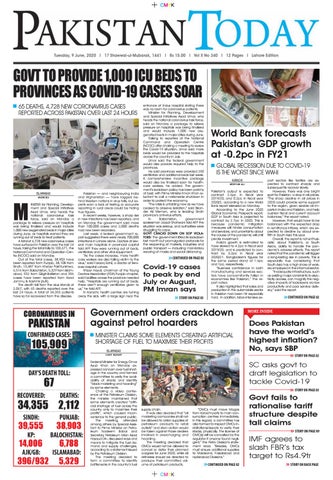
inister for planning, Development and special initiatives asad umar, who heads the national coronavirus task force, said on Monday a package to relieve pressure on hospitals was being finalised and would include 1,000 new oxygenated beds in major cities during June, as hospitals warned they are running out of beds to treat patients. a total of 4,728 new coronavirus cases have surfaced in pakistan over the last 24 hours, taking the total tally to 103,671, the national command and operation centre (ncoc) said on Monday. out of the total cases, 38,903 have been reported from punjab, 38,108 from sindh, 13,487 from Khyber pakhtunkhwa, 6,516 from Balochistan, 5,329 from islamabad, 932 from gilgit-Baltistan and 396 cases have been reported from azad Jammu & Kashmir (aJK). the death toll from the virus stands at 2,067, with 65 deaths reported over the last 24 hours. a total of 34,355 patients have so far recovered from the disease.
pakistan — and neighbouring india and afghanistan — have lagged behind western nations in virus tolls, but experts warn a lack of testing or accurate reporting in rural areas could be hiding true figures. in recent weeks, however, a sharp rise in new infections has been reported, and on Monday the government said more than 100,000 cases and 2,000 deaths had now been recorded. last week, a leaked government report suggested there were nearly 700,000 infections in lahore alone. Doctors at several main hospitals in provincial capital told afp they were running out of beds, ventilators and other vital equipment. “as the cases increase, more health care workers are also falling victim to the virus,” said farooq sahil, a doctor at services hospital lahore. Khizer hayat, chairman of the Young Doctors association (YDa) punjab chapter, said facilities across the province needed help. “hospitals are running out of beds; there aren’t enough ventilators given to us,” he told afp. in Karachi, health centres are turning away the sick, with a large sign near the
CoronavirUs in
pakistan
CONFIRMED CASES:
105,909
entrance of indus hospital stating there was no room for coronavirus patients. Minister for planning, Development and special initiatives asad umar, who heads the national coronavirus task force, said on Monday a package to relieve pressure on hospitals was being finalised and would include 1,000 new oxygenated beds in major cities during June. talking to reporters at the national command and operation centre (ncoc) after chairing a meeting to review the covid-19 situation, umar said more beds would be provided to the hospitals across the country in July. umar said the federal government would also provide required help to the provinces. he said provinces were provided 250 ventilators and additional beds last week. a comprehensive incentive package would also be finalised soon for healthcare workers, he added. the government’s lockdown policy has been patchy at best, with prime Minister imran Khan reluctant to call a nationwide shutdown in order to protect the economy. “the crisis is unfolding now as we have ceased to observe isolation,” said sikander ali Memon, who is leading sindh province’s anti-virus efforts. in Balochistan, government spokesman liaqat shahwani told afp the situation was serious, and authorities were struggling to cope. GOVT CRACKS DOWN ON SOP VIOLATORS: the government lifted its lockdown last month but promulgated protocols for the reopening of markets, industries and public transport — including mandatory wearing of masks and social distancing.
CONTINUED ON PAGE 05
Covid-19 cases to peak by end July or August, PM Imran says STORY ON PAGE 03
World Bank forecasts Pakistan’s GDP growth at -0.2pc in FY21 g
gloBal recession Due to coviD-19 is the worst since ww-ii KARACHI MEiRYUM ALi
pakistan’s output is expected to contract 2.6pc in fiscal year 2019/20, and 0.2pc in fiscal year 2020/2, according to a new world Bank report released on Monday. according to the June 2020 global economic prospects report, gDp in south asia is projected to contract by 2.7pc in 2020. this is because pandemic mitigation measures will hinder consumption and services, and uncertainty about the course of the pandemic will chill private investment. india’s growth is estimated to have slowed to 4.2pc in fiscal year 2019/20, and is predicted to contract by 3.2pc in fiscal year 2020/21. Bangladesh’s figures for the same period stand at 1.6pc and 1pc, respectively. “Business confidence in both manufacturing and services sectors have concomitantly fallen in economies like pakistan,” the report noted. it also highlighted that sales and production in the automobile sector in pakistan had been hit especially hard. in addition, labor-intensive ex-
Government orders crackdown against petrol hoarders g
Minister claiMs soMe eleMents creating artificial shortage of fuel to MaxiMise their profits ISLAMABAD STAFF REPORT
DAY'S DEATH TOLL:
67
RECOVERED:
DEATHS:
34,355 2,112 SINDH:
39,555
PUNJAB:
38,903
KP:
BALOCHISTAN:
AJK/GB:
ISLAMABAD:
14,006 396/932
6,788
5,329
federal Minister for energy omar ayub Khan on Monday expressed concern over fuel shortage in the country and formed a committee to verify the availability of stocks and identify “black marketing and hoarding” by some elements. chairing a video conference at the petroleum Division, the minister maintained that some elements created “artificial shortage of fuel across the country only to maximise their profits”, which caused inconvenience to the general public. the meeting, attended among others by special assistant to prime Minister on petroleum nadeem Babar and secretary petroleum Mian asad hayaud Din, discussed ways and means to mitigate the fuel demand and supply challenges, according to a statement issued by the petroleum Division. the meeting decided to form a committee to identify bottlenecks in the country’s fuel
port sectors like textiles are expected to contract sharply and subsequently recover slowly. however, there was one bright spot for pakistan: a drop in oil prices. “the sharp decline in oil prices in 2020 could provide some support to the region, given sizable oil imports in india and pakistan, and help cushion fiscal and current account balances,” the report noted. however, that would have to be balanced with the expected drop in remittance inflows, which are expected to decline by about onefifth in south asia this year. overall, the report is not enthusiastic about pakistan’s, or south asia’s, ability to handle the pandemic’s adverse effects. the report noted that the pandemic will trigger a long-lasting rise in poverty. this is especially true considering that south asia has a high share of workers employed in the informal sector. “inadequate infrastructure, such as existing major constraints to electricity access, can magnify the negative impacts of lockdowns via low productivity and poor service delivery,” said the report.
CONTINUED ON PAGE 02
more inside
Does Pakistan have the world’s highest inflation? No, says SBP STORY ON PAGE 02
sc asks govt to draft legislation to tackle covid-19 STORY ON PAGE 03
supply chain. it was also decided that “oil marketing companies shall not be allowed to ration supplies of petroleum products to retail outlets” and stern action would be taken against those dealers involved in overcharging and hoarding. the meeting decided that oMcs would not be allowed to cancel or defer their planned cargoes for June 2020, while oil refineries should be directed to produce their committed volume of petroleum products.
CMYK
“oMcs must move Mogas from Karachi ports to main consumption centres immediately. in this regard, a committee has also formed to inspect oMcs installations/depots to verify their stocks, physically. the license of oMc(s) will be cancelled by the regulator if anyone found negligent,” the petro Division’s statement read. “Besides, oMcs must ensure additional supplies to Malakand, faisalabad and hyderabad Divisions.”
CONTINUED ON PAGE 02
Govt fails to rationalise tariff structure despite tall claims STORY ON PAGE 09
iMf agrees to slash fBr’s tax target to rs4.9tr STORY ON BACK PAGE
02
Tuesday, 9 June, 2020
NEWS
DoeS PAkIStAN hAve the WoRlD’S hIGheSt INFlAtIoN? No, SAYS SBP KaraCHi
t
MEIRYUM ALI AND ARIBA SHAHID
HE State Bank of Pakistan (SBP) said that Pakistan's inflation for the year 2020 was not the highest in the world, in a series of tweets on Sunday. The SBP tweeted: “A chart from our Inflation Monitor has generated erroneous headlines. It compares Pakistan’s inflation to a few developed and developing countries. While Pakistan did have a relatively elevated inflation rate so far in FY20, it is not true that it was the highest in the world.” “For instance, Argentina, Iran, Nigeria
and Turkey’s inflation has been higher. Since January, inflation in Pakistan has fallen sharply and much faster than in most other emerging markets,” the SBP added. The clarifying tweets were in reference to the SBP’s own Inflation Monitor for April report, which the central bank had released towards the end of May. On page 19 of the report, in a section titled “10. Inflation in Global Context”, the authors of the report had stated: “In global context, Pakistan witnessed highest inflation not only in comparison with the developed economies but also with emerging economies.” The text accompanied a chat which com-
Pakistan, Germany sign Rs700m accord on renewable energy iSLamaBad APP
Germany will provide technical assistance, worth Rs700 million, to Pakistan in the field of renewable energy and energy efficiency. An agreement was signed between Secretary Economic Affairs Noor Ahmed and Ambassador of Germany to Pakistan Bernhard according to which Germany will provide technical assistance to Pakistan under the Pakistan-Germany Development Programme, worth 4 million euros or Rs700 million. The technical assistance will be provided under the project titled, “Promotion of Renewable Energy and Energy Efficiency Concepts in Cities and Industries,” which is one of the priority areas of the Government of Pakistan. Both, secretary economic affairs and ambassador of Germany to Pakistan stressed on strengthening bilateral relations in the future. The development cooperation between Pakistan and Germany dates back to 1961, with the funding volume to date totaling more than 3 billion euros.
World Bank forecasts Pakistan’s GDP growth at -0.2pc in FY21 Continued from page 01 In addition, a continuation of financial market disruptions globally could add pressure to vulnerable balance sheets of the financial sectors in South Asia. GLOBAL OUTLOOK: The World Bank report not only extensively looked at South Asia’s economies, but also global economies as a whole. According to the report, the Covid-19 global recession is projected to be the deepest since World War II, and will lead to a decline in global per capita gross domestic product (GDP) by 6.2pc. This is more than twice as deep as the global financial crisis of 2009, and the deepest global recession since 1945. To recap, the global economy has experienced 14 global recessions since 1870: in 1876, 1885, 1893, 1908, 1914, 1917-21, 1930-32, 1938, 1945-46, 1975, 1982, 1991, 2009, and 2020. In addition, this global recession is being acutely felt by many economies at the same time. The share of economies in recession is more than 90pc. To compare, the last time this many economies experienced a simultaneous contraction in per capita GDP was in 1870. Even in the Great Depression of 1930-32, only 85pc of countries experienced a recession together. The per capita output growth for emerging markets and developing countries specifically will decline 3.6pc. These markets will also mark their first output contraction, by 2.5pc, in at least the past sixty years, while more developed countries will experience a 7pc in output.
Bilawal holds federal govt responsible for fuel crisis KaraCHi INP
Pakistan People’s Party (PPP) Chairman Bilawal Bhutto-Zardari on Monday blamed the federal government for the fuel crisis in the country. In a statement, the PPP chairman said that “incompetence and bad governance” by the Pakistan Tehreek-e-Insaf (PTI) government was leading the country into a quagmire. “After failure to follow a uniformed policy to prevent the onslaught of coronavirus and mismanaging the response to the locust attack, the PTI government has once again proven that they serve the vested interests of their crony capitalist friends at the cost of the lives of hundreds of millions of ordinary Pakistanis,” he added. Bilawal said that the shortage of petrol at outlets has been artificially created and it would come as no surprise if even this fuel scarcity turns out to be another big scam involving some blue-eyed people of the PTI government.
pared Pakistan’s inflation with a group of emerging and developing countries. The text and chart together had then led to a series of headlines by different media outlets, stating that Pakistan had the highest inflation rate in the world, which is what prompted the SBP to tweet the clarification. Pakistan’s Consumer Price Inflation (CPI) in January was recorded at 14.56pc, which was the highest it has been in more than a decade. However, the index started falling from February, when it had eased to 12.4pc. It further fell to 10.24pc in March, 8.5pc in April, and then to 8.2pc in May. According to Profit’s own analysis, there are approximately 27 other countries that
have a higher inflation rate than Pakistan. Currently, the highest inflation in the world is in Venezuela with 2431pc in March 2020. The average inflation rate around the world is 21.25pc. However, this
4 private members’ bills sail smoothly through Senate iSLamaBad APP
The Senate on Monday passed four private members bills, including the Maintenance and Welfare of Old Parents and Senior Citizens Bill, 2019, the Criminal Laws (Amendment) Bill, 2019, the Companies (Amendment) Bill, 2019 and the Islamabad Pure Food Authority Bill, 2019 as reported by the standing committees concerned. The bills were piloted by senators Rana Maqbool Ahmad, Mian Muhammad Ateeq Shaikh, Ghous Muhammad Khan Niazi and Sajjad Hussain Turi, respectively, in the House. Rana Maqbool Ahmad said the bill would ensure protection of rights of senior citizen. He said that the bill was passed by the committee unanimously. Giving the statement of objects and reason of the bill, he said that there has been a steady rise in the population of older persons in Pakistan, because of an appreciable increase in the life expectancy. He said that increase in population the traditional norms and status of the senior citizens have deteriorated. The elders were exposed to emotional neglect and to lack of physical and financial support and they were facing a lot of problems in the absence of adequate
social security, he added. Giving the statement of objects and reasons of the Islamabad Pure Food Authority Bill, Sajjad Hussain Turi said that safe, secure and hygienic food was the basic right of every man and woman and every state was duty bound to ensure the availability of safe, secure and hygienic food to its citizens. The bill seeks to establish a food authority in the capital and appoint officials in this regard. It also provides a “comprehensive mechanism for regulating and managing food items” as well as punishments for those involved in the business of adulterated and unhygienic food. Moreover, as many as seven private member bills were introduced in the upper house of the parliament and were referred to the concerned standing committees for detailed deliberation. The bills introduced in the House included the Constitution (Amendment) Bill, 2020 (Insertion of new Article 25B), the Working Women (Protection of Rights Bill, 2020, the Pakistan Penal Code (Amendment) Bill, 2020 (Omission of Section 124 A), the Provincial Motor Vehicles (Amendment) Bill, 2020, the Pakistan Electronic Media Regulatory Authority (Amendment) Bill, 2020, the Constitution (Amendment) Bill, 2020 (Amendment of Article 89) and the
NA budget session to be held with 86 lawmakers neWS deSK As coronavirus cases continue to increase across the country, the government and the opposition have agreed to hold the budget session with the minimum number required to maintain quorum in the House. According to the agreement, 46 lawmakers of the government and 40 lawmakers of the opposition parties would attend the session. During the parliamentary session, all standard
operating procedures (SOPs) with regard to prevention of the Covid-19 pandemic, including social distancing norms would also be adopted. According to the Rule 5 of the lower house, it is necessary to have to one-fourth of the total membership of the assembly to continue the session because if the speaker’s attention is drawn to the fact that the quorum is not being maintained then he has to suspend the sitting. The NA consists of a total of 342
Pakistan Environmental Protection (Amendment) Bill, 2020. The bills were moved by Senators Sirajul Haq, Seemee Ezdi, Mian Raza Rabbani and Faisal Javed. Presenting the statement of objects and reason of the bill, Senator Sirajul Haq said that the bill was aimed at providing health as a fundamental right of citizens like provision of compulsory education. Statement of objects and reasons of Pakistan Electronic Media Regulatory (Amendment) Bill, 2020 said that although the media industry of Pakistan has expanded in the past few years, it was facing a slowdown these days and the brunt of which was faced by media employees, reporters, newscasters and correspondents etc., in the form of lay-offs, pay cuts and late or no payments of salaries. It said that in some companies, employees have been forced to take pay cuts which they accepted without any resistance fearing the consequences of losing their jobs. Many news channels have discontinued prime time shows and downsized their employees, resulting in massive unemployment and increasing poverty, thus a need is felt to comprehensively deliberate and legislate upon the exploitation of media employees by the channels and companies, it added.
members of which 272 are directly elected through general election. 70 MNAs are indirectly elected on reserved seats for women and religious minorities. One-fourth of 342 members is around 86. NA Speaker Asad Qaiser held a meeting with the parliamentary leaders over the upcoming budget session. The participants of the meeting held consultations for the upcoming session of budget with precautionary measures against Covid-19. They agreed to hold debate on sugar and wheat crises, coronavirus, locust attacks and other important issues, whereas the question hour and attention notices would be suspended in the upcoming session.
figure includes not only Venezuela’s inflation rate, but also Zimbabwe's high inflation rate, at 766pc in April 2020. If these two outliers are removed, the average global rate falls to 4.01pc.
Malik sends Rs500m defamation notice to US blogger over rape accusation ISLAMABAD: Former interior minister Rehman Malik on Monday sent Rs500 million defamation notice to US blogger Cynthia D Ritchie who earlier alleged that the senior PPP leader had raped her in 2011. In the legal notice, Malik rejected Ritchie’s allegations, saying that the entire episode is a fight for Benazir Bhutto’s prestige. He paid tribute to Benazir Bhutto by saying that the slain former prime minister was considered a leader of impeccable repute by the entire country. In his notice, the former interior minister said that he would expose the faces behind Ritchie’s allegations at the appropriate time. Malik also said that he is constantly receiving threats of being sent to jail or killed. The PPP leader said that he has never bowed to pressure before and would not do the same now. The American blogger had said in a Facebook live video last week that in 2011, she had been raped by Malik, who was then the country’s interior minister. She went on to say that other senior leaders of the party, former PM Yousaf Raza Gilani and ex-federal minister Makhdoom Shahabuddin, had ‘manhandled’ her. STAFF REPORT
Court seeks response from NAB over delay in filing of reference against Ahsan Iqbal ISLAMABAD: An accountability court on Monday reprimanded the National Accountability Bureau (NAB) officials and asked its Chairman Justice (r) Javed Iqbal the reason for the delay in filing a reference against Pakistan Muslim League-Nawaz (PML-N) leader Ahsan Iqbal in the Narowal sports city case. During the hearing, PML-N leader Ahsan Iqbal told the court that it has been two years since the investigation was started against him, adding that he was also arrested in the process, but the probe was yet to finish. “First this case was with FIA and later transferred to NAB,” the prosecutor told the court in response to Iqbal’s statement. However, the court interjected and informed the NAB prosecutor that the case which was transferred from the FIA did not include Iqbal’s name in it. “NAB should inform if the case against Ahsan Iqbal will be filed or should it be disposed of,” the accountability court judge asked the watchdog. INP
Government orders crackdown against petrol hoarders Continued from page 01 The minister also asked the Oil Companies Advisory Council (OCAC) to issue a ‘press statement’ indicating that sufficient stocks of petrol were available in the country and all import of petroleum products was lined up to meet the demand. OGRA was given a task to deploy vigilance teams in the field to verify available stocks of OMCs, depots and retail outlets. The meeting also stressed that additional production by refineries as well as planned imports should be as per schedule aimed at meeting the monthly needs, observing that useable stocks of 214,536 Metric Tonnes of petrol were available in the country, which was sufficient for 10 days.
The meeting vowed to take proactive and appropriate actions jointly by the Petroleum Division, OGRA and all relevant stakeholders, including the provincial government, to normalize the fuel supply situation across the country. EXCESSIVE DEMAND POST LOCKDOWN: Meanwhile, on behalf of OMCs and refineries operating in Pakistan, the OCAC has informed that the current stocks of petrol (motor gasoline) were continuously being replenished by OMCs from supplies being made available through local refineries and regular arrival of vessels carrying imported petrol at the two ports: Karachi Port Trust (KPT) and Fauji Oil Terminal Company (FOTCO) at Port Qasim Authority (PQA). In a statement issued on Monday,
CMYK
OCAC informed, “For the month of June, a total of around 850,000 metric tonnes (MT) of petrol is being supplied from local refineries and imports to the distribution & retail network of the country. The current sales of petrol in the country are exceptionally high (50pc growth) due to the easing of Covid-19 lockdown in the past few weeks, causing depletion of stocks and low price of the product.” The council further stated that the average sales of petrol for the period July 2019 to May 2020 were around 600,000MT per month, which translates to sales of around 20,000MT per day. However, for the reasons mentioned above, a high surge of sales and consumption of 30,000MT per day had been expe-
rienced in the first six days of June 2020. “This sudden increase of 50pc in consumption is being complemented by the industry through additional imports in the months of June and July while there are few pockets of constrained supplies in some parts of the country. However, the Petroleum Division, Oil & Gas Regulatory Authority (OGRA), local refineries & oil marketing companies are working round the clock to mitigate the situation.” The council said that in view of an adequate quantity of petrol being arranged through the petroleum products supply-chain, the consumers are requested to fill up their vehicles as per their normal needs and do not resort to excessive buying.
Tuesday, 9 June, 2020
NEWS
CovID-19 CASeS to PeAk BY eND JUlY oR AUGUSt, PM IMRAN SAYS PREMIER URGES PEOPLE TO FOLLOW SOPS, WEAR FACE MASKS TO STOP VIRUS SPREAD
SAYS ENTIRE WORLD UNDERSTANDS NOW THAT LOCKDOWNS ARE NOT A SOLUTION
P
neWS deSK
RIME Minister Imran Khan on Monday said that the government expects coronavirus cases in the country to peak by end of July or early August. The government had earlier said that it expects Pakistan’s coronavirus peak by end of May or early June. Addressing the nation on PTV, PM Imran said it’s a fact that the virus will spread and the “the trend our experts have observed is that it spreads, then peaks after a few weeks and then the curve will flatten”. “The purpose of flattening the curve is to ease the pressure on hospitals,” explained
SC adjourns Justice Isa case till June 11 after judge goes in self-quarantine iSLamaBad STAFF REPORT
The Supreme Court (SC) adjourned the hearing of Justice Qazi Faez Isa’s petition against a presidential reference filed against him until June 11, as one member of the 10-judge bench has quarantined himself over Covid-19 fears. The judge reportedly took the precautionary step after his driver tested positive for the virus. The apex court is seized with nine petitions moved by Justice Isa, the Supreme Court Bar Association (SCBA), the Pakistan Bar Council (PBC), Abid Hasan Minto, Abdul Basit, who heads the High Court Bar Association, Quetta, Muhammad Asif Reki, the President of Quetta Bar Association, the Sindh High Court Bar Association, the Balochistan Bar Council and the Sindh Bar Council. Justice Isa is currently facing a misconduct reference filed by the president against him in the Supreme Judicial Council. The court is currently hearing the final arguments in the case. According to officials, timing is very significant in the case as summer vacations are going to start from the third week of June and will run through September.
the premier. “We can manage the pandemic if we observe the SOPs in place and take precautions,” he said, urging the people to start wearing face masks. “Please wear masks, this is important. The world has realised that masks can prevent the spread of coronavirus by up to 50 per cent. Secondly, when you go to public spaces, follow the guidelines that have been issued by the government,” he said. “By not adhering to SOPs we are threatening the lives of our elderly,” he said adding that the immunocompromised were also at risk. He warned that Pakistan might also have to face the kind of Covid-19 conditions prevailing in the US, in Brazil and in Europe
SC asks govt to draft legislation to tackle Covid-19 iSLamaBad APP
The Supreme Court (SC) on Monday took back its decision to open markets on the weekend as the number of coronavirus cases continues to rise across the country. The decision was announced by the apex court during a hearing of the suo motu case regarding measures taken against the virus outbreak. “Coronavirus does not differentiate between provinces. The federal government needs to take a lead on this and needs to come up with laws regarding this,” said the top court. Chief Justice of Pakistan (CJP) Gulzar Ahmed called for legislation on the national level to deal with the coronavirus pandemic, adding that nothing would come out of press conferences. “China immediately came up with laws to stem the spread of the virus,” he noted. He asked that how could a policy be formulated through executive orders as it should be formulated under a law.
The attorney general said that the federal government had taken steps to ensure implementation of standard operating procedures (SOPs) against the coronavirus outbreak. He said that specific laws had been made by provincial governments. Justice Ijazul Ahsan said that the virus does not differentiate between provinces, adding that people were dying because of it and something should be done. He said that people should take the coronavirus seriously as 100,000 cases had been reported now. The National Disaster Management Authority’s (NDMA) counsel said that the testing capacity had been increased to 30,000 tests per day. Upon this, the chief justice said that 30,000 tests were very less for a country with a population of 200 million. The NDMA counsel also informed the bench that 100 laboratories were set up across the country to conduct coronavirus tests. The chief justice said that the number of laboratories were less as there should be 100 laboratories in Karachi alone.
200 people flee quarantine camp at Chaman border Quetta INP
A total of 200 people, including women and children, quarantined at the Pakistan-Afghanistan Chaman border fled from the camp on Monday. According to reports, a woman at the camp was seriously ill and wanted to be shifted to a hospital. The camp’s management refused to shift her after which a clash broke out between the people and the camp’s staff.
The quarantined people broke the main gate of the camp and fled, taking the ill woman along with them, according to the district administration. These people were not registered and their records weren’t taken. According to sources, these people had been complaining of not being given food for the last two days and were on a hunger strike. They had also called out the camp management over lack of facilities. They had recently come back to the country from Afghanistan after the government reopened the border.
Hamid Mir serves legal notice to Fayyazul Chohan LaHore STAFF REPORT
Anchorperson Hamid Mir served a legal notice to Punjab Information Minister Fayyazul Hassan Chohan under Section 8 of the Defamation Ordinance, 2002 over “very derogatory, false, libelous, misleading and baseless allegations” against his father. The legal notice stated that on May 22, Hamid Mir was invited by Muhammad Maalik on his television programme, where he commented on the commission report on sugar scandal and praised the incumbent government for the report and its consequences. “While responding to his fair and honest comments on the above-referred TV show, you [Chohan] imputed very derogatory, false, libelous, misleading and baseless allegations to the deceased father [Professor Waris Mir] of our client via social media or You-Tube which has been watched and listened by people all over the world,” the notice read, adding that these “defamatory and misleading allegations” were
intended to harm the reputation of the family of the Mir family. According to the notice, Chohan had claimed that Professor Waris Mir had shown support for enemies of Pakistan through his writing and had kept accusing the Pakistan Armed Forces and politicians for the 1971 episode. The notice also stated that Chohan had claimed that Professor Waris Mir also supported the plans of Sheikh Mujeebur Rehman and his Mukti Bahini and both father and son had been given awards and appreciation by the government of Bangladesh. It further stated that Chohan had raised objections on a bridge being named after “this traitor of Pakistan” and had asked why the anchorperson did not conduct a talk show on this matter or on hospitals, schools and parks that were named after people who allegedly gave fiscal and monetary advantages to Hamir Mir. The notice stated that Chohan challenged Muhammad Maalik and Hamid Mir, the “stigma on politics and journalism”, to show him a video clip of talk shows they hosted
when the Sharif family named hospitals and parks after members of their family. Hamid Mir’s counsel said that these “very serious and baseless allegations attributed to our client’s father are very damaging to our client’s reputation and his family” and have been “intended by you to lower down the integrity and professionalism of our client in the media circle and in the eyes of millions of people that are followers of our client”. The notice clarified that Professor Waris Mir never supported the creation of Bangladesh, but rather he only criticised the 1971 military operation like Faiz Ahmad Faiz and Habib Jalib and they were also nominated for the same “friends of Bangladesh Award”. It added that Professor Waris Mir was given the award posthumously not for supporting Bangladesh but for his efforts for becoming a bridge between East Pakistan and West Pakistan and to keep Pakistan united. Separately, Punjab Assembly Speaker Chaudhry Pervaiz Elahi also condemned the allegations levelled by the provincial information minister.
03
if citizens are not careful. Interestingly, while addressing the nation on March 17, PM Imran had said that Covid19 is a type of flu that spreads rapidly but 97 per cent of the patients recover fully from it so the people need not be afraid of it. However, during his address on Monday, the PM ostensibly took a U-turn on his Mar 17 statement, saying that people were not taking anti-coronavirus SOPs seriously, thinking it was ordinary flu. The prime minister also said that a lockdown is not the solution to the Covid-19 pandemic. “During the lockdown, people – especially labourers and lower-income groups – went through a very difficult.” He added that we, as a people, must realise that Pakistan is a poor country and there was no other choice but to reopen businesses. “The entire world understands now that lockdowns are not a solution.” He gave the example of the US and said the country had the highest number of coronavirus cases and deaths but the US government still went ahead and reopened the country. PM Imran also referred to the application launched by the NCOC – Pak Nighaybaan – which would guide citizens towards which health care facility had what resources available nearest to them. He further announced that the government would be distributing a 1,000 more ICU beds in hospitals across the country.
Rasheed, Abbasi among three MPs test positive for Covid-19 iSLamaBad STAFF REPORT
Three members of parliament, including Minister for Railways Sheikh Rasheed Ahmed and former prime minister and Pakistan Muslim League-Nawaz (PMLN) Senior Vice President Shahid Khaqan Abbasi tested positive for Covid-19 on Monday. A statement released by the Railways Ministry said that although Rasheed, 69, has tested positive, he is asymptomatic. The statement further said that Rasheed has gone into self-isolation and will remain in quarantine for two weeks as per doctors’ advice. Separately, PML-N central spokesperson Marriyum Aurangzeb, while confirming the news, said that Abbasi has quarantined himself within his home. Abbasi, 61, had been out and about last week: he went to the Lahore High Court (LHC) to attend PML-N President Shehbaz Sharif’s bail petition hearing and also held a press conference alongside other party leaders including Aurangzeb and Secretary General Ahsan Iqbal. Aurangzeb and Tariq Fazal Chaudhry, another PML-N leader, also got tested after Abbasi was diagnosed with the virus, as they had been in contact with the former premier. Sharif expressed sorrow at the news and said: “Abbasi is an asset, we hope he will recover soon.” Later in the day, ruling Pakistan Tehreek-e-Insaf (PTI) MNA Jai Parkash was also confirmed as testing positive for the pandemic. Parkash underwent the test on Friday after which he had attended a session of the National Assembly.
04 LAHORE
Tuesday, 9 June, 2020
WEATHER UPDATES TUESDAY
390C
280C
WEDNESDAY
380C
290C
THURSDAY
400C
290C
PRAyER TiMingS FAJR SUNRISE
ZUHR
ASR MAGHRIB ISHA
3:19
12:02
3:41
4:57
7:06
Black market thrives as demand for antivirals increases LAHORE
a
SHAHAB OMER
CTeMRA, the antiviral drug being used for treating coronavirus patients, is being sold in the black market, which limits the role of the Drug Regulatory Authority of Pakistan (DRAP) as it can only control the prices of drugs listed with them. Pakistan Today investigated the matter and found that a person named Salman was selling the 20mg of the drug online. When contacted, he said that he would deliver it at
customers’ homes in Lahore. “You have to complete the 500mg dosage, which would cost Rs750,000, and one 80mg vial would cost Rs150,000,” he said, reiterating that it is an important medicine and would only be delivered at the customer’s home. When DRAP was contacted in this regard, an official said that they regulate the prices off medicines only listed with them. The official said that DRAP has a proper mechanism for regulating the prices of medicines and in case a patient needs a medicine that is not registered with DRAP, there are SROs in this case and a given quantity can be
imported, but the doctor’s prescription is a necessity and they need to mention that the prescribed medicine is unregistered. There is a proper procedure and various documents, including the CNIC of the patient, are required but under the present circumstances, various companies can collect CNICs of patients for getting NOC for imports, and these medicines do not have a price tag and are sold at any price the seller wants, the official added. The official further said that ectemra and Remdesivir are not registered with DRAP, however, Ferozsons has applied for
Remdesivir’s licence. Interestingly, a Federal Investigation Agency (FIA) official told this scribe that the agency cannot do much on this matter. The official said that this matter comes under the domain of the government and DRAP and they can only take action on illegal production of medicines upon complaint. Speaking to Pakistan Today, University of Health Sciences (UHS) Vice Chancellor Dr Javed Akram said that Actemra and many other antiviral medicines are experimental drugs at the moment and it is not certain whether they are effective against the virus.
Covid-19: Gymkhana closed till June 20
2 MORE POLICEMEN DIE OF CORONAVIRUS IN LAHORE
LAHORE: Two more policemen have died of coronavirus in the past 48 hours, the city’s top police LAHORE official confirmed on STAFF REPORT Monday. The virus has so The management of the Lahore Gymkhana have decided far claimed lives of seven close the social club until June 20 amid increasing num- policemen in Lahore, while 137 cops have ber of coronavirus cases in the provincial capital. tested positive for the “Keeping in the view the growing menace of coronavirus and in larger interest of the honourable members virus. STAFF REPORT of the Lahore Gymkhana, the committee of management of Lahore Gymkhana has decided that all facilities, including entry into the Gymkhana, will be closed with immediate effect until June 20,” read a notification issued in this regard. The notification also hinted at a possible extension in closure and requested all members to cooperate with the staff and not to visit the social club during the lockdown.
Human Rights Ministry launches campaign to promote harmony, tolerance LAHORE: The Punjab Ministry of Human Rights and Minority Affairs (MoHRMA) has launched a dedicated communication campaign containing messages of top community leaders, religious leaders and celebrities from various walks of life and faiths on peace, harmony and tolerance. The campaign has been launched to counter the practice in which different sects and groups, especially the Shia pilgrims returning from Iran and members of Tablighi Jamaat, are being held responsible for spreading COViD19 in Pakistan. The ministry is running the campaign in collaboration with the Youth Development Foundation (YDF) - an organisation which has executed several projects on peace and interfaith harmony. While launching the campaign, the MoHRMA minister Ijaz Augustine said the country cannot afford such divisions and hatemongering in these testing times. STAFF REPORT
8:44
“Actemra is a brand name and medicines with the same chemical formulations are available in the market at a cheaper cost,” he said, adding that people should be made aware of this. Ferozsons Laboratories Chief executive Officer (CeO) Osman Waheed said that they had a final meeting for getting the licence and once the get approval they can start the process of manufacturing the medicine. He added that they would import the raw material for this medicine after DRAP’s approval and within six to eight weeks of getting their permit, it would be available in the market.
Tuesday, 9 June, 2020
Taxes on mobile phones hiGhesT in pakisTan in developinG asia: reporT IMPORTS DOMINATE LOCAL MANUFACTURERS IN DEVICE SALES WHILE BASIC FEATURE PHONES REMAIN PERVASIVE IN THE COUNTRY ISLAMABAD
T
SyEda MaSOOMa
Ax payments and fees on mobile consumers and operators in Pakistan are among the highest in developing Asia, said a report issued by the international GSM Association (GSMA). The report titled ‘Pakistan: progressing towards a fully-fledged digital economy’, outlined that with a growing population, and mobile phones being at the center of the public and private sectors’ efforts of gearing the economy towards its economic potential, Pakistan needs to “simplify access and digital connectivity, and reduce the coverage gap”. The importance of the mobile sector to Pakistan is significant and growing. It is a vital contributor to the economy and is redefining the way individuals, businesses and state bodies function and interact.
4 killed in Faisalabad oil depot blaze
With decelerating Gross Domestic Product (GDP) growth compounded by a rising population, the jobs, taxes and productivity gains generated by the digital ecosystem will be pivotal to supporting the health of Pakistan’s economy and society moving forward, the report said. Pakistan’s mobile market has experienced rapid development since the turn of the century; however, the pervasion and widespread consumption of advanced technology and resulting digital services have yet to fully materialize. On certain telecoms metrics Pakistan lags behind its regional peers, some of which are similarly striving to overcome poverty, political crises and conflict. As neighboring markets accelerate digitization programs, keeping pace requires that Pakistan does more to successfully exploit its demographic advantages, including mobilizing its vast – and increasingly tech-savvy – youth population.
LAHORE STaFF rEPOrT
At least four workers died while four others were injured after a huge fire broke out in an oil depot in Faisalabad on Monday. Rescue 1122 teams and 16 fire engines reached the site of the incident to extinguish the fire. The blaze engulfed the oil drums in different parts of the depot with the workers trapped on the premises. Over 30 employees were working at the place and 25 of them were rescued safely. An official said that the oil depot was operating illegally. “Neither the district administration nor police were aware of this depot working in the area.
Systems Limited CEO Asif Peer has suggested a set of overarching reforms to boost IT exports from Pakistan in the wake of Covid-19 pandemic. Speaking to a local publication, Asif Peer said that the pandemic offers a great opportunity for IT companies across Pakistan, and Systems Limited in particular, to boost up their exports and grow. The CEO said that the work-fromhome model has proved itself, besides, the pandemic has forced many businesses to explore digital transformation, cloud services, disaster recovery, and so on, bringing technology to the forefront. “This has opened up opportunities for information technology companies like Systems Limited to grow.” He claimed that the fortunes of all
CONtINuED fROM pAgE 01 “First we educated the masses about the protocols, then we warned them, and now, in the last meeting with the prime minister in the chair, we directed administrations to crack down on places protocols are not being followed,” Umar said in a news conference at the weekend. Many markets and shops have been sealed because of non-compliance over the last few days, he said. Pakistan has been setting records for the number of new daily infections over the last 10 days, partly reflecting increased testing. But of the 23,000 tests daily, more than 1 in 5 have been positive over the last 10 days. Before the lockdown was lifted on May 9, the number of tests finding the coronavirus was approximately 1 in 10, government statistics show. Government officials say safety protocols are not being followed, particularly since just before Eidul Fitr. The decision to lift the lockdown on May 9 despite increasing infections of the coronavirus, which causes respiratory illness Covid-19, was prompted by a worsening economic crisis and unemployment. Pakistan is the 16th country to exceed 100,000 infections, a Reuters tally showed. The virus spread has yet to peak, officials say.
05
dustry’s development, and harm end-users. In Pakistan, consumers face sector-specific taxes that apply to devices, SIM cards, and usage charges, which limit investment, affordability, and overall mobile internet usage. These taxes are particularly likely to affect poorer consumers as mobile broadband services become too expensive, which in turn can widen the digital divide and cause exclusion. Chief Digital Officer for Pakistan Tania Aidrus said in the report that it is clear that Pakistan has to simplify access and digital connectivity, and reduce the coverage gap. “More than half of mobile connections do not have active mobile broadband connections; we need to understand why. The reasons likely range from cost to socioeconomic factors; we need to tackle those systematically. Additionally, while we are approaching 90 million unique subscribers, some basic hurdles need to be removed for the remaining Pakistanis. Handset prices need to be curtailed, while the government continues to explore ways to both reduce the tax burden on imports and drive local production. The right incentives across the board will be required to achieve this. The private sector also has a role to play, with some operators already offering installment plans on low-cost handsets. If we are to truly start thinking of the internet as a fundamental right for all, the ecosystem needs to work together to make solving these issues a priority,” the Chief Digital Officer for Pakistan said in the report. The report also outlined that imports dominate device sales, leaving domestic manufacturers playing catch-up. Basic feature phones remain pervasive in Pakistan; at the end of 2019, they represented 44 percent of total connections in the country.
ERF, taxation reforms suggested to boost IT exports
NEWS DESK
Govt to provide 1,000
The report also said that for the country’s bottom 20 percent and 40 percent income groups, the total cost of mobile ownership (TCMO) for both low and medium consumption baskets is above the UN’s “1 for 2” target (i.e. 1 GB of data costing less than 2 percent of monthly income). Moreover, the upfront cost of a handset represents an affordability challenge for those lower-income Pakistanis who do not have access to finance, which otherwise will enable them to pay by installment. The government has acted to alleviate some of the tax pressure on mobile consumers, including cutting SIM card taxes by 75 percent in 2004/2005. It removed the 16 percent Value Added Tax (VAT) rate on mobile handsets in 2016 – a move that resulted in year-on-year handset sales growth of 25 percent; however, this has since been reinstated. Further, at 31 percent, tax as a percentage of TCMO is significantly above the global average of 19 percent, while the mobile sector makes a disproportionately large tax contribution relevant to its own economic footprint. The report added that strict tax regimes that divert large proportions of revenue from operators to governments can negatively impact connectivity, distort the in-
NEWS
global technology companies have risen during the pandemic because of the digital transformation journey that is taking place. Talking about the government’s role in placating the impact of the pandemic, Asif acknowledged that the government’s decision to keep call centers open was crucial to sustain the BPO industry. However, he suggested government interventions on numerous policy fronts to take IT exports ahead. Asif elaborated that under current policy, IT exporters were allowed to obtain Export Refinance Facility (ERF) to the extent of 50 per cent of the export remittances received during a certain tax year that most of the companies can hardly utilise because banks require hard collateral (fixed assets) to extend the facility. “There should be at least 20 per cent of value of export remittances that should be allowed under ERF without any collateral. This will ensure that even small IT setups
can avail the facility to further grow their businesses,” he said. “To enhance exports, IT companies need to explore other markets. This has been a challenge due to restrictions in remitting funds outside of Pakistan to establish subsidiaries or support subsidiaries in their working capital requirements,” Asif elaborated. He recommended that IT companies should be allowed to make foreign investments in a subsidiary as per some limits. “New exporters should be allowed to remit up to $100,000 directly through authorised banks. For existing exporters, if the value of export remittance is between $1 million to $5 million, they should be allowed to remit up to $500,000 directly through the authorised bank. And if exports are over $5 million, investment should be allowed up to $1 million directly through the authorized bank. These limits should be
allowed once a year; provided the company continues to be an IT exporter,” he elucidated. A key factor Asif highlighted that impedes growth of IT companies were impediments in making foreign investments in subsidiaries. Asif further commented that foreign subsidiaries of IT companies usually are liaison offices and were unable to secure direct financing from banks to meet their working capital requirements due to not having the required collaterals to secure the financing. “To resolve this issue, SBP should allow local banks to issue cross-border corporate guarantees to their foreign branches to the extent of 20 per cent of export remittance of the parent company. This will help the foreign subsidiaries to avail banking facilities backed by the parent company’s position,” he said.
India continuing policy of state terrorism in IOK, says FO ISLAMABAD aPP
Pakistan on Monday strongly condemned the killing of nine Kashmiri fighters by Indian forces in occupied Kashmir, terming them an act of “state terrorism”. The Foreign Office (FO) statement came as four Kashmiris were killed by government forces in occupied Kashmir’s southern Shopian area on Monday, just hours after five fighters died in a firefight in the same area. “Pakistan strongly condemns the unabated extrajudicial killings of Kashmiri youth in acts of state terrorism perpetrated by Indian occupation forces in Indian occupied Jammu and Kashmir,” FO
Spokesperson Aisha Farooqui said in a statement. She noted that nine Kashmiri fighters were killed at the hands of Indian troops during the last 24 hours in “fake encounters” and so-called “cordon-andsearch” operations in Shopian. She said several houses in the area were also destroyed and pellet guns and tear gas used against Kashmiri civilians who took to the streets to protest Indian brutalities. “Infliction of such collective punishment to [a] community is tantamount to crimes against humanity.” She added that it was “highly reprehensible” that India remains “busy in intensifying its brutalisation” of the Kashmiri people while the world community grapples with the coronavirus
pandemic. The FO said extrajudicial killings of Kashmiris in fake encounters by the Indian forces are being perpetrated with “complete impunity” under the cover of draconian laws, adding that the Indian forces neither reveal the identities of the deceased nor hand over their bodies to the families for burial. “The ‘Hindutva’ agenda of the RSSBJP combine is targeting defenceless Kashmiris with mindless violence to break their will,” she said, adding that India’s efforts to “subjugate” the Kashmiri people through killings, torture, forced disappearances, incarcerations and brutalisation will not succeed. The FO stressed that it is the respon-
sibility of the world community to urgently act and protect the Kashmiris from the “wanton killings and other brutalities” being inflicted on them by the Indian forces. “Pakistan will continue to call for holding India accountable for its crimes against the Kashmiri people.” Armed ‘encounters’ are frequent in the occupied Himalayan region, but the fighting has intensified with at least 85 fighters and dozens of government forces killed this year. In the latest incident, soldiers cordoned a village in Shopian early Monday after a tip-off from police, army spokesman Colonel Rajesh Kalia said, according to AFP.
Dangerous delusions or inspirational, educating entertainment
By SahiBzada Jahangir Ertugrul, is a Turkish fictional drama, based on 13th Century Turkish history and centers around the life of Ertugul, father of Osman 1, who was the founder of the Ottomon Empire, a period of history, which all Muslims can be proud of.
Having recently been released in Pakistan and dubbed in Urdu, it has attracted viewership of 5.5 million people and caused quite a storm. If anything shows us, how disunited the Muslims are now, as they have been in history, look no further than the debate this drama is generating. Ertugrul is a nightmare for the liberal elite, who wish to morph themselves into Western culture. Being a lefty, should represent a person who open-minded with a social conscience and scientifically and academically progressive. Unfortunately the term Left, has taken on more sinister characteristics, coming to represent a person who is intolerant and terrified of anything which leads to the Almighty. It has also caused an objection amongst those who have political allegiances against Imran khan, for the petty reason, that Imran Khan recommended that the Pakistani’s at home, could benefit from watching Ertugrul, and it certainly has enough episodes, to keep one safely tucked at home, during lockdown.
So now we know the agendas of those who object the state run TV, PTV airing a Turkish drama, let’s consider whether there is merit to any of the objections. Ertugrul, without doubt is fantastically well made and grips the audience, even those, who switched it on to see an episode or two, to see what all the fuss was about. It’s been named the Islamic Game of Thrones. So, I assume the criticism is not about the production, direction or the acting. Let’s delve deeper into content. The dialogues, each and every one, deliver such beautiful meanings. They educate and entice. There is no vulgarity, which perhaps doesn’t satisfy the ever militant lefties. Then there is the hysterical paranoia, that we will adopt Turkish culture and should be promoting our own. For years we have been watching American and British films. Has that destroyed Pakistani culture? Honestly, it may well have infiltrated its way into the elites of Pakistan, but not the
majority of the awam. What message is Ertugrul portraying? It shows that with unity and sincerity, with faith and belief, one can overcome evil and adversity. It depicts respect for elders. It shows what humility and good manners are. It shows how one treats guests and hospitality. But yes, for some, respect, humility, hospitality, fearless courage, are all rather old fashioned and out of synced with the life styles they wish to lead. There is naturally fear and suspicion, that it may re-introduce golden old values. If only the masses could be so easily influenced towards all that is good. There is fighting and there are wars, just as there have been in history and continue to be, but for a change, the narrative is different and its not the Muslims who are depicted as evil and barbaric. The actors and actresses who have said that Pakistan must fund its own industry, need to rise to the challenge and stop producing the dated dramas of mother-inlaw/daughter-in-law disputes, or a
husband getting entangled with another woman and taking a second wife or a cheating wife. What message have any of these dramas taught Pakistanis? How have they educated them? If Pakistan wishes to compete, then change the script. I feel proud that Pakistan aired this drama, unlike other Muslim countries, who cowered under super powers and political designs. Ertugrul was never meant to be completely factual. It would be called a documentary then Mr Hoodbhoy. It is exactly how it is described, a fictional drama set in an historical context. So, I recommend watch Ertugrul and enjoy it for its entertainment and learn from its etiquettes and manners and revive unity amongst the Muslims. I fear that is just a hopeful dream. The writer is the spokesperson for Prime Minister Imran Khan on Trade & Investment in UK & Europe
Tuesday, 9 June, 2020
06 COMMENT
Back door Prime Ministers
Playing politics with pandemic figures The fewer the tests, the lower the infection figures
A history of poor installed leadership
D
r Zafar Mirza has been repeatedly telling us that there are lesser coronavirus cases and a lower death rate in Pakistan than projected by experts. The reasons the PTi leaders have given range from Pakistan being a blessed country to ‘immediate measures taken by the government to control the outbreak under the supervision of PM imran Khan.’ The estimates, that are now being challenged, have been used to justify the ending of the lockdown and maligning the Sindh government. in mid-May a report prepared by the Technical Working Group set up by Punjab government and comprising leading epidemiologists, public health specialists, applied economists, statisticians and public policy specialists presented a disturbing picture of lahore with estimates that around 670,000 people may have contracted the virus in the provincial capital. The report was shelved as it challenged the justifications being given for zoning and smart lockdowns. On Sunday President of the Punjab chapter of Pakistan Medical Association (PMA) claimed at a press conference in lahore that there were no less than 3.5 million coronavirus cases in lahore and 20 million in Punjab. According to him cases remain under-reported because of government’s failure to conduct sufficient tests. The government, he said, decided to ease the lockdown when it should have further strengthened it. A Punjab level conference of the opposition parties has meanwhile criticized the government for its “irresponsible attitude” and for concealing the real number of the patients and mortalities in Punjab. it has demanded a three week long lockdown in six Punjab districts. instead of rising to the occasion, PM imran Khan initially under-rated Covid-19, a blunder committed by US President Trump and Brazilian President Bolsonaro that has led to disasters in both the countries. later PM Khan took a fatalistic stand maintaining that the pandemic could not be controlled by any government and was bound to spread and responsibility lay on the people to cope with it by following the SOP’s. Thus the government decided to follow the countries that failed rather than those that succeeded in controlling the spread of the pandemic through government intervention, ranging from China and South Korea to new Zealand and Cuba.
Dr FariD a Malik
I
n 2004 around 1500 hours in my capacity as Chairman Pakistan Science Foundation (PSF), i met Mir Zafarullah Khan Jamali the 15th Prime Minister (PM) of Pakistan. The purpose of the meeting was to convince him to induct technocrats in technical ministries. He was not convinced as he thought they would replace politicians who were duly elected. i did my best to explain that technocrats have replaced bureaucrats worldwide as application of technology has led to complexities that generalists are unable to manage. Watching the news bulletin at 1800 hours the same evening, i was shocked to hear that he had resigned. Jamali Sahib was an astute and upright politician, he had no clue that he would be stepping down in a few hours without debate, discussion or voting. later on, i came to know that at the time of his appointment he was made to sign his resignation letter. When the President decided to launch military action against nawab Akbar Bugti, Jamali Sahib refused to go along, hence he was removed to be replaced by another plastic and compliant PM, Shaukat Aziz. Back door PMs are supposed to obey. Mian Muhammad nawaz Sharif is the only back door PM who has unsuccessfully tried three times to stand up to the custodians of these ‘Chor Darwazay ‘, rest have followed the script. Twice in the recent past, elected front door PMs were forced to follow the script. in the seventies it was Zulfiqar Ali Bhutto (ZAB) the most popular leader of his times who led from the front. eventually he was trapped, cornered and eliminated. His daughter Benazir led a courageous movement against the dictator Zia Ul Haq and the PPP finally emerged as the single largest party in the 1988 elections. Power was handed over to her under very unfavourable conditions. She was made to accept Ghulam ishaq Khan (GiK) as the President together with handing over
Government handouts and protection Sugar report reveals how select industries thrive by lobbying
W
HeTHer or not the recently released report detailing a ‘forensic analysis’ of the Sugar industry leads to any meaningful investigations and litigation headed by the FiA and nAB, the fundamental issue that will likely remain unresolved is the manner in which governments of the past and present mollycoddle select industries by providing them with protections and handouts. That the report names senior and prominent members of the present PTi government and opposition parties as well, is no coincidence. Apart from Jehangir Tareen who had already fallen out of favour with the Prime Minister in addition to his ineligibility to hold public office for life, serving PTi ministers and advisors named in the report have only gotten a light slap on the wrist. The scope of the inquiry that was limited to the spike in domestic price of sugar due to permission being granted by the eCC to export the commodity, has been widened to include the granting of subsidies, in order to bring opposition party sugar barons into the fold as well. Despite all the hullabaloo, the market price of sugar remains rigidly high. it is a sad irony that the government is so busy patting itself on the back for making the report public that it is ignoring the original purpose behind the entire exercise – skyrocketing sugar prices. This institutionalised culture of currying favours on the back of financial and political clout has become ingrained in the system over the years and extends to other industries as well. The textile industry for example, by virtue of unlimited access to people in power in practically any government and regime, is able to get huge concessions on a regular basis- an obvious and unfair edge that other industries can only dream of. The construction industry is another case in point. The PM, in unholy haste, wanted to end the Covid-19 lockdown to save the economy and provide a special stimulus package for the construction industry that has only translated into an out of control pandemic and a mini-amnesty scheme for speculative plot traders. A reform policy needs to be put in place to address this deep-rooted systemic failure to separate business and government. Meaningful legislation that identifies conflicts of interest and restricts businessmen from reaching decision-making roles in government should be passed. regulatory authorities such as the SeCP and FBr must be converted into independent and efficient institutions. Such initiatives will make a lot of people unhappy as change often does. But isn’t that exactly what the PTi promised it would bring; change? Time to step up to the challenge and deliver.
Black, black Berlin The sights, sounds and symphony of a Metropolis
Shah Nawaz Mohal
B
erlin loves black. Berlin is black. it has beauty of a beast, vengeance of a teenager, faith of a child, zeal of a fanatic, boredom that never gets satiated, life that keeps on coming back after every tired night, night that keeps on eating away days. Berlin is all this and more. Berlin embraces everything and everyone. All sensations are groomed. All images are caressed. All noise is music. All oblivion finds its way back to memory. All wounds turn into flowery tattoos. All pain gets its voice in piercings. All happiness is transitory. All sadness is drowned in drugs, parties, student jobs, company of friends, literature, graffiti, long walks, train rides, double-decker buses, trams and small acts of innocuous rebellion. Between the savagery that was the First World War and the monstrosity that was nazisim, Germany had Weimar republic. The decadent, self-obsessed, always-partying, always awake Berliners back in the 1920s and early 1930s, lived as if there was no tomorrow and yesterday was always a blur, a haze, a fog. it would be nice, if you just Google Weimar republic, and delve deep into the roots of all that was Berlin. A history-ridden, sleepless, wondrous, ferocious place where the past hugs the present as the fu-
Dedicated to the legacy of the late Hameed Nizami
Arif Nizami Editor Aziz-ud-Din Ahmad
Umar Aziz
Asher John
Joint Editor
Executive Editor
Deputy Editor
Lahore – Ph: 042-36300938, 042-36375965
two most important ministries, Foreign Affairs and and PTi have so far succeeded in entering the corridors of power through their struggle yet they too Finance to the establishment. in Punjab, Mian nawaz Sharif was forcibly in- were made to compromise. Pakistan needs real political leadership that enjoys stalled as the counter weight Chief Minister. Being a front door popularly elected PM, she should have re- popular support. Turkey went through a similar transisted the temptation of manipulated transition of sition. Tayyip erdogan gradually established himself power but she too fell into the trap. it was this com- by serving his people before he amended the constipromise that gave strength to back door unnatural po- tution ending over half a century of Military dominalitical entities like PMl-n and PMl-Q. GiK first tion. Pakistan has credible leadership at the top after tried to oust her through a vote of no-confidence with decades that is trying to establish civilian authority but the help of nawaz Sharif and his Changa Manga a lot of work needs to be done. All brands of Muslim Camp where the MnA’s were lodged with money leagues with its back-door leaders are on their way bags. When they did not succeed, then came the dis- out. As a Muslim league child, i am embarrassed at missal under the 8th amendment. Through the infa- the leadership that has been thrust upon the nation mous islami Jamhoori ittehad (iJi) the back door through the back door. Most civilian institutions are in total disarray and need to be rebuilt. electoral reentrants were brought to the forefront of power. There is a clear political divide between the front forms are also the need of the hour. elections have to be credible to be acceptand back door politicians. able to all contestants. Those who struggle to As PM imran Khan reach the corridors of is walking a fine line, so power like Pakistan PeoAs a Muslim League child, I am far, he remains unple’s Party (PPP) in the by the odds pitseventies and eighties embarrassed at the leadership that daunted ted against him but his and Pakistan Tehreek-estruggle is ongoing. The insaf (PTi) in the nineties has been thrust upon the nation entrenched Mafia’s conand twenties cannot be equated with back door through the back door. Most civilian tinue to resist the muchneeded change. Political entrants who are installed institutions are in total disarray and cleansing has to go on into position to then conto restore the solidate their authority need to be rebuilt. Electoral reforms unabated purity in the land of the through misuse of state pure. After the 1970 deapparatus. The experiare also the need of the hour. bacle, the establishment ments of back door PMs Elections have to be credible to be has been able to thwart have badly failed in fact the political order either they have now turned out acceptable to all contestants by manipulation of the to be political monsters to electoral process or by be dealt with. national holding on to power Accountability Bureau where front door leader(nAB) is after them but due to complexities of common law their conviction ship managed to gain public support. There has to be real transition of power for political order to gain remains an uphill task. Two very important leaders come to mind. Air strength but for that to happen the political parties Marshals Asghar Khan and nur Khan both entered have to organize themselves together with grass root politics after serving the nation in various capacities. structure and support for mass mobilization of people nur Khan realised early that politics in the land of as was done during the recent election campaigns and the pure was not pure. He gracefully withdrew him- the one in the seventies led by ZAB. Only real leadership can fight for change, rest self. On the other hand, Asghar Khan continued, hoping to come into power through honest struggle will either work for narrow self-interests or sheepand sacrifice. He was first used by the third dictator ishly go home as done by Jamali Sb. Kaptaan has aland then abandoned. His son Omar Asghar Khan ways been an attacking player, he is now a front door and heir apparent then emerged as a future political PM who has to lead the charge thereby shutting the leader by joining the cabinet of the fourth dictator. back doors for all times to come. This may turn out Unfortunately, he met with a tragic end leaving the to be his greatest innings as an attack bowler, allonce powerful Tehrik-e-istiqlal in the wilderness. rounder and leader of the nation. Finally, Asghar Sahib decided to merge his party Dr Farid A Malik is ex-Chairman, Pakistan with PTi. His son Ali Asghar Khan contested the election on PTi ticket from his hometown of Abbot- Science Foundation. He can be contacted at: tabad but lost. Only two political entities, the PPP fmaliks@hotmail.com.
I
Karachi – Ph: 021-35381208-9
I
ture takes a peek at this ever-present sight. All three; past, present and future, have a hearty laugh with tears in their eyes, sorrow in their heart and hope in their heads. From being divided in two halves, east Germany and West Germany, where east was all high to prove its communist credentials and West selling its capitalist utopia to reunified Germany. Berlin has seen a lot. it has seen destitution. it has seen division. it was reduced to rubble. it rose like a phoenix. Only to become a Sisyphus, condemned to live the same reality, same ordeal, same travail, same destiny, over and over again, until the end of eternity. Berlin discards nothing. The sewer and serene exist side by side. The homeless with trolleys filled with plastic and glass bottles they can return, get a refund, buy more alcohol and get wasted. The sorted-out, affluent, rich, moneyed ones who buy their Bombay Sapphires and expensive designer wines from Galleria at Alexanderplatz, drive around in their unpretentious cars i.e. Audi, Volkswagen, Mercedes and BMW’s, least bothered to brandish their wealth, exist amidst a sea of humanity trying to solve itself, resolve its doubts, transcend its limits, go beyond all that is and towards something that could be. Berlin worships the potential of every individual to ruin and/or become who they are destined to become. Berlin is a mirror. A mirror showing every individual their inner demons, their deeper desires, their rhyme, the color they are inside, the shadows they are scared of, the realities they aim to escape, and the lies they live over and over again. Berlin is where even anarchist’s respective red line. You can be whatever you want in here. Your sexual orientation-no what it is, your religion-or lack of it, your color-black, brown, white, your ethnicityTurk, South Asian, Chinese, your language-english, German, Turkish, Hindi, your culture-and your love or hatred of it, your past-one you cherish or one you
Islamabad – Ph: 051-2204545
I
Web: www.pakistantoday.com.pk
I
want to escape from. Your world views-conservative, secular, libertarian, socialist, anarchist all take a back seat as you roam aimlessly around Brandenburg Gate to see the glory of the past, Alexanderplatz to get a feel of east Germany meeting West Germany, Zoologischer Garten for food or shopping, Charlottenburgh to feel good, Kurfurstandem to see every and any brand from Tesla to louis Vuitton, Warschauer Straße to behold the decadence of youth, queers, techno-heads, and folks looking for good times. Berlin is a demigoddess, who nourishes you and makes you feel life in all its glory and gore. like a mother who just can’t scold her favorite son. like a Dad, who just can’t stop loving his only daughter. Berlin is a microcosm of what is best, worst, rotten and worth celebrating in humankind. With the history it had, the present it lives in and the future that is promising and bleak, its summers are heaven and its winters are gloomy. Berlin has a long memory, but a short memory span. You can live a thousand lives, die a thousand deaths, live again, live more, die again and die some more. And every time, you start all over. Berlin comes with a restart button, that you keep on pushing until the push comes to shove. What do you get? Many perfect nights, many beautiful days, many sad evenings. Berlin forgets its nights the moment it wakes up in the morning. All that happens in the night vanishes the morning after. Whatever your poison is, Berlin has it in abundance. Black, black Berlin. A Phoenix-turned-Sisyphus which roars only to become silent, catch its breath and roar again. And it roars again. Shah Nawaz Mohal is a law graduate and journalist based in Islamabad. He can be reached at mshahnawazmohal@gmail.com.
Email: editorial@pakistantoday.com.pk
Tuesday, 9 June, 2020
COMMENT 07 Editor’s mail Send your letters to: Letters to Editor, Pakistan Today, 4-Shaarey Fatima Jinnah, Lahore, Pakistan. E-mail: letters@pakistantoday.com.pk Letters should be addressed to Pakistan Today exclusively
Corona and the heart
Covid-19 and the possibility of a debt crisis There are ways of avoiding one
Dr oMer JaveD
A
rOUnD $8 trillion have been spent globally to deal with the Covid-19 pandemic, to support lives and livelihoods of people affected by the virus and lockdowns, respectively, and to overall keep the economies afloat under an environment of low aggregate demand and supply globally, which has already caused the global economy to shrink by $8.5 trillion since the current crisis began, with the global GDP growth forecast for this year at negative 3.5 percent, according to the Un. This sharp and deep economic downturn, which many economists now believe will take the form of a prolonged-U shape, with longer time needed for the global economy to return to an upward trend– mainly because the time to find a vaccine, get it approved for commercial use, and actually getting the people vaccinated, can take around one-and-a-half year– has already had severe negative effects on people being pushed below the poverty line. Here, the World Bank expects the number of people going below the poverty line– where poverty line is defined as people ‘living on less than $1.90 per person per day’– to be at around 60 million, while the estimation of Un is grimmer at 130 million. All this means that government almost everywhere, and especially in emerging and developing countries, will have to continue with greater welfare programmes– for instance, unemployment rates in many parts of the world have seen a significant rise since the start of the pandemic, enhancing in turn allocations in terms of unemployment benefits– and overall loose monetary and fiscal policies. in addition, shrinking of the aggregate demand and supply globally has meant negative impact of exports, and remittances for instance, along with a sharp outflow of financial capital from emerging and developing world, has already been $100 billion since the beginning of last week of January this year, according to international institute of Finance, has all meant that the debt repayment capacity of these group of countries has diminished sig-
nificantly. For instance, ramin Toloui, formerly veloping countries, there has been a rising call assistant secretary for US Treasury, indicated from many corners for the iMF to provide ‘The withdrawal of money [from eM funds] is greater support to indebted countries facing a greater and more sudden than in 2008, the eco- possible crisis by making available greater nomic shock is huge and the path to recovery is amounts of SDrs to them. For instance, David more uncertain than it was after the last crisis’, lubin in a recent article ‘iMF’s $1tn lending and hence the emerging economies faced an power is not all it is cracked up to be’ recom‘enormous’ challenge to save themselves from a mends ‘One way out of this might have been an emergency allocation of special drawing rights, possible debt crisis. Global debt, which had already seen a sig- a tool last used in 2009. This would credit memnificant rise since the Global Financial Crisis ber countries’ accounts with new, unconditional 2007/08, is expected to rise a lot at the back of liquidity that could be exchanged for the five welfare policies being pursued during the cur- currencies that underpin the SDr: the dollar, the rent crisis. in this regard, Un DeSA (United yen, the euro, sterling and the renminbi. That nations Department of economic and Social will not be happening, though, since the US is Affairs) in a recent policy brief highlighted ‘The firmly opposed, for reasons bad and good. So in global community has offered partial debt serv- the end the iMF and its shareholders face a huge ice suspensions to 76 low-income countries, and problem. it either lends more money on easy the iMF has offered debt service relief to 25 of terms without the “collateral” of conditionality the poorest countries. These do not cover com- (borrowing government tighten its belt and exmercial and multilateral debt or middle-income ercise restraint in public spending), at the excountries, and will not suffice to avoid defaults. pense of undermining its own balance sheet; or Debt distress will impede countries’ efforts to it remains, in systemic terms, on the sidelines of this crisis.’ combat the coronAt the same avirus pandemic time, nobel laureand derail progress ate, Joseph Stiglitz, towards the Susamong others, rectainable DevelopIt is hoped developing countries, ommend to debtor ment Goals (SDGs)... Despite including Pakistan, will take timely countries, in a recent article ‘restructurnear zero global inand meaningful measures, to meet ing Argentina’s priterest rates, borrowvate debt is ing costs for most this challenge essential’, to also developing countake note of the path tries have risen; recently thought out credit spreads on by policymakers in emerging market sovereign bonds more than doubled from the Argentina to face the challenge of a likely debt beginning of the year to April, widening to more crisis, whereby ‘‘Against the backdrop of this than 600bps... Median public debt in developing global emergency, Argentina is spearheading its countries grew almost 15 percentage points of public debt-restructuring process in a construcGDP from 2012 to 2019 (from 35 per cent to 51 tive manner, in good faith, and with the support of all domestic political sectors... Argentina has per cent of GDP).’ At the same time, developing countries are presented its private creditors a responsible offer also stuck in the dilemma of how much debt re- that adequately reflects the country’s payment lief to seek, especially with regard to the debt capacity: a three-year grace period with a minor owed to private creditors, so that their credit-rat- cut in capital and a significant cut in interest... ings do not slip down, making it difficult for At this exceptional moment, Argentina’s prothem to approach creditors for future financing. posal also presents an opportunity for the interOne way, therefore, for safeguarding the debtor national financial community to show that it can countries is highlighted by Berry eichengreen in resolve a sovereign-debt crisis in an orderly, efhis recent article ‘Managing the coming global ficient, and sustainable manner. The absence of debt crisis’ as follows, ‘This debt crisis is also a an international legal framework for sovereignhumanitarian crisis and a global public-policy debt restructuring should not deprive indebted crisis. The appropriate entity to organize the re- countries of the possibility to protect their peosponse is therefore the international Monetary ple and provide for economic recovery during Fund [iMF], not the institute of international Fi- the greatest global crisis in our memory.’ The above are some solutions to save from nance, the house organ of the creditors (as recommended by the G20). As a United nations a possible debt crisis, likely in the wake of the organization, the iMF could request that Chapter covid-19 crisis, and it is hoped developing counVii of the Un Charter be invoked to shield tries, including Pakistan, will take timely and debtors from disruptive legal action by oppor- meaningful measures, including taking a leaf out tunistic investors. A crisis of this magnitude war- of these solutions, to meet this challenge. rants no less.’ Omer Javed holds PhD in Economics Another important step that needs to be taken is with regard to the supply of the iMF’s degree from the University of Barcelona, and SDrs (Special Drawing rights). Hence, given previously worked at International Monetary the dilemma facing debtors of emerging and de- Fund. He tweets @omerjaved
DeSPiTe the fact that COViD-19 is considered an illness of the lungs, many patients who contract the new coronavirus experience cardiac issues. Up to 1 in 5 patients with COViD-19 have signs of heart injury, regardless of whether or not they had respiratory symptoms. Though a good portion of these patients already had underlying health issues involving the heart, like heart disease or high blood pressure, many otherwise healthy patients have also developed heart problems, including blood vessel injuries, blood clots, arrhythmia, strokes, and heart attacks. The high incidence of cardiac problems in patients who contract the coronavirus has had physicians stumped: How could a respiratory infection inflict so much damage on the heart: it boils down to a few factors: The widespread inflammation the infection causes, the possibility that the virus directly infects and injures the cardiovascular system, and the overall stress the infection puts on pre existing heart conditions. 45 recent reports pertaining to COViD-19 and cardiovascular complications and found that the coronavirus can cause lasting heart impairments. in addition, the experimental drugs used to treat COViD-19 — like hydroxychloroquine and remdesivir — may cause heart damage in some patients and worsen pre existing heart issues in others. researchers hope the new findings will inform how emergency physicians screen and treat patients diagnosed with COViD-19. Still, more research is needed to confirm exactly how the coronavirus affects heart function, and which patients with COViD-19 are most at risk for running into heart troubles. ASFANDyAr KHAN Islamabad
Who was Ertugral? erTUGrAl Ghazi is a Turkish authentic TV arrangement which disclosed on Pakistani Channel PTV. in Turkish the title of the arrangement is Dirilis ertugral. The dramatization depends on the historical backdrop of the Muslim Oghuz Turks. The story is about the historical backdrop of Anatolia Turkey in thirteenth century. This arrangement shows the fortitude of warrior of Kai clan whose name is ertugral Ghazi who was the dad of Osman (Othman) who established the Ottoman empire. everybody is viewing the show with intrigue. The show has disturbed numerous non-Muslims nations around the globe. An enormous number of individuals additionally went to YouTube to watch the Urdu form the COViD-19 lockdown. ertugral Ghazi show arrangement has crossed over 3 million endorsers inside 25 days. This dramatization crossed around 200 million perspectives on “TrT ertugral by PTV” channel inside a month. in contrast to our traditional Pakistani shows, the islamic topic verifiable dramatization ertugral Ghazi interfaces with the watchers at an enthusiastic and mental level. The authentic fiction arrangement is being circulated on PTV on the uncommon mandates of Prime Minister TAqDEES ZAFAr Islamabad
Open libraries with SOPs All public libraries of Pakistan were forced to close to slow down the pandemic in March this year. Slowly and gradually government lifts lockdown restriction many sectors across the country except public libraries. Many aspirants, researchers and students are facing unprecedented challenges due to closure of libraries. Some aspirants have competitive examination in this year and they have already lost enough time for study owing to closure of public libraries. in corona virus, knowledge plays vital role in making vaccines and solving social issues. researchers always depend on libraries for reliable source of knowledge. They collect reliable information from libraries and compile their research. As libraries have been closed, researchers face serious threat in Pakistan due to inaccessibility of authentic information. As we face economic turmoil and devastation, public libraries can play key role to recovery of the country. it is a place of knowledge and wisdom where knowledge is transferred to masses. it is a place there all competitive and knowledge seekers persons come to seek knowledge. They all are well aware how to deal with pandemic and strictly followed SOPs. it is great lost of society whenever public libraries are closed. Government has opened all shopping malls, restaurants and markets for five days in a week and it has made agreement with business men that they would strictly follow SOPs. But in consequences they have failed to enforce SOPs. The large number of people comes in markets and most of them do not wear masks. on the other hand, if government makes some agreement with liberians and it opens libraries, it will be quite different because those who join the libraries are well educated men they will be stick to guidelines of government. Government must invest in economy of the minds rather than growth of economy by opening shopping malls and markets. That nation will survive who invest in the mind. Therefore government must open public libraries through SOPs and it must not allow children and old men to library because they are vulnerable to pandemic. Corona virus has no time frame how long it remains in public but country cannot afford to close long enough libraries. if it is closed long enough it will be huge lost of the future generation. rASHEED MANgrIO Hyderabad
Mr President, do something! PreSiDenT Dr Arif Alvi while speaking in Geo news’ programme Capital Talk, “ i have read the investigative report on power companies referring to a probe into corruption in the power sector scrutinizing incurring a loss of rs 1 billion per day.” Furthermore he said, “ the country was not raped but gang-raped by the mafias.” Sir, you are on a huge seat with a great power. You should leave no points to get those mafias to jail.” Those who see the crime but do not take action are also listed for the complicity.” ASIF MUrAD UMrANI Karachi
Tuesday, 9 June, 2020
08 WORLD VIEW
The world’s weakesT sTrongman DONALD TRUMP’S USE OF VIOLENCE AND DIVISION ISN’T A SYMBOL OF AUTHORITY—IT’S A SIGN OF DESPERATION
Foreign Policy
I
STEPHEN M WALT
f you know where the continuing wave of public protests in the United States is going to lead us, you’re smarter than I am. In fact, figuring out what is going to happen when mass protesters go up against the coercive apparatus of the government is inherently difficult to predict and maybe impossible. Part of the reason, as Timur Kuran explained in a seminal article (and subsequent book), is that an individual’s propensity to rebel (or, in this case, join a demonstration) is a form of private information that is impossible to ascertain in advance, even in a democracy. Even today, it is hard for outside observers to know what might be the final straw that would provoke more people to go out into the streets or what sort of government response might lead them to stay home. And as Susanne Lohmann and other theorists have argued, protests also benefit from “cascade effects”: You might not be willing to be the first person out in the street, but you might be willing to be number 5,000. In this way, protest movements can grow larger over time and especially if the government reacts in ways that reinforce the initial burst of popular anger. President Donald Trump (and other violence junkies like Republican Sen. Tom Cotton) seems to think that all that is needed to make the demonstrations cease is a ruthless show of force. He should think again. Overwhelming force sometimes works, especially when there is a genuine threat to regime stability, the public at large is supportive, and one can count on the security forces to obey orders and respond brutally. But as the Shah of Iran and other autocrats have discovered, wielding the mailed fist can also turn peace-
ful protests violent, drive more people into the opposition and onto the streets, and eventually cause the security apparatus to switch sides or dissolve. Even if a tyrant ultimately “wins,” the country may be but a hollow shell (see: Syria). More importantly, we are nowhere near the level of public disorder that would justify all-out repression of the sort that Trump and Cotton seem to want. Yes, there has been some criminal looting; those responsible for it should be roundly condemned, arrested, and tried. But preliminary data from the Crowd Counting Consortium suggests that the overwhelming majority of the demonstrations have been remarkably peaceful, with violent incidents being the rare exception rather than the norm. Moreover, in several cases, it appears that overreaction by local police forces triggered the violence, not the other way around. Most important of all: The protesters are not trying to destroy public institutions or upend the constitutional order. No one is setting fire to the U.S. Capitol; storming the gates of the White House; trying to kidnap mayors, senators, or chiefs of police; or even confronting legislators with guns and other threatening gestures, like those right-wing goons did in Michigan a few weeks ago. Not a single governor has requested federal assistance to deal with the demonstrations. According to the fBI, that supposedly dangerous bogeyman known as the “Antifa” movement is not fomenting violence (by contrast, some right-wing militias appear to be). fox News must be terribly disappointed. Instead, the main threat to the constitutional order is coming not from the protesters but from the White House itself. That is the main reason why we are now seeing public pushback from U.S. military leaders (both retired and active) who understand that there is no need for the kind of massive force Trump seems to want. They also understand that the American people are not a “battlespace” to be “dominated” and that the armed services’ proper role is to uphold the Constitution and defend the country against foreign enemies, not to advance a president’s per-
sonal political fortunes. This deeply troubling situation reveals one thing clearly: Trump, an incompetent and increasingly desperate president, has no other cards left to play. The economy is circling the drain, and unlike his predecessor—who successfully led the country out of the 2008 recession—Trump has no plan for reviving it anytime soon. The most recent jobs report notwithstanding, tens of millions of Americans will still be out of work on Election Day, and he knows it. The country is in this condition because Trump’s response to the COVID-19 pandemic was embarrassingly inept. His claim that it would magically disappear was a typical Trumpian lie, and his lies didn’t stop there, even after 100,000 Americans had died. Meanwhile, countries blessed with more able leaders are already starting to recover and reopen safely. That situation won’t change either, and there’s every reason to fear another spike of infections come fall. finally, his impulsive, know-nothing approach to foreign policy has simultaneously emboldened adversaries and angered allies while failing to deliver a single significant foreign-policy achievement. He has no idea how to fix that problem either. His only recourse, therefore, is to sow as much division as he can, even if it does more permanent damage to the country as a whole. Indeed, Trump has every reason to want the level of violence to get worse, both to distract us from his other failures and to convince Americans that they are facing a massive threat to public order and that any and all measures are justified. It really is mind-boggling: for the first time in U.S. history, an American president may genuinely believe that openly encouraging violence and disorder at home could benefit him politically. Not even Richard Nixon went quite that far. The appropriate response, therefore, is to deny him the carnage that he so desperately needs. As my colleague Erica Chenoweth and her co-author Maria Stephan have shown, nonviolent civil resistance is a far more effective means of social change than violent insurrection. The reason is simple:
We should be very wary of politicians lobbying Facebook, Twitter and Google IF THE POLITICIANS ARE NOW PLAYING LOBBYISTS, WHAT SHOULD BE DONE IN RESPONSE?
Slate JESSE BLUMENTHAL
“facebook is looking a lot like the government,” the Washington Post editorial board declared in february. And in 2017, New York Times columnist farhad Manjoo wrote that the “frightful five” (Amazon, Google, Apple, Microsoft, and facebook) have “become kind of more like governments than companies with the amount of money they have, with the kind of power they have over democracy in society.” These types of broad claims about the government like role of technology companies have become commonplace. Proponents point to the size of these firms, their power, their rapid growth, and their importance in our daily lives as proof. But it is a mistake to say that large tech companies are effectively the government. Unlike the government, they are privately held and run. Tech companies cannot tax you. They cannot deprive you of liberty or property. They cannot use legitimate force against you. Not only is this idea that Big Tech is the government incorrect, but the rhetoric masks a serious issue. It is because these companies are not the government, with checks and balances, that they are so susceptible to lobbying and threats—a dynamic that everyone, even those most concerned about the power
of Big Tech, should be wary of. Perhaps no better example of this played out when Twitter fact-checked President Donald Trump and added warnings labels to his tweets. The president was furious. Other Republican politicians weighed in almost immediately to denounce Twitter’s move. There were news stories, cable TV segments, and a backlash from the American public. All of this media pressure was, in effect, a lobbying effort to pressure Twitter to back down and a warning to others not to follow their lead. The president also issued an executive order, but it ended up being more rhetorical bark than legal bite. The actual legal effect of the executive order was minimal: suggesting the government pull advertising, ordering rulemaking processes that have dubious merit, creating a working group with the Department of Justice and state attorneys general to find ways to harass these companies, and urging the Department of Justice to lobby Congress to change the law. Yes, this executive order has an effect, but the tools available are relatively modest. More importantly, there is a process by which other stakeholders can weigh in and challenge this effort. Civil society groups, businesses, academics, and other politicians all have an opportunity to express their views. The executive order, any new regulations, and any laws passed by Congress can all be challenged in court. Different branches of government check each other. But the point of the executive order was not to change the law. The point was for Trump to make clear that he was upset with Twitter’s fact-check of his claims and to warn other companies against similar moves. Trump is hardly alone in trying to jaw-
bone tech companies to change their policies to suit his political interests. Take Democratic federal Elections Commission Commissioner Ellen Weintraub, for example. Weintraub has long sought stricter limits on political speech. She has repeatedly called for bans on “microtargeted” political ads. Her agency administers and enforces federal elections law. But Weintraub is not using her powers as a regulator. In January, after facebook announced that it would not put limits on political advertising, she tweeted, “I am surprised that facebook would put out such a weak proposal that it virtually invites Congress to re-examine facebook’s Section 230 exemptions. I strongly urge facebook to go back to the drawing boards and come back with something much more robust.” That statement is a political threat. Targeted ads are not her only concern. Like many Americans, Weintraub is concerned about misinformation, but as she told Politico’s Nancy Scola in March, “I doubt if it would withstand first Amendment scrutiny if we were to say to the platforms or to broadcasters or anyone else, ‘You have to take that ad down because it contains inaccurate information.’ ” Instead, she is pursuing a strategy that Scola describes as “gently or not-so-gently encourage the big platforms, like facebook and Twitter, to figure out their own ways of what addressing the issue.” These are not isolated incidents. Politicians lobbying technology companies has become one of the few bipartisan sports in Washington. The Trump and Biden campaigns both furiously lobbied Twitter over whether the platform should label as manipulated media a Trump campaign video that took a quote
•
Violent acts make it easier for the state to justify repression, and the coercive arm of the state is usually stronger than the protesters. If protests remain peaceful, however, it becomes harder to justify repression and harder to convince the police or National Guard or other coercive agencies to carry it out. If they try, other Americans will see it for what it is and be properly repulsed. Violent crackdowns on peaceful demonstrations will be a further reminder of just how badly this president has failed the nation. But here’s what really worries me. Although the current protests are primarily about racial injustice—for obvious and entirely understandable reasons—some of the problems America faces transcend race. In addition to legitimate concerns about racial inequality (including the disproportionate impact of COVID-19 on minority populations), the protests are also another manifestation of mass political anger at a political and economic elite that in recent years has done a better job of enriching itself than addressing broader social needs and is rarely held accountable. It is the anger directed at police forces that resist reform and refuse to fire officers who repeatedly commit abuses. It is the anger directed at the Wall Street insiders who cratered the economy in 2008 and were never held accountable. It is the rage aimed at the Harvey Weinsteins who abused power for decades before being exposed and punished. It is the frustration of watching so-called foreign-policy experts like John Bolton and Elliott Abrams receiving endless opportunities to screw up. This broader perception of elite betrayal and privilege is what transformed the unlikely and otherwise dissimilar figures of Trump and Bernie Sanders into formidable political forces. Back in 2016, Trump capitalized on broad popular discontent by falsely portraying himself as a blunt-speaking outsider who would “drain the swamp” and bring his (fictitious) business acumen to bear on the nation’s problems. The con now lies fully exposed, even if his supporters still cannot bring themselves to see it. far from draining the swamp, he staffed his administration with lobbyists, plutocrats, loyalists, hacks, and unqualified family members while he continued to profit at public expense. His chaotic management style produced an endless series of resignations, firings, and acting
appointments, leading to the highest turnover rate of any administration in U.S. history and rendering the federal government even less capable of meeting the country’s needs. Suddenly faced with a public health emergency and a grave economic crisis, Trump has exhibited zero capacity to comfort, unite, inspire, or govern. Lying, preening, and blaming others are the only political skills he ever mastered. My guess is that the level of anger is going to get worse between now and November—especially in the nation’s cities— and it will expand beyond the issue of racial injustice. As federal support payments dry up and personal savings are exhausted, more and more people will be unable to pay rent and will face eviction. More and more young people will have to put their dreams for the future on hold. People will continue to get sick, some of them will die, and all of us will wonder when we will be able to resume some semblance of a normal life. Americans will watch with envy as better governed nations begin to reopen and recover and wonder why they are unable to follow suit. And Donald the Divider will be right there, pouring gasoline on the flames, in the hope of sparking an inferno and resurrecting his failing fortunes. We know his playbook by heart: He’ll blame America’s problems on China, the World Health Organization, Nancy Pelosi, Barack Obama, Hillary Clinton’s email server, the news media, the so-called deep state, fluoridated drinking water, and, if necessary, he’ll drag in George Soros, the Spanish Inquisition, and the Illuminati. Anyone but himself. He’ll call Joe Biden silly names and invent more dark lies about his family. If the demonstrations continue, maybe he’ll use them as a pretext to justify an armed crackdown so that his base will continue to see him as a strong, manly leader. Maybe he’ll get Attorney General Bill Barr to conjure up specious legal arguments to justify suspending the election. Or maybe he’ll try to use some of the country’s security forces to suppress the vote. Who knows? There is no limit to how far this pathetic excuse for a leader will go. Because at this point he has no other options.
by the former vice president out of context to suggest that he was endorsing Trump. A group of Republican senators led by Josh Hawley, a Republican from Missouri, sent a letter to Mark Zuckerberg to protest the fact-checking a pro-life video. Democratic members of the House used tweets to lobby Twitter and facebook to remove an edited video of Speaker Nancy Pelosi ripping up Trump’s State of the Union address. Sen. Ted Cruz, a Republican from Texas, used his opening remarks in a hearing to scold tech executives. He argued that the lack of transparency offers “big tech the power to silence voices with which they disagree” and painted himself as the champion of free speech. At the same hearing, Rep. Mazie Hirono, a Democrat from Hawaii, encouraged tech companies to increase their use of content moderation to combat anti-vaccine conspiracy theories, hate speech, videos of mass shootings, and other forms of repugnant speech. Whether they want more speech or less, more fact checks or fewer, videos to stay up or come down, the one thing all politicians seem to demand is that these companies need to do something. But rarely (Trump’s limited executive order being an exception) have these politicians or regulators turned to the most direct tools at their disposal. There is no serious bill to regulate how facebook conducts fact checks, or remove political ads with misleading editing, or to ban alleged bias against conservatives, or anti-vaccine conspiracy theories, or hate speech, or videos of mass shootings. There’s a reason these legislators and regulators haven’t tried to use the powers of government directly to achieve their speech goals online: They would fail. The bills would likely not pass, and if they did, they would be quickly challenged in court. Rather, they make it clear to companies: Do what we want or else. The “or else” takes the form of bills on privacy, antitrust, and legal liability for speech, fake products, or any other set of harms. As Trump tweeted: “Repeal 230.” Indeed, the point of these bills is usually not to pass but to cajole. The politicians are working the refs. Because if a powerful politician
can convince a company to simply change their internal rules, that decision is not subject to the normal checks and balances of our democratic process. If the politicians are now playing lobbyists, what should be done in response? first, companies should define a set of principles and stick to them. Apple has chosen to define themselves based on their commitment to privacy. facebook is increasingly defining themselves as defenders of free expression. Second, companies can improve how they govern themselves. Developing internal rules and norms can diffuse power and limit the ability of outside lobbying by governments (and other actors) to derail companies from their mission. facebook’s proposed oversight board is an intriguing, if nascent, step in that direction. Third, companies can and should be transparent about when and in what circumstances they are subject to what seems like an undue government pressure campaign. When france attempted to ban free shipping of books, Amazon responded by charging 1 cent and adding a note objecting to the ban to packages containing books. When New York City attempted severely restrict ride sharing, Uber responded by launching “de Blasio” mode that featured a 25-minute wait time and offered a way to email the mayor. fourth, we need to be stronger. The publication of distasteful, uninformed, or even malicious speech will not destroy us, and we—and our politicians—should stop thinking it will. Liberal democracies in general, and the United States in particular, have long resisted top-down speech regulations for good reasons. Such regulations are easily abused. Tom Hazlett, the Clemson economist, has detailed this bipartisan history of abuse in the broadcast industry at length. Today, the internet provides unprecedented access to wide variety information sources, for good and for ill. We have access to more information at our fingertips than at any other point in human history. The question that we are left with is: Will we now choose to limit that speech? Worse, will political leaders limit that speech by going outside of the Constitution (and legislative and regulatory processes) by leaning on companies?
• • •
•
Stephen M. Walt is the Robert and Renée Belfer professor of international relations at Harvard University.
Tuesday, 9 June, 2020
GOvt fAiLS tO RAtiOnALiSE tARiff StRUCtURE dESPitE tALL CLAiMS ISLAMABAD
d
GHUlAM ABBAS
ESPITE making tall claims about ‘tariff structure rationalisation after due consultations with stakeholders’, the commerce ministry, industries & production ministry and other relevant authorities have now realised that the process could not be completed before the budget, informing the government to maintain the existing structure for next financial year. According to details, following the proposals submitted by the National Tariff Commission (NTC), the Tariff Policy Board had held meetings with the Federal Board of Revenue (FBR), Board of Investment (BOI) and other concerned ministries and institutions to finalise the tariff proposals before the budget for 2020-2021. However, according to insiders,
some sectors had raised serious concerns over the findings of NTC, asking the commerce ministry to consider them before incorporation. A commerce ministry source informed this scribe that the process has been halted for some time. However, he added, the government may announce some changes in the tariff/duty structure in routine processes through the Finance Bill 2020-21. Earlier, various sectors had demanded the Ministry of Commerce and other relevant authorities to review the existing tariff structure keeping in view the impact of Covid-19 pandemic. Through two different tariff policy committees constituted by the MoC and MoIP, proposals were made for tariff rationalisation ahead of the budget. The Tariff Policy Board, chaired by Adviser to Prime Minister on Commerce & Investment Abdul Razak Dawood, had also constituted further
Rehan Shaikh appointed Standard Chartered Pakistan CEO
committees to finalise the proposed tariff as various sectors had raised reservations over the draft tariff. According to commerce ministry officials, apart from discussing the tariff structure and customs’ tariff-related proposals for the upcoming federal budget, the Tariff Policy Board had also deliberated upon the economic impact of the ongoing Covid19 pandemic as well as ways and means to avert the financial losses to the businesses. In the previous meetings of the board, the concerned ministries had vowed to rationalise the current tariff regime by analysing the impact assessment of different tariff relief measures taken in the previous fiscal years. It was decided that there would be multiple sessions of the Tariff Policy Board and the subcommittees of the board to finalise the proposals within the stipulated time.
It was agreed that a win-win situation for everyone including the government exchequer would be created and better collection of direct taxes would make room to provide relief to the documented sectors of the economy. It is pertinent to mention that after going through the proposed tariffs, some sectors like Pakistan Association of Large Steel Producers (PALSP) had raised concerns over the government’s decision on reducing the taxes on steel imports, saying that it would lead to the closure of the steel industry. “If duties on long steel products, including billets, bars, wire rods and structures, are reduced, our members will be forced to close factories, resulting in mass unemployment, reduction in revenue generation and a sharp decline in domestic steel supply to the construction industry,” the association had said in its letter sent to the concerned ministries.
MaRket Daily
Stocks rally 399 points amid improved sentiments
KARACHI MEIrYUM AlI
Rehan Shaikh has been appointed as the Director and Chief Executive Officer (CEO) of the Standard Chartered Bank Pakistan (SCBPL), according to a statement issued by the bank to the Pakistan Stock Exchange (PSX) on Monday. Shaikh’s appointment is subject to regulatory approval from the State Bank of Pakistan (SBP). Shaikh is the current CEO of Islamic Banking at Standard Chartered, a position he has held since 2015, and is based in Dubai. This is not the first time Shaikh will be working for Standard Chartered Pakistan; he was previously an employee at the bank’s Pakistan offices between 1998 and 2007, in various roles managing corporate banking and client relationships. Previously, he had also been the senior vice president and business Head, Private Sector & Transaction Banking, at Dubai Islamic Bank. Shaikh will be replacing former CEO Shazad Dada, who had stepped down from that position earlier on May 6. Dada had held the position of CEO at SCBPL since 2014. In the bank statement issued to the PSX at the time, the Board of Directors of SCBPL had accepted the resignation of Dada with effect from July 1, 2020. “The casual vacancy created as a result of the resignation of Dada will be filled in due course of time,” said the bank in its statement. At the time, there were several names rumoured to replace Dada, from within the Standard Chartered Bank (SCB) global network. Those included Shaikh, but also Aalishaan Zaidi, the global head of Digital Banking for Retail SCB, based in Singapore; and Arslan Nayeem, director of Global Corporates SCBPL, based in Pakistan. According to the statement, Dada was to pursue other opportunities outside the group. Then on May 7, it was confirmed that Dada had been appointed as president and CEO of United Bank Ltd. (UBL), with effect from July 1, 2020, in a statement to the PSX. Dada will replace outgoing president and CEO Sima Kamil, whose three-year contract ended on May 31, 2020. However, she will continue to perform as president and CEO until June 30, 2020.
KARACHI STAFF rEPOrT
Bullish trend prevailed at the Pakistan Stock Exchange (PSX) on Monday, with the benchmark KSE-100 accumulating over 400 points intraday amid improved investor sentiment. According to analysts, today’s surge in market optimism was mainly due to the ease in lockdown and opening of various businesses around the country. In addition, expectations of a cut in duties and taxes related to raw material resulted in increased volumes in cement, steel, and pharmaceutical sectors. Global equities also displayed a positive trend, with global crude prices moving up from the last close; WTI Crude Oil price rose 0.71pc to $39.83 while Brent Crude Oil price increased by 0.87pc to $42.67. Foreign investors closed the outgoing week as net sellers, registering a net outflow of
$15.27 million (June 1-5, 2020). The KSE-100 Index remained in the green zone throughout the session, recording its intraday at 34,769.44 after gaining 419.02 points. It finally closed higher by 399.2 points at 34,749.57. Among other indices, the KMI30 Index appreciated 1.13pc to end at 55,797.31, while the KSE All Share Index accumulated 237.93 points, settling at 24,851.95. Of the total traded scrips, 205 advanced and 102 declined. The overall market volumes jumped from 89.07 million in the previous session to 222.14 million, with TRG Pakistan Limited (TRG +4.84pc), Pakistan Refinery Limited Right Shares (PRLR1 13.41pc) and Hascol Petroleum Limited (HASCOL +2.93pc) led the volume chart, exchanging 19.50 million, 18.84 million and 13.14 million shares, respectively. Sectors that painted the index green included oil & gas exploration sector (+133.06 points),
Banking sector (+85.18 points) and Cement sector (+52.10 points). Among the companies, MCB Bank Limited (MCB +52.40 points), Pakistan Oilfields Limited (POL +51.20 points) and United Bank Limited (UBL +36.10 points) remained the top contributors. Adding 3.06pc in its cumulative market capitalization, the technology & communication sector remained the top gainer of the session, with TRG Pakistan Limited (TRG +4.84pc), Systems Limited (SYS +7.50pc), NetSol Technologies Limited (NETSOL +1.91pc) and Hum Network Limited (HUMNL +8.79pc) ending with decent gains. Meanwhile, in a notification to the exchange, BankIslami Pakistan Limited (BIPL +1.17pc) announced that it would discontinue the sale of 8,000,000 shares of BankIslami Modaraba Investments Limited (BMIL) to BRR Investment (Pvt) Limited for failing to secure necessary regulatory approvals.
Govt to ensure targeted disbursement of Rs50bn agriculture package: Hafeez Shaikh ISLAMABAD: Advisor to the Prime Minister on Finance and Revenue, Dr Abdul Hafeez Shaikh on Monday assured full support to a targeted disbursement of the Rs50 billion agriculture package that was recently announced by the government for the farmers and crop growers. “The government has approved this package with a view to extend relief to the farmer community,” he said while chairing a meeting with a delegation of the Farmers Associates Pakistan (FAP) that met the Advisor and members of the government’s economic team at the Fi-
nance Division. “The disbursement of the package directed to the farmers and crop growers remained a key objective of the government,” said a press statement. Dr Abdul Hafeez Shaikh welcomed various proposals and recommendations put forward by the delegation regarding extending direct relief to the farmers, including possible reduction of electricity tariff for tube-wells, reduction of import duty on fertilizers, reduction of mark-up and waiver of agricultural loans and deregulation of import and export of agriculture products and livestock. APP
BUSINESS 09 CORPORATE CORNER
KARACHI: Servis Foundation Director Hassan Javed handing charitable contribution to Aisamul Haq Qureshi towards his campaign ‘Stars Against Hunger’ to support 1,000 economically distressed families. PrESS rElEASE
HBL, Pakistan Post join hands to further financial inclusion HBL and the Pakistan Post Office Department (PPOD) have entered a 20-year strategic alliance with an investment portfolio of Rs118 billion aimed at furthering financial inclusion in the country by leveraging digital technology. Under the agreement, HBL will provide investments in the form of technology, infrastructure and capacity enhancement to the PPOD with the objective of enabling, technology based and regulatory compliant digital, financial services in far flung areas of Pakistan and to help propel Pakistan Post into a modern logistics company in the long run. Under the strategic alliance, PPOD shall provide branchless banking services to its customers using HBL Konnect, the bank’s branch less banking platform. At selected locations across the Pakistan Post network, HBL will also place Automated Teller Machines (ATMs) and Cash Deposit Machines (CDMs) to further support customers and enhance the digital financial service capabilities available at Pakistan Post locations. This partnership will see HBL Konnect’s distribution footprint expand from its current network of more than 40,000 agents to more than 53,000 locations across Pakistan. This expansion is expected to increase HBL’s reach into the rural and agricultural segments which are currently not serviced by the financial sector. “As the most progressive Bank in Pakistan, HBL is committed to leveraging technology for the growth of the economy. Digitisation is creating opportunities to drive the financial inclusion agenda of the Bank at a much faster pace by allowing us to reach out to existing and new segments, in a friction less manner,” said HBL President and CEO Muhammad Aurangzeb. “HBL will provide unrelenting support to the PPOD on a journey towards transforming PPOD into a modern logistics entity that plays a pivotal role in building up the Pakistani ecommerce industry,” he added. BUSINESS DESK
Karachi to receive additional 1,400MW electricity by 2023, says Asad Umar ISLAMABAD: Planning, Development and Special Initiatives Minister Asad Umar said on Monday that Karachi city would receive additional 1,400MW electricity by 2023. He was chairing a special meeting to review the future electricity demand-supply outlook of Karachi. The meeting deliberated upon possible measures to supply additional electricity to Karachi through the national grid to meet the future requirements. It was informed that the electricity demand in Karachi was expected to rise to almost 4,100MW by 2023, and thus would require an additional 1,300MW to meet the future requirements. Power Minister Omar Ayub Khan, Special Assistant to Prime Minister (SAPM) on Petroleum Nadeem Babar, SAPM on Mineral Development Shahzad Qasim, and officials of NEPRA, NTDC and K-Electric were present on the occasion. The meeting was informed that to meet the future requirements of Karachi, the Cabinet Committee on Energy (CCOE) had given the requisite approvals for the supply of 500MW from K2/K3 project. The meeting was also briefed about the commissioning of new gas plants to replace the old thermal power plants running at low efficiency. It concluded that by FY2023, 1,400MW of electricity could be supplied to Karachi through the construction and up-gradation of grid stations at Karachi West and Bin Qasim. CCoE Chairman Asad Umar directed the concerned quarters to look into the commercial aspects of the projects and to remove any bottlenecks in the construction of new grid stations. He assured all the stakeholders that the federal government would provide support to ensure uninterrupted supply of electricity to the citizens of Karachi. APP
Sindh textile millers demand up to 40pc reduction in gas tariff KARACHI STAFF rEPOrT
All Pakistan Textile Mills Association (APTMA) Sindh-Balochistan Chairman Zahid Mazhar has demanded the government to reduce the tariff of indigenous gas for five export-oriented sectors. “The reduction should be announced in line with the major cut in international oil prices so that the negative impact of Covid19 on the economy and exports could be managed effectively,” he said in a statement issued on Monday. Mazhar informed that the Covid-19 outbreak has disrupted the global economy to such an extent that some economists have even suggested that “it will be worse than the great depression”. Due to the corona-led slow-
down in Pakistan’s economy, the growth rate for the current financial year is expected to fall to -1.5pc from the early estimates of +2.4pc. “To offset the devastating impact of coronavirus on the economy, industry and exports, the rate of natural gas for the industries, especially the export industries, including their gas power generation plants, which may be part of the same concern or associated concerns incorporated separately, should be reduced by at least 35pc to 40pc, as the cost of energy is the major component of the total cost of production,” the APTMA official stated. He maintained the drastic fall in international oil prices to around $40 from the previous level of $65 also justified the reduction in gas prices. “In India, the prices of gas have already been reduced drastically,” he noted, adding
that the government must facilitate the textile millers in order to grab the post-corona export opportunities. “Only textile can help us get out of the present crisis; it can bring
CMYK
massive foreign exchange and provide employment to masses in line with the targets of the prime minister,” he said. Mazhar informed that Pakistan’s textile
sector contributes 8.5pc in GDP, employs 40pc of the national labour force and contributes to almost 60pc of total exports. “In the international export arena, the competitors of Pakistan are already going out of their ways to grab lost markets and explore new markets,” he said, adding that export-oriented countries were reducing utility (power & gas) rates to make their industries competitive and to position themselves into the international markets, especially in the US and Europe. “Pakistan’s textile exports are already facing the negative consequences of high energy tariffs relative to other competing countries. It is now or never situation for the textile industry to grab the market share, which cannot be achieved without government intervention by reducing the cost of production,” he concluded.
Tuesday, 9 June, 2020
10 FOREIGN NEWS
LockdownS may have averTed 3 mILLIon deaThS In eUrope by cUrbInG covId-19: STUdy PARIS
w
AGENCIES
IDE-SCALE lockdowns including shop and school closures have reduced Covid-19 transmission rates in Europe enough to control its spread and may have averted more than three million deaths, researchers said on Monday. In a modelling study of lockdown impact in 11 nations, Imperial College London scientists said that the draconian steps, imposed mostly in March, had “a substantial effect” and helped bring the infection’s reproductive rate below one by early May. The reproduction rate, or R value,
Trump plan to slash US troops sparks concern in Germany BERLIN: Germany on Sunday voiced concern at reports that President Donald Trump plans to cut the number of US troops stationed in Germany, amid fears it could weaken a key pillar of NATO defence in the region. German Foreign Minister Heiko Maas said both countries stood to gain from close cooperation even if the transatlantic relationship had become “complicated” under Trump. Other senior politicians in Berlin were more blunt, slamming the plan as the latest blow to US-German ties and a potential security risk. “Should it come to the withdrawal of part of the US troops, we take note of this,” Maas told the Bild am Sonntag daily. “We appreciate the cooperation with the US armed forces that has grown over decades. It is in the interest of both of our countries.” Peter Beyer, Chancellor Angela Merkel’s coordinator for transatlantic relations, warned that “the German-US relationship could be severely affected” by Trump’s decision. The Wall Street Journal and other media reported on Friday that Trump had ordered the Pentagon to slash the number of US military personnel by 9,500 from the current 34,500 permanently assigned in Germany. Such a move would significantly reduce the US commitment to European defence under the NATO umbrella, and appeared to catch Berlin off guard. WAKE-UP CALL: But Maas admitted ties with the Trump administration had become strained. “We are close partners in the transatlantic alliance. But it’s complicated,” Maas told Bild, in a nod to rows ranging from the Iranian nuclear deal to NATO contributions and Berlin’s support for a Russian gas pipeline. There was no immediate confirmation from US officials about the alleged plan to slash US troop numbers in Germany and cap them at 25,000 in future. But Trump’s lukewarm support of longstanding cooperation agreements with European allies has long caused alarm on the continent. The US leader been particularly scathing towards Germany in recent years, accusing the fellow NATO member of not spending enough on defence. Germany hosts more US troops than any other country in Europe, a legacy of the Allied occupation after World War II. Johann Wadephul, a senior member in Chancellor Angela Merkel’s conservative CDU party, said the troop reduction plan should showed that the Trump administration was “neglecting an elementary leadership task: involving alliance partners in the decision-making process”. AGENCIES
India reopens more public spaces despite record virus infections NEW DELHI: Malls and temples reopened in several cities across India on Monday despite the country recording a record daily number of new coronavirus infections, with the pandemic expected to ravage the country for weeks to come. After a 10-week lockdown, the government has risked lifting some restrictions in a bid to ease the devastating blow to the economy dealt by the coronavirus. But the number of new cases rose by 9,983 to 256,611, according to government figures announced on Monday, putting the country of 1.3 billion on course to overtake Britain and Spain among nations with the highest number of infections. The reported death toll of 7,135 is much lower than reported in other badly-hit countries, but the epidemic is only expected to peak locally in July, according to health experts. Still, in the capital New Delhi, shopping malls, restaurants, temples and mosques were allowed to reopen for the first time since March 25. The response was tentative, however, and only a trickle of people returned to some places of worship. Businessman Mohit Budhiraja, wearing a mask and carrying sanitiser, went to his local temple in eastern Delhi for the first time since the lockdown. “It felt like something was missing when I couldn’t come to the temple for all these weeks,” he said. “I hope things improve, but now I will come every day.” AGENCIES
measures the average number of people that one infected person will pass the disease on to. An R value above 1 can lead to exponential growth. The Imperial team estimated that by early May, between 12 and 15m people in the 11 countries — Austria, Belgium, Britain, Denmark, France, Germany, Italy, Norway, Spain, Sweden and Switzerland — had been infected with Covid-19. By comparing the number of deaths counted with deaths predicted by their model if no lockdown measures had been introduced, they found some 3.1m deaths were averted. “Measuring the effectiveness of these interventions is important, given their economic and social impacts, and may in-
dicate which course of action is needed to maintain control,” the researchers said in a summary of their findings. A second study by scientists in the United States, published alongside the Imperial-led one in the journal Nature, estimated that anti-contagion lockdown policies implemented in China, South Korea, Italy, Iran, France and the US prevented or delayed around 530m Covid-19 cases. Focusing their analysis on these six countries, the US research team compared infection growth rates before and after the implementation of more than 1,700 local, regional and national policies designed to slow or halt the spread of Covid-19. They found that without anti-contagion policies in place, early infection rates of the novel coronavirus grew by 68 per cent a day in Iran and an average of 38pc a day across the other five countries. Using econometric modelling normally used in assessing economic policies, they found lockdowns had slowed the infection rate with “measurable beneficial health outcomes in most cases”.
UK slave trader’s statue toppled in anti-racism protests LONDON AGENCIES
Protesters tore down the statue of a notorious British slave trader Sunday and dumped it in a harbour on the second day of demonstrations against George Floyd’s death. Footage showed a few dozen people tie a rope around the neck of Edward Colston’s statue and bring it to the ground in the southwestern city of Bristol. They stamped on it for a few minutes before carrying it and heaving it into the harbour with a great cheer. Red paint was splashed on Colston’s face and a protestor put his knee to the statue’s neck to recall how Floyd — an unarmed African American — was asphyxiated by a white policeman in the US city of Minneapolis last month. “The man was a slave trader. He was good to Bristol but it was on the back of slavery and that is absolutely not on. It’s an insult to the people of Bristol,” 71year-old protestor John McAllister told Britain’s Press Association. “Today I witness history,” another witness named William Want tweeted. “The statue of Edward Colston, a Bristol slave trader, was torn down, defaced, and thrown in the river. #BlackLivesMatter.” But interior minister Priti Patel called the toppling “utterly disgraceful”. The
city’s police promised to carry out an investigation. “That speaks to the acts of public disorder that actually have now become a distraction from the cause which the people are actually protesting about,” Patel told Sky News. “That is a completely unacceptable act and speaks to the vandalism, again, as we saw yesterday in London.” The London police reported making 29 arrests during a day of largely peaceful protests Saturday that included a few scuffles with officers protecting the government district around Downing Street.
Prime Minister Boris Johnson condemned the sporadic violence but did not directly address the toppling of the statue. “These demonstrations have been subverted by thuggery — and they are a betrayal of the cause they purport to serve,” Johnson said in a tweet. “Those responsible will be held to account.” GOOD: Bristol mayor Marvin Rees struck a more conciliatory tone than the one adopted by Britain’s interior minister. “I know the removal of the Colston Statue will divide opinion, as the statue itself has done for many years,” the
mayor said in a statement. “However, it’s important to listen to those who found the statue to represent an affront to humanity.” Colston grew up in a wealthy merchant family and joined a company in 1680 that had a monopoly on the west African slave trade. The Royal African Company (RAC) was formally headed by the brother of King Charles II who later took the throne as James II. The company branded the slaves — including women and children — with its RAC initials on their chests. It is believed to have sold around 100,000 west Africans in the Caribbean and the Americas between 1672 and 1689. Colston later developed a reputation as a philanthropist who donated to charitable causes such as schools and hospitals in Bristol and London. His 18-foot (5.5-metre) bronze statue stood on Bristol’s Colston Avenue since 1895. The city also has a school named in his honour. The Guardian newspaper said a local petition to remove the statue had gathered 11,000 signatures by the weekend. UK opposition Labour party lawmaker Clive Lewis welcomed its toppling by the crowd. “Good,” Lewis tweeted. “Someone responsible for immeasurable blood & suffering. We’ll never solve structural racism till we get to grips with our history in all its complexity.
India sends ‘man-eater’ tiger to lifetime in captivity BETUL AGENCIES
A tiger blamed for killing three people will spend the rest of its life in captivity, Indian officials said Sunday, saying the big cat was “too dangerous” to be allowed to roam free. The five-year-old male predator, also blamed for attacking cattle, had embarked on a trek more than 500 kilometres (310 miles) long from western Maharashtra state to central India’s Betul district in Madhya Pradesh state in 2018. “We gave it several chances to rewild but it habitually went into human habitations,” Madhya Pradesh’s chief wildlife warden, S.K. Mandal, told AFP. “The only option left was to put it in captivity to ensure both the tiger and humans are safe.” The tiger — dubbed the “vagabond” or “nomad” by some local media — was first trapped in December 2018 after its long journey and held in captivity for two months. The big cat was eventually fitted with a tracking collar and shuttled between a tiger reserve and a national park. Officials, however, said it repeatedly strayed and hunted near human settlements, attacking cattle and endangering humans. Finally, the tiger was tranquilised and sent to a zoo in Madhya Pradesh capital’s Bhopal on Saturday. Officials said the decision to capture
the adult tiger was taken a few months ago, but was delayed due to the novel coronavirus lockdown. “It will take some time for him to adjust to the new environment. We will be monitoring his behaviour,” Bhopal’s Van Vihar National Park director, Kamlika Mohanta, told AFP. “As of now it will remain in solitary
CMYK
confinement. A decision to put it on display at the zoo or send it to a (fenced) safari will be taken later.” Human encroachment on tiger habitats have increased in recent decades in the nation of 1.3 billion people, leading to deadly conflicts with the animals. Nearly 225 people were killed in tiger attacks between 2014 and 2019, ac-
cording to government figures. More than 200 tigers were killed by poachers or electrocution between 2012 and 2018, the data showed. India is home to around 70 percent of the world’s tigers. Last year, the government said the tiger population had risen to 2,967 in 2018 from a record low of 1,411 in 2006.
Tuesday,9 June, 2020
CroWDeD houSe: NeW ZealaND’S Super ruGBy opeNS GateS to FaNS WeLLington
F
Agencies
ANS will be allowed to fill stadiums when top-flight rugby resumes in New Zealand this weekend, organisers said Monday, hailing the move as a world first after professional sport’s coronavirus shutdown. New Zealand Rugby made the announcement after Prime Minister Jacinda Ardern eased a range of virus-related restrictions, meaning social distancing requirements no longer apply. It means packed stands are expected when New Zealand’s Super Rugby teams open a domestic series, a temporary replacement for the suspended southern hemisphere competition, on Saturday. “We’re incredibly proud, and grateful, to be the first professional sports competition in the world to be in a position to have our teams play in front of their fans again,” NZR chief Mark Robinson said. “It’s going to be a very special and unique competition and it’s fitting that New Zealanders now have a chance to be part of it.” While many other sports competitions around the globe have announced plans to restart, the vast majority will be played either with no crowds or numbers severely restricted. Some competitions have placed cardboard cutouts in seats to make the grounds appear less empty, and broadcasters have
piped in canned crowd noises in a bid to create a big-match atmosphere. Super Rugby Aotearoa, involving New Zealand’s five provincial teams, was originally slated to go ahead behind closed doors, starting with Otago Highlanders against Waikato Chiefs on Saturday. Instead, when it kicks off under the roof at Dunedin’s Forsyth Barr Stadium, the raucous support from home fans in “The Zoo” section is sure to generate an
Birmingham boss Clotet to leave at end of season London: Birmingham boss Pep Clotet will leave the Championship club at the end of this season after only a year in charge. Clotet joined Birmingham as assistant to Garry Monk in March 2018 before replacing him as manager in June last year. The 43year-old Spaniard was initially given the job in a caretaker role before being appointed on a permanent basis in December. The club said in a statement that they had “agreed to allow the 43-year-old to explore other coaching opportunities.” Clotet had been under pressure after a series of poor results earlier this season, but a 10-match unbeaten prior to the coronavirus suspension hauled Birmingham away from the relegation zone. “It’s been a really difficult decision to take because it’s a privilege to be part of the Blues family, but it’s the best step for everyone and it allows the club to continue to move forward with their vision and strategy,” Clotet said on Monday. “I’m very grateful to the club, its board and the supporters for placing their faith in me to lead the team this season and to face up to the challenges involved in what’s been a key transition under really demanding circumstances. “It’s now time for us to focus on the remainder of the season and for the club to continue building on these foundations.” Birmingham will resume the Championship season later this month in 16th place. “Pep will depart with our very best wishes,” Birmingham chief executive Dong Ren said. “It’s a decision that is filled with sadness for us both. We value Pep very highly and we know how much he loves this club.” Agencie
electric atmosphere. WoRLd WILL Be WATCHInG: Highlanders chief executive Roger Clark said the South Island club was “buzzing” at the prospect of hosting the Chiefs in Saturday’s opener. “The world will be watching and we will be ready to put on a show,” he said. “Our players, coaches and staff have been working overtime to get Super Rugby Aotearoa ready and to now be able to share
the competition with our members and our fans will be a very special occasion.” Tickets for the match went on sale immediately after Ardern’s announcement. The response on the Highlanders’ Facebook page was enthusiastic, with one fan pledging to fly south from Wellington for the match. Spectators are being encouraged to use mobile phone apps to record their locations in case an unexpected virus infection requires contact tracing, although it is not compulsory. New Zealand, with a population of five million, had 1,154 confirmed COVID-19 cases and 22 deaths. While domestic restrictions have been eased, strict border controls remain in place. Australia, which has also enjoyed success containing the coronavirus, will start a competition between its four Super Rugby franchise teams and the Western Force on July 3. South Africa remains in lockdown, while Japan’s Sunwolves have been axed and the Jaguares of Argentina face an uncertain future. There are also questions about the competition’s long-term prospects after the pandemic highlighted existing problems with a format criticised as unwieldy, expensive to run and exhausting for elite players. New Zealand is reviewing its participation, with a report looking at ways to keep the competition relevant and sustainable due by the end of this month.
Stokes does not need extra captaincy pressure, says Pietersen
Danish Kaneria pins hopes on Sourav Ganguly in relation to cricket ban SportS DeSk Pakistan’s former legspinner Danish Kaneria has said that he would appeal against his ban if Board of Control for Cricket in India (BCCI) President Sourav Ganguly were to become the next International Cricket Council (ICC) president. It is pertinent to mention here that the spinner was banned by the England and Wales Cricket Board in 2012 for his involvement in a spot-fixing scandal. “Yes I will appeal (to Ganguly) and I’m sure that the ICC will help me out in every way possible,” Kaneria said on India TV. Furthermore, Kaneria backed Ganguly and said that the BCCI boss understood all the tricks of the trade and was a perfect fit for the role in the governing body. “Ganguly has been an excellent cricketer. He understands the nuances. There is no better candidate than him for the ICC president’s role,” he said. “Ganguly has led India quite well and after that MS Dhoni and Virat Kohli have carried on. He is currently the BCCI president and I believe he can take cricket forward he becomes ICC chief.” Kaneria further said that Ganguly’s appointment would no longer see him turn to the Pakistan Cricket Board (PCB) as the board have been unresponsive to the former cricketer’s attempts. “Ganguly has a strong case for himself. I don’t think he will even need PCB’s support,” he said.
Sydney makes surprise bid for Fury-Wilder rematch
LonDon Agencies
Kevin Pietersen does not think Ben Stokes should captain England if Joe Root is forced to miss a game against the West Indies because it would heap too much pressure on the all-rounder. Root’s wife is due to give birth in July, meaning he risks missing one of the three behind-closed-doors Tests against the Caribbean side next month. Root has backed vice-captain Stokes to do a good job in his absence, but former England skipper Pietersen is wary about the all-rounder assuming even more responsibility. Pietersen, who said he “hated” the responsibility of being captain of England for a brief spell, would prefer wicketkeeper-batsman Jos Buttler to take over. “Do I want to see Ben Stokes change from who he is and the current player he is? Probably not. Jos Buttler would be my guy,” he told talkSPORT. “The entertainers and the guys that have to carry the mantle in the team sometimes aren’t the best captains and sometimes struggle with the extra added pressure.” Pietersen said the captaincy changed how players were viewed in the dressing room. “I struggled with it, I absolutely hated it and I was rubbish,” he said.
SPORTS 11
“You have to change and I couldn’t command the respect of the dressing room.” England begin their summer of cricket, which has been badly affected by the coronavirus pandemic, on July 8 with the first Test against the West Indies. Further international matches against Pakistan, Australia and Ireland are all pencilled in, but they are all likely to be played in empty stadiums. “I would rather be in the broadcaster chair than in the players’ chair
because entertainers like atmosphere and you are going to have to build your own atmosphere and dig as deep as you can to try your best and perform in front of a whisper,” Pietersen said. “It is going to be hard, especially for cricket. Six hours, when you’re in the field and guys are batting and you’re 100 overs into an innings, England are going to have to dig deep because it is going to feel like a warm-up game, with no one watching.”
Sydney: Australian city Sydney has made an audacious bid to host a blockbuster heavyweight rematch between Tyson Fury and Deontay Wilder, with promoters eyeing Boxing Day for the trilogy superfight. Promoter Dean Lonergan has tentatively booked Bankwest Stadium in the city’s west for the bout, The Australian reported Monday. Semi-autonomous Chinese city Macau is also in the running. “I put a proposal to (Top Rank promoter) Bob Arum about six weeks ago by way of email to bring down here the world heavyweight title fight between Deontay Wilder and Tyson Fury,” Lonergan told the newspaper. “The day I suggested was December 26 here so we would (broadcast) to the USA on Christmas night.” Lonergan wasn’t immediately available to confirm the comments. Following a controversial draw in December 2018, Britain’s Fury, unbeaten as a professional, overpowered American Wilder in Las Vegas in February, beating him in seven rounds. Wilder has activated the rematch clause in his contract, with a time yet to be fixed after the original date of July 18 was scrapped because of the coronavirus pandemic. Arum confirmed in a Sky Sports interview at the weekend that Sydney was in the mix, along with Macau. Both cities have got on top of COVID-19, and appear more likely to allow fans than the US or Britain. Agencies
Unfamiliar homes offer Barca and Madrid fresh challenge in frenzied title race BarceLona Agencies
“I’ve missed this place,” Lionel Messi said after stepping onto the Camp Nou grass for the first time in three months but when Barcelona return to action he knows it will not be the same. Instead, La Liga’s frenzied title race will take another step into the unknown as Barca run out into the biggest and now emptiest stadium in Europe after Real Madrid switch to a different home altogether. Two points separate Spain’s greatest rivals ahead of the return to top-flight games on Thursday, when the derby between Sevilla and Real Betis will end a 93-day hiatus and launch a five-week sprint to the finish. When games were suspended on March 12, Madrid had handed first place back to Barcelona, just after beating them at the Santiago Bernabeu, a seemingly significant shift
in momentum that lasted exactly a week. Given the many frailties of the two teams, few could predict who will emerge the stronger from the final 11 games of the season but a fresh factor will be who adapts better to strange surroundings. Instead of their 81,000-capacity stadium in the city-centre, under renovation this summer, Real Madrid will play at the 6,000seater Alfredo di Stefano Stadium, usually the home of the club’s reserve and under-18 teams, at their training ground in the northern suburbs. Barcelona, meanwhile, will trade the advantage of Europe’s largest home crowd for the challenge of its most empty arena, where the absence of fans will, in numerical terms at least, feel starker than anywhere else. “It’s the first time we have to play games without the fans,” said Madrid’s Toni Kroos earlier this month. “The team that adjusts best to this situation is the one that will win.”
FoR BARCA, IT WILL noT Be THe FIRST TIMe. Lionel Messi, Luis Suarez, Sergio Busquets, Gerard Pique, Sergi Roberto, Jordi Alba and Marc-Andre ter Stegen all played against Las Palmas in October 2017, when the club closed its doors at Camp Nou in protest against the game going ahead amid political unrest. They won 3-0 but while that was a oneoff, this time there are five home games to navigate, including Atletico Madrid, who would be more easily overcome with the help of a crowd. Leganes and Espanyol, sitting 19th and 20th respectively, may feel emboldened too. “I love that connection with the fans, it’s what allows us to feel those moments of happiness, to live them,” said Barca’s Arturo Vidal. “But we will have to adapt.” On Saturday, the team held their first full training session at Camp Nou in almost seven years and Real Madrid have been trying to acclimatise too, with Zinedine Zi-
CMYK
dane overseeing regular meetings at their new ground. The pitch replicates exactly the 105 x 60-metre measurements of the
Bernabeu while the club’s groundsman, Paul Burgess, has been moved over to work on the surface.
Tuesday, 9 June, 2020
NEWS
Govt deviSeS PlAn to AttrAct $5bn Fdi in oil And GAS indUStry ISLAMABAD
t
AHMAD AHMADANI
HE government has devised a plan to attract foreign direct investment (FDI) of $5 billion for the exploration and production of oil and gas in the country. This plan is in line with the PSDP+ regime to attract FDI for exploration and production of oil and gas in the upstream and the mid-stream sectors of the country. The projects under this plan would be financed under a public-private partnership model. Sources told this scribe that the Ministry of Energy sent this plan to Pakistan’s embassies and missions abroad to convince foreign companies, however, it would be a difficult task in view of the bureaucratic hurdles that are yet to be resolved. According to technical evaluations, the original recoverable hydrocarbon reserves were 1,246,877 million barrels of oil and 57.436 Trillion Cubic Feet (TCF) of gas. The current recoverable reserves are 347.878 million barrels of oil and 19.541 TCF of gas. Pakistan has a large sedimentary area of 827,268 square kilometres in which only 1,094 exploratory and 1,443 appraisal/development wells have been drilled so far with an average well drilling density of 3.0 wells per 100 square kilometre, and these wells have
resulted in 394 discoveries giving a success ratio of 1:2.80 which is quite attractive. About 95 per cent of these wells are concentrated in the Indus Basin, Balochistan, Khyber Pakhtunkhwa (KP), while the offshore area is virtually unexplored. In order to be compatible in the global market, the government has introduced various petroleum policies which contain attractive incentives. As per salient incentives and gas pricing formula for local and foreign companies at reference crude price of $ 110 BBL, gas price for Zone-I is 6.6 per million British Ther-
Afghan peace talks likely to begin soon after US top envoy tours Pakistan, Qatar KABUL: Talks to end the 18-year-old conflict in Afghanistan may begin this month, sources said on Monday, a day after the US special envoy visited the capital of neighbouring Pakistan and met Taliban leaders in Qatar. The United States signed a troop withdrawal deal with the Taliban in February, but its attempts to usher the insurgent group towards peace talks with the Afghan government have been mired in setbacks and violence surged in March and April. The Taliban’s spokesperson Suhail Shaheen said on Twitter that US envoy Zalmay Khalilzad had discussed “the commencement of intra-Afghan negotiations” at the insurgent group’s political capital, Doha, on Sunday. Khalilzad had earlier met Pakistan’s army chief General Qamar Javed Bajwa, according to the US Embassy in Islamabad. “The two took note of recent progress created by the Eid ceasefire and accelerated prisoner releases as well as reduced violence ahead of intra-Afghan negotiations,” the Embassy said on Monday. “(They) discussed steps required for the start of intra-Afghan negotiations.” Disagreement over the Taliban’s demand for the release of 5,000 prisoners has also blocked progress towards resolving the conflict, in which Pakistan is considered a key regional player. AGENCIES
mal Unit (MMBTU), 6.3/MMBTU for Zone-II, 6.00/MMBTU&F for Zone-III, for offshore shallow 7$/MMBTU, deep 7$/MMBTU, ultra-deep 9$/MMBTU. Transparent criteria for the award of exploration license on the basis of work units (per unit cost is $10,000), while import of machinery/equipment/material, etc. vehicles, vessels at concessionary rates of duty. The interested exploration and production companies are free to participate in the bidding round for acquiring an area either independently or jointly with other companies. Similarly, corporate tax is
capped at 40 per cent without a ring fence, while renewal of lease after expiry of lease term for another five years subject to payment of 15 per cent of the wellhead value and sale of 90 per cent share of pipeline specification gas to government and 10 per cent by exploration and production companies to any buyer with prior consent of government. Likewise, a bonanza of $ 1/MMBTU shall be given for the first three discoveries in the offshore area. More, a new policy for exploring the unconventional hydrocarbon reservoir i.e. Tight Gas (Exploration & Production) Policy, 2011, has also been notified in which 20 per cent premium over the Petroleum Policy, 2012, price has been provided for investors. The low BTU policy containing lucrative incentives for exploration and production companies has also been notified. The Petroleum Division is also in a process of formulating a shale gas policy, which aims to attract multinational companies to Pakistan for undertaking exploration of shale gas and shale oil. It is worth noting here that the government has so far taken several initiatives to create ease of doing business in the upstream petroleum sector and has introduced amendments in Petroleum Exploration and Production Rules, 2013. Besides, the director general (oil) of the Petroleum Division has already devised incentives for investment in the oil refining sector of the country.
Prolonged lockdown to severely impact Pakistan’s economy: SBP KARACHI MEIRYUM ALI
An increase in the time span of measures taken to curtail the Covid-19 pandemic spread in Pakistan will severely impact the economy, the State Bank of Pakistan (SBP) said in a recently released video. In the short, two-minute video titled “How could Covid-19 impact Pakistan economy moving forward?”, the SBP said that the impact of Covid-19 can be likened to any other calamity, in the sense that there is a sudden disruption followed by a wave of reconstruction and recovery, and then normalcy. However, the SBP noted, “The difference is the disruption caused by Covid-19 is more widespread and prolonged.” Instead, due the disruption caused by Covid-19, shopping malls and restaurants have remained closed or severely curtailed, and all economic activity has been scaled down. “Uncertainties also abound over the time when the lockdown would stay in place. The longer the measures are in place, the more the severe the impact will be on the economy.”
the SBP claimed. In the explainer video, the SBO went on to paint two different scenarios. In the first case, Pakistan manages to flatten the Covid-19 curve early and reverses containment measure gently. This allowed for an early supplyside recovery, where manufacturers, transporters, and retailers can reposition themselves and make “all-out efforts” to compensate for any earlier losses. Even if domestic demand remains suppressed (as higher unemployment and weak consumer confidence might weigh in), recovery can be managed with growth-inducing economic policies. But in the second case, the domestic spread is unable to be curtailed, and instead accelerates.
In this dire picture, health care facilities are stretched to the maximum, and lockdowns strictly tightened. “This will suppress economic activity and potentially create an existential threat to micro and small business,” the SBP said. In this case, funds will be spent on healthcare and vulnerable households, while overall economic policies will be fixated on business survival than growth. The video is part of a series of six short videos on the Covid-19 pandemic in Pakistan that the SBP released on its official Youtube page within the last week. The videos include Covid-19’s impact on the economy, the economy’s vulnerability, and how Pakistan is responding to the pandemic. Mostly, the videos are an attempt to distil already available SBP information on the pandemic in digestible video format. In recent months, the SBP has made an active effort to maintain a presence on Youtube this year. For instance, it not only regularly uploads filmed discussions, but also pre-recorded videos featuring the SBP Governor Reza Baqir, often explaining the SBP’s latest monetary announcement.
Fy21: iMF agrees to slash Fbr’s tax target to rs4.9tr ISLAMABAD SHAHZAD PARACHA
The International Monetary Fund (IMF) has agreed to slash the Federal Board of Revenue's tax collection target to Rs4,900 billion for the next fiscal year (FY21), it was learnt on Monday. The IMF had originally set the target for FY21 at Rs5,101 billion. Sources said that the federal government would fix petroleum levy at Rs30 per litre (maximum) for the entire fiscal year. This would help the government generate Rs489 billion in the next fiscal year. The government had estimated to generate Rs250 billion through petroleum levy in the outgoing fiscal year (FY20). Sources claimed that general sales tax (GST) on petroleum products would be kept at 17pc during the next fiscal. Apart from the FBR taxes, the government also expects to collect around Rs500 in "other taxes" as well as Rs1,150 billion in "non-taxes". Adding the above, the government's overall gross revenue for the next fiscal year could surge to around Rs6,500 billion. As Rs3,000 billion of the total revenue would be transferred to provinces in the next fiscal year, the net federal revenue is expected to be around Rs3,500 billion. Although the FBR is confident of achieving the target of Rs4,900 billion, which would 28pc more the previous fiscal’s collection, the finance ministry officials think otherwise, citing FBR's struggle in meeting the Rs3,908 billion revenue target for FY20, which thrice revised downwards.
PiA incurring rs6bn loss per month, PM told ISLAMABAD: Pakistan International Airlines (PIA) Chief Executive Officer Air Marshal Arshad Malik on Monday apprised Prime Minister Imran Khan that in the prevailing situation, the national flag carrier was running into a loss of around Rs6 billion on a monthly basis. A sum of Rs24 billion was being spent yearly on the payment of salaries to its 14,500 employees alone, the PIA CEO briefed the prime minister, who chaired a meeting on the reforms and restructuring of the national airline. The CEO also apprised the PM about the progress regarding investigation into the Karachi plane crash, handing over of bodies to their bereaved families and payment of compensation amount to the heirs of plane crash victims, the PM Office Media Wing in a press release said. The meeting was attended by Aviation Minister Ghulam Sarwar Khan, Information and Broadcasting Minister Senator Shibli Faraz, Advisor to PM on Reforms Dr Ishrat Hussain, Special Assistant Lt Gen (r) Asim Salim Bajwa and other senior officials. During the meeting, a timeline for the restructuring of the PIA and a comprehensive roadmap over reforms and implementation was also submitted before the prime minister. Addressing the meeting, the PM said due to the coronavirus pandemic, the country’s economy was facing difficulties, adding that people had to bear the burden of billions of rupees losses on a monthly basis suffered by the state-owned entities. He said under the current situation, it was imperative to expedite restructuring and reforms process in the PIA, which had been running into billions of rupees loss owing to Covid19. PM Imran stressed upon bringing down expenditures of the organization, focusing on increase in its income and financial resources and upgradation of its fleet. He also directed that special attention should be paid so that the PIA-owned domestic and foreign assets, which could be utilized through a complete transparent and clear manner. The assets should create financial resources for the organization instead of becoming a burden on the general public, he observed. Arshad Malik on the occasion also gave a detailed briefing on the restructuring, improvement in the financial discipline, better and effective utilization of the PIA's assets, and strategy over other related issues. He said due to the prevailing situation, the airlines industry throughout the world had been affected and reforms in that regard, were carried out in the organization. APP
US police back off as peaceful protests push deep reforms WASHINGTON AGENCIES
Calls for deep police reforms gained momentum in the United States as leaders in the city where George Floyd died at the hands of an officer pushed to dismantle the entire department. Floyd’s death sparked nationwide protests demanding a reckoning with institutional racism that have sometimes resulted in clashes with police, but many officers took a less aggressive stance over the weekend when demonstrations were overwhelmingly peaceful. Two weeks after Floyd, an out-of-work black bouncer, died after a white Minneapolis officer pressed a knee on his neck for several minutes, a majority of the Minneapolis City Council vowed to dismantle the 800member agency. “It is clear that our system of policing is not keeping our communities safe,” City Council President Lisa Bender said on Sun-
day. “Our efforts at incremental reform have failed, period.” It’s not the first time an American city has wrestled with how to deal with a police department accused of being overly aggressive or having bias in its ranks. In Ferguson, Missouri — where a white officer in 2014 fatally shot Michael Brown, a black 18-yearold — then-Attorney General Eric Holder said federal authorities considered dismantling the police department. The city eventually reached an agreement short of that but one that required massive reforms. The state of Minnesota has launched a civil rights investigation of the Minneapolis Police Department, and the first concrete changes came when the city agreed to ban chokeholds and neck restraints. On Sunday, nine of the Minneapolis City Council’s 12 members vowed to end policing as the city currently knows it. Mayor Jacob Frey said he doesn’t support the “full abolition” of the department. Protesters nationwide are demanding po-
lice reforms and a reckoning with institutional racism in response to Floyd’s death, and calls to “defund the police” have become rallying cries for many. A heavy-handed response to demonstrations in many places has underscored what critics have maintained: Law enforcement is militarised and too often uses excessive force. Cities imposed curfews as several protests last week were marred by spasms of arson, assaults and smash-and-grab raids on businesses. More than 10,000 people have been arrested around the country since protests began, according to reports tracked by The Associated Press. Videos have surfaced of officers in riot gear using tear gas or physical force against even peaceful demonstrators. But US protests in recent days have been overwhelmingly peaceful — and over the weekend, several police departments appeared to retreat from aggressive tactics. Several cities have also lifted curfews, including Chicago and New York City,
where the governor urged protesters to get tested for the virus and to proceed with caution until they had. Leaders around the
Published by Arif Nizami at Qandeel Printing Press, 4 Queens Road, Lahore. Ph: 042-36300938, 042-36375965. Email: newsroom@pakistantoday.com.pk
country have expressed concern that demonstrations could lead to an increase in coronavirus cases.