CMYK
Friday, 5 June, 2020 I 13 Shawwal-ul-Mubarak, 1441 I Rs 15.00 I Vol X No 336 I 12 Pages I Karachi Edition
Pakistan surPasses China with over 86,000 Covid-19 Cases g
NCOC SAyS SPECIAL TEAMS WILL BE DEPLOyED ACROSS COUNTRy TO ENSURE IMPLEMENTATION OF SOPS
g
GOvERNMENT AChIEvES 30,000 DAILy TESTS MILESTONE, SAyS TTQ STRATEGy hELPED MOBILISE MASSES
ISLAMABAD staff report
t
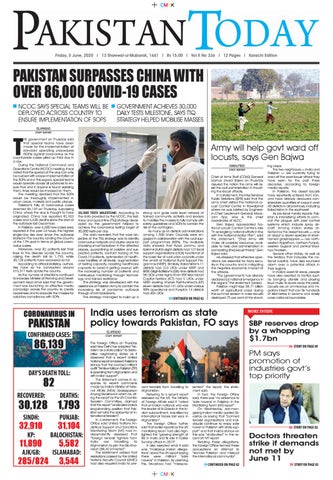
hE government on Thursday said that special teams have been made for the implementation of standard operating procedures (SOPs) against coronavirus as the countrywide cases piled up third day in a row. During the National Command and Operations Centre (NCOC) meeting, it was noted that the spread of the virus can only be curbed with proper implementation of the SOPs and in this regard, special teams would operate across all provinces to ensure that and if anyone is found violating them, fines would be imposed on them. The meeting decided that the SOPs would be thoroughly implemented in urban areas, markets and public places. Pakistan’s tally of coronavirus cases reached 86,139 on Thursday, surpassing China, where the virus is thought to have originated. China has reported 82,933 cases and 4,638 deaths since the start of the outbreak last December. In Pakistan, over 4,600 new cases were reported in the past 24 hours, the highest single-day rise ever since the outbreak started in the country, landing the country at the 17th spot in terms of global coronavirus cases. Moreover, over 82 patients lost their lives to the disease across the country, raising the death toll to 1,793, while 30,128 patients have recovered so far. According to official statistics, authorities have so far conducted around 615,511 tests across the country. As the number of infections continued to increase, Minister of Planning and Development Asad Umar said that the government was launching an effective media campaign across the country to create awareness and to educate the masses for voluntary compliance with SOPs.
Army will help govt ward off locusts, says Gen Bajwa RAWALPINDI staff report
30,000 TESTS MILESTONE: According to the data provided by the NCOC, the test, trace and quarantine (TTQ) strategy developed by the government helped to achieve the coronavirus testing target of 30,000 tests per day. The data revealed that the core objective of the TTQ strategy was to identify coronavirus hotspots and cluster areas for imposing smart lockdown in the affected places, quarantining of positive and suspected patients, contact tracing of the Covid-19 patients, optimisation of healthcare facilities at all levels, augmentation of testing capacity, boosting healthcare capacity to avoid it getting overrun with the increasing number of patients and meticulous monitoring through technology and trained workforce. The strategy was developed with the assistance of Pakistan Army to contain the increasing risk of pandemic outbreak through smart lockdowns. The strategy managed to build up a
Coronavirus in
Pakistan
CONFIRMED CASES:
86,139
DAY'S DEATH TOLL:
82
RECOVERED:
DEATHS:
SINDH:
PUNJAB:
30,128 1,793 32,910
31,104
KP:
BALOCHISTAN:
AJK/GB:
ISLAMABAD:
11,890 285/824
5,582 3,544
strong and grass roots level network of trained community activists and leaders to mobilise the masses to fully comply with safety guidelines and SOPs to contain the risk of the contagion. As many as 66 districts administrations among 1,500 Union Councils were engaged in collaboration with the rural support programmes (RSPs). The available data showed that Azad Jammu and Kashmir (AJK)’s eight districts had 127 local support organisations (LSOs) functional at the basic tier of rural union councils under the ambit of National Rural Support Programme (NRSP). Similarly, Balochistan’s 11 districts had 223 LSOs under NRSP and BRSP, Gilgit-Baltistan’s (GB) nine districts had 58 LSOs under Agha Khan RSP, Islamabad Capital Territory (ICT) had 5 LSOs under NRSP working, Khyber Pakhtunkhwa’s (KP) seven districts had 141 LSOs under various RSPs operational and Punjab’s 14 districts had 406 LSOs.
CONTINUED ON PAGE 02
Chief of Army Staff (COAS) General Qamar Javed Bajwa on Thursday assured the nation the army will assist the civil administration in thwarting the locust attacks. In a statement, the Inter-Services Public Relations (ISPR) said that the army chief visited the National Locust Control Centre in Rawalpindi where he was briefed by Engineerin-Chief Lieutenant General Moazzam Ejaz, who is the chief coordinator of NLCC. Gen Bajwa appreciated National Locust Control Centre’s role “in synergising national efforts in line with the National Action Plan”, said the statement. “[The] Army will make all possible resources available to help civil administration in combating [the] locust threat,” Gen Bajwa said. he stressed that effective operations are essential for food security in the country and in mitigating the negative economic impact of the attacks. “The [government] has already declared [a] national emergency in this regard,” the statement added. Pakistan might lose $8.71 billion worth of agricultural crops during the summer season in case locusts destroyed 75 per cent of the stand-
India uses terrorism as state policy towards Pakistan, FO says ISLAMABAD staff report
The Foreign Office on Thursday said New Delhi has adopted “terrorism as a state policy” to destabilise neighboring states as it observed that a recent United Nations report endorsed Pakistan’s stance that the banned militant outfit “Tehrik-e-Taliban Pakistan (TTP) is operating from Afghanistan and with Indian support”. The statement comes in response to recent comments made by India’s Ministry of External Affairs (MEA) Spokesperson Anurag Srivastava in which he, citing the report by the UN CounterTerrorism Committee, claimed that the report “vindicated India’s long-standing position that Pakistan remains the epicenter of international terrorism”. In a statement, the Foreign Office said United Nations Analytical Support and Sanctions Monitoring Team (MT) had independently assessed that “foreign terrorist fighters from India are travelling to Afghanistan to join the ISIL-Khorasan (ISIL-K) [chapter]”. The statement added that resolutions passed by the United Nations Security Council (UNSC) had also required India to pre-
ing crops. The two neighbours — India and Pakistan — are currently trying to ward off the worst locust attack they have seen for the past three decades, according to foreign media reports. In Pakistan, the desert locusts have reportedly entered from Iran, and have already devoured considerable quantities of crops in over 60 districts in all provinces, including Balochistan in the southwest. As per local media reports, Pakistan is intensifying efforts to combat the plague with pest control systems which include spray aircraft. Among Indian states affected by the desert locusts — one of about a dozen species of shorthorned grasshoppers — are northwestern Rajasthan, northern Punjab, western Gujarat and central Madhya Pradesh. Several other states, as well as the territory that includes the national capital, have also sounded alarm over a potential attack in their regions. In India’s worst-hit areas, people have also resorted to tactics such as banging utensils and playing loud music to scare away the pests. Locusts are an omnivorous and migratory insect that can fly hundreds of kilometers in swarms and easily cross national boundaries.
more inside
SBP reserves drop by a whopping $1.7bn STORY ON PAGE 09
PM says promotion of industries govt’s top priority vent terrorists from travelling to Afghanistan. Referring to a recent report released by the MT, the Ministry of Foreign Affairs said it “noted that an Indian national, who was the leader of Al Qaeda in the Indian subcontinent, was killed by international forces last year in Afghanistan”. The Foreign Office further said that earlier reports by the UN monitoring team had also highlighted the “growing strength of ISIL in India and its role in Easter Sunday attack in 2019”. It also rejected what it said was “malicious Indian allegations” about the UN report saying there were militant “safe havens” in Pakistan. By claiming this, Srivastava had “misrepre-
CMYK
sented” the report, the statement said. In fact, the Foreign Office said, there was “no reference to ‘safe havens’ in Pakistan in the Monitoring Team (MT) report”. On Wednesday, war-mongering Indian media quoted Srivastav as saying that “banned terrorist organisations and individuals continue to enjoy safe haven in Pakistan with state support” and that India’s stance on this was “vindicated” in the recent UN MT report. Refuting these allegations, the Foreign Office termed these accusations an attempt to “slander Pakistan and mislead the international community”.
CONTINUED ON PAGE 02
STORY ON PAGE 02
Doctors threaten strike if demands not met by June 11 STORY ON PAGE 03
02
Friday, 5 June, 2020
NEWS
PM SayS ProMotIon of InduStrIeS govt'S toP PrIorIty finAnce Adviser sAys govt won’t imPose new tAxes in uPcoming budget ISLAMABAD
P
STAFF REPORT
RIME Minister Imran Khan on Thursday said that the promotion of industries and provision of all possible facilities to the business community was a top priority of the government. The prime minister stated this while chairing a high-level meeting regarding the proposed budget for the next financial year.
Adviser on Finance Dr Abdul Hafiz Shaikh presented a sketch of revenue and expenditures of the ongoing fiscal year and estimates for the next budget. The adviser gave a detailed briefing about progress on reforms in the Federal Board of Revenue (FBR). The prime minister said that special attention would be given in the next budget on revival and promotion of the industrial sector affected due to coronavirus. He said the government would ensure the best and effective
Coronavirus situation out of control, says Sindh health minister Sindh Health Minister Dr Azra Fazl Pechuho on Thursday said that the coronavirus situation in the province has gotten out of control. She said that the pathogen has now exceeded levels of danger that were previously predicted. Azra also said that the province lacked means and resources to take further care of coronavirus patients. On May 25, the provincial health minister had appealed to recovered coronavirus patients to donate blood plasma. In her appeal, she had said that there was an alarming increase in the number of critical patients admitted to hospitals. “We are in dire need of blood plasma donations from recovered coronavirus patients for passive immunisation therapy,” she said, adding that people from any blood group could donate plasma to them. She appealed to the masses to come forward and help Sindh government in curing coronavirus patients as the process of plasma transfer was being done under standard operating procedures (SOPs). NEWS DESK
Sindh govt decides to test all int'l travelers KARACHI: The Sindh government has decided to test all the overseas passengers landing at Jinnah Terminal Karachi and keep them in quarantine as per Standard Operating Procedure (SOP). In this connection, CM Advisor on Law Murtaza Wahab has tweeted that 246 passengers landed at Jinnah Terminal from Saudi Arabi and 123 of them were diagnosed positive. All these tests were conducted by the Sindh government and now have started tracing the passengers to put them in isolation. It may be recalled that the federal government has lifted the ban on national and international flights and had announced that the passengers would not be tested. The Sindh government, keeping in view the Covid-19 emergency and gravity of the situation, has decided to test each and every passenger, landing in Karachi. The passengers coming from other countries would have to under the COVID-18 test which is not only in their interest but in the interest of their family members and social circle. “We are already facing a spike in the cases and the death ratio has increased from one percent to 1.7 percent, therefore, there would be no compromise on the tests,” said Information Minister Syed Nasir Shah. Nasir Shah quoting the chief minister said that clear instructions for testing of each and every passenger had been issued to the health department. PPI
Marriyum challenges Imran to submit formal response in defamation case LAHORE: Pakistan Muslim League-Nawaz (PML-N) Secretary Information Marriyum Aurangzeb has challenged Prime Minister Imran Khan to submit a formal response over his claim of Rs10 billion “hush money” allegedly offered by Opposition Leader Shehbaz Sharif, saying that if the premier does not do so then he would not be morally eligible to hold office. Talking to media on Thursday, Marriyum said that the premier would also cease to be righteous and trustworthy in the light of Article 62, 63 of the constitution. “A lying, sugar robbing, incompetent and unqualified person does not deserve to be the leader of the great Pakistani nation. The person who is playing with the lives of his countrymen does not deserve to hold the office of the prime minister,” she added. The former information minister said that the leader of the “NAB-Niazi alliance”, Imran, has been an absconder from the case for the past three years by delaying proceedings 33 times. She said for the past six years, he had been an absconder in the foreign funding case in addition to the 23 secret accounts case which he delayed for two years. Marriyum clarified that Babar Awan cannot represent PM Imran in the case because he is a government office holder and called out the hypocrisy of the system, saying the court has been conveniently excused him appearing in court over the danger of contracting Covid-19 but Shehbaz is summoned twice a week. STAFF REPORT
use of subsidies besides cutting down unnecessary government expenditure. The prime minister emphasized that the government in the upcoming federal budget would give special attention to curtail non-developmental expenditures. The prime minister stressed the need for ensuring full participation of the private sector in development projects, adding that promotion of public-private partnership was need of the hour. The prime minister directed the adviser
on finance to give final shape to estimate of development expenditures in consultation with the provinces. Separately, Shaikh told a media outlet that the government won’t impose new taxes in the light of the Covid-19 pandemic. He said there is no plan to introduce new taxes in the upcoming budget. He said the Pakistan Tehreek e Insaf (PTI), the government was well aware of the country’s defense need and for this, all required funds would be provided to the army. Abdul Hafeez Sheikh said the government would curtail extra expenditures and steps would be taken for proper collection of taxes in the country. To a question about the rising circular debt
situation, he said the government owed Rs2 trillion in circular debt.
Plane crash report to be made public by 22nd: minister LAHORE TLTP
Minister for Aviation, Ghulam Sarwar Khan has said that the initial inquiry report about the recent PIA plane crash incident in Karachi will be made public by the 22nd of this month. Addressing a press conference here on Thursday, he said that a four-member inquiry board is probing the tragic incident. He said a detailed probe report will be made public in four to six months. He said that the government has compensated bereaved families of martyred passengers, with one million rupees compensation per family. He said that people with damaged property due to plane crash will also be compensated. He rejected all rumours regarding his resignation and said that no one should be held accountable for the ill-fated Pakistan International Airlines (PIA) plane crash till the inquiry in the matter is completed by the concerned investigation committees. The minister said that neither was he asked to resign nor had he made such an offer, adding that nobody’s fault or negligence has been identified yet.
The federal minister said that on the directives of Prime Minister Imran Khan, he has been visiting the families of all those killed in the plane crash. He said that of the eight deceased crew members, the bodies of seven have been handed over to their heirs. Sarwar said that the aircraft’s voice box and data box have been handed over to the French probe team
India uses terrorism as state policy towards Pakistan, FO says COntInuED fROM pAgE 01 “The MEA’s distortion and falsification of the contents of the MT report and its concocted allegations reveal that India’s agenda is to create complications for the Afghan peace process,” the FO said. “There is no reference to ‘safe havens’ in Pakistan in the Monitoring Team (MT) report. The report is based on briefings provided in Afghanistan to the MT by certain quarters who have long expressed skepticism about the Afghan peace process. This skepticism is not shared by the larger international community, especially the UN Security Council and the UN Secretary General,” the statement said. “The MEA’s distortion and falsification of the contents of the MT report and its concocted allegations reveal that India’s agenda is to create complications for the Afghan peace process. Pak-
istan has warned the world about the role of spoilers within and outside Afghanistan. “Pakistan has been highlighting India’s sponsorship of terrorist organisations in Afghanistan against Pakistan.” It added that the TTP continued to operate in Afghanistan with Indian support and threatened Pakistan and other countries in the region. “Pakistan has proposed the listing of several Indian terrorism facilitators on the UN Security Council’s terrorism list along with evidence of their involvement in terrorism,” the statement said, adding that Pakistan hoped the “UN Security Council will designate them soon”. “The people of Indian Occupied Jammu and Kashmir (IOJ&K) have long suffered from India’s state terrorism, especially after the cruel lockdown and oppression imposed by the RSS-inspired BJP-led extremist government since 5 August 2019,” it concluded.
sent by Airbus for further investigations and hopefully, within a week, the team would brief the ministry on the initial findings. “We are striving for a transparent, fair and impartial inquiry regarding the regretful incident,” said the aviation minister. Stressing that maximum facilitation is being provided to the victims’ families, the aviation minister stated that the brother of deceased pilot Sajjad Gul, who came from London for his brother’s funeral, was given a ticket by PIA “in line with our standard operating procedures and directives from the Premier to facilitate the victims of PIA plane crash”. The minister also discussed the repatriation of Pakistanis stranded abroad due to coronavirus and international travel restrictions imposed across the world. He said that the operation to bring back 34,000 Pakistanis stranded abroad will continue till June 10. “After June 10, we will take the provinces into confidence and decide the next course of action,” he said, adding that about 100,000 Pakistanis stranded abroad have applied for repatriation in their respective embassies.
Pakistan surpasses China with over 86,000 Covid-19 cases COntInuED fROM pAgE 01 “Under these RSPs collaboration around 20 million people would get benefit from community awareness and education programmes and relief activities to control the coronavirus epidemic,” the report read. Since the strategy was launched across the country after completing its pilot phase, around 2,117 community awareness raising sessions were carried out in the shortest span of time across the country. However, 13,700 mosque announcements were made, about 17,813 information providing pamphlets, brochures and leaflets were distributed, few suspected cases were also identified with the help of this strategy and were referred to the respective health departments, 4,918 face masks were also distributed along with safety gloves whereas 3,430 families were provided soaps for handwashing. It is worth mentioning here that under the NRSP collaboration in ICT, around 80 women and 20 men were trained as community activists that signifies the commitment of the masses especially women to spearhead social efforts to contain the risk of outbreak through education and awareness. Moreover, RSPN has established a monitoring system for this initiative and its format was shared with the NCOC where the information would be provided to NCOC weekly and fortnightly on this format.
in a first, Pakistan earns $6.2m through cigarette exports Although PAkistAn hAs been exPorting tobAcco rAw mAteriAl, this is the first time the country exPorted finished Products ISLAMABAD GHULAM ABBAS
By exporting cigarettes (finished product) for the first time, the country has earned at least $6.28 million in the past 11 months of this financial year (FY20). However, the exports could not be accelerated as per the expectations; gulf countries had placed import orders of cigarettes worth $50 million last year. According to documents available with this scribe, the revenue of $6.28 million during July-May FY20 was the country's first-ever major earning from the export of value-added tobacco products. Although Pakistan exports tobacco (raw material) to various countries, this was the first time that the country ex-
ported finished products, a step which experts believe would help the country capture more markets and earn better returns in the future. As per the data, there was "zero export of cigarettes in FY19", whereas highly negligible quantities of some tobacco products were exported in FY18, FY17 and FY16, amounting only to $50,000, $92,000 and $78,500, respectively. It is pertinent to mention that Pakistan Tobacco Company (PTC) had last year received an import order of cigarettes from gulf countries, particularly Saudi Arabia. "The importing country, after placing the order, had changed its standards for cigarettes, which ultimately caused a delay in the export of the product from
CMYK
Pakistan,” a PTB official said, adding that PTC had later started exporting cigarettes after meeting the new standards of the Arab country. According to the official, "Many cigarette manufacturing plants in Khyber Pakhtunkhwa were established in 1960s' and 70s', following which the importers had asked us to upgrade the quality of tobacco, paper, filters, packaging etc. These requirements have now been met successfully and we are expecting a massive surge in the export of cigarettes to Middle East countries from this year." During the past 11 months, Pakistan collectively exported tobacco worth $38.12 million, which included $15.26 million kilogrammes of tobacco and 0.72 million kg of cigarette. Of the total
amount, raw tobacco had a share of $31.84 million. Pakistan has a market share of around $25 million in the $80 billion trade of world tobacco. According to sources, Pakistan has been exporting tobacco (unfinished) worth $25 million to the Middle East and some European countries, which is almost 30pc of the total tobacco being produced in the country. Rest of the commodity is consumed in making cigarettes for the domestic market. As per statistics of financial year FY19, at least 108,000 tonnes of tobacco worth $24.4 million was exported to at least 26 countries. Pakistan’s major tobacco export destinations included South Korea, Malaysia, Indonesia, Netherlands, UAE, Paraguay, Saudi Arabia, Germany, Kazakhstan, Myanmar, UK, Kuwait, Poland, Australia, USA, Singapore, Canada, Ukraine, Philippines, Bangladesh, Belgium, Afghanistan, Italy, Russia, Yemen and Bulgaria.
Friday, 5 June, 2020
NEWS
SC wonderS If govt Can ProSeCute a judge on 'falSe' legal advICe ISLAMABAD
S
STAFF REPORT
UPREME Court on Thursday wondered how can a reference based on “false legal advice” be filed against its judges as the fullcourt bench resumed hearing in the presidential reference against Justice Qazi Faez Isa which accuses the judge of concealing his offshore assets. As the hearing went underway, Justice Umar Ata Bandial noticed that the Money Laundering (Amendment) Act, which became law in 2015, cannot be applied to a
case that dates back to 2013. “How can the president and prime minister approve a reference based on ‘false legal advice’, Justice Muneeb Akhtar asked. “[We are] telling you leniently that this [legal] mistake can have serious implications.” Justice Mansoor Ali Shah noted that the federal government’s counsel also failed to explain from where does the Assets Recovery Unit (ARU) draws its authority to question a judge. Justice Bandial pointed out that the case cannot be categorised under Article 209 of the Constitution which outlines the functions of the Supreme Judicial Council (SJC). To
Healthcare reforms aimed at improving facilities: Imran ISLAMABAD: Prime Minister Imran Khan on Thursday said that the government has introduced reforms in the healthcare sector to improve healthcare facilities in the country and to correct the flaws of the current system. The prime minister said this while speaking to a delegation of Insaaf Doctors Forum (IDF) that called on him on Thursday. The delegation comprised Dr Munir Khan, Dr Saeed Mustafa, Dr Jawad Wasif, Dr Asim Rizvi, Dr Sajjad, Dr Mohsin Ranjha and others. PM Imran said that the common man is facing difficulties at the moment because the previous governments neglected the health sector, thus depriving people of quality healthcare facilities. During the meeting, both sides discussed the coronavirus situation in the country and the government’s strategy to curb the spread of the virus. The role of doctors and paramedical staff was specially highlighted during the meeting. Both sides also exchanged views about health sector reforms introduced by the Pakistan Tehreek-e-Insaf (PTI) government and the IDF expressed full confidence in the government’s initiative. STAFF REPORT
exports plunge 33pc to $1.39bn in May ISLAMABAD: In line with the expectations, the country's exports witnessed a major setback during the month of May 2020, mainly due to the coronavirus pandemic. According to data released by the Pakistan Bureau of Statistics (PBS), the country's exports fell to $1.39 billion in May 2020 as compared to $2.09 billion in May 2019, showing a decline of 33pc YoY. Meanwhile, imports into the country also witnessed a decrease of 43pc during the month under review, from $5.05 billion in May last year to $2.86 billion. Based on the above-mentioned data, the country's trade deficit witnessed a contraction of 50pc in May 2020 and remained at $1.46 billion. GHULAM ABBAS
which, Barrister Farigh Naseem responded: “Yes, you are absolutely right, but the SJC has issued a show-cause notice.” The prosecutor said that the federal government only forwarded the verified information to the SJC to conduct a probe into the matter. Justice Shah noticed that the court’s question seeking information on the number of public office holders facing legal action on a similar ground went unanswered. Naseem replied that he has made a note of the question. PRESIDENTIAL REFERENCE: The federal government in May last year filed separate references with the Supreme Judicial
Doctors threaten strike if demands not met by June 11 nEWS DESK Doctors across the country have threatened to go on strike from June 11 if the government does not provide protective gear and allowances to doctors, nurses and other paramedical staff, who are fighting against the coronavirus pandemic on the frontline. Addressing a press conference at the National Institute of Pediatrics in Karachi on Thursday, Young Doctors Association (YDA) General Secretary Sindh Dr Mehboob Noorani said that they have been repeatedly asking for protective gear and medical equipment but the Sindh government had been making false promises to them. He said that there were no ventilators in hospitals and doctors and health workers were working without protective gear because the government did not provide them with masks and other safety equipment.
APP
The Islamabad High Court (IHC) on Thursday sought comments from Ministry of Finance within two weeks on a petition against appointments in 10th National Finance Commission (NFC). Justice Mohsin Akther Kiyani heard the petition moved by Pakistan Muslim League-Nawaz's (PML-N) Khurram Dastagir. Barrister Mohsin Shahnawaz Ranjha and Finance Ministry's representative appeared before the court. During the course of proceeding, the representative of Finance Ministry requested the court to grant more time for submission of its reply in the case, which was granted by the bench.The court adjourned hearing of the case till June 18.On May 28, the court had directed the federal government to submit its response as it took up a petition questioning the inclusion of PM’s Special Assistant on Finance and Revenue
Reiterating their demands, Dr Noorani said that a special isolation centre should be set up for paramedical staff, nurses should be given Health Professionals Allowance, and a proper service structure should be formed for doctors and nurses. He said that doctors did not need salutes, but rather the families of those who were martyred in the line of duty should be given shuhuda packages. Lamenting the condition of hospitals, he said that the provincial government has handed over powers to private hospitals and the ‘mafia’, adding that Jinnah Postgraduate Medical College (JPMC) Director was sent a private hospital for treatment recently. Dr Noorani also highlighted the need for security of health professionals working in various hospitals across the country and demanded of the government to set up Rangers check posts in medical centres to ensure health workers’ safety.
lrh extends state-of-the-art facilities to covid-19 patients pESHAWAR APP
Since the start of COVID-19 pandemic in Khyber Pakhtunkhwa in February this year, the Lady Reading Hospital (LRH) of colonial era in provincial capital of KP has been entertaining the influx of coronavirus patients from mountainous Chitral district to DI Khan in South. The hospital was named after wife of British Viceroy Lord Reading in 1927. It is pertinent to mention that Lady Reading, the wife of Viceroy Reading was very fond of Peshawar city and liked its view from the historic fort Qila Balahisar (Fort Balahisar). Once during a visit to Peshawar, she fell from the horse and got injuries while taking a round of the city and she was taken to Agerton hospital for treatment but due to lake of medical facilities she was shifted to Royal Military Hospital (Now Combined Military Hospital). After few years in 1927, she visited Peshawar again and expressed her desire to upgrade Agerton Hospital and
IHC seeks Finance Ministry's comments in NFC case ISLAMABAD
Council (SJC) against two Supreme Court judges, Justice Isa and Justice Karim Khan Agha, accusing the two judges of concealing their assets and recommend action against them under Article 209 of the Constitution. According to Article 209, if the SJC finds the judge to be “incapable of performing the duties of his office or has been guilty of misconduct”, the president may remove the said judge from office. Subsequently in August, Justice Isa approached the apex court and requested it to form a full-court bench comprising all eligible judges to hear his petition against the reference while accusing then chief justice of
Abdul Hafeez Shaikh in the 10th NFC without consultation in accordance with Article 160(1) of the Constitution. The one-member bench comprising Justice Miangul Hassan had also sought responses from Federal Law Secretary Muhammad Khashihur Rehman, SAPM Shaikh, Principal Secretary to the president Tariq Najmi, Cabinet Secretary Ahmad Nawaz Sukhera and other respondents. Barristers Mohsin Shahnawaz Ranjha and Omer Gilani had represented the petitioner in the court. During the hearing, citing media reports, Barrister Omer Gilani had contended that Sindh Chief Minister Murad Ali Shah had also objected to the decision regarding the 10th NFC. To which, Justice Miangul Hassan had warned the lawyer to present “factual arguments instead of speculating” about the issue in question. “Whatever you cannot resolve on the assembly floor, you bring it here [to courts],” the judge had remarked.
donated rupees Rs. 52000/ (fifty two thousand rupees) for the hospital. The Agerton Hospital was later renamed as Lady Reading Hospital (LRH). Lady Reading Hospital is well known across the province as well as the country due to best health services being provided to patients by expert doctors in many specialities including the fatal coronavirus now a days. LRH came under enormous pressure of the suspected coronavirus patients during last three months seeking early diagnoses and treatment, but its computerized healthcare system, treatment and medical facilities remained unmatched during the pandemic. As a result, many of the coronavirus affected patients returned homes upon full recovery from the disease due to unprecedented services of its doctors and other health professionals during COVID-19 crisis. The KP's premier hospital remained a center of hope for thousands of patients in very crisis whether it was 2005 earthquake, war against terror, coronavirus pandemic and has never disappointed the masses.
03
Pakistan Asif Saeed Khosa of “showing personal bias against him”. He had argued that a judicial precedent for constituting a bench comprising the full court is already available in former chief justice Iftikhar Chaudhry vs the president of Pakistan through secretary and others. Later in September, he moved another petition making a similar request. The judge was of the view that matters narrated in accompanying civil miscellaneous application dated August 26 – “which may for the sake of brevity be read as a part hereof” – demonstrates the necessity for hearing by such a full-court bench. “The petition also raises a number of important constitutional questions, including that of the independence of the judiciary, the formation of an independent opinion by the president, obtaining federal cabinet’s approval and other vital issues of surveillance, and the manner and method of collecting evidence against a judge of the Supreme Court and his family,” he had said.
azad Kashmir cabinet passes bill proposing death penalty for child abusers MUZAFFARABAD: The cabinet of the Azad Jammu and Kashmir (AJ&K) on Thursday approved a bill proposing a death penalty for those found guilty of sexually abusing children. AJK Minister for Civil Defence Ahmed Raza Qadri presented the bill to the cabinet committee. The bill says that an officer of Deputy Superintendent of Police (DSP) rank will investigate such an incident. It also bounds the courts to announce their verdicts within 60 days of the incident. Following the cabinet’s approval, the bill will now be presented to the AJK assembly. If the assembly passes the bill, it will become a law. STAFF REPORT
Imran promises 'special funds' to Balochistan for uplift ISLAMABAD: Prime Minister Imran Khan has vowed that a special portion will be allocated to Balochistan province in Public Sector Development Programme (PSDP). Balochistan Chief Minister Jam Kamal Khan called on PM Imran Khan on Thursday. The CM urged the Centre to approve mega projects for the province, adding that he also sought to expedite development work on Khuzdar, Quetta and Chaman roads. They also discussed for an agriculture package for the farmland owners, construction of dams and power projects. PM Imran Khan and CM Jam Kamal Khan held consultations over ongoing projects of the National Highway Authority (NHA) and early completion of China-Pakistan Economic Corridor (CPEC). The premier assured Balochistan CM for the completion of the development projects at earliest besides allocating a special portion in PSDP, sources added. He said that the federal government is focusing on the development budget despite the coronavirus gave negative impacts on the national economy. He added that it is the top priority of the government for special allocations for the Balochistan province. STAFF REPORT
04 KARACHI
Friday, 5 June, 2020
WEATHER UPDATES FRIDAY
350C
280C
SATURDAY
350C
290C
SUNDAY
350C
280C
Prayer TImIngs FAJR SUNRISE
ZUHR
ASR MAGHRIB ISHA
4:14
12:30
3:53
5:41
7:19
8:47
20 Die of CoviD-19 aS 1,667 new CaSeS eMerge in SinDh, SayS CM KARACHI
a
PPI
S many as 1,667 new cases of coronavirus and 20 more virus related deaths were reported in the last 24 hours in Sindh province. This was stated by Sindh Chief Minister (CM) Syed Murad Ali Shah in a press statement issued from the CM House on Thursday. He said that the highest number of 8,390 samples were testes against which 1,667 new cases emerged that constituted 20 per cent of the tests. As far as, 208,843 samples have been tested which produced 33,536 cases that came to 16.1 per cent of the total tests. Shah said that 20 more patients died, lifting the death toll to 575 which came to 1.7 per cent of the total patients. He said that 366
patients were in critical condition, of them 66 had been put on the ventilators. According to Shah, at present 16,179 patients were under treatment, of them 14,910 were at home isolation, 99 at Isolation Centres and 1,170 at different hospitals. He said that the recovery rate of the coronavirus patients in Sindh had come to 50.1 per cent. “Our 764 patients recovered overnight and returned to their normal lifethe number of patients recovered so far had reached 16782,” he said. Giving district-wise breakup of the cases, Shah said that out of 1667 cases, Karachi has 1,311, of them 312 were in East, 271 Korangi, 257 South, 241 West, 143 Central, and 87 Malir. He said that Hyderabad had 42 new cases, Ghotki 38, Kashmore 32, Khairpur 25, Sukkur 24, Larkana 22, Shaheed Benazirabad 21, Dadu and Sujawal 11 each,
Shikarpur 10, Badin eight, Jamshoro seven, Sanghar five, Jacobabad, Kambar, Umerkot, and Tando Mohammad Khan three each, and Thatta, Mirpurkhas and Matiari one each. The chief minister urged the people of Sindh to be careful and adopt precautionary measures to defeat the pandemic. Later, while addressing newsmen in Karachi, he pointed to what he termed “mixed signals” as the reason behind the drastic surge in the number of Covid-19 cases in the country. The Pakistan People’s Party (PPP) has time and again accused the federal government in general and Prime Minister Imran Khan in particular of employing “confused strategy” and sending “mixed signals” in the fight against the pandemic that has so far affected over 83,000 nationals, leaving some 1,729 dead. Murad said that he does not blame the
public for violation of standard operating procedures (SOPs) as “mixed messages” have created confusion regarding the seriousness of the crisis. The chief minister demanded that a “unified message” be given to people so that they can obey SOPs set by governments. He said that he has never criticised the federal government in any of his press conferences, even if he disagreed with the steps taken by Centre. The pressers he held were to clarify the “mixed messages” being conveyed to people. Murad said that “nothing was more important than the lives of people”. “The poor people everyone is supposedly concerned about — and we should be concerned, it’s a good thing — but if a daily wage worker […] dies from the virus, how will his children eat for the rest of their lives,” he questioned.
Court summoned CM without any evidence, says minister KARACHI PPI
Sindh Minister for Information Muhammad Taimur Talpur said on Thursday that the manner in which Sindh Chief Minister Syed Murad Ali Shah had been summoned without any evidence in a case was the continuation of the same policy of PTI which it had been pursuing against the opposition for a long time. The minister said that the case against Sindh chief minister was very weak and there was no evidence against him. He said that no notice had ever been issued to the Chief Minister of Sindh in the case before two days back, adding that, the PTI government could do anything against the opposition. Shah further said that the Sindh Chief Minister was appearing in this case only so that no one could give the impression that he did not abide
by the law. The provincial minister added that the Sindh Chief Minister had nothing to do with this case. He said the case was filed on false grounds and making this case against the Chief Minister of Sindh at present was an attempt to divert the attention of the people from the real issues. Shah said that because the federal government did not take the coronavirus seriously, the pandemic was now out of control. The provincial information minister said that the PTI government was also constantly using various tactics to divert attention from the sugar scandal. He said that the people of Pakistan Tehreeke-Insaf (PTI) thought that the Chief Minister of Sindh might not appear and they would make it an issue. Shah said that because the PTI government did not want to take action against its own people involved in the sugar scandal, it was using various tactics to divert people's atten-
tion from it. The provincial information minister said that the Pakistan Tehreek-e-Insaf (PTI) government had always had the attitude of presenting its people as angels while other people according to them were considered as the root of all evils. He said that the report of the Sugar Commission clearly stated that one of the major factors in the rise in the price of sugar was to allow its export. Shah said that it was no longer a secret that the Prime Minister himself allowed the export of sugar, adding that, and his signature was there. The provincial information minister said that the tragedy in Pakistan was that no action was taken against those responsible. He said that the people of PTI kept saying that it had been two years since they came to power, but what would be their response to what happened to the cases against their people in Khyber Pakhtunkhwa, where they were in power for over five years now.
Murad observed that the relaxations in quarantine that were introduced in April had inflicted huge damage on the economy. He was of that decisions should be made while taking the entire country into consideration, including Sindh. “Sindh is not an island. It is a part of Pakistan,” the chief minister added.
Closure of PSM will result in economic murder of thousands: Dharejo KARACHI: Provincial Minister for Industries & Commerce Jam Ikramullah Dharejo in his response to the news of the dismissal of employees of Pakistan Steel Mills (PSM), has said that closure of PSM would mean economic murder of thousands of families, so the federal government needed to reconsider this decision. In a statement issued here on Thursday, he said that at a time when the whole world had been going through the same ordeal of coronavirus and Pakistan was also suffering from the same conditions, at a time when there was a need to provide relief to working families, the federal government was causing mental anguish and financial torment to working class. "PSM is a national asset. Such an institution needs to be activated instead of shutting down. Its activation may generate maximum employment opportunities," he said. He said that PPP condemned the anti-labour policy of downsizing in government institutions at all levels and it demanded of the federal government that maximum employment opportunities be provided to reduce unemployment in the country. Dharijo said it was unfortunate that the federal government wanted to sell government institutions and corporations to people it liked. PPI
Friday, 5 June, 2020
nEwS
Tobacco growers seek relief, favour Tax on producTs
T
HASSAN NAQVI
OBACCO farmers of Khyber Pakhtunkhwa have said that in the wake of the Covid-19 pandemic, the government must intervene and fix advanced tax on tobacco products instead of imposing levies on farmers. Led by Sarhad Agricultural and Rural Development Organisation and other organizations, farmers told Pakistan Today that the Pakistan Tehreek-e-Insaf government had taken several measures for other sectors to rescue them in the pandemic times and demanded they also be given relief. The farmers have the support of Kisan Board Pakistan, Pakistan Tobacco Workers Association, Sarhad Agricultural, and Rural Development Organisation, Labours Federation, and Anjuman Tahaffuz Haqooq-i-Kashtkaran. One farmer, Gul Khan said their province had no other cash crop like cotton and sugarcane, so they were left to grow tobacco as the only cash crop in the
province. He said over the years without any government support, they had been adding billions to the national exchequer as central excise duty besides providing livelihood to thousands of families. “(Advance) tax on farmers means relief for the tobacco industry while growers will be hit hard. The measure will also help multinational tobacco companies to create
a monopoly in Pakistan,” he said. He said tobacco companies would buy the finest quality tobacco from farmers at lower rates. Mehnatkash Labour Federation President Ibrarullah said that when coronavirus lockdown and halt in trade had snatched millions of jobs, the local tobacco sector was still intact and had the capacity to pro-
vide jobs to thousands of workers. “On the other hand, multinational companies are known for exploiting farmers and workers and layoff,” he maintained. He said one such company in Akora Khattak denied Mahnatkash Labour Union from working on the premises even though the union was duly registered with the Pakistan Labour Department. There are reports that Rs500/kg advance tax is being imposed on tobacco in the 2020-21 budget, Anjuman Tahffuz Haqooq-i-Kashtkaran president Haji Niamatullah said. He demanded that the government reinstate the prevailing tax ratio without imposing an advanced tax on tobacco crops. President of the Sarhad Agricultural and Rural Development Haji Abdul Nabi said that advanced tax on tobacco will burden the poor growers and farmers. President of Pakistan Tobacco Workers Association Liaqat Yousafzai the government should earn exchequer by imposing advanced tax on tobacco products (cigarettes pack) and local tobacco growers should also be included in the Pakistan Tobacco Board.
IHC summons health secretary for violating stay order ISLAMABAD STAFF REPORT
The Islamabad High Court (IHC) has summoned National Health Services (NHS) Secretary Aamir Ashraf Khawaja to appear on June 12 for proceeding against deputationist doctors despite its restraining order. A doctor serving at the Pakistan Institute of Medical Sciences (PIMS) filed a contempt of court petition in the IHC, stating despite restraining order of the court, Secretary Khawaja had started proceeding against him. “They [doctors] are the frontline soldiers in the global effort to protect human lives [amid coronavirus pandemic]. The medical practitioners and health workers have been working selflessly and serving humanity beyond their call of duty,” IHC Chief Justice Athar Minallah remarked on Thursday. Expressed annoyance at the represen-
tative of the Ministry of National Health Services, Justice Minallah said: “The attitude of the [health] ministry is non-serious even during the current situation.” The judge declared that the ministry was “compelling doctors to approach the court even at such a crucial time”. “You [ministry] are playing games both with the court as well as the public.” Addressing the representative of PIMS, who sought permission to speak, Justice Minallah told him that “it was not your fault”. In April this year, the judge was scheduled to announce an order on identical petitions filed by doctors working in the capital on deputation against their repatriation. However, according to him, he did not announce his verdict so that the doctors would not be disturbed. Upon asking, the plaintiff informed the court that it was a section officer within the ministry who handled the ad-
chinese man sentenced to death for killing pakistani student BEIJING APP
A Chinese man in East China’s Jiangsu province was sentenced to death in a first-instance judgement for killing Moiz Uddin, a Pakistani student of the Nanjing University, according to the local media here on Thursday. The man surnamed Cong, 28, stabbed Moiz in his chest with a knife on July 11, 2018, following a quarrel. The attack ruptured the victim’s heart and he bled to death, Jiangsu police said in a statement later that day. The quarrel ensued after Cong’s scooter slightly rubbed against Moiz, following which Cong bought a fruit knife from a nearby supermarket, and returned the spot to attack him, the police said. The Nanjing Intermediate People’s Court sentenced Cong to death for international homicide, turning down all arguments of the defense. Murder should be considered as international injury, the court held. As an adult, Cong should have clearly known that stabbing a person’s chest will lead to his or her death yet he repeatedly stabbed the victim in vital parts like chest and back, the court said in its judgement. Cong behaviour showed his obvious purpose of actively pursuing the death of the victim, it added. The court further rejected a defence argument that the victim was also at fault, saying there was no evidence to prove the victim provoked the brawl. After perpetrating the murder, Cong took refuge in his female friend Xia’s house. Both Cong and Xia were arrested by local police about eight hours after the murder. The then 18-year old Xia, did not know the victim was dead when sheltering Cong, said the court, adding that her subjective culpability of the mind was “relatively small”. Xia is sentenced to 17 months in person for harbouring a criminal, the court ordered.
ministrative affairs. The hearing comes a week after the federal government informed a National Command and Operation Centre (NCOC) meeting that it was
considering to bring in retired medics and final year medical students to bridge the gap between the demand and availability of doctors across the country.
SC directs govt to complete probe into Bahria Icon Tower case ISLAMABAD STAFF REPORT
The Supreme Court on Thursday directed the government to complete the investigation into Bahria Icon Tower case, and submit a copy of the final reference by July 6. A two-member bench of the apex court comprising Justice Umar Ata Bandial and Justice Qazi Muhammad Amin Ahmed issued the order while hearing Dr Dinshah’s bail application. During the course of proceedings, the court expressed anger over the
failure to arrest co-accused Zain Malik, son-in-law of Bahria Town Chairman Malik Riaz. Justice Qazi Amin asked as to why the National Accountability Bureau (NAB) did not arrest Zain Malik as he and Dr Dinshah were partners. He also asked about the chief minister, who had approved allocation of land for Bahria Icon Tower in Karachi. Justice Amin asked why NAB was protecting the accused from the law and whether it was right to build a magnificent building on the state land. The NAB prosecutor said the land of
Bagh Ibn-e-Qasim was allotted for Bahria Icon Tower. Advocate Mian Rauf, counsel for Dr Dinshah, said that his client became Advisor to the Chief Minister in September 2008 while the land for Bahria Icon Tower was allotted in April 2008. Justice Bandial asked whether Dr Dinshah had a feud with the government before he became an Adviser. Justice Qazi Amin said there was no need to look into the documents for such things as everything was written on the wall. Later the case was adjourned till July 6.
05
faisal sabzwari, daughters contract coronavirus KARACHI STAFF REPORT
Leader of Muttahida Qaumi Movement-Pakistan Faisal Sabzwari confirmed Thursday that he has been tested positive for coronavirus along with two of his daughters and his parents. “My coronavirus test came out positive today. In the past few days, my parents, my wife, and two of my [three] daughters contracted the virus,” he said on Twitter. “Among my family, only my second-oldest daughter and Madiha [his wife] were tested negative,” he added. Requesting friends and loved ones to pray for their recovery, he urged everyone to be cautious and follow the protocols for prevention against the deadly respiratory disease. “For God’s sake, be careful, be safe, because there is no space in the hospitals,” Sabzwari added.
world must take notice of atrocities in kashmir, says shibli ISLAMABAD STAFF REPORT
Minister for Information and Broadcasting Senator Shibli Faraz on Thursday urged the world community to take notice of oppression suffered by Kashmiri children at the hands of Indian occupation forces. In a tweet on the International Day of Innocent Children Victims of Aggression, the minister said that Indian crimes against humanity including illegal detention and martyrdom of innocent children in Kashmir was a question mark on the world’s conscience. Shibli Faraz said that inhuman lockdown still persisted in Indian Occupied Jammu and Kashmir where innocent children had been enduring rigorous imprisonment along with their families. The children including toddlers were being deprived of food and medicines, he said adding that the occupation forces should be brought to book for their crimes.
Emirates to resume scheduled flights to Pakistan ISLAMABAD APP
Emirates will resume scheduled passenger flights from Pakistan to Dubai on Monday, the airlines said in a statement on Thursday. The Dubai-based world’s largest international carrier will operate flights to three cities Islamabad, Karachi and Lahore. However, it will carry only cargo from Dubai to Pakistan’s three cities but will also carry stranded residents and citizens when returning to Dubai, Khaleej Times reported. “From June 8, Emirates will resume 14 weekly scheduled passenger flights from Pakistan to Dubai, including a daily from Karachi, five from Lahore and two from Islamabad. From Pakistan, the airline will fly UAE residents and citizens as well as cargo to Dubai. On the flights from Dubai to Pakistan, the airline will only carry cargo,” the
spokesperson said in a statement. “Emirates will fly from Karachi daily, from Islamabad on Thursdays and Saturdays and from Lahore on Mondays, Tuesdays, Thursdays, Fridays and Sundays. Travelers from Pakistan will only be accepted on these flights if they comply with the eligibility and entry criteria requirements of the UAE government,” the airline said. Since the outbreak of Covid-19 and grounding of operations, Emirates has previously operated only special flights to Pakistan to repatriate stranded people from the UAE. The local carrier is already flying scheduled passengers flights to nine destinations including, Chicago, Frankfurt, London Heathrow, Madrid, Melbourne, Milan, Paris, Sydney and Toronto. It aims to add 50 new destinations in June 2020. Emirates said on its website that every passenger flying to Dubai needs to
fill in this health declaration form, print it and hand it over to our ground crew at departure. In addition, travellers will need to ensure that they have the Federal Authority for Identity and Citizenship (ICA) approval
before they book their flights. Stringent entry restrictions remain in place upon arrival in Dubai which includes including a mandatory DHA test on arrival; a mandatory 14-day quarantine and a follow up test before release.
Friday, 5 June, 2020
06 COMMENT
Riots in a time of covid-19
Increasing corona cases And a flip-flopping government
O
N Wednesday evening Pakistan exceeded China in the number of covid-19 positive cases. This should discourage the government leaders from resorting to the hackneyed refrain of the pandemic cases in Pakistan being still below its projections. The government is opening up tourist resorts while maintaining that it would strengthen the lockdown wherever it sees gross violations of the SOPs. It seems to have belatedly discovered that regulations meant to stop the spread of the virus cannot be implemented through advice. The PTI leadership does the right thing only once it has exhausted the alternatives. Finding that appeals-cumwarnings by the PM and his team did not produce the desired effect and that there were few takers for Federal Minister Asad Umar’s “no mask, no service” advice, the government has decided to come down hard on those who violate the SOPs. With 607 corona patients dead in Punjab over the period, the province has suffered the largest number of mortalities in the country. When the Islamabad administration decided to impose a fine of Rs 3000 for violation of SOPs, Punjab CM Usman Buzdar said he had no intention of following suit. The figures seem to have had a sobering impact on Mr Buzdar. He has reportedly decided to put his foot down to ensure implementation of SOPs in some of the worst-hit Punjab cities through punitive measures. Markets found to be lax would be closed down, buses violating SOPs stopped from plying and anybody in a public place without mask fined on the spot. What worries one is that the PTI government can suddenly take an about turn to wriggle out from some of its some of its major commitments. It continues to maintain that it has a sufficient supply of PPes and ventilators, and sufficient capacity in hospitals. However it has suddenly resiled from the responsibility to provide quarantine facilities to expatriates returning from abroad. Does it imply that the number of pandemic affectees has reached a point where it is no more possible to accommodate them in the present quarantine centres? What will happen if the numbers climb to a point where hospitals beds are found to be insufficient? Will corona patients be told to fend for themselves as they are themselves responsible for the illness?
Trump has only made matters worse At Penpoint m A nIAZI O mankind! Lo! We have created you male and female, and have made you nations and tribes that ye may know one another. Lo! the noblest of you, in the sight of Allah, is the best in conduct. Lo! Allah is Knower, Aware. (49: 13)
T
He USA is now showing signs that race has coming to the fore. The protests in over 600 American cities over the killing of one African-American in Minneapolis have now started to become riots, with incidents of arson and looting. This should not be happening, because the USA has gone through the throes of the civil rights movement about half a century ago, and AfricanAmericans are making headway in public life, with one, Barack Obama, even becoming President. However, just as the USA was the last bastion of anti-black discrimination, race remains an issue there. Blacks have been overtaken by yellows and browns, both of whom have faced discrimination from the dominant whites. It has been called ‘culture’ or ‘values’, but they are always under attack from outside. The USA remains the home of political correctness. Now extending to any kind of minority group, it started with the conscious decision to abandon certain words (most notably the n-word, a very strong no-no, used apparently only by black stand-up comedians) which were hurtful to blacks. One of the most significant issues in the USA is what constitutes a ‘black’. Actually, he (or she) might be white, even blond. It is perhaps symbolic that the USA’s first black President had a white mother. The difference between the average American black and a West African shows that there was considerable miscegenation in the past, with white masters mating with black slaves. This had happened with Arabs too, but whereas the children of slave mothers were free if their father was, in the Western world, they were born slaves. According to the Abrahamic faiths, all Mankind is descended from one couple, and after the Deluge, from the three sons of Noah. The descendants of those three make up the races of Mankind. There are obvious differences between a West African, an Indian and a Chinese, but what about mixtures? Not Obama, but all Myanmarese, who are apparently a mixture of Indian and Chinese. Colour plays a role, but race is now seen as a social construct, which can only be used to fulfill certain racial stereotypes. Like basketballers or heavyweight boxers are blacks. They are short blacks
PSM retrenchment Inevitable preliminary to privatization
T
He economic Coordination Committee of the Cabinet has decided on the retrenchment of all 9350 employees of the Pakistan Steel Mills, and though the decision must be ratified by the full Cabinet, it should go through, including a one-time salary payment of Rs18 to 19.7 billion, which would give workers an average of Rs 2.3 million each. It might seem an odd decision while the government needs every penny it can get to pay for the coronavirus pandemic, but it should also be remembered that the PSM had not been operating since 2015, and since then, the salary bill, then for 14,753 workers, had been met by the government, and adjusted as a loan in PSM books. Since 2013, that loan has reached Rs 34 billion, with a monthly bill of Rs 350 million. The move was probably overdue, not least as a preliminary to privatization, as any new owners would be free to hire anyone they might feel useful without any preconditions. One problem would be that those still on the rolls would include many political appointees, for the PSM was long regarded as a source of jobs for the boys. At the same time, there should not be much delay in the PSM privatization. It was done before, and the Supreme Court stepped in and cancelled the deal. PSM may own much desirable real estate, but that should not be an excuse for holding back on a necessary step. Also, while PSM workers have been given due compensation packages, their fate should not be used as an excuse to stop their retrenchment, and the government should resist the inevitable pressures to take back the step. However, that does not mean the plan is flawless. There has been no appreciation shown of the consequences of turning loose nearly 10,000 workers onto the job market, at a time when the economy is in free fall. There should have been a rehabilitation plan, ideally voluntary, on offer. It is still not too late for the government to come up with one, preferably in partnership with the workers who will be affected. This should be done quickly, while employees have not yet spent the capital they have in the form of their compensation, so that it is available for use, if need be.
To webinar or not to webinar? Webinars are taking over, now that there is a pandemic Dr Aneel SAlmAn
W
e have moved from the “age of uncertainty” to the “time of the coronavirus”. Through technology man has remained “social” and “connected” in this “new normal”. This is both remarkable and ironic since there was a time when devices and social media platforms were considered only for extracurricular connections. Online meeting tools have made it possible to work from home. Software companies had been using such tools way before covid-19 and as lockdowns were initiated, the corporate sector, non-profits and especially universities, started using these tools. In Pakistan, where the public (and the government) has been in a state of denial regarding this virus, we now suddenly see a surge in “webinars”, training webinars, educational webinars, discussion webinars, and more. Are we using these tools correctly? What is the effectiveness of these online forums? Is serious debate being generated through them? Or is the sole purpose remaining relevant in a rat race? If A is doing a webinar or podcast, why can’t B? Or is the purpose to show that one is “working”, “researching”, teaching”: How else to convince a donor, a dean, a research director that one is actually earning one’s income while sitting at home? Sadly, in Pakistan, we have yet to learn the benefits of Work From Home (WFH) from an organizational and institutional perspective. employers remain certain that unless one is sitting in the actual office from 9-5, one is essentially “doing nothing.” And of course, since seminars and conferences cannot yet be organized (well, if marriagew halls can open, these might start too, who knows) – an essential part and parcel of many organizations now, a webinar is the next best thing. Before COVID-19, when non-profits and even government ministries organized any conference, workshop, seminar to satisfy their “donors” (anyone believing these spread awareness and make a difference, has only to attend a handful by think tanks in the capital), they would lure university students to fill the empty chairs, with the incentive of good (rather free) food, or in some cases transport, and a chance
Dedicated to the legacy of the late Hameed Nizami
Arif Nizami Editor Aziz-ud-Din Ahmad
Umar Aziz
Asher John
Joint Editor
Executive Editor
Deputy Editor
Lahore – Ph: 042-36300938, 042-36375965
as well as tall whites, and light blacks and huge whites too. For example, the surprise by some that Minnesota, where a lot of Nordic immigrants settled, should have a black population large enough to riot, is stereotypical in its assumptions. The USA included the blacks in its constitution, equating six of them with one white, when it specified that the allocation of seats in the House of Representatives would be according to the population of free people plus a sixth of the slave population. The slaves counted for representation, but did not have the vote. The USA went through a Civil War before slavery was abolished, but the end of slavery did not mean an empowerment of blacks. In the south, they remained subject to a severe colour bar, and there were lynchings and discrimination against any ‘uppity’ blacks. The world was dominated by the white race, with very few independent non-white states, the non-white world being almost all parts of colonial empires. The dissolution of those empires coincided with the American civil rights movement. The empires had practiced racism too, and it had helped that the rulers, whether British, French, Belgian, Dutch or other, had all been white. There was the rise of fascism during the inter-war years that preceded the end of colonialism, which has since morphed into white supremacy. The defeat of the South in the US Civil War also carried an undercurrent of racism, and neo-Nazis and white supremacists got involved in supporting the South. Obama got elected, and that seemed like the blacks were finally getting their rights. Yet it was a spate of killings of black men, mostly youths, by white arresting officers, that marked the last years of his Presidency. Then came Trump’s election, beating a woman candidate. Women were natural allies of blacks, as they too were deprived of their rights by white males. The liberation of blacks, women and minorities was carried out because of the enlightenment ideals inherent in the American Revolution. The first step was not taken by either blacks or women, but by first the Irish and then the Jews. Both were white, but excluded, because they were neither Anglo-Saxon nor Protestant. But has liberation taken place? A lot of the old rhetoric has been dialed down, but as happened in Minneapolis, black men still get killed by white cops. They might not be shot, as Floyd wasn’t, but they end up dead for non-capital offences. As recently as January, a black jogger was shot by a father-andson passing by, who were not even cops. That is an old tactic. A couple of blacks became Roman emperors, the first, being Macrinus, a Berber, who became emperor after taking over in April 217. He was assassinated in June 218. Then there was Phillip the Arab, who reigned 222-249. Both had first commanded the Paetorian Guard, and then taken over for themselves. Colonies were freed, and turned over
I
Karachi – Ph: 021-35381208-9
I
to listen to not one boring professor in class but quite a few in an air-conditioned hall. In the virtual world, this duplicity and lack of good content and speakers; this trend of hosting big seminars, calling political celebrities and bringing students to fill up chairs as part of a popularity contest, has come to an end. But, this is Pakistan and we know how to turn every good thing into a Frankenstein’s monster so, while earlier, it was impossible to meet government officials, NGO heads and experts because they were busy in non-stop meetings; the ‘new reason’ shared in a text message will be that they are busy in nonstop webinars. Now, one may not have to fill empty chairs, now one has to “log in” to show how many people “participated”! One of my colleagues had to “show” his presence in nine webinars in one day! THeRe is an exponential increase of webinars by universities, think tanks and government agencies which may not have been such a bad thing except everyone is doing it on COVID and its impact on anything and everything. A newspaper editor shared that he got over 100 articles about COVID in two days. You might say what else is there except COVID but if you pick up one article or all 100 they will be saying almost the same thing. “experts” write on COVID and then on the same day, turn it into a podcast or share this “wisdom” in a recorded webinar with five people tuned in (or rather out). In Pakistan, we love to recycle research; and are copy-paste gurus but thanks to COVID, we have taken self-projection and plagiarism to new highs. Are these webinars effective? Frankly, no. For one thing, Pakistanis have no webinar etiquette. Somehow most people don’t realize that WFH means doing office work in a structured and organized fashion. And if part of WFH involves, attending or presenting during a webinar then we should have the decency to be dressed up rather showing our pot bellies in shorts, messed up hair, have a decent background (and no, I don’t mean sit in front of the only bookshelf in the house). We should not attend our phone calls or be watering the plants till our turn comes. And yes, it would be nice if the organizers ensure that speakers are at least WeLL PRePAReD! That they are actually interesting people to listen to (and yes watch)! That they are aware of webinar eti-
Islamabad – Ph: 051-2204545
I
Web: www.pakistantoday.com.pk
I
to Westernised elites. The words of the Quran establish Islam as an anti-racist religion, but it is not against the division of Mankind into nations and tribes, but it does so for a reason ‘that you may recognize one another’. This accepts that one’s inheritance matters, but there is an important qualification, that what matters in the sight of the Almighty, is one’s conduct. This is as strong a rejection of racial stereotypes as can be made. Not all religions take this stand. Christianity and Judaism used the Bible to justify slavery, and Hinduism is actually the only religion to base itself on racial divisions. It can be debated whether there is more to Hinduism that the four castes, but in this era of the BJP, it is doubtful if that debate matters. The BJP consists basically of caste Hindus trying to fight back against the enlightenment ideals of the Congress Party (via Nehru’s Fabian socialism). It is symptomatic that the word for ‘caste’, varna, means colour. No wonder then that Indians (whether at home or in the diaspora) are racial bigots. Pakistanis are too, but this is an inheritance from a Hindu past. Higher castes which converted to Islam carried over their old castes, and preserved them by the practice of caste-endogamy. Lower castes were never allowed by their neighbours to forget their caste. Only now has there been some blurring of caste lines. One factor that has been mentioned only in passing has been the covid-19 epidemic. The race riots are seen as a distraction, which has perhaps concealed the role of the lockdown in the USA of creating the atmosphere for people to protest. Also, it should be noted that blacks have been hit that much harder, not because of some predisposition, but because they are poorer, suffer a higher proportion of predisposing morbidities, and are in more exposed professions like nursing or goods delivery. Will the USA survive? It probably will, but at the same time, the present riots have shown that race is an issue. The coming presidential election shows that blacks do not sit well with US democracy, which seems to be designed only for WASP (White AngloSaxon Protestant) males. If on the one hand, Donald Trump is linked to white supremacists, Joe Biden has very old links to the KKK (Ku Klux Klan). He might have been Obama’s Vice-President, but that was probably because he was supposed to have been the designated adult in the room. The race issue is likely to tear the USA apart, not just because it is a matter of justice, but because it shows immigrant minorities that if a minority which has fully internalized ‘American culture’ and has lived in the USA for more than three centuries that they will not be accepted as full citizens, just because of their skin-colour, what chance have they?
The writer is a member of staff.
quette and are technologically savvy! It is so amazing that most webinars being done in Pakistan are proudly uploaded on Facebook or YouTube or available on organizational websites without even being edited to remove improper language or conversations or hacking! I used to love watching America’s funniest home videos, but now, I rarely miss the chance to be amused by the ratpack webinars here. Given our technological backwardness at using these platforms, we have also seen webinars interrupted by political slogans, porn clips and absurd pics during live sessions. Moderators/organizers having left the “technical” side of hosting webinars to the one nerdy tech guy, are unable to control such interruptions, and often the webinar is postponed. Another problem with local webinars is that content is not tailored to the viewers and their new environment. Pakistani webinars offers few opportunities to engage with speakers in real time. Organizers are still stuck in introducing a speaker and then letting him or her drone on and on and on, rather than making these sessions short, focused and interactive. Let’s be honest, good quality webinars can be mind-blowing! To be able to hear and interact with renowned experts from literally any corner of the world, with the click of one “register” button, free of cost from the comfort of one’s room, is stupefying. So, there still remains a question as to why organizations (or we as a nation) weren’t using these technologies earlier and spent so much time in transporting speakers from one city to the next, paying for travel, accommodation, food, leaving huge paper trails of invite cards, letters etc. when the same meeting or seminar or even conference was possible online with none of these ridiculous attachments? Local webinar organizers need to think of how to engage the viewers and what they can learn for them. Most webinars are doing discussion/analysis but webinars can be valuable when they focus on training or diffusing objective information on a discrete topic of shared concern. Moderators should be skilled and create opportunities for dialogue and interaction, and provide the participants an incentive to demonstrate their expertise and ideas as well. Day, time and announcement is very crucial. Research shows that Tuesdays around 11:00 am have maximum participation. Of course, there is no way to completely avoid an occasional pitfall. The objective should be to conduct wellstructured webinars with amazing tech-savvy speakers. Dr Aneel Salman is a Behavioral Economist based in Islamabad. He can be reached at aneelsalman@gmail.com
Email: editorial@pakistantoday.com.pk
Friday, 5 June, 2020
COMMENT 07 Editor’s mail Send your letters to: Letters to Editor, Pakistan Today, 4-Shaarey Fatima Jinnah, Lahore, Pakistan. E-mail: letters@pakistantoday.com.pk Letters should be addressed to Pakistan Today exclusively
Sugar daddy THe newly elected Federal Minister for Information and Broadcasting Senater Shibli faraz used a notorious term “ Sugar daddy” for Salman shehbaz, during a press conference here on Thursday. Giving a sharp glance to the term of 1920s, “ Sugar daddy” means an older man who spoils a younger man or woman financially in exchange for sexual favours. Was that uttered intentionally or unintentionally? ASIF MurAD uMrAnI Karachi
Child labour
Hong Kong National Security Legislation—why it is required? Plugging a hole through foreign interference crept in
SultAn m hAlI
A
T the conclusion of the 13th National People’s Congress (NPC) on May 28, China unanimously approved a plan to establish and improve the legal system and enforcement mechanisms for the Hong Kong Special Administrative Region (HKSAR) to safeguard national security and suppress subversion, secession, terrorism and any acts that might threaten national security in the city. Apparently, there is an outcry in the West over alleged suppression of human rights. A closer examination of the legislation indicates that China’s principle of “one country, two systems,” has been preserved for “the people of Hong Kong governing Hong Kong,” with a high degree of autonomy. The legislation was necessitated by the increasingly notable national security risks in the HKSAR, which have become a prominent problem, challenging the bottom line of the “one country, two systems” principle, harmed the rule of law, and threatened national sovereignty, security and development interests. Article 23 of the Basic Law of the HKSAR stipulates that the HKSAR shall enact laws on its own to prohibit any act of treason, secession, sedition, subversion against the Central People’s Government, or theft of state secrets, to prohibit foreign political organizations or bodies from conducting political activities in the HKSAR, and to prohibit political organizations or bodies of the HKSAR from establishing ties with foreign political organizations or bodies. In a nutshell, the law firmly safeguards national security; upholding and improving the “one country, two systems”; adhering to governing Hong Kong in accordance with the law; resolutely opposing external interference and substantially safeguarding the legitimate rights and interests of Hong Kong residents. The decision comprises seven articles, which ensure that the country will unswervingly, fully and faithfully implement the principles of “one country, two systems,” “the people of Hong Kong governing Hong Kong,” and a high degree of autonomy; stresses taking necessary measures to establish and improve the legal system and enforcement mechanisms for the HKSAR to safeguard national security, as well as prevent, stop and punish activities endangering national
security in accordance with the law. Secondly, the country resolutely opposes the interference in the HKSAR affairs by any foreign or external forces in any form and will take necessary countermeasures. Thirdly, it specifies that it is the HKSAR’s constitutional responsibilities to safeguard national sovereignty, unity and territorial integrity; stresses that the HKSAR must complete the national security legislation stipulated in the Basic Law of the HKSAR at an earlier date and HKSAR’s administrative, legislative and judicial organs must, in accordance with relevant laws and regulations, effectively prevent, stop and punish acts endangering national security. The fourth article specifies that the HKSAR must establish and improve the institutions and enforcement mechanisms for safeguarding national security; when needed, relevant national security organs of the Central People’s Government will set up agencies in the HKSAR to fulfill relevant duties to safeguard national security in accordance with the law. Additionally, Article 5 specifies that the HKSAR chief executive must regularly report to the Central People’s Government on the HKSAR’s performance of the duty to safeguard national security, carry out national security education and forbid acts of endangering national security. The legislation specifies the constitutional meanings of related legislation of the NPC Standing Committee, entrusting it to formulate relevant laws on establishing and improving the legal system and enforcement mechanisms for the HKSAR to safeguard national security. Finally, Article 7 specifies that this decision shall go into effect as of the date of promulgation. Questions arise as to why this decision was necessitated. Hong Kong is part of China and as such, it shoulders the constitutional responsibility of safeguarding national security. But it has long been defenseless in terms of national security. Under the Basic Law, the HKSAR’s constitutional document, Hong Kong shall enact laws on its own to safeguard national security. This is known as Article 23, which had become so stigmatized and demonized in Hong Kong that it is, in fact, very difficult for the HKSAR Legislative Council (LegCo) to fulfill its legal responsibility of enacting relevant laws. This legal loophole was exploited by local and foreign anti-China forces, making activities jeopardizing national security rampant in Hong Kong. It may be recalled that last year, rioters besieged the HKSAR government headquarters and public agencies, broke into and vandalized the HKSAR LegCo building, trashed metro stations, banks and stores, assaulted police officers, set fires on the streets, beat up tourists and residents and even made terrorist threats. The advantages of the national security legislation are that it will solidify the “one country, two systems” principle, under which Hong Kong has a high degree of autonomy and retains its own capitalist economy and legal system. It is not understood what all the hullabaloo is about because the national security legislation only targets those who attempt to split the country, subvert state power, and organize and carry out terrorist activities, as well as foreign and external forces seeking to interfere in Hong Kong’s affairs. The extensive rights and freedoms enjoyed by Hong Kong residents, such as freedom of speech, freedom of the press, right to assembly
and demonstration, to engage in academic research, to travel and to enter or leave the HKSAR will all remain fully protected by the Basic Law, the Hong Kong Bill of Rights Ordinance and other laws. The legislation will not affect foreign investors’ legitimate interests in Hong Kong. Instead, it will make Hong Kong a safer and more stable place and improve the confidence of local and overseas investors in doing business in Hong Kong. Hong Kong’s status as a separate customs territory is recognized by the World Trade Organization and is guaranteed by the Basic Law of the HKSAR. Interestingly, major Western countries, including the USA and the UK, have their own national security laws and created a large number of cases through judicial practices. The National Security Act of the United States was signed into law by then US President Harry Truman on 26 July 1947. The USA also enacted the Patriot Act after the September 11 attacks and the Cloud Act. Britain passed the Official Secrets Act of 1911 to tackle espionage and renewed it with the Official Secrets Act of 1989. Several more acts on anti-terrorism and national security were enacted after the September 11 attacks. In general, Western countries have built sound legal systems on national security, covering legislation, law enforcement, prosecution, trials and other aspects. Hong Kong has preserved its common law system since returning to the motherland in 1997, independent from the system adopted on the Chinese mainland. The legislation will only plug the very apparent loopholes and legal vacuum in national security. It does not affect Hong Kong courts which, under the Basic Law, exercise independent judicial power, including that of final adjudication. National security is a basic precondition for the existence and development of a nation and it concerns the nation’s core interests. In all countries, unitary and federal alike, only the State legislature has the legislative power on issues concerning national security. The Chinese Central Government bears the primary and ultimate responsibility for safeguarding national security. Safeguarding national security is the core of “one country, two systems” and the foundation for its existence. Only when national security is ensured can Hong Kong enjoy prosperity and stability. To establish and improve a legal framework and enforcement mechanism for safeguarding national security in the HKSAR is to prohibit a very small number of people from splitting the country, subverting state power, organizing and carrying out terrorist activities, and foreign and external forces from interfering in the affairs of the HKSAR. It will protect the law-abiding Hong Kong citizens, who are the overwhelming majority, guarantee the legitimate rights and interests of Hong Kong residents and foreign institutions and personnel in Hong Kong, and safeguard the fundamental interests of the state and the HKSAR. It also serves the common interests of the international community. Hong Kong remains China’s internal matter and external agencies have no right to interfere. Sultan M Hali is a retired Group Captain and author of the book Defence & Diplomacy. Currently he is a columnist, analyst and TV talk show host.
NOW a days, Pakistan is having a lot of social and economic issues. One of these which is growing and putting a negative impact on our society is child labor. As a community and society, we must stop this act and put a barrier on this system of abusing children and their rights. every child has a right to education according to law of Pakistan but instead of getting basic education they don’t even have basic necessities which forces them to work in places like workshops, factories, road side hotels, peddling in streets, shops, tyre shops, begging for smuggling mafia, in mines, collecting garbage, housekeeping etc. Most of the children are forced to work. It is against principles and law of justice. In most cases parents or guardians lead their children to work. Our society is also taking advantage of their innocence and circumstances. Children work to support and afford expenses or basic necessities for their families without taking care of themselves. This is the responsibility of the government to ensure the basic rights of their needs and education. Also society should contribute and initiate certain types of campaigns for the sake of awareness to discourage child labor and smuggling. Considering the facts, it is important to address this problem as soon as possible otherwise there will be no place for us in well-being or well established societies in future. I hope that government will address this issue and look into the message to support the development of society on national and social level. HAMzA SIDDIquI rawalpindi
Closed schools IT is an accepted and established fact that the state schooling sector in Sindh has failed miserably. However, that same failed state regulator is now responsible for regulating private schools which have had an impeccable track-record spanning nearly 50 years, and is the sole reason a literacy rate in Pakistan has existed. When the state operates in such an illogical fashion, do we really have any faith in the merits of their decision making? The Directorate of Private Schools is now on the verge of forcing private school closures which will leave hundreds of thousands of children without schools in the province. The directorates only purpose seems to be withholding registrations and renewals in exchange for guaranteed admissions for their cronies, and making decisions about fees without any understanding of the operating costs of a school. If they really possess the know how of operating successful schools, why don’t they use this to fix the government schools that need fixing and make education free and accessible to everyone in the province? MAAz ABBASI Karachi
Resolution of unity BeFORe Neslon Mandela and Dr Martin Luther King Jr, whites stated, “A black male standing on a street corner could be arrested for vagrancy, or for attempted rape if accused of looking at a white woman the wrong way and once imprisoned.” One can commonly say that blacks were considered and treated as slaves. After the sacrificing and toiling of blacks’ leaders like these, had changed the phenomena and brought the world into it’s real shape. Their concepts has been adopted and proven by ongoing protests for a black male named George Floyd who was assassinated by a policeman. every individual is saying,” Justice for George Floyd and Black lives matter.” At no point in the United States’ history the lights of White House went closed but this resolution of unity among people made it happened. The unity of people had made it clear that public has the power to do anything if it stand together for valid reasons. Here the question rises that when can we the Pakistani be united against harassment, violence, Injustice etc? MEEr KHAn Karachi
Virus violence VIOLeNCe, it seems, is in sync with the Covid-19 situation. As the coronavirus pandemic is continuing to spread at a faster pace, violence is also on the rise across the globe. Recently, UN Secretary General Antonio Guterres has called for a global ceasefire, but the violent actors turned a deaf ear to his request and continued their business. For power seekers, virus has done nothing but paved their way to grab more power. In Yemen, chaos has begun once again after the Southern Transitional Council declared self-rule in southern part of the country. Palestinians are in great distress as Israel started annexing the parts of West Bank. Violence is again uptick in Afghanistan and the nascent Afghan Peace Deal seems to exist in papers alone. In India, Muslims are being persecuted since the outbreak of the pandemic. The world has not yet seen the version of lockdown under which the people of Kashmir are forced to live for almost nine months. It is much disheartening that in these miserable times, better sense has not prevailed and those resentments are still in place as they were present before the virus could unleashed itself. So the International community must play it’s role in protecting the most vulnerable from both virus and violence. ALI SHAn Gujranwala
Friday, 5 June, 2020
08 WORLD VIEW
I cannot remain silent OUR FELLOW CITIZENS ARE NOT THE ENEMY, AND MUST NEVER BECOME SO
AtlAntic
I
MIkE MuLLEN
t sickened me to see security personnel— including members of the National Guard—forcibly and violently clear a path through Lafayette square to accommodate the president's visit outside st. John's Church. I have to date been reticent to speak out on issues surrounding President trump's leadership, but we are at an inflection point, and the events of the past few weeks have made it impossible to remain silent. Whatever trump's goal in conducting his visit, he laid bare his disdain for the rights of peaceful protest in this country, gave succor to the leaders of other countries who take comfort in our domestic strife, and risked further politicizing the men and women of our armed forces. there was little good in the stunt. While no one should ever condone the violence, vandalism, and looting that has exploded across our city streets, neither should anyone lose sight of the larger and deeper concerns about institutional racism that have ignited this rage. as a white man, I cannot claim perfect understanding of the fear and anger that african americans feel today. But as someone who has been around for a while, I know enough—and I’ve seen enough—to understand that those feelings are real and that they are all too painfully founded. We must, as citizens, address head-on the issue of police brutality and sustained injustices against the african american community. We must, as citizens, support and defend the right—
indeed, the solemn obligation—to peacefully assemble and to be heard. these are not mutually exclusive pursuits. and neither of these pursuits will be made easier or safer by an overly aggressive use of our military, active duty or National Guard. the United states has a long and, to be fair, sometimes troubled history of using the armed forces to enforce domestic laws. the issue for us today is not whether this authority exists, but whether it will be wisely administered. I remain confident in the professionalism of our men and women in uniform. they will serve with skill and with compassion. they will obey lawful orders. But I am less confident in the soundness of the orders they will be given by this commander in chief, and I am not convinced that the conditions on our streets, as bad as they are, have risen to the level that justifies a heavy reliance on military troops. Certainly, we have not crossed the threshold that would make it appropriate to invoke the provisions of the Insurrection act. Furthermore, I am deeply worried that as they execute their orders, the members of our military will be co-opted for political purposes. Even in the midst of the carnage we are witnessing, we must endeavor to see american cities and towns as our homes and our neighborhoods. they are not “battle spaces” to be dominated, and must never become so. We must ensure that african americans— indeed, all americans—are given the same rights under the Constitution, the same justice under the law, and the same consideration we give to members of our own family. Our fellow citizens are not the enemy, and must never become so. too many foreign and domestic policy choices have become militarized; too many military missions have become politicized. this is not the time for stunts. this is the time for leadership. MIKE MULLEN is a retired admiral from the U.S. Navy and was the 17th chairman of the Joint Chiefs of Staff.
The risks of staying in Afghanistan THE UNITED STATES WILL NEVER MILITARILY FORCE THE TALIBAN TO BEND TO OUR WILL, NO MATTER HOW MANY THOUSANDS OF TROOPS WE DEPLOY OR DECADES WE CONTINUE FIGHTING
Hill
L
DANIEL L DAVIS
ast Wednesday, President trump declared that after 19 years in afghanistan, it is time to “bring our soldiers back home.” the U.s. military, the president, correctly added, had effectively been reduced to, “acting as a police force.” though trump’s words alarmed many, observation of groundtruth reality confirms the president’s declaration as being right. sen. Lindsey Graham (R-s.C.), a prominent advocate of extending our stay in afghanistan, was quick to oppose trump’s intent to withdraw from afghanistan. In a letter sent to the secretaries of state and Defense, Graham instructed the officials to certify that any agreement with the taliban would “further the objectives” of leading to the long term defeat of al Qaeda and IsIs. Conducting a “non-conditions based withdrawal” from afghanistan, the senator wrote, would be “horrendous for our national security interests.” If the senator had his way, he — and those who agree with his position — would be holding american interests hostage to the whims of the taliban. Unless or until the taliban took action according to our preferences, our troops would never leave.
We must stop tying our national interests to actors and events abroad that are following their agendas and couldn’t care less about helping us. as should be painfully obvious to even the most casual observer, after nearly two decades of abject strategic failure in afghanistan, the United states will never militarily force the taliban to bend to our will, no matter how many thousands of troops we deploy or decades we continue fighting. Even more bluntly: we don’t need to defeat the taliban to ensure our security militarily. as I detailed in a recent in-depth analysis published by Defense Priorities, the myth that we were attacked in september 2001 only because the taliban harbored al-Qaeda is completely untrue. this is fundamental to understand. Once you realize the physical territory of afghanistan was only incidental to the original attacks, we quickly recognize that the idea we have to fight until we cleanse afghanistan of any insurgent or terrorist presence is likewise a myth. advocates of remaining in afghanistan until some unstated military objective has been accomplished often claim we would incur risk by withdrawing. a rarely considered–and far more consequential–consideration is the assessment of the risk we incur by staying. I served two combat deployment tours to afghanistan in 2005-06 and 2010-11, regularly observing front-line conditions throughout my year during the Obama surge. I can state conclusively that it is a physical impossibility to use conventional troops to defeat a shadowy
insurgent group militarily. Withdrawal is the far better option — and that’s not just my opinion. In a poll conducted by Concerned Veterans for america (CVa) last month, an overwhelming 73 percent of all veterans queried said they favored a full withdrawal from afghanistan. CVa Executive Director Nate anderson said it should come as no surprise that the veterans who have “borne the burden” of fighting forever wars favor a full withdrawal from afghanistan. Hopefully, anderson said the poll results should give trump “more confidence to follow through on promises to bring american troops home from places like afghanistan and pursue a more restrained foreign policy that will serve american interests.” and that last phrase is the key: if wars don’t serve american interests, they should end. I first publicly argued in early 2012 that the afghan war was being lost and should be concluded. Eight years later, the conditions confirming our military failure have compounded many times over. there is no victory to win in afghanistan, and by all rights, our intervention should end, and our troops should be withdrawn. Refusing to take such rational action is producing the direct opposite of what we intend: we are harming american interests. Daniel L. Davis is a senior fellow for Defense Priorities and a former Lt. Col. in the U.S. Army who retired in 2015 after 21 years, including four combat deployments.
How the world has learned to grieve in a pandemic PANDEMIC RESTRICTIONS HAVE MEANT THAT MANY PEOPLE HAVE DIED OR GRIEVED ALONE. SCENES FROM SINGAPORE TO THE UNITED STATES CONVEY A DEEP SENSE OF LOSS AND SHOW HOW END-OF-LIFE RITUALS ARE BEING ADAPTED
council on Foreign relAtions
H
CLAIrE FELtEr AND LINDSAy MAIzLAND
UNDREDs of thousands of people around the world have died amid the coronavirus pandemic, both from the disease known as COVID-19 and other ailments. Compounding the pain and loss as the death toll mounts is the inability to grieve as before—yet another wrenching disruption affecting cultures and faiths worldwide. In Egypt, this has meant the excruciating inability of families to carry out the Islamic custom of bathing the body before burial; in Mexico, cremations are depriving many of velorios, or wakes; and in India, no more funeral pyres on the Ganges River. Many countries have restricted the number of people who can gather together, and families have been prohibited from visiting loved ones suffering from the disease and from coming into contact with their bodies after they have died. Under state and nationwide lockdowns, many have had to grieve alone. Like so much in this pandemic, it remains unclear how long such measures will remain and what lasting effects they may have on the bereaved and their communities. scholars who study end-of-life rituals worldwide say grieving practices can be crucial for individuals’ mental and spiritual health. “For those who have been bereaved, the funeral ritual is but one part of the process of acknowledging and learning to handle the grief,” says Glenys Caswell, who studies end-of-life care at the University of Nottingham. Hospitals and senior-care facilities in dozens of countries are closed to visitors, with family, friends, and clergy members unable to be physically present with the sick in their final moments. this is not only distressing for the family members but also for the person who is close to death. “Long before COVID, in my hospice work, the far and away number one fear that I heard expressed from dying patients was the fear of dying alone. and look
what everybody’s doing,” says William Hoy, a clinical professor at Baylor University. Health-care workers have sometimes held video calls between patients and their loved ones so they can be together virtually, but Hoy says that’s simply not the same as holding hands. In Roman Catholic rituals, a priest usually performs last rites at a dying person’s bedside, which requires physical touch, including giving communion and anointing them with oil. But amid the pandemic, many clerics have been barred from entering health facilities. During the worst of the outbreak in hard-hit northern Italy, priests stopped saying last rites. Unable to enter patients’ rooms, some priests in the United states have given blessings from the hallway or over the phone. In other religions, such as Hinduism and Islam, family and a faith leader may pray with the dying person, but this has been nearly impossible because of pandemic restrictions. Preparation of the body is an important part of many rituals, but the World Health Organization (WHO) has said that family members and friends should not touch or kiss the body. anyone handling it should wear personal protective equipment, even though there is no evidence that someone who has died of COVID-19 can transmit the disease. Bathing of the body by relatives soon after death is an essential part of Islamic tradition. some countries, such as Egypt, have only allowed medical staff to perform the ritual, while others have limited the number of relatives who can participate and required them to wear protective gear. In Iran, volunteers have helped wash the bodies and prayed over them. In Islam, it is important to perform the burial as soon as possible, ideally within twenty-four hours after death; Jewish funerals customarily also take place within twenty-four hours. But as hospital morgues and funeral homes around the world have been overwhelmed, some families have had difficulty quickly retrieving bodies. One man in Iraq told NPR that he wasn’t able to see his father’s body for eight days. In predominantly Christian countries, particularly those in Latin america, such as Mexico, families often hold velorios, or wakes, lasting up to several days to commemorate the person’s life with dozens of friends and neighbors. But some governments, including Honduras and Nicaragua, have banned these wakes and en-
couraged swift burials after families retrieve the bodies. Funerals allow communities far and wide to come together to support the grieving, commemorate the life of a person who has died, and form tighter bonds. “We cannot find anywhere a group of people in any era or any culture that has allowed the grieving to go it alone. the gathered community is essential to the grief process and the funeral process; it’s as near a universal as we’ve got,” says Hoy. Most countries have banned large gatherings and prohibited travel, which means few family members can attend funerals in person. travel restrictions have prevented Muslim immigrants in France and Italy from repatriating the bodies of loved ones to their home countries, and they have struggled to find local burial plots that follow Islamic tradition. the Indian city of Varanasi typically sees hundreds of Hindu worshippers daily travel to cremate their loved ones in the belief that doing so will free the dead from a cycle of rebirth. Yet it has been largely absent of its funeral pyres since India instituted its nationwide lockdown. In Ghana, a majority-Christian country, funerals are extravagant celebrations that can last up to a week. Families of the deceased arrange live musical performances and buffets; some hire professional mourners to attend the ceremony. “Fantasy coffins” are built to resemble an object or figure that might symbolize the deceased’s profession or evoke a proverb. Now, this tradition has all but stopped as the country has barred gatherings of more than twenty-five people. Many are postponing the ceremonies in the hope they can hold them after the virus has receded. some communities are finding ways to substitute the traditional funeral with new practices even amid pandemic restrictions. Churches in the United states and elsewhere have gone beyond streaming ceremonies online by holding drive-in funerals, in which people can listen to services broadcast on their car radios and watch them projected on a screen in parking lots. a funeral director in scotland has called on residents to revive the custom of bowing when a hearse passes their home to show support for the bereaved and pay respect to the deceased. In many instances, those grieving have observed government orders on social distancing. Yet tensions have flared in some cases. For example, New York City has seen confrontations between police officers and
mourners. Muslim activists in sri Lanka have protested the country’s mandatory cremation order, which violates traditional Islamic practices of burying the dead. after the deceased has been laid to rest, family and friends are left to grieve. Mourning rituals can last weeks or months, and different communities are finding ways to adapt. In normal times, Jewish mourners sit shiva, a weeklong ritual during which members of the community would gather to comfort the family. Now, some families have organized “Zoom shivas,” allowing many more people than could attend a typical shiva to join a video conference for two hours every day. However, because shivas normally require a minyan, or a quorum of ten people present, some Orthodox rabbis have disapproved of gatherings over Zoom. Many ethnically Han Chinese families remember relatives long after their deaths during the annual Qingming Festival, or tomb-sweeping Day. Each spring in countries such as China and singapore, families visit their relatives’ tombs, cleaning the gravesite, praying, and giving offerings. With the festival falling amid the pandemic, governments encouraged people to avoid cemeteries. Instead, cemetery staff livestreamed their tomb-sweeping ceremonies. People could still be coping from the pandemic’s disruptions years or even decades from now, experts say. “We are going to be sweeping up the psycho-social-spiritual pieces of this for more than a generation,” says Hoy, who points to past epidemics that similarly upended community rituals, such as the 2014–16 West african Ebola outbreak. Researchers have described long-lasting psychosocial effects on the loved ones of Ebola victims, including fear of misfortune for not paying proper respect to the deceased and resentment toward authorities. still, people can be surprisingly resilient in the face of tragedy, as Columbia University’s George Bonanno has written, and the ways the world adapts during such times reflect this. sierra Leoneans altered their burial customs in the midst of their civil war in the 1990s, finding other ways to pay respect to the dead, such as carrying out a ceremony using a piece of metal in place of the deceased’s body. they turned to such alternatives again during the Ebola outbreak. In response to COVID-19, New York’s Westchester County has erected a memorial displaying purple ribbons for each of the more than one thousand killed by the virus there. Newspapers in the United states, Italy, and elsewhere have expanded their obituary sections to honor those who have died in the pandemic. “Right now, the task people have is to kind of do as much as they can,” says Bonanno. “We have to go through these processes to get over the loss, and people have found creative ways to do this in the time of COVID.”
Friday, 5 June, 2020
business 09
PSM privatisation to help govt save rs700m per month: minister ISLAMABAD STAFF REPORT
Industries and Production Minister Hammad Azhar said on Thursday that the government had decided to privatise Pakistan Steels Mills (PSM), as it had become a "white elephant" and was a huge burden on the national exchequer. He said the PSM employees were not working for the past many years and now they would get a financial package of around Rs2.3 million per employee as compensation, while they could also contribute to the private sector. Addressing a press briefing along with PSM Chairman Amir Mumtaz and Managing Director Sher Alam, the minister stated, “With this decision, the government would save Rs700 million of people’s hard-earned tax money per month.” Azhar said PSM turned from a profitmaking institution into a loss-making entity in 200809, during the tenure of Pakistan Peoples' Party government, adding that its operational works were shut down during the Pakistan Muslim League-Nawaz government. He said that at one stage, PSM had 30,000 employees, of which many had retired, while there were around 9,000 employees at present. He informed that PSM remained closed for five years as the previous governments could not devise a suitable plan for it. "The PTI government had to spend Rs55 billion to pay the salaries to employees of a closed mill." The minister claimed when his party came into power, PSM was facing a loss of Rs176 billion while its interest was increasing on a daily basis. Azhar said that the previous governments could not handle this issue therefore the present government had to a take final decision regarding the fate of the mill in larger interest of the country. “Around 15 parties are interested in taking over the operational work of PSM,” he stated, adding that only the operations of PSM would be privatized while thousands of acres of land would still remain in custody of the PSM corporation.
no rift with UK tax authorities, FBr clarifies BUSINESS DESK The Federal Board of Revenue (FBR) has rejected a media report claiming that there was a "rift" between Pak-UK tax authorities. In a statement issued on Thursday, FBR clarified that it "enjoys very cordial relations with its UK counterpart, HM Revenue and Customs, and that the cooperation between both the tax authorities is commendable". "HMRC is currently in discussions with FBR on the details of a new support programme and has all along been very forthcoming in assisting Pakistan in taxrelated matters, including its Tax Inspectors Without Borders (TIWB) programme," the statement read. TIWB is an initiative undertaken by FBR in collaboration with HMRC and OECD for the capacity building of FBR officers in the area of “transfer pricing” in line with the changing global demands. The last TIWB mission visited Pakistan in October 2019. "The subsequent visit was suspended due to Covid-19 pandemic and not due to any legal or administrative hurdles," the FBR stated, adding that remote assistance during this time is being undertaken. Furthermore, it said, considering the effectiveness of TIWB, expansion of the programme is also possible on the request of Pakistan. FBR maintained that the elements presented in the news article about the FBR and HMRC partnership are "potentially misleading"; both organisations have been working together since 2014 and this partnership has grown stronger over the years. "HMRC has not communicated any suspension of its cooperation." The board explained that Common Reporting Standards (CRS) and Country by Country Report (CbCR) are two independent line of actions adopted by Pakistan under the Convention on Mutual Administrative Assistance. “Countries who are signatory to this convention undertake an automatic exchange of information,” it stated, adding that Pakistan has been an active member of this convention and the automatic exchanges to and from Pakistan are smoothly underway.
SBP reServeS droP By a whoPPing $1.7Bn KARACHI
T
MEIRYUM ALI
HE net foreign exchange reserves held by the State Bank of Pakistan (SBP) decreased by a whopping $1.712 billion to $10.362 billion, during the week ending May 29, 2020, according to data released by the central bank on Thursday. This plunge of $1.712 billion in reserves is the largest-ever weekly drop recorded in a decade, according to some reports. It also brings the SBP net reserves down to the lowest level since the week ending December 6, 2019. Net foreign reserves held by commercial banks increased slightly, from $6.52 billion to $6.55 billion. The total liquid foreign reserves held by the country fell significantly from $18.597 billion in the week ending May 21, to $16.92 billion during the week under review. The SBP stated that the decrease could be attributed to government external debt repayments of $1.669 bil-
AFTER SUFFERING BIGGEST WEEKLY LOSS, SBP RESERVES NOW STAND AT $10.4BN lion, though it did not say if this repayment was part of general repayments to the IMF. Reserves have been steadily falling since the week ending April 30, mostly on account of external debt repayments, though none as large as the repayment of the week ending May 29. Pakistan’s external debt stands at Rs16.6 trillion, with external government debt making up Rs11.6 trillion, and non-government external debt at Rs3.2 trillion, according to the latest data released by the SBP in May. The country’s debt from the IMF stands at Rs1.07 trillion, a slight increase from the last quarter’s figure of Rs1.04 trillion. According to SBP data, SBP net reserves hovered between the $7 billion and $8 billion region between April and October 2019. However, starting in November 2019, SBP reserves crossed the $9 bil-
lion mark. Reserves were also helped by a $1.3 billion loan from the Asian Development Bank (ADB) in December 2019. Reserves then steadily increased to a peak of $12.8 billion in the first week of March 2020. But beginning mid-March, reserves began to decline. SBP reserves fell from $12.8 billion to $10.8 billion between March 13 and April 17. (To clarify, there was some brief respite in the middle: SBP reserves had momentarily risen by $252 million to $10.974 billion during the week ending April 10, 2020. This was the first time reserves had risen since March 13.) However, in the week ending April 24, SBP reserves got some significant help from the IMF, jumping from $10.889 billion to $12.070 billion. This can be mainly attributed to the $1.39 billion received from the IMF under the Rapid Financing Instrument (RFI), to
Foreign investors taking keen interest in Pakistani airports: Dawood ISLAMABAD TLTP
Adviser to Prime Minister on Commerce & Investment Abdul Razak Dawood said on Thursday that different global investors have shown a keen interest after the government announced the outsourcing of Pakistani airports. The adviser said this while chairing the first meeting of the committee formed by the cabinet on outsourcing of major airports of the country. The meeting was attended by Advisor to PM on Parliamentary Affairs Babar Awan and Special Assistant to PM on Overseas Pakistani & Human Rights Zulfikar Bukhari. Board of Investment Chairman Atif Riaz Bokhari joined the meeting via video link. Referring to the importance of outsourcing of commercial operations of airports in Pakistan, Dawood said that there is
a big potential in the airport-related commercial activities, which can be exploited by bringing in knowledge and experience from major international experts in the aviation industry. He said the gap in nonaeronautical activities at major airports of Pakistan, including duty free shops, restaurants, and commercial outlets, can be efficiently filled by such expertise, thereby bringing the airports at par with leading airports globally. He also apprised the meeting of the interest being shown by different global investors in Pakistani airports, underscoring that best international practices would be ensured in the overall operation and management of various activities by bringing in international investors and generating an overall goodwill of Pakistan among various stakeholders as well as in the aviation industry around the world. Underlining the signifi-
cance of bringing in foreign investment, Dawood said that the foreign direct investment (FDI) always acts as a catalyst to socio-economic development in the country, as it results in creating thousands of jobs in the country. The committee deliberated upon two aspects of airport operations, namely regulatory part of Civil Aviation Authority (CAA) and the commercial part of operations. During the meeting, various options, along with the associated legal aspects were discussed in detail, keeping in view the segregation of regulatory and commercial sides. Representatives from the Privatization Commission were also consulted on their perspective regarding the available options for outsourcing of airport operations. After deliberations, the committee decided to meet again after one week to finalize proposals for the federal cabinet.
PM calls for expediting petroleum sector reforms ISLAMABAD TLTP
Prime Minister Imran Khan on Thursday directed Special Assistant on Petroleum Nadeem Babar to further accelerate the process of reforms in the petroleum sector. Babar was appointed on Wednesday last by Economic Coordination Committee (ECC) as head of a body that would explore various call options for hedging prices of petroleum products imported by Pakistan. As per the details, the body would explore call
option for 15 million barrels of oil for one or two years divided in 12 equal monthly amounts for different stock price above current Brent, as long as the fee is within acceptable range. The body would also include representation from the State Bank of Pakistan, Finance Division, Petroleum Division, Law Division and Planning Division and Pakistan State Oil. The special assistant apprised the prime minister of the progress made so far on petroleum sector reforms. The PM said that it was important to bring improvements in the sector, besides providing relief to the masses.
address the economic impact of the Covid-19 shock. Reserves also rose in the week ending April 30, increasing by $259 million to $12.329 billion. At the time, the SBP did not cite a reason for the increase. However, since then, SBP reserves fell over the course of May, to $12.073.9 billion during the week ending May 21, 2020. The SBP attributed the declines to external debt repayments. SBP Governor Reza Baqir has taken a somewhat optimistic view of the reserves trend. In a webinar yesterday, he said that Pakistan’s net reserves had significantly improved since 2018, where they stood at nearly zero, but have since recovered by nearly $10 billion. Others are not as optimistic: the combined pressure of a fall in exports and remittances due to the Covid-19 pandemic, and a rise in external debt repayments like those of May, may see the net SBP reserves fall to below double digits later this year.
MARKET DAILY
Stocks lose 282 points on selling pressure KARACHI STAFF REPORT
Bears took control of the Pakistan Stock Exchange (PSX) on Thursday, with the benchmark KSE-100 Index shedding over 250 points amid range-bound movement. According to market analysts, investors succumbed to selling pressure on Thursday amid reports that the number of coronavirus cases is rising across the country and that the possibility of another lockdown is on the cards. Moreover, the upcoming budget also increased fears of economic uncertainty. The benchmark KSE-100 Index remained in the negative zone throughout the session, recording its intraday low at 34,090.13 after losing 311.29 points. It settled lower by 282.03 points at 34,119.39. Among other indices, the KMI-30 Index dropped 589.77 points to end at 54,646.32, while the KSE All Share Index lost 207.56 points, closing at 24,469.55. Of the total traded shares, 91 advanced and 192 declined. The overall market volumes increased from 129.95 million shares in the previous session to 143.59 million shares (+10pc). Average traded value, on the contrary, declined by 19pc, from $41.5 million to $33.9 million. TRG Pakistan Limited (TRG 2.93pc), Unity Foods Limited (UNITY -1.61pc) and Hascol Petroleum Limited (HASCOL -1.51pc) topped the volume chart, exchanging 11.32 million, 11.31 million and 8.11 million shares, respectively. Sectors that drove the benchmark index south included banking (-91.10 points), oil & gas exploration (-79.45 points) and power generation & distribution (-33.04 points). Among the companies, Oil and Gas Development Company Limited (OGDC -35.99 points), MCB Bank Limited (MCB -33.99 points) and Hub Power Company Limited (HUBC -30.34 points) dented the index the most. The oil & gas exploration sector lost 1.77pc from its cumulative market capitalization, with Oil and Gas Development Company (OGDC -2.23pc), Pak Petroleum Limited (PPL -1.99pc) and Pakistan Oilfields Limited (POL -1.67pc) closing in the red.
Food inflation on the rise despite reduction in POL prices PESHAWAR AZIZ BUNERI
The prices of edible items remain high in provincial capital despite a record cut in oil prices and declining international rates of pulses, tea, edible oil and other essential items. The citizens are not happy with the current pricing mechanism in the city and have criticised the district administration as well as the provincial government for their "incompetence" in ensuring lower prices of commodities across the board. Abbas Khan, a labourer working for
Rs500 a day in Peshawar, said on the one hand, daily wagers have been unemployed for the past two months due to coronavirus, while on the other hand, the ongoing inflation in the country had badly affected the poorest segment. He noted that the shopkeepers earlier used to say that the main reason behind food inflation was "hike in the prices of POL products". "Despite the continuous fall in petrol prices for the past two months, the poor masses are still finding it hard to make ends meet," Khan maintained.
Sources said the prices of rice, sugar, pulses, tea, powdered milk, ghee and oil in local markets have witnessed an increase across the province, adding that the prices of fruits, vegetables and chicken in Peshawar have also gone beyond the purchasing power of the poor. Shopkeepers said they are helpless in this matter as it is not possible for them to buy commodities at higher rates and sell them at low prices. "It is the responsibility of the government to keep an eye on the demand and supply of commodities. If the supply in the market is
less than the demand, then the price will go up naturally," a shopkeeper explained. Meanwhile, consumers said that in the absence of a "price control mechanism" in the city, the profiteers are making illegitimate profits. They said the government must monitor the availability of essential commodities in the market so as to discourage hoarding and drive out those creating artificial inflation. Talking to this scribe, Suleiman, a resident of Peshawar, said that the district administration has completely failed to control inflation and that "its performance is only
limited to press statements". Moreover, sources informed that the traders on Ashraf Road and Milad Chowk in Peshawar have earned millions of rupees in a single day by increasing the price of flour by Rs700 per 10kg. The price of 85kg sack has gone up from Rs4,100 to Rs4,800. It was also observed that despite a reduction in POL prices, transporters are collecting old fares. Citizens of the province have demanded the KP government and district administrations to immediately launch a crackdown on profiteering and ensure the implementation of government decisions.
Friday, 5 June, 2020
10 FOREIGN NEWS
HydroxycHloroquIne IneffectIve at PreventIng covId-19: trIal WASHINGTON
t
AGENCIES
AKING hydroxychloroquine shortly after being exposed to COVID-19 does not help prevent infection in a statistically meaningful way, scientists reported Wednesday following a clinical trial. The medicine has been touted by US President Donald Trump, who has said he used it as a prophylaxis against the novel coronavirus. But an experiment involving 821 people across the United States and Canada showed it did not work significantly better than a placebo for this purpose. The study was led by a team at the University of Minnesota, and their paper was
published in the New England Journal of Medicine. Researchers enrolled adults who had come into contact with someone who had a confirmed case of Covid-19 for more than 10 minutes at a distance of six feet (about two meters) or less. The majority of them — 719 — were deemed to have had “high-risk” exposure because they wore neither a face mask nor an eye shield at the time, while the rest were “moderate-risk” because they covered their face but did not have goggles. All participants were randomly assigned to receive either hydroxychloroquine — which is certified for use against malaria, rheumatoid arthritis and lupus — or a placebo, within four days. The researchers then looked at how
Pregnant Indian elephant killed after eating fruit stuffed with firecrackers NEW DELHI: A pregnant elephant died in India apparently after eating some fruit containing a firecracker that exploded in her mouth, prompting a criminal investigation into suspected cruelty toward animals, forestry officials said on Wednesday. The incident drew outrage on social media after a forestry officer, Mohan Krishnan, posted an emotional apology to the elephant on May 30 in which he said the animal died from eating pineapple or another fruit stuffed with a firecracker. Forestry officials said the incident happened on May 23 in the Palakkad district of Kerala state in southern India, near farmland where locals sometimes scatter fruit spiked with firecrackers to discourage animals from damaging crops. “We only know that the injury [to the elephant] was caused by some explosive substance,” forestry official Sunil Kumar said. The perpetrators, he said, could face animal cruelty charges that could bring fines or even a jail term. India has the world’s largest population of the Asiatic elephant but they are classified as an endangered species. Incidents of human-animal conflict are not uncommon as elephants often stray into human settlements hunting for food. The pregnant elephant had wandered out of the local Silent Valley National Park in search of food when the incident occurred, forestry officials said. They later found the elephant trying to cool herself in a stream but as locals tried to heave it out of the water to take it to a treatment centre, the animal collapsed and died. “Sorry sister,” Krishnan, who witnessed the elephant’s death, wrote in a Facebook post. “With her mouth and tongue destroyed in the explosion, she paced around hungry without being able to eat. She must have been more worried about the health of the child inside her than about her own hunger.” AGENCIES
Brooklyn bishop accused by second man of sex abuse NEW YORK CITY: The Roman Catholic bishop of Brooklyn, already under a church investigation for alleged sex abuse, has been accused by a second man of abuse in the 1970s when the bishop was a parish priest in New Jersey. Bishop Nicholas DiMarzio “repeatedly sexually abused” Samier Tadros starting when he was about 6 years old, according to a March 9 letter that Tadros’ lawyer sent to the attorney representing the Archdiocese of Newark. The letter alleges the abuse happened in Holy Rosary Church in Jersey City. DiMarzio has previously denied the accusations made by the first accuser. In a statement to The Associated Press, he also denied the accusation leveled by Tadros. “There is absolutely no truth to this allegation,” he said. “This is clearly another attempt to destroy my name and discredit what I have accomplished in my service to God and His people.” Joseph Hayden, DiMarzio’s attorney, said in an email to the AP, “We have uncovered conclusive evidence of Bishop DiMarzio’s innocence.” Hayden declined to share the evidence with the AP. DiMarzio’s case has drawn interest because it is among the first conducted according to procedures Pope Francis issued under a new church law that went into effect last June. The procedures — known in Latin as Vos Estis Lux Mundi, or You are the Light of the World — were issued in an apostolic letter that addresses how the church will handle claims against bishops and other ranking church officials accused of abuse or covering it up. The rules direct archbishops to lead the investigation of an accused bishop in his jurisdiction. In this case, the Archbishop of New York is Cardinal Timothy Dolan. Mitchell Garabedian, an attorney for both of DiMarzio’s accusers, told the AP that Tadros stepped forward after hearing from a family member that another man, 57-year-old Mark Matzek, had accused DiMarzio. AGENCIES
many patients went on to develop Covid19 over the next two weeks, which was confirmed either by a laboratory test or by clinical signs. They found that 49 of the 414 given the medicine got the disease caused by the coronavirus, compared to 58 of the 407 on the placebo. This translates to 11.83 per cent on the drug were infected, versus 14.25 per cent on the placebo. The absolute difference of about 2.4 percentage points in favour of the medicine was not considered statistically significant given the sample size, meaning it could have occurred because of chance. Side effects were more common with hydroxychloroquine than with the placebo — 40.1 per cent versus 16.8 per cent — but
no serious adverse reactions were reported. “This randomized trial did not demonstrate a significant benefit of hydroxychloroquine as postexposure prophylaxis for Covid-19,” wrote the authors. The results of the study were eagerly awaited because it was a randomized controlled trial (RCT), a carefully designed experiment that is considered the gold standard for investigating clinical outcomes. Several previous studies on the drug that have made headlines were “observational,” meaning they looked back at what had already happened. As such, more variables are left to chance and it is generally harder to draw firm conclusions. Nevertheless, Martin Landray, a professor of medicine and epidemiology at the
University of Oxford, said more research was needed to know for sure whether hydroxychloroquine might have a moderately positive effect. “The study is too small to be definitive,” said Landray, who was not involved in the trial. The results “makes it very unlikely that there is a large effect (e.g. a halving in the risk of infection) but cannot rule out a more modest difference (e.g. a reduction of onequarter or one-third) which would still be very valuable,” he added.
Russia struggles to clean up Arctic river fuel spill MOSCOW AGENCIES
Russia on Thursday intensified efforts to clean up a major fuel spill that environmentalists say is the worst such accident in the Arctic, as investigators made their first arrest. A diesel reservoir collapsed at a power station outside the northern Siberian city of Norilsk on Friday, releasing 15,000 tonnes of fuel into a river and 6,000 tonnes into the soil, according to Russia’s state environmental watchdog. President Vladimir Putin has ordered a state of emergency to deal with the disaster. On Wednesday he furiously criticised the delay in the cleanup response, while Norilsk Nickel, the metals giant that owns the collapsed fuel reservoir through a subsidiary, insists it notified the proper agencies immediately. Greenpeace Russia said the accident was the “first accident of such a scale in the Arctic” and comparable to the Exxon Valdez disaster off the coast of Alaska in 1989. Russia’s Investigative Committee said a power station supervisor has been detained and will be charged shortly as it conducts three probes into environmental pollution and safety violations. No information was given about the possible charges against the employee.
SCALE OF CATASTROPHE UNDERESTIMATED: Reinforcements arrived at the remote location on Thursday, said Andrei Malov, spokesman for Russia’s Marine Rescue Service, which cleans up marine spills and was called in at the weekend. “There haven’t been such spills in the Arctic before,” he told AFP. “It needs to be collected very quickly because the fuel is dissolving in the water.” The Ambarnaya River, which is affected by the spill, feeds into Lake Pyasino, a major body of water and the source of the Pyasina River that is vitally important to the entire Taimyr peninsula.
Russian fisheries agency spokesman Dmitry Klokov said restoring the polluted water system would take “decades”. “The scope of this catastrophe is being underestimated,” he told TASS news agency, adding that most of the fuel had sunk to the bottom of the river and already reached the lake. Malov said the marine rescue service has put up six oil containment booms in the Ambarnaya River to stop the diesel fuel going into the lake and was using special devices to skim off the fuel. But the clean-up mission is being hampered by the lack of roads in the area
and windy weather that has already caused blocks of ice to breach the barriers, releasing more fuel towards the lake, and forcing responders to reposition them, Malov said. “It’s swampy territory, and everything can only be delivered there on all-terrain vehicles,” Malov said, predicting that the collected fuel will have to stay on site until the winter in special tanks. PERMAFROST MELTED? Prosecutors in Krasnoyarsk region said in a statement that the spill also polluted 180,000 square metres of land before hitting the river. Norilsk Nickel said the accident possibly occurred because the ground under the fuel reservoir subsided as the permafrost melted due to climate change. WWF expert Alexei Knizhnikov said that while climate change does affect permafrost, the accident wouldn’t have happened if the company followed the rules. By Russian law, there should be a containment structure around any fuel reservoir that would have kept most of the spillage on site, he said. “A lot of the blame lies with the company,” he added. The difficult terrain prompted some officials to suggest the collected fuel should be burned off at the scene, but Russia’s environmental watchdog chief Svetlana Radionova on Thursday ruled this out.
No crowds delight art lovers in Italy at reopened museums ROME AGENCIES
The Uffizi Galleries, the most-visited museum in Italy, is open after three months of Covid-19 lockdown, delighting art lovers who don’t have to jostle with throngs of tourists thanks to new social distancing rules. Uffizi director Eike Schmidt told The Associated Press on Wednesday that the government-ordered closure of museums during coronavirus containment measures meant 1 million fewer visitors and 12 million euros ($13.2 million) in less revenue for that period. Now, at most 450 people at one time are allowed in the Uffizi’s many galleries, chock full of some of the art world’s greatest masterpieces. That means visitors no longer have to elbow their way to admire such masterpieces as Botticelli’s “Birth of Venus.” First in line to enter was Laura Ganino. She was studying in Florence when the lockdown was declared in early March and now was finally about to leave the Tuscan city, since Italy on Wednesday dropped restrictions on travel between regions in the country. Schmidt said tourists from overseas weren’t expected to come to Italy in large numbers likely before 2021. Ganino took advantage of the smaller number of visitors. Crowds, she said, pose “an obstacle between me and what I’m observing.” Right behind her in line was Patrizia Spagnese, from Prato in Tuscany. With crowds, “I get distracted, I tend to tire easily,″ she said, so with her husband she was eager to savor the beauties inside the Uffizi, which she had never seen in its entirety despite many times being in Florence. Schmidt said social distancing heralds a new era in art experience. Without being surrounded by rushing crowds, art lovers can better “feel these emotions that these works of art always transmit,” he said. Visitors to the highly popular Vatican Museums, which reopened two days earlier after lockdown, simi-
CMYK
larly could appreciate opportunities rarely available in the past. These include enjoying Michelangelo’s frescoed ceiling in the Sistine Chapels without many other tourists jockeying for a spot where they can crane their neck to observe the masterpiece overhead. As an added bonus, the Vatican Museums visitors can now see work by Raphael which had long been attributed to that of his artistic workshop but that after several years of delicate cleaning and restoration, experts decided were really painted by him shortly before his death in 1520. Two female figures, each with one breast bared and
serving as allegorical representations of justice and friendship decorate one of the walls of the Hall of Constantine. The Vatican had planned to unveil the ’’rediscovery” of Raphael’s work at an international convention of art experts in April. But the coronavirus outbreak forced that plan to be scrapped. Instead, rank-and-file art lovers who visited the rooms of the Vatican decorated by Raphael, one of the highlights of the Museums tour before they reach the Sistine Chapel, can now admire the feminine figures. Raphael painted the figures with oil-based paint, very unusual for mural painting at the time.
Friday, 5 June, 2020
Italy targets quIck return of football fans to stadIums ROME
I
AGENCIES
T seemed an impossible prospect just a few weeks ago in a country ravaged by the coronavirus pandemic, but in Italy the idea of a return of crowds to stadiums is now being floated as the football season prepares to restart. Since football returned in Europe last month after the virus-imposed shutdown, clubs in Germany and elsewhere have come up with innovative ideas like filling seats with cardboard cutouts of fans. In Denmark supporters watching on Zoom appeared on video screens in stadiums. However, Hungary last weekend became the first European country to allow supporters to return to grounds, albeit in limited numbers. The only exception on the continent in the last three months has been Belarus, where football never stopped and fans kept attending games. Bulgaria, Switzerland and others could soon follow suit, but the idea of seeing fans return to stadiums in Italy takes some getting used to. The country has attributed over 33,000 deaths to COVID-19, one of the highest rates in the world. The football season has been halted since early March and until mid-May teams were not even allowed to train together. Nevertheless, the season is now preparing to return on the football-mad peninsula. The final stages of the Coppa Italia will be played out next week, before
Serie A resumes on June 20. Early matches will definitely go ahead behind closed doors, but clubs and authorities have expressed a willingness to at least partially open venues to supporters before the season’s new end date of August 2. Italy’s sports press has reported that Andrea Agnelli, the highly influential president of Juventus and the powerful European Club Association, was the first to address the subject. PREMATURE, BUT... At a meeting of the league last week, Agnelli reportedly said he expects that “the government will authorise a partial reopening of stadiums in July”. Italian football federation president (FIGC) Gabriele Gravina then said in a radio interview on Monday that it was his “heartfelt wish to be able to see a small
presence in stadiums for the end of the championship”. “Certainly it is premature today but with the resumption of the championship, there could be a new little signal of hope for our country,” continued Gravina. Clubs like Genoa and Sassuolo have given their backing to the idea. There are two sides to the argument. On the one hand, the health situation is improving, with no indication yet of a muchfeared second wave. Indeed, cinemas, theatres and theme parks will all be allowed to reopen from June 15, albeit at limited capacity and with strict social distancing rules in place. “If there are so many things we can do while respecting social distancing, I don’t see why we couldn’t fill 10 percent of large
stadiums,” said Cosimo Sibilia, who oversees the country’s amateur league. The clubs themselves hope that figure could be increased to 20 or even 25 percent. Press reports have suggested clubs are hoping to give priority to lucrative VIP seats, while others consider holding draws or a rotation system to allow season-ticket holders to take turns at attending games. SOME KIND OF NORMALITY: Certainly, some political figures are now coming round to the idea. “Reopening stadiums is something we have never ruled out,” declared Sandra Zampa, undersecretary at the Ministry of Health, this week. “Here the forecasts are that infections will be down to zero by the end of June,” pointed out Ciro Borriello, a Naples city official. “Why not think about filling one in every four seats in that case?” Even some key health experts believe that letting spectators back in is not impossible. “The safety rules, distancing and compulsory wearing of masks, are the same in a stadium as in an opera. And the contingency measures are easier to put in place in a stadium,” Maria Rita Gismondo, a virologist at the Sacco hospital in Milan, told the Corriere dello Sport. Matteo Bassetti, a virologist at Genoa’s San Martino hospital, also believes that seeing fans back in the stands would help the country return to some kind of normality. “We need to start talking about something other than Covid, for example football. We can’t only ever talk about ill or dead people,” he said.
Tokyo weighs scaled-back Olympics, says governor TOKYO AGENCIES
Tokyo 2020 officials are looking at ways to scale back next year’s postponed Olympics, the city’s governor said Thursday, amid reports the opening ceremony could be streamlined and spectator numbers cut. Yuriko Koike told reporters that organisers were weighing up what could be “rationalised and simplified” as costs spiral for holding the first postponed Games in history. The International Olympic Committee announced in March the Games would be delayed due to the coronavirus pandemic that has killed hundreds of thousands and brought international travel to a virtual halt. The Games are now due to open on July 23, 2021, but organisers face the unprecedented headache of rearranging the event, which requires a costly rejigging of everything from venues to transport. Local media said streamlining plans could involve cutting the number of spectators and reducing participation in the opening and closing ceremonies. The Yomiuri Shimbun daily quoted an unnamed source as saying that everyone including athletes, officials and spectators would be required to take a test for the virus. “The top priority is to avoid the worst scenario of cancelling the Games,” an unnamed government source told the daily. Tokyo 2020 spokesman Masa Takaya declined to offer further details as a press conference later on Thursday, saying only that discussions were ongoing. “At this stage we do not have any concrete outcome,” he said, adding that discussions about coronavirus countermeasures would be held “from this autumn onwards.” “Concerning the spread of the novel coronavirus, particularly the situation next summer and how the world will
look like is something very ambiguous,” he added. IOC chief Thomas Bach said last month that 2021 was the “last option” for holding the Tokyo Games, stressing that postponement cannot go on forever. He declined to say whether a vaccine was a prerequisite for going ahead with the Olympics, but was lukewarm on the idea of holding
them behind closed doors. Japanese Prime Minister Shinzo Abe has said it would be “difficult” to hold the postponed Tokyo Olympics if the coronavirus pandemic is not contained. And Tokyo 2020 president Yoshiro Mori has said the Olympics would have to be cancelled if the coronavirus pandemic isn’t brought under control by next year.
SPORTS 11
Premier league clubs agree to five substitutions rule change MANCHESTER: Managers will be able to make up to five substitutions for the remainder of the 2019/20 Premier League season after clubs agreed to the temporary rule change at a meeting on Thursday. FIFA proposed the solution last month to “protect player welfare” with a large number of matches packed into a few weeks to clear the backlog of a threemonth layoff due to the coronavirus pandemic. Premier League clubs also agreed to increase the number of substitutes available for selection from seven to nine for the remainder of the season. “For the remainder of the 2019/20 season, the number of substitutes that can be used during a match will increase from three to five players,” the Premier League said in a statement. “Shareholders also approved for clubs to increase the maximum number of substitute players on the bench from seven to nine for the rest of the 2019/20 season.” To avoid too many stoppages, each team will still only have three opportunities to make changes as well as at half-time. The Premier League will resume with two matches on June 17 as Manchester City host Arsenal and Sheffield United travel to Aston Villa. The remaining nine full rounds of fixtures are then expected to be completed in just five weeks. AGENCIES
bale unlikely to make Premier league return: agent BARCELONA: Gareth Bale’s agent says the Real Madrid forward is unlikely to return to the Premier League because he wants to finish his career at the Bernabeu. Bale is believed to have a difficult relationship with Real manager Zinedine Zidane and was almost sold to Chinese Super League club Jiangsu Suning last year. The former Tottenham star has been linked with a move back to the Premier League on several occasions, with Newcastle the latest club to be mentioned as suitors for the Wales international. But Bale’s agent Jonathan Barnett said the 30-year-old would happily remain in Spain. “He has a very nice lifestyle. I don’t see why he doesn’t see his career out at Madrid, probably,” Barnett told the BBC on Thursday. “As I’ve always said, he’s quite happy in Madrid. It’s his life that he wants to lead. Financially, he will want for nothing the rest of his life, and his children and grandchildren.” Bale has won a host of medals, including four Champions League titles, since joining Real for a then world record £85 million ($107 million) in 2013. But he has rarely been a regular under Zidane and has been criticised by fans and media in Spain for putting more passion into his golf hobby than his Real career. AGENCIES
FIFA ‘mafia’ depicted in new Amazon Prime satire NEW YORK AGENCIES
Fans yearning for the return of professional soccer have spent months rewatching classic matches, obsessing over “contact training” schedules and adopting teams from far-flung leagues that play in empty stadiums. Amazon Prime’s new series “El Presidente,” out Friday, provides a much-needed football fix — but its witheringly satirical take on the 2015 “Fifagate” corruption scandal may leave supporters questioning whether the return of the beautiful game is a good thing after all. “It was crazy what was going on, no?” said series creator and writer Armando Bo. “Not just FIFA... the corruption scandal was so huge, the FBI wanted to show they were the good guys... Everyone wanted to be part of it. So many hands on this super huge business.” The $150 million bribery scandal that rocked the football world with the arrests of dozens of soccer executives — many of them Latin American — culminated in the
downfall of FIFA boss Sepp Blatter. “El Presidente” tells the story through the eyes of Sergio Jadue, a young Chilean who improbably rose from the front office of a humble local club to the vice presidency of CONMEBOL, South American football’s governing body. Filmed mainly in Spanish with subtitles, its depiction of a naive but ambitious character getting swept up in an international criminal world of bribery, fraud and even violence is reminiscent of Netflix’s hit drama “Narcos.” “I guess it’s different, football and drugs — for me, the big challenge was there’s not so much blood,” joked Bo, who won an Oscar for co-writing 2014’s black comedy “Birdman.” “This kind of mafia is more difficult. In ‘Narcos,’ you can just kill everyone and that’s it. It’s real. Here, people didn’t die — not too many.” Amazon will hope “El Presidente” — co-produced by Gaumont, the same French firm behind “Narcos” — enjoys the same global appeal as that show. Hopping between countries and follow-
ing a US undercover agent who tracked Jadue and his co-conspirators, the series is “really local but also really meaningful in every country,” said Bo. “And it’s an era when subtitles are allowed, no?” added the Argentine. “We are seeing international content in the American market, after ‘Narcos,’ after ‘Parasite,’ even ‘Roma.’ “We are seeing that stories need to be told in the language that is more natural, more real, more credible.” BEHIND THE CURTAIN: A soccer fan who adores Lionel Messi, Bo admits it can be painful to look behind the curtain at the greed and corruption rampant in the world’s most popular sport. The show is narrated from beyond the grave by Julio Grondona, the real-life veteran Argentine soccer boss. Grondona’s character highlights the vast contrast between fans’ unadulterated passion for “the World Cup people see” and the true “business World Cup” — an unrivalled cash machine for those pulling the strings. Glamorous events like the Brazil 2014
CMYK
World Cup and Chile’s historic Copa America victory on home soil the following year take a back seat to grubby TV rights deals. But at a time when the world is locked
down, the success of shows like Michael Jordan documentary “The Last Dance” demonstrates a pent-up appetite for the stories behind famous past sporting dramas, Bo said.
Friday, 5 June, 2020
NEWS
Govt foresees 2pc Growth in economy ISLAMABAD
A
GHULAM ABBAS
s the economic growth has come down to a negative 0.4 per cent after the outbreak of the Covid19 pandemic, the government envisions improvement in growth by 2 per cent for the next fiscal year. The Annual Plan Coordination Committee (APCC) on Thursday recommended the outlay of the PsDP 2020-21 of Rs630 billion to the National Economic Council (NEC) for the next budget 2020-21. It also approved a macroeconomic framework with a GDP growth target of 2 per cent and inflation to be reduced to a single digit. APCC is the first step for the country’s development and economic policymakers to set the agenda for next year’s economic and development agenda. The consultative meeting of APCC was held in the Planning Commission with Deputy Chairman Planning Commission Jahanzeb Khan in the chair. According to officials, APCC was told that the economy was heading towards revival till March 2020; however, with the emergence of the Covid-19 pandemic economic landscape has changed. Before Covid-19 exchange rate stability, barring tax revenues, the
overall fiscal performance was satisfactory, reserves were build-up, current account deficit was reduced massively, inflation after peaking in January started decreasing, remittances were improving and QIM was going up with a reduction in the extent of contraction and IMF targets for 3 quarters were fully met. Economic growth was set to rise over 3 per cent but because of Covid-19, it came down to negative 0.4%. Pressure on government spending mounted, exports contracted in April 2020 but imports fell much more quickly. Next year will be challenging too, but the economy will learn to live with the Covid-19 phenomenon and growth will improve to over 2pc, with agriculture despite locust attack impact will post positive growth and some revival is expected in the services sector. Inflation will be in the lower singledigit next year, and external accounts will be comfortably placed with lower current account deficit. However, exports and remittances are likely to face a challenging global environment. The major strategy for PsDP 202021 is focused on the completion of ongoing projects; the Covid-19 responsive development program; more funds have been proposed for the social sector com-
pared to infrastructure than the past years and funding of only approved projects as per provision of Public Finance Management Act 2019. In the Water sector, large multipurpose dams, particularly Diamer Bhasha, Mohmand, Dasu Dams and drainage projects, have been proposed adequate funds. small scale provincial nature dams and drainage projects for less-developed districts have been proposed allocations. Major ongoing projects of Railways including ML-1, Maritime Affairs Karachi shipyard, and Inter-provincial/ regional connectivity have been proposed financing. similarly, a major portion of the western route has also been proposed funds. In the Energy sector, the focus remained on projects of power evacuation, expansion, improving transmission and distribution system to minimize line losses and circular debt. Projects for the supply of power and gas to sEZs have also been proposed for financing. The Health sector is a priority in the wake of Covid-19 to provide improved health services, preventions and control of communicable diseases, production of medical devices, and capacity enhancement of health institutions. The primary focus would be on strengthening promotive, preventing care, and the public
health and hygiene system with supporting community resilience in the country. In the PsDP 2020-21, Out of the total, 59% proposed allocation has been provided to Infrastructure, 35% to social sector, and the remaining 6% to other sectors. For next year preference has been given in allocation of funds to the social sector by proposing an allocation of 35pc (Rs185 billion) of PsDP compared to the financial year 2019-20 where this allocation was in the range of 16%. The government has taken this step to improve the life of the common man by providing good health, education, clean environment, clean drinking water and improving the overall life standards of the masses. The government has proposed Rs159bn to the Transport & Communications, Rs70bn for energy sector, Rs64bn for water, Rs18bn for health and population, Rs43bn for education, Rs19bn for physical planning & housing, Rs 41bn for sDGs, Rs40bn for special areas (AJK, GB), and Rs40bn for merged districts. Under the special program for improving the quality of life of common people Rs. 100 billion have been proposed. The total proposed outlay of the PsDP 2020-21 is Rs 630 billion.
UN rights chief alarmed by clampdown on press freedom in India UNITED NATIONS AGENCIES
UN High Commissioner for Human Rights Michelle Bachelet has expressed alarm over the clampdown on freedom of expression in India and 11 other countries of the Asia-Pacific region, during the coronavirus crisis. In a statement issued in Geneva on Wednesday, she said that any action the authorities take to stop the spread of false information must adhere to the principles of legality, necessity, proportionality. “In these times of great uncertainty, citizens have a right to voice their concerns,” she said. “Medical professionals, journalists, human rights defenders and the general public must be allowed to express opinions on vitally important topics of public interest, such as the provision of health care and the handling of the health and socio-economic crisis, and the distribution of relief items”, she added. From India to Vietnam and from Myanmar to the Philippines, Bachelet detailed how people had been fined, arrested or attacked for allegedly spreading misin-
formation online about Covid-19 or for criticising their government’s response. In India, she said, several journalists and at least one doctor had been charged for their public criticism of the authorities’ response to the Covid-19. In Mumbai, the statement added, police went so far as to pass an order, prohibiting “any
person inciting mistrust towards government functionaries and their actions taken in order to prevent the spread of the Covid-19 virus and thereby causing danger to human health or safety or a disturbance to the public tranquillity”. While recognising the need for restricting misinformation or disinforma-
tion to protect public health – or incitement of hatred towards minority groups – this should not result in censorship, either purposeful or unintentional, Bachelet stressed. “While governments may have a legitimate interest in controlling the spread of misinformation in a volatile and sensitive context, this must be proportionate and protect freedom of expression”, the high commissioner said. Meanwhile, the Geneva-based Human Rights Council issued a statement appealing to states to ensure human rights were at the front and centre of the national responses to the pandemic and not sidelined while contending with the multiple ill-effects of the virus on their societies. The statement, presented by Ambassador Elisabeth Tichy-Fisslberger, and adopted by the 47 member states of the human rights body, “calls upon states to ensure that all human rights are respected, protected and fulfilled while combating the pandemic and that their responses to the Covid-19 pandemic are in full compliance with their human rights obligations and commitments”.
four cops charged in George floyd death, one with 2nd-degree murder MINNEAPOLIS AGENCIES
The white Minneapolis police officer who kneeled on the neck of a black man who later died will now be charged with second-degree murder, and his three colleagues will also face charges, court documents revealed on Wednesday. The May 25 death of George Floyd — who had been accused of trying to buy cigarettes with a counterfeit bill — has ignited protests across the United states over systemic racism and police brutality. “Minnesota Attorney General Keith Ellison is increasing charges against Derek Chauvin to 2nd degree in George Floyd’s murder and also charging other 3 officers,” Us senator Amy Klobuchar tweeted. “This is another important step for justice.” Chauvin was charged last week with third-degree murder, which is roughly akin to manslaughter. A charge of second-degree murder does not suggest premeditation but carries stiffer penalties. Court documents show the second-degree murder charge was added to the prior charges. The three other officers have been charged with aiding and abetting second-degree murder, documents show. In a statement, Floyd’s family described news of the new charges as a “bittersweet moment”. “This is a significant step forward on the road to justice, and we are gratified that this important action came before George Floyd’s body was laid to rest,” the statement said. The statement, issued by family attorney Ben Crump, also said that Ellison would consider elevating the charge to premeditated murder “if the evidence supports it”. The family urged protesters to “raise their voices for change in peaceful ways.” Tens of thousands of demonstrators defied night-time curfews on Tuesday in several Us cities. But the demonstrations were largely peaceful, and while there were tense standoffs with law enforcement, the protests did not feature the looting or clashes with police of previous days.
Trump trying to 'divide' America: ex-Pentagon chief Mattis WASHINGTON AGENCIES
Former Pentagon chief Jim Mattis issued a stinging rebuke of his erstwhile boss, Donald Trump, on Wednesday, accusing the president of trying to “divide” America and failing to provide “mature leadership” as the country reels from days of protests. Mattis, who resigned in December 2018 over Trump’s ordering of a full troop withdrawal from syria, also voiced support for the demonstrators whose anti-racism rallies have roiled the country. “Donald Trump is the first president in my lifetime who does not try to unite the American people — does not even pretend to try,” Mattis wrote in a blistering statement posted online by The Atlantic. “Instead, he tries to divide us,” added the retired Marine general, who had previously argued it would be inappropriate for him to criticize a sitting president. “We are witnessing the consequences of three years without mature leadership,” he stated. Mattis described himself as “angry and
appalled” after witnessing events of the last week, which saw Trump threaten a military crackdown on American citizens as nationwide protests turned violent in some cities. The fury was ignited by the May 25 killing of George Floyd, a black man who suffocated beneath the knee of a white police officer, and whose agonizing death was filmed by bystanders. The demonstrations have mostly been peaceful, but some have degenerated into violence and looting as night falls. Mattis wrote that the protesters’ call for equal justice was a “wholesome and unifying demand.” And he slammed the decision to use force to clear peaceful protesters from near the White House on Monday to allow Trump to pose for photographs at a nearby damaged church, calling it an “abuse of executive authority.” The photo op has become a lightning rod for criticism of Trump’s handling of the crisis, with religious leaders, politicians, and onlookers around the country expressing outrage. “When I joined the military, some 50 years ago, I swore an oath to support and defend the Constitution,” Mattis stated.
“Never did I dream that troops taking that same oath would be ordered under any circumstance to violate the Constitutional rights of their fellow citizens — much less to provide a bizarre photo op for the elected commander-in-chief, with military leadership standing alongside.”
Trump dismissed Mattis with a tweet, rehashing his claim that he “essentially” fired his Pentagon chief. “Probably the only thing Barack Obama and I have in common is that we both had the honor of firing Jim Mattis, the world’s most overrated General,” the president wrote.
Mattis was head of Us Central Command when Obama fired him in 2013 over his hawkish views on Iran. ‘WE CAN UNITE WITHOUT HIM’: For months after Mattis resigned, he refused to criticize Trump publicly, insisting the military must remain apolitical. Wednesday’s statement appeared to signal that he no longer felt bound by that sentiment, as he called for solidarity — with or without the president. “We can unite without him, drawing on the strengths inherent in our civil society,” Mattis wrote. He also appeared to rebuke current Pentagon chief Mark Esper, without specifically naming him. “We must reject any thinking of our cities as a ‘battlespace’ that our uniformed military is called upon to ‘dominate,'” he said. Esper faced criticism after telling Us governors on Monday that they should “dominate the battlespace” to end the protests. On Wednesday, the Pentagon chief backtracked, telling reporters: “In retrospect, I would use different wording.”
Published by Arif Nizami at Plot No 66-C, 1st Floor, 21st Commercial Street, Phase-II (Extension), DHA Karachi and printed at Ibn-e-Hassan Printing Press, Hockey Stadium, Karachi. Ph: 021-35381208-9. Email: newsroom@pakistantoday.com.pk