CMYK
Wednesday, 1 July, 2020 I 9 Dhū al-Qa‘dah, 1441 I Rs 15.00 I Vol XI No 3 I 12 Pages I Islamabad Edition
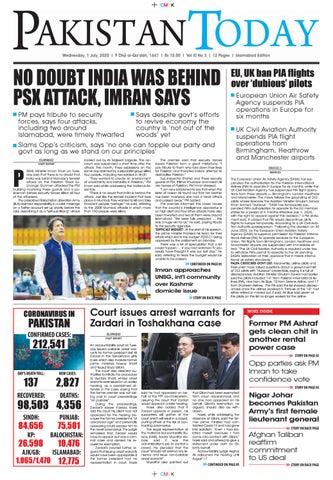
no doubt india was behind PsX attaCk, imran says g
g
PM pays tribute to security forces, says four attacks, including two around Islamabad, were timely thwarted
g
Says despite govt ’s efforts to revive economy the countr y is ‘not out of the woods’ yet
eu, uk ban Pia flights over ‘dubious’ pilots g
g
Slams Opp’s criticism, says ‘no one can topple our party and govt as long as we stand on our principles’ ISLAMABAD STAFF REPORT
P
RIME Minister Imran Khan on Tuesday said that there is no doubt that India was behind Monday’s terrorist attack on the Pakistan Stock Exchange. Gunmen attacked the PSX building martyring three guards and a policeman before security forces killed all four of the attackers. The proscribed Balochistan Liberation Army (BLA) claimed responsibility in a brief message on a Twitter account set up shortly before the raid, describing it as a “self-sacrificing” attack
carried out by its Majeed brigade. The account was suspended a short time after the attack. This month, three explosions on the same day claimed by a separatist group killed four people, including two soldiers in Sindh. “They wanted to create an environment of uncertainty and instability in Pakistan,” PM Imran said while addressing the National Assembly. “There is no doubt that India is behind the attack. Just like the terrorist incident that took place in Mumbai, they wanted to kill and take innocent people hostage,” he said, referring to the 2008 Mumbai attacks in which more than 160 people were killed.
The premier said that security forces saved Pakistan from a great misfortune. “I pay tribute to them who laid down their lives for Pakistan and thwarted India’s attempt to destabilise Pakistan.” Sub-Inspector Shahid and three security guards of PSX, Iftikhar Khudayar and Hasan Ali are heroes of Pakistan, PM Imran stressed. “I am very saddened to say that when the sister of Hasan Ali found out that her brother has been martyred, she had a heart attack and passed away,” PM added. The premier informed the Lower House that the country’s intelligence apparatus is on high alert and four other attacks have also been thwarted and two of them were around Islamabad. “We were fully prepared … this was a huge win for us,” he said, paying tribute to the security agencies. ‘DIFFICULT BUDGET’: At the start of his speech, the prime minister thanked his team for their efforts which led to the budget 2020-21 being approved by the parliament on Monday. There was a lot of speculation that a lot could happen … if you had watched TV you would have thought it was our last day,” he said, referring to fears the budget would be unable to be passed.
CONTINUED ON PAGE 05
Imran approaches UNSG, int’l community over Kashmir domicile issue STORY ON BACK PAGE
Coronavirus in
Pakistan
CONFIRMED CASES:
212,541
DAY'S DEATH TOLL:
NEW CASES:
137
2,827
RECOVERED:
DEATHS:
SINDH:
PUNJAB:
98,503 4,356 84,656
75,501
KP:
BALOCHISTAN:
AJK/GB:
ISLAMABAD:
26,598
10,476
1,065/1,470 12,775
European Union Air Safety Agency suspends PIA operations in Europe for six months UK Civil Aviation Authority suspends PIA flight operations from Birmingham, Heathrow and Manchester airports BRUSSELS AGENCIES
The European Union Air Safety Agency (EASA) has suspended the authorisation for the Pakistan International Airlines (PIA) to operate in Europe for six months, while the UK Civil Aviation Agency has suspended PIA flight operations from three airports — Birmingham, London Heathrow and Manchester. The move follows the grounding of 262 pilots whose licences the Aviation Minister Ghulam Sarwar Khan termed “dubious”. “EASA has temporarily suspended PIA’s authorisation to operate to the EU member states for a period of 6 months effective July 1, 2020, with the right to appeal against this decision,” a PIA statement said. It added that PIA would discontinue all its flights to Europe temporarily. According to a UK Civil Aviation Authority spokesperson: “Following the decision on 30 June 2020, by the European Union Aviation Safety Agency (EASA) to suspend permission for Pakistan International Airlines (PIA) to operate services to the European Union, PIA flights from Birmingham, London Heathrow and Manchester airports are suspended with immediate effect. “The UK Civil Aviation Authority is required under law to withdraw PIA’s permit to operate to the UK pending EASA’s restoration of their approval that it meets international air safety standards.” PALPA CRITICISES GOVT LIST: Meanwhile, airline pilots and their union have raised questions about a government list of 262 pilots with “dubious” credentials, saying it is full of discrepancies. Aviation Minister Ghulam Sarwar had earlier said the pilots included 141 from Pakistan International Airlines (PIA), nine from Air Blue, 10 from Serene Airline, and 17 from Shaheen Airlines. The PIA said the list showed discrepancies once the airlines received it. Thirty-six of the 141 had either retired or moved out, it said. Air Blue said seven of the pilots on the list no longer worked for the airline.
Court issues arrest warrants for Zardari in Toshakhana case ISLAMABAD STAFF REPORT
An accountability court on Tuesday issued bailable arrest warrants for former president Asif Ali Zardari in the Toshakhana gifts case which also involves former prime ministers Nawaz Sharif and Yousuf Raza Gilani. The court also directed authorities to initiate the procedure to declare Sharif, whose arrest warrants were issued in an earlier hearing, as a proclaimed offender in the case, saying that the former premier was not taking part in court proceedings “on purpose”. During the proceedings, Zardari’s lawyer Farooq Naek told the court his client had not appeared for the hearing because the former president is “of advanced age” and personally appearing could expose him to the novel coronavirus. The judge remarked that Zardari would have to appear as it was a criminal case and denied his request for exemption. Zardari’s counsel further argued that issuing arrest warrants would have been appropriate if the former president had no representation in court. Naek
more inside
Former PM Ashraf gets clean chit in another rental power case STORY ON PAGE 02
Opp parties ask PM Imran to take confidence vote STORY ON PAGE 03 said he had appeared on behalf of the PPP co-chairperson, assuring the court that Zardari would appear in a later hearing. Naek also added that if Zardari appears in person, his supporters will gather at the court which will result in a crowd, putting others at the risk of contracting coronavirus. The legal representative of the National Accountability Bureau (NAB), Sardar Muzaffar Abbasi, said it was the administration’s job to control a crowd. He pleaded that the court “should not extend any leniency and issue non-bailable arrest warrants”. Muzaffar also pointed out
CMYK
that Gilani had been exempted from court appearances and no one had appeared on his behalf. Gilani’s exemption, he argued, should also be withdrawn. Naek, while addressing the absence of Gilani, said the former prime minister had contracted Covid-19 and had gone into isolation. “Even I had isolated myself because I had come into contact with Gilani,” Naek said and offered to give a statement under oath on Gilani’s behalf. Accountability judge Asghar Ali adjourned the hearing until August 17.
Nigar Johar becomes Pakistan Army’s first female lieutenant general
CONTINUED ON PAGE 05
STORY ON BACK PAGE
STORY ON BACK PAGE
Afghan Taliban reaffirm commitment to US deal
02
Wednesday, 1 July, 2020
NEWS
PM IMran forMs coMMIttee to Probe Petrol crIsIs ISLAMABAD
P
Staff report
RIME Minister Imran Khan has constituted a four-member committee to investigate the shortage of fuel that affected millions of Pakistanis in June. The committee will be headed by PM’s special assistant Shahzad Syed Qasim and includes former DG (Oil) Petroleum Division Rashid Farooq, CEO Petroleum Institute of Pakistan Asim Murtaza and former senior general manager PSO Naazir Abbas Zaidi and will submit its report on July 10. The convener of the committee can include any other members as well, according to a
education Minister shafqat Mehmood’s mother passes away ISLAMABAD Staff report
Federal Minister for Education Shafqat Mehmood’s mother passed away on Tuesday. The minister announced her demise in a tweet. “She was like a rock for the family and would be deeply mourned. May Allah give her place in heaven,” he added. President Dr Arif Alvi also expressed profound grief and sorrow over her death. In a tweet, the president said, “The mother of my very dear friend Mr Shafqat Mehmood passed away. May her soul rest in peace and may Allah provide strength to my friend and his family to bear this irreparable loss.” Other politicians also expressed deep grief and sorrow over the demise of federal education minister’s mother.
PM Imran appoints 12 caretakers ministers in Gb cabinet ISLAMABAD Staff report
Prime Minister Imran Khan on Tuesday appointed 12 caretaker ministers for the Gilgit-Baltistan interim cabinet. The PM made the appointments on the advice of Caretaker Chief Minister Mir Afzal Khan. The interim ministers include Aftab Ismail Khan, Sarwar Shah, Shaukat Rasheed, Nasir Hussain, Muhammad Ali Khan, Muhammad Yasin, Syed Shabi-ul-Hasnain , Muhammad Ali Qaid, Johar Ali ,Rajab Ali ,Imam Yar Bag, and Abdul Jehan.
IHc orders cDa to respond to plea challenging temple's construction in Islamabad ISLAMABAD Staff report
The Islamabad High Court (IHC) on Tuesday issued a notice to the Capital Development Authority (CDA) on a petition against the construction of a temple in the federal capital. IHC Justice Amir Farooq heard the petition of lawyer Chaudhry Tanveer Akhtar in which he had prayed upon the court that the land allotted for the construction of the Hindu temple in Sector H-9 of Islamabad should be withdrawn along with the funds allocated for the project. “A temple already exists in Saidpur village,” the counsel said, adding that the government could have renovated it. He said that the land given for the temple’s construction in H-9 is a violation of Islamabad’s master plan. He added that the master plan of Islamabad should be implemented and a restraining order should be issued against the construction of the temple. “In Sector H-9, the government did not announce funds for a mosque but released funds for the construction of the temple,” the petitioner lamented. Justice Farooq remarked that the CDA should state whether the temple in H-9 is part of the master plan of Islamabad or not. “Minorities have full rights, they also have to be taken care of,” the judge said. Prime Minister Imran Khan has been made a party in the petition through his principal secretary. Others include secretary ministry of religious affairs, secretary home, secretary CDA, chairman CDA board and chairman union council of Sector H-9.
notification issued from the PM’s office. The committee will explain the impact of price reduction on the import and availability of petrol. It will identify hoarding by oil marketing companies, including curtailment of supply from depots to retail outlets, as well as hoarding by petrol stations. The inquiry committee will identify whether the availability of petrol this year was higher than compared to what it was in the corresponding months of last year, and the impact of coronavirus pandemic on the fuel availability, if any. It has also been tasked to analyze the role of Petroleum Division and the Oil and Gas Regulatory Authority (OGRA), and actions taken by them to address the issue
PKr depreciates 4.8pc in fY20
of fuel shortage. The committee will evaluate the possibility of market manipulation or cartelization by OMCs or retail outlets, and any other issue related to the crisis. Several oil marketing companies used pressure tactics and created a petrol crisis in the country, forcing people to line up at petrol pumps in huge numbers so that the government would relent and allow them to increase the prices. The artificial shortage came after a reduction in the price of petrol by Rs7 for the month of June. The government appeared to have eventually given in to OMCs after it increased the petrol price by Rs25 on June 26.
Former PM Ashraf gets clean chit in another rental power case ISLAMABAD app
An accountability court here on Tuesday acquitted former prime minister Raja Pervaiz Ashraf, former finance minister Shaukat Tareen and other accused in the Piraghaib rental power reference. Piraghaib Power Project was one of the 12 Rental Power Projects (RPPs) which were launched by the Pakistan People’s Party (PPP) government in 2008 to overcome the electricity crisis. Ashraf, a PPP politician who
served as premier between June 22, 2012, and March 25, 2013, is accused of receiving kickbacks and commissions from nine rental power project firms for awarding contracts for setting up their projects. NAB has been investigating 12 RPPs cases in which nine firms reportedly received more than Rs22 billion as mobilisation advance from the government to commission the projects, but most of them were accused of failing to set up plants. Accountability Judge Muhammad Bashir announced his verdict on applications of Ashraf and others
seeking acquittal in the case. Other accused whose acquittal pleas were approved included Tareen, Ismail Qureshi, Shahid Rafi, Tahir Basharat Cheema, Muhammad Saleem Arif, Chaudhry Abdul Qadeer and Iqbal Ali Shah. NAB DECIDES TO CHALLENGE DECISION: Meanwhile, NAB has decided to challenge acquittal of the former prime minister and other accused in the RPPs corruption case. The anti-graft body has requested to annul release order of Raja Pervaiz Ashraf and other accused as evidence against them is present.
President Alvi approves Finance Bill 2020-21 ISLAMABAD Staff report
President Dr Arif Alvi on Tuesday formally approved the Finance Bill 2020-21 under Article 75 of the Constitution. Alvi gave his approval to the Finance Bill 2020-21 after it was passed by the National Assembly on Monday despite the opposition’s vow to not let it sail through the House. On June 12, Industries and Production Minister Hammad Azhar had presented a Rs7.14-trillion budget. The government benches were successful in getting the Finance Bill 2020 approved to give effect to the financial proposals. The House, however, rejected the amendments proposed by the Opposition in the bill.
On Sunday, the opposition parties had agreed to build a united front against the budget and made fiery speeches on the national issues in the session. Apart from protesting the budget, its lawmakers have also decided to demand PM Imran’s resignation. Senior opposition leaders from the PPP, PML-N, and the JUI-F had earlier described it as an “enemy of the people”. Reacting to the budget, PML-N President Shehbaz Sharif said it would cause inflation and unemployment to rise. Erstwhile government ally BNP-M leader Akhtar Mengal had also announced his party’s move to break alliance with the ruling coalition, which caused a momentary hurdle for the government by depleting its numbers in the House.
Govt appoints Yousaf Naseem Khokhar as secretary interior ISLAMABAD Staff report
The federal government on Tuesday appointed Yousaf Nassem Khakhar as the secretary interior. According to a notification issued by the Establishment Division, Khokhar, a BS-22 officer of Pakistan Administrative Service (PAS), presently serving as secretary commerce, has
been transferred and posted as the secretary interior with immediate effect and until further orders. The position of secretary interior was vacated after the premature retirement of Major (r) Azam Suleman. Suleman had replaced Khokhar in April this year owing to his transfer from the post of Punjab chief secretary. Sources said that there will be shuffling in Islamabad Capital Territory (ICT) administration in the coming days.
Pakistan thanks countries for expressing solidarity over PSX terrorist attack ISLAMABAD Staff report
Foreign Office (FO) Spokesperson Aisha Farooqui on Tuesday took to her twitter account to extend gratitude to a number of ambassadors, foreign embassies and foreign ministries of different countries who had expressed solidarity with the government and people of Pakistan over a terrorist attack on Pakistan Stock Exchange (PSX) in Karachi on Monday. In a series of tweets, she separately thanked ambassadors of Turkey, Iran, Azerbaijan, high commissioners of the United Kingdom, Australia, Canada, embassy of the
United States, foreign affairs ministries of China and Turkey for their support and solidarity with the government and people of Pakistan. A number of foreign ambassadors in Pakistan, foreign missions and the foreign affairs ministries of different countries had tweeted their respective governments’ response over the PSX terrorist attack, condemning the act of terror and expressing solidarity, besides expressing sympathies with the families of deceased security personnel and those injured. Meanwhile, tthe General Secretariat of the Organisation of Islamic Cooperation (OIC) also vehemently condemned the terrorist attack on
CMYK
the Pakistan Stock Exchange in Karachi. According to a press release of the OIC General Secretariat, Secretary General Dr Yousef A. AlOthaimeen renewed the OIC’s firm position in rejecting terrorism, extremism and violence in all forms and manifestations. He also emphasised OIC support to Islamic Republic of Pakistan in all its anti-terrorism efforts. “The OIC Secretary General, Dr. Yousef A. Al-Othaimeen, offered his heartfelt condolences and sympathy to the families and relatives of the victims and to the government and people of Pakistan, expressing his hope for a speedy recovery for the injured,” it added.
KARACHI: The Pakistani Rupee depicted a 4.8pc YoY depreciation against the US Dollar during FY20, compared to the depreciation of 24pc during FY19, and an average of 5.4pc since FY01. The rupee withstood turbulent times during the year. Prior to the global pandemic, and despite a liquidity crunch around the world, the rupee was able to hold its ground. "Stability in the Current Account Deficit coupled with building up forex reserves of the country led towards normalized depreciation when compared with the hefty depreciation (24pc) during FY19," noted Tahir Abbas, Head of Research at Arif Habib Limited. However, following Covid-19 and the usual seasonal depreciation in June, the rupee is likely to stay depressed against the dollar until remittances and exports do not rise. arIBa SHaHID
cabinet committee to deliberate privatisation of PIa’s roosevelt Hotel ISLAMABAD: The Cabinet Committee on Privatisation is expected to deliberate on the privatisation of Pakistan International Airlines (PIA) owned Roosevelt Hotel based in New York, on Wednesday. According to documents, the Adviser to the Prime Minister on Finance and Revenue Affairs Dr Abdul Hafeez Shaikh will chair the meeting of the cabinet committee during which the matter will be discussed. Earlier, during last year, the cabinet committee had constituted a task force to finalise terms of reference for leasing out the Roosevelt Hotel. The task force is expected to oversee the transaction to ensure effective and efficient implementation of the committee’s decision in compliance with provisions of the Privatisation Ordinance 2000. Subsequently, in December 2019, the Privatisation Commission board approved terms of references, which were to be sent to the cabinet committee for final approval. During March this year, the Aviation Minister Ghulam Sarwar Khan had informed the National Assembly Standing Committee on Privatisation that the government is planning to give out the Roosevelt Hotel on a long term lease. A feasibility study conducted by Deloitte Transactions and Business Analytics in July 2019 had recommended that the “best use of Roosevelt Hotel property is to redevelop the site into a mixed use of primarily office tower over retail and condominium”. The Privatisation Commission board had earlier approved the initiation of the process for appointment of financial advisers for leasing out the site of the hotel and for setting up of a joint venture project for prospective mixed-use development. SHaHZaD paraCHa
ali Geelani parts ways with Hurriyat conference SRINAGAR: Syed Ali Shah Geelani, chairman of the All Parties Hurriyat Conference (APHC), on Monday quit his faction of the conference, an umbrella alliance of pro-freedom parties, saying the APHC had failed to counter New Delhi’s efforts to tighten its grip on the occupied region. India on Aug 5 last year had unilaterally stripped the disputed territory of its special status through a rushed presidential decree, dividing the Himalayan region into two union territories, Jammu and Kashmir and Ladakh. The move elicited worldwide condemnation with Pakistan and China moving to the United Nations Security Council seeking the restoration of the status quo. The held valley has been under a strict curfew ever since. 91-year-old Geelani, who has been under house arrest in Srinagar for several years, accused the Hurriyat Conference of inaction over New Delhi’s move in a two-page letter and short audio message. “Keeping in view the present situation in Hurriyat Conference, I announce my decision to part ways with it,” he said, accusing members of the grouping of conspiring against him and saying it lacked discipline and accountability. Hurriyat Conference was formed by various pro-freedom groups in Kashmir in 1993 to provide a political platform for seceding from India in the wake of a freedom movement against New Delhi. But the group split in 2003 when hardliners headed by Geelani, who advocated Kashmir’s merger with Pakistan, walked out after moderates decided to hold talks with New Delhi and formed their own faction. Both India and arch-rival Pakistan claim the Himalayan region in full, but rule in parts. aGeNCIeS
Wednesday, 1 July, 2020
NEWS
oPP PartIes asK PM IMran to taKe confIDence vote ISLAMABAD
o
Staff report
PPOSITION parties on Tuesday protested against the Pakistan Tehreek-e-Insaf (PTI) government and challenged Prime Minister Imran Khan to take a vote of confidence from the parliament. Addressing the protesting opposition lawmakers, Pakistan Muslim League-Nawaz (PML-N) senior leader Shahid Khaqan Abbasi rejected the federal budget 2020-2021 and said that they were staging a protest on the roads for the sake of the people. “The government has destroyed the country’s economy. Prices of all essential items are increasing day by day due to ineffective policies of Imran Khan,”
sindh sees record single-day spike in covid-19 cases KARACHI Staff report
he added. Abbasi further said that the federation has failed to prove any corruption charge against the PML-N and Pakistan People’s Party (PPP). While talking to media, PML-N’s Khawaja Asif said that the government has lost confidence of its allies. We have to get rid of this incompetent government at any cost, he urged. The PML-N leader said that petrol prices hike can also increase the cost of electricity and groceries. Meanwhile, PPP’s Naveed Qamar said that opposition is protesting on the behalf of the nation. All Parties Conference (APC) is expected to be held very soon, he told. The PPP also asked the reason behind raising petroleum price by Rs25.
sbP raises rs16bn through t-bill auction KARACHI: The State Bank of Pakistan (SBP) has reported that the government raised Rs16.1 billion through Pakistan Market Treasury Bills (T-bills), against the auction target of Rs100 billion. The SBP conducted the auction for the sale of 3-month, 6-month and 12-month T-bills and received bids amounting to over Rs585.7 billion. Bids worth Rs258.5 billion were received for 3-month T-bills, Rs157.4 billion for 6-month T-bills, while 12-month government papers fetched bids amounting to Rs169.7billion. Out of the received bids, the federal government raised Rs853 million for 3-months, Rs250 million for 6-months and Rs15 billion for 12-months. The total acceptance in the auction, including non-competitive bids, was Rs54.1 billion. The cut-off yield for 3-month bids was at 6.85pc, down from 7.80pc. The yield for 6-month bids was at 6.6pc, down from 7.48pc, while the yield for 12-month bids stood at 6.85pc, down from 7.36pc. The next auction date for T-bills is set for June 15, with a target amount of Rs100 billion. Staff report
38 Indian diplomatic staffers, families leave for India LAHORE: Six diplomats and their families were among 38 staff members of the Indian High Commission who left for their country via the Wagah-Attari border on Tuesday. Reportedly 100 Pakistani nationals, including families of diplomatic staff, would also return to Pakistan via the same route. Earlier, Pakistan had told India to reduce its diplomatic staff’s strength by 50 per cent as a reciprocal measure after New Delhi sought to halve the staff strength at the Pakistan High Commission in the Indian capital. A statement issued by the Indian Ministry of External Affairs had said that the decision, which would be implemented in seven days, had been conveyed to Pakistan’s Chargé d’Affaires. According to the Indian statement, Pakistan’s Chargé d’Affaires was informed that Delhi had “repeatedly expressed concerns about the activities of officials [at the Pakistan High Commission]”. “They have been engaged in acts of espionage and maintained dealings with terrorist organisations,” it had said, referring to the expulsion of two officials from the Pakistan High Commission on May 31. Commenting on the recent hit-and-run in Islamabad involving two Indian High Commission officials, the statement had alleged that Pakistan had “engaged in a sustained campaign to intimidate the officials of the Indian High Commission in Islamabad from carrying on their legitimate diplomatic functions”. Staff report
03
Sindh Chief Minister Syed Murad Ali Shah said on Tuesday that 2,655 fresh coronavirus cases were reported in the province overnight, while the contagious disease claimed 34 more lives. Following this, the number of infected persons has increased to 84,656 and the death toll has climbed to 1,377 in Sindh, he added. The CM said that of 9,435 samples tested between Monday and Tuesday, 2,655 were found to be carrying the virus- 28 per cent of tested samples and the highest single-day ratio reported thus far. Moreover, he stated, 1,208 patients recovered from the infection overnight, taking the total number of recovered persons in the province to 46,824. The recovery rate in Sindh has now jumped up to 55 per cent, he said. He further stated that 36,455 people were currently under treatment for Covid-19 in the province, of whom 34,785 were in home-isolation, 1,504 were being treated at different hospitals and 166 were quarantined at isolation centres. The CM said that among them, 708 patients were in critical condition, including 102 on ventilators.
Ruckus in NA after PPP's Naveed Qamar and PTI's Ali Zaidi engage in verbal duel ISLAMABAD Staff report
A verbal spat between Federal Maritime Affairs Minister Syed Ali Haider Zaidi and Pakistan People’s Party (PPP) lawmaker Syed Naveed Qamar heated the National Assembly session on Tuesday. The issue arose after Zaidi said that he is up for being held accountable if proven corrupt. He was responding to PPP Chairman Bilawal Bhutto-Zardari who had accused Zaidi of embezzlement within the Ministry of Maritime Affairs. “You can embarrass me before the people and cut my connections with PM Imran Khan, if you prove my involvement in corruption of even a single rupee,” Zaidi said while taking the floor of the National
Assembly. He claimed that Bilawal had declared his assets worth Rs1.5 billion before the Election Commission of Pakistan. “Bilawal’s assets are in millions but he pays only a few lakh rupees in taxes?” asked the PTI minister. “Pakistan saw its first major terrorism case in 1981 when the PPP was in power. Uzair Baloch, a person who has confessed to killing 58 people, also belongs to the PPP,” he alleged. He also accused PPP stalwart Naveed Qamar and former president Asif Ali Zardari of “sheltering terrorist groups in Lyari”. It is the JIT report (in the Uzair Baloch case) that tells you about Zardari heading terrorist groups, he remarked. NA Speaker Asad Qaiser then turned Zaidi’s microphone off, citing a shortage of time. When he allowed Qamar to take the floor, a verbal spat started between him and Zaidi.
ATC hands man who threatened judges into FIA custody for a week ISLAMABAD Staff report
An anti-terrorism court on Tuesday remanded a man accused of threatening judges into the custody of the Federal Investigation Agency (FIA) for seven days. Judge Jawad Abbas Hassan heard Agha Iftikharuddin Mirza’s case and ordered the FIA to conduct the suspect’s medical checkup and submit a report in the court. The judge asked the FIA what they want to recover from the suspect. The FIA said that they want to ask him about some things and recover some things too, adding that he runs a web channel called Iqra too. Mirza’s lawyer, on the other hand, said that he is a good man and a scholar. He also suffers from cardiac problems, he added.
On June 24, the wife of Supreme Court Justice Qazi Faez Isa had filed an application for an FIR to be registered against Mirza for threatening her husband. Sarina Isa said the man, whom she tentatively identified as Agha Iftikharuddin Mirza, threatened Justice Isa’s life. She enclosed a USB with a video of the threat. She quoted the man as saying “whoever is caught involved in embezzlement, even if he’s [Justice Qazi] Faez Isa…should be put before a firing squad”. He also called for the public hanging of “people like this” and said the whole city should be called to watch it. “Call them to Fawara Chowk to see that such and such man is being shot,” he said in the video. Sarina Isa said she found his name via an internet search but did not know if it was his real name. She asked the police to look into this further.
sbP extends rozgar scheme until september KARACHI: The State Bank of Pakistan has extended the rozgar scheme for another three months in light of the Covid-19 pandemic, and also widened its scope in collaboration with the government, according to a statement released on Tuesday. The Rozgar Scheme, also known as the Refinance Scheme to Support Employment and Prevent Layoff of Workers, provides concessional loans to businesses for wages and salaries, if they commit not lay off their employees for the loan’s period. Businesses will now be able to obtain financing to pay wages and salaries for a maximum period of six months starting April 2020 till September 2020. Effectively, this suggests that not only businesses can obtain loans to fund their wages and salaries bill up to a period of 3 months from July till September 2020, but can also get reimbursement for the wages and salaries paid during April to June 2020. For those who have already availed financing under the scheme, financing limits for the months of July to September 2020 will be calculated on the same basis on which limits were calculated for the months of April to June 2020. Under the scheme, as of 19 June, financing of Rs112.8 billion was approved by banks for 1,653 businesses, covering the wages and salaries of over 1.1 million employees.Previously, the government had introduced a Risk Sharing Facility for SBP’s Rozgar Scheme to incentivize banks to provide loan to small and medium enterprises. Under this facility, the government bears a 40pc first loss on disbursed portfolio (principal portion only) for eligible borrowers. This facility has now been extended for another three months, and the risk coverage has been increased from 40pc to 60pc. “This higher risk coverage will help banks to provide financing under the Rozgar scheme to collateral deficient SMEs which are otherwise struggling hard. SBP now expects that more SMEs will benefit from the scheme mainly due to higher risk coverage, more awareness of the scheme among the stakeholders,” the statement read. Under the RSF, as of 19 June, financing of Rs25.4 billion was approved by banks for around 1100 businesses, covering wages and salaries of over 220,000 employees. MeIrYUM aLI
Drugs, doctors and donors: Pakistanis turn to 'Corona Warriors' Facebook group LAHORE aGeNCIeS
When musician Zoraiz Riaz set up a Facebook group to help coordinate convalescent plasma donations for people fighting Covid-19 in Pakistan, he expected perhaps a few hundred responses. Within a month, however, the ‘Corona Recovered Warriors’ group had more than 320,000 members, needing a team of 33 volunteers to manage posts from families of patients across Pakistan seeking advice. “Around 85 per cent are looking for plasma,” Riaz, 27, told Reuters from his home in Lahore, one of the hardest-hit cities in the country, which has recorded
nearly 210,000 infections and over 4,300 deaths from the virus. “The rest are looking for different medical supplies, oxygen, ventilators, injections for drugs, or leads on hospitals that have availability,” Riaz added. The scale of the response highlights the large gap left by a disorganised healthcare system which is ill-equipped to offer systematic guidance as Covid-19 deaths mount. PLASMA RUSH: The group this week featured the country’s top expert giving advice on convalescent plasma treatment. “There was no clear guidance from the government, and we had to face this urgent amount of requests for plasma
from almost everyone, even people whose medical consultants were not recommending it were coming to us asking for plasma,” Riaz said. Plasma treatment, involving the infusion of plasma from a recovered Covid-19 patient to a recovering one as a source of antibodies, is widely sought despite limited information on its effectiveness. Leading haematologists in the country warned this month the treatment had become widespread and that government guidelines were urgently needed — particularly with a burgeoning black market for plasma. Health officials finally put in place national standards for plasma treatment and
warned the public that the sale of plasma is illegal. But many families with sick loved ones had already sought guidance from the Facebook group, with volunteer physicians answering questions about plasma and linking donors and recipients to bypass the black market. “Each request for plasma,” Riaz says, “is screened by volunteers who require medical documentation from physicians showing the treatment is viable. Donors are also screened to ensure no one is selling the plasma.” Members are also offering ventilators and oxygen tanks to hospitals, and homecooked food for families of patients or those in quarantine.
04
Wednesday, 1 July, 2020
NEWS
LGS SuSpendS principaL, adminiStrator and coordinator over SexuaL haraSSment ScandaL SCHOOL MANAGEMENT TERMINATES AITZAZ REHMAN SHEIKH, ZAHID WARRAICH, UMER SHAREEF AND SHEHZAD IRSHAD AFTER FINDING THEM GUILTY OF SEXUAL HARASSMENT LAHORE
t
SHAHAB OMER
HE management of the Lahore Grammar School 1-A/1 Gulberg on Tuesday sacked four employees, including two teachers, after they were found guilty of sexually harassing female students. Meanwhile, the District Education Authority has formed a three-member committee comprising educationists and government officers to probe the incidents at
LGS 1-A/1 GULBERG PRINCIPAL MRS SHAKIL, ADMINISTRATOR MAIRA OMAIR RANA, COORDINATOR RUBAB HASSAN SUSPENDED
the elite school. The authority has directed the committee to submit the findings along with “clear cut recommendations” within three days to decide the future course of action regarding the reported incident. A large number of LGS students said that they were being harassed since 2016, but had decided to report the incidents to the management after it became unbearable. According to the school management, the four persons against whom the complaint was lodged include two teachers, a support
staff and a custodian staff. Aitzaz Rehman Sheikh, an A-Level faculty member, Zahid Warraich, also a faculty member, support staff Umer Shareef and custodian staff Shehzad Irshad were accused of harassment by female students, some of whom had left the school a few years ago and others who were still studying there. The LGS management also suspended the services of the school principal Mrs Shakil, administrator Maira Omair Rana, and coordinator Rubab Hassan with immediate effect.
Pakistan Today tried contacting the said administrative officials but no response was received till the filing of this report. Students said that they had lodged various sexual harassment complaints over the years against the accused but no action had been taken by the administration. Hence some of them were forced to leave the school and seek admission in other institutes. The administration said that after receiving evidence against the accused, which included videos, photographs and indecent messages sent by them to students, all four
persons involved were shown the door. The students revealed that the chemistry teacher, Warraich, used to harass them by staring and trying to touch them inappropriately. They also said that he tried to sit with them in a manner that made it very uncomfortable for them to study. They also spoke of a female teacher in the school who told them about how she was also a victim of harassment by one of the staff members at the institute but instead of taking action against the harassers, she told the students to remain silent. On the other hand, the police said that they have not received any request from the school administration to take action against the four accused in the case. Meanwhile, Human Rights Minister Dr Shireen Mazari has also taken notice of the incident and said that Ministry of Human Rights (MOHR) helpline 1099 is available for such complaints and for help of the victims. “Have taken note of serious harassment allegations of young girls and women at educational institutions – most recently at two premier private institutions in Lahore. MOHR helpline 1099 is available for complaints & for help. Our regional offices have been alerted on this issue,” Mazari wrote on Twitter.
Smart lockdown in Lahore extended till July 15 LAHORE STAFF REPORT
ISLAMABAD: Anti-Narcotics Force, in collaboration with Pakistan Postal Services, launched a commemorative postage stamp on the occasion of International Day against Drug Abuse; Illicit Trafficking. The opening ceremony of postal stamp held at ANF Headquarters was attended by ANF Director General Major General Muhammad Arif Malik, Special Secretary Communication Tanveer Ahmed Qureshi, Pakistan Postal Services DG Muhammad Ikhlaq Rana and other senior officers of ANF. PRESS RELEASE
Smart lockdown proving fruitful in containing coronavirus spread: Wazir PESHAWAR APP
Adviser to the Khyber Pakhtunkhwa (KP) Chief Minister on Information, Ajmal Wazir on Tuesday said that the strategy of smart lockdown was proving much fruitful as it helped a lot in containing the further and rapid spread of coronavirus in the province. During a media briefing, he said that to contain the spread of coronavirus, the policy of smart lockdown would continue as directed by the Prime Minister Imran Khan. In different districts of all the seven divisions of KP, he informed till date smart lockdown was imposed in 276 affected areas where total numbers of coronavirus patients were 2,895 and around 880,000 people have been confined to their homes in smart lockdowns. In the affected areas, he said, 3,141 houses have been declared as isolated, adding the smart lockdown was removed from 58 areas after completion of stipulated time. The information adviser further said that federal government deserved appreciation for smooth approval of the budget from the parliament.
The government of Punjab has extended imposition of smart lockdown in various coronavirus hotspots of the provincial capital till July 15. According to a notification issued on Tuesday by the Punjab government's Primary and Secondary Healthcare Department, the government of Punjab has extended the applicability of the order, dated 15.06.2020, till 12:00am Wednesday, 15.07.2020, unless modified otherwise. Primary and Secondary Healthcare Department Secretary Captain (r) Muhammad Usman said the notification will be effective immediately and will be applicable for areas identified in the June 15 order. These include Shahdra, Mazang, Shad Bagh, Harbanspura, Old Lahore, Nishtar Town, Cantt, Allama Iqbal Town, and Gulberg. Earlier in the day, it was reported that the Punjab government has devised a "new strategy" to stem the spread of the COVID-19 pandemic. A meeting presided by senior provincial minister Abdul Aleem Khan and chief secretary
Punjab decided to authorise deputy commissioners to seal or reopen their areas depending on the number of cases there. The meeting also reviewed the price and supply mechanism of medicines and the security situation in the province after the Pakistan Stock Exchange attack that took place in Karachi on Monday. The "smart" lockdown was announced on June 15 in Lahore and was due to come to an end at midnight tonight. At the time of its imposition, the Punjab government had noted that "there has been an increase in the number of pandemic coronavirus cases in the province of Punjab as well as in Pakistan which poses a serious and imminent threat to public health and public order". It was therefore ordered that there shall be "controlled entry and exit" in areas of district Lahore identified as hotspots. Punjab Health Minister Dr Yasmin Rashid had said that the main reason to seal the areas was to halt the surging number of coronavirus cases in the province since the standard operating procedures (SOPs) were being violated in these respective areas.
Buzdar approves setting up of South Punjab secretariat LAHORE TLTP
The Pakistan Tehreek-e-Insaf (PTI) government on Tuesday took another step towards fulfilling its major campaign promise of creating South Punjab province when Chief Minister Usman Buzdar approved the setting up of a secretariat for the region. “PTI is on its way to fulfilling its major promise by setting up a South Punjab Secretariat,” said the chief minister. He added that the office will help resolve the problems of the people at their doorstep. According to details, the headquarters for the police bureaucracy will be set up in Multan, whereas the civil bureaucracy’s headquarters will be in Bahawalpur. The CM had already approved the appointment of an additional chief secretary and an additional inspector gen-
eral for the region. Earlier this month, Chief Minister Buzdar had issued the notification for the appointment of additional chief secretary and additional inspector general of police. At the time, Buzdar had said the posts had been generated and new postings would be carried out soon adding that the officials would dispense new duties from July 1. Due to the measures taken by the government, the sense of deprivation is ending in the people of Punjab, he said. Last month, Minister for Foreign Affairs Shah Mehmood Qureshi had said that Rs3.5 billion had been allocated for this purpose. The ruling party will table a bill in the National Assembly for the creation of the South Punjab province, he had announced in March after Prime Minister Imran Khan chaired a meeting on the issue.
punjab assembly resolution hails cops who foiled pSx attack LAHORE: A resolution submitted in the Punjab Assembly on Tuesday lauded the bravery of policemen who thwarted a terrorist attack on the Pakistan Stock Exchange (PSX). Member of the provincial assembly Sadia Taimoor submitted the resolution, stating that the gallantry of the policemen foiling the attack on the PSX building is laudable. It said terrorists will never succeed in their evil designs. The resolution maintained that the country’s security forces are always ready to defend the motherland and lauded martyrs who always laid down their lives for the defence of the country. INP
Opp won’t succeed in stopping accountability: Punjab governor LAHORE INP
Punjab Governor Chaudhry Mohammad Sarwar on Tuesday said that the opposition parties were claiming that the federal budget would not be passed by grace of God it was passed in the National Assembly (NA), adding that the opposition will never succeed in its agenda of stopping accountability. He was talking to Punjab Minister for Energy Dr Akhtar Malik who called on him at Governor House, Lahore on Tuesday. During the meeting various ad-
ministrative and political issues came under discussion. Sarwar said that approval of federal budget was proof that the coalition and the government are on the same page and the opposition is failing on all fronts. “I congratulate Prime Minister Imran Khan and his team on the approval of the budget and assure the people that for their development and prosperity resources will be used,” he added. He said that Prime Minister Imran Khan wants to take the country forward and the opposition back but we will not allow them to succeed under any circum-
stances. “We are pursuing the politics of principles and vision and will not back down and have not compromised on public interest,” he maintained. The governor said that the attitude of political point scoring should be abandoned by the opposition. “Today, the government is taking steps to deal with other economic and other challenges facing Pakistan due to coronavirus,” he said, adding that the war against coronavirus is a war of 220 million Pakistanis, including the government and political parties. He further said that coronavirus can only be defeated through other meas-
ures such as wearing masks. Speaking on the occasion, the provincial minister for energy said that the governments in the federation and Punjab have given a people-friendly taxfree budget in spite of all difficulties, but the opposition is criticising it for making political shopkeepers shine without reading this budget. He said the people know that PM Imran’s mission was only and only Pakistan. “The prime minister is working for development and prosperity while the opposition is busy defending its interests which will never succeed,” he added.
Wednesday, 1 July, 2020
FReelanCeRs ReGain aCCess to bloCked Funds as PayoneeR CaRds RestoRed LAHORE
u
TAIMOOR HASSAN
SERS in Pakistan and abroad have regained access to funds on Payoneer Prepaid Mastercard cards on Tuesday after UK’s Financial Conduct Authority (FCA) allowed German fintech Wirecard AG’s UK subsidiary Wirecard Solutions Limited (WCSL) - that issues these cards - to resume issuing e-money and providing payment services. On Thursday, Wirecard AG filed for insolvency after it was revealed that the company was involved in an accounting fraud worth billions of dollars. Subsequently, the UK regulator of WCSL, the FCA, ordered WCSL to freeze all prepaid card activity for the time being. The primary objective of the restrictions was to protect the electronic money funds of consumers in safeguarded accounts. It also had the effect of preventing consumers from withdrawing and making payments with those funds.
FCA’s consent on lifting restrictions meant that WCSL could now resume electronic money and payment services to its customers and customers can now, or very shortly, use their cards as usual. For a short duration after the audit was completed and restrictions were lifted, Payoneer cards were inaccessible due to some technical restrictions that were being addressed by Mastercard. “You can now withdraw funds from your card at ATMs or spend them online or in stores,” Payoneer said. The company further stated that they were in the process of enabling users to withdraw funds into local bank accounts. The service would be reactivated on July 6. Payoneer cards are used by freelancers and small companies in Pakistan to make and receive international payments. There are an estimated 50,000 to 100,000 Payoneer users in Pakistan that might have been affected by the freeze on Payoneer prepaid cards due to the fallout of German fintech Wirecard AG’s bid to file insol-
vency following a shocking scandal involving billions of dollars. The quantum of the funds stuck in these cards is estimated to be millions of dollars. Earlier, Payoneer CEO Scott Galit had assured that the company was making arrangements to restore access to funds on cards without waiting for the outcome of the Wirecard scandal probe that caused the freeze. In a late night video statement, Galit said: “While the FCA has given off encouraging signs of progress in its audit of Wirecard Solutions, we have decided not to wait for the outcome.” “Even if there is a shortfall, our intent at Payoneer is to fill the gap so that you get 100 per cent of your money back,” he added. “With millions of customers worldwide, we needed to engage with strategic partners to find sufficient liquidity to publicly take this position,” Galit said, hinting that Payoneer was arranging funds to reimburse Payoneer card holders regardless of the outcome of the Wirecard scandal in Germany.
In a video statement on Monday, Payoneer’s Country Manager for Pakistan, Mohsin Muzaffar had said: “We are coordinating closely with Wirecard and FCA and we have been assured of positive development in the next 24 to 48 hours.” According to the Financial Times, the FCA had earlier said that it had “seen good progress by the firm [WCSL] in meeting the conditions we set”, but added, “we cannot lift the restrictions without reassuring ourselves that the firm has been able to satisfy all our concerns”. The international fallout from the Wirecard scandal grew on Monday, as the German group’s UK subsidiary scrambled to avoid collapse and Singaporean authorities prepared to expand their “extensive” criminal investigation into the company. Newcastle-based WCSL said it was “working hard” to restore operations after the FCA forced it to stop all regulated activities, Financial Times reported.
Court issues arrest warrants for Zardari in Toshakhana case cONtiNuED fROm pAgE 01 TOSHAKHANA CASE: According to the reference, Gillani had been accused of illegally allotting cars to Zardari and Nawaz. Khawaja Anwar Majeed and Khawaja Abdul Ghani Majeed, owners of the Omni Group, were also nominated as accused in the reference. The reference states that Zardari and Sharif obtained cars from Toshakhana by paying 15 per cent of the price of the cars. The bureau further alleged that Gillani facilitated Zardari and Nawaz in this regard. He dishonestly and illegally relaxed the procedure for the acceptance and disposal of gifts, issued by the government of Pakistan vide Cabinet Division’s Memorandum No.9/8/2004-TK dated June 25, 2007, which expressly stipulates that vehicles shall not be allowed to be purchased by the recipients
and be given to the central pool of care of the Cabinet Division. Reference further states that Zardari accepted and received the armored vehicles as gift from the United Arab Emirates (BMW750 Li model 2005, Lexus Jeep model 2007) and from Libya (BMW 760 Li model 2008) in September-October 2008. It was obligated to immediately report and deposit the vehicles with Toshakhana of Cabinet Division but he neither reported the gifted vehicles nor despoiled the same. The NAB reference alleges that Sharif did not hold any public office in the year 2008. However, from April to December 2008 without giving any application or request to then prime minister Gillani dishonestly and illegally obtained relaxation for his benefits of the procedure for the vide Cabinet Division’s above said Memorandum which
expressly stipulate that vehicles shall not be allowed to be purchased by the recipients and be given to the Central Pool of cars of the Cabinet Division. “Nawaz Sharif knowingly and with dishonest intention obtained illegal favour in connivance with the then prime minister Yousaf Raza Gillani by obtaining the relaxation of said procedure for the acceptance and disposal of gifts,” the reference states. In the Toshakhana reference, Khawaja Anwar Majeed having control of and by operating accounts of M/s Ansari Sugar Mills Ltd transferred Rs9.2 million from bank account No 3172-2 maintained with National Bank of Pakistan’s Avari Tower Branch in Karachi, vide cheque dated 23-04-2009 to the account No 0023-011009761001 of Zardari. He made another payment Rs11,117,557 from account No
4108080922 on the behalf of Zardari. Accused persons as part of their overall illicit scheme made payment totaling to Rs20,317,557 for the undue benefit of Zardari. Khawaja Abdul Ghani Majeed, part of their overall illicit scheme, made payments totalling to Rs3,716 million for benefit of Zardari. The NAB investigation has accused these public figures of having committed the offense of corruption and being involved in corrupt practices defined under various sections of NAB. The anti-graft agency has requested the court to conduct a trial and sentence the accused to the strictest possible jail terms under the NAB Ordinance for their involvement in the corruption scam. It is to mention here that Sharif is on bail for his medical treatment in London and Zardari is also on bail.
No doubt India was behind PSX attack, Imran says cONtiNuE pAgE 01 “I want to thank my government, because Chief Whip Amir Dogar gave me full information [about] what we gained and what improvement we had. I also thank my minorities and the way they participated,” the premier said. Imran said he and his finance team know “what a difficult budget this was” and the government had to revise its revenue target from Rs5,000 billion to Rs4,900bn. “We were on our way [and] we had 17 per cent collection but as soon as Covid-19 came, it affected all the economies, so a direct consequence was that our target had to be revised to Rs3,900bn [and] we had a Rs1tr shortfall.” He said no country, including Pakistan, had been able to measure the impact the coronavirus lockdown would have on the economy. “I salute my team, who were criticised for being ‘confused’, because we did not go for a sweeping lockdown that we were being pressured into enforcing. “They gave us examples of Sindh … if I was listened to, I would still not have enforced the lockdown that we did. I would have tried to keep things running.” He said while the opposition was criticising him, people travelling to poor neighbourhoods in cars were being “attacked” by people who were hungry. “Thank goodness we didn’t succumb to the pressure; the world has accepted that smart lockdowns are the only way to combat the virus,” he added. Imran said the real “confusion” was among the poor people who weren’t sure how they would feed their families during the lockdown. At this point, he lauded his aide on social protection Sania Nishtar and her team for distributing emergency cash among the people, saying there was “no other example of this” in a country with an informal economy. The prime minister also acknowledged the health workers who are on the frontlines of the coronavirus battle, saying he knows the pressure they are working under. He added that the government “will try to reward them but Allah will give them the ultimate reward be-
cause they are doing jihad”. ‘NOT OUT OF THE WOODS YET’: Due to the pandemic, the premier noted, the entire service sector is affected, the northern areas that rely on tourism are struggling and teachers in rural areas are without job. He said the government was planning on how to further help them because the country is “not out of the woods” yet. He said despite the unfavourable economic conditions, Pakistan was “saved” because the government opted against completely closing down the agriculture sector. But he said, “We still have a challenge going forward; we don’t know when our tax collection will gain and how we will help those affected, but it will be a constant challenge on how to sustain the economy.” Invoking Charles Dickens, the prime minister said: “It is ‘the worst of times’, but if we want to make it into the best of times we have to plan.” But he said the money that should be spent on education and hospitals is being poured into government corporations running losses, while the power sector has become “the biggest curse” for the country. He held “mafias” responsible for bringing state-owned enterprises to this stage and for the Pakistan International Airlines’ current woes. “It is not an option now … we need to reform all institutions,” he said, recalling that his government had to pay Rs2,000bn out of its first-year tax revenue of Rs4,000bn in interest payments for loans taken by previous governments. “The people who ruined the Steel Mills, PIA and power sector by making political appointments ask why [we] fired people,” the premier added. “All successful societies are run by people making money [and] paying taxes and that being spent on health and education; that is the state of Madina,” he said, regretting that in Pakistan members of mafias and cartels seek to make record profits without paying their due share. “Despite receiving a subsidy of Rs29bn, the entire sugar industry pays taxes of Rs9bn,” the prime minister added. He said the public is forced to purchase pricey sugar because of the regulators’ collusion with the
sugar cartels. “These big monopolies, cartels, mafias would never have been able to run if [previous] governments did not patronise them. [Asif Ali] Zardari and Nawaz [Sharif] have sugar mills; why do they have them? To turn black money into white. We will do inquiries everywhere; we will go after those who exploit the country.” PM Imran during his speech hit back at the opposition for their criticism of the government’s economic performance and calling for his resignation. “I have been hearing from 1988 … they (opposition leaders) go to the West and say ‘save me, I am liberal and moderate but the rest are extremists. If you don’t save me, the extremists will take over Pakistan,” he said. “They are liberal but only in one way: they are liberally corrupt.” Addressing the opposition benches, he continued: “You piled on debts, looted the country and then said we had failed. When the debt was piling [you] didn’t say the government was failing.” Imran said the opposition is “scared that the longer we stay in power” the longer they will be unable to hide their “theft”. But he acknowledged that no position of power is permanent. “Today you’re here, tomorrow you may not be. I live in my house and bear all my own expenses except travel and security. I do this so that I am not scared about leaving the chair and don’t have to compromise on my morals,” he said. The premier revealed that some people, whom he did not name, had asked him to suppress the report about PIA pilots possessing dubious licences, but said that doing so would endanger people’s lives and “the blood will be on my hands”. He advised the young parliamentarians to not be scared of “leaving the chair”, saying it comes and goes. “No one can topple our party and government as long as we stand on our principles,” he said, noting that although former military dictator General Pervez Musharraf’s government “wasn’t as bad”, the National Reconciliation Ordinances he gave “brought the country to this stage”. He said the current opposition wants him to enter into a similar deal with them in order to “save themselves”.
NEWS
05
Punjab govt spends Rs8.6m on CM’s helicopter trips LAHORE: The Punjab government has spent Rs8.6 million in 16 months –from Aug 2018 till Nov 2019– on the helicopter flights of Chief Minister Sardar Usman Buzdar, including 14 flights to his hometown and constituency. According to details released by the Punjab Information Commission, Buzdar made his first visit to Mian Channu and Pakpattan from Lahore on August 28, 2018, on his official helicopter soon after assuming the office. In Sept 2018, the helicopter was used twice for local flying in Lahore. Interestingly, the helicopter was used five times in October out of which Prime Minister Imran Khan used it thrice to visit Punjab Governor’s House during his visits to the provincial capital. In Nov 2018, the official helicopter was used 14 times — thrice to Dera Ghazi Khan, which is also the constituency of the Punjab CM. The official chopper was used to visit Taunsa Sharif, the hometown of the chief minister, during the same month. In Feb 2019, Buzdar paid a visit to Multan, Rajanpur and DG Khan while in the same month he also went to Taunsa by helicopter. In April 2019, the Punjab chief minister made 28 trips on his official helicopter of which five were made to Taunsa. In May 2019, he made 27 visits, eight in July, 13 in August, 10 in September, 14 in October, and 11 in November of which two trips were made to DG Khan. The chief minister’s helicopter was also used several times to go to the Governor’s House in Lahore from the CM’s Secretariat, which is located hardly one kilometre away. He also made several visits to Pakpattan on board his official helicopter during this period. The Punjab government helicopter made a total of 164 flights and remained air borne for 119 hours and 30 minutes during this period. SHAHAB OMER
Govt to bear additional Rs1,800bn cost due to faulty debt policy, says Hafeez Pasha NEWS DESK Former finance minister Hafeez Pasha on Monday said that the government has added an additional cost of Rs1,800 billion in the Budget for FY21 by locking itself into long term debts while interest rates in the country were on a decreasing trend. Speaking to Pakistan Today Editor Arif Nizami on Channel 92’s programme ‘Ho Kya Raha Hai?’, the economist explained that it is a known fact in debt management policy that when interest rates are high, loans of a short term duration are preferred. He claimed that the Pakistan Tehreek-e-Insaf (PTI) government followed a completely opposite approach and floated long term national saving schemes and Pakistan Investment Bonds at a time when interest rates were at a high of 13.25 per cent.
Wednesday, 1 July, 2020
06 COMMENT
Narendra Modi on horns of dilemma?
PTI’s multifarious problems Mostly of its own making
A
LThOUgh the government has defeated the opposition and managed to pass the Finance Bill 2020 in the national Assembly, it has not been an easy task. The political atmosphere surrounding the Budget has been tense as allies of the ruling party demanded their pound of flesh to support a government that has been looking weary and in disarray for months, given the multifarious problems it faces, most of which are of its own making. Allied parties who have been ignored by the Prime Minister for the past two years have evidently had enough and started to jump ship, with the BnP(M) bowing out of the coalition and others waiting in the wings. A reconciliatory dinner for parliamentarians had to be hosted by the PM to remove grievances but it will perhaps take more than that to smooth things over, a message that the Chaudhries of the PML(Q) conveyed through their absence. Pacifying the allies might be possible through various tools at the government’s disposal but placating a severely angry populace that is facing economic hardship is going to be tougher, especially considering how their problems are being unnecessarily compounded. It seems whatever this government focuses its attention on turns into a larger problem than it was to begin with. The sugar and wheat shortage probe has so far resulted in zero arrests and prices in the market remain rigidly high. The ‘petrol mafia’ that had created a shortage a few weeks back was supposed to be taken to task and an inquiry was launched against OMCs (Oil Marketing Companies). Instead, they got exactly what they were demanding through their blackmailing tactics as the government increased the price of petrol by a whopping Rs. 26 before any revision was even due. International humiliation has now been added to the mix. While presenting the PIA crash report in the national Assembly, Federal Aviation Minister ghulam Sarwar revealed that close to 262 pilots, most of who fly for the national carrier, held dubious licenses. An internal investigation and action before publicly disclosing such damaging information would have been more appropriate. Meanwhile, PM Imran Khan labeled Al-Qaeda chief Osama Bin Laden a martyr on the same Assembly floor and has so far offered no real clarification personally, just the usual ‘slip of tongue’ excuses from his many spokespersons. The PM and his team keep coming off as a clueless collection of novices despite having all the support and advantages past governments could only dream of. It is high time they find their footing.
Chinese `Go’ versus Indian Chess amjed jaaved
C
OngReSS leader Rahul gandhi called chest-thumping narendra Modi `surrender Modi’. While addressing the all-party conference, Prime Minister Modi said, “neither have they[Chinese] intruded into our border, nor has any post been taken over by them (China)”. he added, “no one can take even an ‘inch of the land’ The media alleged that China had taken over 640 sq km of Ladakh territory. This fact had been recorded by former foreign secretary Shyam Saran in his 2013 report. But, this allegation was rebutted not only by Saran himself but also by former Defence Minister AK Antony. even “The Indian army denied that Ladakh had shrunk. Change in the river course was cited as a reason for the loss of 5001,500 metres of land annually. Shortly after, India warned China not to alter the status quo ante. Modi’s reaction epitmises the ‘fight or flight response’. Despite whirlwind tours of forward airfields, he did not threaten China with surgical strikes. India had been nibbling at China all along the Line Of Actual Control. Both countries had been strengthening their infrastructure since Doklam faceoff. China was particularly irked at India’s unilateral reorganising of Jammu and Kashmir and Ladakh, and India’s opposition to the $60-billion China Pakistan economic Corridor (CPeC). China wanted to preempt India from dominating the Durbuk-DBO road, to strengthen its position in the Fingers area, and halt the construction of link roads in galwan-Pangong Tso [salt lake]. The galwan hills protrude into the lake like fingers. They are numbered 1 to 8 from west to east. According to India, the LAC lies at Finger 8, but China points to Finger 4. John Bolton’s memoirs The Room Where It Happened should be an eye opener for India. The USA, under America-First. props up India as a proxy gladiator against China. But, in reality, `India was of “marginal concern of the US national security advisor during his term in office. Bolton did not take the India-Pakistan border clash of 2019 very seriously’. Sanjaya Baru points out `Former nSA Bolton’s book raises questions about US commitment to India’s national security.’ There are shrill calls in India to boycott Chinese products. But an economic blockade is a lot easier said than done. So far India and China have only delayed entry of goods into each other’s country. The Indian Railways cancelled a Rs.4.71-billion contract for signaling equipment with the Chinese Beijing national Railway Research and Design Institute of Signal and Communication, citing inadequate pace of work. The contract, signed in 2016, was for Dedicated Freight Corridor Corporation of India Limited. In the telecom sector, BSnL has indicated that it will not use Chinese equipment for 4g upgradation. Yet India remains a major importer of crucial Chinese antibiotics and pharmaceutical ingredients, telecom equipment and semi-conductor devices.
Avoid the war But firmly support the Kashmir cause
D
eSPITe facing humiliation in Ladakh, there is no end to Indian PM narendra Modi’s hubris when it comes to dealing with smaller neigbouring countries. Mr Modi has not forgiven nepalese Prime Minister K P Sharma Oli for claiming ownership over a part of his country that India had included in its own map. Indian agencies have consequently been assigned the task of getting Mr Oli removed by hook or by crook. India has evolved a strategy to put pressure on Pakistan and try to destabilize it. It supports terrorist organisations like the BLA to conduct attacks on Pakistan’s security personnel and the Chinese interests in the country. The terrorist group attacked China’s consulate in Karachi in november 2018, a luxury hotel in gwadar last year and the building of the Pakistan Stock exchange in Karachi where the Chinese are the anchor investors on Monday. India meanwhile continues to launch attacks from across the Line of Control into AJK, injuring and killing civilians. On Monday four people were injured in heavy shelling in the neelum valley. India has rebuffed Pakistan’s offer to open the Kartarpur corridor for Indian Sikhs on the occasion of Maharaja Ranjeet Singh’s death anniversary on June 29. earlier India had initiated a diplomatic spat with Pakistan leading both sides to recall bulk of their staff from their respective high Commissions bringing diplomatic ties to the minimum. The BJP leadership had made provocative statements laying claims to Chinese territory, hoping thus to gain popularity in India after failing to control the coronavirus pandemic. Indian troops then tried to occupy Chinese territory. Mr Modi was however left red faced after he was handed over 20 body bags of Indian soldiers. There are signs that show he is looking for an excuse to initiate a fight with Pakistan. The authorities in Indian controlled Kashmir have issued orders to stock up LPg cylinders for at least two months and have requisitioned school buildings for accommodation of security forces. While Pakistani PM Imran Khan must strongly condemn the ongoing Indian atrocities in the Valley, and support the Kashmiris’ right of self- determination, he needs to avoid providing unnecessary provocation to India just to gain domestic accolades. Mr Khan has to be extra careful as there is little to show that he understands the complexities of foreign relations.
Brain drain or academic asylum? The freedom to think can have a prohibitive cost Zainab najeeb
W
hen I was coming back to Pakistan after completing my masters in the UK, I was met with pitying eyes and words of comfort, as if I had lost something vital enough to be publicly mourned. The loss can typically be imagined in relation to the apparent lack of freedom of mobility, security and the general ease a woman fails to experience in Pakistan, but it honestly is far greater than roaming around cobbled streets after midnight. The loss is political which makes it all the more personal. Young Pakistani academics who go abroad experience an unregulated freedom; their research papers circle around issues that one thinks twice before addressing among a group of friends or even social media (especially social media). It is not that foreign and former imperialists give Pakistani students a voice, far from it. What is gained is not the pen but the paper, a platform, research tools, academic rigour and peace of mind to pursue a topic without fearing for one’s life. Research in itself is not a process of aggrandisement, it is supposed to make you feel uncomfortable, it is supposed to raise questions that if not asked will contribute to the ever growing fort of silence barricading local knowledge production. A friend decided not to publish her Political Science dissertation online, despite the professional benefits, because she did not want to come “under the radar.” Another friend is endlessly pining for an international scholarship only to leave and do what he wants to do the most: write fearlessly, learn endlessly. Another friend is willing to do anything and everything to not come back after her masters from the
Dedicated to the legacy of the late Hameed Nizami
Arif Nizami Editor Aziz-ud-Din Ahmad
Umar Aziz
Asher John
Joint Editor
Executive Editor
Deputy Editor
Lahore – Ph: 042-36300938, 042-36375965
China’s investment in India has jumped by leaps and the expansion, reduction, or capture and loss of stones. bounds. They rose from $1.6 billion in 2014 to $8 bil- The winner is decided by counting each player’s surlion in 2017. These are in sectors as broad-based as rounded territory along with captured stones. China has been playing go, on a multi-dimenautomobiles, electronics and pharmaceuticals and are across the country. One of the top destinations is gu- sional canvas much larger than the Indian landmass jarat, which the BJP has ruled for 19 years. Other and across several spectra, ranging from the military States such as haryana, Karnataka and Maharashtra to the economic “intersections”, blocking India’s “libalso received Chinese investments in infrastructure erty” or maneuverability over a long period. It was India, not China, which set the ball rolling projects over the past decade. The 2018 report titled “Impact of Chinese goods on Indian Industry” at roulette. India allowed its troops to use arms pointed out that bilateral trade between India and against China if necessary. This discretion is contrary China increased from $38 billion in 2007-08 to $89.6 to four India-China bilateral agreements on maintainbillion in 2017-18, and of this, the rise in imports ing peace and tranquility at the India-China border. from China was of $50 billion, while Indian exports These were concluded in 1993, 1996, 2005 and 2013, increased only by $2.5 billion. The report further over a period of 20 years. The use of arms by Indian forces when engaging pointed out that trade with Chinese counterwith China constituted parts will inevitably lead more than 40 percent of to similar action by the India’s total trade deficit. India was able to create latter. Realizing the pitIt identified several key falls of using arms, India areas where Chinese difficulties for Pakistan through has pulled back angry trade was galloping, into the hinterland. cluding pharmaceuticals, US support. The freedom struggle troops Doklam incident solar power and textiles. opened China’s eyes. Iye noted that China was in Kashmir was portrayed as There India intervened even dominating the fire`terrorism’. However, Bolton’s and stopped China road cracker industry. Accordwork at ostensibly ing to the report, India’s book reveals that India does not Bhutan’s request (India dependence on China for has no border with China life-saving drugs was 90 figure prominently in USA’s at Doklam). It appears percent, and in solar ennational security calculus. US that China knows what ergy China’s penetration India has up its sleeve. was up to 84 percent. administrations view India-USA P. Stobden in a To India’s chagrin, newspaper article last nepal legislatively relations through the lens of year `China’s past border amended its maps to show nuclear non-proliferation, tactics, especially in Kala Pani and some other Central Asia, offer India areas as part of nepalese Afghanistan exit and a clue’points out, `If territory. It allowed China India falls for some kind to occupy gorkha Rui vilChina-Russia relations of Chinese position over lage and strategic lands at Aksai Chin, Beijing will 11 places across nepal, then shift the focus to around 36 hectares in four Arunachal to emphatidistricts. Differing strategies: Chinese strategist Sun Tzu’s cally claim 90,000 sq km from India. Ceding Aksai aphorism says “If you know neither the enemy nor Chin would fundamentally alter the status of J&K and yourself, you will succumb in every battle. If you Ladakh’. no more integral part. Just `might is right’ know yourself but not the enemy, for every victory or `jis ki lathi us ki bhains’ (he who has the staff, has gained you will also suffer a defeat. If you know the the cow). India was able to create difficulties for Pakistan enemy and know yourself, you need not fear the rethrough US support. The freedom struggle in Kashsult of a hundred battles”. Wily India is playing chess with China to check- mir was portrayed as `terrorism’. however, Bolton’s mate it. But, China is playing the strategy game book reveals that India does not figure prominently “igo”, commonly known as “go”. It is played on a in USA’s national security calculus. US administramuch larger board 19x19 sides resulting in 361 tions view India-USA relations through the lens of nuclear non-proliferation, Afghanistan exit and points, compared to 64 squares in ghess. In go, the stones are positioned on the “intersec- China-Russia relations. India is envious of China’s growing economic tions” of the squares to deny “liberty” to the opponent’s stones. go also has white and black pieces called clout. Fear of rising China may lead to more constones, but that is where the similarity with chess ends. frontations like the recent one on the Sikkim border. The objective of go is not to capture any single Amjed Jaaved is a freelance journalist, has piece; instead, it is to surround a larger total area of the board with one’s stones before the opponent. As the served in the Pakistan government for 39 years and game progresses, the players position stones on the holds degrees in economics, business administration, and law. He can be reached at board to map out formations and potential territories. Contests between opposing formations result in amjedjaaved@gmail.com.
I
Karachi – Ph: 021-35381208-9
I
USA because she knows her opinions will land her in even hotter water back home. After legitimising my presence nearer to the white board harboured in my prized foreign degree stamp, I stand in front of my students, giving disingenuous disclaimers or making empty jokes so that they know I am not “anti-state”, a title thrown around like the emperor’s old clothes. What we conveniently label as the brain drain, the faithless betrayal of those who manage to get out to never return, can be seen as academic asylum: academic refugees displaced, listlessly knocking on foreign doors for a room of their own. I know too many students, contemporaries and seniors who treat a scholarship as a golden ticket because they know that they will be finally allowed the mental space to produce critical work without fearing for their lives, livelihoods and professional credibility. Those who choose to come back are an anomaly, labelled as naïve or adventurous, people who are put in their place by the all powerful status quo. The deliberate de-platforming of professors like Dr Ammar Ali Jan, Dr Pervez hoodbhoy, and Muhammad hanif from universities in two of Pakistan’s most metropolitan cities is an ode to the stateordained wilful disengagement from critical thinking. Critical thinking is a buzzword now, ornamenting higher education institutions in Pakistan, with any attempt to practice it resulting in a slap on the wrist. Interestingly, it is a popular assumption in Pakistan that the critical thinkers, the writers, the artists, the teachers, the activists don’t have to pay the ever-growing list of bills. They will find a way to get by. Also, harkening towards a more customary dramatic turn of events, around 80 students were arrested in Quetta for peacefully protesting against the digital divide that is literally impeding their right to education. I want to put it as plainly as possible for the ever-
Islamabad – Ph: 051-2204545
I
Web: www.pakistantoday.com.pk
I
resistant ears of those in control: if there is no Internet there can be no online classes. If students do not have the right to raise their concerns then how else are we to move around this business of education? Do the heC and education ministries want to pretend their way out of this mess? Or use police batons as wands to erase the stark oppression of the students’ right to mobilise? Or simply imagine that there is no digital inequality and it is every student for himself? The precedent has definitely been set after the sedition case was filed against some of the organisers and participants (including Dr Jan) following the Student Solidarity March. When students and teachers are villanised, suppressed and silenced, it is not an unintentional consequence or a spill-over effect of a decadent education system, it is a strategic dismissal of those who do not treat education as a business but as an intrinsic struggle towards intellectual growth. It is a well-crafted reduction of the education system to a tool of propagating a specific, state-sanctioned, self-fulfilling nationalism where dissent is treason, activism is criminal and critical thinking is blasphemous. According to K. K. Aziz, “The goal (of education in Pakistan) is to produce a generation with the following traits; docility, inability to ask questions, capacity to indulge in pleasurable illusions, pride in wearing blinkers, willingness to accept guidance from above, alacrity to like and dislike things by order, tendency to ignore gaps in one’s knowledge, enjoyment of make-believe, faith in the high value of pretences.” Those who don’t seem themselves in this checklist, seek refuge in places where they can write about what they have left behind. Those who cannot afford this privilege are criminalised for living their politics. And those who either adapt to the mores or find it exhausting to raise their hands to ask questions, become model citizens. Zainab Najeeb is a freelance columnist
Email: editorial@pakistantoday.com.pk
Wednesday, 1 July, 2020
COMMENT 07 Editor’s mail Send your letters to: Letters to Editor, Pakistan Today, 4-Shaarey Fatima Jinnah, Lahore, Pakistan. E-mail: letters@pakistantoday.com.pk Letters should be addressed to Pakistan Today exclusively
Pakistan and terrorism WheneVeR anything happens in the world according to attacks, Pakistan is pointed out. Firstly pakistan is an independent country, people are social, but there is a question remaining, is pakistan safe? yes pakistan is safe. Pakistan is also named as the country of terrorist only because of being a true muslim country. The stock exchange attack is not only place attacked but seeing in the world so many countries were attacked but the attackers were non muslims and not all terrorist are muslims, each and every country contains terrorism. The attack of exchange office was very unpredictable and sudden but hats off to the brave guards. In the same way so many countries were attacked and also muslims were killed. The perfect definition of terrorism is performing voilance in illegal way. seemingly, it is consist of various types for ex. attacks against government, government attacks on a government, attacks against the country, attacks country to country and group of terrorist again the world’s law and regulations. nevertheless, pakistan is also rooted with this same worry, there should be a law where all countries could stand out against the killer of nations. SuHAIL SAEEd TuNIo Larkana
Insolvable power issues
Indian delusions about Azad and Indian-Held Kashmir India should not take wishes for reality
malik muhammad ashraf
I
nDIAn Defence Minister Rajnath Singh in a video address to Jammu Jan Samvad rally recentally said that under Prime Minister narendra Modi’s leadership Jammu and Kashmir would touch great heights in the next five years to the extent that even the people of AJK would wish to be with India he is one of the Indian hard=line leaders who are in denial mode about the ground realities of Kashmir and claim it as India’s integral part. he is on record to have repeatedly said that if ever talks with Pakistan were held on Kashmir they would be in regard to the area of Kashmir under Pakistan’s control. his statement, rightly and strongly rejected by Pakistan, is nothing but the dream of a lunatic who believes in the illusions he is obsessed with. First of all he needs to be reminded that the very basis on which India started claiming Kashmir as its integral part was challenged and rejected by the Un back in the 1950s through its resolutions 91 and 122, unequivocally reiterating that the question of accession of Kashmir could not be settled by any means other than a plebiscite held under the auspices of the Un. India has also accepted Kashmir as a disputed territory in the Simla Agreement and Lahore Declaration as well. The Un Security Council has thrice held discussions on Kashmir in the wake of Indian action ending the special status of the state and making it part of the Indian Union through the Jammu and Kashmir Reorganization Act 2019, reiterating that the issue of Kashmir needed to be resolved in conformity with the Un Charter and relevant resolutions. It clearly is a rejection of the Indian claims. The world community also has not only refused to accept the Indian narrative of the issue being its internal matter but has also expressed grave concern over the ever worsening situation in IOK after 5 August last year. The Spokesperson of Pakistan’s Ministry of Foreign Affairs was right on money to remind the Indian Minister ”The international opprobrium over the BJP government’s human rights violations in IOJ&K has been unequivocal, including inter alia three UnSC consultations for the first time in about five decades, US Congressional hearings, discussions in parliaments around the world especially the eU, condemnation by international human rights and humanitarian organizations, scores of parliamentarians, hundreds of editorials and op-eds in reputed international newspapers and magazines, and of-
the custodial death count stands at 68, 27,739 have fers of mediation by different world leaders.” The latest repudiation of the Indian stance been subjected to torture, 933 women have been on Kashmir has come from UK Labour Party gang-raped, 10,298 people have been injured by Leader Keir Starmer who, in response to an en- pellet guns, 147 youth have lost their eyesight quiry from the Muslim Council of Britain on 11 through injury by pellet guns and 951 people have May, clarified that the Labour Party’s position been detained under the Public Safety Act. The International media, in spite of denial of on Kashmir had not changed, and it still supported and recognized the Un resolutions on the access to the area, has been continuously reporting about the repression and abuse of human right of the people of Kashmir The Brussels Times recently published a re- rights in Indian-Occupied Jammu and Kashmir. port titled “Kashmir Under Double Lockdown no wonder that the protestors during their rallies despite eU Protest” claiming that in two separate against the Indian atrocities have been carrying letters addressed to President of european Com- the Pakistani flag showing their preference remission recently, a number of members of the garding the accession of the state. In view of the european parliament raised both the situation in foregoing facts, to claim that the people of IndianKashmir and the human rights situation in India. Occupied Jammu and Kashmir were with India In the recent one written on 1st June it was ob- and the people of AJK would wish to join India served “There are cases where it feels like the eU impressed by the progress made under the Modi is not doing everything we can: this is the case regime, is the most preposterous suggestion ever. India may have unilaterally changed the staof Kashmir, probably the world’s long running tus of the state conflict.” The MPs through a parliacalled on the eU mentary decree but leadership to exit cannot change the press concern with ground realities. The the Indian governRegional peace and security is international comment and to call on hostage to the hegemonic streak of munity and the Un India to fulfill its indo not accept the International legal obIndia. The developing situation dian action as legal ligations, including and continue to urge investigations of calls for the immediate intervention upon India to revisit human rights abuses its decision and also in Kashmir. of the UNSC as the peacestop the human Belgian human maintaining organ of the UN before rights violation in rights activist and the Valley. journalist Andy Verits aggression assumes The fact is that mant, in an op-ed in India is acting like a The Brussels Times cataclysmic proportions. The war-like state. It has also called for an Indian leadership should also disputes with almost eU probe into vioits neighbours. lations of human understand that their brinkmanship all The ongoing border rights in Indian clashes between ruled Kashmir. is not going to resolve the issues India and China, and The Indian Minthat bedevil relations between the continued belligerent ister also needs to be posture jolted about the fact two countries. It is in the interest of Indian against Pakistan as that what to talk of reflected through AJK ever joining both India and Pakistan that the daily violations of India in accordance with his illusions, mutual disputes be resolved in the the ceasefire along the Line of Control even the people of light of the UN resolutions and the as well its indiscreIndian-Occupied tion to hit imaginary Jammu and Kashmir ground realties terrorist camps in are not willing to acPakistan last Februcept Indian occupaary, speak volumes tion of their land and about the designs of are determined to take their struggle to its logical end, which is to the Modi regime inebriated by the RSS ideology. achieve their right of self-determination as enun- Regional peace and security is hostage to the ciated in the Un resolutions. The initiation of an hegemonic streak of India. The developing situaarmed struggle by them in 1989 which continues tion calls for the immediate intervention of the till today is glaring testimony of the fact that they UnSC as the peace-maintaining organ of the Un want independence from India. They remain un- before its aggression assumes cataclysmic prodeterred by the ruthless use of military might by portions. The Indian leadership should also unthe Indian security forces which have killed nearly derstand that their brinkmanship is not going to 100,000 Kashmirs between January 1990 and 31 resolve the issues that bedevil relations between May 2020, resorted to 7141 custodial killings, ar- the two countries. It is in the interest of both India rested 160,487 civilians, destroyed 110,327 struc- and Pakistan that the mutual disputes be resolved tures, made 22,915 women widows, orphaned in the light of the Un resolutions and the ground realties. 107,792 children and raped 11,204 women. The freedom movement has gained intensity Malik Muhammad Ashraf is an academic. since the killing of Burhan Wani on 8 July 2016. Since then 1031 Kashmir youth have been killed, He can be contacted at: ashpak10@gmail.com.
IT is pity that the entire government appears helpless to pinpoint the people resposible for the present electricity turmoil in Karachi which is being subjected to severe load shedding in this extreme hot & humid weather for the last several days while no immediate remedy is in sight . On Monday , 29th June , a very high level meeting comprising all important ministers, secretaries , Ke management and advisors deliberated on the causes and issues of otherwise avoidable load shedding going on in Karachi , but failed to fix responsibility for the catestrophe . The outcome of the meering was to constitute another inquiry committee to ascertain the causes of the problem without announcing any measure to end the load shedding to which the Karachites are subjected to . had there been capable and competent participants in the meeting , the responsibility of this catestrophe would have been fixed and many heads should have rolled. As the things are going , the rest of the country should be prepared for another bout of load shedding and power tariff hikes . There is a suppressed power demand at the moment due to slowing down of industrial and commercial activities . Once the things become normal , load shedding is imminent. Is accountability restricted to politicians. Are people responsible to manage and deliver good and efficient services to the masses in different departments out of the accountability ambit? One wonders how long the fellow citizens will have to suffer on so many fronts? One wonders how long the fellow citizens will have to suffer on so many fronts ? ENgR RIAZ BHuTTA Lahore
Legal aid in Pakistan A system which provides free advice about law and helping to the people who are poor or unable to afford it. Majority in Pakistan do not get proper guidance regarding justice, people are not aware of such channels which are working tirelessly to make ease on the path of justice. The legal aid is the substantive right of people under the constitution which makes it obligatory on the state to provide inexpensive justice to eliminate all forms of exploitation, people does not have firm faith in our judicial system so they avoid to go in courts instead they prefer to solve their problems on their own because judicial process is lengthy and takes plenty of time , there are many legal aid provider associations in all over Pakistan for women, children, prisoners, and this concept of legal aid can be traced back in 1944 when in Britain lord chancellor Viscount Simon formed Rushcliffe committee to give legal assistance to people. Pakistan Bar Council free legal aid rules 1999 were framed to provide free legal support to suppressed masses, in pursuance of these rules free legal aid committees were constituted at federal provincial district levels. Under these rules any person desirous of legal aid submits an application to the appropriate committee. One can get legal support while suffering from financial issues. In a country like Pakistan you have to knock on the door of the court to get justice because “law aids the vigilant, not the sleeping ones”. SARFRAZ ALI SooMRo Tharu Shah
Fairness creams IT is really senseless that people almost from entire world are using fairness creams with a concept that white is beautiful. Our country Pakistan is filled with the customers of all these whitening and beauty creams. even though, our Prophet (PBUh) has cleared that skin color must not the tool to judge any soul. Yet, we can see colourism in every corner. god has created everyone with a unique beauty. True beauty lies inside. having a fair skin doesn’t make anyone beautiful. It is disheartening to see girls advising other girls to use bleaching creams to look beautiful or for good proposals. If any marriage proposal is based on beauty it won’t last forever. Colourism is a violence towards humanity. The privilege for having a white skin needs to end along with the false concept of beauty for the real beauty lies in soul which doesn’t need any fairness cream. AFRoZ MJ Turbat
Reopening of educational institutes TO resume education across the country the relevant educational institutes should make a clear cut strategy in order to follow standard operating procedures(SOPs).The effect that the pandemic has had on education in this academic year will undoubtedly have an influence on students,but now we should enhance or extend our learning schedules in order to recover from the great loss. Although online classes are being conducted by various educational institutes, but students participation is negligible mostly from school level institution. nothing is permanent, Pendemic time will definitely end but the modern education systems still need to improve specially in our country. We should model some striking developments in educational system , in order to combat next time trouble , as soon as possible. SAQIB ISHAQ Azad Kashmir
Wednesday, 1 July, 2020
08 WORLD VIEW
AmericA’s four pillArs in the middle eAst Are crumbling WHICH PATH OUGHT THE NEXT US ADMINISTRATION TAKE? FOR A START IT SHOULD END ITS SPECIAL RELATIONSHIPS WITH THESE FOUR COUNTRIES
Financial timeS
A
HiSHaM MelHeM
MERICA’S strategy in the Middle East has rested on the four pillars of Israel, Turkey, Saudi Arabia and Egypt since the late 1970s. US successes in the region have been, at least in part, due to close collaboration with one or more of these states: the 1979 Egyptian-Israeli peace treaty; the containment of Iran’s Revolution; the defeats of the Soviet Union in Afghanistan, the terrorists of alQaeda and the so-called Islamic State. Yet, 40 years later, America’s partial retrenchment and its rising nationalist and chauvinistic passions in the region have led the same four states to use violence outside their territories to shape the destiny of their weaker neighbours. The US today is mostly a hapless observer, as Russia’s influence keeps growing. While Donald Trump has devel-
oped close personal relations with the leaders of these states, the countries themselves have drained a once-significant reservoir of goodwill in the US. Only Israel retains genuine support, but its harsh treatment of Palestinians under occupation and increasingly chauvinistic political orientation has weakened its standing in the US, particularly within the Democratic party and the Jewish community. The other autocratic states are fast running out of friends, both in public opinion and government. It is striking that both former president Barack Obama and Mr Trump believe the region’s complex problems are not amenable to American solutions. Both presidents, for different reasons, have seen the inhospitable Middle East as a graveyard for US hubris. Mr Obama saw a region inhabited by “free-riders”, whose leaders should assume more responsibilities for endemic problems. Mr Trump, who decries the financial burden of the region, would like to withdraw American forces from South Asia and the Middle East, leaving a world he could never understand to its own devices. Both men accepted Russia’s primacy in broken states such as Syria and Libya, and both have been obsessed by Iran, in very different ways. Mr Obama held his 2015 nuclear agreement with Iran to be the jewel in his Middle Eastern
Why Five Eyes should now become six IS IT TO BE COOPERATION OR CONTAINMENT? COLLABORATION OR CONFRONTATION? IT’S AN INCREASINGLY VIGOROUS DEBATE, LEADING TO DEEP INTERNAL DIVISIONS OF VIEWS IN MANY COUNTRIES AND REGIONS Japan timeS DaviD Howell
In September 2018, a senior fellow at the Hudson Institute, Arthur Herman, wrote a fascinating piece for this page saying it was time for Japan to join the Five Eyes intelligence alliance. Moves to align Japan (and Germany) more closely with the Five Eyes framework have since begun but now is the time for a formal and completely full tie-up. The present five members of this long-standing alliance are the United States, the United Kingdom, Australia, Canada and New Zealand. So Japan, with its very advanced communications technologies, would be the sixth full member. The alliance gives mutual access between members to intelligence activities, as well as promoting further military interoperability, creating powerful ties that the digital age both allows and encourages. Behind this whole issue lies, of course, the overarching question of how best to deal with China, the rising giant — a matter that is troubling not just Asian neighbors but nations in every region, large and small. Is it to be cooperation or containment? Collaboration or confrontation? It’s an increasingly vigorous debate, leading to deep internal divisions of views in many countries and regions. You can see the visible ambiguity in American thinking as Washington zigzags from warm handshakes with Chinese President Xi Jinping and greetings one minute to trade wars and denunciations of Huawei the next, not helped by “who is to blame” arguments about COVID-19, quarrels about an inquiry and quarrels about what kind of inquiry. You can see it, too, in Europe where various members of the European Union have taken completely different stances toward China, both in regard to geopolitical issues like Hong Kong’ future or China’s posture in the South China Sea, to more bread-and-butter matters like inward investment, technology transfer and 5G, not to mention, transport, ports, nuclear power and a dozen other areas where China has stepped in. In Britain, too, there are sharp divisions on all these aspects, Huawei and 5G in particular. What has all this got to do with Five Eyes or Six Eyes? The answer is that super intelligence, cyber maneuvering and every kind of soft power messaging are the weapons of the future. If the goal is containment of mighty China on security fronts, but sensible cooperation on others, such as on trade, investment, scientific research and — especially just now — health and environmental issues, then it is precisely in these areas that this balanced formula can work and needs to work. The headlines may be filled with reports of warships, new aircraft carriers, unwelcome drilling rigs and artificial islands in the South Seas claimed by China (the infamous “nine-dash line”), complete with runways and combat aircraft — al-
though some are said to be now crumbling back into the sea. And there is also now a thoroughly nasty, indeed horrific, spat going on between Indian and Chinese troops in the Galwan Valley in Ladakh, not to mention scary talk of Chinese military invasion of Taiwan, which would of course trigger a world war and leave all sides in ashes. But Sun Tzu’s “Art of War” is always the big influence when assessing Chinese longer-term strategy, and it states clearly that China’s strategic goals can best be achieved by non-frontal means, by spying and deceit, and by subduing without fighting. As to what those longer-term Chinese goals are you can take your pick. Listen to some Beijing voices and you hear shrill demands for China to become a global superpower, eyeball to eyeball with an American-led West in a world too long dominated by Western institutions and laws — an ambition which sounds distinctly imperial, more suited to past centuries and from pre-nuclear and pre-digital times. This is a scenario helped on its way by American commentators and academics, who love to talk about the coming clash of civilizations, the Thucydides moment and other apocalyptic scenarios. This is the path of broken agreements, endless border violations, stolen intellectual property, cavalier disregard for human rights and the rules-based international order — in short, where might will prove to be right. Listen to other wiser and more cautious voices in Beijing and you hear the more moderate goal being merely to achieve some balancing up against long-standing domination by Western institutions, to keep foreigners out of what is deemed to be China’s historic sovereign areas and to share with other nations in peace and friendship — win-win all round with the “Belt and Road” initiative binding East and West, and even an eventual convergence of political systems and philosophies of governance rather than inevitable conflicts. The strategic interest of the democracies is to make China see the wisdom of the second path, pursued moderately and lawfully, and the self-harming futility of the first one. What the world needs is for China to prosper but not to bully. Now more than ever global economic recovery and international trade revival will be hugely dependent on an early return to healthy Chinese growth. But it also needs to guard against “overmighty subjects” to use William Shakespeare’s phrase, who could fatally disrupt the delicate balances of today’s network world on which peace and restored prosperity rest. And to guard we need guardians. The Five Eyes alliance expanded fully to six would be ideally fitted to do the job. David Howell is a Conservative politician, journalist and economic consultant.
crown; Mr Trump has torn it up with glee. Turkey and Israel are now fighting a motley crew of groups in Syria in what appears at times to be a war of all against all to reshape a country disfigured beyond recognition. They have been emboldened enough by the Trump administration; Turkey to crush Kurdish political aspirations in Syria and beyond and Israel to annex a significant part of the West Bank rendering its occupation a permanent conquest. In recent years, Turkey has dispatched its armed forces to the former provinces of the Ottoman Empire, from nearby Syria and Iraq all the way to Libya, where Ankara wants to establish a permanent military presence to safeguard its past economic investments and secure new ones. Recently, Egypt’s President Abdel Fattah alSisi also threatened to intervene militarily in Libya to check Turkey’s advances. When Mr Obama asked Gulf states to assume more responsibility for their security needs, he did not anticipate that the crown prince of Saudi Arabia, Mohammed bin Salman, would take his call. The world watched helplessly the spectacle of the richest Arab country cratering the poorest into a moonscape, with considerable logistical support from both the Obama and Trump administrations. Tens of thousands of civilians, including many children,
were killed and maimed by the Saudi-led coalition while the Houthis, armed by Iran, would indiscriminately bomb Yemeni and Saudi cities. Which path ought the next US administration take? For a start it should end its special relationships with these four countries. Turkey is no longer an ally, now that it is being armed by Russia. It is on its way to becoming an American adversary. Israel continues to enjoy US financial largesse and almost unqualified political support, while showing contempt for America’s standing and interests. There is simply no justification for America’s support for the regime in Cairo since the Egyptian revolution of 1952. And when oil prices are at record lows and the US is producing more energy than Saudi Arabia, Washington should end its embrace of that kingdom. It is high time the US stopped leaning on these four brittle pillars of salt. Now is the moment for American policymakers to cut a new path in the Middle East, at an equal distance from George W Bush’s quixotic and interventionist freedom agenda, which died in Iraq, and the irresponsible retrenchment that came after, leaving in its wake a region stretching from Benghazi to Bab al-Mandeb in tatters. The writer is a non-resident fellow at the Gulf States Institute in Washington.
Reopening is not a failure THE GOOD NEWS IS THAT IN NONE OF THESE PLACES HAVE WE YET SEEN A SPIKE IN DEATHS COMMENSURATE WITH THE SPIKE IN CASES the editorS national review Magazine
The coronavirus hasn’t gone away. As the Northeast, the epicenter of the pandemic in the U.S. for months, has seen steep, persistent declines in confirmed cases, other parts of the country have spiked. A month or so ago, most of the increased cases were a function of increased testing. Now, states like Florida, Texas, and Arizona have seen worrying increases in their positivity rates — the percentage of tests that are positive — in a sign of accelerating community spread. The media’s tone about this trend is, of course, apocalyptic, with many commentators portraying the Republican governors of these states as callous extremists hell-bent on reopening, come what may. The fact is that states all over the country have been reopening, and California and North Carolina, both with Democratic governors, have seen spikes in new confirmed cases, too (although not dramatically increasing positivity rates). It’s also irksome to see these governors depicted as villains at the same time New York Governor Andrew Cuomo is lionized as a hero, despite
New York’s vastly higher death rate and his fateful decision to send COVID-positive patients into nursing homes. The reality is that Greg Abbott, Ron DeSantis, and Doug Ducey are reasonable, public-spirited men who never said they would insist on full reopening regardless of the consequences. Abbott has closed bars back down and further restricted the capacity of restaurants. He’s also stopped elective surgeries again in hard-hit areas and will allow counties to mandate wearing masks in public. DeSantis, too, has shuttered bars, while Florida localities are tightening up again on some restrictions. Ducey is hitting the brakes on the state’s reopening process. All of this seems prudent. They are following the evidence and adjusting to new data. We like the local watering hole as much as the next guy, but if bars are contributing to the surge of cases, it only makes sense to close them again. Bars and restaurants also should not be allowed to flout state and local guidelines. And masks, which more Florida localities are mandating, are a mild mitigation measure compared with shutting business and telling people to stay at home. The good news is that in none of these places have we yet seen a spike in
deaths commensurate with the spike in cases. This may simply reflect the fact that deaths are a lagging indicator. But the evidence suggests that we are seeing a younger cohort of people getting the virus. In Florida, the median age of the positive cases has drastically declined, from 65 years old in March to 35 years old now. It looks as though older, more vulnerable people have continued to be cautious about the virus, while younger, less vulnerable people are being less careful. Although not ideal, this is better than the alternative. The virus is unpredictable, but younger people are less likely to get seriously ill and die. None of this means that reopening is a failure. The promise of reopening wasn’t that there would be no additional cases — most people conceded that there would be. The promise of reopening was that we could begin a necessary return to normal life, while managing new outbreaks, hitting the brakes when and where needed, and having plans in place to keep hospitals from coming close to getting overwhelmed, as almost happened during the worst period in New York. This is what Florida, Texas, and Arizona are trying to do, and we should all be rooting for their success.
Where are the deaths? Spectator, USa HeatHer Mac DonalD
The coronavirus doomsayers could not even wait until the fall for the apocalyptic announcements of the dreaded second wave. Because the red states recklessly loosened their lockdowns, we are now told, the US is seeing a dangerous spike in coronavirus cases. ‘EXPERTS SKETCH GLOOMY PICTURE OF VIRUS SPREAD: FAUCI TELLS OF “DISTURBING” WAVE, WITH A VACCINE MONTHS AWAY,’ read the front-page lead headline in the New York Times on Wednesday. ‘VIRUS SPREAD AKIN TO “FOREST FIRE”’ read another front page headline in the Los Angeles Times on Monday, quoting Michael Osterholm, one of the media’s favorite public health experts. Osterholm had told NBC’s Meet the Press: ‘I’m actually of the mind right now — I think this is more like a forest fire. I don’t think that this is going to slow down.’ The ‘this’ is an uptick in daily new cases from 19,002 on June 9 to 38,386 on June 24. The high to date in new daily cases was on April 24 — 39,072. Since April 24, the daily case count started declining, then began rising
again after around June 9. What virtually every fear-mongering story on America’s allegedly precarious situation leaves out, however, is the steadily dropping daily death numbers — from a high of 2,693 on April 21 to 808 on June 24. That April high was driven by New York City and its environs; those New York death numbers have declined, but they have not been replaced by deaths in the rest of the country. This should be good news. Instead, it is no news. The New York Times put three reporters on a full-page article on Texas, published June 25 under the headline ‘AS NEW CASES SOAR, THE GOVERNOR FACES FALLOUT FROM A RUSH TO REOPEN.’ The story never mentioned coronavirus deaths. Texas’s daily death count has bounced around since early May without a sharp rise — a high of 63 new deaths on May 21, 42 on June 24. Arizona, another state facing media contempt, finally beat its earlier high of 67 deaths on May 8 with 79 deaths on June 24. Between those two dates, however, the curve was steady. The Arizona mortalities are concentrated on Indian reservations and to a lesser extent around the Mexican border. In May, Georgia was the main target of expert contempt for its allegedly pre-
mature reopening. Since then, the media have gone silent, due to the state’s truly discouraging downward daily death toll from a high of 119 on April 7, long before the reopenings, to 10 on June 24. There are no crises in hospital capacity anywhere in the country. Nursing homes, meat-packing plants, and prisons remain the main sources of new infections. Half the states are seeing cases decline or hold steady. Case counts are affected by more testing; the positive infection rate captured by testing is declining. The current caseload is younger, which is a good thing. The more people who have been infected and who recover, the more herd immunity is created. Meanwhile, daily deaths from heart disease and cancer — about 3,400 a day combined — go ignored in the press. But the drum beat to halt the still far too tentative reopenings gets louder by the day. It should be resisted. The lockdowns were a mistake the first time around; to reimpose them would be disastrous for any remaining hope of restoring our economy. The damage that has been done to people’s livelihoods and future prosperity will continue to outweigh the damage done by the coronavirus. The only vaccine against poverty and resulting despair is a robust economy.
Wednesday, 1 July, 2020
BUSINESS 09
OrgAnIC MeAT COMPAny COMMenCeS IPO regISTrATIOn, AIMS TO rAISe rS720M
CORPORATE CORNER
KARACHI/LAHORE MEIRYUM ALI AND HASSAN NAQVI
LAHORE: Chairman Joint Chiefs of Staff Committee Gen Nadeem Raza addresses the participants of Navy Staff Course at Pakistan Navy War College.
CEO IMC, Ali Asghar Jamali, handing over the cheque of Rs. 10 million to CEO Indus Hospital, Dr. Abdul Bari Khan
Uber rolls out enhanced safety measures amid Covid-19 ISLAMABAD: As the government begins to ease off lockdown and workplaces slowly resume operations, Uber Pakistan’s #MoveWithSafety campaign aims to educate and raise awareness of the additional safety measures it has put in, in order to help the app’s users stay safe. Saad N. Pall, General Manager at Uber Pakistan, said, “At Uber, we put safety at the heart of everything. Now, as cities begin to reopen, we want to ensure that both riders and drivers recognise that they have a shared responsibility to make travel safer, and enough flexibility to manage this, while prioritising health and safety. Governments, as well as the private sector across the globe, are continually working to assess and adapt a world post the Covid-19 pandemic, and we want to use the scale and influence of our platform to proactively complement the government’s efforts to help everyone stay safe and healthy.”
Silkbank says significant improvement in March 2020 Silkbank announced their September 30, 2019, December 31, 2019 and March 31, 2020 financial results yesterday. The Bank has cleaned up its balance sheet by prudently identifying weak accounts and providing for them and has shown significant improvement in its performance in the March 2020 Quarter. The Bank also reported that in the declining discount rate scenario, it has been building a PIB portfolio which now stands at approximately Rs. 91bn. The Bank has already realized capital gains of Rs. 1.5bn for the September 2019 to March 2020 period and has booked an impressive gain of Rs. 4.4bn and Mark to Market (MTM) of approximately Rs. 1.4bn in the second quarter of 2020. The Bank’s progress in 2019 was curtailed due to decline in real estate prices on account of the economic situation in the country. As a result, the bank had to classify lucrative real estate loans on prudent basis with a concrete recovery plan in place. PRESS RELEASE
T
hE Organic Meat Company’s (TOMC) Initial Public Offering (IPO) of shares, which is set to be the first listing of the current year commenced on Tuesday, June 30. Through the IPO, the company is looking to raise Rs720 million. TMOC, one of Pakistan’s largest meat exporters, will offer 40 million shares, or 35.7 per cent of its stake in the IPO, through book-building, at a floor price of Rs18 per share, with a maximum price band of up to 40 per cent. AKD Securities is the book runner, while Topline Securities and Intermarket Securities are the consultants for this transaction. In an IPO, a company offers shares to the public in return for capital it can use, usually for expansion or operational purposes. Book-building refers to a period when the IPO is open and bids are collected from investors at various prices, which are above or equal to the floor price. After this, an offer price is determined, that is used for shares to the general public. Book-building registration for TMOC will start on June 30 and close on July 7, 2020, while the book-build-
ing bidding period will span from July 3 to July 7. Public subscription for the IPO is due to take place between July 14 and July 16. Initially, 75 per cent of the issue size, or 30 million shares, will be allotted to successful bidders during the book-building process. The remaining 25 per cent of the issue size, or 10 million ordinary shares, will be offered to the general public. Part of the Rs720 million expected to be raised will be used for two specific facilities. The first is an offal processing facility in Korangi to process locally collected offal, costing about Rs167 million. The second is an offal production facility at Karachi Export Processing Zone (KEPZ) for exports to China and Vietnam, costing around Rs104.4 million. The remaining funds will be used to increase TOMC’s product portfolio. Another major reason for the IPO is to reduce TOMC’s dependence on banks. historically TOMC has depended on short term borrowing from various banks for working capital requirements. Currently, TOMC has short term borrowings of Rs718.7 million. however, the currency devaluation forced the company to consider reducing its dependence on banks. What is the Organic Meat Company?
TOMC, a halal meat processor and exporter, was incorporated in 2010 and commenced operations in 2011. Initially, it only had two products, and a capacity of three tonnes per day for beef, and five tonnes per day for mutton. Currently the company has a daily production and chilling capacity of 75 tonnes per day. TOMC has four product categories: frozen meat, vacuum meat, fresh chilled meat, and offal. According to the company’s prospectus, this makes up 46 per cent, 39 per cent, 4 per cent and 1 per cent of revenue in fiscal year 2019. The company also owns a 9.8 acres slaughterhouse and a processing facility in Gadap, Karachi, with sufficient animal holding area for 2,000 goats and sheep and 2,000 cows. Its current slaughtering capacity stands at 60 heads per hour for beef and 120 heads per hour for mutton. According to TOMC, it is the only company which deals in white offal products and also the only company which is currently exporting to middleeastern region via sea. The company also expects to become the first company from Pakistan to export to China. The company is also heavily reliant on exports. Last year, its export sales were approximately Rs2.3 billion, or 93.1 per cent of total sales.
11MFY20
Medicinal imports drop 12pc to 886m ISLAMABAD APP
The imports of medicinal products during the first 11 months of the fiscal year 2019-20 witnessed a decrease of 12.17pc, as compared to the corresponding period of last fiscal year. Pakistan imported medicinal products worth $885.933 million during July-May FY20 as compared to the imports of $1,008.668 million during JulyMay FY19, according to data issued by the Pakistan Bureau of Statistics (PBS). In terms of quantity, Pakistan
imported 19,257 metric tonnes of medicinal products during the period under review as compared to the imports of 21,153 metric tonnes during the corresponding period of last year, showing a decrease of 8.96pc. Meanwhile, on a year-onyear basis, medicinal imports declined by 30.77pc during May 2020, as compared to the same month of last year. Medicinal imports during May 2020 were recorded at $54.911 million, as against the imports of $79.316 million in May 2019. On a monthon-month basis, medicinal imports dropped by 26.12pc in May 2020
when compared with the imports of $74.326 million in April 2020. It is pertinent to mention that the country's trade deficit witnessed a significant reduction of 27.75pc during the first 11 months of FY20, as compared to the corresponding period of last year. Exports witnessed a decrease of 6.85pc to $19.801 billion, as against the exports of $21.256 billion last year. On the other hand, the country's imports witnessed a significant reduction of 18.93pc, from $50.410 billion last year to $40.866 billion during the period under review.
FBR collects Rs50bn more than FY20 revenue target ISLAMABAD SHAHZAD PARACHA
The Federal Board of Revenue (FBR) collected Rs3,957 billion during the fiscal year 2019-20, which was Rs50 billion more than the revised target of Rs3,907 bil-
lion. According to the FBR spokesperson, the department collected Rs411 billion in June 2020, as against the target Rs398 billion. "The FBR managed to collect Rs4 trillion gross revenue for the first time in the country's history, which is commendable,"
he added. It is pertinent to mention that the government had originally set the FY20 revenue target at Rs5.55 trillion. however, it was revised downward after the first review of Pakistan’s economy by the International Monetary Fund (IMF).
MEAT InDUSTRY PoTEnTIAL: According to the Economic Survey of Pakistan for fiscal year 2020, livestock contributes around 60 per cent to the total agriculture sector, 11.7 per cent to total Gross Domestic Product and 3.1 per cent to Pakistan’s exports.The gross value addition of livestock segment has grown from Rs1.3 trillion to Rs1.5 trillion at a 5year CAGR of 3.2 per cent. While Pakistan is a large meat producer, it only ranks 18th in world meat exports, and only serves 3 per cent of the global market. however, the halal industry is set to expand around the world (with around 30 per cent of the world’s population being Muslim), and is expected to grow by 6 per cent in 2020. The industry is worth around $3.4 billion Against this backdrop, TOMC is well-placed since it has the largest export market access from Pakistan, and frequently exports to markets like the Gulf Cooperation Council (GCC) countries, Malaysia and parts of Europe and Central Asia. Though Pakistan has faced stiff competition from meat exporters based in Australia and Brazil, Australia’s recent drop in livestock due to bushfires could provide a window of opportunity for players in Pakistan like TMOC.
SBP receives $1.3bn in loan from Chinese banks KARACHI: The State Bank of Pakistan (SBP) on Tuesday announced that it has received $1.3 billion as loan disbursements from Chinese banks this week. “SBP has received $1.3 billion as Government of Pakistan (GOP) loan disbursements from Chinese banks this week. This brings the total amount of official inflows received since June 23, 2020 to around $3 billion,” the central bank said in a tweet on Tuesday. On June 24, the SBP had received loans amounting to $500 million each from the World Bank (WB) and the Asian Development Bank (ADB) aimed at facilitating the country during its fight against the coronavirus pandemic. STAFF REPORT
SCCI urges govt to allow imports from Afghanistan PESHAWAR: The Sarhad Chamber of Commerce and Industry (SCCI) has requested the federal government to immediately restore Afghanistan's exports to Pakistan, as further delay may lead to disallowance of Pakistan's export to Afghanistan and Central Asian Republics (CARs). "There is a huge demand for Pakistani mango in Afghanistan and CARs which will be adversely affected if Kabul takes countermeasures," said a letter written by the SCCI president to Federal Interior Minister Ijaz Shah. "Export of mangoes is essential for our country to earn valuable foreign exchange." STAFF REPORT
MARKET DAILY
PSX closes FY20 on positive note; benchmark gains 240 points DESPITE COVID-RELATED VOLATILITY, KSE-100 RECORDS AN APPRECIATION OF 1.53PC IN FY20 KARACHI
T
ARIBA SHAHID
hE Pakistan Stock Exchange (PSX) closed the last session of the financial year 2019-20 (FY20) on a positive note, with the KSE-100 posting decent gains amid increased market participation. “The market remained in the green for almost the entire session as there was a surge in volumes. however, the investors’ focus was still on marked-to-market valuation of securities,” said a report issued by Arif habib Ltd. “Cement stocks, which performed well during the past two sessions, remained muted, while E&P stocks also lacked excitement, which coincided with international crude oil prices showing nominal price changes.” MARKET WATCH: The benchmark KSE100 Index remained positive for most part of
the session, recording its intraday high at 34,424.61 after gaining 242.81 points. It ended higher by 240.12 points at 34,421.92. Among other indices, the KMI-30 Index gathered 27.53 points to close at 54,995.25, while the KSE All Share Index accumulated 149.48 points, settling at 24,660.31. Of the total traded shares, 146 advanced and 164 declined. The overall market volumes appreciated from 156.67 million shares in the previous session to 223.16 million shares (+42pc). Average traded value also increased by 33pc, from $33.5 million to reach $44.7 million. Pakistan Refinery Limited Right Shares (PRLR1 -66.67pc), Sui Southern Gas Company Limited (SSGC +4.87pc) and TRG Pakistan Limited (TRG +3.56pc) led the volume chart, exchanging 40.00 million, 14.59 million and 13.74 million shares traded, respectively. Sectors that drove the benchmark index north included banking (+163.98 points),
FERTILISER, CEMENT AND PHARMA SECTORS REMAIN TOP CONTRIBUTORS TO THE INDEX fertilizer (+33.94 points) and food & personal care products (27.04 points). Among the companies, MCB Bank Limited (MCB +77.87 points), United Bank Limited (UBL +24.86 points) and Nestle Pakistan Limited (NESTLE +23.73 points) remained the top contributors. Adding 2.23pc in its cumulative market capitalization, the banking sector emerged as the top gainer of the day, with MCB Bank Limited (MCB +5.49pc), habib Bank Limited (hBL +1.05pc) and Standard Chartered Bank (Pakistan) Limited (SCBPL +2.08pc) accumulating decent gains. FY20 SUMMARY: As per Profit analysis, the KSE-100 Index recorded an appreciation of 1.53pc in FY20. Prior to Covid-19, the index had earned 14.62pc returns. however, during the pandemic period, the returns entered red territory at -11pc. The index touched its highest at 43,468.22 on January 14, 2020. however,
following news of the first confirmed Covid case in Pakistan on February 25, it dropped to 27,046.71 by March 26, 2020 – the duration when lockdowns had started to be imposed. March was the worst month of FY20 where the index dropped by a whopping 23.04pc. however, recovery in April 2020 meant the index gained 16.69pc. As per Tahir Abbas, head of Research at Arif habib Ltd, "Macroeconomic concerns were largely controlled before Covid19 outbreak, especially on the external side. Current account deficit, currency stabilization, and building up of the FX reserves gave support." Foreign outflow (at $279 million) continued for the fifth consecutive year, which was 22pc lower than last year. however, foreigners bought T-bills and PIBs worth $688 million. Outflows were largely concentrated in
E&P ($94 million) and commercial banks ($74 million). The two sectors are the highest weighted sectors in the KSE-100 Index, having a weight of approximately 13pc and 22pc, respectively. "Majority of the outflow was witnessed post-Covid-19, as foreigners sold equities amounting $290 million since Feb '20 in line with the trend witnessed in the emerging markets," Abbas explained. The major contributors that drove the KSE-100 Index during the year included fertiliser, with a positive contribution of 1,075 points and highest offtake in 2019. This is due to the "marginal impact of the lockdown, stable offtake post-Covid-19 and removal of GIDC," Abbas stated. The cement sector was next line, contributing 952 points to the index due to "government's focus towards the construction industry, the package announced for the revival of the industry, and major initiatives with respect to the strategic projects (Diamer-Bhasha Dam, Dasu hydro Power Project and Mohmand Dam)". The pharma sector was the third biggest driver of the index, with a contribution of 298 points, possibly due to rising demand following Covid-19.
wednesday, 1 July, 2020
10 forEIGN NEws
ChINa approveS CoNteNtIoUS hoNg KoNg NatIoNal SeCUrIty law BEIJING
C
AGENCIES
HINA approved a contentious national security law that will allow authorities to crack down on subversive and secessionist activity in Hong Kong, a move many see as Beijing’s boldest yet to erase the legal firewall between the semi-autonomous territory and the mainland’s authoritarian Communist Party system. Chinese President Xi Jinping signed a presidential order on Tuesday promulgating the law after it was approved by the Standing Committee of the National Peoples Congress, the official Xinhua News Agency said. It will be added to the Basic Law, Hong Kong’s constitution. Few details were given but China’s liaison office in Hong Kong issued a statement warning opponents of the law not to underestimate the party centre’s determination to safeguard Hong Kong’s national security or its willingness and ability to enforce the new rules. “We hope the law will serve as a deterrent to prevent people from stirring up trouble,” said Tam Yiu-Chung, Hong Kong’s sole representative on the Standing Committee. “Don’t let Hong Kong be used as a tool to split the country.” He said punishments would not include the death penalty, but did not elaborate on further details. Passage of the law came amid fears in Hong Kong and abroad that it would be used to curb opposition voices in the Asian financial hub. The US has already begun moves to end special trade terms given to Hong Kong after the former British colony was returned to China in 1997.
The legislation is aimed at curbing subversive, secessionist and terrorist activities, as well as foreign intervention in the city’s affairs. It follows months of anti-government protests in Hong Kong last year that at times descended into violence. Speaking in a video message to the UN Human Rights Council in Geneva, Hong Kong leader Carrie Lam said the law would only target an extremely small minority of lawbreakers, would not be retroactive, and that mainland legal bodies would only have jurisdiction in rare, specified situations. Critics say it is the most significant erosion to date of Hong Kong’s British-style rule of law and the high degree of autonomy that Beijing promised Hong Kong would enjoy at least through 2047 under a one
Chinese economic activity picks up despite pandemic BEIJING AGENCIES
China’s manufacturing and services sectors expanded in June, beating last month’s results and economists’ expectations, but the coronavirus crisis still hinders economic recovery. The official manufacturing purchasing managers’ index (PMI) for the country’s manufacturing sector rose to 50.9 in June, up from 50.6 in May, the National Bureau of Statistics (NBS) said on Tuesday. A reading above 50 reflects growth in factory output, while a reading below signals contraction. The statistics agency said that manufacturing growth was supported by stronger supply and demand, with the index for new orders rising for two consecutive months. In June, it hit 51.4, up 0.5 percent from May’s 50.9. Data released on Tuesday also shows that another indicator of economic health, the official non-manufacturing PMI, came in at 54.4 in June, gaining 0.8 percent in one month. The figure has been rising for four consecutive months, but in June it posted the fastest growth since last November. “The latest survey data suggest that economic growth accelerated in June thanks to a faster recovery in manufacturing and services, alongside continued strength in construction activity,” Julian Evans-Pritchard of Capital Economics wrote, adding that the recovery should remain robust in the coming months. Although both the import and export indices improved as countries are starting to reopen, external demand remained sluggish, the NBS noted.
UN to call for $10bn aid for Syrians at Brussels donor meeting BRUSSELS: Governments are set to pledge billions of dollars in aid for Syrians at a virtual conference on Tuesday to help refugees enduring Syria's ninth year of armed conflict, as the coronavirus and high food prices worsen the plight of millions. This year, the United Nations is looking for almost $10bn for people in Syria and surrounding countries. It hopes much of that will come from the 60 governments and nongovernmental agencies gathering by video link on Tuesday from 08:00 GMT. The European Union is hosting the event. The pledging, now an annual event, breaks down into a UN appeal of $3.8bn for aid inside Syria and $6.04bn for countries hosting refugees. Only a fraction has been raised so far. In a report last week, the EU said in 2019 donors contributed $10bn in grants to Turkey, Egypt, Iraq, Jordan, Lebanon and Syria. "The needs have never been greater," said Corinne Fleischer at the World Food Programme, a UN agency. AGENCIES
country, two systems framework. Hong Kong pro-democracy activists Joshua Wong, Agnes Chow and Nathan Law issued statements on Facebook saying they would withdraw from their organisation Demosisto, which then announced that it would disband with the loss of its top members. Wong said worrying about life and safety has become a real issue and nobody will be able to predict the repercussions of the law, whether it is being extradited to China or facing long jail terms. More than a hundred protesters gathered at a luxury mall in Hong Kong’s central business district, chanting slogans including “Free Hong Kong, Revolution Now”, with several holding up a flag representing an in-
dependent Hong Kong as well as posters condemning the law. “The law’s passage represents the greatest threat to human rights in the city’s recent history,” said Joshua Rosenzweig, head of Amnesty International’s China Team. “The speed and secrecy with which China has pushed through this legislation intensifies the fear that Beijing has calculatingly created a weapon of repression to be used against government critics, including people who are merely expressing their views or protesting peacefully,” Rosenzweig said in a statement. Concerns were also expressed in Taiwan, which Beijing claims as its own territory to be brought under its control by force if necessary. “Democracy and freedom are shared universal values of Hong Kong and Taiwan,” the island’s Mainland Affairs Council said, adding that China had betrayed its promises to Hong Kong. The self-governing island recently said it would consider providing asylum for Hong Kong opposition figures who fear arrest. Ahead of the law’s passage, the Trump administration said on Monday it will bar defence exports to Hong Kong and will soon require licenses for the sale of items that have both civilian and military uses. “We cannot risk these items falling into the hands of the People’s Liberation Army, whose primary purpose is to uphold the dictatorship of the (ruling Communist Party) by any means necessary,” US State Secretary Mike Pompeo said in a statement. British Foreign Secretary Dominic Raab said his government was deeply concerned over reports of the law’s passage, saying that would be a grave step. Britain has said it
India considers barring Chinese firms from 5G rollout
could offer residency and possible citizenship to about 3 million of Hong Kong’s 7.5 million people. “This issue is purely China’s internal affairs, and no foreign country has the right to interfere,” Chinese foreign ministry spokesperson Zhao Lijian said. He said China would take necessary measures to protect its national interests in response to the wrong acts of the United States. Under the law, Beijing will set up a national security office in Hong Kong to collect and analyse intelligence and deal with criminal cases related to national security. Government critics fear Beijing will use the law to pursue political opponents. Some have questioned the legal basis on which China proceeded with the legislation, saying it undermines the Basic Law. An earlier attempt to pass a security law in 2003 was dropped after hundreds of thousands of people marched in Hong Kong’s streets against it. China for years had put off another such effort. Citing a new urgency after last year’s protests, it announced it would bypass the Hong Kong legislature and enact the law on its own. Chinese officials have railed against what they claim is foreign interference in the territory that they blame for encouraging the anti-government protests. Beijing condemned the protests as an attempt to permanently split Hong Kong away from China. Drafting of the law took place amid intense secrecy, with even top Hong Kong officials reportedly not given advance notice of its specifics. Questions linger over the effects on Hong Kong’s free press that has come under increasing political and financial pressure, as well as the operations of non-governmental organisations, particularly those with foreign connections. The law’s passage comes after Hong Kong’s legislature in early June approved a contentious bill making it illegal to insult the Chinese national anthem. Pro-China figures have also been pushing for more patriotic education to be introduced into the curriculum, hoping that will boost their identification with Beijing.
Negligence increasing in India after easing Covid-19 curbs: Modi NEW DELHI
NEW DELHI
AGENCIES
AGENCIES
Indian Prime Minister Narendra Modi on Tuesday said that negligence in personal and social behaviour has been increasing after ‘Unlock 1’ on June 1 and noted that there is need to be alert and follow norms as was done during the lockdown to prevent the spread of coronavirus. In an address to the nation, the Prime Minister also asked people to be careful against cough and cold in the rainy season. “We are entering into Unlock 2. We are also entering into a season where cold, cough, fever cases increase. I request citizens to take care of themselves. It is true that if we look at the death rate due to coronavirus, then India is in a better position than many countries of the world. Timely lockdown and other decisions have saved the lives of millions of people in India,” he said. “Since Unlock 1, negligence in personal and social behaviour is also increasing. At first, we were very cautious about the mask, about two-yard distancing, washing hands several times a day for 20 seconds. During lockdown, rules were followed seriously. Now the governments, local bodies and citizens need to show alertness in the same manner,” he said. The Ministry of Home Affairs (MHA) on Monday issued new guidelines for Unlock 2 which will come into force from July 1.
The Indian government is reportedly considering excluding Chinese firms, including tech giant Huawei, from participating in the rollout of next-generation 5G networks, amid rising tensions between the two neighboring nations. Ministers discussed the country’s 5G rollout plans on Monday, the same day New Delhi announced its decision to block 59 Chinese-owned “malicious” mobile apps over alleged security and privacy concerns. According to the Times of India, the officials are unsure whether they should allow Chinese firms to participate in the development of the new technology inside the country. The possible ban would mark a Uturn for India’s stance on Huawei, which was given the green light to enter the local 5G market just six months ago. In December, the government announced that all network equipment makers could participate in 5G trials. In May, the auction for the 5G spectrum was postponed in India until at least next year, due to the dis-
ruption caused by the coronavirus outbreak. That gives the government more time to decide on the use of Chinese equipment in its 5G rollout. Beijing has previously warned that it could retaliate and target Indian firms operating in China if New Delhi bars Huawei from doing business in the country. India’s possible change of heart on Huawei comes after a deadly clash between Chinese and Indian troops in a disputed area in the Hi-
malayas. New Delhi lost 20 soldiers in the skirmish, while China is yet to officially announce its casualties. Huawei has become one of the main US targets in its trade war with China, with Washington pressuring its allies to blacklist the tech company. While the US has managed to persuade some countries that Huawei poses a security threat, many nations are not excluding the firm from their markets.
Moscow rejects ‘nuclear leak’ claims after radioactivity increases over Northern Europe MOSCOW AGENCIES
FReports of slightly elevated radiation levels over Northern Europe were blamed on Moscow by Western media; however, the Kremlin says Russia has registered no nuclear incidents. “We have an absolutely advanced radiation levels safety monitoring system and there are no emergency alarms [that went off],” Kremlin spokesman Dmitry Peskov told reporters on Monday responding to the allegations of a nuclear incident on Russian territory. State nuclear energy agency
Rosatom also said that all the readings reported by its monitoring systems remain within the normal range. A slight increase in the levels of radioactivity over Northern Europe was detected by several monitoring stations in Finland, Sweden, and Norway in the first half of June. The spike was later acknowledged by the Comprehensive Nuclear-Test-Ban Treaty Organization (CTBTO). The CTBTO said the increase was not harmful to people. The organization’s executive director, Lassina Zerbo, tweeted that the isotopes “most likely” came from a “civil source.” The organization also shared a map of the
CMYK
area where the source of radiation might have been located. The marked area covers parts of Sweden, Finland, and Russia. It did not take long for the blame game to begin, with Moscow seemingly being assigned its usual role of scapegoat. The Dutch National Institute for Public Health and the Environment (RIVM) said on Friday that the composition of the nuclear elements indicates an “incident involving a fuel element of a nuclear reactor.” The initial version of the report, published in Dutch, claimed that the radiation came “from the direction of Western Russia.” The claim was swiftly picked up by
Western media, with many outlets interpreting the report as all but certain proof that the mysterious nuclear “event” could be traced back to Russia. When the media and internet were already rife with speculation, the RIVM amended the original report. Blaming a “mistranslation” for the confusion, the Dutch researchers said it was impossible to determine the exact source of the radiation. The now revised report states, rather vaguely, that based on “calculations,” they believe that “the arrival [of isotopes] at the measuring stations took place from a South East direction.”
Wednesday, 1 July, 2020
SPORTS 11
UnDerCOOkeD PakIstan bID tO bUrst engLanD's bUbbLe
C
AGENCIES
OACH Misbahul Haq has left no stone unturned in his preparations but Pakistan still look decidedly undercooked for their three-test series against England in August-September. Skipper Azhar Ali and his squad will discover how much cricket has changed in the six months since their last test, with Covid-19 curbs putting a stop to the use of saliva to shine the ball and forcing games to be played without fans. The bulk of the squad arrived on Sunday after clearing a battery of tests and the matches will be staged in a bio-secure bubble, which will undoubtedly take some time to get used to. England, however, should be well-versed in cricket’s ‘new normal’ by the time they face Pakistan, with their home series against West Indies next month to be played in the same kind of bio-secure environment. Pakistan left England with their heads held high after their last two tours, drawing both, most recently under Sarfraz in 2018. But England have not lost a home series since 2014 and Pakistan’s callow pace attack looks ill-equipped to end that streak.
Of their frontline quicks, only Mohammad Abbas has played test matches in England, with the exciting Shaheen Afridi and 17-year-old Naseem Shah having only 12 test caps between them. Medium pacer Sohail Khan, who toured England in 2016 but has not played a test since the Boxing Day match in Australia that year, has been recalled to add his
experience. “In terms of number of games, of course England have tonnes of experience in their bowling,” captain Azhar said before leaving for England on Sunday. “But we have the skills: (our bowlers) are young and have a lot to offer. They can give trouble to any team in the world.” 'FRAGILE' TOP ORDER: Rory Burns, Dom Sibley, Joe Denly and Zak Crawley
are vying for the top three spots in England’s top order and Azhar saw an opportunity. “Looking at their batting, their top order has been fragile for some time since Alastair Cook retired,” he said. Pakistan’s bowlers will also be able to call upon the knowledge and experience of coaches Waqar Younis and Mushtaq Ahmed, who won a test series in England in 1996. Former captain Younis Khan has also come on board as batting coach for the series and has emphasised the importance of Pakistan’s batsmen posting a first-innings total in excess of 300 runs. The onus will be on Azhar and Babar Azam to provide the bulk of those runs, with the other batsmen looking to bat in partnership with the mainstays and counter England’s varied pace attack, especially the dangerous Jofra Archer. Pakistan have been whitewashed by South Africa and Australia in their last two away series and chief selector Misbah, who enjoys considerable power in Pakistan cricket, will be determined not to suffer the same fate in England. Pakistan have traditionally preferred to wing it rather than plan it and the England series will be a good indication of whether Misbah’s attempts to change that approach have made any inroads.
Pakistan cricket squad in Uk test negative for coronavirus LONDON AGENCIES
UEFA insists 'no Plan B' for Champions League amid Lisbon virus concerns LAUSANNE AGENCIES
Motor racingMcLaren happy with F1's COVID response since Melbourne LONDON AGENCIES
McLaren withdrew from Formula One’s doomed Australian season-opener in March when an employee tested positive for COVID19, but team boss Andreas Seidl is confident this weekend’s second attempt in Austria will be very different. The March 15 race in Melbourne was cancelled before a wheel had turned, and Formula One has had to wait more than 100 days for another opportunity to go racing after countries went into lockdown. Sunday’s opener at Spielberg’s Red Bull Ring will be the latest ever start to a Formula One season, and the first to get going in Austria. It will take place in a changed landscape, one without spectators or sponsors present while teams operate in ‘bubbles’ with strict health and safety conditions and media kept at a distance. “I have to say I’m very happy with the plan that has been developed,” said Seidl. “What is different now to Australia is we have a clear concept of isolation of the teams between each other,” added the German. “The approach is clear: If someone is positive he needs to be isolated from the team and obviously can’t continue. but for everyone else who is not affected or is negative, they can simply keep going.” All the teams have backup staff on standby, tested and ready to step in if needed. In Melbourne, amid general concern about racing in the face of a growing pandemic, McLaren withdrew on the Thursday after one positive result. The race was then called off before the start of Friday practice. Team members will now be tested every five days and will also have to maintain self distancing and wear face masks in the paddock. Seidl said all of his team’s tests had reported negative so far. The teams, who will fly in on charter planes and remain isolated in their hotels, will not mix with locals or rival outfits, with key groups kept isolated within teams to limit any spread. “I think it is a good mix of protecting our people and at the same time allowing to put up a good show,” Seidl said.
UEFA insists there is "no reason to prepare a Plan B" for the final eight of the Champions League in Lisbon despite Portuguese authorities reintroducing restrictions to curb the spread of coronavirus. "We hope everything will be fine and that it will be possible to organise the tournament in Portugal. For the moment there is no reason to prepare a Plan B," a UEFA spokesperson told AFP. The spokesperson added that European football's governing body is in "constant contact with the Portuguese Football Federation and the local authorities". UEFA announced earlier this month that the latter stages of the Champions League would be staged exceptionally as a straight knockout competition from the quarter-finals onwards with all matches in Lisbon. Earlier this month, UEFA president Aleksander Ceferin said: "For now things look well, and we hope everything will be fine until we organise the final eight." He added: "We are assessing the situation, not week by week but day by day, and we will adapt when the time comes, if necessary." Portugal had not suffered to the same extent as other western European countries during the pandemic but last week Portuguese Prime
Minister Antonio Costa announced that some coronavirus restrictions would be reimposed in and around the capital to help control fresh outbreaks. From Wednesday, 19 neighbourhoods on the northern edges of Lisbon will go back into lockdown. Gatherings will be limited to a maximum of five people in these areas, compared to 10 people in the wider Lisbon area and 20 people across the rest of Portugal. The final eight is due to begin with the first quarter-final on August 12, with the final scheduled for August 23. Matches will be played at Benfica's Estadio da Luz and the nearby Estadio
Jose Alvalade, home of Sporting. Atletico Madrid, Paris Saint-Germain, RB Leipzig and Atalanta all qualified for the quarter-finals before the competition was suspended in March. The remaining last 16, second legs are: Juventus v Lyon; Manchester City v Real Madrid; Bayern Munich v Chelsea and Barcelona v Napoli. It is hoped those matches -- set for August 7 and 8 -- will not need to be played on neutral ground but they could also be moved to Portugal, with UEFA standing by to spread the matches around the country, in Lisbon as well as in the northern cities of Porto and Guimaraes.
All 20 players and 11 management personnel in the Pakistan touring party have tested negative for coronavirus since arriving in Britain, the England and Wales Cricket Board said Tuesday. The ECB added that England's latest round of tests, for their training group and management conducted on Monday had also yielded a complete set of negative results. England players and staff have now had three COVID-19 tests. The ECB's announcement followed a statement from Pakistan that six more players had been cleared to join the tour after recording two successive negative COVID-19 tests. But the other four of the 10 players who originally tested positive for the virus last week will have to stay in Pakistan for now after failing further tests. Mohammad Hafeez, Wahab Riaz, Mohammad Hasnain, Shadab Khan, Mohammad Rizwan and Fakhar Zaman are now eligible to travel to England and join the original squad that left on Sunday, the Pakistan Cricket Board said. "All the six players were re-tested on Monday, following their first negative test on June 26," the PCB confirmed. However, Imran Khan, Kashif Bhatti, Haider Ali and Haris Rauf tested positive for a second time. They will not be allowed to travel to England until they have recorded two consecutive negative tests. Pakistan will play three Tests and three Twenty20 internationals against England starting in August, with the exact dates still to be confirmed. The Pakistan squad arrived in England late Sunday and have started a 14-day mandatory quarantine period before intrasquad practice games. A 30-strong England squad and support staff are currently in a biosecure training camp at the Ageas Bowl ahead of next week's opening Test against the West Indies. This first fixture in the three-match series will mark the return of major international cricket from lockdown.
2021 Africa Cup of Nations postponed by a year due to virus CAIRO AGENCIES
Next year's Africa Cup of Nations in Cameroon has been postponed until 2022 due to the coronavirus pandemic, the Confederation of African Football announced Tuesday in a video conference. CAF president Ahmad Ahmad said African football's governing body took the decision as "health was the main priority". African countries have suffered to varying degrees from the pandemic with South Africa the hardest hit among those south of the Sahara, recording more than 144,000 cases, while Egypt has suffered the worst in North Africa with over 66,000 infections. "The peak of the pandemic has not been reached yet," Ahmad added.
The CAF Champions League will round up its matches in September while the Confederation Cup will wrap up towards the end of this year with a 'Final Four' expected to take place in Morocco. These last two competitions were interrupted in March ahead of the semi-finals phase. Ahmad also announced the cancellation of the women's Cup of Nations which was scheduled to take place in November while revealing the launch of a new club competition for 2021. "I am expressing my pride in seeing the birth of a women's Champions League on the African continent," the CAF president, who faced allegations of sexual misconduct last year, said. Last week, FIFA pledged $1.5 billion in grants and loans as a relief fund to help
CMYK
national and continental federations in stemming the economic downturn with the halting of football since the start of the pandemic. Other regional football competitions slated to be played this summer have also
been delayed such as the European Championship and Copa America. This month saw the muted return of prominent European leagues, such as the English Premier League, with matches played in empty stadiums.
Wednesday, 1 July, 2020
PRAyER TImINGS
NEWS
ImrAN APProAChes UNsG, INterNAtIoNAl CommUNIty over KAshmIr domICIle IssUe INDIAN TROOPS MARTYR TWO MORE KASHMIRI YOUTHS IN IOK ISLAMABAD
W
STAFF REPORT
HILE reacting to the issuance of as many as 25,000 domiciles by New Delhi to Indian nationals in held Kashmir on Tuesday, Prime Minister Imran Khan termed the action as “illegal” and said that he has approached United Nations Secretary General (UNSG) Antonio Guterres over the matter. In a series of tweets, the prime minister said that he would also reach out to
other world leaders to stop India from going further on an “unacceptable path that further usurps the legal and internationally guaranteed rights of the Kashmiri people”. He cautioned that such a move would “seriously imperil peace and security in South Asia”. “First, India’s attempt at illegal annexation of IOJK and now its attempts to alter IOJK’s demographic structure incl[uding] by [the] issuance of domicile certificates to 25,000 Indian nationals are all illegal, in violation of UNSC resolutions & international law, incl[uding] 4th Geneva Convention,” he tweeted. As many as 25,000 non-locals have been granted domicile certificates in Muslim-majority occupied Jammu and Kashmir since May 18, which local politicians believe is the beginning of a move to disturb the demographic profile of the region, according to a report from Anadolu Agency. The certificate, a sort of citizen-
Nigar Johar becomes Pakistan Army's first female lieutenant general RAWALPINDI: Major General Nigar Johar has become Pakistan’s first female officer to be promoted to the rank of lieutenant general, the military’s media wing said on Tuesday. In a tweet, the Inter-Services Public Relations (ISPR) Director General Maj Gen Babar Iftikhar, said that the officer has also been appointed as the first female surgeon general of the Pakistan Army. She hails from Panjpeer village, in Swabi district, the statement added. In 2017, the newly promoted lieutenant general became the third woman officer in the history of the Pakistan Army to reach the rank of major general. She is the daughter of Col Qadir, who served in the Inter-Services Intelligence (ISI) and is the niece of retired Maj Mohammad Aamir, a former Pakistan Army officer who served in the ISI as well. Both her parents died in a car accident 30 years ago. According to PID, not only is the newly promoted lieutenant general a doctor, but also a sharp shooter. She completed her schooling from Presentation Convent Girls High School, Rawalpindi and graduated from Army Medical College in 1985. In 2015, she received a Masters degree in public health from the University of Health Sciences, Lahore. She also has the honour of being the first woman officer to be given command of a unit/hospital of the armed forces. Congratulating the officer on her promotion, Leader of the Opposition in the National Assembly Shehbaz Sharif said that this sent a powerful message to girls and young women, “to aspire for the impossible in life”. PPP Senator Sherry Rehman said it was “great” to see the officer being promoted as the Pakistan Army’s first lieutenant general. STAFF REPORT
ship right, entitles a person to residency and government jobs in the region, which until last year were reserved only for the local population. Last year on August 5, when India revoked the semi-autonomous status of the disputed region, it also scrapped the local special citizenship law, guaranteed under Article 35 (A) of its constitution. The law was barring outsiders including Indian nationals from settling and claiming government jobs, to maintain the demographic balance. Information Minister Shibli Faraz also urged the UN and the international community to take “immediate action” to stop India from changing the demography and distinct identity of occupied Kashmir. Faraz said that the “Jammu and Kashmir Grant of Domicile Certificate (Procedure), 2020” was “clearly aimed at changing the demographic structure of Kashmir” and undermined the rights of the valley’s people to self-determination.
He added that he, along with the prime minister, would continue to highlight the plight of the Kashmiris on all international forums until the “realisation of their inalienable right to self-determination in accordance with the UNSC Resolutions”. The minister further alleged that India was “pursuing its expansionist designs” under the cover of the Covid-19 pandemic. TWO MORE KASHMIRI YOUNGSTERS MARTYRED: Meanwhile, Indian troops, in their fresh act of state terrorism, martyred two more Kashmiri youngsters in Islamabad district of occupied Kashmir, taking the number of youngsters martyred in the district since Monday to five. According to reports, the youngsters were martyred by the troops during a cordon and search operation in Waghama area of the district. The troops martyred three Kashmiri youngsters during a similar operation in Runipora area of the district, on Monday.
Afghan Taliban reaffirm commitment to US deal TALIBAN CHIEF NEGOTIATOR REITERATES PLEDGE NOT TO STRIKE AGAINST US FORCES DURING VIDEO CALL WITH MIKE POMPEO KABUL AGENCIES
The Taliban on Tuesday reaffirmed their commitment to the landmark deal signed between them and the United States in February in a video call with Secretary of State Mike Pompeo. The discussion came as US President Donald Trump faces mounting pressure to explain why he did nothing after being reportedly told that Russian spies had offered and paid cash to Taliban-linked militants for killing American soldiers. The Taliban have denied that their fighters received any Russian bounties, and the group’s Qatarbased chief negotiator Mullah Abdul Ghani Baradar reiterated their pledge not to strike against the US. Baradar told Pompeo that “according to the agreement, we do not allow anyone to use Afghan soil against the US and other countries”, Taliban spokesman Suhail Shaheen said Monday in a statement on Twitter. The New York Times, citing anonymous officials, had reported last week that Trump had been told about the alleged Russian bounties but he did nothing in response. Trump denied being informed of the assessment while the White House said the claim had been kept from him because the intelligence underpinning it was unverified. But another report from the Times on Monday said the president had received a report about the alleged
Russian bounties as early as February. That month, the United States had pledged to withdraw all its troops from Afghanistan by mid-2021 in return for security guarantees in a bid to pave the way for negotiations between warring sides. Under the landmark agreement, which excluded the Afghan government, Washington and the militants said they would refrain from attacking each other. The Taliban spokesman said Baradar and Pompeo discussed concerns about the deal, including intra-Afghan talks and the release of 5,000 imprisoned insurgents. “We are committed to starting intra-Afghan talks,” Baradar told Pompeo, blaming the hold-up on the delayed release of prisoners, according to Shaheen. The Afghan government in Kabul has said it has freed nearly 4,000 Taliban prisoners so far in a bid to kickstart the negotiations. Pompeo acknowledged the Taliban had refrained from attacking urban centres and military bases under the deal, but called on them to do more to reduce overall violence, according to Shaheen. Violence had dropped across much of the country after the Taliban offered a brief ceasefire to mark Eid-ulFitr festival last month, but officials say the insurgents have stepped up attacks in recent weeks. Most attacks by the Taliban have targeted Afghan security forces, although there are regular police reports that civilians have been killed in roadside bomb blasts.
Published by Arif Nizami at Plot # 7, Al-Baber Centre, F/8 Markaz, Islamabad. Ph: 051-2204545. Email: newsroom@pakistantoday.com.pk
FAJR SUNRISE
ZUHR
ASR MAGHRIB ISHA
3:18
12:12
5:12
5:01
7:22
9:05
Customs duty on import of electric vehicles’ parts reduced to 1pc FBR CREATES 11 NEW TARIFF LINES FOR ELECTRIC VEHICLES ISLAMABAD GHULAm ABBAS
While introducing a few amendments in customs tariff following the passing of the Finance Act 2020, the government has introduced incentives for importers of electric vehicles' parts. According to officials at the Federal Board of Revenue (FBR), one of the major amendments introduced after the budget speech was the inclusion of electric vehicle policy in the customs tariff. The board, according to the officials, has created 11 new tariff lines for the electric vehicles. Under the policy, the government has reduced customs duty to 1pc on the import of CKD for electric vehicles. However, the rate of customs duty will be 15pc on the import of non-localized parts, while the rate of duty will be 15pc plus additional customs duty on localized parts. The new tax concessions that were not part of the Finance Bill 2020 but have now been included are reduction in income tax rates for engineering services and shipping business, exempting from tax the income of real estate investment trusts, few educational institutions, lowering tax rates for electric vehicles and Hajj operators. As per the budget documents, concessions would be admissible for a period of five years with effect from July 1, 2020, on the import of 10 electric vehicles (CBU) of the same variant to be assembled/manufactured to the extent of maximum 200 units, to two and three-wheeler segment, duly approved/certified by the Engineering Development Board (EDB). The electric auto rickshaws, three-wheeler electric loader and electric motorcycle can be imported at 50pc of the prevailing tariff rate of customs duty as specified in the First Schedule to the Customs Act, 1969. Electric buses, trucks and prime movers can be imported at 1pc duty. Meanwhile, the government has also lowered the sales tax rates on import of mobile phones in CKD kits for certain categories while it has fixed the sales tax at Rs10 per set on the supply of locally manufactured mobile phones in CBU condition in addition to fixed tax at the import stage. Apart from some incentives introduced for the electric vehicles, the anomaly committee, constituted for redressal of issues related to budget, has identified two raw materials locally manufactured, which were exempted from customs duty in the budget. On the recommendation of the committee, the exemptions on those two raw materials were withdrawn.