Monday, 28 December, 2020 I 12 Jumada Al-Awwal, 1442 I Rs 40.00 I Vol XI No 179 I 52 Pages I Islamabad Edition
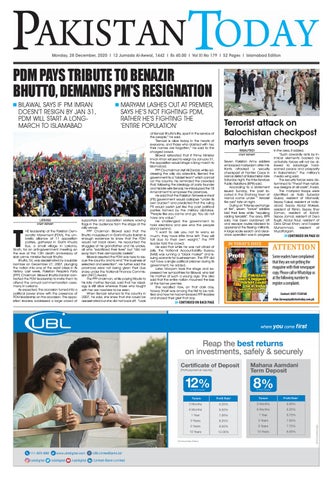
PDM Pays tribute to benazir bhutto, DeManDs PM's resignation g
Bilawal says if pM iMran Doesn’t resign By Jan 31, pDM will start a longMarch to islaMaBaD
LARKANA
t
staff report
he leadership of the pakistan Democratic Movement (pDM), the umbrella alliance of 11 opposition parties, gathered in garhi Khuda Bux, a small village in larkana, sindh, for an anti-government meeting on the eve of the 13th death anniversary of slain prime minister Benazir Bhutto. Bhutto, 54, was assassinated by a suicide bomber on December 27, 2007, plunging the nation into one of the worst crises in its history. last week, pakistan people’s party (ppp) chairman Bilawal Bhutto-Zardari contacted the pDM leadership to invite them to attend the annual commemoration ceremony in larkana. as expected, the occasion turned into a political power show with the presence of pDM leadership on the occasion. the opposition leaders addressed a large crowd of
g
MaryaM lashes out at preMier, says he’s not fighting pDM, rather he’s fighting the ‘entire population’
supporters and opposition workers waving flags in the audience from the stage at the rally venue. ppp chairman Bilawal said that the Bhutto mausoleum in garhi Khuda Bakhsh is enough evidence to know that the pDM would not back down. he recounted the struggles of his grandfather and his uncles, all who “sacrificed their lives” but “did not sway from their democratic beliefs”. Bilawal asserted the pDM was here to rescue the country and to end “the business of selected and selection”. he further said the provinces were not being given their due share under the national finance commission (nfc) award. the ppp chairman, while paying tribute to his late mother Benazir, said that her ideology is still alive whereas those who fought with her are nowhere to be seen. when Benazir returned to the country in 2007, he said, she knew that she could be assassinated but she did not back off. “look
at Benazir Bhutto’s life, spent in the service of the people,” he said. “Benazir is alive today in the hearts of everyone, and those who clashed with her, their names are forgotten,” he said to the charged crowd. Bilawal reiterated that if prime Minister imran Khan refused to resign by January 31, the opposition would stage a long march to islamabad. ppp co-chairman asif ali Zardari, while addressing the rally via video-link, likened the government to a “cricket team” which cannot run the country. he reminded the crowded that, following the ideology of party founder and his late wife Benzair, he introduced the 18 amendment to empower the provinces. he said that the pakistan tehreek-e-insaf (pti) government would collapse “under its own burden” and predicted that the ruling pti would perish just like the past political parties formed by the military dictators. “people like you come and go. you do not have any value.” he challenged the government to hold elections and see who the people stand behind. “i want to ask you not to worry so much; they have little time left. they will fall due to their own weight,” the ppp leader told the crowd. he said that while he was not afraid of jails, the national accountability Bureau (naB) was running a “black market” and issuing warrants for businessmen. the ppp did not have a single political prisoner during its government, he added. later, Maryam took the stage and expressed her sympathies for Bilawal, who lost his mother at such a young age. she also said that the entire nation mourned the loss of the former premier. she recalled how, on that dark day, nawaz sharif was among the first to be notified and how he had embraced ppp leaders and shared their grief that day.
CONTINUED ON BACK PAGE
Terrorist attack on Balochistan checkpost martyrs seven troops RAWALPINDI staff report
seven pakistan army soldiers embraced martyrdom after militants attacked a security checkpost of frontier corps in harnai district of Balochistan late saturday night, the inter-services public relations (ispr) said. according to a statement issued sunday, the post located in the shahrag town of harnai came under ” terrorist fire raid” late at night. During an “intense exchange of fire”, seven “brave” soldiers laid their lives while “repulsing raiding terrorists”. the area, ispr said, has been cordoned off and escape routes blocked to apprehend the fleeing militants. a large scale search and clearance operation was in progress
in today’s issue
in the area, it added. “such cowardly acts by inimical elements backed by anti-state forces will not be allowed to sabotage hardearned peace and prosperity in Balochistan,” the military’s media wing said. the security forces were determined to “thwart their nefarious designs at all costs”, it said. the martyred troops were identified as naib subedar gulzar, resident of Mianwali; sepoy faisal, resident of hafizabad; sepoy abdul wakeel, resident of pishin; sepoy sher Zaman, resident of Kohat; sepoy Jamal, resident of Dera Bugti; abdul rauf, resident of Dera ghazi Khan; and faqeer Muhammad, resident of Muzaffargarh.
CONTINUED ON PAGE 05
attention Some readers have complained that they are not getting the magazine with their newspaper copy. Please call or WhatsApp us at the following number to register a complaint. Contact: 0307-7338168 irfan.farooq@pakistantoday.com.pk
02
Monday, 28 December, 2020
NEWS
opp stands Firm on mandviwalla’s motion aGainst naB chieF ISLAMABAD
t
STAFF REPORT
HE opposition parties in the Senate have reiterated their resolve to stand firm on the House’s deputy chairman Saleem Mandviwalla’s motion against National Accountability Bureau (NAB) chairman retired Justice Javed Iqbal. Reports suggest the united opposition will hold a meeting to mull over the matter
of accountability in Senate on December 30. However, the reports further suggested the parties have refused to budge over the summons issued to Iqbal. After NAB froze his assets in connection with an ongoing investigation into a fake bank accounts scam, Mandviwalla heaped scorns on the antigraft agency, declaring: “It is a blackmailing organisation. It is an extortion organisation. It is an organisation which violates human rights.”
heavy fog causes pia flights to be delayed NEWS DESK Due to the harsh weather conditions, the flight schedules of various Pakistan International Airlines (PIA) flights in various cities have been affected, the airline spokesperson said on Sunday. The spokesperson said that due to the mist surrounding many cities across the country, the schedule needed to be changed for flights in different cities, including Lahore, Karachi, Multan, Faisalabad, Sialkot, and its surrounding areas. Previously, 19 domestic and international flights had been cancelled from Lahore’s Allama Iqbal Airport alone due to the dense fog, including Dubai-bound flight number 410 of a private airline, Riyadh-bound flight number 318, flight number 342 going to Najaf, flight 715 to Istanbul, and flight 244 to Abu Dhabi, flight 430 to Abu Dhabi and flight 132 to Kuala Lumpur. They were further said that more flights will need to be rescheduled if the situation does not improve. “Domestic flights will resume operations after visibility on the runways is ensured,” the spokesperson added. “On the other hand, international flights will land at alternate airports.”
“I have decided to highlight NAB’s human rights violations at every international forum,” he said after the agency informed an accountability court that it had frozen 3.1 million shares of different companies registered in the name of Mandviwala with the Securities and Exchange Commission of Pakistan (SECP) in connection with the case. “I will take NAB before [the] European Union, United Nations and every private entity and human rights body of the
Four soldiers martyred as helicopter crashes in GB
world,” he had said. In a later press conference, Mandviwalla announced to summon Iqbal to Senate to answer questions about the watchdog’s purportedly illegal actions. He said “production warrants” will be issued for the NAB chief if he refuses to appear in the upper house. Mandviwalla had earlier announced a special session of the Senate to take up a privilege motion that he submitted against Iqbal earlier this month.
Former JUI-F leaders likely to form new faction: report NEWS DESK Former Jamiat Ulema-e-Islam-Fazl (JUI-F) senior leaders who had recently been expelled from the party are likely to form a splinter group and have planned a meeting in the federal capital next week, a local media outlet reported on Sunday. As the JUI-F is said to be facing resentment from its senior cadre over the expulsion of Maulana Mohammad Khan Sherani, Hafiz Hussain Ahmed, Maulana Gul Naseeb and Maulana Shujaul Mulk, they have reportedly decided to launch their own faction against Maulana Fazlur Rehman. Furthermore, Ahmed claimed that JUI-F chief Maulana Fazlur Rehman is a dictator. “People like Fazlur Rehman think of parties as their fiefdoms,” he said, adding that Fazl has said that when he is no loner there, his son will take over the party. It used to be Jamaat-eUlema Islam Pakistan and Fazl cleverly added the ‘F’ to the party name, he said. I have spent my life in this party and will continue to, he said, adding that some members of the party have contacted him to express their sympathies. On the other hand, Maulana Gul Naseeb Khan has said that he will use ‘constitutional means’ for
the restoration of his basic membership terminated by the party and has rejected the idea of a splinter group. “The JUI is our party and we will continue with our struggle for the enforcement of Islamic laws from its platform,” he said. The former JUI-F leader said that the party did not inform him about membership termination in writing and he learned about it from the media. Earlier this week, the party’s spokesperson had said that the four leaders had been expelled from the party over violating party discipline and he added that a notification in this regard would soon be issued by the head of the disciplinary committee, Abdul Qayyum. Sherani had said that the Pakistan Democratic Movement (PDM), which is headed by Fazl, was an unnatural alliance and would soon break apart as it had no ideology to begin with. Furthermore, Sherani had said that as Fazl was also “selected” himself, he has no right to criticise Prime Minister Imran Khan. “I had predicted it a long time ago that Imran Khan’s government will complete its five-year term,” Maulana Muhammad Khan Sherani had said. “He will stay in power for the next five years too.”
ISLAMABAD: Four Pakistan Army soldiers died when an army chopper crashed in the mountainous region of Gilgit-Baltistan (GB), the Inter-Services Public Relations (ISPR) said on Saturday night. In a statement, the ISPR said the soldiers were evacuating the body of a martyred soldier, Abdul Qadeer, to a hospital in Skardu when the accident took place due to “mechanical reasons”. The army often uses helicopters to move its injured in remote and sparsely populated parts of GB where quick movement on mountainous roads is difficult, particularly in the winter season. The officers and soldiers who embraced martyrdom were identified as pilot Maj M. Hussain, co-pilot Maj Ayaz Hussain, Naik Inzimam Alam, and Sepoy Muhammad Farooq. GB Minister for Information Fatullah Khan expressed deep sorrow over the tragedy. He acknowledged the sacrifices rendered by the army for the country. In February, a Mirage aircraft on a routine operational training mission crashed near Shorkot in Punjab. The pilot ejected safely and no loss of life or property was reported on the ground. Later that month, a training aircraft came down near Takht Bhai, some 63 kilometers from Peshawar. However, the pilot managed to eject safely. In April, two pilots were martyred when an army aircraft crashed in Punjab. STAFF REPORT
Four killed, 25 injured in islamabad road accident ISLAMABAD: Four people were killed and 25 injured after a coaster and a passenger wagon collided on the Srinagar Highway early Sunday morning. The accident took place near Police Lines Headquarters when the wagon jumped the traffic light and rammed into the coaster. According to rescue officials, passengers in the coaster were all labourers who worked at the Islamabad airport. The bodies and injured people have been moved to the Pakistan Institute of Medical Sciences (PIMS). The hospital administration said that the people killed were identified as 54-year-old Gul Khan, 44-year-old Alim Jan, and 36-year-old Naseem Khan. INP
Chinese diplomat says China ready to help gwadar’s fishing industry grow KARACHI MIAN ABRAR
Chinese Consul General Li Bijian has said that security provision is prerequisite to attract foreign investment to Gwadar where mega projects are being undertaken under China-Pakistan Economic Corridor (CPEC) to help the local people by providing new opportunities of employment, business, development and civic amenities. In an exclusive interview with Pakistan Today, Li Bijian, who is looking after the consular areas of Balochistan and Sindh, said that people shall always be sensitive in dealing with the relations of security and development. “Well, as far as the security is concerned, I am very much impressed by the great efforts of the government and the establishment of Pakistan in ensuring security. The overall security situation has been much improved despite of the effects of Covid-19. While there are still some problems in some certain areas. Generally speaking, the investors are always attaching importance in four areas: the safety of investment, the smooth operation of the business, recovering of the investment, and making profits. Without security, the investors shall not come,” said the Chinese diplomat. He said that the people shall understand that without investment, some regions cannot develop. “Investment would bring development and jobs for local population and also it will improve civic facilities. With industries, locals will increase their incomes and would have better services. The second phase of CPEC projects will focus more on industrial and agricultural cooperation between our two countries. These projects will inject impetus in the development of the special economic zones (SEZs), including Tapeje SEZ in Sindh and the Free Zone in Gwadar, as well as the full growing of the farm lands. All these will be the change makers and fortune makers.” he added.
Consul general shares views on seCurity, investment and fishing related matters
Asked about the resources of Pakistan for attracting foreign investment, Bijian said that Pakistan is a rich country at this regard. “Firstly, Pakistan has more than 220 million population and is one of the most robust consuming markets in the world. Secondly, Pakistan has the largest number of young people who have received education and are talented. Thirdly, Pakistan is an important hub of regional transportation and transit. Fourthly, Pakistan is rich in natural resources and tourist attractions,” he observed. Asked about how the projects in Gwadar are going, Bijian said that with the concerted efforts by both sides, all projects under construction are doing well despite of the negative effects of Covid-19. “We have set up water treatment plants and schools,
and are building roads in Gwadar. The construction of the training institute as well as the hospital and the airport are moving forward steadily. Let me tell you that all these projects are actually an incentive for the people of Pakistan, especially for the people in Balochistan. These projects have brought jobs, opportunities and investments. We want to provide these benefits and services to the people,” he said. Bijian said that Gwadar port and free zone have been developed since 2013. After more than seven years’ construction, the port has already been put into full use. The dock is now able to load and unload all kinds of miscellaneous cargo, bulk cargo, roll on-roll off cargo and containers. The free zone includes south area and north area. The construction of south area has been completed and 14 companies have settled in bringing investment of about 70 million US dollars. More efforts shall be made to develop the north area, especially some favorable policies shall be put in place to encourage the investors. Gwadar Port itself is providing transit, not only for the region of Balochistan, but also from other regions of Pakistan and beyond the Pakistan's borders to Afghanistan and Central Asian countries. “Once all these projects are completed, the people would get more benefits and more services. And eventually, we will win the battle against the challenges of poverty and security. We will bring more employment, more benefits and more social development to local people for sure,” he asserted. Asked about the measures being taken to boost sea fisheries, Bijian said that fisheries are the major source of income for the local people living along the coastal region. “You have rich resources when it comes to fisheries. We call it blue economy. However, the local fishermen
need to increase their fishing capacity to help export the seafood. So, for attracting investors to develop cold storage and processing plants, the fishermen need to develop big associations and net huge quantity of seafood which could be exported. Right now, the fishermen do not have enough seafood that could be exported,” he maintained. He said that fishermen need bigger boats and ships and employ modern fishing tools. Moreover, he said the locals need to go in deep sea for fishing too as on seashores, the fishing is not profitable. “Secondly, many people are catching fish and the resources also depleting fast. Fishermen need to use modern ways to protect ecosystem. They should also seek federal and provincial government’s help in developing more fishing cultures to boost their future fishing capacity,” he added. The consul general said that China has been providing assistance to the fisherman community in Gwadar. “We are providing engines, solar panels and fishing nets, etc. to the local fishermen to help increase their fishing capacity. So, we advise them to organise, and to purchase bigger fishing boats to increase fishing capacity. They may also adopt modern fishing methods and technology,” he added. Moreover, he said, there is a dire need to build processing factories and coaching industries to better store the seafood. “Cold chain industry is also a must for the future. They also need to develop fishing cultures, such as fish and shrimp cultures,” he said. “Chinese investors are very much interested in investing in the fishing sector in Pakistan. It is very important to offer incentives to investors like tax rebate or tax-free option for some period of years,” he concluded.
Monday, 28 December, 2020
private sector will Be allowed to import vaccine KARACHI
p
AGENCIES
AKISTAN will allow the private sector to import vaccines for protection against the novel coronavirus, a senior health official confirmed on
Sunday. “In addition to procurement by the government, if private companies get approval, through the normal process, they will be allowed to do so,” Dr. Faisal Sultan, special assistant to the prime minister on health, told Anadolu Agency. This comes days after officials of the
Health Ministry, and the Drug Regulatory Authority of Pakistan refuted media reports that private sector could purchase vaccines for those individuals that can afford to pay for them. Responding to a query if the government has finalised deals with any vaccine manufacturers, Sultan, who effectively acts as the health minister, said: “Not yet, but very soon.” Earlier, he told Anadolu Agency that authorities were negotiating with China and Russia, among others, to procure the vaccines, and that frontline workers and senior citizens will be inoculated first. The government recently increased
munir urges world to ensure $20bn for covid vaccine ISLAMABAD TLTP
Pakistan’s Permanent Representative to the United Nations and UN Economic and Social Council (ECOSOC) President Munir Akram has urged the international community to ensure adequate financial resources against epidemics across the world. In a message on the occasion of International Day of Epidemic, which was observed on Sunday, he said, “Our response towards all epidemics especially Covid-19 must be of solidarity and international cooperation.” He said that everyone should be provided with equal access to advanced treatments, including vaccines. “The first and immediate task is to ensure that the vaccine against the Covid virus is distributed early and equitably to everyone,” Akram said. In this regard, he called for fully funding the $20 billion-short Covax facility, which is aimed at ensuring all countries will have equal access to any vaccines, once developed. “Our performance in controlling the emerging and re-emerging epidemics depends on the quality and efficiency of our health systems,” the ECOSOC president said, adding that it was also dependent on the strength and agility of early warning systems. But, he said, developing countries lacked essential financial resources to invest in their health systems, and their response to pandemics would depend upon the availability of emergency concessional financing. Ambassador Akram called for ensuring that everyone everywhere – rich or poor – gets equal and equitable access to the most advanced treatments, including vaccines.
an initial sum of $150 to $250 it earmarked for purchasing the doses. The science and technology minister made a similar announcement earlier in the day. “We are in touch with all pharmaceutical companies which are manufacturing Covid-19 vaccines… Dr Faisal Sultan, the federal health adviser, and the Health Ministry are leading the initiative,” Fawad Chaudhry told a news conference in the eastern city of Lahore. He said talks with a couple of pharmas are in their final stages, and the government will be able to finalize
a definite vaccination strategy within a week. “We hope to inoculate a large section of the population free of charge,” he said. “We will also allow private companies to import, and cater to the rich, who do not want to wait.” Pakistan will launch the vaccination drive in the second quarter of 2021, Nausheen Hamid, the parliamentary secretary at the Health Ministry, had said earlier this month. Immunisation has already begun in EU countries, the US, UK and many Gulf states. The vaccines approved so far include the ones produced by Pfizer-BioNTech and Moderna.
Old foes assemble at one place to protect interests: Faraz ISLAMABAD STAFF REPORT
Federal Minister for Information and Broadcasting, Senator Shibli Faraz has said that the agenda of opposition parties is only to protect their interests and old foes have now assembled at one place to achieve this target. In a series of tweets on Sunday, the information minister said that Prime Minister Imran Khan is faithful to the people of Pakistan and he will continue his struggle against those who plundered this country. Faraz said that those who were criticising each other in the past have now gathered in Larkana which exposes their real faces to the people. He said that souls of former premiers and Pakistan People’s Party (PPP) stalwarts, Zulfikar Ali Bhutto and Benazir Bhutto, must be in anguish that
day as the worst adversaries of their philosophies have gathered at their house. The information minter’s remarks came as the PPP invited Pakistan Muslim League-Nawaz (PML-N) – historically considered its arch-rival – to attend the party’s public gathering at Garhi Khuda Bakhsh on Sunday to commemorate the 13th death anniversary of Benazir Bhutto.
Faraz said that those who used to drag each other on the streets of Lahore and Larkana have now become each other’s guests. “Their [opposition’s] politics starts and ends at themselves,” he said, adding that they had nothing else to offer to the masses. They [the opposition] were something else in front of the people and completely different behind them, Faraz said. He added that her visit fortifies the two parties’ historical reality of appearing to fight each other on the face of it, but being one in the same thing behind the curtains. The minister added that the name of former premier Nawaz Sharif – father of Maryam Nawaz – will always be remembered whenever corruption and horse trading will be spoken of. PM Imran, on the other hand, he added, was ‘obedient’ for the people and watchful of those looting the masses
Karachi can witness lowest temperature in seven years today: met office KARACHI
LAHORE: A view of provincial capital engulfed in dense fog. ONLINE
TLTP
The Met department on Sunday forecast that the port city can record its lowest temperature in seven years on Monday (today) as the cold wave across the country and the city is likely to get more severe from next week. In 2013, Karachi had recorded a minimum temperature of 6°C. Another cold wave is expected to take hold of the city in January and, according to the Met department, it could rain in Karachi from January 6-7. According to the details, a new wave of westerly winds has entered the country due to which the severity of cold will increase in Karachi from Monday to Friday. Moreover, strong winds are likely to blow in the city from Sunday. The Met Office said that the weather is expected to drop down to the single digit in Karachi. On the other hand, many cities are also gripped by the cold wave, as Chaman and Kan Mehtarzai received snowfall on Sunday. Gilgit-Baltistan and Upper Khyber Pakhtunkhwa's areas are also expected to receive snowfall.
Lahore has proved to be a 'Waterloo' for PDM: Fawad Chaudhry NEWS DESK Federal Minister for Science and Technology Fawad Chaudhry on Sunday claimed that the Pakistan Democratic Movement (PDM) is on its last legs after the failure of the Lahore rally earlier this month. “The opposition’s movement has practically come to an end. Lahore has proved to be a ‘Waterloo’ for them,” he said while addressing a press conference on Sunday. He said that PDM posed no threat to the incumbent government and had no right to ask for resignations from the ruling party. “PDM is breaking up; PPP [Pakistan People’s Party] distanced itself from the statements of Nawaz Sharif and Fazlur Rehman,” he alleged on the occasion, stating that the rift in the Jamiat Ulema-e-Islam-Fazl (JUI-F) would continue to grow in the coming days. He further added that Maryam Nawaz would be the downfall of Pakistan Muslim League-Nawaz (PMLN), as “Maryam’s politics has drowned her party and all her statements are based on lies”. While taking a jibe at PPP Chairman Bilawal Bhutto-
Zardari and PML-N Vice President Maryam Nawaz, he said that the premiership is not an internship program that could be offered to children and some other arrangements will be made for them. Fawad said that Maryam has never worked in a kitchen and now she wants to become prime minister without any struggle while on the other hand PPP has become a party of only interior Sindh. Reacting to Maryam’s speech that she delivered in Sukkur on Saturday during the workers’ convention wherein the PML-N VP said Prime Minister Imran Khan’s only qualification was being servile, Fawad Chaudhry said that the PML-N leader is not willing to answer “where the billions of rupees she transferred from her accounts to 32 companies came from.” “They [opposition leaders] are showpieces. Given their weaknesses, we do not need to tighten our policy against them. In fact, I am in favour of the government to give the opposition a way out of this difficulty,” he added. He reiterated the need for a dialogue, adding that the PM has always been in support for establishing “an electoral system on which no one can raise a finger.”
NEWS
03
Fm urges nation to unite against india’s nefarious designs ISLAMABAD: Foreign Minister Shah Mahmood Qureshi on Wednesday urged the nation to unite against India’s nefarious designs against Pakistan. In a statement, the foreign minister said that India wants to destabilise Pakistan and is planning a false flag operation against the country. India’s aggressive designs against Pakistan have been exposed, he added. The foreign minister said that Pakistan achieved great success in the war against terrorism. He said, “Pakistan’s armed forces are fully prepared for a befitting response to any aggression or misadventure by the enemies.” Earlier on December 18, FM Qureshi had said that India along with its allies was preparing for a false flag operation to divert the world’s attention from the inner situation. He was addressing the Pakistani Business Community in the UAE. “India preparing for a surgical strike over Pakistan and waiting for a green signal from its allies to attack”, FM Qureshi had been quoted as saying. Qureshi had said he wanted to aware the United Arab Emirates (UAE) and the International of the heinous designs of India against Pakistan. TLTP
opposition divided on issue of resignations: interior minister ISLAMABAD: Minister for Interior Sheikh Rasheed Ahmed has said that the incumbent government will complete its five years constitutional tenure due to timely decisions and positive political approach of Prime Minister Imran Khan. Talking to a private news channel, he said that the opposition parties are divided on the issue of resignations, but they are pretending as united in order to pressurise the government. Rasheed said that the opposition wants to destabilise the country for protecting its personal interests, but the state would never allow them to do so at any cost. He expressed his optimism that the opposition would take part in the Senate elections and would not tender resignations. The minister said that the opposition alliance is using the issue of the resignation as a political stunt. Replying to a question, he said that the politics of Jamiat Ulema-eIslam-Fazl (JUI-F) chief Maulana Fazlur Rehman is based on a personal vendetta. PPI
Former pml-n lawmaker accuses police of protecting harassers LAHORE: A former member of the Punjab Assembly has accused the Liaqatabad police of inaction on her application against some influential men who trespassed her home, harassed her family members and hurled death threats. According to details, former PML-N lawmaker and human rights advocate Mary James Gill moved an application with the Liaqatabad police stating that on the night of Dec 21, five men led by US citizen Syed Haseeb Gillani attacked her home in R-Block Model Town and threatened the family members. "I was present at my home along with my younger sister and brother when around 1.30am five men trespassed into the upper portion of my rented house and tried to break the iron gate. They hurled threats and abuses as the tried to ram the gate with batons and clubs," she stated in her application to the police. However, her application regarding the attack was unilaterally disposed of by the police and no action was taken against the assailants. "Instead of registering a case and arresting the culprits, the police is clearly siding with them. My family and I are continuously being harassed by Gillani and his accomplices but we haven't received any protection from the police despite a written request submitted to the Model Town superintendent of police," she said. According to the former lawmaker, who was recently awarded a prestigious prize for her work for sanitation workers by the Swedish government, she and her family were living in a state of fear after the attack and continuing harassment of the accused. "I am now being threatened to withdraw my applications against Gillani and his accomplices, two of whom were later identified as Syed Shujjat Gillani and Syed Zubair Shah," she said, adding that the accused were relatives of her landlord, who is settled in Canada, and were probably trying to grab his property by forcing her to vacate it. “The police and some other people are now pressurising me to reach a settlement with the accused even though I have provided them video evidence of the attack. The accused are also not allowing us to install surveillance cameras in our portion of the house giving credence to my fears that they are planning to attack us again," she said, adding that the police will be responsible if she or any other member of her family is harmed by the accused. "I am a former lawmaker as well as a practicing lawyer but the manner in which the police is treating my case is appalling," she said. Commenting on the issue, Liaqatabad SHO Asim Jehangir denied that police was siding with any party. "We have summoned both parties on Monday, Dec 28, and will take action on merit after listening to both sides," he said. STAFF REPORT
Monday, 28 December, 2020
04 NEWS Pakistan took wise decision of promoting eVs, says chinese scholar BEIJING INP
Pakistan took a wise decision of promoting electric vehicles (EVs) in the country, Chinese scholar Professor Cheng Xizhonghas said in an article published by the China Economic Net (CEN). According to the professor, with the continuous advancement of the construction of China-Pakistan Economic Corridor (CPEC) and Special Economic Zones (SEZs), the two countries can carry out close cooperation in this sector. Pakistan may boldly introduce China's advanced production technology of new energy vehicles, gradually accelerate the local production and sales of new energy vehicles, which will inject new impetus into the rapid development of the national economy. It is a wise decision on the part of Pakistan’s federal cabinet to grant massive tax exemptions to facilitate promotion of electric vehicles in the country. It allowed one per cent sales tax for locally-made EVs up to 50 kwh and light commercial vehicles (LCVs) up to 150 kwh. It also capped the duty on import of charging equipment at one per cent. At the same time, the EVs will be exempt from federal excise duty (FED), whereas the import of machinery for manufacturing of these vehicles would be duty-free in addition to removal of additional customs duty (ACD). As per the policy, there will be only one per cent tax on import of EV parts for manufacturers. Apart from the tax facilities, the Pakistani government has also waived registration and annual renewal fee for EVs. In October, the Chinese government issued the New Energy Vehicle Industry Development Plan 2021-2035. According to the plan, the development of new energy vehicles is the only way for China to become a powerful automobile country from a big automobile country. It is also a strategic measure to deal with climate change and promote green development. Since 2012, China's new energy vehicle industry has made great achievements and become one of the important forces in the development and transformation of the world's automobile industry. Currently, a new round of global scientific and technological revolution and industrial transformation is developing vigorously. The integration of automobile and related technologies in energy, transportation, information and communication is accelerating. The trend of automobile industry is electrification, networking and intelligence. New energy vehicles integrate new energy, new materials, internet, big data, artificial intelligence and other transformational technologies.
Pdm’s politics revolve around personal interests: Firdous LAHORE INP
Special Assistant to Punjab Chief Minister on Information and Broadcasting Dr Firdous Ashiq Awan has said that the opposition do not refrain from holding public gatherings despite rising cases of coronavirus. In a statement issued here on Sunday, Firdous said:“Number of active coronavirus patients has reached to 135665 in the province. 524 new corona cases have been reported and 42 patients have been died of coronavirus during the past 24 hours. Total 3900 people have been died in the province so far. She added that the Pakistan Democratic Movement (PDM) has scored political points at every critical situation, including coronavirus, and this senseless gang has contributed in the spread of the virus. The PDM has become the enemy of the people. “They were not afraid when they were looting public money. They are now raising hue and cry when they are being held accountable for their embezzlements. This gang will not get NRO,” she concluded.
ISLAMABAD: A view of Faisal Mosque during dense fog in the federal capital. ONLINE
‘NormalisiNg ties with israel to cost PakistaN NatioNal ideology’ ISLAMABAD TLTP
Pakistan will not gain anything by recognising Israel in the security or economic fields except causing a casualty of its own national ideology, which is the real binding force of the country. This was the crux of the deliberation titled 'UAE’s recognition of Israel and its implications for the Middle East and Pakistan', which was held here at the Institute of Policy Studies (IPS). The session, chaired by IPS Executive President Khalid Rahman, was addressed by some former ambassadors, security analysts and members of the IPS’ research faculty. The speakers were unanimous in their views that the issues as delicate, as the recognition of Israel must be addressed in line with the popular opinion and sentiments, and through parliamentary debates. They cautioned that any
measure taken against the national ideology and policy environment will create chaos in the country. It was also deplored that the debate initiated on the issue in the policy arena for some benefits is untimely and counterproductive, as it does not present any vision and proactive plan to benefit from such a major foreign policy shift. Rather, Pakistan does not seem to gain anything by accepting Israel in material terms in the security or economic arena except causing a casualty of its own national ideology. Speaking from a diplomatic viewpoint, the discussion underscored that while it is important to carve paths of pragmatism from within the underlying grey areas of diplomacy and foreign policy, it is also imperative that no step is taken at the cost of the country’s identity, sovereignty or fundamental ideology. Likewise, it should also be made sure that no compromises are made out of any
fear, threat, or greed. It was pointed out that unfortunately, it is such an argument of pragmatism that is being used on many occasions to get important decisions without bringing it into public debate. A similar attempt is being made in the issue of Israel's’ recognition as well, as it is very easy to anticipate that any such discussion in the public domain is less likely to garner much support. Deliberating over the economic aspect, it was stressed that the real issue of the country is not its economic debt, but extreme mismanagement of economic resources that was caused by poor governance. It was highlighted that Israel too was under considerable debt itself, but its efficient utilisation of the loans turned out to be the deciding factor in making its borrowed money beneficial instead of a burden. Similarly, it was also questioned that
if the economic weakness is being deemed as the major reason behind the recognition of Israel, then why rich and self-reliant Muslim countries like UAE have chosen to walk that path? Over the argument of security and intelligence sharing between Pakistan and Israel, a question was raised that against whom the cooperation will be used? If it is supposed to be against terrorism, it would still be relevant in the cases of CPEC and Balochistan, as these two are the major areas where the country is faced with growing threats, most noticeably from its western neighbour. The speakers also lamented that one of the biggest dilemmas faced by the Muslim world at present is that its leaders are not true representatives of its masses. The phenomenon is not only rendering them ineffective at the international scale, but also weakening them from within.
Buzdar directs to continue efforts to stabilise prices of essential commodities LAHORE STAFF REPORT
Punjab Chief Minister Sardar Usman Buzdar has directed the concerned authorities to continue efforts to stabilise the prices of essential commodities besides ensuring their availability to the people. In a statement issued here on Sunday, the CM directed the concerned departments to keep a vigilant eye on the hoarders and profiteers besides launching a
crackdown against them. The CM asserted that strict action should be taken against the hoarders under the Anti-Hoarding Ordinance 2020. He also directed the Provincial Price Control Committee (PPCC) to strictly monitor the prices of essential items and utilise all the administrative powers to ensure availability of the items to the people at fixed rates. He said that timely and effective measures of the government have brought down the prices of flour, sugar and other essential commodities, and provided re-
lief to the people. He warned that illegal increase in prices will not be tolerated. He further directed the commissioners and deputy commissioners of different districts to take action against hoarders and profiteers, and send a report to the Chief Minister's Office. “The profiteers are the culprits of the society and law. The government will take all possible steps for providing relief to the people. I will not allow anyone to exploit the people and government. I will fully protect the interests of the people," the CM said.
Peshawar district administration removes billboards worth millions of rupees PESHAWAR AZIZ BUNERI
LAHORE: A Pakistan Railways official waves a red flag near Badami Bagh to signal the train to stop. ONLINE
The Peshawar district administration has removed 3,000 billboards worth millions of rupees across the city without intimation to Peshawar Development Authority (PDA) and four Tehsil Municipal Administrations (TMAs). Billboard Association President Haji Rashid told Pakistan Today that the PDA and four TMAs in the district had allotted contracts of billboardsworth Rs60 million to different constructors. However, the district administration has now launched an operation and raised down all the billboards in the city. Rashid added that billboards worth around Rs120 million have been destroyed by the administration so far. On these billboards, each advertising party had paid Rs10,000 as NOC fees and millions of rupees in the shape of taxes to the PDA and TMAs. According to sources in the TMAs, the provincial government has granted tax exemptions in various categories due to coronavirus. Resultantly, all the TMAs
are facing severe financial constraints.Now this act of the administration will put more burden on the concerned TMAs. Sources said that the government had issued instructions to the district administration to remove the boards and sought details of all the billboards from the local councilsecretary. However, the district administration did not wait for the details from the local council, but raised down the billboards worth millions of rupees. Earlier, all the TMAs in Peshawar had raised objections to the removal of the billboard business, which employs thousands of people. According to sources, the district administration is not authorised to remove any billboard in the city without giving a prior notice. Some of the billboards were raised down on a law court’s permission. According to some officials of the Billboard Association, they have convened a meeting with Advisor to the Prime Minister ArbabShehzad and the district’s commissioner to apprise them of the situation. "If the government and the district administration failto compensate the losses, we will start protests," they warned.
Monday, 28 December, 2020
NEWS
Terrorist attack on Balochistan checkpost martyrs seven troops contInueD froM pAge 01 In a tweet, Prime Minister Imran Khan said that he was “saddened” to learn about the “Indian backed” attack. “Saddened to hear of 7 brave soldiers martyrdom as a result of terrorist attack on FC post in Harnai Balochistan late last night,” he tweeted. “My heartfelt condolences & prayers go to their families. Our nation stands with our courageous soldiers who face attacks from Indian backed terrorists.” “Strongly condem[n] Charag incident on FC and area,” Balochistan chief minister Jam Kamal Khan tweeted. In October, a gun and rocket attack targeting a paramilitary escort in the town of Ormara martyred seven soldiers and seven private security guards. The attack comes weeks after the military began the fencing of the Gwadar port to protect the ChinaPakistan Economic Corridor (CPEC) projects and change the security dynamics in the restive city. The Balochistan government has planned to fence off 24 square kilometers of the city, which is at the center of the over $64 billion game-changer project that aims to connect China’s strategic Xinxiang province to Gwadar through a network of roads, railways and pipelines to transport cargo, oil, and gas. Reports suggest there will be two entry points to the fenced part of the city and more than 500 surveillance cameras will be installed. Prime Minister Imran Khan expressed sadness over the martyrdom of seven soldiers in a terrorist attack on Twitter, and while condoling the loss of lives, the prime minister sympathised with the bereaved families and prayed for strength to them to bear the loss. “Saddened to hear of 7 brave soldiers martyrdom as a result of terrorist attack on FC post in Harnai Balochistan late last night,” he said. “Our nation stands with our courageous soldiers who face attacks from Indian backed terrorists,” the prime minister added. Furthermore, President Dr Arif Alvi Sunday strongly condemned a terrorist attack on Frontier Corps check post and expressed his deep grief and sorrow over the death of soldiers, according to a press release. Expressing sympathies with the bereaved families, the president prayed for the high ranks of the martyred soldiers and for the bereaved families to bear the loss with fortitude.
NLC shifts stranded containers from Khunjerab to Sost KHunJerAB tLtP
The National Logistics Cell (NLC) transported containers stranded due to the Covid-19 pandemic from Khunjerab Pass to the Silk Route Dry Port Sost on Sunday in freezing temperatures, ahead of schedule to avoid further losses to traders. For this purpose, the Khunjerab border was temporarily opened from December 15 to 25 to allow cross border movement of the containers. The border is usually closed from November 30 up until April 1 every year due to heavy snowfall in the area. The transportation of the containers started from the Khunjerab Pass, upon opening of the border on December 15, as per the laid down Covid-19 standard operating procedures (SOPs). The challenging task of managing the movement of the containers was made possible with the assistance of local administration and the Frontier Works Organization (FWO). All the containers were safely moved to the NLC dry port at Sost, despite slippery conditions caused by the snow and frosted roads. The containers were said to be carrying machinery for hydel energy projects, corona aid for the education department of Gilgit Baltistan as well as trade consignments.
05
GovT To NoTify Gi ruLeS required To fiGhT BaSmaTi CaSe iN eu ISLAMABAD
P
GHULAM ABBAs
AKISTAN is going to notify geographical indication (GI) rules to support its case against India’s unlawful claim to the GI tag of basmati rice in the European Union (EU), as the domestic implementation of GI law is needed to claim a tag for any product in the international market. Though the country is facing registration issues of domestic products in the international market, local items are yet to be protected through the GI act approved this year after a delay of almost 18 years. It may be mentioned here that a product has to be protected under the GI laws of a country before applying for registration for the protection of any product’s GI tagging. However, there are no rules of the GI Registration and Protection Act 2020, enacted in March this year, which is why Pakistan’s basmati was not a protected product.
“The GI law is yet to be implemented as authorities concerned have yet not framed its rules. As a result, many local exportable products cannot be registered anywhere in the world with Pakistani GI tagging,” an exporter and member of the Rice Exporters Association of Pakistan (REAP) said. Earlier in September, the issue of protecting the long-grained rice as a product of Pakistan came at the forefront after India submitted an application with the EU, claiming sole ownership of basmati rice. The Indian application stated that “basmati” is a special long grain aromatic rice grown and produced in a particular geographical region of the Indian subcontinent. After highlighting the brief history of the rice type, the Indian government further claimed that the region is a part of northern India, below the foothills of the Himalayas forming a part of the Indo-Gangetic plain. Incidentally, the issue was pointed out to the Ministry of Commerce and its attached department, the Intellectual Property Organisation of Pakistan (IPO), by
local rice exporters after observing the details of applications on the EU’s website. Eventually, the Indian claim was challenged earlier this month, with Pakistan arguing that basmati rice was a product of both India and Pakistan. It is pertinent to mention here that Pakistan exports 500,000 to 700,000 tonnes of basmati rice annually to different parts of the world, out of which 200,000 to 250,000 tonnes is being shipped to EU countries. Meanwhile, a spokesman for IPO Pakistan said that the rules of the GI law were are likely to be notified in the coming days. “The rules are in printing process and would be notified by the Commerce Ministry soon,” IPO spokesperson Meesak Arif said, adding that the government has authorised the Trade Development Authority of Pakistan (TDAP) as the lead agency regarding basmati rice. “Soon after the rules are notified, TDAP will file for the GI protection of basmati rice in Pakistan, which will eventually make the case of Pakistan in EU and elsewhere strong,” he said.
Afghanistan imposes duty on kinnow import from Pakistan ISLAMABAD GHULAM ABBAs
Afghanistan has imposed duty on import of kinnow from Pakistan causing loss of a 100,000 metric tonnes market to exporters while the two countries are in talks for signing a preferential trade agreement, besides revising existing agreements. In a letter sent to the Ministry of Commerce, Pakistan Fruit and Vegetable Exporters Importers and Merchant Association (PFVA) has informed that Afghanistan has raised taxes by an increase in assessed value of kinnow from Pakistan, which will increase the value of grapes from Afghanistan by Pakistan Customs. Currently, Afghanistan is assessing the value of kinnow at $272 per tonne as compared to $124 per tonne previous season, whereas custom duty at the import stage is 30 per cent at the Afghan side. Pakistan Customs is currently assess-
ing grapes at $700 per tonne against its fair value at $450 per tonne, whereas custom duty on grapes is 10 per cent. The association has informed that kinnow export to Afghanistan is a lifeline for kinnow exporters as Pakistan is exporting is No-2 category and small sized kinnows to Afghanistan which is not exported anywhere else. With the sudden increase of taxes, exports have been hampered as exporters have no other option but to sell the small sized fruit in the domestic market at throw away prices. According to the association, Pakistan is importing a small quantity of grapes from Afghanistan while with allowance of import of grapes at its correct value will encourage Afghan Customs to correct the value of kinnow. It has suggested that since Pakistan is also proceeding with a PTA with the neighbouring country, taking the first step to allow grape import from at fair
value would be encourage Afghanistan to reciprocate the move in good will. Meanwhile, a delegation of PFVA headed by Waheed Ahmed held a meeting with Advisor to Prime Minister for Commerce and Investment Razak Dawood and apprised him of the issues related to export of fruits and vegetables including kinnow after which the advisor assured that he would make all-out efforts to resolve issues faced by the association. He also said that the duty structure is being reviewed and simplified to facilitate Pak-Afghan trade. The delegates of PFVA appreciated initiatives taken by the advisor to address the exorbitant increase in import duty on kinnow by the government of Sri Lanka by taking it up at the diplomatic level which resulted in the withdrawal of an increase in the cess. “This timely action led to the elimination of likely repercussions in kinnow export to Sri Lanka and
will help attain the export target of 350,000 metric tonnes,” they said. Sharing issues related to the export of fruits and vegetables to the international markets of Indonesia, Afghanistan and Iran, Waheed Ahmed emphasised the need for immediate action. The PFVA delegation shared that the quota of Pakistani kinnow import by Indonesia is due to expire on December 30, whereas Pakistan would be deprived of the Indonesian market if steps are not taken to renew the quota deal. “It is, therefore, essential to have an immediate negotiation on the issuance of a new quota by Indonesia so that export to the country can continue without any interruption,” the PFVA stressed. Moreover, the need for an immediate negotiation with Iranian authorities to withdraw the ban on Pakistani kinnow, a lucrative market which has been closed for many years now.
Govt urged to avoid imposing duty on export of copper, aluminium ingots ISLAMABAD sHAHzAD PARACHA
Exporters and melters of copper and aluminium have requested the government to refrain from imposing duty on exports of the two metals. Officials said that a total of $700 million from copper ingots, and $30 million from the export of aluminium ingots were earned for the national exchequer in this year. “Our combined exports would have touched $1 billion, but we were not able to achieve that target due to three months of lockdown due to the ongoing pandemic,” they added.
On the other hand, fan manufacturers have requested the government to go ahead with imposing duty on copper and aluminium exports as prices of the product have increased in the international market due to which their profit has decreased. Officials said that the fan industry’s exports, after value addition, equal $24 million, while one exporter alone sends copper worth $50 million to China. However, exporters of copper and aluminium had recently held a meeting with Advisor to the Prime Minister (PM) on Commerce and Investment, Abdul Razak Dawood, warning of a possible fallout if the government imposes duty
on the export of ingots. The commerce advisor was informed that Pakistan exports copper and aluminium by adding value to metal scrap. “We have been exporting copper ingots since 2008, and throughout the last 12 years, local manufacturers have never faced a shortage of copper or aluminum scrap in the country. Even today, scrap is available in abundance and local manufacturers can easily import it in case they face a shortage as the government has already given many tax-related exemptions on the import of raw materials,” exporters said. The advisor was further informed
that export target for the year 2021 is $2,000 million for the two metals but can be increased tenfold with the government’s support. Presently, China is importing $40 billion copper and aluminium ingots while Pakistan’s contribution is below a billion dollars. It is pertinent to mention here that China has zero-rated this sector under the free trade agreement signed last year due to which copper and aluminium ingots exports reached $730 million in China. Officials said that Chinese investors are also establishing the copper and aluminium ingots industry in Pakistan and any duty can hurt this investment.
The list of coronavirus victims keeps growing City Notes
T
M A NiAzi
he coronavirus is a scourge. It has taken John Edrich from us, as well as Shamsur Rahman Faruqi. They belonged to very different fields, but they were both venerable men, and died of the dread disease because they were now venerable. Edrich was a cricketer, and Faruqi a critic, and their areas of operation widely apart, as reflected in where they died. Edrich died in the UK, Faruqi in Allahabad, now named Prayagraj. Faruqi was not just a critic, but also a novelist. Edrich, on the other hand, did not make a second career of cricket journalism or broadcasting. He was one of the last men to complete the feat of more than 100 first-class centuries, which I
don’t think will ever happen again easily, not because the batsmen of today aren’t what their elders were, but because the English first-class season no longer has more than 30 fixtures, and batsmen no longer play until they’re over 50. The record-holder for centuries, Sir Jack Hobbs, managed 197 hundreds because he played until he was 51, and got more than 30 games a season year in, year out. Of course, Imran Khan was probably concerned, for Edrich was a contemporary, though very senior. Still, a man has a right to be worried when his contemporaries keel over. We shouldn’t forget that Imran might appeal to the youth, but that doesn’t mean he won’t be celebrating his 69th birthday in March. Edric opened for England when Imran debuted, but in both innings he fell to Asif Masood, being first bowled for 0 and then caught behind for 15. Still Imran
must have bowled to him. Still, Imran had some link to Edrich. On the other hand, Faruqi probably left him cold. Not even the most diehard Insafian claims he has a fine taste in literature, or any taste whatsoever. Literary taste is developed by extensive reading. Not even Imran’s worst enemy accuses him of being happiest among his books. Considering that his worst enemy is Mian Nawaz Sharif, that would be a serious accusation. indeed, but it seems the last literate personality that the establishment tried to cultivate was Zulfikar Ali Bhutto. Another person who does not look like a reader, but not even literate, Usman Buzdar, Imran’s Waseem Akram, caught the coronavirus. Of course, if the worst was to happen to Buzdar, Imran would then eagerly seek a replacement. Presumably from a place bigger than his hometown. But though Buzdar does not look educated, he does
CMYK
seem to do something which is the mark of an education. He looks like one of those few who have mastered the difficult (and entirely useless) art of writing with his feet. Another person who has caught the coronavirus, and about whom Imran must be concerned, would be Emanuel Macron, the French President. Macron has continued the new tradition of French Presidents who haven’t written a book during their tenure. France has had a tradition of author-presidents. Charles de Gaulle wrote his wartime memoirs, which were not merely a novelty in being written while in office, but are also esteemed as being fine examples of French prose. Pompidou, his successor, also tried, and his, Jacques Chirac, but was Francois Mitterand who authored not just a book, but one dealing with his academic specialty, philosophy. Imagine Imran doing a book on philosophy. As interesting as Mian Nawaz
writing one on the higher mathematics. Or Ishaq Dar one on conjuring. Come to think of it, that might be quite useful. Since him, the French presidents have all been washouts as writers. Macron’s having married his teacher at school doesn’t really count. Though that puts him in the tradition of French presidents like Mitterrand (again) who admitted towards the end to having a daughter out of wedlock. And while Francois Hollande wrote no books, he did leave the Elysee Palace to go off (on a scooter) to visit a lady friend late at night. I wonder how your typical Indian farmer would react to that. They’re posing another problem for Narendra Modi with protests at his legislation abolishing support prices. If the protest fails, expect us to follow suit. I was enthralled to see the BJP claim that the protesters were hiding Khalistan supporters. Right. Traitors. We know all about that, don’t we?
Monday, 28 December, 2020
06 COMMENT
What is behind the LNG controversy?
Held Kashmir democracy Can we stand a comparison? The Foreign Office was rightly indignant at Indian Prime Minister Narendra Modi’s claim that the local body elections in Kashmir showed that there was democracy there. As the Foreign Office rightly pointed out, those elections would be no substitute for what the people of Kashmir really want, the holding of a plebiscite to determine which state do they wish to join, Pakistan or India. At the same time, Pakistan needs to ask whether it is an attractive enough state for Kashmir to join. Prime Minister Imran Khan has loudly proclaimed that he will personally advocate the Kashmir cause, but will he he show more commitment to democracy? Kashmiris in Indian-held Kashmir need a better example than how the government is trying to suppress the opposition PDM’s movement against it, not to forget the use of NAB, the FBR and the FIA to crush dissenters. Associated with this is freedom of expression, which should include the right of dissent, and of criticizing the government if one disagrees with what it is doing. The government should remember the way it has moved against print, broadcast and social media, at any sign of dissent, does nothing to persuade Kashmiris to join the Federation. The implied contempt of the Prime Minister for Parliament, shown by his prolonged absences from the house, is an indication of the lack of respect of free speech, for it is the main weapon Parliament has. Pakistan has a duty to held Kashmir, not just to provide it moral, political and diplomatic support, but to provide a receptive environment for it. Kashmir has suffered a lockdown since 5 August 2019, after India abolished the special status of Kashmir and then divided it into three union territories. Kashmiris must not feel that the risk getting out of one oppression only to enter another. Apart from the more general purpose of proving the Partition wrong, the Indian media shows up the flaws in Pakistan so that it can be argued in Kashmir that there is no point in jumping from the frying pan into the fire. If Kashmir needs a plebiscite, Pakistan needs free elections. Kashmiris already live in a state where they are left voiceless, so their enthusiasm to join another, at great human cost, must not mean that they face the prospect of a new voicelessness.
AbbAs HAsAn
T
he last few weeks media has been buzzing with allegations and counter-allegations about import of LNG. Both Dawn and Geo have put a figure of $200 milliom as losses due to delay in procuring LNG. Geo went further and put a figure of $122 billion losses incurred by the PTI government due to this delay and other decisions. The debate Friday night between Former Prime Minister Shahid Khaqan Abbasi and SAPM Nadeem Babar helped clarify many issues. Babar clarified that the 23 cargos of LNG procured in the Nov/Dec/Jan window cost an average price of $6.34/mmbtu or 12.5 percent of Brent, still cheaper than the Long-term Sale Agreement (LSA) concluded with Qatar at 13.37 percent of Brent. he also informed that the 43 cargos purchased on thr spot market from 2018-to date had an average purchase price 20 percent less than the LSA with Qatar, saving the country $240 million. Babar also addressed the other allegations namely that LNG terminal was under-utilized, stating that there was insufficient demand for LNG, and justified that the RFO
oil plant, was used to generate only 3.7 percent of the power and that too due to transmission system constraints during peak hours, he also correctly pointed out what really mattered was the cost/mmbtu as that directly translates into electricity prices, regardless of percentage slope with Brent. Abbasi accused the government of delays in awarding the third LNG regasification unit and LNG pipeline. This brings me to the elephant in the room that was not discussed in the debate, namely the raison d’être for LNG in the first place. In 2013, once the PML(N) was in power it needed to replace the expensive RFO power plants with a more economical source. Despite lower cost and environmental benefits, hydel and renewables have an inherent base load reliability issue. The government was left with two main options─ imported LNG or local Thar coal (which is in abundance). Unfortunately it chose to install 3600 MW in LNG power plants, 2400MW of imported coal and one 660 MW Thar coal plant. Today the price of power from Thar coal is $55/MWh while that from imported LNG is currently $90/MWh, or almost half. had the same “Punjab Speed and Focus” been on Thar coal, it would have saved at least $10 billion (over the 20-year project lifetime at 65 percent utilization)- this figure will increase should the rupee depreciate. In addition to reducing the country’s import bill, and foreign exchange saving of approx. $ 0.8 billion a year─ But then Tharparkar isn’t in Punjab. NePRA, the main electricity buyer. operates on a Merit Order System (MOS), whereby maximum power is purchased from the cheapest source and then from the second cheapest and so forth. Based on current costs, hydel power costs are approx. $20/MWh, new renewables approx. $35, Thar coal $55, local gas and imported coal around $65, LNG power $90 and RFO plants $ 120. RFO may be the most expensive fuel but LNG is the second most expensive power source. Today, to be able compete with Thar coal at $55/Mwh, the price of LNG at Karachi must be $3/mmbtu. Given that it costs $3 to chill and transport the gas, LNG power plants will have to have gas for free to produce power at the same cost as Thar coal plants. Today, to be able to compete with renewables at $35/MWh, the LNG price must be around
2020 – An obituary
Why not polio? IMB asks a valid question
The coronavirus, the US elections and WFH
The Independent Monitoring BOARD (IMB) for polio, in its latest six-monthly report, has asked pertinently why Pakistan has been unable to eradicate polio while it has been so successful in tackling covid-19. The IMB said that health Services SAPM Dr Faisal Sultan had expressed a firm commitment to eradication, but the fact of the matter is that the recent resurgence in cases in the last three years predates the covid-19 pandemic, and coincides with the PTI coming to office. The PTI’s first focal person on polio eradication treated the task casually, with the result that all of the effort of eliminating polio went to waste. As the IMB noted, the danger has emerged of Iran being re-infected, as poliovirus has once again been found there in sewage. That indicates that the danger will not be eliminated until the disease is eradicated. The PTI seems to lack commitment in this direction, with the Prime Minister seeming to assume that the focal person’s position was meant for political appointees who wished to do no work. It is a matter of shame for Pakistan that it is still one of those two countries left in the world where polio still occurs, the other being Afghanistan, with travel restrictions because of this having been imposed since 2014. It is perhaps of even greater concern that the virus is moving from Pakistan into other countries. The previous government showed a much greater commitment in bringing down the number of infections. On the other hand, the present government has shown callousness or incompetence, or both. There is an element of corruption as well in this failure, as Pakistan has received got $1.16 billion from the IMB since 2106 till now. If the corrupt PML(N) government could make progress, that means there were at least some funds being properly used. however, now that the cases are going up under the PTI, is it to be assumed that the money is now being embezzled? The government needs to turn more attention to the polio problem, which is already showing signs of getting out of hand because of neglect.
Asif sAAd
W
hAT an extraordinary year it has it been. It came, it destroyed so much of what we knew and how we lived. Now it is going away with vaccines on their way in and Donald Trump on his way out, ushering in hopes about the world returning to some sort of normality. In the wake of destruction comes creation of course, and 2020 has given us more chances to rebuild than ever before– at least in my lifetime. On that note, I turned 56 this year– slowly climbing towards the respected senior citizen label. In 2020 I realized more than ever how precious life is and how delicately is it balanced. You breathe in one bad air particle expelled by a sneeze or cough, and that may be it for you. The term ‘disruption’ may be synonymous with the tech industry but, nature, in the form of this previously unknown virus, has caused the biggest disruption probably since the Second World War. Looking back at 2020, do we mainly look back at the pandemic? Perhaps. But we must also look back to the year to see what have we learned and how and where things go from here. The year began well enough– full of the usual new year resolutions one never really fulfils. The first news of Covid-19 broke in early January of a mysterious new disease emerging in Wuhan. It was only a few weeks later that we began hearing about the spread in europe– Italy to start with. I recall cancelling a business trip to Germany and holland in early February after seeing headlines of the spread there. however, most of us in Pakistan didn’t really give it much thought till the first case was reported here in March. Then came the lockdowns coupled with the endless debate on whether they were doing any good. Somehow, for completely inexplicable reasons and with good fortune, Pakistan escaped the worse of the impact of Covid-19 and the virus seemed to be almost gone by August. Life was getting back to normal and the economy underwent some sort of a revival. however, by November the second wave of the virus was back. This time it seems to be more deadly than before. As I write these words, the reported infection numbers are rising coupled with an alarming
Dedicated to the legacy of the late Hameed Nizami
Arif Nizami Editor Aziz-ud-Din Ahmad
Umar Aziz
Asher John
Joint Editor
Executive Editor
Deputy Editor
Lahore – Ph: 042-36300938, 042-36375965
I
Karachi – Ph: 021-35381208-9
I
increase in the death rates. This time around, one hears of so many people within our own friends and family network who have been infected. A few sadly have not survived. The year 2020 has taken away more loved ones for many families than any other year for many decades. The other big story of the year of course was the US election. It wasn’t so much about who would win but about Donald Trump accepting the results if defeated. Indeed, that turned out a correct misgiving as Trump continues to complain about a stolen election despite the electoral college having recently voted. It was fascinating to watch from a distance as we saw many Pakistanis become more familiar with the US election process than they have ever been about their own country’s. Speaking of which, politics here continue to follow tried and tested patterns of power struggles with all sides hell bent on communicating as loudly and brashly as possible about how they are the saviours of this poor country. What they don’t realize is that endlessly shouting grimy obscenities at each other makes them increasingly irrelevant to the common person. In this aspect, 2020 brought nothing new. Sad to say, I am unlikely to be wrong in predicting that this state of affairs will continue for years to come. Fortunately, some very good things have happened, that transformed from being upcoming trends to essentials of modern-day life. An example is ‘work from home’, now abbreviated as WFh. When we started having Zoom or Teams or Google meetings back in March-April, there was a novelty to it– a sort of a challenge to master the technology and to become familiar with the possibilities of connecting virtually. Surprisingly for most of us, the technology already existed and was readily available to ensure that work did not suffer. And it did not. In fact, office workers and senior managers may have become more
Islamabad – Ph: 051-2204545
$0.5/mmbtu, this would barely cover the cost of LNG transportation, let alone its costs. So anyone who takes Former Prime Minister Shahid Khaqaan Abbasi’s statement during the debate that LNG is the best source of power for Pakistan at its face value, should think again. In the last year the price of oil increased from $30 to $50/ barrel, the price of LNG increased from $2.5 to $ 6.5/mmbtu, the price of imported thermal coal increased from $55 to $80/ton, the rupees/$ depreciated from 130 to 160. Yet due to rupee depreciation and economies of scale the price of Thar coal decreased from $55 to $40/ton. The sun and wind remained free sources of energy. Whereas LNG was required to address the needs of existing power-plants and industrial consumers, the decision to favour LNG over domestic coal at such a large scale, was neither naïve nor ill-informed but a deliberate act of commission. Despite ample evidence, no lessons were learnt from the damage that Benazir government’s pernicious IPP policy had inflicted on the economy by relying on imported fuel─ thus exposing the customers to both foreign currency and oil price risks, not to mention the need for dollars to buy the fuel (the country still continues to pay capacity payments to expensive, idle and inefficient power plants). Despite better choices and ignoring lessons from the IPP policy, the PML(N) government deliberately chose an option that would leave economy weaker─ Why was this choice exercised? I will leave the readers to draw their own conclusions. The energy landscape is changing. It is expected that countries with ample sunlight, such as Pakistan, to reach peak base power by 2030-35. In 10-15 years’ time, due to increasing efficiency of solar panels and battery storage cost reduction to less than $ 60/MWh, thermal generation will most probably become obsolete, with users especially in rural areas switching to renewables and disconnecting from the WAPDA grid. Is the government gearing up to this eventuality by embracing smart grids? The era of supply-side power is ending and unless the government wakes up it will be facing a glut of un-saleable power on a much larger scale than the IPP fiasco. I would add that Friday’s was a refreshingly civilized debate. It is incumbent on the government to take the high road when addressing any allegations, and to exercise civility without resorting to unleash illiterate cyber-goons on social media. It is important for the PTI, which has prided itself on accountability, to go the extra mile to maintain a less fractious relationship with the media and to embrace criticism, particularly with the elections not that far away. Abbas Hasan is a freelance columnist
productive– they certainly tend to be more available in the virtual meetings world. Would we all go back to our offices after the arrival of vaccines? I don’t think so. I think many of us are now fine with working from home and whenever we return to the office it will be in some sort of hybrid way, with WFh remaining a big part of our work life. Similarly, the trends of online education and shopping are very much here to stay in some sort of hybrid combination. The ease and convenience of online alternates in both sectors have always been attractive. The exit of Covid-19 is unlikely to impact their growth. Likewise, the value of food delivery business is now far higher than before. It looks like this will stay for the long term although eating out will also hopefully find its way back once we feel safe from the coronavirus. Online medical assistance is another positive and fast emerging sector from 2020 which should continue. All these technology and online trends should be a positive for a country like Pakistan which seems to have developed human capability in the information technology sector. Therefore, these services businesses should continue to benefit from these trends. On a macro level, the global economy has written off 2020 as an aberration, with most countries posting negative growth for the year. however, economists largely predict that the impact of 2020 will last for some years. It will not be until 2021 that recovery is likely to begin, driven by vaccines. Overall, the aftermath of the biggest economic and social disruption of our lifetime will not disappear in a single year. Most predictions are that growth will return in 2022 but still far below the levels which would have been reached had the pandemic never happened. It will not be till 2024 that the world is likely to return to normal levels of growth. Unfortunately, predictions for Pakistan are not rosy, with the World Bank forecasting an increase in poverty levels after the resumption of the IMF programme. But we have shown ourselves a resilient people and hopefully will bounce back stronger than these dismal forecasts predict. Adios 2020! Rest in peace and may you and your type never return.
Predictions for Pakistan are not rosy, with the World Bank forecasting an increase in poverty levels after the resumption of the IMF programme. But we have shown ourselves a resilient people and hopefully will bounce back stronger than these dismal forecasts predict
I
Web: www.pakistantoday.com.pk
I
Asif Saad is a freelance columnist
Email: editorial@pakistantoday.com.pk
Monday, 28 December, 2020
COMMENT 07 Editor’s mail Send your letters to: Letters to Editor, Pakistan Today, 4-Shaarey Fatima Jinnah, Lahore, Pakistan. e-mail: letters@pakistantoday.com.pk Letters should be addressed to Pakistan Today exclusively
Racing buses The local buses in Karachi are mostly at the edge of getting out of order and the drivers drive with a high speed risking the innocent passengers. Unbelievably, the drivers from the same areas do race of reaching at the destination firstly with each other. Due to the greed of winning the race, zathey over-speed the buses forgetting about the passengers being harmed. This is the reason why so many accidents occur. has it become so common to play with the lives of innocents? Farahnaz Farooq ahmed Karachi
Tutor needed for Fawad Chaudhry
Global disturbing disparities Why the world must pursue development goals
dr. GHulAm nAbi fAi
A
MBASSADOR Volkan Bozkir, the President of the United Nations General Assembly, put forth an ambitious agenda during his maiden speech before the world body on September 14: “It is not only a health crisis, but a social and economic crisis, which has exacerbated existing challenges the UN is seeking to overcome through the 2030 Agenda for Sustainable Development and the Sustainable Development Goals (SDGs).” Let us try to analyze some of these SDGs set out by the United Nations. It is a fact that wWy te hile citizens of some African and Asian countries are starving, the rich countries are beset with obesity. Discrepancies of these type are morally disturbing. The United Nations is ideally suited to end these shocking inequalities because it hosts all the nations of the world and endows each with identical voting power in the General Assembly. The poorest and the weakest are equal to the richest and the strongest. The most urgent approach to promoting global partnership for sustainable development is the ending of warfare. War, whether intramural or international, wreaks havoc on the elements necessary for health, housing, education, employment, the rule of law, the environment, and happiness generally. War is enormously expensive. It diverts resources fromschools, hospitals, roads, and telecommunications toAK-47s, missiles, bombs, and artillery shells. Moreover, wars regularly entail the use of child soldiers, for example, in Sierra Leone, Angola, Sri Lanka, and Sudan. The children are deprived of educational opportunities. Many are maimed and become permanently disabled from productive employment. Others become emotionally and psychologically disturbed, an ailment that routinely finds expression in criminal or anti-social behaviour. By killing or deracinating the flower of youth, war keeps a country immersed in misery and underdevelopment. War also arrests economic development. Foreign investment withers. Infrastructure is destroyed. The consequence is widespread poverty. War also creates a culture antithetical to democracy and the rule of law. It teaches that disputes should be resolved by the bullet in lieu
of the ballot box. I admit that denunciation of warfare is easier than prevention. But if mankind can assemble knowledge to send men to the moon and Land Rovers to Mars, the knowledge necessary to end wars cannot be ar behind. As is said in the Song of Solomon, “They shall beat their swords into plowshares, and their spears into pruning hooks: nation shall not lift up sword against nation, neither shall they learn war anymore.” Prophet Muhammad appealed to the conscience of the human beings by saying, “The pen is mightier than the sword." The second urgent global sustainable development objective should be universal literacy and education. As Socrates explained, the unexamined life is not worth living. Or as philosopher Sam Johnson amplified, there is the same difference between the learned and unlearned as between the living and the dead. And as the Quran says, “Are those who know equal with those who know not?” These observations are made not to deride or degrade the uneducated, but to underscore the criticality of education to making life morally meaningful and fulfilling between ashes to ashes and dust to dust. education is also human capital that fuels economic growth. A worker’s productivity and compensation generally rise commensurate with educational achievement. In addition, education correlates with a worker’s ability to shift jobs and master new skills in an everchanging global economy. The United Nations should thus develop educational yardsticks that a nation must satisfy to receive economic or military aid from third parties, including the World Bank and the International Monetary Fund. The yardsticks should be incorporated in a treaty to be ratified by all United Nations members. A civilization lives by symbols, and what could be more inspiring than privileged persons sacrificing on behalf of underprivileged ones. Third on the global sustainable development agenda should be the elimination of poverty and the securing for every man, woman, and child a right to flourishing health, a clean environment, comfortable housing, and nutritious food. The goal is not a choice but a moral obligation. Thus, rich countries should transfer much of their riches to poor countries. Next on the list of global sustainable development priorities should be the ending of all racial, ethnic, or class hatreds or enmities. Think of the horrifying quantity of violence in the world whose fundamental cause can be traced back to such social divisions. It infects every country on the planet. And if even one person suffers from invidious discrimination, then all are threatened and civilization has been tarnished. The attainment of equality for women is another pressing yardstick of global sustainable development. experience and intuition both demonstrate that women are as intelligent as men. They are as entrepreneurial and disciplined. They contribute every bit as much to economic growth and social cohesion as men. It is thus imperative that women receive the same legal rights and social dignity as men if global sustainable development is to advance.
Trafficking in women or children to provide the sexually decadent pleasures for the rich and squalid, also should rank high on the agenda of global sustainable development. Degradation as commercial sex objects is morally repulsive. The United Nations must do everything in its power to end the vile practice. It scars women and children both physically and emotionally. It enriches the wretched and rewards the worst lusts. Similarly repugnant is trafficking in children for slave labour. The parental sellers, the buyers, and the users of child slave labour should be held accountable as criminals. Children are the future of mankind. They cannot be permitted to groan, suffer, and wither to satisfy the greed and lust for pleasure of the wicked. Global sustainable development also requires universal access to the Internet, a technological marvel that brings the excitement of knowledge and the joys of instant communication to every user. The United Nations should play a key role in the universal access quest. A clean environment is also essential to global sustainable development. Pollution is more than twice cursed. It damages crops. It kills lakes and rivers. It occasions disease and illness through water and air, for example, lead poisoning or cholera. And it may even cause the submersion of entire island nations through global warming, a variation on the biblical flood. A clean environment, therefore, is a key element of community fairness and justice. Let me with great humility offer a few closing observations about the entire global sustainable development enterprise. It is characteristic that national or international organizations employ quantitative benchmarks to measure success in meeting enumerated objectives. For instance, a longstanding objective has been for each nation to contribute a specified percentage of its gross domestic product for humanitarian or foreign aid. Companion quantitative benchmarks have been set for literacy, vaccinations, annual income, longevity, smoking, etc. There is nothing inherently mischievous about these development yardsticks. But they should never distract from our recognition that the highest in sustainable development consists of non-quantifiable characteristics. These would include acts of charity, humility, courage, benevolence, magnanimity, self-restraint, and non-vindictiveness. It would seem to turn logic and morality on their heads to award higher sustainable development acclaim to a nation whose citizens were universally economically prosperous, literate, healthy, long-lived, non-polluting, but also mean-spirited, selfish, and egotistical, than to a nation whose citizens were impoverished, plagued by disease, but were generous in time, effusive in hospitality, austere in habits, and selfless for the community. These goals seem to be ambitious but we will must fulfill our responsibilities for the sake of future generations. Dr. Fai is the Secretary General, Washington-based World Kashmir Awareness Forum. He can be reached at: 1-202-607-6435 or gnfai2003@yahoo.com
I was surprised to watch him saying ,in his today’s( 27th December 2020) Maryam Nawaz/ Bilawal Bhutto criticising press conference wherein the Minister of Science & Technology that Pakistan is World’s 5th strongest country and Muslim World’s strongest country because Pakistan is a nuclear power. Clearly the minister, in my opinion, needs to learn economics because actually a country is strong when it’s economy is strong . A strong economy excels in a country's sovereignty . Since Pakistan’s economy is very weak , we have to request from time to time international financial institutions like the International Monetary Fund, World Bank and others for loans and financial support . When the government Pakistan Tehreek e Insaf came to power in the year 2018 , it decided to go to friendly countries for loans . Strong countries don’t have do this. Therefore, I believe real strong country is the one which has strong economy . The rulers of the country must concentrate to strengthen country’s economy. Pakistan is world 6th largest country by population but it’s GDP ( Nominal ) Ranking is 38 in the world . I believe Pakistan can become 6th largest economy of the world because we have all the natural resources and hard working manpower. ejaz ahmad magoon dubai
Covid in far flung areas IT is known to everyone that, second wave of Covid-19 is more pandemic than its first wave that caused the sharp spike of the daily infections and fatalities in cool winter season. It hurts me to see the population of Awaran's, all are suffering from different symptoms of the diseases such as high fever, headache, cough, runny nose, also breathing problems and many more Covid-19 contains. But unluckily due to non-availability of Covid-19 test facilities and awareness it is making the situation more harmful for the people of Awarans. Moreover, Awaran is the single distirct that remains lack of common diseases treatment and test facilities rather a neglected district of Balochistan. It is urgently urged to the government to ensure the preventive measurements of the pandemic disease which may not harm the people up-coming cool weather of harsh winter. altaF adam awaran
Remembering Benazir On 27th of December in the year 2007 she embraced martyrdom in the same city Rawalpindi where her father was hanged. I would like to conclude with the words of hameed Alwani who assisted her during her days of exile; " People say that democracy in Pakistan is shambling but even that shambling democracy is just because of Mohtramma BB Shaheed,s oblations" The young Benazir accompanied his father at the ceremony of the historical simla agreement as a daughter she must have learned the tricks of maintaining diplomatic relations, from his father, who was probably one of the foremost diplomats Pakistan has ever had. As a leader, she was brave, audacious, courageous, intuitive, and more importantly attached with her people. On the other hand, she also faced severe criticism from her opponents who were against her political existence. They kept alleging her of being "Western" throughout her political career because of her modern and rational approach towards politics. She did not choose this path but the path chose her because she committed to carrying her father,s legacy so she followed him too. Those who were at the peak of their lives in the late 70s and early 80s would have tested the tyranny of General Zia who,s sole aim of life after the assassination of Zulfikar Ali Bhutto was to put hurdles in the way of Benazir so that she can not achieve her ultimate goal that was to make Pakistan Peoples Party a political force again. A bid of her assassination was also made. After Zia had perished everybody would have thought that it was now going to be all easy and facile for her but a less severe and more challenging period of her political Journey started. On 2 December 1988 she became the first woman to hold the office of Prime Minister in a Muslim country, but could, not last long in that office and her government was dismissed after two years by President Ghulam Ishaq Khan. The role of Nawaz Sharif, her political rival was also instrumental in her dismissal from the office. During that brief tenure, she lifted bans from trade unions and also gave independence to the media. Because her rival was Chief executive of the biggest province of the country so it became durable for her to introduce any uniform method or policy for the country In 1993 She again rose to the office of Prime minister but this time with a weak majority. During that second term, she attempted to resolve the economic crisis and tried to form a steady foreign policy. She was also optimistic about resolving the issue of unemployment in the country. Benazir who had been facing tragedies and deceptions throughout her political journey was stuck by another perfidy when her most trusted ally who also was near to her father, Mr. Farooq Laghari the then President of Pakistan dismissed her government using the same sword of article 58( 2 b) She remained under house arrest, imprisonment and suffered acute torture and persecution, despite all these hardships and austerities she always believed that democracy is the best revenge Kamran KhamiSo Khowaja Sujawal
Monday, 28 December, 2020
08 WORLD VIEW
Are you sure you WAnT To go bAck To The office? THE FUTURE OF WORK IS FLEXIBILITY
New York TimeS
T
anne Helen Petersen
hERE’s a common refrain among people who’ve been marooned in their homes this year, trying to manage their jobs and their children’s distance learning, always fighting the losing battle against the dishes, the laundry, the dog hair, the grocery list. “i cannot wait to get back to the office,” they say. But people don’t really want to get back to the office. They want to get out of their apartments, their houses, their parents’ houses. They want their children back in school, and also out of the house. They want to see people’s faces again, and have conversations with people who are closer than six feet from them. But that doesn’t mean that they actually want to be back in the office — at least not the way the office was before. Many companies are preparing to bring employees back in the spring or summer, depending on how fast the vaccines roll out. Picture it: At first, the office will feel like the first day of school, senior year — everything’s familiar, and all your old comforts are there, and everyone’s thrilled to have the sort of proximity we’ve actively avoided for months. But the old annoyances will arrive right on schedule. The commute will still be long; there will still be too many meetings and time-sucks; it’ll still feel like a mad rush to get out the door in the morning or get dinner on the table at night. The question will pres-
ent itself: Why, again, do we insist on traveling to an office every day? When i talked to dozens of analysts, h.R. experts, architects, consultants, real estate agents and office furniture designers, the consensus was clear: The future of office work is flexibility. At one end of that flexibility spectrum, there will be fully “distributed” companies like the software maker GitLab, with no headquarters and employees scattered across the world. At the other, there’ll be more old-fashioned organizations that demand face time in the office, but whose belief in the infeasibility of remote work has been permanently undercut. And then there’s the vast, corporate in between. headquarters aren’t going away, but more companies will embrace the huband-spoke model: smaller footprints in big, expensive cities, and smaller offices in places where employees want to (and can afford to) live. some companies will keep their existing office space and allow people to claim staggered schedules that align with their preferences, avoid peak commuting times, and reduce overall capacity in the office. Others will try what used to be known as “hoteling” or “hot desking,” in which multiple workers share a desk. still others will offer stipends for employees to join the small, neighborhood-oriented working spaces that will proliferate as Americans get vaccinated. People will be leaving their homes, having conversations, working with others — which is what they actually miss when they say they miss the office. They’ll just be doing it more on their terms than ever before. There are problems, of course, with each of these scenarios. Let people do what they want and the pre-pandemic power dynamics of the office will simply reproduce themselves. No one, for example, should be allowed to go to the office every day — otherwise it’ll just become yet another way to prove yourself the better, more present worker. And the employees most likely to embrace the flexibility of working from home are the same people
expected to perform the majority of labor in the home: women. Remote work will have to be viewed as equally important as in-person work. in practice, that means rethinking what remote working actually looks like — that is, very little like what we’re doing now. We’re not just working from home, after all. We’re working from home during a pandemic. We might have haphazardly arrived at workarounds, but there’s still so much more to develop, whether in terms of dedicated heads of remote work, or technology that actually makes hybrid in-person and remote meetings feel less awkward. “i think the future is actually having to manage people,” said Adam segal, the chief executive of Cove, which helps companies organize shared desk and conference space. “The default setting right now is that you just see people in the office, and that’s how you manage them. But now people actually have to learn how to communicate about the work that you’re doing, about productivity, about expectations.” The companies that are creating the tech, the flexible office space, the modular, highturnover conference rooms — they’re ready. But everyone else still seems to be in maintenance mode. “i haven’t heard from anybody, anybody, who’s thinking about how we’re going to make ‘Working Parenting 2.0’ or ‘Flexibility 2.0’ work,” Daisy Dowling, who runs a consulting and coaching business for working parents, told me. “People are too assaulted right now, and they haven’t quite gotten to the planning yet. But that’s kind of scary, because when we do get there, they won’t have the structures in place.” if the structures aren’t in place, piecemeal hybrid schedules will fail, and we’ll end up right back where we were before. For employees’ relationship to work to meaningfully change, companies need to start thinking about it now. What has previously been subtext will have to become text. if your department all comes in on Thursdays, what do you do with that valu-
able, weekly time? Which meetings are essential, which could be silent, or a simple progress update? if you take the train into the city only once a week, that day becomes useful: a time specifically for collaboration and ideas, instead of just another day spent endlessly toggling between emails and meetings, doing everything and getting nothing done. instead of resenting your exhausting slog into the city, it might start to feel actually productive. “Right now, we’re in an emergency, and the red lights are flashing,” said Michael Colacino, the president of the office real estate company squareFoot. “But when the lights are off, the question will still be: ‘how do i get the engineer i want, or the web designer i want? how do i induce them to come here? i can pay them more money, which is expensive. Or i can give them more space, more feeling of safety, more amenities.’” All of these companies catering to the highly skilled work force told me the same thing: Post-Covid flexibility is going to make the office even better. Workers are going to have a higher quality of life, more time with their kids, more connection to their communities. They’ll be able to live where they want to live, stop paying exorbitant rent. They might even figure out how to work less, simply by being able to concentrate more. This is the wild, blissful, utopian flexible future. But this is also a huge shift in the understanding of corporate flexibility — an ethos that was embraced in the 1980s and ’90s. Back then, flexibility was for hirers, not employees. Corporations wanted a work force that could be expanded and reduced quickly, that wasn’t yoked to the company through long-term contracts, faint ideas of loyalty, or union demands. in short, they wanted disposable workers instead of the long-term (or even lifer) employee who had historically weighed down the bottom line. The “flexible” ethos was sold to employees with the language of choice — it’s liberating to be a freelancer or a contractor — even though it was often “freedom” to work more, for less pay, with far less stability. This made shareholders happy but left companies with a burned-out, less productive, and ever more alienated work force.
This was a problem pre-pandemic, and it’s a bigger problem now. Which brings us to the bleak heart of the issue: A vast majority of people who were in “good” jobs — stable, well paid, with benefits — before the pandemic have managed to maintain those good jobs. Doing the job might have become more difficult, but the job itself has largely remained steady. These employees are the ones whose bosses are going to be seeking these solutions, who are thinking of hiring heads of remote work, who are looking to even further “amenitize” their spaces, to figure out new strategies to make work-life balance real. For the rich, and for the office worker whose skills are in demand, the Covid-19 recession has been over for months. With that sort of economic stability brings the ability to innovate and think about what “flexible” could mean moving forward — including, hopefully, new ways of thinking about the centrality of work in our lives. When you’re not compelled to be in the office from 9 to 5, “flexibility means you actually schedule your day around your life,” as Mr. segel put it, “instead of around your work.” That sounds great. But actual work-life balance — the kind that comes with health care and the ability to someday retire — should be for everyone, not just programmers and web designers. The bargaining power that comes from something as oldfashioned as a union or something as seemingly radical as Universal Basic income would liberate workers to ask for more. Not more money, necessarily. But genuine flexibility to make work secondary. if the future of work is flexibility, our challenge now is to make sure that future doesn’t just worsen the ever-widening divide in American society between those promised a new vision of the good, balanced life, and those for whom “flexibility” means effacing your wants and needs and dreams, once again, to the fickle demands of your employer. Anne Helen Petersen writes the newsletter Culture Study and is the author, with Charlie Warzel, of the forthcoming “Out of Office: The Big Problem and Bigger Promise of Working From Home.”
Why this death leaves a permanent patch of darkness in literature THE SCHOLAR, POET, NOVELIST AND TRANSLATOR, WHO WROTE IN URDU AND ENGLISH, DIED ON DECEMBER 25, 2020 AT THE AGE OF 85
Scroll
T
Maaz Bin Bilal
his annushorribilis is not over yet, and it has now taken away from us the greatest doyen and scholar of Urdu literature the world knew over the recent decades, shamsur Rahman Faruqi. he died peacefully at his home, surrounded by his family and his favourite dogs, having recovered earlier this month from Covid-19. i had the honour and pleasure to visit him in his study in January this year, which isn’t anything less than a library. it is hard to imagine all those books sitting there without their avid reader. Ghalib’s often quoted verse “aisākahan se launkitujhsaakahenjise” – “where do i find another who may be like you?” – doesn’t seem to hold truer than in this moment of the greatest loss for Urdu culture. Poet, novelist, critic, literary historiographer, translator, editor, publisher, professor, literary modernist as well as postcolonial revivalist of traditions – it is a long list of literary and cultural roles that he performed exquisitely alongside his job with the indian postal services till his retirement in 1994 and thereafter. it is tough to prioritise one aspect of Faruqi’s literary impact over the others, but what he brought to all the different sides of his prolific career was the capacity to be a revisionist, a field-changing observer, who managed to change the purviews of aesthetics, criticism, and literary history through his
rigorous scholarship. Take for example the magazine, shabkhoon, that he singlehandedly ran for 40 years (1966-2006). “Blood of the night” referred to the surprise attack in the night with the aim of spilling the blood of the literary antecedents of the Progressives by publishing new Modernist literature. it was also produced by Faruqi burning the midnight oil to work on the magazine after his day job. Premchand had provided the manifesto of the Progressives, “humeinhusnkamayaarbadalnahoga”, – “we will have to change the standard of beauty”. To Faruqi, however, the
Progressive onslaught was a political disservice to the beauty of literature, and through the modernism of shabkhoon he set out to set his own aesthetic standard in Urdu literature. he was never one to mince words, in person or in his writing. his literary criticism reflected this strongly. A famous contrarian position he took was to denounce the poetic worth of Faiz Ahmed Faiz, who was the favourite poet of his generation for most. Faruqi said it was only his kaifiyat, or the capacity to feel, the strength of his emotions,
that made Faiz appealing, if at all.The politics, Faruqi said, was read into Faiz’s work from the outside, but he only worked with the traditional radicalism that one may find in the work of any classical ghazal poet. Faiz’s awkward Persianisms also did not appeal to Faruqi. his commentary on Ghalib, Tafheem-e-Ghalib, and his four-volume criticism of Mir Taqi Mir’s verse, sher-e shorAngez, that won the saraswatisamman are only some of his path breaking works of literary criticism. One of the fields to which Faruqi made an exceptional contribution was that of the linguistic history of Urdu, in works such as Early Urdu Literary Culture and history, published at the time he was a visiting professor at University of Pennsylvania. since British times the language had often been understood to have arisen from the military camp, from the Turkish word, “Urdu”. But Faruqi decisively showed it could only have been a highly cultivated language that realised its present form in Mughal Delhi, where it was called zuban-e-urdu-emu’alla-e-shajehanabad, or the “language of the exalted camp of shahjehanabad (Delhi)”. This led to the diminutive Urdu. Till the middle of the nineteenth century, its most noted practitioners, such as Mirza Ghalib, refused to use the word Urdu for their language, calling it Rekhta, hindvi, or hindi, while Mir Taqi Mir, the 18th-century major poet did not know the word, Urdu, as the name of any language. Faruqi’s training as a master’s student of English literature at Allahabad University had familiarised him with both Western ways of criticism as well as the snobbery of the Englishwallahs. This enabled him to produce criticism that was more objectively evaluative than the traditionally eulogised as conventional Urdu criticism had tended to be.
Furthermore, the encounter with Anglicised snobbery, which was a direct result of colonialism, also allowed him to think beyond Western considerations of literary merit and aesthetic worth. Poetic forms such as the ghazal or the practice of oral storytelling, dastangoi, had been frowned upon since the losses of 1857 to the British, creating a sense of inferiority in indians with respect to their own cultural forms of expression. Faruqi revived dastangoi with great success in collaboration with his nephew Mahmood Farooqui, leading to a rebirth of a native art form, which is a most remarkable and extraordinary achievement. Faruqi concentrated on the Dastan-i-Amir hamza, collecting and researching all of its numerous volumes, that Mahmood Farooqui drew from and performed with his former stage partner Danish husain. All this, of course, is apart from Faruqi sahib’s own original creative contributions. his historical novels such as Kai Chand Thaysar-e-Asmaan which he translated himself as The Mirror of Beauty, and the English novel, The sun that Rose from the Earth, tell the tales of Mughal life in rich historical detail, bringing in numerous poets of the time,
Mir, Ghalib, Dagh, as characters. his many collections of Urdu poetry have also been critically appreciated and are highly valued. his translations of not only his own work but that of both canonical and lesser known writers are also a tremendous contribution to the world of letters. The translations of Mir’s poetry for the Murty Classical Library of india is only one notable title among a long list. Faruqi has left an indelible mark on the literary landscape of the indian subcontinent and the world. his numerous works in Urdu and English will continue to resonate for readers and scholars alike. his daughters MehrAfshanFaruqi and BaranFaruqi, both academics, also carry the torch forward, and we await MehrAfshan’s authoritative literary biography of Mirza Ghalib forthcoming from Penguin with bated breath. The world of letters will miss shamsur Rahman Faruqi greatly. Maaz Bin Bilal teaches literature at Jindal Global University. His translation of Mirza’s Ghalib’s long poem on Banaras, Chirag-i-Dair, is forthcoming from Penguin next year.
Monday, 28 December, 2020
BUSINESS 09 Virtual graduation ceremony held for 1,600 under PepsiCo-Amal youth programme Lahore: PepsiCo Pakistan on Wednesday hosted a virtual graduation ceremony for 1,600 fellows of the PepsiCo-Amal youth programme. The graduating cohort has a 40 percent female participation and has representation from 135 town and villages across Pakistan. Speakers at the ceremony included PepsiCo Pakistan and Afghanistan CEO Furqan Ahmed Syed, Amal Academy Co-Founder Benje Williams, Amal Academy CEO Ali Siddiq and Federal Minister of Science and Technology Fawad Chaudhry. Acumen Founder and CEO Jaqueline Novogratz was the keynote speaker at the ceremony. The programme focuses on a wide variety of skills. These include self-confidence, communications, stress tolerance, adaptability, team work to name a few. All of these have been identified as crucial skills to have by prospective employers. The graduation ceremony also highlighted the social impact aspect of the program which instills the importance of giving back to communities in the fellows. It is mandatory for each fellow to be part of a two-month project called the ‘Mega Project’ which requires for fellows to come with a workable solution to a challenge faced by their communities. Over the last two years, the fellows have delivered 615 such projects and impacted 21,256 people throughout the country. PREss RElEasE
National History Museum celebrates Quaid-e-Azam on 144th birth anniversary Lahore: The National History Museum Lahore and Citizens Archive of Pakistan (CAP) hosted daylong celebrations in the remembrance of the founder of this nation, Quaid e Azam Muhammad Ali Jinnah, on his 144th birth anniversary. The event took place under strict Covid-19 SOPS. The event was graced by the attendance of Parks and Horticulture Authority Lahore Director General Jawad Ahmad Qureshi and National History Museum Lahore Senior Manager Awais Ahmed. Children from all sections of the society were invited to become a part of these celebrations and winners from the Painting and Quiz Competition were also awarded prizes at the end of the day. Going forward, NHM will continue to organize regular programming to promote National History Museum as a vibrant learning place, educating Pakistanis on the important subjects of partition, national history, and cultural heritage. PREss RElEasE
Gas & Oil Pakistan Ltd. unveils newest retail outlet near UET Lahore
GOVT UrGEd TO AVOid iMPOsiNG dUTy ON ExPOrT Of COPPEr, ALUMiNiUM iNGOTs iSLaMaBaD
E
sHaHZaD PaRaCHa
xPORTERS and melters of copper and aluminium have requested the government to refrain from imposing duty on exports of the two metals. Officials said that a total of $700 million from copper ingots, and $30 million from the export of aluminium ingots were earned for the national exchequer in this year. “Our combined exports would have touched $1 billion, but we were not able to achieve that target due to three months of lockdown due to the ongoing pan-
demic,” they added. On the other hand, fan manufacturers have requested the government to go ahead with imposing duty on copper and aluminium exports as prices of the product have increased in the international market due to which their profit has decreased. Officials said that the fan industry’s exports, after value addition, equal $24 million, while one exporter alone sends copper worth $50 million to China. However, exporters of copper and aluminium had recently held a meeting with Advisor to the Prime Minister (PM) on Commerce and Investment, Abdul Razak Dawood, warning of a possible
fallout if the government imposes duty on the export of ingots. The commerce advisor was informed that Pakistan exports copper and aluminium by adding value to metal scrap. “We have been exporting copper ingots since 2008, and throughout the last 12 years, local manufacturers have never faced a shortage of copper or aluminum scrap in the country. Even today, scrap is available in abundance and local manufacturers can easily import it in case they face a shortage as the government has already given many tax-related exemptions on the import of raw materials,” exporters said. The advisor was further informed
Indian automakers fear container shortage to hit parts supply, output NeW DeLhi aGENCIEs
Automakers in India are bracing for a parts shortage and possible production losses over the next three to four months due to a global shortage of available shipping containers, said a trade body in the world’s fifth biggest auto market. Shipping freight rates have surged since July and companies are now finding it “almost impossible to sustain normal trade operations”, said Rajesh Menon, director general at the Society of Indian Automobile Manufacturers (SIAM). That is a cause for concern just as India’s auto industry has started showing signs of recovery after coronavirus lockdowns eased. SIAM represents major domestic companies such as Maruti Suzuki and Tata Motors as well as global manufacturers including Volkswagen AG and Ford Motor which are major exporters. A global surge in demand for certain goods during the pandemic has upended normal trade flows, stranding empty cargo containers and leading to bottlenecks. Denmark’s A.P. Moller-Maersk, a leading container and logistics company, said overall exports from India have bounced back strongly
K-Electric re-opens customer care center in Gadap, PMT energised in Jamali Goth Karachi PREss RElEasE
but imports have not, leading to an imbalance and causing the container shortage. Its South Asia boss Steve Felder said they have tripled the number of empty containers they have been bringing from the Middle East in the past few weeks. “Within the country too, we have been repositioning containers from pockets where they are available to pockets where they are in high demand,” he told Reuters, pre-
dicting a return to normality in the first half of 2021. In the meantime, major Indian auto exporters are having to book containers weeks in advance instead of days, said Vinnie Mehta, director general of the Automotive Component Manufacturers Association of India. “Companies may also be forced to absorb the price hikes caused by a spike in freight rates and coupled with the recent surge in raw material costs,” he said.
PREss RElEasE
Pakistan’s fastest growing oil marketing company, GO Pakistan continues to increase its footprint and is proud to announce the inauguration of its latest retail outlet near University of Engineering and Technology (UET), G.T. Road, Lahore. Highlighting the company’s strong commitment to the people, Zeeshan Tayyeb, said, “Being the fastest growing OMC with an expanding presence of over 700 retail sites network, GO is taking immense strides to fulfill the energy needs of the nation in every urban city as well as distant areas of the country.” He further said, “The company’s announcement is part of their ambitious business growth strategy that will enable them to cater to their customers round-the-clock, in all seasons and in every situation.” GO, since its inception, remains a headstrong company with an unwavering commitment to quality and quantity of not only its products but also its services. GO continues to go above and beyond to serve all its customers’ fueling needs.
that export target for the year 2021 is $2,000 million for the two metals but can be increased tenfold with the government’s support. Presently, China is importing $40 billion copper and aluminium ingots while Pakistan’s contribution is below a billion dollars. It is pertinent to mention here that China has zero-rated this sector under the free trade agreement signed last year due to which copper and aluminium ingots exports reached $730 million in China. Officials said that Chinese investors are also establishing the copper and aluminium ingots industry in Pakistan and any duty can hurt this investment.
Coca Cola launches Karachi is Love campaign Lahore PREss RElEasE
When developing our Karachi campaign, it was resolved that in line with Coca Cola’s global purpose of refreshing the world and making a difference, the company would launch a the Karachi is love campaign, which would include a sustainable CSR outreach which will make a difference. Karachi is the pulsating heart of Pakistan. People from every part of the country are present in this great city and yet the city and its people have been forever facing a plethora of problems, not least of which is the nonavailability to millions of safe drinking water, which as we know leads to multiple gastrointestinal diseases and even fatalities, especially in children. Although Coca-Cola has led various interventions in
Sindh in the past related to water and environmental stewardship, with #karchiIsLove campaign, we have again come forward to make a meaningful contribution to alleviating the problem of non-availability of potable water to disadvantaged communities, as an integral part of its Karachi is Love campaign. In brief, the community engagement segment of our campaign will establish a total number of 17 water projects, of which 10 projects will be in partnership with the Clifton Cantonment Board, 5 projects in partnership with Rotary International in high-risk polio areas like Machar Colony and others, and 1 project each with Karwan-eHayat and Iqra City Residents Welfare Association. It will also benefit a population of approx. 383,000 people and involve an allocation of funds by Coca-Cola of Rs26,784,000.
K-Electric (KE) has re-opened its Customer Care Center at Hadiabad, Gadap, following renovation utilizing energy efficient processes, with six facilitation desks added. Separate counters have also been established for senior citizens. The power utility has also successfully energized Jamali Goth. A thickly populated and under-developed pocket of Gadap, KE installed over two hundred low-cost meters, a PMT and over forty-five new electricity poles in the vicinity. To achieve this, KE engaged the local community to convert the area into Aerial Bundled Cabling (ABC). ABC increases resistance to power theft. After educating community residents about the burden power theft can place on entire communities and the power utilities, installation of the infrastructure was completed, and low-cost meter applications were processed on a fast-track basis. A spokesperson representing the power utility said; “KE believes in working with its community partners to counter power theft. Garnering the support of the residents in areas such as Jamali Goth is vital due to a natural resistance that occurs from time to time in such locations. Our teams face hurdles in their attempts to remove illegal connections but due to the support of the community, we are successful in our objectives.” Under its Project Sarbulandi initiative, KE is conducting antipower theft drives and upgradation of power infrastructure through the installation of insulated and theft-resistant ABC. Over 9,000 PMTs have been converted to ABC since the initiative started.
Bitcoin all-time price high surpasses $28,000 Bitcoin markets have been seeing a lot of action this weekend, as the price of the crypto asset touched another all-time high (ATH) at $28,378 per coin. Toward the end of 2020, the cryptocurrency’s market capitalisation has crossed a whopping half of a trillion U.S. dollars in value, a report by bitcoin.com said on Sunday. The leading cryptocurrency by market valuation, bitcoin (BTC), has climbed immensely in value during the last few days. At the time of publication, the asset is trading between $27,250 to $27,750 per BTC on Sunday morning (8-9:30 a.m. EST). A few days ago, on December 24, BTC
was swapping for $23,796 per unit, which means it has gained over 14% during the last three days. Data from markets.Bitcoin.com show that the BTC dominance index has surpassed the 70% handle with an overall market cap of $510 billion today. There’s approximately 18,582,450 BTC in circulation today and during the last 24 hours, bitcoin (BTC) has seen $21 billion in global trade volume. The stablecoin tether (USDT) is still the dominating pair against BTC on Sunday capturing 56% of all trades. This is followed by trading pairs like the USD (15.22%), JPY (8.08%), EUR (5.13%), KRW (3.52%).
During the last seven days, BTC is up 16.4% and 59.12% over the course of the last month. 90-day stats show BTC has gained 155%, and 12-months data against the USD shows BTC is up 272% on Sunday. Using today’s exchange rate, BTC’s current difficulty, and an electrical cost of around $0.06 per kilowatt-hour (kWh) shows that miners are profiting considerably at this price range. Stats show that the top mining rig today is the Bitmain Antminer S19 Pro (110TH/s) which is pulling in $15.37 per day. The S19 Pro is followed by the Microbt Whatsminer M30S++ ($15.18/day), Mi-
CMYK
croBT Whatsminer M30S+ ($12.69/day), Bitmain Antminer S19 95TH/s model ($12.00/day), and the Canaan Avalonminer 1246 ($10.38/day). Currently, the Bitcoin network hashrate is 136 exahash per second, and there’s a total of 18 pools mining the BTC chain. The top five BTC mining pools include F2pool, Binance Pool, Antpool, Btc.com, and Viabtc. F2pool commands 20% of the hashrate or 26.32 EH/s on December 27, 2020. Bitcoin is also seeing a lot of interest during the last few weeks as Google trends data shows the term “bitcoin” has a rating of 96 out of 100. The term and subject “bitcoin”
is also trending quite a bit on Twitter on Sunday morning with over 225,000 tweets about the crypto asset. Lots of individuals have been discussing how BTC surpassed Visa’s market capitalization and is steadily gaining on Berkshire Hathaway. In fact, bitcoin’s (BTC) overall valuation makes it the 11th most valuable global asset, in contrast to the top ten corporations worldwide. “Bitcoin market capitalisation is now over $510 billion. Which puts it just under Warren Buffett’s Berkshire Hathaway, the 10th largest company in the world,” one individual tweeted on Sunday. MONITORING REPORT
Monday, 28 December, 2020
10 fOreiGN News
'THe begInnIng of THe end': europe roLLs ouT vaccInes To see off pandemIc MADRID
Turkey warns Libya's Haftar and supporters against attacking its forces ANKARA AGENCIES
Turkish Defence Minister Hulusi Akar warned on Sunday that the forces of Khalifa Haftar and their supporters based in eastern Libya would be viewed as “legitimate targets” if they attempted to attack Turkish forces in the region. Turkey is the main foreign backer of Libya’s internationally recognised Government of National Accord (GNA) based in Tripoli, which for years has been fighting Haftar’s Libyan National Army (LNA). The LNA is backed by Russia, the United Arab Emirates and Egypt. In October, the GNA and LNA signed a ceasefire agreement and the United Nations has been pushing a political dialogue aimed at elections next year as a solution. Russia on Wednesday called for international efforts toward a peace settlement in Libya to be intensified. Speaking during a visit to Turkish troops in Tripoli, Akar said Haftar had recently started making calls targeting Turkish forces in Libya and calling for attacks on Turkish troops, and also called on all parties to support political talks instead. “This war criminal, thug Haftar and his backers should know that in the event of any attack attempt waged on Turkish forces, the killer Haftar’s forces will be viewed as legitimate targets everywhere,” Akar said. “They should get this in their heads. If they do something like this, they will have nowhere to run,” he said. “Everyone should contribute to reaching a political solution here. Any move other than this is wrong.” Turkey has sent military personnel and equipment to the GNA, helping to turn the tide of the war in Libya, while engaging in talks with Moscow for a solution to the conflict between the GNA and LNA. Both sides have stopped short of withdrawing forces from the frontline, as demanded by the truce. A panel of UN experts has cited the foreign supporters of both sides as breaching an arms embargo on Libya. Last month, Turkey and Germany traded barbs over the search of a Turkish freight ship by a European Union military mission in the Mediterranean aimed at enforcing the Libyan arms embargo, in a move Ankara called illegal. This month, the LNA also intercepted a Turkish ship, under a Jamaican flag, heading to the port of Misrata, prompting an angry rebuke from Ankara. The ship was later released.
Illinois shooter kills three, leaves another three injured WASHINGTON AGENCIES
Three people were killed and another three injured Saturday in the US state of Illinois when a shooter opened fire at a bowling alley, police said. Rockford city police urged people on Twitter to stay away from the area near the Don Carter Lanes bowling alley, as it was an "active situation" and officers were clearing the site. "It is still an ongoing investigation. We do have three individuals that are confirmed deceased," police Chief Dan O'Shea said in a press conference outside the building. He said three other people had been injured from the gunfire and were being treated at local hospitals. "We have a person of interest in custody. That is pretty much where we are at," O'Shea said, without specifying if the shooter had a motive. Don Carter Lanes posted a simple message on Facebook after the shooting asking people to "pray please." Shootings are a frequent occurrence in the United States, but despite the scale of the gun violence efforts to address it legislatively have long been deadlocked at the federal level.
AGENCIES
e
UROPE launched a massive vaccination drive on Sunday with pensioners and medics lining up to take the first shots to see off the Covid-19 pandemic that has crippled economies and claimed more than 1.7 million lives worldwide. “Thank God,” 96-year-old Araceli Hidalgo said as she became the first person in Spain to get a vaccine. She told staff at her care home in Guadalajara near Madrid she had not felt a thing. “Let us see if we can make this virus go away.” In Italy, the first country in Europe to record significant numbers of infections, 29-year-old nurse Claudia Alivernini was one of three medical staff to receive the first shots of the vaccine developed by Pfizer and BioNTech. “It is the beginning of the end ... it was an exciting, historical moment,” she said at Rome’s Spallanzani hospital. The region of 450 million people has secured contracts with a range of suppliers for more than two billion vaccine doses and has set a goal for all adults to be inoculated during 2021. While Europe has some of the best-resourced healthcare systems in the world, the sheer scale of the effort means some countries are calling on retired medics to help while others have loosened rules for who is allowed to give the injections. With surveys pointing to high levels of hesitancy towards the vaccine in countries from France to Poland, leaders of the 27-country European Union are promoting it as the best chance of getting back to something like normal life next year. “We are starting to turn the page on a difficult year,” Ursula von der Leyen, president of the European Commission which is coordinating the programme, said in a tweet. “Vaccination is the lasting way out of the pandemic.” After European governments were criticised for failing to work together to counter the spread of the virus in early 2020, the goal this time is to ensure that there is equal access to the vaccines
across the region. But even then, Hungary on Saturday jumped the gun on the official roll-out by starting to administer shots of the Pfizer and BioNTech vaccine to frontline workers at hospitals in the capital Budapest. Slovakia also went ahead with some inoculations of healthcare staff on Saturday and in Germany, a small number of people at a care home for the elderly were inoculated a day early too. “We do not want to waste that one day that the vaccine loses shelf life. We want to use it right away,” Karsten Fischer, from the pandemic staff of the Harz district in the German state of Saxony-Anhalt told local broadcaster MDR. The distribution of the Pfizer-BioNTech shot presents tough challenges. The vaccine uses new mRNA technology and must be stored at ultra-low temperatures of about -70 degrees Celsius (-112°F). Beyond hospitals and care homes, sports halls and convention centres emptied by lockdown measures will become venues for mass inoculations. In Italy, temporary solar-powered healthcare
pavilions designed to look like five-petalled primrose flowers - a symbol of spring - sprung up in town squares around the country, In Spain, doses were being delivered by air to its island territories and the North African enclaves of Ceuta and Melilla. Portugal is establishing separate cold storage units for its Atlantic archipelagos of Madeira and the Azores. “A window of hope has now opened, without forgetting that there is a very difficult fight ahead,” Portuguese Health Minister Marta Temido told reporters. In the Czech Republic, Prime Minister Andrej Babis was at the head of the queue. In Vienna, three women and two men over 80 got the vaccine in the presence of Austrian Chancellor Sebastian Kurz. “We are at war, but our weapon has arrived and it is in these small vials,” the head of Bulgaria’s antivirus taskforce, General Ventsislav Mutafchiiski said after getting his vaccination in Sofia. Outside the EU, Britain, Switzerland and Serbia have already started vaccinating their citizens in recent weeks.
Turkish parliament passes associations oversight law that critics say will stifle NGOs ANKARA AGENCIES
Turkey’s parliament passed a law on Sunday that would ramp up oversight of foundations and associations and, according to rights groups including Amnesty International, risks limiting the freedoms of civil society organisations. The law allows the interior minister to replace members of organisations who are being investigated for terrorism charges, while the interior ministry can also apply to courts to halt the groups’ activities under the new law. International organisations will also be included under the law and penalised accordingly. Parliament approved the bill drafted by President Tayyip Erdogan’s AK Party, which holds a parliamentary majority with its nationalist MHP allies - early on Sunday, the assembly said on Twitter. Earlier this week, seven civil society organisations, including Human Rights Association and Amnesty, said
in a statement that terrorism charges in Turkey were arbitrary, adding the law violates the presumption of innocence and punishes those whose trials are not finalised. “Given that thousands of civil so-
ciety activists, journalists, politicians, members of professional organisations are investigated within the scope of (anti-terrorism law), there is no doubt that this law will target almost all opponent associations,” said
the organisations. Investigations based on terrorism charges have been launched against hundreds of thousands of people under a crackdown following a failed coup in 2016. Members of Amnesty and other civil society groups have been investigated and tried, while hundreds of foundations were also shut down with decrees. Critics say Erdogan’s government has used the coup attempt as a pretext to quash dissent. The government says the measures are necessary given the security threats facing Turkey. Under the law, foundations will be inspected annually by civil servants. Local governors or the Interior Minister can block online donation campaigns under a measure to prevent terrorism financing and money laundering. Fines of up to 200,000 lira ($26,500.60) can be levied, compared to a previous maximum of 700 lira, in a move the seven organisations said will “in practice lead to the closure of many associations”.
Bangladesh set to move second batch of Rohingya refugees to remote island DHAKA AGENCIES
Bangladesh is set to move a second batch of Rohingya refugees from neighbouring Myanmar to the remote island of Bhasan Char in the Bay of Bengal this month, officials said on Sunday, despite calls by rights groups not to carry out further relocations. Around 1,000 Rohingya refugees, members of a Muslim minority who have fled Myanmar, will be moved to the island in the next few days after Bangladesh relocated more than 1,600 early this month, two officials with the direct knowledge of the matter said. “They will be moved to Chittagong first
and then to Bhasan Char, depending on the high tide,” one of the officials said. The officials declined to be named as the issue had not been made public. Mohammed Shamsud Douza, the deputy Bangladesh government official in charge of refugees, said the relocation was voluntary. “They will not be sent against their will.” The United Nations has said it has not been allowed to carry out a technical and safety assessment of Bhasan Char, a floodprone island in the Bay of Bengal, and was not involved in the transfer of refugees there. Bangladesh says it is transferring only people who are willing to go and the move will ease chronic overcrowding in
camps that are home to more than 1 million Rohingya. But refugees and humanitarian workers say some of the Rohingya have been coerced into going to the island, which emerged from the sea 20 years ago. Bangladesh Foreign Minister Abdul Momen said earlier this month the United Nations should first assess and verify how conducive the environment in Myanmar’s Rakhine state was for repatriating the refugees, before carrying out an assessment of Bhasan Char. Several attempts to kickstart repatriation of Rohingya to Myanmar have failed after refugees said they were too fearful of further violence to return.
Monday, 28 December, 2020
JAmiEson brEAkthrough givEs nEw ZEAlAnd AdvAntAgE in first PAkistAn tEst WELLINGTON
k
AGENCIES
yLE Jamieson made a crucial late breakthrough to put New Zealand on top against Pakistan at the end of the second day of the first Test in Mount Maunganui on Sunday. Abid Ali was on 19 with nightwatchman Mohammad Abbas yet to score as Pakistan reached stumps at 301, still 401 runs behind New Zealand’s 431 after the hosts were dismissed after tea and had about 90 minutes to bowl at the tourists. Shan Massod and Abid had negotiated some testing periods from Tim Southee and Trent Boult but the introduction of Jamieson and the aggressive Neil Wagner put them under even more pressure towards the end of the day. Jamieson made the breakthrough when he had Shan caught by wicketkeeper BJ Watling for 10 when he feathered a catch down the leg side. Watling said it was important to press home the advantage when play resumes on Monday but that Pakistan would be no pushovers. “We have got a decent total on
the board,” he added. “We have to come back tomorrow and put some pressure on them, take some early wickets and see where we end up. “We are not expecting to run through them. They look like they are in for the long run. We will have to
time in reaching his 10th Test match halfcentury, bringing it up inside the first two overs, and Williamson then brought up his 23rd Test century with a clinical cover drive off Nassem Shah for his ninth boundary. But New Zealand’s batsmen had their hands full with the Pakistan bowlers, Williamson facing 261 balls to bring up his century, the most he has needed to achieve the milestone in his 10-year, 82Test career. Williamson and Nicholls were dismissed in quick succession before lunch as the PAKISTAN tourists dragged them30 FOR 1 (ABID 19 selves back into the match, before NOT OUT, ABBAS 0 NOT Watling (73) again OUT, JAMIESON 1-5) TRAIL marshalled the tail NEW ZEALAND 431 to combine for 150 runs for the final (WILLIAMSON 129, WATLING five wickets. 73, TAYLOR 70, NICHOLLS 56, Williamson top bowl well, accurately scored for New 3YASIR 4-109, AFRIDI and challenge them.” Zealand with 129, 113) BY 401 RUNS New Zealand had rewhile tall left-arm fast sumed the day on 222 for three bowler Shaheen Afridi was with captain Kane Williamson on the pick of the Pakistan 94 and Henry Nicholls on 42. bowlers, finishing with 4-109. Lefthander Nicholls wasted little
Rahane reigns as India batsmen banish nightmare 36 MELBOURNE AGENCIES
Stand-in skipper Ajinkya Rahane stepped out of Virat Kohli’s shadow with an inspiring century on Sunday as India’s batsmen banished their horror 36 in Adelaide to take control of the second Test against a profligate Australia on day two. Rahane, left to rally India after Kohli’s departure in the wake of the Adelaide humiliation, stamped his authority with an unbeaten 104 at the Melbourne Cricket Ground, driving the tourists to 277 for five before rain brought stumps early. They have a lead of 82 runs in reply to Australia’s first innings 195, and all the momentum on a flattening pitch as they look to level the fourINDIA Test series after defeat in the 277 FOR 5 opener. Rahane was reprieved on 73 when (RAHANE 104 NOT OUT, dropped by Steve Smith GILL 45, JADEJA 40 NOT in the slips, and again on OUT) LEAD AUSTRALIA 104 when Travis Head a stunning turnaround coughed up a diving from the farce at Adelaide 195 ALL OUT BY 82 chance on the final ball of Oval, where he ran out his RUNS the day, but it was a captain’s captain Kohli in the first inknock of the highest quality by nings and was then out for a the soft-spoken 32-year-old. duck as India slumped to their He had pulled India from early peril lowest ever Test innings total. None of his on a muggy, overcast day and with Ravin- team mates made double figures in that dra Jadeja (40 not out) built a 104-run part- second innings horror show, but at the nership that spanned the final session. MCG Rahane found willing support in a Standing firm against a belligerent pace at- rejigged lineup with Jadeja, debutant tack when the second new ball arrived, Ra- opener Shubman Gill (45) and recalled hane cut paceman Pat Cummins to wicketkeeper Rishabh Pant (29) making backward point for four to bring up his telling contributions. 11th Test century. “The chat in the team was that if we He raised his bat in an understated cel- have to win this match, we need partnerebration as Indian fans in the socially-dis- ships,” said Gill, who was dropped twice tanced crowd of 23,841 roared. It capped during his 65-ball knock.
“We now have a century-plus partnership (Rahane and Jadeja). We hope they can stretch it past 150 and make it as long as possible.” Tim Paine’s Australia were left to rue a poor day in the field, having let Rahane and India off the hook after reducing the tourists to 64 for three early on. Cummins removed Gill and Cheteshwar Pujara (17) in a searing five-ball salvo in the morning but Hanuma Vihari (21) and Pant warded off a collapse in tandem with Rahane. Pace spearhead Mitchell Starc took his 250th Test wicket when he had Pant caught behind before tea but the rangy left-armer finished the day tearing his hair out. Taking the second new ball after tea, Starc soon coaxed a nick from
Rahane that a slow-reacting Smith dropped above head-height in the slips. Starc also sent down the last delivery that pinged off Rahane’s glove and which Head looked to have caught before it popped out of his hands as he lay on the turf. “I think the last ball pretty much summed up our day. It was not our best day, not our worst,” a deflated Starc told reporters. “We created a fair few chances but unfortunately could not hang on to those half-ones. ‘Jinksy’ (Rahane) has batted pretty well throughout the day there.” Rahane strode off with Jadeja a survivor as a cold front swept over the ground. Australia trudged off fuming, with work to do on day three to prevent India batting them out of the Test.
SPORTS 11 Arsenal stop rot by beating Chelsea, Everton move second MANCHESTER AGENCIES
Arsenal ended their seven match winless run in the Premier League with a surprise 3-1 London derby victory over Chelsea at the Emirates Stadium on Saturday while Manchester United were held to a 2-2 draw at Leicester City. Everton moved into second spot with a late winner in a 1-0 defeat of bottom club Sheffield United while Manchester City moved fifth thanks to a 2-0 win over Newcastle United. Manchester United, who had won their last 10 away games in the Premier League, dropped to fourth on 27 points, with third-placed Leicester on 28 and a resurgent Everton on 29. Leaders Liverpool (31) can extend their lead when they face West Bromwich Albion on Sunday. Chelsea’s third defeat in four games drops them to seventh, behind Aston Villa on goal difference after Dean Smith’s side beat Crystal Palace 3-0. Under pressure Arsenal manager Mikel Arteta’s troubles looked to have increased with several regulars ruled out for the visit of a Chelsea side that could have gone second with a win. But the Gunners took the lead in the 35th minute through an Alexandre Lacazette penalty after Kieran Tierney was adjudged to have been clipped in the box by Reece James. Nine minutes later, Granit Xhaka’s unstoppable freekick past Edouard Mendy made it 2-0. Visibly frustrated Chelsea coach Frank Lampard replaced out-of-form Germany striker Timo Werner with winger Callum Hudson-Odoi and Mateo Kovacic with Jorginho at halftime but Arsenal sealed a timely win in the 56th minute when Bukayo Saka’s cross floated over Mendy and the ball went in off the post. Tammy Abraham grabbed a late consolation from a HudsonOdoi cross and Chelsea could have scared Arsenal further if Jorginho had not had a 90th-minute penalty saved by Bernd Leno. “That shows you we are able to do it when we are at our best. Can we do it every three days? That is the question mark we need to respond in the next weeks or so,” Arteta, whose side are in 14th spot, told reporters. Marcus Rashford put United ahead in the 23rd minute with a cool finish after being slipped in by Bruno Fernandes but Harvey Barnes equalised eight minutes later from the edge of the box. Fernandes restored United’s lead in the 79th minute, drilling into the bottom corner after being found inside the area by substitute Edinson Cavani. Again though, the lead was short-lived as Vardy’s first time shot on the half-turn from a low cross from Ayoze Perez, deflected off United defender Axel Tuanzebe. “One point is not the worst result but we are disappointed to not get the three points against a tough side,” United manager Ole Gunnar Solskjaer said. Aston Villa made light of playing half the match with 10 men to thrash Crystal Palace 30. Bertrand Traore put an impressive Villa side ahead early on but the hosts had Tyrone Mings dismissed shortly before the break after picking up a second yellow card. It made little difference as they outplayed Palace in the second half with Kortney Hause heading in from close range to double their lead in the 66th minute and Anwar El Ghazi’s rasping finish 10 minutes later wrapping up the points. Everton left it late with Gylfi Sigurdsson’s 80th-minute goal earning them the points at Sheffield United. Goals in each half from Ilkay Gundogan and Ferran Torres allowed Manchester City to cruise past Newcastle. City have kept their 13th clean sheet of the campaign, more than any other team within the top five European leagues this season.
Another step in the comeback trail as World No 1 Kento Momota wins Japan nationals TOKYO AGENCIES
Badminton world No 1 Kento Momota won the All-Japan championships on Sunday to complete the first step of his comeback, nearly a year after suffering serious injuries in a car crash. Momota came from behind to beat world number 11 Kanta Tsuneyama 18-21, 21-12, 21-17 in Tokyo, marking a successful return from the accident that left him fearing his career might be over after fracturing an eye socket. The win gave Momota his third straight national title, and he immediately turned his thoughts towards making his international comeback at the Thailand Open in January. “I had the initiative in the first game but then I started to lose my cool once I had the lead,” said Momota.
“I think that is because I am still not used to playing matches. In the second and third games, I wanted to put all my feeling into it regardless of technique or tactics, and I think I willed myself to the win. “The Thailand Open starts in the new year and I’ll be able to play against players from overseas. I want to go there and show what I can do as the top Japanese player.” Momota was badly hurt in January when the vehicle taking him to the airport after he won the Malaysia Masters crashed, killing the driver. He admitted to feeling nervous as he returned to competition this week in Tokyo, and he was pushed to the limit by Tsuneyama, who took him to 16-16 in the final game only to crumble with victory in sight. “I was too cautious,” said Momota, who also had to come from a game down in the
quarter-finals. “Before, my game was about using everything I’d built up over time, and
CMYK
my results gave me the confidence to do that. “This week, I had not played for a long
time so I was very anxious going into each match. But I think my game will start to return now that I’ve won this title.” Momota is one of Japan’s brightest hopes for a gold medal on home soil at the coronavirus-postponed Tokyo Games next year. The 26-year-old left-hander won a record-breaking 11 titles last year, and he is confident of adding more after tasting success this week in Tokyo. “I’m 70 per cent relieved and 30 per cent happy,” said Momota. “I am known as world No 1 Momota, so I feel that I am not allowed to lose. “It was not easy for me to get the No 1 ranking. It is because of my experience and ability, and I really hate to lose. “That pride helps me but there is also pressure, and I want to keep doing more. If I can, I want to get back to training.”
Monday, 28 December, 2020
pRAyER tiMings
NEWS
Fajr SunrISe
Zuhr
aSr MaghrIb ISha
5:42
12:09
3:30
7:11
5:08
6:37
Pakistan reiterates its commitment to lasting Peace and stability in afghanistan
a
iSLamaBad stAff REpORt
S the Afghan peace process is making encouraging progress towards a political solution of the conflict, Pakistan has reiterated its firm commitment for lasting peace and stability in Afghanistan, a statement from the Foreign Office (FO) said on Sunday. “While Pakistan’s efforts are acknowledged and appreciated by the Afghan society and the international community, we are concerned about some negative comments which continue to emanate from certain official as well as unofficial Afghan circles,” the statement read. “We would continue to emphasize the mutually agreed fundamental principle that all bilateral issues including security and intelligence matters should be addressed through relevant bilateral forums and channels. Appropriate institutional forums are in place for such discourse in the relevant Working Groups of APPAPS. In addition, during the visit of Prime Minister of Pakistan
to Kabul in November 2020 the two sides also agreed on further strengthening their contacts on matters related to security and peace process,” it added. The FO statement highlighted that the public blame game is detrimental to the Afghan peace process as well as to the shared efforts for enhancing bilateral cooperation. Pakistan has continued to emphasize that there is no military solution to the Afghan conflict and solution of the conflict through a political process is the only way forward. Towards this end, Pakistan has been engaged in serious efforts to facilitate an Afghan-led, Afghanowned peace process. “During the current year, our long-held position was vindicated and Pakistan’s serious efforts facilitated important breakthroughs in the peace process, including: (a) U.S.-Taliban Peace Agreement of 29 February; (b) commencement of Intra-Afghan Negotiations on 12 September; and (c) agreement among Afghan parties on the Rules and Procedures on 2 De-
PDM pays tribute to Benazir Bhutto, demands PM's resignation continued from page 01 The PML-N VP said that the political parties rectified their mistakes and stopped conspiring against each other after realising that it helped the anti-democratic forces to exploit the weaknesses of the political leaders. “The political mistakes that were made in the past were taken advantage of by anti-democratic forces,” she added. She said, “some forces” for whom a “divide and rule” strategy made more sense, then “put together fallen fragments from political parties and formed the Pakistan Tehreek-e-Insaf”. Maryam added that an “incompetent man” was then “imposed on us all”. The PML-N leader said that PM Imran is “begging for NRO” from PDM and sending his emissaries to strike a deal with the opposition parties. “Imran Khan knows he does not even have the authority to give NRO,” said the PML-N VP referring to the prime minister’s recent statement in which he had said giving NRO to opposition by any government would be nothing less than treason against the country. Maryam said that “the corrupt” are pardoned, whereas political leaders are “thrown into jail, shot down and made to face the courts”. “But you can never send to the gallows or exile a political ideology […] which is why, there is no one to take your name, but in every corner of Pakistan, there are people to take Nawaz Sharif and Benazir Bhutto’s names.” “He [PM Imran] watches PDM’s rally through binocular and then celebrates if he finds any of the opposition leader missing from the stage,” Maryam mocked the premier. She once again hit out at the government over inflation and allegedly hiding behind the establishment, telling PM Imran he was not fighting the PDM but the entire population of Pakistan. “These kids’ biggest qualification is that the people of Pakistan are standing with them,” she said, referring to the comment by PM Imran wherein he called her and Bilawal kids. “These kids are half your age but they are turning you around their little finger [and] have given you sleepless nights.” Meanwhile, Jamiat Ulema-e-Pakistan (JUP) leader Awais Noorani said during his address that the PDM’s fight was “simple” and that it wanted all institutions to operate within their domains. “We do not want to fight anyone. Stay within your limits and let people make their decisions,” he said without naming anyone, adding that the PDM wanted free and fair elections. National Party President Abdul Malik Baloch spoke of the parliament “being taken hostage” and how farmers are “dying of hunger”.“The government in power today is a slap in the face of democracy,” he added. Pakhtunkhwa Milli Awami Party (PkMAP) chief Mehmood Khan Achakzai said that the gathering carried a special meaning because all of Pakistan’s political parties “which the establishment set against each
other” had joined hands. “This is God’s blessing that Pakistan’s parties which used to do who knows what against each other, today are united and agreed and gathered under PDM’s [banner],” he said. “Democracy is the fountainhead of our political power,” he added. Awami National Party (ANP) Senior Vice President Haider Khan Hoti said that he presents salutations to the sacrifices rendered by “Bibi shaheed” (Benazir Bhutto). “Zardari sahab, I remember your loyalty to Pakhtuns,” he added. “The way you supported us, I will support Bilawal, like an elder brother,” Hoti said. TV footages showed large crowds going towards the mausoleum where Bhutto is buried next to her father, PPP founder and former prime minister Zulfiqar Ali Bhutto, to pay their respects. Maryam arrived in Sindh late Saturday night while a delegation from the Jamiat Ulema-e-Islam-Fazl (JUI-F) also participated in the meeting. Speaking to reporters at her residence in Lahore on Saturday, Maryam said that she was “very happy that I am going to Benazir Bhutto” on her [death] anniversary. “She gave her life bravely for this country. It is an honour for me to attend her anniversary,” she said. Maryam said that the Charter of Democracy, the 2006 agreement between Benazir and Nawaz to fight their common target President Pervez Musharraf, given to the nation by the PPP and PML-N changed history and now she, Bilawal, and all leaders of the PDM would take it forward. Earlier in the day, PDM leaders, including Bilawal, Maryam, Achakzai and Balochistan National Party-Mengal (BNPM) President Sardar Akhtar Mengal had lunch at Naudero House from where they left for Garhi Khuda Bux. However, JUI-F chief and PDM president Maulana Fazlur Rehman declined the invitation extended by former president and PPP Co-chairperson Zardari to attend the meeting citing other engagements. Instead, a five-member delegation of the party comprising Maulana Abdul Ghafoor Haideri, Abdul Raziq Abid Lakho, Maulana Siraj Ahmad Shah Amroti, Maulana Saud Afzal and Maulana Abdullah Mehr arrived in Larkana to participate in the anniversary. Sources said earlier that Fazl would not participate because the anniversary programme was not a declared public meeting of PDM. Speaking to the media ahead of his departure for Garhi Khuda Bux, Haideri said that Fazl did “not have any grievance with Bilawal or PPP”. If he had any grievance, he would not have sent his delegation either, Haideri added. “Everyone has their schedule and obligations. If Bilawal did not come to Mardan, this cannot be called his grievance,” he said. Bilawal himself arrived in Naudero on Friday, two days ahead of the scheduled programme, while his aunt Faryal Talpur was already there to supervise arrangements, sources suggested.
cember 2020,” the statement read. “As the negotiations enter an important and critical phase from 5 January 2021, the negotiators will be focusing on the substantive issues relating to a comprehensive future political settlement. In this delicate phase of the Intra-Afghan Negotiations, it is important for the negotiating parties to avoid accusations and to demonstrate wisdom, sagacity and vision for the larger objective of lasting peace and stability in Afghanistan. “Pakistan has also continued to express its deep concern at the increasing level of violence in Afghanistan during the current year.The Prime Minister of Pakistan, on several occasions, has reiterated his calls for a reduction in the violence leading to ceasefirem” the FO said. The FO stressed the need to underline the need for the Afghan government to take pro-active measures to fulfil its responsibility for internal security, law and order and protection of Afghan lives. Pakistan stands ready to extend all possible cooperation in the area of security
and effective border management through effective institutional collaboration. “Recently, the two countries have witnessed a positive trajectory in bilateral relations with significant progress on important bilateral matters including revision of APTTA and commencement of negotiations on PTA. High-level leadership contacts and bilateral visits including that of the Prime Minister of Pakistan are a manifestation of further strengthening of PakistanAfghanistan relations. The two sides must continue to build on the momentum and prevent domestic and regional detractors from their subversive designs,” the statement added “Pakistan desires and continues to support a peaceful, stable, united, independent, democratic, sovereign and prosperous Afghanistan. It is important that Afghans should seize this historic opportunity for reaching an inclusive, broad-based and comprehensive political settlement to bring an end to the decades-long internal conflict in Afghanistan,” it concluded.
Gulf Arab ministers to discuss steps to resolve diplomatic dispute duBai
However, Riyadh has pushed for a resolution of the dispute as it seeks to soften criticism from US President-elect Gulf Arab foreign ministers will hold Joe Biden, who pledged to take a firmer a virtual meeting hosted by Bahrain stance with the kingdom than his predeon Sunday ahead of an annual summit cessor. Bahrain said in a statement the to discuss steps towards ending a virtual meeting of foreign ministers diplomatic row that has undermined of the Gulf Cooperation Council regional stability and thwarted (GCC) will prepare the ground for the Washington’s efforts to form a united 41st session of the GCC Summit front against Iran. Saudi Arabia, the which will be held on January 5. “Talks have been going on an evenUnited Arab Emirates (UAE) and Bahrain severed diplomatic ties with tual agreement but it is still work in Qatar in 2017, accusing it of backing progress,” a Gulf official told Reuters. “terrorist” groups. Doha denies the Sources have said they expected an charge and accuses its neighbours of agreement to be reached by the summit, and could result in a set of princiseeking to curtail its sovereignty. AgEnciEs
ples for negotiations or a more concrete move involving reopening airspace to Qatar. But Qatar has told Kuwait and the United States, the two mediators in the dispute, that any resolution should be based on mutual respect, including of foreign policy. Doha had been set 13 demands, ranging from closing Al Jazeera television and shuttering a Turkish base to cutting links to the Muslim Brotherhood and downgrading ties with Iran. Saudi Arabian Foreign Minister Prince Faisal bin Farhan Al Saud said this month that a resolution to the dispute with Qatar seemed “within reach” after Kuwait announced progress towards ending the row.
IOK police charge army officer with killing three labourers in staged gunfight agencieS Police in Indian-occupied Kashmir (IOK) on Saturday charged a captain of the Indian army and his two accomplices for killing three local labourers and passing them as militants. In a charge sheet filed in a local court, police said the captain had staged a gunfight in South Kashmir on July 8 to make it appear like a clash with militants. A special investigation team of Jammu and Kashmir Police, which was tasked to probe the fake encounter, filed a 300-page charge sheet against the army officer. Wajahat Hussian, deputy superintendent of police who headed the probe committee, was quoted by local media as saying that the charge sheet has been filed against three persons in the Principal and Sessions Court Shopain area in South Kashmir. He identified the accused as Capitan Bhupinder of 62 Rashtriya Rifles and Tabish Ahmad and Bilal Ahmad, residents of South Kashmir’s Shopain and Pulwama districts respectively. On Thursday, the
army had said that the process of summary of evidence has been completed about the fake encounter in which three labourers of Rajouri district of Jammu region were killed. The army added that the authorities concerned, along with legal advisers, are examining the case for further proceedings. Earlier, the family had identified the deceased men as Imtiyaz Ahmad, 21, Abrar Ahmad, 25, and Abrar Khatana, 18, from photos that circulated on social media after the gunfight. Seventy days later, the bodies of the slain young men were handed to their families after DNA samples matched with their kin. INDIAN ARMY PROBE: On Sept 18, the Indian military admitted wrongdoing and said its internal probe identified the three men killed as local residents, without explaining how the military had identified them. It also said an army investigation showed the soldiers had exceeded the powers granted to them under the Armed Forces Special Powers Act. Pakistan had subsequently called for a judicial inquiry
into the killings, terming the Indian army’s statement an “acknowledgement that Indian occupation forces are guilty of war crimes in IIOJK (Indian Illegally Occupied Jammu and Kashmir)”. The Armed Forces Special Powers Act gives the Indian military in Occupied Kashmir sweeping powers to search, seize and even shoot suspects on sight without fear of prosecution. Under the Act, local authorities need federal approval to prosecute army or paramilitary soldiers in civilian courts. The special powers were given to the military in 1990, a year after an armed rebellion erupted in Occupied Kashmir seeking the Himalayan region’s independence or merger with Pakistan. Kashmiri civilians and activists for years have accused Indian troops of abusing their powers and repeatedly targeting civilians. In 2000, the Indian army killed five men it alleged were militants responsible for the massacre of 35 Sikhs in the disputed territories. An investigation later found the five were local villagers killed in a faked firefight.
LAHORE: HEAdLigHts cut tHROugH wEt ROAd fOLLOwing A spELL Of RAin in tHE pROvinciAL cApitAL. ZuBAiR MEHfOOZ
Published by Arif Nizami at Plot # 7, Al-Baber Centre, F/8 Markaz, Islamabad, for PT Print (Pvt) Limited. Ph: 051-2204545. Email: newsroom@pakistantoday.com.pk