Tuesday, 15 December, 2020 I 28 Rabi al-Akhir, 1442 I Rs 15.00 I Vol XI No 166 I 12 Pages I Karachi Edition
No NRo foR oppositioN leadeRs, ReiteRates pM g
ISLAMABAD STAFF REPORT
p
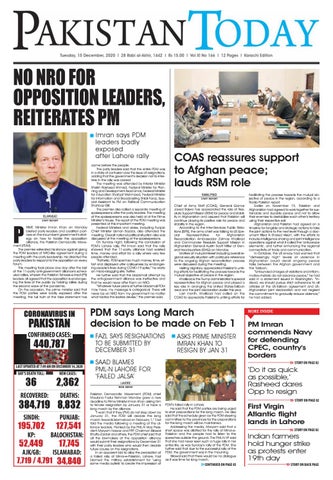
rIMe Minister Imran khan on Monday briefed party leaders and coalition partners on the incumbent government’s strategy on how to tackle the opposition alliance, the Pakistan Democratic Movement (PDM). the premier reiterated his stance against giving the PDM leaders at nro-like agreement during a meeting with the party leadership. he directed the party leaders to respond to the opposition on every forum. this meeting took place one day after the last of the 11-party anti-government alliance’s scheduled rallies, wherein the Pakistan tehreek-e-Insaf (PtI) leaders all agreed that the opposition is endangering the lives of the public by holding rallies during the second wave of the pandemic. on the occasion, the prime minister said that the PDM parties were badly exposed after the meeting, the full truth of the fake statement has
Imran says PDM leaders badly exposed after Lahore rally
come before the people. the party leaders said that the entire PDM was in a state of confusion over the issue of resignations, adding that the government’s decision not to interfere in the rally was correct. the meeting was attended by Interior Minister sheikh rasheed Ahmed, federal Minister for Planning and Development Asad umar, federal Minister for education shafqat Mehmood, federal Minister for Information and broadcasting shibli faraz, special Assistant to PM on Political communication shahbaz gill. the premier also called a separate meeting of spokespersons after the party leaders. the meeting of the spokespersons was also held at at the Prime Minister’s house. the report of the PDM meeting was presented at this important meeting. federal Ministers and aides, including Punjab chief Minister usman bazdar, also attended the meeting. overall national political situation also was discussed at the meeting of the spokespersons. on sunday night, following the conclusion of PDM’s Lahore rally, PM Imran said that the rally showed that the 11-party alliance had wasted time, money and effort for a rally where very few people attended. “Pathetic. PDM spent so much money, time, effort and displayed utter callousness by endangering people’s lives during coVID-19 spike,” he wrote on micro-blogging site, twitter. he further said that the blackmail attempt by the anti-government alliance was ineffective and that he would never offer them an nro. “Whatever future plans of further blackmail PDM may have, my message is categorical: there will never be an nro from my government no matter what tactics the looters devise,” the premier said.
COAS reassures support to Afghan peace; lauds RSM role RAWALPINDI STAFF REPORT
chief of Army staff (coAs), general Qamar Javed bajwa has appreciated the role of resolute support Mission (rsM) for peace and stability in Afghanistan and assured that Pakistan will continue playing its positive role for peace and stability in the region. According to the Inter-services Public relations (IsPr), the army chief was talking to us special representative for Afghanistan reconciliation Ambassador zalmay khalilzad and commander resolute support Mission in Afghanistan general Austin scott Miller at general headquarters (ghQ) on Monday. Matters of mutual interest including overall regional security situation with particular reference to the ongoing Afghan reconciliation process were discussed during the meeting. Visiting dignitary appreciated Pakistan’s untiring efforts for facilitating the process towards the mutual objective of peace in the region. khalilzad is the trump administration’s special representative for Afghan peace and played a key role in arranging the united states-taliban deal and the joint declaration earlier this year. Last month, khalilzad had called on the coAs to appreciate Pakistan’s untiring efforts for
pakistaN
PDM says Long March decision to be made on Feb 1
CONFIRMED CASES:
g
CoRoNaviRus iN
440,787
g
LAST UPDATED AT 7:49 AM ON DECEMBER 14, 2020
DAY'S DEATH TOLL:
36
RECOVERED:
NEW CASES:
2,362 DEATHS:
384,719 8,832 SINDH:
PUNJAB:
195,702
127,541
KP:
BALOCHISTAN:
AJK/GB:
ISLAMABAD:
52,449
17,745
7,719 / 4,791 34,840
fAzL sAys resIgnAtIons to be subMItteD by DeceMber 31
g
Asks PrIMe MInIster IMrAn khAn to resIgn by JAn 31
sAAD bLAMes PML-n LAhore for ‘fAILeD JALsA’
more inside
PM Imran commends Navy for defending CPEC, country's borders STORY ON PAGE 02
‘Do it as quick as possible,’ rasheed dares opp to resign
LAHORE MIAN ABRAR
Pakistan Democratic Movement (PDM) chief Maulana fazlur rehman Monday gave a new deadline to Prime Minister Imran khan asking him to tender resignation by January 31 or face a long march by the alliance. “I warn that if they [PM] do not step down by January 31, the PDM will decide the long march towards Islamabad on february 1,” fazl told the media following a meeting of the alliance leaders. flanked by the PML-n Vice President Maryam nawaz and PPP chairman bilawal bhutto-zardari and others, the PDM chief said that all the lawmakers of the opposition alliance would submit their resignations by December 31 with their party leaders who would then decide future course on the resignations. In an apparent bid to allay the perception of a failed rally at Minar-e-Pakistan, Lahore, fazl blamed the military establishment for ‘using some media outlets’ to create the impression of
facilitating the process towards the mutual objective of peace in the region, according to a radio Pakistan report. earlier on november 19, Pakistan and Afghanistan had agreed to work together for sustainable and durable peace and not to allow their enemies to destabilise each other’s territory using their respective soil. Afghanistan and Pakistan had agreed on a timeline for tangible and strategic actions to take the joint actions to the next level through a document titled ‘A shared Vision’, with the efforts to include intelligence sharing and joint intelligence operations against what it called the ‘anti-peace elements’, and further enhancing the regional connectivity of trade and communication. In october, the us envoy had warned that “distressingly high” levels of violence in Afghanistan could derail ongoing peace talks between the Afghan government and the taliban. “unfounded charges of violations and inflammatory rhetoric do not advance peace,” he had said in a statement issued in Washington. “Instead, we should pursue strict adherence to all articles of the us-taliban agreement and usAfghanistan joint declaration and not neglect the commitment to gradually reduce violence,” he had added.
STORY ON PAGE 02
PDM’s failed rally in Lahore. he said that the PDM parties are being urged to start preparations for the long march. he also said that the schedule given by the PDM steering committee to the provinces for the preparations for the long march will be maintained. Addressing the media, Maryam said that a short space was allotted for the rally at Minar-ePakistan and the people had to listen to the speeches outside the ground. the PML-n VP said that she had never seen such a huge rally in her entire life, as was sunday’s rally of the PDM. she further said that due to the successful rally at the PDM, the government was in the mourning. bilawal said that there would be no dialogue as it was time for long march.
CONTINUED ON PAGE 03
First Virgin Atlantic flight lands in Lahore
STORY ON PAGE 02
Indian farmers hold hunger strike as protests enter 19th day
STORY ON BACK PAGE
02
Tuesday, 15 December, 2020
news
‘Do IT as quICk as possIble,’ RasheeD DaRes opp To ResIgn
I
NEWS DESK
NTERIOR Minister Sheikh Rasheed Ahmad commended the people of Lahore for the “responsibility” they showed in not showing up for the Pakistan Democratic Movement (PDM) rally and dared the opposition to hand in their en masse resignations. “You [are] welcome please. Do it. Do it as quick as possible,” he said on Monday while talking to media persons, adding that the country would be taken forward under the leadership of Prime Minister Imran Khan and the democratically elected government. Prime Minister Imran Khan will never give NRO to the corrupt leaders, he said but added that the incumbent government is ready to hold discussions on all matters
CTD arrests three militants, foiling terror attack MULTAN
except for the corruption cases filed against the opposition. “We are an elected, democratic government and, under the leadership of Imran Khan, we will take this country forward. We do not want to close the doors for dialogue. [The opposition] says it does not want to talk to Imran. Tell us who you wish to speak to so that we can arrange it,” he said. He added that the premier was willing to lose his seat, but would not give an NRO to the opposition. Rasheed said that those that lose the elections develop “mental issues”. Commenting on the Lahore jalsa, he said, “if children from madrassahs did not show up for yesterday’s rally, [the PDM] would have had to face a lot of disappointment”. The interior minister said that the
First Virgin Atlantic flight lands in Lahore LAHORE
STAFF REPORT
STAFF REPORT
Counter-Terrorism Department (CTD) on Monday raided a militant hideout in Rawalpindi, arresting three suspects linked to past bomb attacks. The men had also plotted to target the Islamabad Stock Exchange (ISE), police said. According to a CTD statement, the suspects were involved in four explosions -- in January, March, June and December this year -- killing four people and wounded 30 this year. The CTD said information regarding the presence of the terrorists was received through an anonymous source. Acting on the tipoff, the police raided the location and arrested the suspects. Explosives, detonators, cell phones and other items were recovered from their possession, it added. The arrested militants, it said, had a history of links with the proscribed Tehreek-e-Taliban Pakistan (TTP) but were now acting as mercenaries and receiving instructions from their handlers in Afghanistan. Pakistan has witnessed scores of militant attacks in recent years. The latest development comes a day after a roadside bomb wounded 23 people near a police station in Rawalpindi.
Days after the first Virgin Atlantic flight from Manchester landed in Islamabad, the inaugural flight of the British airline from London landed in Lahore on Monday. The airline started direct services between the United Kingdom and Pakistan last week and is operating three routes: two from Islamabad to London and Manchester and one from Lahore to London. The flight, VS-364, with 150 passengers on board took off from Heathrow Airport on Sunday at 10:00 pm (GMT) and landed at Allama Iqbal International Airport the following morning at 10:00 am. Upon landing, the flight was accorded a warm welcome by the UK consulate staffers and the airport management. According to a statement by the British High Commission in Islamabad, Pakistan is the airline's first new route since the outbreak of the coronavirus. The airline will operate the Boeing 787-9 Dreamliner aircraft on all routes from Pakistan, a press statement said, adding that the passengers will be provided with in-flight entertainment including movies and shows in Urdu. Kosher food options will also be available. After British Airways, Virgin Atlantic becomes the second British airline in less than a year to start direct flight operations on some of the world’s most lucrative routes. In December 2019, British
FIR of Rawalpindi blast registered RAWALPINDI
opposition alliance saw the death of their narrative in the same place they made “tall claims”. Regretting the language being used by Nawaz Sharif against the state institutions, the Interior Minister said we are proud of our armed forces which have given immense sacrifices for the security and defence of the country. Rasheed stated that the opposition had not said “anything new” at the Lahore rally. However, commenting on the speech made by Pakhtunkhwa Milli Awami Party (PkMAP) chief Mahmood Achakzai, the minister said that the remarks were “irresponsible”. The interior minister expressed the commitment to make efforts towards bringing improvement in the law and order situation in the country. He said the performance of Islamabad police will be further improved.
Airway resumed its flights after a decade of absence following the 2008 Marriott Hotel bombing in Islamabad. But the security situation in Pakistan has since improved, with militant attacks sharply down in the country. In Islamabad, a web of road checkpoints dotted across the city for more than a decade has mostly been dismantled. At the time, Richard Crowder, the Deputy British High Commissioner to Pakistan, told reporters the return of British Airways was in large part due to “an improvement in the security environment in this country”. Last week, British High Commissioner Christian Turner said the beginning of Virgin Atlantic's operations to Pakistan was a "historic moment". "Our 1.6 million strong Pakistani diaspora in the UK is at the heart of our ties," a press release quoted him as saying. "18 months ago we had no British airlines flying in Pakistan; today we have over 20 direct flights a week to both Islamabad and Lahore. This is a sign of confidence in Pakistan and will improve people to people links and boost trade." Pakistan has been running international advertising campaigns to rejuvenate its tourism sector, which was wiped out by a wave of militancy that destabilised the country following the September 11, 2001 attacks in the United States and the US-led war against terrorism in Afghanistan.
pM Imran commends navy for defending CpeC, country's borders Prime Minister Imran Khan commended the efforts of the Pakistan Navy in defending the country's maritime borders and the China– Pakistan Economic Corridor (CPEC), including Gwadar Port, during a visit to the Naval Headquarters in Islamabad. He was received by Chief of Naval Staff (CNS) Admiral Muhammad Amjad Khan Niazi, and accompanied by federal ministers Pervez Khattak, Dr Abdul Hafeez Sheikh, Syed Ali Haider Zaidi, and Special Assistant on National Security Dr Moeed Yusuf. PM Imran met with principal-staff officers during his visit and was briefed on the situation of maritime security and the Pakistan Navy’s step to coup with the challenges. Naval Chief Niazi said the Pakistan Navy is fully prepared to protect the maritime interests and sea frontiers of the country. The premier assured the CNS that the country was offering its full support to the maritime forces, and declared 2020 as the year of the blue economy. He said that the government is working to promote the maritime sector as a means of economic growth. The naval chief thanked PM Imran for showing confidence over the capabilities of the naval forces. NEWS DESK
police file two cases against pDM activists, leaders LAHORE: Lahore police on Monday registered two cases against several participants of the Pakistan Democratic Movement (PDM) meeting in Lahore a day earlier for forcing their way into Greater Iqbal Park to make arrangements for the gathering. The first information reports (FIRs) were registered at Lari Adda police station on the complaint of two security staffers deployed at the venue. According to the complaint, scores of PDM activists and leaders broke into the venue on Saturday and placed chairs and installed lights on its ground. Some Pakistan Muslim League-Nawaz (PML-N) leaders also visited the venue and oversaw the preparations. PML-N Vice President Maryam Nawaz had also visited the site late on Saturday night to take a look at the arrangements. INP
Once upon a time: Pakistan’s fabled storytellers fade away
STAFF REPORT
PESHAWAR
The Counter-Terrorism Department (CTD) registered a First Information Report (FIR) on Monday, a day after a roadside bomb exploded near a police station in Rawalpindi, wounding at least 23 people. A hand grenade was thrown near a water filtration plant across the road from the police station, but Rawalpindi City Police Officer (CPO) Ahsan Younas later confirmed the blast was from a device planted on the side of the road. The case was registered under several provisions, including section 7 of the Anti-Terrorism Act, 1997, which deals with punishments for committing acts of terrorism. More than 75 suspects have been rounded up in multiple raids since the blast, the police said. Of those hurt, police said, three had deep wounds, while others were given medical care and discharged from the hospital. No one immediately claimed responsibility for the explosion. A similar roadside bombing struck Rawalpindi earlier this month, killing one person and wounding seven others near a busy bus terminal. In June, a roadside bomb went off in a crowded market in the city, killing one and wounding 15.
AGENCIES
Mohammad Naseem’s eyes shine while he shares the legend of a remote, alpine lake nestled among snowcapped Himalayan peaks as a rare crowd of onlookers hears one of Pakistan’s last “storytellers.” The story of Saif-ul-Malook — the winding saga of a brave prince who falls in love with a fairy — is just one of the 50 tall tales passed down to Naseem by his father. “Usually people tell me I’m crazy when I tell these stories,” says Naseem, whose long white beard and traditional cloak give him the timeless appearance of a storyteller of old. The 65-year-old shopkeeper says it would take days to recite all the stories he learned by heart that are imbued with “the history, the culture” of the land. But few are still listening. Naseem says he hasn’t bothered sharing the stories with his six children, and friends are no longer interested in hearing them as social media, video games, and soap operas have all but eclipsed his ancient art. Video platform TikTok is now a major source of entertainment for the country’s youth, wildly popular in part because it is accessible to illiterate users in rural areas — just as the legends of old once were.
“When I die, these stories will die with me,” sighs Naseem outside his shop in northern Pakistan’s Shogran, where winter snows have blanketed the mountains. Peshawar — in Khyber Pakhtunkhwa where Shogran is located — has long been the country’s stronghold of oral history, its Qissa Khawani or “storytellers bazaar” a Silk Road hub where travelers and locals alike congregated to hear a well-spun yarn. The bustling frontier capital was once “the Times Square of the region” because of “the excellence of its storytellers,” explains Naeem Safi — a consultant at an Islamabad-based institute dedicated to the folk heritage, where cassettes of stories told at the bazaar have been archived. “Writing was not very popular. The transfer of knowledge was verbal. Storytelling was fundamental — people considered themselves educated if they had heard enough stories,” says Safi. Before tuk-tuks and buses clogged its narrow lanes the market was littered with Silk Road caravans of wandering traders who often stayed the night after the city’s sixteen gates were sealed at dusk. In the evenings, the merchants would hear the city’s famed storytellers — who shared tales about the perils of the road, news of wars and local lore. Storytellers were “the communication tools of that time, they were the messengers,” said Ali Awais Qarni,
a researcher in history and literature at the University of Peshawar. “When they were telling the truth, they would always add a little poetry and color to it,” he said. “People would listen to them for hours. Sometimes a story could last a week or a month.” The bazaar’s tea houses and salons have been replaced by neon signs on garish structures that now dot the traffic-choked streets. “There may be some storytellers left, but the tradition is gone. It has transformed into other forms of storytelling,” Safi added. Long-time Peshawar resident Khwaja Safar Ali, 75, remembers his youth in the city when the arrival of caravans was met with excitement. During the day, “we used to run between the camels’ legs,” he recalls. And when evening came, “we would all sit together and listen to the storytellers.” “They would tell us about Kabul, the USSR, Uzbekistan. We learned about these countries through them.” Modern transportation eventually killed off the caravans, which even by the 1960s had become an increasingly rare sight in the area. Storytellers continued to perform for smaller circles, but were gradually replaced by radios and then televisions. This autumn one of Peshawar’s few remaining storytellers died aged 86, said Jalil Ahmed, a tour guide who frequently took his clients to hear the recitations.
Tuesday, 15 December, 2020
kp DoCToR anD 35 oTheRs DIe oF CovID-19; 2,362 FResh Cases suRFaCe ISLAMABAD
p
TLTP
AKISTAN'S coronavirus death toll surged to 8,832 as the virus claimed 36 more lives during the last 24 hours, including a doctor from Khyber Pakhtunkhwa (KP), said the National Command and Operations Centre (NCOC) on Monday. According to the NCOC, 2,362 new infections were reported during the last 24 hours, bringing the total tally to 440,787. The number of active cases in the country has climbed to 47,236, out of whom 2,456 people are under critical care. With 1,719 surviving the virus, the recoveries have climbed to 384,719. A total of 31,830 tests were conducted across the country during the
aforementioned period, while 6,064,220 samples have been tested so far. Overall 384,719 people have recovered from the deadly disease so far. In Sindh, 195,702 cases have been reported so far, 127,541 in Punjab, 52,449 in KP, 34,840 in Islamabad, 4,791 in Gilgit-Baltistan (GB) and 17,745 cases have been reported in Balochistan. The mortality toll has reached 8,832 including 3,158 in Sindh, 3,365 in Punjab, 1,473 in KP, 371 in Islamabad, 175 in Balochistan, 99 in GB and 191 in Azad Jammu and Kashmir (AJK). The statistics of the NCOC showed that most of the Covid-19 deaths, 14 out of 36, were reported from Punjab during the last 24 hours. According to the NCOC, 64 per cent ventilators are being used for coronavirus patients in Multan, while 47 per cent in Islamabad, 36 per cent in Lahore and 28 per cent ventilators
govt committed to resolving journalists’ problems: buzdar LAHORE STAFF REPORT
Punjab Chief Minister Sardar Usman Buzdar has said that the government is committed to resolving the problems being faced by the journalist community. Addressing a ceremony on Monday, the chief minister said that the Punjab government has decided to provide health coverage to all citizens and set a target to ensure the provision of medical facilities across the province by the end of next year. He said that the work on the second phase of Journalist Colony – the Lahore Pres Club Housing Scheme in Harbanspura – will start in near future. The chief minister said that the Pakistan Tehreek-e-Insaf (PTI) government believes in serving the masses and not merely raising hollow slogans. Separately, he thanked the people, especially citizens of Lahore, for remaining indifferent to Pakistan Democratic Movement's (PDM) riotous politics. In a statement issued in Lahore on Monday, he said that Lahorites have rejected opposition parties’ politics of anarchy. He said that the corrupt elements of PDM will be held accountable and they will have to return the looted wealth of the country. He said that PDM is engaged in hatching conspiracies against the process of national development. “After December 8, December 13 has also passed but the PDM gained nothing from their rallies”, he said. He said that leadership of PDM is confused and claimed it is plotting conspiracies against the state Buzdar further said that the ‘funeral’ of PDM’s demands and wishes took place during their public gathering at Minar-e-Pakistan in Lahore. Earlier, Buzdar took a jibe at apparent low attendance during the PDM public gathering at Minar-e-Pakistan, Lahore, and had said that he would like to appreciate the people attending the rally for following social distancing. “I would like to appreciate the people attending the jalsi by following “social distancing” SOPs [standard operating procedures],” he posted a message on Twitter along with a video showing a scattered crowd at the gathering as the speech of the PML-N supreme leader Nawaz Sharif continued.
are in use in Rawalpindi. In Islamabad, 44 per cent of oxygen beds are being used for Covid-19 patients, 50 per cent in Multan, 56 per cent in Rawalpindi, and 61 per cent in Peshawar. A total of 346 coronavirus patients are on ventilators and a total of 3,014 patients are currently admitted to 613 hospitals across the country. Another doctor on Monday succumbed to deadly novel coronavirus in KP. Doctor Almas was admitted at a private hospital after testing positive for the Covid-19, where she breathed her last. According to the Provincial Doctors’ Association, in KP, so far 31 doctors have lost their lives while battling with the coronavirus. Last week, the Provincial Doctors Association (PDA) while highlighting infections in the provincial healthcare
sector had stated that 398 nurses contracted novel coronavirus while working on the front line. Moreover, 1132 other provincial health workers were infected by the disease, the PDA said. During the pandemic 43 health workers, including four nurses, had been martyred by the novel coronavirus infection. “Eight paramedics and six other healthcare workers also martyred by the Covid-19 in KP,” the association said. The NCOC data shows a total of 20,493 Covid-19 infections were recorded across the country in the last seven days on a daily average of 2,927.5 cases. With an average 61.8 coronavirus deaths per day, at least 433 people have died of the virus in the last seven days. A total of 10,245 people have recovered with a daily average of 1,463.5.
Covid-19 runs unchecked in overcrowded prisons ISLAMABAD AGENCIES
A human rights report released Monday criticised Pakistan’s response to the coronavirus threat faced by tens of thousands of inmates stuck in overcrowded and often unsanitary prisons. Instead of following through on promises to ease prison overcrowding made when the pandemic first hit, the government has actually increased its inmate population by over 6,000 between April and August, from 73,242 to 79,603. Some of the few who were freed were later rearrested. The joint report by London-based Amnesty International and Justice Project Pakistan said inmates face a growing risk of infection, and called for renewed efforts to free certain prisoners, particularly the elderly, women and “prisoners of conscience.” “As Pakistan braves the second wave of Covid-19, prisoners remain dangerously exposed as the authorities not only failed to reduce overcrowding, they actually worsened it,” said Rimmel Mohydin, South Asia regional campaigner for Amnesty International. In the first weeks of the outbreak in February, the Islamabad High Court (IHC) ordered the release of pretrial inmates charged with nonviolent crimes as well as those whose bail had previously been denied. In Sindh, 519 prisoners were to be released on bail. But in late March, the Supreme Court suspended all
bail orders that were granted because of the virus. “The Supreme Court’s decision checked the countrywide momentum to reduce prison populations and even led to the rearrest of prisoners,” said the report. Even when the Supreme Court did allow certain prisoners to be freed because of age or time served, they were never released, said Sarah Belal, Justice Project Pakistan’s executive director. Also still behind bars are the women prisoners whom Prime Minister Imran Khan ordered freed if they met certain criteria, such as those on trial or convicted of minor crimes, Belal said. There was no immediate comment from the government on the 37-page report. The country’s prison system was already dangerously overcrowded before the pandemic. Built to accommodate less than 58,000 people, it routinely houses nearly 80,000 inmates, according to the World Prison Brief, delivered by the University of London’s Institute for Crime and Justice Policy Research. Punjab stopped reporting positive cases in jails in April when it had registered just 86 cases. However, in response to a Right to Information Request, the report discovered that only 16,534 virus tests had been conducted over seven months in Punjab’s jails, with 1,345 testing positive. The report called for the immediate release of all “prisoners of conscience” but also asked the government to “strongly consider” releasing pretrial detainees.
Fawad suggests govt to hold talks with opposition ISLAMABAD STAFF REPORT
Federal Minister for Science and Technology Fawad Chaudhry has suggested that the government should hold talks with the opposition. In a series of tweets on Monday morning, Fawad claimed that “the opposition narrative is practically dead” after the much-hyped Lahore rally attracted merely a few thousand attendees. Nevertheless, the “government should in any case pave the way for the beginning of negotiations with the opposition.” The comments of the federal minister came after Pakistan Tehreek-e-Insaf (PTI) representatives termed the Pakistan Democratic Movement (PDM) public rally a “flop
show” and called it proof that the people of Punjab had rejected the opposition’s narrative. The minister stated that Pakhtunkhwa Milli Awami Party's (PkMAP) chief Mahmood Khan Achakzai should have accepted his failure at the Minar-e-Pakistan rally but had decided not to do so because of his arrogance. "The narrative of the opposition has died after yesterday's jalsa in Lahore," he said. "It's high time for the government to pave the way for the opposition and start negotiations with them." Earlier, Fawad Chaudhry stated that Achakzai should be ousted from PDM if Pakistan Muslim League-Nawaz (PML-N) and Pakistan People's Party (PPP) consider themselves to be federal parties, otherwise they would be historically recognised for siding with "anti-Punjab" characters.
news
03
Imran wishes Maulana Tariq Jameel speedy recovery ISLAMABAD: Prime Minister Imran Khan on Monday prayed for the early recovery of religious scholar Tariq Jameel who was admitted to a hospital a day earlier after testing positive for coronavirus. "Praying for Maulana Tariq Jameel's speedy and full recovery from the COVID-19," the prime minister tweeted. The religious scholar made the announcement in a tweet on on Sunday. “I was not feeling well from the last few days and on getting tested for Covid-19, it came positive and was admitted to the hospital on the advice of the doctors,” he wrote. He requested his followers to pray for his health. Maulana Tariq Jameel is one of the most popular Deobandi scholars in the country and is followed by millions around the world. He belongs to the Tableeghi Jamaat group, one of the largest missionary groups in Pakistan. STAFF REPORT
pDM unsettled over low public participation in lahore rally: Faraz ISLAMABAD: Federal Minister for Information and Broadcasting Senator Shibli Faraz has termed the opposition parties' public gathering in Lahore a flop show. In a series of tweets on Monday, the information minister said the public has rejected the narrative of the opposition parties. He said that Pakistan Democratic Movement (PDM) leaders were unsettled by the nonparticipation of people from Lahore and Punjab. “Those whose directions are different cannot have the same destination,” the minister remarked. He recalled that inflammatory language was used against armed forces in Gujranwala rally, the mausoleum of Quaid-eAzam was desecrated in Karachi and anti-Pakistan slogans were used in Quetta gathering. He regretted that the residents of Lahore were declared traitors at Minar-Pakistan. An adamant opposition held its final showdown at Lahore’s Minar-e-Pakistan on Sunday as the ‘first phase’ of its anti-government campaign, under the 11-party alliance, came to a close. The public meeting was held despite the PDM leaders being issued security threat alerts as well as being requested by the government to not hold public gatherings as the second Covid-19 wave intensified in the country. It is pertinent to mention here that public attendance in PDM Lahore rally was markedly below the expectation. STAFF REPORT
pDM says long March decision to be made on Feb 1 “There is no room for dialogue as we have gone to the people’s court. We will only settle with resignation of Imran Khan,” he said. Meanwhile, a source in the PMLN told Pakistan Today that during the joint meeting of the PML-N’s Central Executive Committee and the parliamentary party in Lahore, the PML-N leaders kept blaming each other for the failed jalsa at Minar-ePakistan. According to source, the PML-N leaders kept blaming each other for not bringing a large number of people to the meeting. “PML-N Vice President Maryam Nawaz said that some leaders did not attend the meeting and action would be taken against them after investigation. She also said that the process of reward and punishment will be introduced in the party,” the source said. The source further said that Khawaja Saad Rafique also raised objections on the organizational structure of Punjab. He said that all the chairs hired for the jalsa were distributed among the people. The source said that Saad expressed satisfaction over the party funding for party arrangements for the meeting. He added that Maryam responded to Saad’s comment, saying that political parties succeed due to workers and not money or funds. “Saad Rafique also said that party’s senior leaders pit organisation office-bearers against each-other. Saad also blamed some party office-bearers of Lahore for not fulfilling their responsibilities,” the source said. He said that Maryam responded that those party office-bearers who did not fulfil their responsibilities will be held accountable. CONTINUED fROM PAgE 01
Bears to be shifted to natural habitat in country: IHC NEWS DESK The Islamabad High Court (IHC) on Monday disposed of a case after the Islamabad Wildlife Management Board (IWMB) assured the bench regarding shifting of Muragzar Zoo’s two bears to abroad to an animal sanctuary. On the query of the bench, the IWMB’s official informed the court that it had decided to shift the animals to abroad temporarily, and would be brought back once the sanctuary was set up here. Chief Justice Athar Minallah remarked that the court only wanted to give a natural environment to the bears. The court always gave chance to IWMB to take a decision on the matter, he said.
"We should proud on that animal rights are protected in Pakistan," Justice Minallah said, adding that the court appreciated the decision of the board. The IHC CJ said that the zoos were no better than concentration camps and expressed regret at the treatment of the bears for the mere "entertainment of the human species". "The natural habitat of Suzie and Bubloo was the high altitude plateau of Deosai National Park in the Himalayas. It was indeed inhumane to have deprived them of living in their natural habitat merely for the entertainment of the human species," read the court's order. The bench asked who was responsible for the mistreatment of animals since July 2019. Climate Change Ministry had been
given charge of the matter previously, but the ministry fulfilled its responsibility was under scrutiny now. The ministry’s lawyer said that the ministry had never tried to influence the decision of IWMB. The court said that there was everything in the decision dated July 5, 2019, adding that unfortunately the pair of lions were killed due to poor arrangements but no one took the responsibility for it. "The relocation of Kaavan the elephant, and the two Himalayan brown bears, Suzie and Bubloo, to appropriate sanctuaries has set a precedent for others to follow. They will always represent the people of Pakistan and their resolve to treat living species with respect and dignity," the court order added. All the decisions of this court were
challenged before the top court by the Mayor MCI, the bench said. The bench replied that the ministry of climate change and federal government were responsible for the miseries of zoo animals. "This court wishes the two brown bears, Suzie and Bubloo, a safe journey to their temporary abode with the hope that, being magnanimous by nature, they would forgive the human race for subjecting them to unimaginable pain and suffering," the written order said. The bench decided to cancel the relocation of the two bears to a sanctuary in Jordan and instead shift them to Ayub National Park in Rawalpindi. Last week, while expressing dismay over the plight of animals at Islamabad’s
Marghazar Zoo the IHC had asked the concerned administrator to turn up with reasons over lacklustre performance in the matter. Chief Justice Athar Minhallah had observed the administration is not showing seriousness in providing facilities for any of the animals at the zoo. “If 60 days were not enough to shift two cheetahs from the Marghazar Zoo, the administration should have informed the court”, Justice Minhallah had remarked. The lives of both cheetahs are in danger as one of them is suffering from cancer and the other is infected with a disease. During the course of proceedings, the secretary environment had submitted that not only cheetahs but other animals including monkeys are also in danger.
Tuesday, 15 December, 2020
04 NEWS
Fog disrupts air, road traFFic in punjab, sindh LAHORE
s
STAFF REPORT
EvERAL flights at Karachi’s Jinnah International Airport and Lahore’s Allama Iqbal International Airport were delayed and several sections of the motorways for vehicular traffic were forced to close due to foggy conditions on Monday. According to details, at Karachi’s Jinnah International Airport, a flight ER-540 of a private airline to Quetta was delayed for five hours and rescheduled to fly at 1:00 pm. Another flight, ER-502, of a private airline to Lahore took off from the airport at 9:00 am after a one-hour delay. The Pakistan International Airlines (PIA) flight, PK-302, which was going to depart for Lahore, was delayed for an hour. PIA’s flight to Islamabad, PK-300, was delayed for 45 minutes and another flight of a private airline to Jeddah, Sv-707 was de-
layed for one and a half hours. At Lahore’s Allama Iqbal International Airport, four flights have been cancelled and 10 others were delayed due to dense fog and technical issues. An Airblue flight, 416, was delayed which was scheduled to depart for Dubai. A PIA flight 306 from Karachi to Lahore was cancelled. The national carrier’s flight number 302 was rescheduled to 11:00 pm to transport passengers from Karachi to Lahore. A Lahore-bound flight from Istanbul, 714, arrived at Allama Iqbal International Airport after being delayed. Moreover, several other flights from Dubai to Lahore were delayed. Another flight of PIA, 303, was delayed till 12:00 noon to depart for Karachi from Lahore airport. Meanwhile, the fog has engulfed the plains of Punjab and Sindh causing poor visibility and closure of several sections of the motorways for vehicular traffic. The fog has engulfed plains in Punjab and Sindh causing
visibility problems due to which M-v motorway from Multan to Sukkur has been closed for traffic, a spokesperson of the motorway police said. Several other sections of the motorway were closed due to poor visibility, as motorway M-Iv was closed from Faisalabad to Shamkot, motorway M-III from Faizpur to Abdul Hakeem, while traffic at Multan to Khanewal motorway section was suspended due to thick fog causing poor visibility in the area. According to reports at most of the highways, the visibility was as low as 100 meters. Thick fog engulfed Multan, Sahiwal, Harappa, Cheechawatani, Mian Channu and Khaniwal. Meanwhile, the fog also caused visibility problems at Tabba Sultanpur, Zahir Pir, Lodharan, Bahawalpur, Khanpur, Shahkot, Ahmadpur East, Rahim Yar Khan and Sadiqabad. The motorway police spokesman has advised the people to avoid unnecessary travel and encouraged the use of fog lights in vehicles during travel.
‘state has completely failed in fulfilling its responsibilities’: ihc NEWS DESK Islamabad High Court (IHC) Chief Justice Athar Minallah has said that the state has failed to fulfil its obligation of providing justice to the people of Pakistan in a timely manner as per the Constitution. "The state has completely failed in fulfilling its responsibilities with regards to the provision of immediate justice to the citizens of Pakistan as per the country's Constitution," he said during a hearing related to the delayed justice case on December 24. The IHC also summoned Adviser to the Prime Minister on Accountability and Interior Shahzad Akbar so that Minallah could express his disapproval over the delays in the delivery of justice to the citizens of Pakistan. "Shahzad Akbar should appear before the court and explain what steps are being taken in this regard," he said. "According to the Constitution of the country, speedy and immediate justice is the right of every citizen but the situation has turned into a dismal one," the IHC judge said. "Look at the courts you have built and how the citizens are facing so many problems there," he said while addressing the deputy attorney general (DAG), adding that it was the state that caused the delays but the courts were blamed. Justice Minallah said the court was not interested in their reports and said that it was necessary for a practical solution to be present to the people. He ordered the DAG to provide a solution within ten days. LAHORE: Pakistan Tehreek-e-Insaf workers clean Greater Iqbal Park after Pakistan Democractic Movement's public rally on Sunday. ZUBAIR MEHFOOZ
railways minister vows to provide best service to passengers ISLAMABAD: Newly-appointed Minister for Railways Azam Khan Swati has pledged to ensure safety and provide the best services to the passengers. Azam Khan Swati said this on Monday after assuming charge of his new office. Earlier, Swati along with Interior Minister Sheikh Rasheed Ahmed, who was the former railways minister, arrived at the Ministry of Railways. On the occasion, both the federal ministers expressed best wishes to each other for their new responsibilities. Swati lauded Rasheed for his outstanding performance as railways minister during the last two years. Pakistan Railways Chairman Habibur Rehman Gilani briefed the new railways minister about the functioning of the organisation. Last week, in a major reshuffle in the federal cabinet, Rasheed was appointed as interior minister. Swati had been made federal minister for railways while Brigadier (r) Ijaz Shah was made federal minister for narcotics control. STAFF REPORT
Kp set to develop tourism industry to create jobs: Mahmood PESHAWAR: Khyber Pakhtunkhwa (KP) Chief Minister Mahmood Khan has said that promotion of tourism and conservation of natural environment in tourist destinations of the province are priority of the government. In a statement on Monday, the chief minister said that the government is focusing on developing tourism as an industry to create job opportunities for the public. The chief minister said that the government has launched ‘Travel Responsibly for Experiencing Ecotourism’ in collaboration with the Tourism Department, World Bank and a multinational organisation to keep tourist resorts clean and restore their natural beauty. STAFF REPORT
SC seeks probe report from NAB in fake bank accounts case ISLAMABAD TLTP
The Supreme Court (SC) has sought a probe report from the National Accountability Bureau (NAB) regarding an accused in the fake accounts case while hearing his bail petition on Monday. The top court, while hearing the bail plea of accused Muhammad Umair in the fake accounts case, asked the anti-corruption watchdog to provide the relevant probe report. Muhammad Umair’s counsel argued that NAB should provide details of the money used by him which he gained through the fake account. Justice Mushir Alam warned that the petitioner’s side should not defend the act to assist theft by trying to deceive the court. Furthermore, Justice Yahya Afridi said that the main accused have managed to obtain bail while other accused are still behind bars. He added that NAB had not challenged the bail of Faryal Talpur. To this, NAB prosecutor said that regulations are different for women and expressed suspicions that some ac-
cused are hiding at an undisclosed location in Kacha areas. The NAB’s lawyer continued that some suspects have been sent to foreign countries and the accused Umair was also arrested from Dubai. Muhammad Umair is a Naib Qasid and he should tell the court about the real owner of the money worth millions. He added that a transaction of Rs580 million was made in his bank account. The defence counsel argued that Muhammad Umair has not signed any cheque. Justice Sardar Tariq Masood remarked that all fake accounts were being operated by Arif Khan, according to the anti-graft watchdog. Justice Afridi also asked NAB to tell about the people on whose names 28 out of the total 29 fake bank accounts are registered with. The prosecutor responded that the other accused have not accepted the ownership of their accounts. The institution traced 32 cases from two fake accounts so far and the investigation is still underway for scrutinising 27 more accounts, whereas 10 references have been filed following the probe, said the prosecutor. The top court adjourned the hearing for two weeks.
Murder suspect gunned down inside Karachi court KARACHI STAFF REPORT
A murder suspect was shot dead inside a district and sessions court in Malir, Karachi on Monday while a hearing in a murder case was ongoing. Malir Senior Superintendent of Police (SSP) Irfan Bahadur confirmed to reporters Khushdil, 25, was a prime suspect in the case against him and was being presented before the court when he was attacked outside the waiting room. Khushdil received two bullets to his chest and was immediately taken to a hospital where he was pronounced dead. Bahadur said Khushdil was shot dead by the father of one Ahsan Ali he had allegedly murdered. Kifayatullah, 60, the father of deceased Ali, and who shot the suspect in court today, was due to record his statement in the same murder case. Police said Kifayatullah surrendered himself after the shooting and his weapon was also taken into custody.
Yasmin urges PDM rally participants to quarantine themselves LAHORE STAFF REPORT
Punjab Health Minister Dr Yasmin Rashid on Monday advised the participants of the Pakistan Democratic Movement (PDM) rally to quarantine themselves in order to ensure the safety
of their loved ones from Covid-19. The minister expressed fears that the PDM rally has markedly increased the likelihood of coronavirus spread in Punjab. She strictly advised that everyone who attended the rally should quarantine themselves for at least 14 days in order to keep their families safe.
"The PDM has carried out a deadly attack on the health of its workers under the guise of its lustrous politics and in a bid to hide [their] corruption," she stressed. She lamented that despite the government's incessant efforts to prevent mass gatherings from taking place, the opposition still went ahead with its rally
to put the lives of its workers at stake. She added, “People will never forgive PDM, who has become the enemy of their well-being." Speaking about the crowd that participated in the PDM’s Lahore rally, Pakistan Tehreek-e-Insaf (PTI) Senator Faisal Faisal Javed Khan said that the PDM failed to attract a massive crowd at Minare-Pakistan despite its tall claims, adding that the Lahore rally was a total fiasco.
Tuesday, 15 December, 2020
NEWS
InquIry CoMMISSIon rECoMMEndS aCtIon agaInSt PEtrolEuM SECrEtary, othErS ISLAMABAD
t
AHMAD AHMADANI
HE inquiry commission, which was tasked to probe the shortage of petroleum products during the month of June 2020, has raised serious questions over the performance of the special assistant to prime minister (SAPM) and petroleum secretary. The commission, in its report, has strongly recommended strict penal/departmental action against those involved in illegalities, especially in issuance of unlawful provisional marketing licences/marketing permission. It further suggested the dissolution of Oil and Gas Regulatory Authority (OGRA) through an act of parliament within next six months, adding that investigation/probe should also be conducted to accurately assess the illegality
on part of the OGRA person in this matter. Similarly, the commission has recommended departmental reprimand/action against the secretary of the Ministry of Energy, Petroleum Division (MoEPD). It also sought strict action against officials of Department of Explosive (working under MoEPD) found involved in issuance of unlawful forms ‘K’ & ‘L’ to retail outlets and storage depots, respectively. "Furthermore, monetary losses forced upon Pakistan State Oil during the days of shortage must be equitably recovered from the OMCs, which creamed off the unlawful profits by hoarding, slowing down or drying out their retail outlets." The commission recommended that all such unlawful gains be recovered from OMCs by the federal government as these profits rightfully belonged to the
general consumers at large. According to the commission report, MoEPD has not fared well during the last decade, particularly in the June crisis. The story of MoEPD is also rife with apathy, incompetence flavored with malpractices and disregard to law/rules. However, the commission recommended that to get out of the personal predicament of utter confusion, MoEPD must be empowered to take the matters into its own hands with a consolidated approach. The dire straits of oil industry can only be straightened out with a unified authority, the report added. Meanwhile, the commission recommended departmental/penal action against the incumbent DG Oil for passing flagrant illegal orders regarding allocation of import/local quotas. Strong departmental/penal action has also been recommended against Imran
Ali Abro (research officer) and other associates who had been maneuvering the unlawful affairs in the petro division. As per details, Imran Ali Abro is reportedly the king pin in the division and calls the shots on behalf of his superiors. He has been serving in MoEPD for the last six years without any legal ground. Under the rules of business, a contract employee of private company (Inter State Gas Systems (Pvt Ltd) under MoEPD) cannot serve on deputation/attachment. “All such people with bad character must not go unpunished,” said the inquiry commission report. The commission further recommended that a monitoring cell must be established in the MoEPD to collect all relevant data from OMCs (import, local uplifting, daily/monthly sales of OMCs, refinery import/production program etc).
PM launches Responsible Tourism Initiative – TREK Prime Minister Imran Khan unveiled the logo of ‘Travel Responsibly for Experiencing Ecotourism in Khyber Pakhtunkhwa’ (TREK) – a collaboration between KP government, World Bank Group and Nestlé Pakistan at a ceremony held in the capital. Prime Minister Imran Khan said, “I would like to give a heartfelt congratulations to, Mehmood Khan, Chief Minister Khyber Pakhtunkhwa for his partnership with World Bank and Nestlé Pakistan for a project that I believe that was necessary for a really long time.” The partners vowed to work together for the protection of ecosystem through solid waste management and plastics recycling at the tourism sites across Khyber Pakhtunkhwa. TREK activities include awareness campaigns for tourists, and training of local communities and businesses on waste minimization and collection. Speakers in the event highlighted the role of tourism in job creation and appreciated Khyber Pakhtunkhwa’s efforts for facilitating tourists by improving accessibility through roads, rescue services and planning of tourism zones. “We are opening up new destinations for domestic and international tourists and inviting the private sector to further develop the tourism market of the province. Our collaboration with the World Bank Group, Nestle and other stakeholders will strengthen the efforts to create livelihood opportunities and effectively address the issues faced by the tourism sector including waste management”, said the Chief Minister of KP, Mahmood Khan, when addressing the event. “TREK is an initiative under the Khyber Pakhtunkhwa Integrated Tourism Development (KITE) project being implemented in partnership with the World Bank Group. Tourism Department and its activities emphasize heritage preservation, tourism infrastructure development and destination management while adhering to the fundamentals of responsible tourism,” said Abid Majeed, Secretary Sports, Tourism, Archaeology, Culture and Youth for KP. Speaking on the occasion, Najy Benhassine,
Country Director for World Bank Group (WBG) Pakistan said, “The WBG is keen to continue supporting Khyber Pakhtunkhwa and Punjab in their efforts to provide employment opportunities to the youth in the tourism sector. Today marks the beginning of an important partnership with Khyber Pakhtunkhwa and private sector and we expect to see more corporates stepping forward to contribute towards responsible tourism across the country. The growth and job creation potential of this sector is massive”. Highlighting Nestlé’s initiative in the project, Samer Chedid, CEO, Nestlé Pakistan said, “As part of
our vision for a waste-free future, we are accelerating our actions to tackle plastic waste and our partnership with WBG & KP government is a step in that direction. We will be driving new behavior and understanding through community engagement, cleanup activities, trainings and connecting waste recycling companies with the local administration.” Earlier, KITE and Economic Revitalization of KP (ERKP) project contributed 2 excavators, 6 garbage compactors, 4 dumper trucks, more than 300 dustbins for disposing, collecting and removing waste in the jurisdiction of the Galyat Development Authority, Kaghan Development Authority and Kalam’s relevant authority. PR
from Pakistan and all Covid-19 standard operating procedures (SOPs) will be strictly observed during the trade." At 5,000 meters above sea level, the Khunjerab border post is the highest paved international crossing in the world, a major trade route between China and Pakistan, and an important gateway to South Asia and Europe. China mainly imports textiles, agricultural products and daily commodities through the pass, besides exporting plants and herbs. The border outpost on the Karakoram Highway usually remains open for trade and travel from May
till November-end every year, after which it closes for almost five months in winter. But Pakistani containers have now been stranded in China since December 2019, when the border closed for the winter months, following which all frontiers, including Khunjerab, were indefinitely closed to contain the spread of the novel coronavirus. China News Network reported in December 2019 that cargo import and export had reached 66,600 tonnes during 2019 at Khunjerab Pass in northwest China’s Xinjiang Uygur Autonomous Region, up 46.8pc from the year before.
Expensive lease of PIA’s ATR-72 aircraft comes on FIA radar KARACHI STAFF REPORT
The Federal Investigation Agency (FIA) has launched a probe into the purchase of ATR-72 aircraft by Pakistan International Airlines (PIA) on an expensive dry lease for six years. The FIA has decided to issue notices to all those responsible for purchasing the PIA aircraft on an expensive lease as it caused a loss of over Rs 7 billion to the national exchequer. The leases of the aircraft were approved in 2015 and are going to expire in April 2021. According to details, three ATR planes were leased at Rs179,500 per
Prices of essential commodities declining, monitoring committee told ISLAMABAD STAFF REPORT
The prices of essential commodities have been declining consistently over the past three weeks, the National Price Monitoring Committee (NPMC) was informed on Monday. The meeting, which was chaired by Finance Minister Dr Abdul Hafeez Shaikh, reviewed the availability of essential commodities, including wheat, flour, sugar, tomatoes, chicken, etc., and was apprised by the finance secretary that prices had been declining consistently for the past three weeks. It was underscored during the meeting that as per the SPI data, the prices of some essential commodities declined by 0.3 per cent in the last week due to the availability of wheat, sugar and vegetables following import by the government and private sector. The finance minister appreciated the efforts of the concerned ministries and departments for keeping the prices of essential commodities in check. He also urged the provincial governments to strictly monitor the prices of chicken while ensuring minimal gap between demand and supply. Shaikh also held a detailed discussion with MNFS&R secretary, and provincial chief secretaries regarding the position of wheat and sugar stocks in the country. The MNFS&R secretary told the meeting that sufficient wheat stocks are available across the country. He also said that the Azad Jammu and Kashmir (AJK) government has demanded additional quantity of wheat, which will be fulfilled in time. The finance minister approved the provision of wheat to Utility Stores Corporation (USC). The final approval in this regard will be granted by the Economic Coordination Committee (ECC) of the federal cabinet next week. During the meeting, industries and production secretary said that the slight increase in the price of vegetable ghee is due to spike in international prices.
China bails out Pakistan to repay $1bn Saudi debt
Pak-China Khunjerab border to open today NEWS DESK: Pak-China border crossing at Khunjerab Pass will be opened tomorrow (Tuesday) for 10 days. According to an official notification, the border is being opened to evacuate stranded containers from China to Gilgit-Baltistan. Tourists will not be allowed to travel through border crossing during this period, it added. "Only loaded and stranded containers of traders and containers carrying hydropower machinery of a power house in Hunza district will enter into Pakistan during these 10 days," the notification read. "No container will go to China
05
aircraft while the two others were purchased on a dry lease of Rs172,500 per plane. The aircraft were purchased on a lease, neglecting their market value as similar aircrafts were purchased by Shaheen Air for a six-year dry lease at Rs 195,000 per aircraft. It is pertinent to mention here that on December 12, the Pakistan International Airlines (PIA) excluded ATR-72 airplanes, hired on an expensive lease, from its fleet. As per details, the planes were removed from the PIA fleet due to their nonprofitable operation as the planes were hired on an expensive lease in 2015 by the then administration of the Pak-
istan International Airlines. Though the lease agreement was the biggest hurdle in returning the aircraft and on the directions of the CEO Arshad Malik, the administration by taking advantage of a clause of the agreement in the wake of the Covid-19 pandemic managed to revoke the pact. In this context, the first aircraft APB departed for Johannesburg from Karachi on December 12. Malik said the decision was hard but was inevitable. He said that reforms are being introduced in the PIA and sooner new planes would be added to the fleet of the national flag carrier.
NEWS DESK: Pakistan will repay $2 billion loan to the Kingdom of Saudi Arabia (KSA) as per the repayment schedule. According to the people familiar with the matter, Pakistan is set to return $1 billion to Saudi Arabia in the current month, while the remaining $1 billion would likely be paid next year. Pakistan has arranged loans from alternate sources for repayment of Saudi loans, people with knowledge on the matter, said. Pakistan will immediately borrow $1.5 billion from China, while the country will issue Eurobonds within the next few weeks, which will likely generate around $700 million, sources added. In October 2018, Saudi Arabia had agreed to provide $6.2 billion worth of financial package to Pakistan for three years. This included $3 billion in cash assistance to address Pakistan’s balance of payment issue and $3.2 billion worth of oil on deferred payments. Pakistan has already paid back $1 billion to Saudi Arabia in May this year out of the $3 billion financing.
WB doubles assistance for Ehsaas Programme, PM told ISLAMABAD: Prime Minister Imran Khan has directed the officials concerned to prepare a comprehensive strategy to further expand the scope of Ehsaas Programme. The prime minister said this was talking to his Special Assistant on Poverty Alleviation Sania Nishtar in Islamabad on Monday. Country Director World Bank Najy Benhassine was also present on the occasion. The PM was informed that the World Bank has doubled its assistance for Ehsaas Programme which will help extend social protection to more deserving people. The World Bank country director declared the Ehsaas Programme a flagship programme of social protection and a role model for other countries. TLTP
Punjab govt to utilise three rest houses for tourism purposes LAHORE: The Punjab government on Monday decided to utilise official rest houses for tourism purposes. In this regard, the Ministry of Irrigation handed over three of its rest houses to Punjab Tourism Development Corporation (PTDC) after an MoU signing ceremony in Lahore. The memorandum of understanding was signed by PTDC General Manager (Operations) Asim Raza and Irrigation Chief Engineer Sheikh Moinuddin. Punjab Irrigation Minister Sardar Mohsin Khan Leghari and Adviser to CM on Tourism Asif Mehmood also attended the ceremony. Speaking to the media, Mohsin Khan Leghari expressed his pleasure at handing over the rest houses of the irrigation department to PTDC. STAFF REPORT
Tuesday, 15 December, 2020
06 COMMENT
Politeness or honesty?
Is the age of euphemisms over? Hazards of overplaying one’s hand
T
he PDM movement is gradually turning into a fight for civilian supremacy. Dressing up the truth while referring to the military establishment, by calling it ‘offstage players’, ‘the powers that be’ or ‘khalai makhluq’, was replaced during PDM’s Sunday rally by calling a spade a spade. PML-n VP Maryam nawaz said Imran Khan’s 2011 rally at Minar-e-Pakistan was organized by the then ISI chief Gen Pasha and that Parliament was being run currently by an ex-ISI Colonel. PDM chair Maulana Fazlur Rehman said if the planned long march was stopped, the contest would turn into people versus establishment. BnP (M) chief Sardar Akhtar Mengal said Balochistan had faced the dread and the barbarity for over seventy years while still remaining committed to democracy. he maintained that if Punjab, which alone could put the genie back into the bottle, remained comatose, the ongoing repression could lead to secession. Mian nawaz Sharif said he stood for Jinnah’s Pakistan while asking the audience who was responsible for the hanging of ZAB, the coup against him and manipulation of the 2018 elections. There is equally a need on the part of the politicians to recognize the part they played in seeking military intervention against their opponents in power in the past. They should also accept responsibility for retaining the draconian nAB laws to use them against their opponents. Politicians also continued to retain interpolations in the constitution introduced by military dictator Zia ul haq, like Articles 62 and 63 and the seditions act in PPC. They accused each other of corruption and prepared cases against one another. Is there any change in them? The first stage of the protests planned by PDM is over while the march on Islamabad will come either by January’s end or beginning of February. This provides the two sides more than a month to do much required soul searching. Last week, the government delegated the powers of the cabinet to register sedition cases under the colonial Section 124A of the PPC to interior secretary to facilitate the process of jailing anyone who “brings or attempts to bring into hatred or contempt, or excites or attempts to excite disaffection” towards the government. The government needs to realize that instead of deterring the opposition, the measure would only add fuel to the fire.
The original catch-22
HASAN AFTAB SAEED
O
ne of the toughest challenges that life throws at you is somebody reciting atrocious verses and expecting kudos from you. It is not easy to tell him how bad the poetry is, even if it is somebody else’s work. When the reciter happens to be the poet himself, the situation becomes even trickier. Simulated enthusiasm not only takes a toll on you, but it encourages the bore to become even more set in his ways. The other option, of course, is to be blunt; but that means that he is almost certain to take offence. A regular catch-22 if ever there was one! It used to be an integral part of good manners to avoid compelling others to choose between honesty and politeness. That sensitivity is all but gone. One of the heaviest burdens that I carry on my conscience is a book of poetry for the publication of which I consider myself partly responsible. Back in the day, a friend regularly used to recite what he called his poetry. The quintessential good
Attacks in Rawalpindi A second unexplained attack should cause concern
M
MiAN RAuF
W
ITh the outbreak of COVID-19 pandemic, the world is changing in fundamental ways, and the actions the world leaders take in the next few years will be critical to lay the groundwork for a sustainable, secure, and prosperous future. The year 2020 has brought a new twist in international relations as all countries, irrespective of their material power capabilities, are now trying to improve their ability to resist the emerging tumultuous developments by increasingly adopting nationalist approach to international relations. The Abraham Accords, a US- brokered deal signed between the United Arab emirates (UAe) and Israel, has re-ordered the Middle east diplomacy as it has created numerous opportunities for Israel and repercussion for Palestine. With the signing of the Abraham Accords, a new chapter in the history of Middle east has begun. These agreements between Israel, Bahrain, Sudan, and United Arab emirates not only reflect the expansion of imperial race but also a strategic realignment against the two non- Arab powers, Iran and Turkey, threatening their interest in the region. In fact, normalization of relations between Arab countries and Israel signals a strategic realignment of alliances and priorities in the region that will undoubtedly have consequential ramification on the Palestine cause. The recent move by Arab countries now breaks from that unified Arab position, which at its core enshrined respect for Palestinian’s sovereign decision in reaching a conclusive agreement with Israel that end its occupation since 1967 (the West Bank, including the east Jerusalem and the Gaza
Arif Nizami Editor Umar Aziz
Asher John
Executive Editor
Deputy Editor
Lahore – Ph: 042-36300938, 042-36375965
The author is a connoisseur of music, literature, and food (but not drinks). He can be reached at www.facebook.com/hasanaftabsaeed
Two-state solution only way forward for sustainable stability
Dedicated to the legacy of the late Hameed Nizami
Joint Editor
Simulated enthusiasm not only takes a toll on you, but it encourages the bore to become even more set in his ways. The other option, of course, is to be blunt; but that means that he is almost certain to take offence. A regular catch-22 if ever there was one!
A strategic realignment and betrayal of Palestine cause
ILITAnCy may be making resurgence. Though the grenade attack on Sunday in Rawalpindi has not been claimed by any group, its being the second in a week gives rise to fears that it might have been carried out by terrorists. After all, they have been making resurgence in Waziristan, which was formerly their stamping-ground. There is a suggestion that as both attacks were carried out against street vendors, there might be an attempt to extort protection money. This seems an excuse by investigators to fool the public. Such ingenuity would be better showered on tracing the actual culprits, and preventing the resurgence of a menace which was suppressed by the Army at the cost of much effort and many lives. Of course, it cannot be ruled out that militants have tried to start an extortion racket, but there are a number of things working against it, not least that Rawalpindi is not really large enough for racketeering and the gangs that crime implies. Also, militants have historically gone in for drugs. Rawalpindi should be crawling with intelligence gatherers, with the headquarters of Military Intelligence in that very city, while naval, Air and Inter-Services Intelligence have their headquarters in the twin city of Islamabad, as does the Intelligence Bureau. That grenade attacks take place there, is a stinging reminder that someone seems to have been asleep on the job. Though neither attack seems to have targeted the military specifically, GhQ has led to a very strong military presence there. Did the agencies have their attention more focused elsewhere? That would be unfortunate, for agencies must concentrate on obtaining knowledge which can prevent attacks, whether by arresting perpetrators and thus taking them off the streets, or by dissuading them. It is bad enough that the country’s military is threatened, but it is also worrisome that militants may have found a new modus operandi, which is both low-cost and simple. Throwing a grenade while pillion-riding does not require any particular skills. A supply of grenades, while not easy, is far from impossible. If this is the militant action it seems, and spreads to other cities, then there are rough days ahead indeed.
Aziz-ud-Din Ahmad
sport that I was, I was wont to praise it liberally. On one occasion I went as far as asking him when we should expect to see it in print. (In my defence, one runs out of nice things to say very soon, especially when one does not mean a word of it. Besides, extreme boredom had probably rendered me temporarily insane.) Imagine my horror when a few days later a signed copy of the poet’s maiden book was placed in my hands. My compliments had obviously been taken to heart. The hardbound volume chronicled the sentiments of a lover who had lost the love of his life when she had given preference to the romantic advances of some rich man over similar efforts from our poet, who was habitually short on cash. (Who can blame her?) By and large it was a rather gloomy affair. But to be fair, here and there the contents were side-splitting: for instance, on the inside front cover it said that the book was priced at Rs. 600 – a rather hefty amount in the early nineties, which no sentient being would have even contemplated parting with for the offering. As was the case in live sessions, the entire book was refreshingly indifferent to format, rhyme, or metre. There were quite a few departures from the norm. For example, one could see various refrains (radeefs) within a ghazal, while many of the ghazals had titles. Perhaps it was the poet’s way of rebelling against the status quo (of poetry). But it could also be because he was plain unaware of any norms to begin with. (This is one advantage of becoming a poet without ever having read any poetry.) There were portions where the genre changed from sombre to downright macabre. In one poem, the poet had told the object of his love that now that she had decided to murder him (he had chosen not to mention the source of this piece of intelligence), he wanted
her to do him a favour. This was followed by detailed and rather graphic instructions regarding what to do with each part of his corpse. Cringe was writ large on every page of the book; but for me it was much more than merely cringeworthy, considering my own role in the materializing of the atrocity. The inside front cover also informed the reader that 1000 copies of the volume had been printed. Barring thirty or forty complimentary copies that were distributed among friends and relatives (who promptly placed them on their coffee tables), the rest probably ended up in the shops of Lahore’s paan wallas to wrap their laachi-supaaris in. But if our poet was demoralized by the disappointing public reception to his first book, he showed no signs of it. For he kept producing poetry at a robust rate. In another poetry session months after the publication had been all but forgotten, again rather ill-advisedly (albeit partly in jest) I heard myself inquiring when the second volume was coming up. I regretted the words as soon as they had left my mouth. To my alarm, the bard could not have been more earnest when he replied: ‘I am thinking humour this time.’ Thankfully, that volume never saw the light of day. But the episode taught me the lesson that I should have learnt earlier. My dealings with budding poets ever since have been studies in care and caution. I now make it a point to err on the side of honesty. I still do not fancy breaking a heart any more than the next man does; but when push comes to shove one is well within one’s rights to give preference to one’s own heart. Besides, there are things one owes to the gods of poetry. It was Oscar Wilde who said that every saint has a past and every sinner a future. I am delighted to report that, touch wood, it has been twenty-eight years (and counting) since I last played a part in the publication of a poetry book. I have every intention of keeping it up.
I
Karachi – Ph: 021-35381208-9
I
Strips) and resolve the issue of Palestine’s refugees in line with international law and Un General Assembly resolution number 194. They have also defied the Arab League’s charter which clearly states that members must respect the sovereignty and territorial integrity of other members. normalization of relations with Israel has exacerbated the anguish of Palestinians towards the Arab countries and they perceive the signing of the Abraham Accords as betrayal of long standing Arab solidarity with Palestine. At a recent online Arab League meeting, foreign ministers of the block were not able to come up with a resolution condemning the recent normalization of ties between Israel and some of the Arab countries. This indicates that some powerful players in the League clearly feel uneasy about condemning the deal and thereby upsetting the US. Most of the Arab states are aspiring to normalize relations with Israel due to multiple geo-economic, geo-strategic and geo- political factors. Arab nations are getting closer to Israel to benefit from the latter’s expertise in cyber security, surveillance technology, manufacturing and biotechnology. Second major reason behind normalizing ties with Israel is the consolidation of regimes. As the KAS, UAe and Bahrain are autocratic countries and they consistently want to avert another Arab Spring that might favor democracy and threatened their entrenched rule. This can only be ensured by having a strong external backing by Israel and the United States. Another major reason for their closeness is Trump’s aggressive policy towards Iran. It is pertinent to mentioned here that Kingdom of Saudi Arabia
Islamabad – Ph: 051-2204545
along with Israel was among the nations who hailed President Trump’s decision to pull America out of the US-Iran nuclear deal. China-Iran confluence has raised major concerns among many countries, including the US and KSA. Certainly, some of the posturing by Beijing is very concerning and the US is yet to respond to a $400 billion lifeline thrown by China to the sanctions-riddled Iranian economy. Chinese investment in Iran would undermine the efforts of US President Trump, KSA, and Israel to impose isolation on the Iranian government because of its nuclear ambitions and hegemony in the region. Iran is an arch-enemy of the United States and Israel; Iran collaborates with Russia & China, the US-arch rivals, and Turkey, which may threaten the US imperial interest and Israel’s security in the region. normalization of ties with Israel without a twostate solution could further isolate Palestinians and intensify conflict in the Middle east. Arab peace with Zionist regime is a threat to regional security and harms the Palestinian cause. A new strategic design of the Middle east whose further implications will be seen in the months and years to come but in such a situation, the OIC or a similar forum of Muslim states needs to debate the issue thoroughly. The Palestinians and their supporters must be given such a forum to express their reservations about normalization without a just resolution to the Arab- Israel dispute. A country that serially violates human rights and international treaties should not be rewarded with normal relations.
The Palestinians and their supporters must be given such a forum to express their reservations about normalization without a just resolution to the Arab- Israel dispute. A country that serially violates human rights and international treaties should not be rewarded with normal relations.
I
Web: www.pakistantoday.com.pk
I
The writer is a legal practitioner and columnist. He can be reached at mianrauf2172@gmail.com
Email: editorial@pakistantoday.com.pk
Tuesday, 15 December, 2020
COMMENT 07 Editor’s mail Send your letters to: Letters to Editor, Pakistan Today, 4-Shaarey Fatima Jinnah, Lahore, Pakistan. E-mail: letters@pakistantoday.com.pk Letters should be addressed to Pakistan Today exclusively
16 December in Retrospect IT was in 1971, that Bengali Muslims who in 1906, laid the foundations of All India Muslim League at Dacca, were forced by circumstances to secede on 16 December 1971, when AAK niazi signed the instrument of surrender, in a war which should never have been waged. AIML created Pakistan under the dynamic leadership of Qaid-e-Azam. It is time for retrospection, and learning from the mistakes we made, when instead of upholding Quaid’s vision of a modern democratic welfare state, whose foundations were to be laid on a constitution drafted by the Constituent Assembly which he addressed on 11 August 1947, the reverse was done. MAJ had clearly warned us of the inherent dangers we faced and importance of supremacy of laws and the constitution and the confined role of paid civil and uniformed public office holders, in his address to the Staff College Quetta on 14 June 1948. What followed after his death, was the reverse of what MAJ had vey emphatically elaborated. The remnants of the British Raj, like the Unionist Party of Punjab, and the curse of corruption which we inherited, as elaborated in his 11 August address, conspired to deny the people self-rule through their chosen elected representatives. When the will of the people was thwarted and their mandate given in 1970 elections was denied, the politically active people of former east Pakistan, who supported Madar-e-Millat Fatima Jinnah in the 1965 rigged elections, were forced by circumstances, such as the unwarranted military action to stand up. A military dictator had earlier banned all politicians, including those who supported MAJ and Muslim League in independence struggle through a draconian law eBDO in August 1959. he had already abolished all political parties on 7 October 1958. The rest is history. Malik Tariq ali laHorE
Kashmir continues to bleed How long will this go on for? FARooq AlAy
H
OW long shall this brutal massacre, rape and arson continue in the India occupied Kashmir? Isn’t there an end to repression, over one and a half years long curfew, arrests, tortures, sieges and abductions? There is a long list of Indian atrocities; may I present here for record? There are recorded incidents of massacre, mass graves, extrajudicial killings, torture, sexual violence, suicide and psychological problems, disappearances and human rights violations. In Gawakadal massacre, on 21 January 1990, 51 civilians were killed by Indian troopers during protests against earlier raids in which wanton arrests and molestation of women were conducted. On January 25, 1990, two BSF patrolling parties in handwara indiscriminately fired at peaceful protesters and killed 25 people. Indian forces killed 33 protesters and injured 47 on 1 March 1990 at Zakoora Crossing and Tengpora Bypass Road in Srinagar. At the funeral of Mirwaiz Muhammad Farooq on May 21, 1990 over 60 civilians were killed by paramilitary forces and hundreds injured in the indiscriminate firing on the funeral procession. On 6 January 1993 Indian troops killed 55 civilians in the town of Sopore and set many homes and buildings on fire. On 22 October 1993 the Indian Army killed 51 civilians during protests over the siege of the hazratbal Mosque. 25 of those killed were students. On 27 January 1994 the Indian Army killed 27 civilians, mainly traders, in Kupwara district. Survivors say that the soldiers carried out the massacre to punish people for observing shutdown on January 26. Mass Graves: a state hRC inquiry in 2011 confirmed there were thousands of bullet-ridden bodies buried in unmarked graves in IOK. Out of 2730 bodies, uncovered in 4 of the 14 districts, 574 bodies were identified as the missing. Total number of unmarked graves was more than 6,000. Likewise, extrajudicial killings at the hands of Indian security personnel were recorded by AI in its 1995 report, that hundreds of civilians had been victims of extrajudicial killings, which were often claimed by officers as occurring during “encounters” or “cross-fire”. 95,623 brave Kashmiris were killed between January 1989 and June 2020, and 11,207 women gang raped or molested, according to the J&K Coalition of Civil Society. In October 2002, 300-500 people were killed during the election campaign. Sexual violence and Torture: In Imroz’s study sample of 50 villages, more than 2,000 extreme cases of torture by army and paramilitaries were practiced since 1989. The frequent rape of Kashmiri women routinely goes unpunished. hR groups state that 150 Indian officers of the rank of major or above participated in sexual violence. One of the most horrific incidents is of gendered violence mass rapes committed by ISF
in 1991; they raped 150 women and tortured nearly 200 men, during CASO in the region is the Kunan Poshpura. According to a survey in 2012, 17,000 people, mostly women, have committed suicide during the past 20 years in the Valley. Sexual violence has been routinely perpetrated on Kashmiri women, with 11.6% of respondents saying they were victims of sexual abuse.” Due to the impact of the conflict, a number of people in the valley suffer from various psychological problems like stress, anxiety, mood and post-traumatic disorders. In 2016, the hospital is said to have been overcrowded with more than 100,000 patients. Disappearances: As per local rights bodies, there are over 8,000 Kashmiri youth, who were killed in custody and were later buried in unmarked graves in these graveyards. In occupied Kashmir, boys aged 14 and 16 are held under dreaded Public Safety Act and sent to jails in India or bring them in the areas near the Line of Control and martyred them in fake encounters. Scratch a little deeper and the wounds of decades of conflict sweeping across the region open up when its 1500-odd widows and ‘half widows’ describe the pain of losing their husbands in course of the ongoing freedom fight. In June 2018, the United nations, in its first-ever human rights report on Kashmir, wrote that there is also almost total impunity for enforced or involuntary disappearances, with little movement towards credibly investigating complaints, including into alleged sites of mass graves in Kashmir. According to APDP report, people are being detained under the mechanisms of a plethora of existing laws as well as many are held outside the purview of law, in order to suppress any form of political expression by the Kashmiri people. hR Violations After Article 370 and 35A Abbrogation: Since the unrelenting military siege and crippling lockdown imposed by the fascist Modi on August 5, 2019, Indian troops have martyred 235 Kashmiri, at least 1321 people were critically injured. Indians damaged over 2940 houses and structures and molested 74 women during 2001 CASOs and arrested 13562 across the occupied territory. The Indians in quite violation of the international laws, started a new practice of burying the bodies of the martyred youth secretly, without religious funeral, at distant locations places in unmarked graves in the territory. World hR organizations like Amnesty
International, International Committee of the Red Cross and Asia Watch to take notice of the plight of illegally detained innocent youth, lodged in various jails of India and Kashmir. As per local rights bodies, there are over 6,000 Kashmiri youth, who were killed in custody and were later buried in unmarked graves in these graveyards. During all the CASO’s a common practice can be seen that Indian troops forcibly enter the houses, harass the inmates, arrest the youth and ransack their properties. It can be seen that after the abrogation of article 35A and 370, there was increase in the number of injured youth by pallet bullets and other deadly means. By injuring the youth with irreversible damages ISF are creating a whole generation of crippled and paralyzed Kashmiris with lots of mental health crisis, who want be productive for their society. A 2010 US State Department report cited extrajudicial killings by security forces in areas of conflict such as Kashmir as a major human rights problem in India. Christ of heyns, a special rapporteur on extrajudicial executions, has warned India that “all of these draconian laws had no place in a functioning democracy and should be scrapped.” On 14 June 2018 for the first time ever UnhRC released a report of 49 pages on human rights violations in Kashmir and accused India on the issue. Secretary General of AI Kumi naidoo urged the Indian government to act in accordance with international human rights law and standards towards the people living in occupied Kashmir. new British Foreign Secretary Dominic Raab told the house of Commons that the human rights situation in IhK following the lockdown of the region by the Modi government is “an international issue”. Antonio Guterres: “I go on with a clear opinion that human rights must be fully respected in the territory. Dialogue between India and Pakistan is an absolutely essential element for the solution of the Kashmir”. Geneva spokesperson OhChR, Rupert Colville Tuesday 29th October 2019 says: “We are extremely concerned that the population of IhK continues to be deprived of a wide range of human Rights and we urge the Indian authorities to unlock the situation and fully restore the rights that are currently being denied.” Likewise, UAe Ambassador hamad Obaid Ibrahim Al Zaabi said that 177-day lockdown in occupied Kashmir is complete violation of human rights and the Indian Army’s atrocities have caused serious concerns.
A state HRC inquiry in 2011 confirmed there were thousands of bullet-ridden bodies buried in unmarked graves in IOK. Out of 2730 bodies, uncovered in 4 of the 14 districts, 574 bodies were identified as the missing. Total number of unmarked graves was more than 6,000.
The writer is freelance columnist
Dangers of uncertainty The uncertainty that creates inferiority and depression in our mind and thoughts which express in our attitude and communication, there are few things who are not much important but we think without any good cause and purpose, and these thoughts invite our minds when we become free, and these unhealthy activities separate relations and prejudice in our character. Feelings of depression can be clearly connected to an experience in someone’s life, such as a tragic loss or a violent event. In the absence of a clear “trigger” such as the death of a loved one, a divorce, or the loss of a job, they may feel that it doesn’t make sense for them to feel depressed. The only solutions for such depression are to not take expect from others, don’t be depended on other mood, get your self busy, and make some healthy activities for yourself that will make you mentally and physically healthy and such things reduces the ratio of suicide causes, domestic violence and also crime. Siraj aHMEd abbaSi laHorE
Domestic violence DOMeSTIC violence is a violence that is done by a family member on another family member. Domestic violence is very common in our country and often practiced on children, parents and, particularly, the women face it much. The old traditional families, in Pakistan, treat the women inferior. They are made work all the day like a servant. They are tortured physically and often beaten due to every small reason. They are cursed and killed if they do not bring enough materials in dowry or do not give birth to a male child. Paradoxically, the senseless concepts about women are still saved in the minds of the uncivilized families which make them practice violence on the women. There is urgent need of spreading awareness about a woman’s rights. People truly need a brain wash regarding this. I urge the government to free the women from such reckless viciousness and spread awareness about their rights. FaraHnaz Farooq aHMEd TurbaT
Escalation in electricity tariff The principle of ensuring that those who hold important portfolios, where policy decisions are made in the corridors of power, must have no “Conflicts of Interest” was emphasized by Prophet’s PBUh companions like hazrat Abu Bakr, hazrat Umar, hazrat Ali etc, when they became Caliphs in Islamic Welfare State. Today this principle is taught in every major university in the developed world and followed to ensure transparency, good governance and equal opportunities for all citizens. Unfortunately, in countries where “Rule of Law” is not established and independence of judiciary is compromised and people are denied basic civil rights and necessities of life, those who hold power have conflicts of interest. They use state power to benefit themselves and loss incurred by the state is borne by citizens of that country. Despite reports by few investigative journalists of repute, the powerful lobby within the government, especially in Petroleum, Gas and energy ministries, the people of Pakistan are being burdened with yet another escalation in electricity Tariff. This has been going on for many years, but recently it has become more pronounced. everybody in Pakistan is aware of the nexus within the bureaucracy and few powerful beneficiaries, holding important portfolios, who directly benefit from such deliberate acts. There is no rocket science involved, that demand for gas utilization increases in winter and responsible governments place orders well in advance when the price is right, rather than wait for international prices to escalate. Billions of rupees have been lost continuously because of the misdeeds, or incompetence of those assigned important posts in the concerned ministries. Obviously, such blatant heists can only go unchecked, when those involved have the backing of powerful sections of this country. This is the sad but bitter truth. M Tariq laHorE
Tuesday, 15 December, 2020
08 WORLD VIEW
The IndIan judIcIary dIdn’T suddenly declIne In The ModI years – IT was always broken
Scroll
h
ShoaibDaniyal
as the Indian judiciary suddenly stopped doing its job of acting as a check on the government and upholding the rights of Indians? Much of the English-language media over the last few weeks has featured laments that rely on a narrative of sudden judicial collapse. While most of the concerns raised about lack of judicial oversight are accurate, what is not is a picture of a sudden change. The uncomfortable truth is that the Indian judiciary largely always functioned in an arbitrary manner. a narrative of decline comes not from any historical analysis but a lack of proper observation on the part of many pundits. CASTE IN THE COURT ambedkarite thinkers and activists, for example, have long pointed to the extreme arbitrariness in court workings, where lack of law and procedure is often used to effect outcomes that roll back social justice policies. This has found voice in the almost constant endeavour by courts to either deny or dilute caste-based reservations. One of the first court judgements, passed by the Madras High Court in 1950 and upheld by the supreme Court, after the new Constitution came into force was in fact to strike down the policy of castebased reservations in socially progressive Madras Province based on the complaint of a Brahmin woman, ChamapakamDorairajan, claiming she had been unable to secure a medical seat due to quotas. The political furore this caused among Tamils saw Prime Minister Jawaharlal Nehru’s government rush to overturn the decision using the First amendment to the Indian Constitution. Faced with socially progressive lawmaking in the legislatures, courts fell back upon increasingly arbitrary pronounce-
ments in order to dilute reservations. In 1992, the supreme Court, while hearing a case on the validity of Other Backward Class reservations, not only made sure to cap them using an income criteria – which was not the basis of the law in Parliament and which went against the social justice logic of reservations – but also went on to arbitrarily take up the issue of Dalit and adivasi reservations, ruling that affirmative action could not be applied to promotions. While most legal commentators support the collegium system, ambedkarities largely oppose it, typifying the sharp divide in how the role of the judiciary is viewed. A CHECK ON PROGRESSIVE POLICY This sudden, arbitrary lawmaking from the bench – where the court made policy on sC/sT reservations in a case pertaining to OBC reservations – typifies judicial attitudes towards caste equity. Ironically, even as courts strictly scrutinise sC/sT and OBC reservation, the upper caste quota introduced by the Modi government in 2019 as reservations for ‘economically weaker sections’ sailed through. since the judiciary has – unlike with almost all other new quotas – chosen not to put a stay on it, it would be practically impossible for any future court to roll it back. a similar trend is seen in the sC/sT atrocities act, where progressive legislation passed by Parliament is sought to be constantly diluted by the higher judiciary. Many legal commentators paint a picture of courts as a guarantor of rights against government excess. But in the case of caste-based social justice, the ground situation stands largely reversed. “Much of this flows from the fact that courts in India are not representative,” explained G Karunanidhy, General secretary of the all India Federation of OBC Employees’ Welfare association. The data backs him up: as of 1999, out of 136 supreme Court judges, only two were from Dalit or adviasi communities – the lowest by far of any arm of government. While other commentators have woken up to judicial bias in 2020, ambedkarite thinkers have been pointing to it for years. CLASS BIAS a similar picture emerges from the research of law scholar anujBhuwania, in his study of Public Interest Litigations in the early 2000s in Delhi. an Indian invention, the PIL allows the court to become a parallel governance mechanism. The lack of any checks and balances allows judges, as per Bhuwania, “to act on their biases (aesthetic, anti-poor or otherwise) and that too with a
free hand in a most expansive manner”. according to Bhuwania’s research, this unconstrained judicial power allowed courts through various decisions to evict almost a million slum dwellers in Delhi in the first decade of the millennium – more than double the number evicted during the infamous Emergency. as with caste, with respect to class, normative theories of Indian courts being a check on government excess actually stand reversed on the ground. a slum dweller’s rights are far better protected by elected arms of government than the judiciary. as stark an example of judicial tyranny the Delhi slum demolitions might be, maybe even worse was seen in 2013, when the supreme Court announced that the state of assam would see a strict citizenship verification test – the National Register of Citizens – conducted for all state residents. such a citizenship test, often via documents going back generations, was unique across the world, producing a list of exclusions that was 19 lakh strong – more than twice the population of Rohingya refugees who fled Myanmar. The concept of a citizenship test has since then been taken up by the BJP as a campaign issue, with a promise to repeat the supreme Court’s draconian exercise across the country. Given the vast scales of human misery involved in just these two instances, it is difficult to argue that the Indian judicial system was any less arbitrary or more caring of rights earlier than it is today. HINDUTVA VANGUARD as with caste and class, any sanguine views of the India judiciary before Prime Minister Narendra Modi came to power changes somewhat when seen from the point of view of minority rights. There has been much criticism of the supreme Court’s unusual 2019 judgement awarding the land on which the Babri Masjid stood to the very forces that demolished the mosque in 1992. Less discussed is that the karseva that led to the demolition was itself allowed by the supreme Court. so completely did the supreme Court fail at that critical moment that even the observer it appointed blithely ignored his job and actually brought his family along to watch the mosque being torn down. To complete the disaster, the supreme Court has not held the Uttar Pradesh state government and its ministers legally responsible for the demolition in spite of the fact that it allowed the karseva on that fateful day based on the administration’s promises. This is not all. In 1995, the supreme Court held that since Hindutva was a “way
of life” in India and not simply a religion, asking for votes in the name of Hinduism was perfectly fine. Later in 2005, the sC held that anti-cow slaughter laws that enshrined Hinduism’s reverence towards the animal were constitutional since “value of dung is much more than even the famous ‘Kohinoor’ diamond”, amongst other factors. Notably, on both Hindutva and cow slaughter, the supreme Court was actually in the vanguard of right-wing populist politics, taking radical positions that would only later become nationally hegemonic. Once the court’s record on minority rights is studied in full, its positions during the past few years become less surprising. PRAISE FOR FAILING Given the scope of the Indian judiciary’s interventions and freedom of movement to frame policy, the supreme Court has often been held to be the most powerful court in the world. However, on draconian laws such as preventive detention and anti-terror legislation, the court has consistently chosen to inexplicably not exercise this power, capitulating completely to the legislature. The only protection against “legislative tyranny” is not the court, Justice sR Das famously held in 1950, but in “free and intelligent public opinion”. as academic shylashri shankar has pointed out, ironically even as the court argued this, it also held that it was the ultimate custodian of the what it called the “Basic structure” doctrine – a supposed inviolable essence of the Constitution that was only visible to the higher judiciary and based on which judges in India exercised a near-unique power of judicial review. Judicial review allows the judiciary to declare laws, executive actions and in India’s case, even constitutional amendments, unconstitutional and strike them down. shankar points out the paradox: “Indian judges seized the power to review legislated laws but did not use the doctrine to assess whether preventive detention was a reasonable restriction on a citizen’s liberty. The apex court rejected constitutional challenges to the Preventive Detention act, TaDa and POTa.” as in the earlier cases, this glaring judicial malfunction has happened with little critical commentary. In fact, the court’s self-serving, inconsistent attitude towards judicial review has largely attracted praise from India’s English-language commentariat. SIMPLISTIC MODELS What explains this lacuna? Part of the reason is the shared biases between English-language commentators and benches. as Bhuwania points out, English newspapers mostly “drove the PIL discourse” dur-
Facebook is too big. breaking it up is just part of the solution AMONG OTHER NOXIOUS PURSUITS, THE SOCIAL NETWORK HAS BEEN USED TO INCITE VIOLENCE, SPREAD DISINFORMATION, VACUUM UP PERSONAL INFORMATION, MANIPULATE VOTERS AND SOW DIVISION — PROBLEMS FACEBOOK HAS ACKNOWLEDGED, YET HAS BEEN UNABLE TO ELIMINATE EDITorIAl BoArD
T
l a TimeS
HE Federal Trade Commission and the attorneys general of 46 states filed lawsuits Wednesday seeking what amounted to a do-over on Facebook — the chance to reject two acquisitions that helped make the social network the behemoth it is today. Those acquisitions — the $1-billion purchase of the mobile picture-sharing network Instagram in 2012 and the $19-billion purchase of the messaging service Whatsapp two years later — absorbed fledgling companies that had threatened to draw users away from Facebook. Yet the FTC initially approved both mergers, and the states did not try to stop them at the time they were announced. Facebook will probably make hay out of those approvals as the case moves forward, but this is more than an exercise of 20/20 hindsight. The state and FTC lawsuits allege that the purchases fit into a troubling pattern of steps by Facebook to buy up or beat down rivals. Those allegations, based on docu-
ments and other evidence gathered by state and federal investigators, speak to the kind of anti-competitive tactics that might be ignored in a start-up but can’t be countenanced in a market-leading firm. Today, Facebook is not only the largest social network on the planet by far, it may have the largest customer base — 2.7 billion users, according to data compiled by the website statista — of any company of any kind. Granted, its size alone does not make Facebook a monopoly. and in some respects, its phenomenal reach and penetration has been a boon to the public, allowing people to find and stay in touch with far-flung friends and associates while giving advertisers access to a global market of potential customers. But in recent years, the dark side of Facebook’s popularity and dominance have become more apparent. among other noxious pursuits, the social network has been used to incite violence, spread disinformation, vacuum up personal information, manipulate voters and sow division — problems Facebook has acknowledged,
yet has been unable to eliminate. That’s due in large part to the sheer scale of the network. In fact, Facebook has drawn new complaints as it has tried to cut down on the fake news, conspiracy theories and violent and extremist content spread across its network. among other things, it’s been accused of blocking too much or too little content posted by conservatives and ignoring violent provocations by foreign officials. some of its critics have pushed to weaken or eliminate the federal law that exempts online platforms from being held liable for the content posted by their users and for their efforts to moderate it. But that push wouldn’t hurt deep-pocketed companies like Facebook nearly as much as the fledgling start-ups that might want to compete with them. and other proposals to regulate how Facebook polices speech on its network run afoul of the 1st amendment. The best response to many of the problems Facebook poses would be to have real, vibrant competition among social networks
that gives users better options for privacy, reliability and authenticity. Facebook notes that it’s hardly the only player in the market for social content sharing — YouTube, snapchat, LinkedIn, Twitter and TikTok are all popular in the United states, and China-based WeChat has more than 1 billion users. Facebook is not only far larger than any of its competitors, but it’s also far more complete in terms of the services provided and needs fulfilled. That’s because it has used its enormous resources to expand its offerings as competitors cropped up while also preventing potential rivals from interoperating with its platform — as the states put it in their lawsuit, “constructing a ‘moat’ that competitors could not cross.” Given its current reach and user base, Facebook will remain dominant for some time with or without Instagram and Whatsapp. and simply
ing the court’s rampage through Delhi’s slums. Part of the reason also is that, as academic shylashri shankar explains, “India’s supreme Court has been studied by judicial scholars who tend to be lawyers influenced greatly by the normative approach”. This places great emphasis on the law and other idealised theories such as courts being non-majoritarian in nature or a guarantor of rights against government excess, thus emphasising what “ought to be” over what “is”. shankar instead proposes a more empirical approach that emphasises multiple factors such as politics along with normative ones like the law in producing judicial outcomes in India. shankar’s statistical modelling shows that, contrary to idealised theories of the judiciary being a countermajoritarian check, courts often move with the political environment. according to shankar’s statistical analysis, judges tend to favour the state in case of strong Union governments as well as become more prostate at a time of heightened national security concerns in society. AN EXPECTED CAPITULATION The court’s capitulation to a strong, ideologically consistent Union government such as the one currently in office is therefore unfortunate – but hardly surprising. The fact that commentators had largely cheered on the massive expansion of the court’s powers earlier based on the idealised belief that the judiciary was uninfluenced by majoritarian politics in fact made the situation worse. as Bhuwania has pointed out, in the Modi age “the court has chosen not to deploy its vast powers against the government, but instead has placed its enormous arsenal at the government’s disposal in pursuit of its radical majoritarian agenda”. Rather than a surprise, the current moment is connected causally to the fact that checks and balances on the judiciary were dismantled even as the courts came to exercise vast legislative and executive power far beyond their remit. This breakdown of democratic norms was praised earlier since plodding procedure was often seen to be an enemy of “justice” – an attitude that Bhuwania calls “judicial populism”. Rather than subjectively praise or criticise this judicial populism depending on its temporary outcomes, commentators must make sure to decry the idea of an activist, unchecked court itself and recognise that this has always harmed Indian democracy. The court didn’t suddenly decline in the Modi years. It just so happened that the people who think so weren’t keeping a critical enough eye out earlier. forcing Facebook to divest itself of those pieces isn’t likely to create the necessary competition; no one can know whether either one of those companies would have evolved into effective competitors to Facebook had they not been swallowed up years ago. To give competition a chance to blossom, the courts or regulators have to find a way to breach Facebook’s moat. Its users need to be able to switch easily to unaffiliated apps and services while retaining their connections to one another, just as customers of the local Bell telephone companies needed to be able to choose an unaffiliated longdistance carrier or phone manufacturer after the breakup of aT&T. Innovative rivals need to be able to establish footholds in social networking without being cut off from Facebook’s users, as Twitter was when it introduced the Vine video-clip service in 2013. In an environment with multiple social networks both competing and interoperating across a range of services, having a dominant company wouldn’t pose the challenges that Facebook does today. The lawsuits filed Wednesday could spark a burst of competition and innovation, but only if the remedies they produce are the right ones.
Tuesday, 15 December, 2020
BUSINESS 09
CORPORATE CORNER
STEELMAKERS fEEL THE HEAT of RISIng InPuT CoSTS ISLAMABAD
LAHORE: The Bank of Punjab (BOP) and Pakistan Mortgage Refinance Company (PMRC) have joined hands to provide and promote affordable housing finance in the country by signing a ‘Credit Guarantee Agreement with Credit Guarantee Trust for Low Cost Housing;, set up by the Government of Pakistan with PMRC as Trustee.
KARACHI: Two sets of tractor & trolley worth Rs5.2 million, donated by Consulate General of China in Karachi, will be used in areas of District East's Mehmoodabad, Baloch Colony, Shabbirabad, Shared-e-Millat, Gulistan-eJauhar; District Korangi's Natha Khan, Shah Faisal, Landhi Zone; and District Central's North Nazimabad, Buffer zone, Sakhi Hasan with assistance of local MPAs.
IMC, K-Electric steer Pakistan’s digital transformation through pandemic KARACHI: K-Electric and Indus Motors Company have successfully rolled through the Covid-19 pandemic with the adoption of intelligent holistic business operation solutions by SAP, setting a precedent for Pakistan’s business industry with digital transformation. “Our digital transformation with SAP, allowed us to regulate all our operations remotely without any hassle and allowed us to keep up with the demands of our customers,” said Faizan Mustafa, CIO and Digital Innovation Head, Indus Motors.” Naz Khan, Chief Strategy Officer, KElectric, said, “From generation to transmission and distribution, our dedicated KE team strives to use the latest technologies and digital solutions to ensure uninterrupted supply to our consumers while maintaining best possible business operations.”
TPL Trakker chosen as vehicle, fuel monitoring solutions provider by DMC Korangi KARACHI: TPL Trakker, Pakistan’s leading IoT Company, has partnered with the District Municipal Corporation (DMC) Korangi to provide vehicle monitoring and fuel management services. The customized solution is helping the municipal service provider efficiently manage waste, streetlights, parks and other administrative functions in the Korangi district. Additionally, TPL Trakker is also providing 24-7 monitoring of the company’s vehicles, business insights on drive time and distance travelled, a live dashboard indicating real-time status of the fleet and fuel monitoring. Daily reports will deliver information on how fuel was used, the distance travelled, routes taken and the speed of the vehicles in real-time. Prior to this collaboration, TPL Trakker signed agreements with the Sialkot, Gujranwala, Multan and Faisalabad Waste Management Companies, as well as the DG Khan Municipal Company, all from Punjab. DMC Korangi is the first DMC in Sindh to undertake this initiative.
LHC orders govt to make petroleum commission report public LAHORE: The Lahore High Court (LHC) on Monday ordered the government to immediately make public the commission's report on petroleum crisis. A report of the petroleum commission, which was formed to investigate the petroleum crisis earlier this year, was presented in the LHC. LHC Chief Justice Qasim Khan presided over the hearing, wherein the deputy attorney general of Pakistan presented arguments. Being asked about the report, the deputy attorney general said he was informed that "the report has been presented before the federal cabinet". The chief justice remarked that the commission was formed on the directions of the court and in this regard the court enjoyed more entitlement. He said the report should be automatically made public as per the law.
T
STAFF REPORT
HE drastic increase the prices of raw material has created a crisis-like situation in the struggling steel sector of Pakistan, as major players have been declaring heavy losses for the last two years, absorbing the impact of input costs without passing it on to the end consumers. "However, it is now becoming increasingly difficult for the steel sector to absorb the latest impact of growing prices of raw material internationally," said Pakistan Association of Large Steel Producers (PALSP) in statement on Monday, urging the government to remove all duties on raw material to offset the impact of increase in the cost of raw material, which is now crossing $400 per tonne. "Contrary to the misleading statement on part of a body of developers, domestic steel bar prices have
dropped over the past two years by 8pc in dollar terms, from $806 in 2018 to $746 today. The reason steel prices have increased since 2018 in PKR terms is primarily due to a 45pc depreciation of rupee against dollar, which resulted in increased prices of imported raw materials," the statement read. PALSP informed that since 2018, electricity costs have risen 56pc while the cost of gas has gone up 116pc. Between January 2018 and early 2020, interest rates had doubled from 6pc to 13pc, increasing financial costs of an industry that is highly leveraged by nature. Finally, the Covid-19 lockdowns exaggerated the losses made by the steel industry and led to a large increase in trade debts, resulting in borrowings and financial costs. Despite the above challenges, the steel industry refrained from passing on a large portion of these cost increases and reduced profit margins to continue supplying steel bars at a competitive price to the construc-
tion sector, PALSP said. This is evident from profit margins of steel bar manufacturers that shrunk from approximately 8pc to 3pc between 2018 and 2020. "While facing severe challenges, industry leaders also invested billions in bringing latest European technology to reduce energy consumption and improve product quality; many players increased capacity to attain benefits of economies of scale and cater for local demand." PALSP observed that steel prices across the world would continue to grow in the near future. "However, steel companies also believe this is a temporary phenomenon. As the Covid-19 disruptions ease, raw material prices will also normalize." But with industry margins as low as 3pc, companies have no choice but to pass on these increases to consumers, the association said. With over 300 companies manufacturing steel bars, the steel bar market is highly competitive and reduction in costs would rapidly translate into lower prices in the local market.
NEPRA approves Rs1.11 per unit hike in power tariff ISLAMABAD AHMAD AHMADANI
The National Electric Power Regulatory Authority (NEPRA) on Monday approved Rs1.11 per unit hike in power tariff on account of variations in fuel charges for the month of September 2020, putting a cumulative burden of Rs12 billion on consumers. The power regulator said that the authority, after incorporating the adjustments, has "reviewed and assessed an increase of Rs1.1 138/kWh in the applicable tariff for XWDISCOs on account of variations in the fuel charges for the month of September 2020". NEPRA said that the fuel cost per unit of electricity production in September was Rs3.95 while the advance fuel cost was fixed at Rs2.84.
Life consumers and K-Electric are exempted from the tariff hike, according to a notification issued to this effect. XWDISCOs will show the fuel charges adjustment in respect of September 2020 in the billing month of December 2020. Pursuant to the provisions of Section 31(7) of the Regulation of Generation, Transmission and Distribution of Electric Power Act 1997, (NEPRA Act) read with the mechanism formula determined by the authority in the tariff determinations for XWDISCOs for the FY 2017-18 and notified in the official gazette, NEPRA has to make adjustments in the approved tariff on account of any variations in the fuel charges on a monthly basis. According to NEPRA, in order to make adjustments in the approved tariff of the Ex-WAPDA
DISCOs due to variations in the fuel charges for the month of September 2020, necessary information as to the details of the actual fuel charges etc. was obtained from Central Power Purchasing Agency Guarantee Limited (CPPA-G). The authority conducted the hearing in the matter on October 29, 2020, at NEPRA Tower, Islamabad. Subsequently, on the date fixed for hearing, representatives from CPPA-G, National Power Control Center (NPCC), NTDC, media and general public were present; however, no representative from WAPDA Power Privatization Organization (WPPO), Sui Southern Gas Company Limited (SSGCL), Sui Northern Gas Pipelines Limited (SNGPL), Ministry of Energy and Ministry of Finance attended the hearing despite service of notice.
Tractor production up 19.8pc in July-Nov period ISLAMABAD APP
Production of farm tractors increased 19.83pc to 19,041 units during the first five months (July-November) of the current financial year (FY2020-21), as against the production of 15,890 units in the same period of last year. According to data released by the Pakistan Automobile Manufacturing Association (PAMA), as many as 3,252 units of light commercial vehicles, vans and jeeps were manufactured during the July-Nov FY21 period, compared to 1,893 units manufactured in the
same months of FY20, showing a year-on-year growth of 71.79pc. The production of trucks, however, witnessed a decline of 10.4pc YoY, falling from 1,480 units last year to 1,326 units during the period under review. Similarly, the output of buses dropped 14.02pc YoY, from 271 units last year to 233 units; production of pickups decreased 4.27pc to 6,957 units from 7,268 units last year; whereas that of passenger cars fell 3.73pc to 50,527 units from 52,489 units last year. On the other hand, the manufacturing of motorcycles and three wheelers in the country rose to 789,295 units during the period under review from 674,429 units last year, showing a growth of 17.03pc.
Hafeez Shaikh given additional charge of Revenue Division ISLAMABAD TLTP
Prime Minister Imran Khan has allocated the portfolio of Revenue Division to Finance Minister Hafeez Abdul Shaikh. A notification to this effect was issued on Monday. Consequently, Hafeez Shaikh will now be Federal Minister for Finance and Revenue. Earlier on December 11, Dr Abdul Hafeez Shaikh had sworn in as the federal finance minister. President Dr Arif Alvi had administered the oath to Hafeez Shaikh, who had previously been serving as the adviser to the prime minister on finance, at a ceremony at Aiwan-e-Sadr in Islamabad. He was sworn in as the federal minister in the wake of the Islamabad High Court’s (IHC) December 7 ruling that had held that "unelected advisers and special assistants could not head government’s committees". The court had set aside a notification regarding the Cabinet Committee on Privatisation (CCoP) headed by Dr Shaikh.
Top court sees no improvement in PIA ISLAMABAD TLTP
The Supreme Court resumed on Monday the hearing of a case related to the appointment of Air Marshal (r) Arshad Malik as Chief Executive Officer (CEO) of the Pakistan International Airlines (PIA). Chief Justice Gulzar Ahmed, who headed the apex court bench, termed a report submitted by the national flag carrier in the court 'unsatisfactory', raising questions over its performance. Over the course of the hearing, the country's top adjudicator remarked that “there seems no improvement in the national airline”. He questioned how many people PIA had recruited, to which Malik replied that no recruitment was made, but on the contrary 2,000 employees were fired. CJP Gulzar underscored the need for professional people to run the national airline.
MARKET DAILY
Bulls dominate PSX as benchmark index accumulates 795 points 'AN UNIMPRESSIVE POWER SHOW BY OPPOSITION PARTIES CONTRIBUTED TO THE BUOYANT INVESTOR SENTIMENT ON MONDAY' KARACHI STAFF REPORT
Bulls continued to charge relentlessly on Monday, with the indices accumulating gains all day long amid surge in market volumes. Global equity markets, on the other hand, displayed a mixed performance, whereas crude oil prices inched up from the previous close; WTI crude price appreciating 0.88pc to $46.98 while Brent crude oil price rising 0.96pc to $50.45 (3:50pm PST). "An unimpressive power show by opposition parties contributed to the buoyant investor sentiment than the fundamental drivers that came to fruition after 30 days. Pakistan has been scoring high on external front every
now and then, especially on account of Roshan Digital Account, which has reportedly seen healthy influx of $150 million, besides growing success of Naya Pakistan Certificates that offer competitive yields on different tenors to Pakistani expatriates. International crude oil prices contributed positively to the E&P stocks, as did the fertilizer sector to the benchmark index. Cement sector also contributed positively to the potential of opening up of South African market," a report issued by Arif Habib Ltd read. SUMMARY: The benchmark KSE-100 remained in the green zone throughout the session, touching its intraday high at 43,316.11 after accumulating 845.71 points. It settled higher by 795.82 points at 43,266.22.
Among other indices, the KMI-30 Index accumulated 1,622.99 points to end at 70,641.62, while the KSE All Share Index added 483.72 points, closing at 30,254.30. The overall market volumes increased from 576 million shares in the previous session to 629.5 million shares (+13pc). Average traded value also improved by 11pc, from $149 million to $164.7 million. Pakistan Refinery Ltd (PRL +7.47pc), Hascol Petroleum Ltd (HASCOL +5.97pc) and Azgard Nine Ltd (ANL +7.47pc) led the volume chart, exchanging 57.48 million, 46.85 million and 30.97 million shares, respectively. Sectors that painted the benchmark index green included fertilizer (+134.57 points), banking (+111.53 points) and
oil & gas exploration (+103.87 points). Among the companies, Fauji Fertilizer Company Ltd (FFC +62.67 points), Lucky Cement Ltd (LUCK +54.73 points) and Oil and Gas Development Company Ltd (OGDC +50.39 points) remained the top contributors. Adding 2.77pc to its cumulative market capitalization, the oil & gas marketing sector ended as the session’s top performer, with Pakistan State Oil Ltd (PSO +3.11pc), Sui Northern Gas Pipeline Limited (SNGP +3.48pc) and Hascol Petroleum Limited (HASCOL 5.97pc) posting significant gains. Meanwhile, according to a PSX notification, the National Clearing Company of Pakistan Limited (NCCPL) has made changes to market lot size for listed companies to be effective from January 1, 2021. NCCPL informed that market lots will be reviewed on 6-monthly basis on market value as of the first business day of June and December.
Tuesday, 15 December, 2020
10 FOREIGN NEWS
BangladESh BEtS on PrEfErEntial tradE tErMS to BooSt ExPort EarningS DHAKA
a
AGENCIES
S Bangladesh looks forward to graduating out of the least developed country (LDC) status in 2024, it’s increasingly emphasising on bilateral preferential trade agreement (PTA) and free trade agreement (FTA) to boost its export earnings in the next three to six years, local media reported. While an FTA stipulates free trade between countries, a PTA is much less broad covering preferential tariffs for a set of products or services. Bangladesh, which got the status of lower middle-income country status in 2015, currently benefits from preferential tariffs for its export of goods to some countries, but it might lose access to such lower trade terms once it graduates out of the least developed country list by 2024, as per the World Trade Organisation (WTO) norms. According to sources in the Commerce Ministry, even after getting a middle-income country status in 2024, Bangladesh would get three more years as “grace period” to avail all trade facilities enjoyed by an LDC nation. So, by 2027, Dhaka is aiming to boost its coffers through export earnings riding on LDC status. Bangladesh has already started taking initiatives in this regard. According to the Commerce Ministry, the government is reviewing its various trade
agreements with 44 countries to find out the possibilities of signing PTAs with them. So far, Dhaka has approached 11 countries for inking FTAs with them. The responses from these countries have been positive, the sources said. Besides, significant progress has been done to sign PTA with Bhutan, Nepal and Indonesia, according to the sources. If everything as per plan, Bangladesh will sign its first PTA with Bhutan on December 6 to celebrate the 50th anniversary of diplomatic relations between the two countries. On this day in 1971, Bhutan recognised Bangladesh’s independence. Bangladesh Prime Minister Sheikh Hasina and her Bhutanese counterpart Lotay Tshering would witness the signing ceremony virtually, the sources said. Moreover, the PTA signing with Nepal has been advanced significantly, along with Indonesia’s. The Commerce Ministry sources said that signing of FTAs or PTAs will be done with these countries. Some 100 Bangladeshi products will get duty free access in Bhutan once a trade pact is inked. These include garments, jute products, leather goods, dry cell batteries, fans, watches, potatoes, condensed milk, cement, toothbrush, plywood, particleboard, mineral and carbonated water, green tea, orange juice, pineapple juice, and guava juice. On the other hand, some 34 Bhutanese products will get duty-free access to the
UK in talks over new $27 billion nuclear power station LONDON: The UK will enter negotiations with France’s EDF for the construction of a new £20 billion ($27 billion) nuclear power plant. The long-anticipated move would help to replace the existing generation of atomic plants, all of which will be retired by the middle of the next decade, and help to shore up supplies of pollution-free electricity. The plant in Suffolk, eastern England, could generate 3.2 gigawatts of electricity, enough to provide 7 per cent of the country’s energy needs. “We’re starting negotiations with EDF, which would be the developer at Sizewell C,” Business Secretary Alok Sharma told BBC Radio 4’s Today programme. “What this is not is a green light on the construction, so what we will be doing is looking to see whether we can reach an investment decision in this parliament.” EDF is already building Britain’s first new nuclear plant in more than two decades, Hinkley Point C, with backing from China’s CGN. CGN also owns a 20 per cent development phase stake in Sizewell C but recent media reports have suggested it could pull out. AGENCIES
Putin orders govt workers to disclose crypto holdings MOSCOW: Russian President Vladimir Putin has signed an order compelling the country’s government workers to disclose their cryptocurrency holdings. The order stipulates that employees must submit details of where they bought the digital assets and the value thereof by June 30, 2021. Similarly, children and spouses of government employees must disclose their digital asset holdings, according to a document that was signed last month. Meanwhile, as part of the new requirements that are also applicable to citizens applying for public office, Russian government workers are required to state: Additionally, the order directs workers to furnish the government with details of the investment platforms they use. Meanwhile, in addition to the requirement to specify the “unique convention that identifies the utility digital right,” the decree asks workers to “indicate the name of the operator of the investment platform, its identification. AGENCIES
MANILA AGENCIES
The Asian Development Bank (ADB) Monday announced that it has approved a $93 million loan to help enhance competitiveness in Uzbekistan and boost inclusive growth by improving market-relevant skills development for young people and unemployed job seekers. According to ADB Senior Social Sector Specialist Xin Long, Uzbekistan has significant potential to drive economic growth and create jobs but a lack of skills has been a critical constraint for private sector growth and economic diversification. He said that the project will play a significant role in helping boost employment in Uzbekistan, particularly for young people, and will help students and job seekers pick up the relevant skills they need to thrive in the job market of the 21st century. The Skills Development for a Modern Economy Project seeks to develop a skilled workforce in five priority trades: construction; textiles and garments; information and communication technology; agribusiness and food processing; and machineryrepair and maintenance. At least 60,000 people, including 48,000 unemployed job seekers and 500 people with disabilities will benefit from
Bangladeshi market. These include orange, apple, ginger, fruit juice, milk, natural honey, wheat or meslin flour, homogenised jam, fruit jellies, marmalades, soybeans, mineral water,
wheat bran, cement clinker, limestone, wooden particle boards and wooden furniture. Both the countries will also be able to increase the number of items gradually
Indian SC seeks govt’s affidavit over Covid patients’ treatment NEW DELHI AGENCIES
Granting one day on Monday the Indian Supreme Court asked the Centre to file affidavit about measures taken so far for proper treatment of Covid-19 patients in hospitals and dignified handling of bodies in all the states. Appearing before a bench led by Justice Ashok Bhushan, Solicitor General Tushar Mehta submitted that Centre has filed an affidavit and the Gujarat government has also filed a report on fire in hospitals in the state. To which the bench adjourned hearing for a day saying it did not receive the Centre affidavit on its record. During the course of proceedings, Mehta apprised the Central government has filed reply on December 11 and Gujarat government has filed its report on December 12. “We have received the report for fire audits by Gujarat but the report by centre is not on our record,” the bench said. The apex court had sought last week a response from the Centre as well as states
on issues ranging from adhering to Covid19 guidelines on wearing of face masks and social distancing norms. It had also sought their responses on fire safety measures in hospitals after incidents of fire in Covid-19 dedicated hospitals. Recently, it also took cognizance of the fire incident in a designated Covid-19 hospital in Gujarat’s Rajkot, in which several patients had died, raising the issue of lack of proper fire safety measures in hospitals across the country. The Centre and state governments were asked to file detailed affidavits on steps taken by them with regard to it’s December 03 order, in which the bench while taking into note that guidelines with regard to wearing of masks and keeping social distancing are not being followed in almost all of the states, sought their suggestions in this regard. It had also sought an inquiry report from the Gujrat government on the Rajkot incident and asked all other states to also file reports on fire incidents. The bench was hearing a suo motu case pertaining to the management of Covid-19 crisis and mishandling of bodies.
ADB approves $93m to boost skills development, inclusive growth in Uzbekistan the project. The project will also benefit industries seeking skilled workers and returning migrants who pursue reskilling or recognition of prior learning in the target domains. By upgrading the facilities of six technical and vocational educational institutions, the project will turn these into resource-centres for competency-based training. This will in turn benefit other training institutions not covered under the project, seeking learning resources. “The project also represents a timely response to the coronavirus disease pandemic by supporting government expenditure on social assistance and labour market interventions,” said ADB Country Director for Uzbekistan Cindy Malvicini. “It will promote e-learning for students, trainees, teachers, and government officials.” The project will also establish industry collaboration at key stages of skills development—from curriculum development to workplace training and job placements— while introducing skills gap surveys to enable training service providers to
dynamically plan ahead to fit the future skills needs in the market. The project will complement ADB’s planned financing of the Small and Medium-Sized Enterprises Development
CMYK
Program in Uzbekistan, which aims to link enterprises with skills. It will form synergies with other development partners’ support for skills development and labor market development in the country.
through consultation. The trade between the two neighbouring countries now stands at around USD 6 crore, which was USD 2.5 crore in 2012-13 fiscal.
US removes Sudan from list of terror sponsors KHARTOUM: The US Secretary of State Michael Pompeo has signed a notification, removing Sudan from the State Sponsors of Terrorism list, said the US embassy in Khartoum on Monday. “The congressional notification period of 45 days has lapsed and the Secretary of State has signed a notification stating rescission of Sudan’s State Sponsor of Terrorism designation is effective as of today (December 14), to be published in the Federal Register,” read a Facebook post from the US embassy in Khartoum. This comes after US President Donald Trump sent Congress a letter formally informing the lawmakers that his administration has rescinded Sudan’s designation as a state sponsor of terrorism, in late October. Trump also said that Sudan has provided assurances it will not support acts of international terrorism in the future.Earlier, in October, the President announced that Sudan will be removed from its State Sponsors of Terrorism list after it pays USD 335 million to the victims of previous attacks in the US. According to a report by foreign media, the announcement marks a milestone in relations between the countries that have been steadily improving following the 2019 ouster of former longtime leader Omar al-Bashir. AGENCIES
Eswatini’s PM dies after contracting Covid-19 ESWATINI: The prime minister of Eswatini, Africa’s last absolute monarchy, died in a South African hospital on Sunday, the government said in a statement. Ambrose Dlamini, 52, tested positive for Covid-19 four weeks ago. “Their Majesties have commanded that I inform the nation of the sad and untimely passing away of His Excellency the Prime Minister Ambrose Mandvulo Dlamini,” Deputy Prime Minister Themba Masuku said in a statement. The prime minister “passed on this afternoon while under medical care in a hospital in South Africa,” he added, without detailing the cause of Dlamini’s death. Dlamini had announced in mid-November that he had tested positive for the coronavirus but said that he felt well and was asymptomatic. He was moved to South Africa on December 1, to “guide and fast-track his recovery,” from Covid-19. At that time, the government said Dlamini was stable and responding well to treatment. Dlamini was appointed prime minister in November 2018, following his position as the chief executive officer of telecoms company MTN Eswatini. He had worked in the banking industry for more than 18 years, including as the managing director of Eswatini Nedbank Limited. AGENCIES
Tuesday, 15 December, 2020
SPORTS 11
Tim SouThee and neil Wagner Wrap up dominanT 2-0 Win T AGENCIES
IM Southee and Neil Wagner picked up two lower-order wickets apiece as New Zealand completed a 2-0 series sweep over West Indies, the hosts taking just 13.3 overs on the fourth morning to wrap up their second successive innings win. The win enabled New Zealand to take a full 120 points from this series to strengthen their chances of making the World Test Championship final at Lord's.* West Indies, who began the day trailing by 85, came within 11 runs of making New Zealand bat again. Southee ended any hopes of a miraculous West Indies comeback when he straightened one past Jason holder's defensive bat to knock back his off stump in the first full over of the morning, but there were positives for the visitors to take back from the final day of their tour, courtesy a debut half-century from Joshua da Silva and
played his shots, and if he does a bit more some breezy hitting from Alzarri Joseph. Da Silva looked organised while defend- work on his defensive game, West Indies ing off either foot, and was alert to any scor- could think of pushing him up to No. 8 and Jason holder up to No. 7 to allow ing possibilities, be they off drives, them to play an extra bowler. clips off his legs, or most imWest Indies carried on pressively while pouncing NEW ZEALAND 460 going after the bowling onto the short ball to pull. after Joseph played on Given how comfortable (NICHOLLS 174, WAGNER 66, to Southee, with he looked against a GABRIEL 3-93, JOSEPH 3-109) BEAT Chemar holder clatquality attack, it tering successive seems likely he'll reWEST INDIES 131 (BLACKWOOD 69, off Daryl tain his place even SOUTHEE 5-32, JAMIESON 5-34) AND fours Mitchell, who was when the regular (F/0) 317 (CAMPBELL 68, JASON brought on with wicketkeeper, Shane New Zealand waitDowrich, returns. HOLDER 61, DA SILVA 57, WAGNER ing for the second Joseph, mean3-54, BOULT 3-96) BY AN new ball. They didn't while, followed up his need to take it in the end, second-innings 86 in INNINGS AND 11 RUNS with Wagner managing to hamilton with an 18-ball swing a 77-over-old ball into 24 that contained two pulled da Silva to trap him lbw for 57, and sixes and three fours including a stunning straight drive off Southee. he finishing the match in his next over by yorklooked like a proper batsman when he ing the No. 11 Shannon Gabriel.
Pakistan women to tour South Africa in January 2021 tEAms schEdulEd tO plAy thrEE Odis And thrEE t20is in thE kwAZulu-nAtAl prOvincE
Shahid mahmood, first pakistani player to take 10 wickets in an innings, dies aged 81 AGENCIES Shahid Mahmood, the first Pakistan player to have taken all ten wickets in a first-class innings, has died in New Jersey on Sunday. Mahmood was 81, and had achieved the feat of taking all ten wickets in 1969 during a career that spanned from 1956 to 1970. he toured England with Pakistan in 1962, playing one Test as an opener, which remained his only international game. A lefthand opening batsman and medium-pace bowler, Mahmood was born in Lucknow in India in 1939, but moved to Pakistan after partition in 1947. he played most of his domestic cricket from the Karachi region. he earned a national call-up after averaging 44.21 in the domestic 1961-62 season, scoring 619 runs. On the tour of England, he played a total of 13 games, with 12 first-class fixtures in addition to his sole Test. he scored 369 runs across those games from 25 innings at an average of 16.04. he went on to play domestic cricket till 1970, making 3,117 runs in first-class cricket at an average of 31.80 with five hundreds and 15 fifties. his ten-wicket haul in an innings came for Karachi Whites against Khairpur at the National Stadium, where he led his team to an innings-and-56run win. he took 10 for 58 in 25 overs as Khairpur were bowled out for 146. No other bowler in the Karachi Whites side bowled more than nine overs.
T
AGENCIES
hE South African women's team will return to international action for the first time since March when they host Pakistan in January. The teams will play six white-ball matches in a bio-secure environment in the Kwa-Zulu Natal province, beginning with the two ODIs at Kingsmead on January 20 and January 23, and a third at the Pietermaritzburg Oval, which will also host the first two T20Is, before the tour ends with a third T20I at Kingsmead. "hosting this tour of Pakistan Women is incredibly important to us as this will give our Protea Women much needed game time and also bring in revenue that funds the entire game of cricket especially during these difficult times," Graeme Smith, CSA director of cricket, said. "We enjoy a very good working relationship with the Pakistan Cricket board and we look forward to hosting their ladies side in what promises to be an exciting tour in the new year." The Pakistanis will begin their preparations with a warm-up match at Durban's Chartsworth Oval on January 16 against the South African Emerging squad. "It is critical for women's cricket that we continue to invest in the game in these difficult times, otherwise all the efforts and hard work that have gone recently in building the profile, enhancing the standard and generating fan interest and following will be wasted," PCB women's chief selector and head of the women's cricket, Urooj
Mumtaz, said. "I am delighted that Cricket South Africa have agreed to host us for a full tour despite having already qualified for the ICC Women's World Cup 2022. This is yet another indicator and reflection of our relationship with the Member boards who are willing to help and support each other in any possible way." The ODIs will be broadcast on pay-television provider, SuperSport, while the T20Is will be livestreamed. The series is the latest is ongoing good relations between South Africa and Pakistan, which will see the men's team tour Pakistan for the first time in 14 years early next year and Pakistan reciprocate with a white-ball tour to South Africa next March. The women's series is not part of the ICC Women's Championship. South Africa have already qualified for the 2022 50-over World Cup in New Zealand while Pakistan will have the chance to secure their spot at the qualifying event, which, according to a PCB statement, will be held in July. Pakistan's tour to South Africa will also be their first assignment under head coach David hemp and bowling coach Arshad Khan, who were appointed in October and November respectively. "To prepare and select the best available side and in continuation to the Women's high Performance Camp and the National Triangular T20 Women's Cricket Championship, the women's national selection committee has invited 27 women cricketers for a training and preparation camp, which will be held at the hanif Mohammad high
Performance Centre in Karachi from 20 December," the PCB said in a statement. "From the start of the training camp until the side's departure for Durban on 11 January, the women cricketers will remain and train in a bio-secure environment, besides undergoing routine testing in line with the PCB Covid-19 protocols. Prior to joining the camp, each cricketer will require a negative test and another negative test after reporting for the camp before being allowed to integrate with other members of the group." The South Africa women's team has not played competitive cricket since the 2020 Women's T20 World Cup in Australia, where they made the semi-finals, and have had series against Australia (at home) and West Indies (away) postponed because of the coronavirus pandemic. They had hoped to travel to England for a series in September, but were forced to decline the invitation because of travel restrictions in South Africa at the time. Pakistan's probables for the South Africa tour: Aiman Anwar, Aliya Riaz, Anam Amin, Ayesha Naseem, Ayesha Zafar, Bismah Maroof, Diana Baig, Fatima Sana Khan, Iram Javed, Javeria Khan, Javeria Rauf, Kainat Imtiaz, Kaynat hafeez, Maham Tariq, Muneeba Ali, Nahida Khan, Najiha Alvi, Nashra Sandhu, Natalia Pervaiz, Nida Dar, Omaima Sohail, Rameen Shamim, Saba Nazir, Sadia Iqbal, Sidra Amin, Sidra Nawaz and Syeda Aroob Shah TOUR SCHEDULE 1st ODI: Jan 20, Durban 2nd ODI: Jan 23, Durban 3rd ODI: Jan 26, Pietermaritzburg 1st T20I: Jan 29, Pietermaritzburg 2nd T20I: Jan 31, Pietermaritzburg 3rd T20I: Feb 3, Durban
Federer still not 100pc fit, a doubt for Australian Open AGENCIES Roger Federer said his recovery from two surgeries on his left knee earlier this year has taken longer than expected and he is unsure whether he will be ready for the Australian Open. Federer, who turns 40 in August next year, has not played a competitive match since losing to Novak Djokovic in this season's semi-finals at Melbourne Park. The winner of 20 Grand Slam singles titles, a record he shares with Rafa Nadal, said in October he was prac-
tising pain-free and expected to return to the circuit at the first Grand Slam of the year. "I would have hoped that I would be 100% in October. But I am still not today. It will be tight for the Australian Open," local media quoted Federer as saying late on Sunday at an awards ceremony in Switzerland. "The second knee operation was a huge damper, but in the last six months there has been steady progress. "Let's see how the next two months will unfold. I've been doing a lot of physio and physical work lately, now let's see how tennis is doing." The Australian Open is scheduled for Jan. 18-31
but there have been reports it could be pushed back to a Feb. 8-21 window due to Covid-19 protocols. Even with a three-week delay it might not be enough for Federer, who has won the Australian Open six times. "It's a race against time for the Australian Open. I'm curious to see whether it will start on Feb. 8," Federer said. "Of course, it would help if I had a bit more time." Federer was voted the best Swiss athlete since 1950 at Sunday's ceremony and said it was an "incredible" honour. "I hope there is still something to see from me next year," he added.
If players can travel and quarantine, why can't umpires, asks Jason Holder ‘EvEn iF it's A cAsE whErE yOu gEt A hOmE And An OppOsing umpirE thEn i think thAt's FAir’ AGENCIES Kieron Pollard wasn't terribly pleased by the umpiring during the three-match T20I series in New Zealand, and while Jason holder had no major complaints about the umpiring in the two Tests, he has been left wondering why umpires can't travel during the Covid19 pandemic if players can. "The umpiring, Polly [Pollard] for sure had a few question marks over the umpiring
in the T20 series. But look, I try to be as far down the line. What I would say about the umpiring, or the situation of the umpires, is that if we can travel and do a quarantine, I don't see why an opposing (overseas) umpire can't travel and do the quarantine," holder said after West Indies were beaten by an innings and 12 runs in the second and final Test in Wellington on Monday's fourth day. Since cricket resumed after the initial global lockdown, local umpires have offici-
ated in all international matches to keep inessential travel in check. For the New Zealand vs West Indies Tests, for example, the on-field umpires were Chris Gaffaney, Wayne Knights and Chris Brown, while Shaun haig and Ashley Mehrotra were the reserve umpires, and Jeff Crowe the match referee. "I still don't understand a situation where we're just having home umpires. If players are making the sacrifice and going on the
road and continuing cricket then I feel as though the umpires should do the same," holder said. "Even if it's a case where you get a home and an opposing umpire to do a Test match then I think that's fair. "The umpiring in the Test series, I can't really say it's been horrible. Obviously, in any Test series, you get decisions that you would always question, but the umpires put up their hands and did a reasonable job." holder, who scored 103 runs in four innings with one half-century (in the final innings) to average 34.33 but went wicketless over 58 overs of bowling in hamilton and
Wellington, said he was pleased with the team's "good patches" in the series, but disappointed overall - New Zealand had won the first Test by an innings and 134 runs. "I thought our bowlers were outstanding, just tough that we didn't take our opportunities when they came. Just shows that if you give quality players two-three-four hands in one Test match, they will make you pay for it," holder said. "Then the way we batted in the first innings definitely didn't set up the game well. Pitch was a really good pitch, but I was really, really pleased the way we played in the second innings.
Tuesday, 15 December, 2020
PrAyEr TImINGS
NEWS
IndIan farmers hold hunger strIke as protests enter 19th day NEW DELHI
l
AGENCIES
EADERS of Indian farmers’ unions have held a day-long hunger strike to put pressure on Prime Minister Narendra Modi’s government to repeal a set of new farm laws passed recently. Farmer leaders across India began their hunger strike at 8:00am (02:30 GMT) on Monday and ended it at 5:00pm (11:30GMT), as farmers intensified their agitation for the 19th day. The new laws seek to deregulate India’s enormous agriculture sector by allowing farmers to sell their produce to private buyers beyond government-run wholesale markets, where farmers are assured a minimum price for their crops. But the farmers say the laws threaten their livelihoods and will only benefit big corporations, leaving growers at the mercy of a free market. “Today, we have given a call for protests in all the districts all over India. Main leaders belonging to different farmer organisations will observe fast as a means of protest against the new agriculture laws,” Darshan Pal, a farmer leader, told the media, adding that if the government invited them again for talks, “we will consider it positively”. This is the second time in two weeks the farmers have called for nationwide protests,
asking people to hold sit-ins outside district offices across the country. The protests are being spearheaded by thousands of farmers camping outside the Indian capital, New Delhi, and blocking several highways leading to the city. Delhi state’s Chief Minister Arvind Kejriwal and his Aam Aadmi Party (Common Man’s Party) have extended support to the farmers by fasting with them on Monday. Kejriwal urged his party’s supporters to join the agitation and urged Modi’s Bharatiya Janata Party (BJP) to “shun arrogance” and agree to the demands of the farmers. A BJP spokesperson refused to comment, saying the party has “advised” them not to talk to the media on the protests since the ministers are holding talks with the farmers’ representatives. Last week, a group of opposition leaders including Congress leader Rahul Gandhi met India’s President Ram Nath Kovind and told him the laws should be revoked. Agriculture contributes nearly 15 percent to India’s $2.9-trillion economy and employs more than half of the country’s 1.4 billion people. However, the sector has been facing a crisis, driving thousands of debt-ridden farmers to take their own lives in recent years. Amid the coronavirus pandemic that has further disrupted the country’s economy, the right-wing BJP government passed the three
Electors will gather in state capitols across the country on Monday to formally vote for Joe Biden as the next U.S. president, effectively ending President Donald Trump’s frenzied but failing attempt to overturn his loss in the Nov. 3 election. The state-by-state votes, traditionally an afterthought, have taken on outsized significance this year in light of Trump’s unprecedented assault on the nation’s democratic process. Pushing false claims of widespread fraud, Trump has pressured state officials to throw the election results out and declare him the winner. In the United States, a candidate becomes president not by winning a majority of the national popular vote but through an Electoral College system, which allots electoral votes to the 50 states and the District of Columbia largely based on their population. Election results show Biden, the Democratic former vice president, won 306 of the 538 electoral votes available - exceeding the necessary 270. Trump, a Republican, earned 232. In capitols such as Lansing, Michigan; Harrisburg, Pennsylvania; and Atlanta, Georgia, electors - typically party loyalists - will gather to formally cast those votes. While there are sometimes a handful of “rogue” electors who vote for someone other than the winner of their state’s popular vote, the vast majority rubber-stamp their state’s results, and officials do not expect anything different on Monday. Trump has called on Republican state legislators to appoint their own electors, essentially ignoring the will of the voters. State lawmakers have largely dismissed the idea. The
votes cast on Monday will be sent to Congress to be officially counted on Jan. 6, the final stage of America’s complex election process. Trump said late last month he will leave the White House if the Electoral College votes for Biden, but has since pressed on with his unprecedented campaign to overturn his defeat, filing without success numerous lawsuits challenging state vote counts. On Friday, the U.S. Supreme Court dismissed a lawsuit filed by Texas that sought to invalidate the results in four states that Biden won. Once the Electoral College vote is complete, Trump’s sole remaining gambit would be to convince Congress not to certify the count on Jan. 6. Federal law allows individual lawmakers to challenge states’ electoral votes, which prompts both the House of Representatives and the Senate to debate the objections before voting on whether to sustain them. Mo Brooks, a conservative Republican congressman, has vowed to file challenges when Congress reviews the vote next month, though it is all but certain both chambers would reject his effort. Democrats control the House, while several moderate Republicans in the Senate have already publicly accepted Biden’s victory. ‘LANDMINES’: In 2016, Trump won the Electoral College despite losing the popular vote to Democrat Hillary Clinton by nearly 3 million votes. The formal vote earned extra attention when some Democratic activists called for electors to “go rogue” against Trump. In the end, seven electors broke ranks, an unusually high number but still far too few to sway the outcome. Even if Monday’s vote runs smoothly, Trump’s efforts - such as encouraging state legislatures to appoint their own sets of “dueling” electors - have exposed the potential flaws in
ZUHR
ASR MAGHRIB ISHA
12:27
4:09
7:09
5:45
7:07
US govt agencies hacked; Russia a possible culprit WASHINGTON AGENCIES
farm laws in September. Modi said the legislation was needed to boost the agriculture sector, and that the new laws would benefit the farmers and “liberate” them from the tyranny of middlemen. But the farmers, mostly from Haryana and Punjab states – considered the “grain bowl” of India – have slammed the laws as “anti-farmer”. Several rounds of talks between the farmers’ representatives and the government have failed. The farmers demand complete revocation of the three laws and a Minimum Support Price (MSP) for their produce guaranteed by the government. Last week, the government sent a written proposal to the farmers’ unions, laying out a series of amendments, including written assurances over MSP. But the farmers rejected the offer. “The government’s proposal was just an eyewash,” said farmer leader Hanan Mullah. “It’s been months now since the farmers started protesting against the three laws. We have sent several memorandums to the prime minister, agriculture minister showing our resentment to the farm laws but the government doesn’t care,” he said. “What the government is offering to the farmers are cosmetic changes but those changes will not change the character of the law.” The only way left for the farmers, Mullah said, is to continue their protests democratically and peacefully.
Electoral College will vote Monday, confirming Biden’s US presidential win AGENCIES
FAJR SUNRISE 5:47
the system, said Robert Alexander, a professor at Ohio Northern University who has written a book about the Electoral College. “There are a lot of landmines in the Electoral College, and this election really revealed a lot of them,” he said. While the electoral votes normally involve some pomp and circumstance, most events this year will be significantly scaled back due to the coronavirus pandemic. In Michigan, for instance, the 16 electors are allowed to bring only a single guest; Arizona has shifted its ceremony from the capitol building to an unassuming government facility and pared down the list of invitees. At least one state, Nevada, intends to hold its electoral vote entirely virtually. The process of choosing electors varies by state. In some, state parties pick electors at local or state conventions, while in others, the party leadership chooses the slate. In Pennsylvania, the presidential candidates themselves pick their electors, while in California, Democratic congressional nominees select them. A few electors, such as Stacey Abrams, the former Georgia gubernatorial candidate, are well known political figures. But most are longtime state party devotees, such as Bonnie Lauria, a retired General Motors worker in West Branch, Michigan. “I’ve held most offices, from the local level up to state central,” the 79-yearold said. “This is one I haven’t had the privilege of being part of. I’m glad it’s my turn.” Another Michigan Democratic elector, Blake Mazurek, a 52-year-old history teacher, said he hopes the vote sends a message that the democratic system is still functioning despite Trump’s rhetoric. “I hope there’s a sense of assurance to many in America that our country is not entirely broken,” he said.
Hackers broke into the networks of the US Treasury and Commerce departments as part of a global cyberespionage campaign revealed just days after a leading global cybersecurity firm announced that it had been breached in an attack that industry experts said bore the hallmarks of Russian tradecraft. The FBI and the Department of Homeland Security’s cybersecurity arm are investigating what experts and former officials said appeared to be a large-scale penetration of US government agencies — apparently, the same monthslong cyberespionage campaign that also afflicted the prominent cybersecurity firm FireEye. “This can turn into one of the most impactful espionage campaigns on record,” said cybersecurity expert Dmitri Alperovitch. The hacks were revealed less than a week after FireEye disclosed that foreign government hackers had broken into its network and stolen the company’s own hacking tools. Many experts suspect Russia is responsible. FireEye’s customers include federal, state and local governments and top global corporations. The apparent conduit for the Treasury and Commerce Department hacks — and the FireEye compromise — is a hugely popular piece of server software called SolarWinds. It is used by hundreds of thousands of organisations globally, including most Fortune 500 companies and multiple US federal agencies who will now be scrambling to patch up their networks, said Alperovitch, the former chief technical officer of the cybersecurity firm CrowdStrike. FireEye, without naming the breached agencies or other targets, said in a blog post that its investigation into the hack of its own network had identified “a global campaign” targeting governments and the private sector that, beginning in the spring, slipped malware into a SolarWinds software update. The malware gave the hackers remote access to victims’ networks. FireEye said it had notified “multiple organisations” globally where it saw indications of compromise. It said that the hacks did not seed selfpropagating malware — like the 2016 NotPetya malware blamed on Russia that caused more than $10 billion in damage globally — and that any actual infiltration of an infected organisation required “meticulous planning and manual interaction.” The US government did not publicly identify Russia as the culprit behind the hacks, first reported by Reuters, and said little about who might be responsible. Cybersecurity experts said last week that they considered Russian state hackers to be the main suspect. National Security Council spokesperson John Ullyot said in a statement that the government was “taking all necessary steps to identify and remedy any possible issues related to this situation.” On its website, SolarWinds says it has 300,000 customers worldwide, in-
cluding all five branches of the US military, the Pentagon, the State Department, NASA, the NSA, the Department of Justice and the White House. It says the 10 leading US telecommunications companies and top five US accounting firms are also among customers. The government’s Cybersecurity and Infrastructure Security Agency said it was working with other agencies to help “identify and mitigate any potential compromises.” President Donald Trump last month fired the director of CISA, Chris Krebs, after Krebs vouched for the integrity of the presidential election and disputed Trump’s claims of widespread electoral fraud. In a tweet Sunday, Krebs said “hacks of this type take exceptional tradecraft and time,” adding that he believed that its impact was only beginning to be understood. Federal government agencies have long been attractive targets for foreign hackers. Hackers linked to Russia were able to break into the State Department’s email system in 2014, infecting it so thoroughly that it had to be cut off from the internet while experts worked to eliminate the infestation. Reuters earlier reported that a group backed by a foreign government stole information from Treasury and a Commerce Department agency responsible for deciding internet and telecommunications policy. The Treasury Department deferred comment to the National Security Council. A Commerce Department spokesperson confirmed a “breach in one of our bureaus” and said “we have asked CISA and the FBI to investigate.” The FBI had no immediate comment. Austin, Texasbased SolarWinds confirmed Sunday in an email to The Associated Press that it a “potential vulnerability” related to updates released between March and June for software that helps organisations monitor their online networks for problems. “We believe that this vulnerability is the result of a highly-sophisticated, targeted and manual supply chain attack by a nation-state,” said SolarWinds CEO Kevin Thompson in a statement. The compromise is critical because SolarWinds would give a hacker “God-mode” access to the network, making everything visible, said Alperovitch. FireEye announced on Tuesday that it had been hacked, saying foreign state hackers with “worldclass capabilities” broke into its network and stole offensive tools it uses to probe the defenses of its thousands of customers. The hackers “primarily sought information related to certain government customers,” FireEye CEO Kevin Mandia said in a statement, without naming them. Former NSA hacker Jake Williams, the president of the cybersecurity firm Rendition Infosec, said FireEye surely told the FBI and other federal partners how it had been hacked and they determined that Treasury had been similarly compromised. “I suspect that there’s a number of other (federal) agencies we’re going to hear from this week that have also been hit,” Williams added.
Turkey appoints ambassador to Israel after two years: reports ANKARA AGENCIES
Turkey has appointed a new ambassador to Israel after a two-year absence, said media reports. In May 2018, Ankara withdrew its envoy over deadly attacks against Palestinians in the besieged Gaza Strip who were protesting US President Donald Trump’s decision to move the US embassy from Tel Aviv to Jerusalem. The move to appoint Ufuk Ulutas, 40, as the new Turkish ambassador is part of an attempt to improve ties with incoming Presi-
dent-elect Joe Biden’s administration, a report by Al Monitor quoting “well-placed sources” revealed last week. Ulutas, described as “very polished”, “very clever” and “very pro-Palestinian” by sources quoted in the report, studied Hebrew and Middle Eastern politics in the Hebrew University in Jerusalem. He is also an expert on Israel’s regional rival, Iran, but is not a career diplomat. Turkey first broke off diplomatic ties with Israel in 2010 after 10 pro-Palestinian Turkish activists were killed by Israeli commandos who boarded a Turkish-owned
flotilla trying to deliver aid and break Israel’s years-long maritime blockade of Gaza. They restored ties in 2016, but relations soured again in 2018 in the aftermath of the US embassy move. Ulutas’ appointment also comes as a number of Arab countries – Bahrain, Morocco, Sudan and the United Arab Emirates – agreed to normalise diplomatic ties with Israel in deals brokered by outgoing US President Trump. The Palestinian leadership has slammed the deals as grave betrayals by the Arab states that further undermine Palestinian ef-
forts to achieve self-determination. Earlier this year, Trump proposed a socalled Middle East plan that overwhelmingly favoured Israel and was categorically rejected by the Palestinians. Both Trump’s proposal and the recent normalisation deals have been criticised by Turkish President Recep Tayyip Erdogan, who has positioned himself as a staunch supporter of the Palestinian cause in the Muslim world. Despite the new reported appointment of Ulutas as ambassador, it remains to be seen whether Ankara will establish full diplomatic
ties with Israel. Erdogan and Israeli Prime Minister Benjamin Netanyahu have often exchanged angry remarks, with a war of words reaching a boiling point about two years ago. At the time, Erdogan called Netanyahu a “terrorist” in response to Netanyahu’s comments rejecting Ankara’s “moral lessons” over the Israeli army’s killing of Palestinian protesters in Gaza and labelling Erdogan as someone who “bombs Kurdish villagers”. Erdogan had also criticised a controversial Israeli law that defined the country as the nation-state of the Jewish people.
Published by Arif Nizami at Plot No 66-C, 1st Floor, 21st Commercial Street, Phase-II (Extension), DHA Karachi and printed at Ibn-e-Hassan Printing Press, Hockey Stadium, Karachi, for PT Print (Pvt) Limited. Ph: 021-35381208-9. Email: newsroom@pakistantoday.com.pk