Friday, 11 December, 2020 I 24 Rabi al-Akhir, 1442 I Rs 15.00 I Vol XI No 162 I 12 Pages I Karachi Edition
EU DisinfoLab ‘vinDicatEs Pakistan’s Position, ExPosEs its DEtractors’: PM g
euroPean grouP uncovers 15-year Malicious caMPaign discrediTing PakisTan Through fake news ouTleTs, idenTiTy ThefT, resurrecTed ngos, even huMans ISLAMABAD
H
STAFF REPORT
ours after an independent europe-based non-governmental organisation uncovered an indian misinformation operation against Pakistan, Prime Minister imran khan said that this
“vindicates Pakistan’s position [and] exposes its detractors”. The premier said the above on Twitter, where he added that “Pakistan has consistently drawn attention of [the international] community to india’s subversive activities to undermine democracies in the region”. he also pointed out Pakistan had delivered a dossier to the united nations
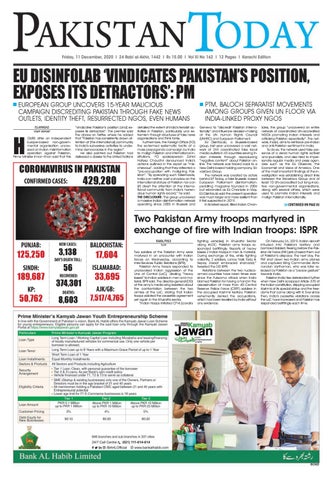
coronavirUs in Pakistan CONFIRMED CASES:
429,280
detailed the extent of india’s terrorist activities in Pakistan, particularly und extremism through structures of fake news organisations and think tanks. furthermore, the foreign office (fo) the so-termed systematic tactic of a mass propaganda campaign by india to malign Pakistan and international institutions. fo spokesperson Zahid hafeez chaudhri denounced india’s actions outlined in the report as “mischievous”, adding that they reflected a “pre-occupation with maligning Pakistan”. “By spreading such falsehoods, india can neither cast a shadow on the international stature of Pakistan nor can [it] divert the attention of the international community from india’s horrendous human rights record,” he said. THE DISCLOSURE: The group uncovered a massive indian disinformation network operating since 2005 in Brussels and
g
PTM, Baloch seParaTisT MoveMenTs aMong grouPs given un floor via india-linked Proxy ngos
geneva to “discredit Pakistan internationally” and influence decision-making at the un human rights council (unhrc) and european Parliament. eu disinfolab, a Brussels-based group, last year uncovered a vast network of 265 coordinated fake local media outlets in 65 countries serving indian interests through reproducing “negative content” about Pakistan online. The network was traced back to a new delhi-based holding company, srivastava group. The network was created by actors behind eP Today, a fake Brussels- based european Parliament disinformationpeddling magazine founded in 2006 but rebranded as eu chronicle in May. eu disinfolab said the present operation was much larger and more resilient than it first suspected in 2019. in its latest report, titled indian chron-
icles, the group “uncovered an entire network of coordinated un-accredited ngos promoting indian interests and criticising Pakistan repeatedly”. The network, it said, aims to reinforce pro-indian and anti-Pakistan sentiment in india. To do so, the network used fake personas of a dead human rights activist and journalists, and also tried to impersonate regular media and press agencies such as the eu observer, the economist and voice of america. one of the most important findings of the investigation was establishing direct links between the srivastava group and at least 10 un-accredited but long-inactive non-governmental organisations, along with several others, which were used to promote indian interests and malign Pakistan internationally.
CONTINUED ON PAGE 05
Two Pakistan Army troops martyred in exchange of fire with Indian troops: ISPR PUNJAB:
125,250 SINDH:
189,687 KP:
50,762
NEW CASES:
3,138
BALOCHISTAN:
DAY'S DEATH TOLL:
17,604
56
ISLAMABAD:
RECOVERED:
374,301 DEATHS:
8,603
33,695 AJK/GB:
7,517/4,765
RAWALPINDI TLTP
Two soldiers of the Pakistan army were martyred in an encounter with indian forces on wednesday, according to inter-services Public relations (isPr). Pakistan army troops responded to unprovoked indian aggression at the line of control (loc), dealing “heavy losses” to indian soldiers in men and material, isPr said. The director-general (dg) of the army’s media wing tweeted about the confrontation between the two armies at the loc, stating that indian troops violated the ceasefire agreement yet again in the khuiratta sector. “indian troops initiated cfvs [cavalry
fighting vehicles] in khuiratta sector along #loc. Pakistan army troops responded befittingly. reports of heavy losses 2 indian troops in men & material. during exchange of fire, while fighting valiantly, 2 soldiers, lance naik Tariq & sepoy Zaroof embraced shahadat,” tweeted the dg isPr. relations between the two nucleararmed countries have been tense ever since the Pulwama attack when india blamed Pakistan for having a hand in the assassination of more than 40 central reserve Police force (crPf) soldiers in the occupied kashmir territory. Pakistan vehemently denied the accusations, which had been levelled by india without any evidence.
on february 26, 2019, indian aircraft intruded into Pakistani territory and bombed Balakot, fleeing before the Pakistan air force (Paf) jets chased them out of Pakistan’s airspace. The next day, the Paf shot down two indian army planes and captured wing commander abhinandan varthaman, who was later released by Pakistan as a “peace gesture” towards india. Pakistan-india ties deteriorated further when new delhi scrapped article 370 of the indian constitution, stripping occupied kashmir of its special status and the freedoms that came along with it. ever since then, india’s ceasefire violations across the loc have increased and Pakistan has responded befittingly each time.
02
Friday, 11 December, 2020
NEWS
By announCing en mass Resignations, PDm leaDeRs enteR BlinD alley: FaRaz ISLAMABAD
m
STAFF REPORT
INISTeR for Information and Broadcasting Shibli Faraz on Thursday said the Pakistan Democratic Movement (PDM) had entered a blind alley by announcing its step of en mass resignations from assemblies in haste, which created fissures in the 11-party alliance. Parliamentary resignations were considered as the last resort in politics and the opposition leaders played this card at the wrong time in their quest for the power, he said while addressing a press conference in the federal capital. The PDM leaders, he said, used the en mass resignations as a 'blackmailing' tool without doing any homework as there were a number of legal issues which would ensue from their actions. The minister said the Pakistan People’s Party (PPP) would never want to lose its provincial government in Sindh while PDM chief Maulana Fazlur Rehman had a plan to take revenge from both the PPP and the Pakistan Muslim League-Nawaz (PML-N) for abandoning him during his long march to Islamabad last year. The members of PDM constituent parties quitting the assemblies would strengthen the position of Pakistan Tehreeke-Insaf (PTI) in the upcoming Senate election, he maintained.
To a query, the minister said his party's members of the National Assembly (NA) during the last government's tenure had presented their resignations to the then speaker Sardar Ayaz Sadiq of the PML-N. Faraz said the PDM, on the other hand, did not work out on the future scenario, on how to evolve after their resignations. For instance, they did not know what the rules the election Commission of Pakistan (eCP) and the Constitution said regarding the resignations from all members of an alliance. To another query, the minister said the government was making all-out efforts to protect the lives of people by updating them
Rasheed says those who resign would become ‘C class’ prisoners NEWS DESK Federal Railways Minister Sheikh Rasheed expressed his hope that not all members of the Opposition would resign from their seats, adding that those that do would not get any “benefits”, rather they would end up in jails as “C class” inmates. The above was said while Rasheed was talking to media persons in Lahore. He said that Prime Minister Imran Khan had opened the door for dialogue, but the Pakistan Democratic Movement (PDM) seemed adamant on refusing. No politician closes the door to dialogue, he added. “Those with whom you want to negotiate are against Nawaz Sharif's statement,” said the railways minister. He added that "whatever" the situation may be, it will not benefit the PDM. Rasheed was not troubled by the news of the PDM’s plans for resigning and said that it would not harm the National Assembly. He further taunted the PDM’s plans for holding a long march towards the federal capital, adding that the winters would be waiting for them. A day earlier, differences and mistrust between the parties PDM had forced the opposition alliance to postpone its decision to announce en masse resignations of its lawmakers during its Lahore rally on December 13. Pakistan People’s Party (PPP) Chairman Bilawal Bhutto-Zardari had already said that its lawmakers in Sindh Assembly would not tender resignations as the party was ruling the province. After listening to the PPP’s perspective, Jamiat Ulema-e-Islam-Fazl (JUI-F) Cheif Fazlur Rehman had said that there was a need for further deliberations over the issue leading to the postponement of resignations. Furthermore, Pakistan Muslim League-Nawaz (PML-N) lawmakers in the Punjab Assembly Jalil Sharaqpuri and Maulana Ghayasuddin had announced that they would defy the party decision. Talking to media persons, Jalil Sharaqpuri said that no one would resign from the assembly for personal agenda being pushed by a specific family. He had said that the PML-N was not a private firm or family property of anyone. He had further maintained that as a senior Muslim Leaguer, he would not resign without just cause and reasoning. Maulana Ghayasuddin had also refused to resign, adding that he had been in the party longer than Nawaz Sharif. He had said that no one could ask for a resignation from him.
on the coronavirus situation regularly. It had successfully coped with the first wave of the pandemic after embracing the smart lockdown strategy that safeguarded the lives and livelihoods of people simultaneously. He made it clear that the government would not impose a complete lockdown due to the rallies of a group which was adamant to put the people's lives at stake to protect their looted money and vested interests. Faraz said the government would follow the same strategy to cope with the second wave of the coronavirus which it had adopted during the first one. When asked about negotiations with the
opposition, he said the prime minister was ready to hold dialogue with them, however, "there will be no compromise on the corruption cases”. He said Prime Minister Imran Khan, soon after taking the oath of his office, called for dialogue and even formed a committee on the opposition's claim of electoral rigging, but they did not bother to even attend its meeting. The minister said the opposition had hijacked the parliament for the last two years to get the production orders for their imprisoned leaders instead of working with the government for the people's welfare. They had remained silent for two years, but now they all of a sudden started creating noise about the rigged elections, he said. Faraz said the opposition parties, when came into the power, only focused on plundering the national wealth and gaining personal benefits. They had turned the country into a Somalia-like state, he added. The minister said they had nothing to do with the democracy as they just sought a NRO (National Reconciliation Ordinance) from the government. Referring to Fazl’s statement regarding the breaking down of the electoral college, he asked if such things could ever really happen in a democratic system. He cited the example of passage of FATF-related laws from the parliament, where the prime minister could have given them an NRO for their support by conceding
to their demand to make the National Accountability Bureau (NAB) “toothless” and “featherless”, but he did not do that in the larger national interest. Faraz highlighted the unnatural alliance between the two major parties of the PDM – the PPP and the PML-N – by playing past video clips of Asif Ali Zardari and Nawaz Sharif in which they were seen criticising each other for the sake of power. He also played a clip of Nawaz Sharif in which he could be seen disgracing Shaheed Mohtarma Benazir Bhutto. The minister said both the party leaders had remained each other’s arch foes in the past in their lust for power, and today they had rallied against the government in an attempt to return to power. He vowed that the government would continue to expose the reality of all the major characters of PDM’s drama. “One by one, we will apprise the public about the PDM leaders’ reality, politics, hypocrisy, selfishness, so-called political principles and ruthlessness in a series of press conferences,” he added. Commenting on the PML-N supreme leader Nawaz Sharif's political career, he said first time Nawaz had come into the power was after backstabbing the then prime minister, Muhammad Khan Junejo. He reminded PPP Chairman Bilawal Bhutto-Zardari about the role of Nawaz Sharif in the hanging of Bilawal’s grandfather. When asked about the restrictions on the PDM's upcoming rally in Lahore, he said the government would not stop them from holding gathering, but would lodge first information reports (FIRs) against the facilitators and opposition leaders who were prompting people to flout the coronavirus related standard operating procedures (SOPs). He hoped that the people of Lahore would reject them as Multan’s citizens had.
Maryam moves court against seizure of Nawaz’s property ISLAMABAD STAFF REPORT
Pakistan Muslim League-Nawaz (PML-N) Vice President Maryam Nawaz has approached an Islamabad accountability court against the seizure of her father Nawaz Sharif’s property in the Toshakhana reference. She filed an application in the court on behalf of her father. After an initial hearing, Judge Syed Asghar Ali issued notices to the National Accountability Bureau (NAB) and others to submit their response to the application by December 16. Sharif’s seized house in Murree is registered in the name of his late wife Begum Kulsoom Nawaz, the application stated, adding it was purchased before the date mentioned in the reference. The house was divided among the family members after her death and a court
SAYS PML-N NOT YET DEMANDED RESIGNATIONS FROM MEMBERS had already given a verdict regarding the division, the application said. Maryam pleaded with the court to set aside the order regarding the seizure of the house. Separately, the PML-N VP on Thursday said that the Pakistan Democratic Movement (PDM) has decided in its meeting for the assembly members to submit their resignations with their party leaderships. PML-N had yet to formally demand resignations from its parliamentarians, she said while talking to media persons in Lahore. “We will ask for resignations after December 13,”
she said. “Resignations have already piled up with us as the MNAs and MPAs brought resignations along with them in a party meeting,” PML-N VP added. “Imran Khan now seeking NRO from the PML-N and the PDM,” Maryam Nawaz claimed, adding that the "PDM will emerge victorious in its struggle”. “We were not aware he was competing with the chair and tent-wallas,” she taunted. The 40 members, including 31 members of Punjab Assembly and nine members of the National Assembly, have submitted their resignations to the party leadership, according to party sources.
Top court reserves verdict over Justice Isa’s review petition ISLAMABAD TLTP
The Supreme Court (SC) on Thursday reserved its decision on Justice Qazi Faez Isa plea regarding the inclusion of three majority judges in the bench hearing the review petitions against the June 19 order. Talking to TLTP, former president of the Supreme Court Bar Association (SCBA), Kamran Murtaza, said, “It’s a settled principle that court would have to decide any miscellaneous application before deciding the main matter in a case so without addressing the concerns, raised about hearing of review petition, the court cannot adjudicate the matter in hand”. A six-judge larger bench, headed by Justice Umar Ata Bandial, reserved the decision when SCBA’s President Abdul Lateef Afridi was unable to appear before the bench due to ill health. Wife of the sitting judge of the SC, Sarina Isa, is among the petitioners who had challenged a split order announced by a ten-judge bench of the apex court over pleas filed
against a presidential reference that sought Justice Isa’s removal due to his failure to mention his family members’ foreign properties in his wealth tax return. Responding to the pleas, seven of the judges of a bench in the case had referred the matter to the Federal Board of Revenue (FBR) for an inquiry with directives to submit its findings to the Supreme Judicial Council (SJC). However, in order to hear review petitions against the verdict, Chief Justice of Pakistan (CJP) Gulzar Ahmed formed a seven-member bench comprising all the judges who wrote the majority judgment. One of the members, Justice Faisal Arab, retired on November 3 this year and to which another bench was announced comprising the remaining six judges. Three judges – Justice Maqbool Baqar, Justice Syed Mansoor Ali Shah and Justice Yahya Afridi – who held the minority view were excluded from the larger bench. At the onset of hearing on Tuesday, Sarina Isa came to the rostrum, along with her daughter, to address the six-judge larger bench led by Justice
Umar Ata Bandial. Sarina argued that the chief justice should be impartial, adding that the CJP is a respondent in this case as a member of the SJC. She also raised the question whether a six-member larger bench could overturn a verdict of the sevenjudge bench. Addressing every member of the bench by name, Sarina repeated the same question, to which head of the bench Justice Bandial asked her to avoid overstepping her limits. "You should be careful while talking about the chief justice and the institution," Justice Bandial observed. Justice Bandial said the chief justice, as the head of the institution, has left the matter relating to the inclusion of the three remaining judges to this larger bench. “We are just confining ourselves to your application for inclusion of the three minority judges,” he said. Citing a number of verdicts to substantiate his claim, Muneer A Malik, counsel for Justice Isa argued saying in the light of citations and Supreme Court Rules, the review petition should be heard by the same bench in the same matter.
Friday, 11 December, 2020
NEWS
CoviD-19 numBeRs will suRPass HosPitals’ CaPaCity iF soPs not FolloweD: Pm ISLAMABAD
a
STAFF REPORT
FTeR chairing a meeting of National Coordination Committee (NCC) Thursday Prime Minister Imran Khan cited rising cases of virus in the country with occupancy of beds in hospitals reaching almost forty percent across the country saying the chances of spread of the virus can be limited by only covering the face.
Appealing again the nation to fully follow the standard operating procedures (SOPs) to avoid the spread of Covid-19 in the winter season PM Imran said that after Multan jalsa by opposition, as many as 64 per cent beds have already been occupied. emphasising the importance of discipline in observing coronavirus SOPs, he reiterated that wearing masks and keeping social distance will save people from the pandemic. He expressed that the more people gather together the more they are likely
adviser to sindh Cm passes away due to Covid-19 Aijaz Ali Shah Sheerazi, adviser to Sindh Chief Minister Murad Ali Shah, passed away on Thursday due to the novel coronavirus. He was being treated at the Aga Khan University Hospital in Karachi. His funeral and burial will take place in Thatta, at the Makli graveyard. Sheerazi started his political career in 1984 and he had been elected as a Member of Provincial Assembly (MPA) five consecutive times and had served as a provincial minister and adviser multiple times as well. Sindh CM expressed his condolences over Sheerazi’s demise. Sheerazi was the father of Member of National Assembly (MNA) Ayaz Shah and MPA Riyaz Shah. NEWS DESK
unga adopts four Pakistani disarmament-related resolutions UNITED NATIONS: The United Nations General Assembly (UNGA) has given its stamp of approval on four resolutions presented by Pakistan aimed at strengthening regional and international peace and security. According to Radio Pakistan, the resolutions were recommended by the 193-member assembly’s Disarmament Committee, and the texts were adopted by the overwhelming support of its membership. Of these, three resolutions dealt with regional disarmament, conventional arms control at regional and sub-regional levels as well as Confidence Building Measures (CBMs) in the regional and sub-regional context. The fourth Pakistani resolution sought security assurances for non-nuclear states. The 'Conclusion of effective International Arrangements to Assure Non-NuclearWeapon States Against the Use or Threat of Use of Nuclear Weapons' resolution was adopted by a vote of 125 in favour to none against, with 62 abstentions. The resolution, titled 'Conventional Arms Control at The Regional and Sub-Regional Levels' was adopted by a vote of 183 in favour, with only India casting a negative vote. Four countries abstained. The resolutions on “Regional Disarmament” and “Confidence-building Measures in the Regional and Sub-regional Context” were adopted by consensus. Diplomats said the approval of the resolutions by the General Assembly was as an acknowledgement of Pakistan’s commitment to promoting the objectives of regional and global disarmament as well as strengthening international peace and security. At a time of growing mistrust and rising tensions in various regions of the world, especially in South Asia, regional approaches to disarmament to strengthen peace and security had assumed greater relevance and significance, they said, noting that the General Assembly has long recognised that international peace and security was co-dependent on stability at the regional and sub-regional levels. International efforts towards disarmament and arms control were reinforced and complemented by regional approaches towards this end, it was pointed out. STAFF REPORT
to spread Covid-19, elaborating that especially in the winter season, people assembling indoors are more susceptible to contract the viral infection due to the closed atmosphere. He noted about 40 per cent of Covid-19 patients are receiving treatments in hospitals, fearing that if the numbers increase, hospitals will soon be out of capacity and compared the situation with developed countries of europe and America where in spite of resources the pandemic caused crises. On the Pakistan Democratic
Movement (PDM) rallies against his government, the PM said that these least bothered him but were becoming super spreaders and posing risks to masses. They can postpone their political gatherings for two- to three months, PM Imran said, adding that Covid-19 is raging on exhausting hospital beds and affecting healthcare workers. It is pertinent to note that Pakistan has recorded 56 deaths and 3,138 new cases due to the coronavirus in the last 24 hours.
Govt bans new connections for industrial sector to meet gas shortfall ISLAMABAD AHMAD AHMADANI
The federal cabinet, while ratifying the proposed natural gas load management plan for the ongoing winter season, has directed that no new gas connection may be allowed to industrial units where grid connectivity was available for power generation. According to sources, the federal cabinet, in its meeting held on 8th December, had ratified the Cabinet Committee on energy (CCoe)'s decision regarding natural gas load management for the ongoing winter season (2020-21) in terms of rule 17 (1) (a) & (c) of the Rules of Business, 1973. It had also directed the Petroleum Division to continue gas supply to the two fertilizer plants -- Agrotech and Fatima Fertilizer -- as long as the gas mitigation plan was not compromised. In addition, the Ministry of Industries & Production was asked to keep an eye on the fertilizer stocks. Sources said the cabinet had further directed that the Petroleum Division to ensure that the plan was implemented in a timely manner to overcome anticipated of gas supply. During the meeting, the petroleum secretary had presented the current status of the demand and supply along with projections till January 2021. The secretary also informed the meeting about major steps taken so far by the division to meet the shortage of gas. earlier, the CCoe, in its meeting held on 26th November, had approved natural gas load management
plan for winter season with certain directions that "there will be no planned curtailment for domestic sector in Sui Southern Gas Company Limited (SSGCL) and Sui Northern Gas Pipelines Limited (SNGPL) systems", and that "there will be no planned curtailment of gas supply to export industry". However, in case of an emergency, supply to captive power units of export-based industry may be curtailed for one day a week at the end of December 2020-beginning of January 2021. Similarly, gas supply to general industry and captive units of general industry (non-export) may be curtailed as needed from mid-December 2020 to end of January 2021. According to CCoe, the supply for the compressed natural gas (CNG) sector may be on 'as and when available' basis. Officials of the Petroleum Division, on the condition of anonymity, said that the division has so far made arrangements for additional LNG cargo for the month of January 2021 so that both LNG terminals could operate at optimum level. It has also undertaken retrieval of natural gas from shut-in wells by workover/overhauling and allocation of volumes by the end of December 2020, which include up to 90MMCFD for SSGCL and 16MMCFD for SNGPL, respectively. In addition, the division has made arrangement of additional gas from Mari Petroleum Company Limited for injection into SNGPL system on ‘as and available basis’ i.e. up to 15MMCFD (phase-I) in December 2020 and up to 50MMCFD (phase-II) by early January 2021, subject to installation of compression facility by MPCL.
Govt plans to save over Rs500bn through targeted subsidies ISLAMABAD SHAHZAD PARACHA
The government's 'subsidies cell', under the supervision of Adviser to Prime Minister on Finance Abdul Hafeez Shaikh, has estimated to save around 500 billion under its targeted subsidies action plan, sources revealed on Thursday. Sources said that the cell has undertaken extensive exercise to assess the financial burden of subsidies on the national exchequer. Presently, the government is providing subsidies to power (electricity), gas, food, petroleum and fertiliser sectors. Sources said that the federal government will save around Rs75 billion under targeted subsidy for industry. Similarly, the Ministry of National Food Security & Research will be able to save Rs50 billion while settling the reform commodity debt. In addition, the power ministry will save Rs200 billion while adopting national average electricity tariff
by consolidating the accounts of DISCOs. Besides, the Power Division will also save Rs18 billion by implementing the electricity pricing agreement reached with Azad Jammu Kashmir through NePRA. A sum of Rs12 billion will be saved by improving the recovery ratio in merged districts of Khyber Pakhtunkhwa. Sources said that the government was also working on a number of action plans, including subsidy on electricity to low income consumers through ehsaas. IeSCO and ehsaas Division would start a pilot project in Islamabad wherein the data of electricity consumers would be matched with IeSCO record, after which the subsidy amount would be cleared. This action plan would be implemented till December 2021, sources said. It is pertinent to mention that the federal government is providing subsidies of around Rs2 trillion annually, which constitute 4.5pc of GDP and 58pc of current budget (excluding payments).
03
Coronavirus vaccine will be available in march 2021 in Pakistan: saPm ISLAMABAD: The Federal Ministry of National Health Services has announced that the coronavirus vaccine will be available in Pakistan by March 2021. Special Assistant to the Prime Minister (SAPM) for Health Dr Faisal Sultan, while talking to a local news station, said that the government has finalized the procedure for procurement of the vaccine. Dr Faisal Sultan said that under the vaccination plan, the vaccine will be available in Pakistan in March 2021, adding that the government was in touch with many different countries for this endeavour. SAPM said that in order to buy the vaccine, they would see which vaccine is the most beneficial. Some aspects of vaccine procurement are a bit difficult to decide, he added, stating that a committee will make a final decision on the purchase of the vaccine after considering the views of experts. Furthermore, he said that the vaccination campaign would be carried out in three phases. The vaccine will be provided on an expanded Programme on Immunisation (ePI) basis. In the first phase, medical staff will be vaccinated, while in the second phase, people over the age of 60 will be vaccinated, and in the third phase, it would be available to the general public. STAFF REPORT
iHC grills CDa for failure to pay compensation after land acquisition ISLAMABAD: Islamabad High Court (IHC) on Thursday grilled Capital Development Authority (CDA) for failing to award compensation to the people from whom it had acquired land for development purposes. "Land belonging to their forefathers had been snatched from the people but they were still being pushed from pillar to post for compensation," remarked Chief Justice Athar Minallah. "everyone should feel ashamed, he remarked It is a reflection of how this country is being managed.” Hearing a petition related to the awarding of compensation after land acquisition, the judge observed the "elites" were ruling Islamabad and the poor were not receiving money even in exchange for their own property. "The CDA should die of shame," said Justice Minallah. He observed that the prime minister was right in saying that there were two Pakistans – one for the rich and powerful and the other for the poor. "If the compensation had not been disbursed then the only thing this court could say was that the country wasn’t being run according to law," the IHC chief justice noted. However, he warned the petitioner’s counsel that the application would be dismissed along with the imposition of a fine in case of any misstatement. In his arguments, the lawyer informed the court the land possession was given in 1995 but his client was still waiting for compensation. APP
Caa notifies new soPs for passengers travelling to Pakistan KARACHI: The Civil Aviation Authority (CAA) has notified new standard operating procedures (SOPs) for international passengers, chartered and private aircraft flights to Pakistan. The new SOPs have been divided in three categories; A, B and C, by the aviation authority, according to a notification issued by the CAA. Japan, Finland, Namibia and Malawi are among the countries removed from the category A, whereas the number of countries included the category has been increased to 24 from 22. The category A includes Australia, China, Cote D’Ivoire, Cuba, Fiji, Iceland, Ireland, Kazakhstan, Laos, Maldives, New Zealand and Nigeria; whereas category B comprises Norway, Rwanda, South Korea, Saudi Arabia, Senegal, Singapore, South Sudan, Sri Lanka, Togo, Uruguay, Vietnam, Zambia. TLTP
Developing Asia’s economy to contract 0.4pc in 2020, grow 6.8pc in 2021: ADB MANILA AGENCIES
economic activity in developing Asia is forecast to contract by 0.4pc this year before picking up to 6.8pc in 2021, as the region moves toward recovery from the effects of the Covid-19 pandemic, according to an Asian Development Bank (ADB) report released on Thursday. The new growth forecast, presented in a regular supplement to the Asian Development Outlook (ADO) 2020 Update, is an improvement from the -0.7pc gross domestic product (GDP) growth forecast in September, while the outlook for 2021
remains unchanged. But the report said that prospects are diverging within the region, with east Asia set to grow this year while other subregions are contracting. "The outlook for developing Asia is showing improvement. Growth projections have been upgraded for China and India, the region's two largest economies," ADB Chief economist Yasuyuki Sawada said in a statement. "A prolonged pandemic remains the primary risk, but recent developments on the vaccine front are tempering this," he said. Most of developing Asia's subregions are forecast to contract this year. The report said that east Asia is the
exception, with an upgraded growth forecast of 1.6 percent for 2020 on the back of faster than expected recoveries in China. east Asia's growth outlook for 2021 is maintained at 7.0pc. The ADB expects China's economy to grow by 2.1pc in 2020, more than the 1.8pc forecast in September, before bouncing back to 7.7pc in 2021, unchanged from the September Update. "But risks on global economic recovery make the forecast uncertain," the ADB warned. The report said that South Asia's GDP is forecast to contract by 6.1pc in 2020, revised up from the 6.8pc contraction expected in September. Growth in South Asia is forecast to rebound to 7.2pc in 2021.
The growth forecast for India, the subregion's largest economy, for fiscal year (FY) 2020 is raised to -8.0pc, from the 9.0pc projection in September, while the outlook for FY2021 is kept at 8.0pc. The report said that economic growth in Southeast Asia remains under pressure as Covid-19 outbreaks and containment measures continue, particularly in Indonesia, Malaysia, and the Philippines. The subregion's growth forecast for 2020 is revised down to -4.4pc from -3.8pc in September. The subregion's outlook for 2021 is also downgraded, with Southeast Asia now expected to grow 5.2pc next year compared to 5.5pc growth forecast in
September. The outlook for the Pacific is unchanged for both 2020 and 2021 at -6.1pc and 1.3pc, respectively. Central Asia's growth forecast for 2020 remains at -2.1pc, but the outlook for 2021 is slightly downgraded to 3.8pc from the 3.9pc growth projection in September. Regional inflation is expected to marginally ease to 2.8pc in 2020, from 2.9pc projected in September, due to depressed demand and low oil prices. Inflation for 2021 is forecast at 1.9pc, down from 2.3pc forecast in September. Oil prices are retained at $42.50 per barrel in 2020 before increasing to $50.00 per barrel in 2021.
Friday, 11 December, 2020
04 NEWS
PuNjAB PoLICe PrePAreS STrATeGy for PDM jALSA LAHORE
A
SHAHAB OMER
S the Pakistan Democratic Movement (PDM) is preparing for its December 13 jalsa in Lahore, the Punjab Police has also formulated its strategy for the rally, Pakistan Today learnt on Thursday. Some of the Pakistan Muslim LeagueNawaz (PML-N) leaders who were already nominated in various cases would be arrested before the PDM rally and the entrances to the provincial capital would also be closed a day before the meeting.
Furthermore, it is alleged that the strategy to stop the workers coming to Lahore from other districts was also in the final stages. There is a threat of terrorism during the Lahore rally and a threat alert has already been issued. The Punjab Police had alerted the PMLN leaders, including Vice President Maryam Nawaz and Punjab President Rana Sanaullah, about the threat of a possible attack on the PDM jalsa and requested the PDM leadership to cancel the rally. The police had issued strict security instructions to Maryam and Sanaullah in case of a non-cancellation, including the use of
Smart lockdown imposed in 55 areas of Lahore LAHORE: As many as 55 areas of Lahore have been placed under smart lockdown due to surge in coronavirus cases during the second wave of the pandemic. The areas placed under smart lockdown include Data Ganj Bakhsh Town, Shalimar Town, Samanabad Town, Aziz Bhatti Town and Allama Iqbal Town. However, only some blocks and streets of these areas, where large number of coronavirus cases reported in the past, were placed under lockdown. Medical services, pharmacies, medical stores, laboratories collection points, hospitals and clinics will remain open 24 hours in these areas. INP
Bilawal urges int’l community to take notice of violations in IHK ISLAMABAD: Pakistan Peoples Party (PPP) Chairman Bilawal Bhutto Zardari has urged the international community to take notice of the grave violations of human rights in the Indian-held Kashmir (IHK). In his message, Bilawal insisted that the international community to ensure end of Indian atrocities in Kashmir and respect of the right of Kashmiris for a referendum. He said: “Protection of human rights of every citizen is the key responsibility of a state. His party has been fighting for the protection of human rights of Pakistanis. Our struggle for equal respect and protection of human rights has been continued despite facing martyrdoms, victimisation, imprisonments, torture and slanderous campaigns.” He pledged that his party’s role as the torch-bearer of human rights campaign would never compromise under any situation. “Countries are adjudged through their human rights record and progress. Prosperity is naturally linked to upholding human rights of every citizen regardless of religion, gender, creed, caste or ethnicity. INP
bulletproof cars. PML-N spokesperson Maryam Aurangzeb said that Prime Minister Imran Khan had said that he would provide containers on the protest of the opposition while their workers were being arrested. “If the workers react to such actions, the Punjab government and Imran Khan will be responsible. The government states on a daily basis that it will not stop the meeting, but our workers are being arrested,” she said. “Imran Khan's competition is not with PDM but with DJ Butt,” she taunted, adding that: “If the government registers an FIR [first information report] against us, we will
frame it and put it in houses.” The government has lost the psychological and democratic war, she claimed. “The PDM will hold the Jalsa on December 13 at Minar-e-Pakistan Ground and the people will get rid of flour, sugar and vote thieves,” she concluded. Meanwhile DJ Butt, who became famous after providing sound system for Pakistan Tehreek-e-Insaf’s (PTI) 2014 sit-in in Islamabad, has been released on bail by the Punjab Police following court orders. “I am still Imran Khan's tiger. I have a license for the weapons recovered from me,” he said after being released on bail at a bond of Rs50,000. It is pertinent to mention here that the police had arrested DJ Butt from his house yesterday and he was charged with possession of illegal weapons. He was also charged with interfering in government affairs, colluding with the police and possessing an illegal rifle. The 11 parties of PDM have been protesting against the government with the first rally having taken place in Gujranwala, the second in Karachi, third in Quetta and fourth in Multan.
DJ Butt gets bail in ‘illegal weapon’ case LAHORE STAFF REPORT
A district and sessions court in Lahore on Thursday granted bail to sound system provider Muhammad Asif aka DJ Butt a day after he was arrested on the charges of possessing an illegal weapon and interference in official work. Civil Judge Qamar Zaman directed him to submit a surety bond of Rs50,000. Punjab police arrested DJ Butt, who rose to prominence during the 2014 sit-in of Pakistan Tehreek-e-Insaf (PTI), on Wednesday. He has been providing a sound system to the rallies of the Pakistan Muslim League-Nawaz (PML-N) in Lahore and elsewhere and for the December 13 meeting his services were hired.
According to the FIR, police raided the office of DJ Butt in Model Town and registered a case for possessing an illegal weapon and interference in official work by manhandling the raiding team members. Police also allegedly manhandled a couple of reporters who reached the Model Town police station to get the FIR copy. The reporters were recording the comments of Butt at the police station when policemen manhandled them and tried to snatch their mobile phones. Butt said that he had been arrested unfairly. Condemning the arrest, PML-N central spokesperson Marriyum Aurangzeb declared: “[Prime Minister] Imran Khan is a small man who is targeting the caterers and sound-system providers like DJ Butt to create hurdles in the PDM [Pakistan Democratic Movement] rally on December 13.”
Pakistan Navy assumes command of multinational anti-piracy task force ISLAMABAD TLTP
Pakistan Navy on Thursday assumed command of a multinational anti-piracy task force operating in the Indian Ocean region. The command of the Combined Task Force 151 (CTF151) was handed over to Pakistan Navy in an impressive ceremony held at the Central Command Headquarters, Bahrain. The ceremony was attended by various diplomats and military dignitaries, including the ambassadors of Pakistan and Turkey, stationed in the Gulf nation. This was the ninth time that Pakistan Navy took over the command of this task force, which conducts counterpiracy operations off the coast of Somalia and the Horn of Africa. The command of the task forc was previously held by Turkish Navy. According to the spokesperson of Pakistan Navy, Commodore Abdul Muneeb has been appointed as the new commander of the task force. He said the Pakistan Navy would continue to work with the navies of other countries for peace and stability in the region. The CTF151 is a multinational naval task force, set up in 2009, and it performs its duties under the supervision of the
Combined Maritime Forces (CMF). The task force ensures maritime security and countering operations against terrorism and piracy at sea. It is also responsible for building capacity and improving relevant capabilities in order to protect global maritime commerce and secure freedom of navigation. The task force operates in conjunction with the European Union’s Operation Atlanta and NATO’s Operation Ocean Shield.
Protection, promotion of human rights our top priority: Balochistan CM QUETTA INP
Balochistan Chief Minister Jam Kamal Khan has said that his government’s top priority is to protect and promote human rights in the province. The World Human Rights Day was observed on Thursday. The CM said that provi-
sion of human rights is necessary for development and prosperity of any country. The provincial government is striving to promote national unity and solidarity in the province. The CM also expressed his concerns over the serious human rights violations in the Indian-held Kashmir (IHK). He requested all segments of society to raise their voice for protection of human rights of Kashmiri people.
ASF seizes 21kg heroin at Islamabad Int’l Airport ISLAMABAD TLTP
The Airport Security Force (ASF) seized a huge quantity of heroin from a car at Islamabad International Airport on Thursday. According to ASF officials, the vehicle was searched upon entering the airport’s parking area. The officials recovered 21 kilogrammes of heroin worth millions of rupees. They said that driver Mohammad Ahmed, who belongs to Khyber Pakhtunkhwa (KP)’s Khyber
agency, was taken into custody. After initial interrogation, he was handed over to the Anti-Narcotics Force (ANF) for further investigation. Earlier on December 2, the ASF had foiled a drug smuggling attempt at Allama Iqbal International Airport, Lahore and recovered 9.04 kilogrammes of heroin from the luggage of a passenger during a routine search. The drug was concealed at the bottom of a trolley bag. Passenger Tasawar Ijaz, a resident of Rawalpindi, was to board Qatar Airways’ Milan-bound flight QR-629.
Two killed in separate incidents in Chiniot CHINIOT: Two persons were killed in separate incidents here on Thursday. According to the police officials, an over speeding van knocked down a motorcycle at Tarkhanwala Road. Due to the accident, a 35year-old person, whose identity could not be confirmed, was killed on the spot. In a separate incident, Riaz, who was working as a labourer at the roof top of a house in the city, was electrocuted to death after he mistakenly touched a high-tension power line passing over. The bodies of both persons were shifted to hospitals of respective areas. INP
PML-N MPA gets bail in Pakpattan AC torture case LAHORE: Lahore High Court (LHC) on Thursday granted pre-arrest bail to a Pakistan Muslim League-Nawaz (PML-N) member of Punjab Assembly (MPA) in a case pertaining to inflicting torture on Pakpattan assistant commissioner. Mian Naveed Ali–MPA from PP-192, Pakpattan-II–was booked along with his father Mian Ahmed Ali and six others in November on charges of abusing and kidnapping AC Khawar Bashir who raided a marquee and imposed Rs50,000 fine on it for violation of the law. The incident drew sharp criticism especially by the All Pakistan Provincial Civil Services Association (APPCSA) and the PMS Officers Association who demanded immediate arrest of the politician. Later, Chief Minister Usman Buzdar also took notice and sought a report from the Sahiwal regional police officer (RPO). The high court approved the request and granted bail till December 24 and directed Naveed to submit a surety bond worth Rs100,000. The court also sought a reply from the concerned station head officer (SHO) into the probe. Earlier this month, an additional district and sessions court in Pakpattan dismissed Naveed's bail request. STAFF REPORT
Govt striving hard to make provinces more autonomous: NA speaker ISLAMABAD: Pakistan National Assembly Speaker Asad Qaiser on Thursday said that the government is striving hard to make the provinces more autonomous. Talking to Khyber Pakhtunkhwa Assembly Speaker Mushtaq Ghani, he said that unity is necessary to face the challenges in the country, as the second wave of Covid-19 is severe in its impacts. The country cannot afford political instability in these critical times. Close cooperation between federation and provinces is the prime requirement for prosperous and developed country. The political leaders need to rise above their politics for the protection of civilians’ lives. On this occasion, Mushtaq Ghani appreciated the efforts of Asad Qaiser to bring the federation and provinces together and the steps of the federation to combat the coronavirus pandemic. TLTP
IHC expresses dismay over plight of animals at Marghazar Zoo ISLAMABAD: The Islamabad High Court (IHC) on Thursday expressed dismay over the plight of animals at Marghazar Zoo and asked the concerned administrator to turn up with reasons of inefficiency in the matter. Taking up the matter, the IHC’s Chief Justice Athar Minallah observed that the administration is not showing seriousness in providing facilities for the animals at the zoo. The administration is only playing politics here. “If 60 days were not enough to shift two cheetahs from the zoo, the administration should have informed the court,” the CJ remarked. The lives of both cheetahs are in danger, as one of them is suffering from cancer while the other is infected with another disease. The IHC was earlier informed that two brown bears at the zoo would be shifted to a sanctuary abroad. During the course of proceedings, the environment secretary submitted that not only two cheetahs but some other animals, including monkeys, are also in danger. While pleading for the court’s trust on them, the secretary assured that the concerned authorities will perform their duties with responsibility. The hearing of the case was later adjourned. TLTP
Friday, 11 December, 2020
NEWS
World Watches as first-mover Britain proBes adverse reactions to pfizer vaccine London
B
AGENCIES
RITAIN hailed “V-Day” when it became the first country to roll out the Pfizer-BioNTech Covid-19 vaccine. Yet, as first mover, it has also become the first to report cases of adverse reactions, allowing other nations to watch and learn. Officials from around the world are keen for British authorities to give them as much information as possible about the two reported cases of anaphylaxis among thousands of people inoculated since mass-vaccination began on Tuesday. Anaphylaxis is an over-reaction of the body’s immune system, which health specialists describe as severe and sometimes life-threatening. While such allergic reactions are rare in any individual vaccine recipient, they are not unusual during large-scale rollouts, scientists, experts and industry figures said.
‘Adab-e-Latif’ ief Editor: Hussain Majrooh Address: G-65 Zainab Tower, Link Model Town Market, Lahore. Pages: 376 -- Price: Rs.400/2. ‘Al-hamra’ Editor: Shahid Ali Khan Address: 24-J Block, ‘Al-Murawwat’, Model Town, Lahore Pages: 195 -- Price: Rs.200/This review is intended to have an overview of the September, 2020 and November 2020 issues of the two leading Lahore-based literary Urdu magazines namely ‘Adab-e-Latif’’ and ‘Al-hamra’. ‘Adab-e-Latif’
The reports nonetheless led to Britain’s Medicines and Healthcare products Regulatory Agency (MHRA) beefing up its guidance for the shot at midnight leading into Thursday, specifically warning that anyone with a history of anaphylaxis should not take it. In the United States, regulators and public health officials are determining whether to approve the vaccine from Pfizer and BioNTech, and what advice to issue. William Schaffner, an infectious disease expert at Vanderbilt University Medical Center, said the British regulator was being cautious in its approach to the shot, which uses new genetic mRNA technology. “They’re being very, very careful. These are new vaccines using a new technology. They’ve gotten a signal here that they need to investigate,” he said. “We’ll benefit from their investigation.” Schaffner, who is a non-voting member of Centers for Disease Control and Prevention’s Advisory Committee on Immunization Practices, said the group would
likely discuss the topic when it discusses the use of Pfizer’s vaccine on Friday. Stephen Hahn, commissioner of the U.S. Food and Drug Administration, said his agency was trying to learn from the UK experience. “We’re working very closely with our UK partners to understand what went on with respect to those allergic reactions,” he told CBS News ahead of a meeting of outside advisers to weigh whether to recommend approval of the vaccine. Canada’s health ministry, which approved the vaccine on Wednesday, also said it would look at the reported reactions in Britain, but added that adverse events were to be expected and would not necessarily change the risk/benefit of the shot. ‘BENEFITS OUTWEIGH RISKS’: The MHRA, which last week became the first regulator in the world to approve the vaccine, said it was looking into the reports of anaphylaxis as a matter of priority. “Anaphylaxis is a known, although very rare, side
Two valued literary journals This magazine was founded by Barkat Ali Chaudhry, an eminent publisher and citizen of Lahore in the year 1935. Eversince it has been appearing uninterruptedly thanks to the efforts of its founder and his successors. A galaxy of writers, poets and intellectuals has served the magazine as its editor on different occasions during its 85 years of publication. They include Fikr Taunsavi, Rajinder Singh Bedi, Krishan Chander, Qateel Shifai, Sahir Ludhianvi, Faiz Ahmad Faiz, Ahmad Nadeem Qasmi, Nasir Kazmi, Intizar Hussain, Ashfaq Ahmad, Masood Ash’ar, Kishwar Naheed, Meerza Adeeb, Nasir Zaidi and others besides Barkat Ali Chaudhry’s son Iftikhar
Ali Chaudhry and daughter Siddiqa Begum, who were its managing editors for a long time. After the demise of Siddiqa Begum and Nasir Zaidi, ‘Adab-e-Latif’ has fallen into the hands of a panel of writers and litterateurs viz. Hussain Majrooh (Chief Editor), Mazhar Salim Mujoka (Editor), Shahzad Nayyar and Amna Mufti (Sub-Editors), and Riaz Ahmad (Artist). The instant issue reflects their collective genius as prompters, selectors, organizers, designers, and publishers. The present issue contains a rich literary menu of virtually all genres of literature like spiritual verse, ghazal, nazm, criticism, reviews, essays, short stories, and translations. Contributors to the issue include such illustrious names as Naseer Turabi, Khurshid Rizvi, Zafar Iqbal, Sarmad Sehbai, Dr. Nasir Abbas Nayyar, Ghulam Hussain Sajid, Jan Kashmiri, Shahida Hasan, Abrar Ahmad, Maqsood Wafa, Baqi Ahmadpuri, Hameeda Shaheen, Ishaq Wardag, Masood Ahmad, Dr. Saadat Saeed, Hafeez Tahir, Dr. Jawaz Jafri, Satya Pal Anand, Ali Muhammad Farshi, Rafiq Sandeelvi, Jamil Ahmad Adeel, Mahmood Ahmad Qazi, Attiya Syed, Muhammad Hameed Shahid, Sarfaraz Shahid, Shahid Ashraf and others. Hussain Majrooh’s prefatory remarks enclose some important contemporary literary issues like the value of literature in a social environment rife with science, technology, commerce, and a surfeit of politicking. He has lamented the indifference of the powers that be as well as the society at large, to literature and literati. Going beyond that, he has also censured the general apathy of different segments of the society to books and literary journals in the growing roar of the Hydra of globalization, machine, business, war, exploitation, crime, disease, social evils, and poverty. The new format and the variety and richness of the content of the magazine suggest a beautiful revival
EU DisinfoLab ‘vindicates Pakistan’s position, exposes its detractors’: PM Continued from page 01 “In Geneva, these think tanks and NGOs are in charge of lobbying, of organising demonstrations, speaking during press conferences and UN side-events, and they were often given the floor at the UN on behalf of the accredited organisations,” the report said. One particular NGO which caught the eye of the researchers was the Commission to Study the Organisation of Peace (CSOP). The CSOP was founded in the early 1930s and received UN-accreditation in 1975 but became inactive later in the 1970s. The investigation found that a former chairman of the CSOP — Professor Louis B Sohn, a leading international law scholar and Harvard Law faculty member for 39 years — was listed under the name Louis Shon as a CSOP participant at the UNHRC session in 2007 and at a separate event in Washington DC in 2011. The listings shocked the researchers because Sohn died in 2006. The report also listed several other instances of identity thefts, including the name of Martin Schulz, former president of the European Parliament, more than 750 fake media outlets covering 119 countries, and over 550 registered domain names. The report further showed that the campaign was amplified by a leading Indian news agency – Asian News International. Born in 1971, ANI describes itself as “South Asia’s leading multimedia
news agency, with more than 100 bureaus in India, South Asia and across the globe”. Indian news media, especially broadcast media, thrive on the content provided by the agency. “Our open-source investigation shows that the operation led by the Srivastava Group and amplified by ANI [… ] began in 2005 and is still ongoing at this date,” the group said. “The operation’s mission is to discredit nations in conflict with India in Asia, in particular, Pakistan but also China to a lesser extent.” The report found that articles from a small fake European media outlet, EU Chronicle, were used as a base by ANI to create news reports. It noted that the Indian agency covers the lobbying efforts taking place under the garb of resurrected/fake NGOs, with sometimes dubious practices. The repackaging of EU Chronicle op-eds and articles into ANI news reports means that the content from the fake European media outlet can reach a wider audience, particularly in India. For example, ANI reports using EU Chronicle content are systematically reproduced on Yahoo News India, a website attracting a sizable audience, it said. The group found at least 13 instances of ANI re-publishing mostly anti-Pakistan and sometimes anti-China op-eds by Members of the European Parliament (MEPs), originally published on EU Chronicle. Some Indian media outlets, which re-use content from ANI,
become a de facto regular amplifier from EU Chronicle. “The actors behind the operation hijacked the names of others, tried to impersonate regular media such as the EU Observer […] used the letterhead of the European Parliament, registered websites under avatars with fake phone numbers, provided fake addresses to the United Nations, created publishing companies to print books of the think-tanks they owned,” the report read. “They used layers of fake media that would quote and republish one another. They used politicians who genuinely wanted to defend women or minority rights to ultimately serve geopolitical interests and gave a platform to far-right politicians when convergent objectives could be reached.” Alexandre Alaphilippe, executive director of EU DisinfoLab, said ANI was being used to give legitimacy to the entire “influence operation”, which relied “more on ANI than on any other distribution channel” to give it “both credibility and a wide reach to its content”, BBC reported. By virtue of being the largest Indian news agency, ANI’s reports have found space in many mainstream Indian news outlets and publishers. Its content was further reproduced on more than 500 fake media websites across 95 countries, the researchers found. Demonstrations in Europe conducted by organisations linked to the Srivastava Group have also been covered
CMYK
by ANI, as well as by fake media ebsites linked to SG. PTM GIVEN UN FLOOR VIA PROXY NGOs: At the core of the report was the issue of ethnic groups being provided floor at the UNHRC on behalf of these proxy NGOs. The list — which includes some of the proscribed organisations including Brahumdagh Bugti-led Baloch Republican Party (BRA) — also featured Pashtun Tahafuz Movement (PTM) which ostensibly demands greater rights for Pashtuns. Other parties/groups in the list include: Baloch Voice Association, European Foundation for South Asian Studies, the World Sindh Congress, the United Kashmir People’s National Party, Jammu Kashmir Peace and Development Institute, Baloch People’s Congress, World Baloch Women’s Forum, Gilgit Baltistan Studies, Baloch Human Rights Council, Baloch Students Organisation, Baloch People’s Congress, Baloch Voice Foundation and Jammu Kashmir National Awami Party. Importantly, the report said, certain actions inside the UNHRC are supported and even organised directly by organisations created by SG, such as the European Organisation for Pakistani Minorities. In its 2019 report, the group also explained how these events were covered by fake media and press agencies including the Times of Geneva, an online portal recently taken down with all of its content, and FourNewsAgency.
05
effect with any vaccine,” the watchdog said. “Most people will not get anaphylaxis and the benefits in protecting people against Covid-19 outweigh the risks.” Its updated guidance to health professionals reads: “Any person with a history of anaphylaxis to a vaccine, medicine or food should not receive the Pfizer-BioNTech vaccine.”That fleshed out an earlier change, in response to the reports of adverse reactions, that had more broadly warned against those with a history of a “significant allergic reaction” to a vaccine, medicine or food taking the shot. A vaccination resources database for doctors in France estimates the number of anaphylaxis events at below 1 per 100,000 doses, although it says it can happen to “any patient with any type of vaccines”. Paul Turner, an expert in allergy and immunology at Imperial College London’s who has been advising the MHRA, said it was unlikely the adverse reactions were due to food allergies. They may have been caused by a component of Pfizer’s vaccine called polyethylene glycol, or PEG, which helps stabilise the shot and is not in other types of vaccines, he added. “As we’ve had more information through, the initial concern that maybe it affects everyone with allergies is not true,” he said. “Likewise, people with a known allergy to just one medicine should not be at risk,” Turner told Reuters. Pfizer and BioNTech said they were supporting the MHRA investigation.
of its esteemed past. ‘Al-hamra’ This magazine was founded by Maulana Hamid Ali Khan, a scion of the family of Maulana Zafar Ali Khan. It is a prestigious monthly Urdu literary journal being regularly published from Lahore. The present issue comprises a miscellany of spiritual verse, nazm, ghazal, travelogue, autobiography, fiction, criticism, and humour. Prominent contributors to the issue are late Maulana Hamid Ali Khan, Syed Riaz Hussain Zaidi, Prof. Fateh Muhammad Malik, Dr. A.B. Ashraf, Prof. Hassan Askari Kazmi, Muhammad Asif Bhalli, Dr. Rauf Khair, Satya Pal Anand, Aslam Ansari, Dr. Jawaz Jafri, Bushra Rahman, Muhammad Anis Ansari, Asnath Kanwal, Aslam Kamal, Dr. Rafiuddin Hashmi, Iqtidar Javed, Zafar Iqbal, Nazir Qaiser, Shaukat Kazmi, Amjad Islam Amjad, Raja Abdul Qayum, Qaiser Najafi, Brig. ® Hamid Saeed Akhtar, Durdana Nosheen Khan, Hanif Bawa, Salma Awan, Dr. Ashfaq Ahmad Virk, Dr. Khurshid Rizvi et al. The dustcover of the magazine is the brainchild of the legendary artist Aslam Kamal. The quality of its content is equally appreciable.
Friday, 11 December, 2020
06 COMMENT
The second wave may not be the last
Media war against Pakistan RAW in Europe
T
he false news of civil war in Pakistan spread by Indian media in October pales into insignificance compared to what RAW is doing to malign Pakistan in europe over the last 15 years. The eU DisinfoLab, an independent non-profit organisation focused on tackling sophisticated disinformation campaigns against the eU and its values, has uncovered a massive operation targeting international institutions while serving Indian interests. The organization recently published a study named “Indian Chronicles” with breathtaking details of the activities of Srivastva network operating from Brussels. The Srivastva network has been created primarily to influence the Geneva based UN Council for human Rights(UNhCR) and the Brussels based european Parliament. Its aim is to manufacture and spread fake news and opinion pieces targeting countries not liked by India, the foremost being Pakistan. Trips have been organised for selected Members of the european Parliament to Kashmir, Bangladesh and the Maldives, often falsely presenting them as official delegations. Among the creations of the Srivastva network are three informal groups in the european Parliament, namely the “South Asia Peace Forum,” the “Baloch Forum” and “Friends of Gilgit-Baltistan.” They have organised press conferences and events within and in front of the european Parliament. Srivasta network’s organisations like WeSTT – the Women economic and Social Think-Tank – have drafted and suggested parliamentary questions to the european Commission. The organisations were used to attract a growing number of MePs into a pro-India and antiPakistan discourse often using causes such as minorities rights and women’s rights as an entry point. The network has created over 265 coordinated fake local media outlets in 65 countries serving Indian interests, as well as multiple dubious think tanks and NGOs. It frequently uses ANI, India’s largest news wire agency to spread the propaganda. The grand media operation with worldwide reach and several trips for selected eU parliamentarians cannot be run on a small budget. Apparently the Srivastva network is funded and directed by RAW. hopefully the eU countries would take action against the network which uses their territory to spread disinformation against Pakistan. The least the investigative report would do is to cause international embarrassment to India. The eU DisinfoLab report is also a reflection on the performance of Pakistan’s embassies in european capitals which failed to connect the dots over all these years.
The government needs to prepare for troubles ahead At Penpoint M A NIAZI
T
he governments of the world seem more interested than the people in the new covid19 vaccines which are at last making it out of the research laboratories into the public domain. Just as the entire Northern hemisphere seemed submerged under the second wave of the covid-19 pandemic, a number of vaccines emerged, which seemed ready for administrative approval for marketing. however, one of the great disappointments of the current pandemic was the failure of the effort to find an effective antiviral. Some vaccines have reached the stage of application to the FDA for approval. This is much faster than normal. however, a vaccine is not a cure. It is of no help to someone who has already caught the disease, and has started to develop symptoms. The vaccines developed includes one which requires the dose to be continually refrigerated at -70°C. As a lot of Third-World health facilities lack such refrigeration facilities, it will mean that that vaccine will not be available in much of the world. Another issue is that the vaccines are arriving at the beginning of the so-called second wave. The last major experience of a new disease was the Spanish influenza of 1918-1921. It is now not really fatal, but it was actually deadlier in its second and third waves. There were four waves in all, and anywhere between 17 million and 100 million people were killed by it, with 500 million people catching it, in a world population of 1.5 billion. Going by those standards, covid19 is far behind. It may have caused a greater stir because of the difference of the times. For one thing, people are not so used to dying, especially of an infectious disease. For another, Spanish flu came to a world which was just coming off its First ever world war. It was merely a footnote to the destruction entailed in that conflict. Covid-19 has struck at a time when even the memories of the Cold War were beginning to fade, and most countries had not known war for decades. Pakistan has represented most countries, in that it was faced with tough choices at the beginning of the pandemic, and has had to face them again. It is also truer of Pakistan than other countries that the pandemic has played a greater role in its politics than
A new airline Air Sial will provide much-needed domestic competition
P
The good outweighs the bad HIdAyAr UllAH
C
OLLeCTIveLy drafted by Parliament in 2010 following two years of considerations by a parliamentary advisory committee, the 18th Amendment essentially redesigned the 1973 Constitution. It entrusted full-fledged jurisdiction to the provinces and decreased the extent of central authority. It set up structures or refined those which required simultaneity by the provinces. To many the eighteenth went too far, and even made one think about its turning te form of government confederal. It tried to harness the Supreme Court with the ability to name judges to the superior judiciary. The amendment has 102 provisions and has made the 1973 Constitution more law based. The eighteenth struck down the Seventeenth imposed by General Musharraf. It restored power to Parliament by eliminating Article 58(2-b) that enabled the President to sack a chosen PM. All the more critically, the eighteenth Amendment furnishes the provinces with solid administrative and monetary self-governance. Clearly, there have been a few issues of limits and coordination between the federal government and the provinces, but self-governance has transformed the nation by eliminating the fundamental reason for contact among the provinces on the appropriation of assets. The framework could be additionally improved by the devolution of capacity to local governments. Shockingly, the parties, which are the greatest victors of common self-governance, are not ready to transfer powers to the lower level. One contention set forward by the sceptics is that the regulatory and monetary selfgovernance allowed to the provinces has prepared for a confederal structure, accordingly weakening the national government. The analysis is unmerited. There might be a few issues identified with security and funds, but greater self-rule strengthens the state instead of weakening it. A unitary type of government can’t keep a diverse nation united. A significant reason for political precariousness has been over-unification under military rule. That has additionally been behind the rise of re-
Dedicated to the legacy of the late Hameed Nizami
Arif Nizami Editor Umar Aziz
Asher John
Joint Editor
Executive Editor
Deputy Editor
Lahore – Ph: 042-36300938, 042-36375965
The writer is a member of staff.
Understanding the 18th Amendment
RIMe MINISTeR Imran Khan inaugurated the country’s fourth airline, Air Sial, when he was in Sialkot on Wednesday. The significance of this is manifold. Apart from the implications for the aviation industry, it marks the launching of a start-up during the coronavirus pandemic. That too in an industry which has been hit worldwide worse than most by the covid-19 pandemic; with airlines piling over each other to announce job cuts and flight cancellations, a new airline is something of a surprise. The new airline has also flowed tangentially, being the result of the success of the Sialkot Airport, the country’s first funded and operated by the private sector. The airport was founded to meet the demand by the city’s burgeoning business community, which found other airports insufficiently responsive to their demands for cargo flights. In view of this, the new airline might well be expected to go in for extensive cargo operations. however, it also will use its fleet of three Airbus A320-200s for flying passengers domestically. While there is likely to be sufficient domestic traffic for its operations, it remains to be seen how it fares when it attempts to expand internationally, which its vice-chairman says it will. For many years monopolised by government-owned national flag carrier PIA, the Pakistani aviation industry has become lively, with new airlines appearing now and then, with some falling by the wayside. At the moment, apart from PIA, Airblue and SereneAir are operating, with Aero Asia and Shaheen Air having ceased operations in recent years. The government should be aware that its grip on aviation as well as airports is being challenged not so much by ambition, as by the need, of Sialkot businessmen. The government should take this opportunity to ponder whether it should be in the aviation business at all. For too long, it was not in aviation really, regarding its airline not as a toehold in a highly competitive business, as a neverending source of jobs for the boys. The result is what PIA has now become, a bloated, overstaffed, loss-making burden on the public exchequer which no one knows what to do with. The government should go where the rethink takes, ready PIA for the market.
Aziz-ud-Din Ahmad
was ever contemplated than when it began. The pandemic has generally posed an existential threat for almost all governments, with there being major criticism of their handling of the crisis, and only the New Zealand government successfully winning reelection if an electoral challenge has come along. Pakistan has seen an opposition form an alliance and challenge the government on its handling of the economy. Ousted PM Nawaz Sharif has ruffled many feathers in attacking the Army, but it should be noted that he blamed the COAS and the DG ISI not so much for interfering in politics, as for bringing an incompetent leadership to office through that interference. Mian Nawaz did not indulge in any abstruse arguments about the morality or otherwise of military interference in politics, did not go into any detail about the constitutional arrangements, but talked about the consequences in bread-and-butter terms that the ordinary man would empathise with. he did not refer the economic failures of the government to the pandemic-induced depression. he can hardly be blamed for this, as the government itself has claimed excellent handling of the economy and has downplayed the pandemic. The government instead has used the pandemic to clamp down on PDM rallies. It has not succeeded so far, but it is noticeable that it has voiced no objection to any other gatherings, most notably the funeral of deceased Tehreek-e-Labbaik Pakistan chief Khadim hussain Rizvi in Lahore. It is possible that the PDM rally in Lahore on December 13 will be blamed by the government for the spread caused by the funeral held on November 21. The pressure the government will face because of the arrival of a vaccine will be as severe as that created by the pandemic itself. The foremost issue will be distribution. The decision has already been made to prioritize frontline health workers, and those over 65, but the temptation will be strong for powerful people to jump the queue. Queue-jumping will also become a symbol of power. The temptation will increase for family members. Frontline workers will be in charge of the distribution, and will be sorely tempted to make their immediate families safe. That may well be seen as reasonable to an extent, but it is the borderline that will create problems. For example, if a frontline health worker is allowed to have parents vaccinated, what about the other children of the now-safe parents? One danger is that those drafting the rules might benefit. For example, the over-60 rule allows the Prime Minister, who is 67,
to benefit, as well as the COAS, who turned 60 only last month. The desire to jump the queue will create an opportunity for crime, and criminals will not be slow to exploit the myriad opportunities offered to part people scared for their lives from their money. The government will have to act to stop that, not just as a matter of public policy, but to prevent disaffection among the populace. Unfortunately, the crime may tempt members of the government; not just the stalwarts of the PTI, but also the permanent civil servants. Another issue, towards which no official attention has been devoted, is what to do about anti-vaccine activists. There are unlikely to be any environmentalists here, but religious extremists might oppose any vaccine adopted just as vigorously as they opposed the polio vaccination campaign. That has receded somewhat into the background, but even now, Pakistan remains with Afghanistan one of the two countries where the existence of polio infection means the disease has not been eradicated. Pakistan has a rather unfortunate history, for the last case of smallpox, the only disease ever wiped out by humans, was in Pakistan. As Pakistan is poor, the allocation of $100 million, as has been done by the government, to buy the vaccine will need to be followed. One problem with the covid-19 vaccines coming out is that they require two injections. This is unlike the smallpox or polio vaccines, which are one-time doses providing lifetime protection. In addition, to take just one example, the european Union has secured 200 million doses (with an option for 100 million more) for Pfizer’s vaccine, Japan 120 million doses, the United States 100 million doses (with an option for 500 million more), and the U.K. 30 million doses. If all options are exercised, Pfizer simply cannot meet that demand even by the end of 2021. The earlier the order is placed, the better. Pakistan might prefer to opt for the Chinese vaccine, which is also now in production in China, but that will not stop those who trust Western medicine blindly to opt for expensive imports from the USA. Or more likely, vials of plain distilled water sold by crooks with foreign labels pasted to them. Both government and people must keep in mind that the vaccines do not mean the end of the second wave that is already upon us. All that can be realistically hoped is that the vaccine will be freely available towards the end of next year. Until then, expect everyone to play with your health.
I
Karachi – Ph: 021-35381208-9
I
gionalism in some areas. There is some truth in the contention that the eighteenth Amendment has added to the nation’s staying on the way of majority rule government with political advances through the discretionary cycle. A unitary or presidential type of government doesn’t give the answer for our heap of political and budgetary issues. Strongmen can’t bring long haul political and budgetary solidness, an exercise we ought to have gained from progressive military standards that left the nation more divided. Indeed, federalism gives more noteworthy dynamism to the framework. The common governments are nearer to the truth and serve the individuals much better. Maybe the most significant aDdition of the eighteenth Amendment has been the freezing of the National Finance Commission Award. It expanded the portion of financial assets to the regions to 57 percent. The inclusion of Article 160(3a) likewise necessitated that the portion of the provinces in each NFC grant couldn’t be below what was given in the past. The amendment likewise gives the control of mineral assets to the provinces, eliminating one of the significant reasons for estrangement of neglected provinces like Balochistan. The weaknesses post-Amendment have shown up in the deficiency in the arrangements by the provinces during the pandemic. The eighteenth Amendment is an exceptionally fine rule yet in extremely helpless hands. That is the quandary. The individuals who should make their rulers responsible for setting trust, political and budgetary, come up short on the fortitude to address them. It consequently stays a single direction heist. With covid-19 came the requirement for ICU beds, ventilators and PPes. That is when the eighteenth Amendment stood retired as an article of confidence and the provinces started looking to the Centre for help. The condition of the healthcare framework, in spite of billions in designation, stood disgraced by its deficiencies, ineptitude and maladministration. With 57.5 percent of income gone to the provinces, they despite everything dump the bills on the government for reimbursement with insignificant budgets. It raises doubts about the head of monetary autonomy. It might simply be an ideal opportunity to think once more about this connection between assets and obligations. Critics of the eighteenth Amendment guarantee
Islamabad – Ph: 051-2204545
I
Web: www.pakistantoday.com.pk
I
that the exchange of a huge some portion of monetary assets to as far as possible the budgetary space for the government which is liable for defence spending and debt servicing, that comprise the greatest portion of the budget. yet, numerous financial analysts discredit the contention saying that the central government is still left with a surplus in the wake of paying for defence and debt servicing to meet different costs. True, the economy is in a bad way, but it isn’t because of the eighteenth Amendment. The economy is basic to public security yet similarly significant is the continuation of majority rule, which is anyway imperfect. There are in fact a few defects left in the alteration that are grey areas in the Constitution. While guaranteeing the supremacy of Parliament by eliminating authoritarian impressions from the Constitution it held some infamous conditions accepted by General Zia, apparently under the influence of religious parties. Likewise some retrogressive and undemocratic provisions were preserved, including forbidding non-Muslims from being President. So victimization of minorities was retained under the eighteenth Amendment. Be that as it may, the ideological groups yelling from the housetops about the eighteenth Amendment would not specify these blemishes. Undoubtedly, a few provinces have encountered limited issues in the release of their dues. yet, that can be settled at the appropriate time. For instance, there is a requirement for a unified syllabus in the nation and for smoothing out common laws. There is additionally a requirement for returning to a portion of the conditions of the amendment to eliminate the disjointed qualities. While securing the devolution of intensity one must acknowledge that the Constitution is a living document and can be changed to make it more serviceable. This must be done through chosen agents. There is also dire need for revisiting some of the clauses of the amendment in order to remove the gray areas and incongruities. Whilst protecting the devolution of power, one must accept the fact that the Constitution is a living document and can be changed to make it more workable for the wellbeing of the masses. In a nutshell, bulldozing the Amendment through any unfair and unconstitutional means would be disastrous and bring havoc. Hidayar Ullah is a freelance columnist
Email: editorial@pakistantoday.com.pk
Friday, 11 December, 2020
COMMENT 07 Editor’s mail send your letters to: Letters to Editor, Pakistan Today, 4-Shaarey Fatima Jinnah, Lahore, Pakistan. e-mail: letters@pakistantoday.com.pk Letters should be addressed to Pakistan Today exclusively
Concentration of poverty
Israeli-Palestinian confederation: why and how A two-state solution requires agreed cooperation dr AloN BeN-MeIr
A
FTeR 72 years of conflict, it is time for Israel and the Palestinians to realize that while a two-state solution remains the most viable option, there are irreversible realities on the ground that can be addressed only jointly in the context of a confederation. The contours of such a confederation are dictated by these realities, the resolution of which requires both sides to fully and permanently collaborate on many levels. The question is, why must Israel and the Palestinians reconcile these realities as a prerequisite to reaching a peace agreement, and how should they go about it to maintain the integrity and independence of their respective states? I begin with the premise that the Palestinians will never give up their right to establish an independent state of their own as was codified by the UNSC in 1947 and in several other international resolutions that followed. Furthermore, the one-state solution, which is being floated as an alternative, will never be accepted by the Israelis as that would compromise the state’s Jewish national identity and undermine its democracy. Confederations are defined as “voluntary associations of independent states that, to secure some common purpose, agree to certain limitations on their freedom of action and establish some joint machinery of consultation or deliberation.” Such a confederation would join independent Israeli and Palestinian states together on issues of common interest that cannot be addressed but in collaboration. Their previous failure to come to an agreement on these issues explains why the conflict became increasingly intractable, as both sides sought concessions to which the other could not acquiesce. A confederation would be able to jointly address and manage the following common issues along with others, such as freedom of movement for all people, the administration of Jerusalem, and national security. The inTerdispersemenT of The populaTion: The fact that the Israelis and Palestinians are interspersed and anchored in their current places of residence makes it simply impossible to separate them. There are roughly 2.5 million Palestinians and an estimated 400,000 Israelis in the West Bank, and in east Jerusalem, there are 328,000 Palestinians and 215,000 Israelis. Although some Israelis living in small settlements can be relocated to larger ones, the vast majority of settlers will stay in place. As was agreed in previous negotiations, the Palestinians will be compensated through land swaps to make up territorially for this, especially the three large blocs of settlements in the West Bank along the 1967 border. There will still be other settlements, such as Ariel, which will undoubtedly remain on Palestinian land. The Palestinians have no choice but to accept that many Israelis will continue to live in settlements in the West Bank, and their demand to remove all settlements outside the three blocs is a non-starter. secure borders: The interdispersement of Israelis and Palestinians in the West Bank and Jerusalem suggests three things. First, it will be impossible to erect a hard border between the two sides, as there will always be Israelis and Palestinians living in each other’s territory; hence physical separation will be impossible. Second, since uprooting Israelis or Palestinians from their current places of residence is impossible, there will be the need for extensive collaboration in relation to security and eco-
nomic development, which will render the border simply a political line. Third, people and goods will move freely in both directions, which in any case is necessitated by their close proximity. however, this free movement does not infringe on their mutuality of independence, but allows them to fully cooperate on every level. There will be a need to differentiate between citizenship and permanent residency. Israelis living in the West Bank can vote or be elected in Israel while maintaining permanent residency in the West Bank, provided they adhere to local laws and ordinance; the same is applicable to Palestinians living in Israel, and those living in east Jerusalem in particular. This is not applicable to Israeli Arabs, who will continue to remain Israeli citizens if they so choose and will vote and be elected in the State of Israel. The Jerusalem realiTy: Jerusalem is unique in that both Israelis and Palestinians have a special affinity to the city. There are four major factors that attest to the city’s uniqueness. First, east Jerusalem houses the largest mixed JewishArab community anywhere in the world, with roughly 328,000 Arabs and 215,000 Israelis. Although the majority of Palestinians live in east Jerusalem, they move freely across the city. Second, the city’s services—roads, electrical grid, communication, and maintenance— are all fully integrated, and there is simply no way that they can be divided. In fact, neither side wants to divide the city, regardless of its final political outcome. Third, Jerusalem is home to the Jews’ holiest shrine, the Western Wall, the third holiest Muslim shrines, the al-Aqsa Mosque and the Dome of the Rock, and the holiest sites in Christianity, within the Church of the holy Sepulchre. Both sides do respect each other’s religious affinity. The fact that their respective holy shrines are adjacent to one another means there will always be the need to fully collaborate on security. Fourth, the main contentious issue between the two sides is the political status of the city. Whereas Israel claims that all of Jerusalem, east and West, is the capital of Israel, the Palestinians insist that east Jerusalem must be the capital of their own state. however, given that the city will remain physically united under any circumstances, and that the majority of the population in east Jerusalem is Palestinian, it stands to reason that a collaborative administration must ensue. Israel will have to accept that the Palestinians will establish their capital in east Jerusalem, while all Israeli Jews living on the east side will remain where they are. In fact, even Trump’s socalled “deal of the century” stipulates that the final status of Jerusalem will be negotiated between the sides. A joint Israeli-Palestinian commission should be established to handle any problem that may arise between the two sections of the city, especially in connection with security, judicial parameters, trade, and the development of joint projects. The nationality of the chairman of the commission should alternate between an Israeli and a Palestinian on an annual or biannual basis, with a clear and well-defined mandate. securiTy: For obvious reasons, Israel’s national security and the Palestinians’ sense of vulnerability are sources of great concern to both sides. Therefore, security collaboration is central to any peace agreement. even now, there is extensive security collaboration which must be further expanded under the umbrella of a confederation. While Israel will insist on maintaining its own security forces along the Jordan valley, Palestinian security forces would join Israeli forces to guard the border with full cooperation
of Jordan to prevent the infiltration of terrorists and smuggled weapons. Collaboration on all security matters is essential; Israel will be hardpressed to make any significant concession unless it is satisfied that its national security will never be compromised. The palesTinian refugees: Although the solution to the Palestinian refugee issue is not directly related to the confederation, there will be no solution to the conflict until this nagging issue is settled. It is time for the Palestinians to disabuse themselves of the notion of the right of return as the Palestinians currently envision it. From previous negotiations, going back to 1967, Israel made it abundantly clear and the PA understood that under no circumstances will Israel allow the return of any significant number of refugees into the State of Israel other than a symbolic few thousand under family reunification, as this would obliterate the Jewish national character of the state. Nevertheless, the problem is that Palestinian leaders have consistently and publicly been promoting the right of return, regardless of how illusory it may be. The right of return was the glue that kept all Palestinians “united,” which their leaders exploited to serve their own political agenda, even though they knew only too well that the right of return, as they described it, would never be realized. Instead, the Palestinians must redefine the right of return—not to the exact towns and villages (and in some claims, exact homes) from which they and their ancestors fled, but to a return to the State of Palestine in general, which is in line with the international legal principle of right of return, which grants this return to “one’s own country.” The solution to the refugee issue rests, as it always has, on compensation and/or resettlement. Saudi Arabia and Germany, as leaders of the Arab states and the eU respectively, as well as the US should embark on raising an initial $15 billion to begin the process of resettlement, mostly in the West Bank, and offer compensation for those who do not choose to relocate, be they in Lebanon, Syria, Jordan, or beyond. As for Gaza, given hamas’ longstanding opposition to the State of Israel, it will not have any impact on this arrangement. If a confederation between Israel and the Palestinians of the West Bank is established, Gaza could eventually join as a third party if it chooses to participate, not necessarily as part of the Palestinian state located in the West Bank. Given the fact that Israelis and Palestinians have been estranged from one another, especially since the Second Intifada in 2000, and are profoundly distrustful of one another, the creation of a confederation should evolve parallel to a process of reconciliation over a period of 8 to 10 years. During this period, the focus should be on the development of people-to-people interactions in just about every sphere of life—social, political, cultural, and economic—to foster trust, while taking every step possible to avoid provocation by either side. Israelis and Palestinians must remember that they have been ordained to coexist in one form or another. There is nothing that either side can do to change this reality. The interdispersement of their population, the impossibility of building hard borders, the future of Jerusalem, and their national security all require them to make significant concessions and fully collaborate to realize the concept of confederation, while safeguarding the independence and the territorial integrity of their respective states. Dr Alon Ben-Meir is a professor of international relations at the Centre for Global Affairs at NYU. He teaches courses on international negotiation and Middle Eastern studies. alon@alonben-meir.com
ThIS letter is to raise the issue of concentrated poverty in Pakistan. According to the report that is submitted by ministry of planning and development in the National Assembly of Pakistan, nearly 29.5% percent of total population is living below the poverty which that lines indicates nearly 5.5 million people. According to Asian Development Bank (ADB). In 2015, 24.5% of the Pakistan total population lived below the poverty line. This shows that the poverty is increasing year-by-year and it will have grave consequences if the authority don’t take effective steps. A large number of population don’t have the proper access to the basic necessities of life. They don’t have basic shelter and home to live. Slow economic growth helps greatly affected the poor population. heavy duties and taxes on basic items have made it difficult for people to afford the necessities. They don’t have the buying power to afford hefty electricity and gas bills. Most of the government hospitals are non functioning and people are forced to seek help from private hospital that is costly so people can’t afford the hefty medical bills and health facilities. To fulfil the family necessities, children are forced to work on low wages instead of getting quality education. Mostly business and corporations apt labour extensive approach while paying low wages to workers. Moreover, due to Covid-19, there is an increased poverty as mostly people lost their job and had no sources of income since months. Government should devise some action plan to overcome the difficulties faced by the poor population. Government needs to provide credit facilities and use labour intensive techniques of production to reduce poverty. Also, government should provide subsidy in electricity and gas bill to people who are living below the poverty line. Government should regularize and monitories the government hospital system so that people don’t have to worry about private hospital hefty bills. Moreover, government should crack down upon child labour and facilitate free education of these children. Uplifting the living standards of people living below poverty line by providing them free education, shelter or homes, increased wages, and health facilities would bring the trend of poverty downwards, and it will lead to a more prosperous and productive society. Fatima ambrein Karachi
India’s disinformation campaign IT is an open secret that India doesn’t spare any chance and tactic to harm the interests of Pakistan, this time with the spread of disinformation and propaganda campaigns to change domestic and international public opinion. A Brussels-based eU’ Disinfolab’ uncovered a network of 265 coordinated fake social media outlets serving the nefarious indian interests. These outlets used to spread fake news for lobbying against Pakistan and China in eU and UN. This is not the first time that Indian resorted to such unethical and shameful ways to harm Pakistan’s interest. These developments require attention of Foreign Office of Pakistan to engage with international community on this issue and compel it to sanction those who are involved in the activities of disinformation. Faisal hayat OKara
AIDS AIDS is one of the serious diseases of the immune system that is caused by infection with a virus and destroys body’s immune system. Besides, it is transmitted from one person to another through blood, sexual intercourse, blades, dental instruments, surgical instruments. According to reports 1,523 patients are suffering with acquired immunodeficiency syndrome have been reported in complete province and in a press conference Dr Zarkoon told that more than 6,000 AIDS patients have not been registered by the Balochistan health department. Out of the 1,523 patients, 1,195 are registered in Quetta and 328 in Turbat. Currently the number of AIDS patients in the country are 26,000. It is my request that the government has to provide full facilities for the treatment of AIDS patients and spread awareness about AIDS to the citizens. Parigul Zahid Kech
A forgotten hero of Sindh The Land of Sindh has produced gems in different periods of history, who not only played a crucial role in the independence movement but were also known for their uprightness, courage, integrity, and distinguished stature in society, Raees Ghulam Mohammad Bhurgri is one of those, but sad to say that young generation is unaware of his remarkable work and Services for the country. A statesman, Jurist, and reformist, Barrister Raees Ghulam Mohammad Khan Bhurgri was born in 1878 in Dengan Bhurgri village Taluka Jamesabad of Tharparkar District (The Taluka was later named after his name- Kot Ghulam Mohammad and is now part of Mirpurkhas District). his father Raees Wali Mohammad Khan Bhurgri was a landlord and notable political figure of Sindh during the18th and 19th centuries. The rising leverage of British rulers in the subcontinent and their unfair treatment of Muslims fueled further his hatred for British rule and impaled him to move abroad for higher education. he returned to Sindh after completing his Bar-at-Law from Lincoln’s-inn in 1908 and started practice in hyderabad. During his practice along with his bosom friend Molana Abdul Majeed Sindhi, he launched a weekly magazine Al-Amin to create awareness among the Muslims about their legitimate Rights Despite being a landlord he was an advocate of poverty-stricken and misery-ridden people of the subcontinent and his prime aim as a politician was to provide relief to those subjugated people groaning under the curse of slavery. After joining Congress in 1909, he was elected member of the Bombay legislative assembly from a seat reserved for landlords and was re-elected again in 1913 and 1917. he believed that education is necessary to uplift the social status of Sindhis and apropos to that he got passed the Muslim education Cess Bill from the then Legislative Assembly of Bombay. As a result of that innovative move, he had to face bitter opposition from Landlords, feudal lords, and the elite class of Sindh. But continued to serve the interest of the common people. As a farsighted and prudent leader, he always emphasized that religion must be kept away from politics. Carrying his legacy his son Raees Ghulam Mustafa Bhurgri also raised a voice for the cause of Sindh. he was a member of the Sindh Assembly and blatantly opposed the “One Unit” move. Kamran KhamisO KhOWaJa suJaWal
Friday, 11 December, 2020
08 WORLD VIEW
How tHe BrItIsH medIa Is suPPortINg macroN's aNtI-Islam camPaIgN COMMENTATORS IN THE UK HAVE LAVISHED PRAISE ON THE FRENCH PRESIDENT AND FAILED TO CRITICALLY ASSESS HIS CRACKDOWN ON MUSLIM CITIZENS
Middle east eye FAisAL HANiF
F
ReNCH President emmanuel Macron’s “Islam of the enlightenment” project took on a new urgency after the killing of schoolteacher Samuel Paty. Macron has hit out at anyone even mildly critical of his approach, including the US media, for whom he reserves a special disdain. The critical approach of the US media towards this episode stands in sharp contrast to the faithful approach taken by its British counterparts in regards to Macron's Muslim project. This includes what Muslims can think about their faith, what they may complain about, and even how they want to educate their children. while the US media has raised the alarm over this level of thoughtpolicing, most British newspapers have given it a thumbs-up. On wednesday, Macron’s bill "supporting Republican Principles" was confirmed by the French council of ministers and will soon be debated in the National Assembly. REPEATING THE GOVERNMENT NARRATIVE: An editorial in the UK's Times newspaper urged “unqualified support” for the crackdown, lauding the French
government’s plans to ban home schooling and to prevent foreign imams from training preachers in France as “a self-defence mechanism for a democratic state”. Now we hear that French children are to be given identity numbers, faithfully reported as a measure to prevent them from “the clutches of Islamists”. Praise for this crackdown is no surprise from a newspaper that has attacked and printed false stories about British Muslims, but additional enthusiasm came from the centre-left Guardian, which notably accepted Macron’s claims that he was setting up new laws “against religious separatism”. Nods to the security apparatus were also found in the Telegraph, in its latest push of the idea that Muslims throughout “the rest of europe” are as problematic as those in France. The Spectator, meanwhile, lamented that Macron was standing “alone” in making conditions harder for Muslims, not content with the fact that those tasked with challenging such unbridled power are standing right beside him. A comparison between US and UK media shows just how servile those closer to home have been for Macron. The New York Times, with which the president and the French media have taken particular umbrage, ran a factual story about the police killing of Paty’s murderer - in sharp contrast to British news sites that, weeks before Paty’s killing, published unverified reports alleging that a man had shouted “Allahu Akbar” as part of a bomb threat at the eiffel Tower. The reports were later shown to be false. DARING TO QUESTION MACRON: Macron has targeted the US media because, unlike its British counterparts, it has dared
to question his government’s crackdown on France’s Muslim citizens. Columns have explored the context of Macron’s policies, including as an electioneering tactic to outwit the far-right. There has also rightly been debate over the policy of laicite as a cover for anti-Muslim racism. Meanwhile, Macron’s paper of choice, the Financial Times, censored a column that caused him chagrin, instead publishing the president’s evidence-light letter, including the claim that his country had “districts where small girls aged three or four are wearing a full veil”. The US media has allowed a plurality of viewpoints and not simply danced to the president’s tune, nor hailed him as the international champion of free speech. The ensuing disdain among the British commentariat shows its near-unanimous reverence for the security state. Research from the investigative outfit Declassified UK has shown how the country’s national print media publishes “selective information supporting the priorities of policy-makers” in the UK. This service apparently now extends across the english Channel. From arbitrary arrests to terrorising schoolchildren, French state overreach barely gets a mention. The French education minister, meanwhile, accuses universities of being beholden to “Islamo-leftist” ideology; no attempt has been made to scrutinise this term or explain why a politician would use it. The notion of “Islamo-fascism”, a favourite of neoconservative war propagandists, is increasingly pushed by anti-Muslim commentators. The aim is to fuse the crazed acts of mostly lone individuals in a post-9/11,
wIll BItcoIN eNd tHe dollar’s reIgN?
Financial tiMes RUCHiR sHARMA
w
HeN the pandemic hit, the US dollar was as mighty as ever. Despite talk of faltering American supremacy, the dollar ruled as the medium of international trade, the anchor against which other nations value their currencies, and the “reserve currency” most central banks hold as savings. Before the US, only five powers had enjoyed the coveted “reserve currency” status, going back to the mid-1400s: Portugal, then Spain, the Netherlands, France and Britain. Those reigns lasted 94 years on average. At the start of 2020, the dollar’s run had endured 100 years. That would have been reason to question how much longer it could continue, but for one caveat: the lack of a successor. There are contenders. europe had hopes for the euro, introduced in 1999. But the currency has failed to gain the world’s trust, owing to doubts about the effectiveness of the eurozone’s multi-state government. China’s aspirations for the renminbi have been stymied for the opposite reason: concern about the arbitrariness of a one-party state. US officials were thus confident
that, in response to the Covid-19 lockdowns, they could print the dollar in limitless quantities without undermining its reserve currency status, allowing the country to keep running large deficits without apparent consequences. But a new class of contenders is emerging: cryptocurrencies. Operating on peer-to-peer networks ungoverned by any state, cryptocurrencies such as bitcoin are being pitched by their champions as decentralised, democratic alternatives. The pandemic has made those crypto-pitches sound less like pure digital hype. Fearful that central banks led by the US Federal Reserve are debasing the value of their currencies, many people have bought bitcoin in bulk. Its price has more than quadrupled since March, making it one of the hottest investments of 2020. From its launch in 2009, bitcoin’s builders have aspired to establish it as “digital gold,” a trusted store of value that offers a safe haven in tumultuous times. But doubters find it hard to feel safe investing in an asset that is so volatile: the last bitcoin bubble popped less than three years ago, and its daily price swings are still four times larger than gold. The sceptics are particularly well represented among those who did not grow up with digital technology. They tend to prefer gold, which has been purchased as protection against the decline of standard currencies for hundreds of years. In a recent survey, only 3 per cent of baby boomers said they own a cryptocurrency, compared with 27 per cent of millennials. Still, those numbers are rising, and there are reasons to think this bitcoin rush has deeper roots. It comes at a turning point for the dollar. Last year, after mounting for decades, US debts to the rest of the world surpassed 50 per cent of its economic output — a threshold that often signals a coming crisis. Since
then, with the government borrowing heavily under lockdown, those liabilities have spiked to 67 per cent of output, deep in the warning zone. The dollar’s reign is likely to end when the rest of the world starts losing confidence that the US can keep paying its bills. That is how dominant currencies fell in the past. Moreover, the US and other major governments show little enthusiasm for reining in the mounting deficits. Money printing is likely to continue, even when the pandemic passes. Trusted or not, bitcoin will gain from widening distrust in the traditional alternatives. Bitcoin is also starting to make progress on its ambition to replace the dollar as a medium of exchange. Today, most bitcoins are held as an investment, not used to pay bills, but that is changing. Smaller businesses are starting to use bitcoin in international trade, particularly in countries where dollars can be hard to come by (such as Nigeria) or the local currency is unstable (Argentina). And in recent weeks PayPal and its Venmo subsidiary have started storing bitcoin with an eye towards accepting it as payment next year. Bitcoin’s surge may still prove to be a bubble, but even if it pops, this year’s rush to cryptocurrencies should serve as a warning to government money printers everywhere, particularly in the US. Do not assume that your traditional currencies are the only stores of value, or mediums of exchange, that people will ever trust. Tech-savvy people are not likely to stop looking for alternatives, until they find or invent one. And stepping in to regulate the digital currency boom, as some governments are already considering, may only accelerate this populist revolt. The writer, Morgan Stanley Investment Management’s chief global strategist, is author of ‘Ten Rules of Successful Nations.’
post-Iraq invasion, post-Arab Spring and post-Islamic State world, with the worst excesses of european fascism, most brutally enacted by governments on the continent not all that long ago. 'ENEMY OF THE REPUBLIC': when the French interior minister, Gerald Darmanin, announced that he would dissolve the Collective Against Islamophobia - calling it an "enemy of the republic", despite the organisation’s clear condemnation of the attack on Paty - the BBC referenced such groups as having a “humanitarian front” while “behind the scenes very much creating mini-communities in France”. The scorn for those who may want to defend this blatant trampling of the civil rights of French Muslims is clear: “without a doubt, there will be an accusation coming soon from the left, from Muslim groups, that this is knee-jerk, that you can’t just close down associations which, whatever you think of them, do have a humanitarian side as well,” the report continued. Muslim leaders with dubious credentials, whose views are unrepresentative of most Muslims, are given a disproportionate voice and presented as a “moderate” alternative to the mainstream - or, in media speak, the “extreme”. extremists might include Muslim children requesting halal foods at school - a “soft” sign of Islamism. In reality, the row over school lunches was a tactic employed by right-wing politicians to effectively tell Muslim children that to be truly French, they must eat pork. Despite this uniformly pro-security and pro-France line, the British commentariat remains less than satisfied. The Telegraph’s Charles Moore lamented that it was “shock-
ing how little attention” was paid in Britain to the killing of Paty - a view echoed by the Mirror and iNews. Just two weeks earlier, iNews ran a disingenuous attack on Muslims over whether sex and Islam were compatible, because some had the gall to object to sacred texts being choreographed in a lingerie show by the singer Rihanna. Meanwhile, columnist Melanie Phillips called out the media for cowardice in the face of Islamists, and separately lauded French writer eric Zemmour in her regular column. This is the same Zemmour who declared that Muslims should choose between France and Islam, and who praised the Great Replacement theory, a driving force behind some of the world’s most deadly white supremacist attacks. ORIENTALIST IMAGININGS: The British media’s reporting on religious concepts under a security paradigm extends to making the impossible possible. Take, for example, the Daily Mail parroting the words of Darmanin when he accused a parent of issuing a “fatwa” against Paty. The story failed to clarify that a layperson cannot issue a religious ruling or fatwa. It’s just the latest example of how Islamic vernacular is manipulated to fit orientalist imaginings of a barbaric culture in which hijabs mean oppression, madrassas are centres of indoctrination, and fatwa literally translates to “death sentence”. The acceleration of the French government’s plans to create a “French Islam of the enlightenment” - by giving French Muslim leaders 15 days to “admit” that Islam is an “apolitical religion” - has spurred more willingness among left-leaning media to question the contradictions of the French state’s policy. Yet, in the early rounds of hysteria, as politicians used Paty’s murder to target a minority, it was left to the online magazine Spiked, no friend of Islam, to question the French state’s attempt to “uphold our belief in free speech by censoring those who disagree”. The fact that it was left to an online magazine to question the French government’s authoritarian approach is an indictment of the mainstream media and its enthusiasm for France’s crackdown on its Muslim citizens. Faisal Hanif is a media analyst at the Centre for Media Monitoring and has previously worked as a news reporter and researcher at the Times and the BBC.
Pigs, cattle, sheep — fatty residues on Indus Valley pottery shows meat-heavy diet
N
LAURE BONNER
ew lipid residue analyses have revealed a dominance of animal products, such as the meat of animals like pigs, cattle, buffalo, sheep and goat as well as dairy products, used in ancient ceramic vessels from rural and urban settlements of the Indus Civilisation in north-west India, the present-day states of Haryana and Uttar Pradesh. The study, published in Journal of Archaeological Science, was led by Dr AkshyetaSuryanarayan, former PhD student at the Department of Archaeology, University of Cambridge and current postdoctoral researcher at CePAM, UMR7264-CNRS, France. Dr Suryanarayan said, “The study of lipid residues involves the extraction and identification of fats and oils that have been absorbed into ancient ceramic vessels during their use in the past. Lipids are relatively less prone to degradation and have been discovered in pottery from archaeological contexts around the world. However, they have seen very limited investigation in ancient ceramics from South Asia. This study is the first to investigate absorbed lipid residues in pottery from multiple Indus sites, including the Indus city of Rakhigarhi, as well as other Indus settlements of Farmana
and Masudpur I and VII, allowing comparisons to be made across settlements and across time.” The identification of specific compounds in the lipid extracts enables the detection of different plant or animal products, such as fatty acids, previously used in the vessels. Additionally, isotopic analysis of fatty acids enables the differentiation of different types of animal meat and milk. These analyses enable an understanding of vessel use and what was being cooked in them. Dr Suryanarayan said, “Our study of lipid residues in Indus pottery shows a dominance of animal products in vessels, such as the meat of non-ruminant animals like pigs, ruminant animals like cattle or buffalo and sheep or goat, as well as dairy products. However, as one of the first studies in the region there are interpretative challenges. Some of the results were quite unexpected, for example, we found a predominance of non-ruminant animal fats, even though the remains of animals like pigs are not found in large quantities in the Indus settlements. It is possible that plant products or mixtures of plant and animal products were also used in vessels, creating ambiguous results. Additionally, despite the high percentages of the remains of domestic ruminant animals found at these sites, there is very limited direct evidence of the use of dairy products in vessels, including in perforated vessels that have been previously suggested to be linked to dairy processing. A recent Scientific Reports study has reported more evidence of dairy products, primarily in bowls in Gujarat. Our results suggest that there may have been regional differences. The analysis of more vessels from different sites would help us explore these potential patterns.” Senior author Dr Cameron Petrie, University of Cambridge, noted, “The products used in vessels across rural and urban Indus sites in north-
west India are similar during the Mature Harappan period (c.2600/25001900 BC). This suggests that even though urban and rural settlements were distinctive and people living in them used different types of material culture and pottery, they may have shared cooking practices and ways of preparing foodstuffs. There is also evidence that rural settlements in northwest India exhibited a continuity in the ways they cooked or prepared foodstuff from the urban (Mature Harappan) to posturban (Late Harappan) periods, particularly during a phase of climatic instability after 4.2 ka BP (c.2100 BC), which suggests that daily practices continued at small rural sites over cultural and climatic changes.” This study adds to existing research in the region which suggests the resilience of rural settlements in northwest India during the transformation of the Indus Civilisation, and during a period of increasing aridity. The results also have major implications for broadening our understanding of the foodways of South Asia, as well as the relationship between pottery and foodstuffs. Dr Suryanarayan concluded, “Our understanding of the culinary history of South Asia is still very limited but these results demonstrate that the use of lipid residues, combined with other techniques in bioarchaeology, have the potential to open exciting new avenues for understanding the relationship between the environment, foodstuffs, material culture, and ancient society in protohistoric South Asia.” Laure Bonner is Outreach and Communications Co-ordinator at Department of Archaeology, University of Cambridge, which first published this article. The full research, conducted by Dr AkshyetaSuryanarayan and others, has been published in Journal of Archaeological Science.
Friday, 11 December, 2020
BUSINESS 09 CORPORATE CORNER
ChITrAL SEZ ComPLETED; buSINESSmEN INvITED To APPLy For INDuSTrIAL uNITS PESHAWAR
SIALKOT: Prime Minister Imran Khan recently awarded a trophy to the The Bank of Punjab for being the ‘Top Performing Bank in PM’s Kamyab Jawan Program (Youth Employment Scheme) Disbursement’. The trophy was received by BOP President & CEO Zafar Masud on behalf of the bank. PR
C
AZIZ BUNERI
ONSTRUCTION work on the Chitral Special Economic Zone (SEZ) has been completed, whereas the Khyber Pakhtunkhwa Economic Zone Development Management Company (KPEZDMC) have invited interested parties to apply for plots to set up industrial units before December 30th. This announcement was made by Federation of Pakistan Chambers of Commerce and Industry (FPCCI) Regional Office Coordinator Sartaj Ahmad Khan and KPEZDMC Chief Executive Officer (CEO) Javed Khattak while briefing Chitral’s business community on Thursday. The project is expected to be inaugurated this month.
Khattak said that the people of Chitral would be given preference in the allotment of plots for industries, expressing hope that the SEZ would create plenty of job opportunities for the locals of the area. He urged women entrepreneurs to also consider investing in the new SEZ. “In this regard, plots sized 1 acre, 4 kanals and 2 kanals can be obtained by submitting a 25pc down payment and feasibility report.” Khattak said that 10 more acres of land would be acquired for the Chitral SEZ in the near future. Speaking on the occasion, Sartaj Ahmad Khan said that the establishment of the economic zone would not only provide employment opportunities to the youth of Chitral but would also establish the country’s economic and trade links with Afghanistan and Central Asian states.
Govt stops sale of Rs25,000 denomination prize bonds KARACHI: Famous Italian Chef Marco Saracino poses for a group photo with participants of 'culinary training workshop' at Beach Luxury Hotel. The event was part of Italian Cuisine Week being celebrated in Karachi from 9th to 16th December. PR
KARACHI: Malaysian car manufacturer company Proton is all set to launch in Pakistan. Proton will introduce its first line of intelligent automobiles in partnership with Al-Haj Automotive. Al-Haj Group was incorporated as a Private Limited Company in 2006 and has been awarded with Green Field Status to assemble Proton in Pakistan. PR
BUSINESS DESK The government has stopped the sale of prize bonds of Rs25,000 denomination with immediate effect, while those in possession can be cashed or replaced with other bonds by May 31, 2021, State Bank of Pakistan (SBP) stated on Thursday. The Finance Ministry had already issued instructions in this regard a day earlier. As per the SBP, "People who have Rs25,000 bonds can cash them or convert them to premium prize bonds of the same denomination by the given deadline. Alternatively, they can get them replaced with Special Savings Certificates or Defence Savings Certificates." "In case one chooses to convert these standard bonds to pre-
mium prize bonds, one will have to participate in a draw. It offers two prizes of Rs30 million each as the first prize. The second prize of Rs10 million consists of five separate prizes. Another 700 prizes of Rs300,000 are part of the third prize." By issuing bonds, the government aims to encourage a culture of saving among people and, at the same time, utilise these savings to finance their own needs as opposed to borrowing from banks, which is expensive, the SBP statement read. It stated that the bonds can be converted to Rs25,000 denomination Premium Prize Bonds (Registered) through the 16 field offices of SBP Banking Services Corporation, and branches of six authorized commercial banks i.e. National Bank of Pakistan, Habib Bank
Limited, United Bank Limited, Muslim Commercial Bank Limited, Allied Bank Limited and Bank Alfalah Limited. The authorised commercial banks shall also issue Rs25,000 denomination Premium Prize Bonds (Registered) as per the prescribed procedure, with immediate effect. Stock of the same has already been delivered to authorized commercial banks. The bondholder shall be required to submit a written request for conversion of bearer bonds to Rs25,000 Premium Prize Bonds (Registered) on the prescribed application form. The central bank has asked the authorised commercial banks to accept requests for replacement of bearer bonds with SSC or DSC on the prescribed application form.
Engro Foundation honours Covid frontline heroes in virtual IATC Awards
PIA asked to lower fares for Gilgit-Baltistan to promote tourism
KARACHI: Engro Foundation, the social investment arm of Engro Corporation, has recognized the achievements of Pakistan’s Covid-19 frontline heroes and announced eight recipients of its flagship ‘I Am The Change (IATC) Awards’. Amidst the global pandemic, the IATC 2020 invited frontline workers to share their inspiring impact stories and how they have been able to create community impact in the fight against Covid-19. Following an extensive review of applications, eight recipients were chosen from diverse backgrounds. This year’s IATC award recipients include Dr Sonia Qureshi, Dr Osama Hussain, Dr Syed Ghazanfar Saleem, Bilqees Abdul Shakoor, Asif Abul Hasan, Raja Muhammad Iqbal, Naveed Pervez and Sana Sharif. Each recipient will be given a cash award of Rs500,000 in recognition of their efforts. Press Rrelease
As Pakistan International Airlines (PIA) recently announced a 30pc cut in domesticfares, it excluded Gilgit and Skardu routes from the facility for unknown reasons. Although the distance from Islamabad to these two destinations was shorter compared to other domestic routes of PIA, the fare for this region remains comparatively higher. Sources said PIA's "discriminatory" decision has surprised the passengers of these routes, who were being forced to pay more fare for 35-minute travel as compared to the fares being paid by passengers on much longer domestic routes. As per the PIA's recent decision, "Passengers will be able to enjoy discounted fares between Karachi, Lahore, Islamabad, Quetta, Faisalabad, Sialkot and Peshawar from December 3. People can travel between these cities on a one-way minimum fare of Rs8,500 and a round-trip minimum fare of Rs17,000, as against Rs12,275 Rs24,600 charged previously for the same." But the people from GB were being made to pay fares ranging from Rs10,000 to Rs17,000 on shorter
Samsung redefines consumer experience with newest QLED 8K Q950TS LAHORE: Samsung Electronics introduced its next generation QLED 8K device, the Q950TS, offering a glimpse into the future of display technology. It combines cutting-edge innovations that make the viewing experience more immersive with connected features that make consumer lifestyles more integrated to deliver the ultimate home entertainment experience. Samsung’s 2020 QLED 8K lineup provides consumers with an unprecedented viewing experience and unparalleled smart home integration. It leverages the power of enhanced AI (Artificial Intelligence) technology to improve audio, video and smart capabilities. Plus, it offers a range of smart features powered by Tizen, making it easier than ever for consumers to use voice commands and access new features like Tap View and Multi View. PR
ISLAMABAD GHULAM ABBAS
routes. "Since Gilgit and Skardu routes are already subsidized, the recent cut in fares was not applicable on these routes," said PIA spokesperson Abdullah Khan while talking to this scribe. He claimed that the airline had considered various factors while calculating the cost of travel to these routes, including fewer passengers and uncertain weather conditions [resulting in cancellation of flights]. Khan, however, admitted that the fare for Skardu and Gilgit two destinations was currently higher than other domestic routes of the airline. Meanwhile, GB Governor Jalal Hussain Maqpoon has written a letter to PIA Chief Executive Officer Air Marshal Arshad Malik, demanding a reduction in fares in order to promote tourism in the area. "Gilgit Baltistan is a prominent place for tourism, as it is home to the second tallest mountain, K-2, and highest altitude plain [plateau], Deosai," Jalal Hussain Maqpoon said, adding that the number of tourists visiting the region could increase manifold if fares were brought down. The governor noted that PIA was currently charging Rs16,000 for a flight from Islamabad to Gilgit and Skardu.
“The FPCCI will help provide technical skills and training to the youth of Chitral so that they can participate in the new economic zone to become economically self-sufficient,” he added. Besides Chitral, the Khyber Pakhtunkhwa government has also completed new economic zones in Nowshera, Ghazi and Jalozai. Earlier in October, Chief Minister Mahmood Khan had said that the provincial government would set up an economic zone in Chitral as part of its efforts to uplift the remote region. The ‘Chitral Economic Zone’ will be spread over 140 acres and will be available for commercial launching by the end of next month, he added. The CM had durther informed that the master plan for the 89 acres Ghazi Economic Zone has also been completed. “The project will be ready for a commercial launch in December this year.”
‘Pakistan to have 20pc renewable energy by 2025’ BUSINESS DESK The government has set targets to introduce 20 per cent renewable energy by 2025, and 30pc by end of 2030. This was shared by Special Assistant to Prime Minister on Petroleum (SAPM) Nadeem Babar during a meeting with United Kingdom High Commissioner in Pakistan Dr Christian Turner at the Petroleum Division on Thursday. The SAPM was briefing the British official about structural reforms being carried out in the energy sector in view of the newly promulgated Renewable Energy Policy. “Pakistan will have the cleanest generation mix with an additional share of 30-40pc hydel power generation,” he said. Babar also apprised the envoy that the government is focusing on manufacturing and assembling wind turbines and solar panels for renewable energy projects with the collaboration of foreign companies and invited British companies to participate in these projects as well. During the meeting, the British high commissioner told the SAPM that British companies have shown interest in investing in Pakistan’s energy sector, especially in off grids solutions and distributed generation system. The envoy also urged Pakistani businesses to utilise the approximately $1.5 billion of credit line for export credit facility which he said remains largely unused.
‘FATF compliance’: Govt to keep a close eye on CDNS investors ISLAMABAD: The government has tightened the monitoring of investors of National Savings in order to comply with conditions of Financial Action Task Force (FATF) and prevent transactions related to money laundering and terror financing. As per details, the Central Directorate of National Savings (CDNS) has prepared a comprehensive plan to examine the customers and issued instructions to all its regional offices in the country. The plan has been prepared by the National Savings AML & CFT Supervisory Board in consultation with the Financial Monitoring Unit (FMU). Under the plan, offices of the national savings have been advised to follow the guidelines in examining and monitoring the customs of saving certificates and prize bonds. All those customers will be examined whose overall investment quantum, account balance or transactional activity is not in line with their businesses, known means or stated purpose of products.TLTP
MARKET DAILY
Stocks manage modest gains despite political noise KARACHI STAFF REPORT
The Pakistan Stock Exchange (PSX) endured another volatile session Thursday, with investors adopting a cautious approach amid political uncertainty. Global equity markets showed a mixed performance, whereas crude oil prices moved north from the previous close; WTI crude price rising 1.10pc to $46.03 while Brent crude price appreciating 1.21pc to $49.45. "Despite a negative start to proceedings, the market managed to discount the potential negative impact of political uncertainty (opp's resigna-
tions from centre/provinces) as well as threat of Indian false flag operation. Investors focused more on fundamentally sound scrips (HBL and NBP), whereas cement, oil & gas marketing and fertilizer sectors remained range bound. Overall, the market investors maintained a cautious approach in search of positive triggers," a report issued by Arif Habib Ltd read. SUMMARY: The benchmark KSE100 Index swayed both ways on Thursday, touching its intraday low at 42,119.63 (-84.40 points) and high at 42,441.31 (+237.28 points). It settled higher by 101.81 points at 42,305.84. Among other indices, the KMI-30
CMYK
Index ended 2.30 points lower at 68,297.58, whereas the KSE All Share Index added 66.49 points, ending at 29,641.66. The overall market volumes jumped from 438.13 million shares in the previous session to 472.00 million shares (+8pc). Average traded value also increased by 2pc, from $118.3 million to $120.1 million. Pakistan International Bulk Terminal Ltd (PIBTL +5.04pc), Unity Foods Ltd (UNITY +1.83pc) and K-Electric Ltd (KEL 1.63pc) led the volume chart, exchanging 50.01 million, 35.61 million and 34.14 million shares, respectively. Sectors that helped the benchmark index close in green included banking
(+47.87 points), technology & communication (+21.77 points) and cement (+15.10 points). Among the companies, Fauji Fertilizer Company Ltd (FFC +31.53 points), TRG Pakistan Ltd (TRG +20.37 points) and Habib Bank Ltd (HBL +16.52 points) remained the top contributors. Adding 3.51pc to its cumulative market capitalization, the refinery sector gained ended as the session’s top performer, with Byco Petroleum Pakistan Ltd (BYCO 2.00pc), Pakistan Refinery Ltd (PRL +1.59pc), National Refinery Ltd (NRL +7.50pc) and Attock Refinery Ltd (ATRL +4.76pc) posting decent gains.
Friday, 11 December, 2020
10 FOREIGN NEWS Lebanese judge charges PM, ex-ministers over Beirut port blast BEIRUT AGENCIES
Lebanon’s investigating judge has charged caretaker Prime Minister Hassan Diab and three former ministers with negligence over the Beirut port blast that killed 200 people and ruined a swathe of the capital in August. The others are former finance minister Ali Hassan Khalil, as well as former public works ministers Ghazi Zeaiter and Youssef Finianos, state news agency NNA said on Thursday. Zeaiter said he would make a statement once he was officially informed of the charges. He headed the public works and transport ministry in 2014, shortly after the arrival of the Rhosus ship carrying a huge stockpile of ammonium nitrate which detonated at the port. Officials have said the cargo of ammonium nitrate, a highly explosive chemical, was stored unsafely for years at the port, which lies in heart of the city. Diab’s office, Finianos and Khalil, who is a senior aide to Lebanon’s influential Parliament Speaker Nabih Berri, could not immediately be reached for comment. Four months after one of the largest non-nuclear explosions on record, which injured thousands of people, victims are still waiting for the results of an investigation their leaders had promised would come within days of the August 4 port blast. The judge leading the official inquiry, Fadi Sawan, sent a letter last month asking parliament to probe 10 former ministers.
Britons may need visas to stay in EU more than 3 months: French minister
270 MiLLion PEoPLE FaCE STarvaTion, SayS WFP OSLO
S
AGENCIES
OME 270 million people worldwide–equivalent to the combined populations of Germany, Britain, France and Italy–stand on the brink of starvation, the head of the United Nations’ World Food Programme said on Thursday upon receiving the Nobel Peace Prize. The WFP, which has coordinated medical logistics during the coronavirus pandemic, was announced winner of the award for 2020 in October. “Because of so many wars, climate change, the widespread use of hunger as a political and military weapon, and a global health pandemic that makes all of that exponentially worse — 270 million people are marching toward starva-
WASHINGTON
PARIS AGENCIES
The United States prepared to roll out a coronavirus vaccine within days as the country’s daily death toll surpassed 3,000 for the first time, exceeding the number of lives lost from the attacks of September 11, 2001. Covid-19 deaths reached 3,253 on Wednesday, pushing up the US total since the start of the pandemic to 289,740, with a record 106,219 people hospitalized with the highly infectious respiratory disease. Healthcare professionals and support staff, exhausted by the demands of the pandemic, have been watching pa-
Buildings shake as deep quake hits Taiwan, only minor damage
tients die alone as millions of Americans refuse to follow medical advice to wear masks and avoid crowds in order to curb the virus’ spread. Potentially helping to rein in the outbreak, a vaccine could start reaching healthcare workers, first responders and nursing home residents as soon as Sunday, though more likely early next week, according to Trump administration officials. US Army General Gustave Perna, the chief operating officer of the Trump administration’s Operation Warp Speed vaccine development program, said all the vaccine doses remained in the hands of the pharmaceutical companies. “But we’ve worked many re-
hearsals and planning cycles ... and that’s why I’m confident that as soon as EUA (emergency use authorization) comes aboard, we’ll start packing to the final destinations and distribution will begin within 24 hours,” Perna said. A panel of independent medical experts was due to decide on Thursday whether to recommend a vaccine from Pfizer Inc and German partner BioNTech SE for emergency use authorization from the US Food and Drug Administration. FDA consent could come as early as Friday (today) or Saturday, followed by the first US injections on Sunday or Monday, Moncef Slaoui, chief adviser to Operation Warp, said.
Maduro allies win 91 per cent of Venezuela congress seats after disputed vote CARACAS
TAIPEI
AGENCIES
AGENCIES
Allies of Venezuelan President Nicolas Maduro won 91 per cent percent of the legislature’s seats following a vote on Sunday that was boycotted by the opposition and disavowed by the United States and the European Union. Opposition leaders and most Western nations said the election was stacked in favor of Maduro, who has been widely criticized for his human rights record and for undermining democracy to stay in power. Candidates from the ruling Socialist Party and allied parties took 253 of 277 seats in the new parliament, according to figures posted on the National Electoral Council’s website on Wednesday. Democratic Action, a long-time opposition
Buildings shook in Taipei on Thursday as a deep, 6.7 magnitude earthquake hit the northern part of Taiwan, though with reports of only minor damage and no injuries. The quake’s epicentre was just off Taiwan’s northeastern coast, at a depth of 77 km (48 miles), according to the island’s Central Weather Bureau. The Taipei city government said there were scattered reports of light damage, but that the subway system was operating as normal. Buildings shook in the capital for around 30 seconds. The high-speed railway line between northern and southern Taiwan was stopped briefly, before resuming normal service, the Transport Ministry said. Taiwan, a self-ruled island that China considers its own, lies near the junction of two tectonic plates and is prone to earthquakes.
the Nobel medal and diploma. “Failure to address their needs will
US on cusp of Covid-19 vaccine as deaths surpass 3,000 in a day AGENCIES
British citizens may need visas for stays in the European Union longer than three months after Brexit from January 1, French European Affairs junior minister Clement Beaune said on Thursday. Beaune said the matter was still being negotiated. “For stays of more than three months, there may be visa applications, professional or other, and this is a point that is still under discussion”, Beaune told reporters. “Whatever happens on January 1, we will be in a different universe. We are ready,” Beaune added. Beaune visited the Gare du Nord train station and the terminal of Eurostar in Paris to check on the new border control facilities ahead of Britain’s full exit from the European Union. Britain told the EU on Thursday it should make significant concessions to break the impasse in Brexit trade talks by the end of the weekend to give some clarity about the finale to the five-year-old Brexit crisis.
tion,” David Beasley said from the WFP headquarters in Rome, upon receiving
party that is now widely accused of being in league with the government, won 11 seats, according to the council’s data. Earlier in the year, the supreme court had put opposition parties in the hands of politicians expelled from those parties for alleged links to Maduro - one of the reasons the opposition had called for a boycott. Opposition leader Juan Guaido, the current chief of parliament, is calling on sympathizers to participate in a December 12 consultation that will ask citizens whether they reject the results of Sunday’s vote and if they want a change of government. Maduro says Guaido is a puppet of the United States and that Venezuela’s economic situation is the result of US. sanctions that have crippled the OPEC member’s oil exports and prevented it from importing fuel.
cause a hunger pandemic which will dwarf the impact of Covid-19. And if that’s not bad enough, out of that 270 million, 30 million depend on us 100 per cent for their survival,” he added. Instead of the usual ceremony at the Oslo City Hall before dignitaries including Norway’s King Harald, WFP officials stayed in Rome due to the coronavirus pandemic. They are expected to travel to Oslo at a later stage to deliver the traditional Nobel lecture. The remaining Nobel awards–for medicine, physics, chemistry, literature and economics–which are traditionally handed out in Stockholm - have also been moved online. The ceremonies are held every year on December 10, the anniversary of the death of Swedish industrialist Alfred Nobel, who founded the awards in his 1895 will. A second vaccine developed by Moderna is a week behind. Widespread inoculations, however, could take months. In the meantime, intensive care units at hundreds of hospitals across the country were at or near capacity, data from the US. Department of Health and Human Services showed. Ten mostly rural counties in California reported having no ICU beds on Wednesday, according to state health figures analyzed by Reuters. Besides the human cost, the pandemic has forced millions out of work as state and local officials impose restrictions on social and economic life to contain the outbreak. Congress, meanwhile, has struggled to end a months-long stalemate over economic assistance. Disagreements remain over business liability protections demanded by Republicans and aid to state and local governments sought by Democrats before a final deal is reached on pandemic assistance.
Car bomb kills at least four in Turkishcontrolled north Syria ANKARA AGENCIES
At least four people were killed in a Turkish-controlled region of northern Syria on Thursday when a car bomb detonated at a checkpoint in the border town of Ras Al Ain, according to a Turkish official and a war monitor. The governor’s office in the Turkish town of Sanliurfa identified the dead as two Turkish police gendarmes and two members of local Syrian security forces. It blamed the blast on the Syrian Kurdish YPG, which Ankara views as a terrorist group. The Syrian Observatory for Human Rights, a UK-based war monitor, put the total death toll at 12, including seven Syrian fighters, two Turkish security personel, two civilians and one unidentified victim. Turkey, which is allied with some Syrian rebel groups opposed to Syrian President Bashar al-Assad, seized control of the town last year in an offensive to push back YPG fighters from the border.
Australian scientists develop genome sequencing to trace Covid-19 cases within four hours SYDNEY AGENCIES
Australian scientists said on Thursday they had developed a rapid genome sequencing method that would cut to within four hours the time taken to trace the source of coronavirus cases, helping to quickly contain any future outbreaks. Genome sequencing can help scientists monitor small changes in the virus at a national or international scale to understand how it is spreading and provide insight into how different cases are linked. “When a new ‘mystery’ coronavirus case is identified, every minute counts,” Ira Deveson, scientist at the Garvan Institute of Medical Research, said in a report, prepared in collaboration with the University of New South Wales (UNSW). Genomic testing helps track the source of mystery cases, the ones whose source of infec-
tion remains unknown. But results often take more than 24 hours now. The novel coronavirus genome is about 30,000 letters long, but tiny compared with the 3 billion letters that make up the DNA, or deoxyribonucleic acid, of the human genome. The virus can alter the genetic signature of the hosts as it replicates itself inside them. “By identifying this genetic variation, we can establish how different cases of coronavirus are linked,” UNSW scientist Rowena Bull said. Australia has largely avoided the high number of cases and deaths from the virus compared with other developed countries, cautiously easing restrictions after reporting zero local Covid-19 cases for the past several days. It has reported just under 28,000 cases of Covid-19 and 908 deaths since the pandemic began but estimates there are fewer than 50 active cases remaining, mostly returned travelers from overseas in hotel quarantine.
Friday, 11 December, 2020
SPORTS 11
REal MaDRiD, atlEtiCo thRough to last 16, intER knoCkED out MADRID
k
AGENCIES
ARIM Benzema sent Real Madrid through to the last 16 of the Champions League on Wednesday alongside their rivals Atletico, while Neymar scored a hat-trick as Paris Saint-Germain beat Istanbul Basaksehir in a match that had been delayed for 24 hours over a racism row. Real are Europe’s most decorated club with 13 European Cups but they needed to beat Borussia Moenchengladbach in Madrid to be sure of making it through the group stage of the Champions League for a 24th straight year. Benzema was their hero, easing the pressure on coach Zinedine Zidane with two fine back-post headers in the first half securing a 2-0 win in a game played behind closed doors at the Alfredo di Stefano Stadium. “Each match is a final and I think that if we
australia to allow 30,000 fans per day at Boxing Day test MELBOURNE: The Melbourne Cricket Ground (MCG) will be permitted 30,000 fans per day during the Boxing Day Test between Australia and India after authorities eased crowd restrictions on Thursday. The match was to be capped at 25,000 fans per day but Victoria Sports Minister Martin Pakula confirmed the increase on social media after the southern state confirmed it had notched its 41st consecutive day without a new case of Covid-19. The second Test of the four-match series will be the first time fans have been allowed to attend the iconic stadium since 86,000 watched Australia win the Women’s T20 World Cup final against India in March. The reopening of the MCG comes after a long hiatus where stadiums and sports enclosures were forced to close down globally due to the Covid-19 pandemic. Plans to reopen venues were also delayed as cases surged, as seen in the UK. Prime Minister Boris Johnson announced in September that the planned return of spectators to sports venues in England could be on hold for six months due to a sharp rise in Covid-19 cases. AGENCIES
World athletics indoor C’ships in China postponed again until 2023 NANJING: The World Athletics Indoor Championships in Nanjing, China have been pushed back again to March 2023 due to the Covid-19 pandemic, the sport’s global governing body said on Thursday. The event was initially scheduled for March 13-15 this year but was postponed for 12 months over fears related to the spread of the novel coronavirus in China. Organisers have now agreed to host the Nanjing event a year after the 2022 championships in Belgrade, World Athletics added. “For the safety of our athletes and technical officials, we must duly consider the risks in bringing a large group of people to attend the event under the pandemic situation and fully respect and carry out the pandemic prevention policy of the host country,” World Athletics said in a statement. AGENCIES
always play how we did today, no team can hurt us,” warned Benzema, who has played in four Champions League final wins with Real in the last seven seasons. The Frenchman also hit the bar in the second half and in the end it was a result that suited both teams, with a 0-0 draw between Inter Milan and Shakhtar Donetsk allowing Real to top Group B and Gladbach, former European Cup runners-up, to go through as runners-up. Players from the German club gathered around smartphones and laptops after full time in Madrid to follow events in Milan, where a winner for either team would have knocked Gladbach out. They celebrated wildly when their qualification was confirmed. “Moments like that live long in the memory. It was absolutely incredible and the joy was uncontainable,” said Gladbach midfielder Christoph Kramer. Shakhtar go into the Europa League while Inter finish bottom of their group, failing to
reach the last 16 for a third season running. Meanwhile Atletico needed to beat Red Bull Salzburg in Austria to qualify as runners-up in Group A behind Bayern Munich, and did so with Mario Hermoso and Yannick Carrasco scoring in a 2-0 victory. “I think in the nine years we’ve been here, we have reached the last 16 eight times,” said Atletico coach Diego Simeone. “I enjoy looking back at that. Lots of people will say it’s just normal for us but I don’t think it’s normal.” Salzburg now go into the Europa League while reigning European champions Bayern completed the group stage unbeaten as Niklas Suele and Eric Maxim Choupo-Moting gave them a 2-0 win over Lokomotiv Moscow. The other team to clinch qualification on Wednesday was Atalanta, whose 1-0 win away to Ajax secured second place in Group D behind Liverpool and a last-16 spot for the second year running. Luis Muriel scored a late winner for Atalanta in Amsterdam after
Ryan Gravenberch was sent off for the hosts, who drop into the Europa League. Already through, Liverpool were able to give a chance to several younger players in their 1-1 draw with Midtjylland in Denmark, where Mohamed Salah put the 2019 winners ahead early on but Alexander Scholz’s penalty gave the hosts an honourable draw. PSG had wrapped up their qualification for the last 16 on Tuesday thanks to Manchester United’s defeat at RB Leipzig, despite their own game being suspended after an unprecedented walkout. Both sets of players refused to continue after a row erupted over an alleged racist remark by the fourth official aimed at Basaksehir’s assistant coach, Pierre Webo. With a new set of officials, the game restarted in the 14th minute on Wednesday
England’s entire tour of india to be held at three venues
Kohli consolidates top spot in ODI batting rankings DUBAI AGENCIES
India captain Virat Kohli’s two halfcenturies in the recently concluded ODI series against Australia have cemented his spot at the top of the ICC Men’s ODI Batting Rankings. Despite missing the ODI series due to a hamstring injury, his compatriot Rohit Sharma remained at number two, five points ahead of Babar Azam, who was at number three. During the first ODI in Sydney, India batsman Hardik Pandya missed out narrowly on becoming the third batsman to score a century in the match following Australia’s Aaron Finch and Steve Smith. Playing his first ODI since the ICC Men’s Cricket World Cup 2019, Pandya struck 90 in the first game and 92 not out in the third to make his first appearance in the top 50 at 49th place with a career-best of 553 points. From the Australian camp, skipper Aaron Finch’s innings of 114 in the first
Batting (top 10)
Bowling (top 10)
Rank ....Player...................Average 1............Virat Kohli ............59.31 2............Rohit Sharma........49.27 3............Babar Azam ..........55.93 4............Ross Taylor ...........48.44 5............Aaron Finch..........41.85 6............Faf du Plessis........47.47 7............David Warner........45.45 8............Kane Williamson ..47.48 9............Quinton de Kock ..44.65 10..........J Bairstow .............47.16
Rank ....Player...................Average 1............Trent Boult............25.29 2............M Ur Rahman.......22.44 3............Jasprit Bumrah......25.33 4............Chris Woakes........30.34 5............Kagiso Rabada......27.34 6............Josh Hazlewood....26.18 7............Mohammad Amir .29.62 8............Pat Cummins ........28.78 9............Matt Henry ...........26.48 10..........Jofra Archer ..........24.00
ODI, followed by scores of 60 and 75 helped him up to a career-best tally of 791 points and put him at No 5, just behind his best of fourth achieved in June 2019. Steve Smith’s pair of 62-ball centuries in the first two matches enabled him to move back into the top 20 ODI batsmen for the first time since 2018. He was at No 15 with 707 points. Glenn Maxwell’s 167 runs in the series at a strike rate of 194.18, pushed him
back up to No 20. This is the first time he has been in the top 20 since February 2017. In a series dominated by batsmen, Adam Zampa made a big impact with the ball, which enabled him entry into the top 20 ODI bowlers for the first time. Zampa’s seven wickets at 23 took him to 14th position with a career-best 623 points. Josh Hazlewood took six wickets and moved up a place to No 6.
Belgium top year-end world rankings for third straight time ZURICH: Belgium were crowned FIFA’s team of the year for the third straight time after retaining the top spot ahead of world champions France in the latest world rankings released on Thursday, soccer’s world governing body said. While a total of 1,082 international games were played in 2019, the most since the rankings system was introduced in 1993, only 352 matches were held this year–the fewest since 1987–due to the disruption caused by the Covid-19 pandemic. Roberto Martinez’s Belgium won six of their eight games this year as they booked their place in next year’s
UEFA Nations League finals. The top four remained unchanged, with Brazil and England retaining their third and fourth ranking respectively. Portugal moved up to fifth, while both Spain (sixth) and Argentina (seventh) improved two places compared to last year. Hungary (40th) were the most improved side in the rankings this year, having gained 44 points and 12 places to break into the top 50. Marco Rossi’s side lost just once in eight matches to qualify for the Euro 2020 finals, which has been postponed until June-July next year due to Covid-19. AGENCIES
Rankings 1. Belgium 2. France 3. Brazil 4. England 5. Portugal 6. Spain 7. Argentina 8. Uruguay 9. Mexico 10. Italy
and an irresistible Neymar scored a hat-trick while also winning a penalty converted by Kylian Mbappe. That was Mbappe’s first Champions League goal in 12 months, and he scored again later on after Mehmet Topal pulled one back. With their 5-1 victory, PSG go through as group winners. Pep Guardiola’s Manchester City made it five wins and a draw in Group D as they eased to a 3-0 victory against Marseille with Ferran Torres and Sergio Aguero getting second-half goals before an Alvaro Gonzalez own goal. Also already qualified, Porto beat Olympiakos 2-0 in Piraeus courtesy of Otavio’s early penalty and a Matheus Uribe goal. The Greeks, who ended with 10 men, finish third in the section. The draw for the last 16 is on Monday.
11. Croatia 12. Denmark 13. Germany 14. Netherlands 15. Colombia 16. Switzerland 17. Chile 18. Wales 19. Poland 20. Senegal
MUMBAI: India and England will play four Tests, five Twenty20 matches and three onedayers in February-March in India with the high-profile series restricted to just three venues due to the Covid-19 pandemic, both cricket boards said on Thursday. The series will kick off on February 5 with Chennai hosting the opening two Tests before the sides head to the Western Indian city of Ahmedabad to play the first international match at the world’s largest cricket stadium. The Motera stadium, with a capacity of 110,000, has displaced the Melbourne Cricket Ground as the world’s largest cricket stadium, and was inaugurated by US President Donald Trump during his visit to India in February. The refurbished stadium will host the final two Tests with the third to be played with pink balls under lights. Motera will also hold the five T20 internationals, which will work as warm-ups for both sides ahead of the World Twenty20 later in the year in India. “The prospect of becoming the first international side to play at the magnificent Sardar Patel Stadium in Ahmedabad adds an extra dimension to the tour and I know will be something that is a highlight for both the players and management,” said Tom Harrison, the chief executive of England’s cricket board. Pune, situated about 150 kilometres from Mumbai, will host the final leg of the series consisting of three 50-over matches. England will arrive in Chennai directly from Colombo on January 27 after playing two Test matches in Sri Lanka. The series will be India’s first at home since South Africa’s tour in March was called off midway through due to the pandemic. The United Arab Emirates hosted the 2020 edition of the popular Indian Premier League due to the situation with the coronavirus in India, which has seen 9.77 million infections, the second-highest in the world after the United States, with a death toll nearing 142,000. “The BCCI prioritises health and safety of both teams and will leave no stone unturned to make sure that the tour is held adhering to all safety protocols agreed by the BCCI and ECB medical teams,” BCCI secretary Jay Shah said. AGENCIES
From ex-partners to photographers, Maradona’s fortune has many claimants BUENOS AIRES AGENCIES
Lawyers are gearing up to do battle over the estate of Diego Maradona, estimated at between $10 million and $40 million and disputed by the soccer great’s children, ex-partners and many others. The legal wrangling began within days of Maradona’s death from a heart attack in Buenos Aires on November 25. “I do not know if they are not hurting sufficiently or
if they wanted to be the first in line, but it’s insane because everyone will be able to participate,” said lawyer Mauricio Dalessandro, who worked with Maradona for several years. Although the exact details of Maradona’s fortune are unclear, it is believed to include real estate, luxury cars, investments and jewels in several of the countries where he lived and worked - Argentina, Spain, Italy, United Arab Emirates, Belarus and Mexico. Forbes magazine estimated the estate as worth be-
tween $10 million and $40 million. The cases involve his five recognised children, six others with claims to be Maradona’s offspring, as well as ex-partners, business associates and even creditors who sued the former Boca Juniors and Napoli star. Maradona has four children in Argentina and one in Italy. However, his lawyer Matias Morla also said he has four children in Cuba, where he spent the early part of the century in a rehabilitation clinic for drug and alcohol abuse.
CMYK
Two others have made paternity claims in Argentina. Morla did not respond to the agency’s requests for comment. “Those who have claims must present their case because the court has DNA and is charged with verifying (the claims) of any children and seeking proof of their claims,” Dalessandro said. “They must present themselves quickly,” he added. A complicating factor comes with the creditors, Ana Rosenfield, a lawyer who represents one of Maradona’s
former partners, told local media in Argentina. Dalessandro estimated there are about 60 claims in civil courts in Buenos Aires, the majority suing the notoriously blunt-speaking Maradona for defamation. Former players and managers, reporters and photographers and even ex-partners are among those with outstanding cases against the former World Cup winner, a law enforcement source told a news agency. “The first thing the estate is going to have to do is hire lawyers,” Rosenfield said.
Friday, 11 December, 2020
PrAyEr TImINGS
NEWS
iSrAEl, morocco AgrEE To normAliSE rElATionS in lATEST US-brokErEd dEAl WASHINGTON
i
AGENCIES
SRAEL and Morocco agreed on Thursday to normalize relations in a deal brokered with U.S. help, making Morocco the fourth Arab country to set aside hostilities with Israel in the past four months. As part of the agreement, U.S. President Donald Trump changed longstanding U.S. policy and recognized Morocco’s sovereignty over Western Sahara. Western Sahara is a desert region where a decades-old territorial dispute has pitted Morocco against the Algeriabacked Polisario Front, a breakaway movement that seeks to establish an independent state in the territory. Trump sealed the agreement in a phone call with Morocco’s King Mohammed VI on Thursday, the White House said. “Another HISTORIC breakthrough today! Our two GREAT friends Israel and the Kingdom of Morocco have agreed to full diplomatic relations – a massive breakthrough for peace in the Middle East!” Trump tweeted. Morocco is the fourth country since August to strike a deal aimed at normalizing relations with
Israel. The others were the United Arab Emirates, Bahrain and Sudan. Much of the momentum behind the deal-making has been to present a united front against Iran and roll back its regional influence. Palestinians have been critical of the normalization deals, saying Arab countries have set back the cause of peace by abandoning a longstanding demand that Israel give up land for a Palestinian state before it can receive recognition. With Trump due to leave office on Jan. 20, the Morocco deal could be among the last his team, led by White House senior adviser Jared Kushner and U.S. envoy Avi Berkowitz, will negotiate before giving way to President-elect Joe Biden’s incoming administration. Kushner told reporters on a conference call it was inevitable that Saudi Arabia would eventually strike a similar deal with Israel. FULL DIPLOMATIC RELATIONS:: Under the agreement, Morocco will establish full diplomatic relations and resume official contacts with Israel, grant overflights and also direct flights to and from Israel for all Israelis. “They are going to reopen their liaison offices in Rabat and Tel Aviv immediately with the intention to open
embassies. And they are going to promote economic cooperation between Israeli and Moroccan companies,” Kushner told Reuters. Trump’s agreement to change U.S. policy toward the Western Sahara was the linchpin for getting Morocco’s agreement and a major shift away from a mostly neutral stance. In Rabat, Morocco’s royal court said Washington will open a consulate in Western Sahara as part of Morocco’s deal with Israel. A White House proclamation said the United States believes that an independent Sahrawi State is “not a realistic option for resolving the conflict and that genuine autonomy under Moroccan sovereignty is the only feasible solution.” “We urge the parties to engage in discussions without delay, using Morocco’s autonomy plan as the only framework to negotiate a mutually acceptable solution,” it said. Washington had supported a 1991 ceasefire between Morocco and the Western Sahara’s Polisario Front independence movement that called for a referendum to resolve the issue. Last month, after a border incident, the Polisario pulled out of that deal and announced a return to armed struggle. The Trump White House has tried to get Saudi Arabia
to sign on to a normalization deal with Israel, believing if the Saudis agreed other Arab nations would follow, but the Saudis have signaled they are not ready. One more Middle East breakthrough is possible. Last week Kushner and his team traveled to Saudi Arabia and Qatar seeking an end to a three-year rift between Doha and the Gulf Cooperation Council countries. A tentative deal has been reached on this front but it was far from clear whether a final agreement to end a blockade of Qatar will be sealed. Saudi Arabia, the United Arab Emirates, Bahrain and Egypt have maintained a diplomatic, trade and travel embargo on Qatar since mid-2017. While Biden is expected to move U.S. foreign policy away from Trump’s “America First” posture, he has indicated he will continue the pursuit of what Trump calls “the Abraham Accords” between Israel and Arab and Muslim nations. The news broke as Jews marked the first night of the Hanukkah festival of lights, commemorating the 2nd century BC victory of Judah Maccabee and his followers in a revolt in Judea against armies of the Seleucid Empire and the ensuing restoration of the Jewish temple in Jerusalem.
Fajr SunrISe
Zuhr
aSr MaghrIb ISha
5:45
12:25
4:08
7:06
5:44
7:05
FEmAlE joUrnAliST killEd by gUnmEn in AFghAniSTAn JALALABAD/KABUL: Gunmen shot and killed a female television journalist, who was also a women’s rights activist, in Afghanistan on Thursday, an incident that underscores an increasing trend of violence against journalists in the country. Malalai Maiwand, a reporter at Enikass Radio and television in Nangarhar, was killed along with her driver in an attack on their vehicle in Jalalabad, capital of the eastern province of Nangarhar, taking the total number of journalists and media workers killed this year in Afghanistan to 10. “She was on the way to the office when the incident happened,” Attaullah Khogyani, spokesman for the provincial governor, said. The area has been a hotbed of militant activity, most notably involving the socalled Islamic State, but no group immediately claimed responsibility for the attack. Afghan interior ministry spokesman Tariq Arian said that in the last decade and a half, the vast majority of journalists killed have been victims of the Taliban. Taliban spokesman Zabihullah Mujahid denied the group’s involvement in the incident. Enikass has been targeted before, with its owner, Engineer Zalmay, kidnapped for ransom in 2018. Maiwand is also not the first of her family to be targeted. Five years ago, her mother, also an activist, was killed by unknown gunmen. “With the killing of Malalai, the working field for female journalists is getting smaller and the journalists may not dare to continue their jobs the way they were doing before,” Nai, an organisation supporting media in Afghanistan, said in a statement. AGENCIES
Indian govt offers more concessions as farmers intensify protests NEW DELHI AGENCIES
India’s agriculture minister said on Thursday the government was ready to consider further changes to divisive reforms that have triggered the biggest protests by farmers in years. Narendra Singh Tomar urged farmers’ leaders to come in for another round of talks to end the impasse over new agricultural legislation the government says was meant to overhaul antiquated procurement procedures and open up the market. Huge crowds have been out on the streets around Delhi since November demanding the government repeal the laws that they say will eventually dismantle India’s regulated markets and leave them at the mercy of private buyers. Protest leaders have threatened to intensify their demonstrations from Saturday by blocking national highways and by boycotting public events held by leaders of Prime Minister Narendra Modi’s ruling party. “The government is ready to consider any addi-
tional objections of the farmers if they have any,” the minister told reporters. The ultimate aim of the legislation, he said, was to increase farmers’ income. “Through these laws the government has eased restrictions on private investment in the agricultural sector,” Tomar said. The current system of procurement where the state set prices would continue, he added. Farmers on Wednesday rejected earlier compromises from the government, including a promise that private market places could be taxed by the state governments at the same rate as state markets. Modi’s reforms, voted through in parliament in September with little debate, have particularly angered politically influential farmers groups in the crop-growing states of Punjab and Haryana. Small farmers fear that once big corporate players enter the market, they will lose government guarantees on prices. “There is no mention of providing legal assurance for the minimum support price for the procurement of crops,” Yogendra Yadav, an opposition leader who is taking part in the protests, told Mirror Now TV channel on Thursday.
SpaceX’s Starship prototype explodes on landing after test launch
US Senate backs massive arms sales to UAE after Trump veto threat
WASHINGTON: SpaceX’s Starship prototype exploded while attempting to land on Wednesday after an otherwise successful test launch from the company’s rocket facility in Boca Chica, Texas, live video of the flight showed. The Starship rocket destroyed in the accident was a 16-story-tall prototype for the heavy-lift launch vehicle being developed by billionaire entrepreneur Elon Musk’s private space company to carry humans and 100 tons of cargo on future missions to the moon and Mars. The self-guided rocket blew up as it touched down on a landing pad following a controlled descent. The test flight had been intended to reach an altitude of 41,000 feet, propelled by three of SpaceX’s newly developed Raptor engines for the first time. But the company left unclear whether the rocket had flown that high. Musk said in a tweet immediately following the landing mishap that the rocket’s “fuel header tank pressure was low” during descent, “causing touchdown velocity to be high.” He added that SpaceX had obtained “all the data we needed” from the test and hailed the rocket’s ascent phase a success. SpaceX made its first attempt to launch Starship on Tuesday, but a problem with its Raptor engines forced an automatic abort just one second before liftoff. The complete Starship rocket, which will stand 394-feet (120.09 meters) tall when mated with its super-heavy first-stage booster, is the company’s next-generation fully reusable launch vehicle - the center of Musk’s ambitions to make human space travel more affordable and routine. NASA awarded SpaceX $135 million to help develop Starship, alongside competing vehicles from rival ventures Blue Origin, the space company owned by Amazon billionaire Jeff Bezos, and Leidos-owned Dynetcis. AGENCIES
WASHINGTON: An effort to stop President Donald Trump’s high-tech weapons deals with the United Arab Emirates fell short on Wednesday in the US Senate as Trump’s fellow Republicans opposed resolutions of disapproval seeking to block the sale of drones and advanced F-35 fighter jets. The Senate voted 50-46 and 49-47, mostly along party lines, to stop consideration of the resolutions, killing them at least until President-elect Joe Biden takes office on Jan. 20. Biden, a Democrat, is expected to review the sales. Early on Wednesday, the Trump administration had issued a formal notice of its intention to veto the measures if they passed the Senate and House of Representatives. The White House said the sales support US foreign policy and national security objectives by “enabling the UAE to deter increasing Iranian aggressive behavior and threats” in the wake of its recent peace deal with Israel. Backers of the sale also described the UAE as an important US partner in the Middle East. The two weapons packages are a major component of a planned $23 billion sale of high-tech armaments to the UAE. Opponents said the transactions were being rushed through, without sufficient assurances that the equipment would not fall into the wrong hands or fuel instability in the Middle East. Some US lawmakers also criticised the UAE for its involvement in the war in Yemen, a conflict considered one of the world’s worst humanitarian disasters. The administration told Congress in November it had approved the massive sale to the UAE of products from General Atomics, Lockheed Martin Corp and Raytheon Technologies Corp. Some lawmakers also worried that the weapons transfers might violate US guarantees that Israel will retain a military advantage in the region. AGENCIES
Published by Arif Nizami at Plot No 66-C, 1st Floor, 21st Commercial Street, Phase-II (Extension), DHA Karachi and printed at Ibn-e-Hassan Printing Press, Hockey Stadium, Karachi, for PT Print (Pvt) Limited. Ph: 021-35381208-9. Email: newsroom@pakistantoday.com.pk