Tuesday, 1 December, 2020 I 14 Rabi al-Akhir, 1442 I Rs 15.00 I Vol XI No 152 I 12 Pages I Karachi Edition
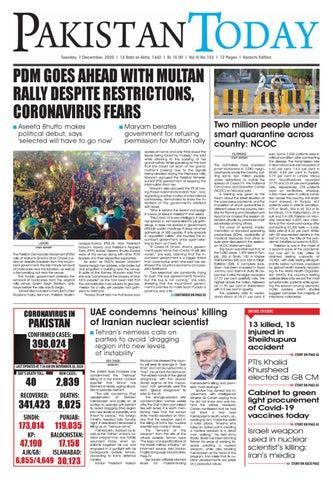
PDM goes aheaD with Multan rally DesPite restrictions, coronavirus fears g
Aseefa Bhutto makes political debut, says 'selected will have to go now'
LAHORE STAFF REPORT
The Pakistan Democratic Movement (PDM) rally at Multan’s Ghanta Ghar Chowk carried on despite backlash from the incumbent government, the last-minute removal of barricades near the location, as well as a fire breaking out near the venue. The Punjab government ordered the removal of barricades from the original rally venue, Qasim Bagh Stadium, only hours before the rally was to begin. Jamiat Ulema-e-Islam-Fazl (JUI-F) chief Maulana Fazlur Rehman, Pakistan Muslim
g
Maryam berates government for refusing permission for Multan rally
League-Nawaz (PML-N) Vice President Maryam Nawaz and Pakistan’s People’s Party (PPP) leader Aseefa Bhutto-Zardari were at the venue along with other PDM leaders and their respective supporters. As soon as PML-N leader Maryam Nawaz began her address, a fire broke out and engulfed a building near the venue. In spite of the flames, Maryam said that she was “convinced of the bravery of Multan’s people” as she had been told that the administration had refused to give permission for a rally, yet people had gathered to hold one. “Nawaz Sharif told me that leave your
coronavirus in
Pakistan
CONFIRMED CASES:
398,024
DAY'S DEATH TOLL:
40
RECOVERED:
NEW CASES:
2,839 DEATHS:
341,423 8,025 SINDH:
PUNJAB:
173,014
119,035
KP:
BALOCHISTAN:
AJK/GB:
ISLAMABAD:
47,190
17,158
6,855/4,649 30,123
CONTINUED ON PAGE 05
ISLAMABAD STAFF REPORT
The authorities have imposed smart lockdowns in 5,082 neighbourhoods across the country, putting some two million people under restrictions to curtail the spread of Covid-19, the National Command and Operation Centre (NCOC) on Monday said. A briefing was given to the forum about the latest situation of the coronavirus pandemic and the imposition of smart quarantines in different areas of the country. Minister for Planning and Development Asad Umar chaired the session attended virtually by provincial chief secretaries among others. The pace of spread, implementation of standard operating procedures (SOPs), availability of medical resources and other issues were discussed in the session, an NCOC statement said. The forum was informed that, of the 5,082 areas, 1,459 were in Punjab, 206 in Sindh, 182 in Khyber Pakhtunkhwa (KP) and 330 in GilgitBaltistan (GB). A complete lockdown has been imposed in Azad Jammu and Kashmir (AJK) till December 6 after the region recorded 27.72 per cent positivity rate, the highest across the nation, followed by 11.95 per cent in Balochistan with 9.9 per cent in Quetta. The positivity ratio in Hyderabad stood at 18.21 per cent, it
UAE condemns ‘heinous’ killing of Iranian nuclear scientist g
Tehran’s nemesis calls on parties to avoid ‘dragging region into new levels of instability ’ ABU DHABI
LAST UPDATED AT 7:34 AM ON NOVEMBER 30, 2020
worries at home and only think about the issues being faced by masses,” she said while referring to the passing of her grandmother. While speaking on the fact that she could not learn of her grandmother’s passing due to the signals being blocked during the Peshawar rally, Maryam accused the Pakistan Tehreeke-Insaf (PTI) government of keeping the information from her. Maryam also accused the PTI of having thrown Kashmir into India’s “lap”, and, regarding another matter of international controversy, demanded to know the intentions of the government’s relations with Israel. “Who is behind the recent campaign in favour of Isreal in Pakistan?” she asked. “This Covid-19 is very intelligent. It does not spread in Jamaat-e-Islami’s (JI) gatherings, it does not spread in government officials’ public meetings. It does not enter gatherings of 300 people. It only spreads in opposition rallies,” she taunted the incumbent government, once again referring to them as Covid-18. “If Covid-18 [Imran Khan’s government] goes home then Covid-19 will also vanish,” she said, claiming that the incumbent government is a bigger threat than coronavirus which she said has destroyed the country’s economy and people’s livelihood. “Two selectors are constantly trying to push this bus (government) forward, but this bus is not running,” she said, stressing that the incumbent government’s promise to make South Punjab a province was a lie.
Two million people under smart quarantine across country: NCOC
AGENCIES
The United Arab Emirates has condemned the “heinous” killing of a top Iranian nuclear scientist that Tehran has blamed on Israel, urging all parties to exercise restraint. “The UAE condemns [the] assassination of Mohsen Fakhrizadeh and [calls] on all parties to exercise self-restraint to avoid dragging [the] region into new levels of instability and threat to peace,” the foreign ministry tweeted late Sunday night. It described Fakhrizadeh’s killing as an “heinous crime”. Fakhrizadeh, dubbed by Israel as the “father” of Iran’s nuclear programme, was fatally wounded Friday when assailants targeted his car and engaged in a gunfight with his bodyguards outside Tehran, according to Iran’s defence ministry. Iranian President Hassan
Rouhani has stressed the country will seek its revenge in “due time” and not be rushed into a “trap”. He pinned the blame on “the wicked hands of the global arrogance, with the usurper Zionist regime as the mercenary”. Iran generally uses the term “global arrogance” to refer to the US. The strongly-worded UAE condemnation comes weeks after the Gulf nation normalised ties with Israel. It is worth mentioning here that the Iranian state media reported on Monday that the weapon used in the killing of Iran’s top nuclear scientist was made in Israel. The “remains of the weapon” from the site of the attack outside Tehran bear “the logo and specifications of the Israeli military industry,” an informed source told Iranian English-language broadcaster, Press-TV. Top Iranian officials blamed Israel for masterminding
said. Some 2,046 patients were in critical condition after contracting the disease. The transmission rate in Islamabad was last recorded at 6.62 per cent, 14.4 per cent in Sindh, 4.84 per cent in Punjab, 6.19 per cent in Lahore. Mirpur and Muzaffarabad recorded 27.75 and 23.44 per cent positivity ratio, respectively. 278 patients were on ventilators, whereas, 2,046 more were in critical condition across the country, the statement showed. In Punjab, 467 patients were in critical condition, 675 in Sindh, 356 in KP, 323 in Islamabad, 16 in Balochistan, 23 in AJK and 5 in GB. Pakistan on Monday recorded 2,839 new infections of the novel coronavirus after conducting 33,302 tests — a positivity ratio of 8.52 per cent. While, with 40 virus-related deaths in the last 24 hours, the tally of the pandemic fatalities jumped to 8,025. Pakistan is now in the midst of a second wave of the pandemic but has yet to fully utilise its claimed testing capacity of 74,407, with daily testing still significantly below numbers proposed by global health experts. According to the World Health Organisation (WHO), the country’s testing policies likely only record the most symptomatic patients while ignoring the spread among asymptomatic carriers, which studies suggest comprise the majority of infections nationwide.
more inside
13 killed, 15 injured in Sheikhupura accident STORY ON PAGE 02
Fakhrizadeh’s killing and promised “hard revenge.” Tel-Aviv has denied any involvement, with Intelligence Minister Eli Cohen saying that he did not know who was behind the attack. However, Cohen confessed that he had not shed a tear over Fakhrizadeh’s death, which, according to him, made the world a safer place. “Anyone who takes an active part in creating a nuclear weapon is a dead man walking,” he told Army Radio. Israel has been blaming Tehran for years of working towards creating a nuclear weapon, while also labeling Fakhrizadeh as the head of the program. Iran insists that its nuclear developments are solely of a peaceful nature.
PTI's Khalid Khursheed elected as GB CM STORY ON PAGE 03
Cabinet to green light procurement of Covid-19 vaccines today STORY ON PAGE 03
Israeli weapon used in nuclear scientist’s killing: Iran’s media STORY ON BACK PAGE
02
Tuesday, 1 December, 2020
NEWS
SikhS obServe 551St birth anniverSary of baba Guru nanak
a
neWS deSK
S the festivities of the 551st birth anniversary of Baba Guru Nanak, the founder of Sikhism, came to an end on Monday, the government assured the Sikh community that their holy sites would be protected in Pakistan. Sikh pilgrims from Pakistan, India and other parts of the world attended the birth anniversary of Guru Nanak Dev Ji. The main ceremony began with the morning hymns followed by Kathas and Kirtan in the praise of the Guru. Later a special
community lunch was held followed by night prayer sessions at Gurdwara. The stalls in Nankana Sahib showcased commemorative postal tickets released by Pakistan’s postal service and commemorative coins issued by the State Bank of Pakistan (SBP). Every year, more than 2,000 Sikhs come to Pakistan to participate in the birth anniversary celebrations of Guru Nanak Dev. However, the number has reduced this year due to the Covid-19 pandemic. The pilgrims will return to India via the Wagah border crossing on December 1 at the end of their pilgrimage. In a video message
released on the occasion, Prime Minister Imran Khan assured the Sikh community that their holy sites in Pakistan will be protected and all possible facilities will be made available for them. “We have completely revamped Hassan Abdal Railway Station to facilitate Sikh pilgrims, who come to their sacred site at Panja Sahib,” he said, adding that all facilities have been provided at the railway station. Imran said that Nankana Sahib and Kartarpur are the two most sacred sites for Sikhs. He said that these sites are as sacred to Sikhs as Makkah and Medina are sacred to the Muslims. He made it clear that his
Govt to act against forced conversion, underage marriages of minority girls LaHore SHAHAB OMER
The government has taken notice of the cases of forced conversions and marriages of underage girls belonging to the minority communities and will take stern action against the perpetrators of these crimes, Prime Minister’s Special Representative on Religious Harmony Allama Tahir Mehmood Ashrafi said on Monday. Addressing a joint press conference at Saint Peter’s School with National Council of Churches of Pakistan (NCCP) President Bishop Azad Marshall, Ashrafi said that Prime Minister Imran Khan has ordered investigation on case to case basis of incidents of forced conversions of minor girls belonging to the minority communities, particularly Christian and Hindu. He said that no person or group would be allowed to exploit minor children in the name of religion. “We have found out that a majority of
such cases are an outcome of sexual exploitation and have no relation with Islam. Our religion forbids forced conversions and all people using religion to cover their crimes will be brought to justice,” he said. He added that the important issue had also been discussed at the platform of the Muttahida Ulema Board and all scholars were unanimous in their disapproval of forced conversions. “I have also taken this issue up with Federal Minister for Human Rights Shireen Mazari, Law Minister Farogh Naseem and Religious Affairs Minister Noorul Haq Qadri and we are committed to ensure implementation of the relevant laws in letter and spirit. Ashrafi also said that the government was also working against the misuse of the blasphemy laws to ensure that no person uses the laws to settle personal agendas. Addressing reporters, Bishop Azad Marshall said that the church leadership had been closely monitoring the cases of abduction and forced conversion
of minor girls and decided to take concrete steps in this regard. “The girl child is the ultimate sufferer in terms of the physical, mental and emotional trauma that results from her abduction and forced marriage,” Bishop Marshall said, adding that the cases of Christian teens, 13-year-old Arzoo Raja of Karachi and 14-year-old Maira Shahbaz of Faisalabad, were some of the incidents that have been highlighted in the national press, but there are many other cases that go unreported due to societal pressure and fear of reprisal from the accused. He said that Christians and Hindus are the two major communities that are suffering from this issue but the federal and provincial governments are yet to take concrete measures to curb this crime despite the presence of relevant laws. “It has also been observed with concern that law enforcement agencies and other forums of justice are facilitating such crimes due to which this trend is increasing,” he added.
government is committed to preserving and protecting the holy sites of all religions, including churches, temples and places relating to Buddhism as well as the Gandhara Civilisation. Meanwhile, Federal Minister for Religious Affairs and Interfaith Harmony Noor-ul-Haq Qadri said that Pakistan is the safest country for all minorities, including Sikh community, to live in tranquillity. Addressing a ceremony held in connection with Baba Guru Nanak’s 551st birth anniversary in Nanka Sahib, Qadri said that followers of all religions are equal citizens of Pakistan.
13 killed, 15 injured in Sheikhupura accident LAHORE: At least 13 people were killed and 15 others injured in a passenger van-bus collision in Narang Mandi city of Sheikhupura district on Monday. The accident took place when the van collided head-on with the bus. According to reports, low visibility due to foggy weather caused the incident. Both vehicles caught fire following the collision, trapping many passengers inside. The death toll is feared to rise as most of the injured people are in critical condition because of serious burns. STAFF REPORT
“Unfortunately, abduction and forcible conversion of a minor girl is accorded a degree of permanence and irreversibility through marriage to a Muslim adult without ascertaining the circumstances and intellectual, emotional and social maturity of the child while making such declarations of consent,” the church leader said. He added that it is often difficult to determine whether such declarations of consent are in fact un-coerced, or if they are the consequence of threats, psychological abuse and conditioning, and fear of social stigma and rebuke. “We believe that Islam is a religion that does not compel people of other faiths to convert. Article 20 of the Constitution also guarantees every citizen the right to profess, practice and propagate his religion, therefore, it is the State’s obligation to protect its minorities from such crimes that are spreading fear and insecurity in our people,” he said. Marshall said he had also decided to move the Supreme Court to identify and fix the lacunas in the existing laws to ensure the protection of the girl child. “We also urge Islamic scholars and government officials to sit with us and develop a mechanism for judging instances of religious conversion of children,” he said.
PDM goes ahead with Multan rally despite restrictions, coronavirus fears Continued from page 01 Continuing to lambast Prime Minister Imran Khan, Maryam said that he “receives donations from mafias and then allows them to rob the public” and still claims to be honest. Maryam quoted several examples of “corruption scandals” against PM Imran’s government, including the PTI foreign funding case, Billion Tree Tsunami project and several others. She further said that Aseefa BhuttoZardari — who was attending the gathering on her brother Bilawal Bhutto-Zardari’s behalf — and herself had come out of their homes to fight for the rights of Pakistanis. Kicking off her political career, the daughter of the late Benazir Bhutto said that the “selected will have to go now”. “I pay tribute to all the party workers and activists that despite all hurdles created by the ‘selected government’, people have gathered in large number here,” she added. She further said that if the party workers were arrested, then the female leaders would rise to take charge. “If they think we will be scared of arrests, they are deluded. If they arrest our brothers, every female worker of PPP will step outside to save our brothers and the country,” Aseefa said on the occasion. PPP leader and former prime minister, Yousaf Raza Gillani, while addressing the crowd, thanked them for making this rally a reality in spite of the incumbent
government’s attempts to stop it. “We had told them [the government] that this power show will be held, and I thank you all for proving that a reality.” He added that the government had put various hurdles in the way, such as the lack of electricity arrangement or proper security. Earlier, the venue had been sealed, and had made it impossible to make proper arrangements. The closure of the venue by the Punjab police and Multan district administration had been due to the government’s orders banning large public gathering to curb the spread of Covid-19. Reportedly, booking of transport buses from other cities to Multan had also been banned. The last to address the rally, Fazl lauded the workers and supporters of PDM parties for attending the rally despite attempts by the government to stop the opposition from holding their public gathering, adding that the alliance had scared the administration off by “merely waving a baton” “[The PTI government] had said they would not let the rally to be held at any cost but now you can see for yourself.” The JUI-F chief also urged his party workers to attend the PDM’s Lahore rally on December 13 in large numbers, which will be the final face-off between the government and opposition before a likely march towards capital Islamabad. Following the rally, Bilawal took to Twitter to express his views.
“Multan defeated selected today. PTI had challenged PDM that we could not hold our Jalsa. Turns out their jails couldn’t hold our workers, their force couldn’t stop the people; the streets of Multan today were a referendum for democracy and against puppet raj. Next stop Lahore IA,” he wrote on his official handle. Earlier in the day, after the district administration refused to give permission for the fifth public meeting of the PDM in Multan citing a surge in coronavirus cases, Maryam rounded on the federal government saying it was “scared” of the antigovernment alliance. The PDM, an umbrella alliance of 11 opposition parties, is holding a rally in Multan today despite the resurgence of the fresh Covid-19 infections. Health authorities have repeatedly warned that the country is now in the midst of a second wave. The government portal keeping track of the contagious disease on Monday recorded 2,839 new infections after conducting 33,302 tests — a positivity ratio of 8.52 percent. The organisers of the meeting have, however, announced to proceed as planned despite the arrest of several workers and leaders in a bid to prevent the gathering from going forward. In Multan, the district administration and opposition workers have been at odds over the holding of the event. Late Saturday night, the police arrested Ali Qasim Gillani, PPP leader and the son of
former prime minister Yousaf Raza Gillani, and, the following day, shifted him to Multan jail. Speaking to the reporters prior to her departure from Lahore, Maryam said that she would have delayed her political activities for a few more days to grieve her grandmother — whose funeral was held on Saturday — but the government’s “brutality against [PDM] workers pulled her towards Multan”. The PML-N leaders condemned the crackdowns on PDM workers and supporters and said that the government was taking all steps to “dismantle” the meeting because it was “scared”. In a question pertaining to holding public gatherings amid the pandemic, Maryam said that even police officials deployed along the route of the venue were not following standard operating procedures (SOPs) put in place to curtail the spread of the disease. “Does corona[virus] spread only through opposition’s gatherings?” she asked. “This rally has succeeded before it has even started,” she claimed, adding, “every container placed along the [venue’s] route, every checkpoint and all the arrests that are being made are a reflection of their [government] fear”. Maryam was referring to the arrests of former premier Gillani’s son, along with other PPP activists. “Whether this rally is held inside the
petrol price to remain unchanged till dec 15 The government has decided to leave the prices of petrol, kerosene, and light diesel unchanged till December 15, a notification issued by the Finance Division on Monday read. “The Government of Pakistan in its endeavor to provide maximum relief to the public has decided to absorb most of the increase in international prices of petroleum products,” the notification said. The notification, however, said that due to a “significant increase” in the international price of High-Speed Diesel (HSD), its rate has been raised by Rs4 per litre till December 15. NEwS DESk
Sadiq, three others get extension in bails in ‘violent protest’ case LAHORE: An anti-terrorism court in Lahore on Monday extended the interim bail of Pakistan Muslim League-Nawaz (PML-N) leader Ayaz Sadiq and three other party leaders in a 2018 case on charges of resorting to violent protests when deposed prime minister Nawaz Sharif returned from London to serve his sentence. The other suspects include former Punjab minister Khwaja Salman Rafique, former MPA Malik Waheed and PML-N activist Rana Ehsan. Sadiq and Rafique appeared before the court and marked their attendance. Presiding Judge Ijaz Ahmad Buttar extended the bails till December 18 and directed the investigation. STAFF REPORT stadium or outside, or on any road in Multan — God willing it will take place,” Maryam said today. Prime Minister Imran Khan on Sunday slammed the opposition parties, accusing its leaders of not caring about people’s lives in their bid to protect their “looted wealth.” “Problem confronting us in Pakistan during COVID-19 is of a political leadership that has never gone through any democratic struggle, nor worked with ordinary citizens to understand the problems they confront, nor contributed in any substantive way for [the] betterment of ordinary citizens,” he said, adding the opposition leaders lacked “empathy” for the masses. The premier said that the Multan rally was just another attempt to secure “NRO”, adding it would spread the virus and endanger lives and livelihoods. EMERGENCY PLAN: Earlier, a spokesperson for the district administration said that it had completed arrangements to deal with any emergency situation. “An emergency plan has been prepared on the instructions of the deputy commissioner,” he said. “Officials from the district administration, police and various organisations have taken over their duties. Officers of all institutions have been instructed to remain at the district headquarters for the next 72 hours.” “Instructions have also been issued to set up three helipads in the area around the stadium while a bomb disposal squad has been readied.” “A control room has been set up at the District HQ,” the spokesperson added.
Tuesday, 1 December, 2020
CabInet to green LIgHt proCureMent oF CovId-19 vaCCInes today CLINICAL TRIAL OF CHINESE VACCINE PRODUCES POSITIVE RESULTS IN PAKISTAN ISLAMABAD
t
MIAN ABRAR
HE federal cabinet is all set to approve recommendations made by the National Command and Operation Centre (NCOC) for procurement of novel Covid-19 vaccines. It is likely that at least two Covid-19 vaccines will be registered globally by next month. The NCOC on Monday had finalised its recommendations for the procurement of the vaccine against the deadly disease and forwarded the same to federal cabinet for approval. Minister for Planning, Development and Special Initiatives Asad Umar took to Twitter to make the announcement on Monday. “NCOC today finalised its recommendations for procurement of Covid vaccine. These will be presented to the cabinet tomorrow for approval. The task force of experts headed by SAPM health Dr Faisal Sultan had developed the recommendations which were discussed and finalised today,” he said. The recommendations will be presented before the federal cabinet during its meeting scheduled on Tuesday,
PAKISTAN TO KEEP ALL OPTIONS ON TABLE TO PROCURE COVID-19 VACCINES
and approval will be sought to obtain the vaccine as quickly as possible. An official in the Ministry of National Health Services who wishes to remain anonymous told Pakistan Today that Pakistan plans to procure vaccines from all friendly countries so as to mitigate the pandemic that was not proving threatening lives of thousands. He said that other than the vaccines developed by Pfizer and Astra Zeneca, Pakistan would also seek support from its friends like China and Russia. “We are closely monitoring the tests being conducted and almost all the vaccines are proving beneficial with some variants. We will try to procure good and quality vaccines to help save our people,” the official said. It may be pertinent to mention here that Prime Minister Imran Khan had already approved allocation of US $100 million for advance payment for procurement of the vaccine at the earliest. CHINESE, RUSSIAN VACCINES PROVING VIABLE: When asked about the tests of the Chinese vaccine being conducted in Pakistan, the official said that the tests had proven the effectiveness of the vaccine.
LHC asks Foreign Ministry to expedite return of 44 prisoners from Iran
“The Chinese vaccine has produced very positive results and we have done its clinical trials. There is not much difference between American, Chinese, British and Russian vaccines. All vaccines would have almost the same impact,” the official said. The official added that since Pakistan has to cater to the needs of a large population, it would use all its options. “We will keep all options on the table. We would have lots of requirements due to our mass population. We would have to acquire the vaccine from various options we have,” he said. When asked about Russian vaccine, the official said that the Russian vaccine can also be utilised, provided the Russians have capacity. “Russia may provide vaccines first to its allies. But since we also have very friendly relations with Russia, we are eager to acquire the Russian vaccine too,” the official added. Another official at the ministry said that different options were being discussed for the last four months. However, the official said, the procurement process was derailed every time due to different reasons such
as [possible] side effects of the vaccines, which vaccine would be available earlier etc., so different options were being considered and reviewed at the same time. “It is expected that at least two vaccines will be registered […] in December 2020,” the official said. The official said that the proposals will be discussed with the federal cabinet and after getting its approval steps will be taken for vaccine procurement. Replying to a question, the official said that the shelf price of Pfizer’s vaccine stands at US$20. “Since two shots of the vaccine will be provided to each person so it will cost $40 to vaccinate each person. The vaccine of AstraZeneca would be cheaper, and it will be available for $4 per dose. So, $8 will be required to vaccinate one person,” the official said. The official asserted that the price being discussed was the shelf price of the vaccine and it can be negotiated. “The price depends on the quantity we want and available stock. I believe the price can be reduced if we order at the earliest or if we let others purchase fist and stand at the end of the queue,” the official concluded.
PTI's Khalid Khursheed elected as GB CM ISLAMABAD GHULAM ABBAS
LAHORE: The Lahore High Court (LHC) has asked the Ministry of Foreign Affairs (MoFA) how much more time the government required to bring back 44 Pakistan nationals imprisoned in Iran. Judge Justice Shahid Waheed on Monday resumed hearing in a petition by Justice Project Pakistan (JPP) on behalf of the families of Pakistan nationals imprisoned in Iran for alleged drug offences. According to the petitioner, Barrister Sarah Belal, as per the government’s response, there were 174 nationals currently detained in Iran, 75 per cent of them on charges of drug trafficking. Earlier this year, Iran Deputy Minister for Justice and Human Rights Mahmoud Abbasi said 44 prisoners were ready to be repatriated by Tehran and the government was awaiting a response from their Pakistan counterparts. Justice Waheed has been hearing the case since 2018 and has admonished the government in the past for not doing enough for the prisoners and for delays in submitting responses in court. During the last two hearings, Justice Waheed had ordered MoFA to appear in person before the court, which had not been complied with. “Finally on Monday, the Assistant Director for Iran and Turkey, Ministry of Foreign Affairs, Saima Khan appeared in person and submitted a list of Pakistanis confined in Iranian prisons,” the Justice Project Pakistan, which advocates for prisoners’ rights, said in a statement. “Justice Waheed then went through the submitted documents and questioned how much more time the government needed to bring back these prisoners.” On November 4, 41 prisoners from Sri Lanka were repatriated to Pakistan to serve out the rest of their sentences in their home country. STAFF REPORT
Advocate Khalid Khursheed was elected as the Chief Minister of Gilgit-Baltistan (GB) by the GB Legislative Assembly on Monday, having secured 22 votes against the nine votes of the joint opposition candidate, Amjad Hussain. The swearing-in ceremony of Khalid Khurshid as the new chief minister of GB and his cabinet will be held on December 2 at the Governor House in Gilgit. GB Governor Raja Jalal Hussain Maqpoon will administer the oath to him. According to official sources, Prime Minister Imran Khan, along with the Federal Minister for Kashmir Affairs & Gilgit-Baltistan Ali Amin Khan Gandapur and the PTI Chief Organiser Saifullah Khan Nyazee, will also attend the swearing-in ceremony. Khursheed, a barrister, hails from Rattu of Astor District in Gilgit Baltistan. He was born on November 17, 1980. He completed his matriculation from Public School and College Gilgit and moved to Faisalabad for further education. He completed graduation and went to London for a degree in law. After returning from London, he contested his first election in 2009 as an independent candidate but he lost the election. He again contested the election as an independent candidate in 2015 but could not win the seat from GBLA-13. In election 2020, he, as the candidate of PTI won the seat against Pakistan People’s Party’s (PPP) Abdul
Hameed, Pakistan Muslim League-Nawaz’s (PML-N) Rana Farman Ali and Dr Ghulam Abbas (Independent) in GBLA-13 Astore-I. He contested in the past two elections as an independent candidate but could not win the seat. Khursheed, a foreign qualified local politician, had joined PTI in 2018 and became president of PTI Diamer Division in GB. His father was a judge. One of his brothers is a retired DIG. He reportedly has an influential family in the constituency. Last week, PM Imran had finalised Khursheed’s name for the position. Khurshid was elected the member of Gilgit-Baltistan assembly from GBLA-13 constituency in GB in the November 15 elections. His selection was made as per the tradition of electing chief ministers from different regions of GB, as previous chief ministers were selected from Baltistan region and Gilgit region. Last week, the new GBLA had elected PTI candidate Amjad Zaidi as the speaker and Nazeer Ahmad as the deputy speaker. Amjad secured 18 votes for the position while Nazeer secured 22 votes for the deputy speaker slot in a secret ballot. On November 24, the PTI government announced that it is set to form its government in GB after securing a majority in the legislative assembly following the 2020 election. The party grabbed 10 seats in the general elections. But after gaining the support of six independent winners and allotment of six reserved seats, PTI secured 22 out of the 33 seats in the assembly.
UN report shows surge in HIV infections NEWS DESK The number of adults newly infected with human immunodeficiency virus (HIV) has sharply increased in the past decade, according to a new United Nations report. The report published by the UN Global HIV Prevention Coalition (GPC) last week shows that progress in HIV prevention worldwide is too slow to reach the target of reducing the global number of HIV infections among adults to fewer than 500,000 a year. By the end of 2019, at least 1.7 million people
worldwide became infected, it showed. While in most countries, despite missed targets, some decrease in new infections was observed, in Pakistan it was on the rise. Citing “low coverage of prevention and treatment services for key populations” in Pakistan, the report said the number of adults newly infected with HIV in the country increased by 74 percent between 2010 and 2019. The number of newly infected adults was 23,000 in 2019, about 1,000 more than in 2018. It is estimated that between 160,000 and 210,000 people in Pakistan are living with HIV.
COAS, Chinese minister discuss regional security, bilateral relations RAWALPINDI STAFF REPORT
Chief of Army Staff (COAS) General Qamar Javed Bajwa has reiterated that Pakistan and China have been standing together all along and their relations will be no different in wake of future challenges. He was talking to China’s Minister of National Defence General Wei Fenghe in Rawalpindi today. General Bajwa thanked the dignitary for China’s unwavering support to Pakistan on all
key issues at regional and international forums. He said that the Pakistan Army greatly values its time-tested and brotherly relations with China. During the meeting, matters of mutual interest, regional security and enhanced bilateral defence collaboration were discussed. The visiting dignitary acknowledged and appreciated Pakistan Army’s sincere efforts for regional peace and provision of a secure environment for the ChinaPakistan Economic Corridor (CPEC) projects.
Later, a memorandum of understanding was also signed for enhancement of defence cooperation between both the Armies. Earlier, on arrival at GHQ, the Chinese minister laid a floral wreath at Yadgar-e-Shuhada. A smartly turned out contingent of Pakistan Army presented the Guard of Honour to visiting dignitary. Meanwhile, China’s Minister of National Defence General Wei Fenghe called on Chairman Joint Chiefs of Staff Committee General Nadeem Raza in Rawalpindi as well. Matters related
to changing geostrategic environment and further strengthening of security and defence cooperation between the two countries were discussed during the meeting. Both sides reaffirmed their commitment to ‘Iron Brotherhood’ and ‘All-Weather’ friendship with continued efforts to forge deeper strategic ties for a shared future and security vision. Earlier, upon arrival at Joint Staff Headquarters, a smartly turned out triservices contingent presented ‘Guard of Honour’ to the visiting dignitary.
NEWS
03
CabInet wILL take up petItIon to Cut dIpLoMatIC tIes wItH FranCe NEWS DESK The federal cabinet, on directions from the Islamabad High Court (IHC), is set to take up a petition which would deal with cutting of diplomatic ties with France as well as the complete boycott of French products within the country. The decision is to be taken during the weekly cabinet meeting on Tuesday. In the petition, petitioner’s counsel Tariq Asad stated that the French publication published several crude caricatures which were blasphemous, defamatory, racist, Islamophobic and sparked anger across the Islamic world. In the order issued by Justice Mohsin Akhtar Kayani of the IHC in October, he had written, “…entire question raised in the instant writ petition is related to the policy decision of Government, therefore, instant writ petition is converted into representation and transmitted the same to the Secretary, Cabinet Division to place the same before Federal Cabinet in the upcoming meeting to take policy decision”. There is been rising tensions between the nations ever since French President Macron supported a teacher who had shown blasphemous caricatures of Holy Prophet (Peace Be Upon Him) in a classroom and was subsequently attacked as a result of the blasphemous content. Last week, France had objected to a statement by Minister for Human Rights Shireen Mazari equating President Emmanuel Macron’s new measures to counter “Islamist separatism” in France with the anti-semitic policies of Nazi Germany. However, the issue was later resolved when both sides held dialogue after a false claim in the cited news article came to light. Furthermore, Macron had issued a “charter of republican values”, detailing a series of steps aimed at purging France of what he declared as “radical Islam”. One of the measures made it necessary for school-going children to wear an identification number that would be used to ensure they are attending school. Earlier this month, French President Emmanuel Macron had said his country is fighting “Islamist separatism, never Islam”, responding to a Financial Times article that he claimed had misquoted him and has since been removed from the newspaper’s website. In a letter to the editor published on Wednesday, Macron had said that the British paper had accused him of “stigmatising French Muslims for electoral purposes and of fostering a climate of fear and suspicion towards them”. “I will not allow anybody to claim that France, or its government, is fostering racism against Muslims,” he had said. On October 27, the National Assembly 9NA0 had unanimously passed a resolution condemning the publication of blasphemous caricatures in France and the “resurgence of Islamophobic acts” in some countries. According to the resolution read out by the minister, the NA, while taking serious note of the republication of blasphemous caricatures of Holy Prophet (PBUH) and the desecration of the Holy Quran in Norway and Sweden, had condemned in strongest terms the “resurgence of blasphemous and Islamophobic acts by mischievous elements in some parts of the world”. The lower house had also expressed serious concern at the “highly concerning statements and hate-mongering especially by leaders like [French] President Emmanuel Macron justifying unlawful propagation and insult to sentiments of more than a billion Muslims through such hate-driven acts under the garb of freedom of expression”. “[The assembly] condemns unequivocally the practice of blasphemy and of insulting prophets of Islam, Christianity and Judaism alike,” according to the resolution, which had also denounced acts of terror carried out in the name of any religion.
Tuesday, 1 December, 2020
04 NEWS
NAtIONwIde POLIO vACCINAtION drIve begINS ISLAMABAD
A
STAFF REPORT
FIvE-DAy nationwide polio vaccination campaign kicked off on Monday during which over 39 million children under five years of age will be vaccinated across the country. According to the Polio Eradication Programme (PEI), around 285,000 health workers will go from house to house, observing strict guidelines for coronavirus
such as wearing a mask, using hand sanitiser and maintaining the minimum distance advised during the campaign. “While continuing our efforts to enhance essential immunisation coverages, the back-to-back planned immunisation campaigns are imperative to give quick immunity boost to children under the age of five,” said National Emergency Operations Centre (NEOC) Coordinator Dr Rana Mohammad Safdar. “We need to ensure that no child is missed during this critical national immu-
nisation campaign aimed to build on successful immunity building efforts during [the] last three months. I urge every Pakistani to take it as a national mission and support the frontline workers who will reach every child with essential polio vaccine during the week.” “All segments of society, including communities, media, religious leaders, social activists, celebrities and doctors, should play [an] active role so that no child remains at risk of contracting polio disease and becoming paralysed for life,”
he added. The campaign has been planned in coordination with Afghanistan. Pakistan is one of the two polio-endemic countries in the world along with its neighbour. The country is facing a challenging situation in polio eradication with the upsurge of the number of polio cases. So far in the current year, a total of 82 polio cases have been reported, including 24 from Balochistan, 22 each from Khyber Pakhtunkhwa (KP) and Sindh, and 14 from Punjab.
SC rejects plea against Qazf proceedings in false rape case ISLAMABAD: A Supreme Court bench on Monday rejected an appeal over Qazf (false accusation of adultery) proceedings against a woman. The SC bench comprising Justice Sardar Tariq turned down the appeal seeking abrogation of Qazf proceedings against the accuser. “The court judgement would not affect the Qazf proceedings,” the bench observed. “The trial court had acquitted accused Shafiq over the benefit of doubt,” the lawyer of the petitioner told the court. The court had also ordered Qazf proceedings against the accuser woman, the lawyer further said. “The Sharia court did not comment over the Qazf point of the trial court decision,” the counsel said. “The court could not rule for cancellation of Qazf proceedings,” Justice Sardar Tariq said. A woman Shakeela had registered a rape case with police in 1998 against Shafiq but the trial court acquitted the accused. The Sharia court had also upheld the trial court’s decision. TLTP
Kaavan, ‘world’s lonesome elephant’, starts new life in Cambodia
LAHORE: Punjab Chief Minister Usman Buzdar chairs a meeting of Cabinet Committee on Coronavirus.
TikTok craze claims another life in Karachi KARACHI STAFF REPORT
In yet another shocking incident, a security guard accidentally shot himself dead while recording a TikTok video on Monday. According to the police, the incident took place in the port city’s Gulshan-eMaymar area. The security guard employed at a flour mill was shooting a video with his friend to upload it on the popular short-video sharing app when he shot him-
self. The police said that the video saved in his mobile phone shows him putting a rifle on his chest. During the recording, he accidentally pulls the trigger of the rifle and a bullet pierces his chest, resulting in his death. The deceased, identified as Anwar Ali, was rushed to the Abbasi Shaheed Hospital where he was pronounced dead. His friend, who was filming the video, has been taken into custody. Earlier on November 21, a security
Next OIC CFM meeting to be held in Pakistan: FM ISLAMABAD: Foreign Minister Shah Mahmood Qureshi has said the passage of unanimous resolution on Kashmir by the Organisation of Islamic Cooperation (OIC) Council of Foreign Ministers is a triumph of Pakistan. In a statement on Monday, the foreign minister said that 57 member countries of the OIC are unanimously accepting Pakistan's stance on blatant human rights violations in Indian Occupied Kashmir (IOK). He said that a false propaganda was done before the session of the OIC Council of Foreign Ministers that Kashmir is not on the agenda of the moot. “If that was the case then how did the OIC pass a resolution on Kashmir?” he questioned. Qureshi said that the next meeting of the OIC Council of Foreign Ministers will be held in Pakistan. As the prospective CFM Chair, Pakistan had also become a member of the sixmember OIC executive committee for the next three years. Regarding relations with the United Arab Emirates (UAE), he said, “We enjoy excellent and strong relations with the brotherly country.” STAFF REPORT
guard in Karachi lost his life while making a video for TikTok. The incident was reported in Karachi’s area of Gulistan-eJauhar, where a security guard accidentally shot himself dead when he was making a TikTok video while pointing out a pistol over his head. Separately, a girl allegedly set the house on fire after elders prevented her from making TikTok videos. The father of the girl, Aziz Ahmed Khilji, had lodged the first information report with the local po-
lice alleging his daughter set their house alight after he tried and stopped her from making videos for the short video sharing platform TikTok. The FIR on father’s complaint reads that upon preventing the daughter from making videos for the platform, she maligned him and then set fire to the house. Later, police arrested the girl. The TikTok craze has overtaken youth in the country and they are not even hesitating in risking their lives for the videos.
Opposition making furore to protect looted money: Faraz ISLAMABAD TLTP
Federal Minister for Information and Broadcasting Senator Shibli Faraz has urged the opposition to not play with the lives of people for its personal gains as the second wave of coronavirus is at its peak. He was addressing a news conference in Islamabad in response to PDM's Monday public gathering in Multan. The minister said that the opposition is unduly making furore and fuss to protect their looted money. He said that in the recent past these leaders were demanding strict lockdown in the country, and now they have pushed aside the threats of pandemic for the sake of their personal motives. He also said that a few of them did not participate in Monday’s gathering in Multan due to coro-
navirus while on the other hand they are convincing innocent people to put their lives at risk. The minister said that Pakistan Muslim League-Nawaz (PML-N) leader Nawaz Sharif remained the top character during all nondemocratic actions in the history of Pakistani politics. He said, “Their language reminds us of Nawaz Sharif who not even spared women for the sake of his politics.” He said due to bad policies of PPP, a mainstream party became a provincial party. He also said that the current opposition did nothing for the poor people of the country and they should realise that these tactics will not work to get people's support. Talking about inflation and other problems faced by the country, the minister said, “We are taking concrete measures under the leadership of Prime Minister Imran Khan to resolve all such issues.”
Khaqan Murtaza assumes charge as CAA director general KARACHI: Flight Lieutenant (r) Khaqan Murtaza on Monday assumed the charge as director general of the Civil Aviation Authority (CAA). The CAA on Friday last announced the appointment of Murtaza for the authority’s long-overdue vacancy of director general. Murtaza had previously served as managing director of Utility Stores Corporation (USC) as well. The notification of his appointment read that Murtaza “shall remain in this position until further notice”. Meanwhile, Pakistan International Airlines (PIA) CEO Air Marshal Arshad Malik has felicitated the newly appointed DG CAA and wished him well for the job ahead. Khaqan Murtaza is a BS-21 officer who was earlier serving with the Sindh government as principal secretary to the Sindh governor. The position of DG CAA had been vacant since March 2018. TLTP
LAHORE: Punjab Chief Minister chairs a meeting of Labour & Human Resource Department.
Pakistan’s lonely elephant Kaavan arrived in Cambodia by cargo plane on Monday to start a new life with fellow pachyderms at a local sanctuary, the culmination of years of campaigning for his transfer by American singer Cher. Cher was on the tarmac at the airport of Cambodia’s second-biggest city Siem Reap to greet Kaavan and was photographed in sunglasses, black face mask and white jacket meeting the vets who accompanied the elephant, who made the long journey in a custom-made crate. Animal rescue organisation Four Paws said Kaavan had another 90-minute drive ahead and would likely arrive at the sanctuary after nightfall, so he would be released in daylight on Tuesday. “Kaavan was eating, was not stressed, he was even a little bit sleeping, standing leaning at the crate wall. He behaves like a frequent flyer,” said Amir Khalil, a Four Paws vet. “The flight was uneventful, which is all you can ask for when you transfer an elephant.” Cher had written songs pressing for Kaavan’s release from grim, isolated conditions at Islamabad Zoo and she had spent the last few days with him in Pakistan. The multi-awardwinning singer has been with a film crew documenting Kaavan’s story and said she was proud to be part of an effort to free an elephant she said had been shackled to a shed for 17 years. Dozens of wildlife workers and experts led by Four Paws used a winch and rope to pull the sedated elephant into the crate before he was loaded onto the Russian-built cargo plane. Kaavan’s handlers took more than 200 kilograms (441 lbs) of food including bananas and melons to keep him busy on his journey. AGENCIES
‘China to make 90pc investment in ML-1 upgradation’ RAWALPINDI: Railways Minister Sheikh Rasheed Ahmed said on Monday that China will make 90pc investment in the upgradation of Main Line-1 (ML-1) project. He was addressing a ceremony organised in connection with revival of Kohat and Subak Kharam express trains in Rawalpindi. The minister expressed confidence that the tender for the ML-1 project will soon be issued, adding that the project would create 150,000 jobs. On the political front, the minister maintained that the government has no threat from the rallies announced by Pakistan Democratic Movement (PDM). "Prime Minister Imran Khan will complete his term of five years," he asserted. Rasheed said that there was a clear difference between the narratives of Nawaz Sharif and Shehbaz Sharif, lauding the latter for issuing a statement of "negotiations at national level". "Pakistan has no external threat; however, the country is facing threats from inside. Our army is aware of everything occurring at borders," he added. Commenting on the statement of JUI-F Emir Maulana Fazlur Rehman about retaliation, Rasheed advised him not to go towards a "political dead end". Responding to a question, the minister said the prices of flour and sugar were coming down in the country owing to the prudent policies of the government. TLTP
Pakistan, China finalise Gwadar ProjeCts for uPCominG jCC ISLAMABAD
t
GHULAM ABBAS
hE 5th meeting of Pakistan China Joint Working Group (JWG) on Gwadar has finalized deliverable projects which would be placed before the next Joint Coordination Committee (JCC) of CPEC. The JWG meeting, held through a video link in Islamabad on Monday, was co-chaired by Ministry of Planning, Development, & Special Initiatives Secretary Mathar Niaz Rana and National Development and Reform Commission (NDRC) Director General Ying Xiong. According to officials, the NDRC director general said that the development of the Gwadar was a priority and would be pushed forward with vigor and zeal. The PD&SI secretary acknowledged the con-
tinuous support extended by Chinese government for the development of Gwadar and assured the Chinese side of Pakistan’s unwavering commitment to accelerate the development projects in the port city. The meeting reviewed the progress of projects in Gwadar. Both sides expressed satisfaction over the progress made in port development with Chinese side appreciating the support provided by Pakistan in port operationalization, particularly enabling the Afghan transit trade through Gwadar. It was agreed that this step would greatly reduce the logistic cost and facilitate the transshipment trade. The China Overseas Ports holding Company Limited (COPhCL) chairman explained the development of the port in detail and highlighted the renewed interest
of entrepreneurs in investing in Gwadar port and free zone area. It was informed that the Eastbay Expressway will be completed in 2021 and all pending issues have been resolved on priority. The expressway will connect the port with the 2nd phase of the Free Trade Zone (FTZ) which will facilitate business climate of the zone and the port alike. Other projects discussed included New Gwadar International Airport (NGIA) and M-8 Motorway for seamless connectivity of Gwadar with the rest of the country and beyond. The progress on the NGIA was noted with satisfaction. The Chinese side appreciated progress on the energy projects in Gwadar. The Power Purchase Agreement of 300MW Coal Power Project was made as a deliverable for the forthcoming 10th JCC. The project upon completion will energize industry in Gwadar and will improve the social and economic well-being of the local community. Projects in the social sector discussed during the meeting include Pak-China Friendship hospital and Vocational & Technical Institute in Gwadar. The MoPD&SI Secretary highlighted that the hospital project is of vital importance for the people of Gwadar and needs
to be expedited. For the Vocational & Technical Institute, both sides agreed to push ahead to create job opportunities for the youth. For the development of Gwadar as a smart port city, it was reiterated that the provision of freshwater is of utmost importance. In this regard, the 1.2 MGD desalination plant project was termed critical. Both sides agreed to take necessary measures to complete the project in time. The dredging of berthing areas is important for large vessels to access the Gwadar port which will improve the operationally of the port. For the construction of breakwater, timely completion of the project was stressed as a crucial intervention required for the fishermen community in Gwadar. The secretary proposed to divide the project into two phases for better implementation of the project. DG NDRC replied in affirmative and appreciated the idea. The secretary also appreciated the projects under Corporate Social Responsibility including the Fraternity Emergency Care Centre of the Red Crescent Society of China, Pak-China Faqeer Colony School and other initiatives of the China Overseas Port holding Company.
NEWS
05
Govt likely to approve uniform standards for steel industry ISLAMABAD GHULAM ABBAS
The country's steelmakers have demanded the government to implement uniform standards for steel and its raw material in the country, sources revealed on Monday. The first meeting in this regard will be held between the Pakistan Association of Large Steel Producers (PALSP) and the Pakistan Standards and Quality Control Authority (PSQCA) tomorrow (Tuesday) at the Ministry of Science and Technology. Following the concern raised by steel players, the S&T minister had last week constituted a committee to deliberate the issues related to revision in marking fee for steel industry and to stop production & sale of substandard steel in the country. The committee comprises of MoST secretary (chairman), PALSP Chairman Javed lqbal, PALSP General Secretary Syed Wajid Bukhari and PSQCA Directors Ali Bux Soomro and Yasin Akhter. Earlier, PALSP had asked the MoST to make mandatory the provision of details to the customers on chemical and physical properties of iron and steel products. The steelmakers also highlighted the necessity of testing and measuring equipment for re-heating furnaces, rolling mills and steel bars. PALSP suggested that all relevant institutions such as PSQCA, Ministry of Industries and Production, Engineering Development Board and the Federal Investigation Agency should enforce the relevant laws regarding substandard steel products and its raw material. The association pointed out that huge quantities of substandard steel bars were being used for the country's infrastructure and housing, which was not only hurting the consumer but also posing a risk to the lives of people [due to earthquakes].
Is GOP beginning to address the elephant sitting on the economy – the floating exchange rate? MoAzAM MAHMood & SHAMyLA CHAUdry (LAHore SCHooL of eConoMiCS)
We have a crisis of growth, felled by the pandemic. So does much of the world. But our growth was felled prior to that, by huge and increasing imbalances. Imbalance in the budget, with too little taxation, chasing too much expenditure. And then in our Balance of Payments (BOPs), with too few exports chasing too many imports. But these deficits have to be paid for. Which they were.Dearly. By running down the foreign currency reserves of the State Bank. By contracting higher borrowing and so debt. By stoking up inflation. Now, we have always in time honoured fashion, tried to muddle through.But is GOP beginning to address the elephant sitting on the economy, squeezing the life out of it? Which is arguablythe floating exchange rate. We have high hopes, based on observing just the tip of the elephant, being addressed by GOP, in the restrictions now placed on Foreign Currency Accounts (FCAs). The tax filing restrictions just placed on FCAs, logically should begin to address two problems. First, presumably to correct the historic drop in revenue below 10% of GDP, the idea is to bump up taxation, by hitting the FCAs. But second, and of more immediate import, FCAs, both tax declared and undeclared, are also a source of large capital outflows. Not just small outflows for consumption, like education and health. But larger outflows for investment and speculation. So a significant proportion of these large scale outflows must be through undeclared FCAs. Which the new restrictions should lower, if not scotch. Further, conversion of Rupees into forex, say US Dollars, and parking them in FCAs, leads to Dollarisation of the economy. Which is weakening the exchange rate. Restricting conversions and parking them in undeclared FCAs, should also reduce Dollarisation and its resultant weakening of the exchange rate. But if GOP is very encouragingly beginning to recognize the tip of the elephant’s head, it needs to logically recognize the rest of the elephant’s body, weighing down on the economy. The weighty elephant is arguably, and oxymoronically, the floating exchange rate. Two years ago, a lifetime in economics, Pakistan looked to be turning its back on kleptocracy and spendthrift development. The new Prime Minister, Imran Khan, had been largely credited with the best will in the world. But the profligacy of the ancien regime had spawned Current Account and Budget deficits, each of 7% of GDP, a due Balance of Payments bill of $15 billion, a pressured ex-
change rate, halving of reserves to $10 billion, and capital outflows of $6 billion in the last year alone. Which required a by now classic recourse to the IMF. Without this multilateral bail out, the external payments could not be met. Nor confidence restored in the macro fundamentals of the economy, to allow faltering investment and growth to resume. Focus on this need to maintain macro fundamentals. Focus on just the need to maintain just three macro fundamentals. The exchange rate, already pressured downwards in open markets. The inflation rate stoking up with high deficits and low growth. And the interest rate, which has to be raised to control inflation and keep the exchange rate peg from falling further. But this rise in the interest rate is also the cost of borrowing and so reduces investment and growth. In macro policy, you cannot have your cake and eat it too. You cannot control all three macro fundamentals, the exchange rate, the interest rate and the inflation rate. Macro policy can come in the flavor of trilemmas. We are caught in Flemming’s. Unfortunately, back at the ranch, the IMF SBA/EFFwas negotiated belatedly, after a critical slipping in macro fundamentals over a year.For which a much higher price had to be paid.And the higher price was the surrendering of the exchange rate. The peg of the Rupee was abandoned for a free float. This was just bad economics for a country in Pakistan’s fragile economic position. Why? Because only a few high income countries have full free floats. Think US., UK., and Canada. Predominantly countries have pegs of some sort, also called managed floats. Why? For four major reasons. One, for a beleaguered economy like Pakistan’s at the moment, a free float sets in expectations of further depreciation of the exchange rate. People rationally bet against the Rupee, for motives of speculation and preserving value. This leads to flight of precious capital abroad.Which in turn weakens the Rupee further. In a vicious circle downwards. Call thesedepreciationary expectations. Analogous to inflationary expectations. Two, a free float, with a depreciating exchange rate, increases the Rupee price of Pakistan’s external commitments, payments that have to be made abroad, repayments of loans, debt, future credit. So the country cannot be any forwarder. Three, a free float brings complete uncertainty into the price environment that investors face. Investors need certainty in the prices of their inputs and outputs to determine their rate of return. But a downwards pressure - more a free fall of the exchange rate - im-
ports in inflation into domestic prices. Making the Rupee value of all imports sky rocket. It is not just the upper classes that have to forgo their French cheeses, but the price of imported capital equipment, plant and machinery, that becomes prohibitive. And Pakistan produces hardly any capital equipment domestically. So the rising cost of imported capital goods further inhibits an already weak domestic investment and growth rate. And most important of all, the inflationary effect on domestic prices through a free float and depreciating exchange rates, can be huge. Just imagine the rising price of imported energy, used to produce all goods, especially wage goods for the poor. No matter how well intentioned, you cannot control market prices by fiat. So what is the alternative to muddling through? It is, to address the whole weight of the elephant sitting on the economy, squeezing the stuffing out of it. The floating exchange rate. The heart of the problem lies in the difficulty, if not the impossibility for us, of maintaining a market based exchange rate. If anything needs revising then,it is the agreement with the IMF, it is the free float of the exchange rate. A peg of the Rupee to a foreign currency or basket of currencies must be sought as of yore. And there should not be reliance on just one policy instrument to sort out Pakistan’s predicament on its external account. A judicious use across three policy instruments would be better. One, a peg with some depreciation can be negotiated. But not a further massive depreciation which ushers in all the expectations of further depreciation, and the entailed problems of domestic and foreign speculators betting against the Rupee, with outflows. The float has depreciated the Rupee plenty. Two, maintaining the peg with some reliance on interest rates. But balancing support for the peg with keeping down this cost of borrowing to keep some growth in the economy. And three, and most importantly, to counter the depreciationary expectations that have been set in, to counter the betting against the Rupee and capital flight abroad, some form of capital controls willbe needed. Certainly if economies like China with a $3 trillion in reserves or India with half a trillion Dollars resort to capital controls, can Pakistan with barely $10 billion afford not to. Otherwise capital, always a flight risk in beleaguered economies like Pakistan, but also Argentina and Turkey, will hemorrhage out. Indeed the IMFs Asia Director admitted that under these circumstances of stalled growth projected for Asia for 2020, capital controls may not be a bridge too far.
Tuesday, 1 December, 2020
06 COMMENT
Al-Quran: a concise introduction
Opposition rallies and Coronavirus Contradictions from a government unwilling to mend fences
An encouragement to understanding the unique book
P
ReSIDeNT PML-N and leader of the opposition in the National Assembly Shehbaz Sharif, out on parole from jail to attend his late mother’s funeral, has called for a ‘national dialogue’ between all political forces to steer the country out of the present crisis. While this is a welcome statement, the political landscape of the country is such that there is simply no space for such a conversation to take place. It is ironic that Federal Minister for Railways Sheikh Rasheed appreciated Shehbaz Sharif’s proposal while the latter has been in jail for two months and is allegedly being mistreated there. Since taking office, the PTI government has made it a matter of policy to push the opposition to the wall, to the extent that it seems personal at times. For a while, the opposition took it lying down but there was bound to pushback at some point, which came in the form of the formation of the Pakistan Democratic Movement (PDM). The alliance has held a series of well-attended rallies, with its latest one in Multan yesterday, for which the Punjab government reluctantly gave permission at the last moment citing the second wave of the coronavirus as the reason. Barriers and containers placed across the city to restrict party workers from reaching the venue were only partially removed on the day of the rally. It would make perfect sense to disallow such a gathering given the rapid increase in positivity rate of Covid-19 in the past month had the government itself not held similar public gatherings a few weeks back when cases were on the rise as well. That there was not even a comment, let alone any effort to contain the massive funeral procession for TLP chief Khadim hussain Rizvi in Lahore by the Punjab Government smacks of hypocrisy. There is no indication from the government that it wants to mend fences with the opposition despite there being a host of national and international issues faced by the country that requires consensus building to address effectively. Such a conciliatory narrative has to come from the very top but Prime Minister Imran Khan instead insists that he will not give any NRO to the opposition and will ‘put them all behind bars’.
HASAN AFTAB SAEED
T
he Quran claims that it is complete in its subject matter. You will have a hard time finding another book that says, justifiably so, that it is the last word on its subject. So, what is Quran’s subject? Barely ten lines into the book, it answers the question: guidance. Guidance for whom, though? An unsophisticated man, turning to the Quran (or its translation), finds no great difficulty in understanding its message. But it would be a mistake to think that it is a simple book. For in the hands of somebody with a philosophical bent the same book contains a nuanced account of immense depth. It takes centuries-old debates, such as free-will/determinism, almost as if in passing, and resolves them with a sentence or two. This is appreciated by those who have followed centuries of speculation on these subjects leading to nowhere. So, in this respect the Quran is for everybody. But from another point of view, it is only for some people. Of course, anybody can take it off the shelf and read it (as millions do in a mechanical way) but there is a
Lopsided accountability
A floating exchange rate?
NAB investigations against businessmen hurting the economy
D
ePuTY Chairman Senate Saleem Mandviwala has laid bare the treatment meted out to him by the National Accountability Bureau (NAB) regarding a fake bank accounts case against him. A visibly perturbed and fed up Mandviwala held a press conference and made claims similar to what others have said in the past, about how the accountability watchdog harasses and intentionally attempts to damage the reputation of businessmen in order to force them into entering a plea bargain. Both the Supreme Court and Islamabad high Court have stated in clear words in various judgments how NAB’s practice of arresting an accused in the very initial stages of an investigation for months is a gross violation of basic human rights and the same was reiterated by Mr Mandviwala. What is more concerning is the claim made by him that NAB Rawalpindi has become notorious for boasting how it has the full support of the armed forces with certain officers giving them instructions about ongoing or fresh investigations. That the NAB chairman was forced to halt the investigation indicates that the serious allegations being made by a top parliamentarian of the country certainly ruffled some feathers. he has also vowed to engage various Senate standing committees to hear the stories of other businessmen who were “blackmailed” into accepting plea deals and to call and question the NAB officers responsible for this “extortion”. Mr Mandviwala was correct in pointing out that NAB’s scare tactics were chasing away much-needed investment in Pakistan where for the first time in 68 years, there is negative growth. There is a dire need to rein in NAB, an institution that has gained a reputation for persecuting select targets on the instructions of those in power. The pursuit of a corruption free country is indeed a noble cause but it has to be done within the ambit of a law that is well-defined and has certain limitations. unfortunately the NAB ordinance has none of these characteristics and no government of the past or the present one has made any meaningful effort to review and rationalize the NAB law. unless this crucial task is undertaken and completed, such vindictive investigations that lead to no logical judicial outcome will continue to take place against politicians, bureaucrats and businessmen.
Addressing the elephant sitting on the economy MoAzAM MAHMooD AND SHAMylA CHAuDry We have a crisis of growth, felled by the pandemic. So does much of the world.
B
uT our growth was felled prior to that, by huge and increasing imbalances. Imbalance in the budget, with too little taxation, chasing too much expenditure. And then in our Balance of Payments (BOPs), with too few exports chasing too many imports. But these deficits have to be paid for. Which they were, by running down the foreign currency reserves of the State Bank and contracting higher borrowing and debt. By stoking up inflation. Now, we have always in time honoured fashion, tried to muddle through. But is the Government of Pakistan (GOP) beginning to address the elephant sitting on the economy, squeezing the life out of it? Which is arguably the floating exchange rate. We have high hopes, based on observing just the tip of the elephant, being addressed by GOP, in the restrictions now placed on Foreign Currency Accounts (FCAs). The tax filing restrictions just placed on FCAs, logically should begin to address two problems. First, presumably to correct the historic drop in revenue below 10% of GDP, the idea is to bump up taxation, by hitting the FCAs. But second, and of more immediate import, FCAs, both tax declared and undeclared, are also a source of large capital outflows. Not just small outflows for consumption, like education and health. But larger outflows for investment and speculation. So a significant proportion of these large scale outflows must be through undeclared FCAs. Which the new restrictions should lower, if not scotch. Further, conversion of Rupees into forex, say uS Dollars, and parking them in FCAs, leads to Dollarisation of the economy. Which is weakening the exchange rate. Restricting conversions and parking them in undeclared FCAs, should also reduce Dollarisation and its resultant weakening of the exchange rate. But if GOP is very encouragingly beginning to recognize the tip of the elephant’s head, it needs to logically recognize the rest of the elephant’s body, weighing down on the economy. The weighty elephant is arguably, and oxymoronically, the floating exchange rate. Two years ago, a lifetime in economics, Pakistan looked to be turning its back on kleptocracy and spendthrift development. The new Prime Minister,
Dedicated to the legacy of the late Hameed Nizami
Arif Nizami Editor Aziz-ud-Din Ahmad
Umar Aziz
Asher John
Joint Editor
Executive Editor
Deputy Editor
Lahore – Ph: 042-36300938, 042-36375965
precondition for benefiting from it. The book makes it clear, again at the very outset: It benefits those who seek guidance with a view to implement it as and when they receive it. They are not of the opinion (like some) that they have figured everything out already. One must have a receptive frame of mind to benefit from the book. Mind you, this condition is not peculiar to the Quran. A mechanics text is equally unbeneficial if approached with anything but the right frame of mind. There are people who read the Quran with very antagonistic mindsets and then wonder what is so special about the book. The Quran explicitly mentions this phenomenon. That from the very same verse some people get guided and others advance even further in their ignorance and arrogance. Talking of guidance, the importance of knowing what one cannot possibly know often goes unappreciated. There are things that humans cannot wrap their heads around, and yet they keep trying (in vain) to know them. The Quran sets clear limits to human knowledge and advises men not to waste their energies on these pursuits which do not even affect their course of action. For example, it tells what God is not, and it mentions many of his attributes (from the human point of view), but not a word is there about his ‘essence’ (for want of a better word – language itself fails here), which is unknowable. Logic in the twentieth century has conclusively demonstrated as much: That the totality of truth is ineffable. But wise men have known all along that the most one can know about the ‘essence’ of God is that one cannot know it. (Of course, God as in the manifestation of his Will is everywhere to be ‘seen’.) Similarly, the Quran makes it clear that the nature of revelation is beyond the comprehension of man. Being a discourse, the Quran naturally contains theory; but it is not merely a theoretical book. Instead, it is of a very practical nature. For the emphasis is never on belief alone – always on theory and practice; belief along with consistent action based on it – for belief without action is useless. This is the sort of consistency the Quran demands from its reader. It is no collection of mere armchair philosophy; on the contrary, it exhorts the reader to action. That is why time and again it encourages the reader to ask the ex-
I
Karachi – Ph: 021-35381208-9
I
Imran Khan, had been largely credited with the best will in the world. But the profligacy of the ancien regime had spawned Current Account and Budget deficits, each of 7% of GDP, a due Balance of Payments bill of $15 billion, a pressured exchange rate, halving of reserves to $10 billion, and capital outflows of $6 billion in the last year alone. Which required a by now classic recourse to the IMF. Without this multilateral bail out, the external payments could not be met. Nor confidence restored in the macro fundamentals of the economy, to allow faltering investment and growth to resume. Focus on this need to maintain macro fundamentals. Focus on just the need to maintain just three macro fundamentals. The exchange rate, already pressured downwards in open markets. The inflation rate stoking up with high deficits and low growth. And the interest rate, which has to be raised to control inflation and keep the exchange rate peg from falling further. But this rise in the interest rate is also the cost of borrowing and so reduces investment and growth. In macro policy, you cannot have your cake and eat it too. You cannot control all three macro fundamentals, the exchange rate, the interest rate and the inflation rate. Macro policy can come in the flavor of trilemmas. We are caught in Flemming’s. unfortunately, back at the ranch, the IMF SBA/eFF was negotiated belatedly, after a critical slipping in macro fundamentals over a year. For which a much higher price had to be paid. And the higher price was the surrendering of the exchange rate. The peg of the Rupee was abandoned for a free float. This was just bad economics for a country in Pakistan’s fragile economic position. Why? Because only a few high income countries have full free floats. Think uS., uK., and Canada. Predominantly countries have pegs of some sort, also called managed floats. Why? For four major reasons. One, for a beleaguered economy like Pakistan’s at the moment, a free float sets in expectations of further depreciation of the exchange rate. People rationally bet against the Rupee, for motives of speculation and preserving value. This leads to flight of precious capital abroad. Which in turn weakens the Rupee further. In a vicious circle downwards. Call these depreciationary expectations. Analogous to inflationary expectations. Two, a free float, with a depreciating exchange rate, increases the Rupee price of Pakistan’s external commitments, payments that have to be made abroad, repayments of loans, debt, future credit. So the country cannot be any forwarder.
Islamabad – Ph: 051-2204545
I
Web: www.pakistantoday.com.pk
I
pert in case he has doubts about something. It does not ‘save’ you from the unpleasant realities of life (as many philosophies do citing epistemological excuses), but turns your face towards facts, however disturbing they may be. One such fact is death. The book discusses it extensively and how to prepare for it. The Quran says that it confirms the earlier revelations, and acts as a quality control agent over them. This does not mean that it goes over the previous revelations verse by verse declaring each of them to be accurate or otherwise. Instead, it only points out major errors; but it does not stop there; it goes on to give arguments to show why those are errors. It does not merely inform; it educates as well. And now a few words on what the Quran is not. Many well-meaning Muslims, in their enthusiasm to introduce it to the non-Muslim, say that the Quran is Muslims’ equivalent of the Bible. This statement could not be more misleading. Pages could be filled listing the ways the two books differ from each other in very basic measures, but to mention a few: The Quran is one coherent book, not a collection of many books collected over a period of hundreds of years. The Quran, from cover to cover, is the verbatim speech of God, which the Bible does not even claim to be. (Just compare the size of the two: God’s speech is concise, whereas man wastes a lot of words to say comparatively little of consequence.) The Quran was revealed in Arabic, a living language to this day; while all earlier revelations (fragments of which can be found in the Bible) were in now long-dead languages that only a handful of specialists can understand. The Quran has always been a public document in that it has been in the possession of the ordinary man from the very start; The Bible for centuries remained the Church’s property, where owning a copy of it by a layman was a punishable offence. No, the Quran is not the ‘Bible of Muslims’. No other book is like the Quran. The Quran is unique. Francis Bacon famously said, ‘Some books are meant to be tasted, others to be swallowed, and some few to be chewed and digested.’ The Quran belongs to the last category. The author is a connoisseur of music, literature, and food (but not drinks). He can be reached at www.facebook.com/hasanaftabsaeed
Three, a free float brings complete uncertainty into the price environment that investors face. Investors need certainty in the prices of their inputs and outputs to determine their rate of return. But a downwards pressure - more a free fall of the exchange rate - imports in inflation into domestic prices. Making the Rupee value of all imports sky rocket. It is not just the upper classes that have to forgo their French cheeses, but the price of imported capital equipment, plant and machinery, that becomes prohibitive. And Pakistan produces hardly any capital equipment domestically. So the rising cost of imported capital goods further inhibits an already weak domestic investment and growth rate. And most important of all, the inflationary effect on domestic prices through a free float and depreciating exchange rates, can be huge. Just imagine the rising price of imported energy, used to produce all goods, especially wage goods for the poor. No matter how well intentioned, you cannot control market prices by fiat. So what is the alternative to muddling through? It is, to address the whole weight of the elephant sitting on the economy, squeezing the stuffing out of it. The floating exchange rate. The heart of the problem lies in the difficulty, if not the impossibility for us, of maintaining a market based exchange rate. If anything needs revising then, it is the agreement with the IMF, it is the free float of the exchange rate. A peg of the Rupee to a foreign currency or basket of currencies must be sought as of yore. And there should not be reliance on just one policy instrument to sort out Pakistan’s predicament on its external account. A judicious use across three policy instruments would be better. One, a peg with some depreciation can be negotiated. But not a further massive depreciation which ushers in all the expectations of further depreciation, and the entailed problems of domestic and foreign speculators betting against the Rupee, with outflows. The float has depreciated the Rupee plenty. Two, maintaining the peg with some reliance on interest rates. But balancing support for the peg with keeping down this cost of borrowing to keep some growth in the economy. And three, and most importantly, to counter the depreciationary expectations that have been set in, to counter the betting against the Rupee and capital flight abroad, some form of capital controls will be needed. Certainly if economies like China with a $3 trillion in reserves or India with half a trillion Dollars resort to capital controls, can Pakistan with barely $10 billion afford not to. Otherwise capital, always a flight risk in beleaguered economies like Pakistan, but also Argentina and Turkey, will hemorrhage out. Indeed the IMFs Asia Director admitted that under these circumstances of stalled growth projected for Asia for 2020, capital controls may not be a bridge too far. The writers are members of the economics department at Lahore School Of Economics
Email: editorial@pakistantoday.com.pk
Tuesday, 1 December, 2020
COMMENT 07 Editor’s mail Send your letters to: Letters to Editor, Pakistan Today, 4-Shaarey Fatima Jinnah, Lahore, Pakistan. E-mail: letters@pakistantoday.com.pk Letters should be addressed to Pakistan Today exclusively
Trolling the PM ReCeNTLY Prime Minister Imran Khan had a visit in Turbat district and delivered a speech at Turbat university where he said that he had seen the structure of Turbat from the helicopter and it looked like a desert where there was water. As the PM said so the public got an excuse to troll him. The PM had seen the scenery of Turbat on a helicopter which was on a high point so he may have not had a perfect look. But this talk of the PM went much so viral on social media and everyone made fun of it. however, the public is always in the wait of such statements so that they can troll someone whether that is the PM of our own country. Additionally, people do not realize that their such acts influence the nation. There is no doubt that social media is internationally used by millions of people all around the world. While the public spreads such jokes about the PM , it affects the reputation of our country in front of others. Farahnaz Farooq ahmEd TurbaT
Plight of women prisoners
Our next colonizers are here Digitally, this time BilAl BAkHT AHMAD
L
eT’S turn our clocks back to the 17th century, when the east India Company, an enterprise, leveraged and expanded their way into the subcontinent. Being a trade monopoly, they were able to wrestle and gain economic control of the subcontinent to expand and colonize most of the then Mughal empire. Fast-forward to today, the memories of the colonialist past are recent for our young nation, but have we actually learned the lesson? I’m referring here to the tactics of grabbing attention used by social media giants, and their attempts to hook users even before they start using the internet. In 2015, facebook’s founder, Mark Zuckerberg launched ‘internet.org’, a ‘noble’ initiative to bring internet to the next billion users and targeted developing countries with their zerorating offerings. Zero-rating is typically identified as the practice of providing free internet access, with the caveat that only select websites can be accessed. Facebook provided the technology needed to enable free access to a stripped-down version of the internet, while local telecom companies paid the operational price of this free internet. Sounds reasonable enough, right? except that this version of the internet* isn’t just stripped down. It’s a collection of websites that exclusively Facebook chose, and called it “freebasics”. It’s supposed to be a basic version of the internet, with Bing as the search engine, AccuWeather for weather forecasts, and no prizes for guessing, Facebook as your only option for social media. It’s not the internet by any means; rather, it’s a handful of websites curated by Facebook itself. This version of the internet which is intended for the low-income reeks of cultural imperialism; most websites hosted on freebasics do not offer local language support. Facebook wasn’t very interested in doing the due diligence to find out what the low-income people across the different communities stand to gain from Freebasics. They pushed the same set of websites across the 38 countries, with Facebook at the top of the list. Facebook was teaming up with local telecom providers in 2015 to preload freebasics on mobile phones and aggressively publicizing freebasics as a tool to promote internet literacy. Zuckerberg sold freebasics as a virtuous public service Facebook was doing. he argued repeatedly that “freebasics is better than having no internet at all”. hyper focused on their user growth, Facebook was ready to use any means necessary to amass more users for their product. Facebook had seen their growth numbers slow down as virtually everyone in the west was already on Facebook. Their eye was on the golden goose, India, and other developing countries like Pakistan which would give them an instant bump in users. Facebook would have complete control over this version of the internet, and would not allow any competitor to go on freebasics. Three months into the launch of freebasics, a large number of its users in India reported that they thought Facebook itself is the internet. Facebook was making sure that even before people get a chance to use the actual internet, they already have a Facebook account. India’s local IT industry and startups saw facebook’s version of the internet as an existen-
tial threat. India was suspicious of Facebook’s intention, and in 2016 they set forth laws in favor of net neutrality which meant that every website would be equally accessible from the internet for any user in India, effectively banning internet.org and freebasics. They saw the unfair competitive advantage Facebook and their product offerings were having and stifling local IT startups. This also forced Facebook and Google’s hand into investing in the availability of India’s internet across the board. As of recently, both the tech giants have been heavily investing in India by establishing Wifi hotspots across the country. A well-defined policy that created a level playing field attracted foreign investments into India’s internet architecture. earlier this year Bangladesh also moved forward to ban zero-rating. While Bangladesh’s reasons to ban zero-rating were motivated by “stopping unhealthy competition and reducing criminal activity”, these are things PTA should also be paying close attention to. What impact does facebook’s zero-rating internet have on users in Pakistan? To this day, freebasics or facebook flex is still accessible from Zong and Telenor. Going a step further, Facebook has teamed up with local telecom providers to provide access to a Facebook free version that includes images and videos that they very unabashedly advertise. users have the option to use Facebook all day long without paying a single rupee. We should be thinking very hard, what does Facebook gain from all of this? The Telecom sector is big, and an important industry in Pakistan. Freebasics would help them entice users with a free low-data version of the internet. Pakistan and 37 other countries have naively rejoiced the availability of this free version of the internet, even with the local telecom providers having to bear the operating costs. The local telecom partners have advertised it as a competitive edge over other carriers. ufone, Telenor, and Zong still offer data packages that make Facebook completely free for their subscribers. Is this perhaps a lack of policy from PTA that has led telecom operators to enter into this zero-rating race with each other? They have to bear the operation costs and offer free Facebook even if it comes as an ethical compromise, just to stay ahead of the competition. 2015 and 2020 are different landscapes for Pakistan’s IT sector too. Pakistan has seen a large boom in startups. Since 2015, technology startups have been raising considerable amounts of money. We saw Airlift raise $24 million just between 2019 and 2020. The future could be bright for the local Pakistani IT industry but these startups do not have access to a market
that Facebook has always had in Pakistan. Facebook has abused their leverage with local telecom companies to create a garden wall that local companies don’t have direct access to. Just as Facebook has expanded with its social media offerings, it has also been diversifying into other domains by introducing a marketplace, and a job portal directly on Facebook. As it would stand, Facebook’s job portal and the marketplace could be accessed free of charges, while accessing Rozee.pk and Daraz.pk/OLX would incur standard data charges. Would PTA take any action to curtail Facebook’s data monopoly on Pakistani consumers? Facebook wields a lot of influential power as a platform. It collects data on users’ interests and uses attention-grabbing tools it has ingeniously crafted to sell us ads. With tools like freebasics, they can do that with users who aren’t even on the internet yet. When we use Facebook, we pay through the time and attention we expend on the platform, and during this time, Facebook chooses to plug us with any ad it likes. It could be something as simple as an ad of a fizzy drink. Or it could be falsified political ads that end up changing the course of a country’s politics like it potentially did when Russian bots were found to be running ads in favor of Donald Trump in the presidential election of the united States in 2016. This should be a big concern for countries like Pakistan. Foreign powers have access to spread misinformation and sway Pakistan’s political discourse to whatever they will. Rumors and hate speech that were spread through Facebook in Sri Lanka caused massive antiMuslim riots in 2018 leading to damage of 465 properties and the death of 2 people. Sectarian violence and mob violence are not unfamiliar terms to Pakistan. Pakistan is seeing a large increase in the emergence of fringe groups that heavily rely on the viral spread of provocative messages. With examples like above, Facebook and Whatsapp have been observed to be breeding grounds of fringe opinions. It’s evident that PTA needs to take back the leeway that Facebook has been granted in Pakistan, whatever reason that might be. What’s unnerving is that foreign powers have opportunities to orchestrate misinformation campaigns with outreach beyond the known internet users meanwhile our telecom operators cheer for “free Facebook”.
Facebook wields a lot of influential power as a platform. It collects data on users’ interests and uses attention-grabbing tools it has ingeniously crafted to sell us ads. With tools like freebasics, they can do that with users who aren’t even on the internet yet. When we use Facebook, we pay through the time and attention we expend on the platform, and during this time, Facebook chooses to plug us with any ad it likes.
The writer is a a software engineer in San Francisco/Silicon Valley, with a fervent interest in Pakistan's technology landscape. He can be reached at bilalbakhtahmad@gmail.com
JAIL reforms has been one of the long-standing and yet unaddressed issue in Pakistan by the authorities. According to recent report by Ministry of human Rights and Federal Ombudsman report, women prisoners face a number of problems such as over-burdened jails: inadequate medical facilities, unhealthy environment, lack of access to legal counsel because of poverty are among other major issues inmates face. Prisoner population is, sadly, left to their mercy and do not meet the international standard. hence, it constitutes a serious human rights violation and, therefore, need radical and urgent reforms keeping in population and growing crime in mind. Moreover, second wave of Covid-19 and political manifesto of PTI government require urgent action by the authorities before it is too late. m. Shahjahan mEmon KambEr ali Khan
Thalassaemia: A lethal disease ThALASSAeMIA is a dangerous hemolytic disease or blood disorder which is most common in Asian countries including Pakistan where approximately 100,000 patients are suffering from thalassaemia. Pakistan has ranked the highest burden countries of the world where the infection rate of thalassaemia disease is highest. Moreover Thalassaemia is a major health concern and is the most prevalent genetically transmitted disorder with a carrier rate of eight to ten percent. Balochistan is the most burdened by thalassaemia disease in the country where there is no concern treatment of such disease and at least 7,000 babies get birth with this deadly virus and most of them lose their lives. The second largest city Turbat has reported numerous patients of deadly disease in the city. however this is the most ancient disease which is not still prevented. The government is highly urged to look on the disease and provide preventive and protective measurements to such disease which could not remain more time. alTaF adam awaran
Bano Qudsia: A Legend BANO Qudsia is widely considered as one of the most notable urdu language authors in modern times. Known for her message of love and hope, Qudsia gained enormous acclaim for urdu classics like her television play Aadhi Baat (1968) and novel Raja Gidh (1981). Qudsia was born on 28th November 1928 in Firozpur, British India (now India), and began to write short stories from her childhood Following a move to nearby Lahore, Pakistan after the partition of the Indian subcontinent, she earned her master’s degree in urdu. While in school, she also met her future husband and fellow luminary of urdu literature Ashfaq Ahmad. During a fertile era of Pakistani literature, Qudsia’s thought-provoking television plays earned her a reputation as a cultural trendsetter. She also wrote a prolific 25 novels and founded her own magazine called Dastango. even as her legend grew throughout her six-decade career, she maintained a reputation for her radical acceptance and kindness, known to embrace those from all walks of life who approached her for mentorship or assistance. In Lieu to her lifetime, literary achievements, Qudsia received the Sitara-e-Imtiaz (Star of excellence) in 1983 and the hilal-e-Imtiaz (Crescent of excellence) in 2000—both among Pakistan’s highest civilian honors. happy birthday, Bano Qudsia! Your contributions to Pakistani literature and entertainment will continue to resonate for generations to come. Kamran KhamiSo Khowaja Sujawal
Covid vaccine in Pakistan WhILe it is expected that at least two Covid-19 vaccines will be registered globally by next month, the National Command and Operation Centre (NCOC) on Monday finalised its recommendations for the procurement of the vaccine against the deadly disease. The recommendations will be presented before the federal cabinet during its meeting scheduled for Tuesday (tomorrow), and approval will be sought to avail the opportunity to get the vaccine at the earliest. This was disclosed by federal Minister for Planning, Development and Special Initiatives Asad umar. “NCOC today finalised its recommendations for procurement of Covid vaccine. These will be presented to the cabinet tomorrow for approval. The task force of experts headed by SAPM health Dr Faisal Sultan had developed the recommendations which were discussed and finalised today,” he said in a tweet on Monday. A senior official of the Ministry of National health Services (NhS), requesting not to be named, said that different options were being discussed for the last four months. “however, unfortunately, the process was derailed every time due to different reasons such as [possible] side effects of the vaccines, which vaccine would be available earlier etc., so different options were being considered and reviewed at the same time,” he said. “As we speak, it is expected that at least two vaccines will be registered, somewhere in the world, in December 2020. We have to make arrangements to get the vaccine at the earliest. EhTiSham ahmad lahorE
08 WORLD VIEW
The WashingTon esTablishmenT is back BIDEN’S LATE NOVEMBER NATIONAL SECURITY PICKS SIGNALED HIS COMMITMENT, AFTER FOUR YEARS OF TRUMP’S UNORTHODOX POLICY APPROACH, TO REALIGN THE WHITE HOUSE WITH THE MAINSTREAM OF THE US DIPLOMATIC AND INTELLIGENCE ESTABLISHMENT NatioNal iNtereSt
a
MArk EPiSkOPOS
S Joe Biden forges ahead with key national security picks, the contours of a Biden foreign policy vision begin to take shape. Earlier this week, Biden tapped long-time ally Antony Blinken to lead the State Department. A veteran of the Clinton and Obama administrations, Blinken’s policy approach is tightly integrated with that of the President-elect. “it’s difficult to know where one person’s policy vision ends and the other’s begins,” a former State Department official told CNN. From the iran Deal to the Paris Climate Agreement, Blinken joins Biden in seeking a negotiated return to most Obama-era policies. Like Biden, Blinken sees international politics through the prism of multilateralism and, more specifically, transatlanticism. to this end, Biden and his team have stated that their first order of foreign policy business is to repair what they see as the damage that has been inflicted by the trump administration on traditional U.S. alliance structures; in their words, to tell the world that “America is back.” there is scarcely a national security issue on which Blinken doesn’t adhere to the established Washington policy wisdom—and that’s partly by design. Biden’s late November national security picks signaled his commitment, after four years of trump’s unorthodox policy approach, to realign the White house with the mainstream of the U.S. diplomatic and intelligence establishment. throughout the 2020 campaign, Biden has tried to deflect charges of being soft on China— Blinken’s appointment is an early indication that this will no longer be a top concern in the transition to a Biden administration. Blinken, who has criticized President trump’s at-
tempts to place economic pressure on China, argued that a meaningful decoupling of China and the United States is impossible, instead expressing interest in a limited reset with Beijing. Blinken has noted the need to deal with China from a “position of strength,” stating: “i think the [former] Vice President would tell you that we have to start by putting ourselves in a position of strength from which to engage China so that the relationship moves forward more on our terms than on theirs.” in addition, Blinken seemingly attributes China’s recent rise to trump’s abandonment of multilateralism. As he put it in a New York times op-ed, “While Mr. trump is obsessed with building walls, Mr. Xi is busy building bridges.” Blinken has yet to offer concrete policy solutions for managing U.S.-China competition, nor is it clear how Blinken’s vision differs from the two preceding Obama terms that saw China’s unimpeded ascendance to an unprecedented degree of economic power and geopolitical clout. On North Korea, Blinken partially acknowledges that the bi-partisan insistence on denuclearization as a precondition for peace talks is a policy dead end: “the hard reality is it’s, if not impossible, highly unlikely that we will achieve, in any near term, the complete denuclearization of North Korea. i just don’t see that as realistic in the near term.” instead, Blinken hopes for arms control talks that may eventually lead to denuclearization: “What i think we can get is an arms control and, over time, disarmament process put in place. But that requires enough pressure, sustained and comprehensive to get North Korea to the table.” Blinken is fully in tune with the President-elect’s intention to confront and roll back Russia: “i would say quickly that a President Biden would be in the business of confronting Mr. Putin for his aggressions, not embrac-
ing him. Not trashing NAtO, but strengthening its deterrence,” said Blinken in a CBS interview earlier this year. Like Biden, Blinken has criticized trump for failing to confront Vladimir Putin over unverified anonymous allegations that Russia offered Afghan militants bounties for the heads of slain U.S. soldiers. “When we have a president who is told that Russia may be putting bounties on the heads of our troops in Afghanistan and does nothing—in fact, worse than nothing, by his own acknowledgement, speaking to President Putin at least six times after he got that report and not raising it, not confronting him and even inviting President Putin to Washington and Russia back into the G7—we have a real, fundamental problem,” Blinken said. Biden nominated a second Obama veteran, Jake Sullivan, as the future National Security Advisor. Sullivan operates in the neo-liberal consensus that is dominant in Biden’s early picks. this consensus believes that China cannot be geopolitically contained and must instead be integrated into an “open, fair, rules-based, regional order” through consistent multilateral engagement. John Kerry, another old party stalwart and long-time devotee of ‘multilateralism’ as the guiding light of U.S. grand strategy, will serve in the President-elect’s newly created post of “presidential climate envoy.” Meanwhile, the President-elect’s pick for U.S. ambassador to the United Nations, Linda thomas-Green-
field, seems like a safe choice to facilitate Biden’s planned reintegration into international institutions that have been spurned by the trump administration. She is also politically salient, given that she was fired by the trump administration in 2017. Finally, Avril haines, an Obama intelligence who has been nominated to serve as Director of National intelligence, reportedly enjoys both credibility in the intelligence community as well as Biden’s personal confidence. President trump seemed at home with a “team of rivals” staffing strategy, pitting clashing policy visions and personalities against one another in continuous competition for the President’s attention. Biden, by contrast, is amassing an ideologically homogeneous team of loyal Obama veterans committed to restoring a slew of abandoned Obama-Biden policies and continuing along the well-trodden path of global engagement through EuroAtlantic multilateralism. this week of nominations has confirmed widespread speculation among Biden’s proponents and detractors alike: after four years of setbacks and frustrations, the Washington foreign policy establishment is back with a vengeance. Mark Episkopos is a national security reporter for the National Interest.
Which coronavirus vaccine should you get? OUR RANKINGS ARE BASED ON EFFICACY, DELIVERY METHOD, TIMING, CELEBRITY PROXIMITY, AND FUN comes, you will probably just be grateful to take whatever vaccine you are offered (or whatever your doctors tells you to get). But in the meantime, here we go!
Slate
W
SHANNON PALUS
ith three COViD-19 vaccines sharing preliminary data from large-scale human trials, and dozens more in the works, it is time to start thinking about which COViD-19 vaccine is the best vaccine, subjectively speaking. in the coming weeks and months, the Food and Drug Administration will be carefully reviewing data to determine which candidates to approve for use with health care workers, and then the general population. We will all soon (not soon enough, but soon) have to decide which vaccine to actually get. the process is going to involve a tangle of supercold storage distribution puzzles, ethical considerations around prioritization for high-risk groups, and pharmaceutical companies scrambling to pipet their products into enough syringes for the country (and world) to reach herd immunity. As the experts have said, due to these logistical quagmires, “we will probably take whatever we are able to get access to,” and also that “one should feel quite happy about that.” Fine! Nevertheless, we live in a country where health care is a commodity. So it is our right—nay, our duty as Americans to have opinions about which life-saving inoculation we would prefer to have needled into our arm tissue. What follows are the top 10 American-led (or partlyUSA-funded or somehow-USA-related) vaccine options. (Yes, efforts with which America has nothing to do could well yield all the best vaccines, in the end—based on the trajectory the overall pandemic has so far taken, that’s probably what will happen. But it would take a few more steps and agreements to have those options at your local doctor’s office.) Like any good experiment, the rankings are subject to change with new data—and there may yet be game-changing new data, as all of the promising vaccines are still in ongoing phase three trials, and have only just begun being scrutinized by scientists and regulators. And like any ranking of things on the internet, our list is based on a questionable amount of interaction with the vaccine itself (in this case: zero). Really, when the times
1. THE DOLLY PARTON VACCINE: Due to her friendship with a doctor at Vanderbilt, and also due to being perfect, Parton donated a million dollars to COViD19 research this spring. Some of that money ended up partially funding Moderna’s vaccine, which Parton herself reportedly learned when Moderna published a preliminary report in the New England Journal of Medicine in November. For some sense of scale, i will tell you that the U.S. government contributed a billion dollars to this particular vaccine. Creating a vaccine is pricey. the Moderna vaccine is genuinely very promising so far: in early data from the phase three trial the vaccine had an efficacy of 94.5 percent. While the effectiveness of the vaccine out in the real world could be a little different, that’s much higher than the 70 percent efficacy rate that Anthony Fauci had said he would settle for early on in the pandemic. the company says it will apply to for Emergency Use Authorization (EUA) “in the coming weeks,” so it could also be one of the first vaccines on the market. We tend to choose our clothes, and even water by how proximate they are to famous people, and now we can follow through with that commitment when selecting an immunization against a deadly virus too.
as “the leading COViD-19 vaccine,” because it has been out in the lead, timeline-wise. Pfizer has already applied for an EUA, and is prepping doses to go to hospitals. in the UK, it could be approved within a matter of days. Very exciting! But there is one problem with the Pfizer vaccine. it needs to be kept at minus 80 degrees Celsius. have we fully absorbed how cold this is? While this is not as cold as the coldest outdoor temperature on planet Earth ever recorded using instruments at ground level—that would be minus 89 degrees Celsius, at a Russian outpost on the East Antarctic Plateau in July of 1938—it sure is close! this means it is pricey to ship and store, and will be harder to get to rural areas, which tend to not have tons of the high-tech storage capabilities it requires. You can’t even open the freezer where it’s kept too many times in a single day, or else it might be rendered useless. TIED FOR 4 AND 5: THE PILL VACCINES: Sort of like the sticker vaccine, efforts from Vaxart, and Merck (along with iAVi), each earn a relatively high ranking purely for their lack of big needles. in fact, these oral vaccines involve no needles at all. it’s still very early days for these, which are in the first phase of clinical trials. the most recent public data (in the case of Vaxart) involves a press release on something called a hamster Challenge Study. So: we’ll see. But pill vaccines would be cool, and easy to take.
2. THE STICKER VACCINE: A vaccine that is a tiny sticker that goes on your finger is in early development at the University of Pittsburgh. the sticker is covered in “microneedles,” which means they are so tiny you can barely feel them. (if you want to practice, you can get all kinds of skin-care stuff that involves microneedles patches.) You almost certainly will not be getting this vaccine as your first coronavirus vaccine because, to be clear, this is not yet in clinical trials (though you can throw your name in the hat to participate). there haven’t actually been any big updates on it recently—there was a “shows promise in mice” headline back April—but i am pulling for it in case we end up needing an annual coronavirus vaccine, the way that we do with the flu. Because again: the vaccine is a sticker. it is therefore a very good vaccine. i bet a lot of people would take a vaccine that comes as a sticker.
6. THE SARS VACCINE: this one’s a bit maddening! Baylor College of Medicine and texas Children’s hospital researchers have had a vaccine for SARS-CoV (the current coronavirus’ cousin) just hanging out in a freezer for years. they’d shown that it protected against SARS in animals, but when the SARS furor died down, they couldn’t get enough funding to keep working on it. And then SARS-CoV-2 came along and we all realized that it sure would have been awfully useful to have years of human safety and efficacy data on a vaccine for a similar-ish virus! Once the current coronavirus started wreaking havoc, the researchers booted things up again, licensing the repurposed SARS vaccine to a company in india, where it is now undergoing early clinical trials for COViD-19.
3. THE EXTREMELY COLD VACCINE: You may have heard promising news about the Pfizer/BioNtech vaccine, which is, numerically speaking, the most promising vaccine so far. it has an efficacy of at 95 percent, according to a press release, and it has been referred to
7. THE CIGARETTE VACCINE: According to the New York times vaccine tracker, there is a vaccine made by “Kentucky BioProcessing, an American subsidiary of British American tobacco, the maker of Lucky Strike” slated to start a Phase 1 clinical trial right about now. the
basis for this vaccine comes from “a wild relative of tobacco called Nicotiana benthamiana [engineered to make] viral proteins.” i do not have any reason to think this vaccine will end up being delivered in the form of an actual cigarette, but if it works, what a turnaround for tobacco’s track record with human health. 8. THE SINGLE-DOSE VACCINE: the vaccines on this list that involve needles all require two doses, spaced a few weeks apart. Johnson and Johnson’s vaccine involves getting jabbed just once. Well, maybe: the company, which has the single-dose clinical trial in-progress now, recently decided it will run a two-dose clinical trial as well, just in case. 9. THE UNDERDOG VACCINE: the biotech firm Novavax is just 33 years old, and has never actually succeeded in making a vaccine that made it to market. But despite being described by the news arm of science journal Science for being “tiny Novavax,” the EtA for the company’s phase 3 data is early next year. that’s not first, but it’s not bad, either. in the meantime, there’s a burgeoning cottage industry of personal essays from participants in Novavax trials. “the charming young doctor smiled broadly and said ‘that’s a really good question’ for all the world as though everyone he saw had not asked the same question,” wrote one trial participant in the Guardian (the question was if the participant could peace out of the Novavax trial if another vaccine was approved in the meantime; the answer was yes). Another participant wrote in Market Watch that “there’s a monthly ‘vaccine registry’ newsletter, the latest of which insisted that it does make sense to keep researching and trying.” that author admitted that “i still root for Novavax,” which makes sense because he has already (potentially) gotten that vaccine, and i have to admit, i find the commitment admirable. 10. THE ‘WHOOPS’ VACCINE: AstraZeneca and Oxford’s vaccine is either 62 percent effective or 90 percent effective, depending on whether you’re looking at data from trial participants who were given the correct dose, or participants who received an accidental, smaller dose, respectively. this error revealed that a lower first dose of the vaccine might actually be more effective. this isn’t scientific kismet, as the company is trying to spin it, so much as “monumental f***-up,” since a clinical trial is not the place to knock things around and see what happens! And there have been some, well a bunch, of other criticisms, too. None of this is a great sign for the AstraZeneca vaccine, though it could still get FDA approval (the agency has so far refused to talk to the press about the consequences of the error for the EUA process). But really, mistakes are why we have the FDA, independent experts, and, in extreme cases, endearingly handsome whistleblowers.
Tuesday, 1 December, 2020
BUSINESS 09
PM SEEKS PRactical MEaSuRES to StREaMlinE PaK-afghan tRadE
CORPORATE CORNER
ISLAMAbAD
KARACHI: Hashoo Group, in collaboration with SNQ Resorts (Pvt) Ltd, has announced to launch a four-star hotel, ‘PC Legacy’, in Naran.
ISLAMABAD: Khushhali Microfinance Bank Ltd (KMBL) President & CEO and PMN Chairman Ghalib Nishtar poses for group photo with other dignitaries during the two-day conference titled ‘Sustaining Resilience: Microfinance in a Post Pandemic Era’ held recently at a local hotel.
KARACHI: Indus Motor Company has realized a 12-year old dream via its Toyota - Goth Education Program (TGEP) with its first batch of students from the under-privileged neighboring localities. The company instituted the T-GEP in 2008 under its Community Uplift Initiative to provide full financial support for elementary and secondary school education to children from economically disadvantaged communities of neighboring localities where IMC operates.
Silkbank declares Rs3.4bn operating profit for 9M2020 bUSINESS DESK The Board of Directors of Silkbank Limited, in its recent meeting, declared an operating profit of Rs3.4 billion for the nine months ended September 30, 2020. The [bank’s] strong performance continues despite the economic slowdown from the shutdown due to Covid-19 and as the bank continues to restructure for profitability, growth and improved controls, read a statement issued by the bank. The bank declared a pre-tax profit of Rs601 million for the nine months ended September 30, 2020, which is Rs.4.6 billion better than the corresponding period of the last year. The bank’s net interest income grew by Rs416 million, reflecting a growth of 27pc over the corresponding period of last year. Non-Funded Income reflected a growth of Rs 5.2 billion, and expenses were lower by 6pc over the corresponding period.
P
STAFF REPORT
RIME Minister Imran Khan on Monday directed the officials concerned to take practical measures to streamline and promote trade between Pakistan and Afghanistan. The PM was chairing a high-level meeting to chalk out ways for improvement in the existing border management system. While underscoring the importance of “independent but secured” borders, the premier directed the establishment of a “special division for border management system” in the interior ministry under the supervision of additional secretary. The meeting was briefed that it was necessary to consolidate the details of all people who enter Pakistan through land, sea, or air routes at one place. It was also informed about progress on border fencing and systems installed at various border crossings. Meanwhile, the PM approved, in principle, es-
PREMIER APPROVES ESTABLISHMENT OF EXPORT DEVELOPMENT BOARD; CALLS FOR ENVIRONMENTAL PROTECTION IN CONSTRUCTION PROJECTS tablishment of the Export Development Board (EDB) with an aim to enhance the country’s exports. The approval was granted during the PM’s meeting with his commerce advisor Abdul Razak Dawood in Islamabad. The PM will be the president of the EDB, while all stakeholders related to exports will be given representation in the board. The meeting of the EDB will be convened every month in which exporters will be invited so that their problems are resolved on a priority basis. In another meeting, PM Imran directed the officials to ensure environmental protection during the execution of construction projects in the country. Talking to Naya Pakistan Housing Development Authority Chairman Anwar Ali Haider and Pakistan Islands Authority Chairman Imran Amin in Islamabad,
K-Electric profit slips in July-Sept quarter
MARKET DAILY
Stocks stage sharp recovery after early losses KARACHI STAFF REPORT
Despite early hiccups, the Pakistan Stock Exchange (PSX) managed to close the last session of the month in green, mainly due to late rally in banking and E&P stocks. The performance of global equity markets remained mixed, whereas crude oil prices dipped lower from the previous close; WTI crude price dropping 1.60pc to $44.80 while Brent crude price falling 1.80pc to $47.38. "The stock market opened on a negative note, slipping over 100 points before banking stocks took the front seat and drove the index to recovery," a report issued by Arif Habib Ltd read. "Changes in the MSCI semi-annual index review, which were made earlier in the month, came into effect today, resulting in MCB among banking sector and OGDC and PPL among E&P sector witnessing brisk activity." SUMMARY The benchmark KSE-100 Index moved within a narrow range on Monday, touching its intraday low at 40,669.85 (-137.24 points) and high at 41,115.10 (+308.01 points). It settled higher by 261.73 points at 41,068.82. Among other indices, the KMI-30 Index accumulated 586.39 points to close at 66,318.10, while the KSE All Share Index gained 129.85 points, ending at 28,849.45. The overall market volumes declined
the PM noted that improvement in construction activities will create employment opportunities and stabilise the economy. He said that environmental analysis of all projects is necessary in accordance with the law, adding that the government will take all possible steps in this regard. The PM was briefed on construction activities and environmental protection measures in these projects during the meeting. Moreover, Minister for Maritime Affairs Syed Ali Haider Zaidi called on Prime Minister Imran Khan on Monday and briefed him about the overall situation of the ports. They discussed provision of easy loans to the fishermen and Karachi situation. The PM directed all possible steps for the financial assistance and prosperity of the fishermen.
bUSINESS DESK
from 397.8 million shares in the previous session to 388.6 million shares (-2pc). Average traded value, however, increased by 7pc, from $82.5 million to $88.2 million. Hum Network Ltd (HUMNL -9.56pc), TRG Pakistan Ltd (TRG +7.49pc) and Pakistan Refinery Ltd (PRL +4.25pc) led the volume chart, exchanging 88.69 million, 31.85 million and 24.80 million shares, respectively. Sectors that kept the benchmark index afloat included technology & communication (+57.32 points), oil & gas marketing (+49.34 points) and banking (+40.34 points). Among the companies, TRG Pakistan Ltd (TRG +50.17 points), Pakistan State Oil Company Ltd (PSO +40.32 points) and MCB Bank Ltd (MCB +22.59 points) remained the top contributors. Adding 3.75pc to its cumulative market capitalization, the refinery sector ended as the session's top performer, with Byco Petroleum Pakistan Ltd (BYCO +1.42pc), Pakistan Refinery Ltd (PRL +4.25pc), National Refinery Ltd (NRL +7.50pc) and Attock Refinery Ltd (ATRL +5.00pc) posting decent gains. On the financial side, Silk Bank Ltd (SILK +1.09pc) announced an earning per share of Rs0.19 for the third quarter of FY20 (Rs0.32 last year); Exide Pakistan Ltd (EXIDE +0.33pc) declared an EPS of Rs0.01 for 2QFY21 (Rs4.34 in 2QFY20); whereas Kohinoor Spinning Mills Ltd (KOSM +1.63pc) recorded an EPS of Rs0.40 for 1QFY21 (Rs0.49 last year).
The Board of Directors of K-Electric Limited (KE), in its meeting held recently at the KE head office, approved the company’s financial results for the quarter ended September 30, 2020. According to a statement issued by the company, KE reported a net profit amounting to Rs1.111 billion for the quarter ended September 30, 2020, translating into an earning per share (EPS) of Rs0.04. The company has decided to invest the profits earned back into business. During the reporting period, KE made additional investment of Rs7.97 billion across the value chain which, along with resumption of industrial and commercial activities post uplifting of Covid-19 lockdown, resulted in 7.3pc and 7pc growth in units sent out and units billed respectively. These operational improvements during the quarter in turn resulted in a 7.4pc increase in gross profit (Q1FY21: Rs13.868 billion; Q1FY20: 12.914 billion) of the company from the comparable period. The corresponding improvement, however, could not be witnessed in the net profit mainly due to increase in impairment provision against doubtful debts and exchange gain which was recorded in the same period last year. The main cause of increase in impairment provision against doubtful debts was lower recovery ratio primarily due to delays in recuperation from Covid-19. The company has accelerated its loss reduction initiatives to recoup the lost improvement in T&D losses on account of Covid-induced lockdown. A key concern for KE is the prevailing circular debt situation and inflated mark-up claims that are affecting the sustainability of the power sector. As of September 30, 2020, KE’s net receivables from various federal and provincial entities, stood at over Rs80 billion on principal basis having a consequential impact on the company’s cashflow position, significantly hampering the power utility’s ability to enhance the pace of investment in power infrastructure. KE remains in continuous engagement with relevant stakeholders and seeks a fair and equitable resolution, with all settlements whether federal or provincial, tabled together under one umbrella.
Soul Sisters Pakistan raises CA$46,161 for digital talk show KARACHI BABAR KHAN JAVED
In a departure from traditional media models, the third season of Conversations with Kanwal (CWK) has raised CA$46,161 (Rs5.6 million) from a Kickstarter campaign backed by members of Soul Sisters Pakistan (SSP). The digital-first talk show, which published its first episode in April 2019, covered a range of topics: from the lack of female education and career prospects to expectations of dowery, rape, harassment and domestic abuse. The first season was funded by a $50,000 grant from Facebook while the second season relied on advertisers and agencies. Given the nature of the subjects covered by CWK and the pandemic induced recession of 2020, Soul Sisters Pakistan founder Kanwal Ahmed spoke to this scribe about the circumstances leading to a crowdfunding route. “The topics I want to talk about aren’t traditional topics that are discussed widely in the media,” said Kanwal. “Things like domestic violence, online harassment, colourism – all of these topics are number
one presented in a very different light because domestic violence, for example, is normalised on Pakistani media – you see women being slapped on the screens all the time. And women being presented in very dehumanising roles.” She added that in light of fairness creams and morning shows doling out advice on skin whitening, her show was covering colourism which goes against the tide of traditional media. She told this scribe that when she pitched the idea of the show to media agencies in 2016 and in 2017, they told her that the show would have no audience and no advertiser would want to associate themselves with a platform that addressed issues of real women. “When I got the Facebook grant, launched the show, and earned over 15 million views, I realised that despite what some may say, people want to watch this,” she said. “So I went back to brands by season two with the proof of concept – people like this, they can relate to it, so why would they not want to watch it? So for season two, I was able to get two great sponsors on board – Shan Foods and Keune Haircosmetics – and we were able to shoot the second season as well which was a great success, covering
topics such as single fatherhood, female foeticide, postpartum depression, step parenting, all of these things.” With Covid-19 and the recession it induced, Kanwal noted that advertisers were shifting or redirecting budgets towards corporate responsibility initiatives that would lessen the burden caused by the pandemic. In speaking with Kanwal, Profit believes that the primary reason advertisers did not sponsor the show for the third season was a lack of understanding between the difference between the context of her and the morning shows they are used to. “By July and August things began to stabilize again,” said Kanwal. “I literally reached out to media agencies to help me get through to brands. But the kinds of responses we were getting from the companies were not aligned with my vision. So for example, adding some sort of segment – like a beauty segment or a laundry segment or a rapid fire segment – to a show like this did not make sense for me.” Readers now need to close their eyes and imagine a show that is deconstructing the rampant reality of domestic violence in Pakistan – only to segway in a segment about
using XYZ fairness cream to accentuate beauty. If this feels out of place, rest assured that it is not an inane idea that stays on the storyboard. Just watch branded news broadcasts and dramas. “One of the brands for example requested to have their product placed on the table,” said Kanwal. “Their lifestyle product – it was not a cup of tea or was it a coffee – that would be contextually relevant to have on a table while two people talk. And on the table, they wanted a lifestyle product around beauty or haircare. Would it be contextually relevant to place a box of soap on the table during a serious topic? Do I have to go all Waseem Badami and gather boxes of products around my table? It’s a very authentic and organic show – I reverted with the recommendation to brand it with ‘XYZ presents CWK’.” CPG marketers asked Kanwal to include a segment around washing dishes, while an eastern apparel brand wanted to use CWK to whitewash a recent employee mistreatment controversy by asking Kanwal to interview employees of the sponsor to speak about their positive working experiences. “My topics were often labeled as dark,” said Kanwal. “Whereas I don’t think
they’re dark: they’re actually full of light, they’re full of hope, they’re giving people a reason to relate to somebody else’s struggle and understand that they are not alone and most of all these topics were seemingly creating impact from the feedback that we were getting.” The negative feedback from advertisers in wanting to throttle creative control and micromanage the content led Kanwal to reconsider doing the third season of the show at all, amid dwindling funds. She told Profit that it was when members reached out with the intent to crowdfund the show that she set up a Kickstarter page and watched nearly CA$ 50,000 roll in to date, exceeding her target of CA$ 35,000. “I don’t blame brands directly or the people working for them,” said Kanwal. “A lot of them have global guidelines that they have to stick by or the regional guidelines. I just feel like the content in India is so much more progressive and I don’t understand why we cannot have the same level of authenticity and openness here. On YouTube, 46pc of my audience is coming from India because Indians were absolutely thrilled with the show.”
Tuesday, 1 December, 2020
10 foReIGn news Covid-19 surge triggers prison riot in Sri Lanka; 8 dead COLOMBO
EtHiOpiAn pM rEjECtS CLAiMS Of CiviLiAn kiLLingS in tigrAy ADDIS ABABA
AGENCIES
Intermittent gunfire rang out on Monday at a Sri Lankan high-security prison where a riot by inmates over a surge of coronavirus infections left at least eight dead and 55 wounded, police said. Hundreds of police surrounded the Mahara prison just outside the capital Colombo as prison guards sought to end the unrest. Inmates fought with guards on Sunday and into the night after setting fire to the kitchens and briefly took two warders hostage, residents and police said. “The two officers have been rescued and hospitalised,” police spokesman Ajith Rohana said. Six hundred officers, including 200 police commandos, were deployed around the perimeter, he added. Prison authorities would not say, however, whether they had taken back the whole Mahara complex. The bodies of eight inmates were taken to the nearby Ragama hospital, medical sources said. Another 55 wounded prisoners, some in critical condition, were admitted on Sunday night.
US sees over 100,000 daily Covid-19 cases for 27th straight day WASHINGTON AGENCIES
The United States on Sunday reported more than 100,000 new Covid-19 cases for the 27th consecutive day, with over 135,000 cases counted by Johns Hopkins University from 0000 GMT Sunday to 0000 GMT Monday. The United States has already recorded more than 13.37 million cases in total, with over 266,800 related deaths as of Sunday night, according to the real-time data published by the university. Meanwhile, over 5 million Covid-19 patients have recovered across the country since the outbreak of the pandemic. The hospitalization number of Covid-19 patients reached a record high of over 93,000 on Sunday, trumping Saturday's record-breaking 91,635, according to the Covid tracking project.
Bitcoin pushing towards all-time high after last week’s stumble NEW YORK AGENCIES
The world’s top cryptocurrency, bitcoin, is recovering after last week’s sharp losses. Bitcoin is up over two percent and was trading above $18,500 on Monday, inching closer to its all-time high of $20,000. The fresh rally comes after the cryptocurrency tumbled on Thursday, falling as low as $16,200. However, bitcoin added 15 percent over the past four days, reaching almost $18,700 earlier on Monday. Its 24-hour trading volume stood at $24.8 billion. Analysts say that the latest movements signal bitcoin has finished correcting. Prior to last week’s slump, bitcoin saw a monster rally that pushed its price to an almost three-year high.
12 al-Shabab militants killed in Somalia
E
AGENCIES
THIOPIA’S Prime Minister Abiy Ahmed said the federal troops have not killed a single civilian in their nearly month-long offensive against regional forces in Tigray. Abiy also assured Parliament on Monday that the army would not destroy Mekelle, capital of Tigray, after announcing its capture on Sunday. The Ethiopian government has been trying to quell a rebellion by the Tigray People’s Liberation Front (TPLF), a powerful ethnically based party that dominated the central government for nearly three decades until Abiy came to power in 2018. Thousands of people are believed to have been killed since the fighting began, more than 43,000 have fled to neighbouring Sudan, and there are reports of armed groups attacking civilians. “Every target has been signed and approved. The House [parliament] can see that. Every missile launched is backed by a signature of authority,” Abiy told lawmakers. “Ninety-nine percent of them hit their targets and 99 percent of them didn’t have collateral damage. No country’s army can show this level of performance. Our army is disciplined and victorious. “They said you will destroy Mekelle and so on. Mekelle is ours. It was built with our resources, we are not going to destroy it. Not even a single person was affected by the operation.” There was no immediate response from the TPLF,
Russia to recognise bitcoin as property with legal protection MOSCOW AGENCIES
Russian Prime Minister Mikhail Mishustin has outlined the government’s plans to amend existing laws to recognise cryptocurrency as property. This means bitcoin owners will have the legal rights to defend and recoup their cryptocurrencies in court. During a meeting, Mikhail Mishustin talked about Russia’s plans for cryptocurrency regulation, saying: “This is a relatively new tool, interest in which is constantly growing.” The Russian prime minister continued: “The government plans to direct the development of this market in a civilised direction so that the owners of such assets can protect their rights and interests, and the creation of shadow schemes would be difficult.” In order to achieve this, Mishustin said, “Let’s make a number of changes to the tax code,” elaborating: digital financial assets will be recognised as property and their owners will be able to count on legal protection in the event of any illegal actions, as well as
MONTREAL AGENCIES
At least 12 al-Shabab fighters were killed on Monday in fierce fighting in the central region of Mudug, an officer confirmed. Abdurrahman Ali Dirie, governor of Mudug region said al-Shabab fighters launched an attack on an army base in Ba'ad Weyn town, but the security forces repelled and pushed them back. "Our forces foiled the militants' attempt to overrun the base. We killed 12 of them and the army captured some of the attackers alive," Dirie said, noting that the army is now controlling the base. However, Al-Qaida allied group al-Shabab claimed victory, saying they briefly captured the base and recovered two combat vehicles from the government forces. Southern and central regions of Somalia have been the battleground of the clashes between government forces and al-Shabab after the militants were chased out of the capital Mogadishu in August 2011 by the Somali army and African Union forces.
defend their property rights in court. Although there have been discussions among lawmakers to treat bitcoin as taxable property, it is not yet official. Different courts have, therefore, made their own decisions whether to recognise the cryptocurrency as property. In July, a Russian court denied a crypto owner the return of his cryptocurrencies, including bitcoin. The court judged that since bitcoin was not considered property under Russian law, its theft was not a crime. In December last year, the supreme court ruled that tokens were assets like money and property. Russia will begin regulating cryptocurrency next year; President Vladimir Putin signed the crypto bill into law in August. However, Russian lawmakers are still trying to add to the bill. In November, the Ministry of Finance developed new amendments to the crypto regulation, introducing new rules and penalties for unreported and underreported cryptocurrencies. Meanwhile, the Bank of Russia is seeking public comments on the central bank digital currency (CBDC), the digital ruble.
History to record 2020 as air industry’s worst financial year: IATA
MOGADISHU AGENCIES
which had accused the government of targeting civilians in air raids and ground fighting. Claims from both sides are difficult to verify since phone and internet links to Tigray have been largely down and access has been tightly controlled. However, Abiy’s claim contradicts what some humanitarian groups have reported. On Monday, Tigray leader Debretsion Gebremichael said his forces are still fighting near Mekelle, which fell to government troops after nearly
The Covid-19 crisis has challenged the global airline industry to fight for survival in 2020, the International Air Transport Association (IATA) has said, adding the industry’s huge losses will continue into 2021. “This crisis is devastating and unrelenting. Airlines have cut costs by 45.8 percent, but revenues are down 60.9 percent. The result is that airlines will lose $66 for every passenger carried this year for a total net loss of $118.5 billion. This loss will be reduced sharply by $80 billion in 2021. But the prospect of losing $38.7 billion next year is nothing to celebrate,” said IATA Director General and CEO Alexandre de Juniac. He added: “We need to get borders safely reopened without quarantine so that people will fly again. And with airlines expected to bleed cash at least until the fourth quarter of 2021, there is no time to lose.” According to the IATA, in the face of a half-trilliondollar revenue drop (from $838 billion in 2019 to $328
billion), airlines cut costs by $365 billion (from $795 billion in 2019 to $430 billion in 2020). “The history books will record 2020 as the industry’s worst financial year, bar none. Airlines cut expenses by an average of a billion dollars a day over 2020 and will still rack-up unprecedented losses. Were it not for the $173 billion in financial support by governments, we would have seen bankruptcies on a massive scale,” said de Juniac. While the industry will see an improved performance in 2021 compared to 2020, “the road to recovery is expected to be long and difficult.” The association warned that passenger volumes are not expected to return to 2019 levels until 2024 at the earliest, with domestic markets recovering faster than international services. “The financial damage of this crisis is severe. Government support has kept airlines alive to this point. More is likely needed as the crisis is lasting longer than anyone could have anticipated. And it must come in forms that do not increase the already high debt load which has ballooned to $651 billion,” de Juniac said.
UK starts purge of Huawei from country’s 5G rollout LONDON AGENCIES
British telecommunications firms must not install new Huawei 5G kit after September 2021, the government said on Monday. The move is part of a plan to purge the Chinese firm’s equipment from high speed mobile networks. The announcement comes ahead of a de-
bate on new telecoms legislation in parliament. “I am setting out a clear path for the complete removal of high-risk vendors from our 5G networks,” digital minister Oliver Dowden said in a statement. “This will be done through new and unprecedented powers to identify and ban telecoms equipment which poses a threat to our national security.” London has also announced a new strategy to diversify the 5G supply chain,
consisting of an initial £250 million ($333.5 million) investment, trials in collaboration with Japanese firm NEC, and the establishment of new research facilities. The UK has already banned the purchase of new Huawei 5G kit after the end of the year. It initially allowed and then banned the use of equipment made by the Chinese tech giant in 5G mobile phone networks from the end of 2027, citing con-
cerns that sanctions by the United States meant the Chinese company would not be a reliable supplier. Beijing has criticized those decisions, while Huawei said last week that it was disappointed by the fact Britain was looking to exclude it from the 5G rollout after the publication of new laws that could see firms fined £100,000 ($133,140) if they break the ban.
a month of fighting. “I’m close to Mekelle in Tigray fighting the invaders,” Debretsion said in a text message, which the government dismissed as a deluded claim. Abiy’s government launched an offensive on November 4 against the TPLF, accusing the former guerrilla movement of insurrection. Federal forces announced that they had taken Mekelle, a highland city of 500,000 people, with relatively little resistance, though the TPLF said on Monday it had shot down a plane and retaken a town.
China’s economic activity gains momentum for 9th straight month BEIJING AGENCIES
China’s official manufacturing Purchasing Managers’ Index (PMI) has expanded for the ninth straight month to 52.1 in November. A reading above 50 on the index indicates expansion. The PMI, a key indicator of the health of a country’s manufacturing sector based on a survey of sentiment among factory owners, rose by 0.7 points compared to last month, according to data released by China’s National Bureau of Statistics on Monday. Meanwhile, China’s non-manufacturing PMI, which reflects sentiment in the services and construction sectors, also finished higher than expected, increasing to 56.4 this month versus 56.2 recorded in October. The composite PMI that covers both manufacturing and non-manufacturing sectors also showed growth. “The composite PMI was 55.7 in November, up 0.4 from the previous month, showing that corporate production and operation activities continued to accelerate in China and the stable recovery trend was further consolidated,” senior NBS statistician Zhao Qinghe said, as quoted by the media. The statistics agency said that the strong performance of the manufacturing sector was driven by subgauges of production and new export orders and import, which hit the best levels of the year. The strong performance of those spheres compensated for weaker growth in the textile and clothing sector, which was still in the contraction territory this month, according to the NBS.
WHO urges govts to fight malaria in sub-Saharan Africa NEW YORK AGENCIES
The World Health Organisation (WHO) warned on Monday that gaps in access to lifesaving tools are undermining efforts to curb malaria, as deaths from the disease will far exceed those killed by Covid-19 in sub-Saharan Africa. In its latest World Malaria Report', the WHO says progress against malaria continues to plateau. In some African states, the fight against the mosquito-borne disease has been set back due to gaps in access to life-saving tools, with disruptions caused by the Covid-19 pandemic only aggravating the situation. Last year, more than 409,000 people were killed by malaria globally, and most of them were children in the impoverished parts of Africa. The toll may be higher this year. “Our estimates are that depending on the level of service disruption … there could be an excess of malaria deaths of somewhere between 20,000 and 100,000 in sub-Saharan Africa, most of them in young children,” said Pedro Alonso, director of the WHO’s malaria program.
Tuesday, 1 December, 2020
PCB Chief Wasim Khan assures BaBar azam of long-term CaPtainCy P AGENCIES
AKISTAN may have had four Test captains in just over three years, but the PCB CEO Wasim Khan is convinced the chopping and changing is over for now. Babar Azam, who replaced Azhar Ali as the captain earlier this month will “remain captain until Ehsan Mani and myself are here,” according to Khan. Speaking to YouTube channel Cricket Baaz, Khan said Azam had been appointed captain “ because he is our best batsman, young and mentally very strong and he himself wanted to take on the responsibility for all three formats. He has a good future. That’s why when the time came we felt that Azhar Ali had
done his best but now was the time to start grooming Babar and make him Test captain as well.” The declaration from Khan comes as something of a departure from the PCB’s policy on captaincy. Sarfaraz Ahmed was given the role on a series-by-series basis for much of his tenure, while Ali never received longterm guarantees in the manner Azam looks to have secured before he takes charge in his first Test match. Azam was appointed white-ball captain last year when Ahmed was removed as allformat skipper, while Ali took over Test match duties. But with Ali struggling to recover from a loss of personal form and Azam’s star continuing to rise, the temptation to settle the captaincy question for potentially
a significant period of time became too tempting for the PCB to ignore. Khan’s commitment to keep Azam at the helm until this administration is in charge lends further credence to the idea Pakistan wished to put an end to questions about the man at the helm. The Pakistan team is currently observing quarantine in New Zealand before a threematch T20I series and a two-match Test series from December 18 to January 5th. Seven members of the squad tested positive upon arrival in New Zealand, with the team copping a rebuke from New Zealand’s director-general of health Ashley Bloomfield for not observing quarantine regulations. After that, New Zealand said the players’ compliance had improved significantly.
World Test Championship: Must ‘go back to the drawing board’, says ICC chairman Greg Barclay AGENCIES Greg Barclay, the new ICC chairman, has conceded that the ambitious World Test Championship (WTC) hasn’t quite achieved what it intended to, and the disruption caused by Covid-19 has only highlighted its “shortcomings”. Barclay suggested going “back to the drawing board” after getting the latest - maiden - edition of the competition out of the way. “In short, I don’t think so. Covid has probably highlighted its shortcomings of the championship,” Barclay said during a virtual media conference for wire services on Monday, when asked if the WTC has served its purpose. The WTC schedule was affected in a big way by the pandemic, forcing the ICC to come up with a percentage allocation of points since it wasn’t going to be possible to finish all the scheduled series before the 2021 final at the Lord’s. “... the issues that we have already got, I wonder whether some of it was because of an attempt to develop a Test Championship, clearly designed to drive interest back into Test cricket, provide a bit of context and relevance around the Test matches,” Barclay said. “From an idealist’s point of view, probably it had a lot of merit but practically, I do disagree, I am not sure whether it has achieved what it intended to do. “My personal view is let’s get through with the little bit that we can in this Covid-19, with reallocation of points and all that [...] but once we have done that, let’s go back to the drawing board as I am not quite sure whether it entirely fits the purpose and has achieved what it in-
tended to after being conceptualised four to five years back. “I think we need to look at it in context of calendar and not put cricketers in a situation where it’s a lot worse and not going to help us.” Barclay said that he had the support of some full-member nations on the matter too. “Yeah, I think there would be some countries (who agree with the rethink). It is difficult for some of the full members as they simply can’t afford to play Test cricket,” he said. “Test cricket has got its legacy and I am a purist but I do accept that as much as I want to keep it as it is, less and less countries are able to afford that arrangement and are able to play it. “Very few countries can make it work from a financial point of view.” While Barclay said he believed that T20 leagues would stay, and continue to assist the financial health of the member boards, he wanted bilateral series with context as players’ safety as well as physical and mental health would be paramount in coming days. “My view is that, I think all forms of cricket need to be taken into account,” he said. “You are right, the calendar is increasingly becoming congested and something has to give somewhere. “... but I do respect that each country has the right to develop its own domestic league given it meets the ICC requirements and is properly sanctioned. “Clearly there is a demand from the playing point of view and commercial partnering perspective. So let’s accept that domestic leagues are here to stay and they have
been tremendously contributing to the growth of the really exciting product like the IPL, BBL and CPL.” Context, he reiterated, would be key in keeping bilateral cricket in good health. “It’s an incredibly difficult juggling act to get in there and also, we need to have enough conversations regarding players’ health safety. I don’t think we have had enough conversations,” he said. “Some of the focus needs to be on the integrity aspect of the game and we need to have competitions which are relevant and have context.” When asked about having more global events, which the world body had informally proposed before being rejected by members, Barclay said, “Bilateral cricket is fundamentally important to member countries. ICC runs very, very good events; all countries must have an opportunity to take part in these events. “I am a fan of maintaining ICC events which are world-class, but at the same time, giving an opportunity to members to have bilateral cricket.” On (the lack of) cricket between India and Pakistan, Barclay chose not to get involved, saying it was “not his mandate” and that he understood there were “geo-political” considerations in play, but he did acknowledge the importance of the BCCI to the global game, despite the many ICC vs BCCI incidents over the years: “India is a massively important part of world cricket. Like all families, we have general squabbles but India recognises that ICC needs Indian cricket. We have been able to navigate through differences, if any.”
SPORTS 11
Raza Hasan ‘expelled’ from Quaid-e-Azam trophy after Covid-19 protocol breach AGENCIES Pakistan left-arm spinner Raza Hasan, who once played a pivotal role in a win against Australia in the 2012 World T20, has seen his career set back sharply once more after being expelled from the Quaid-e-Azam trophy for breaching Covid-19 protocols. According to a PCB release, the 28year old left the bio-secure hotel where his team, the Northerns 2nd XI, was based. Nadeem Khan, the PCB’s High Performance Director, called his actions “irresponsible and damaging”. The PCB has set up bio-secure hotels for both the Quaid-e-Azam trophy teams as well as the second XI sides, with players forbidden from leaving the premises without seeking express permission from the medical staff as well as the High Performance department. Hasan, it appears, did not attempt to obtain clearance from either, which has landed him an effective ban for the rest of the season. “It is sad and unfortunate that despite several reminders and educational programmes on the significance and importance of respecting and following Covid-19 protocols, Raza Hasan decided to take matters in his hand and overstepped the line,” Nadeem Khan said. “As such, he has been expelled from the tournament and will not be allowed for the remaining season. “The PCB has a zero-tolerance approach towards Covid-19 breaches
as these are designed to not only ensure health and safety of all participants but to also demonstrate to the world that we can successfully organise and deliver domestic competitions. “I sincerely hope Raza Hasan will use this time to reflect on his irresponsible actions and the potential damage his breach could have caused to the event in general and Pakistan cricket in particular.” This is the latest incident in a career that began promising so much, but has so far too long appeared on a path of self-destruction. After making his debut as a 19-year old in T20 cricket in 2012, Hasan was picked for the T20 World Cup, where he memorably returned figures of 4-0-14-2, against Australia removing both Shane Watson and Glenn Maxwell in a Man-of-the-Match performance. Consistency, as well as discipline, however, eluded him, and in 2015, he was banned for two years for testing positive for a prohibited substance. He was given an opportunity to return when Lahore Qalandars snapped him up in a draft ahead of the 2018 PSL. He played two games without making an impact, or indeed taking a wicket. He was let go after the season, and has been a regular in the Northerns 2nd XI side this season, without quite delivering the standout performances that might hint at a career anywhere near as promising as the one he looked set to have in 2012.
New Zealand take series 2-0 after Bay Oval washout WEST INDIES 25 FOR 1 (KING 11, FERGUSON 1-13) VS NEW ZEALAND MATCH ABANDONED AGENCIES Rain played an early spoiler in the third and final T20I between New Zealand and West Indies at Bay Oval. Only 2.2 overs were possible in a contest that promised much. With Tim Southee joining the Test squad in Hamilton, Mitchell Santner became the eighth New Zealand captain in men’s T20Is. He won the toss and put the West Indies in under overcast conditions. With Kyle Jamieson and Ross Taylor also having joined Southee on the trip to Hamilton, New Zealand brought back Hamish Bennett, and added allrounder Daryll Mitchell and Scott Kuggeleijn to their XI. The toss seemed a perfect recipe for the hosts to put the West Indies top order under pressure with seam and pace. Santner, though, opted to bowl the first over himself, perhaps with a mission to avoid later match-ups with the likes of Nicholas Pooran and Kieron Pollard, who had taken him for three
successive sixes in Sunday’s game. Two of Santner’s first three deliveries were fired down leg. Then, Brandon King stepped away and lofted him over the extra cover boundary, making the first over a productive one for the West Indies. Lockie Ferguson, who picked six wickets in the first two matches, started with a wide slip in place, and got King to edge as he sought to drive the first ball, but the ball flew past a diving Mitchell to the boundary. Ferguson then held the length back a touch, but kept it fast and wide again, and King had a slash at it, only to hole out to Jimmy Neesham at third man. Kyle Mayers, playing just his second match, walked in next, and nonchalantly whipped one bowled down the leg side past short fine leg to get off the mark in style. Ferguson had another shot at a wicket with a wicked indipper to Andre Fletcher, but the inside edge as the West Indies opener looked to defend, flew low to the left of Tim Seifert and through to fine leg for four.
Pressure for places is driving England’s players to keep improving: Chris Jordan AGENCIES Chris Jordan says that a mixture of intrasquad rivalry and on-field collaboration has been the key to England’s T20I success in South Africa, after the team came through two stiff tests in Cape Town and Paarl to secure an unassailable 2-0 lead in the threematch series. In the course of Sunday’s four-wicket win in Paarl, Jordan also drew level with Stuart Broad as England’s leading T20I wickettaker with 65 scalps in 54 games. But, he said, such accolades were just a by-product of the team’s success, and that he took more satisfaction from the improvements he and his fellow bowlers had made from the first match to the second. “Winning the series, that’s what we set out to do first and foremost,” Jordan told Sky Sports after Sunday’s victory. “It’s obviously a nice milestone to
have but, as long as I’m doing the job for the team, and the team are winning series and winning games, I’m more than happy. If the accolades come with that, then so be it. “It was a solid team performance in the first game, but we put a lot of things right this game, especially in the bowling department and to restrict them to 146, on what we thought was a pretty decent wicket, and to get over the line, was very pleasing. “Once we’d got a couple of wickets, we were able to build a bit a little bit of pressure, build a few dots,” he added. “But with our batting line-up, most par scores feel as if the teams are 15-20 short most of the time, and [Dawid Malan’s] innings shows why he’s at No.1 right now.” England’s captain, Eoin Morgan, had been underwhelmed with England’s efforts in the field in Friday’s opening fixture, describing the performance as “average” after South Africa racked up a challenging 179 for
6 in their 20 overs - a total that was only overcome thanks to Jonny Bairstow’s brilliant 86 not out from 48 balls. And Jordan admitted he had taken that criticism on the chin and gone away to work on his game to visible effect, as did his fellow death bowler, Tom Curran, who followed up figures of 1 for 55 at Newlands the most expensive T20I figures of his career - with a much improved haul of 1 for 37, which included an excellent 20th over in which he conceded just seven runs. “We didn’t really speak as an entire group,” Jordan said. “You just drag the coaches to one side, and make your own personal assessments on the game. For the first game, I gave away a couple of soft wides which then cost me at the back end of the over with a couple of boundaries, so I just tried to tidy that up. “And TC [Curran], he tried to stick to his strengths as much as possible, and
CMYK
go to his slowies a little bit earlier. He was a bit more clever with the way he bowled, and was able to look after his figures as well. So it’s about making those personal assessments and trying to put those wrongs right.” As Morgan admitted ahead of the opening fixture, victory in South Africa hasn’t been England’s sole objective for the series. The process of defining roles for each player in the lead-up to the T20 World Cup has been every bit as important, and thanks to two highly competitive intra-squad warm-up games as well as the on-field collaboration that he and his fellow bowlers have been working on this week, Jordan believes they’ve already made good strides. “In the first couple of overs, we try to get a read [of the pitch] from Sam and Jof,” Jordan said. “I stand at mid-off quite a lot, so I’m just trying to get feedback from the bowlers, until I get into the game myself.
Obviously Jof’s a taller bowler, Sam’s a skiddier bowler, me and TC are probably a little bit similar in height, so we try to get a read, almost every single ball, and then feed back to Morgs and try and come up with the best possible plans. “The competition for places is brilliant,” he added. “[The warmup games] were really good fun because everyone wanted to get each other out, or match each other for sixes. It just raised the level of everyone’s game. “The way Sam [Curran] is striking the ball at the minute is pretty unbelievable, he’s come back with a lot of confidence from the IPL. Stokesy and Rooty, there’s a little bit of rivalry there as well, but it’s all in good spirits because we’re trying to pull in the same direction as a team. We’re trying to make the entire team and squad better, and those type of things just get you ready for series like this.”
Tuesday, 1 December, 2020
PrAyEr TImINGS
NEWS
IsrAelI weAPOn used In nucleAr scIentIst’s kIllIng: IrAn’s medIA FAKHRIZADEH LAID TO REST IN TEHRAN TEHRAN
t
AGENCIES
HE weapon used in the killing of Iran’s top nuclear scientist, Mohsen Fakhrizadeh, was made in Israel, Iranian state media reported on Monday. The “remains of the weapon” from the site of the attack outside Tehran bear “the logo and specifications of the Israeli military industry,” an informed source told Iranian English-language broadcaster,
Press-TV. On Sunday, Iran’s Defence Ministry said that it “had a lead” on the identity of the perpetrators and promised an official announcement with details “soon.” Top Iranian officials blamed Israel for masterminding Fakhrizadeh’s killing and promised “hard revenge.” Tel-Aviv has denied any involvement, with Intelligence Minister Eli Cohen saying that he did not know who was behind the attack. However, Cohen confessed that he had not shed a tear over Fakhrizadeh’s death, which, according to him, made the world a safer place. “Anyone who takes an active part in creating a nuclear weapon is a dead man walking,” he told Army Radio. Israel has been blaming Tehran for years of working towards creating a nuclear weapon, while also labeling
Opec+ meets today to discuss next phase of oil production policy VIENNA AGENCIES
Opec+ will convene its annual meeting virtually on Tuesday (today) alongside nonmember producers, as the alliance faces a delicate balancing act of supporting prices, amid weakened demand and a surge in coronavirus cases. The 23-member alliance, known informally as Opec+, will need to factor in several countries remaining under strict lockdowns, while at the same time meet renewed demand for crude in Asia. The Saudi Arabia and Russia-led alliance also needs to brace for a possible return of crude from Iran and Venezuela over the coming months, which may dampen oil prices that have rallied for the fourth straight week. Libya, a key Opec producer, has also ended nearly 10 months of force majeure and brought its oil barrels to market. Its output has surged to 1.25 million barrels per day following a political deal. The North African country was producing between 80,000 and 140,000 bpd between February and September. Libya has so far been exempt from production cuts. “There are no signs yet emerging that Libya’s export surge will tilt the oil market balance meaningfully into oversupply,” said Norbert Rücker, head of economics and next generation research at Julius Baer. “It is likely that the sentiment cycle is in the early stages of a shift towards bullish territory.” Oil rounded off four straight weeks of gains with Brent, the international benchmark, settling at $48.18, on Friday. West Texas Intermediate, the gauge for US crude, closed at $45.53 per barrel, a far cry from the -$40 per barrel in April because buyers were unable to offtake crude due to limited availability of storage. Both benchmarks finished the week above 7 per cent. Optimism over vaccine trial results from the Pfizer-BioNTech collaboration, Moderna and AstraZeneca have fuelled a rally in global stock markets and an upswing in oil prices. Despite current market conditions, Opec+ has cause for concern. Libyan production is likely to exert a downward pressure on markets. The rising number of Covid-19 cases, which are currently above 62 million, pose a persistent challenge as countries impose lockdowns and movement restrictions, which impact oil demand. Widespread inoculation will take time as companies need to get the necessary regulatory approvals and scale up production of vaccines. Opec+, which swung to action earlier this year to enact an historic production cut of 9.7m bpd with plans for a gradual tapering, is likely to keep up its current momentum of curbs. The group, which has been cutting at the level of 7.7m bpd is likely to maintain this volume until the end of the first quarter of 2021, reversing earlier plans to marginally increase production. “We expect the group to delay this increase by at least three months for several reasons,” said Giovanni Staunovo, commodity analyst with UBS. “Mobility restrictions across Europe and in some US states will dent oil demand in 4Q20 and potentially in 1Q21, oil demand tends to weaken seasonally in the first half of each year, and higher Libyan oil production.”
Fakhrizadeh as the head of the program. Iran insists that its nuclear developments are solely of a peaceful nature. Press-TV did not specify the type of weapons used to target the scientist, only saying that the attack involved “at least one explosion and machinegun fire.” Several different accounts of the assassination have been circulating in Iranian media. According to one scenario, the operation was carried out by a 12-man commando team, while another claimed that Fakhrizadeh’s motorcade was attacked with a remote-controlled machine gun from some 150 meters away. Meanwhile, assassinated nuclear scientist, Mohsen Fakhrizadeh, was laid to rest in the capital Tehran as authorities blamed Israel for the killing and repeated vows to avenge it.
The funeral on Monday, scaled down due to coronavirus protocols and attended only by Fakhrizadeh’s family and some military commanders, was held at the defence ministry headquarters in Tehran. Fakhrizadeh’s coffin, wrapped in an Iranian flag, was then taken to a cemetery near Imamzadeh Saleh Mosque in the north of the city for burial. His body had been taken to the northeastern holy city of Mashhad late on Saturday where he was taken to the holy shrine of Imam Reza (AS) for a ceremonial circling of the holy tomb and prayers. Following that, it was taken to the holy shrine of Bibi Fatima Masumeh’s (AS) in Qom on Sunday, and later to the shrine of Imam Khomeini, founder of the Islamic Republic, in Tehran.
Kushner heading to Saudi, Qatar for Israel talks after assassination of Iran scientist WASHINGTON AGENCIES
White House senior adviser Jared Kushner and his team are headed to Saudi Arabia and Qatar this week for talks in a region simmering with tension after the killing of an Iranian nuclear scientist. A senior administration official said late on Sunday that Kushner is to meet Saudi Crown Prince Mohammed bin Salman in the Saudi city of Neom, and the emir of Qatar in that country in the coming days. He will be joined by Middle East envoys Avi Berkowitz and Brian Hook and Adam Boehler, chief executive of the US International Development Finance Corporation. Kushner and his team helped negotiate normalization deals between Israel and Bahrain, the United Arab Emirates (UAE) and Sudan since August. The official said they would like to advance more such agreements before President Donald Trump hands the power to President-elect Joe Biden on January 20. US officials believe enticing Saudi Arabia into a deal with Israel would prompt other Arab nations to follow suit. But the Saudis do not appear to be on the brink of reaching such a landmark deal and officials in recent weeks have been focusing on other countries, with concern about Iran’s regional influence a uniting factor. Kushner’s trip comes after the killing on Friday of Mohsen Fakhrizadeh in Tehran by unidentified assailants. Western and Israeli governments believe Fakhrizadeh was the architect of a secret Iranian nuclear
weapons program. Days before the killing, Israeli Prime Minister Benjamin Netanyahu travelled to Saudi Arabia and met with bin Salman, an Israeli official said, in what was the first publicly confirmed visit by an Israeli leader. Israeli media said they were joined by US Secretary of State Mike Pompeo. The historic meeting underlined how opposition to Tehran is bringing about a strategic realignment of countries in the Middle East. Bin Salman and Netanyahu fear Biden will adopt policies on Iran similar to those adopted during Barack Obama’s US presidency which strained Washington’s ties with its traditional regional allies. Biden has said he will rejoin the international nuclear pact with Iran that Trump quit in 2018 - and work with al-
lies to strengthen its terms - if Tehran first resumes strict compliance. The senior administration official, speaking to Reuters on condition of anonymity, declined to give more details of Kushner’s trip for security reasons. The official said Kushner met at the White House last week with the Kuwaiti foreign minister, Sheikh Ahmad Nasser Al-Mohammad AlSabah. Kuwait is seen as critical in any effort to resolve a three-year rift between Qatar and other members of the Gulf Cooperation Council (GCC). Saudi Arabia, Egypt, Bahrain and the United Arab Emirates, which comprise the GCC, cut diplomatic ties with Qatar in 2017 and imposed a boycott over allegations that Qatar supported terrorism, a charge it denies.
FAJR SUNRISE
ZUHR
ASR MAGHRIB ISHA
5:39
12:21
4:06
7:00
5:42
7:03
Jordan’s king supports Palestinian rights in meeting with Abbas AQABA AGENCIES
Jordan’s King Abdullah II reaffirmed his support for Palestinian rights at a meeting with President Mahmoud Abbas, days after he discussed the issue with incoming US president Joe Biden. The two men are hoping for a shift in American policy under Biden to revive prospects for a two-state solution they regard as having been compromised by Mr Trump’s plan for Middle East peace. The plan, unveiled in January, ignored Palestinian claims to East Jerusalem and other land, and the illegality of Israeli settlements in territory occupied since the 1967 war. A Jordanian military helicopter took Abbas from Ramallah to meet the king at his palace resort in Aqaba on the Red Sea, before the Palestinian leader travels to Cairo to meet Egyptian President Abdel Fattah El Sisi on Monday. Official Jordanian media said King Abdullah told Abbas that Jordan stood “with all of its capacity and abilities” behind realising a “sovereign and viable” Palestinian state on land Israel occupied in 1967, with East Jerusalem as its capital. “The king affirmed the existing legal and historic status of Jerusalem, emphasising the kingdom’s rejection of all unilateral arrangements that aim at changing the identity of the city and its holy places,” the Petra government news agency said. The Trump peace plan left the old heart of East Jerusalem under Israeli occupation. This includes Al Aqsa Mosque, one of the holiest sites in Islam, and other religious sites under Jordanian custody. A large part of the kingdom’s 10 million population is of Palestinian origin, with relatives in the occupied West Bank and Gaza, and in Israel. Excluding East Jerusalem from the narrow path to Palestinian statehood that Mr Trump offered has been followed by US moves privately seen by Jordanian officials as provocative. The latest was 10 days ago when US Secretary of State Mike Pompeo became the first American foreign minister to visit an Israeli settlement in the occupied West Bank. A joint statement after the meeting in Aqaba said King Abdullah and Mr Abbas “affirmed the need to stop Israeli unilateral moves that compromise the chances for peace and intensify the conflict, such as settlements and annexation of any Palestinian land”. The Royal Palace said the meeting was attended by Jordanian and Palestinian intelligence chiefs Ahmad Husni and Majid Faraj. The Palestinian Authority this month resumed security co-operation with Israel, after halting it to protest against Israeli plans to annex Palestinian territory. The meeting was the first between King Abdullah and Mr Abbas since Washington brokered landmark accords in August between Israel, the UAE and Bahrain. The Palestinian Authority opposed the deals while Jordan said they could revive Palestinian-Israeli peace talks. Last week the king spoke with Mr Biden by phone, becoming the first Arab head of state to do so since the Democrat was elected. A statement by Mr Biden’s office said he looked forward “to working closely with King Abdullah on the many interests shared by our countries”.
Indian farmers continue protest for 4th day, reject talks offer NEW DELHI AGENCIES
Farmers have rejected a government offer of “conditional talks” and demanded the repeal of agricultural laws they say will benefit only private players, as thousands of protesters camped on the outskirts of the capital New Delhi for the fourth day. An estimated 20,000 protesters have been blocking the Delhi-Haryana Highway at the Singhu border, demanding that the government of Prime Minister Narendra Modi allow them to hold a sit-in in the centre of the capital city. Another crossing connecting the state of Haryana – governed by Modi’s rightwing Bharatiya Janata Party (BJP) – and Delhi is also blocked by farmers, most of whom have travelled hundreds of kilometres from northern Punjab state by foot,
tractors or back of trucks. Holding flags and sticks, the farmers listen to their representatives and activists amid chants of slogans against Modi government: “Modi sarkaar murdabad” (Down with the Modi government), “Inquilab zindabad” (long live the revolution) and “Kaale kanoon wapas lo” (repeal the black laws). The laws passed by India’s parliament in September have sparked concerns among the farming community over the edge they give corporations, but the government says private players will bring much-needed investment to an agriculture sector that has stagnated for decades. The protesters have set up langars – free kitchens – at the Singhu borders, areas that have emerged as epicentres of the protests. Volunteers, men and women, served food, tea and fruit to the protesters.
On Monday, farmers held special prayers on the occasion of the Guru Nanak Jayanti, marking the 551st anniversary of the birth of Baba Guru Nanak Dev – the founder of the Sikh religion. The farmers have come prepared, with rations, vegetables and blankets in their trucks and tractors, proof that they are here for the long haul. Hundreds of police and security forces carrying batons, shields and tear gas guns are also stationed at the protest site, with water cannon vehicles at standby. Thousands of farmers from the northern states of Uttar Pradesh and Uttarakhand have organised a protest on another highway connecting the capital with Uttar Pradesh. According to media reports, the numbers are just getting bigger and bigger with each passing day. These farmers say they would rather continue
to block these highways and create as much disruption as possible until the government not just negotiates with them about these laws but also repeals these laws which they say will remove a minimum price for their produce. India’s Home Minister Amit Shah on Sunday urged farmers to shift the protest to a designated place, as his government offered to hold talks to address the farmers’ concerns. But Jagjit Singh, a farmer leader, rejected the conditional offer during a press conference and said that Shah should have offered talks “with an open heart without any conditions”. The farmers have refused to go to the designated venue and called it an “open jail”. They want to be given permission to protest at New Delhi’s Jantar Mantar or Ramlila Ground, two famous protesting sites located in the heart of the city.
Published by Arif Nizami at Plot No 66-C, 1st Floor, 21st Commercial Street, Phase-II (Extension), DHA Karachi and printed at Ibn-e-Hassan Printing Press, Hockey Stadium, Karachi, for PT Print (Pvt) Limited. Ph: 021-35381208-9. Email: newsroom@pakistantoday.com.pk