CMYK
9 August, 2020 I 18 Dhu-Hijjah, 1441 I Rs 25.00 I Vol XI No 40 I 36 Pages I Islamabad Edition
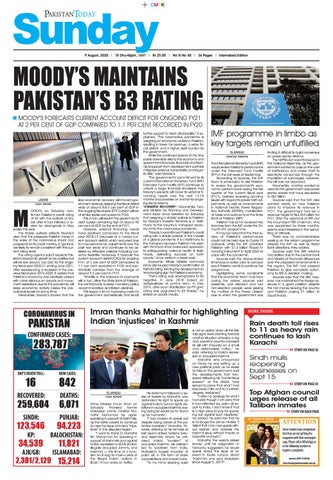
Moody’s Maintains Pakistan’s B3 rating g
MOODy’S FOrecASTS cUrreNT AccOUNT DeFIcIT FOr ONGOING Fy21 AT 2 Per ceNT OF GDP cOMPAreD TO 1.1 Per ceNT recOrDeD IN Fy20
LAHORE staff report
M
OODy’s on Saturday confirmed Pakistan’s credit rating at B3 with the outlook at stable after it had initiated a review for downgrade in May earlier this year. The stable outlook reflects Moody’s view that the pressures Pakistan faces in the wake of the coronavirus shock and prospects for its credit metrics, in general, are likely to remain consistent with the current rating level. The rating agency said it expects Pakistan’s economic growth to be positive but will be low around 1pc-2pc for the ongoing fiscal year 2020-21 ending June 2021, after experiencing a recession in the previous fiscal year 2019-2020. It added that Pakistan’s economy was relatively closed with a low reliance on exports and movement restrictions due to the pandemic will keep economic activity below the preoutbreak levels for some time. Meanwhile, Moody’s shared that the
slow economic recovery will impact government revenue, keeping the fiscal deficit wide at around 8-8.5 per cent of GDP in the ongoing fiscal year (Fy21) which will be at similar levels compared to Fy20. This, in turn, will result in the government’s debt burden remaining high at around 90 per cent of GDP by the end of Fy21. However, external financing needs have declined compared to the fiscal year 2018-19 because of a narrow current account deficit, which occurred due to macroeconomic adjustments over the past two years and continues to be assisted by effective policies including currency flexibility. Moreover, it forecast the current account deficit (cAD) for ongoing Fy21 at 2 per cent of GDP compared to 1.1 per cent recorded in Fy20 and substantially narrower than the average of around 5.5 per cent in Fy19. “Stability in the balance of payments will, in turn, allow the State Bank of Pakistan, the central bank, to keep monetary policy accommodative as inflation declines. This keeps a lid on borrowing costs for the government domestically and lends
Coronavirus in
Pakistan
further support to debt affordability,” it explained. “The coronavirus pandemic is weighing on economic activity in Pakistan, resulting in lower tax revenue, a wider fiscal deficit, and a higher debt burden for the government. While the continued spread of the virus poses downside risks to the economy and government finances, financial and technical support from development partners mitigates external vulnerability and liquidity risks,” said Moody’s. “The government’s commitment to its current International Monetary Fund (IMF) extended Fund Facility (eFF) continues to unlock a large financial envelope that Moody’s expects will cover its external financing needs over the next 12-18 months and provides an anchor for ongoing fiscal reforms. ‘V-SHAPED RECOVERY’: Meanwhile, Federal Minister for Planning and Development Asad Umar tweeted on Saturday that assigning a ‘stable’ outlook to Pakistan by Moody’s Investor Services is a ‘testimony’ to the country’s ‘V-shaped’ recovery amid the coronavirus pandemic. “Moody’s reconfirmed Pakistan’s credit rating with a stable outlook. In the middle of a global pandemic it is a testimony to the V-shaped recovery Pakistan has seen with PM Imran Khan balanced approach to safeguarding national health & livelihoods, delivering success on both counts,” Umar wrote in a tweet post. economic Affairs Minister Hammad Azhar also lauded Moody’s confirmation of Pak’s B3 rating, terming the development an ‘encouraging sign’ for Pakistan’s economy. “Pak’s rating was downgraded to B3 negative in June 2018 based on data/policies of pmln’s term. In Dec 2019, after econ stabilsation by PTI govt, rating was upgraded to B3 Stable,” he stated on social media.
283,787
16
RECOVERED:
259,604 SINDH:
123,546
NEW CASES:
842
DEATHS:
6,071
PUNJAB:
94,223
KP:
BALOCHISTAN:
AJK/GB:
ISLAMABAD:
34,539
11,821
2,301/2,129 15,214
ISLAMABAD sHaHZaD paraCHa
The International Monetary Fund (IMF) would review Pakistan's performance under the extended Fund Facility (eFF) in the last week of September. According to sources, the IMF team is scheduled to visit Pakistan to review the government's economic performance during the first quarter of the current fiscal year (Fy21), besides reviewing pending issues with regard to power tariff adjustments as well as amendments in National electric Power regulatory Authority (NePrA), mobilization of taxes and autonomy of the State Bank of Pakistan (SBP). Pakistan has so far received two tranches from the IMF under the 39month eFF programme. It may be noted that the third review of Pakistan's performance could not be held due to covid-19 outbreak, while the IMF provided Pakistan with $1.4 billion 'rapid Financing Instrument' in April 2020 to cope with the pandemic. Sources said the above-stated time-bound action plan is compulsory if Pakistan wants to continue this programme. Highlighting some constraints that the economic team may face during the review, sources said presently, one elected and two non-elected people were seeing the matters of the Power Division due to which the government was
Imran thanks Mahathir for highlighting Indian ‘injustices’ in Kashmir
CONFIRMED CASES:
DAY'S DEATH TOLL:
IMF programme in limbo as key targets remain unfulfilled
ISLAMABAD staff report
Prime Minister Imran Khan on Saturday thanked former Malaysian prime minister Mahathir Mohamad for again speaking in support of Kashmiris, as the latter vowed to continue to raise the issue of India’s “injustices” in the disputed region. “I want to thank Dr Mahathir Bin Mohamad for speaking in support of Kashmiris and against Indian repression in IIOJK (Indian illegally occupied Jammu and Kashmir) — this time at a function on 8 Aug to mark a year of the illegal Indian actions in IIOJK,” Imran wrote on Twitter.
His statement followed a series of tweets by Mahathir, who defended his right to speak up against India’s human rights violations in occupied Kashmir, saying doing so would be to “stand up for humanity”. “I had chosen to speak out despite being aware of the potential backlash,” Mahathir, 95, wrote, referring to his remarks at last year’s United Nations General Assembly where he criticised India’s “invasion” of occupied Kashmir. His criticism led to backlash from India, Malaysia’s largest importer of palm oil, in the form of order cancellations and import bans. “To my mind, keeping quiet
is not an option when all the telltale signs were pointing towards another situation whereby a big and powerful country imposed its will with impunity on a small and defenceless nation,” he said, referring to India’s repression in occupied Kashmir. Mahathir, who announced on Friday he was setting up a new political party as he seeks to take on the government, said the developments that transpired following his “contentious speech” at the UNGA “only served to prove that what I had said [was] mild and to a certain degree, restrained”. “I offer no apology for what I had said though I am sorry that it had affected our palm oil export to India. I don’t know if that is a high price to pay for speaking out against such injustices,” he added. He said now that he is no longer the prime minister “I take it that I can now speak without restrain and address the Kashmir issue without threats of boycotts and such”. Mahathir, the world’s oldest leader until his resignation in February, suggested he would speak about the issue at an event in Kuala Lumpur about “Kashmir’s one year lockdown since August 5, 2019″.
finding it difficult to build consensus on power sector reforms. The NePrA Act was introduced in the National Assembly, as the government wanted to pass on the cost of inefficiency and power theft to electricity consumers through the imposition of surcharges. However, the bill was not approved. Meanwhile, another worrisome area for the government was power sector arrears that have escalated to rs2 trillion. Sources said that the IMF also wanted clarity on how Pakistan plans to improve its revenue in Fy21. The government had set a revenue target of rs4,963 billion for Fy21 after the approval of IMF but the incumbent FBr chairman, who was appointed for three months, seems only interested in the reshuffling of officials. There was no comprehensive working on the reform programme despite the IMF as well as World Bank directions, they added. Sources said the SBP reforms had stalled due to the central bank and Ministry of Finance's differences over the proposed amendments in this regard. The IMF had pressed Pakistan to give complete autonomy to SBP in decision making. Sources said that the SBP, however, has maintained the foreign reserves in a good position despite the hot money leaving the country and Pakistan paying $1 billion to Saudi Arabia.
more inside
Rain death toll rises to 11 as heavy rain continues to lash Karachi STORY ON PAGE 02
Sindh mulls reopening businesses on Sept 15 STORY ON PAGE 03
Top Afghan council urges release of all Taliban inmates STORY ON BACK PAGE in today’s issue
attention Some readers have complained that they are not getting the magazine with their newspaper copy. Please call or WhatsApp us at the following number to register a complaint. Contact: 0307-7338168 irfan.farooq@pakistantoday.com.pk
02
Sunday, 9 August, 2020
NEWS
RAIN deAth toll RISeS to 11 AS heAVy RAIN CoNtINueS to lASh KARAChI KARACHI
A
STAFF REPORT
T least 11 people have died during the current monsoon spell in Karachi as the city again received moderate to heavy showers for the third day on Saturday. Monsoon rains are continuing in most districts of Sindh and Balochistan. District Municipal Corporations (DMCs), Karachi Metropolitan Corporation (KMCs), the National Disaster Management Authority (NDMA), the Sindh government and the Pakistan Army are assisting relief activities throughout the port city. Malir Nadi (river) was flooded by rainwater and traffic was stuck from Qayyumabad to Korangi Causeway. City Court, Shahrah-e-Faisal, Bhittai Colony, and lowlying areas remained flooded.
According to the Inter-Services Public Relations (ISPR), the Pakistan army had started relief operations in Karachi, and rescue teams were active in affected areas with dewatering pumps and necessary safety equipment. Rainwater is being drained out from low-lying areas and stranded people are being rescued. Further rescue teams have been alerted in the wake of possible flooding or any other emergency situation. The National Disaster Management Authority (NDMA) spokesperson said that three nullahs were completely cleaned and work in other places was ongoing. On the other hand, the number of people who were electrocuted in rain-related incidents surged to nine. The mishaps occurred in Ittehad Town, Gulistan-e-Johar, City Court Road, and Jam Colony. Due to the heavy rains, several areas of Karachi experienced power shortages. Some areas of Orangi Town, Khudadad Colony, Landhi, PECHS, Old City Area and Korangi have been without power since Friday night, while Surjani Town, Khad Basti and other suburbs have been without power since the current spell started two days ago.
Saba Qamar, Bilal Saeed’s video in Wazir Khan mosque draws people’s ire LAHORE SHAHAB OMER
A video of song and dances of actress Saba Qamar and singer Bilal Saeed in the historic mosque ‘Masjid Wazir Khan’ in the provincial capital under the administration of the Punjab Auqaf and Religious Affairs department went viral on social media, which has drawn strong reactions from social and religious circles, Pakistan Today has learnt. An official of the department, speaking on condition of anonymity, said that a production house had been given permission for the shooting in the mosque by the Assistant Director Tableegh e Tarbiyyat but the higher ups of the department were kept unaware of the shooting of the dance. However, the assistant director claimed that he had given permission for the Nikkah scene. The official added that when the dance shooting started, the mosque administration should have stopped it as such activities are not allowed in mosques. He said that the shooting took place in the main chambers of Wazir Khan Mosque and complaints of dancing and singing in the mosques under Auqaf department have been received in the past as well. The official believed that if the video had not been uploaded on Tik Tok by Saba Qamar, perhaps no one would
have known about the incident. However, a departmental inquiry has been initiated by the Director General Religious Affairs and Secretary of the department against the production house and those responsible. The official added that in the past, a ban was imposed in Badshahi Mosque because the department received complaints of dance and inappropriate photography there, but now the ban has been relaxed again. According to the official, due to the historical status and beauty of Wazir Khan Mosque, many people used to come here for Nikkah ceremonies but the mosque administration was also strictly instructed by the department not to allow inappropriate photography within the premises of the mosque. He informed that there was a proper procedure to grant permission before even the routine photography of the mosque and no doubt the said shooting took place with the consent of the mosque administration. However, social media users also reacted strongly to the video going viral and demanded action against the concerned officials and said that immediate action should be taken against those who violated the sanctity of religious places of worship. Speaking to Pakistan Today, Secretary Auqaf Dr. Irshad Ahmed said that a departmental inquiry has been initiated against the incident and strict action would be taken against those responsible.
NAB finalises Narowal Sports Complex reference against Ahsan Iqbal ISLAMABAD TLTP
The National Accountability Bureau (NAB) has finalised the Narowal Sports City corruption reference against Pakistan Muslim League-Nawaz (PML-N) leader Ahsan Iqbal. The NAB has named the former interior minister as the main accused in the reference and sent it for the approval of chairman NAB Justice (r) Javed Iqbal. According to details, the NAB has acquired strong evidence against the PML-N leader and he has been found guilty according to the NAB Ordinance Section 9. Earlier, the National Accountability Bureau (NAB) had converted the inquiry against Pakistan Muslim League-Nawaz (PML-N) leader Ahsan Iqbal into an investigation. It is pertinent to mention here that Ahsan Iqbal had been released from Adiala Jail after the Islamabad High Court had approved his bail. Ahsan has been accused of using funds of the federal government and Pakistan Sports Board (PSB) for a sports city in Narowal. The NAB had announced to initiate a probe into alleged violation of rules in the construction of the National Sports City project – a day after its inauguration by the then president of Pakistan, Mamnoon Hussain.
Plea seeking Faisal Vawda’s disqualification as MNA fixed for hearing ISLAMABAD STAFF REPORT
Govt won’t allow sectarianism, intolerance, says Qadri LAHORE STAFF REPORT
Federal Religious Affairs Minister Noorul Haq Qadri on Saturday said the government will not allow anyone to create mischief by exploiting religious and sectarian divides. “Enemies tried to create an Iraq, Libya and Syria like situation in Pakistan but the nation defeated these conspiracies through unity,” Qadri said while addressing a conference here. After start of the so-called War on Terror in the wake of September 11, 2001 terrorist attacks in the United States, many countries in the Muslim world descended into chaos with wars and conflicts raging in Afghanistan, Iraq, Syria and Libya. Pakistan also witnessed a rise in militancy and terrorism which cost over 70,000 lives. The country, however, managed to
stem the tide of militancy through its successful military operations including Operation Zarb-e-Azb and Operation Radd-ul-Fasaad. Obliquely referring to the terrorists attacks on religious and sectarian minorities, the minister said the people must foil the plots of anti-Islam forces through unity. “All religious institutions and organization must unite for the survival and progress of Pakistan,” he added. The minister appreciated the initiative organized by Jamaat Ahle Haram Pakistan and called for continuous efforts to create a closer bond among followers of different sects and religions. He said in the current situation, there is a need for people of all sects to get united. “Our religious scholars have always played a positive role in promoting harmony. We must join forces to defeat the conspiracies by the enemies of Islam,” he added.
The Islamabad High Court (IHC) on Saturday two petitions seeking disqualification of and contempt of court proceedings against Water Resources Minister Faisal Vawda. Justice Amir Farooq will hear the two petitions on August 20, according to a cause list issued by the IHC registrar. Mian Faisal filed the petition seeking Vawda’s disqualification as an MNA. It noted that the court had sought a reply from the federal minister, the election commission and other parties to the case on January 29. The petition says that Vawda submitted his nomination papers on June 11, 2018, which were accepted on June 18, 2018. He submitted the application to renounce his US citizenship on June 22, 2018 and hid his dual nationality while submitting nomination papers, it states. The petitioner moved the court to disqualify Vawda in the light of Supreme Court’s verdicts, contending that he is illegally holding a public office. Petitioner Jahangir Jadoon said in his petition that on January 29, the court had given Vawda two weeks to submit his reply in the disqualification case. However, it has been several months and no reply was submitted by the minister, the petition notes. It is an open and shut case which is why Vawda does not want to submit a reply, Jadoon stated. The petitioner requested the court to initiate contempt of court proceedings against the minister.
Over 0.3m stranded Pakistanis repatriated from 64 countries ISLAMABAD STAFF REPORT
More than 304,000 Pakistanis have been repatriated from more than 500 domestic and international flights under a special flight operation from 64 countries of the world during a grand operation for repatriation of Pakistanis stranded abroad due to travel restrictions and lockdown because of the coronavirus outbreak. At least 300,000 Pakistanis were repatriated through special flight operations while 4,329 Pakistanis returned home via land routes. The operation launched for the repatriation of Pakistanis stranded abroad in view of lockdown and travel restrictions due to global pandemic was completed, under which more than 344,000 Pakistanis were repatriated by domestic and international flights and land routes. According to the Crisis Management Unit, a total of more than 500 flights of domestic and foreign airlines were operated. Under which 300,000 Pakistanis returned home by air and 4,329 Pakistanis by land. According to the documents, 2,000 members of the Tablighi Jamaat, 1,326 pilgrims and 1,745 Pakistanis imprisoned in foreign jails returned through special flights. According to CMU documents, 154,000 Pakistanis were repatriated from United Arab Emirates, 63,595 from Saudi Arabia, 17,000 from Qatar, 11,729 from Oman, 4,469 from Bahrain and 6,339 Pakistanis were repatriated from Turkey under the operation launched to repatriate Pakistani citizens.
According to the document, 7,122 Pakistanis were repatriated from Britain, 1,702 from the United States and 2,520 from China, while 2,314 Pakistanis were repatriated from Kuwait and 8,110 from Kyrgyzstan. The document further said that 4,098 Pakistanis have returned home from Afghanistan and 1,080 from Iran under a special operation during the lockdown. Similarly, 418 Pakistanis from India, 2987 from Afghanistan and 924 from Iran were repatriated to the country via land route. According to the CMU report, 556 Pakistanis were repatriated from Thailand, 128 from Uzbekistan, 125 from Tajikistan and 1,682 from Iraq. Similarly, 1,933 Pakistanis were brought back to the country from Canada, 50 from Japan and 457 from Indonesia. According to the document, 248 Pakistanis from South Africa, 54 from Maldives and 15 from Congo were repatriated under a special operation launched due to coronavirus. Moreover, at least 65 Pakistani nationals returned from Norway, 327 from Australia, 123 from Germany, 24 from Belgium, one each from the Czech Republic, Finland, and 2 each from Switzerland and Austria. According to the report, 181 Pakistanis were repatriated from Sri Lanka, 501 from Sudan, 124 from Tanzania, 221 from Kenya, 129 from Korea and 3 from Myanmar. It stated that 49 Pakistanis returned to home from Netherlands, 2 from Hungary, 151 from Bangladesh, 33 from Nepal, 15 from Ghana and 205 from Spain under special operations, while 854 Pakistanis were repatriated from France, 184 from Uganda, 38 from Djibouti, 50 from Egypt and 269 from Somalia.
Sunday, 9 August, 2020
NEWS
ACtIVe CoVId CASeS dRoP to 17,815 NCOC DIRECTS PROVINCES TO DEVISE TOURISM GUIDELINES ISLAMABAD
t
STAFF REPORT
HE total number of recovered coronavirus patients in the country has reached 259,604. According to the latest statistics issued by the National Command and Operation Centre (NCOC) on Saturday, there are now 17,815 active cases in Pakistan. A total of 842 new cases were reported over the last twenty-four hours, taking the number of positive cases in the country to 283,487. Sindh remains the worst-hit province by the pandemic in terms of number of cases, followed by Punjab, Khyber Pakhtunkhwa and Islamabad. Of the total reported cases, 123,246
cases have been detected in Sindh so far, 94,223 in Punjab, 34,539 in Khyber Pakhtunkhwa, 11,835 in Balochistan, 15,214 in Islamabad, 2,129 in Azad Jammu and Kashmir, and 2,301 in Gilgit Baltistan. Out of the total Covid-related fatalities, 2,259 occurred in Sindh, 2,166 in Punjab, 1222 in Khyber Pakhtunkhwa, 137 in Balochistan, 171 in Islamabad, 55 in Gilgit Baltistan, and 58 in Azad Jammu and Kashmir. Pakistan has so far conducted 2,103,699 coronavirus tests and 24,366 in the last 24 hours. Meanwhile, the number of coronavirus cases worldwide has crossed 19 million as European nations imposed new travel restrictions and containment measures with fears growing over a second wave of infections. Global deaths from the pandemic
Sindh mulls reopening businesses on Sept 15
have topped 700,000, and Europe remains the hardest-hit region worldwide with more than 200,000 fatalities since the virus first emerged in China late last year. More than half of Africa’s cases are in South Africa, which has the fifthhighest number of infections in the world, after the US, Brazil, India, and Russia. The National Command and Operation Centre has directed the provinces to devise guidelines for managing tourism to contain the resurgence of Covid-19 outbreak. Directives were given in an NCOC meeting chaired by Federal Minister for Planning, Development and Special Initiatives Asad Umar, here on Saturday. The meeting discussed opening up the tourism sector with standard operating procedures (SOPs) and safety guidelines for containment of disease. The forum highlighted that violations of SOPs have been observed at almost all tourist destinations and emphasized that if tourism is not managed well, it might cause another wave of infections.
PM Imran urges nation to join plantation drive on Aug 9
ISLAMABAD APP
Prime Minister Imran Khan on Saturday urged the people to join him in a tree plantation drive across the country on August 9. The premier, in a tweet, said he had also asked MPs, ministers, chief ministers and the volunteer Tiger Force to participate in the “biggest tree planting campaign in our history”. The target is 3.5 million trees to be planted in a day, Imran said. He expressed hope that the plantation target will be exceeded. The government continues to pursue its ambitious plan of planting over 10 billion trees across the country. The project is an upscaled version of the project implemented by the PTI government in KhyberPakhtunkhwa between 2013 and 2018. Earlier, the World Bank expressed its interest to provide $188 million to fund the upcoming Ecosystem Restoration Initiative aims at implementing the ‘Ten Billion Tree Tsunami’ and ‘Recharge Pakistan’ programmes. The $188 million fund will be placed under the National Disaster Risk Management Fund (NDRMF), as it already has a framework and mechanism in place for quick and efficient disbursement of the money.
KARACHI: The Sindh government and health experts explored on Saturday the possibility of reopening all businesses, including eateries, as well as educational institutes across Sindh from September 15, in light of the decisions made during a recent National Coordination Committee (NCC) meeting and an apparent decline in Covid-19 cases. Addressing a provincial coronavirus taskforce meeting, Sindh Chief Minister Syed Murad Ali Shah said that a final decision would only be made after authorities reassessed the situation in the first week of September. “After a Council of Common Interests (CCI) meeting, Prime Minister Imran Khan had chaired an NCC meeting on August 6 in Islamabad, where it was decided that all businesses, including educational institutes, would reopen from September 15,” he said, adding that the provinces had agreed to reach a final decision on the matter after reviewing the pandemic situation in taskforce meetings. The CM then sought the opinion of health experts on resuming commercial, educational and social activities, at which the latter proposed that they could be resumed in line with coronavirus-related standard operating procedures (SOPs). At this, he decided to call another meeting in the first week of September to review the situation, deliberate on the matter and reach a final decision. STAFF REPORT
03
04
Sunday, 9 August, 2020
NEWS
FooD busiNesses opeN buT resTAurANTs iN For A LoNG FiGHT AMiD pANDeMiC LAHORE
T
SHAHAB OMER
HE Punjab Primary and Secondary Healthcare Department (P&SHD) on Saturday issued Standard Operating Procedures (SOPs) regarding the opening of restaurants and fast food businesses; however, restaurant owners are not too optimistic about business in light of strict Covid-19 protocols, Pakistan Today learnt. The P&SHD Care Secretary Capt (r) Muhammad Usman issued SOPs for opening the restaurants while up to 50 per cent people will be allowed to eat in the dining
hall instead of 100 per cent. According to the SOPs, there will be no parties in the dining halls of fast food and restaurants while those above 60 years of age will be barred from entering the restaurants. Similarly, there should be a distance of 6 feet between the dining tables while the play areas will remain closed. Masks, hand-sanitizers and temperature checks will be mandatory. According to SOPs, special care should be taken for social distancing in the restaurant and the restaurant management and workers will be required to wear gloves and masks while customers will not
Attempt to smuggle 10 kg hashish foiled, one accused held KARACHI: Sindh Excise Department on Saturday foiled an attempt to smuggle ten kilogram hashish from Balochistan to Karachi and arrested an accused. According to details, a team of the department headed by Assistant Excise and Taxation Officer Zia-ul-Islam Pathan during checking of vehicles at Jacobabad check post recovered 10 kg hashish from a suspected Mehran car bearing registration number BCC-325. An accused Fazlur Rehman, resident of Mastung was arrested and a case has been registered and investigation is underway. The vehicle used in the incident has also been impounded. Provincial Minister for Excise & Taxation and Narcotics Control & Parliamentary Affairs Mukesh Kumar Chawla congratulated the officers over successful operation and directed them to continue the crackdown on drug dealers, asking them under no circumstances should drug dealers be allowed to enter into Sindh. STAFF REPORT
Two burnt to death as oil tanker catches fire after overturning KOHISTAN: Two people were burnt to death and another scorched when an oil tanker caught fire after overturning here on Saturday. According to details, the accident took place at Karakoram Highway in Sholgara Bakand area of Lower Kohistan where Gilgit bound oil tanker coming from Rawalpindi turned turtle due to reckless driving. The vehicle caught fire, resultantly two people including cleaner Ziawal and an unknown person was burnt to death while another was scorched. Fire brigades and rescue teams reached the scene. The bodies and injured were shifted to local hospital. INP
Tourists arrive in Naran, Kaghan and Murree as lockdown ends PESHAWAR: Tourists have arrived in Naran, Kaghan and Murree as coronavirus lockdown for tourism sector has ended after five months on Saturday. According to details, small businesses have opened along with transport and the locals as well as the visitors have expressed joy over the government’s decision. Weather is extremely pleasant in tourist spots like Shogran, Saiful-Maluk Lake, Babusar Pass and Siri Paye where sightseers have reached without wasting any time. Tourists have also arrived in Hunza Valley and Gilgit to enjoy the weekend. However, the government has advised all to follow the precautionary measures as the COVID-19 threat is not completely over. INP
Flooding in Nai Gaj drowns several villages in Dadu DADU: Heavy rainfall in Dadu during ongoing monsoon spell has caused flooding in Nai Gaj and other drains on Saturday. According to reports, the water in Nai Gaj flowing at the level of 28 feet and more than 50 villages in its route have submerged. The flooding in Gaj river has disrupted land link of more than 200 villages from Dadu and Juhi towns. Hundreds of villagers have taken refuge at trees and roofs of houses to avoid harm. Nai Gaj is an ephemeral river in Dadu district, drains from the Kirthar mountain range and flows from Balochistan to Sindh. It ends at Lake Manchar after flowing through the arid areas of Kachho region. A project of construction of a dam on Nai Gaj was launched by the government to utilize the water has been incomplete for more than a decade. Under the influence of the monsoon low pressure, Garhi Khero tehsil in Jacobabad, Kashmore, Nawabshah and Sujawal also received heavy rainfall causing drainage and sanitary problems for the people. INP
be allowed to enter the restaurant without masks. The customers will not be allowed to enter buffet areas, while waiters will distribute food to the customer from the buffet areas and temperature scanners will be mandatory when customers arrive at the restaurant. Abrar Hussain, owner of Coocos Den, said that the government has decided to open restaurants but the damage caused during the lockdown could not be repaired. “The SOPs issued by the health department will undoubtedly reduce our sales and where our restaurant used to employ 50 people, now only five to ten people will work. Despite the government's
announcement, people will not turn to restaurants, but it will take time for people to return to normal.” Asad Sheikh, founder Foodies R Us believes that restaurant owners are not ready to open their restaurants despite permission. “The government is, of course, acting cautiously, but some of the things in the SOPs are beyond comprehension. With the dining capacity of restaurants reduced by 50pc, sales will be severely affected. SOPs are more stringent for restaurant owners and they will prefer takeaways instead of dine in. This is a very difficult time for the restaurant sector and we hope that good time will come soon.”
Qureshi discusses political situation, Southern Punjab secretariat's affairs with CM LAHORE APP
Foreign Minister Shah Mehmood Qureshi met Punjab Chief Minister Sardar Usman Buzdar at CM's Office here on Saturday where matters of mutual interest, political situation and Southern Punjab Secretariat’s affairs came under discussion. Provincial Minister Dr. Muhammad Akhtar, Chief Whip National Assembly MNA Aamir Dogar, MNA Zain Qureshi, Principal Secretary to the CM Punjab and officers concerned were also present on this occasion. The meeting decided to take prompt administrative steps to make Southern Punjab Secretariat fully functional. Talking on the occasion, Foreign Minister Shah Mehmood Qureshi said the PTI government was fulfilling all its promises made to the people. He said that establishment of Southern Punjab Secretariat would bring relief to the localities. The problems of the people would be solved at the grassroots level besides improving the governance. Shah Mehmood Qureshi, Usman Buzdar and other members of the Assembly strongly condemned the worst military siege and oppression of Modi government in Indian Illegally Occupied Jammu and Kashmir. Shah Mehmood Qureshi said that Pakistan was incomplete without Kashmir. Modi had orchestrated Muslims’ genocide in Indian Illegally Occupied Jammu and Kashmir and had set a new history of oppression on Kashmiris, he added. Usman Buzdar said that the government under the leadership of Prime Minister Imran Khan had been highlighting Indian atrocities at all levels and the entire nation
observed Youm-e-Istehsal. One road in every division of Punjab, including Lahore, would be named after Srinagar, he said, adding, the government paid tribute to everlasting struggle of the Kashmiri people against the illegal Indian occupation. He termed Kashmir as a jugular vein of Pakistan and said that Pakistan could not back off from the core issue of Kashmir cause. He said that Modi blatantly violated the U.N. resolutions on August 5, 2019. He said that Pakistan would continue to expose India’s stubbornness and illegal steps at every level. Usman Buzdar said that secretaries of different departments would soon be posted in Southern Punjab Secretariat and the secretaries would be fully empowered. The Southern Punjab Secretariat would be given administrative and financial autonomy so that affairs related to Multan, Bahawalpur and Dera Ghazi Khan Divisions could be dealt with locally, the Chief Minister stated. Usman Buzdar, while giving approval of setting up of 100-bed Mother & Child Hospital in Multan, said that this hospital would be established on the old building of Ghalla Mandi. He directed to resolve issues related to WASA and sewerage immediately. He said that setting up of Southern Punjab Secretariat was a major step of PTI government. He said that the people of Southern Punjab would not have to come to provincial metropolis for the solution of their problems. He said that former rulers used the funds of Southern Punjab in their own constituencies and people were entertained with hollow slogans, therefore people of Southern Punjab rejected such elements who hoodwinked them in the name of development in the general election.
Wife shoots dead WASA deputy director in Lahore LAHORE STAFF REPORT
A senior officer of Lahore’s water and sanitation agency was shot dead by his wife at his home in Johar Town on Saturday. The woman, Shehla, after killing her husband also shot herself. According to police, she was slightly injured and was under treatment at Jinnah Hospital. Shahid Hafeez, Deputy Director Revenue in Water and Sanitation Agency (WASA) of Lahore, had a
heated argument with his wife at his home in the morning. According to police, his wife got infuriated and she shot her husband multiple times which resulted in his on-the-spot death. Police said the woman is now in their custody as the brother of Shahid Hafeez has filed a complaint against his sister-in-law. Earlier, it was reported that unidentified gunmen barged into Shahid Hafeez’s house and shot him dead. The incidents of gun attacks are on the rise in the provincial capital of
Lahore. On July 31 last, a former additional controller of Punjab University was shot dead in Lahore. Professor Ahmed Ali Chattha was travelling to a dairy farm from his house when he was attacked by armed motorcyclists. He was killed with a single bullet. The Mustafa Town police have begun an investigation and believed the attack might have been the result of personal enmity. However, according to Professor Chattha’s friends, he didn’t have any enemies.
Men accused of assaulting, filming girl get interim bail ISLAMABAD: A district and sessions court in Rawalpindi on Friday extended the interim bail of two men accused of sexual assault, committing "inappropriate acts", and filming a girl. A third man, who is accused of filming the incident, was arrested on Thursday but was also granted interim bail by the court on Friday. The case was registered last month when Capital Police Officer (CPO) Muhammad Ahsan Younis took notice of the incident. The first information report (FIR) was lodged with Waris Khan police station's Station House Officer (SHO) Ghazanfar Abbas as the complainant. According to the FIR, a video, which was circulated on social media, showed two men sexually assaulting a girl while a third suspect was filming the incident. The victim was also stripped by the accused, according to Rawalpindi police spokesperson Sajjadul Hasan, although the FIR does not mention it. The video was later posted on social media, where it was "made viral", the FIR said, adding: "By making the video go viral on social media, [the suspects] hurt the feelings of the people by violating [...] the chastity of the girl." The case was registered under Sections 354 (assault or criminal force to woman with intent to outrage her modesty), 509 (insulting modesty or causing sexual harassment) and 34 (acts done by several persons in furtherance of common intention) of the Pakistan Penal Code. The two accused initially named in the FIR obtained pre-arrest bail from a lower court. Later, during the investigation, they identified the third suspect who was recording the video. He was arrested by the police on Thursday "after multiple raids", according to the police spokesman. STAFF REPORT
Kite string slits little boy’s throat in Lahore LAHORE: A five-year-old boy, Asghar, died after his throat was slit by a glass-coated kite string in Malipura, Band Road area of Lahore on Saturday morning. A large contingent of police rushed to the scene and cordoned off the area to arrest the kite-loving culprit whose fondness for flying kits despite the government’s strict ban has taken an innocent life. Asghar was going on a motorbike with his father, Asif when the glass-coated kite string slit his throat at Bund Road. The little boy died while being shifted to hospital by the officials of the Rescue 1122. The police, tasked by the provincial government to enforce the ban on kite flying, have miserably failed to implement the directives. The police now only swing into action when a tragedy happens. The police do not prevent but only react to these tragedies. STAFF REPORT
LHC bans plastic bags at pharmacies, fruit vendors LAHORE: The Lahore High Court (LHC) has imposed a ban on plastic bags at pharmacies, medical stores and fruit vendors and directed Environment Protection Department to implement the court orders. LHC judge Justice Shahid Karim, in his verdict on plea of advocate Abuzar Salman Khan Niazi, has ordered DG of Department of Environmental Protection to issue directions to regional officers to enforce the ban in districts of Gujranwala, Sialkot and Faisalabad. The court has granted two weeks’ time to all stores to switch to alternatives of the plastic bags and adjourned the hearing till September 9. STAFF REPORT
PHC CJ inaugurates child court in Mohmand TERMS IT BIG STRIDE FORWARD IN JUVENILE JUSTICE SYSTEM PESHAWAR TLTP
While inaugurating a child court in newly merged Mohmand district on Saturday, Chief Justice Peshawar High Court (PHC) Waqar Ahmad Seth expressed resolve to address plight of children both in contact and in conflict with law by arranging resolution of their disputes under one roof. The chief justice virtually inaugurated the child court, the first of its kind in any newly merged district and the fourth in the Khyber Pakhtunkhwa. “This is a big stride forward in the ju-
venile justice system unmatched by any other province so far,” said the CJ. He further said, “Let me remind you that children under 14 years of age constitute almost 35 percent of our population. It would be thus unjust, if not downright criminal, to ignore the welfare of such a large chunk of society.” He stated that cognizant of its responsibility, the Peshawar High Court embarked upon a plan in 2019 to establish a chain of child courts throughout the province beginning with Peshawar, extending next, to the divisional headquarters and finally to each district of the province. Legal Consultant for Group Develop-
ment Pakistan (GDP) Advocate Sharafat A Chaudhry, who provided technical legal support for the establishment of first child court in Mohmand, said, "The Peshawar High Court has made history by establishing a model child court in previously marginalized areas of KP.” Additional District and Session Judge Wali Muhammad has been appointed as presiding officer of the Child Court Mohmand whereas recently three other child courts have been established at Peshawar, Mardan and Abbottabad. It is pertinent to mention that as many as 168 judges and prosecutors, including 31 female judges, have been trained on juvenile justice and child protection related laws in Pakistan in accordance with the decision of the National Judicial Policy Making Committee (NJPMC) in wake of
global convention on child rights. However, implementation of the NJPMC directives of 2019 is not completed according to which juvenile and child protection courts would be established in every district of the country as the Committee had directed high courts to nominate judicial officers for training by the Group Development Pakistan (GDP). Earlier, Khyber Pakhtunkhwa Judicial Academy with technical assistance of the GDP organized third training of juvenile and child courts officials judges, prosecutors, probation officers and child protection officers on laws pertaining to juvenile justice and child rights. Talking to TLTP, Chaudhry who has drafted the country’s recent juvenile justice law said, “There is dire need to enforce the NJPMC decision and establish exclusive juvenile justice courts and juvenile rehabilitation centers in every district of Pakistan”.
Sunday, 9 August, 2020
NEWS
05
Chris Woakes, Jos Buttler lead england home in memoraBle fourth-innings Chase MaNcHEstER
a
AGENCIES
FIGHTING century stand between Chris Woakes and Jos Buttler carried England to a stunning three-wicket victory over Pakistan in a thrilling opening match of their three-Test series. Buttler's gutsy knock of 75 from 101 balls in the face of mounting criticism over his place in the side, combined with Woakes' new-found form with the bat, handed England an unlikely victory and broke their run of five consecutive series in which they had lost the first match. Under pressure to make runs after his Test average had dipped and a torrid time behind the stumps during this match, Buttler came in with England 106 for 4 chasing a target of 277 for victory. He and Woakes, who had a high score of 37 not out from his previous 17 innings, shared a partnership worth 139 for the sixth wicket and helped England pull off the second-highest fourth-innings run chase at Old Trafford. Fittingly, Woakes hit the winnings runs with a four through third man off Shaheen Shah Afridi to finish not out on 84 as England snatched victory by three wickets inside four days. Joe Root began the day suggesting a target below 260 would be within reach. Pakistan pushed it just beyond after Yasir Shah came out, as expected, and threw the bat. Yasir resumed on 12 with Pakistan 137 for 8 and leading by 244. He clubbed 21 from nine balls, including 11 off Jofra Archer's first four deliveries of the day, followed by a defiant four past mid-on and a brutal six over midwicket off Stuart Broad's first three. Broad had the final say two balls later, drawing a wild swing from Yasir to a length ball outside off and finding a thick edge which went through to Buttler behind the
stumps. But Yasir's job was done. In all, Pakistan pilfered 32 runs within the first half hour, before Naseem Shah was the last man out, bowled by Archer for 4. England managed just 22 runs from the first 11 overs of their chase but, with the best part of two days ahead of them, time was the least of their worries. Wickets were, and Mohammad Abbas took the first with the first ball of the 12th, which nipped back and struck Rory Burns on the back leg as it curled in off the seam. Burns was quick to call for a review, but his dismissal was confirmed on umpire's call
with the ball hitting the top of middle stump. There appeared to be words exchanged, with Burns turning to the Pakistan team and putting a finger to his lips as he strode from the field. Dom Sibley and Root pressed on to 55 for 1 by lunch but there was a period after the break where England's scoring went quiet against Abbas and Yasir and they managed just two runs in 29 balls. Yasir, who had claimed four England wickets in their first innings, broke a 64-run partnership when he had Sibley caught by Asad Shafiq for 36, the opener furious with
himself after attempting a drive and sending a thick edge straight to slip. His dismissal brought Ben Stokes - and all his promise - to the crease and England's own "miracle worker" got off the mark with a boundary through third man off Naseem. Crucially, though, Naseem swooped quickly to remove the other set batsman, when he found Root's outside edge, which was collected by Babar Azam at slip to send him out on 42. With England 96 for 3 and needing 181 runs more to win, the glare on Stokes intensified, even though they also had Ollie Pope,
who had top-scored for the hosts in their first innings, at the crease. If any indication was needed as to just how highly prized Stokes' wicket is, Pakistan burned an ambitious review when Naseem struck him on the pad with a ball that looked to be going down the leg side. Sure enough Hawk-Eye showed it was missing and Stokes survived. To Pakistan captain Azhar Ali's credit, however, faced with the prospect of using up another review seven balls later, when Yasir believed he had Stokes caught behind with a googly that bounced out of the rough outside of stump, Azhar went for it. His courage was rewarded when UltraEdge showed the ball had brushed the glove on the way through to Mohammad Rizwan, who gathered the ball high at his second grab. England had lost 3 for 20 and their situation worsened three overs later. Pope could do little about his dismissal when he copped an unplayable delivery from Afridi that reared off a length and hit his top hand, ballooning to Shadab Khan running in from gully. With England 117 for 5 and hope fading fast, still 160 runs from victory, Buttler and Woakes played a stunning hand that rescued their side. With Buttler's white-ball credentials in no question, he combined the skill to rack up the runs at a good tempo with the patience required to not throw his wicket away. Even when he did fall, attempting a reverse sweep off Yasir and struck on the boot for an lbw decison he challenged and lost, Woakes was well set and the hard work was done. Needing 21 more runs, England promoted Stuart Broad, and although he fell cheaply, lbw to Yasir with the second new ball, Woakes saw them home to end a miserable run in first Tests (aside from a one-off win over Ireland) that stretched back to the start of 2019.
India retains T20 World Cup in 2021, Juventus sack Sarri as manager Australia to host in 2022 ROME
AGENCIES
NEW DELHI AGENCIES
India has retained the rights to host the 2021 men's T20 World Cup while Australia have been asked to host the 2022 edition. In another significant decision, the ICC also postponed the 2021 women's ODI World Cup which was scheduled in New Zealand between February and March, to 2022. All these decisions were taken by the ICC Business Corporation, the business development wing of the ICC, which met virtually on Friday. The 2021 event will be hosted in India between October-November next year, with the final scheduled on November 14. Australia, which was originally meant to host the 2020 edition, will now host the tournament in 2022 between October-November with the final scheduled for November 13. This women's World Cup is the second global event the ICC has been forced to postpone in the last two months due to the disruption caused by the Covid-19 pandemic. In July, the ICC Board had deferred the 2020 men's T20 World Cup, scheduled in October-November in Australia this year to next year. The board had given the nod to the ICC management to create fresh windows for the three marquee global events: the T20 World Cups in October-November 2021 and October-November 2022, and the ODI World Cup in October-November 2023, pushed back from its original March-April window. How did India retain the rights? Although it confirmed the development, the ICC did not give any precise reason as to why India had retained the right to host the event "as planned". However, ESPNcricinfo understands the decision for the IBC, which comprises all the members of the ICC Board, became easier once Cricket Australia chairman Earl Eddings said his board would not be able to commit the support of the Australian government to host the tournament in 2021. It is understood that Eddings said that although CA would prefer hosting the event next year, it could not guarantee the government's support at this point. Government backing is key to hosting global events, and the ICC needed a guaranteed undertaking from the host board. It is understood that Sourav Ganguly, the BCCI president, said his board was confident it would get the Indian government's support, which helped the IBC make its decision to retain India as the hosts as per the original schedule of global events. Another thing that went in India's favour is that ICC would not need to change its contractual agreements with its commercial partners for the 2021 edition, since it was staying in India. As for the contractual agreements for the 2020 event which was postponed, the ICC will
need to rework them for 2022 - but the ICC felt that was more helpful commercially. This means there will be no global event for nearly 18 months since the ICC hosted the women's T20 World Cup in February-March this year, which was played in Australia. What it also means is that in 2022, which was meant to be a gap year without any global event, there will now be four ICC events. The year will start with the Under-19 World Cup in January in the Caribbean, followed by the women's ODI World Cup in New Zealand in February-March, then the men's T20 World Cup in October-November in Australia, and be bookended by the women's T20 World Cup in South Africa. On its part, the BCCI had always favoured hosting the 2021 edition instead of in 2022 as that would mean, potentially, India could host three marquee tournaments within a year: the T20 World Cup in 2022, the IPL in 2023 and the 50-over World Cup in 2023. The BCCI feared such a scenario could hurt its content commercially. Another unresolved issue, a thorny one, was the ICC insisting the BCCI find a solution to the longstanding tax exemption issue concerning global events in India. Recently the ICC wrote the BCCI saying it reserved the right to take away the 2021 men's T20 World Cup from India, after the BCCI failed to secure a tax exemption for the tournament from the Indian government. The ICC has given the BCCI until the end of the year to resolve that issue. Interim Cricket Australia CEO Nick Hockley says hosting the event in 2022 might just work out for them after all Setback for Cricket Australia. The IBC decision today will hurt CA in various ways. With the pandemic causing havoc across the world, CA had accepted that it would be impossible to host a global event comprising 16 countries this year. As early as May, Eddings had sent an e-mail to the Finance & Commercial Committee, a powerful wing in the ICC on which he sits, to say it would be "detrimental to cricket" in case the "cancellation" of the T20 World Cup in Australia this year was "replaced by award of" the tournament in October-November 2022. Contents of Eddings' correspondence with the ICC were reported by the Times of India originally. In that email, Eddings also said that it was important for the ICC to have certainty about who would host the marquee tournament to ensure member countries benefited financially from the revenue distribution model which is dependent on the broadcasting rights income. At the time, Eddings suggested that since Australia had "thankfully managed to flatten the (Covid-19) curve" it meant "there is greater certainty of being able to play in Australia in 2021 (which is key to maintaining member distribution)."
CMYK
Italian giants Juventus have sacked Maurizio Sarri as manager after just one season. Sarri guided Juventus to a ninth straight Serie A title but they were knocked out of the Champions League by Lyon at the last-16 stage. Juve won 2-1 in Turin on Friday but the French side progressed
on away goals. Italian Sarri, 61, was appointed on a three-year contract last summer after one year at Premier League club Chelsea. Juventus lost three of their last four league matches to finish only one point clear of Inter Milan in the end. They were also beaten by Napoli in the Coppa Italia final after football in the country restarted following the
coronavirus shutdown. Juventus are two-time European Cup/Champions League winners but have not lifted the trophy since 1996. Former banker Sarri succeeded Massimiliano Allegri in June 2019. A club statement thanked Sarri for "having written a new page in Juventus' history", adding that it was "the culmination of a personal journey that led him to climb all the divisions of Italian football".
Sunday, 9 August, 2020
06 COMMENT
‘Youm e Isthesal’
Yet another pie in the sky
The "biggest ever megaproject"
The day after
S
O far what we know about Prime Minister Imran khan’s Rs 7 trillion Ravi city Project is no more than an idea. Lahore continues to expand without any long term plan. With the population of the city fast increasing, it could face karachi-like water scarcity within a few years. There are no modern facilities to cope with the 5,500 tons of waste produced daily by the city, let alone recycling and turning the waste into commercial goods. a city with a population of nearly 13 million has only one landfill. The Ravi, which was once a sizeable river has turned into a gutter. Lahore no doubt needs government attention. Leaving the metropolis to its fate, Mr khan wants to build a new Rs 7 trillion riverfront city on 100,000 acres, partially in Lahore district and partially in Sheikhupura. It is supposed to be a well designed modern city consisting of green belts, piers and boardwalks along with necessary amenities. among the targets is to rehabilitate and develop the River Ravi into a perennial freshwater body with treated waste water released into it. The project will save Lahore by stopping the spread of unplanned urban sprawl and raise the water table which is going down fast. The idea would be generally welcomed. What is in doubt however is the capacity of the government to execute the mega-plan. There are questions that remain unanswered. First, where will finances for the grandiose project come from? The PM has talked about overseas Pakistani investors and those in the country in possession of black money. Few overseas Pakistanis responded to Imran khan’s calls for sending dollars to overcome the financial crunch the government faced or for water reservoirs. Putting aside qualms of conscience, the PM has again asked black money holders to invest in the project. Perhaps the PM is eying foreign Pakistani investors this time. as he has appointed ministers and advisers with conflicts of interest, his choice of the builders will remain under scrutiny. The PTI has so far shown little aptitude for development activity. The kP government made a mess of the Peshawar BRT project, the only major development work undertaken by any of the PTI’s governments. The PM has yet to establish credentials as a go-getter.
aRif Nizami
T
hE day after widespread national condemnation of India on the first anniversary of annexation of kashmir, foreign minister Shah Mehmood Qureshi got a bit carried away. In a talk show, he admonished Saudi arabia for not acceding to Pakistan’s request to summon a meeting of Riyadh led OIc (Organization of Islamic countries) foreign ministers’ council to condemn New Delhi’s atrocities in held kashmir. Our leadership quite naively assumes that complex foreign policy issues can be resolved by sheer optics and symbolism. When the Saudi crown Prince Muhammad bin Salman, virtual ruler and popularly referred as MBS visited Pakistan last year, khan laid out the red carpet for him, personally driving him from chakalaka air base to the prime minister house. The same royal treatment was accorded to the UaE crown prince khalifa bin Zayed al Nahyan by khan on his short sojourn to Pakistan back in January. The Gulf countries have tremendous stakes in India. Their economic and trade ties with New Delhi are vast and well entrenched. Pakistan does not even come close to it. Millions of Indian workforce is gainfully employed in these countries. Saudi aramco is buying 20 per cent stake in Indian conglomerate Reliance industries worth about $15 billion. For India, the deal is the largest foreign direct investment ever. according to estimates, Riyadh is looking to invest $100 billion in India. While Qureshi was busy extracting maximum political mileage from the kashmir issue, there were ominous undercurrents in our relations with Saudi arabia that as per the norm were not shared with the people of Pakistan. For example, it came as bolt from the blue that Pakistan has paid back Saudi arabia $1billion of the $3 billion loan Islamabad secured one and a half years ago. The loan was given as a special favour to Islamabad to enable it to avoid a default on its interna-
Karachi dead in the water The Sindh government has failed miserably
D
ESPITE an intervention by the federal government, through the NDMa and Pakisan army rescue teams, to resolve karachi’s urban-flooding crisis brought about by monsoon rains, the metropolis continues to suffer with eight rain-related deaths on Friday in various parts of the city, six of which were due to electrocution and the rest by drowning. Teams from the centre had started cleaning major storm-water drains so that this current spell of rains would cause relatively less severe flooding, and while some areas did benefit from this, it was simply not enough to fully contain the situation, as evidenced by the loss of life. karachi is simply too illequipped, and thus grossly mismanaged, from an administrative standpoint that monsoon rains wreaking havoc each year is an eventuality. The city’s infrastructure has had this handicap for decades and, in the absence of the necessary civil work that should be undertaken by the Sindh government and city administration, it deteriorates, leading to a worse situation each passing year. PPP co-chairman Bilalwal Bhutto Zardari is currently up in Prime Minister Imran khan’s grill over the latter’s shortcomings after being in office for more than two years. had the PPP addressed obvious deficiencies in karachi’s drainage and waste management problems over the past 12 years that it has been in power in Sindh, the party chairman’s criticism of the federal government’s performance would have been merited as karachi would perhaps not have been drowning. The PPP is not solely responsible for the literal mess that karachi is swimming in these days. The MQM, currently in a cushy alliance with the PTI at the centre and hence not receiving an appropriate amount of backlash, ran karachi for at least a decade and their performance is equally dismal. Both parties have sat in positions of power and done practically nothing to address the perennial problems faced by the citizens of karachi. The city is the business hub of the country, and severe disruptions in logistics due to annual rains not only hurt existing businesses but discourage potential investors whose feasibility includes ease and cost of transporting goods. One hopes this year’s monsoon knocks some sense into politicians elected to resolve the people’s problems rather than ignoring them.
Childhood denied The problem can no longer be brushed under the carpet
Rabia ahmed
B
ack in 1999 the members of the International Labour Organisation signed convention 182 which concerns the Prohibition and Immediate action for the elimination of the Worst Forms of child Labour, a child being defined by any human being under the age of 18. The convention was ratified over time by various member countries, and by Pakistan in 2001. Tonga, the last one, ratified it on Tuesday 4 august 2020. It may seem like a long time, but no convention has ever been ratified so fully and so swiftly by all members. Ratification expresses a state’s consent to be bound to a treaty. It grants states time to seek approval for the treaty at the domestic level, and to enact the necessary legislation so that the convention or treaty can come into force and be able to work. The United Nations provides for four basic principles regarding children (child being defined as any person under the age of 18). Pakistan has long been signatory to this: 1. Non-discrimination: which means that every child has certain rights regardless of ethnicity, gender, religion, language, ability, or any other status 2. Devotion to the best interests of the child, which must be taken into account when making any decision or taking any action affecting children. 3. To ensure that every child’s right to life, sur-
Dedicated to the legacy of the late Hameed Nizami
Arif Nizami Editor Aziz-ud-Din Ahmad
Umar Aziz
Asher John
Joint Editor
Executive Editor
Deputy Editor
Lahore – Ph: 042-36300938, 042-36375965
tional obligations. Thankfully our time-tested friend India by raking up the kashmir issue. Malaysia under Mahathir Mohamad last year china came to the rescue, to plug the gap and immediately lend $1 billion to be parked in the SBP (State Bank summoned a meeting of Islamic countries as a counof Pakistan) to shore up our foreign exchange reserves. terweight to the OIc. khan, after enthusiastically Those in the know of things claim that tremen- supporting the idea, conveniently opted out at the last dous pressure is being exerted on Pakistan to facili- moment buckling under Saudi pressure. Now with Mahathir no longer in power it is highly tate a deal on Indian spy kulbhushan Jadhav in Pakistan’s custody. Perhaps as a result of proactive unlikely that his successor government will stand by diplomacy, Pakistan has offered India unimpeded the proposal. hence if Qureshi makes good on his consular access to Jadhav. It has also invited India to threat to Saudi arabia of convening an Islamic foreign be a part of the case proceedings due on September 3 ministers’ conference of his own in Pakistan, will have few takers. apart from Turkey (and possibly Iran) we in Islamabad high court. Unsurprisingly, the opposition, paying back in the cannot count on many amongst our Islamic brethren same coin, is accusing the government of a sell-out. who will stand by us through thick and thin. Perhaps the only option is to ramp up our diploPainting Prime Minister Nawaz Sharif as an ‘Indian agent’ and being soft on Jadhav was the favourite hobby- matic efforts on kashmir. We are thumping our chests that the UNSc (United Nation Security council) took horse of khan and his cohorts while in the opposition. Unfortunately, khan spares no effort to smear the up the situation in held kashmir on our request beopposition. Terming its leaders as corrupt, most of them hind closed doors. Incidentally India is also a member of the body. as expected, no statement or even a press booked in NaB cases have their backs to the wall. hatred and contempt for the opposition knows no release was issued. The meeting may have made good bounds. The opposition leadership, as a prelude to headlines but how did it help in alleviating sufferings ‘Youm-e-Istehsal’, was invited to the foreign office of the subjugated kashmiris? Modi, impervious to international opinion, is refor an aPc (all Parties conference). But the prime lentlessly pursuing his hinminister was conspicuously dutva agenda. as if to mock absent. consequently, the the Muslims of India, he laid leader of the opposition the foundation stone of Ram Shahbaz Sharif and PPP Mandir on the site of historic chairperson did not show up Kashmir day, as usual, was Babri Masjid on the very day either orchestrated mostly for of first anniversary of the foras the opposition leadermal annexation of Jammu ship correctly pointed out, optics and domestic and kashmir. this was just a briefing held at Modi is able to do all this the foreign office not an consumption. Actually, there simply because India, despite aPc. On previous such occaare a few options for being an enfant terrible in sions of national importance Pakistan and Indian Muslims before the PTI assumed Pakistan to force India to eyes, is the darling of the west power, aPcs and joint loosen its chokehold on the and vast majority of Islamic houses of the parliament countries. Leveraging itself were held with both the hapless Kashmiri people against china, it has become prime minister and opposian even closer strategic parttion leadership present. ner of the US. Its vast market But khan is assiduously and economic potential sticking to his oft repeated makes it a more attractive stance that he will not shake hands with ‘crooks and thieves’ (of the opposition). destination than Pakistan. Obviously first priority should be given to setting In his lexicon the opposition is guilty as charged and hence have to be avoided like plague. This kind of our house in order. Making tall claims and taking cosself-righteous morality is anathema to smooth run- metic measures will not fly. Let’s face it; khan is prening of a democratic system. Virtually all rallies on siding over a divided house. Instead of pursuing ego-driven policies perhaps Youm-e-Istehsal were a government sponsored show. The chief minister Sindh Murad ali Shah led a rally it is time to cool off a little. concerted efforts are needed to engender consensual politics both on the in karachi sans the opposition. kashmir day, as usual, was orchestrated mostly economy and urgent security and foreign policy isfor optics and domestic consumption. actually, there sues confronting the country. are a few options for Pakistan to force India to loosen Arif Nizami is Editor, Pakistan Today. He can be its chokehold on the hapless kashmiri people. The foreign minister has already admitted that even our contacted at arifn51@hotmail.com http://www.pakistantoday.com.pk so-called Islamic brethren are not willing to annoy
I
Karachi – Ph: 021-35381208-9
I
vival and development is made possible and secure. 4. Respect for the views of the child which must be taken seriously and considered when arriving at decisions. convention 182 on the other hand seeks to improve a child’s life specifically by eliminating the worst forms of child labour such as ‘slavery, or practices similar to slavery, such as the sale and trafficking of children, debt bondage and serfdom and forced or compulsory labour, including forced or compulsory recruitment of children for use in armed conflict; child prostitution, illicit activities such as the production and trafficking of drugs and work which is likely to harm the health, safety or morals of children.’ “It means all children now have legal protection against the worst forms of child labour,” said Guy Ryder, the Director General of the ILO. an aFP report however hgoes on to say that Mr. Ryder was under no illusions that ratification amounted to implementation. and that is the probably the pivot around which the welfare of humankind revolves: implementation. countries which are doing well socially are those that make attempts to implement policies as opposed to those that pay lip service to them. The problem with the current government in the USa for example is the same, that having stated the aim to ‘make it great again,’ its policies are designed to lead it in the opposite direction, a case in point being its efforts to declare the affordable care act (Obamacare) unconstitutional. For now the act stands. The current government tried to get rid of the act which lowers health costs. Without it medical facilities in the USa can legally deny treatment to anyone who does not possess health insurance. and more than 27 million americans are uninsured. That they are not denied emergency care is despite this govt, not thanks to it, due to a bill passed in 1986. To return to convention 182 however, and the plight of children, what are the chances of its implementation in Pakistan? according to information provided by the ILO, the Labour Organisation has carried out successful initiatives as per its child labour programme in various areas of Pakistan. These areas include industries where children are
Islamabad – Ph: 051-2204545
I
Web: www.pakistantoday.com.pk
I
largely employed and which are particular dangerous for children, such as those that manufacture soccer balls, carpet weaving, the surgical tools industry and the glass bangles manufacturers, deep sea fishing, leather tanneries, domestic work, coalmines, rag-picking, auto-workshops, and brick kiln sectors. ILO has also responded to rehabilitate child labour in the earthquake-affected areas. In all these ILO interventions, thousands of child labourers, girls and boys, have been rehabilitated through the provision of non-formal education and related services. Despite all these efforts and the efforts of individuals to improve the life of the Pakistan child “‘about 3.3 million of children in Pakistan are trapped in child labour, depriving them of their childhood, health, education, condemning them to a life of poverty and want” (UNIcEF). There appears to be no effort whatsoever on the part of any of the governments of Pakistan, certainly not the current one, to make a difference to the lives of these children. convention 182 depends on the laws of each ratifying nation for the elimination of the worst forms of child labour, on the worker’s organisations in each country and plans of action and necessary measures to implement such plans. In Pakistan it is illegal to employ a child under the age of 15. Yet the practice is so common as to be ubiquitous. Promises have been made to fix this but as yet nothing has been done. There has been the case just last month of seven-year-old Zahra who was employed as a house maid in Rawalpindi. Zahra was tortured by her employers, and was eventually beaten so that she died in hospital of her injuries. children in this country are working under bondage, very much so, they are being used for prostitution and all the forms of ‘worst labour’ listed under convention 182. The way to end this is via social education, and by eliminating poverty which is often the reason why these children are forced to work. But none of these measures will succeed unless the government is serious about the issue. Unless the government decides to enforce its laws, to not allow child labour, to not accept bribes or pressure from powerful officials to make exceptions in their case, unless the government clamps down heavily on all persons participating in this cruelty, the ‘make Pakistan great again’ aka its transformation into ‘Riasat e Madina’ will remain what it is, a joke. We need laws to be enforced or they might as well not exist. Rabia Ahmed is a freelance columnist. Read more by her at http://rabia-ahmed.blogspot.com
Email: editorial@pakistantoday.com.pk
Sunday, 9 August, 2020
COMMENT 07 Editor’s mail Send your letters to: Letters to Editor, Pakistan Today, 4-Shaarey Fatima Jinnah, Lahore, Pakistan. E-mail: letters@pakistantoday.com.pk Letters should be addressed to Pakistan Today exclusively
Tharparkar back to normal ThaRPaRkaR district a barren desert, but green now after recent heavy rain which has brought back greenery to the region and ended drought. Three recent spells of moderate to heavy rainfalls have brought relief to the rain-deprived desert where many locals, who were forced to migrate due to the long drought. Three recent spells of moderate to heavy rainfalls have brought relief to the rain-deprived desert where many locals, who were forced to migrate due to the long drought, have started returning to their homes. Many areas of Tharparkar continuously received rain for 10 day till Monday, close to 400 mm of rain since the first spell of the current monsoon. The Met Office has predicted more downpour till aug 10 ARSLAN KHAN KARAcHI
Ali Baba
Kashmir gagged, but not silenced Hunger and deprivation stalk a land of beauty
Candid Corner Raoof hasaN “Pale hands I loved beside the Shalimar, Where are you now? Who lies beneath your spell? Whom do you lead on Rapture's roadway far Before you agonise them in farewell? Pale hands I loved beside the Shalimar, Where are you now? Where are you now? Pale hands, pink tipped, like Lotus buds that float On those cool waters where we used to dwell, I would have rather felt you round my throat, Crushing out life, than waving me farewell! Pale hands I loved beside the Shalimar, Where are you now? Where lies your spell?” Amy Woodforde-Finden: “Kashmiri Song”
I
T has befallen few unfortunate places in the world to be wronged as has been the enchanting valley of the State of Jammu and kashmir. The story of its brutal enslavement dates back to before the partition of the Subcontinent into two independent states of Pakistan and India. having suffered a sequence of occupations by a vast variety of beliefs and proclivities, the state was finally sold to Maharaja Gulab Singh by the British vide the Treaty of amritsar signed on 16 March 1846 for a paltry sum of Rs 10,000,000, Rs 2.5 million of which were waived later in consideration of the seller being allowed to retain the area of kulu and Mandi across the river Beas. The kashmiri people had nothing to do with this sale deed which, by all available historical accounts, was contrary to their inherent hopes and aspirations. Even later when, upon Partition, the rest of the princely states of the Subcontinent were given the option to align with Pakistan or India, or stay independent, the same was denied to the kashmiri people who, since then, have been subjected to an unending night of tyranny. When hostilities broke out in the aftermath of the Partition and a fall looked imminent, Maharaja Gulab Singh signed an Instrument of accession with India, but limited its jurisdiction to external affairs, defence and communications
only. Later, in 1954, articles 370 and 35a were added to the Indian constitution which accorded a special status to the Indian-occupied part of the State whereby it could have its own flag and legislature. The matter was also taken to the United Nations by Indian Prime Minister Jawaharlal Nehru, which passed a series of resolutions for conducting a plebiscite in the State of Jammu and kashmir to determine its future in accordance with the wishes of its people. The matter has since been awaiting implementation. all that changed on 5 august 2019 when, through a unilateral action, articles 370 and 35a were scrapped by the Indian government and the state of Jammu and kashmir was incorporated into the Indian Union. Ladakh was separately integrated as a Union territory. The government fearing a violent reaction, a lockdown was clamped on the Valley which brought immeasurable agony and suffering for the people of kashmir. The accompanying spree of murder, torture, rape and plunder unleashed by the occupying Indian forces cannot be encapsulated in words. kashmiri leaders have been placed under house arrest, scores imprisoned, homes broken into, women raped, and pellet guns used with abandon, resulting in loss of sight fora large number of the young people. hunger and deprivation stalk a land of beauty. The simmering feelings of anger and hatred intensified because the people were denied the right enshrined in the rationale of the partition of the Subcontinent. This has gradually crystallised into indigenised rebellion against Indian occupation which is symbolised by the spirit of the likes of Burhanuddin Wani and compatriots. Showing no signs of abating, it has added to the frustration of the occupying forces and increased infliction of torture and other inhuman methods to keep the Valley captive. There are sane voices emanating from inside India speaking about how the abrogation of articles 370 and 35a and passing of the caa and NRc have rubbished the country’s secular pretensions and effectively transformed it into a hindu Nation. In an article written some time ago, arundhati Roy had counted 14 charges to be filed posthumously against Jawaharlal Nehru commensurate with 14 occasions when he made commitments that the fate of the disputed territory will be decided solely in accordance with the wishes of the people of kashmir, but failed to deliver on them. In a more recent article titled ‘India’s day of shame’, arundhati Roy states: “could it be that august 5, 2020 is not actually what its being cracked up to be? could it be instead the little limpet of shame clamped to the soaring cliff of glory”? In another piece titled ‘Demolition men do not build nations, they destroy them’, Siddharath Varadarajan says: “august 5 – the date chosen consciously by baleful men to humiliate the people of India whose independence on august 15 they never fought for – will go down in history as a day that celebrates the triumph of vandalism and destruction over renewal and re-
generation, crime and illegality over law and justice, fiction and fabrication over reality and truth”. The principal objective of the steps taken is to initiate a process of demographic changes in the Indian-occupied kashmir. In a piece for Foreign Policy, Sumit Ganguly writes: “The BJP is keen on changing the demography of the state through a process that may be referred to as “ethnic flooding” - the opposite of ethnic cleansing. With the removal of article 370, this prospect becomes feasible: hindus from other parts of India can now legally settle in kashmir, eventually changing its demographic makeup”. The lackadaisical approach that succeeding governments in Pakistan have pursued concerning the kashmir issue has also contributed to the nature of problem it has now become. The most damning phases have been the ones under the most recent PPP and PML(N) rules when the issue virtually disappeared from the Pakistani radar as they followed a policy of appeasement with the eastern neighbour on account of mutually beneficial relations of profit. The wave of Islamophobia post 9/11 and commercial considerations underpinning the world opinion have also been stumbling blocks in the way of winning international support. In spite of these limitations, Imran khan has advocated the cause of the kashmiri people in a vibrant and convincing manner at all platforms that he has accessed since coming into power. Immediately after assuming the office of Prime Minister, he promised to be the ambassador of the kashmiri people. he has played that role to perfection which has made a substantive difference in terms of enhancing awareness and cultivating sensitivity about the sufferings of the people of the enslaved valley. These efforts have resulted in the issue being discussed in the Security council three times in quick succession after a lapse of over 50 years. Rewriting the political map of Pakistan is a smart move which India may find uncomfortable to deal with. The woes of the people of the tearful valley have intensified under the inhuman lockdown which is now more than a year old. The fate of the kashmiri people can no longer be forfeited to the governing hindutva mindset, or the bloodstained hands of the occupying Indian forces. a multi-spectrum strategic communication landscape is needed to project the case to the world and sensitise it to intervene to stop the bloodbath. alongside extending support to the stricken kashmiri people to ameliorate their sufferings, Pakistan should facilitate the attainment of this key prospect to expose the true magnitude of the crisis and secure international support for the people to exercise their inalienable right to decide their future. The writer is a political and security strategist, and heads the Regional Peace Institute – an Islamabad-based think tank. Email: raoofhasan@hotmail.com. Twitter: @RaoofHasan
ThE Land of Sindh has produced countless Writers, historians, philosophers & Scholars who served this country by excelling in their respective fields. The legacy they have left behind will always inspire the young generation to strive and thrive. 9 august marks the death anniversary of ali Baba, a Distinguished Sindhi writer who altered the course of Sindhi literature by writing Fictions and idiosyncratic Stories. ali Mohammand Rind aka ali Baba was born at kotri Sindh in 1940. Since his childhood he had keen interest in writing and his passion for writing made him a foremost character of Sindhi Literature. he envisaged his personal experience and thoughts regarding Life in his stories which was relatively an interesting aspect of his stories. Mr Sindhi and Moen-JO-Daro were two classic fictions which earned him critical acclaim across the province. TV drama Dungi Manj Dariya also contributed significantly to his peerless fame. he also did notable work in the field of urdu literature. Through his stories he tried to unearth the core issues being confronted by the society along with it he was also instrumental in shaping the trend of fiction writing. he Received Pride of performance award for his remarkable services in the field of literature. he was a complete prodigy who left this world four years ago but will always be remembered for his enormous contribution towards the society and literature. KAmRAN KHAmISo KHowAJA (K.K) SuJAwAL
Ease in Lockdown ThE government's smart lockdown policy seems to be succeeding as asad umar talk with media after NcOc Meeting yesterday, has decided to open various sectors in which tourist places, restaurants are allowed to sit, double rides are allowed to open at times. The timing is being changed as the working hours used to be before the corona virus has been revert and also many sectors have been opened, transport sector and railway sector and air travel, all these things have been opened by the government. That is a welcome development for the people of Pakistan and, as in the case of the corona virus, gradually down .This means that the government has decided to open all the sectors that it has opened to the remaining sectirs which are marriage halls and educational institutions from September 15. Before the educational institutions open from September 15, review will be done on September 7. NcOc have to look further at the situation of corona virus whether the cases are gradually decreasing or not or our case graph is going up then considering this the government will decide some improvement for the educational institutions inshallah and now We have our own precautionary measures. asad Omar said that we should not skip the footsteps of precaution because there is no danger of corona virus. care must be taken to reduce our cases and this shows that the implementation of Smart Lockdown policies of the government seems to be successful and the world is following Pakistan's smart lockdown policy and the world is also following the representatives of Pakistan. In adopting the policy, we must not be cautious and be careful we will survive the corona virus situation and we will be given back our lives and we will live happily ever after as we were living before the corona virus. muHAmmAd NAEEm KARAcHI
PUBG No More: ThE internationally renowned video game Player Unknown’s Battleground (PUBG) has been temporarily banned in Pakistan by the Pakistan. Telecommunication authority PTa on first of July. The reason stated behind the whole scenario is that two children committed suicide over not being allowed to play the game and another young person dying while playing the game. The whole country is split up according to their own personal opinions. Many believe that this was done greatly in the favor of the nation while others have to say that this was an atrocious decision that will soon lead to seriously dire consequences for everyone. Social media platforms have been stormed with people who showcase their skills in the game. Pakistani pro PUBG player Jawad ali, currently runs his YouTube channel from the United kingdom. he stated that, “In the course of four months of me showing my PUBG games to everyone, I gained 147 thousand subscribers all around the world. according to media reports, cases of suicide attributed to the game have also been reported. The Lahore high court has also directed PTa to look into the issue and decide the matter after hearing the complaints." The suspension was denounced by social media users with hashtags such as "UnbanPUBG" and chickendinneratDchowk" trending on Twitter. Minister for Science and Technology Fawad chaudhry tweeted that he was "against all such bans". "Such attitude is killing tech industry." Fawad chaudhry said he hoped IT Minister aminul haque would "take notice of the ban" and PTa would be "instructed not to encourage such bans as it hinders tech growth in the long run". SHEHzAdI HASAN ALI, KARAcHI.
Sunday, 9 August, 2020
08 WORLD VIEW
Is NetaNyahu serIous about aNNexINg JordaN valley? SO WHY MAY NETANYAHU DO THIS? BECAUSE HE CAN. THERE IS NO DISCERNIBLE INTERNAL OPPOSITION SHOULD HE CALL ANOTHER ELECTION, DESPITE ALLEGATIONS OF FRAUD IN AN UPCOMING TRIAL IN DECEMBER AND A CLIMBING CORONAVIRUS INFECTION
GlobeTroTTer
o
eVelYn leoPold
N July 1, Israeli Prime Minister Benjamin Netanyahu promised he would annex part of the Jordan Valley. He did not, but he may still do so before U.S. elections in November and while President Donald Trump is still in office. It could be his legacy. Trump’s challenger, former vice president Joseph Biden, has joined the chorus of world leaders who object to the annexation, arguing that what little remains of a twostate solution would be finished, legally, but he said he would continue U.S. aid to Israel. Even if Netanyahu annexes a small piece of the area, the argument would be the same. The amount would be irrelevant. So why may Netanyahu do this? Because he can. There is no discernible internal opposition should he call another
election, despite allegations of fraud in an upcoming trial in December and a climbing coronavirus infection. The prime minister ignores as much as possible his main competitor, General Benny Gantz, who is part of his government. Annexation means declaring sovereignty over about a third of the West Bank, which is already under Israeli military control. It would include 97 kilometers or about 60 miles along the border with Jordan. King Abdullah of Jordan has threatened Israel with “massive conflict” if the annexation plan is instituted, including having an impact on the Israeli-Jordanian 1994 peace treaty. But President Donald Trump has other things on his mind. He and Netanyahu are facing life-and-death issues. Both are immersed in the coronavirus pandemic; both face daily demonstrations. By July 11, Haaretz said that Israel’s Health Ministry had reported about 37,000 COVID-19 cases and that, according to the World Health Organization, it had the third-highest daily coronavirus infection rate in comparison to European nations. By the end of July, Israel had
70,036 cases and 500 deaths. “The surging protests are a direct outgrowth of the government’s failure to prevent the alarming resurgence of the coronavirus epidemic and, more pertinently, its dismal economic assistance packages,” wrote Chemi Shalev, the U.S. editor for Haaretz. President Trump is certainly not focused on annexation, although he is assumed to be in favor of it and is expected to give Israel the go-ahead. Many Evangelicals, who back Trump, support the action, but he is expected to lose the Jewish vote. In 2016, more than two-thirds of Jewish Americans backed the candidacy of Hillary Clinton. ‘DEAL OF THE CENTURY’: In theory, the annexation in the Jordan Valley is part of the plan that Trump adviser Jared Kushner unveiled a year ago as the “deal of the century.” Kushner envisaged Arab nations pouring millions or billions to prop up the living standards of the Palestinians. Despite a tendency to support Israel among Gulf nations as a bulwark against Iran, money is not streaming in. The plan also calls for a Palestinian state, a point of contention among Israeli settlers
The Russia report reveals that MI5 and MI6 have lost their way
Guardian Martin Kettle
If you listened to Boris Johnson, you would have got the idea that the Russia report was nothing but an attempt to subvert Brexit. But it wasn’t – in fact, the intelligence and security committee report is far more original and important than anyone expected. The real story it has uncovered isn’t even primarily about Russia. It’s about the UK intelligence agencies themselves. The report’s main narrative is not new or hard to understand. Post-Soviet Russia wishes to be treated as a great power. It uses its intelligence services to damage western states such as Britain in order to advance that goal. Its tools include poisoning, cyber disruption, disinformation, financial influence and spying. And, as Britain’s foreign secretary, Dominic Raab, admitted in relation to the 2019 election, it never stops trying. But the big reveal in the Russia report is about Britain, not Russia. It’s that shortsighted British politicians have encouraged this to happen. It’s that UK intelligence agencies chose to watch from the sidelines while it went on. In the report’s three key phrases, the agencies regarded the defence of Britain’s democracy as too much of a “hot potato” to intervene; they were so busy on anti-terrorist work that they “took their eye off the ball”; and this all happened because the government in general, not just the agencies, fostered a “somewhat laissezfaire policy approach” to Russia. This failure is crucial. First, because it says the UK’s intelligence agencies were not focused on hostile threats for which there was already clear public evidence. And, second, because it suggests uncertainty within government about the agencies’ proper purposes, which in the end prevented them from doing their job. This was not always so. When MI5 and MI6 were established more than a century ago, their remit was very clearly summed up in four words: “defence of the realm”. The phrase endured until MI5 finally became a statutory body in 1989, followed five years later by MI6. Richard Haldane, who chaired the committee from which the agencies emerged in 1909, was explicit about those purposes. The agencies were tasked with uncovering “the nature and extent of foreign espionage that is at present taking place within this country”. Their gathering of intelligence should be “systematic”. That’s what MI5, in particular, proceeded to do
for the rest of the 20th century. But it was the very thing that today’s politicians and agencies did not do in the Russian case. There were three main reasons. The first was that successive governments took far too long to grasp that Vladimir Putin was intent on re-establishing a form of 21st-century cold war with western democracies. Instead, from Tony Blair to Johnson, they continued to offer an open door to Russian power and money. In this respect it is hard to place the main blame on the agencies, although they could and should have warned more firmly about the threat. The policy was beyond naive. The second reason was the agencies’ postcold war workloads. This was dominated by counter-terrorism, especially in the wake of 9/11, as well as ongoing issues related to Northern Ireland, and the mounting threat from farright violent extremism. By 2008-09, according to the Russia report, just 3% of MI5’s effort was allocated to work against “hostile state activity”. By 2006, just 4% of GCHQ’s work was focused on the former Soviet bloc, for similar reasons. These proportions have risen again recently, although the precise figures have been redacted from the report. Nevertheless, they mean that Putin’s Russia was largely faced with an open goal. The third reason is the most difficult and challenging. Back in 1909, the “realm” the agencies were to defend was still a meaningful term. Today, in a liberal democracy, it is an anachronism. And yet, as the Russia report puts it, the agencies “do not view themselves as holding primary responsibility for the active defence of the UK’s democratic processes”. When asked by the committee about Russia’s possible role in the EU referendum they displayed “extreme caution” that this might be anything they should concern themselves with. On one level this is admirable. It shows how seriously the agencies appear to take their statutory responsibilities. It shows sensitivity about the line they must tread, as secret agencies, in a world that demands transparency and good governance. But it also shows they are neglecting a key part of their job, and need to have more clarity about what they are defending. Consider the following highly topical example. The potential break-up of Britain that might have resulted from the 2014 Scottish referendum is axiomatically not in the interest of the UK and is also a major problem for UK national security. It therefore has to be a concern to MI5, not least because breaking up the UK is obviously also in the interest of a hostile power such as Russia. The large political constraint is obvious. A majority in Scotland could have voted for it – and may yet do so. The agencies’ role here is obviously immensely delicate, but it is hard to argue that they should just do nothing. A deep governmental thinker like Haldane would have demanded more from the agencies and politicians. He believed in state bodies organised on rational principles, oriented to rational goals that could be accomplished by properly qualified public servants. So should we.
in the West Bank. But David Friedman, the U.S. ambassador to Israel, has told them not to worry, as there are many pre-conditions: “you have to live with the Palestinian state when the Palestinians become Canadians. And when the Palestinians become Canadians all your issues should go away.” In protest of Israel’s planned annexation, the Palestinian Authority (PA) stopped security cooperation with Israel, impairing police and intelligence work that benefited both sides. According to the New York Times, the PA “stopped accepting taxes collected on its behalf by Israel, and in the resulting budget crisis, most officers are receiving only partial pay.” WORLD LEADERS SPEAK UP: On July 7, two joint statements—one by the foreign ministers of Egypt, France, Germany and Jordan, and another by foreign ministers of seven Arab states and the secretary-general of the Arab League—stressed their opposition to the move. British Prime Minister Boris Johnson on June 16 told the House of Commons that the Israeli proposal was a “breach of international law.” Leading the protest was António Guterres, the secretary-general of the United Nations.
He told the UN Security Council in a teleconference in June: “If implemented, annexation would constitute a most serious violation of international law, grievously harm the prospect of a two-state solution and undercut the possibilities of a renewal of negotiations.” WHO CARES FOR PALESTINIANS? Now that the Trump-Kushner plan is stalled, the UN Relief and Works Agency (UNRWA) is reverting to its mission after months of scandal in 2019 and the resignation of its former director. Contributions halted, but they are picking up again, mainly from European nations and non-governmental organizations. The Trump administration, which had contributed $360 million annually before, reduced its contribution to $60 million in 2018 and zero in 2019, prompting cuts in the agency’s operation. The UNRWA was established in 1949 to aid Palestinian refugees. In 2020, it aims to provide assistance to 5.6 million Palestinians in Jordan, Lebanon, Syria, the West Bank and the Gaza Strip. This includes education, health care, social services and other forms of aid. The Associated Press reports: “Agency Director-General Philippe Lazzarini told reporters following a virtual fundraising conference that despite the ‘very strong expression of support’ by international donors ‘we are still in the dark and we do not know if our operations will run until the end of the year.’ “He said the donations covered only a fraction of the roughly $400 million budget gap the agency is facing.”
Jordan’s national security strategy Jordan Times MaMdoh SuleiMan al-aMeri
A country’s interests are the vital issues related to its sovereignty, security, safety, peace, constitution, laws, stability, strength, capabilities, development and resources. This includes all that is related to the political, economic, defence, social, commercial, industrial, cultural and other powers of the country, whether in the present or future. According to changes in security concepts since the early 1990s, Jordan believes that the comprehensive concept of security is no longer limited to hard security cases. It goes beyond that to encompass soft security cases related by dimensions other than security. In Jordan, stability and prosperity in the political, economic, social, technical, media and environmental fields are considered the true pillars of national security. Any violation of this stability and prosperity is deemed a serious threat and challenge to the country and society. From this perspective, the issues discussed in newspapers, such as poverty, unemployment, economic growth, inflation, population growth and the water problem, whether discussed in combination or individually, represent a threat to internal stability and prosperity. Consequently, they form a substantial challenge to national security. The national security apparatus has two functions: security and defence. Defence is assigned mainly to the Armed Forces and security authorities, in addition to the secondary role played by the country’s civilian agencies. Security is mainly assigned to the country’s civilian agencies, though the armed forces and security authorities play a secondary role. Accordingly, all elements of the country’s authorities and civil society organisations become primary tools in pursuit of Jordanian national security. This means that traditionally specialized fields such as health, education and development will no longer remain specialised. Rather, they will fall within the scope of Jordanian national security. According to these standards, the national security vision includes political stability, economic and social development, foreign political relationships, deep understanding and accurate processing of international/regional environmental dynamics and domestic politics. Jordanian national security is not limited to the military, which protects the country’s sovereign borders. The Jordanian military is not the only answer to national security issues. The security of countries is a combination of patriotic and dynamic variables that ensure the country’s sovereignty, freedom in its political decisions, internal security, social stability, ability to meet the developmental, economic, political, social, scientific
and technical requirements of its society, and the capacity to find innovative economic, scientific and political solutions for society’s national security issues. PRIORITIES: Each country has vital matters it protects from outside interference. Great importance is placed on the procedures to guarantee and safeguard those matters. A top priority of Jordanian national security is to defend the country’s pillars (people, land, sovereignty and law), vital interests, internal stability, resources, wealth, strength, ability to develop the country, vital information and policy independence. National security success requires effective coordination among its basic elements in different fields. In the military and security fields, the country must work on building armed forces able to protect its vital values because the internal and external security of the country comes before everything else. The military force includes a general framework that provides the security and protection of the country’s resources and capabilities in order to achieve growth, development and national security objectives in its comprehensive concept. If the country’s external security requires developing a comprehensive military system for defence, then internal security includes ensuring citizens’ satisfaction by protecting such citizens’ rights with relation to each other, as well as securing, defending, and protecting citizens’ rights in the surrounding social environment. As to the external policy field, the country must form a diplomatic authority and increase its efficiency in using its sources of power and international and regional organisations, mobilising public opinion, and using the political power of other countries with interests in the region. This is all for the purpose of explaining the country’s objectives, increasing its global influence and managing the country’s external policy. Within this framework, it is possible to establish international and regional relationships, enter into alliances and make treaties to serve the country’s national objectives. It is necessary that this dimension assist and support other national security dimensions. It is impossible to have a strong economy or efficient military power without the support of effective policy. CHARACTERISTICS: Jordanian national security has specific features that allow it to protect the country and society and maintain its sovereignty and existence. There are two main aspects. The first is a material one, and its components can be easily determined and expressed quantitatively. They can also be easily calculated, assessed and compared with their counterparts in other countries and societies. The elements of strength and weakness can be differentiated. The second aspect is one of morale and current politics. This is intangible
and difficult to express quantitatively. Accurate calculations are replaced by the assessment of tangible effects and results (i.e., the power of the intangible aspect can be assessed by its effects). For example, a fighting unit will be significantly depressed when it fails to accomplish its mission, despite being highly trained and equipped with high-quality weapons. Similarly, if the country’s agricultural production is below the required quantity and quality, in spite of the availability of all production elements, the country in general and the agricultural community in particular will suffer from low spirits. Although it is difficult to quantify morale, any comprehensive security study must express tangible and intangible elements. When the national security concept contains these two aspects, it will identify weak points in the country’s strategy. Then the nation can work to overcome those weak elements by taking precautionary procedures, which ensure that the weakness will not result in the nation’s demise. Thus, the political theorist must cooperate with the military planner in developing political principals and planning precautionary procedures to maintain the nation’s existence and security. The second aspect of national security is derived from the geopolitical characteristics of the territory. Thus, it is the result of interaction among its local, regional and international dimensions. However, each level is affected and impacted by: Local factors related to protecting society from internal threats that are probably supported by external adversaries and inconsistent with the existing political system and the true principles of its people. Regional factors related to the country’s relationship with other countries in the same territory, particularly geographically adjacent countries. International factors, such as relationships linking the country with the international community, the nature of its alliances with others, and its relationship with the world order (i.e., its degree of dependency on superpowers in the world order). Therefore, the national security concept tends to be related to rules of international and regional integration. On the one hand, these rules are derived from the geopolitical characteristics of the territory, represented by location, geographic phenomena, nature of the land, society, and resources, which constitute a form of balance among the (local) subjectivity to protect nationalism and patriotism. On the other hand, they are derived from the policy of peaceful coexistence, which is imposed by geographical proximity. Retired Brigadier General Mamdoh Al-Ameri was the director of Morale Guidance and spokesperson of the Jordan Armed Forces-Arab Army2014/2015.
Sunday, 9 August, 2020
BUSINESS 09
85pc work on MatiariLahore transmission line completed: Asim Bajwa ISLAMABAD: Special Assistant to Prime Minister (SAPM) on Information and Broadcasting Lt Gen (r) Asim Saleem Bajwa said on Saturday that 85pc work on 660kV Matiari-Lahore HVDC Transmission Line Project has been completed. The transmission line will evacuate power North-South and resolve major power-related issues, he said in a tweet. Asim Bajwa, who is also the Chairman of the China-Pakistan Economic Corridor (CPEC) Authority, said the transmission line would have a capacity to evacuate 4,000MW of electricity, adding that the line is 886km long with 1972 towers. The project, being completed at a cost of $1.658 billion, has created over 2,212 direct jobs for locals, the SAPM stated. Meanwhile, in another tweet later in the day, Bajwa gave an update on the south Balochistan projects under CPEC. He said the construction work on the 110km two-lane Khuzdar-Basima N-30 Highway was in full swing. The highway project, work on which commenced in Oct last year, would be completed at a cost of Rs19 billion. According to the SAPM, 20pc physical work on the project has already been completed, adding that the highway would link Khuzdar with N-85 and further to Gwadar. The project would be completed by the end of 2021. APP
Covid-19 crisis could top $5tr in global economic losses: McKinsey NEW YORK: Companies risk losing more than 40pc of annual profit once a decade in a world threatened by trade wars, cyberattacks, pandemics and climate change, according to McKinsey & Co, which estimates the Covid-19 crisis could top $5 trillion in economic losses worldwide. The New York-based consultancy, in a report that analyses 325 companies in 13 industries, quantifies what corporate number crunchers have sensed since the tsunami struck Japan in 2011: that man-made and natural disasters are getting more severe, frequent and costly, and that supply chains spanning the globe need to adapt to reduce exposure to threats to business survival. “The average company can expect to have a month to two months’ disruption of production every 3.7 years, which is incredibly frequent,” said Susan Lund, a partner at the McKinsey Global Institute. “So although you don’t know what the next shock is going to be, the fact is, in most industries, these have become quite significant.” By establishing the frequency of disruptions, McKinsey modelled the potential financial fallout. The most severe shock lasting 100 days could wipe out an entire year of earnings in some industries, it said. According to the report, the five sectors that are most exposed to a set of six shocks account for some $4.4tr in annual exports, or about a quarter of global trade. Those industries are communications equipment, apparel, petroleum products, transportation equipment and mining. The least exposed are food and beverage, pharmaceuticals, fabricated metal, wood products and medical devices. McKinsey started its research at the end of last year, when the US-China trade war seemed like a sizable blow to global trade. Then the pandemic delivered the “mother of all supply-chain shocks,” potentially causing $5tr in losses “if we end up in the middle scenario that we model,” Lund said. “Companies that didn’t know that they had any link to Wuhan found out that they did,” she said, referring to the central Chinese city where the virus first emerged last year. As companies reassess the trade-offs between efficiency and resilience, many are considering more geographically dispersed suppliers, particularly in places other than China. McKinsey’s report estimated, however, that production amounting to only 16pc to 26pc of global trade, worth $2.9tr to $4.6tr, could feasibly move across borders over the next three to five years. For labour-intensive industries like textiles, apparel and furniture, there’s a good argument to move production from China to places like Bangladesh, Vietnam, India or Ethiopia. But for high-tech fields like semiconductors, the opposite is true, Lund said. “There is no business case to invest outside the established cutting-edge clusters outside Taiwan and South Korea because it’s a massive, massive capital investment, huge economies of scale and highly specialised,” she said. TLTP
PSO StArtS iMPOrt Of EurO-V fuEL ISLAMABAD
A
STAFF REPORT
S per the directives of Prime Minister Imran Khan and Energy Minister Omar Ayub Khan, Pakistan State Oil has started to import Euro-V Standard Fuel into the country, said the Petroleum Division spokesperson in his official statement on Saturday. PSO is the first oil marketing company to initiate the process of importing Euro-V petrol. "This move will enable the country to import better quality fuel and primarily aim at protecting the environment from climate change and global warming," the spokesperson said, adding that the division has formulated policy guidelines for switching petrol imports to Euro-V specifications from August 2020.
"All imports of diesel will be conformed to Euro-V standard by January 2021 in order to revolutionise the fuel mix of the country."
According to the spokesperson, policy guidelines have already been shared with the Oil & Gas Regulatory Authority (OGRA) to implement and
ensure the import of Euro-V petrol and diesel in line with deadlines set by the federal government. Euro-V petrol would not only help cut down the sulphur content to avoid air pollution but would also improve the health of vehicles that have been affected by low-quality fuel. The government is encouraging private OMCs to introduce better grade fuel to protect the environment. PSO also took the lead in providing electric charging facilities at one of its fuel stations in the federal capital which was inaugurated by Omar Ayub Khan last month. In addition, the Hydrocarbon Development Institute of Pakistan (HDIP) has also set up testing labs for the examination of Euro-V fuel specifications before OMCs to begin the import of upgraded version of petrol and diesel in the country.
NEPRA notifies eight-month variations in fuel charges KP traders demand round-the-clock opening of businesses PESHAWAR AZIZ BUNERI
ISLAMABAD STAFF REPORT
The National Electric Power Regulatory Authority (NEPRA) has finally notified adjustments in the approved tariff on account of variations in the fuel charges for eight months ending June 2020. According to a NEPRA notification, the authority has made adjustments in the approved tariff on account of variations in fuel charges for the months of November 2019 till June 2020, in respect of power distributing companies (DISCOs). These adjustments will be charged in electricity bills to be issued in the months of August and September 2020. "DISCOs will reflect the fuel charges adjustment in respect of each month in the billing month as per the schedule given above. While affecting the fuel adjustment charges, DISCO will keep in view and strictly comply with
the court order," the NEPRA notification read. As per details, fuel cost adjustment (FCA) pertaining to January, February, March and May would be charged in consumers bills to be issued in August 2020, while FCA for the months of November 2019, December 2019, April 2020 and June 2020, would be charged in September 2020. NEPRA notified 0.9824 per kWh FCA for November 2019, as actual fuel cost was Rs3.4701 per unit as against the reference fuel cost of Rs2.4877 per unit, while it notified Rs1.8779 per unit FCA for December 2019, as actual fuel cost stood at Rs6.3381 per unit as against reference fuel cost of Rs4.4602 per unit. Similarly, the authority notified an FCA of Rs1.1108 per kWh for January 2020 (actual fuel cost was Rs6.8684 per kWh against reference cost of Rs5.7576), Rs1.2051 for February 2020 (ac-
tual fuel cost was Rs 5.1760 per unit against reference fuel cost of Rs3.9710), and Rs0.1069 per unit for March 2020 (actual fuel cost was Rs5.1079 per unit as against reference fuel cost of Rs5.0010. Also, NEPRA notified FCA of Rs0.7040 per unit for April 2020 (actual fuel cost was recorded at Rs4.5319 per unit against reference fuel cost of Rs5.2359), Rs1.2517 per unit for May 2020 (actual fuel cost recorded at Rs3.7939 per unit against reference fuel cost of Rs5.0457 per unit) and Rs1.0581 per for June 2020 (actual fuel cost registered at Rs4.0550 per unit against the reference cost of Rs 5.1130). Pursuant to Section 31 (7) of the Regulation of Generation, Transmission and Distribution of Electric Power (Amendment) Act 2011, the NEPRA makes and notifies monthly adjustments in the approved tariff on account of variations in fuel charges for DISCOs.
Sarhad Chamber of Commerce and Industry (SCCI) President Engr Maqsood Anwar Pervaiz on Saturday complained that despite clear directions from the federal government regarding the opening of businesses 24/7 as well as on weekends, restrictions still remain in place in Peshawar and rest of Khyber Pakhtunkhwa. Talking to a delegation of traders at the chamber house, the SCCI chief noted that businesses and commercial activities were allowed to open round the clock as well as on weekends in Islamabad and Punjab, “but the KP government is yet to issue such a notification”. “This is complete injustice with the KP's business community,” he said, demanding the provincial government to immediately issue a notification for round the clock opening of businesses. The chamber president recalled that federal ministers Asad Umar and Hammad Azhar had earlier stated clearly that the federal government had decided to resume business activities across all sectors of the economy. "However, this didn't happen in Peshawar and the rest of KP," he lamented. He maintained that the business community could not understand the reason behind the delay in notification by the district administration. "There is confusion and unrest among local traders as to whether the restrictions on opening businesses are lifted or not." The traders' delegation on the occasion informed the SCCI chief that they had made several contacts with provincial government high-ups and apprised them about reservations of the business community, but no heed was paid on the demands. The SCCI chief urged Prime Minister Imran Khan, Planning Minister Asad Umar and KP Chief Minister Mahmood Khan to immediately allow the opening of businesses 27/4 as well as on weekends in order to facilitate the business community of the province.
PTA offers leniency in VPN registration process. But will it be enough? ISLAMABAD SYEDA MASOOMA
Pakistan Telecommunication Authority (PTA) has made the registration of corporate Virtual Private Networks (VPNs) necessary. The first notification in this regard was issued on 17 June with the deadline of June 30. Afterwards, the deadline was extended to July 31, and now for the second time, the deadline has been pushed ahead until September end. However, despite these extensions complaints are abounding among small IT businesses and start-ups. Profit comprehensively covered the potential downside to this regulation in a story published on June 22, How PTA’s corporate VPN ban could cripple small IT businesses and startups. In response to this story, PTA issued a clarification that read as follows: “The process is straight forward, simple and swift…A public notice informing all
DURING THE COVID-19 PANDEMIC, PTA HAS ALLOWED APPLICANTS TO PAY FEE ONLINE AND SEND UNDERTAKING ON THEIR BUSINESS LETTER HEAD INSTEAD OF JUDICIAL PAPER users to register their VPNs was advertised in newspapers. The Internet Service Providers (ISPs) were also informed to follow the simple process for registration of VPNs of their clients. For registration, the users have to send a simple filled in form to their service providers to register their VPNs. However, the procedure is being further streamlined and simplified to facilitate all users.” The PTA statement said that the authority would not disrupt the services of legitimate users since the only focus is to contain the grey traffic which is affecting legal businesses. However, despite all claims by PTA, now these potential repercussions have
started to materialize. One of the primary problems that are faced by businesses in wake of this regulation is higher cost – in terms of both time and money. On August 4, a Twitter user, Feisal H. Naqvi, wrote: “My firm bought a new videoconference system. This is what the PTA wants from me: - IPs Whitelisting & Delisting on A4 Plain Paper With Sign & Stamp. - IPs Whitelisting Justification Performa on A4 Plain Paper With Sign & Stamp. - Request Letter & Amplification of reqt on Company’s Letter with Sign & Stamp. - Legal Undertaking on Rs. 100 stamp Paper with sign & Stamp - CNIC of Authorized Signatory crossed for
CMYK
PTA. - Certificate of incorporation - NTN Copy - Pay Order for Rs. 500/EACH IP in the name of PTA” He said that “If this is what it takes to get a videoconference system going, can you imagine what the average business owner goes through?” Profit reached out to PTA for a response, to which they said, “PTA is striving to make all efforts to facilitate businesses. Individual video conferencing applications are allowed to all businesses. To curb grey telephony, PTA requires the registration of commercial or large scale video conferencing devices. Users need to fill two simple forms: an undertaking and basic documentation through their service providers. PTA swiftly and efficiently processes all applications.” Responding to the complaints regarding stamp paper and additional costs, PTA’s statement read, “During the COVID-19 pan-
demic, PTA has allowed applicants to pay fee online and send undertaking on their business letter head instead of judicial paper. Furthermore, PTA is also working to provide online application submission form through PTA website for the facilitation and ease of applicants and to speed up the process.” PTA’s pretext to act and rein in is to stop illegal telephony traffic which causes losses to their licensees and the national exchequer in terms of revenues and taxes is commendable. However, reining in corporations involved in causing losses to the national exchequer by using VPNs will also hurt legitimate businesses by making their costs go up and operations to slow down. The process of registration via ISPs is still being deemed complex, especially considering that some popular domestic ISPs are already out of static IP pool. The slow approval process could also lead to substantial losses to such legitimate businesses and might even put the very viability of newer startups in jeopardy.
Sunday, 9 August, 2020
10 FOREIGN NEWS Blast at military base in Somalia's Mogadishu kills eight MOGADISHU
US coUNterSpy chIef warNS rUSSIa, chINa, IraN tryINg to Meddle IN 2020 poll
AGENCIES
WASHINGTON
At least eight people were killed and 14 wounded when a huge blast rocked a military base in Somalia’s capital Mogadishu near a stadium on Saturday, emergency workers said. The militant group al Shabaab has claimed responsibility for the attack. Soldiers opened fire after the explosion which sent clouds of smoke into the sky, said Halima Abdisalan, a mother of three who lives near the area. “We ran indoors in fear,” she told Reuters. “Soon I could see a military pickup speeding and carrying many soldiers covered with blood. I do not know if they were all dead or injured.” Army officer Major Abdullahi Mohamud said it was an attack. “It must be a suicide car bomb, I am now transporting casualties,” he said. Claiming responsibility for the incident, the military operations spokesman of the al Shabaab group, Abdiasis Abu Musab, said: “We conducted a successful martyrdom operation on a major apostate military base in Mogadishu.” “The enemy suffered many casualties and wounded, military vehicles destroyed.”
AGENCIES
Iran asks UN to hold US accountable for plane interception UNITED NATIONS AGENCIES
Iran is urging the United Nations to hold the United States accountable for the interception of an Iranian passenger plane by two US fighter jets in the skies over Syria last month, which it called an “unlawful” and an “adventuristic act.” Iran’s UN ambassador, Majid Takht Ravanchi, said in identical letters to UN SecretaryGeneral Antonio Guterres and the UN Security Council circulated Friday that Iran “expresses its strongest objections against this violation of international law and will pursue the issue through relevant international bodies.” Ravanchi said a Mahan Airlines Airbus A310 en route from Tehran to Beirut on July 23 “was aggressively and unexpectedly intercepted” by two US F-15 fighter jets while traveling through internationally specified air corridors in Syria’s airspace. “In reaction to the offensive and hazardous maneuverings of the United States fighter jets and in order to save the civil aircraft and passengers’ lives, the airliner had to change altitude abruptly, causing injuries to the passengers onboard,” the ambassador said. US Navy Capt. Bill Urban, a Central Command spokesman, told The Associated Press at the time of the incident that a US F-15 “conducted a standard visual inspection” of the Iranian plane “at a safe distance of approximately 1,000 meters (3,280 feet) from the airliner.” He said the inspection was meant to ensure the safety of US coalition troops in al-Tanf in Syria as the plane was flying over that area. He said once the aircraft was identified as a passenger plane, “the F-15 safely opened distance from the aircraft.” The Iranian ambassador said that in line with provisions of the Convention on International Civil Aviation, Iran’s civil aviation organization contacted Syrian authorities and called for “a prompt and accurate investigation of the incident.” He said Iranian authorities also launched an investigation after the plane returned from Beirut. The results of both investigations will be released “after the revision and finalization of the collected data and information” by both teams, Ravanchi said. “It is obvious that the act by the United States fighter jets is a flagrant violation of the aviation security and freedom of civil aviation reflected in the 1944 Chicago Convention on International Civil Aviation and its relevant annexes as well as an infringement of the 1971 Montreal Convention for the Suppression of Unlawful Acts against the Safety of Civil Aviation,” he said. Ravanchi said: “It is incumbent upon the United Nations to reject such an unlawful and yet adventuristic act and hold the United States accountable for this irresponsible behavior.”
t
HE top U.S. counterintelligence official on Friday warned that Russia, China and Iran will all try to interfere in the 2020 presidential election, with Russia already trying to undercut Democratic candidate Joe Biden. In an unusual public statement, William Evanina, director of the National Counterintelligence and Security Center, said the three countries were using online disinformation and other means to try to influence voters, stir up disorder and undermine American voters’ confidence in the democratic process. President Donald Trump, asked at a news conference in New Jersey how he would respond to interference in the Nov 3 vote, said: “We’re going to watch all of them, we have to be very careful.” He added that he believed Russia, China and Iran all wanted him to lose the election. Foreign adversaries also may try to interfere with US election systems by trying to sabotage the voting process, stealing election data, or calling into question the validity of election results. “It would be difficult for our adversaries to interfere with or manipulate voting results at scale,” Evanina said. Trump repeated his refrain that the biggest risk to the integrity of the election was mail-in ballots.
“It’s much easier for them to forge ballots and send them in, it’s much easier for them to cheat with universal mail-in ballots,” he said, referring to foreign countries. Trump has been attacking the idea of voting by mail ever since a resurgence in coronavirus infections made it less likely that people will want to vote in person in November, saying despite research to the contrary that mail-in voting is vulnerable to fraud. Multiple reviews by US intelligence agencies have concluded that Russia acted to boost Trump’s 2016 campaign and undercut his rival Hillary Clinton’s chances in that election. Trump has long bristled at that finding, which Russia denies. Evanina warned on Friday that Russia is already going after former Vice
President Biden and what it regards as an anti-Russia US “establishment.” In a statement, the Biden campaign said Trump “publicly and repeatedly invited, emboldened, and even tried to coerce foreign interference in American elections.” Evanina said Andriy Derkach, a proRussia Ukrainian politician, has been “spreading claims about corruption – including through publicized leaked phone calls” to undermine Biden’s campaign and the Democratic Party. Trump supporters in the US Senate have launched investigations questioning Biden’s son Hunter’s involvement in alleged business activities in Ukraine. Evanina said “Kremlin-linked actors” also are trying to “boost President Trump’s candidacy via social media and
At least 17 participants of Afghan grand assembly test positive for Covid-19 KABUL AGENCIES
At least 17 participants of a major Afghan grand assembly tested positive for the new coronavirus, officials said on Saturday, a day after the high-profile gathering began in Kabul to deliberate over the fate of Taliban prisoners and the beginning of the peace process in the war-torn country. After being called by the Afghan government, the gathering, known as the Loya Jirga, began on Friday with over 3,600 participants amid tight security and the Covid-19 pandemic to debate whether hard-core Taliban prisoners should be freed, removing a major obstacle in the peace talks. “Samples from all 3,620 participants were taken by our health team, and among them result of 17 were positive” for the virus that causes the disease, said Saeed Jami, a spokesman for Afghanistan’s ministry of public health. Some participants were tested twice, he said. The 17 who tested positive have been sent to the hospital quarantine and treatment, he said. The Loya Jirga, ending on Sunday, is to give nonbinding advice to the government. It was not immediately clear if the testing was done before or after the assembly began, but there is a fear that the infection could have spread given the size of the gathering, which took place under a tent. Afghanistan has officially recorded 37,015 cases of the virus and 1,307 Covid-19 deaths, but officials said this week that at least 10 million people may have been infected. The United States, which signed a troop withdrawal deal with the Taliban in February, has been
watching the Loya Jirga closely. The newly appointed head of the Loya Jirga and former presidential candidate Abdullah Abdullah said on Saturday the outcome was “life or death” for
Is it safe to reopen schools during the pandemic? NEW YORK CITY AGENCIES
Is it safe for schools to reopen during the pandemic? It depends on how widespread COVID19 infections are in the community and the safety measures the school takes. In areas where the virus is poorly controlled, public health experts say in-person education would be too risky. In areas where the virus appears to be under control, experts say schools still need to make adjustments to minimize risk when reopening. A sustained decline in cases and a positive case rate of less than 2% are among the signs the virus is under control, some experts say. But given the many lingering unknowns about the virus, school districts are approaching the school year in a variety of ways.
Russian television.” He said his agency assessed that China would prefer that Trump not win re-election because Beijing regards him as too unpredictable. He said China has been expanding efforts to influence US politics ahead of the election to try to shape US policy, exert pressure on US politicians it regards as anti-China, and deflect criticism of China. Evanina said Iran is likely to use online tactics such as spreading disinformation to discredit US institutions and President Trump and to stir up U.S. voters’ discontent. The leaders of the Senate Intelligence Committee, Republican Marco Rubio and Democrat Mark Warner, thanked Evanina for his warning in a statement and added that all Americans “should endeavor to prevent outside actors from being able to interfere in our elections, influence our politics, and undermine confidence in our democratic institutions.” Tim Murtaugh, a spokesman for Trump’s re-election campaign, insisted that Trump has been “tougher on Russia than any administration in history.” “We don’t need or want foreign interference, and President Trump will beat Joe Biden fair and square,” Murtaugh added. Many officials who oversee US election technology and outside security experts now worry less about hacking in the elections than about misinformation and logistics such as a shortage of poll workers and slowdowns at the US postal service.
Evidence suggests young children don’t spread the disease very easily, while kids aged 10 and up may transmit as easily as adults. But experts say more conclusive proof is needed. And even though children appear less likely to get infected than adults and less likely to become seriously ill when they do, severe cases and deaths have occurred. Children and teens often have only mild illness or no symptoms when infected. That means they could unknowingly pose a risk to other students — who may pass the virus on to their parents and grandparents — or to teachers and other adults who might be vulnerable to severe illness if infected. To reduce risk, experts say schools should make adjustments when resuming inperson classes. Recommended safety measures include wearing face coverings in schools and limit-
ing movement so kids stay in the same classroom all day. Placing desks several feet apart is also advised. Canceling assemblies, cafeteria meals and other gatherings also helps, says the US Centers for Disease Control and Prevention. Some Scandinavian countries with far fewer cases than in the United States reopened schools with adjustments, and have had no outbreaks tied to schools. But in Israel, schools that reopened when virus activity was low ended up shutting down a few weeks later when cases spiked in the community, including among students and teachers. In the US, some school districts are planning a mix of in-person classes and online learning to help maintain social distancing. Other districts, such as those in Atlanta, Houston and Los Angeles, are starting classes online only.
Afghanistan and that its final advice would be announced on Sunday. “I really hope the Jirga’s advice to the government is to help advance the peace process,” he said.
C M YK
E R I T SA Sunday, 9 August, 2020
Pakistan to pitch creation of an organisation of Islamic cooperation at next OIC meeting
F
THE DEPENDENT
oreign Minister Shah Mehmood Qureshi in an unusually full-witted formulation of a plan has announced that Pakistan will soon pitch the creation of an organisation focusing on the cooperation of islamic countries. Qureshi on Wednesday vowed to stop dilly-dallying on the conveying of the mes-
sage in a meeting of the oiC’s Council of Foreign Ministers (CFM). “What we are ideally looking for is for there to be an organisation that caters to the wide interests of the Muslim countries, and works on the central principle of islamic cooperation – an organisation of islamic cooperation, if you will,” the foreign minister said while talking to the Dependent. Qureshi said that if oiC fails to create the organisation, Pakistan would be ready to
create it itself. in response to another question, he said Pakistan could not wait any further. “i am respectfully telling oiC that the creation of an organisation of islamic cooperation is our expectation. if you cannot create it, then i’ll ask Prime Minister imran khan to create an organisation of islamic cooperation within Pakistan. Let’s start with consensus on islam and islamic cooperation in Pakistan first,” he added.
SatIre
New, updated political map of Pakistan to also include housing-authority-sized spaces in Chandigarh, Delhi suburbs THE DEPENDENT
t
he new political map of Pakistan was updated at the last moment to include 200 and 300 acre housingsociety-sized spaces in the suburbs of Chandigarh and new Delhi respectively. “Yes, kashmir is contested, as are Junagarh and Manavadar. And these two spaces right outside Chandigarh and new Delhi, where they are connected by a smooth, carpeted road, only 30 minutes away from the respective city centres,” said foreign
Nation observes 72 year silence on Balochistan
P
THE DEPENDENT
AkiStAn on Wednesday observed a one-minute silence across the country, extending the nation’s 72 year silence on Balochistan by sixty seconds. the one-minute extension of silence was observed throughout Pakistan, and rest of the world by the overseas Pakistanis, in synchrony with events of the past 72 and a half years since March 26, 1948. Addressing a rally in islamabad President Dr Arif Alvi urged the international community to press the allowance of the media to enter and report facts. the president demanded that violations be reversed.
minister Shah Mehmood Qureshi, who was flanked by defence minister Pervez khattak. “no, further subdivisions in these two new bits of Pakistan haven’t been specified, but i can assume, it would be cuttings of 10 maras, 1 kanal, 2 kanal, with ten to fifteen special 5 kanal units. there would be space for two main parks and one small park in each of the subsectors. there would be commercial cutting, one main mosque, two small ones and a multi-
plex cinema,” said Qureshi. “An ideal space which would go up in value soon, so i’d suggest for the people living in the two cities to pick up files as soon as they get available.” “Which they can’t, because it is not india, it is Pakistan,” the defence minister corrected him, while reading off a document. “But i’m told that exceptions can be made for indians coming from good families who can adapt to the discipline here and pay their dues on time.”
SatIre
Prime Minister imran khan addressed an assembly to express solidarity. the premier spoke of a huge mistake and added that oppression has increased after incumbent government coming into power. Foreign Minister Shah Mehmood Qureshi underlined atrocities and urged the need to expose the real face before the world through more effective manner. in a video message, Qureshi said PM imran khan was fighting others’ cases as their ambassador. Qureshi also underlined reassurances of feeling the pain of those suffering. the foreign minister said that the world is not unaware about the ongoing human rights violations and atrocities against unarmed people.
SatIre
After making Karachi federal territory, govt considering reintegrating Sindh into Bombay Presidency
T
THE DEPENDENT
he Pti-led federal government is mulling reintegrating what is now the Sindh province back into the defunct Bombay Presidency after it is done making karachi a federal territory. “karachi, are you ready to be part of federal territory,” tweeted Syed Abbas Jafri, a Pti MPA from karachi. “Article 149-4 states that the PM has authority to declare any area a federal state. Ab hoga karachi azaad!! inshallah #MPAAbbasjafri.” “Yes, we are going to use Article
149-4 to make karachi a federal territory,” said information minister Shibli Faraz. “it will be done as soon as we get past the hurdle of Article 149-4 saying nothing of the sort.” “But the PPP is mismanaging the entirety of Sindh much worse than it is running karachi. So we were initially thinking of federalising the entire province as well. But then, we thought, it is so bad, we need to take it to a level even more removed than the federal tier, specially on the offchance PPP gets the federal government again. So we’re moving the province’s control across space and time!”
SatIre
E D I TO R ’S N OT E The Dependent is a completely satirical publication. The articles within are not true and meant to be taken in good humour. The Dependent is an “equal opportunity offender” and we would urge all concerned to humour our attempts at humour.
The Dependent is a completely satirical publication. The articles within are not true and are meant to be taken in good humour.
Sunday, 9 August, 2020
PRAyER TIMINGS
NEWS
FAJR SUNRISE
ZUHR
ASR MAGHRIB ISHA
3:23
12:07
5:02
5:02
7:11
8:50
ToP AfGhAN coUNcil UrGES rElEASE of All TAlibAN iNmATES KABUL
A
AGENCIES
FGHANISTAN’S Loya Jirga, the highest consultative body of elders, on Saturday urged the government to release the remaining 400 Taliban prisoners to push forward the peace process. On the second day of the grand assembly in the capital Kabul, Abdullah Abdullah, chairman of the Supreme Council of National Reconciliation, said a majority of participants voted in favour of releasing the Taliban inmates.
The fate of the remaining captive insurgents – a particularly thorny issue between Kabul and the Taliban – was one of the main aims of the grand moot, which ends on Sunday. Abdullah said the over 3,000 participants held detailed deliberations on other top priority matters as well, and have voiced support for the government’s calls for a permanent cease-fire and international guarantees that the Taliban will not resort to violence again. They also agreed that the much-stalled intra-Afghan talks should start at the earliest, he said. President Ashraf Ghani, addressing the inaugural
session on Friday, had conveyed that the government was keen to commence negotiations immediately. “[…] The sooner you [council participants] decide, the better it is so that the talks between the Islamic Republic of Afghanistan and the Taliban begin,” he said. He also defended the need for a democratic system in the country, saying the elders of Afghanistan had gathered “to strengthen democratic values, unity and ensure support for economic development.” The event has caught global attention as it is being held amid ongoing peace negotiations between
Pakistan’s exports may rise by up to $12bn by 2024: ITC ISLAMABAD GHULAM ABBAS
Although the country's exports are expected to face the impact of Covid-19 in the current fiscal year, the International Trade Centre's latest export potential assessment for Pakistan sees the country’s exports rising by up to $12 billion by 2024. "More than half of Pakistani exporters struggle with domestic and foreign regulatory barriers," said Invisible Barriers to Trade – Pakistan 2020: Business Perspectives. The report was prepared in collaboration with the World Bank Group’s country office in Pakistan. The report, which is based on a survey of 1,152 importers and exporters, identifies the toughest trade hurdles facing Pakistani businesses. It gives policymakers insight into which policies, procedures and facilities must be strengthened to reduce trade costs and boost competitiveness. "Almost half of these hurdles are homegrown, which means the government has the ability to fix many of the problems holding back its exporters, the report stated, suggesting ways for the government and the private sector to crank up competitiveness by addressing issues such as export inspections, tax refunds, and export certification. The ITC report identifies the most challenging non-tariff measures that Pak-
istani businesses face. Among these are difficulties complying with technical requirements, lack of trade-related information and inadequate domestic infrastructure. Women entrepreneurs also face social constraints and a general lack of sufficient support in government agencies and business support institutions. The NTM Business Survey in Pakistan finds that 49pc of small enterprises and 57pc of medium-sized firms have trouble with non-tariff measures, while 54pc of large companies consider them to be burdensome. Almost half of the challenges these firms reported stem from Pakistani rules on matters such as export inspections, tax refunds, and export certification. These invisible barriers to trade affect exporters and importers differently, and their impact varies across sectors. The key findings of the report show regulations and the procedures to comply with them are difficult for 51pc of Pakistani exporters and 46pc of importers. Most agricultural exporters (60pc) – especially those dealing with fresh and processed foods – experience difficulties with these measures, as most countries have stringent regulations in place to protect human health and the environment. In comparison, 47pc of the Pakistani companies that export manufactured goods face problems. Conformity assessment is the top challenge technical meas-
APP
Pakistan has told the UN Security Council that effective border controls are a “prerequisite” to clamping down on the twin threats of terrorism and organised crime, stressing that support for the terrorist outfits could only be choked through collective efforts. Pakistan Permanent Representative to the UN Munir Akram told an open Council debate that the crime-terrorist nexus varied across different contexts, with several common areas of confluence, including financing tools, recruiting vulnerable youth and operating in areas outside government control. “Being one of the principal victims of terrorism, Pakistan’s resolve to eliminate this scourge is clear and unwavering,” the envoy said, while taking part in the debate on ‘Threats to international peace and security: Linkage between international terrorism and organized crime’. “We will continue to play our role to sever the vi-
Pakistan to strengthen political, economic ties with ASEAN states, Qureshi says ISLAMABAD APP
ures are the main obstacle for exporters. Conformity assessment requirements such as testing and product certification are a bigger concern (41pc) than rules related to quality standards, safety, and production processes (4pc). Pakistani exporters say complying with European rules is difficult and the accompanying conformity assessment procedures are too strict. The neighbouring SAARC countries account for only 5pc of the problems that Pakistani exporters experience with foreign regulations. At the individual partner country level, the United Arab Emirates and the United Kingdom are responsible for the most reported regulations, each accounting for 8pc. German measures account for 6pc, while Oman and the United States account for 5pc each. Domestic regulations create obstacles
Pakistani regulations account for about 45pc of the troublesome measures that exporters face. Most of these involve export inspections (31pc), tax refunds (27pc), and export certification (10pc). Pakistani policies cause 55pc of the problems reported by exporters of manufactured goods and one-third of the difficulties that agriculture exporters experience. Large firms (52pc) face more problems with domestic export regulations than small and medium-sized businesses (45pc). Pakistani exporters say the regulations are overly strict or compliance is difficult in just 12pc of the cases. In contrast, the procedures are the problem in 70pc of the cases – and most of these occur in Pakistan itself. The remaining 18pc is difficult due to both the regulation itself and related procedures. More than two-thirds of these obstacles occur in Pakistan.
India fomenting terrorism in region, Pakistan tells UNSC NEW YORK
the Taliban and the US. The US State Department also hoped that the grand moot, along with consolidating national support for peace in Afghanistan, would determine the fate of the remaining Taliban prisoners, which remains “the last obstacle to the start of intra-Afghan negotiations.” The Taliban, however, have downplayed the importance of the Loya Jirga. “It is imperative that all sides understand the need of this time and refrain from creating obstacles for the present opportunity,” the group said in a statement on Wednesday.
cious link between terrorism and organised crime in our region,” the Pakistani envoy told the 15-member Council. “This is critical for our own people, as well as for our neighbourhood and indeed the rest of the world,” he said. Terrorist organisations like Tehreek-e Taliban Pakistan (TTP) and Jamaatul Ahrar (JuA) attacked Pakistan using their bases outside of borders, he continued. “These are mercenary terrorist groups and work with third country’s state patronage for profit generation,” he said. “This nexus of mercenary terrorists and their patrons generate finances through proceeds from narco-trade, kidnapping for ransom, extortion and smuggling of natural resources like timber,” Ambassador Akram said. “One example of this patronage was proven by the arrest of Commander Kulbhushan Jadhav, an Indian intelligence agent,” he pointed out, saying that Jadhav was running a syndicate of criminals and terrorists to foment terrorism in Pakistan. Similarly, Pakistan also submitted the names of four other terrorist facilitators to the Security Council’s 1267
Sanctions Committee. “Such Indian terrorism facilitators, hiding in plane sights, in our neighbourhood, continue to fuel terrorism inside Pakistan.” Akram mentioned the recent attacks on the Pakistan Stock Exchange in Karachi. It was the work of such Indian-sponsored mercenary terrorists, he said. “Pakistan will continue to make all efforts to expose the ominous role of India, the fountain head of terrorism, in our region.” As regards the world drug problem, Ambassador Akram called for focusing on reducing both the supply and the demand of narcotics drugs through a well-integrated, comprehensive and balanced approach. He stressed that strategies must be tailored to each situation, with the UN playing an effective role. Akram informed that council said that Pakistan’s law-enforcement agencies continued to make record drug seizures every year which was a “tangible manifestation of our consistent and dedicated efforts not only to protect our own country, but also protect the rest of the world from this scourge.”
Foreign Minister Shah Mahmood Qureshi on Saturday said that Pakistan would continue to deepen and further strengthen political, economic and cultural ties with Association of Southeast Asian Nations (ASEAN) member states in line with its ‘Vision East Asia’ policy. On the occasion of the 53rd ASEAN day, FM Qureshi said that Pakistan enjoys close friendly ties with all ASEAN members. “Our historic and deep-rooted relations pre-date the modem era, harkening back to abiding linkages forged during the time of the Gandhara Civilization,” the foreign minister said. The foreign minister also commended the ASEAN members for effectively and admirably handling the Covid-19 pandemic. On behalf of the federal government and people of Pakistan, FM Qureshi gave warm felicitations to the ASEAN members on the occasion. ASEAN has completed its seven decades of existence with providing assistance to its member states and taking them along for a shared future. ASEAN was inspired by other regional groupings of the world but it has its own pace of growth and set its course through consensus among its members. The huge single market and production base is the main objective of the ASEAN economic community.
UNGA president-elect arriving today ISLAMABAD STAFF REPORT
Newly-elected president of the United Nations General Assembly (UNGA), Volkan Bozkir will arrive in Pakistan on Sunday. During his visit, the UNGA president-elect will hold important meetings with Prime Minister Imran Khan, Foreign Minister Shah Mahmood Qureshi, and other high officials. Taking to social networking website, Twitter, Volkan Bozkir said that as the president-elect of the 75th Session of the UNGA, as per usual practice, he continues to visit several countries upon their invitations. “Within this scope, I will fly to Islamabad tomorrow, to pay my earlier postponed visit to Pakistan,” he added. He maintained that during his meetings with PM Imran and FM Qureshi, they would exchange views on issues and priorities of the 75th session of the UNGA agenda.
Latin America, Caribbean surpass Europe in virus deaths MONTEVIDEO AGENCIES
Latin America and the Caribbean surpassed Europe on Friday to become the region hardest-hit with coronavirus deaths, as India passed the milestone of two million infections. The world’s worst-affected region has reported 213,120 fatalities, 460 more than Europe, according to an AFP tally based on official data. Worldwide there have been more than 19 million cases of coronavirus and over 715,000 deaths from the illness since it was first reported in China at the end of last year. The virus has flared up again in areas where
it appeared to have been curbed and has steadily spread across India and Africa. India’s cases have doubled in three weeks, reaching two million on Friday following a record daily jump of more than 60,000 new infections. It is only the third country after the United States and Brazil to surpass two million cases. Official figures show the world’s second most populous nation has also recorded 41,500 deaths. Prime Minister Narendra Modi’s government imposed one of the world’s strictest lockdowns in late March, with tens of millions of migrant workers losing their jobs almost overnight. But with the economy in tatters, restrictions have
been steadily eased. Experts say the true numbers of cases and fatalities are grossly under-reported as causes of death in the country of 1.3 billion people are rarely properly recorded. The stigmatization of those infected has put off many from getting tested. “There’s both the fear of the disease as well as of isolation and quarantine,” Rajib Kumar, who heads the Centre of Social Medicine and Community Health at Delhi’s Jawaharlal Nehru University, told AFP. However, there have been some positive indicators in Africa, where health authorities warned against complacency amid hopes that the pandemic is peaking in some parts of the continent. “African countries are doing their best, despite…
Published by Arif Nizami at Plot # 7, Al-Baber Centre, F/8 Markaz, Islamabad. Ph: 051-2204545. Email: newsroom@pakistantoday.com.pk
limitations” such as weak health systems, Mary Stephen of the World Health Organisation’s Africa office, told AFP. Some countries have seen declines of around 20% in cases but there remain fears of a second wave. “Because we don’t see many people like we used to see in Italy, like 1,000 people dying (a day), people tend to relax, they think the risk is not so much in Africa,” said Stephen. MEXICO DEATHS RISE: Much of the world is placing its hopes on an effective vaccine becoming available sooner rather than later. Up to 100 million Covid-19 vaccine doses could be made available for poorer countries by 2021, announced Gavi, the Vaccine Alliance.