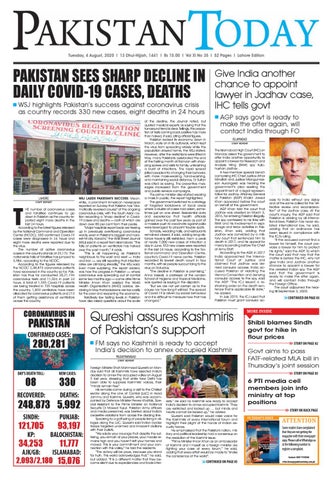
Tuesday, 4 August, 2020 I 13 Dhul-Hijjah, 1441 I Rs 15.00 I Vol XI No 35 I 52 Pages I Lahore Edition
Pakistan sees sharP deCline in daily Covid-19 Cases, deaths g
WSJ highlights Pakistan’s success against coronavirus crisis as country records 330 new cases, eight deaths in 24 hours
LAHORE STAFF REPORT
t
He number of coronavirus cases and fatalities continues to go down in Pakistan as the country reported eight more deaths in the last 24 hours. According to the latest figures released by the National Command and Operation Center (NCOC), 330 confirmed Covid-19 cases were diagnosed in 24 hours and eight more deaths were reported due to the virus. The number of active coronavirus cases in the country stands at 25,172. The nationwide tally of fatalities has jumped to 5,984, according to the NCOC. According to the figures released by the NCOC 2,48,873 coronavirus patients have recovered in the country so far. Pakistan has thus far conducted 20,21,196 coronavirus tests and 11,026 in past 24 hours. A total of 1,595 Covid-19 patients are being treated in 735 hospitals across the country. 1,859 ventilators have been allocated for coronavirus patients and 213 of them getting assistance of ventilators across the country.
WSJ LAUDS PAKISTAN’S SUCCESS: Meanwhile, a prominent American newspaper reported on Sunday that Pakistan has “dramatically reversed course” of the ongoing coronavirus crisis, with the South Asian nation recording a “sharp decline” in Covid19 cases and deaths — both of which are down over 80 per cent from their peaks. “Major hospitals report beds are freeing up in previously overflowing coronavirus wards, even in Pakistan’s biggest and hardest-hit city, Karachi,” the Wall Street Journal (WSJ) said in a report from Islamabad. “The tally of patients on ventilators has halved over the past month,” it adds. “This is all happening as Pakistan’s neighbours to the east and west — India and Iran — are still reporting that infection rates are climbing steadily,” the WSJ said. even more surprising, the report added, was how the progress in Pakistan — where coronavirus was spreading out of control some two months ago — came after Prime Minister Imran Khan resisted the World Health Organisation’s (WHO) advice, declaring in May that lockdowns are too costly for the poor and reopening the economy. Relatively low testing levels in Pakistan have also raised questions about the scale
Coronavirus in
Pakistan
CONFIRMED CASES:
280,281
of the decline, the Journal noted, but quoted medical experts as saying that the turnaround trend is clear. Tellingly, the proportion of tests coming back positive has more than halved, it said, citing official figures. Pakistan locked its economy down in March, early on in its outbreak, which kept the virus from spreading widely while the population stayed home, the WSJ stated. However, after the restrictions were lifted in May, many Pakistanis celebrated the end of the fasting month of Ramzan with shopping sprees and visits to family, unleashing a burst of infections. The rapid spread jolted people into changing their behavior, with more mask-wearing, hand-washing, and maintaining social distance, Dr Sultan was cited as saying. The preventive messages increased from the government and public service campaigns. The prime minister also started wearing a mask in public, the report highlighted. The government switched to a strategy of targeted lockdowns of local areas where a cluster of cases had arisen, sometimes just on one street. Residential data and experience that health officials gained over the past few years as part of a massive push to vaccinate against polio were leveraged to pinpoint trouble spots. Schools, wedding halls, and restaurants remained closed, it said, adding long-distance travel is still restricted. From a peak of nearly 7,000 new cases of infection a day in June, 553 new cases were reported in the last 24 hours, according to the National command and Operation Centre, country’s Covid-19 nerve centre. Pakistan recorded its lowest death count in four months, with six people succumbing to the virus on Saturday. “The decline in Pakistan is promising,” Anna Vassall, a professor at the London School of Hygiene and Tropical Medicine, was quoted as saying in the dispatch. “But we are not yet certain as to the cause nor how long it will last. The spread of Covid-19 is driven by social behaviour and it is difficult to measure how that has changed.”
Give India another chance to appoint lawyer in Jadhav case, IHC tells govt g
AGP says govt is ready to make the offer again, will contact India through FO ISLAMABAD STAFF REPORT
The Islamabad High Court (IHC) on Monday asked the government to offer India another opportunity to appoint a lawyer for Research and Analysis Wing (RAW) spy Kulbhushan Jadhav . A two-member special bench comprising IHC Chief Justice Athar Minallah and Justice Miangul Hassan Aurangzeb was hearing the government’s plea seeking the appointment of a legal representative for Jadhav. Attorney General of Pakistan (AGP) Khalid Jawed Khan appeared before the court on behalf of the government. AGP Khan told the court that Jadhav was arrested on March 3, 2016, for entering Pakistan illegally. The spy confessed to his links with RAW and his involvement in espionage and terror activities in Pakistan, Khan said, adding that Jadhav was convicted by a military court that sentenced him to death in 2017, and his appeal for mercy is pending before the Chief of Army Staff. According to the AGP, in 2017 India approached the International Court of Justice and claimed that Jadhav was denied consular access. India accused Pakistan of violating the Vienna Convention and denying consular access to the spy, said the AGP. “The ICJ issued a restraining order on the death sentence that is applicable till date,” he added. In July 2019, the ICJ ruled that Pakistan must grant consular ac-
Qureshi assures Kashmiris of Pakistan’s support g
FM says no Kashmiri is ready to accept India’s decision to annex occupied Kashmir MUZAFFARABAD STAFF REPORT
DAY'S DEATH TOLL:
08
RECOVERED:
NEW CASES:
330
DEATHS:
248,873 5,992 SINDH:
121,705
PUNJAB:
93,197
KP:
BALOCHISTAN:
AJK/GB:
ISLAMABAD:
34,253
11,777
2,093/2,180 15,076
Foreign Minister Shah Mahmood Qureshi on Monday said that all Kashmiris have rejected India’s decision to annex the occupied valley on August 5 last year, stressing that while New Delhi has been able to suppress Kashmiris’ voices, their “minds remain free”. His remarks came during a visit to the Chirikot sector along the Line of Control (LoC) in Azad Jammu and Kashmir. Qureshi, who was accompanied by Defence Minister Pervez Khattak, Special Assistant to the Prime Minister on National Security Dr Moeed Yusuf, Pakistan Army officers and media personnel, was briefed about India’s ceasefire violations from across the dividing line. Speaking to a gathering of people living in villages along the LoC, Qureshi said Indian border troops targeted unarmed and innocent civilians with their bullets. “We salute your courage that despite the suffering, you remain at your places, your morale remains high and you haven’t left your homes and moved. This is your commitment and your connection with this valley,” he told the residents. “The victory will be yours, because you stand for truth. This world acknowledges that,” he said, but added: “It is a different matter that they become silent due to expediencies and trade inter-
cess to India without any delay and at the same called for the “effective review and reconsideration” of the Jadhav case. At the court’s inquiry, the AGP said that Pakistan is abiding by all international laws. Pakistan has never violated international law, he said, adding that an ordinance has been issued in compliance with the ICJ’s ruling. “If the accused cannot find a lawyer for himself, the court provides a lawyer for him to protect his rights,” said the AGP. To which the court said that now that the matter is before the IHC, why not give India and Jadhav another chance to appoint a lawyer for the arrested Indian spy. The AGP said that the government is ready to make the offer again, and will contact India through the Foreign Office. The court adjourned the hearing till September 3, 2020.
CONTINUED ON PAGE 05
more inside
Shibli blames Sindh govt for hike in flour prices STORY ON PAGE 02
Govt aims to pass FATF-related MLA bill in Thursday’s joint session STORY ON PAGE 03
ests.” He said no Kashmiri was ready to accept India’s decision to annex occupied Kashmir. “They are restricted and locked up … but minds and hearts cannot be locked up,” he added. Qureshi said Pakistan would raise voice for the Kashmiris at every international forum and highlight their plight at the hands of Indian security forces. He emphasised that the Pakistani nation, military and political leadership had a consensus on the resolution of the Kashmir issue. “Prime Minister Imran Khan as an ambassador of Kashmir and I myself as a foreign minister are fighting your case at every forum,” he said, adding that every effort would be made to “shake the conscience of the world”.
CONTINUED ON PAGE 05
6 PTI media cell members join info ministry at top positions STORY ON BACK PAGE in today’s issue
attention Some readers have complained that they are not getting the magazine with their newspaper copy. Please call or WhatsApp us at the following number to register a complaint. Contact: 0307-7338168 irfan.farooq@pakistantoday.com.pk
02
Tuesday, 4 August, 2020
news
SHIBlI BlAmeS SINdH GOvt FOr HIKe IN FlOUr PrICeS ISLAMABAD APP
Federal Minister for Information and Broadcasting Senator Shibli Faraz on Monday said the Sindh government was responsible for the present rise in flour prices as it was not releasing its share of wheat in the market. Addressing a press conference along with Minister for Food Security Syed Fakhar Imam, the minister said that an impression was being given in the market that flour prices were rising. The minister said Punjab and Sindh had higher wheat production but the Sindh government had created a situation that was forcing the people of the province to buy expensive wheat. He said in the past, some people made illicit profiteering by such tactics and nurtured the system of sucking the blood of the people. The profiteers were trying to discredit the government, he said, adding that those responsible for artificial shortages would be dealt with severely. He said most of the people in rural Sindh suffered from malnutrition as the Sindh government did nothing for the well-
FAKHAR IMAM SAYS IT’S THE RESPONSIBILITY OF PROVINCES TO IDENTIFY CARTELISATION
being of its people. He said the rains in Karachi had also exposed the poor performance of the Sindh government. He said the Pakistan People’s Party had pushed the innocent people of
Govt renames Islamabad’s Kashmir Highway as Srinagar Highway ISLAMABAD STAFF REPORT
Pakistan on Monday renamed Islamabad’s “Kashmir Highway” as “Srinagar Highway” to pay tributes to the struggles of the people of Indian Occupied Kashmir. Speaking on the occasion, Minister for Communications Murad Saeed said it will also be known as the “Road to Srinagar”. According to Radio Pakistan, Saeed said the day is not far when the people of Islamabad and Muzaffarabad will collectively offer prayers at Jamia Mosque in Srinagar. Foreign Minister Shah Mahmood Qureshi had announced that Pakistan will mark August 5 as “Yaum-e-Istehsal”, when India revoked Article 370 of its constitution to annex the disputed territory. The whole nation should unitedly raise voice against the military siege imposed by New Delhi in the Indian occupied Kashmir a year ago after the revocation of its special status and convey a message to the Kashmiris that they were not alone in their struggle for the right to self-determination, he said while talking to journalists here after offering Eidul Azha prayer, he had said. “On the day (August 5, 2019), the IIOJK’s flag was downed, the Kashmiris were put behind the bars, and perhaps today no Eid prayer congregation was held in Srinagar,” he said. The Kashmiri people had been facing immense difficulties, pain and persecution under the continued military siege for the last one year, he added.
province into the swamp of poverty with its pathetic policies. The petroleum prices rose in Pakistan due to upward trend in the international market, he said adding that the situation
had not returned to normalcy yet in the country due to the coronavirus pandemic. Addressing the press, Fakhar Imam said that it was the responsibility of the provinces to identify cartelisation. Imam said that the government has written two letters in this regard to the provincial government of Sindh but it is not releasing wheat. He said the government has procured 6.6 million tonnes of wheat this year which is 2.6m tonnes more than last year. He said that Pakistan is the eighth largest producer of wheat in the world. He said the people of Sindh are facing difficulties due to non-release of wheat from the provincial government while a 20-kg bag of flour is available at Rs860 in Punjab province. Imam said that there is cartelization and hoarding in Pakistan. He said he did not understand why the Sindh government wants to create a wheat crisis. The country produced more wheat than the target. The food minister said that if the Sindh government releases wheat, the price will go down significantly. The federation and the provinces are working hard to ensure that there are no complaints about wheat and flour. Wheat will be provided to the common man at the right price, he claimed. Imam said that all the provinces should cooperate with one another and the federal ministry will ensure easy supply of wheat in the country. The Federal Ministry is providing facilities to private sector importers to ensure proper and timely import of wheat.
PML-N won’t support any undemocratic act to remove PM Imran, says Abbasi NEWS DESK Former prime minister and senior leader of the Pakistan Muslim League-Nawaz (PML-N) Shahid Khaqan Abbasi on Monday said that his party will not become part of any “undemocratic act” to remove Prime Minister Imran Khan from office. “This is our firm decision. We will not be used to remove anyone,” Abbasi said during an interview with a private news channel. He, however, clarified that his party does want to oust PM Imran’s government but by using constitutional options. “We will force the government to take the vote of confidence,” Abbasi said, explaining his party’s strategy. He said that the government will itself learn that the time has come for them to go home when they will see their coalition partners parting ways.The PML-N was once considered a pro-establishment party but it changed its path after former prime minister Nawaz Sharif was removed from office following a verdict of the Supreme Court in the Panama Leaks case in 2017. Nawaz was jailed in another corruption case, but later allowed to leave Pakistan to receive medical treatment in London. The party blamed
the country’s establishment for the party’s downfall and its election loss. Abbasi said that what happened in the 2018 elections proved that his party wasn’t liked by the establishment. “The establishment does exist in Pakistan as it exists all over the world,” the PML-N leader said. “They have their own stance and if there is no similarity between your stance and theirs then problems arise.” “If you want to say that there is an establishment, it is certainly here. Does it interfere in the affairs? It certainly does,” Abbasi said. However, he clarified that the PML-N doesn’t want a fight with the establishment but warned that it doesn’t want to be used by anyone. “In the parliamentary system, your vote is not yours but the party’s,” said Abbasi. “If the party has taken a decision then that is my decision too whether I like it or not it’s a separate thing.” But there were other lawmakers in the opposition parties that choose to defy the decision of their parties and didn’t vote in favour of the bill. Senator Pervaiz Rasheed of the PML-N was one of them. Abbasi said that Rasheed didn’t have any right to go against the party’s decision. “I am ready to say it on his face that he doesn’t have the right to do so.”“If he didn’t want to vote then he should have resigned,” the PML-N leader said.
PIA sacks five more pilots over bogus licences KARACHI INP
The Pakistan International Airlines (PIA) said on Saturday it sacked 63 employees in last month on various charges, including fake pilot licences, fake educational credentials, embezzlement and dereliction of duty. PIA spokesperson Abdullah Khan said that the actions had been taken in accordance with the rules. He confirmed that among the 63 laid-off employees, 5 were captains, who were sacked over charges of having fake licences. The PIA fired 28 employees over fake credentials, while 27 employees were sacked for being absent
without notice. Two employees over fired on charges of embezzlement and one employee was fired for incompetence, according to officials. Besides, the airlines demoted four employees for refusing to work, and held back increments to three employees for violating the standard operating procedures (SOPs). The spokesperson said rules of procedure were followed in the process of punishment, which would continue in PIA without any pressure. Last month, the PIA had sacked 17 pilots for having ‘dubious’ flying licences on the order of the federal cabinet. They included 12 captains and five first officers. The sacking followed startling revelations by Aviation Minister Ghulam Sarwar Khan.
Pakistan asks UK to hand over Shehbaz’s son-in-law NEWS DESK Pakistan on Monday asked the British government to hand over Imran Ali Yousuf, son-inlaw of Pakistan Muslim League-Nawaz (PML-N) President Shehbaz Sharif, to it, a private news channel reported. According to the report, Pakistani officials requested the UK authorities to hand over the suspect on ‘reciprocal’ basis to the country as the two countries do not have an extradition treaty in place. The report maintained that the UK government will review the request in due time. It is pertinent to mention here that Daily Mail had leveled corruption allegations against Imran Ali Yousuf and Earthquake Reconstruction and Rehabilitation Authority’s (ERRA) Ikram Naveed. Earlier on June 22, sources privy to the National Accountability Bureau (NAB) had claimed that investigations into former chief minister Shehbaz Sharif and his family’s wealth has thus far revealed benami companies worth Rs 2.40 billion. According to details, the undeclared (benami) wealth was being represented by three different frontmen whose details had been revealed. According to the report, Nisar Ahmed, Syed Tahir Naqvi and Ali Ahmed were all frontmen to the massive wealth which originally belongs to Shehbaz Sharif and his family.
Sharif Group’s CFO remanded in NAB custody for 14 days LAHORE TLTP
An accountability court on Monday handed Chief Financial Officer (CFO) of the Sharif Group of Companies, Mohammad Usman to the National Accountability Bureau (NAB) for 14 days. During the hearing of a plea filed by Usman, NAB Prosecutor Waris Ali Janjua told the court that the CFO had been taken into custody based on the statements of suspects who were arrested previously on money laundering charges. “Mohammad Usman used to launder money for the Sharif family,” the prosecutor told the court. In response, the court questioned Janjua if the suspect had been told on what grounds he had been arrested. The NAB prosecutor replied that the reasons were properly communicated. When the court asked Usman regarding his arrest, the suspect said that the arrest was made two days ago when he was travelling on Multan Road. “The NAB officials told me the reasons behind [my] arrest last night,” he told the court, appealing the court that he [Usman] is a patient of high blood pressure and should be allowed homecooked meals. Meanwhile, Usman’s lawyer told the court that his client was arrested on political basis. “Mohammad Usman is a chartered accountant and a very qualified individual,” the lawyer told the court, stressing that the arrest was not justified. After hearing the arguments, the court handed Usman over to NAB’s custody for 14 days on physical remand. Last year in December, NAB had issued orders to freeze 23 pieces of property belonging to the former Punjab chief minister and his sons Hamza and Suleman Shehbaz over the allegation that they acquired assets beyond their means and were involved in laundering money.
CPNE protests govt raids on newspaper offices, printing presses KARACHI STAFF REPORT
The Council of Pakistan Newspaper Editors (CPNE) has expressed concern over unannounced raids on newspaper and printing houses across the country by staff of the Federal Information Ministry and some individuals, terming such activities as unethical and an attempt to harass the print media. Newspaper offices and their printing houses in all provinces are taking precautionary measures during the long lockdown from the corona outbreak, while news outlets are working with extremely low attendance of staff. The Federal Ministry of Information
should take all stakeholders, including CPNE, into confidence in the aforesaid activities and refrain from entering the news outlets in the style of raids without prior notice and permission as all the media outlets have special security arrangements on the instructions of the Federal Ministry of Information and security agencies to prevent any possible terrorist attacks on the news outlets. In the name of verifying circulation of the newspapers, such raids tantamount to harass the media. Any new system for verification of circulation of newspapers should be evolved with taking into confidence and consultations of all stakeholders, including CPNE. This was stated at an emergent meeting of CPNE office bearers and chairmen
of provincial committees through a video link chaired by CPNE President Arif Nizami. The recent government raids on newspapers office and printing presses were discussed in detail. The meeting said that due to precautionary measures against coronavirus, most of the staff in the news outlets have been detailed to work from their homes, while the newspapers particularly local & regional newspapers across the country are facing severe economic losses which need to be assisted by the government. Hence the recent series of raids on the printing press should be stopped immediately. Moreover the fair, transparent and widespread and judicious distribution of government advertisements and immediate payment of dues to the
newspapers should be ensured. The meeting also observed that newspaper managements are being harassed by issuing unnecessary notices by various regional offices of PID for reclaiming the already submitted documents. The meeting called on the government to stop the unannounced raids on newspapers and printing presses for at least a year in view of the seriousness of the coronavirus epidemic, during which the government and newspapers, including local newspapers, may collaborate to formulate a transparent system for verifying and certifying the genuine newspapers. The meeting also emphasized on fair, judicious, equitable, inclusive and transparent distribution of government advertisements in which local & regional
newspapers are not overlooked. The meeting was attended by CPNE President Arif Nizami, General Secretary Dr Jabbar Khattak, former secretary general Ejaz-ul-Haq, Vice President Sardar Khan Niazi, Vice President Punjab Irshad Ahmed Arif, Vice President Khyber Pakhtunkhwa Dr Hafiz Sanaullah Khan, Deputy Secretary General Amir Mahmood, Finance Secretary Hamid Hussain Abidi, Information Secretary Abdul Rehman Mangrio, Sindh Committee Chairman Ghulam Nabi Chandio, Punjab Committee Chairman Muhammad Haider Amin, Deputy Chairman Ayaz Khan, Khyber Pakhtunkhwa Committee Chairman Tahir Farooq and Deputy Chairman Balochistan Committee Arif Baloch.
Tuesday, 4 August, 2020
news
erdOGAN reIterAteS SUPPOrt tO PAKIStAN ON KASHmIr ISSUe ISLAMABAD
P
STAFF REPORT
resident Recep Tayyip Erdogan has assured Turkey’s support for Pakistan’s stance on the Kashmir dispute, President Dr Arif Alvi said on Saturday. According to a tweet by the President’s Office, the two counterparts held a telephonic conversation in which they “exchanged Eidul Azha greetings” besides discussing the Kashmir issue and the coronavirus pandemic. The tweet quoted President Alvi as saying that occupation regimes were continuing their “extreme repression” in Palestine and Indian occupied Kashmir even during the coronavirus pandemic. “[The] Turkish President assured that his country would continue to support Pakistan’s stance on Kashmir as both brotherly countries have similar goals,” according to a subsequent tweet.
PM IMRAN SAYS PAKISTAN ‘DEEPLY APPRECIATES TURKEY’S STEADFAST SUPPORT’ ON DISPUTED VALLEY Erdogan also invited Alvi to visit Turkey after the end of the pandemic. While congratulating Erdogan on the reopening of Istanbul’s historical Hagia Sophia as a mosque after nearly nine decades, President Alvi “reiterated Pakistan’s steadfast support to Turkey on its legitimate interests and assured that Pakistan will continue its policy to provide Turkey with all possible support”. The Turkish leader also called Prime Minister Imran Khan and the two leaders shared their views on a range of issues. The prime minister too felicitated Erdogan on reopening of the Hagia Sophia for prayers and told him that “millions of Pakistanis watched it live on television”, according to a tweet by the Prime Minister’s Office (PMO).
No one understands spirit of sacrifice better than a soldier, says Gen Bajwa
During their conversation, Prime Minister Imran recalled Erdogan’s visit to Pakistan for the sixth session of the High-Level Strategic Cooperation Council (HLSCC) in February and reaffirmed Pakistan’s commitment to “further fortify bilateral cooperation” in all areas. “Pakistan deeply appreciates Turkey’s steadfast support for the just cause of Kashmir, which President Erdogan reaffirmed during his address to the joint session of parliament in February 2020,” the PMO said. Erdogan’s contact with the Pakistani leadership comes days before the world marks one year since India revoked the semi-autonomous status of occupied Kashmir and split it into two federal territories, causing further determination in
IHC takes officials to task over animal deaths at Islamabad Zoo ISLAMABAD STAFF REPORT
RAWALPINDI STAFF REPORT
Chief of Army Staff (COAS) General Qamar Javed Bajwa on Saturday said that Pakistan was aware of the enemy’s design to destabilise the country and the region, adding that the army was fully prepared and capable of thwarting any such “covert or overt undertakings”. According to Inter Services Public Relations (ISPR), he said this while visiting troops deployed on frontlines along the Line of Control (LoC) in Khuiratta Sector as the nation celebrates Eidul Azha. “No one understands this spirit of sacrifice better than a soldier,” he said while interacting with troops, adding that Eidul Azha epitomises the essence of unconditional sacrifice. “Let us also reiterate our pledge to always stand by our Kashmiri brethren braving Indian atrocities for their right of self-determination despite all odds,” ISPR quoted General Qamar as saying. The army chief said that we are aware of the enemy’s design to destabilise our country and this region. “Pakistan Army is fully prepared and capable of thwarting any such covert or overt undertakings.” The COAS spent time with troops on the first day of Eid and commended their high morale, operational readiness and continuous vigil being maintained along the LoC. Corps Commander Rawalpindi Corps, Lieutenant General Azhar Abbas received the army chief at the LoC. Later, General Bajwa also visited Armed Forces Institute of Cardiology And National Institute of Heart Diseases (AFIC and NIHD) and performed the groundbreaking of NIHD Centre of Excellence in Prevention and Cardiovascular Research and Development (NEPCARD) where indigenous research on heart diseases will be carried out including their preventive measures. Appreciating contributions of Army Medical Corps, the COAS said that AFIC and NIHD being state of the art facility is providing high-quality medical care at the national level. He especially lauded the contribution of doctors and healthcare workers as frontline soldiers against the Covid-19 pandemic. Lieutenant General Muhammad Aamer, Adjutant General Pakistan Army and Lieutenant General Nigar Johar, Surgeon General Pakistan Army received the COAS upon his arrival at AFIC and NIHD.
New Delhi’s ties with Islamabad. IMRAN, ERDOGAN DISCUSS ANTI-VIRUS STRATEGY: Prime Minister Imran during the phone call also appreciated Turkey for its role in the fight against Covid-19 and for extending support to a number of countries, including Pakistan. The premier briefed Erdogan on his government’s strategy to contain the spread of the virus in Pakistan and the particular focus on “saving lives, securing livelihoods, and stimulating the economy”, according to a PMO statement. The two leaders also discussed the need for Pakistan and Turkey to jointly work for medicine development. “The Pakistan-Turkey strategic relationship is underpinned by unique mutual trust, understanding and close cooperation,” the premier’s office noted. It said that Prime Minister Imran and President Erdogan resolved to “stay in close contact on all issues of common interest”.
The Islamabad High Court (IHC) on Monday summoned the chairperson of the Wildlife Management Board and the secretary of ministry of climate change, sought names of wildlife officials, and hinted at contempt of court proceedings against Climate Change Minister Zartaj Gul and Special Assistant to the Prime Minister on Climate Change Malik Amin Aslam in a case pertaining to deaths of animals at Islamabad Zoo. Hearing the case, IHC Chief Justice Athar Minallah said that it appeared that the animals died due to incompetence of the Wildlife Management Board. According to the May 21 ruling, the board was responsible for the transfer of animals, remarked the court, adding that on March 16 the notification of the wildlife management board was submitted with approval of the federal cabinet. The court was informed that the lions are being shifted to Lahore instead of a sanctuary, recalled the court. The Ministry of Climate Change seems to be more interested in taking control of the management than in the transfer of animals, the court observed. The petitioner’s lawyer stated that the lions were being shifted to Lahore when they died. The court observed that this pointed towards incompetence of the board. The Climate Change Ministry, Metropolitan Corporation Islamabad, and the Capital Development Authority are all engaging in politics, remarked Justice Minallah. “No one is prepared to take responsibility of the zoo,” he added. Reminding that the court had asked in its earlier decision as to who would be responsible if anything hap-
pened to the animals, Justice Minallah directed Deputy Attorney General Tayyab Shah to read the court’s earlier decision with regards to the zoo. Justice Minallah observed that the federal government had notified who would be on the board. “Who is the SAPM on climate change?” asked Justice Minallah. Noting that Zartaj Gul is the minister for climate change, Justice Minallah wondered whether it would be best to initiate contempt of court proceedings against all the members of the board. The judge also expressed anger at the incompetency that led to the deaths of the animals. He asked whether an FIR has been registered for the negligence and inquired about the investigation into the matter. He asked whether the ones whose negligence led to the deaths are the ones investigating the matter. Directing his ire towards the federal government and the wildlife management board, Justice Minallah sought details of the officials and adjourned the hearing till Tuesday. Animals at the zoo are being transferred to other zoos or private sanctuaries across the country following directions from the Islamabad High Court (IHC) to protect them from mismanagement at the zoo. However, the process has proved to be deadly for some animals. So far, as many as 10 animals held at the zoo have died over the past month during attempts to transfer them to sanctuaries due to the alleged incompetence and negligence of the caretakers. Meanwhile, the Ministry of Climate Change has set up a highlevel inquiry committee to probe the deaths of animals at the Islamabad Zoo. A statement issued by the ministry last week, stated that committee will be chaired by the Ministry of Climate Change Additional Secretary Joudat Ayaz, and it will look into the causes of the recent deaths of animals at the zoo including lions, ostrich and other animals if any.
03
Urban flooding threatens Karachi, lower Sindh amid more rain KARACHI: The Pakistan Meteorological Department (PMD) has issued a warning that Karachi and lower Sindh can suffer from urban flooding in the days to come, as the fourth looming monsoon spell may wreak more havoc in the province than the earlier three spells. The institution predicted that the fourth spell of monsoon rain in Karachi, which is forecast from August 7-8, can result in more rain than the previous three spells. A low lying pressure system, formed in the Bay of Bengal, is expected to enter Sindh on August 6. “Under the influence of this weather system strong monsoon currents are expected to penetrate in Sindh, South Punjab and Eastern Balochistan from Thursday (evening/night) to Saturday,” the PMD noted in its latest advisory. “Widespread rain/wind-thundershowers, with isolated heavy to very heavy falls are expected in Karachi, Hyderabad, Thatta, Badin, Tharparker, Umerkot, Mirpurkhas, Sanghar, Tando Allah Yar, Matiyari, Tando Muhammad Khan, Jamshoro, Dadu and Shaheed Benazirabad from Thursday (evening/night) to Saturday.” The PMD said that heavy downpour may generate urban flooding in Karachi and Hyderabad and flash flooding in hill torrents of Khuzdar on Friday and Saturday and advised the authorities to stay alert during the period. Last week, the Pakistan Army was called in to help the local administration in managing and dealing with the urban flooding crisis in Karachi. According to the Inter-Services Public Relations (ISPR), the “Army [was] called to assist civil administration for managing the urban flooding situation in Karachi”. STAFF REPORT
Govt aims to pass FAtF-related mlA bill in thursday’s joint session ISLAMABAD: A joint sitting of parliament would be held on Thursday in which the government would table seven bills, including the mutual legal assistance (MLA) bill for approval, according to a media report. The president on Monday convened the joint sitting of the parliament on Thursday under Article 54 (1) of the Constitution. According to reports, the government and opposition would meet on August 5, Wednesday, to discuss the MLA bill. The federal government faces a challenge to get the country out of the grey list of the Financial Action Task Force (FATF), the reports said, adding that the government has to send its implementation report to the FATF by August 6. To get out of the grey list, the government has to amend three key bills as per FATF requirements, said the sources. The government had completed legislation on two bills while the third, the MLA bill, will be tabled in the joint sitting on August 6. Before tabling of the bill, the government would seek the cooperation of the opposition for the approval of the bills, sources said. The National Assembly had already passed the bills, while those could not be passed by the Senate had already been sent to the joint sitting. The other bills sent to the joint sitting, pertained to increasing the number of judges of the Islamabad High Court, rights of persons with disabilities, survey and maps, the Federal Public Service Commission, and the Pakistan Medical Commission and Pakistan Medical Tribunals. STAFF REPORT
Kuwait aviation bans flights to 31 ‘high risk’ countries, including Pakistan, over Covid-19 fears KUWAIT CITY AGENCIES
Kuwait has banned commercial flights to 31 countries, including Pakistan, regarded as ‘high risk’ due to the spread of the coronavirus, the Directorate General of Civil Aviation said on Saturday. The ban will remain in place until further notice. Apart from Pakistan, the countries include India, Egypt, the Philippines, Lebanon and Sri Lanka, which all have large numbers of expatriates in Kuwait. The list also includes China, Iran, Brazil, Mexico, Italy and Iraq. The ban was announced the same day Kuwait began
a partial resumption of commercial flights. The authorities have said Kuwait International Airport would run at about 30 per cent capacity from Saturday, gradually increasing in coming months. Kuwait, which has recorded nearly 67,000 coronavirus cases and more than 400 deaths, began a five-phase plan at the start of June to gradually lift restrictions imposed to curb the spread of the virus. A partial curfew remains in place. In June, three UAE airlines including Emirates, Etihad and Fly Dubai had suspended flight operations to Pakistan after several outbound passengers tested positive for the novel coronavirus.
Emirates suspended its operations after 30 Pakistani passengers bound for Hong Kong tested positive for Covid-19, saying that the airline was “coordinating closely with the various authorities and will review and implement any required additional measures to satisfy all parties before we resume services from Pakistan”. Soon after Emirates’ announcement, Fly Dubai and Etihad took the same decision and suspended operations for outbound passengers. A few weeks after suspension of services, Emirates and Etihad Airways resumed flights from Pakistan for passengers who tested negative for Covid-19.
04
Tuesday, 4 August, 2020
NEWS
Muggers open fire on police in Raiwind, two cops injured LAHORE: At least two cops have been injured in Raiwind area of the Lahore after an encounter ensued between police team and muggers on Sunday. According to police, the cops intercepted muggers in Raiwind area, who opened fire on the police party as they chased them. The two cops, one of them an assistant sub-inspector while the other one a constable, sustained bullet wounds, they said adding that the accused were able to flee from the incident site. STAFF REPORT
Massive drain clearing drive begins in Karachi KARACHI
P
STAFF REPORT
AKiSTAn Army and FWO teams reached Gujjar nullah here on Monday morning to assist the civilian authorities in clearance of the city’s mostly encroached sewerage drains. The Frontier Works Organisation (FWO) personnel have reached Gujjar nullah with over 50 dumpers, cranes and other machinery to remove garbage, which had chocked free flow
of the water in the drain in recent rainfall and submerged adjacent area. Paramilitary Rangers personnel have also been deployed at the site of the drain clearance work. The drive has been launched under the oversight of the national Disaster Management Authority (nDMA). The garbage from the sewerage drain being immediately transferred to the landfill site. The drain clearance work has also been started at ‘Cafe Piala’ in Federal B’ Area of Karachi with heavy machinery and other equipment.
nDMA Chairman Lt. General Muhammad Afzal on Sunday in a media briefing in islamabad said that nDMA was tasked to clear encroached nullahs in Karachi and asked the federal and the provincial authorities to sit together to resolve the city’s long-standing issues as temporary measures would only subside them rather than solving them permanently. Muhammad Afzal said that the nDMA has launched the cleanliness drive in the city and would take measures to minimize the effects from rainfall as compared to the past.
Punjab lifts Eidul Azha smart lockdown LAHORE STAFF REPORT
The government of Punjab on Sunday announced it was lifting the “smart lockdown” imposed in certain cities in the province from Monday, August 3. According to a notification issued by the Primary and Secondary Healthcare Department, “All educational and training institutes, marriage halls, business centres, expo halls, restaurants (except takeaway and home delivery), theme/amusement parks, public parks, play areas and arcades, beauty parlours and spas, cinemas, theatres shall remain closed.” The notification added there would be a complete ban on sporting tournaments/ matches (indoor and outdoor) except non-contact professional sports without spectators. “There shall also be a complete ban on gatherings of all kinds for social, religious, or any other purpose at any place, public or private,” it said. The notification further said, “All businesses, factories, facilities, premises, retail shops, shopping malls and plazas except the aforementioned negative list, are hereby allowed to operate subject to adoption of SOPs/guidelines from 9am to 7pm Monday to Friday.” A complete lockdown shall be observed on
Saturday and Sunday except for medical services and pharmacies/medical stores, tire puncture shops, atta chakkies, postal/courier services, driver hotels, petrol pumps, oil depots, LPG outlets and filling plants, agriculture machinery workshops and spare parts shops, printing press, call centres (with 50% staff and no public dealing), takeaway/home Delivery from restaurants (24 hours a day). Grocery stores, bakeries, kiryana stores, fruit and vegetable shops along with chicken, meat and milk shops to remain open from 6am to 12am, while inter-city and inter-district public transport will remain operational 24 hours a day. Churches will remain open from 9am to 7pm on Sundays. The Punjab government on July 27 had announced markets across Punjab would remain close till August 5 in line with the government's measures to stem the spread of coronavirus during Eid-ul-Adha. However, trade organisations of Lahore had rejected the government's orders and had opened the markets. Several shopkeepers were detained in Gujranwala for violating lockdown and showing resistance over the provincial government's earlier orders, whereas, four shops were sealed in Sargodha and three shopkeepers were fined.
He said there are chances of another spell of rain in the city from 7 to 9 August. Addressing a media briefing in islamabad, he said that six days of August are important for Karachi as there is a prediction of rainfall in the city from 7 to 9 August and then a weak system would remain in the city, which would cause little drizzle from time to time in the metropolis till August 15. He said that 83 mm rain was recorded in Karachi during one hour in a day previously after which the Prime Minister directed him to reach the city to carry out relief activities. The water was, however, drained out when i reached Karachi, Muhammad Afzal said. “Karachi issues could only be solved after realizing the issues faced by the city,” he said and added that 20,000 tonnes of garbage was generated in the city daily but there is no mechanism to dispose it off.
Aleem urges Sindh govt to release subsidised wheat to millers LAHORE STAFF REPORT
Punjab Senior Minister Abdul Aleem Khan on Monday asked the Sindh government to immediately provide wheat to flour mills at subsidised rates on the lines of Punjab and Khyber Pakhtunkhwa. Addressing a press conference here, Khan asked the Sindh government to give up its indifference and show mercy to people so that supply of wheat at low rates could be started in Sindh. He said that after supply of the government wheat to flour mills at low rates across Punjab, a 20kg bag of flour is available at Rs860 but when it crossed Rahim Yar Khan and entered Sindh, it is sold at more than Rs1,200. He also said that according to the Constitution of Pakistan, no province could stop the inter-provincial transportation of wheat or flour, so Punjab has had to bear this burden. Khan appealed to Sindh Chief Minister Syed Murad Ali Shah to immediately intervene in the matter and ensure supply of wheat to flour mills in Sindh at low rates and decrease the price of flour at Punjab level. He insisted that if Punjab and KP could provide cheap flour then the Sindh government could also do so. The senior minister stated that 17,000 tonnes of wheat was being supplied to flour mills in Punjab daily which has been increased to 32,000 tonnes during Eid days. He mentioned that they had 10 months stock and wheat should start being imported before December in which Punjab’s share would be 0.7 to 0.8 million tons. He said that so far orders had been issued to import 0.444 million tonnes of wheat.
Tuesday, 4 August, 2020
NEWS
05
With a heavy hand, india rides out occupied Kashmir’s year of disquiet SRINAGAR
t
AGENCIES
HE scars of last summer remain in Soura, an enclave that became a symbol of occupied Kashmir’s resistance to India’s central government a year ago on Wednesday. Coils of concertina wire, remnants of makeshift road blocks, lie close to the broken tar of roads dug up to keep the security forces of Prime Minister Narendra Modi out of this area of 15,000 people in occupied Kashmir’s main city of Srinagar. A year after stripping occupied Kashmir of its autonomy, Modi’s government has prevented widespread protests and violence, with a heavy hand on people who for weeks had barricaded themselves in and staged protests, hurling stones at federal troops armed with pellet guns and tear gas. Security forces eventually broke through. But local politicians warn that anger is rife with young men still picking up arms — and stones. This Himalayan region has been at the heart of tensions between Hindu-majority India and Muslim Pak-
istan for decades, the cause of two of the three wars between the nuclear-armed neighbours. Both countries claim the region in full, but each rules only in part. On Aug 5, 2019, Modi split the state of occupied Jammu and Kashmir into two federally controlled territories and took away its special privileges, saying this was necessary to better integrate the region with the rest of India. New Delhi flooded troops into the Muslim-majority valley, where armed Kashmiris have struggled since the 1990s. India detained thousands, imposed harsh movement restrictions and forced a communications blackout. Many of those measures have since been eased, but the internet remains throttled and a subsequent Covid19 lockdown — India has the world’s third-highest coronavirus infections and rising fast — has forced millions of Kashmiris to stay in their homes for 12 months. “The government said that they did it for the good of Jammu and Kashmir. What good things have happened since then? They have destroyed our economy,” said Mohammad Yusuf Tarigami, a former lawmaker. “Where is the development?” Modi’s government says it has undertaken reforms but that the pandemic, hitting occupied Kashmir hard
Qureshi assures Kashmiris of Pakistan’s support CONTINUED FROM PAGE 01 The minister noted that India was giving a false impression about the resumption of normalcy in occupied Kashmir. “If the situation is normal then why are the bodies of martyrs not being returned? It is because they are afraid of the reaction,” he said, adding that New Delhi had deployed 900,000 troops in the region for the same reason. “They are degenerating psychologically, while you are winning this fight with determination,” Qureshi said. He told the villagers that the Kashmir Highway in Islamabad had been renamed as the Srinagar Highway “because our destination is Srinagar”. He said the day was not far when Kashmiris “will offer prayers of gratitude at Srinagar’s Jamia mosque”. Following the visit, SAPM Yusuf said he was “so proud of our armed forces for defending Kashmiris
against constant Indian aggression and CFVs (ceasefire violations)”. He paid tribute to the resolve of the victims of the Indian firing to “support the goal of their Kashmiri brethren for self-determination and liberation from illegal Indian occupation”. “I appeal to the entire nation to join in solidarity with our Kashmiri brothers and sisters in IIOJK on #YoumeIstehsal. If they keep suffering, we keep suffering,” he tweeted. The ministerial visit to the LoC comes as the world prepares to mark one year on Wednesday since India revoked the semi-autonomous status of occupied Kashmir and split it into two federal territories, causing further deterioration in New Delhi’s ties with Islamabad. Last week, the government had called for observing the first anniversary of occupied Kashmir’s annexation on August 5 as Yaum-i-Istehsal (Day of Exploitation) with full enthusiasm as it rolled out a range of activities planned for the occasion.
like the rest of India, got in the way. Reforms include legal changes to help non-Kashmiris who can now apply for government jobs and secure seats in colleges for their children, 10,000 new government jobs, extending federal schemes to the territory and bolstering the village-level administrative system. “We have to try and win public sentiment,” a government official told Reuters, adding there is a push to improve roads, water and electrification. Indian occupied Jammu and Kashmir police chief Vijay Kumar said security forces had kept up the pressure on the uprising, killing 138 fighters in the year to July, slightly more than the 129 killed in the same period last year. Still, officials express concern that there is little sign of a let-up in disaffected youth joining the armed revolt. This year around 60 new recruits have joined the groups through July, compared with 80 for the same period last year, according to a government estimate. “The challenge would be how do we tamp down the recruitment,” the government official said. SYMBOL OF RESISTANCE: Two of Fatima Wani’s three sons have found little work as labourers in the past
Give India another chance to appoint CONTINUED FROM PAGE 01 In view of the ICJ judgement, the federal government had promulgated the International Court of Justice (Review and Reconsideration) Ordinance, 2020 on May 20 for an effective review of the case. The ordinance read that a foreign national — either themselves or through their authorised representative or through a consular officer of mission of their country — might file a petition before a high court for a review and reconsideration in terms of Section 3 of an order of conviction/sentence of a military court operating under the Army Act 1952. It is also stated that the petition for review and reconsideration could be filed within 60 days of the promulgation of the ordinance. Since the ordinance was issued on May 20, the deadline expired on July 20. In its petition before the IHC, the government has moved
How AI can help Pakistan fight its many battles LAHORE KK SHAHID
Even before Covid-19, Pakistan was dealing with multipronged crises, ranging from the economy to health, and digital rights. The pandemic, however, has significantly exacerbated the crises. The precipitously rising problems have, in turn, given rise to global calls for similarly urgent solutions. In a world, where social distancing has become a basic necessity to fight the pandemic, digitization is an integral part of any solutions. Artificial Intelligence (AI) and big data have been its vanguards. But where AI is helping the world address the economic and health challenges, it has simultaneously raised alarm bells over possible misuse as states up the ante on surveillance. In Pakistan, where both the crises and rights concerns are significantly higher, AI practitioners are engaged in multiple battles to ensure collective uplift. One such firm is Mountainise, which is providing solutions in Marketing Technology (martech) and Health technology (healthtech). Having received funding from Google and Segment.io, Mountainise is helping struggling businesses cope with the economic crunch through Lucrative AI. In this interview, Muhammad Jalil, the Founder of Mountainise discusses how AI can help Pakistan fight the economic and health crises, while addressing the growing digital rights concerns. How can Pakistani businesses benefit from Artificial Intelligence? Muhammad Jalil: Simply put, Artificial Intelligence just takes raw data from business and converts it into actionable insights through machine learning. Enterprise Resource Planning (ERP) and Cost Per Mille (CPM) are the main sources of information for the AI system, which uses analytical and predictive capabilities to convert data into prediction models as well as prioritization of higher customer lifetime value expectancy. So the benefits for businesses are unlimited essentially because with the analysis and performance optimization, as we deploy at Lucrative AI, firms can prioritize objectives and allocate resources to make the most effective decisions. As a natural consequence of smart and calculated decision making, sales and marketing will see an increase in output without any increase in input and that really is the beauty of AI. Businesses don’t have to input anything additional to gain benefit from the AI system. For instance, Lucrative AI just organizes and optimizes decision making on the basis of existing data. For Pakistani businesses, this is an exciting opportunity to predict post-pandemic market situation and leverage their resources to get the most
out of them. Not to mention, a better and more personalized understanding of their customers’ journey, through AI, is sure to improve sales and profits even in a postCovid economy. Can AI be beneficial for small and medium businesses? MJ: AI can be designed for all types of businesses because it utilizes information to optimize business performance, so obviously there is something on offer for smaller businesses as well. In fact, small businesses can be streamlined more easily because they are more agile and have the capacity to move around their resources easily. With the predictive models, machine learning and information analysis of AI, small businesses will be able to stay afloat by allocating resources to essential areas. We have to understand that AI relies on information and even in the middle of this pandemic there is plenty of information circulating. That is why Lucrative AI, along with other AI systems, offers immense benefits to small and medium enterprises as well. Most of all, machine learning can help these smaller businesses stay on top of the crisis and manage their marketing and sales strategy according to the situation. As the demands and needs of consumers have shifted during the pandemic, so too can the strategy and business decision of small and medium enterprises in accordance with the consumers. AI helps analyze the consumer journey so there’s no reason why it shouldn’t provide small and medium businesses with the tools to survive in the middle of a crisis where consumers are still indulged in consumption. How has Artificial Intelligence progressed in Pakistan in recent years? MJ: Even though the progression of Artificial Intelligence has been slow in Pakistan, yet the digital age has arrived and now we are seeing some real progress on this front. Tech businesses in Pakistan have realized the value in using artificial intelligence to analyze information and gain a competitive advantage in dynamically changing industries. This is why we have seen an explosion in the number of online businesses and e-commerce sites in Pakistan. Particularly in the case of Artificial Intelligence, the President’s Initiative on Artificial Intelligence and Computing (PIAIC) was started in 2018 which shows that the country is now beginning to take it seriously and explore the opportunities presented by AI. In the face of the current pandemic, AI has huge implications since it can be used by the healthcare system to deal with the load of the pandemic. However, in order to progress further and rapidly in the field of AI, Pakistan needs to develop programs specifically targeted at harnessing this potential. Even though PIAIC is a step in the right direction, Pakistan still has much to do in order to
CMYK
12 months, making it difficult to make ends meet. But the 62-year-old housewife’s worry is with her eldest son, picked up for allegedly taking part in a protest and booked under the Public Safety Act, which allows for detention for up to two years without charge. About 150 people arrested last year are still detained, two-thirds of them charged under the law, according to government data. Wani said her family had to sell a cow to pay for their travel to the northern town of Agra to meet her son in prison. “He is innocent,” she said, tears rolling down her cheeks. “I want justice.” Police chief Kumar said arrests had been made of stone-throwers and associates of fighters trying to stir up violence in the streets, some of whom had been booked under the security act. In Soura, the indignation remains. A young man, who gave his name as Sahil and claimed he had been detained three times by police for clashing with troops, said he wasn’t going to back down. “We are being suppressed, and I will fight against that suppression in whatever way I can,” he said. “I will continue stone pelting.”
be able to gain practical advantages by artificial intelligence especially in areas such as healthcare and agriculture where there is immediate need of technological advancement. How can the government’s Digital Pakistan initiative boost the MarTech industry in Pakistan? Do you have any suggestions for the government? MJ: The digital marketing initiative taken by the Pakistani government is important in the future development of the MarTech industry since it lays the foundations for new entrepreneurs to get involved in the field. Some of the key features of the Digital Pakistan initiative will help excel the MarTech industry, particularly the establishment of digital infrastructure improving connectivity and access to the internet throughout the country and the education of the youth regarding digital technologies and latest trends. This initiative is likely to motivate entrepreneurs to take the next step in their journey and establish startups that help promote the MarTech industry of Pakistan. Of course, for a lasting and positive impact on the MarTech industry, the government will need to introduce digital marketing education as a compulsory course in regular universities and incentivize educational institutes to educate students regarding the tools and technologies that will help them in establishing startups. Particularly, it will help the development of advanced technologies in Pakistan that will help our country rival India and other rising economies in their digital boom. For that sustained efforts are necessary, over the course of many years because this is a necessary initiative that cannot be abandoned now. Covid-19 has created a financial crisis the world over, especially for a crisis-struck economy like Pakistan. Can AI and big data help address the broader economic crisis? MJ: To a large extent, yes. AI is all about organizing and analyzing data to make the best decision possible. The current financial crisis requires a series of well calculated decisions to be made to minimize the impact of Covid-19 and quicken the recovery process for the economy. Of course, this cannot be an isolated process and it must be integrated with the overall effort and economic policies of the government. Big data in particular can help manage the data related challenges in the financial sector of Pakistan by predicting the future of markets and allowing the government and related authorities to take action accordingly. The biggest advantage of AI and big data in this financial crisis is the ability to eliminate uncertainty. Since these technologies are designed to provide accurate insights that help in decision making, so by utilizing them properly, struggling economies like Pakistan can understand the economic challenges and conditions that will
the IHC to appoint a counsel to review and reconsider the verdict of the military court in accordance with the decision of the ICJ. The Judge Advocate General (JAG) branch of General Headquarters (GHQ) and the Ministry of Defence have been made parties in the petition. The government has further stated that Jadhav refused to file a review petition or an application to reconsider the verdict, adding that he did not have independent sources to hire counsel to represent him. On July 16, Pakistan offered India third consular access to Jadhav as the day before Indian diplomats walked out of the meeting without hearing him. According to the petition, the Indian spy cannot appoint a legal representative in Pakistan without the assistance of India, while New Delhi is also reluctant to avail the facility under the ordinance. The petition requested the court to appoint a legal representative for Jadhav so that Pakistan could fulfill its responsibility according to the ICJ’s ruling.
present themselves as the world recovers from the pandemic. In such a situation, having the decisiveness and ability to act in time to mitigate the long term effects of the pandemic will be crucial for the economy and with AI and Big Data, this can be done. How has covid-19 impacted the AI industry in general and Mountainise in particular? MJ: Covid-19 has swiftly forced industries to automate which has allowed AI to become more involved in industries it was not so involved in before. Particularly as e-commerce has seen an increase in activity, so AI has come to the forefront by offering innovative solutions to the increase in buying and selling that is taking place online. Even in industries such as healthcare and agriculture, the need for automation increased when the pandemic began which has opened up opportunities for AI and it will give people an opportunity to see that AI can provide more benefits than the old fashioned way of doing things. At Mountainise, the impact of Covid-19 has been similar to the rest of the industry. Employees work from home and online office spaces have become important in coordinating team activity. However, the level of performance has remained steady since the people at Mountainise are dedicated professionals. The pandemic has not stopped Mountainise from expanding the team however, and we have taken on new members since we believe that promoting employment in such a dire time is an effective way to give back to the community and contribute positively. Even though a remote culture has developed for the time being, the pandemic has allowed us to take advantage of an unprecedented situation and improve performance for ourselves and our clients. Whenever there is a question of AI and big data, there are privacy concerns as well. How does Mountainise ensure that the data that it processes isn’t mishandled and remains secure? MJ: The AI and Big Data technologies are all based on information and data. So if the protection of that data cannot be guaranteed then clients do not have any reason to trust us or come to us for their benefit. That is why Mountainise takes special care to ensure the privacy of its clients’ data and information. The data of our clients as well as the end user is equally important for us and it is our bread and butter. That is why we implement industry standard procedures and policies in protecting their data. No sensitive information is ever shared with third parties that are not specified by us beforehand and the data of all of our clients is protected through transparency. We are upfront about the type of data we collect, why we collect it and how it is used throughout the process. This provides clients with a sense of assurance and privacy. Any sharing of sensitive information is completely disclosed to the client because we believe that the protection of rights, property, or personal safety of Lucrative, any of our end users, or any member of the general public is extremely important and should be guarded at all times.
Tuesday, 4 August, 2020
06 COMMENT
Preference for difficulty over ease
Depriving Occupied Kashmir of its identity August 5 is a dark day for the Kashmiris
On sadism masquerading as religion
B
Y revoking Indian Constitution’s Article 370 on August 5, 2019 the BJP government stripped the occupied Kashmir of its autonomy after seven decades. the Article allowed the state to have its own constitution, a separate flag and freedom to make laws relating to permanent residency, ownership of property and fundamental rights. two months later the state was bifurcated into two Indian-administered union territories, one called Jammu and Kashmir and the other Ladakh. Over two thousand Kashmiri politicians, students, lawyers and businessmen were arrested, with some removed to jails outside occupied Kashmir while a lockdown-longest ever in history- was clamped on the Valley amidst widespread public protests. Being a party to the dispute, Pakistan strongly opposed the Indian measures. India had provoked China also by laying claims to Chinese territory after taking over the administration of Ladakh. Indian obduracy led to clashes between Indian and Chinese troops, particularly at Galwan on June 15, leading to the death of 20 Indian troops. the dispute still remains unresolved. Pakistan is under obligation to provide moral and political support to the Kashmiri people. Pakistan government has announced observing August 5 as a day of protests against the Indian move to deprive the Kashmiris of their constitutionally guaranteed autonomy. President Alvi would lead a walk in Islamabad to be followed by a media interaction to highlight the Kashmir issue. PM Imran Khan would address the Legislative Assembly of Azad Jammu and Kashmir after a solidarity walk joined by AJK president and prime minister in Muzaffarabad. the day will be marked by holding worldwide rallies, solidarity marches led by the country’s top leadership, a parliamentary session devoted to Kashmir issue, renaming of an inter-provincial highway and special postal stamps with a hard-hitting depiction. Pakistan needs to provide maximum moral and diplomatic support to the oppressed people of occupied Kashmir. Islamabad also needs to launch a strong diplomatic push on various international forums. It needs to mobilise its embassies to highlight the plight of the Kashmiri people and Pakistan’s demand for the issue to be resolved in accordance with the UN resolutions and the aspirations of the Kashmiri people expressed through an internationally organised referendum. While being fully prepared to defend itself, Pakistan has to avoid taking recourse to jingoistic slogans.
HASAN AFTAB SAEED
I
t may not be conscious on the part of the more ardent religious folks, but this comes to the fore every so often when one converses with them. Its last instance was a few days back during a discussion on the lunar calendar. My opponent kept presenting arguments in favour of visual observation. I kept giving counterarguments. After this toand-fro that went on for a while, he remarked (by way of signalling the conclusion of the discussion) that the only reason behind the very debate was ‘desirability seeking its room in Islamic jurisprudence’ (as if it were a crime!). When was desirability not a part of Islamic jurisprudence? I asked. Was it not the Prophet (Peace Be Upon Him) himself who instructed: Yassiru wa la tuassiru [Make (matters) easy and not difficult]? I failed to get a response to this. the general approach among Muslims for many centuries now has been exactly the opposite of this instruction. Which is very unfortunate because countless debates over many an issue get affected by this sadistic preference for making life difficult for others, a preference that seems to have pervaded the very DNA of our religious classes. It is not as if anybody is advocating changing the black and white parts of religion in the interest of convenience or ease. What is under discussion are the grey areas, especially problems raised by new inventions and the societies based on them, problems for which there are no explicit instructions. If, in such
Rains and politics
F
OR the citizens of Karachi, the catastrophe created by monsoon rains is an annual event. the city’s sewerage and drainage system is ill-equipped to handle heavy continuous rainfall for more than a couple of hours, at which point water starts to collect on the roads. this coupled with a perpetual waste management problem, whereby only between 2,000 and 3,000 tons of the 20,000 tons of waste that is generated daily, is picked up and processed, results in the spontaneous formation of small garbage infested lakes in different parts of the metropolis. Destruction of private and public property is one consequence of the twin problems; death due to rain-related incidents is another more serious outcome. Both the PPP and MQM, running the province and Karachi for over more than a decade, have miserably failed at addressing these issues for years. As is typical in such circumstances, the Federal government sees this as an opportunity to criticise the Sindh government for its incompetence. the MQM, being an ally of the ruling party in the center, gets a pass. Chairman PPP Bilawal Bhutto has recently gone on the warpath against the PtI government both inside and outside of parliament. In the backdrop of such mudslinging between the center and the Sindh government, it was to be expected that any move by the former to come on to the latter’s turf and address these problems would create another crisis. therefore, Prime Minister Imran Khan, showing some political savvy, tasked the NDMA and the Army to clean up Karachi. While the PPP can stop the center from intervening in provincial matters, it cannot do the same when it comes to the NDMA, Rangers and the army. NDMA Chairman Lt Gen Mohammad Afzal, while announcing the commencement of work to clean major storm-water drains, explained that their short-term goal was “disaster mitigation” and to prepare the city to tolerate upcoming spells of rain. His advice for ‘all stakeholders to come on board, create consensus and formulate a long-term plan to find a permanent solution’ should be considered by the federal, provincial and district-level governments. Such an outcome seems unlikely however, given the heightened political tensions not to mention the disdain felt by all parties involved for each other. As things stand, Karachi should not expect the next monsoon season to be any different than the current or previous ones.
SHAH NAwAz MoHAl
B
ORN of excruciating pain and in a dark, dreary time sans light, still I outwitted, overpowered, defeated many a foes, seen many a mighty empires crumble like castles of sand as it was their time to bite the dust and be remembered no more, I survived even after being truncated, during my younger years I triumphed and savored the success with pride and confidence and accepted the defeats with courage and hope. the bruised, battered world that had recently fought its greatest, bloodiest war and barely made a return from the brink of annihilation had great expectations for me, the new kid on the block. they called me Pakistan. I came in this world with heavy baggage, the first smell I smelt was rotten reek of a million dead bodies, the first sight I saw was of homeless folks whose faces told a thousand gory tales of man’s cruelty towards man that they lived while en route to their Promised land, the first and only thought I had was to survive come what may, and the first emotion I had was a mixed one, it was gush of energy one has after achieving a goal and being frightened at the cost it came at. I, dearest sirs and ma’ams, was destined to regret my most cherished decisions down the line. I knew that the journey ahead won’t be easy at all. What I was not aware of was that it would be so perilous that my very existence will be imperiled before I turned 25.
Arif Nizami Editor Umar Aziz
Asher John
Executive Editor
Deputy Editor
Lahore – Ph: 042-36300938, 042-36375965
The question of how the honourable member (or anybody else for that matter) can differentiate between grooming and designing apart, the sadistic craving for seeing punishment meted out (that too, in the name of religion) though disconcerting, is by no means out of character for a society where schadenfreude seems to be getting more widespread by the day.
Hasan Aftab Saeed is a connoisseur of music, literature, and food (but not drinks). He can be reached at www.facebook.com/hasanaftabsaeed
At its 73th birthday, Mr P calculates the decisions made and the roads not taken
Dedicated to the legacy of the late Hameed Nizami
Joint Editor
and the most reasonable must necessarily be different things. two, it takes for granted that people given a freedom will necessarily misuse it. three, it focuses on intentions of people (which are unknown to anybody but Allah). We would be much better advised thinking the best on the part of others and devoting our energies to better things than worrying about what goes on inside a man’s breast. Let us leave the judgment of people’s motivations and intentions to Allah. One can easily recognize this perversion when it appears under slightly different garbs as well. to give a familiar example, many a divorce (pronounced in the wrong way and hence falling in the grey area) is implemented under social pressure, because reconciliation of the couple would be ‘too convenient’ for many people’s liking. ‘the husband obviously is having second thoughts now that he has realized all the implications!’ is the standard argument used. ‘And your problem is?’ one so wants to ask. Last month, MPA Rukhsana Kausar of PML(N) submitted a resolution in the Punjab Assembly calling for stern punishment to those indulging in the practice of ‘designing’ their beards. the question of how the honourable member (or anybody else for that matter) can differentiate between grooming and designing apart, the sadistic craving for seeing punishment meted out (that too, in the name of religion) though disconcerting, is by no means out of character for a society where schadenfreude seems to be getting more widespread by the day.
Musings of a battered septuagenarian
Karachi needs a more permanent solution to its infrastructure problem
Aziz-ud-Din Ahmad
cases, there are two obvious avenues and the only ‘shortcoming’ of the one is that it is convenient and more practical, so what is wrong with that? Why vilify that and prefer (and even glorify) the difficult one if sadism is not at play? this preference for the difficult over the simple sadly has a long history in our tradition. It has multiple consequences, all of them devastating. First, it robs the institution of ijtihad of any originality and freshness for fear of the solution being ‘too convenient’. Another manifestation of the obsession for making matters difficult for others is even more calamitous. It has successfully been drilled into the heads of the bulk of the masses that they must follow one jurisprudence school in toto (in every matter, for the principle as well as its applications), that they are not allowed to pick and choose between the imams from different schools. that would be too convenient and would therefore be unacceptable. the different schools differ considerably in many matters (as is very natural); and since their leaders are not infallible there are bound to be cases where one school offers a more reasonable solution to a problem than the other. What, pray, is wrong in opting for the most reasonable one irrespective of where one finds it? In addition to causing much pain and inconvenience all around, this is precisely the sort of narrow-mindedness that fosters provincialism and ultimately leads to sectarianism. this picking and choosing will open the gateway to insincerity and men becoming slaves to personal preferences, one is told. that people are likely to use this freedom to choose the easiest, not the most reasonable option. this sort of reasoning suffers from many limitations: One, it presupposes that the easiest
I
Karachi – Ph: 021-35381208-9
I
Always bent to pick sides, occasionally resorting to cheating and double game, I’ll be at ease with my neighbours, one minute, I was on the heights of euphoria, the very next scratching the bottom of the barrel to make do. these were my sins, I, the precocious Pakistan, landed myself in troubles that neither concerned nor called for my involvement. I thought that it is best to choose sides, rather than stare as a spectator. I was wrong. Soon after coming into being I developed an aversion to slow, foot-dragging, back-biting, always conniving and plotting politicos, the so-called leaders. the Prime Minister and their cabinets came and went so rapidly that even the keenest of historians struggle to keep track. And who came in their place? Well, those who promised to save me from aggressors, decided that they are the best people to mentor, discipline, educate, and take care of the 10-year old me. A new dawn for a new nation, they said. A new but false dawn, it turned out to be. I spent my adolescence as a military brat; disciplined, brainwashed, confident, and shallow. And when I learned to take orders, salute perfectly, polish my boots and iron my shirts, my masters were changed. I was entrusted to them same old lousy civvies. Soon the very code of conduct was scraped and a new one took its place. And it has been ever since, the moment I start to get hold of the rules and regulations, they are either ‘held in abeyance’ or ‘amended to suit new ground realities’. After outliving two Constitutions, I was fitted with a third one. And 4 years later, even before I got comfortable in plain clothes while working in a secretariat, I was back to the barracks donning that khaki suit I’ve worn for the better part of my life. As I matured and reached manhood and realised
Islamabad – Ph: 051-2204545
that there is no running away, no chance at redemption, no restart button, no new beginnings and no deus ex machina. I was in for a surprise, when a plane crash changed everything. And from then on, slowly and steadily, I came out of the barracks, donned the wrinkled plain clothes and once again resolved to never allow soldiers to do what they are not qualified to. In every nook, every wall and every cranny, a new writing was visible. ‘All of this should better end as we have too many ‘weary’ generations before us’ said those few of weary generations who were left alive. Alas, the gentlemen of barracks again made a comeback. I was 52 and hopeless. there is no way out of this Sisyphean cycle I was condemned to. the more it persisted, the less I resisted as I knew the futility of resistance. Now, I am 70, finally a septuagenarian. As I sit and take stock of what went awry and what didn’t. All the roads not taken haunt me, all the choices that proved wrong have become nightmares, and I have yet to find out my ‘why’ of living, as only then I could hammer out all the ‘hows’ of living. ‘Your heroes divide you. Your villains define you,’ I often have this internal monologue. ‘What is my big lie? I know what a big lie is, right? Well, a big lie is a lie that is so mighty, so humongous that everything and everyone dwarfs in comparison. My big lie is my inability to question what led to certain happenings, certain phenomenon, certain accidents, certain mishaps that shaped me?’ It finishes only to start anew.
Soon after coming into being I developed an aversion to slow, footdragging, back-biting, always conniving and plotting politicos, the socalled leaders. The Prime Minister and their cabinets came and went so rapidly that even the keenest of historians struggle to keep track.
I
Web: www.pakistantoday.com.pk
I
Shah Nawaz Mohal is a law graduate, feature writer and columnist. At present he is studying world literature at University of Potsdam, Germany. He can be reached at mshahnawazmohal@gmail.com
Email: editorial@pakistantoday.com.pk
Tuesday, 4 August, 2020
COMMENT 07 Editor’s mail Send your letters to: Letters to Editor, Pakistan today, 4-Shaarey Fatima Jinnah, Lahore, Pakistan. E-mail: letters@pakistantoday.com.pk Letters should be addressed to Pakistan today exclusively
Solidarity with Kashmiris on 5th August GOVt of pakistan decided to organized rallies in cities for solidarity with kashmiris. And participants of rally will condemn the aggressive Indian occupation of Jammu and Kashmir and the worst atrocities. International community now realizing that the premier narinder modi and his fellowers are not targeting only the innocent kashmiris but other minorities in india with their terrorism and facism. Pakistan will support its kashmiri brothers till they get the right of self determination as per the resolution of UN . the whole pakistani citizens support the kashmiris brothers for their right of freedom. And international community will take action against india for such a terrosrism in Jammu and Kashmir. ARSAlAn KhAn KARAChi
100 Textbooks banned
Eliminating hunger in Pakistan Abiding by international commitments SuMEErA ASgHAr roy & AlExANDEr AyErTEy oDoNkor
A
recent survey conducted by the World Food Programme suggests that 36.9% of Pakistan’s total population is experiencing food insecurity and close to 82% of children in the country have been deprived of the minimum number of meals in a day. the survey also reveals that Pakistan has the second highest rate of malnutrition in the region with 18% of children under the age of five suffering from acute malnutrition and 40% of children in the same age group having stunted growth. to rectify this deplorable condition in Pakistan, and other parts of the world, the United Nations launched the Sustainable Development Goals (SDGs), which focuses on seventeen distinct points. Zero hunger is one of them. As a member of the United Nations, Pakistan has agreed to achieve set objectives within specified time frames. With a population of about 216 million, Pakistan is the world’s fifth most populous country according to the World Bank. A constantly growing population and a high level of poverty has been a major contributing factor to the accelerating levels of hunger and malnutrition. So far, attempts to control Pakistan’s population growth rate, or even alleviate poverty, has been a wild goose chase. According to the United Nations, Pakistan’s population growth rate of 2.4% is the highest in South Asia. With about 40% of Pakistan’s entire population living below the poverty line, the International Monetary Fund (IMF) has projected that real Gross Domestic Product (GDP) will decline by 3% in the wake of the COVID-19 pandemic, affecting services, manufacturing and even agriculture, which contributes 19% of GDP and employs almost 42.3% of the workforce. this new development can increase the poverty rate, which has dropped by 40% in the last two decades. to adequately address the high level of poverty and the growing population size, it is imperative for relevant stakeholders to implement appropriate measures by drawing lessons from other countries on the continent. For example, China has been successful in lifting more than 850 million people from poverty after the country’s economic reforms in 1978, by controlling population growth. the leadership of Pakistan also tried to control the country’s population by implementing different programs at different times, but insurmountable social norms and religious factors became a drawback. Programs such as the Family Planning Association of Pakistan that was initiated between 1955 and 1960, continuous motivation system and the inundation program that was introduced by Bhutto was destined to fail – the use of contraceptives and sterilization has been rejected by a large percentage of the country’s population. to improve the quality of life and also eliminate hunger in Pakistan, the international nongovernmental organization, Action against Hunger began operation in 2005, partnering local organizations. By 2018, the program has had a positive impact on 334,558 people in Pakistan – making nutrition and health programs accessible to 190,724 people, providing water to 142,735 people with 1,129 people benefiting from food security and livelihood programs. Other programs such as the Pakistan Country Strategic Plan (2018-2022) – a five-year strategic plan that focuses on achieving Sustainable
Development Goals and other priorities of the Government by 2025 via the support of the World Food Programme and other development partners has been implemented in Pakistan to improve the standard of living of the masses. the main objective of the program is to improve economic growth, resilience, food security, nutrition, education, productive livelihoods, and social protection in Pakistan. Additionally, the Government of Pakistan has implemented the Benazir Income Support Program (BISP). the long-term objective of this program is to achieve the United Nations Sustainable Development Goals (SDGs) on eradicating extreme poverty and empowering women. the program is currently the most extensive social safety net program in the country, providing financial assistance to widows or divorced women. With more than 5.4 million active beneficiaries, these eligible individuals receive unconditional cash payments of PKR 4,834 (US$36) quarterly. Again, contemporary research has shown that in developing countries such as Pakistan, growth in the agriculture sector is more effective in reducing poverty than other sectors of the economy. this makes the inclusion of agriculture in the second phase of the China Pakistan Economic Corridor (CPEC) a step in the right direction. China has acceded to provide US$ 100 million for the agriculture sector under the social development program this year. Pakistan has the option to utilize this amount in an effort to upgrade its agricultural infrastructure by introducing modern tools and machinery to improve agricultural productivity. Part of the funds can also be invested in the supply chain, to improve the quality of storage facilities, transportation networks and other required infrastructure. Data from the Asian Development Bank (ADB) indicates that postharvest losses in fruits and vegetables as a result of mishandling of perishable products, inadequate storage facilities, poor transportation networks and poorly developed market infrastructure accounts for 30% to 40% of total production. In 2016, the annual monetary value of postharvest losses for fruits and vegetables in Punjab, Balochistan, Sindh and Khyber Pakhunkhwa was between US$700 million and US$934 million – a reduction of 75% in postharvest losses when expressed in export premium prices is equivalent to an annual sav-
ings of US$1.13 billion. In spite of the many programs that have been implemented to alleviate poverty, eliminate hunger and malnutrition, the percentage of undernourished people is increasing as time goes by. A condition largely attributed to nationwide corruption, lack of transparency and nepotism. In the case of the BISP, the government has exposed corrupt activities to the general public, revealing corrupt acts involving 2,543 government employees and names of some bureaucrats. the organization’s database had not been updated for a decade, clearly depicting inappropriate monitoring and evaluation practices for the program. What purpose will these aforementioned programs serve if they are ineffective in mitigating poverty, hunger and malnutrition? If they are not achieving the desired goals, then there is the need to explore the root cause and uproot the deadly factors, i.e., corruption, and defective M&E measures. An assessment of PtI’s agenda does not show an impressive outlook of population control as the Prime Minister of Pakistan, Imran Khan, is repeating the unsuccessful efforts of previous leaders. there has been no sign of tabdeeli, which could have brought things on track. High levels of hunger have been prevalent in Sindh and Balochistan. One can easily predict widespread hunger in Balochistan every year, mainly because of over dependence on rain-fed agriculture – poor rainfall patterns have reduced agriculture productivity in the area. In recent years, Pakistan has been a food surplus country yet a large section of the population is facing food insecurity and malnutrition. to ensure that food insecurity and malnutrition is brought to an end, relevant stakeholders and local authorities should implement strategies to control population growth, offer soft loans and insurance packages to farmers whose crops have been engulfed by crop-eating insects. this will encourage many poor households to engage in agricultural activities.
A condition largely attributed to nationwide corruption, lack of transparency and nepotism. In the case of the BISP, the government has exposed corrupt activities to the general public, revealing corrupt acts involving 2,543 government employees and names of some bureaucrats. The organization’s database had not been updated for a decade, clearly depicting inappropriate monitoring and evaluation practices for the program. What purpose will these aforementioned programs serve if they are ineffective in mitigating poverty, hunger and malnutrition?
Summer Asghar Roy author is a doctoral candidate at China Agricultural University, Beijing. Alexander Ayertey Odonkor is a chartered financial analyst and a chartered economist with a stellar expertise in the financial services industry in developing economies.
BANNING is a new trend in Pakistan. Few weeks ago we were discussing a ban on games and social sites. this now seems ironic. On thursday 23rd July Punjab Curriculum and textbook Board (PCtB) Managing Director Rai Manzoor banned 100 books which were being taught in private schools. Rai Manzoor claims that books carried blasphemous and anticontent i.e. against “two-Nation theory ‘’. PCtB has banned 31 publishers including Oxford and Cambridge. District Education Authorities (DEA’s) will be visiting private schools too to check if banned books are still taught. PCtB MD said FIRs will be registered against publishers for violation under PCtB Act 2015. Books carried sayings of Mahatma Gandhi instead of Muhammad Ali Jinnah and Allama Iqbal. to conclude, the problem is that PCBt have implied that they can register a police complaint against a person who does not comply with the publishing board which under section 14 of PCtB Act 2015. Banning and imprisoning persons for publishing a book the Board has a difference of opinion with is complicated and can lead to different circumstances. there should be a course related to spiritual/religious studies , rather than a specific strict belief system course, if we need our youth to be impartial, open minded and reasonable individuals when they grow up to add to the prosperity of all mankind. the PCtB should reconsider its recent decisions, and it does not provide an avenue for those whose publications are prohibited to appeal or even to defend their case to the Board. the Banning of books is a serious matter, which ruins our international image. the board is empowered so it must have strict checks and a review body accountable for this act. YUSRA FAtEh KARAChi
Problem of broken roads IN Sachal Goth, G3 stop, wakeel society scheme# 33 Karachi, I want to highlight the problem of broken roads. Our Municipal Corporation wants waking up; and as private appeals to their office had no effect, perhaps a little publicity will do no harm. For the last months Sachal Goath road has been almost impassable. the surface is badly broken up by heavy rains , and on dark night it is positively dangerous for vehicles or carriages to pass that way. Moreover, there are heaps of road metal on both sides of the road, which leave very little room in the middle. It is scandalous that we should be inconvenienced in this way for weeks and I hope the public will bring pressure to bear on those responsible so that the road may be put in through repair without further delay KAnwAl Ali KARAChi
Smart lockdown for Eid EID-UL-AZHA is one of the most eminent Eid and opportunity which honours the willingness of Ibrahim to sacrifice his son Ismael as an act of obidience to God’s commands . It is a unique day for world’s Muslims. But very surprisingly Muslims mark second Eid of extended lockdown. Do you know the strict lockdown is to stop Eid celebrations. Although corona cases drop by 80 percent and is not to be curbed at the accurate time . this is only possibly applied while people constantly follow rules of lockdown. Pakistan saw daily virus deaths peak at about 150 in June . this sacrificing Eid was not much interesting as majority of parks in Pakistan were shut down and if opened were bounded by SOPs. the coronavirus is really destructive virus still not finished. I request the authorities of Pakistan to design strict lockdown after Eid so that we earlierly gain a cure for this virus. BARKAtUllAh tURBAt
Eid precautions tHIS year the Eid has fallen on August 01, which is the month of monsoons. this Eid brings festivities of Qurbani and meat. However, Eid ul Duha falling in August has its dangerous side too. Rains, floods, and wet conditions increase the risk of electrocutions. People tend to be lax in their attitude and use electric poles to tie their animal increasing the risk of electrocution of animals and people. Similarly, during this season, insects, serpents, and adders thrive and are dangerous to human and cattle alike. People must be careful in wandering in green areas to graze their animals. A bite of a poisonous adder can be life threatening. If people are not careful in properly disposing off the blood, organs, and hides, they can become the sources of unbearable smell and diseases. Finally, this year we have the added risk of Coronavirus, which may become out of control if people are not careful about precautionary measures such as social distancing and hygiene. While the government is running an awareness campaign to educate people about risks related to Coronavirus, electrocution and disposing off the animal waste, we as people also need to play our part and take responsibility. We should be very careful and aware of all the dangers and celebrate Eid in a manner that it does not become source of tragedy for anyone. RAjA ShAFAAtUllAh iSlAmABAd
Tuesday, 4 August, 2020
08 WORLD VIEW
A friendship, A pAndemic And A deAth beside the highwAy THE IDEAS OF CIVILITY, GRACE AND TOLERANCE WERE REPLACED BY TRIUMPHALIST DISPLAYS OF PREJUDICE, SEXISM, HATE SPEECH AND ABUSE DIRECTED AT WOMEN, MINORITIES AND LIBERALS
New York Times
s
Basharat Peer
omebody took a photograph on the side of a highway in India. on a clearing of baked earth, a lithe, athletic man holds his friend in his lap. A red bag and a half empty bottle of water are at his side. The first man is leaning over his friend like a canopy, his face is anxious and his eyes searching his friend’s face for signs of life. The friend is small and wiry, in a light green T-shirt and a faded pair of jeans. He is sick, and seems barely conscious. His hair is soaked and sticking to his scalp, a sparse stubble accentuates the deathlike pallor of his face, his eyes are closed, and his darkened lips are half parted. The lid of the water bottle is open. His friend’s cupped hand is about to pour some water on his feverish, dehydrated lips. I saw this photo in may, as it was traveling across Indian social media. News stories filled in some of the details: It was taken on may 15 on the outskirts of Kolaras, a small town in the central Indian state of madhya Pradesh. The two young men were childhood friends: mohammad Saiyub, a 22-yearold muslim, and Amrit Kumar, a 24-year-old dalit, a term for those once known as “untouchables,” people who have suffered the greatest violence and discrimination under the centuries-old Hindu caste system. over the next few weeks, I found myself returning to that moment preserved and isolated by the photograph. I came across some details about their lives in the Indian press: The two came from a small village called devari in the northern state of Uttar Pradesh. They had been working in Surat, a city on the west coast, and were making their way home, part of a mass migration that began when the Indian government ordered a national lockdown to prevent the spread of the coronavirus. despite our image-saturated times, the photograph began assuming greater meanings for me. For the past six years, since Prime minister Narendra modi and his Hindu nationalist bharatiya Janata Party took power, it has seemed as if a veil covering India’s basest impulses has been removed. The ideas of civility, grace and tolerance were replaced by triumphalist displays of prejudice, sexism, hate speech and abuse directed at women, minorities and liberals. This culture of vilification dominates India’s television networks, social media and the immensely popular mobile messaging service WhatsApp. When you do come across acts of kindness and compassion, they seem to be documented and calibrated to serve the gods of exhibitionism and self-promotion. The photograph of Amrit and Saiyub came like a gentle rain from heaven on India’s hate-filled public sphere. The gift of friendship and trust it captured filled me with a certain sadness, as it felt so rare. I felt compelled to find out more about their lives and journeys. on a June morning, I left New delhi for devari. The highway was unusually empty. To travel through a landscape that played a part in shaping you is to also travel through the layers of memories, to revisit the concerns and debates of an earlier life. I thought of my journeys as a reporter in the 2000s on these roads — the debates about India’s economic growth, the comparisons of its newfound wealth and inequality to the Roaring Twenties in the United States, the debates about equal distribution of opportunity, equal citizenship and the campaigns against the violence of the caste system. This time of hope and aspiration gave way to an aggressive Hindu majoritarianism and strident nationalism with the 2014 election of mr. modi. Within a few years, even his electoral promises of economic growth proved to be a mirage. Along with his devotion to the Hindu nationalist project, a consistent feature of mr. modi’s rule has been his penchant for dramatic policy decisions — on everything from Kashmir to currency — without serious consideration of their effects. That trait was starkly illustrated by the imposition of a lockdown on march 24, which forced factories, offices and educational institutions to close with only four hours’ notice, at a time when India had a mere 600 coronavirus cases compared to the 1.58 million now.
The lockdown struck India’s poor like a hammer. An overwhelming majority of workers — more than 92 percent — lead precarious lives. Within weeks of the lockdown, multitudes who had been employed at construction sites and brick kilns, in mines and factories, in hotels and restaurants or as street vendors couldn’t pay rent or buy enough to eat. The only place that would offer them shelter and share what it had was the village, the home they had left. The Indian government, seeking to contain the spread of the virus, tried to stop them from leaving the cities, shutting down trains and buses. The poor defied the government and hundreds of thousands walked or caught rides to their villages: the first wave of coronavirus “refugees” in the world. Among the millions of migrant workers who made the desperate journey home were Amrit and Saiyub. They were trying to reach devari, about 920 miles away. It was mr. modi’s decision that brought them to that patch of baked earth by the highway. About an hour from Ayodhya, I got off the highway. I met Saiyub in a bazaar a few miles from his village and he led the way on his scooter. Saiyub’s family owns a third of an acre, which will be divided among three brothers when his father dies. Amrit’s family owns even less: one-twelfth of an acre. Saiyub and I sat on plastic chairs in the courtyard of his modest home. Three goats reclined on a charpoy, a bed woven on a frame, nearby. He had been in fifth grade when his father, a farmer, developed a severe back problem and couldn’t work. Two of his older brothers left for mumbai to find work. He helped with the chores at home, attended his school indifferently and hung out with Amrit, who lived a few minutes away. Interfaith friendships in India are not as uncommon as the regnant political discourse might suggest. Amrit was the first to go. His father, Ram Charan, had struggled to make enough from farming and working on construction sites to raise his five children, and could no longer bear the hard labor. So Amrit dropped out of high school and went to Surat to find work. Surat is a mercantile city in the state of Gujarat, close to the Arabian Sea, an ancient port that is now a major hub for India’s textile industry and the largest diamond polishing and processing center in the world. The city of 4.5 million people employs hundreds of thousands of migrant workers. Amrit found a job in a factory manufacturing cloth and saris. every year, when the factory closed for the diwali holidays, Amrit would come back to visit. The friends would walk about the village, Saiyub told me. He was working construction at the time, whenever there was an opportunity. Amrit spoke about the factory, urging his friend to move to the city. “I will find you a job in Surat,” Amrit promised. Precise numbers are hard to arrive at, but scholars of urbanization and migration estimate that India has more than a 100 million migrant workers. The majority come from the impoverished northern Indian states which, like the American Rust belt, have suffered decades of decline. They find work in the manufacturing and services powerhouses in western India; the national capital region, delhi; and, increasingly, the fastgrowing states in southern India. “Way back from the 1960s Indian government policies encouraged industry in the western and southern areas — India’s major capitalists came from those regions and preferred investing there,” said Rathin Roy, one of India’s leading economists. “most politicians in the north were rural folk who saw the few pockets of industry as sites for rent-seeking.” For Saiyub, there were few options other than migrating. In the winter of 2015, he left the village with Amrit. After a 36-hour train journey, they arrived in Surat. They rented a room together for 2,000 rupees, or about $27, a month near Amrit’s factory. A few days later, Saiyub got a job, with Amrit’s help, at a factory that produced thread. Saiyub started his work at 7 a.m., stopped for a lunch break and continued till 7 p.m. “We would go home for an hour, eat dinner and return at 8 p.m.,” he said. He worked a four more hours, till midnight, returning to his room to sleep for six hours before setting
out for the factory again. I was struck by the 16 hour shifts, but he brushed that off. “We could stop for a bit. It is not that bad.” on Sundays, Amrit and Saiyub washed their clothes, walked around the city, and watched films and news on their phones. They made about 15,000 rupees, or $200, a month each and wired most of it home to their parents. on march 25, the morning after mr. modi announced the lockdown, the factory owners told the workers the factories would close. They wouldn’t be paid while the factories remained shut. Saiyub’s boss gave everyone rice and lentils and about 1,500 rupees. Amrit’s boss offered his workers rice and lentils, but no cash. Saiyub and Amrit resigned themselves to the situation and stayed in their room most of the time, stepping out briefly to buy food. “We talked a lot and watched videos on our phones,” he said. “Amrit spoke a lot about his sister’s wedding.” They watched the news of the explosion of the pandemic in India. The dispatches were grim: Workers protesting about lack of food and demanding to be allowed to return home; police in Surat beating and arresting protesting workers; workers walking home in desperation; bodies of people dying of the coronavirus being tossed into hastily dug graves; cases rising steadily despite the lockdown being extended; and even middle-class Indians, who live in spacious homes and can bear the cost of treatment at private hospitals, being turned away from hospitals lacking beds and ventilators. The Indian government spends just a little over 1 percent of its gross domestic product on health care, one of the lowest rates in the world. Subsidized health care benefits are also tied to a citizen’s domicile — that is, their village — meaning many migrant workers couldn’t use them. Treatment costs because of an illness push more than 63 million Indians into poverty every year. “We had to get home,” said Saiyub. on may 1, after intense public criticism for ignoring the migrant worker exodus, the Indian government started operations of the state-owned railway network to transport workers. Amrit and Saiyub spoke to a travel agent to help them get two seats on the trains going to basti or Gorakhpur, the stations closest to their village. They paid him. Two weeks passed but they could not get a spot. The travel agent promised to call the moment he had their seats booked. Fifty-one days into the lockdown, on may 14, the two friends were restless, running out of savings and certain that they needed to get home somehow. Amrit met some workers from their region in Uttar Pradesh who had negotiated with a truck driver to drive them home. They would have to each pay 4,000 Indian rupees, or $53. They agreed. The truck driver would wait for the workers at a secluded spot on NH-48 road, which they would follow north. The two friends packed a bag each, locked their room and set out at 9 p.m. They walked 15 miles through the humid night with about 60 other workers to the designated place on the highway and waited. The truck arrived at 2 a.m. The workers completely filled the bed of the truck, packed together like sheep. Twelve men were still left, Amrit and Saiyub among them. They were asked to climb into a balcony-like space above the driver’s seat. The journey began. The morning came. The truck groaned on through madhya Pradesh, the huge state in central India best known outside the country as home to the forests and wildlife parks that inspired Rudyard Kipling’s “The Jungle book.” Around noon they were passing by Kolaras, when Amrit turned to Saiyub. “I am feeling cold,” he said. “I have a fever.” Saiyub suggested they keep an eye on the road and stop the truck when they spotted a pharmacy. The truck droned on. Amrit was shivering, his temperature rising. They climbed down to the bed of the truck to shield Amrit from the wind. A little later, cramped in a corner among about 50 other workers, Amrit started coughing and sweating. His fellow passengers were alarmed and cries of protest rose: “He is coughing. He has a fever. He has corona.” The voices turned angrier: “We are running home to save ourselves from corona.” “He will infect us all.” “We don’t want to die because of him.”
Saiyub cradling his childhood friend, Amrit Kumar, after he collapsed from heat stroke. The image was shared widely on Indian social media.
The driver stopped the truck. The passengers and the driver insisted that Amrit get off. Saiyub asked the driver to stop at a hospital. The driver and the workers were uncertain about the lockdown rules and weren’t ready to lose any time for Amrit. They refused and insisted Amrit get off right there. “Let him go. you should come home with us,” the driver told Saiyub. “I couldn’t let Amrit be alone,” he said. Saiyub picked up their bags and helped Amrit off the truck. A blinding 109-degree afternoon sun baked the road, the fields, the trees in the distance. They sat in the clearing by the highway. Scores of workers went past, following the highway toward their homes. A politician arrived with a few cars and distributed food and water. Saiyub rushed and collected a few bottles of water. Amrit babbled incoherently; his temperature rose. “I was holding him and he was burning,” Saiyub recalled. He poured water over Amrit’s head but his body wasn’t cooling down. Saiyub asked the politician to call an ambulance. As he waited, he cradled Amrit in his lap, wiping his forehead with a wet handkerchief and pouring handfuls of water on his lips. In that moment, somebody took a photograph of the two friends. An ambulance arrived and drove them to a small hospital in Kolaras. A doctor found that Amrit had low blood sugar and a high temperature and feared he had suffered a heat stroke. He tried oral rehydration therapy to revive Amrit, whose consciousness was fading. A few hours later, Amrit was transferred to a better-equipped hospital in Shivpuri, a town about 15 miles away, where doctors diagnosed severe dehydration and moved him into the intensive care unit. He called Amrit’s father. In the village, the news of his son’s collapse shook Ram Charan. He conferred with his family and set out for basti, the town where the government officials who administer the district were based. The coronavirus lockdown in Uttar Pradesh forbade people from traveling without official permission. Ram Charan requested from officials a pass that would allow him to travel to the hospital in Shivpuri to see his son. They turned him away. Saiyub stayed with Amrit in the I.C.U. The doctors tested the two friends for coronavirus, sent their samples to a laboratory and put Amrit on a ventilator. In the evening, they moved Saiyub to a quarantine ward. “I was not allowed to leave the quarantine ward and see Amrit till our corona results would come,” he said. Sleep eluded Saiyub and nightmarish scenarios haunted him. In the morning, on may 16, a nurse came to the quarantine ward and confirmed his fear. Amrit had died of severe dehydration. A doctor asked Saiyub to inform Amrit’s relatives of his death and have them collect his body. “His family can’t come here,” he replied. “I will take him home.”
The doctors moved Amrit’s body to the hospital morgue, where it would have to wait till the results of their coronavirus tests arrived. Saiyub grieved alone in the quarantine ward for two days, unable to see his deceased friend. He received several calls from officials who administered Shivpuri, the district where the hospital was located. The officials in Amrit and Saiyub’s home district had made it clear to the Shivpuri officials that they would not allow Amrit’s body into devari if he tested positive for the coronavirus. They had urged them to cremate him in Shivpuri itself. For two days, Saiyub repeated a single prayer: “ya Allah! When the results arrive let me and Amrit test negative for corona.” on the afternoon of may 18, the reports came from a laboratory: both the friends had tested negative. In the evening, after a few hours of paperwork, Saiyub was allowed to return home with Amrit’s body. An ambulance was ready. “The freezer they had kept him had not been working,” Saiyub recalled. Amrit’s body had turned black; his skin and flesh were peeling off. “He was already smelling.” As Saiyub sat in the ambulance carrying him and the body to devari, he feared Amrit’s parents wouldn’t be able to bear the sight of their son’s corpse. “I called his father. He agreed that I should take him straight to the graveyard in the village.” most Hindus cremate their deceased family members but some dalits like Amrit’s family bury their dead. The ambulance drove on. Saiyub ignored the numerous calls he was getting from friends and family in the village and stayed in silence beside his friend throughout the nightlong journey. About half a mile from Amrit’s home in devari, the dalit graveyard is a single acre of land lush with wild grass and shaded by mahua trees. Amrit was buried there. The plain brown mound of earth about six feet long and three feet wide has no tombstone. Five weeks had passed since they buried Amrit when I met Saiyub in the village. He was living with his parents, surviving off their meager savings. There was no work in the village for him. He worried more about the fate of Amrit’s family: his parents, his four teenage sisters, his 12-year-old brother. Amrit’s loss had left Ram Charan, his father, a shrunken shell of a man. Ram Charan gets between 30 to 40 days of work a year through a public works program. Since the pandemic began, he has found three days of work overseeing laborers cleaning an irrigation canal in the village, making 202 rupees, or about $2.70, a day. The future seems uncertain after Amrit’s death. “He was all we had. He kept our family going,” Ram Charan said. “He is not here anymore.” Basharat Peer, a staff editor for Opinion, is the author of “Curfewed Night,” a memoir of the conflict in Kashmir, and “A Question of Order: India, Turkey, and the Return of Strongmen.”
Tuesday, 4 August, 2020
BUSINESS 09 Export of transportation services falls 4.8pc to $758m
FBR dIREctEd to hElP 12,000 taxPayERs dEclaRE assEts, avaIl amNEsty schEmE ISLAMABAD
ISLAMABAD APP
Pakistan generated a revenue of $758.02 million by providing transportation services to different countries during the first 11 months (July-May) of the fiscal year 2019-20 (FY20). According to data issued by the Pakistan Bureau of Statistics (PBS), Pakistan's earnings through the provision of transportation services suffered a decrease of 4.81pc during the period under review, as the country generated a revenue of $796.32 million during the corresponding period of FY19. Of the overall decline, the export of air transportation services fell by 0.31pc, from $654.41 million to $652.38 million. Within the air services, export of passenger services increased by 13.92pc, from $381.58 million to $434.68 million, while the export of freight services jumped by 23.35pc, from $19.19 million to $23.67 million. However, any potential surplus was overturned by a 23.5pc decrease in the export of other air transport services. Meanwhile, the PBS' data further revealed that the export of road transportation services during the period under review experienced a decline of 60.24pc, as it reduced from $82.15 million in 11MFY29 to $32.66 million. Among road services, the export of freight services decreased by 57.21pc (from $76.32 million to $32.66 million), whereas that of postal and courier services witnessed an increase of 330.48pc, from $2.69 million to $11.58 million. Moreover, the export of sea transportation services witnessed an increase of 7.9pc during July-May FY20, from $57.07 million last year to $61.40 million. Among sea transportation exports, freight services rose by 26.95pc (from $20.56 million to $26.10 million), whereas other sea transport services decreased by 3pc (from $36.51 million to $35.30 million). It may be noted that the country's overall services deficit decreased by 41.63pc during the first 11 months of FY20, as services' exports decreased by 8.52pc (from $5.52 billion to $5.05 billion) while services' imports plunged by 23.61pc (from $10.15 billion to $7.75 billion).
Najy Benhassine succeeds Illango Patchamuthu as WB’s Pakistan chief BUSINESS DESK Najy Benhassine is the World Bank’s new Country Director for Pakistan effective August 1. He succeeds Mr Illango Patchamuthu, who completed his term on July 31. Benhassine most recently served as Regional Director, MENA, World Bank (Macro-fiscal, Trade, Finance, Competitiveness, Poverty and Governance practices). Prior to this, he was Director for the Finance, Competitiveness & Innovation Global Practice. Since joining the World Bank in 2001, he has worked extensively on economic development, finance, private sector development and impact evaluations. His appointment comes at a time when the government of Pakistan is confronting both the immediate and longer-term health and economic impacts of the COVID-19 crisis. “It is critical that we help protect the lives and livelihoods of the people of Pakistan and support economic recovery in the wake of the COVID-19 pandemic,” Benhassine said, adding “My first priority is to ensure that World Bank support helps to not only alleviate the immediate health and economic impacts of the crisis but at the same time support the Government’s ambitious social and economic reform program to promote a more resilient and inclusive economy so that Pakistan can build back better.” The World Bank portfolio in Pakistan includes 56 active projects amounting to approximately $11 billion. The portfolio supports reforms and investments to strengthen institutions, particularly in fiscal management and human development; multi-sectoral initiatives in children's nutrition, education and skills, irrigated agriculture, tourism, disaster risk management, and urban development; and clean energy, and social and financial inclusion.
t
SHAHZAD PARACHA
HE Federal Tax Ombudsman (FTO) has issued a landmark judgment directing the Federal Board of Revenue (FBR) to give relief to 12,000 taxpayers who had deposited Rs2.6 billion tax under the Tax Amnesty Scheme (Assets Declaration Ordinance 2019) but were unable to upload their asset declaration due to failure of the FBR online system on the last day. The FTO recommendation states that despite the passage of almost an year, FBR has taken no measure to address grievances of the aggrieved taxpayers. It further said that FBR was well aware of the failure of its online system, due to which 12,000 taxpayers suffered. The FBR had contended in its
TAXPAYERS WERE UNABLE TO BENEFIT FROM TAX AMNESTY SCHEME AFTER FBR’S ONLINE SYSTEM CRASHED ON LAST DAY OF ASSETS DECLARATION reply to the FTO that the filing of declaration of assets and not the payment of taxes was a prerequisite for availing the scheme. It further said that FBR’s online system had been fully functional, and that complainants never accessed the FBR website. However, FBR also accepted that there was increased pressure on its online system on the last date for submitting declaration of assets. During the hearing, Pakistan Tax Bar Association (PTBA) president contended that FBR’s online system had been non-responsive and that this fact
has been confirmed in a statement on electronic media by then FBR chairman Shabber Zaidi. PTBA rejected FBR’s claim that its system had been fully functional. PTBA also provided screenshots showing unavailability of the online system to FTO. Earlier PTBA had also forwarded the screenshots to FBR. FTO observed that unavailability of the online system amounts to incompetence and inefficiency on part of the FBR. The purpose of Tax Amnesty Scheme was to create a culture of
WB approves $400m to help Pakistan combat locusts, open schools ISLAMABAD GHULAM ABBAS
The World Bank has approved two projects worth $400 million for Pakistan with an aim to support interventions in reducing food insecurity from the outbreak of locusts, and measures to restore education for schools closed due to Covid-19. The financing of $200 million for the 'Locust Emergency and Food Security Project (LEAFS)' will support emergency actions to control the locust outbreak and prevent further spread across Pakistan and South Asia region, said a statement issued by the bank on Monday. This would be the World Bank’s first agriculture project at federal level in Pakistan since 2010, when the 18th amendment had devolved agriculture and rural affairs to provinces.
Of the total project cost, $125 million would be financed from the International Development Association (IDA). Commenting on the approval of the two projects, WB Country Director for Pakistan Illango Patchamuthu said that the compounded impact of the locust outbreak and Covid-19 pandemic calls for urgent, coordinated and targeted actions to secure Pakistan’s agricultural economy and improve educational systems to protect human capital. ”Together, these projects will contribute to short- and long-term goals to increase Pakistan’s food security and achieve greater equity for students across the country,” he stated. According to the WB statement, the LEAFS project will benefit at least six million farmers and agricultural labourers, of which approximately 30pc are women, by addressing the negative im-
pacts on the livelihoods of farmers and labourers living in areas where crop damage and losses are most severe. Meanwhile, the $200 million loan from the International Development Association (IDA) of the World Bank for the ‘Actions to Strengthen Performance for Inclusive and Responsive Education Programme (ASPIRE)’ will address school disruptions due to Covid-19 by accelerating virtual and distance learning opportunities for students. “ASPIRE supports Pakistan’s efforts to safely reopen schools by establishing protocols and leveraging technology to expand access to online learning programs and training for teachers and administrators. Increased connectivity will help bridge the gap to provide education services for Pakistan’s youth, particularly among disadvantaged communities,” the statement read.
LAHORE STAFF REPORT
The overall offtake of cement surged by 41pc year-onyear (YoY) to 4.97 million tonnes in July 2020, as domestic despatches jumped 36pc YoY to 4.06 million tonnes while exports increased by a remarkable 71pc to 0.91 million tonnes. On a month-on-month basis (MoM), provisional cement offtake increased 7pc in July 2020, as against 4.62 million tonnes in June 2020. "In particular, offtake from the southern region touched an all-time high in July, as total despatches went up 63pc YoY/10pc MoM to 1.31 million tonnes," said a report issued by AHL Ltd. "This was in lieu of a 6pc YoY/ 19pc MoM uptick in local despatches (0.53 million tonnes) following the reopening of the economy after coronarelated lockdown." Meanwhile, exports from the southern region ar-
rived at a record 0.78 million tonnes in July, depicting a 3pc YoY/ 5pc MoM jump, as gradual resumption of global trade aided offtake to Bangladesh and Sri Lanka. Similarly, despatches from the northern region also surged 35pc YoY/7pc MoM to 3.66 million tonnes. According to AHL Ltd, local offtake in the north jumped 43pc YoY/4pc MoM due to construction of housing colonies at Diamer-Bhasha and Mohmand Dam sites as well as other private sector demand. Exports from the northern region arrived at 0.13 million tonnes, down 44pc YoY but up 182pc MoM. STRONG START TO FY21 On a YoY basis, all cement players displayed a robust jump in offtake; top performers of July 2020 included Pioneer Cement Limited (0.267 million tonnes; +178pc YoY), Kohat Cement Company (0.325 million tonnes; +102pc YoY) and Lucky Cement Limited (0.879 million tonnes; +46pc YoY).
Stocks gain 613 points on positive sentiments KARACHI Investors of the Pakistan Stock Exchange (PSX) returned after Eid holidays with positive sentiments, as the indices accumulated gains throughout the day particularly on the back of a dip in coronavirus infections over the weekend. Global equity markets also showed a positive trend on Monday. However, crude oil prices slid from the previous close; WTI crude price fell 0.87pc to $39.92 while Brent crude oil price declined 0.57pc to $43.27. "The market continued with its recent momentum and remained positive throughout Monday, with the index ending just shy of the 40,000-mark. It also realised the highest traded value of Rs26 billion, a level last observed in 2017. The exploration & production stocks saw selling pressure, but cement and banking sectors took the lead and carried the momentum for-
The programme will provide training to teachers on distance-learning and expand digital access through free, public Wi-Fi hotspots. ASPIRE also strengthens coordination among federal and provincial governments to generate new investments in traditional and alternative education programs to accelerate the recovery phase and build back better. “School disruptions from the Covid-19 pandemic disproportionately affect disadvantaged and hard-to-reach children, especially girls and young women,” said Task Team Leaders for the programme, Manal Quota and Juan Baron. “The programme addresses immediate and medium-term response efforts to increase education services for out-of-school students by combining traditional and innovative learning approaches through new technology and alternative teaching methods.”
Cement offtake jumps 41pc to 4.97m tonnes in July
MARKET DAILY
STAFF REPORT
documentation in the economy and tax compliance but non-responsiveness of the FBR’s e-portal deprived the declarants to avail the scheme, FTO added. FTO report states that FBR had realised its fault in handling the situation and allowed an extension to taxpayers for submitting their asset declarations. It further stated that giving an extension was against the provisions of the ordinance and FBR’s contention that uploading of the declaration was a prerequisite for availing of the scheme. The FTO has recommended the FBR to make arrangements and facilitate the filing of asset declarations by invoking the provisions of Section 17 of the Income Tax Ordinance, update FBR’s IT system and report compliance within 45 days.
ward," said a report issued by AHL Ltd. "Release of inflation data caused some selling pressure, but the same improved prospects for banking sector stocks, which are still trading relatively low compared with listed manufacturing sector stocks." The KSE-100 Index accumulated gains throughout the day, marking its intraday high at 39,928.92 after gaining 670.48 points. It settled higher by 613.17 points at 39,871.61. Among other indices, the KMI-30 Index added 855.33 points to close at 63,962.98, while the KSE All Share Index gathered 336.89 points, ending 27,896.15. Of the total traded shares, 240 advanced and 102 declined. The overall market volumes surged from 368.70 million shares in the previous session (Thursday) to 538.17 million shares (+46pc). Average trade value also increased by 51pc, from $102.3 million to $154.2 million. Maple Leaf Cement Factory Ltd (MLCF
4.28pc), Power Cement Ltd (POWER 13.89pc) and TRG Pak Ltd (TRG 7.49pc) led the volume chart, exchanging 34.81 million, 32.57 million and 29.89 million shares, respectively. Sectors that brought positivity to the benchmark index included banking (196.24 points), cement (115.86 points) and fertiliser (49.49 points). Among the companies, Habib Bank Ltd (HBL 98.53 points), Lucky Cement Ltd (LUCK 53.97 points) and TRG Pakistan Ltd (TRG 37.14 points) remained the top contributors. Adding 3.08pc in its cumulative market capitalization, the cement sector ended as the session's top gainer, with DG Khan Cement Company Ltd (DGKC 1.92pc), Lucky Cement Ltd (LUCK 3.19pc) and Bestway Cement Ltd (BWCL 2.54pc) posting decent gains. Meanwhile, The Organic Meat Company Limited (TOMCL +7.50) got listed on PSX. The scrip had hit its upper circuit breaker price of Rs21.50 during early trade.
CMYK
On a MoM basis, barring Fecto Cement Limited, all players reported growth in July despatches. The top performers included Kohat Cement Company (+26pc), DG Khan Cement (+18pc), Attock Cement Pakistan Limited (+15pc), and Cherat Cement Company (+7pc MoM). RECOVERY SET IN MOTION "With coal prices coming down close to FY16 levels (when margins of the sector had peaked), expected stability in the PKR-USD parity, cut in FED to Rs1,500/tonne from Rs2,000/tonne post-budget, hike in cement prices alongside robust growth expected in offtake amid construction package announced by the government as well as focus on construction of dams and highways, we believe earnings rebound in FY21 is set to keep interest in the sector lively,” the AHL report stated. It picked LUCK, ACPL and KOHC as favourites, with their June 21 target prices set at Rs712 per share, Rs209 per share and Rs193 per share, respectively.
Tuesday, 4 August, 2020
10 FOREIGN NEWS
There may never be a covId-19 'sIlver bulleT', warns who NEW YORK
T
AGENCIES
HE World Health Organisation (WHO) on Monday warned that, despite the rush to discover effective vaccines, there might never be a “silver bullet” for the new coronavirus. The WHO urged governments and citizens to focus on doing the known basics, such as testing, contact tracing, maintaining physical distance, and wearing a mask in order to suppress the pandemic, which has upended normal life around the globe and triggered a devastating economic crisis. “We all hope to have a number of effective vaccines that can help prevent people from infection,” WHO director-general Tedros Adhanom Ghebreyesus told a virtual press conference. “However, there’s no silver bullet at the moment — and there might never be. “For now, stopping outbreaks comes down to the basics of public health and disease control. “Do it all,” he urged. The novel coronavirus has killed nearly 690,000 people and infected at least 18.1 million since the outbreak emerged in Wuhan in China last December, according to a tally from official sources compiled by AFP. CHINA MISSION: The WHO began pressing China in early May to invite in its experts to help investigate the animal origins of COVID-19. The UN health agency sent an epidemiologist and an animal health specialist to Beijing on July 10 to lay the groundwork for a probe aimed at identifying how the virus entered the human species.
Their scoping mission is now complete, said Tedros. “The WHO advance team that travelled to China has now concluded their mission to lay the groundwork for further
joint efforts to identify the virus origins,” he said. “WHO and Chinese experts have drafted the terms of reference for the studies and programme of work for an interna-
tional team, led by WHO. “The international team will include leading scientists and researchers from China and around the world. “Epidemiological studies will begin in Wuhan to identify the potential source of infection of the early cases. “Evidence and hypotheses generated through this work will lay the ground for further, longer-term studies.” The pair have not yet returned to the WHO´s Geneva headquarters for a debriefing. Scientists believe the killer virus jumped from animals to humans, possibly from a market in the city of Wuhan selling exotic animals for meat. Chinese officials said early in the outbreak that the virus may have spread from a market in the city, which sold live and wild animals, but no further confirmation of that has been revealed.
Top IndIan mInIsTers In hospITal as vIrus cases breach 50,000 for fIfTh day BENGALURU AGENCIES
India’s interior minister and the chiefs of two big states have been hospitalised with Covid-19 as the country’s daily cases topped 50,000 for a fifth straight day on Monday. The country reported 52,972 new confirmed infections in the past 24 hours, taking the total to 1.8 million – the third highest in the world after the United States and Brazil – data from India’s Ministry of Health and Family Welfare showed on Monday. With 771 new deaths, the Covid-19 disease has now killed 38,135 people in India, including that of a minister on Sunday in the most populous state of Uttar Pradesh. On Sunday, Union Home Minister Amit Shah, one of
Prime Minister Narendra Modi’s closest aides, as well as the chief minister of the southern state of Karnataka, were hospitalised. The chief of the central state of Madhya Pradesh is also recovering in hospital. It was not immediately clear whether Shah’s cabinet colleagues, including the finance minister, had isolated themselves. As infections continue to surge in the country, having registered a record of 57,118 on Saturday, India has also stepped up efforts to test more people and search for a vaccine. The health ministry said on Twitter that the country’s drug authorities had allowed Serum Institute of India, the world’s largest manufacturer of vaccines by volume, to conduct clinical trials of a vaccine candidate developed by Oxford University and AstraZeneca Plc.
Indian vigilantes attack Muslim man with hammer on suspicion of beef transportation NEW DELHI AGENCIES
A young Muslim man was brutally attacked by a group of men near Delhi on suspicions of transporting beef, it emerged on Sunday after a video of the incident went viral on social media. According to Times of India, police said that the incident took place on Friday morning in Haryana’s Gurgaon district and one of the accused had been arrested. In the video, a group of men can be seen dragging and kicking the 27-year-old victim, identified as Lukmaan, as a huge crowd watches in silence, the Times of India reported. One of the men in the video can also be seen using a hammer to physically assault the victim, the report said, adding that a cop can also be seen standing next to the victim. “The victim told police he was transporting buffalo meat in his truck from Nuh to Sadar Bazaar area of Gurgaon. When he reached Gurgaon, he was chased by some men on motorcycles. He sped away but got waylaid and thrashed by them,” police Public Relations Officer (PRO) Subhash Boken told the publication. “They later took the victim to another place near Sohna and beat him up again and also damaged his vehicle,” he said, adding that the victim had been hospitalised and a case had been registered. He said that one of the accused, Pradeep Yadav, had been arrested while the others had been identified. “Efforts
are underway to apprehend them,” he told Times of India. “The motive behind the attack is not clear, but it could be prompted by suspicion over transportation of beef. The samples of the meat have been taken,” Boken said while talking to The Hindu. The president of the Masjid Market said the assailants attacked those who tried to intervene. Meanwhile, NDTV reported the owner of the vehicles as saying that the meat was buffalo and he had been in the business for 50 years. The publication added that officials had also sent the meat to a lab for testing.
At least 44 people were killed in cow-related violence from 2015 to 2018, according to Human Rights Watch. Last year, a US State Department report said religious violence against minorities had increased under Indian Prime Minister Narendra Modi. It said Muslims and low-caste Dalits had been particularly targeted for eating beef. In recent years, angry mobs have lynched many people from marginalised groups in India, especially Muslims and the Dalits who occupy the lowest rung of the ancient caste system, often over suspicions of cow slaughter.
Iran detains us-based opposition leader over 2008 bomb attack TEHRAN AGENCIES
Iran said on Saturday its intelligence services have detained a US-based leader of a promonarchist group whom it accused of being behind a deadly 2008 bombing and of plotting other attacks, and that he is being held in Iran. An intelligence ministry statement cited by state television did not say how, where or when the detention took place. “Jamshid Sharmahd, the ringleader of the terrorist Tondar (Thunder) group, who directed armed and terrorist acts in Iran from America, was arrested following a complicated operation, and is now in (our agents’) powerful hands,” it said. Television showed a video of a man identifying himself as Sharmahd and giving his date of birth. The man was later shown with a blindfold, saying: “They needed explosives and we provided it.” Tondar did not confirm the detention. In reaction to what it said were reports of Sharmahd’s “abduction”, the group said on its website it did not confirm “stories being told by various networks”. However, it said in an earlier posting on social media that “Tondar […] will continue to fight even in the absence of a commander”. A State Department spokeswoman said on Saturday that the US government was “aware of reports related to the detention of Sharmahd. The Iranian regime has a long history of detaining Iranians and foreign nationals on spurious charges. We urge Iran to be fully transparent and abide by all international legal standards.” Based in Los Angeles, the little-known Kingdom Assembly of Iran, or Tondar, says it seeks to restore the Iranian monarchy that was overthrown by the 1979 Islamic revolution. It runs pro-Iranian opposition radio and television stations abroad. According to the group’s website, Sharmahd is an Iranian-German electronics engineer who was born in 1955 and lived in Germany before moving to Los Angeles in 2003. No comment was immediately available from the German foreign ministry. The Iranian ministry statement said Sharmahd planned and directed an explosion at a religious center in the southern city of Shiraz in 2008 that killed 14 people and wounded 215. It said Iranian intelligence had prevented several other plots in more recent years, including one, at an unspecified date, to blow up the shrine of Ayatollah Ruhollah Khomeini, the late founder of the Islamic Republic.
Saudi Arabia concludes downsized Hajj amid Covid-19 MECCA AGENCIES
Pilgrims concluded the smallest Hajj in modern history amid the coronavirus pandemic on Sunday. Only up to 10,000 Muslims took part in the Hajj, a far cry from the 2.5 million who took part in the five-day annual pilgrimage last year. Masked pilgrims threw pebbles at a wall symbolising Satan in Mina, close to the holy city of Makkah, on the final day of Hajj, state media reported. Instead of gathering the pebbles themselves as in past years, they were handed them bagged and sterilised by Hajj authorities, to protect against the novel coronavirus. Pilgrims walk around the Kabba at the Grand Mosque, in the Muslim holy city of Mecca, Saudi Arabia, Fri-
day, July 31, 2020. Photo: Saudi Ministry of Media/AP Pilgrims returned to the Grand Mosque in Mecca later Sunday to perform a final “tawaf“, or circling of the Holy Kaaba. Holding the ritual in the shadow of the pandemic required “double efforts” by Saudi authorities, King Salman said on Friday after being discharged from hospital following surgery to remove his gall bladder. “The Hajj this year was restricted to a very limited number of people from multiple nationalities, ensuring the ritual was completed despite the difficult circumstances,” said the kingdom’s 84-year-old ruler. Health authorities said no coronavirus cases were reported at the holy sites during the Hajj. The pilgrims, who were required to observe social distancing and sub-
jected to regular temperature checks, will go into mandatory quarantine after the Hajj, authorities said. The ritual, one of the five pillars of Islam and a must for able-bodied Muslims at least once in their lifetime, is usually one of the world’s largest religious gatherings. But local media said up to 10,000 people already residing in the kingdom were participating this year. The Hajj ministry had initially said around 1,000 pilgrims would be allowed. The Hajj typically costs thousands of dollars for pilgrims, who often save for years as well as endure long waiting lists for a chance to attend. But this year, the Saudi government is covering the expenses of all pilgrims, providing them with meals, hotel accommodation and health care, worshippers said
CMYK
Tuesday, 4 August, 2020
SPORTS 11
EngLand haS PLEnty Of PaCE OPtiOnS tO ChOOSE frOm ahEad Of PaKiStan tEStS LONDON
a
AGENCIES
S Pakistan and England prepare to lock horns in the first Test match between the two sides this week at Old Trafford, the hosts have to decide which out of the six specialist pacemen they need to play against the visitors. Joe Root can call on veteran new-ball partners James Anderson and Stuart Broad, the express pace of Jofra Archer and Mark Wood and the impressive Sam Curran and Chris Woakes. The hosts rotated their quicks during last month´s 2-1 series win over the West Indies which, together with the upcoming campaign against Pakistan, forms a programme of six Tests in seven weeks. That is a particularly tough schedule for fast bowlers in a season cut short by the coronavirus pandemic. England’s management has argued no paceman can play all six Tests, with the restrictions imposed by maintaining a bio-se-
cure “bubble” requiring several options to be immediately at hand. But it is an issue they will need to handle with care given they have now lost the opener in eight of their past 10 multi-match Test series, which for all their resilience could prove costly if it happens against Pakistan. Broad revealed on Sunday he felt “so low” after being omitted from the West Indies opener that he considered retiring. The recalled Broad responded with 16 wickets at a miserly average of under 11 in the next two matches as he joined longstanding England new-ball colleague Anderson as one of a select group of seven bowlers to have taken 500 Test wickets. At 34, and bowling a generally fuller length which makes his ability to move the ball late off the seam an even more challenging proposition, Broad is in arguably the best form of his career. Anderson, four years older and a swing bowler who thrives in home conditions, is closing in on 600 Test wickets, with England’s all-time leading
bowler clearly not done yet. World Cup winners Archer and Wood provide England with the option of genuine 90-miles-per-hour-plus pace, with speed through the air an asset even when pitch and overhead conditions favour the batsmen. Then there is Curran, whose left-arm angle adds variety to an otherwise all rightarm attack. The Surrey bowler has won every Test he has played in at home. Woakes, who took 5-50 in the West Indies decider, has a better home average than either Broad or Anderson, with his 81 Test wickets in England coming at just 22 apiece. Woakes is now more inclined to deploy a sharp bouncer, which makes it harder for batsmen to routinely push forward in the hope of blunting his movement. That still leaves the pace bowling of star all-rounder Ben Stokes who, as he showed before guiding England to an astounding one-wicket win with a brilliant century during last year´s Headingley Test against Australia, can also drag his side back into
matches by sheer force of personality with the ball. But the West Indies finale may serve as a model for England. Stokes was unfit to bowl, although he featured as a batsman, and that meant England deployed Anderson, Broad, Archer and Woakes in an attack featuring spinner Dom Bess after omitting batsman Zak Crawley. England could now drop Bess or still play four specialist quicks even if Stokes is fit to bowl for the first Test, which starts at Old Trafford on Wednesday. There were times when Archer, who clearly thrives on responsibility, was relegated to the role of first and second change during the West Indies finale and appeared
to bowl accordingly. Archer was making his return after missing the second Test due to a breach of coronavirus protocols. It may be, however, that even Anderson and Broad will have to accept they cannot always be the “main men” from now on. England often appear so obsessed with the Ashes that the opponent in front of them becomes relegated to a warm-up act for their next confrontation with Australia. But this season’s compressed schedule may have inadvertently given England a template for how to regain the urn Down Under in 2021/22. “With the talent that’s waiting in the wings it’s an exciting place to be and long may those headaches continue,” said Root.
Pakistan to announce 16-member squad for England Test series today Premier League start date ‘too early’ for Chelsea: Lampard
NEWS DESK Pakistan will announce its 16-member squad for England series tomorrow which kicks-off at Old Trafford, Manchester on Wednesday. Expressing satisfaction with the team’s preparations for the England series, head coach Misbah-ul-Haq said the team was in good form and ready to play. “We started after three months from scratch, which has been good so far,” Misbah said while speaking through a video link on Monday. “The top-order’s performance is crucial [to winning the match],” Misbah said, adding that the bowling side of both the teams was strong. The head coach added if a team was able to put up a score of over 300 runs on the board in the first innings, then it had 70% chances of winning the match. While noting that this was an opportunity for young bowlers to exhibit their skills, he said that the Pakistani bowlers lacked experience when compared to their counterparts. Misbah said that Sohail Khan was bowling well, but a combination would be made based on the prevalent conditions. “We have to move forward and not think about ourselves only,” he said,
adding that bowling coach Wasim Akram was in continuous contact with the players. “We plan on having two spinners in the playing squad,” he said, adding that
a player, for every department, would be picked. Pakistan are the second Test team, after West Indies, to tour England this summer.
They will play three Tests, the first beginning on Wednesday, and three T20 Internationals in bio-secure venues in Manchester and Southampton.
UAE to host IPL 2020 from September 19 to November 10 MUMBAI AGENCIES
IPL 2020 will take place in the UAE from September 19 to November 10, pending clearances from the Indian government. During its meeting on Sunday, the IPL governing council decided to set a 24player limit for each squad, and approved the use of unlimited Covid-19 substitutes. The window makes IPL 2020 a 53-day event, three days longer than the last two seasons, and the longest of all the eightteam editions of the tournament. Ten of the 53 days will involve double-headers. The matches will be played across Dubai, Abu Dhabi and Sharjah, with night matches starting at 7.30pm IST (6.00pm UAE time), and afternoon matches at 3.30pm IST (2.00pm UAE time). A franchise told ESPNcricinfo that detailed fixtures would be sent to them on Monday, and that the first leg of the tournament will be played behind closed doors. The Emirates board, earlier this week, had shown a keenness to fill the stadiums . A BCCI release said the Women’s T20 Challenge would also take place alongside
the IPL, featuring three teams playing four matches during the final week of the tournament. The release added that the governing council would finalise and publish its standard operating procedures (SOPs) “in due course, including the agencies to execute and deliver a bio-secure environment for safe and successful conduct of IPL 2020 Season.”
In the lead-up to the meeting, it was understood that the date for the final was a toss-up between November 8 and November 10. With the latter date chosen, the IPL will for the first time have the final on a weekday - Tuesday. The BCCI said a meeting with the franchises would be called shortly, and among the logistical and operational issues
EACH SQUAD WILL BE ALLOWED A MAXIMUM OF 24 PLAYERS AND UNLIMITED COVID-19 SUBS CMYK
that will be discussed before the SOPs are ready, three franchises - Sunrisers Hyderabad, Rajasthan Royals, and Kings XI Punjab - will likely be seeking clarity on the squad limit, given that all three of them currently have 25 players listed in their squads on the official IPL website. The IPL will retain all its major sponsor, including the Chinese mobile company VIVO, the title sponsor. The topic of Chinese sponsors has been a contentious one in recent weeks, given the cross-border tensions between India and China. In April, the BCCI due to the Covid19 pandemic. The board’s first preference was to stage the event in India, but the rapidly increasing count of coronavirus cases in the country has made that unfeasible. The total count of confirmed cases in India has shot past the 1.75 million mark, which puts the country place behind only the USA and Brazil worldwide. On July 21, Brijesh Patel, the chairman of the IPL governing council, announced that plans were afoot to . Part of the 2014 edition was also held in the UAE, since it coincided with the general elections in India.
LONDON: Chelsea boss Frank Lampard believes starting next season on 12 September is “too early” given his side’s schedule. The 2020-21 start date was but Chelsea face Bayern Munich on Saturday in a rescheduled Champions League round of 16 tie. Even if they fail to advance from a 3-0 deficit, Chelsea will have just 35 days before the new Premier League season. “Players need to be given a break to play at the level and quality product the Premier League is,” Lampard said. It is understood that when Premier League clubs agreed the new start date it was also clear that a break of at least 30 days would be permitted for Chelsea and any of the other teams playing in the end-of-season European competitions. Manchester City also remain in the Champions League, the final of which is on 23 August, while Manchester United and Wolves are still involved in the Europa League, which has its final on 21 August. Lampard saw Willian and Ruben Loftus-Cheek pull out on the eve of the FA Cup final through injury, then lost Cesar Azpilicueta and goalscorer Christian Pulisic during to hamstring problems. “I would like to think the Premier League would look seriously at that,” he added. AGENCIES
Kyrgios withdraws from US Open over coronavirus concerns SYDNEY: Nick Kyrgios announced he won’t play in the US Open in New York, instead saying in a video that he is more concerned about the safety of people around the globe amid the Covid-19 pandemic. “Let’s take a breath here and remember what’s important which is health and safety of our community,” the 25-year-old Australian said. “We can rebuild our sport and the economy but we can never recover lives lost.” Kyrgios, ranked No. 40 in the world, never has advanced past the third round of a US Open. This year’s tournament is scheduled to be played Aug 31 to Sept 12. He said he didn’t object to the USTA holding the tournament — in June, he called the organization “selfish” but said he recognizes it supports jobs — but called on the players who will be participating to act “appropriately” and “safely.” “I will not be playing this year at the US Open. It hurts me at my core,” he said in the video, which was posted Saturday to the Instagram account of the Uninterrupted. “But I’m sitting out for the people, for my Aussies, for the hundreds of thousands of Americans who have lost their lives, for all of you.” AGENCIES
Tuesday, 4 August, 2020
PRAyER TImINGS
NEWS
FAJR SUNRISE
ZUHR
ASR MAGHRIB ISHA
3:49
12:09
4:57
5:20
6:57
8:28
6 pti media Cell memberS join info miniStry at top poSitionS IMRAN HAIDER GHAZALI APPOINTED AS GENERAL MANAGER OF DIGITAL MEDIA WING AT INFORMATION MINISTRY LAHORE
S
STAFF REPORT
Ix members of the ruling Pakistan Tehreek-e-Insaf’s digital media cell have been appointed at top positions in the Ministry of Information & Broadcasting, a notification issued on Monday by the Establishment Division confirmed. According to the Establishment Division’s notification, one officer would be appointed at the Management Pay-II (MPII) pay scale and five at the MP-III level. The MP-II and MP-III appointments would be equivalent to Grade-21 and Grade-20 civil servant jobs, it added. Imran Haider Ghazali was hired at the MP-II scale, whereas Shahbaz Khan, Muhammad Muzammil Hassan, Usman bin Zaheer, Naeem Ahmed Yasin, and Syeda Dhanak Hashmi at the MP-III scale.
Sources told Profit that following months of candidate assessments and interviews, Imran Ghazali was appointed the general manager of the Digital Media Wing (DMW). This March, the federal cabinet approved a supplementary grant of Rs42.791 million ($256,000) for the creation of a DMW, which aims to ostensibly counter fake news that damages the federal government’s repute among social media users. The DMW is meant to help the government formulate its policies on digital media and be helpful in countering the criticism the government is facing due to inflation and high electricity tariff. Sources told Profit that the DMW will work as a strategic unit of the Government of Pakistan to provide results-oriented media content, digital public relations, and will give authentic government updates on digital media. As the general manager of the DMW, Ghazali has been tasked with
INFO MINISTRY SAYS APPOINTMENTS MADE ACCORDING TO PROCEDURE APPROVED BY PM IMRAN KHAN leading a data-driven, growth-oriented team to further the interests of the State of Pakistan locally and internationally. “DMW will also be responsible for curating the digital content for official social media assets of the government,” said a source. “It will also be organising and verifying social media accounts of all federal government ministries and will be enhancing their digital media presence.” As the founding member of the PTI’s social media team, Ghazali is credited with creating the online presence of Prime Minister Imran Khan and led social media for the political party during the 2013 elections, while working with Starcom Pakistan. The Publicis agency went on to lead the 2018 media strategy that won PTI the elections on a $4.7 million media budget. According to an Information Ministry statement in response to media reports that the appointments had been approved with-
out any competition, the recruitment was done according to a procedure approved by Prime Minister Imran Khan for its ‘Digital Media Wing’ back in April 2020. The latest job vacancies, the ministry added, were also advertised in the newspapers as per law. It said a total of 76 applications were received for the position of ‘General Manager’, whereas 67 for the ‘Digital Media Consultant’ vacancy. All in all, some 461 people applied to the jobs across seven MP scales, it added. The recruitment in the digital media wing were made by a special selection board after it conducted interviews, the ministry noted, adding that a summary of the selected individuals was approved by the Prime Minister on July 20. Those who have been hired would be paid Rs75,000 a month, it said. The candidates for the remaining 16 posts had been shortlisted, it added further.
Ghani discusses Afghan peace process with PM Imran Slow progreSS in mediation between Saudi arabia and iran, SayS pm imran
file photo
ISLAMABAD APP
Prime Minister Imran Khan on Monday received a phone call from Afghan President Ashraf Ghani and expressed hope that the next phase of Afghan peace process would start soon, leading to the peaceful end of lingering conflict in the war-ravaged country. Both leaders exchanged Eid greetings and discussed host of issues including Afghan peace process, a statement issued by the PM Office said. The two leaders, as per the official statement, discussed the latest stage in the Afghan reconciliation. PM Imran high-
lighted Pakistan’s positive contribution to the peace process, strongly stressing that peace in Afghanistan is of paramount importance. He expressed the hope that the current momentum would be further built to implement the US-Taliban Peace Agreement in its entirety leading to intra-Afghan negotiations at the earliest. The much-awaited intra-Afghan dialogue is expected to resume soon as the Afghan government and Taliban have almost completed the prisoners swap, a key precondition for the start of the next phase of peace process. The issue lingered on because of Afghan government’s initial reluctance to
iSlAMABAD: Pakistan’s US-requested mediation efforts between Gulf rivals Saudi Arabia and Iran have been making slow progress, Prime Minister Imran Khan said on Monday. Prompted by Washington, the premier in October visited Tehran and Riyadh to facilitate talks after attacks on Gulf oil interests that the United States blamed on Iran. “Our mediation between Iran and Saudi Arabia has not stopped and we are making progress, but slowly,” PM Imran told Al Jazeera in extracts the broadcaster released from an interview to be aired in full on Wednesday. “We have done our best to avoid a military confrontation between Iran and Saudi Arabia, and our efforts have succeeded,” Qatar-based TV channel also reported the prime minister as saying. Iran has long been at odds with US Gulf ally Saudi Arabia. US-Iranian frictions worsened when President Donald Trump’s administration withdrew in mid-2018 from an accord limiting Tehran’s nuclear programme in exchange for easing sanctions. AGENCIES
free Taliban prisoners before the intraAfghan dialogue. The intra-Afghan dialogue will decided the future political dispensation of Afghanistan and the role of Taliban. The first round is expected to take place in Doha, although other countries including Germany and Norway also offered to host the talks. Meanwhile, referring to the various institutional mechanisms between the two countries, the premier highlighted the importance of working together to further strengthen bilateral relations, saying Pakistan looks forward to the next Session of Afghanistan-Pakistan Action Plan for Peace and Solidarity (APAPPS) at the ear-
imran appoints Shaukat Khanum Ceo as health adviser ISLAMABAD: Prime Minister Imran Khan has appointed Dr Faisal Sultan, the chief executive officer (CEO) of the Shaukat Khanum Memorial Cancer Hospital & Research Centre, as his special assistant on national health services, regulations and coordination, a statement issued by his office said on Monday. Dr Sultan, who also serves as the prime minister’s focal person on Covid-19, will replace Dr Zafar Mirza, who had resigned last week. According to the statement, he will hold the status of a federal minister. A consultant physician on medicine and infectious diseases, Dr Sultan completed his graduation from Lahore’s King Edward Medical College University (KEMU) in 1987. He also holds the postgraduate degrees of Diplomate American Board of Internal Medicine (1992) and Diplomate American Board of Infectious Disease (1994). Responding to his successor’s appointment, Dr Mirza said: “I am very pleased about the appointment of Dr Faisal Sultan as SAPM health. As [a] federal minister he will be able to make decisions which [are] important.” He termed Dr Sultan “a capable professional with a good worldview” and a good friend, wishing him success in his new role. STAFF REPORT
global coronavirus cases top 18m, death toll tops 687,000
liest. President Ghani extended felicitations to Premier Imran on the occasion of Eidul Azha. PM Imran reciprocated the Eid greetings and observed that this year, Eidul Azha came when the international community is facing a number of challenges, including Covid-19. He commiserated with President Ghani on the loss of lives in Afghanistan due to coronavirus and expressed the hope that pandemic would be successfully contained. PM Imran informed Afghan leader of the government’s strategy against Covid19 in Pakistan with the particular emphasis on saving lives, securing livelihoods and stimulating economy.
MELBOURNE: Confirmed coronavirus cases in the world jumped past 18 million on Monday with many countries reporting fresh clusters of the virus. Six months after the World Health Organisation declared a global emergency, the virus has killed more than 687,000 people since it first emerged in China late last year, according to an AFP tally compiled from official sources. Fresh clusters have been reported in countries that had previously brought their outbreaks under control, forcing governments to reimpose lockdown measures despite worries over further economic fallout. Australia’s Victoria state imposed fresh, sweeping restrictions on Sunday, including a curfew in Melbourne for the next six weeks, a ban on wedding gatherings, and an order that schools and universities go back online in the coming days. “Anything short of this will see it drag on for months and months and months,” Victoria premier Daniel Andrews said of the outbreak. AGENCIES
214 Kashmiris martyred, 1,390 injured by Indian troops during one-year siege SRINAGAR APP
In Indian occupied Jammu and Kashmir (IIOJK), unrelenting military siege and crippling lockdown imposed by the fascist Narendra Modi government of India on August 5, last year, have almost completed a year. A report released by the Research Section of Kashmir Media Service, on Monday, said, most of the victims were killed in fake encounters during cordon-and-search operations in the length and breadth of the territory. Youth were picked up from their houses and then eliminated after falsely labelling them as Mujahideen or overground workers, the report revealed. It said that the Indian troops had martyred 214 Kashmiris, including 4 women and 10 young boys during the period. It said that at least 1,390 people were critically injured due to the use of brute force by Indian troops on peaceful demonstrators and mourners in the territory. The report added that these killings rendered 9 women widowed and 22 children orphaned. “The troops damaged over 946 houses and structures and molested or disgraced 84 women and arrested 13,680, including aged woman and half a dozen girls during cordon-and-search operations across the occupied territory during the period.” After the custodial killing of prominent young Kashmiri resistance leader, Burhan Wani on July 8, 2016, the troops injured 10,240 by pellets and blinded over five dozen while eyesight of 385 was damaged. Indian troops killed 95,647 Kashmiris from 1990 to till date. The life of Kashmiris has been particularly made miserable since
New Delhi illegally abrogated Article 370 of its constitution on August 5, 2019. The move, the report said, was aimed at snatching away the identity of the Kashmiris through changing the Muslim-majority status of the illegal occupied territory into a minority. As the entire illegally occupied Kashmir has been turned into an open-air prison, thousands of Hurriyat leaders, political and human rights activists, religious heads, journalists, businessmen, lawyers and civil society members, youth and activists were arrested after or before August 5, 2019, and still continue to remain in Tihar and other jails of India and occupied Kashmir. Prominent among them are: Muhammad Yasin Malik, Shabbir Ahmad Shah, Muhammad Ashraf Sehrai, Masarrat Aalam Butt, Syeda Aasiya Andrabi, Nahida Nasreen, Fahmida Soofi, Nayeem Ahmad Khan, Mohammad Aiyaz Akbar, Altaf Ahmad Shah, Peer Saifullah, Mehrajudin Kalwal, Hayat Ahmad and Asif Sultan. Senior Hurriyet leaders Syed Ali Geelani and Mirwaiz Umar Farooq continue to remain under house detention in Srinagar. A continued ban on high-speed internet has deprived Kashmiris of useful local and world information regarding education, business, and coronavirus, the report said. India had suspended the internet 4G services in occupied Kashmir on August 5, 2019. “Modi regime is engaged in changing the Muslim majority status of occupied Kashmir. For this purpose, it has granted domicile certificates to thousands of Indians,” it added. The report deplored that press freedom is under a constant threat in occupied Kashmir where jour-
nalists are detained and harassed. “Cruel military lockdown has pushed occupied Kashmir into the stone age. Communications blockade has made the Kashmiris’ lives miserable,” it added. The report, however, maintained that the worst siege of the last 12 months had failed to subdue the freedom sentiment of the Kashmiri people and they are determined to keep fighting for their rights, including the right
to self-determination. It said that New Delhi must realise the fact that it would not be able to silence the Kashmiris and must listen to voices seeking lifting of siege in occupied Kashmir. The report urged the world community to take cognisance of India’s brutal actions in the occupied territory and force it to resolve the Kashmir dispute in accordance with the Kashmiris’ aspirations and the relevant UN resolutions.
Published by Arif Nizami at Qandeel Printing Press, 4 Queens Road, Lahore. Ph: 042-36300938, 042-36375965. Email: newsroom@pakistantoday.com.pk