Friday, 21 August, 2020 I 1 Muharram, 1441 I Rs 15.00 I Vol XI No 52 I 12 Pages I Karachi Edition
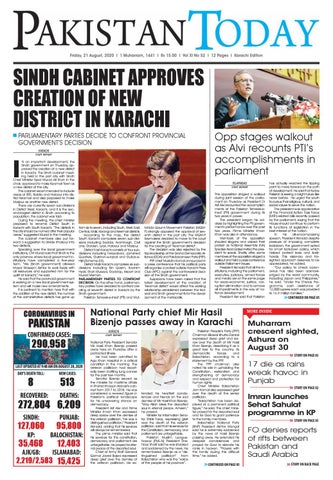
sindh Cabinet aPProves Creation of new distriCt in karaChi g
PArlIAmenTAry PArTIes decIde TO cOnfrOnT PrOvIncIAl gOvernmenT’s decIsIOn KARACHI staff report
i
n an important development, the sindh government on Thursday approved the creation of a new district in Karachi. The sindh cabinet meeting held in the port city with sindh chief minister syed murad Ali shah in the chair, approved to make Keamari Town as a new district of the city. The cabinet recommended to include areas of sITe, Baldia and Harbour into district Keamari and also proposed to make maripur as another new district. There are currently seven sub-divisions in district West, Karachi, and it is the second-largest district in sindh according to population, the cabinet was told. during the meeting, the chief minister proposed to rename district south in Karachi with south Karachi. “The districts in the city should be named after their popular areas,” suggested murad in the meeting. The cabinet members also put forward a suggestion to divide Khairpur into two districts. speaking over the local government institutions, cm murad said that sindh is the only province where local government institutions have completed a five-year term. “We [sindh government] allowed mayor Waseem Akhtar to work freely with all resources and supported him for the uplift of Karachi,” he said. He said that the provincial government is working on a new local government system and will make new amendments. It is pertinent to mention here that with the addition of the new district, the number of the administrative districts has gone up
ISLAMABAD staff report
from six to seven, including south, West, east, central, malir, Korangi and Keemari districts. According to the map, the district south Karachi comprises seven sub-divisions including saddar, Arambagh, civil line, garden, lyari, Harbour and maripur. district east Karachi consists of four subdivisions including ferozabad, Jamshed Quarters, gulshan-e-Iqbal and gulzar-eHijri (scheme-33). district malir Karachi comprises six subdivisions including Bin Qasim, Ibrahim Hydri, shah mureed, gaddap, Airport and murad memon. PARLIAMENTARY PARTIES TO CONFRONT DECISION: On the other hand, parliamentary parties have decided to confront creating of seventh district in Karachi by the sindh government. Pakistan Tehreek-e-Insaf (PTI) and mut-
Coronavirus in
Pakistan
CONFIRMED CASES:
290,958
LAST UPDATED AT 9:48 AM ON AUGUST 20, 2020 DAY'S DEATH TOLL: NEW CASES:
8
RECOVERED:
513
DEATHS:
272,804 6,209 SINDH:
127,060
PUNJAB:
95,800
KP:
BALOCHISTAN:
AJK/GB:
ISLAMABAD:
35,468
Opp stages walkout as Alvi recounts PTI’s accomplishments in parliament
12,403
2,219/2,583 15,425
tahida Qaumi movement Pakistan (mQmP) strongly opposed the approval of seventh district in the port city. The mQm-P lawmakers decided to move to the court against the sindh government’s decision for the creating of ‘Keamari district’. The decision was also rejected by the top leadership of the grand democratic Alliance (gdA) and Pak-sarzameen Party (PsP). PsP chief mustafa Kamal announced in a press conference that his political party will organise a protest outside Karachi Press club (KPc) against the controversial decision of the sindh government. suspicions have been raised that the latest development of the creation of ‘Keamari district’ would affect the working relationship established between the federal and sindh governments for the development of the metropolis.
The opposition staged a walkout during joint session of the parliament on Thursday as President dr Arif Alvi recounted the accomplishments of the Pakistan Tehreek-eInsaf (PTI) government during its two years in power. The president began his address by highlighting the PTI government’s performance over the past two years. Prime minister Imran Khan was also in attendance. members of the opposition shouted slogans and voiced their protest as national Assembly (nA) speaker Asad Qaiser invited the president to speak. shortly after, some members of the opposition staged a walkout and held a press conference outside Parliament House. President Alvi said that all the institutions, including the parliament, executive, judiciary, armed forces and media are on the same page for socio-economic justice, corruption elimination and to remove all impediments in the way of national development. President Alvi said that Pakistan
National Party chief Mir Hasil Bizenjo passes away in Karachi KARACHI staff report
national Party President senator mir Hasil Khan Bizenjo passed away here on Thursday after a protracted illness. He had been admitted to Aga Khan Hospital in a critical condition in the morning. The veteran politician had reportedly been battling lung cancer for the past few months. senator Bizenjo served as the minister for maritime affairs in shahid Khaqan Abbasi’s cabinet from 2017 to 2018. He was considered a revered figure in Pakistan’s political landscape for his unwavering stance on democracy. President Arif Alvi and Prime minister Imran Khan expressed deep sorrow over the demise of the veteran politician. “He was a distinguished politician,” President Alvi said, adding that his services will always be remembered. The prime minister said that his services for the constitution, democracy and parliament are unforgettable. He prayed for eternal peace of the departed soul. chief of Army staff general Qamar Javed Bajwa expressed deep grief over the demise of the veteran politician. He ex-
tended his heartfelt condolences and friends on the sad demise of mir Hasil Khan Bizenjo. “may Allah bless the departed soul in eternal peace. Ameen,” he prayed. minister for Information senator shibli faraz, expressing grief over the death of the veteran politician, said that his services for the constitution, democracy, and parliament are unforgettable. Pakistan muslim leaguenawaz (Pml-n) President shehbaz sharif said he was shocked and saddened by the news. He remembered Bizenjo as a “distinguished politician” from Balochistan who was the “voice of the people of his province”.
Pakistan People’s Party (PPP) chairman Bilawal Bhutto-Zardari expressed deep grief and sorrow over the death of mir Hasil Khan Bizenjo, describing it as a great loss to the country, its democratic forces and Balochistan, according to a statement by the PPP. The PPP chairman also noted his role in upholding the constitution, restoration and strengthening of democracy and respect and protection for human rights. chief minister Balochistan Jam Kamal also expressed grief over the death of the senior politician. “Balochistan has been deprived of a prominent political figure,” he said. The chief minister prayed for the departed soul and for god to grant patience to the family members. Balochistan national Party (BnP) President Akhtar mengal said he is extremely saddened by the news of Hasil Bizenjo passing away. He extended his deepest condolences and prayed for god to elevate his ranks in heaven. “Prayers with the family during this difficult time,” he added.
CONTINUED ON PAGE 05
has actually reached the tipping point to move forward on the path of development. He said that today Pakistan is seeing a bright future like never before. He urged the youth to pursue their religious, cultural, and social values to serve the nation. The president was appreciative of the financial Action Task force (fATf)-related bills recently passed by the parliament, saying that the House should continue to perform its functions of legislation in the best interest of the nation. In his all-encompassing speech, President Alvi said despite pressure of imposing complete lockdown, the government opted for smart lockdown policy, which helped protect lives and livelihoods. This visionary and farsighted approach deserves to be appreciated, he added. “Our policy to check coronavirus has also been acknowledged by the world community, including Japan and Philippines,” he said. “Under the ehsaas Programme, cash assistance of 12,000 rupees each was provided to 16.9 million families.”
CONTINUED ON PAGE 05
more inside
Muharram crescent sighted, Ashura on August 30 STORY ON PAGE 03
17 die as rains wreak havoc in Punjab STORY ON PAGE 02
Imran launches Sehat Sahulat programme in KP STORY ON PAGE 03
fO denies reports of rifts between Pakistan and saudi Arabia STORY ON BACK PAGE
02
Friday, 21 August, 2020
NEWS
17 die as rains wreak havoc in Punjab LAHORE
T
CM BUZDAR DIRECTS FOR ENSURING EARLY DRAINAGE OF RAINWATER
SHAHAB OMER/TLTP
HE poor management and planning of district administration and the Water and Sanitation Agency (WASA) was exposed when rain wreaked havoc in the provincial capital on Thursday. According to details, due to heavy rains in the provincial capital, water accumulated on all sides while roads began to look like canals, underpasses were flooded and many vehicles and motorcycles were also damaged. At least 17 people died and many others got injured in different rain-related incidents in Punjab on Thursday. According to a rescue team spokesperson, the roof of an old house collapsed in Ibrahim Colony located in Lahore’s Harbanspura area, killing four people and injuring five others. Following the incident, rescue workers
rushed to the spot and recovered the two bodies, whereas seven others were injured.er, two of the injured succumbed to injuries during treatment while the condition of the remaining injured is said to be out of danger. Meanwhile, the roof of a house on Muridke Road in Sheikhupura collapsed, killing two people and injuring seven others. Moreover, five people, including a woman and four children, were killed when the roof of their house collapsed in Phalia area of Mandi Bahauddin. In addition, a landslide occurred in a coal mine in Qasba Bhal of Chakwal due to the rain, causing three labourers to get crushed to death and five others injured. Two other persons died in Faisalabad and Zafarwal due to electrocution. Due to heavy rainfall, the power transmission system of Lahore Electric Supply
PMd predicts thunderstorms, heavy rainfall in karachi for next two days KARACHI: The Pakistan Meteorological Department (PMD) on Thursday forecast thunderstorms and heavy rain in Karachi for August 21 and 22. The PMD, while issuing a report on monsoon rains, said apart from Karachi, other districts of Sindh are also likely to receive rainfall. Director Meteorology Abdul Qayyum Bhutto said that there is low air pressure system near India’s Rajasthan region, which is moving towards the west. “Under its influence, monsoon currents are entering eastern Sindh, rains in Karachi may continue till Sunday,” the director said, adding that rain is also expected in Thar Parkar, Mirpur Khas, Umerkot, Sanghar, Hyderabad and other districts. INP
PM, babar awan discuss constitutional, legal, political matters ISLAMABAD INP
Adviser to Prime Minister on Parliamentary Affairs Dr Babar Awan called on Prime Minister Imran Khan in Islamabad on Thursday. Constitutional, legal and political matters were discussed in the meeting, said a press release issued by PM Office. Dr Awan presented calendar of the third parliamentary year of the Pakistan Tehreek-e-Insaf (PTI) government to the prime minister.
Company (LESCO) also stopped and technical faults were reported in more than 70 feeders. Prolonged power outages started in several areas of the provincial capital. Even in low-lying areas, people reported losses by water entering their houses. The highest rainfall in the city was recorded at Lakshmi Chowk at 186 millimeters. While 141 mm of rain was recorded in Upper Mall, 74 mm in Mughalpura and 173 mm in Tajpura. Similarly, 123 mm of rain was recorded in Nishtar Town, 120 mm in Chowk Nakhuda, 141 mm in Paniwala Talab, 156 mm in Farrukhabad, 155 mm in Gulshan-e-Ravi, 131 mm in Iqbal Town, 153 mm in Samanabad, 103 mm in Johar Town and 92.6 mm in Allama Iqbal International Airport. Rains also fell in Gujranwala, Sargodha, Faisalabad, Kasur and Mianwali Bhakkar,
ISLAMABAD INP
The Islamabad High Court (IHC) on Thursday disposed of a petition filed by former prime minister Nawaz Sharif challenging issuance of non-bailable arrest warrants against him by an accountability court in the Toshakhana reference. The IHC division bench comprising Chief Justice Athar Minallah and Justice Aamer Farooq took up the petition. The court dismissed the constitutional petition through which Sharif sought withdrawal of warrants issued when his counsel Jahangir Khan Jadoon sought permission to do so. The former premier had also sought the court’s permission to join proceedings in the accountability court through a pleader. The accountability court, hearing the case on Aug 17, had granted him permission to do so. At the previous hearing, the bench had in-
The Supreme Court (SC) on Thursday gave the government four more weeks to overhaul loss-making Pakistan Railways in order to turn it into a profit-making national entity. A bench headed by Chief Justice of Pakistan (CJP) Gulzar Ahmed issued these directions while hearing a suo motu case pertaining to financial losses the railways department has been inflicting on the na-
tional exchequer. The court gave the four-week extension for the restructuring of Railways on the request of the Planning Commission. The court also issued directives to the Sindh government and the Railways Ministry to submit a report regarding Karachi’s circular railway project. CJP Gulzar expressed reservations regarding the timeline for the completion of the much-touted ML-1 project after he was informed that the multibillion-dollar project, being built under the China Pakistan
LAHORE APP
quired about the status of the bail granted to the PML-N supreme leader in the Al-Azizia reference. It noted that the removal of Sharif’s name from the Exit Control List (ECL) was by the government, not the court. Sharif, who is currently in London, had moved the petition through Jadoon, citing NAB chairman, judge of the accountability court-III and the investigation officer in the reference as respondents. The petitioner stated that the IHC granted him bail on October 9, 2019, on medical grounds yet the accountability court initiated the process of declaring him a proclaimed offender under Section 87 of the criminal procedure code (CrPC). The former premier said he went to London on Nov 19 last year for medical treatment with the approval of the government. Nevertheless, warrants were issued in the case, depriving him of his constitutional and fundamental rights as he didn’t conceal himself from any process of the law, he added.
ML-1 BE COMPLETED IN LESS THAN STIPULATED 3 YEARS, REMARKS CJP TLTP
Punjab iGP rejects claim of sniper attack at Maryam
Nawaz withdraws petition against arrest warrant in Toshakhana reference
SC gives four weeks to overhaul railways ISLAMABAD
causing accumulation of water in low-lying areas and in some cities, the incidents of roof collapses have also occurred. Rainwater also entered the radiology department of Lahore General Hospital due to which CT scan service in the hospital was suspended while the back side of the emergency including TB ward and eye department of the hospital was also affected. Water also accumulated in the hospital’s nursing hostel, residential quarters and cafeteria and the relatives of the patients were confined to the wards while medical superintendent of the hospital Dr Mahmood Salahuddin said that water was being pumped out through three disposals. BUZDAR DIRECTS FOR ENSURING EARLY DRAINAGE OF RAINWATER: Punjab Chief Minister Sardar Usman Buzdar directed the concerned departments to remain vigilant in the wake of heavy rains for
Economic Corridor (CPEC), will be completed within three years. “Three years is a lot. China lays down railway lines in months. If funds are available, so much time should not be spent completing the project,” CJP Gulzar remarked after the railways secretary told him the project will take three years to complete. He also said that laying down 1,800-kilometer railway track was not a problem for China. The CJP warned officials that the Karachi to Hyderabad railway bridge could
quick relief and rescue operation. The chief minister said that drainage of rainwater should be ensured in minimum possible time. He directed that the situation arising after rains should be fully monitored. Weather in Lahore and its adjoining areas turned pleasant after heavy monsoon rain lashed the provincial capital of Punjab. Heavy downpour in different areas inundated roads and streets in Lahore. Buzdar directed WASA and administrative officers to remain on the ground till draining out of rainwater from low-lying areas of the city. He warned the authorities that no negligence would be tolerated in this regard and special arrangements to ensure smooth flow of traffic should also be ensured. Rain was also reported in other parts of the country including Islamabad, Rawalpindi, Joharabad, Khushab, Gujranwala, Sargodha, Faisalabad, Kasur, Jhang, Bhakkar, Sheikhupura, Nankana, Chiniot and other cities.
collapse at any moment. He compared the bridge with a railway bridge in Kotri built by the British before independence, noting that the latter was in “good condition” even today. “There is not a single bridge over the Indus that the nation can be proud of,” CJP Gulzar regretted. He added that the Ayub Bridge built during former president Ayub Khan’s era was the only bridge that could be considered “beautiful”. “Good bridges should be built for ML1,” the judge urged the railway officials present at the hearing. He also directed them to “respect” the Indus as well during the construction because it “runs the country’s economy”. The secretary assured the CJP that state-of-the-art bridges will be built under the ML-1 project.
Punjab Inspector General of Police (IGP) Shoaib Dastgir has dismissed reports of bullets being fired on the vehicle of Pakistan Muslim League-Nawaz (PML-N) leader Maryam Nawaz last week when she appeared before the office of the National Accountability Bureau (NAB) in Lahore. Many police officials were injured when a scuffle broke out last week between policemen and PML-N workers during Maryam’s appearance. Footage of the incident suggested the workers had brought bags full of stones which were pelted at police and security officials. Former Senator Sajid Mir, after meeting Maryam on Sunday, claimed she had been targeted by some sniper during her appearance, saying the windscreen of her bullet-proof vehicle could not be smashed by a stone. Speaking to reporters on Thursday, Dastgir said no evidence was offered to back up claims asserted through reports and social media. He also said the institution of police is an independent one and has no tussle with any political party. However, he warned, those who took the law into their hands will be punished.
shehbaz, Maryam told to file response in land grabbing case LAHORE: A civil court on Thursday directed Pakistan Muslim League-Nawaz (PML-N) President Shehbaz Sharif and Vice-President Maryam Nawaz to submit their reply in a case against them for allegedly encroaching upon 4,000 acres of land in Jati Umra. Senior Civil Judge Fozia Saira was hearing a lawsuit filed by Punjab University Professor Dr Abdul Rauf. The counsel for the Sharif family members appeared in court and sought time to submit their response. Granting his request, the court gave the lawyer until September 12 to file comments. TLTP
Govt to address price-hikes, hoarding, smuggling as top priority, says Faraz GHULAM ABBAS ISLAMABAD
Minister for Information and Broadcasting Shibli Faraz on Thursday acknowledged that the federal government is still facing various challenges, including increasing prices, hoarding and smuggling, which he said would be addressed by the government as its top most priority. While addressing the media along with some other cabinet members, the information minister said that Imran Khan's 22-years of political struggle was aimed at ending corruption and politics of vested interests in the country adding that this aim is close to being fulfilled. The information minister announced that the Pakistan Tehreek-e-Insaf (PTI) government would implement its complete manifesto by the end of its five-year term adding that giving relief to the people is the government’s top priority. “Imran Khan is the custodian of the future of the country’s youth,” Faraz said. While addressing the press conference, Adviser to
the Prime Minister on Institutional Reforms Dr Ishrat Husain said that the Prime Imran Khan has vowed to bring reforms in all areas. However, he added that it will take some time to rectify the shortcomings of the previous 25 years. He said that shortcomings in governance is the main reason behind all crises faced by Pakistan. Dr Ishrat added that Pakistan’s economy was growing at a fast rate from 1950 to 1990s, however the growth has slowed down due to the politicisation of institutions. He presented four points aimed at ending the discretionary powers of the government and enabling the use of Information Technology to impart transparency and automation. The government has reduced the number of federal government departments from 440 to 324, he said adding that 71,000 government posts that had been lying vacant for more than a year have been abolished as they were not required. “Now we are modernising treasury rules and streamlining the law-making process,” he said adding that re-
forms were essential in several state owned entities including the Federal Board of Revenue (FBR). He said that the government will bring civil service reforms which will include a promotion policy. While highlighting the performance of his ministries PTI leader Shehryar Afridi said that the three most important achievements include resolving the issues faced by the pilgrims at Pakistan-Iran border, ending the sit-in by Hazara community of Quetta and the sit-in by Tehreek Labaik Pakistan (TLP) in Islamabad through negotiations. He said that during his tenure as the Minister of State for Interior the interior ministry recovered 33,000 kanals of land and introduced late night raids at police stations. He said that his ministry also achieved other goals which include visa on arrival regime, streamlining regulations for international Non-Government Organisations (NGOs) and stringent measures against illegal arms. Shehryar Afridi was previously appointed as the minister of state for interior and is currently the minister
of state for states and frontier regions. The press conference was also addressed by the Adviser to the Prime Minister on Commerce and Investment Abdul Razzak Dawood. He highlighted the challenges faced by the government in overcoming the trade deficit and increasing exports amid the coronavirus pandemic. He said that the government has announced incentive packages for five major export sectors while expressing confidence that exports will increase in the coming months. Minister of State for Climate Change Zartaj Gul said that during the last two years her ministry has launched the Billion Tree Tsunami project under which 324 million trees have already been planted. She said the project has also created a large number of jobs in the country. Similarly, adviser to the PM on Climate Change Malik Amin Aslam informed regarding the government's achievements under the ‘Clean and Green Pakistan Campaign’.
Friday, 21 August, 2020
NEWS
iMran launches sehaT sahulaT ProGraMMe in kP PESHAWAR
P
STAFF REPORT
RIME Minister Imran Khan on Thursday launched healthcare coverage for all residents of Khyber Pakhtunkhwa under the Sehat Sahulat Programme. Addressing the launching ceremony, the prime minister lauded the initiative, saying that the step will “put pressure” on other provinces as well to introduce such welfare initiatives. He said that he will push the idea in Punjab as well, where the Pakistan Tehreek-e-Insaf (PTI) is in power and will also suggest the Balochistan government to launch a similar initiative in the province. Once the populations of the three provinces have access to free healthcare,
the people in Sindh will demand the provincial government to introduce a similar programme. Under the programme, each family will receive health coverage of Rs1 million per year. Both public and private hospitals designated by the programme will provide free treatment to residents of the province. State Life Insurance Corporation, which has been selected after a competitive bidding process, will be paid Rs2,849 per family annually. The premier, in his address today, lauded the KP government for implementing the scheme and said: “You don’t know [the significance] of the step you have taken. You will realise when people send prayers your way.” He noted that the PTI provincial government had implemented the programme despite budgetary constraints.
The prime minister said that the programme will also motivate publicsector hospitals to provide better healthcare facilities in order to compete with private-sector hospitals, which will be offering free treatment under the Sehat Sahulat Programme. He further said that the government will offer incentives to private hospitals by removing duty charges on imported medical equipment. Furthermore, Auqaf and evacuee trust department will sell land on lower rates to anyone who wishes to build a hospital. He said that hospitals will also be built-in remote areas so that healthcare can be accessible to all citizens. While health insurance will be available to any resident with an identity card, the prime minister urged the KP government to “encourage everyone to get a
health card” so that a proper database can be maintained and pilferage can be avoided. KP HEALTH INITIATIVE: All the 6.617 million residents of Swat, Buner, Dir Upper, Dir Lower, Shangla, Malakand, Chitral Lower, Chitral Upper and Bajaur districts of Malakand division will start receiving free health services regardless of their financial status from October. It will be followed by Hazara division in November, Mardan and Peshawar in December and Kohat, Bannu and Dera Ismail Khan in January when the whole population of the province will receive free medical services. The first phase of the programme was launched in 2015 that covered three per cent of the population (100,000 families in four districts) of the province. The programme was extended to 51 per cent of the population (1,791,930 people in all districts) in the second phase in 2016. The third phase of the programme was started in 2017, covering 64 per cent of the population (3,200,000 families). So far, more than Rs10 billion has been spent on free treatment of 250,000 people.
03
Muharram moon sighted, ashura on august 30 NEWS DESK The Hijri year of 1442 has started with the sighting of the moon of Muharram-ul-Haram in Pakistan, announced the Central Ruet-e-Hilal Committee on Thursday. The committee said that the first month of the Islamic (Hijri) calendar will begin on Friday, August 21 and the Day of Ashura will fall on Sunday, August 30. The Day of Ashura is marked by Muslims to commemorate the martyrdom of Hazrat Imam Hussain (AS) and his companions on 10th of Muharram. On 9th and 10th of Muharram, processions are taken out in all the major cities of the country with government deploying police and paramilitaries to ensure the security of mourners.
ihc suspends Fbr notice to Palestine envoy ISLAMABAD STAFF REPORT
Pakistan lodges protest with india over ceasefire violations ISLAMABAD
Govt scheme pilgrims asked to take back their Hajj dues by Aug 30 ISLAMABAD
TLTP
APP
The Foreign Office (FO) summoned a senior Indian diplomat on Thursday and registered Pakistan’s strong protest over the ceasefire violation by the Indian occupation forces along the Line of Control (LoC) on Wednesday. In a statement, FO Spokesperson Zahid Hafeez Chaudhri said that one innocent civilian was injured in indiscriminate and unprovoked firing by the Indian occupation forces in Sabzkot Sector of the LoC. He said that the Indian occupation forces along the LoC and the Working Boundary (WB) have been continuously targeting civilian populated areas with artillery fire, heavy-caliber mortars, and automatic weapons. He said that this year, India has committed more than 2,027 ceasefire violations to date, resulting in 16 martyrdoms and serious injuries to 166 innocent civilians. Condemning the deplorable targeting of innocent civilians by the Indian occupation forces, the spokesperson said that such senseless acts are in clear violation of the 2003 Ceasefire Understanding, and are also against all established humanitarian norms and professional military conduct. He said that these egregious violations of international law reflect consistent Indian attempts to escalate the situation along the LoC and are a threat to regional peace and security.
The Ministry of Religious Affairs and Interfaith Harmony has asked the successful applicants of Government Hajj Scheme to take back their deposited hajj dues by August 31. Spokesman of the religious ministry said in a press release that the 98 percent successful applicants of government Hajj scheme had already been refunded their dues and the rest of two percent pilgrims could get their dues back from their respective banks till the end of the current month. He said that the ministry had maintained a close liaison with the respective banks for the smooth refund to the pilgrims, who could not perform Hajj following the Saudi decision of excluding pilgrims from outside Saudi Arabia to contain coronavirus spread in the kingdom. The branches of designated scheduled banks had started the cash return of the deposited Hajj dues from July 2, 2020. Each applicant of government scheme was informed individually about the repaying of their amount via mobile phone. A pilgrim was required to visit his respective bank branch (where he had deposited the dues) along
with original Computerised National Identity Cards (CNIC) and bank receipt of the deposited hajj dues for a cash return of the amount. While in case of getting amount through banker’s cheque, the group leader was required to visit the relevant bank’s branch along with the original documents of his group’s intending pilgrims. The applicants were asked to contact the ministry’s Accounts Officer Refund on telephone no 0519208465; 051-9205696; 051- 9216980-82 in case of any difficulty in the refunding process. In case closure of the relevant branch, the amount was being refunded through the other nominated bank branch. A total of 86,765 intending pilgrims were picked through general balloting from out of 149,295 applicants, aspiring to perform the sacred religious obligation under the government scheme. A total of 179,210 Pakistanis were aspiring to perform Hajj this year including 107,526 under government scheme and 71,684 under the private scheme. The government Hajj package (per person) was Rs463,445 for the north region without Qurbani and Rs486,270 for the same region with Qurbani (animal sacrificial). While Rs455,695 for South Region without Qurbani and Rs478,520 for the same region without Qurbani.
Political parties unite to support CPEC as 'game changer', reject 'New Cold War' ISLAMABAD MIAN ABRAR
Nine major political parties of the country on Thursday rejected the ‘New Cold War’ and vowed their full support to the game-changer China-Pakistan Economic Corridor (CPEC). The International Department of Communist Party of China (CPC), in collaboration with Pakistan-China Institute, organized the second conference of CPEC Political Parties Joint Consultation Mechanism (JCM) on the theme of “Working Together to Promote Economic Development and Improve People’s Lives Through High-Quality CPEC Cooperation.” The conference was participated by nine political parties: Pakistan Tehreek-e-Insaf (PTI), Pakistan Muslim League-Nawaz (PML-N), Pakistan People’s Party (PPP), Balochistan Awami Party (BAP), National Party, Jamiat Ulema-e-Islam-Fazl (JUI-F), Awami National Party (ANP), Jamaat-e-Islami (JI), and Pakhtunkhwa Milli Awami Party (PkMAP), as well as leading officials from relevant government departments and representatives from the business community of the two countries. The first JCM was held in Beijing in March 2019 and this JCM has now emerged as the institutional mechanism between the CPC and Pakistani political parties for CPEC coordination and communication. This online conference of 9 political parties rep-
resenting both the government and the opposition was the first of its kind in Pakistan that agreed to preserve, protect and promote CPEC, above party lines, since they all view CPEC as a “game-changer and a guarantor of a better tomorrow for Pakistan’s 220 million people”. President Arif Alvi, in a congratulatory message to the conference, termed CPEC as ‘an iconic project of the Belt & Road Initiative which will change the destiny of the region and promote regional connectivity’. He reaffirmed Pakistan’s strong support to One China policy and strongly opposed any foreign intervention in the internal affairs of China concerning Hong Kong and Taiwan. He also thanked China for supporting Pakistan on the Kashmir issue. The conference was co-chaired from the Pakistani side by Senate Chairman Sadiq Sanjrani, and from the Chinese side by Minister of the International Department of CPC Song Tao, who is a member of the Chinese Central leadership. The three-hour long conference also had experts speaking on various issues. Minister of IDCPC Song Tao, in his keynote speech, thanked the president of Pakistan Dr Arif Alvi for sending the congratulatory letter. While appreciating the consensus to take it forward, he said that party to party cooperation between China and Pakistan is increasing and CPEC is entering into a new era. Senator Sanjrani, in his keynote address, credited
China for promoting regional connectivity with its landmark Belt and Road Initiative and extended Pakistan’s support to President Xi Jinping’s vision of “shared prosperity” and “win-win” cooperation of which CPEC is the practical manifestation. While appreciating President Xi Jinping’s leadership which has fulfilled the promise of “ruling for the people”, he pointed towards the role of CPC in accomplishing the first centennial goal by 2021. Lastly, he affirmed that the Senate of Pakistan shall play a greater role in engaging the consensus of different parties and delivering political support for more cooperation between the countries under the CPEC. Leader of CPC Jiangxi Provincial Committee Liu Qi congratulated all participants for the successful organization of the second JCM of political parties on CPEC. He said that the economic cooperation between Pakistan and China is important in the highquality construction of CPEC. Moreover, he announced the donation of 500,000 masked and 2,000 Protective Personal Equipment (PPE) to Pakistani political parties. Saifullah Khan Nyazee, the chief organiser of the PTI, said that this conference is a great moment that shows that all political parties are on one platform when it comes to CPEC. He also appreciated the exemplary measures taken by China during the fight against the pandemic. Moreover, he reaffirmed the commitment and confidence of PTI in taking CPEC forward.
The Islamabad High Court (IHC) on Thursday suspended a show-cause notice issued to Palestine Ambassador Ahmed Jawad A Rabei by Federal Board of Revenue (FBR) for selling a vehicle imported to Pakistan under the diplomatic immunity. The court, presided over by IHC Chief Justice Athar Minallah, ordered the customs collector to return the confiscated vehicle to the businessman and refrain from taking any action against the ambassador until a further hearing. Justice Minallah also issued notices to Foreign Secretary Sohail Mahmood, FBR and customs officials, giving them two-week time to submit responses. Rabei, in his petition, had recalled that the ambassadors enjoy immunity under the Vienna Convention, but the FBR on Aug 4 served him a show-cause notice for selling the vehicle. The FBR’s notice was also served on the businessman, Basil Ahmed Affendi, informing him that the vehicle might be permanently confiscated and they might also face penalties of up to 10 times the value of the car. However, after backlash on social media with many questioning the timing of the move and linking it with the recent formalisation of UAE-Israel ties, the revenue body withdrew its notice issued to the ambassador and tendered an apology for the inconvenience caused to him. Senate Committee of Foreign Affairs chairman Mushahid Hussain Sayed on Tuesday raised the matter in the House and said the revenue collector had tendered an apology to the ambassador, but it was not acceptable as it had happened at a time when there were talks about recognition of Israel by Muslim countries. The government had, however, regretted the PML-N senator’s act of linking the notice to the Palestine issue, terming it “inappropriate”.
kP announces incentives for construction firms PESHAWAR STAFF REPORT
The Khyber Pakhtunkhwa (KP) government has reduced and eliminated different taxes to facilitate construction industry in line with the Prime Minister Imran Khan’s vision to boost the sector. Provincial Minister for Housing Dr Amjad Ali, addressing a news conference along with Special Assistant to CM on Information and Local Government Kamran Bangash on Thursday, said that construction of houses has already been started in a large number of housing societies across the province. He said that the federal government has introduced the bank home finance facility for construction of houses, so that to provide shelter to the low-income strata. He also said that the KP government in collaboration with Pakistan Housing Foundation would construct 20,000 grey structure houses under Naya Pakistan Housing scheme in Sarozai area of Peshawar, for which the balloting process has already been completed. He added the total cost of the project is Rs97 billion. Dr Amjad said that the provincial government has a special focus on the housing sector in the province, as the construction of houses would promote various allied industries, and would generate employment opportunities in the province. He said that the purpose of the housing department is not to earn profit from people, rather to provide them housing facilities on a no-profit no-loss basis. The housing minister said that the housing department has provided two per cent quota to journalists in Sarozai housing scheme, while quota would also be provided to them in Jalozai housing scheme.
04
Friday, 21 August, 2020
NEWS
WanT To Serve Karachi, no dual SySTeM, TaKeover of MegaciTy on cardS: adil KARACHI
P
INP
AKISTAN Tehreek-e-Insaf (PTI) Vice President and parliamentary party leader in Sindh Assembly Haleem Adil Sheikh said on Thursday that we want to serve Karachi and resolve its lingering civic issues; however, no any dual system or takeover of the megacity is on the cards. Addressing a press conference in Hunaid Lakhani Secretariat, he said during two years, the PTI government has given a lot of progress and prosperity to the country. We salute Prime Minister Imran Khan and his team as he has cleaned the mess of past in just two years,” he said. He also said that in Imran Khan the nation had got an honest, patriotic and brave leader and he is the fulfillment of the dreams
of Qauid-e-Azam Muhammad Ali Jinnah and Dr Allama Iqbal. Adil said that for last week there are allegations that the federal government wanted to occupy Karachi. He said these allegations are not true. “We want to do the tasks for which a coordination committee has already been formed,” he added. The PTI leader said that if Karachi is developed, whole Sindh and whole Pakistan would benefit from it as 64 per cent revenue of Pakistan and 90 per cent tax of Sindh is collected from Karachi. He said that there is no takeover and no dual system. He added that to talk about the progress and prosperity of Karachi is not an enmity to the megacity. The PTI VP said that we want that gutters of Karachi are cleaned, its roads repaired and its 50 years old buses are replaced with new ones. He asked if this is an enmity to Karachi. He said that Karachi is Sindh and
Sindh is Karachi, adding “we are against new province or a dual system”. He asked whether the funds given to provincial government during last 10 years were really spent for progress and development of Karachi. He asked the Pakistan People’s Party (PPP) not to hide its failures behind its 'Sindh card'. He said that the PPP has always tried to mislead masses through ethnic-leaning slogans. He added that this is time to shun the politics of ethnicity and extremism. The PTI leader said that on one hand the PPP is sitting in the committee and one the other hands Nisar Khuhro is arranging protest demos. Adil said that during last two years, the PTI government has steered Pakistan clear from crisis. It had returned loans of Rs5,000 billion taken by the previous government. “It has inked agreement with the International
Monetary Fund (IMF). It has given incentives to increase exports. The external deficit is reduced from $20 billion to $3 billion. It has decreased expenses of civil and military administrations. It has not taken any loan from State Bank of Pakistan (SBP) this year,” he added. The PTI VP said during two years remittances are increased by $23 billion. “SBP reserves are increased by $12.5 billion. Our stock exchange is the second best stock exchange of the world. Non-tax revenues are increased by Rs1.4 trillion,” he said. He also said that the economy is improving fast. The government has given health cards and set up shelter homes, Ehsaas cash emergency programme is the largest programme of Pakistan, he added. The PTI leader said that Pakistan’s friendship with China is improving. He said that reports of commission in sugar mafia
CDA, MCI permits occupation of government land: IHC ISLAMABAD APP
The Islamabad High Court (IHC) Thursday observed that it was a misconduct of the Capital Development Authority (CDA) and the Municipal Corporation Islamabad (MCI) to give permission for illegally occupation of the government land in the federal capital. IHC's Justice Mohsin Akther Kiyani reserved the judgment on the case filed by a citizen against alleged grabbing of National Park's land in Islamabad. A detailed order would be issued on the matter, he said. Justice Kiani directed that the National Accountability Bureau (NAB) should prepare a reference against Senator Aurangzeb Orakzai for allegedly occupying the government land. Addressing the senator, the judge asked why he had constructed a fence to
occupy the land. Mayor Islamabad Sheikh Anser Aziz said the Municipal Corporation
Islamabad (MCI) had only given permission to the senator for tree plantation and
not that of any construction on the government land. The MCI could demolish the fence if the court issued an order. On this, Justice Kiyani remarked that it would not be a favour to the court rather it was the MCI's legal duty to protect the government land from grabbers but there was no one in the federal capital to save the state land from grabbers. Since the Coivd19 outbreak, the capital witnessed more land grabbing, he added. The director environment said that his department had given permission only for tree plantation on 10 to 15 acres of land and if more land was occupied then it was a violation. The court observed that the officer even did not know as to how much land was allowed to be occupied. The CDA official adopted the stance that all powers related to the National Park area were with the MCI and Ministry of Climate Change.Ate this, the court reserved its judgment on issue.
Islamabad traders demand cut in board tax, parking plazas ISLAMABAD TLTP
The business community has demanded the civic authorities to immediately issue orders for withdrawal of board tax notices issued to traders and construct multi-storey parking plazas in various Marakaz and markets. A meeting of the Traders Welfare Committee of the Islamabad Chamber of Commerce and Industry (ICCI) was held under the chairmanship of its convener Khalid Mahmood Chaudhry, which was
attended by representatives of various markets. A resolution was passed calling upon Mayor Islamabad Sheikh Ansar Aziz to immediately issue orders for withdrawal of board tax notices issued to traders. Another resolution was passed to call upon the CDA to arrange the construction of multi-storey parking plazas in various Marakaz and markets and start development works in these business areas to save them from further destruction. Addressing the meeting, Tahir Abbasi, senior vice president of ICCI, said that no development
work has been done in any market of Islamabad for the last five years though the collection of taxes is higher than before. "If the markets continue to be neglected like this, they will soon turn into ruins, so the CDA should pay immediate attention to the better development of the markets," he said. Expressing his views, Khalid Mahmood Chaudhry said that the MCI had unilaterally increased the board tax, which was illegal as stakeholders were not taken into confidence. He demanded that Sheikh Ansar Aziz should immediately issue orders for the withdrawal of board tax notices issued to
traders and urged that all legal requirements should be met before raising any kind of tax. He said that there was no magistrate for MCI while the present magistrate was for CDA only and the district magistrate did not issue any notification to MCI. Chaudhry Nadeem, PTI Traders Wing coordinator and chairman of the task force, said that the present government wants to solve the problems of traders but this is being hampered by differences between the MCI and the CDA. However, all hurdles will be removed soon to address the issues of traders.
scandal and other scandals are made public. He also said the opposition wants NRO but no NRO would be given to them. Sindh Baitul Mal Chairman Hunaid Lakhani said that unemployment is the major problem of Pakistan. He said that PTI government during last two years has attained a lot of successes. We have saved the country from a default, he added. Lakhani said that PM Imran is not an ordinary leader and he has ensured that the wheels of economy are running. “We sent the National Disaster Management Authority (NDMA) to improve situation in Karachi. He said our policy on coronavirus went successful,” he said. He also said that Bill Gates and president of the United Nations have praised Pakistan in this regard. “We have supported 7 million families through Ehsaas cash emergency programme,” he added.
Two killed, another injured in Sheikhupura road mishap SHEIKHUPURA INP
Two people were killed and another injured in collision between an over speeding oil tanker and a mini-truck, rescue sources said on Thursday. According to details, the accident took place on Muridke Road in village Saikham of Sheikhupura where an oil tanker collided with mini-truck used to transport poultry breed. Two people including mini-truck driver Asif 34, and conductor Ali Hamza died in the accident while 57-year-old Khadim Hussain hailing from Faisalabad was critically injured. The bodies and injured were shifted to hospital for medico-legal formalities and the police after registering a case into the incident have started an investigation.
Two youngsters killed in Mansehra road accident MANSEHRA INP
Two youngsters were killed in collision between motorcycle and an over speeding mini-truck, police said on Thursday. According to details, the accident took place in Mera Jabori area of Dadar in district Mansehra where an over speeding motorcycle collided with mini-truck. Muhammad Afzal and Muhammad Hafeez died in the accident. The bodies were shifted to hospital where they were handed over to heirs after postmortem.
University of AJK to open up doors for economic, social development: Masood MUZAFFARABAD TLTP
Describing University of Azad Jammu and Kashmir as the mother of all public sector universities, Azad Jammu and Kashmir (AJK) President Sardar Masood Khan has directed the management of the university to make more efforts to turn the institution into a centre of excellence for cutting edge new technologies. He expressed these views while addressing the administration and faculty members of the university after a briefing on the occasion of a visit to the newly constructed King Abdullah Campus located at Chattar Kalass near Muzaffarabad on Thursday.
“The King Abdullah Campus of the university will not only become a centre of knowledge and high-quality education but also open up new doors for economic and social development for the people of Muzaffarabad and adjoining districts,” he said. The AJK president said that ViceChancellor Professor Dr Kaleem Abbasi and the management of the university deserve tribute for the hard work they did in the completion of this state-of-the-art campus built in collaboration with Saudi Fund for Development and the Higher Education Commission (HEC) of Pakistan. He said that the students graduated from this university are not only playing their excellent role in the development
and prosperity of AJK and Pakistan, but many of them are acquiring further education in the world reputed universities like George Town University, Oxford and Cambridge. He said that he is very happy to know that the University of Azad Jammu and Kashmir and other universities are launching programs like artificial intelligence, internet of things, big data and nanotechnology keeping in view the requirements of modern times, which would significantly help the youth get a worldclass education and to keep pace with the youth of other countries in the race for development. He also said that with modern and quality education, Azad Kashmir would
not only move towards self-reliance but also acquire the potential to become the engine of economic growth of the whole of Pakistan. President Khan urged the management of the university to plan for a digital revolution keeping in view the needs of the future and to make Muzaffarabad's Jhelum Valley a Silicon Valley to provide an opportunity to the students to use their knowledge and skills for the development and prosperity of the country and the nation. He added that the vice-chancellor of the university has the full support of the government and the presidency and he is rightly expected to use his leadership skills to make the university a hub of knowledge and to transform the youth into valuable human capital. The president pledged to take all measures for provision of uninterrupted supply of electricity, internet facility and other educational needs to the King Abdullah Campus to improve and enhance the learning environment for the students.
Friday, 21 August, 2020
NEWS
Hafeez SHaiKH SeeKS tecHNical iNPut froM World BaNK oN PeNSioN reforMS ISLAMABAD
a
TLTP
DvISER to the Prime Minister on Finance & Revenue Dr Abdul Hafeez Shaikh has requested technical input from the World Bank on the pension reforms currently being prepared by the Ministry of Finance. The adviser was talking to World Bank's newly appointed Country Director in Pakistan Najy Benhassine on Thursday. Dr Shaikh welcomed the country director and appreciated the strong working relationship between the government of Pakistan and the World Bank. He highlighted the reforms initiated by the government to tackle the balance of payment crisis in 2018/19 and to bring stability to the economy. The adviser shared details of how the
Covid-19 pandemic had adversely impacted the economy and slowed down the reforms programme. He outlined the steps taken by the government to tackle the Covid-19 pandemic and to stimulate the economy. In particular, he highlighted the Prime Minister’s Ehsas programme under which over 16 million of the most vulnerable households had benefitted from cash transfers. Similarly, the support provided to SMEs and businesses in the form of subsidized payroll loans, deferred loan repayments and subsidy on power bills, also kept economic activities afloat during the pandemic induced downturn. Najy Benhassine appreciated the strong response by the government during the Covid19 pandemic and highlighted the World Bank’s support to the emergency response, with projects totalling almost half a billion
National Party chief Mir Hasil Bizenjo passes away in Karachi
dollars to help the country prevent, detect and respond to the pandemic and strengthen public health preparedness. Dr Hafeez Shaikh appreciated the support provided by the World Bank during the pandemic and stressed the need to continue with the reforms agenda. In particular, he stressed the need to strengthen public finances with a focus to enhance the tax base and improve expenditure management. Looking forward, both sides reaffirmed to strengthen the relationship and remove bottlenecks in executing the development projects funded by the World Bank. The WB portfolio in Pakistan includes 56 active projects amounting to approximately $11 billion. The portfolio supports reforms and investments to strengthen institutions, particularly in fiscal management and human development.
CDA retrieves encroached land worth Rs403.5bn in Islamabad
contInueD on pAge 01
ISLAMABAD
PML-N’s Senator Pervaiz Rashid said that the veteran politician would always be remembered for his services in strengthening the country’s democracy. “Whenever we spoke of democracy in the country, he was a guiding light. His passing away is not the extinguishing of a flame, because he has lit a thousand more lamps which will continue to burn.” Senator Sherry Rehman of the PPP said that she was deeply saddened and shocked over the news of Bizenjo’s death. She said he was a towering figure when it comes to progressive politics. “Forget Balochistan, he had no parallel when it comes to the entire country’s progressive politics.” PPP’s Senator Raza Rabbani said that Bizenjo struggled for provincial autonomy throughout his life. Rabbani said that the country had not seen an honest politician like Bizenjo.
SBP reserves rise $139m to $12.6bn KARACHI: The foreign exchange reserves held by the central bank increased $139.1 million or 1.12pc on a weekly basis, according to data released by the State Bank of Pakistan on Thursday. On Aug 13, the foreign currency reserves held by the SBP were recorded at $12,608.4 million, as compared to $12,469.3 million in the previous week. STAFF REPORT
AHMAD AHMADANI
On the advice of Prime Minister Imran Khan, the Capital Development Authority (CDA) has so far retrieved 12,751 kanals of encroached land, worth approximately Rs403.5 billion, in the federal capital. According to sources, the CDA chairman, in a recent meeting of the federal cabinet, had informed that 7,714,355 square yards (12,751 kanals) of land has so far been retrieved by CDA. They informed that removal of encroachments from the green areas of sectors F-6, F-7 and F-8 has been completed and 35 kanals of land has been recovered. In addition, 80 different structures in Model Town Humak were razed while 30 kanals of prime land in the area was recovered from grabbers. In total, 570 illegally built shops along a road in Bari Imam Bazar were razed, besides a one-kilometre strip on either side of the road being cleared, said sources. As per sources, the federal cabinet, in its meeting held on August 11, 2020, has directed the CDA chairman to issue notices for removal of encroachments on roads as well the Margalla Hills National Park, and immediately take cognizance of the matters pertaining to Monal restaurant.
It further directed CDA that in case of any violation, required legal proceedings should be initiated against the owners. The federal government ordered the CDA to contemplate allowing food carts in the Blue Area to provide livelihood to the poor which could provide access to inexpensive street food for the workers and visitors to the commercial area. The entire activity shall be regulated by the CDA so that it does not create a nuisance for the other residents of the federal capital. According to documents, CDA has so far retrieved 92 kanal of land (Rs2.9 billion) on the right of Kashmir Highway; 95 kanals of land (Rs3 billion) on Korang Nullah bed; and 1,400 kanals of land (Rs44.3 billion) of the right of GT Road, Tarnol. Similarly, the CDA retrieved 510 kanals land on Bahria Enclave-Kuri Road (worth Rs16.1 billion); 2,320 kanals of land in a zoo-cum botanical garden (worth Rs73.5 billion); 1,775 kanals of land in sector E-12 (worth Rs56.2 billion); 65 kanals of Quaid-e-Azam University land (Rs2.1 billion); 36 kanals land in Blue Area (worth Rs1.2 billion); 165 kanals land in King Hammad Medical University (Rs5.2 billion), 122 kanals land in Malpur village (Rs3.9 billion), 10 kanals land of Saidpur village (Rs0.3 billion) and 600 kanals land in Park Enclave (Rs18.9 billion).
PTI govt adds Rs11.3tr to public debt in two years ISLAMABAD SHAHZAD PARACHA
Pakistan's total public debt – domestic and external – was recorded at Rs36.3 trillion in the financial year 2019-20 (FY20), up 154pc (or Rs22 trillion) since FY13, when it was recorded at Rs14.3 trillion, an official document of the finance ministry revealed. During the first two years in power, the PTI government increased the public debt by
Rs11.3 trillion or 45.2pc. The same in FY18 was recorded at Rs25 trillion. In FY2008, when President Musharraf left the seat of the president, Pakistan's total public debt was Rs6.1 trillion. By the end of the PPPled government in 2013, the debt had risen to Rs14.3 trillion (Rs8.2 trillion or +134pc). The government of PML-N, in his fiveyear tenure (2013-18), further piled a debt of Rs10.7 trillion, taking the country's total to Rs25 trillion.
But Imran Khan's government has surpassed the previous government by matching the amount of debt only in two years. It may be noted here that if Pakistan today decides to retire all its public debt, then it will have to forego around 87pc of its gross domestic product (GDP), which, at present, stands at Rs41.7 trillion. This also indicates that Pakistan has violated the Fiscal Responsibility and Debt Limitation Act (FRDLA), which calls for limiting the debt to below 60pc of GDP.
MCB profit rises 24pc to Rs13.2bn in half-year 2020 LAHoRe STAFF REPORT
The Board of Directors of MCB Bank Ltd (MCB) met on Thursday to review the bank's performance and announce its financial statements for the half-year ended June 30, 2020. According to the financials, the bank’s unconsolidated profit after tax increased to Rs13.2 billion in the half-year ending June 2020, as compared to the Rs10.67 billion in the corresponding period last year, showing a growth of 24pc year-on-year. The bank’s earnings per share (EPS) clocked in at Rs11.15, which is an increase from the Rs9.01 during the same period last year. In compliance with the SBP’s instructions, the bank has not declared a dividend for the second half ended June 30, 2020. The bank’s net interest income for the first six months of 2020 increased by 30pc over the first half of 2019, to Rs36 billion, on the back of volume growth and 69 basis points increase in net interest margin.
On the operating expenses side, the bank reported a net decrease of Rs138 million compared to last year, with the cost to income ratio improving to 38pc in this half from 46.1pc last year. The bank suffered from higher than expected provisioning costs of Rs3.9 billion in the second half of the calendar year 2020, which was a significant increase from the Rs759 million recorded in the second quarter last year. This was considered lower than analysts' expectations. According to the bank, the full potential effect of the economic stress posed by the Covid19 outbreak remained difficult to predict, so management had booked a general provision of Rs4 billion to provide insulation against any unexpected rise in non-performing loans. Still, MCB’s non-performing loans rose by Rs939 million, and is recorded at Rs50.4 billion. The bank said the rise was because foreign currency-denominated non-performing loans were affected by currency devaluation, not because there had been a growth in
non-performing loans per se. The coverage and infection ratios of the bank were reported at 94pc and 9.91pc, respectively. The total asset base of MCB is recorded at Rs1.67 trillion, which is an increase of 10pc over December 2019. Within assets, net investments increased by Rs180 billion (or a 24pc rise), while gross advances decreased by Rs32 billion (or a fall of 6pc) compared to December 2019. Meanwhile, the deposit base of the bank increased by Rs129.9 billion (or a rise of 11pc) over December 2019, with over 50pc of the growth in current accounts. The bank’s CASA ratio is now 94.2pc, while the return on assets (ROA) is 1.66pc, and the return on equity (ROE) is 18.16pc. Additionally, the bank’s total capital adequacy ratio is 20.51pc, which the bank stressed was higher than the typical requirement of 11.5pc. The bank also highlighted that its leverage ratio of 6.72pc was above the regulatory limit of 3pc.
CMYK
05
Opp stages walkout as Alvi recounts PTI’s accomplishments in parliament contInueD on pAge 01 He said that Pakistan’s health facilities were prepared to cope with the Covid-19 challenge more than the requirements. He, however, said the country still has to build capacity to meet the challenges of Tuberculosis and Hepatitis. Referring to the economic situation, the president expressed satisfaction that despite coronavirus outbreak, the economy is on the positive trajectory. He pointed out that several financial institutions have also recognised the positive economic outlook of Pakistan. Enumerating the achievements on the economic front, the president said the Current Account Deficit has been reduced to three billion dollars from $20 billion, while foreign exchange reserves surged to $12.5 billion. He also said that the government’s incentives to the industry have contributed to bring improvement in exports. He further said the exports for the month of July have crossed the threshold of $1.9 billion, which is a 5.8 per cent increase when compared with the correspondent period last year. Remittances have soared to $23 billion from $20 billion and the month of July witnessed 36.5 per cent increase in the remittances, he added. President Alvi said the agriculture sector witnessed positive growth during the last fiscal year. He said that the government gave a mega package of Rs280 billion to this sector, under which the electricity to farmers for tube wells will be provided on subsidised rates. The president said the government announced a historic package for the construction sector, which will provide job opportunities to the youth. ML-1 project will prove to be a game changer, while work on China-Pakistan Economic Corridor (CPEC) is going ahead. He said that issues of smuggling and circular debt need to be checked. He said that the religious scholars should play their role to check population growth and ensure inheritance rights of women as per Islamic injunctions. He added that economic empowerment of women is important to take forward the country. The president said that the nation successfully tackled the challenges of terrorism and extremism as well as open heartedly hosted millions of Afghan refugees. He said that the government is making efforts to bring a uniform syllabus, which will go a long way in promoting harmony and cohesion in the society as
well as nation building. He added that the present government has given a record fifty thousand scholarships to students in one year. The president also welcomed the recent understanding reached between federal and provincial governments to address the problems of Karachi. Turning to the foreign policy of the present government, he said that the prime minister deserves appreciation for forcefully raising the Kashmir issue at world forums, including United Nations General Assembly (UNGA). He said that it is the success of Pakistan’s foreign policy that the United Nations Security Council (UNSC) held discussion on the outstanding Kashmir dispute thrice in a year. He said that the entire country is united on Kashmir issue and we will always stand by the oppressed Kashmiri people. He also said that Pakistan totally rejects Indian unilateral and illegal actions of August 5 last year. He added that these Indian actions are in complete violation of international laws, UNSC resolutions, human rights charter and Simla Accord. President Alvi said that this Hindutva fascist mindset will not succeed and Kashmiris will soon get independence from the Indian clutches. He said that Pakistan is thankful to Turkey, Malaysia, Azerbaijan and Iran for supporting Pakistan’s stance on Kashmir dispute. He also regretted over the treatment being meted out to minorities in India. The president also appreciated PM Imran for taking a categorical stance that Pakistan will not recognise Israel till Palestinian people get their rights. Regarding relations with Saudi Arabia, the president emphatically stated that these ties were strong and will remain so in future as well. President Alvi said that Pakistan will be main beneficiary of peace in Afghanistan. “Therefore, we support the intra-Afghan dialogue for durable peace there,” he said. Later, addressing a press conference outside Parliament House after walking out of the joint session, Pakistan People’s Party (PPP) leader Raja Pervez Ashraf said that the people of Pakistan were being “duped”. “What happened to the jobs promised to the youth, the five million houses you said you would build,” he asked. He also lashed out at the president for “agreeing with everything like a PTI worker”. “He doesn’t deserve the title of president,” he added.
Friday, 21 August, 2020
06 COMMENT
Arab cause or Muslim?
Resolving Karachi’s woes Rivals work jointly on establishment’s watch
D
Do Palestinians or Kashmiris deserve freedom?
ESPITE being riven by deep-set suspicions and rivalries, the federal and Sindh governments have agreed to work together to resolve some of the harrowing problems faced by the people of Karachi. The move would be hailed as the issues faced by the country’s industrial hub can only be resolved through centre-province cooperation. last year Federal Maritime Affairs Minister Ali Zaidi slammed the Sindh government for failure to clean Karachi’s drains and volunteered to perform the job with the help of PTI workers. He ended up failing miserably. This year the task was assigned to the NDMA and FWO which could dredge only three stormwater drains. The DG NDMA underlined the various hurdles, concluding that finally all stakeholders would have to be brought on board to create a consensus for a permanent solution. In order to succeed, the leaders at the centre and the province have to be extra careful. The PM didn’t put his best foot forward when he made the cryptic remark that his government was about take a major action in Karachi. Consequently while the Sindh government was holding talks with the federal government’s team, the PPP was conducting protests all over Sindh against the perceived dismemberment of the province. What is needed in days to come is for both sides to avoid surrendering to the electoral needs of some of their shortsighted lawmakers. The PPP government is justified to maintain that it alone is entitled under the Constitution to execute uplift works in Sindh and its capital city Karachi. Any committee assigned the task of initiating the activity has therefore to be presided over by the Sindh CM. The unresolved issue of the committee’s chairman needs to be resolved urgently. The committee will have to work on six areas, including potable water, sewerage system, solid waste disposal, clearing nullahs, removing encroachments, repairing roads, and introducing a modern transportation system. A list of projects would be finalised in two weeks to be divided between the Centre and Sindh to take charge. The source of financing the projects will also be worked out. It remains to be seen if the political parties can manage to safely traverse the political minefield.
At Penpoint M A nIAZI
T
HE decision of the UAE to recognize Israel is just the tip of the iceberg, and Israel has announced (before it happened) that Bahrain and Oman would soon follow suit. Once that happens, only Saudi Arabia, Kuwait, Iraq and Qatar would be left of the Gulf Arabs who would not have recognized Israel. The UAE ‘achievement’, making Israel refrain from annexing those portions of the West Bank it had announced it would, was exposed for the fig leaf it was, when the evening after the announcement, the Israeli Prime Minister, Benjamin Netanyahu, said the annexation had been postponed, not cancelled. Even if he had not said so, the fact remains that the West Bank remains under Israeli occupation, and thus liable to annexation any time. One of the great achievements of the 1979 Camp David Accords was that Egypt did recognize Israel, but got back the Sinai Peninsula. This time around, the UAE did not get anything, though admittedly it had not lost any territory to Israel in this, it resembled Jordan, which recognized Israel in 1994. Jordan did not get any territory, even though as a result of the 1967 War it had lost the West Bank, which it now agreed would form part of a future Palestinian state. That leaves only Syria as the only Arab country which lost territory in 1967 (the Golan Heights) which has still to make a peace agreement with Israel. However, Syria is not in the forefront of opposition to Israel; Iran is. At the same time, it should not be ignored that this opposition has not been reflected in operations against Israel. Israel has repeatedly launched airstrikes against Iranian nuclear facilities, and while undeclared, remains the only nuclear power (albeit undeclared) in the Middle East. Iran’s nuclear programme is opposed virulently by Israel, and one of the reasons why US President Donald Trump reneged on the Iran nuclear deal was because Israel was so vigorously against it that Netanyahu addressed US Congress despite then President Barack Obama’s opposition, so as to denounce the deal. That the deal has come just before the US Presidential election has caused comment. It not only burnishes Trump’s credentials among Jews, it also justifies the role of son-in-law Jared Kushner as the Administration’s chief Middle East negotiator. Kushner, who is an Orthodox Jew, has worked closely with Abu Dhabi Crown Prince Muhammad bin Zayed, a position which means he is almost certainly the like-
Mian Nawaz makes a comeback Is he angling for a role his silence had lost him?
A tale of two parties
P
Ml-N supremo Mian Nawaz Sharif’s contacts with PPP Co-Chairman Bilawal Bhutto Zardari and JUIF chief Maulana Fazlur Rehman mark a comeback of sorts, since they represented a break in his self-imposed silence and his careful distancing of himself from political activity of any sort, whether of contacts with leaders of other parties, or of statements that rouse the party faithful. He told both that the PMl-N was behind them in their efforts, assuring the Maulana of his party’s support in the FATF-mandated legislation, and Mr Bhutto Zardari of that support in calling a meeting of the Rehbar Committee. It was also pertinent that the Maulana complained directly of the policies of PMl-N President Shehbaz Sharif. Mr Sharif may have been prompted to play a more active role because his following of Mian Shehbaz’s advice to keep quiet, does not seem to be paying dividends any more. After the initial relief of getting out of jail and Pakistan, he has now himself been declared an absconder in the Toshakhana reference by an accountability court, while his daughter Maryam, who he sees as silent despite her bail, is now being hounded by NAB. If this is the reward of silence, why not go down fighting? However, fighting is now difficult. There are a number of senior party leaders, like Kh Asif, Kh Saad Rafique, Shahid Khaqan Abbasi and Ahsan Iqbal, who have had NAB on their trail, the last three actually being imprisoned, who are not just leading figures in the party, but who are not happy with a particularly aggressive policy. With this background, Mr Sharif will first have to ensure that his party’s members are on board before he attempts to unite the opposition. It is not likely that the opposition can combine successfully to bring down the government. However, it can end the present crowing by the PTI that opposition parties are too disunited to do it any harm, by a display of unity and an aligning of policies. It is only if he can achieve that, that Mr Sharif can hope to get to a stage where he is allowed unrestricted political activity.
The PTI has done pretty well, all told
AbbAs HAsAn
A
ll recent incoming governments in Pakistan have faced various crises– the current one having its share of crises compounded by covid-19. This government had promised a new approach to governance and addressing Pakistan’s manifold problems, and it is useful to compare with its predecessor. Energy Crisis PML(N): The PMl(N) inherited the energy crisis from previous governments but was well aware of its causes. It vowed to end load shedding within two years of taking office. At that time the main reason the country was in a quagmire was due to unaffordable power, a result of the disastrous IPP policy implemented by the PPP and successive governments, which was heavily dependent on expensive imported fuel and inefficient power plants. By 2013 over 55 percent of the country’s energy mix depended on imported fuel and take or pay purchase agreements. In 1995 when the policy was written, oil was at $18/barrel and the rupee-dollar exchange rate was 23. By 2013 oil was $105/barrel and the rupee was 100/$. However under the take or pay agreements the entire risk was borne by WAPDA. Upon assuming power, Prime Minister Nawaz
Dedicated to the legacy of the late Hameed Nizami
Arif Nizami Editor Aziz-ud-Din Ahmad
Umar Aziz
Asher John
Joint Editor
Executive Editor
Deputy Editor
Lahore – Ph: 042-36300938, 042-36375965
own decision on whether to recognize or not does not depend on just its affiliation with the Arab states. It also depends on how far Israel’s relations with India go. The Kashmir issue takes center stage once again, because India has been following in Kashmir the Israeli playbook in Palestine. Back in 1948, the UN considered both the Kashmir liest next President of the UAE, on a solution to the and Palestinian questions. Pakistan was obviously at the region’s various problems, and had come up with the forefront of the Kashmir issue, but it also took a lead plan to throw money at the Palestinians in exchange role in the Palestinian issue as it realized that the Arab for their accepting the Zionist entity as a legitimate diplomats were not necessarily up to the task. Before state. It was virtually a non-starter, being ignored by Partition, the Quaid-e-Azam carefully monitored developments in Palestine, which was to become Israel. It was Palestinians more than opposed. Kushner is also in close contact with Saudi Crown a Mandated Territory due for Independence just as India Prince Muhammad Bin Salman, and it should be as- was. The Quaid wanted Pakistan created in one, and Issumed that UAE did what it did with Saudi approval. rael prevented in the other, and in that connection, was Both Crown Princes are unlikely to face smooth suc- in constant contact with the Grand Mufti of Palestine, cessions, and assume it is useful to have the USA on Amin Al-Husseini. The Arabs were also their side when the not up to the task of runcrunch time comes. For ning their new states, the Saudi Crown Prince, lacking education and that might be quite soon, The argument that Arabs do not grooming, and suddenly for King Salman bin all of that oil Abdul Aziz was only recare about Kashmir, so Pakistanis having wealth to handle. While cently in hospital. The Pakistanis became inUAE succession is probshould not care about Palestine creasingly useful over the ably a little way off, but would only be valid if the Arab years, there were the the Emir of Abu Dhabi, Palestinians initially; and the President of the governments recognizing Israel some of whom even UAE, Khalifa bin Zayed, their diplomatic is 71, but it now has to be are representative of their peoples. manned services. Not only were included in calculations. they refugees, they were That Palestinian paladin, Yasser Muhammad bin relatively better educated. Salman, in particular, Arafat, ultimately recognized Israel Pakistan has toyed seems to be betting on the with the idea of recogniold US alliance with in the Oslo Accords. tion. The decision has been Saudi Arabia, which goes to wait for the Arab counback to the meeting of tries to do so first. The adSaudi King Faisal with vantage has always been a US President Franklin D. Roosevelt on the US warship USS Quincy in 1945. It cozying up to the USA. The USA’s pressure had been thus preceded the creation of Israel. The Saudis had re- there for recognition, and not just Turkey, but Iran under mained neutral in World War II, but did agree to guar- the Shah, did so, leaving Pakistan, Indonesia and Malaysia as non-Arab Muslim countries which do not antee the USA’s oil supplies. The UAE’s decision to recognize Israel should re- recognize Israel. Pakistan has not backed the Palestinian move the grievance felt by many at the Arab countries’ cause only because of the Arabs, but also because it has refusal to back the Kashmir cause. With this decision, been popular among the population as a Muslim cause. the UAE has abandoned Arab unity. There has been Recognizing Israel has not only to pass the hurdle of much soul-searching among Pakistanis because while Arab countries, but also of domestic public opinion. The argument that Arabs do not care about Kashthe country has regarded Palestine as a Muslim cause, and thus supported it, the Arabs have regarded it as an mir, so Pakistanis should not care about Palestine Arab cause, and have not supported Kashmir, not re- would only be valid if the Arab governments recoggarding that Muslim cause as anything to do with them. nizing Israel are representative of their peoples. That The UAE has not got into the kind of bind that Palestinian paladin, Yasser Arafat, ultimately recogTurkey has. It has threatened to break diplomatic re- nized Israel in the Oslo Accords. His Israeli partner, lations with the UAE, conveniently ignoring the fact Yitzhak Rabin, was killed for his pains. That alone that one of the last remnants of its secularism is its should be warning enough about how Israelis feel. own diplomatic ties with Israel. The calculation for The writer is a member of staff. most countries has become complicated: Pakistan’s
I
Karachi – Ph: 021-35381208-9
I
Sharif appointed his brother and Punjab Chief Minister Shahbaz Sharif as energy czar. This led to policy driven by political objectives. The obvious solution could have been to renegotiate the IPP agreements and replace the crude oil-fired power plants with ones using local fuel, or with renewable energy, as well as improve distribution losses. However, the solution favoured by the PMl(N) further increased the country’s dependence on imported lNG and imported coal. This was in line with the PMl-N political objective of maximizing the installation of plants in Punjab; ensuring they were operational for the election; and signing secretive long-term fuel purchase agreements. By 2015 it was obvious that the lNG price was going to fall; as the US was surplus in energy and for the first time President Obama allowed US energy exports. At the same time; Australia was developing major lNG capacity and supply outstripped demand. However as prudent buyers moved to short-term contracts, Pakistan disadvantaged itself in February 2016, by signing a 15-year long Term Sales Agreement (lTSA) with Qatar for lNG at 13.35 percent of Brent. Currently, the lNG spot price is less than half what Pakistan is paying to Qatar under the lTSA. Today the price of power from a lNG plant fuelled by Qatar gas is approximately 8 cents/unit as compared to 6 cents/ unit for Thar coal power. The price of Thar coal is not entirely dependent on the rupee and with economies of scale, since 2017 the price of Thar coal price has decreased by $20/ton. This option would have been a far more reasonable course for the PMl(N) government to adopt. Thus had the 3,600 MW of lNG been based on Thar coal the country would be saving $500 million a year, or about $12.5 billion over the project life of 25 years. PTI: Upon assuming power Prime Minister Imran Khan appointed a high level committee headed by SAPM Nadeem Baber, Shahzad Qasim, and others. The committee put a blanket ban on all power projects using imported fuel. In 2019, this committee formed the Committee for Power Sector Audit, Circular Debt Resolution and Future Roadmap comprising various professionals including financial auditors. The 300-page report of this committee, published in March 2020, recommended several alleviatory steps including shifting tariff from USD to Rupees, and ending Take or Pay agreements. On August 14, the government announced its MOU with the IPPs converting the Return on Equity (ROE) Component from USD to Rupees with a 17 percent ROE at a parity rate of 148/USD. It will not entirely solve the circular debt problem, but will go some way, as some Tariff component of the tariff will
Islamabad – Ph: 051-2204545
I
Web: www.pakistantoday.com.pk
I
not increase. Obviously major efforts are still needed to reduce distribution losses. In August 2020 the government also issued the proposed energy mix for 2030 which envisages reducing the imported energy component to 23 percent with more emphasis on renewables. It also issued the renewable power policy encouraging setting up of renewable power to be bid on an annual basis based on the expected increase in load. It will reward investors avoiding indexing the new power tariff to the dollar. Under this policy, recently the government awarded a wind power project at 4.7 cents/unit. Due to recent improvements in solar panel efficiencies, the price of solar power will be at least comparable if not even more economical. The PMl(N) had awarded the Quaid Azam solar park at 12 cents/unit. COVID-19 Crisis PTI: Covid-19 struck in February 2020, and by all counts, the PTI’s initial response was at best scratchy. It allowed the annual Tableeghi Jamaat Ijtma to go ahead despite numerous warnings the disease was widespread abroad, and mismanaged the quarantining of Zaireen from Iran. As the danger increased, the government set up a National Command Operating Centre (NCOC) to centralize and disseminate information, introduced lockdown measures throughout the country, and kept constant liaison with the provincial health ministers and their focal persons. A taskforce to manage the crisis was promptly put in place that included epidemiologists and technology experts, alongside prominent members of the armed forces. Today as covid-19 cases reduce, the economy can open up further. Based on the latest Moody’s report, the country’s GDP for next year may well increase by 2 percent unlike the earlier prediction of it contracting by up to 6 percent. Thus, the PTI’s approach to this crisis, unlike in other South Asian neighbours where the pandemic still rages unabated, has saved the country approximately $20 billion. Unlike previous elected governments, even at the cost of short term political capital, and despite intense pressure from the opposition and dissenting voices, the PTI persevered with its informed and experiential decision making process. Unfortunately, this approach is yet to be utilized by the PTI for other urgent issues, such as civil service reforms, police reforms, controlling food prices, and introduction of decentralized local government. let’s hope that for large infrastructure projects, future governments understand that these are high risk, multi-election projects. Abbas Hasan is an engineer and a cricket fan who works in the Middle East. He can be reached on Twitter at: @A3bbasHasan
Email: editorial@pakistantoday.com.pk
Friday, 21 August, 2020
COMMENT 07 Editor’s mail Send your letters to: Letters to Editor, Pakistan Today, 4-Shaarey Fatima Jinnah, Lahore, Pakistan. E-mail: letters@pakistantoday.com.pk Letters should be addressed to Pakistan Today exclusively
Protecting journalists JOURNAlISTS are the ones who spend their day and night, seeking the truth to let the public be aware of everything in the world. But last few years had been way too harsh for journalism. According to the Committee to Protect Journalists, 81 journalists were killed in 2017, 53 in 2018 and 49 in 2019 with unpredictable number of journalists jailed or forced to flew. There is a profound need to make some secure laws for journalists to stop brutality towards them who are determined to show the veracity to us. Afroz MJ TurbAT
Plague of child marriages
Kashmiris across the world observed 15 August as Black Day And the Indian economy continues to suffer from the pandemic
sultAn M HAlI
15
August 2020 was India’s 74th Independence Day, which should have been celebrated but there was little cause for joy. The Indian economy is in tatters. Inflation is in double digits, COVID19 in India has run amok, while the growth rate is stinted. According to Economic Times, India’s economy may have contracted by as much as a fourth in the June 2020 quarter because of the Covid-19 pandemic and the lockdown that ensued, according to a poll of 11 economists conducted by Economic Times. They warned that a recovery may take a while as the virus spreads and infection numbers rise, prompting further localized closures. Their contraction estimates ranged from 13.6 percent to 25.7 percent and are in line with those seen in other countries hit hard by the coronavirus. The official gross domestic product (GDP) numbers for the first quarter will be released on August 31. The Indian economy grew 4.2 percent in FY20 and 3.1 percent in the quarter ended March 31, signaling that growth was already slowing before the pandemic tightened its grip. June quarter growth in FY20 was 5.2 percent. Even at the lower end of the range, the contraction will be historic, experts said. India needs to gain control over the outbreak to ensure that economic recovery is sustained, said most of the economists polled by Economic Times, warning that local lockdowns were hurting the nascent recovery. They called for more measures from the government to support growth. India’s nationwide lockdown began on March 25 and was eased in phases in May, leading to a revival in business activity in June. But July saw states being forced to implement shutdowns in containment zones amid fresh outbreaks, denting the uptick. “We need to have a structured approach to on-and-off lockdowns and have a comprehensive fiscal plan to help the states so that the states can get the desired confidence and mojo back! As of now, containing the virus in rural areas must be the top priority,” said Soumya Kanti Ghosh, group chief economic adviser, State Bank of India. He sees a 16.5 percent contraction in the June quarter but that’s an improvement over the previous estimate because of
better-than-expected corporate results. India has problem remains that due to the lockdown, conthe highest number of fresh daily infections and sumption is still down, jobs are not there and peois third highest in terms of cumulative cases in ple do not have purchasing power,” he said. If that were not enough, India’s mishandling the world, behind the USA and Brazil. “The first quarter bore the most brunt of the of COVID-19 has led to unprecedented deaths. stringent lockdown in response to the pandemic, Simultaneously, Kashmiris across the world obwhich dealt a sudden stop to nearly three-fourths served India’s Independence Day as ‘Black Day’. A complete lockdown was observed on the of the economy for at least two of the three months,” said Radhika Rao, India economist at occasion in Indian illegally occupied Kashmir. A call for a complete strike was given by DBS Bank, predicting a 16.6percent contraction veteran Hurriyat leader, Syed Ali Geelani, in the first quarter. India Ratings sees a 13.6 percent contraction, whereas Chairperson of the Awami Action Comthe least in the poll. Chief economist DK Pant said mittee Mirwaiz Umar Farooq led Hurriyat no quarter in the fiscal year would see positive forum, which was supported by almost all Hurgrowth. Think tank National Council of Applied riyat organizations, endorsed the call. Geelani, Economic Research (NCAER) forecast the steep- in a message, said that a nation that resorts to est decline of 25.7 percent. With a similar outlook usurpation and deprives others of their freedom of no positive growth this year, Sonal Verma, No- loses every right to celebrate its independence. The All Parties Hurriyat Conference mura’s chief economist for India and Asia excluding Japan, pegged the first-quarter contraction at (APHC) spokesperson in a statement deplored that all basic human 15.2 percent. The rights and civil libpandemic is spreaderties have been ing at a much faster ruthlessly snatched rate after the opening Pakistan has taken the lead in and violated by up of the economy, India in Indian illeGhosh said sepabuilding pressure on India to gally occupied rately in an SBI ReKashmir. search note, adding reverse its decision on Illegally last year, Pakthat mortality rates Occupied Kashmir and is lending istan observed Aumay increase by 0.5gust 15 as a Black 3.5 percent. Manumoral pressure on India. The Day and staged ralfacturing and lies and demonstraservices bore the beating that Indian troops received tions to protest New brunt of the panDelhi’s illegal move demic in the quarter at the hands of China at Ladakh, to strip Indian illeended June. Governprovide impetus to Pakistan to gally occupied ment transfers, good Kashmir of its spemonsoons and large apply pressure on India to abide cial status. Rallies procurement of foodgrains may help by the UN Resolutions on Kashmir were also organized in lahore, Kohat, the farm sector grow. and settle the seven decades plus Chiniot, Narowal, Industrial production Gujranwala, Rojhan, shrank 35.9 percent old issue peacefully Bhimber, Sukkur, in the quarter from a Vehari, Kashmore, year ago compared Sahiwal, Shahkot, with 3 percent Kalabagh, Bhatta growth in the corresponding period last year. Manufacturing shrank Sultanpur, Talumba, Chonia, and Shikarpur to 40.7 percent in the quarter while some services express solidarity with the Kashmiri people. This year the fervor was higher in pitch. were down 35 percent. “For Q1, we are looking at -21 percent, with industry declining 32 percent. Members of civil society, political parties, reliThe saving grace is agriculture, which we have gious and international human rights organization, taken at a 4 percent growth,” said HDFC Bank groups and monitoring cells urged India to desist chief economist Abheek Barua. “Manufacturing from sabotaging peace and actual status of Kashwas hit in April and May but recovered a little in mir. According to the government’s decision, flags June,” said Indranil Pan, chief economist at IDFC on all public buildings in lahore, including the First Bank, pegging the quarterly contraction at 17 Punjab Governor House, Punjab Assembly, Chief percent. “Certain services segments remain weak Minister’s Secretariat, Town Hall, lahore High Court, lahore Museum and other government ofand will remain so going ahead.” “Pent-up demand and inventory restocking fices, were flown at half-mast. Pakistan has taken the lead in building presbuoyed sentiments and production levels soon after, helped by the gradual reopen,” said Rao. sure on India to reverse its decision on Illegally High-frequency indicators such as the index of in- Occupied Kashmir and is lending moral pressure dustrial production (IIP), fuel demand, mobility, on India. The beating that Indian troops received and e-way bills improved on a monthly basis at the hands of China at ladakh, provide impetus through the quarter but were still far below last to Pakistan to apply pressure on India to abide by year’s levels. That bounce may not be sustained the UN Resolutions on Kashmir and settle the as consumption and purchasing power will con- seven decades plus old issue peacefully. tinue to remain stressed as the virus penetrates Sultan M Hali is a retired Group Captain rural areas, economists warned. Despite sequential improvements, the lockdown continued to plague and author of the book Defence & Diplomacy. the economy, according to Madan Sabnavis, chief Currently he is a columnist, analyst and TV talk economist at CARE Ratings. “The fundamental show host.
CHIlD marriage is, no doubt, a goofy step that jeopardizes life of a couple. Child marriage laws in foreign countries specially in the United States have two principles that is “with the consent of guardian and parents” or “without”. Without the consent of parents getting married in the age less than 18 is illegal but with the consent of guardian and parents it has relaxation of a year or so. This is no secret that Asian countries have high underage marriage ratio. Early marriagej, in some parts of the country, is a common practice. The child marriage in Pakistan mostly occurs in rural areas where people are less educated, poverty striken and little aware of medical side effects of the underage marriages. These days a picture on social media is being widely shared in which a lass in her red-bridal-dress is setting beside her aged husband. Having seen that grim picture, I had goosebumps. The young girl, without her consent and owing to barbaric culture, has set to choose an old man as her life partner. For long we have been hearing that women were buried in pre-Islam era and with the revelation of the Islam that culture saw an end. As a shift came to the age, this crime adopted a new pattern. Women previously buried are now married in their very early ages. Marrying a woman, who has barely reached the age of puberty, is tantamount to her burial. Albeit, many organisations are actively working on the issue of “early marriages” and try to eradicate this menace but it continues in many remote areas of Pakistan. For instance, this week a man from district Swabi tried to sell his two daughters whose ages were 11 and 12 years. Fortunately, the police foiled man’s attempt and saved the two young girls. It is crystal clear that the two young girls would see early marriages and many other issues as well, if the police did not respond to the crime on time. What we, as responsible citizens, can do is to surreptitiously report the matter to concerned authorities and foil such notorious attempts. . Besides this, awareness campaigns should be run by the organizations working for prevention of child marriages in order to bring awareness and parents be warned of dire medical consequence of early marriages. This is how this crime can be contained and lives of young girls can be saved. NuMAN bACHA SWAbI
UAE-Israel deal APROPOS to the peace deal between Israel and the UAE announced on 13 August. Israel and the UAE had reached a historic deal that would lead to a full normalization of diplomatic relations between the two Middle Eastern nations in an agreement that US President Donald Trump helped broker. But for those aware of happenings in the Middle East, the relationship between Tel Aviv and Abu Dhabi had been blossoming behind the scenes for many years. Palestinians protested against the deal, seeing it as a betrayal of their cause by a major player in the Arab world, which has broadly held that normal ties with Israel are only possible once its dispute with the Palestinians is resolved. However, Prime Minister Imran had categorically rejected any possibility that Pakistan could establish relations with Israel after it signed a historic deal with the United Arab Emirates (UAE) to normalize bilateral relations. The prime minister had said that accepting the state of Israel is equivalent to give up Pakistan’s stance on Indian Illegally Occupied Jammu and Kashmir (IIOJK). In this context, Palestine embassy thanked Premier Imran for such a strong response and appreciates every individual of Pakistan, including political parties, media, civil society, who is observing solidarity with Palestine in any possible way. AfIA AMbrEEN rAWAlpINdI
Terrorising guests IF you happen to have relatives or friends in Karachi’s Malir Cantonment or you are invited to a social gathering, then your affection for your hosts should be strong. A visitor to the locality could walk into a dreadful experience, especially if the visit is on holidays, weekends or even in the evenings. There are two checkposts for visitors: one at Model Colony and another at the end of University Road: the latter being more in use due to its easy access through the newly-built link road from Shara e Faisal. An average waiting time at the checkposts could easily be half an hour or even more. Although the infrastructure built is quite adequate and neat, the processing time is agonisingly slow due to understaffing. There is one official for vehicle and driver entry and one official for other passengers of the vehicle, which takes ages. All entries are done manually with questions asked in the style of immigration officers. After you have cleared this test, you get in a long queue of vehicles for final security checks and checking of your entry permits. By the time you arrive at your host’s place, your mind is filled with thoughts as how to avoid this place in future. It is beyond understanding how two well-built checkposts cannot be handled efficiently. So the next time you visit Malir Cantonment, it has got to be out of the love for your relatives. AASHIr SAlEEM KArACHI
Friday, 21 August, 2020
08 WORLD VIEW
COVID-19 VaCCInes COulD beCOme manDaTOry. Here’s HOw IT mIgHT wOrk
NatioNal GeoGraphiC
y
JILLIAN KRAMER
oU walk towards the arena, ready for a big game, tickets in hand. But what you see is a long line wrapping around the corner of the building and a bottleneck at the entrance as people search their pockets and purses for a small piece of paper. To be cleared to enter, you’ll also need that document—proof that you’ve received a CoVID-19 vaccination. This is the future as some experts see it: a world in which you’ll need to show you’ve been inoculated against the novel coronavirus to attend a sports game, get a manicure, go to work, or hop on a train. “we’re not going to get to the point where the vaccine police break down your door to vaccinate you,” says Arthur Caplan, a bioethicist at New York University’s School of Medicine. But he and several other health policy experts envision vaccine mandates could be instituted and enforced by local governments or employers—similar to the current vaccine requirements for school-age children, military personnel, and hospital workers. In the United States, most vaccine mandates come from the government. The Advisory Committee on Immunization Practices (ACIP) makes recommendations for both pediatric and adult vaccines, and state legislatures or city councils determine whether to issue mandates. These mandates are most commonly tied to public school attendance, and all 50 states require students to receive some vaccines, with exemptions for medical, religious, and philosophical reasons. Adult vaccine mandates—compelling employees and the public to inoculate themselves—aren’t nearly as widespread, but they’re not unheard of. U.S. states and cities can and have forced compulsory vaccinations on citizens. In 1901, for example, Cambridge, Massachusetts, adopted a law that required all citizens aged 21 and older to get vaccinated against smallpox. Failure to com-
AFTER A COVID-19 VACCINE IS AVAILABLE, YOU MAY NEED TO GET INOCULATED TO GO TO THE OFFICE, ATTEND A SPORTING EVENT, OR EVEN GET A SEAT AT A RESTAURANT ply could lead to a five-dollar fine, or the equivalent of $150 today. Those who challenged the order in court lost. (The last outbreak of smallpox in the U.S. occurred in 1949.) SHIRT, SHOES, AND INOCULATION REQUIRE: Today, the U.S. military requires troops to be immunized against multiples diseases, including tetanus, diphtheria, hepatitis A, and polio. Several states require workers at healthcare facilities to be vaccinated against diseases such as pertussis, chickenpox, measles, mumps, and rubella. Hospital systems often require additional vaccinations as a condition of employment. And legally, all employers, in any industry, can compel their employees to get vaccinated. The mandates can be directed toward customers, as well. Just as business owners can bar shoeless and shirtless clients from entering their restaurants, salons, arenas, and stores, they can legally keep people out for any number of reasons, “as long as they’re not running afoul of any antidiscrimination laws,” says Dorit Rubinstein Reiss, a professor of health and vaccine law at the University of California, Hastings College of the Law. when a CoVID-19 vaccine becomes available, some experts think states will require targeted industries to enforce vaccine mandates for their employees, especially those we’ve come to know as “essential workers.” “Grocery store workers get exposed to a lot of people, but also have the chance to infect a lot of people because of the nature of their work and the fact that virtually everybody needs to buy food,” says Carmel Shachar, executive director of the Petrie-Flom Center for Health Law Policy, Biotechnology, and Bioethics at Harvard Law School. Hospitality industry workers—those who work in restaurants, bars, and coffee shops, for example—could also see similar mandates. “It’s in an employer's interest to make sure that their workplace is protected and that you can't infect your col-
Wuhan coronavirus: From silent streets to packed pools "A STUDY FROM LONDON CAME OUT SUGGESTING THAT ABOUT 10-20% OF PEOPLE WITH COVID-19 ARE RESPONSIBLE FOR ABOUT 80% OF CASES"
T
BBC
HoUSANDS of people packed shoulder-toshoulder with no face masks in sight, frolicking on rubber floats and cheering along to a music festival. It's not a very 2020 image, but it was the scene this weekend in the Chinese city of wuhan, where Covid-19 first emerged late last year. Pictures of partygoers at the wuhan Maya Beach water Park - looking very much removed from the outbreak that the rest of the world continues to battle - have now gone, well, viral. It's worlds apart from the images that came out of wuhan when it had the world's first Covid-19 lockdown in January - a ghost town devoid of residents and vehicles. The lockdown was lifted in April and there have been no domestically transmitted cases in wuhan or Hubei province since mid-May. A SLOW RETURN TO NORMAL: wuhan went into a then unprecedented lockdown on 23 January at a time where the virus had killed 17 people and affected more than 400. It was a week after China confirmed that human-to-human transmission of the virus had taken place, something not previously proven. The city of 11 million people was entirely cut off from the rest of China, as thousands of people were over the next few months tested and placed in quarantine. All large public gatherings were cancelled and people told to avoid gathering. By March, the lockdown slowly started to ease. one resident from each household was allowed to leave their residential compound for a maximum of two hours. Shopping malls began re-opening, public transport started to run and people slowly started heading out - though social distancing was still in place and masks had to be worn. For a while it seemed like life was getting back to normal as schools reopened, businesses slowly emerged and public transport resumed operations. But on 12 May, six new virus cases were recorded. The city quickly put in place ambitious plans to test its entire population of 11 million people. The outbreak was soon brought under control. DID CHINA TEST A WHOLE CITY IN 10 DAYS? By June, night markets - which see street stalls set up along small streets - were allowed to re-open. And a month later, in July, life truly started to go back to
normal in most parts of China. Cinemas in most places were allowed to re-open, certain parks, libraries, museums were also allowed to open at half capacity and larger gatherings were given permission to take place. Today, it appears that life has edged back to normal in wuhan. The images of partygoers attending the HoHA water Electrical Musical Festival over the weekend have only proved this point. organisers even offered female tourists tickets at half price in a bid to attract more visitors. wuhan Happy Valley - the theme park that owns the Maya water park - re-opened on 25 June, but according to its deputy general manager it only started getting more visitors this August. The park currently sees around 15,000 visitors on the weekend, he said, around half the number of people it saw this time last year. on Chinese social media, some commenters expressed surprise that such a large scale event was allowed to take place in wuhan. There was also alarm on Twitter and Facebook. But wuhan has not had a local coronavirus case since mid-May, and about 9.9 million people in the city have been tested for the virus. There are no bans in place on large gatherings. However, Sanjaya Senanayake, an associate professor in infectious diseases at the Australian National University, said that while a majority of the city's residents had been tested, there was still the risk of the virus being introduced from elsewhere. "The problem is we haven't eradicated Covid-19, and what that means is that as long as it’s not eradicated, there's still the risk of having it introduced, whether from overseas or elsewhere," he told the BBC. He points to the example of New Zealand, which had no locally transmitted cases for more than three months - before a new spike in cases were reported earlier last week. "A study from London came out suggesting that about 10-20% of people with Covid-19 are responsible for about 80% of cases," he said. "So if you're putting large groups of people together you really have to be careful. Even if one person has the virus, you're in for some rough times." Meanwhile, the virus continues to rage on elsewhere. There have been more than 21 million cases worldwide. Countries like South Korea - which seemed to have successfully contained the virus - are facing a new wave of cases. So it may be a long time before other countries feel confident in allowing crowded events to resume.
leagues,” Shachar says. “Having a widely accessible vaccine gets a lot of employers out of having to control their clients’ behavior.” And with a vaccinated workforce, “you don't need to worry if the people you're serving at the restaurant have CoVID-19.” Even the general public could be incentivized to get vaccinated. “oddly enough, the best way to impose a mandate is to reward people with more freedom if they follow that mandate,” Caplan says. For example, with proof of inoculation, you would be able to attend a sporting event “as a reward for doing the right thing,” he says. “And I can imagine people saying, if you want to go to my restaurant, my bowling alley, or my tattoo parlor, then I want to see a vaccine certificate, too.” Booster shots could also be required, depending on the efficacy of future vaccines. Flu vaccines are effective about 70 percent of the time, says Lauren Grossman, professor of emergency medicine at the University of Colorado Denver, and new shots are needed each year. Yvonne Maldonado, a health policy professor at Stanford University, warns that any CoVID-19 vaccine may not elicit lasting immunity and could require frequent boosters. If that’s the case, mandates would likely also include proof of booster shots. CERTIFIED VACCINATED: while the enforcement of such mandates wouldn’t be without its challenges, it would hardly be impossible or without precedent. To board an Emirates flight to Dubai today, for example, all passengers must present a negative CoVID-19 test certificate. once a vaccine is available, airlines could put in place sweeping regulations requiring CoVID-19 vaccination certificates. Reiss says federal laws could require proof of a CoVID-19 vaccine to get a passport—which would then display an emblem showing your vaccination status. Driver’s licenses could be updated in a similar fashion, Caplan says. At work, employee badges could carry
vaccination stickers, and a paper certificate from your doctor could serve as vaccine proof for public events. “Perhaps we'll get to a point where we need to sign proof of immunity to book an appointment,” Grossman says. More than 150 CoVID-19 vaccines are currently in development. Prices for various vaccines have begun to emerge, with some front-runners saying shots could cost as little as four dollars or as much as $37 per dose— which is about what a flu shot costs. Employers who mandate CoVID-19 vaccines may help cover the costs, provide time off to obtain the vaccine, or offer on-site vaccinations, says Amber Clayton, director of the Society for Human Resource Management HR Knowledge Center. To help people without insurance or who are lowincome or unemployed, some officials have suggested that the federal government could provide shots for free, but details of such a program have not been released. If such mandates are put into place, not everyone will welcome them: a recent Gallup poll shows that as many as 35 percent of Americans wouldn’t get a CoVID-19 vaccine even if it were free. And while anti-vaccine sentiment across the country remains low overall, vaccine hesitancy is growing, with some studies indicating childhood vaccine rates are dropping across the country. Those with anti-vaccine sentiments are what Caplan describes as a loud minority: They often use compelling campaigns to spread fear about vaccines. For instance, some purport that the measles, mumps, and rubella (MMR) vaccine—required for all school-age children— causes autism. This assertion has been proven false, but it has also caused a decline in MMR vaccination. Similar anti-vaccine campaigns directed at the vaccines under development for CoVID-19 have started to spread, even before a vaccine has been approved for the public. Vaccine mandates, experts say, could be the target of aggressive campaigns from groups that say they are concerned with the safety and efficacy of a vaccine developed at record speed. People who express hesitancy about a potential CoVID-19 vaccine often say their top worry is safety, which raises concerns that some Americans could shy away from inoculation. But if a CoVID-19 vaccine is proven safe, “I think the majority of people will want it,” Caplan says. “And if the majority of people want it, you won't have to mandate it—they'll be looking for it.”
Alone against the world MORE THAN EVER, TRUMP’S SLOGAN OF AMERICA FIRST IS COMING TO MEAN AMERICA ALONE Slate
T
FRED KAPLAN
wo events last week underscore just how isolated Donald Trump’s America is in the world. The first was an Aug. 12 speech in Prague by Secretary of State Mike Pompeo, who managed to sidestep every pressing issue on European security and democracy. The second, two days later, was a U.N. Security Council vote, on extending an arms embargo against Iran, that the United States lost by the most thumping margin in the council’s history. Pompeo’s speech was very odd. Delivered in the senate chamber of the Czech Republic, one of the few remaining bastions of democracy in post-communist central Europe, it contained just one sentence about Russia, nothing about threats to Ukraine or the rigged election in Belarus or the rise of illiberalism in Hungary and Poland or the dangers of a splintered European Union. Instead, he focused almost entirely on China—or, rather, the Chinese Communist Party, which he claimed is “totally separate from the Chinese people,” a “regime” with “a Marxist-Leninist core.” He went further and declared, “what’s happening now isn’t Cold war 2.0. The challenge of resisting the CCP threat is in some ways much more difficult”—this, to an audience that viscerally remembers the 1968 Soviet coup that left their country occupied by five Red Army tank divisions and a harsh dictatorship for the next 22 years. Pompeo’s theme wasn’t entirely out of place. China is a highly contentious issue in Czech politics. Czech President Milos Zeman, who is closely tied to businessmen with major interests in China, has said he wants his country to be an “unsinkable aircraft carrier of Chinese investment expansion” in Europe. By contrast, Prague Mayor Zdenek Hrib has roused Beijing’s ire by touting Tibetan independence (even flying the Tibetan flag over city hall) and scheduling an official visit, with a large delegation, to Taiwan—a move that compelled Beijing to cancel a Chinese tour of the Czech Philharmonic. Ivo Daalder, president of the Chicago Council on Global Affairs and a former U.S. ambassador to NATo, said in an email that many Czechs see China’s domination of Tibet and Taiwan “from their own national experience, and Pompeo was playing to that.” However, Daalder went on, his speech came during “the very week when Belarus exploded and when Turkey and Greece (with French help) threatened to come to blows”—yet he spent none of his time “dealing with the crises on Europe’s doorsteps. Remarkable!” Just last month, Pompeo delivered a similar, though more impassioned speech at the Richard Nixon Library, essentially calling for regime change in China, even suggesting that Russia—which he didn’t criticize in the
slightest—might be a worthy ally in this crusade, a notion that Russian specialists on Moscow-Beijing relations dismiss as fantasy. Pompeo’s obsession with China might even be deemed single-minded, except that he does harbor another obsession—regime change against Iran. And it was this obsession that led to the most embarrassing defeat that washington has ever experienced at the United Nations. The humbling came when the U.S., at Pompeo’s initiative, put forth a resolution to extend an embargo on buying and selling conventional weapons to and from Iran. of the 15 members on the Security Council, just two voted in favor of the motion—the United States and the Dominican Republic. Two others—Russia and China—opposed. The other 11, most of them longtime U.S. allies, abstained. Under the Iran nuclear deal, as part of a broader lifting of economic sanctions, the embargo—which has been in effect for 10 years—was to be canceled on oct. 18, 2020, five years after the U.N. adopted the deal. Pompeo argued that the Security Council should extend the embargo because Iran has recently exceeded the deal’s limits on enriching uranium and on stockpiling nuclear fuel. However, other members of the council argued that Iran took this step only after the United States withdrew from the deal, reimposed its own sanctions against Iran, then demanded that other signatories do the same, threatening to impose sanctions against them if they didn’t. In fact, Iran was well within Paragraph 36 of the nuclear deal, which states that if one signatory believes that the others “were not meeting their commitments,” then, after several meetings and consultations, it would have “grounds to cease performing its commitments.” (Iranian diplomats tried to dissuade the European signatories from restoring sanctions for a full year before resuming its nuclear program.) European members also argued that, because the United States withdrew from the deal, it no longer has standing to comment or impose penalties on Iran’s actions. Finally, these members still hope to bring Iran back to the table—to restore compliance on all sides—perhaps after Trump leaves office. Trump officials have made the novel argument that the United States remains a “participant” in the accord, even though Trump withdrew from it. This has prompted sighs and giggles all-round. As many have noted, a country can’t cherry-pick compliance with international agreements: It can’t declare itself a participant in some clauses but not in others. In short, Trump and Pompeo are turning the United States into a feckless world power—so narrow in its obsessions, so transparent in its hypocrisies, that it is neither credible as an ally nor effective at expressing or pursuing its own national interests. More than ever, Trump’s slogan of America First is coming to mean America Alone.
Friday, 21 August, 2020
Business 09
PM diREctS BaNKS to SiMPlify aPPlicatioN PRocESS foR houSiNG loaNS
MARKET DAILY
ISLAMABAD
Bears return to bourse as KSE-100 sheds 285 points KARACHI STAFF REPORT
Bearish sentiments prevailed at the Pakistan Stock Exchange (PSX) on Thursday, with the indices succumbing to selling pressure following the announcement of financial results by prominent market players. Global equity markets also showed a negative trend, while Crude oil prices declined from the previous close; WTI crude price falling 1.02pc to $42.67 and Brent crude price dropping 1.06pc to $44.89. "Despite a positive start to proceedings, the stock market lost over 350 points intraday mainly due to selling activity observed in fertiliser, banking, cement, refinery and oil & gas marketing companies, especially after the announcement of financial results by banking players," said a report issued by AHL Ltd. "Following their respective financial announcements, FABL had hit lower circuit while MCB also lost ground but remained above the lower circuit." MARKET SUMMARY: The benchmark KSE-100 Index remained in the red zone for almost the entire session, recording its intraday low at 39,781.39 after losing 372.72 points. It settled lower by 285.56 points at 39,868.55. Among other indices, the KMI-30 Index lost 696.66 points to close at 64,401.88, while the KSE All Share Index dropped 146.82 points, ending at 28,075.02. The overall market volumes contracted further from 427.19 million shares in the previous session to 394.62 million shares (-8pc). Average traded value also declined by 24pc, from $110.4 million to $84.4 million. TRG Pakistan Ltd (TRG +2.67pc), Pakistan Telecommunication Company Ltd (PTC +2.94pc) and Unity Foods Ltd (UNITY +2.57pc) led the volume chart, exchanging 30.42 million, 21.05 million and 20.14 million shares, respectively. Sectors that drove the benchmark index south included cement (-79.90 points), banking (-44.12 points) and oil & gas exploration (-26.69 pts). Among the companies, MCB Bank Ltd (MCB -69.86 points), Hub Power Company Ltd (HUBC 31.54 points) and Lucky Cement Ltd (LUCK 29.42 points) dented the index the most. Shedding 1.91pc from its cumulative market capitalization, the cement emerged as the session top loser, with DG Khan Cement Company (DGKC 2.42pc), Maple Leaf Cement Factory (MLCF 2.34pc) and Lucky Cement (LUCK 1.65pc) closing in the negative territory. On the financial side, MCB Bank Ltd (MCB -4.22pc) declared earnings per share of Rs5.65 for the second quarter of FY20 (Rs4.72 in 2QFY19), Mari Petroleum Company Ltd (MARI -0.96pc) announced an EPS of Rs227.23 for FY20 (Rs182.36 in FY19), while Pakistan Refinery Ltd (PRL -3.04pc) published an EPS of Rs-17.74 for FY20 (Rs-13.68 last year). Meanwhile, TPL Properties Ltd (TPLP +12.50pc) and Bank AL Habib Ltd (BAHL +0.66pc) announced that they have entered into a sale-purchase agreement for the company's flagship project "Centrepoint".
P
STAFF REPORT
RIME Minister Imran Khan on Thursday instructed commercial banks to simplify the application process for house building loans in order to facilitate low and middle income groups. The prime minister while chairing the weekly meeting of the National Coordination Committee on Housing, Construction and Development said that the government has addressed all the reservations of the banks. The State Bank of Pakistan (SBP) has been empowered for timely disbursement of subsidy to the banks on
house building loans announced by the government. Moreover, matters pertaining to foreclosure are also being pursued effectively, he added. The meeting was attended by Information Minister Senator Shibli Faraz, special assistants to the prime minister Malik Amin Aslam, Asim Saleem Bajwa, Syed Zulfiqar Bukhari and Dr Shahbaz Gill, SBP Governor Dr Raza Baqir, Naya Pakistan Housing Authority Chairman Anwar Ali Haider and other senior officers. The presidents of all major banks of the country and representatives from the Association of Builders and Developers (ABAD) also attended the weekly meeting. The prime minister expressed satis-
BOK reports Rs1.2bn profit for half-year 2020
ISLAMABAD APP
The price of 24-karat gold decreased by Rs2,500 on Thursday and was traded at Rs117,500, as against its previous close at Rs120,000. According to the Karachi Sarafa Association, the price of 10-gram gold also lowered by Rs2,144 to Rs100,737, as against its previous day's sale at Rs102,881. Likewise, the price of per tola silver dropped by Rs50 to Rs1,430, while that of 10-gram silver dipped by Rs42.86 to Rs1,226. The price of yellow metal in the international market decreased by $50, from $1,985 per ounce to $1,935 per ounce.
ter about the products launched by their respective organisations under the housing programme. The heads of other banks also assured the prime minister that they will soon launch their own house building products. Earlier in 2018, the Pakistan Tehreek-e-Insaf (PTI) had stated in its election manifesto that it will build five million houses in five years if elected into government. Since assuming power the ruling party has launched the Naya Pakistan Housing Programme aimed at providing affordable housing to people. However, issues pertaining to the financing of house building still remains a challenge as the country lacks a strong mortgage market.
Exporters laud lifting of ban on export of surgical, N-95 masks
PESHAWAR
FAISALABAD
AZIZ BUNERI
APP
The Board of Directors of the Bank of Khyber (BOK) recently held its 162nd meeting, wherein it was announced that the bank has posted Rs1,206 million profit after tax (PAT) for the half-year ended June 30, 2020. The meeting was chaired by Khyber Pakhtunkhwa Additional Chief Secretary and BOK Board of Directors Chairman Shakeel Qadir Khan. Owing to the prevailing Covid-19, most members attended the meeting via video link. These included KP Finance Secretary Atif Rehman, BOK Acting Managing Director Ihsan Ullah Ihsan, and board members Maqsood Ismail Ahmad Javed Akhtar, Asad Muhammad Iqbal and Rashid Ali Khan. According to details, the Bank of Khyber managed to perform better than expected despite Covid-19 pandemic, as the bank posted Rs1,206 million PAT for the half-year ended June 30, 2020, as compared to Rs498 million for the same period of 2019. The bank’s deposits stood at Rs221,126 million, whereas advances clocked in at Rs118,026 million, a slight increase from the year-end 2019. Investments were recorded at Rs158,026 million, while the bank’s total assets rose to Rs318,195 million. The board was informed that the bank was operating with 169 branches and three sub-branches,
wherein 84 branches were functioning as dedicated Islamic banking branches. Moreover, 76pc of the BOK branch network comprises profitable units. This percentage was achieved only due to the execution of a comprehensive strategy by the management. It is pertinent to mention that the BOK's newly opened branches have a gestation period and as of June 30, the number of loss-making branches stood at 42. Furthermore, 10 branches are expected to be converted into profit by the end of the current year, thus reducing the loss-making branches number to 32. The board expressed its satisfaction over half-yearly results and advised the management to work more diligently to achieve next targets and play its proactive role in the socio-economic uplift of the province.
Allied Bank appoints Aizid Razzaq Gill as CEO KARACHI STAFF REPORT
Gold price drops to Rs117,500 per tola
faction over the role being played by banks and said that the construction industry can play a vital part in strengthening the country’s economy. He said that the uplift of the construction industry will also benefit banks which will be able to attract additional business opportunities. On the other hand, Pakistan Banks Association president said that effective policies of the government and facilitation process for the banks has encouraged the private sector. He added that all banks are ready to play their role in providing housing facilities to people belonging to low and middle income groups. Presidents of Bank of Punjab and Bank Al Falah briefed the prime minis-
Allied Bank Limited (ABL) on Thursday issued a statement to the Pakistan Stock Exchange (PSX) announcing that Aizid Razzaq Gill has been appointed as the bank’s president and Chief Executive Officer (CEO). Gill’s appointment is subject to regulatory approval from the State Bank of Pakistan (SBP). The new CEO, who comes from within the bank’s existing management had been working as ABL’s Chief Risk Officer (CRO), a position he had held since August 2017. Gill had joined ABL in 2005 as regional corporate head, and has also held the positions of head commercial assets, group head liabilities, head of commercial and retail risk and head of operational risk. The new ABL CEO is a graduate of University of Engineering and Technology Lahore (UET) and
has a masters degree in business administration from California State University, and another masters degree in business economics from the University of Manchester Institute of Science and Technology. He will be replacing Tahir Hussein Qureshi, who had been CEO of ABL since January 2017. Qureshi will continue as the CEO until the completion of his existing term, which ends on December 31, 2020. Qureshi had joined ABL in 2008 and served as chief of audit and risk review, chief financial officer and chief operating officer. Before joining ABL, he had held senior management positions at the Bank of Punjab, Habib Bank Limited and MCB Bank Limited. “The Board of Directors (BoD) acknowledged the invaluable contribution of the outgoing President and CEO Tahir Hassan Qureshi for progress of the bank during his tenure,” the notice read.
Pakistan Hosiery Manufacturers and Exporters Association (PHMA) North Zone Chairman Mian Naeem Ahmed on Thursday appreciated the federal government’s decision of lifting the ban on the export of surgical and N-95 masks. He said that the Covid-19 pandemic provided a huge opportunity for Pakistan to increase exports of health and safety products including Personal Protective Equipments (PPE) and sanitisers adding that the decision to lift the ban on the export of N-95 and surgical masks will help enhance Pakistan’s exports. The PHMA North Zone chairman said that Pakistani exporters are producing world-class medical equipment which is sufficient to fulfill the domestic needs and export demand from other countries. "Pakistani exporters are ready to utilise this opportunity and enhance the country’s export base," he said. He also appreciated Adviser to the Prime Minister on Commerce, Textile, Industries and Production and Investment Abdul Razak Dawood for playing an active role in increasing Pakistan’s exports.
Punjab govt announces new working hours for businesses LAHORE INP
The Punjab government has decided to change business hours in the province to prevent the resurgence of deadly coronavirus that has played havoc across the world. A high-level meeting was held in Lahore under the chair of Punjab Law Minister Raja Basharat to discuss Covid-19 situation and implementation of standard operating procedures (SOPs). According to media reports, it was agreed that "all businesses will operate from 8am until 10pm throughout the week, while medical stores, petrol pumps, grocery stores and clinics will remain open 24/7". The meeting decided to make the wearing of face masks in markets and shopping malls mandatory. A notification in this regard will soon be issued. Earlier, the Punjab government had allowed businesses to operate round the clock and for seven days a week
Pact with IPPs good step but forensic audit necessary to save industry: FPCCI LAHORE STAFF REPORT
The Federation of Pakistan Chambers of Commerce and Industry (FPCCI) on Wednesday termed the government’s recent agreement with the Independent Power Producers (IPP) as a step in the right direction to lower the cost of electricity generation in the country. FPCCI President Mian Anjum Nisar called for a forensic audit of the IPPs which he said would help revive the local industry. “FPCCI demands forensic audit of IPPs, besides impeachment of those who are responsible without any discrimination in the larger national interest of the country,” he said.
He urged the government to bring power and gas tariffs for domestic as well as export sectors at par with tariffs being applied in regional and neighboring countries, adding that the low energy tariffs is the only way to ensure more investment in the country. He lauded the government and the IPPs for signing a pact in the larger public interest which would lead to lower electricity cost, and reduce circular debt. He added that there is still room to further cut the cost of power generation. Along with the new pact with the IPPs, he stressed the need for more concrete steps with a view to provide electricity at a competitive price to the end consumers, small and medium enterprises (SMEs) and the agriculture sector.
The FPCCI president proposed that the next target should be reforms in Distribution Companies (DISCOs) which will help further reduce cost of production, which is currently very high owing to ever-increasing power and gas tariffs, expensive fuel and continued weakening of the Pakistani rupee along with rising import duties on industrial raw material. He observed that the government will have to make visible reduction in taxes to help revive businesses hit by the Covid-19 economic slowdown. He said that the huge rise in energy tariffs is due to excessive capacity payments to IPPs in US dollars, leading to a further addition in public debt of the government, which is ultimately passed on to the end consumers
CMYK
through National Electric Power Regulatory Authority (NEPRA) in the form of hike in fuel surcharges. Nisar said that the major reason behind Pakistan’s growing circular debt is the sovereign guarantee of rate of return to IPPs in terms of US dollars which has caused huge losses due to the deprecation of the local currency. He said that the inquiry report on the power sector stirred fierce debate regarding Pakistan's energy crisis. According to reports, the cabinet had approved the release of findings of the PM enquiry committee report and forensic audit of the IPPs to the public. A commission had also been established to probe the matter. However nothing has materialised in this re-
gard so far, as a powerful lobby in the power sector is creating hurdles in the way of the independent commission to probe the matter of additional profitability by the IPPs. He said that the country can improve economic growth and job creation by overcoming inefficiencies in its power sector, which needs to focus on eliminating waste, promoting the shift towards cleaner energy and attracting private investments. He said that the overall line losses of distribution companies in the public sector remained unchanged at 18.3pc for the last several years while the current Unaccounted For Gas (UFG) losses of gas companies are causing a loss of more than Rs50 billion to the end consumers and the industry as a whole.
Friday, 21 August, 2020
10 FOREIGN NEWS Israeli tanks shell Gaza GAZA AGENCIES
Israeli tanks shelled Hamas positions in the Gaza Strip overnight in response to continued waves of incendiary balloons across the border, the army said on Thursday. The continuing cross-border violence came despite the attempts of Egyptian security to end the flare-up, which has seen two weeks of rocket and fire balloon attacks from Gaza and almost nightly Israeli reprisals. "Explosive and arson balloons were launched from the Gaza Strip into Israel," the Israeli army said. "In response... tanks targeted military posts belonging to the Hamas terrorist organisation in the Gaza Strip." Gaza security officials said the fire hit Hamas observation posts near Al Maghazi and Al Bureij refugee camps in the centre of the strip, and the town of Khan Younis, further south. There were no casualties, they said. Israel and Hamas, which rules Gaza, have fought three wars since 2008. In response to the waves of balloons, Israel has banned fishing off Gaza's coast and closed the Kerem Shalom goods crossing, cutting off deliveries of fuel to the territory's sole power plant. Power had already been in short supply even before the shutdown, with consumers having access to electricity for only about eight hours a day. That will now be cut to just four hours a day using power supplied from the Israeli grid.
45 migrants drown in shipwreck off Libyan coast TRIPOLI
RUSSIaN oppoSItIoN LeadeR IN coma afteR ‘poISoNING’, SayS SpokeSpeRSoN TOMSK
R
AGENCIES
USSIAN opposition politician Alexei Navalny is on a ventilator in a hospital intensive care unit in Siberia after falling ill from suspected poisoning during a flight, his spokeswoman said on Thursday morning. The 44-year-old vocal critic of Russia’s President Vladimir Putin felt unwell on a flight back to Moscow from Tomsk, a city in Siberia, Kira Yarmysh said on Twitter. “The plane made an emergency landing in Omsk. Alexei has toxic poisoning.” “Alexei is still on a ventilator. He is
AGENCIES
At least 45 people have drowned off the coast of Libya in the worst shipwreck in the central Mediterranean of 2020. The United Nations' refugee agency and the International Organisation for Migration (IOM) confirmed the deaths of the migrants and refugees, most of whom had come to Libya from sub-Saharan Africa. "Some 37 survivors, mainly from Senegal, Mali, Chad and Ghana, were rescued by local fishermen and later detained upon disembarkation," the statement said. "They reported to IOM staff that 45 others, including five children, lost their lives when the vessel’s engine exploded off the coast of Zuwarah," it said, referring to a town in western Libya that has become a hub for migrant trafficking. In light of the disaster the UN has called for an increase in the capacity for search and rescue missions in the Mediterranean Sea. At least 302 people have been killed on the central Mediterranean route since the start of 2020. The number of people fleeing Libya has increased in the summer months. Thousands have been returned to the war-torn country despite escalating violence there. The burden of search and rescue has shifted from Europe, the hoped-for destination of the migrants, to the Libyan coast guard. The UN has said 7,000 people have returned to the North African country this year despite assertions from the IOM, UNHCR and international rescue NGOs that Libya cannot be designated a safe port for migrants to disembark. The country has been plunged into instability over the past nine years since the removal of Muammar Qaddafi, who ruled the country for 40 years, and the start of an internecine civil war in 2014. The EU’s mission to rescue migrants in the central Mediterranean, Operation Sophia, was shelved in March. Its replacement mission, Operation Irini, has been handed the task of enforcing the long-flouted UN arms embargo on Libya but has no meaningful emphasis on migrant rescue. International NGOs such as Medecins Sans Frontiers, Sea-Watch and SOS Mediterranee, which operate rescue vessels in the central Mediterranean, have reported ongoing hostility from European governments towards their work. Their rescue ships are regularly detained in port for prolonged periods by what they have said are nuisance inspections. At the same time, safeguards in place following the outbreak of the coronavirus have also hampered the turnaround time for the rescue ships. Europe's response to the migrant crisis has been hobbled by infighting. At the other end of the continent's migration routes, Britain, which left the EU formally this year, has found itself in the beginnings of a standoff with France over how to address illegal immigration across the English Channel. A 16-year-old Sudanese boy was found dead on a French beach on Wednesday after he tried to reach the UK in a dinghy, which was punctured with a shovel he was using as an oar.
The politician is in grave condition, Russia’s state news agency Tass reported, citing the chief doctor at the hospital. Last year, Navalny was rushed to a hospital from prison where he was serving a sentence following an administrative arrest, with what his team said was suspected poisoning. Doctors then said he had a severe allergic attack and discharged him back to prison the following day. Navalny’s Foundation for Fighting Corruption has been exposing corruption among government officials, including some at the highest level. Last month, the politician had to shut the foundation after a financially devastating lawsuit from Yevgeny Prigozhin, a businessman with
Opec+ stresses need for full conformity to cuts RIYADH
AGENCIES
in a coma in serious condition. There are no test results yet,” she said. Yarmysh also said that doctors are yet to disclose the results of tests and accused them of stalling. She told the Echo Moskvy radio station that Navalny was sweating and asked her to talk to him so that he could “focus on a sound of a voice.” He then went to the bathroom and lost consciousness. Yarmysh says the politician must have consumed something from the tea he drank on Thursday morning. “Doctors are saying the toxin was absorbed quicker with hot liquid,” she tweeted, adding that Navalny’s team called police to the hospital.
The Opec+ has stressed it requires 100 percent conformity from all members as it awaits plans from nations that exceeded agreed production limits to implement compensatory cuts. At the group’s latest joint ministerial monitoring committee meeting, Opec+ said that compensation for shortfalls in May, June and July "is not only fair, but vital for the ongoing rebalancing efforts and to help deliver long-term oil market stability”. The alliance came together in April to implement historic production cuts in response to a record drop in demand as movement restrictions to halt the spread of the coronavirus grounded planes and kept people at home. US crude prices also fell below zero for contracts for May delivery over storage constraints, prompting concern over the stability of oil markets. Opec+ drew back 9.7 million bar-
rels per day from May until July, and has since tapered restrictions to 7.7m bpd. Countries that produced above their quotas have been asked to make additional cuts until September. “It [the JMMC] also requested other underperforming participating countries to submit their plans for implementation of the required compensation for the overproduced volumes to the Opec Secretariat by the end of next week, 28 August 2020,” a communique following the meeting read. Saudi energy minister Prince Abdulaziz bin Salman, who addressed the JMMC ahead of the meeting, said he expected oil demand to recover to 97 percent of preCovid-19 levels by the end of the year. The group achieved 97 percent compliance last month. The International Energy Agency last week cut demand growth projections for the first time in three months by 140,000 bpd, while Opec pared its forecast by 100,000 bpd. Platts Analytics estimates that oil demand will
decline by 8.2m bpd year-on-year in 2020, but will increase again by 6.7m bpd in 2021. A potential second outbreak of the virus is a looming concern for oil markets. More than 22.5 million people have been infected by coronavirus as of Thursday, according to Worldometer, which tracks the pandemic. Covid-19 has claimed 791,200 lives so far, with the US accounting for one fifth of all fatalities. Despite the scale of the pandemic in the country, the market share of US shale producers is likely to increase as long as WTI remains above $40 per barrel, said Ehsan Khoman, head of Mena research and strategy at MUFG Bank. "At the peak of Covid-19 disruptions, we estimate that 1.9-2.2m bpd of US production was either shut-in or curtailed, as prices fell below operating costs. These wells have been returning to production since the start of July, with the majority of shuttered production expected to be back online by September,” he said in a note on Thursday.
Kamala sees US at 'inflexion point' in November polls WASHINGTON AGENCIES
The Democratic Party has made history by nominating Kamala Harris as its vice presidential candidate, as an array of party leaders laid out their case for Joe Biden to be the next president of the United States and urged people to organise and vote. Democrats must defeat President Donald Trump in the November election or face a chaotic, destructive future amid a deadly pandemic and a rising climate crisis, Harris and a parade of Democrats including women, immigrants and young people warned on the third night of the virtual Democratic National Convention. "We're at an inflexion point," Harris said in her acceptance speech on Wednesday in a direct attack on Trump. "Right now we have a president who turns our tragedies into political weapons," Harris said. "Constant chaos leaves us adrift. The incompetence makes us feel afraid. The callousness makes us feel alone. It's a lot. And here's the thing - we can do better and deserve so much
more," Harris said. "We must elect a president who will bring something different, something better, and do the important work - a president who will bring all of us together - Black, white, Latino, Asian, Indigenous - to achieve the future we collectively want," Harris said. The daughter of Indian and Jamaican immigrants, Harris is the first woman of colour to be nominated as a candidate for vice president by a major US party - Republican or Democrat. Harris's remarks capped a night of appearances by big-name Democratic politicians in support of Biden's candidacy. Harris spoke passionately about the strength of her late mother Shyamala who conveyed values of activism to her and she testified about her love of family. "She came across as really genuine. There was a warmth to it that counterbalances her image as a tough person," Courtney Burns, an associate professor of political science at Bucknell University, said. Harris's selection as vice president "showed diversity and connection", Burns said.
close ties to the Kremlin. The most prominent member of Russia’s opposition, Navalny campaigned to challenge Putin in the 2018 presidential election, but was barred from running. He set up a network of campaign offices across Russia and has since been putting forward opposition candidates in regional elections, challenging members of Russia’s ruling party, United Russia. Like many other opposition politicians in Russia, Navalny has been frequently detained by law enforcement and harassed by pro-Kremlin groups. In 2017, he was attacked by several men who threw antiseptic in his face, damaging one eye.
Iran announces locally made ballistic and cruise missiles amid US tensions TEHRAN AGENCIES
Iran unveiled a surface-to-surface ballistic missile that Defence Minister Amir Hatami said had a range of 1,400 kilometres and a new cruise missile on Thursday, ignoring the US demands that Tehran halt its missile programme. “The surfaceto-surface missile, called martyr Qassem Soleimani, has a range of 1,400 km and the cruise missile, called martyr Abu Mahdi, has a range of over 1,000 km,” Hatami said in a televised speech. Pictures of the missiles were shown on state TV. Soleimani, head of Iran's elite Quds Force, and Iraqi militia commander Abu Mahdi al-Muhandis were killed in January in a US strike on their convoy in Baghdad airport. The announcement comes as the United States is pushing to extend an UN-imposed arms embargo against Iran, which is due to expire in October under Tehran's 2015 nuclear deal with world powers.
1,000 tons of goods offloaded at Beirut port: UN NEW YORK AGENCIES
The blast-devastated Beirut port is temporarily operational, a UN spokesman said, adding that emergency relief and aid materials will continue to be delivered to victims. Stephane Dujarric, spokesman for UN Secretary-General Antonio Guterres, said almost 9,000 containers have been unloaded at the port between Aug. 11 and 18. More than 1,000 tons of goods, including iron and wheat, have been offloaded. "We, along with our partners, are continuing to provide emergency humanitarian assistance and conduct assessments," Dujarric said. Lebanon imports about 85 percent of its food. Although the government announced a two-week lockdown due to the Covid-19 pandemic beginning Aug. 21 and lasting until Sept. 6, "all relief and aid work in the aftermath of the Beirut explosion will be allowed to continue," he said. Since August 4 when explosions leveled much of the port, the UN Refugee Agency helpline has received more than 6,000 calls with more than 500 direct referrals for refugees in need of assistance, Dujarric said. It is providing psychosocial support, emergency cash, shelter kits and follow-ups on any issues related to child protection or sexual and gender-based violence.
Global maritime piracy spikes during Covid-19 pandemic LONDON AGENCIES
The COVID-19 pandemic and floating oil storage boom are threatening to reverse the trend of declining attacks as pirates are looking to cash in on the chaos. The year 2019 marked a crucial milestone in the fight against global maritime piracy. According to the International Maritime Bureau (IMB), global pirate attacks plunged to a 25-year low, with piracy on large ships of over 100GT (gross tonnage) plunging to just 41, or more than a 50 percent decline on the rolling 10-year average of 95. Notably, zero cases were recorded in
the notorious Gulf of Aden off the Somali coast, once considered the deadliest piracy hotspot anywhere on the planet. But now, the Covid-19 pandemic and floating oil storage boom are threatening to reverse that trend. According to the Regional Cooperation Agreement on Combating Piracy and Armed Robbery (ReCAAP), attacks have returned to the Gulf of Mexico, a key floating storage hub where oil producers have been anchoring their excess inventories during the oil supply glut. Alarmingly, maritime security officials have also reported that piracy in Asia doubled during the first half of 2020 compared to last year's corresponding period.
Piracy tends to record significant upswings during times of economic downturns, and the economic devastation wrought by the Covid-19 pandemic is largely to blame for the resurgence in this global menace. Pirate attacks in the southern Gulf of Mexico surged during the month of April, which, incidentally, was the time when global floating storage filled to the brim leading to the historic oil price crash. The attacks here have primarily been focusing on ships carrying oil cargoes, with pirates preferring to rob the crews of money and seizing valuable technical equipment for sale in black markets instead of hijacking the ships. On the other side of the globe, the Gulf
of Guinea off the West African coast is proving to be the world's biggest piracy hotspot. The Gulf of Guinea is also well endowed with vast oil and gas riches as well as a relatively well-trained militia that has honed its skills fighting in the Delta's secessionist movement. Gulf of Guinea pirates are not only some of the most violent but have also been employing a different tactic: hunting for human capital instead of hijacking ships. A month ago, IMB reported that 77 seafarers had been taken hostage or kidnapped for ransom in the Gulf of Guinea since January, good for more than 90 percent of all the kidnappings at sea worldwide while ship hi-
jackings fell to the lowest level since 1993. Asia is also emerging as another piracy hotspot. IMB says the attacks are spread across a wide swath, from the South China Sea to the coasts of Indonesia, Vietnam, India, Philippines, and Bangladesh. Most attacks, though, are concentrated in the Singapore and the Malacca straits, thanks to the unique topography of the sea. Cargo ships traveling along the Singapore Strait remain especially vulnerable, considering the water body is only 10 miles wide and features numerous tiny islands with low or non-existent human settlements and zero government presence, thus making them perfect hideouts for pirates.
Friday, 21 August, 2020
SPORTS 11
PakistaN's 10-yEar ruN uNdEr thrEat iN fiNal tEst agaiNst ENglaNd
P
SPORTS DESK
AKISTAN head into Friday's third Test at Southampton facing a first series defeat against England in 10 years while the England and Wales Cricket Board (ECB) said that the third Test will feature revised playing timings to accommodate for poor weather conditions. The tourists are 1-0 down in a threematch campaign after a three-wicket defeat in the first Test at Old Trafford, a match where Pakistan were on top until the closing stages, followed by a draw in a second Test at Southampton where neither side had a chance of victory in a match blighted by bad weather. There had been concerns that, as happened to the West Indies' fast bowlers during
their 2-1 defeat by England in a preceding behind closed door series that marked international cricket's return from lockdown, Pakistan's quicks would be worn out by three back-to-back Tests. But the lack of action in the second match — Pakistan had bowled just 43.1 overs in England's first innings when a draw was agreed — should mean a first-choice pace attack of Shaheen Afridi, Mohammad Abbas and Naseem Shah who are all fit and firing for Friday's finale at the Ageas Bowl. Pakistan coach Misbahul Haq was confident fatigue would not have been an issue in any event, with the former captain, in a blog for the Pakistan Cricket Board's website, writing that “fitness has been an important part of our strategy as a team” since he took charge in September. Despite little play
in the second Test, Misbah was heartened by the determination of Mohammad Rizwan, who top-scored with 72, the resilience of Pakistan's top-order in “testing conditions” and the fact an attack featuring leg-spinner Yasir Shah took four wickets. 'BIG GAME': “The seamers also bowled really well [...] That last session, even as the game drifted towards a draw, gives us a lot of confidence going into the last Test,” Misbah added. “It's a big game and we want to end the series on a good note.” Meanwhile, England face another selection dilemma. There will be a strong temptation to stick with the tried and tested pace trio of James Anderson, Stuart Broad and Chris Woakes, so effective in the kind of overcast English conditions that are likely to be a factor in the third Test as they were in
the second. But with English cricket constantly obsessing about the next Ashes series, a 2021/22 tour of Australia, team management would like to give express fast bowlers Jofra Archer and Mark Wood more Test-match game time before they head 'Down Under'. “It's very difficult,” said England coach Chris Silverwood. “You look at what you need for the here and now and you look down the line for what we potentially need
Yousuf appointed batting coach for High Performance Centre in Lahore SPORTS DESK The Pakistan Cricket Board (PCB) on Thursday appointed former skipper Mohammad Yousuf as the batting coach of its National High Performance Centre (NHPC) in Lahore. Yousuf, who has scored 7,530 Test and 9,720 ODI runs in a career spanning from 1998 to 2010, will head the list of coaches, which already boasts of Mushtaq Ahmed as the spin bowling consultant. "My ambitions in making a career in coaching is an open secret but it was all about the timing and a proper roadmap for our future cricket in which I could contribute effectively," Yousuf said in a statement issued by the PCB. "I believe this is the right time for me to start my second innings as I can sense the intent and optimism in the approach. "I am delighted to have been offered this opportunity and I firmly believe I can help young cricketers by transferring my knowledge and experience, which I have acquired after being part of one of the brightest and formidable eras of Pakistan cricket," he added. Joining Yousuf at the NHPC is former
wicketkeeper Atiq-uz-Zaman and tear away fast bowler Mohammad Zahid. Atiq has played a Test, three ODIs and 69 first-class matches, while Zahid has featured in five Tests, 11 ODIs and 43 firstclass matches before a back injury cut short his promising career. PCB has also confirmed 36 coaches for the six Cricket Associations, which will feature in the Quaid-e-Azam Trophy, National
T20 Cup, Pakistan Cup One-Day Tournament and the National U19 cricket tournament for the 2020-21 domestic season. The performance review and recruitment process was carried out by Grant Bradburn (Head of High Performance Coaching), Saqlain Mushtaq (Head of International Player Development) and Shahid Aslam (National Men's Team Assistant). "It has been a rigorous 360-degree review and recruitment process, and in the end, I am happy that we have been able to attract some of the very best ex-international and domestic performers strictly on merit of their coaching ability," said Mushtaq. "A number of newly-appointed coaches are known for playing an aggressive brand of positive cricket, and I hope they will induce the same spirit in their sides as we remain committed to closing the gap between our domestic cricket and international cricket," he added. International stars added to the coaching panel include Abdul Razzaq (46 Tests, 265 ODIs and 32 T20Is), Aizaz Cheema (seven Tests 14 ODIs and five T20Is), Basit Ali (19 Tests and 50 ODIs), Faisal Iqbal (26 Tests, 18 ODIs), Ghulam Ali (three ODIs and 167 first-class matches),
Humayun Farhat (one Test and five ODIs), Irfan Fazil (one Test, one ODI) and Zafar Iqbal (eight ODIs). Besides these international cricketers, seven other former first-class cricketers will make their coaching debuts in the upcoming domestic season. They are: Aftab Khan, Aslam Qureshi, Fahad Masood, Habib Baloch, Hafiz Majid Jahangir, Hanif Malik, and Mohammad Sadiq. The coaches, who have been retained for the 2020-21 season, are: Abdul Rehman, Akram Raza, Bilal Ahmed, Fahad Akram, Hussain Khosa, Iqbal Imam, Kamran Khan, Mazhar Dinari, Mohammad Masroor, Mohammad Wasim, Rafatullah Mohmand, Saeed Anwar Junior, Sajjad Akbar, Samiullah Niazi, Saqib Faqir, Shahid Anwar, Shoaib Khan, Tahir Mahmood, Tanvir Shaukat, Wasim Haider and Zahoor Elahi. Following changes of first XI head coaches, there has been a reshuffle in the men's national selection committee. Razzaq, Basit, Faisal and Shahid Anwar will now join Abdur Rehman and Mohammad Wasim in head coach and chief selector Misbah-ul-Haq's men's national selection panel.
Serge Gnabry sends dominant Bayern Munich into Champions League final against PSG SPORTS DESK Bayern Munich powered into the Champions League final, where they will face Paris St Germain (PSG), as two goals from Serge Gnabry led them to an emphatic 3-0 win over Olympique Lyonnais on Wednesday. Bayern will bid for their sixth European Cup triumph when they come up against Neymar and Kylian Mbappe on Sunday and after convincingly beating Chelsea, Barcelona and now Lyon, Hansi Flick's side will surely start as favourites. The Germans are unbeaten in 2020, winning 24 of 25 matches in all competitions and they have won every Champions League game this season. No team has ever won the Champions League with a 100 percent record but while Bayern will fancy their chances, PSG's powerful attack should make for an entertaining contest. "Paris are a good team. For now we celebrate a little bit but afterwards we focus on the next game," said Bayern's Canadian left back Alphonso Davies. "It's going to be a good game, there's going to be goals in it. This is what you dream of as a footballer – playing against
the best in Europe. And we're able to do that, I'm excited," he added. PSG will take hope from the early chances that Lyon created -- Memphis Depay found space behind the Bayern defence but, forced wide, he could only shoot into the side-netting. Lyon, who upset Juventus and Manchester City in the previous rounds, had warmed up on the field before the game with rarely-seen intensity and it showed as they took the game to Bayern and they went close again in the 17th minute. Powerful striker Karl Toko Ekambi found space in the Bayern box and should have done better after his first shot was blocked and his follow-up effort struck the post. But moments later Bayern grabbed the lead – a
clever ball from Joshua Kimmich found Gnabry who danced in from the right and unleashed an unstoppable shot, from over 20 metres out, into the top corner. SNAP-SHOT: Gnabry went close again with a snap-shot that Lyon keeper Anthony Lopes did well to keep out as Bayern pushed hard for a second. The former Arsenal midfielder fed Ivan Perisic on the left and the Croatian's low cross found Robert Lewandowski at the back post. His weak shot was saved by Lopes, only for the alert Gnabry to pounce and convert his ninth goal in nine Champions League games. Lewandowski, looking well below his usual levels of sharpness, had another good chance after the interval, but he again made it too easy for Lopes, leaving Lyon still with hope. Moussa Dembele, the two-goal
CMYK
hero in the quarter-final win over Manchester City, came on for Depay in the 58th minute and added much-needed life to the Lyon attack. But once again, when the chance came for the French side, they failed to make the most of it -- Houssem Aouar finding Ekambi in the box but the Cameroonian's finish was straight at Manuel Neuer. Bayern lacked the intensity of their first-half display but they made sure of the win in the 88th minute when Lewandowski rose to head home a Kimmich cross from a free kick for his 15th Champions League goal this season. Lewandowski has scored in nine straight UEFA Champions League matches – only Cristiano Ronaldo (11) has a longer streak -- and has notched 55 goals in all competitions this season. Lyon's disappointment will be stronger given that their seventh-place finish in the French league means they will not be competing in European football next season. "We knew that we were up against a better team and we stuck to our game plan but to beat such a team, you need to score when you have the chance," said Lyon sports director Juninho. "Maybe it would have been different if we had converted our early chances."
(in Australia). “It's a difficult balance to get [...] There's various factors we look at and pace is one of them: it's pace, movement, bounce, left or right arm [...] all these things come into account.” Another, immediate, issue is that Friday's match could be played on a used pitch if the weather means the Ageas Bowl ground staff do not have enough time to prepare a fresh surface after the second Test finished on Monday.
Zimbabwe seeks government’s permission to tour Pakistan in November SPORTS DESK The Zimbabwe Cricket has sought permission from its government to tour Pakistan for a three-match ODI series and as many T20Is in November. Zimbabwe had to recently call off a home series against Afghanistan due to additional measures put in place by the government to curb the spread of the novel coronavirus. ZC Communications Manager Darlington Majonga was quoted as saying by The Chronicle that they are hoping to save their international season with the tour to Pakistan, which would of course be subject to the government’s approval. "ZC had applied for a waiver to proceed with the series in a strictly controlled environment, but with Zimbabwe experiencing a rise in the number of coronavirus cases, the government advised that the country was not yet ready to host visiting teams,” he said. “However, all hope is not lost as ZC will seek clearance from the government for the team to travel to Pakistan in October." PCB, according to sources, is busying making bio-secure arrangements for the Zimbabwe series as well as the remianing matches of the Pakistan Super League 2020. The board intends to hold the T20 matches after the Zimbabwe series.
ECB confirm revised start times
SPORTS DESK ECB on Thursday said that the third Test will feature revised playing timings to accommodate for poor weather conditions. Play can begin at 10:30 local time (09:30 GMT), 30 minutes earlier than the scheduled 11:00 start if time is lost due to bad light or rain earlier in the test, the ECB said in a statement. “Following positive discussions with the ECB, the International Cricket Council (ICC) and various stakeholders [...] the ECB and the ICC have agreed to revised start times ahead of the third test,” the ECB said in a statement. “The flexible approach will enable the prospect of making up time for inclement weather during the morning session of subsequent days rather than at the end of the day.” The ECB said that after the conclusion of play on the first day, the match referee, groundstaff and ECB Match Manager would discuss the start times for the next day and if the forecast looked good, play could begin at 10:30.
Friday, 21 August, 2020
PRAyER TImINGS
NEWS
FAJR SUNRISE 4:49 6:09
ZUHR 12:35
ASR MAGHRIB ISHA 5:10 7:01 8:21
ForEign oFFicE dEniEs rEports oF riFts bEtwEEn pAkistAn And sAUdi ArAbiA ISLAMABAD
t
STAFF REPORT
HE Foreign Office (FO) on Thursday denied reports of a rift between Pakistan and Saudi Arabia, saying that Islamabad and Riyadh enjoy unique relations, deeprooted in religion, culture and social ties. “Prime Minister Imran Khan’s remarks and Army Chief General Qamar Javed Bajwa’s recent visit to Saudi Arabia attest to the unchanged fraternal relations and close contact between the two countries,” Foreign Office Spokesperson Zahid Hafeez Chaudhri said during his weekly press briefing. Chaudhri added that Pakistan and Saudi Arabia have strong economic, political, security and military cooperation at all levels. Citing the example of Crown Prince Mohammed bin Salman’s visit last year to Islamabad and PM Imran’s visit to Saudi
Arabia, he said that they cemented relations between the two countries and provided new opportunities of cooperation in trade, investment and other fields.
The spokesperson added that Pakistan appreciates the Kingdom’s role in the Organisation of Islamic Cooperation (OIC) Contact Group on Jammu and Kashmir.
Responding to a question about the normalisation of relations between UAE and Israel, the spokesperson said there was no change in Pakistan’s position on the Palestine-Israel issue. “Pakistan stands by the commitment realising the legitimate rights of the Palestinian people, including their right to selfdetermination for a just, comprehensive and long-lasting peace,” he noted. He continued, “Pakistan has consistently supported a two-state solution per UNSC [United Nations Security Council] and OIC resolutions as well as international law with pre-1967 borders and with Al-Quds Al-Sharif as the capital of Palestine.” Speaking about recent developments and how Pakistan plans to tackle it, Chaudhri said Pakistan’s approach would be guided by “our evaluation of how Palestinians’ rights and aspirations are upheld and how regional, peace and security and stability are preserved”.
FM Qureshi reaches China on ‘very important’ visit ISLAMABAD STAFF REPORT
iran detains UAE ship amid rising tensions between two countries TEHRAN: Iran seized a United Arab Emirates (UAE) registered ship violating its territorial waters this week, Iran’s foreign ministry said on Thursday, adding that UAE coastguards killed two Iranian fishermen on the same day. Tensions have risen between the two oil-rich countries which face each other across the Gulf since last week’s agreement between the Gulf state and Tehran’s arch-foe Israel to normalise ties. “On Monday, an Emirati ship was seized by Iran’s border guards and its crew was detained due to illegal traffic in our country’s waters,” state TV quoted the statement as saying. “On the same day, UAE guards shot dead two Iranian fishermen and seized a boat.” The statement said Iran summoned the UAE charge d’affairs in Tehran over the incident. The UAE foreign ministry declined to comment when contacted by Reuters. State news agency WAM reported on Monday that the Gulf state’s coastguards had tried to stop eight fishing boats which violated the state’s territorial waters northwest of Sir Bu Nu’Ayr island, without reporting any casualties. “The UAE authorities […] in a note on Wednesday, have expressed their deep regret over the incident and announced their readiness to compensate for all the damage caused,” Iran’s statement said. AGENCIES
Foreign Minister Shah Mahmood Qureshi reached China on Thursday on an official day-long visit which he described as “very important”. Pakistan’s Ambassador in China Moeenul Haq, along with officials from the Chinese Foreign Ministry received FM Qureshi at Hannan airport. Earlier, the foreign minister left for China to attend the second round of the China-Pakistan Foreign Ministers’ Strategic Dialogue, a statement from the Foreign Office said on Thursday. In a video message released before his departure, the foreign minister said he was going on a “very important trip to China” and that he had a discussion with Prime Minister Imran Khan before leaving. “I am leaving on a very important visit to China. I had a discussion with the prime minister regarding this visit yesterday. My delegation will represent the stance of the political and military leadership of the country. I am hopeful that my meeting with Foreign Minister Wang Yi will prove to be beneficial for both countries,” Qureshi said. Qureshi, who is accompanied by senior officials, will visit China’s Hainan province where he will lead the Pakistani delegation in the dialogue, the FO statement added. He is scheduled to return on Friday. State Councillor and Foreign Minister Wang Yi will lead the Chinese side during the dialogue, according to the statement. “During the dialogue, both sides will discuss cooperation on Covid-19, bilateral relations and regional and international issues of mutual interest,” the FO said. “This time the strategic dialogue is highly relevant and the two sides
will take the opportunity to discuss anti-epidemic cooperation, bilateral ties and other regional and international issues of mutual interest,” Chinese foreign ministry spokesperson, Zhao Lijian announced at the regular ministry briefing. “The visit will play an important role in further strengthening Pakistan-China ‘All-Weather Strategic Cooperative Partnership’ and deepen strategic communication and coordination with China on a range of issues,” the FO statement added. The first round of the China-Pakistan Foreign Ministers’ Strategic Dialogue took place in March 2019 in which both sides vowed to protect the $60 billion ChinaPakistan Economic Corridor (CPEC) from “all kinds of threats”. Reports emerging on Wednesday suggested the foreign minister will “hold meetings with his Chinese counterpart and senior leadership while important decisions will be taken regarding the visit of the Chinese president to Pakistan.” He was also expected to call upon Chinese President Xi Jinping during the trip.
pompeo warns russia, china against ignoring move to reimpose Un sanctions on iran WASHINGTON: US Secretary of State Mike Pompeo warned Russia and China not to disregard the reimposition of all United Nations sanctions on Iran, which President Donald Trump has directed him to trigger at the United Nations Security Council (UNSC) in New York on Thursday. Pompeo will meet with Indonesia’s UN Ambassador Dian Triansyah Djani — council president for August — to submit a complaint about Iran’s non-compliance with a 2015 nuclear deal, even though Washington quit the accord in 2018. The nuclear deal between Iran, Russia, China, Germany, Britain, France and the United States aimed to prevent Tehran from developing nuclear weapons in return for sanctions relief. That accord is enshrined in a 2015 Security Council resolution. In response to what the United States calls its “maximum pressure” campaign of unilateral sanctions – a bid to get Iran to negotiate a new deal – Tehran has breached central limits of the 2015 pact, including on its stock of enriched uranium. Diplomats say the so-called sanctions snapback process will be messy as Russia, China and other countries question the legality of the US move given that Washington itself is no longer complying with what Trump called the “worst deal ever.” Given questions over the US move, diplomats said Russia, China and other countries are likely to simply ignore it and not reimpose the sanctions on Iran. When asked if the United States would target Russia and China with sanctions if they refuse to reimpose the UN measures on Iran, Pompeo told Fox News on Wednesday: “Absolutely.” “We have already done that, where we have seen any country violate […] the current American sanctions, we’ve held every nation accountable for that. We’ll do the same thing with respect to the broader UN Security Council sanctions as well,” he said. The United States had threatened to use the sanctions snapback provision in the nuclear deal after it lost a bid in the Security Council on Friday to extend an arms embargo on Tehran, which is due to expire in October. Pompeo said it was unfortunate that the European members of the council abstained on the US attempt to extend the arms embargo and that the move “makes the European people less safe.” AGENCIES
UAE coUld gEt F-35 jEts in sidE AgrEEmEnt to isrAEl pEAcE dEAl: rEport WASHINGTON AGENCIES
The United States is eyeing the sale of stealthy F-35 fighter jets to the United Arab Emirates (UAE) in a side agreement to the UAE’s overtures to Israel, a media outlet quoted an industry insider who was part of the dialogue with government officials as saying on Wednesday. A sale, which could reduce Israel’s military advantage in the Middle East, would come after Israel and the UAE said last week they would normalize diplomatic ties and forge a broad new relationship under an accord that US President Donald Trump helped broker. At a news conference on Wednesday, Trump said the
UAE was interested in buying F-35 fighter jets made by Lockheed Martin Corp, which Israel has used in combat. “They’d like to buy F-35’s, we’ll see what happens, it’s under review.” Israeli Prime Minister Benjamin Netanyahu, citing a need to maintain Israeli military superiority in the region, said on Tuesday his country would oppose any US F-35 sales to the UAE. Any F-35 sale could take years to negotiate and deliver, giving a new US presidential administration ample time to halt the deal. Poland, the most recent F-35 customer, purchased 32 of the jets, but will not receive its first delivery until 2024. Any sale would also need congressional approval. The industry source said the prospective jet sale was
arranged with the help of Trump senior adviser and sonin-law Jared Kushner. The Pentagon and the White House did not immediately respond to a request for comment. The potential F35 deal was first reported by Israeli newspaper Yedioth Ahronoth. The United States guarantees that Israel receives more advanced American weapons than Arab states, giving it what is labeled a “Qualitative Military Edge” over its neighbors. Under the accord with the UAE, Israel agreed to suspend its planned annexation of areas of the occupied West Bank. The agreement also firms up opposition to regional power Iran, which the UAE, Israel and the United States view as the main threat in the Middle East.
UK government faces more criticism after Cambridge exam problem LONDON AGENCIES
British Prime Minister Boris Johnson’s government was facing fresh criticism on Thursday over its handling of grading for school exams after results for hundreds of thousands of students were pulled. Education Secretary Gavin Williamson has been accused of overseeing a fiasco over how grades have been awarded to teenagers
who were unable to take their exams because of the Covid-19 pandemic. Exam board Pearson announced late on Wednesday that it would recalculate grades for BTECs, specialist work-related qualifications, just hours before students were due to receive their results. Its decision came days after the government bowed to pressure from angry pupils, teachers and lawmakers and ditched an algorithm that had downgraded A-level results for almost 40 percent of school leavers last
week, with those in disadvantaged areas more adversely affected. Students were told on Monday they would now be awarded the grade that their teachers had predicted for them based on past performance, and that process is also being adopted for younger pupils receiving their GCSE results on Thursday. However, Pearson said that change meant it was now having to change its BTEC grades. “We have become concerned about
unfairness, including consistency with the approaches now being used for GCSE and A-Levels,” it said in a statement. Williamson has been accused of ignoring warnings that the grading system would lead to unfair results and both he and Johnson have been lampooned by the media for their handling of the issue. “Every step of this way there are problems you have to encounter and deal with, and we are dealing with them swiftly,”
schools minister Nick Gibb told BBC television. “We’re working, as I said, night and day to get these issues right.” He echoed Williamson’s apology for the uncertainty and confusion caused. “Gavin Williamson was warned again and again about the problems with the grading algorithm, and each time, he did nothing,” said Kate Green, the opposition Labour Party’s education spokeswoman. “This endless pattern of incompetence is no way to run a country.”
Published by Arif Nizami at Plot No 66-C, 1st Floor, 21st Commercial Street, Phase-II (Extension), DHA Karachi and printed at Ibn-e-Hassan Printing Press, Hockey Stadium, Karachi. Ph: 021-35381208-9. Email: newsroom@pakistantoday.com.pk