CMYK
Friday, 3 April, 2020 I 09 Shaban, 1441 I Rs 20.00 I Vol X No 275 I 12 Pages I Islamabad Edition
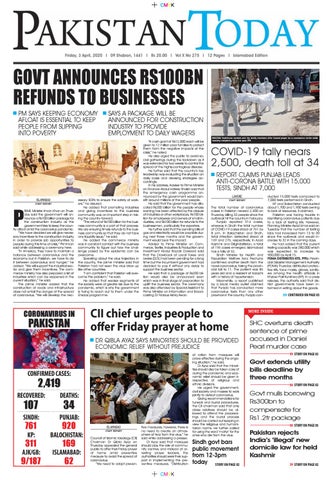
Govt announces Rs100bn Refunds to businesses g
pm SayS keepIng eCOnOmy aflOat IS eSSentIal tO keep peOple frOm SlIppIng IntO pOVerty
ISLAMABAD sTAff rePorT
P
rIme minister Imran khan on thursday said the government will announce a rs100 billion package for the construction industry as the government tries to keep the country afloat amid the coronavirus pandemic. “we have decided we will give necessary incentives to the construction industry in order to provide job opportunities to people during this time of crisis,” pm Imran said while addressing a ceremony here. “In america, they have to maintain a balance between coronavirus and the economy but in pakistan, we have to do it between coronavirus and hunger,” he added. “we will support the industrial sector and give them incentives. the commerce ministry has also prepared a list of industries which can be reopened in the current situation,” he said. the prime minister added that the construction of roads and infrastructure does not entail the danger of the spread of coronavirus. “we will develop the nec-
g
SayS a paCkage wIll be annOunCeD fOr COnStruCtIOn InDuStry tO prOVIDe emplOyment tO DaIly wagerS
essary SOps to ensure the safety of workers,” he assured. He added that promoting industries and giving incentives to the business community was an important step in taking the country forward. “the refund of rs100 billion for the business community is a part of that process. we are ensuring timely refunds to the business community so that they do not face any liquidity issue,” he said. He added the commerce ministry was in constant contact with the business community to figure out how the challenge posed by the epidemic can be overcome. Speaking about the virus trajectory in the country, the prime minister said that pakistan had not seen the virus blow up like other countries. “I am confident that pakistan will overcome this problem,” he said. He added that weaker segments of the society were at greater risk due to the pandemic, which is why the government is trying to reach out to them under the ehsaas programme.
coRonaviRus in
Pakistan
“a cash grant of rs12,000 each will be given to 12 million poor families to protect them from the negative impacts of the crisis,” he noted. He also urged the public to avoid social gatherings during the lockdown as it was extended for two weeks to control the spread of the highly-contagious disease. He further said that the country’s top leadership was evaluating the situation on daily basis and devising strategies accordingly. In his address, adviser to prime minister on finance abdul Hafeez Shaikh said that the emergency cash programme announced by the government would benefit around millions of the poor people. He said that the government has allocated rs200 billion for the people whose earning has been affected by the closure of industries or other workplaces, rs100 billion for employees and owners of small industries, and rs100 billion for refunds to the businessmen, particularly the exporters. He further said that the pending bills of gas and electricity would be payable during next three months and the government would bear the impact. advisor to prime minister on Commerce, textile, Industries & production and Investment abdul razzak Dawood said that the Drawback of local taxes and levies (Dltl) had been pending for a long time but the incumbent government had decided to pay it without any delay to support the business sector. He said that a package of rs200 billion would also be announced soon which was in final stage of preparation to uplift the business sector. the ceremony was also attended by Special assistant to prime minister on Information and broadcasting Dr firdous ashiq awan.
2,419
SINDH:
PUNJAB:
107 761
34
920
KP:
BALOCHISTAN:
AJK/GB:
ISLAMABAD:
311 9/187
169 62
g
repOrt ClaImS punjab leaDS antI-COrOna battle wItH 15,000 teStS, SInDH at 7,000 LAHORE sTAff rePorT
the total number of coronavirus cases in pakistan neared 2,400 on thursday, killing 33 people since the outbreak hit the country in february. punjab reported 914 cases, whereas in Sindh the total number of COVID-19 cases stood at 761 by 8 pm. In balochistan and Sindh, total infection detected stood at 169 and 276, respectively. In azad kashmir and gilgit-baltistan, a total of 196 cases emerged. Islamabad has a tally of 62. Sindh minister for Health and population welfare azra pechuho confirmed another death from the novel coronavirus, taking the provincial toll to 11. the patient was 86 years old and a resident of karachi with a history of hypertension. meanwhile, a report published by a local media outlet claimed that punjab has conducted more coronavirus tests than any other province in the country. punjab con-
Dr QIbla ayaz SayS mInOrItIeS SHOulD be prOVIDeD eCOnOmIC relIef wItHOut prejuDICe
CONFIRMED CASES: DEATHS:
COVID-19 tally nears 2,500, death toll at 34
CII chief urges people to offer Friday prayer at home g
RECOVERED:
MULTAN: Healthcare workers and the family members offer funeral prayer for a coronavirus victim while wearing complete protective gear. PPI
ISLAMABAD sTAff rePorT
Council of Islamic Ideology (CII) Chairman Dr Qibla ayaz on thursday appealed the general public to offer their friday prayer at home amid preventive measure to avoid the spread of coronavirus. “we need to adopt preven-
tive measures, however, there is no need to create an atmosphere of fear from the virus,” he said while addressing a presser. Dr ayaz said that mosques should play the role of community centres and instead of arresting prayer leaders, the authorities should seek their support in implementing the preventive measures. “Distribution
CMYK
of ration from mosques will prove effective during the ongoing situation,” he said. Dr ayaz said that the minorities should also be taken care of during the pandemic and economic relief should be given irrespective of religious and ethnic divisions. He urged the government, civil society and masses to work jointly to defeat coronavirus. giving recommendations for funeral and burial procedures, the CII chairman said that only close relatives should be allowed to attend the proceedings and the burial process should be carried out keeping in view the religious and humanitarian norms. He further called for using the word ‘martyr’ for the ones who die from the virus.
Sindh govt bars public movement from 12-3pm today STORY ON PAGE 02
ducted 15,000 tests compared to 7,000 tests performed in Sindh. kp and balochistan conducted about 1,700 and 1,900 tests owning to lack of resources, it claimed. pakistan was facing trouble in identifying coronavirus patients due to a lack of testing kits. However, planning minister asad umar said on tuesday that the number of testing labs had increased from 13 to 30 since the outbreak and would increase to 32 in the coming days. He had added that the current testing capacity was 280,000 which was expected to increase to 900,000 by april 15. PDMA DISTRIBUTES KITS, PPEs: provincial Disaster management authority (pDma) thursday distributed protective kits, face masks, gloves, sanitizers among the health officials in khyber pakhtunkhwa (kp). In a press release, the authority said that district governments have been informed in writing about the goods.
CONTINUED ON PAGE 03
more inside
SHC overturns death sentence of prime accused in Daniel pearl murder case STORY ON PAGE 03
Govt extends utility bills deadline by three months STORY ON PAGE 02
govt mulls borrowing rs300bn to compensate for rs1.2tr package STORY ON PAGE 05
Pakistan rejects India’s ‘illegal’ new domicile law for held Kashmir STORY ON PAGE 02
02
Friday, 3 April, 2020
NEWS
PakiSTan RejecTS inDia'S 'illeGal' new Domicile law FoR HelD kaSHmiR pm imran says pakistan conDemns inDia’s continueD attempts to ‘illegally’ alter DemograpHy in iok ISLAMABAD
P
STAFF REPORT
RIME Minister Imran Khan on Thursday said that Pakistan strongly condemns the Indian government’s continued attempts to “illegally” alter the demography in occupied Kashmir. He was referring to the new domicile law introduced by the Indian government, under which an Indian citizen, who has lived in occupied Jammu and Kashmir for 15 years, can call the territory their place of domicile. Through a gazette notification issued by the Indian government on Wednesday, a domiciled person has been defined as one who has resided for a period of 15 years in the occupied territory of Jammu and Kash-
mir or has studied for a period of seven years and appeared in class 10 or 12 examinations in an educational institution located there. The prime minister in a post on Twitter said that the new domicile law was in “violation of all international laws and treaties”. Calling the timing of the move “particularly reprehensible”, he said the action sought to exploit the international focus on the Covid-19 pandemic to further the Bharatiya Janata Party’s “Hindutva” agenda. A statement issued by the Foreign Office earlier in the day also stated that the Reorganisation Order 2020 was a violation of international law and the Geneva Convention. The statement said Pakistan had been trying to sensitise the world community to India’s attempt to change the “demography and distinct identity” of Kashmir.
fo says inDia’s reorganisation orDer 2020 violates international law anD geneva convention “The latest Indian action, at this moment of global health crisis, is particularly reprehensible as it seeks to take advantage of the international community’s focus on the ongoing Covid-19 pandemic and further advance Bharatiya Janata Party’s ‘Hindutva’ agenda.” The statement called on the United Nations and the world community to take notice of India’s actions and hold it “accountable for its persistent violations of international law”. Last month, Pakistan had called on India to lift the communication blockade imposed in occupied Kashmir and ensure supplies of essential commodities in the valley to contain the spread of Covid-19 and mitigate the suffering of Kashmiris. The Indian government had on August 5, 2019 repealed Article 370 of its constitu-
ISLAMABAD APP
Hussain Dawood pledges Rs1bn to bolster fight against corona pandemic DawooD Hercules group cHief says ‘neeD of tHe Hour is to reDuce tHe spreaD anD impact of tHe virus’ NEWS DESK Dawood Hercules Corporation Chairman Hussain Dawood on Thursday pledged Rs1 billion in cash, services and kind to combat COVID19, on behalf of his family and both the corporations. “We are committed to help solve some of the most pressing issues of our time and it is incumbent upon us to serve our nation best when it needs us most. These are our fundamental values that continue to be at the core of what we strive to achieve,” Hussain said in a press release issued Thursday. “We must work on several fronts concurrently. The need of the hour is to target on reducing the spread and impact of this virus,” he emphasised. The group further said it would focus on disease prevention, with a major focus on testing and diagnostics, protecting and enabling healthcare practitioners and other key workers, who are at the frontline of the fight against this pandemic, enabling patient care and facilities; and to bolster livelihoods and sustenance of the most deserving in society. The company also welcomed the efforts by the government and other organisations who have stepped up to this challenge. The contribution comes a day after Prime Minister Imran Khan announced the coronavirus relief fund to fight the epidemic and urged everyone to donate.
Foreign Minister Shah Mahmood Qureshi on Thursday reiterated Pakistan’s readiness to host the SAARC Health Ministers’ Meeting and suggested that due to the prevailing global health emergency, a video conference could be organised. In a telephonic conversation with SAARC Secretary General Esala Ruwan Weerakoon, Qureshi said being a founding member, Pakistan remains committed to the SAARC process and considers it an important platform for regional cooperation. Congratulating Weerakoon on assuming responsibilities as the 14th Secretary General of SAARC, Qureshi
tion, stripping occupied Kashmir of its special status. It also divided up occupied Jammu and Kashmir into two union territories; one Jammu and Kashmir, and the other the Buddhist-dominated high altitude region of Ladakh. The bifurcation of the territory came into effect on October 31 last year. A strict lockdown and communications blackout has been in place in occupied Kashmir since August last year, with reports suggesting limited mobile data services and internet were temporarily restored in the region in January. Kashmir is a disputed territory claimed in full by both India and Pakistan. The UN Security Council has passed multiple resolutions recognising the Kashmir issue as an international dispute and calling for a plebiscite in the valley to give Kashmiris their right of self-determination.
pakistan reiterates offer to host saarc health ministers' video moot assured him of Pakistan’s full support and expressed the hope that under his experienced stewardship, the SAARC process would be able to move forward. The foreign minister and the secretary general discussed the challenges faced by South Asian States in the face of the spread of COVID-19 pandemic. The need for joint efforts to deal with the situation was emphasised by both sides. The foreign minister also reiterated that the proposed SAARC COVID-19
Emergency Fund may be placed under the supervision of secretary general of SAARC and that the modalities for the Fund’s utilization be finalized through consultations among Member States. Dilating upon the economic impact of COVID-19 on the developing world, Foreign Minister Qureshi highlighted Prime Minister Imran Khan’s call for debt restructuring of the developing countries to enable them to dedicate resources towards saving human lives and shoring up economies.
Qatar supports pakistan's call for debt restructuring ISLAMABAD STAFF REPORT
Foreign Minister Shah Mahmood Qureshi on Thursday held a telephonic conversation with his Qatari counterpart Mohammad bin Abdulrahman Al Thani and discussed the challenges posed by the coronavirus. Qureshi apprised Al Thani about Prime Minister Imran Khan’s call for debt relief/restructuring to enable the developing countries to free up resources to combat the disease and shore up economies. Al Thani underscored the importance of learning from the experience of the countries which have managed to control the disease successfully. He also described Pakistan’s call for debt restructuring as a timely initiative and stated that Qatar supports the demand. Qureshi said Pakistan is deploying all available resources to curtail
the spread of COVID-19 and reduce its impact. Appreciating the timely measures taken by the Qatar government, he noted that these steps helped contain the disease in the oil-rich MENA economy. He also appreciated the role played by Qatar in facilitating the peace process in Afghanistan. The foreign minister expressed
deep concern over the situation in the Indian occupied Kashmir, where the coronavirus has spread and fatalities are being reported. He called for the immediate lifting of all restrictions to allow the dissemination of information and unfettered supply of medicines and other essentials.
Govt can't silence media through abusive Twitter trends, says Bilawal LARKANA: Pakistan People’s Party (PPP) Chairman Bilawal Bhutto-Zardari on Thursday condemned abusive Twitter trends against prominent journalists and termed them attempts to muzzle criticism. “These trends are nothing but another attempt at silencing critics and giving a message to the rest of the media to stay silent or face the consequences.” He said: “If the federal government and PTI social media teams focus as hard on corona awareness as they do on trolling dissenting voices, it would be a far better use of time and resources in these difficult times.” The PPP chief urged that in these extraordinary times, the country needed a unifying response to the unprecedented challenge posed by the coronavirus pandemic. “We cannot afford and must avoid divisive politics and settling of political scores at this critical juncture.” He said that the media played an important part in a democratic dispensation and the world over, media had held governments accountable for their response to one of the worst crises in recent human history. “For those who think media can be bullied into submission must also remember that journalists in Pakistan have a long history of resistance to injustice and tyranny.” STAFF REPORT
Firdous urges youth to help people during lockdown ISLAMABAD: Special Assistant to the Prime Minister on Information and Broadcasting Dr Firdous Ashiq Awan said on Thursday that Pakistani youth have always played a vital role in social service. In a series of tweets, the SAPM said that Prime Minister Imran Khan entrusted the responsibility of delivering the essential items at the homes of the deserving people to the youth who have always worked actively with Imran Khan in social work. She said that the word “tiger” should not be attributed to any political party, particularly Pakistan Tehreek-eInsaf (PTI) as every young man serving the community is a tiger. She said Imran Khan has been using the word tiger for youth even when he had not joined politics. Awan said these young men were present during the construction of Shaukat Khanum Memorial Hospital, which does not discriminate against anyone on political grounds. The SAPM urged political parties to give importance to “the cause” rather than words as the nation has to defeat a foe like corona by collective efforts. She asked the youth to register themselves at the Citizens Portal to support Imran Khan in the mission of national service. Separately, she welcomed the Japanese assistance of $2.16 million for Pakistan to deal with the coronavirus. In a tweet on Thursday, she said Japan has always helped Pakistan in difficult times. APP
Pakistan has over 48,000 under-trial prisoners, SC told ISLAMABAD APP
Sindh govt bars public movement from 12-3pm on Friday KARACHI: The Sindh government has announced a complete ban over public movement and activities between 12 and 3pm on Friday. No one will be allowed to leave the house and businesses will be closed. A ban is already in place over congregations for Friday prayers to control the spread of the coronavirus. Sindh Information Minister Nasir Hussain Shah said strict action will be taken against anyone found violating the ban. The Sindh government had banned Friday prayers in the province last week. The order issued by the government said that only three to five mosque staff members (such as the imam and khateeb) are allowed to pray there. Some mosques, however, did not follow the government’s orders and police had to make announcements asking people to go back to their homes. STAFF REPORT
The Supreme Court Bar Association (SCBA) on Wednesday submitted its response in the Supreme Court regarding the number of prisoners in jails, saying that more than half of the prison population was under trial. In the report, SCBA President Qalb-eHassan said the number of convicted prisoners in prisons across the country was 25,456, whereas the number of under-trial prisoners in the country was 48,008, it added. There were 1,527 people over the age of 60 in 114 prisons. According to the report, over 1,184 women were imprisoned across the country, while 140 newborns were also locked up with mothers in Punjab and Khyber Pakhtunkhwa jails. The report said more than 33 per cent of the extra prisoners were kept in various prisons across the country. The report said there were 58 vacancies of the psychiatrist and 108 vacancies of doctors were lying vacant in the jails.
It said no ambulance service was available in 10 per cent of Punjab’s jails. Around 2,400 people were suffering from deadly diseases, such as AIDS and hepati-
CMYK
tis, it said. In Punjab alone, 66 disabled prisoners were locked up in different jails, the report added.
The number of TB patients in prisons was 173 and 594 prisoners suffered from mental illness in various jails across the country, it added.
Friday, 3 April, 2020
SHC oveRtuRNS deAtH SeNteNCe of pRiMe ACCuSed iN dANieL peARL MuRdeR CASe COURT SAYS PROSECUTION FAILED TO PROVE CASE AGAINST AHMED OMER SHEIKH AND THREE OTHERS KARACHI STAFF REPORT
THE Sindh High Court (SHC) on Thursday turned the death sentence awarded to Ahmed Omer Saeed Sheikh, the prime suspect in journalist Daniel Pearl murder case, in a seven-year jail term in addition to acquitting other three suspects, earlier handed life sentences, as it announced its verdict in the case. The other three suspects are Fahad Naseem, Salman Saqib and Sheikh Adil. The verdict was announced by a twomember bench, headed by Justice Mohammad Karim Khan Agha – which had reserved the judgement last month on the appeals filed by the convicts in 2002 –
after hearing arguments and examining the record and proceedings of the case. In the detailed verdict, the bench declared that the prosecution had failed to prove the case against the suspects. However, it said, the judges found Sheikh guilty of being involved in abduction-forransom of the slain journalist and sentenced him seven years in jail, Anadolu Agency reported, citing defense counsel. However, the bench said, since Sheikh has been in prison for the last 18 years, his seven-year sentence will be counted from the time served, implying that he has already served his sentence. The court also turned down the appeal of the state, also filed in the same year, seeking enhancement of the sen-
LHC seeks arguments from NAB on petitions for Mir Shakil’s release LAHORE: The Lahore High Court (LHC) on Thursday, while adjourning the hearing of bail petitions for Jang/Geo Editor-in-Chief Mir Shakilur Rahman in plots exemption case till April 7, sought arguments from National Accountability Bureau’s (NAB) prosecutor on the next hearing. The division bench, headed by Justice Sardar Ahmad Naeem, heard the petitions filed by Mir Shakil and his wife Shahina Shakil. Barrister Aitzaz Ahsan appeared on behalf of the petitioners and pleaded with the court for immediate release of Mir Shakil while setting aside his physical remand. He said that the bureau had arrested his client without any lawful authority. “It was a private transaction but the bureau acted beyond its jurisdiction and arrested my client,” he said while arguing that the plots were exempted in accordance with the law and then prevalent policy. “The bureau violated its own policy and SOPs by arresting his client since NAB had decided not to summon businessmen and issued SOPs to this effect during October 2019,” he added. Subsequently, the bench adjourned further hearing till April 7 on conclusion of arguments by petitioners’ counsel and sought arguments from NAB prosecutor on the next date of hearing. Earlier, a NAB prosecutor filed a reply to the petition, filed by Mir Shakil at the start of the proceedings. Mir Shakil was arrested by the bureau on March 12 in illegal plots exemption case. The bureau had alleged that the accused obtained illegal exemption for 54 plots of one-kanal each in Johar Town area of Lahore, with the connivance of Nawaz Sharif, the then chief minister of Punjab, in violation of the exemption policy. STAFF REPORT
Shehbaz urges govt to reduce petrol price by Rs26 LAHORE: Pakistan Muslim League-Nawaz (PML-N) President Shehbaz Sharif on Thursday urged the federal government to slash petrol price by at least Rs26 in the wake of massive slump in international oil prices. Last week, the government announced to reduce the prices of all petroleum products by Rs 15 per litre for three months, bringing the petrol to Rs96 per litre. Shehbaz, also the National Assembly opposition leader, said the cut won’t have any adverse impact on the expenditures of the Centre given the situation in the global market. The underprivileged people should be taken care of, Shehbaz said, adding that labourers, daily-wagers, and people from the lowermiddle-class deserved the government’s help. “Traders, industrialists, and the business fraternity have always played a key role during trying times and now, in the current crisis, we have to help and guide them,” he added. The PML-N leader explained that after having discussions in light of the ongoing pandemic, his party had set up a plan of action, which he claimed will help the public get rid of its present woes. Late last month, as the worldwide coronavirus cases shot to more than 700,000 — they are almost a million, as of reporting time — crude oil struck the lowest levels in more than 17 years, with Brent North Sea tumbling to $22.58 per barrel at one point. There are warnings that oil could sink even further as storage tanks around the world approached full capacity. STAFF REPORT
tence. Pearl, the South Asia bureau chief for the Wall Street Journal, was abducted on January 23, 2002, in Karachi and beheaded the next month, reportedly by AlQaeda. His murder sent shock waves throughout the world and was covered extensively in the Western media. In his autobiography In the Line of Fire: A Memoir, former president Pervaiz Musharraf had claimed that Sheikh, a British national and a student at the London School of Economics (reports claim that he did not graduate), was hired by MI6 to engage in “jihadi operations”, adding that “at some point, he probably became a rogue or a double agent”. THE CASE: In July 2002, following the hearings, an anti-terrorism court (ATC) in Hyderabad had sentenced to death Sheikh and life term to other co-accused. However, all four convicts had moved the SHC in 2002 challenging their convictions. While arguing the case, the
defense had maintained that the prosecution had “miserably failed” to prove its case against their clients beyond any reasonable doubt and prosecution witnesses were mostly policemen, whose testimonies could not be relied upon. They had further contended that Naseem and Adil Sheikh’s confessions before a judicial magistrate were defective and not voluntary. They had argued that the recovery of the laptop from Naseem was shown to have been made on Feb 11, 2002, while computer expert Ronald Joseph had deposed that he was given the computer for verification on Feb 4 and he examined the laptop for six days. Deputy Prosecutor General Saleem Akhtar had supported the trial court’s verdict and submitted that the prosecution had proved its case against the appellants beyond a shadow of doubt and had requested the court to dismiss the appeals.
Govt extends utility bills deadline by three months ISLAMABAD STAFF REPORT
The federal government has decided to extend the deadline for gas and electricity bills by three months owning to a countrywide lockdown in Pakistan to contain the pandemic. “People do not have to pay their gas and electricity bills immediately,” Adviser to PM on Finance Hafeez Shaikh announced on Thursday. The government has set aside Rs1 billion to incur these losses,
he added. Shaikh, while speaking to reporters at the Prime Minister’s House, said that the government will spend Rs70 billion to make up for the decrease in petrol and diesel prices. “We have removed all duties on food products,” he claimed, adding that the government has procured wheat worth Rs200 billion to help farmers and small landowners. “We don’t want any contraction in the economy,” he added. He also said that the government
is going to spend Rs107 billion to refund businessmen. “Rs30 billion will be given to the Drawback of Local Taxes and Levies (DLTL), Rs10 billion to sales tax for exporters, Rs52 billion will be spent on refund of sales tax, and Rs15 billion on duty drawback,” he added. He said that the funds are being released and it will continue till next week. “We are in constant contact with all provincial governments and are doing our best to help the people in these crucial times,” he added.
Govt did not follow due process in KPT chairman's removal, says IHC CJ COURT MAINTAINS STAY ORDER AGAINST REMOVAL OF REAR ADMIRAL (R) JAMIL AKHTAR, SEEKS GOVT’S REPLY BY APRIL 10 ISLAMABAD STAFF REPORT
The Islamabad High Court (IHC) on Thursday maintained the stay order against the removal of Karachi Port Trust (KPT) Chairman Rear Admiral (r) Jamil Akhter and directed the federation to submit a written reply in the matter by April 10. On March 27, the IHC had suspended the federal government’s order terminating Akhtar’s services and had issued notices to the federal government for April 2. The Pakistan Muslim LeagueNawaz (PML-N) government had appointed Akhtar on November 23, 2017, for three years, but the Pakistan Tehreek-e-Insaf (PTI) government removed him from the post on March 25, citing various reasons. According to a notification issued
by the Establishment Division on March 25, the federal government had removed Akhtar from the post “forthwith by modifying/reducing his period of initial appointment in terms of Section 11 of the KPT Act, 1886, with immediate effect”. Later, issuing another notification, the Establishment Division said that “the federal government is pleased to assign additional charge of the post of the chairman of the KPT to Shakeel Mangnejo (BPS21), director general of Ports and Shipping, Karachi, under the Ministry of Maritime Affairs, for a period of three months”. Appearing before a single-member bench of IHC Chief Justice Athar Minallah on Thursday, Akhtar’s lawyer Raja Zahurul Hassan said that his client’s removal was a violation of the law, adding that by virtue of his
office, Akhtar had also been one of the trustees of the KPT. Raja said that the government had issued the impugned notification of March 25 by misinterpreting Section 11 read with Section 15 and 15(A) of the KPT Act, 1886, without placing the matter before the federal cabinet. “The KPT Act clearly states that a trustee or chairman could only be removed on the grounds clearly written in the relevant sections,” he added. The IHC CJ observed that the government had violated due process of the law by terminating Akhtar. He later sought written reply from the Cabinet Division secretary, principal secretary to the prime minister, principal secretary to the president, Establishment Division secretary, Ministry of Marine Time Affairs and the Marine Affairs secretary by April 10.
NEWS
03
'Bright but dysfunctional': Who is omar Saeed Sheikh? The British-born militant Omar Saeed Sheikh, whose death sentence reduced to seven years for kidnapping the Wall Street Journal reporter Daniel Pearl, came from a background many times removed from the darkened rooms where he kept his kidnap victims, according to Guardian. The Sindh High Court overturned the murder conviction of Sheikh as it only found Sheikh guilty of the lesser charge of kidnapping and sentenced him to seven years in prison. The son of a Pakistani wholesale clothes merchant from Wanstead, east London, Sheikh was a public schoolboy, a student at the London School of Economics and a member of a UK arm wrestling team before he moved to South Asia and began hostage-taking in support of radical Islamists in Kashmir and Afghanistan. “Pearl’s [allged] murder and kidnap were not Sheikh’s first. He became notorious in 1994 with the kidnap of three Britons and one American in Delhi. A shootout followed and the four captives were released. Sheikh went to jail without achieving his goal: the release of a leader of the fundamentalist group Harkat-ul Mojahedin, Maulana Masood Azhar.” According to Guardian, “A Pakistanbased journalist, Syed Ali Hasan, who was at both the fee-paying Forest school and the LSE with Sheikh, told the BBC World Service in February this year that his classmate and fellow student had not always been the model schoolboy sometimes imagined. He said he was a “bright but rather dysfunctional” student who had been suspended from school several times on account of his violence.” “But it was at the LSE that Sheikh came into contact with radical Islamists. “He told us he was going to Bosnia driving aid convoys, and he never came back to university,” Mr Hasan said. The war appears to have been a turning point – he told police during his 1994 interrogation that he was disturbed by the ethnic conflict he saw while an aid worker with a charity called the Convoy of Mercy.” After five years in jail he was freed by the Indian government on December 31 1999 to meet the demands of hijackers who had seized an Indian Airlines jet. From then until he was arrested in connection with the Pearl kidnap – perpetrated, the kidnappers claimed, in order to secure the release of captives taken by the US in Afghanistan – he lived in Pakistan as a member of Jaish-e Mohammad, a militant group accused of the December attack on the Indian parliament. According to a Dawn report, military investigators believe Sheikh drew up the earliest plans for former president Pervez Musharraf’s assassination in 2002 and raised funds for the attacks. NEWS DESK
Covid-19 tally nears 2,400, death toll at 33 ContInueD fRoM pAge 01 According to PDMA, it delivered 50,000 masks in Malakand, 20,000 in Peshawar, 15,000 in Bakka Khel Task camp, 10,000 in DI Khan, 5,000 in North Waziristan and 5,000 in Bannu. In addition to this, 10,000 PPEs have also been dispatched to district governments. “We have also provided 1,000 N-95 masks to Hayatabad Medical Complex and 2,300 to the health department,” it said. CHINA SENDS SUPPLIES WORTH $3M: A special Pakistan International Airline (PIA) flight carrying relief supplies worth $3 million donated by China, landed in Islamabad late Wednesday night. Through a tweet on Thursday morning, Foreign Office Spokesperson Aisha Farooqui said: “We thank Chinese people & leadership for their solidarity & appreciate #China’s continued support to combat #COVID19.” Beijing is at the forefront of Pakistan’s fight against the pandemic which has killed over 47,500 people worldwide. In the last two weeks, it has donated enormous stockpiles of medical equipment and relief goods both at the government and private levels. Today, Pakistan Ambassador in Beijing Naghmana Hashmi announced a further 35 tons of emergency relief supplies donation from the “Chinese entities and individuals”. The Chinese government is also helping Pakistan in building a temporary makeshift hospital in Islamabad.
CPEC remains unaffected by corona pandemic ISLAMABAD INP
The federal government has decided to begin work at the China-Pakistan Economic Corridor (CPEC) despite the rising trend of the coronavirus pandemic in the country. The decision was taken during the meeting of the National Coordination Committee, attended by the chief ministers of all provinces, federal ministers and top military officials. The construction industry will also be allowed to operate from tomorrow and the prime minister would announce a package for the industry on Friday. The premier has completed a consultation with the economic team on the revival of the economy and an advisory would be issued to the provinces for allowing travel of the labourers related to the industry.
The federal government has also decided to issue an advisory for Friday and other prayers under which the local administration is directed to take the decision keeping in view the on-ground situation of coronavirus pandemic. Reports quoting prime minister during the meeting said that they have decided to start operations of the construction sector in order to provide relief to the lower segment of the society. “The labourers’ employment is associated with the industrial sector,” the premier said, adding that the labour class was currently a top priority of the government. The prime minister was also briefed on the current status of the pilgrims who had arrived at the Taftan border from Iran. The briefing said that the pilgrims were currently in good health and a majority of them who contracted the virus have recovered from it.
It is pertinent to mention here that the NCC meeting on Wednesday decided for extending its lockdown till April 14 to
curb the spread of COVID-19 besides finalising a solid strategy to cope with the impact of the pandemic.
04 ISLAMABAD
Friday, 3 April, 2020
WEATHER UPDATES FRIDAY
270C
120C
SATURDAY
290C
150C
SUNDAY
270C
140C
PRAyER TimingS FAJR SUNRISE
ZUHR
ASR MAGHRIB ISHA
4:30
12:12
3:46
5:55
6:29
7:54
FEDERal CaPiTal's REsiDEnTs ConTinuE VisiTing TRails DEsPiTE loCkDown ISLAMABAD
T
APP
HE residents of the federal capital are continuing to visit trails despite lockdown for containing the pandemic of Corona virus in the country. Talking to APP, Assistant Director Islamabad Wildlife Management Board (IWMB) Sakhawat Ali regretted the irresponsible behaviour of residents flouting the restriction to stay at homes for mitigating the risk of outbreak. He said: "IWMB staff and Islamabad Capital Territory Police officials are deputed at the entrance of all the Trails. However, the regular and expert hikers are using short routes and alternate passages to venture into the Margalla Hills National Park." Though the number was not that big yet
it was a threat due to serious outbreak of Corona virus. The visitors were parking their cars other than the designated places and using hidden routes in the woods, he added. Sakhawat added that IWMB staff was vigilant and performing its duties despite the lockdown. "IWMB rangers are patrolling in the National Park as it is the season for budding of Kachnar plant or Bauhinia Variegata. Local communities dwelling in the National Park are also moving in the park for plucking of Kachnar flowers." He said the staff was barring masses to avoid cutting the bushes of Kachnar plants and plucking its flowers as it was detrimental for the ecology. He urged people to avoid visiting the National Park for their safety and protection of others to mitigate the risk of Corona virus outbreak.
Education ministry, PTV launch Teleschool to facilitate students’ education ISLAMABAD: Minister for Federal Education and Professional Training Shafqat Mahmood has said that the Education Ministry through Pakistan Television (PTV) has launched an initiative called "Teleschool" for providing an opportunity to school going students to get an education while they remain indoors. Taking to Twitter, the minister said that the aim is to provide students 10 hours of course based classes every day. It is worth mentioning here that the Ministry of Federal Education and Professional Training and PTV has signed a Memorandum of Understanding (MoU) in this regard. The MoU was signed by Joint Secretary Education Umair Javaid and PTV Managing Director (MD) Amir Manzoor in a ceremony that was attended by Shafqat Mahmood, PTV General Manager (GM) Farhat Anwar and other concerned officials. Under the MoU, the Ministry of Federal Education will broadcast a programme titled Teleschool on PTV during summer vacations for class one to 12. PTV MD Amir Manzoor said that being a state channel, PTV was playing its part in providing education to the masses within its resources during these testing times. APP
Delivery of relief package to over two million families to start in two days: CM
RAWALPINDI: Worried men sit at the roadside in hopes of someone assigning them work. PPi
100,000 youth registered with ‘Corona Tiger Force’: Dar ISLAMABAD APP
Special Assistant to the Prime Minister (PM) on Youth Affairs Usman Dar on Thursday said that the registration process of “Coronavirus Relief Tiger Force” has had a successful beginning as around 100,000 youngsters have registered themselves to serve as volunteers. "The youth wants to register themselves with the force,” Usman said, adding that they are collecting data and would expand parameters to the district level soon. He said that the opposition was trying to create a controversy regarding the force, but he wanted to convey to them that the volunteer force would be formed above party lines. "The force would work in collaboration with district administrations to look after the affairs of quarantine centres," he added. It may be mentioned here that the force will also be responsible for ensuring uninterrupted food supply to the less-privileged people at their doorstep in an emergency situation. Dar said that the PM wanted to engage the youth in the fight against
FORCE WILL BE ASSIGNED TASKS ON A DAILY BASIS COVID-19, keeping in view their enthusiasm and efficiency seen at the time of natural calamities in the past. "Every country around the world was calling their volunteers to work collectively. The Pakistani Muslim League-Nawaz (PML-N) and Pakistan Peoples' Party (PPP) are criticising every positive step instead of joining hands with the government," he said, adding that they had not even collected data of the poor in the past, which is now the need of the hour and taking a lot of precious time. "This is not the right time to indulge in negative politics as we all are passing through a difficult phase," he said. He further urged the youth to get themselves registered as volunteers through the Citizen Portal mobile application to support PM Imran Khan in the national service of helping people during the lockdown. Dar said that the premier trusts the youth with the task of delivering essen-
tial commodities to the needy during the current crisis as they have always been supportive of him in social work. Dar also clarified that the word “tiger” should not be attributed to any political party. "Every youth serving society is a tiger. Imran Khan was calling them tigers since the day when he had not joined politics," he added. Apprising more regarding the project, he said that data collection including details of deserving families from across the country will be completed by April 10. The programme will enlist people over the age of 18 through the Citizens Portal whereas registered volunteers will work with district administrations and the National Disaster Management Authority (NDMA). The responsibilities of the Corona Relief Tiger Force include delivering food & essential commodities, running awareness campaigns, identifying poor people, quarantine management etc. "They will be assigned responsibilities on a daily basis," Dar informed. "The youth will join the frontline in the fight against coronavirus along with nurses, paramedical staff and doctors," he concluded.
SC dismisses service restoration of KP police constable ISLAMABAD APP
The Supreme Court on Wednesday suspended the service tribunal verdict and maintained the inquiry committee decision regarding dismissal of Khyber Pakhtunkhwa (KP) Police Constable Shahid Khan from service over absence from duty. A two-member bench of the apex court comprising Chief Justice Gulzar Ahmed and Justice Ijaz Ul Ahsan heard the case filed by the KP government against service tribunal verdict. During the course of proceedings, the court was informed that the inquiry com-
mittee dismissed Constable Shahid Khan for six months' continuous absence while the service tribunal eased the sentence and restored Shahid Khan to the job. Justice Ijaz Ul Ahsan said that Shahid Khan remained absent from service for six months and three days and never appeared before the inquiry committee. The counsel for the constable said that constable Shahid Khan had been absent for two months ten days, not six months. He said that his client's earned leave was remaining and he was on leave. He said that his client had admitted the period when he was absent from service and being absent for six months was misrepresented.
PESHAWAR: Khyber Pakhtunkhwa Chief Minister Mahmood Khan said on Thursday the government would provide relief package to more than two million families across the province. Talking to media persons in Bannu he said registration of poor families under Ehsaas Program and BISP has been started and relief cheques would be distributed among deserving people within two days. The chief minister said the government and administration was keeping strict eye on prices of daily used commodities and warned the hoarders and profiteers of strict action. Mahmood Khan appealed the general public to stay at homes and cooperate with the law enforcing agencies in this regard and maintain social distancing. Earlier, the chief minister visited quarantine center and isolation ward in Bannu. Chief Secretary Khyber Pakhtunkhwa Dr Kazim Niaz and Commissioner Bannu division were also present on the occasion. HoARDERS Won’t BE foRgIvEn At Any coSt In BAnnu: The Khyber Pakhtunkhwa government is trying to control prices so as to not burden people, said Chief Minister Mahmood Khan during his one-day visit to Bannu on Thursday. “We have told people not to hoard anything. Hoarders will not be forgiven,” he said, adding that they can’t overcome the coronavirus crisis without the help of the people. We have closed everything for the safety of the people, he remarked. “People should only leave their houses when they need to.” He added, “We can’t impose a curfew, and PM Imran Khan keeps saying this in his speeches.” The chief minister said the government is trying to facilitate people who can’t even purchase their own food. “We plan on distributing rations among 2.1 million families,” he said, adding that the registration work has started already. Khan arrived in Bannu on Thursday morning. He was accompanied by the provincial chief secretary and ministers. He is expected to review the arrangements at the quarantine centres and isolation wards set up at the Khalifa Gul Nawaz Teaching Hospital. STAFF REPORT
207 quarantined as precautionary measure in Rawalpindi district RAWALPInDI: The district administration in collaboration with concerned departments has quarantined 207 COVID-19 suspected persons as a precautionary measure in the district. According to data shared by Directorate of Public Relations (DPR) here Thursday, to date,148 people were quarantined at homes while 59 were quarantined at various facilities in the district. The DPR said that they were under regular observation and the rapid response team of the Health Department were compiling their daily record. “Presently 48 cases were tested positive out of which two have been died while 37 patients having positive symptoms were admitted in different hospitals of the district who were provided the required treatment,” the DPR said. Meanwhile Deputy Commissioner Capt (Retd) Anwar ul Haq said that maximum arrangements for the treatment of COVID-19 patients have been made besides all possible preventive measures are in place to meet any eventuality. He said a full-scale fumigation drive was underway in different localities of the city especially where corona suspects have been found. He advised the citizens to adopt precautionary measures and do not create panic.APP
150,000 coronavirus testing kits to be available within few weeks: Fawad ISLAMABAD APP
Federal Minister for Science and Technology, Chaudhry Fawad Hussain on Thursday said that around 1,50,000 coronavirus testing kits will be manufactured within the next few weeks. Talking to the media after his visit to the National University of Science and Technology (NUST), the federal minister said that the brilliant team of NUST has prepared testing kits which have been to the Drug Regulatory Authority of Pakistan (DRAP) for approval. "The university also checked the results of these testing kits by taking samples from
different hospitals for their satisfaction before sending the kits to DRAP," he said, adding that the testing kits would be used as soon as they get approved. Chaudhry also told that the Pakistan Engineering Council (PEC), which had received 48 designs of ventilators, has approved three that have also been sent to DRAP and told the body had constituted an expert committee which will be meeting soon to work on this matter. He observed that marketing medical devices, particularly those that are invasive, is not a short process. "Considering the inherently lengthy process, these particular kits are being fast-tracked so that the country's imme-
diate requirement can be met as early as possible and dependence on imported kits can be reduced," Chaudhry added. Appreciating the efforts of NUST researchers and scientists, the federal minister said that it was scientists who have now sequenced the complete genome of SARS-CoV2, which would yield more accurate diagnostics for this virus and will also impact vaccine development studies. Talking about fake and low quality sanitisers being sold in the market, Chaudhry Fawad also encouraged NUST to expedite work on the commercialisation of high quality sanitisers developed by the university.
Friday, 3 April, 2020
Govt mulls borrowinG rs300bn to compensate for rs1.2tr packaGe ISLAMABAD SHAHZAD PARACHA/GHULAM ABBAS
t
hE federal government is mulling to borrow Rs300 billion from different sources to meet expenses of the recently announced Rs1.2 trillion economic relief package, aimed at fulfilling the necessary requirements of the public in the wake of the ongoing coronavirus pandemic. As people doubt the government’s capacity to even bear the burden of the announced package, the major chunk of the relief package, as expected, will be based on borrowings from different global lenders, sources claimed. Apart from the tax exemptions and other reliefs being offered to the public, the package announced by Prime Minister Imran Khan is based on assistance (loan) from lenders and saving money through delayed payment of interests. The government has already requested the International Monetary Fund (IMF) for a grant and the fund agreed. Sources privy to the development said Rs300 billion out of Rs1,200 billion is being considered as relief through tax exemptions. Borrowing and tax relief jointly make half of the announced package, they added. Sources said the government would also utilise around Rs150 billion worth of the Public Sector Development Program (PSDP) for this package as the Ministry of Finance (MoF) has already waived the conditions for releases in four quarters of the current fiscal year. Interestingly, officials of the Ministry of Planning and Development claim there would be no cut in PSDP. As of today, there will be no cut in PSDP, they say and
add instead they (officials) have been asked to speed up the spending on development projects. however, sources in MoF clearly indicate a cut of Rs150 billion in PSDP of this financial year. Sources said the package also includes Rs200 billion worth savings from interest payment and budgetary support worth Rs 150 billion. ADB and WB have also given an amount to the government to mitigate the effects of COVID-19, they added. In addition, the government would establish a ‘Residual/Emergency Relief Fund’ in which Rs100 billion would be kept to mitigating the impact of COVID19. Moreover, the government would give Rs105 billion to payback sales tax and income tax refunds, duty drawbacks and customs duty to exporters.
FBR would give Rs75 billion and the Ministry of commerce Rs30 billion to exporters. An amount of Rs50 billion has also been earmarked for the Utility Stores Corporation (USC) to give ration to the poor people with the assistance of BISP. Lastly, the government would also provide Rs6 billion for Pakistan Railways to meet its expenses. As per details related to the tax exemptions, the rate of advance tax on the import of different pulses has been reduced to zero from 2pc. Similarly, individuals and associations of persons providing tea, spices, dry milk and salt to USC without a brand name will pay 1.5pc withholding tax instead of 4.5pc, while and Individuals and AoPs receiving payments from the corporation for supplying ghee, sugar, pulses, and wheat
flour will be charged 1.5pc withholding tax instead of 4.5pc. In addition, the government has also exempted additional customs duty (ADC) @ 2pc on soya bean oil, canola oil, palm oil and sunflower oil (and on these four oil seeds). The government has allocated Rs200 billion for daily wagers, who were affected due to the lockdown. Sources said the economic team would utilise the BISP money for this purpose as around Rs130 to Rs140 billion have to be utilised by the division. The Poverty Alleviation Division has a plan to disburse this amount under regular ‘Kafalat Programme’ and emergency cash assistance on the recommendations of the district administration. The assistance will be provided for four months besides BISP beneficiaries. It will be one time dispensation and the cash will be provided either in one installment of Rs12,000 through Kafalat partner banks i.e Bank Alfalah and habib Bank Limited after biometric verification or it may be provided in two installments of Rs6,000 each. Few days ago, PM’s Adviser on Finance Dr hafeez Shiekh had said the government would give more money to the Poverty Alleviation Division for disbursement of money to daily wagers and the deserving people. According to economists, though the relief under the present virus crisis may give some sigh of relief to the people, the same would ultimately add the economic woes of the government. The further borrowing and relaxation in taxes would multiply the public debt with further reduction in revenue, they fear.
WAPDA to award Diamer-Bhasha Dam contract this month ASAD UMAR SAYS GOVT WILL REQUEST SC TO RELEASE DAM FUND FOR CONSTRUCTION OF BHASHA DAM ISLAMABAD STAFF REPORT
The Water and Power Development Authority (WAPDA) has finally decided to award the contract for the much-delayed Diamer-Bhasha Dam this month. During a recent meeting at the Ministry of Planning, Development and Reforms, WAPDA officials stated that all technical issues related to the award of the contract have been resolved and that the entire process would be completed within the next couple of weeks. Although the government is yet to arrange the financing for this mega project, it has decided to at least commence work on the main dam project through available resources, while leaving the power generation part of the project to be considered later.
During the meeting, Planning Minister Asad Umar had directed WAPDA to ensure progress on the project as per the set timelines. The minister was informed that work on already Diamer-Bhasha Dam Project was underway and a cost Rs99.238 billion has been incurred on the project till February 2020, including Rs93.9 billion for land acquisition. It was further informed that WAPDA intends to award the contract for the “main dam & allied structures” within the next couple weeks to start the construction activities within the current financial year. Further expenditure of around Rs61 billion was planned during the current financial year, including Rs22 billion on resettlement and Rs39 billion on construction-related activities. The project is divided into six major
components, for which separate contracts will be awarded in a phased manner. The dam part of the project is expected to be completed by Sept 2027, while the overall completion is expected in March 2028. The meeting was further informed that Prime Minister-Supreme Court Dam Fund has an amount of Rs12.17 billion available with it, which was currently invested in MTBs. In a tweet on Thursday, the minister claimed that the dam fund which was kept under the supervision of the superior court may be used for construction work of the dam. “Government will be requesting the court to use this money as part of the expenditure to construct the dam,” he said. Earlier in January 2020, in a surprising development, WAPDA had sought Rs170.756 billion, through another re-
vised PC-I, for the acquisition of land/resettlement of Diamer-Bhasha Dam Project. The cost of 2nd revised PC-I of the project, which was submitted by WAPDA to MoPD&R, was 68pc higher than the 1st revised PC-I of the Acquisition of Land & Resettlement (AL&R), as the total cost of the project was estimated at Rs101.3 billion in 2015. According to sources, the Planning Commission, while showing its displeasure over the surge in the resettlement cost, had asked WAPDA to explain the reasons for incurring such heavy costs to national exchequer due to time and cost overrun. As per the Planning Commission, there should also be a comprehensive investigation by the Prime Minister’s Inspection Commission to probe into WAPDA’s proven inefficiencies in the aforementioned project.
Wheat shortage in KP lifts Biotech company to develop COVID-19 20kg flour price to Rs1,300 vaccine from tobacco plants PESHAWAR AZIZ BUNERI
Due to the reduction in wheat grains supply to flour mills in Khyber Pakhtunkhwa, the price of 20kilogram flour bag has jumped to Rs1,300 amid the coronavirus-led lockdown. Pakistan Flour Mills Association’s Khyber Pakhtunkhwa Group Leader Mohammad Naeem Butt told Pakistan Today that the government has failed to meet the grain demand of flour mills. “Currently, there are 200 flour mills operating in the province hav the demand of 13,000 tonnes of wheat, whereas the government is providing just 6,000 tonnes of wheat,” he said. Prior to the lockdown, the KP government was providing 5,000 tonnes of wheat to flour mills as the province was getting 7,000 tonnes supply in the form of wheat and
flour before the coronavirus lockdown in the country. But now, the supply has been stopped due to which there is now crises like situation in the market, Butt noted. “The situation can be improved only if the Sindh government lifts ban on the supply of wheat outside their province. Farmers in Sindh have harvested the wheat crop and the grain is lying with farmers, but the Sindh government has imposed ban on wheat transportation to other province.” The miller said the federal government was asked to raise the issue with the Sindh government as the KP province would be more affected due to wheat shortage. Therefore, the association had requested Chief Minister Mahmood Khan and the federal government to allow them to bring wheat directly from Sindh, he added.
The increasing number of coronavirus victims around the world has put all the research centres in efforts to develop a vaccine that can prevent people from getting sick from coronavirus. In this effort, Canadian-based biotech company, Medicago, partially owned by Philip Morris International (PMI), announced that it now focuses on developing a plantbased vaccine against coronavirus disease which it hopes to submit for approval by the US Food and Drug Administration very soon. Medicago in a statement said it successfully produced a Virus-Like Particle (VLP) of the coronavirus just 20 days after receiving the genetic sequence of severe acute respiratory syndrome coronavirus 2 (SARS-COV2), the virus responsible for COVID-19. This is the breakthrough first step in developing a vaccine. Medicago already uses a plant-based technology to develop vaccines for seasonal flu, but is now working on developing a vaccine for COVID-19. Instead of working with live virus in chicken eggs as a bioreactor, Medicago uses tobacco plants in what it describes as a faster and more efficient process of producing proteins.
The company said that using tobacco plants and genetically engineered agrobacterium works faster than using eggs. It also makes the vaccine easier to produce at scale. The company believes that tobacco plants are “highly efficient at producing proteins of varying complexity, serving as mini-factories for our vaccines.” With its plant-based technology, Medicago researchers insert a genetic sequence into agrobacterium, a soil bacteria, which is taken up by the subject plant Nicotiana benthamiana—known as a close relative to tobacco. The plant develops the protein that can be used as a vaccine. “The pace of our initial progress in COVID-19 is attributable to the capability of our plant-based platform which is able to produce vaccine and antibody solutions to counteract this global public health threat. The ability to produce a candidate vaccine within 20 days after obtaining the gene is a critical differentiator for our proven technology. This technology enables scale-up at unprecedented speed to potentially combat COVID-19,” said Dr Bruce Clark, CEO of Medicago. BUSINESS DESK
NEWS
05
CORPORATE CORNER
LAHORE: MCB Bank has donated a sum of Rs5,000,000 to renowned NGO Jahandad Society for Community Development (JSCD) for distribution of food ration packs to needy families during the COVID-19 lockdown.
nestlé pakistan to support vulnerable communities with rs100m in coviD-19 pandemic LAHORE: To meet the nutritional needs of both affectees and frontline workers during these times, Nestlé Pakistan has committed Rs100 million in the national response to the COVID-19 pandemic. As part of the pledge, Nestlé Pakistan will give product and cash donations, which will include 4 million servings of milk, iron fortified dairy products, baby cereals, water and juices. highlighting the efforts, Samer Chedid, CEO, Nestlé Pakistan said, “We will be mobilizing relief to medical facilities (quarantine centers) and food-delivery organizations serving vulnerable families, worth 100 million rupees, in the form of product and cash donations, through national and provincial disaster management authorities and local governments.”
byco announces plans to install DHDs & fcc units KARACHI: Byco Petroleum Pakistan Limited (Byco) has announced its decision to establish a diesel hydro de-sulphurising (DhDS) unit and a fluid catalytic cracking (FCC) unit. The decision was taken during the “Extraordinary General Meeting” of Byco’s shareholders. Amir Abbassciy, Byco’s Chief Executive Officer, commented: “Today we announce yet another decision taken to future proofing our business through continuous improvement of our systems and processes. We have been planning and preparing for these upgrades at our refineries for some time.”
serena extends community support in wake of coviD-19 ISLAMABAD: Serena hotels has started distributing rations to communities in locations surrounding their hotels countrywide to support affected segments at a time when the global coronavirus pandemic is wreaking havoc on the country’s economy. More than 3400 deserving families and households in areas where Serena hotels are located, including in Islamabad, Faisalabad, Quetta, Swat, Gilgit, hunza, Shigar and Khaplu have been provided with rations that include food staples and essentials.
Js bank wins big at asiamoney awards 2020 Reflecting Pakistan’s growing stature in the international financial space, JS Bank won the ‘Best bank for SMEs’ and ‘Best bank for CSR’ awards at the Asiamoney Awards 2020. The bank has won the Asiamoney Best Bank for SME award in 2019 as well. 2019 was a year of growth and development at JS Bank. While not amongst the largest banks in Pakistan, JS Bank is amongst the top three when it comes to lending to small and medium-sized enterprises (SMEs). The Bank’s overall SME client roster has increased to approximately 22,000 with parallel business portfolio growth. “We at JS Bank strive to build value for the customers and communities we serve. We are humbled by the appreciation and will continue to build and introduce offerings that meet market needs.” said Basir Shamsie, President and CEO, JS Bank. “I thank our customers for their continued support and my team for their efforts without whom none of this would have been possible.” PRESS RELEASE
Friday, 3 April, 2020
06 COMMENT
Life in lockdown
Overtaken by events A failure of leadership in testing times
W
ITH Prime Minister Imran Khan continuing to be indecisive, partial and even obstructive, vital decisions to counter the coronavirus threat on the federal level are being taken by the National Security Committee, albeit belatedly. Among the provinces, the Sindh government alone displayed the capability to take initiatives and efficiency in implementing them. Weeks after the first coronavirus case in Pakistan, the PM finally spoke on the issue saying there was no need for panic, a statement that he keeps repeating. He failed to announce his government’s strategy to deal with the crisis, meanwhile consistently opposing the lockdown imposed by the Sindh government. Mr Khan was bound to be overtaken by events. When indecisiveness by a Prime Minister begins to cause harm to the country, and the opposition proves incapable of making the ruling party rectify its course, other forces are likely to step in, a development that is already taking place at a rapid pace. Wary of the PTI government’s incompetence, the National Security Committee constituted a few weeks back a National Coordination Committee (NCC) to evaluate the situation on a day-to-day basis. Within days the NCC decided to set up a National Command and operation Centre (NCoC) to act as the implementation arm of the NCC. on Wednesday, the NCC decided to extend the lockout over the entire country for two weeks. The same day ISPR announced the designation of a serving Army general as convener of the newly-established NCoC. The NCoC convener immediately hosted a briefing for important cabinet members and SAPMs. CoAS Gen Qamar Javed Bajwa and senior military officials also took part in the session which was briefed about the deployment of troops across the country for assisting the civilian agencies and the status of the containment efforts and enforcement measures against Covid-19. The future course of action was also deliberated upon at the meeting. Had the PM displayed leadership instead of leaving “faith and youth” to do the job, the involvement of the unelected sector in policymaking and execution of decisions might have been unnecessary. Hopefully henceforth all sources of proliferation of the coronavirus, including large religious gatherings, will be effectively blocked. Similarly the controversial induction of the Corona Relief Tigers would end, leaving local government bodies to help distribute food wherever needed.
Waiting for the summer heat puts off the crisis, not solves it at Penpoint M a NiaZi
T
HE coronavirus pandemic has created a new reality. And the most salient feature is that the world is heading for a depression. Some say it has arrived. That means it is worse for the economy than the Spanish flu, which is not listed as a cause of the Great Depression, which began with the Crash of 1929, which started the freefall in stock values that led to the reverse of growth: contraction. Apart from the wiping out of wealth, it also led to mass unemployment and the destruction of enterprises. Economic recovery was tried repeatedly, but it was not under World War II that the solution propounded by several economists, most notably John Maynard Keynes, was put into practice, and there was truly heavy spending by the state on anything. one of the results of this was the post-War welfare state. Not only was there a need to spend, but there was a revulsion against the suffering that large masses of people underwent during the Depression. The world has suffered economic crises before, but governments have relied on Keynesian ideas to avoid recessions lasting too long. one requirement was that the world went off the gold standard. That meant that a country did not require gold to back its currency, and there was no longer any restriction on the amount of money in circulation. Money could be printed. The dollar was the reserve currency of the world because of the strength of the US economy, the third currency in which two countries traded. Every country has to earn dollars by exporting, so as to pay for its imports. The USA is in the happy position of just printing dollars to pay for its imports. This has had its own disadvantages, like other countries holding vast amounts of dollars, giving them the potential to play with its value. The USA as well as its nearest economic rival, China, have been badly hit by the coronavirus, and the effect of their economies grinding to a halt may put the whole world into a depression. Europe has also been hit, tilting the world further towards depression. one thing missing is a new economic theory. Gov-
Need to reflect and act
T
HURSDAy was World Autism Awareness Day, and while the world struggles with the Covid-19 pandemic, this was an opportunity to remind ourselves that those medical conditions which pre-existed before the pandemic, have not gone away. It also served as a reminder that society is less tolerant not just of those who are differently abled because of autism, but generally of all those who are differently abled because of one difference or the other. one of the problems that our society suffers from is that there is too much stigmatization of the differently abled. That has led to this being seen as a moral problem, and one result has been that not enough resources are devoted to special education, and not enough differentiation between various kinds of disability is created. Physical disabilities, where there are no other mental disabilities, are not catered for. This should be all the more reason why the anti-polio campaign should have been prosecuted more vigorously, as parents feared the prospect of their children not receiving proper facilities anywhere, all their lives. However, vaccinators still need police escorts, and the cavalier neglect of the anti-polio campaign by the present government seems to have been overcome by the new crisis. When ordinary schools and colleges are shut down, it seems something of a needless flourish to think about the adequacy of special education facilities. However, the theme of this year’s Awareness Day is Transition to Adulthood, which actually fits in with this pandemic. After all, when it is over, all societies will need everyone, and that will include the autistic. They may not fit the norm, but they can pull their weight in society; provided that they are met with acceptance and given the education they deserve. For this to be achieved it is first necessary to spread awareness and then pass meaningful legislation to create a more inclusive and accepting environment for the differently abled.
The economic consequences are not because of the lockdown, but the virus Sidra Shafaqat
N
o outdoor activities, No flights, no trains, six feet distance from others that we have to maintain. But why? Because it is time to fight with an invisible enemy ‘CoVID19’. All over the world, the deadly virus is affecting lives of people irrespective of any discrimination between rich or poor economies. The World Health organization has officially declared the outbreak a pandemic. Countries are imposing strict measures to control the spread of coronavirus. In Pakistan, a total 2118 cases are reported on April 2 with 27 confirmed deaths. The risk assessment of this disease is also high. In this scenario, government forced a lockdown in all regions of the country for up to approximately two weeks. Public transport, markets, parks, offices and other public spots will remain closed. Health professionals are doing their best to combat the CoVID-19 outbreak in Pakistan. All the available resources are being utilized by the government. Hence in a country with one of the lowest public health expenditures as a percentage of GDP in the world, it is of utmost importance to limit the number of infections as much as possible. However, this is just one side of the situation. on the other hand, the economy is also battling against CoVID-19. A controversial question is that whether the country should be under lockdown or not. Most countries have closed down their borders and implemented nationwide lockdowns. India has announced a 21-day nationwide lockdown with 1.3 billion people confined to their homes, likewise a 21-day lockdown has been in South Africa, while Italy with the highest death toll in world had imposed lockdown on March 10 restricting 60 million citizens to their homes, France, Spain, Norway and New Zealand are also following the same strategy, while on March 23, the UK went into full lockdown. Here, the need is to evaluate whether an economy like Pakistan can afford the nationwide lockdown or it’s a path towards another bout of troublesome economic downfall. Is the financial situation of our economy able to feed the population without any economic activity? Prime Minister Imran Khan also stated that a complete lockdown in country is not a feasible solution as 25 percent of the
Dedicated to the legacy of the late Hameed Nizami
Arif Nizami Editor Umar Aziz
Asher John
Joint Editor
Executive Editor
Deputy Editor
Lahore – Ph: 042-36300938, 042-36375965
The writer is a member of staff.
COVID-19: economic impact of nationwide lockdown
World Autism Day
Aziz-ud-Din Ahmad
ernments’ economic solutions have been pretty much Keynesian orthodoxy. There has been little of Milton Friedman’s supply-side economics, which focused on not letting the printing of money cause too much inflation. At present, none of the solutions to the economic problem are going out of the Keynesian box. If there is another depression, where instead of growth, there is contraction, where production falls, strikes, it will have horrendous consequences, particularly in terms of unemployment. A key factor is when the world begins to return to normal. That in turn depends on how effectively governments combat the epidemic. It will not really help if any government is efficient, because inefficiency by another will mean that its own gains are temporary, and limited to the duration for the virus to make a comeback. There are already attempts by Western governments to attempt a return to normal. That would mean an end to quarantine and social distancing measures, so that people can go back to work. However, that might mean a resurgence of the infection. That will only mean another round of deaths and disruption, and strain on a healthcare system which would not have either recovered from the strain now being placed on it, nor adapted to the new circumstances. There has been a lot of blame thrown at the healthcare system in the West for not being able to handle the epidemic, and there has been much maligning of the systems of the developing world, which are much more primitive. However, it must be remembered that if the epidemic is not the new normal, there was no reason to prepare for an epidemic. It is also an indication that the world is not ready for a really vicious epidemic, one which spreads faster, and kills many more, than CoVID-19, which does not infect everyone, and which kills only a small proportion of those who do catch it. At the same time, it should not be complained that this is new-fangled. The coronavirus is not an old disease, which is why it kills its host. However, viral diseases, once they starting causing illness among humans, have a nasty way of staying. True, they no longer kill, allowing their hosts to live, but only one, smallpox, has been actually eliminated, while many, all lumped together as the ‘common cold’, remain to infect Mankind repeatedly. Even now, the only reliable treatment for a viral disease is to let the infection
run its course. As is the case with CoVID-19, the disease is not always fatal, with people with healthy respiratory systems and with good general immunity, surviving. At the moment, not only are scientists working hard to find a vaccine, but are also working on finding an antiviral. While some antivirals are available, they are not as effective as antibiotics, which have answered bacterial infections so effectively that they no longer cause pandemics. Keeping in view that the bubonic plague was bacterial, causing the Black Death, which probably brought feudalism to an end, that was a big plus. However, viruses haven’t been controlled, and there seem to have been an increasing number of attempts in recent decades, as viruses which infect animals attempt to transfer to humans. Apart from recent attempts by coronaviruses to make the transition, like MERS (which came from camels) and SARS (which is suspected as coming from civet cats) and now CoVID-19 itself (which may have come from bats via pangolins), there have been such diseases as AIDS and Ebola fever, where viruses have made a transition to humans. These were diseases that did not easily cause infections, or were not easily caught, with the result that they were contained. However, victims continue to be snared, and very often die. Those earlier epidemics were precursors of CoVID-19, which gives rise to the disturbing thought that it might be merely an intermediate stage rather than the final epidemic. China and South Korea are supposed to have had their healthcare systems honed by the experience they had of MERS, so the world now has to brace itself for the next epidemic, which could actually come out of anywhere. That means that what seems to be the government strategy, of waiting for the hot weather to kill off the virus, may work only temporarily. Some cold viruses remain in summer, and CoVID-19 need be no exception. Not only will it be back in winter, but it will be joined sooner or later by other coronaviruses. However, it should be remembered that one reason for the apparent instability in global public health, is because of global warming and climate change. Virus populations had developed an equilibrium with various animal species, and remained confined to those animals’ habitats. However, climate change has destroyed many habitats, endangering the species, or making them extinct. The viruses infesting them have to go somewhere, and try their luck with human beings. Climate change deniers like US President Donald Trump are the loudest in claiming that the virus is Chinese, even though they have done their bit for CoVID-19, as well as for any succeeding viral epidemics.
I
Karachi – Ph: 021-35381208-9
I
population lives below the poverty line. It would stipend of Rs 3,000 ($20) for next four months. Now there is serious requirement to do a costmake their lives miserable. Economic activities are crippled. The virus has benefit analysis. The cost includes the aforementioned economic downfall killed off the stock market through the nationwide lockgains. The Federal Comdown whereas the benefit merce Secretary commerce will be in terms of reduction said that exports orders had The government has to manage in CoVID-19 positive cases got cancelled and due to this and a lower number of fatalexport loss can be in the the situation efficiently and ities. Another unintended range of $2 billion to $4 bilcompetently by implementing benefit is the reduction in the lion. The FBR is already facpollution level in the cities ing a massive revenue new economic priorities; due to the closure of factoshortfall. The estimated colpublic transport and relection of revenue till June precise planning to protect jobs ries, duced human activity. 2020 is just Rs 4.4 trillion as Environmental experts have compared to the FBR’s ancompanies and employers, identified the improvement nual target of 5.555 trillion. compensation on payable in the Air Quality Index Former Finance Minister Dr (AQI) of Karachi under the Hafiz Pasha indicated that interest amount to energy lockdown in Sindh due to unemployment rate of 5.8 coronavirus. The AQI in percent reported by the service providers, relief on Khyber-Pakhtunkhwa has Labour Force Survey 2017income tax to companies also dropped, showing 18 may surge to 8.1 percent healthy air quality. This imin fiscal year 2020-21. Not producing products related to provement is also expected only this, inflation and in other major air polluting poverty level will also rise life necessities and health cities, specifically, Lahore. after the industrial shutdown. protection and to announce The government has to A drop in international manage the situation effitourism and a reduction in resome back support for ciently and competently by mittances are other pieces of implementing new ecobad news. The Asian Develexporters. Along with all this, it nomic priorities; precise opment Bank reported that planning to protect jobs Pakistan economy may face is a major responsibility of companies and employers, losses of $5 billion or may citizens to self-quarantine and compensation on payable ineven more than that. amount to energy servCurrently, in order to provide government a free hand terest ice providers, relief on tackle the situation, an ecoincome tax to companies nomic relief package of Rs to gear up some economic producing products related 900 billion ($5.6 billion) activities in a proper manner to life necessities and health was approved by the Prime protection and to announce Minister on March 24. out under the war of COVID-19 some back support for exof this, Rs 200 billion ($1.25 porters. Along with all this, billion) are assigned for low it is a major responsibility of income groups, particularly for laborers, along with Rs 280 billion ($1.76 billion) citizens to self-quarantine and provide government a for wheat procurement. Whereas, a package of Rs free hand to gear up some economic activities in a 100 billion is to support the agriculture sector and proper manner under the war of CoVID-19. small industries. Furthermore, the PM stated said that Sidra Shafaqat is a freelance columnist over five million people will be provided a monthly
Islamabad – Ph: 051-2204545
I
Web: www.pakistantoday.com.pk
I
Email: editorial@pakistantoday.com.pk
Friday, 3 April, 2020
COMMENT 07 Editor’s mail Send your letters to: Letters to Editor, Pakistan Today, 4-Shaarey Fatima Jinnah, Lahore, Pakistan. E-mail: letters@pakistantoday.com.pk Letters should be addressed to Pakistan Today exclusively
Website for Corona aS corona is extensively discussed in social, electronic, and paper media. The problem is undoubtedly challenging however, being threatened, panic, and anxious may not help coping up the situation. as laymen people believe whatever they were thrown to by overflowing social media tools, therefore, it is an extremely important to make an official and authentic platform nationally and provisionally where information can be pasted and timely updated. These forums will definitely provide a across match for filtering the fake and fabricated piece of information. i humbly wish to notify the authorities to make such an arrangement and propagate through electronic and paper media. ArEEbA Karachi
Rape culture
Modi’s pandemic lockdown becomes a human tragedy
sultan m hali
I
ndian propaganda masters have been giving a spin to Modi’s handling of the COVid-19 pandemic in india by criticizing Pakistan. indian news agency ANI quotes Washington-based Gilgit Baltistan (GB) political activist Senge Hasnan Sering as stating “indian PM Modi is playing a constructive and supportive role as expected from the leader of the world’s fourth-largest economy. His policy of ‘no citizens left behind’ has earned him recognition from opposition parties who are also supporting his Sunday lockdown directive.” Senge Hasnan Sering, allegedly an indian factotum, in the same breath, also took a swipe at islamabad’s alleged total lack of a coordinated response for combating the COVid-19 pandemic and the government’s complete apathy towards GB by saying “although Gilgit-Baltistan is a direct neighbour of China’s Xinjiang, its inhabitants are getting coronavirus infection transmitted from a completely unexpected location like iran.” To prove his point, Sering remarked, “When compared with Pakistani provinces and Pakistani administered Kashmir, GB has the highest number of positive cases in proportion to population size,” and this is an undisputable fact. if that were not enough, indian media is spreading the disinformation that the residents of azad Jammu Kashmir are incensed that the government of Pakistan has established quarantines for persons testing positive to COVid-19 in cities of azad Kashmir, which are housing patients from Punjab. While the pack of lies of Modi’s deft handling of COVid-19 outbreak is being propagated in Chanakyan fashion that “tell a lie so often that it appears to be the truth”, it is being negated by independent media sources. The harsh reality, being reported by internationals news agencies and TV channels with vivid and heartbreaking videos depict the thousands of indians trudging home in the sweltering heat because they were caught unawares by the sudden lockdown of india by narendra Modi and his cash-strapped government’s inability to provide food and basic necessities to the people. Work and wages dried up after india declared a 21-day lockdown with four hours’ notice on the midnight of 24 March, to prevent the spread of the coronavirus. all over india, millions of migrant workers are fleeing its shuttered cities and trekking home to
their villages. These informal workers are the back- be sending planes to bring home one lot, but bone of the big-city economy, constructing houses, leave the other to walk back home,” tweeted cooking food, serving in eateries, delivering take- Shekhar Gupta, founder and editor of The Print. Simultaneously, bone-chilling stories of the aways, cutting hair in salons, making automobiles, plumbing toilets and delivering newspapers, collapse of indian economy are rampant. The inamong other things. Escaping poverty in their vil- dian economy is set to slow down sharply as lages, most of the estimated 100 million of them companies face the prospect of going weeks or live in squalid housing in congested urban ghettos even months with virtually no revenue, and consumer demand is likely to remain soft even after and aspire for upward mobility. Soutik Biswas, BBC’s india correspondent, the coronavirus crisis blows over because of in his opinion piece titled ‘Coronavirus: india’s bankruptcies, job losses and the resulting psypandemic lockdown turns into a human tragedy’ chological scars. Forecasters are slashing india’s economic writes that last week’s lockdown turned them into refugees overnight. Their workplaces were growth estimates for the financial year starting 1 shut, and most employees and contractors who april, with most expecting a severe contraction in June quarter output. Last Monday, S&P Global paid them vanished. Sprawled together, men, women and chil- Ratings cut its estimate for india’s gross domestic dren began their journeys at all hours of the day product (GdP) growth to 3.5 percent from its last week. They carried their paltry belongings─ earlier estimate of 5.2 percent, as it expects the damages to the econusually food, water and omy from the covid-19 clothes─ in cheap rexpandemic for the asiaine and cloth bags. The Pacific region to be as young men carried Indian policy makers have severe as the one during tatty backpacks. When the asian financial crithe children were too announced several measures sis of 1997-98. tired to walk, their par“amid unusually ents carried them on to counter the impact of the high uncertainty, we their shoulders. They walked under virus on the economy and more forecast asia-Pacific growth to dive to 2.2 the sun and they are likely to come in the next percent in 2020 with a walked under the stars. U-shaped recovery takMost said they had run few weeks. While the ing hold only later this out of money and were year— this would push afraid they would government has announced a activity four percentage starve. “india is walkrelief package for those hit points below trend,” it ing home,” headlined in a recent report. The Indian Express worst by the 21-day nationwide saidindian policy maknewspaper. ers have announced sevThe staggering exlockdown to prevent eral measures to counter odus was reminiscent of community transmission of the the impact of the virus the flight of refugees on the economy and during the bloody particoronavirus, the Reserve Bank more are likely to come tion in 1947. Millions in the next few weeks. of bedraggled refugees of India (RBI) took a series of While the government had then trekked to east has announced a relief and west Pakistan, in a steps to boost liquidity in the package for those hit migration that displaced banking system and encourage worst by the 21-day na15 million people. tionwide lockdown to This time, hundreds banks to lend prevent community of thousands of migrant transmission of the workers are desperately coronavirus, the Retrying to return home in serve Bank of india their own country. Battling hunger and fatigue, they are bound by a col- (RBi) took a series of steps to boost liquidity in lective will to somehow get back to where they the banking system and encourage banks to lend. belong. Home in the village ensures food and the Last week, international Monetary Fund (iMF) comfort of the family, they say. Prime Minister managing director Kristalina Georgieva said the narendra Modi apologized for the lockdown global economy could be staring at a recession “which has caused difficulties in your lives, espe- that is as bad as or worse than the global financial cially the poor people”, adding these “tough crisis of 2008. The iMF is expected to substantially reduce its growth estimates for most measures were needed to win this battle.” Whatever the reason, Mr Modi and the state economies in its World Economic Outlook, governments appeared to have bungled in not which is scheduled to be released in april. Reanticipating this exodus which has made a flecting the pessimism, indian stock markets conmockery of the lockdown and turned it into a tinued their downward march, dumping stocks and conserving cash. The Sensex plunged 4.61 human tragedy. Mr Modi has been extremely responsive to percent to 28,440.32, while the 50-share index the plight of indian migrant workers stranded nifty shed 4.38 percent to 8,281.10. Clearly, a lockdown to stave off a pandemic abroad: hundreds of them have been brought back home in special flights. But the plight of is turning into a humanitarian crisis. workers at home struck a jarring note. Sultan M Hali is a retired Group Captain “Wanting to go home in a crisis is natural. if indian students, tourists, pilgrims stranded over- and author of the book Defence & Diplomacy. seas want to return, so do labourers in big cities. Currently he is a columnist, analyst and TV talk They want to go home to their villages. We can’t show host.
WE all can see the heart-wrenching condition of our society due to increasing higher number of sexually assaulted cases of children who is under 9 to 13 years old. Being a Muslim it’s the worst ever the condition of our society. not only this after they sex with” little flowers” they brutally killed them. Here are the following reasons why society is covered with this rape culture. Rape culture is a sociological concept for a setting in which rape is pervasive and normalized due to societal attitudes about gender and sexuality. Behaviors commonly associated with rape culture include victim blaming, slut-shaming, sexual objectification, trivializing rape, denial of widespread rape, refusing to acknowledge the harm caused by sexual violence, or some combination of these. it has been used to describe and explain behavior within social groups, including prison rape and in conflict areas where war rape is used as psychological warfare. Entire societies have been alleged to be rape cultures.The notion of rape culture was developed by second-wave feminists, primarily in the United States, beginning in the 1970s. Critics of the concept dispute the existence or extent of rape culture, arguing that the concept is too narrow or that, although there are cultures where rape is pervasive, the idea of a rape culture can imply that the rapist is not at fault but rather the society that enables rape. There have been many movements that been made in order to address rape culture, such as SlutWalk and Me Too. These movements have helped share people’s stories through the use of hashtags which are embodied and connected to rape. SHAHZAIb SHAIKH Karachi
TB too, not just Corona EaCH year, we commemorate World Tuberculosis (TB) day on March 24 to raise public awareness about the devastating health, social and economic consequences of TB, and to step up efforts to end the global TB epidemic. The date marks the day in 1882 when dr Robert Koch announced that he had discovered the bacterium that causes TB, which opened the way towards diagnosing and curing this disease. TB remains the world’s deadliest infectious killer. Each day, nearly 4500 people lose their lives to TB and close to 30,000 people fall ill with this preventable and curable disease. Global efforts to combat TB have saved an estimated 54 million lives since the year 2000 and reduced the TB mortality rate by 42%. To accelerate the TB response in countries to reach targets. NorEEN YAr MuHAMMAD Karachi
Sanitizer in the time of Corona aS we all know that coronavirus is spreading rapidly throughout the world. There are 2260 confirmed cases of COVid-19 in Pakistan. The health agency says, do wash your hands frequently and thoroughly. This is the smartest thing you can do to prevent the spread of viruses. Fear of the coronavirus has led people to stock up on the germ-killing gel, leaving store shelves empty and online retailers with sky-high prices set by those trying to profit on the rush. More is on the way, although it’s not clear how long it will take retailers to restock. do make sure that if you are able to buy a lesser-known brand of hand sanitizer, it’s made of at least 60% alcohol, as recommended by the Centers for disease Control and Prevention. (C.d.C.) rAZI rAHMAN Karachi
Fake news on social media i would like to draw your attention towards the fake news on social media. as you can see, it has become a trend nowadays that people on social media tell other fake news on anything to fool others. For example, somebody will say that there were a lot of people at the market or will say that the stores were closed or will say that nobody came to that meeting or the teacher has got sick and cannot conduct a class. Then the next day the other finds out that what was told on social media, it didn’t actually happen at all or somebody tells you that nothing like that happened. The fact is that some people spread fake news for fun to fool others without any reason, this also misguides people. This is nothing more than playing with someone’s life who has no business with you. Social media did help bring people together but also gave rise to many evils that also includes spreading fake news to the people. ZuHAIb SHAH Karachi
War of water a recent foreign media report has revealed that the Modi-led government of india is planning to stop Pakistan’s share of river water from flowing into Pakistan by the end of this year. indian authorities are working on a plan to stop 2 TMC of water from the Ujh River, a branch of Ravi, flowing through the Kathua district of indian Occupied Kashmir. Last year, after creating Pulwama drama to frame Pakistan, Modi and his ministers began to threaten Pakistan with water terrorism. Modi has previously claimed that india will block Pakistan’s water supply in the near future. ZAIYAN AHMED KHAN Karachi
Friday, 3 April, 2020
08 WORLD VIEW
Under Modi, india’s press is not so free anyMore INDIA’S GOVERNMENT HAS PRESSURED ADVERTISERS AND EVEN SHUT DOWN CHANNELS TO SHAPE THE INFORMATION THAT 1.3 BILLION INDIANS RECEIVE. IT’S PART OF A WIDER ASSAULT ON DISSENT NEw YORk TImEs
t
Vindu GoeL And Jeffrey GeTTLemAn
HE Media One anchorman Vinesh Kunhiraman went on air as usual on March 6, ready to tell the station’s five million viewers in India’s Kerala State about the death anniversary of a beloved comedian and the latest news on the coronavirus pandemic. Just a few minutes into the broadcast, he saw the managing editor rush to the studio floor, gesturing wildly. “I realized something was not right,” Mr. Kunhiraman recalled. The station’s uplink suddenly went dead. Mr. Kunhiraman’s image dissolved into a blue screen. A bland message told viewers there was no signal. “We regret the inconvenience,” it said. But this was no technical difficulty. The station had been cut off by an order from India’s Ministry of Information and Broadcasting. The government decided to block the channel for 48 hours because it had covered February’s biggest news story — the mob attacks on Muslims in New Delhi that flared into broader unrest — in a way that seemed “critical toward Delhi Police and R.S.S.,” the order said. The R.S.S. is a Hindu-nationalist social movement with close ties to Prime Minister Narendra Modi and his Bharatiya Janata Party. “It was shocking the central government took such a decision,” said R. Subhash, an editor at Media One. “It was an attack on the freedom of the press.” India’s free press has played a crucial role in protecting this country’s democracy since its independence from Britain in 1947. But journalists here now feel under attack. Since Mr. Modi came to power in 2014, they say, his government has tried to control the country’s news media, especially the airwaves, like no other prime minister in decades. Mr. Modi has shrewdly cultivated the media to build a cult of personality that portrays him as the nation’s selfless savior. At the same time, senior government officials have pressed news outlets — berating editors, cutting off advertising, ordering tax investigations — to ignore the uglier side of his party’s campaign to transform India from a tolerant, religiously diverse country into an assertively Hindu one. With the coronavirus pandemic, Mr. Modi has gotten more blatant in his attempt to control coverage and, as with other difficult stories, some Indian news executives seem willing to go along. Right before he announced the world’s largest coronavirus lockdown, on 1.3 billion people, Mr. Modi met with top news executives and urged them to publish “inspiring and positive stories” about the government’s efforts. Then, after the lockdown stranded half a million migrant workers, with some dying along the highways, his lawyers persuaded the Supreme Court this week to order all media to “publish the official version” of coronavirus developments, although outlets are still allowed to carry independent reporting. An association of leading broadcasters was quick to praise the court decision, which many intellectuals said was yet another attack on India’s constitutionally guaranteed freedom of speech. Through an aide, India’s information and broadcast-
ing minister, Prakash Javadekar, initially agreed to discuss the government’s media policies. But in the two weeks since then, Mr. Javadekar has declined to answer any questions, including a written list emailed to him. His aide cited the demands of the coronavirus crisis. India’s media universe is vast, perhaps the biggest in the world: More than 17,000 newspapers, 100,000 magazines, 178 television news channels and countless websites in dozens of languages. Thousands of Facebook pages call themselves news publishers, and YouTube is filled with local bulletins on everything from real estate trends to police raids. But Mr. Modi’s ministers have leaned on business leaders to cut off support to independent media, slowly strangling their operations. His government has pressured media owners to fire journalists who have criticized the prime minister and told them to stop running features like hate-crime trackers that have embarrassed Mr. Modi’s party. Mr. Modi is backed up by an army of online allies who discredit and harass independent journalists; female journalists, in particular, have been besieged with abuse and rape threats. And the police say Hindu nationalists were behind the 2017 murder of Gauri Lankesh, a female newspaper editor hailed as one of India’s most crusading journalists. Like other populist leaders, Mr. Modi and his ministers bristle at any public criticism, whether from business executives, foreign leaders, or even schoolchildren. And for the most part, Indian news outlets have knuckled under, concluding that since much of the public supports the prime minister, they should, too. Even skeptical journalists censor themselves, afraid to be branded anti-national by a government that equates patriotism with support for Mr. Modi. His government has also imposed the strictest restrictions on foreign journalists in decades, suddenly and without explanation. Visas have been tightened, and foreign journalists have been banned from hotbeds of unrest such as northeast India and Indian held Kashmir, a Muslim-majority area that was stripped of its statehood in August and put under a severe crackdown. The Kashmir story was seismic, but many Indian journalists, looking back on it, feel that they toed the government line and overlooked grave human rights abuses. “We didn’t do justice to the big story,’’ said Rajdeep Sardesai, one of the country’s leading news anchors. “We should have gone out there and reported the situation from the ground aggressively and independently.’’ There were security restrictions on where Indian reporters could go, Mr. Sardesai said, but he admitted it was more than that. “A large section of the Indian media,” he said, “has become a lap dog, not a watchdog.” The business model in India doesn’t help. Well before Mr. Modi first became prime minister in 2014, newspapers and television stations have relied on government advertising, allowing politicians to reward friendly outlets and punish critics. And media owners often run other businesses for which they need the government’s favor, making them reluctant to take on those in power. With the coronavirus pandemic dampening advertising and restricting newspaper circulation, news organizations are now sliding into crisis. One of the most independent, The Indian Express, just decided to cut salaries. Even as Mr. Modi constantly touts India as the world’s largest democracy, its ranking on the Reporters Without Borders press freedom index is 140 out of 180. “In the past six years, the Indian media has deterio-
rated,” said Shakuntala Banaji, a media professor at the London School of Economics. “There is no semblance of truth or responsibility left in the vast majority of media reports.” One corporate boss begged the station to take his company’s logo off the screen, saying the government was squeezing him too hard. Another executive broke down in tears as he canceled a large advertising contract. No TV channel has come under more pressure from Mr. Modi’s government than NDTV, an influential network that airs in English and Hindi. Mr. Modi’s grudge goes back to 2002, when he was chief minister of Gujarat State, and NDTV journalists reported that his government stood by while hundreds of Muslims were massacred in religiously driven violence. When Mr. Modi became prime minister, his administration began a full-scale assault on NDTV. The government accused it of laundering money through a deal with NBC, the American TV network. The accusations have dragged on for years, and NDTV denies any wrongdoing. “The thing in India is, you can file a case, and win it 10 years later,” said Prannoy Roy, one of NDTV’s founders. “The process is the punishment.” The effort to brand NDTV as unpatriotic has been devastatingly effective. In one November 2016 email, the luxury automaker Daimler told NDTV that it would not proceed with a marketing campaign because “there are people associated with the channel that are linked to anti-India stuff, by the public at large.” A Daimler spokeswoman said Friday that the email did not reflect the company’s views and that the campaign had been rejected for economic reasons. As money dried up, the station laid off hundreds of journalists. NDTV now gets much of its advertising from state governments, many of which are controlled by opposition parties. ‘STAY FIRMLY WITH THE NATIONAL GOVERNMENT’: Many within India’s news firmament have embraced Mr. Modi, sensing how much the popular mood has swung away from India’s founding secularism and toward Mr. Modi’s brand of strident Hindu nationalism. Right-wing TV anchors, led by Arnab Goswami of Republic TV, compete to outdo one another as the loudest Modi supporters. As the government announced the crackdown in Indian held Kashmir, M.K. Anand, the managing director of Times Network, sent his editors a directive. “We are India’s leading news broadcasters,” he wrote in a WhatsApp message, seen by The New York Times. “It is important that we stay firmly with the national government at this juncture instead of focusing on finding faults.” The Modi government has been particularly concerned about broadcast media, which reach into every corner of the country. It has approved very few new TV channels, and even Bloomberg, the American media giant, has been unable to get a license, despite investing millions of dollars with its Indian partner. In this environment, sharp criticism of Mr. Modi can end careers. After a host at the Hindi news channel ABP questioned the results of one of the prime minister’s initiatives to help poor farmers, the satellite transmission of the show was interrupted every time it was broadcast, said several people who worked at the station. The channel’s owners pressured the host, Punya Prasun Bajpai, to resign, and as soon as he left, the transmission interruptions stopped, the former employees said.
And after another ABP anchor, Abhisar Sharma, criticized Mr. Modi on live television about public safety, he was pulled off the air the same day. He, too, said he was pressured to quit. Mr. Sharma then took to YouTube to broadcast his commentary, but pro-Modi trolls followed him into cyberspace. Every time he uploaded a video — and some drew millions of views — YouTube would receive thousands of complaints that he had made inappropriate remarks, Mr. Sharma said. The site’s algorithm then blocked any advertising revenue he would have made. “You can’t escape them,” he said. ATTACKING THE MESSENGER: Small-town journalists have come under government attack, as well. Last August, Pawan Kumar Jaiswal, a part-time journalist who also ran a tiny mobile phone accessories shop, broke a story revealing how poor children in a school near Varanasi, Mr. Modi’s parliamentary constituency, were being fed only flatbread and salt for lunch — a clear violation of government nutrition rules. After his short video went viral, a state education officer filed a criminal complaint against Mr. Jaiswal, accusing him of conspiracy, false evidence and cheating, a crime that can draw up to seven years in jail. His source at the school was promptly arrested. Fearing he was next, Mr. Jaiswal fled to New Delhi, where he hid for several weeks. “Sometimes I felt like committing suicide,’’ he said. Even though an investigation eventually vindicated his reporting and the police dropped the charges against him, Mr. Jaiswal continues to be stalked by people connected to the school, he said. He has reason to be afraid. Several Indian journalists have been killed in recent years, from a Kashmiri newspaper editor shot outside his office to a young journalist in Chhattisgarh found tied up in a forest. ‘RESPONSIBLE FREEDOM’: The shutdown of Media One and another Kerala television station, Asianet News, in March was a new twist. Both stations broadcast in Malayalam, a local language spoken by less than 3 percent of Indians. And both channels had aired witness accounts that echoed what many other outlets aired during the violence in Delhi: that the police had done little to stop Hindu mobs as they rampaged against Muslims. But the broadcast ministry claimed that what these two stations reported “could enhance the communal disharmony across the country.” After many complaints about the shutdown, the broadcasting minister, Mr. Javadekar, reversed the orders the next morning. “Press freedom is absolutely essential in a democratic setup and that is the commitment of the Modi government,” Mr. Javadekar said at a news conference, implying that the orders had been issued without his consent. “But let me also say,” he concluded, “that everybody accepts that it has to be a responsible freedom.” Sameer Yasir, Shalini Venugopal and Hari Kumar contributed reporting. Vindu Goel, a reporter based in Mumbai, India, covers the impact of technology on South Asia’s economy and culture. He previously reported on technology and social media from San Francisco. He joined The Times from The San Jose Mercury News in 2008. Jeffrey Gettleman is the South Asia bureau chief, based in New Delhi. He was the winner of a Pulitzer Prize in 2012 for international reporting.
Closing houses of worship during the pandemic is an act of faith and charity EDITORIAL BOARD L A Times
Among the other disruptions caused by the COVID-19 pandemic has been the closing of houses of worship and the cancellation of religious gatherings. The arrival of what could be called spiritual distancing was powerfully symbolized last week by images of Pope Francis offering a blessing to an empty St. Peter’s Square. Christians around the world in the coming weeks will be “attending” Easter services via YouTube and Jews will be participating in Passover seders on Zoom. The alacrity with which mainstream religious groups have responded to the pandemic is admirable, but the idea of suspending public worship also has provoked dissent. We’re referring not only to a handful of religious leaders who have behaved recklessly in holding services in defiance of social distancing norms or government decrees, but also to those clergy members and commentators who, without advocating violation of the law, have questioned the idea. For example, Cardinal Raymond Burke, the former archbishop of St. Louis and onetime Vatican official who is a hero of conservative Catholics, has criticized the closing of churches for worship — undertaken in some cases even before civil authorities acted to shut down public meetings. (The California Catholic Conference announced a suspension of public celebrations of Mass
IN TIME, CHURCHES, SYNAGOGUES, MOSQUES AND PRIVATE HOMES WILL AGAIN BE FILLED WITH WORSHIPERS. BUT IT WOULD BE TRAGIC — AND FUNDAMENTALLY IRRELIGIOUS — TO RUSH THAT RETURN TO NORMALCY AND RISK HUMAN LIVES on March 18, a day before Gov. Gavin Newsom ordered Californians to stay at home.) “Even as we have found a way to provide for food and medicine and other necessities of life during a time of contagion, without irresponsibly risking the spread of the contagion, so, in a similar way, we can find a way to provide for the necessities of our spiritual life,” Burke wrote on his blog on March 21. He suggested that worshipers could gather in large churches “without violating the requirements of social distance,” a debatable proposition at best. A similar argument was proposed in a March 13 article in Foreign Policy magazine by Lyman Stone, a research fellow at the Institute for Family Studies and a Lutheran. Stone suggested that the lesson of Christian responses to plagues over the years is: “We don’t cancel church.” Stone, who wrote a handbook that suggests ways for churches to continue to meet in small groups, further argued: “Even as we take Communion from separate plates and cups to minimize risk, forgo hand-shaking or hugging, and sit at a distance from each other, we still commune.” He also suggested that continuing church
services would serve as “a societal roll call, especially for older people: Those who don’t show up should be checked on during the week.” (The idea that religious services are vital isn’t confined to members of the clergy and commentators. When Florida Gov. Ron DeSantis on Wednesday belatedly issued a stay-at-home order, he included attending religious services as one of the “essential activities” exempt from the order.) Arguments against suspending worship aren’t just a variation on President Trump’s “aspiration” that American churches would be filled on Easter as part of an expedited economic revitalization. Trump was later persuaded that this wasn’t a good idea. Many who worry about closing churches or suspending services aren’t cheerleaders for capitalism; they want to defend religious values. Those values include fellowship with other believers — it was an Anglican priest who wrote that “no man is an island” — and of course contact with God. As Burke put it: “In considering what is needed to live, we must not forget that our first consideration is our relationship with God.”
Of course a religious leader would say that. But the bishops and pastors who have decided to close churches for the time being in the interest of public health are also acting on a religious impulse, a reverence for human life. In an editorial written partly as a response to Stone, the magazine Christianity Today made a powerful case for erring on the side of safety. The editorial argued that “even if we do practice stringent hygiene and social distancing, coming together as congregations in the face of this pandemic actually mars our witness. Rather than looking courageous and faithful, we come off looking callous and even foolish, not unlike the snake handlers who insisted on playing with poison as a proof of true faith.” It added: “The church remains the church online, too.” The same can be said of other faiths that must worship virtually as the price of protecting themselves and others from a rampant virus. In time, churches, synagogues, mosques and private homes will again be filled with worshipers. But it would be tragic — and fundamentally irreligious — to rush that return to normalcy and risk human lives.
Friday, 3 April, 2020
BUSINESS 09
‘All resources beinG utilised to Protect econoMy froM virus iMPAct’ hafeez Shaikh SayS after aNNouNCiNg rS1.2tr hiStoriC paCkage, govt Now StriviNg to eNSure traNSpareNt diStributioN of relief moNey ISLAMABAD
PM order immediate redressal of energy sector woes ISLAMABAD APP
Prime Minister Imran Khan on Thursday directed the ministry concerned to accelerate reforms in the energy sector by removing all systemic hurdles and effectively utilising limited resources to ensure relief to the common man. “Problems in the energy sector are directly related to the people’s lives, which necessitates accelerated solution,”the PM observed while chairing a meeting on the reforms process in the power sector. Energy Minister Omar Ayub, Planning Minister Asad Umar, Finance Adviser Abdul Hafeez Shaikh, Commerce Adviser Abdul Razzak Dawood and Special Assistant to PM on Petroleum Nadeem Babar were also present on the occasion, a PM Office press release said. Briefing the prime minister on the reforms process in the gas sector and availability of the petroleum products, Nadeem Babar maintained a sufficient stock of products was available in the country. The PM said the resolution of energy-related issues was among the top government priorities and that the reforms process in the sector would continue uninterrupted. He said the availability of limited gas reservoirs necessitated judicious and productive use of the resources. The premier called for considering the availability of liquefied petroleum gas (LPG) in areas lacking the supply of natural gas to make people meet their daily needs without cutting trees for the purpose.
Govt starts clinical trial of locally made ventilators LAHORE HASSAN NAQVI
The government has started conducting clinical trials of locally made ventilators and in this regard, the prototypes of two already developed ventilators have been sent to the relevant departments. Talking to Pakistan Today, Science & Technology Minister Chaudhry Fawad Hussain said that the Pakistan Engineering Council (PEC) had received 48 designs for ventilators, of which two designs were selected and forwarded to the Drug Regulatory Authority of Pakistan (DRAP) for further approval. “Companies are being shortlisted for these purposes and soon we will start the production of ventilators in Pakistan,” the minister claimed. The Prime Minister’s Task Force on Knowledge Economy has so far received 34 proposals (out of 48), with many prototyes under development phase. Talking to this scribe, Dr Shoab Ahmad Khan, focal person of PM’s Task Force on Knowledge Economy, lauded PEC for taking "leadership role in the ventilators initiative". The focal person said that there are many selfless individuals who are working day and night under the leadership of PEC Chairman Engr Jawad Salim Qureshi and his representatives Brig (r) Tariq Javed. "We are encouraging everyone to keep putting their efforts for the betterment of the country," Dr Khan added.He also appreciated the efforts of Task Force on Coronavirus Chairperson Dr AttaurRehman and S&T Minister Fawad Chaudhry for quickly aligning all the relevant stakeholders. "DRAP was approached to quickly adopt an international emergency standard, preferably a UK-based, for the use of ventilators, while the National Disaster Management Authority (NDMA) was taken on board to place an order for pilot production of any prototype that passes through the PEC committee evaluation. Health secretary was reached for facilitation of testing services."
A
STAFF REPORT
DVISER to Prime Minister on Finance and Revenue Dr Abdul Hafeez Shaikh said on Thursday that the government was taking all possible measures to safeguard the masses from the economic impact of Covid-19 pandemic. Addressing the tax refund cheque distribution ceremony on Thursday, the adviser said that the government had announced the historic Rs1.2 trillion relief package to achieve three particular objectives: provision of security, food and cash to the deserving people. He informed that the prime minister had already inaugurated a Rs150 billion programme under which 12 million families across the country would be given cash (each family would be given Rs12,000). “One-third of the country’s population would benefit from this initiative.” Secondly, he said, in order to protect the business community, which was being badly hit by the closures
of global markets, the government had taken five big decisions, including the provision of Rs200 billion to those employees who were faced with unemployment threats or other difficulties. He mentioned that the government had also announced Rs100 billion for the SME sector employees and owners, saying that currently if they were facing issues in repaying principle amount or interests, they would be given relaxation. Hafeez Shaikh said a total of Rs100 billion was being refunded to people, particularly businessmen and exporters, while the government had also set aside another Rs100 billion to bear the burden of deferred payments on account of electricity and gas bills. “People don’t need to pay their bills immediately and they can defer them for up to three months.” He said an amount of Rs70 billion was released by the government to the reduce prices of petrol, diesel and other imported oil. "The government has exempted food products from all types of duties and importantly, it will procure
Covid-19: Software house Netsol announces layoffs, pay cuts BUSINESS DESK NetSol Technologies, Pakistan’s largest software house, has announced a 20-30pc cut in salaries across the board and has laid off several employees. According to a media report, the decision was taken to reduce costs in the wake of coronavirus crisis. “In order for the company to stay relevant, the management has decided to reduce the company’s expenses, effective from 1st of April, 2020. It will be implementing a pay cut on employees making more than Rs150,000. A very limited number of resources making less than Rs150,000 might get a salary cut as well,” stated the company in an internal email sent to employees. However, salaries for the month of March would remain unchanged. The email also noted that
SayS all SaleS tax refuNdS will be Cleared withiN a week wheat of around Rs200 billion only to ensure that the farmers are facilitated and the demand for agriculture products is increased," he added. Talking about refunds, the adviser said that Rs100 billion were being refunded in four different ways, including Rs30 billion refunds of Drawback of Local Taxes and Levies (DLTL) through the commerce ministry and Rs10 billion through the FASTER sales tax mechanism. Similarly, he added, Rs52 billion would be paid as the sales tax refunds to non-exporters, whereas Rs15 billion were being provided in duty drawbacks. “This brings the total to Rs107 billion, distribution of which will be completed within a week.” Terming it a historic achievement, he remarked, "I want to say to the PM that it is contribution of your government that no sales tax refund will remain payable." He said that the federal government was in regularly contact provincial governments in order to ensure that the relief package money was being spent transparently and was reaching those who are affected by the Covid-9 situation.
markEt daily
stocks extend rally as index surpasses 30,000-mark KARACHI STAFF REPORT
the senior management team, across all the regions, had already indured a large pay cut and has asked each division on what can be done to reduce the costs with minimal impact on delivery capabilities. Meanwhile, employees believe that if the company is going for a pay cut, it should
also reduce their working hours by 20 to 30pc. According to a company’s internal document, COVID-19 has completely inhibited NetSol’s ability to win any kind of new business in the near to midterm and the effect would be evident in the upcoming third and fourth quarters.
SECP allows firms 30-day relaxation amid coronavirus concerns ISLAMABAD SYEDA MASOOMA
The Securities and Exchange Commission of Pakistan (SECP) has announced regulatory relief for the corporate sector to dilute the impact of coronavirus. Realising that companies have been facing difficulties in compliance with regulatory requirements related to communication with shareholders, holding AGMs [annual general meetings] and issuance of financial statements etc, SECP has relaxed regulatory deadlines for listed companies. The facilitations include i) 30-day relaxation in holding AGMs and filing deadline for first quarter financial statements; ii) companies can circulate the notices of general meetings and annual reports electronically; and iii) as the law does not provide
for any specific relaxation in requirement of holding of the BOD meeting once in every quarter, however, in terms of Section 179 of the Companies Act, companies are encouraged to pass resolution by the directors through circulation. The requirement for filing quarterly financial statements has not been relaxed except for the first quarter, but the SECP said that due consideration will be given to all underlying circumstances while enforcing regulatory compliance. Given the extraordinary circumstances, companies are advised to prioritise public safety while ensuring corporate compliance. Companies are encouraged to make necessary arrangements for the use of technology and related applications in order to enable them to work from home to meet regulatory compliances.
Continuing with the positive momentum from the previous session, indices of the Pakistan Stock Exchange (PSX) accumulated decent gains on Thursday, with the benchmark KSE100 ending above the 30,000 mark. Foreign investors remained net sellers on Wednesday, recording a net outflow of $42.90 million. "A jump in international crude prices by approximately 10pc seem to have given the impetus to the market today, with OGDC, PPL and POL trading near cap for most part of the trading session," said an analyst at Arif Habib Ltd. "Institutional buying further boosted the sentiment amid possibility of an announcement of a relief package for construction industry. In anticipation, construction sectors (cement & steel) rallied and hit upper circuits." Gathering 1,336.43 points, the KSE-100 Index jumped past the 30,000 mark to its record its intraday high at 30,842.00. It ended higher by 1,277.09 points at 30,782.66. Among other indices, the KMI-30 Index surged 2,446.87 points to close at 47,812.39, while the KSE All Share Index accumulated 772.79 points, settling at 21,989.20. The overall volumes were recorded at 311.40 million, of which 226.57 million belonged to the KSE-100 scrips. Hascol Petroleum Limited (HASCOL +8.49pc), KElectric Limited (KEL +6.79pc) and Unity Foods Limited (UNITY +7.29pc) topped the volume chart, exchanging 29.54 million, 20.59 million and 19.04 million shares, respectively. Sectors that drove the index north included banking (+328.00 points), oil & gas exploration (+258.46 points) and cement (+160.49 points). Among the companies, Oil & Gas Development Company Limited (OGDC +81.44 points), Pak Petroleum Limited (+79.83 points) and Engro Corporation Limited (ENGRO xx points) remained the top contributors to the index. Adding 8.66pc in its total market capitalization, the refinery sector emerged as the top gainer of the day, with Byco Petroleum Pakistan Limited (BYCO +9.23pc), Pakistan Refinery Limited (PRL +8.90pc), Attock Refinery Limited (ATRL +7.49pc) and National Refinery Limited (NRL +7.50pc) closing with decent gains.
Textile millers seek govt's help as export orders likely to drop 50pc LAHORE STAFF REPORT
Fearing that export orders may drop by 50 per cent in the wake of coronavirus-led lockdown, All Pakistan Textile Mills Association (APTMA) Punjab Chairman Adil Bashir has demanded the government to freeze the interest cost of loans. In a news statement issued on Thursday, he also urged the State Bank of Pakistan to issue directions to banks for suspension of interest on the long-term as well as working
capital loans/advances for a period of three months (from April till June). The Rs100 billion relief announced by the prime minister could be utilised to defray this cost, Bashir added. He said the government should make arrangements for the deferment of instalments against all loans for a period of one year and issue a Standard Operating Procedure (SOP) to restart production and protect jobs.” The APTMA leader also proposed setting up of monitoring committees at district and provincial levels to monitor the produc-
tion activities at mills. Payment of utility bills of the textile industry should be deferred by three months, he added. Bashir demanded the government to direct the Federal Board of Revenue (FBR) for immediate payment of all sales tax refunds of exporters [up to 80pc of the total] within 72 hours of filing such claims. “In case the lockdown continues beyond one month, the government should share the burden of salaries from funds of Social Security, Employees Old-Age Benefits Institution, Workers Welfare Funds,
and other such arrangements under the control of the government.” Bashir said major buying chains of textile products namely Inditex Group, JCPenney, Mango, H&M, GAP, Levis, Bed, Bath & Beyond, Nike, American Eagle, and IKEA have already shut their businesses, while many other chains and stores are in the process of closing operations. “The industry estimates suggest that more than 50pc of orders, which were to be shipped in the next 30 days, have already been deferred or cancelled,” he informed. “It
will add pressure on the cash flow and force many industries to lay off workers especially when there are rampant reports that big buyers are filing bankruptcies.” In addition to setbacks to exports, he said, COVID-19 has also adversely impacted the domestic commerce due to the lockdown and closing of all shopping outlets. The APTMA Punjab chief hoped that the government would streamline issues faced by the textile industry without any delay in the larger interests of exports, investment and employment in the country.
Friday, 3 April, 2020
10 FOREIGN NEWS
World food prices decline sharply in March due to pandeMic: un agency ROME
t
AGENCIES
HE United Nations food agency said on Thursday that the world food prices saw a sharp steep in March, due to a drop in demand amid the coronavirus pandemic and a plunge in global oil prices. The Food and Agriculture Organization (FAO) food price index, which measures monthly changes for a basket of cereals, oilseeds, dairy products, meat and sugar, averaged 172.2 points last month, down 4.3% on February. “The price drops are largely driven by demand factors, not supply, and the demand factors are influenced by ever-more deteriorating economic prospects,” said FAO Senior Economist Abdolreza Abbassian. FAO also slightly increased its forecast for cereal production, predicting a crop totalling some 2.721 billion tonnes in 2019, up from a previous forecast of 2.719 billion and some 2.4% higher than the 2018 crop. FAO’s sugar price index posted the biggest fall, down 19.1% from the previous month. The drop was triggered by a re-
china's shenzhen bans eating of cats and dogs after coronavirus SHENZHEN: The Chinese city of Shenzhen has banned the eating of dogs and cats as part of a wider clampdown on the wildlife trade since the emergence of the new coronavirus. Scientists suspect the coronavirus passed to humans from animals. Some of the earliest infections were found in people who had exposure to a wildlife market in the central city of Wuhan, where bats, snakes, civets and other animals were sold. The disease has infected more than 935,000 people around the world and killed some 47,000 of them. Authorities in the southern Chinese technology hub said the ban on eating dogs and cats would come into force on May 1. “Dogs and cats as pets have established a much closer relationship with humans than all other animals, and banning the consumption of dogs and cats and other pets is a common practice in developed countries and in Hong Kong and Taiwan,” the city government said in an order posted on Wednesday. “This ban also responds to the demand and spirit of human civilization.” China’s top legislature said in late February it was banning the trade and consumption of wild animals. Provincial and city governments across the country have been moving to enforce the ruling but Shenzhen has been the most explicit about extending that ban to dogs and cats. Dogs, in particular, are eaten in several parts of Asia. Liu Jianping, an official with the Shenzhen Center for Disease Prevention and Control, said that the poultry, livestock and seafood available to consumers were sufficient. “There is no evidence showing that wildlife is more nutritious than poultry and livestock,” Liu was quoted as saying by the state-owned media Shenzhen Daily. Shenzhen’s initial rules, first proposed in late February, appeared to ban the consumption of turtles and frogs — both common dishes in China’s south. AGENCIES
duction in consumption linked to the virus lockdowns seen in many countries, and lower demand from ethanol producers due to the recent dive in crude oil prices, the Rome-based agency said. The vegetable oil price index slumped 12%, pushed down by sliding palm oil prices which was linked to a plunge in crude mineral oil prices and growing uncertainty over the impact of coronavirus on the market. “Oil prices have fallen by more than half during the past month, which catalyzes a large downward impact on biofuels, which are an important source of demand in the markets for sugar and vegetable oils,” said FAO analyst Peter Thoenes. The dairy price index dropped 3%, driven by declining quotations and slowing global import demand for skim and whole milk powders, while the meat index fell by 0.6%. The cereal price index fell 1.9%, with rice prices bucking the downward trend, rising for the third month running, buoyed by stockpiling spurred by concerns over the pandemic and reports that Vietnam might introduce export bans. FAO said Vietnam had since downplayed the reports. While FAO lifted its forecast for 2019 world cereal production, its estimate for 2020 wheat production remained unchanged at 763 million tonnes, close to last year’s record level. “(This) coupled with ample inventories, will help shield food markets from turmoil during the coronavirus storm,” FAO predicted.
Netanyahu re-enters quarantine after Israel health minister contracts COVID-19 JERUSALEM AGENCIES
Israeli Health Minister Yaakov Litzman, a leading member of the ultraOrthodox Jewish community, has tested positive for COVID-19, forcing Prime Minister Benjamin Netanyahu to re-enter precautionary quarantine, officials said Thursday. Netanyahu’s previous quarantine, imposed earlier this week after one of his staffers tested positive for the novel coronavirus, had ended Wednesday night, his office said. The premier’s new seven-day self-isolation was imposed following his contacts with the 71-year-old Litzman, the prime minister’s office said. Litzman of the Gur Hassidic sect — whose wife also tested positive — is the most prominent member of the hard-hit ultra-Orthodox community to test positive for the virus that has infected more than 6,200 Israelis. “Litzman and his wife feel well, are receiving treatment and will be quarantined and supervised,” a health ministry statement said. The ministry added that its director-general, Moshe Bar Siman Tov, along with other senior officials, will also enter quarantine following contacts with Litzman. Israeli media also reported that the head of the Mossad spy agency, Yossi Cohen, may also be compelled to self-isolate after having had contact with Litzman, but that information could not be immediately confirmed. ULTRA ORTHODOX RESTRIC-
TIONS: The rising caseload has spurred Israel to increasingly tighten restrictions, with the latest measures aimed directly at ultra-Orthodox Jewish communities that have resisted social distancing rules. According to health ministry data, ultra-Orthodox neighbourhoods and cities have become COVID-19 hotspots after leading rabbis had initially ignored and even refuted state orders to close educational institutions and limit synagogue attendance. Netanyahu on Wednesday said there had been “a very positive change among the ultra-Orthodox public”. He said the ultra-Orthodox, or Haredim in Hebrew, had now “well internalised the danger of the spread of the coronavirus”.
They are “listening to the instructions and behaving responsibly, with full backing from the rabbis,” he added. In a televised address, Netanyahu said the movement to and from the central Israeli ultra-Orthodox city of Bnei Brak would be reduced “to the necessary minimum”. The quarantined and sick from Bnei Brak would be taken away to hotels elsewhere in the country, the right-wing premier added. Netanyahu also told Israelis to wear face masks in public, in a reversal of policy. “If you do not have a mask, use a scarf or any other face covering that will reduce the spread of the virus to others,” he said.
Prince Harry, Meghan felt ‘exploited’ during their time in the royal family LOS ANGELES AGENCIES
With Prince Harry and Meghan Markle having officially stepped down as senior members of the royal family, the couple moved because they felt ‘trapped’ and wrongfully ‘exploited’ during their time in Britain with the royal family. A source close to the couple recently came out, claiming that the royal family would “exploit their popularity when convenient.” This led to the pair feeling ‘trapped’ and constrained by their lifestyle, with no choice left by to leave. The insider was quoted talking to the Daily Mail, stating,
CMYK
“They felt that the institution only wanted to trot them out to exploit their popularity when convenient. Otherwise it wanted to constrain because it was jealous and threatened by their popularity.” Another confidant of the couple also claimed that the couple “felt the family just couldn’t handle them,” thus “the felt trapped and believed senior establishment figures, including William, were trying to derail them.” However, there are also reports flooding in which claim that Prince Harry and Meghan blindsided the British monarchy from the beginning. Royal reporter Rebecca English claims “Unknown to anyone, the couple had in fact been ‘plotting’ life outside of Britain.” Not only that, Prince Harry had already informed his royal aids of his plans to leave the royal family shortly after Christmas, even before that news was revealed to the Queen.
95pc of europe’s virus dead over 60 but young not immune, says un LONDON: More than 95 per cent of those who have died of the novel coronavirus in Europe have been over 60 years of age, but young people should not be complacent, the head of the World Health Organisation’s (WHO) office in Europe said on Thursday. Dr Hans Kluge said age is not the only risk factor for getting a severe case of the virus that has put billions under lockdown and upended the world economy. “The very notion that Covid-19 only affects older people is factually wrong,” he said at an online news conference in Copenhagen. “Young people are not invincible.” The comments echoed similar statements from WHO Director-General Tedros Adhanom Ghebreyesus. The UN health agency says 10pc to 15pc of people under 50 years of age with the disease have moderate or severe cases. “Severe cases of the disease have been seen in people in their teens or 20s, with many requiring intensive care and some, unfortunately, passing away,” Kluge said. He said recent statistics showed 30,098 people have been reported to have died in Europe, mostly in Italy, France and Spain. “We know that over 95pc of these deaths occurred in those older than 60 years,” he said, with more than half of the dead over 80. Kluge said more than 80pc of those who died had at least one other chronic underlying condition like cardiovascular disease, hypertension or diabetes. “On a positive note, there are reports of people over the age of 100 who were admitted to hospital for Covid-19 and have now — since — made a complete recovery,” he said. AGENCIES
iran, us heat up war of words on iraq despite virus pandemic TEHRAN: Iran said Thursday it “only acts in self-defence” after President Donald Trump warned it against attacks on US troops in Iraq, as a new war of words heated up despite the coronavirus pandemic. Tensions between the arch-foes flared in Iraq where the United States deployed Patriot air defence missiles prompting neighbouring Iran to warn of consequences and demand a US withdrawal. Both countries have been hit hard by the COVID-19 pandemic, which has claimed more than 5,000 lives in the United States and more than 3,000 in Iran. “Unlike the US — which surreptitiously lies, cheats & assassinates — Iran only acts in self-defence,” Foreign Minister Mohammad Javad Zarif tweeted. “Don’t be misled by usual warmongers, AGAIN,” he said, addressing US President Donald Trump, “Iran starts no wars but teaches lessons to those who do,” he added. Trump warned Iran on Wednesday that it would pay a “heavy price” in the event of further attacks on US troops. He tweeted that “upon information and belief, Iran or its proxies are planning a sneak attack on U.S. troops and/or assets in Iraq.” AGENCIES
Friday, 3 April, 2020
Misbah bats for full World test ChaMpionship, equal opportunity Lahore
p
Agencies
AkISTAN head coach Misbahul-Haq has called for a "fair and equal" resolution to the World Test Championship when cricket finally resumes even if it means extending the tournament, warning that a shortened competition would fail to give a "true picture" of the standings. With cricket, like nearly all major sports and activities, forced to a grinding halt because of the coronavirus pandemic, one of the key questions is how to bring the inaugural World Test Championship, which is scheduled to run until June 2021, to an agreeable conclusion. Several series that are part of the Championship have been postponed over the past few weeks, with the scheduling and limited time-frame meaning it is virtually impossible to fulfil all the fixtures before the end date. "When we finally start moving back to normal life and cricket can resume, every side should get equal opportunities and the tournament shouldn't be shortened," Misbah said in a video press conference. "No matches should be struck off, even if that means prolonging the championship. Every side should get the chance to play all the games they had scheduled in this cycle. Otherwise, you won't get the true picture of what the rankings should have actually been and only some teams play all their games. That will disrupt the balance of the tournament. To me, it doesn't matter
if this goes beyond 2021 if that's what it will take for everyone to get equal opportunities. That's not a problem." England's three-match Test series in Sri Lanka and the second Test of Bangladesh's series in Pakistan are among the most notable World Test Championship fixtures to be postponed, but it remains exceedingly likely most, if not all, cricket over the next few months won't go ahead. That means England's three-match Test series against West Indies and Pakistan are also in jeopardy, as is West Indies' two-Test series against South Africa. The seasonal demands of Test cricket mean rescheduling these games before June 2021 is improbable, and if all games in the Championship are to be honoured, extending the tournament would appear to
be the only solution. That would mean delaying the start of the second World Test Championship competition, due to start immediately after. Misbah also spoke about the challenges players faced trying to keep themselves fit while ensuring they stayed home, revealing the coaching staff were monitoring their progress through fitness watches. "All of our centrally contracted players and those in our wider pool are in complete contact with the coaching staff and the fitness trainer. We send them the training plans that we want them to follow and to keep ourselves in shape to the best of our abilities. We want to ensure when cricket resumes, the physical conditions of our players should be the same as it was before and meets the demands of international
cricket. "We have groups online where we check in with players on how they think they're doing. We share plans with them on the exercise regimen to follow even if they don't have access to gym facilities. "Because we can't practice on the ground, what we can do is make sure we do our homework properly. That goes both for me and the players. We look at the last couple of series we played there and how England played in the last season at home. We analyse what we can do better so as soon we get the opportunity, we hit the ground running. He did have a few choice words for Sharjeel khan, acknowledging he had the ability to be an explosive asset in T20 cricket, but expressed disappointment with his fitness levels. "He has the strike rate you'll need at the top of the order at the World T20, especially against pace bowling on Australian pitches. But I think Sharjeel needs to work harder. He's emerged back onto the scene after such a long time, so the one thing he could have ensured was his fitness, the one thing he could control, was up to the mark. "If you're serious about making a comeback, the you should have been in perfect physical shape. If he thinks he can come into the side without having made any changes, then selecting him would be an injustice to the other players. I wasn't satisfied to see that at all. Now that there's no cricket, he should be thinking day and night he needs to become super fit."
SPORTS 11
Khabib won't fight in ufC 249 Moscow Agencies
Mixed martial arts star khabib Nurmagomedov said Thursday he would not take part in a UFC card scheduled for April 18, saying he was not prepared to travel amid the coronavirus pandemic. Lightweight champion Nurmagomedov was due to have headlined the UFC 249 event in a bout against Tony Ferguson but said in a post on Instagram he was not willing to leave Russia for the fight. "I understand everything and I'm definitely upset more than you to cancel the fight, probably like all others, I had many plans after the fight, but I can't control it all," Nurmagomedov wrote. The Ultimate Fighting Championship has already postponed three events after officials were unable to find venues to stage bouts amid restrictions put in place to combat the COVID19 pandemic. The UFC had still not disclosed a venue for the khabib-Ferguson fight, but president Dana White has spoken of his determination to organise the card. Reports have said the fights were expected to go ahead without fans.
England players opt against pay cut London Agencies
England's centrally contracted players appear - at this stage - to have declined the offer to accept a temporary pay cut as part of the sport's efforts to combat the challenges set by the COVID-19 pandemic.
Tom Harrison, the ECB chief executive, wrote to Tony Irish, his counterpart at the Professional Cricketers' Association (the PCA; the players' union who negotiate pay on behalf of centrally contracted players), on March 29 to broach the subject. ESPNcricinfo has a copy of this letter. In the letter, Harrison revealed that he
personally would be taking a 25% pay cut "for at least three months" as the ECB "confronted‌ the biggest challenge the sport has known in the modern era." It is understood that other ECB executives have volunteered a 20% pay cut and some staff will be informed on Wednesday morning of a decision to furlough them.
It is unclear how much direct input the players had on the decision, although writing on Twitter, Ben Stokes responded with fury at the suggestion that England's centrally contracted players had personally turned down the request. While there were some exchanges between the PCA and the players on WhatsApp groups, the PCA stance has remained that pay cuts should only be seen as a last resort. Jos Buttler, meanwhile, is auctioning off the shirt he wore when England clinched the World Cup to raise money for a health service charity. While the ECB understood they could not compel the players to accept a pay cut, they had hoped they might volunteer one as a "gesture" in an unprecedented crisis. But, after receiving a less than enthusiastic response to the idea, in a media conference on March 31, Harrison said the ECB "are not seeking pay cuts from England players". "In these circumstances," Harrison wrote, "it is my strong belief that a leadership example must be set. The PCA is yet to receive a proposal from the first-class counties, and will wait for that to arrive before considering it. Irish's most recent public comments stressed the need for collective solutions. Many county players have now been furloughed. While some counties are makingup the full difference between the government contribution and their full salaries, some are not.
Coronavirus pause could force global football to change London Agencies
Football has ground to a halt due to the coronavirus pandemic, and the immediate concern is the simple survival of many clubs because of the financial impact, but there is hope that the global game could ultimately emerge better from this crisis. "We are living through something none of us were used to and which will change us profoundly," Everton manager Carlo Ancelotti told Corriere dello Sport. Not since World War II has the sport been forced to stop across Europe. The sudden interruption has exposed the deficiencies of a system intoxicated by huge sums of money. Cutbacks are inevitable in the short term. "TV money will go down, players and coaches will earn less. Tickets will cost less because people
will have less money. The economy will be different and so will football. Maybe it will be better," said Ancelotti. "As with most things, crisis is an opportunity," football historian and academic David Goldblatt, author of recent book The Age of Football, told AFP, before sounding a warning. FEWER GAMES It may also be time to rework the fixture calendar. The fashion for expanding existing tournaments -- like staging a 48-team World Cup and 24-team Club World Cup -- is surely not sustainable. "It is now high time that we find some rules to say ok, let's get out of this crisis as well as we can, but let's also put safeguards in that manage player loads successfully moving forward," warned Jonas Baer-Hoffmann, general secretary of global players' union FIFPro, as he called for "a much healthier setup than we what have had lately."
FIFA president Gianni Infantino has acknowledged the calls for change, telling La Gazzetta dello Sport that "we can perhaps reform world football by taking a step back. With different formats. Fewer tournaments, maybe fewer teams, but more balanced." Goldblatt, meanwhile, believes FIFA need to look again at plans to stage a 48-team World Cup in 2026 all across North America. That, and the European Championship that UEFA intend to stage in 12 cities across the continent, are being planned in ways which appear at odds with the need to face up to another imminent threat: climate change. "If we have learned anything from the last couple of months it is that we should listen to the scientists," Goldblatt says. "We need to hit the pause button on all of this and have a massive rethink."
Mclaren drivers take pay cut amid cost-cutting measures woking Agencies
McLaren drivers Carlos Sainz and Lando Norris have taken voluntary pay cuts as part of a raft of cost-cutting measures to help the team survive the coronavirus crisis with Formula One in lockdown. The British-based team will also use the Uk government's furlough scheme to guarantee 80 percent of salary for staff up to a maximum of ÂŁ2,500 ($3,000) a month. "The McLaren Group is temporarily furloughing a number of employees as part of wider cost-cutting measures due to the impact of the Covid-19 pandemic on its business," said an official spokesperson for McLaren. "These measures are focused on protecting jobs in the shortterm to ensure our employees return to fulltime work as the economy recovers." The opening eight Grand Prixs of the 2020 season have been cancelled or postponed due to the COVID-19 pandemic.
Friday, 3 April, 2020
NEWS
GlobAl viruS cASeS neAr A Million AS SpAin SeeS record deAthS PARIS
c
AGENCIES
ONFIRMED coronavirus cases approached one million around the world on Thursday as Europe reeled from the pandemic and the US prepared for what President Donald Trump warned would be “horrific” days ahead. The virus claimed thousands more lives in its relentless march across the globe, including nearly 1,000 new deaths in Spain, despite more than half of the planet subjected to some form of lockdown. And it continued to wreak havoc on the global economy, with Spain reporting its biggest monthly increase in jobless claims on record and the US expected to reveal more massive job losses. Since emerging in China in December, COVID-19 has infected more than 940,000 people — including at least 500,000 in Europe — and claimed more than 47,000 lives, according to a tally by AFP from official sources. World Health Organization head Tedros Adhanom Ghebreyesus said there had been a “near exponential growth” in new cases over the past five weeks and a doubling of deaths in the past week alone. “In the next few days, we will reach one million confirmed cases and 50,000 deaths,” he told a virtual news conference on Wednesday, warning that Africa and Latin America needed to be prepared for a wider impact. ‘SLOWDOWN’ IN SPAIN: New figures on infection rates and virus-related deaths would show Thursday whether there were signs the epidemic could be peaking in Europe, where at least 34,000 have died. Britain and France both reported their highest daily death tolls on Wednesday, but infection rates in Italy and Spain — the two countries hardest hit — were slowing.
Spain said on Thursday it had suffered a record 950 deaths in 24 hours, bringing the total number of fatalities to 10,003. The number of confirmed cases passed the 110,000 mark, the government said, although the rates of both new infections and deaths continued a downward trend. “The data show the curve has stabilised” and the epidemic has entered a “slowdown” phase, Health Minister Salvador Illa said. Spain, the eurozone’s fourth-largest economy, also registered a leap of 302,265 jobless claims last month after imposing a nationwide lockdown since March 14. The virus has chiefly affected the elderly and those with pre-existing medical conditions, but recent cases have highlighted that it can kill people from all walks of life. The dead have included a 16-year-old in France, a 12-year-old in Belgium and Ismail
Mohamed Abdullah, 13, in Britain, whose family said the “gentle and kind” boy had no underlying health issues. British Prime Minister Boris Johnson,
NEW YORK AGENCIES
The global economy could shrink by up to one per cent in 2020 due to the COVID-19 pandemic, and may contract even further if restrictions on economic activities are extended without adequate fiscal responses, according to analysis released today by the UN Department of Economic and Social Affairs (DESA). The DESA briefing finds that millions of workers are at risk of losing their jobs as nearly 100 countries close their national borders. That could translate to a global economic contraction of 0.9 per cent by the end of 2020, or even higher if governments fail to provide income support and help boost consumer spending. According to the forecast, lockdowns in Europe and North America are hitting the service sector hard, particularly industries that involve physical interactions such as retail trade, leisure and hospitality, recreation and transportation services. Collectively, such industries account for more than a quarter of all jobs in these economies. As businesses lose revenue, unemployment is likely to increase sharply, transforming a supply-side shock to a wider demand-side shock for the economy. The severity of the impact will largely depend on the duration of restrictions on the movement of people and economic activities and on the scale and efficacy of responses by national treasuries. Against that backdrop, UN-DESA is joining a chorus of voices across the UN system calling for well-designed fiscal stimulus packages which prioritize health spending and
support households most affected by the pandemic. “Urgent and bold policy measures are needed, not only to contain the pandemic and save lives, but also to protect the most vulnerable in our societies from economic ruin and to sustain economic growth and financial stability,” said Liu Zhenmin, Under-SecretaryGeneral for Economic and Social Affairs. Today’s analysis also warns that the adverse effects of prolonged economic restrictions in developed economies will soon spill over to developing countries via trade and investment channels. A sharp decline in consumer spending in the European Union and the United States will reduce imports of consumer goods from developing countries. Developing countries, particularly those dependent on tourism and commodity exports, face heightened economic risks. Global manufacturing production could contract significantly, and the plummeting number of travellers is likely to hurt the tourism sector in small island developing States, which employs millions of low-skilled workers. The UN civil aviation body, ICAO, welcomed the commitment by leaders of the G20 industrialized nations late last week indicating that bold fiscal support was needed to safeguard the global travel industry, in order to aid the global recovery in the coming months. Meanwhile, the decline in commodity-related revenues and a reversal of capital flows are increasing the likelihood of debt distress
More than three-quarters of Americans are under lockdown, including tens of thousands of prisoners, who were told Wednesday they would be confined to their cells for two weeks. Officials also shuttered the Grand Canyon to prevent tourists gathering there, and New York announced that outdoor basketball courts would be closed as the city grapples with sky-rocketing infections and a severely strained health system. JAZZ GIANT MARSALIS DIES: The US Labor Department was due on Thursday to provide weekly figures on first-time claims for unemployment benefits after last week’s report showed a record 3.3 million filed claims. Economists are warning that US job losses could surge to the previously unimaginable range of 10 to 20 million in April. The virus and the measures taken to contain it have raised fears of the worst global economic downturn since the Great Depression of the 1930s. It has also claimed the lives of many high-profile figures, including on Wednesday jazz legend Ellis Marsalis, whose family said the “giant of a musician and teacher” died at the age of 85 after contracting the virus.
Saudi Arabia imposes 24-hour curfew in Makkah, Medina RIYADH: Saudi Arabia on Thursday declared a 24-hour curfew in all parts of the holy cities of Makkah and Medina cities as part of measures to stem the spread of the coronavirus. "The 24-hour curfew will be imposed in all parts of the cities of Makkah and Medina, with a ban on entry and exit from both cities," the Saudi Interior Ministry said on Twitter. The curfew starts from Thursday “until further notice.” All commercial activities inside the residential neighborhoods of the two cities were also prohibited, except for pharmacies, food products stores, gas stations and banking services, the ministry said. The announcement comes amid uncertainty over Hajj which is due to take place at the end of July, after authorities this week urged Muslims to temporarily defer preparations for the annual pilgrimage. The holy cities were earlier under a 15-hour daily curfew. Moreover, the local authorities had already banned people from entering and exiting the cities as well as prohibiting movement between all provinces. Saudi Arabia, which has reported the highest number of infections in the Gulf, is scrambling to limit the spread of the disease at home. On Thursday, the health ministry said that the deaths from the illness had risen to 21 while 1,885 infections were reported. Last month, Saudi Arabia had suspended Umrah over fears of the coronavirus pandemic spreading to Islam’s holiest cities. Saudi Arabia’s Salman bin Abdulaziz Al Saud has also warned of a “more difficult” fight ahead against the virus, as the kingdom faces the economic double blow of virus-led shutdowns and crashing oil prices. AGENCIES
COVID-19 may shrink global economy by 1pc: UNDESA SAYS DEVELOPING COUNTRIES AT RISK OF STEEP ECONOMIC DECLINE
himself in isolation after testing positive, announced plans for a massive increase in virus testing after it emerged that just 2,000 of hundreds of thousands of staff in the state-run National Health Service (NHS) had been tested. US TOLL PASSES 5,000: The United States, which now accounts for almost a quarter of reported global infections, saw its death toll pass 5,000 by the early hours of Thursday, according to a tally by Johns Hopkins University. Among the latest known US fatalities was a six-week-old baby who was taken to a Connecticut hospital late last week. “Testing confirmed last night that the newborn was COVID-19 positive,” the state’s Governor Ned Lamont tweeted. “This is absolutely heartbreaking.” Trump, who was criticised for initially playing down the virus but has stepped up containment efforts in recent days, warned that the situation was going to get much worse. “We’re going to have a couple of weeks, starting pretty much now, but especially a few days from now, that are going to be horrific,” he said. “But even in the most challenging of times, Americans do not despair. We do not give in to fear.”
for many nations. Governments may be forced to curtail public expenditure at a time when they need to ramp up spending to contain the pandemic and support consumption and investment. Elliot Harris, UN Chief Economist and Assistant Secretary-General for Economic Development, said the collective goal must be a resilient recovery which puts the planet back on a sustainable track. “We must not lose sight how it is affecting the most vulnerable population and what that means for sustainable development,” he stressed. ‘The alarms raised by UN-DESA echo another report, released on 31 March, in which UN experts issued a broad appeal for a “large-scale, coordinated, comprehensive multilateral response” amounting to at least 10 per cent of global gross domestic product (GDP). The document, titled “Shared responsibility, global solidarity: Responding to the socioeconomic impacts of COVID-10,” describes the speed and scale of the outbreak, the severity of cases, and the societal and economic disruption of the coronavirus. Secretary-General António Guterres launched the report with a dire warning about the scope of the crisis. “COVID-19 is the greatest test that we have faced together since the formation of the United Nations,” he stressed, noting that the virus is “attacking societies at their core, claiming lives and people’s livelihoods.” The UN Chief underscored the importance of focusing on the most vulnerable by designing responses that, among other things, provide health and unemployment insurance and social protections while also bolstering businesses to prevent bankruptcies and job losses. The recovery from COVID-19 must lead to an economy focused on building inclusive and sustainable economies that are more resilient in facing pandemics, climate change, and the many other global challenges, he added.
Moody’s says SBP measures will help Pakistani banks GDP FORECAST REDUCED TO 2.0-2.5PC KARACHI MEIRYUM ALI
Moody’s Investors Service on Thursday said in a new report that the recent measures taken by the State Bank of Pakistan (SBP) will help Pakistani banks. The global rating agency’s research arm said that “We expect the measures to mitigate banks' asset-quality deterioration amid less business generation and loan growth in an economic slowdown.” The measures in question were referring to the SBP cutting the policy rate by 150 basis points from 12.5pc to 11pc on March 23. Then on March 26, the SBP announced in its relief package for borrowers, that it was to relax the regulatory criteria for restructuring of loans until March 31, 2021. Loans that are rescheduled within 180 days from the due date of payment will not be treated as defaults. The SBP also reduced the capital conservation buffer (CCB) from 2.5 percent to 1.5pc, allowing banks to lend an additional amount of around Rs800 billion Moody’s rates five Pakistani banks: Habib Bank Limited, National Bank of Pakistan, United Bank Ltd, MCB Bank Limited. “These banks benefit from high or very high levels of government support, which will shield their credit profiles from impairment of their standalone credit assessments,” said Constantinos Kypreos, senior vice president at Moody’s Investor Service. The policy rate reduction will help maintain credit growth, which will remain below normal GDP growth, according to the report. “Lower interest rates on loans will
Published by Arif Nizami at Plot # 7, Al-Baber Centre, F/8 Markaz, Islamabad. Ph: 051-2204545. Email: newsroom@pakistantoday.com.pk
also improve borrowers’ repayment capacity, however, the lower rates will reduce net interest margins and diminish banks' earnings,” the report warned. As for the lower CCB, it will support banks' lending activities, but might create a potential asset-quality pressure. The SBP’s loan refinancing, and allowance for delayed principal payments, “lowers the risk of asset impairment and supports the value of securitised assets over the longer term”. Additionally, the report noted that the SBP has postponed for two months until 30 August 2020 the preparation of pro forma accounts based on the International Financial Reporting Standard No. 9, which requires full implementation by 1 January 2021. “The delay supports capital ratios that would be adversely affected by higher provisions if IFRS9 were to have taken effect earlier,” the authors of the report noted. OTHER OBSERVATIONS: In light of the coronavirus pandemic, the authors of the report also said they expected Pakistan's real GDP growth to slow to 2.0-2.5 percent for fiscal 2020, which ends 30 June 2020. This is lower than the earlier forecast of 2.9percent. Consumption of services, which has underpinned growth in recent years, will be adversely affected by the movement restrictions. The authors of the report were also concerned about Pakistan’s textile sector, which accounts for around 60 percent of exports, saying it has been hit by supply-chain disruptions and a decline of orders. Manufacturing loans, mainly to the textile and food sector, accounted for 62 percent of privatesector loans as of 29 February 2020.