CMYK
Wednesday, 1 April, 2020 I 07 Shaban, 1441 I Rs 20.00 I Vol X No 273 I 12 Pages I Lahore Edition
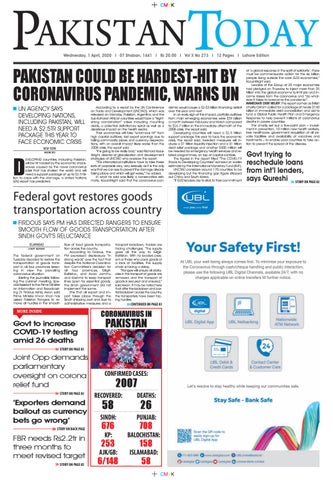
Pakistan could be hardest-hit by coronavirus Pandemic, warns un g
uN AGeNCy SAyS DeveloPING NATIoNS, INCluDING PAKISTAN, WIll NeeD A $2.5TR SuPPoRT PACKAGe ThIS yeAR To FACe eCoNoMIC CRISIS NEW YORK agencies
d
eveloPING countries, including Pakistan, will be hit hardest by the economic shockwaves caused by the novel coronavirus crisis that has shaken the world and will need a support package of up to $2.5 trillion to cope with the damage, a united Nations (uN) report has predicted.
According to a report by the uN Conference on Trade and Development (uNCTAD), which was released on Monday, Pakistan, Argentina and the Sub-Saharan African countries would face a “frightening combination” crises including mounting debts, a potential deflationary spiral as well as a disastrous impact on the health sector. Their economies will take “enormous hit” from high capital outflows, lost export earnings due to falling commodity prices and currency depreciations, with an overall impact likely worse than the 2008 crisis, the report said. “It is going to be really bad,” said Richard KozulWright, director of globalisation and development strategies at uNCTAD who oversaw the report. “The international institutions have to take these sorts of proposals very, very seriously as it is the only way that we can see to prevent the damage already taking place and which will get worse,” he added. In what he said was likely a conservative estimate, Kozul-Wright said that the coronavirus pan-
demic would cause a $2-$3 trillion financing deficit over this year and next. In an early sign of the impact, portfolio outflows from main emerging economies were $59 billion a month between February and March compared to $26.7 billion in the immediate aftermath of the 2008 crisis, the report said. Developing countries will need a $2.5 trillion support package this year to face the economic crisis, the report said. Needed measures will include a $1 trillion liquidity injection and a $1 trillion debt relief package and another $500 million will be needed for emergency health services and related programmes, on top of capital controls. The figures in the report titled “The CovID-19 Shock to Developing Countries” echoed an earlier estimate by the International Monetary Fund (IMF). uNCTAD considers around 170 countries to be developing but the financing gap figure stripped out China and South Korea. “If G20 leaders are to stick to their commitment
Federal govt restores goods transportation across country g
FIRDouS SAyS PM hAS DIReCTeD RANGeRS To eNSuRe SMooTh FloW oF GooDS TRANSPoRTATIoN AFTeR SINDh GovT’S ReluCTANCe ISLAMABAD staff report
The federal government on Tuesday decided to restore the transportation of goods transport in all four provinces keeping in view the prevailing coronavirus situation. Briefing the journalists following the cabinet meeting, Special Assistant to the Prime Minister on Information and Broadcasting Dr Firdous Ashiq Awan said Prime Minister Imran Khan has asked Pakistan Rangers to remove all hurdles in the smooth
flow of food goods transportation across the country. According to Firdous, the PM expressed displeasure “in strong words” over the fact that despite the National Coordination Committee’s decision for all four provinces, GilgitBaltistan, and Azad Jammu and Kashmir to keep transport lines open for essential goods, the Sindh government did not implement the same. She that all export and import takes place through the Sindh shipping port and due to administrative measures and a
more inside
transport lockdown, traders are facing challenges. “The supply goes all the way to GilgitBaltistan. With no loaders present or those who pack goods or a lack of facilities, the supply chain is facing a delay. “Rangers will ensure all obstacles in the transport of goods are removed and the transport of goods is secured and ensured,” said Awan. It may be noted here that after the lockdown and partial lockdown across the country, the transporters have been facing hurdles.
CONTINUED ON PAGE 03
coronavirus in
Govt to increase COVID-19 testing amid 26 deaths
Pakistan
STORY ON PAGE 03
Joint opp demands parliamentary oversight on corona relief fund STORY ON PAGE 03
‘Exporters demand bailout as currency bets go wrong’ STORY ON BACK PAGE
FBR needs Rs2.2tr in three months to meet revised target STORY ON PAGE 05
CONFIRMED CASES:
2007
RECOVERED:
DEATHS:
SINDH:
PUNJAB:
58
676
26
708
KP:
BALOCHISTAN:
AJK/GB:
ISLAMABAD:
253 6/148
158 58
CMYK
of ‘a global response in the spirit of solidarity’, there must be commensurate action for the six billion people living outside the core G20 economies,” Kozul-Wright said. leaders of the Group of 20 major economies had pledged on Thursday to inject more than $5 trillion into the global economy to limit job and income losses from the coronavirus and “do whatever it takes to overcome the pandemic”. IMMEDIATE DEBT RELIEF: The report comes as British charity oxfam called for a package of nearly $160 billion in immediate debt cancellation and aid to fund a Global Public health Plan and emergency Response to help prevent millions of coronavirus deaths in poorer countries. The charity set out a five-point plan – investment in prevention, 10 million new health workers, free healthcare, government requisition of all private facilities and availability of vaccines and treatments – to enable poor countries to take action to prevent the spread of the disease.
Govt trying to reschedule loans from int’l lenders, says Qureshi STORY ON PAGE 02
02
Wednesday, 1 April, 2020
NEWS
Govt tryInG to reschedule loAns from Int’l lenders: QureshI MULTAN
f
STAFF REPORT
OREIGN Minister Shah Mahmood Qureshi said on Tuesday that the government was trying to get loans rescheduled from the International Monetary Fund (IMF), World Bank (WB) and Asian Development Bank (ADB) to deal with the coronavirus pandemic effectively. Speaking during a meeting at Circuit House, the foreign minister said that the rescheduled amount would be used to facilitate the health sector. He said that the government was closely carefully monitoring the
coronavirus situation locally and internationally. He said that one newly-established subcommittee is coordinating with the international community under his supervision whereas the other is headed by Minister for Planning and Development and is focusing on ensuring the supply of food commodities in the country under lockdown. Qureshi said that he was constantly in contact with the European Union (EU), G77 and G20 countries, adding that the government was also contacting Pakistanis abroad to ensure their safety. Responding to a question, Qureshi said that the government was trying playing its role for the lifting of international sanctions on Iran.
“They cannot even purchase ventilators despite having money to buy them,” he added. Speaking about a possible nationwide lockdown, he said that it would require immense preparation. “In China, when 60 million people underwent complete lockdown in Wuhan, 45,000 workers were mobilised to ensure uninterrupted online supply of food items to people’s homes,” he added. He pointed out that before a complete lockdown can be announced, the government would have to ensure the distribution of food to people’s homes. About the volunteer force announced by the prime minister, Qureshi said that Corona Relief Tiger Force’s
first meeting would be held in Multan. Qureshi said that every union council comprised six wards and a volunteer force would be created in each ward. “These youngsters will register the names, ID card numbers, phone numbers and addresses of those in need of financial assistance,” he added. The foreign minister urged the local parliamentarians and district administrations to extend maximum cooperation in this regard so that the poor can be facilitated. He said that government gave a historic relief package of Rs1.2 trillion and would continue to support different segments of the society.
Jang Group's publisher Mir Javedur Rehman passes away KARACHI/LAHORE STAFF REPORT
Jang Group’s publisher Mir Javedur Rehman passed away in Karachi on Tuesday. He was suffering from lung cancer and was being treated at a private hospital in Karachi. Javed was the brother of the group’s chief executive Mir Shakilur Rehman, who is currently under NAB’s custody in Lahore. Rehman had asked for permission to travel to Karachi in order to meet his brother, which was issued by the accountability bureau on Monday, however he could not meet his brother before he passed away. Meanwhile, an accountability court in Lahore granted a 7-day transit remand of Mir Shakil to enable him to attend the funeral rites of his brother. Accountability Judge Syed Jawadul Hassan passed the orders while allowing an applica-
tion filed by Mir Shakil for the purpose. A prosecutor for the National Accountability Bureau (NAB) stated that the bureau did not have any objection if Mir Shakil was allowed to attend the funeral. The court allowed the application and directed Mir Shakil to ensure his presence before the court on April 7, on the expiry of his physical remand term. Mir Shakilur Rahman was arrested by the bureau on March 12 in plots illegal exemption case. The bureau alleged that the accused obtained illegal exemption on 54 plots of one-kanal each in Johar Town Lahore, with the connivance of Nawaz Sharif, the then chief minister of Punjab, in violation of the exemption policy. ‘HUMBLE, SIMPLE, HARDWORKING MAN’: Meanwhile, colleagues and friends of Mir Javedur Rehman described him as a “humble and simple man” and a hardworking journalist. President Arif Alvi termed Mir Javed as “very soft spoken and nice man” in a condolence message on Twitter.
Leader of the Opposition in the National Assembly Shehbaz Sharif said Mir Javed’s “services to country’s journalism will be remembered for a long time to come”. Sindh Chief Minister Murad Ali Shah, in a statement, offered his condolences to the family of the deceased. He lauded Mir Javed’s services for the Jang Group, especially its magazine Akhbar-e-Jahan. Punjab Assembly Speaker Chaudhry Pervez Elahi described Mir Javed as a “humble and sympathetic” man. PML-N lawmaker Khawaja Saad Rafique regretted that Mir Shakil could not meet his brother as he was under NAB’s detention. Council of Pakistan Newspaper Editors (CPNE) President Arif Nizami and Secretary General Dr Jabbar Khattak also condoled his death and prayed for his forgiveness. The CPNE leaders said that he was a towering figure in the world of journalism and the entire newspaper industry has been saddened by his death.
PIA to partially resume int’l flights from April 2 NEWS DESK The Pakistan International Airlines has decided to partially restore international flights from April 2 from the New Islamabad International Airport. The passengers coming from abroad will be kept in quarantine after landing and they will need to wear gloves and masks throughout the travel. The Foreign Office and National Security Committee (NSC) on Tuesday gave the nod to the PIA partially restoring international flight operations. The NSC will give its formal approval to the move on Wednesday. According to a report, two charter flights carrying 400 passengers will set off for Toronto, Canada from the Islamabad International Airport. The flights will include the officers and staff of the Canadian High Commission. The authorities are also considering running three commercial flights to the UK from April 4 after the completion of the necessary protective measures. Flight services will not be available during the travel. In addition, the passengers will be tested for body temperatures prior to boarding.
Govt trying to address media industry’s issues, says Firdous ISLAMABAD APP
Special Assistant to the Prime Minister on Information and Broadcasting Dr Firdous Ashiq Awan has said that the government is trying to address the issues being faced by the media industry in the prevailing circumstances. She said this while talking to a delegation of All Pakistan Newspapers Society (APNS), Council of Pakistan Newspapers Editors (CPNE) and Pakistan Broadcasters Association (PBA) late on Monday night. The SAPM said that the Pakistan Tehreek-e-Insaf (PTI) government firmly believes in the fundamental democratic right of freedom of expression and it would continue to provide all possible facilities for the promotion of free and responsible journalism. Freedom of
Arrangements being made to keep industries running: Hammad ISLAMABAD: Federal Minister for Economic Affairs Hammad Azhar said on Tuesday that the federal government, in consultation with all the provinces, has made comprehensive arrangements to ensure sufficient production and supply of all essential items by keeping the relevant industries open and operational. Addressing a press conference along with Federal Minister for Planning, Development and Reform Asad Umar and Special Assistant to Prime Minister on Health Dr Zafar Mirza, the minister said that since the country was in a lockdown, there was a dire need to ensure production and supply of daily use essential items across the country to facilitate people. “We have been engaged in meetings for the last four days with chief secretaries and officials of all four provinces, Gilgit-Baltistan (GB), Azad Jammu and Kashmir (AJK) and Islamabad through video conference and we have made certain decisions with mutual consultations,” the minister said. He said that the list of necessary manufacturers, industry, retailers and services had been prepared in consultation with the provinces, adding, that the provincial governments had the right to increase or decrease the list according to their requirements. APP
CMYK
media and democracy were interlinked and cannot be ignored, she added. Both sides also discussed a special relief package in the context of the problems being faced by the media industry and the challenges being posed by the coronavirus pandemic. Dr Firdous said that Prime Minister Imran Khan has issued clear instructions for payment of outstanding dues to media houses. She said that steps were being taken to ensure that there should be no delay in this regard. Appreciating the media’s performance at this time of pandemic, she said that journalists and media workers were playing an important role in the fight against the pandemic. “The government wants to ensure the well-being of journalists and media workers and soon a separate meeting will be convened to address the issues of newspaper hawkers,” she added.
Wednesday, 1 April, 2020
NEWS
03
Govt to IncreAse covId-19 testInG AmId 26 deAths TOLL OF AFFECTED PERSONS NEARS 2,000 AS MINISTER SAYS GOVT WILL BE ABLE TO TEST 280,000 PEOPLE FROM APRIL 1 LAHORE/ISLAMABAD
P
STAFF REPORT
AKISTAN reported at least three more deaths on Tuesday and over a hundred new cases, taking the tally to 1,975, as the federal government announced to ramp up testing from Wednesday in order to contain the novel coronavirus. As of Tuesday 9 pm, Punjab and Sindh reported 676 and 676 cases, respectively, whereas Balochistan and Khyber Pakhtunkhwa detected 158 and 253 cases each. Islamabad and Azad Kashmir/Gilgit-Baltistan regions had 58 and 154 cases, respectively. A 74-year-old man died from the coronavirus in Sindh, with the provincial death toll from the disease rising to eight. The patient, a resident of Karachi, was brought to the hospital on March 26 where he was tested, the Sindh health minister said. He had a history of Acute Respiratory
Distress Syndrome and Diabetes. Another death was of a 70-year-old patient who was tested for the coronavirus after he visited a hospital. “The patient passed away early on Wednesday. His test results came back positive after his death,” the minister said, adding that the patient had multiple health issues and had been infected due to local transmission. The number of people who have recovered from the deadly disease stands at 58. ‘INCREASE IN TESTING CAPACITY’: Addressing a press conference in Islamabad after the fifth meeting of National Coordination Committee on Coronavirus, Federal Minister for Planning and Development Asad Umar said the country will able to test and 280,000 from April 1. By March 13, the capacity was 30,000 people. By April 15, he said this capacity will rise to 900,000. Umar said that the National Coordination Committee and the National Command
nawaz's heart surgery delayed till coronavirus situation improves LONDON: Former prime minister Nawaz Sharif’s physician Dr David R. Lawrence has issued a report, saying that the ailing Pakistan Muslim League-Nawaz (PML-N) supremo’s heart surgery will have to wait until the “prevailing uncertainty of Covid-19 settles down,” hinting at his extended duration of stay abroad which appeared to be on the cards for some time now. According to the report, Sharif “at his age, with significant disease burden, falls in the category of patients who — if exposed — can develop serious Covid-19 symptoms with adverse effects”. The doctor further said that Nawaz has been advised to stay “in close proximity of” advanced health facilities in London. Nawaz, who is said to be diagnosed with an immune system disorder, flew to London in November last year after the government granted him one-time permission to fly abroad for a medical check-up. He was accompanied by his brother, National Assembly Opposition Leader Shehbaz Sharif and personal physician Dr Adnan Khan. Shehbaz returned to Pakistan on Mar 22 after spending some four months with his brother. STAFF REPORT
ASAD UMAR SAYS GOVT WANTS TO DEVELOP BALANCED APPROACH TOWARDS LOCKDOWN Centre, that began working from Tuesday, will not be partisan. Umar said the process for cash disbursements to the poor families under the economic stimulus package announced by the prime minister would be started within a week. He informed that in order to materialise the prime minister’s announcement of disbursing Rs3,000 per month to 12 million families, the social protection division would publish and broadcast advertisements in newspapers and circulate messages through SMS across the country, after which the formal process of cash disbursement would start. He said all the beneficiaries would get a four-month stipend in advance amounting to Rs 12,000 per family. Asad Umar said five meetings of NCC to review the situation in the wake of lockdown due to coronavirus in the country had already been held and sixth would be held on Wednesday. In order to ensure smooth implementation of decisions taken in the meeting and maintain a balanced approach, he said the
prime minister had directed to have close coordination with all the provinces, Azad Kashmir and Gilgit-Baltistan. He said the PM had also directed to work with all provinces to making special measures to ensure that the procurement of wheat was not affected due to lockdown. “There is no dearth of wheat and other essential food items, therefore people should not panic in the current situation,” he added. He further informed that in the next meeting to be held Wednesday which would be attended by chief ministers of all the provinces, GB and AJK, the government would announce further strategy about extension or closure of lockdown in the country. He said in order to ensure a comprehensive implementation of decisions made in the NCC meetings, a National Command Center was formed whose first meeting was held on Tuesday. The minister said if no lockdown was in place, there was fear of a spread of the virus on a large scale; however, putting strict lockdown to such a level that people
Joint Opp demands parliamentary oversight on corona relief fund LAHORE STAFF REPORT
Pakistan Muslim League-Nawaz (PML-N) President and National Assembly (NA) Opposition Leader Shehbaz Sharif, after consultation with leaders of opposition parties on Tuesday, issued a joint declaration rejecting the creation of “Tiger Force” as a political stunt and called for the immediate setting up of a parliamentary monitoring committee to prevent usage of Corona Relief Fund for political purposes. Shehbaz contacted Pakistan People’s Party (PPP) Chairman Bilawal Bhutto-Zardari, Jamiat Ulema-e-IslamFazl (JUI-F) chief Maulana Fazlur Rehman, Jamaat-e-Islami (JI) chief Sirajul Haq, Pukhtunkhwa Milli Awami Party (PkMAP) head Mahmud Khan Achakzai, Qaumi Watan Party (QWP) chief Aftab Shairpao and National Party (NP) head Hasil Khan Bazinjo. In a joint charter of demands, the leaders called for the setting up of parliamentary oversight for the monitoring and just distribution of Corona Relief Fund. They demanded that a parliamentary monitoring committee be set up immediately to ensure transparency of how and where the goods and items in this regard are being procured from and where are they being used. They also demanded that the criteria for disbursement of ration among the laborers and the deserving be clearly shared and followed and warned the government against using this money for its political gains.
The demanded that a meeting of the Coronavirus Parliamentary Senate Committee and Standing Committee on Health be called immediately and be briefed on the real on ground situation of the outbreak. The opposition leaders demanded that coronavirus testing be made free at all hospitals and the scope of the testing be widened. Pakistan Medical and Dental Council (PMDC) must be revived and operationalised with immediate effect, they demanded. They once again renewed their call for the provision of protective gear to doctors, nurses and paramedics while additional ventilators must be provided without delay. The leaders stressed that the awareness campaign be spread far and wide with all regional and national sources of information dissemination. A Disease Surveillance System is imperative and must be established while factual data be gathered and the truth be shared with the nation, they added. They vehemently rejected the so-called “Tiger Force” and said that in the presence of the police and the already active Rangers, this step is mere political gimmickry, therefore, they said the nation’s money and resources must not be wasted on this and instead, the local government must be revived immediately to increase administrative force. Meanwhile, the PML-N president also urged the government to immediately summon a meeting of National Security Committee (NSC) to discuss the coronavirus pandemic. In a statement, Shehbaz said, “Prime Minister Imran Khan’s address on the coronavirus situation has raised several questions regarding important decisions taken by the NSC.”
Automobile lobby obstructing EV policy for 'vested interests' ISLAMABAD APP
The Ministry of Climate Change (MoCC) on Tuesday said some elements with ‘vested interests’ were trying to sabotage the National Electric Vehicle Policy (NEVP), approved by the federal cabinet in November 2019. An official alleged, “Deep-rooted’ automobile manufacturers’ lobby, in connivance with its few consolidators at the helm of affairs, was active to scuttle the policy. The MoCC official argued that there was no issue in defining the policy by the Ministry of Industries and Production; however, around
40 per cent of the major world policies were spearheaded and housed in the climate ministries across the globe owing to the global focus on cutting air emissions. He said the committee formed by the Economic Coordination Committee to hold consultations on the policy through relevant ministries was headed by Adviser to the Prime Minister on Commerce, Textile, Industries Production Abdul Razak Dawood and Adviser to the Prime Minister on Climate Change Malik Amin Aslam was also its member. “Most of the fuel-based cars produced in Pakistan are not up to the mark as they had euro-II engines installed in the vehicles and
are also abusing the masses by selling them at hefty costs. The car that costs half a million rupees in India is sold for over a million rupees in Pakistan and these also lacked road safety equipment and modern technology,” he regretted. He said Pakistan only has a 3-4 year window to cash in on the opportunity and become a leading manufacturer of the right-hand drive EVs by 2023. “If the time lapsed in just deciding the incentives package and policy domain then Pakistan will lose this opportunity and some other country will benefit through it. Like the combustion engine, we will then become a net importer of EVs only.”
Federal govt restores goods transportation across country CONTINUED fROM pAgE 01 Goods Carrier (KGC) President Rana Muhammad Aslam had said the government had exempted goods transportation from lockdown, but basic facilities needed on highways were not being provided.“Drivers are complaining of not having food and workshop facilities on highways.” Thus, he added there were chances that transport would be squeezed further. If the government wanted a smooth supply of eatables, it would have to ensure that the needed facilities were available along the highways, he had added.RESCUE PACKAGE APPROVED:The federal cabinet also approved the PM’s financial stimulus package to deal with the adverse impact of the coronavirus outbreak on the country’s economy.The special assistant said the labour ministry has been directed to prepare a strategy of complete registration of labour
class in consultation with all provinces to ensure their social, health and job security.Special Assistant on Poverty Alleviation Dr Sania Nishtar briefed the cabinet about the mechanism of cash transfer worth Rs150 billion to at least “12 million poor families” across the country under the Ehsaas Programme.Special Assistant on National Health Services Dr Zafar Mirza informed the federal cabinet about the measures taken to contain the coronavirus pandemic and the decisions taken by the National Coordination Committee on coronavirus. Firdous said the prime minister also directed to introduce reforms in the state institutions to promote e-governance.Terming Sukuk bonds vital for the promotion of Islamic Banking, Firdous said the government has decided to issue the bonds for a period of three years.She said the National Coordination Committee’s meeting will be held in Islamabad on Wednesday to address the prevailing situation
of the flour crisis in the country.She urged the opposition to avoid politicising the current situation and join hands with the government to contain coronavirus. Firdous said the government will welcome suggestions and proposals by the opposition in this regard.The premier’s aide on information also said that the prime minister was informed during the cabinet meeting that coronavirus patients are being treated as “untouchables”. She said this is a “criminal act” and t hat the prime minister expressed great disapproval of the fact. “Law enforcement agencies or hospital security officials mistreating them have been strictly told to treat them well and not treat them as criminals and not to push them into quarantine,” said Awan.She said that admission into a quarantine facility it should be carried out respectfully with the patients’ approval and their families’ consent and that all governments had been told to strictly comply with this.
could not even get their daily use items, especially eatables, was also not doable. He cited example of India where a strict lockdown was implemented without taking into consideration the people’s daily basis requirements, which resulted in failure. Therefore, he said the government wanted to develop a balanced approach where people would be forced to remain inside; and shops of food, medicine and other essential items would also not be closed. In today’s meeting, the minister informed that the PM had specially directed to ensure provision of required supplies to the utility stores specially in far-flung areas of Balochistan and districts of erstwhile FATA. Meanwhile, Punjab Chief Minister Usman Buzdar, whose province is worst-hit by the calamity, also claimed that his government would increase the testing capacity to better contain the virus. The provincial health department has been told to increase their testing capacity for detecting COVID-19 cases, he said, adding that the department will be provided with all the resources. The chief minister added that the provincial government will also notify a committee for providing health professionals with safety kits and personal protective equipment.
Govt urged to allow production at Karachi export Processing Zone ISLAMABAD: Exporters have sought the federal government’s intervention in allowing production activities at the Karachi Export Processing Zone (KEPZ). Exporters as well as businessmen have written a letter to the KEPZ Authority secretary, seeking permission to continue production activities so that their pending export orders could be completed. “We are manufacturers and exporters of embroidered laces in KEPZ under the name of Eurotex. We have also shut our production in order to safeguard our labours and community in the wake of the coronavirus crisis,” states Mustafa Humayun of Eurotex in the letter. “Today our customer has informed us that our competitors/exporters in the Karachi SITE area have resumed production. If we (Eurotex) are unable to deliver goods, they (the foreign customer) will cancel orders and transfer to other suppliers running production.” Humyaun requested the KEPZ secretary to allow the company to partially run with the limited staff so that they might fulfill their orders, otherwise the company would lose its customers as well as precious foreign exchange. “Our machines with 4 meters in size are installed far from each other so the workers will not be in close contact with each other. We will also make arrangements to give masks and sanitisers to labourers upon their arrival and before leaving the company.” Officials, however, say police and other law enforcement agencies are not allowing employees of EPZs to visit offices due to lockdown. SHAHZAD PARACHA
04 LAHORE
Wednesday, 1 April, 2020
WEATHER UPDATES WEDNESDAY
280C
160C
THURSDAY
280C
140C
FRIDAY
290C
150C
WHeaT fLOuR CRIsIs COnTInues In PunJab WHEAT SHORTAGE A FAKE ISSUE CREATED BY CITIZENS AND SELLERS THEMSELVES NEW SUPPLY AFTER THRESHING SEASON WOULD FIX ISSUE LAHORE
T
SHAHAB OMER
HE Punjab government is failing to continue the supply chain of wheat flour while most wheat grinding units, locally known as chakkis, have also closed due to a rise in the prices of ground wheat, Pakistan Today learnt on Monday. A member of the Aata Chakki Association (ACA) said that the demand for flour wheat had increased. “Due to an increase in demand, the price of wheat flour has jumped in many food markets of the province. Before the lockdown, 40kg ground wheat in the open market was for Rs1,800 whereas it is now being sold at the rate of Rs2,100,” he said. “Some dealers are also creating an ar-
tificial crisis and shortage of wheat and a jump of Rs300 for 40kg wheat is causing the closure of many shops. Similarly, most chakkis have increased rates from Rs62 per Kg to Rs65 per Kg,” he added. An official of the Punjab Food Department informed this scribe that the total demand of Lahore per day was 21,500 bags of wheat whereas the government has given 1.5 million bags. “From Punjab, a total of 5,000 bags were also sent to Khyber Pakhtunkhwa (KP),” he added. A resident of Canal Park Gulberg area Tariq Masih, expressing his despair, said, “I am in search of wheat flour for the last
two days and am unable to find it at any shop. Some shopkeepers are spreading rumours that people are storing wheat because of the expected curfew that could be announced any day but some are upset themselves because they are not getting supplied”. Another resident of Johar Town area, Nadir Saleem said, “I am not getting wheat four from the market. Shopkeepers are selling in kilogrammes and not providing a full bag of 10kg or 20 kg. They are of the view that there could be a serious shortage in the future due to which they were not selling wheat flour in bulk”. Provincial Minister for Food Sami
Ullah Chaudhry while commenting on the situation said, “There is no shortage of wheat in Punjab. The daily consumption of the province is 24,000 metric tons and we are providing 30,000 metric tons of wheat. The issue of the shortage at some points is a result of abnormal buying. If a consumer requires one bag of wheat flour he purchased two or more bags in panic while sellers have also added to this situation by hoarding”. “Similarly, many philanthropists have stocked wheat to distribute it among the needy. No doubt, this is a remarkable effort but the pressure of demand has affected the supply chain. The government is providing wheat at subsidised rates and we are also setting the procedure of the procurement for philanthropists who would, as per procedure, come to the deputy commissioner (DC) office and get their quotation approved for buying wheat bags from us directly,” he added. The food minister particularly added that thrashing of wheat will begin in a couple of days after which a new wheat supply would come to the market so, the problem would be overcome. Lahore deputy commissioner (DC) Danish Afzal also assured that there was no need to panic as all would be managed soon. “The 25 points which have been established specially for the presence of wheat are working efficiently and people are also getting the wheat from there,” he said.
Punjab decides to close stores by 5pm LAHORE: The Punjab Government on Tuesday changed its lockdown strategy, deciding to shut down all shops by 5pm. According to the decision, the timings of markets would be 9am to 5pm from April 1. However, medical stores and pharmacies are exempt from this order. Earlier, Punjab Chief Minister (CM) Usman Buzdar imposed a 14-day partial lockdown in the province in order to take strict measures to contain the coronavirus through observing of social distancing and self-quarantine aimed at thwarting the emergence of new cases. STAFF REPORT
Raiwind city sealed after 27 Tableeghi Jamaat members test positive for COVIDPunjab police on Tuesday completely sealed off Raiwind city, shutting down all general and medical stores and barring all residents from leaving their houses. “Even now more than 2,200 people of the Tableeghi Jamaat are present in the gathering,” police said. It may be noted here that there is a tableeghi mosque adjacent to Raiwind city where 50 men were suspected to have contracted the virus. Upon screening, it was discovered that 27 did indeed have the virus. Many people have either been shifted to the Kala Shah Kaku quarantine facility or a quarantine facility in Kasur while a team of doctors is currently testing them to ascertain whether or not more might be infected. NEWS DESK
PRAyER TiMiNgS FAJR SUNRISE
ZUHR
ASR MAGHRIB ISHA
5:11
12:16
3:32
6:31
6:00
7:21
Punjab govt asks schools to reduce fees MINISTER SAYS SCHOOL OWNERS SHOULD REDUCE FEES BY AT LEAST 20PC FOR APRIL AND MAY, WARNS AGAINST LAY-OFFS LAHORE STAFF REPORT
The Punjab government has approached private schools with a proposal for a reduction in fees to provide relief to families battling with coronavirus pandemic. The decision was taken in a meeting of the special committee, headed by Punjab Minister for Law, Parliamentary Affairs and Social Welfare Muhammad Basharat Raja on Tuesday. Minister for Schools Education Murad Raas, Secretary Schools Shehryar Sultan and representatives of private school owners also attended the meeting. Law Minister Raja said the schools were asked to come up with recommendations within two days. He said that after receiving proposals from the school owners, Chief Minister Usman Bazdar would take the final decision. He said that private school owners should voluntarily give a discount of at least 20 per cent in the monthly fees of April and May. He said that no school should receive a three-month fee at a time, neither any teacher should be fired nor her/his salary deducted. The law minister said that the Punjab government gave priority to the interests of students, parents, teachers and school owners simultaneously. Earlier in the day, Punjab Education Minister Murad Raas urged parents not to pay fees as the government was mulling to get the private schools to reduce the fees. “Do not pay any fees at the moment and wait for the notification from the government,” he said in an interview. When the interviewer asked of “certain schools” declining to reduce fees, Raas said that after the court orders have been given and the law has been passed, we will have portals where the citizens will be able to write a complaint about the fees being charged. When asked about semester fees being charged in the universities, Raas said to refer the matter to Higher Education Minister Raja Yasir. He also said the current holiday period would be treated as the official summer holidays. “The announcement will also be made on social media and on TV, so don’t worry there will be no confusion about that. These are the official summer holidays,” he said. The new education year will start from June 1 now, he clarified. “All the exams scheduled for spring are canceled in the wake of the coronavirus pandemic,” he said, adding that a new schedule will be issued after June. When asked, Raas responded that the homework will also be assigned to the students to keep them occupied during the vacations. Responding to a question pertaining to the assessment criteria for promotion in higher grades, the minister said, students from grade 1 to grade 8, will be given their summer homework and if they complete it and submit it after the holidays they shall be promoted to the next class there shall be no exams for them in this kind of conditions. Noting that June and July offer the peak of the heatwave in Pakistan, he said the government will change the timings in the summer. “If there is a heatwave, we will give a few days off since this is an emergency situation we will need to adjust to some conditions,” he said.
LHC seeks arguments on maintainability of Hamza's bail plea LAHORE APP
A Lahore High Court (LHC) division bench on Tuesday sought arguments on the maintainability of the second post-arrest bail petition filed by Pakistan Muslim League-Nawaz (PML-N) leader Hamza Shehbaz in assets beyond means case over fresh grounds of being vulnerable to being infected by coronavirus in prison. The bench comprising Justice Sardar Ahmad Naeem and Justice Farooq Haider heard the petition filed by PML-N leader. As the proceedings started, Justice Sardar Ahmad Naeem observed that the Supreme Court had suspended decisions of all high courts for the release of the prisoners. To this, the petitioner’s counsel Advocate Amjad Pervaiz requested the court to adjourn proceedings till April 6. At this, the bench questioned Amjad Pervaiz how the petition was maintainable. Amjad Pervaiz replied that Advocate Azam Nazir Tarar would assist the court over the issue on the next date of hearing. Subsequently, the bench adjourned the hearing till April 7 and sought arguments on maintainability of plea. It may be mentioned here that Hamza Shehbaz had submitted that coronavirus was spreading all over the world, including Pakistan. He submitted that as per media reports, there were suspected patients in jails and expressed apprehension that he might get infected with coronavirus in prison. He mentioned that the LHC had already directed authorities concerned for filing bail applications of prisoners in the wake of the pandemic and pleaded the court for granting him post-arrest bail in the corruption case against him. It is pertinent to mention here that the LHC had earlier dismissed the PML-N leader’s postarrest bail petition. However, he has been granted bail in the Ramzan Sugar Mills case
Wednesday, 1 April, 2020
FBR needs Rs2.2tR In tHRee mOntHs tO meet RevIsed taRGet ISLAMABAD
t
SHAHZAD PARACHA
HE Federal Board of Revenue (FBR) has to collect around Rs2.19 trillion in the last quarter (April-June) of FY20 to meet the revised annual revenue target of Rs5.23 trillion. Sources said the premier tax agency of the country has collected Rs3,050 billion tax during the July-March FY20 period and now it needs around Rs2.2 trillion more to meet the target.
The actual target of the current fiscal year was Rs5,550 billion that was revised downward with the permission of the International Monetary Fund (IMF). Sources further said tax officials, during the second review, requested further downward revision in the revenue target to Rs4,800 billion. The request is still pending approval. FBR collected Rs320 billion in March, which is around Rs10 billion more than the collection of Feb 2020, sources said. They added that the tax department is
Govt extends Rs40,000 prize bond encashment date till June 30 ISLAMABAD STAFF REPORT
The federal government on Tuesday extended the date of encashment/redemption of Rs40,000 denomination national prize bonds for another three months. “In term of sub rule 1 of rule 4 of the Prize Bonds Rules 1999, as amended vide notification no 20(7)GS-1/2018-326 dated March 6, 2020, the Finance Division with the approval of the minister-in-charge, is pleased to extend the last date for encashment/redemption of Rs40,000 denomination national prize bonds with immediate effect till June 30, 2020,” read a notification issued by the finance ministry. “The procedure for encashment of Rs40,000 denomination national prize bonds, issued vide SRO 735(1)/2019 dated 24/6/2019, shall continue to be observed.” Earlier, the State Bank of Pakistan in February last month instructed all banks’ CEOs and presidents to withdraw the Rs40,000 denomination national prize bonds till March 31, 2020. The banks were also directed to submit the consolidated bank-wide position to the currency management department on April 1st. According to the statement, the SBP Inspection Team can inspect data submitted by commercial banks. It is pertinent to mention that the Finance Division had limited the sale of prize bonds of Rs40,000 denomination after 24 June 2019. It meant that no bond of Rs40,000 would be sold, redeemed or encashed after 24 June 2019.
Petition filed in IHC for repatriation of Pakistani pilgrims in Iran A petition has been filed the Islamabad High Court (IHC), seeking the repatriation of Pakistani pilgrims stranded in Iran amid the coronavirus outbreak. Syed Nasir Abbas Sherazi, the chairperson of Majlis Wahdat-e-Muslimeen Pakistan filed the petition through his lawyer Fida Hussain Rana and made the government, Interior Ministry, Ministry of Foreign Affairs, Defence Ministry and the Pakistan Electronic Media Regulatory Authority (PEMRA) respondents. The petition stated that Pakistanis who travel to Iran, Iraq and Syria for pilgrimage to the holy shrines are usually given visas for 15 to 30 days, however, the visas of Pakistanis in Iran are either expired or are about to expire. It added that they are now stranded in the country because the government has suspended all international flights. NEWS DESK
FO says can't leave citizens stranded in Iran ISLAMABAD: Foreign Office Spokesperson Aisha Farooqui on Tuesday said that the Ministry of Foreign Affairs was responsible to allow pilgrims from Iran to enter the country. In a statement issued on Tuesday, she said that facilities were being improved by Pakistan at the Taftan border, adding that the thousands of pilgrims were facilitated after the coronavirus outbreak in the Iranian city of Qom. The spokesperson said that the Pak-Iran border is closed, but it is our responsibility to allow our citizens to enter Pakistan, adding that Islamabad and Tehran are working on the issue of pilgrims. “Pakistani government and embassy are in touch with the Iranian government on pilgrims issue,” Farooqui added. STAFF REPORT
striving to meet the revised target, but it seems impossible and the department expects to collect Rs4,500 to 4,600 billion during the year. The economic team has proposed a Rs4,780 billion revenue target for the next fiscal year (2020-21), according to its three-year midterm budget strategy paper. Furthermore, FBR in a statement issued Tuesday made an appeal to taxpayers to pay their due taxes in time to increase the revenue resources of the government. “The staff and officers of FBR are
performing their duties diligently during the lockdown without fear of the viral outbreak in the country. They are determined to collect revenue for the government in such difficult times by keeping a safe distance with the taxpayers. “However, it is also the responsibility of taxpayers to pay their due taxes in time because taxes paid by them would be used by the government to rid the country of this contagious disease and mitigate financial suffering of people who desperately need help at this critical time,” the statement read.
As demand plummets, cement sector braces for the worst LAHORE HASSAN NAQVI
The local cement players of the country have started to shut their plants as economic activity significantly slowed down with the government, paramedics and other state authorities trying to limit the coronavirus outbreak in the country. Talking to Pakistan Today, Maple Leaf Cement Factory Limited Chief Executive Officer (CEO) Sayeed Tariq Saigol said that he thinks the cement industry will face challenges in light of Covid-19. “Dispatches are already down, and a large scale spread of the disease will lead to further curtailment of construction activity,” Saigol said, adding that this is a huge challenge for the industry as well as construction workers all over the country. Shahrukh Saleem, an investment analyst at AKD Securities, stated that given this backdrop, “we forecast a grim sales outlook for 4QFY20, exacerbating worries of local cement player after gross margins have already declined to 8.04pc in 1HFY20 against 24.89pc in 1HFY19.” He predicted that 3Q FY20 is on course to be the worst quarter so far in terms of profitability of the ongoing downcycle. “This ongoing situation poses significant risk to our demand estimates of 6.3 percent YoY growth in local dispatches for FY20,” Saleem said.
The investment analyst added that assuming a decline of 60percentYoY for 4QFY20 as demand from the private sector dissipates while governments divert funds from Public Sector Development Plan (PSDP) to fund relief packages. “We highlight the risk of local dispatches posting a decline of 11 percent for FY20,” he said. Saleem said consequently, with thin demand, expectations of price increase in near term have also lost steam. In case local demand declines by 60 percent while price remains at current level, we highlight a risk of 44.2 percent downward revision in our earnings estimate for FY20. However, he said, “We await further clarity on the situation (length and severity of lockdown) before changing our estimates.” Intensifying prices competition in North He opined that clinker exports have provided significant support to the Southern region in times of low demand and surplus capacity. “However, the recent spike in cases in Sri Lanka, South Africa and Bangladesh and recent strict measures are drawing curtains on export avenues, raising risks to price discipline in the South,” Saleem noted. He added that on a similar note, problems are mounting for Northern cement players, as exports to Afghanistan remain stuck due to closure of Afghan border. Saleem noted
that local industry was on course to export approximately 3.5 million tonnes to Afghanistan for FY20, forming 6.9 percent of the total installed regional capacity. INVESTMENT PERSPECTIVE: He added that coal prices have provided some respite in these times of adversity, declining by 23.8 percent from February this year. “High of $85 per tonne to trade at $65 per tonne as fears of global slowdown increases,” Saleem said. “We believe the current decline can continue as global demand remains weak though Pakistan Rupee (PKR) depreciation against United States Dollar US $ (7.2 percent CYTD) can erode benefits for local players,” he predicted. Saleem noted that on the other hand, as the COVID-19 outbreak intensifies in Australia and South Africa while China struggles to return to normalcy, we could not rule out a shortterm spike in prices due to severe supply disruptions. For him, another catalyst on the periphery is in the form of subdued cost of energy with local furnace oil prices now standing at Rs49,000 per tonnes (ex-refinery) while LNG prices are also expected to come significantly down. Saleem added assuming Brent averages at $28 per barrel for March this year, LNG DES prices can be expected to decline by 21.5 percent to $6.55/mmBTU against $8.35/mmBTU for January this year.
Govt urged to facilitate exporters, manufacturers amid virus lockdowns ISLAMABAD STAFF REPORT
The Overseas Investors Chamber of Commerce and Industry (OICCI) has urged the federal government and provinces to ease the coronavirus lockdown restrictions on and facilitate exporters, as well as manufacturers, transporters, distributors and retailers of essential goods to prevent disruptions in supply chain. Supporting enforcement of lockdown and other measures taken by the federal government and the provinces to limit the spread of Covid-19, the OICCI has separately written to Sindh Chief Minister Murad Ali Shah and Commerce, Industries and Production minister Abdul Razzak Dawood, seeking their support for easing certain restrictions on the movement of persons as well as raw materials for the industries involved in the manufacture of the essential items. The chamber has also called for correct interpretation and proper implementation of the guidelines given in the notifications issued by the provincial governments. Urging the Sindh government to ensure unrestricted movement of people and raw materials for industries like medicines, food, petroleum, medical gases, sanitization items like soaps, shampoos and detergents critical for coronavirus prevention, the OICCI, which repre-
sents foreign investors operating in the country, said the transportation services, factories and distribution outlets involved in the supply of these items should remain open. It said the government’s guidelines in this regard were being wrongly interpreted and foreign investors like Procter and Gamble, Unilever and some others have complained of not being allowed to provide services as per guidelines. The chamber requested the chief minister to immediately intervene to facilitate uninterrupted movement of essential goods and related persons. It said the government should appoint a focal person to authorize free move-
ment of such essential goods on the basis of recommendation from the respective CEO of the foreign-owned company. In the letter to the commerce minister, the OICCI urged him to direct the law enforcement agencies, especially the Rangers, to allow uninterrupted movement of export goods and essential items. It also requested that the two or more employees of the companies with temperature screening facilities should be allowed to travel together in a vehicle. Further, the suppliers of packaging and other raw materials need to be allowed access to the factories to help them avoid interruption in production and distribution.
NEWS
05
minister gets KPt chief sacked after refusal to award contract without bidding: report Federal Minister for Port and Shipping Ali Zaidi pushed for the removal of then Karachi Port Trust (KPT) chairman Rear Admiral (r) Jamil Akhtar after the latter refused to grant a contract for a mega project to the minister’s blue-eyed company, a journalist claimed. Speaking on a Din TV show, journalist Mumtaz Bhatti claimed that Zaidi wanted the former KPT chairman to award the contract to MIBT, a company owned by the friend of the shipping minister, for $70m. Akhtar refused and told the minister that the contract will only be awarded via standard bidding procedure. However, in the bidding process, a company named RAMD made a bid of $13-15m for the same task which the MIBT had asked $70m for, he claimed. Subsequently, Zaidi allegedly got the finance director removed, but that didn’t work out. Eventually, Zaidi in connivance with a secretary and his ‘friend’ in Islamabad sent the chairman of the KPT packing. The federal government removed Akhtar from the post of the chairman on March 25 with immediate effect. The Established Division, Government of Pakistan had issued notification in this regard on Wednesday. The notification had said “The Federal Government is pleased to remove Rear Admiral Jamil Akhtar (retd) from the post of Chairman Karachi Port Trust (KPT) under Ministry of Maritime Affairs, forthwith by modifying/reducing his period of initial appointment in terms of Section 11 of KPT Act, 1886, with immediate effect”. MONITORING REPORT
Pakistan army departments donate salaries to Pm's COvId-19 fund RAWALPINDI STAFF REPORT
A few Pakistan Army departments have announced that they would donate their salaries “to support national efforts in the fight against COVID-19,” a statement issued by the Inter-Services Public Relations (ISPR) said on Tuesday. According to the ISPR, scientists, engineers and employees of the National Command Authority (NCA) and Strategic Plans Division (SPD) have contributed their salaries according to their pay scale which are as follows: l Employees of Special Pay Scale 11-14 – 3 days l Employees of Special Pay Scale 8-10 – 2 days l Employees of Special Pay Scale 1-7 – 1 day Chairman Joint Chiefs of Staff Committee General Nadeem Raza also contributed his one month’s pay, the ISPR added. PM Imran while announcing his government’s road map on Monday emphasised the need for donations and charity saying the country is facing challenge of coronavirus along with poverty.
sialkot teachers performing quarantine protest for safety supplies The teachers of government schools who were allotted duties outside quarantine centres in Sialkot stormed the assistant commissioner’s office on Tuesday. A total of 7,413 teachers were assigned duties outside houses and quarantine centres across the city, according to the district administration. They had to make sure that people adhered to the rules of social distancing and did not leave their houses. They, however, complained that the government never gave them any proper equipment or precautionary supplies against the coronavirus. Basic precautionary equipment is our right, a protester said, adding that they could only perform their duties if their health was ensured. NEWS DESK
Wednesday, 1 April, 2020
06 COMMENT
Apocalypse
Fighting deadly epidemic requires a consensus action plan Arbitrary decisions can divide the nation
P
AKiSTAN discovered its first coronavirus patient in Karachi on February 26. The Sindh CM declared lockdown in the province for 15 days from March 23 with the rest of the provinces following suit with a less stringent version. The PM however continues his opposition to lockdowns. This has led Leader of the opposition Shahbaz Sharif to call upon the National Security Committee to clarify its position on the issue. The PM has on several occasions underlined the need for national unity to deal with the challenge posed by the pandemic, maintaining that the government alone cannot cope with the disease. on Monday, he announced a virus relief fund while the Economic Coordination Committee (ECC) approved a Rs 1.2 trillion stimulus package. The PM also announced the setting up of a Corona Tigers Relief Force meant to distribute food to unemployed daily wagers. in his latest address the PM again failed to announce the government’s overall strategy to deal with the virus that he had promised earlier. Meanwhile policies continue to be announced and actions taken without any attempt to create a national consensus. This has led to accusations that the government is more interested in seeking political mileage from the situation than in responding to the challenge through a commonly agreed policy. PML-N President Shahbaz Sharif and PPP Senator Sherry Rehman have accused the government of acting arbitrarily. The latter has complained that the government is taking decisions that impact provinces without consulting provincial governments. She has questioned how the government was going to determine the provinces’ share in the Rs1.2 trillion stimulus package announced by the ECC. The PML-N chief has demanded the formation of a parliamentary monitoring committee to ensure oversight and transparency in the government’s dealings and to restrain it from using relief funds for advancing its political agenda. Both leaders have opposed pushing inexperienced and untrained youth into the fray, calling instead for distribution of food to the vulnerable sections of population through local government bodies like Mohalla committees. it is time for the entire nation to single-mindedly face the challenge posed by the deadly virus. For this the government needs to take the opposition into confidence and stop its war against the media.
A war with warriors other than the usual ones RAmlA nAqvi
W
E are always ready for wars. We are trained for it. We expect to fight in the apocalypse, holy wars, national wars, the war against opponents. But we always have practiced it against the fellow we never liked in school, a colleague we always hated and the relatives we disowned. Mentally and physically we always fight someone. The enemy always has a few attributes;. he is an outsider, unwanted, ugly and monstrously impulsive and evil. There are also a few rules regarding war and apocalypse, set by our myths, bedtime stories, comic books and yes movies. The first rule, we need a savior. Secondly, we are safe at our place. Third rule, danger always comes from outside. And fourth, the traveller is always a wise person. The narrative is always the same as well. The town is in trouble or plagued by some evil force or ruler. Then comes a saviour. He too, is a polarized character, Christ in one book, antiChrist in the other. Biblical or fictional, he is a native but banished from the town for some political or notso-political reason, like Harry Potter, Jon Snow, or orestes. He can be some traveller or outsider who tries to help and save the town for the betterment of humanity like Superman or Sinbad the sailor; he can be some noble aristocrat or filthy rich guy who has been working on such missions, like Batman, Zorro or the biblical Christ, even a commoner like Aladdin, but the foreign training is a must in this narrative. He (the saviour is always he) first meets the town, makes its natives ending their feuds, gathers them in the town because the outside is not safer, vows to protect citizens, puts the women and the children inside a castle and finally, fights besides the men and defeats the demon. The demon is always, dark, wears black, brings a storm and is supported by the power-hungry group of the town. He can be the purest power-hungry sorcerer like Jafar, or evil itself like voldemort,
The world can learn from African countries
d
ESPiTE an international fall in commodity prices, consumers across the country still have to pay higher prices. When the Coronavirus pandemic arrived in Pakistan the possibility of a lockdown induced a buying frenzy, which created shortages. once the lockdown was put in place the timings for wholesale and retail stores to remain open were shortened, leading to an increased volume of customers during the allotted timeframe to avoid lockdown violations. Logistical disruptions have broken some supply chains as well, resulting in shortages. These price hikes are despite a drop in international prices of imported staple foods such as pulses, palm oil and tea, indicating domestic problems that are making essentials expensive. Before the Coronavirus started spreading there was a drop in inflation that even led to an initial cut in the interest rates. This was quickly followed by a 30 per cent drop in international oil prices that lead to a Rs 20 drop in petrol and diesel prices in the country. But still, prices remain stringent, unmoved by significant drops in input costs. it is likely that the full benefit of the fuel cost reduction and the general level of inflation has been mitigated by the fall in the value of the rupee against the dollar, which has depreciated close to 10 per cent in the past week alone whereas further volatility suggests that this trend could continue. These are serious challenges that the federal government has to address in order to ease the suffering of the masses facing this unprecedented once-in-ageneration pandemic. Although it has removed or lessened taxes on some of the more essential items, this has failed to arrest the rise in prices. There is a likelihood that certain wholesalers are either creating artificial shortages by hoarding goods or have widened their margins to make the most of this crisis. Such profiteers, as PM imran Khan has stated, will be dealt with swiftly by the state. one therefore hopes a thorough investigation is made into the ongoing pricing crisis soon, so that any unexplainable artificial price upticks are identified and corrected.
Abdul RAhmAn mAlik
C
ovid-19 has spread around the world rapidly .Thousands have died in China, iran, France, italy and the USA. As hundreds of cases are reported positive daily, fear, economic crisis, education and health effects have played havoc. in Pakistan, Sindh has been the worst affected with most of the cases imported from iran via Taftan. Covid-19 has caused more deaths than the Ebola fever outbreak in Africa. However, the Ebola experience has enabled the African nations to develop a comprehensive plan to fight the Coronavirus. Companies such as Google, Yahoo, Twitter, Microsoft and Apple have advised their employees to stay at home and work from their home. They also circulated the WHo guidelines among their employees and avoid gatherings of more than 10 people as announced in the latest guidelines of WHoM. Countries are strictly following the preventive measures communicated to the people by WHo experts and putting bans on unnecessary travel in the city or out of city or borders. it is an alarming situation since as no vaccine nor treatment been developed yet. WHo cautions countries with limited facilities to conduct tests and treat patients advising preventive measures until a vaccine could be discovered. At the moment Covid-19 has caused more deaths than the Ebola outbreak in African countries, especially in Congo. According to calculations based on the Center of disease Control’s figures, betweeb 2.4 million to 21 million people in the USA. could require hospitalization, potentially crushing the nation’s medical system, which has only about 925,000 staffed hospital beds. The number is very low for the huge number of people who will infected. it may cause panic in a developed country like the USA. Less than a tenth of those beds are for people who are critically ill. it would be disastrous to deal with the pandemic given the Medical facilities available in the USA and African states. At the moment, Spain and italy are the worst hit along with the USA. Luckily, the situation in Africa is under control. The African nations have started preparations for fighting this deadly virus, they have had the advantage of fighting Ebola and thus learning lessons such as health and hygiene requirements. Though African countries have limited resources
Dedicated to the legacy of the late Hameed Nizami
Arif Nizami Editor Umar Aziz
Asher John
Joint Editor
Executive Editor
Deputy Editor
Lahore – Ph: 042-36300938, 042-36375965
Ramla Naqvi is a freelance columnist
The global response to the PANDEMIC
High commodity prices Genuine or manufactured?
Aziz-ud-Din Ahmad
or a demonic creature accidentally made by nature like The Night King, or he can be some revengeful psychopath like Joker. i like the Urdu folklore narrative as well. Jinn ne sb ko pathar ka bana diya hai. Door kisi ghaar main aik tota hai, us maindjinn ki jaan hai. Shehzada aega, us totay ki mundhiya marorhay ga. Jinn bhasm ho jae ga. Is tarha woh apni ra’aya ko bachaye ga. (The monster has turned everyone into the marble. The (promised) Prince reaches the plagued town and traces the demon. But he finds a parrot in a distant cave in which the monster’s life is and breaks its neck. The demon turns into ashes. The town is finally saved.) That’s how we are trained…. trained to wait… wait for the Promised Messiah, trained to consider ourselves safe inside with our own people. it’s not only us who think like this. So does the state we live in, the government we elect to govern us. They say every country has a plan A, B, C and d ready to fight a war against their presumably enemy country. They say every military has always been preparing to fight such glorious wars with deadly weapons for ages. They say every government also prepares to fight against a natural disaster like a tsunami, an earthquake and a flood. No doubt! because they do perform well in such disasters. They say Pentagon has a plan for the apocalypse, zombie attack and alien attack too. Just like a superpower! So, we remember those lessons we have learned over the centuries. We remember not to trust other people but our people, because we have learned to discriminate against people. So we choose or make friends as well as enemies. We believe the traveller is always wise, brings something good for us. And yes, we are always ready to fight the unseen villain of humanity. Things didn’t happen the same way this time! No deadly Beowolf roamed the earth this time. No dark Lord, anti-Christ, Aegisthus or Jafar plagued the town. Yes! a foreigner has been attacking us. But he wasn’t a citizen from the next town or next planet. He is no citizen! No human being! He is a citizen of
the human body. The invader who has been attacking every“body” he sees around, making each of us a demon for the other person. So the demon is not an outsider this time. it can be us or our confidantes. in this war, every citizen is a warrior. A jinn is turning everyone into marble and everyone who touches the marble will be one of them. Everyone can be transformed now. Not willingly like ionesco’s Rhinoceros, but unwillingly! So, who is going to decide who is the villain this time? Surely us! We are in the habit of making enemies (thanks to our training) even in an apocalypse like the covid-19 outbreak. ABC calls corona an XYZ virus and XYZ says that it’s ABC army who planted this virus in XYZ land. We always forget that the saviour’s first move is to meet the townspeople and “ask” them to end their feuds and to fight against the demon because if we do not stand united, we are defiantly going to fall united. Why does a Messiah need to tell it? it’s a common wisdom written behind every truck, Facebook pages on environmentalism and different sort of activism. And after this motivational speech, why does the Messiah fight beside the citizens like he is one of them? Notably, he was a different person with unique abilities before his motivational war speech. Maybe it’s his kind words that separate him from the herd. Maybe his thoughts are his unique ability. Maybe it’s the only missing ingredient from Grandma’s cookbook. And he is no Messiah without his philosophy. He might be as strong as his herd is. Because no hero fights alone, he always fights along with his people. Those who fight in the front row can be seen equally heroes. They know the recipe of wars. They know if they stand together, the town’s not going to fall. Currently, people fighting in the front row are no soldiers, they don’t have uniforms with badges on shoulders. They wear white coats, some of them wear a stethoscope around their neck and some of them wear safety goggles. And they are wearing it like armour these days. They are our own people (both he and she). They are one of us. They are not outsiders. They are not from Krypton, or faraway lands, or holding magical swords. Yet they are superheroes, who hold their equipment like swords, performing their duties without second thoughts, or blaming XYZ or ABC. Maybe they know that the blame game is not going to help. Maybe they know everyone is a messiah in his place. Maybe they know that apocalypse has one rule: if we do not stand united, we are defiantly going to fall united.
I
Karachi – Ph: 021-35381208-9
I
and facilities they have started following the WHo Pre- cases, and one death. Nigeria also made it mandatory to use hand sancautionary measures to deal with a possible outbreak. its implications are dreadful and catastrophic for itizers after visiting banks, restaurants, offices and suthe world at large. The world has been struggling to permarkets. Even several health workers were deployed at indeal with this pandemic with schools, colleges, universities, restaurants; places of worship all being shut ternational airports to screen passengers. The experience of Nigeria’s dealing with Ebola ento stop public gatherings. People are advised through media campaigns and abled the African nations to adopt preventive measinstructions circulated by WHo to adopt precaution- ures. The airlines suspended their flights including ary measures. Symptoms include fever, cough, and Rwanda Air, Kenyan Airlines, and Royal Air Morocco. African Nations had learnt from the Ebola expedifficulty in breathing. Medical scientists and microbiologists have been rience that hand washing is the first line of defence unable to discover any antidote to control the spread. against any viruses. China has also been able to overcome the outEven WHo appears to be helpless. Physicians have been advising common treatment for fever such as break by bringing the number of new cases to single digits. WHo has also recommended learning from Paracetamol, cough syrup and self-isolation. China how it faces this Till date, there are pandemic. 100 reported cases in The Chinese experiAfrican Countries with ence should be utilized two deaths happened in WHO has cautioned the developing to help control the panMorocco and Egypt demic in italy where the each. countries around the world to take death toll crossed 11,000 So far, the situation in African countries is preventive measures to stop people people and iran 2900 people. normal only Egypt has from falling prey to this pandemic, Even WHo should the maximum number of take experts from cases reported. especially those with limited African countries, China The African Counand Europe to develop a tries have been well preresources and so ill-prepared strategy to fight this panpared to contain the demic. The pandemic outbreak that has played has been contracted in havoc around the world. india with confirmed There are at least 800,000 reported cases worldwide and over 39,000 deaths cases of 1251, Pakistan with confirmed cases of 1865 by Wednesday afternoon. The numbers are constantly owing to this deadly virus, by Tuesday afternoon. The Ebola experience has enabled the African na- growing, increasing concerns about preparedness of tions to develop a comprehensive plan to fight this various nations. The cases reported and confirmed in South Asia Novel Corona virus. Most of the cases in Egypt are those passengers are mainly those who travelled to iran, Syria, and who had travelled abroad and ship’s crew members China. There is so far no confirmed case of domestic coming from badly affected countries. The reported nature o. Luckily, SAARC leaders held an online video concases are just imported from out of Africa as there is ference on levels of readiness against this Novel Conot any domestic viral outbreak. However, apart from the rest of world, African rona virus, at the request of indian PM Narendra Modi. states have done a tremendous job to contain Covid- SAPM dr Zafar Mirza proposed a regional mechanism 19 by adopting strict preventive measures, completely to fight covid-19 and even demanded india lift the curfew in Kashmir over pandemic concerns. banning travel from the worst affected countries. it is essential to follow WHo prescriptions to rein this connection, Rwanda had not reported any case, yet it advised to maintain hygiene and installed main secure until the vaccine could be developed. hand-washing Taps and sanitizers. it has since re- Medical experts claim this may take 18 Months. WHo has cautioned the developing countries ported 70 cases, but no deaths so far. Similarly, Kenya had not reported any cases, yet around the world to take preventive measures to stop it established the 120-bed quarantine centre and two people from falling prey to this pandemic, especially Testing facilities at Nairobi. it has since reported 50 those with limited resources and so ill-prepared.
Islamabad – Ph: 051-2204545
I
Web: www.pakistantoday.com.pk
I
Email: editorial@pakistantoday.com.pk
Wednesday, 1 April, 2020
COMMENT 07 Editor’s mail Send your letters to: Letters to Editor, Pakistan Today, 4-Shaarey Fatima Jinnah, Lahore, Pakistan. E-mail: letters@pakistantoday.com.pk Letters should be addressed to Pakistan Today exclusively
Why schools should give a big discount on fees
Coronavirus and Spanish influenza Neighbourhoods must form committees to help the needy believes that China’s battle with the coronavirus administrative measures, mobilized the health offers a beacon of hope for the rest of the word. service and facilities at its command to contain in January, China resorted to shutting down the virus, set up an effective mechanism to upWuhan and placed its 11 million residents in ef- date the people on the developing situation and fective quarantine —a move then replicated in continuously putting out instructions regarding the rest of Hubel province, putting 50 million the preventive measure that the people need to people in mass isolation. China has reported take to supplement the efforts of the government only one new local infection over the past four in this regard. it has also announced a stimulus days, a seemingly remarkable turnaround given and relief package of Rs 1200 billion including Rs.200 billion for the chaos that surpayment of rounded the initial monthly stipend of outbreak in the city Rs 3000 to 12 milof Wuhan. The situation in Pakistan, though lion labourers and Following the wagers. logic of containaggravating with every passing day, dailyThere is no ment and not replidenying the fact cating the Chinese is not as bad as in European that the efforts of model lock stock the government can and barrel, the Eucountries, as rightly pointed out by succeed only when ropean countries mAlik muhAmmAd AshRAf the Prime Minister, and does not the people extend are using extreme full cooperation to social distancing warrant a complete lockdown right ovid-19, with its exponential spread and home quaranthem, particularly across the globe, is quite similar to tines in varying denow as being suggested by different in the case of nathe Spanish influenza pandemic of grees to contain the tional emergencies circles. But God forbid, if the 1918-29 in regards to its symptoms spread of virus. The like the one we are and the way it affects the respiratory USA and European facing at the mosituation deteriorates like in the system of human beings and the causes of its countries, in spite ment. They must spread. As for Covid-19, the symptoms include of their economic European countries, Pakistan will be follow the prevenflu, fever and difficulty in breathing. in Spanish strength and state of tive measures being left with no choice to go for influenza the patients developed the most vis- the art health facilidisseminated by the cous type of pneumonia, which made the pa- ties, have not gone government complete lockdown which would tients to struggle for air until they suffocated. in for complete locksources and take the the case of Covid-19, the virus mainly spreads down like the China challenge with the become an inescapable eventuality through human gatherings, visits to crowded as it involves enorseriousness that it public places, shopping centres and the move- mous social and warrants. it is inment of the people from one place to another. deed a very precareconomic costs The global spread of the Spanish influenza which only a counious situation, but was also attributed to movements of troops dur- try like China can afford to implement. For the as the Prime Minister has repeatedly advised, ing the World War i and the human carriers foregoing reasons, the less developed countries there is no need for panic. The challenge can be travelling along trade routes and shipping lines like Pakistan neither have the capacity to enforce met collectively with unwavering determination sweeping through North America, Europe, complete lockdowns nor the resources to defray to fight it out. As they say, the character of a naAsia, Africa, Brazil and South Pacific. in india the costs involved in dealing with the conse- tion is tested in times of adversity. We must the mortality rate was extremely high at around quences of such actions. They will surely need stand united with steely determination to miti50 deaths per 10,000 people. Spanish influenza help from the affluent global community to con- gate the impact of corona related devastation. has been recorded as the most devastating epi- front the challenge. The situation in Pakistan, though aggravatdemic in the world’s history. in the two years Prime Minister imran Khan has rightly and ing with every passing day, is not as bad as in that this scourge ravaged the earth, a fifth of the justifiably asked the developed nations to write European countries, as rightly pointed out by the world’s population was infected and it is esti- off the loans given to the less developed coun- Prime Minister, and does not warrant a complete mated that 30-50 tries. His con- lockdown right now as being suggested by difmillion people lost tention of not ferent circles. But God forbid, if the situation detheir lives. enforcing a com- teriorates like in the European countries, it is really hard plete lockdown also Pakistan will be left with no choice to go for to predict at the has considerable complete lockdown which would become an inPrime Minister Imran Khan has moment how long merit. Forty percent escapable eventuality. rightly and justifiably asked the it will take to get in case that situation really arises, it would of our population rid of the corona lives below the be extremely difficult for the government to developed nations to write off the virus and how poverty line. Such reach out to each and every person and family many lives it will an action would which needs financial or other assistance. My loans given to the less developed consume across the make the lives of suggestion is that in anticipation of such an globe until an effecdaily wage earners, eventuality emerging, the best way to deal with countries. His contention of not tive vaccine against labourers and the the situation would be to mobilize and motivate enforcing a complete lockdown also indigent extremely the masses to form committees at the level of it could be developed and made difficult. The gov- their localities to identify the deserving people has considerable merit. Forty available to all the ernment in spite of who would need help during the period of lockaffected countries its willingness and down and also take care of them using the repercent of our population lives .As the things stand commitment to mit- sources generated through donations and even below the poverty line. at the moment the igate the suffering Zakat by the affluent people of the locality supexperts believe that of this section of plemented by government contributions. This the best weapon the society simply community participation will lessen the financial against the spread does not have the burden of the government to a considerable exof the virus is ‘conresources to fulfill tent and also eliminate the chances of pilferage tainment’ through lockdowns and extreme so- its obligations. and fraud. cial distancing as may be deemed necessary However, it is pertinent to point out that it under the prevailing circumstances. Malik Muhammad Ashraf is an academic. was not lacking in the commitment to save the WHo Chief Tedros Adhanom Ghebreyesus lives of the people. it has taken all the required He can be contacted at: ashpak10@gmail.com.
C
AS an economist, i have come up with four reasons in favour of the fee reduction: 1) Schools charge fees against a service they provide. Like any other service provider, if one isn’t providing a service or only providing a partial service (distance learning), one can’t charge the full price. This is not a wish. it’s the law. 2) These are unprecedented times and companies across sectors are giving forced unpaid leaves and pay cuts to their employees. Why should teachers and other administrative staff in schools be treated any differently? 3) other than reduced payroll expenses, schools are already saving big time on their overhead expenses especially utilities, stationary, petty cash, interest on loans etc. 4) School fees contribute not just towards covering expenses of a school but it includes a decent percentage of profit for the owners. Why shouldn’t school owners run losses or pay from their retained earnings for a change like almost all other businesses at the moment? imagine if schools insist on charging the normal fee, school owners would make even more than they usually do. How is this fair or even legal? For arguments sake, i was also able to come up with one scenario where schools need not give a discount: if the parents don’t ask for one in the first place. MANSooR AHMED Lahore
Effect of CovID-19 on poverty PovERTY is one of the major issues faced by pakistan. According to a report published by human development index Pakistan ranks 150 out of 189 countries in poverty. Before the outbreak of coronavirus, upto 29.5 percent people lived below the poverty line that constituted approximately 55 million people. However, the situation is different after the outbreak of covid-19. it is expected that the rate of poverty will become 50 percent and 120 million people will live under the poverty line by the end of this year amid an outbreak of coronavirus. We have been witnessing the unnecessary debate over whether or not total lockdown is justified. The prime minister imran Khan already opposed total lockdown because he said if he imposed lockdown across the country, people would run out of food and starve. However, the government of all provinces are already experiencing the lockdown that will result in abject poverty. According to the international Labour organization (iLo), almost 90 percent of pakistan’s workforce are working as security guards, cleaners, raksha drivers, street vendors, garbage collectors and domestic help are suffering from hunger and food shortage due to lockdown in the country. Therefore, there is a dire need to take strong measures by the government to support the poor and implement properly on relief packages given by federal and provincial governments. otherwise, the situation will be further critical for the country and people will die of hunger not of coronavirus. BILAwAL ALI LAkHo Shikarpur
Corona’s ferocity Covid-19 is one of the curses. The skirmish of the virus is disseminating exponentially day by day. Nowadays, it is the most vulnerable subject that people are discussing repeatedly. The scorching virus has changed the beautiful image of the country. Government imposed a lockdown in the country. Streets have been godforsaken places. Truly, tranquility of the empty cities are consuming inner-scenery and peace. People are stressed to stay at home because it spreads from person to person instantly. in fact, people are cooperating with the government so far. The frontline fighters are such doctors, paramedics, police officers, and army. They are all heroes of the nation. However, few brave people have lost their lives. Among all, one of them is Waqar Kharal. He is superintendent of police (SP) due to the lockdown he was handling security in Manga village, in Peshawar. in the village, a person died due to Corona-virus. After a few days, he was tested positive for Corona-virus. Additionally, dr Zafar Mirza, Special Assistant to Prime Minister imran Khan on National Health Services said that during last 24 hours a number of suspected cases was 13,324 out of them 1,600 are confirmed cases including 593 from the Punjab, 502 from Sindh, 192 from Khyber Pakhtunkhwa, 141 from Balochistan, 123 from GB, six from AJK and 43 from the iCT. He said in the backlash of virus 17 people have lost their precious lives and death toll is increasing. in this regard, he reiterated that everyone should help the government and stay at home. Social distance is the only option to protect from the curse. There is no other option. NAvEED ABBAS MAItLo Islamabad
Water crisis in Corona time SiNCE the serious out break of the contagious disease Covid 19,the government has put a halt on the movement in the country in the shape of lockdown.7 days have been passed since most of the province has shut down and as promised by the government the province has not experienced loadshedding and the electricity utility bills will appear in installments. But the main concern of the province is cleanliness. Water storage has become common and a serious issue in the most areas of karachi because now a days, the public would have to consume alot of water in order to stay Clean and protect themselves from the pandemic virus. The government has to take serious note against this issue and make sure KWSB (karachi water and sewerage board)gets water supplied in all areas. IBAAD HASSAN karachi
Wednesday, 1 April, 2020
08 WORLD VIEW
For auTocraTs, and oThers, coronavirus is a chance To grab even more power LEADERS AROUND THE WORLD HAVE PASSED EMERGENCY DECREES AND LEGISLATION EXPANDING THEIR REACH DURING THE PANDEMIC. WILL THEY EVER RELINQUISH THEM?
neW yoRk tiMes
i
SelAm GebreKidAn
N Hungary, the prime minister can now rule by decree. In Britain, ministers have what a critic called “eye-watering” power to detain people and close borders. Israel’s prime minister has shut down courts and begun an intrusive surveillance of citizens. Chile has sent the military to public squares once occupied by protesters. Bolivia has postponed elections. As the coronavirus pandemic brings the world to a juddering halt and anxious citizens demand action, leaders across the globe are invoking executive powers and seizing virtually dictatorial authority with scant resistance. Governments and rights groups agree that these extraordinary times call for extraordinary measures. States need new powers to shut their borders, enforce quarantines and track infected people. Many of these actions are protected under international rules, constitutional lawyers say. But critics say some governments are using the public health crisis as cover to seize new powers that have little to do with the outbreak, with few safeguards to ensure that their new authority will not be abused. The laws are taking swift hold across a broad range of political systems — in authoritarian states like Jordan, faltering democracies like Hungary, and traditional democracies like Britain. And there are few sunset provisions to ensure that the powers will be rescinded once the threat passes. “We could have a parallel epidemic of authoritarian and repressive measures following close if not on the heels of a health epidemic,” said Fionnuala Ni Aolain, the United Nations Special Rapporteur on counterterrorism and human rights. As the new laws broaden state surveillance, allow governments to detain people indefinitely and infringe on freedoms of assembly and expression, they could also shape civic life, politics and economies for decades to come. The pandemic is already redefining norms. Invasive surveillance systems in South Korea and Singapore, which would have invited censure under normal
circumstances, have been praised for slowing infections. Governments that initially criticized China for putting millions of its citizens under lockdown have since followed suit. Israel’s prime minister, Benjamin Netanyahu, has authorized his country’s internal security agency to track citizens using a secret trove of cellphone data developed for counterterrorism. By tracing people’s movements, the government can punish those who defy isolation orders with up to six months in prison. And by ordering the closing of the nation’s courts, Mr. Netanyahu delayed his scheduled appearance to face corruption charges. In some parts of the world, new emergency laws have revived old fears of martial law. The Philippine Congress passed legislation last week that gave President Rodrigo Duterte emergency powers and $5.4 billion to deal with the pandemic. Lawmakers watered down an earlier draft law that would have allowed the president to take over private businesses. “This limitless grant of emergency powers is tantamount to autocracy,” a Philippine rights group, the Concerned Lawyers for Civil Liberties, said in a statement. The lawyers noted that Mr. Duterte had once compared the country’s Constitution to a “scrap of toilet paper.” Some states are using the pandemic to crack down on dissent. In Jordan, after an emergency “defense law” gave wide latitude to his office, Prime Minister Omar Razzaz said his government would “deal firmly” with anyone who spreads “rumors, fabrications and false news that sows panic.” Prime Minister Prayuth Chan-ocha of Thailand has assumed the authority to impose curfews and censor the news media. Journalists there have been sued and intimidated for criticizing the government’s response to the outbreak. While the virus itself may have cooled protesters’ will to crowd public squares, Chile’s declaration of a “state of catastrophe” and the military’s presence on city streets has muted raging dissent that rocked the nation for months. The pandemic has also disrupted planned elections. This month, Bolivia suspended a much anticipated presidential election that had been scheduled for early May. A disputed election last year set off violent protests and forced President Evo Morales to resign. The interim president, who promised to serve only as a caretaker, has since consolidated power and announced her plan to run for an elected term. The country’s election tribunal said on Thursday that it would hold the elections sometime between June and September. In the United States, the Justice Department asked
I helped prepare Australia’s pandemic plan and so far it’s unfolding reasonably well sydney MoRning heRald AdAm KAmrAdt-Scott
In recent weeks we’ve seen calls to “lock down” Australia to halt the spread of COVID19. These calls have increased in frequency and stridency after watching the unmitigated human tragedy in countries like Italy, Britain and the United States. If those calling for lockdowns are to be believed, Australia is tracking along the same trajectory and it is “inevitable” we’ll face a similar catastrophe. The risk Australia will confront an epidemic that overwhelms our health system is real. To suggest we are somehow immune from what we’ve seen happen overseas is lunacy. But equally, Australia’s response has unfolded reasonably well to date given the rapidly changing circumstances. And while you may not have heard much about it, the government does have a plan. I know because I was part of a small team that helped develop that plan. Australia’s pandemic preparedness plans were in development by the early 2000s but were spurred along by the 2003 SARS outbreak and emergence of “Bird Flu” in 2005. Australia’s first national exercise – Exercise Cumpston – was then held over four days in 2006 to test the health sector response to a hypothetical pandemic. After the first, the Council of Australian Governments agreed to hold a second national exercise to test when a pandemic virus is widespread across Australia. The aim of Exercise Sustain 08 was to test the non-health sector response and identify how we could get the country back on its feet. In contrast to 2006, Sustain 08 was a six month-long exercise programme involving three discussion exercises and a fourth “functional” exercise that tested our national coordination mechanisms. The discussion
exercises involved over 300 experts from multiple sectors of Australian society that looked in detail at measures to halt the spread of an infectious disease. The functional exercise culminated in a teleconference involving COAG leaders, simulating the national cabinet Prime Minister Morrison announced on March 13. The plan we are seeing enacted now is based on a number of principles. The first of which is, while we have high concentration in our capital cities, Australia’s population is spread across 7.7 million square kilometres. For these reasons, while there is a need to coordinate as much as possible, each jurisdiction needs the flexibility to implement measures based on their specific circumstances. Put simply, it makes little sense to implement nationwide measures that would see Cooktown’s schools close if the majority of infected people are in Geelong. This approach is necessary not only for trying to contain a pandemic but, critically, to also help the country get back on its feet, as it permits measures to be kept in place in one part of the country while other areas resume normal social and economic functioning. A second key element is that any response needs to be scalable, flexible and proportionate to the threat. Our pandemic plans were designed to deal with a highly transmissible airborne disease. COVID-19 is not airborne. It is spread by droplet form, which means applying different strategies and some of the more stringent measures (like a lockdown) that might be warranted in an influenza pandemic may not be necessary now, or at least, not yet. Of course, not everything was resolved by Exercise Sustain 08. It was agreed, for example, the level and extent of government assistance to industry, communities, even individuals, would be contingent on who was being affected, what sectors of society were impacted, and what was happening across the world.
Congress for sweeping new powers, including a plan to eliminate legal protections for asylum seekers and detain people indefinitely without trial. After Republicans and Democrats balked, the department scaled back and submitted a more modest proposal. Rights groups say governments may continue to absorb more power while their citizens are distracted. They worry that people may not recognize the rights they have ceded until it is too late to reclaim them. Some emergency bills were waved through so quickly that lawmakers and rights groups had no time to read them, let alone debate their necessity. Rights advocates have also questioned the speed with which states have drafted lengthy legislation. Certain governments have a set of desired powers “ready to go” in case of emergency or crisis, said Ms. Aolain, the United Nations special rapporteur. They draft laws in advance and wait “for the opportunity of the crisis to be presented,” she said. It is far from clear what will become of the emergency laws when the crisis passes. In the past, laws enacted in a rush, like the Patriot Act that followed the Sept. 11 attacks, have outlived the crises they were meant to address. Over time, emergency decrees permeate legal structures and become normalized, said Douglas Rutzen, the president of the International Center for Not-for-Profit Law in Washington, which is tracking new legislation and decrees during the pandemic. “It’s really easy to construct emergency powers,” Mr. Rutzen said. “It’s really difficult to deconstruct them.” ‘A REAL DICTATORSHIP’: The pandemic may be a boon to governments with an autocratic bent. In Hungary, a new law has granted Prime Minister Viktor Orban the power to sidestep Parliament and suspend existing laws. Mr. Orban, who declared a state of emergency this month, now has the sole power to end the emergency. Parliament, where two-thirds of the seats are controlled by his party, approved the legislation. Critics say the new legislation could allow Mr. Orban’s government to further erode democratic institutions and persecute journalists and members of the opposition. The law will permanently amend two articles of the criminal code that will further limit freedom of expression and penalize people for breaching quarantine orders. It will also suspend all elections and referendums. Under one measure, anyone who disseminates information that could hinder the government’s response to the epidemic could face up to five years in prison. The legislation gives broad latitude to the public prosecutor to determine what counts as distorted or false informa-
It also has to be acknowledged not everything has gone to plan with the Australian COVID-19 response. Mistakes have been made. There’ll be a lot of time for analyses in the years ahead. For now, the important thing is that governments acknowledge the mistakes, note the lessons, and ensure they aren’t repeated. Where successive governments have let Australia down is in ignoring one of the key recommendations of Exercise Sustain 08. Namely, that planning at the national level was highly complex and required continued refinement. It was further noted the momentum created by holding the two national exercises needed to continue, to ensure we were adequately prepared. Since 2008 though, no further national exercises have been held. I also suspect the national stockpile of personal protective equipment created to help us get through the first months of a pandemic has been subject to a raft of efficiency savings, cut backs and clawbacks by a string of governments unfamiliar with how critical that stockpile was to our plans. This has left us in a position that is less than ideal, where strategies that were already agreed upon in 2008 are being revisited and reconsidered, and where we may not have sufficient levels of PPE for our frontline healthcare workers. And let’s be clear: it is our frontline healthcare workers who will bear the brunt of failed policy. They are our first, last, and until a vaccine becomes available, only line of defence. They must be supported and protected at all costs. It is easy to become consumed by the panic and anxiety. These are dangerous times, and the world is confronting a global pandemic the likes of which hasn’t been seen for a century. Amid the doom and gloom it is important to remember that despite some of the mistakes, our government, your government, remains one of the best prepared in the world. The work put in behind the scenes over the past two decades has got us here. That preparation can only take us so far though. We need every Australian to join this fight, to do their bit. It is, after all, a fight for our very lives.
tion. “The draft law is alarming,” said Daniel Karsai, a lawyer in Budapest who said the new legislation had created “a big fear” among Hungarians that “the Orban administration will be a real dictatorship.” “There is not enough trust in the government in this respect,” he said. Others pointed to the government’s track record of prolonging emergency legislation long after a crisis. One such decree, issued at the height of Europe’s migration crisis five years ago, is still in effect. ‘EYE-WATERING POWERS’: Robust democracies are also using the pandemic to expand their power. Britain has a long history of democracy and well-established democratic customs. Nevertheless, a coronavirus bill that was rushed through Parliament at a breakneck pace affords government ministries the power to detain and isolate people indefinitely, ban public gatherings including protests, and shut down ports and airports, all with little oversight. Introducing the bill in Parliament, the health secretary, Matt Hancock, called it “a departure from the way that we do things in peacetime.” He said the measures would be “strictly temporary and proportionate to the threat that we face.” But some of the provisions — called Henry VIII powers, after the notorious 16th-century monarch — will give the government unchecked control. The legislation gives sweeping powers to border agents and the police, which could lead to indefinite detention and reinforce “hostile environment” policies against immigrants, critics said. “Each clause could have had months of debate, and instead it’s all being debated in a few days,” said Adam Wagner, a lawyer who advises a parliamentary committee on human rights. “Everybody’s been trying just to read it, let alone properly critique it,” he said of the legislation, which runs to 340 pages. “These are eye-watering powers that would have not been really imaginable in peacetime in this country before,” said Silkie Carlo, the director of Big Brother Watch, a rights group. She called the measures “draconian.” Ms. Carlo fears that Britain will “swing from crisis to crisis, health panic to health panic, and then find that we’ve lost.” “We risk easily finding ourselves in a perpetual state of emergency,” she said. Reporting was contributed by Benjamin Novak from Budapest; Hannah Beech from Bangkok; Jason Gutierrez from Manila; Julie Turkewitz from Bogotá, Colombia; Anatoly Kurmanaev from Caracas, Venezuela; and Rana Sweis from Amman, Jordan.
Turkmenistan bans the word ‘coronavirus’ THE STATE-CONTROLLED MEDIA ARE NO LONGER ALLOWED TO USE THE WORD AND IT HAS EVEN BEEN REMOVED FROM HEALTH INFORMATION BROCHURES DISTRIBUTED IN SCHOOLS, HOSPITALS AND WORKPLACES RepoRteRs Without BoRdeRs By banishing the word “coronavirus” from the Turkmen vocabulary in a radical move to suppress all information about the pandemic, Turkmenistan’s government is putting its citizens in danger, Reporters Without Borders (RSF) says. The state-controlled media are no longer allowed to use the word and it has even been removed from health information brochures distributed in schools, hospitals and workplaces, according to Turkmenistan Chronicle, one of the few sources of independent news, whose site is blocked within the country. In this information black hole neighbouring Iran, people wearing face masks or talking about the coronavirus on the street, at bus stops or in lines outside shops are liable to be arrested by plainclothes police, according to journalists based in the capital, Ashgabat, who report for Radio Azatlyk, the Turkmen language service of Radio Free Europe/Radio Liberty. “The Turkmen authorities have lived up to their reputation by adopting this extreme method for eradicating all information about the coronavirus,” said Jeanne Cavelier, the head of RSF’s Eastern Europe and Central Asia desk. “This denial of information not only endangers the Turkmen citizens most at risk but also reinforces the authoritarianism imposed by President Gurbanguly Berdymukhammedov. We urge the international community to react and to take him to task for his systematic human rights violations.” Turkmen citizens only have access to very one-sided information about the coronavirus epidemic while, according to the authorities, no case has so far been detected in Turkmenistan. The president, also known as “Father Protector,” gave orders on 13 March for public spaces to be fumigated with a traditional plant called “harmala” as a protective measure. In Moscow, the Turkmen embassy hotline for Turkmen citizens trapped in Russia by the Covid-19 crisis refuses to answer journalists’ questions about the assistance offered to those who want to return home. Radio Azatlyk reports that, since the embassy’s closure on 17 March, many Turkmen citizens have been waiting in vain at Moscow’s Domodedovo airport for a flight because they have nowhere else to stay. Ranked last in RSF’s 2019 World Press Freedom Index, Turkmenistan is one of the world’s most closed countries. The government controls all domestic media and continues to step up its persecution of those who clandestinely report for exile media outlets. The few Internet users can only access a highly-censored version of the Internet, usually in cafés where they must first present identification.
Wednesday, 1 April, 2020
BUSINESS 09
TexTIle MIllers Call fOr exTensIOn In DeBT repayMenT MOraTOrIuM
CORPORATE CORNER
LAHORE
T
LAHORE: Chinese energy engineer group Jiangsu Power Design Institute Company Limited has donated 10,000 medical face masks to NTDC employees to keep them safe/protected from novel coronavirus while performing their duties. P RE SS REl EA S E
Tech startup Wusool holds online discussion on COVID-19 pandemic ISLAMABAD: Wusool, a startup focused on digital payments in general and e-commerce payment gateways, organized an online panel discussion on possible future after the COVID-19 experience. The discussion invited a cross section of participants to take part in the discussion through an open platform. The discussants included public policy experts, researchers, industry experts and media professionals. The participants agreed that the government needs to take a lead in creating an enabling environment at this stage to encourage digital transformation. Shabbir Buxamoosa, Co-Founder of Wusool and senior industry professional, highlighted the need for the think tanks to create knowledge resources and enough evidence through data, that can push the policymakers and business leaders to create value in the changing times for the end consumer, while benefiting from the digital transformation identifying new areas of growth for the industry and job creation for the economy. PRESS RElEASE
ufone make ushare service free of cost amid lockdowns LAHORE: To facilitate customers across the country and make sharing of balance easy during the lockdown, Pakistani telecom operator Ufone has made its UShare service free of cost for people. This is a countrywide offer and customers can now share balance with their friends and family without any additional service charges. Customers can share Rs600 per transaction and maximum four transactions can be made every day making the cumulative transaction amount up to Rs2,400. Previously, only Rs200 could be transferred in every transaction with a service charge of Rs2.99 per transaction whereas the maximum transfer limit was Rs800 in a single day. The service charge has been completely waived along with increasing transfer limit to help as many people as possible. PRESS RElEASE
COVID-19: Murree Brewery seeks permission to produce sanitisers ISLAMABAD SYEDA MASOOMA
Murree Brewery, a Pakistan-based manufacturer of alcoholic and non-alcoholic beverages, has filed for a licence to manufacture and sell alcohol-based hand sanitisers. The company wrote a letter to the Director General Excise and Taxation Punjab on March 28, 2020, requesting a special permission for manufacturing and selling of ethanolbased hand sanitisers (having 70 per cent v/v ethanol). The letter says that the said permission may be granted without any long formal requirements so as to be performed as a corporate social responsibility by the company. Murree Brewery currently possesses L-1 and L-3 licenses that allow for the manufacturing and sale of intoxicating liquor with ethanol being the basic raw material for it. It may also be noted that on March 30, 2020 the Punjab Excise Department had issued 16 licenses for hand sanitiser manufacturing, out of which only one company possesses a license prior to this.
STAFF REPORT
HE All Pakistan Textile Mills Association (APTMA) on Tuesday demanded the government to immediately extend the debt repayment moratorium to cover working capital lines of credit. They also demanded a reduction in interest rate to 5pc for the industry, besides suspension of 1.5pc turnover tax. “Turnover tax is a presumptive tax on profits, and as there is no profit possible under the current circumstances, it should be suspended or held in abeyance," said a statement issued by APTMA on Tuesday. "The zero-rating regime for the sector must be restored."
‘UNDER THE PREVALENT CIRCUMSTANCES, COLLECTION OF SALES TAX WILL ONLY HASTEN BANKRUPTCIES AND USHER IN A SERIOUS DEPRESSION’ The body claimed that given the record of the Federal Board of Revenue (FBR) and the design of the sales tax system, at least three-month sales tax gets stuck in the pipeline before it is refunded. "As the refund is only reclaimable after exports -- which have become stagnant, collection of sales tax will only hasten bankruptcies, and usher in a serious depression. We strongly urge the government to suspend the sales tax regime until normalcy returns," the
statement read. The textile millers further demanded the government to renegotiate its LNG contracts on favourable terms in order to reduce the cost of gas in the near future. "Get NEPRA to redetermine the tariffs of IPPs to reflect the actual rates of return; it will reduce power tariffs and circular debt of the country." CRISIS SITUATION: Given that the great majority of export orders have either been deferred or cancelled, the en-
LPG price reduced by Rs39 per kg ISLAMABAD AHMAD AHMADANI
After petroleum products, the Oil and Gas Regulatory Authority (OGRA) has notified a decrease in the price of locally produced Liquefied Petroleum Gas (LPG) by Rs39 per kilogramme from April. According to a notification, the price of an 11.8kg domestic cylinder has been decreased by Rs462.78, while the price of a commercial cylinder has been slashed by Rs1,781. The price of a domestic cylinder weighing up to 11.8kg would now stand at Rs1,067.39 after a decrease of Rs462, while the price of a commercial cylinder would be at Rs4,107 after a decline of 1,781. After revised prices, the cylinder would be sold in open market at Rs1,067.39 that was available at Rs1,530.17 during the month of March. The per Metric Ton (MT) LPG rate has been fixed at Rs90,457.47 for the month of April. The commodity sale price for per MT was Rs129,675.59 during the month of March. The reduction in LPG prices followed a decrease of up to Rs15 per litre in POL prices on March 24. As per clause 3, 4, and 5 of the LPG Policy 2016, the commodity’s price would be regulated with a maximum price at all levels of the supply chain.
However, producers, marketing companies, and distributors may sell below the maximum price determined from time to time. LPG Distributors Association Pakistan Chairman Ifran Khokar said the LPG price had decreased by Rs90 per kg after the OGRA’s announcement. He said LPG would be available at Rs90 per kilogram across the country during the month of April. He said previously domestic cylinder was available at Rs1,530 and commercial cylinder at Rs5,882 in the open market. The LPG price has reached 17 years low level, Khokhar added. He advised LPG distributors not to sell LPG above the OGRA’s notified price. Khokhar, however, demanded the government to devise the LPG policy to save the industry from losses. He also demanded the government to save the industry from Rs2 billion losses due to the coronavirus crisis by withdrawing sales tax, levy, and advance tax imposed on LPG. Khokhar urged the government to take a policy decision for mitigating sufferings of commodity distributors and marketing companies. “LPG is available in abundance in the country,” Khokar maintained.
New auto entrants demand tax relief to plug losses LAHORE HASSAN NAQVI
New entrants in the country's auto sector, including Nishat Hyundai Motors Pakistan Limited (NHMPL) and Kia Lucky Motors Pakistan Limited (KLMPL), have demanded the government to completely waive sales tax on input at the import stage. erTalking to Pakistan Today, KLMPL Chief Op ating Officer (COO) Muhammad Faisal demanded that the input sales tax for new entrants should be waived completely till the situation improves. "As inventories are piling up and there are no sales to show, the government should completely waive sales tax on input for new entrants like us." Agreeing with Faisal, NHMPL Chief Financial Officer (CFO) Noreez Abdullah said in addition to waiving input sales tax at the imports stage, the government should also return the amount already received on account of input sales tax. Abdullah said that as a greenfield auto manufacturing concern, the company would request the government to allow sales tax refunds to those who have
just come out of their construction phase and are struggling with the prevalent economic downcycle, which is being further exacerbated by the spread of Covid-19. "The refunds will greatly help in easing the liquidity crunch faced by the sector, which is finding it hard to get new working capital lines from the banks under the present conditions," Abdullah noted. He also demanded an extension in the 'introductory period of new models' amid slowdown caused by the coronavirus (Covid-19) outbreak in the country. The CFO noted that the country’s introductory period of news models is timebound under the auto policy. “So, we would like to request the government to extend the June 2021 deadline under auto policy to the equivalent period of lockdown in Punjab, or airspace closure, whichever is lengthier for the new entrants,” Abdullah demanded. He informed that the arrival of foreign technical advisers is being delayed due to the ongoing lockdowns and closure of airspace, adding that critical project-related activities are getting a hit owing to the closure of markets.
tire textile sector is in crisis, the APTMA leaders said, highlighting that Europe and the USA are closed for business. “The crisis is further compounded by the fact that industry has entered cotton import contracts, the values of which has fallen from around 80 cents/lb to 50 cents/lb as of today.” They demanded that given this grave situation, the government's steps of deferring loan repayments and speeding up of refunds will fall far short of keeping the industry afloat. “This will result in a lot of concerns/companies going bankrupt. The impact on unemployment can only be shielded by the industry for a month or two beyond which there will be no capacity to retain workers,” they stated.
market daily Bulls charge back with 1,208-point rally; index crosses 29,000 mark KARACHI STAFF REPORT
The Pakistan Stock Exchange (PSX) turned its fortunes on Tuesday, with the benchmark KSE-100 Index accumulating over 1,000 points to cross the 29,000 mark. Foreign investors ended the previous session (Monday) as net sellers with a net outflow of $2.97 million. March 2020 turned out to be a nightmare for the PSX, as the KSE-100 dropped over 23pc or over 8,000 points during the month (highest fall in the last 10 years). The KSE-100 Index started the day on a positive note, gaining 1,311.16 points to touch its intraday high at 29,334.55. Unlike previous sessions, the index managed to hold its ground on Tuesday and ended higher by 1,208.24 points at 29,231.63. Among other indices, the KMI-30 Index gained 2,108.53 points to close at 45,051.66, while the KSE All Share Index accumulated 715.28 points, settling at 21,037.82. Of the total traded shares, 255 advanced and 56 declined. "The overriding factor that helped investors take a positive view on the market seems to be weakening the selling pressure from foreign investors," said an analyst at Arif Habib Limited. "Recent announcements on tax relief by the government, including select relief on account of custom duty, additional duties and GST, also helped restore the investor confidence." The overall market volumes increased from 159.45 million in the previous session to 221.83 million, with Hascol Petroleum Limited (HASCOL +9.39pc), Maple Leaf Cement Factory Limited (MLCF +7.19pc) and K-Electric Limited (KEL +6.79pc) leading the volume chart. The scripts had exchanged 25.78 million, 19.03 million and 16.82 million shares, respectively. Sectors that painted the index green included banking (+341.48 points), fertilizer (+161.01 points) and oil & gas exploration (+124.96 points). Among the companies, Engro Corporation Limited (ENGRO +89.99 points), Hub Power Company Limited (HUBC +83.47 points) and MCB Bank Limited (MCB +77.33 points) added maximum points to the index. The cement sector added 4.54pc to its cumulative market capitalization, with Lucky Cement Limited (LUCK +4.74pc), DG Khan Cement Company Limited (DGKC +3.73pc), Maple Leaf Cement Factory Limited (MLCF +7.19pc) closing with decent gains. Similarly, the refinery sector gained 6.23pc in its total market capitalization. Attock Refinery Limited (ATRL +6.82pc), National Refinery Limited (NRL +7.49pc), Pakistan Refinery Limited (PRL +9.82pc) and Byco Petroleum Pakistan Limited (BYCO +5.44pc) all closed with decent gains.
ride-hailing service launches financial support initiatives for drivers KARACHI SYEDA MASOOMA
Ride-hailing company Careem has announced initiatives to support their captains (drivers) as mobility through ride-hailing becomes restricted due to the COVID-19 pandemic. Careem explains captains are self-employed individuals earning daily wages through Careem’s platforms and the company has come up with the following ways to extend meaningful support through its 'BE CAREEM' initiatives. Careem has partnered with MicroEnsure to facilitate captains’
health insurance in Pakistan. The low-cost insurance policies start from Rs163 to Rs569 per month and cover hospitalization and ICU admission in case the captain or their family members are tested positive for COVID-19 or are diagnosed with any other disease. There is also a ‘Captain Sick Pay Policy’ whereby Careem has announced financial support for two weeks to any captain who is diagnosed with COVID-19 or placed in individual quarantine by a public health authority. The press release issued by Careem also said that the company is leading discussions with financial institutions to provide flexibility
to captains for car loan payments, and is actively engaging governments on fee and stimulus programmes as part of financing support. Careem has also partnered with NGOs to help distribute ration packages across the most affected communities in the country including captains until mobility restrictions are relaxed. Teams have distributed free sanitizers and masks where they were able to procure them as well. Additionally, Careem colleagues across the network have donated generous sums of personal money to captains. Some have even contributed their salaries for the rest of the
year, said the press release. Careem Pakistan Country General Manager Zeeshan Hasib Baig said, "Captains are the heart of what we do at Careem, and we appreciate and value their selfless service to our customers and communities in these unprecedented times. We understand that many of our captains rely on Careem as a single source of income to provide for their loved ones, and we are here to support them and their families in times of need to the best our ability." 'MAY NOT BE ENOUGH': Despite all the efforts made, it may simply not be enough, as highlighted in an open letter to relevant
governments, financial institutions, businesses and the general public by Mudassir Sheikha, Careem Founder and CEO, to help Careem help captains in their time of need. The letter stated, "There is no easy way to describe it: our captains are in grave danger of losing everything. If we focus just on Careem’s half a million active captains and assume they need just $500 a month as a bare minimum to cover their most basic financial needs, the captain community needs the financial support of $250 million per month. It is not feasible for Careem or any other company to fill this gap on its own.”
Wednesday, 1 April, 2020
10 FOREIGN NEWS
ExtrEmE isolation: world's last virus-frEE cornErs hold tight NUUK
a
AGENCIES
cOrOnAVirUS-Free tropical island nestled in the northern Pacific may seem the perfect place to ride out a pandemic — but residents on Palau say life right now is far from idyllic. The microstate of 18,000 people is among a dwindling number of places on earth that still report zero cases of cOViD-19 as figures mount daily elsewhere. The disparate group also includes Samoa, Turkmenistan, north Korea and bases on the frozen continent of Antarctica. A dot in the ocean hundreds of kilometres from its nearest neighbours, Palau is surrounded by the vast Pacific, which has acted as a buffer against the virus. Along with strict travel restrictions, this seems to have kept infections at bay for a number of nations including Tonga, the Solomons islands, the Marshall islands and Micronesia. But remoteness is not certain to stop the relentless march of the new disease. The northern Mariana islands confirmed its first cases over the weekend, followed by a suspected death on Monday. Klamiokl Tulop, a 28-yearold artist and single mum, is hopeful Palau can avoid the fate of Wuhan, new York or Madrid — where better-resourced health services were overrun.
But she describes a growing sense of dread, a fear that the virus is coming or could already be on the island undetected. “You can feel a rising tension and anxiety just shopping,” she told AFP.
“Stores are crowded even more during non-payday weeks.” There have been several scares on Palau, including a potential case that saw one person placed into quarantine this week
as authorities await test results. ANTARCTIC SECLUSION: inside Australia’s four remote Antarctic research bases, around 90 people have found themselves ensconced on the only virus-free
Megxit complete: Harry and Meghan formally quit royal life LONDON AGENCIES
Prince Harry and his wife Meghan formally step down as senior members of the British royal family on Tuesday, as they start a controversial new life in the United States. The couple have already relocated to california, according to reports, after announcing in January that they intended to quit royal life and “work to become financially independent”.
The decision means they will no longer carry out duties on behalf of Queen elizabeth ii and are giving up their office within the monarchy in Britain. it follows reports Meghan was deeply unhappy with life inside the centuries-old institution and increasing complaints from the couple about media intrusion. Their shock announcement rocked the royal family, appearing to blindside the queen and other senior family members. it led the 93-year-old monarch to call an emergency summit with her eldest son and heir Prince charles, and
his two sons Princes William and Harry, to thrash out the terms of their departure. The family eventually agreed the couple, who have an 11-month-old son Archie, will relinquish their His or Her royal Highness titles, and no longer use the “Sussex royal” label. They currently use the name for their popular instagram account and website, and had also made dozens of trademark applications with it for various products. However, they will continue to be known as the Duke and Duchess of Sussex, their official titles, and Harry remains sixth in line to the throne, with no change
continent as they watch their old home transform beyond recognition. There is no need for social distancing in the tundra. “They’re probably the only Australians at the moment that can have a large dinner together or have the bar still open or the gym still open,” Antarctic Division Operations manager robb clifton told AFP. The bases are now isolated until november, so the group is safe, but clifton admits “the main thing that’s on the mind of expeditioners is how their loved ones are going back home.” in some places, reporting no cases does not always mean there are no cases to report. north Korea has portrayed emergency measures as an unqualified success in keeping cOViD-19 out, despite sustained epidemics in neighbouring china and South Korea. But state media also appears to have doctored images to give ordinary north Koreans face masks — handing sceptics reason to believe the world’s most secretive government may not be telling the whole truth. WAITING FOR THE INEVITABLE: While Palau has no confirmed cases, it has still been gripped by the society-altering fears and economic paralysis that have affected the rest of the world. Supermarket aisles in the country’s largest town Koror have seen panic buying and there are shortages of hand sanitisers, masks and alcohol. The islands depend heavily on goods being shipped or flown in, meaning supplies can quickly run low. United Airlines used to fly six times a week from nearby Guam — which has seen more than 50 cases — but now there is just one flight a week. “Look at how bad we coped when shipments were late before this pandemic happened,” Tulop said. “everyone was practically in uproar.” residents have been practising social distancing. Doctors are waiting for test kits to arrive from Taiwan.
in the line of succession. DREAM SOURED: Harry and Meghan’s departure — dubbed “Megxit” by the British press — is a far cry from 2018, when they married in a fairytale wedding at Windsor castle watched around the world. Meghan, 38, a former TV actress who is of mixed race, was seen as a breath of fresh air for the royal family, which is often characterised as overly stuffy. But relations with the media soon soured, with some newspapers accused of peddling offensive racial stereotypes and dishing out unfair criticism. There were also reports of splits within the family, and a growing rift between Harry and William. Since revealing their plans, the couple had been living in a luxury mansion on canada’s Pacific west coast, visiting Britain only briefly this month.
French brotherhood braves pandemic to bury the destitute PARIS AGENCIES
A ringing bell breaks the silence of the cemetery as five members of the charitable Brotherhood of Saint eloi in Bethune solemnly remove their twopointed hats. All are wearing black capes, white gloves and, of course, face masks. Founded eight centuries ago during a plague outbreak that devastated this region of northern France, the charity is continuing its mission to give homeless people a respectable burial — even during the coronavirus pandemic. “Our role remains the same. regardless of the social rank of the deceased, we do exactly the same thing,” robert Guenot, the charity’s provost, told AFP. The 25 volunteer members bury nearly 300 dead every year. But the cOViD-19 outbreak, which has led to an unprecedented lockdown of
France’s population and limited funeral attendance to around 20 people, has forced the organisation to adapt its traditions and rituals. “We’ve reduced our activities because there are no longer any religious ceremonies, but we’ve also reduced our presence: there are now only five volunteers per service, as opposed to the usual 11, because we don’t want to penalise families,” said 72-year-old Guenot. They also take sanitary precautions. “We try to protect ourselves as much as possible. Anyone who feels ill of course refuses to be in the service. There’s no taking risks,” said Patrick Tijeras, 55, who became a member in november. “We feel that we have a social value,” Tijeras said. “Just as a sick person has the right to be cared for, the dead person has the right to this dignified treatment.”
Panama to restrict movement by gender during virus quarantine PANAMA CITY AGENCIES
The government of Panama on Monday announced strict quarantine measures that separate citizens by gender in an effort to slow the spread of the novel coronavirus. From Wednesday, men and women will only be able to leave their homes for two hours at a time, and on different days. Until now, quarantine regulations were not based on gender. Men will be able to go to the supermarket or the pharmacy on Tuesdays, Thursdays and Saturdays, and women will be allowed out on Mondays, Wednesdays and Fridays. no one will be allowed to go out on Sundays. The new measures
CMYK
will last for 15 days. “This absolute quarantine is for nothing more than to save your life,” security minister Juan Pino said at a press conference.
Erdogan vows to sustain economy as pressure for lockdown grows ANKARA AGENCIES
Turkish President Tayyip erdogan is under growing pressure from unions and the opposition for a lockdown to slow the spread of coronavirus, but insists that Turkey should “keep wheels turning” in the economy and that people continue going to work. Ankara has stopped all international flights, limited domestic travel, closed schools, bars and cafes, suspended mass prayers and sports fixtures to counter the outbreak. The authorities have not, however, ordered people to stay at home, even as the number of cases in Turkey has risen sharply. On Monday these reached 10,827, less than three weeks since Turkey registered its first case. The death toll jumped to 168, drawing fresh calls for tighter measures. With Turkey emerging from a recession triggered by a 2018 currency crisis, erdogan aims to avoid endangering the recovery by enforcing a stayat-home order that would halt economic activity and has called instead for voluntary self-isolation. Two leading union confederations called for a halt to all but emergency work and for measures to be implemented to support workers. “All work should be stopped for a minimum of 15 days except for the production of essential and emergency goods and services,” TUrK-iS chairman ergun Atalay said in a statement. He also called for a ban on layoffs for the duration of the pandemic and said income support should be provided to all workers who are experiencing loss of work and income. The DiSK union confederation issued an identical statement.
Wednesday, 1 April, 2020
Wimbledon Will be cancelled, believes Jamie murray
London
c
Agencies
AnCELLIng Wimbledon is the only realistic option open to organisers as they grapple with the chaos caused by the coronavirus, says twotime grand Slam men’s doubles
champion Jamie Murray. Tennis is at a standstill until June 7, with the entire European clay-court season already wiped out and the only grand Slam event played on grass is expected to be officially cancelled on Wednesday. Wimbledon organisers have ruled out playing the two-week tournament, slated to run
from June 29 to July 12, behind closed doors. The French Open has already been postponed, shoehorned into the schedule in late September, and it will be difficult for Wimbledon to rearrange. Murray, a Wimbledon men’s doubles finalist in 2015 and a two-time mixed doubles champion, said postponing the tournament presented a series of hurdles, including shorter evenings. “I think for them, it’s difficult to move the tournament back because you’re running into other tournaments that are for the moment still on the schedule,” the 34-year-old Scotsman told the BBC on Tuesday. “And also just things like daylight to host the event. Each week that passes, you get less and less light to play the tournament. “Obviously they play until nine and 10 o’clock each night at Wimbledon.” Murray, whose younger brother Andy is a two-time Wimbledon singles champion, is kicking his heels in the absence of tennis. “I’m just at home, taking the necessary precautions, and trying to stay as active as I can,” he said. “It’s different. We’re used to being on the road all the time, used to being in different cities every week, and you kind of become institutionalised to that.”
CMYK
SPORTS 11
Spurs cut non-playing staff wages by 20 percent London Agencies
Tottenham have reduced the wages of non-playing staff by 20 percent for the next two months, with chairman Daniel Levy hoping players will follow suit due to the financial crisis caused by coronavirus. Players at Barcelona, Juventus and Bayern Munich are among those to have taken either a significant wage cut or deferred payments during the crisis. Football in England is suspended until at least April 30 and a meeting of Premier League clubs on Friday is expected to push that date further back. “Having already taken steps to reduce costs, we ourselves made the difficult decision, in order to protect jobs, to reduce the remuneration of all 550 non-playing directors and employees for April and May by 20 percent,” Levy said in a statement on the Spurs website. “We hope the current discussions between the Premier League, PFA (Professional Footballers’ Association) and LMA (League Managers Association) will result in players and coaches doing their bit for the football eco system.” Tottenham earlier this month posted profits of £68.6 million ($85
million) for the year to June 2019 on the back of a run to the Champions League final and their move into a new 62,000-capacity stadium.However, Levy said those numbers bore little relevance, with the club facing a difficult period and uncertainty among sponsors and media partners. “When I read or hear stories about player transfers this summer like nothing has happened, people need to wake up to the enormity of what is happening around us,” he added. “We maybe the eighth-largest Club in the world by revenue according to the Deloitte survey but all that historical data is totally irrelevant as this virus has no boundaries.” Tottenham sit eighth in the Premier League table and would therefore miss out on the riches of Champions League football for the first time in five years next season if the league were to be curtailed as it stands.
Wednesday, 1 April, 2020
NEWS
ExportErS dEmand baIloUt aS cUrrEncy bEtS go wrong LAHORE YOUSAF NIZAMI AND HASSAN NAQVI
t
HE leading 26 textile exporters of Pakistan have demanded the government to intervene by giving them the option to make the international export contracts null and void to mitigate losses, Pakistan Today learnt on Tuesday. According to informed sources, exporters expect these losses to be approximately Rs12-15 billion. “The total forward expected booking is estimated to about $3bn,” sources said. They added that if this value is closed out today, the average difference on these bookings is about three per cent, which equates to $90m or approximately Rs15bn. “Exporters have requested the government to use the reserve fund, which has Rs100bn to cancel these contracts and reach settlement with commercial banks as soon as possible,” sources said. As per details, the exporters said that over the last few months, they had sold forward dollars at approximately Rs160, which means they would have got Rs160 for every dollar paid by them. “However, as our orders are deferred or cancelled due to the coronavirus (Covid-19)-led shutdown of port operations and markets, we are receiving no dollars in sales to settle this forward. This would have been fine if the dollar had remained at its value.” “However, the sudden upsurge in dollar value means that exporters have to pay the difference out of their pockets, hence causing them a loss,” sources said. They added that the exporters told the government that this is something that they cannot afford in the given circum-
stances, and they will likely be paying penalties or even default. “It is essential for the government to reduce these losses for the textile sector to stay afloat. We stand behind the government to minimise unemployment, but we need assistance to help do this,” sources quoted the exporters as having told the government. Textile exporters who made this demand to the government include Artistic Milliners, Feroze 1888 Limited, Gul Ahmad Textile Mills, Liberty Mills, Artistic Denim, Al-Karam Textile Mills, Soorty Enterprise, Sapphire Textile Mills, Interloop Limited, Navina Denim, Mustaqim Industries, Nishat Chunian, Reliance Weaving Mills, Fazal Rehman Fabrics, Mahmood Textile Mills, Masood Spinning Mills, Masood Fabrics, Roomi Fabrics, Sapphire Fibres, Sapphire Finishing Mills, Diamond Fabrics, and Nagina Group. Sources from the banking and other market segments, however, said it's blackmailing on the part of exporters, who want the government to fund their gambling. “By no means, this demand by exporters is justified,” sources added. “If the price of the dollar had gone down they (exporters) would have earned millions of dollars,” one of the sources added. One of textile exporters, who made this demand and didn’t wish to be named, said they had made this demand as most of the exporters sell dollars forward. “With no proceeds coming now, it will cause a serious problem for them so this demand is justified,” he said. Agreeing with his colleague, another exporter said that it is justified because “for instance, if we have manufactured clothes for Zara and they are not purchas-
ing it now due to Covid-19, the merchandise will be useless for us as we have incurred cost of production and other expenses on it,” the exporter said. He added that exporters do benefit from selling forward dollars but in the current prevailing situation it would be a huge loss for exporters who are facing a lot of hardships due to Covid-19. “In the given circumstances, the government should support the export oriented textile sector so it is a justified demand,” he opined. Exporters book forwards to hedge their foreign exchange exposure by essentially agreeing to sell their future dollars from export proceeds in the present. This means that they will get a premium on the prevalent USD/PKR rate on a particular day for a fixed tenor. For example, a textile exporter is expecting payment for his shipment six months from today. He will approach his banker and ask to book those proceeds today. The reason to do this can either be that the market is very stable or the exporter is expecting the rupee to appreciate. By booking his proceeds at a higher rate (prevalent dollar rate plus premium) he is betting that 6 months from now the market rate will be lower than the rate he has booked thereby receiving more rupees for his dollars. NOW, ONE Of THREE THINGS CAN HAPPEN AfTER SIx MONTHS: a. The USD/PKR market remains at 155 and the exporter converts his dollar proceeds at his forward booking rate of 160 and makes Rs5/dollar more than he would have if he had not booked an export forward. b. The USD/PKR depreciates to 165
and the exporter has to realise his proceeds at his forward booking rate of 160 and makes Rs 5/dollar less than he would have if he had not booked an export forward. c. Due to some unforeseen circumstances his dollar proceeds are either delayed or his order was cancelled meaning those ‘forward sold’ dollars will not be coming. In such an instance the bank will ‘close-out’ the export forward contract. This is done by offsetting the forward rate with the USD/PKR on the day the 6month period finishes. If the rate is higher than 160 the bank will charge the exporter that difference, if it is lower the bank will pay that sum to the exporter. So when the rupee was stable, hovering at a calm 155, a lot of exporters booked forwards at 160, some perhaps at higher rates. The expectation was that it would remain stable or appreciate further and exporters would make a killing. That did not happen. In the wake of the virus outbreak, the rupee depreciated sharply within days and is currently in the 165-167 range, much higher than the forward booking rates. While condition ‘b’ mentioned above will apply to those whose orders aren’t cancelled, exporters who are facing heavy cancellations due to the global pandemic will have to bear a loss as banks close out their forwards; outcome ‘c’. “Whenever an exposure is hedged, for one party to make a profit, another has to make a loss. This is an inherent and implied risk. Exporters now asking for a bailout made a bet and lost. The taxpayer should not be charged for this,” a banker commented on the exporters fresh demand that the government write off the amount they owe to banks after close-outs.
Worldwide lockdown hardens as Spain sees deadliest day BARCELONA AGENCIES
Tightened lockdowns across the planet saw nearly half of humanity told to stay at home in a bid to stem the spiralling coronavirus pandemic, as Spain recorded its deadliest day Tuesday and the United States braced for the full impact of the disease. The virus has claimed nearly 38,000 lives worldwide in a health crisis that is rapidly reorganising political power, hammering the global economy and the daily existence of some 3.6 billion people. Spain, whose outbreak is the world’s second deadliest after Italy, broke another national record of 849 deaths in one day Tuesday, dampening hopes it could have passed the peak of the crisis that has debilitated the country for weeks. In battered Italy, flags flew at half-mast during a minute of silence to honour the more than 11,500 people who have perished from the virus, and the health workers still working through nightmarish conditions. Although there are signs the spread of infections is slowing in Italy, hundreds are still dying every day, leading authorities to extend a stringent nationwide shutdown despite its crushing economic impact. In Belgium, a 12-year-old girl infected with COVID19 was pronounced dead, a rare case of a young person succumbing to the disease, and yet another grim re-
minder of its reach. ‘WE NEED HELP NOW’: Across the Atlantic, the United States was preparing for its darkest days after the death toll topped 3,000 out of 163,000 known infections — the highest case count for any country. Scenes previously unimaginable in peacetime — such as a field hospital set to open in Central Park — shook frightened New Yorkers hunkered down in an eerily quiet city. A US military medical ship with 1,000 beds also docked in Manhattan to relieve pressure on the city’s overwhelmed health system. The city’s food banks are seeing a surge of newcomers who have lost income as the world’s financial capital shuts down. “It is my first time,” Lina Alba, a 40-year-old single mother of five, said at a food distribution centre run by the New York charity City Harvest. She worked as a maid in a Manhattan hotel until it closed two weeks ago. “We need the help now. This is crazy. So we don’t know what’s gonna happen in a few weeks.” ITALY MOURNS: Italy marked a minute of silence and flew flags at half mast Tuesday to mourn the 11,591 people who have died from the coronavirus pandemic that has dramatically altered life in the Mediterranean country. The nation of 60 million people has recorded nearly a third of all fatalities caused by COVID-19 across the world.
The day of mourning marks a month in which Italy saw more deaths from a single disaster than at any time since World War II. It was first detected in Italy near the northern financial hub Milan in late February before spreading and overwhelming hospitals with critically ill patients. Italy now has nearly 4,000 people receiving intensive care treatment for COVID-19. ‘I CRIED GETTING READY’: The number of confirmed COVID-19 cases around is now approaching 38,000 deaths, according to a Johns Hopkins University tracker. Health systems are in overdrive as exhausted medical professionals make grim decisions about how to distribute limited protective gear and life-saving respirators. “Waking up this morning I cried. I cried eating breakfast. I cried getting ready,” French nurse Elise Cordier confessed on Facebook in a post that revealed the fear and anguish of those on the front line. But, she said, once in “the hospital locker room, I dried my tears. I breathed in. I breathed out. The people in the hospital beds are crying too, and it is I who am there to dry their tears.” World leaders — several of whom have been stricken or forced into isolation — are still grappling for ways to deal with a crisis that is generating economic and social shockwaves unseen since World War II.
US extends Iran nuclear cooperation sanctions waivers WASHINGTON AGENCIES
The Trump administration on Monday renewed several waivers on US sanctions against Iran, allowing Russian, European and Chinese companies to continue to work on Iran’s civilian nuclear facilities without drawing American penalties. Secretary of State Mike Pompeo signed off on the waiver extensions but couched the decision as one that continues restrictions on Iran’s atomic work. “Iran’s continued expansion of nuclear activities is unacceptable. The regime’s nuclear extortion is among the greatest threats to international peace and security,” State Department spokeswoman Morgan Ortagus said in a statement. Current and former officials familiar with the matter said Pompeo had opposed extending the waivers, which are among the few remaining components of the 2015 Iran nuclear deal that the administration has not cancelled. However, the officials said Treasury Secretary Steven Mnuchin had prevailed in an internal debate on the subject last week by arguing that the coronavirus pandemic made eliminating the waivers unpalatable at a time when the administration is being criticized for refusing to ease sanctions to deal with the outbreak. The officials were not authorised to publicly discuss the decision and spoke on condition of anonymity. Last week, the administration slapped new sanctions on 20 Iranian people and companies for supporting militia in Iraq held responsible for attacks on bases where US forces are located. At the same time, however, it extended another sanctions waiver to allow energy-starved Iraq to keep importing Iranian power. President Donald Trump withdrew from the nuclear deal in 2018 and has steadily reimposed US sanctions on Iran that had been eased or lifted under its terms. The socalled “civilian-nuclear cooperation” waivers allow foreign companies to do work at some of Iran’s declared nuclear sites without becoming subject to US sanctions. Deal supporters say the waivers give international experts a valuable window into Iran’s atomic programme that might otherwise not exist. They also say some of the work, particularly at the Tehran reactor on nuclear isotopes that can be used in medicine, is humanitarian in nature. But Iran hawks in Congress have been pressing Pompeo to eliminate all the waivers, saying they should be revoked because they give Iran access to technology that could be used for weapons. The hawks most strenuously objected to the waiver that allowed work at Iran’s once-secret Fordow facility, which is built into a mountain. Pompeo cancelled the Fordow waiver in mid-December but the others, which allow work at the Bushehr nuclear power station, the Arak heavy water plant and the Tehran Research Reactor, were last extended in late January for 60 days. On Monday, the waivers were extended for another 60 days.
Coronavirus patients contagious days after symptoms disappear, study suggests A new study suggests people affected by coronavirus may be contagious for several days after their symptoms disappear. A team of researchers from Yale University School of Medicine in a US state found that about half the COVID-19 patients in China carried the virus even after they appeared to have recovered. Some were infectious for up to eight days after their symptoms, including fevers and coughs, had alleviated. The researchers said the findings of the study, published in the American Journal of Respiratory and Critical Care Medicine, provide evidence that patients should extend their isolation beyond the recommended 14 days so as not to infect others. The researchers observed 16 patients with mild cases of the virus for their study. They had all been admitted to the Treatment Center of PLA General Hospital in Beijing
between January 28 and February 9. Coughing, fever, pain in the pharynx (the membrane that connects the nose and mouth to the esophagus) and shortness of breath were among primary symptoms. The team took throat swabs of all the patients on alternate days and analysed them for signs of the virus. These adults were discharged after they received two consecutive negative tests. “The most significant finding from our study is that half of the patients kept shedding the virus even after resolution of their symptoms,” said co-lead author Dr Lokesh Sharma, an instructor at Yale School of Medicine. “More severe infections may have even longer shedding times.” The incubation period, from infection to the onset of symptoms, was five days in all but one patient.
Patients had symptoms for an average of eight days and remained contagious for one to eight days after symptoms ended. Corresponding author Dr Lixin Xie, a professor at PLA General Hospital in Beijing, suggested people self-isolate for longer. “If you had mild respiratory symptoms from COVID-19 and were staying at home so as not to infect people, extend your quarantine for another two weeks after recovery to ensure that you don’t infect other people,” he said. The authors said despite the small-scale of patients studied, that the findings suggest patients who have appeared to recover could spread the disease. “COVID-19 patients can be infectious even after their symptomatic recovery, so treat the asymptomatic/recently recovered patients as carefully as symptomatic patient,’” they wrote. AGENCIES
Published by Arif Nizami at Qandeel Printing Press, 4 Queens Road, Lahore. Ph: 042-36300938, 042-36375965. Email: newsroom@pakistantoday.com.pk