CMYK
Friday, 17 April, 2020 I 23 Shaban, 1441 I Rs 15.00 I Vol X No 289 I 12 Pages I Islamabad Edition
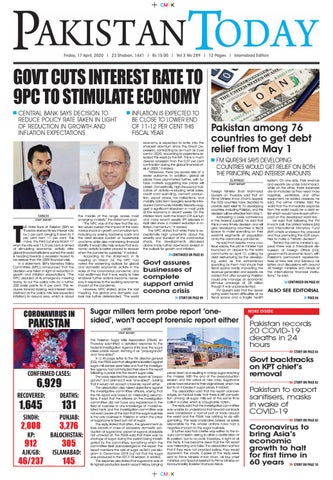
Govt cuts interest rate to 9pc to stimulate economy g
Central bank says DeCIsIOn tO reDuCe POlICy rate taken In lIght OF reDuCtIOn In grOwth anD InFlatIOn exPeCtatIOns
KARACHI staff report
t
he state bank of Pakistan (sbP) on thursday slashed its key interest rate by 2 per cent, bringing it down to 9 per cent from 11 per cent. this move, the third cut since March 17 when the rate was 13.25 per cent, is aimed at stimulating economic activity after global financial institutions warned the world is heading towards a recession feared to be deeper than the 2009 financial crisis. In a statement, sbP’s Monetary Policy Committee (MPC) announced that the decision was taken in light of reduction in growth and inflation expectations. “the MPC decided at its emergency meeting today, to cut the policy rate by a further 200 basis points to 9 per cent. this reduces forward looking real interest rates (defined as the policy rate less expected inflation) to around zero, which is about
g
InFlatIOn Is exPeCteD tO be ClOse tO lOwer enD OF 11-12 Per Cent thIs FIsCal year
the middle of the range across most emerging markets,” the statement read. “the MPC was of the view that this action would cushion the impact of the coronavirus shock on growth and employment, including by easing borrowing costs and the debt service burden of households and firms, while also maintaining financial stability. It would also help ensure that economic activity is better placed to recover when the pandemic subsides,” it added. according to the statement, in its meeting on March 24, the MPC had noted the worsening outlook for global and domestic economic activity in the wake of the coronavirus pandemic and had reaffirmed that it was ready to take whatever further actions become necessary in response to the evolving economic impact of the pandemic. however, MPC stated, since the last meeting, the global and domestic outlook has further deteriorated. “the world
coronavirus in
pakistan
economy is expected to enter into the sharpest downturn since the great Depression, contracting by as much as 3 per cent in 2020, according to projections released this week by the IMF. this is a much deeper recession than the 0.07 per cent contraction during the global financial crisis in 2009,” it stated. “Moreover, there are severe risks of a worse outcome. In addition, global oil prices have plummeted further, with futures markets suggesting low prices will persist. Domestically, high-frequency indicators of activity―including retail sales, credit card spending, cement production, export orders, tax collections, and mobility data from google’s recently introduced Community Mobility reports―suggest a significant slowdown in most parts of the economy in recent weeks. On the inflation front, both the March CPI out-turn and more recent weekly sPI releases in april also show a marked reduction in inflation momentum,” it added. the MPC stated that while there is exceptionally high uncertainty about the severity and duration of the coronavirus shock, the developments discussed above imply further downward revision in the outlook for growth and inflation.
CONTINUED ON PAGE 05
Govt assures businesses of complete support amid corona crisis STORY ON PAGE 09
Pakistan among 76 countries to get debt relief from May 1 g
FM QureshI says DeVelOPIng COuntrIes wOulD get relIeF On bOth the PrInCIPal anD Interest aMOunts ISLAMABAD staff report
Foreign Minister shah Mahmood Qureshi on thursday said that on Prime Minister Imran khan’s appeal, the g20 countries have decided to provide debt relief to 76 developing countries, including Pakistan, and this decision will be effective from May 1. addressing a press conference in the federal capital, he said that this is a very timely decision and will give developing countries a fiscal space to make spending on their worst-hit segments of population amid the coronavirus pandemic. he said that despite many cautious voices, the prime minister had launched an appeal to the world community on april 12, calling for debt restructuring for the developing world as the extraordinary spending by them had shrunk their fiscal space badly impacting the revenue generation and exports. he added that after scraping, Pakistan could only manage an economic stimulus package of $8 billion though it was unprecedented. FM Qureshi said that the developing world faced difficulties of no fiscal space and a fragile health
Sugar millers term probe report ‘onesided’, won’t accept forensic report either LAHORE staff report
CONFIRMED CASES:
6,929
RECOVERED:
DEATHS:
SINDH:
PUNJAB:
1,645 2,008
131
3,276
KP:
BALOCHISTAN:
AJK/GB:
ISLAMABAD:
912 46/237
305 145
the Pakistan sugar Mills association (PsMa) on thursday submitted a detailed response to the Federal Investigation agency (FIa) over the sugar crises probe report, terming it as “propaganda” and “one-sided”. In a 45-page letter to the FIa director general (Dg), the PsMa said that allegations levelled against sugar mill owners were false and that the investigative agency had not included their view in the report following a probe into the recent sugar crisis. the body rejected the probe report as “propaganda” and claimed it was “one-sided”, adding that it would not accept a forensic report either. the association also raised objections against the investigative committee officers, saying that the FIa report was based on misleading assumptions. It said that the officers on the investigation committee did not have any experience in the field of business or any knowledge of market-related facts and the investigation committee was not even aware of the fact that the sugar business is the only business in Pakistan in which the price of sugarcane is fixed but not of sugar. the reply stated that often, the government allows exports in case of excessive domestic production of sugarcane; export of sugar is absolutely not unheard of. the PsMa said that there was no shortage of sugar during the period being investigated by the committee, something which the committee itself acknowledged in the report. the report mentions the rate of sugar as rs51 per kilogram in December 2018 but not that the sugar was produced in the 2017-18 season, it added. the response also stated that sugarcane was at its highest production level in recent history, bringing
system. On one side, their revenue and exports are under bad impact, while on the other, there expenses are on increase as they need more hospitals, ventilators and other equipment, he added. however, he said, the prime minister told the world that the immediate response from the world could be a debt relief which would have its spin-off impact on the developed world too. he said that following the PM Imran’s call, the united nations (un) and International Monetary Fund (IMF) chiefs endorsed the proposal and thus prompting the g20 countries to make a “historic decision”. “behind the prime minister’s appeal, there was a threadbare discussion at Foreign Office (FO), government’s economic team, with Pakistan’s permanent representatives at new york and geneva, his letters and discussions with around 30 foreign ministers and heads of the international financial institutions,” he said.
CONTINUED ON PAGE 05
ALSO SEE EDITORIAL PAGE 06
more inside
Pakistan records 20 COVID-19 deaths in 24 hours STORY ON PAGE 03
prices down and resulting in cheap sugar reaching the masses. with the end of the overproduction season and the arrival of new crop, sugarcane prices have returned to their original level, which has led to an increase in sugar prices, it added. the association said that the report acknowledges, on factual basis, that there is stiff competition among all sugar mills yet at the same time calls it a cartel, which is a laughable notion. the reply said that the investigative committee was unable to understand that forward contracts were considered a normal part of trade around the world and the PsMa has nothing to do with gambling. the reply implicates brokers as solely responsible for this, whose actions have had a negative impact on the sugar business. It further said that a letter was written to the inquiry commission asking to allow a clarification of its position, but to no avail, therefore, in light of all the facts, it has become clear that the FIa report was misleading and false. the association warned that if they were not provided justice, they would approach the courts. Copies of the reply were sent to Prime Minister Imran khan, all four chief ministers and special assistant to Prime Minister on accountability barrister shahzad akbar.
CMYK
Govt backtracks on KPT chief’s removal STORY ON PAGE 02
Pakistan to export sanitisers, masks in wake of COVID-19 STORY ON PAGE 02
Coronavirus to bring Asia’s economic growth to halt for first time in 60 years STORY ON PAGE 10
02
Friday, 17 April, 2020
NEWS
Govt BACktRACkS on kPt CHIef’S ReMovAl AGP sAys AkhtAr will be restored to his Position, new Probe will be lAunched ISLAMABAD
t
STAFF REPORT
HE federal government is willing to withdraw the notification of Karachi Port Trust (KPT) Chairperson Jamil Akhtar, the attorney general told the Islamabad High Court on Thursday. Attorney General Khalid Javed Khan
appeared in the case being heard by Chief Justice Athar Minallah. The petition filed by Akhtar challenged his removal from the post by the Maritime Affairs Minister Ali Zaidi. The attorney general said that the notification would be taken back and a new investigation would be started into Akhtar’s conduct as the KPT chief. Over the course of the hearing, the bench also
200bps decrease in policy rate provides govt Rs1tr cushion: Pasha Former finance minister and eminent economic expert Hafeez Pasha on Thursday said the reduction of 200 basis points by the State Bank of Pakistan will provide the government fiscal space of up to Rs1 trillion, which would enable it to cope with difficult times of coronavirus pandemic. Speaking on 92 News TV programme hosted by senior journalist Arif Nizami, he said the government will have to take more measures to provide relief to people if the lockdown imposed in the wake of the spiked infection remained intact. He said there persisted a possibility of further cuts in policy rate if things didn’t get better. Speaking about the negative growth in the Pakistani economy, he said the -1.5 GDP will have adverse impacts on the economy as the country would be facing such negative growth in seven decades. Due to the lockdown, industries have been shut down, which means Pakistan will be losing 40-50 of its export orders along with foreign direct investments, he said, adding the standstill will push millions of people below the poverty line. He said at least 4 million people will be rendered jobless if the lockdown remained in place for the next few months and added that currently, the number of unemployed people in the country was already 4 million. He appreciated the government for providing relief to vulnerable segments of society, such as daily wagers and contractual workers, saying if things don’t improve in the coming months, then the government must think of another relief package to keep the starvation at bay. NEWS DESK
PRA extends date to file sales tax returns LAHORE: Amid coronavirus outbreak and subsequent lockdown, the Punjab Revenue Authority (PRA) on Thursday extended the date for submission of payments and filing of sales tax returns under the Punjab Sales Tax on Services Act 2012. According to a notification issued by the PRA chairman, “In exercise of powers conferred under sub section 1 of section 84 of the Punjab Sales Tax on Services Act, 2012, the Punjab Revenue Authority is pleased to extend the due date of payment of Punjab Sales Tax and filing of sales tax returns/withholding statements for the tax period of March 2020 up to 30th April, 2020 for all the registered persons including withholding agents.” According to an official spokesperson of PRA, service providers and withholding agents would benefit from this opportunity. SHAHAB OMER
raised questions over Ali Zaidi’s interference in the case.Akhtar, who was appointed on November 23, 2017 for three years, was removed from the post on March 25. He was accused of causing irregularities and hiring people illegally. On March 28, the Islamabad High Court stayed his dismissal and asked the federal government to submit a reply in the case. The federal government had removed Akhtar from the post of the chairman on March 25 with immediate effect. The notification had said: “The Federal Government is pleased to remove Rear Admiral Jamil Akhtar (retd) from the post of Chairman Karachi Port Trust (KPT) under Min-
istry of Maritime Affairs, forthwith by modifying/reducing his period of initial appointment in terms of Section 11 of KPT Act, 1886, with immediate effect”. According to a journalist, Zaidi had pushed for the removal Akhtar after he refused to grant a contract for a mega project to the minister’s blue-eyed company. Speaking on a Din TV show, journalist Mumtaz Bhatti had claimed that Zaidi wanted the former KPT chairman to award the contract to MIBT, a company owned by the friend of the shipping minister, for $70m. Akhtar refused and told the minister that the contract will only be awarded via standard bidding procedure. However, in the bidding process, a company named RAMD made a bid of $13-15m for the same task which the MIBT had asked $70m for, he had claimed. Subsequently, Zaidi had allegedly gotten the finance director removed, but that didn’t work out. Eventually, Zaidi in connivance with a secretary and his ‘friend’ in Islamabad sent the chairman of the KPT packing.
Pakistan to export sanitisers, masks in wake of COVID-19 ISLAMABAD GHULAM ABBAS
As the country is currently importing testing kits, masks and other medical material to fight the coronavirus pandemic, the government has allowed businesses to manufacture masks and sanitisers for export purposes. The said permission was granted during a meeting of the National Command and Control Centre (NCOC), said Adviser to Prime Minister for Commerce and Investment Abdul Razak Dawood. In a series of tweets on Thursday, the adviser informed that the approval was only for “normal textile masks”, and does not include N95 and surgical masks. He urged the manufacturers to prepare themselves as necessary documentation and details would soon be issued in this regard. "The NCOC meeting this morning approved the export of sanitisers & textile masks NOT N95 & NOT surgical masks but normal
textile masks. Necessary documentation details will be issued in the next few days so please prepare yourselves," he tweeted. "We have to think strategically for the after lockdown scenario. I request businessmen to think of changing their product mix, geographical spread and going into new lines of business. This has to be our sustainable growth strategy," the adviser continued, urging the business community forward their suggestions [if any] to the Ministry of Commerce. The adviser had earlier cautioned that Pakistan's economic condition had reached acritical stage following the spread of COVID-19. "We will sit in the Ministry of Finance to discuss and analyse the projections of both the IMF and World Bank but one thing is for sure, situation for Pakistan is critical," he had said. Last month, the federal government had placed a ban on the export of personal protective equipment
after the country's coronavirus tally crossed 950. The banned equipment included N95 masks, surgical masks, face masks, hand sanitisers, biohazard bags, goggles, disposable gloves, and gowns. The initiative was taken at a time when countries had rushed to protect their supply of masks, as panic buying, hoarding and theft had spread over fears of the deadly virus. The demand and price of protective medical gear, especially disposable face masks, had gone up since last December when coronavirus appeared in Wuhan, China. Masks had either disappeared from medical stores in the city or were being sold at exorbitant prices across the metropolis. The masks which were previously available at Rs10 were now even not available at Rs40. However, local masks (made of cloth) were being sold in abundance but they are not recommended by the doctors.
iPPs may agree to tariff cut as negotiations with govt continue ISLAMABAD AHMAD AHMADANI
Some representatives of Independent Power Producers (IPPs) have expressed willingness to reduce power tariff and review power purchase agreements, Pakistan Today has learnt According to sources, during a meeting held between the representatives of IPPs and a committee constituted earlier by the Cabinet Committee on Energy, some IPPs agreed to the government's stance of making the power sector sustainable. Several issues pertaining to the IPPs, including heat rate test, foreign currency indexation for local investors, rescheduling/increasing the debt term, operation and management costs, return on equity etc. were discussed in detail on the occasion. Sources said the committee has been holding discussions with the IPPs to have power tariff reduced and the
power agreements reviewed. "It is likely that a consensus will be developed among all stakeholders regarding a cut in power tariff, as the government is making all out efforts to help the power consumers get affordable electricity amid crisis caused by coronavirus," an insider said. On April 2nd, the Cabinet Committee on Energy had constituted a committee under the chairmanship of Power Minister Omer Ayub Khan to deliberate various viable and mutually acceptable options to make the power sector sustainable. Subsequently, on April 13th, the CCoE shared a meeting notice, wherein it had invited the representatives of IPPs to discuss tariff related issues on the 16th. Sources said that another round of talks with the stakeholders to discuss an appropriate mechanism and steps for tariff optimization/reduction would be held on Monday (20th April) at Private Power &Infrastructure Board (PPIB), Ministry of Energy.
IHC summons Health Ministry’s officials in PMDC case ISLAMABAD: The Islamabad High Court (IHC) on Thursday summoned officials of Ministry of National Health Services, Regulations and Coordination (NHSRC) in a case pertaining to payment of salaries to the employees of Pakistan Medical and Dental Council (PM&DC) and restoration of its registrar. Justice Mohsin Akhter Kiyani of the IHC, while hearing the case, remarked that the salaries should have been paid to the employees as the council had its own funds. Additional Attorney General (AAG) Tariq Khokher informed the court that the matter related to the restoration of PMDC registrar was pending before the top court. To this, Justice Kiyani said that they should wait for the Supreme Court’s (SC) decision and summoned the joint secretary health and section officer concerned on next date of hearing. The petitioners’ counsel pleaded that the salaries had not been paid to the PMDC’s employees so far despite restoration of the council. The counsel alleged that the ministry officials asked his client, Brigadier (r) Dr Hafizuddin Siddiqui, who was recently restored as the PMDC registrar, to leave by shutting down the office. The case was adjourned till April 21. APP
Google to help Pakistani businesses with remote working Google has announced a free virtual workshop in a bid to help Pakistani businesses cope with remote working and transition into digital platforms as the country faces restrictions on movement due to the COVID-19 outbreak. “It’s a course developed from our Grow with Google programme that we have transitioned virtually during the COVID-19 restricted movement period,” read the press release issued by Google on Thursday. While facilitating those who cannot attend the workshop virtually, the tech giant has also given an option for downloading the self-study app instead through which business owners — who are unable to attend these virtual workshops — can turn to the Google Primer app for fast and easy lessons that can be done in just five minutes. “Primer offers several hundred lessons in business, marketing, management, and more, along with personalised next steps to put your new skills to work right away,” read Google’s statement. Additionally, entrepreneurs can also find more tips and recommendations to help them grow their business on the Grow with Google website. NEWS DESK
SBP reserves rise $252m to $10.9bn KARACHI: Foreign exchange reserves held by the State Bank of Pakistan (SBP) increased by $252 million to $10,974.6 million during the week ending April 10, 2020, according to data released by the central bank on Thursday. This rise is attributed primarily due to official inflows, the central bank said. The news monetarily halts the trend of substantial drops in the SBP reserves, which had continued since March 13. SBP reserves fell from $12.8 billion to $10.7 billion between March 13 and April 3. Net foreign reserves held by commercial banks also increased, from $6,265.7 million to $6,320.9 million The total liquid foreign reserves held by the country rose from $16,988.2 million to $17,295.5 million. MEIRYUM ALI
Govt urged to discourage illegal businesses, provide relief to taxpayers ISLAMABAD GHULAM ABBAS
Various taxpaying industries that are contributing towards the government's Covid-19 Relief Fund have urged the government to discourage smuggling and illegal businesses, which are fuelling parallel economy in the country. Sources in the Ministry of Industries (MoI) said major registered and taxpaying firms had requested the government to take practical steps against those running illegal businesses in the country. On one hand, many organisations have stepped forward to donate in the corona relief fund on the call of Prime Minister Imran Khan, but on the other, illegal businesses flourishing and not
paying taxes, sources quoted multiple industries as having conveyed to the government. “If we take a look at the highest taxpaying industries, the legitimate tobacco industry of Pakistan is definitely in top rankings. Unfortunately, this tax is only being paid by 60pc of the tobacco industry, whereas 40pc of the industry is evading taxes. This 40pc comprises local manufacturers who are not only evading taxes by showing less production and under invoicing, but also selling cigarettes on lower prices, which is yet another breach of the law of the land. This is causing an annual Rs40-45 billion loss to the local economy,” the tobacco industry said in a statement.
CMYK
In another statement, the tyre industry has also informed that illegal trade is costing Pakistan a loss of approximately Rs30 billion annually. According to a data provided by a local tyre manufacturer, in 2017-18 the national exchequer incurred a loss of Rs30 billion (at the current rate of duty) because of tyre smuggling. Similarly, the petroleum industry, due to the smuggling of Iranian oil, has been causing an annual loss of Rs60 billion to the national exchequer every year. This smuggling reportedly takes place through the Pak-Iran border in Balochistan and is in circulation, hurting the legitimate oil and gas sector. As per documents shared with the Senate’s Standing Committee on Petro-
leum, the Pakistan State Oil (PSO) had to shut 159 petrol outlets down in Balochistan where Iranian petrol is freely available at fuel stations and it is cheaper by Rs10 to Rs20 per litre. Instead of curbing illegal businesses, the governments have been burdening already tax-paying industries by increasing ratios of taxes. Increasing taxes on the legitimate businesses further poses a threat to the economy as businesses will suffer even more, threatening the contribution towards the national exchequer. During this time of crisis if the government is able to restrict the illegal trade in the country by taking strict measures such as the track and trace system and encourage legitimate businesses to maximise productivity by putting reasonable taxes on them, the economy can get better. If illegal trade is controlled, the government would have more than Rs130 billion rupees, which can be used to get through this period of crisis.
Friday, 17 April, 2020
Pakistan records 20 covid-19 deaths in 24 hours LOCAL TRANSMISSION OF CASES INCREASES TO 58PC LAHORE
a
STAFF REPORT
S the total number of coronavirus cases in the country crosses 6,500, the National Command and Operation Centre revealed on Thursday that more than 58 per cent of these cases were transmitted locally. Pakistan recorded over 20 deaths on Thursday, taking the total toll to 131, with the emergence of over 650 new cases. Punjab accounts for the most COVID-19 infections, reporting 3,276 cases as of Thursday evening. Sindh, Balochistan, and Khyber Pakhtunkhwa have so far reached 2,008, 305, and 912 cases, respectively.
Islamabad has 145 cases, GilgitBaltistan has 237 cases whereas Azad Kashmir has 46 cases so far. The recoveries stand at 1,645. According to the Ministry of National Health Services, Pakistan conducted 5,540 coronavirus tests on Wednesday– the highest number of tests conducted over a 24-hour period in the country. The ministry said Pakistan’s total number of tests stood at 78,979, according to the latest figures available. It further said that as the number of tests conducted rises, so will the number of positive cases. “In fact, the government’s aim is to conduct 25,000 tests daily by the end of April and predictive modelling shows that in that case 1,000 new cases will be
china assures Pakistan of continued support amid pandemic ISLAMABAD: China’s State Councilor and Foreign Minister Wang Yi telephoned Foreign Minister Shah Mahmood Qureshi on Thursday, assuring that China would continue to provide all possible support to help Pakistan overcome the coronavirus crisis as soon as possible. “We will continue to provide all possible support according to the needs of Pakistan to help it overcome the epidemic as soon as possible,” he said. According to a statement issued by Chinese Foreign Ministry, Wang Yi said that at a critical moment in China’s fight against the epidemic, President Dr. Arif Alvi paid a special visit to China and expressed his firm support for Pakistan to Chinese leaders, adding, “China will bear this in mind.” He said that at present, the Pakistan’s epidemic situation also had an impact on the Chinese people. All sectors of Chinese society had acted spontaneously and actively donated money and materials to provide assistance to Pakistani brothers and sisters within their ability, he added. Wang Yi said that the Chinese government had provided Pakistan with multiple batches of material assistance, and had also dispatched medical expert groups to hold expert video conferences to share prevention and treatment experience. APP
reported daily in the country on average. PM CALLS FOR SOCIAL DISTANCING: Meanwhile, Prime Minister Imran Khan has urged media to play its due role in providing authentic information and countering propaganda by some elements under prevailing situation of coronavirus epidemic. Presiding over a high-level meeting here on Thursday, the prime minister said paramedical staff, doctors and nurses deserve appreciation, as they are engaged in treating corona patients across the country.
Mufti Muneeb hopes for ‘unanimous formula’ on mosques lockdown KARACHI STAFF REPORT
Ruet-e-Hilal Committee Chairman Mufti Muneebur Rehman on Thursday said that he hoped that the religious scholars and government would be able to reach an understanding regarding the standard operating procedures (SoPs) concerning congregations and opening of mosques during Ramzan. Rehman, who also heads the board for the madressas of Barelvi school of thought, hoped that a “unanimous formula” could be readied in Saturday’s meeting between President Arif Alvi and prominent religious scholars from across the country. Speaking after a meeting with Sindh Chief Minister Murad Ali Shah, he said the Sindh government also hoped that a unified decision could be made on Saturday which the ulema would agree on and the government would abide by. “It will be better for our country, our state, our nation,” he said. Murad said he would direct police not to be strict inside mosques on
Govt to consult ulema for formulatinG ramzan Guidelines, says Pm ISLAMABAD: Prime Minister Imran Khan on Thursday said a comprehensive plan for Ramzan would be devised in consultation with religious scholars. He said this during a meeting with religious scholar Maulana Tariq Jameel at PM’s Office. Imran praised Tariq Jameel for his awareness campaign regarding the coronavirus pandemic. The prime minister told him that his government required cooperation from religious scholars to deal with the pandemic. He said he would soon meet a delegation of clerics. “The government’s efforts aim to protect people from a pandemic that has engulfed the entire world,” PM Khan said. “Religious scholars have guided the government in every difficult time,” he said. APP
Friday, saying restrictions on gatherings in the mosques will remain in place. However, all movement would remain suspended from 12pm to 3pm. Earlier, Federal Minister for Religious Affairs and Interfaith Harmony Noorul Haq Qadri met with Sajjada Nasheens of big shrines across the country in an effort to build consensus ahead of the meeting. The minister also contacted heads of madaris, Punjab Ulema Board and members of the Council of Islamic Ideology and invited them to partici-
Pakistan’s internet use surges amid COVID-19 lockdown ISLAMABAD ANADOLU AGENCY
From binge-watching the Turkish drama series Resurrection: Ertugrul on Netflix to video calls with family and friends, Pakistanis are keeping themselves quite occupied while staying at home amid coronavirus pandemic. According to the Pakistan Telecommunication Authority (PTA), there has been a 15% surge in internet usage since the lockdown came into effect on March 24. The number of coronavirus cases in the country crossed 6,500 as the total confirmed death toll reached to 124 on Thursday. “This is the highest surge we have seen ever. Facebook, YouTube, WhatsApp, Instagram, TikTok and Netflix are the most popular social media apps being used during these days, and most of the trends on social media apps are related to COVID-19 developments and initiatives taken by the government in this regard,” said PTA spokesperson Khurram Mehran. Often called the Turkish
The Prime Minister said the government allowed limited business activities in the country keeping in view problems being faced by labour and business class. He, however, urged the citizens to demonstrate responsibility and maintain proper social distancing to mitigate adverse impacts of coronavirus. Imran Khan directed the authorities concerned to launch special campaigns for raising awareness among masses about COVID-19.
Game of Thrones by fans, Resurrection: Ertugrul tells the story of the period prior to the establishment of the Ottoman Empire around the life of Ertugrul Gazi, the father of the empire’s first leader in 13th century Anatolia (now Turkey). “More content is being streamed online compared to downloads. According to the numbers on Netflix, Money Heist is trending at No. 1 and Turkish drama series Resurrection: Ertugrul is trending at No. 2,” Mehran told Anadolu Agency. Dr. Farhan Virk, a social media activist, said: “Only the privileged have access to Netflix. The rest are sharing content like the series Ertugrul via pen drives. There is already a trend on Twitter in which people are asking state TV to run this series with Urdu dubbing.” According to Turkey’s Ministry of Culture and Tourism, dozens of Turkish series are being followed by more than 500 million viewers in over 150 countries. While giving an interview to a local channel, President Arif Alvi mentioned the
bandwidth challenges faced by Pakistan. VIDEO CONFERENCING APPS: The Higher Education Commission also announced that it is working with telecommunications companies to offer data bundles to university students at cheaper rates. “Video conferencing apps have gained popularity. Most of the schools are offering online classes through applications such as Google Classroom. Use of e-commerce and entertainment applications has also picked up. The Higher Education Commission is also making a plan with telecom companies in which special data bundles will be offered to students in which they can use the internet at cheaper rates from 8 a.m. to 12 noon,” Mehran said. The surge in internet use is also raising alarms over privacy breaches which are likely to increase in the coming days. Privacy issues will always remain a challenge in Pakistan due to the model of services being provided by third parties not conforming to the existing licensing
pate in Saturday’s meeting at the President House. A meeting of prominent religious scholars in Karachi on Tuesday had concluded that the lockdown imposed by the government to curb the spread of coronavirus was “not applicable to mosques”. Calling the congregational prayers a “necessity”, a statement released after the meeting said that it was important to continue the prayers while observing precautionary measures.
regime. “Currently, the Prevention of Electronic Crimes Act is facilitating authorities in protecting internet users in Pakistan. But standard procedures do not work during emergencies. Swift action is needed, especially when a sense of uncertainty is engulfing people’s lives. The last thing they need is for the only outlet for human interaction to be unsafe,” said Hija Kamran, who leads digital rights advocacy at Media Matters for Democracy. CELEBRITIES IN LOCKDOWN: From distributing rations among the destitute to giving live performances through their social media platforms, celebrities are keeping public morale high during self-isolation. “As a public figure in Pakistan, I’ve been quite active when it comes to helping out the core base of this country, our daily wagers, where the Ali Zafar Foundation has been actively providing rations to those in need and encouraging everyone who is capable to do the same,” said actor and musician Ali Zafar. “In addition to this, through my social media assets, I’ve been spreading awareness as well as assisting our local bodies on policymaking when it comes to dealing with the fight against COVID-19.”
NEWS
03
over 0.95m people sign up for ‘tiger force’ ISLAMABAD: More than 0.95 million people have registered themselves as volunteers for the Prime Minister’s Corona Relief Tiger Force (CRTF) which is being set up to carry out relief and rescue activities across the country amid coronavirus crisis. According to the real time volunteers’ data on the CRTF web portal, some 0.62 million aspirants were from Punjab, 0.14 million from Sindh and 0.13 million Khyber Pakhtunkhwa. Whereas, more than 45,000 people signed up for the CRTF from other areas including Azad Jammu and Kashmir (AJK), Balochistan, Gilgit Baltistan (GB) and Islamabad. The deadline for registration of the CRTF expired on April 15 but was extended by the government, an official from the office of Special Assistant to the Prime Minister (SAPM) on Youth Affairs told APP on Thursday. “The CRTF started the registration process on March 31,” he added. Soon after the completion of the registration process, the lists of the volunteers would be placed on the dashboards of Pakistan Citizen’s Portal for the respective Deputy Commissioners (DCs), read an official handout which was shared by the government with all the district administrations. According to the document, a copy of which is available with APP, the DCs would be given the option of retrieving the volunteers’ data on the basis of their locality, qualification or skill set. They would notify three Committees for different administrative tiers as per the composition and Terms of References (ToRs) defined by the government for management and supervision of the CRTF at field level. The committees would be set up at District, Tehsil and Union Council or village level.
relaxation in lockdown for relief of people: firdous ISLAMABAD: Special Assistant to the Prime Minister on Information and Broadcasting Dr Firdous Ashiq Awan said on Thursday that Prime Minister Imran Khan eased the lockdown for facilitation of the people, and ensuring timely supply of essential goods and other facilities. In a tweet, she said that this step did not mean that the challenge of corona pandemic was over. The fight against outbreak of coronavirus was going on, she said adding that with care citizens have to protect themselves and others. She said all citizens should enjoy their rights but at the same time fulfill their responsibilities. Dr Firdous urged the people to apply strict adherence to preventive measures and social distancing. This war cannot be won without the help and cooperation of the people, she remarked. She advised the people not to leave the precaution while playing the role of responsible citizens as only cure for this menace was precaution and avoidance. APP
04 ISLAMABAD
Friday, 17 April, 2020
WEATHER UPDATES FRIDAY
280C
180C
SATURDAY
310C
170C
SUNDAY
270C
160C
NatioN will sail through paNdemic crisis successfully: presideNt alvi RAWALPINDI
p
APP
rESIDENT Dr Arif Alvi on Thursday hoped that the Pakistani nation would successfully sail through the crisis of COVID-19 pandemic as multiple challenges in the past had chiselled it into a brave and steadfast nation. While addressing a distribution ceremony of ration bags among coolies of the Pakistan railways in an event arranged by Pakistan Baitul Mal at rawalpindi railway Station, the president said that from hosting millions of Afghan refugees to fighting out terrorism and sectarianism, the Pakistani nation has stood steadfast against all hardships. “The way the Pakistani nation has braved hardships is unprecedented in history. One way or the other, the lockdown would ultimately affect the econ-
omy but the government would maintain a balance to keep the economy working,” he said. Minister for railways Sheikh rasheed Ahmed, Special Assistant to Prime Minister (SAPM) Sania Nishtar, Pakistan Baitul Mal Managing Director (MD) Aun Abbas Buppi and Islamic relief Umair Hassan also attended the ceremony. The president said that coronavirus has emerged as a global challenge and being a developing economy, Pakistan could not give a relief package worth trillions of dollars like the developed countries; however, the government is providing cash assistance worth rs12,000 each among 12 million worsthit families to help feed their families. He said though the ratio of coronavirus cases is lower than the feared estimates; people should show no laxity towards precautionary measures.
The president said that a decision regarding the tarawih prayer would be taken on April 18 after consultations with religious scholars and advised people to give out maximum alms and zakat during the holy month so that the support system for the needy could continue working. He called for showing unity and discipline to face the COVID-19 challenge, exemplifying the role of German and Japanese people who had rebuilt their countries after the Second World War through their hard work and unity. He also lauded the pro-poor efforts of the railways minister and hoped that the railways would revive its usual operations and overcome the losses once the pervading situation ends. Minister for railways Sheikh rasheed Ahmed applauded the role of the loaders and their hard work and thanked the MD Baitul Mal and Chief of Army Staff General Qamar Javed Bajwa
who donated 3,000 ration bags for the railway loaders. He said the prime minister would soon inaugurate this converted train that would be taken to Taftan within 24 hours, adding that seven railways hospitals are also on standby. Dr Sania Nishtar said the world is faced with an ordeal but the nation would sail through it with all-out support by the government. She said under Ehsaas, an Emergency Cash Program has been launched to support 12 million families and the ration distribution scheme would also be launched by next week. She said being an important pillar of Ehsaas Program, the Pakistan Baitul Mal is playing a vibrant role to support the government in its social safety endeavour. She appreciated the railways minister for advocating the case of poor in the cabinet meetings by bringing out different ideas.
PRAyER TimingS FAJR SUNRISE
ZUHR
ASR MAGHRIB ISHA
4:11
12:09
3:47
5:38
6:39
8:07
icci for notification to open all businesses related to construction industry ISLAMABAD: Islamabad Chamber of Commerce and Industry (ICCI) President Muhammad Ahmed Waheed Thursday urged the quarters concerned to issue notification for opening of all businesses related with construction industry including steel re-rolling and marble sectors. He said on the instructions of the coordination committee and prime minister, district administration had issued notification for opening of construction industry, but steel re-rolling, marble and some other industries were not covered in the said notification, which had created confusion in the businessmen of the construction sector. The ICCI president said other provinces had notified opening of all construction related businesses and stressed that new notification for Islamabad should be issued to remove the prevailing confusion. He said if all businesses related with construction industry were not opened, there would be no benefit of the opening of construction industry as many materials and items used in construction would not be available in the market.He said due to lockdown, all businesses had already suffered great loss. However, the government’s announcement to open some industries including construction had given a new hope to the depressed business community. He said the ICCI had already issued instructions to the traders and industrialists to fully abide by the standard operating procedures (SOPs) issued by the local administration for opening the business activities. APP
only 6 Kp districts are corona-free, Jhagra says
PESHAWAR: Peepal Mandi Bazaar hums with activity after the government eased restrictions on a lockdown imposed by the provincial government as a preventive measure against the spread of COVID-19. PPi
KP CM seeks citizens, traders’ cooperation to wipe out Covid-19 PESHAWAR APP
Chief Minister Khyber Pakhtunkhwa Mehmood Khan Thursday sought cooperation of traders and citizens of districts Peshawar and Mardan to wipe out coronavirus pandemic. In his tweet, he said "There is no or less than 10 cases of COVID-19 in 16 districts of the province
therefore, one-size-fits-all approach cannot work,” "Uneven spread of the disease is the lesson learnt across the globe," he added. He said that 235 cases of coronavirus have been reported from provincial capital followed by 108 cases in Mardan. The Chief Minister urged masses and traders to pay special attention to social distancing and use of
masks and sanitizers at work places to avoid spread of infectious disease. Meanwhile Khyber Pakhtunkhwa Health Minister Taimur Saleem Jhagra told media that overall coronavirus cases have reduced in the province due to effective lockdown and untiring services of doctors, paramedic staff and other front line forces. "The provincial government is enhancing coronavirus testing capacity to 1000 per day and increasing workforce in health sector for facilitation of people," he said. According to Health Department data, out of the 50 new confirmed cases in Khyber Pakhtunkhwa 38 were from Peshawar and out of 41 total deaths in Khyber Pakhtunkhwa 19 were from provincial capital.
PESHAWAR: Khyber Pakhtunkhwa Finance Minister Taimur Khan Jhagra on Thursday said that so far there are only six districts in the province where no cases have been detected. The areas include Chitral, Upper and Lower Kohistan, Battagram etc. According to Jhagra, the reason behind zero cases being recorded in these areas is the thin population. KP’s coronavirus toll currently stands at 912, according to the government’s database, with 42 deaths. Some 191 patients have recovered so far. The recovery ratio is 21%, third-highest after Gilgit-Baltistan, Sindh and Balochistan. Separately, earlier in the day, thanked traders in the province for working with the government during this difficult time, adding that the country could not afford any unrest at the moment. Taking to Twitter, the minister said: “Had a marathon session with representatives of KP traders at the secretariat. It was important to listen to them at length because we feel their pain. Everyone in the country and most of the world is going through a difficult time as never experienced before in our lives. “rest assured that we will find a way for your businesses to run. It is a priority. But let us take considered risks and not take decisions with unintended consequences,” he said. The federal government on Tuesday, while extending the duration of the lockdown, allowed some industries to reopen. The sectors that opened up after the announcement include the construction industry (cement shops, bricks kilns, crushing plants, bitumen and prefabricated construction materials), chemical and manufacturing plants, e-commerce for export, e-commerce for local deliveries of necessary items, software development and programming, paper and packaging units, plants nurseries, cement plants, fertilizer plants, mines and minerals, laundry services, agriculture machinery/equipment manufacturing plants, glass manufacturing, veterinary services, stationery and book dealers and all export industries provided their export orders are approved by Trade Development Authority of Pakistan (TDAP). STAFF REPORT
Patients, doctors complain of SOPs violation, lack of facilitates at Holy Family Hospital RAWALPINDI APP
Patients and visitors at the Holy Family Hospital on Thursday complained that its management was not adhering to standard operating procedures (SOPs) while dealing with COVD-19 patients, adding that the isolation ward was also not “allocated rationally”, exposing them to high risk of catching coronavirus. “Coronavirus is highly contagious and a reasonable distance is advised by healthcare experts but due to improper allocation of space in the isolation ward, thousands of daily patients and visitors are exposed to the infection,” said a visitor, Noreen Sheikh, while talking to APP. “The isolation ward for coronavirus infected patients is at the last corner of the hospital so infected patients have to walk through the whole building to reach there, putting others at risk,” she added. “I have to visit my mother who is admitted for spinal fracture but my entire family is afraid and concerned about
being fully exposed due to the free mobility of corona infected patients. The hospital staff has no answer to this illmanagement,” Saleem Khan, another patient’s attendant said. Asadullah Ahmed, a resident of Khushab whose sister is also admitted at the Holy Family Hospital, shared similar views. “I spent twenty-four hours in the hospital to look after my sister and moving among corona infected patients gave me a panic attack. I am psychologically convinced that I will also become a victim in this environment,” he said. Similarly, Sardar Ahmed, a cardiac patient who was brought to the hospital for his heart congestion a couple of days ago said,” I am devastated to see that all patients, including corona suspects, are using the same door to enter the OPD and are sharing the same area that leads to the laboratory”. Additionally, doctors and paramedics also complained about the non-provision of safety gear and equipment. One of the doctors, on request of anonymity, revealed that they were not
provided with any proper protective gear which was affecting their work. “We are working in fearful conditions as a frontline force,” he said. Another lady doctor working in the OPD requesting anonymity said that many doctors and paramedics were not given N-95 masks and were simply told that it was not needed because it was an initial stage. “But anyone entering the OPD could be a carrier of this novel virus. Even irrelevant staffers are given these facilities but not us who have to treat patients,” she informed in a regrettable tone. “The Holy Family Hospital was already treating a number of patients with other illnesses on a daily basis. Corona testing labs and quarantines should be operated at a distance and with separate entry and exit gates as it is unsafe for others to be treated in the same building,” she added. According to the details, the distance from the OPD to the laboratory and quarantine centre is around 90 yards after a COVID-19 patient walks through the in-
ternal corridor to the isolation ward. However, Medical Superintendent (MS) Dr Shehzad Ahmed refuted the allegations. “The hospital has adopted all the measures recommended by the World Health Organization (WHO) experts and the SOP’s are in line with international standards,” he maintained. “We are combating COVID-19 by working on three levels. In the first step, suspects go through a filtration process and are identified whether they are carriers of the contagion or not. Then they are sent to the lab, and finally, after being declared positive, they are admitted in the isolation ward,” he told. He also added that N-95 masks were only provided to doctors and paramedics dealing with corona positive patients while sweepers and staff not working in the isolation ward were wearing a replica of the N-95 which comes without a filter and is easily available in the market. In reply to a question, he said that the isolation ward was up to the mark as a single room was allocated for one patient and only specific staff was appointed to offer duties. He also rejected the news of two patients dying at the hospital due to the virus. One of the patients, he said, was a drug addict and the other who was suffering chronicle tuberculosis was alive and still being treated in the hospital.
Friday, 17 April, 2020
AEDB AlloWs 18 EntItIEs to sEt uP 653MW PoWEr PlAnts ISLAMABAD
t
APP
HE Alternative Energy Development Board (AEDB) has issued a letter of support (LOS) and a letter of intent (LOI) to 18 companies and sugar mills to set up power plants having accumulative capacity of 653MW. Sources told APP on Thursday that these projects are in different stages of development and would start supplying power
generation by 2022. Sharing details, they said 74.4MW Etihad Power Generation (Rahim Yar Khan) is under construction and would attain commercial operation by 2021. Similarly, sources said LOSs were issued to 32MW Shahtaj Sugar Mills Ltd, 49.8MW Hunza Power, 31.2MW Bahawalpur Energy, 31MW Indus Energy, 31.2MW Ittefaq Power, 40MW Kashmir Power, 30MW Alliance Sugar Mills, 25MW RYK Energy, 48.9MW Two Star Industries, 30MW TAY Powergen Company, 30MW Hamza Sygar Mill (Unit-II), 26.5MW Faran
75 families left homeless after Islamabad admin tears down slum
Power, 30MW Sheikhoo Power, 26.5MW Mehran Energy, 26.5MW Habib Sugar Mills. These projects are being set up in various parts of the country including Rahim Yar Khan, MandiBahauddi, Jhang, Bahawalpur, Ghotki, Toba Tek Singh, Tando Allah Yar, Tando Muhammad Khan, Muzaffargarh and Nawabshah. Sources said the LOIs were issued to 45MW Sadiqabad Power and 45 MWGhotki Power. AEDB has formulated of a new Alternative and Renewable Energy Policy (ARE Policy 2019) consequent to expiry of RE
Govt cuts interest rate CoNtINuED froM pAgE 01 “The economy is expected to contract by -1.5 per cent in FY20 before recovering to around 2 per cent growth in FY21. Inflation is expected to be close to the lower end of the previously announced 11-12 percent range this fiscal year, and to fall to 7-9 per cent range next fiscal year,” it stated. “While there are some upside risks to headline inflation in case of temporary supply disruptions or food price shocks, these are unlikely to generate strong second-round effects due to the weakness of the economy. Similarly, the inflationary impact of the recent exchange rate depreciation is expected to be contained given low import demand and falling global prices,” it added. The MPC highlighted that this rate cut would complement other measures recently taken by the SBP to support the economy, including concessional financing to companies that do not lay off workers, oneyear extension in principal payments, doubling of the period for rescheduling of loans from 90 to 180 days, and concessional financing for hospitals and medical centers incurring expenses to combat the coronavirus pandemic.
Pakistan among 76 countries CoNtINuED froM pAgE 01 The foreign minister told the media that this was the prime minister’s forth global initiative during his less than two years term including drive against climate change, campaign against eliminating Islamophobia, action against corrupt and illicit financial flows, and the latest being the initiative against debt relief. Responding to a question, the foreign minister said that the developing countries would get relief on both the principal and interest amounts. He added that the relief would be given by all the financial institutions including IMF and World Bank (WB). He hoped that the relief would have a substantial impact on Pakistan and the developing countries. Earlier, the relief was granted to the least developing countries, but after Pakistan’s initiative it was extended to 76 countries of the developing world, he added.
Policy 2006 in March, 2018. The policy aims to create a conducive environment for the sustainable growth of ARE Sector in Pakistan. The GOP’s strategic objectives of Energy Security, Economic Benefits, Environmental Protection, Sustainable Growth and Social Equity will further be harnessed under the ARE Policy 2019. The draft policy has an expanded scope encompassing all alternative and renewable energy sources, competitive procurement and addresses areas like distributed generation systems, off-grid solutions, B2B methodologies and rural energy services. The draft ARE Policy 2019 sets a target of achieving 20 per cent capacity from ARE technologies by 2025 and 30pc capacity by 2030. The draft ARE Policy 2019 envisages development of large scale ARE projects in all parts of the country through active participation of the provinces and also lays down procedure for development of provincially sponsored projects.
Imran thankful to G20 for debt relief ISLAMABAD APP
ISLAMABAD: Human Rights Minister Shireen Mazari on Thursday expressed outrage and ordered an inquiry into the demolition of at least 75 huts in a G-11/4 slum by the Islamabad administration without any “prior approval”. “Absolutely unacceptable,” declared Mazari on Twitter and added she had taken up the issue with the Capital Development Authority (CDA) chairman and the interior minister. She said an “immediate inquiry” would be ordered to ascertain why the action was done apparently without the sanction of the CDA and the interior ministry. The minister said action will be taken immediately if any police official was found involved in the incident. “Shocking and criminal behaviour on part of those involved,” she remarked, announcing that the 75 evicted families would be provided shelter and compensation as soon as possible. Islamabad Deputy Commissioner Muhammad Hamza Shafqaat said the official who sanctioned the operation was suspended. The authorities that ordered the operation “say it (the area) was a den of professional beggars, however, the inquiry will find out [the] facts”, he added. Photos and videos shared on Twitter showed a tractor tearing down structures as helpless dwellers look on. Social activists criticised authorities for razing the huts and making hundreds of people homeless in the middle of the coronavirus pandemic. STAFF REPORT
NEWS
Prime Minister Imran Khan on Thursday appreciated the debt relief measures by G20 countries, the International Monetary Fund (IMF) and the World Bank for developing countries, including Pakistan. The premier lauded the debt relief measures after Finance Adviser Dr Abdul Hafeez Shaikh called on PM Imran and informed him about the planned approval of an additional $1.4 billion concessionary financing from IMF to deal with the economic impact of coronavirus. In the meeting, the finance adviser also updated the premier about the progress on various components of the economic stimulus package announced by the government. On April 12, PM Imran had appealed for a “Global Initia-
tive on Debt Relief” to deal with a global recession in the wake of the outbreak of novel coronavirus. The premier had appealed to the international community, the United Nations Security Council (UNSC) and international financial institutions to respond positively to the dilemma confronting developing counties in the face of the pandemic. While noting that the COVID-19 pandemic has posed unprecedented health and economic challenges, PM Imran had underlined that a global recession was certain, one worse than the ‘Great Depression’. “A global pandemic cannot be contained without strong, coordinated and well-crafted global response,” he had stressed. In a televised speech, the premier had said that the global initiative on debt relief would bring together stakeholders on a platform to promote coordinated
health and economic response. A statement issued from his office had noted that various announcements were made by multilateral actors such as the UN, the IMF, and the World Bank. The announcements made included initial relief packages of US$1.4 billion by the IMF and $1 billion by the World Bank. Imran had proposed that developing countries be provided with fiscal space and financial relief through enhanced debt relief and restructuring as well as other additional measures that could help them manage the unfolding crisis. As part of his diplomatic outreach, Imran had said that he would be approaching the heads of state and governments from a wide range of countries notably from the Paris Club, Highly Indebted Poor Countries (HIPC), heads of international organisations and others concerned to join him in this endeavour.
Pharmacists seek criminal investigation against Dr Mirza ISLAMABAD STAFF REPORT
Pakistan Young Pharmacist Association (PYPA) General-Secretary Dr Furqan Ibrahim has submitted an application to Chief Justice of Pakistan (CJP) Gulzar Ahmed, requesting him to initiate criminal investigation against Special Assistant to Prime Minister on Health Dr Zafar Mirza over allegations of corruption, a local news outlet reported on Thursday. The applicant stated that when Dr Mirza was appointed after the termination of his predecessor over allegations of corruption and illegal hike in prices of medicines, he ordered a reduction in prices within 72 hours and said that the looted money would be recovered and submitted to Bait-ul-Mal, and embezzlers would be punished. However, the applicant claimed, prices of medicines were increased and the PM’s aide allegedly took billions of rupees from pharmaceutical companies in return for facilitation. The PYPA general secretary claimed
that Dr Mirza tried to sabotage the country’s healthcare system by replacing the PMDC Act with PMC Ordinance, 2019, which was recently declared void by the Islamabad High Court (IHC). He also alleged that the PM’s aide smuggled over 20 million face masks and protective gear out of Pakistan,
which led to their shortage in the country, and created room for the supply of substandard equipment. He added that a number of doctors have refused to work without protective equipment and this has led to deaths of hundreds of patients who could not get medical assistance. The applicant stated that the Federal Investigation Agency (FIA) is also currently investigating the matter. He added that the PM’s aide has also started a defamatory campaign against the CJP on social media and the premier took note and ordered the FIA to take legal action against those defaming the apex judiciary. He also said that the SAPM continued to appoint corrupt persons and terminate honest officers, including Dr Obaid Ali, who had highlighted the corrupt practices of Mirza in letters to the premier. Moreover, the PYPA general secretary alleged that the PM’s aide had appointed junior doctors as heads of hospitals administered by the federal government – resulting in a near-collapse of the healthcare system.
UAE to extend visas for Pakistani nationals amid coronavirus outbreak
ISLAMABAD APP
The United Arab Emirates (UAE) has announced to extend visas for Pakistani nationals along with other measures that were discussed during a video link conference between the UAE minister on human resource and PM’s
aide on Overseas Pakistanis Zulfi Bukhari on Thursday. The UAE ministry has decided to assist the stranded Pakistani nationals in every way possible and will provide legal protection to those who are willing to stay in UAE. In a major development, both ministers have discussed that Pakistani nationals who were recently dismissed from their jobs would be given salaries in full, however, virtual jobs will be provided to Pakistani employees on a priority basis. In order to facilitate Pakistani expats, UAE firms will also provide airfare to Pakistani employees so that they can safely return to their home country. Bukhari thanked UAE for facilitating Pakistani nationals in these hard times of the pandemic. It is pertinent to mention that Pakistan is a big labour supplier to the UAE, with more than a million Pakistanis living and working in the country, according to Pakistani diplomats. Since March, Dubai has been under lockdown as the UAE has ramped up measures to curb the spread of the coronavirus.
05
PM Imran seeks performance report from ministers NEWS DESK Days after Prime Minister Imran Khan had expressed annoyance at the “unprofessional conduct” of some of his ministers, he has sought performance reports from all of them, an indication that those who fail to perform up to the mark would be sacked, a local news outlet reported on Thursday. Following criticism of the ministers’ performance, the prime minister had decided to monitor their work himself. However, the report stated, he found the performance of his 48-member federal cabinet to be unsatisfactory and asked them for a comprehensive report about their performance since the time of their taking office. The ministers have also been asked to present a future of action of their respective ministries and they will brief the premier about the steps taken during their tenure as ministers. On March 7, PM Imran, while expressing annoyance at the unprofessional conduct of his cabinet members, had said that sometimes the opposition did not even need to do something against the government as its ministers’ statements were enough to land it in hot water. “When the opposition does nothing, some minister makes such a statement that it becomes difficult to handle the fallout,” PM Imran was quoted as saying during a meeting with the PTI social media team. “There are even some ministers who are found more in Kohsar Market than their offices,” he had taken a jibe at ministers. In September last year, the Prime Minister’s Office (PMO) had issued a “red letter” to 27 ministries for a “critical delay” in the tasks assigned to them. The letter — which is viewed as a final warning and an expression of displeasure — was issued to the secretaries for 27 federal ministries out of a total of 34 ministries.
41 Pakistani nationals return home via Wagah ISLAMABAD: At least 41 Pakistanis entered the country via Wagah after the authorities commenced the repatriation of citizens stranded in India due to the imposed lockdowns in both countries to contain the spread of coronavirus. According to the Pakistan High Commission in New Dehli, nearly 150 citizens still await repatriation and efforts were afoot for the return of Indian citizens in Pakistan. The returnees thanked both the Indian and Pakistani governments for ensuring their return to their home country. Many of the returnees were reportedly quarantined in various cities and screened at Attari before being allowed to cross the Wagah border. The returnees have been shifted to the Jinnah hospital in Lahore, where they will be tested for coronavirus. On Tuesday, the Pakistan International Airlines (PIA) announced additional flights to bring back Pakistani nationals who are stranded abroad in the wake of the coronavirus pandemic. According to a spokesperson for the national flag-carrier, flights will depart for Manchester from Islamabad on April 17 and April 18. He added that two more flights — PK 8852 and PK 8894 — will travel to Seoul from Islamabad on April 17. STAFF REPORT
Friday, 17 April, 2020
06 COMMENT
Brave New World
Is the game worth the candle? Putting more lives on the line
What will be the lessons of the lockdown?
T
he National Coordination Committee decided to extend the lockdown for two weeks while at the same time easing it. It also decided to reopen ‘lowrisk industries’. Prime Minister Imran Khan said the Centre and provinces had a general consensus on opening of some of the essential industries with necessary precautionary measures. however, he added, the provinces could implement their own policies where needed. The PM has taken a great risk without waiting for a supportive environment. The steps are normally taken when the curve of an epidemic is flattened, showing itself in a decrease in the number of new cases. This is by no means the case with Pakistan where virus cases are doubling every two weeks. Sindh Chief Minister Murad Ali Shah maintains that coronavirus deaths are being under-reported which is disputed by health SAPM Dr Zafar Mirza who claims that fatality rate in such cases is ‘very low in Pakistan.’ The federal government has thus ignored the maxim that during the pandemics, it is better to err on the side of caution. While the federal government is keen to open industries, it has so far failed to flesh out what it really entails. No industry can run without transport which currently remains suspended. even when allowed to ply, buses or train bogies transporting labour will have to carry only one-third of their capacity to maintain social distancing. The extra charges will have to be borne by the factory owners, thus raising the production expenses. The easing of the lockdown in Lahore led to anomalies that showed little homework had been done by the Punjab government. Stores at Brandreth Road which supply accessories to the contactors and constitute a crucial link in the supply chain of the construction industry, were not allowed to open. Small scale construction remained blocked as shops supplying cement, crush and sand were kept shut. Bookshops were opened but Urdu Bazar which supplies books to retailers, remained shuttered. The permission to open tailoring houses was meaningless as cloth markets were kept closed. In case the easing of the lockdown leads to large congregations on Fridays and Taraveeh prayers during Ramzan, the rate of increase in coronavirus cases is likely to multiply beyond any guesstimate.
at Penpoint M a NiaZi
T
he majority of the planet is under lockdown, and so are its people. Yet the peaks of the coronavirus epidemics have not been reached except in a few countries which were sort of pioneers, in that the infection revealed itself there ahead of other countries, and the disease has run its course in those places. The effects of the lockdown, or rather of the numerous lockdowns, may have been primarily on the disease, but it is likely to change the way we do things, and the way we look at the world. With the world coming out of lockdown not because the disease is beaten, but because governments can’t maintain one any more, the hangover of the lockdown may remain, just as the flour and sugar rationing of World War II was retained in Pakistan until Ziaul haq abolished it in 1987. Perhaps the most important lesson is the sheer meaninglessness of borders, and how they might actually be an obstacle to fighting the virus. Standing on national pride at this point is counterproductive. One example is that of Kashmir, which India insists is an internal affair, but which Pakistan says is a public health issue. With the disease spreading in Kashmir, it is perhaps only a matter of time before Indian health authorities have questions needing quick answers about AJK. Will Pakistani authorities then take a nationalistic stance and reject ‘Indian interference?’ And Pakistani questions about IOK were less motivated by genuine public health concerns than by nationalistic concerns. There are going to be queries raised about Syrian refugees in Turkey and Greece, not to forget Afghan refugees in Pakistan, Rohingya in Bangladesh, or Somali in Kenya. What about Palestinian refugees in Syria, Lebanon and Jordan? The last, who first came to the camps in 1948, show that camps are not set up according to sound public health principles, and become even greater public-health hazards when they acquire permanence. Another essential lesson of this pandemic has been about the use of technology. Since the last great pandemic, of the Spanish ‘flu’ about a century ago, people have grown a lot less accepting of the death of either loved ones, or themselves. This is because of the technology that has made death so much less of a common experience. But it’s not just about medicine or healthcare professionals, though the search for ventilators seems to have some of the quality of the World War II search for antibiotics. The present pandemic has not yet led to the discovery of a reli-
Coronavirus debt relief G20 acts
T
he G20 countries have paved the way for the multilateral donors, as well as the G7 countries, to give the world’s 76 most highly indebted countries debt relief by themselves deciding to postpone their debt repayments for a year. This is not a debt writeoff, as had been suggested by some heavily indebted countries, but does mean that the payments that were due this year have been thrown forward. The G20, which includes the world’s 20 largest economies, also includes the G7, which are the world’s seven largest economies, and thus not just the biggest bilateral lenders, but the biggest contributors to the multilateral lending institutions. The G20 countries hope that the benefiting states will not only be freed from the burden of raising the foreign exchange needed to pay their debt, but will use the money thus freed up to spend on measures to combat the coronavirus pandemic. The G20 countries have not done as much of a favour as they might like to pretend. The only solid step emerging from the decision is that there will not be a slew of defaults. The affected countries have no means of obtaining the money needed, because exports have collapsed along with the rest of international trade, especially of primary products, which provide the sole income for many countries. Pakistan shows the problem faced by countries which also rely on workers’ remittances for their foreign exchange. Workers are being thrown out of work abroad as well, which means the remittances are going to be much lower than usual, and it would have been increasingly difficult, perhaps ultimately impossible, to meet a payment schedule set in less stressful times. however, Pakistan’s debt managers should not go overboard. It is true that the moratorium indicates how long the G20 thinks it will take the world economy to get back on track, and enable the indebted countries to start repayments again. If things do not go according to plan, the G20 has said it is willing to ‘amplify its efforts’. however, it should give us pause that Pakistan and North Korea are the only two nuclear powers not in the G20. Instead, Pakistan is likely to be alongside some of the poorest and worst-run countries in the world to benefit from this relief.
The politics of coronavirus Right-wing nationalism rises up at the wrong time MuhaMMad Firas shaMs
T
he outbreak of covid-19 is already being viewed globally through the partisan lens of right wing nationalism, making bids to curb the virus difficult. China finds itself taking the flak for being non-transparent on the actual number of cases and the provenance of the disease. A pandemonium of allegations are making the rounds on how the “sick man” of Asia, as described by the Wall Street Journal, launched a biological weapon against the Western world. The virus is Christmas for fake news peddlers. Take Arkansas Senator Tom Cotton who gained notoriety with a speculation of his own about how the virus was created in Wuhan’s bio safety- level 4 super laboratory, the only one in China to carry out research on human infectious diseases. Cotton who spoke like a true Republican crusader abandoned all reason by “deducing” that the virus might be an experiment gone wrong or purposeful release of a bio-weapon, hence, China poses a Soviet Union USSR-level threat. Unfortunately for the Chinese, such diseases have in a way become synonymous with their country. Wind the clock to 2003, SARS emanated in a wet market situated in Southern China spreading to over 27 countries, resulting in almost 800 deaths. The traces of the virus were found in farmed civet cats. So far we know there is some evidence that the virus originated in a bats and transmitted to a pangolins before infecting a humans. For the symbiont to jump between species all three have to come in contact with each other and China’s squalid wet markets, like as in Wuhan, are the perfect breeding grounds for the spread of such a deadly pandemic. The decision to permit private farming came in the 1970’s when the Communist government, unable to feed its 900 million population, was beset by famine. Therefore, while large corporations controlled production of popular foods like poultry, peasant households in order to eke out a living
Dedicated to the legacy of the late Hameed Nizami
Arif Nizami Editor Aziz-ud-Din Ahmad
Umar Aziz
Asher John
Joint Editor
Executive Editor
Deputy Editor
Lahore – Ph: 042-36300938, 042-36375965
able antiviral, though some progress has been re- based economy being manned by people who keep ported. The AIDS pandemic, also caused by a virus, on updating their skills. We should not underestimate had led to the development of antivirals, but none the magnitude of the challenge. There have been two which killed off the disease, merely kept it under methods of giving infants the skills they will need as adults, both to negotiate their paths through society, some sort of check. The limits of telemedicine have been tested. As and to earn a living. One is informal learning from well as those of tele-education and tele-labour. Is adults, particularly parents, and older children, parthere a distanced social life? east and West seem ticularly siblings. The other is formal, the attending equally affected. Over here, the issue of who to hug of some sort of school, where they would learn from and with whom to shake hands seem already settled: adults who had made this their profession. So far, the nobody. It seems that the cold, more verbal culture of Internet was an informal means, but now it seems that the West has triumphed, not because of safety, but se- it will provide formal means as well. Schools, or their curity. But then, those advancements of the Western equivalent, have been part of human civilization for way of life, the bar and the club, are also nixed, and thousands of years now, but now that is possibly that means that those out for fun have no option but going to change. Another change that has to opt for something long been thrust on people has condemned as the first step been the way they experito alcoholism: toping alone. ence religion. Religious conSo far, there is no elecOne of the problems with the gregations are supposed to tronic means of getting be a no-no. For how long? drunk, but education pandemic is that governments One way in which India’s through electronic means has been around for some in place had to handle it even if ruling BJP is attempting to use the pandemic is by time. There are not only prethey had a different agenda. spreading the calumny that pandemic examples of the Muslims are somehow reAllama Iqbal Open UniverModi, Imran Khan, Donald sponsible, especially the sity dating back to 1974, but Tablighi Jamaat. The BJP there is a separate Virtual Trump, Jair Bolsonaro, Boris has targeted the Tablighi JaUniversity founded in 2002. Johnson, all had different maat as playing an active The basic difference berole in spreading the disease tween these two and other agendas, but they will be in India. The Tablighi Jaeducational institutions is maat was founded so as to that lectures are delivered remembered for how they counter the Shuddhi and online, though the AIOU handle themselves and their Sangathan Movements, provides for student-faculty which had been started by meetings, though faculty country today the Arya Samaj, for the rewould not have delivered version of Muslims or Christhe lectures. tians back to the hinduism Schools and universities from which they converted, have taken the first step, of having lectures delivered online. Student interaction, back in the 1920s. harming the Tablighi Jamaat thus in the form of questions, are also electronic. The com- bolsters the reconversion movement supported by the puter and the Internet have made this possible. At the BJP itself. That movement is not the present stress of time of the last pandemic, and for a long time after, the BJP, whose attempt to remove Muslims from citthere was no option to sending children to schools, izenship through the National Register of Citizens where they could become carriers if not get sick, or has caused so much turmoil, with Assam as merely letting them grow up wild. Now, there is only a small the testing-ground for an ideology which makes fraction of those who need education. A lot of chil- hindu-ness a prerequisite for Indian-ness. One of the problems with the pandemic is that dren lack access to the Internet, if at all they are in school. The concept of distance learning was sup- governments in place had to handle it even if they had posed to be of great help for those who did not have a different agenda. Modi, Imran Khan, Donald access to schools, or who had missed out on it at the Trump, Jair Bolsonaro, Boris Johnson, all had differright time, and it was hoped it would provide them ent agendas, but they will be remembered for how they handle themselves and their country today. access later on. The changing dimensions of the classroom might have application when we think of a knowledgeThe writer is a member of staff.
I
Karachi – Ph: 021-35381208-9
I
turned to wild animals. With government backing, this measure resulted in poverty alleviation; and in 1988, the Wildlife Protection law was amended to term wild life as a state-owned resource,s providing immunity to those involved in farming and trading of these animals. This was a spur for small farms, as breeding and domestication of wildlife turned into a multi-million dollar industry, which also became the hub for illegal trading of endangered animals from around the world, funneled into Chinese wet markets for great profits. Due to the immense 2welobbying power of the industry over the Communist government, there have only been temporary bans on the trade of infected and endangered animals over the years. In other words, it has been encouraged to grow as products generated by the industry are marketed for its sex-enhancement, disease- curing qualities making them quite popular with the small Chinese elite. hence, the safety of 1.4 billion people was jeopardized to favour a meagre but influential proportion of the Chinese population. The novel coronavirus has provided fodder for europe’s populist right to further the pathology of nationalism, renewing their clamor for a crackdown on migrants and a closing down of borders. One of the hardline proponents of anti-immigration measures, Matteo Salvini, the former Interior Minister of Italy, has accused migrants from Africa of carrying the disease to Italian shores, as the country has become the epicentere of the virus in europe. But his claims don’t hold water as much needed cohesiveness is required in the european Union, home to 450 million people, which has an open border policy as part of its fundamentals. The eU, which is trying to overcome the reeling effect of Brexit, needs a unified message to keep the pathogen at bay. Albeit, that doesn’t seem to be happening as the likes of French rightist leder Marine Le Pen and hungarian Prime Minister Viktor Orban are singing a nativist populist tune of creating a link between the virus and immigration due to open borders which is reminiscent ofs the border crisis of 2015 caused by the influx migrants from war-torn
Islamabad – Ph: 051-2204545
I
Web: www.pakistantoday.com.pk
I
countries. The World health Organization (WhO) has called border restrictions as impeding technical expertise and aid from reaching the affected areas along with casting a shadow on economic activity in these countries. Marina Cino Pagliarello, at the London School of economics, described the imbroglio as the convergence of two crises exposing the dearth of trust and solidarity in the largest political and economic body in the world. For the european rightwingers like Salvini, the enemy hasn’t changed: it’s still - migrants. Across the Atlantic, US President Donald Trump and his retinue are blaming China of for the Thucydides Trap. The Chinese Ambassador to the US, Cui Tiankai, who has overruled the allegation, finds himself in the crosshairs. China’s longes-t serving diplomat in the USA has his prowess put to the test amid the outbreak of the coronavirus pandemic and in the face of swelling animosity for China amongst the US legislators. Recently, in a tit-for-tat move, the USA designated five different Chinese media outlets as “foreign missions” and state apparatuses for propaganda after China expelled three Wall Street Journal journalists for referring to China as the “sick man of Asia” in their opinion piece. The coronavirus infodemic ought not to be understood in the context of the great power rivalry, where China is seen as waging a biowarfare or the American military being accused of bringing the virus to Wuhan. Such accusations are based on obstinate prejudice, which is not what theat world needs right now to rein in the virus. The path of confrontation will lead to further de-globalization, protectionism, tariffs, closing down of borders and erecting of walls which will only aggravate the pandemic. The only way to curb the crisis is not through fearmongering or xenophobia but through international collaboration. Solution to a global disease has to be global, through exchange of ideas, better communication and increased coordination. By being hermetic, no one country can cease the spread of an epidemic with the help of the outside world. Alongside this, the international community must be moved to put pressure on China to halt its wet market operations and illegal wildlife trade for good, since it only contributes a very small portion in China’s gigantic GDP, its results are hurting the second largest economy the most. Muhammad Firas Shams is a freelance columnist
Email: editorial@pakistantoday.com.pk
Friday, 17 April, 2020
COMMENT 07 Editor’s mail Send your letters to: Letters to Editor, Pakistan Today, 4-Shaarey Fatima Jinnah, Lahore, Pakistan. E-mail: letters@pakistantoday.com.pk Letters should be addressed to Pakistan Today exclusively
Covid 19 and mental health
Covid-19 & CPEC endeavours Keeping growth going in hard times
sultan m hali
C
PEC has been progressing and contributing to Pakistan’s economic and social development even in the face of adverse circumstances due to covid-19. The mega project brings solidarity, assistance and confidence to the people of Pakistan. To add impetus to CPEC projects, on March 16 and 17, President Arif Alvi paid a state visit to China. The leadership of the two countries met and agreed to further promote the development of CPEC. An MoU was signed to set up two new working groups on science, technology and agriculture, under the framework of CPEC. On March 25, the working group meeting on energy was held. The working group will continue to meet and coordinate with other working groups under the CPEC framework to make preparations for the JCC meeting. Contrary to negative speculation, China has not withdrawn engineers working on CPEC projects nor laid off Pakistani workers since the outbreak of covid-19 in Pakistan. Currently, CPEC hosts nearly 7000 Chinese and 40,000 Pakistani employees. Over 40,000 Pakistani families are directly supported by the CPEC projects. The energy sector under CPEC continues to provide power. Transportation projects facilitate the transportation of medical materials. The Special Economic Zones (SEZ)s under CPEC exhibit economic vitality. The social sector under CPEC provides relief to the public. It is heartening that, owing to concerted precautions for preventing COVID-19, no infection occurred at any of the CPEC projects. The Chinese companies attach great importance to the protection of both Chinese and Pakistani employees. Some companies are planning to send medical teams to Pakistan to better protect the projects and the joint interests of the two peoples. So far, China has donated 125,400 COVID19 Real-time PCR Kits, 2.8 million surgical masks, 0.42million N95 masks, 1.2 million medical gloves, 0.21 million medical protection suits and 217 ventilators to Pakistan, and also provided $4 million to the Pakistani government for building an emergency hospital. Chinese medical experts’ teams are in Pakistan to provide assistance and expertise in the fight against covid-19. There are more in the pipeline. Chinese companies working in CPEC projects have made themselves a part of the local community and are active in lending a helping hand in different ways to Pakistan. All provinces have benefited from this.
Some examples are the All Pakistan Chinese Enterprises’ Association, under whose aegis, some companies have provided medical supplies and donations to Pakistan to fight against covid-19. Zonergy Company Limited of China, and the China Machinery Engineering Corporation called on Prime Minister Imran Khan in Islamabad on 8 April and donated Rs 5 million to the Prime Minister’s covid-19 Relief Fund. They also donated medical supplies worth Rs 3 million to the National Disaster Management Authority (NDMA) that include 30,000 masks, 100 N95 masks and 300 protection suits. The industrial and commercial bank of China has donated medical supplies to the Pakistani Embassy in Beijing. Power China Port Qasim Electric Power Company (Private) Limited donated Rs 321,000 to Pakistan’s medical authorities for fighting the covid-19 epidemic. In Baluchistan, the Gwadar East-Bay Expressway Project in collaboration with China Overseas Ports Holding Company and the Chinese Red Cross medical team in Gwadar has donated medical supplies to GDA Hospital. TChina Power Hub Generation Company (Pvt.) Ltd. (CPHGC) has donated ration bags to the deserving families in the villages of Hub. The CPHGC also distributed 1000 kg of disinfectants and 2000 masks to the AC Hub’s office. In KP, China Railway Construction Corporation (International) Limited presented epidemic prevention materials, including face masks and hand sanitizers, to the Government of Khyber Pakhtunkhwa. China Railway presented face masks and disinfectants to Pakistan Railways. CPEC has created more than 75,000 jobs directly and 200,000 jobs indirectly for the Pakistani people, with its per capita income increased by 23 percent. More than 100 small and medium-sized enterprises have participated in the construction of CPEC, providing hundreds of thousands of jobs. CPEC is expected to create 2.3 million jobs between 2015 and 2030 and boost Pakistan’s annual economic growth rate by 2 to 2.5 percent, according to the Pakistani government. Amid the contribution of CPEC, Pakistan is ranked 108 in the ease of doing business from 136, according to the latest World Bank annual ratings. Under the joint planning of the two governments, the next phase of development of CPEC will continue to advance infrastructure construction, focus on people’s livelihood, and industrial and agricultural cooperation, maintain a sound momentum of high-quality development and bring more benefits to the two countries and peoples. In the realm of energy, 12 power projects have either been completed or are under construction. The total installed capacity of these projects is 7240 MW with total investment of about $12.4 billion. In addition, nine projects are under preparation, with a total installed capacity of 6390 MW. As of fiscal year 2018-19, COD CPEC energy projects had generated $250 million in tax revenue for Pakistan and provided over 10,000 jobs. They now accounted for 14.5 percent of available energy in the NTDC grid. The Havelian-Mansehra section of the Karakorum Highway (KKH) II opened to traffic on 18 November 18, and it resolves the trip problem along the KKH. The Highway helps to shorten the travel time from 3 hours to 30 minutes. Work on upgrading the KKH’s Havelian-Thakot section is also on track for timely completion. The 392km-long Multan-Sukkur section of the PeshawarKarachi-Motorway was completed ahead of schedule and inaugurated at the 9th JCC in November 2019. The project has created about 29,000 local jobs, and a large number of Pakistani techni-
cians have been trained during its construction. In Gwadar, work on the redesigned Eastbay Expressway and the New Gwadar International Airport is proceeding according to timelines. Various issues regarding Orange Line Mass Transit project in Lahore had been resolved, and the project will start operation soon. The Chinese and Pakistani sides agreed to expedite the design review and feasibility approval of the Main Line-I (ML-1) PeshawarKarachi railway project. Both sides also agreed to constitute a financing committees to explore the possibility of renminbi financing. Both sides agreed to consider the Quetta mass transit and the greater Peshawar mass transit projects in the next JWG Meeting after approval of their PC-1s. The Gwadar new airport was launched in October 2019. The construction work is being carried out according to plan. Construction work of the China-Pakistan Gwadar Faqeer Middle School is in full swing and expected to be completed by this year. China-Pakistan Gwadar Vocational Technical School was launched on January and was supposed to be completed in July 2021. The 300 MW coal-fired power plant was launched in March, and its preparatory work would be expedited. China plans to dispatch experts’ teams for the early implementation of a 1.2 million gallons per day desalination plant. The Initial District of Gwadar Free Zone has got over 20 enterprises residents, with a direct investment over $600 million. Detailed planning is being undertaken for the further development of the Free Zone which had already been granted considerable concessions. The China-Pakistan Friendship Hospital will be launched soon. A medical college and nursing school would be considered for Phase I of the Gwadar Development Authority (GDA) hospital project. In the last JCC, progress on three SEZs, Rashakai, Dhabeji, and Allama Iqbal, was reviewed. The importance for supporting infrastructure, targeted incentives for investors and a “one-window” facility, was reaffirmed. The first round of business diagnosis for Pakistani’s textiles sector was undertaken and its findings on enhancing industrial productivity and overall competitiveness were presented. It was agreed to expand and deepen the business-diagnosis mechanism to other industrial sub-sectors. It was agreed to activate the Pakistan-China Business Council to give full play to the private sectors of both countries. The Council would comprise senior executives from leading enterprises. In the Socioeconomic Development and Agriculture, out of 17 fast-track socioeconomic development projects, 12 were ready for commencement, while the remaining five projects would also be expedited. Special emphasis was placed on early launch of Pakistan-China joint agricultural technology laboratory. Both sides would also enhance cooperation in agricultural areas including deep processing technology, fisheries, and disease-free zones. Both sides also agreed to accelerate the procedures for: (a) Balochistan Solar Power Lighting Equipment; (b) Drinking Water Equipment Supply (solar-powered pumps in KP and water filtration plants in AJK); (c) Smart Classroom Project for Higher Education; (d) Provision of Medical Equipment and Material; (e) Pakistan Vocational School Equipment. Despite the black clouds of covid-19 hovering, CPEC endeavours in the backdrop of the pandemic are providing social, industrial and economic support to Pakistan Sultan M Hali is a retired Group Captain and author of the book Defence & Diplomacy. Currently he is a columnist, analyst and TV talk show host.
THE coronavirus spread all over the world, sullying millions of people and killing thousands. All the prophylactic measurements are taken all over the world but the most important thing is “How it affects our mind & psycho-domain?”. The capability of the human body to fight against the pathogen is “Immunity”, but the most important thing we always forgot to mention is the “WILL Power” & “Positive Attitude” of the infected person. If we focus on our language then we use the following words for example “He is fighting against the acute hemophilia”, here the term fighting means the person is willingly trying to overcome the impact of diseases and hope so to be a healthy person as soon as possible, here the determination, positive behavior & optimistic approach allows the patient to fight against any disease. Similarly Coronavirus is just a pathogen spreading all over the world as an educated person it’s over responsibility to analyze the psychological affect of this pathogen on the society. It will definitely hit the mind of major population and yet we can predict that “CORONAPhobia” is build up among the people, as this kind of phobia first attack the mind of the person and its symptoms are varies with the person e.g anxiety, stress, depression & phobia of different kinds. The critical impact of Corona is deal by the Medics & State, but its impact on the mentality of the Nation will bring a completely revolutionaries the thinking perspective of people. In order to save the Nation from such conditions we also have to highlight the positive news related to the COVID-19 and the progress going around the world. We all focus on the exponential growth of the patient all over the world But we have to elaborate on the recovery rate all over the world. No doubt the situation is panic but let things run smoothly. As a responsible nation it’s our duty to aware the people about the positive & negative prospectives related to COVID-19 in an appropriate way. May Almighty end our all worries & make our world a lustrous ecstasy. DaniSH MaLik Rawalpindi
Corona fever IT is to draw your attention towards the panic rising in our country due to COVID-19. Corona virus has started to spread all over the world including our country Pakistan. This has created chaos among people. They have become terrified of this virus. Given the fact that it is spreading rapidly and is causing deaths all round the world, no one notices that the recovery rate is much higher than the death rate of the corona patients. Media is playing its role in informing the people about situations all over the globe, but people are pessimistic rather than being optimistic in this situation. This is creating chaos and panic in the country. Through the media, people need to be calmed down. Also, lack of awareness regarding this disease is another cause of trepidation among people. People are getting influenced by one another and starting to become terrified rather than digging for some information. They are not completely aware of the causes of COVID-19 and are continuously falling prey to several profiteers. There is a need to spread awareness among people regarding Coronavirus so that the chances of fraud for these profiteers can be lessened. Articles involving positive changes and efforts all around the world should be published. Also, this is a necessity to make people realize that COVID-19 is more curable than the deaths it has caused. Due to the popularity of your newspaper among the common people as well as the government officials, I request you to publish an article regarding this issue so that it can gain the attention of the officials. Your act of kindness will greatly be appreciated. iqRa RaTHoRE islamabad
Future of SMEs in Pakistan IN the recent past, some tremendous changes were witnessed in the outlook of Pakistan’s status in the international markets and its demographics. According to a Mckinsey’s report on Pakistan’s entrepreneurship, Pakistan is well positioned as an emerging economy projected to be among the fastest-growing in the coming years with an annual growth rate of 6% through to 2026. Despite the economy undergoing a challenging period, and a declining currency exchange rate, the intrinsic drivers suggest tailwinds for growth thanks to the flourishing startup culture in Pakistan, which has given rise to small and medium enterprises. Small and medium sized businesses contribute to about 30% of the GDP and 25 % of manufactured goods exports. Yet, SMEs looking to secure credit from financial institutions have to face certain challenges due to onerous credit assessment requirements of banks resulting in these businesses opting for exploitative informal financial sources to feed their financing needs for growth. SMEs are likely to get relief in access to finance and various initiatives for this have been taken by regulators, development partners, and financial sector players. Karandaaz Pakistan has also provided grants to financial sector players and technological firms to design and experiment innovative methods of calculating credit scores for those who want to avail credit from the bank but do not meet the collateral requirements as set by conventional methods. aMMaR MuzaFFaR karachi
Undermining WHO WHO,the biggest international health body in the world,was accused for being pro-China and US is using it as a scapegoat.Last week,Mr.Trump severely accused global health body for mismanagement and was criticized for being failed to provide timely information during global contagion.Furthermore,Trump stated that WHO was mishandling the coronavirus crisis.But the ground realities are that it was WHO that started awareness campaigns to put the virus at bay.Daily and hourly,WHO keeps a close eye over new developments of coronavirus across the globe and tries to bring forth much-needed advice and warnings to curb the spread of Covid-19.Considering the gravity of situation, such statement during coronavirus pandemic undermines the efforts of WHO and further aggravates the situation as world is preoccupied with Covid-19.The efforts of WHO to contain the Covid-19,of course,deserve immense praise. qaSiM Jan Turbat
Friday, 17 April, 2020
08 WORLD VIEW Why is India targeting writers Women leaders are doing a disproportionately great job at handling the during the coronavirus pandemic? pandemic. so Why aren't there more of them? JOURNALISTS, INTELLECTUALS
Cnn
i
leTa honG FinCher
N Taiwan, early intervention measures have controlled the coronavirus pandemic so successfully that it is now exporting millions of face masks to help the European Union and others. Germany has overseen the largestscale coronavirus testing program in Europe, conducting 350,000 tests each week, detecting the virus early enough to isolate and treat patients effectively. In New Zealand, the prime minister took early action to shut down tourism and impose a month-long lockdown on the entire country, limiting coronavirus casualties to just nine deaths. All three places have received accolades for their impressive handling of the coronavirus pandemic. They are scattered across the globe: one is in the heart of Europe, one is in Asia and the other is in the South Pacific. But they have one thing in common: they're all led by women. The success of these and other women-led governments in dealing with a global pandemic is all the more noteworthy, given that women make up less than 7% of world leaders. EARLY, DECISIVE ACTION: These countries -- all multiparty democracies with high levels of public trust in their governments -- have contained the pandemic through early, scientific intervention. They have implemented widespread testing, easy access to quality medical treatment, aggressive contact tracing and tough restrictions on social gatherings. Take Taiwan, a democracy of almost 24 million people -with roughly the same population as Australia -- off China's east coast. Taiwan is claimed by Beijing as its territory and shunned by the World Health Organization, so it should have been highly vulnerable to an epidemic originating in mainland China. But when Taiwan President Tsai Ing-wen heard about a mysterious new virus infecting the citizens of Wuhan in December last year, she immediately ordered all planes arriving from Wuhan to be inspected. She then set up an epidemic command center, ramped up production of personal protective equipment such as face masks and restricted all flights from mainland China, Hong Kong and Macau.Taiwan's early, aggressive intervention measures have limited the outbreak to just 393 confirmed infections and six deaths. The US State Department cites Taiwan's coronavirus success in calling for Taiwan to be given observer status in the WHO's World Health Assembly. Germany, with 83 million citizens, has had over 132,000 infections but very low deaths per million -- far lower than most other European countries. German Chancellor Angela Merkel, with a doctorate in quantum chemistry, has seen her approval ratings soar due to her capable handling of the pandemic. Germany has the most intensive care beds and the largest-scale coronavirus testing program in Europe. "Maybe our biggest strength in Germany ... is the rational decision-making at the highest level of government combined with the trust the government enjoys in the population," HansGeorg Kräusslich, the head of virology at University Hospital in Heidelberg, told the New York Times. New Zealand is an island country of almost five million, which relies heavily on tourism. But Prime Minister Jacinda
Ardern shut New Zealand's borders to foreign visitors on March 19 and announced a four-week lockdown of the country on March 23, requiring all non-essential workers to stay at home except for grocery shopping or exercising nearby. The country has carried out widespread testing and recorded over 1,300 coronavirus cases, but only nine deaths. New Zealand is only halfway through its lockdown, and Ardern has said it won't end early. "In the face of the greatest threat to human health we have seen in over a century, Kiwis have quietly and collectively implemented a nationwide wall of defense," Ardern said in a speech to the nation Thursday. THE NORDIC COUNTRIES: Four of the five Nordic countries are led by women. Their countries each have lower death rates from coronavirus compared to the rest of Europe. For example, Finland's Prime Minister, 34-year-old Sanna Marin, is the world's youngest leader but she has an 85% approval rating among Finns for her preparedness for the pandemic, with only 59 deaths in a population of 5.5 million. Iceland's Prime Minister Katrín Jakobsdóttir governs a small, island country of only 360,000 people. But its large-scale, randomized testing of the coronavirus could have broad ramifications for the rest of the world, as it has found that around half of all people who test positive for the virus are asymptomatic. Iceland also intervened early, aggressively contact-tracing and quarantining suspected coronavirus cases. Contrast these interventionist responses with Sweden -- the only Nordic country not led by a woman -- where Prime Minister Stefan Löfven refused to impose a lockdown and has kept schools and businesses open. There, the death rate has soared far higher than in most other European countries. Other female heads of state have also made headlines through their tough response to the coronavirus. Prime Minister Silveria Jacobs of Sint Maarten governs a tiny Caribbean island of just 41,000, but her no-nonsense video telling citizens to "simply stop moving" for two weeks has gone viral around the world. "If you do not have the type of bread you like in your house, eat crackers. If you do not have bread, eat cereal. Eat oats," she says emphatically. 'INCOMPETENT, SCIENCE-DENIALIST MEN': Of course, South Korea's (male) President Moon Jae-in has deservedly received praise for flattening the curve of infections in his country through widespread testing. But many countries led by incompetent, science-denialist men have led to catastrophic coronavirus outbreaks. The epicenter of the pandemic is now the United States, where President Trump initially accused the Democratic party of politicizing the virus as a "hoax" and failed to heed multiple warnings from top scientists for months. That helped bring about the current emergency of over 25,000 coronavirus deaths and a half-million cases, which continue to mount each day. Similarly, UK Prime Minister Boris Johnson dismissed the severity of the public health crisis and refused to introduce restrictions on social gatherings long after other European countries went on lockdown. Before he was hospitalized with Covid-19, he told reporters that the virus would not stop him from shaking hands with hospital patients. And the coronavirus would not have spread throughout the world as swiftly if Chinese President Xi Jinping had not allowed five million people to leave Wuhan before it went on lockdown. MORE WOMEN NEEDED? It's too early to say definitively which leaders will emerge as having taken enough of the right steps to control the spread of coronavirus -- and save lives. But the examples above show that a disproportionately large number of leaders who acted early and decisively were women. Yet, on January 1, 2020 only 10 of 152 elected heads of state were women, according to the Inter-Parliamentary Union and the United Nations -- and men made up 75% of parliamentarians, 73% of managerial decision-makers and 76% of the people in mainstream news media. "We have created a world where women are squeezed into just 25% -- one quarter -- of the space, both in physical decision-making rooms, and in the stories that we tell about our lives. One quarter is not enough," said UN Women Executive Director Phumzile Mlambo-Ngcuka. It is long past time for us to recognize that the world is in dire need of more women leaders and equal representation of women at all levels of politics. At the very least, the disproportionate number of women leaders succeeding in controlling this pandemic -- so far -should show us that gender equality is critical to global public health and international security. Leta Hong Fincher is the author of "Betraying Big Brother: The Feminist Awakening in China" and "Leftover Women: The Resurgence of Gender Inequality in China."
The gangster head of the WHO Counter Currents ThomaS C mounTain
The head of the World Health Organization, Dr Tedros Adhanom Gebreyesus, was a senior capo for the Tigray Peoples Liberation Front (TPLF) gangster mafia that ruled Ethiopia from 1991-2018. During that time, he served as Health Minister and Foreign Minister, cementing his credentials as a member of the inner circle of what was one of if not the most corrupt, brutal and genocidal regimes to set foot on this planet in the past 30 years. From 2007 to Ethiopia’s Peaceful Revolution in 2018 Dr. Tedros was complicit in the
AND DISSIDENTS ARE BEING THREATENED BY MODI’S GOVERNMENT Guardian Priyamvada GoPal and Salil TriPaThi
As a lethal virus scorches its way across continents, the leftwing Indian rights campaigner Gautam Navlakha has been reminding us of the words of Leonard Cohen, urging people to speak up for the right things: “There is a crack/a crack in everything, that’s how light gets in.” While many of us experience lockdown in varying degrees of constraint, Navlakha – who cited Cohen’s lyrics in a recent statement – faces actual incarceration as does another highprofile Indian, the eminent academic and Dalit intellectual Prof Anand Teltumbde. Meanwhile, Siddharth Varadarajan, the well-known journalist and a founder-editor of the respected investigative online portal the Wire, faces prosecution in an unrelated case. While locking down its vast population from coronavirus, why is India seeking to lock up dissident intellectuals and intimidate journalists? The three men have been accused of outrages ranging from assassination plots to promoting “enmity, hatred or illwill among classes” — allegations that have been widely criticised as politically motivated. But their apparent common crime is one that underlies the harassment and intimidation of scores of other journalists, writers, academics and human rights campaigners in India. They have criticised the actions of the hardline Hindu nationalist dispensation that rules India today, as well as the culture of divisive bigotry that it has fostered widely in civil society. Navlakha is a longstanding critic of state and army atrocities in the disputed region of Indian-held Kashmir, which has faced a disgraceful lockdown since August last year and continues to experience unconstitutional — and, in corona-ridden times, dangerous — limits on internet access. He is accused, along with respected figures like the poet Varavara Rao and trade unionist Sudha Bharadwaj, of allegedly conspiring in a plot against Prime Minister Narendra Modi in 2018. Teltumbde, related by marriage to India’s towering Dalit leader and constitution-drafter, Babasaheb Ambedkar, has been remanded in custody in the context of violence in the town of Bhima Koregain in 2018. Ironically, Teltumbde has written in the past about how the Indian state seeks to “discredit and eliminate individuals it deems a threat to its apparatus.” Varadarajan, whose platform the Wire has previously fallen foul of powerful and wealthy figures with strong connections to the government, faces a different set of charges. Since the outbreak of the pandemic, there have been strong moves in the Indian media and sections of the ruling dispensation to pin blame for the spread of the virus on Muslim communities. Yogi Adityanath, a fundamentalist Hindu cleric turned politician with a good line in inflammatory speech, is the chief minister of India’s largest state, Uttar Pradesh, where tensions have been rising. Although the Wire misattributed a quote to him on its website, the erratum was quickly corrected and acknowledged. Nonetheless, Varadarajan now stands
TPLF’s crime of genocide against the Somali people of the Ogaden with the genocidal blockade of food and medicine to the region. He was part of expelling the Red Cross and Doctors Without Borders from the Ogaden during a series of Cholera outbreaks and in helping deny medicine to the Somali Ogadenis he oversaw the deaths of untold thousands during a series of historical droughts, famines and epidemics. Dr. Tedros did not just cover up cholera epidemics, he was complicit in a medicine blockade to those affected. And this ganster is today the head of the WHO? How the hell did this happen? Deja Vu Anthony Lake, the CIA and UNICEF? In 2016 a revolutionary situation was developing in Ethiopia with the TPLF mafia’s days clearly numbered. Dr. Tedros read the writing on the wall and made himself “available” to serve
the interests of Pax Americana at the UN. Being the USA as the major contributor to the WHO his vetting for its head by the CIA was a must. Having demonstrated suitability for the job by overseeing genocide made him eminently qualified and during the early days of the Trump Regime in 2017 he made his move from the sinking ship in Addis Ababa to Switzerland and the fat salaries of the UN. Today he finds himself on the hot seat with a 100-year global flu pandemic raging. For almost three years he remained quiet about the almost total lack of preparation at the WHO for what numerous panels had warned was inevitable, a highly contagious and deadly virus quickly spreading across the world. Where were the stockpiles of protective supplies the public health professionals called for, repeatedly? Where were the stockpiles of medical equipment? Where were the testing
accused of a fantastical range of crimes, including disobeying an order of a public servant and creating or promoting enmity between classes. The real problem may be that the Wire reported correctly that Adityanath had attended a Hindu religious gathering after the national lockdown was declared on 24 March. This report came even as public feelings have been whipped up against Muslims because Tablighi Jamaat, a Muslim organisation, held an event prior to the lockdown where many attendees did get infected. The Wire has also noted that “believers” in more than one religious community have been late in adopting precautions against large gatherings. For a long time now, India has benefited from the title of world’s largest democracy (meaning, in fact, the most populous democratic state). That grand moniker continues to lull the world into believing constitutional rights and freedoms thrive in that nation, when they are in fact under grave threat. Although the misuse of state powers to intimidate principled journalists and of religious divides to garner votes has occurred under other governments, including those of the current Congress opposition, there is little doubt that the last six years of Modi’s government have seen an alarming crackdown on campus dissidents as well as journalists and writers. Fourteen journalists have been killed in India since Modi’s election in 2014. (In the 10 preceding years when the opposition was in power, 17 journalists were killed.) Journalists routinely face intimidation, legal proceedings and restrictions on accessing information. Female reporters deal with constant online harassment, including threats of sexual violence. Three prominent rationalists who have challenged Hindu orthodoxy have been murdered in recent years. A widely condemned 2019 Citizenship Amendment Act promises fasttrack citizenship to select religious minorities claiming asylum from neighbouring countries, conspicuously discriminating against Muslims. As Donald Trump wrongly claims his government has “absolute power”, we know from the case of Viktor Orbán, who has seized sweeping emergency powers in Hungary, that the global lockdown against the virus can strengthen authoritarian forces if not strenuously guarded against. It will take a vigilant citizenry and media to stop that from happening. In India it is precisely dissident intellectuals like Teltumbde, journalists like Varadarajan and committed activists like Navlakha who are leading the defence of pluralism and democracy. It is of the utmost importance that the world speaks up for them and stands by them now. For, in doing so, we stand up for ourselves and a world we will want to see changed for the better after the pandemic, one in which we can all breathe more freely. Priyamvada Gopal is an academic at Cambridge University and author of Insurgent Empire: Anticolonial Resistance and British Dissent (Verso, 2019). Salil Tripathi is a journalist, human rights campaigner and chair of the Writers in Prison Committee of PEN International.
kits the esteemed Doctors urgently spoke of? Where was Dr. Tedros? Holding press conferences expressing the urgency of the matter? Raising a hue and cry about the potential for disaster predicted by his professional colleagues? Dr. Tedros was missing in action to put it simply, his silence was deafening, just as was his silence when his “comrades” in the once Marxist Leninist Hoxha-ite TPLF mafia in Ethiopia blockaded medicine during a cholera epidemic. No preparation leads to crisis management and Dr. Adhanom “admitting mistakes were made” by this failure of leadership in the face of a global crisis. But then what should we expect from someone who made his bones complicit in mass murder in the Ogaden? Thomas C. Mountain is an historian and educator, living and reporting from Eritrea since 2006.
Friday, 17 April, 2020
business 09
Govt ASSuRES BuSinESSES of coMPlEtE SuPPoRt AMid coRonA cRiSiS
CORPORATE CORNER
FINANCE ADVISER SAYS A ‘COMPREHENSIVE RELIEF PACKAGE’WILL SOON BE CONSTITUTES FIVE-MEMBER COMMITTEE TO ANNOUNCED TO ADDRESS LIQUIDITY ISSUES BEING FACED BY INDUSTRIES CHALK OUT INCENTIVES FOR RETAIL SECTOR ISLAMABAD ISLAMABAD: Telenor Pakistan continues to stand with fellow citizens by pledging Rs1.6 billion towards COVID relief efforts. PRESS RELEASE
Zafar Masud appointed Bank of Punjab president NEWS DESK Zafar Masud has joined Bank of Punjab as President and Chief executive Officer (CeO) after he was cleared by the state Bank of Pakistan under Fitness and Proper Test (FPT) criteria, informed the bank in a letter to the Pakistan stock exchange on Thursday. Masud brings with him 27 years of rich and diversified experience as an international banker and entrepreneur, serving at top positions at multinational banks in Pakistan and abroad. He has extensive experience of working at the Board of directors level of leading institutions including state Bank of Pakistan (sBP), Barclays Bank (southern Africa) and National Bank of Pakistan. He had earlier worked as director General of National savings, Ministry of Finance, CeO (interim) at infraZamin Pakistan and Founding Partner Burj Capital. He also held leadership positions at dubai islamic Bank, Citigroup and American express Bank. Masud holds a Master of Business Administration (Banking) from iBA, Karachi and Bachelor’s from Hailey College of Commerce, Punjab University, Lahore.
K-Electric appoints Riyadh Edrees as chairman BUSINESS DESK The Board of directors of K-electric Limited has elected riyadh s. A. A. edrees as the company’s new chairman with effect from April 9, 2020. edrees, who has nearly 25 years of experience across the fields of construction, finance, oil & gas, telecommunications and academics, initially joined the Ke Board in November 2005 at the time of company’s privatisation and acted as a board member till May 2009. He rejoined the Ke Board in July last year. He is also the Chairman of Meezan Bank Limited (Pakistan), Chairman and Managing director of ikarus Petroleum industries Company, and is a member of the board at a number of other companies. He also serves as the deputy Chief executive Officer at National industries Group Holding, Kuwait. edrees holds a Bsc in Chemical engineering from the University of Newcastle and an Msc in Chemical engineering from Kuwait University. “i am honoured to lead K-electric as its new chairman. A trendsetter in the power sector, Ke is one of the most successful cases of privatisation in the country, and i look forward to working with all our stakeholders to take the Company further ahead.” said the newly-elected chairman.
A
STAFF REPORT
dviser to Prime Minister on Finance and revenue dr Abdul Hafeez shaikh said on Thursday that the government was commitment to resolving liquidity and cash flow issues being faced by industries and businesses due to coronavirus lockdown. Chairing a meeting-cum-video conference with leading industrialists and businessmen of the country, the adviser said that the government has already started its work in this regard by releasing more than rs115 billion of sales tax and income tax refunds/duty drawbacks stuck for many years. industries and Production Minister Hammad Azhar, Adviser to Prime Minister on Commerce and investment Abdul razak dawood and Federal Board of revenue (FBr) Chairperson Nausheen JavaidAmjad were also present on the occasion.
during the conference, Hafeez shaikh heard various proposals and suggestions from the business community, and assured the participants that the government would carefully study all the proposals and would soon a comprehensive relief package for the industry. He told the meeting that the government had released rs52 billion of the claimed rs57 billion to exporters through the FBr's FAsTer system. similarly, he added, the government had also cleared about rs30 billion tax refunds under dLTL, besides clearing rs15 billion in duty drawbacks. "in addition, the government has decided to pay within the next week all income tax refunds held up since 2014 and this measure alone would benefit nearly 100,000 taxpayers who would be paid over rs50 billion worth of refunds." earlier, the businessmen and industrialists had called for an 'inclusive relief package' that could address the needs of the large-scale as well as sMe sectors. INCENTIVES FOR RETAILERS: Meanwhile, the
Railways plans to outsource 16 loss-making trains ISLAMABAD APP
Pakistan railways is planning to outsource as many as 16 trains on different routes across the country to earn more revenue and to turn the department into a profitable institution. "The department will outsource 10 passenger and six freight trains to the private sector," a railway official told APP, adding that work in this regard was already in the final stages. initially, he said, passenger trains including Lasani express (runs between Lahore and sialkot via Narowal), Jinnah express (runs between Lahore and Karachi) and Fareed express (Lahore-Karachi) would be outsourced. The official said seven more passenger trains would be outsourced in phases, adding that several parties were showing a keen interest in this regard. He said six freight trains would be given to private companies and that all these trains the Pakistan
railways was going to privatise were incuring losses. The official said that the Main Line-i (ML-i) Project would bring revolution in the railways system. The tendering process of the project would be completed in the month of May, he added. He said ML-i, a 1,872km-long track from Peshawar to Karachi, would be laid out in addition to the existing one, turning it into a double track route and the track would be fenced under the project. “The project will increase the speed of passenger trains from the current 65km-110km per hour to 160km per hour, while freight trains will be operated at 120km per hour,” the official further told. He said the track would have a computer-based signaling and control system as well as a grade separation to ensure the safety of train operations. The main line would cover Karachi to Peshawar via Hyderabad, Nawabshah, rohri, rahimyar Khan, Bahawalpur, Khanewal, sahiwal, Lahore, Gujranwala, rawalpindi and Peshawar, he added.
T-bill outflows reach $2.6bn in 10 months KARACHI MEIRYUM ALI
The cumulative net investment in T-bills from July 2019 to date is now well below $1 billion, standing at $841 million, according to data released by the state Bank of Pakistan (sBP). Much of this divestment impact has to do with the trend of foreign outflows leaving the country that has continued unabated since late February 2020. in total, foreigners have now divested $2.6 billion worth of T-bills since July 2019. Foreign investors divested $85 million worth of treasury bills (T-bills) on April 15, as per the special Convertible rupee Account (sCrA), which tracks inflows and outflows from foreign countries. The total gross divestment during March 2020 stood at $1.735 billion, while gross divestment in April 2020 so far has reached $550 million. Previously, foreign investors $54 million worth of T-bills on April 13; divested $82 million worth of T-bills on April 8; divested $73 million worth of Tbills on April 6; and divested $48 million worth of T-bills on April 1.
Just two days ago, the cumulative net investment had stood at $951 million. This was the first time the cumulative net investment since July had stood at less than $1 billion since October 2019, when it stood at $441 million. in fact, the preceding eight months had seen positive inflows of varying amounts. Cumulative net investment in T-bills comfortably climbed from $15 million in July 2019 to $3.099 billion in February 2020. But in March, foreign outflows, or ‘hot money’ began to leave the country just as quickly as they had poured in, mostly due to investor worry about the COvid-19 outbreak. The cumulative net investment in T-bills from July 2019 to March plummeted to $1.364 billion. The flight of money occurred even while the sBP was maintaining a generally high policy rate, at 13.25pc. But then the sBP cut the policy rate by 75 basis points to 12.5pc on March 17, and then just one week later on March 24, by 150 basis points, from 12.5pc to 11pc. Then on April 16, the sBP decided to cut the interest rate for a third time, by 200 basis points from 11pc to 9pc. This drastic reduction in the policy rate is expected to further exacerbate foreign outflows.
adviser constituted a five-member committee, including senior officials from the Finance division and FBr, to sit with the stakeholders and finalise proposals to provide relief to the retail sector in wake of the prevailing situation. representatives of the retails Association of Pakistan informed the meeting that the country's retail sector was contributing 18 per cent to the GdP, besides employing 16 per cent of the labour force. They said that owing to the prevailing circumstances, they are foreseeing negative growth in the current year, hence it was imperative to provide relief to the retail sector, especially the integrated sector. dr Abdul Hafeez shaikh said the government was keen to help the retail sector and in this regard constituted a committee to further discuss the proposals offered by rAP representatives. He directed the committee to follow a quick-action approach to decide the support mechanism, as the government wanted early redressal of hardships being faced by the various sectors of the economy.
MARKET DAILY Stocks add 87 points in range-bound session KARACHI STAFF REPORT
indices of the Pakistan stock exchange (PsX) traded within a narrow range on Thursday, with the benchmark Kse-100index closing in the green despite accumulating losses in early trade. Foreign investors closed the previous session (Wednesday) as net sellers, registering a net outflow of $3.04 million. “The auction of Pakistan investment Bonds (PiBs) which resulted in normalization of yield curve, gave good reasons to investors to come back to equities,” said an analyst at Arif Habib Ltd.“However, weakening oil fundamentals kept the investors in limbo on whether to book profit or take new positions.” Losing 225.78 points, the Kse-100 index slipped to its intraday low at 31,016.41. However, it changed directions thereon to touch its intraday high at 31,447.22 (+205.03 points). The index settled higher by 87.27 points at 31,329.46. Among other indices, the KMi-30 index gained 237.14 points to close at 49,424.18, while the Kse All share index accumulated 209.91 points, ending at 22,398.18. Of the total traded shares, 151 advanced and 137 declined. The overall trading volumes contracted from 185.45 million in the previous session to 118.92 million, with Maple Leaf Cement Factory Limited (MLCF +1.47pc), Unity Foods Limited (UNiTY +4.47pc) and Hascol Petroleum Limited (HAsCOL -1.52pc) topping the volume chart. The scrips had exchanged 14.79 million, 10.90 million and 7.23 million shares, respectively. sectors that rescued the benchmark index from bears included oil & gas exploration (+41.71 points), tobacco (+36.59 points) and investment banking (+26.98 points). Among the companies, Pakistan Tobacco Company Limited (PAKT +27.82 points), dawood Hercules Corporation Limited (dAWH +27.30 points) and Oil and Gas development Company Limited (OGdC +20.67 points) remained the top positive contributors to the index. Meanwhile, sazgar engineering Works Limited (sAZeW -1.44pc) announced its financial performance for the third quarter of FY20. The company's revenue slipped 0.48pc YoY, while gross profit increased by 6.57pc. its cumulative earnings per share fell from rs3.09 last year to rs1.88 during the period under review. Also, Lotte Chemical Pakistan Limited (LOTCHeM -3.93pc) released its financial results for the first quarter of FY20. The company's revenue declined by 27pc to rs11.71 billion, which resulted in a gross loss of rs113.08 million.The company's ePs fell from rs0.85 last year to rs0.04.
Daraz e-commerce index shows growth in digital payments LAHORE STAFF REPORT
daraz on Thursday launched Pakistan's first 'e-commerce index', providing insights on consumer behaviour and mapping the growth of the e-commerce industry in the country. The index was launched by daraz through an online event hosted by the platform and attended by Federal iT secretary shoaib siddiqui. Pakistan remains a cash-reliant economy
and consequently, collecting reliable data regarding the growth of the e-commerce market has remained a challenge. Therefore, the purpose of the e-commerce index is not only to establish benchmarks for online consumer behaviour but also to help stakeholders in the industry better understand the online shopper. daraz, which is a major player in e-commerce marketplaces, relied on the company’s internal data from 2019 to prepare these insights. The index further cites Nielsen data and claims that 85pc of retail e-commerce
customers have shopped on daraz. The index analyses the behaviour patterns of a growing segment of Pakistanis who shop online and outlines factors that encourage or discourage shoppers from transitioning to online channels. Furthermore, it maps the e-commerce potential of tier-2 cities, such as sialkot, Gujranwala, Hyderabad and Multan, highlighting the extensivity of e-commerce penetration across Pakistan and observing customers’ demands for different categories of products and brands.
One of the key findings of the index is that there has been a shift towards digital payment methods in 2019. On daraz, digital payments contributed 32pc of total consumer spend while the use of e-wallets increased by 8.2pc year-on-year. The index further highlights the changes witnessed in consumer demand during the second and third weeks of March 2020, following the outbreak of the coronavirus in Pakistan. it notes that the percentage of sales of FMCG products on daraz doubled during
that time period and are expected to rise to 70pc of the platform’s total sales in the coming weeks. “during this period of uncertainty, we have witnessed a shift in customers’ behaviour, with demand of essential products growing fast - a strong indication that ecommerce can serve as a solution at this time. it is our responsibility to ensure continued access to these goods to facilitate social distancing, help our country and to serve our customers,” said daraz Md ehsan saya.
Friday, 17 April, 2020
10 FOREIGN NEWS
cOrOnavirus tO bring asia’s ecOnOmic grOWtH tO Halt fOr first time in 60 years
cOvid-19 to have ‘profound’ mental health fallout LONDON
IMF SAYS IMPACT OF CORONAVIRUS ON REGION ‘WILL BE SEVERE, ACROSS THE BOARD, AND UNPRECEDENTED’ WASHINGTON
a
AGENCIES
SIA’S economic growth this year will grind to a halt for the first time in 60 years, as the coronavirus crisis takes an “unprecedented” toll on the region’s service sector and major export destinations, the International Monetary Fund (IMF) said on Thursday. Policymakers must offer targeted support to households and firms hardest-hit by travel bans, social distancing policies and other measures aimed at containing the pandemic, said Changyong Rhee, director of the IMF’s Asia and Pacific Department. “These are highly uncertain and challenging times for the global economy. The Asia-Pacific region is no exception. The impact of the coronavirus on the region will be severe, across the board, and unprecedented,” he told a virtual news briefing conducted with a live webcast. “This is not a time for business as usual. Asian countries need to use all policy instruments in their toolkits.”
AGENCIES
Asia’s economy is likely to suffer zero growth this year for the first time in 60 years, the IMF said in a report on the AsiaPacific region released on Thursday. While Asia is set to fare better than other regions suffering economic contractions, the projection is worse than the 4.7 percent average growth rates throughout the global financial crisis, and the 1.3pc increase during the Asian financial crisis in the late 1990s, the IMF said. The IMF expects a 7.6pc expansion in Asian economic growth next year on the assumption that containment policies succeed, but added the outlook was highly uncertain. Unlike the global financial crisis triggered by the 2008 collapse of Lehman Brothers, the pandemic was directly hitting the region’s service sector by forcing households to stay home and shops to shut down, the IMF said. The region’s export powerhouses were also taking a battering from slumping demand for their goods by key trading partners such as the United States and European countries, it said. China’s economy is expected to grow
nigerian security forces kill 18 for violating covid-19 lockdown LAGOS AGENCIES
Nigerian security forces have killed 18 people in their enforcement of measures to curb coronavirus, a figure higher than the documented toll inflicted by the disease, the country’s human rights body claimed on Wednesday. Africa’s most populous nation has imposed a total lockdown in megacity Lagos and the capital Abuja and set restrictions in other regions in a bid to contain the virus. According to official figures, coronavirus has so far infected 407 people in Nigeria, of whom 12 have died so far. Security forces, including police and army, have been deployed to enforce the restrictions, sparking deadly confrontations in some states. The country’s National Human Rights Commission said it had received and documented “105 complaints of incidents of human rights violations perpetuated by security forces” in 24 of Nigeria’s 36 states and Abuja. Of these complaints, “there were 8 documented incidents of extrajudicial killings leading to 18 deaths,” it said. The commission noted that the tally of killings was higher than the recorded toll from the disease itself. “Whereas Covid-19 led to the death of 11 victims, law enforcement agents extrajudicially executed 18 persons in the cause of the enforcement regulations,” it said, referring to the official virus toll at the time of the report.
by 1.2pc this year, down from 6pc growth in the IMF’s January forecast, on weak exports and losses in domestic activity due to social distancing steps. The world’s second-largest economy is expected to see a rebound in activity later this year, with growth to bounce back to 9.2pc next year, the IMF said. But there were risks even to China’s growth outlook as the virus could return and delay normalisation, the IMF said. “Chinese policymakers have reacted very strongly to the outbreak of the crisis … If the situation becomes aggravated, they have more room to use fiscal, mone-
tary policies,” Rhee said. “Whether that would be needed will really depend on progress in containing the virus.” Asian policymakers must offer targeted support to households and firms hit hardest by the pandemic, the IMF said, calling also for efforts to provide ample liquidity to markets and ease financial stress faced by small and midsize firms. Rhee warned that direct cash transfers to citizens, part of the US stimulus package, may not be the best policy for many Asian countries which should focus on preventing small firms from going under to stop a sharp increase in unemployment.
Trump says US investigating whether virus came from Wuhan lab WASHINGTON D.C.
u
AGENCIES
NITED States President Donald Trump has said his government is trying to determine whether the coronavirus emanated from a lab in Wuhan, China, while US Secretary of State Mike Pompeo said Beijing “needs to come clean” on what they know. The source of the virus remains a mystery, General Mark Milley, chairman of the US Joint Chiefs of Staff, said on Tuesday that US intelligence indicates that the coronavirus likely occurred naturally, as opposed to being created in a laboratory in China, but there is no certainty either way. Fox News reported on Wednesday that the virus originated in a Wuhan laboratory not as a bioweapon, but as part of China’s effort to demonstrate that its efforts to identify and combat viruses are equal to or greater than the capabilities of the US. This report and others have suggested the Wuhan lab where virology experiments take place and lax safety standards there led to someone getting infected and appearing at a nearby “wet” market, where the virus began to spread. At a White House news conference Trump was asked about the reports of the virus escaping from the Wuhan lab, and he said he was aware
WHO says nO evidence Of cOrOnavirus being made in a lab: cHina BEIJING: China on Thursday said the World Health Organisation had said there was no evidence that the coronavirus that has infected more than 2 million people globally was made in a lab. Ministry spokesman Zhao Lijian made the remark in response to a question about accusations the coronavirus originated in a lab in the central Chinese city of Wuhan, where the epidemic first emerged in late 2019. Zhao told reporters during a daily briefing in Beijing that WHO officials “have said multiple times there is no evidence the new coronavirus was created in a laboratory.” US President Donald Trump said on Wednesday his government is trying to determine whether the coronavirus emanated from a lab in Wuhan, China, and Secretary of State Mike Pompeo said Beijing “needs to come clean” on what they know. Zhao did not directly address Trump’s comments. A day earlier, Pompeo had urged China’s top diplomat on the need for full transparency and information sharing as Washington ramped up its pressure on Beijing over the coronavirus outbreak. Tensions have increased again between the world’s top two economies over the global pandemic, which has now infected more than 2 million people, as President Donald Trump has pulled US funding for WHO, accusing it of being “China-centric.” AGENCIES
of them. “We are doing a very thorough examination of this horrible situation that happened,” he said. Asked if he had raised the subject in his conversations with Chinese President Xi Jinping, Trump said: “I don’t want to discuss what I talked to him about the laboratory, I just don’t want to discuss, it’s inappropriate right now.” Trump has sought to stress
strong ties with China during the pandemic as the US has relied on China for personal protection equipment desperately needed by American medical workers. As far back as February, the Chinese state-backed Wuhan Institute of Virology dismissed rumours that the virus may have been artificially synthesised at one of its laboratories or perhaps escaped from such a facility.
The coronavirus pandemic is likely to have a “profound and pervasive impact” on global mental health as billions struggle to cope with isolated living and anxiety spikes, experts warned Thursday. In a paper published in Lancet Psychiatry, a panel of 24 specialists call for more funding for research into the impacts COVID-19 may have on society’s mental well-being. Two accompanying surveys of the British public showed that most people questioned had experienced heightened anxiety and fear of becoming mentally unwell since the pandemic struck. “We are all dealing with unprecedented uncertainty and major changes to the way we live our lives as a result of coronavirus,” said lead author Emily Holmes from Uppsala University’s department of psychology. “Our surveys show these changes are already having a considerable impact on our mental health.” The authors called for real-time monitoring of anxiety, depression, self-harm and suicide across the world, as well as the creation of treatment programmes that can be accessed remotely. “This needs to be on a bigger scale than we have ever seen previously, and must be coordinated, targeted and comprehensive,” said Matthew Hotopf, from King’s College London’s Institute of Psychiatry, Psychology and Neuroscience. “Above all, we want to stress that all new interventions must be informed by top notch research to make sure they work.” Studies into the mental health impact of previous disease outbreaks, such as the SARS epidemic in the early 2000s, showed a clear increase in suicide rates and the number of health care workers who experience emotional distress. But the impact of the COVID-19 epidemic is unprecedented, with billions of people forced to isolate at home and no end in sight even after social distancing measures are eased.
greenland’s ice sheet shrinking faster than ever: study NEW YORK AGENCIES
Last year Greenland’s ice sheet shrank by more than at any time since record-taking began, according to a study published on Wednesday that showed climate change could cause sharp rises in global sea levels. The huge melt was due not only to warm temperatures, but also atmospheric circulation patterns that have become more frequent due to climate change, suggesting scientists may be underestimating the threat to the ice, the authors found. “We’re destroying ice in decades that was built over thousands of years,” Marco Tedesco, research professor at Columbia University’s Lamont-Doherty Earth Observatory, who led the study, said. “What we do here has huge implications for everywhere else in the world.” Greenland’s ice sheet, the world’s second largest, recorded its biggest outright drop in what scientists call “surface mass” since recordkeeping began in 1948, according to the study. Greenland lost around 600 billion tonnes of water last year, an amount that would contribute about 1.5 millimetres of sea level rise, according to the study from Columbia and Belgium’s Liege universities, published in The Cryosphere. Greenland’s ice sheet covers 80 per cent of the island and could raise global sea levels by up to 23 feet if it melted entirely. Greenland contributed 20-25pc of global sea level rise over the last few decades, Tedesco said. If carbon emissions continues to grow, this share could rise to around 40pc by 2100, he said, although there is considerable uncertainty about how ice melt will develop in Antarctica — the largest ice sheet on Earth. Most models used by scientists to project Greenland’s future ice loss do not capture the impact of changing atmospheric circulation patterns — meaning such models may be significantly underestimating future melting, the authors said.
India charges Tableeghi Jamaat leader with culpable homicide for coronavirus surge NEW DELHI AGENCIES
India has brought charges of culpable homicide not amounting to murder against the chief of the country’s Tableeghi Jamaat for holding a gathering last month that authorities say led to a big jump in coronavirus infections, police said on Thursday. The headquarters of the Tableeghi Jamaat group in a cramped corner of Delhi were sealed and thousands of followers, including some from Indonesia, Malaysia and Bangladesh, were taken into quarantine after it emerged they had attended meetings
there in mid-March. Police initially filed a case against Muhammad Saad Kandhalvi, the chief of the centre, for violating a ban on big gatherings but had now invoked the law against culpable homicide, a police spokesman said. Delhi police had filed a first information report earlier against the Tableeghi chief, “now Section 304 has been added”, the officer said, referring to culpable homicide in the penal code, which carries a maximum punishment of a 10-year prison term. A spokesman for the Tableeghi Jamaat group, Mujeebur Rehman, declined to comment saying they had not
confirmed reports about the new charges. The Tableeghi Jamaat is one of the world’s biggest Sunni Muslim proselytising organisations with followers in more than 80 countries. Authorities said at the beginning of the month that a third of the nearly 3,000 coronavirus cases at that time were either people who attended the Tableeghi gathering or those who were later exposed to them. India’s tally of coronavirus infections has since jumped to 12,380, including 414 deaths, as of Thursday. In the coronavirus hot spot of Delhi, 1,080 of its 1,561 cases were linked to the group’s gathering, ac-
CMYK
cording to the city government data on Wednesday. The Tableeghi administrators earlier said many of the followers who had visited its offices in a narrow, winding lane in Delhi’s historic Nizamuddin quarter were stranded after the government declared a three-week lockdown, and the centre had to offer them shelter.
Critics of Prime Minister Narendra Modi’s government have cautioned against fanning communal tension by laying the blame for the spread of the coronavirus on the Muslim group. Officials have rejected suggestions they were unfairly targeting the Muslim community, but said they had
to rebuke the group because it had behaved irresponsibly by ignoring social-distancing rules. The Tableeghi Jamaat was also linked to a surge of cases in Pakistan where it cancelled a similar gathering, but only at the last minute when thousands had already arrived at a premises in the city of Lahore.
Friday, 17 April, 2020
PCB To Bid For iCC evenTs wiTh emiraTes CriCkeT Board: ehsan mani Lahore
T
agencies
HE PCB is planning to team up with the Emirates Cricket Board (ECB) to bid for ICC events in the cycle that runs from 2023 to 2031. According to Ehsan Mani, the PCB chairman, the Pakistan board intends to bid for five to six major events, aiming to win at least two of those. The ICC had invited expressions of interest from its Member nations until March 15 for 20 global events that will be held in the 2023-2031 cycle but due to the coronavirus pandemic the meetings have been deferred indefinitely. Mani, meanwhile, has opted to initiate discussions with the ECB about the possibility of making joint bids and co-hosting events with a view to increasing the chances of winning the bids. Since becoming an affiliated member of the ICC in 1952, Pakistan have hosted two global cricket events: the 1987 and 1996 World Cups. They were supposed to host the 2008 Champions Trophy (which was later postponed and staged in South Africa) and the 2011 ODI World Cup but lost the hosting rights as several nations refused to tour Pakistan over security concerns in the wake of rising terrorist attacks in the country. "It is very important for Pakistan
cricket and its development that some of the ICC events are played in Pakistan," Mani said in a PCB podcast. "We intend to make a very serious expression of our interest on this matter and we will be getting full government support as well. The ICC delegation did met with Dr Fahmida Mirza, the Minister for Inter-Provincial Coordination who also handles sports in the country, and they [the ICC] got a very positive impression [of our intent and ability to host global events]. "We had expressed an interest to host five to six events and, frankly, it is likely we won't be getting more than one or two. But we also thought out of the box to bid jointly with another country. I have already
begun speaking with the Emirates Cricket Board for a team-up to increase the chances of hosting some of it together but, again, it needs cooperation. There are a few events with 16 games and then there are events with 30-40 games, so depending on the scale, the workload can be divided between us." For the best part of the decade following the terrorist attack on Sri Lanka's team bus in March 2009, international cricket on Pakistani soil remained an impossibility, with the PCB also stripped of hosting rights to ICC events. But in May 2015, the PCB convinced Zimbabwe to visit for a short limited-overs series after guaranteeing them a USD 500,000 pay package.
Two years later, the final of the 2017 Pakistan Super League (PSL) was held in Lahore, with an eight-member overseas contingent taking part in the high-octane clash. Since then, Bangladesh, Sri Lanka, West Indies, and a World XI side have toured Pakistan for international matches across formats and the PSL, too, has made a gradual comeback in its entirety. "We have demonstrated through the PSL that Pakistan has what it takes to hold international games at a large scale," Mani said. "Those 30 games were free of any untoward incidents; they were well run despite some logistical challenges, which we were able to overcome to send the message loud and clear that we have the ability to stage big matches. It's premature to tell which events we would be bidding for but we have indicated to the ICC about our interest across the board: from youth cricket to the senior World Cups. We have full confidence in our logistic capability and infrastructure to hold them. "But there are other countries, too, who are likely to present a strong case for their bids. But unfortunately when the "Big Three" (India, Australia, and England) emerged as a combined force and Pakistan and a few other boards couldn't stop that from happening, the ICC had distributed all major events between them. But this won't happen this time around."
India seal women's World Cup berth after Pakistan series scrapped Light at the end of tunnel as rescheduled Tour de France unveiled Paris: The Tour de France will be raced from August 29 to September 20, organisers announced on Wednesday, postponing cycling's flagship event originally slated to start on June 27 due to the coronavirus lockdown. The new dates follow French President Emmanuel Macron's extension of a ban on large public gatherings until mid-July. The news comes as a relief to professional cycling teams and fans with four-times Tour winner Chris Froome welcoming a "light at the end of the tunnel" for those suffering under COVID-19 lockdown. The decision moves the three-week race out of its traditional slot in the summer holidays, when roadside crowds of around 12 million would be expected to gather in festive spirit. It will now finish on the same day the postponed French Open championships starts, September 20, giving a worrying indication of a potential autumn fixture pile-up as more sports seek to reschedule suspended events. Tour director Christian Prudhomme told AFP the new start was based on a double rationale. agencies
MuMbai agencies
India have qualified for the 2021 women's World Cup after the International Cricket Council declared that the points from a cancelled series against Pakistan would be shared. The series, part of the ICC Women's Championship, was unable to be played after India's governing body, the BCCI, said it could not get government clearance to host Pakistan with tensions rising between the neighbours over the disputed Kashmir region. The ICC declared the circumstances a "force majeure" event and awarded the teams three points each. Two other final-round series cancelled because of the coronavirus pandemic -- South Africa v Australia and Sri Lanka v New Zealand -- also saw the six points on offer shared. The decision means India sealed the final automatic qualifying spot on 23 points behind Australia (37), holders England (29) and South Africa (25) for the 50-over competition next year alongside hosts New Zealand. "The technical committee con-
cluded that the (India v Pakistan) series could not be played because of a Force Majeure event," an ICC statement said late Wednesday. "The BCCI demonstrated that it was unable to obtain the necessary government clearances to allow India to participate in the bilateral series against Pakistan." The fierce rivals have not played a bilateral series since 2012-13 when the Pakistan men crossed the border for a series of one-day internationals. With their decades-old dispute over
Kashmir at a new peak, India has stopped all sports teams going to Pakistan and they have only clashed at major international events, such as last year's 50-over men's World Cup in England. Pakistan, who finished four points below India, will now seek one of the three remaining places in the World Cup at a 10-team qualifying tournament in Sri Lanka originally scheduled for July 3-19, but which could be postponed because of the COVID-19 pandemic.
SPORTS 11
nadal expecting lengthy wait before tennis returns MaDriD: Rafael Nadal thinks the global nature of tennis means there is little chance tournaments will go ahead any time soon as sport continues to be paralysed by the coronavirus pandemic. Novak Djokovic also anticipates a lengthy delay before tennis can be played even behind closed doors, with the world number one expecting players to have to wait a "few months". The French Open, which Nadal has won a record 12 times, has been postponed until September, shortly after the US Open, while Wimbledon was cancelled earlier this month for the first time since World War II. But the prospect of either grand slams at Roland Garros or Flushing Meadows being played with fans appears increasingly remote. "Tennis is a global sport," Nadal told Spanish radio station Onda Cero on Wednesday night. "We go from country to country and a lot of people have to move around. "It seems difficult to me for any big tournament to be played in the short or medium term." agencies
disrupted Formula one season could end in tears Monaco� Formula One's 70th anniversary season, stalled by the coronavirus pandemic, could end in tears for teams facing financial ruin unless the sport cuts costs and achieves sustainable spending. Alarm bells have been ringing for weeks about whether the sport can survive in its current format ahead of key talks Thursday between motor racing's governing body FIA, Formula One bosses and the 10 teams who take part in the circuit. "The crisis is the final wake-up call for a sport which was unhealthy and not sustainable and had reached a point where we need drastic changes," McLaren's team principal Andreas Seidl told journalists on the eve of the conference. Formula One, the most expensive luxury brand of motorsport, has weathered financial storms before. Following the 2007-8 crisis manufacturers BMW, Honda, Toyota and Renault quit. In 2009, the French Grand Prix was cancelled and the Fuji circuit in Japan, owned by Toyota, dropped out. But Formula One cut costs and recovered. This time the blow to the sport and the global economy is harder and the sport may be less well equipped to deal with it. Two races (Australia, Monaco) have been cancelled, seven (Bahrain, China, Vietnam, Netherlands, Spain, Azerbaijan, Canada) have been postponed and the later rounds, starting with the French Grand Prix on June 28, are in doubt. Ratings agency Moody's downgraded Formula One, owned by the American group Liberty Media, early in April but said it felt the sport could survive a lost season. agencies
Fan Zhiyi, the Chinese cult hero who 'rejected Liverpool, Newcastle' Shanghai agencies
Fan Zhiyi says he turned down a Liverpool offer made by Gerard Houllier in a pub and also rejected Newcastle United, while a trial at Tottenham Hotspur was torpedoed by injury. But does the 50-year-old known as "General Fan" in China have any regrets? Not for a second, because he became a cult hero at Crystal Palace and represented his country at their only World Cup in 2002, although injury badly hampered his tournament. Speaking to AFP in Shanghai, Fan remembers how he caught the eye of thenEngland manager Terry Venables and how his Palace team-mates often tried to lure him to the pub, while describing his enduring affection for the "charm" of English football. It was at a pub that, according to Fan, then-Liverpool manager Houllier met his agent and wanted to sign the Chinese trailblazer. It was January 2001 and a Palace side with Fan at the heart of the defence had
beaten a Liverpool team containing Steven Gerrard and Michael Owen 2-1 in the home leg of the League Cup semi-finals. "After the game, in the pub, he spoke with my agent and said, 'Can I talk to you about Fan?'" Fan says. However, Fan was determined to play for his country and he says Liverpool -- like Newcastle, who also made him an offer -- wanted to limit his time with the national side. "It was very difficult. Many people called me silly for giving up a better opportunity, better wages and probably more fame," Fan says. "But I had to make a choice and the choice has to be for my country because they always backed me, pushed me and gave me the chance." DrinKinG cULTUrE: Fan, a central defender who could also play in midfield or even attack, was always destined to end up in England. An England side led by Venables and featuring Paul Gascoigne and Alan Shearer travelled to Beijing in May 1996 for a friendly. England eased to a 3-0 victory but Fan made his mark. "We tried to keep in touch, he really
liked me and Sun Jihai. He said that if there was a chance, he wanted to bring us to England," Fan says of Venables. In 1997 Fan was offered a two-week trial with Premier League club Tottenham, but he was injured and failed to show his best. A year later, Venables signed Fan and Sun for second-tier Palace, raising eyebrows in England. However, Fan would play more than 100 times for Palace and even captained them, while Sun later became a fixture for Manchester City in the top flight. Fan admits that adapting to life in England was a huge challenge at the start. "Communication was my main concern. I tried to talk but for the first two months at Palace it was just 'Good morning Fan' in the morning and 'Goodbye Fan' in the afternoon." Then there was the drinking culture, which was prevalent in English football at that time. Neil Ruddock, a notoriously hard drinker, was a cigar-smoking team-mate for a while. "They'd say, 'Hey Fan, do you have time?' Time for what? 'Time to to go the pub?' "I didn't drink (alcohol). They'd say,
CMYK
'No Fan, you're joking!'" Wayne Routledge, the winger who went on to have a successful Premier League career, was a youth player and cleaned Fan's boots. After three years at Palace, Fan moved to Dundee in Scotland in 2001 and later Cardiff City. MY DrEaM Perhaps surprisingly -given his status at Palace and in China, where he is coaching youth players -- the London club have not pursued plans to use Fan to push their brand in the world's most populous country. But both Palace and England remain close to him. He had a daughter born in London and she holds a British passport. He rejected British citizenship. He is watching with sadness how coronavirus, which emerged in China in December, has killed more than 12,000 people in Britain. "Every time I have the opportunity to go back to London or the UK, I feel like it's returning home," Fan says. "My dream in the future, when I really want to retire, is to return to London and buy a house in the countryside. "Life there would be really happy."
Friday, 17 April, 2020
NEWS
EUrOpE still ‘iN EyE Of thE stOrm’ dEspitE mOvEs tO EasE virUs lOCkdOwNs PARIS
p
AGENCIES
ARTS of Europe moved cautiously to reopen their streets and economies on Thursday but the coronavirus pandemic was far from beaten and the World Health Organisation (WHO) warned the continent was still in the “eye of the storm”. Since emerging in China late last year, the virus has turned the world upside down, killing tens of thousands, forcing half of humanity indoors and raising the spectre of a second Great Depression. Hope that its spread has peaked in Europe and the United States has seen some countries take tentative steps to ease restrictions, with US President Donald Trump set to unveil plans on Thursday for lifting lockdowns across the world’s top economy. But with global cases and deaths still growing — and fears of a second wave of infections in previously hit countries — officials are warning that life around the world will not be returning to normal until a vaccine is available. “We remain in the eye of the storm,” the WHO’s regional director for Europe, Hans Kluge, said in an online news conference from Copenhagen. Positive signs in Spain, Italy, Germany, France and Switzerland were over-
shadowed by sustained or increased levels of infections in other countries, such as Britain, Turkey, Ukraine and Russia, he said. “It is imperative that we do not let down our guard.” More than two million people have been infected with the virus around the world and 137,000, including 90,000 in Europe, have died, according to an AFP tally. Hard-hit parts of Europe have seen a slowdown in infections and deaths in recent days, with Spain recording 551 new deaths on Thursday, almost half of the daily toll at its peak. After weeks on strict lockdowns, Spain and Italy have begun to ease restrictions, allowing some businesses to reopen. Germany on Wednesday also an-
nounced initial steps to reopen some shops and gradually restart schools, Denmark began reopening schools for younger children after a month-long closure and Finland lifted a blockade of Helsinki. US ‘PASSED THE PEAK’: Trump has promised swift guidelines on reopening parts of the United States, telling reporters his “aggressive strategy” against the virus was working and that “the data suggests that nationwide we have passed the peak on new cases”. “We’ll be the comeback kids, all of us,” said Trump. As European residents began to emerge from their homes, some feared it may be too soon.
“I think people should still hold out a little longer because I think it’s going to come back again, not as intensely, but the pandemic is going to come back a little bit,” deliveryman Gean Carlo Minaya told AFP in Madrid. In other parts of Europe, severe restrictions were set to remain in place for weeks, with Britain expected to extend its lockdown measures later Thursday. United Nations chief Antonio Guterres said only a “safe and effective vaccine” can return the world to normal, hoping that could be available by year-end. The Bill & Melinda Gates Foundation offered $150 million and called for global cooperation to ready vaccines, but its chief executive laid bare the challenge facing humanity. “There are seven billion people on the planet,” said Gates Foundation CEO Mark Suzman. “We are going to need to vaccinate nearly every one. There is no manufacturing capacity to do that.” Even with a vaccine, the virus is expected to lay waste to the global economy, with the International Monetary Fund warning that $9 trillion could be lost in a second Great Depression. In the developing world, there are growing fears of a collapse in social order as food becomes scarce — with the situation especially acute in Africa and Latin America.
Only a Covid-19 vaccine will allow return to ‘normalcy’: UN chief NEW YORK: A Covid-19 vaccine may be the only thing that can bring back “normalcy,” UN Secretary General Antonio Guterres said on Wednesday, hoping for just that before the end of the year. “A safe and effective vaccine may be the only tool that can return the world to a sense of ‘normalcy’, saving millions of lives and countless trillions of dollars,” he added during a video conference with the 50 or so African countries that are members of the United Nations. He called for its accelerated development and accessibility to all, adding it must have a “universal global benefit” and “allow us to control the pandemic”. “We need an ambitious effort to ensure that international stakeholders operate through a harmonised, integrated and leveraged approach to maximise the speed and scale needed for the universal deployment of such a vaccine by the end of 2020,” he insisted. Guterres said his appeal on March 25 for $2 billion in donations for a comprehensive UN humanitarian response to the pandemic had so far raised about 20 per cent of that amount. Through the World Health Organisation (WHO), the United Nations has been able to equip 47 African countries with Covid-19 tests, he said. AGENCIES
NAB to probe Kachhi Canal Project after cabinet’s nod ISLAMABAD MIAN ABRAR
The federal cabinet has approved the transfer of inquiry into the corruption charges in the Kachhi Canal Project from the Federal Investigation Agency (FIA) to the National Accountability Bureau (NAB) on a request made by the Water Resources Division. The cabinet approved the summary titled ‘Transfer of Inquiry into the Corruption Charges of Kachhi Canal’ and directed that FIA should give a presentation on plans to build its capacity to deal with such corruption cases to the cabinet soon. It merits mention that the canal project was initiated in 2003 at a cost of Rs31bn, but could not be completed in time due to the volatile security in the province. In 2013, the project was revised to Rs59bn. By 2018 end, the project was again revised to Rs102bn– listing a raise of Rs70bn in almost 17 years.
The project will significantly develop Balochistan, as it aims to irrigate thousands of acres of land in the province that could make the province self-sufficient in terms of food and agriculture. According to the documents available with Pakistan Today, a fact-finding commission, headed by former Supreme Court judge Tassaduq Hussain Jillani, had recommended a probe by the FIA into the Kachhi Canal project. The committee was constituted on the direction of the Council of Common Interest (CCI) in its meeting held in February 2016. In compliance with the decision, the report of the committee was sent to the FIA on June 10, 2019. In the meanwhile, the NAB’s Multan director approached the FIA to transfer the record of the package-IV of the Kachhi Canal as the matter was already under inquiry with the NAB. On Jan 15, the FIA asked the Water Resources Ministry to seek the cabinet’s advice
regarding the transfer of the inquiry file to NAB. The FIA further requested to engage professionally competent engineers and project management staff to evaluate the nature and extent of the criminal liability and fix the responsibility. The FIA was in charge of the inquiry of all the packages of the project while NAB’s Multan chapter was seized with the Package-IV of the project. Package-IV is part of phase-1 of the project which pertains to the construction of 129 km carrier canal in the Dera Ghazi District, Punjab. The request of the FIA was forwarded to the NAB Headquarter, Islamabad on February 03, 2020. The NAB, in its response, directed to transfer the subject inquiry to it as stipulated under Section-18 (d) of the NAB Ordinance, 1999. The matter was also been examined in the Ministry in regard to the capacity of the FIA to probe into procedural, technical and financial irregularities of huge magnitude
during the execution of the project. FIA, after a lapse of almost ten months, finally come up with a proposal to engage a third-party consultant to facilitate the agency in carrying technical scrutiny of the contract, procurement and verification of physical work at the site. It was found out that the FIA was handicapped in undertaking the assigned task which involves critical evaluation of procurement processes, financial and physical progress visà-vis payments made to the contractor and determination of loss to the government. The project is under investigation since Feb 20, 2016, when the CCI decided to conduct an inquiry into irregularities and corruption in the project. The committee fixed only collectively responsibility instead holding individuals accountable. The FIA, in view of its limited capacity to investigate a mega-development project, would further delay the accountability
Published by Arif Nizami at Plot # 7, Al-Baber Centre, F/8 Markaz, Islamabad. Ph: 051-2204545. Email: newsroom@pakistantoday.com.pk
process, the committee had suggested. “Chairman NAB is empowered under Section-18 (d) of the NAO 1999 to transfer any inquiry from any Authority to the NAB. The Ministry is of the view that the direction of the Chairman, NAB may be implemented in view of non-availability of requisite professional skills and technical expertise in the FIA to investigate multidimensional irregularities and corruption in the Kachhi Canal project,” the committee suggested. While the federal cabinet had decided to get the inquiry conducted by the FIA, it was asked to review its earlier decision of May 28, 2019, with the direction to transfer the inquiry of all the remaining packages of the project to the NAB. The Ministry of Water Resources apprised the prime minister through a summary dated March 5, 2020, who directed, in terms of Rule-16 (m) of the Rules of Business, 1973 to place the matter before the cabinet for decision.