CMYK
Wednesday, 15 April, 2020 I 21 Shaban, 1441 I Rs 15.00 I Vol X No 287 I 12 Pages I Lahore Edition
Govt extends lockdown for two weeks, eases restrictions g
g
exPoRt-RelateD inDuStRieS, cheMical anD ceMent PlantS, SoFtwaRe houSeS, MineS, PaPeR PackaGinG to ReSuMe oPeRationS Six aiRPoRtS to Be ReoPeneD BY aPRil 20 to BRinG Back 6,000 StRanDeD PakiStaniS
g
g
PM SaYS Govt will iSSue oRDinanceS to PRoviDe StiMuluS PackaGe to conStRuction inDuStRY, take StRinGent action aGainSt hoaRDeRS FeDeRal Govt wantS to allow DailY waGeRS like electRicianS, PluMBeRS anD otheRS to ReSuMe theiR Routine woRk
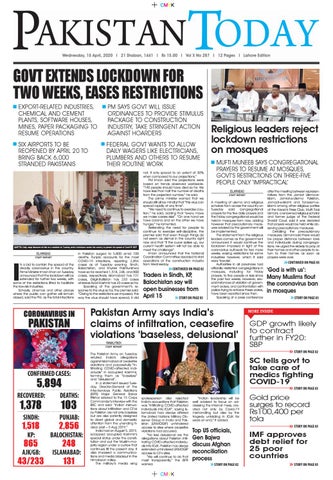
QUETTA: Daily wage labourers sit idle on a roadside on Tuesday amid a lockdown across the country to prevent the spread of Covid-19. inP
ISLAMABAD sTAff rEPorT
i
n a bid to contain the spread of the deadly coronavirus in the country, Prime Minister imran khan on tuesday announced that the lockdown will be extended for further two weeks, with some of the restrictions lifted to facilitate the low-risk industries. Schools, cinemas and other places where the public can gather will remain closed, said the PM, as the total infections
in Pakistan surged to 5,800 amid 100 deaths. Punjab accounts for the most coviD-19 infections, reporting 2,856 cases as of tuesday evening. Sindh, Balochistan, and khyber Pakhtunkhwa have so far reached 1,518, 248, and 800 cases, respectively. islamabad has 131 cases, Gilgit-Baltistan has 233 cases whereas azad kashmir has 43 cases so far. Speaking of the government’s response to the virus so far, the premier said: “owing to the restrictions we imposed, the way the virus should have spread, it did
coronavirus in
Pakistan
not. it only spread to an extent of 30% when compared to our projections.” PM imran said the projections were based on trends observed worldwide. “190 people should have died so far. we have less than half the number of deaths from the projected number,” he said. the prime minister warned that we should still all be mindful that “this virus can spread rapidly at any time”. “we need to continue to exercise caution,” he said, adding that “every move we make carries risks”. “on one hand we have corona and on the other we have hunger,” he lamented. Reiterating the need for people to continue to exercise self-discipline, the premier said that even though things do not seem as dismal in the country right now and that “if the curve spikes up, our current health system will not be able to meet the challenge”. imran announced that the national coordination committee decided to start operations of the construction industry from wednesday.
CONTINUED ON PAGE 02
Traders in Sindh, KP, Balochistan say will open businesses from April 15 STORY ON PAGE 03
Religious leaders reject lockdown restrictions on mosques g
MuFti MuneeB SaYS conGReGational PRaYeRS to ReSuMe at MoSqueS, Govt’S ReStRictionS on thRee-Five PeoPle onlY ‘iMPRactical’ ISLAMABAD sTAff rEPorT
a meeting of ulema and religious scholars from across the country on tuesday said congregational prayers for the five daily prayers and the Friday congregational would be held in mosques from now, adding however that precautionary measures advised by the government will be implemented. the statement from the religious leaders comes as the government announced it would continue the lockdown imposed in light of the coronavirus outbreak for two more weeks, easing restrictions for some industries however, which it said were ‘low-risk’. authorities in all provinces had officially restricted congregations in mosques, including for Friday prayers, to five people or less since the past two weeks. however, several instances of violation of government orders, and confrontation with police trying to enforce these orders, have been reported since then. Speaking at a press conference
Pakistan Army says India’s claims of infiltration, ceasefire violations ‘baseless, delusional’ RAWALPINDI sTAff rEPorT
CONFIRMED CASES:
5,894
RECOVERED:
DEATHS:
SINDH:
PUNJAB:
1,378 1,518
103
2,856
KP:
BALOCHISTAN:
AJK/GB:
ISLAMABAD:
865 43/233
248 131
the Pakistan army on tuesday refuted india’s allegations against islamabad of ceasefire violations and purposefully “infiltrating coviD-affected individuals” in occupied kashmir, terming them as “baseless” and “delusional”. in a statement issued tuesday, Director-General of the inter-Services Public Relations (iSPR) Major General Babar iftikhar referred to the 15 corps commander’s interview with the BBc and said: “indian insinuations about infiltration and cFvs by Pakistan are not only baseless but are also patently designed to divert global and domestic attention from the unending fiasco post – 5 aug 2019.” india had on august 5, 2019, scrapped occupied kashmir’s special status under the constitution and put the Muslim-majority region under a curfew that continues till the present day. it also imposed a communications and media blackout in the himalayan valley. the military’s media wing
after the meeting between representatives from the Jamiat ulema-eislam, Jamiat-e-ulema Pakistan, Jamaat-e-islami and tanzeem-eislami among other religious parties at the karachi Press club, Mufti taqi usmani, a renowned religious scholar and former judge of the Federal Shariat court, said it was decided that prayers would be held while observing precautionary measures. Detailing the precautionary measures, usmani said there would be proper distance between rows and individuals during congregations. he urged the elderly to pray at their homes and other people to return to their homes as soon as prayers were over.
CONTINUED ON PAGE 05
‘God is with us’: Many Muslims flout the coronavirus ban in mosques STORY ON PAGE 03
more inside
GDP growth likely to contract further in FY20: SBP STORY ON PAGE 02
SC tells govt to take care of medics fighting COVID-19 STORY ON PAGE 03 spokesperson also rejected india’s accusations that Pakistan was “infiltrating coviD-affected individuals into ioJk”, saying islamabad had always offered the united nations Military observer Group in india and Pakistan (unMoGiP) unhindered access to sites where ceasefire violations had occurred. “no less delusional are the allegations about Pakistan infiltrating coviD-affected individuals into ioJk. Pakistan has always extended unhindered unMoGiP access to cFv sites. “we will continue to do that most transparently,” the iSPR warned.
CMYK
“indian leadership will be well advised to focus on addressing the internal mess, created not only by covid-19 mishandling but also by the tragedy unfolding in ioJk for years on end,” it added.
Top US officials, Gen Bajwa discuss Afghan reconciliation process STORY ON PAGE 02
Gold price surges to record Rs100,400 per tola STORY ON PAGE 05
IMF approves debt relief for 25 poor countries STORY ON PAGE 05
02
Wednesday, 15 April, 2020
NEWS
GDP GroWtH lIkely to CoNtrACt furtHer IN fy20: SBP AVERAGE HEADLINE INFLATION PROJECTED TO REMAIN BROADLY UNCHANGED AT 11-12PC SBP SAYS STABILISATION EFFORTS YIELDED IMPROVEMENTS DURING THE FIRST HALF OF FY20 KaraCHi
t
MEIRYUM ALI
HE State Bank of Pakistan (SBP) said on Tuesday that the country’s GDP growth projections for fiscal year 2020, currently at 3pc, are likely to contract further in the coming months. According to the SBP’s ‘Second Quarterly Report for fiscal year 2020 on The State of Pakistan’s Economy’, achieving this year’s real GDP growth target of 4pc had been unlikely, as the agriculture sector’s performance was lower than expectations, while export-driven growth had not been sufficient to compensate for subdued domestic market activity. However, according to the report, the stabilisation efforts and regulatory measures yielded notable improvements in several sec-
tors during the first half of fiscal year 2020. “Broadly speaking, the current account deficit contracted to a six-year low, foreign exchange reserves increased, the primary budget recorded a surplus, and core inflation eased,” the report stated. “Exportbased manufacturing also showed signs of traction, and construction activities picked up, indicating that the economy was on the path of recovery.” The SBP further said that progress under the IMF programme remained on track and the credit rating agencies maintained their stable outlook for Pakistan during the review period. Most of the improvement in the current account stemmed from a reduction in the import bill, with some contribution from export earnings. Depressed international commodity prices had partially offset the gains in export volumes offered by a competitive exchange rate.
Top US officials, Gen Bajwa discuss Afghan reconciliation process raWaLpindi STAFF REPORT
The US chief negotiator and the top American commander in Afghanistan visited Islamabad on Tuesday and discussed Afghan peace process with Pakistan’s top military leadership. “Special Representative for
Afghanistan Reconciliation Zalmay Khalilzad and Resolute Support Mission Commander General Austin Scott Miller visited Islamabad on April 14,” a statement issued by the US embassy in Pakistan said. “In the meeting with Chief of Army Staff General Qamar Javed Bajwa, Ambassador Khalilzad and General Miller discussed the United States’ ongoing efforts
Foreign direct investment (FDI) inflows were also about the same level as last year. The report emphasized that reforms needed to be prioritised to attract and sustain higher FDI inflows into the country. The SBP’s projections for the average headline inflation for fiscal year 2020 remained broadly unchanged at 11-12pc. Even though food inflation surged steeply in both quarters, it was mostly due to supply disruptions, which the SBP argued are typically seasonal, and core inflation did not rise by a commensurate amount. The fiscal deficit as a per cent of GDP reduced from 2.7pc in the first half of fiscal year 2019, to 2.3pc in the first half of fiscal year 2020. The primary surplus surpassed the target, and revenue growth was substantially higher. The reversal of earlier tax concessions and implementation of new levies helped increase the revenue collection, even though the overall revenue target was missed. Policy measures such as an increase in GST on petroleum products, increased excise duty on cement and cigarettes, upward revision in salary slabs, adjustments in power tariffs, end of preferential treatment for certain sectors helped in higher tax collection. According to the SBP, there was a need to increase documentation in the economy. The agriculture sector, however, did not
do so well. According to the report, the sector could not cope with challenges like constrained water availability and climate change. The cotton crop, in particular, was hit by unfavourable weather, pest attacks and low water availability. The decline in cotton production is also likely to undermine the agriculture sector’s performance in fiscal year 2020. The report also had two special sections. The first was dedicated to the state of competition in the domestic economy. This is part of the SBP;s stabilization measures, and further structural reforms. “The overall competitive environment in Pakistan has been unfavourable for productivity enhancement and growth…the role of the public sector should generally be limited to addressing market failures through structural reforms, and only providing broad institutional support to businesses,” the SBP said. In the second section, the SBP was also concerned that despite improvements in Pakistan’s economy, it was now subject to risk from the spread of COVID-19. “The spillovers from the global economy and the infection- containment measures in the country are bound to weaken the economic activity and consumer demand and adversely impact supply. As the situation is extremely fluid and highly uncertain, the economic outlook remains subdued compared to the pre-outbreak estimates,” said the SBP. The SBP listed some steps it has taken, such as the Monetary Policy Committee cutting the policy rate by 225 basis points in March. It also listed 12 different measures the SBP had taken to mitigate any adverse impact, such as relief to borrowers for one year on principal loan repayments, concessional financing for businesses, and concessional financing to hospitals.
for a sustainable peace in Afghanistan,” the communique added. Pakistan’s military leaders reaffirmed their support for US efforts and renewed their commitment to act to advance a political settlement to the conflict, according to the statement. The visit of US delegation comes a day after their meeting with Taliban officials in Doha on a prisoner release dispute that led to stall US-led peace-making efforts, a Taliban spokesperson said. The discussions, held despite the global coronavirus pandemic, followed
some movement on prisoner releases, with Kabul freeing some 300 insurgent detainees and the Taliban releasing a first batch of government prisoners. The dispute over the size and pace of the releases, an increase in Taliban violence and other issues have stalled the USled effort to end America’s longest war and decades of strife in Afghanistan. Suhail Shaheen, a spokesperson for the Taliban office in Doha, said on Twitter that Khalilzad and Miller met Mullah Abdul Ghani Baradar, a co-founder of the insurgent movement, and his chief negotiator.
IHC directs restoration of 3G/4G internet in tribal districts iSLamaBad STAFF REPORT
Alvi rules out possibility of national govt ISLAMABAD: President Arif Alvi on Tuesday ruled the possibility of a national government in the country, saying the current assemblies would complete their five-years tenure. He expressed these views in an interview with a private television channel. The president to a question about the sugar and wheat scandal report said subsidies were not a new thing as the same had been given by various governments. But now it would be checked whether or not the subsidies were misused. He was sure that Prime Minister Imran Khan would take action after the forensic report against those found involved in the scandal, he added. About re-joining of Pakistan Tehreek-e-Insaf leader Aleem Khan as a senior minister in the Punjab cabinet, President Alvi said after clearing in the inquiry report, he had been inducted in the cabinet. About convening the session of the National Assembly to deliberate upon the current COVID-19 situation, the president said he would talk to NA Speaker Asad Qaisar in that regard. He said all sections of the society had performed well to control the spread of the pandemic. Despite a rift between the treasury and opposition members over lack of coordination and poor handling of the coronavirus situation, he said the federal and provincial governments were performing well to curb the spread of the virus. “Overall consensus is more than the differences,” he added. APP
The Islamabad High Court (IHC) on Tuesday directed the concerned authorities to take appropriate measures to restore the internet 3G/4G facilities in the former Federally Administered Tribal Areas (FATA). The IHC bench headed by Chief Justice Athar Minallah also expressed its surprise over the non-availability of the internet facility. The petition was filed by Sayed Muhammad, resident of district Kurram, who studies at the National University of Modern Languages (NUML). During hearing the case, the chief justice asked the counsel whether there is no internet facility in the area at all, adding how was it possible that the whole merged area be deprived of such important facility. The IHC issued notices to the Information Technology secretary and the Pakistan Telecommunication Authority (PTA) chairman and sought a written reply in the next hearing. Counsel Raheem Wazir contended that access to the internet was a constitutionally guaranteed right under Article 19 and 19-A. He said the students
were required to have access to the internet due to online teaching following the lockdown. He argued that the students and the general public of the former FATA shouldn’t be denied their constitutionally guaranteed rights by refusing to give access to the internet. Raheem informed the court that the people of the merged districts restricted to their homes due to the lockdown. “The people from across the country are enjoying the internet facility and the students are being given online classes, while thousands of students from tribal districts are being deprived of this much-needed facility,” he argued. The counsel for petitioner apprised the bench that due to the non-availability of the internet the precious education years of students, including the petitioner, would be wasted. The counsel replied that they wrote several times to the prime minister, chief minister and governor KP to resolve the issue; however the issue remained unaddressed hitherto. He said that the students of the seven tribal districts have been protesting for the last ten days demanding internet facility so as their precious year could not be wasted. The chief justice sought written reply from both the parties, while adjourning the case till April 23.
Soldier martyred in North Waziristan operation RAWALPINDI: A Pakistan Army soldier embraced martyrdom in an exchange of fire with terrorists during an intelligence-based operation (IBO) in North Waziristan on Tuesday, said Inter-Services Public Relations (ISPR). According to the military’s media wing, the terrorists opened fire as soon as the Quick Reaction Force cordoned off the area. During the exchange of fire, a soldier embraced martyrdom. He was identified as Lance Naik Irshad Khan, a resident of Jamrud. A day ago, security forces had shot dead two terrorists in an operation in North Waziristan’s Datta Khel area. One serviceman had embraced martyrdom during the exchange of fire with terrorists, the military’s media wing said. The martyred soldier was identified as Naek Adil Shehzad, resident of Mansehra. On April 10, two Pakistan Army had soldiers embraced martyrdom in an exchange of fire with terrorists during an intelligence-based operation (IBO) in North Waziristan, the ISPR had said. The military’s media wing had said that seven terrorists were also killed during the operation. STAFF REPORT
PIA announces additional flights to repatriate Pakistan nationals ISLAMABAD: Pakistan International Airlines (PIA) on Tuesday announced additional flights to bring back Pakistani nationals who are stranded abroad in the wake of the coronavirus pandemic. According to a spokesperson for the national flag-carrier, flights will depart for Manchester from Islamabad on April 17 and April 18. He added that two more flights — PK 8852 and PK 8894 — will travel to Seoul from Islamabad on April 17. In addition, a special flight from Karachi to Jakarta, Indonesia will depart on April 18, he said. He stated that the national carrier will also designate two more flights for Toronto, Canada for April 15 and 19. On April 17, a special flight will head to Dubai to bring back stranded nationals, he said. Currently, some 25,000 Pakistan nationals are stranded in the UAE and have registered with their mission. According to officials, the number is even higher as not all of them have registered. APP
PMDC record and assets missing, IHC informed ISLAMABAD: Pakistan Medical and Dental Council (PMDC) Registrar Brigadier (r) Hafizuddin Siddiqui on Tuesday submitted a report in the Islamabad High Court (IHC), which revealed that important record and assets of the regulatory body were missing from the premises. The report revealed that the record of various departments was missing and the regulatory authority’s assets, including keys, three laptops, a hard disc, a Wi-Fi device and five vehicles, were missing. The report also revealed that the keys of five houses owned by PMDC had not been handed over yet. According to the document, the secretary of the now-defunct Pakistan Medical Commission (PMC) and the Health Ministry were informed about the situation but no reply was given by the ministry, whereas the secretary, while refusing to visit himself, asked the contact the Health Ministry. STAFF REPORT
Govt extends lockdown for two weeks, eases restrictions Continued from page 01 “75% of labourers in Pakistan are not registered with any government body due to which it is very difficult for the government to support them. For this reason, we are opening the construction industry to help the weaker segment of our society,” he explained. He added that a majority had agreed to open select industries but provinces that think it would be too soon to lift restrictions, can decide to continue with the lockdown. GOVT TO ISSUES ORDINANCES: The PM further said that the government would issue a presidential ordinance on Wednesday to provide unprecedented stimulus package to the construction industry. “We are also going to issue an ordinance to take stringent actions against smuggling and hoarding of goods,” he said while terming the smuggling and hoarding as two major challenges being faced by the country.
“We are taking steps to control the spread of coronavirus… I am aware of the difficulties faced by people due to lockdown,” said the premier, adding that, “I appreciate the people for braving these difficulties and adopt the government’s lockdown measures”. Speaking about the Ehsaas Emergency initiative, the PM said: “From what I’ve been told, an amount of around Rs45bn has been distributed among 2.8 million families so far”. On overseas Pakistanis, he said: “We fear that if the stranded Pakistanis are brought back home we might not be able to deal with the situation if they have contracted coronavirus with the limited resources at our disposal.” The premier said the government would join hands with Ulema to come up with a national strategy for Ramzan to ensure that citizens can offer their religious obligations within the guidelines for COVID-19. Asad Umar took over the briefing to
CMYK
speak of the National Coordination Committee which had convened earlier in the day to decide on the matter of whether or not to extend the lockdown. He rejected the impression that “there is no coordination” among members of the committee. Speaking on the occasion, Dr Zafar Mirza, PM’s aide on health, said the number of coronavirus cases is high in Sindh in contrast to Punjab despite the fact that the former had taken aggressive measures to contain the virus. “We are opening the businesses in line with the world’s best practices,” he maintained. Swift decisions taken by the federal government have slowed down the spread of coronavirus in Pakistan, he said. Dr Mirza said SOPs will be applied to all the industries that the government has decided to open and strict adherence is necessary to ensure that the spread of COVD-19 is prevented. Federal Minister for Industries and Production Hammad Azhar outlined the various indus-
tries that will be opened across the country. These include: chemicals manufacturing plants; e-commerce exports; software development; paper packaging; cement plants; fertilizers; mines, glass manufacturing units and export-related industries. “The trade of instrument manufacturers and some other industries will also be reopened in accordance with the standard operating procedures (SOPs). Veterinary hospitals and book shops will be reopened as well.” “However, provinces have not shown agreement on some points as the federal government wants to allow daily wagers like electricians, plumbers and others to resume their routine work. Punjab government has shown support to recommendation placed by the federal government,” he said. PM’s Special Assistant on National Security Moeed Yusuf said six airports will be reopened by April 20 “so we can bring back 6,000 stranded Pakistanis back home”.
Wednesday, 15 April, 2020
trADerS IN SINDH, kP, BAloCHIStAN SAy WIll oPeN BuSINeSSeS froM WeDNeSDAy KaraCHi/peSHaWar
t
STAFF REPORT
RADERS across the country on Tuesday said that they would resume operations from April 15, however, the business community in Punjab has urged the government to permit activities for a limited time. Prime Minister Imran Khan, in his address to the nation, extended the lockdown till April 30. The premier said that some industries
such as construction would be allowed to operate from Wednesday. The business community in Karachi said that they will resume operations from April 15 and that the traders would follow preventive measures. Addressing a press conference, a representative of the Karachi’s trader community said: “We cannot afford the imposed restrictions anymore.” “The businessmen have paid their employees a month’s salary but will we unable to do so if the lockdown extends,”
Cabinet approves lockdown extension till April 30
he said. ” We will give our shops keys to [the officials at] the Chief Minister House and will protest outside the provincial chief’s office,” he added. Voicing the traders in Sindh, Balochistan’s business community said that they would resume operations from April 15 as well. They said that the traders cannot bear the lockdown restrictions anymore. He said that the activities would be conducted and precautionary measures would be followed, adding that the
‘God is with us’: Many Muslims flout the coronavirus ban in mosques
ISLAMABAD: The federal cabinet on Tuesday suggested ‘strict’ measures to curb smuggling and hoarding in a bid to ensure a stable supply of basic commodities during the coronavirus pandemic while endorsing 14-day extension in the lockdown imposed by the Centre and the provinces. A meeting chaired by Prime Minister Imran Khan decided to extend lockdown till April 30 across Pakistan; however, it decided to open skills-related businesses after which tailors, electricians, mechanics, plumbers, and barbers will be allowed to work. The government also decided to open all sectors related to construction and rules have been formulated in this regard. The responsibility for various projects in the construction sector will be decided between the provinces and each province will develop strategies regarding the pending development and construction projects. Air travel, public transport, public gatherings, wedding halls, cinemas and public places will remain close due to the outbreak of the coronavirus pandemic. Addressing a press conference in Islamabad on Tuesday, Special Assistant to the Prime Minister on Information and Broadcasting Firdous Ashiq Awan said the cabinet was briefed about the proposed legislation to provide facilitation to construction sector. The special assistant said in order to control inflation in the country and to ensure an uninterrupted supply of items of daily use, an ordinance was being brought. She said the cabinet members recommended strict punishments to be included in the proposed legislation against hoarders and smugglers. The cabinet appreciated the efforts of Dr Sania Nishtar and Ehsaas team in the disbursement of cash to needy and eligible persons under its emergency cash relief programme. “Provinces are playing a crucial role in the implementation of this programme on merit and transparency,” Firdous said and added focal persons were being appointed for the smooth working of the programme. APP
iSLamaBad AGENCIES
Sabir Durrani says he offers prayers almost every day at a mosque in Multan. He says that often a dozen or more men are in attendance – none of them wearing protective face masks. Durrani, 52, is among thousands of devout Muslims flouting government orders issued late last month banning religious congregations of five or more people to stem the spread of the coronavirus. The disease has so far infected more than 5,300 people and killed 93 in the world’s second-most populous Muslim country. “Our prayer leader told us that the virus can’t infect us the way it does Western people,” Durrani told Reuters. “He said we wash our hands and we wash our face five times a day before we say our prayers, and the infidels don’t, so we need not worry. God is with us.” The Islamic lobby holds immense clout in this country of over 200 million people. Religious parties have not been successful in electoral politics but they are able to whip up large, often violent, crowds on matters pertaining to religion, such as in support of the country’s harsh blasphemy law. “Religion and prayers are an emotional issue for many people in Pakistan, and the government has to be sensitive to that,” Mirza Shahzad Akbar, a special assistant to Prime
SC tells govt to take care of medics fighting COVID-19 iSLamaBad APP
The Supreme Court on Tuesday issued its written orders regarding the coronavirus suo moto notice case, asking the federal and provincial government to provide complete facilities to doctors and paramedics at earliest. The court, in its judgement, directed the federal government to file a comprehensive report, along with the outcome of the high-level meeting which was scheduled to take place on Monday. The court order stated that the governments of Khyber Pakhtunkhwa and Balochistan had submitted their reports, where were taken on record. It seemed that the effect of coronavirus (COVID-19) was not so much alarming in the two provinces, including, Gilgit-Baltistan and things were being kept in control. Punjab, Sindh, and ICT (Islamabad Capital Territory), however, were on different pedestals, where there was a considerable
provincial government had been informed regarding the decision to resume operations. Furthermore, the traders in Khyber Pakhtunkhwa said that they could not afford the lockdown further and that they would open shops from April 15. President United Business Group, Ilyas Bilour said that small scale traders were forced into starvation due to the lockdown. He lamented that labourers were severely affected due to the closure of business centres.
threat of surge of the pandemic. The SC directed the Punjab government and the ICT administration to submit their reports regarding matters relating to the pandemic. It also sought all necessary information, which could show that the citizens’ fundamental rights were fully safeguarded and the state functionaries were aware of what was necessary for the survival of the people. According to the order,”The doctors and paramedics, who are working in the front line
Minister Imran Khan, told Reuters. More than 60% of the coronavirus cases in Pakistan have so far been linked to Muslims returning from pilgrimages in the Middle East and followers of the Tablighi Jamaat, an orthodox proselytizing group. But the worry is of a big spike coming from the congregational prayers held in mosques, especially on Fridays, the Islamic sabbath. The numbers in attendance at prayers are likely to increase with the onset of the holy month of Ramazan within two weeks, and authorities are struggling to cope. While the Council of Islamic Ideology, a body that advises the government on religious issues, has called on clerics and the public to cooperate with government measures, several priests and local leaders have opposed the ban. A prominent leader of a religious party told a crowd of hundreds of people gathered for a funeral last week that government orders to limit congregations were unacceptable. “If you do this, we will be forced to think that mosques are being deserted on America’s instructions,” Mufti Kafayatullah told the crowd. “We’re ready to give our lives, but not ready to desert our mosques.” BLIND EYE: In Karachi, police were attacked for a second straight week as they attempted to halt prayers at a mosque last Friday. A policewoman was injured in the clashes,
and in the previous week, police fired shots in the air to quell an angry mob. In other cities, police seem to be turning a blind eye to some mosque gatherings. Last Friday, one of the top Twitter trends in Pakistan was “Muslims, the mosque is calling you”. In Islamabad, hundreds gathered on Friday without any hindrance at one of the city’s largest mosques, located just two miles (three km) from the seat of government, including parliament and the prime minister’s secretariat. On March 27, authorities filed 88 cases against mosque administrations in Karachi and arrested 38 people for defying restrictions on Friday congregations, but charges were dropped a day later, and the people were released. “I think it’s partly appeasement and partly the fact that Pakistan’s governments and politics are locked permanently in an electoral framework in which they don’t want to lose the support of the religious elite and religious proletariat,” author and defence analyst Ayesha Siddiqa told Reuters. Akbar, the special assistant to the prime minister, said most mosques were cooperating with the government. He added, however: “This is a sensitive matter, we don’t want to impose it using a stick. And even if we wanted to, there aren’t enough sticks to implement it across Pakistan.”
in dealing with this pandemic, are especially affected and are at risk of contracting this disease and it is hoped that the federal government so also the provincial governments, the ICT and GB shall ensure that all necessary needs of the doctors and paramedics, in such emergency situation, are fully fulfilled. We are informed that doctors and paramedics are performing duties beyond their call of duty and at many places, they are not even being provided with food. This, in our view, is a sensitive issue, which should immediately be addressed by all the governments and grievances, in this regard of the doctors and paramedics are redressed.” The court observed that the condition of sanitary staff was also not good and it was informed that they were exposed to all sorts of diseases while working in hospitals and other places. No effective care was being provided to them and a request had been made that they be provided with the requisite protection, so that they might perform their work without any fear. “In the circumstances, the federal government as well as all the provincial governments, including, the ICT and GB, shall ensure that sanitary staff are taken care of and are provided with proper and secure uniforms, so that they can work without fear of being affected by the disease,” it added.
NEWS
03
IMf acknowledges Pakistan’s anti-corona efforts ISLAMABAD: The International Monetary Fund (IMF) has acknowledged Pakistan’s measures to contain the spread of the coronavirus. The IMF’s recent publication ‘Policy Tracker’ of its 193 member-states said that COVID-19 has been spreading rapidly in the past month in Pakistan, with 4,489 confirmed cases claiming 63 deaths, as of 9 April. The fund said that the government announced a relief package worth Rs1.2 trillion to help daily wagers, common people of Pakistan and boost the economy. Other measures include quarantining over three thousand travelers from Iran, closing borders with neighboring countries, international travel restrictions, school closures, social distancing measures, and lockdowns in cities and provinces across the country. Pakistan army troops were deployed to help provincial governments in their measures to contain the spread of the virus. The government announced an economic stimulus package on the fiscal side under which key measures include the elimination of import duties on imports of emergency health equipment, relief to daily wage workers worth Rs200bn, Rs150bn for cash transfers to low-income families, accelerated tax refunds to the export industry with Rs100bn, and financial support of Rs100bn to Small and Medium Enterprises. The economic package also earmarked resources for accelerated procurement of wheat worth Rs280bn, financial support to Utility Stores worth Rs50bn, relief in fuel prices with Rs70bn, a fund of Rs15bn to support health and food supplies, Rs110bn for electricity bill payments relief, Rs100bn for an emergency contingency fund and a transfer of Rs25bn to National Disaster Management Authority for purchase of necessary equipment to deal with the pandemic. On the monetary and macro financial front, the State Bank of Pakistan responded to the crisis by cutting the policy rate twice by a cumulative 225 basis points to 11.0 percent in the span of a less than two weeks in March this year. APP
NCoC finalises recommendations for opening industries in phases ISLAMABAD: The National Command and Operation Centre (NCOC) on Tuesday finalised its recommendations for the opening of industries and businesses in phases. A meeting of the NCOC was held in Islamabad with Planning Minister Asad Umar in the chair, which finalised various recommendations for National Coordination Committee’s (NCC) approval in wake of the coronavirus pandemic. The meeting suggested that Ministry of Interior, in consultation with religious scholars, will formulate guidelines for Ramzan. Regarding indigenous manufacturing capacity of the country, the meeting recommended that Ministry of Science and Technology, Drug Regulatory Authority of Pakistan (DRAP) and National University of Science and Technology (NUST) should finalise decision of domestic development of testing kits within 36 hours. It was mentioned in the meeting that Pakistan Engineering Council (PEC) is developing five types of ventilators and eight designs have been submitted for approval. APP
04 LahOre
Wednesday, 15 april, 2020
Weather Updates WEDNESDAY
370C
230C
THURSDAY
360C
220C
FRIDAY
360C
230C
PRAyER TiMingS FAJR SUNRISE
ZUHR
ASR MAGHRIB ISHA
5:11
12:16
3:32
6:31
6:00
7:21
LocKdown restrictions eAsed Amid 15-dAy extension PUNJAB GOVT SAYS 47 GOVT DEPTS TO REMAIN OPERATIONAL DURING LOCKDOWN PERIOD ALSO ALLOWS CONSTRUCTION INDUSTRIES, BOOKS AND STATIONERY SHOPS, ELECTRICIANS, TAILORS, MECHANICS AND BARBERS ETC TO RESUME OPERATIONS LAHORE
t
SHAHAB OMER
HE government of Punjab on Tuesday decided that almost 47 government administrative departments and different private sectors will remain open during the ongoing lockdown which has now been extended for two weeks in view of the rapidly increasing coronavirus cases in the province, especially Lahore. However, Punjab Chief Secretary Maj (r) Azam Suleman issued a notification, a copy of which has been sent to the principal secretary to the chief minister (PSCM), all divisional commissioners, administrative
secretaries, and all deputy commissioners (DC) stating, “The competent authority has desired that the remaining administrative departments to the extent of offices of administrative secretaries and additional chief secretaries where applicable will start functioning from April 15, 2020. The remaining staff will continue to work online as already directed vide notification referred above”. In this regard, an official of Punjab secretariat shared the list of 43 departments which will remain open during the lockdown. These departments include Agriculture, Auqaf and Religious Affairs, Board of Revenue, Disaster Management (PDMA), Baitul-Maal, Chief Minister’s Inspection Team,
Communications and Works, Cooperatives, Energy, Environment Protection, Excise and Taxation, Finance, Food, Forestry, Wildlife and Fisheries, Governor's Secretariat, Health, Higher Education, Home, Housing, Urban Development and Public Health Engineering, Human Rights and Minorities Affairs, Industries, Commerce and Investment, Information and Culture, Irrigation, Labour and Human Resource, Law and Parliamentary Affairs, Literacy and Non-formal Basic Education, Livestock and Dairy Development, Local Government and Community Development, Management and Professional Development, Mines and Minerals, Planning and Development, Population Welfare, Public Prosecution, School Education, Services and General Administration, Social Welfare, Special Education, Transport, Women Development, Youth Affairs, Sports, Archeology & Tourism and Zakat and Ushr. Similarly, law enforcement departments and district administrations will also remain on duty to combat the pandemic. Interestingly, an official of Civil Secretariat on condition of anonymity said that the secretariat staff was already working in offices. “Not everyone needs to come to work
but now the lower staff, additional secretaries and deputy secretaries will be ordered to come to the office, putting their and others lives at risk. There are no disinfection sprays, hand sanitizers, masks or gloves in the Punjab Civil Secretariat. Most of the administrative secretaries sit in the civil secretariat and this will worsen the situation,” he said. PRIVATE SECTORS ALLOWED TO WORK: According to the notification, private sectors that would be allowed to operate during the lockdown include chemical
Aleem Khan gets food ministry LAHORE: Pakistan Tehreek-e-Insaf (PTI) leader Aleem Khan returned to the Punjab cabinet on Tuesday, after a break of over a year following his arrest by the National Accountability Bureau (NAB) which ran an investigation into his alleged offshore companies and assets. In this regard, the Punjab government issued a notification handing over the food ministry to Khan, who will now render his services as a senior minister. After the incendiary Federal Investigation Agency (FIA) report on the sugar crisis, erstwhile Punjab food minister Samiullah Chaudhry had tendered his resignation, following which the post had fallen vacant. In his resignation, Chaudhry said he resigned as he faced allegations that he could not bring reforms in the department, adding that he would not hold any government office until the clearance of accusations. Elected from PP-158 (Lahore-XV) in the July 25 polls last year, Aleem Khan was Punjab’s Senior Minister for Local Government & Community Development, Planning & Development before resigning from his position due to the NAB case. STAFF REPORT
plants, e-commerce for delivery etc, software developing firms, paper packaging firms, cement fertiliser plants, laundry, plant nurseries, agriculture machinery, agriculture products, glass manufacturing, animal hospitals, export industries, books and stationery shops, construction industries, electricians, tailors, mechanics and barbers. However, all sectors especially the export and construction industries, are directed to strictly follows SOPs provided by the World Health Organisation (WHO).
PIC doctors, staff undergo coronavirus test LAHORE STAFF REPORT
The management of Punjab Institute of Cardiology (PIC) has become active after detection of coronavirus in one of its senior doctors. The chairman of the PIC on Tuesday sent samples of 122 doctors and the staff for the test of coronavirus. Sources privy to the development has said the sample of PIC chairman has also been sent for the test. A senior cardiac surgeon at the Punjab Institute of Cardiology (PIC) had tested positive for the novel coronavirus (Covid-19) on Monday. He was placed into quarantine at the Pakistan Kidney and Liver Institute (PKLI) after his test turned out to be positive. Besides, the doctor has been stopped from performing surgeries until his recovery from the infection.
CM visits field hospitals, financial aid centers
LAHORE APP
Punjab Chief Minister Sardar Usman Buzdar on Tuesday inspected field hospitals and centres set up for financial aid distribution under Ehsaas Kafalat Programme at Mandi Bahauddin, Gujjar Khan and Rawalpindi. CM inspected financial aid distribution centre at Government Higher Secondary School Bikhi Sharif in Mandi Bahauddin and gave an amount of Rs12,000 as financial aid to a needy woman, said a hand out issued here. CM said on the occasion that this programme had been started for the relief of indigent families. It was the most transparent and fastest financial aid programme in the history of the country, he added. He assured that every effort will be made to facilitate the disfranchised segments of the society. The government has also arranged different facilities at aid distribution centres along with ensuring social distancing. Six centres have been set up in Mandi Bahaud-
din to provide financial aid to 63236 deserving persons till the end of this month. Meanwhile, around Rs880 million will be distributed in Gujranwala division. The CM also reviewed the arrangements made for coronavirus treatment. During his visit to Gujar Khan tehsil to review the financial aid distribution at a local school, he met with the applicants and inquired about the procedure of aid distribution. The people expressed their satisfaction and commended the arrangements. Talking to them, the CM maintained that financial aid worth Rs12000 was a substantial relief. As much as 4966 people will receive their financial aid by tomorrow (Wednesday). The women applicants expressed their satisfaction over the arrangements while talking to the CM. Usman Buzdar reiterated that Ehsaas Kafalat Programme will prove as the most transparent initiative and assured that provision of financial aid to the deserving will ensured. The chief minister also inspected the 130-bed specialized
field hospital at sports complex Rawalpindi. The hospital was linked with Rawalpindi Institute of Urology and its capacity can be increased to 300 beds. The CM appreciated the performance of both the district administration and health department. He also visited PRCS’s 150-bed corona care field hospital where Chairman Pakistan Red Crescent Society where Ibrar-Ul-Haq gave a briefing about the arrangements. Usman Buzdar appreciated that all the necessary facilities, including ICU ward and ten ventilators, were arranged in the hospital. Talking on this occasion, he said that field hospitals had been set up in different districts to provide best medical facilities at the doorsteps of the patients and coronavirus will be defeated in collaboration with the masses. Punjab Health Minister Dr Yasmeen Rashid, Additional Chief Secretary (Urbanization and Infrastructure) Tahir Khursheed, Commissioner Rawalpindi Division, DC Mandi Bahauddin, DG PDMA and others were also present on this occasion.
Wednesday, 15 April, 2020
PakIstan asks GeRMany, Uk, ChIna FoR debt RelIeF iSLAmABAd
F
STAFF REPORT
OLLOWING up on his call for a ‘Global Initiative on Debt Relief’, Prime Minister Imran Khan on Tuesday held a telephonic conversation with German Chancellor Angela Merkel. During the call, the prime minister emphasised that COVID-19 has unfolded an unprecedented global health and economic crisis, where developing countries will be hit harder due to lack of fiscal space and debt servicing. People in the developing world face a starker choice: death by COVID-19 or by hunger, he added. He underscored that ability of the developing countries to cope with the COVID-19 challenge would depend on providing urgent debt relief, at their request, and without onerous conditions.
The premier hoped that alongside the United Nations Secretary General (UNGS) António Guterres, countries like Germany would provide leadership to this issue, in the forthcoming G-20 Finance Ministers’ Meeting as well as the spring meetings of the International Monetary Fund (IMF) and the World Bank (WB). Following up on their earlier conversation regarding the COVID-19 pandemic and efforts to contain the outbreak, Foreign Minister Shah Mahmood Qureshi had a telephonic conversation with the British Secretary of State for Foreign and Commonwealth Affairs Dominic Raab. Qureshi apprised the British secretary of state about PM Imran’s call for debt relief for poor countries. Alluding to reports by WB and IMF concerning an imminent economic recession of a graver nature than the Great Depression, the foreign minister underscored
IMF approves debt relief for 25 poor countries
that without immediate, coordinated and comprehensive actions to create fiscal space, the developing world may have to contend with dire social, political and economic consequences. He expressed hope that the UK will support and advance this cause in earnest, particularly through the platform of G20. The British secretary of state assured FM Qureshi of UK’s understanding and support for the initiative. Meanwhile, Adviser to Prime Minister on Finance and Revenue Dr Abdul Hafeez Shaikh has sought Chin’s support for Pakistan’s efforts to seek rollover of half of foreign $27.8 billion debt that is set to mature during the next three years. During a meeting with Chinese Ambassador Yao Jing at the Finance Division, the adviser said that Pakistan looks forward to Chinese support in dealing with this unprecedented situation arising because of the coronavirus pandemic.
It is important to note that of the total $27.8 billion, around $19 billion have to be paid to only four major creditors of Pakistan – International Monetary Fund (IMF), World Bank (WB), Asian Development Bank (ABD) and China. He said that different economies have different levels of strength to deal with the economic losses and the developing countries will be the worst hit by the impact of this slowdown. Keeping in view the present circumstances WB, IMF and G-20 countries are talking about debt relief without which developing countries will be worst affected. The adviser expressed hope that these forums would be able to come up with a plan enabling developing countries like Pakistan to not only meet its international obligations but also to provide relief to its population adversely affected by this pandemic.
COVID-19: Govt approves SOPs for private int’l flight operations to Pakistan
BRuSSELS
iSLAmABAd
AGENCIES
APP
The International Monetary Fund on Monday announced immediate debt relief for 25 poor countries to help them free up funds to fight the coronavirus pandemic. “This provides grants to our poorest and most vulnerable members to cover their IMF debt obligations for an initial phase over the next six months and will help them channel more of their scarce financial resources towards vital emergency medical and other relief efforts,” IMF Managing Director Kristalina Georgieva said in a statement. The IMF board approved the debt relief for the countries, nearly all in Africa, but also Afghanistan, Yemen, Nepal and Haiti. The fund together with the World Bank have called for rich nations to stop collecting debt payments from poor countries from May 1 through June 2021. The debt relief will be funded by the IMF’s Catastrophe Containment and Relief Trust (CCRT), which was first set up to combat the West Africa Ebola outbreak in 2015 and has been repurposed to help countries fend off COVID-19. The fund currently has $500 million, with Japan, Britain, China and the Netherlands among its main contributors. “I urge other donors to help us replenish the trust’s resources and boost further our ability to provide additional debt service relief for a full two years to our poorest member countries,” Georgieva said. Last week, the World bank said it would roll out $160 billion in emergency aid over 15 months to help countries stricken by the virus, including $14 billion in debt repayments from 76 poor countries to other governments.
CJP Gulzar, family test negative for coronavirus iSLAmABAd APP
The Supreme Court (SC) on Tuesday said that Chief Justice of Pakistan (CJP) Gulzar Ahmed, his family and his secretary have all tested negative for the coronavirus. In a statement, the apex court said that the top judge’s tests were conducted after an employee of the court developed symptoms of Covid-19, following which he was put under quarantine as a suspected patient. The employee, a naib qasid at the apex court, had first tested negative for the virus, but the result was “doubtful” and another test was conducted which turned out to be positive, the statement read. The employee has now been isolated at Polyclinic.
The government on Tuesday approved the standard operating procedures (SOPs) for international flights to Pakistan, effective from April 14-19, under which all passengers, crew and ground handling agents would have to follow strict preventive measures against the coronavirus pandemic. “The SOPs comprehensively cover effective steps required to control the spread of COVID-19,” Aviation Division Spokesman Abdul Sattar Khokhar said in a press statement. According to the SOPs issued for international private aircraft, an undertaking assuring full compliance in letter and spirit would be submitted to the Pakistan Civil Aviation Authority (PCAA) at the time of filing request for authorization of any such flight. The aircraft operations would be subject to full compliance of the PCAA instructions regarding aircraft disinfection, passenger and crew protection measures. In order to ensure safety of passengers and crew (cockpit and cabin) and to minimise the risks associated with COVID-19, following measures are to be taken in case of private aircraft flight operations to Pakistan: At the pre-embarkation stage, the arrival date and time of the private international aircraft would be decided by the PCAA so that presence of all necessary personnel including health and other authorities could be ensured at the flight time.The aircraft will be disinfected in accordance with the procedures prescribed by the PCAA at each station before passenger boarding. The disinfection standard shall be mandatory prior to embarkation from a foreign airport for flight to Pakistan. The disinfection certificate from the operator/ GHA shall be verified by the staff of concerned authority at the airport of departure. The disinfection is to be logged in aircraft documents. The captain of the aircraft shall satisfy himself regarding full compliance of the PCAA instructions on disinfection. An inventory of essential Personal Protection Equipment (PPE), comprising protection suits, gloves, surgical masks, goggles, and N-95 masks, etc. shall be maintained in each aircraft. The International Passenger Health
Declaration form will be disseminated to all potential travelers to Pakistan before boarding the flight. Completion of International Passenger Health Declaration Form by passengers/guardians (in case of infants and differently-abled) shall be the operator’s responsibility. The form will be filled and signed prior to boarding the flight. The operator, through its station manager (or the GHA where applicable), shall be responsible for providing the passenger manifest to the destination airport in Pakistan, before take-off of the flight. Passengers are to be scanned through thermal devices for COVID-19 before boarding. Either a thermal scanner or a calibrated non-contact thermal device shall be used for the purpose. Any passenger or crew member with raised body temperature shall be examined by a health professional at the airport of embarkation. Passengers shall be seated in a staggered fashion with the objective to maintain social distance. During the flight, all passengers are to comply with the following instructions during air travel to Pakistan. All passengers are required to wear surgical masks throughout the duration of flight. Passengers are not allowed to congregate in the aircraft during the course of air travel. Any passenger having symptoms or feelings of COVID-19, including but not limited to shortness of breath, coughing, high fever and sore throat, must immediately inform the cabin crew. All cockpit and cabin crew will wear appropriate PPE dress and surgical masks throughout the duration of flight without compromising on safety. Cabin crew will provide hand sanitiser after every hour during the flight to each passenger except during the food/beverage service. One or two aft seats (where practical) shall be kept vacant for the passengers and crew displaying symptoms of illness. The passengers and crew members, having symptoms of illness will be isolated towards aft of the aircraft and kept there till the termination of flight. Such persons will remain at this seat in the aircraft till such time the health crew is called in by the cabin crew for medical evacuation. After the completion of boarding, the captain will ensure that the cabin crew takes a picture displaying
passengers seated with masks affixed to their face. The photograph will be submitted to the concerned health staff at the airport of disembarkation electronically by WhatsApp. The captain of the aircraft will maintain copies of these images for record purposes. Cabin crew will spray disinfectant in the lavatory after every 60 minutes of flight. Before landing, the captain of the aircraft will confirm to the concerned air traffic controller that the Domestic Passenger Health Declaration Forms have been filled by all passengers and crew. The form will be checked at the entrance to the airport passenger terminal building by the PCAA/Airport Security Force (ASF) staff. The cabin crew shall use alcoholbased disinfection wipes to clean and disinfect their hands. After touching or disposing wastes, hands should be cleaned with hand sanitiser or soap. Upon contacting ill passengers (having symptoms of COVID-19), cabin attendants must ensure use of N95 masks, gloves and protective goggles in addition to their PPE suits. At the post-disembarkation stage, the getting off will be done row-wise in an orderly manner from front to back ensuring social distance. Seat map will be provided by the operator/GHA, along with copy of the passenger manifest, to the PCAA and health staff, and the receipt will be obtained from the receiving party along with name and designation. All passenger luggage and cargo shall be disinfected by the operator or its GHA soon after unloading the aircraft. The operator or its GHA shall be responsible for provision of appropriate masks and gloves to the staff involved with handling the cheeked baggage and cargo. Passengers shall not be allowed to pick up their luggage from the baggage carousel themselves. Instead, the respective operator/GHA staff shall pick up the luggage from the belt and place it in such a way that each piece is at a safe distance from the other. The passengers shall wait behind barriers, placed in such a way that social distance is maintained. Passengers shall pick up their luggage while maintaining social distance. The operator/GHA staff deputed for handling luggage shall wear protective masks and gloves.
NEWS
05
PM responsible for maintaining national unity on coronavirus matter: Marriyum LAHORE STAFF REPORT
Pakistan Muslim League-Nawaz (PML-N) spokesperson Marriyum Aurangzeb on Tuesday has said that Prime Minister Imran Khan is responsible for maintaining national solidarity and unity on coronavirus matter. In a statement, the PML-N leader said that national harmony cannot be established by calling members of other political parties as thieves. The nation is expecting effective measures from Imran Khan in this time of need, she added.
Religious leaders reject lockdown restrictions on mosques COntinuEd fROm pAgE 01 “In the present conditions, five daily prayers along with precautionary measures are essential,” he added. Ruet-e-Hilal Committee Chairman Mufti Muneebur Rehman said the lockdown was not “applicable to mosques”, adding that arrangements would be made for Friday congregational prayers and tarawih in Ramzan. Calling the congregational prayers a “necessity”, a statement released after the meeting said that it was important to continue the prayers while observing precautionary measures. The meeting called for the resumption of all congregational prayers including the five daily prayers and the Friday prayers terming the government’s restrictions on three-five people only “impractical”. The statement urged elderly people, people affected by the virus or those caring for virus patients to not come to the mosque. Detailing preventive measures that would be taken, the statement added that carpets would be removed and the floor washed with disinfectant liquid after the prayers, and sanitisers would be installed at the gates of the mosque. The statement further advised people to perform ablutions at their homes, wear masks and to leave for their homes immediately after prayers ended. It also advised that the Urdu part of the Friday sermon be removed and substituted with five minutes of information about preventive measures for Covid-19. The decision to reopen mosques by prominent ulema comes a day after senior clerics of Wafaqul Madaris al Arabia warned the government not to further the restrictions on congregations in mosques, which have been imposed to contain the spread of the novel coronavirus. Despite the government’s pleas to observe social distancing, more than 53 senior clerics of Rawalpindi and Islamabad, belonging to the Wafaqul Madaris al Arabia, held a meeting in Jamia Darul Uloom Zakria, Tarnol, Islamabad to discuss the matter. The meeting was attended by senior clerics representing various seminaries, banned groups, proscribed persons and political and non-political parties. Commenting on the clerics’ announcement, Federal Minister for Religious Affairs Noor ul Haq Qadri on Tuesday said that the decision on allowing congregational prayers, tarawih and aitekaf countrywide would be made on April 18 after consultation with the clerics. “Unilateral and local decisions should be avoided to promote unity among the country,” he said, adding that the government would take necessary measures for a coronavirus-free Ramzan. The minister said that the government would take clerics from all schools of thoughts and political leadership into confidence over its decisions. “The government through its measures is prioritizing to save lives of the people,” he said. Noor ul Haq Qadri said that meeting of the clerics would be headed by President Arif Alvi and attended by provincial governors and president of Azad Kashmir.
Gold price surges to record Rs100,400 per tola BuSinESS dESK The gold price reached an all-time high of Rs100,400 in Pakistani markets on Tuesday, the All Sindh Saraf and Jewellers Association (ASSJA) announced. This is the first time that the gold price has crossed over Rs100,000 in the country’s history as the precious metal witnessed an
increase of Rs700 per tola in its price on Tuesday. The prices compiled by ASSJA come with a lag of a day after a change in global prices. The bullion market is closed because of a nationwide lockdown, but the prices are calculated based on an increase in international gold price. Gold futures were trading at $1,721 per ounce in the international market, their high-
est level in seven-and-a-half years. Gold futures have been on the rise recently, increasing by more than $200 per ounce since last week of March when they were trading at under $1,500. Gold is correlated with dollar and other commodities, but dollar has weakened and alternates such as oil have also become cheaper because of a global slowdown. This
is why investors are parking their money into gold, which is considered safe in uncertain times, say market experts. The surge in local prices came despite a nationwide lockdown, which resulted in suspension of trade. Haroon Chand of ASSJA says no weddings are taking place and no one is buying gold.
“Prices in Pakistan are Rs7,000 less than the Dubai rates. This means if you buy a tola of gold in Dubai, you will pay Rs107,400. The discount may reduce and prices increase when the markets open,” he adds. According to the association, they will keep their shops closed until the lockdown is over, primarily because they deal in gold and need safety.
Wednesday, 15 April, 2020
06 COMMENT
Strategizing special measures
Extending ‘partial’ lockdown Papering over deep-rooted antipathy
A
FTER the number of confirmed coronavirus cases in Pakistan exceeding 5,000 and 100 patients already dead, there is finally a pretence of understanding between the federal government, the four provinces, AJK and Gilgit-Baltistan to extend the lockdown for two more weeks. The first coronavirus case was detected in Pakistan on February 26. it took the federal government 48 days to put a stamp of approval over what the provinces led by Sindh were already doing. The federal government however has preferred to call it ‘partial’ lockdown. it has also been decided to allow the opening of certain low risk industries that include sections of e-commerce, software development and programming, also mining and mineral industries, industries producing agricultural machinery and fertilisers. The Pm has ordered opening of construction industry forthwith, maintaining that it employs the largest workforce after agriculture. To start with, the government wants to open brick kilns, crushing plants, and presumably units manufacturing steel bars. The government also wants to open cement factories. None of these industrial activities can be undertaken unless the government allows buses and trains to take labour to factories and back. The government has promised to ensure that no industry will be allowed to disregard the SOPs. it would be interesting to find how social distancing is enforced in transport carrying tens of thousands of workers daily. What will determine the success of the war against the pandemic is national unity. Federal minister Asad Umar waxed eloquent over the prevailing coordination between four different parties ruling the federation, the four provinces, AJK and Gilgit-Baltistan. Unfortunately the situation on ground is different. The day mr Umar made the claim, the Sindh Governor Sindh was explaining to the people that the money being distributed under the Ehsas Programme had nothing to do with BiSP and was in fact a special gift from Prime minister imran Khan. An SAPm berated the performance of the Sindh government in containing coronavirus as the rate of those affected was higher in Sindh than other provinces. The statements negated the perception of bonhomie and indicated the deep-rooted antipathy that persists between the government and opposition. Unless the party running the federation takes the lead in muzzling some its big mouths, consensus will remain elusive
Existing structures should be used optinally
dR NAsiR idRees
C
ORONA Virus pandemic is understood to take a longer course than perceived, as more information and time unfolds the curve; and, given the fact, that the vaccine availability is yet distant. Some important up-front suggestions and facts for the government to consider include: Strategizing the reSponSe: The government should have a strategy in place to combat the pandemic. Rather than learning from mistakes over time and copying or modelling the response of other countries; for we do not have the time for that, and may face catastrophic consequences by the time we end up with this learning curve as every country has its specific environment, economic status and conditions, preparedness and response and no two countries can mimic a similar response. Pakistan’s National Action Plan for COVid19 is a good base to start; although it has a complete set of recommendations, it does not provide a strategic real-time plan – the development of this strategic plan with responsibilities at all levels, the Federal, Provincial, district and Union Council, is essential to place a coordinated response─ specific measures put down for each level inclusive of the private health sector within the geographical boundaries mentioned is essential, for prompt actions and interventions. The roles and responsibilities of the district administration, police, armed forces, health paraphernalia, and the line departments such as food security, NdmA, PdmAs needs to be put down in this strategic framework for a coordinated and responsible effort. This will enable each component of the strategy to know and act accordingly, while the rest do their bit, rather than having a mixed haphazard response with unclear responsibilities.
Reviving bodies Aleem Khan inducted into Punjab cabinet
A
LEEm Khan was one of the most central figures in the PTi and financiers of not only the party’s more conventional political activities but also much of the 2014 dharna, which was anything but. He has been absent from the forefront for the last fourteen months but has now been inducted into the Punjab cabinet. Reportedly, his portfolio combination has been framed in a way that he will act like deputy Chief minister. This may not suit Cm Usman Buzdar who has already expressed his apprehensions about mr. Khan, complaining about his interference in matters soon after the latter was released on bail from NAB custody that he had been taken into soon after Prime minister imran Khan took oath. The timing of his reentry into active politics raises a number of questions. Pm Khan’s ‘point man on accountability’ mr. Shahzad Akbar has repeatedly stated, while referring exclusively to opposition parties’ members, that their respective bails did not mean they were innocent of the crimes they had been detained for. it would be unfair to pin all this on mr. Akbar however; this hypocrisy and erosion of moral grandstanding is not only widespread among the PTi but is quite frequent as well. There is an obvious and inherent unapologetic shamelessness to the PTi’s approach towards what is set out to do- meaningful accountability. While it remains to be heavily skewed in the disfavor of political opponents this so-called accountability is touted as some holy exercise that whoever critiques too much tends to become a victim of. Another important aspect to be considered and questioned is the timing of Aleem Khan’s promotion as it closely follows the dishonorable discharge of former ‘go-to guy’ of the Pm, Jehangir Tareen. Since the release of the FiA’s report on the sugar and wheat crisis mr. Tareen has dropped considerably in party ranks and does not enjoy the same level of access to the Pm that he once did. Perhaps the PTi feels that such a person can be dangerous, especially considering his unmatched ability to convince parliamentarians to switch positions and loyalties very effectively. His closeness to Aleem Khan is well known as well. in the midst of increased chatter about the formation of a National Government and a pandemic to which the government’s response has been less than satisfactory; Aleem Khan’s revival seems to be more about putting out fires rather than introducing some fresh blood into the Punjab Cabinet to improve its already dismal performance.
Along with deaths, hatred is also rising Abdul RAsool syed
A
mid the covid-19 pandemic, another concomitant pandemic, xenophobia, has also enveloped the world. Xenophobia, more specifically sinophobia, is globally surging exponentially. Stigmatization of Chinese people for the coronavirus outbreak has become the new normal. People now look at Chinese with humungous disdain for they consider them solely responsible for all the physical and mental afflictions they are undergoing nowadays due to the covid-19 outbreak which first appeared in China’s Wuhan city. moreover, this discrimination is not only restrcicted to the Chinese, but people of East Asian and South Asian descent resembling Chinese are also facing xenophobia, prejudice, racial apartheid and violence. disease inculcates fear and thus discrimination. This has been happening at any pandemic. during the 1853 US yellow–fever epidemic, European immigrants, perceived to be more vulnerable, were primary targets of stigmatization. during the SARS outbreak, which originated in China, East Asians bore the brunt. in the 2014 Ebola outbreak, Africans were targeted. For this reason, the WHO opted against denoting a geographic location when officially naming the new virus, as it did with Ebola and the 2012 middle East Respiratory Syndrome. “Stigma, to be honest, is more dangerous than virus itself” was remarked by WHO dG dr Tedros Adhanom. However, newspapers are replete with news of ballooning xenophobia and racial discrimination after the outbreak. Even the country where the virus originated is not immune to this social epidemic. Countless Wuhan natives have been turned away from hotels in other provinces, had their id numbers, home addresses and telephone numbers deliberately leaked online or got harassing phone calls from strangers. Some places also reportedly had signs saying “people from Wuhan and cars from Hubei are not welcomed here.” in addition, on 29 march, The Guardian reported that Western and African expatriates in China were reporting enhanced racial hostility and discrimination FTER a shift of covid-19 cases from local to imported ones. it claims
Arif Nizami Editor Umar Aziz
Asher John
Joint Editor
Executive Editor
Deputy Editor
Lahore – Ph: 042-36300938, 042-36375965
Dr Nasir Idrees is a freelance columnist
Growing Xenophobia Amid COVID-19
Dedicated to the legacy of the late Hameed Nizami
Aziz-ud-Din Ahmad
Lockdown: First we need to comprehend why a lockdown is required, and secondly how to handle this in the Pakistani context, amidst the economic fallouts and true needs of protecting the masses. For this, the federal and provincial governments chart out what they want to achieve and how to phase it out─ phasing out over time is the essential message (the objective of a lockdown is to identify infected, isolate and quarantine, and if possible test, the contacts; treat, retest and move on). in a country like Pakistan where the government has limited resources, with apprehensions of economic consequences for the vulnerable, and limited testing facilities and kits, the best approach is area-wise lockdown and lift approach; if we continue as we are, we may actually see an unending cycle. So we first map out district and union council-wise affected areas all over Pakistan (GiS mapping); the provincial governments should take the lead, cordon off these areas, immediately test their populations, isolate the infected in out-of-city isolation centres, and quarantine the rest for nine days, retest the quarantined and lift the lockdown in that area, those isolated treated and returned after testing negative. The restriction of movement of the population of the cordoned-off area can then be lifted within the area. Economic activity and daily routine can return for that area (its population will not move out of it until all the district is cleared, and ultimately the province), while other areas are handled the same way– meaning we gradually clear the union councils, districts and provinces and move on. Currently we are waiting for any information to come, but we must become proactive searchers of the infected. For the district administration jointly with the armed forces, this should not be difficult, like election monitoring. ideally the government should spread a message that anyone who feels he needs a test may go to a designated testing site. We are avoiding this currently and asking patients to restrict themselves to the home if they feel they have the virus. most important, the Federal government should let the provincial governments take the lead, essentially their responsibility after devolution. The solution lies in decentralizing the approach, for optimum results: while the federal government does uniform benchmarking in consensus with the provinces, and looking after the iCT and the federating areas, the provinces should lead implementation within their boundaries. SpeciaL MeaSureS for MedicS: Further, special measures need to be taken to account, especially for the vulnerable, in this case the medical fraternity, not only because they are more prone, but also because they can become potential carriers. The safest mode to restrict spread in medics, and to the larger population through them, is through creation of 1-2
quarantine and isolation centres outside the cities, and not in hospitals. Across the world the isolation centres are established either in stadiums, large warehouses, or fields. Sourcing hospitals as isolation centres may prove a great fault, considering the time this pandemic will last and the non-availability of hospitals, or the refusal of hospitals to take up patients suffering from major ailments– it might end up with more deaths from other ailments than from COVid-19 itself, or an upsurge of hundreds of thousands of patients once these hospitals are re-opened for public use; which may actually lead to yet another catastrophe. The armed forces are helping in all countries– they have the capability and training to erect immediate temporary infrastructure of hospitals in times of war; and China presents a recent example. This ability should be used for this need. These temporary isolation centres can be erected in the suburbs and in rural areas. if the existing hospitals are used for longer time, especially in settings like Pakistan where there is minimal protection by re-sterilizing hospitals, these hospitals will turn into potential epicentres; and the loss of doctors to a doctor-constrained country is another grave consequence. medical staff, including doctors, nurses, attendants, sanitary workers and auxiliary personnel should be given minimum exposure through rotations of staffs working in these one or two designated isolation centres. They can work in a cycle of 24 hours (wear the PPE and discard after 24 hours) and then be replaced by another team from another hospital, the first team can return after a week or ten days. minimal exposure reduces chances of being infected. Prolonged working is exhaustive, reduces immunity and has attached fears of infection and spread. Only broadcasting Salam is not enough; you don’t send your soldiers to the border with just Salam and Salutes, you gear them up with arms and protection; doctors are your soldiers in this cause– the Government and the public needs to fully support them with the essential needs. Additionally, the hospitals (and especially the isolation centres) should have counters like in the banks, as in many countries suffering the pandemic, fully covered with glass, roof to floor, for the medics to encounter the COVid19-suspected (ideally all) patients. The throat samples for testing COVid-19, if required, can be taken from across the counter and ideally by the patients themselves. Finally, and most importantly, the Government should immediately designate a Research Cell to investigate Pakistan’s Covid-19 epidemiological parameters, start randomized clinical trials and explore manufacturing a vaccine, while we prepare to generate passive immunity providing serums. We have no dearth of statured epidemiologists and researchers– they need to come up to the occasion.
I
Karachi – Ph: 021-35381208-9
I
that Chinese media have published articles entitled “Beware of a second outbreak started by foreign garbage”, and incidents of foreigners being barred from restaurants, shops, gyms and hotels, subjected to further screening, and increasing verbal attacks and exclusion. moreover, Hong Kongers have also started displaying antipathy for the people of mainland china. Hong Kong restaurants are now demanding customers produce Hong Kong identity cards to prove that they are not from the mainland. Tenno Ramen, a Japanese noodle restaurant, refused to serve mainland Chinese customers., saying on Facebook, “We want to live longer. We want to safeguard local customers. Please excuse us”. indians too are evincing bias against Chinese people. An indian islamic cleric ilyas sharfuddin said in an audio address that the coronavirus outbreak was a “punishment of ALLAH on China for mistreating Uighur muslims”. meanwhile, in israel, over 1,000 South Korean tourists were instructed to avoid public places and remain in isolation in their hotels. The israeli military announced its intention to quarantine some 200 South Koreans at a military base. many of the rest were rejected by hotels and forced to spend nights at Ben Gurion Airport. An israeli newspaper subsequently published a Korean complaint that “israel is Treating (Korean and other Asian) Tourists like Coronavirus”. Sadly, in Japan also, the situation is no more different for Chinese, the hashtag#ChinesedontComeToJapan trending on Twitter; furthermore, on Twitter, Japanese people have called Chinese tourists “dirty”, “insensitive”, and “bioterrorists”. According to an ipsos mORi poll, 28 percent of Japanese respondents said they would consider avoiding people of Chinese origin in the future to protect themselves from coronavirus. What’s more is that even in Singapore, an online petition urging the Singaporean government to ban Chinese nationals and travellers from China from entering was signed by 125,000. The Singapore Home Affairs ministry has ordered an investigation against islamic teacher Abdul Halim bin Abdul Karim, after he had posted on Facebook that the pandemic was “a retribution by Allah against the Chinese for their oppressive treatmentof uighur muslims in xinjiang.” in a separate post, he
Islamabad – Ph: 051-2204545
I
Web: www.pakistantoday.com.pk
I
claimed Chinese people did not wash properly after defecating and were not as hygienic as muslims, causing the virus to spread. Home Affairs and Law minister K Shanmugam slammed the comments as “silly”, “xenophobic” and “thoroughly racist” and “quite unacceptable from anyone, let alone someone who is supposed to be a religious teacher.” Even in England, On 12 February, Sky News reported that some Chinese people said they were facing increasing levels of racist abuse; Chinese businesses, including the busy Chinese Takeaway segment and businesses in China Town, London, recorded significantly reduced customers in the aftermath of the coronavirus outbreak compared to usual elevated sales related to Chinese New Year celebrations. in the USA, there have been reports of over 1000 xenophobia and racism cases against Asian-Americans between 28 January and 24 February, when the first COVid-19 cases that were being reported there. media critique organization FAiR has documented instances of anti-Asian racism on the street, and states that many US (as well as UK) media outlets capitalize on Sinophobia and “Orientalist tropes”, that the Chinese are inherently sneaky and untrustworthy, and are ruled by an incompetent, authoritarian government that is the ‘sick man of Asia’”. moreover, U.S. President donald Trump’s frequent references to the coronavirus as the “Chinese virus” has been criticized as anti-Chinese and racist, as well as diversionary. Trump continued to use this phrase despite criticism from democratic legislators as well as Asian-American advocates and public health experts, who said that the use of the phrase inflamed tensions and cited a surge in attacks on AsianAmericans. Scott Kennedy, an expert at the center for strategic and international studies, said that Trump’s use of the phrase fueled a narrative relating not only to the Chinese Communist Party “but to China and Chinese people in general” and was “xenophobic and tinged with racist overtones,” especially given the Trump Administration’s past statements and actions. There is hope the world will soon surmount the ongoing pandemic but the pandemic of xenophobia launched, particularly against Chinese people and generally against the people of East Asian and South Asian descent, if not inhibited earnestly, would continue to haunt the generations to come. Abdul Rasool Syed is a freelance columnist
Email: editorial@pakistantoday.com.pk
Wednesday, 15 April, 2020
COMMENT 07 Editor’s mail Send your letters to: Letters to Editor, Pakistan Today, 4-Shaarey Fatima Jinnah, Lahore, Pakistan. E-mail: letters@pakistantoday.com.pk Letters should be addressed to Pakistan Today exclusively
Digitization in Pakistan
Proverbial wisdom What folk wisdom can apply to the pandemic
MAlik MuhAMMAd AshRAf
P
ROVERBS are pearls of wisdom premised on realities of life which provide guidance for dealing with or overcoming an unpalatable situation or a challenge, at the same time also pinpointing the inadequacies of those who have to confront those situations. Their veracity and applicability to the circumstances can hardly be denied as they are the outcomes of human experience over thousands of years, which lend eternity to the truth contained in them. i would like to quote two Punjabi proverbs which are quintessential of the situation that our country is faced with in the backdrop of the onset of coronavirus. The first is Ganji nahaey gi ki tay nachorey gi ki and the other is Jidey ghar daney ohdey kamley wi sianey’ The English version of these proverbs respectively are: ‘When a bald woman bathes, what will she dry?’ and ‘if they have grain, even their mad ones are wise’. A lot is being said and written on policies and approaches that are needed and that the government must adopt, to deal with the unprecedented challenge. i am afraid some of the solutions and strategies being suggested are simply not relevant to our situation and our existing economic prowess. Nevertheless i also find it hard to differ with the intellectual thrust of some of these discourses because they are surely applicable to the developed nations who not only have the resources to absorb the shockwaves unfurled by the corona virus as well as the paraphernalia and structures capable of supporting and reinforcing the national strategies and also keeping the people in the loop about those efforts and the ravages of the virus. The reality is that our economy is in a perilous situation and is likely to plummet to a new low due to the impact of the virus. The country simply does not have the resources to stem the rot, help the poor and daily wage-earners affected by the lockdown, buy the medical and other equipment required to treat the afflicted persons and ensure the safety of the medics in case the pandemic assumes intensity. Even the most developed countries are struggling to cope with the ever changing situation and their health systems have come under unprecedented stress. But they are lucky in the sense that they have the resources available, not only to save their economies from going into a recession, but also to support the people who are losing jobs be-
cause of the lockdowns and closure of indus- and minimizing the level of unemployment. Equally appreciable is the financial aid plan tries, besides expanding their health systems exof the government for the poorest sections of sopeditiously to deal with the challenge. Third World countries like Pakistan cannot ciety through Ehsas Programme which will benfollow their model and strategies for rescuing efit 12 million people who desperately need the economy and providing relief to the people support to keep the wheel of life going. in spite affected by the virus on the scale that such rich of resource constraints, the subsidies given by countries could afford. They surely need outside the government are also very significant in this help and assistance which, though now it has regard. Nobody knows how long the pandemic is started trickling in, may not be adequate enough to cater to their needs. Under the circumstances going to last. The Prime minister sounds realisthey have perforce to cut their cloth according tic when he says that there was a possibility of to the size. The strategies and responses to deal the pandemic assuming intensity in the coming with the challenge have to be commensurate days and we might run short of the equipment with the available resources and in line with the and space by the end of April to house and treat the coronavirus victims. He is also right in saysocial conditions. in view of the foregoing stark realities, the ing and admitting the reality that Pakistan simflak being hurled at the PTi government by its ply did not have the resources and the capacity political opponents and some of the critics about to cope with the situation if the spread of the the inadequate stimulus and relief package and coronavirus became unmanageable. Nevertheless the government scarcity of the facilhas already initiated ities and equipment measures to deal to treat the coronwith such an evenavirus patients, is People need to understand that no tuality and to pronot justifiable. They vide food to the need to be remeasures and policies adopted by people at their minded that even in doorsteps in case a the developed the government can be successful complete lock countries like the unless they are supported and down becomes necUSA, there are it is also encomplaints about supplemented by the people. Under essary. couraging to note shortage of necesthat some philansary equipment and the given circumstances the best thropist organizafacilities for treatrole that the people can play in tions, NGOs ing the patients bemotivated by the cause the pandemic tackling the spread of coronavirus is spirit of national has affected hunsolidarity, have also dreds and thouto stay home and avoid all sorts of unfurled efforts to sands of people and help the poor and nobody had actusocialization. By the grace of God needy. Affluent inally perceived the the situation in Pakistan is not as dividuals are also enormity and the acting magnaniferocity of the chalserious as it is in other countries. It mously to help the lenge with which it has struck them. is still possible to prevent its spread poor around them. The Prime Under the cirif people strictly follow social minister is also cumstances instead right in emphasizof castigating the distancing. There is no better cure ing that the only government for the way the spread of alleged inadequate than prevention virus could be response to the chalchecked was to oblenge due to resource serve social disconstraint and the tancing and make fragility of the existing health system, it needs to be judged on the basis the current lockdown a success. Unfortunately of its commitment and determination to deal with it has been observed that people still do not seem the pandemic. Honestly speaking, i find it not lack- to have realized the gravity of the situation, and ing on both the counts. Keeping in view our eco- at some places they have been seen ignoring the nomic and social conditions the government is preventive measures being announced by the doing whatever is possible to mitigate the impact media day and night. People need to understand that no measures of the virus. it is surely moving in the right direction in regards to preventing the spread of the virus, and policies adopted by the government can be treating the afflicted persons, providing relief to the successful unless they are supported and supplevulnerable sections of the society and also making mented by the people. Under the given circumsure that the vital sectors of the economy are kept stances the best role that the people can play in tackling the spread of coronavirus is to stay home running to avoid a total collapse. The government decision not to enforce and avoid all sorts of socialization. By the grace complete lockdown, keeping the agriculture sec- of God the situation in Pakistan is not as serious tor open, allowing the construction sector to re- as it is in other countries. it is still possible to prestart its operations and giving it the status of an vent its spread if people strictly follow social disindustry, according amnesty to the investments tancing. There is no better cure than prevention. made in the construction industry and allowing Malik Muhammad Ashraf is an academic. Rs 100 billion rebate to the business community, are positive moves to keep the economy running He can be contacted at: ashpak10@gmail.com.
mORE than 25000 students graduate every year in Pakistan but only 1500-2500 of them are employed. The problem unfortunately, is of quality & standard that our universities lack. The government of Pakistan launched two mega digital platform in 2018: Piaic, digiSkills. it is worth stating that these initiatives are substantial in reshaping Pakistan by revolutionizing education, research and businesses through introducing latest cutting-edge technologies with standardized content. it aims to make Pakistan a global hub for artificial intelligence, data science, cloud native computing, edge computing, blockchain, augmented reality, internet of things,creative writing, graphic design, search engine optimization, freelancing, digital literacy, word press and other market demanded courses. These large scale training programs dedicated to advancing technology by conducting online classes, afford opportunities to everyone especially females - who are tech enthusiast, can acquire fundamental skills of advance technologies easily via these platforms by staying home. if such mega initiatives continue, Pakistan is likely to be included in the comity of technically advanced & developed countries as rich pool of talent is available in our country, but the problem is that they didn’t get any platform to hone & showcase their skills. i think covid-19 lockdown could be taken as opportunity in disguise which ought to be used benefit from these platform for university enrolled students and office workers to enhance their technical abilities. i further request the government to immediately formulate a plan to capitalise such mega projects. Hopefully,one day Pakistan would turn into an iT hub of the world. ZARA ADALAt RAJA Islamabad
Debt relief dUE to rapid spread of coronavirus there is a negative on countries economy and forced the governments to attempt urgent response. Countries like Pakistan is facing the biggest challenge of COVid-19 which is affecting every classes of societies . However, the crisis management was not well- maintained by the government . As part of measures to mitigate the prevailing crisis , the government has also reduced the prices of things , and to deal with the crisis recovery and control hunger of poor citizens , the government has announced a massive relief package to support the poor classes in our societies. After experiencing a difficult crisis and seeing cases steadily increasing and hunger becoming more hazardous than the virus , the government cautiously declared ihsaas Emergency Cash Programme which has been introduced in the context of economic hardship being experienced by the vulnerable due to the ongoing pandemic . Then on Sunday Khan appealed to the international Community to provide developing countries with an urgent debt relief to help tackle the COVid-19 . Regardless, the world Bank warned the countries in South Asia, including Pakistan, india , Afghanistan and Bangladesh which are on course to experience their worst economic performance in 40 years in the wake of coronavirus outbreak . Previously Pakistan’s economy is sabotaged since the government seem to have no satisfactory, social , political and economic policies that leads the country toward durable stability. BARkAtuLLAH turbat
It’s time to pay back NEWS of a major economic crisis is also circulating in the world where the loss of life is being widespread with the Corona virus. An economic crisis that is far more dangerous than the 2008 crisis and for the first time since 1990 may play a key role in increasing poverty. We are muslims. We do not see the survival of humanity in terms of materialism. But it is important to keep in the corner of your mind that if the poor people were not in our factories, our children could not go to the Beacon House. if there were no poor people, no rich would be proud of their wealth today, He would not sit on an expensive couch, hanging leg on leg in a party.There was no one to serve the rich ,no servant and no laborer. But this poor man made us honorable. The rich have become Babu, Chaudhry, malik and Khan because of these poor people. Become Sardaar and Alexander. Today, the outbreak of the world has taken the time to pay back the poor for the affluent.Today, the poor desperately need money.Remember not required that the ministry of Finance does have to be our under to help the poor, rather in this difficult time, affordability assistance can fill the stomach of the poor. AHSAN IqBAL Abbottabad
Govt hide and seek GOVERNmENT is playing hide and seek with people by deluding them in case people are being bothered while the government is increasing the days of lockdown without doing any attempt or giving them food at home .By increasing lock down government is not saving the lives of people even though making more difficulties for them. Unfortunately, to say it can be a new plan to irritate people by keeping them at home or not allowing them outside which is unbearable for everyone because home has become like prison means they are in confinement. Additionally, prisoners are happier than the people who are staying at home because prisoners are comfortable ,they are getting food two times but the people who are at home are just getting simple motivation that we will help you yet no one takes action to remove the hunger of people .The government has made an organization in the name of Ehsaas Program. The Ehsaas Amdan (income) program involves giving away small “assets” to those who live below the poverty line so that it will be little help to them for surviving their lives. it has been 24 days of lockdown yet they did not get any kind of price from the new-made organization. So, what will be the condition of the working and the working class who earn on daily bases for running their families? Waiting does not feed or decrease their hunger; it kills them step by step. The government is requested to help the people who are underdeveloped and have no way to earn in the present. kHuDADAD BALocH karachi
Wednesday, 15 April, 2020
08 WORLD VIEW
Coronavirus fight hinders aCtion against other deadly diseases
In Pakistan, sex workers face a cruel dilemma Independent Saba Karim Khan
VACCINATION DRIVES FOR POLIO, MEASLES AND OTHER DISEASES ARE PAUSED IN POOR NATIONS, RAISING FEARS THAT OTHER EPIDEMICS COULD SURGE
Wall Street Journal
t
Saeed Shah and Joe ParKinSon
HE coronavirus threat has suspended vaccination campaigns against many other diseases in the developing world, raising fears that other epidemics could surge in the poorest nations. With developing nations now engaged in commercial shutdowns and enforced social distancing measures, health services are pausing mass vaccination drives for polio, measles and other deadly diseases. Such campaigns risk spreading the new coronavirus, the World Health Organization warns. All polio vaccination drives—part of a decades long effort to wipe out the disease—have now been suspended by the Global Polio Eradication Initiative. Even routine immunization programs, often carried out in hospitals and clinics, have been disrupted or halted. Experts worry the lockdowns, while saving lives from Covid-19, could multiply death and suffering from other diseases in developing countries. “When people are unprotected through vaccines, diseases like measles, cholera, meningitis, yellow fever and polio can cause devastating epidemics,” said Katherine O’Brien, Director of Immunization, Vaccines and Biologicals at WHO. “This would not only be catastrophic for those who become ill, but also for health systems—especially those already battling Covid-19. The worst impacts will be felt in the poorest countries, where children are most at risk from these diseases.” The highest-profile vaccination effort to suffer could be polio, where a 40-yearlong effort to wipe the disease from the face of the earth had come close to success. Pakistan and Afghanistan were the last major hurdles. Measles has also been dramatically reduced by years of vaccination drives. Outbreaks of those two diseases in particular could spiral into epidemics while vaccination efforts pause, experts warn. Health workers often go door to door, or call large numbers to hospitals and clinics to receive vaccines, both of which risk spreading the coronavirus. School closures have disrupted school-based vaccinations, such as the HPV inoculation given to girls to protect against cervical cancer. Between
2 and 3 million lives are saved annually from vaccinations, the WHO says, which has urged countries to continue routine immunizations where possible. In countries across Africa, from Burkina Faso to Uganda, health officials are sounding the alarm as social and economic investments deployed to fight Covid-19 divert resources from nationwide vaccination campaigns. Health professionals are particularly worried about countries fighting a measles epidemic, such as the Democratic Republic of Congo, where the world’s largest outbreak has so far killed an estimated 6,500 children—far more than a continuing Ebola outbreak—and sickened 340,000. Edouard Biegbeder, Unicef representative in the country, said the response to coronavirus must be carefully calibrated to prevent it having a punishing effect on children. “The knock-on effects are very worrying. Because COVID appears to be targeting the elderly, we may have more children dying of preventable disease than of COVID,” Mr. Biegbeder said. Among the top causes of death in Africa are many illnesses that can be prevented by vaccines, such as tuberculosis, pneumonia and rotaviruses—the most common cause of severe diarrheal disease in young children. The predicted surge of coronavirus cases across Africa, where the number of confirmed infections and deaths significantly lags behind Asia and Europe, reveals the agonizing choice for the region’s policy makers. Lockdowns across the continent are already sharply reducing the number of children attending clinics for vaccines. Already, postponements and interruptions in vaccination shipments mean at least 13.5 million people in 14 of the world’s least-developed countries won’t be protected against diseases like measles, polio and human papillomavirus (HPV), with millions more likely to follow, according to the Vaccine Alliance. “These diseases were major killers in the past,” said Seth Berkley, chief executive of Gavi, the Vaccine Alliance, which unites developing countries and donors. “If we had a prolonged period of not giving vaccines, you might see these diseases coming roaring back.” The effects are being felt in Uganda, where a lockdown on public transport has already sharply disrupted vaccinations. Some clinics around the capital of Kam-
pala say they have registered a drop of between 60% and 80% in the number of children arriving up for weekly vaccination appointments. Uganda has one of the world’s most stringent lockdown measures. It bans private cars, motorcycles and public vans from transporting people, including children and even expectant mothers unless they have a government exemption permit. Even when the coronavirus crisis relents, systems for tracking and catching up with missed children are much less robust in developing countries. And many health workers could die battling coronavirus. The polio campaign has come tantalizingly close to achieving its aim, with polio cases down 99.9% since the drive started in 1988, when the disease was paralyzing 1,000 children a day in 125 countries. Success would make polio only the second disease to be eliminated, after smallpox back in 1980. Billions of dollars have been invested internationally in the effort, including by the United Nations, Rotary International and the Bill and Melinda Gates Foundation. There were just 175 cases of wild polio virus in 2019, mostly in Pakistan but also in Afghanistan, the only two countries where it remains endemic. And that was after Pakistan had suffered local setbacks in its polio fight last year—mostly due to fierce propaganda against the vaccine— but the country had been hoping to fight back in 2020. A quarter of a million health workers in Pakistan go door to door to vaccinate children against this crippling disease, which requires the delivery of many doses to children over their first five years to build their immunity as malnourishment makes them more particularly vulnerable. While on this mission, dozens of polio workers have been killed over the last decade by Islamic militants, who see them as spies and the vaccine as a conspiracy to sterilize Muslims. Continuing the campaign now would place vaccinators and the communities at risk from coronavirus, said Rana Safdar, who heads Pakistan’s polio program. The polio infrastructure has been redirected to battling coronavirus, including for disease surveillance, data management and public information. “Our polio battle is very important to us as a nation and for the entire globe,” said Dr. Safdar. “We have suffered a blow.”
Tucked away in the mesmerising, sexy city of Lahore nestles Heera Mandi (Diamond Market), Pakistan’s oldest redlight district. A decade ago, accompanied by my two best friends, I ventured into the heart of Lahore, seeking inspiration for my debut novel. Listening to first-hand stories of how, in an era bygone, this marketplace of desires was akin to Montmartre with a Mughal spiral – filled with dancing girls and courtesans who dazzled the city’s wealthiest businessmen and bewitched its royalty – felt like time travel. It allowed us to descend past grimy tiles, sooty window panes and money-minded flesh peddlers into a world of well-preserved culture and etiquette. Over the years, sex work has shifted from Heera Mandi’s alleys to private mansions, farmhouses, and seedy, rented apartment buildings, sprawled across the country. Despite the stigma attached to it, behind closed doors a large part of the elite entertainment industry in Pakistan relies on these women: dancing girls, escorts and prostitutes rolled into one. Now coronavirus has turned the sex industry into an adjunct of its past acclaim, excavating layers of inequality between clients and sex workers. Self-isolation is a luxury that most sex workers simply cannot afford. Given business is already so dull, client attrition doesn’t just mean less work, it means less safe work. When an opportunity crops up, it shoves women into situations where they are forced to compromise boundaries, grabbing anything that comes their way. They are not in positions to negotiate rates or demand vetting of clients. Survival instinct eclipses the very real fear of contracting the virus. Sex workers are not part of the formal economy in Pakistan, eliminating them from Covid-19 relief agendas; the taboo exacerbates their invisibility at times of such crisis. Few have savings or insurance plans to afford them healthcare or testing. Attempts to mobilise grassroots support for the community, such as through crowdfunding, invites tremendous criticism given the country’s religious culture. Though sex workers are accustomed to the pendulum swinging between feast and famine, the uncertainty of how long this lockdown may last heightens their anxieties. Some women may turn to web cam work and other online services; however, digital access in Pakistan remains is now widespread, limiting their economic options further. Clients, too, are unlikely to settle for virtual interaction as a substitute for an in-person exchange. Coronavirus is decimating the sex industry while also carrying out some-
SEX WORKERS ARE NOT PART OF THE FORMAL ECONOMY, ELIMINATING THEM FROM PAKISTAN’S COVID-19 RELIEF AGENDAS. TABOO EXACERBATES THEIR INVISIBILITY thing of a social autopsy in economically fragile countries such as Pakistan: there is an incompatible dichotomy between hunger and disease. On the one hand, in the case of a complete lockdown, hordes of families – including the children and dependents of sex workers – will struggle for survival without money for basics such as food, shelter, utilities. If this situation persists indefinitely, the probability of a rebellion on the streets cannot be ruled out. On the other hand, looser quarantines and less austere measures are likely to produce wider, uncontrollable spread of contagion, especially in those nations with an already fledgling healthcare infrastructure. No easy solutions present themselves, but government efforts are underway. An Ehsaas Emergency Cash Programme – the largest social protection effort in the country’s history – was launched last week to pay close to $1bn dollars to those hardest hit by the financial slowdown. Yet, beneath the topsoil of this crisis, we remain mired deep in our own political dramas. Daily chastising taking aim at the government for failing to offer miraculous intervention and a definitive Covid-19 timetable swallow up copious amounts of television and social media airtime. At a moment of extraordinary global catastrophe, this political opportunism and point scoring erodes collective action and coalitionbuilding; discord becomes ascendant, subsuming people with more despair. A less superficial and implosive approach may help us weather the storm better; to spend energies devising ways of protecting daily wage earners and anticipating and preventing the next looming threat to their incomes – including those industries our culture would rather we pretended did not exist. Covid-19 offers a timely warning to Pakistan: if we waste more time poking at differences within, it will be tantamount to tossing a lit match into a powder keg. Saba Karim Khan is an instructor in social sciences based at New York University’s Abu Dhabi campus.
The global coronavirus crisis is poised to get much, much worse edItorIal Board new YorK TimeS
In some places in the United States and other developed countries hit hard by Covid-19, the question is when might it become possible to start getting back to work. For much of the rest of the world, the nightmare is yet to start. And part of the horror is that many poorer countries won’t have the means to do much about it. Nor, given the international community’s lack of organization and leadership in the face of a global crisis, can they count on richer nations to help them. With the exception of Iran, the countries hardest hit up till now are among those with the world’s most advanced economies, scientific establishments and medical services — and even Iran has a relatively functional medical system. What probably lies ahead is the spread of the coronavirus through countries ravaged by conflict, through packed refugee camps and detention centers in places like Syria or Bangladesh, through teeming cities like Mumbai, Rio de Janeiro or Monrovia, where social distancing is impossible and government is not trusted, through countries without the fiscal capacity or health services to mount a viable response. That would be disastrous not only for them but also for the rest of the world as supplies of raw materials are disrupted, fragile economies collapse, strongmen grow stronger and the virus doubles back to reinfect northern regions.
WHAT HAPPENS WHEN THE PANDEMIC STRIKES NATIONS OF MILLIONS OF PEOPLE THAT HAVE ONLY A HALF-DOZEN VENTILATORS? So far, the most vulnerable regions have reported comparatively few cases — one in Yemen, a smattering across Africa and the Middle East. But that may be partly a function of unreliable reporting or deliberate denial. The numbers are growing, and as the world has learned, they are likely to swell radically and swiftly. A survey by the International Crisis Group said the full impact is hard to anticipate, but, “If the disease spreads in densely packed urban centers in fragile states, it may be virtually impossible to control. The dramatic economic slowdown already underway will disrupt trade flows and create unemployment that will do damage at levels that are hard to forecast and grim to contemplate.” For a sense of the scale of the plight of some developing nations, consider one of the most critical pieces of medical equipment used in treatment: the ventilator. The United States has some 160,000 ventilators, according to one estimate. Sierra Leone has 13. South Sudan has four. Central African Republic has three. In Venezuela, where 90 percent of the hospitals already face shortages, there are only 84 intensive care unit beds for a population of 32 million, according to a report from the International Rescue Committee.
“The lesson of the crisis is that the weakest links in the global health chain are a threat to health everywhere,” said David Miliband, the organization’s president. “We cannot afford these weak links, and must strengthen the efforts in war-torn countries and communities to lift their life chances.” In the United States and Europe, governments and businesses have been able to pay many furloughed workers at least part of their salaries, and others are eligible for unemployment benefits. But billions of people in Africa, Latin America and South Asia have no safety net and no savings. The United Nations has warned that income loss in developing countries could exceed $220 billion. The impact will not be uniform. The International Monetary Fund and the World Bank have moved quickly to offer billions in emergency loans to poorer countries, though they’ve warned this will not be enough. Countries with relatively stable governments, like Peru, have been quick to mount countermeasures, while battered nations like Haiti and Venezuela have few defenses available. Some dictatorships, like Egypt, have used the outbreak to tighten their grip. Across the Southern Hemisphere, the pandemic’s effects may be cushioned by
young populations. In such African countries as Niger, Angola, Chad, Mali, Uganda and Somalia, nearly half the population is 15 or younger. In the United States, that share is 19 percent. The U.N. secretary general, Antonio Guterres, and Pope Francis have both called for a cessation of all global conflicts to focus on what Mr. Guterres called “the true fight of our lives.” Last week Saudi Arabia announced a cease-fire in its war against Houthi rebels in Yemen, and armed groups have indicated a desire to stop fighting in Colombia, Cameroon and the Philippines. The Afghan government and the Taliban have both begun efforts to stem the spread of the virus. And Russia may find the burden of supporting Syrian troops or secessionists in western Ukraine excessive if Covid-19 begins to take a heavy toll on the economy. But the Islamic State has called on its followers to ramp up their efforts. The Houthis have not reciprocated Saudi Arabia’s cease-fire, and fighting has escalated in parts of sub-Saharan Africa. It is understandable that governments of rich nations have focused first and foremost on the crisis within their own borders. Nothing like the coronavirus has ever overwhelmed so much of the world in such short order, or with such cataclysmic force. Yet it is dismaying that a danger that confronts the entire world, that is likely to hurt the entire global economy, has led to so little global cooperation and has been met with so little
global leadership. This is a crisis in which the United States could have emerged as the leader. The country still may do so. But on top of the widely chronicled failures at home, the Trump administration has provided little inspiration for the world. The response in Europe has also been marked by confusion and disunity: The president of the European Union’s main science organization resigned last week in protest of the bloc's handling of the crisis. The World Health Organization, meanwhile, is under heavy fire from critics who say its complicated relationship with China may have undermined its mission. That is not likely to change, especially while the disease continues to ravage the United States, Italy, Spain and many other countries in the Northern Hemisphere, and most especially in an American presidential election year, when the struggle against Covid-19 is likely to become only more politicized. But the weakness of Washington should not prevent the brain trust of the developed world — the think tanks, news media, universities and nongovernmental organizations — from focusing on a strategy for the next and possibly most brutal front in the struggle against the scourge of the coronavirus. Many organizations have already begun to do so, recognizing that this may be the defining struggle of our era, and that if ever the world demanded a global response, this is it.
Wednesday, 15 April, 2020
BUSINESS 09
ProvinceS agree to reoPen conStruction Sector, SayS miniSter
CORPORATE CORNER
ISLAMABAD
ISLAMABAD: In the wake of coronavirus lockdown, TECNO mobile has announced to extend its smartphone warranty for an additional two months not only in Pakistan but in more than 15 countries. PRESS RELEASE
engro donates rs50m to Sindh govt’s ‘corona emergency Fund’ KARACHI: Engro Energy Limited on Tuesday donated Rs50 million to the Government of Sindh Corona Emergency Fund. The donation was made in presence of Sindh Chief Minister Murad Ali Shah,Engro Corporation President & CEOGhias Khan and Engro Energy Limited (EEL) CEO Ahsan Zafar Syed. Speaking on the occasion, Ghias Khan said, “These are unprecedented times. For most of us, COVID-19 is the first global crisis and most serious health threat in our lifetime. It is important at this juncture to unite as a nation to tackle this disease. I commend the Government of Sindh on making tireless efforts in protecting people and supporting the underprivileged in our society.” PRESS RELEASE
Huawei maintains steady growth in enterprise market LAHORE: Huawei has confirmed steady growth in the enterprise market, achieving global sales revenue of $12.8 billion—up 8.6pc year-on-year. Huawei's enterprise business has become one of the key drivers of the company's overall expansion. In the Middle East specifically, the company’s enterprise business group achieved exceptional results with sales revenue growing 24pcYoY, making the region one of the top performers for Huawei globally. As of 2019, more than 700 cities and 228 Fortune Global 500 companies have chosen Huawei as their digital transformation partner. In addition, Huawei's enterprise business has a network of more than 28,000 partners worldwide, which contribute up to 86pc of the global revenue of the business group. PRESS RELEASE
Bank aL Habib posts rs11.1bn profit for 2019 BUSINESS DESK: The Annual General Meeting of Bank AL Habib Limited was held on Tuesday, wherein theshareholders approved the bank’s annual accounts for the year ended December 31, 2019. The payment of 35pc cash dividend (Final) was also approved. Deposits of the banks as on December 31, 2019, were recorded Rs903,740 million, while profit after tax stood at Rs11,169 million. PRESS RELEASE
e
STAFF REPORT
CONOMIC Affairs Minister HammadAzhar has said that all provinces have agreed to reopen the construction sector amid coronavirus lockdown. Addressing a joint press conference after attending the National Coordination Committee (NCC) meeting, Azhar said that all provinces were consulted for the resumption of construction activities, and that the governments have unanimously decided to reopen the sector. In addition, he said, e-commerce businesses, software development firms, veterinary hospitals, bookshops, paper packaging units, cement, fertilisers, mines and minerals plants will also be reopened. "The trade of instrument manufacturers and some other industries will recommence their operations in accordance with the standard operating procedures (SOPs).”
ISLAMABAD: Prime Minister Imran Khan on Tuesday decided to further provide greater entrepreneurship opportunities to the country’s youth by enhancing loan limits under the KamyabJawan programme from the current limit of Rs5 million to Rs25 million. The decision was taken at a meeting with PM’s Finance Adviser Dr Abdul Hafeez Shaikh and PM’s Special Assistant on Youth Affairs Usman Dar, the PM office media wing said in a press release. It was also decided to curtail the interest rate from current 8 per cent on the borrowed amounts, besides inclusion of all banks in the KamyabJawan programme. During the meeting, the prime minister also directed to expedite the process of distribution of amounts among the applicants after improvement in the current situation. He said the country’s youth should be extended with further opportunities and facilities. INP
The minister, however, said the provinces did not agree with the Centre on some points; the federal government wanted daily wagers to resume their routine work. “Electricians, plumbers and other daily wagers will be allowed to work in Khyber Pakhtunkhwa and Punjab only,” he informed. Azhar said the construction sector will be opened in phases, first of which will include the reopening of
FBR directs field officers to clear ST refunds by 20th ISLAMABAD SHAHZAD PARACHA
The Federal Board of Revenue (FBR) has directed all chief commissioners (Inland Revenue) to complete the sales tax refund process by April 20th. "The sales tax refund process was to be completed by the end of last week, but it still remains inconclusive," said FBR in a letter to the field formations. It further stated that on order to ensure the process is completed by the end of this week, no processing officer shall be allowed any leave until this process is completed. "In view of the COVID-19 Relief Package implementation, this exercise has to be completed
before April 20, 2020, even if extended working hours are required (observance of Saturday and Sunday as working days)," the letter stated. In a separate statement on Tuesday, the tax department revealed that it has so far released Rs51.5 billion refunds through its Fully Automated Sales Tax E-Refund System (FASTER). According to FBR, Rs64.5 billion worth of refunds were claimed since July 2019 through the new system, of which refund cases of Rs57 billion were processed. Out of the total processed cases, refund payments of Rs51.5 billion have been made to the exporters and businessmen. The remaining unpaid refund cases have been withheld due to incomplete
data provided by exporters and businessmen. Moreover, the FBR stated that the department has devised a centralized system of online payment of sales tax, FED and income tax refunds directly in the bank account of the taxpayers. For this purpose, the tax department has requested the taxpayers to update their IRIS profile. "In the given ‘bank account details’ area on the system, an ‘IBAN detail row’ is added wherein taxpayers are required to add IBAN numbers of the same bank account whose details are already available in IRIS profile.” The FBR has advised the taxpayers to do the needful as soon as possible to avail electronic transfer facility.
Foreign divestment in T-bills reaches $412m in April KARACHI MEIRYUM ALI
‘Kamyab Jawan’: PM decides to enhance loaning limit up to Rs25m
‘E-COMMERCE BUSINESSES, SOFTWARE FIRMS, VETERINARY HOSPITALS, BOOKSHOPS, PAPER PACKAGING UNITS, CEMENT, FERTILISER ANDMINERAL PLANTS WILLALSO BE REOPENED’
The cumulative net investment in T-bills from July 2019 to date is now below $1 billion, standing at $951 million, according to data released by the State Bank of Pakistan (SBP). Much of this divestment impact has to do with the trend of foreign outflows leaving the country that has continued unabated since late February 2020. The total gross divestment during March 2020 stood at $1.735 billion, while gross divestment in April 2020 so far has reached $412 million. Foreign investors divested $54 million worth of treasury bills (T-bills) on April 13, as per the Special Convertible Rupee Account (SCRA), which tracks inflows and outflows from foreign countries. Previously, foreign investors divested $82 million worth of T-bills on April 8; divested $73 million worth of T-bills on April 6; and divested $48 million worth of T-bills on April 1. This is the first time the cumulative net investment since July has stood at less than $1 billion since October 2019, where it stood at $441 million.
In fact, in the preceding eight months had seen positive inflows of varying amounts. Notable months include November 2019, which saw a monthly net investment in T-bills of $713 million, and January 2020, which recorded a monthly net investment of $1.413 billion. That is how the cumulative net investment in Tbills comfortably climbed from $15 million in July 2019, to $3.099 billion in February 2020. But in March, foreign outflows, or ‘hot money’ began to leave the country just as quickly as they had poured in, mostly due to investor worry about the COVID-19 outbreak. The cumulative net investment in T-bills from July 2019 to March plummeted to $1.364 billion. It is expected to drop even further in the coming weeks, as foriegn outflows are expected to continue to leave. The flight of money occurred even while the SBP was maintaining a generally high policy rate, at 13.25pc. But then the SBP cut the policy rate by 75 basis points to 12.5pc on March 17, and then just one week later on March 24, by 150 basis points, from 12.5pc to 11pc. The reduction in the policy rate is expected to further exacerbate foreign outflows.
brick, cement, crushing plants, pre-fab materials, and other fundamentals. The minister stated that construction sites in KP and Punjab will be opened immediately, while Balochistan, Sindh and GB will decide their own timeframe. “This is an ongoing process, and it will be reviewed before Ramazan by the government to see what else can be done to provide relief to the masses.” Earlier this month, the prime minister had elevated the status of the construction sector to that of an industry, besides announcing incentives for investors and businessmen in a bid to mitigate the economic impact of the coronavirus outbreak. While speaking to journalists, the premier had said that a board will also be formed to address all issues and matters related to the industry. "The reason I am paying attention to the construction sector was that it generated jobs for daily wage workers, many of whom have lost their income due to the ongoing lockdown, the PM had stated.
MARKET DAILY
Stocks add 189 points in volatile trade KARACHI: Investors at the Pakistan Stock Exchange (PSX) witnessed a volatile session on Tuesday, with the benchmark KSE-100 Index swaying both ways in search of a clear direction before landing in the green. Continuing with the selling trend, foreign investors ended the previous session (Monday) as net sellers, registering a net outflow of $1.30 million. "A major reason behind positivity [at the bourse] was the government's consideration ofimposing a ‘smart lockdown’ or partial opening of businesses across the country, as this raised hopes among investors that things would soon return to normalcy," said an analyst at Arif Habib Limited. "Also, WTI Crude Oil price saw a 2.5pc decline in international markets, which caused local investors to book profits on exploration & production and oil & gas marketing companies." Among other developments, the government said it plans to seek rollover of half of its external public debt maturing from July 2020 to June 2023, worth $27.8bn, in order to help its citizens affected by coronavirus. Bretton Woods Institutions will also review the possibility of writing off loans of member nations. The KSE-100 Index began the session on a positive note, gathering 362.76 points to mark its intraday high at 31,395.75. The index, however, changed it course thereon, slumping to 30,941.07 after losing 91.92 points. It finally manged to recover the losses and closed higher by 189.75 points at 31,222.74. The KMI-30 Index gained 276.15 points to close at 49,121.50, while the KSE All Share Index closed with a gain of +90.61 points at 22,198.86. The overall trading volumes declined from 153.59 million in the last session to 130.19 million, with Maple Leaf Cement Factory Limited (MLCF +3.32pc), Hascol Petroleum Limited (HASCOL -0.61pc) and Pak Elektron Limited (PAEL -1.37pc) leading the volume chart. The scrips had exchanged 11.41 million, 10.73 million and 7.71 million shares, respectively. Sectors that rescued the benchmark index from ending in the red zone included cement (+61.05 points), banking (+47.23 points) and textile composite (+40.55 points). Among the companies, Lucky Cement Limited (LUCK +22.83 points), Millat Tractors Limited (MTL +19.36 points) and Nishat Mills Limited (NML +16.32 points) remained the top contributors to the index. The pharmaceutical sector turned out to be the biggest gainer of the day, adding 3.17pc in its cumulative market capitalization. Abbot Laboratories (Pakistan) Limited (ABOT +5.62pc), GlaxoSmithKline Consumer Healthcare Limited (GSKCH +5.49pc), The Searle Company Limited (SEARL +3.55pc) and GlaxoSmithKline (Pakistan) Limited (GLAXO +3.02pc) closed with decent gains. STAFF REPORT
Textile millers fear they may not survive corona crisis LAHORE HASSAN NAQVI
Perturbed over the outbreak of coronavirus, the All Pakistan Textile Mills Association (APTMA) on Tuesday demanded the government to extend the date to file sales tax returns, suspend interest charges for the quarter ended March 31, 2020, and defer energy bills for March and April 2020. APTMA Executive Director ShahidSattar, in his three separate letters written to Energy Minister Omer Ayub, State Bank of Pakistan (SBP) Governor Dr Reza Baqir and Federal Board Revenue (FBR) Chairman NausheenJavedAmjad, stated that the future
outlook for textile markets is extremely bleak as the bulk of export orders already stand cancelled. He noted that the western analysts had unequivocally classified textile as one market that would take years to recover back to its pre-Covid-19 turnover. “Textile is not an essential commodity and once the market reopens,consumers’ preferences will change for the worse on non-essential consumer goods,”Sattarsaid, adding that the domestic market for all practical purposes has completely collapsed with little hope that it would even recover to 50pc of its pre-Covid-19 levels even by the end of the year.
The APTMAofficial said that the direct exporters face a very stark choice between payment of salaries and wages (even if vide the new loan scheme), interest charges, energy bills and suppliers of intermediate products and raw materials. Sattar noted that indirect exporters or manufacturers of intermediate products are already in this crisis situation. The letters read that in the absence of cash flow from export or domestic sales, it is simply not possible to make payments for interest on all types of loan and advances for the quarter ended March 31, sales tax due on April 15 (these are for the months of January, February and March) and RLNG/Gas and
electricity for at least next three months. Sattar requested the SBP governor that under these grave circumstances, advise financial institutions to defer payment of interest on all types of financing for one quarter at least. “We request that the SBP take this request seriously so that the economy may deal with the Covid-19 situation in an orderly fashion and avoid chaos and panic situations,” the letter to SBP governor reads. He requested the FBR chairman to extend the date for sales tax return and payments due on April 15, for the textile sector by at least a month and take urgent action in this regard. Meanwhile, he also requested the energy
minister to defer the payment of all energy bills for one quarter at least and take urgent action in this regard. In a separate letter to Ministry of Commerce (MoC) Secretary Sardar Ahmad Nawaz Sukehra, Sattar stated that the validity of the certificates issued by FBR for special energy rates were valid till March 30. “Under the Covid-19 situation, the validity of these certificates should be extended to June 30.” For fresh applications for regionally competitive energy rates, Sattar stated that the matter has been discussed many times and new methodology is required to be approved and notified urgently.
Wednesday, 15 April, 2020
10 FOREIGN NEWS
AsiA mArkets rise As ChinA trAde dAtA beAts foreCAsts BEIJING
A
AGENCIES
SIAN markets posted gains on Tuesday as better than expected Chinese trade data suggested a rebound from the economic devastation wrought by the coronavirus pandemic. China has largely brought the disease under control within its borders since the coronavirus outbreak first emerged in the city of Wuhan late last year. But it came at the cost of drastic measures that shuttered much of the economy and cordoned off tens of millions of people at the epicentre of the outbreak. With much of the country returning to work and travel restrictions eased across industrial hub Wuhan, Tuesday’s data beat market expectations. Exports fell 6.6 percent and imports dropped 0.9 percent in March on a yearly basis, according to official figures — falls that were well below the dire 10 percent or more forecast in a Bloomberg survey of economists. But Julian Evans-Pritchard of Capital Economics warned “the worst is still to come” for China’s export businesses, with more economic headwinds likely in the months ahead as major trading partners battle their coronavirus outbreaks. Investors will now await the release of
China’s quarterly GDP figures on Friday, with forecasters predicting a 6.2 percent contraction. Regional bourses had already moved into positive territory before the trade figures were released. Tokyo closed up more than 3.1 percent to a one-month high after gains in US stock index futures in late trad-
and more than 23,500 have died. Some market watchers say the US economy could bounce back relatively quickly once the coronavirus situation is managed, but others warn of a more protracted slowdown due to the risk of second-wave outbreaks. Shanghai finished 1.6 percent higher
ing ahead of earnings reports from major American banks later Tuesday. That data will be among the first to show the effects of the near-overnight economic shutdown in the country worst affected by the pandemic. Nearly 600,000 people have tested positive for the disease across the US,
and Hong Kong returned from a four-day break to close up 0.6 percent. Sydney was up 1.9 percent despite the forecast doubling of Australia’s unemployment rate to 10 percent in the second quarter, and a National Australia Bank survey showing record-low business confidence. The Australian dollar has also rallied from last month’s 18-year lows with the slowdown in new coronavirus infections and signs of returning industrial activity in China, said AxiCorp chief market strategist Stephen Innes. “The combination of early containment and quality health care system put Australia head and shoulders above many,” he added. London was trading 0.2 percent lower in morning trade. OIL FUTURES STRUGGLE: Oil markets had a lacklustre session after US President Donald Trump claimed producers were considering output cuts of 20 million barrels per day — more than double the figure publicly announced. Producers had thrashed out a compromise over the weekend to cut production by nearly 10 million barrels per day from May. Prices had been battered after the coronavirus outbreak sent demand off a cliff, with a Saudi-Russian price war compounding the crisis. A roller-coaster session on Monday saw West Texas Intermediate futures rise nearly eight percent in early Asian trade before closing in negative territory, with investors still nervous about a supply glut. “Short of the US setting a timetable for reopening their economy in full, it is hard to construct a case where oil will sustain substantial gains from here,” said OANDA’s Jeffrey Halley. European benchmark Brent was flat and WTI was down 0.5 percent in Tuesday trade.
Virus becomes latest battle between Iran and US amid tensions WASHINGTON AGENCIES
Even as both face the same invisible enemy in the coronavirus pandemic, Iran and the United States remain locked in retaliatory pressure campaigns that now view the outbreak as just the latest battleground. Initially overwhelmed, Tehran now seeks to sway international opinion on US sanctions by highlighting its struggles with COVID-19, the illness caused by the virus. Iran asked for $5 billion from the International Monetary Fund even as it enriches uranium beyond the limits of its 2015 deal with world powers. The US, which unilaterally withdrew from the deal in 2018 under President Donald Trump, insists that aid can reach the Islamic Republic — though humanitarian organizations say Washington’s sanctions disrupt even permitted trade. At the same time, the US is now withdrawing troops from Iraqi bases, redeployments it insists are preplanned even as Trump alleges Iran plans “a sneak attack” against them. The risk of open conflict between the countries is overshadowed by the pandemic. Yet it persists — some say at levels as high as immediately after the January drone strike by the US that killed Iranian Gen. Qassem Soleimani in Iraq. “After Soleimani’s killing, everybody thought there will be war, but nothing happened,” said Mahsa Rouhi, a
research fellow at the International Institute for Strategic Studies. “Whereas we were so close to a war that it’s not that nothing happened. And we are not back to normal. … We are back to a situation where any move could easily escalate into a conflict.” The current tensions can seem trivial, compared to the pandemic, which has infected at least 1.9 million people worldwide and killed over 119,000. This perception has been helped by mocking social media posts from the US State Department and a former leader of Iran’s paramilitary Revolutionary Guard seemingly backing the fringe idea of California seceding from the US. The stakes, however, are anything but. The night Iran retaliated for the Soleimani killing, it also accidentally shot down a Ukrainian jetliner, killing all 176 people aboard. Allied Shiite militias in Iraq also continue to threaten
American forces deployed there in the aftermath of the fight against the Islamic State group. While largely silent in the initial days of the outbreak in Iran, Foreign Minister Mohammad Javad Zarif has begun a concerted campaign targeting American sanctions. It’s a way to absolve Iran’s civilian government of responsibility for an outbreak it hasn’t contained. But Zarif’s allegations of “medical terror” by the US also highlight the challenge Tehran faces in accessing some medical supplies. While the US says medical and humanitarian aid remains exempt, Human Rights Watch said American laws as written affect Iran’s access to crucial equipment, “including ventilators, CT scanners, decontamination equipment and full-mask respirators.” Meanwhile, international firms remain leery of running afoul of US sanctions even for authorized transactions with Iran.
Hunger for ‘good news’ grows as pandemic woes deepen NEW YORK CITY AGENCIES
Battered by grim headlines, horrifying statistics and deep uncertainty over the coronavirus pandemic, many people worldwide are trying to lift their spirits by seeking out “good news.” Sites specializing in upbeat news have seen a surge in growth in recent weeks. And Google searches for “good news” have jumped fivefold since the start of the year. The Good News Network, created in the late 1990s, has seen traffic triple in the past month with more than 10 million visitors, according to founder and editor Geri Weis-Corbley. “People are sending us links of positive, inspiring things happening in their neighborhoods, in their cities, in their states, so we have so much good news to pass along,” said Weis-Corbley, who also observed spikes in interest after the September 11 attacks and the global financial crisis of a decade ago. “We think that people now are experiencing a yearning for good news that will continue.” Other websites including The Guardian, Fox News, Huff-
CMYK
Post, MSN and Yahoo have their own pages dedicated to uplifting stories. A CNN newsletter, “The Good Stuff,” created last year, has seen a 50 percent jump in subscriptions over the past month, a network spokesperson said. “Our editorial team saw growing interest in the stories that made our audience smile, with fascinating discoveries, everyday heroes, inspiring movements and great things happening all over the world,” the spokesperson said. Actor John Krasinski joined the effort with his own weekly YouTube video show, “Some Good News,” from March 29, which mimics a traditional news broadcast but focusing on uplifting stories. Krasinski’s videos offer a mix of tributes to pandemic “health heroes” and celebrity appearances including from his actress wife Emily Blunt and got 15 million views for its first episode. COPING WITH CRISIS: Stuart Soroka, a professor at the University of Michigan’s Institute for Social Research, said humans are conditioned to pay closer attention to negative news because it could force them to change their behavior.
Wednesday, 15 April, 2020
SPORTS 11
TOp ITAlIAn dOcTOr AGAInsT MAy resTArT fOr serIe A Turin
A
Agencies
leading Italian doctor specialising in infectious diseases said on Monday he would be against Serie A restarting its season next month.
Football across the country, which has recorded more than 20,000 deaths from the coronavirus pandemic, has been postponed since March 9 due to the outbreak. According to local reports the league could begin again at the end of next month, with players returning to training on May 4. “If I had to give a technical view, sincerely it would not be a favourable one. That being said, it will be of course for the politicians to decide,” said Giovanni Rezza, the
head of infectious diseases at Italy’s National Institute of Health. “I’ve heard certain people propose more strict observations with players tested every few days. But sincerely it seems to me a slightly far-fetched theory. And we’re almost in May already. “It’s obvious that politics will decide. But it’s a sport that involves contact and that contact could imply a certain risk of transmission.” The Italian Football Federation (FIGC) is set to meet on Wednesday to discuss the medical protocols surrounding players training again, with lockdown measures in the country extended to May 3. “We’ll start, I hope, at the start of May with tests to make sure the players are negative and that training can start,” the FIGC’s president Gabriele Gravina told Sky Sport
on Monday. Rezza’s comments have already caused strong reaction in Italy, with Torino president Urbano Cairo saying it is “senseless” to think about restarting the league before the end of May. However Lazio, who are a point behind Serie A leaders Juventus and have made no secret of their desire to finish the season, blasted Rezza, a fan of city rivals Roma who joked he would be happy to see the campaign cancelled. “It would be much more useful if instead of worrying about this (Lazio winning the league) they found a way to take on this virus,” said Lazio spokesman Arturo Diaconale. “It also really would be desirable that instead of stoking needless footballing arguments, he dedicated all his energy to researching a cure or a vaccine that can stop the contagion.”
Cycling faces economic ‘meltdown’ if Tour de France cancelled Asian football body extends virus shutdown indefinitely Beijing: The Asian Football Confederation announced Tuesday the indefinite postponement because of the coronavirus of all matches scheduled for May and June, plunging the AFC Champions League into further disarray. The region’s premier club competition was put on hold in March as the pandemic spread, and the latest reshuffle means the 32-team group stage will have to be completed in July before the alreadypostponed knock-out rounds start a month later. “Following the continued preventive measures and travel restrictions put in place by several governments, the Asian Football Confederation has decided today to postpone all matches and competitions scheduled to take place in May and June until further notice,” an AFC statement said. “As one of the first confederations in world football to undertake precautionary measures in light of the COVID19 outbreak, the latest decision reinforces the AFC’s commitment to ensure the safety and wellbeing of players, participating teams, officials, fans and all stakeholders.” Less than two of the six rounds of group-stage matches have been completed so far, meaning the competition will face severe congestion even if it returns in July. The extended shutdown also affects the two-legged women’s Olympic qualifying play-off between China and South Korea, which had already been moved to June 1 and 9. June qualifiers for the men’s 2022 World Cup and 2023 Asian Cup had already been postponed. Football was one of the first sports affected by travel restrictions prompted by the coronavirus, which has now forced the blanket stoppage of professional sporting events worldwide. Agencies
Paris Agencies
The Tour de France is not only a French monument, but also the economic heartbeat of professional cycling itself and analysts fear heavy consequences if the coronavirus crisis forces its cancellation. An announcement is expected this week on either a postponement or an outright cancellation of the 21-day extravaganza that is currently scheduled to start in Nice on June 27. The “Grande Boucle”, as the Tour is known in France, is the central economic pillar which supports the 22 professional teams on the roster for 2020. “Cancellation opens the door to a possible economic meltdown in the cycling sector,” says Jean-Francois Mignot of the French National Centre for Scientific Research, who has written the book “A History of the Tour de France”. Maintaining the original dates looks almost impossible following French President Emmanuel Macron’s announcement on Monday that public events with large crowds were banned until at least mid-July. France has been under lockdown
since March 17, and nearly 15,000 people have died from coronavirus in the country. Usually, up to 12 million fans line the roads as the Tour makes its way through the French countryside and towns and cities for three weeks every summer. “It’s as simple as this. If the Tour does not take place, teams could disappear, riders and staff alike would find themselves unemployed,” said Marc Madiot, the chief of top French outfit Groupama-FDJ. His team budget is estimated at 20 million euros ($21.8 million) per year and is bankrolled by the state lottery and an insurance company. tour rolls on aDvertising revenue” Tour de France organisers Amaury Sport Organisation (ASO) paid 2.3 million euros in total prize money on the 2019 edition, won by Ineos’ Colombian rider Egan Bernal who picked up a cheque for 500,000 euros. The Tour rakes in revenue but the giant cost of staging the event, featuring logistics that are as spectacular as any mountainside showdown on two wheels, eat into the margins of all road races. Sponsors are paying hard cash for
the daily hours-long television coverage and even the smallest teams can get involved in a breakaway and hence command screen time. There are ceremonies every day on the Tour de France for all kinds of prizes — sprinting, climbing, attacking, young riders — where sponsors’ names are prominent. “Most sponsors are in cycling for this reason alone, the whole thing is centred around the Tour de France,” Mignot claimed. “If these sponsors invest money it is because television viewers recognise the team jerseys, it is the only cycling race watched by such a vast audience.” “There are very few other sports with so much riding on one event,” explains Bruno Bianzina, the general manager of the agency Sport Market. Mignot estimated that ASO’s Tour revenue has climbed from five million euros in the mid-80s to 50 million today. Another group, Sporsora, put the turnover for the 2019 Tour de France at 130 million euros. Some 40-50 percent comes from sponsors, television rights make up around half, and host regions of the race also contribute around five percent. This would make up more than half the turnover ASO declared in 2018, which according to Infogreffe.fr was 233.5 million euros. ASO did not reply to questions from AFP. props up CYCling: “The Tour de France props up the whole of cycling, but the Tour needs the rest of the cycling calendar too,” says Madiot, a twotime winner of the Paris-Roubaix one-day race. Even the smallest sponsor pays 250,000 euros to ASO while it is estimated that the yellow jersey sponsor, the LCL bank, pay 10 million euros. “But it goes much deeper than that because the Tour de France is also a huge advert for France and French tourism,” Bianzina says.
The greatest T20 player: Dhoni or Babar? Gayle or Nabi? Here is a match-up to determine the greatest T20 cricketer. Ms Dhoni v BaBar azaM Ms Dhoni runs 6621 ave 39.88 sr 135.62 CatChes as Keeper 165 stuMpings 83 MS Dhoni marshalled a young group with very little international pedigree to the inaugural title back in 2007. In that high-pressure final against Pakistan, Dhoni punted on Joginder Sharma to bowl the final over. The move worked, and there was no stopping the advent of the IPL after that. The Chennai Super Kings shelled out US$ 1.5 million to get Dhoni in the inaugural IPL auction. He soon established himself as Chennai’s thala, leading them to titles in 2010, 2011 and 2018 - when they returned after a two-year suspension. Under Dhoni’s captaincy, Super Kings have made it to the knockouts in all ten seasons they have played the IPL. Despite usually batting lower down the order, Dhoni is the seventh-highest scorer , with 4432 runs at an average of 42.20 and a strike rate just under 138.
Dhoni has also effected the most dismissals as a keeper in both the and in . Dhoni is the in the format, and that came to the fore when he and Hardik Pandya in the 2016 T20
CMYK
World Cup. Even as T20 continues to evolve into a datadriven sport, Dhoni continues to analytics and conventional T20 cricket wisdom with his instincts. BaBar azaM runs 4861 ave 43.01 sr 125.31 Currently the No. 1-ranked T20I batsman in the world, Babar Azam is technically strong, and has excelled in the shortest format. Azam only made his T20I debut in September 2016, but has grown rapidly to become Pakistan’s in the format. Other than Virat Kohli, he’s the only batsman with over 500 T20I runs to average , and his T20 average of 43.01 is the highest for any batsman with over . He’s the in the PSL, only behind Kamran Akmal, with 1388 runs in 43 innings at an average of 35.58 and a strike rate of 117.32. Captaincy hasn’t affected his batting; in fact, he has fared better with the extra responsibility, hitting 432 runs in ten T20 innings at an average of 61.71 and strike rate of nearly 144. Azam sparkled for Somerset in the T20 Blast last year too, finishing as the top runscorer in the and scoring his maiden T20 hundred: an . He matched that score in the National T20 Cup at home .
German venues should stay shut for 18 months: expert Berlin: Football fans and concert-goers could be barred from seeing their favourite teams and bands play live in Germany for 18 months due to the coronavirus, according to a science expert. Keeping Germany’s stadiums and music venues closed until well into 2021 “would certainly be very wise” according to Gerald Haug, president of the Leopoldina Academy of Sciences, which advises Angela Merkel’s government on measures to combat the virus. In an interview aired by broadcaster ARD on Monday, Haug added that “as to whether it will last a year and a half, we have to wait and see there are also more optimistic assessments of the situation. “But it will certainly last several months more, it could go up to a year and a half.” The German Football League (DFL) suspended all Bundesliga matches on March 13 but will meet Friday to discuss whether football can resume in early May, most likely in empty stadiums with fans locked out. The DFL would need the go-ahead from the health authorities for leagues to resume. Having been closed since mid-March, concert halls and sports venues across Germany remain shut until further notice. On Monday, the Leopoldina Academy advocated a “step-by-step” return to normal conditions if the figures for new contaminations “stabilise at a low level” and if “hygiene measures are maintained”. Agencies
Bolt goes viral with ‘social distancing’ Olympic photo
Kingston: Retired track star Usain Bolt showed he’s still a few steps ahead when he posted an AFP picture of him outstripping his rivals at the Beijing Olympics with the cheeky caption: “social distancing”. Bolt’s post, featuring a picture by AFP photographer Nicolas Asfouri of the 2008 Olympics 100m final, blew up on social media, drawing more than half a million likes and 90,000 retweets. It showed the Jamaican crossing the finish line at the Bird’s Nest stadium in a then-world record time of 9.69sec, glancing round from lane four as his despairing competitors trail two paces behind. “Savage”, commented one Twitter user, while New York Times journalist Christopher Clarey posted another picture of Bolt out in front on his own, captioned “self isolation”. Bolt’s chest-thumping celebration in Beijing added to a legend that grew further when he won the 200m in another worldrecord time. He retired in 2017 with eight Olympic gold medals and the current 100m mark of 9.58sec, set in 2009. Bolt, 33, has been encouraging Jamaicans to self-isolate during the coronavirus pandemic, posting videos of himself exercising at home and juggling footballs with a friend. Agencies
Wednesday, 15 April, 2020
NEWS
GlObAl ecOnOmy Will Suffer WOrSt yeAr Since GreAt DepreSSiOn, imf reiterAteS BRUSSELS
b
AGENCIES
EATEN down by the coronavirus outbreak, the world economy in 2020 will suffer its worst year since the Great Depression of the 1930s, the International Monetary Fund (IMF) said on Tuesday in its latest forecast. The IMF said that it expects the global economy to shrink 3 per cent this year — far worse than its 0.1pc dip in the Great Recession year of 2009 — before rebounding in 2021 with 5.8pc growth. It acknowledges, though, that prospects for a rebound next year are clouded by uncertainty. The bleak assessment represents a breathtaking downgrade by the IMF. In its previous forecast in January, before Covid-19 emerged as a grave threat to public health and economic growth worldwide, the international lending organisation had forecast moderate global growth of 3.3pc this year. But far-reaching measures to contain the pandemic — lockdowns, business shutdowns, social distancing and travel restrictions — have suddenly brought economic activity to a near-standstill across much of the world. “The world has been put in a great lockdown,” the IMF’s chief economist, Gita Gopinath, told reporters. “This is a crisis like no other.” Gopinath said the cumulative loss to the global gross domestic product (GDP), the broadest gauge of economic output, could
amount to $9 trillion — more than the economies of Germany and Japan combined. The IMF’s twice-yearly World Economic Outlook was prepared for this week’s spring meetings of the 189-nation IMF and its sister lending organisation, the World Bank. Those meetings, along with a gathering of finance ministers and central bankers of the world’s 20 biggest economies, will be held virtually for the first time in light of the coronavirus outbreak. In its latest outlook, the IMF expects economic contractions this year of 5.9pc in the United States, 7.5pc in the 19 European countries that share the euro currency, 5.2pc in Japan and 6.5pc in the United Kingdom. China, where the pandemic originated, is expected to eke out 1.2pc growth this year. The world’s second-biggest economy, which had gone into lockdown, has begun to open up well before other countries. Worldwide trade will plummet 11pc this year, the IMF predicts, and then grow 8.4pc in 2021. SHROUDED BY UNKNOWNS: The IMF cautioned that its forecast is shrouded by unknowns. They include the path that the virus will take; the effectiveness of policies meant to contain the outbreak and minimise the economic damage; and uncertainty over whether, even many months from now, people will continue to isolate themselves and depress spending as a precaution against a potential resurgence of the virus. On a hopeful note, the IMF noted that pol-
icymakers in many countries have engineered what it calls a “swift and sizeable” response to the economic crisis. In the United States, for instance, the Federal Reserve has intervened aggressively to smooth lending markets. And US Congress has enacted three separate rescue measures, including a $2.2 trillion aid package — the largest in US history — that is meant to sustain households and businesses until the outbreak recedes and economic life begins to return to normal. That package includes direct payments to individuals, business loans, grants to companies that agree not to lay off workers and expanded unemployment benefits. And Congress is moving toward approving a possible fourth economic aid measure. Gathering at their own virtual meeting, finance officials of the Group of Seven major industrial countries, including US Treasury Secretary Steven Mnuchin and Fed Chairman Jerome Powell, pledged to “use all available policy tools” to achieve a strong recovery. In Europe, the sudden downturn has spotlighted the vulnerabilities of the shared euro currency. The 19-country bloc lacks a powerful central treasury. And it’s struggled to settle on a unified fiscal response, with northern European countries like the Netherlands and Germany blocking proposals for shared borrowing backed by all countries. The member countries did agree on what could amount to a half-trillion euros in stimulus. But conditions on part of the package mean that some of the money may never be tapped.
Spain, Austria ease lockdowns but WHO warns coronavirus ‘has not peaked’ NEW YORK AGENCIES
Spain and Austria allowed partial returns to work on Tuesday but Britain, France and India extended coronavirus lockdowns to try to rein in the most serious pandemic in a century which the World Health Organisation (WHO) said had “certainly” not peaked. Nearly two million people globally have been infected and more than 119,200 have died, according to a Reuters tally of official figures. The epicentre has moved from China, where the virus first emerged in December, to the United States which now has the highest death toll at 23,568. World leaders, in considering easing curbs on movement, have to balance the risks to health and the economy, as the lockdowns strangled supply lines, especially in China, and brought economic activity to a virtual halt. WHO said the number of new cases was easing in some parts of Europe, including Italy and Spain, but outbreaks were growing in Britain and Turkey. “The overall world outbreak, 90 per cent of cases are coming from Europe and the United States of America. So we are certainly not seeing the peak yet,” WHO spokeswoman Margaret Harris told a briefing in Geneva. In Spain, restrictions have helped to slow a spiralling death rate that reached its peak in early April. Some activities, including construction and manufacturing, were allowed to restart. Shops, bars and public spaces are to stay closed until at least April 26. Italy, which has the world’s second highest death toll of 20,465, maintained some tight restrictions on movement. Denmark, one of the first European countries to shut down, will reopen day care centres and schools for children in first to fifth grade on April 15. TRUMP ‘CALLS THE SHOTS’: The death toll in British hospitals rose to 11,329 on Monday and Foreign Secretary Dominic Raab said there would be no easing of lockdown measures when they come up for review this week. The Times newspaper said on Tuesday he would extend them until at least May 7. French President Emmanuel Macron on Monday extended a virtual lockdown to May 11. India, the world’s second-most populous country after China, extended its nationwide lockdown until May 3 as the number of coronavirus cases crossed 10,000.
Published by Arif Nizami at Qandeel Printing Press, 4 Queens Road, Lahore. Ph: 042-36300938, 042-36375965. Email: newsroom@pakistantoday.com.pk