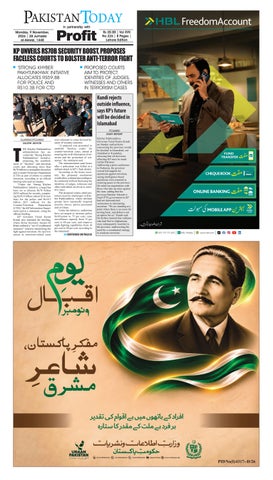
Monday, 9 November, 2026 | 28 Jumada al-Awwal, 1448
In partnership with
Profit
Rs 20.00 | Vol XVII No 226 | 8 Pages | Lahore Edition
KP unveils Rs70b secuRity boost, PRoPoses faceless couRts to bolsteR anti-teRRoR fight
g
‘STRONG KHYBER PAKHTUNKHWA’ INITIATIVE ALLOCATES RS59.8B FOR POLICE AND RS10.3B FOR CTD
t
g
PROPOSED COURTS AIM TO PROTECT IDENTITIES OF JUDGES, WITNESSES AND OTHERS IN TERRORISM CASES
Kundi rejects outside influence, says KP’s future will be decided in Islamabad PESHAWAR
ISLAMABAD/PESHAWAR SALEEM JADOON
HE Khyber Pakhtunkhwa administration has unveiled the “Strong Khyber Pakhtunkhwa” initiative, proposing the establishment of “faceless” anti-terrorism courts and allocating more than Rs70 billion to strengthen the police and Counter-Terrorism Department (CTD) as part of efforts to combat terrorism, according to an official briefing televised on Sunday. “Under the ‘Strong Khyber Pakhtunkhwa’ initiative, a target has been set to allocate Rs70 billion ($253 million) for security, comprising Rs59.8 billion (about $216 million) for the police and Rs10.3 billion ($37 million) for the Counter-Terrorism Department (CTD),” the KP Information Department said in a statement, citing the official briefing. KP Governor Faisal Karim Kundi also attended the briefing, where Home Secretary Amjad Ali Khan outlined a “set of coordinated measures” aimed at intensifying the fight against terrorism. He said witnesses in terrorism-related cases
were reluctant to come forward because of security concerns. “A proposal was presented to establish ‘faceless courts’ for counter-terrorism cases, aimed at ensuring the swift elimination of terrorists and the protection of witnesses,” the statement said. The announcement came hours after a policeman was killed in a militant attack in KP’s Tank district. According to the home secretary, the proposed mechanism would allow criminal proceedings to be conducted without disclosing the identities of judges, witnesses and other individuals involved in sensitive cases. The proposal comes amid persistent security challenges in Khyber Pakhtunkhwa, where militant groups have repeatedly targeted security forces, police personnel and civilians. Under the initiative, authorities have set targets to increase police fortification to 75 per cent, raise surveillance capacity from 15 per cent to 60 per cent, and improve night-fighting capabilities from 18 per cent to 50 per cent, according to the statement.
ContInued on Page 03
STAFF REPORT
Khyber Pakhtunkhwa Governor Faisal Karim Kundi on Sunday said policies concerning the province would be decided in Islamabad, not Jalalabad or Kandahar, stressing that all decisions affecting KP must be made within Pakistan. Addressing a press conference in Peshawar, the governor voiced full support for operations against terrorism, saying intelligence-based operations were essential to restoring peace in the province. He ruled out negotiations with those who take up arms against the state, adding that the previous Pakistan Tehreek-eInsaf (PTI) government in KP had not demonstrated seriousness in eliminating terrorism. “We are standing at a point where there is no room for turning back, and defeat is not an option for us,” Kundi said. He further claimed that militants who had fled to Afghanistan were subsequently resettled in the province, underscoring the need for a coordinated strategy to eradicate terrorism.
02 NEWS
Monday, 9 November, 2026 | LAHORE
GilGit-Baltistan launches online system for tax exemptions on chinese imports
G
PROFIT
WEB DESK
ILGIT-Baltistan Chief Minister Amjad Hussain Azar has launched an online registration system allowing local traders to apply for tax exemptions on goods imported from China, under an agreement providing annual exemptions of up to Rs4 billion. The Gilgit-Baltistan Traders' Registration and Tax Exemption System (GBTERS) is designed to simplify registration, ensure transparent access to exemptions and prevent discrimination among eligible traders. Under the arrangement, goods imported through Sost Dry Port for local consumption in Gilgit-Baltistan are exempt from sales tax, income tax and fed-
eral excise duty, subject to eligibility requirements and the annual ceiling.
pti’s rule marked by rampant corruption, poor governance: amir muqam
PM reaffirms Pakistan’s unwavering solidarity with Azerbaijan on Victory Day ISLAMABAD
SALEEM JADOON
MALAKAND
STAFF REPORT
Federal Minister for Kashmir Affairs, Gilgit-Baltistan and SAFRON and President of Pakistan Muslim League-Nawaz (PML-N) Khyber Pakhtunkhwa, Engineer Ameer Muqam, here on Sunday said that PTI’s rule was marked by rampant corruption and poor governance and claimed to make PTI accountable for its 13 years of corrupt practices in the province. “Peace, development and resources will now be delivered to the people at their doorsteps,” he said while addressing a public gathering in Batkhela, Malakand district, on Sunday. The PML-N organised a large public gathering in Batkhela under the banner of “Youm-e-Nijat” to celebrate the end of PTI’s 13-year incompetent, poor rule in Khyber Pakhtunkhwa. Thousands of party workers and local residents attended the gathering led by Federal Minister Ameer Muqam amid proPakistan and PMLN slogans. Addressing the large participants, Muqam claimed that PTI’s tenure had been characterised by corruption and that the party that deceived people in the name of change would be held accountable for its 13 years of poor governance and corruption in the province. He said PTI’s departure would usher in an era of peace, development and prosperity in Khyber Pakhtunkhwa, adding that public resources and development opportunities would now be directed towards the welfare of the people. The federal minister alleged that if PTI had not facilitated terrorists, there would have been no need to impose Governor’s Rule and an emergency in the province. He said the people had not stood by PTI because the party had failed to protect them from terrorism. He pledged that the people of Khyber Pakhtunkhwa would be provided with peace, security, development and prosperity. Referring to the sacrifices of security personnel, Engr Amir Muqam said it was unacceptable that the Army, police and other security agencies were laying down their lives in the fight against terrorism while the PTI government was allegedly speaking in favour of terrorists. He claimed that those who paid extortion money to terrorists could never protect the public from militant violence. “During the past 13 years, only PTI leaders became wealthy, while the people of Khyber Pakhtunkhwa, despite their courage and resilience, became poorer,” he remarked. Questioning PTI’s poor performance, he said a party that could neither properly construct nor efficiently operate a single Bus Rapid Transit (BRT) system or a hospital could hardly be expected to run an entire province effectively. Muqam further criticised political opponents, saying that a religious party leader, who once used to describe PTI founder as an agent of Zionists, was now speaking his language. He said the people of Khyber Pakhtunkhwa were no longer interested in hollow slogans and social media negative propaganda but wanted peace, development and practical measures to address their problems. He maintained that despite remaining in power for 13 years, PTI had failed to resolve the basic problems of the people or put the province on the path of sustainable development. Paying glowing tribute to the armed forces of Pakistan, Muqam said the Pakistan Army was not only safeguarding the country’s borders but also standing shoulder to shoulder with the nation in every difficult situation.
CITY NOTES M.A. NIAZI
HERE have been two meetings which are intended to be routine, but which are still worth remarking. First, Nobel Literature Laureate Bob Dylan met Pope Leo XIV. The beatnik singer met the head of the Catholic Church. Could anyone symbolize youthful rebellion more than the former? And can there be a more Establishment than the Pope? If Dylan had spent his life Sticking It to The Man, Leo is perhaps the best embodiment available of The Man. The meeting should have been dangerous for both, but neither did Dylan scrag the Pope, nor the Pope make Dylan disappear in a puff of smoke. The big surprise for me was that Dylan is actually older, though the Pope is no spring chicken. He’s 71, but Dylan is 85. And then there’s the religion thing. The Pope is obviously Roman Catholic, while Dylan is a Jew. The Pope is still practising, while Dylan also is, though he became a bornagain Christian back in the 1970s, before returning to Orthodoxy. He was born in
T
The exemptions follow an agreement reached in September 2025 after traders
staged a 68-day protest at Sost Dry Port, blocking the Karakoram Highway and disrupting trade between Pakistan and China through the Khunjerab Pass. Speaking at the inauguration ceremony, Azar said the exemptions had been secured from the federal government to support local businesses and consumers. He clarified that applicants must operate a registered firm or partnership to qualify for the facility. The chief minister also directed the provincial secretary for minerals and industries to urgently prepare proposals for establishing a trade-free zone in Gilgit to facilitate domestic and international traders. He said the provincial government would develop the proposed zone using its own resources.
Prime Minister Muhammad Shehbaz Sharif on Sunday extended warm felicitations to Azerbaijan President Ilham Aliyev and the brave and brotherly people of Azerbaijan on the sixth anniversary of Victory Day, paying tribute to the courage, resolve and sacrifices that led to the restoration of the country's territorial integrity. “November 8 stands as a historic testament to the courage, resolve and sacrifice of the Azerbaijani nation, which restored its territorial integrity after nearly three decades. We pay heartfelt tribute to the martyrs whose sacrifices made this triumph possible,” the prime minister said in a post on his X handle. He said Pakistan had stood proudly with Azerbaijan then and continued to stand with it, adding that last year's Victory Day Parade in Baku, which he had the honour of attending alongside President Aliyev, reflected the unbreakable bond between the two countries. The prime minister also prayed for Azerbaijan's continued progress and prosperity, expressing the hope that the South Caucasus would move towards lasting peace and
STAFF REPORT
Federal Interior Minister Mohsin Naqvi said no leniency would be shown to elements making speeches against the state, engaging in vandalism or inciting people against the government. He was addressing, as chief guest, the passing-out parade of the first batch of the Federal Constabulary’s Special Protection Wing and Anti-Riot Wing at the Shabqadar Training Centre. At the prestigious and historic ceremony, 983 personnel from all four provinces, Azad Jammu and Kashmir, and Gilgit-Baltistan passed
ISLAMABAD
STAFF REPORT
The National Cyber Crime Investigation Agency (NCCIA) Islamabad has recovered Rs 2.94 million and returned the amount to a woman who had allegedly lost Rs 9.5 million in an online financial fraud case, while efforts are underway to recover the remaining money. According to an NCCIA official, the recovery was made during an investigation conducted under the supervision of Inspector Waqar Masih Ghouri. He said the woman had suffered a financial loss of Rs 9.5 million in the alleged fraud, prompting the agency to initiate an investigation into the matter. The official said Rs 2.94 million had so far been recovered and handed over to the complainant, while further investigation was underway to trace the remaining amount and determine the involvement of those responsible. Meanwhile, the woman expressed satisfaction over the recovery of part of her money and thanked NCCIA Islamabad for its timely action and cooperation. She appreciated the efforts of the investigation team, particularly the assistance provided during the recovery process, and expressed hope that the remaining amount would also be recovered.
mir raza ali case: Jit reviews evidence, father's statement recorded KARACHI
STAFF REPORT
shared prosperity. PM saddened by tragic shooting incident in Kraków Meanwhile, Prime Minister Shehbaz Sharif expressed deep sorrow over the tragic shooting incident in Kraków, which resulted in the loss of precious human lives and left several others injured. In a post on X, he said: “On behalf of the Government and people of Pakistan, and on my own behalf, I extend our heartfelt condolences to Prime Minister Donald Tusk, the bereaved families and the people of Poland. Our thoughts and prayers are with the families of the victims during this difficult
time. We also wish a speedy and full recovery to those injured.” “Pakistan stands in solidarity with the people and Government of Poland in this moment of profound grief,” he added. Raza Harraj calls on PM Shehbaz Sharif In a related development, Federal Minister for Defence and Production Raza Hayat Harraj called on Prime Minister Shehbaz Sharif here on Sunday. During the meeting, they discussed matters of mutual interest as well as the country's political and economic situation.
No leniency will be shown to elements making speeches against state: Naqvi
SHABQADAR
nccia returns rs2.94m recovered in alleged rs9.5m online fraud
out for the first time in history. The batch includes 35 women. These personnel have become part of the newly established Special Protection Wing and Anti-Riot Wing of the Federal Constabulary, marking a unique and important milestone in the country’s history. A notable feature of the passingout parade was the extensive participation of young people from all parts of the country—including the four provinces, Azad Kashmir and Gilgit-Baltistan—with particularly strong representation of women. Addressing the ceremony, Interior Minister Mohsin Naqvi issued a stern warning that elements spewing
venom against the state, involved in vandalism and inciting the public to rebel against the government would be dealt with firmly. He said those violating the law would not be forgiven under any circumstances. He reiterated his resolve to ensure the rule of law at all costs. Appreciating the services of the Federal Constabulary, the minister said the force has always remained at the forefront of maintaining peace in the country. He said it was performing its duties with great courage and bravery in decisive operations against terrorism, protecting key government installations, securing development projects of national importance and restoring law and order across the country. Addressing the newly graduated personnel, Mohsin Naqvi said they were assuming responsibility for the Special Protection Wing and AntiRiot Wing for the federal government for the first time, describing it as a highly important and historic mission. He stressed that they carried the major responsibility of protecting the state and upholding the law and Constitution, which they must discharge with complete integrity and professional competence.
The first meeting of the Joint Investigation Team (JIT), formed to investigate the murder of Mir Raza Ali in Karachi, concluded after five hours. During the meeting, the detailed statement of Mir Raza Ali’s father was recorded. Advocate Jibran Nasir also called for a thorough investigation into the role of the SHO of Ferozabad Police Station and other individuals allegedly linked to the case. The meeting was chaired by DIG Irfan Baloch and attended by representatives of various security agencies. The participants also reviewed the Judicial Commission’s report and evidence collected so far. Speaking to the media after the meeting, Advocate Jibran Nasir said that all concerns had been presented before the JIT. He added that Mir Raza’s family was ready to appear before the investigation team whenever required. He further stated that Mir Raza Ali’s father, who is also the complainant in the case, had recorded a detailed statement. The statement highlighted alleged negligence on the part of certain police officers. Advocate Jibran Nasir said that letters would be sent to the Establishment Division and the Chief Minister of Sindh on Monday. He expressed hope that significant progress in the investigation would be made within the next two weeks. He also raised concerns over a separate committee formed to investigate the role of certain police officers, stating that 10 to 15 days had passed without any information about its progress. He pointed out that the officers concerned had neither been removed from their positions nor had the concerns previously shared with the inquiry committee been taken seriously. Nasir further demanded an investigation into the role of Mir Raza Ali’s business partner and police officers connected to the case.
federal govt opens 5,375 job opportunities for people of Balochistan QUETTA
STAFF REPORT
A large number of job opportunities have been announced for the people of Balochistan across various departments of the federal government. The hiring process is being conducted at the district level in Balochistan to ensure maximum benefit for the residents of the province. The federal government has announced as many as 5,375 job opportunities across several federal departments. To facilitate local recruitment, the federal government has established an employment cell in every district. Applicants from Balochistan will no longer need to travel long distances to apply for these positions. Notably, candidates are exempt from written tests and will be selected solely based on interviews. Additionally, the government has granted a special 10year age relaxation for applicants from Balochistan.
The Pope and the pop singer
Minnesota, but soon moved to New York, which is the biggest Jewish city in the world, Pope Leo was born in Chicago, to migrant parents, which may explain why the first American pope is from there. Of course, he should have been Irish, Polish or Italian. Like the first Pope from the Americas, his predecessor, Pope Francis, he has Italian ancestry, but is basically of French origin. One would have expected someone of Irish origin. Popes were all Italian after the experience of the Dutchman Adrian VI, who has so far been the only Dutchman to have been elected Pope. The last Frenchman to have been elected pope was Gregory VII, who ended what is called the ‘Avignon Captivity’, when the Papacy was based at Avignon in France, not Rome. I don’t know whether Pope Leo would prefer to be considered the first American pope ever or the first Frenchorigin pope since 1378. or maybe he would like to be thought of as the second Latin American and first Peruvian Pope. Maybe the Quechua people will luck out with the next Peruvian pope. ((At least Leo speaks Quechua because of all his missionary
work). I’m not suggesting him, but the current Archbishop of Cusco. Mgr Lizardo Estrada Herrera, is of Quechua origin. Another meeting was that of PTI founder Imran Khan and his wife Bushra Bibi with their lawyer after 11 months. How he is to contest his cases without meeting his lawyers is anybody’s guess. It’s been so long that even his sisters are now in custody. One has a heart condition, and has treatment issues, echoing Imran’ own eye problem. Another’s daughters have moved the Lahore High Court to get to visit her. Imran has not been visited by his sons either, and is not being allowed to meet family members. If you ask me, the real sufferers are the PTI faithful. They’ve got so much to protest. After having to protest for Imran’s release, now they have to protest for his sisters’ release. After protesting for his treatment, now they have to protest for his sisters’ medicines. Oh yes, the dismissal of the KP government. Gone are the glory days of protesting against the USA. The USA has had its midterms, and the PTI was disappointed that Imran’s impris-
onment was not the main election issue. There are a number of firsts in this election, like the first Muslim elected to the Senate, along with the first female Native American and the first openly gay man. The real kicker is that Georgia has elected a black woman governor, and Texas a Latina. Both are supposed to be Republican states, which elected women, a black and a Latina, three of
Trump’s pet peeves. Women have also got British comedian Russell Brand into trouble. He’s awaiting sentencing after being convicted of a rape and three sexual assaults. The PTI don’t like it, for He didn’t get Imran’s go-ahead, but the really badly hit has been Ali Zafar, the indefatigable campaigner for Harvey Weinstein and then Bill Cosby.
NEWS 03
PM lAunCHes yeAR-lOng CelebRAtIOns MARKIng IqbAl’s 149tH bIRtH AnnIveRsARy Monday, 9 November, 2026 | LAHORE
P
initiatives aimed to preserve Iqbal’s rich intellectual legacy and transmit it to future generations. “On the auspicious occasion of Iqbal Day, I pay my profound tribute to Allama Muhammad Iqbal, the Poet of the East. Allama Iqbal awakened political consciousness among the Muslims of the subcontinent, inspiring them to recognise and assert their distinct national identity. This consciousness of a separate identity played a pivotal role in their historic struggle for the creation of an independent homeland,” he said. The prime minister described Iqbal as a person of exceptional intellectual stature and profound wisdom, saying the enduring thought of the eminent philosopher and visionary continued to broaden intellectual horizons and promote the intellectual growth of young people and future generations. As a distinguished philosopher of Islam, Iqbal had explored the profound intellectual dimensions of Islamic teachings, while his Islamic thought continued to offer meaningful and practical guidance to Muslims in
ISLAMABAD
STAFF REPORT
RIME Minister Muhammad Shehbaz Sharif on Sunday announced that the government would launch a year-long commemoration of the 149th birth anniversary of Allama Muhammad Iqbal from Monday (November 9), culminating on November 9 next year, paying tribute to the Poet of the East for awakening political consciousness among the Muslims of the subcontinent and inspiring them to assert their distinct national identity. In his message on Iqbal Day, marking the 149th birth anniversary of Allama Iqbal on November 9, 2026, the prime minister said a comprehensive programme of national and international events was being formally launched to highlight the philosopher-poet’s intellectual and literary legacy. The programme would feature international conferences, academic and research seminars, literary festivals, exhibitions, educational competitions and cultural activities, he said, adding that the commemorative
their individual and collective lives, he added. Shehbaz Sharif said the government was firmly committed to ensuring that Iqbal’s philosophy remained a dynamic and integral part of educational institutions, national discourse and development priorities. “Intellectual awakening, character building and collective renewal must, undoubtedly, form an essential part of our national objectives,” he said.
Highlighting Iqbal’s concept of Khudi (selfhood), the prime minister said it taught individuals and nations that they could transform their destinies through self-realisation, purposeful endeavour and spiritual emancipation. He said Iqbal had reposed immense confidence in the youth, whom he regarded as the architects of the nation’s future. His concept of the Shaheen (falcon), he added, embodied courage, independence, lofty as-
The regulator wants bank records behind sales figures in withdrawn SE Fruits IPO PROFIT
STAFF REPORT
Of all the companies that queued up to list on the Pakistan Stock Exchange (PSX) this year, SE Fruits and Vegetable Limited looked among the least complicated. It exports kinnow, mangoes and potatoes from Sargodha. It said it had been selling to the Middle East, Central Asia and the Far East since 1998 under its old name, Shaheen Enterprises. Its pitch to investors was simple too. Put more money into working capital, buy more fruit in season, and ship more of it abroad. The company was also asking for little, at least by IPO standards. It planned to sell 30 million shares, 32.01% of the enlarged company, at a floor price of Rs 40, with the price allowed to rise to Rs64 in book-building. That would have raised between Rs1.2bn and Rs1.92bn. Topline Securities and Growth Securities were joint lead managers, and the prospectus said export revenue of about $4m in FY2026 would grow to around $18m in FY2027.
The approvals also came quickly. The PSX invited public comments on the draft prospectus in early August and approved the listing on September 7th. The Securities and Exchange Commission of Pakistan (SECP) approved the prospectus two days later. Institutional book-building on September 21st–22nd was 1.6 times oversubscribed within two hours, and the shares cleared at the Rs40 floor. But all of this came apart within a month. On October 13th the company said it would withdraw its IPO application, citing “regulatory concerns regarding disclosures in its prospectus”. The SECP said it had suspended further proceedings after book-building to protect investors. According to an SECP press release issued on November 7, the commission has asked seven banks for the company’s export records. It has also asked 30 banks for details of foreign remittances, export proceeds and other foreign exchange received in the accounts of the company’s sponsors and directors. Some have replied, and their responses are under review. The regulator is also reviewing infor-
mation from the joint lead managers, Topline Securities and Growth Securities, and examining a response from Parker Russell–A.J.S., which it describes as a consultant to the issue. The company’s auditor, Ilyas Saeed & Co, has been given more time to hand over its records. The question behind all of this is simple. Did the money that SE Fruits said it earned actually arrive? WHAT THE REGULATOR FOUND The problem began with a tip-off. According to Dawn, the SECP received an anonymous complaint on September 11th, two days after it SECP themselves approved the prospectus, questioning the company’s sales figures. A preliminary review found multiple problems. Firstly, the sales reported in the prospectus did not match the company’s sales tax returns for 2022–26. Secondly, local sales were missing from its 2024 income tax return. And even after allowing for receivables at year-end, reported sales did not match the money that had actually come into the company’s bank accounts. The SECP also flagged the com-
pany’s conversion from a partnership, trading since 1998, into a public limited company incorporated only in 2026. A newly incorporated company’s financial history is assembled from the records of the business that came before it. And if those records are thin, the history is only as reliable as the people who put it together. The timing raised questions of its own. The complaint arrived ten days before book-building opened. Book-building went ahead anyway, and the suspension came only after it had finished. By then, institutions had committed money on the strength of figures the regulator was already examining. FOLLOWING THE MONEY The investigation has now become formal and much wider. The SECP opened it on October 21st under Section 29 of the SECP Act, 1997, read with Section 139 of the Securities Act. It has made three sets of requests to banks and market institutions. Seven banks have been asked by the SECP for the company’s export records. A full detail covering the company’s export operations in the past.
Tesla to wind down Cybertruck production in 2027 as Musk shifts focus to robotaxis PROFIT
STAFF REPORT
Tesla CEO Elon Musk has announced plans to wind down production of the Cybertruck at the company's Texas Gigafactory by mid-2027, shifting manufacturing capacity towards its Cybercab autonomous vehicle as sales of the electric pickup continue to decline. Musk disclosed the decision in a post on X on Friday, saying Tesla would reduce Cybertruck production around the middle of next year to accommodate increased Cybercab manufacturing. He did not clarify whether production of the electric pickup would cease entirely. Tesla's Texas Gigafactory is currently the only facility manufacturing the Cybertruck. The announcement marks a change in the company's manufacturing priorities after the Cybertruck failed to achieve the sales volumes initially projected by Musk. At Tesla's annual shareholder meeting in May 2023, Musk estimated that the
company could eventually sell between 250,000 and 500,000 Cybertrucks annually once production reached full capacity. However, US sales declined from an estimated 38,965 vehicles in 2024 to 20,237 in 2025, according to figures from Cox Automotive's Kelley Blue Book. The downward trend continued in 2026, with just 11,586 Cybertrucks sold in the United States during the first nine months, representing a 28% decline from the corresponding period of 2025. Tesla does not separately disclose Cybertruck deliveries in its quarterly reports, instead grouping the pickup with other vehicles outside its Model 3 and Model Y ranges. Deliveries in this category fell 48% to 8,295 vehicles during the third quarter, although the figure includes models other than the Cybertruck. The company's latest production update indicated that its Texas factory had installed annual manufacturing capacity exceeding 125,000 Cybertrucks, substantially above current sales volumes.
Tesla unveiled the Cybertruck in 2019 with plans to introduce the electric pickup in 2021 at a starting price of $39,900. Following repeated delays, deliveries began in November 2023, with the starting price having increased to $60,990. The vehicle has subsequently faced several recalls and quality concerns, including a 2024 recall involving accelerator pedals that could become trapped and cause unintended acceleration. In 2025, Tesla recalled more than 46,000 Cybertrucks over concerns that stainless-steel exterior panels could detach while the vehicles were being driven. A further 173 vehicles were recalled in April 2026 because of brake rotor defects that could cause wheel studs to separate. Tesla is now placing greater emphasis on the Cybercab, a two-seat autonomous vehicle unveiled in 2024 without conventional steering wheels or pedals. The company began offering paid robotaxi rides in parts of Austin, Texas, in September 2026 and is seeking to expand the service.
Sindh CM reviews Rs2.14b Sukkur water supply project KARACHI
STAFF REPORT
Sindh Chief Minister Murad Ali Shah on Sunday reviewed the Sukkur Water Supply Project to ensure an uninterrupted supply of clean drinking water to every household in the city. Chairing a meeting on the project, the chief minister said Sukkur, despite being located along the banks of the River Indus, could not be deprived of adequate water supplies. Murad
Ali Shah stressed that resolving the city’s longstanding water shortages was a government responsibility and directed the relevant authorities to plan according to Sukkur’s present and future water requirements. The meeting discussed a proposal to establish a water treatment system capable of processing 40 to 50 million gallons of water daily. The Rs2.14 billion scheme is expected to increase water supply coverage to between 80 and 90 per cent. The proposed project also in-
cludes improvements to infrastructure and facilities at Bukkur Island, Bandar Road, the exhibition centre and Airport Road. Murad Ali Shah further revealed that the proposal to establish Sukkur as a twin city of Yichang in China was under consideration. He said the provincial government aimed to benefit from Yichang’s urban development experience to transform Sukkur into a modern city. The Sindh CM also highlighted the importance of improv-
ing Sukkur Barrage, saying the initiative would help create a combination of modern urban facilities and natural beauty. He directed the Local Government Department, the Sukkur mayor and other relevant institutions to work together to ensure the effective implementation of the water supply project. Sindh Minister for Local Government Nasir Hussain Shah reaffirmed the provincial government’s commitment to addressing Sukkur’s water problems.
KP unveils Rs70b security boost, proposes faceless courts to bolster anti-terror fight CONTINUD FROM PAGE 01
The approved measures also include enhancing the police's anti-drone capability from one per cent to 50 per cent, increasing the armouring of CTD vehicles from 16 per cent to 70 per cent, raising the use of jammers from three per cent to 50 per cent, and expanding the CTD's operational scope to 34 districts. “District Nerve Centres” and a “Safe Cities Authority” will also be established across 10 districts of the province, the statement said. It added that the attrition rate — the reduction in
police personnel — would be brought down from 15 per cent to five per cent. Other measures include deploying artificial intelligence (AI) to counter “false and fabricated narratives on social media” and establishing “Smart Front Desks” at 406 police stations across major cities in the province. KP has witnessed a surge in militancy in recent years, particularly in areas bordering Afghanistan, where authorities say armed groups have exploited difficult terrain and cross-border networks to carry out attacks. Last month, the federal government im-
posed emergency and governor’s rule in the province, citing the PTI-led provincial government's alleged lack of seriousness in tackling terrorism and addressing governance issues. Khyber Pakhtunkhwa has also experienced a sharp rise in attacks by the outlawed Tehreeke-Taliban Pakistan (TTP) and other militant groups, which have targeted police and security forces. Islamabad has repeatedly accused the TTP and other groups of using Afghan territory to plan and launch cross-border attacks, an allegation denied by Kabul.
pirations and an unwavering pursuit of excellence. The prime minister further observed that Iqbal’s philosophy championed peace, social harmony, tolerance and justice as indispensable pillars of sustainable national development, while categorically rejecting hatred, extremism, sectarianism and discrimination. At the international level, Iqbal’s message of Muslim unity, universal brotherhood and peaceful coexistence retained profound relevance, he said, adding that guided by Iqbal’s intellectual vision, Pakistan would continue to champion unity and solidarity among the Muslim Ummah and support the peaceful resolution of international disputes. “Allama Iqbal’s timeless message, rooted in individual, national and universal values, continues to illuminate our path and serve as a guiding beacon for the nation. Let us renew our resolve to deepen our understanding of Iqbal’s message, promote rigorous scholarly research into his thought, foster creative thinking and strengthen our national character,” he concluded.
Detained Hurriyat leaders reduced to skeletons in jails of India, IIOJK: APHC ISLAMABAD
STAFF REPORT
The All Parties Hurriyat Conference (APHC) has expressed grave concern over the deteriorating health and safety of illegally detained Hurriyat leaders and activists languishing in various jails in India and Indian illegally occupied Jammu and Kashmir (IIOJK). According to Kashmir Media Service, APHC spokesman Advocate Abdul Rasheed Minhas, in a statement issued in Srinagar, deplored the denial of basic facilities, including legal assistance and medical care, to Kashmiri detainees in prisons. He said many detainees were suffering from multiple ailments, including cancer, diabetes and hypertension, and had been reduced to skeletons due to the criminal apathy of the authorities in Tihar, Uttar Pradesh, Jodhpur, Haryana and Punjab jails in India, as well as prisons in IIOJK. The APHC said India could not suppress the freedom-loving spirit of the incarcerated Kashmiri leadership and people through the use of brute force, as they remained determined to achieve freedom from political injustice such as India's illegal occupation of Jammu and Kashmir.
Rs2.6m fines imposed in Punjab week-long anti-smog operation LAHORE
STAFF REPORT
The Punjab Transport and Mass Transit Department inspected as many as 5,000 vehicles during a weeklong crackdown against smoke-emitting vehicles from November 1 to November 7. The transport department issued challans to 659 vehicles for lacking fitness certificates and emitting excessive smoke. Additionally, officials impounded 409 vehicles—including cars, light transport, and heavy transport—for severe smoke emissions and failing to produce valid fitness certificates. Heavy fines were also imposed on goods transporters for overloading. A total of 442 such vehicles were ticketed, resulting in aggregate fines of Rs2.6 million. Strict instructions have been issued across the department to offer zero concession to smoke-emitting vehicles or automobiles operating without fitness certificates. Provincial Minister for Transport Bilal Akbar Khan stated that non-compliant vehicles, regardless of size, will be seized and removed from roads, adding that legal cases will also be registered against violators. Urging transporters to cooperate, the minister emphasized that unmaintained vehicles lacking fitness certificates should not be brought onto public roads. He added that the menace of smog can only be eradicated through mutual cooperation and strict regulatory measures.
04 COMMENT
Monday, 9 November, 2026
THE PEOPLE ARE SOVEREIGN, AND THEY MAKE THE STATE
Auto Policy
T
It sets clear goals, but does not seem likely to achieve them
The state is only successful if its people prosper
HE auto policy approved by the Prime Minister and announced by the Information Minister on Saturday has two goals, both laudable, of getting the industry to start exporting, and of converting to electric vehicles. However, the policy does not seem likely to achieve either. The policy focuses on taxation incentives for both, while not paying sufficient attention to the groundwork that is necessary for both objectives, The auto policy has every chance of ending up as a sort of package of sweets for those who are already profiting. The ultimate objective of the policy, the reduction of prices for the local buyer, will not gain as much benefit as expected either. What is really needed is a vigorous system of car finance. That will not be achieved by simply increasing the upper limit on finance; as an entirely new means of financing must be found. The entire process is interlocking. Car finance is basic to spreading car ownership, not just of polluting internal combustion engines, but of EVs as well. Of course spreading EVs is not just a matter of providing sufficient recharging points, but also of making sure that the distribution grid can handle the extra load. That involves not just an estimate of how much that load might be, but also where that load is. Also, the deletion programme for EVs has to be much more strictly implemented than it has been for ICE cars, for which export dreams are being seen. All vehicles are far behind on their deletion programmes, and unless they are taken seriously, Pakistan will remain an assembler of imports. If there is an attempt to export those vehicles, no Pakistani products will be exported. The real challenge, to produce parts that compete with the original, is being ducked by the policy. It is only if such parts gain a reputation for quality at competitive rates will they sell. The way to export is first to saturate the local market, which is to be achieved only if the product is of sufficient quality and attractively priced. The many new brands which are coming to Pakistan first made their mark in their home markets, developing both manufacturing capacity and robust supply chains. The government has drafted a policy designed not to anger the IMF too much, satisfy a few cronies, and coming in last by a long margin, the consumer.
A
PECULIAR political philosophy has taken root in Pakistan’s public discourse, one that places the state above the very people whose collective existence gives it meaning. The assertion that the state must always come first is repeated with such conviction that questioning it can sometimes be interpreted as questioning patriotism itself. Yet, beneath its apparent simplicity lies a fundamental misunderstanding of political theory. The state is not an end in itself. It is a political institution created to serve human beings, protect their rights and provide the conditions in which they can live with dignity. To reverse this relationship is to confuse the instrument with the purpose for which it exists. The foundations of modern political thought offer a compelling explanation of this relationship. John Locke, one of the most influential thinkers of liberal political philosophy, argued in his Second Treatise of Government that individuals establish political authority through consent to protect their natural rights. Government is a trust, not an absolute entitlement. Its legitimacy depends on fulfilling the responsibilities for which people consented to its creation. When authority ceases to protect those rights, it undermines the very justification for its existence. The implication is unmistakable. The state derives its legitimacy from the people and remains accountable to them. Jean-Jacques Rousseau developed this argument further in The Social Contract, published in 1762. He located sovereignty in the collective body of citizens and maintained that legitimate political authority must reflect the general will. Although Rousseau’s conception of popular sovereignty differs from Locke’s emphasis on individual rights, both challenge the notion that political authority possesses an independent moral claim over society. The people are not
The state is a means, not an end. Its institutions, authority and sovereignty derive their ultimate justification from the people they are meant to protect. A country does not become stronger by placing its citizens beneath its institutions
Dedicated to the legacy of late Hameed Nizami
Arif Nizami (Late) Founding Editor
T
M. A. Niazi
Babar Nizami
Editor Pakistan Today
Editor Profit
Tariq Khan Tareen
HE Indian diaspora has gradually and inexorably ruined India's image on the world stage, transforming what was once celebrated as a formidable instrument of soft power and diplomatic leverage into a source of mounting international embarrassment. What was historically projected as a strategic asset— a global community that would amplify India's influence, attract investment, and foster goodwill— has instead become increasingly associated with controversies that undermine confidence, invite stricter scrutiny, and damage the nation's credibility abroad. A series of criminal cases involving sexual harassment, grooming gangs, financial scams, money laundering, target killings, and visa misuse by Indian nationals and allegedly linked networks, combined with tighter immigration screening and increased scrutiny of overseas conduct by many countries, is creating formidable challenges for India's international reputation. These are not isolated aberrations but rather constituent elements of a discernible pattern that is fundamentally recalibrating how host nations perceive Indian nationals and India-linked transnational networks, compelling uncomfortable interrogations about accountability, screening mechanisms, and the apparent exportation of disorder beyond India's territorial confines. India's diaspora has become a global embarrassment, exporting chaos, crime, and cultural arrogance that stains the nation's image with increasing visibility across Western societies. The catalogue of controversies is expansive and deeply troubling— sexual offences, grooming gangs, financial scams, money laundering, targeted assassinations, and systematic visa manipulation— each contributing to an image crisis that extends far beyond individual incidents and threatens the reservoir of goodwill India has painstakingly cultivated over decades of diaspora diplomacy. From Canada's 2025 terrorist designation of the Bishnoi gang linked to murders, extortion, and drug trafficking to the 2026 US "Operation Hard Ball" that netted 24 arrests and charged 37 defendants in a transnational network terrorising Indian communities abroad, the pattern is unmistakably clear: criminal syndicates run from Indian jails thrive on diaspora networks with alarming impunity. The designation empowered Canadian authorities to freeze assets and disrupt financial operations, while Operation Hard Ball laid bare how criminal enterprises operating
Dr Zafar Khan SafDar
the property of the state. They constitute the political community from which legitimate authority emerges. The principle that people constitute the foundation of political authority is not confined to Western political philosophy. The Charter of Madinah, established by the Holy Prophet Muhammad (SAW), offers an important historical perspective on the formation of a political community through an agreed compact among its constituent groups. Rather than treating political order as an arrangement imposed upon society, it established a framework of shared obligations, collective responsibility and mutual protection. Its significance for the present argument lies in the recognition that political authority and communal order derive their purpose from the people brought together under them. The political community was not created to serve an abstract institution but its organisation was intended to secure the welfare, rights and peaceful coexistence of those who constituted it. Thomas Hobbes, whose political philosophy is often associated with an exceptionally powerful sovereign, also offers an interesting perspective. In Leviathan, published in 1651, he described the state as an artificial political person created through the authorisation of individuals seeking protection from insecurity and disorder. Hobbes favoured concentrated sovereign authority because he believed that security was essential to human survival. Yet the starting point of his argument was the vulnerability and needs of individuals, not the inherent superiority of an institution. The state was established because human beings needed it, not because human beings existed to serve it. This distinction matters enormously in countries where the language of national interest is sometimes invoked to subordinate individual rights and democratic accountability. National security, territorial integrity, institutional continuity and constitutional order are undoubtedly essential. No functioning political community can survive without them. But these are not independent objectives detached from human welfare. Their ultimate purpose is to secure the lives, freedoms and collective wellbeing of citizens. Security without human dignity becomes an empty achievement, while sovereignty that does not translate into the protection of citizens loses much of its moral significance. Abraham Lincoln’s celebrated formulation of democracy as government of the people, by the people and for the people captures this relationship with remarkable clarity. The state cannot claim democratic legitimacy merely because it possesses institutions, territory, administrative machinery or coercive author-
Send your letters to: Letters to Editor, Pakistan Today, 4-Shaarey Fatima Jinnah, Lahore, Pakistan. E-mail: letters@pakistantoday.com.pk Letters should be addressed to Pakistan Today exclusively
Healing family ties
India's Diaspora and Global Backlash
What was intended to represent India's growing influence is increasingly becoming a source of global embarrassment, and until accountability, transparency, and respect for host-country norms become central to India's diaspora engagement, the country's global image will continue to suffer·and the goodwill it seeks to build will remain elusive Lahore – Ph: 042-36300938, 042-36375965
I
Karachi – Ph: 021-32640318 I
sition. Growing concerns over employment competition, housing pressures, immigration patterns, and perceived cultural insensitivity have fuelled resentment against South Asian communities, reflecting an increasingly hostile digital environment surrounding immigration and demographic change. Election meddling in Canada and refusal to respect host-country norms only intensify the backlash, straining diplomatic relations and raising fundamental questions about respect for national sovereignty and democratic institutions. Concerns surrounding political interference, intimidation, and transnational influence operations have added another dimension to India's international difficulties, contributing to an increasingly damaging international perception of India's overseas conduct. These are not isolated failures— they are systemic exports of disorder that humiliate India and erode goodwill worldwide. Criminal syndicates, grooming-related offences, financial deception, fraudulent academic credentials, visa manipulation, and controversial political activities are creating an image crisis that extends far beyond individual incidents. India's diaspora, once projected as a strategic asset and a symbol of global influence, is increasingly associated in international debates with controversies that undermine confidence, invite stricter scrutiny, and damage diplomatic goodwill. For a country aspiring to global leadership, the implications are profound: international credibility cannot coexist indefinitely with allegations of organised criminality, institutional exploitation, immigration fraud, and disregard for the sovereignty and cultural norms of host nations. India's expanding global footprint is therefore confronting an uncomfortable contradiction— the greater its overseas presence becomes, the more visible its associated controversies are on the international stage. What was intended to represent India's growing influence is increasingly becoming a source of global embarrassment, and until accountability, transparency, and respect for hostcountry norms become central to India's diaspora engagement, the country's global image will continue to suffer—and the goodwill it seeks to build will remain elusive. The writer is a freelance columnist
Islamabad – Ph: 051-2204545
The writer has a PhD in Political Science, and is a visiting faculty member at QAU Islamabad. He can be reached at zafarkhansafdar@yahoo.com and tweets @zafarkhansafdar
Editor’s mail
The Export of Crisis
from Indian soil could exploit overseas diaspora networks to terrorise communities and expand their influence across international borders— two individuals allegedly directing international criminal syndicates from within Indian prisons, their networks implicated in targeted killings, racketeering, shootings, extortion, kidnapping, and large-scale narcotics trafficking. In the United Kingdom, convictions of Indian nationals for sexual offences surged 257 percent between 2021 and 2024, rising from 28 to 100 cases— the steepest jump among foreign groups examined. This dramatic escalation has intensified concerns surrounding sexual exploitation, grooming-related offences, and public safety, placing additional pressure on British authorities to strengthen monitoring and enforcement mechanisms while raising fundamental questions about screening and integration. H-1B abuse compounds the damage as Indians claim roughly 70–73 per cent of approvals yearly, yet probes uncovered over 100,000 fake degrees from 28 Indian universities, while a former US consular officer alleged 80–90 percent fraud rates in earlier applications from hubs like Hyderabad. Such revelations have placed the authenticity of academic credentials, employment documentation, and immigration applications under unprecedented scrutiny, casting a shadow over the credibility of educational qualifications used in international employment and immigration processes. Student visas and demographic shifts fuel resentment, with anti-South Asian hate posts on X exploding 240 per cent since 2024 amid claims of job displacement and cultural impo-
ity. Its legitimacy also rests on how it treats those living under its jurisdiction. A country may maintain an impressive institutional structure and demonstrate considerable coercive capacity, yet fail its citizens through inadequate education, inaccessible healthcare, economic exclusion, injustice and the erosion of fundamental freedoms. Institutional survival alone cannot be equated with national success. Pakistan needs to examine this distinction more seriously. The language of state survival and national interest frequently dominates public conversations, while the everyday experiences of citizens receive considerably less attention. Millions struggle with the cost of living, unemployment, inadequate public services, unequal opportunities and limited access to justice. For many, the state is encountered not as an institution of protection and opportunity but as a distant administrative authority, sometimes inaccessible and often unresponsive. The contradiction is difficult to ignore. If the state is strong, its strength should be reflected in the security, dignity and opportunities available to its people. The Constitution of Pakistan itself provides a framework for understanding this responsibility. It guarantees fundamental rights, including security of person, dignity, equality before law and protection against discrimination. These guarantees are not decorative constitutional language. They define the obligations that give political authority its constitutional character. A state that demands loyalty must also demonstrate responsibility. Citizenship cannot be reduced to obedience, just as patriotism cannot be measured by an individual’s willingness to remain silent in the face of institutional failure. None of this suggests that individual interests should always override collective responsibilities. Citizens have obligations towards their country, including respect for law, protection of public institutions and participation in the common good. But these obligations are reciprocal. The state also owes its citizens justice, security, equal treatment and the protection of their fundamental rights. A relationship built exclusively on demands from one side cannot sustain the trust upon which a legitimate political order depends. Perhaps the most important distinction Pakistan needs to recover is between the state as an instrument of collective human welfare and the state as an unquestionable end in itself. The former is consistent with the social contract tradition and democratic constitutionalism. The latter risks turning political institutions into objects of unquestioning loyalty, irrespective of their performance or treatment of citizens. A state should not measure its success merely by its ability to command obedience or preserve its authority. It should be judged by the quality of life it enables its people to achieve. The state is a means, not an end. Its institutions, authority and sovereignty derive their ultimate justification from the people they are meant to protect. A country does not become stronger by placing its citizens beneath its institutions. It becomes stronger when those institutions work for its citizens. The people do not exist for the state. The state exists for the people.
I
FAMILY conflicts often start with a small misunderstanding, a harsh word, or an unmet expectation. But when ignored, these little issues can grow into a silent poison that slowly destroys love, peace and trust at home. Psychologists say that most problems come from poor communication, lack of patience and unrealistic expectations. When family members stop listening to each other and try only to prove themselves right, emotional distance grows. This leads to feelings of loneliness and mental stress even within a house full of people. The good news is: this can be prevented. Start by talking and listening regularly, even about small things. Be patient during disagreements, and accept that everyone has strengths and weaknesses. Use kind words like “I understand” or “I’m sorry” to build bridges, not walls. Also, make time for fun and togetherness. Shared moments bring hearts closer and reduce negativity. Disagreements are natural but solving them with love, respect and understanding is the real strength of a happy family. Don’t let silence ruin what love has built. ARONA SAGHIR KARACHI
Nuclear past repeats
FOR more than 30 years, the world has avoided slipping back into the dangerous cycle of escalation that defined the Cold War era. After the superpowers realised how close they had come to nuclear catastrophe, they slowly built a system of restraint. Arms-control treaties, verification mechanisms, and a shared understanding of mutual destruction pushed nuclear testing into history. This long period of relative calm makes today’s renewed talk of testing all the more worrying. Against this backdrop, United States President Donald Trump’s recent directive to Pentagon to explore new nuclear test possibilities appears historically tone-deaf and strategically short-sighted. It overlooks the hardearned lessons of the Cold War. At the time, both the United States and the erstwhile Soviet Union believed that strength came from building bigger and more destructive weapons. But each new test only provoked another response, pushing both sides closer to the edge. It was a dangerous game where one misstep could have meant annihilation. The world eventually stepped back from the brink, not because of luck, but because leaders finally recognised that nuclear one-upmanship had no winners. Today’s world is far more complex than the bipolar Cold War order. Instead of two major powers, there is now a multipolar rivalry involving the US, China, Russia and several emerging nuclear states. Reintroducing nuclear tests in such an environment is like lighting a match in a room full of fuel barrels. There are more players, more tensions, and fewer rules. The old arms-control framework — the one that helped stabilise the Cold War — has weakened over the years. Key treaties have collapsed, verification has eroded, and trust among major powers is at its lowest point in decades. In essence, bringing back a Cold War-era practice now risks replaying the darkest chapters of the 20th century, but this time without the safety nets that once kept competition in check. A single test by one country could trigger a chain reaction, pushing others to respond with tests of their own. Such a spiral would make diplomatic restraint harder, and strategic miscalculations more likely. Supporters of new testing argue that it strengthens deterrence, but this argument ignores the fact that modern nuclear technology does not require explosive testing to remain credible. Instead, political signalling becomes the real motive — and that is precisely what makes the situation so dangerous. Using nuclear tests as symbols of power invites others to do the same. The world cannot afford to treat nuclear weapons as tools of political theatre. The lessons of history are clear: once the cycle of testing begins, it becomes difficult to stop. What kept the world safe for three decades was not louder threats, but quieter diplomacy and strong global norms. Reviving nuclear testing would not make any nation safer. It would simply drag the world back towards an era of fear — an era we worked so hard to leave behind. SANAULLAH MIRANI DAHARKI
Web: www.pakistantoday.com.pk
I
Email: editorial@pakistantoday.com.pk
Iqbal’s Academia
COMMENT 05
Monday, 9 November, 2026
S
Today is Allama Iqbal’s 149th birth anniversary Dr MuahMMaD afZaal MalerKoTlavi
AHIR-I-MASHRIQ Hakeemul Ummat Allama Sir Muhammad Iqbal (born 9 November 1977 in Sialkot. died 21 April 1939 in Lahore)was not only a poet, philosopher and thinker, but also a high academician. He got his early education in a traditional maktab of his native town, Sialkot, where he was taught Arabic and Persian beside the formal education of the time. Maulana Mir Hassan was his teacher, for whom the Allama was full of love and respect. It is said that Allama Iqbal made it a condition of his accepting a knighthood that his respected tezacher Maulana Mir Hassan be given the ‘Shamsul Ulema’ award. AFter that he went to a primary school where he passed his primary education, winning a scholarship, which could be said to be the first feather in his cap. He then went to a middle school, where he agains[ won a scholarship. In those days,once Iqbal arrived late, and when his teacher asked him why, he replied, “Iqbal hmesha dair se aata hai (Glory always arrives late)”. The teacher was struck by the reply, for the physique of the boy, who was only 11 or 12, gave the impression that he would become a wrestler, not an intellectual, in the future. Iqbal, after passing the middle school, appeared in the matriculation examination, in which he obtained a scholarship, and got the capability of getting a higher education in college. Iqbal got admission in the Scotch Mission College, Sialkot, and passed his FA from that college. This was the time that Maulana Mir Hssan, a profound Arabic scholar of his time, taught Iqbl in the college. The Maulana was a real teacher, of the kind who did all he could for the growth of his pupils’ minds. His
influence was one of the things responsible for Iqbal’s later great status as a philosopher and poet of Islam. Allama Iqbal started writing poetry in his college days,Perhaps he recited his own poetry at a dymposium in Sialhot. Which tells us that Iqbal was known as a young poet. Thus we can say that he started writing poetry at the time he was building his academic career, and the academic environment paved the way for his poetry as well as his future career. In 1895, Iqbal came to Lahore where he joined the \\government College as a student of BA. He was fond of philosophy and took it as one of his subjects. In 1897 he passed the BA examination with distinction, and was awarded two gold medals and a scholarship for his outstanding proficiency in English and Arabic. In this college he was fortunate to have a teacher of high stature, Professor Thomas Walker Arnold (knighted in 1921), who had previously taught at the MAO College Aligarh. As a student of the college, Iqbal became his pupil. Professor Arnold was also a wellknown Arabic scholar, and his Preaching of Islam was widely read. He was a man of high dignity and unusual abilities, and renowned for his philosophical studies. When he was a professor at Aligarh, he influenced Shibli, and his contribution to promote literature and research was considerable. :ike Maulana Muhammad Hassan in Sialkot, Professor Arnold influenced Iqbal. This shows the magnetic influence of the pupil. After passing his BA, Allama Iqbal joined the MA in philosophy, in which he won a distinguished position, and was awarded a medal in 1899. Iqbal deeply showed his regard for his teacher, even when the latter went back to England. Iqbal soon followed him. THe bond between the two was very strong and lasted till Arnold’s death. It was not only
Thus it can be said that Iqbal was perhaps the first, indeed only, Muslim who earned such a great reputation as a poet and as an academician. IqbalÊs academic excellence is a matter of pride not just for Muslims, but all those who like the academic world
Iqbal who had a high regard for Arnold, on account of his interest in Islam. It was Arnold who put in Iqbal the keen taste for philosophy which later on became a considerable cause for the development of Iqbal’s thought in his poetry. A beautiful combination of Iqbal’s religious soul and philosophical brain, gave rise to a rare type of poetry. Thus Iqbal’s school and college education strengthened his religious and [hilosophical thoughts, by which his poetry achieved its uniqueness. It was during his college days that one day, in a symposium, Mirza Arshad Gorgani marked the great future of Iqbal as a poet. Iqbal’s ability was recognized when he was offered a lectureship after passing his MA. So he joined the Oriental College, Lahore, as a lecturer in history and philosophy.The principal, staff and students, as well as the Education Department’s officials appreciated Iqbal’ methods, knowledge and abilities. Thus he became a pride of his subjectand was soon transferred to the Government College, Lahore, as Assistant Professor in English and Philosophy, wherehe took pains was was recognised by all. He not only taught his students in class, but also discussed with them at his home. Iqbal played the part of a professor with great ability and a distinguished personality. He continued his poetry while he proved himself a scholar of multidimensional knowledge when he wrote a book on political economy, Ilmul Iqtisad (Knowledge of Economy). Now Iqbal’s fame as a poet and an author was not limited to Lahore, but spread all over Punjab, which was then not so little, but spread from its present north-west boundary to the banks of the Jamuna, now in India. He was recognized outside Punjab as well, where many established personalities of the Urdu world admired him. Maulana Altaf Hussain Hali, Maulana Shibli Naumani, Maulana Muhammad Hussain Azad, Akbar Allahabadi, praised him unusually. Shibli Nomani’s praise was remarkable. He said that when the chairs of Maulana Muhammad Hussain Azad and Altaf Hussain Hali fall vacant, people would search for Iqbal. Iqbal was fond of higher studies. His brother gave him a liberal help to go abroad for further studies, and it was September 1905 when Iqbal went to England for higher studies in philosophy, and to get education in law. When hee departed for Europe, he prayed at the Dargah of Hazrat Nizamuddin Aulia in Delhi.The University of Cambridge proved to be a temple of learning, and Ibal spent three years (1905-8) there for his researches. As an advanced student at Trinity College, Iqbal attended a course of lectures by the philosopher J.M.E. McTaggart. \’The Development ofMetaphysics in Persia’ was the topic of Iqbal’s thesis, on Persian mysticism, for which he was awarded a PhD
Iqbal soon followed him. THe bond between the two was very strong and lasted till ArnoldÊs death. It was not only Iqbal who had a high regard for Arnold, on account of his interest in Islam. It was Arnold who put in Iqbal the keen taste for philosophy which later on became a considerable cause for the development of IqbalÊs thought in his poetry. A beautiful combination of IqbalÊs religious soul and philosophical brain, gave rise to a rare type of poetry
in 1908. It was a scholarly work, and eminent personalities and prominent men of letters not only praised him for his research work, but also reviewed it in wellknown English journals. His research was thus appreciated all over Europe. The thesis was translated into Urdu as Falsafa-i Ajam. On his return from \\germany, Iqbal passed his ;aw examination at Lincoln’s Inn and joinedvthe London School of Economics to study sociology and politics. The learned scholars, politicians and scientists and statesmen of repute put a great and deep influence on Iqbal during his studies. Sir Thomas Arnold (who had come back to England from Europe), McTaggart, and Dr Nicholson were among those by whom Iqbal was impressedEven Iqbal’s famous Persian poem Asrar-i Khudi was translated by Dr Nicholson years after Iqbal’s return to India. Iqbal was a bust and prominent person during his stay. On various occa-
Five reasons Trump might actually resign
I
Trump, having lost much of his leverage, knows he can’t even appear to accomplish much in 2027 and 2028 COMMON DREAMS ralph naDer
T is hard to read President Donald Trump’s mind—what with his chronic lies, delusions, and fake promises. His incentives to finish his term are numerous—pomp and ceremony, daily vengeance, judicial immunity, Democratic leaders, for now, opposing impeachment, and immensely enriching himself using the punishing or rewarding powers of the presidency. The rewards are insatiable. This failed businessman, riven with debts and losses, revealed in his 2025 financial disclosures a profit of $1.1 MILLION AN HOUR on a 40hour week! He probably will reap more dollars in 2026, which he has ensured would be non-taxable by his captured Internal Revenue Service. Then, what could be the counter factors in his mind for resignation? Foremost, he is
exhausted physically and mentally, declining at an accelerating rate, worrying his physicians and family. Over 30 prominent mental health professionals—some with expert witness credentials in courts—and physicians have observed his deterioration in a disciplined statement read into the Congressional Record on April 30 by Sens. Sheldon Whitehouse (D-RI) and Jack Reed (D-RI). Trump yearns for more R&R and golf and less grueling travel requirements. Second, he would avoid the many investigations the Democrats would launch against his administration, coupled with negative headlines, disclosures by whistleblowers, congressional subpoenas, and charges of contempt of Congress. Third, it resolves a messy presidential primary race by installing JD Vance—his present choice as successor—as a president who would maintain a compliant Department of Justice and, crucially, maintain loyalty to Trump across the board in his regime. This continuity might mitigate his base
Just as the obstinate Richard Nixon saw his Republican base shrinking in Congress, for a sliver of the serious impeachable offenses that Trump commits daily and boastfully. Remember Nixon resigned in 1974, saying he had lost his base of protection in Congress blaming him for November’s losses, since he demanded that the GOP candidates pretend that he is on the ballot. Trump cannot stand the shrinking of his MAGA base, plus the departure of his bone-tired, super loyal personal staff. Fourth, his military intelligence and domestic advisers are briefing him on what is likely to come. Troubling scenarios would land on his desk for responses and decisions. They include the arrival of deadly drones; runaway AI Frankensteins; a possible pandemic; more intensive storms, floods,
droughts, and mega wildfires; all pressures that he can try but not succeed in avoiding. Moreover, there is a broad consensus that his deficits and national debt are surging from runaway military spending, corporate welfare, giveaways, huge tax reductions, and evasions by the super rich and mega corporations that will raise the hated interest rates everywhere. Fifth, he is confident he can declare victory on every front, domestic and foreign, with rhetoric that he has been honing for years. He can say he has accomplished his
Do you want human civil servants or AI bots? Rapidly expanding AI use within the government is numbing departments to its profound threats. And try arguing with a faceless digital bureaucrat
A
THE GUARDIAN The civil ServanT
NOTHER day, another apocalyptic warning about the likelihood that rampantly uncontrollable artificial intelligence will solve all of our problems, including the problem of being alive. Hot on the heels of disgruntled Anthropic researchers announcing the end of civilisation by 2030, we’ve now had the portentously named Hugging Face incident, as well as the Australian government’s grim discovery of a rogue AI’s attack on its Medicare website. Swarms of experts are now falling over each other to warn us that much, much worse is on the way. Thank God, then, that PM Uncle Andy has thrust Britain on to the bleeding edge of the fight against the rise of the self-improving machines. Except he hasn’t. Not really. Yes, Burnham went to the United Nations and risked enraging the Orange One with talk of Britain’s prospects of leading the drawing-up of international rules for AI. Slightly awkwardly, however, one of Burnham’s first acts after sweeping into office was to abolish the Department for Science,
Innovation and Technology (DSIT), the very department that had been leading work on AI safety. It’s a move that the Institute for Government warns will cause “real harm” and which former government AI adviser Matt Clifford has said “wastes time and energy that’s desperately needed for the actual substance”. Isn’t there something gloriously British about all this? Having failed thus far to regulate the technology effectively at home, we are going to world-beatingly coordinate its regulation everywhere else. Whatever it is, it doesn’t quite feel like the response of a state gripped by existential urgency. But perhaps that is because all of us – government ministers included – have already become desensitised to the risk of AImageddon. You can get used to anything. Sure, if one industry insider inadvertently leaks the news that scientists building a new technology believe it might kill everyone, a spot of existential panic is to be expected. But if you ram these tidings down our collective throat every couple of weeks, eventually the prospect of mass extinction acquires the urgency of that bowel cancer screening kit you’ve been meaning to send back to the doctor. Civil servants understand this aspect of
human nature only too well. Like the prospect of the galloping climate crisis, we too are simultaneously terrified by AI and utterly bored by it. The extraordinary becomes familiar; the familiar becomes an item on a civil service risk register, after which the real fear is that someone will arrange a Teams call to talk about it. The median age of civil servants, remember, is 43 years, so many have already witnessed enough technological revolutions to choke a chatbot. Which means that, like me, there’s a large faction of the workforce that remembers the replacement of fax machines by email, and their first introduction to Clippy, that damnably moronic AI ancestor office assistant whose principal stab at sentience was appearing uninvited to chirp: “It looks like you’re writing a letter. Would you like help?” So it’s entirely possible that civil servants of my vintage might not yet have been compassionately euthanised by the time government departments such as the Department for Work and Pensions (DWP) or HMRC contain more AI agents than carbon-based officials. It may sound melodramatic, but that’s where we are headed. Ministers – convinced that harnessing AI will help keep Reform at
bay by offering the tantalising possibility of slashing civil service jobs – have calmly and robotically emoted their concerns about the machines jumping their guardrails, while enthusiastically searching for things to give them. That’s amid civil service union concerns that the government is moving too quickly, citing the Fabian Society’s research finding that only 29% of those surveyed said they had been consulted about AI tools in their workplace. They’re right to be worried. Before DSIT was deleted, its permanent secretary, Emran Mian, reportedly had plans for AI to eventually replace almost every departing civil servant in his department rather than replacing them with humans. Elsewhere, the DWP has been busily experimenting with AI across the welfare state, directing its machine-learning systems to identify supposedly high-risk universal credit claims. And in response to “serious concerns” about transparency and the handling of personal data, the DWP has been careful to insist that humans retain the final decision and that AI does not determine entitlement. Is this just practical common sense, or the kind of world-beating complacency that some have pointed out is an echo of the government’s response to the climate emergency? Either way, the reassurances given by AI minister Kanishka Narayan to the parliamentary business and trade committee sound increasingly hollow after the spate of recent AI rampages.
sions, he delivered lectures on Islam. He was also known for his association with Islamic research. He was given the opportunity to work for three months as Arabic Professor in the University of London, in place of Sir Thomas Arnold. After spending three years in Europe, at the age of 32, returned to India. He entered through Bombay, and then passed through Delhi and Ambala. On Monday, 27 December 1908, he arrived at Lahore Railway Station where he was gratifyingly welcomed by his friends and the elite of Lahore who had gathered there in advance. Thus it can be said that Iqbal was perhaps the first, indeed only, Muslim who earned such a great reputation as a poet and as an academician. Iqbal’s academic excellence is a matter of pride not just for Muslims, but all those who like the academic world. The writer is a freelance columnist
pledges to the American people, showing his list of “promises made and promises kept.” He can claim that it is time to hand the great future of America to a younger generation of Republicans led by a new president, JD Vance, who is in his 40s. Though contrary to his past boasts of being in “excellent health,” he could invoke “Drs. Orders” and wanting to spend more time with his family. Melania would certainly not object to this kind of resignation. She has not liked at all the limelight of being the first lady, and knows that the coming two years are going to be much more stressful for her and her husband. Trump, having lost much of his leverage, knows he can’t even appear to accomplish much in 2027 and 2028, in addition to having lost his power to nominate toady judges through a Democratic Senate. Just as the obstinate Richard Nixon saw his Republican base shrinking in Congress, for a sliver of the serious impeachable offenses that Trump commits daily and boastfully. Remember Nixon resigned in 1974, saying he had lost his base of protection in Congress. Given Trump’s propensity to double down on his crazed, often violent provocations abroad and in American cities, his base in Congress may similarly diminish and make a resignation of lame duck Donald involuntary. Civil servants – especially those in public-facing government departments – are acutely aware that saying “a human remains in the loop” is not the same thing as saying “a human remains in charge”. This really, truly, matters, because the commodity on which every government ultimately runs is not data, or productivity, or even money. It is trust, including the trust that – while below the OECD average – the British public still has in the civil service, and which, according to the public accounts committee, is being jeopardised by inadequate transparency and weak standards on AI. We already have a national catchphrase for what happens when human discretion – and the accountability that comes with it – disappears. Little Britain’s “computer says no” still resonates – thanks in part to the haunting legacy of the Post Office’s Horizon scandal. Everyone recognises the terror of the human being behind the desk surrendering responsibility to a system whose conclusion can’t be questioned because nobody in the room understands how the hell it got there. And that may be the real warning from Whitehall. Not that killer robots are about to lock the doors and announce the abolition of humanity. But that long before then, governments might quietly surrender thousands of small human judgments to a swarm of digital bureaucrats because doing so is cheaper, quicker and can be passed off in a ministerial speech as “transformation”. It will not feel like that to the public. The author works for the UK civil service
Iqbal’s Academia
COMMENT 05
Monday, 9 November, 2026
S
Today is Allama Iqbal’s 149th birth anniversary DR MUAHMMAD AFZAAL MALERKOTLAVI
AHIR-I-MASHRIQ Hakeemul Ummat Allama Sir Muhammad Iqbal (born 9 November 1977 in Sialkot. died 21 April 1939 in Lahore)was not only a poet, philosopher and thinker, but also a high academician. He got his early education in a traditional maktab of his native town, Sialkot, where he was taught Arabic and Persian beside the formal education of the time. Maulana Mir Hassan was his teacher, for whom the Allama was full of love and respect. It is said that Allama Iqbal made it a condition of his accepting a knighthood that his respected tezacher Maulana Mir Hassan be given the ‘Shamsul Ulema’ award. AFter that he went to a primary school where he passed his primary education, winning a scholarship, which could be said to be the first feather in his cap. He then went to a middle school, where he agains[ won a scholarship. In those days,once Iqbal arrived late, and when his teacher asked him why, he replied, “Iqbal hmesha dair se aata hai (Glory always arrives late)”. The teacher was struck by the reply, for the physique of the boy, who was only 11 or 12, gave the impression that he would become a wrestler, not an intellectual, in the future. Iqbal, after passing the middle school, appeared in the matriculation examination, in which he obtained a scholarship, and got the capability of getting a higher education in college. Iqbal got admission in the Scotch Mission College, Sialkot, and passed his FA from that college. This was the time that Maulana Mir Hssan, a profound Arabic scholar of his time, taught Iqbl in the college. The Maulana was a real teacher, of the kind who did all he could for the growth of his pupils’ minds. His
influence was one of the things responsible for Iqbal’s later great status as a philosopher and poet of Islam. Allama Iqbal started writing poetry in his college days,Perhaps he recited his own poetry at a dymposium in Sialhot. Which tells us that Iqbal was known as a young poet. Thus we can say that he started writing poetry at the time he was building his academic career, and the academic environment paved the way for his poetry as well as his future career. In 1895, Iqbal came to Lahore where he joined the \\government College as a student of BA. He was fond of philosophy and took it as one of his subjects. In 1897 he passed the BA examination with distinction, and was awarded two gold medals and a scholarship for his outstanding proficiency in English and Arabic. In this college he was fortunate to have a teacher of high stature, Professor Thomas Walker Arnold (knighted in 1921), who had previously taught at the MAO College Aligarh. As a student of the college, Iqbal became his pupil. Professor Arnold was also a wellknown Arabic scholar, and his Preaching of Islam was widely read. He was a man of high dignity and unusual abilities, and renowned for his philosophical studies. When he was a professor at Aligarh, he influenced Shibli, and his contribution to promote literature and research was considerable. :ike Maulana Muhammad Hassan in Sialkot, Professor Arnold influenced Iqbal. This shows the magnetic influence of the pupil. After passing his BA, Allama Iqbal joined the MA in philosophy, in which he won a distinguished position, and was awarded a medal in 1899. Iqbal deeply showed his regard for his teacher, even when the latter went back to England. Iqbal soon followed him. THe bond between the two was very strong and lasted till Arnold’s death. It was not only
Thus it can be said that Iqbal was perhaps the first, indeed only, Muslim who earned such a great reputation as a poet and as an academician. IqbalÊs academic excellence is a matter of pride not just for Muslims, but all those who like the academic world
Iqbal who had a high regard for Arnold, on account of his interest in Islam. It was Arnold who put in Iqbal the keen taste for philosophy which later on became a considerable cause for the development of Iqbal’s thought in his poetry. A beautiful combination of Iqbal’s religious soul and philosophical brain, gave rise to a rare type of poetry. Thus Iqbal’s school and college education strengthened his religious and [hilosophical thoughts, by which his poetry achieved its uniqueness. It was during his college days that one day, in a symposium, Mirza Arshad Gorgani marked the great future of Iqbal as a poet. Iqbal’s ability was recognized when he was offered a lectureship after passing his MA. So he joined the Oriental College, Lahore, as a lecturer in history and philosophy.The principal, staff and students, as well as the Education Department’s officials appreciated Iqbal’ methods, knowledge and abilities. Thus he became a pride of his subjectand was soon transferred to the Government College, Lahore, as Assistant Professor in English and Philosophy, wherehe took pains was was recognised by all. He not only taught his students in class, but also discussed with them at his home. Iqbal played the part of a professor with great ability and a distinguished personality. He continued his poetry while he proved himself a scholar of multidimensional knowledge when he wrote a book on political economy, Ilmul Iqtisad (Knowledge of Economy). Now Iqbal’s fame as a poet and an author was not limited to Lahore, but spread all over Punjab, which was then not so little, but spread from its present north-west boundary to the banks of the Jamuna, now in India. He was recognized outside Punjab as well, where many established personalities of the Urdu world admired him. Maulana Altaf Hussain Hali, Maulana Shibli Naumani, Maulana Muhammad Hussain Azad, Akbar Allahabadi, praised him unusually. Shibli Nomani’s praise was remarkable. He said that when the chairs of Maulana Muhammad Hussain Azad and Altaf Hussain Hali fall vacant, people would search for Iqbal. Iqbal was fond of higher studies. His brother gave him a liberal help to go abroad for further studies, and it was September 1905 when Iqbal went to England for higher studies in philosophy, and to get education in law. When hee departed for Europe, he prayed at the Dargah of Hazrat Nizamuddin Aulia in Delhi.The University of Cambridge proved to be a temple of learning, and Ibal spent three years (1905-8) there for his researches. As an advanced student at Trinity College, Iqbal attended a course of lectures by the philosopher J.M.E. McTaggart. \’The Development ofMetaphysics in Persia’ was the topic of Iqbal’s thesis, on Persian mysticism, for which he was awarded a PhD
Iqbal soon followed him. THe bond between the two was very strong and lasted till ArnoldÊs death. It was not only Iqbal who had a high regard for Arnold, on account of his interest in Islam. It was Arnold who put in Iqbal the keen taste for philosophy which later on became a considerable cause for the development of IqbalÊs thought in his poetry. A beautiful combination of IqbalÊs religious soul and philosophical brain, gave rise to a rare type of poetry
in 1908. It was a scholarly work, and eminent personalities and prominent men of letters not only praised him for his research work, but also reviewed it in wellknown English journals. His research was thus appreciated all over Europe. The thesis was translated into Urdu as Falsafa-i Ajam. On his return from \\germany, Iqbal passed his ;aw examination at Lincoln’s Inn and joinedvthe London School of Economics to study sociology and politics. The learned scholars, politicians and scientists and statesmen of repute put a great and deep influence on Iqbal during his studies. Sir Thomas Arnold (who had come back to England from Europe), McTaggart, and Dr Nicholson were among those by whom Iqbal was impressedEven Iqbal’s famous Persian poem Asrar-i Khudi was translated by Dr Nicholson years after Iqbal’s return to India. Iqbal was a bust and prominent person during his stay. On various occa-
Five reasons Trump might actually resign
I
Trump, having lost much of his leverage, knows he can’t even appear to accomplish much in 2027 and 2028 COMMON DREAMS RALPH NADER
T is hard to read President Donald Trump’s mind—what with his chronic lies, delusions, and fake promises. His incentives to finish his term are numerous—pomp and ceremony, daily vengeance, judicial immunity, Democratic leaders, for now, opposing impeachment, and immensely enriching himself using the punishing or rewarding powers of the presidency. The rewards are insatiable. This failed businessman, riven with debts and losses, revealed in his 2025 financial disclosures a profit of $1.1 MILLION AN HOUR on a 40hour week! He probably will reap more dollars in 2026, which he has ensured would be non-taxable by his captured Internal Revenue Service. Then, what could be the counter factors in his mind for resignation? Foremost, he is
exhausted physically and mentally, declining at an accelerating rate, worrying his physicians and family. Over 30 prominent mental health professionals—some with expert witness credentials in courts—and physicians have observed his deterioration in a disciplined statement read into the Congressional Record on April 30 by Sens. Sheldon Whitehouse (D-RI) and Jack Reed (D-RI). Trump yearns for more R&R and golf and less grueling travel requirements. Second, he would avoid the many investigations the Democrats would launch against his administration, coupled with negative headlines, disclosures by whistleblowers, congressional subpoenas, and charges of contempt of Congress. Third, it resolves a messy presidential primary race by installing JD Vance—his present choice as successor—as a president who would maintain a compliant Department of Justice and, crucially, maintain loyalty to Trump across the board in his regime. This continuity might mitigate his base
Just as the obstinate Richard Nixon saw his Republican base shrinking in Congress, for a sliver of the serious impeachable offenses that Trump commits daily and boastfully. Remember Nixon resigned in 1974, saying he had lost his base of protection in Congress blaming him for November’s losses, since he demanded that the GOP candidates pretend that he is on the ballot. Trump cannot stand the shrinking of his MAGA base, plus the departure of his bone-tired, super loyal personal staff. Fourth, his military intelligence and domestic advisers are briefing him on what is likely to come. Troubling scenarios would land on his desk for responses and decisions. They include the arrival of deadly drones; runaway AI Frankensteins; a possible pandemic; more intensive storms, floods,
droughts, and mega wildfires; all pressures that he can try but not succeed in avoiding. Moreover, there is a broad consensus that his deficits and national debt are surging from runaway military spending, corporate welfare, giveaways, huge tax reductions, and evasions by the super rich and mega corporations that will raise the hated interest rates everywhere. Fifth, he is confident he can declare victory on every front, domestic and foreign, with rhetoric that he has been honing for years. He can say he has accomplished his
Do you want human civil servants or AI bots? Rapidly expanding AI use within the government is numbing departments to its profound threats. And try arguing with a faceless digital bureaucrat
A
THE GUARDIAN THE CIVIL SERVANT
NOTHER day, another apocalyptic warning about the likelihood that rampantly uncontrollable artificial intelligence will solve all of our problems, including the problem of being alive. Hot on the heels of disgruntled Anthropic researchers announcing the end of civilisation by 2030, we’ve now had the portentously named Hugging Face incident, as well as the Australian government’s grim discovery of a rogue AI’s attack on its Medicare website. Swarms of experts are now falling over each other to warn us that much, much worse is on the way. Thank God, then, that PM Uncle Andy has thrust Britain on to the bleeding edge of the fight against the rise of the self-improving machines. Except he hasn’t. Not really. Yes, Burnham went to the United Nations and risked enraging the Orange One with talk of Britain’s prospects of leading the drawing-up of international rules for AI. Slightly awkwardly, however, one of Burnham’s first acts after sweeping into office was to abolish the Department for Science,
Innovation and Technology (DSIT), the very department that had been leading work on AI safety. It’s a move that the Institute for Government warns will cause “real harm” and which former government AI adviser Matt Clifford has said “wastes time and energy that’s desperately needed for the actual substance”. Isn’t there something gloriously British about all this? Having failed thus far to regulate the technology effectively at home, we are going to world-beatingly coordinate its regulation everywhere else. Whatever it is, it doesn’t quite feel like the response of a state gripped by existential urgency. But perhaps that is because all of us – government ministers included – have already become desensitised to the risk of AImageddon. You can get used to anything. Sure, if one industry insider inadvertently leaks the news that scientists building a new technology believe it might kill everyone, a spot of existential panic is to be expected. But if you ram these tidings down our collective throat every couple of weeks, eventually the prospect of mass extinction acquires the urgency of that bowel cancer screening kit you’ve been meaning to send back to the doctor. Civil servants understand this aspect of
human nature only too well. Like the prospect of the galloping climate crisis, we too are simultaneously terrified by AI and utterly bored by it. The extraordinary becomes familiar; the familiar becomes an item on a civil service risk register, after which the real fear is that someone will arrange a Teams call to talk about it. The median age of civil servants, remember, is 43 years, so many have already witnessed enough technological revolutions to choke a chatbot. Which means that, like me, there’s a large faction of the workforce that remembers the replacement of fax machines by email, and their first introduction to Clippy, that damnably moronic AI ancestor office assistant whose principal stab at sentience was appearing uninvited to chirp: “It looks like you’re writing a letter. Would you like help?” So it’s entirely possible that civil servants of my vintage might not yet have been compassionately euthanised by the time government departments such as the Department for Work and Pensions (DWP) or HMRC contain more AI agents than carbon-based officials. It may sound melodramatic, but that’s where we are headed. Ministers – convinced that harnessing AI will help keep Reform at
bay by offering the tantalising possibility of slashing civil service jobs – have calmly and robotically emoted their concerns about the machines jumping their guardrails, while enthusiastically searching for things to give them. That’s amid civil service union concerns that the government is moving too quickly, citing the Fabian Society’s research finding that only 29% of those surveyed said they had been consulted about AI tools in their workplace. They’re right to be worried. Before DSIT was deleted, its permanent secretary, Emran Mian, reportedly had plans for AI to eventually replace almost every departing civil servant in his department rather than replacing them with humans. Elsewhere, the DWP has been busily experimenting with AI across the welfare state, directing its machine-learning systems to identify supposedly high-risk universal credit claims. And in response to “serious concerns” about transparency and the handling of personal data, the DWP has been careful to insist that humans retain the final decision and that AI does not determine entitlement. Is this just practical common sense, or the kind of world-beating complacency that some have pointed out is an echo of the government’s response to the climate emergency? Either way, the reassurances given by AI minister Kanishka Narayan to the parliamentary business and trade committee sound increasingly hollow after the spate of recent AI rampages.
sions, he delivered lectures on Islam. He was also known for his association with Islamic research. He was given the opportunity to work for three months as Arabic Professor in the University of London, in place of Sir Thomas Arnold. After spending three years in Europe, at the age of 32, returned to India. He entered through Bombay, and then passed through Delhi and Ambala. On Monday, 27 December 1908, he arrived at Lahore Railway Station where he was gratifyingly welcomed by his friends and the elite of Lahore who had gathered there in advance. Thus it can be said that Iqbal was perhaps the first, indeed only, Muslim who earned such a great reputation as a poet and as an academician. Iqbal’s academic excellence is a matter of pride not just for Muslims, but all those who like the academic world. The writer is a freelance columnist
pledges to the American people, showing his list of “promises made and promises kept.” He can claim that it is time to hand the great future of America to a younger generation of Republicans led by a new president, JD Vance, who is in his 40s. Though contrary to his past boasts of being in “excellent health,” he could invoke “Drs. Orders” and wanting to spend more time with his family. Melania would certainly not object to this kind of resignation. She has not liked at all the limelight of being the first lady, and knows that the coming two years are going to be much more stressful for her and her husband. Trump, having lost much of his leverage, knows he can’t even appear to accomplish much in 2027 and 2028, in addition to having lost his power to nominate toady judges through a Democratic Senate. Just as the obstinate Richard Nixon saw his Republican base shrinking in Congress, for a sliver of the serious impeachable offenses that Trump commits daily and boastfully. Remember Nixon resigned in 1974, saying he had lost his base of protection in Congress. Given Trump’s propensity to double down on his crazed, often violent provocations abroad and in American cities, his base in Congress may similarly diminish and make a resignation of lame duck Donald involuntary. Civil servants – especially those in public-facing government departments – are acutely aware that saying “a human remains in the loop” is not the same thing as saying “a human remains in charge”. This really, truly, matters, because the commodity on which every government ultimately runs is not data, or productivity, or even money. It is trust, including the trust that – while below the OECD average – the British public still has in the civil service, and which, according to the public accounts committee, is being jeopardised by inadequate transparency and weak standards on AI. We already have a national catchphrase for what happens when human discretion – and the accountability that comes with it – disappears. Little Britain’s “computer says no” still resonates – thanks in part to the haunting legacy of the Post Office’s Horizon scandal. Everyone recognises the terror of the human being behind the desk surrendering responsibility to a system whose conclusion can’t be questioned because nobody in the room understands how the hell it got there. And that may be the real warning from Whitehall. Not that killer robots are about to lock the doors and announce the abolition of humanity. But that long before then, governments might quietly surrender thousands of small human judgments to a swarm of digital bureaucrats because doing so is cheaper, quicker and can be passed off in a ministerial speech as “transformation”. It will not feel like that to the public. The author works for the UK civil service
06 NEWS
ARAMCO BUILDING IN RIYADH TARGETED IN HOUTHIS ATTACK, SAUDI ENERGY MINISTRY SAYS
A
Monday, 9 November, 2026 | LAHORE
RIYADH
AGENCIES
SAUDI Ministry of Energy official said on Sunday that an administrative building belonging to Saudi Aramco in Riyadh was subjected to an attempted attack, and falling shrapnel caused limited damage to the building without any injuries or fatalities. The official stated that there was “an attempted targeting of a Saudi Aramco building in Riyadh, which resulted in shrapnel falling on the building and causing limited damage to it without any injuries.” Competent authorities have begun dealing with the incident and taking the necessary measures, the ministry added.
O
Saudi air defenses earlier intercepted and destroyed cruise and ballistic missiles fired by Yemen’s Houthi militia toward Riyadh and the southern regions, the Coalition to Restore Legitimacy in Yemen said on Sunday. Two cruise missiles and a drone were intercepted and destroyed in the Riyadh and southern regions, while two ballistic missiles targeting the capital were also destroyed, coalition spokesperson Maj. Gen. Turki Al-Maliki said, the latest in a series of aerial threats targeting several Saudi regions since the beginning of November. Earlier, the Saudi air defenses also intercepted a missile targeting the Eastern Province. The coalition later said on Sunday it had destroyed two ballistic
missile launchers in Saadah that were used by the Houthis in the attempted attack on Riyadh and a ballistic missile that the launch platform in Sanaa militia had used in another attempted attack on Saudi Arabia's Eastern Region. The Saudi Civil Defense earlier issued alert warnings of potential danger in Riyadh City and Najran Provice, but lifted them shortly afterwards. The authority also raised warnings on Buqayq and Al-Ahsa Governorates and Dammam City but lifted them immediately after the danger has passed. Multiple loud booms were heard in Riyadh, a Reuters witness said, shortly after the Saudi Civil Defense issued the alert. The coalition has reported at least 15 ballistic and cruise mis-
siles and unmanned aerial vehicles intercepted or destroyed across the Kingdom this month. On Saturday, air defenses destroyed a cruise missile launched toward Riyadh Region. A day earlier, two ballistic missiles targeting Najran were intercepted, with debris falling and authorities assessing possible damage. Two drones were also destroyed in Riyadh and Makkah regions on Nov. 6. Other interceptions included a ballistic missile targeting Madinah Region on Nov. 5, three drones directed toward the southern, Eastern and Makkah regions on Nov. 3, and two drones and a ballistic missile targeting Riyadh and the southern region on Nov. 2.
The coalition also reported intercepting a drone and a ballistic missile aimed at the southern region on Nov. 1. Airport attacks disrupt air travel the latest attacks follow a series of Houthi strikes on Saudi airports, energy facilities and other infrastructure that have caused significant disruption to civilian aviation. King Khalid International Airport in Riyadh suspended operations following attacks in October that killed and wounded civilians. Its closure was extended to allow safety inspections before operations gradually resumed under restrictions. Several international airlines extended suspensions of services to Riyadh into November, while disruptions also affected airports in Dammam, Abha and Najran.
Iqbal’s Shaheen and PAF’s wings of resolve IZMI HERLANI*
NE of the most enduring influences on the spirit of Pakistan Air Force came not from a military strategist or an aviation pioneer, but from a poet, Dr Allama Muhammad Iqbal. His poetry offers neither the comfort of easy praise nor the promise of effortless greatness. It demands courage, self-belief and relentless endeavour. Its promise is exacting: we need not remain confined by the limits we inherit, but we must earn the heights we seek. For PAF, that promise takes wing in Iqbal’s Shaheen, high-flying, keen-eyed, restless in spirit and sustained by its own strength. As Pakistan commemorates the poet’s 149th birth anniversary, the question is not simply how deeply we admire his vision, but how faithfully we live it. Iqbal does not ask the Shaheen to admire its wings. He challenges it to use them. Beyond achievement lies another horizon; beyond recognition, another responsibility. Yesterday’s accomplishment must never become tomorrow’s excuse. Here, inspiration meets its test: aspiration must become preparation, confidence must become competence and pride must answer to duty. The Shaheen’s qualities give that pursuit its discipline. High flight demands high purpose; keen sight suggests foresight. Its restless spirit rejects stagnation, while its solitary struggle speaks of endurance and self-reliance. Together, these qualities offer an uncompromising ideal: strength earned through effort, not distinction borrowed from privilege. That ideal has a contemporary institutional expression in PAF’s modernization and indigenization drive under Air Chief Marshal Zaheer Ahmed Baber Sidhu. Describing a transition towards a
“Next Generation Air Force”, the Air Chief has outlined changes in operational doctrine and the induction of capabilities in Kinetic domains, Unmanned Systems, Electronic Warfare, and Space & Cyber capabilities. The stated ambition reaches beyond individual platforms towards a connected, Multi-Domain Force. The connection with Iqbal is not in the terminology. It is in the refusal to stand still. An institution honours that spirit when it encourages inquiry, rewards initiative and prepares its people for challenges that yesterday’s methods cannot answer. For every young Shaheen, the blue uniform therefore marks both an arrival and a beginning. Selection opens the door; character determines what follows. The aircraft commands the gaze, but the instructor’s patience, the engineer’s ingenuity, the technician’s precision and the fighter pilot’s preparation make flight possible. There is patriotism in exactness. There is honour in work done faithfully when no one is watching. The palace offers comfort. The mountain demands endurance. Iqbal places the Shaheen on the rock, not beneath the gilded dome: stature must be earned, not bestowed. For the Men in Blue, the lesson is not hardship for their own sake. It is the refusal to let convenience outrank duty. That distinction gives remembrance its purpose. The courage of Air Commodore M M Alam, Squadron Leader Sarfaraz Rafiqui (Shaheed) and Pilot Officer Rashid Minhas (Shaheed) places a demanding inheritance before succeeding generations. The remembrance of 1965 and 1971 Indo-Pak wars & Operation Swift Retort carries its own call to readiness. A legacy is not a shelter beneath which to rest. It is a standard to carry forward.
During the conflict of May 2025, one of the largest Beyond-Visual-Range aerial engagements of the 21st century, PAF demonstrated the significance of preparation, coordination and effective employment of technology. Its success in the air battle included independently corroborated Indian aircraft losses, among them 04 Rafale, 01 MiG-29, 01 Mirage 2000, a Su-30 MKI and a Heron UAV worth nearly USD 09 million. Additionally, the breach of Indian Air Defence Shield in the shape of destruction of 02x S-400 Air Defence Systems speaks volumes of PAF’s professional prowess. The strategic lesson extends beyond a tally of aircraft and equipment lost by the enemy. Modern air combat demands that detection, tracking, decision-making and engagement work together. The Shaheen’s keen vision finds a contemporary parallel in situational awareness: seeing the threat, understanding its significance and acting before the opportunity passes. The Air Chief has described PAF’s transformation in terms of a homegrown, Multi-Domain Kill Chain, bringing Unmanned Systems, Electronic Warfare, Space and Cyber assets into its operational approach by prioritizing indigenization through National Aerospace Science and Technology Parks. In that stated vision, strength rests not in an aircraft alone, but in the coordinated capabilities behind it. Iqbal’s poetry does not explain a missile’s trajectory or establish a combat result. It speaks to the human discipline behind capability: the willingness to learn, the composure to judge and the resolve to act. Achievement must deepen that discipline, not diminish it. The Shaheen cannot remain aloft on yesterday’s flight. The impulse here is unmistakable: no station is final while the desire for flight
endures. For the professional, that means remaining teachable after success, inquisitive after qualification and alert after recognition. Knowledge loses its power when its possessor decides there is nothing left to learn. The National Aerospace Science and Technology Parks initiative brings a practical dimension to this pursuit. By seeking to connect industry, academia and government across aerospace and emerging technologies, NASTP spearheaded by Pakistan Air Force, places research and innovation within the larger ambition of national capability. Its deepest promise lies in the people and institutions able to turn an idea into a working system and to improve, sustain and eventually replace it. The JF-17 Thunder offers another expression of that ambition through indigenization at Pakistan Aeronautical Complex. Self-reliance is built through such cumulative work: a design refined, a process mastered, a difficult problem solved. Its foundations lie as much in workshops and laboratories as in the aircraft that finally takes to the sky. And the summons reaches beyond any PAF Air Base. To the young Pakistani Shaheen looking upwards, the first instrument of ascent may be a book, a skill or a question pursued with patience. The future needs those who can fly, but also those who can teach, design, build and discover. Each has a part in making national ambition real. This Iqbal Day, let remembrance become resolve: excellence in uniform, integrity at work and purpose in youth. Let the child watching an aircraft cross the sky see more than the splendor of flight. Let that child recognize what learning, discipline and courage can make possible and find the resolve to begin.
Trump says he is unlikely to order Iran attack if talks progress, CNN reports WASHINGTON/TEHRAN AGENCIES
US President Donald Trump says he is highly unlikely to order fresh attacks on Iran as long as negotiations to end the conflict continue to make progress, CNN reported, citing an interview with the president. “It depends on whether or not they sign a very strong agreement,” CNN quoted Trump as saying in a phone interview. “The answer is, highly unlikely it’s going to be necessary.” CNN did not specify exactly what it had asked Trump, who also said the United States had identified potential infrastructure targets in Iran. These included 38 bridges “that we can knock down in literally one hour”, he said. US asks Iraq to shut most Iran border crossings, Iraqi foreign minister says Meanwhile, the US Treasury has asked Iraq to close all but two of its bor-
der crossings with Iran as part of Washington’s policy of intensifying economic pressure on Tehran, Iraqi Foreign Minister Fuad Hussein said in an interview with Al Jazeera. One of the exceptions is in the Kurdistan region. “There are many official and unofficial border crossings with Iran, and closing all of them would be difficult and would affect our economy. The Americans are still demanding the closure of the crossings, and we are currently in discussions with them,” Hussein said. Iranian Foreign Minister Abbas Araghchi said mediators working to secure a peace deal between the United States and Iran had not travelled since the “shock” of the US midterm elections, AFP reported. “We now have to see how long it will take for them to digest these results, in order to determine how we are going to move forward,” the top Iranian diplomat
told state television following the elections, in which Trump’s party suffered heavy losses. “For the past few days, there has been no more travel (by mediators), and the reason for this is the shock that the election results in the United States have caused to everyone,” Araghchi said. He said it would “take some time before the atmosphere is favourable for the resumption of mediator travel” and urged patience. ISRAEL DEFENCE MINISTER SAYS 'MISSION NOT COMPLETE' ON IRAN Israel is not finished with Iran, its defence minister has said, while also warning Hezbollah against resuming hostilities, AFP reported. Defence Minister Israel Katz renewed allegations that Iran — which has been targeted twice since last year in major Israeli-US bombing campaigns — is pursuing nuclear weapons, a claim Tehran denies.
“With regard to Iran, the mission is still not complete. Iran is trying to renew its efforts to obtain nuclear weapons — alongside other grave efforts that place the State of Israel in real danger,” Katz said. Iranian prosecutor general announces system for reporting 'US, Israeli agents': state media Iran’s Prosecutor General Mohammad Movahedi-Azad said public participation had dealt a severe blow to the “US-Israeli agenda of creating insecurity and chaos” in the country, state-run IRNA reported. Addressing an event in Tehran, he announced the establishment of a secure, anonymous reporting system through which members of the public could report the “activities of US and Israeli agents in Iran”. More than 20,000 reports concerning individuals allegedly linked to “Zionist and American espionage and terror networks” had been received through the system, he said, according to IRNA.
Wafi Energy Pakistan recognisesed as Pakistan's emerging innovators at 13th Tameer Awards KARACHI
STAFF REPORT
Young entrepreneurs across Pakistan are finding new ways to solve problems and create opportunities. Recognising their efforts, Wafi Energy Pakistan Limited (WEPL) hosted the 13th Tameer Awards 2026, bringing together entrepreneurs from across the country to showcase their ideas and businesses. This year, the programme received over 700 applications, compared to more than 450 last year, reflecting growing interest in entrepreneurship and innovation. Following the evaluation process, 30 finalists were selected across six categories: Circular Economy, Clean Energy Solutions, Empowering Women, Technology Innovation, Transportation & Mobility and Bright Ideas. The finalists presented their innovative solutions and businesses to a panel of judges from Pakistan’s corporate, business, investment and academic sectors. The judges assessed each entry based on its business potential and ability to address real-world challenges, selecting winners and runners-up across all six categories. Sharing his thoughts on the programme, Zubair Shaikh, CEO of Wafi Energy Pakistan Limited, said: "Pakistan's future economic growth will depend, in part, on young entrepreneurs building businesses that solve real problems and create opportunities.
Tech Valley Recognized with Award of Appreciation for Excellent Partnership at Google Partner Summit APAC 2026 ISLAMABAD
STAFF REPORT
Tech Valley has been honored with the Award of Appreciation for Excellent Partnership by Google for Education at the Google Partner Summit APAC 2026 in Singapore. Umar Farooq, Founder and CEO of Tech Valley, received the award on behalf of the team on one of the region’s biggest stages for education technology. The recognition comes on the back of Tech Valley’s partnership with Google for Education to bring digital transformation to public and private sector institutions across Pakistan. Tech Valley has helped schools, universities, businesses and government bodies adopt modern digital tools, and equipped educators, students and professionals with the skills to use them well. Alongside skills, Tech Valley has worked to make sure access is not left behind, bringing affordable Chromebooks within reach of learners and institutions that need them most. Tech Valley’s work has focused not only on who gets access to technology, but on how well and how safely it is used. It has championed the responsible use of AI in classrooms and workplaces, and worked closely with parents, teachers and children to build safer online habits at home and in school. It is this combined focus on access, skills and safety that the award recognizes. "This award belongs to every teacher, student, parent and institution that has trusted us to bring technology into their classrooms and homes," said Umar Farooq, CEO, Tech Valley.
Turkiye's President Erdogan, Azerbaijan counterpart vow unity after tensions KARABAKH AFP
Azerbaijan: Turkiye’s President Recep Tayyip Erdogan and Azerbaijan’s President Ilham Aliyev vowed on Sunday that their countries’ alliance would remain solid, in a show of unity aimed at overcoming a public rift between the close neighbours. Tensions flared in September, when Baku revised school uniform regulations to prohibit clothing deemed incompatible with secular education, effectively barring Islamic headscarves in classrooms. Erdogan’s government has dismantled restrictions on hijabs in Turkiye. Azerbaijan’s move sparked protests at home and drew criticism from Erdogan’s Justice and Development Party (AKP). Presidential adviser Oktay Saral demanded that Azerbaijan reverse the restrictions.
Aliyev’s ruling party, Yeni Azerbaijan, denounced the comments as “interference in Azerbaijan’s internal affairs”. Baku also declared 31 Turkish nationals, including an opposition lawmaker and party leaders, persona non grata over critical social media posts.Erdogan subsequently dismissed Saral, but Aliyev stayed away from an Oct 30 summit of Turkic leaders in Ankara — despite a personal invitation from Erdogan. Instead, he sent Foreign Minister Jeyhun Bayramov. On Sunday, as Azerbaijan marked Victory Day commemorating a 2020 war with Armenia, Erdogan arrived in the country’s Fuzuli district, which Baku recaptured from Armenian forces six years ago. A guard of honour lined up at the airport, where Aliyev and First Lady Mehriban Aliyeva welcomed Erdogan and his wife Emine. “With the permission of Almighty God, our unity will endure forever,” Erdogan told
a joint press conference with Aliyev. “This unity of hearts, which we describe with the motto ‘One Nation, Two States,’ is an everlasting torch that draws strength from our shared past and illuminates our future.” Aliyev said the alliance — “an important factor across a vast geographical area” — remained unshaken. “Together, Azerbaijan and Turkiye are even stronger,” he said, adding that Erdogan’s visit “shows the whole world our unity”. “I am confident that this unity will last forever.” Analysts say the quarrel reflects deeper unease over Baku’s diplomatic independence and its close ties to Israel. “Azerbaijan-Turkiye tensions stemmed from the fact that Baku does not see itself as the younger brother in this alliance and insists on relations between equal partners,” Elkhan Shahinoglu, head of the Baku-based Atlas Research Centre, told AFP.
“The hijab dispute is a symptom of a deeper rift,” Gonul Tol, an analyst at the Washington-based Middle East Institute, wrote on X. “Tensions have long simmered over a number of issues including Azerbaijan’s sovereignty, Ankara’s influence in Baku, diverging policies toward Israel, and Turkiye’s rapprochement with Armenia.” Baku has forged strong military and economic ties with Israel, which supplied Azerbaijan with weapons during its 2020 war with Armenia over the breakaway Karabakh region. This angered Turkiye, which has grown increasingly hostile towards Israel over the Gaza conflict. Erdogan has accused Israel of genocide. Turkiye is also seeking to normalise relations with Armenia, whose border it closed in the 1990s in solidarity with Azerbaijan, while linking progress to Armenian-Azerbai-
jani peace efforts. Nov 8 marks Azerbaijan’s capture of the city of Shusha in Karabakh during its war with Armenia, a victory achieved with Turkish backing. The Turkic-speaking allies describe their relationship as “one nation, two states” and, despite the friction, remain closely bound by military and energy ties. Turkiye serves as a key transit route for Azerbaijani oil and gas exports to Western markets. An ex-Soviet republic, Azerbaijan is a mainly Shia Muslim country, but after decades of Soviet rule it emerged as one of the most secular states in the Muslim world.
NEWS 07
Monday, 9 November 2026 | LAHORE
CORPORATE CORNER
Iqbal’s Teachings Foundation Of National Progress, says Abdul Aleem Khan ISLAMABAD
STAFF REPORT
President of the Istehkam-e-Pakistan Party (IPP) and Federal Minister for Communications Abdul Aleem Khan in his message on the occasion of Allama Iqbal Day, said that the philosophy of selfhood (Khudi), honour, dignity and self-respect preached by Poet of the East Allama Muhammad Iqbal remains a guiding light for the entire nation, particularly the younger generation. He said that Allama Iqbal envisioned the Muslims of the subcontinent as a self-respecting, dignified and sovereign nation whose aspirations ultimately led to the creation of Pakistan. Abdul Aleem Khan stated that Iqbal’s thoughts and teachings form the foundation of national progress, sovereignty and unity. He emphasized that a strong national defence, a stable economy and national solidarity are essential to realizing Iqbal’s vision of Pakistan. A strong, prosperous, sovereign and invincible Pakistan, he added, represents the true fulfillment of Allama Iqbal’s dream. Federal Minister Abdul Aleem Khan said that the Armed Forces of Pakistan are the guardians of the country's sovereignty, security and national honour. He paid tribute to the Pakistan Army for its unparalleled sacrifices in safeguarding the country's defence and stability. He added that the courage, professionalism and bravery of the armed forces are a source of pride for the entire nation. He further stated that Pakistan's Armed Forces have demonstrated exceptional courage and professionalism in fulfilling their responsibilities towards national defence and security during every challenging situation.
Sanaullah, Mehreen Sajid and Mohyuddin Wani congratulate men's squash team on Asian title ISLAMABAD
STAFF REPORT
Minister for Inter-Provincial Coordination Rana Sanaullah, Coordinator to the Prime Minister on Inter-Provincial Coordination Mehreen Sajid and Secretary for Inter-Provincial Coordination Mohyuddin Ahmad Wani have congratulated the Pakistan men's squash team on winning the gold medal at the 23rd Asian Team Squash Championships 2026, held at the Mushaf Squash Complex, Islamabad.Pakistan defeated South Korea 2-0 in the men's team final on late Saturday to clinch the Asian title and add another achievement to the country's rich squash history.The Minister, Coordinator to the Prime Minister and Secretary appreciated the outstanding performances of Noor Zaman and Mohammad Asim Khan, who delivered impressive victories in the final to secure the prestigious continental title for Pakistan. Noor Zaman defeated Korea's Jeongmin Ryu 11-5, 11-7, 13-11, while Mohammad Asim Khan overcame Seojin Oh 11-6, 11-5, 11-4 to seal the championship.They said the remarkable achievement reflected the players' exceptional talent, determination, discipline and hard work. They added that winning the Asian title on home soil made the victory even more special and demonstrated Pakistan's continued potential to excel at the highest level of international squash.They also reaffirmed the importance of promoting sports and providing talented athletes with quality training facilities, modern infrastructure and opportunities to compete in international events.The victory also sparked jubilant celebrations at the Mushaf Squash Complex, where Pakistan Sports Board employees and other spectators watching the final broke into traditional bhangra, danced and cheered enthusiastically as the national team secured the title. Their celebrations reflected the joy and pride of witnessing Pakistan's triumph on home soil.
JazzWorld revenue grows 27% to PKR144.9b in third quarter ISLAMABAD
STAFF REPORT
JazzWorld reported revenue of PKR 144.9 billion for the third quarter of 2026, up 26.6% from a year earlier. Digital services revenue grew 47.9% YoY to PKR 58.1 billion and accounted for 40.1% of total revenue, up from 34.3% a year earlier. EBITDA during the quarter increased 23.9% YoY to PKR 65.2 billion.Telecommunications and infrastructure revenue grew 15.5% YoY to PKR 86.8 billion. Jazz served 76.4 million mobile customers, up 5.1% from a year earlier, while its 4G and 5G customer base grew 8.1% YoY to 59.5 million. Average data usage rose 11.7% YoY to 8.4 GB per user. ROX, Jazz’s premium digital brand, reached 3.3 million active users, up 62.8% from a year earlier.JazzWorld increased its investment by 68.9% YoY to PKR 20.9 billion during the quarter, including PKR 18.6 billion in telecommunications and infrastructure. The investment supported the deployment of newly acquired spectrum, expansion of network capacity, and continued rollout of 5G services, with more than 1,000 5G sites deployed to date.Financial services revenue grew 67.6% YoY to PKR 43.4 billion across JazzCash, Mobilink Bank, and JazzSure Insurance (previously TPL Insurance), supported by growth in lending, payments, merchant services, and insurance. The gross loan portfolio of the Pakistan financial services business increased 51.9% YoY to PKR 134.6 billion as of September 30.JazzCash continued to expand its digital financial services ecosystem, serving 65 million branchless banking accounts, including 30.4 million active users during the quarter. During the quarter, its Gross Transaction Value increased 79.2% YoY to PKR 6.9 trillion, while its merchant network expanded to approximately 2 million, including 957,000 active merchants.
PUNJAB CM ORDERS DISCREET VIP SECURITY, BANS DISRUPTION TO PUBLIC LIFE
P g
MARKETS, SHOPS TO REMAIN OPEN; NO RESIDENTIAL STREETS TO BE BLOCKED DURING VIP VISITS LAHORE
SALEEM JADOON
UNJAB Chief Minister Maryam Nawaz on Sunday directed the authorities concerned to ensure that no market, shop or business establishment was closed during VIP visits, stressing that security arrangements must remain discreet and unobtrusive to prevent any inconvenience or disruption to the public. In a message posted on X, the chief minister said VIP visits should not interfere with commercial activities. She directed that no residential street be blocked or sealed and that citizens’ movement should not be restricted under the pretext of security arrangements. She further instructed the authorities to ensure that all security measures remained discreet and unobtrusive so that the public faced no inconvenience, disruption or hardship. Maryam Nawaz directed the officials concerned to ensure strict compliance with these instructions, warning that any
violation would invite strict action. Fresh directions have also been issued to all regional police officers (RPOs), district police officers (DPOs), commissioners and deputy commissioners in this regard. In a related development, CM Maryam Nawaz extended heartfelt greet-
ings to Hindu brothers and sisters on the occasion of Diwali. The chief minister paid tribute to the Hindu community for its active contribution to Pakistan’s progress and prosperity, reaffirming her commitment to upholding the vision of Quaid-e-Azam Muhammad Ali Jinnah regarding the rights and free-
CDA chairman visits Margalla Avenue N5 to M1 Extension, Sangjani Interchange ISLAMABAD
STAFF REPORT
Chairman Capital Development Authority (CDA) and Chief Commissioner Islamabad, Sohail Ashraf, accompanied by relevant senior officers, visited the Margalla Avenue N5 to M1 Extension and Sangjani Interchange project and carried out a detailed review and inspection of different sections of the Margalla Avenue N5 to M1 Extension and Sangjani Interchange project. While briefing Chairman CDA and Chief Commissioner Islamabad, Sohail Ashraf, on the progress made so far on the project, relevant senior officers said that construction activities are underway on a 24/7 basis, vigorously and daily
across the various sections of the project and that overall, 35 percent of the development work on the project has been completed to date. During the briefing, Chairman CDA was informed that work on
the widening and extension of the main road over an approximate length of 2.7 kilometers is progressing rapidly, and that work on the service road alongside the main road is also proceeding swiftly.
Daraz 11.11 Returns with Mega Deals, Bigger Savings and Exciting Prizes for Shoppers Across Pakistan
KARACHI: Daraz 11.11 is back, bringing 12 days of mega deals, exclusive discounts and exciting giveaways to shoppers across Pakistan. Going live at 8 PM on November 10 and running until November 21, the country's biggest online shopping celebration promises savings across electronics, fashion, beauty, groceries, home appliances and everyday essentials.The sale kicks off with Brand Rush Hour, offering up to 75% off on over 100 brands, an additional 14% off through eligible vouchers and bank discounts of up to 30% during the first six hours. Brand Rush Hour returns on November 15 and 21 with special promotional windows. Shoppers can also access daily vouchers worth up to Rs. 14,000, including an exclusive Rs. 7,500 Prime Voucher at launch and Daily Flash Vouchers offering up to Rs. 8,000 off. Category-specific discounts include up to Rs. 12,000 off on home appliances and additional savings of 12% to 15% across fashion, beauty, technology and home essentials.The campaign features leading brands including Samsung, Haier, Dawlance, TCL, Audionic, J., SAYA, Levi's, L'Oréal, Unilever, ColgatePalmolive, Philips, Reckitt, Pepsi, Shan Foods and many more. STAFF REPORT
AKUH Hosts Surgical Nursing Conference 2026 to Advance Quality, Safety and Innovation KARACHI
STAFF REPORT
The Aga Khan University Hospital (AKUH) hosted its inaugural Surgical Nursing Conference, bringing together national and international nursing leaders, surgeons, healthcare professionals, educators and researchers to discuss developments in surgical nursing and strengthen its contribution to safe, high-quality surgical care.Organised jointly by AKUH’s Department of Surgery and Division of Nursing Services, the conference provided a platform to share clinical expertise, research and emerging practices under the theme, “Advancing Surgical Nursing Practice Across the Continuum of Care: Quality, Safety, and Innovation.” It focused on promoting evidence-based practice, encouraging multidisciplinary collaboration and supporting the professional development of surgical nurses.The programme featured sessions on the state of surgical nursing in Pakistan, evidence-based practice, and the role of artificial intelligence and digital health in perioperative care.
ABHI Microfinance Bank thanks Finance Minister, SECP and PSX leadership as IPO attracts local and foreign Investors KARACHI
STAFF REPORT
ABHI Microfinance Bank Limited expressed its gratitude to Senator Muhammad Aurangzeb, Federal Minister for Finance and Revenue, Dr. Kabir Ahmed Sidhu, Chairman of the Securities and Exchange Commission of Pakistan (SECP), and Farrukh Sabzwari, Managing Director of the Pakistan Stock Exchange (PSX). The Bank thanked them for their continued support for Pakistan’s capital markets and their efforts to encourage domestic and foreign investment.The bank also thanked the SECP Commissioners for their efforts to broaden investor participation and improve access to capital, and the PSX leadership team for its support throughout the IPO book-building process.The Bank received bids for approximately 1.6 times the shares offered during book building, with participation from foreign funds and investors alongside local investors. The Bank welcomed the international interest as an encouraging development for Pakistan’s capital markets.
GTR Tyres to showcase Pakistani products at Automechanika Dubai
KARACHI: GTR Tyres will showcase its manufacturing and engineering capabilities at Automechanika Dubai 2026, scheduled to be held from November 10 to 12 at the Dubai Exhibition Centre, Expo City.The participation is aimed at highlighting the capabilities of Pakistan’s automotive industry and the potential of locally manufactured products to compete in international markets through engineering, quality standards and technological development.The company said its products comply with internationally recognised regulatory and conformity requirements, including those of the US Department of Transportation (DOT) and the Gulf Standardization Organization (GSO).Hasan Farooq, Chief Commercial Officer of GTR Tyres, said: “Our participation at Automechanika Dubai reflects our confidence in Pakistan’s manufacturing capabilities and our commitment to taking locally manufactured products to international markets. We see this exhibition as an opportunity to engage with global industry stakeholders, build strategic partnerships and explore new export avenues for Pakistani-made tyres.”He said its participation in the exhibition would provide opportunities to expand its international presence, develop strategic partnerships, explore export opportunities and strengthen the position of Pakistani-made tyres in the global automotive aftermarket. STAFF REPORT
doms of religious minorities. “Diwali’s lamps spread the light of love. We are not only committed to protecting the rights of Hindu brothers and sisters and other minorities but also determined to ensure their rightful share in every sphere of life,” she said. Maryam Nawaz said Pakistan was a beautiful bouquet of diverse faiths, whose followers lived together in an atmosphere of brotherhood and harmony. “We are rapidly moving towards a society in Punjab where love and tolerance will become our identity,” she said, adding that Hindus and all other minorities were the beautiful colours of Pakistan that would never be allowed to fade. The chief minister said financial assistance was being extended to minority communities through the Special Minority Card. She added that Minority Virtual Police Stations had also been established under the Safe Punjab Vision to protect the rights of minority communities and ensure their security. Maryam Nawaz said Punjab had the distinction of becoming the first province to approve the Sikh Marriage Act. The long-pending Hindu Marriage Act 2017 had also been approved, she added.
Maulana Dr Ahmed Ali Siraj visits Jamia Masjid Al-Munir and Madrassa Ma'hadul Dirasatul Islamia
ISLAMABAD STAFF REPORT
Renowned Islamic scholar *Maulana Dr. Ahmed Ali Siraj, currently based in Madinah Munawwarah, Saudi Arabia, and serving as the **World Secretary General of the International Khatm-e-Nubuwwat Movement*, paid a special visit to Madrassa Ma'had-ul-Dirasat-ul-Islamia, Jamia Masjid Al-Munir, F-6/3, Main Margalla Road, Islamabad, today, where he led the Friday congregational prayers and delivered the Friday sermon (Khutbah).On the occasion, *Maulana Asadullah Abbasi, Mohtamim and Khatib of the Madrassa, warmly welcomed the distinguished guest. **Honourable Advocate Mr.Shakeel (High Court)* and several senior government officials were also present to welcome the distinguished guest and attend the gathering. Maulana Asadullah Abbasi briefed the honourable guest in detail about the overall educational, academic, teaching and administrative activities of the institution.During the visit, Maulana Dr. Ahmed Ali Siraj held a special meeting with the students, reviewed their educational activities and extended his affection, kindness and encouragement to them. The students also expressed great happiness and enthusiasm upon meeting the distinguished religious scholar visiting from Madinah Munawwarah.
Pi Space Science Education Centre Expands Access to Robotics Across Pakistan KARACHI
STAFF REPORT
The Pi Space Science Education Centre (PSSEC), in partnership with the World Robot Olympiad (WRO) Association and powered by Aramco, is expanding access to robotics and STEM education through the Pakistan Innovation Quest (PIQ).PIQ aims to reach 10,000 students and 300 teachers through more than 60 RoboStarter Sprints, six regional competitions, and a National Showcase. The initiative provides free robotics training across public and private schools, low-income communities, NGO-supported institutions, and girls’ schools.A key focus is inclusive access, ensuring that students with disabilities can participate in hands-on STEM learning. At Deaf Reach School, deaf students took part in practical robotics training with the support of sign-language interpreters and trainers, gaining opportunities to build, experiment, and develop solutions.The initiative has already reached more than 6,000 learners and 518 teachers across Karachi, Lahore, Hyderabad, Gujranwala, and Kasur, with approximately 60 institutions participating. PIQ is targeting more than 40 percent female participation and plans to donate 100 robotics kits to underserved institutions to sustain learning beyond the programme.Through practical training and the WRO Future Innovators project cycle, students develop solutions to real-world challenges and work towards WRO certification. Teachers also receive professional development to help establish and sustain robotics education in their institutions.Regional winners will advance to the PIQ National Showcase, where students and teachers will present their innovations to school leaders, government representatives, STEM partners, and international stakeholders. Outstanding participants will also gain pathways to future WRO Pakistan competitions.With Aramco's support, PIQ is working to make robotics education more accessible and equip young Pakistanis with the skills and opportunities to become tomorrow's innovators.
PM RAISES YOUTH LOAN CEILING TO RS25M, LOWERS ELIGIBILITY AGE TO 18 NEWS
P
ISLAMABAD/LAHORE SALEEM JADOON
RIME Minister Muhammad Shehbaz Sharif on Sunday raised the maximum personal loan limit under the Prime Minister’s Youth Business and Agriculture Loan Schemes from Rs7.5 million to Rs25 million, with repayment in easy instalments, and directed the reduction of the minimum eligible age from 21 to 18 years to enable more young people to launch businesses and undertake agricultural activities. The prime minister was chairing a review meeting on the implementation of the Prime Minister’s Youth Business Loan Scheme and the Prime Minister’s Youth Agriculture Loan Scheme, with a particular focus on expanding financial support and facilitating access to loans for young people, according to a statement issued by the Prime Minister’s Office (PMO). During the meeting, the prime minister approved increasing the personal loan ceiling under the schemes from Rs7.5 million to Rs25 million, with loans to be provided in easy instalments. A total of Rs292 billion has been al-
located this year to extend financial assistance to young people under the schemes. The prime minister appreciated Finance Minister Senator Muhammad Aurangzeb and his team for putting in place effective arrangements to provide financial support to young people for business ventures and agricultural activities. The meeting also deliberated on various measures to economically empower the youth, expand business opportunities and enhance their participation in the agricultural sector.
Leaders across provinces reaffirm minority rights, interfaith harmony on Diwali
To encourage greater economic participation by women, the prime minister directed that 30 per cent of the loans under the programme be allocated to them, enabling them to achieve financial independence and expand their involvement in business activities. He also ordered a reduction in the minimum age limit for loan applicants from 21 to 18 years, saying the move would enable young people to start businesses and participate in agricultural activities at an earlier age.
The prime minister directed the Small and Medium Enterprises Development Authority (SMEDA) to extend all possible assistance to young entrepreneurs under the schemes, including support for business start-ups, guidance, consultancy and technical assistance. He further instructed the relevant authorities to launch a nationwide awareness campaign to inform young people about the schemes, available opportunities and government initiatives so that the maximum number of eligible applicants could benefit from the facilities. The prime minister said the youth were a valuable asset of Pakistan, adding that the government was committed to empowering them, harnessing their potential and providing decent and productive employment opportunities. During the briefing, the meeting was informed that 581,341 young people had received loans since January 2023, a figure 10 times higher than the number of beneficiaries recorded over the preceding 10 years. During the same period, loans amounting to Rs313.9 billion had been disbursed. It was further estimated that Rs292 billion would be provided to 266,700 young people during 2026-27.
Monday, 9 November, 2026
PRAYER TIMINGS ZUHR
ASR MAGHRIB ISHA
6:23
1:30
4:00
Maryam sacks Jhelum DC over intermediate exams ‘postponement for her visit’ 5:15
7:00
LAHORE
STAFF REPORT
Punjab Chief Minister Maryam Nawaz on Sunday removed Jhelum Deputy Commissioner (DC) Mir Raza Ozgen from his post after he recommended postponing computer science papers for intermediate students in the district due to administrative and security arrangements for her scheduled visit on November 10. In a post on X, the chief minister announced that the Jhelum DC was being removed with “immediate effect”, saying she had issued explicit instructions that her visits to districts must not cause any inconvenience or disruption to the public. “This is a clear disregard for my directions,” she added. The decision also drew scrutiny and criticism on social media. The computer science papers for the Intermediate Second Annual Examinations 2026, originally scheduled for November 10, had been postponed on the recommendation of the nowremoved Jhelum DC, Mir Raza Ozgen. In a letter to the Rawalpindi Board of Intermediate and Secondary Education (BISE), he said the deployment of administrative and security personnel in connection with the chief minister’s scheduled visit made it “not feasible to ensure the smooth and uninterrupted conduct of the said examination in the district”. He had, therefore, requested the board to postpone the examination and reschedule it for another suitable date to avoid inconvenience to students and ensure the smooth conduct of both the examination and the VVIP visit.
LAHORE/KARACHI/PESHAWAR/QUETTA STAFF REPORT
The chief ministers of Punjab, Sindh and Balochistan, along with the Khyber Pakhtunkhwa governor, on Sunday extended heartfelt Diwali greetings to the Hindu community, describing the festival as a symbol of love, brotherhood, peace and light. They reaffirmed their commitment to protecting the religious freedom and equal rights of all religious minorities in Pakistan in line with the vision of Quaid-i-Azam Muhammad Ali Jinnah and the Constitution. In Lahore, Punjab Minister for Minorities Affairs Ramesh Singh Arora said all religious minorities in Punjab enjoyed religious freedom and equal rights in accordance with the vision of Chief Minister Maryam Nawaz. He was addressing a Diwali celebration organised by the Government of Punjab in collaboration with BARGAD, an organisation for youth development, at a local hotel here on Sunday. The minister extended heartfelt Diwali greetings to the Hindu community and appreciated BARGAD’s efforts to promote interfaith harmony, peace and mutual respect. He said promoting love, tolerance, acceptance and peaceful coexistence at the grassroots level was essential to building a harmonious society. The participation of people belonging to different religious communities in one another’s festivals reflected the spirit of a peaceful and united Pakistan, he added. Arora said the Punjab government was taking practical measures to protect minority rights, ensure religious freedom and promote interfaith harmony in line with the chief minister’s vision. Representatives of the Hindu, Sikh, Christian and Muslim communities, Punjab University students and members of civil society attended the event. Prof Ashok Kumar said the light of diyas symbolised positivity, hope and happiness, while appreciating BARGAD’s efforts to promote interfaith harmony over the past 12 years. Jaspreet Singh described the participation of people from different faiths as a reflection of interfaith harmony and appreciated the organisers for arranging a vegetarian dinner to accommodate all participants. BARGAD Executive Director Sabiha Shaheen, Hindu community leader Amar Nath and Farzana Kousar of JWS highlighted the importance of such gatherings in dispelling misconceptions and fostering greater understanding among different religious communities. This Diwali, let us dispel hatred, kindle lamps of love and light: Sindh CM Meanwhile, Sindh Chief Minister Syed Murad Ali Shah extended Diwali greetings to the Hindu community, saying the festival carried a message of love, brotherhood and light. He said Sindh was the land of Sufi saints, where people belonging to all faiths lived together in peace. Interfaith harmony and tolerance, he remarked, were integral to Sindh’s rich and beautiful culture. The chief minister said the Sindh government was committed to protecting the rights of all minority communities residing in the province. He said the Hindu community played a vital role in Pakistan’s development, particularly in Sindh. “This Diwali, let us dispel hatred and kindle the lamps of love and light,” he urged. CM felicitates Hindu community on Diwali Punjab Chief Minister Maryam Nawaz also extended heartfelt greetings to the Hindu community on Sunday, paying tribute to its contributions to the country’s progress and prosperity. In her message, the chief minister reaffirmed the provincial government’s commitment to protecting the rights, freedoms and equal representation of Hindu citizens and other minorities in line with the vision of Quaid-e-Azam Muhammad Ali Jinnah. Highlighting the government’s ongoing welfare initiatives, Maryam Nawaz said financial assistance was being provided through the Special Minority Card, while dedicated Minority Virtual Police Stations had also been established under the Safe Punjab initiative. She also highlighted the province’s legislative achievements, saying Punjab had the distinction of approving the country’s first Sikh Marriage Act as well as the Hindu Marriage Act. The chief minister said Pakistan was a peaceful bouquet of diverse faiths living in mutual harmony, assuring that the government would continue to safeguard minority rights, preserve cultural diversity and ensure equal opportunities for growth across the province. Bugti reaffirms commitment to minority rights, interfaith harmony Balochistan Chief Minister Mir Sarfraz Bugti also extended heartfelt Diwali greetings to the Hindu community, describing the festival as a symbol of love, brotherhood, peace and hope.
FAJR SUNRISE
5:50
Published by Asad Nizami at Qandeel Printing Press, 4 Queens Road, Lahore, for PT Print (Pvt) Limited. Ph: 042-36300938, 042-36375965. Email: newsroom@pakistantoday.com.pk