In partnership with
Profit
Tuesday, 3 November, 2026 | 22 Jumada al-Awwal, 1448
Rs 20.00 | Vol XVII No 220 | 8 Pages | Karachi Edition
ShEhbAz CALLS For SuStAINED PAkIStAN-ChINA PoLItICAL ENGAGEMENt, PArty-to-PArty ExChANGES g
g
IDCPC MINISTER LIU HAIXING REAFFIRMS CHINA'S COMMITMENT TO DEEPENING TIES WITH PAKISTAN
g
PAKISTAN, CHINA MOVE TO FACILITATE AGRICULTURAL TRADE THROUGH SOSTKHUNJERAB GREEN CHANNEL
P
g
ISLAMABAD
DAR, CHINESE CPC MINISTER DISCUSS CULTURAL LINKS AND PEOPLE-TO PEOPLE EXCHANGES
NEW CHINA-PAKISTAN INFORMATION CORRIDOR TO PROMOTE MEDIA, BUSINESS AND CULTURAL COOPERATION
MIAN ABRAR
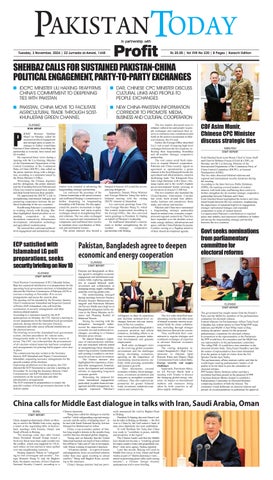
RIME Minister Shehbaz Sharif on Monday called for sustained political engagement and stronger party-to-party exchanges to further consolidate Pakistan-China relations, describing the partnership as ironclad, time-tested and all-weather. He expressed these views during a meeting with Mr Liu Haixing, Minister of the International Department of the Central Committee of the Communist Party of China (IDCPC), who called on the prime minister along with a delegation, according to a statement issued by the Prime Minister’s Office. Welcoming the Chinese dignitary and his delegation, the prime minister said the friendship between Pakistan and China was rooted in mutual trust, respect and deep bonds between their peoples. He appreciated the IDCPC’s role in strengthening institutional linkages and promoting cooperation between the political leadership of the two countries. Reaffirming Pakistan’s commitment to working closely with Beijing, Shehbaz highlighted shared priorities in expanding cooperation in trade, investment, connectivity, infrastructure development, information technology and agricultural modernisation. He stressed that continued politicallevel engagement and institutional coop-
eration were essential to advancing the longstanding strategic partnership. Liu conveyed the greetings of the Chinese leadership to the prime minister and reaffirmed Beijing’s commitment to further deepening its longstanding friendship with Pakistan. He also appreciated the positive momentum in highlevel engagements and party-to-party exchanges aimed at strengthening bilateral relations. The two sides exchanged views on regional and international developments and reaffirmed their resolve to maintain close coordination at bilateral and multilateral forums. The prime minister also hosted a
ECP satisfied with Islamabad LG poll preparations, seeks security briefing on Nov 10 ISLAMABAD
STAFF REPORT
Chief Election Commissioner (CEC) Sikandar Sultan Raja has expressed satisfaction over preparations for the upcoming local government elections in Islamabad and directed the Election Commission of Pakistan (ECP) to convene a meeting on November 10 to review arrangements and assess the security plan. The meeting will be attended by the Secretary Interior, Chief Commissioner Islamabad and Inspector General of Police (IGP) Islamabad, who will brief the commission on security arrangements and other election-related matters. According to a statement issued by the ECP spokesperson on Monday, the CEC chaired a meeting to review preparations for the Islamabad local government elections, during which the Secretary Election Commission and other senior officials briefed him on the electoral process. The briefing covered the Islamabad local government system, election procedures for various seats, arrangements made so far and the future course of action. The CEC was informed that the procurement of all election-related materials had been completed and arrangements for printing ballot papers were also in place. The commission has also written to the Secretary Interior, IGP Islamabad and Deputy Commissioner Islamabad, requesting necessary arrangements for the smooth conduct of the elections. Expressing satisfaction over the progress, the CEC directed the ECP Secretariat to convene a meeting on November 10, inviting the Secretary Interior, Chief Commissioner and IGP Islamabad to brief the commission on the security plan and other administrative arrangements. The ECP reiterated its preparedness to ensure the peaceful conduct of local government elections in the federal capital.
banquet in honour of Liu and the accompanying delegation. Separately, Deputy Prime Minister and Foreign Minister Ishaq Dar held a bilateral meeting with the visiting IDCPC minister in Islamabad. Liu conveyed greetings from Chinese Foreign Minister Wang Yi, which Dar warmly reciprocated, according to the Foreign Office. Dar also conveyed warm greetings to President Xi Jinping on behalf of Pakistan’s leadership. He reaffirmed Islamabad’s commitment to further strengthening the allweather strategic cooperative partnership with Beijing.
The two leaders discussed ways to enhance cultural ties and people-to-people exchanges and expressed their resolve to maintain close coordination and build on the positive momentum in bilateral relations, the FO said. Earlier, the Foreign Office described Liu’s visit as part of ongoing high-level exchanges between the two countries, reflecting their longstanding friendship and all-weather strategic cooperative partnership. The visit comes amid fresh initiatives to expand bilateral cooperation. Pakistan and China recently signed an agreement to operationalise a green channel at the Sost-Khunjerab border for agricultural and allied products, aimed at facilitating trade. The Khunjerab Pass links Gilgit-Baltistan with China’s Xinjiang region and is the world’s highest paved international border crossing, at an elevation of around 15,500 feet. The two countries also launched the China-Pakistan Information Corridor last week, built around four pillars: media, business and enterprises, think tanks, and culture and tourism. Pakistan and China have maintained a longstanding strategic partnership based on mutual trust, economic cooperation and regional connectivity. Their ties have expanded over the decades across trade, energy, defence, infrastructure and space, with the China-Pakistan Economic Corridor serving as a flagship initiative of their shared development agenda.
Pakistan, Bangladesh agree to deepen economic and energy cooperation ISLAMABAD
CDF Asim Munir, Chinese CPC Minister discuss strategic ties RAWALPINDI
STAFF REPORT
Field Marshal Syed Asim Munir, Chief of Army Staff and Chief of Defence Forces (COAS & CDF), on Monday met Mr Liu Haixing, Minister of the International Department of the Communist Party of China Central Committee (IDCPC), at General Headquarters (GHQ). The two sides discussed bilateral relations and regional and international security dynamics during the meeting. According to the Inter-Services Public Relations (ISPR), the meeting covered matters of mutual interest, with both sides reaffirming their resolve to further strengthen the all-weather strategic cooperative partnership between Pakistan and China. Field Marshal Munir highlighted the historic and timetested bonds between the two countries, emphasising the importance of sustained high-level engagement, stronger institutional linkages and expanded cooperation in areas of mutual interest. Liu appreciated Pakistan’s contributions to regional peace and stability and expressed confidence in further advancing the longstanding strategic partnership between the two countries.
Govt seeks nominations from parliamentary committee for electoral reforms
STAFF REPORT
Pakistan and Bangladesh on Monday agreed to strengthen economic engagement and institutional cooperation while exploring opportunities to expand bilateral trade, investment and collaboration in managing energy supply challenges amid the evolving global crisis. The understanding emerged during meetings between Finance Minister Senator Muhammad Aurangzeb and Petroleum Minister Ali Pervaiz Malik and a high-level Bangladeshi delegation led by Adviser to the Prime Minister on Finance and Planning Rashid Al Mahmud Titumir. During his meeting with the delegation, Aurangzeb underscored the importance of closer economic ties and institutional exchanges, according to a Finance Ministry press release. He shared Pakistan’s experience of macroeconomic stabilisation and structural reforms aimed at strengthening fiscal discipline, improving economic fundamentals and creating a conducive environment for private-sector investment. The finance minister also highlighted the importance of prudent debt management, financialsector development and sustained reforms in supporting long-term economic growth. Welcoming the proposal for closer institutional engagement, particularly in public financial management and debt management, Aurangzeb expressed Pakistan’s
ISLAMABAD STAFF REPORT
willingness to share its experience and facilitate technical-level exchanges between relevant institutions of the two countries. Titumir outlined Bangladesh’s economic priorities and reform initiatives, including efforts to attract investment, promote industrial development and generate employment. Both sides exchanged views on the evolving global economic environment and the challenges facing developing economies, agreeing on the importance of maintaining macroeconomic stability while pursuing sustainable and inclusive growth. Their discussions covered economic reforms, fiscal management, investment promotion and measures to strengthen economic resilience. They also explored opportunities for greater bilateral trade, investment, industrial cooperation and connectivity.
The two sides identified manufacturing, textiles and other areas of mutual economic interest as potential fields for closer collaboration, including through stronger links between their private sectors. They reaffirmed their commitment to regular dialogue and continued exchanges of expertise to advance bilateral economic cooperation. The visiting delegation included Bangladesh’s High Commissioner to Pakistan Iqbal Hussain Khan and Deputy High Commissioner Fazle Lohani Babu. Energy security and supply challenges Separately, Petroleum Minister Ali Pervaiz Malik held a meeting with Titumir to discuss the changing global energy situation, its impact on international markets and measures being taken by both countries to address supply challenges.
The government has sought names from the People’s Party and the MQM for members of the parliamentary committee for electoral reforms. Federal Minister for Parliamentary Affairs Tariq Fazal Chaudhry has written letters to Chief Whip PPP Aijaz Jakhrani and MQM’s Chief Whip Amin ul Haq seeking the parties’ names for the proposed parliamentary committee for electoral reforms. In proportion to the representation in the Parliament the PPP would have five members and the MQM has one representative in the parliamentary committee. The ruling PML-N would have nine members in the electoral reforms body. Tariq Fazal Chaudhry said that the names of representatives have been demanded from the parties in light of a letter from the NA Speaker Sardar Ayaz Sadiq. The parliamentary affairs minister earlier said that he would begin meeting parliamentary leaders of all parties to invite them to join the committee on electoral reforms. PPP Senator Sherry Rehman earlier said that a resolution had been passed on the proposal of PPP Chairman Bilawal Bhutto-Zardari to establish a Parliamentary Committee on Electoral Reforms comprising members of both the Houses. The committee would deliberate on electoral reforms and present its recommendations to parliament for approval.
China calls for Middle East dialogue in talks with Iran, Saudi Arabia, Oman BEIJING
STAFF REPORT
China stepped up diplomatic efforts on Monday to resolve the Middle East crisis, urging a return to the negotiating table in back-toback meetings with Iranian, Omani and Saudi officials in Beijing. The meetings come days after United States President Donald Trump issued a fresh war threat more than eight months into the conflict, which was triggered by US-Israeli strikes on Iran and has at times spilled over into neighbouring countries. Beijing supports Tehran in “safeguarding its own sovereignty and security”, Foreign Minister Wang Yi told Ali Bagheri Kani, the deputy secretary of Iran’s Supreme National Security Council, according to a
Chinese statement. Wang later called for dialogue to end the conflict “while safeguarding regional energy security and the safety of shipping lanes”, as he met with Saudi National Security Adviser Musaad bin Mohammad al-Aiban. China, a top economic partner of Iran, has long sought a detente in the months-long conflict that has disrupted global shipping. Trump said on Saturday that the United States had knocked out much of Iran’s military but still has to “take care of” one or two targets, with Tehran warning of reprisals if attacked. “All parties should… in a spirit of reason and pragmatism, focus on a political solution rather than once again resorting to armed conflict,” Wang told Bagheri Kani, according to the statement. China’s foreign ministry had not previ-
ously announced the visit by Bagheri Kani to Beijing. President Xi Jinping also met Oman’s sultan for talks in Beijing on Monday — the first visit to China by the Gulf nation’s head of state since diplomatic ties were established. Xi told Haitham bin Tariq that China was ready to “contribute to peace, stability and prosperity in the region”. The Chinese leader said that the Middle East should not become a “wrestling ground for major-country rivalry and geopolitical conflicts”, state news agency Xinhua reported. Later this month, Beijing will send its Middle East envoy to Iran, Oman and Saudi Arabia as part of “shuttle diplomacy visits… aimed at promoting peace talks (and) easing tensions”, a Chinese foreign ministry spokesperson told a news briefing.
02 NEWS
Tuesday, 3 November, 2026 | KARACHI
NEPRA URGED TO REVISE CONSUMER SERVICE RULES OVER GRID CHARGES, DETECTION BILLS
T
PROFIT
MONITORING REPORT
HE National Electric Power Regulatory Authority (NEPRA) has been urged to revise its proposed amendments to the Consumer Service Manual (CSM) to prevent arbitrary grid-sharing charges, higher industrial connection costs and misuse of detection-billing powers by power distribution companies (DISCOs), Business Recorder reported. In objections submitted to the regulator, Muhammed Arif Bilvani argued that several proposed changes could impose additional financial burdens on electricity consumers without adequate technical justification or procedural safeguards. He opposed the proposed 500 kVA threshold for dedicated transformers, arguing that consumers should not face grid-sharing charges solely because their transformer capacity exceeds the limit. He recommended allowing dedicated transformers of up to 1,000 kVA for eligible consumers without automatic additional charges. Bilvani also questioned the proposed uniform grid-sharing rate of Rs8.948
million per MW, maintaining that charges should reflect actual infrastructure requirements and available grid capacity rather than a fixed rate. He urged NEPRA to ensure that DISCOs do not recover infrastructure costs already included in electricity tariffs and that revised charges apply only to new applications. For industrial connections, the submission proposed allowing 33 kV grid stations for demand below 25 MW and
Zuma Resources eyes tech acquisitions with Rs350m SPAC, free shares for investors PROFIT
NEWS DESK
Zuma Resources Limited, formerly known as Bilal Fibres Limited, has announced plans to establish a Rs350 million special purpose acquisition company (SPAC), tentatively named Zuma SPAC-I Limited, which will seek listing on the Pakistan Stock Exchange (PSX) and offer free shares to existing Zuma shareholders, subject to regulatory approvals. In a notice submitted to the PSX on Monday, the company said its board of directors had approved pursuing the establishment and sponsorship of the proposed SPAC at a meeting held on October 30, 2026. The new entity will focus on merger and acquisition opportunities in technology, artificial intelligence, digital connectivity and other eligible high-growth sectors. A SPAC is an investment vehicle established to raise capital and subsequently acquire or merge with an existing business. As part of the initiative, Zuma Resources intends to distribute a portion of its shareholding in the proposed SPAC to existing shareholders without requiring them to make any subscription payment. The allocation will be proportionate to shareholders' existing holdings in Zuma Resources, although the company has yet to determine the distribution ratio and eligibility date. According to the notice, the proposed arrangement is intended to create additional shareholder value by providing investors with direct ownership in a separately listed investment and acquisition vehicle. However, the distribution of free shares will depend on the successful establishment and proposed listing of Zuma SPAC-I Limited, compliance with sponsorshareholding and transfer restrictions, and the necessary corporate and regulatory approvals. The company will also need to finalise a legally permissible mechanism for transferring or allocating the shares.
66 kV installations for demand below 45 MW, instead of requiring more expensive 132 kV infrastructure where lower-voltage alternatives are technically feasible. The objections also sought a mandatory 15-day notice before the expiry of temporary disconnection periods to prevent consumers from being automatically charged without prior notification. Regarding detection billing, Bilvani proposed requiring DISCOs to provide
itemised calculations and supporting evidence rather than assessing disputed consumption solely on sanctioned load. He recommended suspending recovery of formally disputed detection bills exceeding Rs500,000 for industrial consumers, Rs250,000 for commercial consumers and Rs99,000 for domestic consumers until the relevant authority decides the matter. Such complaints should be resolved within 30 days, while DISCOs should be prohibited from disconnecting consumers over disputed amounts under formal adjudication, provided undisputed current bills are paid. The submission further proposed that irregular, assessed and arrears-related bills be accompanied by explanatory letters detailing the calculations and reasons for additional charges. Bilvani also raised concerns about DISCOs, particularly K-Electric, requiring fresh load surveys for reductions in sanctioned load despite the availability of prescribed technical test reports. He urged NEPRA to clarify the procedure and prevent unnecessary security deposit demands when consumers seek lower sanctioned loads.
US-backed consortium proposes $4.4b LNG project in Pakistan PROFIT
MONITORING REPORT
US-based Global Vision Energy Partners (GVEP) and Khanjee Holdings, alongside Luxembourgbased General Mediterranean Holding and international strategic investors, are pursuing a proposed $4.4 billion investment in Pakistan's LNG sector, with backing from the Trump administration, to develop an integrated LNG import, storage, regasification and transmission network at Port Qasim. Dawn reported that the proposed development comes after Energas, a consortium involving the Lucky Group and QatarEnergy, abandoned a similar LNG project because of changes in Pakistan's energy policies and requirements, alongside unresolved regulatory and fiscal issues. The consortium's proposed investment would establish an LNG terminal and storage facility at Port Qasim, followed by a 1,100-kilometre gas transmission pipeline to supply major consumers across the country. The sponsors have secured consent from the Port Qasim Authority for the proposed project location and submitted an application to the
Oil and Gas Regulatory Authority (Ogra) for a provisional licence. A special purpose vehicle (SPV) has also been incorporated to develop, own and operate the project, while government facilitation has been conveyed through the Ministry of Maritime Affairs and the Petroleum Division. The project has been approved for consideration under the US Trade and Development Agency's project preparation programme. It could also receive partial financing from the US Development Finance Corporation, supported by export credit guarantees from the US Export-Import Bank for equipment, technology and services. The investment is planned in two phases, beginning with the construction of an LNG import, storage and regasification terminal at Port Qasim at an estimated cost of $1.7 billion. The terminal will comprise four storage tanks, each with a capacity of 140,000 cubic metres, providing combined static storage capacity of 560,000 cubic metres. With three inventory turnover cycles annually, the facility is projected to handle approximately 35.6 billion cubic feet (BCF) of LNG each year, with storage capacity of
around 11.9BCF per cycle. The second phase involves constructing a 1,100-kilometre gas transmission pipeline with a diameter of 42 to 48 inches and a transportation capacity of approximately 1.2 billion cubic feet per day. The pipeline would transport gas upcountry, taking the estimated overall project investment to $4.4 billion. Pakistan previously pursued a comparable North-South gas pipeline project in cooperation with Russia. The proposed investment is intended to address a major gap in Pakistan's LNG infrastructure, as the country currently lacks dedicated LNG storage facilities and remains dependent on international supply chains for its regasified LNG requirements. The sponsors also intend to establish Port Qasim as a regional LNG storage and trading hub serving domestic consumers and international suppliers, particularly those based in the United States and the Middle East. The project's location outside the Strait of Hormuz is considered an important advantage because of the shipping disruptions and supply risks associated with the strategic waterway.
LPG prices go through the roof, hit Rs630 per kg against official Rs294 rate PROFIT
MONITORING REPORT
Liquefied petroleum gas (LPG) prices have surged to as high as Rs630 per kilogram in Pakistan's open market, more than twice the official rate of Rs294 per kg notified by the Oil and Gas Regulatory Authority (OGRA) for November. The price surge comes amid supply shortages linked to the USIran war and the closure of the Iranian border, which continue to disrupt the market. While LPG is being sold at up to Rs630 per kg in the open market, company-operated franchises are charging as much as Rs400 per kg, significantly above the government-notified price. In a notification issued on Saturday, OGRA increased the official LPG price for November to Rs294,075 per tonne from Rs279,341 per tonne in October. Following the revision, the official retail price of an 11.8kg domestic LPG cylinder has increased by Rs173 to Rs3,470. The regulator attributed the in-
crease to changes in Saudi Aramco's contract price and the US dollar exchange rate. According to OGRA, the Saudi Aramco contract price rose by 6.47% compared with the previous month, while the average dollar exchange rate declined slightly by 0.12%, resulting in an increase of Rs14.73 per kg in the consumer price. However, the higher open-market prices reflect growing supply constraints, particularly following the closure of the border with Iran. LPG Distributors Association of Pakistan Chairman Irfan Khokhar described the situation as serious, saying that approximately 70% of the country's LPG supplies were imported from Iran, while the remaining 30% were produced domestically. He urged the government to take measures to curb market manipulation and address the supply shortage. Meanwhile, LPG marketing companies have threatened to suspend their operations from November 16 if the government proceeds with a new LPG policy without adequately involving the private sector. Pakistan LPG Marketers Asso-
ciation Chairman Ali Haider warned that companies would observe a strike from November 16 if the proposed policy was implemented. He opposed reversing the deregulation of the LPG sector and maintained that the closure of the Iranian border had already created significant supply difficulties. According to Haider, of approximately 1.3 million tonnes of LPG, only around 225,000 tonnes were imported from the Gulf, with most of those imports handled by private companies. He also pointed out that the ProGas terminal at Port Qasim was under the control of Sui Southern Gas Company, which he said had last imported LPG around seven months earlier. The association has written to Petroleum Minister Ali Pervaiz Malik, objecting to the draft LPG policy submitted to the prime minister without input from private-sector stakeholders. It has called for complete deregulation of the LPG industry and opposed measures that could reduce private-sector participation in imports and distribution.
PIA receives first Boeing 787-9 Dreamliner to expand UK operations PROFIT
MONITORING REPORT
Pakistan International Airlines (PIA) has added its first Boeing 787-9 Dreamliner to its fleet, becoming the first Pakistani airline to operate the aircraft as part of its plans to modernise international operations and expand direct flights to the United Kingdom. As per news reports, the aircraft, acquired on lease from Norse Atlantic Airways last month, arrived at Islamabad International Airport on Sunday as flight PK786 from London. PIA Chief Executive Aamir Hayat, accompanied by senior airline officials, received the aircraft at the airport. The Boeing 787-9 Dreamliner is a longrange, twin-engine aircraft with seating capacity for up to 325 passengers. It features modern in-flight entertainment systems and a spacious cabin designed to improve passenger comfort on longhaul routes. The aircraft is the first of two Boeing 787-9 Dreamliners being acquired under an ACMI agreement signed with Norse Atlantic Airways last month. Under the arrangement, the lessor provides the aircraft, crew, maintenance and insurance. According to a PIA spokesperson, the addition is part of the airline's strategy to modernise its fleet, strengthen its international network and improve passenger services. The new aircraft will primarily support direct longhaul operations between Pakistan and the United Kingdom, allowing the airline to expand connectivity between different destinations in the two countries. PIA also expects the additional capacity to help meet growing passenger demand and support the expansion of its international route network. Before the arrival of the Dreamliner, PIA's fleet comprised 12 Boeing 777 aircraft, 15 Airbus A320 planes and five ATR aircraft. The fleet expansion follows the airline's privatisation last year, when a consortium led by Arif Habib Corporation Limited acquired a 75% stake in PIA through a winning bid of Rs135 billion.
From chicken to vegetables, Lahore consumers pay well above official rates PROFIT
WEB DESK
Consumers in Lahore continue to pay substantially more than government-notified prices for essential food items, with market surveys showing widespread overcharging across poultry, vegetables and fruits despite reductions in official rates. The persistent gap between official and retail prices points to weak enforcement of the Punjab government's price-control measures, with traders quick to pass on price increases but slow to implement reductions, leaving consumers paying more despite government notifications and market inspections. Vegetable prices showed a mixed trend, with some commodities recording increases in official rates and others registering reductions. However, retail prices remained substantially higher across most categories. Sugar-free potatoes became Rs12 per kg more expensive, with official prices fixed at Rs50–54 per kg, but retailers charged Rs80–100 per kg. Tomato prices increased by Rs45 per kg, taking the notified rate to Rs140–175 per kg. In retail markets, tomatoes sold between Rs250 and Rs280 per kg. Onion prices were reduced by Rs10 per kg to Rs185–195 per kg, but consumers continued to pay Rs220–250 per kg. Local garlic increased by Rs10 per kg to Rs230– 240 per kg officially, while retail prices ranged from Rs300 to Rs320 per kg. Chinese garlic was sold at approximately Rs800 per kg against its official rate of Rs410–430 per kg. Harani garlic also recorded an official increase of Rs10 per kg to Rs335–350 per kg, but retailers charged Rs500–600 per kg. Thai ginger prices declined by Rs20 per kg to Rs350–365 per kg, while Chinese ginger was officially priced at Rs305–320 per kg. Both varieties were sold between Rs400 and Rs500 per kg. Farm cucumbers remained unchanged at Rs57–60 per kg but retailed at Rs100–120 per kg. Brinjal became Rs20 per kg more expensive, taking its official price to Rs85–90 per kg, against retail rates of Rs140–160 per kg. Bitter gourd prices were reduced by Rs10 per kg to Rs133–140 per kg, but consumers paid Rs200–250 per kg. Spinach remained officially priced at Rs38–40 per kg, while retail prices ranged between Rs80 and Rs100 per kg. Local zucchini was fixed at Rs162–170 per kg but sold at Rs250–300 per kg, while farm zucchini retailed at Rs150–200 per kg. Methi remained unchanged at Rs105–110 per kg but sold at Rs150–200 per kg.
Pakistan takes over SCO Interbank Consortium chairmanship for 2026-27 PROFIT
WEB DESK
Pakistan has assumed the chairmanship of the Shanghai Cooperation Organisation Interbank Consortium (SCO-IBC) for 2026-27, with HBL Chairman Sultan Ali Allana taking over as chairman of the consortium amid the country's concurrent leadership of the SCO. In a statement issued on Monday, the Ministry of Finance congratulated Allana on assuming the position and reaffirmed Pakistan's commitment to strengthening economic partnerships among SCO member states. The ministry said Pakistan would focus on facilitating cross-border trade and investment, expanding financial coopera-
tion and advancing regional economic integration during its chairmanship. The SCO-IBC serves as a platform
for financial cooperation among SCO member states, supporting sustainable development through collaboration with
multilateral institutions. The consortium also works to promote regional trade and investment and explore financing mechanisms for transnational mega projects. HBL, Pakistan's largest bank, joined the consortium as a partner bank on August 8, 2014, before becoming a full member at its 14th annual council meeting in June 2018. The bank was nominated to chair the SCO-IBC Council for the 2026-27 term during the consortium's annual council meeting held in Bishkek, Kyrgyzstan, on July 2, 2026. The appointment coincides with Pakistan's assumption of the chairmanship of the SCO Council of Heads of State in September 2026.
NEWS 03
PSX SWINGS BETWEEN LOSSES AND GAINS AS INVESTORS WEIGH MIDDLE EAST PEACE PROSPECTS
Tuesday, 3 November, 2026 | KARACHI
T
PROFIT
NeWs Desk
HE Pakistan Stock Exchange (PSX) witnessed sharp fluctuations on Monday, with the benchmark KSE-100 index recovering from steep early losses to trade in positive territory during the afternoon session, as investors assessed declining global oil prices and renewed diplomatic efforts to end the US-Israeli war on Iran. According to the PSX website, the market opened on a weak note, with the benchmark index shedding around 500 points in the opening minutes of trading. Selling pressure subsequently intensified, pushing the index down by more than 800 points to an intraday low of 165,585.42. However, the market reversed its losses during the afternoon session. By 1:50 pm, the KSE-100 index had recovered to 166,734.58 points, with a gain of 325.33
OPEC+ keeps December oil output targets unchanged amid Iran war disruptions
g
BENCHMARK KSE-100 INDEX HITS INTRADAY LOW OF 165,585 BEFORE RECOVERING TO 166,734, UP 325 POINTS OR 0.2%; INDEX GAINED 4,034 POINTS LAST WEEK BUT LOST 3,560 POINTS IN OCTOBER 4,034.37 points, or 2.5%, during the week to close at 166,409.25 points, supported by buying across major sectors. According to AKD Securities, average daily trading volume surged 121% during the week to 1.095 billion shares, reflecting increased market activity amid improving sentiment. Despite the weekly recovery, the PSX ended October in negative territory as geopolitical tensions, foreign portfolio outflows and domestic political uncertainty continued to weigh on investor confidence. The benchmark index declined by 3,560 points, or 2.1%, during the month to close at 166,409 points, according to Arif Habib Ltd (AHL). Domestic uncertainty was heightened by the imposition of emergency and governor's rule in Khyber Pakhtunkhwa,
points, or 0.2%, against the previous close of 166,409.25. The volatility came as global oil prices declined following a third consecutive day of talks between Iranian and Qatari officials aimed at advancing negotiations to end the conflict involving Iran, the United States and Israel. Selling pressure was observed across several sectors, including apparel, automobile parts and accessories, chemicals, insurance, cement, commercial banks, oil and gas exploration, oil marketing companies and refineries. Monday's fluctuations followed a recovery in the previous week, when the PSX ended a five-week losing streak as renewed optimism over regional peace negotiations encouraged investors to return to equities. The benchmark KSE-100 index gained
Pakistan's Fading Green: An overlooked Ecological Crisis
LONDON reuters
OPEC+ agreed on Sunday to keep its oil production targets unchanged for December as disruptions to Gulf exports caused by the Iran war continue, postponing further policy adjustments until next year ahead of a decision on production quotas for 2027. Seven OPEC+ members — Saudi Arabia, Russia, Iraq, Kuwait, Algeria, Kazakhstan and Oman — reached the decision during an online meeting, according to a statement issued by the group. Although Gulf producers have been increasing oil exports following months of disruption caused by the conflict, most continue to produce substantially below their assigned targets. OPEC+, which comprises the Organisation of the Petroleum Exporting Countries and allies including Russia, has 21 members. The seven countries that met on Sunday have been responsible for monthly production decisions in recent years, alongside the United Arab Emirates until it left OPEC in May. All 21 members are scheduled to meet on November 29, when analysts expect the group to determine production quotas for 2027. The decision comes amid uncertainty over global oil supplies and the possibility of further escalation in the US-Iran conflict. Oil prices rose more than 2% on Friday, with Brent crude settling near $118 per barrel, its highest level since April, as traders assessed the risk of renewed hostilities following the US midterm elections. The International Energy Agency and other forecasters have warned that global oil markets could face excess supply in 2027 if disrupted exports from Gulf producers return to normal levels. Jorge Leon, an analyst at Rystad, said the November 29 ministerial meeting would be more consequential because OPEC+ would need to establish its production framework for 2027. He said the group faced uncertainty over the duration of the US-Iran conflict, the pace at which shipments through the Strait of Hormuz could recover and the potential supply surplus once disrupted production returned to the market. The seven OPEC+ members have increased production targets during much of 2026 and completed the phased reversal of a 1.65 million-barrel-perday output reduction in September. The cuts were originally agreed in 2023. The group subsequently maintained production targets for October and November before extending the pause into December.
adding to concerns over the country's political and economic outlook. Topline Securities attributed the monthly decline to geopolitical uncertainty, foreign portfolio outflows, profit-taking in heavyweight stocks and cautious investor sentiment amid volatility in global financial markets and domestic macroeconomic concerns. The market nevertheless recovered towards the end of October, supported by renewed diplomatic efforts to resolve the US-Iran conflict and better-than-expected corporate earnings. Globally, share markets bounced in Asia on Monday as investors hoped for Apple earnings later in the session to provide some relief from AI cash-burn worries, while oil prices slid after talks continued between Iranian and Qatari mediators.
Ali Arif PirAchA
HE rapid urbanization of Pakistan’s major cities, including Lahore, Islamabad, and Karachi, is a pressing concern that demands immediate attention. Over the last few decades, these once vibrant, green, and expansive cities, which were historically known for their lush gardens and treelined boulevards, have been increasingly swallowed by an overwhelming tide of concrete. The fundamental question that arises is: why has this shift occurred, and at what cost? The reality is clear, Pakistan’s green spaces—vital to the physical and mental health of its citizens—are being sacrificed at an alarming rate in the name of progress. As we gaze upon the bustling urban centers of Pakistan, one cannot help but notice the rise in buildings, shopping malls, and housing societies where there was once greenery. These "developments" are often promoted as necessary for the growth and modernization of cities, but the true impact of such growth on the environment is devastating. The socalled expansion is taking place at the expense of the planet and its people. What was once a peaceful space where people could retreat from the
T
daily pressures of life has now become yet another chaotic, concrete jungle. The indiscriminate destruction of green spaces has led to higher temperatures, increased pollution, and an overall decrease in the quality of life for residents. The argument that urban development is essential for economic growth is not without merit, yet it is an argument that fails to account for the deeper consequences of such development. For instance, Lahore, a city that once boasted a rich landscape of gardens and parks, now battles some of the highest levels of air pollution in the world. In Karachi, heatwaves have become an annual nightmare, with rising temperatures exacerbated by the loss of trees and natural shade. Moreover, Pakistan’s cities are experiencing a surge in mental health issues and respiratory problems, largely due to the lack of greenery and the increasing prevalence of air pollution. It is, therefore, not just the aesthetic loss that matters; the erosion of green spaces is a tangible, existential threat to the well-being of the urban populace. Urban planners and policymakers often defend these drastic changes, arguing that cities need infrastructure to accommodate a growing population. However, this myopic viewpoint fails to recognize that growth and development should be balanced with the preservation of the environment. Sustainable urban planning is about more than just the construction of more buildings; it is about creating spaces that allow both nature and humanity to coexist. Green spaces are not luxuries or afterthoughts; they are necessities. What is desperately needed in Pakistan is an overhaul of how urban planning is approached. Policymakers must begin to see the environment as a vital aspect of the city’s infrastructure, one that requires active preserva-
tion and enhancement. The promotion of tree plantations, public parks, and other green initiatives should be prioritized alongside housing and commercial projects. The government must also be prepared to enforce stricter regulations that protect existing green spaces from the bulldozers of “development.” If the current trajectory of urbanization continues unchecked, it will be the citizens, particularly those in urban centers, who will ultimately bear the consequences. Rising temperatures, declining air quality, and reduced mental health are just some of the issues that will continue to plague these cities if the value of green spaces is not understood and acted upon. This crisis is not just one of environmental degradation; it is a social and cultural failure. A city that fails to nurture its green spaces is a city that fails to nurture its people. It is crucial that we begin to think of our urban centers not as sprawling masses of buildings but as ecosystems that must support and enrich the lives of those who inhabit them. The “progress” of tearing down nature in favor of bricks and mortar will ultimately be a hollow one if it leads to the decline of quality of life for urban residents. Ultimately, the question must be asked: what kind of future do we want to create? A city filled with towering buildings and smog-filled air may be the vision of growth, but it is far from the vision of a healthy, vibrant, and sustainable urban space. To safeguard the future of Pakistan’s cities, we must make the preservation of green spaces a central tenet of urban planning. Only then can we ensure that growth does not come at the cost of the environment, health, and the overall wellbeing of the people.
A student from Aitchison College in class A1.
US pushes resumption of Russian gas supplies to Europe through Ukraine WASHINGTON Web Desk
The United States is supporting the resumption of Russian natural gas exports to Europe through pipelines crossing Ukraine as part of negotiations aimed at securing an energy ceasefire before winter, the Wall Street Journal reported, citing American, European and Ukrainian officials. The proposal, discussed by US envoys Jared Kushner and Steve Witkoff during visits to Moscow and Kyiv in September, would involve routing Russian gas sales through an American intermediary to circumvent European sanctions, potentially creating investment opportunities for US companies. According to the report, the arrangement would provide Russia with an incentive to agree to a ceasefire targeting energy infrastructure, while allowing Ukraine to earn transit fees from gas transported through its territory. The White House has also proposed depositing Russian gas export proceeds into an escrow account in a third country to prevent Moscow from using the revenue to finance its war, a senior US official told the newspaper. However, the proposal faces significant opposition from European governments, which have committed to eliminating Russian gas imports by the end of 2027. The European Union has adopted legislation requiring the complete phase-out of Russian natural gas purchases, while leaders of major European countries have opposed restoring energy dependence on Moscow. EU Energy Commissioner Dan Jorgensen has maintained that the restrictions should remain permanent, even if Russia and Ukraine reach a
peace agreement. The initiative was temporarily sidelined last month after Ukraine suspended attacks on Russian oil refineries for nearly two weeks under pressure from President Donald Trump. During that period, Russia continued attacking Ukrainian energy infrastructure, while Washington shifted its attention towards negotiations for a broader peace agreement. Ukraine resumed attacks on Friday, targeting three major Russian refineries over three days, renewing US efforts to negotiate an energy ceasefire ahead of planned trilateral talks involving Washington, Moscow and Kyiv in Abu Dhabi in mid-November. Russia has so far rejected American attempts to secure such an agreement, according to the report. The proposed arrangement would use the Soviet-era pipeline network connecting Russia's Siberian gas fields to European markets through Ukraine, Slovakia and onward to Austria and Germany. Unlike the Nord Stream pipelines, which were damaged in underwater explosions in September 2022, the Ukrainian transit network could resume operations relatively quickly. Limited gas deliveries continued through the system until January 2025. The Wall Street Journal reported that Washington also considers the eventual reopening of Nord Stream a possible component of a broader settlement addressing the conflict and Russia's relations with European countries. Europe has significantly reduced its reliance on Russian natural gas since the invasion of Ukraine. Russia now accounts for approximately 11% of European gas supplies, compared with 45% before the war.
Japan's Nikkei firmed 0.3%, while South Korea added 2.6%, having shed 16% last month. MSCI's broadest index of AsiaPacific shares outside Japan rose 0.5%. China's battered blue chips gained 1.3% after media reports said regulators would meet financial institutions to discuss measures to support capital markets. In Europe, EUROSTOXX 50 futures rose 0.3%, while DAX futures firmed 0.2% and FTSE futures were flat. Oil prices slipped more than 3% on Monday after Iranian and Qatari officials held a third straight day of talks aimed at pushing for a deal to end the US-Israeli war on Iran. Brent crude futures fell $3.43, or 3%, to $110 a barrel by 0712 GMT, while US West Texas Intermediate crude fetched $100.62 a barrel, down $3.50, or 3.4%. Brent ended October at its highest in six months amid concerns that the US-Iran conflict could escalate again after Tuesday's US midterm elections.
FBR declares thousands of taxpayers inactive over failure to file returns Tax experts say taxpayers seeking filing extensions also affected as revenue collection falls short of targets PROFIT
Web Desk
The Federal Board of Revenue (FBR) has changed the status of thousands of taxpayers from active to inactive after they failed to submit their income tax returns by the October 31, 2026, deadline, including individuals who had applied for additional time to file their returns. The action was taken with immediate effect following the expiry of the twice-extended deadline for filing income tax returns. Tax experts claimed that the change in status had also affected taxpayers who submitted applications on October 31 seeking an extension beyond the prescribed deadline. These taxpayers were declared inactive despite having applied for additional time to submit their returns. The enforcement action comes as the FBR continues to face a shortfall in revenue collection during the current fiscal year. The tax authority collected Rs4.06 trillion during the first four months of fiscal year 2026-27, falling Rs124 billion short of its July-October target despite registering a 6% increase compared with the corresponding period last year. Provisional figures compiled until October 30 showed that tax receipts increased by Rs220 billion year-on-year, considerably below the 17.4% growth required to meet the annual revenue collection target. The government has set an FBR tax collection target of Rs15.263 trillion for FY27 under its programme with the International Monetary Fund (IMF). For October alone, the FBR collected Rs974 billion against its assigned target of Rs1.132 trillion, resulting in a shortfall of Rs158 billion. Monthly revenue increased by only Rs23 billion, or 2.5%, compared with October of the previous fiscal year, reflecting slower growth in tax receipts.
04 COMMENT
The growing burden of anxiety in Pakistan
Precarious balance
T
HE world is precariously balanced between an increasingly urgent diplomatic effort and the possibility of renewed war in the Middle East, with decisions taken over the coming days carrying implications well beyond the states directly involved. After eight months of conflict, the costs extend through energy supplies, shipping routes and household budgets, leaving countries with little influence over military decisions exposed to their consequences. Reports of possible nuclear escalation remain unverified, but they revive a fear that has accompanied this conflict throughout, adding urgency to efforts to prevent further fighting. China’s meetings with Iranian, Saudi and Omani leaders, alongside plans for further shuttle diplomacy, indicate that regional concerns are receiving sustained attention at the highest levels. Continued exchanges between Washington and Tehran through mediators are also significant, even though a breakthrough remains elusive. These efforts need a practical purpose: narrowing differences, establishing credible assurances and creating conditions in which neither side regards renewed military action as its preferred option. Diplomatic activity offers encouragement, but its value will depend on whether it changes the calculations of those able to resume hostilities. All this unfolds against the background of the American midterm elections, with polling pointing towards Democratic gains while leaving control of the Senate uncertain. A changed Congress could strengthen scrutiny of the administration and complicate its legislative programme, although electoral setbacks would not automatically produce restraint abroad. The danger lies in allowing political timing to shape decisions whose human and economic consequences will outlast any campaign. Governments and populations will watch the next several days with understandable anxiety, hoping that the electoral calendar creates room for negotiation rather than merely determining when military pressure resumes. Pakistan’s contribution to keeping diplomatic channels open deserves recognition, particularly its work with regional partners to encourage dialogue between Washington and Tehran. Its continuing engagement with China offers scope for closer coordination, as Beijing intensifies its own attempts to bring the parties back towards negotiations. Islamabad should continue using its relationships to sustain communication, reduce mistrust and support workable compromises, while recognising that the final decisions rest with the principal parties. For a country exposed to regional insecurity and external economic shocks, this is a responsibility grounded in national interest. Pakistan has a constructive role to play in sustaining these efforts, and the hope must be that sense prevails.
A
MuhaMMad Mohsin iqbal
child enters the world without an understanding of fear, uncertainty or responsibility. His days are governed by immediate needs, and tomorrow holds no particular threat. But as childhood gives way to adolescence and adulthood, the mind gradually becomes occupied with questions about education, employment, financial security, family responsibilities and social standing. What begins as a natural concern for the future can eventually become a persistent psychological burden. In a society where economic insecurity and social pressures are widespread, the ability to preserve mental well-being is becoming an increasingly difficult undertaking. At every stage of life, anxieties assume a different form. Students worry about examination results, admission to reputable institutions and the expectations of their parents. Those who struggle academically may become apprehensive about their prospects of finding employment and earning a respectable livelihood. For graduates, the transition from education to professional life often brings the frustration of unemployment and uncertain opportunities. Later, marriage, raising children, meeting household expenses and caring for ageing parents introduce further responsibilities. Even a medical emergency within a family can destabilise an otherwise settled household, particularly when treatment is beyond its financial means. These concerns are not unusual in themselves; they are part of the human experience. The real danger emerges when pressures accumulate without adequate emotional, social or financial support. Persistent anxiety can develop into depression and other mental health conditions, impairing an individual’s ability to work, maintain relationships and participate constructively in society. Yet mental distress often remains invisible. Many people continue their daily routines while concealing their suffering, partly because society is more accustomed to judging emotional vulnerability than understanding it. The figures presented before Pakistan’s National Assembly offer a disturbing indication of the scale of the problem. The number of people suffering from mental health conditions reportedly increased from
Dedicated to the legacy of late Hameed Nizami
Arif Nizami (Late) Founding Editor
Why jobs mean security! M. A. Niazi
Babar Nizami
Editor Pakistan Today
Editor Profit
I
Fareed KaKar
N Gwadar, a young man we will call Asad wakes up each morning to the sound of the sea, with nowhere to go. He holds a diploma in electrical work and has watched every online tutorial he can find. By ten o’clock he is at a tea stall, where he can see the cranes of the new port. By noon, the talk turns, as it does most days, to who has left for Karachi, who is trying for the Gulf and who has given up. Asad is not angry. He is waiting. The question for Pakistan is what will fill the space where his work should be. Asad is one of nearly six million Pakistanis looking for work. The latest Labour Force Survey puts unemployment at 7.1 per cent, and close to 13 per cent among people aged 15 to 24. Among women with university degrees, almost one in four cannot find a job. These numbers are usually seen as an economic problem. They are also a security concern. A job gives a young person more than an income. It gives a daily purpose, a place in the community and a stake in the future. When that is missing for too long, the empty hours fill with something else, whether frustration, migration, crime or the influence of those who exploit anger. Every job adds a little to stability. Every year of waiting adds a little to risk. Many Chinese families will recognise Asad’s situation from their own history. Not long ago, millions of young people in rural China faced the same choice between leaving home and waiting. China responded early. Its rise is often described through large factories and coastal cities, but much of its social stability was built on a smaller scale. In the 1980s, township and village enterprises gave millions of farmers factory jobs close to home. Later, China made employment a top economic priority and treated a steady job as the most reliable way out of poverty. One part of this experience deserves more attention abroad. During its campaign against poverty, China brought work to villages instead
of sending villagers to distant cities. Small poverty alleviation workshops opened in unused schools, courtyards and village halls. Larger companies supplied the orders and bought the finished products. In Heze, a city in Shandong province, more than 3,000 such workshops employed over 37,000 villagers by 2020. A mother could sew garments or assemble parts in the morning, collect her children from school at noon and still help with the harvest. CPEC 2.0 can apply this lesson. The first phase built roads and power plants that now support Pakistan’s economy. The second phase, with its focus on industry, agriculture and livelihoods, can support its people more directly. I propose that Pakistan and China launch a programme called Workshops Next Door. The idea is simple. Firms in the special economic zones would not keep every stage of production inside the zones. Lighter work, such as stitching, packing, sorting, food processing and small assembly, would move to certified workshops in nearby districts. Each workshop would be linked to an anchor company that guarantees orders, sets quality standards and trains workers. Provincial governments would provide buildings, such as unused schools or community halls. Chinese partners would share their experience of running such workshops at scale. The programme should first serve those who are furthest from opportunity. These include women who cannot travel far for work,
Tuesday, 3 November, 2026
30 million in 2019 to 32.4 million in 2023. Against this growing burden, the country has only 1,050 registered psychiatrists. Of these, 406 serve in Punjab, 228 in Sindh, 122 in Khyber Pakhtunkhwa and just 44 in Balochistan. The disparity between the scale of need and the availability of professional assistance raises serious questions about the capacity of the public healthcare system to respond to this challenge. The shortage is not merely a matter of numbers. Access to mental healthcare is further restricted by geographical inequalities, financial constraints, limited institutional facilities and the social stigma attached to psychological illness. In smaller towns and rural communities, specialist services are often difficult to obtain. Even in urban centres, treatment may remain unaffordable for families already struggling with basic necessities. Consequently, many people either postpone seeking assistance or suffer in silence until their condition becomes more difficult to manage. Pakistan’s economic circumstances have added another dimension to this crisis. According to the World Bank figures cited for 2025, the national poverty rate reached 29 per cent, compared with 22 per cent in 2019. The report attributes the increase to inflation, rising prices of essential commodities, unequal distribution of resources and declining incomes among workers. It further estimates that 72.6 million people were living below the poverty line in 2024. Behind these figures are households making difficult choices between food, education, healthcare and other basic requirements. Poverty is not simply an absence of money; it is also an enduring source of uncertainty. A father unable to meet his children’s educational expenses, a young graduate unable to secure employment despite years of study, or a daily-wage worker uncertain about tomorrow’s earnings may experience a level of stress that gradually affects the entire household. Financial insecurity can strain marriages, disturb family relationships and deprive children of the emotional stability essential for their development. When economic hardship becomes prolonged, hope itself can begin to diminish. There is, therefore, a close relationship between economic well-being and mental health. An individual struggling with depression or persistent anxiety may find it difficult to perform professionally, make sound decisions or sustain productive relationships. At the same time, unemployment, poverty and financial uncertainty can intensify psychological distress. The two conditions can reinforce one another, creating a cycle that is difficult to break without institutional support and timely intervention. Addressing this challenge requires more than advising people to remain patient or optimistic. Personal resilience matters, but it cannot compensate for the absence of employment opportunities, affordable healthcare and social protection. A comprehensive national response must recognise mental health as an essential component of public health rather than a secondary concern. Government hospitals need more psychiatrists, clinical psychologists and trained counsellors. Mental
young people in small towns, and families in Balochistan and the less developed districts of every province. Training should be practical and paid, so that people earn while they learn. CPEC 2.0 should also measure its results in jobs. Alongside megawatts and kilometres, each new project could report the number of jobs created for every million dollars invested, and how many of them went to local people. A districtlevel jobs map, updated every year, would show where the corridor is improving lives and where more effort is needed. Security is often discussed in terms of borders and weapons. Yet much of it is shaped in ordinary places, such as a tea stall at noon, a mother deciding between work and her children, or a young man wondering whether tomorrow will be any different. China’s experience shows that a country becomes more stable one job at a time. Pakistan and China can now share that lesson along the corridor they have built together. Asad should not have to choose between leaving home and waiting at the tea stall. One day soon, a workshop down the road should be offering him work. Asad is a fictional name. His story represents many young people across Pakistan.
The author is a research associate at the Centre of Excellence for CPEC, Ministry of Planning, Development and Special Initiatives, Pakistan. His work focuses on socio-economic development and people-to-people connectivity under CPEC 2.0. He can be reached at fareedkakar@pide.org.pk
CPEC 2.0 can apply this lesson. The first phase built roads and power plants that now support Pakistan’s economy. The second phase, with its focus on industry, agriculture and livelihoods, can support its people more directly. I propose that Pakistan and China launch a programme called Workshops Next Door.
health services should be incorporated into primary healthcare, while educational institutions should provide appropriate counselling facilities to help students cope with academic pressure and emotional difficulties. Public awareness is equally important. Psychological illness should not be treated as a source of embarrassment or a failure of personal character. Families must learn to recognise signs of emotional distress and respond with understanding rather than criticism. Employers and educational institutions should promote healthier environments in which individuals can discuss their difficulties without fear of discrimination. Early intervention, affordable treatment and community-based support can prevent many conditions from becoming severe. Economic policy must also form part of the broader response. Controlling inflation, expanding employment opportunities, protecting workers’ purchasing power and ensuring a fairer distribution of resources are not merely economic objectives; they are also measures that can strengthen the psychological security of society. Development loses much of its meaning when ordinary citizens remain uncertain about their ability to afford food, education, housing and medical treatment. Faith, family bonds, gratitude and a sense of purpose can provide individuals with valuable emotional strength. Physical activity, adequate sleep, meaningful social interaction and a balanced routine can also contribute to psychological well-being. Nevertheless, spiritual encouragement and personal discipline should complement professional care, not replace it when medical intervention is necessary. The progress of a nation cannot be measured exclusively through economic growth, infrastructure or the strength of its institutions. It must also be judged by the security, dignity and peace of mind enjoyed by its citizens. Worries are an unavoidable part of life, but a society should not allow them to become an unbearable burden. Pakistan’s growing mental health challenge demands a response that combines economic reform, accessible healthcare, public awareness and compassion. The ultimate measure of development is not merely how much a nation produces or possesses, but how securely and peacefully its people are able to live. The writer is freelance columnist
Editor’s mail
Send your letters to: Letters to Editor, Pakistan Today, 4-Shaarey Fatima Jinnah, Lahore, Pakistan. E-mail: letters@pakistantoday.com.pk Letters should be addressed to Pakistan Today exclusively
Connect education with employment
PAKISTAN’S education system needs to place greater emphasis on practical skills that correspond with the requirements of the modern labour market. Although academic qualifications remain important, employers increasingly seek individuals who can demonstrate technical knowledge and workplace competence. Training in information technology, artificial intelligence, data analysis and cybersecurity could create additional employment opportunities for young people. However, training programmes must focus on developing useful capabilities rather than merely issuing certificates. Universities and colleges should establish partnerships with businesses to provide internships, professional training and practical projects. Students from disadvantaged backgrounds must also be given opportunities to participate. SANA MAHMOOD ISLAMABAD
Address Punjab’s air pollution
AIR pollution has become a recurring public health concern across Punjab, particularly during the winter months. Emissions from vehicles, industrial facilities, brick kilns and agricultural activities contribute to deteriorating air quality and expose millions of residents to harmful pollutants. Children, elderly citizens and individuals suffering from respiratory illnesses are particularly vulnerable. Pollution also affects outdoor workers and disrupts educational and commercial activities. Authorities must adopt a comprehensive strategy involving stricter emission standards, regular industrial inspections and improved public transport. Farmers should receive assistance in adopting alternatives to crop residue burning. USMAN TARIQ SIALKOT
Improve electricity outage reporting
UNANNOUNCED electricity interruptions continue to create problems for households and businesses in Karachi. Consumers frequently struggle to obtain accurate information about the reasons for outages and the expected restoration of supply. Electricity disruptions affect commercial operations, household activities and essential services. The absence of timely updates makes it difficult for residents to plan their daily routines. K-Electric should improve communication with consumers by providing accurate outage notifications, restoration estimates and accessible complaint facilities. Greater coordination with construction agencies is also necessary to prevent damage to electricity infrastructure during development projects. Transparent communication and prompt responses to complaints would help improve consumer confidence in electricity services. FAHAD RAZA KARACHI
Prepare cities for extreme heat
Lahore – Ph: 042-36300938, 042-36375965
I
Karachi – Ph: 021-32640318 I
Islamabad – Ph: 051-2204545
I
RISING temperatures and prolonged heatwaves have increased the risks faced by communities across Pakistan. Extreme weather conditions affect public health, economic productivity and the daily lives of people who lack access to adequate cooling facilities. Low-income households and outdoor workers face particular difficulties because they often cannot afford protective measures or avoid exposure during the hottest parts of the day. Local administrations should establish heatwave response plans, including drinking water stations, public shelters and timely weather warnings. Employers must introduce appropriate safety measures for outdoor workers, while urban planners should prioritise green spaces and better building designs. MARIAM KHALID HYDERABAD
Web: www.pakistantoday.com.pk
I
Email: editorial@pakistantoday.com.pk
COMMENT 05
The Crypto Heist Tuesday, 3 November, 2026
T
The immediate aftermath resembled a financial thriller unfolding across continents. Binance suspended withdrawals, cybersecurity specialists mobilized, stablecoin issuers rushed to freeze suspicious assets, and investigators pursued transactions through interconnected digital networks. Approximately $2.8 billion was reportedly immobilized, while billions more remained outside immediate recovery. The company promised to compensate customers, but the extraordinary spectacle raised a terrifying question: if billions could escape through a compromised access point, what protection could ordinary investors realistically expect from an industry entrusted with enormous private fortunes? The tremors quickly reached cryptocurrency markets. Bitcoin reportedly plunged below $80,000, Ethereum weakened, and crypto-related companies faced renewed selling pressure. Investors who had been encouraged to regard digital currencies as the future of money suddenly confronted an uncomfortable possibility: the same technology that promises instant global financial freedom can also accelerate the disappearance of stolen wealth. The reported heist threatened something far more valuable than the missing billions. It threatened confidence in the architecture of an emerging financial system. But behind this spectacular robbery lies another story, one involving the White House, enormous private fortunes, politically connected investors and a president who transformed himself from cryptocurrency skeptic into its most influential political champion. Donald Trump once dismissed Bitcoin as potentially fraudulent and dangerous. Yet his second presidency embraced cryptocurrency with extraordinary enthusiasm, promising to establish the United States as the global capital of digital assets. What had once been portrayed as a speculative financial experiment became an instrument of national economic ambition, presidential promotion and substantial private commercial opportunity. The transformation was accompanied by a profound political contradiction. While the administration encouraged the expansion of cryptocurrency and adopted a more industry-
Qamar Bashir
HE greatest financial robbery of the digital age unfolded without a single gunshot, masked robber, armored vehicle or broken vault. In a breathtaking operation reportedly lasting barely twenty minutes, cybercriminals penetrated the digital defenses of Binance, the world’s largest cryptocurrency exchange, and transferred $6.3 billion across a maze of electronic networks. By the time alarm bells sounded, billions had vanished into a financial wilderness where money moves at lightning speed, identities hide behind encrypted addresses, and international borders offer little resistance. The robbery was so audacious that investigators described it as potentially the largest financial heist in human history. The trail reportedly began with something astonishingly ordinary: an engineer’s compromised laptop. Behind that seemingly insignificant breach lay a sophisticated operation capable of penetrating digital wallets, manipulating access privileges and transferring enormous fortunes across multiple blockchain networks. The suspected attackers did not need to physically enter a bank or overpower security guards. They needed access to the right digital credentials. Once inside, the financial equivalent of a vault containing billions could allegedly be emptied before conventional human intervention could catch up. As investigators followed the electronic footprints, suspicion reportedly converged on TraderTraitor, a notorious hacking organization associated with North Korea. Blockchain intelligence specialists identified similarities with earlier cryptocurrency thefts attributed to Pyongyang, including the spectacular $1.5 billion Bybit robbery in 2025. Yet the identity of the perpetrators remained an investigative assessment rather than a conclusively established fact. President Donald Trump himself acknowledged that Washington was examining the incident without confirming North Korean responsibility. The criminals’ identities remained uncertain, but the vulnerability exposed by the reported attack was impossible to ignore.
friendly enforcement approach, the president’s own family developed extensive commercial interests in the same financial ecosystem. According to the financial disclosures described in BBC reporting, Trump’s cryptocurrency-related income for 2025 exceeded $1.4 billion, including hundreds of millions from token royalties and World Liberty Financial. The president promoting the digital financial revolution was therefore closely connected, through family enterprises and disclosed income, to its commercial rewards. A conventional international financial transfer may encounter banks, compliance officers, suspicious-activity monitoring and opportunities for intervention. Cryptocurrency transactions can travel through automated networks around the clock, sometimes becoming effectively irreversible within minutes. Criminals exploiting stolen credentials may disperse assets among numerous wallets, exchange them across networks and convert them into forms that are increasingly difficult to freeze. The very efficiency that attracts legitimate investors can become an extraordinary advantage for technologically sophisticated thieves.
The geopolitical implications are chilling. Governments spend billions protecting military installations, financial institutions and strategic infrastructure, yet a compromised laptop or stolen credential may provide access to digital fortunes of comparable strategic importance. The political implications for Trump are equally uncomfortable. His administration cannot credibly champion cryptocurrency as the foundation of American financial leadership while overlooking the necessity of strong investor protections and enforceable cybersecurity standards. Nor can public concerns about conflicts of interest simply be dismissed when the president’s family has substantial financial exposure to the industry affected by government policy. The White House maintains that the president’s business interests are independently managed and that official decisions serve the national interest. Such assurances deserve scrutiny through transparent oversight rather than acceptance or rejection of political loyalty alone. The most disturbing possibility is that the Binance episode may be remembered not
A conventional international financial transfer may encounter banks, compliance officers, suspicious-activity monitoring and opportunities for intervention. Cryptocurrency transactions can travel through automated networks around the clock, sometimes becoming effectively irreversible within minutes. Criminals exploiting stolen credentials may disperse assets among numerous wallets, exchange them across networks and convert them into forms that are increasingly difficult to freeze.
The Gulf goes to Tehran Regional ownership is a slogan until someone can help stop a war
O
Saudi oil facilities, airports and desalination plants sit within reach of Iranian weapons. Another round of war could expose them regardless of how closely Riyadh coordinates with Washington
MIDDLE EAST MONITOR Jasim al-azzawi
N 26 October, senior officials from three of Washington’s regional security partners flew to Tehran and sat down with its fiercest adversary. Saudi Defence Minister Prince Khalid bin Salman led the delegation, joined by Turkey’s intelligence chief, Ibrahim Kalin, and Pakistan’s army chief, Field Marshal Asim Munir. They met Iranian President Masoud Pezeshkian, Foreign Minister Abbas Araghchi and Mohsen Rezaei, secretary of Iran’s Supreme National Security Council. The United States was not in the room. The visit came amid warnings of renewed American strikes after the US midterm elections on 3 November. President Donald Trump had told supporters that Washington might launch “another little Epic Fury”, a reference to Operation Epic Fury, the US military campaign against Iran launched alongside Israel on 28 February. Subsequent reporting said regional allies had been briefed on possible short, intense attacks and the retaliation they might provoke. No final decision had been announced. For Riyadh, however, the danger was immediate enough to warrant a direct approach to Tehran. The visitors represented the three signatories of the Mecca Joint Defence Agreement, signed on 7 August. Its text treats an external armed attack on one party as an attack on all, while leaving the nature and extent of assistance to the parties’ assessment. Turkish President Recep Tayyip Erdogan says it should not be viewed as “an alliance established against Iran, Israel or any third country”. Turkish Foreign Minister Hakan Fidan has presented a wider regional security framework as a path towards lasting stability. Less than three months after signing the pact, its members were pursuing deterrence and dialogue together. Riyadh framed the trip as crisis management. Its foreign ministry said the aim was to “de-escalate between the parties to the current crisis”. Rezaei described “a very positive atmosphere” and said the participants agreed that regional countries should provide regional security without outside interference. They would keep talking. The public accounts of the meeting, however, offered no timetable or enforce-
able arrangement for de-escalation. Rezaei later claimed that Prince Khalid had warned Israel might eventually target Turkey and Saudi Arabia. That remains the Iranian official’s account, not a publicly confirmed Saudi statement. For Riyadh, Yemen was an urgent test. Alhurra, the US government-funded Arabic-language broadcaster, reported that attacks by Yemen’s Houthi movement (Ansarallah) since September had left at least 17 people dead in Saudi Arabia, injured hundreds and disrupted thousands of flights. During the Tehran meetings, the Houthis claimed further attacks on Riyadh’s airport and pumping stations along the East-West pipeline. Those claims could not be independently verified. The Saudi-led coalition separately reported intercepting five ballistic missiles directed towards Riyadh and the kingdom’s east, as well as drones aimed at its south. The pipeline gives the threat strategic weight. It carries Saudi crude to the Red Sea, providing an export route that bypasses the Strait of Hormuz. Araghchi had said on 20 October that neither Riyadh nor the Houthis had responded to Iran’s mediation initiative. The Tehran meeting produced no publicly announced agreement to stop the attacks. Regional sources briefed on the discussions told the Abu Dhabi-based newspaper The National that Saudi Arabia and its partners had asked Iran to restrain the Houthis. At the same time, Iranian interlocutors maintained that Tehran lacked the leverage to compel them. That distinction matters. Iran’s relationship with the Houthis gives it influence; it does not establish that Tehran can order every attack to begin or end. Gregory Gause of the Washington-based Middle East Institute, speaking to Alhurra, identified a further constraint: neither Turkey nor Pakistan was willing to apply military or economic pressure on Iran. Their ability to change Tehran’s calculations was therefore limited. Riyadh wanted Iranian help in extending any Gulf understanding to Yemen. Whether Tehran could deliver that, and on what terms, remained unresolved. Diplomacy nevertheless continued. Qatari mediators visited Tehran on 30 October. By 1 November, Araghchi said his deputy had travelled to Qatar for further consultations, while ruling out a planned direct meeting with American representatives. Discussions over regional hostilities and the reopening of Hormuz had not yet produced an announced agreement. The channel remained active, but its results remained uncertain. The defence pact carries its own constraints. Turkish parliamentary scrutiny was still under way in late October, and the agreement’s text makes entry into force dependent on ratification by all parties. Its collective defence language is not an automatic order to dispatch troops. Turkish officials have stressed that military action remains subject to national decisions and parliamentary requirements. That caution is consistent with the diplomatic mission. Ankara and Islamabad want to support
Riyadh without committing themselves to an open-ended confrontation with Iran or the Houthis. Gönül Tol of the Middle East Institute told Alhurra that the three partners possessed limited leverage over either Washington or Tehran. Ultimately, she argued, preventing further escalation depended on an agreement between those two capitals. Pezeshkian’s visit to Moscow on 27 October invited another interpretation: that Tehran was assembling a counterweight to Washington. The setting supports a narrower conclusion. He was attending the Gas Exporting Countries Forum summit, where Qatar’s emir, Sheikh Tamim bin Hamad Al Thani, also met Russian President Vladimir Putin. The visit showed diplomatic coordination, but did not, by itself, establish a new security alignment. The language was nonetheless pointed. Pezeshkian said regional problems could be resolved “without the United States.” Putin expressed hope that conditions would improve. Following Russian Foreign Minister Sergey Lavrov’s earlier visit to Tehran, Araghchi had said Iran and Russia had never worked so closely. These were meaningful signals of partnership, not evidence that Moscow could deliver a regional settlement. Washington, meanwhile, kept diplomacy and military pressure in play. On 30 October, Trump called the conflict “a war, but it’s not a typical war” and said the United States still had time to negotiate. The following day, US Secretary of State Marco Rubio said Trump had made no decision on further strikes and preferred a diplomatic solution. He also reaffirmed American defence commitments to Saudi Arabia. Fidan’s meeting with Rubio at the G20 foreign ministers’ meeting in Atlanta underscored the point: the Tehran channel had not replaced communication with Washington. So what is this? Not an anti-American bloc. It is a hedge against the possibility that American and Iranian decisions will leave neighbouring states absorbing the damage. Saudi oil facilities, airports and desalination plants sit within reach of Iranian weapons. Another round of war could expose them regardless of how closely Riyadh coordinates with Washington. As Anna Jacobs of the Arab Gulf States Institute in Washington told Alhurra: “These countries know they need to find a modus operandi with Iran.” The test is not whether every Houthi attack stops immediately, nor whether one round of talks produces a comprehensive peace. It is whether continued diplomacy yields a sustained reduction in attacks, reciprocal restraint and arrangements that survive the next crisis. Washington’s absence from one meeting does not mean its influence has disappeared. Regional diplomacy does not mean the region can yet secure itself. The Mecca partners have opened a channel to Tehran. Its value will depend on whether they can turn conversation into restraint. Regional ownership is a slogan until someone can help stop a war.
as an isolated technological failure but as a warning about the consequences of allowing financial innovation, political promotion and private profit to advance without equally ambitious safeguards. Cryptocurrency enthusiasts may rightly argue that digital assets offer genuine advantages in settlement, accessibility and financial competition. But investors cannot live on technological promises alone. They require enforceable security standards, reliable custodians, credible supervision and meaningful protection when those entrusted with their assets fail. Whether this reported heist becomes cryptocurrency’s death knell remains uncertain. Digital currencies have survived spectacular collapses, criminal scandals, exchange failures and previous billion-dollar thefts. The industry’s resilience should not be underestimated. Nevertheless, every financial revolution ultimately confronts the same uncompromising test: whether ordinary people can trust it with their savings. If that trust deteriorates, political endorsements, technological sophistication and promises of extraordinary returns may prove insufficient to prevent a sustained exodus of investors. The final revelation in this extraordinary financial detective story may therefore be more consequential than the identity of the hackers. The alleged disappearance of $6.3 billion has exposed the dangerous convergence of digital vulnerability, geopolitical criminality, political influence and immense private financial interests.
The writer retired as Press Secretary the President, and is former Press Minister at Embassy of Pakistan to France and former MD, Shalimar Recording & Broadcasting Company Limited
Time for India to deliver on the New Delhi consensus
S
GLOBAL TIMES Xie Chao
OME Indian media outlets have recently reignited public controversy over the ChinaIndia border issue. Reports alleging that the Chinese military has “changed its patrol patterns” and “undermined border stability” have circulated widely, accompanied by videos purporting to show border confrontations, some of which have been misleadingly captioned or presented out of context. Against the backdrop of domestic political instability and intense partisan rivalry, certain political factions in India are exploiting the border issue by invoking the “China card” in partisan disputes and accusing the ruling party of being insufficiently tough on Beijing. China’s Ministry of Foreign Affairs has clarified that China conducts normal border patrol and control activities to safeguard its territorial sovereignty and stability in the border areas, while calling on India to “work with China in the same direction by jointly implementing the common understandings reached between the two sides and maintaining peace and tranquility in the border areas with concrete actions.” Despite these clarifications, some Indian media outlets continued to sensationalize the issue and fuel public anxiety, contributing to an increasingly anti-China atmosphere in India. The politicization of the “China issue” has seemingly become a standard tactic in Indian party politics, where adopting an anti-China stance is regarded as an unquestionable form of political correctness. In earlier years, more balanced and objective perspectives could be found in Indian academic and policy discussions, including proposals to resolve territorial disputes through negotiations. In recent years, however, such perspectives have become far less visible in mainstream Indian media, overshadowed by inflammatory and confrontational narratives. Meanwhile, public discourse on China has grown increasingly polarized, with some commentators portraying the two neighboring countries as locked in fundamental and structural conflict and even asserting that a war between India and China is “inevitable.” Another source of distorted perceptions about China is the heavy reliance of some Indian media on Western coverage. Because English is widely used in India, Western media narratives reach a large domestic audience, making it easier for certain framings of China-related events to be repeated without sufficient independent scrutiny. Some Indian commen-
tators, in their apparent endorsement of Western media, increasingly substitute political positioning for factual reporting and clicks for journalistic scrutiny. These developments have contributed to a recurring cycle of rapprochement and renewed tension between the two countries. Both sides have sought to advance bilateral relations on the basis of shared interests and historical ties, yet diplomatic progress can quickly be undermined when the border issue is sensationalized in India’s domestic political discourse and drawn into partisan competition. As a result, improvements painstakingly achieved through diplomatic engagement remain vulnerable to the fluctuations of India’s domestic political environment. Ultimately, it is the Indian public that bears much of the cost. Repeated exposure to sensationalized reporting and politically motivated narratives risks distorting public perceptions and narrowing the political space for pragmatic engagement with China. Ordinary Indians may lose out on economic opportunities arising from improved bilateral relations. Investment, supplychain partnerships and quality employment opportunities that India could otherwise attract may instead be captured by Southeast Asian economies, which are often perceived as offering a more stable geopolitical environment. Following the meeting in Kazan between the leaders of China and India in 2024, bilateral relations began to recover and gained further momentum over the following two years. This progress helped lay the political foundation for the two leaders’ meeting in New Delhi on September 12, 2026, on the sidelines of the BRICS Summit. At the meeting, the two leaders underscored the importance of maintaining peace and tranquility in the border areas and expressed their commitment to the continued improvement of bilateral relations. For India, the time has come to reflect on and implement the consensus reached at the New Delhi meeting, exercise political wisdom to overcome domestic interference, preserve peace and tranquility in the border areas, and sustain the momentum of the renewed improvement in bilateral relations. Only when China and India genuinely extend trust, understanding and mutual support to one another can they advance the process of multipolarity, promote global economic growth, and emerge as a stabilizing and constructive force in an increasingly turbulent world.
The author is an associate professor at the Institute of International Studies, Fudan University.
06 NEWS
XI STRESSES CHINA-OMAN PARTNERSHIP IN ENERGY, INVESTMENT AND HIGH-TECH INNOVATION
C
Tuesday, 3 November, 2026 | KARACHI
BEIJING
stAFF correspondent
HINESE President Xi Jinping said on Monday that China is ready to deepen the synergy of development strategies with Oman and be a stable and reliable partner in the energy sector, a partner with promising potential in investment, and a partner in fostering innovation in advanced technologies. Xi made the remarks during talks with Sultan Haitham Bin Tarik Al Said of Oman, who is on a state visit to China. Noting that China and Oman share a longstanding friendship characterized by deep roots, a solid foundation, and bright prospects, Xi said the two sides have maintained mutual trust, treated each other with sincerity, shown mutual respect, and walked together along the path of righteousness and justice. In recent years, political mutual trust between the two countries has deepened, mutually beneficial cooperation has yielded fruitful results, and the traditional friendship has taken firm root in the hearts of both peoples, he added.
Xi stressed that this is the first visit to China by an Omani head of state since the establishment of diplomatic ties 48 years ago. He expressed the confidence that the discussions will mark an important chapter in the history of China-Oman relations and inject strong impetus into the development of bilateral ties. Xi said the two sides should deepen political mutual trust, strengthen sharing of governance experience, and further highlight the strategic nature of China-Oman relations.
Experts highlight Pakistan’s growing vitamin D crisis at Lahore summit
China supports Oman in safeguarding its national independence, sovereignty, security and stability, and in independently exploring a development path suited to its national realities, he said. He called for expanding practical cooperation and further solidifying the foundation for mutual benefit and win-win outcomes. Xi said China aims to make bilateral energy cooperation more multi-dimensional and comprehensive, strengthen exchanges in industry, investment, AI, science and tech-
nology, and people-to-people ties, and join hands on the paths towards development, revitalization, and modernization. On the regional situation, Xi said the Middle East and the Gulf region should not become an arena for major-power rivalry or geopolitical conflict, adding that concerted efforts are needed to foster and maintain peace and stability in the region. China will continue to advocate resolving disputes through political and diplomatic means, and supports regional countries in building a common home of good-neighborliness, development, security and cooperation, he said. Xi also said China is ready to strengthen communication and coordination with Oman and other Arab states and Gulf Cooperation Council (GCC) countries to jointly work for the early restoration of peace and tranquility in the region and the realization of lasting stability. Haitham said Oman and China enjoy longstanding friendship and have always respected and trusted each other. Oman firmly adheres to the one-China principle and supports China in safeguarding its national sovereignty and territorial integrity, he added. Noting that China has been Oman’s
largest trading partner for many years, and that Chinese enterprises’ investment in Oman has continued to grow, Haitham said economic ties between the two countries have become more comprehensive and diversified. Oman is ready to synergize development strategies with China and strengthen cooperation in trade, investment, industry, infrastructure, AI, science and technology, and other fields, he said. Haitham also said Oman highly appreciates China’s just position on the Middle East issue and stands ready to maintain close coordination with China to uphold international law, advocate for the peaceful resolution of disputes, and jointly promote security and stability in the region and beyond. After the talks, the two heads of state jointly witnessed the signing of multiple cooperation documents in areas such as industrial and supply chains, green development and digital finance. During the visit, the two sides issued the Joint Statement between the People’s Republic of China and the Sultanate of Oman on Deepening the China-Oman Strategic Partnership.
Haley Stevens endorses Republican candidate in critical US Senate race WASHINGTON AFp
LAHORE
press releAse
Medical experts have warned that vitamin D deficiency is widespread in Pakistan, affecting people across different age groups despite the country’s abundant sunshine. They stressed the need for greater public awareness, early diagnosis and proper treatment to address the growing health challenge. The concerns were raised at the D Connect Summit 2026, organised in connection with World Vitamin D Day at Avari Hotel on Mall Road, Lahore. The seminar was arranged by *Scotmann Pharmaceuticals which brought together medical professionals who discussed the impact of vitamin D deficiency on bone health, women’s health and overall well-being. Prof. Dr Faisal Masood, Professor and Head of the Department of Orthopaedics at Mayo Hospital, Lahore, spoke on the topic, “From Childhood to Aging: Vitamin D – A Lifetime Partner in Bone Health.” He explained that bones perform several important functions in the human body. These include helping people move, protecting vital organs and maintaining calcium balance. Calcium is essential for the proper functioning of the heart, muscles and nerves, while vitamin D helps the body absorb and use calcium.
PTCL Appoints Amad Khan as Chief Marketing Officer ISLAMABAD
press releAse
Pakistan Telecommunication Company Limited (PTCL) has announced the appointment of Amad Khan as Chief Marketing Officer (CMO), following approval by the Company’s Board of Directors. Amad brings over two decades of experience across telecommunications, technology and digital transformation, with a career spanning Pakistan, Australia and the Middle East. His experience encompasses commercial strategy, product management, revenue growth, customer experience and large-scale technology transformation. Since joining PTCL, Amad has held senior commercial leadership responsibilities across the company’s wireline portfolio, including Fiber, Voice, TV, OTT and IoT. He has played a pivotal role in advancing PTCL’s Fiber strategy, contributing to its position as Pakistan’s leading Fiber operator, while driving revenue growth, customer experience improvements and digital transformation initiatives.
Democratic congresswoman in Michigan, Haley Stevens, broke ranks with her party on Sunday to endorse the Republican candidate in her state's key US Senate race against left-wing progressive candidate Abdul El-Sayed. In a startling display of party infighting just two days before the November 3 midterm election, Stevens, who lost a bruising primary to El-Sayed in August despite being backed by the Democratic establishment, said she was endorsing Republican Mike Rogers. "This is a very close election, we all know that, but Abdul made very clear that I was not welcome in his campaign," she told reporters when announcing her endorsement. Democrats are seeking to wrest control of both chambers of Congress from Republicans in Tuesday's midterms, with the Michigan race a key battleground
that could help them flip control of the Senate. Sunday's statement from Stevens was illustrative of internal divisions within the party, with left-wing candidates often clashing with the Democratic Party's establishment core on key issues. El-Sayed, a candidate with a rising national profile, has been a vocal critic
Bangladesh garment workers protesting for higher wages clash with police DHAKA AFp
Thousands of Bangladeshi garment workers blocked a major highway and clashed with police on Monday, demanding a monthly minimum wage more than double their current pay, as protests spread across industrial hubs. The South Asian nation of 170 million people is the world’s second-biggest garment exporter behind China, manufacturing clothes for some of the largest international brands. Hundreds of workers in Gazipur, north of the capital Dhaka, blocked the Dhaka-Tangail highway, vandalising several vehicles, while large groups took to the streets in the Mirpur district, where police dispersed demonstrators with tear gas, AFP reporters saw. Angry workers also set fire to a police vehicle. The protests came despite the government's announcement
on Sunday that it would establish a wage board to review the minimum wage in the vital garment industry, which employs millions of people and generates the bulk of Bangladesh’s export earnings. However, labour leaders say workers’ grievances extend beyond the formation of the board, citing inflation and rising household expenses. The protesters demand a 30,000-taka monthly wage, more than double their current pay. Workers currently earn about 13,000 taka a month, according to Kalpona Akter of the Bangladesh Centre for Workers Solidarity. Police fired stun grenades and tear gas canisters to disperse crowds in Ashulia, a Dhaka suburb and the site of some of the country’s largest factories. “Food prices, cooking gas and electricity bills have all gone up — the government must either bring down the prices of essential commodities or raise our wages,” said
Mamum, 28, a factory worker. Machine operator Sharmin, 24, said: “We keep the wheels of the economy turning. They must listen to us.” Home Minister Salahuddin Ahmed warned that the government was taking strong action to stop the protests. “Those engaging in unlawful activities and conspiracies under the guise of labour movements will be tackled with an iron hand,” he said after meeting industry leaders on Monday. However, Ahmed also said earlier Prime Minister Tarique Rahman had instructed officials after hosting an emergency cabinet meeting late on Sunday to “ensure workers’ rights and improve their living standards”. He said Rahman had told them to make sure production and exports continued “unhindered”. Bangladesh’s main manufacturer associations for garments and knitwear warned that “prolonged unrest could disrupt production.
Trump could launch nuclear strike on Iran within days, claims Tucker Carlson
Ratcliffe were following Netanyahu's lead. He further said former President Barack Obama had also opposed the Iran peace agreement being drafted in Doha.
WASHINGTON Agencies
US commentator Tucker Carlson claimed late on Sunday that the Trump administration could be days away from launching a nuclear strike on Iran, alleging that Israeli Prime Minister Benjamin Netanyahu is pressuring President Donald Trump to authorise an attack on a suspected nuclear site in central Iran. In a lengthy post on the US social media company X, Carlson identified the potential target as Pickaxe Mountain, where Israeli intelligence allegedly believes Iran has resumed its nuclear enrichment program. Carlson is a conservative political commentator and former Fox News host whose program, Tucker Carlson Tonight, aired from 2016 to 2023. He now hosts an independent political show on X, where he regularly comments on US foreign policy and international affairs. Carlson claimed conventional US weapons could not penetrate the estimated 300 feet of solid granite protecting underground tunnels at the site, leaving a nuclear strike as the only military option. "Bibi (Netanyahu) calls Trump about it every day," Carlson quoted an unnamed informed observer as saying.
of the US alliance with Israel, calling for a halt to arms sales to that country. On Sunday, El-Sayed said he was unbothered by the Stevens announcement. "At the end of the day, I actually don't think about Haley Stevens. I think about the 9,999,998 people who are not those two," he said, referring to Stevens
Carlson argued that Netanyahu's political survival is driving his push for further military action. He claimed Netanyahu needs Trump's intervention to secure a 61-seat majority in the Knesset following the latest election results, warning that otherwise he could lose power and face investigations and possible imprisonment. He also alleged that Netanyahu has been pressing senior US officials, including Defence Secretary Pete Hegseth and US Central Command chief Adm. Brad Cooper, to resume major combat operations. Carlson also claimed that Secretary of State Marco Rubio and CIA Director John
FEARS OF REGIONAL ESCALATION Carlson said US allies in the Middle East were increasingly concerned about renewed fighting. He claimed Netanyahu secretly travelled to Abu Dhabi on September 27 to persuade the UAE to support a final attack on Iran, but Emirati officials refused. Warning of the economic consequences, Carlson said eight months of conflict had severely affected Gulf economies, as well as global energy and fertiliser markets. He claimed 11 of the world's approximately 850 oil supertankers were badly damaged in the Strait of Hormuz in October alone. He also warned that a nuclear explosion at Pickaxe Mountain could contaminate the Gulf and threaten the water supply of around 100 million people. Carlson argued that a US nuclear strike could establish a dangerous precedent, potentially encouraging Russia to use nuclear weapons against Ukraine, triggering renewed nuclear tensions between India and Pakistan, and prompting North Korea to attack Seoul.
and Rogers. "Because you know what, I am just less interested in the politics of it all than I am in the policy of it all." Democratic backlash against Stevens was fast and furious. Senate Minority Leader Chuck Schumer called her move a "despicable betrayal," while the chair of the Michigan Democrats' black caucus said Stevens "revealed herself to be a sellout" who has lost her way. If elected, El-Sayed would be the first Muslim member of the US Senate. US President Donald Trump has often singled him out for abuse on the campaign trail, calling him a "jihadist" and claiming he wants to impose Islamic law on the United States. Trump quickly praised Stevens for her "bravery," posting on his Truth Social platform that "Haley said what few people are willing to say." Most polls put El-Sayed narrowly ahead of Rogers going into election day.
Jordan's king calls Israel's expansionist ambitions 'biggest threat' to region's future AMMAN
Agencies
Jordan’s King Abdullah II said on Monday that Israel’s expansionist ambitions pose the greatest threat to the region’s future, stressing that regional security and stability cannot be achieved without Palestinians securing their rights to their land. “Israeli expansionist ambitions remain the greatest threat to the region’s future and its hopes,” Abdullah said in a speech to parliament. He pointed to the continuing humanitarian catastrophe in the Gaza Strip and Israeli attacks in the occupied West Bank, including East Jerusalem, despite international calls to halt Israeli violations. He stressed that there could be no security or stability in the region without recognising the Palestinian people’s rights to their land. “Those who believe tyranny grants legitimacy are mistaken, and those who believe time erases the truth are mistaken,” the king said. He reaffirmed Jordan’s commitment to its principles, Arab identity and defending Arab causes, pledging to maintain that position as his father had before him and his son would after him. The monarch also stressed that achieving a unified Arab position would remain a priority for Jordan.
Tuesday, 3 November 2026 | KARACHI
CORPORATE CORNER
HBL Manufacturing PMI Edges Down to a Six-Month Low
KARACHI STAFF REPORT
The seasonally adjusted HBL Pakistan Manufacturing Purchasing Managers' Index, compiled by S&P Global, edged down to 50.8 in October from 50.9 in September. The reading remains above the 50.0 mark that separates growth from contraction, but points to only a marginal improvement in operating conditions. At the same time, underlying indicators point to higher inflationary risks, as a sharp increase in input costs weighed on production activity. Input price inflation hit its highest level since data collection began in May 2024 as survey respondents pointed mainly to higher raw material prices, especially fuel and fabrics. Manufacturers passed more of the burden on to customers, lifting selling prices at the fastest rate since April. This highlights the growing challenges facing the manufacturing sector amid elevated energy prices and persistent disruptions across the Middle East. New orders returned to growth after contracting in September, supported by improved product quality and a recovery in domestic demand. In contrast, export orders fell for the first time in six months and recorded their sharpest fall in over a year, as higher prices and regional disruptions weighed on external demand.
Shangla Gains Climate Defence Base with New DDMU
ALPURI, SHANGLA STAFF REPORT
Hamid Ali, Deputy Commissioner of District Shangla, inaugurated therehabilitated District Disaster Management Unit (DDMU) in Alpuri, marking an important step towardsstrengthening district-level disaster preparedness, emergency coordination and climate resilience in the district.The rehabilitation was undertaken by CESVI under the Green Climate Fund (GCF)-funded project, “IntegratedClimate Risk Management for Strengthened Resilience to Climate Change in Buner and Shangla Districts of KhyberPakhtunkhwa Province, Pakistan,” in collaboration with the United Nations World Food Programme (WFP).Located in a district highly vulnerable to climate-induced hazards, including flash floods and landslides, therehabilitated facility is intended to strengthen the capacity of local disaster management authorities to coordinatepreparedness and response efforts. Improved district-level facilities are particularly important in Shangla, wheremountainous terrain and rapidly changing weather conditions can leave communities with limited time to preparefor emergencies. The rehabilitation addresses an important institutional need, ensuring that district disastermanagement authorities have a more functional environment to support coordination, information managementand emergency decision-making.
Banks and Regulators Chart Pakistan’s Digital Asset Path at PBA - LUMS Dialogue
LAHORE STAFF REPORT
The Pakistan Banks Association (PBA), in collaboration with the Centre for Digital Asset Research (CeDAR) at LUMS, convened the “Dialogue on Digital Assets and the Future of Banking,” bringing together the Ministry of Finance, Pakistan Virtual Assets Regulatory Authority (PVARA), State Bank of Pakistan (SBP), Securities and Exchange Commission of Pakistan (SECP), banking industry leaders and international experts. Held in continuation of the Pakistan Banking Summit 2026, the Dialogue explored the banking sector's role in advancing digital finance through responsible innovation, regulatory coordination and institutional preparedness. Discussions focused on cross-border payments, tokenisation, programmable payments and the practical application of emerging technologies within Pakistan's financial ecosystem. The Dialogue featured Senator Muhammad Aurangzeb, Federal Minister for Finance and Revenue, as Chief Guest, alongside Bilal Bin Saqib, Minister of State and Chairman, PVARA; Saleem Ullah, Deputy Governor, SBP; Imtiaz Haider, Commissioner, SECP; and Umar Farooq, Global Co-Head of Payments, J.P. Morgan.
NEWS 07 CM PUNJAB PLEDGES SAFE WORKING ENVIRONMENT, PROTECTION OF JOURNALISTS’ RIGHTS
C
LAHORE
STAFF REPORT
HIEF Minister Punjab Maryam Nawaz Sharif has reaffirmed her government’s commitment to protecting journalists’ rights and ensuring a safe environment for them to perform their professional duties without fear or intimidation. In a message on the International Day to End Impunity for Crimes against Journalists, she said the protection of journalists, press freedom and freedom of expression were essential to a democratic society. Describing journalists as the eyes and ears of society and champions of truth, she said the government stood with those who upheld the cause of truth and would safeguard their rights. She stressed that violence against journalists for raising their voices against injustice and falsehood must end, while their professional dignity and rights should be respected. CM Punjab said free and responsible journalism played a vital role in strengthening democracy and that a free press was indispensable for a strong democratic society. She termed threats, violence and harass-
ment against journalists unacceptable and called for bringing those involved in crimes against media professionals to justice. The chief minister described journalists who exposed oppression, injustice and falsehood as heroes and said they were guardians of social justice and the voice of the people. Reiterating her commitment to press freedom, she said she would stand as a guarantor of its protection. She also expressed her resolve to help homeless journalists realise their dream of owning a home.
23rd Asian Team Squash Championship2026 To Commence At Mushaf Squash Complex, Islamabad
She said attempts to silence the voice of truth amounted to an assault on the fundamental rights of society. Claiming that journalists and journalism were safe in Punjab, the chief minister said, by the grace of Allah, there had been no incidents of murder or violence against journalists in the province and none would occur in the future. She said the Punjab government supported the principles of press freedom and the protection of journalists. 1,150 Rural Women Complete Textile
Waseem Ahmad Khan Appointed Senior Vice Chairman of Consumers Association of Pakistan
Training under She Thread Programme As many as 1,150 rural women have completed textile training and secured employment under the Punjab government’s ‘She Thread’ programme, aimed at equipping women with market-oriented skills and creating employment opportunities in the textile sector. Chief Minister Punjab Maryam Nawaz Sharif has set a target of training 2,500 rural women by June next year. The programme also provides trainees with a monthly stipend of Rs15,000 during the training period. The Women Development Department has started registration of women from rural areas of Lahore under the initiative. Training is being conducted at Shahkam Industries on Multan Road, where participants will be trained as industrial sewing machine operators and apparel supervisors. The three-month course includes classroom instruction and practical training to equip participants with skills required by the textile industry. Women aged between 18 and 45, holding Punjab domicile and at least a matriculation qualification, are eligible to apply. Applicants can register at Shahkam Industries by submitting their national identity cards and domicile certificates.
ISLAMABAD
STAFF REPORT
The 23rd Asian Team Squash Championship2026 will commence on 03 November, 2026 at Mushaf Squash Complex, Islamabad, under the auspices of Pakistan Squash Federation. The prestigious continental championship will feature men's and women's team events, bringing together leading squash players from across Asia. The championship will feature six men's teams comprising 24 players and five women's teams comprising 20 players. The event will also witness the participation of 36 foreign players, 12 foreign officials and 10 technical delegates and referees, reflecting the international significance and competitive stature of the championship.Pakistan Air Force has remained at the forefront of promoting Squash in the country, playing a pivotal role in nurturing talent, developing world-class sporting infrastructure and sustaining Pakistan's rich legacy of excellence in the sport.
Adrian Hamilton-Manns Takes Charge of PIA
lahore: Soul-stirring observance of the 26th Annual Grand Mehfile-Milad-e-Mustafa ﷺby Sarwari Jamaat. The spiritual leader of Sarwari Jamaat, Hazrat Sakhi Sultan Baba Jani Sarkar, addressing a large gathering of the public. PR
KARACHI STAFF REPORT
The Consumers Association of Pakistan (CAP), a voluntary organisation dedicated to safeguarding consumer rights, has announced the appointment of Mr. Waseem Ahmad Khan as Senior Vice Chairman for the 2026–2027 term.The appointment was made by Mr. Kaukab Iqbal, Founder and Chairman of the Consumers Association of Pakistan, in recognition of Mr. Khan’s association with the organisation and his commitment to its mission of promoting consumer rights and public welfare.Speaking on the occasion, Kaukab Iqbal.
National Bank of Pakistan Observes Pinktober 2026 Through Breast Cancer Awareness Initiatives
KARACHI STAFF REPORT
Pakistan International Airlines' Board is pleased to announce the appointment of Mr. Adrian Hamilton-Manns as the Chief Executive Officer of the national carrier. He has assumed charge of the office from today. Mr. Hamilton-Manns brings a wealth of leadership and strategic experience within the global aviation sector. His appointment marks a pivotal chapter in PIA’s ongoing transformation. He has to his credit managing three airlines as a CEO, and is considered a world expert in transformation and reviving airlines. His professional experience spans over 30 years. As Mr Hamilton-Manns assumes the role of CEO, the consortium and the entire management board extend their deepest gratitude to the outgoing Chief Executive Officer, Air Vice Marshal (AVM) Amir Hayat, for his outstanding service and dedication to this vital national role. Over his four-and-a-half-year tenure, AVM Amir Hayat’s decisive leadership was instrumental in navigating the airline through significant industry challenges. His relentless efforts were central to initiating comprehensive structural reforms, optimizing operational efficiencies, and successfully preparing the airline for its highly anticipated privatization phase.
KARACHI STAFF REPORT
National Bank of Pakistan (NBP) observed Pinktober 2026 through a series of breast cancer awareness initiatives aimed at promoting early detection, timely medical consultation, and employee well-being.As part of the campaign, NBP’s Head Office organized a breast cancer awareness session on October 12, 2026, at the NBP Auditorium, in collaboration with Pink Ribbon Pakistan. The session highlighted the importance of recognizing potential warning signs, seeking timely medical advice, and encouraging open conversations about breast health.Speaking on the occasion, Mr. Imran Sarwar, President & CEO, National Bank of Pakistan, emphasized the importance of prioritizing health and well-being alongside professional responsibilities. He highlighted the role of awareness, timely medical consultation, and a supportive workplace in enabling individuals to make informed decisions about their health.
Customers Immediate Complaints Rectification Is Ministry Of Energy Power Division Vision
ISLAMABAD: Mr. Khalid Khan, Joint Secretary (CA&D) Ministry Of Energy Power Division, visited the Regional Customer Facilitation Centre established at IESCO Headquarters, Islamabad. Chairman IESCO Dr. Tahir Masood, Chief Executive IESCO Engr. Chaudhry Khalid Mahmood, and other senior IESCO officers warmly welcomed him.Chairman IESCO Dr. Tahir Masood briefed him that in light of prime minister of Pakistan vision and minister of energy power division directives we are very much concerned for providing best and timely services to valuable customers. He added that in customer facilitation centres customers complaints pertain to bill installment, bills correction, extension in due date, power outage etc are being entertained under single roof. He further said that new electricity connection cases are also being entertained . Mr. Khalid khan appreciated IESCO board of directors and management towards their positive and customers friendly approach. He emphasizes establishing such customer facilitation centres in other DISCOs as well where customers without any trouble can get a solution of their all electricity issues. STAFF REPORT
People of Sindh Cannot Continue to Bear Cost of Federal Power Utilities’ Failures: Hemnani KARACHI
STAFF REPORT
Spokesperson, Government of Sindh, Sukhdev Hemnani, has expressed serious concern over the persistent inefficiencies of federally controlled electricity distribution companies, particularly HESCO and SEPCO, saying that excessive line losses, poor recoveries, prolonged load-shedding and lack of cooperation with the Sindh Government continue to burden consumers and obstruct development projects across the province.Hemnani questioned why the people of Sindh continued to suffer despite repeated provincial government interventions, Sindh Assembly resolutions and regulatory findings exposing serious deficiencies in these companies.Citing NEPRA’s Performance Evaluation Report for FY 2024–25, he said HESCO recorded transmission and distribution losses of nearly 28%, while SEPCO’s losses reached around 40%, with their respective bill recovery rates standing at just 74.80% and 74.20%. The combined financial impact of their excess distribution losses exceeded Rs 63 billion in a single financial year.
Tuesday, 3 November, 2026
PTI DENIES 'FACTIONALISM', WARNS MEMBERS AGAINST BREACHING PARTY DISCIPLINE
PRAYER TIMINGS
NEWS
T
ISLAMABAD
STAFF CORRESPONDENT
HE Pakistan Tehreek-e-Insaf (PTI) on Monday rejected reports of factionalism within its ranks, declaring that the party remained united under the leadership of its founder, Imran Khan, and warning that disciplinary action would be taken against anyone violating its policies or organisational rules. The warning was issued by the party’s political committee after a meeting that reviewed internal matters and the country’s overall political and economic situation. The participants also discussed Imran Khan’s imprisonment, the detention of his family members, arrests of party leaders and workers, and issues concerning key PTI figures in Khyber Pakhtunkhwa. In a statement shared on X, the committee categorically denied reports of any grouping or division within the party, saying its leadership and workers remained committed to Imran Khan’s leadership, ideology and mission. “Putting aside political differences, all party leaders and workers will continue to struggle for common goals,” the statement said. Describing organisational discipline as essential amid the prevailing political
circumstances, the committee decided that uniform action would be taken against anyone found violating the party’s established rules and policies. It stressed that parliamentarians, the party’s parliamentary group and other relevant stakeholders should be fully involved in consultations. Suggestions and reservations raised by lawmakers, it added, would be given special consideration. The committee also cautioned that irresponsible public statements and conduct inconsistent with the party’s platform would not be overlooked, saying strict ad-
herence to organisational rules was necessary to preserve unity and stability. It decided that the party’s future strategy and next course of action would be finalised at the earliest and presented to workers and the public. The committee reiterated its resolve to continue the struggle for public rights, democracy and constitutional supremacy despite what it described as ongoing political pressure. The statement comes amid reports of disagreements within PTI over its response to the current political challenges
and speculation about a group of Khyber Pakhtunkhwa MPAs backing Ali Amin Gandapur as acting provincial party president in the absence of Junaid Akbar. PTI later clarified that Akbar remained the party’s provincial president and appointed Senator Noorul Haq Qadri to discharge his responsibilities during his absence. Several party leaders had also questioned recent decisions and what they described as an overreliance on KP Chief Minister Sohail Afridi, whose role has become non-functional following the imposition of governor’s rule in the province. The political committee demanded the release of Afridi, KP Assembly Speaker Babar Saleem Swati and other provincial lawmakers detained following the imposition of governor’s rule and emergency in the province on October 11. Governor Faisal Karim Kundi has said Afridi and Swati were placed under house arrest. “Keeping elected public representatives in custody is an insult to democratic values and the public mandate,” the committee said. It also voiced concern over reports that Imran Khan and his wife, Bushra Bibi, had been transferred to hospital without their families being taken into confidence.
KP Governor stresses need to promote business activities through transparent, efficient governance system Salman Safdar meets Imran Khan, Bushra Bibi at Adiala after months ISLAMABAD
STAFF REPORT
Barrister Salman Safdar on Monday met Pakistan Tehreek-e-Insaf (PTI) founder Imran Khan and his wife, Bushra Bibi, at Adiala Jail, ending months without direct access to the incarcerated couple. In a post on X, Safdar said the meeting took place at 4:30pm and lasted around 40 minutes. He described it as his first meeting with Imran in seven months and with Bushra in 11 months, adding that jail authorities had arranged it after multiple requests. “The session was insufficient to cover all cases/legal matters,” the lawyer said, indicating that the limited time had not allowed him to discuss all pending legal issues. Safdar said Imran and Bushra briefed him on their health and the conditions in which they were being kept in prison. They also conveyed fresh instructions concerning certain legal matters and ongoing cases. He did not disclose details of the instructions. The meeting comes amid continuing legal proceedings and concerns over the couple’s access to family members and lawyers. On September 2, the Islamabad High Court (IHC) directed Adiala Jail authorities to ensure meaningful human interaction, family access, exercise, reading material and other facilities for Imran and Bushra. The court observed that lawful incarceration did not authorise the avoidable deprivation of human dignity. Earlier, on June 18, the IHC had directed the Islamabad advocate general to ensure a meeting between the couple and their legal counsel within seven days to facilitate legal formalities and the prosecution of appeals against their convictions in the £190 million reference case. Safdar last met Imran on April 9 for legal consultation in the £190 million case. The meeting, which lasted about an hour, had been facilitated in compliance with an IHC order issued a day earlier. Imran and Bushra remain incarcerated at Adiala Jail. They were sentenced to 17 years in prison on December 20, 2025, in the Toshakhana-II case, involving allegations that they unlawfully retained a Bulgari jewellery set gifted by the Saudi crown prince during an official visit to Saudi Arabia. Imran has been in custody since August 2023 and is also facing pending trials under the Anti-Terrorism Act in connection with the May 9, 2023 protests.
PESHAWAR STAFF REPORT
Khyber Pakhtunkhwa Governor Faisal Karim Kundi on Monday stressed the need to promote business activities in the province through a transparent, efficient and digital governance system, saying that providing maximum facilities to the business community should remain a key government priority. Chairing a meeting on ease of doing business and proposed reforms in relevant laws and regulations, the Governor said unnecessary bureaucratic hurdles should be eliminated through the introduction of modern digital systems, enabling entrepreneurs to access government services without making repeated visits to public offices. The meeting was attended by Adviser to the Governor on Finance Tariq Mahmood Pasha, Ad-
viser on Industries Irshad Ahmad, Adviser on Planning and Development Usman Saifullah Khan, Chief Secretary Dr Fakhare Alam Irfan, Secretary Industries and other senior officials. The participants briefed the Governor on measures aimed at facilitating businesses, the issuance of no-objection certificates (NoCs), the implementation of the Khyber Pakhtunkhwa Asaan Karobar Act 2025, the Asaan Karobar Live Portal, the digitisation of regulatory licensing and certification offices, and steps taken to address existing challenges. The meeting was also informed about reform proposals prepared in consultation with 19 government departments. The Governor directed the authorities to introduce a single-window system to provide all business-related services under one roof and further simplify the
online registration process to encourage investment and improve public convenience. He said an effective mechanism should be developed to ensure that citizens are not required to visit government offices for routine matters. He also instructed the authorities to activate, at the earliest, the online complaints portal for Asaan Karobar to ensure prompt resolution of issues faced by the business community. Governor Kundi further directed the appointment of a focal person for effective coordination with the federal government and called for an immediate meeting with the Information Technology Department to expedite the implementation of digital reforms. He also ordered that the meeting of the committee formed for Asaan Karobar be convened soon to begin practical implementation of the proposed reforms.
Pakistan, Germany have huge potential for economic cooperation: envoy ISLAMABAD
RAJA KASHIF ASHFAQ
German Ambassador to Pakistan Dr. Ina Lepel visited the National Press Club (NPC), Islamabad, and participated in a special interactive session with journalists under the Press Club’s international outreach initiative, “Meet the Press.” During her visit, the German ambassador toured various sections of the National Press Club and also planted a sapling on its premises as a symbol of friendship and environmental sustainability. President National Press Club Abdul Razzaq Sial, Secretary Dr. Furqan Rao, members of the Governing Body and senior journalists warmly welcomed the German envoy upon her arrival. Welcoming the ambassador, NPC President Abdul Razzaq Sial expressed hope that such diplomatic engagements would con-
tinue in the future. On the occasion, NPC Secretary Dr. Furqan Rao briefed the ambassador about the history of the National Press Club, its journalistic activities, institutional role and initiatives for the welfare of the journalist community. He said Germany was an important development partner of Pakistan, adding that the two countries enjoyed longstanding cooperation in trade, education, development projects and strengthening democratic institutions. He also appreciated Germany’s role in providing higher education opportunities and scholarships to Pakistani students. Addressing the Meet the Press session, German Ambassador Dr. Ina Lepel highlighted the longstanding friendly relations between Pakistan and Germany and stressed the need to significantly enhance bilateral trade.
She pointed out that despite years of diplomatic and economic engagement, bilateral trade had not increased to the desired level. Recalling her previous diplomatic assignment in Pakistan in 2017, she said she had now returned to the country as ambassador, but regretted that trade volume between the two countries had not witnessed substantial improvement during this period. The ambassador said Pakistan and Germany had vast potential for economic growth and stressed that both countries needed to work together to promote trade, investment and business cooperation for mutual benefit. Discussing the regional situation, Dr. Lepel appreciated Pakistan’s diplomatic efforts to reduce tensions, particularly amid the recent US-Iran tensions. She said Pakistan had taken commendable initiatives to promote peace, stability and dialogue in the region.
FAJR SUNRISE
ZUHR
ASR MAGHRIB ISHA
6:13
1:30
4:00
5:40
LAHORE
Air pollution in Lahore reached hazardous levels on Monday morning, with the city recording an Air Quality Index of 535 and PM2.5 concentrations of 343 micrograms per cubic metre at 8am. Smog also blanketed several surrounding districts, while air quality deteriorated sharply across other major cities in Punjab. Gujranwala recorded an AQI of 606 in the morning, while Faisalabad and Multan registered readings of 310 each and Sialkot recorded 260. Lahore also briefly ranked as the world’s most polluted major city during an early morning reading, although international rankings continued to fluctuate during the day. Agricultural burning, industrial emissions, vehicle pollution, brick kilns, construction dust and open waste burning remained among the major contributors to deteriorating air quality across Lahore and
neighbouring districts. Satellite observations showed 13,241 fire spots in Pakistani Punjab between October 1 and 29, compared with 3,158 in Indian Punjab. Around 92% of the fires detected in Pakistani Punjab were located on farmland and were considered likely to be linked to crop residue burning. Okara recorded the highest number of fire spots at 2,144, followed by Gujranwala with 1,011 and Nankana Sahib with 1,003. Several of the affected districts lie within the wider airshed surrounding Lahore, meaning pollution generated outside the provincial capital can also influence air quality in the city. However, satellite detections alone cannot establish how much smoke from individual fires contributed to Lahore’s AQI. An assessment of 26 monitoring sites in Lahore found average PM2.5 concentrations declined by 27% in October compared with the same period last year. After adjusting for weather conditions,
however, the improvement attributable to factors other than weather was estimated at around 4%. PM2.5 concentrations also remained above Pakistan’s prescribed daily limit on every day of October. Fine particulate matter can penetrate deep into the lungs and enter the bloodstream, increasing the risk of respiratory and cardiovascular illness. Children, elderly people, outdoor workers and those with existing respiratory conditions remain particularly vulnerable during severe pollution episodes. The deteriorating air quality has also affected school attendance, commuting, outdoor employment, transport and commercial activity, with people working or travelling on roads facing prolonged exposure. Punjab Environmental Protection Department spokesperson Sajid Bashir said air quality during October had improved compared with last year and that authorities were continuing efforts to control pollution. Environmental experts have called for
7:00
Refineries to absorb Rs15b monthly burden to keep petrol prices down ISLAMABAD
STAFF REPORT
The government on Monday said oil refineries would absorb a burden of around Rs15 billion per month under a revised petroleum pricing mechanism, helping keep petrol prices Rs15 per litre lower than they would otherwise have been amid the ongoing US-Israeli war on Iran. Addressing a press conference alongside Information Minister Attaullah Tarar, Petroleum Minister Ali Pervaiz Malik said international oil markets were facing an upward trend amid regional tensions, with spot market and Platts rates fluctuating. However, he said, domestic petrol prices were influenced by several other factors. Malik said the government had asked oil refineries to support consumers during the difficult period, adding that their cooperation had prevented a Rs15 per litre increase in petrol prices announced in Friday’s price determination. “The Rs15 increase that was coming in the petrol prices on Friday, they helped the government with that, and because of that we were able to maintain the price,” he said. The minister said the benefit of shifting the Rs15-per-litre burden from consumers to refineries had already been reflected in Friday’s price determination. He thanked refineries for increasing their throughput and cooperating with the government to ease the burden on the public. Malik said the government did not intend to cause hardship to any stakeholder and wanted to manage the impact of the international crisis through a transparent process. He also argued that refineries had earned substantial profits, saying their earnings in the preceding three months exceeded their total profits for the previous year. Discussing Pakistan State Oil (PSO) tenders, the petroleum minister said premiums had increased by around $10 to $20 per barrel. Before the crisis, the premium charged by refineries stood at about $5 per barrel, while a limit of $20 had now been established, he added. Malik said the government would intervene to protect consumers if the situation deteriorated further. He also pointed to a sharp rise in insurance and logistics costs, saying the availability of very large crude carriers had become increasingly expensive.
LHC orders meeting between Imran Khan's sister and daughters LAHORE
STAFF REPORT
The Lahore High Court (LHC) on Monday directed jail authorities to arrange a meeting between Noreen Niazi, sister of PTI founder Imran Khan, and her two daughters on Tuesday, while seeking an explanation from the Lahore deputy commissioner over the extensions in the detention orders of Noreen and another sister, Uzma Khan. Justice Abher Gul Khan issued the directions while hearing petitions challenging the detention orders of Imran’s sisters Noreen, Uzma and Aleema Khanum under the Punjab Maintenance of Public Order Ordinance, 1960. The judge summoned the Lahore deputy commissioner to appear in person on November 4 and explain the extensions in Noreen and Uzma’s detention. The three sisters were detained in September as PTI prepared for a protest march to Islamabad seeking Imran Khan’s release. Aleema was taken into custody on September 20 for 30 days, while Noreen and Uzma were detained the following day for the same period. Their detention was challenged after the initial 30-day period expired last month. The Punjab government subsequently informed the court that their detention had been extended for another 30 days. During Monday’s hearing, petitioners’ counsel Rana Mudassar Umar told the court that Noreen’s two daughters and lawyers wanted to meet her. Raising concerns about her health, he said she was an elderly woman and her actual condition could only be assessed after meeting her. Noreen was shifted to the Punjab Institute of Cardiology (PIC) after her health deteriorated, on the recommendation of doctors at Kot Lakhpat Jail, where she is being held. Later, Prime Minister’s Adviser on Political Affairs Rana Sanaullah informed the Senate that she was doing well after receiving medical treatment in Lahore.
Lahore AQI surges to 535 as hazardous smog grips Punjab STAFF REPORT
5:20
stronger industrial monitoring, cleaner transport, better construction-dust controls, restrictions on waste burning, modernised brick kilns and alternatives to crop residue burning.
They have also stressed the need for coordinated enforcement across districts rather than treating Lahore’s smog as an isolated urban problem.
Published by Asad Nizami at Plot No 66-C, 1st Floor, 21st Commercial Street, Phase-II (Extension), DHA Karachi and printed at Ibn-e-Hassan Printing Press, Hockey Stadium, Karachi, for PT Print (Pvt) Limited. Ph: 021-32640318 . Email: newsroom@pakistantoday.com.pk