In partnership with
Profit
Wednesday, 18 November, 2026 | 7 Jumada ul Sani, 1448
Rs 20.00 | Vol XVII No 235 | 8 Pages | Lahore Edition
BILAWAL STIRS UP ‘POLITICAL HORNET’S NEST,’ CALLS FOR POLITICAL RESET AND END TO ‘REVENGE POLITICS’ g
g
PPP CHAIRMAN SAYS GOVERNANCE SYSTEM NOT COLLAPSED BUT ‘MADE TO COLLAPSE,’ INSISTS RESET MUST BEGIN IN PARLIAMENT
g
CALLS FOR RETURNING PTI’S RESERVED SEATS AND ELECTION SYMBOL AS CONFIDENCE-BUILDING MEASURES
REJECTS REFERENDUM ON NEW PROVINCES, WARNS AGAINST ANY ‘UNCONSTITUTIONAL’ MOVE OR FORCED DIVISION OF SINDH
Tarar challenges parties to seek public mandate on creation of new provinces
Sanaullah warns Bilawal’s remarks on 27th Amendment could raise disqualification questions
STAFF REPORT
STAFF REPORT
ISLAMABAD
A
KARACHI SALEEM JADOON
MID a raging debate over a possible system reset and the creation of new provinces, Pakistan Peoples Party (PPP) Chairman Bilawal BhuttoZardari on Tuesday declared that the governance system had not collapsed on its own but had been “made to collapse”, calling for a political reset to correct “injustices” and restore public confidence in state institutions and parliament. “The proposed solution was not an actual remedy to the illness due to which we suffered a system collapse. Nobody objects that the system has collapsed, but there is no discussion and debate on why it collapsed,” Bilawal emphasised while addressing an event at the Karachi Press Club.
He maintained that resolving the underlying causes of the crisis was essential to addressing public concerns, including poverty, unemployment and inflation. “If we want to focus on resolving the issues of the public, if we want to fight poverty, unemployment, inflation, then we absolutely need to decide why the system collapsed,” he said. Bilawal asserted that a reset was “definitely needed”, but insisted that it must be political, arguing that the system had not collapsed by itself but had been deliberately made to collapse. “Why political? Because politicians are the representatives of the people, and if politicians do not play their role, then these fundamental issues won’t be resolved,” he said.
CONTINUED ON PAGE 03
ISLAMABAD
Federal Minister for Information and Broadcasting Attaullah Tarar on Tuesday defended a referendum as a constitutional and legal mechanism for ascertaining public opinion, stressing that no political party should have reservations about seeking the people’s views on administrative reforms and the creation of new provinces. Responding to a statement by Pakistan People’s Party (PPP) Chairman Bilawal Bhutto Zardari, the minister said good governance, institutional reforms and public welfare were shared objectives of all political parties, adding that people wanted an effective and accountable system of governance. He said the ongoing debate on governance and provincial arrangements should not be suppressed, as citizens had the right to express their views on matters affecting their welfare and the country’s administrative structure.
Adviser to the Prime Minister on Political Affairs Rana Sanaullah has warned that PPP Chairman Bilawal Bhutto-Zardari’s remarks about the passage of the 27th Constitutional Amendment could raise questions about his disqualification if they suggested that he voted under pressure or external influence. Sanaullah questioned Bilawal’s criticism of the constitutional amendment, pointing out that the Pakistan Peoples Party (PPP) had actively participated in the legislative process and supported its passage. The remarks followed Bilawal’s address at the Karachi Press Club earlier in the day, where he criticised the manner in which the 27th Amendment was approved, arguing that it lacked political consensus and had been pushed through by force.
CONTINUED ON PAGE 03
CONTINUED ON PAGE 03
CDF Munir holds separate talks with UK, Turkish military chiefs to bolster defence ties Pakistan, Türkiye air chiefs move to deepen defence, aerospace cooperation ISLAMABAD
STAFF REPORT
RAWALPINDI STAFF REPORT
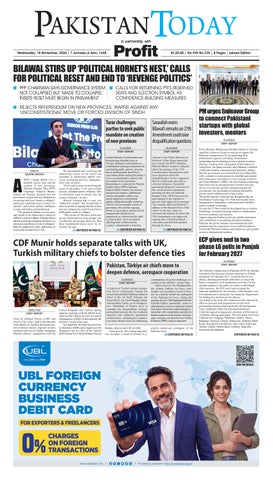
Chief of Defence Forces (CDF) and Chief of the Army Staff Field Marshal Asim Munir on Tuesday discussed matters of mutual interest, regional security dynamics and ways to further strengthen bilateral defence cooperation with the
United Kingdom and Turkiye during separate meetings with the British army chief and the Turkish air chief at General Headquarters (GHQ) in Rawalpindi, the military’s media wing said. In a statement, the Inter-Services Public Relations (ISPR) said a high-level UK delegation, led by Chief of the General Staff General Sir Charles Roland Vincent
A high-level Turkish defence delegation led by Commander Turkish Air Force General Rafet Dalkıran called on Chief of the Air Staff, Pakistan Air Force (PAF), Air Chief Marshal Zaheer Ahmed Baber Sidhu, at Air Headquarters, Islamabad, to discuss ways to translate the longstanding strategic partnership between the two brotherly countries into enhanced operational collaboration, technological cooperation and a shared vision for addressing
Walker, called on the CDF at GHQ. Upon arrival, the visiting dignitary was accorded a Guard of Honour by a
PM urges Endeavor Group to connect Pakistani startups with global investors, mentors ISLAMABAD
STAFF REPORT
Prime Minister Muhammad Shehbaz Sharif on Tuesday urged the Endeavor Group to step up its support for Pakistani entrepreneurs by strengthening their professional capacity, providing international mentorship and facilitating access to global investors. During a meeting with a delegation of the Endeavor Group here, the prime minister said Pakistan’s talented youth had immense entrepreneurial potential, adding that the government was committed to providing them with a conducive environment to establish and expand their businesses, according to a news release issued by the Prime Minister’s Office. He said modern technology, innovation and an entrepreneurial mindset were key drivers of economic growth, emphasising that the government was promoting investment and publicprivate sector collaboration in these areas. The prime minister informed the delegation that an Information Technology (IT) Park had recently been inaugurated in Islamabad, with all possible facilities made available to startups. He said the IT Park would be developed into a modern technology ecosystem through effective collaboration between academia and industry. Appreciating the Endeavor Group’s global experience and contribution to promoting entrepreneurship in Pakistan, the prime minister said international best practices and the experience of successful businesses could help Pakistani startups and enterprises gain greater access to international markets.
ECP gives nod to two phase LG polls in Punjab for February 2027 ISLAMABAD
STAFF REPORT
contemporary air power challenges, according to the military’s media wing. Upon arrival at Air Headquarters, the visiting Turkish Air Force commander was accorded a Guard of Honour by a smartly turned-out contingent of the Pakistan Air Force. During the meeting, the Air Chief highlighted that the Pakistan-Türkiye partnership, rooted in shared history, common values and mutual trust, had evolved into a robust strategic relationship with considerable potential for further expansion in the defence and aerospace domains, teh Inter-Services Public Relations (ISPR) said in a statement.
The Election Commission of Pakistan (ECP) on Tuesday announced that local government elections in Punjab, scheduled for February 2027, would be held in two phases, directing provincial authorities to ensure the timely completion of all preparatory activities for the smooth conduct of the polls. In a letter to the Punjab chief secretary, the ECP said it had accepted the proposal submitted by the secretary of the Punjab Local Government and Community Development Department for holding the elections in two phases. According to the letter, the commission also directed its office to proceed with preparations for the local government elections and ensure that all prerequisites were completed within the stipulated timeframe. Under the agreed arrangement, elections will be held in 18 districts during each phase. The first phase will cover Chakwal and Talagang, Pakpattan, Sialkot, Okara, Rajanpur, Narowal, Chiniot, Khanewal, Nankana Sahib, Kasur, Rawalpindi and Murree, Dera Ghazi Khan and Taunsa, Lahore, Bahawalpur, Lodhran, Sargodha, Hafizabad and Bhakkar.
CONTINUED ON PAGE 03
CONTINUED ON PAGE 03
smartly turned-out contingent of the Pakistan Army.
02 NEWS
Wednesday, 18 November, 2026 | LAHORE
PSX GIVES UP EARLY GAINS IN ANOTHER VOLATILE SESSION
T
PROFIT
newS deSk
HE Pakistan Stock Exchange (PSX) witnessed another sharp reversal on Tuesday as an early rally evaporated, sending the benchmark KSE-100 Index into negative territory despite falling global oil prices and hopes of easing regional tensions. According to PSX data, the market opened on a strong footing, with the benchmark index climbing over 1,200 points to an intraday high of 179,450.96 points during the opening minutes of trading. However, buying momentum quickly faded as the session progressed, with the index plunging to
Panther Tyres commissions 3.5 MW solar plant, raises total capacity to 6 MW New solar installation at company's factory increases captive renewable power generation capacity as part of sustainability initiatives PROFIT
newS deSk
Panther Tyres Limited has commissioned a 3.5-megawatt (MW) solar power plant at its factory, increasing the company's total captive solar power generation capacity to 6 MW. In a regulatory filing submitted to the Pakistan Stock Exchange (PSX) on Tuesday, the company announced the completion and commissioning of the additional solar installation, following its earlier disclosure on May 7, 2026. "Panther Tyres Limited has successfully commissioned its 3.5 MW solar power plant at the Company's factory," the company stated. The new installation increases the company's captive solar generation capacity from 2.5 MW to 6 MW, expanding its ability to generate electricity through renewable sources for its own operations. "With the commissioning of this additional capacity, the Company's total captive solar power generation capacity has increased to 6 MW," the filing added. The company said the project forms part of its broader Environmental, Social and Governance (ESG) objectives, particularly its efforts to reduce carbon emissions and promote renewable energy. The disclosure was made under Sections 96 and 131 of the Securities Act, 2015, and Clause 5.6.1(a) of the Pakistan Stock Exchange Rule Book.
Jubilee General Insurance approves sale of property in Lahore PROFIT
newS deSk
Jubilee General Insurance Company Limited has approved the sale of its immovable property located at Upper Mall in Lahore, subject to approval from the company's shareholders. In a disclosure submitted to the Pakistan Stock Exchange (PSX) on Monday, the company said its board of directors approved the proposed transaction during meetings held on November 12 and 13. The property, situated at Plot No. 254, Upper Mall Scheme, 100Upper Mall, Lahore, measures approximately 6 kanal, 17 marla and 145 square feet. The proposed sale includes the land along with all buildings and structures situated on the premises. According to the company, the transaction requires shareholder approval under Section 183(3)(a) of the Companies Act, 2017. Jubilee General Insurance said it would seek the necessary approval at an extraordinary general meeting of its shareholders. The disclosure did not specify the property's proposed sale value, the identity of a potential buyer or the expected completion date of the transaction. The company also did not announce a date for the extraordinary general meeting.
g
BENCHMARK KSE-100 INDEX SETTLED AT 177,517.73, DOWN 665.22 POINTS OR 0.37%.
177,876.50 points by midday. At close, the benchmark index settled at 177,517.73, down 665.22 points or 0.37% from the previous close of 178,182.95, as major sectors displayed mixed performance. Tuesday's trading mirrored the previous session, when a strong opening rally lost most of its momentum in the final hour as profit-taking erased more than 1,500 points of intraday gains. The benchmark eventually closed Monday with a modest increase of 309.08 points at 178,182.95. The latest volatility came despite signs of improvement in the regional economic en-
vironment, including recovering energy exports through Middle Eastern shipping routes and declining international crude oil prices. On the domestic economic front, the State Bank of Pakistan (SBP), in its Annual Report on the State of Pakistan's Economy for FY26, highlighted the economy's resilience against domestic and global shocks amid an increasingly uncertain geopolitical environment. The central bank reported improvements across key macroeconomic indicators during FY26 and projected real GDP growth of 3.5% to 4.5% for FY27.
Meanwhile, global equity markets remained under pressure as concerns over the technology sector and tighter US restrictions on China's access to advanced artificial intelligence chips weighed on investor sentiment. Asian stocks followed Wall Street lower on Tuesday, with South Korea's technologyheavy KOSPI and Taiwan's benchmark index both declining more than 2%. Japan's Nikkei fell 1.2%, while MSCI's broadest index of Asia-Pacific shares outside Japan dropped 1.5%. European markets were also expected to open lower, with EUROSTOXX 50 futures down 0.6%, Germany's DAX fu-
tures declining 0.54% and Britain's FTSE futures losing 0.8%. Chinese technology companies faced additional selling pressure as investors assessed the potential impact of Washington's expanded restrictions on advanced AI chips. Alibaba shares fell nearly 5%, while Baidu declined almost 7% in Hong Kong trading. In commodity markets, oil prices declined as expectations of a supply surplus, supported by recovering Middle Eastern exports, outweighed concerns over continuing attacks on tankers and broader geopolitical tensions. Brent crude futures fell 82 cents, or 0.9%, to $91.62 per barrel at 0720 GMT, while US West Texas Intermediate crude declined 83 cents, or 1%, to $84.89 per barrel.
Saudi investor renews bid to acquire 84.51% stake in Samba Bank after withdrawing earlier offer g
NAJD GATEWAY LET ITS FIRST ANNOUNCEMENT LAPSE, THEN FILED A NEW ONE SAME DAY. PAKISTAN’S SMALLEST COMMERCIAL BANK IS BEING SOLD AS ITS PROFIT FALLS, WHATS IN IT FOR BUYER? PROFIT REPORT
Najd Gateway Holding Company has renewed its bid to buy 84.51% of Samba Bank from the Saudi National Bank (SNB), hours after its first offer lapsed. The Saudi investment company withdrew its February public announcement of intention after the extended deadline for a formal offer expired on November 17. It filed fresh disclosures with the Pakistan Stock Exchange (PSX) the same day, saying it remains fully committed to the deal. The filings say the parties are in the final stages of negotiating a share purchase agreement. The withdrawal was a procedural step under the takeover regulations, not a change of mind. No price has been disclosed. Samba’s shares closed at Rs13.42 on November 16. At that price, SNB’s 852 million shares are worth about Rs11.4 billion. If the deal goes ahead, Najd Gateway must also make a public offer for at least another 7.75% of the bank. A fully subscribed offer would take its holding to about 92.26%. Arif Habib Limited is the manager to the offer. WHO IS BUYING Najd Gateway was incorporated in Saudi Arabia on January 18, 2024. It is privately held and wholly owned by its chairman, Prince Mansour bin Mohammed S. Al Saud. It first approached SNB with a non-
binding offer for the stake in December 2025. A formal announcement of intention followed in February 2026, with an addendum in March and a deadline extension in August. The deal still depends on due diligence, a signed purchase agreement and regulatory approvals in Pakistan and Saudi Arabia. The announcement warns that it could be withdrawn if approvals are not granted.
A LONG EXIT SNB inherited Samba Bank when Samba Financial Group merged with National Commercial Bank in 2021 to form SNB. In October that year, SNB said it would divest the Pakistani bank. The sale has not been easy. Bank Alfalah made a public announcement of intention to buy the same 84.51% stake, and the State Bank of Pakistan gave it in-principle approval to carry out due diligence. In November 2024, SNB ended the sale process, and Bank Alfalah withdrew. Meezan Bank, United Bank, Askari Bank and a consortium including Fatima Fertilizer have also been linked to the bank over the years. WHAT IS BEING SOLD Samba is Pakistan’s smallest commercial bank. It had total assets of Rs206 billion and deposits of Rs119 billion at the end of 2025, according to PACRA, which rates it AA.
It earned a profit after tax of Rs727 million in 2025, up about 4%. This year has been weaker. In the nine months to September, profit fell 63% to Rs174 million, and the bank lost about Rs100 million in the third quarter alone. The fall came from funding costs. Interest expense rose 11% while interest income rose only 3%, cutting net interest income by 21% to Rs3.4 billion. Lower provisions did not make up the difference. The bank also has new leadership. Rashid Jahangir, its chief financial officer since 2016, was confirmed as president and CEO in February after serving in an acting role.
FIVE YEARS OF THIN RETURNS Samba’s earnings have been uneven. It made a profit of Rs789 million in 2021, a loss of Rs428 million in 2022, then profits of Rs1.24 billion in 2023, Rs699 million in 2024 and Rs727 million in 2025. The returns are small for the size of the bank. Last year’s profit was a return of about 3.9% on equity of Rs18.8 billion. In the first nine months of this year, the bank earned Rs174 million. The balance sheet has moved away from lending. Net advances fell from Rs82 billion at the end of 2021 to Rs62 billion at the end of 2025, while deposits rose from Rs79 billion to Rs119 billion. The bank lent about 52 rupees for every 100 rupees of deposits last year, down from more
ABHI Microfinance Bank's retail IPO portion oversubscribed by 6.95%; investors have priced it close to the floor PROFIT REPORT
ABHI Microfinance Bank’s initial public offering (IPO) drew applications for 35.3 million shares in its retail portion, against 33 million on offer. That is 6.95% more than the shares available, or about 1.07 times. The public subscription ran on November 12 and 13. It drew 6,080 applications worth Rs547 million, split almost evenly between the eIPO platforms of the Central Depository Company (CDC) and the Pakistan Stock Exchange (PSX), according to figures filed by the consultant, Arif Habib Limited. Applications for up to 2,000 shares will be filled in full. Larger ones will be scaled back pro rata. The retail offer followed bookbuilding on November 5 and 6, in which institutional and wealthy investors bid for 1.6 times the 99 million shares on offer. The price was set at Rs15.50, just 50 paisa above the floor of Rs15. The bank had allowed a price band up to Rs22.50. Across 132 million shares, the IPO raises about Rs2.05 billion.
A FINTECH THAT BOUGHT A BANK ABHI began as a fintech, best known for earned wage ac-
cess, which lets employees draw part of their salary before payday. Most of its revenue came from lending to small businesses. In September 2024, it teamed up with TPL Corporation to buy FINCA Microfinance Bank. For a lender, a deposit-taking bank offers cheaper funding than borrowing from other lenders. The bank has grown quickly since. It reported a record profit after tax of Rs1.02 billion for 2025. In the first half of 2026, by its own account, profit rose to Rs1.5 billion from Rs200 million a year earlier. Deposits reached Rs86 billion and gross advances Rs50 billion by June. It has 114 branches. But its capital was thin. At the end of 2025, its paid-up capital net of accumulated losses was negative Rs397 million. By June, equity had turned positive at Rs3.1 billion, helped by profit and Rs2 billion recorded as an advance against the issue of shares.
WHY IT NEEDS THE MONEY The State Bank of Pakistan (SBP) has raised the capital bar for microfinance banks. By June 2027, every one must hold paid-up capital, net of losses, of at least Rs2 billion. Microfinance banks must also keep a capital adequacy ratio of at least 15%. ABHI says the IPO proceeds
will grow its loan book and strengthen its capital base, including meeting the SBP’s requirements.
WHAT THE DEMAND SAYS The numbers of the IPO point to caution rather than enthusiasm. Institutional investors covered the book 1.6 times but would not pay much above the floor, and the retail portion was only just filled. That is modest by this year’s standards. In January, Pak Qatar General Takaful’s IPO was oversubscribed 21 times. In May, Sitara Petroleum’s was oversubscribed about seven times. The caution reflects the sector as much as the bank. Microfinance banks went through two years of heavy losses as high interest rates raised funding costs and borrowers struggled to repay. Losses narrowed sharply in 2025, but several banks still have to raise capital to meet the new rules. ABHI’s pitch to investors is that it is different, a bank run by a fintech, with profits rising fast. The first half of 2026 alone earned more than all of 2025. The book-building price suggests investors want that growth to last longer before they pay more for it. The shares are expected to list on the PSX once allotment is complete. The bank has not announced a listing date.
SECP seeks explanation from HUM Network over financial discrepancies, Rs5.739b in receivables PROFIT
monitoring report
The Securities and Exchange Commission of Pakistan (SECP) has issued a regulatory notice to
HUM Network Limited, seeking explanations over financial discrepancies, subsidiary write-offs and Rs5.739 billion in related-party receivables. As per reports, the regulator has directed the company to submit its response within five days, setting November 21, 2026, as the deadline for providing the requested explanations. The notice raises questions about the company's financial reporting, particularly the treatment of subsidiary write-offs and the substantial amount recorded as receivables from related parties. Related-party receivables generally represent amounts owed to a company by entities or individuals with which it has an established relationship, including subsidiaries, associated companies or other connected parties. The notice also flags subsidiary write-offs, which can affect a company's reported financial position depending on their nature and accounting treatment. HUM Network has been given until November 21 to address the regulator's observations.
than 100 in 2021.
WHY BUY SAMBA? This gives rise to the question that why would anyone want to buy Samba Bank if it is doing so poorly? The answer is the price. At current rate, it looks low against the bank’s own books. At Rs13.42, the shares trade at about 0.72 times their book value of Rs18.65 a share. On that basis, SNB’s 84.51% stake is worth about Rs15.9 billion at book value, against about Rs11.4 billion at the market price. The gap gives a buyer room to pay a premium to the market and still buy below book. The bank is rated AA by PACRA, whose latest review says its capital adequacy ratio is well above the regulatory minimum. Buying an existing bank gives a new owner a licence, a deposit base of Rs119 billion and a branch network in one transaction, which is the usual route into Pakistani banking. The weak earnings cut both ways. They help explain the discount, and they are what a new owner would have to fix, by lowering funding costs and lending more of the bank’s deposits. For SNB, which has been trying to leave for five years, the question is whether this attempt reaches a signed agreement. Najd Gateway is required to issue a fresh public announcement of intention within two working days. Neither side has said when it expects to sign.
Bank of Punjab receives Rs20b from Punjab government under equity injection plan LAHORE
Saddam HuSSain
The Bank of Punjab (BOP) has received Rs20 billion from the Government of Punjab as the first tranche of an approved equity injection of up to Rs30 billion, the bank disclosed to the Pakistan Stock Exchange (PSX) on Tuesday. In its regulatory filing, the bank stated, "We are pleased to inform you that The Bank of Punjab (the Bank) has received PKR 20 billion from the Government of the Punjab (GoPb) towards the first tranche of the approved equity injection of up to PKR 30 billion." The bank said the capital injection had previously been disclosed to the PSX on August 10 and October 30, 2026. Under the approved arrangement, the bank will issue 523,560,209 ordinary shares to the provincial government at Rs38.20 per share, rather than through a rights offering. "Accordingly, under approved arrangements, the Bank shall issue 523,560,209 ordinary shares to GoPb, otherwise than by way of right offer, at the issue price of PKR 38.20 per share," the filing stated. The share issuance will be carried out in accordance with approvals granted by the SECP and the SBP, along with applicable regulatory requirements. The Rs20 billion received represents approximately two-thirds of the total approved equity injection, leaving up to Rs10 billion under the overall Rs30 billion arrangement. The issuance of new ordinary shares will increase the bank's equity capital and the number of outstanding shares, with the Punjab govt receiving the newly issued shares. The bank said it would notify the PSX upon completion of the share issuance.
NEWS 03
Wednesday, 18 November, 2026 | LAHORE
FINNISH COMPANIES EXPLORE INVESTMENT OPPORTUNITIES IN PAKISTAN'S ENERGY, MINERAL SECTORS COMBINED
STAFF REPORT
Finnish companies have expressed interest in exploring investment opportunities in Pakistan's energy, minerals and infrastructure sectors, as a business delegation met Federal Minister for Petroleum Ali Pervaiz Malik to discuss potential partnerships and greater commercial cooperation. The delegation, led by Finland's Deputy Minister for International Trade and UnderSecretary of State at the Ministry for Foreign Affairs, Jarno Syrjälä, included representatives of Wärtsilä, Elematic and Casagrande Laboratories. During the meeting held on November
16, both sides discussed opportunities for expanding bilateral economic engagement, particularly through business-to-business partnerships and investment in Pakistan's energy and mineral resources. Syrjälä said efforts were underway to encourage more Finnish companies to enter the Pakistani market and explore commercial and investment opportunities. Malik briefed the delegation on reforms being introduced in Pakistan's petroleum sector, including deregulation measures aimed at improving market efficiency and encouraging private-sector participation. He also outlined the government's efforts to diversify the country's energy mix and strengthen energy security
Bilawal stirs up ‘political hornet’s nest,’ calls for political reset and end to ‘revenge politics’ CONTINUED FROM PAGE 01
Interior Minister Mohsin Naqvi has stirred up a political storm after calling for the creation of new administrative units, arguing that the existing governance system had “collapsed” and needed a “reset”. “Everyone makes mistakes, but there comes a time when you must fix those mistakes. How do we fix that?” Bilawal asked rhetorically.He contended that state institutions had “lost their legitimacy” and called for concerted efforts to restore public confidence in them. Addressing the ‘Meet the Press’ event and responding to questions afterwards, Bilawal made it clear that the PPP would resist any “unconstitutional” move concerning the creation of new provinces. He also opposed holding a referendum on the issue, questioning the “intent” behind the proposal, and said his party’s lawmakers were facing “pressure” but would not succumb to it. Going beyond his oft-repeated calls for electoral reforms and political consensus, the PPP chairman called for the opposition Pakistan Tehreek-e-Insaf (PTI) to be given its reserved seats as a “confidence-building measure”. He also questioned the state of the judiciary, particularly in the wake of the 27th Amendment, which he had strongly advocated at the time of its passage just a year ago. ‘INJUSTICES’ TO PTI OVER RESERVED SEATS, SYMBOL’ The PPP chairman observed that “some such injustices” had been committed which, if corrected, could quickly help restore the opposition’s confidence in the system. In an indirect reference to the PTI, Bilawal recalled the revocation of the PPP’s election symbol in 1988, saying: “Revoking the symbol from a party is akin to you joking with the public, and the public denounced this tradition and action and responded to you in those elections.” Departing from the ruling coalition’s position, Bilawal said that “what happened with the reserved seats was a joke”. He argued that the opposition had not only been deprived of those seats, but that “those in the treasury benches also put them in their pockets”.The PTI, which was deprived of its reserved seats in the 2024 elections, was declared eligible for the seats by the Supreme Court. However, a constitutional bench constituted later through the 26th Amendment overturned that ruling while hearing review petitions filed by the coalition parties. “And from those same reserved seats, which are not yours, you brought constitutional amendments not once but twice, and are now thinking to bring a third one,” Bilawal said. He called for addressing reservations over alleged electoral rigging and restoring the party symbol so that the PTI could retain its political identity.“It is a confidence-building measure that we, without any preconditions, return the reserved seats to the opposition, which is their right,” Bilawal said, whose PPP was also among the beneficiaries of the reserved seats case. ‘IMRAN KHAN A POLITICAL PRISONER’ Reiterating his demand for electoral reforms, Bilawal stressed the need to restore the PTI’s and the wider opposition’s confidence in parliament. “If we want the system to be reset and the Parliament to start functioning, vengeful actions will need to be stopped. How much revenge will you take after all?” he asked. The PPP chairman said not only should retaliatory actions be halted, but the “tradition of revenge inserted in Pakistan’s politics” must also be ended permanently. He recalled a speech by PTI founder Imran Khan, in which the latter had questioned whether “we were ants”. Bilawal called for ensuring that no one remained a political prisoner in Pakistan, saying this was essential for the system to function effectively. “What a weird country this is; since 1947, whoever becomes the prime minister goes to jail, whoever gets out of jail goes to sit in the Prime Minister House,” he remarked. “You broke [our] back, then ask ‘why did you fall’,” he quipped, stressing that political prisoners would have to be released.
through foreign investment and international partnerships. Highlighting opportunities in the mineral sector, the minister said the government was working to attract international investors, facilitate modern exploration and mining practices, and accelerate the development of Pakistan's mineral resources. He emphasised the importance of strengthening regulatory institutions and improving regulatory frameworks to enhance transparency, institutional capacity and investor confidence in the energy and mining sectors. The minister encouraged Finnish companies to establish stronger commercial relationships with Pakistani businesses and
explore opportunities to contribute technology, expertise and investment to energy, mineral and infrastructure projects. The delegation also included Wille Eerola, Honorary Consul General of Pakistan in Finland and Chairman of the Fin-
land-Pakistan Business Council. Both sides agreed to continue engagement aimed at developing potential investment partnerships and expanding commercial ties between Pakistan and Finland.
Tarar challenges parties to seek public mandate on creation of new provinces CONTINUED FROM PAGE 01
“The real question is what problem there is in approaching the people on this matter,” he said, adding that the decision about what the people wanted should rest with them rather than political leaders. Tarar said the country had been governed by successive administrations for decades, making it difficult for political stakeholders to distance themselves from the shortcomings of the existing system. He added that using politics as a shield against accountability was unacceptable under both the law and public expectations. Questioning criticism of the Na-
tional Accountability Bureau (NAB), he said reforms in the institution had also been introduced by those now holding it responsible for its shortcomings. The minister also described it as contradictory for political parties to enjoy government positions and privileges while simultaneously projecting themselves as opposition parties. Referring to the debate on the creation of new provinces, he said the issue should be considered constructively rather than turned into a political controversy. “If the people of Pakistan and Sindh want more provinces, they should be created; otherwise, they should not,”
he said, maintaining that public representatives derived their authority from the people and must respect their aspirations. Tarar said the past misuse of referendums could not justify depriving citizens of their constitutional right to express their opinions. No individual, he added, could impose a personal agenda on the people of Sindh, Punjab, Khyber Pakhtunkhwa and Balochistan without first ascertaining their views. He urged coalition partners to sit together and reach a decision in the national interest, guided by public opinion. The minister said the debate should continue both inside and outside parlia-
ment, with all stakeholders given an opportunity to participate. He also called for stronger protection of journalists’ rights, saying the federal government was working in this regard and would continue its efforts. Tarar urged the Sindh government to take notice of reported incidents of journalists’ exploitation and fulfil its responsibility to protect them. He stressed that the ongoing discussion should not create an impression that public opinion was being restricted, adding that the people’s interests and aspirations must remain at the centre of the debate.
ECP gives nod to two phase Sanaullah warns Bilawal’s remarks on 27th polls in Punjab for Amendment could raise disqualification questions LG February 2027 CONTINUED FROM PAGE 01
Bilawal also expressed concern about the consequences for the judiciary, maintaining that the constitutional changes had undermined public confidence in the judicial system. Responding to those remarks, Sanaullah said the PPP was a coalition partner in the federal government, held important positions within the administration and had participated in negotiations surrounding both the 26th and 27th Constitutional Amendments. He maintained that the party had played an active role in securing the votes required for the latest amendment and questioned why its leadership was now describing the legislative process as coercive. The prime minister’s adviser argued that if a political leader acknowledged voting for a constitutional
amendment under pressure rather than independently exercising their judgement, such an admission could raise questions about their eligibility to hold office. Sanaullah suggested that the implications would remain relevant regardless of whether the claim was made immediately after the vote or at a later stage. He also advised Bilawal to reconsider the language used in his speech, maintaining that the remarks could have consequences for the PPP chairman himself. When asked specifically whether Bilawal could face disqualification over the statement, Sanaullah reiterated that any admission of voting under outside influence would raise serious questions. However, his comments represented a political interpretation of Bilawal’s remarks rather than any formal legal finding or disqualification proceedings.
CDF Munir holds separate talks with UK, Turkish military chiefs to bolster defence ties CONTINUED FROM PAGE 01
“Matters of mutual interest, the prevailing regional security environment and avenues for enhancing bilateral defence and security cooperation” came under discussion during the meeting, the ISPR said, adding that the CDF reaffirmed Pakistan’s commitment to further expanding defence ties with the United Kingdom. “Both sides expressed satisfaction over the longstanding, cordial relations between Pakistan and the United Kingdom and reaffirmed their commitment to further strengthening bilateral military-to-military cooperation,” it added. The visiting dignitary, in turn, appreciated the “professionalism and operational preparedness” of Pakistan’s armed forces and acknowledged their contributions towards maintaining peace and stability in the region. According to the ISPR, the visit reflected the shared resolve of Pakistan and the UK to deepen defence cooperation and further strengthen bilateral military ties.
COMMANDER TURKISH AIR FORCE, CDF MUNIR DISCUSS REGIONAL SECURITY DYNAMICS Separately, Commander of the Turkish Air Force General Rafet Dalkıran also called on the CDF at GHQ, where the two sides discussed matters of mutual interest, regional security dynamics and avenues for enhancing bilateral defence cooperation, the military’s media wing said. CDF Munir highlighted the “deep-rooted historical, cultural and strategic ties between the two countries” and appreciated the strong defence partnership between their armed forces. The visiting dignitary reciprocated the sentiments on strengthening bilateral defence ties, appreciated the professionalism of the Pakistan Armed Forces and acknowledged Pakistan’s contributions to regional peace and stability, the ISPR added. Earlier this month, Pakistan and the United Kingdom also agreed to strengthen security cooperation during delegation-level talks between Interior Minister Mohsin Naqvi and visiting British Security Minister Dan Jarvis in Islamabad.
CONTINUED FROM PAGE 01|
The second phase will cover Sahiwal, Gujranwala and Wazirabad, Bahawalnagar, Attock, Khushab, Mandi Bahauddin, Vehari, Jhelum, Sheikhupura, Muzaffargarh and Kot Addu, Toba Tek Singh, Faisalabad, Multan, Mianwali, Layyah, Jhang, Gujrat and Rahim Yar Khan. The ECP also forwarded copies of the letter to the provincial election commissioner and the secretary of the Punjab Local Government and Community Development Department. Local government elections in Punjab have faced repeated delays, with the last polls held in 2015 under the Punjab Local Government Act, 2013. Polling was conducted in phases between October and December that year, while the elected councils assumed office in 2017 following indirect elections for mayors and chairpersons. The PTI government dissolved the elected local bodies in April 2019, before the completion of their tenure. However, the Supreme Court subsequently restored them, and they eventually completed their term on December 31, 2021. Successive provincial governments repeatedly amended or replaced the Punjab Local Government Act, with each legislative change requiring the ECP to restart preparations, including delimitation and election planning. Frequent changes in the legal framework, coupled with administrative delays by successive governments, contributed significantly to the repeated postponement of local government elections. Under Article 140A of the Constitution and the Elections Act, local government elections are required to be held within 120 days of the expiry of the term of local bodies. Since the councils completed their tenure in December 2021, elections were due by April 2022 but have remained pending despite repeated postponements. The ECP had initially proposed holding local government elections in Punjab on December 14. However, the provincial government proposed holding the polls in phases in April 2027, citing concerns over smog, dense fog and adverse winter weather conditions expected during December and January. The ECP rejected the proposal and, earlier this month, decided to hold the first phase of elections in Punjab on February 7, 2027. The decision followed a hearing conducted by a four-member bench headed by Chief Election Commissioner Sikandar Sultan Raja. During the hearing, an ECP member pointed out that the provincial government had previously proposed holding the elections in April.
04 COMMENT
The nakba continues
Greatness thrust upon ‘em
I
In the West Bank in slow motion
With the ECO and SCO Chairmanships coinciding, Pakistan has a unique opportunity
T is a matter of coincidental conjunction, but Pakistan was bound to be placed in a key diplomatic position, because it assumes the rotating chairmanship of both the Economic Cooperation Organisation and the Shanghai Cooperation Organisation for the 2026-7 term. As there is a considerable overlap in the membership of both organizations, it means that Pakistan’s position at the heart of Asia will be buttressed, and it will increasingly be the route through which the Central Asian Republics, and Afghanistan, all landlocked, will use to access the outside world. Pakistan had already assumed the chairmanship of the SCO at the end of the recent Bishkek summit, and assumed the chairmanship of ECO on Monday at the meeting of the Council of Ministers in Islamabad. Both organisations are essentially economic, though they has led to a certain political coordination. Perhaps that is the reason why both the SCO at Bishkek and the ECO at Islamabad took positions supporting Pakistan’s efforts to bring about peace in the Middle East war. ECO was bound to be strongly in favour of Iran because Iran is a member, while Russia and China, which both look kindly on Iran, and warily on the USA, are members of the SCO, the latter actually being its founder. The emphasis Pakistan is placing on its chairmanship is to enhance regional connectivity. The announced theme for ECO is ‘“Reviving Regionalism for a Resilient ECO.” For the SCO, the theme is “Turning Vision into Action: Connectivity, Innovation and Shared Prosperity”. It should be noted that the SCO is the economic forum for China’s New Silk Road project, as well as the ‘One Belt One Road’ rubric under which it has become a development partner all over the world. As Pakistan is something of a showcase for OBOR because of the China-Pakistan Economic Corridor, its becoming Chairman of both the SCO and ECO is of great importance for China, because it places an ‘iron brother’ in charge while China is engaged in a confrontation with the USA. Pakistan is also trying to improve relations with the USA, and is not likely to guide these organisations into conflict with it. Pakistan’s centrality is also being emphasised by the continuing development of the Makkah Pact, which will meet in Islamabad at the end of the month. It remains to be seen how this growing importance is translated into permanent advantage.
W
WASHINGTON WATCH Dr JAmeS J ZOGby
HAT the Israelis are doing throughout Palestine is nothing more than an extension of the Nakba, in slow-motion. The worst case is Gaza, where Israel callously ignores a “ceasefire” by daily killing civilians, denying needed food, shelter, and medical needs to two million suffering Palestinians, and continuing to encroach on Palestinian lands compressing them into ever-smaller areas. But the situation in the West Bank (and by extension what the Israelis call “East Jerusalem” which, in addition to the Holy City, includes 28 West Bank villages) must also be considered. To understand how this is an extension of the Nakba, it’s important to look back at what transpired in 1948 and why it happened. When Jewish leaders in Palestine were presented with the 1948 United Nations partition plan, despite having reservations about how viable their proposed state might be, they nevertheless accepted it. While the area reserved for the Jewish State included 80 percent of all of the Jewish inhabitants of Palestine, the
Taken together, Israel’s actions since the 1948 Nakba and its immediate aftermath, and continuing since then in Gaza and the West Bank, constitute an eight decade-long process of displacement and ultimately the erasure of the independent Palestinian Arab presence in their land.
Dedicated to the legacy of late Hameed Nizami
Arif Nizami (Late)
area’s population was still evenly divided between Arabs and Jews. And despite the fact that the partitioned area included almost all of the Jewish-owned land in Palestine, that amounted to less than 10 percent of the total area, while Arabs owned four times more than that. The Arabs of Palestine rejected the partition. They felt it was unjust both that the Jewish state received the largest portion of land they owned and that despite being almost half the population of the new Jewish state, they were to be reduced to a minority. Israel’s goal in 1948, as described by David Ben Gurion, who became Israel’s first prime minister, was to use force to create more favourable conditions for their proposed “Jewish state.” Ben Gurion and his allies laid out a detailed plan that involved terrorizing Arabs out of their homes in order to expand the areas set aside for their state. As this campaign of terror and evictions unfolded, armies from the surrounding Arab states responded. Israeli propagandists used this response to justify their tactics, claiming self- defense. But in reality, their campaign of terror began months earlier and no Arab army ever entered the areas set aside for the Jewish state. The Arabs only attempted to salvage the parts of Palestine that were to be the Arab state. When the dust settled, 700,000 Arabs had been forced to flee, and Ben Gurion was able to boast of a “double miracle”—the new Jewish state had “more land and less Arabs.” In the years that followed, Ben Gurion’s plan continued to be implemented. Arabs who tried to return were shot and killed, their homes and lands were confiscated, and over 420 Arab villages were laid waste and plowed under. Where Arabs remained, in the Galilee and what was called the “Triangle,” their villages and towns were surrounded and their lands seized. All of this was by design. And it is important to note this because the same design can be seen in the way Israel is operating, to different degrees, in both the West Bank and Gaza today. Thirty years ago, I was in the State Department office of a member of the Clinton Administration’s “peace team.” On his wall there hung a map of the West Bank with Areas A (under the control of the Palestinian Authority), B (under joint Israeli/Palestinian control), and C (under Israeli control), each in dif-
Mind, metals and markets Founding Editor
M. A. Niazi
Babar Nizami
Editor Pakistan Today
Editor Profit
A
The battle for AI’s mineral backbone AbID SAqlAIN TArAr
RTIFICIAL intelligence could become the brain of the next-generation economy, while minerals and metals will form its physical body. Just as software vulnerability is important, hardware deserves equal consideration. Every AI system requires metals and minerals to connect its models with physical infrastructure and transform its programmed intelligence into practical applications. The next generation of humanoid robots will also depend on extracted metals such as copper, silver, cobalt, tin and other chemical alloys.
THE MARKET OF METALS: Is It the Hypertension of the AI Revolution? Data centres are among the biggest consumers of electricity and infrastructure materials. Estimates suggest that around 60–70 metric tonnes of materials may be required per megawatt of data-centre capacity, depending on the technology and infrastructure considered. A standard data centre with a capacity of 20–25 MW, or a high-tech facility approaching 100 MW, therefore represents a substantial demand for construction materials and metals. The next layer of energy infrastructure is actually more extensive outside the data centre than inside it. Overhead and underground cables, electricity poles, transformers, high-tension and low-tension panels, and secondary distribution panels, are all essential to meet increasing electricity demand. Consequently, the expansion of AI is not merely a software revolution; it is also a race to secure the minerals and metals required to sustain it.
FROM THE RACE OF MINDS TO THE RACE OF METALS: China vs the USA China is considerably ahead in the critical-minerals competition. According to figures attributed to the IEA’s 2025–26 reporting, the gap between China and the USA is substantial. The comparison illustrates how mining capacity and, more importantly, refining capabilities determine strategic control over
mineral supply chains.
CONSIDER THE FOLLOWING FIGURES: n.
Rare earths: China accounts for approximately 69 percent of mining and 90 percent of refining, while the United States represents around 13 percent of mining and one percent of refining. n. Lithium: China holds approximately 21 percent of mining and 75 percent of refining, compared with three percent mining and two percent refining for the USA. n. Graphite: China accounts for more than 65 percent of mining and around 90 percent of refining, while the American share remains below three percent. n. Copper and nickel: China’s position also exceeds 10 percent in these respective mineral markets.
CHINA FOLLOWS A STRAIGHTFORWARD STRATEGIC PRINCIPLE: whoever possesses the capacity to extract and process minerals can exercise greater control over their economic value. In China, mining projects can reportedly secure environmental approvals within five or six years, whereas comparable projects in the USA may take more than 20 years. America’s democratic oversight, environmental scrutiny, autonomous institutional structure and extensive paperwork can delay large-scale mining projects. China’s centralised decision-making system, supported by the authority of the Communist Party and the PLA, offers a different model of project execution.
How Can Pakistan Become a Favourite Shop for Global Investors? Pakistan is rich in mineral resources, including an estimated 185 billion metric tonnes of coal reserves. However, possessing minerals is not the same as possessing the industrial capacity to refine and commercialise them. China can invest in refining facilities, process raw materials and sell higher-value products. The USA
ferent colours. I was there to present a document I had prepared on Israeli impediments to the implementation of the Oslo Accords. Whether he was being naive or disingenuous, the State Department official said, pointing to the green dots of Area A, “As we progress, these green dots will expand and be connected until Palestinians will be able to exercise control over the entirety of this land.” Based on my experiences working with the US peace team, the Israelis, and the Palestinians, I responded, “What if they’re never allowed to connect? And all we have are these little Bantustans surrounded by hostile Israeli control?” This is where we are today. During the first years of Oslo, the Israelis refused to allow Palestinians to develop an independent economy. Using their control over areas B and C, they constrained Palestinian movement of goods and people so that the major sources of income for Palestinians were serving as day labourers in Israel or Israeli settlements. When hostilities began and permits were denied to Palestinian workers, they became more dependent on aid or remittances from abroad. In recent years, the Israeli plan to complete the conquest of Palestine has accelerated. What is unfolding in the West Bank isn’t, as the Israelis say, “actions by a handful of rogue youth,” but rather the implementation of the same slow-motion Nakba. Settlements and outposts are being placed in locations designed to cut off Palestinians from one another. Thousands of homes are being demolished, agricultural lands are being seized, Palestinians in smaller towns and villages that are in the way are being terrorized into leaving, consolidating them in areas where they can be more easily controlled. The design is clear. The green dots of Area A will be severed one from another and never connected. This is not happenstance. It is an extension of the same thinking that brought on the Nakba or its elaboration in the infamous mid-1970s Drobles Plan, which envisioned completing the conquest of the West Bank by seizing land, expanding settlements, and building Jewish-only roads and infrastructure making a contiguous Palestinian entity an impossibility. Taken together, Israel’s actions since the 1948 Nakba and its immediate aftermath, and continuing since then in Gaza and the West Bank, constitute an eight decade-long process of displacement and ultimately the erasure of the independent Palestinian Arab presence in their land. The writer is President, Arab American Institute
Editor’s mail
could also offer competitive investment agreements, technology and industrial partnerships. Projects such as Reko Diq remain important opportunities, but political instability, the Tehrik Taliban Pakistan threat and Balochistan Liberation Army militancy continue to create serious ecurity challenges. Pakistan has assured Chinese engineers of their safety, and coordination between the PLA and Pakistan’s military establishment has remained an important part of bilateral security cooperation. Nevertheless, every attack on foreign engineers creates uncertainty, interrupts operations and delays investment. Without stronger security arrangements, these projects cannot progress at their full potential. Pakistan is therefore attempting to diversify its strategic partnerships rather than depend exclusively on China. Its engagement with Washington, including the high-profile White House visit and diplomatic lunch, reflects an effort to attract American investment and broaden its economic options. Meanwhile, China is also exploring alternative mineral opportunities in Afghanistan and Iran. But there is another question that deserves equal attention. Do the people of Balochistan have an equal place in the mineral economy of their own land? For centuries, local communities have lived above these mineral resources, yet they often remain outside the central equation of economic development. Opposition leader Mahmood Khan Achakzai has described these resources as the birthright of Balochistan’s children. The constitutional, legal and political question of ownership, provincial rights and equitable distribution cannot be ignored. Pakistan may possess the minerals that the next global economy desperately needs, but resources alone cannot guarantee prosperity. Security, political stability, transparent agreements, local participation and industrial refining capacity will determine the real value of this opportunity. Will Pakistan become a strategic supplier in the AI-driven global economy, or will it remain a marketplace where others extract, refine and sell the wealth beneath its soil? The writer is a freelance columnist.
Send your letters to: Letters to Editor, Pakistan Today, 4-Shaarey Fatima Jinnah, Lahore, Pakistan. E-mail: letters@pakistantoday.com.pk Letters should be addressed to Pakistan Today exclusively
Secure dangerous roadside drains
OPEN drains and poorly maintained roads continue to endanger pedestrians and motorists in several parts of Karachi. The situation near Magsi Goth in Malir requires urgent attention because uncovered drainage channels and inadequate safety arrangements create a risk of accidents. Motorcyclists and pedestrians are particularly vulnerable where roads are uneven, construction material obstructs movement and warning signs are missing. Such conditions become even more dangerous after sunset. Municipal authorities should install protective barriers, improve street lighting and place visible warning signs around hazardous locations. Contractors must also ensure that construction activities do not compromise public safety. Regular inspections and timely repairs would help prevent accidents and protect residents. DANISH IQBAL KARACHI
Challenge harmful beauty standards
THE growing promotion of skin-lightening products has reinforced unrealistic beauty standards in society. Advertisements frequently associate lighter skin tones with attractiveness, confidence and professional success, creating unnecessary pressure on consumers. Young people are particularly susceptible to such messaging because of their exposure to social media and commercial advertising. Some consumers may also use cosmetic products without understanding their ingredients or possible health effects. Regulatory authorities should ensure that cosmetic manufacturers provide accurate information and avoid misleading advertising claims. Schools, families and media organisations should promote greater acceptance of different appearances. HIRA SALEEM RAWALPINDI
Protect small investors
ECONOMIC uncertainty and frequent fluctuations in financial markets have made investment decisions increasingly difficult for ordinary Pakistanis. Rising living costs, changing interest rates and unpredictable market conditions have created additional challenges for people seeking to protect their savings. Many small investors lack access to reliable financial information and consequently make decisions without fully understanding the risks involved. This exposes their savings to potential losses. Financial institutions and regulatory authorities should introduce awareness programmes explaining investment options, market risks and the importance of financial planning. The government must also pursue consistent economic policies to strengthen investor confidence. Greater financial literacy would enable households to manage their savings more effectively. BILAL AHMED CHAKWAL
Restore reliable bus services
Will Pakistan become a strategic supplier in the AIdriven global economy, or will it remain a marketplace where others extract, refine and sell the wealth beneath its soil? Lahore – Ph: 042-36300938, 042-36375965
Wednesday, 18 November, 2026
I
Karachi – Ph: 021-32640318 I
Islamabad – Ph: 051-2204545
I
KARACHI’S public transport system continues to face operational problems despite the introduction of new bus services. Frequent breakdowns, overcrowding and irregular schedules have created difficulties for passengers who depend on affordable transportation. The Red Bus service was expected to improve commuting conditions, particularly for students, employees and low-income residents. However, unreliable operations have reduced its effectiveness and forced passengers to spend additional time and money travelling across the city. The provincial government should ensure regular vehicle maintenance, improve monitoring of bus operations and provide sufficient buses on busy routes. AYESHA SIDDIQUI KARACHI
Web: www.pakistantoday.com.pk
I
Email: editorial@pakistantoday.com.pk
T
Pak Army successfully fired supersonic ballistic missile ‘Fateh-2’
abdul basit alvi
HE Pakistan Army has successfully test-fired the Fatah-2 Extended Range ballistic missile, marking a significant step in modernizing the country’s conventional weapons and strengthening its defense capabilities. The achievement reflects years of research and development by Pakistani scientists and engineers. The missile is equipped with an advanced navigation system and modern avionics that help control its flight and improve targeting accuracy. As a hypersonic ballistic missile, it travels at extremely high speeds along an arcing trajectory through the upper atmosphere and potentially into space before descending toward its target. Its speed and flight characteristics make it a challenging target for existing air defense systems. A key feature of the Fatah-2 is its ability to change direction during flight, allowing it to correct course and follow less predictable trajectories. This manoeuvrability complicates interception because missile defense systems must continuously track its changing path and adjust their calculations. ISPR has expressed confidence in the missile’s ability to overcome enemy defences, although its actual effectiveness depends on operational conditions and opposing defence capabilities. The missile is also designed to strike targets with high precision, making it suitable for engaging important installations such as military command centers, radar systems, and critical infrastructure. Its accuracy can be assessed through circular error probability (CEP), which indicates the radius within which half of the missiles fired are expected to land. These capabilities strengthen the army’s ability to conduct precise strikes, improve its conventional deterrence, and respond to potential threats. The increase in the range is another key aspect of this test. The extended range will further enhance the army’s operational reach. Range is a fundamental parameter for any missile system. A longer range means that the missile can be launched from positions further back from the front lines, which increases the safety of the launch platforms. It also means that the targets can be threatened located deeper within an adversary’s territory. This deep strike capability is im-
portant for disrupting enemy operations and for attacking strategic assets located far from the border. The successful test was witnessed by the Commander of the Army Rocket Force Command, along with senior army officers and the scientists and engineers involved in developing the system. The presence of the Commander of the Army Rocket Force Command is significant. The Command is responsible for the management and deployment of the Army’s missile systems. That the commander personally observed the test underscores the importance that the military leadership places on this capability. The presence of the scientists and engineers, who actually designed and built the missile, allowed them to observe the performance of their creation in a real-world environment and to collect data for further refinement. The President, Prime Minister, Chiefs of Defence Forces, and Services Chiefs have also congratulated the scientists and engineers on the successful test. This highlevel recognition demonstrates that the achievement is viewed as a matter of national importance. The successful test has also been a source of happiness and pride for the people of Pakistan. Pakistanis are happy to see the milestone achieved by the Pakistan Army and feel proud of the institution that is ready to defend the homeland. The defense of the nation is a matter of deep concern for citizens, and any improvement in the country’s ability to protect itself is generally welcomed by the public. The Fatah-2 Extended Range test is seen as evidence that the Pakistan Army is continually working to increase its defense capabilities. This provides reassurance to the public that the military is prepared to meet the security challenges that the country may face. The Fatah-2 ER is part of a broader family of weapons systems that Pakistan has been developing. It is a successor to the orig-
inal Fatah-2, which itself was an improvement over the Fatah-1. The Fatah-1 had a maximum range of approximately 150 km. The original Fatah-2 increased this range to 400 km. The Extended Range version that was recently tested further improves upon this. The Fatah-2 system is a guided multiple-launch rocket system. This means that it is designed to fire multiple rockets from a single launcher platform. The ability to fire multiple missiles in rapid succession can be useful for saturating enemy defenses or for engaging multiple targets simultaneously. The Fatah-2 Extended Range missile appears to be longer than the original Fatah-2 variant based on footage released by the ISPR. It seems to retain the same diameter of approximately 600 mm. If the goal was to extend the range of the missile, then lengthening the missile body would allow for an increase in the volume of solid rocket fuel that the missile can carry. This is a straightforward approach to increasing range, although it does come with a weight penalty A heavier missile requires a more powerful launch system and may have other operational implications. It is also possible that improvements were made to the rocket motor itself, perhaps through a more efficient design or an improved solid fuel composition. Advances in these areas can also contribute to increased range without necessarily requiring a significant increase in the size of the missile. The original Fatah-2 had a length of approximately 7.5 m. It carries a warhead weighing approximately 365 kg. Its accuracy is reported to be within 50 m CEP. This means that half of the missiles fired at a given target are expected to land within 50 m of that target. The anti-ship ballistic missile variant of the Fatah-2, known as SMASH, has an even greater accuracy of within 10-15 m CEP depending on its seeker configuration. The Fatah-2 Extended Range is expected to maintain or improve upon this level of accuracy. The accuracy of a missile
is determined by the quality of its guidance system and the precision of its navigation. The advanced navigation and avionics systems mentioned in the ISPR statement are the components that enable this high level of precision. The extended range of the Fatah-2 will enhance the Pakistan Army’s ability to engage targets at greater distances, including targets located deep inside enemy territory. The concept of deep strike is an important one in military strategy. It refers to the ability to attack targets that are far behind the front lines of an adversary. These targets might include command and control centers, air bases, supply depots, and communication hubs. The ability to threaten such targets can disrupt an enemy’s ability to coordinate and sustain its military operations. It can also serve as a deterrent by demonstrating that no target is completely safe from attack. The test launch itself was conducted for training purposes as well as to test the missile’s improved accuracy and enhanced survivability. The training aspect is important because it ensures that the personnel who operate the system are familiar with its procedures and can employ it effectively in a real scenario. The testing of improved accuracy and survivability indicates that the recent test was not just a demonstration but also a validation of the system’s performance characteristics. Survivability in this context likely refers to the missile’s ability to survive attempts to intercept it. The maneuverability and speed
The recognition given to the scientists and engineers by the highest levels of government and military leadership reflects the importance of this achievement. For the people of Pakistan, this test is a source of pride and a reassurance that the armed forces are continually working to protect the country. The Fatah-2 Extended Range is another hallmark in the ongoing story of Pakistan’s defense development.
Who controls money in a cashless world?
M
COMMENT 05
Another Landmark
Wednesday, 18 November, 2026
RCW
Kanan heydarov
ONEY can remain in a bank account while its owner cannot use it. A payment network may fail, a cyberattack may disable online banking, or authorities may freeze an account. These are different threats, yet they expose a shared weakness as economies rely increasingly on electronic payments. Financial modernization should be judged by more than convenience: people must retain access to their money during disruptions and meaningful protection against arbitrary restrictions. This is a question of national resilience and individual rights. The change is already substantial. The World Bank’s Global Findex 2025 reports that 79 percent of adults worldwide held a financial account in 2024, compared with 51 percent in 2011. The Bank for International Settlements found that 85 of 93 surveyed central banks were exploring digital currencies. Such research does not mean cash will disappear. In the euro area, cash still accounted for 52 percent of in-store transactions in 2024, although its share was declining. The question is how institutions govern growing digital dependence. Japan demonstrated the operational danger in October 2023, when a malfunction in the Zengin interbank network delayed roughly five million transfers over two days. Around 870,000 were not completed as scheduled. In California, a ransomware attack disrupted online banking at Patelco Credit Union between June 29 and July 15, 2024, affecting an institution with approximately 500,000 members. Neither incident meant that customers’ deposits had vanished; both showed how access can fail while balances remain on the books. The European Union’s Digital Operational Resilience Act, applicable since January 2025, strengthens oversight of technology risks and critical service providers. Norway’s central bank recommends keeping cash, multiple payment cards, and accounts at more than one bank. Yet these precautions cannot compensate for banks sharing a vulnerable network. Resilience requires alternatives that operate independently and recovery plans tested under realistic stress, especially when several banks rely on the same critical provider. For states, dependence also carries a geopolitical dimension. Following Russia’s invasion of Ukraine, the European Union barred seven Russian banks from SWIFT financial messaging services in March 2022. The measure restricted access to a major messaging network, rather than banning every possible transfer. Sanctions can be legitimate instruments of foreign policy, but the episode illustrates how access to international financial infrastructure may depend on political decisions beyond a country’s control. Europe itself faces a different exposure. According to the European Central Bank, more than 60 percent of euro-area countries lack a national card-payment system for in-store purchases. Creating isolated national systems would sacrifice interoperability and raise costs. Financial sovereignty is better understood as the capacity to maintain essential payments, diversify critical providers, and withstand external disruption without withdrawing
from global markets. That sovereignty must also protect citizens at home. Independence from foreign networks offers little protection when domestic authorities can restrict access without effective review. Digital identification and transaction records can help investigators trace illicit funds, combat fraud, and widen access to formal banking. These advantages are considerable, especially for smaller businesses and people previously excluded from financial services. Authorities also need lawful powers to freeze suspicious assets. An IMF study published in 2025 also shows that financial-integrity risks differ according to the architecture of retail central bank digital currencies. The problem emerges when oversight is weak, automated decisions are difficult to contest, or political authorities turn financial controls against independent voices. Myanmar offers a documented example involving conventional banking, rather than a central bank digital currency. In 2022, a United Nations Special Rapporteur reported that military authorities required banks to collect information on civil society organizations’ finances and ordered some groups’ accounts frozen. Financial exclusion can therefore serve political repression even without new digital currencies. As cash options decline, concentrating payment channels could make similar measures faster and harder to escape. An organization denied access might struggle to pay staff or sustain its work before a court hears its case. Design choices still matter. The ECB says its proposed digital euro would complement cash, support offline payments, and would not be programmable to restrict where or how it can be spent. A pilot is planned for the second half of 2027, with issuance dependent on legislation and further decisions. These are proposals to be tested, not guarantees. Privacy limits, independent appeals, and workable alternatives must be established before new systems become indispensable. By 2030, one path would combine faster payments with reliable backups, meaningful privacy protections, and prompt remedies for wrongful account freezes. Another would leave people exposed to concentrated technology providers and sweeping state surveillance. A mixed outcome may be more plausible: digital access could improve while safeguards lag, because upgrading payment technology is often easier than building independent oversight. Countries with similar adoption rates could consequently offer very different levels of financial freedom. Warning signs would include opaque account-freezing rules, prolonged outages, and ineffective appeals. Governments should publish results from payment-continuity exercises, test whether backup services actually work during commonprovider outages, preserve access to cash, and ensure account restrictions are proportionate and independently reviewable. The test of financial sovereignty is twofold: can a country keep money moving when external systems fail, and can its citizens challenge the state when their own access is denied? A government that answers only the first question has secured its networks without securing the people who depend on them.
Kanan Heydarov is a geopolitical analyst and international risk specialist.
of the missile are the primary factors that contribute to its survivability. The Army Rocket Force Command was reportedly established in the aftermath of certain security challenges. The creation of this command indicates a desire to organize and manage the Army’s missile capabilities in a more focused and effective manner. The successful test of the Fatah-2 Extended Range is a validation of the work being done under it. It demonstrates that the command has the technical expertise and the operational capability to manage complex missile systems. The regional security environment in South Asia is characterized by a continued arms race between Pakistan and India. Both countries are nuclear powers and both continue to develop short, medium, and longrange missile systems. The Fatah-2 Extended Range is part of Pakistan’s efforts to maintain a credible conventional deterrent in this environment. The development of new missile systems is often a response to developments on the other side. The Fatah2 Extended Range provides Pakistan with a conventional deep strike capability that can be used to counter potential threats. The successful test of the Fatah-2 Extended Range is a significant development for Pakistan’s defense capabilities. It represents the successful integration of advanced technologies into a weapon system that can enhance the Army’s ability to defend the nation. The combination of extended range, high accuracy, and the ability to evade missile defenses makes this a valuable asset for the Pakistan Army. The recognition given to the scientists and engineers by the highest levels of government and military leadership reflects the importance of this achievement. For the people of Pakistan, this test is a source of pride and a reassurance that the armed forces are continually working to protect the country. The Fatah-2 Extended Range is another hallmark in the ongoing story of Pakistan’s defense development.
Hasina must return via extradition, not on her own terms
T
The writer is a freelance columnist.
Hasina was sentenced to death for crimes against humanity; Dhaka should not let her passport request become a political bargaining chip ASIA TIMES
Faisal MahMud
HE difference between returning home and being brought home is much more than semantics. For ousted Bangladesh Prime Minister Sheik Hasina, it could determine whether she returns as a convicted fugitive or as an ex-leader who negotiated the terms of her own comeback. This should concern Prime Minister Tarique Rahman’s government far more than the latest correspondence from a British law firm. Hasina, who fled Bangladesh in August 2024 amid a popular uprising against her 15-year rule, has reportedly sought a new Bangladeshi passport and a national identity card through London-based Matrix Chambers. The request, communicated to the Bangladesh High Commission in New Delhi, has generated a predictable political controversy. Her supporters see another opportunity to present the ousted prime minister as a victim of political persecution. Her opponents see an attempt to circumvent the consequences of a conviction for crimes against humanity. Both reactions risk giving the paperwork more importance than it deserves. A passport is just a travel document, not an instrument of political rehabilitation. It cannot be a political bargaining chip over the return of a former head of government convicted of crimes against humanity committed during her final weeks in power. Now, the question is not whether Hasina wants to return from exile in India. It is whether Bangladesh will insist that she return through the legal process already available to it. And the answer to that question should be unequivocal: extradition. GRAVER THAN POLITICS The reason for the government to resist attempts to recast Hasina’s case as an ordinary political dispute is a no-brainer. In February 2025, the United Nations Human Rights Office published its investigation into the crackdown on Bangladesh’s student-led uprising. Its findings were devastating. The report estimated that as many as 1,400 people were killed between July 15 and August 5, 2024, a period of just three weeks. Thousands more were injured. Children accounted for an estimated 12% to 13% of those killed. Investigators found reasonable grounds to believe that the former government, its security agencies and violent elements associated with the Awami League had systematically com-
mitted serious human rights violations. The report identified evidence of an official policy to suppress protesters through violence, raising concerns about crimes against humanity. It was not a verdict against Hasina, but its findings were independent of Bangladesh’s subsequent judicial proceedings. Hasina and her Awami League have sought to portray the International Crimes Tribunal proceedings as political persecution. Their argument draws from concerns about due process, her trial in absentia and the death penalty verdict. Their concerns deserve scrutiny, but they do not erase the underlying crimes or the evidence gathered by international investigators. On November 17, 2025, the tribunal sentenced Hasina to death for crimes against humanity. She has denied wrongdoing and rejected the legitimacy of the proceedings. The Awami League’s political narrative asks Bangladeshis to view the conviction primarily through the familiar rivalry between two parties. Yet the killings were not simply another episode in that rivalry. They involved the state’s machinery being turned against people demanding political change. A former prime minister does not acquire immunity from criminal accountability because her prosecution carries political consequences. Nor does a political dimension automatically invalidate a criminal case. WHO DICTATES THE TERMS? On November 13, Bangladesh National Party (BNP) Acting Secretary General Ruhul Kabir Rizvi identified the essential difference between voluntary return and extradition. Speaking at a discussion in Dhaka, Rizvi argued that Hasina could not simply return through the ordinary process because she was a convicted person sought under an extradition treaty. He described passports and identity documents as secondary matters. Extradition, he said, was a legal process between two sovereign states. Her supporters could present a return arranged according to Hasina’s preference and timetable as an act of defiance. The former prime minister would appear to have forced the government to accommodate her initiative. That perception would not change her legal status, but politics is not conducted solely through legal documents. Lord Varys, the fictional master of political intelligence in Game of Thrones, offers a useful observation here: “Power resides where men believe it resides.” This insight is especially relevant for Bangladesh, where perceptions of authority have often mattered almost as much as authority itself.
Hasina governed for more than 15 consecutive years through a political system that increasingly concentrated power around her office. Her sudden removal demonstrated how quickly an apparently unassailable government could lose its authority. The BNP government should understand that lesson better than most. Tarique Rahman came to power through the February 2026 election. His government’s legitimacy rests on that electoral mandate and its ability to exercise constitutional authority, not on granting concessions to an ousted predecessor. It should therefore resist any arrangement that allows Hasina to appear to have negotiated her own return. That does not mean humiliating her, denying her lawful protections or treating an extradition request as a guarantee of India’s compliance. It means insisting that the legal process, rather than her wishes, determines what happens next. There is also a domestic security consideration. The Awami League remains a political force with supporters across Bangladesh, even though its activities have been banned. A return portrayed as Hasina’s personal victory could energize its networks and sharpen tensions with the government. So, the risk of organized unrest, intimidation or sabotage by violent elements is a legitimate concern for Rahman. An improvised return, particularly one surrounded by competing claims of victory and defeat, could unnecessarily pave the way for confrontation. A formal extradition would offer a clearer chain of responsibility. India would make a sovereign decision on Bangladesh’s request, and the transfer would occur through established channels. Bangladeshi authorities would assume custody under an identifiable legal process. That is preferable to a politically charged arrival negotiated through informal understandings. For Rahman’s administration, the strongest position is also the simplest: do not turn a passport request into a political negotiation, and do not replace the established extradition process with an arrangement whose main benefit would be to rehabilitate Hasina’s political standing. Bangladesh has asked India to hand over a convicted former prime minister. That request should remain the basis of its policy. Hasina may wish to decide when and how she comes home, but the government has no obligation to let her decide. The terms must be set by law, not by the person seeking to escape its consequences. Faisal Mahmud is the managing editor of Daily Waadaa.
06 NEWs
OIL TANKER SHIPPING RATES PLUNGE 64% AS GULF EXPORTS RECOVER
S
LONDON
STAFF REPORT
HIPPING costs for the world's largest oil tankers have fallen sharply since the beginning of November, retreating from record highs reached in October as Gulf crude exports recover and demand for longdistance shipments weakens. Freight rates for very large crude carriers (VLCCs) transporting oil from the Gulf of Oman to China dropped to approximately 308 on the Worldscale index on November 13, marking a 64% decline from the record 841 recorded on October 8, according to Baltic Exchange data. The decline comes as oil exporters in the Gulf have restored crude shipments to levels approaching those recorded before
the outbreak of the US-Israeli war on Iran, reducing Asian buyers' reliance on supplies from more distant markets. The recovery in exports has been supported by alternative shipping arrangements, including ship-to-ship transfers and dark crossings, during which vessels disable their tracking systems to avoid detection, despite continuing attacks on commercial shipping. As Middle Eastern supplies increased, demand for crude from the United States, West Africa and the North Sea weakened, reducing the need for tankers undertaking longer voyages and increasing vessel availability. Arrow Shipbroking analyst Delia He attributed the decline in freight demand to the recovery in Gulf exports, which has reduced Asian purchases of American and North Sea
crude. Vortexa analyst Ioannis Papadimitriou also linked the downturn to the earlier surge in shipping costs, which made longer-haul crude shipments less attractive to Asian refiners and encouraged greater reliance on Middle Eastern supplies. Meanwhile, the number of available vessels has increased as tankers complete deliveries and discharge cargoes in East Asia, adding further downward pressure on freight rates. The correction has been even more pronounced on certain other shipping routes, including voyages from West Africa to Asia. Beyond changing trade flows, the decline reflects an easing of the geopolitical risk premium that had driven tanker rates to unprecedented levels in October, when attacks involving Iran and the United States
heightened concerns about shipping safety in the Gulf. The same geopolitical developments had contributed to higher crude prices, although oil prices have since fallen by 20% this month, partly reflecting expectations of a possible de-escalation in the conflict.
Wednesday, 18 November, 2026 | LAHORE
He said the scale of the freight rate decline could not be explained entirely by changes in vessel supply and chartering demand, suggesting that the market was also undergoing an unusually sharp reversal of the geopolitical risk premium built into shipping costs.
Dubai airport passenger traffic falls 28% as Middle East conflict disrupts travel PROFIT
STAFF REPORT
Dubai International Airport (DXB) recorded a 28.1% decline in passenger traffic during the first nine months of 2026 as the ongoing Middle East conflict disrupted regional aviation, forcing airlines to suspend flights and adjust operations. The airport handled 50.4 million passengers between January and September, compared with the corresponding period last year, according to figures released by operator Dubai Airports on Tuesday. Passenger traffic in the third quarter stood at 18.8 million, representing a 22.1% decline from the same period in 2025, although the smaller year-on-year contraction indicated some improvement compared with the overall ninemonth performance. The decline follows widespread disruption to air travel across the Middle
East after the outbreak of the US-Israeli war against Iran earlier this year, which prompted several countries to temporarily close their airspace and forced international airlines to suspend or reroute services. Gulf carriers, which operate some of
77 pharma companies paid outstanding RS387.7m on Ombudsman Punjab’s orders LAHORE
STAFF REPORT
The effective and timely intervention of the Ombudsman Punjab has resulted in the release of outstanding payments worth Rs387.7 million to 77 pharmaceutical companies by public sector hospitals. According to the spokesman, the companies had approached the Office of the Ombudsman Punjab, complaining that despite supplying medicines to the government hospitals concerned in a timely manner, their outstanding payments had not been released, which is causing financial difficulties and disrupting their business operations. Following a thorough examination of the complaints and scrutiny of the relevant record, the Ombudsman Punjab found that the delay in the release of payments was unjustified. The authorities concerned were directed to verify the claims and ensure the immediate clearance of legitimate dues.
the world's largest international airline networks, have gradually restored flights as operating conditions improved. However, renewed regional security concerns, including recent attacks on Saudi Arabia by Yemen's Iranaligned Houthi movement, have compli-
cated prospects for a full recovery. Dubai Airports said several international airlines that previously suspended services because of the conflict had resumed operations in recent months, including British Airways. Despite the disruption, DXB has continued to serve both passengers travelling directly to Dubai and those connecting through the emirate to other international destinations, with direct and transfer traffic remaining broadly balanced during the year. Dubai Airports chief executive Paul Griffiths said the airport expects to handle approximately 70 million passengers during 2026. The forecast implies that DXB would need to accommodate around 19.6 million passengers in the final quarter to meet its full-year target. Dubai International remains a major global aviation hub, serving as a connecting point between Europe, Asia, Africa and other international markets
Asian stocks fall as US tightens AI chip restrictions ahead of Nvidia earnings PROFIT AGENCIES
Asian stock markets declined sharply on Tuesday as technology shares came under pressure following new US restrictions on China's access to advanced artificial intelligence chips, while investors awaited Nvidia's quarterly earnings amid uncertainty over the company's leadership. South Korea's KOSPI and Taiwan's benchmark stock index both fell more than 2%, while Japan's Nikkei declined 1.2%. MSCI's broadest index of AsiaPacific shares outside Japan dropped 1.5%, extending losses recorded on Wall Street overnight. The weakness also weighed on European market expectations, with EUROSTOXX 50 futures falling 0.6%, Germany's DAX futures declining 0.54% and Britain's FTSE futures losing 0.8%. The sell-off followed Washington's announcement of additional re-
strictions designed to prevent Chinese companies from accessing advanced AI computing technology through overseas data centres. The new rules target shipments of high-performance chips to facilities in countries including Thailand and Malaysia, where Chinese companies have reportedly accessed computing capacity to train artificial intelligence models. The measures extend existing export controls beyond direct chip purchases to the remote use of computing infrastructure, potentially affecting cloud service providers dependent on Chinese customers. Saxo chief investment strategist Charu Chanana said the restrictions could reduce utilisation rates, weaken pricing and delay expansion plans for data centre operators serving Chinese AI developers, while uncertainty over licensing requirements could complicate financing for new projects. Chinese technology stocks also declined as investors assessed the potential impact on domestic AI development. Alibaba shares fell nearly 5%, while Baidu dropped almost 7% in Hong Kong trading. The restrictions come days after Nvidia chief executive Jensen Huang resigned following reports of a relationship with a suspected Chinese intelligence asset employed by Singapore-based cloud company Megaspeed, an Nvidia partner facing scrutiny over possible illegal transfers of advanced chips to China.
KARACHI: Chief Organiser Zia Zafar poses with renowned models and actors Sunita Marshall, Zohreh Amir, Sabbahat Sarhandi, Sarah Omair, Benita David, Sidra Sajid, Rida Khan, Seher Akhter and Fuzaan Khan on the ramp during the Style Runway Fashion Show Pakistan (SRF) Season 19.
PACA Conducts Training on Tracking Digital Currencies in Money Laundering Investigations ISLAMABAD
STAFF REPOERT
Pakistan Anti-Corruption Academy (PACA) Imparts Capacity Building Course on Tracking and Tracing Digital Currencies in Money Laundering Investigations The Pakistan Anti-Corruption Academy (PACA) conducted two-day Capacity Building Course (CBC-III) focusing on the use of digital and crypto currencies, tools, and techniques for tracking and tracing in money laundering cases. Held from November 16 to 17, 2026, at the PACA campus in Islamabad, the specialized training brought together officers from the National Accountability Bureau (NAB) and other Law Enforcement Agencies through both physical and online participation. The course was inaugurated by PACA Director General Mr. Ghulam Safdar Shah, who highlighted the critical need to elevate the professional capabilities of law enforcement personnel to effectively counter the complex challenges posed by virtual currencies and their potential misuse in financial crimes. Over the two days, participants engaged in four comprehensive sessions delivered by senior experts. Day one explored blockchain technology, Bitcoin mechanics, USDT transactions on the Tron network, decentralized platforms, and investigative red flags. It also examined global regulatory frameworks, FATF recommendations, Pakistan's regulatory evolution including the establishment of PVARA and the Virtual Assets Act of 2026, banking channel oversight, and practical case studies involving multi-wallet USDT tracing. Day two focused on practical investigative workflows, evidence preservation, and a live demonstration of the Trace X platform for wallet clustering, cross-chain analysis, and generating court-ready forensic reports.
Wednesday, 18 November 2026 | LAHORE
CORPORATE CORNER
NUML Hosts International Conference on CPEC 2.0 and Pakistan-China Strategic Partnership
ISLAMABAD STAFF REPORT
The two-day “International conference on CPEC 2.0 and Pakistan-China Strategic Partnership", organized by the Faculty of Social Sciences commenced at the National University of Modern Languages, bringing together policymakers, academics, experts, facultyPakistan-China cooperation.Federal Minister for Planning, Development and Special Initiatives Prof. Ahsan Iqbal attended the inaugural session as Chief Guest, while Vice Chancellor PIDE Dr. Nadeem Javed delivered the keynote address. Rector NUML Maj Gen Shahid Mahmood Kayani, HI(M) (Retd), DG NUML Brig Muhammad Rafiq Khan, Deans, Directors, faculty members and a large number of students also attended the session. The proceedings commenced with the national anthem and recitation, followed by introductory remarks by Prof. Dr. M. Riaz. Shad, Dean, Faculty of Social Sciences, NUML.Addressing the conference, Prof. Ahsan Iqbal described the present era as a "knowledge revolution", driven by rapid technological advancement. He termed Pakistan and China natural partners in pursuing shared development goals and highlighted the strategic significance of CPEC. He said the next phase of CPEC should focus on growth, skills and livelihood development, knowledge, innovation, green development, technology and human capital.
Pakistan–Korea collaboration boosting agricultural research, tech transfer: PARC
ISLAMABAD STAFF REPORT
The Korea Partnership for Innovation of Agriculture (KOPIA) Pakistan Center, in collaboration with the Pakistan Agricultural Research Council (PARC), convened its 11th Project Planning and Steering Committee meeting at the National Agricultural Research Centre (NARC), Islamabad, to review progress under three Pakistan–Korea technical cooperation projects aimed at strengthening agricultural productivity, food security and farmers' livelihoods.The meeting was chaired by Dr. Syed Murtaza Hassan Andrabi, Chairman PARC, with Mr. Park Intae, Director, KOPIA Pakistan Center, and representatives of relevant institutions and project teams. Chairman PARC emphasized that Pakistan–Korea collaboration is playing a vital role in introducing modern agricultural technologies, strengthening indigenous research capacity and improving productivity across key agricultural sectors. He reaffirmed PARC’s commitment to further strengthening this partnership to ensure effective technology transfer, sustainable agricultural development and tangible benefits for farmers across Pakistan.
Pakistan qualify for final of Asia Cup Blind Cricket Tournament
DHAKA, BANGLADESH STAFF REPORT
Pakistan has qualified for the final of the Asia Cup Blind Cricket Tournament after defeating India by one wicket in an exciting contest. At the Anwar Cricket Stadium in Bashundhara, India won the toss and elected to bat first. India scored 179 runs for the loss of six wickets in their allotted 20 overs. Captain Durgarao (62 runs), Sanjay Kumar (30 runs), and D. Venkatesh (26 runs) were the top scorers. Babar Ali, Badar Munir, and Muhammad Idrees each claimed one wicket.In response, Pakistan chased down the target on the final ball of the 20th over, losing nine wickets along the way after an innings marked by several twists and turns. With seven runs required off the last two deliveries, all-rounder Niamatullah hit a six followed by a four to secure victory for Pakistan. Captain Nisar Ali played a responsible innings, scoring 64 runs off 51 balls, while Muhammad Safdar contributed 31 runs. Nisar Ali was named Man of the Match but dedicated his award to Niamatullah. A match between India and Bangladesh is scheduled for Wednesday; the winner will advance to the final, where they will face Pakistan on November 20th.
NEWS 07 CM MARYAM UNVEILS APNA GAON DRIVE, 485 VILLAGES TO GET DEVELOPMENT SOCIETIES IN FIRST PHASE
P g
CM SETS 44-DAY DEADLINE, AGREES TO PARTIALLY LIFT 29-YEAR BAN ON COOPERATIVE SOCIETIES LAHORE
SALEEM JADOON
UNJAB Chief Minister Maryam Nawaz has approved the launch of the ‘CM Punjab Apna Gaon Programme’ through a dedicated cooperative society model, with cooperative societies to be established in 485 villages in the first phase to undertake rural development projects. Chairing a special meeting, the chief minister decided to launch the programme through the cooperative society model, under which streets would be paved, drainage systems installed and wastewater disposal ponds developed in villages. “Rural development projects will be completed through cooperative societies. In the first phase, cooperative societies will be established in 485 villages for development projects, while 1,500 villages will be covered in the second phase,” the chief minister was informed. The chief minister set a 44-day deadline for launching the Apna Gaon Programme. The meeting also agreed to partially lift the ban on cooperative societies in Punjab after 29 years. It was informed that a five-member tehsil monitoring committee, headed by the Assistant Commissioner, would oversee the functioning of cooperative
societies. The Assistant Director of Local Government would also be part of the committee. A separate five-member management committee would be constituted for each cooperative society, comprising a president, vice-president, general secretary, treasurer and executive member. CM Maryam Nawaz also directed the installation of solar-powered streetlights in villages. She said the government wanted to place the development of every village in the hands of its own residents, enabling villagers to make decisions about local development projects through coopera-
tive societies. “We want to make the development process sustainable and effective through cooperative societies,” she said. The chief minister said all villages across Punjab would now move towards progress, with development placed in the hands of their residents. This, she added, was a practical manifestation of the government's commitment to transforming the lives of people in rural areas. CM URGES STUDENTS TO EMBRACE TECHNOLOGY, DISCIPLINE AND SERVICE Meanwhile, Chief Minister Maryam Nawaz urged students to complement
Azma dismisses Imran’s medical concerns as ‘propaganda,’ says he sought NRO in writing LAHORE STAFF REPORT
Punjab Information and Culture Minister Azma Bokhari on Tuesday dismissed former prime minister Imran Khan’s letter as “nothing more than propaganda” surrounding his medical treatment, claiming that he has sought an NRO in writing under his own signature. She said that a man who once mocked the illnesses of others was now himself complaining of ill health in jail, while allegations of inadequate medical facilities in prison were entirely baseless. In a statement, Azma Bokhari said that whether it was the claim about a snake emerging from former prime minister Mian Nawaz Sharif’s cell or the incident involv-
ing an attack on Begum Kulsoom Nawaz’s hospital, those responsible were now facing the consequences of their own actions. She said former prime minister Imran Khan had been examined by medical specialists eight times during his detention at Adiala Jail. The medical staff on duty at the prison
Finland-Pakistan Business Summit 2026 open new avenues for business cooperation
checked his vital signs three times daily, while special medical boards had also conducted detailed examinations on various occasions. Azma Bokhari stated that in August 2024, a cardiologist examined him following complaints of headaches and anxiety and prescribed medication. In February 2026, a five-member medical team conducted a detailed examination of his eyes and blood pressure at Adiala Jail. Subsequently, on August 10, 2026, a four-member medical board examined him and revised his blood pressure medication. She further stated that during the night between August 20 and 21, 2026, he was shifted to PIMS, where eye specialists and a medical board prepared a detailed medical fitness report.
Malaysia Promotes MM2H in Pakistan: New Authorized Representative Appointed to Ease Long-Term Residency
KARACHI STAFF REPORT
Finland and Pakistan are looking to deepen bilateral economic ties as a Finnish delegation comprising around ten companies visits the country for the Finland-Pakistan Business Summit 2026. The delegation met with members of the local business community in Islamabad and Karachi to explore opportunities for commercial partnerships, with mining, energy, healthcare, construction and technology emerging as promising areas for cooperation.The summit also marks 75 years of diplomatic relations between the two countries and is hosting H.E. Mr. Jarno Syrjälä, Finland’s Deputy Minister for International Trade and Under-Secretary of State at the Ministry of Foreign Affairs. His visit, accompanied by a Finnish business delegation, is the first official ministerial visit from Finland to Pakistan in 75 years.
KARACHI STAFF REPORT
The Consulate General of Malaysia in Karachi hosted a high-profile media briefing to officially announce the appointment of Greenland Travels (Pvt) Ltd as the authorized representative in Pakistan for the Malaysia My Second Home (MM2H) program. Addressing the media gathering, held at Consulate General of Malaysia Karachi, the Consul General , Mr. Mohd Yunus Ibrahim, highlighted the deepening bilateral and people-topeople ties between Malaysia and Pakistan. He noted that Malaysia has emerged as a premier global destination, welcoming 135,867 Pakistani visitors in 2025—a robust 7% increase from the previous year. Globally, international tourist arrivals to Malaysia reached 42 million.
CDA chief visits Margalla Avenue Extension N5 to M1, Sangjani Interchange project
ISLAMABAD: Chairman Capital Development Authority (CDA) and Chief Commissioner Islamabad Sohail Ashraf visited the Margalla Avenue Extension N5 to M1 and Sangjani Interchange project and conducted a detailed review of the progress made in the development works.Relevant senior officers, while giving a briefing to Chairman CDA Sohail Ashraf on the progress of the ongoing development works on the project, said that 24/7 construction activities are actively ongoing on a daily basis on various sections of the project and overall, 41 percent of the project's development work has been completed so far.During the briefing to Chairman CDA, it was said that work on the main road extension of approximately 2.7 kilometers in length is continuing at a fast pace on all sections (within ICT limits). Similarly, work on all the loops and ramps included in the project is also continuing swiftly. Furthermore, work is also being carried out on the service road connected to the main road.During the briefing, Chairman CDA was informed that the structural work of the underpass included in the Margalla Avenue Extension project has been completed. Meanwhile, the concrete walls and footing slabs of the underpass have also been completed. STAFF REPORT
modern education and technological skills with discipline, ethical values and a spirit of service, maintaining that higher education was a fundamental right of every young person. In her message on International Students’ Day, she described students as future leaders and pillars of national development, emphasising their pivotal role in shaping the country's future. She said the Punjab government was utilising all available resources to help students realise their aspirations. The Honhaar Scholarship Programme, laptop scheme and provision of electric bikes were among the initiatives launched to facilitate students, she added. The chief minister said students were being provided quality education at Nawaz Sharif Schools of Eminence, which, she maintained, offered standards comparable to those of expensive private institutions. She urged students to remain informed about national politics and current affairs so they could make informed decisions about the country's leadership and future. “Today’s students will become tomorrow’s scientists, civil servants, champions, policymakers and global leaders,” she said. The chief minister also encouraged students to use government-provided laptops and digital libraries for educational and research purposes, urging them to uphold their skills, ethical values and commitment to public service wherever they went.
Media briefing of 12th Vice Admiral HMS Choudri amateurs Golf Cup 2026 held in Lahore
LAHORE STAFF REPORT
Media briefing for 12th Vice Admiral H.M.S. Choudri Amateur Golf Cup 2026 was held at Pakistan Navy War College, Lahore. Commander Central Punjab, Rear Admiral Sohail Ahmad Azmie briefed the media on details of the tournament, scheduled to be played from 19 to 22 November 2026 at Defence Raya Golf & Country Club, Lahore.While addressing the media, Rear Admiral Sohail Ahmad Azmie highlighted Pakistan Navy’s role in promoting and fostering a sporting culture across the country. This golf cup holds significant importance, and golf championships organized by Pakistan Navy in Lahore since 2011 are a testament to this fact. He further appreciated the commendable performances demonstrated by participants in previous editions and anticipated another highly competitive championship this year.The tournament features three major categories: Amateurs, Seniors and Ladies. The Amateurs category includes players with a handicap of 10 or below, who will play 18 holes daily, competing a total of 54 holes over three days.
One Brand, Different Ways to Drive: MG offers powertrain for every need
LAHORE STAFF REPORT
From conventional petrol engines to hybrid technology, plug-in hybrids and fully electric vehicles, MG’s expanding portfolio gives Pakistani consumers the freedom to choose a vehicle that fits their lifestyle, driving habits and comfort with new mobility technologies. Choosing a car today involves more than design, performance or price. Driving patterns, daily commute distances, fuel costs, access to charging and even comfort with newer technologies all influence what makes a vehicle the right fit. Recognizing that no two drivers have exactly the same needs, MG offers a diverse range of powertrain options, bringing together internal combustion engine (ICE), hybrid electric vehicle (HEV), plug-in hybrid electric vehicle (PHEV) and battery electric vehicle (BEV) technologies. For those who prefer conventional petrol power For drivers who value the familiarity and flexibility of a conventional petrol engine, MG offers options such as the MG HS Petrol and MG ZS Petrol. These vehicles provide the convenience of traditional refueling without requiring drivers to adapt to charging routines or new driving habits. For a more efficient everyday commute Drivers looking to embrace electrification without depending on external charging can explore MG’s hybrid options. The MG HS Hybrid+ and MG ZS Hybrid+ combine a petrol engine with electric motor assistance, allowing the vehicle to manage energy more efficiently, particularly in changing urban traffic conditions.
Wednesday, 18 November, 2026
PRAYER TIMINGS
flour prices rise PAKISTAN, TURKMENISTAN SIGN THREE ACCORDS inWheat Karachi despite TO BOOST TRADE, CONNECTIVITY AND ENERGY TIES arrival of imports
NEWS
P
ISLAMABAD
SALEEM JADOON
AKISTAN and Turkmenistan on Tuesday signed three agreements to expand bilateral cooperation in connectivity, trade and tourism, while reaffirming their commitment to advancing regional energy and transport projects, including the longdelayed Turkmenistan-Afghanistan-Pakistan-India (TAPI) gas pipeline. The agreements were signed following the sixth session of the PakistanTurkmenistan Joint Intergovernmental Commission (IGC) on Economic Cooperation in Islamabad, co-chaired by Pakistan’s Deputy Prime Minister and Foreign Minister Ishaq Dar and Turkmen Foreign Minister Rashid Meredov. The development comes as Pakistan seeks to strengthen its energy, trade and economic ties with landlocked Central Asian states, positioning itself as a key trade and transit hub capable of connecting the region with global markets through its strategic location.
FAJR SUNRISE
ZUHR
ASR MAGHRIB ISHA
6:33
1:30
4:00
6:00
The three documents signed on Tuesday included the protocol of the sixth IGC session, a cooperation programme between the two foreign ministries for 2026-2030, and a memorandum of understanding on tourism cooperation between the two countries. ADVANCE WORK ON BILATERAL
Petrol price cut by Rs3 per litre, diesel rate unchanged for Nov 18 PROFIT
AHMAD AHMADANI
The government has reduced petrol price by Rs3 per litre to Rs325, while maintaining the high-speed diesel (HSD) rate at Rs358 per litre for November 18. According to Oil and Gas Regulatory Authority (OGRA), the revised petroleum prices have been announced under the pricing mechanism approved by the federal government. The price reduction will provide some relief to motorcyclists and car owners, as petrol is primarily used in motorcycles, private cars and other small vehicles. Meanwhile, the government has kept the HSD price unchanged at Rs358 per litre. Diesel is widely used in heavy transport vehicles, buses, trucks, tractors and agricultural machinery, making its price particularly important for transporters, farmers and the overall cost of transporting goods. The unchanged diesel price means that transporters and farmers will not receive any additional relief from the latest revision, while consumers may continue to face existing transportation and agricultural cost pressures. The revised prices will be applicable for November 18.
Pakistan urges sustained global support for war-torn Syria’s reconstruction, sovereignty UNITED NATIONS STAFF REPORT
Pakistan on Monday called on the international community to provide sustained and practical assistance for the reconstruction of war-torn Syria while respecting its sovereignty and territorial integrity amid significant challenges and a complex regional environment. “Syria’s transition continues despite considerable challenges and a complex regional environment; the progress achieved deserves recognition and sustained support,” Pakistan’s Permanent Representative to the United Nations, Ambassador Syed Haider Shah, told the UN Security Council during a briefing on political and humanitarian developments in the country. “The scale of Syria’s needs calls for predictable support and effective cooperation with the Syrian Government,” the Pakistani envoy said. Syria has undergone major political and social changes since a popular uprising ousted President Bashar al-Assad in late 2024. The country’s new leader, Ahmed al-Sharaa, has stepped up engagement with the international community and pledged accountability for past atrocity crimes while undertaking significant government reforms. Ambassador Haider Shah said Pakistan welcomed the Syrian government’s efforts to advance the political transition, rebuild national institutions and strengthen engagement with regional and international partners, particularly as wider regional tensions added to the challenges facing the country. “The Syrian leadership’s emphasis on diplomacy and engagement in navigating this difficult environment is highly appreciable,” he said.
TRANSIT TRADE FRAMEWORK, VIABLE TRANSPORT LINKS Speaking at a joint press conference with his Turkmen counterpart, Ishaq Dar said the two sides had discussed ways to advance work on a bilateral transit trade framework and explore commercially viable transport links.
“We discussed ways to advance work on a bilateral transit trade framework and explore commercially viable transport links... I reiterated Pakistan’s readiness to explore practical arrangements for the use of our ports, including Karachi and Gwadar, and Turkmenistan cargo,” Dar said. He said the two sides had also exchanged views on energy cooperation, including the TAPI gas pipeline project, and recognised the importance of continued engagement among the participating countries on its technical and commercial aspects. Both sides also discussed the proposed Turkmenistan-Afghanistan-Pakistan electricity transmission project and its associated fibre-optic communications link, including the need for further assessment of their technical and commercial viability, Dar added. Beyond connectivity and energy, the two countries explored opportunities to broaden cooperation in agriculture, industry, tourism, culture, higher education, information technology, health and financial services.
PM orders coordinated port strategy, PNSC overhaul to boost competitiveness ISLAMABAD
STAFF REPORT
Prime Minister Muhammad Shehbaz Sharif on Tuesday directed all port-related institutions to work in close coordination and adopt an integrated strategy to address the problems facing the business community, stressing that enhancing port capacity was essential to expanding trade and driving economic growth. The prime minister issued the directives while chairing a highlevel meeting on the country’s ports and the Pakistan National Shipping Corporation (PNSC), according to a news release issued by the Prime Minister’s Office. He said the country’s ports played a pivotal role in expanding trade and driving economic growth, stressing that enhancing their capacity was essential for Pakistan to emerge as a key trade and transshipment hub in the region. The prime minister directed that cargo handling, clearance and other port-related processes be modernised to facilitate traders and accelerate commercial activity. Turning to the national shipping line, he said comprehensive reforms were urgently needed to transform the PNSC into a modern,
stable and competitive organisation capable of meeting international standards. He directed the preparation of a viable plan to expand the corporation’s fleet, enabling Pakistan to strengthen its own shipping capacity for imports and exports. The meeting was briefed on the PNSC reform agenda and informed that a business development plan had been prepared for the corporation. The proposed reforms and business plan include expanding the fleet and improving human resource management. Participants were further informed that the primary objective of the reforms was to enhance the country’s sea cargo capacity in line with the highest international
standards by 2030. The meeting was attended by Federal Minister for Climate Change Musadik Malik, Federal Minister for Economic Affairs Ahad Khan Cheema, Federal Minister for Law and Justice Azam Nazeer Tarar, Federal Minister for Maritime Affairs Junaid Anwar Chaudhry, Adviser to the Prime Minister on Privatisation Muhammad Ali, Minister of State for Finance and Railways Bilal Azhar Kayani, and Special Assistant to the Prime Minister on Energy Lt Gen (R) Zafar Iqbal. Members of the National Assembly Farooq Sattar and Abdul Qadir Patel, along with senior government officials, were also present.
Sugar millers seek immediate exports as surplus reaches 1.1m tonnes
PROFIT WEB DESK
The Pakistan Sugar Mills Association (PSMA) has urged the government to immediately permit sugar exports, deregulate the industry and withdraw the notification requiring mills to begin crushing within 24 hours, citing mounting surplus stocks and operational difficulties.
Speaking at a press conference on Monday, PSMA Chairman Asim Ghani Usman said the country currently has a surplus of 1.1 million tonnes of sugar, while the government has yet to approve exports despite an earlier commitment to allow shipments of 600,000 tonnes. He said repeated requests for export permission had received no response, raising concerns
over the industry's ability to manage existing stocks ahead of the new crushing season. According to the association, sugarcane cultivation has increased by approximately 16% this year, with sugar production projected to reach 8.5 million tonnes during the 2026-27 crushing season. The anticipated increase in production, combined with existing surplus stocks, could create storage difficulties for sugar mills if exports remain restricted. The association also opposed the Punjab government's directive requiring mills to commence crushing operations within 24 hours, arguing that such a short notice period was operationally impractical. Usman said restarting sugar mills required several preparatory steps, including recalling workers and firing up boilers, while farmers also needed sufficient time to harvest and transport sugarcane.
5:10
PROFIT
WEB DESK
Wheat and flour prices have increased in Karachi despite the arrival of more than 100,000 tonnes of imported wheat since late October, as traders warn of a shortage of up to four million tonnes before the next harvest. Retail prices of flour No. 2.5 and fine flour have risen by Rs10 per kg to Rs180 and Rs200, respectively, following fresh price increases by flour millers amid tightening grain supplies. The first shipment of 51,000 tonnes, which arrived on October 28, initially brought wheat prices down from Rs140 to Rs130 per kg. However, open-market rates returned to Rs140 per kg last week, prompting millers to revise flour prices upwards. Market stakeholders estimate a wheat shortfall of between three million and four million tonnes this season, despite domestic production increasing by 4.3% to 29.61 million tonnes in FY26 from 28.40 million tonnes a year earlier, according to the Economic Survey FY26. Annual wheat consumption is estimated at between 31 million and 32 million tonnes, while traders believe at least three million tonnes of additional supplies will be required before the next crop from Sindh and Punjab reaches markets between March and May. Industry representatives said the government had been warned about the potential shortage as early as May and urged to allow private-sector imports of at least two million tonnes. The supply situation in Karachi has worsened following the suspension of wheat arrivals from Punjab, leaving local flour mills dependent on limited open-market stocks and imported shipments. Wholesale prices have also increased, with flour No. 2.5 rising to Rs8,100 per 50kg bag from Rs7,800, maida to Rs9,000 from Rs8,400, and fine flour to Rs9,150 from Rs8,550. High-quality chakki flour is selling for Rs200 per kg in the wholesale market and Rs215 per kg at retail outlets. Millers have reported similar price increases in Punjab and Khyber Pakhtunkhwa, while flour rates vary between mills depending on their available wheat stocks and procurement costs. Traders say the imported quantity remains insufficient, particularly as Karachi's flour mills alone require approximately 8,000 tonnes of wheat daily for grinding. They have also raised concerns about hoarding and speculative activity, calling for stronger government monitoring of wheat stocks in warehouses, markets and flour mills. The rising prices are adding pressure on low- and middle-income households, with a 10kg bag of fine flour now costing around Rs2,000. Meanwhile, tandoor operators are facing higher flour and LPG costs but have so far kept bread prices unchanged. Chapati continues to sell for Rs20, naan for Rs30-35, sheermal and taftaan for Rs100-110, and qulcha for Rs90-100.
KP signs fiscal agreement to contribute Rs157b to federal government PROFIT
MONITORING REPORT
The federal government has signed an interim fiscal agreement with the administration of Khyber Pakhtunkhwa (KP) to secure an estimated Rs157 billion in annual cash grants, bringing the province into a broader arrangement under which all four provinces are expected to contribute Rs1.035 trillion towards national security and development priorities during the current fiscal year, The Express Tribune reported. The agreement, signed earlier this month under Article 164 of the Constitution, also covers Rs17.8 billion already deducted by the federal government from KP's National Finance Commission (NFC) transfers during July-October 2026. According to figures reported by the Finance Ministry, the federal government received Rs107.3 billion from the four provinces during the first four months of the fiscal year, representing approximately 10.3% of the annual commitment. Punjab contributed the largest amount at Rs55.7 billion, followed by Sindh with Rs27.3 billion, KP with Rs17.8 billion and Balochistan with Rs6.5 billion. The agreement was confirmed by Tariq Pasha, Finance and Revenue Adviser to KP's Advisory Council, which is assisting Governor Faisal Karim Kundi in administering the province following the imposition of governor's rule last month. The arrangement follows an understanding reached between the federal and provincial governments in June 2026 to provide financial support for security expenditure and projects considered nationally important. Of the Rs1.035 trillion annual contribution, Punjab is expected to provide Rs556 billion, Sindh Rs264 billion, KP Rs157 billion and Balochistan Rs58 billion. However, the contributions depend on the Federal Board of Revenue (FBR) meeting its annual tax collection target of Rs15.264 trillion. Any shortfall in collections would proportionately reduce the grants. Balochistan's contribution is subject to an additional condition that its NFC transfers remain protected at the previous year's level of Rs737 billion.
Pakistan faces winter load shedding risk as RLNG shortages threaten power plants PROFIT
MONITORING REPORT
The Independent System Market Operator (ISMO) has warned that insufficient supplies of re-gasified liquefied natural gas (RLNG) to four major power plants could threaten electricity system stability and increase load shedding this winter, Business Recorder reported. In a letter to the Petroleum Division and Sui Northern Gas Pipelines Limited (SNGPL), ISMO Executive Director System Operation Muhammad Zakria called for advance arrangements of RLNG cargoes to ensure uninterrupted fuel supplies to gasfired power plants. The system operator identified Haveli Bahadur Shah, Bhikki, Balloki and Punjab Thermal Power Limited as four plants that have previously experienced operational instability when running on high-speed diesel (HSD), limiting their ability to switch fuels during gas shortages reliably.
The warning comes as Pakistan struggles to secure additional LNG supplies at acceptable prices, having rejected expensive international bids for December 2026 and January 2027 deliveries. Pakistan LNG Limited (PLL) initially invited bids on November 4 for two spot LNG cargoes of 140,000 cubic metres each, with a tolerance of 5%, for delivery at Port Qasim during December 14-16 and January 9-11. The bidding deadline was extended from November 6 to November 10 following requests from international suppliers. For the December cargo, TotalEnergies Gas & Power Limited submitted the lowest offer of approximately $27.30 per million British thermal units (MMBtu), compared with QatarEnergy Trading's quotation of $31 per MMBtu. TotalEnergies also emerged as the lowest bidder for January delivery at approximately $27.10 per MMBtu. However, PLL rejected the offers because of their high prices and issued a fresh
tender on November 12 for the same delivery windows. The new tender seeks two cargoes of 140,000 cubic metres each on a Delivered Ex-Ship basis, with bids due on November 18. Meanwhile, the government has reduced its planned LNG procurement for November 2026 to February 2027 from 24 to 18 cargoes, prioritising supplies under existing long-term contracts with Qatar. Earlier estimates had identified a requirement of 24 cargoes for the SNGPL network, including nine for electricity generation and 15 for domestic gas consumption, alongside two additional contingency cargoes. The Petroleum Division has been engaging with Qatar to maximise deliveries under existing agreements, although supply disruptions and elevated international prices have complicated winter procurement. Pakistan faced similar difficulties in September when PLL rejected spot LNG offers of approximately $26.97 and $26.71
7:00
per MMBtu for separate delivery windows. A subsequent tender for September 12-16 attracted no bids. The procurement difficulties have already contributed to fuel constraints at RLNG-based power plants. ISMO has cautioned that inadequate gas supplies, combined with the unreliable op-
Published by Asad Nizami at Qandeel Printing Press, 4 Queens Road, Lahore, for PT Print (Pvt) Limited. Ph: 042-36300938, 042-36375965. Email: newsroom@pakistantoday.com.pk
eration of the four identified plants on diesel, could reduce available generation capacity and force additional load management to maintain grid stability. The operator has urged the relevant authorities to arrange LNG supplies in advance rather than depend on emergency procurement once shortages develop.