In partnership with
Profit
Friday, 13 November, 2026 | 2 Jumada ul-Sani, 1448
Rs 20.00 | Vol XVII No 230 | 8 Pages | Lahore Edition
NAQVI CALLS FOR REFERENDUM TO 'GAUGE PUBLIC OPINION' AMID DEBATE OVER CREATION OF NEW PROVINCES g
g
INTERIOR MINISTER SAYS PEOPLE'S VERDICT MUST DETERMINE WHETHER NEW ADMINISTRATIVE UNITS SHOULD BE CREATED
g
ASSURES COALITION PARTNERS NO DECISION WILL BE TAKEN WITHOUT CONSENSUS; SAYS HE IS FULLY BEHIND PUBLIC OPINION
g
SAYS HE AND BILAWAL ARE 'NEARLY ON THE SAME PAGE' ON NEED FOR A POLITICAL RESET DECLARES CORRUPTION EXISTS ACROSS PAKISTAN, STRESSES COLLECTIVE RESPONSIBILITY TO ROOT IT OUT
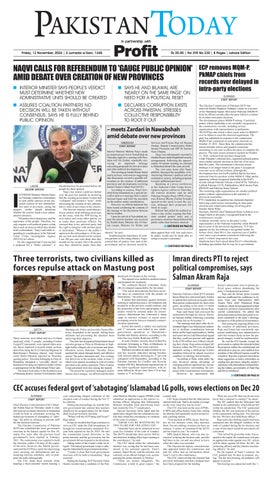
– meets Zardari in Nawabshah amid debate over new provinces NAWABSHAH
STAFF REPORT
I
LAHORE SALEEM JADOON
NTERIOR Minister Mohsin Naqvi on Thursday called for a referendum to seek public opinion on the proposed creation of new administrative units or provinces, saying the people's verdict should determine whether the country needs a new administrative structure. “All parties stress democracy and the supremacy of the people. Therefore, my only request to all political parties is that this is such an issue on which they should hold a referendum,” Naqvi said while responding to a media query at the National Cyber Crime Investigation Agency (NCCIA) in Lahore. He also suggested that if anyone had a proposal for a “better solution”, it
should likewise be presented before the people for their opinion. Naqvi has stirred a political debate over the past few months by declaring that the existing governance system had “collapsed” and needed a “reset”, while advocating the creation of new administrative units or provinces in the country. The interior minister noted that political parties held differing positions on the issue, with the PPP having its own stance and some other parties yet to make their positions official. He stressed that every political party had the right to disagree with another party or individual. “Whatever the public's opinion in the referendum is, if the people say new units should not be created, I am 100 per cent with them that they should not be created. But if the public says they should be made, then they
Interior Minister Mohsin Naqvi made an unannounced visit to Nawabshah on Thursday night for a meeting with President Asif Ali Zardari, reportedly conveying an important message concerning proposals for new provinces and other political developments. The meeting at Zardari House lasted nearly an hour, with sources suggesting that discussions covered a possible referendum on the creation of additional provinces and developments involving Jamiat Ulema-e-Islam-Fazl (JUI-F). According to sources, Naqvi travelled from Islamabad on a special aircraft to deliver a message from a senior national figure and brief the president on the matters under consideration. However, no official statement has been issued confirming the contents of the message or the discussions between the two leaders. Upon his arrival at Nawabshah airport, the interior minister was received by Sindh Home Minister Zia Ul Hassan Lanjar, Minister for Works and should,” he said. Emphasising the importance of coalition partners in the ruling alliance, Naqvi assured that all parties were part of the government and no decision would be
Services and Prisons Haji Ali Hassan Zardari, Deputy Commissioner Abdul Samad Nizamani and SSP Dr Sameer Noor Channa. Naqvi was subsequently escorted to Zardari House under heightened security arrangements. Following the approximately 59-minute meeting, he returned to Islamabad aboard the same aircraft. The visit came hours after Naqvi publicly discussed the possibility of restructuring Pakistan’s political and administrative system, including proposals to create additional provinces. Speaking at a press conference at the National Cyber Crime Investigation Agency earlier on Thursday, the interior minister said he and Pakistan Peoples Party (PPP) Chairman Bilawal Bhutto Zardari broadly agreed on the need to reset the system, although their proposals differed in scope. Bilawal had called for political reforms a day earlier, arguing that Pakistan needed greater unity and a governance structure that prioritised the public rather than business interests.
CONTINUED ON PAGE 03
taken against their will. Any such move, he added, would only be made after securing everyone's consensus.
Three terrorists, two civilians killed as forces repulse attack on Mastung post
QUETTA STAFF REPORT
Three terrorists were killed and two civilians martyred, while 17 people, including Frontier Corps (FC) personnel, were injured when security forces repulsed a terrorist attack on Kandawa Post along the N-25 National Highway in Balochistan’s Mastung district, state broadcaster Radio Pakistan reported on Thursday, quoting police. Terrorists belonging to Fitna alHindustan attempted a “cowardly attack” on Kandawa Post using an explosives-laden vehicle, a spokesperson for the Balochistan Police said. The attack took place in the Kandawa area of Mastung district, around 10 kilometres from
Mastung city. Police said security forces effectively responded to the assault, killing three militants and preventing the attackers from achieving their objective. The state has designated Balochistan-based terrorist groups as Fitna al-Hindustan to highlight India's alleged role in terrorism and destabilisation across Pakistan. “Security forces repulsed the attack through timely and effective action,” the police statement said. Two civilians lost their lives in the incident, while at least 13 others were injured, according to a list of victims provided in the police statement. Three Frontier Corps personnel were also among the injured. The powerful explosion damaged nearby houses and a mosque. An official said the blast
CONTINUED ON PAGE 03
destroyed five houses in the vicinity. The injured were shifted to medical centres and hospitals for treatment. The outlawed Baloch Liberation Army (BLA) claimed responsibility for the attack. “The attack demonstrates that these terrorists have no connection with the people of Balochistan,” the police said. It added that operations against elements seeking to undermine peace, development and prosperity in the province would continue, and the protection of the lives and property of the people would be ensured under all circumstances. Balochistan has witnessed a sharp surge in terrorist violence in recent years, prompting security forces to intensify counterterrorism operations. Earlier this month, a soldier was martyred and 17 terrorists were killed in two intelligence-based operations in Balochistan’s Kachhi and Kharan districts, according to the Inter-Services Public Relations (ISPR). In early October, security forces killed five terrorists belonging to Fitna al-Hindustan in Mastung, Pakistan Television reported. Pakistan recorded an improvement in several key security indicators during October, with terrorist attacks declining by 37 per cent compared with September, according to the Pakistan Institute for Conflict and Security Studies (PICSS). Balochistan registered one of the most significant improvements, with attacks falling by 46 per cent, from 132 in September to 71 in October.
ECP removes MQM-P, PkMAP chiefs from records over delayed in intra-party elections ISLAMABAD
STAFF REPORT
The Election Commission of Pakistan (ECP) has removed Khalid Maqbool Siddiqui’s name as convener of the Muttahida Qaumi Movement-Pakistan (MQM-P) from its official records after the party failed to conduct its overdue intra-party elections. The development places MQM-P among 13 political parties whose leadership is not currently recognised in the commission’s records, including several organisations with representation in parliament. The ECP has also issued a show-cause notice to MQM-P over its failure to meet the electoral requirement. The party has submitted its response to the commission. MQM-P last conducted its intra-party elections on October 15, 2021. Since then, the commission has issued multiple notices and granted extensions amounting to one year to allow the party to complete the process. The most recent extension expired on October 15, 2026, without fresh elections being held. Under Pakistan’s electoral laws, registered political parties must conduct internal elections at intervals of no more than five years. The commission’s decision means Siddiqui is no longer listed as the party’s recognised convener on its official website, although the development does not itself establish that he has been removed from his position within MQM-P. Other parties appearing without recognised leadership in the ECP’s records include Pakistan Tehreek-e-Insaf (PTI), Tehreek-eLabbaik Pakistan (TLP), Pakhtunkhwa Milli Awami Party (PkMAP) and Pakistan Sunni Tehreek. The remaining eight organisations are smaller political parties without representation in the national or provincial assemblies. PTI’s leadership recognition has remained disputed following controversies surrounding its intra-party elections and related proceedings involving party founder Imran Khan. Similarly, PkMAP chief Mahmood Khan Achakzai is no longer listed as the party’s recognised head in the commission’s records. Achakzai currently serves as the party’s only representative in the National Assembly, while PkMAP has no seats in the provincial legislatures. TLP also appears on the list without a recognised leader. Its former chief, Saad Rizvi, has remained out of public view since a government crackdown following the party’s violent long march last year. Questions have been raised about Rizvi’s whereabouts, including speculation that he may be in government
Imran directs PTI to reject political compromises, says Salman Akram Raja ISLAMABAD
STAFF REPORT
Pakistan Tehreek-e-Insaf (PTI) founder Imran Khan has instructed party leaders to uphold their political principles rather than pursue compromises for short-term gains, according to the party’s Central Secretary General Salman Akram Raja. Raja said Imran had conveyed the instructions through his lawyer, Barrister Salman Safdar, following a meeting at Adiala Jail on November 11. The meeting took place after the Islamabad High Court directed jail authorities to facilitate consultations between Imran and his legal representatives. Safdar and senior lawyer Latif Khosa had argued that they could not proceed with appeals in the £190 million case without consulting their clients. Raja acknowledged differences within the PTI over its political approach, saying a small group of party members believed he placed excessive emphasis on ideology and principles. According to Raja, some party figures favoured taking advantage of emerging political opportunities, including discussions surrounding the proposed 28th Constitutional Amendment. However, he maintained that
Imran’s instructions were to pursue political space without abandoning the party’s fundamental positions. Raja said the former prime minister had also reaffirmed his confidence in Allama Nasir and Pakhtunkhwa Milli Awami Party chief Mahmood Khan Achakzai, whom he had appointed to their respective political responsibilities after careful consideration. He added that Imran had instructed him personally to remain committed to the party’s ideology, irrespective of the political circumstances. Discussing the ongoing debate over the creation of additional provinces, Raja said Imran had consistently supported establishing new administrative units but wanted clarity on how the proposed changes would be implemented. He said the PTI founder wanted the government to explain the rationale behind the proposal, outline the constitutional and administrative process, and establish how residents of the affected regions would be consulted. Raja also expressed reservations about suggestions to hold a referendum on creating new provinces, citing the country’s experience with referendums conducted during the military governments of Ziaul Haq and Pervez Musharraf.
CONTINUED ON PAGE 03
CEC accuses federal govt of ‘sabotaging’ Islamabad LG polls, vows elections on Dec 20 ISLAMABAD
STAFF REPORT
Chief Election Commissioner (CEC) Sikandar Sultan Raja on Thursday made it clear that local government elections in Islamabad would be held as scheduled, accusing the federal government of attempting to “sabotage” the polls by refusing to provide staff for the electoral exercise. The Election Commission of Pakistan (ECP) has scheduled the local government elections in the federal capital for Dec 20, nearly five years after the previous local government’s term expired in February 2021. The commission was required to hold the elections within 120 days of the expiry of the term. However, the federal government and the ECP have spent the intervening years carrying out delimitations and announcing election schedules, only to postpone the polls subsequently. The CEC made these remarks while heading a three-member bench hearing a
case concerning alleged violations of the electoral code of conduct during the NA-77 by-election. During the proceedings, he said the federal government had ordered that teachers should not be assigned duties for the Islamabad local government elections. “Where will the ECP bring staff from?” Raja asked. It may be recalled that Raja continues to serve as CEC under the 26th Amendment, although his constitutionally mandated fiveyear term expired on Jan 26, 2025. He said the commission issued directions to the prime minister and the government, but the government did not respond to its directions. Taking notice of the Centre’s order, he alleged: “The federal government wants to sabotage the Islamabad local government elections.” “I make it clear that local government elections will be held in Islamabad,” Raja asserted. During the hearing, ECP Secretary Omar Hamid recalled that a candidate of the Pak-
istan Markazi Muslim League (PMML) had submitted an application to the district returning officer, alleging that Information Minister Attaullah Tarar and Farooq Tarar had visited the NA-77 constituency. Special Secretary Zafar Iqbal said the application alleged that the information minister had visited the constituency in violation of the code of conduct. ‘TARAR CAN BE SENTENCED TO TWO YEARS FOR VIOLATING COD’ “Attaullah Tarar can be sentenced to two years for violation of the code of conduct. The [ECP] should take strict action. MNAs and ministers holding office kept roaming in the constituency,” he said. The CEC asked where the information minister was, noting that he had been summoned in his personal capacity. Tarar’s counsel, Sajeel Swati, said the minister was currently on an official foreign visit, accompanying the prime minister to Türkiye. “These are serious allegations. The Commission is held in great respect,” the
counsel said. CEC Raja remarked that the information minister had only “had to do media coverage on the visit; what else was he to do”. The CEC also took up the case of PMLN MPA and office-bearer Asma Naz, telling her that she had repeatedly moved around inside a polling station. “Your position as MPA can go. Such tactics do not increase votes; they decrease them. You are smiling; it seems you have no remorse. A notice of contempt of the [ECP] can be issued to you,” he warned. MPA Qudsia Batool, who was also accused of violating the election code, said she had been in her car and was about to leave when the video was recorded. The Gujranwala deputy commissioner also appeared before the commission and said his office had no information about Tarar’s visit to the constituency. The CEC observed that the minister had arrived by helicopter and that a helipad must have been prepared for the landing.
“How are you a DC that you do not even know that a minister is coming?” he asked. The DC replied that the helicopter had landed in the cantonment, which did not fall within his jurisdiction. The CEC questioned whether the DC was unaware of his powers in the cantonment, telling him: “Go and read the law. We have also held these offices.” Raja said a fact-finding inquiry had been conducted into the alleged violation of the code of conduct during the by-election, and a copy of the report would be provided to all concerned. “You will all be given that order. You respond to the report; the commission will pass an appropriate order against you, DC. Action will be taken against all three, the DC, the [returning officer] and the [district monitoring officer],” he said. On the request of Tarar’s counsel, the CEC granted him 10 days to respond, saying: “On the next hearing, all members will appear in person.” The hearing was adjourned until Dec 1.
02 NEWS
Friday, 13 November, 2026 | LAHORE
WORLD BANK CLASSIFIES ENTIRE $375.9M PAKISTAN GRID PROJECT AS CLIMATE FINANCE
T
PROFIT
MONITORING REPORT
HE World Bank has designated the full $375.9 million financing package for Pakistan's Grid Stability Enhancement Project as climate-related funding, with the bulk of the amount directed towards measures aimed at mitigating climate change. According to the bank's IBRD/IDA Climate Finance Assessment Sheet for fiscal year 2027, approximately $357.11 million, equivalent to 95% of the total financing, falls under climate mitigation, while $18.8 million, or 5%, has been classified as adaptation finance. The initiative, formally titled BESTPAK MPA Programme Phase 1: Grid Stability Enhancement Project, is part of the World Bank's Energy and Extractives portfolio and carries project identification number P504536.
The assessment identifies the installation of power electronics-based reactive power compensation devices, known as STATCOMs, as the project's principal investment. This component accounts for $369.9 million of the overall financing, of which
Asian stocks tumble as Nvidia shares plunge on uncertainty over CEO's future PROFIT
REUTERS
Asian stock markets fell sharply on Thursday as Nvidia shares plunged in after-hours trading amid reports that its board was considering removing chief executive Jensen Huang, triggering widespread selling in semiconductor and technology stocks. Nvidia shares dropped as much as 8.8% in extended trading, while S&P 500 futures declined 0.5% as uncertainty surrounding the world's leading supplier of artificial intelligence processors unsettled investors. Taiwan's benchmark stock index led regional losses, falling 2.6%, followed by a 0.9% decline in South Korea's Kospi. Japan's Nikkei 225 also dropped 0.9%, while the MSCI Asia-Pacific index excluding Japan fell 1.2%. The sell-off followed reports that Nvidia's board met late Wednesday to consider Huang's future amid allegations concerning his personal relationships, including a reported association with a woman suspected of having links to Chinese intelligence. The allegations and the possibility of a leadership change raised concerns about disruption to Nvidia's central role in the global artificial intelligence industry, where investment levels and valuations were already facing increased scrutiny. Meanwhile, shares of Chinese graphics processing unit manufacturers advanced as investors anticipated potential opportunities for domestic chip suppliers if Nvidia's difficulties affected its position in the Chinese market. Chinese artificial intelligence companies were also reportedly seeking additional access to Nvidia computing capacity amid concerns that Washington could introduce further restrictions on advanced chip technology.
Pakistan Customs revises import values of 68 categories of dyes, optical brightening agents PROFIT
NEWS DESK
The Directorate General of Customs Valuation has revised the customs assessment values of 68 categories of unbranded dyes and optical brightening agents imported into Pakistan, introducing new rates ranging from $2.71 to $25 per kilogram for calculating applicable duties and taxes. The revised values, notified through Valuation Ruling No. 2128/2026, replace the previous valuation ruling issued on January 11, 2024, and apply to products imported from all countries. The revision covers reactive dyes, acid dyes, acid leather dyes, direct dyes, disperse dyes and optical brightening agents used in various industrial applications. According to the notification, the Directorate initiated the valuation exercise following representations from industry stakeholders seeking adjustments to customs values in line with prevailing international market conditions. Consultations were held on October 6 and October 15, 2026, with representatives of the Pakistan Chemicals and Dyes Merchants Association (PCDMA) and other stakeholders. During the meetings, participants acknowledged that international prices had increased relative to the existing customs valuation benchmarks and submitted proposals for revising the assessment rates.
$351.41 million has been categorised as climate mitigation funding and $18.5 million as adaptation finance. STATCOM technology is used to regulate voltage and improve the stability of electricity transmission networks, helping power systems manage fluctua-
tions in electricity supply and demand. A further $6 million has been set aside for technical assistance and project implementation support. The World Bank has attributed $5.7 million of this allocation to mitigation activities and $300,000 to adaptation measures. The assessment also identifies $37.59 million in financing that delivers benefits for both climate mitigation and adaptation. Under the bank's accounting methodology, half of this dual-benefit amount is deducted from each category when determining the final climate finance totals, preventing the same expenditure from being counted twice. The classification follows the Joint Multilateral Development Banks' methodologies for tracking climate finance, which establish the criteria used to identify and account for investments supporting climate mitigation and adaptation.
Sugar mills refuse to begin crushing before December, demand export of 400,000 tonnes PROFIT
NEWS DESK
The Pakistan Sugar Mills Association (PSMA) has decided not to begin the new sugarcane crushing season before December, citing mounting sugar stocks and delays in export approvals, while demanding government permission to export another 400,000 tonnes of surplus sugar. The decision was reached unanimously at a meeting of the association's general body on Wednesday, attended by sugar mill owners from Punjab, Sindh and Khyber Pakhtunkhwa. The meeting was held simultaneously in Lahore, Karachi and Islamabad. According to the association, approximately 1.1 million metric tonnes of surplus sugar remain in warehouses despite the previously approved export quota of 200,000 tonnes. Mill owners maintained that the government had yet to allow exports under the agreed arrangements, making it difficult for the industry to commence fresh crushing operations while substantial stocks remained unsold. The general body authorised the PSMA executive committee to
approach the federal government and seek immediate approval for exporting 400,000 metric tonnes of surplus sugar. It also demanded the announcement of the long-awaited deregulation policy for the sugar industry, arguing that continued government controls were adding to the sector's operational and financial difficulties. Association members warned that another substantial surplus could emerge by the end of the 2026-27 crushing season, potentially increasing pressure on mills already holding large inventories. They maintained that without
timely policy decisions, sugar stocks would continue accumulating, placing additional financial strain on the industry. The meeting also proposed sending a formal letter to the deputy prime minister requesting a meeting to discuss the challenges facing sugar manufacturers and the measures sought by the association. Meanwhile, the PSMA decided to hold a press conference in Lahore on November 16, where mill owners will announce their future course of action regarding the crushing season and their demands for sugar exports and deregulation.
FBR collects Rs4.089tr in four months, misses revenue target by Rs96b PROFIT
MONITORING REPORT
The Federal Board of Revenue (FBR) missed its revenue collection target by Rs96 billion during the first four months of fiscal year 2026-27, as weak income tax and customs duty receipts outweighed stronger collections from sales tax and federal excise duty. According to provisional figures, the tax authority collected Rs4.089 trillion between July and October 2026 against a target of Rs4.185 trillion, recording year-onyear revenue growth of approximately 6%. The modest increase in collections presents a challenge for the FBR, which has been assigned an annual revenue target of Rs15.264 trillion for the current fiscal year. The revenue gap was particu-
larly evident in October, when collections reached Rs1.003 trillion against a monthly target of Rs1.132 trillion, leaving a shortfall of approximately Rs129 billion based on the rounded figures. Despite missing its target, October revenue increased compared with the corresponding month of the previous fiscal year. During the four-month period, gross tax receipts stood at approximately Rs4.355 trillion, while refunds and rebates of Rs265 billion reduced net collections to Rs4.089 trillion. Income tax and customs collections lag behind Income tax remained the largest source of revenue, contributing Rs1.861 trillion during July–October FY27. However, collections fell Rs148 billion short of the Rs2.009 trillion target, despite increasing by approximately 4% compared with
the corresponding period last year. Customs duty receipts also remained below expectations, reaching Rs427 billion against a target of Rs449 billion. The resulting Rs22 billion shortfall reflected limited growth in revenue from imported goods. In contrast, sales tax collections performed better than anticipated, generating Rs1.524 trillion against a target of Rs1.448 trillion. The Rs76 billion surplus in sales tax receipts provided some relief to overall revenue performance, with collections increasing approximately 12% from Rs1.360 trillion recorded during the same period last year. Federal Excise Duty collections stood at approximately Rs278 billion, broadly meeting the assigned target and recording year-on-year growth of around 7%.
Silver price in Pakistan Gold price in Pakistan for today for today
PROFIT: Silver rates in Pakistan fluctuate frequently in response to international market trends. The rates listed are provided by local gold markets and Sarafa Markets in various cities. NEWS DESK
PROFIT: Gold prices in Pakistan fluctuate frequently in response to international market trends. The rates listed are provided by local gold markets and Sarafa Markets in various cities. NEWS DESK
FBR introduces automated scrutiny of income tax returns, gives taxpayers time to correct errors PROFIT
NEWS DESK
The Federal Board of Revenue (FBR) has introduced a system for electronically examining income tax returns and notifying taxpayers of discrepancies, giving them an opportunity to explain or correct identified errors before legal or penal proceedings are initiated. The new procedure, notified through SRO 2098(I)/2026 on November 10, amends the Income Tax Rules, 2002, by introducing Rule 38B, which establishes a framework for automated scrutiny and communication of issues detected in tax returns. Under the amended rules, an automated system incorporating Computerised Risk Management (CRM) will process income tax returns covered by Section 120(2A) of the Income Tax Ordinance, 2001. The system will be able to examine returns, identify factual or legal errors and cross-match information against other available data to detect discrepancies. Where potential errors are identified, taxpayers may receive electronic advice or advance notifications through the FBR's IRIS platform, specifying the issues requiring clarification or correction. Rather than proceeding directly towards legal or penal action, the mechanism provides taxpayers with an opportunity to address the identified discrepancies. Taxpayers to receive at least seven days to respond Under Rule 38B, taxpayers receiving an electronic intimation must be allowed a minimum of seven days to explain the discrepancy, correct the information or take other remedial action. If no response is received within the specified period, a reminder will be issued, providing at least another seven days for compliance. The notification also authorises the relevant Inland Revenue officer to issue system-generated advance intimations identifying discrepancies in taxpayers' returns. The new framework does not remove the tax authority's powers to initiate proceedings under existing legislation. Instead, it establishes a procedure for communicating identified issues and obtaining taxpayers' responses before any necessary action is taken. Inland Revenue officers to review discrepancies The automated system will maintain records of identified discrepancies, notifications issued and responses submitted by taxpayers. These records will be communicated to the Inland Revenue officer having jurisdiction over the taxpayer, who will examine the explanation provided or consider the absence of a response. The officer may subsequently take action, where required, under the relevant provisions of the Income Tax Ordinance, 2001, and its associated rules. To maintain a record of the scrutiny process, the FBR has also provided for a dedicated dashboard containing notifications, taxpayer responses and subsequent actions taken by tax officials.
Oil falls over $1 on easing geopolitical fears and oversupply worries PROFIT
REUTERS
Oil prices fell more than $1 per barrel on Thursday as easing concerns over an escalation of conflict in the Middle East reduced the risk premium in crude markets, while rising OPEC+ output and growing US inventories fed worries about oversupply. Brent futures were down $1.47, or 1.58%, to $91.29 a barrel by 0426 GMT. US West Texas Intermediate crude futures slipped $1.24, or 1.43%, to $85.29. The declines reversed Wednesday's gains, when Brent rose 1.4% and WTI added 0.6% after both benchmarks hit two-month lows the previous day. "Markets are falling on expectations that behind-thescenes efforts are underway to secure a ceasefire between Russia and Ukraine and that it is unlikely the Iran war will escalate ahead of the US-China summit next week," said Hiroyuki Kikukawa, chief strategist of Nissan Securities Investment, a unit of Nissan Securities. "However, given the uncertainty surrounding the Strait of Hormuz, the markets are unlikely to suffer a significant collapse," Kikukawa said. Russian and Ukrainian negotiators agreed to a major prisoner exchange at two days of peace talks in Abu Dhabi that ended on Wednesday, although US mediators said differences remained on other major issues, including territory. Ukrainian President Volodymyr Zelenskiy said Kyiv hoped to achieve concrete results on resolving the war this year. Meanwhile, Iran will not allow even a single particle of enriched nuclear material to leave the country and there will be consequences if the US launches new strikes, Iranian security chief Mohsen Rezaei said in televised remarks. Washington has said nuclear issues must be part of any initial negotiations with Iran aimed at ending the eightmonth-old war, while US officials downplayed the need for further military strikes.
Dasu-Mansehra transmission line faces delays as contractor flags payment and clearance issues PROFIT
MONITORING REPORT
Construction of the 765-kilovolt transmission line from Dasu Hydropower Plant to Mansehra is facing delays due to outstanding payments, design disputes and land clearance issues, with the contractor claiming that 215 of the project's 420 tower locations remain affected by right-of-way and regulatory restrictions, Business Recorder reported. In a letter dated November 2, 2026, to the managing director of the National Grid Company (NGC), Sinohydro Corporation Limited sought immediate intervention, claiming that approximately Rs1.494 billion and $146.677 million were outstanding
against various invoices. According to the contractor, 17 invoices under Schedule-4 worth Rs555.721 million remain pending, including Rs152.989 million in overdue payments. A separate invoice of $146.677 million is also outstanding, alongside overdue price adjustment claims of Rs272.897 million and customs-duty invoices worth Rs154.235 million. Sinohydro also disputed a proposed payment mechanism linking compensation for completed access roads to the completion of tower foundations, erection and stringing. The company maintained that these were separate contractual activities and warned that continued non-payment could lead to suspension or reduction of work.
The contractor further reported Rs151.711 million in crop compensation claims awaiting submission for reimbursement because the employer had not regularly provided the required vouchers. Three pending change orders were also identified, including Rs54.726 million for bridge strengthening near Tower No. 27, Rs709.909 million for foundation modifications covering 71 towers and CNY1.346 million for terminal towers to be imported from China. These approvals have reportedly been pending for more than ten, eight and four months, respectively. Design-related problems are affecting more than 100 tower locations, with Sinohydro claiming that the original tower con-
figurations failed to meet required clearance standards. The company said it had proposed special tower designs in 2023, but the employer acknowledged their necessity only in October 2026. Other technical issues include repeated revisions to foundation designs, unresolved soil investigations and problems with the transmission-line alignment, which passes through steep terrain and crosses existing power lines. The contractor also cited the need for route modifications to account for future hydropower developments. Right-of-way restrictions and pending forest clearances are reportedly affecting 123 tower locations in Section-I and 65 in Section-II, while another 27 locations await
National Highway Authority approvals. Sinohydro said no construction sites were available between Tower Nos. 150 and 198 because of unresolved right-of-way issues associated with the Besham Committee, disrupting the planned deployment of manpower and machinery. The contractor has requested NGC to resolve the payment disputes, approve pending design changes and secure the necessary land and regulatory clearances. It warned that continued delays could result in claims for extensions of time and additional costs under the contract. The 765-kV transmission line is intended to evacuate electricity from the Dasu Hydropower Project and strengthen Pakistan's national transmission network.
NEWS 03
Friday, 13 November, 2026 | LAHORE
UZBEKISTAN APPROVES 184 PAKISTANI KINNOW EXPORTERS AS BOTH COUNTRIES EXPLORE AGRICULTURAL COOPERATION
U
PROFIT
Web Desk
ZBEKISTAN has approved 184 Pakistani kinnow exporters and 39 packhouses for access to its market ahead of the upcoming export season, while both countries have agreed to explore closer cooperation in agricultural research, seed development, horticulture and livestock. According to an official announcement, the approvals were granted by Uzbekistan's Food Safety Committee, allowing exporters registered with Pakistan's Department of Plant Protection (DPP) to access the Uzbek market, subject to applicable regulatory and phytosanitary requirements. The development is particularly significant amid the closure of trade routes through Afghanistan since October 2025, which has disrupted access to a traditional export destination for Pakistani fruits, including kinnow and mangoes.
Govt raises Rs550b in T-bill auction as yields drop by up to 48 basis points
Cut-off yields decline across all four tenors compared with October 28 auction; govt raises more than its Rs400b target PROFIT
Web Desk
The government raised Rs550.82 billion through the auction of Market Treasury Bills (MTBs) on Wednesday, as cut-off yields declined across all four tenors by 22 to 48 basis points compared with the previous auction held on October 28, according to the State Bank of Pakistan (SBP). The largest decline was recorded in 12-month treasury bills, where the cut-off yield fell by 48 basis points to 12.4100% from 12.8900% in the previous auction. The six-month cut-off yield declined by 46 basis points to 12.1900% from 12.6500%, while the three-month yield dropped by 42.62 basis points to 11.9999% from 12.4261%. The one-month yield also decreased by 22.17 basis points to 11.8838% from 12.1055%. The government accepted Rs550.82 billion in realised value against competitive bids worth Rs2.07 trillion, with the total face value of accepted securities reaching Rs586.71 billion. The amount raised was lower than the Rs1.84 trillion secured in the previous auction but exceeded the government's reported target of Rs400 billion for November 11. According to the SBP's auction results, three-month treasury bills accounted for the largest share of accepted bids, with Rs292.70 billion raised, followed by 12-month securities at Rs206.02 billion. Six-month bills attracted accepted bids worth Rs36.09 billion, while one-month securities accounted for Rs16.01 billion. Of the total amount raised, Rs209.13 billion came through competitive bids, while noncompetitive bids contributed Rs341.69 billion. Among competitive bids, 12-month securities accounted for the highest accepted amount at Rs179.33 billion, followed by three-month bills at Rs18.94 billion, sixmonth bills at Rs10.37 billion and one-month bills at Rs495.49 million. Non-competitive bids were concentrated in three-month securities, which accounted for Rs273.77 billion, followed by Rs26.69 billion in 12month bills, Rs25.72 billion in six-month bills and Rs15.51 billion in one-month securities. The weighted average yields stood at 11.8838% for one-month bills, 11.9887% for three-month bills, 12.1900% for sixmonth bills and 12.3988% for 12-month securities. The central bank's data also showed that provincial government bids worth Rs223.83 million were accepted under the three-month category, with a face value of Rs230 million. The auction covered onemonth, three-month, six-month and 12-month treasury bills, with settlement scheduled for November 12, 2026.
The approval is expected to help Pakistani exporters diversify their markets and expand fruit exports to Central Asia. The market access arrangement follows coordinated efforts by the Ministry of Commerce, Trade Development Authority of Pakistan (TDAP), Ministry of National Food Security and Research, DPP and Pakistan's diplomatic and trade representatives in Uzbekistan. Separately, Pakistan and Uzbekistan discussed expanding agricultural cooperation during a meeting between Federal Minister for National Food Security and Research Rana Tanveer Hussain and Uzbekistan's Deputy Minister of Agriculture Alisher Shukurov on the sidelines of COP31 in Antalya, Türkiye, on November 12. The discussions covered joint research on hybrid and genetically modified seeds, particularly for cotton and horticultural crops, along with cooperation in livestock development and modern agricultural technologies. Uzbekistan proposed sending a
technical delegation to Pakistan to engage with agricultural experts and research institutions and identify opportunities for technology transfer, joint research and institutional collaboration. The meeting also explored climate-resilient farming practices, sustainable agricultural development and ways to improve productivity through scientific cooperation. The discussions followed Uzbekistan's launch of its Agrifood Investment Opportunities for Resilient Agriculture (ANORA) Platform at COP31 on November 11. The initiative aims to attract investment into climate-resilient agricultural projects, including sustainable land management, water-efficient infrastructure and modern farming technologies. Both countries expressed interest in strengthening technical exchanges and research partnerships to improve agricultural productivity, food security and resilience to climate-related challenges.
Naqvi calls for referendum to 'gauge public opinion' amid debate over creation of new provinces CONTINUED FROM PAGE 01
“My only recommendation is that if we are to bring this debate to a conclusion, we should simply seek the people's opinion,” he said. The minister had also maintained in September that any new administrative units would be created only with public consent, while reiterating his support for the formation of new provinces.
‘NAQVI AND BILAWAL NEARLY ON SAME PAGE’ Responding to another question, Naqvi referred to recent remarks by PPP Chairman Bilawal Bhutto-Zardari, who had called for a “political reset” and urged political parties to unite, saying that he and Bilawal were “nearly on the same page”. “He (Bilawal) said that political matters are about to be reset, while my suggestion is that overall matters are about to be reset,” Naqvi explained. In his statement on Tuesday, the PPP chairman had called for a “political
reset”, urging all political parties to unite for the sake of the country rather than engage in “unnecessary debates”. Although Naqvi said he and Bilawal largely shared the same views, the PPP chairman had in September called for a parliamentary debate on the creation of new provinces. “So instead of speaking at business forums, Mohsin Naqvi should visit Parliament,” Bilawal had remarked, apparently referring to the first occasion when Naqvi advocated the creation of more administrative units while speaking at the Pakistan Economic Summit 2026 in July.
‘CORRUPTION EXISTS EVRYWHER IN COUNTRY’ During his interaction with reporters, Naqvi was also asked about recent remarks by Federal Minister Chaudhry Salik Hussain concerning alleged corruption in Punjab. Responding to the question, he said: “If someone is saying that no corruption is taking place in Pakistan, then apolo-
gies, but corruption exists across the entire country and it is our responsibility to end it.” The interior minister stressed that corruption should be highlighted wherever it existed. The controversy over corruption allegations emerged after PML-Q's Salik criticised the incumbent PML-N-led Punjab government, claiming that he regularly received complaints of corruption. Taking strong exception to his remarks, Punjab Chief Minister Maryam Nawaz issued a Rs5 billion defamation notice to Salik over his allegations against her government and demanded that he retract his statements. Naqvi was also questioned about a Capital Development Authority (CDA) notice concerning the residence of the JUI-F chief. Defending the authority's action, he said the campaign had been underway for months and was not directed against any particular individual. “This (CDA) campaign has been ongoing for months, and it is not against a certain individual,” he said.
Naqvi meets Zardari in Nawabshah amid debate over new provinces CONTINUED FROM PAGE 01
Naqvi subsequently clarified that Bilawal had referred specifically to political reform, while his own proposal involved a wider restructuring of the country’s governance framework. He also maintained that any major decision would require the consent of the parties concerned and dismissed speculation that the debate could create divisions among coalition partners. On the question of establishing new provinces, Naqvi suggested that political parties should seek public opinion through a referendum. Recent reports have indicated that a proposal to reorganise Pakistan into 12 provinces is being discussed, potentially involving a nationwide referendum before a proposed 28th Constitutional Amendment. The idea has generated
disagreement among political parties, particularly in Sindh, where the provincial government has strongly opposed any division of the province. On September 4, the Sindh Assembly adopted a resolution rejecting proposals to divide Sindh or establish new administrative units within its boundaries. Chief Minister Murad Ali Shah also declared that the provincial government would not compromise on Sindh’s territorial integrity. Naqvi first publicly advocated creating additional provinces or administrative units on July 31 during the Pakistan Economic Summit 2026 in Islamabad. He argued that the existing governance structure required fundamental changes to improve public services, decentralise authority and address administrative weaknesses. His remarks drew criticism from
Imran directs PTI to reject political compromises, says Salman Akram Raja CONTINUED FROM PAGE 01
He said the party would require assurances about the transparency and credibility of any such exercise before deciding whether to participate. Raja maintained that Imran considered public sovereignty and democratic principles more important than his personal circumstances, and that the interests of people across Pakistan’s provinces and regions remained central to his political position. Separately, the PTI leader expressed concern about Imran’s health, claiming that his blood pressure remained uncontrolled and had reached
several Pakistan Muslim League-Nawaz leaders, including Rana Sanaullah, who questioned the interior minister’s criticism of a political system through which he had himself risen to office. Defence Minister Khawaja Asif, however, expressed broad agreement with Naqvi’s assessment and supported the debate over administrative restructuring. Muttahida Qaumi MovementPakistan leader and Federal Health Minister Mustafa Kamal has also repeatedly advocated the creation of additional provinces, including proposals affecting Sindh. Any change to existing provincial boundaries would require a constitutional amendment and approval from the relevant provincial assembly. A referendum could be used to gauge public support but would not replace the constitutional approval process.
193 on Saturday. The claim was not independently verified. Asked whether Safdar’s communication of political instructions could affect future meetings with Imran, Raja said the consultation had not been conducted secretly. He explained that microphones were present and the entire discussion was recorded, adding that the three-hour meeting had proceeded without interruption. Raja also referred to differences between statements made by Safdar and Khosa after the meeting, saying Safdar had subsequently clarified certain matters following Khosa’s public remarks.
Sindh to distribute Rs17b wheat subsidy among 550,000 farmers from Nov 20 PROFIT
Web Desk
The Sindh government has decided to release Rs17 billion in subsidies to 550,000 farmers during the current Rabi season under the Sindh Wheat Growers Support Programme, with distribution scheduled to be formally inaugurated on November 20. Pakistan Peoples Party (PPP) Chairperson Bilawal Bhutto-Zardari will launch the subsidy distribution at a ceremony at the Chief Minister House, where eligible farmers will receive financial assistance through the Benazir Hari Card. Sindh Agriculture Minister Sardar Muhammad Bux Khan Mahar said the programme would benefit approximately 550,000 farmers across the province during the ongoing wheat cultivation season.
Gold hits over one-week low as strong dollar fuels Fed rate hike expectations Spot gold slips to $3,977.99 per ounce as dollar reaches 19-month high following stronger-than-expected US inflation data PROFIT
ReuteRs
Gold prices fell to their lowest level in more than a week on Thursday as a stronger US dollar and growing expectations of an interest rate hike by the Federal Reserve weighed on demand for the precious metal. Spot gold declined 0.2% to $3,977.99 per ounce by 0506 GMT, after earlier touching its lowest level since November 4. US gold futures for December delivery dropped 0.4% to $3,983.20. The US dollar climbed to a 19month high against major currencies, making dollar-denominated gold more expensive for buyers using other currencies. The decline followed stronger-than-expected US inflation data released on Tuesday, which showed consumer prices accelerating in October. Hawkish remarks from Federal Reserve officials further strengthened expectations of monetary tightening. Investors increased their bets on a potential half-percentage-point interest rate increase in December, while market pricing indicated expectations of another hike in March 2027, according to the CME FedWatch tool. Higher interest rates generally reduce gold's appeal by increasing the opportunity cost of holding the non-yielding asset, even though bullion is traditionally regarded as a hedge against inflation. Ilya Spivak, head of global macro at Tastylive, said gold had experienced a significant pullback following the inflation figures and rising rate hike expectations, although the market was struggling to sustain the downward momentum. Investors are now awaiting the US Producer Price Index report, scheduled for release on Friday, for further indications of inflationary pressures and the Federal Reserve's likely policy direction. Analysts at OCBC said the near-term outlook remained uncertain, with oil prices, bond yields and the dollar likely to influence gold prices. However, they maintained that the broader economic environment had not turned sufficiently negative to undermine gold's medium-term prospects.
04 COMMENT
Fighting against Local Councils
Friday, 13 November, 2026
COP31
W
Prime Minister Shehbaz Sharif’s speech touched on relevant themes
W
The fight over policing
HILE addressing the 31st Conference of Parties on Climate Change at Antalya, Turkiye, Prime Minister Shehbaz Sharif highlighted how Pakistan had added 22 GW of solar power in just two years, He did not speak of how the government’s own lead department, the Power Division, had fought this tooth and nail, and did its best to protect the interests of the Independent Power Producers. He did not mention that the transformation had taken place as consumers tried to escape the effects of a high (and ever increasing) electricity tariff by solarizing. Be that as it may, Pakistan finds itself in the midst of a solarization revolution, which is led by individual consumers, not the utilities, which have lost their monopoly over generation, as consumers have opted for putting up the capital expenditure necessary to install solar power. He also mentioned the recent dome placement ceremony for Chashma-7, a nuclear power plant. Nuclear power has certain problems attached. One is that it is dangerous. There have been enough accidents at nuclear power plants, the worst probably being Chernobyl in the former USSR, to make operating them fraught with risk. They are also very expensive to build, and thus the per-unit cost is very high.Hoever, nuclear power must be added to the mix if the goal of ‘35 by 35’, of achieving 35 percent energy from renewables by 2035 is to be achieved. One of the main obstacles to the goal is US President Donald Trump, who is on record as claiming that climate change was not happening. One of the important points noted by Mr Sharif was that the countries worst affected should not be left to fend for themselves, especially when they had not caused the pollution causing the climate change. Again, as the world’s richest country, the USA has an important role to play. As the first COP to be attended by a Prime Minister, Mr Sharif has signalled the high priority he gives to the climate change issue. If he could use his good offices with Mr Trump to convince him the climate change was not just a reality, but threatening all of civilization, he would win the gratitude of many. The ‘35 by 35’ goal may not be sufficient, but it cannot be achieved without the active participation of the USA. Even if Pakistan achieves that goal, it will not be enough. China, the EU and the USA must step, if the world as we know it is to be saved.
At Penpoint M A niAZi
ITH local body elections in KP up in limbo because of Governor’s Rule and polls at last in the Punjab, it has become clear that national and provincial legislators are still involved in a struggle with local councillors over ensuring control over decision-making. The essential problem is one of neatness. Where is power supposed to vest? The problem is that both legislators and councillors are outside the chains of command that all government servants fit into. Even where there is a political master (like a chief minister or a prime minister), then legislators and councillors may compete with one another for influence with that master. Then the power is dependent on the relationship of the councillor with the CM. The CM depends on MPAs for survival in office, so local councillors depend on their MPA to convince the CM. Because the elections are not held regularly, the English tradition of using these elections as a bellwether is not used. While local elections have now become party-based, they are very local, just as national or provincial polls are. In all parties, but particularly the PML(N), applicants for national and provincial tickets usually claim the support of local councillors to demonstrate their electoral clout. At the same time, MNAs and MPAs have failed to develop a clear symbiotic relationship with their local councillors because of this irregularity of election. Provincial and national elections can take place earlier than five years, but since 2013, the assemblies have usually run for a full term. Not so the local councils. Local councils have a longer history than assemblies, but one the assemblies came, the councils were not exactly replaced, but decreased in importance. One reason was that provincial subjects were more important than those handled by councils. It is worth noting that councils are empowered to exercise some of the provincial government’s functions, and in the past, upto the 1960s, they did. Local councils ran schools and dispensaries, but found them difficult to run, mostly because of the salary burden. The schools and dispensaries were taken over by the provincial governments. The councils were also permitted to raise their own police forces, but this did not happen. Policing seems to be the main problem, though revenue is a close second, more because it involves ownership records rather than anything else. Municipal police forces are the norm in the UK and USA, but here it seems that the colonial model is maintained, of a province-wide force, The force is province-wide, but was put under the control of district nazims in the Musharraf Martial Law, which tried to devolve powers from the provincial governments down to the districts. Part of the issue is the purpose of policing. Whoever becomes Chief Minister of a province wants to use it to protect friends and persecute enemies. How-
Dedicated to the legacy of late Hameed Nizami
Arif Nizami (Late) Founding Editor
What Pakistan must learn and do next M. A. Niazi
Babar Nizami
Editor Pakistan Today
Editor Profit
Beyond COP31
T
Abid HussAin
HE conference of the Parties (COP 31) is underway in Antalya, Turkiye, from November 9-20. This is the 31st United Nations Climate Change Conference, bringing together 196 countries and 102 national leaders from developed and developing countries. The summit is described as an implementation COP; however, disagreements over climate finance, the responsibilities of industrialized countries, and fossil fuels remain core issues in translating international commitments into practical action. Despite contributing less than 1 percent of global greenhouse gas emissions, Pakistan remains among the world’s most climate-vulnerable countries. Its major cities, such as Lahore, Multan, Karachi, and Faisalabad, frequently attract global attention for deteriorating air quality Index (AQI) levels. Pakistan’s delegation is expected to communicate a balanced perspective at COP31, acknowledging the country’s domestic environmental challenges and the need for stronger pollution-control measures. The delegation must also assure the world that, despite significant economic constraints, the country continues to pursue efforts to reduce emissions, transition toward more sustainable development, and strengthen climate resilience. The delegation must also ensure that climate responsibility is assessed not only through environmental indicators but also in the context of historical emissions, unequal distribution, and the economic capacity of climate vulnerability. For Pakistan, the central lesson is clear: climate diplomacy must present its arguments with domestic policy reforms, institutional capacity, and measurable outcomes. Undoubtedly, the devastating flood of 2022 affected approximately 33 million people and caused economic losses and damages exceeding $30 billion. The country is still repeating those old practices in subsequent floods, droughts, glacier-related hazards, and prolonged heatwaves. These events have not only threatened
our agriculture, public health, food security, and economic stability but also damaged the country’s infrastructure. The government of Pakistan should not treat climate change merely as an environmental concern but as an integral component of Pakistan’s economic and national security policies. For each subsequent COP, the country organizes high-profile climate awareness programs in expensive hotel venues and invites eminent experts and representatives from different fields, such as health, economics, environmental science, and other relevant sectors. These events aim to set policy priorities ahead of successive Conferences of the Parties (COPs); however, they serve more as networking opportunities, and no concrete policies have emerged from them to address the country’s growing climate vulnerabilities. Each time, the government stakeholders announce that considerable financial and administrative resources are allotted for these events; still, there is limited evidence of corresponding progress in translating discussion into concrete policy interventions. Pakistan does not simply need more conferences or policy declarations; it needs clear institutional responsibilities, transparent resource use, evidence-based decision-making, and an effective monitoring mechanism to ensure commitments translate into tangible improvements in environmental protection and climate resilience that keep the country on the right track. For Pre- and post-COP31, Pakistan must move from climate pledges to a closed adaptation program; it must develop a costed adaptation program addressing water management, urban heat, climate-resilient agriculture, public health, flood preparedness and resilient infrastructure. Climate finance must become a central diplomatic priority for developing countries like Pakistan to address the climate impacts. It cannot afford to finance repeated climate reconstruction through additional borrowing; it should prepare an evidence-based proposal for
ever, a CM’s friends and enemies, though many, are limited, and there are whole swathes of territory where he or she has no problem with anyone. However, in that area, the local MNA or MPA has both friends to protect and enemies to persecute. Therefore, the MPA’s support is basically tied to his or her ability to get police cooperation. That has sometimes meant that CM has handed over the district’s policing to a particular member, who might also have a seat in the federal or provincial cabinet. Musharraf’s National Reconstruction Bureau had the idea of placing the police under the district nazim. That meant the IGP posted officials, which the nazims didn’t really mind, because they wanted to ensure their power over the Station House Officers, and for that they did not need the DSPs and above, so long as they left the SHOs in place, and did not take the side of the opponents in the cases they were interested in, such as by ordering that justice should be done. The PTI claimed that it would dispense justice, and indeed that was the name of the party, but as their candidates wanted the police to obey them instead of their predecessors, the policing system remained unchanged. The problem is that of control. Politicians do not seek having the police left to act as it will, but to bring its control down to their level. The proposal of putting the district police under a public security commission has been made, but not implemented. Such a system would require that the police service be split up into separate forces for separate districts. As a matter of fact, upto the rank of head constable, policemen are recruited from a particular district, and will only serve there. If they become upper subordinate officers, up to the rank of DSP, they become liable to serve anywhere within the province. As a matter of practice, officers may serve in a more limited area, because by that time they have developed the sort of localized knowledge that is essential to good policing, apart of course from the kind of familial responsibilities which make them want to put down roots. Thus, in a province-wide force, one can threaten a police officer with a transfer to the boondocks if he does not improve his performance (or overlook a particular crime by a supporter of his political master). In a district-wide force, the worst threat that can be made is to transfer him from one corner of the district to another. And what does one do with the district police chief? An SP of a bustling district near the capital can be sent to another end of the province, to what is essentially an overgrown village, with different policing
I
Karachi – Ph: 021-32640318 I
The writer is a member of staff
Finally, there is the paradox of local councils being enshrined in the Constitution. No matter the difficulties they create, if they are not in place, the Constitutional apparatus is not complete. However, it is the Constitutional Court which has to ensure that all provinces obey the Constitution, or else the provinces will not give up power without a struggle.
Editor’s mail
Send your letters to: Letters to Editor, Pakistan Today, 4-Shaarey Fatima Jinnah, Lahore, Pakistan. E-mail: letters@pakistantoday.com.pk Letters should be addressed to Pakistan Today exclusively
Flush the failure
a green climate fund, a fund for responding to loss and damage, and adaptation funds. The Hindu Kush, Karakoram and Himalayan mountains are critical sources of fresh water for downstream populations. Melting glaciers and expanding glacial lake outburst floods pose serious threats to settlements, agriculture, livelihoods, and infrastructure. Pakistan should promote a regional mountain agenda in international climate negotiations with Nepal, Bhutan, Kyrgyzstan, and Tajikistan, focusing on dedicated financing, scientific research, glacier monitoring, disaster preparedness, and earlywarning systems. The next climate policy of Pakistan should become socially inclusive and gender-responsive because women, people with disabilities, children, and low-income communities frequently face disproportionate consequences of climate disasters. Moreover, disaster relief should include maternal healthcare, accessible shelter, livelihood restoration, and safe sanitation. Pakistan must reform its energy and governance system. At the institutional level, climate expenditure should be publicly disclosed. Similarly, provincial governments should clearly define implementation and responsibilities and all projects should be evaluated independently . Undoubtedly, COP31 presents Pakistan with an opportunity to move beyond diplomatic rhetoric and fragmented commitments towards a coherent, action-oriented national climate policy. Pursuing climate justice on the international stage is not the real test for Pakistan. Still, the real test is how these negotiations, promises, and dialogue will finally turn that progress into action.
The writer is a PhD Scholar at PIDE and associated with ISSI, a premier think tank in Pakistan. He can be reached at abidhussain@issi.org.pk
Undoubtedly, COP31 presents Pakistan with an opportunity to move beyond diplomatic rhetoric and fragmented commitments towards a coherent, action-oriented national climate policy. Pursuing climate justice on the international stage is not the real test for Pakistan. Still, the real test is how these negotiations, promises, and dialogue will finally turn that progress into action.
Lahore – Ph: 042-36300938, 042-36375965
problems. He cannot be transferred out of a district if he is the police. An IGP, for example, cannot be transferred, except to the federal government, which will then post him somewhere. However, no CM can get rid of an IGP by transferring him to another province. Something of the same effect is sought by the creation of more provinces, and it is to be noticed that the idea is being pushed by the same forces that wanted the district government system. Though that system also devolved education and health downwards, along with such subjects as irrigation and revenue, it should also be noted that it also meant a divorce between local councils and assemblies. The Ayub and Zia Martial Laws had allowed members to hold both local and provincial or national office, which meant that some people held dual office. This was prohibited when the Zia Martial Law was lifted, a prohibition retained by the Musharraf Martial Law. Despite the problems legislators have with local councils, no one has ever come out against them. Legislators have an ambivalent attitude, mainly because they have an educational value. The concept of ghar ki seat (home seat) also exists, and it is a taunt during election campaigns that a candidate could not win even his ghar ki seat without party/biradari support. Local councils provide contests that are consolation prizes for supporters. Someone who aspires to a provincial seat but do not quite dare, settle for local council seats. Finally, there is the paradox of local councils being enshrined in the Constitution. No matter the difficulties they create, if they are not in place, the Constitutional apparatus is not complete. However, it is the Constitutional Court which has to ensure that all provinces obey the Constitution, or else the provinces will not give up power without a struggle.
Islamabad – Ph: 051-2204545
I
THE severe sewerage problem faced by the residents of State Bank Society and the surrounding areas has now become a persistent phenomenon, which has become a nuisance for the entire locality. The 48-inch main sewerage line running the length of Gulzar-i-Hijri Road has far outlived its lifespan and now requires urgent attention. This aging infrastructure has developed a disturbing tendency to break down every couple of months. These frequent breakdowns have serious consequences for the entire area. The blockage and overflow of sewer often affect neighbouring societies, including Gwalior Society, Madras Society, PCSIR Society and even Karachi University. One of the most alarming issues is the contamination of freshwater lines, as sewer, after seeping into the ground, mixes with the potable water supply. This contaminated water eventually reaches the underground tanks of house-holds, putting the health and safety of the residents at risk. Although the Karachi Water and Sewerage Corporation (KWSC) has been making temporary repairs, these measures are short-term and fail to address the root cause of the problem. The repairs are ineffective, often lasting only a few months before the issues resurface. This cycle of temporary fixes has left the residents frustrated and in constant fear of another breakdown. The situation has reached a point where the need for a permanent solution is undeniable. The sewerage line must be replaced entirely with new piping that meets the highest standards of quality. AHMED SAAD KARACHI
Reality on trial
ARTIFICIAL intelligence (AI) is speedily becoming very popular as more and more people use it to save time. However, it is now impossible to say with certainty whether a particular video clip is fake or real. We know that there are many people who go berserk when they see videos of their womenfolk dancing or even photos in which they are seen seated next to men who are not their close relatives. What if someone posts a fake video or obscene photo of a woman (who has rejected his advances) on social media and sends it to her relatives? Things have got so bad that it is now impossible to even talk to others without getting into an argument. If, for example, I mention a video of a cult leader saying something controversial, the immediate response is, “It’s probably AI-generated”. Neither side is in a apposition to establish authority of the claim in such cases. Of course, there is a positive side to it also. In school, we were taught that politics and religious topics should be avoided when talking to friends or strangers. So the only safe thing left is sports, like, say, cricket. I know for sure that I would not be lynched if I say that a particular cricketer should not be selected for the next tour. Certainly, a more serious problem is likely to surface in a few decades from now, when, fortunately I have no chance of being alive. When robots become increasingly like humans in appearance, how will someone know if the man or woman talking to them is real? SHAKIR LAKHANI KARACHI
Death trap bridge in Turbat
I visited the University of Turbat recently to meet my friends, and on my way had to cross the D-Baloch Bridge. The bridge is in a disastrous condition, posing a serious risk to the life of students who have to use it every day to reach the campus. Obviously, the life of everyone who uses it is in danger. Iron and steel bars are seen through the concrete. The situation is so bad that a police official stands there to warn the commuters of the hazard ahead. Instead of deploying constables, the government should reconstruct the bridge. YASIR KHALIL KARACHI
Web: www.pakistantoday.com.pk
I
Email: editorial@pakistantoday.com.pk
COMMENT 05
Europe’s colonial ambitions against Russia Friday, 13 November, 2026
The West wants Russia’s resources
T
Qamar bashir
HE imperial ambitions that once propelled European powers across continents in pursuit of territory, wealth, natural resources and geopolitical supremacy have returned to haunt their architects. For centuries, Britain and other European powers accumulated enormous fortunes by exploiting weaker nations, extracting their resources and controlling their political destinies. The collapse of the USSR presented Europe with another historic opportunity: to extend its influence eastward, weaken Russia, surround it strategically and ultimately gain leverage over its immense natural wealth. Yet the grand strategy intended to diminish Russia has produced a spectacular reversal. Russia remains standing, while Europe confronts economic difficulties, political instability, public resentment and the consequences of its own strategic miscalculations. Karl Marx recognized that capitalism possessed an extraordinary capacity to create an interconnected global economy. Markets, industries, trade routes and financial systems would eventually bind distant societies into a single economic structure. What this expansion produced, however, was an international order characterized by staggering inequalities. Western Europe, North America and Japan accumulated extraordinary wealth, while much of Asia, Africa and Latin America endured colonial exploitation, economic dependency and persistent poverty. The global economy became interconnected without becoming equitable. Its prosperity was concentrated among the powerful, while its burdens were disproportionately imposed upon the powerless. European colonialism was never merely about planting flags or establishing administrative control. Its central objective was economic extraction. Colonized territories supplied raw materials, cheap labor, captive markets and strategic routes through which imperial powers accumulated wealth. Political domination pro-
tected economic privilege, while military superiority enforced submission. The vocabulary of imperialism subsequently changed, but the pursuit of resources, markets and geopolitical advantage remained deeply embedded in international power struggles. The dissolution of the USSR in 1991 fundamentally transformed Europe’s strategic landscape. Russia inherited enormous territory, substantial military capabilities, vast hydrocarbon reserves, mineral deposits, agricultural resources and a geographical position connecting Europe with Asia. Its oil, natural gas, coal, precious metals, rare-earth potential and strategic transportation corridors represented extraordinary economic and geopolitical assets. For European strategists, a weakened Russia promised a more favourable balance of power, reduced resistance to Western influence and potentially greater leverage over these resources. The subsequent enlargement of NATO and the European Union steadily shifted Europe’s political and security architecture eastward. Poland, Hungary and the Czech Republic entered NATO in 1999. Bulgaria, Romania, Slovakia and the Baltic states followed in 2004, alongside other countries. Several former Soviet-aligned states also joined the European Union. Western governments presented this expansion as the sovereign choice of countries seeking security and prosperity. Moscow increasingly interpreted the same process as strategic encirclement, the erosion of its regional influence and the gradual construction of a hostile military perimeter. Ukraine eventually became the most consequential arena of this confrontation. Its geographical position, agricultural wealth, industrial infrastructure, Black Sea access and historical connections with Russia made it
The time has arrived for Western governments to abandon the illusion that global supremacy guarantees national well-being. Their foremost responsibility is not to control Russia’s resources, redraw geopolitical boundaries or perpetuate confrontations across continents. It is to improve the lives of their own citizens through affordable energy, productive industries, quality healthcare, education, housing and economic security.
Can police make you unlock your phone?
P
KATHMANDU POST bivek Chaudhary
OLICE have your phone. They tell you to unlock it. You say no. Investigators may call that ‘non-cooperation’, but a label doesn’t settle anything. What matters is whether the demand had a legal basis in the first place, and whether forcing you to comply would violate your rights. Seizing a phone and forcing its owner to unlock it are two different things. Having the power to do the first doesn’t give you the second. Your phone holds private conversations, bank records, work emails and a record of where you’ve been, and police would love to see it all. Getting in can be the difference between knowing what happened and guessing. No one is suggesting police shouldn’t investigate. The narrower question is whether chasing evidence lets the state make an accused person help build the case against themselves. Article 20(7) of Nepal’s Constitution says no one accused of an offence can be compelled to be a witness against themselves. It sets a limit on how far investigators can go. There is a real difference between collecting evidence that already exists and making a person do something so you can reach it. The messages, photos and documents on a phone were there before any investigation began. Asking for the password changes that. The owner stops being someone who simply owns an object and becomes a participant in the process that opens it up. So we can’t wave the issue away by saying, “The evidence was already there.” Even unlocking a phone isn’t one act. Telling police a password you’ve memorised, unlocking the phone yourself, and letting investigators in through a separately authorised technical process are three different things, and the law may treat them differently. Lumping them together skips the very question that needs answering. The same goes for seizing a phone and looking through it. Being allowed to seize a device doesn’t, on its own, settle how its contents can be examined or what methods can be used to get in. Article 28 protects the right to privacy, and the Privacy Act, 2075 BS, adds protections for personal information and communications, subject to other laws. These have to be read alongside police powers. A lawful investigation can justify looking at relevant digital material, but how far that power reaches, what procedure applies and which methods are allowed depend on what the law actually says. Nor does holding a phone give police free rein
strategically indispensable. A Ukraine firmly integrated into Western military structures would fundamentally alter Russia’s security environment. From Moscow’s perspective, the possibility of NATO extending its influence across Ukraine represented a direct challenge to its strategic depth and regional security. The political upheaval of 2014 intensified these tensions. The overthrow of President Viktor Yanukovych, following mass protests and political confrontation, was celebrated in Western capitals as a democratic breakthrough. Russia characterized the change as a Western-supported coup. Western political involvement and support for Ukraine’s subsequent governments reinforced Moscow’s suspicions. Volodymyr Zelenskyy’s election in 2019, however, occurred through a competitive presidential vote, rather than the 2014 uprising. Nevertheless, Ukraine increasingly became the principal battlefield of competing Russian and Western strategic ambitions. When Russia launched its full-scale invasion in February 2022, Europe and the USA mobilized enormous financial, military, diplomatic and economic resources behind Ukraine. Sanctions targeted Russian banks, energy exports, technology access and international financial transactions. Western governments expected sustained economic pressure, combined with Ukrainian military resistance, to weaken Moscow’s ability to continue the war. Some anticipated that economic isolation would eventually undermine Russia’s domestic stability and geopolitical influence. Instead, Russia demonstrated greater economic resilience than many Western policymakers anticipated. Moscow redirected substantial energy exports toward Asian markets, strengthened commercial relation-
over everything in it. It gets especially interesting when access depends on the owner’s own action. Suppose investigators could get the same data through a legally authorised forensic process. Does forcing the owner to give up a password then raise its own problem? And if the law allows compulsion in some cases, what safeguards come with it? These need answers drawn from legislation and court rulings, not assumptions about police power. Investigators may see a refused password as an obstacle. But wanting cooperation isn’t the same as having a right to it. If there is a legal duty to comply, it has to be in the law, and someone shouldn’t be treated as having committed a separate offence just because they said no. That cuts both ways. Citing Article 20(7) doesn’t automatically protect every refusal. Whether a demand amounts to compelled self-incrimination depends on what exactly is being asked and in what circumstances. Police should be able to explain the legal basis for their demand, and the person on the receiving end should be able to challenge it through the remedies the law provides. Where the law is vague about compelled access to encrypted devices, practice becomes inconsistent, and evidence gets challenged. A good framework would treat four things separately: seizing a device, examining it, demanding a password, and using technical tools to get around security. For each, it would say what legal authority is needed, when a judge’s approval is required, what safeguards protect personal data, and what happens if someone refuses. It should also cover preserving evidence, documenting each step and protecting information unrelated to the alleged offence. None of this hampers good policing; it makes evidence more likely to hold up in court. Nepal Police and the relevant bodies should check whether current laws and procedures deal with compelled access to password-protected phones and, if not, put a standard operating procedure in place. A phone can be a seizable object, a store of existing evidence and a window into someone’s private life, all at once. The law should recognise those as separate things instead of assuming that power over one means power over all three. Whether, when and on what lawful authority the state can require an accused person to help it get in is the question Nepal’s legal institutions now have to answer. Bivek Chaudhary writes on constitutional law, fundamental rights, criminal justice, and the administration of justice in Nepal.
T
ARAB NEWS
ships with China and India, expanded domestic military production and adapted parts of its financial system to sanctions. China became particularly important as a commercial partner and geopolitical counterweight to Western pressure. Although Russia suffered significant military losses, economic disruption and long-term technological constraints, the anticipated rapid collapse of its economy did not materialize. Europe, meanwhile, discovered that economic warfare could inflict serious costs upon those deploying it. The reduction of Russian energy supplies forced European industries and households to adjust to a fundamentally altered energy market. Germany’s energy-intensive industrial sector faced particularly severe pressures. Higher energy costs, inflation, expensive defense commitments and uncertainty over industrial competitiveness exposed vulnerabilities within economies accustomed to relatively affordable energy and stable international trade. The political consequences extended beyond economic statistics. Farmers, industrial workers, transport operators and ordinary households across European countries expressed frustration over living costs, declining purchasing power and government priorities. Demonstrations reflected numerous domestic grievances, but energy insecurity and economic pressures associated with the confrontation with Russia intensified an already difficult environment. Resources committed to military expenditure and foreign strategic objectives increasingly competed with demands for better public services, employment security and affordable living conditions. Donald Trump’s approach to Ukraine further complicated Europe’s calculations. His insistence that European governments assume greater responsibility for their own security exposed the continent’s longstanding dependence upon American military power. Washington’s shifting commitment created uncertainty over the durability of Western support for Kyiv. Europe found itself confronting the possibility of sustaining an expensive confrontation with Russia without the same degree of dependable American leadership and assistance. The irony is striking. European powers that once dictated the destinies of distant nations now struggle to control the consequences of their own geopolitical ambitions. A strategy intended to isolate Russia has encouraged Moscow to deepen relationships outside the Western economic system. The emergence of BRICS and the growing influence of China illustrate a broader international movement toward alternative commercial and diplomatic arrangements. The Western mo-
The writer retired as Press Secretary the President, and is former Press Minister at Embassy of Pakistan to France and former MD, Shalimar Recording & Broadcasting Company Limited
A last-ditch attempt to bring Tehran closer to Makkah This third round, if it happens, is not about managing the nuclear file. It is about ending it, and possibly many other things along the way. So, who will compromise?
Faisal J. abbas
HE surprise visit by the Makkah Pact senior officials — Saudi Arabia, Pakistan and Turkiye — to Tehran left many wondering: What can three capitals with different equities but a shared concern actually achieve in Tehran, and at this late hour? The answer is both modest and crucial. The visit represents an opportunity to apprise Iran of the facts and risks, and the need to act wisely and realistically, and to spare its people and the region the consequences of escalation. This is particularly true when a destructive US-Israeli campaign seems more imminent than ever. This is not speculation. As CNN reported this week, US officials said American forces in the Middle East are prepared to launch new, potentially major, military operations against Iran “within 96 hours of receiving” an order from President Donald Trump. Sufficient forces are now deployed in the region to carry out the potential attacks, the sources said. And the scope, crucially, would likely go beyond efforts to simply “mow the lawn” — striking radars and launchers that can be quickly reconstituted — as has been the case since Trump halted full combat operations earlier this year. In other words, this third round, if it happens, is not about managing the nuclear file. It is about ending it, and possibly many other things along the way. So, who will compromise? Well, both sides will have to give up something, as both sides have something to lose. The only difference is that Saudi Arabia takes losses, both its own and the region’s, into consideration — civilian, economic and strategic. I am not sure the same can be said for the ideologues in Tehran who consider enrichment a red line and refuse to send a gram
of enriched uranium abroad. What was acceptable under Barack Obama in 2015 — 3.67 percent enrichment with a portion shipped to Russia — is now unacceptable to Trump. His position is zero enrichment, transfer of all stockpiles to America and the dismantling or severe restriction of facilities. Tehran, meanwhile, refuses both. Trump has also made it clear that if he does not get what he wants through negotiations, he will not hesitate to use brute force. The distance between the two positions is vast. But that is exactly why the Makkah Pact matters. Since its inception, the Kingdom has walked the fine line between diplomacy and deterrence. It has bravely and with high accuracy managed to protect itself, its holy sites and its people from missiles and drones, while keeping the door to de-escalation ajar. However, an unprecedented US-Israeli attack will have unprecedented consequences, whether or not it is militarily successful — for energy, for navigation, for the entire re-
ELECTION OFFICIALS WARN THAT BALLOTS TIED TO STRAY CAT UNLIKELY TO ARRIVE IN TIME SATIRE
U
nopoly over global economic decision-making is increasingly contested. Russia has not emerged unscathed, nor has Europe alone determined the course of the conflict. Nevertheless, the confrontation demonstrates the limitations of attempting to impose geopolitical outcomes through military alliances, economic coercion and strategic pressure. The belief that a major nuclear power possessing vast resources, territorial depth and powerful international partnerships could be economically strangled into submission has proved dangerously simplistic. The lesson extends far beyond Russia and Ukraine. Britain, Europe and the USA must confront the declining effectiveness of imperial habits in a world where formerly subordinated nations possess growing economic, technological and diplomatic influence. Threatening territories, expanding military commitments and attempting to police the international system cannot indefinitely substitute for domestic prosperity and political legitimacy. The time has arrived for Western governments to abandon the illusion that global supremacy guarantees national well-being. Their foremost responsibility is not to control Russia’s resources, redraw geopolitical boundaries or perpetuate confrontations across continents. It is to improve the lives of their own citizens through affordable energy, productive industries, quality healthcare, education, housing and economic security. Europe attempted to weaken Russia through a geopolitical chess game, only to discover that the board could turn against its own players. The greatest victory now available to Europe and the USA is not the subjugation of another nation, but the restoration of prosperity, stability and dignity to their own people.
THE ONION
RGING the public to use the most reliable methods available to submit their vote, election officials across the country warned Monday that a ballot tied to stray cat would likely
not arrive in time. “Unfortunately, finding a stray tabby under a car and gently tying your ballot to its tail with a ribbon almost certainly ensures your vote will miss the deadline for counting,” said Michigan Secretary of State Jocelyn Benson, adding that laying out a few treats in a trail and nudging the animal in the direction of the city clerk’s office would not accelerate the process. “Cats are notoriously distractible, and
gion. This is why a last-ditch attempt to avert war is not weakness. It is wisdom. Still, there are limits to what the Makkah Pact side will accept, and they must be stated clearly. Any discussion about regional security must be based on respect for the UN Charter, international law and the Charter of the Organization of Islamic Cooperation. That includes a concrete commitment: ceasing interference in Arab affairs, stopping support for militias and attacks, and ensuring freedom of navigation and its security. This is the minimum for any regional order worth its name. The ball is now in Tehran’s court. Eight days before the US midterms, the clock described by CNN is ticking. Will Tehran choose to come closer to Makkah — to realism, to the neighborhood, to international law — or will it risk chaos not just for itself but for the whole region?
Faisal J. Abbas is the Editor-in-Chief of Arab News.
every minute wasted stalking a moth or snoozing on a patch of sunny pavement increases the risk that your voice will not be heard in this critical midterm election. If you are nowhere near a ballot drop box or even a standard mailbox and have no other alternative, at least select a stray that seems to be in good health and capable of evading coyotes, hawks, and other predators. It is unlikely those animals will assume possession of your ballot and carry it to its final destination.” Benson went on to say that voters with no access to any other method could simply tie their ballot to a balloon, which arrives by the deadline 98% of the time.
06 NEWS
TRUMP TO FLEX MUSCLES ON ASIA TOUR AFTER US MIDTERMS LOSSES
A
WASHINGTON afp
FTER his party suffered a midterms hammering, US President Donald Trump faces a new challenge: proving he is still the boss of foreign policy on the global stage. With Trump politically hamstrung as he enters the remaining two-year ‘lame duck’ period of his White House tenure, world leaders may be quietly wondering how to leverage the new balance of power in Washington. The 80-year-old Republican heads to the ASEAN summit in the Philippines and APEC summit in China from a radically transformed and hostile political landscape at home after the Democrats seized both the House of Representatives and the Senate. Constitutionally banned from seeking a third term in the 2028 presidential race, the unpredictable billionaire could be all the more inclined to focus his energy on the international stage. “After bad midterms, this is how presi-
dents reset,” Edgard Kagan, an expert at the Centre for Strategic and International Studies (CSIS), told a news briefing.
IRAN, TRADE, CHINA That is especially true for Trump on his Asian tour, where he is unlikely to be pressed publicly on domestic politics. China has described the midterms as an “internal affair” and said it is “willing to con-
Iran demands compensation for environmental damage from US-Israeli strikes
Iranian President Masoud Pezeshkian calls for documenting environmental damage caused by military aggression and establishing compensation mechanisms at COP31
ANTALYA ReuteRs
Turkey: Iran's President Masoud Pezeshkian told the COP31 climate conference on Wednesday his country wanted compensation for environmental damage caused by US and Israeli strikes, saying the issue related to global efforts to fight climate change. "We expect the global community to establish a genuine and meaningful link between climate commitments in times of peace and responsibility in times of war, to document and assess the environmental damages caused by military aggressions and to develop compensation mechanisms," he said. His comments were part of back-to-back speeches by heads of state on the third day of the two-week conference in Turkey. International climate agreements currently include billions of dollars in wealthy-country finance to help developing countries adapt to climate change and pay for its impacts, but there is no provision covering environmental impacts of military strikes. The US and Israel launched a military campaign against Iran in late February. The conflict, which spread to Lebanon and the Gulf, has involved repeated strikes on energy infrastructure in Iran and across the wider region, as well as strikes on shipping. Iran has repeatedly attacked oil tankers navigating the Strait of Hormuz. Those attacks have caused environmental damage, including substantial oil leaks. The Iran war may also have led to a reduction in overall global emissions. A report from a consortium of international scientists on Tuesday said global fossil fuel emissions are on track to fall slightly this year, in part due to high prices for fuel and expanded use of renewable energy in the wake of the conflict.
tinue working” with the United States after Republicans lost control of both chambers of Congress. But the power shift in Washington will still be on leaders’ radars, said Joshua Kurlantzick, an expert in Southeast Asia and South Asia at the Council on Foreign Relations. “In private, many (Asian) leaders are relieved,” Kurlantzick wrote in an article this month. “The Iran war has been particularly challenging for the United States’ Asian partners
ReuteRs
The Asian Infrastructure Investment Bank has agreed a record $1.6 billion financing deal with COP31 climate conference host Turkey to support a series of policy reforms aimed at attracting the investment it needs to hit its climate goals, the bank said. Turkey, a founding member of the AIIB, will need an estimated $68 billion in additional climate investment by 2030, around half from private sources, the bank said in a statement on Thursday, the fourth day of the two-week UN climate conference being held in Antalya. Covering fiscal policy, financial regulation and sectoral planning, the agreement will support the implementation of Turkey's Climate Law and its plan to cut planet-warming emissions, which includes an interim target for 2035 and aims to achieve net zero by 2053.
HIGH-PROFILE MEETING Trump relishes dramatic gestures and foreign policy provides an ideal arena for highprofile meetings, such as with Chinese and Russian leaders Xi Jinping and Vladimir Putin. Trump told reporters this week he expects to meet Xi and Putin at the APEC summit in Shenzhen, China, scheduled for November 18-19. The president said “denuclearisation” and ending the war in Iran would be on the agenda. But the bigger goal for Trump may well be a single photo of himself standing with the two other leaders he views as his great power equals, said Kurt Campbell, chair of The Asia Group and a senior diplomat during the Biden administration. “I think in many respects this could be ‘the meeting is the message’,” Campbell said. Ukraine’s President Volodymyr Zelensky, who watched in horror as the White House appeared to pivot towards Moscow this year, has warned against a “Yalta 2.0,” referring to Western leaders dividing Europe with the Soviet Union in 1945. Victor Cha, president of geopolitics and foreign policy and Korea chair at CSIS, said the Republicans’ midterm defeat meant a high-profile meeting was all the more likely. “One that he (Trump) has personally staked a lot of time over two terms has been on North Korea,” Cha said. “There’s nobody else in the US government that makes policy on North Korea except the president, so I think that he’ll be focused on that sort of legacy issue”.
Chinese AI firms rush to secure overseas Nvidia chip access amid fears of tighter US restrictions US Remote Access Security Act (RASA), which would authorise the Commerce Department to regulate remote, cloudbased access to restricted technologies. The legislation, approved by the US House of Representatives in January by a 369-22 vote, is awaiting Senate consideration. Although Washington restricts exports of Nvidia's most advanced AI chips to China, Chinese companies can currently access such processors remotely through overseas data centres. The proposed legislation could close this route. The renewed urgency follows a controversy involving Huang, who acknowledged on Sunday that he had been unfaithful to his wife. The New York Times reported allegations that the woman involved, Alice Huang, a former executive at Singapore-based cloudcomputing company Megaspeed, was a Chinese intelligence asset, citing conclusions attributed to US authorities. Reuters said it could not independ-
BEIJING
ReuteRs
Chinese artificial intelligence companies are seeking to secure Nvidia-powered computing capacity at overseas data centres amid concerns that a controversy involving the US chipmaker's chief executive, Jensen Huang, could accelerate restrictions on China's access to advanced American processors. According to Reuters, citing three people familiar with the matter, a major Chinese cloud provider has internally discussed reserving overseas Nvidia computing capacity, while other companies have approached data-centre operators about securing access. Smaller AI developers are also considering arrangements with cloud-computing providers in Southeast Asia, as companies seek to protect their access to the processors needed to train and operate advanced AI models. The concerns centre on the proposed
‘Fifty Years Strong’: PSO and KPC Chart Next Chapter of Pakistan-Kuwait Energy Partnership KARACHI
staff RepoRt
Pakistan State Oil (PSO) and Kuwait Petroleum Corporation (KPC) have reaffirmed their 50-year energy partnership, agreeing to expand cooperation across the energy value chain and explore new avenues for strategic collaboration. The PSO delegation was led by Mr. Jawad Ahmed Cheema, Chief Executive Officer of PSO, and included Mr. Ghulam Murtaza Shaikh, Vice President Consumer Business, and Mr. Ashar Ansar, General Manager Supply. They met KPC’s senior leadership, including Shaikh Nawaf Saud Al-Sabah, Chief Executive Officer and Deputy Chairman of KPC, and Shaikh Khaled Ahmad Al-Sabah, Managing Director International Marketing at KPC and Chief Executive Officer of Kuwait Oil Tanker Company (KOTC).Building on five decades of mutual trust and cooperation, both sides agreed to deepen collaboration in
response to evolving global energy dynamics and Pakistan’s growing energy requirements. The expanded agenda covers supply, storage, shipping, refining, lubricants and investment, with a shared focus on energy security and long-term growth. Key Out comes1. Supply Partnership Renewed PSO and KPC agreed to continue their longstanding gasoil and jet fuel supply arrangements from Kuwait to Pakistan, while optimising terms in line with prevailing market realities.2. Wider Product Basket Both parties agreed to explore KPC supplies of motor gasoline and petrochemicals to Pakistan.3. Lubricants Cooperation Discussions covered base oil supplies and broader opportunities in lubricants marketing.4. Bonded Storage in Pakistan KPC will utilise Pakistan’s storage and port facilities under the Government of Pakistan’s recently revised Customs Bonded Storage Policy, which offers a more facilitative framework for international suppliers.
COP31 host Turkey, AIIB strike record $1.6b climate policy deal ANTALYA
and allies, and they hope that after the midterm results US President Donald Trump’s decision-making on the issue will become more predictable.” Trump has said several times since the midterms that renewed fighting between the US and Iran is unlikely. A Democratic-controlled Congress could also take a tougher stance towards China, Kurlantzick added, backtracking on the Trump administration’s “soft approach” to Beijing that has sparked unease among US allies in Asia. Leaders in the world’s largest continent are also hoping to see Democrats push back on Trump’s barrage of tariffs on trading partners, which have stung Asian economies heavily reliant on exports. Democratic House leader Hakeem Jeffries has urged Congress to reassert its authority over US trade policy. The Democrats will not get an easy ride in undoing Trump’s policies, though. The president enjoys broad authority over trade and holds veto power over congressional legislation — which he has vowed to use.
Friday, 13 November, 2026 | LAHORE
The money will help scale sustainable finance, accelerate decarbonisation and boost climate resilience efforts across the country of 86 million people as global warming drives drought, floods and wildfires. "This financing represents AIIB's largest climate policybased financing package to date, and we look forward to contributing to Türkiye delivering on its climate ambitions," said AIIB Chief Investment Officer Konstantin Limitovskiy. Total AIIB climate financing in 2025 was a record $7.47billion.
HELP FOR TURKEY'S NASCENT TRADING SCHEME Part of the sustainable finance support will go towards helping the country scale its nascent emissions trading scheme, under which companies in high-emitting sectors will receive and trade allowances. A domestic carbon price could help exporters to the European
Union in sectors such as steel and cement, as carbon costs paid in Turkey can be taken into account under the bloc's carbon border levy on emissions embedded in certain imported products. Programme targets include getting at least 180 facilities reporting baseline emissions under the scheme by April 2027 and securing production licences for 1,800 megawatts of wind and solar capacity by early 2027. The plan also aims to help 225,000 farmers in water-stressed basins switch to less water-intensive crops by 2028 and to have 50,000 hectares (124,000 acres) designated as carbon sinks — where land absorbs climate-damaging carbon — by 2028. As the country faces increasing pressure from water scarcity, drought, extreme heat, wildfires and urban flooding, the reform plan aims to help strengthen planning and risk management in areas including water, ecosystems and health.
ently verify the allegation, which China has denied. Alice Huang also reportedly had business and investment connections with major Chinese technology companies, including Tencent and Alibaba. Neither company immediately responded to requests for comment. Megaspeed has previously faced scrutiny over suspicions that it helped Chinese customers access advanced Nvidia processors subject to US export controls. The company has denied illegally diverting chips to China.
Concerns about stricter enforcement have also increased demand for restricted Nvidia processors in China's grey market, with traders and intermediaries reportedly stockpiling chips in anticipation of a possible crackdown. The concerns extend to the movement of advanced AI servers into China through third countries. In March, US prosecutors charged Super Micro Computer cofounder Yih-Shyan Liaw and two others with conspiring to divert servers containing Nvidia processors to China through a Southeast Asian company. Prosecutors alleged that the intermediary purchased approximately $2.5 billion worth of servers between 2024 and 2025, with a substantial portion subsequently diverted to China. The defendants have not been convicted. Separately, procurement records showed that a Chinese university linked to the People's Liberation Army purchased Nvidia H200 processors last month despite being subject to US export restrictions.
India raises winter fertiliser subsidy by 64% to $6.65 billion
NEW DELHI: India's cabinet has approved a fertiliser subsidy of 623.70 billion Indian rupees ($6.65 billion) for the winter crop season, an increase of approximately 64% from the previous year, as global supply disruptions continue to push up fertiliser costs. Information Minister Ashwini Vaishnaw announced the decision on Wednesday, with the allocation covering the October 2026 to March 2027 crop season. The approved amount is 244.2 billion rupees higher than the 379.5 billion rupees allocated for the corresponding period last year. According to the government, the increase is intended to ensure fertiliser availability at affordable prices for farmers while adjusting subsidy rates to reflect changes in international prices. ReuteRs
Friday, 13 November 2026 | LAHORE
CORPORATE CORNER
IG Railways Police Visits Training School Walton
LAHORE STAFF REPORT
Newly appointed Inspector General of Railways Police, Shahzada Sultan, paid a detailed visit to Police Training School Walton. Upon his arrival, SP Railways Police Abrar Abbas and the Principal of Police Training School warmly welcomed him and presented him with a bouquet of flowers.The IG Railways Police inspected the parade of trainees at the training school and reviewed their training standards. He also visited the classrooms, hostel, mess hall, IT room and library and inspected the facilities being provided there. He appreciated the performance of the trainees and commended their dedication to acquiring professional knowledge and skills.The IG Railways Police also inspected the weapons kept in the armoury. He listened to the melodious tunes performed by the Railways Police Band and appreciated its performance.Speaking on the occasion, IG Railways Police Shahzada Sultan said that the importance of professional training in a police force could not be overstated. He emphasized that the quality training imparted at Police Training School Walton would ensure that Railways Police personnel treat railway passengers with courtesy and professionalism and consider the protection of railway installations their foremost responsibility.He further stated that all available resources would be utilized to provide Railways Police personnel with modern training in line with evolving requirements, adding that no negligence or compromise would be tolerated in this regard.During the visit, the IG Railways Police also planted a sapling at the training school.
AI and IoT Conference held at NED University alongside Career Fair 2026
KARACHI STAFF REPORT
NED University of Engineering and Technology hosted its Career Fair 2026 to provide employment opportunities to current and graduating students and connect them with the corporate sector. Alongside the career fair, the university also organized its first International Conference on Artificial Intelligence (AI) and the Internet of Things (IoT), with Muhammad Ali Rashid, Special Assistant to the Chief Minister for Science and Information Technology, attending as the Chief Guest.Sharing details of the conference, its Secretary, Dr. Haider Ali, stated that 218 researchers participated in the event, 62 research papers were presented, and students set up 38 stalls as part of the exhibition.According to NED University spokesperson Farwa Hassan, the Career Fair was inaugurated by Vice Chancellor Dr. Muhammad Tufail, who appreciated the efforts of the organizing team.Various companies representing the corporate sector and other industries established their stalls at the Career Fair. These included organizations from engineering, consumer goods, banking, e-commerce, software development, computer science, information technology, education, fashion, finance, and the social sector.
Meezan Bank Joins Ministry of Finance, SBP to Mark PKR 10 Trillion GOP Sukuk Milestone
KARACHI STAFF REPORT
In a historic milestone for Pakistan’s Islamic financial sector and sovereign debt management, in 2026 the Government of Pakistan (GOP) Sukuk portfolio has crossed the PKR 10 trillion mark, both in terms outstanding amount and total issuances The achievement was commemorated by Meezan Bank at a gathering in Islamabad that brought together the Ministry of Finance, the State Bank of Pakistan, fellow Joint Financial Advisors Dubai Islamic Bank (Pakistan) Limited, Bank Islami Pakistan Limited and Bank Alfalah Limited, all of whom have contributed to the development of Pakistan’s Islamic capital market. The Government of Pakistan issued PKR 4.179 trillion in Sukuk between January and 31 October 2026, more than double the record PKR 2.052 trillion issued in all of 2025.
NEWS 07
MARYAM URGES PARENTS TO VACCINATE CHILDREN AGAINST PNEUMONIA
P g
PUNJAB CM STRESSES TIMELY IMMUNISATION OF UNDER-FIVE CHILDREN, ANNOUNCES FREE VACCINES UNDER PUNJAB'S EPI PROGRAMME LAHORE
SALEEM JADOON
UNJAB Chief Minister Maryam Nawaz has urged parents to ensure timely vaccination of children under five against pneumonia, emphasising that timely immunisation and public awareness are vital to preventing the potentially fatal disease. In her message on World Pneumonia Day, she said the occasion served as a reminder that no one should lose their life to a preventable disease. She said the Punjab government was taking comprehensive measures to combat pneumonia, including providing free vaccination and modern healthcare facilities at hospitals across the province. Under the provincial Expanded Programme on Immunisation (EPI), pneumonia vaccines were being administered free of charge to all children under the age of two. She urged parents to ensure completion of their children's vaccination course at basic and rural health centres throughout the province. The chief minister said timely diag-
nosis and vaccination could save precious lives, particularly those of children and elderly people. She noted that pneumonia claimed the lives of millions of children and elderly people worldwide every year. Warning that the disease could prove particularly life-threatening for children under five and older people, she urged
families to take extra care of their health during the winter season. CM CONDOLES MARTYRDOM OF 10 KP POLICE PERSONNEL IN KOHAT Meanwhile, Chief Minister Maryam Nawaz expressed deep grief and sorrow over the martyrdom of 10 Khyber Pakhtunkhwa (KP) police personnel, in-
Maryam’s Dhee Rani Programme brings wedding joy to 150 deserving couples in Lahore LAHORE
STAFF REPORT
A mass wedding ceremony for 150 deserving couples was held in Lahore under the Punjab government's Dhee Rani Programme, launched on the directions of Chief Minister Maryam Nawaz, with Provincial Minister for Information and Culture Azma Bokhari attending as the chief guest. Speaker National Assembly Sardar Ayaz Sadiq and Adviser to the Chief Minister Ali Dar attended the ceremony as special guests. Provincial Minister for Social Welfare and Bait-ul-Maal Sohail Shaukat Butt, members of the provincial assembly and relevant government officials were also present. The ceremony brought together couples from deserving families, including orphaned, destitute and differently-abled girls, to help them begin their married lives with dignity. The participation of 21 minority couples added a beautiful expression of interfaith harmony, religious tolerance and social solidarity. On behalf of Chief Minister Maryam Nawaz, each bride and groom was presented with a gift of Rs200,000 through ATM cards. Addressing the ceremony, Provincial Minister for Information and Culture Azma Bokhari said children had bestowed upon Chief Minister Maryam Nawaz the title of 'Mother', reflecting the affection and care she extended to the people
STAFF REPORT
Chief Executive IESCO, Engr. Chaudhry Khalid Mahmood, has stated that electricity theft is not merely an unethical and illegal act; it is an attack on the national exchequer, the country's economy, and the legitimate rights of millions of honest electricity consumers. He emphasized that IESCO is dealing with these anti-national elements with an iron hand and that no leniency or concession will be extended to electricity thieves.
IMI raises $800,000 at New York Fundraiser for Medical Complexes in Karachi and Lahore
KARACHI / NEW YORK STAFF REPORT
of Punjab. She said the chief minister was a mother, daughter and sister to the people of the province and was practically demonstrating motherly love and compassion for its daughters. She said Maryam Nawaz was not focused solely on development projects but had also made public service and welfare a priority. Her initiatives, she added, were designed to improve people's lives rather than serve political interests. Azma Bokhari said a mother could better understand the problems, aspirations and needs of the daughters of the nation. Through the Dhee Rani Programme, the government was extending support to deserving parents who could not afford the expenses of their daughters' weddings, helping them settle their daughters into married life with dignity. She said the Punjab chief minister was providing dowry packages and wedding gifts to newly married
couples with dignity and respect, enabling them to embark on a new chapter of their lives in a respectable manner. The provincial minister made it clear that injustice against any woman in Punjab would not be tolerated. She said slapping a young girl was no minor offence, adding that being slapped in public could leave a woman with a deeply painful experience for the rest of her life. She stressed that there would be no compromise on the dignity, respect and protection of women. Azma Bokhari said married life should be founded on love, affection, harmony and mutual respect, emphasising that a husband must respect his wife just as a wife should respect her husband. She observed that those who worked swiftly for public welfare often attracted more opponents, but people committed to serving the public were not deterred by falsehoods and propaganda.
Electricity Thieves Deserve No Sympathy or Concessions: CE IESCO ISLAMABAD
cluding a Deputy Superintendent of Police (DSP), in a terrorist attack in Kohat. She extended heartfelt condolences and sympathies to the bereaved families of the martyrs. Strongly condemning the terrorist attack in the Dara Baka Khel area of Kohat, the chief minister paid tribute to the KP police personnel for killing 18 terrorists. CM DIRECTS CMIT TO REVIEW SIALKOT MODEL BAZAAR BEAUTIFICATION PROJECT On the directions of Chief Minister Maryam Nawaz, an inspection team headed by Special Assistant Shoaib Mirza reached Sialkot to review the beautification and renovation work at the Sialkot Model Bazaar. The team carried out a detailed inspection of the ongoing project, with particular focus on the quality of the work. The Deputy Commissioner Sialkot briefed the CM Inspection Team on the project, informing it that the bazaar's flooring had been adorned with attractive, colourful tiles. Uniform signboards had also been installed at all shops, while their exterior facades had been beautified.
Sharing details of IESCO's antielectricity theft campaign for October 2026, Engr. Chaudhry Khalid Mahmood said that IESCO's detection teams inspected 67,173 electricity meters across various tariff categories. During the operation, 142 individuals were caught stealing electricity through direct connections, while 12 meters were found tampered with and 7 meters had been deliberately drilled to facilitate electricity theft. As a result, a total of 161 electricity thieves were detected and fines exceeding Rs. 19.4 million were imposed. Applications were
also submitted to the relevant police stations for legal action against the offenders. Several electricity meters and transformers were disconnected as part of the enforcement operation. Engr. Chaudhry Khalid Mahmood categorically stated that the fight against electricity theft is not solely the responsibility of the government and power distribution companies. He urged all valued and law-abiding consumers to actively support IESCO in this national campaign by reporting electricity theft to their concerned SDOs or through the IESCO Helpline 118.
CDA chief visits Islamabad Expressway Service Road project, reviews ongoing development works
ISLAMABAD: Chairman Capital Development Authority (CDA) and Chief Commissioner Islamabad Sohail Ashraf visited the Islamabad Expressway Service Road (East) project and carried out a detailed review of the ongoing development works on the project.While briefing Chairman CDA Sohail Ashraf on the development works carried out so far in the project, relevant officers said that overall more than 31 percent of the development work on the project has been completed so far and under the Islamabad Expressway Service Road (East) project, a dualcarriageway three-lane road approximately 9.3 kilometers long is being constructed from Faizabad to Gulberg.During the briefing, Chairman CDA was informed that construction work is continuing swiftly and simultaneously on various sections of the Islamabad Expressway Service Road (East) project, and work on the construction of the underpass, an important part of the project, is also continuing at a rapid pace. He was informed that work on all 153 piles of the underpass has been completed, while work on the retaining walls of Ramp A and Ramp B is continuing swiftly. In addition, work on various culverts for bridges and drainage has entered the final stages.In line with the direction of Chairman CDA, an enforcement operation against all kinds of illegal constructions and encroachments around the Expressway (East) is also underway, with the aim of removing all obstacles in the way of the project and making the timely completion of construction work possible.. STAFF REPORT
Imamia Medics International (IMI), a global organisation of Pakistani doctors, hosted a grand fundraising dinner in New York to raise funds for the University Medical Complex hospitals currently under construction in Karachi and Lahore.The event attracted more than 600 guests, including Pakistani-origin doctors, engineers, scientists, writers and other prominent members of the community. Participants showed generous support for the initiative, contributing towards the development of modern healthcare facilities and the advancement of medical education in Pakistan.Pakistan’s Consul General in New York, Aamer Ahmed Atozai, attended the event as a special guest. A special message from Pakistan’s Ambassador, Rizwan Saeed Sheikh, was also shared with the participants, highlighting the significance of initiatives aimed at strengthening Pakistan’s healthcare sector.The evening featured a special literary and cultural programme. Renowned cancer specialist and poet Dr. Azra Raza captivated the audience with her poetry, adding a literary touch to the occasion. Acclaimed singer Ali Haider also performed renowned devotional kalam in praise of the Ahl al-Bayt (AS), making the evening memorable for the attendees.Through the fundraising dinner, Imamia Medics International successfully raised US$800,000 for the University Medical Complex projects in Karachi and Lahore. The funds will support the development of modern medical facilities and contribute towards improving access to quality healthcare, while also creating opportunities for the education.
No compromise on protection of women and children: CCPO Lahore
LAHORE STAFF REPORT
Capital City Police Officer Lahore Bilal Siddique Kamyana has said that the protection of women and children remains a top priority of the police, adding that no leniency would be shown to those involved in crimes against them and strict legal action would be taken against the perpetrators.He was chairing a meeting at his office to review the performance of Model Town and Cantt divisions. Expressing satisfaction over the decline in heinous crimes, the CCPO directed officers to intensify preventive measures and accelerate efforts to arrest criminals.He called for a comprehensive strategy to curb theft incidents and directed police officers to identify organized gangs involved in such crimes and take effective action against them. He also ordered the deployment of plainclothes personnel at theft hotspots to prevent criminal activities and ensure the arrest of suspects.Bilal Kamyana said timely registration of tenants played an important role in identifying criminal elements and preventing crime. He directed officers to further strengthen the tenant registration process and ensure its effective implementation.The CCPO instructed police officers to demonstrate exemplary professional performance and improve public service delivery to project a positive image of the police department.
Friday, 13 November, 2026
PRAYER TIMINGS
ShehbAz urGeS GrANt-bASed climAte FiNANce, wArNS AGAiNSt weApoNiSiNG wAter At cop31 NEWS
g
PM SAYS VULNERABLE NATIONS NEED DEBT-FREE SUPPORT AS CLIMATE DISASTERS THREATEN LIVES AND LIVELIHOODS
g
WARNS NO COUNTRY SHOULD PUT DOWNSTREAM POPULATIONS AT RISK, STRESSES WATER-SHARING AGREEMENTS MUST BE HONOURED
PM, Erdogan reaffirm historic ties, vow to strengthen Pakistan-Türkiye strategic partnership ANTALYA
STAFF REPORT
p
ANTALYA, TÜRKIYE SALEEM JADOON
RIME Minister Shehbaz Sharif on Thursday called for grant-based financing for countries bearing the brunt of climate change, while warning against the “weaponisation of water” and stressing that no nation should be allowed to put the lives and livelihoods of downstream populations at risk. “National effort cannot replace a fair and just global response when climate disaster strikes, while vulnerable countries need timely help and finance that does not deepen their debt. We call for grant-based finance, including publicprivate partnerships, alongside significant enhancement of resilience and adaptation funds, which amount to survival funds, especially for struggling economies,” the prime minister said while addressing the COP31 summit in the Turkish city of Antalya. He cautioned that water “must never
be weaponised”, emphasising that no country should be allowed to endanger the lives and livelihoods of people living downstream. “Water-sharing agreements must be honoured,” he said. The prime minister said national efforts to combat climate change could not substitute for a fair and equitable global response. When climate disasters struck, he added, vulnerable countries needed timely assistance and financing that did not add to their debt burden. PM Shehbaz called for grant-based financing, including public-private partnerships, and a substantial increase in resilience and adaptation funds, which he described as essential for the survival of struggling economies. Recalling Pakistan’s devastating floods, he highlighted the human and economic toll of climate-related disasters. He recounted the plight of a young man in Buner who was just two days away from his wedding when flash
ANF arrests 20 Nigerian nationals in major drug crackdown across twin cities ISLAMABAD
STAFF REPORT
The Anti-Narcotics Force (ANF) on Thursday claimed to have arrested 20 Nigerian nationals in a major antinarcotics operation in the twin cities of Rawalpindi and Islamabad, and seized more than 4 kilograms of narcotics during the operation. In a statement, the ANF said the coordinated operation was conducted at various locations across the twin cities on the basis of intelligence reports, adding the operation came amid an ongoing nationwide campaign against drug trafficking. Preliminary investigations revealed that two of the arrested Nigerian nationals were already on bail in a previous narcotics case. “The arrested suspects were associated with an organized drug trafficking network allegedly involved in the smuggling, distribution and sale of cocaine, ice, and weed among youth, particularly students of educational institutions in Islamabad and Rawalpindi,” the ANF said. “The recovered drugs comprised 1.682 kg cocaine, 2 kg of methamphetamine (Ice) and 750 grams weed.” The agency said it has been closely monitoring the activities of the drug traffickers and acted on actionable intelligence. “ANF has expanded the scope of its investigations to identify potential facilitators, sources of narcotics supply, financial supporters, local contacts and possible connections with other drug trafficking organizations,” it said. In Sept., the United States credited the ANF with helping seize 463 kilograms of Afghan-origin crystal methamphetamine worth $21 million that was bound for Sri Lanka. The seizure took place on Aug. 30. Sri Lankan authorities previously said the drugs were discovered concealed in bath towels inside a shipping container at Colombo port. Earlier accounts focused on intelligence supplied by the US Drug Enforcement Administration and the interception by Sri Lankan police and customs authorities.
Prime Minister Muhammad Shehbaz Sharif on Thursday held a bilateral meeting with Turkish President Recep Tayyip Erdogan, alongside other world leaders, on the sidelines of the UN Framework Convention on Climate Change (UNFCCC) COP31 Leaders Summit, reaffirming the historic and brotherly ties between Pakistan and Türkiye and resolving to further strengthen their strategic partnership. The two leaders reaffirmed the deep-rooted and historic bonds between Pakistan and Türkiye and expressed satisfaction over the positive trajectory of bilateral relations, according to a news release issued by the Prime Minister's Office. They held wide-ranging discussions on ways to further expand bilateral cooperation, with particular emphasis on trade and investment, defence collaboration, energy cooperation
floods struck his village in August 2025. “A home preparing for celebration became a house of mourning,” he said. PM Shehbaz said he had visited families who had lost their homes, livelihoods and loved ones in the floods, adding that their suffering mirrored the experiences of millions of people in Pakistan and across the developing world. These countries, he said, had contributed the least to climate change but were bearing its most severe consequences. ‘WARNING HAS BECOME A STARK REALITY’
and connectivity. Both leaders stressed the need to accelerate the implementation of ongoing initiatives and explore new avenues for deepening economic engagement. They also exchanged views on the evolving regional situation and broader global developments. Prime Minister Shehbaz highlighted the ongoing efforts by regional countries, particularly members of the Makkah Accord, to promote de-escalation and advance dialogue. President Erdogan appreciated Pakistan's constructive role and mediation efforts, which led to the signing of the Islamabad MoU. The prime minister thanked the Turkish president for his steadfast support and close coordination throughout Pakistan's diplomatic efforts. Both leaders underscored the importance of all parties honouring their commitments under the Islamabad MoU to pave the way for durable and lasting peace in the wider region.
Referring to the catastrophic floods of 2022, the prime minister said onethird of Pakistan had been submerged, affecting 33 million people. He said standing crops had been washed away, millions of acres of land inundated, more than 1,700 people killed and economic losses had exceeded $30 billion. Recalling his warning at the United Nations four years ago, PM Shehbaz said: “Four years ago, at the United Nations, I warned that what happens in Pakistan will not stay in Pakistan.”
Fajr SunriSE
Zuhr
aSr Maghrib iSha
6:25
1:30
4:00
5:50
5:10
7:00
11 killed, two injured as passenger van plunges into river in Ghizer GILGIT
STAFF REPORT
At least 11 people, including an infant, were killed and two others injured when a passenger van plunged into a river in Gilgit-Baltistan’s Ghizer district on Thursday. According to local police, the van was travelling from Gilgit to Yasin Valley in Ghizer on Thursday evening when its driver lost control near Morkah Bridge, sending the vehicle plunging into the Yasin River. Police initially said rescue teams had retrieved the bodies of 10 passengers, including two women, and rescued three injured people, among them a child. The injured were shifted to Gupis Civil Hospital for treatment. In a subsequent update, police revised the death toll to 11, including an infant, while confirming that two people had been injured. The deceased and injured were residents of Yasin Valley, police said, adding that an investigation was under way to determine the cause of the accident. Gilgit-Baltistan Chief Minister Amjad Hussain expressed deep grief and sorrow over the loss of lives in the tragic incident. He directed the district administration, rescue agencies and relevant health department officials to ensure the immediate transportation of the injured to nearby hospitals and mobilise all available resources to provide them with the best possible medical care. The chief minister also instructed the administration to ensure that no negligence occurred during rescue operations and that the treatment and care of the injured were closely monitored. Extending heartfelt condolences and sympathies to the bereaved families, Hussain described the loss of lives in the accident as “deeply distressing”. He prayed for eternal peace for the deceased and strength for their families to bear the loss, while wishing the injured a speedy recovery.
Petrol, diesel prices cut by Rs3 and Rs4 per litre for November 13 PROFIT AHMAD AHMADANI
The government has reduced the prices of petrol and high-speed diesel (HSD) by Rs3 and Rs4 per litre, respectively, fixing their new prices at Rs332 and Rs360 per litre for November 13. The Oil and Gas Regulatory Authority (OGRA) issued a notification on Thursday announcing the revised prices, which will remain applicable for one day under the government's daily petroleum pricing mechanism. With the latest reduction, petrol has become cheaper by Rs3 per litre, bringing its price down from Rs335 to Rs332, while the price of high-speed diesel has declined by Rs4 per litre,
from Rs364 to Rs360. The latest cuts offer another round of limited relief to motorists, motorcyclists, transporters, farmers and businesses already struggling with high fuel costs and rising living expenses. Petrol is primarily used in motorcycles, private cars, rickshaws and other light vehicles, making its price particularly important for millions of middleand lower-income households that depend on personal transport for their daily commutes. The Rs3 per litre reduction means a consumer purchasing 10 litres of petrol will save Rs30, while someone buying 20 litres will save Rs60 compared with the previously applicable rate. Although the reduction provides some relief to
household fuel budgets, its immediate financial impact on individual consumers remains limited. High-speed diesel, meanwhile, is widely used in trucks, buses, intercity transport vehicles, tractors, agricultural machinery and heavy commercial vehicles. It is also consumed by power plants and large generators. The Rs4 per litre reduction in diesel prices is particularly relevant for the transport and agricultural sectors, where fuel represents a significant operating expense. Lower diesel costs can help reduce the operating expenses of goods transporters, passenger transport operators and farmers using diesel-powered machinery for cultivation, harvesting and other agricultural activities.
For consumers, any reduction in diesel prices is important because trucks and other heavy vehicles transport essential commodities, including food, vegetables, fruits, agricultural produce and industrial goods, across the country. A decline in diesel prices can ease transportation costs and reduce pressure on the prices of essential commodities. However, the benefit to consumers will depend on whether transport operators and businesses pass on the savings rather than retaining them to offset their existing operating costs. Similarly, the petrol price reduction offers some relief to daily commuters, particularly motorcyclists and rickshaw users, who spend a substantial portion of their limited incomes on fuel.
NEPRA's revised electricity consumption package rate of Rs25.30 per unit faces internal opposition PROFIT
MONITORING REPORT
The National Electric Power Regulatory Authority (NEPRA) has approved the continuation of the Incremental Consumption Package (ICP) at a revised rate of Rs25.30 per unit, up from Rs22.98, despite opposition from two members who recommended suspending the scheme over insufficient data to establish its actual cost, Business Recorder reported. NEPRA Chairman Waseem Mukhtar supported the continuation of the package through his casting vote, alongside Member (Law) Ghulamullah Shaikh. However, Member (Tariff and Fi-
nance) Amina Ahmed and Member (Development) Engineer Maqsood Anwar Khan dissented, warning that the revised tariff lacked a credible link to the actual marginal cost of supplying additional electricity. In their dissenting opinion on NEPRA's November 6, 2026 decision, the two members recommended temporarily suspending the package until the Power Division submitted a comprehensive review supported by verifiable cost calculations. The package, approved by the federal cabinet in November 2025, was designed to encourage additional electricity consumption, bring industrial demand back to the national grid and
utilise idle generation capacity. Under its conditions, incremental consumers were required to pay a tariff covering at least the actual marginal cost of additional electricity supply, ensuring that other consumers would not bear the financial burden. A mandatory review was required every six months. However, the dissenting members said the Power Division failed to submit the required review after the first sixmonth period ended on May 31, 2026. Despite NEPRA's repeated requests, the ministry initially provided incomplete data and later asked the regulator to conduct the review itself. NEPRA's tariff team calculated the
weighted average marginal cost of incremental electricity at approximately Rs31.83 per unit, which was subsequently reduced to Rs29.65 after partial adjustments. The dissenting members maintained that neither figure could be considered a reliable determination because essential information concerning generation constraints, RLNG costs and system modelling remained unavailable. They also rejected the Power Division's proposed Rs25.30 rate, arguing that it was based on an assumed generation mix with updated fuel prices rather than actual marginal costs during the review period.
Pakistan loses $1b in exports as Afghanistan trade suspension disrupts regional commerce PROFIT
GHULAM ABBAS
Pakistan's exports have declined by around $1 billion following the suspension of bilateral and transit trade with Afghanistan, while regional conflicts and trade disruptions caused an estimated $387 million loss between July and October, the National Assembly Standing Committee on Commerce was informed on Wednesday. Briefing the committee, chaired by Muhammad Jawed Hanif Khan, Commerce Secretary Jawad Paul defended the suspension of trade with Afghanistan on national security grounds, maintaining that the government could not afford further loss of human lives in the name of trade. He acknowledged that the restrictions had affected Pakistan's exports to Afghanistan and disrupted access to Central Asian markets, particularly for agricultural products such as kinnow and potatoes. The committee chairman questioned the rationale behind suspending trade, highlighting the loss of export opportunities and
disruption of trade routes connecting Pakistan with Central Asian countries. Paul maintained that national security remained the government's foremost priority. The discussion also covered Pakistan's bilateral trade suspension with India, which has remained in place since 2019. The commerce secretary acknowledged that some trade continued indirectly through third countries, including the United Arab Emirates. Hanif questioned the effectiveness of trade restrictions when commercial exchanges could continue through third countries, citing continued trade between China and India despite tensions between the two countries. Regional conflict causes $387 million trade loss The commerce secretary informed the committee that Pakistan had incurred an estimated $387 million in trade losses during July–October because of disruptions associated with regional conflicts, border closures and rising transportation costs. He said the Iran-US conflict had affected commercial exchanges with Gulf countries, although trade flows were grad-
ually recovering. Shipping disruptions and higher port charges had increased costs for exporters, particularly those supplying agricultural products and perishable goods. To maintain shipments of meat and other commodities to Gulf markets, the government had arranged cargo vessels. The com-
mittee was also informed that coordination was under way with regional airlines, including Emirates, Gulf Air and Fly Jazeera, to facilitate air transportation of agricultural products and reduce freight and handling costs. Trade with Iran had also faced difficulties because of international sanctions,
with banks reluctant to process transactions over concerns about potential penalties. The committee was informed that the government had closed the Gabd-Rimdan border crossing because of sanctions-related concerns, although partial bilateral trade with Iran continued.
Pakistan suffers $387m trade loss amid regional conflict, committee told
PROFIT: Pakistan suffered an estimated $387 million loss in trade between July and October amid disruptions caused by regional conflicts, border closures and rising transportation costs, while exports to Afghanistan declined by around $1 billion following the suspension of bilateral trade, the National Assembly's Standing Committee on Commerce was informed on Wednesday. The committee, chaired by Muhammad Jawed Hanif Khan, was briefed by Commerce Secretary Jawad Paul on the impact of regional tensions involving Iran, the Middle East and Afghanistan on Pakistan's trade, including disruptions to trade routes and increased freight and insurance costs. The secretary said bilateral trade with Gulf countries and Iran had initially declined amid the Iran-US conflict, although trade with Gulf countries was now gradually recovering. He said the government had introduced cargo shipping arrangements to facilitate the supply of meat and other perishable products to Gulf countries, while coordination was also underway with regional airlines, including Emirates, Gulf Air and Fly Jazeera, to facilitate the air transportation of agricultural products and reduce freight and handling costs. However, shipping and port charges had increased, adding to the cost of international trade, he said. The secretary said the government had closed the Gabd-Rimdan border crossing with Iran because of sanctions imposed on Iran and concerns that Pakistani companies could face international restrictions if they continued certain trading arrangements. He said Pakistan had earlier introduced an electronic form (e-form) facility for exports of products, including kinnow and potatoes, to Central Asian countries through Iranian territory to facilitate trade while addressing the risk of sanctions against Pakistani companies. GHULAM ABBAS
Published by Asad Nizami at Qandeel Printing Press, 4 Queens Road, Lahore, for PT Print (Pvt) Limited. Ph: 042-36300938, 042-36375965. Email: newsroom@pakistantoday.com.pk