In partnership with
Profit
Tuesday, 10 November, 2026 | 29 Jumada al-Awwal, 1448
Rs 50.00 | Vol XVII No 227 | 56 Pages | Karachi Edition
PakiStaN likely to hoSt key Makkah DefeNCe alliaNCe MeetiNg aMiD US-iraN teNSioNS g
g
g ISLAMABAD STEPS UP DIPLOMATIC EFFORTS FOREIGN AND DEFENCE MINISTERS, MILITARY CHIEFS OF PAKISTAN, SAUDI TO EASE US-IRAN CONFLICT AND ADDRESS ARABIA AND TÜRKIYE EXPECTED TO ATTEND REGIONAL SECURITY CONCERNS
COMMITTEE MEETING COMES AMID ESCALATING REGIONAL TENSIONS AND HOUTHI ATTACKS ON SAUDI INFRASTRUCTURE
g
THREE-NATION PACT BINDS MEMBERS TO TREAT AN ARMED ATTACK ON ONE AS AN ATTACK ON ALL
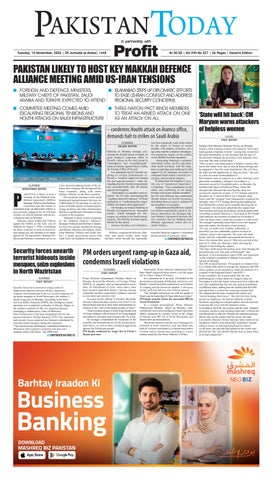
– condemns Houthi attack on Aramco office, demands halt to strikes on Saudi Arabia ISLAMABAD
SALEEM JADOON
P
ISLAMABAD MONITORING REPORT
AKISTAN is likely to host a meeting of the Makkah Joint Defence Agreement’s (MJDA) Strategic Political and Defence Committee later this month, as Islamabad steps up diplomatic efforts to ease tensions triggered by the US-Iran conflict, an official familiar with the development said on Monday. Pakistan, Saudi Arabia and Türkiye signed the MJDA in the holy city of Makkah on August 7, 2026, committing the three countries to treat an armed attack against any one member as an attack against all. The agreement’s Strategic Political and Defence Committee serves as
a key decision-making forum of the alliance and comprises the foreign and defence ministers, along with senior military officials, of the three countries. The proposed meeting comes amid heightened regional tensions between the United States (US) and Iran, as well as a series of Houthi attacks on Saudi airports, energy facilities and other infrastructure that have significantly disrupted civilian aviation in the kingdom. “Pakistan is likely to host a meeting of the Makkah Defense Alliance’s Strategic Political and Defense Committee later this month, attended by foreign and defense ministers and military chiefs from Pakistan, Türkiye and Saudi Arabia,” a senior government source told Arab News on condition of anonymity.
Security forces unearth terrorist hideouts inside mosques, seize explosives in North Waziristan ISLAMABAD
STAFF REPORT
Security forces have recovered a large cache of improvised explosive devices (IEDs), explosives, weapons and ammunition from two terrorist hideouts set up inside mosques in North Waziristan, the military’s media wing said on Monday. According to the InterServices Public Relations (ISPR), the intelligence-based operation was conducted on Sunday in Muzak village, on the southern outskirts of Mir Ali, targeting hideouts belonging to Indian proxy Fitna Al-Khawarij. Fitna Al-Khawarij is the state-designated term for the banned Tehreek-e-Taliban Pakistan (TTP). The statement said security forces sanitised two hideouts established by terrorists inside mosques during the operation. “The terrorists had deliberately established hideouts in Masajid to store explosive materials and also were running torture cells there,” the ISPR said.
CONTINUED ON PAGE 03
Pakistan on Monday strongly condemned the Houthi attack on Saudi oil giant Aramco’s corporate office in Riyadh, calling on the rebel group to “immediately and unconditionally” cease all attacks against Saudi Arabia, the Foreign Office (FO) said. In a statement, the FO said the targeting of civilian infrastructure reflected a “reckless regard for human life and regional security”, while demanding that the Houthis immediately and unconditionally halt all attacks against the kingdom. “Fortunately, no casualties were reported,” the FO said, commending the “vigilance and swift response” of Saudi authorities in “confronting this unjustifiable and unprovoked aggression”. On Sunday, an Aramco building in Riyadh was targeted in an “attempted attack”, which damaged the skyscraper, according to the Saudi energy ministry. The Houthis claimed responsibility for the attack. Aramco facilities and infrastrucMilitary cooperation between Pakistan and Saudi Arabia dates back decades, while Riyadh has repeatedly
ture have repeatedly come under attack by the rebels in Yemen in recent months, with tankers, refineries, storage areas and the company’s headquarters among the targets, as the conflict in the Middle East has expanded. Reiterating Pakistan’s solidarity with Saudi Arabia, the FO said Islamabad stood resolutely with the kingdom’s leadership and reaffirmed its full support for all measures necessary to safeguard Saudi Arabia’s security, sovereignty and territorial integrity. It added that the kingdom’s security was of “paramount importance” to Pakistan. “Our commitment to the safety and well-being of our Saudi brothers and sisters remains steadfast,” the FO said. Pakistan has condemned Houthi attacks on several occasions, describing them as a grave violation of the kingdom’s sovereignty. Islamabad and Riyadh have signed two defence agreements aimed at collective deterrence: the Strategic Mutual Defence Agreement between the two countries and the Makkah Joint Defence Agreement, which also includes Turkiye.
extended financial support to Islamabad during periods of economic stress.
CONTINUED ON PAGE 03
PM orders urgent ramp-up in Gaza aid, condemns Israeli violations ISLAMABAD
STAFF REPORT
Prime Minister Muhammad Shehbaz Sharif on Monday directed the Ministry of Foreign Affairs (MOFA) to urgently step up humanitarian assistance for Palestinians in Gaza, where heavy rains have flooded makeshift shelters, leaving already vulnerable families, particularly children, exposed to starvation and extreme cold. In a post on his official X account, the prime minister expressed deep concern over Israel’s continued illegal actions to deny basic humanitarian assistance to the “brave Palestinian people of Gaza”. “Heart-rending images of tents being flooded and of Gazan children with nowhere to go being trapped and subject to starvation and extreme cold,” he wrote. He strongly condemned the violations of the ceasefire and international law by the occupying Israeli forces, as well as their continued aggression against the Palestinian people. PM deeply saddened by tragic fire in China’s Shanxi province
Meanwhile, Prime Minister Muhammad Shehbaz Sharif expressed deep sorrow over the tragic fire in China’s Shanxi Province. In a statement on X, he said, “On behalf of the government and people of Pakistan, and on my own behalf, I extend heartfelt condolences to President Xi Jinping and the bereaved families. I also pray for the swift and full recovery of those injured. “Our thoughts and prayers are with the people of Shanxi and the leadership of China in this hour of grief.” PM lauds security forces for successful IBO in North Waziristan In a related development, Prime Minister Muhammad Shehbaz Sharif on Monday commended the successful intelligence-based operation (IBO) conducted by security forces in the village of Mozak, near Mir Ali in North Waziristan, and lauded their professionalism. The prime minister said the use of mosques by terrorists to store explosives and turn them into hubs of violence amounted to a blatant desecration of Islam and its sacred sites, according to a news release issued by the Prime Minister’s Office.
‘State will hit back’: CM Maryam warns attackers of helpless women LAHORE
STAFF REPORT
Punjab Chief Minister Maryam Nawaz on Monday issued a stern warning to those who dared to “raise their hand against a helpless woman”, saying they would face the same humiliation, as she declared that the days of the powerful abusing the powerless with impunity were over and “the state will hit back”. “Dare to raise your hand against a helpless woman who leaves her home every day to earn an honest living, and be prepared to face the same humiliation. She will have the right and the opportunity to slap you back,” she said in a post on social media platform X. Her remarks came in response to a video showing a man physically assaulting a salesgirl. According to a statement issued by Faisalabad police on Monday, the incident took place at Kohinoor Plaza, where the salesgirl had informed the man that the shop was exclusively meant for women. CCTV footage shared by the police on X showed that it was a lingerie shop. Police said the “enraged” man subsequently assaulted the salesgirl, with CCTV footage showing him pulling her from behind the counter and eventually throwing her to the ground. The statement added that the suspect had been arrested and legal proceedings initiated against him. According to details shared in a visual post by the Punjab chief minister, the incident occurred on November 8 when the shop owner visited the premises to collect rent. The salesgirl reportedly asked him to leave the lingerie shop and contact the business owner instead. “No one, no matter how wealthy, influential, or powerful, can now intimidate, exploit or harm an ordinary citizen with impunity. The state will stand firmly with the vulnerable and respond decisively to those who misuse their power,” Maryam asserted in her post on X, while also sharing a video showing the alleged victim hitting the suspect. “The days of the powerful getting away with abusing the powerless are over. The state will hit back!” she declared. A first information report (FIR) was registered on the woman's complaint at Madina Town police station on Monday. The FIR invoked Sections 354 (assault or criminal force to a woman with intent to outrage her modesty) and 509 (word, gesture or act intended to insult the modesty of a woman) of the Pakistan Penal Code (PPC). In her complaint, the woman stated that she was performing her routine duties at a lingerie shop on November 8 when the shop's owner arrived to collect the rent. She explained that the rent was paid in instalments on different dates, adding that she handed him Rs5,000 and asked him to collect the remaining amount later. She alleged that the man escalated the matter and “started arguing about taxes”. She told him that, being merely an employee, she had no authority to make decisions regarding tax-related matters and advised him to discuss the issue with the business owner. According to the FIR, the woman said the man “adopted extremely unethical and insulting behaviour” towards her and threatened to slap her. Despite her repeated requests that he take up the matter with the owner, the man Last month, Maryam Nawaz had also taken notice of an incident in which a man physically assaulted a woman riding a scooty on Mozang Ring Road in Lahore. At the time, she said she had spoken to the victim and advised her that “she should slap the man as many times as he had slapped her”.
02 NEWS
Tuesday, 10 November, 2026 | KARACHI
ESSENTIAL FOOD PRICES REMAIN ABOVE OFFICIAL RATES ACROSS LAHORE MARKETS
C
PROFIT
WEB DESK
ONSUMERS in Lahore continued to pay substantially higher prices for essential food items than the rates notified by the government last week, with tomatoes, chicken, potatoes and other commodities selling well above official limits despite revisions in price lists. A weekly market survey showed that tomatoes were being sold for Rs300–350 per kg against the officially notified range of Rs180–215 per kg. Their official price increased by Rs40 per kg during the week, adding to the burden on households already facing elevated food costs. Chicken prices also remained high despite a reduction in the notified rate for meat. The official price of chicken meat was lowered by Rs29 per kg to Rs570, but retailers continued to charge between Rs600 and Rs680 per kg. Boneless chicken was selling at Rs900–1,100 per kg, while live chicken
prices increased by Rs20 per kg to an officially notified range of Rs379–393 per kg. Live birds, however, remained largely unavailable for sale across the city. Potatoes were another commodity showing a substantial difference between official and market prices. Sugar-free potatoes, officially priced at Rs50–53 per kg, were being sold for Rs80–100 per kg. Onion prices remained unchanged at
the notified range of Rs185–195 per kg, but consumers were paying Rs220–250 per kg in retail markets. Garlic prices also exceeded government rates across different varieties. Local garlic, officially priced at Rs230–240 per kg, was selling for Rs300–320 per kg. Chinese garlic was available at approximately Rs700 per kg, considerably
above its notified price of Rs400–420 per kg. Harani garlic, officially fixed at Rs330–345 per kg, was being sold for Rs500–600 per kg. Meanwhile, the official price of Thai ginger declined by Rs10 per kg to Rs340–355, while Chinese ginger was fixed at Rs315–330 per kg. Despite these rates, both varieties were selling for Rs400–500 per kg. The survey also recorded increases in the prices of several vegetables, including pumpkin, capsicum and cauliflower, although specific rates were not provided. The continued differences between government-notified and actual retail prices have raised concerns about the effectiveness of price-control enforcement in Lahore. While official price lists reflected adjustments in commodity prices, retailers continued to charge higher rates, with some products remaining unavailable at the prescribed prices, highlighting weak enforcement by government authorities, particularly the Punjab Enforcement and Regulatory Authority (PERA).
FIA arrests three in Karachi over alleged counterfeit Atlas Honda products PROFIT
WEB DESK
Govt to transfer IESCO land, pension liabilities and debts to PHL ahead of privatisation PROFIT
MONITORING REPORT
The government plans to transfer Islamabad Electric Supply Company's (IESCO) land, pension liabilities of retired employees and selected financial obligations to Power Holding Limited (PHL) as part of a restructuring exercise ahead of the power distribution company's privatisation, Business Recorder reported. IESCO has approached its creditors for no-objection certificates to implement the arrangement, which was approved by the Cabinet Committee on Privatisation (CCoP) in August 2026 and ratified by the Federal Cabinet on September 23. Under the plan, PHL will serve as a government-owned special purpose vehicle to take over specified assets and liabilities of IESCO, Faisalabad Electric Supply Company (FESCO) and Gujranwala Electric Power Company (GEPCO), the three distribution companies included in the first phase of privatisation. All land owned by IESCO will be transferred to PHL and subsequently leased back to the distribution company on a long-term basis. Pension and other retirement benefit liabilities of retired employees will also shift to PHL, while obligations relating to serving employees will remain with IESCO. Of the funds held in IESCO's existing retirement benefit trusts, Rs1.5 billion will be retained for current employees, with the remaining amount transferred to a trust established by PHL. The restructuring also covers the transfer of Punjab government payables and receivables, overdue debtservicing liabilities on re-lent loans along with markup, and tax receivables from the Federal Board of Revenue (FBR), including related court cases. However, debt-servicing obligations that are not yet due will remain on IESCO's balance sheet. According to the company's communication to creditors, PHL will assume responsibility for the transferred debts and obligations once the scheme takes effect, releasing IESCO from those liabilities subject to the arrangement's terms. The restructuring will be implemented through a scheme of arrangement under the Companies Act, 2017, requiring approval from the relevant company members and sanction by the Securities and Exchange Commission of Pakistan (SECP). IESCO has sought consent from creditors with outstanding claims as of June 30, 2026, while informing them that they may retain their creditor status during consideration of the scheme by the relevant authorities. The restructuring is intended to separate specified assets and legacy financial obligations from the distribution companies before the government divests its shareholding to private investors.
The Federal Investigation Agency (FIA) has arrested three suspects during a raid on an alleged counterfeit manufacturing facility in Karachi's SITE area for suspected infringement of Atlas Honda's registered copyright. According to an FIA spokesperson, the agency's Corporate Crime Circle Karachi conducted the operation in Metroville-III, seizing a large quantity of allegedly infringing goods along with machinery and equipment used in their production. The raid was carried out on the complaint filed by Ghulam Murtaza, an authorised representative of Atlas Honda. The complainant alleged that
the suspects were manufacturing products that infringed the company's registered copyright and protected artistic works. The arrested individuals were identified as Syed Asif Ali, Syed
Anas Ali and Syed Asfand Ali. The FIA registered a case against the three suspects and transferred them to its Corporate Crime Circle Karachi for further legal proceedings.
Customs registers FIR against industrial unit in Risalpur Export Processing Zone over alleged Rs117m tax evasion
PROFIT MONITORING REPORT
Pakistan Customs has registered a case against Shippo Private Limited, an industrial unit operating in the Export Processing Zone (EPZ) Risalpur, after an audit uncovered a substantial shortage of goods involving suspected customs duty and tax evasion of approximately Rs117 million.
As per reports, the Collectorate of Customs Appraisement, Peshawar, registered a First Information Report (FIR) against the company on November 6, 2026, following a focused audit of its operations. The investigation followed the interception of a consignment imported by Shippo at Karachi Port, where the Directorate of Transit Trade reportedly found that the goods did not match those authorised under
the company's industrial licence. The consignment had been intercepted for examination before the issuance of transhipment permission for EPZ Risalpur. Customs authorities in Karachi subsequently registered a separate FIR over the alleged import irregularities. Following these developments, customs officials in Peshawar conducted a stock audit that identified a significant shortage of goods, raising concerns over potential evasion of government duties and taxes. Meanwhile, a fire broke out at Shippo's premises on November 8, two days after the registration of the second FIR. Authorities said the cause and circumstances of the fire had not yet been established, while the relevant zone authority was expected to examine the incident under applicable procedures. Pakistan Customs said legal proceedings would continue in accordance with the law as part of its efforts to enforce customs regulations and protect government revenue.
Silver price in Pakistan Gold price in Pakistan for today for today
PROFIT: Silver rates in Pakistan fluctuate frequently in response to international market trends. The rates listed are provided by local gold markets and Sarafa Markets in various cities. NEWS DESK
PROFIT: Gold prices in Pakistan fluctuate frequently in response to international market trends. The rates listed are provided by local gold markets and Sarafa Markets in various cities. NEWS DESK
Govt raises youth business loan limit to Rs25m, lowers eligibility age to 18 PROFIT
NEWS DESK
Prime Minister Shehbaz Sharif has increased the maximum loan limit under the Prime Minister's Youth Business and Agriculture Loan Schemes from Rs7.5 million to Rs25 million, lowered the minimum eligibility age from 21 to 18 years and directed that 30% of loans be reserved for women. The decisions were announced during a review meeting on Sunday, where the prime minister also instructed authorities to provide loans in easy instalments to help young people establish businesses, expand existing operations and undertake agricultural activities. According to a briefing presented at the meeting, 581,341 young people have received loans worth Rs313.9 billion since January 2023. Officials said the number of beneficiaries is ten times higher than in the preceding decade. The government has allocated Rs292 billion for FY2026-27 to provide financing to approximately 266,700 young people under the schemes. To facilitate applicants, the prime minister directed the Small and Medium Enterprises Development Authority (SMEDA) to provide business consultancy, technical assistance and start-up support to young entrepreneurs. He also ordered a nationwide awareness campaign to inform eligible applicants about the financing schemes and available business opportunities. The prime minister said the government aimed to expand employment opportunities and encourage youth participation in business and agriculture, with particular emphasis on women's financial independence. Finance Minister Muhammad Aurangzeb, Special Assistant to the Prime Minister on Youth Affairs Rana Mashhood Ahmed Khan and Special Assistant on Political Affairs Talha Burki attended the meeting.
Saudi Aramco's corporate office in Riyadh damaged by debris from attempted missile attack PROFIT
REUTERS
Saudi Aramco's corporate office in Riyadh's financial district sustained damage on Sunday after debris from an attempted missile attack struck the building, blowing out windows across several floors. Saudi Arabia's energy ministry said the damage to Aramco Tower was limited and no injuries or fatalities were reported. The ministry did not identify those responsible, although Yemen's Iran-aligned Houthi group claimed responsibility for the attack. The Saudi-led coalition said its air defences intercepted Houthi missiles over Riyadh early on Sunday and also intercepted a missile targeting the Eastern Province, home to most of Saudi Arabia's oil and gas reserves. The coalition said it had destroyed ballistic missile launchers in Yemen's Saada and Sanaa regions that were used in the attacks. The latest strikes come amid escalating hostilities between Saudi Arabia and the Houthis, who have intensified attacks on Saudi energy infrastructure, ports and airports in recent weeks. Aramco's headquarters in Dhahran also sustained extensive damage in an attack last month. Houthi military spokesperson Yahya Saree said Riyadh's international airport was among Sunday's targets, although Saudi authorities did not confirm the claim. An earlier strike on the airport in October killed 13 people and injured more than 300. The renewed fighting intensified after Houthi forces advanced towards the Bab el-Mandeb Strait in September, threatening a major shipping route amid the wider US-Israeli war with Iran. Saudi Arabia has responded with air strikes against Houthi positions in Yemen. The Houthi-run health ministry said at least 40 people were killed in Saudi strikes near Sanaa on Saturday, while Saudi authorities said they were investigating the reports. The escalation comes as Riyadh seeks international assistance to strengthen its defences. Britain announced in October that it would deploy fighter jets on defensive missions to help protect Saudi cities from Houthi attacks. Diplomatic efforts have also continued, with senior officials from Saudi Arabia, Pakistan and Türkiye meeting Iranian representatives in Tehran last month under the Mecca defence pact framework. Iran subsequently said discussions with Riyadh were continuing over potential regional security arrangements that would exclude foreign military involvement. Meanwhile, several Saudi government agencies resumed office operations on Sunday, while many schools reopened for in-person classes after weeks of remote learning prompted by earlier attacks.
Oil falls as Trump signals restraint on Iran despite fresh shipping attacks PROFIT
REUTERS
Oil prices fell on Monday after US President Donald Trump downplayed the likelihood of renewed strikes on Iran, though attacks on ships near the Strait of Hormuz kept supply concerns in focus. Brent crude dropped by $1.65, or 1.7%, to $96.67 a barrel by 0830 GMT while US West Texas Intermediate lost 96 cents, or 1%, to $89.87. The Brent benchmark plunged 16% last week for its steepest weekly drop since the start of the COVID-19 pandemic. 'Relatively Optimistic Scenario' "The (oil) market appears to be pricing in a relatively optimistic scenario of de-escalation, even though a comprehensive agreement between Washington and Tehran
has yet to materialise," said Sugandha Sachdeva, founder of New Delhi-based research firm SS WealthStreet. "Unless there is a meaningful diplomatic breakthrough accompanied by a sustained normalisation of shipping flows through the Strait of Hormuz, crude oil prices are likely to retain a geopolitical risk premium, with near-term support seen at $93 a barrel for Brent." Trump said on Sunday that he was highly unlikely to order fresh attacks on Iran as long as talks to end the conflict progressed, even as both countries reported that shipping had been hit in or near the Strait of Hormuz. He had hinted at renewing attacks on Iran after last week's US midterm elections, but there has been no sign of a large-scale US military operation. Iran has said it would
respond by striking US and Israeli targets. Tim Waterer, chief analyst at KCM Trade, called Trump's comments "more measured" but said the market is still waiting to see whether the midterms have produced a lasting shift in Trump’s approach to the conflict, or whether this is just another temporary change in tone. Oil is headed for a glut again as recovering Middle Eastern oil flows, rising production from other countries and weak demand have pushed global supply above consumption, JPMorgan said in a report on Friday, estimating a surplus of 1.1 million barrels per day in September, widening to 1.4 million bpd in October. Separately, the Iran-aligned Houthis said they were responsible for an attack on Saudi Aramco's offices in Riyadh on Sunday.
Elsewhere, Russia's Kirishi oil refinery was set on fire after a Ukrainian drone at-
tack on the region on Monday, Governor Alexander Drozdenko said.
NEWS 03
GOLD RISES OVER 1% AS SOFTER OIL PRICES EASE INFLATION WORRIES
Tuesday, 10 November, 2026 | KARACHI
G
PROFIT
STAFF REPORT
OLD rose more than 1% on Monday as softer oil prices eased inflation concerns, while investors awaited key US inflation data and fresh signals from the Federal Reserve on its policy outlook. Spot gold climbed 1.2% to $4,112.90 per ounce by 0630 GMT, while US gold futures for December delivery also rose 1.2% to $4,122.00. Bullion gained about 5% last week. Oil prices fell after US President Donald Trump said he was highly unlikely to order further attacks on Iran as talks to end the conflict continued, easing concerns about potential supply disruptions.
Lower oil prices can ease inflationary pressures and reduce expectations that interest rates will stay higher for longer, lowering the opportunity cost of holding non-yielding bullion. "Trump's more conciliatory tone toward Iran is helping keep a lid on oil prices, which in turn eases some of the inflation pressure that had been weighing on the metal along with a modest pullback in the dollar," said Tim Waterer, chief market analyst at KCM Trade. The dollar softened, making greenback-priced bullion more affordable for buyers overseas. Meanwhile, US job growth accelerated in October and the unemployment rate fell to 4.1%, reinforcing expectations that the labour market remains resilient and keeping
the Fed on track for a December interestrate increase. Traders currently see a 79% chance that the Fed will raise rates in December, up from 71% prior to the payrolls data, according to CME's FedWatch tool. Market participants now await the US Consumer Price Index data due on Tuesday and the Producer Price Index on Friday to further gauge the Fed's monetary policy stance. "Any hot readings would likely firm the dollar and lift the odds of a December rate hike, which would quickly put gold back on the defensive," Waterer said. Among other metals, spot silver climbed 1.4% to $52.57 per ounce, platinum gained 0.7% to $1,546.83 and palladium rose 1.4% to $1,037.58.
Pakistan's relaxed GMO soybean import rules raise concerns over agricultural biosecurity PROFIT
STAFF REPORT
Pakistan's decision to relax biosecurity import conditions for genetically modified (GMO)/living modified organism (LMO)-containing viable soybeans from Brazil and the United States has raised serious concerns about the possible entry of invasive superweeds, crop diseases, nematodes, mites and other pests into the country's agricultural system, besides posing serious environmental risks, as the revised import conditions reportedly remove several essential safeguards previously required to prevent the introduction of biosecurity risks and GMO/LMO contamination of the environment. These conditions are also alleged to violate Articles 15, 16 and 18 of the Cartagena Protocol, which deal with the transboundary movement of GMOs/LMOs. The revised import conditions, issued on August 1, 2026, by the National Agri Trade and Food Safety Authority (NAFSA) administration, have reportedly waived mandatory seed devitalisation in violation of the EPA licence, relaxed requirements for additional declarations certifying consignments as free of specified quarantine pests and superweeds, and placed greater reliance on phosphine fumigation, a treatment primarily used to control stored-grain insects. However, it has limited effectiveness against khapra beetles and certain low-respiration stages of insects, which may exhibit resistance to the treatment. The changes have also raised serious questions about the adequacy of cargo inspections, the monitoring of shipments during transportation and the authority responsible for enforcing Pakistan's plant quarantine regulations and biosafety regime. According to experts, Brazilian soybean imports carry potential risks from
116 quarantine pests, including 42 insects, 27 weeds, 25 fungi, eight bacteria, six viruses, six mites and two nematodes. These organisms can threaten crops, spread plant diseases and introduce invasive weed species into agricultural areas. The concerns are particularly significant for Pakistan, where agriculture supports millions of livelihoods and provides raw materials for major industries, including textiles. Under the previous import conditions introduced from 2018 onwards, Brazilian soybean consignments were required to undergo measures to ensure that seeds could not germinate, even in the event of accidental spillage or unintentional release. These included verified additional declarations from the exporting country's plant protection authority and approved treatments, such as dryheat treatment, gamma irradiation, ethylene oxide or methyl bromide fumigation, supported by germination testing. According to plant protection experts, the revised conditions have reportedly removed or weakened several of these requirements. RISK OF VIABLE SEEDS ENTERING AGRICULTURAL AREAS One of the principal concerns relates to the removal of the requirement that
imported GMO soybeans have zero germination capacity. Rule 49 of the Pakistan Plant Quarantine Rules, 2019, requires GMO soybeans imported for industrial crushing or processing to be rendered incapable of germination. The purpose is to ensure that imported grain does not become a source of unauthorised cultivation or accidental spread. Previously, International Seed Testing Association (ISTA) certificates were used to verify that imported seeds had no germination capacity. The Pakistan Environmental Protection Agency also imposes conditions under the Pakistan Biosafety Rules, 2005, including requirements relating to seed devitalisation and verification of approved GMO events. The removal of these safeguards could allow viable seeds to enter the country and potentially germinate if spilled during transportation, handling or an accident. According to the objections, neither NAFSA nor Pak-EPA has devised emergency measures to address such incidents. The risk does not end at ports. Imported soybeans are transported from Karachi to processing facilities, including destinations hundreds of kilometres away in Punjab. If viable seeds escape from trucks or cargo during transit, they
could reach agricultural land. The revised conditions reportedly require transportation under sealed conditions but do not specify detailed arrangements such as leak-proof containers, designated routes, GPS tracking, biosecurity monitoring or procedures for dealing with accidental spills. REMOVAL OF SAFEGUARDS AGAINST 27 INVASIVE WEEDS Another major concern is the removal of the mandatory additional declaration relating to quarantine weed seeds under Schedule V of the Pakistan Plant Quarantine Rules, 2019. According to the cited pest-risk assessment, Brazilian soybean imports may carry 27 invasive weed species that are not currently established in Pakistan. The additional declaration is important because it requires the exporting country's plant protection authority to certify that specified prohibited pests or weeds are absent from the consignment. Without this certification, quarantine inspectors may face greater difficulty identifying and intercepting prohibited weed seeds mixed with bulk soybean shipments. The revised conditions instead place significant reliance on aluminium phosphide, which releases phosphine gas and is primarily used as an insect fumigant. However, phosphine does not destroy weed seeds or render soybean seeds incapable of germination. It therefore cannot replace seed devitalisation or certification measures designed to prevent the introduction of invasive plants. The technical objections also question the composition and legal status of a committee reportedly consulted during the revision of the import conditions. The committee included officials from the Punjab Agriculture Department, a professor from the University of Agriculture Faisalabad and a chemist from the HEJ Research Institute of Chemistry.
Pakistan to receive 75% of new Saudi-backed private equity fund PROFIT
STAFF REPORT
Pakistan is set to receive 75% of the investment allocated under a new private equity fund backed by Saudi Arabian and Pakistani investors, following an agreement signed on Monday to strengthen bilateral investment cooperation. The Saudi-Pakistan Joint Business Council (SPJBC), established by the governments of both countries to promote private-sector cooperation, signed a memorandum of understanding (MoU) on November 9 to establish the fund. According to the council, the fund will initially have a size of several hundred million dollars, with the potential to
expand as additional investment opportunities emerge across different sectors. Under the proposed arrangement, three-quarters of the fund's capital will be directed towards projects in Pakistan, while the remaining 25% will be allocated to investment opportunities in Saudi Arabia. Investors from both countries are expected to contribute equally to the fund, which will target private-sector businesses in agriculture, mining, construction and other industries. The initiative will also explore investment opportunities arising from Pakistan's plans to commercialise public assets, including airports, motorways, ports and maritime development proj-
ects. In Saudi Arabia, potential investments will include commercial projects, particularly in the Kingdom's holy cities. The agreement provides for financial institutions from both countries to participate in the equity of the fund management company. However, the fund's establishment and investment activities remain subject to regulatory approvals in Pakistan and Saudi Arabia. The development follows a series of engagements between Pakistani and Saudi business leaders aimed at expanding economic cooperation beyond traditional government-to-government arrangements. In August, SPJBC Chairman Prince Mansour bin Mohammad Al Saud met Prime Minister Shehbaz
Sharif during a visit to Pakistan, with discussions focusing on potential Saudi investments in agriculture, infrastructure, energy, information technology and real estate. Saudi investors have also explored opportunities in Pakistan's transport infrastructure, including the Sukkur-Hyderabad Motorway project, as Islamabad seeks greater foreign private-sector participation in major development projects. The latest agreement represents another step towards institutionalising investment cooperation between the two countries, although the fund's final structure and initial investments will depend on the completion of regulatory approvals.
Security forces unearth terrorist hideouts inside mosques, seize explosives in North Waziristan CONTINUED FROM PAGE 01
“This reprehensible desecration of places of worship by Indian proxy Fitna Al-Khawarij serves as yet another clear piece of evidence of their utter disregard for the fundamental teachings of Islam,” the statement added. The ISPR said terrorists abetted by the Afghan Taliban had “nothing to do with Islam”, adding that their “perverted” interpretation and misuse of religion was “unacceptable and fully rejected” by the people of Khyber-Pakhtunkhwa and Pakistan. A sanitisation operation was under way to search for and eliminate any other terrorist hideouts in the area. The military’s media wing said the counter-terrorism campaign under the vision of “Azm-e-Istehkam”, approved by the Federal Apex Committee on the National Action Plan, would continue at full pace. It reiterated that security forces and law enforcement agencies would continue their efforts to “wipe out the menace of foreign-sponsored and supported terrorism from the country”. Terrorism remains a growing challenge for Pakistan, with the number of attacks increasing every year since 2022, according to the Armed Conflict Location & Event Data (ACLED), a global monitoring organisation. ACLED data shows that attacks in Pakistan rose nearly fourfold, from 658 in 2022 to 2,425 in 2025. The threat continued to escalate in 2026. Two security reports presented to the federal cabinet in October showed that terrorist incidents in Khyber-Pakhtunkhwa had increased by 195 per cent between March 2024 and September 2026. The reports further found that 73 per cent of attacks recorded in the province during 2026 had targeted police and security personnel, while the use of drones and improvised explosive devices (IEDs) had emerged as growing threats. Pakistan has repeatedly accused the Afghan Taliban authorities of allowing the banned Tehreek-e-Taliban Pakistan (TTP) to operate from Afghan territory and launch attacks inside the country.
Pakistan likely to host key Makkah Defence Alliance meeting amid US-Iran tensions CONTINUED FROM PAGE 01
The two countries also signed a separate bilateral defence agreement in September last year. Under the pact, Pakistan deployed 8,000 troops, a squadron of fighter jets and an air defence system to Saudi Arabia, further expanding military cooperation between the two countries, Reuters reported in May. Pakistan has assured Saudi Arabia of its support in safeguarding the kingdom’s territorial integrity and sovereignty amid recurring Houthi attacks. Islamabad has also called on the Yemenbased group to return to the negotiating table and immediately halt attacks against Saudi Arabia’s civilian infrastructure. The MJDA committee also met in Riyadh last month to discuss security developments and threats facing the kingdom. All three countries have maintained that the defence pact remains open to other countries wishing to join, while clarifying that it is defensive in nature and is not directed against any particular state.
Nvidia shares plunge 6% as CEO Jensen Huang faces foreign intelligence controversy PROFIT
STAFF REPORT
Nvidia shares fell around 6% on Monday after the US chipmaker launched an independent investigation into allegations that CEO Jensen Huang had been targeted by a foreign intelligence operation, raising concerns about leadership stability at one of the world's most valuable technology companies. The investigation follows reports that Huang had maintained a relationship with a Chinese businesswoman allegedly linked to intelligence activities on behalf of Beijing. According to a New York Times report, US authorities investigated Alice Huang, a former executive at Singapore-based Megaspeed, and concluded that she was a Chinese intelligence asset. The allegations remain disputed. Huang subsequently acknowledged in a message to Nvidia employees that he had
been unfaithful to his wife, apologising for his conduct without disclosing details of the relationship. Nvidia's shares initially dropped as much as 8% before recovering slightly to trade around 6% lower, wiping more than $280 billion from the company's market capitalisation compared with its previous closing valuation. The company announced on Sunday that an independent committee of directors, supported by external legal counsel, would investigate the allegations and assess any potential implications for national security and corporate operations. Nvidia said its board continued to support Huang and had no reason to believe that company secrets or national security had been compromised. The developments have intensified scrutiny of Huang's central role in Nvidia's operations and the wider artificial intelligence industry. The 63-year-old co-founder
holds approximately 3.6% of the company and maintains significant influence over strategic decisions, product development and relationships with major technology customers. Analysts have warned that uncertainty surrounding Huang's leadership could affect investor confidence and potentially delay investment decisions or product launches, although most do not anticipate his immediate departure. The controversy has also affected Nvidia's activities in Asia. Huang's daughter, Madison Huang, an Nvidia executive, cancelled a planned visit to South Korea, where she had been scheduled to meet technology companies during an industry conference. However, South Korean officials said they did not expect disruptions to contracted deliveries of Nvidia graphics processing units. Shares of major Asian semiconductor suppliers recovered despite the uncertainty, with Taiwan Semiconductor Manufacturing
Company gaining 4.7%, while Samsung Electronics and SK Hynix rose 0.6% and 0.4%, respectively. Meanwhile, China's Foreign Ministry rejected allegations of Chinese espionage, describing the accusations as baseless. US President Donald Trump also addressed the controversy on Sunday, saying he had not discussed the allegations with Huang while expressing confidence in the Nvidia chief executive. The investigation comes as Nvidia remains central to the global expansion of artificial intelligence infrastructure, with its advanced processors underpinning major investments by technology companies and governments worldwide. The investigation, board position and Huang's admission were independently confirmed through Nvidia's November 8 statements. The share-price movements and Asian market figures reflect the supplied Reuters report's trading snapshot, rather than final closing prices.
04 COMMENT
WHAT PAKISTAN MUST TAKE TO COP31
Instability as usual
T
HE attempted Houthi attack on an Aramco administrative building in Riyadh is a reminder that the Middle East’s conflicts continue to develop independently of the political events commanding international attention. No casualties were reported, but attacks on civilian infrastructure remain unacceptable, while the persistence of Houthi operations against Saudi Arabia exposes the limits of existing efforts to contain the confrontation. Pakistan’s condemnation and demand for an immediate cessation of attacks are justified; protecting civilians and preventing further escalation must remain central to the response. With the US midterm elections and uncertainty over Benjamin Netanyahu’s political future dominating coverage, there is a temptation to treat changes in Washington and Israel as the next decisive moment for regional peace. Electoral outcomes can change diplomatic incentives, particularly when governments face greater scrutiny of their foreign policy, but neither a weakened American administration nor a possible change of Israeli leadership automatically resolves the conflicts already under way. Waiting for political realignments to produce moderation leaves too much dependent on calculations made elsewhere. Over the past year or so, the region has moved between military escalation, negotiations and arrangements that have struggled to hold, with the US-Iran confrontation adding uncertainty to unresolved Palestinian and Yemeni questions. These developments carry consequences far beyond the states directly involved, because insecurity around energy supplies and maritime routes can affect trade, investment and household costs across importing economies. For countries such as Pakistan, the distinction between a distant regional crisis and an immediate domestic economic concern is increasingly difficult to sustain. Pakistan’s sustained diplomatic engagement has therefore been constructive, including its efforts to facilitate dialogue between Washington and Tehran while maintaining support for Saudi security. Its advocacy of a negotiated settlement in Yemen also recognises that military responses alone cannot provide a durable political outcome. Islamabad should continue working with regional partners to preserve communication and encourage restraint, using its relationships to support agreements whose implementation receives as much attention as their announcement. The larger concern is that repeated disruption is becoming an accepted condition of international affairs, with each incident absorbed into expectations rather than prompting sustained efforts to address its causes. Governments and businesses may learn to operate amid uncertainty, but adaptation does not reduce the human and economic costs of prolonged conflict. As the Middle East remains in flux, diplomacy needs continuity beyond election cycles, with measurable progress on civilian protection, maritime security and political negotiations.
A
Climate change has become a national security and development challenge, and Pakistan’s case at COP31 should reflect it
Arif Nizami (Late) Founding Editor
M. A. Niazi
Babar Nizami Editor Profit
FAREED KAKAR
S COP31 opens in Antalya, Türkiye, on 9 November, Pakistan’s delegation needed to carry a new message. For years, climate change has been discussed in Pakistan as an environmental issue, measured in rainfall, temperatures and melting glaciers. These indicators matter, but they no longer tell the full story. Climate change now affects the economy, the food supply, public health, schools and social stability. It has become a national security challenge, and Pakistan should present it as one. The numbers make the case. The 2022 floods affected around 33 million people, displaced nearly eight million and claimed more than 1,700 lives. The Post-Disaster Needs Assessment, prepared by the government with the World Bank, the Asian Development Bank and international partners, placed damages at US$14.9 billion and economic losses at US$15.2 billion. Reconstruction needs were estimated at US$16.3 billion. Three years later, the 2025 monsoon showed that 2022 was not a one-off event. The Ministry of Planning’s preliminary assessment puts losses at around Rs822 billion, or about US$2.9 billion. More than 1,000 people died, around four million were displaced and nearly 3.3 million acres of cropped land were damaged. Together, these two disasters point to a burden of more than US$33 billion, before counting heatwaves, droughts and smaller floods. These are not just disaster statistics. When a flood washes away a road, markets lose their connection. When farmland goes under water, farmers lose income, food prices rise and industries lose raw materials. When a house collapses, a family loses years of savings. Recurring climate shocks are becoming recurring economic shocks. Security in this century cannot be defined only by borders and military strength. A secure state is one that can provide food, water, energy, jobs and stability to its people. Climate change touches each of these. Food security comes first. Pakistan’s agriculture depends on predictable water and weather. Floods destroy standing crops, while heatwaves and drought cut yields. The loss of a harvest spreads to rural jobs, livestock, food prices and the wider supply chain. Water security is equally critical. With a growing population and heavy reliance on the Indus system, the issue is not only how much rain falls, but how well water is stored, shared and managed. Energy is also exposed, as hydropower depends on steady river flows and extreme heat pushes up electricity demand. Climate shocks can also strain social cohesion. Families who lose homes, land and livestock often move to cities, adding pressure on housing, services and jobs. Climate change does not cause conflict by itself, but it can deepen existing pressures, especially
Dedicated to the legacy of late Hameed Nizami
Editor Pakistan Today
in water-scarce regions such as Balochistan. The most lasting damage is to human development. A flood may recede in weeks, but its effects can last a generation. The 2022 floods damaged around 22,000 schools, and official estimates warned that up to 9.1 million more people could fall below the poverty line. Children lose school years, families lose access to health care and clean water, and farmers spend years rebuilding what took decades to earn. Women, daily-wage workers and rural households carry the heaviest burden. There is also a question of fairness. Pakistan produces less than one per cent of global greenhouse gas emissions, yet it pays one of the highest prices. The United Nations estimates that Pakistan needs about US$348 billion between 2023 and 2030 to meet its climate and development needs, including US$152 billion for adaptation and resilience. No economy carrying heavy debt can fund this alone. Over the next two weeks in Antalya, Pakistan can move beyond describing flood damage and present a clear, practical agenda. Five points should be at its centre. First, frame climate change as a security and development issue. Pakistan can show that climate risk is being built into national planning through a standing mechanism that brings together the National Security Division, the Ministry of Climate Change, the Ministry of Planning, NDMA and the provinces. Second, bring evidence. District-level climate risk maps, built from satellite, weather and GIS data, can show partners exactly where people, farmland and infrastructure are most exposed. Third, bring a bankable portfolio. Ready-to-fund projects in resilient infrastructure, efficient irrigation, drought-resistant agriculture, early-warning systems and livelihood support for farmers and women would turn pledges into results. Fourth, ask for fair
When Ballot Box Challenges Presidential Power
T
Tuesday, 10 November, 2026
finance. Pakistan should press for faster access to the Loss and Damage Fund, which made its first allocation only last month, and for adaptation support that is predictable and largely grant-based, so that each disaster does not turn into new borrowing. The commitment made at Belém to at least triple adaptation finance by 2035 now needs a clear baseline and a delivery plan, and Antalya is the place to agree on both. A national disaster risk financing facility, backed by contingency funds and insurance, would show that Pakistan is also doing its part. Fifth, build partnerships for delivery. China, multilateral banks and regional partners can contribute through water management, resilient infrastructure, clean energy and technology transfer. Success should be measured not by how much is announced, but by how much reaches vulnerable communities and how quickly. Climate justice should mean partnership before the next disaster, not sympathy after it. That is the message Pakistan must carry into the negotiations at Antalya. The next major climate disaster will test more than Pakistan’s ability to rescue and provide relief. It will test the strength of its economy, its institutions and its capacity to protect the next generation. Pakistan’s future security will depend not only on how well it guards its borders, but on how well it protects the lives and livelihoods of its people. Climate resilience is national resilience. The writer is a Research Officer at the Centre of Excellence for CPEC, Ministry of Planning, Development and Special Initiatives, where he works on socio-economic development, security and people-topeople connectivity under CPEC 2.0. He is also the Founding Director General of the National Institute for Policy and Dialogue (NIPD). He can be reached at fdsmeerzai@gmail.com
Editor’s mail
Send your letters to: Letters to Editor, Pakistan Today, 4-Shaarey Fatima Jinnah, Lahore, Pakistan. E-mail: letters@pakistantoday.com.pk Letters should be addressed to Pakistan Today exclusively
Healing family ties
MUHAMMAD MOHSIN IQBAL
HE American midterm elections have delivered a message that extends far beyond the boundaries of domestic politics. They have demonstrated that while the people possess the power to place a president in the White House, they also retain the authority to challenge his policies, restrain his ambitions and reject the direction in which he seeks to lead the country. Democracy is not a licence granted to those in power to govern without restraint; it is a continuing relationship between the electorate and its elected representatives, sustained by public confidence and accountability. The results of November 3 have dealt a significant political setback to President Donald Trump and the Republican Party, with Democrats securing control of both chambers of Congress. The outcome represents a formidable challenge to an administration that had enjoyed considerable freedom in pursuing its legislative and political agenda. It also illustrates that the American electorate does not necessarily endorse every presidential decision simply because it has elected the individual occupying the Oval Office. For years, American administrations have frequently presented their domestic and international policies as expressions of national will. Yet the distinction between the authority of a government and the consent of its people is fundamental. A president may possess constitutional powers, command enormous military resources and exercise considerable influence over international affairs, but none of these attributes guarantees public approval. The ballot box remains an instrument through which citizens can remind their leaders that political authority ultimately derives from them. The election results have raised serious questions about the direction of American foreign policy, particularly its reliance on military pressure, confrontation and the projection of power abroad. Trump's posture towards Iran, the possibility of military escalation and the wider consequences of confrontation in the Middle East have contributed to anxieties about the human and economic costs of another conflict. At a time when global energy markets remain vulnerable to geopolitical instability, the consequences of military adventurism would not be confined to the countries directly involved. Rising oil prices, economic uncertainty and disruptions to international trade would affect ordinary Americans as well as populations across the de-
veloping world. The American people have reason to question whether an increasingly confrontational foreign policy serves their national interests. The pursuit of peace is not a sign of weakness, nor does diplomatic engagement necessarily imply compromise on matters of national security. A powerful country demonstrates its maturity not merely through its capacity to wage war but through its ability to prevent one. The question of Palestine has also exposed a profound moral contradiction in American foreign policy. Washington's largely unconditional support for Israel, despite the immense suffering inflicted upon the people of Gaza, has generated deep disquiet internationally. Images of devastated neighbourhoods, displaced families and innocent children have challenged the credibility of American claims to champion democracy, human rights and international justice. A policy that appears selective in its application of humanitarian principles inevitably weakens the moral standing of the country pursuing it. Equally significant is the changing political and social landscape within the United States. The electoral success of Abdul El-Sayed in Michigan, who has won a seat in the United States Senate, carries historical importance. His victory makes him the first Muslim elected to the US Senate and reflects the growing political participation of communities that have often found themselves at the margins of mainstream political discourse. His achievement should be viewed not simply through the prism of religious identity but as an expression of democratic inclusion. American society is diverse, and its political institutions must reflect that diversity. The electoral participation and success of Muslim and Black Americans demonstrate that public office cannot legitimately be treated as the exclusive preserve of any particular religious, racial or cultural group. The attention surrounding El-Sayed's family, including his scarf-wearing wife, also carries a broader social significance. A woman's choice to observe her faith through her appearance should not become a source of political prejudice or public discrimination. The strength of a democratic society lies in its ability to accommodate differences without demanding that citizens abandon their cultural or religious identities to earn acceptance. The elections have also challenged the assumption that political influence can be pur-
Lahore – Ph: 042-36300938, 042-36375965
I
Karachi – Ph: 021-32640318 I
chased through personal wealth, campaign expenditure or access to powerful institutions. Financial resources may strengthen a campaign, but they cannot indefinitely substitute for public confidence. The voter is not merely a spectator in the political arena; the voter is its ultimate judge. The transfer of congressional control to the Democrats is particularly consequential. A president whose party no longer commands either chamber of Congress must confront a more demanding legislative environment. Congressional scrutiny, investigations and resistance to executive initiatives may significantly restrict the administration's freedom of action. Decisions concerning foreign military engagements, public expenditure and domestic governance will face renewed political examination. Nevertheless, it would be premature to interpret the results as a complete rejection of every aspect of Trump's presidency or as evidence that every American voter shares an identical position on Iran, Israel, immigration or economic policy. Elections are shaped by several concerns, including inflation, employment, healthcare, taxation and public confidence in government. Their collective message, however, is unmistakable: presidential authority is not beyond democratic accountability. For the international community, the American midterm elections offer an important reminder that even the world's most powerful democracy is subject to the will of its citizens. No president can assume that military strength, political rhetoric or economic influence will secure permanent public allegiance. The people may tolerate disagreements, but they retain the right to withdraw their confidence when they believe their leaders have departed from their expectations. Ultimately, the greatest strength of American democracy is not the power of its presidency, the size of its military or the influence of its economy. It is the continuing ability of its citizens to challenge authority through peaceful and constitutional means. The message from the ballot box is therefore clear: power may win an election, but only responsible leadership can sustain public trust. A government that disregards the aspirations of its people may retain office for a time, but it cannot indefinitely command their moral and political confidence. The writer is freelance columnist
Islamabad – Ph: 051-2204545
I
FAMILY conflicts often start with a small misunderstanding, a harsh word, or an unmet expectation. But when ignored, these little issues can grow into a silent poison that slowly destroys love, peace and trust at home. Psychologists say that most problems come from poor communication, lack of patience and unrealistic expectations. When family members stop listening to each other and try only to prove themselves right, emotional distance grows. This leads to feelings of loneliness and mental stress even within a house full of people. The good news is: this can be prevented. Start by talking and listening regularly, even about small things. Be patient during disagreements, and accept that everyone has strengths and weaknesses. Use kind words like “I understand” or “I’m sorry” to build bridges, not walls. Also, make time for fun and togetherness. Shared moments bring hearts closer and reduce negativity. Disagreements are natural but solving them with love, respect and understanding is the real strength of a happy family. Don’t let silence ruin what love has built. ARONA SAGHIR KARACHI
Nuclear past repeats
FOR more than 30 years, the world has avoided slipping back into the dangerous cycle of escalation that defined the Cold War era. After the superpowers realised how close they had come to nuclear catastrophe, they slowly built a system of restraint. Arms-control treaties, verification mechanisms, and a shared understanding of mutual destruction pushed nuclear testing into history. This long period of relative calm makes today’s renewed talk of testing all the more worrying. Against this backdrop, United States President Donald Trump’s recent directive to Pentagon to explore new nuclear test possibilities appears historically tone-deaf and strategically short-sighted. It overlooks the hardearned lessons of the Cold War. At the time, both the United States and the erstwhile Soviet Union believed that strength came from building bigger and more destructive weapons. But each new test only provoked another response, pushing both sides closer to the edge. It was a dangerous game where one misstep could have meant annihilation. The world eventually stepped back from the brink, not because of luck, but because leaders finally recognised that nuclear one-upmanship had no winners. Today’s world is far more complex than the bipolar Cold War order. Instead of two major powers, there is now a multipolar rivalry involving the US, China, Russia and several emerging nuclear states. Reintroducing nuclear tests in such an environment is like lighting a match in a room full of fuel barrels. There are more players, more tensions, and fewer rules. The old arms-control framework — the one that helped stabilise the Cold War — has weakened over the years. Key treaties have collapsed, verification has eroded, and trust among major powers is at its lowest point in decades. In essence, bringing back a Cold War-era practice now risks replaying the darkest chapters of the 20th century, but this time without the safety nets that once kept competition in check. A single test by one country could trigger a chain reaction, pushing others to respond with tests of their own. Such a spiral would make diplomatic restraint harder, and strategic miscalculations more likely. Supporters of new testing argue that it strengthens deterrence, but this argument ignores the fact that modern nuclear technology does not require explosive testing to remain credible. Instead, political signalling becomes the real motive — and that is precisely what makes the situation so dangerous. Using nuclear tests as symbols of power invites others to do the same. The world cannot afford to treat nuclear weapons as tools of political theatre. The lessons of history are clear: once the cycle of testing begins, it becomes difficult to stop. What kept the world safe for three decades was not louder threats, but quieter diplomacy and strong global norms. Reviving nuclear testing would not make any nation safer. It would simply drag the world back towards an era of fear — an era we worked so hard to leave behind. SANAULLAH MIRANI DAHARKI
Web: www.pakistantoday.com.pk
I
Email: editorial@pakistantoday.com.pk
04-05 Comments 10th November 2026_Layout 1 11/9/2026 11:24 PM Page 2
COMMENT 05
Iran’s Triple Triumph Against Trump and Netanyahu Tuesday, 10 November, 2026
History has delivered a devastating irony to Donald Trump and Benjamin Netanyahu
T
QAMAR BASHIR
HE two leaders who unleashed a war intended to destroy Iran's military capabilities, strangle its economy and ultimately dismantle its political system now confront the consequences of their own strategic miscalculation. Iran, despite enduring overwhelming military pressure, punishing economic sanctions and relentless international isolation, remains standing. Meanwhile, Trump has lost Republican control of both chambers of Congress, and Netanyahu is struggling to assemble a parliamentary majority. What began as a campaign to determine who would govern Tehran has become a political nightmare threatening the authority of those who sought its destruction. Iran's extraordinary achievement is not merely that it survived the military and economic onslaught, but that its resistance helped transform the war into a political liability for its adversaries within their own countries. The confrontation exposed the dangerous distinction between military superiority and strategic success. American and Israeli forces possessed extraordinary technological advantages, sophisticated intelligence networks, advanced aircraft and formidable missile-defense systems. Yet none of these advantages guaranteed the political outcome their leaders anticipated. Iran absorbed devastating attacks
while preserving its governing institutions, retaining retaliatory capabilities and refusing to accept externally imposed political surrender. Iranian missiles and drones repeatedly challenged Israel's defenses, disrupted economic activity and forced civilians into shelters. The psychological consequences were substantial. A country accustomed to projecting overwhelming military superiority discovered that technological sophistication could not guarantee immunity from sustained retaliation. American military installations throughout the region also faced threats, demonstrating the vulnerability of forward-deployed forces and the countries hosting them. The enormous expense of missile-defense interceptors, military deployments, ammunition replenishment and prolonged operations further exposed the imbalance between the cost of attack and defense. Relatively inexpensive Iranian drones and projectiles could compel adversaries to deploy sophisticated defensive systems costing vastly more. The confrontation therefore became not merely a contest of firepower but an exhausting struggle over resources, endurance and political determination. Ultimately, the decisive question was whether the military campaign achieved its central objectives. Iran's political system survived. Its missile capabilities were not eliminated. Its nuclear ambitions were not conclusively extinguished, and its regional influence was not permanently dismantled. The economic confrontation produced an equally remarkable reversal. For decades, Washington had attempted to compel Iranian submission through primary and secondary sanctions, financial restrictions, trade barriers and diplomatic isolation. Yet the anticipated political collapse never materialized. Despite economic hardship and internal dissatisfaction, Iran's governing institutions endured. External military pressure also strengthened nationalist resistance among sections of the population,
European economies and regional countries that hosted American military facilities or supported the campaign also encountered the consequences of energy insecurity, disrupted shipping and higher operating costs
demonstrating that economic punishment does not necessarily translate into political capitulation. Meanwhile, the conflict unleashed economic consequences far beyond Iran's borders. Disruptions around the Strait of Hormuz threatened global energy supplies, pushed up transportation costs and intensified inflationary pressures. American consumers confronted rising gasoline prices and household expenses, while Israeli businesses struggled with wartime disruption, security expenditures and interrupted commercial activity. European economies and regional countries that hosted American military facilities or supported the campaign also encountered the consequences of energy insecurity, disrupted shipping and higher operating costs. The economic pain that Washington intended to concentrate on Tehran spread through the international economy, reaching the households and industries of countries aligned with the United States. For Trump, this economic backlash carried particularly damaging political consequences. He had promised American voters prosperity, affordable living and an end to costly foreign entanglements. Instead, the Iran confrontation became associated with rising prices, expanding military expenditures and another prolonged Middle Eastern conflict. Every additional dollar spent on warfare invited uncomfortable questions about neglected domestic priorities. The political reckoning arrived with the November 2026 midterm elections. Democrats captured both chambers of Congress in a sweeping rejection of Republican governance. Public frustration over the cost of living, presidential conduct and the unpopular Iran war contributed to the electoral reversal. The conflict had become an electoral burden rather than the triumphant demonstration of American strength its architects had anticipated. Trump now faces the prospect of a hostile Congress armed with investigative and subpoena powers. Democratic lawmakers have signaled scrutiny of his family's business dealings, potential conflicts of interest, immigration enforcement, Justice Department conduct, federal contracts and alleged administrative corruption. The political implications are profound. A president who previously enjoyed congressional support must now contend with lawmakers capable of obstructing his legislative priorities, investigating his administration and demanding accountability. He retains substantial executive authority, but his freedom to govern without sustained
congressional resistance has been sharply curtailed. Netanyahu faces an equally uncomfortable predicament. Israel's October 27 election left his political bloc with only 53 seats in the 120-member Knesset, eight short of a governing majority. His opponents secured 48 seats, while Arab-led parties won 19, making coalition negotiations decisive for his political survival. His predicament is compounded by longstanding corruption proceedings, controversy surrounding intelligence failures before October 7, demands for an independent inquiry and accusations that security institutions have been politicized. The Iran confrontation has added another contentious chapter to a political career built upon promises of exceptional national-security leadership. Even if Netanyahu succeeds in assembling another coalition, he could face a fragile parliamentary arrangement, intensified opposition and persistent demands for accountability. The leader who promised to eliminate Iran's strategic threat now confronts uncertainty over his own political future. The significance of these developments extends beyond Trump and Netanyahu. Theyexpose a fundamental limitation of coercive power: military dominance cannot guarantee political obedience, economic sanctions cannot automatically overthrow governments, and foreign adventures cannot indefinitely escape domestic accountability. A determined adversary may achieve strategic success simply by surviving long enough for the costs of aggression to overwhelm the political calculations of its attackers. In the
final reckoning, Iran has transformed a war intended to destroy its military power, cripple its economy and overthrow its government into a historic strategic humiliation for its architects. Tehran frustrated the central military objectives jointly pursued by Washington and Tel Aviv, endured the crushing weight of primary and secondary sanctions, and imposed enormous economic costs on American and Israeli populations, European allies and regional countries that supported or facilitated the confrontation. But the most devastating reversal has unfolded on the political front. The Iranian government that Trump and Netanyahu sought to remove remains intact, while Netanyahu struggles to retain the premiership and Trump, deprived of congressional majorities, faces the prospect of becoming a politically toothless tiger. Iran survived their missiles, outlasted their sanctions and witnessed the political backlash engulf their governments. The ultimate irony is both profound and merciless: Trump and Netanyahu went to war to change the government in Tehran, only to discover that their war had helped destabilize their own political fortunes. The regime they sought to overthrow remains standing; the political authority they hoped to strengthen through victory is now fighting for survival.
The writer retired as Press Secretary the President, and is former Press Minister at Embassy of Pakistan to France and former MD, Shalimar Recording & Broadcasting Company Limited
“Cult of Death”? Check your calling card, Mr Rubio
U
What is striking to me is where Rubio called the Islamic Republic of Iran a "cult of death" TEHRAN TIMES MOHAMMAD SARFI
S Secretary of State Marco Rubio addressed Iran in parts of his Wednesday evening speech at the Acropolis in Athens. Taken as a whole, his speech was a selective reading of history; a flimsy version of Samuel Huntington's "Clash of Civilizations." When the argument is flimsy, a theatrical stage must inevitably be built out of historical symbols. The audience is meant to be impressed by the backdrop, not by the force of the reasoning.
The same logic applies to the war. When a war is launched without careful calculation, on the basis of impulsive, gut-feel decisions, a civilizational and historical veneer must later be tailored to justify it. Rubio's colleague, US Secretary of War Pete Hegseth, has gone even further, seeking to legitimize the same action with religious and evangelical language. I do not intend here to critique every aspect of Rubio's speech. Other observers have, to some extent, already done so, particularly from a historical perspective. What is striking to me is where Rubio called the Islamic Republic of Iran a "cult of death." The phrase reminded me of George W. Bush's "axis of evil" after September
11. The pattern is the same: manufacturing a label to evade accountability. Most of the perpetrators of those attacks were Saudi nationals, and no documented link to Iran was ever proven, yet the then-US president chose to point the finger at Iran. Twenty-five years later, the victims' families remain aggrieved by Riyadh's lack of accountability and by the appeasement of the matter by US administrations — Republican and Democratic alike. Labeling Iran a "cult of death" is, first and foremost, an insult to the intelligence of that speech's audience. One need only review the record of the seven-month war: Who attacked a school in Minab on the first day of the war? Who targeted Iran's bridges, roads, and civilian infrastructure? Thousands of civilians were killed in these attacks, some 300 of them schoolchild-
ren alone. The unarmed vessel Dena was also sunk in waters near Sri Lanka, killing more than a hundred sailors. Trump later stated bluntly that we did it for fun. Nor is this record limited to that. Who threatened, even at the UN General Assembly, the complete annihilation of the Iranian nation and civilization? And who, by supporting Israel's operations in Gaza, became complicit in the killing of more than 20,000 children? Ten days ago, the US Secretary of War said bluntly at the Marine Corps base in Quantico, Virginia: " Lethality is our calling card." The remark was shocking, but at least it was honest. An army that sets in motion under the slogans of counterterrorism, freedom, and democracy — what has it brought the targeted nations in practice but death and destruction? So with this record, who truly deserves
Choices that will define Asia’s AI future are coming into focus
W
ASIA TIMES JOEL KAPLAN
E are fortunate to live at an incredible moment in history. As more and more AI applications have become available, people have turned to them to seek advice, build businesses, express ideas, learn, and improve their health and quality of life. Nowhere is this more clear than in Asia. AI is already turbocharging small businesses here. We commissioned YouGov to survey nearly 4,000 small business owners across nine Asia-Pacific markets, and 84% told us their business already uses AI, with 58% using it at least a few times a week. Of those using it, 76% report a positive impact on productivity and 71% on revenue or sales — against 6% reporting a negative one. More striking is what they say it changes. The vast majority say AI lets them do things that once required significantly more money or resources, and 80% say it helps them compete with much larger companies. It is not only the smallest firms. M1, a Singaporean telecoms operator, rebuilt its phone pre-ordering as a conversational jour-
ney on WhatsApp rather than a queue and a call center. Sales rose 55%, and the time customers spent ordering fell by more than 60%. The same is true in science and medicine. JAMSTEC, one of the world’s leading ocean research agencies, used Meta’s open model Llama in its work monitoring how the climate is changing around Japan’s coasts. In South Korea, researchers at Seoul National University use another of our open models to interpret medical scans. Superintelligence is the next chapter in this technology’s evolution, which brings two questions into focus. How do we spread the remarkable benefits of this technology as widely as possible? And how do we make sure it is built safely and behaves in a way that is aligned with what people want? On spreading the benefits, Meta’s aim is for everyone to have access to an exceptionally capable agent that understands you and your goals, whoever you are, wherever you live. That’s why we built our agent Muse, which will soon be available in the Asia-Pacific region. Think of it like having a super smart sidekick working tirelessly for you, that you have complete control over. And we want everyone to be able to use advanced AI models to create things tailored to the needs of their communities and their societies. But a technology only a few institutions can build is not going to serve everyone. That’s the case for open models, which let developers, universities, countries, and individuals download advanced AI models for free. It’s no coincidence that JAMSTEC and Seoul National University’s medical scanning program were built on Meta’s open models. Open models let people and institutions in Asia fine-tune on local data, run it on domestic infrastructure, and work in their own
language, without building a frontier lab from scratch. Build on an open foundation and, if that foundation disappears tomorrow, you still have what you built and can use it without anyone’s permission. Closed models offer access, not sovereignty. If an API disappears, you have nothing. On safety, openness is an advantage rather than a concession. For most categories of risk — cybersecurity above all — the open-source record is clear: broad access lets far more people find and fix problems than any closed process can, and it puts powerful models in the hands of the defenders. By allowing researchers, developers, and policymakers to scrutinize and improve AI models, it helps ensure they have high standards of transparency and accountability. Every lab has both the responsibility and the
incentive to train its models carefully. People will not use an agent that is misaligned with them, so trust is fast becoming the capability that separates one model from another. That is why we delayed shipping Muse for several months to concentrate on safety and security. Other labs can do the same. And it’s why we were happy to commit – alongside other leading AI labs – to institute a set of controls to ensure we are building AI responsibly. While some around the world are reacting to fears about AI with regulation that stifles innovation, many governments across Asia are choosing policy grounded in science rather than reaction. Japan’s AI Promotion Act rests on principles, official guidance, and voluntary cooperation rather than rigid enforcement. South Korea has legislated, building its
the label of "cult of death"? Answering that question requires no complex research. It requires only a modicum of courage and a refusal to close one's eyes to reality. The Trump administration claims that all this killing was carried out to prevent Iran from acquiring a nuclear weapon. The bitter irony of our time is that the only country in history to have used the atomic bomb, killing hundreds of thousands, regards itself as the world's nuclear policeman. When the Israeli regime, even after the genocide in Gaza, calls itself "the most moral army in the world," it is hardly surprising that the US Secretary of State should also call Iran a "cult of death." The issue here is not the misreading of history. It is the attempt to turn history into a license for war and atrocity. Mohammad Sarfi is the Editor-in-Chief
framework around promotion and trust, and concentrating its rules on the highest-impact systems. Singapore launched the world’s first Model AI Governance Framework for Agentic AI and is leading the development of Guides for AI Governance and Ethics at ASEAN. We believe this future should be for everyone, with superintelligence available broadly and people building for their communities and their societies with open models. That won’t happen by accident. The choices being made now about how to regulate this remarkable technology will be hard to unmake. Policymakers should meet this extraordinary moment with optimism. Demand openness, demand responsibility, and demand access for everyone. Joel Kaplan is Meta’s chief global affairs officer. He will be speaking at the 2026 Milken Institute Asia Summit.
sATIre
S
World in shock as Trump expresses no opinion about something NEWS BISCUIT JEREMYNH
ILENCE descended on newsrooms across the world as they realised that US President Donald Trump had not opined about some story he'd just seen on the telly. 'Whether it's the RAF Fairford incident, the Flydubai pilot stabbing or rioting French school kids,' said the editor of Rotters, the international press agency dedicated to covering Trump and his buddies, 'we've always waited eagerly to see whatever unsolicited comment the President has come out with.
'However rash, ignorant or pointless Trump's opinion may be, he's never been able to resist the urge to sound off about whatever captures his twisted mind. And our job is to irritate readers by repeating whatever he has said, even though they were perfectly fine without hearing about it at all. 'So imagine our surprise when British PM Andy Burnham announced an end to the state pension triple lock and Trump didn't weigh in with something typically dumb and ugly on Truth Social. We waited for hours, but nothing. Later we found out that Trump had been asked what he thought and actually said he didn't have a view one way
or another. Incredible!' Upon hearing that Gobshite Donald had declined to pronounce on something he knew damn all about, astrophysicists scrambled to observatories to see whether the Earth was still spinning on its axis, and the world's faith leaders checked in with the Almighty to see whether doomsday had come. Normal service resumed shortly after, when Trump used social media to post a characteristically rude remark that Federal Reserve chairman Jerome Powell was stupid and belonged in jail. Donald Trump, who himself is a convicted criminal, is 80 in IQ points.
06 NEWS
TRUMP TO HOLD TALKS WITH QATAR AS PROSPECTS FOR IRAN PEACE DEAL REMAIN UNCERTAIN
U
Tuesday, 10 November, 2026 | KARACHI
WASHINGTON AGENCIES
S President Donald Trump is scheduled to meet Qatar’s prime minister in Washington on Monday as diplomatic efforts to end the eight-month war with Iran intensify, although American and Gulf officials have expressed doubts about the possibility of an immediate agreement. Qatari Prime Minister and Foreign Minister Sheikh Mohammed bin Abdulrahman Al-Thani will hold discussions with Trump and Vice President JD Vance after visiting Tehran last week as part of efforts to narrow differences between Washington and Iran. The diplomatic push follows the November 3 US midterm elections, which in-
A
creased domestic political pressure on the Trump administration to bring the conflict to an end. The war, launched by the United States and Israel on February 28, has disrupted global energy supplies, intensified regional instability and triggered attacks across several Middle Eastern countries. Iran has proposed a settlement involving the removal of the American blockade of its ports, the relaxation of certain sanctions and an end to bombing operations. In exchange, Tehran would lift its blockade of the Strait of Hormuz, with further negotiations on its nuclear programme and outstanding sanctions to follow. Washington has repeatedly rejected the proposal, despite Iranian officials maintaining that the initial agreement could be completed within two days.
US Secretary of State Marco Rubio dismissed Tehran’s conditions on Sunday as unrealistic and indicated that a diplomatic breakthrough was unlikely in the immediate future. Iranian Foreign Ministry spokesperson Esmaeil Baghaei defended the proposal on Monday, maintaining that it offered a reasonable basis for negotiations. Vice President Vance, who previously led negotiations resulting in a short-lived ceasefire in June, is expected to participate in the latest discussions with the Qatari leadership. Several senior Republicans, including Vance, have attributed their party’s electoral setbacks to public dissatisfaction with the war, adding pressure on the administration to pursue a negotiated settlement. United Arab Emirates official Anwar Gargash also expressed reservations about the prospects for a comprehensive political
agreement, warning that regional uncertainty could persist without a durable settlement. Turkish President Recep Tayyip Erdogan said on Monday that he had urged Trump to avoid another escalation, reiterating Ankara’s preference for dialogue and diplomatic engagement. Despite the renewed negotiations, military activity has continued across the region. Iranian state media reported that American forces struck Qeshm island overnight, although a provincial official said the attacks had not disrupted essential infrastructure or public services. A senior Iranian source said the strikes targeted radar installations used for air defence and maritime navigation, along with missile-launching and mine-laying facilities. The United States has not publicly commented on the reported operation.
A NEW NARRATIVE
Fear of Maryam Nawaz’s Growing Popularity SAIF AWAN
look at Pakistan’s political history reveals that Nawaz Sharif is arguably the prime minister who has delivered the greatest public relief and undertaken the most significant development work for the country. Although his three terms in office were relatively short, the list of his achievements for Pakistan and its people is remarkably long. Wherever one travels across the country, one finds projects initiated by Nawaz Sharif. Whenever attempts to build a political narrative against Nawaz Sharif’s government failed, a false narrative of corruption was introduced. During his three tenures, Nawaz Sharif completed projects worth trillions of rupees across Pakistan. To this day, not a single conclusive piece of evidence of corruption has emerged against him, nor has any corruption allegation against him been proven. Former Chief Justice Anwar Zaheer Jamali also described the Panama Bench's decision as a mockery of the Constitution of Pakistan. Maryam Nawaz has been governing Punjab for more than two years. The scale of work undertaken by her government during this period is unprecedented in Pakistan's history. No other chief minister has completed such a large number of major development projects in such a short span of time. Few could have imagined that Punjab would see the construction of 220,000 houses in just 18 months, the development of more than 30,000 kilometres of roads, and the distribution of 50,000 green tractors. More than 100,000 students could receive laptops, while another 100,000 could benefit from scholarships. Punjab could establish 300 Nawaz Sharif Schools of Eminence. Billions of rupees could be distributed among deserving citizens through the Maryam Nawaz Ration Card, Himmat Card, Rehmat Card and Minority Card initiatives. Relief under the Ramazan
Package could reach people's doorsteps. Punjab also witnessed the largest flood in its history, affecting more than 800,000 people. In response, Maryam Nawaz's government distributed more than Rs200 billion from provincial resources to support flood victims. During this period, a political party repeatedly urged Maryam Nawaz to seek assistance from international institutions. However, she did not take even a single penny from any foreign organisation, or even from the federal government. The rehabilitation of flood-affected families was completed using Punjab's own resources. Under the Asaan Karobar Programme, thousands of people were provided loans worth billions of rupees to establish new businesses. An extensive network of electric buses has been introduced across Punjab. Last year, 25,000 electric bikes were distributed among students, and the government is now preparing to distribute another 100,000. Beautification initiatives have been rapidly completed in cities across Punjab, with major commercial markets being renovated and transformed. For the first time, the Maryam Nawaz government also introduced an e-tendering system to ensure transparency in public procurement and government contracting. By shifting the entire tendering and bidding process online, the government has sought to eliminate corruption, nepotism and the practice of awarding contracts to favoured individuals. In place of the traditional, paperwork-intensive and time-consuming procedures, digital mechanisms have been introduced to expedite official processes and significantly reduce administrative costs. The online system has enabled competent and qualified companies to participate in tenders without unnecessary hurdles, making it possible to secure better-quality work at lower costs. The government has also introduced an effective monitoring mechanism to oversee the entire process.
Maintaining digital records of financial transactions, contracts and official documentation has become easier for government authorities, as has conducting audits. The Maryam Nawaz government has also taken difficult decisions to prevent corruption and financial irregularities. Compliance with PPRA regulations and other relevant laws has been strengthened, while mechanisms have been introduced to identify financial irregularities in a timely manner. All this is happening in Punjab. Within just two to two-and-a-half years, Maryam Nawaz has launched and completed projects worth trillions of rupees while ensuring that relief reaches people at their doorsteps. Not a single major corruption or default scandal has emerged in connection with these projects. So far, two cases involving alleged corruption or financial irregularities have surfaced in Punjab, and both were brought to light by Chief Minister Maryam Nawaz herself. One involved financial irregularities in the Suthra Punjab Programme in Faisalabad, while the other concerned alleged irregularities in a beautification project in Khanewal. In both cases, Maryam Nawaz took the initiative to expose the matters. Across Pakistan, no other chief minister has taken such prompt action in response to allegations of corruption or financial irregularities as Maryam Nawaz did in these two cases. At present, Maryam Nawaz is arguably the only chief minister in Pakistan whose popularity is rising on the basis of her government's performance. The people of Punjab appear satisfied with the work being carried out by her administration. Elections are the ultimate measure of whether the public is satisfied or dissatisfied with a government. Following the 2024 general elections, the PML-N won 10 provincial assembly seats and two National Assembly seats in subsequent by-elections. In 2025, by-elections were held on
13 seats that had fallen vacant after PTIbacked legislators were disqualified in connection with the May 9 cases. The PML-N won 12 of these 13 seats, including the Haripur National Assembly constituency. Following the disqualification of Omar Ayub, PML-N candidate Babar Nawaz secured victory in the byelection. More recently, following the death of Iqbal Channar in Bahawalpur, his son Munir Iqbal Channar defeated Tariq Bashir Cheema's son, Wali Dad, by a margin of 46,000 votes. In every by-election held in Punjab since the 2024 general elections, PML-N candidates have secured victories with margins ranging from 30,000 to 48,000 votes. This is no miracle; rather, it reflects the endorsement of Maryam Nawaz's performance by the people of Punjab. Political narratives of corruption can be manufactured to mislead the public and spread propaganda. This is precisely what happened in the past when the PTI founder repeatedly built a false corruption narrative against Nawaz Sharif. Similar attempts are now being made to construct a corruption narrative against Maryam Nawaz. Maryam Nawaz has already endured imprisonment twice despite committing no crime, including the hardships of jail and detention by the National Accountability Bureau (NAB). She can neither be intimidated nor threatened, and such propaganda is unlikely to frighten her. When Salik Hussain levelled what Maryam Nawaz considers baseless allegations of corruption, she immediately issued a notice in response. Maryam Nawaz maintains that her record is clean and that she will not allow anyone to question her integrity without evidence. The corruption narrative being built against Maryam Nawaz, therefore, stems from fear of her growing public popularity. Her political opponents believe that if she continues working at the same pace for another two years, they could face political elimination from Punjab.
US moves military equipment near Gaza as plans for international force advance US
AGENCIES
The United States has begun military preparations near the Gaza Strip ahead of a proposed deployment of international troops, with Israel reportedly approving the entry of an initial contingent of around 250 foreign personnel into the Palestinian territory. Israeli news outlet Walla reported on Monday that Prime Minister Benjamin Netanyahu’s government had authorised the preliminary deployment as part of plans to establish an International Stabilisation Force under US President Donald Trump’s Gaza initiative. The development represents a shift from Israel’s earlier position, when officials discussed allowing only a few dozen foreign personnel into
Gaza. Netanyahu had denied in August that his government had approved the proposed force’s entry. According to the report, Indonesia, Morocco, Kazakhstan, Kosovo, Uganda and Albania have indicated their willingness to participate in the multinational mission. Kazakhstan has offered medical and logistical support, while Kosovo has proposed contributing personnel for security and policing operations. Preparations have reportedly accelerated along the Gaza border over the past two weeks, with American troops and military officers from other countries observed in areas controlled by the Israeli military. Walla reported that an Israeli military installation in the south had been transferred to US control and converted into
a secured operational facility. American forces have moved trucks, armoured personnel carriers, medical evacuation vehicles and machine gunequipped military vehicles to the installation, located within the operational area of the Israeli army’s Gaza Division. Security arrangements at the facility have also been strengthened, including the installation of surveillance systems, guard towers, additional lighting and reinforced perimeter fencing. Armed American personnel are reportedly guarding the compound around the clock. Israeli military officials cited by Walla said the preparations were intended to facilitate the eventual movement of multinational troops into Gaza. However, the proposed force has yet to enter the territory, despite discussions
about its deployment beginning several months ago. The report suggested that concerns within Israel’s military establishment have increased over the possibility that Washington could adopt a more assertive position on Gaza, particularly following the November 3 US midterm elections, in which Democrats gained control of both chambers of Congress. Israeli security officials are reportedly concerned about the potential size of the international contingent and the implications of its deployment for Israel’s military operations in the enclave. Separately, preparations are advancing for a United Arab Emiratesbacked project to establish a residential area in Rafah, southern Gaza, intended to accommodate tens of thousands of Palestinians.
Meanwhile, attacks on commercial shipping in the Gulf and Strait of Hormuz have continued following a sharp increase in October. Iranian authorities reported that a tanker struck a mine east of the strait on Sunday, while state television claimed that 11 tankers had been disabled over the preceding 10 days. The conflict has also spread beyond Iran, contributing to military confrontations in Lebanon and renewed fighting in Yemen. On Sunday, Yemen’s Houthi movement claimed responsibility for an attack on an office building belonging to Saudi oil company Aramco in Riyadh. The strike damaged windows across several floors of the building in the Saudi capital’s financial district. Saudi Arabia’s Energy Ministry acknowledged damage caused by an attempted attack but did not identify those responsible.
Islamabad Police arrests 20,883 accused in Ten-Month crackdown; stolen property worth Rs1.62b recovered ISLAMABAD
STAFF REPORT
According to details, under the command of IGP Islamabad Captain (Retd.) Muhammad Sohail Chaudhry, Islamabad Police continues its indiscriminate and effective operations against criminal elements across the federal capital. During the first ten months of 2026, Islamabad Police achieved significant results in combating crime, maintaining law and order and protecting the lives and property of citizens. During this period, Islamabad Police arrested 20,883 accused involved in various crimes and recovered stolen property worth more than Rs. 1.625 billion. Police arrested 1,197 members of 509 criminal gangs involved in robbery, street crime, house burglaries, car theft and motorcycle theft. The recovered property included 194 vehicles, 668 motorcycles, gold jewelry and valuable mobile phones worth millions of rupees. Islamabad Police also took effective action against proclaimed offenders and previously recorded criminals, arresting more than 5,000 proclaimed offenders during the first ten months of the year. As part of the ongoing crackdown against illegal possession and display of weapons, police arrested 2,112 accused. The recoveries included 189 Kalashnikovs and rifles, 32 guns and carbines, 1,757 pistols of different calibers, 174 daggers and a large quantity of ammunition. During the crackdown against drug dealers, Islamabad Police arrested 1,527 accused over the past ten months. Recoveries included more than 232 kilograms of hashish, over 138 kilograms of heroin, 194 kilograms of ice and 14,962 bottles of liquor.
PAFLA's freelancers to get 35% discount from Essa Lab KARACHI
STAFF REPORT
The Pakistan Freelancers Association (PAFLA) and Dr Essa Laboratory & Diagnostic Centre have signed a Memorandum of Understanding (MoU) to provide exclusive discounts on a wide range of healthcare and diagnostic services to eligible members of the association.The agreement aims to improve access to affordable healthcare for Pakistan’s growing freelance community, which often lacks the medical benefits and health coverage commonly provided to employees in the formal corporate sector.The MoU was signed by Farheen Fatima, Chief Growth & Strategy at PAFLA, and Hana Farhan Essa Abedin, Director at Dr Essa Laboratory & Diagnostic Centre.Under the partnership, eligible PAFLA members will receive a 35% discount on routine laboratory tests, along with special discounts on specialised tests, diagnostic imaging, MRI and CT scans, ultrasound, physiotherapy, dentistry and a range of other healthcare services.The initiative is part of PAFLA’s broader efforts to provide social protection, welfare benefits and facilitation opportunities to freelancers and digital workers across the country.Speaking on the occasion, Farheen Fartima, Chief Growth and Strategy at PAFLA, said freelancing was emerging as an increasingly popular source of livelihood worldwide, particularly in Pakistan, where a growing number of talented and skilled individuals were adopting independent digital work.
Blast at Turkish steel plant kills 16, injures 13; crane collapse blamed ALIAGA, IZMIR AGENCIES
An explosion ripped through a steel plant in western Turkiye on Monday, killing 16 people and injuring 13, President Recep Tayyip Erdogan said, announcing investigations into the tragedy. Eight workers were trapped at the HABAS steel factory about 60 kilometres north of the port city of Izmir, where the blast struck around midday (2pm PKT), governor Suleyman Elban said. Footage posted online showed a huge cloud of thick smoke pouring into the sky as flames appeared to engulf a tall structure within the HABAS Demir Celik plant in Aliaga. “The circumstances surrounding this tragic incident, which has deeply saddened our nation, including how and why it happened, whether there was any negligence
and who bears responsibility, will be established,” Erdogan said on television, adding that two of the injured were in serious condition. HABAS is a privately owned group and one of Turkey’s top steel producers. CRANE COLLAPSE According to Izmir’s governor, the blast was caused by an overhead crane that collapsed into a large industrial furnace used during the liquid steel casting process. “While a boiler replacement operation was being carried out at the HABAS iron and steel factory, the overhead crane fell and landed in the arc furnace, causing an explosion in the steel mill behind it,” Elban told reporters, referring to a large electric-powered steelmaking furnace. An eyewitness, Deniz Ulker, said it felt like an “earthquake”. “When I looked at the factory across the
street, thick black smoke was coming out. A fire broke out where the chimney was,” Ulker told Anadolu news agency. “It was like a bomb going off,” said Turan Ilbay, who works as a truck driver at the factory and also spoke to Anadolu. Izmir mayor Cemil Tugay said on X that rescue teams were “continuing their work to remove the collapsed platform” and that those affected were factory workers. SAFETY ISSUES Workers’ groups said there was a long record of safety issues at HABAS. Contacted by an AFP journalist, HABAS declined to answer questions. Before Monday’s explosion, the Evrensel daily said at least 11 workers had died over the past decade while working there. Turkiye’s Labour Party, a small Marxist faction, said on X it was the third time in three weeks that workers had lost their lives
at HABAS. It said one man died after falling eight metres from a ladder on October 21, while another died when a tyre he was inflating on a construction machine exploded. Outside the hospital where the injured were taken, two representatives of the leftist Aegean Workers’ Collective were arrested while trying to make a statement about
workplace safety issues, a group spokesman said. “The HABAS management’s blind greed for profit has resulted in a major disaster today,” their spokesman Oktay Turk told AFP. “Those responsible for this massacre must be brought to justice,” he said, calling for the immediate release of his colleagues.
Tuesday, 10 November 2026 | KARACHI
CORPORATE CORNER
Shahbaz Young Football Championship Held in Lahore to Mark Allama Iqbal’s Birth Anniversary
NEWS 07 CM MARYAM VOWS TO CHAMPION POOR’S RIGHTS, URGES NATION TO EMBRACE IQBAL’S VISION
“M g
PUNJAB CM SAYS IQBAL AWAKENED MUSLIMS OF SUBCONTINENT, GAVE NATION ITS DIRECTION THROUGH PHILOSOPHY OF SELFHOOD LAHORE
SALEEM JADOON
LAHORE STAFF REPORT
A vibrant football championship featuring talented young players from Lahore was organised to commemorate the birth anniversary of Poet of the East and visionary philosopher, Allama Muhammad Iqbal (RA). The event aimed to promote sports among the younger generation, encourage healthy activities and highlight Allama Iqbal’s inspiring vision of the Shaheen (eagle) as a symbol of courage, ambition, self-confidence and determination.The championship culminated in an exciting final between the teams of Rehman Gardens and Bahria Town. Players from both sides demonstrated exceptional sporting skills, teamwork, discipline and competitive spirit, making the final an engaging contest for spectators.The event was attended by distinguished guests, including Liaquat Ali Chattha, former Commissioner and CEO of Sheeps Club; Barrister Mian Zubair Waheed, CEO of Blossomfield International School; Mian Fahad Waheed, Chairman of Blossomfield International School; Rao Salman Yaseen, Project Director of Blossomfield International School; and Malik Shujaat Jindran. The distinguished guests appreciated the young players and emphasised the importance of sports in promoting physical fitness, discipline and positive character development among youth.
EBM Pakistan Influencer Awards 2026 Mark Successful Inaugural Edition
KARACHI STAFF REPORT
The EBM Pakistan Influencer Awards 2026 concluded its inaugural edition on Saturday, November 7, 2026, at Expo Centre Karachi. Presented by ARY Digital Network as Presenting Partner and hosted by HSY, Rabab Hashim, Dino Ali and Faiza Saleem, the ceremony announced winners across more than 30 categories, selected through a combination of performance data, expert jury evaluation and public voting. Moving beyond conventional measures of digital popularity, the awards recognised creators for their influence, contribution and impact across platforms and content categories. The evening brought together nominees, members of the Advisory Board, Creator and Executive Juries, and other key stakeholders from across Pakistan's digital and media landscape. Honours were presented in the Creator of the Year and Emerging Creator of the Year categories for Instagram, TikTok and YouTube, alongside a diverse range of disciplines, including lifestyle, fashion, food, comedy, entertainment, technology, business and careers, gaming and social impact.
43rd death anniversary of industrialist, former senator Ch Muhammad Ashraf observed
LAHORE STAFF REPORT
The 43rd death anniversary of Al-Haaj Chaudhry Muhammad Ashraf, former senator from Sindh, renowned industrialist and founder of Ashraf Group of Industries, was observed with solemnity.Late Ch Muhammad Ashraf was the father of Chaudhry Muhammad Zaka Ashraf, Chairman of Ashraf Group of Industries and the Pakistan Sugar Mills Association.A large number of civil and senior government officials, politicians, farmers, elected members of the National and provincial assemblies, former and serving local government representatives, and people from Sindh and Punjab, along with members of the journalist community, attended the anniversary gathering.The speakers paid tribute to the late Chaudhry Muhammad Ashraf for his struggle to introduce revolutionary measures in agriculture and improve socio-economic conditions in remote areas. They also acknowledged his contributions to social welfare initiatives.Special prayers were offered on the occasion for the eternal peace of the departed soul.
Y mission is to stand up for the rights of the poor,” Chief Minister Punjab Maryam Nawaz said on Monday, paying tribute to Poet of the East and architect of the idea of Pakistan Allama Muhammad Iqbal, whose intellectual contributions to the creation of Pakistan, she said, could never be forgotten. In her message on the birth anniversary of Dr Allama Muhammad Iqbal, observed as Iqbal Day, the chief minister paid tribute to the great philosopher and poet's vision, wisdom and intellectual legacy. She said Allama Iqbal had awakened the Muslims of the subcontinent to the consciousness of freedom through his poetry, adding that his message of self-
hood and awakening continued to serve as a guiding force for the younger generation. Maryam Nawaz stressed the need to familiarise young people with Iqbal's phi-
losophy and make his poetry an integral part of the educational curriculum. She said Allama Iqbal had given the nation its direction, while Quaid-e-Azam
Azma hits back at ‘Elahi camp,’ touts Rs12b development package for Gujrat LAHORE
STAFF REPORT
Punjab Minister for Information and Culture Azma Bokhari, while sharing a video of Hussain Elahi on social media, said that those who had failed to transform Gujrat despite occupying several high-ranking public offices for years were now criticising Lahore without the slightest sense of embarrassment. She questioned what practical steps had been taken for Gujrat by those who had served as Deputy Prime Minister, Chief Minister of Punjab, Speaker of the Punjab As-
sembly, and federal and provincial ministers, saying they should first account for their own performance before criticising others. In her statement, Azma Bokhari said the public service and development initiatives being undertaken by Chief Minister Maryam Nawaz Sharif across Punjab were causing considerable unease among certain political elements. She said the people of Punjab had repeatedly endorsed Maryam Nawaz Sharif's politics of public service in every by-election, but some individuals remained unwilling to accept the people's verdict. The information minister said
IBA Karachi organizes 6th annual international CBERCON 2026 on ‘beyond polycrisis: pathways towards a sustainable economic future’
that, for the first time in the province's history, the Maryam Nawaz-led government had allocated a historic Rs12 billion in development funds for Gujrat. Dozens of development projects had been launched under the allocation, including a mega sewerage project for the city. Azma Bokhari further said that Chief Minister Maryam Nawaz Sharif had recently launched the Rs9.8 billion Gujrat-Sargodha Road project. Under the initiative, 94.30 kilometres of road would be constructed and rehabilitated, while a 27.90-kilometre stretch in Mandi Bahauddin would be upgraded to a dual carriageway.
World’s No. 1 Smart Home Camera Brand EZVIZ Announces Massive 11.11 Discounts
HANGZHOU, CHINA STAFF REPORT
ISLAMABAD STAFF REPORT
IBA proudly hosted the Sixth Annual International Conference on “Beyond Polycrisis: Pathways Towards a Sustainable Economic Future”, which was organized by IBA Center for Business & Economic Research (CBER), in partnership with the World Bank Group, Sindh Higher Education Commission, NOWPDP, Dawn Media and Avari Towers. The two-day conference brought together scholars, policymakers, industry leaders and students to examine how Pakistan can move beyond its overlapping economic, climate and governance crises. Dr. S Akbar Zaidi, Executive Director, IBA Karachi, in his opening remarks, described Pakistan’s economic, climate, population and political challenges as interconnected crises, noting that growth has for years remained only slightly above the rate of population growth. He identified climate change and population as two crises that need far greater attention, with Pakistan’s population of about 250 million projected to reach 270 million by 2030. Dr. Yaqoob Khan Bangash, Professor & Dean, SESS, noted in his welcome address, that Pakistan has shown real resilience through repeated crises, but cautioned that survival should not be mistaken for progress. He said the question is not only how Pakistan gets through its crises, but what it must do to move beyond them. Prof. Adil Najam, Dean Emeritus & Professor, Boston University’s Frederick S. Pardee School of Global Studies, and President, WWF International, delivered the opening keynote.
– EZVIZ, a global smart home brand with more than 230 million registered users, has announced its 11.11 shopping promotion in Pakistan, offering discounts of up to 60% on selected smart security products. The promotion runs from 10 November at 20:00 until 21 November at 23:59 through participating local retailers, including Daraz Pakistan. Founded in 2013 and now serving more than 130 countries and regions, EZVIZ develops AI-powered smart cameras and smart entry products. Compatible devices connect through the EZVIZ App, where users can view camera footage, receive notifications and manage their home security remotely.
THK Unveils Renewed Identity, Targets Next Phase of Growth as Independent Firm
Muhammad Ali Jinnah had led the dispirited caravan towards its destination. The lesson of self-respect imparted by Iqbal, she added, was among his greatest contributions to the nation. The chief minister said Pakistan could emerge as a moderate and welfare state only by following the teachings and philosophy of Allama Iqbal. On Iqbal Day, she said, the nation should renew its commitment to embracing his vision and working for Pakistan's progress and dignity. She said Allama Iqbal had awakened the Muslims of the subcontinent and instilled in them an understanding of the Two-Nation Theory. His inspiring poetry had transformed them into an awakened and dynamic nation. Maryam Nawaz described Allama Iqbal as a torchbearer of Islam's universal message, which remained relevant and enduring in every era.
Sindh ensures security, necessary arrangements for Diwali celebrations across province: Hemnani KARACHI
STAFF REPORT
Sindh Government Spokesperson Sukhdev Assardas Hemnani has extended warm greetings to the Hindu community on the occasion of Diwali, reaffirming the provincial government’s commitment to religious freedom, interfaith harmony and the protection of minority rights.Hemnani stated that, under the directions of Chief Minister Syed Murad Ali Shah, the provincial government is taking all necessary measures to ensure peaceful, secure and dignified Diwali celebrations across Sindh from November 8 to 10.He stated that the police authorities across the province have been issued strict directives to ensure comprehensive security arrangements at Hindu temples, places of worship, communal spaces and religious gatherings.Hemnani added that the Chief Minister has also directed the relevant authorities to coordinate with electricity distribution utilities, with the aim of ensuring uninterrupted power supply in Hindu neighbourhoods and at places of worship during the celebrations.He further highlighted that the Sindh Government has also declared November 9 a holiday for the Hindu community on the occasion of Diwali, reaffirming its commitment to facilitating religious observances and respecting the province’s cultural and religious diversity.“Safeguarding religious freedom and ensuring that every community can celebrate its faith with dignity, safety and peace of mind is both a constitutional responsibility and a fundamental commitment of the Sindh Government,” he said.Hemnani maintained that, following the vision of PPP Chairman Bilawal Bhutto Zardari, the provincial government remains steadfast in its commitment to equal citizenship, minority rights and interfaith harmony.Acknowledging the Hindu community’s longstanding contributions to Sindh’s social, economic and cultural development, Hemnani said that religious coexistence and mutual respect have remained integral to the province’s history and identity.“Sindh’s diversity is its strength. The spirit of Diwali, symbolising the triumph of light over darkness, reminds us of our shared values of peace, tolerance and unity. May this festival bring happiness, prosperity and harmony to every home,” Hemnani concluded.
Saudi, Pakistani Investors Sign MoU to Launch Saudi–Pak Private Equity Fund
KARACHI
STAFF REPORT
THK unveiled its new brand identity at the DHA Golf Club Convention Centre Karachi, marking a new chapter as an independent professional services firm. Building on nearly six decades of legacy, the firm reaffirms its commitment to clients and stakeholders in Pakistan and beyond.The event brought together prominent business leaders and corporate executives as well as THK’s founding, former and current Partners. The programme opened with the recitation from the Holy Quran and the national anthem, followed by a video showcasing the firm’s journey since 1969.
TCF Enrolment Reaches 343,000 as Graduates Build Careers and Businesses Across Pakistan
KARACHI: The Citizens Foundation (TCF) has reported that student enrolment across its school network has reached 343,000, up from 320,000 a year earlier, as its graduates pursue higher education, enter new professions and build businesses in communities across Pakistan.According to its latest figures for 2025 to 2026, TCF now operates 2,342 school units nationwide, supported by an entirely female teaching faculty of 17,500. Since its founding in 1995, 79,400 students have graduated from its schools.Behind these numbers are young people whose paths have taken them far beyond the classrooms where their education began.In Lasbela, Balochistan, Kulsoom Afzal's schooling was interrupted by financial difficulties. She returned to education in Grade 5 at a TCF school and went on to secure the highest marks in her district's Intermediate examinations.Today, Kulsoom is one of Lasbela's first female civil engineers and is pursuing a master's degree at NED University. Her journey into engineering marks a significant achievement in a district where few women had previously entered the profession.In Nowshera, Khyber Pakhtunkhwa, Mohammad Owais Khan has followed a different path.After completing his Intermediate education in Computer Science, he began teaching himself digital skills while working to support his ambitions. With scholarship support from TCF, he enrolled at Abdul Wali Khan University Mardan to pursue a degree in Computer Science. STAFF REPORT
KARACHI STAFF REPORT
The Saudi–Pakistan Joint Business Council (SPJBC) have signed today a Memorandum of Understanding (MoU) to establish the Saudi–Pakistan Private Equity Fund. The signing was attended by Members of the Council from both two countries. From the Pakistani side, Mr. Fawad Mukhtar, Co-Chair of the Council and Chairman, Fatima Group, joined virtually. Members present in person included Mr. Zafar Masud, President & CEO, The Bank of Punjab, Mr. Nassir Saleem, President & CEO, Habib Bank Limited, Mr. Yousaf Hussain, President & CEO, Faysal Bank Limited, and Mr. Maqsood Ismail, Director, Ismail Industries Limited. Dr. Gohar Ejaz, Chairman, Lake City Group, Lord Zameer Choudrey, Chairman, Bestway Group, and Mr. Jawaid Iqbal, President & CEO, United Bank Limited, also joined virtually. From the Saudi side, the signing was attended by H.H Prince Mansour bin Mohammad Al Saud, Chairman of the (SPJBC), and both vice chairman’s council Mr. Mohammad bin Abdukaziz Al Ajlan (CEO of Al Ajlan Group), Mr. Abdulaziz Bin Ali Al Ashrafi (Tayba Group), and council members: Dr. Mohammed Khan (RAEM Group), Mr. Zaid Al Sharif (Alsharif group), Eng. Mohammed Al Mufarij (CEO Saudi Meters Company), Dr. Mohammed AlSowaidan (CEO of international investment Gare), Abdallah Al Muhnna (CEO of SAFA Investment), Mr. Abdulrahman Ayedh Algahtani.
Tuesday, 10 November, 2026
NATIoN PAyS TRIbUTe To IQbAl oN 149TH bIRTH ANNIveRSARy AS yeAR-loNg CelebRATIoNS begIN
PRAYER TIMINGS
NEWS
Pakistan Navy takes guard at Iqbal’s mausoleum Pakistan Navy on Monday assumed guard duties at the mausoleum of Dr Allama Muhammad Iqbal during a changeof-guard ceremony held as the nation celebrated the 149th birth anniversary of Mufakkir-e-Pakistan, the visionary behind the idea of an independent Muslim state in the subcontinent. A smartly turned-out Pakistan Navy contingent took over the guard duties from Pakistan Rangers (Punjab), according to a news release issued by the Directorate General Public Relations (Pakistan Navy). Pakistan Navy Station Commander Lahore, Commodore Misbah Ul Amin, attended the ceremony as the chief guest The chief guest laid a floral wreath at the mausoleum on behalf of Chief of the Naval Staff Admiral Naveed Ashraf, as well as the officers, sailors and civilian personnel of the Pakistan
Navy, and offered Fateha. He also recorded his remarks in the visitors' book, paying rich tribute to the great poet and philosopher. The ceremony was attended by dignitaries, members of the media and a large number of people from the general public. IGP pays tribute to Allama Iqbal at mausoleum Meanwhile, Punjab Inspector General of Police (IGP) Abdul Kareem on Monday visited the mausoleum of Allama Muhammad Iqbal to pay tribute to the national poet on his birth anniversary. According to a Punjab Police spokesperson, the IGP laid a floral wreath at the tomb, presented a salute, offered Fateha and recorded his remarks in the visitors' book. Speaking on the occasion, he said Iqbal's poetry had infused the Muslims of the subcontinent with renewed passion and enthusiasm during the freedom movement.
distinguished philosopher of Islam, Allama Iqbal explored the profound intellectual dimensions of Islamic teachings. His Islamic thought continues to offer meaningful and practical guidance to Muslims in their individual and collective lives,” he added. The message further stated, “The
government is firmly committed to ensuring that Iqbal’s thought remains a dynamic and integral part of our educational institutions, national discourse and development priorities. Intellectual awakening, character building and collective renewal must, undoubtedly, form an essential part of our national objectives.”
LAHORE
STAFF REPORT
T
ISLAMABAD SALEEM JADOON
HE country's top leadership on Monday paid glowing tributes to national poet and philosopher Allama Muhammad Iqbal on his 149th birth anniversary, highlighting his enduring message of self-respect, intellectual awakening, unity and action, and urging the nation, particularly the youth, to draw inspiration from his poetry to cultivate a spirit of inquiry and strengthen critical thinking. The government also formally launched year-long celebrations marking the 149th birth anniversary of Allama Iqbal, with commemorative activities scheduled to continue until November 9 next year. In a message issued on the occasion of Iqbal Day, Prime Minister Shehbaz Sharif said, “A comprehensive programme of national and international events is being formally launched, fea-
turing international conferences, academic and research seminars, literary festivals, exhibitions, educational competitions and cultural activities. These commemorative initiatives aim to preserve and transmit Iqbal’s rich intellectual legacy to future generations.” He stated, “On the auspicious occasion of Iqbal Day, I pay my profound tribute to Allama Muhammad Iqbal, the Poet of the East. Allama Iqbal awakened political consciousness among the Muslims of the subcontinent, inspiring them to recognise and assert their distinct national identity. This consciousness of a separate identity played a pivotal role in their historic struggle for the creation of an independent homeland.” “Allama Iqbal was a person of exceptional intellectual stature and profound wisdom. The enduring thought of this eminent philosopher and visionary continues to broaden intellectual horizons and foster the intellectual growth of our youth and future generations. As a
Opposition alliance demands judicial scrutiny of governor’s rule, emergency in KP ISLAMABAD
STAFF REPORT
JUI-F alleges deputy chief Qari Iftikhar picked up by unidentified men in Islamabad ISLAMABAD
STAFF REPORT
The Jamiat Ulema-e-Islam-Fazl (JUI-F) on Monday alleged that its Deputy Chief Qari Iftikhar had been taken into custody by unidentified individuals in Islamabad, with no information provided about his whereabouts, according to the party’s spokesperson. JUI-F spokesperson Aslam Ghauri said he and his colleagues were intercepted by plainclothesmen near E11 in Islamabad, where four to five individuals allegedly forced them into a vehicle. He said the men also confiscated his cellphone and other identification documents. “We were not told which institution these individuals belonged to or why we were being taken into custody,” Ghauri said. He added that he and one of his colleagues were driven around the city for approximately an hour before being released. However, he alleged that the unidentified men took Qari Iftikhar away and did not disclose his whereabouts. Iftikhar is the deputy chief of the JUI-F and also heads the party’s Islamabad office. There was no immediate official statement from the relevant authorities regarding the alleged incident. The reported detention comes amid mounting tensions between the government and the JUI-F following the imposition of governor’s rule in Khyber-Pakhtunkhwa. Following the imposition of emergency and governor’s rule, JUI-F chief Maulana Fazlur Rehman accused the government of backing out of negotiations with the PTI and the opposition alliance despite initially agreeing to their demands. He categorically rejected the imposition of governor’s rule or an emergency in K-P, arguing that if an emergency had to be imposed, it should be imposed on the federal government, which he described as illegitimate. The criticism subsequently spilled over into the National Assembly, intensifying the war of words between the government and the JUI-F chief. Fazl had accused the government of misusing the Constitution. Federal ministers hit back, accusing the JUI-F chief of overlooking his own role in the formation and removal of governments. Interior Minister Mohsin Naqvi criticised Fazl over his opposition to governor’s rule in the province, suggesting that the religious-political leader was unhappy at not being offered a role in the new provincial setup.
The opposition alliance, Tehreeke-Tahafuz-e-Ayin-e-Pakistan (TTAP), on Monday called for a transparent judicial review of the constitutional grounds for imposing governor’s rule and an emergency in Khyber-Pakhtunkhwa (K-P), warning that such “unilateral and uncalled-for” measures undermine provincial autonomy, the public mandate and parliamentary democracy. “Governance styles must be transparently examined by the judiciary to determine their constitutional validity, as supremacy of the Constitution, provincial autonomy and parliamentary democracy must be safeguarded,” the opposition alliance said in a joint declaration. The declaration was issued by Leader of the Opposition in the National Assembly Mahmood Khan Achakzai, Leader of the Opposition in the Senate Allama Raja Nasir
Abbas, and Pakistan Tehreek-eInsaf (PTI) leader and former National Assembly speaker Asad Qaiser following consultations on the country’s prevailing “political and constitutional” situation. On November 7, the Peshawar High Court (PHC) removed all petitions challenging the imposition of emergency and governor’s rule in Khyber-Pakhtunkhwa, as well as cases concerning detentions under the 3-MPO, from its cause list following a Federal Constitutional Court ruling that stripped it of jurisdiction over post-October 12 cases. The move came after the high court’s November 5 order barring it from hearing 3-MPO detention cases. Earlier, the PHC had granted bail to 23 PTI workers arrested under the ordinance and sought responses from the governor and the provincial assembly speaker over the imposition of governor’s rule. The declaration also paid tribute to Maulana Fazlur Rehman for his stance on constitutional mat-
ters, saying that targeting the dignity and honour of political leaders or their families over political differences was contrary to democratic traditions. Expressing concern over the health of PTI founding chairman Imran Khan and his wife, Bushra Bibi, the TTAP demanded that their complete medical examination reports be made public without delay. It also called for the immediate implementation of the Supreme Court’s decision to transfer the former prime minister to Shifa International Hospital. “Imran Khan’s treatment should be ensured in the presence of his personal physicians,” the joint declaration further emphasised. Referring to the arrests of several PTI leaders in the aftermath of the long march, including suspended K-P Chief Minister Sohail Afridi and Speaker Babar Saleem Swati, the opposition alliance demanded an explanation from the government.
World Bank energy mission visits Pakistan to review ongoing projects PROFIT
WEB DESK
A World Bank energy mission, led by Moez Cherif, the Practice Manager for Energy in the Middle East, North Africa, Afghanistan and Pakistan (MENAAP) region, is visiting Pakistan from November 9 to 13 to review ongoing energy-sector projects and hold discussions with senior government officials on the progress of its portfolio. The delegation will engage with officials from the power and petroleum divisions, the Privatisation Commission and other key institutions. According to a World Bank letter addressed to Economic Affairs Secretary Muhammad Humair Karim, the mission will also hold discussions with representatives of the Asian Development Bank (ADB), International Finance Corporation (IFC), Asian Infrastructure Investment Bank (AIIB) and Islamic Development Bank (IsDB).
The delegation's agenda includes meetings with the National Grid Company (NGC) and Water and Power Development Authority (WAPDA) in Lahore on November 10, followed by consultations with the federal power and petroleum secretaries in Islamabad on November 11. Discussions on energy efficiency and provincial energy development are also planned with the National Energy Efficiency and Conservation Authority
(NEECA) and Khyber Pakhtunkhwa Energy Development Organisation (PEDO). The mission will participate in the Pakistan Minerals Investment Forum on November 12 and hold meetings with officials from the Privatisation Commission and Economic Affairs Division. The visit marks Cherif's first trip to Pakistan since taking over as Practice Manager on July 1, 2026. The delegation is scheduled to depart Islamabad on November 13.
FAJR SUNRISE
ZUHR
ASR MAGHRIB ISHA
6:25
1:30
4:00
5:50 IN TODAY’S ISSUE
PROFIT
The Peshawar High Court (PHC) has ruled that Federal Excise Duty (FED) cannot be imposed on green leaf or hand-stemmed tobacco unless it has undergone processing through a Green Leaf Threshing (GLT) unit. According to a news report, a division bench comprising Justice Syed Arshad Ali and Justice Muhammad Faheem Wali issued the ruling while deciding a petition filed by Pak Hills Tobacco Company Pvt Ltd against the federal government and other respondents. The court ordered the immediate release of 3,375 kilograms of seized hand-stemmed tobacco and the company's vehicle, setting aside
the FED demand against the consignment. In its detailed judgment, the bench held that green leaf and hand-stemmed tobacco that had not undergone processing and conversion through a GLT unit did not fall within the definition of un-manufactured tobacco under Section 2(24A) of the Federal Excise Act, 2005, and therefore could not attract FED under Section 3. The court clarified that hand-stemming, whether performed manually or with machinery, did not independently constitute manufacturing for the purpose of imposing excise duty. It also set aside the related show-cause notices and orders, directing authorities to release seized tobacco, vehicles, equipment and records, and immediately de-seal the af-
fected premises and machinery. However, tax authorities may retain specifically identified tobacco stock for up to 15 days if they have grounds to believe it was processed through a GLT unit. A reasoned order must support any such action after providing the affected party an opportunity to be heard. The bench also struck down compulsory registration notices based solely on hand-stemming being classified as manufacturing, while allowing fresh proceedings where evidence establishes that a company or individual operates a GLT unit. The court clarified that its decision did not automatically eliminate separate liabilities relating to sales tax, penalties or confiscation, which must be determined
7:00
ATTENTION Some readers have complained that they are not getting the magazine with their newspaper copy. Please call or WhatsApp us at the following number to register a complaint. Contact: 0307-7338168
PDMA alerts Haripur, Swabi, Nowshera as Tarbela Dam releases over 150,000 cusecs into Indus
irfan.farooq@pakistantoday.com.pk
PROFIT
AHMAD AHMADANI
The Provincial Disaster Management Authority (PDMA) has alerted the administrations of Haripur, Swabi and Nowshera as water discharge from Tarbela Dam into the River Indus is expected to exceed 150,000 cusecs, directing authorities to take precautionary measures over the next 24 hours. According to a notification issued by the Superintendent Engineer (Survey and Hydrology) of the Tarbela Dam Project, water discharge into the River Indus is expected to remain above 150,000 cusecs. In view of the anticipated increase, the PDMA has directed the deputy commissioners of Haripur, Swabi and Nowshera to ensure necessary precautionary and safety measures to protect people from potential risks. The authority has also instructed the district administrations to maintain close surveillance of settlements along the River Indus and other vulnerable locations and take advance measures to respond to any possible emergency. The PDMA said its emergency operations were fully operational and urged citizens to immediately report any untoward incident through its helpline 1700.
Court grants two-day police remand of ‘suspect’ in Rabia Ahsan murder probe ISLAMABAD
STAFF REPORT
A local court on Monday granted police a two-day physical remand of Ahsan Tahir Khan, husband of late TV anchorperson Rabia Ahsan, who was found shot dead at her Rawalpindi residence a day earlier, his lawyer said. Police took Khan into custody on Sunday after Rabia Ahsan was found dead at her home in Rawalpindi. According to police, the anchorperson’s body bore a gunshot wound below the neck, prompting the launch of a murder investigation and the detention of her husband. Ahsan worked as an anchorperson at Urdu-language news channel 92 News. A first information report (FIR) was registered on Sunday under Section 302 (premeditated murder) of the Pakistan Penal Code (PPC) and Section 2-A of the Punjab Arms Amendment Ordinance, 2015, local media reported. On Monday, police produced Khan before Area Magistrate Talat Waheed and sought his physical custody for further investigation. “The court today remanded Ahsan Tahir Khan into two days of custody,” Sami Ullah Waheed, Khan’s counsel, said. Rawalpindi City Police Officer (CPO) Hassan Mushtaq Sukhera told reporters on Sunday that forensic teams had collected evidence from the suspected crime scene and recovered the weapon allegedly used in the shooting. Local media reports, citing police sources, said Khan had told investigators that the firearm discharged accidentally, resulting in his wife’s death. Police have not publicly confirmed the circumstances surrounding the shooting or established whether it was accidental or deliberate. First Lady Aseefa Bhutto-Zardari on Sunday expressed sorrow over the incident and called for a transparent investigation into the alleged murder. “Such incidents demand serious attention and accountability,” the statement said. “Women must be able to live and work without fear for their lives.”
Peshawar High Court rules FED cannot be imposed on unprocessed tobacco WEB DESK
5:10
independently under the relevant laws. In the case of Pak Hills Tobacco Company, the FED demand was set aside,
while any applicable sales tax liability on the seized consignment was left for separate determination.
Published by Asad Nizami at Plot No 66-C, 1st Floor, 21st Commercial Street, Phase-II (Extension), DHA Karachi and printed at Ibn-e-Hassan Printing Press, Hockey Stadium, Karachi, for PT Print (Pvt) Limited. Ph: 021-32640318 . Email: newsroom@pakistantoday.com.pk