In partnership with
Profit
Saturday, 31 October, 2026 | 19 Jumada al-Awwal, 1448
Rs 20.00 | Vol XVII No 217 | 8 Pages | Islamabad Edition
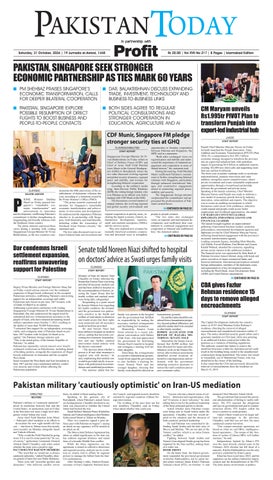
PAKISTAN, SINGAPORE SEEK STRONGER ECONOMIC PARTNERSHIP AS TIES MARK 60 YEARS g
g
PM SHEHBAZ PRAISES SINGAPORE’S ECONOMIC TRANSFORMATION, CALLS FOR DEEPER BILATERAL COOPERATION
PAKISTAN, SINGAPORE EXPLORE POSSIBLE RESUMPTION OF DIRECT FLIGHTS TO BOOST BUSINESS AND PEOPLE-TO-PEOPLE CONTACTS
g
g
DAR, BALAKRISHNAN DISCUSS EXPANDING TRADE, INVESTMENT, TECHNOLOGY AND BUSINESS-TO-BUSINESS LINKS BOTH SIDES AGREE TO REGULAR POLITICAL CONSULTATIONS AND STRONGER COOPERATION IN EDUCATION, AGRICULTURE AND AI
CDF Munir, Singapore FM pledge stronger security ties at GHQ ISLAMABAD/RAWALPINDI STAFF REPORT
P
ISLAMABAD SALEEM JADOON
RIME Minister Shehbaz Sharif on Friday praised Singapore’s “remarkable economic transformation” and achievements in innovation and development, reaffirming Pakistan’s commitment to further strengthening its longstanding and friendly relations with the Southeast Asian country. The prime minister expressed these views during a meeting with visiting Singaporean Foreign Minister Dr Vivian Balakrishnan, as the two countries com-
memorate the 60th anniversary of the establishment of diplomatic relations this year, according to a statement issued by the Prime Minister’s Office (PMO). “The prime minister expressed admiration for Singapore’s remarkable economic transformation and achievements in innovation and development. He underscored the importance Pakistan attaches to its partnership with Singapore, both bilaterally and multilaterally, including within the Association of Southeast Asian Nations (Asean),” the statement said. The two sides discussed ways to enhance bilateral trade and investment and
Dar condemns Israeli settlement expansion, reaffirms unwavering support for Palestine ISLAMABAD
STAFF REPORT
Deputy Prime Minister and Foreign Minister Ishaq Dar on Friday voiced serious concern over the continued expansion of illegal Israeli settlements in the occupied Palestinian territories, reaffirming Pakistan's unwavering support for an independent, sovereign and viable Palestinian state based on pre-June 1967 borders, with Al-Quds Al-Sharif as its capital. Addressing a joint press conference with visiting Singaporean Foreign Minister Dr Vivian Balakrishnan in Islamabad, Dar also underscored the urgent need for unhindered delivery of humanitarian assistance to the people of Gaza, who have endured devastating Israeli military operations since October 7, 2023, resulting in the deaths of more than 70,000 Palestinians. “I reiterated firm support for an independent, sovereign, viable, and contiguous state of Palestine based on preJune 1967 borders with Al-Quds Al-Sharif as its capital,” the Pakistani foreign minister said. “This is the stated policy of the Islamic Republic of Pakistan,” he added. Pakistan has repeatedly voiced concern over Israel's continued restrictions on Palestinians, including denial of building permits, alongside the expansion of illegal Jewish settlements in Jerusalem and the occupied West Bank. Israel occupied the West Bank and East Jerusalem in June 1967 and has since maintained military control over security and civilian affairs affecting the Palestinian population.
Singaporean Foreign Minister Dr Vivian Balakrishnan on Friday called on Chief of Defence Forces (CDF) and Chief of Army Staff Field Marshal Asim Munir at the General Headquarters (GHQ) in Rawalpindi, where the two sides discussed evolving regional and global security dynamics, regional peace and stability, and avenues for strengthening bilateral cooperation. According to the military's media wing, Inter-Services Public Relations (ISPR), the visiting foreign minister, who is in Pakistan on an official visit, held a meeting with CDF Munir at the GHQ. The discussions covered matters of mutual interest, the evolving regional and global security environment and expand cooperation in priority areas, including the digital economy, fintech, infrastructure development, logistics, small and medium enterprises (SMEs) and the services sector. They also explored new avenues for mutually beneficial economic cooperation and discussed ways to strengthen
opportunities to broaden cooperation between Pakistan and Singapore, the ISPR said in a statement. “Both sides exchanged views on regional peace and stability and underscored the importance of sustained engagement and cooperation in areas of shared interest,” the statement read. During the meeting, Field Marshal Munir reaffirmed Pakistan's commitment to further strengthening bilateral relations with Singapore, particularly through enhanced institutional linkages and constructive engagement aimed at promoting regional peace, stability and security. The Singaporean foreign minister reciprocated the commitment and appreciated the professionalism of Pakistan's armed forces.
CONTINUED ON PAGE 03
people-to-people contacts. “The two sides also exchanged views on regional and international developments and reaffirmed their commitment to continued engagement and cooperation at bilateral and multilateral fora,” the statement added.
CONTINUED ON PAGE 03
Senate told Noreen Niazi shifted to hospital on doctors’ advice as Swati urges family visits ISLAMABAD
STAFF REPORT
Minister of State for Interior Talal Chaudhry on Friday informed the Senate that Noreen Niazi was being provided all necessary medical care and had been shifted to hospital on the recommendation of doctors, assuring the Upper House that her health, welfare and medical needs were being fully safeguarded. Responding to a point raised by Senator Mohsin Aziz regarding her health condition, the minister said the government was particularly sensitive to the health and welfare of individuals in detention and would ensure that their rights were protected and all necessary medical facilities provided. He said Noreen Niazi had been shifted to hospital on medical advice, adding that decisions concerning her treatment, hospitalisation and any further medical intervention rested entirely with the doctors concerned. “The decision about whether a person is ill and what treatment is required rests with doctors,” he said, emphasising that medical care would be provided strictly in accordance with professional recommendations and established procedures. The minister added that her
CM Maryam unveils Rs1.995tr PIVOT Plan to transform Punjab into export-led industrial hub LAHORE
STAFF REPORT
Punjab Chief Minister Maryam Nawaz on Friday formally launched the Punjab Innovation, Value Addition and Economic Transformation (PIVOT) Plan 2026–29, a comprehensive Rs1,995.3 billion economic strategy designed to transform the province into an export-led industrial hub, with ambitious targets of generating $6.8 billion in additional exports, creating 162,000 new direct jobs and supporting more than one million livelihoods. The three-year economic roadmap seeks to accelerate industrialisation, promote innovation and value addition, strengthen export competitiveness, attract private investment and create sustainable employment opportunities through a broad-based partnership between the government and private sector. Speaking at the launch ceremony, Chief Minister Maryam Nawaz said Punjab was ready to embrace a new model of economic growth driven by industry, innovation, value addition and exports. The objective was to create an enabling environment in which businesses could invest with confidence, industries could expand and people could access better employment and livelihood opportunities, she added. CM MARYAM CONVENES GLOBAL DIPLOMATS, INDUSTRIAL GIANTS AND FINANCIAL LEADERS The launch brought together an unprecedented gathering of prominent business leaders, economic policymakers, international development agencies and diplomats invited by Chief Minister Maryam Nawaz, reflecting broad-based engagement with the province's economic transformation agenda. Leading corporate figures, including Mian Mansha, Arif Habib, Fawad Mukhtar, Ziad Bashir and Osman Khalid Waheed, attended the ceremony, signalling private-sector interest in the ambitious initiative. The financial sector was represented by State Bank of Pakistan Governor Jameel Ahmad, along with heads and senior executives of major commercial banks and financial institutions. International participation included foreign ambassadors, members of the diplomatic corps and representatives of key development partners, including the World Bank, Asian Development Bank (ADB) and United Nations organisations.
CDA gives Fazlur Rehman residence 15 days to remove alleged encroachments
CONTINUED ON PAGE 03
family was present at the hospital and the government had fulfilled its responsibility by making the necessary medical arrangements and facilitating her treatment. Meanwhile, Senator Azam Swati referred to a recent telephone conversation with Hafeez Ullah Niazi, who had appreciated the government for facilitating Noreen Niazi's transfer to hospital and arranging a meeting with her elder daughter. Describing the arrangements as a positive humanitarian gesture, Azam Swati urged the government to also facilitate a meeting between Noreen Niazi and her younger daughter, stressing that family visits should be allowed on
humanitarian grounds. He said the matter should be considered from a humanitarian perspective, beyond political differences, and called for similar relief to be extended to other family members. RS900M ALLOCATED FOR REPAIR OF HAZARA MOTORWAY: SENATE TOLD Meanwhile, the Senate was informed that Rs900 million had been allocated for repair and rehabilitation work on the Hazara Motorway after technical assessments identified several locations affected by road depressions and settlement, with the government initiating corrective measures to restore the road's condition and ensure commuter safety.
ISLAMABAD
STAFF REPORT
The Capital Development Authority has issued a notice at JUI-F chief Maulana Fazlur Rehman’s residence, directing the removal of alleged encroachments and unauthorised structures within 15 days. The notice identified security guard cabins and a generator installed on CDA land, while also pointing to an additional kitchen constructed within the premises as a violation of building regulations. The authority warned that failure to remove the identified structures within the stipulated period could result in the building being sealed or the unauthorised constructions being demolished. The notice was issued to Amanullah, son of Muhammad Younis, who was identified as the owner of the building. It also stated that the CDA had previously directed the removal of encroachments from the residence on March 18, 2019.
Pakistan military 'cautiously optimistic' on Iran-US mediation RAWALPINDI REUTERS
Pakistan’s military is “cautiously optimistic” about its mediation between Iran and the United States, its spokesman said on Friday in his first interview since a high-level delegation visited Tehran this week. Army chief Field Marshal Asim Munir — Pakistan's chief mediator in its efforts to de-escalate the now eight-month-old Iran war — has been to Tehran twice this month, most recently on Monday alongside Saudi and Turkish officials. “Why would the Field Marshal be going twice if it is not for some positivity? So yes, of course,” spokesman Lieutenant General Ahmed Sharif Chaudhry said when asked whether the trips were a positive sign. PACT DOES NOT BAR NEW MEMBERS “The word that we would use is always cautiously optimistic,” added Chaudhry, director general of Inter-Services Public Relations. There were still "powerful spoilers and detractors," who believed conflict serves
them, he added without naming them. Speaking in the garrison city of Rawalpindi, where Pakistan's armed forces are headquartered, Chaudhry declined to say what was discussed or whether the United States had backed the trip. Saudi Defence Minister Prince Khalid bin Salman and Turkish intelligence chief Ibrahim Kalin joined Munir in Tehran on Monday. Their two countries signed a joint defence pact with Pakistan on August 7, saying an attack on any signatory will be treated as an attack on all. The Mecca Joint Defence Agreement has taken on added significance as the Iran war has redrawn regional alliances and raised fears of a broader Middle East conflict. While the three signatories say the agreement is aimed at collective deterrence and regional security, analysts see its evolution as closely tied to efforts by regional powers to manage the fallout from the IranUS confrontation. After Monday’s talks, Mohsen Rezaei, secretary of Iran’s Supreme National Secu-
rity Council, said regional security should be ensured by regional countries without foreign intervention. The wording of the pact does not bar new members, Chaudhry said on Friday when asked whether Iran could join.
“Anyone who has a shared vision of collective deterrence and regional peace, why not? Everyone is most welcome,” he said, adding that it was for the political leadership of the three principal parties to decide. Asked whether more Pakistani troops were being sent to Saudi Arabia under the agreement, Chaudhry said that would depend on the situation and the decision of both countries’ political leadership. He said Pakistan was committed to defending Saudi Arabia and the holy sites of Mecca and Medina. "We are not part of the Yemeni conflict, which is an intra-Yemen conflict," he added. Fighting between Saudi Arabia and Yemen's Iran-aligned Houthi group has been reignited by the Iran conflict, stoking fears of a wider war. HOME FRONT On the home front, the federal government suspended the provincial government in Khyber Pakhtunkhwa, led by jailed former prime minister Imran Khan’s Pakistan Tehreek-e-Insaf (PTI), on October 11 and
detained Chief Minister Sohail Afridi. The government had accused the provincial administration of failing to tackle militancy. The PTI rejected the allegations and says its government took part in counterterrorism efforts. PTI leaders called the move a pretext to crush protests. Asked if there would now be larger military-led campaigns in the province, Chaudhry said that was not how the army conducted counter-terrorism. "Our counter-terrorism operations are based on what we call IBOs, intelligencebased operations... The tempo of the freedom of action of (those) IBOs will further increase," he said. Independents backed by Khan’s PTI won the most directly elected seats in the February 2024 election but fell short of a majority. Khyber Pakhtunkhwa was the only province controlled by Khan’s party. Khan has been in jail since 2023, and his supporters see the military behind his imprisonment and the dismantlement of the PTI. The army denies involvement in politics.
02 NEWS
PAKISTAN'S INFLATION PROJECTED AT 9.5% TO 10.5% IN OCTOBER
P
PROFIT
NEWS DESK
AKISTAN's headline inflation is projected to remain between 9.5% and 10.5% in October 2026, with its subsequent trajectory dependent on international energy prices, domestic food supplies and base effects, according to the Finance Division's latest Monthly Economic Update and Outlook. The projection comes as the government seeks to maintain macroeconomic stability amid persistent geopolitical tensions in the Middle East, volatile oil prices and the resulting pressure on domestic production, transportation and household expenses. In its October 2026 report, the Finance Division said Pakistan's economy continued to consolidate macroeconomic stability during the first quarter of fiscal year 2027, supported by stronger external inflows, improved access to international financing and rising workers' remittances. The report noted that these developments helped sustain the economic recovery despite the ongoing Middle East
crisis and higher international energy prices, while a relatively stable rupee and stronger foreign exchange reserves improved the country's ability to absorb external shocks. Headline consumer price inflation eased to 10.3% year-on-year in September 2026, compared with 11.1% in August and 5.8% in September 2025. However, average inflation during July-September FY2027 stood at 10.2%, considerably higher than the 4.3%
FBR revises customs duty drawback rates for exporters PROFIT
NEWS DESK
recorded during the corresponding period of the previous fiscal year. Transport prices increased by 27.4% year-on-year in September, while prices in the housing, water, electricity, gas and fuel category rose by 12.4%, reflecting the impact of elevated energy costs. Perishable food prices increased by 11.8%, while non-perishable food prices rose by 7.6%. The Sensitive Price Indicator increased by 0.65% during the week ending October 22, with prices of
Pakistan receives third LNG cargo in October amid regional tensions PROFIT
MONITORING REPORT
The Federal Board of Revenue (FBR) has notified revised customs duty drawback rates for a range of export-oriented products, including textiles, garments, hosiery, carpets, blankets and other manufactured goods, with the new rates applicable from October 27, 2026. Through SRO 1908(I)/2026, the tax authority has authorised repayment of customs duties paid on specified imported raw materials used in the production or manufacture of eligible exported goods. The notification, issued under clause (c) of Section 21 of the Customs Act, 1969, supersedes earlier SRO 209(I)/2009, issued on March 5, 2009. Under the revised arrangement, customs duty drawback will be calculated according to productspecific rates, generally expressed as a percentage of the free-on-board (FOB) value of exported goods. The notification specifies eligible imported raw materials, manufactured products, their respective Harmonised System codes and the applicable repayment rates. For exporters of 100% cotton products, the FBR has prescribed a drawback rate of 0.011% of FOB value for grey fabrics, 0.272% for grey ready-made garments and 0.497% for grey made-ups, including bedwear, curtains and table linen. Bleached cotton fabrics will qualify for a repayment rate of 0.190%, while bleached ready-made garments and made-ups will receive 0.306% and 0.672%, respectively. For dyed, printed or partially dyed cotton products, the prescribed rates are 0.450% for fabrics, 0.328% for ready-made garments and 0.573% for made-ups. The notification also sets conditions for the classification of partially dyed or printed cotton fabrics and made-ups. Where the dyed or printed portion exceeds 25% but does not exceed 30% of the total surface area, the goods will qualify under the specified provisions for partially dyed or printed products. Where the dyed or printed portion exceeds 30%, the goods will be treated as dyed or printed products under the relevant schedule. For polyester-cotton blended products, the FBR has prescribed a drawback rate of 0.125% for grey blended fabrics, 0.270% for bleached blended fabrics and 0.693% for dyed or printed blended fabrics. Grey blended garments will qualify for a rate of 0.249%, compared with 0.441% for bleached blended garments and 0.937% for dyed or printed blended garments. The rates for grey, bleached and dyed or printed blended made-ups have been fixed at 0.146%, 0.326% and 0.761%, respectively. These provisions cover eligible products manufactured using polyester staple fibre and cotton fibre in different blending proportions. The notification separately prescribes rates for products made entirely from polyester staple fibre, including fabrics and other textile products. Under the relevant schedule, grey polyester fabrics will qualify for a drawback rate of 0.107%, bleached polyester fabrics for 0.224% and dyed or printed polyester fabrics for 0.151%. For hosiery articles, the FBR has prescribed a drawback rate of 1.784% of FOB value, covering eligible products manufactured using specified imported materials such as nylon, elastic, dyes, processing chemicals, accessories and packing materials.
19 items rising, 12 declining and 20 remaining unchanged. The Finance Division said improved agricultural supplies could help moderate food inflation, although international energy prices and geopolitical developments remain important risks to the outlook. The report also highlighted the Monetary Policy Committee's decision to increase the policy rate by 50 basis points to 12%, effective October 27, 2026, in response to growing inflationary risks associated with the intensifying Middle East conflict and persistently high global energy prices. The increase is intended to anchor inflation expectations, contain secondround price pressures and preserve macroeconomic stability. On the broader economic outlook, the Finance Division said revised national accounts placed real gross domestic product growth for FY2026 at 3.65%, slightly below the earlier estimate of 3.70%. Agricultural growth was revised upwards to 3.50% from 2.89%, while industry and services recorded growth of 3.34% and 3.81%, respectively.
Pakistan has received its third liquefied natural gas (LNG) cargo in October, providing some relief to the country's gas supply system as heightened tensions in the Strait of Hormuz continue to complicate energy shipments ahead of the winter season. The vessel Shandong Redwood arrived from Qatar on October 28 and berthed at the Engro Elengy LNG terminal, with the cargo priced at 13.37% of Brent crude oil. The vessel berthed alongside Engro Elengy Terminal Limited's (EETL) floating storage and regasification unit (FSRU), Exquisite, for regasification. The shipment was
reportedly arranged with the assistance of Iranian officials amid ongoing regional tensions. The latest delivery follows two earlier LNG shipments received this month. The first vessel, AlAreesh, arrived on October 13, while the second, Ejnan, reached Pakistan on October 21 and berthed at the Pakistan GasPort Limited (PGPL) terminal for regasification. Although the arrival of the third cargo offers temporary relief, Pakistan faces growing procurement challenges as domestic gas demand is expected to increase sharply during the winter months. The authorities concerned are expected to arrange three to four LNG cargoes in November, while
requirements are projected to increase to nine cargoes in December and 11 in January. The anticipated rise in demand is particularly significant for the country's two major gas distribution companies. In the jurisdiction of Sui Northern Gas Pipelines Limited (SNGPL), covering Punjab and Khyber Pakhtunkhwa, domestic gas demand is projected to triple from approximately 500 million cubic feet per day (mmcfd) to 1,500 mmcfd during peak winter. Similarly, demand in the jurisdiction of Sui Southern Gas Company (SSGC), covering Sindh and Balochistan, is expected to increase from around 300 mmcfd to between 500 and 600 mmcfd.
SBP launches SMEConnect to streamline small business financing PROFIT
NEWS DESK
The State Bank of Pakistan (SBP) has launched SMEConnect, a centralised digital platform designed to simplify access to financing for small and medium enterprises (SMEs), making it mandatory for all SME financing applications to be submitted through the portal from November 1, 2026. According to a statement issued by the central bank, the platform will serve as a single digital channel through which SMEs across Pakistan can apply for financing from banks and development finance institutions (DFIs). The platform aims to streamline the application process while improving accessibility, efficiency
and transparency in SME financing. The SBP said SMEConnect will allow applicants to track the status of their financing applications in real time, while those whose applications are rejected will be able to view the reasons for rejection. The platform will also feature a live dashboard providing the central bank with real-time information on financing applications received, processed, approved, disbursed and rejected. The dashboard will allow the SBP to monitor application activity at both individual bank and DFI levels and across the industry, providing greater visibility into the SME financing process. Under the new arrangement, all SME financing applications will be received exclusively through SMEConnect from November 1.
Applicants visiting bank or DFI branches, or accessing their websites to apply for financing, will be directed to the centralised portal. The central bank has instructed all banks and DFIs to prominently display the SMEConnect link on their websites to facilitate access for customers. Financial institutions have also been advised to ensure that their SME teams and field staff are fully familiar with the platform and can guide applicants through the financing application process. The SBP said the launch of SMEConnect reflects its commitment to promoting financial inclusion, supporting entrepreneurship and strengthening the SME financing ecosystem to achieve inclusive economic growth.
Pakistan, China sign agreement to facilitate agricultural trade at Sost-Khunjerab border PROFIT
WEB DESK
Pakistan and China have signed an agreement to operationalise a Green Channel at the Sost-Khunjerab border to facilitate the movement of agricultural and allied products through priority customs processing and examination. The agreement was signed during an online ceremony held at the Federal Board of Revenue (FBR) headquarters in Islamabad on Thursday, bringing
together customs administrations from both countries. Under the arrangement, eligible agricultural consignments will receive priority processing and examination, while risk-based controls will remain in place to ensure effective customs oversight. The agreement also provides for enhanced information sharing and the exchange of risk alerts between the customs authorities of Pakistan and China to strengthen coordination and improve cross-border trade management. Recognising the time-sen-
sitive nature of agricultural trade, the Green Channel will prioritise the handling of perishable consignments to minimise delays and ensure their timely movement across the border. The arrangement will apply to an agreed list of agricultural products traded between the two countries. The Pakistani delegation was led by Syed Shakeel Shah, Member Customs Operations, and included the Chief Collector of Customs, Peshawar; Collector of Customs, Gilgit-Baltistan; and representatives of the Department of Plant Protection,
Saturday, 31 October, 2026 | ISLAMABAD
Govt proposes cutting cotton seed approval time to 12–18 months PROFIT
SADDAM HUSSAIN
Federal Minister for National Food Security and Research Rana Tanveer Hussain chaired a highlevel meeting on the Cotton Revival Strategy, directing concerned institutions to accelerate reforms in seed development, regulatory approvals, research and mechanization to restore cotton production and improve farmers’ profitability. A major focus of the meeting was the proposed 12– 18-month fast-track approval mechanism for imported cotton seed, compared with the approximately seven years required under existing procedures. The proposal, supported by cotton-sector stakeholders, will be examined within the existing legal and regulatory framework without compromising mandatory scientific testing, biosecurity or biosafety standards. The meeting considered a three-pronged Cotton Revival Strategy focusing on strengthening locally developed cotton seed, facilitating the import of improved cotton seed and introducing a fast-track approval mechanism for imported varieties. The meeting reviewed the persistent decline in cotton cultivation and production, particularly in Punjab, where falling yields, rising production costs and declining profitability have encouraged farmers to shift towards sugarcane, maize and other competing crops. Cotton Leaf Curl Virus, pest infestations, climate variability, poor-quality seed and inadequate mechanization were identified as major constraints. Addressing the participants, Federal Minister Rana Tanveer Hussain emphasized that reviving cotton was essential for strengthening Pakistan's agricultural economy, supporting the textile industry and reducing dependence on imported raw materials. He stressed that cotton cultivation must become economically attractive for farmers through improved productivity, quality seed and reduced production costs. Regarding imported cotton seed, the Minister directed the Department of Plant Protection to expedite pending Pest Risk Analyses (PRAs) and Controlled Import Permits (CIPs) to facilitate access to improved international seed technologies while ensuring compliance with phytosanitary requirements. The meeting reviewed engagement with China, Türkiye, Syria, Kenya, the United States, Mexico, Kyrgyzstan and Australia. DPP informed participants that China had submitted its technical dossier and additional information had been requested, while progress with several other countries remained dependent on their responses. To strengthen domestic cotton research, the meeting decided to constitute a three-member committee comprising PARC, NSDRA and PCCC, led by PARC , to facilitate the acquisition of exotic cotton germplasm. The committee will identify technical requirements, funding needs and acquisition arrangements. Mechanisms will also be developed to provide private seed companies access to suitable germplasm available with public research institutions. The meeting emphasized strengthening publicsector cotton research through performance-based accountability, clearly defined key performance indicators (KPIs) and appropriate incentives for cotton breeders to develop commercially viable, high-yielding and climate-resilient varieties. The meeting also discussed regulatory challenges concerning genetically modified and Bt cotton varieties. It was emphasized that necessary biosafety clearances must be obtained from the relevant authorities under the Ministry of Climate Change and Environmental Coordination. Matters requiring higher-level policy intervention may be referred to the Prime Minister. On crop zoning, the Minister directed NSDRA and relevant institutions to expedite the processing of promising cotton varieties identified through trials and facilitate the availability of basic seed. The meeting emphasized that cotton varieties should be evaluated and approved according to their performance in specific agro-climatic regions rather than relying exclusively on uniform national criteria. Recognizing mechanization as critical to reducing production costs and overcoming labour shortages, participants discussed the introduction of singlepick cotton varieties and mechanical cotton-picking technology. Relevant institutions were asked to examine dedicated testing parameters for varieties suitable for mechanical harvesting. The taxation of agricultural machinery was also identified as an issue requiring review. The meeting further highlighted emerging opportunities in sustainable and traceable cotton production, including organic cotton and potential carbon-credit mechanisms, to enhance Pakistan's competitiveness in international markets. The meeting was attended by representatives of the Ministry of National Food Security and Research, National Seed Development and Regulatory Authority (NSDRA), Pakistan Agricultural Research Council (PARC), Pakistan Central Cotton Committee (PCCC), Department of Plant Protection (DPP), provincial agriculture departments, private seed companies, All Pakistan Textile Mills Association (APTMA), ginners, seed associations, Cotton Connect and other stakeholders.
Industry seeks NAB probe into alleged overpriced coal purchases at Port Qasim power plant PROFIT
MONITORING REPORT
Industrial representatives have demanded a comprehensive investigation, including by the National Accountability Bureau (NAB), into coal procurement practices at the Port Qasim power plant, alleging that the producer was purchasing coal through affiliated entities at prices significantly higher than those paid by other power plants, Dawn reported. The demand was raised during a public hearing conducted by the National Electric Power Regulatory Authority (Nepra) on Thursday. Nepra assured participants that only prudent coal procurement costs would be allowed and that the power producer would have to bear the financial impact of any
costs found to be unjustified. According to data submitted by the Central Power Purchasing Agency (CPPA), the average electricity generation fuel costs increased by almost 37.5% year-on-year in September amid reduced liquefied natural gas (LNG) supplies and greater reliance on expensive diesel, furnace oil and imported coal. High-speed diesel accounted for 213 gigawatt-hours (GWh), or approximately 1.6% of total grid electricity supply, during September. The generation cost of diesel-based electricity reached Rs62.14 per unit, compared with 80GWh generated at Rs54 per unit in August. Furnace oil-based generation stood at 263GWh in September, declining from 321GWh in August, while its generation cost
decreased to Rs44.86 per unit from approximately Rs46 per unit in the preceding month. Its share of total electricity generation remained close to 2%. Representatives of entities operating under the Power Division confirmed that furnace oil- and diesel-based electricity together accounted for 3.6% of total power generation in September because of the unavailability of LNG and other cheaper sources. Meanwhile, government entities reported that overall electricity demand increased by 6.5% in September, while industrial consumption rose by 6.7%. Industry representatives maintained that the increase in industrial electricity consumption reflected a shift from captive power generation to the national grid rather than the impact of the incremental package.
NEWS 03
Saturday, 31 October, 2026 | ISLAMABAD
SIFC FINALISES 38 PROJECTS TARGETING $40B INVESTMENT ACROSS KEY SECTORS, SENATE PANEL TOLD
T
PROFIT
monitoring report
HE Special Investment Facilitation Council (SIFC) has finalised around 38 projects across major sectors of Pakistan's economy, with an estimated investment potential of $40 billion, officials informed the Senate Standing Committee on Cabinet Secretariat on Thursday. The projects cover mining, industry, railways, roads, maritime affairs, power, information technology, pharmaceuticals, healthcare, tourism and food security, as the government seeks to attract foreign investment and address regulatory obstacles affecting businesses.
Haleon Pakistan begins local manufacturing of Panadol 500mg tablets at Jamshoro plant PROFIT
saDDam Hussain
Haleon Pakistan Limited has commenced manufacturing Panadol 500mg tablets at its own facility in Jamshoro, marking a shift to inhouse production following an investment announced three years ago to expand its manufacturing capacity. In a disclosure submitted to the Pakistan Stock Exchange (PSX) on Friday, the company said production had started at the Jamshoro facility as part of its plans to strengthen domestic manufacturing capabilities and improve the availability of its products in Pakistan. The development follows Haleon Pakistan's investment announcement on October 13, 2023, to manufacture its Panadol base portfolio at the facility. According to the company, the investment was undertaken to introduce manufacturing technology and enhance production capacity in Pakistan. Haleon Pakistan also announced a change in the physical appearance of Panadol 500mg tablets produced at the Jamshoro plant. The locally manufactured tablets will feature a new beacon engraving instead of the existing "Panadol" text engraving. The company clarified that the change would be limited to the tablet's design, with its quality and efficacy remaining unchanged. Haleon Pakistan said the commencement of manufacturing at Jamshoro represented a step towards strengthening its in-house production capabilities and ensuring reliable product availability for consumers in the country.
CM Maryam unveils Rs1.995tr PIVOT Plan to transform Punjab into export-led industrial hub CONTINUED FROM PAGE 01
Senior government officials, led by Senior Minister Marriyum Aurangzeb and Chief Secretary Zahid Akhtar Zaman, provincial cabinet members, administrative secretaries and district focal officers also attended the ceremony to outline the government's institutional and operational commitments towards implementing the plan. The programme targets key manufacturing value chains, including garments and textiles, sports goods, leather and footwear, surgical instruments, pharmaceuticals, fans, cutlery, steel and ceramics. It also envisages the establishment of modern testing laboratories, certification facilities and plug-and-play industrial infrastructure to help local businesses fulfil international compliance requirements, improve product quality and gain access to export markets. Emphasising the need to move beyond conventional production practices, the chief minister said local industries must focus not merely on increasing output but also on improving product quality, adding value and strengthening their presence in international markets. She said Punjab's manufacturers would be facilitated through access to modern technology, reliable energy solutions, quality infrastructure and financing facilities to expand production and exports.
CDF Munir, Singapore FM pledge stronger security ties at GHQ CONTINUED FROM PAGE 01
He also acknowledged Pakistan's role in promoting regional peace and stability, the ISPR added. Earlier, Dr Vivian Balakrishnan called on Prime Minister Shehbaz Sharif, who expressed admiration for Singapore's “remarkable economic transformation” and its achievements in innovation and development. According to the PMO, the prime minister reaffirmed Pakistan's commitment to further strengthening its longstanding and friendly relations with Singapore, particularly as the two countries are marking the 60th anniversary of the establishment of diplomatic relations this year. Earlier, Deputy Prime Minister and Foreign Minister Senator Mohammad Ishaq Dar also held talks with his Singaporean counterpart, focusing on expanding bilateral cooperation in trade and investment, the Foreign Office said. Dr Balakrishnan arrived in Islamabad earlier in the day and called on DPM Dar at the Ministry of Foreign Affairs. In a statement, the FO said the two leaders reviewed the “longstanding and friendly relations” between Pakistan and Singapore as the two countries commemorated 60 years of diplomatic relations.
g
SENATE STANDING COMMITTEE ON CABINET SECRETARIAT RAISES CONCERNS OVER HIGH BUSINESS COSTS, REGULATORY HURDLES AND PROFIT REPATRIATION AS US-IRAN CONFLICT CREATES UNCERTAINTY OVER INVESTMENT PROJECTIONS
The committee, chaired by Senator Rana Mehmoodul Hassan, was also informed that the Brownfield Refinery Policy had been approved, with five refineries signing implementation agreements involving proposed investments of approximately $6 billion. SIFC officials briefed lawmakers on engagement with Chinese companies and prospective investors from Qatar and Kuwait, alongside measures aimed at simplifying regulatory approvals, facilitating visas and introducing single-window serv-
ices for investors. However, the committee was informed that disruptions to trade and business arising from the regional situation, including the US-Iran conflict, had made it difficult to provide reliable investment projections and final figures at this stage. Committee Chairman Rana Mehmoodul Hassan observed that obtaining no-objection certificates (NOCs) had previously been a major hurdle for investors, although the situation had improved following SIFC's intervention.
He called for further simplification of approval procedures and a reduction in regulatory requirements to make investment easier. Senator Saadia Abbasi questioned the effectiveness of administrative leadership in addressing bureaucratic inefficiencies and sought details of the incentives being offered to attract foreign investors. Senator Abdul Qadir raised concerns over Pakistan's higher business costs compared with regional economies, particularly electricity prices and financing expenses. He also highlighted difficulties aris-
ing from multiple regulatory requirements, tax notices, restrictions affecting profit repatriation and competition from smuggled products. The senator called for a coordinated relief mechanism involving the federal government and the State Bank of Pakistan to strengthen investor confidence and safeguard existing and prospective investments. Committee members stressed the need for SIFC to continue addressing investmentrelated obstacles and improving Pakistan's competitiveness in regional markets.
FBR refuses to reverse decision to shift customs assessment operations from Karachi to Islamabad
g
CUSTOMS CLEARANCE TIME DROPS FROM 40.2 TO 20.57 HOURS, WITH 83% OF CONSIGNMENTS CLEARED WITHIN 48 HOURS; PHYSICAL EXAMINATION AND PORT OPERATIONS TO REMAIN IN KARACHI ISLAMABAD Web Desk
The Federal Board of Revenue (FBR) has reaffirmed its commitment to strengthening Faceless Customs Assessment (FCA), clarifying that the relocation of the Central Appraising Unit (CAU) to Islamabad represents the next phase of customs modernisation and is not subject to reversal. Responding to concerns raised by the All Pakistan Textile Mills Association (APTMA) regarding clearance delays, valuation disputes and laboratory referrals, FBR stated that the performance figures cited in the representation largely relate to the initial months of implementation and do not fully reflect subsequent improvements. The tax authority said that average Customs clearance time has declined from 40.2 hours to 20.57 hours, while 83% of consignments are now cleared within 48 hours. FBR remains committed to resolving genuine operational bottlenecks without compromising the core objectives of the reform. The initiative is guided by the objective of reducing discretionary powers, minimising direct interaction between
taxpayers and tax officials, and ensuring transparent, system-driven assessment decisions. FBR has clarified that only the assessment function will be relocated to Islamabad, other functions will remain with the collectorate of jurisdiction. The FBR said that physical examination and port operations will continue at Karachi, and traders will be able to approach their respective Karachi collectorates for resolution of issues. To further improve clearance efficiency, FBR said it will pursue targeted measures, including dedicated backlogclearance arrangements for EFS and export-oriented consignments, as well as green-channel facilitation for Authorised Economic Operators and compliant importers. Proposed service timelines include 24 hours for assessment and first review, 48 hours for second review, 24 hours for examination after grounding, and 72 hours for laboratory results, supported by automatic escalation mechanisms. Provisional release under Section 81 of the Customs Act, 1969, will also be facilitated wherever legally applicable. FBR has further clarified that customs
valuation continues to be governed by Section 25 of the Customs Act, 1969. Digital assessment does not authorise arbitrary enhancement of declared values, and officers are required to follow the prescribed valuation methods and record reasons wherever required. Electronic documentation, specialist consultation and digital coordination are expected to improve assessment quality while reducing unnecessary personal interfaces. FBR has invited APTMA and other trade bodies to submit specific and verifiable cases, including relevant Goods Declaration numbers, to enable the examination and resolution of reported delays, valuation disputes and classification errors. FBR reiterated that operational challenges will be addressed through targeted improvements while maintaining the integrity of Faceless Customs Assessment and the broader agenda of transparent, accountable and efficient customs administration. FBR has urged trade bodies to educate their members about the timely filing of Goods Declarations before vessel arrival. Advance filing and pre-arrival processing can enable eligible consignments to be as-
sessed and cleared earlier, thereby reducing port dwell time and avoidable demurrage costs. The reform is part of FBR’s broader digital transformation, which includes the Digital Invoicing System and AI-based Digital Production Monitoring. These initiatives strengthen transaction documentation, improve visibility of industrial production and tax records, and help curb evasion, concealment of economic activity and unfair competitive practices. Digitalisation is intended to protect compliant businesses by making compliance more transparent and reducing opportunities for preferential treatment through personal influence. International experience also supports the transition towards technology-driven customs administration. India’s faceless assessment model, Singapore’s TradeNet and Dubai Smart Customs demonstrate how digital systems can facilitate trade while promoting transparency and accountability. The underlying principle is to ensure that customs decisions are based on law, evidence and prescribed procedures rather than personal access or physical proximity.
Pakistan, Singapore seek stronger economic partnership as ties mark 60 years CONTINUED FROM PAGE 01
POSSIBLE RESUMPTION OF DIRECT FLIGHTS DISCUSSED The meeting followed talks between Deputy Prime Minister and Foreign Minister Senator Mohammad Ishaq Dar and his Singaporean counterpart, during which the two sides discussed the possible resumption of direct flights between Pakistan and Singapore to facilitate business travel and closer contact between their peoples. Dar shared the development at a joint press conference with Balakrishnan, describing Pakistan and Singapore as longstanding and friendly partners whose relations were founded on mutual respect and goodwill. He noted that Pakistan was among the first countries to recognise Singapore following its independence in 1965. The visit was particularly significant as it marked the first visit to Pakistan by a Singaporean foreign minister in more than two decades, he said. “I am grateful that he was kind to accept my invitation,” Dar said, adding that the visit assumed added significance as the two countries were commemorating 60 years of diplomatic relations this year. “The visit reflects our shared commitment to strengthen this friendship and broaden our cooperation.” Dar said delegation-level talks and a restricted meeting held earlier in the day had focused on strengthening political and economic ties, expanding cooperation in technology and education, and promoting cultural and people-to-people contacts. “We also exchanged views on key regional and international developments,” he added. He said the two sides had recognised “the considerable untapped potential in our relationship” and stressed the need for sustained engagement. “We agreed to hold regular bilateral political consultation and promote highlevel exchanges to strengthen cooperation between our governments and institutions,” he said. Dar said economic cooperation had remained central to the discussions, with both sides welcoming the growth in bilateral trade and exploring ways to build on the progress. “We agreed to encourage closer engagement between our business communities through the exchange of business delegations and stronger links between our chambers of commerce,” he said. The two sides also discussed reopening the Trade and Investment Office at Pakistan’s High Commission in Singapore. “The reopening of the Pakistan Trade and Investment Office is a testament to Pakistan’s resolve to promote stronger B2B ties with our friendly country Singapore,” Dar said. Beyond trade and investment, he said, the discussions covered closer cooperation in education, research and innovation, particularly in digital technologies and artificial intelligence (AI). The two sides also considered strengthening links between their universi-
ties and research institutions and agreed to deepen cooperation in human resource development, agriculture and climate-related areas. Dar noted that Pakistani professionals working in Singapore were contributing to its economy and society and serving as a “valuable bridge between our two nations”. He said the two countries had also agreed to encourage greater cultural, academic, youth and people-to-people exchanges. The possibility of resuming direct flights was also discussed to facilitate business travel and bring the people of the two countries closer, he added.
SINGAPORE TO PAKISTAN, DEEPEN ENGAGEMENT THROUGH ASEAN Pakistan’s engagement with the Association of Southeast Asian Nations (Asean), of which it is the “oldest sectoral dialogue partner”, also featured in the discussions, Dar said. “Pakistan attaches great importance to practical cooperation with the organisation and its member states. I convey Pakistan’s best wishes to Singapore as it prepares to assume the Asean chairmanship in 2027. “We look forward to working closely with Singapore in support of its priorities as the chair and to further strengthening the Pakistan-Asean cooperation,” he said. Dar said the meetings also provided an opportunity to exchange views on regional and international peace and security. “We discussed the impact of regional tensions on maritime trade,” he said, stressing that secure sea routes and uninterrupted supply chains were essential for trade and economic stability. He said the two sides had reaffirmed the central role of dialogue and diplomacy, respect for international law and adherence to the principles of the United Nations Charter in addressing regional and global challenges. Dar said he had conveyed to the visiting dignitary that Pakistan remained engaged with key regional and international partners to promote continued dialogue and diplomacy, which he described as the “only viable means to resolve outstanding challenges”. On Palestine, Dar expressed concern over the continued expansion of illegal Israeli settlements and efforts to alter the status of the West Bank and Al-Quds Al-Sharif. “I expressed concern over the continued expansion of illegal settlements and efforts to alter the status of the West Bank and Al-Quds Al-Sharif. I stressed the urgent need for unhindered delivery of humanitarian assistance to the people of Gaza. I reiterated firm support for an independent, sovereign, viable, and contiguous state of Palestine based on pre-June 1967 borders with Al-Quds Al-Sharif as its capital, which is the stated policy of the Islamic Republic of Pakistan,” he said. On South Asia, Dar said he had briefed the visiting foreign minister on the importance of a “just, durable and peaceful set-
tlement of the longstanding Jammu and Kashmir dispute in accordance with the relevant UN Security Council resolutions”. Concluding his remarks, Dar said Pakistan looked forward to working closely with Singapore to translate the understandings reached during the visit into practical cooperation. “We have committed to deepening this partnership and building a more prosperous future for our people,” he said, adding that the friendship between the two countries remained strong and forwardlooking as they marked six decades of diplomatic relations.
SINGAPORE SEES GREATER SCOPE FOR TRADE, INVESTMENT Speaking after Dar, Balakrishnan recalled that Pakistan was among the earliest countries to recognise Singapore’s independence and said the two countries were commemorating the 60th anniversary of diplomatic relations. “This is a significant year for Singapore and Pakistan. We have never forgotten that Pakistan was one of the earliest countries to recognise Singapore’s independence. And that’s why we are commemorating the 60th anniversary of diplomatic ties,” he said. He said the two countries had maintained high-level exchanges over the years and had opportunities for substantive and productive discussions. “We’re in constant communication, far more than people realise — that we have a very effective partnership,” he said, describing bilateral diplomatic relations as “excellent”. However, he observed that the strength of diplomatic ties was not adequately reflected in trade relations. “In fact, they are so good that it makes it even more obvious that actual trade relations — and looking at the numbers and the data — ought to be much higher. And that, I would say, is the first order of business,” he said. Balakrishnan stressed the need to facilitate greater trade and investment flows, particularly by strengthening links between SMEs and business communities in the two countries. He said business representatives needed opportunities to meet, understand each other and explore commercial opportunities and risks in Southeast Asia and South Asia. The governments, he added, should facilitate such interactions and identify new avenues for mutually beneficial cooperation. “In an increasingly uncertain global environment, including on the business side of it, I think it is all the more important for our two countries to remain open, connected and constructively engaged with each other,” he said. The two sides also discussed carbon markets, which Balakrishnan described as another promising area for cooperation. “It will be another promising avenue to attract investments into projects in Pakistan that reduce emissions while supporting sustainable development, and our officials are exploring opportunities in this area,” he
said.
DISASTER MANAGEMENT MOU TO BOOST PREPAREDNESS Referring to the exchange of a memorandum of understanding (MoU) on disaster management, Balakrishnan said the agreement reflected the two countries’ shared commitment to strengthening disaster preparedness and response. He said natural disasters were an everpresent challenge, particularly in the context of climate change, and countries needed to work together to improve their resilience. “Unfortunately, Pakistan had extensive experience in responding to large-scale natural disasters,” he said, adding that Singapore could learn from Pakistan’s experience in disaster response and preparedness. Through the MoU, the two countries hoped to explore cooperation in early warning systems, sharing best practices, strengthening search and rescue capabilities, and conducting joint training and exercises. “Disasters do not respect boundaries, do not have passports, and again, the more we can work together, the better,” he added. The Singaporean foreign minister also welcomed opportunities to deepen cooperation between higher education institutions in the two countries, including Singapore’s Nanyang Technological University and National University of Singapore, and Pakistan’s National University of Sciences and Technology. “I want to emphasise that this is just the beginning. We hope to expand that list in due time,” he said.
SINGAPORE APPRECIATES PAKISTAN’S REGIONAL ROLE On regional and international developments, Balakrishnan commended Pakistan’s role in promoting dialogue and diplomacy, particularly amid tensions in the Gulf. He said a substantial share of the energy passing through the Gulf was destined for South Asia, Southeast Asia and Northeast Asia. “And the unique, but very constructive and valuable role that Pakistan plays is the one which we commend you for, and we wish you every success because if you succeed, it’s good for all of us,” he said. He emphasised the importance of international law for both countries, particularly in the maritime domain. As an island city-state whose trade volume was three times its gross domestic product (GDP), Singapore attached great importance to maritime navigation and the United Nations Convention on the Law of the Sea (UNCLOS) 1982, he said. The convention guaranteed freedom of navigation and overflight, particularly in straits used for international navigation, as a right rather than one granted at the discretion of littoral states. Balakrishnan said Singapore was “very, very heartened” that Pakistan shared its position on the issue.
04 COMMENT
When economic recovery fails to become public progress
Saturday, 31 October, 2026
Punjab moves on agriculture
T
With the ZTBL almost inoperational the Kissan Bank may fill its place
HE Zarai Taraqiati Bank Limited, in its heyday the Agricultural Development Bank Limited, is being privatized. However, the farmer cannot make do without credit, especially for inputs. When the farmer harvests his crop and sells it, he pays off any loans he has taken for its inputs, and then borrows afresh to get seed, fertilizer and buy or rent farm equipment. While the ZBTL will remain in the business of agricultural credit, it is unlikely to remain a cash cow for large landowners, who felt they did not have to repay loans. One of the problems with ZBTL is that its infected loan portfolio has climbed past Rs 80 billion, which is 44 percent of the total portfolio. It has also been noted that, because it is the largest province and requires the most agricultural credit, the infected portfolio is highest in Punjab. It means that the new Kissan Bank will have to be extre-vigilant about attempts to gouge it. However, agricultural credit has become particularly important at this juncture, with the World Bank predicting increases in world rice and wheat prices in the coming year, of 12 and 28 percent respectively, along with a six percent drop in cotton production. The drop in cotton production is part of a global trend caused by climatic conditions, and the World Bank forecasts a 14 percent increase in price. Higher rice prices should mean better export prospects, but higher wheat prices should not be allowed to lead to greater exports, lest the vicious cycle of importing dearer than exports is repeated. However, for the farmer to benefit from these developments, credit plays a crucial role. The Kissan Bank fills the gap that will be left by the ZTBL, and while it might find useful personnel among those of its members who are let go, it must be careful that it is not penetrated by the officials who facilitated the defalcations of the past. One of the things that still needs work is the sourcing of the fertilizers, because there is no certainty that the Hormuz Strait, through which so much diammonium fertilizer flows, will reopen in time for the wheat or even the rice crop. Another area where the Punjab government can intervene usefully is in seed improvement, which is crucial particularly to cotton. This it can do by getting all its universities involved, and not just the ones dedicated to agriculture.
Making government more responsive
A
Rizwan ahmad
N economy can improve on paper while its people continue to struggle for better opportunities. Government revenue may rise, the budget deficit may narrow and economic growth may resume, yet these achievements do not necessarily translate into productive employment, better public services or greater financial security. For Pakistan, the challenge is not simply to restore economic stability, but to ensure that it produces lasting improvements in people’s lives. The latest national accounts provide a starting point. On October 19, the Pakistan Bureau of Statistics reported that GDP growth for fiscal year 2025– 26 had been revised to 3.65 percent, against an earlier estimate of 3.70 percent. Growth in the final quarter stood at 2 percent. Agriculture expanded by 3.50 percent, industry by 3.34 percent and services by 3.81 percent. These figures measure economic activity, but they do not establish whether growth is creating sufficient employment, encouraging productive investment or strengthening public institutions. Economic stabilisation remains essential. Fiscal pressures, expensive debt servicing and external financing difficulties restrict the government’s capacity to invest in development. However, stabilisation should create the conditions for economic transformation rather than become an end in itself. Its value lies in expanding productive capacity, improving essential services and reducing vulnerability to future shocks. Without this transition, the state risks managing financial constraints without addressing the structural weaknesses that sustain them. Industrial performance illustrates why the composition of growth matters. The revised estimate for large-scale manufacturing growth fell from 6.11 percent to 5.01 percent in FY2025–26. While automobile production and electrical equipment recorded strong growth, pharmaceuticals and iron and steel products contracted. These divergent results require policymakers to examine competitiveness, investment barriers and the capacity to produce higher-value goods. Aggregate growth targets cannot substitute for an assess-
Dedicated to the legacy of late Hameed Nizami
Arif Nizami (Late)
ment of whether industries are becoming more productive and capable of sustaining expansion. Fiscal policy presents a similar challenge. In its October assessment, the International Monetary Fund emphasised the need to maintain fiscal sustainability while supporting public investment and social spending. It also called for a fairer, simpler and more growthfriendly tax system. Reform should therefore extend beyond collecting additional revenue. Broadening the tax base, reviewing unjustified exemptions, improving enforcement and simplifying compliance would help distribute obligations more consistently. Excessive costs and unpredictable rules can discourage investment, particularly when businesses already operating within the documented economy face additional pressure. A successful tax system must raise revenue without unnecessarily undermining productive activity. The more fundamental question is how effectively the state uses the resources it collects. A department can spend its approved budget and complete its assigned activities without achieving the purpose for which public money was allocated. Building classrooms does not establish that children are learning. Purchasing medical equipment does not prove that patients are receiving better treatment. Completing a road does not demonstrate that transport costs have fallen or businesses have gained better access to markets. Administrative completion and public benefit are different measures of performance. Pakistan’s spending priorities make this distinction particularly relevant. The IMF reported in October that health and education expenditure had increased from 2.2 percent of GDP in FY2024 to 2.5 percent in FY2026, with a commitment to reach 2.8 percent in FY2027. These figures indicate the resources allocated to essential services, but they cannot independently establish improvements in access or quality. That requires evidence of what citizens actually receive. Pakistan should introduce an annual public outcomes report, presented to Parliament and made accessible to citizens. Rather than reproducing budgetary figures or listing completed projects, it should identify measurable objectives for major public programmes, compare promised results with actual performance and explain significant shortfalls. Education programmes could be assessed through learning outcomes and school retention; healthcare initiatives through access and quality of treatment; and infrastructure projects through utilisation, maintenance and economic benefits. For this mechanism to carry weight, performance indicators should be established before expenditure begins and independently verified where appropriate. Departments should explain persistent failures and identify corrective measures. Subsequent budget decisions should consider a programme’s effectiveness, public need and prospects for improvement. This would not mean automatically withdrawing funding whenever a target is missed. It would require a reasoned justification for continued expenditure, particularly where programmes repeatedly fail to deliver their intended results.
Separating facts from fiction Founding Editor
M. A. Niazi
Babar Nizami
Editor Pakistan Today
Editor Profit
Fate of the missing persons
T
asad ali
HE issue of missing persons has emerged as one of the most sensitive and contested subjects in Pakistan’s political and human rights discourse. It involves genuine human suffering, complex security challenges, legal questions and competing political narratives. While the disappearance of any individual demands serious investigation and a timely response, the issue must also be examined through credible evidence rather than assumptions, sensationalism or political expediency. Pakistan’s challenge is to protect national security while upholding constitutional rights, ensuring accountability and addressing the concerns of affected families. The debate surrounding missing persons is frequently complicated by allegations that state institutions, particularly law enforcement and intelligence agencies, are responsible for every reported disappearance. Such generalisations risk replacing investigation with accusation. At the same time, dismissing allegations without examining the available evidence can deepen public mistrust. A balanced approach requires distinguishing between verified facts, unsubstantiated claims and cases that remain unresolved. Missing persons are a global concern affecting countries across different continents, political systems, religions and ethnic communities. Conflicts, organised crime, human trafficking, migration, domestic disputes, natural disasters and state repression can all contribute to disappearances. International bodies have documented cases across numerous countries, including Iraq, Syria, Sri Lanka, Chile, Ethiopia, Mexico and countries in Europe and Asia. A major weakness in the Pakistani debate is the tendency to treat every reported missingperson case as evidence of enforced disappearance. These are not necessarily identical categories. A person may be missing because of a family dispute, voluntary absence, criminal activity, militant recruitment, migration, detention or circumstances that have yet to be established. An enforced disappearance, by contrast, involves deprivation of liberty by state agents, or by persons acting with state authorisation, support or acquiescence, followed by a refusal to acknowledge the detention or concealment of the person’s fate or whereabouts.
This distinction is fundamental to a credible investigation. A name appearing on a missingperson list is a reason to investigate, not conclusive proof of who is responsible. Equally, the absence of publicly available evidence does not automatically establish that an allegation is false. Each case requires independent verification, documentation and appropriate legal scrutiny. Pakistan’s security environment adds further complexity. The country has faced terrorism, separatist violence, militant recruitment and cross-border security threats. In such circumstances, authorities must investigate credible security threats while ensuring that suspects retain their legal rights. Security considerations, however, cannot replace due process, and allegations involving state personnel must be examined through transparent and impartial mechanisms. The missing-persons issue has also become a subject of political contestation and international advocacy. Various political groups, activists and overseas campaigners have raised allegations against Pakistani institutions through demonstrations, media engagement and digital platforms. Some narratives may be influenced by political objectives, while others reflect genuine concerns about relatives whose whereabouts remain unknown. It is therefore essential to assess claims on their merits rather than categorically accepting or rejecting them because of the identity or political affiliation of the person making them. Allegations circulated through social media can reach international audiences before authorities have completed an investigation. Unverified claims, when presented as established facts, can damage institutional credibility and intensify political polarisation. Behind every missing-person case is a human story. Families endure uncertainty, emotional distress, financial hardship and prolonged anxiety when they cannot establish the whereabouts of a loved one. Their suffering deserves recognition regardless of the political circumstances surrounding a case. Pakistan has taken legislative and administrative steps to address the issue, including the establishment of the Commission of Inquiry on Enforced Disappearances. However, the effec-
I
Karachi – Ph: 021-32640318 I
tiveness of such mechanisms depends on their ability to resolve cases, communicate meaningful progress to families and ensure that credible allegations receive appropriate legal attention. The existence of a commission alone is insufficient if families continue to face uncertainty or investigations remain inconclusive. A stronger response requires a centralised, publicly accessible case-tracking system, subject to appropriate privacy and security safeguards. Authorities should maintain accurate records of arrests and detention, promptly inform families of a detainee’s whereabouts in accordance with the law, and ensure access to legal representation and judicial review. Independent investigations should examine credible allegations of unlawful detention, while officials found responsible for wrongdoing should face accountability through due process. Parliament, the judiciary, human rights institutions and civil society can contribute by reviewing existing procedures, identifying implementation gaps and recommending practical reforms. Regular publication of anonymised statistics— distinguishing newly reported cases, resolved cases, verified enforced disappearances and cases still under investigation— would improve transparency and discourage the manipulation of incomplete figures. The international community also has a responsibility to apply consistent standards. Human rights concerns should be investigated impartially, irrespective of the country involved, while allegations against Pakistan should be assessed using credible evidence and established legal principles. Political lobbying, diplomatic pressure and media campaigns should neither substitute for investigations nor discourage legitimate scrutiny. Pakistan can protect its international standing most effectively by demonstrating that every reported disappearance matters, every credible allegation deserves investigation and every family has a right to seek answers. Transparent institutions, reliable data, independent oversight and adherence to the rule of law offer a stronger response to misinformation than rhetoric alone. The writer can be asadmalik2008@gmail.com
Islamabad – Ph: 051-2204545
The writer is a legal researcher on law, public policy, and politics, with a focus on governance, institutional reform, and accountability.
Editor’s mail
reached
at
Pakistan can protect its international standing most effectively by demonstrating that every reported disappearance matters, every credible allegation deserves investigation and every family has a right to seek answers. Transparent institutions, reliable data, independent oversight and adherence to the rule of law offer a stronger response to misinformation than rhetoric alone.
Lahore – Ph: 042-36300938, 042-36375965
Accountability must also distinguish institutional shortcomings from circumstances beyond an organisation’s control. Economic shocks and implementation difficulties can affect performance. A credible assessment should recognise these constraints while identifying failures arising from poor planning, weak execution or ineffective policies. Its purpose should be to improve decisions, not merely assign blame. Successful initiatives could be expanded, ineffective measures redesigned and scarce resources directed towards programmes that demonstrate genuine public value. This approach would also benefit private enterprise. Predictable taxation, reliable energy, suitable infrastructure, access to finance and a skilled workforce are essential for sustained investment. Government incentives cannot indefinitely compensate for weaknesses in these foundations. Public support for businesses should be assessed by whether it removes barriers to productive activity, strengthens competitiveness and generates lasting economic benefits. Evidence-based decisions would help policymakers distinguish effective interventions from initiatives that generate announcements without meaningful results. None of this diminishes the importance of growth, fiscal discipline or revenue mobilisation. These remain necessary measures of economic performance, but none alone establishes whether national development is reaching the public. Higher growth does not automatically mean more productive employment, just as increased expenditure does not guarantee better services. Each objective requires evidence appropriate to the result being pursued. Pakistan has worked to restore financial stability under difficult conditions. Preserving that progress matters, but the next stage requires a more demanding standard of public performance. The government must explain not only what it collects and spends, but what those resources accomplish and what changes when policies fail. Economic recovery becomes meaningful when improvements in national accounts translate into improvements in people’s lives. Pakistan’s progress should ultimately be judged not only by the targets its government meets, but by the tangible benefits its citizens receive.
I
Send your letters to: Letters to Editor, Pakistan Today, 4-Shaarey Fatima Jinnah, Lahore, Pakistan. E-mail: letters@pakistantoday.com.pk Letters should be addressed to Pakistan Today exclusively
E-stamp chaos reigns
THE government’s introduction of e-stamp papers is a welcome step aimed at stopping fraud and bringing transparency to official documentation. People have welcomed the move because it promised convenience, accountability and an end to the old stamp-paper mafia. But what this really means on the ground is a different story. The banks responsible for issuing e-stamps often push applicants into long and unnecessary delays, saying the ‘printer is not working’, or the ‘system is down’, or the ‘paper is not available’. They ask people to come back after hours or even the next day. A process designed to take minutes ends up consuming several hours. There is a simple solution. People should be able to generate the challan, pay it online or at any bank, instantly receive their estamp with a secure barcode or QR code, and print it on any standard printer. This would save time, reduce rush at banks and make the system truly digital. The purpose of e-stamp is defeated if people still face avoidable obstacles. The authorities concerned must fix these operational issues and move towards a fully online, user-friendly mechanism. Only then will the initiative fulfil its promise of making lawful documentation easier instead of more frustrating. AHSAN UL HAQUE KARACHI
Death drives here
MORE people die in road accidents in Pakistan every year than in all other crimes put together, including terrorism. Unfortunately, enforcement of traffic laws has never been the priority of the rulers for the simple reason that most of the culprits belong to the elite class. In Islamabad, a large vehicle moving at a frighteningly high speed is a common sight on Iran Avenue. Those who have to take a left turn drive on the right-most lane and take the left turn without compromising the car’s speed. This dangerous manoeuvre is executed multiple times every day. The roundabout at the starting point of Iran Avenue displays an ugly chaos with no one caring about the traffic coming from the right side. It is understood that millions of rupees were spent on the installation of cameras across the federal capital, but no one has ever been booked for violation of the traffic laws with the help of these cameras. The traffic police force usually complains about shortage of staff, but that is not a valid excuse for having no control at all on the capital’s busy roads. The rulers need to understand that road terror has become more alarming for the residents of the federal capital than suicide attacks. SIKANDER AQEEL ANSARI ISLAMABAD
No blankets, no mercy
WINTER is not really a pleasant season for everyone. While we enjoy its beauty wrapped in warm blankets in our comfort-able homes, countless children, mostly orphans, struggle to survive without even a single blanket. We cannot truly imagine what they endure in the biting cold. As we celebrate winter as a ‘wonderful season’, they spend their nights trembling along roadsides, fighting harsh winds with nothing to protect them. The reality is painful: winter is not the same for everyone. We live in warm houses, surrounded by comfort, while those innocent children suffer in silence. Sadly, we have failed as a nation to support our own people. We may not be able to provide them luxury homes, but we can offer them one simple gift; a blanket. Even a small act of kindness can bring warmth, comfort and smile to a child who has nothing. A single blanket may seem ordinary to us, but for them, it can mean survival in harsh weather. Let us become the reason someone feels safe this winter. Sometimes, even the smallest gesture becomes a life-changing blessing. WASEEM AHMED TUMP
Web: www.pakistantoday.com.pk
I
Email: editorial@pakistantoday.com.pk
COMMENT 05
China–Pakistan cooperation against terrorism
Saturday, 31 October, 2026
T
From conventional weapons to artificial intelligence Syed JaWad ali SHaH
HE strength of a nation’s armed forces can no longer be measured solely by the number of tanks, artillery pieces, fighter aircraft or soldiers it possesses. Today, technological innovation, intelligence gathering, unmanned aerial vehicles, artificial intelligence, secure communications, electronic surveillance and the ability to detect emerging threats in real time are increasingly important to national security. This transformation is particularly significant in the fight against terrorism. Unlike conventional warfare, counterterrorism operations rarely take place along clearly defined front lines. Threats can emerge from remote mountainous regions, insecure border areas, urban centres or clandestine networks operating across geographical boundaries. In such an environment, timely information, effective coordination and advanced technological capabilities can make a substantial difference. Pakistan has endured decades of terrorism, sacrificing the lives of military personnel, law enforcement officers and civilians. Its security challenges make international cooperation, technological advancement and institutional capacity-building important components of its national security strategy. Against this backdrop, China–Pakistan defence and security cooperation deserves closer examination. The relationship extends beyond the purchase of military equipment to include joint defence production, military training, counterterrorism exercises and cooperation in modern law enforcement. The central question is not simply what weapons China supplies to Pakistan, but how bilateral cooperation can help Pakistan respond to evolving security threats while strengthening its own technological and industrial capabilities. China and Pakistan have maintained extensive defence relations for decades. According to Pakistan’s Ministry of Foreign Affairs, their cooperation encompasses military exchanges, personnel training, joint exercises, defence trade and joint defence production. These areas provide the institutional foundation for a broader security partnership. One of the most prominent examples is the JF-17 Thunder, a multirole combat aircraft jointly developed by Pakistan and China. The programme illustrates how bilateral cooperation can extend beyond purchasing finished equipment to include engineering, manufacturing and the development of domestic industrial expertise. Pakistan has also acquired Chinese J10C fighter aircraft, while Chinese-origin air-defence and airborne surveillance plat-
A
forms form part of Pakistan’s broader defence capabilities. These systems are primarily associated with conventional defence and airpower rather than being dedicated counterterrorism tools. Nevertheless, they illustrate a wider principle: modern national security depends on the integration of equipment, information, trained personnel and effective command structures. For Pakistan, the long-term value of cooperation with China will depend not only on access to advanced systems but also on the ability to maintain, operate and progressively improve them. Unmanned aerial vehicles, commonly known as drones, have become an important feature of modern security operations. Depending on their design and lawful use, they can support surveillance, reconnaissance, terrain assessment and the monitoring of remote areas. At the same time, commercially available and improvised drones can present serious security challenges when used for hostile purposes. This has increased the importance of counter-drone capabilities and specialised training. Recent China–Pakistan military exercises demonstrate that both countries recognise these changing requirements. The Warrior-IX joint counterterrorism exercise, conducted in Pakistan in late 2025, indrone reconnaissance and cluded countermeasures, live-fire training, individual counterterrorism skills and coordinated operational drills. The exercise took place at the National Counter Terrorism Training Centre in Pabbi and provided an opportunity for personnel from both countries to train together. More recently, Karakoram-2026 brought Chinese and Pakistani armies together for joint training focused on counterterrorism operations in high-altitude areas. According to China’s Ministry of National Defense, the programme included unmanned aerial vehicle operations, target-search and firing exercises, long-range sniping, joint command and field exercises. The nine-day training programme concluded in Korla, Xinjiang, on 22 October 2026. These exercises are significant because they allow participating forces to exchange experience, practise coordinated procedures and improve interoperability in demanding environments. However, a distinction must be maintained between using equipment during a joint exercise and transferring that equipment permanently to another country. Publicly reported exercises establish evidence of training and cooperation; they do not, by themselves, confirm the transfer of every technology demonstrated. For Pakistan, the strategic priority should be to develop an integrated approach in which aerial surveillance, ground-based intelligence, communications and counter-drone measures
complement one another. The objective should be better situational awareness, protection of vulnerable installations and improved responses to emerging threats. The fight against terrorism extends well beyond the battlefield. It also involves policing, border management, financial investigations, cybercrime prevention and the lawful collection and analysis of intelligence. Artificial intelligence and digital technologies can assist law enforcement agencies in processing large volumes of information, identifying patterns, managing evidence and improving the coordination of investigations. When properly designed and supervised, such systems may help authorities use available resources more efficiently. In September 2026, Pakistan and China agreed to expand cooperation in police training, modern technology and law enforcement. Reporting by Pakistan’s state broadcaster and Dawn indicated that China would assist Pakistan in establishing a modern law enforcement centre. The discussions also covered counterterrorism, counter-narcotics measures and the potential contribution of Chinese AIbased technologies and equipment. This initiative represents a proposed area of cooperation, rather than evidence that a fully operational centre or a particular AI system has already been delivered. Its potential importance lies in institutional capacity-building. Modern equipment can be useful, but its effectiveness depends on trained personnel, reliable data, secure infrastructure, clear operating procedures and coordination among relevant agencies. Pakistan could benefit from further cooperation in digital forensics, cybercrime investigations, secure information management and specialised police training. Such cooperation should be accompanied by appropriate legal safeguards, independent oversight and protections for citizens’ privacy. Artificial intelligence should support professional judgement, not replace it. Reliable evidence, human accountability and due process must remain central to law enforcement. China’s defence cooperation with Pakistan also encompasses capabilities relevant to air defence and surveillance. Pakistan operates Chinese-origin J-10C fighter aircraft, HQ-9/P air-defence systems and ZDK-03 airborne early-warning and control aircraft. These platforms serve broader military and air-defence functions and should not be confused with equipment specifically designed for counterterrorism operations. Their wider relevance lies in the importance of situational awareness: the ability to identify potential threats, understand the surrounding operational environment and communicate information to the appropriate command authorities. Counterterrorism requires a comparable principle at a different operational level. Security agencies need timely and reliable in-
When the AI bubble bursts Productive bubbles are just as certain to burst as unproductive ones. Sooner or later, economic fundamentals assert themselves
PROJECT SYNDICATE William H. JaneWay
BOUT a year ago, the idea that speculative investment has created an “AI bubble” began to take hold and soon became conventional wisdom. Since bubbles always burst, the fear now is that time is running out for this one. The interplay between AI deployment and financial speculation can be analyzed independently of the debate between doomers and accelerationists over whether generative AI will liquidate humanity or usher in a golden age of abundance. In fact, the boom and the bubble could both be over before that debate is resolved. In a recent blog post, Noah Smith examined how massive investments in AI infrastructure and training are reshaping the relationship between the real economy and the financial system. As hyperscalers increasingly rely on borrowed money to finance those investments, he observed, they will have to generate ever larger revenues and cash flows to justify them. That makes this a good time to look beyond the current AI boom and adopt a longerterm perspective on financial bubbles. In my 2018 book Doing Capitalism in the Innovation Economy, I propose a framework for understanding the dynamics that drive bubbles and their potential consequences. The first “law” of bubbles is that any tradable asset can become the object of speculation. Speculative demand can drive the valuation of any asset to levels decoupled from the cash flows—past, present, or prospective—that represent its fundamental value. This phenomenon can be traced to the dynamics of financial markets populated by investors who do not know and cannot know the future. Recognizing that no one else can know, either, market participants watch what others do and follow suit. Each investor rationally tries to anticipate their peers’ behavior, producing the collective exercise in irrationality we call a bubble. John Maynard Keynes famously captured this dynamic in his metaphor of the beauty contest: “Professional investment may be likened to those newspaper competitions in which the competitors have to pick out the six prettiest faces from a hundred photographs, the prize being awarded to the competitor whose choice most nearly corresponds to the average preferences of the competitors as a whole; so that each competitor has to pick, not those faces
formation from border monitoring, field intelligence, police reporting and other lawful sources. The challenge is not simply acquiring advanced platforms. Pakistan must also ensure that its systems can communicate effectively, that personnel are adequately trained, and that maintenance, spare parts and technical support remain available. A technologically advanced system delivers limited value if it cannot be sustained, integrated or operated effectively in the conditions for which it is intended. For any country seeking long-term strategic autonomy, the ability to maintain and develop its own defence capabilities is as important as the ability to acquire modern equipment. The JF-17 programme offers a prominent example of Pakistan–China cooperation in joint defence development and production. It demonstrates the potential benefits of a partnership that involves more than the purchase of finished products. Pakistan can build on this experience by exploring further cooperation in defence electronics, communications equipment, surveillance technologies, counter-drone systems, testing facilities and maintenance capabilities. Universities, research institutions, engineering firms and domestic manufacturers should have opportunities to participate in suitable joint research and industrial programmes. The objective should be to develop local expertise, improve quality-control systems and reduce unnecessary dependence on imported components. Where agreements permit, technical training and meaningful technology transfer should be treated as long-term strategic priorities. Such progress, however, requires clear contractual arrangements. Every proposed partnership should establish what technology will actually be transferred, what local manufacturing is feasible, what intellectual property rights apply and how much maintenance can eventually be undertaken within Pakistan. Self-reliance does not mean abandoning international partnerships. It means ensuring that international cooperation progressively strengthens domestic capabilities. Security cooperation between China and Pakistan is also shaped by the protection of Chinese citizens, infrastructure and projects associated with the China–Pakistan Economic Corridor (CPEC). Chinese personnel, engineers and businesses operating in Pakistan require a secure environment. For Pakistan, protecting these people and projects is both a security responsibility and an important condition for maintaining investor confidence and economic cooperation. No imported technology can compensate for weaknesses in intelligence coordination, inadequate training or ineffective implementation. Similarly, security arrangements must be designed to protect both personnel and surrounding communities while respecting Pakistan’s laws and national sovereignty.
which he himself finds prettiest, but those which he thinks likeliest to catch the fancy of the other competitors, all of whom are looking at the problem from the same point of view.”
TWO-DIMENSIONAL BUBBLES Neither regulatory changes nor technological advances have altered this basic dynamic. But while bubbles are ubiquitous, not all of them are the same. I have found it useful to distinguish bubbles along two dimensions, illustrated by the figure below. The first dimension is the focus of speculation. Can the assets whose deployment is being financed by speculative investment expand the economy’s productive capacity? This was the case with the 19th-century railway manias, the bull market of the “Roaring Twenties” that financed the buildout of the US electricity grid, and, most recently, the dot-com bubble that funded the internet’s global deployment at the end of the 20th century. By contrast, the Dutch tulip bubble of the 1630s revolved around tulip bulbs, which were decidedly unproductive. After some 15 years of experimentation and hype, much the same can be said of crypto. Real estate, both commercial and residential, has also repeatedly been the subject of speculative booms. The great credit boom of 2005–08, amplified by modern mathematical finance through seemingly endless varieties of derivative credit structures, is the most recent example of a thoroughly unproductive bubble. AI-generated content already accounts for half the articles published online, and not even digital forensics experts can tell what’s real anymore. Can those still offering a humanistic vision of online life make themselves heard over the din? Productive bubbles are just as certain to burst as unproductive ones. Sooner or later, economic fundamentals assert themselves. As the cash flows implicit in asset valuations fail to materialize, more and more investors recognize that the valuations cannot be sustained until a tipping point is reached. The collapse may be triggered by a high-profile failure, like that of Jay Cooke & Co. in New York in 1873. Or it may follow a less dramatic but ultimately decisive conviction that “enough is enough,” as happened in the spring of 2000. Either way, the bubble bursts. The second dimension of bubbles is the locus of speculation, which becomes especially important when bubbles pop. Was the bubble financed principally through the relatively unleveraged equity and high-yield bond markets? Or did the speculation pene-
trate the core banking system that finances the working capital of businesses and the real estate that accounts for much of the net worth of workers and consumers? In a 2015 paper, Òscar Jordà, Moritz Schularick, and Alan M. Taylor examined 140 years of historical financial data, concluding that “what makes bubbles dangerous is the role of credit.” Their findings are consistent with the distinction highlighted by former Federal Reserve Governor Frederic Mishkin and other policymakers in the aftermath of the 2008 financial crisis. Whereas “pure, unleveraged ‘irrational exuberance’ bubbles” may “pose a limited threat to financial stability or the macroeconomic outlook,” rising asset prices and increasing leverage reinforce one another during “credit boom bubbles.” When credit boom bubbles burst, Mishkin explained, “the resulting deleveraging depresses business and household spending, which weakens economic activity and increases macroeconomic risk in credit markets.” This was very much the story of the 2008 crisis and the Great Recession. Indeed, when the dot-com bubble burst in 2000, WorldCom and Global Crossing—the two leading builders of the fiber-optic networks that carried internet traffic—went bankrupt, and WorldCom’s senior executives were even jailed for fraud. But these investments in infrastructure had been funded by junk bonds, not bank credit. The economic consequences were thus limited and could be managed through conventional monetary policy.
THE SEARCH FOR AI’S KILLER APPS Historically, when productive bubbles burst, the infrastructure they funded remained in place. No one tore up the railroad tracks, dismantled the electricity grids and power stations, or dug up the fiberoptic cables. While the first movers of each era lost vast amounts of their investors’ capital, those who followed eventually developed the killer applications and reaped the rewards. For the railroads, the killer app was mail-order retail, pioneered by Montgomery Ward and Sears Roebuck in the 1880s and made possible by the development of Railway Express. Electrification took much longer, with 50 years passing between Edison’s launch of the first electricity-generating station in 1882 and the point when the electrification of manufacturing produced the fastest productivity growth in American history. In between came the buildout of regional electricity networks and the invention of the unit-drive motor. Similarly, the fiber-optic backbone laid
down during the telecom boom of the 1990s found its killer app in streaming, but only after broadband access became commonplace and advances in data-compression algorithms made it viable. This is where the history of earlier general-purpose technologies offers a lesson for today’s AI boom. It is not too early to conclude that generative AI will deliver meaningful productivity gains across a wide range of applications. In other words, we can expect the current frenzy to be remembered as a productive bubble. But will those gains arrive soon enough, and will they be big enough, to justify the enormous investments already being made in AI infrastructure, let alone the hundreds of billions in commitments that have been announced? We are now in a period of trial-and-error experimentation, of the kind Geoffrey A. Moore described during the IT revolution a generation ago. Identifying worthwhile applications, let alone world-beating ones, takes time, and complementary inventions are needed to adapt general-purpose technologies to particular uses. Another potential cause of delay is the need to insure against the risks of using AI across numerous domains, from medicine to autonomous vehicles. In fact, another factor slowing the buildout is the need to insure data centers and supporting power stations.
SLOWING THE RACE FOR RETURNS Because timing is everything for productive and unproductive bubbles alike, keeping track of leverage is critical for AI invest-
Long-term security requires not only protecting individual projects but also addressing the wider conditions that allow violent networks to operate. To obtain lasting benefits from its cooperation with China, Pakistan should focus on five strategic priorities. First, strengthen drone and counterdrone capabilities. Investment should extend beyond equipment procurement to training, maintenance, local research and the integration of lawful surveillance systems with existing security arrangements. Second, modernise law enforcement and intelligence coordination. Police, counterterrorism agencies and relevant institutions need secure information-sharing mechanisms, professional training and reliable investigative tools. Information must be assessed carefully and acted upon in accordance with the law. Third, deepen local defence production. Joint programmes should create meaningful opportunities for Pakistani engineers, manufacturers and research institutions. The longterm objective should be to expand domestic technical expertise and sustainment capacity. Fourth, invest in cybersecurity and technical skills. Advanced systems require trained operators, secure networks, reliable maintenance and protection against cyber threats. These capabilities should be developed alongside the procurement of equipment. The importance of China–Pakistan relations should not be measured solely by defence agreements, official statements or displays of advanced military equipment. Their real value will be demonstrated through practical outcomes: better threat detection, more effective law enforcement, improved protection of sensitive infrastructure and the preservation of human life. Pakistan’s objective should extend beyond acquiring sophisticated weapons. It should seek to build a security and defence system that understands modern technology, adapts it to national requirements, sustains it through domestic expertise and uses it responsibly. The defining challenge of 21st-century security is not simply to possess advanced equipment. It is to integrate technology, intelligence, training, industrial capability and effective institutions into a coherent national strategy. For China and Pakistan, the next stage of their partnership should therefore focus on converting cooperation into capability, capability into institutional strength, and institutional strength into sustainable peace. Ultimately, the measure of this partnership will not be the sophistication of the technology acquired, but the security, resilience and lasting benefits it delivers to the people of Pakistan.
The writer is Senior Advisor of the CPEC Investment Department, Zhejiang Chamber of Commerce, China and of Belt and Road Initiative (BRI) Cooperation, and president of the Pakistani Community in Zhejiang Province, China
ment. Encouragingly, many observers are doing just that, and there are signs that financial markets are beginning to pay attention. CoreWeave’s recent selloff is a case in point. As investment has surged, AI financing has become increasingly complex and leveraged. So-called “circular financing,” exemplified by Nvidia funding both the hyperscalers and their customers, the developers of large language models, provides ample grounds for concern, so much so that it now has its own Wikipedia entry. The growing reliance on private credit to fund today’s buildout, with lenders themselves borrowing from banks, is bringing the AI bubble closer to the core of the financial system. The AI bubble may still deflate rather than burst. In that case, evidence of slowing growth among LLM providers, especially Anthropic and OpenAI, along with delays and cancellations in data-center construction, may paradoxically be good news for the system as a whole. The radical shift in public attitudes toward data centers is also dampening the irrational exuberance that greeted ChatGPT’s launch four years ago. Nevertheless, the risk of a sudden, destabilizing collapse remains. The Trump administration’s track record so far inspires little confidence in its ability to handle an AI bust. Investors would do well to remember the words of Bernard Baruch, the iconic mid20th-century speculator and presidential adviser. When asked how he made his fortune, he replied, “By selling too soon.”
William H. Janeway is Distinguished Affiliated Professor in Economics at the University of Cambridge and author of Doing Capitalism in the Innovation Economy (Cambridge University Press, 2018).
REPUBLICANS PRIVATELY URGING TRUMP TO NOT BE PRESIDENT LEADING UP TO MIDTERMS SATIRE
S
THE ONION
AYING the gesture would boost his party’s electoral prospects at a crucial moment, Republicans have been privately urging President Donald Trump to not be president in the run-up to next week’s midterms, sources confirmed today. “We tactfully suggested that Republicans up and down the ticket would benefit from someone else being commander-in-chief, at least through Tuesday of next week,” said a GOP insider who did not wish to be named for fear of retaliation, adding that strategists
had assured Trump he would be re-sworn into office the moment all the votes had been tallied. “We just thought it would be advantageous for candidates to forge an identity separate from Trump and be able to say, at a town hall, ‘The president’s a private citizen now, and I’m focused on the future,’ or, ‘Let’s not dwell on my ties to a man who’s no longer president and hasn’t even been in the White House since last Thursday.’ I’m certain he realizes that a quick, short-term resignation would pay massive dividends for both his allies and, of course, himself.” At press time, the plan had reportedly been scrapped after panicked Republicans realized that JD Vance would immediately assume the presidency in Trump’s place.
06 NEWS
Saturday, 31 October, 2026 | ISLAMABAD
WAR WITH IRAN TO END SOON, TRUMP TELLS SUPPORTERS
U
WASHINGTON agencieS
S President Donald Trump, speaking ahead of the November 3 midterm congressional elections, said on Friday he believed the war with Iran would end soon, but did not say how that would happen. "It's going to get wrapped up soon," he said in an interview with Kansas City radio station KCMO. "We need a guarantee there'll never be a nuclear weapon." Trump has said the US would not strike Iran before the elections.
QATARI MEDIATORS RETURN TO TEHRAN IN RENEWED PUSH FOR US-IRAN DEAL Qatari mediators returned to Tehran on Friday in an effort to negotiate an agreement to end the US-Iran conflict, with the diplomatic initiative coordinated with Washington, Al Jazeera reported. The latest push follows a report Wednesday by The Wall Street Journal that US Vice President JD Vance had sent a letter to Iranian security chief Mohsen Rezaei in an attempt to revive stalled negotiations. Tehran received the message but had yet to respond, a senior Iranian official
told the semi-official Fars News Agency on Thursday.
US BLOCKADE, WAR OF AGGRESSION CAUSE OF MARITIME INSECURITY IN STRAIT OF HORMUZ: IRAN AT UNSC Iran’s representative to the United Nations Security Council Gholamhossein Darzi condemned the US and Israel for their ongoing military aggression and what he termed an illegal naval blockade, saying that Washington’s actions are
First Lady Lauds BISP’s Role in Women’s Empowerment, Assures Full Support for Its Initiatives ISLAMABAD
pReSS ReleaSe
First Lady Bibi Asifa Bhutto Zardari visited the headquarters of the Benazir Income Support Programme (BISP) in Islamabad and chaired a meeting to review its initiatives for poverty alleviation, women’s empowerment, financial inclusion and skills development. Chairperson BISP Senator Rubina Khalid and Secretary BISP Amer Ali Ahmad briefed her on the programme’s achievements and ongoing initiatives.The First Lady appreciated BISP’s role in supporting vulnerable families and advancing women’s empowerment. She emphasised financial literacy and public awareness to help beneficiaries make informed financial decisions and access their entitled assistance with dignity and transparency.
the root cause of maritime insecurity in the Persian Gulf and the Strait of Hormuz, according to Press TV on Friday. He rejected attempts by Western states to blame Tehran for disruptions in the vital waterway, adding that Iran had upheld freedom of navigation as a responsible coastal state for decades. “Regrettably, at today's meeting, some speakers have once again ignored the root causes of the current situation,” the envoy said. “The responsibility for any disrup-
tion, obstruction, or other interference with maritime navigation in the Persian Gulf and the Strait of Hormuz lies directly with the aggressors and those who facilitate or assist their act of aggression against Iran.” "Attempts to shift this responsibility onto Iran are unfounded and lack credibility,” he said. The Iranian diplomat said that the Strait of Hormuz remained entirely open and secure until February 28, 2026. Since then, the US and Israel launched a "brutal war of aggression" against Iran, deliberately targeting the country's civilian and maritime infrastructure, ports, and vessels, according to Press TV. The envoy condemned the US military enforcement of the blockade as a "flagrant violation" of Iran's sovereignty and territorial integrity, and a grave breach of Article 2(4) of the UN Charter, which strictly prohibits the threat or use of force against the political independence of any state. Beyond the military implications, the diplomat highlighted the humanitarian toll of the siege. “The US blockade threatens civilian access to food, medicine, fuel, and other essential supplies, imposes collective punishment, and deprives them of essential needs indispensable to their survival,” he said, according to Press TV. Iranian foreign ministry spokesperson denounces attempts to 'whitewash' Israeli, US 'atrocities'. Iranian Foreign Ministry Spokesperson Esmaeil Baghaei on Friday denounced attempts by the United Kingdom to exploit the "Special Rapporteurship on the Situation of Human Rights in Iran to blame Iran for the crimes committed by the US and Israel."
CPC outlines four areas of focus in anti-corruption drive
Chairman CDA visits various Marakiz, Reviews Development, Renovation and Beautification Works
ISLAMABAD
pReSS ReleaSe
In line with the vision of Federal Interior Minister Syed Mohsin Raza Naqvi and under the leadership of Chairman Capital Development Authority (CDA) Sohail Ashraf, the Chairman CDA visited various commercial centres of Islamabad, including Kohsar Market, Jinnah Super Market (F-7) and F-6 Markaz, to review ongoing development, renovation and infrastructure improvement works. During the visit, the Chairman CDA Sohail Ashraf reviewed the progress of ongoing upgradation, beautification and infrastructure improvement initiatives in different Marakiz. He was given a detailed briefing on the progress achieved so far, improvements in infrastructure, renovation of public spaces, and measures being undertaken to provide better facilities to citizens, shoppers and visitors to these Marakiz.
Meta Brings Together Policymakers, Parents and Educators at Pakistan’s Digital Tahafuzz Summit
BEIJING
Staff RepoRt
The Communist Party of China (CPC) has outlined four areas of focus for steadfastly following a distinctive Chinese path to combating corruption in a resolution adopted at a plenary session of the CPC Central Committee, a senior anti-graft official said Friday. The four areas include maintaining a tough stance against corruption, strengthening checks on and oversight over the exercise of power, fortifying the cultural-ethical foundations for championing integrity and disdaining corruption, and enhancing coordinated efforts to prevent corruption by rooting out audacity, opportunity, and desire. Zhang Fuhai, deputy secretary of the Central Commission for Discipline Inspection of the CPC
ISLAMABAD
pReSS ReleaSe
and deputy head of the National Commission of Supervision, made the remarks at a press conference on the guiding principles from the fifth plenary session of the 20th Central Committee of the CPC. The plenum, which concluded on Thursday in Beijing, adopted the Resolution of the Central Committee of the CPC on Certain Major Issues concerning Persevering with Full and Rigorous Party Self-Governance. Since the 18th National Congress of the CPC in 2012, discipline inspection and supervisory organs across the country have filed 8.105 million cases and punished 7.922 million people, including 963 officials registered at and supervised by the CPC Central Committee, according to Zhang. Also speaking at the press conference, Xie Chuntao, vice president of the Party School of the CPC Central Committee (National Academy of Governance), said the resolution sets specific requirements for "ensuring the enforcement of institutions." The resolution stresses that mandatory institutional requirements must be executed, with everyone equal before institutions, no one enjoying privileges in observing them, and no exceptions in enforcing them, Xie said. It also requires that institutions be enforced and overseen throughout the process of Party organizations, Party members and officials performing their duties, ensuring that institutions remain authoritative at all times and effective everywhere, he added. The resolution also calls for resolutely correcting practices in which directives are ignored and prohibitions are defied, he said.
China glad to see Germany play greater role in EU, int’l affairs: President Xi BEIJING
Staff RepoRt
China's policy toward Germany is consistent, stable and predictable, and China is happy to see Germany play a greater role in European and international affairs, Chinese President Xi Jinping said on Friday. Xi made the remarks when holding talks with German President FrankWalter Steinmeier in Beijing, noting that China has attached great importance to Germany's status as a major country and always supported its reunification and development. Xi expressed the hope that Germany will view China's development and its cooperation with China with an open and positive attitude, uphold a rational, pragmatic and friendly policy toward China, and adhere to mutual respect and equal treatment, which is a valuable experience for the sustained and sound development of China-Germany relations. China has always viewed the EU as a partner and is committed to developing China-EU relations with sincerity and goodwill.
Meta today hosted the Digital Tahafuzz Summit in Islamabad, a day dedicated to youth safety and well-being online, in partnership with the Ministry of IT & Telecom, the Ministry of Human Rights, the Pakistan Telecommunication Authority (PTA), the Social Media Protection & Regulatory Authority (SMPRA)the National Commission on the Rights of Child (NCRC) and Zindagi Trust. Policymakers, educators, parents, civil society representatives and creators spent the day discussing how to give young people room to grow up online while keeping them safe as they do. Speakers explored how to protect young people online while preserving access to social media’s benefits through privacy, age-appropriate design and default safeguards. Discussions also examined a workable, privacy-preserving age-assurance framework for Pakistan, emphasising that protections are most effective when young people understand them and can turn to trusted adults.
NEWS 07
Saturday, 31 October 2026 | ISLAMABAD
CORPORATE CORNER
HBL Microfinance Bank Launches First Islamic Banking Branch in KP
ISLAMABAD STAFF REPORT
HBL Microfinance Bank Limited (HBL MfB) has taken a significant step towards its journey of financial inclusion, with the launch of its Islamic Banking operations, marked by the inauguration of the Bank’s first Islamic Banking branch in Timergara, Khyber Pakhtunkhwa, following the grant of an Islamic Banking licence by the State Bank of Pakistan (SBP).Through Islamic Banking operations, the bank extends its access to the Shariah-compliant financial solutions for individuals, micro-entrepreneurs, farmers and communities, who prefer banking services that are aligned with the Islamic principles.On the occasion, Mr. Amir Khan, President & CEO, HBL Microfinance Bank, said, “The launch of our Islamic Banking branch marks a key milestone in the bank’s journey to make financial services more inclusive, accessible and responsive to serve the people of Pakistan. Our first Islamic Banking branch in Timergara is a step in the right direction especially for those who need our services the most and brings communities closer and enables our customers to thrive with confidence.”Established in 2002, HBL Microfinance Bank has built its strong presence serving millions of customers by improving the quality of life for underserved communities across Pakistan. The launch of Islamic Banking operations is a natural extension of Bank’s mandate, providing people with more options to varied financial solutions designed around Shariah principles.
Field Marshal ray of hope for Muslim Ummah, Saudi scholar
KARACHI STAFF REPORT
Field Marshal and Chief of Defence Forces (CDF) Gen. Asim Munis is ray of hope for the entire Muslim Ummah, said Prof. Dr. Ahmed Saad Alahmed, Acting Rector and the President of the International Islamic University Islamabad (IIUI). He stated this delivering Jumma prayers sermon at Faisal Mosque. Faisal Mosque is a gift from the Kingdom of Saudi Arabia to Pakistan and a symbol of brotherly relationships between the two countries. The IIUI is custodian of this grand monument as per the vision and spirit of the leadership of the two countries and aims and objectives of the Organization of Islamic Countries (OIC). The worthy acting rector paid rich tribute to the CDF. He also prayed for the strength and success of Pakistan's armed forces in every field. He said that the armed forces of Pakistan, under the leadership of the Field Marshal, are the strength of Muslim Ummah. He said Muslim Ummah has never faced a fiercer enemy than now and their unity, after Allah's help, is their real strength.
PANAH Urges Immediate Enactment of Front-ofPack Warning Labels to Protect Public Health
ISLAMABAD STAFF REPORT
The Pakistan National Heart Association (PANAH), in collaboration with Iqra University, organized an awareness session to engage young people in advocating for mandatory Front-of-Pack Warning Labels (FOPWLs) on unhealthy ultra-processed food products to address the alarming rise of non-communicable diseases (NCDs) in Pakistan.Addressing the participants, PANAH General Secretary Sana Ullah Ghumman highlighted the growing burden of diabetes, obesity, cardiovascular diseases and other NCDs, which account for approximately 60% of deaths in Pakistan. He stressed that excessive consumption of ultra-processed foods high in sugar, salt and unhealthy fats is contributing significantly to this public-health crisis. Citing successful international examples, including Chile, Mexico and other countries that have introduced front-of-pack warning labelling policies, he urged the government to enact mandatory FOPWL regulations without further delay. "Consumers have a fundamental right to know what they are eating. Clear warning labels can empower families to make informed food choices.
CM MARYAM UNVEILS PIET INITIATIVE TO DRIVE PUNJAB’S DIGITAL, INDUSTRIAL TRANSFORMATION SAYS RS200B LOANS DISBURSED UNDER ASAAN KAROBAR SCHEME, OVER 200,000 SECURE APPROVALS THROUGH E-BIZ
P g
LAHORE
SALEEM JADOON
UNJAB Chief Minister Maryam Nawaz on Friday said her government had introduced a range of innovative reforms to steer the province into the digital age, improve the business environment and equip young people with modern skills to meet the evolving demands of industry. Addressing the launch ceremony of the Punjab Innovation, Entrepreneurship and Technology (PIET) initiative, she said Punjab played a pivotal role in the national economy, emphasising that sustainable industrial growth hinged on the adoption of modern technology, availability of a skilled workforce and creation of a business-friendly environment. She said the provincial government had disbursed loans worth around Rs200 billion under the Asaan Karobar Scheme, while more than 200,000 people had obtained no-objection certificates and other requisite approvals through the e-Biz platform, reflecting the government's efforts to simplify business procedures and facilitate investors.
The chief minister said Punjab had a workforce of 36 million, while industries were increasingly in need of skilled manpower to meet their production and operational requirements. The government had already provided training to 400,000 skilled workers and planned to equip another 600,000 with relevant professional skills, she added.
She said more than 1,200 startups were operating in Punjab, while 50 common facilities had been brought together to promote the development of industrial clusters. The government had also consolidated various skill development programmes under one roof to facilitate access to training and better align workforce capabilities with industrial requirements.
JUI should stop trying to become PTI’s B-team: Azma LAHORE
STAFF REPORT
Punjab Minister for Information and Culture Azma Bokhari, responding to a statement by Kamran Murtaza, said that the practical measures and performance of Chief Minister Maryam Nawaz for public service were causing discomfort not only to the Pakistan Tehreek-e-Insaf but also to several others. Azma Bokhari said PTI was already sufficient to engage in political point-scoring over Maryam Nawaz’s initiatives, adding that Jamiat Ulema-e-Islam (JUI) should not try to become PTI’s B-team. “Politics of having a dagger under one’s arm while professing goodwill is no longer going to work,” she remarked. The provincial information minister said the people of Punjab had given Maryam Nawaz their mandate, and fulfilling public expectations remained her foremost priority. She added that the protection of women and children was among the top priorities of the Punjab government. Incidents of violence against women and abuse of children were absolutely unacceptable, she said. Azma Bokhari further said the reasons behind directing anger against the state over the removal of ille-
Nestlé Pakistan to showcase efforts to advance regenerative food systems at 29th SDC
gal encroachments in Khyber Pakhtunkhwa (KP) were well known. She maintained that Maryam Nawaz would take every measure in the best interest of the people to maintain law and order in Punjab and protect their lives and property. Criticism would not deter her, she said, adding that she would make no compromise whatsoever on the protection of the lives and property of the people.
ABHI Microfinance Bank Plans to Raise Rs2b to Rs3b Through IPO
ISLAMABAD
STAFF REPORT
Nestlé Pakistan is set to participate in the 29th Sustainable Development Conference (SDC) and Sustainability Investment Expo (SIE), hosted by the Sustainable Development Policy Institute (SDPI) from November 2 to 5, 2026, bringing to the forum its efforts to advance regenerative agriculture through food systems, climate action and water stewardship, better systems and packaging, and circular economy. Building on its recognition at last year’s conference, where Nestlé Pakistan secured 1st Position in Renewable Energy & Low-Carbon Transitions at the SDC Sustainability Awards 2025 and received the Best Pavilion Award at the Sustainability Investment Expo, Nestlé Pakistan will return this year to demonstrate how sustainability is being embedded across its value chain, from farms and factories to communities and ecosystems.Under the theme “Advancing Regenerative Food Systems at Scale,” Nestlé Pakistan’s presence at the Sustainability Investment Expo will offer visitors an immersive view of interventions being undertaken across its sustainability pillars. Artfully rendered models and interactive displays at the Nestlé pavilion will demonstrate Nestlé Pakistan’s sustainable practices and its partner farmers, helping visitors experience how renewable energy, regenerative farming, water stewardship and packaging circularity come together to strengthen the resilience of Pakistan’s food systems. At Nestlé, we believe building more resilient food systems starts with supporting farmer livelihoods and healthier ecosystems, while strengthening the value chain.
KARACHI STAFF REPORT
ABHI Microfinance Bank plans to raise between Rs 2 billion and Rs 3 billion through an initial public offering (IPO) of 132 million ordinary shares on the Pakistan Stock Exchange (PSX), with a floor price of Rs15 per share.According to details disclosed to the PSX, the book-building process will take place on November 5 and 6, while the retail subscription period is scheduled for November 12 and 13.The book-building portion comprises 99 million ordinary shares, representing 75% of the total issue, at a floor price of Rs15 per share, including a premium of Rs5 per share. The price band allows a maximum increase of 50%, taking the upper price limit to Rs22.50 per share.The general public portion of the offering will be fully underwritten by Arif Habib Limited, Topline Securities Limited, Growth Securities (Private) Limited and Dawood Equities Limited.
OGDC Profit Rises 53% to Rs58.5b in 1Q, Declares Highest-Ever Dividend of Rs5.00 per Share
ISLAMABAD: Oil & Gas Development Company Limited (OGDC), Pakistan’s largest exploration and production company, today reported a profit after tax of Rs 58.5 billion for the quarter ended September 30, 2026, an increase of 53% over the corresponding quarter last year. The Board of Directors, at its meeting in Islamabad, approved the financial results and declared a first interim cash dividend of Rs 5.00 per share (50%), the highest first-quarter dividend in the Company’s history, up from Rs 3.50 per share a year earlier.Net sales revenue rose 38% to Rs 132.4 billion from Rs 96.2 billion in the corresponding quarter, and profit after tax increased to Rs 58.5 billion from Rs 38.3 billion, lifting earnings per share to Rs 13.60 from Rs 8.91. The improvement was driven by higher production volumes and stronger realized prices, partly offset by continued forced production curtailments and the appreciation of the rupee against the US dollar. Collections against billings stood at 100% for the quarter. OGDC contributed Rs 82 billion to the national exchequer through taxes, dividends, royalties and levies, and its indigenous oil and gas production saved the country an estimated US$ 1.32 billion in foreign exchange through import substitution.Commenting on the results, Mr. Zafar Masud, Chairman of the Board, said: “This was a quarter of delivery: double-digit growth in oil, gas and LPG production, collections at 100% of billings, and a record first-quarter dividend for our shareholders. The Board’s decision reflects confidence in the Company’s cash generation, while preserving its capacity to invest in compression, water injection and new drilling to sustain production and to pursue new frontiers in unconventional gas, geothermal energy and critical minerals.” STAFF REPORT
Emphasising the need to balance industrial expansion with environmental protection, the chief minister said effective environmental monitoring was essential to making industries sustainable, but shutting down factories in the name of environmental protection was not the answer. Instead, inspection mechanisms should be strengthened and industrial units encouraged to comply with environmental standards without jeopardising the livelihoods of their workers, she said. “I have no desire to shut down anyone’s business, but there will be no compromise on standards,” she said, adding that the government's objective was to ensure a clean environment and safe food for the people. The chief minister said the provincial government was pursuing a policy of broadening the tax base instead of burdening people and businesses with new taxes. Punjab's revenue had increased from Rs200 billion to Rs1 trillion, she claimed. She said the government had pledged to eliminate red tape across departments before launching the PIET initiative, stressing that an efficient administrative system was essential for promoting entrepreneurship and attracting investment.
Chery Master Pakistan Takes Customers to China for Global User Summit 2026
ISLAMABAD STAFF REPORT
Chery Master Pakistan took its customers to Wuhu, China, from October 18 to 24 for the Chery International User Summit 2026. The event gave Pakistani customers a closer look at the company’s global progress, latest technologies and familyfocused innovations.A major highlight came on October 21, when a Pakistani Chery customer received two international awards at Chery Brand Night. The customer won the Brand Co-creation Star Award and the Global Referral Star Award. Representatives from 20 countries attended the ceremony, making the recognition part of Chery’s wider global user community.Chery Showcases New Models and TechnologiesDuring the week-long summit, Chery presented its philosophy, “Together. For Family.” through new vehicle launches, technology demonstrations, safety tests and customer experiences. One of the main attractions was the global debut of the Tiggo V Super Hybrid. The concept combines an SUV’s space, an MPV’s practicality and a pickup’s utility.
IGP Islamabad visits State-of-Art 4C Centre, Reviews Security Monitoring and AI-Based Systems
ISLAMABAD STAFF REPORT
According to the details, Inspector General of Police (IGP) Islamabad Captain (Retd.) Muhammad Sohail Chaudhry visited the state-ofthe-art Command, Control, Communication and Coordination Centre (4C) at the Central Police Office (CPO), where he reviewed the citywide security monitoring system, effective monitoring of field forces, emergency response mechanisms and the performance of advanced Artificial Intelligence (AI)-based systems.During the visit, the concerned officers briefed the IGP on various systems operating at the 4C Centre, the use of modern technology and its role in security monitoring and coordination. IGP Islamabad directed the officers to make effective use of modern technology and available resources to further strengthen security monitoring across the city, improve field force supervision and ensure a prompt response to emergency situations.Furthermore, IGP Islamabad personally listened to the complaints and concerns of citizens visiting the Central Police Office, as well as those of police officers and officials. He issued necessary directions to the concerned officers to ensure the prompt and appropriate resolution of their issues. He emphasized that all applications and grievances must be addressed fairly, on merit and within the stipulated time.
OGRA RAISES RLNG PRICES BY UP TO 15.27PC FOR OCTOBER
Saturday, 31 October, 2026
PRAYER TIMINGS
NEWS
T
PROFIT
AHMAD AHMADANI
HE Oil and Gas Regulatory Authority (OGRA) has increased the price of imported re-gasified liquefied natural gas (RLNG) by up to 15.27 percent for October 2026, raising the notified cost of imported gas for both Sui gas companies amid Pakistan's continued reliance on LNG imports to meet domestic energy demand. According to OGRA's notification, the RLNG distribution price for Sui Northern Gas Pipelines Limited (SNGPL) has been increased by 14.01 percent to $17.3259 per million British thermal units (MMBtu), compared with $15.1963 per MMBtu in September. Similarly, the distribution price for Sui Southern Gas Company Limited (SSGCL) has been raised by 15.27 percent to $16.3959 per MMBtu from $14.2233 per MMBtu in the preceding month. At the transmission level, RLNG prices for SNGPL increased by 13.89 percent to $15.9357 per MMBtu from $13.9927, while SSGCL's transmission
price rose by 15.25 percent to $14.5339 per MMBtu from $12.6112. The authority said the revised prices had been determined on the basis of two RLNG cargoes imported by Pakistan State Oil (PSO). The new rates are applicable from October 1, 2026. According to industry sources, the increase comes at a time when Pakistan con-
Three police personnel martyred in KP PESHAWAR
STAFF REPORT
Three police personnel, including an officer of the Counter-Terrorism Department (CTD), were killed in three separate attacks in different districts of Khyber Pakhtunkhwa, police said on Friday. In the first incident, terrorists attacked a police checkpost located near the junction of Bajaur and Malakand districts, killing a police constable. Police identified the martyred official as Khaista Ameen Syed, who lost his life while defending the checkpost against the attackers. In another incident in Lakki Marwat, motorcycle-riding armed men opened fire on police personnel at Shahbazkhel Adda, killing Constable Mumtaz Khan, who was posted at Shahbazkhel Police Station. According to police, another police official accompanying Mumtaz Khan returned fire, forcing the attackers to flee. Following the incident, members of the district police, local peace committee and security forces launched a pursuit operation. During an exchange of fire, two suspected terrorists belonging to Fitna alKhawarij (FAK) were killed, while efforts were underway to track down three other suspects. Meanwhile, a Counter-Terrorism Department (CTD) official, Sadiq Zaman, was shot dead within the jurisdiction of Saddar Police Station in Bannu. Police said the deceased was serving with CTD North Waziristan and was currently on leave at his home. He was also serving as the driver of the SP CTD North Waziristan. His body was shifted to the District Headquarters Hospital, while police launched an investigation into the incident.
NA declares workplace harassment includes non-sexual misconduct ISLAMABAD
STAFF REPORT
tinues to use imported LNG to supplement domestic gas supplies and meet demand from power plants, industries and other sectors. RLNG is injected into the gas transmission and distribution network to help bridge the gap between indigenous production and national consumption. The higher notified prices increase the cost at which imported gas is sup-
ZUHR
ASR MAGHRIB ISHA
6:13
1:30
4:00
Pakistan Army destroys Afghan Taliban posts after Angoor Adda firing
plied through the two utilities. This can add to financial pressure on the gas sector, particularly when imported LNG is more expensive than domestically produced natural gas, sources said. The sources also said power generation is another area of concern. RLNG is used by power plants, and higher fuel costs can increase electricity generation expenses. Any resulting impact on electricity tariffs would depend on powersector fuel costs, regulatory adjustments and government policy. Industrial consumers, particularly those relying on gas for production and captive power generation, may also face higher operating costs where RLNGlinked prices apply. This could add to production expenses and put further pressure on businesses already dealing with elevated energy costs. The increase also highlights the financial challenges associated with Pakistan's dependence on imported energy. Changes in international LNG prices, cargo procurement costs and exchangerate movements can affect the cost of imported gas and create additional pressure on the country's energy supply chain.
PM orders fast-track completion of federal development projects in GB ISLAMABAD
5:20
7:00
ISLAMABAD
STAFF REPORT
Pakistan Army troops destroyed multiple Afghan Taliban posts after cross-border firing targeted civilian areas in South Waziristan’s Angoor Adda sector, according to security sources. The latest exchange followed firing and mortar shelling from the Afghan side towards Pakistani territory. Pakistani forces responded by targeting Afghan Taliban positions across the border, with several posts reportedly destroyed during the retaliatory action. Security sources said the response was aimed at positions involved in firing towards Pakistan. The Angoor Adda sector has witnessed repeated crossborder exchanges in recent months, adding to tensions between Islamabad and the Afghan Taliban authorities. Pakistan has repeatedly accused Kabul of failing to prevent militant groups from operating from Afghan territory and launching attacks inside the country. The Afghan Taliban authorities have denied allowing their territory to be used for attacks against Pakistan. Islamabad has maintained that it reserves the right to respond to cross-border attacks and take measures to protect civilians and security personnel. Security forces remain deployed along the border amid concerns over further firing or militant activity in the area.
FCC criticises government for defying sacked employees verdict ISLAMABAD
STAFF REPORT
SALEEM JADOON
Prime Minister Shehbaz Sharif on Friday directed the relevant ministries and departments to fasttrack ongoing federal development projects in Gilgit-Baltistan (GB), ensure timely release of funds and remove all impediments to their execution, stressing that effective monitoring and institutional coordination were essential to completing the schemes at the earliest and delivering their benefits to the people of the region. Chairing a review meeting on federal development projects in Gilgit-Baltistan, the prime minister called for removing all bottlenecks hampering project implementation on a priority basis and directed the concerned institutions to strengthen coordination to accelerate progress on the development initiatives, according to a statement issued by the Prime Minister's Office (PMO). He also ordered regular monitoring of ongoing projects, particularly those relating to the energy sector, to ensure their timely completion and enable the people of Gilgit-Baltistan to benefit from
improved facilities at the earliest. The prime minister specifically directed the authorities to expedite work on the 100-megawatt solar power project launched by the federal government for the people of Gilgit-Baltistan and ensure its early completion. meeting reviewed The progress on various ongoing hydropower, infrastructure and solar energy projects, including the completion of the Naltar Power Project. It also discussed measures to strengthen counterterrorism capabilities and expand digital infrastructure in the region. A report prepared by the com-
mittee constituted in July 2026 on the prime minister's directives was presented at the meeting. The report provided an update on the status of federal development projects, identified obstacles affecting their implementation and outlined measures required to ensure their timely completion. Reaffirming the federal government's commitment to the region's development, Prime Minister Shehbaz Sharif said the progress of Gilgit-Baltistan, provision of basic facilities to its people and improvement in their living standards remained among the government's foremost priorities.
The Federal Constitutional Court (FCC) on Friday criticised the government’s failure to implement an earlier Supreme Court judgment in the sacked employees case, warning that disregarding or delaying compliance with judicial verdicts amounted to “challenging the very framework of the legal system”. The observation came during the hearing of contempt petitions against the Punjab and federal governments over their failure to implement the Supreme Court’s December 17, 2021 judgment, which had addressed the right to livelihood of thousands of dismissed government employees. The 2021 ruling had followed review proceedings concerning a decision that declared the PPP-era Sacked Employees (Reinstatement) Ordinance Act, 2010 (SERA) unconstitutional and illegal. The law had provided for the reinstatement or promotion of nearly 17,000 government employees. On Friday, FCC Judge Justice Ali Baqar Najafi stressed that the Supreme Court’s orders, when it was the country’s apex court before the 27th Constitutional Amendment, were not recommendations or advisories but legal mandates that had to be followed. Justice Najafi was part of a three-member bench headed by FCC Chief Justice Aminuddin Khan that heard the contempt petitions. In a 10-page order, Justice Najafi observed that Supreme Court decisions represented the outcome of rigorous legal scrutiny and deliberation, reflecting the values and laws of the country. “In a constitutional democracy, the rule of law is not just a principle but the foundation upon which the legitimacy of and good governance in any system of government rests,” he observed.
PTI raises alarm over arrests, Noreen Niazi's hospital treatment LAHORE
STAFF CORRESPONDENT
The National Assembly on Friday adopted a resolution reaffirming that workplace harassment is not confined to sexual misconduct and may also include intimidation, humiliation, degrading treatment and gender-based discrimination. The resolution, moved by MNA Dr Shahida Rehmani, secretary of the Women’s Parliamentary Caucus (WPC), reaffirmed Parliament’s commitment to safeguarding the dignity, equality and rights of individuals against all forms of workplace harassment and gender-based discrimination, in line with Articles 14 and 25 of the Constitution. It stressed that harassment could manifest itself through gender-based discrimination, intimidation, humiliation, degrading treatment, hostile behaviour and the misuse of authority, regardless of whether the conduct was sexual or non-sexual in nature. The resolution reaffirmed the legislative intent and protections provided under the Protection against Harassment of Women at the Workplace Act, 2010, as amended in 2022. It noted that the amended law expressly recognises both sexual and non-sexual forms of gender-based discrimination within the statutory framework of harassment.
FAJR SUNRISE
5:40
Pakistan Tehreek-e-Insaf (PTI) Secretary-General Salman Akram Raja on Friday expressed concern over human rights violations and the arrest of political workers, saying that the loss of hope for justice amounted to the death of society. Speaking to the media in Lahore, Raja said the hardships faced by Imran Khan and his family were part of a wider problem affecting thousands of families across the country. He said that while he spoke about atrocities against Muslims elsewhere, it was equally important to examine the treatment of people in Pakistan. The issue, he added, was not confined to Imran Khan’s family, although he believed they were facing the brunt of the situation. Raja said hundreds and thousands of families had their children imprisoned, with some allegedly subjected to torture and deprived of hope for justice. He warned that the erosion of public confidence in the justice system was de-
structive for society. The PTI secretary-general also called for the repeal of Section 3 of the Maintenance of Public Order (MPO) law, describing it as a draconian colonial-era provision. He said it allowed authorities to detain a person three times for 30 days each on the suspicion that they might disturb public order. Meanwhile, PTI expressed strong indignation over the events following the sudden deterioration in the health of party founder Imran Khan’s sister, Noreen Niazi, and her subsequent transfer to hospital. In statements issued by the party spokesperson and its legal team, PTI alleged that the government and administration had violated basic human and moral values in their handling of the situation. The party said Noreen had suffered severe heart pain and was immediately taken to hospital for treatment. However, it alleged that police imposed stringent security restrictions after her arrival, locking entrances near the intensive care unit and ward and sealing off the area. PTI claimed that her family mem-
LHC seeks separate plea for Noreen Niazi's medical care LAHORE
STAFF REPORT
The Lahore High Court (LHC) on Friday directed the lawyer representing Noreen Niazi, sister of Pakistan Tehreek-e-Insaf (PTI) founder Imran Khan, to file a separate application seeking medical treatment and family access for her following her hospitalisation while in preventive detention. Noreen, 70, was admitted to the Punjab Institute of Cardiology (PIC) on Wednesday after her health deteriorated in custody, according to her counsel, Rana Mudassar Umer. Justice Abher Gul Khan issued the direction while hearing a petition filed by Sakeena Niazi challenging the continued
bers were being denied access to her and that authorities had failed to provide ver-
detention of Imran Khan’s sisters, Noreen and Dr Uzma Khan, under the Maintenance of Public Order (MPO) law. The court asked whether the petitioner had formally approached the authorities for medical facilities and permission for family members to visit Noreen. Advocate Umer informed the court that an application had already been submitted to the deputy commissioner. The judge, however, directed him to file a separate civil miscellaneous application before the court to seek the required relief. During the hearing, Umer challenged the legal basis for extending the detention of the two women, arguing that the latest detention orders were virtually identical to the previous ones, with only the dates changed.
ified or satisfactory information about her condition.
China vows to extend CPEC benefits to communities across Pakistan ISLAMABAD
STAFF CORRESPONDENT
Chinese Ambassador to Pakistan Jiang Zaidong on Friday reaffirmed China’s commitment to ensuring that the benefits of the China-Pakistan Economic Corridor (CPEC), including its second phase, reach communities across the country, citing $25.9 billion in direct investment under the flagship initiative. Addressing the 2026 China-South Asia Forum on Poverty Reduction and Development Cooperation, the ambassador identified agriculture as a key area for expanding bilateral cooperation and called for stronger agricultural trade to help improve Pakistan’s trade balance with China. The event also featured the launch of a report by the CICG Centre for Europe and Asia (China Pictorial Publications), examining international perspectives on China’s poverty alleviation achievements, philoso-
phy and experience. Jiang said President Xi Jinping had prioritised improving people's livelihoods since 2012, pursuing targeted poverty alleviation through visits to impoverished regions and policies tailored to local conditions. He said China had introduced a five-year transition period after eliminating absolute poverty to consolidate its achievements and prevent people from slipping back into poverty. The ambassador also highlighted the Global Development Initiative (GDI), launched in 2021, saying it had mobilised $23 billion for cooperation projects benefiting more than 40 million people. He referred to an agricultural forum held on January 19, 2026, and stressed the importance of strengthening agricultural trade between Pakistan and China. Speaking at the event, the Minister of State for Planning, Development and Special Initiatives Chaudhry Armaghan Subhani said
the two countries were working together on development projects designed to improve people's daily lives. He said CPEC had helped improve road
infrastructure and electricity supply, while joint social development initiatives were expanding access to healthcare, clean drinking water and modern farming. Around 15,000 solar lights had been provided to households in Balochistan through development initiatives, he added. Subhani said future cooperation should focus on projects with direct benefits for local communities, including vocational training, support for small businesses and improved access to essential services. He noted that South Asian countries faced shared challenges, including poverty, unemployment, floods and unequal access to basic facilities. The event also featured presentations of the English edition of Xi Jinping: The Governance of China, Volume V; the Urdu edition of Xi Jinping: The Governance of China, Volume II; and the English edition of Up and Out of Poverty to the guests repre-
Published by Asad Nizami at Plot # 7, Al-Baber Centre, F/8 Markaz, Islamabad, for PT Print (Pvt) Limited. Ph: 051-2204545. Email: newsroom@pakistantoday.com.pk
seting South Asian countries. Thematic sessions examined poverty reduction strategies, inclusive development, regional cooperation and emerging sources of economic growth. Speakers included Nadeem Javaid, Vice Chancellor of the Pakistan Institute of Development Economics; Abid Qaiyum Suleri, Executive Director of the Sustainable Development Policy Institute; Jamshed Kazi, Country Representative of UN Women Pakistan; Liu Yonggang of China Three Gorges South Asia Investment Ltd.; Moeed Yusuf, Vice Chancellor of Beaconhouse National University; Wang Huihua of Energy China International Group Ltd. (Pakistan); and development economist Vaqar Ahmed. The discussions highlighted the role of effective governance, technological innovation and regional partnerships in promoting sustainable development and reducing poverty across South Asia.