In partnership with
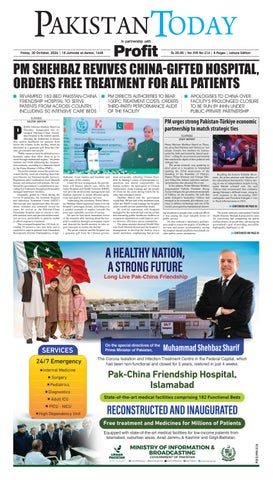
PM Shehbaz reviveS China-gifted hoSPital, orderS free treatMent for all PatientS
Profit
Friday, 30 October, 2026 | 18 Jumada al-Awwal, 1448
g
REVAMPED 182-BED PAKISTAN-CHINA FRIENDSHIP HOSPITAL TO SERVE PATIENTS FROM ACROSS COUNTRY, INCLUDING 50 INTENSIVE CARE BEDS
P
ISLAMABAD
g
PM DIRECTS AUTHORITIES TO BEAR 100PC TREATMENT COSTS, ORDERS THIRD-PARTY PERFORMANCE AUDIT OF THE FACILITY
g
APOLOGISES TO CHINA OVER FACILITY’S PROLONGED CLOSURE TO BE RUN BY IHHN UNDER PUBLIC-PRIVATE PARTNERSHIP
PM urges strong Pakistan-Türkiye economic partnership to match strategic ties
SALEEM JADOON
RIME Minister Shehbaz Sharif on Thursday inaugurated the revamped Pakistan-China Friendship Hospital in the federal capital, directing the authorities to ensure free, quality healthcare for patients from across the country at the facility, which he described as a generous gift from the Chinese government and people. “Public resources must be utilised to serve humanity rather than allow them to go to waste through institutional neglect,” the prime minister said while addressing the inauguration ceremony, according to a statement issued by the Prime Minister’s Office (PMO). The prime minister toured the newly renovated facility, received a briefing from Federal Minister for National Health Services, Regulation and Coordination Syed Mustafa Kamal, and interacted with patients. He reaffirmed his government’s commitment to providing free treatment through professionally managed healthcare facilities. Originally gifted by China during the Covid-19 pandemic, the Isolation Hospital and Infectious Treatment Centre (IHITC) had become non-operational after the pandemic subsided and remained closed for years. Its revival as the Pakistan-China Friendship Hospital aims to restore a valuable national asset and provide modern medical services, particularly to patients unable to afford expensive treatment. The revamped hospital has 182 beds, including 50 intensive care unit beds, and is expected to cater to patients from Islamabad, Rawalpindi, Khyber Pakhtunkhwa, Gilgit-
Rs 20.00 | Vol XVII No 216 | 8 Pages | Lahore Edition
ISLAMABAD
STAFF REPORT
Baltistan, Azad Jammu and Kashmir and other parts of the country. Under the new arrangement, the government will finance patient care, while the Indus Hospital and Health Network (IHHN) will provide professional management and medical expertise to ensure efficient operations and quality healthcare services. Addressing the ceremony, Prime Minister Shehbaz Sharif expressed regret over the hospital’s prolonged closure, describing it as a painful example of neglect towards the poor and vulnerable sections of society. He said he had taken immediate notice of the situation after learning about the hospital’s condition through a newspaper report and directed the health minister to take urgent measures to restore the facility. The prime minister said the hospital was a generous gift from the Chinese govern-
ment and people, reflecting Chinese President Xi Jinping’s vision of international cooperation and shared responsibility for human welfare. He apologised to Chinese Ambassador Jiang Zaidong and the people of China for the years during which the facility had remained closed. Shehbaz Sharif said the government would bear 100 per cent of the treatment costs, while the IHHN would manage the hospital under a public-private partnership model. He said his experience with hospitals managed by the network had convinced him that entrusting public healthcare facilities to competent organisations could improve service delivery, efficiency and accountability. The prime minister directed Health Minister Syed Mustafa Kamal and the hospital’s management to develop the facility into a model institution, emphasising that provid-
Prime Minister Shehbaz Sharif on Thursday described Pakistan and Türkiye as “not simply friends, but brothers by history, united by faith and bound by shared sacrifices,” calling for an economic partnership that matched the depth of their political and strategic ties. The prime minister was speaking as chief guest at a reception in Islamabad marking the 103rd anniversary of the founding of the Republic of Türkiye. Deputy Prime Minister and Foreign Minister Ishaq Dar, federal ministers and parliamentarians also attended the event. In his address, Prime Minister Shehbaz congratulated Turkish President Recep Tayyip Erdogan, the government and people of Türkiye on the occasion. He said that under Erdogan’s leadership, Türkiye had emerged as an economic powerhouse, a pioneer in defence technology and one of the world’s most generous humanitarian donors.
ing treatment to people who could not afford it was among the most valuable forms of public service. He also ordered a third-party performance audit to assess the quality of healthcare services and ensure accountability, saying the hospital should establish a benchmark for other public-sector institutions.
Recalling the historic Khilafat Movement, the prime minister said Muslims of the subcontinent had stood by Türkiye during its war of independence despite living under British colonial rule. He said Türkiye had reciprocated that solidarity during Pakistan’s difficult times, citing its swift response to the devastating 2005 earthquake and President Erdogan’s visit to flood-affected areas in 2010.
CONTINUED ON PAGE 03
The prime minister commended Federal Health Minister Mustafa Kamal and his team for conceiving and completing the public welfare project in record time, advancing the government’s goal of providing accessible, high-quality healthcare to all.
CONTINUED ON PAGE 03
02 newS
Friday, 30 October, 2026 | lahORe
SBP GOVERNOR EXPECTS FURTHER GDP GROWTH, INFLATION TO EASE TOWARDS TARGET
S
PROFIT
NEWS DESK
TATE Bank of Pakistan (SBP) Governor Jameel Ahmad has said that Pakistan's economic fundamentals have significantly improved despite severe global and regional shocks, with real GDP growth recovering to 3.7% in FY26 and expected to rise further in the ongoing fiscal year. Addressing the annual convocation ceremony of the Institute of Cost and Management Accountants of Pakistan (ICMA Pakistan), the governor said that although challenges persist, Pakistan has made considerable progress since 2022. He noted that despite significant supply shocks, the country has managed to contain their impact on the domestic economy. Inflation remained close to the SBP's target range in FY26. Although it has increased since then, it is projected to gradually ease towards the target range, supported by prudent monetary tightening. The governor said the external account remains stable, with the current account deficit expected to stay within 0 to 1% of GDP. Real GDP growth has also recovered gradually, from a contraction in FY23 to
3.7% in FY26, and is expected to increase further during the current fiscal year. He said improvements in economic fundamentals and growing resilience are being recognised by international credit rating agencies, multilateral partners and foreign investors. Reflecting on the economic adjustments undertaken during FY22 and FY23, Ahmad emphasised that timely and decisive action, fiscal discipline and forward-looking, evidence-based policymaking have helped strengthen Pakistan's economic resilience.
Asian shares mixed as Alphabet sell-off weighs on US futures PROFIT
SBP consolidates licensing rules for banks, financial institutions PROFIT
NEWS DESK
REUTERS
Asian stock markets traded unevenly on Thursday as contrasting earnings from major technology companies unsettled investors, while a sharp decline in Alphabet shares dragged US stock futures lower. Alphabet shares plunged 10% in after-hours trading, wiping nearly $400 billion off the company's market value amid concerns over heavy spending. The decline pushed Nasdaq futures down 0.9%. Microsoft, meanwhile, gained 3% after reporting stronger-than-expected cash flows and beating cloud revenue forecasts. The mixed earnings performance increased investor attention on upcoming results from Amazon and Intel, both scheduled for release later on Thursday. In Asia, South Korea's KOSPI index fell 1.2% after Samsung Electronics shares dropped 4%, despite the company reporting record earnings supported by strong demand for memory chips. Samsung's failure to announce plans to increase shareholder returns weighed on its stock. SK Hynix, however, gained 4.6% after rising 11% in the previous session, following plans to return about $75 billion to shareholders this year. MSCI's broadest index of Asia-Pacific shares outside Japan declined 0.7%, while Japan's Nikkei fluctuated before trading 1% higher.
Oil prices fall as peace talks ease Middle East supply concerns PROFIT
REUTERS
He noted that raising the policy rate and maintaining it for almost a year, alongside temporary measures to manage non-debt foreign exchange outflows, had been necessary to restore macroeconomic stability and avert a deeper external financing and debt crisis. The governor stressed that lasting economic progress cannot be achieved through short-term fixes at the expense of long-term stability. He added that maintaining a positive forward-looking real policy rate had helped bring inflation down from over 30% to
Oil prices declined on Thursday, reversing part of the previous session's gains, as expectations of renewed diplomatic efforts between the United States and Iran eased concerns over potential supply disruptions from escalating tensions in the Middle East. Brent crude futures fell 85 cents, or 0.7%, to $114.47 per barrel by 0720 GMT, while US West Texas Intermediate (WTI) crude futures dropped $1.13, or 1.1%, to $101.65 per barrel. The decline followed gains of 1.3% in Brent and 3% in WTI on Wednesday. Market sentiment improved after reports that US Vice President JD Vance had sent a letter to Iranian Security Council chief Mohsen Rezaei in an effort to revive peace negotiations. The Wall Street Journal reported the development on Wednesday, citing US officials and people familiar with the discussions. Nomura Securities economist Yuki Takashima said expectations of renewed negotiations were putting downward pressure on oil prices, although losses remained limited by continuing geopolitical risks. Concerns persisted over intensifying attacks by Yemen's Houthi group and the possibility of further US military action against Iran following the November 3 midterm elections. The Saudi-led coalition said it intercepted and destroyed a ballistic missile launched by the Houthis towards Saudi Arabia's eastern region early Thursday.
within the medium-term target range. Meanwhile, risk-based supervision has strengthened the proactive identification of financial stability risks, with financial sector adequacy and performance indicators improving despite the period of elevated policy rates. Addressing the next generation of accounting and finance professionals, the governor expressed confidence that the skills and knowledge acquired during their studies, together with dedication, hard work and commitment to excellence, would help shape Pakistan's future economic landscape. He encouraged graduates to allow evidence to guide their judgement, professional ethics to define their conduct and a long-term commitment to Pakistan's sustainable and inclusive development to inform their actions. Concluding his address, Ahmad underscored the vital role of the accounting and finance profession in strengthening institutions, promoting accountability and ensuring informed decision-making. He highlighted the profession's contribution to sound governance, responsible use of public resources and productive investment, while congratulating graduates and wishing them success in their future endeavours.
The State Bank of Pakistan (SBP) has issued a consolidated licensing and authorisation handbook for regulated financial institutions, bringing together existing instructions and updated requirements for banks, digital banks, microfinance banks, exchange companies, electronic money institutions, payment service providers and private credit bureaus. In BPRD Circular No. 03, issued on October 28, 2026, the central bank said all new applications for licences or authorisations to establish regulated entities would be processed under the requirements outlined in the handbook. The framework consolidates licensing procedures, eligibility criteria, capital requirements, governance standards and documentation requirements for institutions seeking to enter Pakistan's financial sector. According to the circular, the SBP has consolidated and updated its existing licensing instructions under Section 4C(h) of the State Bank of Pakistan Act, 1956, which empowers the central bank to license, regulate and supervise scheduled banks and financial institutions within its jurisdiction. The handbook covers seven broad categories of regulated entities,
including conventional and Islamic commercial banks, digital retail and full banks, microfinance banks, exchange companies, electronic money institutions, payment system operators and service providers, and private credit bureaus. Under the general requirements, applicants must demonstrate financial strength, transparent ownership structures, legitimate sources of funding and viable business plans. Prospective sponsors, beneficial owners, directors, chief executives and key management personnel will also be subject to the central bank's fit-and-proper criteria. The SBP has specified that licences will not be granted to shell companies or shell banks. Applicants must also demonstrate their ability to comply with anti-money laundering, counter-terrorism financing, consumer protection, data security and other applicable regulatory requirements. The handbook also outlines disqualification criteria for prospective applicants and sponsors, including individuals convicted of serious offences, declared bankrupt, disqualified by regulators or associated with institutions whose licences were revoked due to financial or regulatory misconduct. Members or office-bearers of political parties, elected legislators and public office holders are also among
those ineligible to obtain a licence or become sponsor shareholders. The central bank has prescribed non-refundable application processing fees of Rs 5 million for commercial and digital banks, Rs 2 million for microfinance banks and exchange companies, and Rs 200,000 for electronic money institutions, payment system operators, payment service providers and private credit bureaus. According to the handbook, licensing and authorisation decisions are generally made within six to eight weeks for complete applications that meet the prescribed requirements. However, the timeframe may vary depending on the quality of submissions, external feedback and applicants' responsiveness, while additional stages of regulatory approval may require more time. For commercial banks, the framework specifies a minimum paid-up capital requirement of Rs 20 billion for locally incorporated institutions, subject to any subsequent changes prescribed by the SBP. The handbook also maintains a moratorium on establishing new commercial banks wholly owned by local sponsors, while allowing foreign investors to establish banks independently or in partnership with local investors, subject to regulatory conditions.
Pakistan's cotton production projected to decline 6% in 2026–27: World Bank PROFIT
NEWS DESK
Pakistan's cotton production is projected to decline by 6% during the 2026–27 crop season, according to the World Bank's latest Commodity Markets Outlook, as global cotton supplies face growing pressure from adverse weather conditions and reduced production in major producing countries. The October 2026 report, citing estimates from the United States Department of Agriculture (USDA), forecasts a 3% decline in global cotton production during the 2026–27 season, with Pakistan and China expected to record reductions of 6% each. Cotton production in the United States is also projected to decline by 3%, while Brazil and India are expected to register increases of approximately 1% each. The projected decline in Pakistan's output comes as international
cotton markets face tightening supply prospects, with deteriorating crop conditions in major producing regions, including India and the United States, threatening yields. The World Bank said the intensification of El Niño has added further uncertainty to the global cotton supply outlook, increasing the risk of production disruptions. According to the report, international cotton prices increased by 6% during the third quarter of 2026 compared with the previous quarter, reflecting concerns over tightening supplies for the 2026–27 season. Prices remained broadly stable during the first half of October but were approximately 20% higher than a year earlier. The World Bank forecasts average cotton prices to increase by 14% in 2026, reaching $1.95 per kilogram, compared with $1.71 per kilogram in 2025. Prices are expected to rise further to $2 per kilogram in 2027 and
$2.02 per kilogram in 2028, representing increases of approximately 3% and 1%, respectively, as production gradually recovers. Meanwhile, global cotton consumption is projected to increase by 2% during the 2026–27 season, despite the anticipated decline in production. As a result, the global cotton stocks-to-use ratio, which measures inventories relative to consumption, is expected to decline to 0.57 from 0.63 at the end of the 2025–26 season. The reduction indicates tighter global cotton supplies relative to demand, potentially increasing the market's sensitivity to further production disruptions. The World Bank said the outlook remains exposed to several risks, particularly the possibility of a stronger-than-anticipated El Niño, which could reduce yields and push international prices above current forecasts.
World Bank forecasts 28% surge in global wheat prices in 2026 PROFIT
WEB DESK
International wheat prices are projected to increase by 28% in 2026 and rise further in 2027, according to the World Bank's latest Commodity Markets Outlook, as disruptions to Black Sea grain shipments and declining global production put pressure on supplies. The October 2026 report forecasts that the benchmark US hard red winter wheat price will average $311 per metric tonne in 2026, compared with $243 per tonne in 2025. Wheat prices are expected to increase by another 13.5% to $353 per tonne in 2027 before declining by approximately 11% to $315 per tonne in 2028. The projections come as international grain markets face supply disruptions caused by the conflict between Russia and Ukraine, alongside deteriorating growing conditions in several major producing countries. According to the World Bank, attacks on grain shipments and port infrastructure in the Black Sea region have disrupted exports, contributing to a 14% increase in global grain prices between June and September 2026. Russia and Ukraine collectively account for approximately 30% of global wheat exports, making disruptions to shipments from the region particularly significant for international markets. The report projects that global wheat production will decline by 3% during the 2026–27 season, with reduced harvests expected in several major producing countries. Wheat production in the European Union is forecast to fall by 20%, reaching its lowest level in nearly two decades, as persistent summer heat and drought reduce both cultivated area and crop yields. Meanwhile, wheat output in Russia and Ukraine is projected to increase by 11% and 8%, respectively, partially offsetting production declines in Argentina, Brazil, the European Union and the United States. However, continued attacks on Black Sea shipping infrastructure could limit the availability of wheat supplies in international markets despite improved production in Russia and Ukraine. The World Bank also identifies adverse weather conditions as a major risk to global agricultural production, with an unusually strong El Niño expected to affect growing conditions in several regions. Overall, the World Bank expects global food commodity prices to increase by 10% in 2026, followed by another 7% rise in 2027, with grain prices projected to climb by 9% next year. Although global grain supplies are expected to decline during the 2026–27 season for the first time in four years, total supplies, including opening inventories, are projected to remain approximately 3% higher than two years earlier. The report said relatively strong overall grain supplies could help limit price increases compared with previous periods of severe market disruption. However, it warned that continued hostilities in the Black Sea, combined with stronger-than-anticipated weather shocks and elevated energy prices, could push international food prices above current forecasts.
PSO renews fuel supply deal with Attock Refinery until 2030 PROFIT
MONITORING REPORT
Pakistan State Oil (PSO) has secured board approval to extend its petroleum supply arrangement with Attock Refinery Limited (ARL) until June 2030, increasing monthly allocations of gasoline and other fuels while introducing additional safeguards to address discrepancies in product quality and delivered quantities, Business Recorder reported. The five-year renewal, covering July 1, 2025, to June 30, 2030, follows the expiry of the previous agreement in June last year and negotiations between the two companies over revised commercial and operational terms. Under the revised arrangement, ARL's monthly allocation of motor gasoline to PSO will increase to between 14,000 and 16,000 metric tonnes, compared with the previous range of 12,000 to 15,000 tonnes. The agreement also raises the monthly allocation of MTT from 50–100 tonnes to 250–300 tonnes and introduces a formal supply range for Jet A-1 aviation fuel of 9,000–11,000 tonnes per month, which was not specified in the previous arrangement. Beyond the revised supply volumes, the agreement places greater emphasis on the verification of petroleum products delivered by the refinery, particularly measurements that can affect the quantities recorded by the two companies. Under the new procedures, ARL must allow petroleum products to settle for at least 24 hours before delivery, while gasoline temperatures must remain 3–5 degrees Celsius below the product's initial boiling point. For high-speed diesel, kerosene, aviation fuel and light diesel oil, the permitted temperature variation is limited to five degrees Celsius above or below ambient conditions, based on readings at the refinery's pumping station.
Punjab govt announces first Kisan Bank, Rs17b in agricultural loans PROFIT
WEB DESK
The Punjab Government on Wednesday announced the establishment of the province's first Apna Kisan Bank and a Rs17 billion subsidised agricultural financing programme, alongside an increase in loan limits under the Kisan Card Scheme. Addressing representatives of small, medium and large farming communities from across Punjab, Chief Minister Maryam Nawaz outlined a financing plan offering farmers loans at concessional interest rates to improve access to agricultural credit. Under the proposed arrangement, farmers will be eligible for interest-free loans of up to Rs10 million, while financing of up to Rs30 million will carry a two per cent inter-
est rate. Loans of up to Rs50 million will be available at five per cent interest through the Punjab Urban Unit. The chief minister said the Rs17 billion financing programme would support farmers cultivating approximately five million acres of agricultural land. She also announced an increase of Rs3,500 per acre in the Kisan Card loan limit for purchasing diammonium phosphate (DAP) fertiliser, raising the amount from Rs30,000 to Rs33,500 per acre. Maryam said the provincial government would coordinate with the federal government to ensure implementation of the wheat support price of Rs4,500 per maund. Highlighting existing agricultural assistance programmes, she said more than one million small farmers were benefiting from
the Kisan Card Scheme, which enabled them to purchase fertilisers, seeds and pesticides without relying on middlemen. She maintained that the digitalisation of agricultural financing had improved transparency in loan disbursements and helped farmers access financial support more efficiently. The chief minister said her administration had resisted pressure to impose agricultural income tax on farmers and remained committed to protecting their financial interests. To strengthen agricultural processing and improve returns for growers, she announced plans to establish agro-parks in Sargodha, Bhakkar, Khanewal and Okara. The proposed facilities will focus on grading, storage and processing of agricultural produce, including mangoes, kinnows, oranges and potatoes, with the
objective of increasing value addition and supporting exports. Maryam said Punjab would also explore
opportunities to export processed agricultural products, including pasta, following an increase in wheat production.
NEWS 03
Friday, 30 October, 2026 | LAHORE
PSO SAYS WORKING WITH GOVT AND IMF ON CIRCULAR DEBT SETTLEMENT PLAN
P
PROFIT
STAFF REPORT
AKISTAN State Oil (PSO) has said at its annual general meeting that it is working with the federal government and the International Monetary Fund (IMF) on a settlement plan for outstanding circular debt, while its receivables have not increased since February 2024. The company said it received approximately Rs10 billion in circular debt payments from the Power Division after the financial year ended, in addition to Rs26 bil-
lion from Sui Northern Gas Pipelines Limited (SNGPL) during the final quarter. It also reported a recovery in its petroleum market share to more than 40%, with most gains recorded since July 2026. Management attributed the improvement to better product availability, pricing discipline and supply chain efficiency rather than aggressive discounting. To maintain its position against more than 40 oil marketing companies, PSO is investing in high-volume retail outlets, brand improvements and supply chain automation. Management expects overall petroleum sales to remain broadly stable or grow mod-
estly, as high fuel prices, government austerity measures and the increasing adoption of electric vehicles and solar energy weigh on demand. PSO plans to install electric vehicle charging facilities at selected outlets and along major routes, including Karachi-Hyderabad and Rawalpindi-Peshawar, as well as in Lahore and other cities. The company expects to complete retail automation requirements, including automatic tank gauging systems, by March 2027, potentially qualifying it for higher oil marketing company margins. Dealer margins have already increased, while OMC
margins remain unchanged. Management also said PSO was preparing for potential deregulation of the petroleum sector as the government considers changes to the existing market structure. On liquefied natural gas (LNG), the company said its government-to-government supply arrangement with QatarEnergy remained profitable before financing costs but became loss-making after those expenses were included. Management attributed the pressure partly to an effective tax rate exceeding 50%, primarily because of the one per cent minimum tax on LNG turnover.
Global rice prices projected to rise 12% in 2027, says WB PROFIT STAFF REPORT
International rice prices are projected to rise by approximately 12% in 2027 as adverse weather conditions associated with El Niño threaten production across major Asian exporting countries, according to the World Bank's latest Commodity Markets Outlook. The October 2026 report forecasts that the benchmark Thai 5% rice price
will average $448 per metric tonne in 2026, representing an increase of 9.8% from $408 per tonne in 2025. Prices are expected to rise by another 11.6% to $500 per tonne in 2027 before declining by 6.4% to $468 per tonne in 2028. The World Bank projects that global rice production will decline by 2% during the 2026–27 season, marking the first annual contraction in a decade, as El Niño affects harvests in major Asian exporting countries. The report said adverse
weather conditions associated with El Niño have already disrupted the planting and harvesting of rice and sugar in several producing regions. The World Bank has revised its 2027 rice price forecast upward by 21% compared with its April 2026 projection, reflecting growing concerns over future supplies. The report noted that rice prices increased by 6% during the third quarter of 2026 compared with the preceding quarter, as international markets responded to
PM Shehbaz revives China-gifted hospital, orders free treatment for all patients CONTINUED FROM PAGE 01
182-BED HOSPITAL TO HELP MEET GROWING HEALTHCARE DEMAND Speaking on the occasion, Federal Health Minister Syed Mustafa Kamal thanked the prime minister for his personal efforts and close supervision, saying his detailed involvement and commitment had helped bring the hospital’s revival to fruition within a short period. He highlighted the growing demand for healthcare services in Islamabad, noting that the capital’s population had increased substantially since its establishment. Patients from Gilgit-Baltistan, Khyber Pakhtunkhwa, Azad Jammu and Kashmir and Rawalpindi also travelled to the capital for treatment, he added. The minister said the 182-bed hospital would help meet the growing demand and provide muchneeded relief to patients from Islamabad and surrounding regions. He also informed the gathering that a 200-bed cancer hospital at the Pakistan Institute of Medical Sciences (PIMS) had been prepared and was expected to become operational next year. Thanking the Chinese government and people on behalf of Pakistan, Mustafa Kamal described the
hospital as a precious gift and said he was honoured to contribute to restoring it to service. hinese Ambassador to Pakistan Jiang Zaidong welcomed the inauguration, expressing happiness that the facility had been transformed from an isolation hospital into a general hospital under the personal attention of Prime Minister Shehbaz Sharif. He appreciated the decision to name the facility Pakistan-China Friendship Hospital, saying it reflected the prime minister’s strong feelings for China and commitment to strengthening bilateral relations. The ambassador also acknowledged Pakistan’s efforts in other areas of public welfare, including polio eradication, the expansion of health card initiatives and youth development. Referring to Pakistan’s economic indicators, Jiang noted improvements in foreign exchange reserves, exports, foreign direct investment and credit ratings. He expressed China’s desire to work with Pakistan to advance economic cooperation under the second phase of the China-Pakistan Economic Corridor (CPEC). He expressed hope that the Pakistan-China Friendship Hospital would operate successfully and continue serving the people, fur-
ther strengthening the longstanding friendship between the two countries. Dr Abdul Bari Khan, chief executive officer of the Indus Hospital and Health Network, thanked the prime minister and the health minister for entrusting the organisation with the hospital’s management, describing the partnership as an important opportunity to expand free healthcare services in the federal capital. He said the network operated 15 hospitals, 140 primary healthcare clinics, four blood centres and four physical rehabilitation centres across Pakistan, serving approximately 700,000 patients every month. Dr Bari recalled that the partnership with Shehbaz Sharif dated back to his tenure as Punjab chief minister, when the provincial government entrusted the network with managing hospitals to improve access to quality healthcare. He said the network’s operations had expanded significantly, with its annual budget increasing from Rs1 billion in its first year to Rs68 billion in the current year. He attributed the growth to public support, donations, the dedication of healthcare teams and the prayers of patients, adding that around 70 per cent of the network’s total budget was raised within Pakistan.
PM urges strong Pakistan-Türkiye economic partnership to match strategic ties CONTINEUD FROM PAGE 01
He also recalled the gesture of Turkish First Lady Emine Erdogan, who donated her necklace for flood victims, and said Türkiye subsequently helped build a hospital, a school and model villages in Muzaffargarh. The Recep Tayyip Erdogan Hospital and Emine Erdogan School, he noted, continued to serve local communities. The prime minister also appreciated Türkiye’s firm support for Pakistan during last year’s Marka-e-Haq against India. Describing the Makkah Agreement, signed on August 7, 2026, between Pakistan, Türkiye and Saudi Arabia, as a significant milestone, he said it reinforced collective deterrence and the three countries’ shared commitment to regional peace and stability. He reiterated that Pakistan would continue to champion dialogue, diplomacy, respect for international law and the peaceful settlement of disputes. Turning to economic cooperation, the prime minister recalled announcing the President Tayyip Erdogan Special Economic Zone in Karachi at the Pakistan-Türkiye Business Conference in Istanbul in July. He invited Turkish investors to explore Pakistan’s young population, strategic geographical location and expanding investment opportunities. He urged both countries to translate their longstanding goodwill into practical economic cooperation, joint ventures and employment opportunities for young people, stressing the need for economic ties to keep pace with their strong political and strategic relationship. The reception also featured a cake-cutting ceremony to mark the anniversary. ‘PAKISTAN HURTS, TÜRKIYE FEELS THE PAIN’ Welcoming the guests, Turkish Ambassador Dr Irfan Neziroglu said the Turkish War of Liberation and the establishment of the Republic in 1923 under Gazi Mustafa Kemal Atatürk had inspired many nations, including Muslims of South Asia, in their own struggles for independence. He noted that Quaid-i-Azam Muhammad Ali Jinnah and Allama Muhammad Iqbal had both admired the Turkish struggle.
tightening supply prospects. The anticipated increases in rice prices during 2026 and 2027 would be the largest since 2012, apart from those recorded in 2020, when the COVID-19 pandemic disrupted supplies, and in 2023, when export restrictions contributed to sharp price increases. The World Bank's baseline forecast assumes that major rice-exporting countries will not introduce export restrictions in response to production declines.
Despite disruptions in the Strait of Hormuz, PSO received 11 LNG cargoes from QatarEnergy since March and is coordinating with the government on winter supply arrangements. The company has no plans to exit the LNG business, provided outstanding structural issues are addressed. It also confirmed that LNG accounts with SNGPL had been reconciled, with remaining amounts largely related to government diversion payments owed to the gas utility. Regarding petroleum imports, management said domestic refineries were meeting around 95% to 97% of Pakistan's high-speed diesel requirements, with only four to five diesel cargoes imported since March 2026. It said the limited imports had reduced the significance of price differences between imported and locally refined diesel, while the Ministry of Petroleum was working to diversify crude oil and petroleum product suppliers to strengthen supply security.
World Bank flags substantial risks to $727m KP energy project PROFIT
STAFF REPORT
The World Bank has rated progress towards the development objectives of the $727 million Khyber Pakhtunkhwa Hydropower and Renewable Energy Development Project as moderately unsatisfactory, citing substantial risks related to economic conditions, institutional capacity, financial management and environmental compliance. In its latest public disclosure on Wednesday, the bank maintained an overall risk rating of substantial for the project, which was approved in 2020 and is scheduled for completion by November 30, 2027. However, the bank assessed overall implementation progress as moderately satisfactory, indicating that work on the project has advanced despite concerns over its ability to achieve the intended development outcomes.
04 COMMENT
Friday, 30 October, 2026
ANOTHER PACT…
Petroleum levy problem
T
T
The government tries to fend off the Jamaat Islami’s Long March
Where does Indonesia come in?
HOUGH the petroleum levy was the subject of discussion between Prime Minister Shehbaz Sharif and Jamat Islami Amir Hafiz Naeeumur Rehman, the real issue was whether or not the Jamaat would carry out its Long March in midNovember. The Jamaat was still insisting that it would march, and rejected the government’s request for a postponement of seven to ten days. Though not present, the shadow of the International Monetary Fund loomed large, for the revenue from the petroleum levy, About Rs one trillion a year, has played a massive role in enabling the government to meet the IMF demand that a primary surplus be maintained. Another problem is that the petroleum levy has also been promised to the IMF, so as to receive climate sustainability and resilience funding of $1 billion. Even with the latest cuts, the petrol price was still Rs 376.06 per litre on Wednesday, which means that an end to the petroleum levy would mean a new price below Rs 300 per litre. Perhaps one reason why Mr Sharif agreed to set up a committee is his own realization that bringing the petrol price down would burnish his image greatly. There may also be the feeling that the price should not be allowed to cross Rs 500 per litre as it is threatening to, and that possibly, even with the removal of the levy, the price would go to that level. The Jamaat wants the levy removed at once, the government wants it removed gradually. When the Jamaat first raised this issue, there was talk on the government side of imposing further taxes to make up the gap that would open up because of the petroleum levy. The Jamaat is also highly critical of the government for having recourse to the IMF time and again, but even if one was to support that, it would still be difficult to support the revenue gap being filled by such a regressive tax, as that of consumption of a basic input. The only real way of handling the price of oil is for it to come down on the international market, and for that diplomacy might be the only course. The Israeli elections have shown that the basis of the war, Israel’s intransigence, may be counterproductive, and the new Israeli government, whether led by Mr Netanyahu or not, would incline towards ending the war. The US midterms remain, but is expected that the pointlessness to the war might become visible.
Founding Editor
Babar Nizami Editor Profit
That means that after making the commitment to the alliance partners, the force then has to designate the units that will be moved. These units are informed accordingly. This is not to allow the men to say their farewells to their families. In fact, if they disclose that they may be going somewhere, let alone where, it is a violation of good order and discipline. This information is so that the unit commanders can integrate their future deployment into training schedules, and also prepare movement plans, which are the most complex of staff exercises. The army and air force has been raised on assumptions based on national needs, not an alliance’s. However, they might have been raised because of a national commitment, and have to be paid for out of the national budget. For example, Pakistan Army units which have been detailed for UN peacekeeping, must be ready for combat with any opponent, such as India, at any time. The best example of how armies provide for both national and alliance needs is to be found in the post-World War II confrontation between NATO and the Warsaw Pact. The best example of an army changing its profile to meet new requirements is the British Army, which had to balance its reduced commitments because of decolonization with the new demands of NATO and BAOR (the British Army of the Rhine). Another example is how the USA juggled its forces between those it committed to the Vietnam War and those it maintained in Europe (mostly Germany). It is not a very instructive example, however, because the forces previously stationed in Vietnam had high rates of drug addiction and other forms of indiscipline, and infected the forces already stationed there. In fact, those troops became a problem when moved back to the USA, where they spread the diseases of addiction and insubordination to Stateside units. Pakistan might face this problem, for it has not only got two agreements with Saudi Arabia, it has just concluded another with Kuwait. This does not include other Gulf states with which it has arrangements involving the secondment of officers, mainly as trainers, Though the Pakistani armed forces are large and capable, which means that they can not only provide training but they also have the leeway to second offficers in substantial numbers, it is looking as
Pakistan may be getting into the Middle East, but it should not get in so dep that it is forced to take sides in a volatile region, whose volatility is shown by the current war
Arif Nizami (Late) M. A. Niazi
M A NIAZI
HE Badr Defence Pact is between Pakistan, Turkiye, Qatar and Indonesia. It seems a distorted version of the Makkah Declaration, for it exchanges Saudi Arabia with Qatar as the Gulf Arab state, and brings in Indonesia to join Pakistan and Turkiye as the Ajami (non-Arab Muslim) countries with a strong military. It is worth noting that Saudi Arabia is left out, which indicates that what Saudi Arabia has, is being brought to the table by Qatar. That can only be oil wealth. It should be noted that Qatar too is participating in a shooting war, and is already a member of the Gulf Cooperation Council military command, which has proved so inept and negligible that it is no longer even mentioned in the context of the current conflict. It should not be assumed that Qatar’s presence is somehow opposed to Saudi Arabia. At the same time, Qatar is not just a slavish follower, and at one point was boycotted by Saudi Arabia, Bahrain, Egypt and the UAE because of its links with the Muslim Brotherhood and thus Hamas, and ultimately Iran. Cultivating Iran does not seem to have worked, for Qatar has had its gas facilities attacked in the current conflict. It has signed this agreement despite seeing the obvious reluctance of both Pakistan and Turkiye to get involved with the Houthis. It might be noted that Qatar had joined Saudi Arabia’s anti-Houthi military action before the current conflict. The really new entrant to the fast-developing network of alliances in the Middle East is Indonesia. Previously, Indonesia had stayed out of the Middle East, though this began to change when it accepted being part of the Gaza peacepeeping force, and promised to appoint a second in command under a US major general. Indonesia has promised to commit 8000 troops, or an expanded brigade. Initially, with up to 20,00 troops ultimately. This is out of an army of 300,000, and while the country fulfills a number of UN peacekeeping commitments. Pakistan so far has not announced any commitment of troops beyond those already in Saudi Arabia, which they have been for a long time. It is possible that it may be running into the problem that is faced, at least to some extent, whenever a country enters a military pact: that is, what are the force commitments it has made. This is extremely important, for it must not only make the commitments clear, but it must also be communicated to the unit level within one’s own force.
Dedicated to the legacy of late Hameed Nizami
Editor Pakistan Today
At Penpoint
The writer is a member of staff
Pakistan’s deadly definition of Development Is the air breathable?
P
DR ZAFAR KHAN SAFDAR
AKISTAN’S pursuit of economic growth is exacting a price that its development statistics rarely acknowledge. The air its citizens breathe is shortening their lives, exposing the failure of a model that counts economic gains while discounting the human cost. Yale University’s 2026 Environmental Performance Index ranks Pakistan 157th among 177 countries overall and 176th in air quality. Its environmental health ranking is 175th. These figures expose a fundamental flaw in the country’s understanding of development. Growth that destroys the conditions necessary for human life cannot be counted as progress without qualification. The human cost is staggering. Air pollution is estimated to cause hundreds of thousands of premature deaths in Pakistan each year. In 2025, Senator Sherry Rehman cited an annual toll of 256,000 deaths and estimated the economic losses at $22 billion, equivalent to 6.5 percent of GDP. These estimates encompass the consequences of illness, premature death and lost productivity, although their precise magnitude depends on the underlying methodology. Even allowing for uncertainty, the scale of the damage is impossible to dismiss. Money that could support education, healthcare and productive investment is consumed by an environmental crisis that the country has repeatedly failed to control. The damage extends beyond hospital admissions and premature deaths. The University of Chicago’s Air Quality Life Index estimates that particulate air pollution reduces average life expectancy in Pakistan by approximately 3.3 years. Residents of heavily polluted cities face
even greater losses. For millions of people, polluted air is not an occasional inconvenience but a daily exposure that gradually diminishes their health and years of life. Children grow up breathing air that threatens their development, while workers bear the physical costs of an economy whose output is often valued more highly than their well-being. When pollution shortens lives and reduces people’s capacity to work, it is not merely an environmental problem. It is a failure of economic policy. The causes are neither mysterious nor beyond the reach of public policy. Vehicle emissions, industrial pollution, brick kilns, the burning of agricultural residues and the widespread use of polluting fuels all contribute to Pakistan’s deteriorating air quality. Weak enforcement allows many polluters to impose costs on the wider population without paying the full price of the damage they cause. Seasonal smog in Punjab has become a recurring public health emergency, yet the response too often intensifies when the air becomes visibly dangerous and fades when the immediate crisis passes. Temporary school closures and restrictions on outdoor activities may reduce exposure for a time, but they cannot substitute for sustained control of emissions at their source. Urban development reveals the same failure of priorities. Pakistan’s cities are expanding rapidly, but construction and road-building frequently receive greater attention than the environmental conditions that make urban life tolerable. Trees are removed to accommodate roads and commercial projects, while green spaces struggle to survive the pressure of rising land values. Yet urban trees are not simply ornamental features. They provide shade, moderate temperatures, absorb some air pollutants and help manage rainwater. Their removal can make neighbourhoods hotter and less healthy, particularly for people who cannot afford air conditioning or live in poorly ventilated homes. The contradiction is difficult to ignore. Governments invest in roads to improve mobility and promote economic activity, but insufficient attention is paid to public transport, pedestrian infrastructure and the emissions generated by the vehicles using those roads. Industrial expansion is encouraged, yet environmental safeguards are too often treated as secondary considerations. Cities are built for the movement of vehicles and the accumulation of property, while the needs of pedestrians, children and ordinary residents receive less atten-
Pakistan cannot afford to abandon economic growth. It must industrialise, create jobs and build the infrastructure its people need. But it cannot continue treating clean air, safe water, fertile soil and urban greenery as expendable resources. These are not luxuries to be pursued after development. They are among its essential foundations Lahore – Ph: 042-36300938, 042-36375965
if the question of sufficiency must be addressed. It should not be forgotten that the armed forces face a much larger opponent in its East, and that has to be the primary aim for them. There seems yet another attempt to create a security architecture for the Gulf which would exclude the USA. The engaging of Iran by the three countries of the Makkah Declaration fits into this scenario, for the lead Gulf country in ongoing peace efforts is Qatar, which is also one of the signatories of the Badr Pact. In fact, the only one of the several countries involved not to have a public role is Indonesia. It is also worth wondering how Indonesia finds itself in this company. It does not even depend on Iran for oil, being a rival oil producer if anything. The only connection it has is that it is a US ally. Like Pakistan and Turkiye, it has a history of military rule as well as being a staunch US ally. It is interesting that the only Arab country with a military of the same size as Pakistan, Turkiye or Indonesia, Egypt, is not in either of the alliances, though it was spoken about freely as about to join the Makkah Declaration. A closer look at Indonesia causes the observer to ask why the alliance was formed. A military alliance has to have an objective, a common enemy. The Makkah Declaration could be against Iran, but the recent engagement with Iran indicates that this is not the case. It is possibly against Israel, but that us unlikely among such aggressively pro-US countries. The Badr Pact would have the same potential opponents, but Indonesia does not fit that pattern. One clue is afforded by the fact that whatever alternative architecture is being developed, does not include Israel. Israel is the USA’s most responsible ally, but it is toxic to the extent that countries recognizing it have been penalized. Indonesia is a sort of steppeddown version. The Badr Pact may merely be the result of the upheaval overtaking the entire Middle East. On the face of it, it should dovetail into the Makkah Declaration, merging into it. It should not form a rival organization, especially as Qatar, though under Iranian fire because of its hosting of CENTCOM forces at its famous Al-Hodaida Air Base, is a very close US ally, though it has not yet joined ths Abraham Accords. Its representative was at the meeting of the military heads of Saudi Arabia, the UAE, Bahrain, Kuwait, Jordan and Egypt, with the head of Centcom and the Israeli Chief of Defence Forces, in Germany. Though the meeting included countries which have not yet recognized Israel, the meeting had to take place if action against Iran was to be coordinated. Pakistan may be getting into the Middle East, but it should not get in so deep that it is forced to take sides in a volatile region, whose volatility is shown by the current war.
I
Karachi – Ph: 021-32640318 I
tion. Development becomes a measure of physical expansion rather than an assessment of whether people are living better lives. Other countries demonstrate that environmental damage need not be an inevitable price of economic progress. South Korea confronted severe pollution during its period of rapid industrialisation and subsequently strengthened emissions controls and air-quality monitoring. Singapore has incorporated green spaces and urban greenery into its planning model. Their experiences are not directly transferable to Pakistan, whose institutions and resources differ, but they establish an important principle. Environmental protection requires political commitment, enforceable rules and long-term investment. It does not emerge automatically as economies grow wealthier. Pakistan already has a National Clean Air Policy, adopted in 2023. The challenge is to translate policy into measurable improvements in the air people breathe. Emissions standards must be enforced consistently against vehicles and industrial facilities. Brick kilns need cleaner technologies and effective oversight. Farmers require practical and affordable alternatives to crop burning rather than restrictions unsupported by adequate assistance. Public transport must become a credible alternative to private vehicles, while urban development approvals should protect existing trees and require meaningful green spaces. Air-quality monitoring data should be accessible to the public, allowing citizens to assess government performance and hold responsible institutions accountable. These measures require money, administrative capacity and political will. They also require a change in how success is measured. Governments routinely announce kilometres of roads constructed, buildings completed and investments attracted. Those achievements matter, but they tell only part of the story. A development model that expands economic activity while increasing illness, reducing life expectancy and degrading the environment may generate visible assets while quietly destroying human wealth. The cost eventually appears in medical bills, lost working days, diminished productivity and lives cut short. Pakistan cannot afford to abandon economic growth. It must industrialise, create jobs and build the infrastructure its people need. But it cannot continue treating clean air, safe water, fertile soil and urban greenery as expendable resources. These are not luxuries to be pursued after development. They are among its essential foundations. The true measure of Pakistan’s progress is not merely how much it builds, but whether the people for whom it builds can live longer, breathe cleaner air and enjoy the benefits of economic growth. A country that sacrifices the health of its citizens in the name of development risks destroying the very human potential on which its future depends. Pakistan does not need less development. It needs a definition of development that does not come at the cost of human life. The writer has a PhD in Political Science, and is a visiting faculty member at QAU Islamabad. He can be reached at zafarkhansafdar@yahoo.com and tweets @zafarkhansafdar Islamabad – Ph: 051-2204545
I
Editor’s mail
Send your letters to: Letters to Editor, Pakistan Today, 4-Shaarey Fatima Jinnah, Lahore, Pakistan. E-mail: letters@pakistantoday.com.pk Letters should be addressed to Pakistan Today exclusively
Healing family ties
FAMILY conflicts often start with a small misunderstanding, a harsh word, or an unmet expectation. But when ignored, these little issues can grow into a silent poison that slowly destroys love, peace and trust at home. Psychologists say that most problems come from poor communication, lack of patience and unrealistic expectations. When family members stop listening to each other and try only to prove themselves right, emotional distance grows. This leads to feelings of loneliness and mental stress even within a house full of people. The good news is: this can be prevented. Start by talking and listening regularly, even about small things. Be patient during disagreements, and accept that everyone has strengths and weaknesses. Use kind words like “I understand” or “I’m sorry” to build bridges, not walls. Also, make time for fun and togetherness. Shared moments bring hearts closer and reduce negativity. Disagreements are natural but solving them with love, respect and understanding is the real strength of a happy family. Don’t let silence ruin what love has built. ARONA SAGHIR KARACHI
Nuclear past repeats
FOR more than 30 years, the world has avoided slipping back into the dangerous cycle of escalation that defined the Cold War era. After the superpowers realised how close they had come to nuclear catastrophe, they slowly built a system of restraint. Arms-control treaties, verification mechanisms, and a shared understanding of mutual destruction pushed nuclear testing into history. This long period of relative calm makes today’s renewed talk of testing all the more worrying. Against this backdrop, United States President Donald Trump’s recent directive to Pentagon to explore new nuclear test possibilities appears historically tone-deaf and strategically short-sighted. It overlooks the hardearned lessons of the Cold War. At the time, both the United States and the erstwhile Soviet Union believed that strength came from building bigger and more destructive weapons. But each new test only provoked another response, pushing both sides closer to the edge. It was a dangerous game where one misstep could have meant annihilation. The world eventually stepped back from the brink, not because of luck, but because leaders finally recognised that nuclear one-upmanship had no winners. Today’s world is far more complex than the bipolar Cold War order. Instead of two major powers, there is now a multipolar rivalry involving the US, China, Russia and several emerging nuclear states. Reintroducing nuclear tests in such an environment is like lighting a match in a room full of fuel barrels. There are more players, more tensions, and fewer rules. The old arms-control framework — the one that helped stabilise the Cold War — has weakened over the years. Key treaties have collapsed, verification has eroded, and trust among major powers is at its lowest point in decades. In essence, bringing back a Cold War-era practice now risks replaying the darkest chapters of the 20th century, but this time without the safety nets that once kept competition in check. A single test by one country could trigger a chain reaction, pushing others to respond with tests of their own. Such a spiral would make diplomatic restraint harder, and strategic miscalculations more likely. Supporters of new testing argue that it strengthens deterrence, but this argument ignores the fact that modern nuclear technology does not require explosive testing to remain credible. Instead, political signalling becomes the real motive — and that is precisely what makes the situation so dangerous. Using nuclear tests as symbols of power invites others to do the same. The world cannot afford to treat nuclear weapons as tools of political theatre. The lessons of history are clear: once the cycle of testing begins, it becomes difficult to stop. What kept the world safe for three decades was not louder threats, but quieter diplomacy and strong global norms. Reviving nuclear testing would not make any nation safer. It would simply drag the world back towards an era of fear — an era we worked so hard to leave behind. SANAULLAH MIRANI DAHARKI
Web: www.pakistantoday.com.pk
I
Email: editorial@pakistantoday.com.pk
COMMENT 05
Netanyahu’s Electoral Setback Friday, 30 October, 2026
Will Israel Choose War or Diplomacy?
I
QAMAR BASHIR
SRAEL’S October 27 general election has delivered a significant political setback to Prime Minister Benjamin Netanyahu,whose campaign emphasized military strength, national security and confrontation with Iran. Yet the voters have not handed his principal opponent, former military chief Gadi Eisenkot, an unambiguous mandate either. Instead, Israel faces a fragmented parliament, difficult coalition negotiations and potentially prolonged political uncertainty, with consequences extending far beyond its borders. The initial exit polls projected approximately 50 seats for Netanyahu’s bloc, 52–53 for Eisenkot’s opposition alliance and17–18 for Arab-led parties. Updated projections narrowed the contest further, placing the two principal blocs at approximately 51 seats each. Neither approaches the 61 seats required for a majority in the 120-member Knesset. These remain provisional projections, not final election results. The election represents more than a contest between two political personalities. It is a referendum on Netanyahu's wartime leadership, Israel’s democratic institutions, the
October 7 intelligence failures, military conscription, relations with Palestinians and the future direction of Israeli foreign policy. High voter participation, particularly among Arab citizens, suggests that substantial sections of Israeli society want their voices heard in determining that direction. Netanyahu’s political predicament is particularly complicated because his traditional allies include ultranationalist and religious parties whose positions on Palestinian territory, settlement expansion and military operations are frequently more uncompromising than those of the broader Israeli electorate. Parties associated with Itamar Ben-Gvir and Bezalel Smotrich have advocated extensive Israeli control over Palestinian territories, while ultra-Orthodox parties prioritize religious institutions, public funding and military-service exemptions. These factions should not be treated as ideologically identical. Nevertheless, another Netanyahu-led government dependent on their parliamentary support could face intensified demands for settlement expansion, restrictions onPalestinian sovereignty and continued military pressure across the region. Coalition negotiations might therefore reinforce rather than moderate some of the policies that have generated international criticism. The consequences would extend to Gaza, where Israel’s military campaign has caused enormous civilian suffering, destruction and displacement. International institutions and human-rights organizations have raised grave allegations concerning violations of international humanitarian law. Netanyahu rejects accusations of criminal wrongdoing and maintains that Israel’s operations are necessary for national security and the defeat of Hamas. In the occupied West Bank, continued settlement expansion and settler violence
IsraelÊs electoral verdict remains incomplete, but its message is unmistakably complex: political power is fragmented, public confidence is contested, and the choice between continued confrontation and meaningful diplomacy remains unresolved. The Middle East now awaits not merely the formation of another Israeli government, but an indication of whether that government can open a credible path toward peace
have undermined prospects for Palestinian self-determination. In southern Lebanon, Israeli security operations and demands for buffer arrangements have raised serious questions about Lebanese sovereignty. The occupied Syrian Golan Heights remains another longstanding territorial dispute, notwithstanding Israel’s annexation claim and US recognition of Israeli sovereignty there. Iran represents perhaps the most dangerous dimension of Netanyahu’s regional strategy. His political message has consistently presented Tehran as an existential security threat, requiring military preparedness and, when deemed necessary, offensive action. His critics contend that an escalating confrontation risks drawing the USA into an increasingly costly regional conflict while destabilizing neighbouring countries and threatening international energy supplies. An Eisenkot-led administration could alter the methods through which Israel pursues its security objectives, although it would not necessarily abandon those objectives. Eisenkot, himself a former military chief, also considers Iran a major strategic threat and supports strong Israeli military capabilities. His distinction from Netanyahu lies more in his emphasis on institutional accountability, national cohesion, coordinated security policy and rebuilding international partnerships than in any categorical rejection of military force. His proposed independent state commission of inquiry into the October 7, 2023, attacks could become particularly consequential. Such an investigation would examine the intelligence, military and political failures that allowed Hamas militants to breach Israel’s defenses, kill civilians and security personnel, and take hostages. Serious questions have been raised about whether Israeli authorities adequately assessed warnings preceding the attack,why border defences proved insufficient and how political and military decision-making contributed to the catastrophe.There have also been investigations and disputes concerning Israeli fire during the fighting. These questions deserve independent examination, with responsibility established through evidence rather than political accusation. However, allegations that Netanyahu deliberately facilitated the Hamas attack to justify territorial expansion, or that Israeli forces caused most of the deaths, have not been established by credible evidence. An independent inquiry would be important precisely because it could distinguish docuinstitutional failures from mented speculation, determine individual accountability and restore public confidence in the findings. For Palestinians, an Eisenkot government might offer greater scope for negotia-
tions over Gaza’s reconstruction, civilian administration and the prevention of further displacement. Proposals involving Palestinian technocrats and international participation could provide alternatives to indefinite Israeli military administration. Yet Eisenkot’s security-centered outlook does not automatically translate into support for full Palestinian sovereignty or immediate Israeli withdrawal from occupied territories. A settlement freeze, stronger action against extremist settler violence and renewed diplomatic engagement would constitute meaningful changes if implemented. But a durable settlement would still require confronting the fundamental questions of occupation, borders, Palestinian political rights, security guarantees and internationally recognized self-determination. The Arab-led parties may therefore become the election’s most consequential parliamentary actors. Ra’am, led byMansour Abbas, has previously demonstrated willingness to participate in coalition arrangements, while other Arab political factions have generally maintained stronger opposition to Israeli policies toward Palestinians. Their combined representation could be indispensable to preventing Netanyahu’s return or sustaining an alternative administration. Yet Eisenkot’s prospective coalition contains secular right-wing politicians who oppose governing alongside Arab parties.This creates a fundamental contradiction: the opposition may possess sufficient combined parliamentary strength to replace Netanyahu, but not the political agreement necessary to exercise that strength. Outside parliamentary support, a minority administration or carefully negotiated confidence arrangements could become possible solutions. Even a successfully constituted government would confront an uphill struggle. A narrow parliamentary base could allow relatively small factions to threaten legislation, budgets and coalition survival. Disagreements over military conscription, religious privileges, judicial independence and Palestinian policy could destabilize the administration before its regional diplomatic initiatives acquire momentum. Should neither political camp assemble
a workable governing arrangement, Israel could enter another prolonged cycle of negotiations, failed mandates and potentially fresh elections. Under Israel’s parliamentary system and Basic Laws, the outgoing government generally continues in a caretaker capacity until a replacement takes office. Netanyahu could therefore remain prime minister despite losing his existing parliamentary majority. Such uncertainty would have consequences for Washington, European capitals, Tehran, Beirut, Damascus and thePalestinian territories. Governments would struggle to determine whether Israeli military commitments, diplomatic assurances and regional policies represented temporary political calculations or the enduring direction of the state. Ultimately, the election has exposed the limitations of relying exclusively on military power to address deeply rooted political disputes. Israel’s security concerns are real, as are Palestinian demands for freedom, dignity and statehood and neighboring countries’ rights to sovereignty and territorial integrity. None can be permanently resolved through force alone. The central question is therefore not simply whether Netanyahu survives or Eisenkot replaces him. It is whether Israel's next government, whatever its composition, can reconcile security with international law, accountability with democratic governance, and national interests with regional coexistence. Israel’s electoral verdict remains incomplete, but its message is unmistakably complex: political power is fragmented, public confidence is contested, and the choice between continued confrontation and meaningful diplomacy remains unresolved. The Middle East now awaits not merely the formation of another Israeli government, but an indication of whether that government can open a credible path toward peace. The writer retired as Press Secretary the President, and is former Press Minister at Embassy of Pakistan to France and former MD, Shalimar Recording & Broadcasting Company Limited
How a third war could push Iran towards nuclear weapons There is a belief in US President Donald Trump’s circle that economic pressure has brought Iran to the brink and that another round of strikes could make regime change possible
T
MIDDLE EAST MONITOR
MAHDI NIKSEFAT MOTLAGH AND KIAVASH KALHOR
HE most dangerous moment for a dominant power comes when it considers continuing a war necessary to vindicate the decision to begin it. At that point, every inadequate outcome can become an argument for a larger attack. Past costs raise the demand for victory, even as the conditions for achieving it grow more difficult. America is approaching such a point in its confrontation with Iran: a war intended to demonstrate its capacity to exercise power has become a test of that power’s credibility. The Atlantic’s report of 22 October offers a clear account of this calculation. Drawing on conversations with officials and people familiar with the discussions, it describes a belief in US President Donald Trump’s circle that economic pressure has brought Iran to the brink and that another round of strikes could make regime change possible. The same report stresses that no final decision to resume attacks has been taken. What has returned is the expectation that one additional application of pressure will deliver a decisive result. That expectation is a new expression of an old error: the assumption that an enemy’s vulnerability guarantees that its behaviour can be managed. Iran can suffer damage without accepting the political outcome its attacker seeks. The distance between these two possibilities is where military action becomes a hegemonic gamble. Understanding this gamble requires attention to the function of a “manageable enemy”. In this calculation, the presence of a familiar adversary helps organise alliances, justify a military presence and establish the need for protection. Such an enemy’s value to the dominant power depends on the expectation that the scale of the threat, the costs of confrontation and the terms on which it ends can be controlled. In this picture, Iran is important enough for a confrontation with it to carry regional significance, yet is imagined to be sufficiently vulnerable that it cannot alter the rules of engagement. The account of protection and obedience offered by Carl Schmitt, the German jurist and political theorist, helps clarify this relationship. In his analysis, the protecting power plays a role in determining the enemy and shaping political allegiance. Extending this argument to America’s regional order suggests that a claim to security leadership rests on the expectation that the leader can provide protection and contain danger. “Manageable enemy” is this essay’s own formulation; what it draws from Schmitt is
the relationship between the promise of protection and political authority. The difficulty begins when confronting the enemy makes the promised security more costly. Allies that rely on American protection also become exposed to the consequences of American policy. If military operations produce prolonged insecurity, economic disruption and the prospect of retaliation, the capacity to destroy remains intact, but the claim to control the crisis’s outcome comes into question. Hegemonic authority erodes in the gap between the two. The experience of Iraq should have made Washington more alert to this gap. The fall of Saddam Hussein’s government did not resolve the problem of establishing a stable order favourable to the United States. In Iran’s case, even the conversion of military strikes into political collapse has encountered serious obstacles. Institutional plurality, sources of national attachment and experience of governing under pressure make it difficult to move automatically from eliminating individuals to disabling the system. A government can grow weaker while retaining the capacity to make decisions and resist. The 12-day war of June 2025 and the US-Israeli campaign that began on 28 February, 2026 exposed this problem on different scales. Iran’s losses have been real. Yet the outcome those losses were supposed to produce – acceptance of a future determined by Washington and Tel Aviv – remains contested. The continuation of negotiations, threats and pressure itself demonstrates that military superiority has yet to produce the intended political conclusion. A Reuters report of 27 August records the distance between the initial expectation and the resulting situation. Trump had spoken of a campaign lasting four to five weeks, yet six months later the United States was caught between increasing the pressure and finding a face-saving exit. That distance matters for understanding the next decision, because a protracted war can change what ending it means to the power that began it. This is where the hegemonic gamble takes shape. Once a president ties his credibility to forcing Iran to retreat, an agreement that recognises Iran’s continuing freedom of action may appear to him as an admission of failure. Concern for personal credibility then becomes entangled with concern for the credibility of American threats and the confidence of allies. A specific conflict comes to bear the burden of vindicating a much broader claim to power. This does not mean that ending the war would automatically bring down American hegemony. The danger lies in how the war’s end is interpreted. If Washington regards Tehran’s overt submission as the only acceptable outcome, it narrows its own access
to exits that could preserve American power and resources. Under these conditions, a third round of major strikes can be presented as an opportunity to repair the credibility damaged by the first two. The promise is similar each time: this will be the final application of pressure. Yet if the expected political response fails to materialise, further pressure is demanded to justify what came before. Even a desire to concentrate on larger rivals will not necessarily interrupt this cycle. A leader who has defined withdrawal from a conflict as defeat may deepen his commitment in an attempt to escape it. Iran, meanwhile, does not remain the static target it was at the beginning of the confrontation. The experience of attack changes its perception of threats and the ways it preserves the functions of government. Replacing commanders, sustaining decision-making and drawing on different means of imposing costs are elements of an adaptive capacity that assessments based solely on the number of targets destroyed tend to overlook. Adaptation to war, however, should not be confused with immunity from it. Organisational survival can coexist with social exhaustion, damaged infrastructure and dwindling resources. Experience teaches both sides, and the attacker can also change its methods. The argument about the difficulty of an American political victory must therefore remain grounded in the problem of converting destruction into compliance. No past experience guarantees the failure of the next round of strikes. For Tehran, this presents a more difficult problem. The ability to endure a war does not necessarily prevent the next one from beginning. Iran may be able to deny its enemy an easy victory while still facing repeated cycles of attack, reconstruction and renewed threats. Each instance of survival imposes a further cost on society and leaves the question of future security unresolved. Viewed in this light, a condition of neither war nor peace can gradually become intolerable. If a ceasefire is accompanied by continued economic pressure and the enduring possibility of attack, reconstruction remains vulnerable to renewed interruption. The state plans for the future, but the viability of those plans depends on its enemy’s next decision. Under these conditions, the problem of deterrence extends beyond absorbing the costs of one war to preventing its recurrence. This is where the continuation of America’s gamble could alter Iran’s nuclear calculations. If Iranian decision-makers conclude that their existing instruments raise the costs of war without preventing its recurrence, the argument advanced by advocates of nuclear weapons gains strength. They can contend that escaping the cycle of attacks re-
quires a different form of deterrence. Signs of this debate are already visible. An excerpt from a Financial Times report, reproduced by the Carnegie Endowment for International Peace on 20 October, describes growing calls among some hardline politicians, parliamentarians and analysts to abandon opposition to nuclear weapons and withdraw from the Nuclear Non-Proliferation Treaty. The report indicates a shift within part of the political debate; it does not establish that the government has taken an official decision. If a third round of strikes also fails to produce a dependable political settlement, that argument could become stronger. For advocates of a change in nuclear policy, the latest experience would provide further evidence that a temporary halt to bombing does not secure the future. In that case, acquiring a weapon could be proposed as a means of preventing a fourth round, although there would be no guarantee that it would achieve that objective. A considerable distance separates this calculation from its realisation. A stronger incentive, a political decision, practical capability and a reliable deterrent are distinct stages. A Reuters report of 7 October emphasises the severe damage to facilities and the uncertainty surrounding the state of the nuclear programme. That uncertainty prevents us from treating the path to a weapon as straightforward or inevitable. An attempt to follow that path could itself increase the risk of further attacks. Despite these limitations, the contradiction within the policy of pressure remains: operations justified as a means of preventing the weaponisation of Iran’s nuclear programme may increase the political influence of those advocating precisely that choice.
Destroying capacity and strengthening incentives can happen simultaneously. Shortterm military success does not, by itself, answer the long-term problem of non-proliferation. Israel also has agency in this process. Its government may regard the rebuilding of Iran’s capabilities as a threat that must be contained again. But the United States must reckon with a wider set of consequences: the security of regional partners, economic costs and the ability to bring the conflict to an end. Treating these two sets of objectives as identical risks turning every stage of Iranian recovery into a fresh demand for American intervention. A way out depends on changing the conditions that both sides use to justify the next round. Verifiable limits on the nuclear programme must be linked to a credible reduction in the risk of attack and a genuine opportunity for reconstruction. An agreement that offers Tehran only the promise of a pause will not weaken the argument of those advocating nuclear deterrence. Accepting that Iran has a viable economic and security future, by contrast, could change the basis of the calculation. To preserve its power, America must be able to distinguish between ending an unsuccessful war and surrendering its global position. Insisting that only Iran’s submission can preserve American credibility is precisely what binds that credibility to an increasingly costly outcome. The danger of a third round is that Washington returns to war to prove that its enemy can be managed, while Tehran concludes from the recurrence of war that it must permanently change the costs of attacking it. In that event, the gamble to preserve hegemony could strengthen the very nuclear incentive that the war was supposed to eliminate.
SATIRE
Trump demands place on all paint colour charts NEWS BISCUIT JEREMYNH
'I know they're never going to honour my name after I've left the White House,' Donald Trump told a paintmakers' conference in Dulux, Pennsylvania. 'They'll demolish the Trump ballroom and turn the TrumpKennedy Centre back into the boring old Kennedy Centre. 'That's why I want you guys to immortalise the name 'Trump' by making it a colour on your paint charts. 'Trump's gotta be bright red, like my ties and my hats,' ranted the President. 'I mean, a really insanely lurid shade of red - somewhere beyond High on Amphetamines Traffic Light red and Red Alert:
This Plane Is Going To Crash Dive red.' 'I also want orange like my skin. And white, like my skin. And gold - I love gold. All the gold. So much gold.... And I want black like the void where my heart should be.' 'I guess we had no choice except to go ahead and do what he wanted,' grunted a spokes-brush for the Guild of Servile American Paint and Dyestuff Makers, 20 minutes after Trump's speech. 'He said he'd put huge tariffs on us if we didn't. 'Our only question is, who the hell is going to be deranged enough to decorate their house in MAGA red?' Latest reports indicate that 77 million completely deranged Trump voters had put in orders for the repugnant new paint.
06 nEwS
XI CALLS FOR TIGHTER PARTY GOVERNANCE AT CPC PLENUM
T
BEIJING
MIAN ABRAR
HE Communist Party of China (CPC) has adopted a resolution to strengthen full and rigorous Party self-governance, reaffirming its commitment to discipline, anti-corruption and institutional oversight under the leadership of Xi Jinping. The resolution was adopted at the fifth plenary session of the 20th CPC Central Committee, held in Beijing from October 26 to 29. The Political Bureau of the CPC Central Committee presided over the meeting, while Xi, general secretary of the CPC Central Committee, delivered an important address. According to the communique issued after the session, participants heard and discussed a work report presented by Xi and approved the Resolution of the Central Committee of the Communist Party of China on Certain Major Issues concerning Persevering with Full and Rigorous Party
Self-Governance. Xi also explained the draft resolution. The CPC Central Committee fully affirmed the Political Bureau’s work since the fourth plenary session and assessed positively the Party’s achievements in strengthening self-governance in the new era. Reflecting on the CPC’s history, the communique said the Party’s successive achievements stemmed from its pursuit of the ideal of communism, its commitment to the lasting greatness of the Chinese nation, and its mission of securing happiness for the Chinese people and national rejuvenation. The session highlighted the development of Xi Jinping Thought on Party Building, which addresses fundamental questions concerning the kind of long-term governing Marxist party the CPC should build and how it should be developed and strengthened. The communique noted that while favourable conditions existed for advancing rigorous Party governance, changing global, national and internal Party circumstances had also created new challenges.
It said the CPC must continue to unite and lead the people in safeguarding China’s sovereignty, security and development interests, advancing reform and development, maintaining social harmony and stability, and preserving the Party’s advanced nature and integrity. The resolution called for Party building in the new era to be guided by the Party Con-
Friday, 30 October 2026 | LAHORE
stitution, with the CPC’s vanguard character preserved and the overall leadership of the Party and the centralised, unified leadership of the CPC Central Committee upheld. The session outlined seven guiding principles for rigorous Party self-governance: serving the Party’s missions and tasks; strengthening the Party politically as the overarching principle; exercising strict gov-
China firmly opposes US blacklisting of Chinese firms under 'forced labour prevention' measures BEIJING
STAFF CORRESPONDENT
China on Thursday strongly condemned and firmly opposed the United States' decision to add three Chinese entities to the so-called "Uyghur Forced Labour Prevention Act Entity List," accusing Washington of using human rights as a pretext to suppress Chinese businesses and pursue unilateral protectionism. There is no forced labour in China, and people of all ethnic groups in Xinjiang enjoy freedom and equality in employment, with their labour rights and interests effectively protected by law, a spokesperson for the Ministry of Commerce said in response to the US Departof Homeland Security's ment announcement that it had added three Chinese entities to the list. The US measures have no factual basis, the spokesperson said, accusing the US side of persistently manipulating human rights issues to pursue unilateral protectionism and bullying under the guise of human rights protection.
The spokesperson noted that the United States had recently added a large number of Chinese entities to the same list. China had lodged solemn representations with the US side and taken resolute countermeasures. Disregarding China's firm opposition, the United States has continued to impose new sanctions, this time targeting
Chinese biomedical technology companies, the spokesperson said. Such actions run counter to the consensus reached by the two heads of state, seriously undermine the stability of China-US economic and trade relations, and run counter to humanitarian principles, the spokesperson added. The spokesperson urged the United
States to immediately stop its political manipulation and smear campaigns and cease its unjustified suppression of Chinese companies, adding that China will take necessary measures to resolutely safeguard its own interests. Chinese Foreign Ministry spokesperson Guo Jiakun also reiterated Beijing's opposition to the US decision at a regular press conference on Thursday, accusing Washington of repeatedly spreading what China describes as false allegations concerning Xinjiang and using claims of forced labour as a pretext to target Chinese enterprises. Guo said the allegations of forced labour were a century-old lie fabricated by anti-China forces, aimed at destabilizing Xinjiang, smearing China and containing its development. China urged the United States to stop interfering in China's internal affairs and seeking to contain its development under the guise of human rights, Guo said, adding that China would take necessary measures to resolutely safeguard the legitimate rights and interests of Chinese enterprises.
Qatar presents Iran with new draft deal to end ME war, Tehran calls ideas unacceptable DOHA
AGENCIES
Qatari mediators have presented Iran with a new draft deal to end the war with the US and Israel, an official briefed on the negotiations said, but a senior Iranian official said Doha had only put forward unacceptable ideas that did not amount to an offer. The official briefed on the negotiations, who is not from Iran, said a new draft peace proposal for the eight-monthold conflict was presented on Sunday and was being considered by Tehran, with a response expected by the end of the week. Qatar, along with Pakistan, has led mediation to end the war, which has disrupted global shipping and oil supplies and recently spread to Saudi Arabia and Yemen. The proposal presented by Qatar sets a seven-day timeline addressing both Tehran's and Washington's concerns, laying out daily confidence-building steps that each side must take, the official briefed on the negotiations said. The timeline could begin early next week and several countries would act as guarantors of the deal, the official added. Shortly afterwards, a senior Iranian official involved in the talks said Qatar had presented only "unacceptable ideas and not an offer", and that Tehran's policy on showing no flexibility over the nuclear issue remained unchanged. Iran's Foreign Minister Abbas Araqchi said on Wednesday that Tehran
remained in close contact with intermediaries to review ideas that could ensure the implementation of its own seven-day proposal aimed at ending the war in the Middle East. He said Iran continued to give diplomacy a chance to succeed, adding that Tehran's seven-day plan could be implemented in less than a week. Washington wants Iran's decadeslong nuclear programme to be part of negotiations to end the war from the outset, while Iran says its conditions — which include an end to the US blockade of Iranian ports and the lifting of sanctions on Iranian oil exports — must be met first. Iran rejects Western concerns that its nuclear programme is military in nature. ATTACK ON SAUDI OIL REFINERY In late September, Iran presented its seven-day proposal under which Araqchi
said the Strait of Hormuz, one of the world's most important energy shipping channels, could be reopened if certain conditions were met. US President Donald Trump rejected it, prompting further Qatari mediation. The draft discussed in Tehran on Sunday was different from that proposal, the official briefed on the negotiations said, though the details of the latest plan were not immediately clear. The official had previously told Reuters that the Qatari mediators had coordinated with Washington before going to Tehran. Earlier mediation efforts to end the war that the US and Israel launched on February 28 helped produce an interim peace agreement in June, but it quickly unravelled. In recent weeks, Yemen's Iranaligned Houthi forces have launched repeated attacks against Saudi Arabia — a
key US ally and the world's largest crude exporter — opening a new front in the eight-month-old war. Oil prices LCOc1 rose more than 1% to more than $115 per barrel on Wednesday after a Houthi attack on Saudi Arabia's largest oil refinery, Ras Tanura, stoking concerns over supply risks. Fighting with the Houthis intensified last month as the group advanced against Saudi-backed forces towards the Bab elMandeb Strait, another important shipping lane on the other side of the Arabian Peninsula from Hormuz. CONCERNS ABOUT RISKS OF NEW STRIKES The official briefed on the negotiations said there were concerns ahead of Sunday's meeting in Tehran that Israeli Prime Minister Benjamin Netanyahu, fighting for another term in a general election, could resume attacks on the Islamic Republic this week. On Friday, Trump repeated threats to strike Iran again, while Iranian security officials told Reuters Tehran had drawn up detailed plans to attack Gulf undersea cables if the US and Israel resumed attacks. On Monday, top officials from Saudi Arabia, Turkey and Pakistan also met Iranian officials in Tehran as part of deescalation efforts. Qatar said on Tuesday that Iran needs to stop threats against Arab Gulf states and open the Strait of Hormuz to show good intentions for mediation efforts to succeed. Gulf states came under sustained bombardment earlier in the war.
ernance across the board; adopting a problem-oriented approach; upholding fundamental principles while pursuing innovation; following a top-down approach; and governing the Party in accordance with regulations. DISCIPLINE, OVERSIGHT AND ANTI-CORRUPTION Strengthening Party spirit was identified as a fundamental task in advancing rigorous self-governance, while democratic centralism was described as the Party’s basic organisational principle and leadership system. The communique stressed that strict management of officials remained central to the process. It called for building a high-calibre cadre of officials with firm political commitment, strong professional competence, exemplary conduct and strict discipline. Party organisations at every level and across all sectors were assigned a principal role in implementing rigorous self-governance. Their political and organisational functions must be strengthened through systematic development, the communique said. Improving conduct and tightening discipline were also identified as effective measures for advancing the Party’s governance agenda. On corruption, the communique called for integrated measures to ensure officials lacked the audacity, opportunity or desire to engage in corrupt practices. It stressed the need to address both the symptoms and root causes of corruption through a combination of severe punishment, targeted remedies and effective prevention.
US removes senior army strategist in latest military shake-up WASHINGTON AGENCIES
The United States has removed Lieutenant General Brett Sylvia from his position as the military’s top strategy and planning officer on the Joint Chiefs of Staff, marking another senior departure from the armed forces under President Donald Trump. Sylvia was removed this week from his role as head of strategy, plans and policy, although no official reason for the decision has been announced. No replacement has yet been named. His departure comes amid a broader reshaping of the US military leadership since Trump returned to office. Defence Secretary Pete Hegseth said last month that the number of US generals and admirals had been reduced by 20%, describing the cuts as part of an effort to increase accountability and refocus the military on warfighting. The latest removal also comes as Washington weighs its next steps towards Iran following months of conflict and tensions in the region. Trump last week raised the possibility of another round of military action against Tehran, referring to the US-Israeli strikes carried out in February. He did not give a timetable for any potential operation. The United States and Iran have not carried out major attacks against land-based targets since early September, although both sides have continued targeting commercial shipping. Sylvia previously commanded the US Army’s 101st Airborne Division and also served in Iraq.
Trump denies Iran peace outreach, says Vance letter concerned medical supplies WASHINGTON AGENCIES
US President Donald Trump has denied that Vice President JD Vance’s outreach to Iran was aimed at reviving peace negotiations, saying the communication instead concerned medical supplies and other humanitarian needs. Iran has received a letter from Vance but has not yet responded, according to Iranian media. US media reported that Vance had written to Iran’s top security official, Mohsen Rezaei, in an effort to restart peace talks, with one report saying the letter was sent at Trump’s direction. Asked whether he had instructed Vance to contact Tehran about restarting negotiations, Trump rejected the suggestion. He said the outreach related to Iran’s need for medical supplies and other assistance, adding that Vance had asked whether such contact was acceptable. Neither Iran’s mission to the United Nations nor Vance’s office immediately commented on the reported letter. The United States and Israel launched military operations against Iran at the end of February, while Washington has since imposed a naval blockade aimed at restricting Iran’s oil export revenues and increasing economic pressure on Tehran. Iran has repeatedly argued that US sanctions have also affected civilian access to medicines and medical equipment. Tehran told the UN Security Council in August that US measures were depriving civilians of access to food, medicines, medical equipment, energy and other essential supplies. Separately, Qatari mediators presented Iran with a fresh proposal on Sunday aimed at ending the conflict, but a senior Iranian official said the ideas put forward were unacceptable and did not amount to a viable offer. The conflict has also contributed to higher global energy costs, adding to domestic political pressure on Trump and Republican candidates ahead of the US midterm elections.
Israel piles pressure on Arab parties as Netanyahu seeks government TEL AVIV AGENCIES
Prime Minister Benjamin Netanyahu's bloc on Thursday piled pressure on Israeli Arab leaders over unproven accusations of foreign funding, in a push to neuter parties that could hold the key to forming a government after an inconclusive election. Israeli President Isaac Herzog called for an investigation into allegations of fraud but cautioned against stigmatising the entire Arab Israeli community, who voted at unprecedented rates. Israel was nearing the completion of ballot-counting from Tuesday's election, in which neither Netanyahu nor the opposition bloc led by former military chief Gadi Eisenkot looked able to secure a majority in the parliament known as the Knesset.
The Netanyahu camp's accusations, which a key Arab party has rejected, could bring uncertainty to the electoral process at a time when the threat of a return to war with Iran looms over the region. Israel's election saw soaring participation by Israeli Arabs, descendants of Palestinians who stayed after the country's creation in 1948, as outrage boiled at calls by officials such as National Security Minister Itamar Ben Gvir to treat their community much as Israel has dealt with Palestinians in Gaza and the occupied West Bank. Following Netanyahu's accusations of impropriety, Ben Gvir went so far as to encourage Israel to "immediately" order the arrests of Arab party leaders. Raam party leader Mansour Abbas said he welcomed an investigation into claims of wrongdoing, adding that his
moderate Islamist party had "no connection" with the accusations. The Arab parties together have enough votes to take the opposition bloc over the finish line, but Eisenkot has baulked after relentless attacks by Netanyahu, who warned his right-wing Jewish base that voting for the opposition would put Arabs in power. ‘POLITICAL EARTHQUAKE’ Supreme Court Justice Noam Sohlberg, a conservative who heads the Central Election Commission, requested an investigation by the Shin Bet security service into allegations that Raam received money from Qatar, the energy-rich Gulf powerbroker that has channels to Hamas. "The Raamgate scandal is a political earthquake. Israel's elections have been stolen!" Netanyahu's Likud party said. Government officials did not
offer evidence to back the allegations, and left-wing candidate Yair Golan accused Netanyahu of attempting to stir controversy after failing to get a majority. "Now he is trying to challenge the election results through an ugly delegitimisation campaign against the will of the people, and against the Arab public in particular." Netanyahu himself has long been under the cloud of allegations related to Qatar after the arrests last year of two of his aides for allegedly receiving payments from the Gulf state. Qatar categorically denied the latest accusations of interference. "They accuse Qatar of buying off Benjamin Netanyahu, the Israeli political left and now, in this latest campaign, the Arab vote," foreign ministry spokesman Majed Al Ansari said. "These accusations are ridiculous and
dangerous in equal measure." Netanyahu, Israel's longest-serving prime minister, for years tacitly supported Qatar funding for Hamasruled Gaza, hoping to preserve stability. That paradigm collapsed on October 7, 2023, when Hamas carried out the deadliest single attack ever on Israel. KINGMAKERS UNDER PRESSURE With nearly 93 per cent of the vote counted, Netanyahu's bloc was at 53 seats and the opposition forces led by Eisenkot on 48 -- both well under the 61 needed to form a government. The two main Arab formations were on track for an unprecedented 19 seats between them. Some observers quickly said that the allegations would help Netanyahu by making the Arab lawmakers even more toxic to Eisenkot.
NEWS 07
Friday, 30 October 2026 | LAHORE
CORPORATE CORNER
Qist Bazaar Marks Five Years of Rewriting Rules of Retail and Financial Inclusion
KARACHI STAFF REPORT
Qist Bazaar celebrates five years of operations, having grown from a startup into one of Pakistan's leading Shariah-compliant installment financing platforms. With over 100 branches across more than 18 cities, the company has made essential household products accessible to Hundreds of thousands of Pakistani families while maintaining profitability since day one.Founded in 2021, Qist Bazaar has financed more than PKR 15 billion worth of products, including smartphones, laptops, refrigerators, washing machines, motorcycles, and solar solutions. Backed by Bank Alfalah and leading venture capital firms, including Indus Valley Capital and Gobi Partners, the company has processed over one million applications nationwide.
Tetra Pak, WWF-Pakistan recognise Lahore school for carton recycling achievement
LAHORE STAFF REPORT
Tetra Pak Pakistan and WWF-Pakistan today recognised Crescent Model Girls High School, Lahore, for collecting 173 kg of used beverage cartons under their joint Recycling Awareness Project. As the Central Region winner, the school received furniture made from recycled Tetra Pak cartons, showing students how used packaging can be turned into useful products.The school’s collection of approximately 12,110 used beverage cartons was recognised at a ceremony on Thursday, 29 October 2026, where furniture awarded for its recycling efforts was inaugurated with a ribbon-cutting. The ceremony featured a recap of the school’s carton collection efforts, a short quiz with Tetra Pak’s mascot, Captain Dubloo, and an educational mime performance on water conservation by senior school students.Speaking on the initiative, Muhammad Bin Shahzad, Sustainability Manager at Tetra Pak Pakistan, said, “Today’s students are not just the leaders of tomorrow, they are also the change makers of today. Every responsible choice they make can create a positive impact beyond the classroom. Our partnership with WWF-Pakistan reflects Tetra Pak’s commitment to strengthening collection and recycling efforts while empowering the next generation to make informed, responsible decisions and contribute to a more sustainable future for their communities.”Hammad Naqi Khan, Director General, WWF-Pakistan, said, “When young people are given the opportunity to act, they turn awareness into responsibility. The students of Crescent Model Girls High School have shown that meaningful environmental action can begin in the classroom.”
Pakistan Navy Hosts National Beach Volleyball Championship 2026
KARACHI STAFF REPORT
Pakistan Navy is hosting National Beach Volleyball Championship 2026 at Manora Beach, Karachi, from 28 October to 01 November 2026, in collaboration with the Pakistan Volleyball Federation (PVF).Rear Admiral Muhammad Umair, Commandant Pakistan Naval Academy, graced the opening ceremony as Chief Guest, alongside senior PVF officials.The championship reflects Pakistan Navy’s commitment to promote sports, encourage youth participation, raise maritime awareness and highlight potential of Pakistan’s coastline for coastal tourism and recreational activities.Speaking on the occasion, Shah Naeem Zafar, Secretary General PVF and Shahid Masood, Joint Secretary PVF, highlighted the championship’s significance in promoting beach volleyball and providing athletes with a national level competitive platform.Through such initiatives, Pakistan Navy continues to foster sportsmanship, strengthen civil military collaboration and promote the country’s rich maritime heritage.
CM MARYAM PLEDGES RS5B MORE FOR STROKE CARE, SPECIALISED HEALTHCARE ACROSS PUNJAB PUNJAB CM SAYS NO STROKE PATIENT WILL BE DENIED TREATMENT FOR LACK OF FUNDS AS 15 MORE STROKE CENTRES PLANNED
P g
LAHORE
SALEEM JADOON
UNJAB Chief Minister Maryam Nawaz on Thursday announced an additional Rs5 billion for stroke treatment and pledged to establish stroke centres, cardiac facilities, paediatric centres and cancer hospitals at every divisional headquarters across the province to improve access to specialised healthcare. She also announced that heart transplant surgeries would begin soon at the Jinnah Institute of Cardiology, marking another step towards expanding advanced medical services in Punjab. Addressing an event organised at the Punjab Institute of Neurosciences (PINS) to mark World Stroke Day, the chief minister declared that no stroke patient would be denied treatment because of a shortage of funds. She directed the relevant officials to inform her directly of any financial requirements to ensure that patients received timely medical care. During her visit to PINS, Maryam Nawaz inspected the intensive care unit and control room, observed neurosurgical procedures from the operating theatre
gallery and interacted with patients. She also witnessed the rehabilitation of stroke patients through robotic physiotherapy. Emphasising the importance of timely intervention, the chief minister said stroke patients had a critical window of four to five hours during which prompt medical treatment could significantly improve their chances of recovery. She urged people to seek immediate medical assistance if they experienced symptoms such as weakness in an arm or difficulty speaking, advising them to call Rescue 1122 without delay.
High blood pressure, diabetes, heart disease and high cholesterol could increase the risk of stroke, she said, stressing that its warning signs should never be ignored and that immediate medical attention could prove critical. The chief minister said Rescue 1122 had helped save the lives of 85 stroke patients by transporting them to stroke centres in time. She commended the rescue service and medical teams for their efforts in ensuring timely treatment. Highlighting the financial and geographical barriers confronting patients,
Punjab CM’s farmer-friendly initiatives driving agricultural development: Azma LAHORE
STAFF REPORT
Punjab Minister for Information and Culture Azma Bokhari has said that practical steps are being taken to accelerate agricultural development across the province under the farmer-friendly initiatives of Chief Minister Maryam Nawaz. She said the announcement of the establishment of Kisan Bank had fulfilled a longstanding demand of the farming community. The chief minister had also addressed another key demand of farmers by deciding to fix the wheat support price at Rs4,500 per maund
Azma Bokhari said farmers’ representatives from across Punjab had appreciated the initiatives launched by Chief Minister Maryam Nawaz for their welfare, adding that tangible efforts to promote agricultural development were now visible throughout the province. “For the first time in Punjab’s history, 50,000 tractors are being provided to farmers, while one million farmers are directly benefiting from the Kisan Card,” she said. The information and culture minister said the chief minister had placed her trust in the farming community, a confidence reflected in the 100 per cent recovery rate under the
Kisan Card scheme. She said the provincial government was investing in the younger generation by providing laptops and scholarships, while farmers were being supported through the provision of tractors, super seeders and Kisan Cards to facilitate agricultural activities. Azma Bokhari said Punjab was undergoing a process of change and progress under the leadership of Maryam Nawaz. She added that development projects and relief packages were no longer confined to official files or social media announcements, as their benefits were now visibly reaching people at the grassroots level.
Police Board weighs measures to improve probe into violence against women, rape cases LAHORE
STAFF REPORT
The Police Executive Board (PEB) on Thursday considered various proposals to further improve investigations into cases, particularly those involving violence against women, rape and exploitation, while supervisory officers were directed to ensure the effective discharge of their administrative responsibilities.
The meeting of the Police Executive Board was held under the chairmanship of Punjab Inspector General of Police Abdul Kareem at the Central Police Office (CPO), according to a statement issued by the CPO. Additional inspectors general, heads of various departments and field units, deputy inspectors general, assistant inspectors general and other senior officers attended the meeting. The Additional IG
South Punjab and other officers participated through a video link. The meeting discussed measures to expand residential facilities for police officers and personnel, alongside proposals to strengthen investigations into cases involving violence against women, rape and exploitation. The participants also deliberated on the deputation policy, Leave Preparatory to Retirement (LPR), training and other administrative and policy matters.
NBP reports PKR48.9b profit after tax for 9M’26 as total assets reach PKR7.75tr
Zong brings regulators, industry and academia together to strengthen cyber resilience
STAFF REPORT
STAFF REPORT
KARACHI
The Board of Directors of National Bank of Pakistan (“NBP” or “the Bank”) met yesterday to approve the Bank’s interim condensed financial statements for the nine-month period ended September 30, 2026.Operating amid a lower interest-rate environment and following an exceptionally strong comparative 9M period, the Bank reported total income of PKR 193.6 Bn and profit after tax of PKR 48.9 Bn (earnings per share: PKR 22.98) for 9M’26. Pertinent to mention that the comparative prior year period had benefited from a reducing policy rate environment resulting in higher net interest income, and stronger capital-market gains.Gross interest income for the period stood at PKR 562.6 Bn, down 6.4% year on year, primarily reflecting the lower average interest-rate environment. Income from the Bank’.
ISLAMABAD
Zong, Pakistan’s Leading Technology Services Enterprise, brought together regulators, national cyber authorities, academia and telecom operators in Islamabad to strengthen collaboration on securing Pakistan’s digital future. As cyber threats become increasingly sophisticated, the sessions underscored the importance of collective action, shared accountability and resilient digital infrastructure in building a safe and trusted cyberspace. The industry session was held as part of the Pakistan Telecommunication Authority’s (PTA) national Cybersecurity Awareness Week 2026, under the theme “Building a Safe, Secure and Resilient Cyberspace.” Dr. Khawar Siddique Khokhar, Member Compliance & Enforcement, PTA, attended as chief guest alongside senior officials from PTA, PKCERT.
CDA retrieves state assets worth Rs1,300b during clean-up drive
ISLAMABAD: The Capital Development Authority (CDA), under the vision of Syed Mohsin Raza Naqvi, Federal Minister for Interior, and the leadership of Sohail Ashraf, Chairman CDA, has intensified its comprehensive, across the board actions to reclaim state land, dismantle long standing encroachments, address alleged irregularities, and protect valuable public assets across Islamabad. Through its ongoing recovery operations, CDA has reclaimed public land and recovered state land of worth approximately Rs 1,300 billion (Rs 1.3 trillion). These efforts reflect the Authority’s commitment to safeguarding national wealth, upholding the rule of law, restoring planned urban development, and ensuring that public property is protected for the benefit of citizens.As part of these efforts, approximately 600 acres of state land near the Prime Minister’s House have been recovered. This recovery marks a significant step towards protecting strategically located public land and reinforcing the principle that state property must be safeguarded in accordance with the law. The operation also highlights the importance of systematic enforcement and verification of land records in addressing long standing encroachments and ensuring that public assets remain available for their designated purposes. STAFF REPORT
Maryam Nawaz said the cost of the TNK injection used in stroke treatment was beyond the reach of many ordinary people. Patients from distant districts, including Rahim Yar Khan, also faced difficulties travelling to Lahore to access specialised treatment. She said the establishment of stroke facilities closer to patients' homes would help overcome these challenges and enable them to receive timely medical attention without having to travel long distances. ‘40 STROKE CENTRES ESTABLISHED ACROSS PROVINCE’ Provincial Health Minister Kh Salman Rafique said the Punjab government had established 40 stroke centres across the province, comprising 38 primary stroke centres and two comprehensive stroke centres. He also said that 2.6 million dialysis sessions and 2,400 cardiac surgeries had been performed in Punjab. The chief minister announced that 15 additional stroke centres would be established to further expand access to specialised treatment. She said PINS Executive Director Dr Asif Bashir and head of neurology Dr Qasim Bashir were training doctors and nurses to strengthen the province's capacity to provide specialised stroke care.
Wafi Energy Pakistan reports Q3 2026 results KARACHI
STAFF REPORT
The Board of Directors of Wafi Energy Pakistan Limited (WEPL) announced its financial results for the nine months ended September 30, 2026. WEPL reported a profit after tax of PKR 6,558 million for the first nine months of the year, compared with PKR 3,030 million in the same period last year. The results were announced amid continued volatility in global oil markets, supply-side pressures and a challenging operating environment. WEPL also announced a dividend of PKR 4 per share.During this period, WEPL continued to expand its retail network, adding 54 new Shell retail sites, 26 Shell Select stores and 9 Shell Recharge electric vehicle charging locations. WEPL continued to serve customers across its consumer and industrial lubricants businesses through product offerings and customer engagement. New alliances and partnerships further supported the growth of its retail business and customer offering.As part of its community initiatives, WEPL supported children’s education through its partnership with The Dawood Foundation’s MagnifiScience Centre. WEPL also secured first place in the IFC–Pakistan Business Council’s Climate2Equal initiative for work carried out through WEPL’s Access to Energy programme, which supports women and rural communities.During the period, Shell recognized Wafi Energy Pakistan Limited as Shell Licensee of the Year 2025, among Shell licensees worldwide. The recognition reflects WEPL’s work across its business and its commitment to operational standards, safety and customer service.
TikTok releases Q2 2026 community guidelines enforcement report KARACHI
STAFF REPORT
TikTok removed more than 23.2 million (23,243,711) videos in Pakistan between April and June 2026 for violating its Community Guidelines, according to its Q2 2026 Community Guidelines Enforcement Report. Globally, the platform removed over 188.2 million videos during the same period. The report provides an overview of TikTok’s enforcement efforts during the quarter, including data on content removals and account actions in Pakistan and worldwide.In Pakistan, the video removal rate stood at 1.1%. Of these, 99.7% were detected and taken down proactively, while 94.5% were taken down within 24 hours of posting. Meanwhile, 519,075 videos were restored following further review.Globally, automated detection technologies accounted for 99.5% of video removals. Following further review, 6,262,383 videos were restored, while 92.7% of violating videos were removed within 24 hours of posting.The report also details action taken against fake and underage accounts. During the quarter, TikTok removed 146.8 million (146,807,400) fake accounts and an additional 26.8 million
Standard Chartered Pakistan delivers profit before tax of PKR37.1b KARACHI
STAFF REPORT
Standard Chartered Bank (Pakistan) Limited delivered a resilient financial performance for the nine-month period ended 30 September 2026 with a Profit before tax of PKR 37.1bn compared to PKR 46.1bn last period.The Bank posted revenue of PKR 53.6bn, down 15% year on year, primarily due to reduction in interest rates. Total expenses declined by 1% from comparative period, reflecting strong cost discipline despite investment in our people and infrastructure. The Bank continues to maintain an efficient cost-to-income ratio of 33%, one of the lowest in the industry. A prudent risk approach and strong recoveries of bad debts led to a net ECL release of PKR 1.2bn during the period.On the liabilities side, the Bank’s total deposits stood at PKR 739bn, registering an increase of PKR 88.7bn or 14% from the start of the year, with current accounts mix comprising 58% of the deposit book.
BILAWAL URGES ACHAKZAI TO END OPPOSITION BOYCOTT OF PARLIAMENTARY COMMITTEES NEWS
P
ISLAMABAD
STAFF REPORT
AKISTAN Peoples Party (PPP) Chairman Bilawal Bhutto-Zardari on Thursday urged National Assembly Opposition Leader Mahmood Khan Achakzai to use the authority delegated to him by jailed PTI founder Imran Khan to persuade opposition lawmakers to participate in parliamentary committees and discuss pressing national issues. Addressing the National Assembly during a session chaired by Deputy Speaker Syed Ghulam Mustafa, Bilawal called for strengthening Parliament by collectively addressing matters of national importance. “If Parliament is powerful, we are all powerful; this is the power bestowed on us by the people of Pakistan,” he said. Urging the speaker and the government to fulfil their responsibilities, the PPP chairman also called on the opposition to play its role in parliamentary proceedings. He criticised the opposition’s boycott of committee meetings, saying the move had contributed to weakening Parliament and deprived lawmakers of opportunities to raise the concerns of their parties, constituents and the public on relevant platforms. “Those who want this House to remain dysfunctional and do not want the people of Pakistan to benefit from it have succeeded,” he said, sarcastically congratulating the opposition for helping achieve that objective. Turning to Achakzai, Bilawal urged him to exercise the “authority and power” entrusted to him and Senate Opposition
Leader Allama Raja Nasir Abbas by Imran Khan to bring opposition lawmakers back to committee proceedings. The PPP chairman particularly called for the opposition’s participation in the parliamentary committee on electoral reforms, constituted following a motion moved by his party. He asked Achakzai to nominate a representative and submit the name to the speaker’s office. Recalling that the opposition had described electoral rigging as its fundamental concern, Bilawal said participation in the committee was essential if allegations of rigging were to be addressed before the next general election, local government polls or by-elections. He described engagement in the committee as a necessary step towards restoring Parliament’s authority and questioned the purpose of an electoral re-
Sanaullah says Imran's sister stable after hospital treatment ISLAMABAD
STAFF REPORT
forms process if the opposition refused to participate. Bilawal also warned that efforts to bring political stakeholders together for discussions on terrorism, economic challenges, national security and other pressing matters would be ineffective without opposition involvement. Bilawal seeks security briefings Against the backdrop of an evolving geopolitical situation, the PPP chairman called for the foreign, interior and defence ministers to brief Parliament on the challenges confronting Pakistan. “Tell this House about the potential threats facing Pakistan and the region, particularly as three key maritime routes are closed,” he said. He also sought a briefing on developments surrounding the war in Iran and its implications for Pakistan, as well as
PRAYER TIMINGS FAJR SUNRISE
ZUHR
ASR MAGHRIB ISHA
6:11
1:30
4:00
KP accelerates Afghan repatriation, sets up district control rooms 5:40
5:20
7:15
PESHAWAR
STAFF REPORT
The process of repatriation of Afghan refugees from Khyber Pakhtunkhwa has witnessed acceleration, with provincial and district-level control rooms being established and reports sought from police chiefs in all 34 districts. According to official sources on Thursday, the National Crisis Management Cell would provide necessary instructions to provincial governments around the clock, while coordination among administrative authorities is being strengthened to improve arrangements for the return of Afghan nationals. Meanwhile, authorities have intensified the collection of information about Afghan nationals living and doing businesses in Peshawar. Sources said details being compiled including names, residential addresses, shop information, mobile phone numbers, businesses, children, vehicles and sources of income of Afghan nationals residing in different parts of the city and its markets. Authorities are also reportedly collecting information about their relatives living abroad and family links with government employees and officials. Official sources said arrangements are underway to establish control rooms at the offices of the Peshawar deputy commissioner and the Capital City Police Officer (CCPO). Additional Frontier Constabulary platoons are also being deployed in various districts to assist the police. Sources added that preparations have begun for simultaneous operations in Peshawar’s vegetable and fruit markets and other commercial areas.
Agricultural training in China spurs startups, with 107 Pakistani professionals ISLAMABAD
STAFF REPORT
Lawyer Imaan, Hadi sentenced to 10 years jail each in security breach case ISLAMABAD
STAFF REPORT
Adviser to the Prime Minister on Political Affairs Rana Sanaullah told the Senate on Thursday that Noreen Niazi, sister of jailed Pakistan Tehreek-e-Insaf (PTI) founder Imran Khan, was doing well after receiving medical treatment at a Lahore hospital. Noreen was shifted from Kot Lakhpat jail to the Punjab Institute of Cardiology (PIC) on Wednesday after experiencing high blood pressure, according to her lawyer. The lawyer also claimed that her family had not been informed about her deteriorating health. Responding to a query from PTI parliamentary leader Barrister Ali Zafar on the Senate floor, Sanaullah said Noreen had been provided medical facilities immediately after her condition was reported. “As per the information available, she is fine and all her medical tests are normal,” he said. Addressing concerns that Noreen’s family had allegedly been denied access to her, the prime minister’s adviser said he would seek details and assured the PTI that the matter would be addressed if the allegation proved correct, keeping the circumstances at the hospital in view. During the exchange, PTI Senator Mashal Yousafzai repeatedly interrupted Sanaullah, questioning the grounds for Noreen’s detention. The PML-N senator said she had been jailed because she allegedly sought to create unrest in the country by mobilising people for a long march towards Islamabad. Responding to Zafar, Sanaullah said any request for relief concerning Imran Khan’s health or meetings with him should be pursued through the courts, as the PTI founder was in judicial custody. Noreen, Aleema Khan and Uzma Khan have been detained under the Punjab Maintenance of Public Order Ordinance, 1960, since September 21, following orders issued by the Lahore deputy commissioner. Their detention was extended for a further 30 days on October 7, according to reports. The detentions came amid a government crackdown on the PTI ahead of its nationwide protest and planned march to Islamabad, which the party had announced to demand Imran’s release and the supremacy of the Constitution. Zafar raises human rights concerns Speaking on a point of order, Zafar argued that Noreen had been detained despite committing no crime. While her lawyer had reported high blood pressure, the PTI senator claimed she had suffered a heart attack and that her family was being prevented from meeting her. Invoking Shakespeare’s phrase “milk of human kindness”, Zafar urged the government to end what he described as serious human rights violations.
the defence agreements recently signed by the country. Bilawal said every member of Parliament had the right to be informed about national security threats, terrorism and other domestic challenges, the government’s response and the possible consequences in the coming days. Earlier this month, addressing a rally in Karachi, Bilawal had offered an olive branch to opposition parties, saying constructive engagement with the federal government could help pave the way for the reversal of governor’s rule in Khyber-Pakhtunkhwa. He had invited the opposition to join the parliamentary electoral reforms process and engage with the federal government. The Centre imposed governor’s rule and emergency in KP on October 11, citing the provincial government’s alleged disengagement from the fight against terrorism. The decision drew criticism from opposition parties. PPP delegation invites Achakzai to committee Separately, a PPP delegation met Achakzai and invited the PTI to join the parliamentary committee on electoral reforms, according to a statement issued by the party on X. The delegation comprised former National Assembly speaker Raja Pervez Ashraf and Syed Naveed Qamar. Senate Opposition Leader Allama Raja Nasir Abbas was also present. The delegation urged Achakzai to participate in the committee to promote consultation and discussion among parliamentary representatives on electoral reforms.
Friday, 30 October, 2026
An Anti-Terrorism Court (ATC) in Islamabad on Thursday sentenced human rights lawyer Imaan Zainab Mazari-Hazir and her husband, Hadi Ali Chattha, to 10 years in prison each in a security breach case involving alleged disruption of the security route of an international cricket team. ATC Judge Tahir Abbas Sipra announced the verdict at Adiala jail, where the trial was conducted, sentencing the couple under three separate legal provisions. The court ordered that all sentences run concurrently. According to the judgment, the court awarded each of the accused 10 years’ imprisonment and imposed a fine of Rs100,000 under Section 7(h) of the Anti-Terrorism Act, 1997, read with Section 6(2)(m), which deals with serious coercion or intimidation of a public servant to compel them to
discharge or refrain from discharging their lawful duties. The court also sentenced both accused to one year in prison and imposed a fine of Rs50,000 each under Section 186 of the Pakistan Penal Code (PPC), relating to obstruction of a public servant in the discharge of public functions. Additionally, Imaan and Hadi were each sentenced to two years’ imprisonment under Section 353 of the PPC, which deals with assault or criminal force used to deter a public servant from performing their duty. The couple was indicted on Oct 7 during the jail trial in the 2024 case concerning the alleged disruption of an international cricket team's security route and incitement to public unrest. The prosecution accused them of removing barriers along the route. Both lawyers pleaded not guilty, following which the formal trial proceeded. Both had been on bail in this
case before the verdict. In its judgment, Judge Sipra held that the couple was “responsible for the offence committed under joint object and common intention”, observing that their objective was to “compromise the security arrangements through pressuring security officials”. While acknowledging that freedom of movement was a constitutional right, the court observed that the exercise of this right remained subject to compliance with the law. “The same right is subject to observance of the law of the land, and nobody is allowed to attack/assault” law enforcement agencies, the judgment stated. Referring to the 2009 attack on the Sri Lankan cricket team in Lahore, the court said the assault on police personnel and the attempt to put the security of an international team visiting Pakistan at risk demonstrated an intention to create a sense of terror.
Pakistani agricultural professionals are looking to China's farming technologies for ways to address challenges at home, as 107 participants in the third batch of a bilateral training programme continue their studies at Northwest A&F University, China. Since the programme began, 885 participants have completed training and returned to Pakistan, where they have helped establish 15 startups and train more than 50,000 farmers and other agricultural professionals, China Economic Net (CEN) reported on Thursday quoting a Pakistani official. The programme was highlighted at the China-Pakistan Agricultural Science and Technology Exchange Event, themed "Touyan Program Empower Agriculture, Sail Toward the World," held in Yangling, Shaanxi, China on October 27 alongside the 33rd Yangling Agricultural Hi-Tech Fair and the 2026 Shanghai Cooperation Organization Agricultural Expo. Saima Naurin, project director at Pakistan's Higher Education Commission (HEC), said the programme was designed to address practical challenges in Pakistan's agricultural sector. Nine priority areas were identified in consultation with agricultural universities, experts and government departments. These areas include farm mechanization; crop speed breeding; advanced technologies such as drones, the Internet of Things and artificial intelligence; seed production and processing; livestock disease surveillance; livestock breeding and genomics; aquaculture; high-efficiency irrigation and water management; and fruit and vegetable processing. The training combines academic instruction with hands-on experience. Participants are also placed with Chinese enterprises and international organizations to learn how agricultural technologies are applied in practice, Naurin said.
PTI backs suspended KP chief minister, says Afridi retains Imran’s support ISLAMABAD
STAFF REPORT
PTI has thrown its support behind suspended Khyber Pakhtunkhwa Chief Minister Sohail Afridi, saying he continues to enjoy the confidence of party founder Imran Khan despite the imposition of emergency and governor’s rule in the province. Party leaders said Afridi remained PTI’s political choice for the chief minister’s office and rejected speculation that the party was considering replacing him. They maintained that decisions regarding the provincial leadership would be taken in consultation with Imran Khan. PTI leaders also criticised the suspension of the elected provincial setup, arguing that Afridi had been prevented from functioning through measures im-
posed by the federal government. The party said it would continue pressing for restoration of the elected government and withdrawal of governor’s rule. PTI’s parliamentary leadership has already announced plans to raise the issue in parliament and challenge the emergency politically and legally. Party representatives said Afridi had remained loyal to PTI and retained the backing of both the leadership and the parliamentary party in Khyber Pakhtunkhwa. The federal government has defended the emergency measures on security grounds, while PTI has rejected that justification and described the move as politically motivated. The dispute has deepened tensions between the Centre and PTI as the party campaigns for restoration of its provincial government.
Court upholds non-bailable arrest warrants for KP CM ISLAMABAD
STAFF REPORT
The District and Sessions Court of Islamabad on Thursday maintained nonbailable arrest warrants for Khyber Pakhtunkhwa Chief Minister Sohail Afridi in a case involving allegations of making misleading accusations against state institutions and damaging their reputation. Judicial Magistrate Malik Aman heard the case registered against the KP chief minister under the Prevention of Electronic Crimes Act (PECA).
During the hearing, the court maintained the non-bailable arrest warrants against Sohail Afridi due to his absence. The court also ordered the authorities to arrest him and produce him before the court. The case was registered against the KP chief minister by the National Cyber Crime Investigation Agency (NCCIA) under PECA over allegations related to statements against state institutions and attempts to damage their reputation. After hearing the matter, the court adjourned further proceedings until November 15.
Pakistan, Saudi Arabia explore investment in agriculture, mining ISLAMABAD
STAFF REPORT
Pakistan and Saudi Arabia have discussed expanding economic cooperation in agriculture, minerals, mining and other sectors with investment potential, as Islamabad seeks to translate longstanding bilateral ties into concrete commercial partnerships. The discussions took place during a meeting between Finance Minister Muhammad Aurangzeb and Saudi Ambassador to Pakistan Dr Rajeh Tami Albugamy, who called on the minister on Thursday, according to a statement issued by the Ministry of Finance. Both sides stressed the need to turn shared priorities into tangible outcomes and strengthen commercial engagement between the two countries. Aurangzeb reaffirmed the longstanding friendship between Pakistan and Saudi Arabia and appreciated Riyadh’s continued support for Islamabad. He underscored the importance of further strengthening economic relations and expanding investment cooperation. The finance minister highlighted Pak-
istan’s progress towards restoring macroeconomic stability, citing improvements in foreign exchange reserves and inflation, as well as recent upgrades by international creditrating agencies. He also referred to Pakistan’s return to international capital markets through a $3 billion Eurobond issuance and its access to China’s capital market. He stressed the need to consolidate recent economic gains, build investor confidence and promote sustainable, investment-led growth. Aurangzeb reiterated the government’s commitment to structural reforms and maintaining a stable and predictable investment environment to attract both domestic and foreign investors. The Saudi ambassador described relations between the two countries as “rooted in shared faith, history, mutual trust and respect”. He emphasised that stronger business-to-business engagement could deepen people-to-people ties and generate mutually beneficial economic opportunities. The meeting also covered Pakistan’s strategic geographic location and its poten-
tial to serve as a regional trade and transit hub, facilitating connectivity and opening avenues for broader economic cooperation. The two sides exchanged views on the regional situation and the ongoing conflict, underscoring the importance of peace, stability and continued cooperation in addressing emerging challenges and protecting regional economic prospects. The meeting reaffirmed their commitment to strengthening the strategic partnership and expanding trade and investment ties. Pakistan has been seeking to attract greater Saudi investment in key sectors, including energy, mining, agriculture, livestock and infrastructure. In February, a delegation from Saudi Arabia’s Kyan presented investment proposals covering energy, mining, information technology, agriculture and livestock, with individual projects estimated to require at least $200 million. In June, Islamabad renewed efforts to secure Saudi investment in a proposed $10 billion oil refinery at Gwadar, alongside port terminals and petrochemical projects. Saudi
Arabia also reportedly offered to acquire a 15 per cent stake in the Reko Diq copper and gold project, although policy inconsistency and bureaucratic hurdles have been identified as obstacles to attracting foreign investment.
Published by Asad Nizami at Qandeel Printing Press, 4 Queens Road, Lahore, for PT Print (Pvt) Limited. Ph: 042-36300938, 042-36375965. Email: newsroom@pakistantoday.com.pk
In July, Saudi-based Falcon Vision Group expressed interest in investing up to $10 billion in Pakistan, with potential opportunities in infrastructure, technology, construction and other industries.