In partnership with
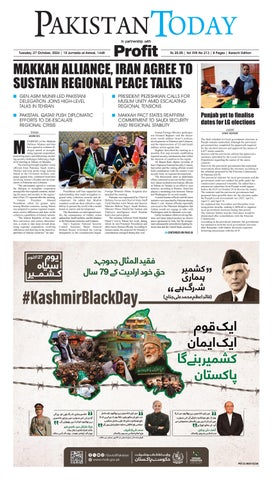
MAKKAH ALLIANCE, IRAN AGREE TO SUSTAIN REGIONAL PEACE TALKS Tuesday, 27 October, 2026 | 15 Jumada al-Awwal, 1448
g
g
GEN ASIM MUNIR-LED PAKISTANI DELEGATION JOINS HIGH-LEVEL TALKS IN TEHRAN
PAKISTAN, QATAR PUSH DIPLOMATIC EFFORTS TO DE-ESCALATE REGIONAL CRISIS
M
TEHRAN
Profit
g
g
PRESIDENT PEZESHKIAN CALLS FOR MUSLIM UNITY AMID ESCALATING REGIONAL TENSIONS MAKKAH PACT STATES REAFFIRM COMMITMENT TO SAUDI SECURITY AND REGIONAL STABILITY
AGENCIES
EMBERS of the Makkah Defence Alliance and Iran have agreed to continue dialogue aimed at strengthening regional cooperation, promoting peace and addressing escalating security challenges following a highlevel meeting in Tehran on Monday. The meeting brought together senior officials from Pakistan, Saudi Arabia, Türkiye and Iran amid rising tensions linked to the US-Israeli military campaign against Iran, continued hostilities involving Yemen’s Houthis and developments in Palestine and Lebanon. “The participants agreed to continue the dialogue to strengthen cooperation amongst the four regional countries, including for peace and security in the region,” Iran’s Press TV reported after the meeting. Iranian President Masoud Pezeshkian called for greater unity among Muslim countries, saying Tehran was prepared to pursue regional cooperation, resolve differences and draw on the collective capabilities of Islamic nations. “The Islamic Republic of Iran, with firm conviction and serious determination, is ready to take steps toward deepening regional cooperation, resolving differences and drawing on the shared capabilities of Islamic countries,” he said.
Pezeshkian said Iran supported any understanding that could strengthen regional unity, cohesion, security and development. He added that Muslim countries could use their collective capabilities to present the world with a model based on justice and development. The discussions covered regional security, the consequences of military action against Iran, Israel's policies, and the situation in the Palestinian territories and Lebanon. Iran’s Supreme National Security Council Secretary Major General Mohsen Rezaei welcomed the visiting delegations as the consultations began.
Rs 20.00 | Vol XVII No 213 | 8 Pages | Karachi Edition
Foreign Minister Abbas Araghchi also attended the meeting. Pakistan was represented by Chief of Defence Forces and Chief of Army Staff Field Marshal Asim Munir and Interior Minister Mohsin Naqvi. Saudi Defence Minister Prince Khalid bin Salman and Türkiye's intelligence chief Ibrahim Kalin also participated. The meeting followed Field Marshal Munir’s visit to Tehran last week, during which he met President Pezeshkian and other senior Iranian officials. According to Iranian media, the proposal for Monday’s consultations emerged during that visit.
Iranian Foreign Ministry spokesperson Esmaeil Baghaei said the discussions would address Israel’s policies, developments in Palestine and Lebanon, and the repercussions of US and Israeli military action against Iran. Baghaei described the meeting as a possible first step towards establishing regional security mechanisms that reflect the interests of countries in the region. Ali Baqeri-Kani, deputy secretary of Iran’s Supreme National Security Council, had earlier said the visiting officials would hold consultations with the country’s top security body on regional developments. The discussions came as diplomatic efforts continued to prevent further escalation. Qatari mediators met Iranian officials in Tehran on Sunday in an effort to ease tensions, according to Reuters. Qatar has played a mediating role between Tehran and Washington for several months. A senior Iranian official said the latest initiative was launched by Pakistan during Munir’s visit. Iranian officials reportedly conveyed to the Pakistani delegation that Tehran would not engage in talks with Washington until its demands were met. Earlier mediation efforts involving Pakistan and Qatar helped produce an interim peace agreement in June, but the arrangement subsequently unravelled as fighting between Iran and the United States resumed.
CONTINUED ON PAGE 03
Punjab yet to finalise dates for LG elections LAHORE
STAFF REPORT
The final schedule for local government elections in Punjab remains undecided, although the provincial government has completed the paperwork required for the electoral process and approved the names of 6,637 union councils. Sources said the provincial cabinet has approved a summary submitted by the Local Government Department regarding the names of the union councils. However, the provincial government has expressed reservations about holding the elections according to the schedule proposed by the Election Commission of Pakistan (ECP). The provincial minister for local government said the government could not conduct the polls under the commission's proposed timetable. He added that a ministerial committee from Punjab would appear before the ECP on October 28 to discuss the matter. The minister said the provincial government had proposed three possible dates for the elections under the Punjab Local Government Act 2025: April 4, April 11 and April 18. He explained that November and December were smog-prone months, making it difficult to organise local government elections during that period. The minister further said the final dates would be determined after consultations with the Election Commission. According to the provincial minister, the government has planned to hold the local government elections after Ramadan, with further decisions expected following discussions with the ECP.
02
Tuesday, 27 October, 2026 | KARACHI
NEWS 03
Tuesday, 27 October, 2026 | KARACHI
PAKISTAN FACES WIDENING FRUIT, VEGETABLE SUPPLY GAPS AS OVER 60% CANNOT AFFORD HEALTHY DIET, UN AGENCY SAYS
P
PROFIT
Monitoring report
g
AKISTAN faces widening shortages of vegetables, fruits, roots and tubers, and pulses, while cereals and sugar remain in excess of dietary requirements, according to a new policy brief by the Food and Agriculture Organisation (FAO), a specialized agency of the United Nations that leads international efforts to defeat hunger, improve nutrition, and promote sustainable agriculture. The brief, titled Food Supply for Healthy Diets in Pakistan, warns that more than 60% of the population cannot afford a healthy diet, contributing to persistent undernutrition and rising diet-related noncommunicable diseases.
FOOD AND AGRICULTURE ORGANISATION REPORTS VEGETABLE SUPPLY SHORTFALL OF UP TO 21.6 MILLION TONNES AND FRUIT GAP OF UP TO 14.3 MILLION TONNES IN 2023, WHILE CEREALS AND SUGAR EXCEED DIETARY REQUIREMENTS
The assessment compares Pakistan's annual food supply with population-level dietary requirements across 10 food groups between 2010 and 2023, using the country's foodbased dietary guidelines adopted in 2018. According to the findings, the estimated vegetable supply shortfall widened from a range of 10.9 million to 17.8 million tonnes in 2010 to 13 million to 21.6 million tonnes in 2023. The fruit supply gap similarly increased from 1.9 million to 10.3 million tonnes in 2010 to 3.9 million to 14.3 million tonnes in 2023. The report also identifies persistent
shortages of roots and tubers, legumes and pulses, while cereals and sugar continue to exceed recommended dietary requirements. However, the supply of milk, milk products, meat and eggs has improved, while fats and oils moved from a small shortfall in 2010 into the estimated required range in subsequent years. Population growth is adding to the pressure on Pakistan's food system. The country's population increased from 189.3 million in 2010 to 235.2 million in 2023 and is projected to reach approximately 330 million by 2050. FAO warns that climate change and
Book Review: New Poetry
Syed AfSAr SAjid 1. 2.
'Rauzan-e-Shab' --- an anthology of ghazal by Ahmad Saqi
'Taar-e-Rag-e-Jaan' --- a verse collection by Prof. Dr. Sheikh M. Iqbal
Tamgha-e-Imtiaz
Ahmad Saqi and Dr. Sh. Muhammad Iqbal, both acclaimed poets of contemporaneity, have recently published their respective verse anthologies titled ‘Rauzan-e-Shab’ and ‘Taar-e-Rag-eJaaN’ from Okara and Sargodha. The former’s collection of ghazal is third in a succession after ‘Khanakti Khak’ and ‘Darwaza’ whereas the latter’s book is twenty-sixth in a succession of miscellaneous publications related to poetry, prose, criticism, and autobiography. 'Rauzan-e-Shab'
The book contains 78 numbers of ghazal besides a ‘Hamd’ and a ‘Na’at’. Famed
poet and critic Ghulam Hussain Sajid has written its flap which though concise, is a scholarly critique of Saqi’s poetics with reference to his published work. To him Saqi is an optimist abounding in self-reliance and that his (Saqi’s) verse is not tainted with any flaw concerning diction or artistry. The other quality of his ghazal is stated to be its thematic manifoldness emanating from the poet’s hold on the Arabic tradition of poetry as much as its Ajami Persianate counterpart. Seemingly modernistic, Saqi’s poetry has a perceptive affinity with the classical tradition envisaging clarity of expression rather than ambiguity that tends to lend his voice a distinct individuality laced with creative zest, erudition, and a true philosophical insight which saves his poetry from being one-dimensional. The aforementioned duality explains the central paradox of ‘Rauzan-e-Shab’ --- a kind of coalescence of classicism and modernism. Saqi does not believe in obscurity as a sign of depth. His lines are instantly communicative, yet they linger because of the vitality of their thought. Here the reader will not find artificial complexity or borrowed melancholy. Instead, one finds a freshness of metaphor -- Rauzan (window) and Shab (night) itself is a metaphor for hope in darkness. The ghazal moves beyond love and beloved to questions of self, time, existence and faith --- the ‘Hamd’ and the ‘Na’at’ in the beginning set this spiritual tone.
Saqi’s ghazal is neither mere wordplay nor an unintelligible modernism. It balances both ---- it is modern because it is honest, and classical because it is clear. Thus ‘Rauzan-e-Shab’ is a collection that deserves to be read not just for its poetic pleasure, but for its quiet, selfreliant optimism also.
Taar-e-Rag-e-Jaan
It is not only Dr. Iqbal’s latest verse collection but it is the summation of a lifelong academic-cumintellectual journey. He is a retired professor of English and a seasoned poet of Urdu and Punjabi. Although he is sightless, his verse reflects his sensuous richness, with other senses being hyper-alive. Colour is heard, fragrance is touched, and silence has texture. His imagery is not visual reportage but inner perception ---- Baseerat rather than Basarat. The Rag-e-JaaN --- the vein of
other challenges could further strain agricultural production and food availability. The organisation recommends realigning agricultural production and trade policies with nutritional requirements, particularly through increased investment in vegetables, fruits, pulses, roots and tubers, alongside support for milk production in selected regions. It also calls for improved food distribution, reduced post-harvest losses and food waste, and incentives for food processors to improve quality standards and reduce salt, sugar and unhealthy fats. The brief recommends updating Pak-
life --- becomes his eye. In fact he stands as a rare synthesis of scholar, seer and survivor. Bahut haseen hain naghmon sey nalahaa-e-firaq/ Woh saaz pay, yeh rag-e-jaan pay gaaey jaatay hain. As a professor of English, his engagement with Western existentialism, romanticism and modernism filters into his Urdu and Punjabi verse without ever making it seem academic. He thinks like an English modernist and feels like an Urdu romanticist. In Urdu he retains classical grace with compression and a mystic inwardness. Taar-e-Rag-e-Jaan confronts a world that the poet defines accurately in terms of grief, delusion, and anarchy. Yet his response is not lamentation but resolve. He has transformed gham into shaoor in his verse. In a time of false narratives and moral delusion, he holds fast to the authenticity of the self. He refuses to ‘see’ the false world, he ‘sees’ the true one within. Thus voidness of vision becomes a metaphor in his verse. When the external world collapses into anarchy, he does not retreat, but constructs an inner cosmos where ‘brightness is all’. Thus poetry becomes the poet’s act of defiance, his existential assertion that to create beauty in a broken world is itself the highest revolt. Eminent litterateurs Hussain Majrooh, Shahid Bukhari, and Dr. Najeeba Arif have written commendatory flaps for the book, highlighting its formalistic and intrinsic values. Naseem Sehar, Dr. Anwaar Ahmad Bagvi, Dr. Hasan Yasir Malik, Prof. Muhammad Akram, and Prof. Dr. Fazeelat Bano have added complimentary forewords ---- all concurring on the uniqueness as also exquisiteness, of Dr. Iqbal’s life and art.
The writer is a Faisalabad based former bureaucrat, poet, literary and cultural analyst, and an academic. He can be reached at: afsar.sajid@hotmail.com.
Makkah Alliance, Iran agree to sustain regional peace talks CONTINUED FROM PAGE 01
Saudi Deputy Minister for Public Diplomacy Rayed Krimly said the meeting formed part of continuing efforts by the Makkah Pact countries to de-escalate the crisis, promote diplomatic solutions and support mediation initiatives led by Pakistan and Qatar. In a post on X, Krimly said the visit highlighted the role of the pact’s member states in promoting regional security and stability and their willingness to work with other countries in the region towards that objective. The consultations represent an important diplomatic contact between Iran and all three members of the Makkah Defence Alliance since Saudi Arabia became more directly affected by the widening conflict. Under the Makkah Joint Defence Agreement signed in August, an armed attack against one member is treated as an attack against all. Article One of the agreement requires the parties to employ all necessary means to eliminate threats to one another’s territorial integrity, sovereignty and internationally recognised borders. Ministers from the pact’s member states held an emergency meeting in Riyadh earlier this month, agreeing to ensure the rapid deployment of military forces and capabilities in Saudi Arabia amid mounting security concerns. Pakistan approved the agreement last week, while Türkiye's parliamentary ratification process remained underway, according to the report. The diplomatic initiative comes against a backdrop of intensifying regional hostilities. Saudi Arabia intercepted another wave of missiles and drones on Sunday as fighting involving Yemen’s Houthis continued. The Houthi attacks have added pressure on Saudi Arabia, a US ally, amid the broader confrontation involving Iran, the United States and Israel. Recent developments have heightened concerns about the potential expansion of the conflict across the Gulf. Tensions between Washington and Tehran have also sharpened. US President Donald Trump said on Friday that Washington could undertake another military operation against Iran, while Iranian leaders warned that any renewed US campaign would be met with a stronger response. Reuters has reported that Iranian security officials drew up plans to target undersea cables in the Gulf if the United States and Israel launched further attacks. A US intelligence memo, meanwhile, warned that alleged Iranian plots against American personnel had reached advanced stages. The conflict, now approaching its eighth month, has placed additional pressure on regional diplomacy and increased the urgency of efforts to contain hostilities. Monday’s meeting did not announce a comprehensive settlement, but the agreement to continue dialogue signalled a willingness to maintain communication amid sharply diverging security concerns.
istan's dietary guidelines to incorporate nutrition, health and environmental priorities, supported by nutrition education and efforts to change dietary behaviour. Other proposals include evidence-based taxes on beverages and foods high in sugar, salt and unhealthy fats, along with front-ofpackage nutrition labelling to help consumers make informed food choices. FAO stresses that promoting healthier eating habits will require coordinated fiscal, regulatory and agricultural measures to ensure nutritious foods are available, accessible and affordable.
Lahore Ring Road Authority raises traffic fines to Rs10,000 for multiple violations PROFIT
Web deSk
The Lahore Ring Road Authority (LRRA) has increased fines for traffic violations, with penalties reaching Rs10,000 for several offences and the fine for driving without a licence rising tenfold from Rs500 to Rs5,000. The revised schedule covers speeding, improper overtaking, illegal parking, overloading, wrong-lane driving, tinted windows, unauthorised motorcycles and pedestrian crossings. Improper overtaking will now carry a fine of Rs5,000 for cars and Rs10,000 for vehicles with engine capacities exceeding 2,000cc. Speeding will attract the same penalties, with Rs5,000 imposed on vehicles up to 2,000cc and Rs10,000 on larger vehicles. Driving in the wrong lane will incur a Rs2,000 fine, while travelling against traffic on a one-way section will cost Rs5,000. The penalty for overloading has increased from Rs2,000 to Rs7,000, while illegal parking fines have doubled from Rs1,000 to Rs2,000. Smoke-emitting cars will face fines of Rs4,000, compared with Rs5,000 for commercial vehicles. Underage driving will carry a Rs10,000 penalty. Motorists using black-tinted window films or non-standard number plates will be fined Rs5,000. Motorcycles entering the Ring Road will also face a Rs5,000 penalty. The fine for pedestrians crossing the Ring Road has increased from Rs200 to Rs1,000, while owners bringing cattle onto the road will be fined Rs5,000. Penalties for using mobile phones while driving or failing to wear seatbelts have increased from Rs500 to Rs3,000.
04 COMMENT
The economics of Pakistan’s battery rush
Pakistan’s overdue rate rise
P
A
AKISTAN’S 50-basis-point policy rate increase to 12% was overdue; faced with a global energy shock, the State Bank has ample reason to prioritise inflation control, even as businesses seek cheaper credit. With major central banks also tightening, Pakistan must consider how international interest rate differentials affect capital flows, currency stability and the cost of external financing. The adjustment is still very conservative, and its adequacy will depend on whether it changes expectations and keeps monetary conditions sufficiently restrictive. There is a legitimate argument against using interest rates to address supply disruptions, since dearer borrowing cannot produce oil or improve transport routes; nevertheless, monetary policy must respond when an external price increase risks becoming embedded in domestic pricing. If firms expect costs to keep rising, and households expect their purchasing power to deteriorate further, the initial shock can feed a broader inflation process, making eventual stabilisation more costly. A half-percentage-point increase is a modest response to that risk, particularly when uncertainty concerns the persistence of the shock rather than a single month’s price reading. The relevant test is whether the policy rate remains sufficiently above expected inflation to restrain demand and reward saving; a positive gap against past inflation provides little reassurance if the outlook has worsened. Waiting for the full impact to appear in published data risks allowing expectations to adjust first. The costs to industry deserve serious consideration, especially where higher financing charges squeeze working capital and delay investment; however, an inadequately contained inflation shock can also undermine production through exchange rate pressure, unpredictable input costs and weakened household demand. For financial markets, a credible response can reduce uncertainty over future policy, whereas hesitant tightening may force a sharper correction later, with greater damage to borrowers and the recovery. Fiscal policy must support this adjustment, because an interest rate increase becomes less effective when public spending offsets its intended restraint. Any relief from higher living costs should be directed towards vulnerable households within a credible budget, while supply measures should address the domestic bottlenecks that monetary policy cannot repair. Asking interest rates to carry the entire stabilisation burden would impose unnecessary costs on private investment. The State Bank should therefore explain the conditions that would trigger further action, rather than allow this small increase to be read as the end of the response. Given the global risks, 50 basis points is a cautious step; its value lies in demonstrating a willingness to act again if the inflation outlook requires it.
ShafqaT aBBaS
battery stores electricity. In Pakistan, it increasingly stores something else: protection against an uncertain power system. Households and businesses are turning to batteries to cope with high tariffs and unreliable supply. Individually, these are private responses. Collectively, they are reshaping the economics of Pakistan’s power sector through their effects on electricity demand, grid finances, industrial competitiveness, and the distribution of energy costs. According to a Renewables First study published in July 2026, Pakistan imported an estimated 4.6 gigawatt-hours of lithium-ion battery storage in 2025, around 220 per cent more than in the preceding year. Cumulative imports between 2018 and 2025 reached approximately 7.6GWh, with about 60pc arriving in 2025 alone. Pakistan’s solar rush is becoming a battery rush. Falling technology costs, rooftop solar, expensive grid electricity, and unreliable supply are driving this change. But its pace also signals declining confidence in the future cost and dependability of grid electricity. Repeated tariff increases and unreliable supply may lead consumers to expect more of the same. Economists call this, adaptive expectations. For many households and businesses, batteries are a way to prepare for that possibility and a warning to the power sector that confidence in the grid is weakening. A household considering a battery looks beyond its latest bill to future tariffs, solar compensation, and interruptions. Businesses must also account for lost production, idle labour, and higher operating costs. Battery becomes more than an energy device; it becomes insurance against financial, operational, and policy uncertainty. These expectations are being reinforced by changing financial incentives. The shift from net me-
Arif Nizami (Late) Founding Editor
What does a University’s rank really tell us? M. A. Niazi
Babar Nizami Editor Profit
T
Dr. MuhaMMaD Bilal Tahir
IMES Higher Education (THE) and QS rankings can tell very different stories about the same university. For Pakistan, the bigger question is whether these rankings reflect what matters most: research that translates into innovation, funding and national impact. Why does the same university sometimes look remarkably different in the Times Higher Education and QS world rankings? The question sounds simple, but the answer reveals something much bigger about the way universities—and increasingly entire higher education systems—measure research. The temptation, whenever a new ranking is released, is to look at the number first. Did the university rise? Did it fall? Who moved ahead? Who slipped behind? Perhaps the more useful question is: what exactly is the ranking measuring? This distinction matters because THE and QS may be working with broadly similar bibliometric data, yet they can tell very different stories about the same institution. At the heart of the difference is a deceptively simple choice: what do you divide research performance by? QS’s Citations per Faculty indicator essentially asks how much cited research is produced in relation to the size of the academic faculty. THE’s research-quality framework, by contrast, places much greater emphasis on how well a university’s publications perform against comparable research worldwide. In other words, one approach places considerable weight on research impact per academic, while the other asks more directly about the citation performance of the research itself. That difference can matter enormously. Imagine a specialized science and technology institute with 400 academics producing 4,000 papers over five years. Now compare it with a comprehensive university employing 4,000 academics and producing 20,000 papers. The smaller institution produces far more papers per academic. The larger institution, however, may produce papers that are cited substantially more often. Depending on which question we ask, the same two universities can therefore appear very different. Neither conclusion is necessarily wrong. They are simply answers to different questions. The denominator
matters. This is where university leaders should pay particular attention. In a per-faculty system, the definition of faculty becomes important. Should research-only staff, postdocs, clinicians or teaching-focused academics count as faculty? When rankings depend on the denominator, these definitions can change scores without changing research output. Once metrics become targets, institutions adapt to them. Citation patterns also vary sharply across disciplines, while older papers have more time to accumulate citations. Rankings must therefore be interpreted in context. The attempts to account for disciplinary and publication differences through field- and yearnormalized measures, while QS uses a different methodology, including its Citations per Faculty measure and subject-level approaches. Yet neither should be mistaken for a complete definition of research quality. A citation shows that research has been referenced; it does not necessarily show that the research was correct, transformative, commercially valuable or socially useful. The problem is that we often count what is easiest to count. Pakistan’s universities have spent years under pressure to publish. Publication matters: serious research requires peer review, scholarly communication and international visibility. But publication cannot be the destination. A university may produce hundreds of papers without developing a commercially successful technology, accumulate citations without influencing public policy, or improve its ranking without addressing a major problem faced by the society that funds it. So the more important question is not simply: How many papers did our universities publish? It is: What did those papers change? Did research improve agricultural productivity, reduce industrial costs, develop new materials, medicines or manufacturing processes, improve water or energy security, influence public policy, or generate intellectual property, startups, technology licenses and industry partnerships? These are harder questions to measure. But they are also the questions that matter. For Pakistan, the debate over rankings should therefore become a broader debate about what we expect research to achieve—and how the
Lahore – Ph: 042-36300938, 042-36375965
tering towards net billing did not create the battery boom, but it may accelerate it. When grid electricity costs more than the credit received for surplus solar generation, consumers have a stronger reason to store daytime electricity for later use. Net billing changes the reward for exports; batteries make greater selfconsumption possible. Viewed through game theory, this relationship resembles a coordination problem. Consumers decide whether to rely on the grid or invest in private reliability, while power-sector institutions decide whether to restore confidence through better service or recover falling revenue through higher charges. Each side’s response changes the incentives facing the other. A self-reinforcing cycle can follow. Solar and batteries reduce grid purchases, but capacity payments and network costs do not decline at the same pace. Falling sales increase pressure on tariffs and fixed charges. These increases confirm consumers’ expectations and encourage further investment in private energy systems. What is individually rational may therefore become collectively damaging. Customers may remain connected but use the grid mainly as backup, leaving its costs to be recovered from a shrinking revenue base. The burden will not be shared equally. Affluent households and large businesses can afford solarplus-storage systems; poorer households, tenants, and small businesses often cannot. Pakistan risks developing a dependable private system for those able to pay and a financially stressed public grid for those unable to leave. The wider economic effect is mixed. Batteries can reduce interruptions and industrial downtime, extend the use of solar power beyond sunset, and displace imported fuels. Yet, battery imports require foreign exchange, while businesses financing their own electricity security have less capital available for machinery, employment, and expansion. The value of this investment should therefore be assessed against the fuel imports it displaces, the pro-
duction losses it prevents and its effect on grid finances — not simply against the battery import bill. Pakistan should not try to reverse this transition, but it can determine whether batteries weaken the public grid or become part of a more flexible electricity system. Policy must begin with measurement. Consumerowned batteries should be incorporated into demand forecasts and power-system planning. Credible estimates of installed storage, charging patterns and behind-the-meter consumption are essential because historical grid demand no longer reveals consumers’ full electricity requirements. Better information must be matched by better incentives. Time-of-use tariffs may accelerate rather than slow battery adoption. Their value lies in guiding how batteries are used: lower daytime prices can encourage charging when electricity is abundant, while higher evening prices encourage discharge during costly peaks. Private storage could therefore become a tool for managing peak demand rather than simply a means of grid withdrawal. This could turn the coordination problem into a win-win opportunity. With suitable meters, market rules, and payments, consumer-owned batteries could support grid stability, and provide ancillary services. Consumers would earn a return on their investment, while the power sector would gain a more flexible grid. Tariff periods should reflect system conditions and be reviewed seasonally. Over time, distributed batteries could also support the grid, although this would require smart meters, technical standards, aggregators, and clear market rules. Restricting batteries would not address the underlying problem. Consumers are responding to real costs and risks. Policy should instead turn privately owned batteries from grid withdrawal instruments into resources that improve system reliability and efficiency. Pakistan’s battery rush does not mean consumers no longer need a national electricity system. It means they are no longer willing to depend on it unconditionally. Consumers have made their move by investing in private reliability. The state’s next move should be to restore confidence in the grid. That requires changing not only tariffs and regulations, but also consumers’ expectations about whether the national electricity system will remain affordable, dependable, and worth using. The writer is an economist and can be reached at shafqat2567@gmail.com.
Pakistan’s solar rush is becoming a battery rush. Falling technology costs, rooftop solar, expensive grid electricity, and unreliable supply are driving this change. But its pace also signals declining confidence in the future cost and dependability of grid electricity.
Dedicated to the legacy of late Hameed Nizami
Editor Pakistan Today
Tuesday, 27 October, 2026
I
Karachi – Ph: 021-32640318 I
Higher Education Commission can encourage universities to demonstrate that impact. HEC’s policy direction already recognizes research quality, innovation, university-industry linkages and commercialization. The next step is to connect these efforts through a funding architecture that rewards not simply research output, but demonstrable value and impact. This does not mean abandoning basic research; fundamental research remains the foundation of many future technologies. But universities should demonstrate how their research contributes to knowledge, human capital, industry, public policy and society. A technology adopted by industry, research that shapes policy, a successful patent or globally influential fundamental research can all represent meaningful impact. There is nothing wrong with universities caring about QS or THE. Rankings can provide useful benchmarks for research visibility, collaboration and citation performance. But they are indicators, not institutional missions. If funding is tied mechanically to rankings, universities will inevitably organize themselves around ranking methodologies. The smarter approach is to use rankings as one dashboard among many—not the dashboard. For Pakistan, the real challenge is to build a national research ecosystem where HEC, universities, research councils, industry, government and the private sector focus on one question: What public value is being created from our investment in knowledge? This value may be a highly cited paper, patent, startup, new technology, policy reform, better crop variety, affordable medical solution, energy innovation or a researcher who creates future impact. The lesson from THE and QS is that measurement shapes behavior. If we measure only publications or citations, we will optimize for them. But if we measure research quality alongside innovation, relevance, technology transfer, industry engagement and social and economic impact, universities will pursue broader outcomes. Ultimately, research should matter beyond the university, not merely improve its position in a global ranking. Beyond THE and QS, Pakistan needs a research system that measures not only citations and publications, but what universities actually change. It will be the answer to a much harder question: What changed because this university existed?
The writer is Director, Institute of Physics, Khwaja Fareed University of Engineering and Information Technology, Rahim Yar Khan, Pakistan
Islamabad – Ph: 051-2204545
I
Editor’s mail
Send your letters to: Letters to Editor, Pakistan Today, 4-Shaarey Fatima Jinnah, Lahore, Pakistan. E-mail: letters@pakistantoday.com.pk Letters should be addressed to Pakistan Today exclusively
Petrol pirates persist
THE Prime Minister’s Office (PMO) recently conveyed to the media that there has been 82 per cent jump in oil-related taxes in the July-November period as a result of a crackdown on smuggling. The news is heartening. Smuggled petrol and diesel result in huge losses to the exchequer. However, unfortunately, the sale of smuggled petrol and diesel continues in the capital city. This commodity reaches the capital after crossing more than a thousand miles and passing through several Pakistan Customs checkposts. There are two kiosks doing this shady business in the sector where I live. The residents have complained in writing to the local police, but to no avail. I would tend to take such media reports with a pinch of salt. Perhaps the prime minister is either unaware or not being kept informed of the ground realities. FORMER AMBASSADOR JAVED HAFEEZ ISLAMABAD
Sick without support
THE medical facility for employees and pensioners of the Karachi Water and Sewerage Corporation (KWSC) is in a severely pathetic state. My mother, a pensioner, needs regular medication that costs Rs3,000 twice a week. The situation has worsened drastically following the KWSC’s abrupt suspension of medical facilities. This means a life-saving treatment has now become a luxury not many can afford. Ironically, while payments to panel medical institutions remain frozen, various reports allegedly suggest that substantial advanced payments are being diverted to insurance companies under some new, but largely ineffective medical insurance scheme. This transition would only add to the grievances of those who solely rely on direct medical support. Furthermore, the annual medical budget is frequently curtailed. There are persistent allegations that funds allocated for employees’ and pensioners’ medical care are being diverted to unrelated projects. This is pathetic, showing a careless attitude of a bureaucratic leadership towards what is an already fragile low-income class. SALEEM GHANI KARACHI
Security demands unity
WITH 2026 already having entered our lives, it is clear that the new year demands serious and renewed resolve to control the escalating incidents of terrorism, particularly in Khyber Pakhtunkhwa (KP) and Balochistan. There is a palpable concern that the focus of the top-tier political leadership on confrontational politics among various parties is inadvertently allowing space for terrorist groups to operate with in-creasing confidence and boldness. As such, recent events tragically underscore a perception of a vanishing state writ in certain regions. The security situation across the country appears to be deteriorating, with major urban and supposedly secure centres, including Islamabad and Peshawar, also experiencing various shades of terrorism. This emboldened pattern of aggression necessitates a comprehensive and immediate shift in strategy. To effectively counter this grave national security challenge, it is imperative that all institutions and political stakeholders set aside their differences and forge a united front. The current trajectory, characterised by a loss of precious human lives and a growing sense of impunity among militant groups, is unsustainable and warrants immediate attention. Sustained stability and security require an immediate pivot from a reactive approach to a robust, co-ordinated and proactive response. National consensus and unified insti-tutional action are the only means to reassert the state’s authority, dismantle all terrorist networks, and ensure the safety, security and sovereignty of the affected regions and the nation at large. ANWAR SAYAB KHAN BANNU
Web: www.pakistantoday.com.pk
I
Email: editorial@pakistantoday.com.pk
COMMENT 05
Seventy-nine years, one promise unkept
Tuesday, 27 October, 2026
Today is the 79th anniversary of the Indian occupation of Kashmir
O
Dr ZaFar Khan saFDar
N 27 October 1947, Indian military aircraft landed at Srinagar airport. Troops disembarked. A conflict began that has not ended in 79 years, that has consumed over 96,514 lives in Indian Illegally Occupied Jammu and Kashmir between January 1989 and September 2026 alone, that has produced the most militarised zone on earth with more than 900,000 Indian troops deployed across a territory whose people have never been asked, in any free and fair process, whether they wish to remain part of India. Today, 27 October 2026, Kashmiris on both sides of the Line of Control and in every city on every continent where their diaspora has scattered, observe Black Day. They wear black armbands. They hoist black flags. They gather in protest. They do what people do when the institutions designed to protect them have failed them for eight decades; they keep showing up, because showing up is the only instrument left. The legal case for Kashmir’s self-determination is not ambiguous and has never been ambiguous. UN Security Council Resolution 47, adopted on April 21, 1948, called for a free and impartial plebiscite to determine the future of Jammu and Kashmir. It was not a suggestion. It was a binding resolution of the world’s highest collective security body, passed unanimously, establishing a clear international obligation on both India and Pakistan to create the conditions under which the Kashmiri people could exercise their right to choose. Pakistan accepted the UN resolutions calling for a plebiscite in Kashmir, but India has never honoured the commitment to let Kashmiris determine their own future. This double standard became increasingly evident after the 1972 Simla Agreement, which India has invoked to portray Kashmir as a purely bilateral dispute and exclude UN involvement. Having accepted the international framework when it suited its interests, India subsequently sought to sideline it when im-
plementation threatened its position. This selective approach amounts to a double-cross, using bilateral negotiations to defer indefinitely an international commitment that remains unfulfilled. The events of August 5, 2019, removed whatever ambiguity remained about India’s long-term intentions. The revocation of Article 370, which had provided Jammu and Kashmir its special constitutional status since accession, and the reorganisation of the former state into two Union Territories administered directly from New Delhi, was accompanied by the largest single deployment of additional troops in the territory’s history, a complete communications blackout lasting months, the preventive detention of thousands of political figures including mainstream leaders who had previously cooperated with Indian governance, and internet shutdowns that the UN Human Rights Office described as a violation of international human rights standards. The demographic dimension of the post-2019 changes are the most consequential for the territory’s long-term future. New domicile laws allow non-Kashmiris to obtain residency certificates and purchase land in what was previously protected territory, a change whose explicit purpose is the gradual alteration of a Muslim-majority demographic reality that has been the foundation of the Kashmiri selfdetermination claim since 1948. The human rights documentation of what this occupation has meant for ordinary Kashmiris is extensive, credible, and largely unread by the international community. UN Human Rights reports published in 2018 and 2019 raised serious concerns about excessive use of force, arbitrary detention, impunity for security forces, restrictions on freedoms of assembly and expression, and the inadequacy of accountability mechanisms. Pellet gun use against protesters has blinded hundreds of young Kashmiris. The Armed Forces Special Powers Act provides Indian military and paramilitary forces effective immunity from prosecution for actions taken in
the territory, creating a legal framework in which accountability is structurally impossible. More than 8,000 cases of enforced disappearances have been documented by Kashmiri human rights organisations. Parveena Ahangar founded the Association of Parents of Disappeared Persons after her son was taken by Indian security forces in 1990. For thirty-six years, she has searched for answers about his fate, but she still does not know what happened to him. India describes itself as the world’s largest democracy and is increasingly accepted by the international community in those terms, particularly as its strategic importance as a counterweight to China makes Western governments reluctant to press it on human rights commitments that might complicate the broader relationship. This is not a new phenomenon in international relations. Major powers have always calibrated their human rights advocacy against their strategic interests, and smaller populations with
Today, 27 October 2026, Kashmiris on both sides of the Line of Control and in every city on every continent where their diaspora has scattered, observe Black Day. They wear black armbands. They hoist black flags. They gather in protest. They do what people do when the institutions designed to protect them have failed them for eight decades; they keep showing up, because showing up is the only instrument left.
Lula beats Bolsonaro to win Brazil presidential election
B
AXIOS
RAZIL President Luiz Inácio Lula da Silva was elected to a fourth, nonconsecutive term in the nation’s presidential election, according to early results released Sunday evening. Why it matters: Lula’s victory deals a setback to Brazil’s right-wing populist movement and preserves a major counterweight to President Trump’s influence in Latin America, with tensions over trade and tariffs threatening to persist. Lula, the incumbent candidate, was facing Flávio Bolsonaro, the son of former Brazilian President Jair Bolsonaro. Flávio was widely seen as the heir to the nation’s right-wing populist movement. The latest: Lula thanked the Brazilian people after his election win, but Bolsonaro told reporters he would not accept the results and said they should be annulled, according to translations. The big picture: The election has been shaped by the impact of U.S. tariffs, climate change and the Amazon rainforest, 60% of which is in Brazil. Bolsonaro campaigned on public security and tackling corruption, presenting himself as a continuation of his
father’s political legacy, while Lula emphasized defending Brazilian sovereignty against U.S. pressure. Yet substantive policy debate was limited, with both candidates focusing instead on corruption allegations levied against the opposing camp, wrote Matthew Taylor, a Brazil politics expert at American University. Zoom in: After the U.S. imposed additional 25% tariffs on some Brazilian goods this summer, Lula accused Bolsonaro of being “Trump’s candidate” and the U.S. president of wanting to “colonize” Brazil. Lula has enacted climate policies aimed at reversing environmental deregulation under the previous administration, while Bolsonaro denied climate change and pledged to continue his father’s political legacy. Amazon deforestation has fallen 71% since 2022, the year before Lula returned to office, reaching its lowest annual level on record in 2026. Yet Lula’s environmental record is complicated by his support for expanded oil development. Lula defeated Jair Bolsonaro in the previous election. The elder Bolsonaro is now serving a 27-year prison sentence for plotting a coup to overturn the 2022 election, though he remains under house arrest due to health problems.
tions, demographic engineering designed to alter the foundation of their self-determination claim, and the consistent failure of the international community to enforce the resolution it unanimously passed in 1948. October 27 is not merely a date on Pakistani calendar or a diplomatic talking point. It is the anniversary of a promise that has been kept by nobody except the Kashmiris themselves, who have kept faith with the demand for self-determination across eight decades of occupation, across generations who were born into the conflict and have grown old inside it, across every attempt to normalise what should never have become normal. The black flags flying today in Srinagar and Muzaffarabad and London and New York represent the most patient and most betrayed demand for justice in the contemporary world. The least the world owes them is honest acknowledgement that its silence has been a choice, that the resolution of 1948 remains unimplemented not because it is unclear but because implementing it is inconvenient, and that convenience has been purchased at the cost of every Kashmiri life and every Kashmiri future that the occupation has consumed since the troops landed on October 27, 1947.
The writer is Ph.D in Political Science from Griffith University Brisbane, and visiting faculty at QAU Islamabad. His area of specialization is political development and social change. He can be reached at zafarkhansafdar@yahoo.com and on X @zafarkhansafdar.
The biggest election in Israel’s history Most polls show Netanyahu’s Likud and his current coalition partners losing their majority
O
THE GUARDIAN
Emma graham-harrison
N Tuesday Israel holds its first election since the 7 October 2023 Hamas attacks, the deadliest day in the country’s history, which resulted in the deaths of about 1,200 people, the majority of them civilians. Since then Israel has pursued a war of annihilation in Gaza, launched two inconclusive wars with Iran, and intensified a campaign of state-backed ethnic cleansing in the occupied West Bank. Domestically the coalition formed by Benjamin Netanyahu has taken aim at democratic institutions, including the supreme court. Many Israelis have described this election as the most consequential in their country’s history.
rEbEcca FalconEr
weaker geopolitical leverage have always paid the price of that calibration. What makes Kashmir’s case particularly urgent is that the legal framework for its resolution already exists and has simply not been implemented because one party has concluded that its power position allows it to defer implementation indefinitely while the international community has concluded that pressing for implementation is not worth the diplomatic cost. Pakistan’s case on Kashmir is straightforward, legally grounded, and deserves to be stated without the defensive qualification that comes from decades of association with conflict and instability. The Kashmiri people were promised a plebiscite by the United Nations. They have never received it. They have instead received seventy-nine years of military occupation, hundred thousand documented deaths, thousands of enforced disappearances, a communications blackout, the destruction of their constitutional protec-
WHO ARE THE MAIN PLAYERS? The prime minister, Benjamin Netanyahu, has led Israel for 19 out of the last 30 years, most recently at the head of a far-right coalition. He is seeking a new mandate with the endorsement of the US president, Donald Trump, and the fight is personal as well as political. He is on trial for corruption; losing power may mean a greater risk of jail time. His main rival is Gadi Eisenkot, a former head of the Israeli military and relative political newcomer, the son of Moroccan immigrants who rose to the heart of Israel’s establishment from humble beginnings. His son and two nephews were killed fighting in Gaza in 2024. He lacks Netanyahu’s charisma, but has embraced that as part of a campaign positioning him as the opposite of Israel’s current leader, down to the name of his new party – Yashar, or “Honesty”.
WHAT ARE THE KEY ISSUES FOR VOTERS? Israel’s security is at the heart of the election, overshadowing even the soaring cost of living. Opponents of the current government point to the catastrophe of the 7 October attacks, the erosion of democratic institutions, rise of religious extremism and the cost of
Palestinian politicians have indicated they might support a minority government of the Jewish Israeli parties in order to unseat Netanyahu’s far-right coalition
open-ended, multi-front wars. They have promised a state commission of inquiry into 7 October, and most have pledged to end draft exemption for ultra-Orthodox men, a source of deep resentment among families whose loved ones are serving or have been killed. They are also concerned about international isolation, amid broadening sanctions over settlement expansion, and an accelerating brain drain among the elite. Netanyahu has tried to shift blame for 7 October on to Israel’s security establishment, and despite presiding over the deadliest day in Israel’s history, he claims to be the only leader with the experience and international contacts to keep the country safe. He recently posted an AI image of a nuclear bomb hitting Tel Aviv on social media, with the claim “anyone who cares about their physical existence” should pause before voting for the opposition. His far-right allies have called for the ethnic cleansing of Gaza and the occupied West Bank, and expansion of settlements. His ultra-Orthodox partners want to preserve a decades-old exemption from conscription and subsidies for religious study.
WHAT ARE THE POLLS SAYING? Most polls show Netanyahu’s Likud and his current coalition partners losing their majority. That fall in voter support has been fairly consistent for more than two years. They also show a clear anti-Netanyahu majority. However, those opposition seats are divided between the bloc of Jewish Israeli parties, led by Eisenkot’s Yashar, and parties representing Palestinian citizens of Israel. The Jewish Israeli parties are unlikely to have a majority on their own, but have mostly ruled out going into coalition with Palestinians. Palestinian politicians have indicated they might support a minority government of the Jewish Israeli parties in order to unseat Netanyahu’s far-right coalition.
HOW DOES THE SYSTEM WORK AND WHEN MIGHT WE GET RESULTS/A NEW GOVERNMENT? The Knesset has 120 seats, with lawmakers voted in through a system of proportional rep-
BATMAN IS TO BE NEW JAMES BOND
I
SATIRE
NEWS BISCUIT rogt
N a move that has set the world of superheroes reeling, Barbra Broccoli, long-time Bond producer and custodian of the James Bond brand, has announced that Batman is to be the new James Bond, taking over from Daniel Craig. The announcement was made after an in-
tense weekend of auditions at a secret location in southeast London which led to headlines like Broccoli to Brockley. The caped crusader beat off competition from the likes of Callum Turner, Jack Lowden and Josh O’Connor, leaving those who had wanted the first black Bond bitterly disappointed. On hearing he was successful Batman said: ‘I’ve been an admirer of James’ work for many years, particularly the strides he has made in tackling those who would threaten to blow up Earth itself.
resentation. No single party has ever claimed a majority of 61 seats, so Israel has always been governed by coalitions. When the results are in, the president invites the party with the largest number of seats to try to agree a governing coalition. Exit polls are released at 10pm Israeli time (8pm GMT), and the first indication of actual voting counts usually emerges in the early hours of the morning. Getting full results could take much longer, with the outcome potentially hanging on the electoral fortunes of two small parties, which need to win 3.25% of the overall vote to take up seats in the Knesset. Polling puts both around this threshold. If they cross it, they each get four seats, which would have a significant impact on coalition building options. The far-right Amcha Yisrael is led by the former general Ofer Winter, who has pledged to back Netanyahu for prime minister if he gets into the Knesset. The Reservists is a rightwing Zionist party focused on ensuring universal conscription whose leaders sit between the two blocs. They have ruled out joining any government supported by either the ultra-Orthodox – key Netanyahu allies – or Palestinian parties whose backing Eisenkot is likely to need. If it goes down to the wire, counting could take more than a day.
HOW DEMOCRATIC IS THE VOTE – AND WHO IS BEING DISENFRANCHISED? About 15 million people live in areas under Israeli control. Just over 7 million Jewish Israelis and 1.7 million Palestinian citizens of Israel live within the country’s pre-1967 borders, known as the “green line”, and have full voting rights. In the occupied West Bank, more than 500,000 Israeli settlers can vote. They live among 3.1 million Palestinians who are subject to military rule and do not have the right to vote. In occupied East Jerusalem more than 230,000 Israelis with voting rights live among 350,000 Palestinians who cannot vote. Two million Palestinians in Gaza, who live under Israeli military occupation, according to the international court of justice, also have no vote.
It is an honour to take up the mantle.’ Others are not so happy. Spiderman, Superman and the Hulk issued a joint statement saying: ‘We deplore one of our number going to the other side like this, chasing the Amazon dollar [Amazon now has creative control of the Bond franchise]. We are also very sorry to report that Batman’s faithful partner Robin has gone straight into therapy.’ Meanwhile, how Batman will use Bond’s most famous phrase remains a closely guarded secret. Perhaps simply: ‘The name’s ‘man. Batman.’
06 NEWS
IRAN SAYS US 'NOT SERIOUS' ABOUT TALKS, REJECTS CLAIMS OVER NUCLEAR PROGRAMME
I
Tuesday, 27 October, 2026 | KARACHI
and signed the 2015 nuclear agreement, but the US withdrew from it three years later. The spokesman accused the US administration of being influenced by Israeli claims about Iran’s nuclear programme, describing allegations that Tehran was developing a nuclear bomb as a justification for military aggression.
TEHRAN
Agencies
RAN accused the US on Monday of lacking seriousness in negotiations, saying Washington has repeatedly confused diplomacy with imposing demands on Tehran. “The American side is not serious about negotiations,” Foreign Ministry spokesman Esmaeil Baghaei said during his weekly news conference, as cited by the state-run IRNA news agency. He accused Washington of repeatedly making false claims, recalling that US President Donald Trump had expressed support for negotiations shortly before the US military attacks on Iran in June 2025. “What do you call this? Do you see any goodwill in this approach?” he asked. Baghaei said Tehran had not received any new European proposal for negotiations beyond a political statement, criticising Britain, France and Germany for their positions during the conflict. He accused the three countries of following Washington’s lead on the restoration of
UN sanctions and failing to condemn military attacks against Iran.
NO NUCLEAR WEAPONS Baghaei reiterated that Iran had never possessed nuclear weapons or sought to acquire them, accusing Washington of using allegations about Tehran’s nuclear programme to justify military action. He said Iran had negotiated in good faith
Ambani, Adani outlets among Indian publishers contesting Modi's privacy law
MISSING IRANIAN PILOTS Baghaei said Iran continued to hold Qatar responsible for clarifying the fate of three Iranian pilots whose aircraft were hit in the Gulf country. “Until we have evidence of their deaths or receive precise information and documentation, we assume that the country where their aircraft were hit must be held accountable,” he said. He added that Tehran was pursuing the matter in coordination with its military leadership and through technical delegations and legal discussions. Baghaei also confirmed that a Qatari delegation recently visited Tehran, saying the trip involved bilateral cooperation and regional mediation efforts. He described such visits as normal dur-
ing regional conflicts, noting that Qatar had sought to convey messages and present its positions. Commenting on Israel’s upcoming elections and threats of military action against Iran, Baqaei accused Israeli politicians of competing over who could commit more crimes. “It makes no difference to us who takes charge of a regime with a history of violence and killings,” he said.
RUSSIA VISIT The spokesman confirmed that President Masoud Pezeshkian would travel to Russia on Monday night to attend a summit of gasexporting countries. He said the visit would provide opportunities to strengthen energy cooperation with Moscow and hold consultations with other major energy-producing countries. Baghaei also addressed border-related difficulties with Pakistan and Iraq, saying discussions with Islamabad were progressing positively. He said Pakistan had described the issue as technical while also raising security concerns, including reports of planned attacks. Regarding Iraq, he said Iranian diplomatic
missions were pursuing the matter, warning that US pressure on Baghdad could harm the Iraqi population and bilateral relations. Baghaei said Iran summoned the Italian ambassador on Sunday to express concern over the authorities’ handling of protests in European countries. He accused France, Belgium and Italy of using excessive force and restricting the right to protest, saying such measures were inconsistent with their human rights obligations. The French ambassador had also been summoned previously, he added.
SAUDI ARABIA AND YEMEN On the conflict involving Saudi Arabia and Yemen, Baqaei said regional security was interconnected and instability in one country could affect others. He stressed that the dispute should be resolved between Saudi Arabia and Yemen, reiterating Tehran’s readiness to help facilitate a settlement. “Military approaches make problems more complicated and cause extensive damage,” he said, expressing hope that Saudi Arabia would pursue a negotiated solution.
Houthis say they attacked East-West oil pumping stations SANA'A
reuters
NEW DELHI Agencies
A group of 21 news publishers, including companies owned by billionaires Mukesh Ambani and Gautam Adani, has challenged India's privacy law in court, arguing it would trample investigative work and let New Delhi identify journalists' sources, documents show. Prime Minister Narendra Modi's government last year announced implementation of a privacy law to protect digital personal data of users, raising compliance requirements for platforms like Meta and Google. The publishers have said that since media outlets were not exempt, the law was an invasion of press freedom. Media companies received assurances in an August meeting with the government that the law would protect press freedom, but not having a written carve-out for journalists like in the European Union, Singapore and Britain was alarming, India's Digital News Publishers Association (DNPA) said in a confidential filing at the Supreme Court, reviewed by Reuters. The October 6 lawsuit, being reported for the first time and due to be heard on Tuesday, is the most high-profile challenge to Modi’s privacy law. Until now, only free speech activists and a group of smaller news outlets had challenged it. It also marks an unusual challenge to the government from businesses headed by Ambani and Adani, who opposition parties allege are close to Modi and get favourable treatment - charges the businesses and the government vehemently deny. DNPA and the media groups did not respond to requests for comment from Reuters, and neither did India's information technology ministry. The publishers are demanding that most of the law's contentious provisions, which kick in from May 2027, should be quashed. They are arguing the law could force a journalist to get prior consent from a person they want to investigate and force publishers to erase stories. They also say powers granted by the law to demand information could expose reporters' sources. The law would "render investigative journalism a benign and neutered recorder of events," the 698-page filing said. The provisions "constitute pre-censorship which is anathema to any democracy worth its name". The lawsuit comes amid accusations of declining press freedom in India since Modi took office in 2014. Critics say many mainstream media outlets have not done enough to scrutinise Modi’s government. India's ranking in Reporters Without Borders’ World Press Freedom Index fell to 157th out of 180 countries this year, from 140th in 2014 - but the government rejects the rankings.
The Houthi group in Yemen said on Monday it had attacked Saudi Arabia's East-West crude oil pumping stations and Riyadh airport, but there was no immediate Saudi confirmation. The Saudi-led coalition in Yemen said earlier it had destroyed two ballistic missile launchers in the capital Sanaa, including one used to fire a missile towards Riyadh that the coalition said it had intercepted. The Houthis have been firing ballistic missiles and drones at Saudi airports, ports and oil installations, turning US ally Saudi Arabia into a pressure point in the wider war.
SAUDIS SAY RIYADH AIRPORT PARTLY REOPENS DESPITE RENEWED HOUTHI THREATS Saudi Arabia said its main airport resumed operations at two terminals on Sunday even as Yemen's Iran-aligned Houthis vowed to keep striking the facility, which they called a "military target". King Khalid International Airport in Riyadh had halted operations on Oc-
tober 10 following an attack claimed by the Houthis that killed 13 people, the deadliest in the kingdom in more than a decade. Saudi Arabia said it intercepted another wave of missiles and drones on Sunday as fighting with the militant group continued unabated. The Houthis said they had launched attacks on the air hub among other sites in the kingdom, including in Khamis Mushait and Jazan. It was not immedi-
BEIJING
China on Sunday marked the 81st anniversary of its recovery of Taiwan and observed Taiwan Recovery Day, with commemorative events held across the Taiwan Strait to honor the shared history of resistance against Japanese aggression and reaffirm calls for national reunification. A symposium in Fuzhou, capital of East China's Fujian Province, brought together about 200 participants, including descendants of Taiwan's anti-Japanese resistance fighters and revolutionary martyrs, young people from both sides of the strait, representatives from Hong Kong, Macao and overseas communities, and experts and scholars. Song Tao, head of both the Taiwan Work Office of the Communist Party of China Central Committee and the Taiwan Affairs Office of the State Council, said at the symposium that the establishment of Taiwan Recovery Day underscored China's firm resolve to safeguard its sovereignty and territorial integrity
FLIGHT TRACKING DATA SHOWS LITTLE TRAFFIC After Saudi authorities announced the partial resumption of operations at the
Xi calls for stronger Party selfgovernance at key CPC plenum BEIJING
stAff report
The 20th Central Committee of the Communist Party of China (CPC) began its fifth plenary session in Beijing on Monday, with General Secretary Xi Jinping presenting a work report and explaining a draft decision on strengthening full and rigorous Party self-governance. Xi delivered the report on behalf of the Political Bureau of the CPC Central Committee and expounded on the draft decision concerning major issues related to upholding strict Party governance with perseverance. The draft document reviews the achievements and experience of full and rigorous Party selfgovernance in the new era, analyses the current situation and challenges facing Party building,
and outlines strategic plans to strengthen the process in the coming years. A Political Bureau meeting in September decided to submit the draft decision to the plenum for deliberation. Since the 18th CPC National Congress in 2012, efforts to exercise full and rigorous Party selfgovernance have made significant progress, opening new ground in the century-old Party’s pursuit of self-reform and bringing historic achievements and transformations in the development of the Party and the country, according to a Political Bureau meeting in July that set the agenda for the plenum. The meeting said the Party and the Chinese people had secured the historical initiative to build a strong Party and a strong country.
China marks anniversary of Taiwan's recovery with events across Taiwan Strait stAff correspondent
ately clear if those were the strikes the kingdom said it had blocked. The conflict has become an increasingly destabilising element in the US-Israeli offensive against Iran, turning US ally Saudi Arabia into a pressure point in the wider war.
and helped consolidate the international consensus on upholding the one-China principle. Song urged people on both sides of the strait to carry forward the spirit of the Chinese people's resistance against Japanese aggression and resolutely oppose "Taiwan independence" secessionism and foreign interference. He pledged firm support for patriots in Taiwan who support reunification and reaffirmed the mainland's commitment to advancing national reunification. Hung Hsiu-chu, former chairwoman of the Chinese Kuomintang party and chairwoman of the Taiwan-based Chinese Cyan Geese Peace Education Foundation, said people on both sides of the strait should carry forward the spirit of those who defended the country's territory and work toward peaceful reunification. Following its war against China in 1894, Japan seized Taiwan and the Penghu Islands in 1895, subjecting Taiwan to five decades of colonial rule. Taiwan's recovery in 1945 marked a hard-won victory in the Chinese people's resistance against Japanese aggression
during World War II and a defining moment in the nation's efforts to safeguard its sovereignty and territorial integrity. In October 2025, China's national legislature designated October 25 as Taiwan Recovery Day. In Beijing, the Central Committee of the Taiwan Democratic Self-Government League held a commemorative event on Saturday at a memorial square in the city's western suburbs. Participants observed a moment of silence, sang songs and laid flowers before a monument measuring 14 meters long and 4 meters high, paying tribute to those who sacrificed their lives for national reunification. Xu Yunchu, granddaughter of revolutionary martyr Zhu Feng, said the history of Taiwan's recovery demonstrated that Taiwan is an inalienable part of China. "Our territory must remain undivided, and our nation must remain united. Chinese on both sides of the strait should work together to safeguard the common homeland of the Chinese nation," she said.
However, it cautioned that profound changes unfolding internationally, within China and inside the Party had created new circumstances and challenges for efforts to maintain rigorous Party governance. It called for higher standards and more concrete measures to uphold and apply the valuable experience gained in the new era, address prominent issues in Party building, and consolidate and further develop the sound political environment established through Party self-supervision and self-governance. The plenary session is expected to review the draft decision and consider strategic measures aimed at sustaining full and rigorous Party self-governance, strengthening the Party’s capacity for self-reform and advancing its long-term development.
Chen Wen-cheng, a young participant from Taiwan, said establishing Taiwan Recovery Day was significant in strengthening historical awareness among people in Taiwan and deepening emotional ties across the strait. He called on younger generations to preserve their shared historical memory and carry forward the aspirations of their predecessors. Other commemorative activities included the release in Beijing of a music video about Taiwan's recovery, an exhibition in Shanghai featuring historical materials on Taiwan people's resistance against Japanese aggression, and a seminar in Jinhua, Zhejiang Province, on the history and legacy of the Taiwan volunteer corps, a force formed by patriotic Taiwan residents to resist Japanese aggression during WWII. China Post also issued a commemorative stamp marking Taiwan Recovery Day on Sunday. Featuring the Great Wall, Alishan and Sun Moon Lake, the stamp attracted strong interest from collectors at postal outlets and online platforms across the mainland.
airport, Houthi military spokesperson Yahya Saree vowed the facility would "never be safe" and urged airlines, airport staff and travellers not to use it. Late on Saturday, the airport said it would designate Terminal 1 for domestic flights and Terminal 2 for international flights operated by national carriers starting Sunday. Despite the announcement, Flightradar24 data showed little traffic at the airport on Sunday. The Saudi-led coalition said earlier this month that the Houthis had carried out 20 attacks on the airport between October 1 and 11.
MISSILE AND DRONE ATTACKS CONTINUE Saudi civil defence said on Sunday that shrapnel from the interception of two ballistic missiles launched by the Houthis over Khamis Mushait and Ahad Rafidah injured two people and damaged residential buildings and vehicles. Civil defence authorities earlier issued emergency alerts for Riyadh and the cities of Abha, Khamis Mushait, Jazan and Najran on Sunday, before saying minutes later that the danger had passed. The coalition said two drones and a ballistic missile were launched towards Riyadh, and a cruise missile towards the southern city of Khamis Mushait. It later said it intercepted 10 ballistic missiles fired towards southern Saudi Arabia. The Houthis said they attacked the airport and Saudi oil facilities on Saturday. Saudi authorities did not comment directly on the Houthi statements.
Egypt approves military support for Saudi Arabia after Houthi attacks escalate CAIRO
Agencies
Egypt's parliament authorised the military on Monday to provide support to help defend Saudi Arabia, parliamentarians said, and local media reported, a move that could push Cairo directly into the regional conflict that has expanded with intensified attacks by Yemen's Iran-allied Houthis on the Gulf kingdom. President Abdel Fattah al-Sisi had asked parliament last week to approve defending its Gulf Arab ally and the world's biggest oil exporter if Riyadh requests help against the Houthis, whose advances also threaten the strategic Bab el-Mandeb Strait — a gateway to Egypt's Suez Canal. Egypt has frequently condemned Iranian and Iranian-backed attacks on Gulf countries but has not publicly engaged in direct combat or joined the Makkah mutual defence pact between Saudi Arabia, Pakistan and Türkiye that was signed in August. The approval followed closed-door discussions on authorising military support to the kingdom, including the possible deployment of troops, amid escalating regional tensions.
Tuesday, 27 October 2026 | KARACHI
CORPORATE CORNER
Senior Deputy Chief Manager Muhammad Tahir, Deputy Director Shamila Warraich, Assistant Director Saima Maqsood Bhatti, HBL Branch Manager Shafique are offering prayers after inaugurating the ATM machine. PR
FFC Secures Top Honors at ICAP-ICMA Best Corporate and Sustainability Reports Awards 2025
LAHORE STAFF REPORT
Fauji Fertilizer Company Limited (FFC) has once again demonstrated its commitment to excellence in corporate reporting, securing 1st Position in the Chemical and Fertilizer Sector at the Best Corporate and Sustainability Reports Awards 2025, organized jointly by the Institute of Chartered Accountants of Pakistan (ICAP) and the Institute of Cost and Management Accountants of Pakistan (ICMA). The awards were announced at a ceremony held at the Marriot Hotel, Islamabad on October 25th, 2026. FFC also secured a place among the top five companies in the overall category, earning recognition alongside leading organizations across diverse sectors for the quality of its corporate reporting. FFC further reinforced it standing in sustainability reporting by securing 2nd Position in the Best Sustainability Report category. These achievements underscore FFC’s unwavering commitment to transparency, accountability, sound governance and sustainable business practices, reaffirming its position as an industry leader, while achieving stakeholders’ satisfaction.
FrieslandCampina Engro Pakistan Ltd Announces Financial Results for Q3, 2026 KARACHI
STAFF REPORT
The Company achieved revenue growth of 10.1% during the first nine months of 2026 over the same period last year. Revenue reached PKR 88.4 billion compared to PKR 80.2 billion last year. This performance was driven by favorable portfolio mix, emphasis on in-market execution, selective brand investment and route-to-market fundamentals. Alongside strong delivery, ongoing efficiency initiatives across sourcing and manufacturing translated into gross margin expansion of 400 bps and operating profit growth of 53.3% versus the same period last year.The packaged milk market continues to face an uneven playing field, driven by the 18% sales tax imposed on UHT milk in July 2024. Loose milk, which remains outside the tax net, continues to widen the price gap and suppress volumes in the formal dairy sector. The Company continued to actively engage with relevant government stakeholders to advocate for equitable taxation aligned with global benchmarks, underscoring the adverse impact of the current tax regime on farmer livelihoods and the documented dairy economy.Regional conflicts continued to create challenges for the operating environment during the 3rd quarter of 2026. Higher freight and energy prices weighed on the value chain and continued to put pressure on input costs during the third quarter.
Soneri Bank Limited announces financial results for the Quarter and Nine Months KARACHI
STAFF REPORT
The Board of Directors of Soneri Bank Limited, in their 218th meeting held in Karachi on 26 October 2026, approved the Bank’s financial statements for the Quarter and Nine Months period ended 30 September 2026. The Bank’s stable performance across all functional areas underscores its operational robustness and resilience, achieved despite a challenging macroeconomic landscape driven by surging international energy prices, persistent geopolitical tensions, and domestic energy tariff adjustments. Against this backdrop of elevated headline inflation, which peaked at 11.7% before moderating to 10.3% by September 2026, and a tight monetary policy environment where the State Bank of Pakistan maintained the policy rate at 11.5%, the Bank successfully sustained its profitability and asset growth. Capitalising on rising private sector credit, strengthening external buffers, and Pakistan's sovereign rating upgrade to B3, the Bank successfully managed risk while executing planned capital expenditure to expand its branch footprint and digital networks. The Bank posted a Profit Before Tax (PBT) of Rs. 6.027 billion and a Profit After Tax (PAT) of Rs. 2.941 billion for the period ended September 30, 2026, compared to Rs. 9.604 billion and Rs. 3.304 billion, respectively, in the prior period.
NEWS 07
PUNJAB OFFERS FEDERAL GOVERNMENT HELP WITH BUSINESS DIGITISATION
C
LAHORE
STAFF REPORT
HIEF Minister Punjab Maryam Nawaz Sharif on Monday offered technical assistance to the federal government for digitising business processes, as a special committee led by Prime Minister’s Adviser on Industries and Production Haroon Akhtar Khan met her to discuss reforms aimed at improving the ease of doing business. The meeting, also attended by Prime Minister’s Coordinator on Commerce Ehsan Afzal Khan, reviewed measures to promote investment, facilitate businesses and accelerate industrial growth. The federal reform committee praised the Punjab government’s initiatives to attract investment and improve the business environment. Haroon Akhtar Khan said Punjab had already implemented several measures recommended by the committee to facilitate businesses and promote industry. He appreciated the efforts of CM Punjab and her team, saying their work was reflected in the province’s development projects. CM Punjab said industrialisation was the fastest route to economic growth and stressed the need to promote local industries to generate employment. She said the provincial government was also revamping skills development programmes under a unified framework, with sector-specific training yielding positive results. The chief minister said Punjab was expanding its tax base and improving revenue collection without imposing new taxes. She added that the government was working to facilitate businesses while taking ground realities into account. She said the province had completed cluster mapping and planned to develop hubs for cottage industries. The
CDC and EClear Services Expand Collaboration to Advance Digital Payments through Raast in Pakistan’s Capital Market
KARACHI STAFF REPORT
Reinforcing their commitment to digital innovation and operational excellence in Pakistan’s capital market, Central Depository Company of Pakistan Limited (CDC) and EClear Services Limited are expanding their collaboration to introduce advanced digital payment and investor verification services under CDC’s Raast Aggregator framework.The collaboration builds on the successful implementation of Raast Person-to-Person (P2P) and Static QR Code services by CDC, which enables customers of capital market entities to conveniently transfer funds for trading, investment or any other purpose.
Pakistan’s Record IT Earnings Put Spotlight on Stablecoin as Payoneer Research Shows Global Platforms Moving Beyond Pilots
government was also promoting livestock farming to increase meat exports and encouraging young people to start businesses through the Asaan Karobar Finance Scheme. Officials informed the meeting that the scheme had provided Rs70 billion in interest-free loans, supporting 112,000 businesses. The briefing also highlighted progress under the province’s eBiz platform, which provides 437 services through 28 departments under a single-window system. More than 210,000 applications
FBL delivers resilient growth and strong results for nine months KARACHI
STAFF REPORT
Faysal Bank Limited (FBL) delivered a resilient performance for the nine months ended September 30, 2026, posting Profit Before Tax of PKR 31.3 billion and Profit After Tax of PKR 15.2 billion, translating into Earnings Per Share of PKR 10. The Board has declared a third-quarter cash dividend of PKR 1.5 per share (15%), in addition to the PKR 3 per share already paid for the first half of the year.Total assets stood above PKR 1.8 trillion, as the Bank took a measured approach to balancesheet growth while prioritising the quality of its funding. This was supported by trade and transactional flows, a growing customer base and an expanding branch network.Deposits rose 9.3% to PKR 1.56 trillion, led by a 20% increase in current accounts to PKR 642 billion. The current account mix improved to 41.2% from 37.5% in December 2025, and CASA rose to 85.2% from 81.9%. In line with its prudent lending stance, the Bank's Advance-to-Deposit Ratio moderated to 50.1% from 61.1% in December 2025. Asset quality remained robust, with an infection ratio of 2.4%. The successful issuance of a PKR 7 billion Tier II Sukuk further strengthened the Bank's capital base.
Haier Signs MOU with Bahauddin Zakariya University Multan to Empower Students Through Scholarships
As Pakistani IT and services export business post their highest-ever monthly earnings, new research from Payoneer, the global financial technology company powering business growth across borders, shows that the international marketplaces and platforms paying them are turning stablecoin into core financial infrastructure.Unveiled at Money20/20 in Las Vegas, Payoneer’s report, Stablecoin Steps Up, surveyed 265 senior payments, treasury and finance leaders at US-based marketplaces, platforms and enterprises with annual revenue of $100 million or more. It finds stablecoin well past experimentation: 69% are already live with it in real operations, 41% at meaningful scale. Faster settlement leads the proven benefits at 50%, with better market and currency access (41%) and a better recipient experience (40%) close behind.
CCPO Lahore Bilal Siddique Kamyana Addresses ‘Meet The Press’ At Lahore Press Club
LAHORE STAFF REPORT
Capital City Police Officer Bilal Siddique Kamyana has said that Lahore is a safe city with no room for the underworld, land-grabbing groups or extortion mafias, adding that crimes against women and children remain a “red line” for the Punjab chief minister and that no compromise will be made on their protection.However, he warned that strict legal action would also be taken against those found filing false cases.He was speaking at a “Meet the Press” programme during his visit to the Lahore Press Club on Monday. DIG Operations Faisal Kamran and DIG Investigation Zeeshan Raza accompanied him. Press Club President Arshad Ansari and other officebearers welcomed the Police Chief.Bilal Siddique Kamyana said the police and the press had a close and longstanding relationship, stressing that constructive criticism and fact-based reporting played a key role in building a healthy society.
Iqra University Hyderabad Campus triples student body in first year KARACHI
STAFF REPORT
KARACHI
STAFF REPORT
were being processed through the platform, officials said. Under the Maryam Ki Dastak initiative, 4.5 million digital services had been delivered to citizens, while lengthy documentation requirements for various services had been reduced to a few essential documents. The chief minister expressed confidence in Prime Minister Shehbaz Sharif’s commitment to promoting investment and in the efforts of the Special Investment Facilitation Council (SIFC) to improve the investment climate.
KARACHI STAFF REPORT
Haier Pakistan remains committed to empowering youth through education and continues to invest in initiatives that support deserving students across the country. As part of this ongoing commitment, Haier has signed a Memorandum of Understanding (MOU) with Bahauddin Zakariya University (BZU), Multan, marking another significant milestone in its longterm efforts to promote educational opportunities. Through this partnership, Haier has extended its support for the need-based scholarship program until 2028, ensuring that talented yet financially challenged students can continue their higher education and realize their full potential.
Chairman CDA visits Sector E-12 to review latest progress
ISLAMABAD: Chairman Capital Development Authority (CDA), Sohail Ashraf, visited Sector E12 to review the latest pace and progress of ongoing development work in Sector E-12 following the historic retrieval of 1,135 kanals of valuable state land worth billions of rupees after 40 years through action against illegal encroachments and unauthorised occupation.The Member Planning, Director General (Works), CDA, Chief Executive Officer, MCI, Deputy Director General (Enforcement), CDA, Additional Deputy Commissioner (General), Project Director and the concerned Assistant Commissioner also accompanied the Chairman during the visit.During the visit, the Chairman CDA reviewed the latest progress of ongoing development work and directed the concerned officers to accelerate work and ensure the timely completion of sector development work in accordance with the prescribed timelines and approved development plans. He emphasised that the development of sectors across Islamabad remains one of the topmost priorities of the CDA, in line with the directions of Federal Minister for Interior Syed Mohsin Raza Naqvi.The historic retrieval of 1,135 kanals of valuable state land marks a significant achievement in protecting public assets and countering illegal encroachments and unauthorised occupation. The recovery of this land has paved the way for planned development and the provision of essential infrastructure and civic amenities for residents. STAFF REPORT
Iqra University’s Hyderabad Campus has recorded a threefold increase in student enrolment during its first year, marking the milestone with an anniversary celebration themed “The First of Many.”Established in August 2025 and inaugurated in October 2025, the campus has expanded its academic offerings with the introduction of BS Artificial Intelligence and MS Computer Science programmes in the Spring semester.The ceremony was attended by MNA Syed Waseem Hussain as chief guest, Vice Chancellor Prof. Dr. Nassar Ikram, Ms. Imaan Hunaid Lakhani, daughter of the late Hunaid Lakhani, and Campus Director Prof. Dr. Imtiaz Hussain.Speaking on the occasion, Prof. Dr. Nassar Ikram reaffirmed the university’s commitment to academic excellence and innovation, saying the new programmes would equip students with skills required in the evolving technology sector.
Standard Chartered Pakistan brings workplace menopause conversation into focus KARACHI
STAFF REPORT
Standard Chartered Pakistan marked World Menopause Day with a dedicated event aimed at encouraging greater awareness and more open conversations around menopause in the workplace, bringing together colleagues, business leaders, industry stakeholders and healthcare experts.Held under the theme “Strength to Understand,” the event explored menopause through the lens of workplace inclusion and wellbeing, focusing on breaking stigma, implications for talent retention and career progression, and the role leaders and organisations can play in creating more supportive workplaces.The event formed part of Standard Chartered’s wider commitment to creating an inclusive workplace where colleagues are supported through different stages of their lives and careers.
g
Tuesday, 27 October, 2026
PRAYER TIMINGS
SBP RAISES POLICY RATE TO 12% AS MIDDLE EAST CONFLICT WORSENS INFLATION OUTLOOK NEWS
T
PROFIT
NEWS DESK
HE State Bank of Pakistan’s (SBP) Monetary Policy Committee (MPC) decided to increase the policy rate by 50 basis points to 12% on Monday, with the decision taking effect from October 27, 2026, as the intensification of the Middle East conflict and low prospects of its near-term resolution worsened the inflation outlook. The decision was backed by nine out of 10 committee members. The MPC noted that global energy prices remained persistently elevated amid the ongoing conflict, increasing risks to the inflation outlook compared with its earlier assessment. “Considering these developments and the evolving risks, the MPC deemed today’s decision as necessary to keep inflation expectations anchored, contain second-round effects of the ongoing supply shock, and bring inflation within the target range of 5–7%,” the committee said in its monetary policy statement issued on October 26. The committee said the decision would help preserve macroeconomic stability, which is necessary for sustainable economic growth. Inflation outlook worsens The MPC noted that the re-escalation of the Middle East conflict and domestic wheat supply frictions were two major factors keeping inflation elevated, with their expected continuation over the next
few months worsening the outlook. Elevated energy and wheat prices, along with prices of allied products, contributed significantly to headline inflation reaching 10.3% year-on-year in September, higher than the MPC had expected. Meanwhile, core inflation remained elevated at around 8.4%. The committee warned that elevated food and energy inflation could further increase inflation expectations and feed into core inflation in the coming months. The inflation outlook remains subject to multiple risks, including geopolitical tensions, global commodity price volatility, unanticipated adjustments in energy tariffs, further increases in wheat and allied product prices, and adverse weather conditions. The MPC said maintaining an adequately positive real policy rate on a forward-looking basis was necessary to
Former army chief Abdul Waheed Kakar dies in Rawalpindi RAWALPINDI
bring inflation within the target range over the medium term. Economic activity shows signs of recovery The committee said economic activity had started to recover gradually compared with the fourth quarter of FY26. Large-scale manufacturing (LSM) output grew by 1.9% year-on-year during July and August FY27, compared with marginal growth of 0.4% in the fourth quarter of FY26. Other high-frequency indicators, including cement and petroleum, oil and lubricants (POL) sales, private sector credit and the Purchasing Managers’ Index, also pointed to a recovery in economic activity. The MPC noted that the first official estimates of Kharif crops had turned out better than anticipated, improving the outlook for the agriculture sector. Available indicators for the services sector, including information and com-
munication technology exports, import volumes and business confidence among services firms, also indicated gradually improving prospects. Overall, the committee expects real gross domestic product (GDP) growth to remain within its earlier projected range of 3.5% to 4.5% during FY27. However, it warned that the outlook remained vulnerable to further intensification of the Middle East conflict and adverse climate events amid worsening El Niño conditions. Current account deficit recorded at $874 million Pakistan’s current account recorded a deficit of $874 million in the first quarter of FY27, according to the MPC statement. Exports were recovering, led by rice, high-value-added textiles and services exports, while workers’ remittances remained resilient and were projected to exceed the earlier assessment. At the same time, imports were rising sharply, led by non-energy imports, in line with the recovery in economic activity and higher prices. Based on these developments, the committee assessed that the current account deficit would remain within its earlier projected range of 0–1% of GDP during FY27. The MPC said this, alongside higher financial inflows, was expected to increase the SBP’s foreign exchange reserves beyond their current level. However, the outlook remained vulnerable to elevated global commodity prices, tightening international financial conditions and supply constraints.
Pakistan, China vow to deepen media and strategic communication cooperation ISLAMABAD
MIAN ABRAR
STAFF REPORT
Former chief of army staff General (retired) Abdul Waheed Kakar passed away in Rawalpindi on Monday. Chief of Army Staff and Chief of Defence Forces Field Marshal Syed Asim Munir and all ranks of the Pakistan Army expressed sorrow over his death. The military paid tribute to Kakar’s career, leadership and services to the Pakistan Army, while extending condolences to his family. President Asif Ali Zardari also expressed grief over the former army chief’s passing and offered condolences to the bereaved family. Prime Minister Shehbaz Sharif similarly expressed sorrow and paid tribute to Kakar’s services to the Pakistan Army.
JI chief slams CCD encounters, calls them extrajudicial killings LAHORE
STAFF REPORT
Jamaat-e-Islami (JI) Pakistan chief Hafiz Naeemur Rehman on Monday condemned the killings of suspects in recent police encounters, describing them as extrajudicial killings and alleging that the actions were aimed at shielding the real perpetrators. Addressing a news conference in Lahore, Hafiz Naeem referred to two recent cases involving Laiba Ijaz, a gold medallist from the International Islamic University Islamabad (IIUI), and 15-year-old orphan Waseem Abbas. He said the suspects in both cases had been killed in police encounters instead of being brought to justice through the judicial system. Hafiz Naeem said the killings raised serious questions about the rule of law and the state of the country’s justice system. “Extrajudicial killings show that anarchy has spread across the country,” he said, alleging that a handful of powerful individuals were acting without accountability and that such measures were intended to suppress public anger. He claimed that suspects were being killed to protect the people behind the crimes, adding that the suspect involved in the fraud against Laiba had not necessarily acted alone. “The real culprits are being concealed by killing the suspects,” he said. Referring to the Waseem Abbas case, the JI chief said the incident reflected deeper problems rooted in feudalism, capitalism and the influence of powerful individuals. He alleged that connections with influential people and government officials allowed some individuals to act without fear of accountability.
Pakistan and China have reaffirmed their commitment to strengthening cooperation in media engagement, strategic communication and public diplomacy during the third round of the Pakistan-China Spokespersons’ Dialogue held in Islamabad on Monday. The dialogue, led by Foreign Office (FO) spokesperson Sajjad Haider Khan and his Chinese counterpart, Mao Ning, focused on strengthening coordination between the two countries’ foreign ministries, expanding media cooperation and enhancing exchanges to promote mutual understanding and further consolidate their longstanding friendship. According to the FO, both sides discussed ways to deepen collaboration in strategic communication and public diplomacy, recognising the importance of regular consultations and closer engagement in advancing bilateral relations. “Both sides underscored the importance of closer coordination, regular consultations and en-
hanced exchanges to promote mutual understanding and further deepen the longstanding friendship between Pakistan and China,” the FO said in a statement. The two sides also expressed satisfaction with the existing cooperation between their foreign ministries and reiterated their commitment to maintaining regular engagement through the spokespersons’ dialogue mechanism. The discussions highlighted several key areas of cooperation, including closer coordination between the two countries’
spokespersons, enhanced media engagement, more frequent exchanges and coordinated efforts to promote greater understanding between their peoples. The dialogue also provided a platform to discuss the role of strategic communication and public diplomacy in supporting bilateral relations and strengthening people-to-people contacts. During her visit, Mao Ning also called on Deputy Prime Minister and Foreign Minister Ishaq Dar in a meeting attended by the Chinese ambassador to Pakistan.
Imaan, Hadi move SC against continuation of ATC trial ISLAMABAD
STAFF REPORT
Incarcerated human rights lawyer Imaan Mazari and her husband, Hadi Ali Chattha, on Monday approached the Supreme Court to challenge the Islamabad High Court’s (IHC) October 19 order refusing to suspend their trial before an anti-terrorism court (ATC) in a security breach case. The case relates to the alleged removal of security barriers along the route of an international cricket team and incitement to public unrest. The
couple was indicted on October 7. Through separate but nearly identical petitions filed through senior counsel Faisal Siddiqui, the couple challenged the IHC order, arguing that the trial was proceeding with unprecedented haste and in violation of their due process and fair trial rights. The petitions said the trial court recorded the examination-inchief of six prosecution witnesses on October 10 and 14 and accepted the prosecution’s request to shift the proceedings to Adiala jail. The couple maintained that the ongoing trial amounted to persecu-
tion intended to undermine the Supreme Court’s order suspending their 17-year sentences in a separate controversial social media post case and prevent their eventual release through what they described as a frivolous and mala fide case that had mysteriously resurfaced. Imaan’s petition argued that the IHC had “erroneously refused to exercise its discretion to grant ad interim relief to stay the criminal trial”, despite what she described as multiple factual and legal grounds warranting suspension of the proceedings.
FAJR SUNRISE
ZUHR
ASR MAGHRIB ISHA
6:11
1:30
4:15
5:40
5:25
7:15
Imran Khan sisters' detention extended by 30 days, LHC told LAHORE
STAFF REPORT
The Lahore High Court (LHC) has disposed of a petition seeking the recovery of Pakistan Tehreek-eInsaf (PTI) founder Imran Khan’s three sisters after the Punjab government informed the court that their detention had been extended for another 30 days. Justice Abhar Gul Khan heard the petition filed by Shahraiz in Lahore. The court disposed of the matter in light of a report submitted by the Home Secretary. During the hearing, the Punjab government’s counsel informed the court that the detention of Aleema Khanum, Uzma Khan and Noreen Niazi had been extended by another 30 days on October 7. The petitioner’s counsel argued that the three women had not been released despite the expiry of their initial detention period. He requested the court to order their recovery and direct that they be produced before it. Advocate Rana Mudassar Umar appeared on behalf of the petitioner. Uzma Khan’s husband, Ahad Khan, and Aleema Khanum’s son were also present in court. During the proceedings, the court observed that the detention notification had been issued by the Deputy Commissioner (DC) of Lahore, who had not been made a party to the petition. The court remarked that it could not issue an order beyond the scope of the petition, noting that the relevant official had not been included in the case. In view of the Home Secretary’s report and the circumstances highlighted during the hearing, the LHC disposed of the petition seeking the recovery of the PTI founder’s sisters. During the hearing, Rana Mudassar Umar also referred to the 26th and 27th Constitutional Amendments, stating that they would come into play in the matter. The court responded by pointing to the limits of the petition, reiterating that it could not issue an order beyond the scope of the case before it. The proceedings concluded with the disposal of the petition, while the Punjab government maintained that the detention of all three women had been extended for a further 30 days.
IHC summons top officials over failure to remove names from PCL ISLAMABAD
STAFF REPORT
The Islamabad High Court (IHC) on Monday summoned the interior secretary, director general of the Federal Investigation Agency (FIA) and director general of Immigration and Passports over the failure to implement court orders directing the removal of citizens’ names from the Passport Control List (PCL). A single-member bench comprising Justice Azam Khan heard contempt of court petitions filed over the authorities’ failure to remove the petitioners’ names from the PCL despite judicial directives. The court had directed Director General Immigration and Passports Muhammad Ali Randhawa in September to implement its orders regarding the removal of citizens’ names from the PCL by the next date of hearing. During Monday’s proceedings, the court summoned Interior Secretary Ahmed Raza Sarwar, FIA Director General Usman Anwar and DG Immigration and Passports Muhammad Ali Randhawa to appear in person. A deputy director of Immigration and Passports informed the court that the matter was pending before a review committee. Justice Azam Khan questioned the explanation, asking how the court should respond to a failure to implement its order merely because the matter was before a committee. Immigration and Passports officials told the court that the committee was part of the procedure for reviewing such cases. The judge also questioned what mechanism was in place after a court issued an order and warned the assistant attorney general that the authorities would face consequences if another contempt petition was filed over non-compliance. The court directed that the director general be called to appear, observing that the matter could not be handled in this manner.
Pakistan rubbishes Afghan claims of civilian casualties in airstrikes ISLAMABAD
STAFF REPORT
Pakistan on Monday rejected allegations by the Afghan Taliban government that its counterterrorism operations in Afghanistan had caused civilian casualties, maintaining that its actions were restrained, proportionate and directed exclusively against terrorist targets and their logistical support bases. The Foreign Office (FO) described the allegations as “baseless and unsubstantiated”, saying misleading narratives would neither obscure the threat posed by terrorist networks operating from Afghan territory nor absolve the Afghan Taliban of its responsibility to prevent attacks against Pakistan from being planned and launched across the border. The response followed a claim by a spokesperson for Afghanistan’s Ministry of Foreign Affairs in an interview with CNN that Pakistani military strikes had killed or injured 1,119 Afghan civilians since late 2021, according to Afghan media.
Afghan Taliban officials have repeatedly alleged civilian casualties in Pakistani strikes, while Islamabad maintains that its operations target terrorist and military infrastructure. In its statement, the FO said attacks originating from Afghan soil had caused more than 3,500 casualties in Pakistan in 2026. It added that relevant United Nations mechanisms had also reported on the situation, making cross-border terrorism a serious concern for the international community. The FO accused the Afghan Taliban of continuing to shelter a large number of terrorist organisations, including the banned Tehreek-i-Taliban Pakistan (TTP), the Balochistan Liberation Army (BLA) and their affiliates, which it said posed a threat to regional and international peace and stability. Thousands of Pakistani civilians had been martyred in terrorist attacks that were “planned, financed, supported and carried out” from Afghan soil under what the FO described as the “watch, patronage and active facilitation” of the Afghan Taliban.
“No responsible state can remain passive when its civilians and security forces are repeatedly targeted,” the statement said. The FO maintained that Pakistan’s response to terrorist attacks was undertaken in self-defence, in accordance with the principles of necessity and as a last resort. It stressed that the operations were “directed only and exclusively against terrorists and their logistical support bases in Afghanistan”. Pakistan’s response, the statement added, had been “proportionate to the level of threat” and had adhered to the principles of distinction and precaution. “The scale and scope of the action reflected restraint, particularly in light of the severity and frequency of terrorist attacks faced by Pakistan. Pakistan rejects any insinuations otherwise,” it said. The FO urged the international community to hold the Afghan Taliban accountable for what it described as a failure to fulfil obligations under various international commitments.
Pakistan denounces Houthi attacks near Makkah and Madina ISLAMABAD
STAFF REPORT
Pakistan on Monday condemned Houthi missile attacks targeting Saudi Arabia’s Makkah and Madina regions, describing them as a “grave violation” of the kingdom’s sovereignty and territorial integrity and a threat to the sanctity of Islam’s holiest sites. In a statement, the Foreign Office (FO) said the “reprehensible attacks constitute a grave violation of Saudi Arabia’s sovereignty and territorial integrity and demonstrate a blatant disregard for the sanctity of Islam’s holiest sites and the safety of civilians”. Pakistan reiterated its “unwavering solidarity” with Saudi Arabia and reaf-
firmed its commitment to the Makkah Alliance, the FO said. It also renewed Islamabad’s steadfast support for the kingdom’s security, stability and defence, including the protection of the Two Holy Mosques against external aggression or threats. The FO commended the “vigilance and efficiency” of Saudi air defence forces in countering the attacks. The condemnation followed a similar statement by the Muslim World League (MWL) on Sunday. The Makkah-based organisation said the attacks showed “disregard for the danger of frightening the feelings of more than two billion Muslims” and violated the values of Islam and basic principles of humanity.
Published by Asad Nizami at Plot No 66-C, 1st Floor, 21st Commercial Street, Phase-II (Extension), DHA Karachi and printed at Ibn-e-Hassan Printing Press, Hockey Stadium, Karachi, for PT Print (Pvt) Limited. Ph: 021-32640318 . Email: newsroom@pakistantoday.com.pk