Monday, 26 October, 2026 | 14 Jumada al-Awwal, 1448
In partnership with
Profit
Rs 20.00 | Vol XVII No 212 | 8 Pages | Lahore Edition
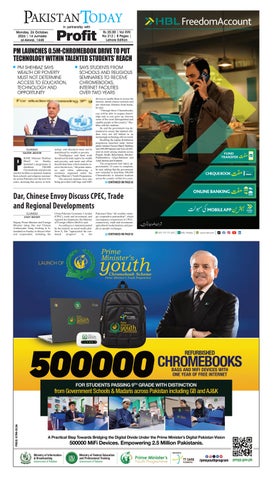
PM launches 0.5M-chroMebook drive to Put technology within talented students’ reach
g
PM SHEHBAZ SAYS WEALTH OR POVERTY MUST NOT DETERMINE ACCESS TO EDUCATION, TECHNOLOGY AND OPPORTUNITY
P
ISLAMABAD SALEEM JADOON
RIME Minister Shehbaz Sharif on Sunday launched a programme to distribute 500,000 Chromebooks and provide internet facilities to talented students from schools and religious seminaries across Pakistan over the next two years, stressing that access to tech-
g
SAYS STUDENTS FROM SCHOOLS AND RELIGIOUS SEMINARIES TO RECEIVE CHROMEBOOKS, INTERNET FACILITIES OVER TWO YEARS
nology and education must not be determined by wealth or poverty. “Intelligence and hard work should not be held captive by wealth and poverty, and merit and effort should determine which students receive the devices,” the prime minister said while addressing a ceremony organised under the Prime Minister’s Youth Programme. The selected students were also being provided with bags and MiFi
devices to enable them to access the internet, attend classes remotely and use electronic libraries from home, he said. “Through these Chromebooks, you will be able to acquire knowledge and, as you grow up, become some of the most distinguished and capable people in this country,” Shehbaz told the students. He said the government was determined to ensure that talented children were not left behind in an increasingly technology-driven world. Recalling the laptop distribution programme launched under former prime minister Nawaz Sharif, Shehbaz said 600,000 laptops had been distributed on merit among students across Punjab, Sindh, Balochistan, KhyberPakhtunkhwa, Gilgit-Baltistan and Azad Jammu and Kashmir. The programme had taken approximately 10 years to complete, he said, adding that the government now intended to distribute 500,000 Chromebooks to talented students across the country within two years.
CONTINUED ON PAGE 03
Dar, Chinese Envoy Discuss CPEC, Trade and Regional Developments ISLAMABAD
STAFF REPORT
Deputy Prime Minister and Foreign Minister Ishaq Dar met Chinese Ambassador Jiang Zaidong in Islamabad on Sunday to discuss bilateral cooperation, including the
China-Pakistan Economic Corridor (CPEC), trade and investment, and regional developments, the Ministry of Foreign Affairs (MoFA) said. According to a statement posted by the ministry on social media platform X, Dar “appreciated the continued progress” in the
Pakistan-China “all-weather strategic cooperative partnership”, which encompasses cooperation in CPEC, connectivity, trade and investment, agricultural modernisation, and people-to-people exchanges.
CONTINUED ON PAGE 03
02 NEWS
Monday, 26 October, 2026 | LAHORE
PAKISTAN SEEKS EARLY SIGNING OF GCC FREE TRADE AGREEMENT, QATARI INVESTMENT
P
PROFIT
WEB DESK
AKISTAN has urged Qatar to support the early signing of the Pakistan-Gulf Cooperation Council (GCC) Free Trade Agreement (FTA), while seeking greater market access for Pakistani exports and Qatari investment in agriculture, industrial development, information technology and infrastructure. The proposals were discussed during the second meeting of the Pakistan-Qatar Joint Task Force (JTF) on Trade and Investment, held in Doha on October 24, according to a statement issued by the Ministry of Commerce on Sunday. Federal Minister for Commerce Jam Kamal Khan and Qatar’s Minister of State for Foreign Trade Affairs, Dr Ahmad bin Mohammed Al-Sayed, cochaired the meeting, which reviewed progress in bilateral economic cooperation and explored new trade and investment opportunities. Pakistan sought Qatar's support in completing the remaining formalities for the GCC FTA, informing the meeting that Islamabad had completed its domestic approval process and forwarded the approved agreement text to the GCC Secretariat on December 31, 2025. The agreement, which aims to expand
trade and investment ties between Pakistan and the six-member Gulf bloc, has yet to be formally signed and implemented. Pakistan also called for the removal of restrictions on exports of bone-in meat to Qatar, saying it had already submitted a comprehensive technical dossier addressing animal health and food safety requirements to the relevant Qatari authorities. In the agriculture and food security sector, Pakistan highlighted a proposed government-to-government arrangement between the Trading Corporation of Pakistan (TCP) and Qatar's Hassad Food for the supply of Pakistani rice.
The proposed agreement has been submitted to the federal cabinet for approval and has not yet been finalised. Pakistan also invited Qatari investment in grain storage facilities, silos, cold storage, integrated cold-chain infrastructure, modern agriculture and advanced farming technologies. In the industrial sector, Islamabad presented investment opportunities in new-energy vehicles and electric vehicles (EVs), including joint manufacturing, technology transfer and industrial partnerships. Opportunities in information technology, digital infrastructure and digital serv-
ices were also discussed as part of efforts to expand bilateral economic cooperation. Pakistan further sought Qatari participation in maritime transport and shipping, identifying potential investment in oil tankers, liquefied natural gas (LNG) carriers and container vessels. The Pakistani side also presented the proposed Karachi-Hyderabad Motorway as a potential investment opportunity, highlighting its expected role in improving connectivity between seaports, the national road network and regional transit routes, particularly those linking Pakistan with Central Asia. The two sides discussed the concept of an investment fund aimed at attracting Qatari capital into infrastructure, agriculture, industrial development and other priority sectors. No final agreement on establishing the fund was announced. Both countries also discussed activating 11 technical working groups covering logistics, aviation, advanced manufacturing, mining and minerals, agriculture, tourism, financial technology, healthcare, education, information technology and startups. Pakistan said it had shared the composition of its working groups and requested Qatar to nominate its representatives so that the groups could begin identifying concrete trade and investment opportunities.
WAPDA signs Rs133.18b contract for Diamer-Basha dam hydro-mechanical works PROFIT
WEB DESK
China's Chery to launch robotaxis in UAE in 2027, expand overseas vehicle production PROFIT
REUTERS
Chinese automaker Chery plans to launch its first robotaxi services in the United Arab Emirates (UAE) in 2027 as part of a broader international expansion that will also increase overseas vehicle production and investment in charging infrastructure. The company announced the plans on Friday, with Executive Vice President Zhang Guibing outlining its strategy to expand local manufacturing operations in international markets. Chery expects vehicles manufactured outside China to account for more than 50% of its export volume by the end of 2026, compared with approximately 48% currently. The company aims to increase that proportion to 60% in 2027 and 70% by 2030, reflecting a shift towards manufacturing vehicles closer to overseas customers rather than relying primarily on exports from China. Speaking at an event at Chery's headquarters in Wuhu, Zhang said the company was pursuing local production to create employment opportunities and strengthen cooperation with technology providers in its international markets. Chery, which sells vehicles under the Omoda and Jaecoo brands, is among the Chinese automakers expanding internationally through competitive pricing and advanced automotive technologies. Alongside its manufacturing expansion, the company plans to begin developing fast-charging and energy storage stations in overseas markets, including the United Kingdom, Spain and Thailand, from 2027. The planned robotaxi launch in the UAE will mark another step in Chery's expansion into emerging automotive technologies, alongside its efforts to increase overseas production and develop supporting energy infrastructure.
CITY NOTES M.A. NIAZI
T’s always the little guy who gets pushed around. Look at Faheem Akram, who has been released into the custody of the National Cyber Crime Investigation Agency after being nabbed for forging and selling 5.1 million US postage labels worth $126 million at $2 apiece, after he was indicted by a Florida court. He sold the labels over a website. He’s a native of Khanewal. The NCCIA may be looking at the $100,000 reward for his arrest offered by the US government. But Faheem just seems to be an entrepreneur who saw a market, and went for it. It wasn’t strictly legal according to the laws of the capitalist USA, so they did him down. Look, he is supposed to have sold five million shipping labels to 5200 individuals since 2023. That’s almost 1000 labels a customer. Likelier is that there were a few very large customers, and loads of individuals buying just one or two per head. We won’t compare Faheem Akram with the revered Lahore Gymkhana, which is under fire from the Punjab Assembly for
I
The Water and Power Development Authority (WAPDA) has signed a Rs133.18 billion contract with the Power China-IKAN Joint Venture (JV) for hydro-mechanical works under the Diamer-Basha Dam Project. The HM-1 contract was signed at a ceremony held at WAPDA House in Lahore. Chief Engineer and Project Director Diamer-Basha Dam Arif Ali signed the agreement on behalf of WAPDA, while Ling Jianke represented the joint venture. The ceremony was attended by WAPDA Chairman Lt Gen Muhammad Saeed (Retd), Member Finance, Member Water, Member Power, Chief Executive Officer of Diamer Basha Development Company, a delegation of the joint venture led by the chairman of Power China International Group Limited, and representatives of the project consultants. The HM-1 contract covers the manufacturing, supply and installation of hydro-mechanical equip-
ment and hydraulic steel structures required for the dam's operation. The scope of work includes gates and steel structures designed to regulate water flows at the dam, with equipment to be installed at flushing tunnels on both banks, power intakes and outlets. The contract also covers steel lining, hoisting and pumping systems, along with associated electrical works. The Diamer-Basha Dam is among the federal government's priority infrastructure projects aimed at strengthening Pakistan's
water, food and energy security. The dam is being constructed across the River Indus, approximately 40 kilometres downstream of Chilas. Upon completion, it will have a gross water storage capacity of 8.1 million acre-feet (MAF) and an installed hydropower generation capacity of 4,500 megawatts (MW). The project is expected to enhance water storage for irrigation, support electricity generation and contribute to the country's long-term water and energy requirements.
Govt seeks industry proposals to boost exports, revive industrial activity PROFIT
WEB DESK
Adviser to the Prime Minister on Industries and Production Haroon Akhtar Khan has urged representatives of export-oriented industries to submit concrete proposals for removing industrial bottlenecks, improving productivity and expanding access to international markets as the government seeks to boost exports and revive industrial activity. The adviser made these remarks while chairing a meeting of the Task Force on Export and Industrial Enhancement on Saturday, according to an official news release. The meeting was attended by Joint Secretary Freedoon Akram Sheikh and representatives of various industrial sectors, including leather, sports goods, cutlery, carpets and other export-
oriented industries. Haroon Akhtar Khan said the task force had been established to identify challenges confronting industries, explore opportunities for growth and develop practical measures to strengthen Pakistan's export performance. He highlighted the government's commitment to implementing the prime minister's vision for economic revival through export enhancement, industrial development and closer cooperation with the private sector. The adviser said the government was engaging business representatives and relevant stakeholders to address industrial challenges, improve competitiveness and create conditions conducive to business expansion. He stressed that meaningful consultation with industry represen-
tatives was essential for formulating effective policies that address the practical difficulties faced by manufacturers and exporters. A series of consultative meetings was being held, with further engagements planned to incorporate industry recommendations and experiences into the policymaking process, he added. Highlighting the potential of export-oriented sectors, Haroon said industries such as leather, sports goods, cutlery and carpets could contribute to higher exports, employment generation and economic growth. He asked industry representatives to submit actionable recommendations addressing sector-specific constraints, improving production efficiency, enhancing product quality and exploring new export markets.
Pakistan targets $5.5b IT exports, $44b remittances in FY27: Aurangzeb PROFIT
WEB DESK
Federal Minister for Finance and Revenue Muhammad Aurangzeb has said Pakistan's information technology (IT) exports are expected to reach $5.5 billion and workers' remittances $44 billion during the current fiscal year, as the government pursues structural reforms aimed at sustaining economic stability, reducing energy costs and promoting export-led growth. Addressing a policy dialogue at the Lahore University of Management Sciences (LUMS) on Saturday, the finance minister said Pakistan needed to break its historical cycle of economic booms and balance-of-payments crises by increasing exports, improving productivity and encouraging privatesector investment. He said excessive reliance on import-driven growth had repeatedly exposed the economy to external financing pressures, requiring four to five years of stabilisation efforts following each crisis. Aurangzeb maintained that the country must move towards sustainable economic growth capable of generating employment, attracting investment and improving living standards rather than relying on short-term consumption-led expansion. Highlighting improvements in key economic indicators, the minister said Pakistan's foreign exchange reserves were at a historic high and sufficient to cover more than three months of imports, compared with previous periods when reserves had fallen to the equivalent of just two weeks of imports. He said Pakistan's credit rating had improved three times since April 2025, while measures had been taken to restore access to international financial markets. The minister referred to a private placement undertaken in April 2026 and efforts to raise financing through Panda bonds, alongside renewed interest in Pakistan's international bond offerings. He said investor orders for Pakistan's Eurobonds were twice the amount offered, with interest coming from investors in Asia, the Middle East, Europe and the United States. Aurangzeb said international investors were increasingly assessing Pakistan's economic outlook beyond its ongoing International Monetary Fund (IMF) programme, which is scheduled to conclude in October 2027. He stressed that continued implementation of structural reforms would be essential to maintaining economic stability, strengthening investor confidence and ensuring policy continuity after the programme ends. Discussing measures to improve export competitiveness, the finance minister said the government was working to broaden the tax base, improve the taxation system and reduce the cost of doing business. He cited tax relief measures for exporters, including the abolition of the super tax and reductions in tax slabs, as part of the government's efforts to support export-oriented industries. He also referred to financing facilities for exporters at an interest rate of 4.5 percent and discussions on supplying surplus electricity to industries at approximately Rs23 per unit.
Wapda, SCO sign Rs14.06b agreements for Dasu, Chilas Safe City projects PROFIT
MONITORING REPORT
The Water and Power Development Authority (Wapda) and the Special Communications Organization (SCO) signed two agreements worth a combined Rs14.06 billion for the development of Safe City projects in Dasu and Chilas, with both schemes scheduled for completion within 11 months. Under the agreements, the Dasu Safe City Project will be developed at an estimated cost of Rs6.38 billion, while the Chilas Safe City Project will cost Rs7.68 billion. The signing ceremony took place at Wapda House in Lahore in the presence of Wapda Chairman Lt Gen Muhammad Saeed (retd) and SCO Director General Maj Gen Sajjad Haider Khan. The agreement for the Dasu Safe City Project was signed by General Manager and Project Director Dasu Hydropower Project Amir Shafiq-ur-Rehman and SCO Director Special Projects Brig Syed Saeb Imam Zaidi (retd). For the Chilas Safe City Project, the agreement was signed by Chief Engineer and Project Director Diamer Basha Dam Arif Ali and SCO Director Special Projects Brig Syed Saeb Imam Zaidi (retd).
And the rest is silence
renting Rs 100 acres of government land for Rs 5000 a year, even though the rental value in market prices is probably Rs 100 billion. The fire would probably end if certain people were given government officers’ memberships. That is a stiff Rs 252,000 a year, but still beats ordinary membership, which is Rs 1.6 million a year. Old Faheem Akram is not known to be a member. He will get it in the neck for his fraud, which was in the millions, while the Gymkhana members or office-bearers will be left untouched. Oh yes, the Club might pay a higher rent. Which will be extracted from the members in the shape of a higher membership fee. Faheem Akram is lucky to be in the custody of the NCCIA, not the CCD. Those guys seem to go by habit. A man was arrested by the CCD Multan for killing a boy by running over him, but then he allegedly escaped from custody. He was pillion riding on a motorbike when stopped on the Bahawalpur bypass. They started firing, and the man was killed in the police reply. Well, the Lahore CTD is more traditional. They were taking an arrested criminal
to recover the proceeds of his loot, when his accomplices attempted to get him to escape. As usual, he was the only person to be hit, and he died. One would think accomplices would stop trying to rescue anyone, because they always kill them. One of the more criminal uses of Artificial Intelligence was to exploit the PHP loophole that was all over the Internet, which led to three countries having to take their official websites offline, Japan, Finland and the Netherlands. Apparently, our websites were not worth hacking. I woner how the CTD would have handled the matter. Having the web developer and then get shot, perhaps by other web developers trying to help him escape. Not to forget a few software engineers, a breed known to shoot first and ask questions later. Or how would they gandle the tainted milk case, which killed one-and-a-half-yearold Faizan, and three-and-a-half-year-old Zain Ali, who’s still fighting for his life? Come to think of it, how would the CTD handle the war of words between PTI Secretary General Salman Akram Ranjha and KP ex-CM Ali Amin Gandapur? I hope it’s
not on the lines of quietening by silencing forever. The CTD motto seems to be that Shakespearean line, at the end of Hamlet, when the stage is littered with dead bodies: “The rest is silence.” Hamlet himself speaks the line, just as he is about to die. Meanwhile, there have been strange coincidences in the cricket world. On the same day India managed the highest run chase in T20I history, making 181 for 6 on the second last ball in reply to 180 for 5, England made the third best chase in an ODI, making
430, with Harry Brook making a double hundred, the first by an England player. Spare a thought for the losing teams. They must have both thought they had posted winning totals. But sometimes, it\s just not your day. Well, Harry Brook should shrug. Remember when he scored a triple-hundred in a Test? And helped England beat Pakistan by an innings, even though Pakistan had made 556 in the first innings, with a century by skipper Shan Masood. Now it’s brook’s turn to be the highscoring losing captain.
NEWS 03
Monday, 26 October, 2026 | LAHORE
PSX POISED FOR REBOUND ON IMPROVING ECONOMY; POLICY RATE DECISION, MIDEAST DEVELOPMENTS SEEN AS KEY CATALYSTS: REPORT
P g
KSE-100 SHEDS 4,045 POINTS, OR 2.4%, TO CLOSE AT 162,375 AMID MIDDLE EAST TENSIONS AND RISING OIL PRICES; BANKING, TECHNOLOGY AND CEMENT STOCKS WEIGH ON INDEX AS MUTUAL FUNDS AND FOREIGN INVESTORS REMAIN NET SELLERS, WHILE TRADING VOLUMES DECLINE AHEAD OF OCTOBER 26 MONETARY POLICY DECISION PROFIT
saDDam HussaiN
AKISTAN’S equity market is expected to gain momentum on the back of improving economic indicators, with the State Bank of Pakistan’s (SBP) Monetary Policy Committee meeting on October 26 seen as a key market catalyst, although the central bank is widely expected to keep interest rates unchanged, according to separate reports by Arif Habib Limited and AKD Securities. The brokerage firms said any positive developments in the Middle East conflict could ease international crude oil prices, potentially creating room for monetary easing and further supporting Pakistan's equity market. The market remained volatile during the week ended on Friday amid continued Houthi attacks on Saudi Arabia and reports that the United States was planning an attack on Iran after the midterm elections. Brent crude oil prices consequently rose by 6.4% WoW to $114.9 per barrel on Friday. The benchmark KSE-100 Index declined by 2.4% week-on-week (WoW), shedding 4,045 points to close at 162,375, primarily due to persistent geopolitical uncertainty. The KSE-All Share Index also declined by 2.2% WoW to 98,620 points. Year-to-date, the KSE-100 and KSE-All Share indices were down 6.7% and 5.7%, respectively. The banking sector made the largest negative contribution to the benchmark index, accounting for a decline of 925 points, followed by technology with 512 points, investment banks with 507 points,
Dar, Chinese Envoy Discuss CPEC, Trade and Regional Developments CONTINUED FROM PAGE 01
Dar also “underscored the importance of sustained high-level exchanges” to further advance the “Pakistan-China Community of Shared Future in the New Era”, the statement said. The meeting also provided an opportunity for the two sides to “exchange views on regional developments”, with both reaffirming “the importance of dialogue and diplomacy for sustainable peace and stability in the region”, according to the ministry. Pakistan and China marked the 75th anniversary of their diplomatic relations this year, as both countries seek to broaden cooperation beyond traditional infrastructure projects. The next phase of CPEC, known as CPEC 2.0, is expected to focus on industrialisation, agriculture, mining, information technology and artificial intelligence, reflecting the two countries’ efforts to expand economic and technological cooperation. At the seventh round of the Pakistan-China Foreign Ministers’ Strategic Dialogue, held in Beijing in January, the two countries agreed to align their development priorities and deepen cooperation in trade, investment, science and technology, cybersecurity, and people-to-people exchanges.
SBP injects Rs13.06 trn into banking system through conventional, Shariah-compliant OMOs KARACHI
web Desk
The State Bank of Pakistan (SBP) injected Rs13.061 trillion into the banking system through conventional and Shariah-compliant open market operations (OMOs) on Friday, October 23, to provide short-term liquidity to financial institutions. According to the central bank's auction results, Rs12.601 trillion was injected through conventional reverse repo operations, while another Rs460.40 billion was provided through Shariah-compliant Mudarabah-based operations. In the conventional OMO, banks submitted bids with a total face value of Rs13.081 trillion, against which the SBP accepted Rs12.601 trillion. The central bank accepted Rs276 billion for the seven-day tenor at a rate of 11.55%, approving all five bids received. For the 14-day tenor, the SBP accepted Rs12.325 trillion against offers of Rs12.805 trillion, with the accepted rate of return standing at 11.53%. A total of 32 out of 33 bids were accepted. The SBP said bids worth Rs4.179 trillion were submitted at 11.53%, of which Rs3.707 trillion was accepted on a pro-rata basis. Separately, the central bank injected Rs460.40 billion through Shariah-compliant Mudarabah-based OMOs, accepting the entire amount offered by participating institutions. Of this, Rs32 billion was accepted for seven days at a return of 11.56%, while Rs428.40 billion was accepted for 14 days at 11.55%. All 11 bids submitted in the Shariah-compliant operations were accepted. The combined realised value of the conventional and Shariah-compliant injections stood at Rs12.733 trillion, compared with the total accepted face value of Rs13.061 trillion. The operations provided liquidity through seven- and 14-day maturities, with the bulk of the accepted funds allocated to the longer tenor.
cement with 459 points and power with 266 points. Miscellaneous companies contributed 19 positive points, while the sugar sector added 0.5 points. Among individual stocks, ENGROH was the largest negative contributor, subtracting 489 points from the index, followed by SYS with 277 points, LUCK with 226 points, ATRL with 195 points and HUBC with 193 points. Positive contributions came from PSEL, which added 26 points, THCCL with 18 points, UPFL with 15 points, BWCL with 11 points and NESTLE with nine points. Sector-wise, refineries, technology and communication, and woollen companies were the worst performers, declining by 10.1%, 7.7% and 7.3% WoW, respectively. Modarabas gained 5.2%, followed by sugar and allied industries at 1.5% and leasing companies at 0.5%. Among individual stocks, THCCL gained 4.4% WoW, UPFL rose 3.2%, PSEL increased 2.4%, TPLRF1 advanced 1.3% and BWCL gained 1.2%. The major declining stocks were PTC, which fell 15.5% WoW, PGLC with a 12.7% decline, AHCL with 11.2%, ATRL with 10.5% and KAPCO with 9.5%. Average trading volumes stood at 393 million shares, down 12.6% WoW, while the average traded value increased by 7.3% to $69.7 million. A separate brokerage report placed average daily trading volumes at 496 million shares, reflecting a 13.4% weekly decline. Mutual funds recorded net selling of $10.2 million during the week, while foreign investors sold shares worth a net $5.7 million. Individual investors were the largest net buy-
ers, purchasing shares worth $14.0 million. On the macroeconomic front, Pakistan's economic growth estimate for FY2025-26 was revised downward to 3.65% from the provisional estimate of 3.70%, according to figures released on October 19, 2026. Growth for FY2024-25 was also revised to 3.11% from 3.18%. Quarterly economic growth during FY2025-26 stood at 3.89% in the first quarter, 4.31% in the second, 4.42% in the third and 2.0% in the fourth quarter. Agriculture grew by 3.50%, industry by 3.34% and services by 3.81%. The size of the economy reached Rs126.4 trillion, equivalent to $450.4 billion, while per capita income stood at $1,896. The World Bank projected Pakistan's GDP growth at 3.8% for FY2026-27, with inflation expected to reach 8.2%, compared with 7.1% in FY2025-26. Pakistan's total liquid foreign exchange reserves declined by $30.3 million WoW to $26.83 billion as of October 16, 2026. State Bank of Pakistan (SBP) reserves increased by $19.1 million to $21.49 billion, while commercial bank reserves fell by $49.4 million to $5.34 billion. The country's import cover stood at 3.01 months. Meanwhile, the Pakistani rupee appreciated marginally by 0.03% against the US dollar to close at Rs276.82. In the energy sector, electricity generation increased by 5% year-on-year (YoY) to 13,217 gigawatt-hours in September 2026, supported by higher generation from hydropower, local coal, imported coal and wind sources. However, the cost of electric-
ity generation rose by 32% YoY to Rs9.35 per kilowatt-hour due to a higher share of regasified liquefied natural gas, high-speed diesel and furnace oil in the generation mix, alongside elevated international oil prices. Consequently, electricity distribution companies sought a positive fuel charges adjustment of Rs2.56 per kilowatt-hour for September 2026. Power generation during the first quarter of FY2026-27 increased by 6% YoY amid a recovery in electricity consumption. Domestic petroleum prices declined during the week, with motor spirit falling by 3.2% WoW, or approximately Rs12.5 per litre, to Rs377.71 per litre, while high-speed diesel declined by 1.3%, or approximately Rs5.2 per litre, to Rs391.75 per litre. The reductions followed declines in exrefinery prices of 4.5% WoW for motor spirit and 1.8% for high-speed diesel, while petroleum levies and margins remained unchanged. In the agricultural sector, cotton arrivals increased by 8% YoY to 4.081 million bales as of October 15, 2026. Sindh recorded arrivals of 2.443 million bales, up 7% YoY, while Punjab reported 1.638 million bales, an increase of 8%. Cotton sowing reached 1.79 million hectares, representing 82.8% of the target of 2.16 million hectares. The government has set a production target of 9.64 million bales for FY2026-27, compared with 7.05 million bales in FY2025-26. Banking sector deposits increased by 16% YoY to Rs40.8 trillion at the end of September 2026, while consumer automobile financing rose by 33.6% YoY to Rs407
PM launches 0.5m-Chromebook drive to put technology within talented students’ reach CONTINUED FROM PAGE 01
“This is a remarkable instrument that will be in your hands so that you do not fall behind anyone in the world in terms of ability and intelligence,” he said. The prime minister said the earlier laptop scheme had benefited students from diverse backgrounds and regions, including children whose fathers had died and those whose parents worked as labourers. Recalling an interaction with a student at the ceremony, Shehbaz said he had asked the child about his father’s occupation. “Prime Minister, my father is a labourer,” the student had replied. Shehbaz said such circumstances should not prevent children from developing their abilities or pursuing an education. He thanked Rashid Minhas, founder of the Tokyo Care Foundation, for donating towards the initiative, expressing gratitude on behalf of himself, his government and the students who would benefit from the programme. The contribution reflected the confidence of overseas Pakistanis in the country’s young people and their potential, he said, adding that Pakistanis living abroad worked hard to enhance the country’s standing internationally. He said the donation had been made in recognition of the students’ intelligence and capabilities and thanked the foundation for supporting the initiative. The prime minister also highlighted the government’s efforts to provide quality education through the Daanish schools programme. He said he had in-
augurated a Daanish school in Islamabad a few days earlier, while 27 more were under construction across the country. “These schools will be distinguished for their quality of education, their teachers and the facilities they provide,” Shehbaz said, adding that the institutions would have smart boards and electronic libraries, alongside sports grounds, residential dormitories and food facilities. “No child has to spend a single penny at these Daanish schools,” he said, emphasising that financial circumstances should not stand in the way of education. “It is our responsibility to ensure that our children receive the education and facilities they deserve,” the prime minister said. “It should be the foremost duty of any government to build the future of the children of this nation, help them become great individuals and great Pakistanis, and remove the obstacles standing in their way.” Shehbaz also referred to two students who had spoken at the ceremony, highlighting the challenges they had overcome to continue their education. He mentioned Syed Shams Raza, a student from a tribal area whose father had been martyred. “Just consider how this child is facing the hardships of life; you and I cannot even imagine it,” he said. Referring to the Quranic teaching on martyrs, the prime minister said Islam held those who sacrificed their lives in high regard. He also emphasised the resilience required of a child growing up without a father. “I believe there are not just one or
two, but thousands and hundreds of thousands of remarkable children like Syed Shams Raza in this country,” he said. Shehbaz praised the student’s determination to work hard despite his circumstances, become a capable Pakistani and serve the nation when he grew up. He also commended a girl from Baltistan who attended a religious seminary and spoke confidently about her education and ambitions. The student had told the gathering that she was passionate about studying but had been given to understand that students from religious seminaries would not receive laptops or Chromebooks. Shehbaz said he wanted to dispel that impression, pointing out that previous laptop distribution programmes had included some prominent religious seminaries alongside universities and colleges. He said the current Chromebook programme would likewise cover students from both schools and seminaries, with selection based solely on merit and hard work. “Only your hard work and ability will be the criteria,” he said. The prime minister added that the devices would help students pursue further education and could also become a source of livelihood when they entered the workforce. He said the benefits of the earlier laptop distribution programme had become particularly evident during the Covid-19 pandemic, when students relied on technology to continue their education. The laptops had enabled students to attend university classes and continue learning despite the disruption caused by the pandemic, he said.
billion during the month, marking the 22nd consecutive monthly increase. Fertiliser sales showed mixed trends, with urea offtake increasing by 42% YoY to 611,000 tonnes in September 2026, supported by inventory accumulation ahead of the Rabi season. Diammonium phosphate offtake, however, declined by 30% YoY to 68,000 tonnes amid higher domestic prices. In the automobile sector, the committee reviewing Pakistan's Automotive and Auto Parts Manufacturing Policy 2026–31 proposed reforms aimed at increasing exports, accelerating the adoption of new energy vehicles and improving competition. The proposed measures included lower sales tax on new energy vehicles, reduced import tariffs, mandatory export targets for original equipment manufacturers, localisation requirements and incentives for incremental exports. Weekly Sensitive Price Indicator inflation increased by 0.65% WoW and 11.85% YoY. The Privatisation Commission prequalified 10 bidders for Islamabad Electric Supply Company, while power sector circular debt increased to Rs1.7 trillion and gas sector liabilities reached Rs3.6 trillion as of June 30, 2026. Looking ahead, brokerage analysts expect the Monetary Policy Committee meeting scheduled for October 26 and the ongoing September-quarter corporate earnings season to influence market direction, while geopolitical developments remain a key factor. The KSE-100 Index is currently trading at a price-to-earnings ratio of 7.02 times, offering a dividend yield of 7.0%.
NHA directed to prioritise financially viable projects, avoid debt burden ISLAMABAD
Federal Minister for Economic Affairs Senator Ahad Khan Cheema has directed the National Highway Authority (NHA) to prioritise financially viable projects and develop a practical business plan to ensure long-term operational sustainability and avoid unsustainable debt-servicing obligations. Chairing a meeting to review NHA's financial position, business plan development and ongoing assessment with an Asian Development Bank (ADB) consultant, the minister emphasised the need for clear implementation timelines and an assessment of the authority's institutional capacity. He directed that project PC-I documents incorporate realistic commercial indicators to facilitate appraisal by the Central Development Working Party (CDWP). Cheema also called for NHA projects to be categorised according to their financial viability and financing requirements to support investment and funding decisions. The minister clarified that external or commercial financing arrangements should not result in reductions to NHA's allocation under the Public Sector Development Programme (PSDP), stressing that federal development funding remained essential for the authority. He further directed the early sharing of project feasibility assessments with the Finance Division's Central Monitoring Unit (CMU).
Iran plans attacks on Gulf undersea internet cables if US-Israel conflict resumes, officials say g
IRANIAN SECURITY OFFICIALS WARN OF STRIKES ON CRITICAL COMMUNICATIONS INFRASTRUCTURE AND EFFORTS TO PREVENT REPAIRS; ANALYSTS SAY GULF NETWORKS FACE GREATER RISKS THAN GLOBAL INTERNET CONNECTIVITY DUBAI
ReuteRs
Iran has prepared plans to attack undersea communications cables in the Gulf if the United States and Israel launch further military strikes against the country, potentially disrupting regional internet services, financial transactions and cloud computing operations, according to two senior Iranian security officials. The officials told Reuters that Tehran was considering a broader range of retaliatory targets in the event of renewed hostilities, including communications infrastructure that supports Gulf economies and their expanding technology industries. Speaking anonymously, one official said Iran would also seek to obstruct repairs to damaged cables to extend the duration of any communications outages. Neither official disclosed the locations of potential attacks or the methods that could be used. The warnings follow statements by senior Iranian figures indicating that critical digital infrastructure could become a target if diplomatic efforts with Washington fail and military operations resume. Yadollah Javani, deputy head of political affairs for Iran's Islamic Revolutionary Guard Corps (IRGC), said on Wednesday
that seven major internet cables passing beneath the Strait of Hormuz could be targeted if Iranian infrastructure came under attack. Iranian security official Mohsen Rezaei had also warned earlier this month that US-linked digital infrastructure in the Gulf, including data centres and artificial intelligence facilities, could face retaliation in another conflict. The Strait of Hormuz, which separates Iran and Oman, is an important route for regional communications infrastructure, although its contribution to worldwide internet connectivity is relatively limited. According to the International Telecommunication Union, undersea cables carry approximately 99% of global internet traffic. However, Alan Mauldin, research director at telecommunications research firm TeleGeography, said less than 1% of international bandwidth passes through the Strait of Hormuz, suggesting that attacks there would have a greater impact on Gulf countries than on global communications. Multiple cable failures could nevertheless affect internet speeds, banking transactions, electronic commerce and cloud-based services across the region, depending on the availability and capacity of alternative connections.
News Desk
Telecommunications operators could redirect some traffic through other submarine or land-based networks, but the extent of disruption would depend on how much additional demand those routes could accommodate. Restoring damaged cables during an active conflict could also prove difficult because repair vessels would face security risks, higher insurance costs and potential delays in obtaining permission to operate in territorial waters. The threats come as Gulf governments invest heavily in data centres, artificial intelligence and digital infrastructure to diversify their economies beyond oil, often in partnership with major US technology companies. Iranian strikes in March directly hit two Amazon Web Services facilities in the United Arab Emirates and damaged infrastructure near another facility in Bahrain. During the same period, the IRGC identified several American technology companies, including Microsoft, Google, Apple and Nvidia, as potential targets. Alex Vatanka, director of the Iran programme at the Middle East Institute in Washington, said Tehran's threats appeared intended to discourage further military action by increasing concerns among Gulf governments and US businesses
about the security of their regional investments. He said Iran was seeking to encourage Gulf countries and technology executives to press US President Donald Trump over the economic risks associated with another conflict. A second Iranian security official said Gulf governments should hold Washington responsible for any damage to regional communications infrastructure resulting from renewed military action. The US State Department and Iran's Foreign Ministry did not respond to requests for comment on the officials' remarks, while Gulf governments had not immediately issued responses. Analysts also identified the Red Sea as a potentially more consequential location for communications disruptions because of its role in connecting Europe, East Africa and Asia. TeleGeography estimates that cables passing through the Red Sea account for approximately 3% of global international bandwidth demand and around 10% of traffic between regions. Although Iran has not publicly indicated plans to attack Red Sea cables, analysts said the region could present additional risks if Tehran received support from its Houthi allies in Yemen. Gulf governments and technology companies have been investing in alternative terrestrial and submarine connections to reduce their dependence on individual routes. Microsoft, for example, plans to spend more than $400 million on subsea and land-based communications infrastructure across the Middle East by 2030. While these investments could improve the resilience of regional networks, analysts warned that simultaneous damage to multiple cables, particularly during wartime when repairs could be delayed, would remain a significant risk to the Gulf's growing digital economy.
04 COMMENT
Why they are illegal under India’s own law
Monday, 26 October, 2026
Wheat shortage looming
D
DPM hopes traditional methods will work
EPUTY Prime Minister Ishaq Dar has ordered all the traditional methods a government has of dealing with a wheat shortage. While chairing a Cabinet committee to review the stock position, pricing and supply of essential commodities, he noted the shortage of wheat and ordered an end to hoarding and speculation, as well as the release of wheat stocks to the flour mills. This came after a recent decision to set the indicative wheat price for next season at Rs 4500 per maund, which represents a substantial rise on the indicative price last season. Of course, the government has set the indicative price without having any means of enforcing it, unlike the wheat support price, when the state bought all that could be sold to it at that price. However, the IMF has finally made it abandon the support price in favour of letting the market decide the price. The release of wheat stocks to the mills is a traditional tool to handle shortages, but un the new system is not available to the government. The present imbalance is an illustration of the carry-over effect of bad decisions, like the one to allow wheat export. The rising of prices is to be expected now that the government does not sell wheat stocks, and apart from its exhortations against speculation and hoarding, the mechanism to stop it is not exactly available either. The district magistrates are not as potent as before. The present situation is based on the assumption by traders that farmers will not sow. The market may determine the price, but it does seem a risky approach to take with the national food staple. The determining may lead to increase in price that the government can do little or nothing about, except to preach to hardheaded businessmen who will speculate and hoard limitlessly if it means they can make a quick profit. The idea of exporting dear and importing cheap has not been made to work. Wheat is not the only staple which the government has knocked out of equilibrium because of a bad decision to export. There is also sugar. That was another of the essential commodities that the committee discussed. There too Mr Dar proposed a notional price, but there does not seem any mechanism available to enforce it. It would be too extreme a conspiracy theory to accuse the IMF of trying to break Pakistan’s ability to feed itself, but its dictates are certainly leading to that.
A
Arif Nizami (Late) Babar Nizami
Editor Pakistan Today
Editor Profit
D
EMOCRACY is meant to be a contest of performance. Governments seek re-election by presenting their achievements, while opposition parties challenge their record and offer alternative policies. Voters are expected to judge them on matters that shape everyday life; employment, inflation, education, healthcare and the quality of public institutions. Yet this democratic ideal is often overshadowed by a more expedient political calculation. When domestic performance becomes difficult to defend, political leaders increasingly turn to external threats to shift public attention from governance to national security. The appeal of this strategy is straightforward. Economic difficulties, administrative failures and unfulfilled promises demand explanations; an external adversary offers a simpler narrative. By portraying the nation as threatened, leaders can mobilise patriotic sentiment, consolidate support and recast criticism as a question of national loyalty. The danger is that confrontation becomes politically rewarding, while restraint is portrayed as weakness. India provides a revealing example of how national security can shape electoral discourse. During the 2019 general election, the Pulwama attack and India’s subsequent air strikes at Balakot featured prominently in political debate. The Bharatiya Janata Party presented its response to terrorism as evidence of decisive leadership, while opposition parties questioned aspects of the government’s claims and the political use of military action. The episode illustrated how a security crisis could become a defining feature of an election campaign. In the wider debate surrounding India-Pakistan tensions, allegations and counter-allegations frequently intensify public anger. The more immediate concern is how such episodes influence political judgement. When inflammatory rhetoric displaces investigation and diplomacy, a crisis can become difficult to contain. In a region where both countries possess nuclear weapons, retaliatory pressures and the fear of appearing weak can narrow the space for rational decision-making. Political leaders may benefit from projecting resolve, but the consequences of miscalculation extend far beyond the electoral arena. Israel presents another example of the intersection between security policy and political survival. Prime Minister Benjamin Netanyahu has long placed Iran’s nuclear programme and regional influence at the centre of his security narrative. The war in Gaza following the Hamas-led attacks of October 7, 2023, and the subsequent
with constitutional protections, judicial safeguards, and basic human rights principles. In May 2025, India’s Ministry of Home Affairs introduced a Standard Operating Procedure directing states and district administrations to identify, detain, verify, and deport alleged illegal Bangladeshi migrants and Rohingya. The SOP requires local police to conduct verification, place suspected undocumented migrants in special holding centres, restrict their movement, and facilitate deportation after administrative processing. The Immigration and Foreigners Order, 2025 was introduced under India’s new immigration framework, replacing parts of the older Foreigners Act regime. It expands the government’s authority over foreigners by strengthening registration, movement restrictions, detention, and deportation powers while placing significant responsibility on individuals to establish their legal status during immigration proceedings. The SOP on the deportation of alleged illegal Bangladeshi migrants and Rohingya, together with the Immigration and Foreigners Order, 2025, has drawn significant legal and procedural criticism because it grants authorities broad detention and deportation powers while reportedly providing insufficient opportunities for individuals to challenge their classification as foreigners. Critics argue that the verification process has, in some cases, resulted in wrongful deportations of Indian citizens, while Bangladesh has objected to instances where people were pushed across the border without prior bilateral nationality verification. Human rights organisations have also raised concerns over arbitrary detention, coercive removals, and inadequate legal safeguards, and the deportation of Rohingya has been questioned in light of the international principle of non-refoulement, which discourages returning people to places where they may face persecution. Collectively, these shortcomings have fueled concerns that the framework may undermine
India is often not given adequate time or a fair opportunity to prove that they are Indian citizens. Finding another precedent anywhere in the world for such a practice would be astonishing.
When conflict becomes an electoral asset
M. A. Niazi
MuhaMMad Mohsin iqbal
MuhaMMad al-aMin
S of September 2026, Bangladesh officially says that 2,369 people have been pushed into its territory by India’s Border Security Force since 5 August 2024. According to Bangladesh’s Home Minister, 2,175 of them were handed over to police stations, 11 were returned to the BSF, and 183 were pushed back at the border. At the same time, the BGB also foiled 36 attempted push-ins after the West Bengal Assembly election. In India, the practice has already triggered at least two major High Court cases— one before the Gauhati High Court involving Mumtaz Begum’s alleged unlawful push-in and another before the Calcutta High Court concerning the detention of a suspected Bangladeshi without due process— reflecting growing judicial scrutiny over the legality of such actions. A recent and highly sensitive case has raised serious concerns over India’s alleged practice of forcibly pushing people across the Bangladesh border without giving them a fair opportunity to prove their citizenship. The Supreme Court of India has issued notices to the Central Government and the Government of West Bengal, seeking explanations after Shaheen Fakir filed a habeas corpus petition. According to the petition, Fakir’s mother is an Indian citizen and a resident of Gobindapur in North 24 Parganas, West Bengal. Around 20 years ago, she moved to Mumbai with her husband in search of work, where she was employed as a domestic worker. The petition alleges that she was detained in Mumbai on 19 July, held for more than 100 hours without being produced before a judicial magistrate or informed of the grounds for her detention, and that her family was kept in the dark throughout. She was later handed over to the BSF and allegedly forced across the Bangladesh border without any judicial determination of her citizenship, consular assistance, or a meaningful opportunity to present evidence in her defence. After entering Bangladesh, she reportedly received humanitarian assistance from border authorities and managed to contact her family on 31 July. Court documents state that she possesses documentary evidence supporting her Indian citizenship, including her grandfather’s name in the 1952 electoral roll and her parents’ names in the 2002 voter list. Although her own name was recently removed during a voter roll revision, that matter is currently under appeal before a tribunal in West Bengal. The case has intensified concerns about whether individuals can be labelled “illegal” without due process, raising broader questions about compliance
Dedicated to the legacy of late Hameed Nizami Founding Editor
Its push-in operations into Bangladesh
regional escalation have further intensified debate over the relationship between military strategy, domestic politics and public accountability. In a climate dominated by security emergencies, questions about the conduct of war, the protection of civilians and the prospects for a political settlement can struggle to receive sustained attention. A government’s record must therefore be judged not only by the threats it identifies, but also by the consequences of its decisions. When the language of existential danger dominates public life, political responsibility and the search for peace risk being pushed to the margins. The United States offers a different but equally instructive perspective. Its interventions in Iraq in 2003, Afghanistan and Libya in 2011 arose from distinct circumstances, yet they demonstrate how governments can build public support for military action by presenting it as essential to national security or international order. Iraq remains a particularly sobering example. Claims concerning weapons of mass destruction helped justify the invasion, but the alleged stockpiles were not found. The resulting instability and human suffering exposed the dangers of allowing official assurances and public fear to overwhelm independent scrutiny. History also shows that external confrontation does not invariably rescue governments facing domestic difficulties. Argentina’s military junta invaded the Falkland Islands in 1982 amid economic troubles and declining legitimacy. The invasion initially stirred nationalist enthusiasm, but military defeat further weakened the regime and contributed to its eventual collapse. The episode demonstrated that patriotic mobilisation may temporarily divert attention from domestic grievances, but it cannot indefinitely compensate for failures of leadership. Russia’s annexation of Crimea in 2014 coincided with a marked rise in public support for President Vladimir Putin, illustrating the political appeal of nationalist mobilisation. The fullscale invasion of Ukraine in 2022, however, has carried devastating human costs and far-reaching economic and strategic consequences. Turkey, too, illustrates how governments can invoke cross-border threats and militant activity to justify military operations and appeal to national
solidarity. These cases differ in their circumstances, but each demonstrates the importance of examining the domestic political effects of decisions taken in the name of national security. The underlying problem is not that every external crisis is manufactured or every military operation politically motivated. It is that security rhetoric can provide governments with a convenient means of avoiding difficult questions about their performance. When citizens are repeatedly told that the nation faces an existential enemy, concerns about unemployment, rising prices, public services and institutional integrity can appear secondary. Yet these are precisely the issues on which democratic governments should be held accountable. For Pakistan and India, the stakes are particularly high. Both countries face pressing economic and social challenges that require sustained attention, investment and regional cooperation. A political culture in which hostility becomes an electoral necessity diverts resources from human development and perpetuates mistrust between neighbouring societies. Neither country benefits when confrontation repeatedly overshadows the welfare of its people. The measure of statesmanship lies not simply in denouncing adversaries or demonstrating military strength, but in protecting national interests while preserving room for dialogue. Political leaders must distinguish between the demands of national security and the attractions of electoral advantage. The ability to exercise restraint, pursue diplomacy and accept public scrutiny is as important to responsible leadership as the capacity to respond to threats. A leader may gain a temporary electoral advantage by invoking an external enemy, but no nation can build lasting prosperity on fear. The real test of democratic leadership is whether governments can improve citizens’ lives, strengthen institutions and safeguard national interests without allowing confrontation to become an end in itself. When conflict becomes an electoral asset, the political gains may be short-lived, but the human, economic and strategic costs can endure for generations. The writer is freelance columnist
History also shows that external confrontation does not invariably rescue governments facing domestic difficulties. Argentina’s military junta invaded the Falkland Islands in 1982 amid economic troubles and declining legitimacy. The invasion initially stirred nationalist enthusiasm, but military defeat further weakened the regime and contributed to its eventual collapse.
Lahore – Ph: 042-36300938, 042-36375965
I
Karachi – Ph: 021-32640318 I
Islamabad – Ph: 051-2204545
I
due process, increase the risk of mistaken deportations, and create friction with established international human rights standards. Along with that, the alleged practice of forcibly pushing suspected Bangladeshi migrants across the border without completing a fair nationality determination process appears to be in tension with the constitutional safeguards embodied in Articles 14, 21, and 22 of the Constitution of India. Article 14 guarantees equality before the law to “any person,” while Article 21 protects the life and personal liberty of “no person” except through a fair, just, and reasonable procedure established by law—protections that the Supreme Court has repeatedly held apply even to foreigners. Article 22 further requires that an arrested person be informed of the grounds of arrest, be allowed legal representation, and be produced before a magistrate within 24 hours, except in constitutionally recognised exceptions. Recent Supreme Court rulings have also emphasised that citizenship disputes carrying serious consequences such as detention or deportation must be resolved through a lawful and non-arbitrary process. Therefore, if individuals are pushed across the border without meaningful verification, an opportunity to be heard, or compliance with these procedural safeguards, such actions raise serious constitutional concerns regarding due process, equality before the law, and protection against arbitrary deprivation of liberty. Several human rights organisations have alleged that Indian authorities have, in some cases, forced Bengali-speaking people— particularly members of Muslim minority communities— into Bangladesh without following proper legal channels, citizenship verification procedures, or established repatriation mechanisms. Human Rights Watch has documented allegations that ethnic Bengali Muslims in West Bengal were pushed toward the Bangladesh border without due process, raising concerns over arbitrary deportations. Similarly, Ain o Salish Kendra (ASK) has criticised alleged push-in practices involving women, children, and elderly people, arguing that such actions violate human dignity and international human rights standards by bypassing lawful immigration procedures. India is often not given adequate time or a fair opportunity to prove that they are Indian citizens. Finding another precedent anywhere in the world for such a practice would be astonishing. Yet this is precisely what is alleged to be happening in India, making it a deeply condemnable practice that raises serious concerns about due process, human dignity, and the rule of law.
The writer is an educator. He completed his postgraduation from the Department of International Relations at Rajshahi University,Bangladesh
Editor’s mail
Send your letters to: Letters to Editor, Pakistan Today, 4-Shaarey Fatima Jinnah, Lahore, Pakistan. E-mail: letters@pakistantoday.com.pk Letters should be addressed to Pakistan Today exclusively
Corruption’s price tag
RECENTLY, IMF released its ‘Governance and Corruption Diagnostic Report on Pakistan’. The report admits that Pakistan’s governance indicators rank poorly, reflecting in controlling corruption, enforcing contracts and protecting property rights. Moreover, in the Transparency International’s Corruption Perception Index (CPI), released in early 2025, Pakistan’s rank was 135th out of 180 countries, dropping two spots further from 133rd in 2023. These reports by the noted international bodies show how Pakistan is chronically engulfed in this persistent evil. Corruption in Pakistan has weakened the roots of state as efficient public service delivery is being vanished. This evil is persistent in every government as well as private sector institution of this country. Moreover, the recent IMF report highlights that Pakistan is estimated to lose up to 6.5 percent of its GDP annually due to corruption and “elite capture,” which amounts to approximately $16 billion. This persistent evil has led to hindered economic growth, eroded public trust and poor service delivery. Corruption drains public funds, discourages investment and fuels inflation and poverty. Moreover, politically, it undermines democratic institutions, creates instability and weakens the rule of law by fostering patronage and making public services inefficient. The weakness of anticorruption and anti-graft watchdogs in Pakistan has contributed more severely to this menace as accountability laws have lost their worth. This vicious cycle of corruption is dragging the poor further into poverty while the rich are become richer through their misdoings. As Mario Puzo, in his magnum opus God Father wrote, “Behind every great fortune, there is a crime”. The very maxim seems fit to the context of Pakistan as corruption has made great fortune for the leaders, bureaucrats and some unknowns of this pity nation. May Pakistan see the day free from this persistent evil! ZAIN-UL ABDIN JESSAR LARKANA
Accents don’t define
IT has been years since I left my hometown in Balochistan to pursue higher education. Coming from a certain background, I carried the accent of my community: its sound shaped by dust, distance and dialogue. I once believed that my ideas and efforts mattered more than how I sounded. But over time, I have realised that in Pakistan, accent often speaks louder than competence. In classrooms, most students from rural regions hesitate to speak. A single mis- pronunciation can trigger laughter or quiet correction. The result is not improved fluency, but growing silence that travels with them beyond the classroom. In Pakistan’s schools and offices, the struggle is not about grammar, but about accent. Rural voices, shaped by Sindhi, Punjabi, Pashto, Balochi or Saraiki people, are quietly judged the moment they speak. One different vowel, one uneven rhythm, and the verdict is: ‘uneducated’, ‘unrefined’. A 2025 study found that speakers with local or non-urban accents are rated as less intelligent and employable than those with city or foreign ones. Research from Karachi’s leading business school confirms that employers often favour urban accents. The problem here is not competence; it is prejudice disguised as polish. I have often been told to work on my accent, but I choose not to. My accent is my identity, shaped by the land and people I come from. It does not limit me; it defines me, making my voice distinct, diverse and rooted in authenticity. When Pakistan mocks rural tones and praises borrowed ones, it kills confidence and celebrates imitation. The real divide in this country is not between English and Urdu, but between those allowed to speak freely and those forced to measure every word. Until we learn to respect every voice, we will keep mistaking silence for something it is not. ALMAS KURD KARACHI
Web: www.pakistantoday.com.pk
I
Email: editorial@pakistantoday.com.pk
COMMENT 05
Can Pakistan turn connectivity into economic power?
Monday, 26 October, 2026
F
cultural exports. markets. CPEC 2.0 is the test of CPEC 1.0 international Gwadar remains an important part of the Pakistan can benefit particularly from
ayeSha naveed
OR more than a decade, the ChinaPakistan Economic Corridor (CPEC) has been discussed primarily in terms of roads, power plants, ports and investment. But Pakistan has now entered a different stage of the project. The central question is no longer simply how much infrastructure can be built. It is how effectively that infrastructure can be transformed into industries, exports, employment, technology and regional trade. This is the emerging challenge of CPEC 2.0. The first phase of CPEC created an important physical foundation for Pakistan’s economic connectivity. According to the CPEC Secretariat, approximately $25 billion in Chinese investment was made during Phase I, while nearly 8000 megawatts of power-generation capacity was added to Pakistan’s system. The first phase also included major infrastructure and connectivity initiatives. The second phase is being designed around a broader economic vision. Recent official discussions have placed greater emphasis on industrial cooperation, agriculture, minerals, science and technology, innovation, human-resource development and business-to-business partnerships. In August 2026, Pakistani and Chinese officials also discussed strengthening enterprise-to-enterprise cooperation and encouraging greater participation by manufacturing businesses. This change in emphasis is important because infrastructure by itself does not automatically produce economic transformation. A highway can reduce travelling time, but businesses must use that highway to transport goods. A port can provide access to international markets, but exporters need competitive products. An industrial zone can attract investors, but investors also require reliable energy, skilled workers, efficient customs procedures, predictable regulations and access to markets. Therefore, the future of CPEC will depend increasingly on what Pakistan does with the infrastructure that has already been developed. Industrial cooperation is one of the most important components of CPEC 2.0. Pakistan needs to move from being primarily a consumer market towards becoming a stronger production and export base. Special Economic Zones can play a role in this transformation. However, establishing industrial zones is not enough. The real objective should be to create productive industries capable of competing in regional and
cooperation in sectors where it already has an economic base, including textiles, agriculture, food processing, pharmaceuticals, minerals, construction materials and information technology. The recently discussed CPEC 2.0 agenda includes greater business-to-business cooperation and industrial development. In April 2026, a Pakistan-China consultative session examined cooperation in areas including minerals, agriculture, pharmaceuticals, construction materials, jewellery and retail, alongside agricultural mechanisation, ICT cooperation and value-added processing in Gwadar. This suggests a possible shift from government-led projects towards stronger participation by private companies. That shift matters. Governments can create infrastructure and policy frameworks, but sustainable employment and export growth ultimately depend heavily on productive businesses.
AGRICULTURE: FROM PRODUCTION TO VALUE ADDITION Pakistan has a large agricultural sector, yet a significant challenge lies in converting agricultural production into higher-value products. Instead of concentrating only on increasing the quantity of crops, Pakistan needs greater investment in storage, food processing, packaging, agricultural technology, cold chains and international marketing. Pakistan and China have already expanded cooperation in agricultural development. In 2026, agreements and cooperation documents covered agricultural development, phytosanitary requirements for maize and dried fruits and nuts, animal vaccines and related areas. The CPEC Secretariat has also reported that around 1,000 Pakistani agricultural experts are being sent to China for training in advanced agricultural technologies. Such cooperation could become more meaningful if knowledge and technology reach farmers, universities and private agricultural businesses in Pakistan. The objective should be clear: produce more efficiently, reduce post-harvest losses, develop processed products and expand agri-
CPEC vision because of its location on the Arabian Sea. But the significance of Gwadar should not be measured simply by the existence of a port. A successful port requires an ecosystem of businesses, logistics companies, warehouses, processing facilities, transport links and efficient customs services. Gwadar’s future is therefore connected to Pakistan’s broader regional connectivity strategy. Pakistan’s geographical position gives it potential access to markets in China, Central Asia and beyond. Yet geography alone cannot guarantee that Pakistan will become a regional trade hub.
TRADE REQUIRES RELIABILITY. If cargo experiences lengthy delays at borders, complicated documentation, inadequate scanning facilities or unpredictable security conditions, businesses will look for alternatives. For CPEC to become a genuinely regional connectivity platform, Pakistan will therefore need to improve not only roads and railways but also customs, border management, logistics and digital trade systems. Countries such as Kazakhstan, Uzbekistan, Kyrgyzstan, Tajikistan and Turkmenistan are landlocked and require efficient routes to international markets. Pakistan, with access to the Arabian Sea, could potentially provide a maritime connection for Central Asian trade. However, this opportunity requires more than diplomatic agreements. The effectiveness of any Pakistan-Central Asia trade route depends on stable transit arrangements, secure borders, efficient customs procedures and reliable infrastructure. Pakistan’s relationship with Afghanistan is particularly important in this regard because several potential overland routes to Central Asia pass through Afghan territory. Consequently, regional connectivity cannot be separated from regional stability. One of the most important changes under CPEC 2.0 is the greater emphasis on business-to-business cooperation. This is significant because economic corridors ultimately depend on businesses using them. Chinese companies may provide investment and technological expertise, while Pak-
The first phase helped build the physical foundation. The second phase will test whether Pakistan can turn that foundation into productive economic power. For CPEC, the next chapter is therefore not simply about building a corridor.
As Israeli election looms, Trump advisers see opportunity beyond Netanyahu
P
AXIOS
Barak ravid
RESIDENT Trump has endorsed Benjamin Netanyahu in Israeli election, but some of his advisers see opportunity for his Middle East agenda in a government led by someone else, U.S. officials tell Axios.
WHY IT MATTERS: Trump has never worked with an Israeli prime minister other than Netanyahu, and doesn’t personally know any of the other candidates. The two have forged a close but often turbulent relationship. “He’s the devil he knows,” one Trump adviser said, describing the president’s view of Netanyahu.
DRIVING THE NEWS: After weeks of hesitation, Trump endorsed Netanyahu and even suggested his defeat would have consequences for U.S.-Israel relations. One U.S. official described the endorsement as a win-win for Trump, regardless of the outcome. If Netanyahu wins — or remains in power as caretaker prime minister — Trump could claim credit for rescuing him politically and use that leverage to press for concessions. If Netanyahu loses and his opponents form a government, Israel’s new leaders would still have every incentive to cultivate good relations with Trump. His endorsement of their rival would quickly become a footnote.
BEHIND THE SCENES: Many of Trump’s closest advisers opposed his decision to endorse Netanyahu, believing the president should stay out of the Israeli election, according to sources familiar with the discussions. Vice President Vance notably declined to follow Trump’s lead when asked about the election this week, amid growing hostility toward Netanyahu in parts of the MAGA movement. “I’m not attacking Bibi Netanyahu. I’m not endorsing Bibi Netanyahu. I think the president’s endorsement is ultimately what matters,” Vance told reporters.
ZOOM IN: Vance, who endorsed former Hungarian Prime Minister Viktor Orbán days before his election defeat in April, said he would no longer get involved in foreign elections. The vice president is among the senior Trump officials who became disillusioned with Netanyahu during the war with Iran, according to sources familiar with their thinking. Vance and other top aides believe Netanyahu’s pre-war assessments to the White House were mistaken, deepening questions about whether he remains the best partner for achieving Trump’s regional ambitions.
THE BIG PICTURE: Once the Israeli election and U.S. midterms are over, Trump will face a defining choice for his Middle East agenda: whether to join Netanyahu in another major military operation against Iran. Netanyahu is eager to move forward. But the election results could influence Trump’s decision, or at least the timing of any renewed large-scale fighting. Trump also wants to move beyond the Iran war and pursue an ambitious diplomatic agenda that includes implementing his Gaza peace plan, brokering deals between Israel and Lebanon and Syria, and ultimately securing a historic Israeli-Saudi peace
agreement. Whether Trump can make progress on those goals will depend in part on who governs Israel — and what kind of coalition emerges from Tuesday’s vote.
istani businesses can provide local knowledge, labour, market access and entrepreneurial capacity. The objective should be mutually beneficial partnerships that create productive capacity inside Pakistan. Small and medium-sized enterprises should also receive attention. A corridor that benefits only large companies would have a narrower economic impact than one that connects small manufacturers, farmers, exporters, technology firms and logistics companies with larger domestic and international markets. For this reason, access to finance, technical training, digital infrastructure and export support will be important. No economic corridor can succeed without people capable of operating it. Pakistan’s young population represents a major potential economic resource, but demographic potential becomes an economic advantage only when young people have relevant skills. CPEC 2.0 therefore provides an opportunity to connect universities, vocational institutions and industries. Training should increasingly focus on areas such as engineering, logistics, information technology, artificial intelligence, modern agriculture, manufacturing, mineral processing and international trade. The goal should not merely be to create jobs connected to individual projects. Pakistan should develop a skilled workforce capable of participating in wider regional and global value chains. For Pakistan, the larger significance of CPEC lies in its connection to the country’s emerging geo-economic priorities. For decades, Pakistan’s strategic importance was frequently discussed through the lens of geography and security. CPEC adds an economic dimension to that geography. Pakistan sits at the intersection of South Asia, Central Asia, China and the Arabian Sea. But being located between regions does not automatically make a country a trade hub. A country becomes economically important when its infrastructure, institutions, businesses and policies allow international
How an Israeli spyware is threatening global security
SYRIA: Trump’s envoy Tom Barrack has similar concerns about the Netanyahu government’s approach to Damascus and continued Israeli military operations in Syria.
LEBANON AND THE WEST BANK: Secretary of State Marco Rubio and his team have a better relationship with Netanyahu, but believe Israel could do more to strengthen Lebanon’s government. They are also frustrated by Netanyahu’s failure to do more to curb settler attacks on Palestinians in the West Bank.
BETWEEN THE LINES: Some U.S. officials say a new Israeli government without Netanyahu’s far-right coalition partners could be easier to work with. White House deputy press secretary Anna Kelly declined to comment, referring Axios to Trump’s endorsement of Netanyahu on Truth Social.
STATE OF PLAY: Three major Israeli television networks released their final pre-election polls Friday, all showing Netanyahu’s coalition falling well short of a parliamentary majority. All three projected just 50 seats for Netanyahu’s bloc in the 120-member Knesset — 17 fewer than his current coalition holds. His Likud party, which currently holds 32 seats, was projected to win just 20. The polls gave former military chief Gadi Eisenkot’s opposition bloc between 52 and 56 seats, with another 14 to 16 going to two Arab Israeli parties. Channel 11 also projected four seats for a reservists party unaffiliated with either bloc. Pro-Netanyahu Channel 14 was the major outlier, projecting 60 seats for his bloc and 30 for Likud in a poll earlier this week.
WHAT TO WATCH: The polls point to a potential political deadlock: Neither Netanyahu nor Eisenkot appears to have a clear path to the 61 seats needed to form a government. Eisenkot would need to bring Arab Israeli parties into his coalition, which he has ruled out, or form a minority government with their outside support — an arrangement some of his potential partners oppose. A unity government between Netanyahu and his rivals is considered highly unlikely. If neither side can assemble a governing majority, Israel could face another election, with Netanyahu remaining in power as caretaker prime minister.
THE BOTTOM LINE: Rather than ushering in a new government more receptive to Trump’s agenda, Tuesday’s election could leave the president dealing with a weakened Netanyahu and an Israeli political system consumed by another prolonged crisis.
The writer is a freelance columnist
Al Jazeera is the latest target of Israeli spyware weaponising digital ads for surveillance, but the attack is just the tip of the iceberg
THE INTRIGUE: Behind the scenes over the last six months, several of Trump’s top advisers have grown dissatisfied with Netanyahu on key regional priorities.
GAZA: Trump’s envoys Steve Witkoff and Jared Kushner have expressed frustration with Netanyahu’s reluctance to advance implementation of the president’s peace plan.
trade to move through it efficiently. This is where CPEC 2.0 faces its greatest challenge. Pakistan must convert geographical potential into economic competitiveness. CPEC 2.0 should therefore be viewed neither simply as a collection of new projects nor only as a continuation of Phase I. It represents an opportunity to deepen the economic relationship between Pakistan and China while strengthening Pakistan’s domestic productive capacity. The official CPEC framework now places greater emphasis on innovation, livelihoods, openness, green development and growth. Recent consultations have also stressed a transition from infrastructure towards industrialisation, from connectivity towards competitiveness and from investment towards productivity. The difficult part will be implementation. Pakistan will need policy continuity, stronger institutions, efficient regulations, improved security, better customs procedures and greater coordination between federal and provincial authorities. Investors will also require confidence that agreements will be implemented and that economic policies will remain predictable. CPEC cannot solve every economic problem facing Pakistan. Nor can infrastructure alone guarantee exports or industrial growth. But it can provide a platform. The real opportunity of CPEC 2.0 is to use that platform to build a more productive economy—one that manufactures more, exports more, develops human capital and connects Pakistani businesses with regional and global markets. The first phase helped build the physical foundation. The second phase will test whether Pakistan can turn that foundation into productive economic power. For CPEC, the next chapter is therefore not simply about building a corridor. It is about building the economy that can make the corridor matter
L
NEW ARAB
richard SilverStein
AST week, the forensic digital security NGO Citizen Lab documented a cyberattack it named Adfection. It was found on 45 Al Jazeera journalists’ computers. It used zeroclick spyware created by Israeli spyware developer Candiru, which implanted malware in ads displayed on a web page. It infected the computer and gave access to nearly every user activity, including email, texts, video and audio, browser activity, etc. The targeted user did not have to click on a link or download a file. The campaign required an online company to buy the ads which compromised the device. It was an Israeli company called Discover-Tech. Its platform, Controlium, strips the anonymity of targeted individuals even if they have encrypted or masked their digital footprint. The ads also covertly directed millions of devices to Candiru’s servers, where their content was harvested for largescale tracking and reconnaissance. This campaign required a second player, the spyware firm, Candiru. Ironically, it was named for an Amazonian fish which feeds on the blood of host fishes. Considering its business model, the name seems apt. Candiru wrote the code which was implanted with the ads. They then placed the ads on specific websites visited by targeted individuals. Its partner, Discover-Tech, not only placed the ads but also amassed geo-data that let it identify and track targets, a process known as microtargeting. They track users’ physical location and follow their movements. The spyware also tracks devices in cellular, Wi-Fi, or VPN modes. Discover-Tech placed 4 billion ad bids. The ads were served on 200,000 different Android and Apple apps and various websites. In particular, they targeted defence, foreign affairs, internal security, military and
Citizen Lab noted that Discover Tech purports to be a legitimate ad company. But in reality, it is a front for large-scale Israeli espionage
intelligence bodies. These agencies included NATO, the Pentagon, the International Criminal Court, Israeli government ministries (foreign, defence, police), and the European Parliament. In all, users in 23 countries were attacked. Candiru, which designed Adfection, has led a mysterious existence since its founding in 2014. It has changed its name repeatedly to skirt sanctions and accountability. It is currently named Integrity Labs. Another bit of irony considering the “integrity” of malware design. Its website claims it is based in Hong Kong with offices in various Asian cities. It doesn’t mention Herzliya, where it was founded and where its CEO is based. In fact, Israeli companies seeking to shield themselves from exposure and avoid potential interference from Israeli regulations employ a wellknown subterfuge by moving operations abroad. Similarly, Integrity Labs’ peripatetic existence “created a corporate buffer to distance its operations from US sanctions [against Candiru] while continuing to deploy surveillance tools.”
WHO ENGINEERED THE SPYWARE CAMPAIGN? Citizen Lab declined to identify which country or government entity managed this overall project. It seems highly likely it was Israel, considering a majority of those targeted were either in Europe or the Middle East. The most likely Israeli source for such a campaign is the IDF’s SIGINT branch, Unit 8200, whose mission is to intercept communications using precisely the tools developed by Candiru/Integrity Labs. Israel also has explicit interest in many of the entities targeted, including the Pentagon, ICC and Al Jazeera. Though Adfection appeared on Pentagon computers, Citizen Lab did not indicate whether US intelligence assets were attacked as well. Israel is a world leader in developing surveillance, spyware, and
cyber-attack products. The IDF field tests many of them in Palestine, which is among the most surveilled places on earth. There are tens of thousands of CCTV cameras, facial recognition technology, AI, drones, telecommunication intercepts, and a massive database compiled on every individual Palestinian. Israel’s primary signals intelligence corps, Unit 8200, has created multiple AI-based tools to exert control over a restive population. Among them are Where’s Daddy, Ha’bsorah (“Good News”), and Fire Factory. The AI program, Lavender, assigns a 1 to 100 score for all 2.5 million Gazans to determine if they should be killed. In other words, artificial intelligence makes life-anddeath decisions leading to the murder of thousands of Palestinians. Many Israeli companies like NSO Group, Candiru, Intellexa, Cellebrite, Circles and Paragon were founded by Unit 8200 veterans. They are leaders in the development of spyware used by police and intelligence agencies throughout the world to surveil—and even murder—human rights activists, journalists (among them, Jamal Khashoggi), and lawyers. They are products of the Israeli surveillance state, exported worldwide along with the oppressive values they represent. Israel has created a Brave New World of digital surveillance and sold it to some of the most dangerous individuals and repressive regimes on earth. It is a World of chaos and cruelty, like Hobbes’ war of all against all. International bodies like the United Nations appear unable or unwilling to impose any regulation on these nefarious tools, which pose a grave threat to democracy, justice and human rights.
Richard Silverstein writes the Tikun Olam blog and is a freelance journalist specialising in exposing secrets of the Israeli national security state.
06 NEWS
Monday, 26 October, 2026 | LAHORE
TRUMP RULES OUT IRAN STRIKE FOR TODAY, WEIGHS DEAL AGAINST FURTHER MILITARY ACTION
U
WASHINGTON/TEHRAN/RIYADH Agencies
S President Donald Trump has ruled out a strike on Iran for Sunday, saying he is weighing whether to reach an agreement with Tehran or take further military action, as diplomatic efforts to ease regional tensions continued amid fresh security threats across the Middle East. Asked whether US strikes could resume as soon as Sunday while departing the White House for Michigan, Trump said: “Would I tell you that? The answer is no, there will not be a strike today,” Al Jazeera reported. Earlier, Trump said he was deciding between reaching a deal with Tehran and taking action to “finish them off”, after suggesting on Friday that Washington might launch another round of its “Epic Fury” military operation, CBS News reported. “Now, my question is, do I make a deal with them, or do I finish them off?” Trump said in an interview with Fox News’ Sunday Morning Futures. He also claimed that the United States now controlled the Strait of Hormuz and criticised former president Barack Obama for the 2015 nuclear agreement with Iran, from which Trump
withdrew during his first term. Meanwhile, Qatari mediators were in Tehran as part of an effort coordinated with Washington to de-escalate regional tensions, an official briefed on the situation told Reuters. Qatar’s Prime Minister Sheikh Mohammed bin Abdulrahman bin Jassim Al Thani also held a telephone conversation with Turkish Foreign Minister Hakan Fidan to discuss diplomatic efforts to promote regional security and stability. Fidan emphasised the need for a solution ensuring freedom of maritime navigation and an agreement securing lasting peace in the region, Al Jazeera reported. Iranian Parliament Speaker Mohammad Bagher Ghalibaf, meanwhile, said Washington must take the necessary
Putin says accusations of Russia provoking European protests are ‘clear overkill’
steps to extricate itself from what he described as a “quagmire” resulting from its own miscalculations. Ghalibaf said the United States was wrong to believe that media pressure or military threats could force Iran to submit. He described Iran as an impregnable fortress of self-belief and defensive strength, insisting that no foreign power would be allowed to dictate terms concerning the country’s sovereignty and national dignity. He said Washington had entered a quagmire through its own miscalculations and must take the necessary steps to get itself out of it.
NETANYAHU WARNS IRAN AGAINST DISRUPTING ELECTIONS Israeli Prime Minister Benjamin Netanyahu warned Iran and its allies against attempting to disrupt Tuesday’s Israeli elections through attacks, threatening a forceful response to any hostile action. “We have intelligence signs that our enemies, Iran and its proxies, could challenge us with attacks in order to disrupt the elections,” Netanyahu said in a video released by his office. He said the Israeli military was prepared for both defensive and offensive operations, adding: “Don’t test us. You will suffer disproportionate blows.” The warning came amid heightened
regional tensions and concerns over further military escalation. Separately, the Israeli military carried out an air strike on the town of Baraachit in southern Lebanon’s Nabatieh governorate, within the Bint Jbeil district, according to Lebanon’s National News Agency, as reported by Al Jazeera.
RIYADH AIRPORT PARTIALLY RESUMES OPERATIONS Flights resumed at Riyadh’s King Khalid International Airport after a two-week closure following a series of deadly attacks on the facility, even as Yemen’s Houthi forces continued targeting Saudi Arabia, AFP reported. The airport’s website listed several domestic and international flights scheduled for Sunday, including arrivals from Dubai, Paris and Cairo. However, operations remained limited. Flight-tracking website Flightradar24 showed that only a small number of flights had departed, while the vast majority remained cancelled. The resumption of operations came as explosions were reported in Riyadh earlier in the day, following a text message warning residents of a hostile threat targeting the Saudi capital. Saudi officials did not provide further details about the extent of the airport’s resumed operations when approached by AFP.
Houthis unleash missile barrage on Saudi Arabia as Riyadh Airport partially reopens RIYADH
Agencies
MOSCOW
sAleem JAdoon
Russian President Vladimir Putin called accusations that Russia was provoking mass protests in major European cities a “clear overkill.” Speaking in an interview with the VGTRK broadcasting company published on Sunday, Putin said he was surprised that the initial reaction in Europe was not anti-Russian but antiAmerican. “Claims immediately began to be thrown out that the events taking place in Europe are the result of the activities of the current American administration and its support for right-wing parties and movements,” he said. Putin said that was “strange and completely unexpected” to him, as he did not expect European leaders to attack “their main ally and protector, so to speak, in the military sense of the word, across the ocean.” “But they quickly came to their senses and switched to their traditional accusations against the Russian Federation,” he said. The president added: “There is nothing unexpected here. As is known, Russia has always been accused of all mortal sins. But now I am ready to respond.” Putin said claims that Moscow was provoking mass demonstrations in major European cities are an obvious exaggeration even to ordinary citizens of European countries. “My first reaction when I saw this was surprise, because to say that we are provoking mass protests in major European cities is a clear overkill, which, in my opinion, is obvious to ordinary citizens of European countries,” he noted. “Nevertheless, they have now taken this well-trodden and worn-out path, and we see some accusations against Russia,” he added. Putin said this points to “the weakness and inability of some leaders in European countries to take responsibility for what is happening.” “This is bad. Why? Because it means they do not analyse the events, do not look for the causes of what is happening, but simply shift the blame onto someone, first the US, now Russia,” he said. Nationwide student protests have been underway in France for several weeks. French Foreign Minister Jean-Noel Barrot, speaking at an OECD-hosted conference on October 21, accused protesters of using “hostile narratives” from Russia, China, Iran and the MAGA community.
Yemen’s Houthi rebels launched wide-ranging strikes across swathes of southern Saudi Arabia on Sunday, as the kingdom announced the partial reopening of Riyadh’s international airport despite repeated attacks by the group. Alerts warning of possible attacks were activated across the kingdom’s south throughout the day, with the Saudi-led military coalition fighting the Houthis saying at least 10 ballistic missiles were intercepted. Saudi Arabia, which leads a military coalition fighting the Houthis, has faced a barrage of strikes from the group in recent weeks. The fighting erupted after a years-long truce between the Houthis and Yemen’s government fell apart. “The bombardment has been very heavy since this morning — may God keep us safe. Everything is shaking because of the explosions,” one resident in Khamis Mushait told AFP on Sunday on condition of anonymity. Further north, Riyadh’s international airport said flights would resume on Sunday after a two-week closure following the Houthi strikes. However, it remained unclear to what extent the airport was operational. The Houthi fighters have carried out waves of strikes on the airport, including an attack this month that killed 13 people and wounded more than 300, the deadliest in the kingdom in more than a decade. The group has also targeted oil infrastructure and other sites. Houthi military spokesman Yahya Saree warned that Riyadh airport was still “unsafe” and a “military target”. “The Yemeni Armed Forces warn all international, regional and local airlines — as well as staff and travellers — against using King Khalid Airport in
OR a child growing up in poverty, education is often the first casualty of economic hardships. In Punjab’s urban slums and workingclass neighbourhoods, children often face a painful choice: attend school or help their families survive. Many spend their days in workshops, markets and other workplaces, contributing to household incomes. Their exclusion from education is rarely a lack of ambition; it stems from circumstances that leave little room for learning. This reality exposes a weakness in conventional education systems. When school timings and teaching arrangements fail to accommodate disadvantaged children, those who need education most are often excluded.
F
ATTACK WARNING As the airport prepared to open, AFP journalists in Riyadh heard three explosions in the early hours of Sunday, with residents receiving alert messages for a “hostile aerial threat” urging them to stay in a safe place. The warning came as the Saudi-led coalition fighting the Houthis said it had downed a ballistic missile launched by the group towards the capital, as well as two drones in the capital area. “Air defences intercepted and destroyed a ballistic missile launched by the terrorist Houthi militia toward Riyadh,” the coalition posted on X. Later on Sunday morning, the coalition said its forces intercepted a cruise missile fired by the Houthis at the kingdom’s southern city of Khamis Mushait. Attacks appeared to target areas across the south, with warnings also issued for Abha city along with areas in Taif, Namas and Jazan. The attacks came after the Houthi fighters said that — in the space of 24 hours — they targeted three Saudi airports, including in Riyadh, energy installations, a pipeline and an air base.
SAO PAULO, BRAZIL Agencies
Brazil held its breath on Sunday as voters went to the polls to decide between leftist leader Luiz Inacio Lula da Silva or his right-wing challenger Flavio Bolsonaro. It is the final electoral battle for Lula, who turns 81 on Tuesday and is hoping to pull off a dramatic turnaround after coming in second to the son of former president Jair Bolsonaro in the first round of voting. Final polls showed the two candidates neck-and-neck. Sunday’s runoff will determine whether Brazil remains one of Latin America’s few leftist nations or joins a regional swing to the right championed by US President Donald Trump, an ally of the Bolsonaro family, though he has not openly endorsed Flavio. Lula, who is seeking a fourth nonconsecutive term, has pitched himself as a bulwark against US interference and democratic backsliding and promised to expand social protections. The right “wants to govern with the American flag”, he said after casting his ballot in the state of Sao Paulo. Flavio Bolsonaro, 45, has vowed to crack down on crime and slash government spending, while handing Brazil to “the Lord Jesus Christ”. “The time has come for real change,” he declared after voting in Rio de Janeiro. “Brazil can’t stand another four years like this.” “This is about renewal, enough of the same old thing,” 67year-old retiree Eduardo Viana told AFP, adding that Lula “says he governs for the poor… just look, people can’t even go to the supermarket.” Bolsonaro presents himself as more moderate than his firebrand father, who is serving a 27-year sentence for attempting a coup after his 2022 election loss. After its first-round defeat, the left swung into action with massive rallies declaring “Never Again Bolsonaro”, where protesters recalled the former president’s chaotic handling of the Covid pandemic, devastation of the Amazon rainforest and cuts to public programs. Deforestation of the world’s largest rainforest has hit its lowest level in four decades under Lula. Yet, as the El Nino weather phenomenon fueled fires that choked Amazonian cities with smoke in recent weeks, climate change barely featured in the campaign. Rain bucketed down across Brazil on Sunday, which may affect voter turnout following a record abstention rate during the first round earlier this month. Polling stations will close at 5pm local time (1am PKT), and results are expected within hours.
FED UP WITH CRIME Lula, revered for social welfare programs that lifted millions out of poverty, made a dramatic comeback to office in 2022 elections after a corruption scandal saw him jailed for over 18 months. The charges, annulled on procedural grounds, have continued to haunt him. In his third term he has overseen a drop in inflation and unemployment, and lifted millions out of hunger, but voters complain about the cost of living and a sense of insecurity. Lula’s social policies became a point of tension as he expanded welfare programmes during the campaign. Critics want the government to rein in spending. “Even if people call it handouts, for us, they were an enormous help. Because anyone who has ever gone hungry knows not to take these programs for granted,” said Walter dos Santos, 56, who lives in Lula’s native northeastern Brazil, a bastion of support for the president.
Protesters clash with police over India dam project bordering China NEW DELHI AFP
Indian protesters angry over a proposed Himalayan mega-dam, intended to counter an upstream Chinese hydropower project, have clashed with police and torched buildings, officials said. The violence in northeastern Arunachal Pradesh state erupted late on Friday during protests against the proposed 11,200-megawatt Siang Upper Multipurpose Project of state-run hydropower company NHPC, Chief Minister Pema Khandu told reporters on Saturday. “The mob destroyed a lot of properties, police station, the NHPC office was vandalised, several elected representatives’ homes were ransacked,” Khandu told reporters. Around 40 police personnel were injured by stones thrown by protesters, who also vandalised the NHPC’s offices. Police fired tear gas canisters to dis-
A second chance
QUDRAT ULLAH
Riyadh, as it is unsafe and serves as a military target for our forces,” he said. “The Saudi regime shall bear the consequences of any operations at the airport.”
Brazil chooses between Lula and Bolsonaro in nail-biter vote
Addressing this challenge requires more than building classrooms. It demands an approach that reaches children unable to access traditional schooling. The Punjab Education Foundation’s (PEF) Ed-Tech Accelerated Learning Programme (ALP) offers a promising response. Under the leadership of Chief Minister Maryam Nawaz Sharif, the Punjab government is pursuing measures to widen educational access through free schooling, digital learning and flexible educational arrangements. The programme uses a public-private partnership model to bring out-of-school children back into learning, recognising that poverty should not determine a child’s access to knowledge or prospects for a better future. Approximately 99 ALP schools are operational across Punjab, serving nearly 25,000 children. The provincial government has approved another 300 schools in the urban slums of Lahore, Faisalabad, Multan, Sargodha and Rawalpindi. This planned expansion reflects an effort to extend educational opportunities to communities where poverty and exclusion reinforce each other. The Punjab government deserves recognition for prioritising educational access for disadvantaged communities through initiatives such as the Ed-Tech ALP. By support-
perse the crowd. Khandu urged opponents of the project to engage with the government. “Question us, have dialogue with us, instead of violence,” Khandu said. India says the proposed dam is needed to counter China’s $167-billion Yaxia project, a likely recordbreaking hydropower scheme upstream in Tibet. New Delhi fears the Chinese project could affect water flows downstream, and says the proposed Indian dam would create a vast reservoir to store water and help maintain flows into the Brahmaputra river. Beijing has said its project will have no “negative impact” downstream. China claims Arunachal Pradesh as part of southern Tibet. India says the state is an integral part of its territory. India’s proposed dam, which would be by far its largest hydropower project, has drawn fierce opposition from local communities who fear the loss of their
ing free education, flexible school timings, digital learning facilities and vocational training, the government is addressing barriers that have kept vulnerable children outside the education system. The approval of 300 additional schools offers an opportunity to extend these benefits to more children. These reforms matter because they can reach families who cannot afford conventional schooling or whose economic circumstances prevent regular attendance. Sustained implementation, transparent monitoring and measurable improvements in learning outcomes will be essential to translate this policy commitment into lasting opportunities for Punjab’s poorest children. The programme’s most important innovation is flexibility. Three daily shifts, operating between 8am and 6:30pm, allow needy children to attend classes around their responsibilities. This arrangement recognises an economic reality: for some families, losing a child’s daily contribution can mean sacrificing necessities. Flexible schooling helps reconcile immediate financial pressures with the long-term benefits of education. Yet access alone cannot transform lives. Children must receive quality instruction that prepares them for a changing world. The programme’s emphasis on educational tech-
homes and land. The project underscores tensions between the two most populous countries, which share a disputed Himalayan border patrolled by tens of thousands of troops. India’s foreign ministry said on Friday the two sides remained in regular contact to manage border tensions, after a top Indian border police official Shatrujeet Kapur reported “face offs” between Indian and Chinese forces. “The situation in the India-China border areas gets disturbed from time to time when Chinese forces diverge from established patrolling patterns,” foreign ministry spokesperson Randhir Jaiswal told reporters in New Delhi. “Both sides continue to use existing diplomatic and military mechanisms to resolve outstanding issues and avoid misunderstanding and miscalculation.”
nology is therefore significant. Classrooms use multimedia resources, students receive Chromebooks, and lessons introduce them to digital tools, including artificial intelligence. Some students have reportedly used AI tools to create video games, demonstrating how technology can encourage creativity, problem-solving and confidence. Digital literacy is increasingly important in economies reshaped by technological change. Disadvantaged children who learn these skills gain opportunities to develop ideas, create products and explore new forms of work. However, technology must complement qualified teachers, strong foundational literacy and numeracy and regular assessments of learning outcomes. The ALP’s Middle-Tech Stream adds another dimension by combining education with vocational training. Courses in graphic design, computer skills, the Internet of Things and tailoring equip students with practical competencies alongside academic knowledge. These skills could support employment, entrepreneurship, home-based work or online freelancing. For struggling families, education becomes more compelling when it offers a credible pathway towards economic independence. However, training must translate into real opportunities. Quality instruction, recognised competencies, access to equipment and links with employers will determine whether students can convert their skills into sustainable
livelihoods. The programme must also help children progress academically and, wherever possible, move away from exploitative labour. Education should accommodate difficult circumstances without allowing them to define a child’s future. The proposed expansion brings responsibilities. New schools must become operational promptly, teachers must be adequately trained and public resources must be transparently monitored. Attendance, retention, literacy, numeracy and progression into further education or employment should be measured systematically. Success depends not simply on how many children enroll, but on how many acquire lasting knowledge and skills. Ultimately, the PEF initiative challenges the assumption that disadvantaged children cannot learn. By combining flexible schedules, technology and practical training, Punjab has an opportunity to make education more inclusive and economically relevant. The programme’s success will be measured not by schools opened or devices distributed, but by children who remain in education, develop valuable skills and gain greater control over their futures. Every child brought back into learning represents an opportunity recovered from poverty. Investing in that opportunity is an investment in human potential, social mobility and Pakistan’s national progress.
The writer is a Lahore-based public policy analyst. He tweets @dgprnewsfeed)
NEWS 07 CM MARYAM SETS JUNE 2027 DEADLINE FOR 5,734 WATER FILTRATION PLANTS ACROSS PUNJAB
Monday, 26 October 2026 | LAHORE
CORPORATE CORNER
Karachi: Chief guest and Provincial Minister Saeed Ghani in a group photo with the players at the conclusion of the Venus ABC Open International Squash Championship. Also present on the occasion are former world champion Jahangir Khan, DHA Administrator Brigadier Ameer Nawaz Khan, Sindh Squash Association President Adnan Asad, and others. PR
RIU Hosts YES 2026 Expo and Awards to Honour Young Entrepreneurs, Innovators
PUNJAB CM SAYS MOBILE MAINTENANCE UNITS TO BE ESTABLISHED IN EVERY TEHSIL TO ENSURE UNINTERRUPTED CLEAN WATER SUPPLY
P g
LAHORE
SALEEM JADOON
UNJAB Chief Minister Maryam Nawaz has set a June 2027 deadline for the completion of 5,734 water filtration plants across the province, reiterating that access to clean drinking water is a fundamental right of every citizen. Chairing a meeting of the Punjab Saaf Pani Authority, the chief minister assigned the responsibility of monitoring water filtration plants to the respective assistant commissioners. Public committees will also be constituted under the supervision of assistant commissioners to oversee the functioning of filtration plants in their respective neighbourhoods. The meeting decided to establish mobile maintenance units in every tehsil to ensure the timely repair and rehabilitation of water filtration plants. Each mobile workshop will be equipped with plumbers and other technical staff to facilitate prompt maintenance and ensure uninterrupted access to clean drinking water. The chief minister also approved the Last-Mile Water Supply Project to provide water to the worst-affected areas of Chak-
wal, Rajanpur and Rawalpindi. Water supply schemes covering 256 kilometres in Chakwal and 1,780 kilometres in Rajanpur will be prioritised under the initiative. Maryam Nawaz was given a detailed briefing on the water bottling plants operating in four districts of Punjab. The plants in Khushab, Dera Ghazi Khan, Rahim Yar Khan and Bahawalpur are producing 10,000 bottles of 19 litres each daily. The CM Water Bottling Project is benefiting 4.8 million people, while more than 75,000 water bottles have been delivered to households under the initiative.
The chief minister said access to clean drinking water was the right of every citizen and reiterated that safe water would be provided to all. She expressed satisfaction that, for the first time in Punjab, the provincial government had taken the initiative of delivering clean drinking water directly to people's homes. Maryam Nawaz said water supply schemes would also be launched in other areas after the projects in Chakwal, Rajanpur and Rawalpindi. She added that people would no longer have to travel miles to fetch drinking water.
CM Expresses Grief Over Loss of Lives in Van Accident Near Murree Meanwhile, Chief Minister Maryam Nawaz expressed deep grief and sorrow over the loss of precious lives in an accident involving a Suzuki van that fell into a ravine near Murree. The chief minister extended her heartfelt sympathies to the bereaved families and prayed for the swift recovery of those injured in the accident. Maryam Nawaz directed the authorities to ensure the provision of the best possible medical treatment to the injured and instructed the Deputy Commissioner Murree to monitor rescue and relief operations. CM Inspection Team Visits DHQ Hospital Rajanpur Separately, on the directions of Chief Minister Maryam Nawaz, the CM Inspection Team, led by Special Assistant Shoaib Mirza, visited the District Headquarters (DHQ) Hospital Rajanpur and conducted a detailed inspection of the facility. The team sought feedback from patients and other visitors and expressed satisfaction over the hospital's cleanliness arrangements. It also inspected the underconstruction portion of the facility.
ISLAMABAD STAFF REPORT
Riphah International University (RIU), in collaboration with YES Pakistan, hosted the Young CEOs, Entrepreneurs and Innovators Summit, Expo and Awards 2026 at its Gulberg Greens Campus, bringing together young business leaders, entrepreneurs, innovators, academics and students to celebrate entrepreneurial achievements and promote stronger linkages between academia and industry. The event recognised emerging entrepreneurs, young chief executives and innovators for their contributions to business development and innovation. A large number of business professionals, representatives of academic institutions and students attended the gathering, which provided a platform for networking, knowledge-sharing and encouraging entrepreneurial aspirations among young people. The ceremony was attended by H.E. Munsoo Kurrimbaccus, High Commissioner of Mauritius; Prof. Dr. Javed Laghari, former Chairman of the Higher Education Commission (HEC) and Head of the HEC Task Force; HEC members Dr. Habib Bukhari, Dr. Muhammad Shafiq and Dr. Nasir Mehmood; and Muhammad Murtaza Noor, Founder of YES Pakistan, alongside prominent business personalities and senior academics.
Kiyani clinches title of 19th Chief of Naval Staff Amateurs Golf Cup 2026
Punjab Film City set for Dec 15 launch as CM Maryam approves 35pc rebate for Punjabi films LAHORE
STAFF REPORT
Punjab’s biggest-ever initiative to revive the province’s cinematic heritage and transform it into a hub of film, drama, culture and tourism is nearing completion, with preparations finalised for the launch of Pakistan’s first state-of-the-art Film City on December 15 under the vision of Chief Minister Maryam Nawaz Sharif. The chief minister has approved a rebate of 35 percent for Punjabi films and 20 percent for Urdu films produced in Punjab, fulfilling her directive to support the local film industry and encourage filmmaking in the province. Key decisions to revive the film industry, promote modern filmmaking and restore Lahore’s position as a centre of cinematic activity were approved at the first meeting of the Punjab Film Authority, chaired by Senior Provincial Minister Marriyum Aurangzeb. The chief minister has also approved the formulation of Pakistan’s first royalty law for the film industry and directed that the proposed legislation be presented at the next meeting of the Punjab Film Authority. The proposed Film City will
A group photograph featuring Ms. Sadia Rashid, President of Hamdard Foundation Pakistan, Prof Dr. Imran Amin, Vice Chancellor of Hamdard University, and members of Hamdard Shura, on the occasion of the joint session of Hamdard Nannay Assembly and Hamdard Shura, held in connection with the 29th martyrdom anniversary of Shaheed Hakim Mohammed Said, under the theme “A Lamp That Continues to Shine. PR
feature a film and music school, a film museum, a film trading house, post-production facilities, a studio complex, state-of-the-art film studios and Pakistan’s largest convention centre. The newly approved rebate policy is expected to provide financial relief to filmmakers, encourage quality film production and attract investment to the industry, strengthening the foundations for a sustainable revival of Punjab’s cinematic sector. The meeting also decided to introduce an online, one-window facility to help filmmakers identify suitable shooting locations, simplifying the process of securing locations for film and drama productions.
The Film City Authority’s budget of more than Rs589 million for the financial year 2026-27 was referred to the financing committee for review. Approval was also granted to recruit 26 employees in the first phase against 53 sanctioned posts. The authority’s board will have the power to make appointments and dismissals. The meeting reviewed progress on the establishment of six committees, including the formation of the Punjab Film Fund Committee, as part of efforts to develop an institutional framework for the revival and promotion of the film industry.
MoU Signed with Saudi Investors for First-of-Its-Kind Theme Park in Islamabad
KARACHI STAFF REPORT
Ahmad Sultan Kiyani won the title of 19th Chief of the Naval Staff Amateurs Golf Cup 2026. Ahmed Zafar Hayat, Ami Qin, Dua Fareed Rao and Mustafa Zubair won the titles in the Senior, Ladies (WAGR), Ladies and Junior categories, respectively. Chief of the Naval Staff, Admiral Naveed Ashraf, graced the closing ceremony as Chief Guest. While addressing the ceremony, Chief of the Naval Staff congratulated the winners and commended the high standard of golf, skill and sportsmanship displayed by participants throughout the tournament. He also acknowledged the unwavering support of sponsors, media representatives and management of Margalla Greens Golf Club (MGGC) towards the successful conduct of the event. The four-day tournament was held from 22 to 25 October 2026 at Margalla Greens Golf Club, Islamabad, attracting golfers from across the country. Competitions were held in various categories, including Amateurs, Seniors, Ladies and Juniors. Since its inception in 2007, the Chief of the Naval Staff Amateurs Golf Cup has remained a prestigious event on the national golf circuit, reflecting Pakistan Navy’s commitment to fostering sportsmanship, physical excellence and national sports culture.
LAHORE STAFF REPORT
The signing ceremony for a project to establish Pakistan’s first-ever theme park in Islamabad was held at the historic Gaddafi Stadium, with Federal Interior Minister and Chairman Pakistan Cricket Board (PCB) Mohsin Naqvi as the chief guest. The Memorandum of Under-
standing (MoU) was signed by Prince Mansour bin Mohammed Al Saud, Chairman Saudi-Pakistan Business Council, and Sohail Ashraf, Chairman of the Capital Development Authority (CDA). The PCB chairman welcomed the signing of the MoU and congratulated Prince Mansour bin Mohammed Al Saud on the initiative. Under the agreement, Saudi in-
vestors will invest in the theme park project in Islamabad, while the CDA will provide land for the development. Speaking on the occasion, Naqvi warmly welcomed the distinguished guests from Saudi Arabia who had arrived to sign the MoU for the theme park project. He said Islamabad’s infrastructure was being developed along the lines of the world’s most modern cities. He assured Saudi investors that every possible facility and support would be provided to them. Naqvi said the theme park would prove to be a game-changing project. He added that a roadshow focused on real estate investment in Saudi Arabia was also planned for the coming months. Prince Mansour bin Mohammed Al Saud said Pakistan, particularly Islamabad, offered excellent investment opportunities. Members of the CDA and the Saudi delegation were also present at the ceremony.
Punjab creates dedicated tree orchards to save green cover from development projects LAHORE
STAFF REPORT
In a first for the province, the Punjab Horticulture Authority (PHA) has set up dedicated orchards to receive any trees that must be relocated for safety or development work, Director General Ahmad Usman Javaid announced Sunday. In the first phase, the orchards have been established at three Faisalabad parks: Bagh-e-Jinnah, Kaleem Shaheed Park and Dhobi Ghat Park. According to Mr Javaid, the district horticulture agency had identified 795 trees for transplantation. It has relocated 352 so far and is moving the remaining 443. Bagh-e-Jinnah received 166 trees, Dhobi Ghat Park 127 and Kaleem Shaheed Park 59. Transplanted trees need deep watering twice a week and a layer of mulch around their base, kept away from the trunk to prevent rot. Experts advise against applying fertiliser or pruning healthy branches during the first year, as both can put additional stress on weakened roots. A commonly used guideline suggests allowing about one year of recovery for every inch of trunk diameter. Experts believe autumn is an ideal time for transplanting trees in Punjab because cooler temperatures reduce stress on foliage, allowing trees to focus their energy on root recovery before winter dormancy. In March, the PHA introduced the Public Parks, Greenbelts, and Green Areas Protection & Regulated Emergency Transplantation Regulations, 2026, to establish uniform rules for protecting and maintaining green spaces across Punjab. Under the regulations, transplantation must be considered before a tree is cut down. If felling is unavoidable, at least 20 saplings must be planted for every tree removed. If a transplanted tree dies, the requirement increases to 50 saplings. All replacement trees must be native, climate-resilient species and maintained for at least three years. An Arboricultural Impact Assessment (AIA) is mandatory for all major development projects that could affect existing trees.
First Women’s Agenda Conference Unites Global Feminist Voices ISLAMABAD
STAFF REPORT
Shirakat Foundation, in collaboration with Fondazione Pangea and Women Without Violence International Foundation (WWVIF), organized the First Annual Conference on Strengthening the Women’s Agenda (CSWA) from 23 to 25 October 2026 at Lok Virsa, Islamabad, bringing together representatives from more than 20 organizations, civil society representatives, activists, researchers, and professionals to strengthen collective advocacy for women’s rights and gender equality. The conference aimed to carry forward the ambition of the 1995 Beijing Declaration and Platform for Action by connecting its commitments to the realities, challenges, and priorities facing women and girls today. It provided a platform for feminist voices from diverse backgrounds to exchange perspec-
tives, reflect on progress, and identify priorities for advancing women’s rights, particularly from the perspective of the Global South. More than 20 organizations participated in the conference, including Women Without Violence International Foundation (WWVIF), WUNRN – Women’s UN Report Network, Sampark,Women for peace in the world, Global Alliance for Improved Nutrition (GAIN), Rozan, Balochistan Sustainable Development Initiatives, and Action for Girls’ Empowerment, among others. Over the three-day conference, participants engaged in dialogue and knowledgesharing on the continuing relevance of the Beijing Platform for Action more than three decades after its adoption. Discussions highlighted persistent gender inequalities, the importance of women’s leadership and meaningful participation in decision-making,
the prevention of violence against women and girls, and the need to strengthen advocacy for women’s rights and gender equality. The conference sought to advance an advocacy agenda that carries the ambition of the 1995 Beijing Declaration into today’s realities. It encouraged participants to examine emerging challenges, identify gaps in the implementation of existing commitments, and explore practical ways to make women’s rights a stronger priority in policies, institutions, and development processes. Bringing together organizations and feminist voices from different contexts created opportunities to share experiences, strengthen networks, and explore areas for collective action. The discussions also emphasized the importance of recognizing the diverse experiences of women and girls and ensuring that their voices, priorities, and lived realities inform advocacy and decision-making.
Monday, 26 October, 2026
Ton-up Shadab pullS pakiSTan back from brink in hiSToric chaSe againST england
PRAYER TIMINGS
NEWS
S
LAHORE
SALEEM JADOON
HADAB Khan produced a brilliant, pressure-packed unbeaten century to lead Pakistan to a thrilling one-wicket victory over England, successfully chasing down a target of 242 with 17 balls to spare in a tense finish. Pakistan reached 243 for nine in 47.1 overs, anchored by Shadab’s spectacular 113 not out off 96 balls, which featured 13 boundaries and five huge sixes. Coming in after an early top-order collapse, his extraordinary innings revived the hosts and kept their hopes alive in a highstakes run chase. Earlier in the match, England were bowled out for 241 in 46.4 overs after being put in to bat. Ben Duckett anchored the innings with a patient 105 off 111 deliveries, striking 10 fours and two sixes. Sam Curran provided valuable support with 42 off 52 balls, while Gus Atkinson added a crucial late flourish
with an unbeaten 36 from 28 deliveries to boost the total. Shaheen Shah Afridi led Pakistan’s bowling attack with an impressive spell of
4 for 46, while Arafat Minhas and Razaullah picked up two wickets apiece. Haris Rauf chipped in with a wicket as well. Pakistan’s chase got off to a disas-
trous start as Fakhar Zaman, Saim Ayub, and Babar Azam departed cheaply, leaving the hosts reeling at 31 for three. Saad Baig offered brief resistance with a brisk 22-ball 32, but England’s bowlers maintained control through the middle overs with regular breakthroughs. Salman Agha contributed 26 and Hasan Nawaz scored 15 before Pakistan slid into deep trouble at 131 for eight. However, Shadab held his nerve and calmly marshaled the chase, securing vital support from the lower order to keep Pakistan on track. For England, Jamie Overton was the pick of the bowlers with three wickets, while Atkinson and Liam Dawson claimed two each. Dawson was particularly economical, conceding just 30 runs in his 10-over quota. Despite losing nine wickets, Pakistan crossed the finish line at 243 for nine, with Shadab’s memorable knock proving to be the difference. Duckett’s fine century ultimately ended in a losing cause as Pakistan clinched a dramatic, nail-biting victory.
Two soldiers martyred, six Indian sponsored terrorists killed in DI Khan IBO
cm maryam removes Jhang dc over pera vehicle’s use in Jeep rally LAHORE
STAFF REPORT
Punjab Chief Minister Maryam Nawaz on Sunday ordered the immediate removal of Jhang Deputy Commissioner Babar Sahib Din over the use of an official vehicle of the Punjab Enforcement and Regulatory Authority (Pera) in a jeep rally, terming the incident a serious breach of administrative discipline. “The deployment of a regulatory authority’s resources for non-serious purposes, beyond its officially prescribed mandate, constitutes a serious breach of administrative discipline and a violation of established policy,” Maryam said in a post on social media platform X, sharing a video of the incident. “In view of this matter, the deputy commissioner is being removed from the post with immediate effect,” the chief minister said. The three-day Jhang Thal Jeep Rally, which concluded last week, was organised in collaboration with private sponsors, according to Jhang District Information Officer Riaz Marth. He added that the event had received appreciation from provincial government authorities. Maryam took notice of the incident after a video surfaced on social media showing a Pera vehicle participating in the rally alongside other vehicles. She also shared a notification issued by the Punjab government’s Services and General Administration Department on Sunday, stating that, on the governor’s orders, DC Sahib Din “is hereby transferred, with immediate effect”. He was directed to report to the department for further orders. Responding to a claim that the vehicle had accompanied the rally for security and rescue purposes, the chief minister said security was the responsibility of the police, while rescue and emergency response fell within the mandate of Rescue 1122. “Neither function falls within Pera’s statutory mandate,” she said. “The activity in question, therefore, has no apparent connection with Pera’s prescribed duties and raises serious concerns about the rationale for deploying its vehicle in the rally.” The chief minister also shared a letter issued by Pera Director General Farrukh Atiq Khan on October 21, after the rally had concluded, directing all deputy commissioners and chairpersons of District Enforcement and Regulatory Boards (DERBs) to look into the misuse of Pera vehicles. “It has been observed that Pera doublecabin vehicles issued to your good offices, for Pera field operations exclusively, are being engaged in unauthorised activities/operations,” the letter issued by the retired captain stated. The letter noted that some deputy commissioners had handed over Pera vehicles to assistant deputy commissioners, in violation of the authority’s official policy.
RAWALPINDI STAFF REPORT
Two soldiers embraced martyrdom while security forces neutralised six terrorists during an intelligence-based operation (IBO) in Khyber-Pakhtunkhwa’s Dera Ismail Khan district, the military’s media wing said on Sunday. In a statement, the Inter-Services Public Relations (ISPR), said the operation was conducted on October 24 in the general area of Zarkani following reports of the presence of “Khwarij belonging to Indian proxy, Fitna al-Khawarij”. “Owing to meticulous conduct of the operation by security forces, six Indian-sponsored Khwarij were sent to hell,” the ISPR said. It added that two soldiers embraced martyrdom during an intense exchange of fire. “During the intense fire exchange, Naik Ghulam Murtaza (aged 36, resident of District Gujrat) and
Sepoy Taseer Ahmed (aged 30, resident of District Talagang), having fought gallantly, paid the ultimate
sacrifices and embraced shahadat,” the statement said. Weapons and ammunition were also recovered from the killed terrorists, the ISPR said, adding that they had been actively involved in numerous terrorist activities targeting security forces and law enforcement agencies, as well as in the killing of innocent civilians. A sanitisation operation was underway to eliminate any other Indian-sponsored Khwarij found in the area, the statement added, describing the action as part of the ongoing counterterrorism campaign under the vision of Azm-e-Istehkam.
Security forces eliminate Fitna al-Khawarij commander in Balochistan IBO ISLAMABAD
STAFF REPORT
Security forces eliminated Adil Shah, alias Darvesh, a commander of the Indian proxy Fitna al-Khawarij, during an intelligence-based operation (IBO) in Balochistan’s Qila Saifullah under the ongoing Operation Radd-ul-Fitna 3, state media reported on Sunday, citing security sources. According to Radio Pakistan, the slain commander had been associated with Fitna alKhawarij since December 2020
and had been managing the terrorist group’s financial affairs since 2024. “He had also been involved in facilitating permanent residences for foreign terrorists in Zhob, Sherani and Shaban,” the source said. Shah had been involved in attacks on security forces and kidnappings for ransom since 2022. As many as 19 first information reports (FIRs) had been registered against him, while a bounty of Rs2.5 million had been placed on his head, the source added.
R4, European powers pledge diplomacy to defuse regional conflicts, advance peace ISTANBUL/ISLAMABAD STAFF REPORT
The Foreign Ministers of the Regional Four (R4) and France, Germany, Italy and the United Kingdom on Saturday reaffirmed their commitment to continuing diplomatic efforts to promote peace and stability in the region and beyond, while addressing the security, economic and trade implications of regional and international conflicts. The Foreign Ministers of the Republic of Turkiye, the Arab Republic of Egypt, the Islamic Republic of Pakistan and the Kingdom of Saudi Arabia (R4), along with their counterparts from France, Germany, Italy and the United Kingdom, met in Istanbul, Turkiye, to discuss key regional and international developments. “The Ministers discussed various issues of regional and international importance, namely
US/Israel-Iran conflict, IsraeliPalestinian conflict and the need for a negotiated two-state solution, the appalling Houthi militia attacks against the Kingdom of Saudi Arabia and the Government of Yemen, safety and freedom of navigation, escalated tension in Straits of Hormuz and Bab El Mandeb and the Black Sea. They expressed their commitment to continue contributing towards diplomatic efforts aimed at promoting peace and stability in the region and beyond, and addressing the security, economic and trade implications of these issues,” a joint press release shared by the Foreign Office spokesperson said. The ministers underscored the urgent need to address regional conflicts through dialogue, diplomacy and de-escalation, stressing that peaceful engagement remained essential to preventing further escalation and promoting stability. In accordance with relevant
United Nations resolutions, they emphasized the need to pursue lasting, negotiated solutions to all outstanding conflicts. The ministers also agreed to continue dialogue under the R4 and R4+E4 formats, with a view to preventing conflicts and advancing peace and stability in the region. DPM/FM reaffirms special bond between Pakistan, Turkiye Deputy Prime Minister and Foreign Minister Senator Mohammad Ishaq Dar reaffirmed the special bond between Pakistan and Turkiye, underscoring the two countries’ longstanding ties of friendship and high-level strategic cooperation. At the conclusion of the Regional Four (R4) and R4+E4 meetings, Dar and the participating foreign ministers from France, Germany, Italy and the United Kingdom called on Turkish President Recep Tayyip Erdogan in Istanbul.
FAJR SUNRISE
ZUHR
ASR MAGHRIB ISHA
6:11
1:30
4:15
5:40
5:25
7:15
pakistan secures second place at ankara international military drone competition ISLAMABAD
STAFF REPORT
Pakistan secured second place at an international military drone competition held in Ankara, Türkiye, this week, with teams from 33 countries participating, the Turkish Embassy in Islamabad said on Sunday. Türkiye clinched first place, followed by Pakistan in second, Italy in third and France in fourth at the Best International Military Drone Team Competition 2026 (BIMDTC-2026), held in the Turkish capital on Saturday, according to Turkish newspaper Türkiye Today. The competition, described as the first of its kind, brought together military drone teams from 33 countries around the world. Each participating country was permitted to field a team of up to three members, including at least two First-Person View (FPV) pilots drawn from active-duty or reserve military personnel. Teams recording the fastest course times qualified for the final, the newspaper reported. “Congratulations to the Turkish team for securing 1st place and Pakistan for achieving 2nd place at the Best International Military Drone Team Competition 2026 (BIMDTC-2026) in Ankara, bringing together competitors from 33 different countries,” the Turkish Embassy in Islamabad said in a post on social media platform X. “The outstanding performances of the Turkish and Pakistani teams stand as yet another testament to their skill, precision and growing expertise in the field of unmanned aerial systems,” it added. Pakistan and Türkiye maintain close cooperation in the defence and military sectors. Pakistan’s military has extensively relied on drones in conflicts, including during its brief confrontation with India in May 2025. According to Reuters, Pakistan used Turkish-origin YIHA-III and Asisguard Songar drones, alongside the domestically produced Shahpar-II unmanned aerial vehicle (UAV), manufactured by the state-owned Global Industrial & Defense Solutions conglomerate. The two countries have also pursued closer defence ties in recent months. In August, Pakistan, Türkiye and Saudi Arabia signed a trilateral defence pact in Makkah amid growing Houthi attacks and the continuing USIran conflict. Under the agreement, an attack on any one of the three signatories is to be treated as an attack on all three. The pact formalised decades of security cooperation among the three countries, reflecting their efforts to strengthen defence ties and coordination.
pakistan warns ai-driven warfare raises risks of military miscalculation, nuclear escalation UNITED NATIONS STAFF REPORT
Pakistan has warned that artificial intelligence (AI) systems operating without effective human judgment and control significantly heighten the risks of military miscalculation and rapid conflict escalation, particularly in regions where conventional and nuclear capabilities are closely intertwined. “Without effective human judgement and control, these systems increase the risks of miscalculation and escalation, lower the threshold for the use of force, and erode compliance with international humanitarian law (IHL),” Pakistani delegate Husham Ahmed told the General Assembly’s First Committee, which is examining threats to global peace and security arising from the malicious use of information and communications technology (ICT). Ahmed, a counsellor at Pakistan’s Mission to the UN offices in Geneva, emphasized that AI-enabled targeting and decision-support tools were no longer a future prospect but were already being deployed on a large scale in active conflicts around the world. Against this backdrop, he called for inclusive, United Nations-led governance frameworks to prevent these technologies from compressing military response windows to dangerous levels, particularly in regions where conventional and nuclear capabilities are closely entangled.
Pakistan receives 4,000-tonne LPG shipment from Bahrain amid supply shortages PROFIT
WEB DESK
A vessel carrying 4,000 metric tonnes of liquefied petroleum gas (LPG) from Bahrain arrived at Port Qasim on October 24, providing additional imported supplies as Pakistan grapples with LPG shortages and rising prices. The vessel, Yellowstone, berthed at 8:42am on Saturday, and handling operations for the imported consignment have begun, the Port Qasim Authority (PQA) said in a press release issued on Sunday. The authority said the shipment highlighted Port Qasim’s role in meeting the energy requirements of domestic and commercial consumers. The arrival comes amid growing concerns over LPG availability and rising prices across the country. LPG is widely
used by households, particularly in areas without access to piped natural gas, as well as by hotels, restaurants and other commercial establishments. Meanwhile, the resumption of crossborder trade with Iran at the Gabd-Rimdan crossing on Saturday is expected to facilitate the movement of stranded trucks carrying LPG and other essential commodities following a week-long suspension. The reopening of the crossing could help ease disruptions to LPG imports from Iran, while the shipment from Bahrain is expected to augment supplies in the domestic market. However, the extent to which the additional imported LPG will ease shortages and stabilise retail prices will depend on the pace of cargo handling, distribution to local markets and prevailing supply-anddemand conditions.
Iran denies closing border with Pakistan, blames import documentation changes for LPG trade disruption PROFIT
WEB DESK
Iran has denied reports that it has closed its border with Pakistan, saying there are no restrictions on exports of Iranian goods, including liquefied petroleum gas (LPG), while attributing disruptions in cross-border cargo shipments to changes in Pakistan’s import documentation procedures. Iranian Ambassador to Pakistan Reza Amiri Moghadam clarified the situation in a statement shared on X, saying Iran’s bor-
ders with all neighbouring countries remained open. “Currently, there are no restrictions on the Iranian side on the export of Iranian goods to Pakistan, including LPG,” the ambassador said. He said closing borders with neighbouring countries, particularly Pakistan, would neither be logical nor serve the interests of either country under the prevailing circumstances. The ambassador attributed the disruption to changes in Pakistan’s E-Form procedures for imports from Iran, saying the revised documentation requirements had ef-
Published by Asad Nizami at Qandeel Printing Press, 4 Queens Road, Lahore, for PT Print (Pvt) Limited. Ph: 042-36300938, 042-36375965. Email: newsroom@pakistantoday.com.pk
fectively prevented traders from dispatching cargo from Iran to Pakistan. He said consultations with Pakistani authorities were underway to resolve the issue. The clarification comes amid reports of disruptions in cross-border trade, particularly involving LPG shipments. According to the ambassador, several hundred trucks carrying LPG had crossed into Pakistan through the Rimdan-Gabd border crossing but had remained stranded on the Pakistani side for several weeks without being unloaded or cleared.