In partnership with
Profit
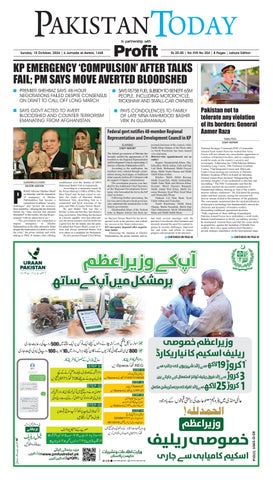
KP EMERGENCY ‘COMPULSION’ AFTER TALKS FAIL; PM SAYS MOVE AVERTED BLOODSHED Sunday, 18 October, 2026 | 6 Jumada al-Awwal, 1448
g
g
PREMIER SHEHBAZ SAYS 48-HOUR NEGOTIATIONS FAILED DESPITE CONSENSUS ON DRAFT TO CALL OFF LONG MARCH SAYS GOVT ACTED TO AVERT BLOODSHED AND COUNTER TERRORISM EMANATING FROM AFGHANISTAN
g
g
Rs 20.00 | Vol XVII No 204 | 8 Pages | Lahore Edition
SAYS RS75B FUEL SUBSIDY TO BENEFIT 65M PEOPLE, INCLUDING MOTORCYCLE, RICKSHAW AND SMALL-CAR OWNERS PAYS CONDOLENCES TO FAMILY OF LATE MNA MAHMOOD BASHIR VIRK IN GUJRANWALA
Federal govt notifies 48-member Regional Representation and development Council in Kp ISLAMABAD
STAFF REPORT
P
GUJRANWALA/LAHORE SALEEM JADOON
RIME Minister Shehbaz Sharif on Saturday said the imposition of emergency in Khyber Pakhtunkhwa had become a compulsion to address “security challenges” and “protect the economy from instability,” alleging that the elements behind the “long marches had planned bloodshed” in the country, leaving the government “with no option but to act.” “The government was compelled to impose emergency in Khyber Pakhtunkhwa as the talks ultimately failed despite the finalisation of a draft to resolve the crisis,” the prime minister said while talking to PML-N leaders after offering
condolences over the demise of MNA Mahmood Bashir Virk in Gujranwala. According to a statement issued by the Prime Minister’s Office (PMO), Shehbaz Sharif said he had visited to condole the death of Barrister Bashir Mehmood Virk, describing him as a committed and loyal associate of the party and PML-N leader Nawaz Sharif. He said Bashir Virk was like a brother to him and that they had shared a long association. Describing the deceased as a decent, capable, wise and sober person, the prime minister said his death was a great loss for his family and the party. He added that Nawaz Sharif, a man of vision, had always preferred Bashir Virk over others as a candidate for Parliament. He also praised Punjab Chief Minis-
The federal government of Pakistan has formally notified the appointment of 48 members to the Regional Representation and Development Council, representing 12 districts of Khyber Pakhtunkhwa (KP). According to the notification, the members were selected through consultations among local jirgas, or traditional tribal councils, held in all 12 districts with the support of deputy commissioners. The nomination process was handled by the Additional Chief Secretary of the Regional Development Secretariat, who forwarded the list to the KP chief secretary. Following further processing, the list was sent to the provincial governor, who submitted the nominations to the federal government. Shaukatullah Khan of the Tarkani tribe in Bajaur district has been ap-
ter Maryam Nawaz Sharif for her development work in the province and wished her success in her future endeavours. KP emergency imposed after negotiations failed Discussing the situation in Khyber Pakhtunkhwa, the prime minister said he
pointed chairman of the council, while Malik Khan Marjan of the Wazir tribe in North Waziristan has been named vice-chairman. District-wise appointments are as under: Bajaur: Shaukatullah Khan, Shahabuddin, Malik Sultan Zaib and Haji Lali Shah. Mohmand: Malik Fayyaz Khan, Malik Nadir Manan and Malik Sahib Khan Ambar. Khyber: Malik Abdul Razzaq, Malik Izzatullah, Malik Salahuddin, Malik Zahir Shah and Shireen Khan. Kurram: Munir Hussain Bangash, Malik Abdul Wali Khan, Malik Zameen Hussain, Syed Wali, Syed Mian and Ehsanullah Ehsan. Orakzai: Lal Man Shah, Syed Fakhr Abbas and Faizullah. North Waziristan: Malik Khan Marjan, Malik Nasrullah, Malik Haji Sher Muhammad, Mufti Misbahullah Khan and Malik Habib Khan.
had held several meetings with the province’s two former chief ministers and sincerely stressed the need for a united response to security challenges, improved law and order, and efforts to ensure progress and prosperity in the province.
Continued on page 03
Pakistan not to tolerate any violation of its borders: General Aamer Raza RAWALPINDI
STAFF REPORT
National Strategic Command (NSC) Commander General Syed Aamer Raza has warned that Army Forces will not tolerate any cross-border aggression or violation of Pakistan's borders, and no compromise would be made on the country’s security and sovereignty. Addressing the 154th Pakistan Military Academy Long Course, 39th Technical Graduate Course, 73nd Integrated Course and 28th Lady Cadet Course passing-out ceremony at Pakistan Military Academy (PMA) in Kakul on Saturday, General Aamer Raza declared "Safeguarding the territorial integrity of our motherland is absolute and unyielding." The NSC Commander said that the ceremony marked the successful completion of foundational military training at "one of the world's premier military academies". He felicitated the passing cadets and their parents, saying the occasion will forever remain etched in the memory of the graduates. The commander maintained that the rapid proliferation of disruptive technology has fundamentally altered the character and dynamics of modern warfare, dismantling traditional operational doctrines. "Fully cognisant of these shifting of paradigms, Pakistan Armed Forces have undertaken a swift multidomain transformation to fortify our military posture," he maintained. General Raza said that the recent shifts in geopolitics, against the backdrop of Middle East conflict, have once again underscored Pakistan's pivotal strategic importance on the international stage.
Continued on page 03
02 NEWS
Sunday, 18 October, 2026 | LAHORE
PAKISTAN EXPLORES SUKUK ISSUANCE, REFINANCING OF COSTLY DEBT AND INFRASTRUCTURE INVESTMENT WITH THREE UAE BANKS
F
PROFIT
NEWS DESK
INANCE Minister Muhammad Aurangzeb held separate meetings with delegations from Sharjah Islamic Bank, Abu Dhabi Commercial Bank and Ajman Bank on the sidelines of the World Bank Group–IMF Annual Meetings 2026 in Bangkok, discussing Sukuk issuance, debt refinancing, infrastructure investment and Pakistan's economic outlook. The discussions focused on replacing expensive short-term borrowing, extending debt maturities, reducing repayment concentrations and diversifying financing sources without increasing overall external debt. The finance minister highlighted improvements in Pakistan's fiscal and external indicators, stronger foreign exchange reserves, credit rating upgrades and progress under the IMF programme. He reaffirmed the government's commitment to macroeconomic stability, fiscal consolidation and sustainable export-led growth. Sharjah Islamic Bank During his meeting with the Sharjah Islamic Bank delegation, Aurangzeb discussed prospective Sukuk issuance, rupee-denominated dollar-settled instru-
ments, further Panda bond issuance and possible Eurobond tokenization. Both sides also discussed Multilateral Investment Guarantee Agency (MIGA)-backed financing and rising global funding costs. The bank reaffirmed its support for Pakistan and expressed readiness to participate in a Sukuk issuance. Aurangzeb outlined investment opportunities in refinery upgrades, power distribution privatization and airport outsourcing. The discussions also covered developing capital market benchmarks through financial institution issuances
Pakistan's banking deposits rise 16% to Rs40.83tr in September 2026 PROFIT
SADDAM HUSSAIN
Pakistan's banking sector deposits increased 16% year-on-year (YoY) to Rs40.83 trillion in September 2026, compared with Rs35.21 trillion in the same month last year, according to State Bank of Pakistan (SBP) data compiled by Arif Habib Limited (AHL). The banking sector's advances rose 14.3% YoY to Rs15.38 trillion from Rs13.46 trillion in September 2025, while investments increased 12.1% to Rs40.14 trillion from Rs35.82 trillion. On a month-on-month (MoM) basis, deposits grew 4% from Rs39.24 trillion in August, while advances increased 6% from Rs14.52 trillion. However, banking sector investments declined 2.5% MoM from Rs41.19 trillion recorded in August 2026. The advances-to-deposits ratio (ADR) stood at 37.7% in September, compared with 38.2% a year earlier, reflecting a decline of 54 basis points. On a monthly basis, the ADR increased by 69 basis points from 37% in August, indicating that advances grew faster than deposits during September. Meanwhile, the investment-to-deposits ratio (IDR) stood at 98.3%, down 342 basis points from 101.7% in September 2025. The IDR also declined by 664 basis points from 104.9% in August 2026, reflecting a reduction in investments relative to deposits. The latest figures show that banking sector deposits, advances and investments all recorded double-digit annual growth, although investments declined on a monthly basis. Despite the monthly improvement in ADR, the banking sector's investment-to-deposits ratio remained substantially higher than its advancesto-deposits ratio.
Pakistan's foreign direct investment rises 20% to $719.7m in first quarter of FY27 PROFIT
NEWS DESK
Pakistan's net foreign direct investment (FDI) increased 20% year-on-year (YoY) to approximately $720 million during the first quarter of FY27, compared with $600 million in the corresponding period last year, according to State Bank of Pakistan (SBP) data compiled by AKD Securities. In September 2026, net FDI stood at $219 million, up 18% from $186 million in the same month last year. However, investment declined 31% month-onmonth (MoM) from $316 million recorded in August. Country-wise data showed that Canada remained the largest source of net FDI during JulySeptember FY27, contributing $229 million, compared with $225 million in the corresponding period of FY26, an increase of 2%. China followed with $197 million, reflecting a 63% increase from $121 million in the same period last year. Investment from the United Arab Emirates rose to $55 million from $20 million, while inflows from Hong Kong declined 25% to $26 million from $34 million. Other countries collectively contributed $213 million during the quarter, compared with $200 million a year earlier, an increase of 6%. Sector-wise, financial businesses attracted the highest net FDI during the first three months of FY27, receiving $191 million, up 39% from $138 million in the corresponding period last year.
and expanding lending to businesses, small and medium-sized enterprises (SMEs) and the agriculture sector. Abu Dhabi Commercial Bank In his meeting with Abu Dhabi Commercial Bank delegation, the finance minister discussed capital market issuances and debt management measures aimed at replacing costly short-term borrowing and extending repayment maturities. He welcomed the bank's interest in several transactions, including restored Pakistan credit limits, participation in International Islamic Trade Finance Corporation (ITFC) financing, MIGA-backed
financing and an International Finance Corporation (IFC)-supported Diversified Payment Rights (DPR) transaction. Aurangzeb also highlighted investment opportunities in refinery upgrades, privatization, airport outsourcing, electricity transmission and the ML-1 railway project. Both sides explored data centre financing and digital finance, including the importance of competitive electricity pricing and an effective regulatory framework. The meeting also reviewed the economic impact of regional conflict, energy security and targeted relief measures, with follow-up to be coordinated through the Debt Management Office in the Ministry of Finance. Ajman Bank During discussions with Ajman Bank, Aurangzeb highlighted improvements in Pakistan's fiscal and external indicators and reaffirmed the government's commitment to economic reforms. The meeting covered prospective Sukuk issuances, rupee-denominated dollar-settled instruments and diversification of funding sources. The finance minister emphasized replacing expensive short-term debt, extending maturities and avoiding repayment concentrations without increasing overall external debt.
Pakistan showcases 20 tech companies at TechCrunch Disrupt 2026 to attract US investment PROFIT MONITORING REPORT
Pakistan showcased around 20 technology companies at TechCrunch Disrupt 2026 in San Francisco, seeking to attract investment, expand its international market presence and strengthen commercial partnerships with the United States. The companies participated through the Pakistan Pavilion at the three-day technology conference, held from October 13 to 15 at Moscone West, where they presented products and innovative solutions across various technology sectors.
Pakistan's Ambassador to the US, Rizwan Saeed Sheikh, visited the pavilion on Thursday and urged participating firms to use the opportunity to establish long-term commercial relationships and explore investment opportunities in the American market. According to a statement issued by the Pakistan Embassy in Washington, the ambassador assured the companies of support from Pakistani diplomatic missions in the US in developing business connections with American partners. He highlighted the capabilities of Pakistan's technology industry and called for stronger bilateral co-
operation in information technology, innovation and digital entrepreneurship. The ambassador also encouraged participating firms to promote Pakistan as a competitive and reliable partner in the global digital economy. During his visit, company representatives briefed him on their products, technological solutions and plans to expand operations in the US market. TechCrunch Disrupt brings together technology start-ups, entrepreneurs, software professionals, venture capitalists and industry leaders to explore investment opportunities and emerging technologies.
Pakistan's refinery margins reach around $30/barrel in Q1FY27 amid higher diesel spreads PROFIT MONITORING REPORT
Pakistan's oil refineries are estimated to have recorded gross refining margins (GRMs) of around $30 per barrel during the first quarter of FY27, supported by higher diesel spreads and expected inventory gains amid disruptions to global energy supplies. According to a research report by a brokerage firm, supply uncertainties linked to the US-Iran and Russia-Ukraine conflicts supported petroleum product margins during July-September 2026. The average crude oil procurement cost for import-dependent refineries, including freight and premiums, was estimated at approx-
imately $97 per barrel during the quarter. Diesel remained the primary contributor to refining margins, accounting for more than 45% of the industry's overall product slate. The average ex-refinery diesel price was estimated at $154 per barrel, resulting in a spread of approximately $55–57 per barrel. Petrol also supported profitability, with an estimated average spread of $25 per barrel. However, high-sulphur furnace oil (HSFO) continued to generate negative margins, with refineries expected to incur losses of approximately $25 per barrel on the product. The report also projected inventory gains for the first quarter of
FY27, following inventory losses recorded during the final quarter of FY26. Company-wise estimates showed that Attock Refinery Limited (ATRL) recorded the highest estimated GRM of around $40 per barrel, alongside projected inventory gains of Rs1.5 billion. National Refinery Limited (NRL) followed with an estimated GRM of $28.9 per barrel and anticipated inventory gains of Rs2.7 billion. Pakistan Refinery Limited (PRL) was estimated to have achieved a GRM of $26 per barrel, while Cnergyico PK Limited (CNERGY) recorded an estimated fuel GRM of $24.3 per barrel.
Pakistan considers dairy market liberalisation to target $2b exports by 2035 PROFIT
MONITORING REPORT
Pakistan is considering liberalising its dairy market and removing milk from the essential commodities list as part of proposed reforms aimed at attracting investment and increasing annual dairy exports to $2 billion by 2035. The proposals are contained in a policy framework titled Attracting Investment to Enhance Pakistan's Dairy Exports, prepared by the Planning Commission, Ministry of National Food Security, Food and Agriculture Organisation (FAO) and industry stakeholders under the URAAN Pakistan initiative. The framework targets $500 million in annual dairy exports by FY30 and $2 billion by 2035, with the private sector expected to lead investment, processing and export development. Pakistan is the world's fourthlargest milk producer, generating approximately 72 billion litres
annually, equivalent to around 7% of global production. However, the country recorded a dairy trade deficit of $37 million in 2024, despite the global dairy market being valued at $50 billion. According to the policy analysis, only 5% of Pakistan's milk undergoes formal processing, while most supplies pass through informal distribution channels. Low milk yields, inadequate processing facilities and price controls have also constrained investment and export competitiveness. The proposed reforms include reducing the tax on value-added dairy products from 18% to 5% and eliminating or capping import duties on dairy machinery, genetic material and feed ingredients at 5%. Licensed dairy farms and processing facilities could also receive agricultural electricity tariffs, while investment support has been proposed for cold-chain infrastructure, particularly solar-powered milk chillers. The framework recommends al-
lowing private dairy companies to organise small farmers into cooperatives and farmer entrepreneur groups, providing technology and training while purchasing milk through contracts based on agreed prices and quality standards. To address restrictions on international market access, the policy proposes a national digital animal disease surveillance and traceability system, alongside disease-free dairy zones in Punjab and Sindh accredited by the World Organisation for Animal Health. The policy also highlights the annual loss of approximately 1.5 million productive dairy animals and two million calves, which affects breeding capacity and livestock productivity. Other proposals include expanding sexed semen and embryo transfer facilities, allowing livestock to be used as collateral for smallholder loans and establishing Dairy Export Processing Zones linked to Karachi and Gwadar ports.
Pakistan to host Minerals Investment Forum on November 12–13 to attract foreign investment PROFIT
MONITORING REPORT
Pakistan is set to host the Pakistan Minerals Investment Forum 2026 (PMIF26) on November 12–13 at the Jinnah Convention Centre in Islamabad, bringing together international investors, mining companies and financial institutions to attract investment in the country's mineral sector. The forum, originally scheduled for April 8–9, will focus on mineral exploration, project development, technology, value addition and investment opportunities, with the $8.83 billion Reko Diq copper and gold project among the major developments underpinning Pakistan's mining ambitions. Federal Minister for Energy (Petroleum Division) Ali Pervaiz Malik has said the forum aims to promote sustainable investment and develop mineral resources that have remained largely unexplored. The event will feature discussions on geological exploration, resource assessment, remote sensing and geophysical technologies to support mineral development. Last year's forum attracted approximately 5,000 delegates from more than 50 countries, resulting in the signing of 16 memoranda of understanding and 18 panel discussions. The upcoming forum comes as Pakistan seeks to expand investment in critical minerals, including copper, gold and rare earth elements, amid growing international demand for materials used in electrification and advanced manufacturing. Pakistan has 92 known minerals, of which 52 are commercially exploited. Despite estimated mineral reserves valued at around $8 trillion, the mining sector has historically contributed less than 3% to gross domestic product. A major focus of Pakistan's mineral investment strategy is the Reko Diq project in Balochistan's Chagai district, jointly owned by Barrick Mining Corporation with a 50% stake, the Balochistan government with 25%, and three federal stateowned enterprises holding the remaining 25%. Through PMIF26, Pakistan aims to strengthen international partnerships, attract investment in exploration and processing, and develop its mineral resources into a larger source of exports and industrial growth.
SBP injects Rs3.03tr into banking system through conventional, Islamic OMOs PROFIT
NEWS DESK
The State Bank of Pakistan (SBP) injected a combined Rs3.025 trillion into the banking system through conventional and Shariah-compliant open market operations (OMOs) conducted on October 16, 2026. According to the central bank's auction results, the SBP accepted Rs2.665 trillion on a face-value basis through conventional reverse repo purchase operations and Rs360.5 billion through Shariahcompliant Mudarabah-based injections. In conventional OMOs, the central bank received bids worth Rs3.190 trillion and accepted Rs2.665 trillion across seven- and 14-day tenors. For the seven-day tenor, the SBP accepted Rs2.4 trillion against offers of Rs2.925 trillion at an annualised rate of return of 11.51%. For the 14-day tenor, the central bank accepted the entire offered amount of Rs264.75 billion at 11.54%. The conventional operations attracted 17 bids, all of which were accepted in full or in part. The SBP said Rs2.419 trillion had been offered at the seven-day rate of 11.51%, of which Rs1.894 trillion was accepted on a pro-rata basis. Separately, the SBP accepted the full Rs360.5 billion offered through Shariah-compliant Mudarabah-based OMOs. Of this amount, Rs70.5 billion was injected for seven days at an annualised return of 11.55%, while Rs290 billion was accepted for 14 days at 11.56%. The Islamic operations received five bids, comprising three for the seven-day tenor and two for the 14-day tenor, all of which were accepted. On a realised-value basis, the conventional liquidity injection amounted to Rs2.585 trillion, while the Shariah-compliant injection totalled Rs360.779 billion, bringing the combined realised value to approximately Rs2.946 trillion. The operations provided short-term liquidity to the banking system through both conventional and Islamic financing arrangements.
GEPCO proposes 50% increase in authorised share capital to Rs75b PROFIT
MONITORING REPORT
Gujranwala Electric Power Company (GEPCO) has proposed a 50% increase in its authorised share capital from Rs50 billion to Rs75 billion following directions from the Cabinet Committee on Privatisation, according to an official company notice. The proposal will be presented for shareholder approval at GEPCO's 34th Ex-
traordinary General Meeting (EOGM), scheduled for October 22, 2026. Under the proposal, the company's authorised share capital will increase from five billion ordinary shares of Rs10 each to 7.5 billion ordinary shares of the same value. The move follows directions conveyed by the Privatisation Commission through a letter dated September 25, 2026, as part of the company's ongoing privatisation process. If approved, the increase will require an
amendment to the capital clause of GEPCO's Memorandum of Association. The proposed resolution will also authorise the company's chief executive officer and company secretary to complete the necessary regulatory filings and other formalities with the Securities and Exchange Commission of Pakistan (SECP) and relevant authorities. The increase relates to GEPCO's authorised share capital, which sets the maximum
value of shares the company may issue. It does not necessarily involve an immediate issuance of new shares or an injection of fresh equity. The company has not disclosed any plans for issuing additional shares or raising capital under the proposed increase. The proposal remains subject to shareholder approval and completion of the applicable corporate and regulatory requirements.
NEWS 03
POWER CONSUMERS MAY FACE RS2.56 PER UNIT HIKE UNDER SEPTEMBER FUEL ADJUSTMENT
Sunday, 18 October, 2026 | LAHORE
E
PROFIT
AHMAD AHMADANI
LECTRICITY consumers may face an additional burden of Rs2.56 per unit under the September 2026 fuel charges adjustment (FCA). According to sources, the Central Power Purchasing Agency-Guarantee (CPPA-G) has sought an increase of Rs2.5624 per kilowatt-hour over the reference fuel charges of Rs7.4596 per unit for consumers of ex-WAPDA distribution companies (XWDISCOs). The National Electric Power Regulatory Authority (NEPRA) has scheduled a public hearing for October 29 to consider the request submitted by CPPA-G. If approved, the proposed adjustment
would increase the fuel charges component to Rs10.0220 per unit, adding to the financial pressure on households and businesses already struggling with high electricity bills and rising living expenses, sources said. Under the proposed adjustment, a consumer using 100 units a month would face an additional charge of Rs256.24, while those consuming 200 and 300 units would pay Rs512.48 and Rs768.72 more, respectively, before applicable taxes and other billrelated adjustments. The actual impact on individual bills would depend on the applicable billing treatment and the regulator's final determination. The proposed increase has not yet been approved and will be subject to NEPRA's determination after consideration of the submitted data and any objections raised by in-
terested parties. According to the data provided by CPPA-G, electricity generation during September 2026 stood at 13,217 gigawatt-hours (GWh), at a total cost of Rs123.618 billion, equivalent to Rs9.3532 per unit. After accounting for previous adjustments, the RLNG fuel-rate adjustment, sales to independent power producers and transmission losses, net electricity delivered to distribution companies amounted to 12,760 GWh. The generation mix included 2,155 GWh from imported coal at Rs17.2329 per unit and 1,327 GWh from local coal at Rs5.9946 per unit. RLNG-based generation stood at 804 GWh at Rs39.7372 per unit, while gas-fired generation contributed 1,066 GWh at Rs13.0414 per unit.
High-speed diesel-based generation amounted to 213 GWh at Rs62.1381 per unit, while furnace oil-based generation totalled 263 GWh at Rs44.8613 per unit. Nuclear generation contributed 1,893 GWh at Rs2.9045 per unit, while hydropower accounted for 4,834 GWh, or 36.58% of total generation. The CPPA-G data also showed a previous adjustment of Rs16.376 billion, equivalent to Rs1.2390 per unit, and an RLNG fuel-rate adjustment of minus Rs10.617 billion, equivalent to minus Rs0.8033 per unit. After the relevant adjustments, the net delivered electricity cost was recorded at Rs127.876 billion, or Rs10.0220 per unit. Under Section 31(7) of the NEPRA Act, 1997, and the monthly fuel price adjustment
FBR chairman orders time-bound procedure to expedite income tax refunds PROFIT STAFF REPORT
Federal Board of Revenue (FBR) Chairman Rashid Mehmood Langrial has directed officials to develop a timebound procedure for processing and issuing income tax refunds following concerns raised by the Karachi Tax Bar Association (KTBA) over delays faced by taxpayers. The directive was issued during a meeting between the FBR chairman and KTBA office-bearers. According to the KTBA, the association stressed that taxpayers complying with their tax obligations often have no clear indication of when excess taxes will be refunded. It called for timely settlement of both income tax and sales tax
refund claims. Responding to the concerns, Langrial instructed the relevant officials to formulate a time-bound mechanism to accelerate the processing and issuance of income tax refunds. The association also highlighted pending applications from taxpayers seeking to revise their income tax returns to claim refunds of taxes paid under Section 7E. It urged the FBR to ensure full implementation of instructions issued through a letter dated September 23, 2026, to address the outstanding applications. On matters concerning foreign investment, the KTBA called for simpler procedural requirements and consistent application of existing tax laws. It maintained that non-resident tax-
Pakistan not to tolerate any violation of its borders: General Aamer Raza CONTINUED FROM PAGE 01
"Our decisive role in restoring regional stability exemplified by the landmark Islamabad Accord which demonstrates our enduring commitment to peace and diplomatic de-escalation," he added. The NSC Commander warned enemies against any cross-border aggression, saying the country's stance "remains resolute and unambiguous". "There is no space of conflict or war in a nuclearized environment, and any miscalculation will be met with a response far beyond the imagination or calculation of the initiator," he added. He reiterated that Pakistan stood resolutely as a peace-loving nation, consistently prioritising restraint, dialogue and regional stability, saying the nation and its defenders rendered supreme sacrifices in the its pursuit. "However, let no adversary mistake our commitment to peace as weakness nor misinterpret our restraint as a lack of resolve. We will neither tolerate cross-border aggression nor any violation of our sovereign borders," the NSC Commander made it crystal clear to Pakistan’s enemies.
payers should not be subjected to compliance obligations beyond those expressly prescribed under the law, while unnecessary procedural burdens should be reduced wherever possible. The association also raised concerns about Sales Tax General Order No. 25/2026, which requires registered persons to issue prescribed stock transfer notes when moving goods between taxpayers' premises. FBR officials acknowledged the practical difficulties highlighted by the association and agreed to examine the matter through internal consultations. Another issue discussed was the retention of business equipment and records by tax authorities. According to the KTBA, the FBR chairman acknowledged the difficul-
ties faced by businesses when their equipment and records remain in official custody and emphasised that such items should be released at the earliest opportunity. The association further urged the tax authority to ensure due process before initiating coercive recovery proceedings for advance income tax. It called for taxpayers to be provided with a reasonable opportunity and sufficient time to fulfil their obligations before recovery measures are initiated. The KTBA also drew attention to delays in issuing notifications related to income tax returns, recurring technical problems on the FBR's IRIS portal and difficulties encountered by taxpayers and practitioners when uploading bulk data.
FBR implements faceless tax audit and assessment system from October 15 PROFIT STAFF REPORT
The Federal Board of Revenue (FBR) has implemented a new framework for conducting tax audits, assessments and related proceedings through the National Faceless Centre (NFC), effective October 15, 2026. According to SRO 1828(I)/2026, the FBR has enforced Chapter XX of the Income Tax Rules, 2002, while SRO 1825(I)/2026 brings Chapter VIAC of the Sales Tax Rules, 2006, into effect from the same date. The framework provides for electronic handling of tax proceedings, separation of official functions and quality-control reviews to improve transparency and procedural oversight. Under the income tax rules, the faceless mechanism applies to cases designated under Section 122E of the Income Tax Ordinance, 2001, rather than automatically covering every taxpayer. The covered proceedings include audits under Sections 177 and 214C, proceedings under Section 111 and assessments under Chapter X of the Ordinance. The rules require audit, assessment and qualitycontrol functions for the same case and tax year to be assigned to separate officers or units.
Notices, orders and other official communications must be generated through the FBR's computerised system and carry a Digital Identification Number (DIN). Taxpayers and their authorised representatives will be required to submit replies, supporting documents and evidence electronically through their designated IRIS accounts. The framework also allows physical verification through the Field Operations Wing where necessary, subject to authorisation. Cases may be transferred to another tax authority in specified circumstances requiring physical records, repeated verification or special handling. Audit reports, adjudication notices and assessment orders will undergo quality-control reviews under the prescribed procedures. The rules also cover proceedings relating to penalties under Section 182 and default surcharge under Section 205 of the Income Tax Ordinance. The new mechanism establishes a structured system for handling designated tax cases through electronic communication, independent assignment of functions and procedural reviews, while retaining provisions for physical verification where required.
Pakistan's industrial output grows 1.85% in first two months of FY27, falls 5% MoM in August LAHORE AGENCIES
Pakistan's large-scale manufacturing (LSM) sector recorded growth of 1.85% during the first two months of FY27, although industrial output declined 4.96% month-on-month in August 2026, according to provisional data released by the Pakistan Bureau of Statistics (PBS). The Quantum Index of Manufacturing (QIM) stood at 116.14 points during July-August FY27, compared with 114.03 points in the corresponding period of the previous fiscal year. For August alone, the index stood at 113.19 points, compared with 112.45 points in August 2025 and 119.10 points in July 2026. This represented year-onyear growth of 0.67% in August, alongside a monthly contraction of 4.96%. The provisional figures, compiled using the base year 2015-16, showed that growth in wearing apparel, petroleum products and automobiles supported overall manufacturing performance, while several major industries continued to contract. PETROLEUM, GARMENTS AND AUTOMOBILES DRIVE GROWTH Petroleum products recorded growth of 31.85% in August compared with the same month last year, while cumulative output during July-August FY27 increased 15.48%. The sector contributed 1.17 percentage points to overall LSM growth during the two-month period.
Wearing apparel production increased 10.85% year-on-year in August and 16.69% during July-August, contributing 2.85 percentage points to cumulative industrial growth. Automobile production rose 11.66% in August, while output during the first two months of FY27 increased 32.45%, contributing 1.20 percentage points to overall growth. Other transport equipment recorded growth of 26.95% in August and 37.04% during July-August, adding 0.27 percentage points to cumulative growth. Furniture production increased 73.47% year-on-year in August and 31.08% during the two-month period, contributing 0.43 percentage points. Wood products recorded the highest percentage increase among the growing sectors, with output rising 242.71% in August and 253.26% during July-August. The sector contributed 0.07 percentage points to overall growth. Tobacco production increased 10.11% in August and 22.35% during July-August, adding 0.37 percentage points to cumulative growth. Electrical equipment output rose 2.06% in August and 4.99% during the two-month period, contributing 0.13 percentage points. Fabricated metal products grew 7.07% in August and 10.31% during July-August, while rubber products increased 5.06% and 2.50%, respectively. Computer, electronic and optical products recorded growth of 4.91% in August and 5.15% during the first two
months of FY27. Non-metallic mineral products declined 4.93% in August but registered cumulative growth of 0.20% during July-August. Food, chemicals and pharmaceuticals weigh on output Food manufacturing declined 10.49% year-on-year in August, while cumulative production fell 8.86% during July-August FY27. The sector reduced overall LSM growth by 1.20 percentage points, making it the largest negative contributor during the two-month period. Chemical manufacturing contracted 12.93% in August and 10.78% during July-August, subtracting 0.89 percentage points from overall growth. Within the chemicals category, chemical products declined 20.36% in August and 16.83% during the twomonth period. Fertiliser production fell 9.00% in August and 7.55% during July-August, contributing a negative 0.40 percentage points to cumulative growth. Pharmaceutical output decreased 8.86% in August and 14.57% during July-August, reducing overall LSM growth by 0.86 percentage points. Iron and steel production declined 11.56% year-on-year in August and 11.48% during the first two months of FY27, subtracting 0.48 percentage points from overall growth. Textile manufacturing fell 2.80% in August and 2.98% during July-August, contributing a negative 0.52 percentage
points. Beverage production declined 7.79% in August and 7.21% during the two-month period, reducing cumulative growth by 0.37 percentage points. Paper and board output fell 5.41% in August and 5.72% during July-August, while leather products declined 0.30% and 0.88%, respectively. Other manufacturing, including football production, contracted 37.97% in August and 39.57% during July-August, subtracting 0.20 percentage points from overall growth. Machinery and equipment production increased 9.17% year-on-year in August but declined 4.27% during the first two months of FY27. Mixed performance across major industrial products PBS data showed that cotton yarn production increased 1.46% in August and 2.09% during July-August FY27. Cotton cloth production remained nearly unchanged, increasing 0.04% in August but declining 0.03% during the two-month period. Garments recorded growth of 10.85% in August and 16.69% during July-August. Cement production declined 3.52% in August but increased 1.26% during the first two months of FY27. Fertiliser production declined 9.00% in August and 7.55% during July-August, while iron and steel output fell 11.56% and 11.48%, respectively. Automobile production increased 11.66% in August and 32.45% during the two-month period.
mechanism, the regulator may adjust approved tariffs to account for variations in fuel charges, subject to the applicable legal framework and federal government policy guidelines. The requested adjustment will therefore be examined by NEPRA before a final decision is made. Sources also said that, under the federal government's policy guidelines for uniform fuel charges adjustments, the FCA determination for XWDISCO consumers would also apply to K-Electric consumers. The final determination could therefore have implications for electricity consumers beyond the ex-WAPDA distribution companies. NEPRA has invited interested and affected parties to submit objections at the public hearing.
KP emergency ‘compulsion’ after talks fail; PM says move averted bloodshed CONTINUED FROM PAGE 01
He said a collective approach was essential to counter terrorism emanating from Afghanistan and restore peace and stability. The prime minister said thousands of personnel from law enforcement agencies and the armed forces had laid down their lives fighting terrorism, while a large number of civilians had also fallen victim to terrorist attacks. He said previous long marches had damaged the national economy, disrupted exports and imports, and adversely affected people's lives. Alleging that the elements behind the long marches had planned bloodshed, Shehbaz Sharif said the government could not remain indifferent to such a situation and had been left with no choice but to take action. He said the government had constituted a committee that held negotiations for 48 hours, with consensus reportedly reached on a draft aimed at withdrawing the call for the long march. However, the negotiations ultimately failed, leading to the imposition of emergency to avert bloodshed, he added. The prime minister said the government could not remain a silent spectator in such circumstances, as doing so would amount to criminal negligence for which future generations would never forgive it. He maintained that the decision had been taken in the best interest of the nation. He added that an Advisory Council comprising capable and neutral individuals had been formed to oversee the affairs of Khyber Pakhtunkhwa. Rs75bn fuel subsidy to benefit 65m people The prime minister lauded the military and political leadership for enhancing Pakistan’s standing in the comity of nations and helping stabilise the economy. He said the situation in the Gulf region had triggered a worldwide wave of inflation. In response, the government, with the cooperation of parliamentarians and party workers, was providing fuel subsidies to 12 million citizens who owned motorcycles, rickshaws and cars with engine capacities of up to 800cc. The government would provide Rs75 billion in subsidies under the fuel relief scheme, he said, adding that 65 million people would benefit directly or indirectly from the initiative. PM VISITS VIRK FAMILY TO OFFER CONDOLENCES Separately, Prime Minister Shehbaz Sharif visited the residence of Rashid Bashir Virk in Gujranwala to offer condolences over the death of his father, MNA and former federal minister Mahmood Bashir Virk. According to a statement issued by the PMO, the prime minister expressed heartfelt sympathies to Rashid Bashir Virk and his family, praying that they be granted patience and fortitude to bear the loss. He said the services of the late Mahmood Bashir Virk to national politics would always be remembered. The prime minister also prayed for the departed soul to be granted a place in Jannat-ul-Firdous and for the bereaved family to be blessed with patience. Federal Minister for Law and Justice Azam Nazeer Tarar and Federal Minister for Information and Broadcasting Attaullah Tarar were also present on the occasion. CII CHAIRMAN CALLS ON PM Meanwhile, Chairman of the Council of Islamic Ideology (CII) Dr Allama Raghib Hussain Naeemi called on Prime Minister Shehbaz Sharif on Saturday. During the meeting, matters relating to the Council of Islamic Ideology were discussed.
04 COMMENT
Sunday, 18 October, 2026
Pak-US TieS afTer The Middle eaST ConfliCT
drain or haemorrhage?
T
Not only are Pakistanis migrating in huge numbers, they are the country’s best educated
More than just security and anti-terrorism
HE written answer to a Question presented by by Overseas Pakistanis Minister Ch Salik Hussain to the National Assembly indicates that the brain drain is more a haemorrhage, with 187,000 Pakistanis leaving for abroad, in search of employment opportunities and a better future. The answer said that those leaving included doctors, engineers, IT professionals, academics, and skilled and professional workers in other fields. Apart from the obvious loss of talent, which would have better contributed to the country, there is the question of what compensation Pakistan is getting from the host countries for educating all of these young people, often providing them highly technical and sophisticated education at great expense for a poor country. It should be remembered that the benefiting countries do not have a developed education system of their own, or face a shortage of indigenously trained professionals, so import our young people. Common to both is confidence that our graduates are attracted by more money. Too often, by the way, the attraction is not more money; rather it is money abroad, none here. Too often, the problem is not that the job here is worse, but that there is no job. The shortage of opportunities here is the first problem that must be solved. Then there is the question of what constitutes adequate compensation. There is only so much that can be sacrificed. What crops up with increasing frequency is that there is no merit in place, that jobs do not go to the deserving or the best qualified, but to the candidate with the weightiest recommendation. Also, those going abroad (as well as those who stay at home) have a common complaint: the arrogance of officialdom. This is related to, but not identical with, the first complaint. Being dealt with promptly and fairly at a government office is an experience as unfamiliar as it is rare. Then there is the matter of lifestyle. The impression created of a prosperous lifestyle has been created by the media, but it is not entirely false. However, it may be stressed that such a lifestyle is not available to most native Westerners, let alone immigrants. The option of converting our country into an ersatz West is perhaps the goal of the globalization project, but as our best talent must be sucked into the maw of the metropole, perhaps it will not be realized.
P
AKISTAN-US relations are entering a phase in which economics, technology, energy, critical minerals, counterterrorism and regional diplomacy are becoming increasingly interconnected. For decades, the bilateral relationship has often been viewed primarily through the lens of security, Afghanistan and counterterrorism. That framework is now being supplemented by a broader agenda centered on trade, investment, resilient supply chains and private-sector cooperation. The economic foundation of this relationship is already substantial. According to the US Trade Representative, total US trade in goods and services with Pakistan reached an estimated $11.5 billion in 2025, an increase of 14 percent from 2024. Goods trade accounted for approximately $8.5 billion, while services trade was around $2.9 billion. US goods exports to Pakistan reached $3.1 billion, while imports from Pakistan stood at $5.4 billion. These figures demonstrate that the relationship has a significant commercial base that can potentially be expanded beyond traditional sectors. Pakistan's demographic scale and geographic position further strengthen the case for deeper engagement. A large consumer market, a growing services sector and its location at the intersection of South Asia, Central Asia, the Middle East and the Indian Ocean provide multiple avenues for cooperation. For Washington, Pakistan can be relevant not only as a bilateral market but also as part of broader regional supply chains and connectivity networks. Technology represents one of the most promising areas. Pakistan's information and communication technology sector has expanded rapidly, with ICT services exports increasing 18.3 percent to $3.8 bil-
The central challenge is converting these areas of potential into transparent, commercially viable and mutually beneficial arrangements. If both sides can maintain sustained institutional dialogue and give greater space to the private sector
Dedicated to the legacy of late Hameed Nizami
Arif Nizami (Late) Founding Editor
M. A. Niazi
Babar Nizami
Editor Pakistan Today
Editor Profit
a
ASAD ALI
lion in FY2025, according to the State Bank of Pakistan. Software development, freelancing, IT-enabled services and digital entrepreneurship are creating new opportunities for Pakistan to integrate into international technology markets. For the USA, deeper engagement with Pakistan's technology sector could provide access to a large pool of skilled professionals and expanding digital businesses. For Pakistan, partnerships with US companies could facilitate technology transfer, investment, training and access to global markets. Business-to-business partnerships may therefore become as important as government-to-government initiatives. Another potentially significant area is critical minerals. Pakistan possesses substantial mineral resources, including copper, gold, iron ore, coal, chromite and lead-zinc. These resources have attracted greater attention as major economies seek to diversify supply chains for strategically important minerals. The USA has also placed increasing policy emphasis on resilient critical-mineral supply chains. In 2025, US bilateral engagement with Pakistan included commercial interests in sectors including critical minerals. The opportunity, however, is not simply about extracting minerals. Pakistan's greater economic benefit would come from developing exploration, processing, refining, infrastructure and associated manufacturing capabilities. US investment and technology could potentially contribute to these areas, while Pakistan could provide access to resources and regional markets. Such cooperation would require transparent contracts, predictable regulations, environmental safeguards and mechanisms that ensure local economic benefits. Energy is another area where the relationship could acquire greater depth. Pakistan's energy requirements are closely connected to its economic performance, industrial competitiveness and external financing pressures. US companies have historically been active in Pakistan's energy and other commercial sectors. Earlier US government assessments have identified energy, agriculture, consumer goods, communications and business services among areas of American investment. Future cooperation could increasingly involve renewable energy, energy efficiency, transmission infrastructure and technology. Security, nevertheless, remains an important component of the relationship. Pakistan has experienced enormous human and economic costs from terrorism, while the USA continues to have an interest
The writer is a freelance columnist
Editor’s mail
CPEC 2.0's Missing Number MUJTABA ARSHAD
TRUCK leaving Pakistan at Torkham in 2023 spent about 30 hours on the Pakistan side of the crossing, up from 24.2 hours a year earlier. Inbound trucks took 19.0 hours, up from 15.6. The crossing cost roughly $270 outbound and $183 inbound. These figures come from the CAREC Corridor Performance Measurement and Monitoring (CPMM) programme, supported by the Asian Development Bank, and they are unusual: few Pakistani trade routes have numbers like this in public. These are 2023 observations for one border crossing, not a measure of Pakistan’s current national performance, but they demonstrate the kind of routelevel evidence needed to assess trade facilitation. Torkham is not a CPEC project, and its trade flows are not a direct measure of CPEC performance. But it illustrates a wider challenge for Pakistan’s regional connectivity agenda: the country tracks infrastructure projects, while comparable public evidence on the time and cost of moving goods across individual routes remains harder to find. Building a road is one achievement; making the entire trade journey faster and more predictable is another. That matters because CPEC Phase II identifies regional connectivity as one of its five corridors. Its purpose is to strengthen Pakistan’s connections with regional markets and supply chains. The practical test is whether exporters and transporters can move goods more cheaply, quickly and predictably. A new highway cannot answer that question by itself. It would be wrong to blame customs alone. The CPMM case study lists nine agencies at Torkham, from Pakistan Customs and the National Logistics Cell to quarantine and anti-narcotics authorities. It also points to digital systems not fully integrated across them, cash payments for some fees, unreliable data connectivity, routine inspection of almost all consignments despite risk-management tools, sudden security closures, and little consultation with traders and freight forwarders. Each cause needs a different remedy. Lumped together as "delay", none can be fixed. Pakistan has not stood still. Pakistan Single Window has initiated a Time Release Study pro-
Send your letters to: Letters to Editor, Pakistan Today, 4-Shaarey Fatima Jinnah, Lahore, Pakistan. E-mail: letters@pakistantoday.com.pk Letters should be addressed to Pakistan Today exclusively
Stinking oversight
How much does it cost to cross Pakistan's borders?
gramme covering 18 trading ports, according to its FY2024–25 Annual Monitoring and Evaluation Report. The programme is planned to run from February 2025 to March 2028, in three phases. The report lists the study as ongoing. This is an important foundation, but it also highlights the need to translate measurement into action: route-level findings should identify the sources of delay, assign responsibility for corrective measures and allow progress to be tracked over time. My proposal is a Regional Connectivity Performance Framework. It is a way of joining up what exists, not a new bureaucracy. The framework should build on the existing Time Release Study programme and other available administrative data, while extending the analysis to the complete journey of a shipment where reliable information permits. Customs and the Single Window already time-stamp declarations, terminal systems record cargo movements, and CPMM offers a tested methodology. The framework would add a short survey of exporters, freight forwarders and transport operators, and report, for defined commodities on a defined route: border clearance time; waiting time by cause, where data allow; end-to-end shipment cost; variation in transit time, as a measure of reliability; system
CPEC 2.0 will be judged, in the end, by whether regional trade through Pakistan gets cheaper, faster and more predictable. At present we can say how many kilometres have been built. Can anyone say what a consignment pays, and how long it waits, to cross?
Lahore – Ph: 042-36300938, 042-36375965
in preventing transnational terrorist networks from operating across the region. Counterterrorism cooperation has consequently remained a practical area of bilateral engagement. Earlier US-Pakistan dialogues have focused on ISIS-K, TTP, border security, investigative cooperation and capacity building. The evolution of this security relationship is important because it can provide a foundation for broader strategic communication. Counterterrorism cooperation does not have to dominate the bilateral relationship, but effective coordination on shared security concerns can create greater confidence for engagement in economic and diplomatic areas. Regional diplomacy is another potential bridge. Pakistan's geographic position gives it interests in developments involving Afghanistan, Iran, the Gulf, Central Asia and the wider Indian Ocean region. At the same time, Washington has interests in regional stability, secure trade routes and the prevention of violent extremism. Diplomatic coordination does not necessarily require identical positions on every regional issue. Instead, sustained dialogue can help the two countries identify areas where their interests overlap. People-to-people relations provide an additional foundation. Educational exchanges, professional networks, Pakistani-American business communities, technology partnerships and academic cooperation have created enduring connections between the two societies. These relationships can support commercial diplomacy by linking universities, entrepreneurs, investors and professionals. Yet a broader relationship will require both countries to move beyond episodic engagement. Pakistan needs to improve regulatory predictability, strengthen investor protection, facilitate repatriation of profits, improve infrastructure and maintain consistent economic policies. These are important considerations for foreign investors, and previous US assessments have identified regulatory, taxation and intellectual-property issues as challenges for American companies operating in Pakistan. For Washington, sustained engagement will similarly require recognition that Pakistan's interests are broader than any single security issue. A durable relationship is more likely to emerge when economic, technological, diplomatic and security interests reinforce one another. The future of Pakistan-US relations, therefore, may increasingly be defined not by a single strategic issue but by a network of overlapping interests. Trade can support investment; investment can strengthen technology and manufacturing; technology can improve productivity; energy cooperation can support industrial growth; critical-mineral partnerships can connect Pakistan to emerging supply chains; and security cooperation can contribute to regional stability. The central challenge is converting these areas of potential into transparent, commercially viable and mutually beneficial arrangements. If both sides can maintain sustained institutional dialogue and give greater space to the private sector, Pakistan-US relations can develop a broader foundation— one in which economic opportunity and strategic cooperation are complementary rather than competing dimensions of the partnership.
i
Karachi – Ph: 021-32640318 i
outages and closures; operator experience; and, for every bottleneck found, a named institution and a deadline. I suggest a 90-day pilot at one crossing, selected after comparing verified cargo volumes, trade relevance, data availability and the feasibility of inter-agency coordination. Torkham offers a documented baseline, but a China-facing crossing may be more directly relevant to CPEC; the choice should be evidence-led rather than predetermined. In the first month, the government would designate a lead through the CPEC coordination machinery the Planning Ministry already runs, and FBR, the Single Window, the Commerce Ministry and border agencies would agree on common indicators. In the second, existing data would be collected and validated, supplemented by the survey. In the third, the main bottlenecks would be identified, corrective actions assigned, and a short diagnostic published. The diagnostic should distinguish administrative delays from infrastructure, security and other operational constraints, so that each proposed remedy is assigned to the institution with the relevant authority. This is a recommendation, not a government commitment. Most of it is administrative. Extending data-sharing to other agencies may need notification by the Single Window's Governing Council, which the Act empowers it to do. Commercial confidentiality and security restrictions will limit what can be published; aggregated figures may have to do. I would promise no percentage reduction in cost or delay until a baseline exists. CPEC 2.0 will be judged, in the end, by whether regional trade through Pakistan gets cheaper, faster and more predictable. At present we can say how many kilometres have been built. Can anyone say what a consignment pays, and how long it waits, to cross?
The writer is a Research Associate at the Centre of Excellence for CPEC, PIDE Islamabad – Ph: 051-2204545
i
THE Karachi chapter of the Arts Council of Pakistan has earned a reasonable reputation as a place where arts and culture are allowed to flourish and thrive. This is definitely good for society at large, and those running the show deserve due acknowledgment. However, the job is apparently so hectic, time-consuming and stressful that the administration is unable to find the time or the focus to keep its washrooms clean. I recently had the misfortune of visiting the place after several years in connection with a fund-raising event for a charity hospital in Karachi’s Koohi Goth area. The programme, which also featured an Urdu theater play, lasted a few hours. Visiting the washrooms, as such, was an inevitability that could not be put on hold beyond a limit. To call the smell merely ‘foul’ would be a rank understatement. All sorts of adjectives hit my senses the moment I stepped in. Pungent, acrid, putrid, acerbic, stinking and many more; all blended into one ‘Arts Councilish’ odour. It was noxious to the point of being obnoxious. I am sure the cause of arts and culture can still be served with clean and fragrant washrooms. All that the administration has to do is to at least try. Once it does, it will be surprised to know that the two targets are not mutually exclusive. Just try. DR SYED SHAH TALHA IQBAL KARACHI
karachi collapse
THE latest Economist Intelligence Unit’s Global Liveability Index has ranked Karachi 170th out of 173 cities. Sadly, this comes as no surprise to those of us who live here. I have travelled across Pakistan, and I can say with confidence that no other major city is in such a poor state. Karachi no longer feels like a city; it feels like a vast, neglected slum. Every day we deal with broken roads, garbage piling up, and water and electricity shortages. Despite all this, the Sindh government keeps making tall claims. But the truth is plain to see. The provincial government’s performance is all around us, and it is pathetic. Karachi has incredible potential, and its people are hardworking and resilient. We need serious action and real leadership before things get even worse. The recent Karachi ranking should be an eye-opener for the Sindh government. But I think this is something too much to ask. SAAD ALI KARACHI
Tax houdinis
IRRESPECTIVE of which political party, or dictator, happens to be at the helm of affairs at any given point in time, the targets of political economy have always overruled economic imperatives. Those who have the muscle and the clout continue to evade taxes under state patronage. Beyond rhetoric, no government has ever done anything concrete to make the elite pay taxes. To fill the gap, all that the governments have ever done is to impose indirect taxes, which is a way of passing on the burden to those who survive from pay-cheque to pay-cheque, and those who afford nothing more than two square meals a day and some level of basic education for their children. All through the subsequent year, they hear the usual pep talk of the ruling elite that justice would be done the next year. After all, someone has to make a sacrifice, and it seems it is their destiny to be the nation’s sacrificial lambs. The lower and middle classes of the country must be prepared to make sacrifices for the nation so that our non-tax-paying elite continue to lead their luxurious lifestyles, be beneficiaries of subsidised land allotments, play golf and, of course, spend their vacations abroad. MALIK TARIQ ALI LAHORE
Web: www.pakistantoday.com.pk
i
Email: editorial@pakistantoday.com.pk
A very surprise Trojan for Tehran Sunday, 18 October, 2026
N
COMMENT 05
Zarif scores more points than Pahlavi scion NAQI AKBAR
O day or a week passes in the major headlines, the X or any other media outlet that the war between Iran and the USA is about to resume in one way or another. Yet what is being observed is that there is an unwritten understanding or a truce; an unspoken intimacy of sorts between the prime stakeholders; the USA as well as the people who actually matter in the corridors of power in Tehran; that the resumption of war at the previous levels is unlikely to escalate. If it will escalate, it will happen when the avenues for that communication are exhausted, the street pressure is unmanageable and thirdly, the communication has lost its utility. Two weeks ago, in these very columns, it was discussed that the regime change operation in Iran could not apparently get it was supposed to do, the rapid collapse of the Theocratic government and the replacement of the so called ‘rogue’ infrastructure by the ‘compliant’ infrastructure, that is the reformists, in the position of power and influence. That could not happen as it could have ended the war in two or three weeks, depending upon how much time the invading military took in eliminating the regime figures. It is on record that while the administration figures were largely spared the direct strikes and the president and the foreign minister of the reformist administration have to invent narratives that they ‘barely escaped unhurt’ on so and so day. Likewise, the IRGC key commanders as
well as Ali Larijani were practically hounded and killed; which meant that the ground intel on these figures was provided by the individuals who would have wished for the change of the regime. There are similar accounts of Mujtaba Khamenei being hounded from one hospital to another through relentless air strikes; and the attack on members of the Experts Council or the ‘Leadership Council’. However, the results could not be achieved as expected. The column of that very page concluded that what the world bought in the end was a stalemate, stagflation and no end to the crisis. But the effort was still not without dividends for the regime change proponents. The intended end result for the complete project was the restoration of the previous monarchy, the Pahlavi dynasty; whose worldview fitted in well with what Washington and Tel Aviv think about Tehran. That did not happen, but what did happen, expressed in no uncertain terms by the US President, was the power gained by the reformists in the day-to-day management of Iran in the post-Khamenei period. In the early days of war with the street in complete support for the slain leader, there was no point or logic for the reformists to say anything which could make them suspect in the eyes of a large cross section of the public. The initiatives apparently taken independently by the Pakistani leadership, but actually orchestrated from Washington to the Presidency in Tehran, broke the stalemate for the reform camp. The president and the foreign minister, the front men for the Zarif administration, were able to create a weak support for the talks with the USA in a bid to do the follow-
The other way round, it can again be a quick escalation aimed at this time a complete regime changes with devastating repercussions for the Iranians. Given the fact that the number of stakeholders on the US side have increased on the back of regional developments; the pressure on Iran to make a deal like Camp David is as much as going for a decisive push precipitating a stalemate which is negotiated by Rezai; not Araghchi
M
ing; in their own agenda, normalization of relations with the USA, for the USA a foothold in Iran; with regime decapitation already done by the CENTCOM and IDF in the form of targeting the leader and the IRGC; the available administration willing rather desperate to talk with the USA in whatever way they can. As things stand, the possibility of war is weak on the count, despite the ‘radical tones’ of the few reformist office holders; the deliberate ‘positive signalling for normalization with the USA and possibly Israel’ is being done by the main reform leadership. A scroll through the wall of X/Twitter will reveal there have been intentional leaks of the conversations by the former FM and current force behind the reform camp in which scathing remarks were made against the political line taken by the late supreme leader. The video claimed that the diplomatic setup in Iran was nothing but what Zarif argued was the ‘extension of the Quds Force’. Similarly, the former president of Iran Khatami has argued without mincing words that ‘Iran has no right whatsoever to interfere with the affairs of the Palestinians. These statements, as the radicals predictably argue, are music to the ears of the key policymakers in Washington as well as Tel Aviv. Similarly, despite the red flag on negotiations argued by the new leader Mujtaba Khamenei and authenticated by the IRGC and the select elements in the corridors of power, who still subscribe to the worldview of the slain leader specially
the secretary of the Iranian National Security Council Mohsen Rezai; the reformists are still trying hard to sell their point of view to the Iranian public opinion. In a very recent comment by Zarif that the bombed place in Tehran which might have had the population supporting opening up with the USA, post air strikes, the same support might have evaporated. In a way the point of disagreement of the reform camp with the USA has been that it was ruining the prospects of any rapprochement. The analysis of that resurgence of emphasis not just on Islamabad MoU, but also a complete overhaul is the whispering of what the political analysts in Tehran and elsewhere suspect of a soft coup taking place. The supreme leader is very much intact, so is the IRGC and the Parliament. However, there is the failure of the parliament to discuss the MOU under articles 7577 of the Iranian constitution. Likewise, the preparedness of the armed forces is fast turning into the stalemate-triggered tiredness. No doubt every night data of Flight Radar 24 for the Middle East reveals that the preparedness of the US forces has not died down anywhere after the MOU. In fact many analysts argue that the level of refurbishment of war assets in the Gulf bases is indicative of another round of war or strikes against Iran. What is odd here is a somewhat different type of response observed from Tehran. The ‘Artesh’ or Army and the IRGC do not mince words to say that they are ready for the reply. However, it is a different atmos-
phere in the reformists’ camp; who are giving vibes of finally foregoing the regime key commitments; the issue of Palestine, gradual acceptance of the Abraham Accords on some later date and consequent surrender of the resistance. The reformist president and foreign minister would like the Islamabad MoU to take the centrestage, but are constrained by the hard fact that the daily intel dossiers from the IRGC and Artesh paint a different picture, which practically justifies combat readiness on the part of the Iranian military. As the month of midterm primaries November closes in, the US administration is under pressure to cough up results; that can be either a ‘Breaking News’ regarding an agreement; a lasting agreement reached with Iran; which in the Tehrani interpretation means surrendering the positions held by the republic since 1979; precisely the strategic signaling by the Reformist Elders; namely Zarif and Khatami, to convince the USA that Iran is ready for surrender. The other way round, it can again be a quick escalation aimed at this time a complete regime changes with devastating repercussions for the Iranians. Given the fact that the number of stakeholders on the US side have increased on the back of regional developments; the pressure on Iran to make a deal like Camp David is as much as going for a decisive push precipitating a stalemate which is negotiated by Rezai; not Araghchi. The writer is a freelance columnist
Why Morocco is deepening ties with Israel despite public anger NEW ARAB DANIEL LINDLEY
OROCCO’S recent elections took place amid widespread disillusionment with electoral politics. And, while general election ballots were still being counted, the Moroccan Front for Supporting Palestine and Against Normalisation was leading three days of action across 45 cities to demonstrate opposition to normalisation with Israel. The people clearly felt that the streets were a much better space to have their views heard, and possibly change their political reality. To understand Moroccan politics, the most important thing to know is that the King is still very much in charge. Although reforms following the 2011 Arab Spring gave the elected parliament some extra powers, the King still maintains executive authority over religious affairs, defence, foreign policy and national security matters. Therefore, different election results don’t necessarily signal change in Moroccan government policy on anything beyond traffic safety reforms. The clearest example is Morocco’s increasingly friendly relationship with Israel. Despite the latest Arab Opinion Index finding that 89% of Moroccans opposed recognition of Israel (with only 6% supporting it), the government has announced that Morocco and Israel will
W
upgrade their diplomatic relations to full embassies with ambassadors. To really rub salt into the wound, it was also announced that Israel’s office will be relocated to Mehdi Ben Barka Avenue. Ben Barka was a Moroccan revolutionary socialist leader whose kidnapping and murder in 1965 was recently revealed to have been a Mossad operation. Naturally, normalisation with Israel has provoked massive opposition among the Moroccan public, especially after the Gaza genocide. Even before the recent protests against normalisation, Moroccans have spent the past three years of Israel’s genocide in Gaza showing their solidarity with the Palestinians despite the risks of government repression. Already in October 2023, it was being reported that ‘hardly a day goes by’ without a rally for Palestine led by a coalition of leftwing parties, trade unions, civil associations and Islamist organisations. Emmanuel Macron couldn’t even visit Israel without a demonstration being held outside the French consulate in Casablanca denouncing “the criminal position of the French government, which supports genocide in Gaza.” The Moroccan security forces would forcibly break up a similar demonstration a year later, denouncing Macron for calling Hamas ‘barbaric’, with some activists requiring hospital treatment. Mobilisations for Palestine continued elsewhere across 2024. In September, a national day of action resulted in simultaneous
rallies in 50 cities demanding that humanitarian aid be allowed into Gaza. Meanwhile, students and university alumni organised the UM6P campaign to oppose normalisation with Israel in Moroccan universities, with specific opposition to ties with the Hebrew University of Jerusalem, known for its cooperation with the Israeli military. The mobilisations escalated further in 2025, when Israel’s violation of the first Trump ceasefire agreement brought tens of thousands onto the streets in some of the biggest protests Morocco had seen so far. The government was said to have ‘tolerated’ most protests; however, anyone who had “implicated the monarchy in their complaints” was liable to be arrested. The contradiction remains, however: the same public that shows such strong opposition to Moroccan foreign policy never utters even the mildest criticism of the monarch behind it. Morocco’s official line is to position itself as a ‘mediator’ between Israel and the Palestinians, making the defence that this alignment allows it to influence Israel in a positive direction rather than just being treated as an enemy state. However, since the recent Gaza genocide, almost nobody actually believes this. The more logical place to look for an explanation for Morocco’s warming towards Israel is Western Sahara, most of which has been illegally occupied by Morocco since 1975, despite the Polisario Front being recognised by the UN as its legitimate rep-
resentatives. The United States and Israel are two of only a handful of states that recognise Morocco’s de facto sovereignty over Western Sahara as ‘legitimate’. This took place in 2020 as part of Donald Trump’s Abraham Accords. The quid pro quo seems obvious here: Israel/the US recognise Morocco’s illegal annexation, and in return Morocco recognises Israel. It should be noted that, although illegal, Morocco’s occupation of Western Sahara is far less violent than Israel’s treatment of the Palestinians. The most crucial difference is that Western Saharans, including the indigenous Sahrawi people, are legally treated as Moroccan citizens by the government and are permitted to move across the territory and into Morocco proper should they wish. They are not reduced to stateless non-citizens with no rights like Palestinians are. Israel is also becoming an important supplier for the Moroccan military. According to the Jerusalem Post, Israel was the 3rd largest source of Moroccan military imports in 2019-23. These ties became public enough that in 2022 the Israeli military’s Chief of Staff even made an official visit to Morocco, though since the Gaza genocide they haven’t dared to be so brazen. In August 2025, Morocco also conducted training exercises using EXTRA guided rockets provided by Elbit Systems (Israel’s largest weapons manufacturer), giving them access to precision medium-range munitions. Morocco also agreed to a $500m deal with
Reading between the lines of Fukuyama’s memoir THE POINT MAGAZINE NOAH SWANK
HEN Fukuyama released a memoir last month, I expected that, thanks to my unusually violent exposure to his first book, I’d be able to sympathize with him like nobody else could. In fact, if the book has any central theme, it isn’t politics, or even Fukuyama’s life story. This is a book about hobbies. We learn in the second chapter that Fukuyama’s grandmother, Shizu Yokota, played piano and koto, and painted watercolors. His grandfather practiced calligraphy and horsemanship. His intellectual mentor, Allan Bloom, collected vinyl and CDs. The third chapter details Fukuyama’s lifelong experience woodworking, and the fifth gives us his thoughts on sports and music. The tenth is about art photography; the twelfth about woodworking again; the 25th about building computers. Some reviewers are perplexed by this choice of focus. Samuel Moyn quips that “chapters about his interest in photography and power tools do not quite compensate for the absence of any detail on the author’s
emotional life or personal relationships. But then, Fukuyama has always said that history’s afterparty would be boring.” It’s an easy book to misremember. The big thesis is, of course, that History is Over: liberal capitalism has proven itself to be, if not perfect, then better than any possible alternative at satisfying human needs. This being the case, there will never again be any titanic, life-consuming struggle between ideologies. However, the second half of the book— the “Last Man” half—intentionally complicates the triumphalist story. Liberal capitalism, Fukuyama argues, isn’t just the consummation of human progress since it satisfies our material needs. Drawing on the French philosopher Alexandre Kojève’s interpretation of Hegel, he contends that more than food, warmth or pleasure, we thirst after recognition, the approval of our society and our peers. Before reading the memoir, I assumed that Fukuyama was attuned to this particular neurosis of our time three decades out because he himself had felt the way utopia could make someone nostalgic for bloody, convulsing History. But the memoir gives little hint of this. The chapter after chapter of his memoir
that Fukuyama devotes to his hobbies are anything but a digression: they are his response to living “in the realm of the last man.” In one of the few stories from his childhood, he recounts finding his father’s stash of Playboy magazines. The centerfolds titillate the ten-year-old boy, but he finds himself drawn away to a glossy, full-page feature of high-end cameras.. After that anecdote, Fukuyama proceeds to lovingly recount the make and model of the cameras he’s owned over the years: a black Nikon F2a; a Leica M3; a Kodak Ektachrome E100. And then he finally sounds the elegiac note I had been expecting from the book: “unfortunately we’re at the end of a road for still photography, both on the hardware and creative sides. … It is hard not to believe that still photography as an art form has reached its own local end of history, with every conceivable innovation having been tried by someone over the years.” This seems to have saddened him more than the end of political history. Fukuyama does have political interests, of course. The chapters on arts and crafts are broken up with episodes from his intellectual development. Cameras are followed by French poststructuralism, which he spent the
early Seventies studying in Paris. The Yom Kippur War is ongoing at the time; Fukuyama notes that the oil embargo made for a frigid winter in Europe. The poststructuralists also left him cold. “My father had
Israel Aerospace Industries (IAI) to provide its Barak MX air defence system. Although this has not been publicly acknowledged, Reuters reported that Morocco will also purchase a $1 billion Ofek spy satellite from IAI to replace its existing satellites. Not only has Morocco become a close military ally of Israel, but it is also making itself increasingly dependent on Israeli systems and technological infrastructure in the long term, making it difficult for even an anti-normalisation government to reverse the trend. So what next for Morocco? So long as opposition is restricted to just expressing opinions against the treatment of the Palestinians, it’s likely that the government will continue to cosy up to Israel with impunity. This may even become more apparent if the United States continues to cut down on its forces in the region, leaving Israel as the more direct Western military outpost offering to protect local authorities from their own populations. A potential flashpoint for popular opposition will be the 2030 World Cup, which Morocco is co-hosting and is currently busy preparing infrastructure for. If it goes smoothly, it will likely boost Moroccan soft power. However, the recent storming of Ceuta, where 70,000 Moroccans were so desperate to get into Spain that 141 drowned themselves trying, is not a sign of a happy country.
Daniel Lindley is a writer and trade union activist in the UK.
once dismissed the kind of hyperintellectualized realm I had entered as ‘intellectual masturbation,’” he recalls, “and I began to see his point.” Determined to study something more relevant to the “great ongoing struggles,” he leaves for Harvard, to study under the political philosopher Harvey Mansfield. Mansfield, like Fukuyama’s other mentor, Allan Bloom, belongs to the intellectual tradition of Straussianism. More than any specific doctrine or set of ideas, Straussians are united by the practice of reading and interpreting the great books. Fukuyama climbed that Straussian social ladder quite high, which made it all the more admirable when he chose to break with the community over their support for the Iraq War. He remarks that many friends stopped talking to him after that. Still, he’s dismissive of theories that link Iraq in any essential way to Strauss’s ideas. And he’s equally dismissive of the argument—made by Samuel Huntington, among others—that the War on Terror represented some great civilizational struggle between the West and Islamism that disproved the End of History; Islamism, Fukuyama thinks, was never a serious contender. For his part, he seems quite content these days without any great civilizational struggles. And while reading In the Realm of the Last Man, I found myself forgetting why I ever felt otherwise.
06 newS
TRUmp waIveS key RUSSIa-RelaTed SancTIonS, TaRIffS befoRe They Take effecT UndeR new law
U
WASHINGTON AGENCIES
S President Donald Trump waived key Russia-related US sanctions and tariffs days before they were to take effect under a law he signed last month, including duties on the country's goods and penalties for buying its oil and gas. In an executive order released by the White House on Friday, Trump said the waiver was in the national interest of the United States. The law is meant to increase pressure on Russia for its invasion of Ukraine that began in 2022. Trump, however, has been warming toward Moscow while publicly criticising Ukrainian President Volodymyr Zelenskiy, including suggesting Kyiv needs a new leader. Weeks before US midterm elections in which Trump's Republicans are battling to maintain their narrow grip on both chambers of Congress, the new measures could have
Sunday, 18 October 2026 | LAHORe
risked further raising oil prices as Americans face increased costs largely attributed to the US-Israeli war on Iran, analysts have said. The legislation, whose primary backer in Congress was the late Senator Lindsey Graham, a South Carolina Republican, would have imposed tariffs of up to 100% within 30 days on all goods brought into the US from the five largest importers of Russian crude oil or gas, as well as on any country that knowingly bought oil or gas 30 days after the law was enacted or was among the top five countries helping Russia evade sanctions. The order said the waiver will remain in effect until Trump or his top officials determine that "further action is appropriate." Trump signed the Lindsey O. Graham Sanctioning Russia and Iran Act of 2026 in midSeptember. "I have submitted to Congress a certification that the issuance of such a waiver at this time is in the national interests of the United States," Trump said in the order. Countries such as China and India,
warned Washington that new tariffs could impact bilateral ties. The law allows the president to waive sanctions simply by informing Congress that he has determined that they are not in the national interest.
which are among the biggest buyers of Russian oil, have raised concerns about the Russia sanctions bill. Beijing has said it "consistently opposed long-arm jurisdiction that lacks a basis in international law" while India
US Representative Don Beyer, a Virginia Democrat, blasted Trump for the waiver, saying he was giving in to Russian President Vladimir Putin. "Trump's latest surrender to Putin again betrays our Ukrainian partners and defies clear congressional intent of legislation designed to punish Russia for its illegal war of aggression," Beyer said in a statement. Trump had also faced criticism from several US senators, including some Republicans, over a recent diesel deal with Russia in which Trump agreed to lift sanctions on Russian exports and Russia agreed to supply diesel to global markets in an effort to lower fuel prices. The lawmakers who criticised the deal said it would help fund Russia's war efforts. Putin's investment envoy, Kirill Dmitriev, called Trump's waiver "a truly historic moment," posting on X that the legislation could have effectively brought all economic cooperation between Russia and the US to a halt.
Croatian PM meets Chinese FM, calls for deeper bilateral cooperation ZAGREB
STAFF CORRESPONDENT
Croatian Prime Minister Andrej Plenkovic met with visiting Chinese Foreign Minister Wang Yi on Saturday, expressing Croatia's willingness to deepen cooperation with China in various fields and under the China-Central and Eastern European Countries (CEEC) cooperation framework. Wang, also a member of the Political Bureau of the Communist Party of China Central Committee, said China values its traditional friendship with Croatia and is willing to further elevate bilateral ties on the basis
of their comprehensive cooperative partnership. Wang noted China and CEEC have a practical need to
strengthen exchanges and advance cooperation. Such cooperation is fully open and transparent and helps advance
European integration, he said, adding that China stands ready to deepen cooperation in various fields within the framework with countries in the region willing to participate. China appreciates Croatia's positive attitude and hopes to use the 15th anniversary of the China-CEEC cooperation mechanism next year as an opportunity to revitalize mutually beneficial cooperation, Wang stressed. On China-EU economic and trade relations, Plenkovic said EU countries, including Croatia, have concerns about trade imbalances. He noted that the recent EU summit positively
assessed the consensus reached through the China-EU trade and investment consultation mechanism and called for continued communication and dialogue to properly address differences. Wang said China stands ready to strengthen dialogue with the EU in the spirit of equality and mutual benefit, jointly uphold free trade and promote an open and inclusive economic globalization. Wang also exchanged views with Plenkovic on the situation in the Western Balkans, saying China hopes regional countries will enhance understanding, rebuild trust and live in peace through dialogue.
China's proposed AI tech export controls aim to ensure safety, encourage open-source devt and sharing BEIJING
STAFF CORRESPONDENT
The proposed addition of 23 key AI technologies to China’s catalogue of technologies prohibited or restricted from export will ensure that AI remains safe and controllable while encouraging open-source development, cooperation and sharing, a spokesperson for China’s Ministry of Commerce said on Friday. Under the proposal, relevant technologies already in the public domain through open-source releases or academic publications would fall outside the scope of export controls, the spokesperson said. The remarks came as China solicited public comments on proposed revisions to its catalogue of technologies prohibited or restricted from export and introduced temporary measures requiring registration before the export of relevant technologies. The proposed revisions would add 23 key technologies related to large AI models, AI agents, computing clusters and information processing to the catalogue. The spokesperson said risks inherent in AI and those arising from its use have drawn widespread attention.
Six US lawmakers urge Rubio to raise India's crackdown on protesters WASHINGTON AGENCIES
Six US lawmakers, including Pramila Jayapal and Ilhan Omar, have urged US Secretary of State Marco Rubio to raise concerns with Indian officials over the excessive use of force, arbitrary detentions and restrictions on protests against the Special Intensive Revision (SIR) of electoral rolls and Chief Election Commissioner Gyanesh Kumar. The lawmakers, also including Jim McGovern, Rashida Tlaib, Eleanor Holmes Norton, and Jesus Garcia, accused Indian diplomatic missions in the United States of deploying photographers to monitor demonstrators showing solidarity with the Cockroach Janata Party (CJP) student movement. In a letter sent to Rubio on Friday, the lawmakers expressed concern over what they described as a pattern of repression, wrongful detention and excessive use of force against students and other protesters in Delhi and elsewhere in India. “We ask that you prioritize these subjects in discussions with your counterparts in India,” the letter said. Rubio is visiting India between October 17 and 22 and is scheduled to meet Indian External Affairs Minister S Jaishankar in Mumbai. The lawmakers cited the CJP protests against then Indian Education Minister Dharmendra Pradhan and the ongoing demonstrations seeking the resignation of CEC Gyanesh Kumar as examples of alleged use of excessive forces against protesters. They also raised concerns over the handling of protests since July, including reports of mass detentions in Mumbai. “Throughout the year, human rights organizations and reporters documented the use of tear gas, pellet guns, and batons by police and paramilitary forces against unarmed protesters in contravention of guidelines established by the Office of the United Nations High Commissioner for Human Rights and India’s own home ministry,” the letter said.
Iran backs 'political process' to resolve Saudi-Houthi conflict BAGHDAD
AGENCIES
Iranian Foreign Minister Abbas Araghchi said on Saturday that Tehran supports a “political process” to resolve the conflict between Saudi Arabia and Yemen’s Houthi rebels. The Houthis have repeatedly attacked Saudi targets, including energy facilities and Riyadh’s international airport, where 13 people were killed in a major attack last week. “We support an inclusive and comprehensive political process as the only practical and sustainable way to resolve the issue,” Araghchi said in a speech at the Organisation of Islamic Cooperation in Baghdad. Araghchi repeated Iran’s offer to mediate between the two sides. Deputy Foreign Minister Saeed Khatibzadeh previously said Riyadh has not responded to Iran’s overture. On Friday, Iran denied having anything to do with the Houthi attacks, after Saudi Arabia accused Tehran of encouraging the group’s escalation. In his speech, Araghchi also said “either we build security together, or we will endure insecurity together,” adding that Tehran was willing “to cooperate with all its brothers and neighbours to achieve the first option”. The Houthis have repeatedly at-
tacked Saudi airports, oil facilities and tankers after a truce in their long-running war with Yemen’s coalition government unravelled in July. On Wednesday, Yemen’s Houthi rebels said they had targeted facilities belonging to Saudi Aramco, after Saudi officials reported a strike on a building in Riyadh housing the energy giant’s operations centre. Powerful explosions also rattled the Saudi capital, as the coalition fighting the Houthis said it had intercepted a missile fired by the group towards Riyadh. On Tuesday, Saudi Arabia launched strikes on Houthi-controlled areas of Yemen, targeting fuel and energy facilities it said were
being used to support missile and drone attacks, as the Yemeni group threatened a “harsh and painful” response against Saudi airports, refineries and oil installations. Hours later, Saudi authorities issued warnings of potential hostile aerial threats in the kingdom’s eastern province and Riyadh. Loud explosions were heard near Saudi Aramco’s headquarters in Dhahran, according to witnesses. Later, a Saudi energy ministry official confirmed the attack. Saudi Arabia’s civil defence agency said that four people — two women, a man and a child — were wounded by debris from two intercepted Houthi cruise missiles in the capital and that 15 homes were damaged.
NEWS 07
Sunday, 18 October 2026 | LAHORE
CORPORATE CORNER
NUR-LEAD Faculty Development & Training Programme Concludes
LAHORE STAFF REPORT
The NUR-LEAD, Leadership in Education & Academic Development Programme, a five-day faculty development and training initiative organised by the Institute of Faculty Development, NUR International University (NIU), concluded with a closing ceremony at Fatima Memorial Hospital. The programme brought together national and international academic experts for focused training sessions and discussions on contemporary teaching practices, academic leadership, and the evolving demands of higher education.The closing ceremony was attended by Mrs. Shahima Rehman, Founding Chairperson, Board of Governors, NUR International University; Salem Rehman, Vice Chancellor, NIU; Prof. Dr. Farooq Anwar, Pro Vice-Chancellor, NIU; Prof. Dr. Tayyab Abbas, Principal, Schools of Health Sciences, NUR-FMS; and Mansoor Jamal Butt, Group Head Operations, NUR-FMS, along with Vice Chancellors and Rectors of other universities in Lahore.The first four days of the programme were held at NUR International University, featuring training sessions led by national and international experts to strengthen faculty capacity and professional practice. Key areas included Outcome-Based Education, innovative teaching methodologies, Artificial Intelligence and the future of healthcare, entrepreneurial thinking, research, quality education, and educational innovation. A dedicated discussion on women, entrepreneurship, and Islam was also held as part of the programme.
CCP’s Bid-Rigging Detection System Featured in Stanford Global Antitrust Report ISLAMABAD
STAFF REPORT
Pakistan’s initiative to use artificial intelligence and advanced data analysis to detect cartels in public procurement has received international recognition, with the Competition Commission of Pakistan’s Bid-Rigging Detection System (BRDS) featuring in the Computational Antitrust Worldwide: Fifth Cross-Agency Report, published by Stanford Computational Antitrust.The report brings together first-hand accounts from 30 competition authorities and examines what computational tools have enabled agencies to achieve that would otherwise have been difficult—or impossible—through conventional enforcement methods. The report explains how BRDS is designed to transform the detection of collusive tendering in Pakistan from a largely complaint-driven and manual process to proactive, systematic and data-led market surveillance.The initiative assumes particular significance as Pakistan is estimated to spend around 15–20 percent of its Gross Domestic Product—approximately $60 billion annually—on the public procurement of goods, works and services. Historically, the scale and fragmentation of procurement data, coupled with the absence of automated links to corporate ownership records, made it difficult to identify sophisticated patterns such as bid rotation, cover bidding and relatedparty participation across multiple tenders.BRDS has reached an advanced stage of development and pre-deployment preparation. Understandings have been reached with Public Procurement Regulatory Authority, provincial procurement authorities and SECP for the implementation of the system.
Zong Wins Gold in Creative Excellence at Dragons of Asia Awards 2026 in Kuala Lumpur ISLAMABAD
STAFF REPORT
Zong, Pakistan’s leading Technology Services Enterprise, has won Gold in Creative Excellence for its AI-powered 5G launch campaign at the Dragons of Asia Awards 2026. The international recognition builds on Zong's success at the Dragons of Pakistan Awards earlier this year and places the brand's work among the region's best in marketing and communications.The winning entry, AIsa Hai Future, blended artificial and augmented intelligence with Pakistani creativity, reimagining the nation’s digital future through a distinctive, customer-focused brand narrative. The recognition also reflects Zong’s evolution as a future-focused, AI-driven digital brand. By combining technology, innovation and data-led insights, Zong continues to develop more relevant customer experiences and strengthen its approach to brand communication thus engaging customers more meaningfully. By earning Gold against regional competition, Zong has demonstrated that Pakistani brands can deliver internationally recognized creative work when they combine a clear brand purpose with a genuine understanding of their audiences.Commenting on the achievement, Hina Ali, Head of Marketing Communication at Zong, said: “Winning Gold in Creative Excellence at the Dragons of Asia Awards is a proud moment for Zong. We believe great creativity begins with understanding people: what matters to them, what resonates with them, and how our brand proposition can become meaningful in their lives.
CM MARYAM VOWS DECISIVE GOVERNANCE, SAYS PUBLIC SERVICE DEMANDS COURAGE, INTEGRITY
P g
PUNJAB CM SAYS TIMELY DECISIONS CAN TRANSFORM MILLIONS OF LIVES, VOWS TO RESIST PRESSURE AND RECOMMENDATIONS LAHORE
SALEEM JADOON
UNJAB Chief Minister Maryam Nawaz on Saturday said public service required timely decision-making, professional integrity and the courage to take risks, asserting that she remained undeterred by criticism despite receiving more criticism than praise. “Every decision taken by the chief minister can bring a change in the lives of millions of people,” she said while addressing a delegation of the Sindh Common Training Programme at the Chief Minister’s House here on Saturday, according to a statement issued by the Chief Minister’s Office (CMO). The chief minister said the responsibilities of the chief minister’s office were demanding, with new challenges emerging every day. She stressed that public officials could not afford to waste time, as punctuality and efficient decision-making were essential to effective governance. “I proudly say that I am made in Pakistan, educated in Pakistan and live in Pakistan,” she said, urging public servants to recognise their responsibility towards a country that had invested in their education, identity and professional development. She emphasised that personal feelings should not influence professional decisions, particularly for those holding positions of
authority. Officials must understand what decisions were required and take them at the appropriate time, she added. Reflecting on her political journey, Maryam Nawaz said she had never held an elected office before becoming chief minister and had worked hard to reach her current position. She said public interest must take precedence over personal considerations, adding that she did not entertain recommendations regarding the appointment of senior officials. Citing the Apni Chhat Apna Ghar housing programme as an example of the government’s commitment to public welfare, she said the initiative had received
the UN-Habitat Scroll of Honour in Muscat for its rapid implementation and sustainable, low-cost housing model. She said more than 200,000 housing loans had been disbursed within 18 months and 125,000 houses completed under the scheme. With a recovery rate of 99.9 per cent and no defaults, the programme demonstrated the importance of accountability, she said, adding that the government had introduced checks and safeguards because the money being spent belonged to the public. Maryam Nawaz said more than 100 schemes were under way across Punjab and urged citizens to place their trust in
Vibrant Bengali Music and Dance Captivate Islamabad as Pakistan, Bangladesh Strengthen Cultural Ties ISLAMABAD
STAFF REPORT
Captivating performances of Bengali music and dance by a 15-member Bangladeshi cultural troupe brought the rich artistic traditions of Bangladesh to life at the Pakistan National Council of the Arts (PNCA) in Islamabad on Saturday, celebrating the enduring cultural connections between Pakistan and Bangladesh and highlighting the role of artistic exchanges in bringing people closer. Federal Minister for National Heritage and Culture Aurangzeb Khan Khichi attended the vibrant cultural evening as Chief Guest. The event was also attended by Bangladesh High Commissioner to Pakistan Md. Iqbal Hussain Khan, Secretary National Heritage & Culture Division Asad Rehman Gillani, members of the diplomatic corps, senior civil and military officials, media representatives, students and members of the community from the both sides. Welcoming the visiting artists, Federal Minister Aurangzeb Khan Khichi said cultural exchanges provide a meaningful platform for people to understand one another, appreciate diverse artistic traditions and strengthen mutual respect. He expressed the hope that the visit would encourage artists from Pakistan and Bangladesh to visit each other’s countries, share creative experiences and build stronger cultural and people-to-people connections. He said that the Ministry was keen to welcome the Bangladeshi troupe and meet the High Commis-
sioner, underscoring the importance attached to strengthening bilateral engagement through culture. Secretary National Heritage & Culture Division Asad Rehman Gillani welcomed the delegation and appreciated the dedication of the artists in presenting Bangladesh’s cultural heritage. He observed that such exchanges create opportunities for artists and cultural institutions to share experiences, inspire young performers and preserve traditional artistic practices. He also acknowledged the cooperation of the Bangladeshi counterparts, diplomatic representatives, PNCA management and technical teams in organizing the programme. Bangladesh High Commissioner Md. Iqbal Hussain Khan highlighted the historical and cultural connections between the two countries, reflected in their music, literature and shared regional traditions. He expressed gratitude to the Government and people of Pakistan for warmly welcoming the visiting artists and emphasized the importance of cultural initiatives in strengthening relations between the two peoples. The nearly two-hour programme featured a colourful blend of group dances, solo vocal performances and group songs, earning enthusiastic applause from a packed auditorium. Solo vocal performances were presented by Peal Hassan, Md. Isha Khan Ethun Babu, Mohammad Jamal Uddin Naser and Naznin Chaudhary. Dance performances featured Farhana Chowdhury, Abdur Rashid Swapan,
Mehbooba Mahnoor Chandni and Golam Mostafa, accompanied by musicians Raju Ahmed Chowdhury on tabla, Md. Rahat Ahmed Hasan on synthesizer, Md. Iqbal Hossain Khondaker on guitar and Shourov Saha on octapad. Most members of the delegation were visiting Pakistan for the first time and expressed happiness at the opportunity to experience the country’s hospitality and cultural environment. During their visit, the delegation toured the Department of Archaeology and Museums (DOAM) and Faisal Mosque, and other places expressing admiration for Islamabad’s beauty and cultural landmarks. The visit provided an opportunity for the artists and officials to experience Pakistan’s heritage and further deepen mutual understanding. On the sidelines of the cultural evening, Federal Minister Aurangzeb Khan Khichi inaugurated a solo art exhibition by acclaimed Bangladeshi artist Md. Abdus Sattar organized at PNCA’s photography gallery, adding another dimension to the celebration of Bangladesh’s artistic heritage. Later, the Embassy of Bangladesh hosted a dinner reception in honour of Federal Minister Aurangzeb Khan Khichi, Secretary Asad Rehman Gillani, other ministry officials and the visiting cultural troupe. The reception provided an opportunity to exchange views on the longstanding historical and cultural connections between Pakistan and Bangladesh and the positive momentum in their bilateral relations.
NCCIA DG holds meeting with additional director Islamabad to review cybercrime complaints ISLAMABAD STAFF REPORT
Director General National Cyber Crime Investigation Agency (NCCIA) Syed Ali Nasir Rizvi on Saturday held a meeting with Additional Director Islamabad Muhammad Shoaib Khan to review ongoing operations and measures for the timely resolution of cyber-
crime complaints. An NCCIA official told that the meeting discussed the agency’s professional matters, ongoing initiatives and steps being taken to ensure effective action on complaints related to cybercrime. During the meeting, the DG Rizvi stressed the need for prompt attention to public complaints and timely resolution of problems faced
by citizens. He also emphasized further improving measures against cybercrime and ensuring an effective response to complaints received by the agency. Rizvi directed that public grievances be addressed without unnecessary delay and that efforts to improve the agency’s performance in handling cybercrime cases be strengthened.
BISP organise training and awareness session on digital payment system in Sindh
KARACHI: The Benazir Income Support Programme (BISP), in collaboration with UNICEF Pakistan’s Social Policy Section, organized a provincial-level training and awareness session for BISP field staff in Karachi to facilitate the implementation of its new Digital Payment System.Addressing participants, Additional Secretary BISP Dr. Asmat Nawaz emphasized that staff preparedness and direct communication with women beneficiaries are essential for the system’s successful implementation. He said that while various media platforms are important, direct person-to-person communication is the most effective way to guide beneficiaries. Field staff actively participated, raised relevant questions, and developed a better understanding of the digital payment procedures and how to communicate them effectively to women beneficiaries. Under the 1LINK interoperability system, women beneficiaries can withdraw payments from any authorized retailer of any partner bank anywhere in Pakistan, at any time, seven days a week, after receiving the payment confirmation SMS. Dr. Asmat Nawaz appreciated UNICEF Pakistan’s valuable collaboration and continued support in strengthening BISP field teams.The session was attended by Director General Operations and Monitoring Adnan Ghuman, Director General Sindh Sanaullah Rind, Director Payment Faisal Aslam, Director Media Qurat ul Ain Fatima, Director Central Zone Waqar-un-Nisa, Deputy Director Training Dr. Qurat ul Ain, and other senior officials, consultants, and BISP field staff from the Sindh Region. STAFF REPORT
the government, describing the relationship between the state and the people as a “new social contract”. She reiterated that merit was the guiding principle in the appointment of district police officers and deputy commissioners, saying she personally interviewed candidates for key positions and resisted political pressure and recommendations. Emphasising the need for a citizencentred state, she said people in need should not be forced to stand in queues or repeatedly visit government offices to obtain assistance. Instead, the state should reach out to them and ensure that essential services were accessible.
DC orders improved care, education and healthcare for children at CPWB LAHORE
STAFF REPORT
Deputy Commissioner Muhammad Ali Ejaz on Saturday visited the Child Protection and Welfare Bureau (CPWB) Lahore to review the standard of facilities, including accommodation, food, education and training provided to orphaned, destitute and vulnerable children residing there. Chief Officer Metropolitan Corporation Lahore Kaleem Yousaf, Assistant Commissioner Shalimar Rabia Altaf and representatives of allied departments accompanied him during the visit. The DC inspected various wards, the nursery, play area and other sections of the bureau and reviewed cleanliness arrangements. He also interacted with the children and inquired about their well-being. During the visit, he directed the relevant officials to ensure high standards of care, food and accommodation for the children. He stressed the need to further improve the nursery and play area to provide a conducive environment for children’s recreation, learning and development. He also directed the officials to maintain cleanliness across all sections, utilise available resources for quality education and training, and ensure the effective functioning of the children’s healthcare and medical examination system. The DC further emphasised effective coordination among the relevant departments and called for transparent and regular monitoring of welfarerelated activities. On the occasion, DC Muhammad Ali Ejaz said the care, protection and proper upbringing of orphaned and vulnerable children were among the state’s foremost responsibilities. He said providing children with a safe future, quality education and a healthy environment remained a top priority.
Ufone achieves global recognition at Dragons of Asia 2026
ISLAMABAD STAFF REPORT
Pak Telecom Mobile Limited (PTML), through its brand Ufone 5G, has won two awards at the Dragons of Asia Awards 2026, including a Gold Dragon in the hotly contested ‘Best in Media’ category for its ‘Super 5’ campaign, and a Black Dragon in the ‘Marketing Discipline’ category for ‘Babar Azam’s Lost Phone’ campaign. Ufone was the only telecom brand from Pakistan to win a Gold at the prestigious awards.The Dragons of Asia recognize excellence in results-driven marketing communications across the region, and celebrate campaigns that combine strategic insight, creative thinking and effective execution. Ufone’s double win underscores its ability to translate consumer insights into compelling brand experiences that resonate with audiences.Built around Ufone’s Super 5 package, which enables customers to share data, calls and SMS with four friends or family members, the Gold-winning campaign brought together comedian and television host Tabish Hashmi and former Pakistan cricket stars Younis Khan, Shoaib Malik, Abdul Razzaq and Saeed Ajmal, all members of Pakistan’s 2009 ICC T20 World Cup-winning squad.Launched in February 2026, the campaign sparked public curiosity through teaser videos on social media in which the cricketing legends hinted at a mysterious “selection”, prompting speculation about a possible return to the game. The eventual reveal through the ad campaign turned the premise on its head by showing the players competing for a place in Tabish Hashmi’s own Super 5 group.
FAZL CALLS FOR PARLIAMENTARY DEBATE ON TERRORISM AS MINISTERS HIT BACK
Sunday, 18 October, 2026
PRAYER TIMINGS
NEWS
J
LAHORE
STAFF CORRESPONDENT
AMIAT Ulema-i-Islam-Fazl (JUI-F) chief Maulana Fazlur Rehman on Saturday said his party’s criticism of the country’s security situation was aimed at government policies rather than state institutions, describing allegations levelled against him by federal ministers as character assassination. Addressing a press conference in Lahore, Fazl called for an in-camera parliamentary session to review the security situation and develop a consensus-based strategy to combat terrorism. He urged the government to engage political parties in the process instead of ridiculing their leaders. “Our only question is why the country has failed to eliminate terrorism. Let us sit together and find out why,” he said, adding that Parliament was the appropriate forum to discuss the issue and make decisions. Fazl argued that criticism of government policies was intended to bring about corrective action and should not be interpreted as an attempt to undermine the sacrifices made in the fight against terrorism. “If Parliament is supreme, why are decisions taken in Rawalpindi while Parliament is simply told to follow them?” he
asked, alleging that the government was implementing decisions made elsewhere. He maintained that the public should be taken into confidence over the country’s security policy. If citizens were expected to support the fight against terrorism, the government needed to explain its decisions rather than impose what he called unilateral measures. The JUI-F chief also reiterated his opposition to the imposition of emergency rule in Khyber Pakhtunkhwa or any other part of the country. Recalling his family’s opposition to emergency rule
Two Police personnel martyred in terrorist attack on patrol team in Naseerabad NASEERABAD
STAFF REPORT
Unidentified terrorists opened fire on a police team, martyring two police personnel within the limits of the Sadar police station in Naseerabad. According to police, the attackers targeted the team on the Bedar Bridge, martyring Head Constable Ahmed Khan and Constable Abdul Malik on the spot. The local Deputy Superintendent of Police (DSP) stated that the officers were on patrol when they came under fire. The terrorists managed to escape from the scene, while police have cordoned off the area to search for the culprits. Authorities have also registered a First Information Report (FIR) against the unidentified attackers. Earlier in May this year, at least nine policemen were martyred in a terrorist attack in the Mangi Phase III area of Quetta, Balochistan. According to the Deputy Commissioner, an exchange of fire between security personnel and the terrorists continued throughout the night. Police officers fought the attackers for several hours before the assault came to an end. The deputy commissioner of Ziarat said police personnel put up strong resistance and continued battling the terrorists overnight. He also added that a hunt for the missing five policemen was also underway. Further details about the attack and any subsequent security operation are awaited.
Former Khyber Pakhtunkhwa CM Ali Amin Gandapur under police custody ISLAMABAD
STAFF REPORT
Former Khyber Pakhtunkhwa chief minister and Pakistan Tehreek-e-Insaf (PTI) leader Ali Amin Gandapur has been taken into custody by law enforcement agencies. A hearing was held at Islamabad’s District and Sessions Courts in the audio leak case registered against Gandapur at Golra Police Station. During the hearing, his lawyer formally informed the court that Gandapur had already been arrested, making his appearance impossible. The case was heard by Additional District and Sessions Judge Hakim Khan Bhakar. At the outset, Raja Zahoor Advocate appeared before the court on Gandapur’s behalf. Co-accused Farooq also appeared before the court. Defence lawyer Raja Zahoor told the court that Gandapur had intended to appear in court today in compliance with the law, but was unable to do so because he had already been arrested. During the hearing, Raja Zahoor argued that since the accused was already in custody, issuing arrest warrants again would serve no administrative or legal purpose.
in Balochistan during the 1970s, he said his father had resigned when the government of Zulfikar Ali Bhutto imposed the measure in the province. Fazl described the recurrence of such measures as unfortunate, noting that the Pakistan Peoples Party had repeatedly been associated with their imposition. Questioning the rationale for the emergency, governor’s rule and deployment of troops in KP, he asked why the province was being subjected to such measures when Balochistan was also facing a comparable, if not worse, level of
terrorist violence. He also questioned the government’s engagement with the Pakistan Tehreek-iInsaf (PTI), which had governed KP, when ministers were accusing the party of supporting terrorists. He noted that both sides had said they reached a consensus during negotiations. Fazl said around 250 JUI-F workers had been killed in terrorist violence and rejected allegations that his party supported terrorism. “How can a party whose members have laid their lives be accused of supporting terrorists?” he asked. He also questioned why he was being singled out for criticism, pointing out that political leaders, including former prime minister Nawaz Sharif, had disagreed with the military leadership at various times. The controversy followed remarks by Interior Minister Mohsin Naqvi on Friday, when he said, without naming anyone, that a political party chief was “extremely upset” over not being appointed governor of KP. The comments came after Fazl accused the federal government of depriving provinces of their rights and questioned its justification for imposing governor’s rule on the grounds of insufficient cooperation in counterterrorism efforts.
Security forces repel Afghan Taliban firing along KP border, several posts destroyed ISLAMABAD
STAFF REPORT
Security forces effectively responded to unprovoked firing by Afghan Taliban personnel in Khyber Pakhtunkhwa’s Upper Kurram and Ghuzgarhi sectors, with several Taliban personnel reportedly killed in the retaliatory action, state media reported on Saturday. PTV News and the state-run Associated Press of Pakistan (APP), citing security sources, reported that Afghan Taliban forces opened fire in the Taldah sector of Upper Kurram to “facilitate the movement of terrorists” into Pakistan across the border. The Pakistan Army responded with heavy weapons, destroying several Afghan Taliban positions and forcing their personnel to abandon the posts, PTV News reported. Separately, APP quoted security sources as saying that several Afghan Taliban personnel were “reportedly killed during the Pakistan Army’s retaliatory action
along the Ghuzgarhi border”. According to the sources, the army also targeted the Afghan Taliban’s Topsar border post and Shipola base camp in the Upper Kurram sector with artillery fire, reportedly destroying the latter completely. The exchange of fire was continuing in the area, APP quoted the sources as saying. “Pakistan Army gave full and effective response to Afghan Taliban’s unprovoked firing in Taldah Sector, Upper Karam Ourghuz Garhi,” security officials said on condition of anonymity. “Several Afghan Taliban regime personnel are reportedly killed in Pakistan Army’s retaliatory action,” they added. The officials said Pakistani forces had targeted the Taliban’s Topsar border post and Shipola base camp during the exchange of fire, claiming that the base camp had been “destroyed completely”. They further said that Afghan Taliban personnel had abandoned a border post following the Pak-
istani response, while firing continued in the area. The reported casualties and destruction could not be independently verified, and there was no immediate comment from the Afghan Taliban authorities. The latest confrontation comes against the backdrop of recurring tensions along the Pakistan-Afghanistan border. The two countries have engaged in sporadic clashes since major border skirmishes in October last year, while Pakistan has also conducted airstrikes inside Afghanistan, accusing the Taliban authorities of sheltering militants responsible for attacks on Pakistani territory. Pakistan has repeatedly accused the Afghan Taliban government of allowing militant groups, particularly the Tehreek-e-Taliban Pakistan (TTP), to operate from Afghan soil and launch cross-border attacks. Kabul denies the allegations and maintains that Pakistan’s security problems are an internal matter.
Kundi vows to tap KP's mineral wealth, invites foreign investors PESHAWAR
STAFF REPORT
Khyber Pakhtunkhwa Governor Faisal Karim Kundi on Saturday pledged to exploit the province’s mineral, oil and gas resources to boost economic growth, urging domestic and foreign companies to invest through joint ventures that could create jobs and support local businesses. Speaking to the media on the sidelines of a convocation ceremony in Peshawar, Kundi said the province was rich in minerals and intended to extract and sell them through agreements aimed at improving people’s economic conditions. “If an international company comes and enters into a joint venture with Pakistani companies and the people of KP, providing them with employment and economic support, why are you speaking against this?” he asked, inviting investors to participate in developing the province’s natural resources. He also called for the extraction of oil and gas reserves, arguing that investment and economic
opportunities, alongside access to education, could help communities resist extremist narratives. The governor criticised religious clerics who, he alleged, encouraged poor families to send their children to fight while remaining comfortable themselves. Turning to politics, Kundi criticised Jamiat Ulema-e-Islam-Fazl (JUI-F) chief Maulana Fazlur Rehman for opposing governor’s rule in KP, asserting that the administration had been formed without his support and would continue to function successfully. “Maulana himself used to say
— I have heard him say — that no government could be formed without him, and that if one were formed, it would not be able to function. By the grace of Allah Almighty, it has been formed without you; it will function and succeed,” he said. Kundi expressed disappointment over Fazl’s recent remarks, questioning what he described as a contradiction between the JUI-F chief’s opposition to governor’s rule and his concerns about worsening law and order in the province. “He says that imposing governor’s rule in KP is wrong, so why did he complain that he could no longer move around the province and that the provincial government had failed to maintain law and order?” the governor asked. He also challenged Fazl’s political positions by referring to his alleged support for the Legal Framework Order (LFO) of 1970 and the allocation of land associated with the army. Referring to Dera Ismail Khan, Kundi alleged that land belonging to martyrs had also been allocated to the JUI-F chief.
FAJR SUNRISE
ZUHR
ASR MAGHRIB ISHA
6:07
1:30
4:30
5:40
ISLAMABAD
Pakistan’s Ambassador to Saudi Arabia Ahmad Farooq on Saturday reaffirmed Islamabad’s commitment to defending the Kingdom under a trilateral security pact, while urging millions of Pakistanis living there to remain calm and follow the instructions of local authorities amid continuing Houthi attacks. “Pakistan reaffirms its commitment to strengthening the defense of the Kingdom of Saudi Arabia and, in line with the recent decisions of the SPDC meeting of the Makkah Agreement, will provide the necessary support to defend the Kingdom,” Ambassador Farooq told Arab News in a video interview from Riyadh. “The Makkah Joint Defense Agreement embodies the shared commitment of Pakistan, Saudi Arabia and Türkiye to strengthen collec-
tive security and establish peace, security and stability in the region and beyond,” he said. Alongside its defence commitments, Islamabad was also working to keep diplomatic channels open and pursue negotiated settlements to regional conflicts, Farooq said. Yemen’s Houthi militia has launched a series of attacks targeting Saudi civilian and energy infrastructure, including Riyadh’s King Khalid International Airport, where one Pakistani national was killed and six others injured, according to Pakistan’s Foreign Office. Pakistan and Saudi Arabia signed a bilateral defence pact in September last year, agreeing to treat aggression against either country as aggression against both. A subsequent agreement signed in Makkah in August 2026 brought Türkiye into a trilateral collective defence framework. The three countries reaffirmed their commitment to Saudi Arabia’s defence and agreed on measures to ensure the rapid de-
ployment of military forces and capabilities to the Kingdom during an emergency meeting of the Strategic Political and Defense Committee (SPDC) under the Makkah Joint Defense Agreement on October 5. The ambassador strongly condemned the continuing Houthi attacks against Saudi Arabia, including those targeting the holy cities of Makkah and Madinah, as well as civilian and economic infrastructure. “Pakistan continues to play its role in bringing peace to the region through dialogue and a negotiated settlement,” he said. “The leadership of Pakistan is committed to this objective and remains actively engaged in this effort.” The ambassador also underscored the importance of the more than 2.5 million Pakistanis living in Saudi Arabia, describing the community as a key contributor to the Kingdom’s development and one of Pakistan’s major sources of remittances.
7:30
US diplomat praises Pakistan's hospitality at tennis championship ISLAMABAD
STAFF CORRESPONDENT
United States Chargé d’Affaires Natalie Baker has praised Pakistan for hosting its first international women's tennis tournament at the W15 level, describing the event as a historic milestone for women's sports and an important opportunity to strengthen international relations through sports diplomacy. Speaking at the closing ceremony of the Junaid Family Foundation (JFF) Women's W15 Futures Tournament in Islamabad on Saturday, Baker congratulated the organisers for bringing together 30 female players from 17 countries and territories to compete in Pakistan. "I was especially pleased to learn that this is the first women's tournament at this level ever held in Pakistan. That makes it a real milestone, and everyone who helped make this happen should be very proud," Baker told players, officials and distinguished guests. "The United States believes in the power of sports to teach teamwork, resilience, and the ability to build connections between our people and our countries. And those connections last long after the final point," she said. Emphasising the importance of sports diplomacy in strengthening international relations, Baker expressed hope that more Pakistani athletes would compete at major international sporting events. "As the United States prepares to host the Summer 2028 Olympic and Paralympic Games in Los Angeles, we look forward to seeing more Pakistani athletes on the world stage," she said. The senior American diplomat praised the competitive spirit, sportsmanship and warm Pakistani hospitality experienced by international players throughout the tournament. She thanked Pakistan Tennis Federation President Aisam-ulHaq Qureshi, Ansir and Sufia Junaid, and the Pakistan Tennis Federation for organising the championship. Baker also paid tribute to Qureshi's historic achievement at the 2010 US Open, where he reached two doubles finals and became the first Pakistani tennis player to contest a Grand Slam final. She praised his efforts to create opportunities for the next generation of Pakistani tennis players. The tournament was sponsored by the Junaid Family Foundation, led by Pakistani-American philanthropists Ansir and Sufia Junaid, as part of its broader commitment to women's empowerment, maternal health and education in Pakistan.
ATC rejects 30-day remand of PTI leader Khalid Khurshid, orders jail custody ISLAMABAD
STAFF REPORT
An anti-terrorism court (ATC) in the federal capital on Saturday rejected the police request for a 30-day physical remand of PTI leader and former GilgitBaltistan chief minister Khalid Khurshid and sent him to jail on judicial remand in a case registered in connection with the party’s November 26 protest. The Islamabad Police produced the PTI leader before ATC Judge Abul Hasnat Muhammad Zulqarnain, who was hearing the case against Khurshid, and sought his 30-day physical remand for investigation. The court, however, turned down the request and ordered that he be sent to jail on judicial remand. The Aabpara Police had registered a case against Khurshid, who also serves as the PTI’s GB president, in connection with the party’s November 26 protest in 2024. The protest saw more than 10,000 PTI supporters converge on Islamabad in defiance of a ban on public gatherings and a lockdown, leading to clashes with security personnel. Around 20,000 security personnel had been deployed to prevent the protesters from entering the capital. A day of clashes between security forces and protesters in the city’s Red Zone ended with the PTI leadership’s hasty retreat. The party subsequently announced that it was calling off its planned protest sit-in “for the time being”. Following the unrest, cases were registered against several PTI leaders under various sections of the Pakistan Penal Code and Section 7 of the AntiTerrorism Act. Khurshid was arrested along with Khyber Pakhtunkhwa Assembly Speaker Babar Saleem Swati and several others at the speaker’s house in Peshawar, according to the PTI, shortly after the Centre imposed emergency and governor’s rule in KP on October 11.
Pakistan vows necessary support to defend Saudi Arabia under trilateral pact STAFF REPORT
5:30
“The Kingdom of Saudi Arabia hosts the largest Pakistani diaspora in the world, whose members are playing an active role in the Kingdom’s development and are also a vital source of remittances for Pakistan,” Farooq said.
Published by Asad Nizami at Qandeel Printing Press, 4 Queens Road, Lahore, for PT Print (Pvt) Limited. Ph: 042-36300938, 042-36375965. Email: newsroom@pakistantoday.com.pk
Addressing concerns over the security situation, the ambassador urged Pakistani nationals in the Kingdom to remain composed and comply with instructions issued by local authorities amid the continuing attacks.