In partnership with
Profit
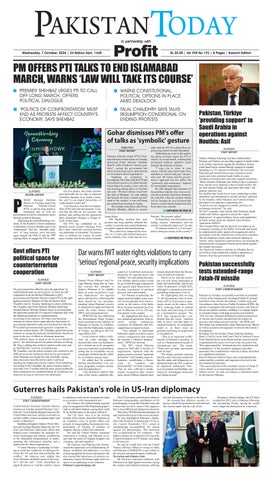
PM OFFERS PTI TALKS TO END ISLAMABAD MARCH, WARNS ‘LAW WILL TAKE ITS COURSE’ Wednesday, 7 October, 2026 | 24 Rabius Sani, 1448
g
g
PREMIER SHEHBAZ URGES PTI TO CALL OFF LONG MARCH, OFFERS POLITICAL DIALOGUE
g
‘POLITICS OF CONFRONTATION’ MUST END AS PROTESTS AFFECT COUNTRY’S ECONOMY, SAYS SHEHBAZ
g
Rs 20.00 | Vol XVII No 193 | 8 Pages | Karachi Edition
WARNS CONSTITUTIONAL, POLITICAL OPTIONS IN PLACE AMID DEADLOCK
TALAL CHAUDHRY SAYS TALKS RESUMPTION CONDITIONAL ON ENDING PROTESTS
Gohar dismisses PM's offer of talks as 'symbolic' gesture RAWALPINDI
STAFF REPORT
P
ISLAMABAD SALEEM JADOON
RIME Minister Shehbaz Sharif on Tuesday urged the Pakistan Tehreek-e-Insaf (PTI), to end its long march to Islamabad and sit with the government to resolve contentious issues through political dialogue. Addressing the groundbreaking ceremony of the Kashmir Chowk underpass in Islamabad, Premier Shehbaz said it was “unfortunate” that the “dreadful shadows” of long marches were hovering again despite the PML-N and the PPP making efforts to engage the PTI in talks.
The two parties, the prime minister said, held talks for two days in National Assembly Speaker Ayaz Sadiq’s chamber, and “it was hoped that politics of confrontation would end”. “Unfortunately, that did not happen. They [PTI] only had one purpose: to ensure that the talks do not succeed,” the premier said, adding that the opposition party demanded changes to things already settled upon. The PTI has embarked on its planned march despite warnings from the Centre, which has vowed to prevent any gatherings in Islamabad. The protest aims to demand the release of jailed party founder and former prime minister
Govt offers PTI political space for counterterrorism cooperation
Imran Khan. PM Shehbaz asserted that such protests and long marches affected the country’s economy and created hindrances in exports, imports and manufacturing. “We collectively improved the economy in 2.5 years and reached macroeconomic stability. Now is the time for it to
CONTINUED ON PAGE 03
flourish,” the premier added. “In September, our information technology exports, remittances and the country’s production improved,” he said. “If someone harms it, is it not equivalent to being an enemy of the country?”
CONTINUED ON PAGE 03
Dar warns IWT water rights violations to carry ‘serious’ regional peace, security implications ISLAMABAD STAFF REPORT
ISLAMABAD
STAFF REPORT
Pakistan Tehreek-i-Insaf (PTI) Chairman Barrister Gohar Khan on Tuesday dismissed Prime Minister Shehbaz Sharif’s offer of talks as “merely symbolic”, saying the government had taken no practical step to demonstrate its seriousness about negotiations. Speaking to journalists in Rawalpindi, Mr Gohar said the PTI had been denied access to its jailed founder Imran Khan for nearly a year, with the last meeting taking place in October last year. “We have always stood with the state of Pakistan,” he said, adding that despite the party’s stated commitment to the country, it was still being prevented from meeting its leader. His remarks came hours after Prime Minister Shehbaz offered to resume
talks with the PTI if it called off its ongoing long march towards Islamabad. Addressing an event in the capital, the prime minister urged the PTI to end its sit-in and march, warning that prolonged political agitation could damage the national economy. “I urge you to come to your senses, end the long march and sit-in, and then we will sit with you,” the premier said. Mr Gohar said the government’s approach did not reflect the “generosity and seriousness” required for meaningful negotiations. He also alleged that members of Imran Khan’s family who were not involved in politics had been detained. He said that when he reached Adiala Jail on Tuesday, he was informed that Imran’s cousin Qasim Zaman had also been taken into custody.
The government has offered to give the opposition “as much political space as can be given” in return for full cooperation from the Khyber Pakhtunkhwa (KP) government and Pakistan Tehreek-i-Insaf (PTI) in the fight against terrorism, Minister of State for Interior Talal Chaudhry said on Tuesday. Speaking at a press conference, Mr Chaudhry said Prime Minister Shehbaz Sharif had directed Interior Minister Mohsin Naqvi to accommodate the opposition politically if it agreed to cooperate fully with the federal government on counterterrorism. According to the minister, Mr Naqvi met the prime minister in Lahore late at night after the first round of government-opposition talks and informed him that the PTI and KP government had agreed to cooperate on terrorism-related matters. Mr Chaudhry quoted the prime minister as saying that political considerations should not come in the way of efforts to eliminate terrorism. “The political space, as much as can be given, should be given,” the minister quoted the prime minister as telling Mr Naqvi, adding that political capital could come and go but Pakistan’s security was paramount. Mr Chaudhry said the prime minister also referred to the difficult economic measures taken by his government when Pakistan was facing the risk of default, saying those decisions had affected his party’s political standing but helped prevent the country from defaulting. According to Mr Chaudhry, the prime minister made it clear that even if another political party gained politically from cooperation on counterterrorism, he would have no objection as long as terrorism was eliminated.
Deputy Prime Minister and Foreign Minister Ishaq Dar on Tuesday warned that attempts to deprive Pakistan of its rightful share of water would have “serious implications” for regional peace and security, cautioning that there should be “no misunderstanding” about Pakistan’s resolve to safeguard its rights and interests under the Indus Waters Treaty (IWT) and international law. DPM/FM Dar was addressing the International Water Symposium convened by the Embassy of Pakistan in Austria in collaboration with the Diplomatic Academy of Vienna, according to the Foreign Office (FO). In his keynote address delivered via video message, Dar stressed that water was fundamental to human survival, prosperity and environmental sustainability, noting that its availability was increasingly determining the stability of relations among states. He added that for countries sharing transboundary river systems, geography created a “permanent interdependence”. “Any attempt to deprive Pakistan of the waters rightfully allo-
cated to it would have serious implications for regional peace and stability,” he said, posing the question whether shared waters would be governed through cooperation and agreed legal frameworks or become instruments of political pressure and confrontation. For Pakistan in particular, the deputy premier added, water security was inseparable from food security, as the waters of the Indus River System sustained the lives and livelihoods of over 250 million people in the country. He highlighted that these waters sustained agriculture, food security, energy production, economic development and lifesupporting ecological systems. “Any attempt to undermine Pakistan’s rights over these waters carries consequences that extend far beyond a bilateral disagreement,” DPM Dar stressed. The IWT, which Pakistan signed in 1960 after a decade of negotiations, replaced what the deputy premier termed “upstream discretion” with binding legal obligations, establishing a framework of “certainty and predictability” for both countries. This, he said, reflected a fundamental recognition that “waters upon which millions depend must
remain insulated from the fluctuations in political relations”. However, he said this principle was now being challenged as India had unilaterally placed the treaty “in abeyance” in April 2025, although it contained no provision permitting either party to do so. He highlighted that on Aug 31, the Permanent Court of Arbitration (PCA) had issued a unanimous award on the status of the IWT, ordering India to uphold the treaty and restricting its work on a hydropower project. The PCA had unequivocally confirmed that the treaty “remains fully in force” and that India remained bound by its obligations under it, as there were no grounds justifying its suspension or termination. “This is an important reaffirmation of Pakistan’s position, as well as a fundamental principle of international law,” Dar stated. “Pacta sunt servanda: agreements must be kept.” The deputy premier stressed that the court’s decision reinforced that the rights and obligations established under the IWT could not be displaced unilaterally. However, he pointed out that India continued its “intransigent behaviour and illegal actions”.
Pakistan, Türkiye 'providing support' to Saudi Arabia in operations against Houthis: Asif ISLAMABAD
STAFF REPORT
Defence Minister Khawaja Asif has confirmed that Pakistan and Türkiye are providing support to Saudi Arabia in its military operations against the Houthis in Yemen, while Saudi forces remain directly engaged in combat. Speaking to a TV channel on Monday, Mr Asif said Pakistani and Turkish forces had a presence in the region and were assisting Saudi Arabia in areas including reconnaissance and other support operations. “Both countries [Pakistan and Türkiye] have a presence here, but the army fighting is that of Saudi Arabia. We are here and providing any assistance they need,” the defence minister said. He clarified that Saudi forces were conducting combat operations and attempting to reclaim territory captured by the Houthis, while Pakistani and Turkish military personnel were playing a supporting role. “Saudi forces are engaged in combat, and they are reclaiming territories,” he said. Mr Asif’s remarks came shortly after Pakistan, Saudi Arabia and Türkiye agreed to ensure the “rapid deployment” of agreed military forces and capabilities in Saudi Arabia under the Makkah Joint Defence Agreement (MJDA). The Foreign Office said the decision was taken at an emergency meeting of the MJDA in Riyadh and would be implemented under approved arrangements and in accordance with the national laws of the three countries. The development comes amid renewed fighting in Yemen, where Saudi-led coalition forces are backing the internationally recognised Yemeni government against the Houthi movement. The Saudi-led coalition said late on Monday that its naval forces had conducted a military operation in Yemen’s Red Sea governorate of Hodeidah.
Pakistan successfully tests extended-range Fatah-IV missile ISLAMABAD
Pakistan on Tuesday successfully test-fired an extended version of the indigenously developed Fatah-IV groundlaunched cruise missile, the military’s media wing said. According to Inter-Services Public Relations (ISPR), the missile is equipped with advanced avionics and state-ofthe-art navigation systems, enabling it to engage targets at extended ranges with high precision and lethality. “The test also validated additional technical parameters of various sub-systems incorporated for improved accuracy and enhanced survivability,” the ISPR said. The launch was witnessed by senior Pakistan Army officers as well as scientists and engineers involved in the missile’s development. President Asif Ali Zardari, Prime Minister Shehbaz Sharif, Chief of Army Staff and Chief of Defence Forces Field Marshal Syed Asim Munir and the services chiefs congratulated the teams involved in the successful test. They appreciated the “technical prowess, dedication and commitment” of the scientists, engineers and other personnel who contributed to what the military described as a significant milestone. Interior Minister Mohsin Naqvi also congratulated the nation and the scientists and engineers involved in the development programme. “The successful test of the extended version of Fatah-IV cruise missile is an important advancement in the defence sector,” he said, according to a statement issued by the Interior Ministry.
Guterres hails Pakistan's role in US-Iran diplomacy ISLAMABAD
STAFF CORRESPONDENT
United Nations Secretary General Antonio Guterres on Tuesday praised Pakistan’s “pivotal role” in facilitating dialogue between the United States and Iran, calling on all sides to end the conflict, restore navigation rights and return to diplomacy. Speaking alongside Deputy Prime Minister and Foreign Minister Ishaq Dar, the UN chief said Pakistan’s diplomatic efforts had helped create conditions for dialogue between Washington and Tehran, contributing to the Islamabad memorandum of understanding, the subsequent ceasefire and a framework for future negotiations. “I salute Pakistan’s leadership for helping to create the conditions for dialogue between the US and Iran and mediating that conflict,” Mr Guterres said, adding that every Pakistani should be proud of the country’s “pivotal role”. From Islamabad, he urged all parties to “end the conflict, return
to diplomacy and restore navigational rights in accordance with international law”. Mr Guterres also linked lasting regional peace to recognition of the Palestinian people’s right to self-determination, saying there could be no durable peace in the region without it. The UN chief, who is in the closing months of his tenure, described Pakistan as an important voice in global affairs and praised its longstanding humanitarian role, particularly its hosting of millions of Afghans fleeing conflict and instability. He said the United Nations remained committed to working with Pakistan to ensure that the return of Afghan refugees was voluntary, safe and dignified. Mr Guterres said Pakistan had demonstrated the importance of multilateralism, dialogue, mediation and diplomacy at a time of growing global divisions and mistrust. He also stressed the importance of inclusive institutions, respect for human rights and civic space in strengthening social cohesion. Pakistan’s peacekeeping role
The UN secretary general paid tribute to Pakistan’s longstanding contribution to UN peacekeeping, noting that Pakistani men and women had served in some of the organisation’s most difficult and dangerous missions. More than 180 Pakistani peacekeepers, he said, had lost their lives in the service of peace. He also highlighted Pakistan’s leadership with Denmark in sponsoring UN Security Council Resolution 2823, aimed at strengthening accountability for crimes against UN peacekeepers. The resolution was co-sponsored by 153 countries — the highest number of co-sponsors for a Security Council resolution in UN history, according to Mr Guterres. He said he would later visit the United Nations Military Observer Group in India and Pakistan (UNMOGIP) to pay tribute to the mission and peacekeepers worldwide. Terrorism and climate crisis Mr Guterres expressed solidarity with Pakistan in its fight against terrorism, saying the country had endured immense suffering
STAFF CORRESPONDENT
and lost thousands of people to the threat. He stressed that effective security responses should be grounded in international law, human rights and the rule of law.
Turning to climate change, the UN chief recalled his 2022 visit to Pakistan following the devastating floods, saying he would never forget the destruction he witnessed.
02 NEWs
Wednesday, 7 October, 2026 | kaRaChi
PAkistAn’s lOss-MAkinG sOEs blEED Rs342.8b As DEbt cROssEs Rs10 tRilliOn
P
net adjusted profit declined 30% to Rs80.5 billion from Rs114.3 billion a year earlier. The National Highway Authority (NHA) was by far the largest loss-making SOE, posting a loss of Rs124.7 billion, with the report identifying depreciation and financing costs associated with foreign-lent loans and cash development loans as major drivers. Quetta Electric Supply Company (QESCO) followed with a Rs35.3 billion loss, while Sukkur Electric Power Company (SEPCO) lost Rs34.9 billion and Pakistan Railways Rs29.4 billion. Peshawar Electric Supply Company (PESCO) recorded a Rs23.7 billion loss, PIA Holding Company Rs21.5 billion, Hyderabad Electric Supply Company (HESCO) Rs18 billion, Neelum Jhelum Hydro Power Company Rs14.5 billion and Pakistan Steel Mills Rs12.9 billion. The report attributed losses at power dis-
PROFIT
STAFF REPORT
AKISTAN’S 23 loss-making state-owned enterprises (SOEs) accumulated Rs342.8 billion in losses during the first half of FY26, equivalent to around Rs2.8 billion per working day, while total SOE debt excluding sovereign guarantees surged 14% to Rs10.099 trillion and government fiscal support rose 31% to Rs804 billion. According to the Finance Division’s Federal State-Owned Enterprises Bi-Annual Report for H1 FY26, covering July to December 2025, aggregate losses remained virtually unchanged from Rs342.9 billion in the corresponding period last year. At the same time, profits generated by profitable SOEs fell 7% from Rs457.2 billion to Rs423.3 billion. As a result, the federal SOE portfolio’s
tribution companies largely to technical losses above regulatory benchmarks, underrecoveries and operational inefficiencies. DISCO inefficiencies contributed Rs112 billion to circular debt flows, while under-recoveries added another Rs31 billion during the six-month period. Debt pressures also increased significantly during the period. Total SOE debt, excluding sovereign guarantees, rose 14% to Rs10.099 trillion from Rs8.831 trillion. Foreign-related loans rose 40% to Rs2.581 trillion from Rs1.843 trillion, the sharpest increase. Cash development loans increased 25% to Rs2.098 trillion, while bank borrowings rose 10% to Rs3.102 trillion. Accrued interest increased 9% to Rs2.182 trillion. Unfunded pension liabilities increased 11% to Rs1.982 trillion from Rs1.792 trillion, adding to the wider fiscal exposure associated with the SOE portfolio.
Government fiscal support to SOEs increased to Rs804 billion from Rs616 billion in H1 FY25. Equity injections surged 190% to Rs224.6 billion from Rs77.4 billion, largely reflecting payments aimed at clearing power-sector circular debt obligations to independent power producers. Government loans to SOEs increased 79% to Rs164.8 billion, while subsidies remained broadly stable at Rs332.2 billion. Grants declined 27% to Rs82.3 billion. Meanwhile, SOEs contributed Rs839 billion to the federal government, down 19% from Rs1.043 trillion a year earlier. Dividends rose 26% to Rs112.8 billion and tax payments increased 10% to Rs235.2 billion, but non-tax revenues fell 35% to Rs399.6 billion and interest receipts declined 29% to Rs92.2 billion. Consequently, net fiscal flow — the difference between SOE contributions to the government and fiscal support received — fell sharply to Rs35.8 billion from
Power Division seeks review of Rs22.98/kWh incremental power package as costs surge ISLAMABAD STAFF REPORT
The Power Division has sought a review of the Rs22.98 per unit incremental electricity package for industrial and agricultural consumers after marginal costs surged above the fixed tariff, potentially increasing the burden on other electricity consumers. The National Electric Power Regulatory Authority (NEPRA) conducted a public hearing on Monday on the Power Division’s motion seeking reconsideration of the incremental consumption package for industrial and private agricultural consumers across XW-DISCOs and K-Electric. The package applies to both Timeof-Use (ToU) and Non-Time-of-Use consumers and covers incremental electricity consumption during peak and offpeak periods. The Power Division told the hearing that the fixed tariff of Rs22.98 per kilowatt-hour (kWh) had come under significant pressure as marginal costs exceeded the package rate during several months. According to the presentation, the weighted average marginal cost stood at Rs27.58/kWh from December through May, significantly above the package tariff. After adjusting for transmission and distribution losses, the weighted average marginal cost increased to Rs31.83/kWh. Cost pressures were particularly
high in April and May. The average marginal cost reached Rs36.71/kWh in April and Rs33.98/kWh in May, while on a loss-adjusted basis it climbed to Rs42.37/kWh and Rs39.22/kWh, respectively. The April loss-adjusted marginal cost was therefore Rs19.39 per unit above the package tariff, while the gap stood at Rs16.24 per unit in May. The Power Division said the difference between the package tariff and the higher marginal cost was, pending approval by the power regulator, being borne by other electricity consumers. The package also contains a safeguard linked to electricity consumption growth, triggering a review when combined industrial and agricultural consumption exceeds 25% above the baseline. The presentation showed that consumption growth crossed this threshold in January, February and April, reaching 25.13%, 26.20% and 34.81%, respectively. Growth during the other months remained below the 25% threshold. The semi-annual review provides another basis for considering an adjustment to the tariff. The mechanism requires reviews to maintain cost-revenue alignment and allows marginal tariffs to be adjusted where necessary. The scheme is required to terminate if an upward adjustment becomes necessary during two consecutive reviews. The Ministry of Energy (Power Di-
Pakistan’s bank deposits rise 14% to Rs39.24tr in August 2026 PROFIT
vision) was expected to submit the required information following stakeholder consultations in the first week of June 2026. However, the raw data was provided to NEPRA on July 29. After NEPRA sought a proposal following consultations with stakeholders, the Power Division responded on September 9, requesting the regulator to conduct proceedings on the matter. According to the presentation, the six-month weighted average marginal rate stood at around Rs32/kWh, while four months had already passed in the second review period, raising the question of whether the package should be revised or suspended as marginal electricity costs remain substantially above the fixed rate. The presentation also showed significant differences in effective break-even prices among consumer categories. For B1 peak consumers, the effective break-even price stood at Rs31.15/kWh, while B2 Time-of-Use consumers had a break-even price of Rs29.05/kWh. The corresponding rates for B3, B4 and B5 consumers were Rs30.03/kWh, Rs29.62/kWh and Rs32.91/kWh, respectively. The figures put the Rs22.98/kWh package tariff below the effective breakeven price for all categories presented to the regulator. NEPRA will now have to determine whether the existing rate continues to reflect the cost of supplying incremental electricity to participating industrial and agricultural consumers
Govt moves to strengthen Debt Management Office under dedicated head PROFIT
STAFF REPORT
The federal government is moving to strengthen the Debt Management Office (DMO) by placing its strategic direction under a dedicated head responsible for borrowing, debt risks, market access and long-term debt sustainability. According to the Finance Division, the Head of DMO will align public debt management with macroeconomic stability and the government’s fiscal objectives while overseeing implementation of the Medium-Term Debt Management Strategy (MTDS) and Annual Borrowing Plan (ABP) under the Fiscal Responsibility and Debt Limitation (FRDL) Act, 2025. The official will oversee domestic and external borrowing programmes, including decisions on market access, diversification of funding sources and financing instruments based on cost and risk considerations. The DMO head will also oversee strategic benchmarks covering interestrate, refinancing and contingent-liability risks as the government moves towards a more structured, riskbased approach to debt management. The office will seek to diversify government funding through a wider range of domestic and external debt instruments while strengthening governance, accountability and internal controls. The DMO head will lead engagement with the Finance Secretary, State Bank of Pakistan, Economic Affairs Division, International Monetary Fund, development partners, investors and international credit rating agencies. The role will also cover investor relations and market communication, including oversight of communication on debt management policies, financing plans and the government’s market position. The DMO will be responsible for timely statutory debt publications and fiscal risk disclosures, inputs for the federal budget and debt sustainability assessments, and compliance with debt-data reporting requirements.
Nine firms, including three Turkish companies, qualify for GEPCO privatisation ISLAMABAD
STAFF REPORT
Pakistan’s banking sector deposits rose 13.9% YoY to Rs39.244 trillion at the end of August, supported by increased digitalisation and strong remittance inflows through official channels, according to the latest State Bank of Pakistan (SBP) data. Analysts attributed the strong growth in banking deposits to increased digitalisation and robust remittance flows through official channels. Deposits also increased 0.5% from July. Workers’ remittances rose 15% YoY to $7.3 billion during the first two months of FY27. In August alone, inflows reached $3.7 billion, up 17% YoY and 1% MoM. Banks’ advances increased 10.7% YoY to Rs13.609 trillion in August and were 0.4% higher than in July. Investments rose 13.4% YoY to Rs41.185 trillion, while increasing 0.9% MoM. Despite the increase in investments, the investment-to-deposit ratio (IDR) eased to 104.9% from 105.3% a year earlier. The ratio stood at 104.6% in July. The advances-to-deposit ratio (ADR), meanwhile, declined to 34.7% from 35.7% in August last year and remained unchanged from July. The IDR remained above 100% amid lower external financing available to the government and higher interest rates, while the banking sector’s lower ADR reflected relatively weaker lending compared with the growth in deposits.
and whether the tariff should be revised or the package suspended under its termination provisions. During the hearing, intervener Rehan Javed called for the package tariff to be revised to the actual marginal cost with effect from June 2026. He also sought a refund of the marginal-price difference charged to non-beneficiary consumers since June, proposing that the amount be recovered from package beneficiaries at the revised rate and any residual amount from the Government of Pakistan as the scheme’s sponsor. Another intervener, Amir Sheikh, raised concerns over the package’s cross-subsidy implications, arguing that it was increasing the burden on domestic and commercial consumers while the majority of industry was effectively subsidising a smaller group of beneficiaries. Sheikh also questioned the continued need for the package following implementation of the gas levy and the resulting conversion of captive power consumers to the national grid. “Gas levy implementation forced captive grid conversion, so package was not required,” he said. He also argued that load-shedding alongside reduced-cost electricity packages for industrial and agricultural consumers was contradictory. “Doing load shed and allowing reduced cost packages to Industrial & Agri consumer is self-contradictory,” he said. “The only fair and sound decision is to suspend the package,” Sheikh added.
Rs427 billion. The Fiscal Efficiency Index declined to 1.04 times from 1.64 times, leaving the portfolio close to the point at which SOEs would become net fiscal consumers. Sovereign guarantees stood at Rs2.123 trillion, down 5% from Rs2.245 trillion a year earlier. The report also put total circular debt on an IFRS basis, excluding the gas sector’s late payment surcharge, at Rs3.382 trillion in December 2025, compared with Rs3.929 trillion in June 2025. Power-sector circular debt payable to IPPs stood at Rs1.361 trillion, while gas-sector circular debt was around Rs2 trillion. Despite the losses, profitable SOEs collectively earned Rs423.3 billion. Oil and Gas Development Company Limited (OGDCL) led with Rs73 billion in profit, followed by National Bank of Pakistan at Rs42.9 billion, Pakistan Petroleum Limited at Rs40.2 billion and Pak Arab Refinery Company at Rs31.2 billion. The report said profitability remained concentrated among a relatively small group of entities, particularly in the oil and gas and financial sectors, while persistent weaknesses in power distribution, transport and infrastructure continued to pose fiscal risks to the government.
AHMAD AHMADANI
Nine firms, including three Turkish energy companies, have qualified for the privatisation of Gujranwala Electric Power Company (GEPCO), clearing the way for the next stage of a transaction involving the acquisition of 51% to 100% shareholding along with management control. The Privatisation Commission (PC) Board approved the prequalification of the nine interested parties at its 259th meeting held on Monday under the chairmanship of Adviser to the Prime Minister on Privatisation and Privatisation Commission Chairman Muhammad Ali. The Board was informed that 11 Expressions of Interest (EOIs) had been received for GEPCO, with interested parties seeking to acquire between 51% and 100% shareholding along with manage-
ment control. Following an evaluation of the submissions against the approved prequalification criteria, the Financial Adviser recommended nine interested parties for prequalification and progression to the next stage of the transaction. The prequalified parties are Aktor Elektrik Enerji Yatirimlari San. Ve Tic. A.S., Genvera Enerji A.S., Cengiz Enerji Sanayii Ve Ticaret A.S., Engro Energy Limited, Sapphire Fibres Limited, Hub Power Holdings Consortium, Shirazi Investments (Pvt.) Limited Consortium, Artistic Milliners (Pvt.) Limited Consortium and AKD Securities Consortium. The three Turkish companies are Aktor Elektrik Enerji Yatirimlari, Genvera Enerji and Cengiz Enerji, while the remaining prequalified parties comprise Pakistani business groups and investment consortia.
The nine parties will now proceed in accordance with the approved transaction process, including gaining access to the Virtual Data Room (VDR) for detailed buy-side due diligence. Two of the 11 interested parties will not proceed further. KElectric formally withdrew its EOI through written intimation to the Privatisation Commission, while Al Sharif Contracting & Commercial Development Co. Ltd. was unable to provide the documents required under the Request for Statement of Qualification (RSOQ). The GEPCO transaction is part of the government’s wider power-sector privatisation programme, aimed at attracting domestic and international investment and improving efficiency and service delivery. Meanwhile, the Privatisation Commission Board also consid-
ered the reconstitution of the Negotiation Committee for the outsourcing or concession of Allama Iqbal International Airport, Lahore; Jinnah International Airport, Karachi; and Islamabad International Airport. The Board also reviewed progress on financial-sector transactions and advised the Transaction Advisers to fast-track the privatisation processes of House Building Finance Company Limited (HBFCL) and Zarai Taraqiati Bank Limited (ZTBL). The Commission said it remained committed to advancing the government’s privatisation programme through transparent, competitive and professionally managed transactions, with a focus on attracting credible domestic and international investment, improving efficiency and service delivery, and maximising value for the government.
Pakistan inaugurates Phase-III expansion of Thar Block-II coal mine, boosting capacity 47% to 11.2m tonnes PROFIT STAFF REPORT
The Phase-III expansion of the Thar BlockII coal mine was inaugurated on Monday, increasing annual production capacity by 47% from 7.6 million tonnes to 11.2 million tonnes as Pakistan expands the use of indigenous coal for power generation. The expansion adds 3.6 million tonnes of annual coal production capacity and has been completed through 100% self-financing, according to project officials. The additional coal will supply Lucky Electric Power Company’s 660-megawatt power plant, increasing the total generation capacity supported by coal from Thar Block-II from 1,320MW to 1,980MW. Officials said electricity generated from the expanded mine would be sufficient to
supply approximately 4.5 million households daily. The expansion is expected to reduce power generation costs by around Rs15 billion annually while saving approximately $220 million in foreign exchange each year through the displacement of imported fuel. According to project officials, cumulative foreign exchange savings from Thar Block-II have already exceeded $1.7 billion since commercial operations began. Mine-mouth power generation using Thar coal costs approximately $3.75 per MMBtu, which officials said makes it one of the country's cheapest energy sources and nearly three times cheaper than imported coal. The latest expansion marks the third increase in the mine’s production capacity since Sindh Engro Coal Mining Company
(SECMC) began commercial operations at Thar Block-II in 2019. The mine initially started with annual production capacity of 3.8 million tonnes. Phase-II, completed in 2022, doubled capacity to 7.6 million tonnes, while Phase-III has added another 3.6 million tonnes to take total capacity to 11.2 million tonnes. This means Thar Block-II’s annual mining capacity has nearly tripled from its original level within seven years of commercial operations. Pakistan Peoples Party Chairman Bilawal Bhutto-Zardari inaugurated Phase-III along with what project officials described as Pakistan’s first coal drying unit at Thar Coal Block-II. Speaking at the ceremony, SECMC Chief Executive Officer Amir Iqbal said the project was contributing to Pakistan’s energy security and economic growth.
“Thar stands as a testament to the power of public-private partnership and proof that we can achieve what once seemed impossible. As we continue to energise Pakistan, our ambition is to build SECMC into a world-class, sustainable mining company,” he said. Sindh Chief Minister Syed Murad Ali Shah also addressed the ceremony and highlighted the development of Thar’s coal re-
sources since plans for coal-based power generation in the region were first pursued in the 1990s. With Phase-III operational, the focus of Thar Block-II shifts to supplying the additional 3.6 million tonnes of annual production to Lucky Electric’s 660MW plant, expanding the amount of electricity generated from domestic Thar coal while reducing reliance on imported energy.
NEWS 03
Wednesday, 7 October, 2026 | KARACHI
PAKISTAN UNVEILS FIRST NATIONAL HOUSING POLICY IN NEARLY 25 YEARS
P
PROFIT
STAFF REPORT
AKISTAN’S Ministry of Housing and Works has launched the National Housing Policy 2025, the country’s first national housing policy update in nearly 25 years, as the government seeks to address an estimated housing deficit of around 13 million units. The policy was formally unveiled in Islamabad on October 5 in collaboration with UN-Habitat Pakistan, coinciding with World Habitat Day 2026. The updated framework focuses on increasing the supply of affordable housing, improving land tenure security, expanding access to housing finance and upgrading informal settlements. The government said implementation would now focus on expanding access to adequate and affordable housing, improving
coordination among relevant institutions and developing more sustainable and climate-resilient settlements. The policy also incorporates the government’s housing finance initiatives as part of its action plan for improving home ownership among low- and middle-income households. Under the Wazir-e-Azam Apna Ghar Programme and Ghar Ho To Apna scheme, Rs65 billion has so far been disbursed to first-time homebuyers across the country, according to the Ministry of Housing and Works. The government said the programme is intended to make housing finance more accessible and affordable, particularly for lowand middle-income families. The new housing finance framework provides financing support of up to 90% for home ownership, according to details shared at the policy launch. The government estimates Pakistan’s
housing deficit at approximately 13 million units and says the shortfall continues to increase, adding pressure to housing affordability and urban infrastructure. The National Housing Policy 2025 seeks to establish a national framework for addressing these challenges while linking housing development with climate resilience, sustainable urbanisation and broader development planning. The policy places particular emphasis on adequate housing and access to basic services, while identifying institutional coordination and collaboration among government agencies, development partners and other stakeholders as important components of implementation. The launch was held at the National University of Sciences and Technology in Islamabad as part of Pakistan’s observance of World Habitat Day, which this year is being marked under the theme “Adequate Housing for All.”
IMF may cut Pakistan’s health, education spending target by Gohar dismisses PM's offer of talks as Rs300b as provinces face cash surplus pressure: report 'symbolic' gesture PROFIT
STAFF REPORT
The International Monetary Fund (IMF) may lower Pakistan’s combined health and education spending target by Rs300 billion to around Rs3.9 trillion as provincial governments face fiscal pressures from commitments to generate a large cash surplus and provide grants to the federal government, The Express Tribune reported. Government sources said discussions with provincial governments indicated that the existing cumulative spending target of more than Rs4.2 trillion was likely to be missed again during FY27. The five governments have budgeted around Rs500 billion less for health and education than required under the current IMF target. Even if the target is reduced to Rs3.9 trillion, a gap of around Rs200 billion would remain against existing
budget allocations. Sources said the proposed reduction had not yet been finalised, with another round of discussions pending. The health and education spending requirement is currently an indicative target under Pakistan’s $7 billion IMF programme. Finance Secretary Imdad Ullah Bosal told a parliamentary committee last month that the condition had been repeatedly missed during the programme. Combined spending fell Rs370 billion short of the IMF target during the previous fiscal year. Sources said the IMF had at one stage indicated that it could make the condition more stringent by converting it into a quantitative performance criterion. Missing such a criterion would require a waiver from the IMF Executive Board. During the ongoing review, the IMF mission asked provincial governments whether they could meet their health and education spending commitments.
Punjab and Sindh cited fiscal pressures stemming from the provinces’ commitment to generate a Rs1.7 trillion cash surplus and provide cash grants to the federal government under the National Economic Initiative. KhyberPakhtunkhwa, which has not yet committed to provide grants to the centre, assured the IMF that it would meet its spending targets. For FY27, Punjab has allocated Rs1.3 trillion to health and education out of its Rs5.9 trillion provincial budget. Sindh has allocated a combined Rs1.1 trillion, Khyber-Pakhtunkhwa more than Rs800 billion and Balochistan Rs268 billion. Bosal had earlier said provincial spending targets had also come under pressure because shortfalls in Federal Board of Revenue (FBR) tax collection forced the federal government to ask provinces to curtail expenditure. Under arrangements agreed during
the budget, the federal and provincial governments are to provide Rs1.036 trillion in cash grants, subject to the FBR achieving its annual tax collection target of Rs15.263 trillion. The federal government also reduced its Public Sector Development Programme by Rs126 billion to Rs1 trillion to create fiscal space for national economic initiatives, while Punjab cut its development spending envelope by Rs150 billion. The IMF review talks are scheduled to conclude on Wednesday, with discussions focused on finalising a consensus draft of the Memorandum of Economic and Financial Policies (MEFP). If the two sides reach a staff-level agreement and the review subsequently receives the required IMF approval, Pakistan would gain access to around $1 billion under the $7 billion programme and more than $200 million under the climate facility.
Pakistan to import three LNG cargoes from Qatar for October amid Hormuz uncertainty PROFIT STAFF REPORT
Pakistan has decided to seek three LNG cargoes from Qatar during October and plans to engage Iranian authorities to facilitate their safe passage as uncertainty over supplies through the Strait of Hormuz persists, The News reported. The government is focusing on securing the three October cargoes after QatarEnergy extended force majeure on LNG supplies to Pakistan until November 4, raising concerns over supplies ahead of the winter season. Pakistan managed to arrange two LNG cargoes from Qatar in September after taking both Iranian and US authorities into confidence. The first arrived around September 10, followed by the second on September 23. Officials said securing three cargoes during October could be more difficult because of continued uncertainty
over the Strait of Hormuz and the absence of a broader peace arrangement between the United States and Iran. The government is therefore working to keep diplomatic channels open, particularly with Iran, to facilitate the movement of LNG vessels. Pakistan has so far decided against entering the spot LNG market despite the risk of supply shortages. Spot LNG is estimated to cost around 28-30 per MMBtu, putting the cost of a single cargo at approximately $100 million. The high cost of spot purchases could put additional pressure on the country's finances if Pakistan has to procure significant volumes outside its long-term supply arrangements. The three October cargoes are also important as domestic gas demand begins to rise with falling temperatures. As of October 5, the power sector was consuming around 237 million cubic feet per day (mmcfd) of regasified LNG, followed by the export and non-export sectors at around 175 mmcfd and fertiliser plants at ap-
proximately 88 mmcfd. Pakistan's LNG requirements are expected to increase further during winter, with officials estimating demand for around nine cargoes in December and approximately 11 in January 2027. The availability of the three October cargoes could therefore provide some near-term supply relief while the government assesses whether QatarEnergy's force majeure will extend deeper into winter. On the infrastructure side, the Engro LNG terminal is currently available after the cargo that arrived on September 10 was consumed. The PGPL terminal is regasifying LNG from the vessel that arrived on September 23. Officials fear that a prolonged disruption to contracted LNG supplies could eventually force Pakistan towards expensive spot purchases and tighter allocation of available gas, making the success of efforts to secure the three Qatar cargoes in October important for managing supplies ahead of peak winter demand.
PM offers PTI talks to end Islamabad march, warns ‘law will take its course’ CONTINUED FROM PAGE 01
The premier stressed that putting the economy in shambles and the lives of people in danger would not be allowed. “The law will take its course,” he said “I will still say: come to your senses. Will your actions harm the country or benefit it? … End your long march and protests. When you end them, we will surely sit down with you,” he said. In his address on the occasion, Interior Minister Mohsin Naqvi said, without naming anyone, that people had to see for themselves which public representatives were working for their welfare and which ones were engaging in “negative politics”. Talks resumption hinges on PTI calling off march: Talal Ch Separately, Minister of State for Interior Talal Chaudhry also spoke about the resumption of talks, saying that it remained conditional upon the PTI calling off its marches and protests. Addressing a press conference in Islamabad, he warned that constitutional and political measures were in place to respond to the PTI’s ongoing long march and held Khyber Pakhtunkhwa Chief Minister Sohail Afridi responsible for the breakdown in negotiations. “Political and constitutional measures are in place,” Chaudhry said. He added that the “wise” people part of the PTI’s delegation had tried to make the talks successful. Chaudhry further said that if the talks had succeeded, Pakistan would have had a united political front and the PTI would have gained “political space”. He added that a “hardening of the state” was now close, stressing that “enough softness has been shown”.
“The state is like a mother, but it also has to act like a father at times,” Chaudhry said. “Constitutional options are under discussion, but the political option comes first,” he said. Commenting on the talks, Chaudhry told reporters that on the first day, Naqvi presented the government’s position regarding terrorism in KP, which included facts about the provincial government’s lack of involvement in the province’s affairs, budget and counterterrorism efforts. Chaudhry said the next day, the PTI delegation returned to Islamabad to continue talks after discussing the terms of the agreement with KP’s senior leadership in Peshawar. He said CM Afridi had previously reassured the Centre that the PTI delegation had the authority to reach an agreement on behalf of the provincial government. “We were assured that on terrorism, they [PTI] agreed 100 per cent on the federal government’s points,” Chaudhry said, adding that it was only then that Naqvi travelled to Lahore to PM Shehbaz and informed him that the PTI and the PMLN had agreed on the terrorism issue. “The prime minister said, ‘give as much political space as you can’,” Chaudhry told the media. According to him, PM Shehbaz told Naqvi that “parties’ political capital comes and goes”. Chaudhry said the premier further told Naqvi that when Pakistan was on the brink of financial default, strict measures reduced PML-N’s political capital, but they ensured that the country would not default. The second day of the talks started after the two sides had agreed on the issue
of terrorism, Chaudhry said. “The win for us in the draft agreement was that we would be successful in bringing the PTI to the same page for eliminating terrorism,” he said. The draft was ready by 9pm on the second day of the talks, and Naqvi was getting ready to take it to President Asif Ali Zardari, according to the state minister. “Everything was fine,” he said, adding that some back and forth happened on further edits, but they were all agreed upon. “At the last minute, the opposition sat in a separate room for a while to consult with the KP chief minister. When they came out, they couldn’t look us in the eye and asked for permission to leave,” Chaudhry said. He added that the PTI delegation thanked the PML-N for patiently conducting the talks. The nation had agreed on the two National Action Plans (NAP) against terrorism, Chaudhry said, adding that the second plan was agreed upon during the PTI’s government under former prime minister Imran. He said that NAP was linked to “Pakistan’s Constitution, its needs, security, stability and Islamic teachings”. Citing Afridi’s statement that he wouldn’t allow a plan against the people of KP, Chaudhry questioned if Imran’s NAP was against the people of the province. Chaudhry claimed that KP was unsafe for common people and politicians alike; however, he noted that at the same time, the PTI’s leaders and workers were safe from threats in the same region. “The only one safe there is PTI,” he said, questioning, “Why do [terrorists] have a soft corner for you only?”
On the possibility of talks resuming, Chaudhry said that any further talks were conditional upon the PTI calling off its marches and protests. “Don’t encourage terrorists. Instead, let’s kill them together,” Chaudhry further stated. COLLAPSE OF GOVERNMENTOPPOSITION DIALOGUE Over the weekend, the government and opposition held two rounds of talks, which did not yield positive results, with counterterrorism policies and access to Imran emerging as two major sticking points. On Sunday, the PTI said it wanted immediate access to party chief Imran for consultations and even agreed to forgo other demands in return for a meeting with Imran. However, the government declined to make access to Imran part of the proposed agreement, the opposition party claimed. Another deadlock was terrorism in KP. The federal government asked the KP government to support its counterterrorism measures and support emergency measures within 72 hours in the merged tribal districts, the PTI said. Instead, the PTI proposed that authorised representatives of the federal and KP governments meet within 72 hours to develop a clear, comprehensive and mutually agreed strategy for peace and counterterrorism, the statement added. The PTI said the health and medical treatment of Imran Khan was also raised as a matter of fundamental importance. After talks between the government and the opposition ended without headway, Interior Minister Naqvi on Sunday accused CM Afridi of “sabotaging” negotiations.
CONTINUED FROM PAGE 01
The PTI chairman said his party had entered negotiations with the government “in good faith and sincerity”, but claimed the authorities had failed to reciprocate. He maintained that none of PTI’s demands was unconstitutional or illegal and said the party’s position on terrorism was clear: the National Action Plan should be implemented in its entirety. “Khyber Pakhtunkhwa is the province worst affected by terrorism,” he said, pointing out that the provincial assembly had unanimously passed a resolution on the issue. Mr Gohar said another one or two rounds of talks could have helped resolve outstanding issues, adding that the failure of negotiations should not lead either side to shift responsibility onto the other. RAJA ASKS GOVT TO CONTACT OPPOSITION PTI Secretary General Salman Akram Raja separately said the government should approach the opposition leadership if it genuinely wanted to resume dialogue. Speaking outside the Islamabad High Court, Mr Raja named opposition leaders Mahmood Khan Achakzai and Allama Raja Nasir Abbas as the authorised representatives with whom the government should engage. He said the PTI’s long march would continue until a concrete understanding was reached. Mr Raja rejected claims that the government and opposition had reached an agreement during their recent talks, saying the PTI negotiating team had been given full authority to make decisions. He said differences emerged after the government proposed operations in five districts of Khyber Pakhtunkhwa without prior consultation. According to Mr Raja, Imran Khan had authorised Mr Achakzai and Allama Nasir Abbas to negotiate on behalf of the party. “If the government wants to talk, it can contact Allama Nasir Abbas,” he said, adding that Mr Achakzai and Mr Abbas would decide whether negotiations should resume. QAISER URGES POLITICAL DIALOGUE Separately, PTI leader Asad Qaiser called on the government to engage with the party over what he described as its “legitimate constitutional and legal demands”. In a video statement, Mr Qaiser said peaceful protest was a constitutional and legal right and maintained that PTI demonstrations would remain peaceful.
04 COMMENT
When ‘Democracy’ becomes an obstacle to peace
Makkah Declaration operationalized
P
Pakistan, Turkiye commit to send troops even as the Houthis take a battering
AKISTAN and Turkiye have agreed to send resources to Saudi Arabia to help it combat the Houthis even as the Yemeni government forces expelled the Houthis from their positions overlooking the Bab el-Mandeb strait, thus raising the question as to what exactly Pakistan is doing in an intra-Arab conflict, It is also worth noting that the commitment has been made without any debate in Parliament, where indeed the original Declaration has not been discussed. That there is a shooting war, that between the USA and Iran, going on, might explain the great haste with which the decision has been taken, but it is a momentous decision, fully as much as even the peacekeeping missions which Pakistan has avoided in the Arab world. As the Makkah Declaration has barely got off the ground, the type of policy coordination needed for a welloiled alliance has not been put in place. It is possible that some or even all Pakistani or Turkish troops inducted into the theatre will not be used for combat. Instead, they will relieve Saudi troops who are presently engaged on internal-security duty. For the present, the counteroffensive which has succeeded against Houthis has been carried out under the aegis of the loyalist army, but it is stiffened by Saudi forces. It is also not clear whether the Pakistani forces will be augmented in Saudi Arabia, or whether forces already present will be used. Both Turkiye and Pakistan have special skills in drone warfare and anti-drone measures, which will be particularly useful against Houthi drone capability, which has allowed it to strike targets deep with Saudi Arabia. This creates an interesting situation for Pakistan in particular, for its antidrone expertise, which it showed so successfully in the summer of last year, relies to a great extent on Chinese help. China, while trying to stay above the fray, is in Iran’s corner, and the Houthi depend on Iran for their arms, particularly drones. Pakistan does not have any easy choices in this conflict, and it must weigh the consequences of Turkiye coming to Saudi Arabia’s aid on its own. It is particularly of concern that an important pillar of Pakistani foreign policy, the refusal to intervene in internal Arab conflicts, which it a[[lied as recently as January this year, when it did not commit troops to the peacekeeping force proposed for Gaza, is being jettisoned so casually.
Trump and Netanyahu both posture before elections
W
WASHINGTON WATCH Dr JAmeS J ZOGby
HILE proponents assert that the spread of democracy is essential to securing peace, two allied democracies— the USA and Israel— are engaged in wars that are actually being exacerbated by the fact that both countries are in the midst of elections. From the beginning, in the American mind, democracy has been seen as more than just a form of governance. Both Liberals and Conservatives have idealized and elevated the idea of democracy into the equivalent of religious doctrine, making exaggerated claims about the benefits that accrue to societies that are democratic. We have been told that democratically elected governments are: more tolerant, more respectful of minority rights, more accountable for their actions, and less likely to start wars. Given this mindset, several past US administrations have made the spread of democracy a foreign policy priority, arguing that it was essential for world peace. While the US and some of its allies flaunt these attributes, boasting that their democracies place them above societies with other forms of governance, in reality, their claims of purity and adherence to ideals do not hold up to scrutiny. The glaring contradiction between the values we and other democracies espouse and our actual behaviour have been clear since our founding. After all, the American experiment with democracy was built on the backs of slave labour and the genocide of Native Americans. And more recently, when the George W. Bush Administration launched its campaign to promote democracies worldwide, it did so while blundering through a devastating “war of choice” in Iraq and torturing prisoners in “black sites” they had suborned other countries to make available to US interrogators. Much the same can be said of Israel, who we and they tout as “our closest ally” and the “only democracy in the Middle East.” Like us, Israel claims that its democracy elevates it above its neighbours, making its actions more just and its behavior more moral.
Dedicated to the legacy of late Hameed Nizami
Arif Nizami (Late) Founding Editor
The next big shock M. A. Niazi
Babar Nizami
Editor Pakistan Today
Editor Profit
T
No room for extravagance IbrAHIm AfTAb
HERE is one number that quietly sets the price of almost everything in the global economy, and this month it crossed 5 percent. The yield on the 10year U.S. Treasury note briefly touched the 5 percent level on September 14, a level last seen in late 2023, and the 30-year yield now sits above 5.3 percent. When the price of money moves, it moves for everyone— the home buyer in Ohio, the pension fund in Tokyo, and, most importantly, the finance ministry in Islamabad. We start with Washington, which borrows more than it can comfortably explain: the US national debt has crossed $40 trillion, and large deficits mean a steady flow of new debt, so investors want a higher return to keep absorbing it. Add to that the governments’ never-ending appetite to spend and the massive investments promised and undertaken in the AI industry, which have further pushed these numbers up. The Federal Reserve recently hiked interest rates for the first time in three years; with oil over $100 per barrel, inflation looks stubborn, and any chance of a rate cut is now very slim. Then there is artificial intelligence, which we usually file under technology stocks. It belongs in the bond story too: data centres, chips and power grids cost staggering sums, and the companies building them are issuing debt in bulk. AI also keeps growth strong, which makes rate cuts harder to justify; at the same time, the higher productivity gains the technology was expected to deliver have not yet materialised, which puts a question mark over this whole exercise Japan is an interesting case here because it has been the quieter half of the story, and arguably the most important one. For three decades it was the world’s cheap-money machine— with rates stuck near zero, Japanese
pension funds, insurers and households sent their savings abroad, and much of it landed in US Treasury and European bonds, holding yields down everywhere. As we all know, Japan holds the largest amount of US Treasuries, well over $1 trillion. That arrangement is fraying: Japan’s 10-year yield touched 3 percent at the start of September, the first time in nearly three decades, and the 30-year is near 4.1 percent. Inflation and public debt well over twice the size of the economy are behind it. When money at home pays that much, the incentive to send it abroad weakens, and that can sound alarm bells for US Treasuries— which perhaps explains the US government’s joint intervention with the Japanese government to stabilize the yen and the bond markets. If the cheap inflow of money from Japan stalls, or in the worst case reverses and Japan starts selling, it will send shock waves through the global economy. Pakistan is not a player in this drama, but it sits in the audience and still pays for the ticket. The first cost is the price of borrowing abroad: every Pakistani eurobond is priced as a premium over U.S. Treasuries, so when the benchmark climbs, the whole structure shifts up. This year’s eurobond sale, along with upgrades from S&P and Moody’s, shows that the country can still reach the market, but reserves of $21 billion
And like true believers in any ideology, when it is pointed out that reality doesn’t agree with their claims, they deny it and attack whoever has pointed out the disconnect. The fact that democracies hold elections provides them with yet another reason to boast of their superiority. However, as we see playing out in both Israel and the USA, instead of providing a cleansing moment, elections are often used by contesting parties to justify bad behaviour and exacerbate social tensions. President Trump, for example, needs a way out of his no-win war with Iran, especially because of its negative impact on the economy and consumers, and the insecurity and instability it’s fomenting in the Gulf. But he is loath to look weak by ending the war without some claim of victory, because of the negative impact that might have on his legacy and his hold over his base voters —whom he needs to turn out in November to deliver a GOP victory. And so, he continues his bellicose language and threats toward Iran. Israel’s Prime Minister Netanyahu may have assumed that he could manage a governing coalition of parties even more extreme than his own. But his partners have used their positions to aggravate tensions with Palestinians in both Israel and the occupied lands. And when Netanyahu felt compelled to sign onto ceasefires that were supposed to stop the bombing in
I
Karachi – Ph: 021-32640318 I
Gaza and Lebanon, his agreement proved hollow. In the face of criticism from his opponents and even his coalition partners that he was compromising Israel’s security by not “finishing the job,” he has continued to violate both ceasefires with impunity, while doing nothing to rein in the widespread terrorist violence in the West Bank being fomented by his allies. He feels he must do this because he cannot afford to lose any of his governing partners or he’ll be out of office. The bottom line is that in both instances, instead of implementing the values claimed to be the attributes of democracy, these elections do the opposite. Political discourse becomes coarser and more divisive, social tensions are aggravated, and warlike behaviors are promoted. Especially troubling is that while reporters and commentators know that the words and actions of both Netanyahu and Trump are directed more at appeasing their constituents than they are at the realities in Gaza, Lebanon, or Iran, too often they sin by omission and treat the political posturing as if it were real. For example, instead of being honest and treating Netanyahu’s claims that villages in south Lebanon need to be demolished to fend off his opponents’ accusations of weakness, they report it as if leveling whole Lebanese villages is needed for Israel’s security. Sadly, this is what has become of our democracies. The writer is President, Arab American Institute
Especially troubling is that while reporters and commentators know that the words and actions of both Netanyahu and Trump are directed more at appeasing their constituents than they are at the realities in Gaza, Lebanon, or Iran, too often they sin by omission and treat the political posturing as if it were real.
are a cushion, not a fortress, and Pakistan will need to go back to lenders again. The other cost is oil: Pakistan imports the vast majority of its fuel, so crude-oil spikes flow straight into prices. Inflation is already rising, and although the policy rate hasn’t moved yet, at the moment it looks only a matter of time before it does. And when that happens, any chance of economic recovery or growth becomes more and more expensive to finance. Another key, and perhaps more important, factor is the cost of borrowing: the government borrows at home at roughly 12 percent for 10 years, against about 5 percent in the USA. This gap compensates investors for inflation and the risk associated with the Pakistani economy, especially its exchange rate. If yields are rising globally, it becomes ever more expensive and difficult to compete with other markets, as they offer more cushion and stability at Pakistan’s expense, and the only real draw was the high yield; when that advantage narrows, it makes Pakistani debt less attractive for foreigners to hold. Pakistan cannot move the Federal Reserve or the Bank of Japan. But it can, and it must, set its own house in order. There is no room for fiscal extravagance to fund growth that will burn through the reserves we have built over three years through severe hardship. Markets are growing less forgiving of heavy borrowers, and they will be least forgiving of those with the least room for error. The writer is a freelance columnist
Pakistan cannot move the Federal Reserve or the Bank of Japan. But it can, and it must, set its own house in order. There is no room for fiscal extravagance to fund growth that will burn through the reserves we have built over three years through severe hardship. Markets are growing less forgiving of heavy borrowers, and they will be least forgiving of those with the least room for error.
Lahore – Ph: 042-36300938, 042-36375965
Wednesday, 7 October, 2026
Islamabad – Ph: 051-2204545
I
Editor’s mail
Send your letters to: Letters to Editor, Pakistan Today, 4-Shaarey Fatima Jinnah, Lahore, Pakistan. E-mail: letters@pakistantoday.com.pk Letters should be addressed to Pakistan Today exclusively
Stinking oversight
THE Karachi chapter of the Arts Council of Pakistan has earned a reasonable reputation as a place where arts and culture are allowed to flourish and thrive. This is definitely good for society at large, and those running the show deserve due acknowledgment. However, the job is apparently so hectic, time-consuming and stressful that the administration is unable to find the time or the focus to keep its washrooms clean. I recently had the misfortune of visiting the place after several years in connection with a fund-raising event for a charity hospital in Karachi’s Koohi Goth area. The programme, which also featured an Urdu theater play, lasted a few hours. Visiting the washrooms, as such, was an inevitability that could not be put on hold beyond a limit. To call the smell merely ‘foul’ would be a rank understatement. All sorts of adjectives hit my senses the moment I stepped in. Pungent, acrid, putrid, acerbic, stinking and many more; all blended into one ‘Arts Councilish’ odour. It was noxious to the point of being obnoxious. I am sure the cause of arts and culture can still be served with clean and fragrant washrooms. All that the administration has to do is to at least try. Once it does, it will be surprised to know that the two targets are not mutually exclusive. Just try. DR SYED SHAH TALHA IQBAL KARACHI
Karachi collapse
THE latest Economist Intelligence Unit’s Global Liveability Index has ranked Karachi 170th out of 173 cities. Sadly, this comes as no surprise to those of us who live here. I have travelled across Pakistan, and I can say with confidence that no other major city is in such a poor state. Karachi no longer feels like a city; it feels like a vast, neglected slum. Every day we deal with broken roads, garbage piling up, and water and electricity shortages. Despite all this, the Sindh government keeps making tall claims. But the truth is plain to see. The provincial government’s performance is all around us, and it is pathetic. Karachi has incredible potential, and its people are hardworking and resilient. We need serious action and real leadership before things get even worse. The recent Karachi ranking should be an eye-opener for the Sindh government. But I think this is something too much to ask. SAAD ALI KARACHI
Tax houdinis
IRRESPECTIVE of which political party, or dictator, happens to be at the helm of affairs at any given point in time, the targets of political economy have always overruled economic imperatives. Those who have the muscle and the clout continue to evade taxes under state patronage. Beyond rhetoric, no government has ever done anything concrete to make the elite pay taxes. To fill the gap, all that the governments have ever done is to impose indirect taxes, which is a way of passing on the burden to those who survive from pay-cheque to pay-cheque, and those who afford nothing more than two square meals a day and some level of basic education for their children. All through the subsequent year, they hear the usual pep talk of the ruling elite that justice would be done the next year. After all, someone has to make a sacrifice, and it seems it is their destiny to be the nation’s sacrificial lambs. The lower and middle classes of the country must be prepared to make sacrifices for the nation so that our non-tax-paying elite continue to lead their luxurious lifestyles, be beneficiaries of subsidised land allotments, play golf and, of course, spend their vacations abroad. MALIK TARIQ ALI LAHORE
Web: www.pakistantoday.com.pk
I
Email: editorial@pakistantoday.com.pk
COMMENT 05
The commonest barrier facing working women Wednesday, 7 October, 2026
The door that needs to be there before it can be opened
R
aMina abdul GHafoor
ECENTLY, while sitting in a lounge with a group of professional women over tea, what began as a casual conversation took an unexpected turn. One of my friends quietly admitted that she deliberately avoids drinking water, tea, or coffee throughout the workday. We looked at her in surprise. “Why?” someone asked. She smiled awkwardly before replying, “Because there is no separate washroom for women at my workplace.” For a brief moment, the room fell silent. Then, almost every woman around the table had a story of her own. One had worked in a factory where there was no dedicated ladies’ washroom. Another spoke about spending an entire shift without drinking water because she dreaded using a shared facility. Someone else recalled waiting until every male colleague had left before she could use the washroom in privacy. Others admitted they routinely held their bladder until they returned home because they did not feel comfortable or safe using the available facilities. What shocked us was not that these stories existed. It was that they were still being told in 2026. That conversation raised an important question. While Pakistan’s industrial sector has made remarkable strides in automation, robotics, and digital transformation, many workplaces still lack one of the most basic facilities required for an inclusive workforce. Factories equipped with world-class production lines and advanced machinery worth millions of rupees continue to overlook something so fundamental that it should never have remained an issue—a safe, private, and dedicated washroom for women. Many workplaces still fail to provide something as basic as a safe, private, and dedicated washroom for women. Women working in Pakistan’s industries and corporations are not asking for special treatment. They are asking for one of the most basic workplace necessities. Until we provide that,
our conversation about women’s empowerment remains incomplete. Pakistan is producing more women engineers, architects, scientists, and technical professionals than ever before. Universities continue to graduate thousands of talented women each year, eager to contribute to the country’s industrial and economic development. Government initiatives, universities, and private organizations all encourage greater female participation in STEM, engineering, manufacturing, and leadership. Yet one fundamental question remains largely unasked: Are our workplaces actually designed for women? According to the Asian Development Bank, women comprise only around 22 percent of Pakistan’s labour force, one of the lowest participation rates in South Asia. UNIDO estimates that women account for only 3.6 percent of employment in Pakistan’s major industrial sectors, while Gallup Pakistan reports that despite increasing numbers of women graduating in engineering, only around 28% enter employment. We often attribute these numbers to cultural expectations, transportation challenges, family responsibilities, or social norms. Those are certainly important factors. But perhaps we have overlooked another barrier, one that exists inside our workplaces. If women hesitate to join or remain in corporate or industry because even the most basic facilities are missing, then perhaps the problem is not simply about attracting women into engineering. Perhaps it is about making engineering workplaces ready for women. Unfortunately, the stories shared in that lounge are not isolated incidents. An investigation by the International Federation of Journalists (IFJ) documented remarkably similar experiences among women journalists in Pakistan. Women reported deliberately avoiding
drinking water because there were no separate washrooms, waiting for male colleagues to leave before using shared facilities, and experiencing anxiety and health concerns due to inadequate sanitation. The issue clearly extends far beyond factories. It exists across offices, media organizations, construction sites, and numerous professional environments throughout Pakistan. The World Health Organization (WHO) recognizes access to safe sanitation as a matter of health, dignity, equality, and fundamental human rights— not merely an infrastructure issue. Research from Columbia University’s Mailman School of Public Health further reinforces this reality. The researchers conclude that adequate access to a private, comfortable, and well-located toilet remains a critical challenge for many girls and women around the world. Their research explains that women have unique sanitation needs throughout different stages of life, particularly during menstruation, pregnancy, post-partum recovery, and certain medical conditions. At any given time, nearly onequarter of adult women worldwide are menstruating and require private, hygienic facilities to manage their menstrual health with dignity. When these facilities are absent, women often avoid drinking water, delay using the toilet, and compromise both their health and productivity. The research highlights another reality that strongly resonates within Pakistani society. Unlike men, women often experience far greater expectations regarding modesty and privacy. Even entering or leaving a washroom, changing menstrual products, or disposing of sanitary waste can become a source of anxiety because these ordinary biological needs remain surrounded by social expectations and stigma.
The next time a corporate office, organization, commercial building, industrial facility, or factory opens its doors, let us not measure its success solely by its infrastructure, production capacity, automation, or technological advancement. Let us also ask a far more fundamental question: Is it truly designed to welcome women with dignity, safety, and equal opportunity?
This anxiety is not created by women. It is created by the environments in which they are expected to work. Globally, the discussion has already evolved beyond simply providing separate washrooms. Researchers now advocate for female-friendly washrooms— spaces equipped with menstrual hygiene facilities, sanitary waste disposal systems, secure locks, proper lighting, adequate water supply, accessibility for pregnant women and women with disabilities, and designs that protect women from harassment while ensuring dignity and comfort. They argue that mainstreaming femalefriendly toilets is essential for achieving the United Nations Sustainable Development Goals on health, sanitation, quality education, gender equality, and women’s economic empowerment. That is an important discussion. But for many women working in Pakistan’s industries, we have not yet reached that point. Before discussing advanced design standards, we must first achieve a far more fundamental milestone: Ensuring that every woman has access to a safe, secure, private, and dedicated washroom and a basic rest area at her workplace. Only then can we begin discussing how to make those facilities truly female-friendly. Some employers argue that because there are only a handful of women in their organization, constructing a separate washroom is unnecessary. Perhaps we should ask the opposite question. How can we expect more women to join engineering, manufacturing, and industry if workplaces continue
Sexual abuse in schools
Will Trump roll the dice again?
M
of their own. Here, I want Dostoevsky has the answer tomethods turn to Dostoevsky for help. The
TEHRAN TIMES
MoHaMMad Sarfi
ANY around the world are trying to decode and analyze the character of the current President of the United States — from politicians and analysts to journalists, traders, and market players. After all, the U.S. president wields vast powers, while the mechanisms in the American system for overseeing and constraining those powers are, more often than not, theoretical possibilities on paper rather than practical realities. One of the biggest questions observers in America and around the world are grappling with today is this: Will Trump once again turn up the flames of war with Iran and launch an attack, or not? First of all, it must be said that the war that began on February 28 has never actually ended. It has had its ebbs and flows — at times more intense, at times quieter — but it has not ended. Back to the question. Arguably, one of the most logical ways to find an answer would be to look at Trump’s own positions. Yet he takes a new stance and makes a new claim every day, and is deeply contradictory on this front. Matters have reached the point where, in a recent campaign speech in Oklahoma, he claimed that Iran was even producing narcotics inside its nuclear facilities. The sheer degree to which Trump treats his audience as fools is at times astonishing. When conventional, logical approaches fail to solve a puzzle, everyone tries to resort to inventive
great virtue of writers is that you can count on their help even after their death. One of Dostoevsky’s most famous and captivating works is the novel The Gambler, written in just 26 days, whose dramatic creation was itself driven by the financial pressure of the author’s own gambling losses. It makes no difference where a gambler is from or what the instrument of gambling is; throughout history, gamblers have remained utterly loyal to one thing: never walking away from the table. Winners press on to win more; losers press on to recover their losses — both convinced of their luck. Alexei Ivanovich, the hero of the novel, like every other gambler, is faithful to this unwritten pact. When he wins a handsome sum, he keeps playing to make more; and when he loses for the first time: “With a feeling like a sick qualm, as though I would like to make my way out of the crowd and go home, I staked another fifty gulden — this time on the red.” The attack on Venezuela was, for Trump — albeit through cheating — the equivalent of a sweet win. But for one addicted to gambling, a sweet win is not only never enough; it further stimulates the instinct. Egged on by the then head of Mossad, the U.S. president fell under the illusion that it was now time to land the whale. Defeating an Iran that has stood against America since 1979 and has outlasted every previous president could immortalize his name in history. Less than a year ago, he had attempted this gamble and lost — and he thought that this time the story would be different.
A war that was supposed to last a few days, or at most four to six weeks, has now turned into a sevenmonth quagmire for America, with price displays at some gas stations showing $9.99 for diesel — simply because they are physically incapable of displaying a higher figure. Trump’s late-February gamble has become the most unpopular American war in decades and has brought his voter base to the brink of collapse. A rational man in such circumstances would revise his calculations and abandon the folly. But it must not be forgotten that we are dealing with a tired and desperate gambler who has promised each spectator $5,000 to cheer him on louder, who does not shrink from attacking a school and massacring children to secure victory, and who regards
sinking an unarmed vessel as entertainment. Losing the gamble is not the main problem; the main problem is his false hope in luck. Some sources say Trump has stated in closed-door meetings that the reason the war has produced no result is that the attacks were not severe enough. At the end of Dostoevsky’s novel, Alexei, who has lost everything, recalls a memory in which he once had only one gulden left in a game and won 170 with it, and says: “This is a fact — That is what one’s last gulden can sometimes mean! And what if I had lost heart that time, if I had not dared to make up my mind? ... Tomorrow, tomorrow all shall be ended!”
Mohammad Editor-in-Chief.
Sarfi
is
Whisky producers release reserves to help ease pain of diesel prices
T
MartinH
HE W4 nations of whisky producers have agreed to release some of their strategic reserves. This should keep prices down, helping more consumers to numb the pain of extortionate diesel
prices. Scotland, Ireland, the US, and Canada made
The writer is Manager Sales SCSMSPM, BEE, and can be reached at amina.a.ghafoor@gmail.com
More than 8,500 sexual offences at or near schools were committed against under-13s, most of them girls
the
SATIRE
NEWS BISCUIT
to be designed as though women were never expected to be there? Facilities should not follow representation. Representation follows facilities. Pakistan has made remarkable progress in educating women. Now our industries must evolve at the same pace. The question is no longer whether women are ready for industry. The real question is whether our industries are ready for women. A workplace may invest millions in their portfolio, marketing, products, manufacturing, robotics, automation, artificial intelligence, and digital transformation. Yet if a woman hesitates before drinking a glass of water because she fears using the washroom, that workplace has failed one of the simplest tests of inclusion. Genuine women’s empowerment is not measured by how many women are hired. It is measured by whether they can work with dignity once they are hired. And sometimes, dignity begins with something as simple as a clean, safe door marked “Ladies.” The next time a corporate office, organization, commercial building, industrial facility, or factory opens its doors, let us not measure its success solely by its infrastructure, production capacity, automation, or technological advancement. Let us also ask a far more fundamental question: Is it truly designed to welcome women with dignity, safety, and equal opportunity?
the announcement this week following threats of export bans which could have led to problems on world markets, where prices have been rising steadily. ‘Even Aldi’s budget whisky costs over £15 a litre now; at this rate it will soon be cost-effective to convert my diesel car to run on the stuff,’ said someone who didn’t actually realise that whilst a petrol engine can theoretically run on whisky, a diesel one cannot, although the argument did sound plausible in the pub after a cou-
ple of pints. Views across Scotland were mixed. Some felt that countries stopping whisky exports would ultimately damage their economies. Others said that it’s a travesty that anyone apart from the Scots is even allowed to make the stuff. ‘A spokesman for the government said, ‘We’d love everyone to buy more whisky and less diesel. A mere 45% of what someone pays for diesel goes in tax, whereas with whisky it’s a whopping 85%.’
T
THE GUARDIAN Editorial
HE Guardian’s findings about the extent of sexual abuse in schools require an urgent, calibrated response. Data revealing multiple rapes committed each year on school premises in England and Wales is hard to comprehend. Yet this is what freedom of information requests to police forces, covering the period from 2021 until last year, have revealed. As well as the severity of the offences, the youth of many of the victims is disturbing. More than 8,500 sexual offences at or near schools were committed against under13s, most of them girls. Data about perpetrators contains gaps, including their age and sex. While the overwhelming majority of such acts are carried out by boys, we don’t know the exact proportion, nor if there is an age gap between those carrying out abuse and those being targeted. Only 33 out of 43 police forces shared their data, meaning that large areas including Scotland are not represented. But whatever the exact details, and allowing for the fact that these are reports, not convictions, the findings are deeply dismaying. The suggestion by the acting chief constable Becky Riggs, who leads on child protection and abuse investigation for the National Police Chiefs’ Council, that the figures could reflect an increased willingness to report sexual abuse rather than more abuse taking place, must be taken seriously. At the same time, an unknown number of assaults continue to go unreported. Exact comparisons with the past are not possible since there is no equivalent dataset. What can be said, 10 years after a committee of MPs recommended that ministers should make sexual abuse in
schools an “immediate policy priority”, is that the problem has not gone away; some experts believe that it is getting worse. The response to the problem so far has relied on three main tools. One is the promotion of sex and relationships education. The scale of image-based abuse in schools requires further investigation, but Monday’s warning of a huge rise in AI child sexual abuse material globally points to the need for a curriculum that keeps abreast of technological change. The second tool is online safety laws including age verification, tighter restrictions on pornography, and the pledge by Sir Keir Starmer’s government to place smartphones off-limits for under16s. The third is the criminal justice system, and ongoing efforts to improve the way that police and prosecutors deal with victims. Ministers will need all these to work if they are to have any chance of meeting their goal of halving violence against women and girls. But acute resource and capacity problems are hampering courts and prisons, while pornography regulation needs to be enforced as well as discussed. While campaigners are hopeful, effects need to be measured. In relationships education, good intentions must not be confused with effects. To make a difference, schools need investment, training and evaluation. This problem cannot be left to teachers to deal with; parents should also discuss these issues with young people. And politicians will have to be brave. The focus on sexual crimes by rightwing and far-right parties in many countries places liberals in a difficult position, with some fearful that by talking about them, they risk adding to a narrative that sows discord and scapegoats immigrants. The abuse of children by other children is an upsetting subject, but looking away is the worst of all options. As a society, we owe it to young people to deal with it.
06 neWs
FRANCIS HALZEN WINS NOBEL PHYSICS PRIZE FOR ANTARCTIC 'GHOST PARTICLE' HUNT
T
WASHINGTON REUTERS
HE Belgian-American Francis Halzen won the 2026 Nobel Prize in Physics for his work creating an observatory to detect high-energy neutrinos - some of the universe's most elusive subatomic particles - and try to establish how they are made. Halzen, 82, realised that pristine ice at the South Pole could be used to track such neutrinos, sometimes known as "ghost particles" for the way they pass through the Earth and our bodies without a trace, only interacting with matter extremely rarely. "The messengers bring information from the cosmos," Eva Olsson, of the Royal Swedish Academy of Sciences, told a press conference. "They open the door to distant galaxies and tell us about the processes of exploding stars." HALZEN HAILED FOR DETECTING MESSENGERS FROM THE COSMOS The interactions registered by the IceCube observatory in Antarctica provide information about how high-energy neutrinos are created and may even reveal previously unknown phenomena, the Academy said.
Wednesday, 7 October 2026 | karaCHI
In 2014, the US-based Smithsonian magazine dubbed Halzen "Neutrino Man" when giving him one of its Ingenuity Awards, acclaiming him for an "amazing experiment (that) heralds the beginning of a new era in astronomy". It even published a comic illustrating his life: "How One Physicist’s Pursuit of the Cosmos Took Off in Antarctica". The particle detector comprises more than 5,000 sensors set in a cubic kilometre of Antarctic ice, which extends to a depth of 2,500 metres below the surface near the Amundsen-Scott South Pole Station. The observatory awaits blips from the nearly massless high-energy neutrinos, which unlike other particles do not lose energy or change direction, in the hope of tracing their paths back to exploding stars, gamma-ray bursts, and cataclysmic phenomena involving black holes and neutron stars. It can expect to register about one per day. Halzen, a professor at the University of Wisconsin–Madison in the United States, first presented his idea for capturing neutrino traces at the South Pole in 1988, but the project was not completed until 2011. "I have to emphasise how lucky I was because, when we started this project, everybody realised this was maybe a good idea,
but very few thought it would work, including myself," Halzen told the press conference by telephone. Neutrinos are electrically neutral, undisturbed by any magnetic field, which means that, in contrast to electromagnetic waves such as visible light, the direction from which they arrive points directly back to their source.
FRUITS OF HALZEN'S RESEARCH YET TO COME The observatory has been able to determine that high-energy neutrinos originate within but also far outside our own galaxy, setting in motion an interstellar quest to find the objects and processes that create them. Through the long winter at the South Pole, when bringing anything in or out is dif-
Iranian army claims accelerated production of advanced missiles, drones TEHRAN
AGENCIES
The spokesman for the Iranian Army Brigadier General Mohammad Akraminia spoke on the military’s enhanced readiness in an interview with Fars News Agency, signalling a significant leap in the country’s indigenous deterrence capabilities, according to Press TV. Akraminia confirmed that the domestic production of new military hardware did not cease during the war. "The new defensive and offensive equipment, including missiles and drones, was being produced on a daily basis during the 40-day (Ramadan) war, and today, their production continues with even greater intensity," the Army spokesman
stated. "Currently, a massive stockpile of this equipment is at the disposal of the Iranian Army forces, and the Army is fully prepared in terms of equipment." He added that the army already deployed some of these new systems in the field, with plans to officially unveil them to the media at the "appropriate time and if necessary.” Akraminia also emphasised the tactical experience gained by Iranian forces during the recent US-Israeli aggression. In a separate interview, IRNA reported that Iranian army commander Major General Amir Hatami said that Iran's defence industry played a critical role in supporting combat forces during the recent 12day and 40-day imposed wars. Hatami made the remarks during a
Former German spy chief arrested over alleged buying of classified information BERLIN
AGENCIES
Former German foreign intelligence chief August Hanning was arrested on Tuesday on suspicion of paying for access to classified documents and using them to prepare an analysis for a foreign intelligence service, federal prosecutors said. Prosecutors did not identify the foreign intelligence service, and it was not immediately clear whether the analysis reached its intended recipient. Prosecutors allege that five years after his tenure as head of the BND intelligence service ended in 2005, Hanning agreed with a former BND office manager to receive confidential intelligence information in exchange for payment. The office manager, identified as Manfred D. in line with privacy rules, was also arrested on Tuesday. Prosecutors said D. is suspected of having supplied around 2,000 documents over the years, including classified material intended solely for internal use within the BND and senior-level intelligence briefings at the chancellery. According to prosecutors, Hanning used classified information supplied by D. to prepare an analysis for an officer of a foreign intelligence service and for years shared political information with a representative of another foreign intelligence service. According to information obtained by the SZ newspaper, the case does not involve Russia. Hanning did not respond to a request for comment from Reuters. The BND declined to comment and referred to prosecutors. The chancellery declined to comment. Police carried out arrests and searches in the states of Bavaria, North Rhine-Westphalia and Berlin on Tuesday, and both suspects were due to appear before a judge at the Federal Court of Justice, prosecutors added.
meeting with Mehrdad Akhlaqi, managing director of the Defence Industries Organisation of the Ministry of Defence and Armed Forces Logistics, at the Army headquarters in Tehran on Tuesday. IRNA reported that Hatami praised the efforts of defence industry specialists during the conflicts, saying that despite enemy attempts to disrupt the production chain for military equipment and weapons, ministry managers and employees kept production lines operating under the most difficult conditions. Iran warns Bahrain and other regional states against assaults staged from their territory Tehran warned Bahrain and other regional states against allowing their territory or airspace to be used in attacks on Iran, saying that it will respond if they
allow such attacks again, according to Iran's state news agency IRNA on Tuesday. Ali Karimi Magham, Second Secretary of the Permanent Mission of the Islamic Republic of Iran to the United Nations, made the remarks on Monday before the UN Third Committee, responding to statements by Bahrain’s representative. He said Bahrain was speaking about human rights while ignoring the circumstances surrounding events. Karimi Magham said Bahrain was not a victim, noting that it had provided its territory, bases and airspace for an illegal US war against Iran. A country that had made its territory available for an unlawful war against its neighbour, he said, could not express surprise at the consequences, according to IRNA.
Trump orders firing squad for gunman who killed 13 people at Fort Hood, Texas WASHINGTON AGENCIES
President Donald Trump has ordered the use of a firing squad to execute the former United States Army psychiatrist who killed 13 people at Fort Hood, Texas, in a 2009 shooting spree the gunman later described as retaliation for US wars in the Muslim world, the Pentagon said on Monday. Putting former US Army Major Nidal Hasan to death by Army firing squad was approved by Trump at the recommendation of Defence Secretary Pete Hegseth, Pentagon spokesperson Sean Parnell said on X. Parnell noted that Hasan shouted "Allahu Akbar" — God is greatest in Arabic — during the attack, which killed 12 unarmed active-duty soldiers and a retired serviceman, and wounded 32 others. The Secretary of the Army will set the time and place of the execution, Parnell said, adding, "Judgment day for Hasan has finally come." Death by firing squad was one of several forms of capital punishment the Trump administration recently added to permissible forms of execution for the gravest of federal crimes, along with electrocution and gas asphyxiation. The number of federal execution options was expanded in part because of increasing difficulties in obtaining drugs for lethal injections, which have also proved challenging to carry out for other reasons at times. Plans by the state of Tennessee to execute a woman for the first time in more than 200 years went awry last week when prison personnel botched an attempt to administer a lethal injection, leaving the death-row inmate, Christa Pike, alive but unconscious and
hospitalised on life support. Pike's lawyers had previously urged that the Tennessee Department of Correction to consider an alternative to lethal injection, such as hanging or firing squad, in anticipation of the trouble executioners faced in establishing a sound intravenous line. A military jury sentenced Hasan to death in August 2013, after finding him guilty of 45 counts of premeditated murder and attempted premeditated murder for opening fire with a laser-sighted handgun in a medical facility at the sprawling central Texas military base. The shooting came weeks before Hasan, now 56, was scheduled to be deployed to Afghanistan. He was left partially paralysed and confined to a wheelchair from being shot by police upon his arrest. In a statement responding to Trump's decision, the group Death Penalty Action, which opposes capital punishment, said: "There is nothing Donald Trump loves more than the power to kill." Military executions are rare, and under the Uniform Code of Military Justice a death sentence imposed by court-martial may not be carried out "until approved by the president." If Hasan is put to death, it would mark the first military execution since 1961, the group said. According to the Death Penalty Information Centre, the 1961 execution was carried out by hanging. The apparent last known execution by a US military firing squad was one carried out "by musketry" in November 1945, the centre reported. At least five states have firing squads on the books, according to the Death Penalty Information Centre. In 2025, South Carolina carried out the first such execution in the US in 15 years.
China urges Philippines to stop infringement, provocations in South China Sea BEIJING
STAFF CORRESPONDENT
A Chinese Foreign Ministry spokesperson on Tuesday urged the Philippine side to immediately stop its infringement and provocations in the South China Sea. According to reports, Philippine aircraft and vessels intruded into waters and airspace under China's jurisdiction without China's permission in recent days. Spokesperson Guo Jiakun said China has sovereignty over Huangyan Dao and Nansha Qundao, including Zhongye Dao and Tiexian Jiao, as well as their adjacent waters, and has sovereign rights and jurisdiction over relevant waters. The scope of Philippine territory is defined by several international treaties, he said, noting that China's Huangyan Dao and Nansha Qundao lie beyond that scope. Over the past few days, Philippine aircraft and vessels have intruded into airspace and waters under China's jurisdiction without China's permission, disrupting China's normal law enforcement operations, which is a serious violation of China's sovereignty and jurisdiction, and a deliberate attempt to undermine peace and stability in the South China Sea, said Guo.
Business only Progresses when we have Growth, New Ideas and Innovation: Nazish Khan KARACHI
STAFF REPORT
The founder and driving force behind Nazish Apparels, Nazish Khan, is a successful businesswoman and a personality who is at the forefront of welfare work. She started her career in the education sector, but soon her passion for fashion and creative expression was awakened. Under her leadership, Nazish Apparels has established its foothold in the world of international fashion. Nazish Khan is an EC Member of the Handicrafts Association of Pakistan, Punjab Chapter, and for many years has been running the Standing Committee on Fashion & Boutique at the Lahore Chamber of Commerce & Industry (LCCI) as Convener with great success. She has also received the Best Convener Award for her excellent services. She has also been an active member of various international communities and different welfare organizations. Her business journey and commitment to high standards is reflected in the concept of this brand, which embodies both elegance and authentic tradition.
China rejects Western criticism, urges end to 'politicisation' of human rights UNITED NATIONS AGENCIES
China has rejected what it called “groundless accusations and malicious smears” over its human rights record by several Western countries, urging them to stop fabricating and spreading false claims and using human rights issues for political manipulation. Speaking during the general debate of the UN General Assembly’s Third Committee, China’s Deputy Permanent Representative to the United Nations Sun Lei criticised comments by the United Kingdom, Australia, Japan, Ireland, the Czech Republic and Lithuania, saying the countries had no standing to lecture others while facing human rights challenges of their own. Sun said the countries often portrayed themselves as “human rights teachers” despite what he described as serious problems
at home. He said China had continued to improve people’s well-being through economic and social development, noting that nearly 100 million people had been lifted out of poverty and a middle-income group of more than 400 million had emerged. By contrast, Sun pointed to poverty and inequality in some Western countries. He said more than 14 million people in the UK were living below the poverty line, while Japan’s relative household poverty rate stood at 15 per cent and child poverty had become increasingly serious. Turning to political rights, Sun said China had continued to advance what it described as “whole-process people’s democracy” and ensure that people participated in running the country. He also defended China’s national security law in Hong Kong, saying it had brought the city from “chaos to governance” and
from stability to prosperity while improving and developing its democratic system. Sun contrasted this with public concerns over democracy in some Western countries, citing polls showing that around 75 per cent of people in the UK were worried about the future of democracy. He said public trust in government in Australia and the Czech Republic had also fallen to low levels, with young people’s confidence in democracy declining significantly. On ethnic and minority rights, Sun said all ethnic groups in China were equal members of the Chinese nation and that their political, economic, cultural and religious rights were effectively protected in the Xinjiang Uygur Autonomous Region and Xizang Autonomous Region. He said the implementation of China’s Ethnic Unity and Progress Promotion Law was aimed at promoting common prosperity
ficult as temperatures below -50°C (-58°F) preclude even aircraft landing, a skeleton crew of "winterovers" have to maintain the observatory. The station, home to many other activities, can house as many as 150 people and has an industrial kitchen, dining room, gym and even a greenhouse. Six days ago it celebrated the sun's return above the horizon aftre six months of night with a six-hole icegolf tournament. Halzen said the main fruits of his work were not yet apparent and that it was too early to say exactly what it could reveal about the universe. "The real excitement is that I cannot answer that question yet," he said. "This is just an introduction to the science, the astronomy is still to come." WINNERS FROM EINSTEIN TO BOHR AND THE CURIES Belgian Prime Minister Bart De Wever congratulated Halzen on the recognition of "a life dedicated to unraveling the greatest secrets of the cosmos through its most minuscule manifestations". The Nobel physics laureate receives an award of 12 million Swedish crowns ($1.2 million). The Nobel Prizes were established under the will of Swedish inventor and entrepreneur Alfred Nobel, whose fortune was built in part on the invention of dynamite.
and development among all ethnic groups. Sun also accused Japan of failing to fulfil its commitments to eliminate racial discrimination and said the rights and development of the Ainu and Ryukyu peoples remained concerns. He further argued that colonialism had left a lasting impact on Britain, Australia and Ireland, contributing to continuing problems including racism and ethnic divisions. The Chinese envoy said Beijing had contributed to the international human rights cause through its own development and by promoting dialogue, cooperation and what it described as more equitable global human rights governance. He accused several Western countries of invoking human rights selectively while remaining indifferent to what China described as unjust treatment of the people of Palestine, Iran and Cuba.
According to Sun, some countries repeatedly used human rights as a pretext to interfere in the internal affairs of other states and impose unilateral coercive measures, which he said harmed developing countries. Amid what he described as global turbulence and growing pressure on multilateralism, Sun called for greater international solidarity and cooperation on human rights. He said China would continue to pursue a human rights development path suited to its national conditions, engage in constructive dialogue and oppose the politicisation of human rights. Sun urged the countries concerned to stop what he called the fabrication and dissemination of false information about China and to refrain from exploiting human rights issues for political purposes, warning that such an approach would ultimately prove counterproductive.
NEWS 07
Wednesday, 7 October 2026 | KARACHI
CORPORATE CORNER
Ch Salik meets ILO DG as Pakistan and ILO agree to further strengthen cooperation
ISLAMABAD STAFF REPORT
Federal Minister for Overseas Pakistanis and Human Resource Development Chaudhry Salik Hussain held a meeting with International Labour Organization (ILO) Director-General Gilbert F. Houngbo in Islamabad. Minister of State for Overseas Pakistanis and Human Resource Development Muhammad Awn Chaudhry, Federal Secretary Nadeem Aslam Chaudhry, Secretary Workers Welfare Fund Zulfiqar Ahmed, and representatives of workers’ unions and employers’ organizations were also present on the occasion.Federal Minister Chaudhry Salik Hussain welcomed ILO Director-General Gilbert F. Houngbo to Pakistan and said that the visit of the ILO Director-General to Pakistan after three decades was a welcome development. He emphasized the need to further strengthen the longstanding partnership between Pakistan and the ILO.Chaudhry Salik Hussain said that Pakistan attaches great importance to the ILO’s tripartite system and social dialogue and is committed to further expanding cooperation with the ILO in Geneva. He said that Pakistan is keen to resume an active role as a Deputy Member of the ILO Governing Body.
Ethiopian envoy discusses Scholarships, AI and Digital Knowledge Sharing during COMSATS University visit
ISLAMABAD STAFF REPORT
Dr. Oumer Hussien Oba, Ambassador of the Federal Democratic Republic of Ethiopia to Pakistan, visited COMSATS University Islamabad (CUI) on Tuesday to explore avenues for strengthening academic, research and institutional cooperation between CUI and Ethiopian universities.The Ambassador was accompanied by Mr. Melaw Getachew, Minister Counsellor; Mr. Chalachew Eshitei, Public Diplomacy Officer and Mr. Naveed Ahmed, Business Promotion Officer. The meeting was also attended by CUI's senior management led by varsity Rector Prof. Dr. Raheel Qamar and also including Dr. Fahim A. Qureshi, Registrar, Muhammad Azam, Treasurer, Prof. Dr. Sajjad A. Madani, Controller of Examinations, Prof. Dr. Majid Iqbal, Incharge Islamabad Campus and Ms. Muniba Nasir, Head CUI International Office.During the meeting, both sides discussed developing a structured framework for cooperation encompassing student scholarships, faculty engagement, artificial intelligence, emerging technologies, digital transformation, knowledge sharing and sustainability. As an important initiative to strengthen educational linkages, Prof. Raheel Qamar, Rector CUI expressed willingness to offer 20 tuition-free scholarships to Ethiopian students, with modalities to be formalized under a proposed institutional arrangement.
Chairman & CEO of DWP Group elected Chairman of PEMA
ISLAMABAD STAFF REPORT
Mr. Muhammad Farooq Naseem, Chairman and CEO of DWP Group, has been elected Chairman of the Pakistan Electronics Manufacturers Association (PEMA). Mr. Naseem will lead the Association alongside Mr. Umar Ahsan Khan (CEO Dawlance) as Senior Vice Chairman, and Mr. Muhammad Faisal Afzal (CEO Super Asia) as Vice Chairman. The Association formally announced the election of its new Executive Committee and Office Bearers, effective immediately following today’s Annual General Meeting (AGM). PEMA has the mandate to represent Pakistan’s manufacturing industry of Home Appliances and Electronic products. Its current strategic focus is on Export development, Advocacy on Govt. policy, Market Affairs and Vendor Development. Mr. Naseem and the incoming leadership reiterated their commitment to scale-up and modernize Pakistan’s electronics manufacturing industry to international competitiveness and capabilities to enable exports.
CM MAryAM OFFErS OMAN PUNjAB MEAT ExPOrTS, SKILLED-WOrKEr ACCESS IN MUSCAT
P g
OMANI MINISTER AGREES TO SHARE SKILLED LABOUR DEMAND WITH PUNJAB LAHORE
SALEEM JADOON
UNJAB Chief Minister Maryam Nawaz on Tuesday offered to export high-quality meat from Punjab to Muscat and proposed measures to facilitate the export of skilled workers from the province by easing visa restrictions, a proposal welcomed by Oman’s minister, who assured that his government would inform the Punjab government about the demand for skilled labour. “65 percent of Pakistan’s population comprises youth, which is a valuable national asset, and thousands of young people in Punjab have already received training according to market requirements,” Punjab Chief Minister Maryam Nawaz said while talking to Oman’s Minister for Agriculture, Fisheries and Water Resources Saud bin Hamoud bin Ahmed Al Habsi in Muscat. She said young people were being provided training through various skill development programmes. At the meeting, held in Muscat, both leaders discussed bilateral relations and reviewed measures to further strengthen mutually beneficial cooperation between Punjab and Oman in various fields, ac-
cording to a statement issued by the Chief Minister’s Office (CMO). Oman’s Minister for Agriculture, Fisheries and Water Resources Saud bin Hamoud bin Ahmed Al Habsi warmly welcomed Chief Minister Maryam Nawaz Sharif and congratulated her on receiving the UN-Habitat Scroll of Honour Award. The meeting reviewed prospects for cooperation between Punjab and Oman in agriculture, fisheries and water re-
sources. It was agreed to enhance cooperation between the governments of Punjab and Oman in agriculture, fisheries, livestock and other sectors. Minister Saud bin Hamoud bin Ahmed Al Habsi offered to establish the first shrimp centre in Punjab. The meeting also agreed to take measures to increase exports of livestock for milk and meat production. CM Maryam Nawaz said the exceptional talent of Pakistani youth was
recognised worldwide. She said young people were being provided technical and vocational training in line with modern requirements in various sectors, while millions of young people in Punjab were being equipped with skills according to the requirements of the local job market. The chief minister said former Prime Minister Muhammad Nawaz Sharif had termed her visit to Oman a matter of good fortune while seeing her off for Muscat. “My father, Muhammad Nawaz Sharif Sahib, told me that I was fortunate. He said that despite serving as Prime Minister three times, he could not visit Muscat,” she said. CM Maryam Nawaz said the construction of 200,000 to 250,000 houses under the Apni Chhat, Apna Ghar programme was a game changer in the housing sector. She said people from other provinces were coming to Punjab in search of better employment opportunities and a brighter future. The chief minister appreciated the development achieved in fisheries and other sectors in Muscat under the leadership of Minister Saud bin Hamoud bin Ahmed Al Habsi. She said Punjab was the backbone of Pakistan’s agricultural economy.
Azma challenges PTI propaganda with ‘Apni Chhat Apna Ghar’ beneficiaries’ testimony LAHORE STAFF REPORT
Punjab Minister for Information and Culture Azma Bokhari, responding to claims and propaganda by the Pakistan Tehreek-e-Insaf (PTI) regarding the “Apni Chhat Apna Ghar” programme, presented live videos of families who have received homes under the initiative. Azma Bokhari said, “Enough ignorance has been displayed; now let the reality be seen as well,” saying these were families for whom the dream of owning a home had become a reality, with no political party’s plaque attached to it. The Punjab Information Minister questioned: “If these were merely homes constructed during the PTI’s tenure, then who issued 214,302 interest-free loans?” Azma Bokhari further questioned who provided more than Rs278.46 billion in interest-free loans, how 120,753 homes had been completed and how 60,464 homes were still under construction. She said attempts to portray people’s homes as the political property of a particular party might work on social media, but the testimony of the actual deserving families living in those homes could not be denied.
Bahria University hosts Fudan University delegation from China to advance academic cooperation
ISLAMABAD STAFF REPORT
A delegation from Fudan University, China, visited Bahria University (BU) on 06 October 2026 as part of a high-level academic engagement aimed at strengthening Pakistan-China cooperation in higher education. The six-member delegation from Fudan University was led by Ms. Chen Yan, Associate Vice President and Executive Dean, Graduate School, and included Mr. Xian Menghan, Vice Dean, Graduate School; Prof. Zhang Junliang, Department of Chemistry; Prof. Xiao Jiang, Department of Physics; Ms. Zhu Yanjun, Program Manager, International Students Office; and Ms. Chen Jiehong, Program Manager, Office of Global Partnerships.During the visit, the delegation conducted an informative session on JUSTCOOL.
lahore: Group photo of participants with students after the Panel Discussion on "Pakistan as a Bridge for Peace and Stability: The Way Forward", jointly organized by Press Information Department Lahore and Department of Digital Media, University of the Punjab. PR
Azma Bokhari said, “This is not the politics of plaques; it is a practical programme to provide people with a roof of their own.” The Punjab Information Minister said those with no performance to showcase resorted to creating stories about homes built by others. She said propaganda could be spread as much as desired, but a home ultimately remained a home. “The family holding the keys to that home is its real testimony,” she added.
Lahore police order indiscriminate crackdown on beggars, swindlers, kite flyers LAHORE
STAFF REPORT
Capital City Police Officer (CCPO) Bilal Siddique Kamyana has ordered an indiscriminate crackdown on professional beggars, swindlers and kite flyers, besides directing police to step up measures to prevent thefts at crime hotspots and on public transport.He issued the directives while presiding over a meeting held to review the performance of Iqbal Town and Saddar divisions. The meeting reviewed the overall law and order situation and measures taken to control crime in the city.The CCPO expressed satisfaction over the crime control situation in both divisions and appreciated the performance of their police teams.Bilal Siddique Kamyana directed the police to ensure that professional beggars and swindlers were not allowed to operate at traffic signals and to intensify action against organised groups involved in such activities.He said the government’s directions for preventing kite flying must be implemented in letter and spirit and ordered strict and indiscriminate action against those violating the Kite Flying Act.The CCPO also stressed the need for professional training of security guards deployed at banks, markets and jewellery shops to improve security arrangements.He directed the deployment of plain-clothes police personnel at crime hotspots to prevent thefts and called for immediate and effective measures to protect passengers from the theft of mobile phones and other valuables on public transport.
Zero Beyond Wellness Partners with Babar Azam to Bring a New Era of Wellness to Pakistan
ISLAMABAD: Pakistan’s wellness landscape is set to enter a new chapter as Zero Beyond Wellness joins hands with star cricketer Babar Azam to introduce a specially curated range of wellness and fitness products under the Babar Azam name. In a partnership that brings together one of Pakistan’s most recognized sporting personalities and a leading wellnessfocused brand, Zero Beyond Wellness and Babar Azam are working together to promote a more health-conscious lifestyle for people across Pakistan. The collaboration introduces a portfolio of products designed around everyday health, fitness, recovery and personal wellness. The initial range includes a massage chair, foot massager, massage gun, treadmill, elliptical bike, digital scale and six-pack machine, offering consumers a selection of solutions for exercise, relaxation, recovery and fitness monitoring at home. The partnership reflects Zero Beyond Wellness’ broader ambition to position itself as a brand dedicated to improving the wellness and health experience of consumers. Rather than being projected as wellness and a luxury or occasional pursuit, Zero aims to make health and fitness a more accessible and consistent part of everyday life. STAFF REPORT
Alkhidmat reaffirms support for Palestinians as Gaza conflict enters third year
LAHORE STAFF REPORT
As the humanitarian crisis in Gaza enters its third year, Alkhidmat Foundation Pakistan has reaffirmed its commitment to standing with the Palestinian people and continuing its relief and rehabilitation operations. In a statement issued on Tuesday, Alkhidmat Foundation Pakistan President Dr Hafeez Ur Rehman highlighted that despite two full years of conflict, the plight of Palestinians remains critical, with millions continuing to endure displacement, severe food insecurity, disease, and shortages of basic life necessities. He stressed that the responsibility of the international community must extend beyond verbal concern, calling for urgent, practical measures to ensure uninterrupted delivery of humanitarian assistance and support long-term rehabilitation. Dr Rehman detailed that Alkhidmat has maintained continuous relief operations since the outbreak of the war.
Fatima Fertilizer Secures Top Position at UN GCNP Sustainability Awards
ISLAMABAD STAFF REPORT
Fatima Fertilizer Company Limited has secured 1st Position in the Human Rights category at the United Nations Global Compact Network Pakistan (GCNP) Sustainability Awards 2026, recognising the Company’s commitment to responsible business practices, inclusion and creating positive impact for its employees, farmers and communities.The award marks another milestone in Fatima Fertilizer’s evolving sustainability journey, which was formally anchored in November 2024 when the Company became the first private-sector organisation in Pakistan to formally adopt the UNDP SDG Impact Framework. Through the framework, Fatima Fertilizer has mapped its activities against 15 Sustainable Development Goals (SDGs) and 49 targets across eight priority impact areas.The Company’s sustainability approach integrates responsible business practices with its core role in supporting Pakistan’s agriculture sector and contributing to the wellbeing of the communities.
Wednesday, 7 October, 2026
PRAYER TIMINGS
ShehBaz SeeKS ILO-BaCKeD gLOBaL CertIFICatIOn FOr PaKIStan’S SKILLeD wOrKFOrCe NEWS
P
ISLAMABAD
SALEEM JADOON
RIME Minister Muhammad Shehbaz Sharif on Tuesday underlined the need for greater International Labour Organization (ILO) facilitation in the international certification and professional training of Pakistan’s skilled labour in line with international labour market standards, saying Pakistan valued its promising partnership with the ILO in creating opportunities for productive employment for the country’s youth and skilled workforce. The prime minister expressed these views during a meeting with ILO Director General Gilbert F. Houngbo, who called on him along with his delegation at the Prime Minister’s Office, according to a statement issued by the Prime Minister’s Office (PMO). The prime minister warmly welcomed the ILO Director General and appreciated the robust cooperation between Pakistan and the organisation, saying the government was taking effective measures for the welfare, protection and professional progression of the national labour force. He highlighted that, to enhance industrial growth, productivity and the competitiveness of the labour market, the government had reinvigorated the Small
and Medium Enterprises Development Authority (SMEDA). He added that greater collaboration and constructive engagement with the ILO could further strengthen SMEDA’s initiatives. The ILO Director General thanked the prime minister for the meeting and expressed eagerness to work with Pakistan in a joint endeavour for the protection, progression and prosperity of its labour force. He also appreciated the positive coordination between the ILO and the Federal Ministry of Overseas Pakistanis and Human Resource Development.
Houngbo reaffirmed the ILO’s continued collaboration with the government, employers and workers in Pakistan for the cohesive progress of the labour force and industrial development. The ILO Director General was accompanied by Senior Advisor Hitomi Nakagome and Gier Thomas Tonsil, Director of the ILO Country Office for Pakistan. Federal Minister for Overseas Pakistanis and Human Resource Development Ch. Salik Hussain, Special Assistant to the Prime Minister (SAPM) Syed Tariq Fatemi, Acting
Foreign Secretary Nabeel Munir, President Employers’ Federation of Pakistan Majyd Aziz, Deputy Member (Workers) ILO Governing Body Muhammad Saad and senior government officials attended the meeting. PM directs third-party audit of all NHA projects Meanwhile, Prime Minister Shehbaz Sharif on Tuesday directed that all ongoing projects of the National Highway Authority (NHA) be subjected to a third-party audit and asked for a strategy to build national highways, motorways and expressways under the public-private partnership (PPP) mode. The prime minister issued the directives while chairing a review meeting on NHA affairs at the Prime Minister House. The meeting reviewed progress on ongoing development work on national highways, motorways and expressways, according to a Prime Minister’s Office news release. Addressing the participants, the prime minister said improved transport connectivity was indispensable for the development and prosperity of any country. He said the government was working on a priority basis to connect remote areas with the rest of the country so that people there could have the best travel facilities and more opportunities for business and employment could be created.
Afridi leads PTI march towards Mattani as govt warns against Islamabad move PESHAWAR STAFF REPORT
Pakistan, UK reaffirm push to strengthen ties, fast-track political dialogue g
DAR, DOUGHTY REVIEW BILATERAL TIES WITH FOCUS ON TRADE, INVESTMENT, EDUCATION ISLAMABAD
STAFF REPORT
Pakistan and the United Kingdom on Tuesday reaffirmed their commitment to further strengthening bilateral relations, with particular focus on trade and investment, education, security and other areas of mutual interest, according to the Foreign Office (FO). The commitment was expressed during a meeting between Deputy Prime Minister and Foreign Minister Ishaq Dar and UK Minister of State for the Middle East, North Africa, Afghanistan and Pakistan Stephen Doughty in Islamabad, the FO said in a statement posted on X. DPM/FM Ishaq Dar received Stephen Doughty at the Ministry of Foreign Affairs, where the two sides reviewed the entire spectrum of Pakistan-UK bilateral relations and reaffirmed their resolve to further strengthen ties. The discussions focused particularly on trade and investment, education, security and other areas of mutual interest, the FO said. The two sides also exchanged views on regional and international developments and expressed concern over the evolving situation in the region. Deputy Prime Minister and Foreign Minister Ishaq Dar emphasised that sustained dialogue and diplomacy remained critical to addressing regional and global challenges. The two sides agreed to work towards the early operationalisation of the Pakistan-UK Bilateral Political Dialogue.
Khyber Pakhtunkhwa Chief Minister Sohail Afridi on Tuesday led the PTI’s protest convoy from Kohat towards Mattani on the outskirts of Peshawar, as the party pressed ahead with its march demanding the release of jailed founder Imran Khan. The protesters are scheduled to spend the night in Mattani, according to PTI information deputy secretary in Khyber Pakhtunkhwa Ikram Khatana. The march, launched from Lakki Marwat on Sunday, reached Kohat on Monday night. The convoy is expected to reach Khairabad, on the Punjab-KP border, by Oct 8, when Mr Afridi is to announce the next course of action. The PTI had previously declared Islamabad as the ultimate destination of the march, although its route beyond Khairabad has not yet been announced. The federal government has warned the party against holding protests or gatherings in the capital. The march followed the failure of weekend negotiations between the government and opposition, with counterterrorism policy and PTI’s demand for access to Imran Khan among the major points of disagreement. Addressing supporters at University Chowk in Kohat before
departing for Mattani, Mr Afridi criticised the federal government’s counterterrorism policy and claimed that its approach had failed to eliminate militancy in the province. “Your failed policy did not end terrorism. Let me propose a policy under which peace can be established in 100 days,” he said, according to a statement issued by his office. The chief minister said he was not afraid of anyone and maintained that the PTI had pursued its demands through constitutional and legal means. He said peaceful protest was a constitutional right when other avenues failed to produce results. Mr Afridi said he had shared a draft of his demands with the opposition team negotiating with the government and offered to with-
draw the march if any of his demands was found to be unconstitutional or illegal. He said the PTI would continue its protest peacefully, adding that Khyber Pakhtunkhwa had witnessed military operations for more than two decades but terrorism remained a serious challenge. The chief minister also warned that once the party decided to move towards Islamabad, “nobody would be able to stop” it. He criticised the government’s objections to the march after the PTI had postponed its launch from Sept 27 to Oct 4. Mr Afridi further expressed concern over reports about Imran Khan’s health in jail, saying that if any harm came to the PTI founder, the jail administration, prime minister and other relevant authorities would be held responsible.
Police take Imran's cousin Qasim Zaman into custody ISLAMABAD STAFF REPORT
The police took Qasim Zaman, cousin of Pakistan Tehreek-e-Insaf founder chairman Imran Khan, into custody. According to reports, Qasim Zaman had arrived outside Rawalpindi’s Adiala Jail to meet the PTI founder on the scheduled day for family meetings. The police took him into cus-
tody at the Factory Checkpoint and transferred him to a nearby police post. Following the incident, PTI Chairman Barrister Gohar began making high-level contacts for Qasim Zaman’s immediate release and to resolve the matter. PTI Chairman Barrister Gohar Ali Khan expressed a strong reaction to the police taking Imran Khan’s cousin Qasim Zaman into custody. Speaking to the media,
Barrister Gohar said he had received information that Qasim Zaman had been picked up. He said Qasim Zaman was a completely non-political person who had never held a press conference or spoken to the media. He said it was extremely regrettable that such a non-political and peaceful person had been detained in this manner, adding, “For God’s sake, the practice of picking people up like this must now stop.”
FAJR SUNRISE
ZUHR
ASR MAGHRIB ISHA
6:02
1:30
4:30
5:30
5:45
7:30
Five bodies found with gunshot wounds in Bannu MIRANSHAH
STAFF REPORT
Five people were found shot dead in two separate areas of Bannu district on Monday night, police said on Tuesday, highlighting the continuing security concerns in the region. Assistant Sub-Inspector Tayyab Khan said two bodies were recovered from Feroz Fateh Khel within the jurisdiction of Mandan police station. The victims were identified as 55-year-old Sher Ayaz Khan and 25-year-old Adnan. In a separate incident, three bodies were recovered from Nar Bostan, an area falling under the jurisdiction of Kaki police station, the officer said. The deceased were identified as 44-year-old Karim Khan and 49-year-old Saadullah, while the identity of the third victim remained unknown. All five bodies bore apparent gunshot wounds, according to police. The bodies were shifted to the District Headquarters Hospital, Bannu, for post-mortem examinations and completion of legal formalities. Police said the circumstances surrounding the killings and the motive behind the attacks were not immediately known. Investigations were under way to determine how and why the victims were killed. The latest incidents come amid a series of violent attacks and killings reported in Bannu and adjoining areas in recent weeks. On Sept 21, the bodies of two Frontier Constabulary personnel who had gone missing from the Saifan Kozi Khel area of Kuram Garhi were recovered from Kamali graveyard in Palosi. The deceased were identified as Havaldar Ishaq and Sepoy Umar Hayat, both members of Platoon No. 59. Earlier, on Sept 14, an Elite Force constable, Ahmadullah, was killed in a firing incident within the limits of Cantt police station. In a separate clash in the Paing area of Domel, a civilian was killed during an exchange of fire between members of a local peace committee and armed men. A recent alleged quadcopter attack in Hathi Khel, Wazir subdivision, also left a woman and another civilian dead and two others injured. Following the attack, police and security personnel, including the Counter-Terrorism Department and Elite Force, launched an operation in the area with the assistance of members of a local peace committee. Police later claimed that a suspected militant was killed during the operation. The recovery of the five bodies has added to concerns over a renewed wave of violence in Bannu, where security forces and law-enforcement agencies have been conducting operations against militants and responding to a series of attacks in recent weeks.
Four Customs officials, traffic police official martyred in firing incidents in DI Khan DERA ISMAIL KHAN STAFF REPORT
Four Customs officials and a traffic police official were martyred in two separate firing incidents in Dera Ismail Khan district of Khyber Pakhtunkhwa on Tuesday, police said. In the first incident, unidentified attackers opened fire near Qureshi Morr, killing four Customs officials, according to police. The attackers fled the scene after the shooting, police said, adding that a heavy contingent of law enforcement personnel cordoned off the area and launched a search operation. In a separate incident, unidentified assailants opened fire on a Highway Traffic Police mobile near Mufti Mahmood Chowk bypass. The vehicle’s driver, Habib, son of Sabz Ali, was martyred in the attack, while another police official, identified as Subhan, sustained injuries. The injured official was shifted to the District Headquarters Teaching Hospital for treatment. Traffic DSP Chan Shah, Headquarters DSP Inam Gandapur and SP Security Murad Ali Khan visited the hospital following the incident.
PTI lawyers approach FCC for early hearing of Bushra Bibi's appeal ISLAMABAD STAFF REPORT
Senior members of the PTI legal team Tuesday approached the Federal Constitutional Court (FCC) seeking early fixation of former first lady Bushra Bibi’s criminal appeal against her conviction in the £190 million Al-Qadir Trust case. The legal delegation, led by PTI Secretary General Salman Akram Raja and Barrister Salman Safdar, requested the FCC office to register and fix the appeal before an appropriate bench at the earliest. According to Advocate Intezar Hussain Panjutha, the court office assured the lawyers that the appeal would be numbered within the week and fixed for hearing accordingly. He said no fresh written application was filed on Tuesday, with the lawyers making a verbal request for early registration and fixation. Bushra Bibi was sentenced to seven years in prison in January 2025 in the Al-
Qadir Trust case and is currently incarcerated at Adiala Jail. She and PTI founder Imran Khan were convicted in the case involving allegations of providing undue benefits to property tycoon Malik Riaz in connection with the recovery and repatriation of funds from the United Kingdom. The couple had initially approached the Islamabad High Court (IHC) seeking suspension of their sentences. Their pleas were dismissed in May 2026 after the high court noted that their appeals against conviction had already been fixed for hearing. Bushra subsequently approached the FCC after the Supreme Court office returned petitions challenging the IHC order, holding that the appropriate remedy lay before the newly established constitutional court under the relevant provisions of the National Accountability Ordinance. In a separate application filed before the FCC on Sept 17, Barrister Salman Safdar had sought an early hearing, citing what the petition described as a rapidly deteriorating
condition affecting Bushra’s eyesight. The application argued that the role attributed to Bushra by the prosecution was limited to aiding and abetting and did not involve any primary or substantive act constituting the alleged offence. It further maintained that, as a woman in custody, she deserved priority consideration under the spirit of the first proviso to Section 497(1) of the Code of Criminal Procedure. The plea also cited her age of 54 and her conviction under Section 9(a)(xii) of the National Accountability Ordinance, 1999. According to the application, Bushra developed a serious eye condition while her plea for suspension of sentence was pending before the IHC and underwent surgery at AlShifa Trust Eye Hospital on April 16, 2026. The application cited a medical report submitted by the Adiala Jail superintendent, according to which Bushra was diagnosed with posterior vitreous detachment in her right eye. It said she subsequently developed a “black curtain” and acute deterioration in vision,
prompting emergency treatment and surgery. The petition further claimed that a subsequent examination revealed new opacity and posterior vitreous detachment developing in her previously unaffected left eye.
The lawyers argued that the prolonged delay in deciding her plea had caused “grave and irreversible prejudice” and maintained that the continuing delay in fixation posed a serious risk to her remaining eyesight.
Published by Asad Nizami at Plot No 66-C, 1st Floor, 21st Commercial Street, Phase-II (Extension), DHA Karachi and printed at Ibn-e-Hassan Printing Press, Hockey Stadium, Karachi, for PT Print (Pvt) Limited. Ph: 021-32640318 . Email: newsroom@pakistantoday.com.pk