In partnership with
Profit
MAKKAH PACT: PAKISTAN, TÜRKIYE TO RAPIDLY DEPLOY FORCES IN SAUDI ARABIA Tuesday, 6 October, 2026 | 23 Rabius Sani, 1448
g
g
THE TWO ALLIES AGREE TO RAPID DEPLOYMENT OF MILITARY FORCES AND CAPABILITIES TO SAUDI ARABIA PAKISTAN AND TÜRKIYE CONDEMN ATTACKS TARGETING MAKKAH, MADINA AND SAUDI FACILITIES
P
g
g
RIYADH
Rs 50.00 | Vol XVII No 192 | 52 Pages | Islamabad Edition
MAKKAH COMMITTEE ORDERS IMMEDIATE IMPLEMENTATION OF COLLECTIVE DEFENCE COMMITMENTS DAR, ASIM MUNIR AND KHAWAJA ASIF ATTEND EMERGENCY RIYADH DEFENCE MEETING
THARPARKAR
STAFF REPORT
MIAN ABRAR
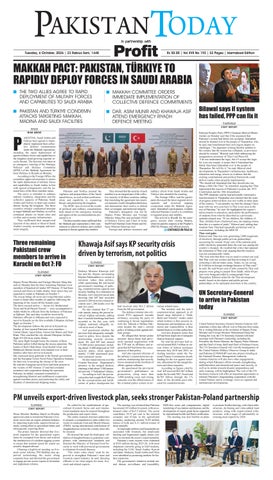
AKISTAN, Saudi Arabia and Turkiye have agreed to immediately implement their collective defence commitments under the Makkah Agreement, including the rapid deployment of agreed military forces and capabilities to the kingdom amid growing regional security threats. The decision was taken at an emergency meeting of the Strategic Political and Defence Committee (SPDC) of the Makkah Agreement for Joint Defence in Riyadh on Monday. According to the Foreign Office, the committee approved measures to ensure the rapid deployment of military forces and capabilities to Saudi Arabia in line with agreed arrangements and the national laws of the three member states. The move is intended to enhance military readiness, integration and the collective capacity of Pakistan, Saudi Arabia and Turkiye to deter and counter threats facing the kingdom. The three countries strongly condemned attempts to target Makkah and Madina, as well as continued attacks on Saudi cities and civilian and economic infrastructure. They reaffirmed their unequivocal rejection of any attack or threat to Saudi Arabia’s security, sovereignty and territorial integrity.
Bilawal says if system has failed, PPP can fix it
Pakistan and Turkiye praised the vigilance and preparedness of the Saudi armed forces, as well as their professionalism and capability in countering threats and protecting the kingdom. The SPDC also reviewed the results of political and military consultations held ahead of the emergency meeting and approved the recommendations presented to it. The three member states reaffirmed that the Makkah pact represented a firm commitment to collective defence and a unified response to threats against any member.
Three remaining Pakistani crew members to arrive in Karachi on Oct 7: FO ISLAMABAD
STAFF REPORT
Deputy Prime Minister and Foreign Minister Ishaq Dar said on Monday that the three remaining Pakistani crew members of hijacked oil tanker MT Honour 25 had been rescued and flown to Addis Ababa, from where they are expected to return to Pakistan on October 7. The rescue brings all seven surviving Pakistani sailors closer to home after months of captivity following the hijacking of the vessel off the Somali coast. The three rescued sailors — Imran Ali, Muhammad Yasin and Syed Husain Yousuf — were accompanied to Addis Ababa by officials from the Embassy of Pakistan in Djibouti. Dar said they would be received by Pakistani officials in Ethiopia and were expected to travel to Karachi on the first available Ethiopian Airlines flight on October 7. The development follows the arrival in Karachi on Sunday of four injured Pakistani crew members — Usman Ghani, Aqeel Khan, Ameen bin Shams and Yasir Khan. They reached the city aboard Ethiopian Airlines flight ET 694 from Addis Ababa. The same flight brought home the remains of three Pakistani sailors killed during the rescue operation. The bodies of Rafi Ullah Khan, Syed Kashif Umer and Mahmood Ahmad Ansari were handed over to their families after their arrival in Karachi. Dar expressed deep gratitude to the Somali government and the European Union Naval Force Operation Atalanta for their role in securing the release of the crew. He said the European naval force had been present in the vicinity of MT Honour 25 and had extended assistance and cooperation during the operation. Pakistan, he added, remained committed to strengthening bilateral and multilateral cooperation against maritime piracy and protecting the safety and freedom of international shipping routes.
They stressed that the security of each member was an integral part of the collective security of all three countries, adding that translating the agreement into practical measures would strengthen deterrence and demonstrate their resolve to defend their sovereignty and territorial integrity. Pakistan’s delegation was led by Deputy Prime Minister and Foreign Minister Ishaq Dar and included Chief of Defence Forces and Chief of Army Staff Field Marshal Asim Munir and Defence Minister Khawaja Asif. Foreign and defence ministers and
military chiefs from Saudi Arabia and Türkiye also attended the meeting. The Foreign Office said the participants discussed the latest regional developments and reviewed ongoing cooperation under the Makkah Agreement. Islamabad’s participation, it added, reflected Pakistan’s resolve to contribute to regional peace and stability. Dar arrived in Riyadh for the emergency session after visiting Madina, where he paid his respects at the Prophet’s (PBUH) Mosque and offered prayers.
CONTINUED ON PAGE 03
Khawaja Asif says KP security crisis driven by terrorism, not politics ISLAMABAD STAFF REPORT
Defence Minister Khawaja Asif has said the dispute surrounding Khyber Pakhtunkhwa is rooted in terrorism rather than politics, while questioning the provincial government’s handling of policing, counterterrorism capacity and security funding. In a statement on Monday, Asif cited provincial data showing that KP had recorded around 6,200 terrorism-related incidents and 1,200 deaths over the past two years. He also claimed that 37 suicide attacks during the period involved Afghan nationals, adding that 14 suicide bombings had been recorded so far this year, with Afghan nationals allegedly involved in most of them. Asif questioned whether the province had adequately strengthened its police force despite the deteriorating security environment. He said KP had around 125,000 police personnel, including about 13,000 deployed on VIP security duties, while approximately 17,000 sanctioned positions remained vacant. He also raised concerns over the Counter-Terrorism Department’s presence in the merged districts, claiming it had about 3,300 personnel and only 17 bulletproof vehicles. According to Asif, the provincial police had sought Rs42 billion for the reconstruction and fortification of police checkpoints but
had received only Rs1.2 billion from the KP government. The defence minister also criticised PTI’s approach towards militancy, accusing the party of continuing to favour negotiations with the Tehreek-e-Taliban Pakistan despite the state’s current policy of taking action against militant groups. He alleged that former prime minister Imran Khan had previously pursued negotiations with the TTP and its affiliates and argued that KP had borne the consequences of that policy. Asif also rejected criticism of the military’s counterterrorism operations, maintaining that security forces remained at the forefront of efforts against militants. He questioned the provincial government’s performance on prosecution, citing more than 3,000 pending cases and raising concerns over the effectiveness of the criminal justice system in ter-
rorism-related cases. The minister said the state’s counterterrorism approach in affected areas followed a “Hold, Build and Transfer” model, under which territory is first secured, infrastructure and institutions are restored and responsibility is then handed back to civilian authorities. Asif also disputed claims that KP had been deprived of adequate federal financial support. He said the province had received around Rs8.5 trillion in various forms of federal assistance between July 2010 and 2025, including transfers under the National Finance Commission Award, funding for the war against terrorism, allocations for the merged districts and direct transfers. According to figures cited by Asif, KP received Rs5.867 trillion under the Seventh NFC Award and Rs705 billion through the 1% share of the divisible pool allocated for counterterrorism.
Pakistan Peoples Party (PPP) Chairman Bilawal Bhutto Zardari on Monday said that if the argument that Pakistan’s system had failed was accepted, Islamabad should be handed over to the people of Tharparkar, who, he said, had transformed their own region despite its challenges. “An argument is being forcibly pushed in the country that the system has collapsed, so provinces should be created,” Bilawal said while addressing the inauguration ceremony of Thar Coal Phase-III. “I do not understand the logic, but if I accept this logic for even one minute, it means that if Islamabad has failed, then hand Islamabad over to the people of Tharparkar. We will fix it,” he said. Bilawal cited developments in Tharparkar’s infrastructure, healthcare, education and energy sectors as evidence that the existing constitutional and political framework could deliver results when properly implemented. “We should tell Islamabad that they should also run things a little like Thar,” he remarked, arguing that Thar represented the success of Pakistan’s system, the 1973 Constitution and the 18th Amendment. The PPP chairman said he had personally witnessed a transformation in Tharparkar and claimed that the scale of progress achieved there was not visible in other parts of the country. “I can proudly say that the change I have seen with my own eyes here in Thar is not seen in the rest of Pakistan,” he said. He highlighted the region’s achievements in education, particularly the performance of students from what he described as a previously underdeveloped area. “If our children, the children of Thar, children from a backward area, are topping exams, then this is a matter of pride,” Bilawal said, adding that students from Thar had repeatedly performed well in examinations, including the MDCAT. Thar coal gains Bilawal said Thar was now generating 2,000 megawatts of electricity through public-private partnerships, accounting for around 14 per cent of the national grid, while electricity generated from the coal was among the country’s cheapest. He recalled that critics had opposed the extraction of Thar coal, arguing that the resource was not commercially viable. “We were told that there was no need to extract our coal, that Thar coal was useless and that investing in it and extracting it did not make sense. Today, we are saving $1.6 billion in foreign exchange because of Thar coal,” he said. He said 94 per cent of jobs created by Thar coal projects were going to people from Sindh, while 60 per cent were being provided to young people from Tharparkar. Bilawal called for the Thar development model, based on devolution and public-private partnerships, to be replicated elsewhere in the country.
UN Secretary-General to arrive in Pakistan today ISLAMABAD
STAFF REPORT
United Nations Secretary-General Antonio Guterres will undertake a three-day official visit to Pakistan from today. He is visiting Pakistan at the invitation of Deputy Prime Minister and Foreign Minister Mohammad Ishaq Dar. During the visit, the UN Secretary-General will hold meetings with Pakistan's leadership, including the President, the Prime Minister, the Deputy Prime Minister, and the Chief of Army Staff and Chief of Defence Forces. The UN Secretary-General will visit the headquarters of the United Nations Military Observer Group in India and Pakistan (UNMOGIP) and also attend a briefing at the National Disaster Management Authority. Antonio Guterres will also have other engagements, during which Pakistan's efforts towards strengthening multilateralism and international peace and security, as well as its strides towards disaster preparedness and early warning, will be highlighted. The visit of the UN Secretary-General will offer an important opportunity to reiterate Pakistan's longstanding cooperation with the United Nations and to exchange views on regional and international developments.
PM unveils export-driven livestock plan, seeks stronger Pakistan-Poland partnership ISLAMABAD
STAFF REPORT
Prime Minister Shehbaz Sharif on Monday approved a plan to transform Pakistan’s livestock sector into an export-oriented industry by importing high-yield, superior-breed animals, rearing them at specialised farms and subsequently exporting them. The prime minister directed that livestock imported for the specialised export farms be exempted from duties and ordered the introduction of a modern tagging system to ensure that animals raised for export are actually shipped abroad. Chairing a high-level meeting on livestock sector reforms, PM Shehbaz also approved restructuring the sector along corporate lines and directed the government to engage private-sector experts to formulate and implement reforms.
He called for the establishment of specialised livestock farms and said international standards must be ensured throughout the production and export chain. The prime minister directed authorities to prepare a comprehensive plan within two weeks to eradicate Foot-and-Mouth Disease (FMD), saying international certification of slaughterhouses across the country must also be ensured. He stressed the need for third-party validation of slaughterhouses to guarantee compliance with international standards and directed the Ministry of National Food Security to work with provincial governments to eliminate livestock diseases. “The entire value chain” must be improved to strengthen Pakistan’s meat and livestock export industry, he said, directing officials to set clear targets for meat, livestock and related exports.
The meeting was informed that Pakistan has around 245 million livestock, with an estimated value of Rs5.5 trillion. The sector contributes 14.97 per cent to the national economy and 63.6pc to the agricultural economy, producing around 74.69 million tonnes of milk and 6.31 million tonnes of meat annually. Around eight million rural households are associated with livestock, but small-scale farming and fragmented supply chains continue to constrain the sector’s export potential. Pakistan’s meat exports were estimated at $530 million during 2025-26, with most shipments currently going to Gulf markets, including the UAE, Saudi Arabia, Kuwait and Qatar. Malaysia, Saudi Arabia and China were identified as promising markets for further expansion. The government’s initiatives include animal disease surveillance and traceability,
FMD-free zones and compartments, digital monitoring of vaccination and diseases, and the development of export-grade farms supported by international health and Halal certification. The meeting was also briefed on plans
to promote feedlot farming, cold-chain infrastructure, de-boning and value-added meat products, along with export-related infrastructure, with a target of substantially increasing meat exports by 2028.
02 NEWS
Tuesday, 6 October, 2026 | ISLAMABAD
GOVT SEEKS CABINET APPROVAL TO FACILITATE LPG IMPORTS AMID WINTER SUPPLY CONCERNS, MINISTER SAYS
T
PROFIT
WEB DESK
HE government has submitted a summary to the federal cabinet to facilitate LPG imports as part of contingency measures to prevent fuel shortages amid heightened international energy risks, Petroleum Minister Ali Pervez Malik said on Sunday. Malik said the government was planning in advance to ensure adequate availability of crude oil, petrol, diesel, gas and LPG, particularly during the upcoming winter and in view of changing conditions in global energy markets. He said arrangements were being made to meet gas demand during December, January and February, with the prime minister and federal cabinet briefed on expected requirements, avail-
able supplies and potential challenges. On LPG prices, Malik said rates were determined by the Oil and Gas Regulatory Authority (OGRA), with Saudi Aramco's monthly Contract Price
FIA probes alleged irregular appointments, promotions at Engineering Development Board PROFIT
GHULAM ABBAS
An eight-member team of the Federal Investigation Agency’s Anti-Corruption Circle has visited the Engineering Development Board (EDB) to investigate alleged irregularities in appointments, promotions, deputations and other administrative decisions taken during the tenure of former caretaker CEO Engineer Khuda Bakhsh, amid an escalating power struggle within the body responsible for formulating policies for the country’s engineering sector. The FIA team recently held a meeting with incumbent CEO Hammad Mansoor and sought extensive records relating to Mr Khuda Bakhsh’s service and tenure at the EDB, including his appointment, deputation, absorption, promotions and upgradations, as well as his appointment as chief executive. The inquiry also covers allegations of illegal appointments, irregular promotions and other administrative and financial irregularities during Mr Khuda Bakhsh’s tenure as acting CEO and chief executive, according to official correspondence reviewed for this report. The FIA has sought the relevant service and organisational rules, approvals, notifications, proceedings of departmental promotion committees and selection boards, minutes of meetings, correspondence, audit observations, conflict-ofinterest declarations and other related documents. It has also asked the EDB to provide a consolidated record of employees recruited or appointed during the relevant period, including their names, designations, grades, dates and nature of appointment, sanctioned posts against which they were appointed, appointing authorities and present status. The agency has separately sought complete records relating to appointments made under the project titled “Strengthening of the Engineering Industry/Sector”, including its approved PC-I, sanctioned posts, recruitment process, selection committee proceedings, approvals, appointment orders, remuneration and project expenditure. The FIA inquiry comes against the backdrop of a prolonged dispute between senior EDB officials and the Ministry of Industries and Production over appointments, deputations and administrative authority. The EDB, established in 1995 as an attached department of the Ministry of Industries and Production, is mandated to strengthen the country’s engineering base and serves as a key policy and decision-making body on matters relating to the engineering industry. The internal dispute intensified after Mr Mansoor took charge as CEO in October 2025 and removed Mr Khuda Bakhsh from the EDB on the grounds that his parent organisation was the State Engineering Corporation rather than the board. Mr Khuda Bakhsh challenged the move in court and obtained a stay order. He continues to hold his position as a general manager of the EDB, according to officials familiar with the matter. Meanwhile, Mr Mansoor himself came under scrutiny over the appointment of several employees on deputation, with questions raised about whether the prescribed procedure was followed. The Ministry of Industries and Production had objected to the assignment of Mian Usman Ali Shah, a BS-19 officer serving on deputation at the EDB, to the post of general manager, a BS-20 position. The matter was subsequently taken up with the Establishment Division. The Establishment Division not only sought Mr Shah’s repatriation but also raised a separate disciplinary issue. In a letter dated Aug 17, 2026, the Deputy Secretary (Discipline-I) of the Establishment Division informed the EDB’s GM (HR/Admin) that Mr Shah had allegedly been nominated in an FIR registered on July 10, 2026, at Bhanamari police station in Peshawar under Sections 384, 447, 506, 148 and 149 of the Pakistan Penal Code.
forming an important part of the pricing mechanism. He said the government was taking steps to maintain adequate LPG supplies as winter demand increases. The minister also said more than
nine million people had benefited from the government's petroleum relief scheme, under which eligible motorcyclists and users of vehicles of up to 800cc receive relief of Rs100 per litre. He said the scheme would continue subject to the availability of financial resources, while any decline in international oil prices would be passed on to domestic consumers. Malik said domestic petroleum prices were determined through a transparent mechanism linked to movements in international markets. He also said Pakistan was concerned about attacks on oil installations near Riyadh and disruptions to maritime routes near Bab-el-Mandeb, stressing that advance planning for fuel availability was necessary to limit the impact of potential global supply disruptions and higher energy prices on domestic consumers.
Pakistan’s seafood exports surge 35% to $125.4 million in Q1FY2026-27 PROFIT NEWS DESK
Pakistan’s fish and seafood exports rose 34.4% year-on-year to $125.4 million during the first quarter of FY27, while export volumes jumped 40.2% to 61,679 metric tonnes, Federal Minister for Maritime Affairs Muhammad Junaid Anwar Chaudhry said on Monday. Export earnings stood at $93.28 million in the first quarter of FY26, before increasing to $125.4 million during the July-September period of the current fiscal year. Over a two-year period, seafood export earnings have increased 74.4% from $71.9 million in 1QFY25, while export volumes have risen 74.8% from 35,294 metric tonnes. In volume terms, exports increased from 35,294 metric tonnes in 1QFY25 to 43,995 metric tonnes in 1QFY26 before reaching 61,679 metric tonnes in 1QFY27. Chaudhry said the increase in export earnings highlighted the economic potential of Pakistan’s marine fisheries sector as the country seeks to expand its blue economy. He said the fisheries sector remained an important part of the coastal economy, supporting fishing communities while generating foreign exchange through exports of fish and other marine products. The minister also highlighted the Marine Fisheries Department’s
PROFIT
Selling pressure gripped the Pakistan Stock Exchange (PSX) on Monday, pushing the benchmark KSE-100 Index down more than 2,300 points during intraday trading as domestic political uncertainty, regional tensions and elevated energy prices weighed on investor sentiment. According to the PSX website, the market opened on a bearish note, with the KSE-100 shedding more than 1,200 points within the opening minutes of trading. Selling persisted as the session progressed and intensified after midday, pushing the index to an intraday low of 165,766.79. At 12:50 pm, the KSE-100 was trading at 165,891.20, down 2,264.29 points, or 1.35%, from the previous close. Analysts attributed the decline to a combination of domestic and global factors, with political uncertainty at home encouraging a cautious approach while elevated international oil prices raised concerns over inflation and the broader macroeconomic outlook.
PROFIT
NEWS DESK
The Board of Directors of Attock Cement Pakistan Limited has approved and recommended changing the company’s name to “Falcon Cement Limited”, subject to shareholder and regulatory approvals. In a material information notice submitted to the Pakistan Stock Exchange (PSX) on Monday, the cement manufacturer said its board had approved the proposed name change through a resolution passed by circulation. The proposal will now be placed before shareholders through a special resolution and will also require completion of applicable statutory and regulatory formalities under the Companies Act, 2017, as well as requirements of the Securities and Exchange Commission of Pakistan (SECP) and the PSX. The company has called an extraordinary general meeting (EOGM) for October 20, 2026, where shareholders will consider and vote on the proposed change. The proposed rebranding would see the listed company adopt the Falcon name already associated with its cement brand, subject to the required approvals. Attock Cement said it would make further disclosures as required under applicable laws and regulations.
Zuma Resources approves 100% acquisition of international eSIM platform sim.market PROFIT
NEWS DESK
performance during FY26, when seafood exports reached a record $568 million. He said the opening of new international markets, particularly Russia, had contributed to the sector’s progress. According to Chaudhry, efforts to resume shrimp exports to the United States and the revival of the fishing licensing regime in Pakistan’s Exclusive Economic Zone could further support the sustainable use of marine fisheries resources. However, he said institutional, technical and capacity constraints needed to be addressed for Pakistan to increase exports to higher-value international seafood markets, particularly the European Union. The minister also called for the re-
vival of the Marine Fisheries Department’s Fisheries Training Centre to strengthen technical skills and improve compliance with international fisheries and seafood safety requirements. He said improving the capabilities of fishermen, skippers, fisheries professionals and other participants in the supply chain would help improve the quality, safety and traceability of Pakistani seafood and strengthen its competitiveness in international markets. Chaudhry said the government would continue efforts to modernise the fisheries sector, sustainably utilise marine resources, expand access to international markets and increase the sector’s contribution to the economy.
PSX falls over 2,300 points as investors turn cautious amid political noise NEWS DESK
Attock Cement board approves changing name to Falcon Cement Limited
“Going forward, the market direction will be set by where oil prices head on the global front and whether political noise settles on the domestic front,” an analyst said. Selling was broad-based, affecting automobile assemblers, cement, commercial banks, oil and gas exploration companies, oil marketing companies, power generation companies and refineries. The latest decline follows a difficult last week for equities, during which uncertainty surrounding the US-Iran conflict and elevated global energy prices kept investors cautious. The KSE-100 lost 2,610 points, or 1.5%, week-on-week to close at 168,155 points last week. Average daily trading volume also declined 45% to 647 million shares. International oil prices remained elevated for much of the week, reaching $105.3 per barrel as supply-chain concerns and China's suspension of oil-product exports outweighed recovering crude flows from the Gulf. AKD Securities said in its weekly review that improving economic indicators could support the market, while the upcoming IMF
review would remain an important near-term catalyst. It added that a potential US-Iran agreement could ease international oil prices from their current elevated levels. Asian stocks made brisk gains on Monday as investors pared back expectations of a Federal Reserve rate hike this month, while the euro sank to a 17-month low on concerns over France's deteriorating fiscal position. Japan's Nikkei rose 2%, while MSCI's broadest index of Asia-Pacific shares outside Japan advanced 0.9%. Nasdaq futures were flat while S&P 500 futures eased 0.1%. EUROSTOXX 50 futures and DAX futures inched down, though FTSE futures tacked on 0.26%. Oil prices fell on Monday as rising Middle East crude exports and a release of oil stocks by the Group of Seven nations boosted supplies, offsetting concerns about further damage to Gulf oil infrastructure as the US-Israeli war on Iran drags on. Brent crude futures fell 72 cents, or 0.71%, to $101.59 a barrel at 0634 GMT, while US West Texas Intermediate crude was at $90.05 a barrel, down $1.05, or 1.2%.
The Board of Directors of Zuma Resources Limited has approved the acquisition of 100% ownership and associated rights of the international digital connectivity and eSIM platform sim.market through its wholly owned UK subsidiary, expanding the company’s push into international telecommunications. The board approved the proposed acquisition at its meeting on October 2, 2026, according to a material information notice submitted to the Pakistan Stock Exchange (PSX) on Monday. The proposed acquisition covers the sim.market brand and trademark rights, domain name, website and platform rights, goodwill, associated intellectual property, customer and commercial rights and other business assets and rights forming part of the platform, where applicable. Sim.market operates as an international digital connectivity and eSIM platform offering travel and global connectivity services across multiple markets. The acquisition builds on Zuma Resources’ broader move into international connectivity services. The company incorporated Zuma Global Ltd in England and Wales on September 18, 2026, as a wholly owned subsidiary to develop its overseas technology and telecom operations. Zuma has also initiated regulatory engagement with UK communications regulator Ofcom as it prepares to offer physical SIMs, eSIMs and other digital connectivity services in the market. The company had earlier approved a strategic partnership with Telna North America, Inc. to support the rollout of global eSIM and physical SIM connectivity services. Telna provides eSIM, physical SIM and mobile network connectivity across more than 200 countries through partnerships with international mobile operators. Zuma had projected annual revenue of between $3 million and $5 million during the initial phase of the international telecom rollout, subject to regulatory approvals and commercial implementation. The latest acquisition would bring ownership of the sim.market brand and associated business rights under Zuma Global. Zuma said the transaction is aligned with its strategy to expand in technology and digital telecommunications and develop its international eSIM and connectivity business. However, the company has not yet disclosed the value of the proposed acquisition. The board has authorised Zuma Resources’ chief executive officer to negotiate and finalise the terms and structure of the transaction, including the purchase consideration, adjustment or settlement of receivables, assets and liabilities, transfer of related business rights and assets and other commercial terms. The disclosure therefore represents board approval to proceed with the acquisition process, while the final purchase price and transaction structure remain subject to negotiations. Zuma said it would make further disclosures regarding the finalisation and completion of the transaction and any other material developments required under applicable laws and regulations.
Saudi Arabia cuts November oil prices for Asia to six-year low PROFIT
REUTERS
Saudi Arabia has unexpectedly cut its November crude oil prices for Asian buyers to their lowest levels in six years as record shipping costs increase the expense of moving oil from the Gulf. Saudi Aramco set the November official selling price (OSP) for its flagship Arab Light crude at $5 per barrel below the average of Oman and Dubai prices, widening the discount by $3 from October. The November discount is the widest since June 2020, according to Reuters data. The cut came despite expectations that Saudi Arabia would increase the Arab Light price by as much as $5 per barrel following
gains in Middle Eastern crude benchmarks. Aramco also reduced November prices for its heavier Arab Medium and Arab Heavy grades sold to Asia by $5 per barrel. Three Asian refining sources said the lower prices appeared aimed at compensating buyers for sharply higher freight costs. The cost of chartering a very large crude carrier capable of transporting 2 million barrels from the Gulf to China reached $1.2 million per day on Friday, according to LSEG data, compared with around $80,000 per day a year earlier. Aramco has been considering discounts for crude loaded off Oman to offset record freight rates and protect its market share after disruptions linked to the US-Israeli war against Iran affected regional exports.
One refining source said the lower prices could also compensate buyers for delays and longer voyages involving Saudi crude exported through Egypt's Sidi Kerir port. Since September, Aramco has moved millions of barrels through ship-to-ship transfers outside the Strait of Hormuz, while Saudi Arabia has also resumed crude loading at the Red Sea port of Yanbu after a drone attack temporarily shut the kingdom's East-West oil pipeline. While cutting prices for Asia, Aramco raised November OSPs for northwest European customers by $3 per barrel across all grades. Prices for US buyers were left unchanged.
KARACHI CUSTOMS UNCOVERS RS3.2B IMPORTS THROUGH ALLEGED FAKE FIRMS
NEWS 03
Tuesday, 6 October, 2026 | ISLAMABAD
T g
PROBE FINDS TWO COMPANIES ALLEGEDLY OPERATED AS ‘MARKET IDS’ FOR HIDDEN IMPORTERS, FLAGS UNDER-INVOICING AND TAX IRREGULARITIES AND SEEKS JIT INVESTIGATION INTO TRADE-BASED MONEY LAUNDERING PROFIT
MonitoRing RepoRt
HE Collectorate of Customs Airport Karachi has uncovered imports worth Rs3.2 billion allegedly routed through two paper companies operating as “market IDs” for undisclosed importers and has sought a Joint Investigation Team (JIT) to investigate suspected trade-based money laundering (TBML), Business Recorder reported. According to an investigation report, the case began with a crackdown on internet routers imported without mandatory Pakistan Telecommunication Authority (PTA) certification before developing into a wider probe on the instructions of the Federal Board of Revenue (FBR). Customs initially identified 10 goods declarations covering 71,815 routers cleared through the Airport Facilitation Unit without the required PTA certificate, in violation of SRO 1172(I)/2021 and import policy requirements. The consignments were confiscated after adjudication and traced to two com-
Gold rises as chances of October Fed rate hike fall
panies that subsequently challenged the seizures before the Federal Tax Ombudsman. Both complaints were dismissed. The investigation widened after several individuals approached the Collectorate claiming ownership of separate portions of goods covered by individual declarations and sought their release separately. Scrutiny subsequently found that both entities were allegedly paper companies registered in the names of front men and being used as “market IDs” by unidentified operators. One company's declared address was a rice and flour shop, while the other was registered at a rented family residence. One firm was registered with the FBR only as a “Service Provider / General Order Supplier” rather than an importer, which the report said indicated potential fiscal fraud under Section 32A(1)(b) of the Customs Act, 1969, a predicate offence under the Anti-Money Laundering Act, 2010. The companies' WeBOC user IDs were accessed from 2,983 and 2,732 unique IP addresses, respectively, with 1,048 IP addresses common to both. The report said the pattern suggested multiple undisclosed operators were using
PROFIT
neWs DesK
Gold prices edged higher on Monday as weaker US labour market data sharply reduced expectations that the Federal Reserve would raise interest rates again in October. Spot gold rose 0.4% to $4,158.17 per ounce by 0150 GMT, while US gold futures for December delivery gained 0.6% to $4,186.40. US job growth slowed more than expected in September, while nonfarm payroll figures for the previous two months were revised sharply lower. Traders now see a 22% probability of a Federal Reserve rate hike in October, down from 64% a week earlier, according to the CME FedWatch Tool. Markets, however, are still pricing in an 87% chance of an increase in December. The Fed raised its benchmark overnight interest rate by 25 basis points last month to a range of 3.75%-4.00%, its first increase in three years. "The softer labour market data has helped dial back October Fed hike expectations, which is providing gold some support. But the market is still treating the Fed’s broader hiking cycle as intact even if a pause occurs in October," KCM Trade chief market analyst Tim Waterer said. Gold, which does not pay interest, typically benefits when expectations for higher interest rates decline. Geopolitical developments in the Middle East also remained in focus after Yemen's Saudibacked, internationally recognised government announced a major military campaign on Sunday to retake areas controlled by the Iranbacked Houthis. Waterer said developments in the Middle East would continue to influence gold through their impact on oil prices and the broader inflation outlook. Oil prices slipped as rising Middle East crude exports and releases of oil by G7 countries added to supplies despite concerns over further damage to Gulf oil infrastructure amid the Iran war. Among other precious metals, spot silver climbed 1.7% to $61.40 per ounce. Platinum gained 0.6% to $1,708.48, while palladium rose 0.6% to $1,175.04.
Makkah Pact: Pakistan, Türkiye to rapidly deploy forces in Saudi Arabia CONTINUED FROM PAGE 01
The meeting came amid heightened tensions between Saudi Arabia and Yemen’s Houthi movement. Dar had earlier said the emergency session would focus on recent Houthi attacks against the kingdom. The Houthis have claimed attacks involving ballistic missiles and drones against Saudi targets, including an Aramco facility south of Riyadh, while Saudi-led forces have conducted strikes against Houthi positions in Yemen. The renewed fighting has heightened concerns over the security of the Gulf and vital international maritime routes. PACT MOVES TOWARDS IMPLEMENTATION: The Makkah Agreement for Joint Defence was signed on August 7 to strengthen collective deterrence and establish the principle that an attack against one member would be treated as an attack against all. The alliance held its first SPDC meeting in Istanbul on August 31, where it was decided that Pakistan would initially head the alliance’s secretariat for three years. Retired Lieutenant General Nauman Mahmood was subsequently appointed its first secretary general. Military coordination among the three countries has since intensified. Their military chiefs held urgent talks in Riyadh on September 25 following the Houthi attacks on Saudi Arabia. Pakistan has repeatedly reaffirmed its commitment to the kingdom’s security. InterServices Public Relations Director General Lieutenant General Ahmed Sharif Chaudhry recently said Pakistan would go to “any extent” to defend Saudi Arabia and described Islamabad’s commitment to the kingdom as unconditional. Defence Minister Khawaja Asif has likewise said Pakistan would stand by Saudi Arabia both practically and diplomatically if the conflict with the Houthis escalated.
the same NTN and WeBOC identities for imports, misdeclarations, policy violations and illicit fund transfers. The scale of the companies' trading activity also differed sharply from their declared financial resources. Their proprietors had combined declared capital of Rs2.2 million when imports began, while the highest combined capital subsequently declared was around Rs77.7 million, which the report said would not have financed even one month of their import activity. Customs enhanced the declared value of imported goods by Rs1.3 billion during assessment. In the case of routers alone, goods declared at Rs97 million were reassessed at Rs565 million, which investigators cited as evidence of systematic under-invoicing. The two companies also recorded around Rs2.9 billion in local sales while paying almost no sales tax. Many sales were made to blacklisted, suspended or inactive buyers or entities whose registered business activities did not correspond with the goods purchased. The report alleged that imports were financed with undisclosed funds belong-
ing to hidden beneficial owners. The companies shared 108 local buyers and 12 foreign suppliers, with a single supplier accounting for 61% of their combined imports. Their trading activity also moved in parallel and their sales tax returns were frequently filed within minutes of each other, which the report cited as evidence of coordinated control. The report further alleged that people linked to the entities pressured and threatened Customs officials after the Collectorate refused to release the goods and began examining beneficial ownership, describing the activity as part of an organised cartel seeking illegal clearance. The Collectorate has recommended forming a JIT comprising anti-money laundering officials from Customs, Inland Revenue and/or the Federal Investigation Agency to investigate suspected money laundering and beneficial ownership. It has also proposed suspending or cancelling both WeBOC user IDs under Section 155F of the Customs Act and referring the case to RTO-II Karachi for income tax and sales tax proceedings.
Pakistan’s 1LINK expects over 12b transactions worth nearly Rs90trn in 2026 g
PAYMENT NETWORK PROCESSED MORE THAN 10B TRANSACTIONS WORTH RS75.4TRN IN 2025; 1IBFT HANDLES RS43.7TRN IN FIRST NINE MONTHS OF 2026 PROFIT
MonitoRing RepoRt
Pakistan’s 1LINK expects transaction volumes across its payment rails to exceed 12 billion in 2026, with total throughput approaching Rs90 trillion as digital payments continue to grow. The projection covers financial and non-financial transactions, value-added services and Fraud Risk Management Services. In 2025, 1LINK processed more than 10 billion transactions worth Rs75.4 trillion, up nearly 20% in volume and 19.3% in value. Syed Suleman Hasan, Chief Corporate Affairs and Company Secretary at 1LINK, said the company was on track to process payment transactions equivalent to approximately 75% of Pak-
istan’s GDP. From January to September 2026, 1IBFT processed approximately 998.9 million transactions worth Rs43.7 trillion, while 1BILL facilitated around 170.6 million transactions valued at Rs12.3 trillion. The company’s ATM Switching network handled another 285.4 million transactions worth Rs3.2 trillion during the same period. PayPak, Pakistan’s domestic payment scheme, has meanwhile issued approximately 16.8 million cards and accounts for nearly 28% of all debit cards in circulation. Hasan said digital payments were reducing dependence on cash and allowing consumers to transfer funds, pay bills, make purchases and access banking services more efficiently. He said 1LINK, which is marking
its 22nd anniversary, also supports government payment and collection initiatives and works with banks, fintechs, regulators and other participants in the financial ecosystem. Hasan said further growth in digital payments would be driven by increasing smartphone penetration, expanding digital banking adoption and greater acceptance of electronic payments among consumers and merchants. “Technology has fundamentally changed how people interact with financial services. As we celebrate 22 years of serving Pakistan, our focus remains on enabling innovation, promoting interoperability and delivering payment infrastructure that supports the evolving needs of consumers, businesses and the national economy,” he said.
OPEC+ keeps November oil output targets unchanged g
SEVEN CORE PRODUCERS MAINTAIN EXISTING CEILINGS AS GULF OUTPUT REMAINS WELL BELOW PRE-WAR LEVELS; BRENT CRUDE STAYS ABOVE $100 A BARREL LONDON/MOSCOW ReuteRs
OPEC+ has agreed to keep its oil production targets unchanged for November as Middle East supply disruptions continue to keep actual output well below quotas and further policy changes remain unlikely before 2027. Seven core members of the group — Saudi Arabia, Russia, Iraq, Kuwait, Algeria, Kazakhstan and Oman — agreed to maintain existing production ceilings during a brief online meeting on Sunday. The decision was in line with market expectations and comes as Gulf OPEC+ producers continue to pump below their targets because of export disruptions linked to the US-Israeli war with Iran. Exports from Gulf producers have fluctuated between 60% and 80% of normal levels in recent months despite increasing flows through the Strait of Hormuz. "The OPEC+ group of seven
kept their production ceilings unchanged, in line with market expectations. That said, despite rising flows through the Strait of Hormuz, their output levels remain well below quota," UBS analyst Giovanni Staunovo said. "Consequently, the oil market remains tight." Brent crude remains above $100 a barrel, compared with around $73 before the Iran war began in late February. Oil prices declined on Friday after European leaders agreed to US President Donald Trump's request to release diesel reserves. OPEC+ had been increasing production targets for much of 2026 following years of output cuts, but the Middle East conflict meant much of the planned increase did not translate into actual additional supply. The seven core producers pumped 25 million barrels per day (bpd) in August, an increase of 630,000 bpd from July but still around 5 million bpd below their combined pre-war produc-
tion in February, according to OPEC data. The conflict has also delayed an OPEC+ review of members' production capacity that will play a key role in determining their output quotas for 2027. Industry sources said the war had created uncertainty around estimates of future production potential, complicating the capacity assessment. OPEC+ still has around 2 million bpd of production cuts in place across most of its members. The group needs the capacity review before determining how future production increases or quota changes will be distributed among members. Further changes to production policy are unlikely before 2027, according to industry sources. The seven core OPEC+ members are scheduled to meet again on November 1. The Joint Ministerial Monitoring Committee, a separate OPEC+ body responsible for reviewing market conditions but not setting production policy, also met on Sunday.
Electric vehicle sales in Europe surge 45% to record 1.64 million in 2026
EVs capture 22% of EU car market in January-August as model availability rises 50%; European carmakers account for nearly 60% of available models BERLIN
ReuteRs
Electric vehicle sales in the European Union surged 45% year-on-year to a record 1.64 million units during the first eight months of 2026 as carmakers expanded their range of more affordable models, according to a new study. EVs accounted for 22% of new vehicle sales between January and August, six percentage points higher than during the same period last year, Brussels-based environmental advocacy group Transport & Environment (T&E) said in its EV progress report. T&E described 2026 as a “pivotal year for EV availability”, with the number of models available to European consumers increasing 50% in a year as manufacturers expanded their line-ups to meet EU emissions targets. European carmakers accounted for nearly 60% of available EV models and introduced another 16 models during the first half of 2026. Chinese manufacturers held a 21% share of available models and added 11 vehicles during the same period. The expansion includes lowerpriced electric cars from manufacturers such as Volkswagen, which is rolling out models including the all-electric Polo as it works to meet EU emissions requirements and avoid potential fines. The shift towards electric vehicles is also taking place against a sharp increase in fuel prices linked to the Middle East conflict. Diesel prices have risen 38% since the Iran war began, according to the study, increasing the cost of filling a 50-litre tank by around €30 ($34). T&E said the combination of a wider range of electric vehicles, more affordable models and higher running costs for combustion-engine cars was supporting stronger EV uptake across the European market.
Saudi Arabia quietly shelving $2.5b NEOM Stadium planned for 2034 World Cup RIYADH/DUBAI ReuteRs
Saudi Arabia is quietly shelving plans to build one of its most ambitious stadiums for the 2034 FIFA World Cup, two sources familiar with the matter said, after delays and downscaling of the futuristic development housing it. The proposed 46,000-seat $2.5 billion NEOM Stadium was designed as an elevated arena within The Line, the planned 160-kilometre steel-and-glass city that forms part of the wider NEOM development. MEED Projects, a Dubai-based construction intelligence platform, estimates the stadium would cost $2.5 billion and now lists the project as “on hold”, with no completion date. The Line was originally one of the flagship projects under Saudi Arabia's Vision 2030 economic diversification programme. Public Investment Fund Governor Yasir AlRumayyan said in April that The Line was no longer a priority and was not essential for completion before 2030, although he denied that projects had been cancelled. NEOM and the Saudi government media office did not respond to requests for comment. The World Cup 2034 Hosting Higher Authority said substantial construction milestones for the tournament were already being delivered but did not specifically address the status of the NEOM Stadium. Saudi Arabia is planning to build or renovate 15 World Cup venues across five cities alongside dozens of training facilities for the 2034 tournament, which will be the first edition of the expanded 48-team competition hosted by a single country. MEED estimates the combined value of the stadium projects at $22.7 billion, with the remaining venues and facilities at various stages of development and expected to be completed between 2026 and 2033. The shelving of the NEOM venue comes as Saudi Arabia reassesses some of its expensive giga-projects. Construction of The Mukaab, the cube-shaped skyscraper at the centre of Riyadh's New Murabba development, was suspended earlier this year. The PIF has also been shifting its investment strategy towards projects offering more immediate financial returns.
Middle East crude exports exceed pre-war levels despite tanker attacks g
CRUDE SHIPMENTS REACH AS HIGH AS 22.5 MILLION BARRELS PER DAY IN LATE SEPTEMBER AS TRAFFIC THROUGH STRAIT OF HORMUZ RECOVERS DESPITE AT LEAST SEVEN REPORTED VESSEL ATTACKS SINGAPORE ReuteRs
Middle East crude oil exports climbed above pre-war levels on four days during the final week of September, even as attacks on vessels increased in and around the Strait of Hormuz, according to shipping data. Provisional data from ship-tracking firm Kpler showed crude exports exceeded pre-war levels on September 24 and from September 27 to 29, reaching between 19.5 million and 22.5 million barrels per day (bpd). That compares with average exports of around 18 million bpd between March 2025 and February 2026, before the US-Israeli war with Iran began on February 28. The seven-day moving average for Middle Eastern crude exports stood at 18.5
million bpd on October 1. The figures cover shipments through the Strait of Hormuz and Red Sea, exports from terminals and shipto-ship transfers in the Gulf of Oman. Total shipments of crude oil, petroleum products, chemicals and non-gas liquids averaged 22.4 million bpd during the seven days to September 30. Liquefied natural gas shipments through the Strait of Hormuz also increased in September, reaching their highest monthly level since February. The shipping figures exclude vessels that may have crossed the strait after switching off their Automatic Identification System transponders to avoid detection. Before the war began, around 125 large commercial vessels typically passed through the Strait of Hormuz each day, including oil tankers, gas carriers, bulk car-
riers and container ships. The waterway accounted for about 20% of global daily crude oil and LNG supply. The recovery in shipping traffic has, however, coincided with an increase in security incidents. Shipping intelligence firm Marisks said at least seven attacks on tankers had been reported in and around the Strait of Hormuz. The very large crude carrier Kazimah III was reportedly hit by an unidentified projectile while operating in the strait on October 1, causing a fire onboard. Marisks said all crew members were safe and were subsequently evacuated. Kpler data showed the vessel had last been seen discharging 2 million barrels of Kuwaiti crude at Oman’s Ras Markaz port on September 17. The United Kingdom Maritime Trade
Operations agency has reported at least one attack each day in the Strait of Hormuz or Gulf of Aden since October 2. Marisks warned that merchant vessels using the Strait of Hormuz face a heightened and increasingly unpredictable threat as traffic through the waterway increases. The firm said available intelligence indicated recent incidents may not necessarily involve individual merchant ships being deliberately selected as targets. Instead, it said Iranian forces may be firing missiles into a predetermined engagement area, or “kill box”, where weapons could potentially acquire radar signatures from vessels present in the area. Under such a scenario, Marisks said simply being present within the engagement zone at the relevant time could expose commercial vessels to attack.
04 COMMENT
China’s long road from struggle to strength
Tuesday, 6 October, 2026
The pact awakens
T
HE reported agreement by Pakistan, Turkiye and Saudi Arabia to move towards rapid force deployment in the Kingdom marks a significant shift in the Middle East’s security landscape. What began as a political and strategic understanding under the Makkah pact has quickly moved towards its natural materialisation: a working defence arrangement with practical military implications. That speed matters. In a region already strained by conflict, proxy warfare, attacks on shipping routes and the insecurity of Gulf states, the pact is no longer only a diplomatic statement. It is becoming an operational framework. For Pakistan, Turkiye and Saudi Arabia, this creates both influence and responsibility. The three countries are not marginal actors. Saudi Arabia is central to Gulf stability and the wider Muslim world. Turkiye has deep military capacity and regional reach. Pakistan brings one of the Muslim world’s largest armed forces, long defence experience and strategic weight. Together, they represent a bloc capable of deterring aggression, reassuring allies and shaping the terms of regional security. But deterrence must not become adventurism. The real test of the Makkah pact will not be whether it can move forces quickly, but whether it can exercise power wisely. Military coordination can help prevent escalation only if it is matched by political restraint, clear objectives and a commitment to diplomacy. The pact’s rapid movement towards implementation suggests that all three capitals understand the gravity of the moment. The region does not need another open-ended military front. It needs credible partners who can discourage attacks, protect holy sites and critical routes, and create space for political settlements. That is where Pakistan, Turkiye and Saudi Arabia must now focus their energies. Their responsibility is especially important because their actions will be watched beyond the Middle East. Any collective response must be measured, legal and proportionate. It must strengthen regional order, not deepen sectarian or geopolitical fault lines. It must also avoid the temptation to treat military preparedness as a substitute for diplomacy. If handled carefully, the Makkah pact could become a stabilising arrangement at a dangerous time. It could show that regional security need not depend solely on distant powers, and that responsible Muslim states can coordinate in defence of peace rather than escalation. This is the promise now before Pakistan, Turkiye and Saudi Arabia. They have moved quickly from pledge to practice. They must now prove that the purpose of that speed is not war, but stability.
E
MuhaMMad Mohsin iqbal
VERY year, October 1 carries a special significance for China. It marks the establishment of the People’s Republic of China in 1949 and the beginning of a remarkable chapter in the country’s modern history. Seventyseven years later, China’s transformation from a poor and war-ravaged country into one of the world’s largest economies and most consequential powers remains one of the defining stories of the modern age. China’s rise, however, cannot be explained merely by its vast population, natural resources or geographical size. Behind the skyline of Shanghai, the factories of Shenzhen, the high-speed railways crossing the country and the extraordinary expansion of its technological capacity lies something less visible but equally important; a political and administrative system that has placed considerable emphasis on the selection, training and evaluation of officials. This raises an intriguing question; how does a person in China progress from being an ordinary political worker to occupying a position of national leadership? The answer is more complicated than the popular story that every aspiring Chinese leader simply passes a “civil service test” and then spends thirty years climbing a predetermined ladder. The reality is a much longer and more intricate process. Entry into the Communist Party has its own formal procedures. Applicants must be recommended, investigated and approved through Party organisations, and those accepted normally undergo a probationary period before becoming full members. The civil-service examination, meanwhile, is a separate mechanism for recruitment into government service. What distinguishes the Chinese system is therefore not a single examination but the accumulation of experience. Officials may serve at different administrative levels and are assessed on their ability to implement policies, manage institutions and deliver results. Research on China’s cadre system has found that economic performance has historically been an important consideration in advancement, while the criteria have increasingly broadened to include social welfare, poverty reduction, environmental protection and other policy objectives. This is an important point. In China, political advancement is not normally the consequence of winning a nationwide popular election. Officials are selected and promoted through a hierarchical Partystate system. Their careers depend upon assessments by higher authorities, organisational requirements, political considerations and demonstrated performance. Academic research also cautions against portraying this system as a perfectly mechanical meritocracy: political loyalty, institutional relation-
Dedicated to the legacy of late Hameed Nizami
Arif Nizami (Late) Founding Editor
Digital Pakistan: Are we ready beyond technology? M. A. Niazi
Babar Nizami
Editor Pakistan Today
Editor Profit
W
MuhaMMad usMan
HETHER you open a newspaper, scroll through social media, or listen to recent government announcements, you come across one repeated phrase again and again: Pakistan Digital Transformation. From the establishment of a Google office to new data governance policies and investments in data centers, one thing is clear: Pakistan is moving steadily toward a digital future. However, beyond these ambitious efforts, one important question has received very little attention. Do we understand the law, economics, and business knowledge that come with the digital age? For decades, our universities have taught economics and business through concepts developed for factories, physical goods, and traditional pipeline business models. Likewise, our laws and regulatory framework were developed for industries where growth depends on land, labor, and machines. However, digital markets operate according to a completely different logic. Their economics, competition, and growth dynamics are completely different and are evolving rapidly. The real challenge in the future will be to ensure that educational institutes and regulatory authorities also evolve at the same pace, so that curricula, skills, and regulatory understanding keep pace with the changing nature of digital business. Consider, for example, how differently a digital business grows compared to a traditional industrial business or a pipeline business model. A traditional business model produces and sells something to consumers. The more you sell, the more you grow. More factories mean more production and more growth. In contrast, digital business growth comes from connecting more people, services, and businesses on the same platform. Here, growth comes more from data, users, technology, and a wider ecosystem, and less from the number of factories. A digital platform becomes more valuable and useful as more people join it. This gave birth to a new business growth term called the network effect. Not only the business model, but the economics behind this transformation are fundamentally different. In the traditional industrial model, businesses face a recurring marginal cost for each unit produced. For each unit of a car, a factory produces, it incurs an additional cost of labor, raw materials, transportation, and storage. However, in the digital market, the story is completely different. Developing a software application, a search engine, or an artificial intelligence model/system may require substantial investment upfront, but once the product is developed, the cost of serving an additional unit is almost negligible. Now, this cost structure has changed business strategies worldwide. Big tech companies such as Google and Facebook offer free serv-
ices across the globe. Search engines, social media platforms, and email services we use on a daily basis generate value not by charging users but by creating a large ecosystem of consumers and advertisers, developers, and application users. They charge one side and subsidize the other. These changing dynamics of cost and prices are not reflected in our traditional theories of economics taught at universities; they also have serious implications for regulatory authorities following the regulatory frameworks that were developed for traditional cost and price structures. Another important change to business thinking brought about by digital markets is the concept that scale alone is insufficient. For business growth in digital markets, it is the speed at which scale is achieved that matters. The traditional business model strived to maximize production and profit by building factories and increasing output. In contrast, the digital business model strives to achieve scale at an unprecedented speed. Big tech companies such as Meta, Google, Amazon, and Microsoft did not become global giants simply because they invested in large factories; they reached this level because they connected millions of users within a very brief time. Those that have understood the dynamics related to speed have survived, while those who did not have vanished.
ships and factional considerations can also influence promotion. Nevertheless, the emphasis on long-term administrative experience is striking. A cadre may be required to demonstrate competence in one locality before being entrusted with a larger responsibility. Economic development, employment, poverty reduction, public administration, social stability and environmental objectives can all enter the assessment. China has also increasingly recognised that rapid economic growth cannot be the sole measure of good governance. The World Bank has documented the expansion of performance criteria to include social, environmental and innovation outcomes. The career of Xi Jinping provides an illuminating example of this gradual ascent. Before reaching the highest office, he served for many years in provincial and local positions, including Fujian and Zhejiang. In 2007, following the removal of Shanghai Party Secretary Chen Liangyu amid a major corruption scandal, Xi was appointed to lead Shanghai. His tenure there was brief, but the assignment placed him directly in one of China’s most important political and economic centres. Later that year, he entered the Standing Committee of the Communist Party’s Politburo, marking his arrival at the highest level of national leadership. Another significant feature of the Chinese model is continuing education. Senior officials are not simply left to rely upon the experience acquired in provincial offices. The Central Party School of the Communist Party of China, now operating together with the National Academy of Governance, serves as a principal institution for educating and training senior and middle-ranking officials. Its programmes cover political theory, governance, national strategy and professional capabilities. The Chinese government revised the regulations governing Party schools in 2025, reaffirming their role in training Party members and officials. China’s achievements, therefore, should not be reduced to the simplistic proposition that it has ad-
One interesting feature of digital markets is the blurring of traditional boundaries between industries. In the conventional economy, a bank competes with other banks, and a retailer competes with another retailer. In digital markets, businesses do not necessarily remain within the same boundaries. For example, Amazon first started as an online bookseller but gradually expanded into a global marketplace, cloud computing, video streaming, advertising, logistics, and digital services. Google is another example of how digital businesses can expand far beyond the market in which they originally started. The broader lesson from these changes is that digital transformation is not only about technology; it is also reshaping the rules of economics, business, and competition. It is changing how business grows, how markets work, and how regulators should respond. Pakistan therefore needs to invest in the knowledge required to understand the digital economy, besides investing in technology and digital infrastructure. For a successful digital transformation journey, universities will have to bring platform economics/business, network effects, data-based business models, and the dynamics of the digital ecosystem into mainstream business, economics, and law education. Regulators too will need continuous training to understand these new dynamics of markets, where growth and competition in the future will be shaped by data, network effects, ecosystem control, and the speed at which firms can scale.
Muhammad Usman is a PhD scholar in Economics with over 14 years of experience across the government, private, and development sectors.
The broader lesson from these changes is that digital transformation is not only about technology; it is also reshaping the rules of economics, business, and competition. It is changing how business grows, how markets work, and how regulators should respond. Pakistan therefore needs to invest in the knowledge required to understand the digital economy, besides investing in technology and digital infrastructure.
Lahore – Ph: 042-36300938, 042-36375965
I
Karachi – Ph: 021-32640318 I
Islamabad – Ph: 051-2204545
I
vanced because it possesses a flawless system of selecting technocrats. The reality is more complex. China’s development has resulted from a combination of economic reforms, enormous investment, industrial policy, education, infrastructure, international trade, technological advancement and a highly organised state apparatus. Its cadre-management system has been one important component of that larger transformation. There are also serious debates about the system. Researchers have documented weaknesses, including the possibility that officials may manipulate performance indicators or concentrate excessively on measurable targets. Environmental objectives, for example, have sometimes competed with the traditional emphasis on economic growth. Yet there is a lesson here that deserves attention beyond political systems and ideological differences. Nations do not become powerful merely because they possess constitutions, institutions or ambitious plans. Institutions become effective when capable people are placed in positions of responsibility, when performance is examined, when experience matters and when public administration is treated as a serious profession. China’s extraordinary journey since 1949 is ultimately a story of sustained national effort. Its experience demonstrates the enormous consequences that can follow when a state builds institutions capable of pursuing long-term objectives and develops a leadership pipeline through years of administrative experience and training. Other countries need not copy China’s political model to study this lesson. They can draw their own conclusions from it. The central question for any nation is simple: are positions of authority being treated as rewards for loyalty and connections, or as responsibilities requiring knowledge, experience, integrity and proven performance? China’s rise has made that question impossible for the rest of the world to ignore. The writer is freelance columnist
Editor’s mail
Send your letters to: Letters to Editor, Pakistan Today, 4-Shaarey Fatima Jinnah, Lahore, Pakistan. E-mail: letters@pakistantoday.com.pk Letters should be addressed to Pakistan Today exclusively
Abusive behavior of teachers in academic institutions
TEACHERS play an important role in shaping students’ academic, social, and personal development. However, abusive teaching behaviors can negatively affect students and create an unhealthy educational environment. Abusive teaching behavior refers to inappropriate actions, words, or attitudes by teachers that cause emotional, psychological, or academic harm to students. Such behaviors may occur in different forms, including genderbased humiliation, psychological abuse, verbal abuse, and threatening behavior. These behaviors can make students feel unsafe, disrespected, and unsupported in academic institutions. Therefore, it is important to understand these behaviors and their consequences in order to promote a respectful, supportive, and healthy learning environment for all students. One of the forms of abusive teaching behavior is gender-based humiliation. It occurs when teachers humiliate, insult, or treat students unfairly because of their gender. Teachers may sometimes make inappropriate comments about the abilities, appearance, behavior, or personality of male and female students. For example, girls may be considered less capable in certain subjects, while boys may be criticized for expressing emotions or showing weakness. Such gender-based attitudes can make students feel inferior and uncomfortable in the classroom. When students repeatedly experience this type of humiliation, they may lose confidence and become reluctant to participate in academic activities. Teachers should therefore treat all students equally, respectfully, and fairly. Verbal abuse is another harmful form of abusive teaching behavior in academic institutions. It involves the use of insulting, disrespectful, humiliating, or offensive language toward students. Teachers may verbally abuse students by shouting at them, calling them insulting and inappropriate names, using sarcasm, making hurtful comments, or criticizing them in front of their classmates. Such behavior can cause embarrassment, fear, and emotional distress. Students who regularly experience verbal abuse may become silent and hesitant to participate in classroom discussions. They may also lose trust in their teachers and feel uncomfortable in the learning environment. Teachers should communicate with students respectfully and use constructive criticism rather than offensive language to correct their mistakes. Another significant form of abusive teaching behavior is psychological abuse. It involves behaviors that negatively affect students’ emotional and psychological well-being. Teachers may psychologically abuse students through constant criticism, humiliation, excessive comparison, intimidation, ignoring their efforts, or making them feel incapable and worthless. Such behavior can create fear, stress, and emotional insecurity among students. When students continuously feel that their teacher does not value or respect them, they may lose motivation and develop negative feelings about themselves and their academic abilities. Psychological abuse can also make students afraid of making mistakes or expressing their opinions. Teachers should provide constructive feedback, encouragement, and emotional support instead of using behaviors that cause psychological harm. Threatening behavior is another harmful form of abusive teaching behavior. It involves using fear, intimidation, or threats to control students or maintain discipline. Teachers may threaten students with punishment, poor grades, expulsion, public humiliation, or other negative consequences. Such behavior can create an atmosphere of fear and insecurity in the classroom. Students who experience threatening behavior may become anxious and hesitate to ask questions, express their opinions, or participate in academic activities. Continuous threats may also negatively affect their emotional well-being and relationship with teachers. Instead of using fear and intimidation, teachers should maintain discipline through clear rules, respectful communication, constructive guidance, and positive reinforcement. This can create a safer and healthier learning environment.
Web: www.pakistantoday.com.pk
I
Email: editorial@pakistantoday.com.pk
LAYIBA TAHIR KARACHI
Polarisation has a price
Tuesday, 6 October, 2026
E
Dr Zafar khan SafDar
LEVEN hours of negotiations, two rounds of talks and a draft agreement reportedly 90% complete should have offered a small sign of hope in a country exhausted by political confrontation. Instead, the talks collapsed over unresolved differences on terrorism, the role of the Khyber Pakhtunkhwa government in supporting the federal authorities and security forces in fight against militancy, and dispute surrounding the planned long march. By morning, another political opening had closed, and Pakistan was back where it has spent much of the past few years, watching its political rivals prepare for the next confrontation. The significance of the collapse lies beyond the negotiations themselves. Pakistan has developed a political rhythm in which confrontation becomes the default, negotiation becomes temporary and compromise becomes politically dangerous. Every dispute is quickly absorbed into the larger struggle over power, legitimacy and survival. The country can spend hours debating who should concede what to whom, while millions of people outside that argument are dealing with problems that cannot be postponed. Their politics begins at the kitchen table, with the electricity bill, the grocery list, the school fee and the question of whether the month’s income will be enough. For them, political power has a very different meaning. A government changes, an opposition protests, parliament argues and television moves from one political crisis to another, but the price of flour remains the price of flour. Electricity does not become cheaper because one party wins a parliamentary battle. A university graduate does not find employment because politicians defeat their opponents on television. The distance between the country’s political conversation and the lives of its citizens has become one of the most troubling features of public life. Economic hardship makes that distance even more dangerous. Inflation is reported as a percentage, but families experience it as a series of choices. Which expense can wait? Which medicine can be bought later? Which item can be removed from the grocery basket? Can the school payment be made on time? Can the electricity bill be paid without borrowing? A falling standard of living rarely announces itself dramatically. More
often, it appears in the small freedoms people gradually lose. Those losses eventually change the way people look at politics. When economic insecurity persists, frustration searches for an explanation. Political parties offer competing explanations, competing villains and competing promises. What begins as economic anxiety can become political anger. The more insecure people feel, the more attractive absolute political positions can become. And the more politics hardens into confrontation, the more difficult it becomes to create the stability required for investment, employment and sustained economic recovery. The two crises begin feeding each other. This is also why the language of politics matters. Pakistan’s political argument has become increasingly unforgiving. An opponent is rarely presented as someone who simply has a different view. He is corrupt, incompetent, dishonest, disloyal or dangerous. Television turns disagreement into spectacle, while social media rewards outrage with an audience. Political parties have discovered that mobilising supporters against an enemy is often easier than persuading them about a policy. The result is a politics in which defeating the other side can become an objective in itself. There is a cost to that culture that does not appear in parliamentary speeches. Businesses postpone decisions when uncertainty becomes routine. Investors hesitate when political conflict can suddenly disrupt normal life. Families become cautious about spending and long-term commitments. Young people look at the country and make calculations that no government should want them to make about whether their education, ambition and future might have better prospects elsewhere. National confidence is not lost in one dramatic moment. It is worn down through thousands of private decisions to wait, leave or give up. And yet the people who carry these consequences have almost no control over the political events producing them. The daily
wage worker does not decide whether a protest will close a road. The shopkeeper does not decide whether a political dispute will shut a market. A student does not decide whether negotiations succeed. A salaried household cannot vote against an electricity bill. Political leaders can return to negotiations, issue statements, mobilise supporters and wait for the next political opportunity. Ordinary citizens have to wake up the next morning and go to work. That is why polarisation is no longer simply a problem for parliament or political institutions. It is becoming a problem of everyday economic life. When every reform
COMMENT 05
is interpreted through partisan suspicion, even necessary decisions become harder to make. Taxes become political weapons, subsidies become instruments of mobilisation and economic policies are judged according to who announced them rather than whether they improve people’s lives. A country already struggling with poverty and unemployment cannot afford to make every economic decision another front in its political war. The latest failed talks should be understood as more than another missed political opportunity. If the two sides had genuinely settled most of their differences after eleven hours, the remaining disagreements were
For them, political power has a very different meaning. A government changes, an opposition protests, parliament argues and television moves from one political crisis to another, but the price of flour remains the price of flour. Electricity does not become cheaper because one party wins a parliamentary battle. A university graduate does not find employment because politicians defeat their opponents on television. The distance between the country’s political conversation and the lives of its citizens has become one of the most troubling features of public life.
precisely the reason to continue talking. Democracy does not require political opponents to agree on everything. It requires them to remain capable of disagreement without making the country itself pay for it. Pakistan’s political class has repeatedly demonstrated that it can mobilise people, dominate television screens and sustain confrontation. What it has yet to demonstrate consistently is the greater skill of politics, which is knowing when winning an argument is less important than preventing the country from losing. There will always be another election, another government, another opposition and another dispute. That is politics but there is only one Pakistan, and the people living in it cannot keep paying for a political culture in which compromise is weakness, confrontation is rewarded and the consequences are passed down to those with the least power to bear them. Polarisation has a price. The tragedy is those who create political conflict rarely pay it. Ordinary people do, at the grocery counter, at the electricity meter and in the opportunities they lose.
The writer is Ph.D in Political Science and visiting faculty at QAU Islamabad. His area of specialization is political development and social change. He can be reached at zafarkhansafdar@yahoo.com and on X @zafarkhansafdar.
Why Lula is down against Bolsonaro Jr. There are still three weeks until the next round, and Lula could still win, but it’s gonna take a massive fight. Part of that fight is changing how the international media covers things
W
PAYDAY REPORT mike elk
ITH the Brazilian presidential election headed to a runoff, Luiz Inácio Lula da Silva is down 47% to 45% and faces a massive fight ahead. I wanted to give a quick analysis of what happened and where things are going next.
LULA COULD STILL WIN IF HE CAN CONSOLIDATE SUPPORT FROM THIRD PARTIES
Lula lost by only 2%, and several third-party candidates, who took a combined 8% of the vote, have publicly indicated they would not endorse Flávio Bolsonaro in the second round. Likewise, 29 million Brazilians did not vote in this round of the runoff and may be persuaded to vote for Lula in the second round if they fear Bolsonaro. While Brasil defeated Jair Bolsonaro narrowly in 2022, it swung right again, much like the United States. Voters are upset, and they are taking it out on the party in power. On Tuesday, the Brazilian Senate is scheduled to vote on a measure that would shorten the Brazilian workweek from six days to five days. Bolsonaro has opposed this measure, and Lula could use the vote to mobilize workers’ support against the Bolsonaro team. It’s a tough road ahead for Lula, but not impossible.
WHAT HURT LULA IN THE FIRST ROUND?
Three primary factors hurt Lula in the first round. First, Lula’s age and the fact that the Workers’ Party (PT) has held the presidency in Brazil for 18 of the last 24 years. The second is that the Brazilian corporate media constantly manufactured scandals against Lula. Finally, the role that US President Donald Trump played in training and validating the right-wing in Brasil, while not decisive, provided critical support. Here’s what went wrong for Lula.
1. LULA IS 80 & HIS PARTY RULED BRASIL FOR 18 OF THE LAST 24 YEARS
Like former US President Joe Biden, one problem Lula faces right now is that he is 80 years old. He doesn’t look as sharp as he used to, while Flávio Bolsonaro is nearly half his age—45 years younger. Additionally, Lula’s party, the Workers’ Party (PT), has held the presidency
While I don’t want to underestimate the strength of fascists within Brasil, it’s important to note that Trump and his operatives did help the Bolsonaro family pull off an impressive comeback
for 18 of the last 24 years. Lula and Dilma, both members of the Workers’ Party (PT), held the presidency from 2002 to 2016. Lula was reelected in 2022 for his record third term. No Brazilian has ever won a third term. Although the PT has rarely controlled Congress, it is seen as the ruling party because it has held the presidency for 18 of the last 24 years. Voters are likely to associate any problems in the country with the PT, which has held the presidency for so long. While Brasil defeated Jair Bolsonaro narrowly in 2022, it swung right again, much like the United States. Voters are upset, and they are taking it out on the party in power. Even worse, Lula failed to recruit young candidates, who may have excited voters to turn out in tight races. In what should have been a competitive Senate election in Rio de Janeiro, the PT recruited 84-year-old Bendedita da Silva, who lost in a landslide to Bolsonaro allies. Last week, Lula skipped the presidential debate; so did Bolsonaro and its unclear how much this decision might have hurt him. Lacking excitement, nearly 29 million Brazilians did not vote despite it being obligatory in Brasil.
2. BRAZILIAN MEDIA MANUFACTURING SCANDALS AGAINST LULA
The Brazilian media market is extremely consolidated, and the heads of major networks like Globo have been going after Lula hard. They have been accused of manufacturing scandals against Lula. Last November, the financial institution Banco Master collapsed amid allegations of massive fraud. The bank was being run like a Ponzi scheme, resulting in the largest financial collapse in Brazilian history, with nearly $8 billion in investors’ funds lost. Despite Banco Master CEO Daniel Vorcaro being a very vocal Bolsonaro supporter, the Brazilian media has repeatedly tried to link the scandal to Lula’s Workers’ Party, as Vorcaro cultivated political ties on both sides of the aisle. Every attack on Lula by the Trump administration generated headlines in Brasil and validated the wild claims made by Bolsonaro allies of a flawed Brazilian justice system. Lula’s son, businessman Fábio Luís da Silva, commonly known as “Lulinha,” was scrutinized over large bank accounts worth millions of dollars. For months, Lulinha has offered to open his books and has claimed that he received no special favors from Banco Master. Still, the media repeatedly raised questions about Lulinha’s alleged impropriety. At one point, media giant TV Globo made a giant infographic web with arrows, showing a complex network linked to Lula. Other reporters widely ridiculed the conspiracy theory map, and TV Globo eventually had to apologize publicly on air. Then, in May, The Intercept Brasil released a WhatsApp message from Flávio Bolsonaro to Vorcaro, asking him for more than $26 million to fund a strange Englishlanguage biopic named Dark Horse, about his father. In the film, Jair Bolsonaro is portrayed by right-wing American actor Jim Caviezel, who played Jesus in the controversial 2004 film The Passion of the Christ. Polling throughout the spring and summer showed Lula leading as the scandal remained fresh in people’s minds. Then, the Brazilian corporate media went into
The Brazilian media market is extremely consolidated, and the heads of major networks like Globo have been going after Lula hard. They have been accused of manufacturing scandals against Lula
high gear to attack Lula. They went after Supreme Court Justice Alexandre de Moraes, who led the prosecution that jailed Bolsonaro. Moraes has accused Brazilian Supreme Court Justice André Mendonca, a Bolsonaro appointee, of failing to follow proper procedure in his handling of the Banco Master scandal, leaking information to the press on Lula’s political allies while hiding information on Bolsonaro’s allies. Moraes asked the Brazilian Federal police to investigate Mendonça’s violation of federal investigation procedures and for selectively leaking information to the press that would make Lula allies look bad while suppressing information on Bolsonaro allies. Moraes accused Mendonça of attempting to “steer the production of evidence toward falsely accusing Supreme Court justices of crimes, expressly naming Justices Gilmar Mendes, Dias Toffoli, Luiz Fux, Alexandre de Moraes, and Nunes Marques, as well as the prosecutor general and the director-general of the Federal Police.”
3. TRUMP TRAINED AND EMBOLDENED BOLSONARO ALLIES
While I don’t want to underestimate the strength of fascists within Brasil, it’s important to note that Trump and his operatives did help the Bolsonaro family pull off an impressive comeback. In March 2025, Eduardo Bolsonaro fled to the United States rather than face prosecution in Brasil for his role in trying to orchestrate a coup, and he was granted permanent residency status in July. While in the United States, Eduardo Bolsonaro has worked closely with Trump officials, including Special Presidential Envoy for Special Missions Richard Grenell, to oust Lula from power. “It was a privilege to speak with Ambassador Richard Grenell at President Trump’s residence at Mara-Lago,” Eduardo Bolsonaro wrote on Instagram following a meeting with Grenel in 2025. “The conservative movement is global—and we are just getting started.” Eduardo Bolsonaro worked closely with top Trump aides like Brad Parscale, Trump’s director of digital strategy, to learn the social media strategy that led Trump to win reelection. As president, Trump worked hard to attack Lula. He placed punitive tariffs on Brazil for convicting Jair Bolsonaro, Eduardo’s father, for attempting to assassinate Lula and overthrow his government in 2022. These tariffs hurt Brasil’s economy. More importantly, Trump’s constant denunciation of the jailing of Bolsonaro validated conspiracy theories of right-wingers that the justice process was flawed. When Alexandre de Moraes, who led Bolsonaro’s conviction, was implicated in the Banco Master scandal, it only reinforced these conspiracy theories. Ahead of the Brazilian presidential election, the Trump administration has labeled Brasil as a major distributor of cocaine and attempted to paint Lula as weak on taking on drug gangs. In June, the Trump administration labeled two gangs as “terrorist organizations,” something which the Lula administration has repeatedly resisted because of fears of how the Trump administration could intervene in law enforcement and military matters in Brasil.
On Friday, the Trump administration closed its embassy in Brasil and all of its consulates in a move that many saw as a scare tactic designed to interfere once again in the Brazilian presidential election. The same day, the Brazilian federal police and intelligence service ABIN were warning of a possible US coup attempt. It was already known that Trump operatives were training operatives in Brasil, and the Brazilian federal police report described in depth how much Trump’s intervention had shifted things in Brasil.
INTERNATIONAL MEDIA FAILED TO CHECK BRAZILIAN MEDIA
Finally, the international media completely ignored the Brazilian presidential election, allowing corporate media within Brasil to dominate the conversation without any accountability from the international media. There are still three weeks until the next round, and Lula could still win, but it’s gonna take a massive fight. Part of that fight is changing how the international media covers things.
TRUMP: HOW I’M TOTALLY NOT LIKE IRAN’S TYRANTS SATIRE
“H
NEWS BISCUIT Jeremynh
ERE’S the reason why every true patriot should support me when I start bombing Iran again after the mid-terms,” US President Donald Trump told his favourite publication, Antichristian Science Monitor. “Their leaders are downright un-American. “They rule their country on a whim, waste money on self-worshipping vanity projects and rake huge amounts of money off the top, which is totally unlike the way I do things. “They’re also a bunch of self-righteous hypocrites who accuse their critics of telling fake news while lying compulsively themselves. You won’t catch us doing that here in the White House. “And they send thugs onto the streets to crack down on undesirables while persecuting universities and news organisations who’ve displeased them. I only do that to the likes of Harvard and CNN, who asked me: ‘Please, sir. Make an example of us.’ “And Iran’s leaders are a bunch of useless geriatics who fall asleep in meetings. Don’t ever accuse me of doing that,” said Trump, stifling a yawn. “That’s fake snooze!”
06 NEWS
YEMENI GOVT FORCES RECAPTURE RED SEA PORT OF MOKHA, BAB EL-MANDEB STRAIT FROM HOUTHIS
Y
RIYADH
AGENCIES
EMENI pro-government forces recaptured Mokha, a Red Sea port city in western Taiz province in southwestern Yemen, from the Houthi group on Monday after “fierce fighting,” Yemen’s state news agency SABA reported. The Nation’s Shield Forces, Giants Brigades and Tihama Resistance, backed by the Popular Resistance, took control of the city with air support, a military source told the agency. The Houthis had controlled Mokha since early September, the source said. Fighting at several positions surrounding the city involved various types of weapons and left Houthi fighters dead and wounded, according to the source. Several Houthi fighters were captured, while others fled, the source added, without providing casualty or prisoner figures. Yemen's army said earlier on Monday that government forces had taken control of the strategic Bab el-Mandeb area from the Houthis as part of the ongoing military op-
Tuesday, 6 October, 2026 | ISLAMABAD
eration, “Dawn of Yemen”. Military spokesman Lt Col Majid Abdullah al-Nuzayli said the pro-government Southern Giants Brigades and Nation’s Shield forces had “successfully taken control of Bab el-Mandeb.” In a series of statements on X, al-Nuzayli said government forces also took control of Dhubab airport and cut the road between Dhubab and Mokha. He said hundreds of Houthi fighters had been surrounded in the Dhubab area and called on them to surrender, adding that some Houthi fighters later fled by boat via the sea. Earlier in the day, Yemen's armed forces said they had begun a "strategic offensive" in Yemen's capital Sanaa. The Houthis have held the capital and vast parts of the northwest, where most of the population lives. The Yemeni army said earlier that government forces had seized the Dhubab district and strategic positions around the Bab el-Mandeb Strait following clashes with the Houthis. Yemen’s official Saba news agency said forces from the Nation’s Shield and the progovernment Southern Giants Brigades,
US intends to 'live by' security pact with Saudi Arabia: Rubio
AGENCIES
US Secretary of State Marco Rubio said on Monday that the US intended to uphold its bilateral security commitments with Saudi Arabia amid renewed military confrontations involving Houthi forces in Yemen. "The United States has a defence and security agreement with Saudi Arabia, and we intend to live by it," Rubio told reporters ahead of a European tour including Iceland, Greece, and Portugal, declining to elaborate on operational specifics. Rubio said that in the face of continuous Houthi attacks, Riyadh had "a right to defend themselves," adding that Yemeni allied forces were trying to recover areas lost during previous clashes. Addressing control around the Bab el-Mandeb Strait, Rubio said Saudi and Yemeni troops opposed Houthi domination near the maritime corridor, describing local counter-offensives as an expected development. The remarks follow Monday’s announcement by Rashad al-Alimi, the chair of Yemen's Presidential Leadership Council, of the launch of a military operation to retake the capital Sanaa with the support of the country’s “brothers and friends” and restore state institutions from the Houthis, who have controlled the city since 2014. Yemeni army units reported securing the Dhubab district and strategic positions along the strait. Washington has so far rejected direct participation in kinetic strikes in support of the campaign, preferring instead to provide intelligence and advisory assistance to Saudi Arabia. A tanker reported multiple explosions near the vessel off Yemen's coast on Sunday, according to the United Kingdom Maritime Trade Operations (UKMTO). In a warning, UKMTO said the incident occurred 60 nautical miles south of the port city of Mokha. The tanker's company security officer reported seeing multiple explosions in close proximity to the vessel, the agency said. “The crew are reported as safe and no environmental impact has been reported,” it added. Authorities are investigating the incident, UKMTO said, advising vessels transiting the area to exercise caution and report any suspicious activity. The warning did not identify the tanker or indicate what caused the explosions.
backed by the Popular Resistance, took control of Dhubab in western Taiz province. A military source told Saba that the forces launched a large-scale operation with air support targeting Houthi positions and forces across several areas of the district. The forces advanced and took control of key positions while cutting supply lines and routes leading to Bab el-Mandeb, the source said. The source said an unspecified number of Houthi fighters were killed or injured in the clashes, while several military vehicles and equipment were destroyed or damaged. The Southern Giants Brigades separately
LONDON
Disgraced ex-prince Andrew Mountbatten-Windsor has launched a legal challenge over search warrants for his royal homes issued before his February arrest, Britain's judiciary confirmed Monday, in an unprecedented royal move in modern times. The judiciary confirmed the High Court was to hold a private hearing on Thursday, as King Charles III's brother challenges Thames Valley Police over the searches in Windsor, west of London, and Sandringham, eastern England. The force arrested Andrew on his 66th birthday on February 19 on suspicion of misconduct in public office related to his links to late US sex offender Jeffrey Epstein. Andrew was released the same day after hours of police questioning, but remained under investigation. He has denied all wrongdoing in his associations with the American financier. His shock arrest prompted Charles to issue a statement insisting "the law must take its course". The Daily Telegraph reported
the legal challenge late on Sunday. The newspaper noted it was the first time a member of Britain's royal family has challenged the lawfulness of criminal proceedings against them since the trial of Charles I in 1649. It said his legal team wanted to examine whether the search warrants granted by a judge at London's Old Bailey court -- formally known as the Central Criminal Court -- were lawful. Andrew's legal team did not immediately respond to a request for comment.
'JUDICIAL REVIEW': The judiciary's press office said, "The case concerns an application by Andrew Mountbatten-Windsor for a judicial review to quash search warrants issued by a judge at the Central Criminal Court on 18 February 2026".Andrew's arrest and the police searches marked a new low for the ex-prince, who was stripped of his royal titles last year and ousted from his Windsor home over his Epstein connections. The government has even mulled passing a law to remove him from the line of succession. Scandal has engulfed the king's younger brother since one
TEHRAN
Iran's President Masoud Pezeshkian nominated Mehrdad Akhlaqi as the country’s new defence minister, formally submitting his name to Parliament Speaker Mohammad-Bagher Ghalibaf in a letter, Tehran Times reported on Monday. According to Tehran Times, Akhlaqi is a senior official at Iran’s Ministry of Defence and had previously served as the chief executive of the Aerospace Industries Organisation.
IRAN THREATENS TO TARGET US BASES, WARSHIPS IF WASHINGTON LAUNCHES GROUND INVASION: Iran would target all US military bases and American vessels if Washington launches a ground invasion of the country, a senior commander of the Islamic Revolutionary Guard
YEMENI ARMY SAYS 1,747 HOUTHIS ‘NEUTRALISED’ IN OVER 1,100 MILITARY OPERATIONS: The Yemeni army said that its forces had “neutralised” 1,747 Houthi members in 1,122 military operations across several fronts in the country. Military spokesman Majed Abdullah al-
of Epstein's accusers, Virginia Giuffre, claimed in her posthumous memoirs that she had been trafficked three times to have sex with Andrew when she was a teenager. The former prince has repeatedly denied the claims. He settled a US civil lawsuit in 2022 brought by Giuffre while not admitting liability. The Thames Valley Police probe follows new revelations from documents relating to the American financier released by the United States earlier this year, including emails in which Andrew appeared to share potentially confidential information with him.
EPSTEIN EMAILS: In one November 2010 email seen by AFP, Andrew appeared to share with the US financier reports on his visit to several Asian countries. Epstein had been convicted in the United States in 2008 of procuring a child for prostitution. At least nine British police forces confirmed they were looking into claims -- some related to Andrew -- stemming from the batch of some three million Epstein files released by the US authorities in January.
India court seeks explanations from election body in voter list row NEW DELHI AFP
India's Supreme Court ordered the government and the national election body on Monday to explain decisions linked to a large-scale revision of voter rolls that prompted accusations of wrongdoing. Opposition parties and activists have organised protests and called for the resignation of Gyanesh Kumar, head of the Election Commission of India (ECI), alleging that the revision had improperly removed millions of names from voter lists. Critics have accused Kumar of acting at the behest of Prime Minister Narendra Modi's Hindu nationalist Bharatiya Janata Party. The ECI, the constitutional body responsible for conducting elections in the world's largest democracy, has rejected allegations of wrongdoing. On Monday, a threejudge bench led by Chief Justice Surya Kant issued notices to the government, the ECI and Kumar after hearing petitions challenging decisions linked to the voter list revision. Another hearing is expected to be
Pezeshkian nominates Mehrdad Akhlaqi as Iran's new defence minister AGENCIES
SAUDI-LED COALITION SAYS 100 FIGHTER JETS INVOLVED IN YEMEN OPERATION AGAINST HOUTHIS: The Saudi-led coalition said Monday that 100 fighter jets had participated in the ongoing “Dawn of Yemen” military operation against the Houthis. The coalition said 324 “high-value targets” had been destroyed since the operation began. In separate statements, it said it was providing round-the-clock air support to Yemeni government forces on the ground and air protection for the Bab el-Mandeb Strait, adding that operations against moving targets were continuing.
Nuzaili said in a statement on US social media platform X that the operations targeted artillery and rocket-launcher positions, defensive fortifications, approach and advance routes, supply lines and means, reinforcements and military buildups, as well as command structures and command-and-control centres belonging to the Houthis. He said the operations were conducted in Saada, Al-Jawf and Taiz provinces, as well as along Yemen’s western coast. According to al-Nuzaili, the operations involved warplanes, drones, artillery, missiles, rocket launchers, and snipers. He said the operations also destroyed or disabled 364 military vehicles and transport and supply assets. Al-Nuzaili added that government forces would continue their operations to retake state territory and institutions and extend national sovereignty. Presidential Leadership Council Chairman Rashad al-Alimi on Sunday announced the launch of comprehensive military operations against the Houthis, saying the armed forces, security forces and other military formations had been ordered to retake the territory held by the group.
Former European diplomats, Ex-prince Andrew seeks to ministers, officials urge EU act against illegal West 'quash' Epstein search warrants toBank settlements AFP
WASHINGTON
announced the launch of what they called a “decisive” military operation against the Houthis in the Bab el-Mandeb area.
Corps (IRGC) warned. Ali Fadavi, head of the advisory group to the IRGC commander-in-chief, made the remarks a day earlier while appearing on an Iranian state television program. “If the Americans launch a ground attack, then we will target every location related to the Americans, American bases and every vessel related to the Americans,” he said. Fadavi argued that the US understands military force, saying Americans “understand missiles hitting their warships” and “missiles hitting their bases.” He also said Iran’s production of military equipment exceeds the rate at which it is being used, claiming the country’s current capabilities have increased significantly compared with the previous two wars. Turning to the Strait of Hormuz, Fadavi said Iran and Oman should draw up and enforce rules
governing the strategic waterway, adding that such rules have already been prepared and are being implemented. He also warned that American vessels would be vulnerable to Iranian attacks if Washington deployed them to the region. “The Americans can only create tensions through the air, and certainly an increase in tensions will be to the detriment of the Americans,” he said. Fadavi also said Iran had “in no way attacked a Muslim country,” arguing that Tehran had instead targeted US military bases located in those countries. His remarks come amid increased US military activity in the region and heightened tensions between Washington and Tehran. The US has recently moved additional naval and military assets toward the Middle East, including carrier and amphibious forces, while strengthening air and missile defences at bases and facilities in the region.
held next week. One of the petitions sought a probe into ECI records to determine whether its decisions complied with constitutional requirements. Protests have been held across several cities since a report last month by The Indian Express, which said two of the ECI's three members had formally objected at least 14 times to key decisions linked to the voter roll revision. "Newspaper reports may be 100% correct, partially correct or incorrect. We cannot pass an order on that basis today. We would definitely want their response. If we find there were instances where law wasn't followed, we can undo it," broadcaster NDTV quoted the bench as saying. The ECI says the revision exercise, which started last year, is intended to identify fraudulently registered voters and prevent "foreign illegal immigrants" from voting. Critics say the drive has disproportionately affected marginalised and minority communities, especially Muslims.
ANKARA
AGENCIES
Around 500 former diplomats, ministers and European officials called on Monday on the European Union and its member states to take action against Israel’s illegal settlement expansion in the occupied West Bank, warning that a planned project near Jerusalem could undermine prospects for a two-state solution. The signatories urged the EU, in an open letter cited by Belga news agency, to take measures against Israel’s planned E1 settlement project, which envisages the construction of more than 1,200 housing units near Jerusalem. The signatories include former Belgian Prime Minister Yves Leterme, former French Prime Ministers Dominique de Villepin and Alain Juppe, former Swedish Prime Minister Stefan Löfven and former Italian Prime Minister Massimo D’Alema. They said the project would divide the occupied West Bank into two parts and further isolate occupied East Jerusalem from the rest of the territory. The letter described a two-state solution as “the only possible outcome that could resolve the Israeli-Palestinian conflict.” “Despite the far-reaching consequences of the new land annexation, the EU has taken no measures to deter E1,” the signatories said, criticising the bloc for failing to meet its obligations to respond to violations of international law. They also criticised Germany and Italy for opposing sanctions against Israel. The former officials called on the European Commission to immediately submit legislative proposals to sanction financial institutions and other service providers involved in implementing the E1 project and other settlements considered illegal under international law. They also urged the EU to prevent all trade with Israeli settlements in the occupied Palestinian territories. EU leaders are scheduled to discuss a range of issues, including developments in the Middle East, at a summit in Brussels on October 15-16. Calls to suspend the EUIsrael Association Agreement have persisted amid concerns over Israel’s policies in the occupied Palestinian territories and its attacks in the region.
NEWS 07
Tuesday, 6 October 2026 | ISLAMABAD
CORPORATE CORNER
Privatisation Commission Board Advances Key Transactions Across Power, Aviation and Financial Sectors
ISLAMABAD STAFF REPORT
The Privatisation Commission (PC) Board, in its 259th meeting held today under the chairmanship of Mr. Muhammad Ali, Adviser to the Prime Minister on Privatisation and Chairman of the Privatisation Commission, considered and approved key measures to advance ongoing privatisation transactions across the power, aviation and financial sectors.As a major agenda item, the Board approved the prequalification of 9 Interested Parties (IPs) for the privatisation of Gujranwala Electric Power Company (GEPCO).The Board was informed that 11 Expressions of Interest (EOIs) had been received for GEPCO for the acquisition of 51% to 100% shareholding, together with management control. Following evaluation of the submissions against the approved prequalification criteria, the Financial Adviser recommended 9 Interested Parties for prequalification and progression to the next stage of the transaction. The Board approved the following prequalified Interested Parties:1. Aktor Elektrik Enerji Yatirimlari San. Ve Tic. A.S.2. Genvera Enerji A.S.3. Cengiz Enerji Sanayii Ve Ticaret A.S.4. Engro Energy Limited5. Sapphire Fibers Limited6. Hub Power Holdings Consortium7.
CM PUNJAB SAYS ‘APNI CHHAT, APNA GHAR’ HAS BECOME PAKISTAN’S IDENTITY
C
LAHORE
STAFF REPORT
HIEF Minister Punjab Maryam Nawaz Sharif on Monday said the province’s low-cost housing initiative, Apni Chhat, Apna Ghar, had become a global benchmark and a source of recognition for not only Punjab but Pakistan. In a message on World Habitat Day, the chief minister said the programme had once again received international recognition, with Punjab being conferred the UN-Habitat Scroll of Honour Award for the Apni Chhat, Apna Ghar project. She said Punjab had topped the UNHabitat Scroll of Honour rankings again after 19 years, describing the initiative as “a ray of hope” for low-income families. The chief minster said more than 200,000 people had obtained loans under the programme in a record short period, adding that the government would achieve its target of constructing 500,000 houses within five years. She said the programme was an important step towards fulfilling the dream of owning a home for ordinary citizens. “On World Habitat Day, we reaffirm our commitment to providing shelter to every deserving family,” she said, adding
that safe, dignified and quality housing was a fundamental right of every citizen and that this right would be ensured.
Pedalling for a Cause: Faysal Bank and Patients’ Aid Foundation Unite Against Breast Cancer
CM Punjab pays tribute to teachers on World Teachers’ Day Chief Minister Punjab Maryam Nawaz
TGI Fridays™ Signs Development Agreement to Fuel Pakistan Growth
Capital Emergency Service CDA Responds to 1475 Emergency Calls in September
ISLAMABAD STAFF REPORT
On the directions of Federal Minister for Interior Syed Mohsin Raza Naqvi and the able and effective supervision of the Chairman Capital Development Authority (CDA), Sohail Ashraf, the Capital Emergency Service (CES), CDA continued comprehensive and effective emergency response, rescue and medical operations across Islamabad during September 2026, responding to a total of 1,475 emergency calls during the month.The September 2026 operational figures demonstrate the wide-ranging responsibilities of the Capital Emergency Service, which responded to medical emergencies, road traffic crashes, fire incidents, rescue situations, dewatering requirements, animal rescue cases and other emergencies across the federal capital.According to the Monthly Consolidated Emergency/Event Cover Report for September 2026, the Capital Emergency Service responded to 1,152 Emergency Medical Service (EMS) calls, representing the largest category of emergencies handled during the month. These included 544 medical emergencies, 433 road traffic crashes (RTCs), 120 miscellaneous cases, 46 fall/slip incidents, 6 crime-related cases and 3 drowning incidents.
Ministry of Housing and Works Launches National Housing Policy 2025 on World Habitat Day, October 5, 2026
KARACHI
LAHORE
STAFF REPORT
STAFF REPORT
Faysal Bank Limited (FBL), for the third consecutive year, joined hands with Patients’ Aid Foundation (JPMC) as Title Sponsor of “Bike A Cause 3 – Pedal Together to Defeat Breast Cancer” bringing together the Karachi cycling community, healthcare professionals and supporters to raise awareness and support for free breastcancer care at Jinnah Postgraduate Medical Centre (JPMC).The initiative seeks to help make quality breast-cancer screening and treatment accessible to patients who cannot afford it, particularly those from underserved communities across Karachi, Sindh, Balochistan and other parts of Pakistan. Proceeds from the initiative will support Patients’ Aid Foundation’s efforts to provide free healthcare to patients in need.Commenting on the occasion, Mr. Yousaf Hussain, President and CEO of Faysal Bank, said, “Care is one of Faysal Bank’s core Islamic values, and we believe its true meaning lies in turning compassion into meaningful action. We are proud to continue our association with Patients’ Aid Foundation for the third consecutive year and to support its efforts to make quality healthcare accessible to those who need it most.
ACCA Pakistan Takes Its Corporate Conference to Multan and Faisalabad Bringing the National Business Conversation to Pakistan's Second Cities
The Ministry of Housing and Works, in collaboration with UN-Habitat Pakistan, has launched the National Housing Policy 2025, marking the country’s first national housing policy update in nearly 25 years. A launch ceremony was held today at the National University of Sciences and Technology, Islamabad, where Federal Minister for Housing and Works Mian Riaz Hussain Pirzada formally unveiled the policy draft. Federal Minister for Climate Change and Environmental Coordination Dr. Musadik Masood Malik was the Guest of Honor at the ceremony. Dr. Osman Hasan, Pro-Rector NUST and Secretary House and Works Capt. (R) Muhammad Mehmood were the other key speakers in this event.The event convened senior government representatives, members of academia, development partners.
Association of Chartered Certified Accountants (ACCA) Pakistan has conducted Faisalabad and Multan editions of its Corporate Conference 2026, bringing senior policymakers, business leaders, academics and finance professionals together in two of Pakistan's most important regional economic hubs. The conferences were held under the theme "Redefining Value in a Changed World."The series takes the national business dialogue beyond the largest metropolitan centres and into the cities that anchor Pakistan's textiles, agriculture, manufacturing and exports. Both evenings opened with a shared inaugural session on how Pakistan can build competitiveness in a rapidly shifting global economy, and each featured a regional address on how Punjab can help deliver the country's trillion-dollar economic ambition.In Faisalabad, Rana Ihsaan Afzal Khan, Coordinator to the Prime Minister of Pakistan, addressed the audience as Guest of Honour. He said: "Faisalabad has always been the engine of Pakistan's industrial and export strength.
Expensive REEVs to cancel out fuel savings, add to tax losses ISLAMABAD
STAFF REPORT
The Range-Extended Electric Vehicles (REEVs) can help Pakistan use less imported petrol and reduce pollution in the long run but the higher price of bringing these vehicles into the country today can cancel out — and even exceed — those fuel savings."REEV run mostly on electricity and use a allegedly small 1500 cc petrol engine cum generator only when the battery needs extra power," said auto expert, adding that if Pakistan adds 30,000 such vehicles every year, the country could save more than US$1 billion in petrol import costs over five years. He added that this happens because these cars replace a lot of petrol that normal cars would have used for daily driving.However, he added, REEVs currently cost more to bring into the country as a normal petrol car needs about $8540 worth of imported parts, while a REEV needs around $20,000. "This extra $11,460 per vehicle creates a big upfront cost. For a large fleet of 150,000 REEVs, this higher import bill adds up to roughly $1.7 billion extra foreign exchange going out of the country. “”"When we put the two numbers together for a 150,000-vehicle fleet built up over five years, the fuel savings of about $1 billion are smaller than the extra $1.7 billion spent on importing the more expensive REEVs and Tax loss of USD 1.6 Billion," reasoned auto expert.He said that this leaves a net loss of around $2.4 billion in foreign exchange national exchequer for the country under the current cost assumptions.
Federal Climate Secretary Tours Dawlance Karachi Plant, Spotlights Industry Shift to Ozone-Safe Refrigerator Manufacturing!
KARACHI KARACHI
ISLAMABAD
ISLAMABAD
PAFLA and HBL to empower freelancers in Pakistan
STAFF REPORT
STAFF REPORT
STAFF REPORT
TGI Fridays™ today announced a landmark development agreement with Meerab Hospitality, marking an exciting chapter for the brand in Pakistan and further accelerating its growth across South Asia. Following the brand’s recent development agreement in the Maldives, the partnership reinforces TGI Fridays’ strategy of expanding its global footprint through strategic, long-term franchise partnerships.With more than 240 million people and a median age of just 21, Pakistan offers scale, youth and long-term growth potential. Rapid urbanization, investment in malls and mixed-use destinations, and an evolving dining culture are creating new opportunities for international restaurant brands as consumers increasingly seek experience-led dining. Through its partnership with Meerab Hospitality, TGI Fridays will bring its signature combination of bold American flavors, legendary mocktails, high-energy atmosphere and unmistakable Fridays hospitality to one of South Asia’s most dynamic consumer markets. Meerab Hospitality, the franchise and development arm of Meerab Properties, combines a two-decade track record across the Middle East, South Asia and Central Asia with extensive international hospitality experience.
Sharif on Monday paid tribute to teachers on World Teachers’ Day, saying teachers were the most respected segment of society and played a vital role in shaping students’ knowledge, character and values. In a special message, the chief minister offered millions of salutations to the Holy Prophet Muhammad (PBUH), the “greatest teacher”, and praised teachers across Punjab for their dedication, hard work and commitment. She said the status and dignity of teachers was everlasting and that the respect for teachers remained deeply rooted in society. “A good teacher imparts not only knowledge but also introduces students to manners, moral values and social traditions,” CM Punjab said, adding that teachers could lay the foundation for positive change in society. She said the Punjab government was introducing programmes such as the Nawaz Sharif Schools of Eminence across the province to promote quality education. The chief minister said AI was being introduced in primary education to familiarise students with modern knowledge and skills. She added that teachers were being provided free training in spoken English, information technology and modern teaching methodologies.
Pakistan Freelancers Association (PAFLA) and Habib Bank Limited (HBL) have signed a Memorandum of Understanding (MoU) to empower freelancers across the country, with the enhanced banking services and the strengthening of the freelancing ecosystem in the country.The agreement was signed by Faisal Malik, Head HBL Konnect, and Dr. Imran Batada Global CIO Award Winner. President, PAFLA, in the presence of Muhammad Nassir Salim, President and CEO - HBL, Aalishaan Zaidi, Head Retail, HBL, and Ibrahim Amin, Co-founder and Chairman, PAFLA, Fahad Sheikh - Cofounder, PAFLA & Farheen Fatima - Chief Growth & Strategy, PAFLA along with senior officials from both organizations.Under the agreement, HBL will facilitate PAFLA members by providing them with specialized banking products, foreign currency accounts, international payment solutions, and digital banking services.PAFLA and HBL will take initiatives to support freelancers for upskilling through financial literacy workshops, educational sessions, and professional-development programs. Both organizations will supporting sustainable entrepreneurship, income growth, and economic empowerment among freelancers across Pakistan.Both organizations will strengthen Pakistan's freelancing ecosystem through joint events, community engagement, industry partnerships, and awareness initiatives.
STAFF REPORT
Federal Secretary, Ministry of Climate Change & Environmental Coordination (MoCC), Mr. Awais Manzur Sumra, visited Dawlance’s DPL1 manufacturing facility in Karachi on Thursday, 24 September 2026, to review the company’s transition to climate-friendly refrigerant and insulation technologies, a key part of Pakistan’s efforts to protect the ozone layer and reduce climate-warming emissions. The Secretary was accompanied by Dr. Zaigham Abbas, Deputy Director (Labs/NEQs), Pak-EPA; Syed Azmat Hussain Shah, Interim National Project Manager, National Ozone Unit (NOU), MoCC; and Mr. Muhammad Zia Ul Mustafa, Deputy Director (Admin), Pak-EPA, Islamabad. At the centre of the visit was Dawlance’s conversion to cyclopentane technology, undertaken with the financial and technical assistance of the United Nations Industrial Development Organization (UNIDO) and the NOU at MoCC. Cyclopentane, used in the insulation foam of refrigerators and freezers, has zero ozone-depleting potential and a negligible global warming potential compared with the chemicals it replaces. The delegation took keen interest in the project, which demonstrates how collaboration between government, international development partners and the private sector can deliver environmental gains at industrial scale. Commenting on the visit, Mr. Umar Ahsan Khan, Chief Executive Officer, Dawlance, said: “Sustainability is not a choice for manufacturers today; it is a responsibility we owe to our consumers and to future generations.
SOHAIl AfrIdI vOwS TO defy 'ClOSed-dOOr' POlICIeS
Tuesday, 6 October, 2026
PRAYER TIMINGS
NEWS
K
KARAK
STAFF REPORT
HYBER Pakhtunkhwa Chief Minister Sohail Afridi on Monday resumed PTI’s protest march from Karak, railing against the federal government’s counterterrorism policy and warning that his party would not accept decisions taken “behind closed doors” against the province or the country. Addressing supporters at Jail Chowk before his convoy’s departure for Kohat, Mr Afridi defended the march, which seeks the release of PTI founder and former prime minister Imran Khan, and reiterated his criticism of military operations and drone attacks carried out in the past. The PTI-led march proceeded despite warnings from the federal government that gatherings in Islamabad would not be allowed. The protest was launched after weekend negotiations between the government and opposition ended in a deadlock, with differences over counterterrorism policy and access to Mr Khan emerging as major sticking points. According to a PTI update issued after 6pm, the convoy was moving from Karak towards Kohat.
Mr Afridi also responded to Interior Minister Mohsin Naqvi’s criticism of him, in which the federal minister had described the KP chief minister as “immature”. Referring to remarks by Punjab Chief Minister Maryam Nawaz about the threat of terrorism to Punjab, Mr Afridi questioned whether it would be considered mature for him to say that KP faced no threat from India but from other provinces. “If you deem it immature to speak about one’s province and people, then I
ATC adjourns Imaan, Hadi bail hearing till Oct 13 after IO fails to appear ISLAMABAD
STAFF CORRESPONDENT
An Anti-Terrorism Court (ATC) on Monday adjourned until October 13 the hearing of bail applications filed by lawyer Imaan Mazari and her husband, Hadi Ali Chattha, in a terrorism case after the investigating officer (IO) failed to appear before the court. ATC Judge Abul Hasnat Muhammad Zulqarnain expressed strong displeasure over the IO’s absence and said he would issue a separate order regarding the official’s non-appearance. The proceedings took an unusual turn when a court official informed the judge that the IO was “out”. When the judge asked where the officer was, he directed officials to summon the relevant DSP to the courtroom. “Verbal statements will not be accepted,” the judge observed. The hearing was briefly adjourned, after which the DSP appeared before the court with a written report. He told the judge that the IO was in GilgitBaltistan and that his mobile phone was switched off. According to the DSP, it could take 10 to 15 days to establish contact with the officer. The explanation further angered the judge, who expressed concern over what he described as incorrect information being provided to the court. The judge directed security personnel to ensure that the DSP did not leave the court premises without permission. He also ordered that handcuffs be brought into the courtroom and instructed the security in-charge to arrest the official if he attempted to leave after an order to that effect. Addressing defence lawyers, Justice Zulqarnain remarked that there should be a “judicial force” capable of ensuring the immediate implementation of court orders.
have shown this immaturity yesterday, still do and will keep doing so,” he said. The KP chief minister alleged that “wrong policies drafted behind closed doors” were affecting state institutions and said PTI would oppose any decision it considered harmful to KP or Pakistan. “We will not accept any decision taken behind closed doors that is against us, our province or Pakistan,” he said. Mr Afridi also sought to emphasise his patriotism, saying PTI supporters
chanted “Pakistan Zindabad” and stood for the national anthem. He warned, however, that attempts to divide the country and spread hatred could affect how future generations viewed the national identity. He said PTI was presenting what it described as public demands through democratic means but warned that if the situation crossed “all limits”, neither he nor anyone else would be able to control the public. Mr Afridi maintained that policies should reflect the wishes of the people and youth and serve national interests. He also invoked Mr Khan’s imprisonment, saying the PTI founder could secure his release if he chose but was remaining behind bars for what the party describes as the country’s “freedom”. “He is free even in jail, and we are slaves even when free,” the chief minister said. He urged supporters to reach Swabi, saying the party’s next course of action could not be anticipated. Convoy’s planned route Mr Afridi’s focal person for digital media, Yar Muhammad Khan Niazi, earlier posted a video showing supporters welcoming the chief minister at Jail Chowk.
ECP directs federal, provincial govts to expedite legal, administrative measures for holding LG polls ISLAMABAD
STAFF REPORT
The Election Commission of Pakistan (ECP) on Monday directed the federal and provincial governments to expedite legal and administrative measures for holding local government elections across Punjab, Sindh, Khyber Pakhtunkhwa, Balochistan, Islamabad and cantonments. Chief Election Commissioner Sikandar Sultan Raja chaired the special meeting, attended by ECP members Nisar Ahmed Durrani, Shah Muhammad Jatoi and Justice (retired) Ikramullah, Secretary ECP and senior officials. Regarding Punjab, the commission was briefed that it was ready to conduct local government elections and had already sent a draft election schedule to the provincial government. The ECP has also sought lists of District Returning Officers, Returning Officers and Assistant Returning Officers from the Punjab government to facilitate their appointment. The commission asked the provincial government to respond to the draft election schedule at the earliest. For Islamabad Capital Territory, the commission was in-
formed that delimitation had been completed. However, the Islamabad Capital Territory Amendment Ordinance 2026 had expired. The ECP decided to approach the federal government, pointing out that the relevant legislation had already been approved by the Senate Standing Committee and urging completion of the legislative process without delay. The commission said that if the required legislation was not enacted, it would proceed with local government elections under the existing Islamabad Capital Territory Local Government Act, 2015. Regarding cantonments, the ECP said delimitation had been completed across all cantonments and it was ready to conduct elections. Under Section 19-D(2) of the Cantonments Act, 2023, however, the federal government is required to request the ECP to hold elections in cantonments. The commission noted that despite reminders and a letter written by the Chief Election Commissioner to the Prime Minister, no progress had been made in forwarding the required request. The ECP decided to send a final letter to the Ministry of Defence and said that if no satisfactory response was received, it
would take an appropriate decision regarding the holding of cantonment elections. In Khyber Pakhtunkhwa, the commission was informed that delimitation had been completed in 23 districts and was under way in seven others when the provincial government amended Section 6(5)(e) of the Khyber Pakhtunkhwa Local Government Act, 2023. The amendment increased the population threshold for delimiting Village and Neighbourhood Councils from 5,00015,000 to 30,000-40,000. The ECP observed that the revised threshold was inconsistent with the number of Village and Neighbourhood Councils specified in Schedule IX of the provincial Local Government Act, making delimitation under the amended threshold impracticable. The commission asked the provincial government to amend the number of Village and Neighbourhood Councils in Schedule IX in line with the revised threshold so that delimitation and elections could proceed. As the provincial government had not taken the required action, the matter is currently under consideration by the ECP, which would take an appropriate decision.
Islamabad ATC orders Imran Khan’s appearance in Judicial Complex attack case ISLAMABAD STAFF REPORT
An anti-terrorism court in Islamabad has ordered authorities to produce jailed Pakistan Tehreek-e-Insaf founder Imran Khan at the next hearing of a case related to the 2023 attack on the Judicial Complex. ATC Judge Tahir Abbas Sipra directed that the former prime minister be presented either physically or through a video link at the next hearing scheduled for November 5. The case stems from an incident in 2023 when Imran arrived at the Judicial Complex in Islamabad to seek bail in several cases.
A large number of PTI supporters gathered outside the complex during his appearance, with authorities alleging that security barriers were dismantled, the entrance gate was vandalised and court proceedings were disrupted. Islamabad police subsequently registered a terrorism case at Ramna police station against several individuals under Section 7 of the Anti-Terrorism Act and Section 353 of the Pakistan Penal Code. During Monday’s proceedings, the court also declared PTI leaders Farrukh Habib, Hammad Azhar, Murad Saeed and Shibli Faraz proclaimed offenders. The judge sought details of properties belonging to the four PTI leaders.
FAJR SUNRISE
ZUHR
ASR MAGHRIB ISHA
5:58
1:30
4:30
5:30 IN TODAY’S ISSUE
MOSCOW
Pakistan’s Special Representative for Afghanistan Mohammad Sadiq on Monday warned that terrorism remained at the heart of Afghanistan’s problems, saying Islamabad would continue to take “all appropriate measures” under international law to protect its citizens. Speaking at the eighth meeting of the Moscow Format Consultations on Afghanistan, Mr Sadiq said terrorist groups operating from Afghan soil posed the most serious security threat to Pakistan five years after the Taliban returned to power. He said more than 4,700 Pakistanis had been killed by terrorism emanating from Afghanistan over the past three years alone. “The roots of terrorism emanating from
7:45
ATTENTION Some readers have complained that they are not getting the magazine with their newspaper copy. Please call or WhatsApp us at the following number to register a complaint. Contact: 0307-7338168
JI to announce fresh protest plan against petroleum levy after October 7
irfan.farooq@pakistantoday.com.pk
ISLAMABAD
STAFF REPORT
Jamaat-e-Islami chief Hafiz Naeemur Rehman has said the party will announce the next phase of its campaign against the petroleum levy after October 7, renewing pressure on the government to abolish the charge. Addressing a press conference in Karachi, Naeem criticised the government’s petrol relief package and maintained that it had been introduced in response to public and political pressure. He argued that the relief scheme did not cover all motorcyclists and therefore could not provide comprehensive relief to consumers affected by high fuel prices. Naeem reiterated JI’s position that abolishing the petroleum levy remained the only effective solution to the issue. JI had launched a march demanding the withdrawal of the levy on September 21 but postponed the protest the following day after Prime Minister Shehbaz Sharif appealed to the party and assured its leadership of a meeting. The prime minister subsequently travelled to New York for the United Nations General Assembly and returned to Pakistan earlier this week, but a meeting with JI leaders has yet to take place. Naeem also questioned what he described as the silence of other political parties on the petroleum levy and urged them to take a clearer position on the issue. He criticised what he described as unequal treatment of different sections of society and maintained that the government’s fuel package should not be presented as a favour to the public. JI is now expected to decide its next course of action after October 7 as it continues pressing the government for broader fuel relief and the removal of the petroleum levy.
PTI rules out reconciliation without Imran, blames KP terrorism policy for collapse of govt talks ISLAMABAD
STAFF REPORT
PTI leaders on Monday ruled out meaningful reconciliation with the government unless party founder Imran Khan is included in any future dialogue, blaming his exclusion and differences over counterterrorism policy for the collapse of weekend talks. PTI Secretary General Salman Akram Raja said the party had entered negotiations in good faith but was not allowed to consult its incarcerated founder on the issues under discussion. “Only [Imran] has the capability to bridge the gulf that has developed between the state and the nation,” Mr Raja said at a press conference at Khyber Pakhtunkhwa House. He said Imran Khan remained central to resolving the political impasse and that the PTI had every right to seek his opinion during negotiations. Mr Raja also identified counterterrorism policy as a major reason for the failure of the talks, saying the government was unwilling to agree on a collective strategy to address terrorism in KP. He said the PTI had hoped that the second round of negotiations would help resolve differences, but alleged that the opposition was instead being pressed to endorse the government’s actions on terrorism. “We were being pushed to support the government over every action being taken regarding terrorism in KP,” he said. The PTI, according to Mr Raja, had asked the government to respect recommendations emerging from a peace jirga convened by the KP Assembly, which brought together political parties and other stakeholders. He said the opposition had also called for the views of tribal leaders to be taken into account in framing a counterterrorism policy. The PTI had proposed that any agreement between the two sides contain a commitment to make collective decisions on terrorism, but the government refused to put such a provision in writing, he claimed. “We were told that a unanimous strategy against terrorism would not be developed and it would not be included in the agreement,” Mr Raja said.
At Moscow moot, Pakistan warns of Afghan terror threat STAFF CORRESPONDENT
5:50
Afghanistan lie in a nexus between the Taliban regime and terrorist groups that operate with impunity on Afghan soil,” Mr Sadiq said, adding that the situation had been further aggravated by external actors supporting proxies inside Afghanistan to target Pakistan and other countries in the region. “No country would tolerate such a situation,” he said, accusing the Taliban regime of complicity in attacks planned, financed and carried out from Afghan territory. Mr Sadiq said Pakistan’s counterterrorism operations were being conducted in response to attacks originating from Afghan soil and were “precise, intelligence-based and defensive in nature”. He maintained that Pakistan was exercising its right to self-defence and that its actions were directed solely against terrorist outfits
Published by Asad Nizami at Plot # 7, Al-Baber Centre, F/8 Markaz, Islamabad, for PT Print (Pvt) Limited. Ph: 051-2204545. Email: newsroom@pakistantoday.com.pk
based in Afghanistan that posed a threat to Pakistan and the wider region. “Pakistan will continue to take all appropriate measures to uphold the safety and security of its citizens in accordance with international law, and based on the principles of necessity and as a measure of last resort,” he said. He described the measures as legitimate defensive actions against sanctuaries and bases used for planning, training and launching terrorist attacks inside Pakistan, adding that the scale of Pakistan’s response demonstrated restraint given the seriousness of the threat. The special representative said Islamabad still wanted peace in the region and had remained engaged in political and diplomatic efforts to address terrorism emanating from Afghan territory.