In partnership with
Profit
Friday, 2 October, 2026 | 19 Rabius Sani, 1448
Rs 20.00 | Vol XVII No 188 | 8 Pages | Islamabad Edition
IndIA’s ‘deAd’ PAkIsTAnI ex-soldIer APPeArs AlIve As dG IsPr exPoses ‘fAlse flAG’ clAIM g
g
I
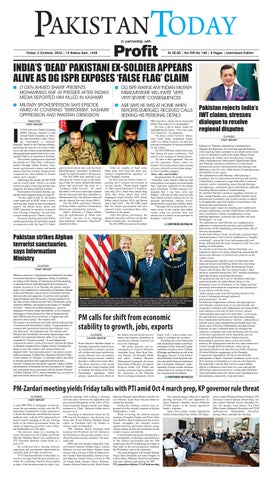
LT GEN AHMED SHARIF PRESENTS MOHAMMAD ASIF AT PRESSER AFTER INDIAN MEDIA REPORTED HIM KILLED IN KASHMIR
g
MILITARY SPOKESPERSON SAYS EPISODE AIMED AT COVERING ‘TERRORISM’, KASHMIR OPPRESSION AND PAKISTAN OBSESSION
g
RAWALPINDI
DG ISPR WARNS ANY INDIAN MILITARY MISADVENTURE WILL INVITE ‘VERY, VERY SEVERE’ CONSEQUENCES
ASIF SAYS HE WAS AT HOME WHEN REPORTS EMERGED, RECEIVED CALLS SEEKING HIS PERSONAL DETAILS
STAFF REPORT
NTER-Services Public Relations (ISPR) Director General Lt Gen Ahmed Sharif Chaudhry on Thursday ridiculed India’s claim of having “neutralised” a “terrorist” allegedly linked to the Pakistan military, presenting the man alive at a news conference a day after Indian media published his photograph and reported him to be a commander killed in an operation in Kashmir. The military spokesperson described the episode as a “false flag”, walking reporters through Indian military statements, government releases and media reports which he said had “progressively connected the slain militant to former soldier Asif’s identity”. Addressing the media, the DG ISPR said he would speak “about a so-called terrorist incident, a false flag that has been staged by the Indian political military”. He presented a five-point timeline, saying the entire sequence began on Sept 29. “On the night of Sep 29, the Indian corps deployed in IIOK made a tweet, claiming that, based on joint intelligence reports, the Indian Army, police and CRPF launched an operation in general area of Korag, Yousmarg,” he read from a social media post by Chinar Corps. The press briefing came after Indian media reported that an individual wanted in connection with the April 22 Pahal-
gam terrorist attack last year had been killed during an “encounter” in Indian Illegally Occupied Kashmir’s Korag area. The DG ISPR then referred to another post by Chinar Corps on the morning of Sept 30, which claimed that Indian forces had recovered the body of a “Lashkar-e-Taiba terrorist”. He noted that India’s ANI news outlet later claimed that the deceased had been identified as Mohammad Asif, who had been inducted into the Special Services Group (SSG). The DG ISPR said India’s Ministry of Home Affairs and Press Information Bureau also reiterated the narrative. India’s Ministry of Home Affairs said the neutralisation of “Musa alias Asif Fauji” was part of an “ongoing long-sustained Operation Sheruwali” launched in May.
Pakistan strikes Afghan terrorist sanctuaries, says Information Ministry
“After six months of hard work, Musa alias Asif Fauji has been neutralised. Congratulations, applause,” Lt Gen Chaudhry retorted. He then read out Indian claims regarding Asif’s alleged involvement in various attacks: “Halan attack August 23, DKG attack December 23, Kandi attack May 2023, Shah Sitar attack May 2024, Shiv Khori attack June 2024, Gagangeer attack October 2024, Boota Pahari attack October 2024, and Basira attack April 2025.” The DG ISPR noted that the Indian government had also claimed to have neutralised three other “members of the group”. “After this [press conference], the shameful characters will have at least the shame to delete this,” he remarked. The DG ISPR also read out the Indian
PIB’s narrative, which said its forces had killed “four senior LeT commanders”. He took a jibe at Indian media for highlighting the claims. “Now they said, ‘Let’s jump in’,” he remarked. “So there comes News18, Statesman, India Today, Hindustan Times, ABP Live, Indian Express,” he said, displaying screengrabs of reports published by the outlets. The DG ISPR then called Asif to join him during the press conference. Asif said he was a resident of Attock district. “So here is that superman. You can see this superman. Please, come, my brother. Tell us about these achievements of yours, what all you have been doing,” Lt Gen Chaudhry quipped. ‘Here, alive and healthy’ Speaking before the media, Asif said: “Yesterday, some friends called me and told me there were reports on social media that I had been martyred by the Indian army in Kashmir. “To their concerns, I responded that I was here, alive and healthy.” Asif said he also received calls from Indian numbers asking him for his personal information, identity, whereabouts and his connection with the claims. “Through ANI on social media, I became aware of the reports that Indian media, using my personal data, had named me as a martyr in an operation in Kashmir,” Asif said.
CONTINUED ON PAGE 03
ISLAMABAD
STAFF REPORT
Pakistan carried out "well-planned and calibrated" air strikes on terrorist hideouts in Afghanistan, killing 22 militants, according to the Ministry of Information and Broadcasting, as tensions between Islamabad and Kabul continued to escalate. In a post on X on Thursday, the ministry said the strikes were conducted in continuation of Operation Ghazab lil Haq and Pakistan’s stated resolve to eliminate terrorists, their networks and supporters. It said the aerial operation targeted hideouts and safe havens of groups referred to by the state as Fitna al Khawarij and Fitna al Hindustan, along with their affiliates, and resulted in the deaths of “multiple terrorists”. “Based on credible intelligence, selective targeting of terrorist camps and hideouts at two locations belonging to Fitna al Khawarij, Fitna al Hindustan and their affiliates has been carried out in Afghanistan with precision and accuracy,” the ministry said. The targets were destroyed and initial reports indicated that 22 terrorists had been killed, it added. “Large quantities of weapons and ammunition stored at these hideouts were also destroyed,” the statement said. The ministry said Pakistan had consistently advocated regional peace and stability but maintained that the safety of its citizens remained its “foremost priority”. It said Afghanistan continued to remain “a hub of terrorism” and that the threat to Pakistan emanated from Afghan territory. Keeping this threat in view, the ministry said, terrorist hubs were targeted while “maximum precaution” was taken to avoid collateral damage. It added that Operation Ghazab lil Haq would continue at “full pace” to eliminate what it described as foreign-sponsored and supported terrorism from Pakistan. Pakistan has repeatedly urged the Afghan Taliban administration to dismantle terrorist sanctuaries on Afghan soil, particularly those associated with the banned Tehreeki-Taliban Pakistan (TTP), which Islamabad says are used to plan and launch attacks inside Pakistan.
ISLAMABAD: Prime Minister Shehbaz Sharif met United States President Donald Trump during a reception banquet hosted by the latter in honour of world leaders on the sidelines of the 81st session of the United Nations General Assembly (UNGA) in New York last month, according to details released by the Press Information Department (PID) on Thursday.The PID shared photographs, released by the White House, showing the two leaders standing together, smiling and shaking hands.No further details about the interaction were provided.
PM calls for shift from economic stability to growth, jobs, exports ISLAMABAD
SALEEM JADOON
Prime Minister Shehbaz Sharif on Thursday stressed the need to focus on sustainable economic growth, job creation and export promotion, saying Pakistan had successfully restored macroeconomic stability through a collaborative team effort. The prime minister, in his virtual address at the Gong Ceremony held to celebrate the listing of the Naya Nazimabad Apartment REIT scheme, lauded the joint efforts of
the federal and provincial governments and financial institutions in steering the national economy out of severe challenges. The prime minister was accompanied by Federal Ministers Attaullah Tarar, Mian Riaz Hussain Pirzada, Dr Musadik Malik and others. Finance Minister Muhammad Aurangzeb, Governor State Bank of Pakistan, prominent business leader Arif Habib and leading corporate figures attended the ceremony at the Pakistan Stock Exchange in Karachi, which
began with a cake-cutting ceremony to celebrate the occasion. Recalling his recent interactions with international bankers and financial leaders in New York and London, including executives from Citibank, JPMorgan and Barclays as well as the Managing Director of the International Monetary Fund, the prime minister said global financial institutions had commended Pakistan’s implementation of long-overdue structural reforms that were creating an attractive ecosystem for investment.
CONTINUED ON PAGE 03
Pakistan rejects India’s IWT claims, stresses dialogue to resolve regional disputes ISLAMABAD
STAFF REPORT
Pakistan on Thursday reiterated its commitment to dialogue and diplomacy for resolving regional disputes, while rejecting India’s attempts to cast doubt on the recent Court of Arbitration award on the Indus Waters Treaty. Addressing the weekly news briefing here, Foreign Office Spokesperson Ambassador Sajjad Haider Khan said Pakistan remained committed to a rules-based international system and maintained that dialogue and diplomacy were the only viable means of ensuring peace and stability in the region. The spokesperson said Pakistan, while playing a mediatory role in communication between Iran and the United States, continued to urge both sides to exercise restraint, resolve outstanding issues through dialogue and diplomacy, and honour their commitments under the Islamabad Memorandum of Understanding. He clarified Pakistan’s position regarding sanctions on Iran, saying Pakistan was a responsible member of the international community and would continue to adhere to all applicable sanctions regimes in accordance with international and domestic laws. “Pakistan highly values its enduring and multifaceted strategic partnership with the United States and remains fully committed to further strengthening its longstanding diplomatic, economic and security ties with Washington,” he said. The spokesperson said Pakistan also emphasised its adherence to international practices and established frameworks while maintaining communication with all relevant stakeholders. On the Indus Waters Treaty, he strongly rejected India’s characterization of the Court of Arbitration as “illegally constituted”, saying the Court had unanimously and firmly affirmed that the treaty remained in full force and binding on both parties. He said the Court had also affirmed that India was required to observe its treaty obligations concerning the design and operation of hydroelectric projects on the western rivers. The spokesperson said the Court of Arbitration had imposed measures prohibiting India from concreting specified portions of the Ratle Hydroelectric Power Project until 90 days after the Neutral Expert’s final decision, expected around July 2027, besides imposing a reporting measure concerning the project. He pointed out that the Court of Arbitration had been constituted under the Indus Waters Treaty at the Permanent Court of Arbitration in The Hague and had previously determined its competence and constitution in accordance with the treaty. “India cannot escape from the binding awards of the Court of Arbitration through unilateral pronouncements,” he said. On Pakistan-Afghanistan relations, the spokesperson said Pakistan remained keen to develop friendly and cooperative relations with Afghanistan, but stressed that such relations could only be built on trust, mutual understanding and respect for each other’s sovereignty. He said Pakistan’s concerns over terrorism emanating from Afghanistan had become a “red line”, particularly as terrorist activity had extended beyond border areas into deeper parts of Khyber Pakhtunkhwa and Balochistan. Pakistan, he said, remained ready for dialogue but expected a complete end to the infiltration and activities of terrorist organisations which Islamabad says are supported and facilitated from Afghan territory. Responding to questions about recent cross-border tensions, the spokesperson said the two sides remained in contact through different channels, while leaving operational details to the Inter-Services Public Relations. On India-Pakistan engagement in the Shanghai Cooperation Organisation (SCO), he described the participation of India’s National Coordinator in the recent SCO meeting in Islamabad as a welcome development. He noted that it was the first visit by a senior Indian official to Pakistan in more than two years and said the official had expressed interest in visiting other Pakistani cities and spoken positively about issues including peace, development, connectivity, trade and transit.
PM-Zardari meeting yields Friday talks with PTI amid Oct 4 march prep, KP governor rule threat ISLAMABAD
STAFF REPORT
A joint PPP-PML-N delegation would represent the government in talks with the PTI leadership scheduled for Friday (tomorrow) to break the stalemate and defuse the current political crisis, with the PTI’s planned Oct 4 protest march emerging as the key sticking point as the federal government keeps the option of imposing governor’s rule in Khyber Pakhtunkhwa on the table. The decision, taken at a meeting between President Asif Ali Zardari and Prime Minister Shehbaz Sharif, was confirmed by PTI Chairman Barrister Gohar Khan in a post on X. He confirmed that a meeting between opposition and government representatives would be held on Friday (tomorrow). “PTI Chairman Barrister Gohar Khan received a message from the government yesterday for a meeting, which he has accepted in light of the decisions made in today’s op-
position meeting. God willing, a meeting will take place between the opposition and government delegations in the office of National Assembly Speaker Sardar Ayaz Sadiq tomorrow at 12pm,” Barrister Gohar said in the post on X. According to statements issued by the PPP and the Presidency, the decision was taken after Prime Minister Shehbaz Sharif called on President Asif Ali Zardari at Aiwan-i-Sadr in Islamabad. “PM Shehbaz Sharif Thursday held meeting with President Asif Ali Zardari at the Presidency to discuss the country’s overall political and security situation,” the statement said. DPM and FM Senator Ishaq Dar, Federal Interior Minister Mohsin Naqvi, Federal Minister for Law and Justice Senator Azam Nazeer Tarar, Advisor to PM on Political Affairs Senator Rana Sanaullah, Attorney General Mansoor Usman Awan, Advisor to PM Dr Tauqir Shah, Senator Sherry Rehman, Senator Saleem Mandviwalla, Sindh Senior
Minister Sharjeel Inam Memon and Provincial Minister Syed Nasir Hussain Shah attended the meeting. During the meeting, concern was expressed over the security situation in Khyber Pakhtunkhwa, it said. While reviewing the national security situation, President Zardari and Prime Minister Shehbaz Sharif emphasized the need to further strengthen the national resolve against terrorism and ensure effective cooperation among all relevant institutions for the country’s peace and stability. It was decided during the meeting that a joint delegation comprising representatives of the federal government and the PPP would meet the PTI leadership on Friday to hold talks on the current political situation, the Presidency said in the statement. The joint delegation will include Mohsin Naqvi, Rana Sanaullah and Amir Muqam, as well as Sherry Rehman, Syed Naveed Qamar and Aijaz Jakhrani representing the PPP. PTI, opposition alliance TTAP hold meeting
The announcement followed a separate meeting between PTI and opposition alliance Tehreek-i-Tahaffuz Ayeen-i-Pakistan (TTAP) leaders in the Senate opposition leader’s chamber. Apart from Gohar, Senate Opposition Leader Allama Raja Nasir Abbas, NA Oppo-
sition Leader Mehmood Khan Achakzai, PTI Secretary General Salman Akram Raja, former senator Mustafa Nawaz Khokhar, former NA speaker Asad Qaiser, NA Chief Whip Aamer Mahmood Kamboh and TTAP spokesperson Akhundzada Yousufzai, among others, attended the meeting.
02 NEWS
Friday, 2 October, 2026 | ISLAMABAD
PAKISTAN’S INFLATION STAYS ABOVE 10% IN SEPT 2026 AS FUEL, TRANSPORT COSTS SURGE
P
PROFIT
News Desk
AKISTAN'S headline inflation remained in double digits at 10.3% YoY in September 2026, easing from 11.1% in August but nearly twice the 5.8% recorded a year earlier, as transport and energy costs continued to exert pressure on prices. On a MoM basis, the Consumer Price Index (CPI) increased 1.3% in September, compared with 1.2% in August and 2.1% in September 2025, according to the Pakistan Bureau of Statistics (PBS). The more precise National Consumer Price Index (NCPI) figures showed inflation at 10.26% YoY and 1.27% MoM in September. Transport recorded the sharpest increase among the major national CPI groups, rising 27.43% YoY and 5.75% MoM. Housing, water, electricity, gas and fuels increased 12.39% YoY and 3.05% MoM. Food and non-alcoholic beverages, which carry a 34.58% weight in the national CPI, rose 8.20% YoY but just 0.19% during September. Perishable food prices increased 11.78% YoY and 0.81% MoM, while nonperishable food inflation stood at 7.64% YoY and 0.09% MoM. Communication prices increased 13.54% YoY, miscellaneous goods and serv-
PNSC may lease container vessel to cut exporters’ shipping costs, maritime affairs minister says PROFIT
web Desk
Pakistan National Shipping Corporation (PNSC) could consider leasing or purchasing a container vessel to support exporters if sufficient cargo volumes can be guaranteed to make the operation commercially viable, Federal Minister for Maritime Affairs Muhammad Junaid Anwar Chaudhry said on Wednesday. The proposal emerged during a meeting between the minister and a three-member delegation of exporters seeking measures to reduce shipping costs and improve Pakistan’s connectivity with international markets. Chaudhry constituted a working group comprising representatives of the Ministry of Maritime Affairs, PNSC and exporters to examine the feasibility of a dedicated container vessel and other measures to improve shipping connectivity and reduce transportation costs. The exporters told the minister that changes in regional shipping routes had resulted in longer journeys, increasing transportation costs and delivery times to European and US markets. They said the longer routes had put Pakistani exporters at a disadvantage compared with regional competitors that had relatively easier and more direct access to key international markets. The delegation comprised Shahzad Asghar Ali, CEO of Style Textile; Benedikt Birner, vice president Global Adidas; and Saqib Rafique, senior director, Sourcing Operations at Adidas. PNSC Chief Executive Officer Syed Jarar Haider Kazmi participated in the meeting online. The participants agreed to assess the feasibility of the dedicated vessel proposal alongside other measures aimed at improving access to international markets. The delegation will consult other exporters and submit proposals to the working group, which will examine possible arrangements to improve shipping connectivity, lower transportation costs and facilitate Pakistani exports.
g
CPI SLOWS FROM 11.1% IN AUGUST, BUT PRICES RISE 1.3% MOM; TRANSPORT COSTS JUMP 27.43% YOY WHILE WHOLESALE INFLATION ACCELERATES TO 13.33%
ices 10.90%, clothing and footwear 8.98%, health 7.88%, education 7.77%, furnishing and household equipment maintenance 7.23%, restaurants and hotels 6.10%, and alcoholic beverages and tobacco 3%. Recreation and culture recorded a 0.58% increase. Urban inflation eased to 10.1% YoY from 10.4% in August, while prices increased 1.3% MoM, compared with 0.9% in the previous month. Rural inflation slowed more sharply to 10.5% YoY from 12.2% in August. On a monthly basis, rural prices increased 1.2%, compared with 1.6% a month earlier. The detailed urban index showed transport costs rising 29.24% YoY and 5.79% MoM, while housing, water, electricity, gas and fuels increased 9.80% YoY and 2.72% MoM. Among urban consumers, electricity charges jumped 15.28% during September, motor fuel increased 10.76% and liquefied hydrocarbons rose 5.37%. Food prices moved in different directions. Urban onion prices surged 29.17% MoM, while wheat increased 3.86%, besan 2.74%, wheat flour 2.28%, pulse gram 1.82% and wheat products 1.60%.
Tomato prices, meanwhile, fell 24.67% MoM, chicken 8.14%, eggs 5.92%, potatoes 4.19%, pulse moong 2.09% and sugar 0.88%. Compared with September 2025, urban onion prices were 125.48% higher, wheat 40.96%, wheat flour 31.71%, wheat products 16.03%, fresh fruits 14.75% and meat 14.68%. Several food items were substantially cheaper than a year earlier. Potatoes declined 30.34%, chicken 20.92%, eggs 20.19%, sugar 19.94%, pulse gram 13.49%, besan 12.37% and gram whole 12.04%. Among urban non-food items, liquefied hydrocarbons surged 57.14% YoY, motor vehicle tax 38.68%, motor fuel 37.73%, electricity charges 32.46% and transport services 29.56%. Rural consumers faced a similar pattern. Housing, water, electricity, gas and fuels rose 18.90% YoY and 3.82% MoM, while transport increased 24.53% YoY and 5.67% MoM. Rural onion prices jumped 39.38% during September, while electricity charges rose 15.28%, motor fuels 11.13% and liquefied hydrocarbons 7.58%. On a YoY basis, rural onion prices were
136.70% higher, wheat 37.46% and wheat flour 34.31%. Liquefied hydrocarbons increased 53.98%, motor fuels 39.70%, motor vehicle tax 34.32% and electricity charges 32.46%. At the same time, rural potato prices were 34.47% lower than a year earlier, sugar 21.82%, chicken 21.31% and eggs 19.27%. Core inflation, measured by non-food non-energy (NFNE), remained below headline inflation. Urban core inflation eased to 8.6% YoY from 8.8% in August, while rural core inflation declined to 8.1% from 8.5%. Both indices increased 0.2% MoM. On a 20% weighted trimmed-mean basis, however, urban core inflation increased to 9.4% YoY from 8.9%, while rural trimmed-mean inflation rose to 9.4% from 9.1%. On a monthly basis, the respective increases were 0.3% and 0.4%. Average national CPI inflation during July-September FY27 stood at 10.20%, compared with 4.30% in the corresponding period of FY26. Average urban inflation stood at 9.75% against 4.52% a year earlier, while rural inflation averaged 10.87% compared with 3.97%.
LPG prices rise 8% for October, household cylinder up Rs244 g
OGRA SETS CONSUMER PRICE AT RS279.34 PER KG; 11.8KG HOUSEHOLD CYLINDER RISES TO RS3,296.23 AND COMMERCIAL CYLINDER TO RS12,682 PROFIT
staff RepoRt
The Oil and Gas Regulatory Authority (OGRA) has raised liquefied petroleum gas (LPG) prices by 8% for October, increasing the cost of a standard household cylinder by around Rs244 as consumers face higher cooking fuel costs. According to OGRA's latest notification, the consumer price of LPG has been set at Rs279.34 per kilogram from Thursday, up from Rs258.65 in September. The price of an 11.8kg household cylinder will increase to Rs3,296.23 from Rs3,052.10, meaning consumers will pay about Rs244 more
per cylinder. The price of a 45.4kg commercial cylinder will rise by Rs939 to Rs12,682, increasing costs for businesses that use LPG for cooking or heating. The October increase follows successive increases in the previous two months. OGRA raised LPG prices by 5.34% in August, adding Rs152 to the price of a household cylinder, followed by another 1.7% increase in September. The increases followed a sharp reduction in July, when LPG prices were cut by 21.8%, lowering the cost of a household cylinder by almost Rs795. The July reduction came after Saudi Aramco's contract price, a key benchmark
for Pakistan's LPG imports, declined 25.62%, alongside a modest strengthening of the rupee. The latest increase is particularly significant for households and consumers in areas without access to piped natural gas, where LPG is used as an alternative cooking fuel. Taxes and other charges account for a sizeable portion of the regulated LPG price. OGRA's pricing structure includes a petroleum levy of Rs4,669 per tonne and GST of Rs36,311 per tonne. An additional 18% GST of Rs6,300 is imposed on marketing, distribution, and transportation margins, bringing total margin-related charges to around Rs35,000 per tonne.
Pakistan’s local mobile phone assembly falls 14% in August, meets 95% of demand g
PRODUCTION DROPS TO 1.66M UNITS AMID POST-BUDGET HIGH BASE; 8M2026 OUTPUT FALLS 6% TO 18.66M UNITS AS IMPORTS PLUNGE 69% IN AUGUST PROFIT
News Desk
Pakistan's local mobile phone manufacturing and assembly fell 14% YoY to 1.66 million units in August 2026, although locally produced devices still met 95% of the country's mobile phone demand during the month, according to data released by the Pakistan Telecommunication Authority (PTA). Production also dropped 57% compared with July, when assembly had been elevated by strong demand following purchase deferments ahead of the FY27 budget, according to Topline Pakistan Research. Despite the sharp monthly fall, im-
ports remained considerably lower. Pakistan imported just 80,000 mobile phones during August, down 69% YoY and 27% MoM. As a result, locally manufactured and assembled phones accounted for 95% of domestic mobile phone demand during August, compared with 97% in July. The decline was less pronounced over the first eight months of the year. Local manufacturers and assemblers produced 18.66 million phones during 8M2026, down 6% from 19.77 million units in the corresponding period of 2025. Locally produced phones accounted for 87% of Pakistan's mobile phone demand during the eight-month period. VGO Tel was the country's
largest local assembler by volume during 8M2026, producing 2.45 million units, followed by Infinix with 1.96 million and Itel with 1.56 million. Tecno assembled 1.14 million phones during the period, while Samsung produced 1.01 million units. Vivo and Nokia each assembled 970,000 units, followed by Club Mobile at 720,000, X Mobile at 700,000 and Q Mobile at 630,000 units. The figures show that while domestic mobile phone production weakened during the first eight months of 2026 and fell sharply in August, local assembly continued to account for the overwhelming majority of phones supplied to the Pakistani market.
The Sensitive Price Indicator (SPI) for the lowest expenditure quintile increased 8.36% YoY and 1% MoM in September. The combined SPI, covering all quintiles, increased 9.88% YoY and 1.63% MoM. Wholesale inflation accelerated further. The Wholesale Price Index (WPI) increased 13.33% YoY in September, up from 11.8% in August and just 0.6% in September 2025. Wholesale prices rose 1.88% MoM, compared with 2% in August. Within the WPI, other transportable goods recorded a 34.31% YoY increase and a 4.58% MoM rise. Ores, minerals, electricity, gas and water increased 7.28% YoY and 4.35% MoM, while agriculture, forestry and fishery prices rose 7.29% YoY but declined 0.13% during September. At the wholesale level, motor spirit prices jumped 12.40% MoM, electrical energy 11.40%, kerosene oil 7.78%, diesel oil 7.36% and furnace oil 6.25%. Wheat and wheat flour increased 2.71% and 2.69%, respectively. Compared with a year earlier, wholesale kerosene oil prices surged 78.93%, diesel oil 61.45%, footwear 51.86%, furnace oil 47.82%, wheat 44.49%, motor spirit 42.77% and wheat flour 39.13%. Wholesale prices for potatoes, meanwhile, were 44.38% lower YoY, refined sugar 21.62%, eggs 20.43% and poultry 17.48%.
Sugar exports to be halted if local retail price crosses Rs155/kg PROFIT
MoNitoRiNg RepoRt
The federal government has set Rs155 per kg as the national average retail price at which it will suspend sugar exports, a level Rs9.95 above the prevailing average price that could add Rs5.72 billion to the monthly consumer burden if prices rise to the cap. The Cabinet Committee for the Export of Surplus Sugar set the price trigger at a meeting on September 29, 2026, under Deputy Prime Minister Ishaq Dar. Minutes issued by the Ministry of National Food Security on September 30 state that exports will only be suspended if the national average retail price exceeds Rs155 per kg. According to the Pakistan Bureau of Statistics (PBS), the national average retail price of sugar stood at Rs145.05 per kg on September 24, leaving a difference of Rs9.95 per kg between the prevailing price and the government's export suspension trigger. With national sugar consumption estimated at 575,000 tonnes, or 575 million kg, per month, a Rs9.95 per kg increase would translate into an additional Rs5.721 billion in monthly consumer spending. At a rounded difference of Rs10 per kg between Rs145 and Rs155, the additional cost would amount to Rs5.75 billion per month. Industry insiders claimed that retailers were already benefiting from weak checks by local administrations and argued that higher price caps allowed the government to avoid criticism over its inability to control retail rates. Pakistan Sugar Mills Association (PSMA) outgoing chairman Chaudhry Zaka Ashraf, meanwhile, rejected the Rs155 per kg threshold as too low. He said costs faced by the sugar industry and farmers were considerably higher, putting the figure at around Rs160 per kg.
Askari General Insurance names new chairman after 51% stake transfer PROFIT
News Desk
Economic activity to strengthen in FY27, Sept inflation seen at 10-11%: Finance Division g
FINANCE DIVISION EXPECTS RECOVERY TO BROADEN ACROSS AGRICULTURE, MANUFACTURING AND PRIVATE-SECTOR CREDIT, WHILE INFLATION OUTLOOK REMAINS TIED TO GLOBAL OIL PRICES ISLAMABAD News Desk
Pakistan’s economic activity is expected to strengthen further in FY27 as recovery broadens across agriculture, manufacturing and private-sector credit, although headline inflation is projected to remain elevated at 10-11% in September, with its subsequent trajectory largely dependent on international oil prices, the Finance Division said. In its Monthly Economic Update & Outlook for September 2026, the ministry said remittances and services exports were expected to continue supporting household incomes and external accounts, while stronger reserves and renewed access to international capital markets would provide a better buffer against external shocks. Elevated global oil prices, however, remain the principal risk to the outlook through their impact on purchasing power, input costs and the import bill. Inflation had already accelerated to 11.1% YoY in August from 9.2% in July and 3.1% a year earlier, reflecting the passthrough of higher global oil prices into domestic energy, transport and food costs. On a monthly basis, inflation remained at 1.2%. Food, housing and utilities, and transport together contributed 8.2 percentage points, or around three-quarters of head-
line inflation in August, with food alone accounting for 4.9 percentage points. Core inflation stood below headline inflation at 8.8% in urban areas and 8.5% in rural areas, while the Sensitive Price Indicator increased 0.99% in the week ending September 24. The Finance Division said manufacturing-related activity had strengthened during the first two months of FY27, supported by higher vehicle production and sales, increased domestic cement dispatches and growth across several largescale industries. Large-scale manufacturing output increased 3.03% YoY in July and 9.5% compared with June. Automobile production surged 57%, while wearing apparel and tobacco output increased 22% and 35.8%, respectively. Vehicle production and sales increased 27.6% and 29.9%, respectively, during July-August. Cement dispatches rose 2.8% to around 8.5 million tonnes, as an 8% increase in domestic dispatches more than offset a 16.7% decline in exports. Early agricultural indicators also remained positive. Agricultural credit disbursements increased 16.4% to Rs271.9 billion in July from Rs233.7 billion a year earlier. Urea offtake during April-August stood at 2.755 million tonnes, up 2.9% from the corresponding Kharif period last year, while DAP offtake declined 24.5%
to 417,000 tonnes. Tractor sales increased 4.7% to 2,294 units during July-August, while agricultural machinery and implement imports stood at $29.2 million. Higher acreage under rice and sugarcane, alongside encouraging early cotton arrivals, pointed towards positive growth in important crops, according to the report. The external position also improved during the opening two months of FY27, with the current account deficit narrowing to $543 million from $853 million a year earlier despite a widening trade gap. Goods imports increased 11.4%, outpacing a 4% rise in exports. Workers’ remittances, however, jumped 14.7% to $7.29 billion, exceeding the entire goods and services deficit of $6.75 billion, while services exports increased 28.8% to $1.81 billion. Total foreign direct and portfolio investment inflows increased 80.2% to $562 million. FDI rose 24% to $494.5 million, while portfolio investment returned to a net inflow. The report said a $3 billion Eurobond issuance in September boosted reserves. SBP’s liquid foreign exchange reserves reached $21.39 billion on September 18, equivalent to around three months of goods and services imports, while total liquid reserves stood at $26.8 billion. Fiscal performance was more mixed. FBR net tax collection increased 3.7% to
Rs1.722 trillion during July-August from Rs1.662 trillion a year earlier. Sales tax receipts rose 13.8% to Rs718.9 billion and federal excise receipts increased 2.2% to Rs117.9 billion. Direct tax collection, however, declined 2.9% to Rs689.6 billion, while customs receipts fell 4% to Rs195.9 billion. Federal current expenditure increased to Rs1.092 trillion in July from Rs761.6 billion a year earlier, with interest payments rising to Rs792.9 billion from Rs490.4 billion. Non-interest current expenditure stood at Rs299.1 billion, up 10.3%. The consolidated fiscal deficit consequently widened to Rs596.6 billion, or 0.4% of GDP, from Rs261.5 billion, or 0.2% of GDP, a year earlier. The primary balance remained in surplus at Rs196.3 billion, or 0.1% of GDP, compared with a surplus of Rs228.9 billion, or 0.2% of GDP, last year. Meanwhile, the State Bank of Pakistan kept the policy rate unchanged at 11.5% on September 14, with elevated global crude oil prices remaining the main risk to the inflation outlook. The central bank’s mediumterm inflation target remains 5-7%. The Finance Division said priorities going forward were to accelerate revenue mobilisation, keep relief measures temporary and targeted, and sustain progress on energy and tax reforms.
Askari General Insurance Company Limited has appointed Lt Gen Anwar Ali Hyder (Retd) as chairman and reshuffled its board following the transfer of Army Welfare Trust's 51% shareholding in the insurer to Fauji Foundation, according to a notice to the PSX on Thursday. The company said 51,337,953 ordinary shares, representing 51% of its total issued and paid-up share capital, were transferred from Army Welfare Trust (AWT) to Fauji Foundation (FF) on August 28, 2026. Following completion of the transaction, four directors — Maj Gen Syed Anis Akbar (Retd), Maj Gen Abid Latif Khan (Retd), Malik Riffat Mahmood and Brig Salman Nazar (Retd) — tendered their resignations from the board with effect from September 28, 2026. The existing board subsequently accepted the resignations and approved, subject to requisite Securities and Exchange Commission of Pakistan approvals, the appointment of Lt Gen Anwar Ali Hyder (Retd), Syed Bakhtiar Kazmi, Muhammad Majid Munir and Brig Irfan Khan (Retd) as directors. The appointments will fill the casual vacancies for the remainder of the respective terms of the outgoing directors. Following the resignation of Maj Gen Syed Anis Akbar (Retd) as director and chairman, the board appointed Lt Gen Anwar Ali Hyder (Retd) as chairman for the remainder of the outgoing chairman's term. The company also reconstituted its Audit Committee, Investment Committee, and Ethics, Human Resource & Remuneration Committee with immediate effect. The board resolution approving the changes will be placed before its next meeting for noting and will form part of the minutes, the company said.
newS 03
IncOme tax RetuRn FIlIngS jump 45% tO 5.77 mIllIOn aS nOn-SalaRIed FIleRS dRIve gROwth
Friday, 2 October, 2026 | ISLAMABAD
t
PROFIT
STAFF REPORT
HE number of income tax returns filed in Pakistan surged nearly 45% YoY to 5.77 million by September 30, with traders, professionals and other non-salaried individuals accounting for around four-fifths of the increase, according to Federal Board of Revenue (FBR) data. A total of 5,767,384 returns had been filed by September 30, compared with 3,980,692 on the same date last year, an increase of about 1.79 million filings. The filing base has expanded sharply over recent years. Returns filed by the end of September stood at 1.86 million in 2022, 1.92 million in 2023, 3.72 million in 2024, 3.98 million in 2025 and 5.77 million in 2026, putting the latest figure at nearly three times the 2022 level.
Non-salaried individuals, including traders, shopkeepers, professionals and selfemployed persons, were the main source of growth. Their returns increased 60% to 3.81 million from 2.38 million last year, adding around 1.43 million filers. Non-salaried returns stood at 965,000 five years ago and accounted for roughly half of all filings. They now represent around two-thirds of total returns. Returns filed by salaried individuals increased 22% to 1.9 million, while those filed by associations of persons, including partnerships, rose 33% to 53,756. The increase in return filings, however, was not matched by tax payments. Around 39% of returns filed this year were nil returns, broadly unchanged from last year. Returns declaring income above the taxable threshold increased 37% to nearly 2.5 million from 1.82 million. Within this category, returns from non-salaried individuals
rose 47%, while those from salaried individuals increased 32%. Payment filers, or taxpayers showing tax paid with their returns, increased 38% to 3.35 million. Among non-salaried individuals, payment filers rose around 50% to 1.75 million. Five years ago, returns declaring income above the taxable threshold stood at around 900,000, while payment filers numbered 1.29 million. Tax paid with returns by individuals increased 11% to Rs34.5 billion, while payments by associations of persons rose 16% to Rs3.7 billion. Companies, however, recorded a decline. A total of 7,953 company returns had been filed by September 30, compared with 11,206 on the same date last year. Tax paid with company returns also fell to Rs39.1 billion from Rs49 billion. As a result, total tax paid with returns declined around 7% to Rs77.3 billion from Rs83.3 billion last year, despite the substan-
tial increase in the number of returns filed. FBR officials attributed the decline in company filings largely to timing, saying many companies had delayed filing in anticipation
FBR beats first-quarter tax target by Rs30.5b, easing pressure for IMF contingency measures ISLAMABAD SHAHZAD PARACHA
Pakistan is unlikely to face immediate pressure to introduce additional contingency revenue measures under its IMF programme after the Federal Board of Revenue (FBR) exceeded its tax collection targets for both the first quarter and September 2026. Provisional FBR figures show that the tax authority collected Rs3,083.5 billion during July-September 2026 against a quarterly target of Rs3,053 billion, exceeding the target by around Rs30.5 billion. Sources said the IMF had asked Pakistani authorities during recent talks to prepare contingency measures in case revenue
collection fell short of agreed targets. With the first-quarter target now exceeded, officials believe the immediate need for additional corrective revenue measures has eased. SEPTEMBER COLLECTION ALSO EXCEEDS TARGET September, traditionally the heaviest month of the first quarter, generated Rs1,360.7 billion in net revenue against a target of Rs1,343 billion, exceeding the monthly target by around Rs17.7 billion. September collection was also around 11% higher than the Rs1,229 billion collected in September 2025. REVENUE TARGET ACHIEVED DESPITE HIGHER REFUNDS The latest figures also show that the
FBR exceeded its target despite paying substantially higher refunds during the quarter. The FBR paid Rs203.2 billion in refunds during July-September, compared with Rs159 billion in the same period last year, an increase of around 28%. Sales tax refunds increased from Rs112 billion to Rs130 billion, while income tax refunds rose from Rs32 billion to Rs51 billion. In September alone, refunds reached Rs47 billion, compared with Rs35 billion a year earlier. The figures indicate that the quarterly target was not achieved simply by holding back refunds owed to businesses and exporters.
SALES TAX DRIVES REVENUE GROWTH AS INCOME TAX RATES FALL The composition of revenue shows that sales tax accounted for most of the increase in collection during the quarter. Net sales tax collection increased 11% to Rs1,137 billion from Rs1,020 billion last year and exceeded its target by around 8%. Gross sales tax collection before refunds rose 12%, from Rs1,131 billion to Rs1,266 billion. Of the approximately Rs194 billion increase in net FBR revenue over the previous year, sales tax contributed around Rs117 billion, or about 60%, while income tax contributed approximately Rs72 billion.
India’s ‘dead’ Pakistani ex-soldier appears alive as DG ISPR exposes ‘false flag’ claim CONTINUED FROM PAGE 01
“I was surprised by whatever was happening as I was sitting in my home,” he remarked. Following the reports, Asif said he informed his unit about them to clarify his position. The unit asked him to block all numbers calling from India and said that ISPR officials would contact him. Sharing details about himself, Asif said he joined the Pakistan Army in 2000. “In 2005, I joined the SSG, performed my duty with courage for 18 years, and retired in 2023.” Asif added that he had also worked for a private security company for three years. “For the past three or four months, I have been living with my family in our home in Rawalpindi.” He termed the Indian allegations “false, ignominious and disreputable”. “I condemn this. By the grace of God, I am alive and present before you.” He further affirmed that he had performed his duties with courage and that Pakistan responded face to face, not from behind. ‘SIX REASONS BEHIND SUCH DRAMAS’ Taking the microphone, the DG ISPR maintained that there were “six reasons” behind what he described as “such dra-
mas” by India against Pakistan. “It is a very shameful and embarrassing thing. No self-respecting nation does this.” ‘COVER OWN TRACK OF TERRORISM’ Explaining the first reason, Lt Gen Chaudhry said India staged such theatrics to “cover its own track of terrorism”. “So, there has to be some good reason,” he added. “India is the biggest sponsor of terrorism and a terrorist state in the world,” the DG ISPR declared. “And its implication, involvement, direct and indirect terrorism in the region goes back decades,” he added. “Whether it’s Mukti Bahini or LTT, and now the TTP, BLA, and their funding, sponsorship and planning. It (India) has now become a victim of its own trait.” The military spokesperson said this terrorism was also “now taking on an internal dimension”. He elaborated: “They are not just terrorising the region or countries around the region; they are terrorising the Muslims inside India, and also the Kashmiris, Sikhs, Dalits, Christians, [residents of] Manipur, and tribals. “Some country which lives and breathes terrorism is at the same time very afraid that their dark face will be exposed, so they have to cover their tracks.
What better way to cover their tracks than to start calling everyone else a terrorist?” Lt Gen Chaudhry then played a video clip on what he described as “decades of lies that they have been feeding to their own people as well as to the world at large”. He accused India of jailing Muslim Kashmiris, adding: “They take them out, kill them, and stage that as a false flag operation, portraying it as a terrorist act.” The DG ISPR quipped: “This time they went ahead; they said this is not very spicy, let’s take an army soldier of Pakistan and portray him as one that we have killed.” He then referred to India’s alleged involvement in transnational killings, saying, “This habit of false flag operations has further encouraged India to go for transnational killings.” He added, “Everyone whom they don’t like, they start calling terrorists, because they see their image.” The military spokesperson then played a video containing a clip of an Afghan minister saying “our DNA is one” as he referred to India. “That is the illegitimate child of this terrorism, which is on our western border,” Lt Gen Chaudhry said, referring to Afghanistan. “Because what better opportunity than to give this dirty work to someone
who is ready to do it for certain coins and dollars and money,” he retorted. ‘OPPRESSION IN OCCUPIED KASHMIR’ The DG ISPR identified the second reason as developments in occupied Jammu and Kashmir, describing it as the “biggest garrison of the world”. “What’s happening in Indian Illegally Occupied Jammu and Kashmir plays a big role in the psyche and in the cognitive domain of these Indians,” he asserted. “For every 10th Kashmiri, there is an Indian soldier or a security person. There are nearly 1 million military, security, and intelligence CRPF and law enforcement there,” he pointed out, while referring to other acts such as arrests and demolition of houses. “And you cannot subside them; you cannot take out their desire to be counted. It’s a simple desire,” Lt Gen Chaudhry said, noting that Kashmiris wanted the right of selfdetermination as promised in a United Nations Security Council resolution. He stated that New Delhi had to stage such incidents to “portray that Kashmiris have no problem”, whereas the reality was otherwise due to what he described as “oppression” against them. “You have an internal problem, a great internal problem of oppression, of torture. [But] you don’t want to address it; you want to externalise it.
PM calls for shift from economic stability to growth, jobs, exports CONTINUED FROM PAGE 01
He particularly thanked the finance minister, cabinet members, Federal Board of Revenue (FBR) and federal secretaries for establishing a replicable model of teamwork to achieve macroeconomic stability, which had brought Pakistan back onto the path of sustainable development. He said the successful implementation of reforms and restoration of macroeconomic stability were the result of a cohesive partnership between the political hierarchy and military leadership working in complete harmony. Highlighting key economic indicators, the prime minister pointed out that Pakistan had successfully achieved a $3 billion Eurobond issuance against offers of $6 billion, while State Bank foreign exchange reserves had risen to around $21.4 billion, alongside commercial bank reserves of $5.5 billion. He said foreign remittances and IT exports were on an upward trajectory, while the Roshan Digital Account was also performing robustly. However, stressing the need to shift from stabilisation to growth, Prime Minister Shehbaz called for efforts to achieve economic growth driven by technology, employment generation, production and exports to boost the national economy. The prime minister recalled that the federal budget for 2026–27 of-
fered hundreds of billions of rupees in tax breaks and incentives for exporters, manufacturers and industries, including the construction sector. He said the incentives introduced by the government for the construction sector were now coming to fruition. He specifically commended the real estate and industrial initiatives spearheaded by business leaders such as Arif Habib in Lahore and Karachi under the REIT structure, urging further modernisation and improvement of the stock exchange and capital markets by studying other markets in the region. The prime minister expressed deep concern over the poor performance of certain industries that had received heavy subsidies and tariff walls while repeatedly making commitments to ensure import substitution and promote competitiveness. He called for an honest approach that prioritised national interest over personal gains, stressing that progress depended on modernised machinery, productivity and hard work. Prime Minister Shehbaz particularly appreciated the Chief of Defence Forces and Chief of the Army Staff, Field Marshal Syed Asim Munir, for his steadfast support and commitment to national security and economic progress, describing him as a great partner throughout the journey.
of an extension in the deadline. The deadline has since been extended, with officials expecting company filings and associated payments to increase in the coming weeks.
Only four new traders file returns under FBR’s fixed tax scheme, Senate panel told PROFIT
STAFF REPORT
Only four new traders filed tax returns under the government's fixed tax scheme by the statutory deadline, prompting the Federal Board of Revenue (FBR) to acknowledge that the response had fallen below expectations and warn of stronger enforcement against non-compliant retailers. FBR Chairman Rashid Mahmood Langrial told the Senate Standing Committee on Finance that the response to the scheme remained disappointing, saying that the government's attempt to bring traders into the system through a simplified regime had failed to generate the expected participation. "Good faith has been defeated" by traders, Langrial said, rejecting technical glitches in the filing application as merely an excuse for not filing returns. FBR Member Operations Zubair Bilal told the committee that 787 tax returns had so far been filed under the new scheme, of which only four were from new filers. The government launched the 1% fixed tax scheme for retailers, offering exemption from audits and the installation of Point of Sales systems in return for payment of the fixed tax. Minister of State for Finance Bilal Azhar Kayani said the government had consulted traders before introducing the scheme and remained hopeful that participation would increase once the FBR began pursuing non-compliant businesses. "If the traders do not opt for the scheme and even the fines prove insufficient to convince them, then strong enforcement measures would have to be taken," Kayani told the committee. He said 10,338 retailers had registered through the application within two months, including 2,337 new registrations, but only a small number had subsequently filed returns. The scheme covers traders with annual sales of up to Rs200 million. The government is targeting between 500,000 and one million traders from an estimated 3.7 million currently outside the tax system. Asked about the potential Rs50 billion revenue collection from traders during the current year, Langrial said collections could exceed Rs100 billion if the scheme succeeded, but payments would be negligible if it failed. Penalties for non-compliance are expected to be introduced in stages, beginning with a Rs10,000 fine, followed by Rs25,000 at the second stage and Rs50,000 at the third.
04 COMMENT
Running out of steam?
The IMF comes calling
T
Good news does not mean the country can get off the hook
T
What does the PTI mean to do differently?
HE International Monetary Fund review team carrying out what should be the last review of the current programme has received two bits of good news: first, the Central Board of Revenue exceeded its quarterly target of Rs 3.053 trillion by Rs 30 billion; second, the government plans to eliminate the subsidy given to lifeline electricity consumers. The information given to the IMF team coincided with the abysmal failure of yet another scheme to bring the retail sector into the tax net, and with the virtually routine extension in the last date for the filing of income tax returns. It is therefore no surprise that income tax collection has missed the first-quarter target, as has customs, which the IMF had also fiddled with, claiming the enhancement of market efficiency. One sign of a pick-up in the economy is that the CBR managed to meet its target because of stronger collections than targeted in sales tax and excise duty, the former reflecting a picking up of commercial activity, the latter of manufacturing. The failure of income tax collection to reach target reflects not just a failure to expand the tax net, but also the CBR;s not squeezing existing taxpayers. It seems there is little or no blood left in that stone. The IMF and the government may both preen themselves on those first signs of recovery, which are accompanied by others, such as rising foreign exchange reserves and the successful return to the capital markets with a successful bond issue.. However, there are still problems which persist, and which IMF programmes are not designed to address, such as the need for a breakneck pace of job creation, and thus a pressing need for constant growth. The IMF should not be carried away by its success, and continue to dampen growth. As the present IMF programme winds down, it is almost as if both the government and the IMF are looking ahead to the next programme. While there might be clever banker’s tactics enabling Pakistan to keep nose above water, there is getting away from the fact that only by exporting more will Pakistan stay ahead of the debt trap it has got into. While Pakistan be far away from the default it was nearing when the IMF took it in hand, it is no nearer increasing its exports in the dramatic fashion that is needed.
At Penpoint M A NIAZI
HAT there was an attack on the Aman Mela checkpost in Darazinda, Dera Ismail Khan district, the day after the Pakistan Tehrik Insaf postponed its Islamabad rally, should not be taken to mean that the PTI has anything to do with the attack, or even with the perpetrators. However, it does raise questions about the relationship between the two which in turn serve as a reminder of previous connections. The PTI is suffering greatly from militant depredations in KP, because it has formed the government there since 2013. The present Chief Minister, Sohail Afridi, is suspected of having a soft spot for them. That is inconvenient, because the militants’ ideological bedfellows, the Afghan Taliban, are involved in a shooting war with Pakistan, and have been for more than seven months. The conflict has actually lasted eight days longer than the US-Iran war, having started on February 21. Federal Information Minister Ataullah Tarar is becoming increasingly vocal about the KP government, going as far as calling it the TTP’s B=team, and of playing a role in funding it. Though he has not made the accusation, the links of the TTP to India must be recalled. This conflict has occurred despite the initially close relations with the Taliban that Pakistan had, when the fall of Kabul had seen the then DG ISI, Lt Gen Faiz Hameed, make a highly publicized visit there. The PTI also formed the federal government at the time. During the time the PTI was being removed from office, its opponents occasionally invoked the Afghan Taliban as well as the Tehrik Taliban Pakistan as providing militants to guard Imran Khan. That did not stop Imran from being arrested and imprisoned, not that there was any evidence of Taliban reinforcements for him. The point at which the Taliban, Afghan or Pakistani, should have intervened or been deployed, 9 May 2023, saw none of them. Either they had let down Imran massively, or the rumours were merely rumours. PTI opponents have described it as an attempted coup, but there is no sign of the PTI’s most effective tool being used. It is worth noting that the talk of Governor’s Rule has emanated from KP. The Governor, a PPP stalwart, has said that it was under consideration. The CM has said that no attempt would succeed, and only Imran could replace him, The reason for imposing Governor’s Rule would be both the worsening law and order situation of the province, but also the recent amendment in the KP Police Act 2026, which would bind the IGP, and thus the rest of the police force much more tightly to the provincial government. While the immediate reason for the provincial governments’ decision to promulgate the Act is the striking down by the Peshawar High Court of key provisions of the Police Act 2024 relating to the need for the IGP to refer certain transfer and posting decisions to the CM. The Act tries to reproduce the old powers. It does not really matter whether those provisions
Dedicated to the legacy of late Hameed Nizami
Arif Nizami (Late) Founding Editor
The regulations lag amid AI proliferation M. A. Niazi
Babar Nizami
Editor Pakistan Today
Editor Profit
I
Governments must safeguard their citizens Abdul MusAwIr HAkro
have lost count of how many Artificial Intelligence (AI) upgrade announcements have been made by tech companies like OpenAI, Anthropic, Meta, and Google, since last week. The technology is just getting everywhere, while the world is watching numbly without realizing the unforeseeable repercussions of its unprecedented pace. This is entropy, for neither governments nor people have any clue of what is happening, and of how the social landscape is being reshaped in the proverbial blink of an eye. The skyrocketing AI innovations have left governments continents behind to control by framing regulations and laws. In fact, even more complications are adding up as there is a breakthrough that Anthropic and OpenAI are now investing in: making AI self-improving superintelligence and autonomous, independent of human agency. The news was broken by former OpenAI and Anthropic researcher Jacob Coxon, who recently quit the latter tech company, stating that companies are “gambling with our lives”. Meanwhile, it is worth questioning why these tech companies are rushing without teaming up with each other and getting countries onboard on AI ethical issues. It is because this is a golden opportunity for capitalist elites, such as Elon Musk, Sam Altman, Dario Amodei and others, to accumulate advantage from this reg-
ulation vacuum. The American sociologist William F. Ogburn termed this vacuum the cultural lag. The cultural lag is the gap between material culture (physical objects and technologies that humans create) and non-material culture (regulations, norms, values, beliefs, laws and statutes). These two components of human culture always move at different speeds. Mainly, the non-material culture lags behind the material culture. For instance, today, AI advancements have been so breakneck that governments and people are unable to regulate and adopt. This gap period or cultural lag causes social disruption in the society. And it is precisely the current status of the world.
The regulations lag is not a temporary gap but a deliberate delay by powerful groups and nations to make profits, primarily at the cost of AIrecipient nations’ sovereignty, security and privacy.
are struck down, so long as it is not before the rally, as the CM needs those powers to prevent the police from blocking his way (and that of the many PTI supporters he will bring along), which is probably the only thing that would change before October 4, the new date for the rally. That week is also going to be enough to overcome the 15-day delay that the Governor can impose. As the Act was legislated as an ordinance, the Cabinet decision of September 27, will become law 15 days later. The root of the problem is that the law applies to both the rally and the insurgency faced by the provincial government. The provincial government has not really been able to get a handle on the insurgency, Afridi’s throwing the blame on the federal government for its foreign policy, sounded mere face saving the moment he made it, after the Kohat attack. His claim that the foreign policy followed by the Imran government was successful ignores two major factors. First, there was almost no change in the foreign policy establishment; second, the present policy is reactive, as the only demand of the government is that the Taliban stop providing safe havens, and that has been refused stubbornly, to the extent that the Taliban have been willing to accept airstrikes. The government has not just got KP to worry about. There is also Balochistan to cause concern, The body-count approach in Balochistan was on display in the announcement by the Inter-Services Public Relations last Sunday that 71 terrorists had been killed in Intelligence-Based Operations on Quetta district in their camps over 96 hours of operations.The CBOs were against militant camps and struck at both the separatist and sectarian terrorists. The fact of these operations indicates that Balochistan too might slip into an insurgency out of control. The sectarian terrorists are a spillover from KP, belonging to the Pashrun areas of the province, which had once been conquered from Afghanistan by the Raj. Those areas should have been safe from the appeal of Baloch nationalism, but they got their own sectarian terror. This affords an insight into the motivation of the terrorists. Doe they share this motivation with the young men of Punjab and Sind, who migrate, in increasing numbers. Increasingly illegally and increasingly ingeniously? Apart from the shrinking of job opportunities, there is the factor of unfairness, as influence and bribery become needed for getting jobs, and then there is the contumely that everyone faces from officialdom.
Will the youth of the Indus provinces of Punjab and Sindh resist the temptation to take up arms or not? That is for the future to decide. It is even possible to see the PTI’s support as being based in these factors, an acknowledgement that these problems exist. The PTI might be seen as the ‘democratic’ solution. It should be noted that whereas Punjab’s voters showed a lack of confidence in the traditional parties. Sind has stuck to the PPP and MQM. KP and Balochistan seem to have gotten ahead of themselves. They could claim that the anti-terrorist efforts have the police, which is supposed to be under the provinces, following a different line. That does not mean cross-purposes, with the federal government on one side, and the provincial on the other. The KP police may have to take a backseat at present because KP is a conflict zone, because of the fighting with the Taliban. However, the KP Police is integral to ensuring that it provides the right environment, especially since it is an asymmetric conflict, with Pakistan using its air force, and the Taliban letting the TTP do their fighting for them. At the same time, does failure to provide that environment constitute grounds for sacking a provincial government. Is that provincial government in cahoots with a foreign power like India? What is the evidence on which the federal government is relying? Where will it be produced? It would be politically irresponsible to use Governor’s Rule to get rid of a provincial government which is a base for an opposition party. This is especially true if the real reason for the postponement is what some inner PTI sources are whispering, that it became clear that the turnout would be bad. It seems that the PTI is getting tired, and is losing support. It does not seem that it has the strength to launch a movement without the sort of help it once enjoyed. Then the questions: what to do on October 11? Where will crowds come from then? The writer is a member of staff
It seems that the PTI is getting tired, and is losing support. It does not seem that it has the strength to launch a movement without the sort of help it once enjoyed. Then the questions: what to do on October 11? Where will crowds come from then?
This social disruption period is what tech giants are capitalizing by ramping up AI advancements in the absence of regulating frameworks. Once regulations are framed globally, there will be restrictions, government taxes, and lower profits for them. However, the AI race is not solely between capitalists, but also between nations, such as the USA and China. They also might deliberately lag regulations as they too reap benefits from the delay and the uncertainty revolving AI impacts. The United Nations, on the other hand, has not been able to make AI risk related laws either, mainly owing to the interest of vetoing countries. In all this, the AI-recipient nations are going to bear all the cost of regulations lag, for they are exchanging their national data in return for AI integration. It might expose their sovereignty and perhaps pose security challenges in the future. Therefore, it is high time for recipient nations like Pakistan to act before these imminent challenges turn into crises. The three measures should be taken immediately. First, on the government level, Pakistan must seek unambiguous regulatory frameworks from the AI-tech companies before signing any Memorandum of Understanding (MoU). Also, the international forums should be channeled to seek them, these regulatory frameworks being followed by AI-producing countries. National sovereignty and citizen privacy should precede any advancement. Second, educational awareness regarding AI’s use and content detection should be made to address challenges pertaining to synthetic media and deepfakes. Third, social media is a powerful tool to raise collective voices against the negligent production of AI, without considering its environmental impacts and ethical hurdles on the global level. The regulations lag is not a temporary gap but a deliberate delay by powerful groups and nations to make profits, primarily at the cost of AI-recipient nations’ sovereignty, security and privacy. The writer is a lawyer based in Karachi.
Editor’s mail
Send your letters to: Letters to Editor, Pakistan Today, 4-Shaarey Fatima Jinnah, Lahore, Pakistan. E-mail: letters@pakistantoday.com.pk Letters should be addressed to Pakistan Today exclusively
Banned but not broken
THREE years ago, I was one of the last girls in Afghanistan to take the Kankor exam under the Taliban regime. I scored 305 out of 360 marks in the national university entrance exam in Afghanistan, and was accepted into the law faculty of Kabul University. My dream career was finally within my reach. I left my home in Jawzjan in great excitement to start my university life but the next day things changed; everything changed. The Taliban regime banned all universities for girls. I packed my bag in silence and returned home. My dreams were shattered, and there was isolation, depression and tears. I stayed home, unable to study, thinking about the future I could no longer reach. Every day felt heavier than the last. I applied for many scholarships, but getting a visa as an Afghan girl was almost impossible. The hope I had slowly faded. One day, I applied for Pakistan’s Allama Muhammad Iqbal Scholarship for Afghan Students. I did that without expecting anything. One midnight, I got an email stating that I had been selected. I still remember that night. I could not sleep at all. It all felt like a dream, the kind you do not dare to believe is true. However, it was just the beginning of another struggle. I needed a passport, and mine had only four months left before it was to expire. Under the Taliban regime, getting a passport was close to impossible. My sister found someone who promised to get it extended from Iran for a huge amount of money, but he disappeared. I lost hope again, but decided to apply for the visa with the shortvalidity pass-port. Cutting a long story short, I did cross the passport hurdle, and my father accompanied me to Peshawar. He was old and tired, but my father took that difficult journey just to giveme, his child, a future. A couple of months later, I got admission to the Department of International Relations of the Quaid-i-Azam University in Islamabad. This was the real beginning. Initially, I did not know even a single word of Urdu. When I entered my class for the first time, I felt like an alien. I could not understand the teacher and could not speak to my classmates. But slowly things changed. Teachers were a big help, and I started picking up words; one word from each conversation. Now I can understand Urdu much better and feel like a part of the class. The university has become my home. My classmates are my family. I have spent four Eids here without my own family. I miss them a lot, especially my mother. But I have done all this for a reason, for myself, for my family who believed in me, and for my country that still awaits a better future. Not every journey is this beautiful, but every step can be meaningful. SHOGOFA SHOKORI ISLAMABAD
Slippery standards
Lahore – Ph: 042-36300938, 042-36375965
Friday, 2 October, 2026
I
Karachi – Ph: 021-32640318 I
Islamabad – Ph: 051-2204545
I
THE prevailing discount model in the lubricants sector that is being followed by the Pakistan State Oil (PSO) at its retail outlets needs attention. The PSO has mandated dealers to lift a certain quantity of lubricants with every load of petrol and diesel. Consequently, these lubricants are being sold in the market at significantly discounted rates that often range from Rs200 to Rs250. This practice appears to be driven by dealers’ efforts to dispose of the mandated stock quickly, potentially to offset losses. However, it raises serious concerns about two key areas. The heavy discounting on genuine lubricants is distorting the market and putting rather undue pressure on other lubricant brands, especially those maintaining standard pricing and quality. Besides, there is growing concern that non-PSO dealers may be compensating for these discounts by delivering less-than-standard quantity and quality of petrol and diesel to customers, leading to possible consumer dissatisfaction and ethical implications. This situation, if left unaddressed, may impact fair market competition, and will harm consumer trust in fuel retailing practices. The issue merits a closer review, and further broad discussion to find a balanced solution that may protect both market integrity and consumer interests. NAVEED AHMED KARACHI
Web: www.pakistantoday.com.pk
I
Email: editorial@pakistantoday.com.pk
COMMENT 05
Pain, romance and ratings
Friday, 2 October, 2026
TV plays have a teaching role
P
dr ZaFar KhaN saFdar
AKISTAN produces roughly 80 to 120 television dramas a year, depending on how production is counted. That is a remarkable volume of storytelling, but the bigger change is happening somewhere else. Pakistani dramas are no longer confined to the television set in the corner of the living room. They live on YouTube, Instagram, TikTok and Facebook. Episodes are uploaded online, scenes are cut into short clips, arguments become reels and romantic moments circulate for days after an episode ends. A young person does not even have to watch a complete drama to absorb its characters, language and ideas. The story now comes to the phone. This has changed the cultural power of Pakistani drama. Recent productions have shown a welcome willingness to discuss subjects that were once treated as private shame like domestic violence, harassment, divorce, class inequality, toxic relationships, forced marriage and the changing expectations of young women. Some dramas have genuinely opened conversations. Research published in 2025 found a relationship between exposure to contemporary Pakistani dramas and viewers’ perceptions of the realism of social issues and their social awareness, although the measured effect on perceptions was small. The important point is not that every drama is secretly damaging society but that stories can leave ideas behind long after the episode has ended. And this is where the conversation needs to become more serious. Are our dramas merely showing Pakistani society, or are they also teaching it how to understand itself? Take marriage. In one familiar formula, the husband is cruel, the wife is patient, the mother-in-law is manipulative, the family is oppressive and separation becomes the dramatic moment of liberation. Sometimes such stories are painfully close to reality. Domestic violence is real. Forced marriage is real. Women do endure humiliation and coercion. Television should not hide these realities. But a social problem can be weakened by the way it is dramatised. If every difficult marriage becomes a contest between a mon-
ster and a victim, viewers are given little understanding of the ordinary complications that hold families together or tear them apart. Real marriages contain boredom, affection, financial pressure, compromise, resentment, forgiveness, unequal expectations and sometimes genuine cruelty. Real divorce involves children, housing, income, inheritance, parental pressure and years of emotional consequences. Drama often compresses all of this into a villain, a confrontation and a soundtrack. The result is emotionally powerful but socially thin. Domestic violence presents an even greater danger. Showing violence can expose what families prefer to conceal. But repeated scenes of slapping, screaming, humiliation and emotional torture can also turn suffering into a form of entertainment. The audience waits for the next confrontation, the next betrayal and the next revenge. The woman cries. The villain is exposed. The music rises. Then the episode ends. But violence in a real Pakistani household does not end with background music. It may continue because the woman has no income, because children depend on the household, because parents refuse to take her back, because the police are inaccessible or because society tells her to tolerate what it would never ask a man to tolerate. The drama shows the wound but often skips the structure that keeps producing it. Class is another recurring fantasy. The rich live in enormous houses, possess endless money and spend their days managing relationships. The poor are either saints who suffer beautifully or desperate characters waiting for rescue. Somewhere between them is the Pakistani middle class, which actually carries much of the country’s social and economic life but rarely receives the same dramatic attention. Education, employment, inflation, rent, school fees and career insecurity are not as glamorous as inherited wealth and family feuds, so they often disappear.
The message becomes particularly confusing for young viewers. Independence is celebrated, yet financial independence is rarely shown. A woman may reject an oppressive family, only to find security through another powerful man. A poor character may dream of escaping poverty, but the escape frequently arrives through romance, inheritance or a wealthy benefactor rather than education, work or social mobility. The story appears progressive while quietly preserving the old hierarchy. The phone has made this influence harder to escape. A teenager may encounter a dramatic scene while scrolling through social media without knowing the story that sur-
A drama need not lecture its audience or offer easy answers. It simply needs to understand that every story carries an idea of how life works. And in a country where millions now encounter those stories on television and on their phones, the most important scene may be the one that remains after the screen goes dark.
A new Gulf-Iran relationship should separate rivalry from confrontation The US will remain central to Gulf security. Its military, intelligence and technological capabilities are difficult to replace. But Gulf states also know that Washington acts according to its own assessment of American interests, and those interests will not always coincide with theirs
F
THE NATIONAL
ebtesam al Ketbi
OR years, Gulf states have faced a familiar problem: how to contain the risks posed by Iran without allowing rivalry to turn into open war. The sources of tension were never difficult to identify. Iran’s nuclear programme, ballistic missiles, ties to armed groups across the region and the uncertainty surrounding the Strait of Hormuz have shaped Gulf security calculations for decades. The challenge was always to keep those risks within limits. That produced a pragmatic approach across much of the Gulf. Deterrence mattered, but so did dialogue. The US remained the main external security partner, while Gulf states invested heavily in their own defences. Channels with Tehran stayed open. Trade continued where political conditions allowed it. The ongoing war showed how fragile that arrangement had become. Once missiles and drones reach Gulf states, and shipping and energy flows become part of the confrontation, it is much harder to believe that the Iranian challenge can be managed through deterrence and de-escalation alone. The question now is not how to return to what existed before the war. It is what kind of relationship with Iran can be built after it. One weakness in earlier policy was the tendency to talk about an “Iran strategy”, as if the relationship presented one problem and therefore required one answer. In reality, Iran appears very differently depending on the issue at hand. It is a military power, a nuclear actor, a central player in the Strait of Hormuz and a state with ties to armed groups across the region. It is also a permanent neighbour, connected to the Gulf by geography, trade and long-standing economic links. Those issues cannot be
dealt with in the same way. Air defence may stop a missile, but it cannot settle the future of navigation through Hormuz. Economic relations cannot deter an attack. Dialogue may reduce the chances of miscalculation, but it cannot replace military preparedness. Nor can military power on its own create workable maritime rules or sustain an economic relationship. The next phase of Gulf policy may therefore need to be more selective: firmer in some areas, more open in others, and less inclined to let confrontation in one file determine the entire relationship. In other words, the challenge is in shaping a difficult neighbourhood. The aim is not rapprochement for its own sake. Nor is it to assume that decades of rivalry can be talked away. It is simply to stop one dispute from consuming everything else. Military tensions may remain serious while political channels stay open. Maritime arrangements can still be discussed even if disagreements over missiles and armed groups remain unresolved. Economic ties should not depend entirely on whether the political relationship happens to be good or bad at a particular moment. During the war, that separation largely disappeared. Iran’s confrontation with the US and other actors spilled into the Gulf, leaving states in the region to bear part of the cost of a conflict they had neither initiated nor wanted. This should now become a central subject in any Gulf-Iranian dialogue: how can Iran be prevented from shifting the costs of its wars with others on to the Gulf? The American military presence in several Gulf states clearly complicates the matter. From Tehran’s perspective, the distinction between hosting US forces and participating in US military operations can narrow very quickly during wartime. Yet Gulf states cannot accept the reverse argument either: that the presence of American forces on their territory gives Iran a standing justification for targeting them whenever Tehran and Washington enter into confrontation. That ambiguity has become too costly. This is not a call for Gulf neutrality, and it does not require a rethink of existing alliances. But clearer limits are needed. What actually makes a state a direct party to a war? When does the use of a military base cross the line into participation in hostilities? Which civil-
rounds it. A 30-second clip of possessiveness can be presented as romance. A jealous husband can become a desirable intense character. Endless sacrifice can be mistaken for proof of love. Revenge can look like strength. Wealth can look like happiness. Millions of views can make repetition feel like normality. That is why the industry needs to think beyond ratings. Pakistani dramas have demonstrated that audiences will watch stories about difficult social realities. Recent productions have shown that prime-time television can confront subjects once considered too sensitive for mainstream entertainment. The opportunity is therefore much larger than entertainment. Writers can show young Pakistanis that strength is not cruelty, love is not possession, sacrifice is not the same as submission and independence does not require another person’s wealth. There is nothing wrong with romance. There is nothing wrong with melodrama. There is nothing wrong with villains, tears or complicated families. The problem begins when every social wound becomes a plot device and every social lesson is sacrificed to the next rating. A drama does not have to preach to be responsible. It simply has to understand that its characters live in the same society as its viewers. The girl watching on her
As long as Tehran sees Gulf countries mainly as extensions of US policy, the region will remain exposed to the risk of becoming the arena in which Iran tries to impose costs on Washington
ian and economic facilities should remain outside the conflict? There may be no easy agreement on these questions. Leaving them undefined, however, makes it more likely that the next crisis will reproduce the same dangers. Hormuz raises a similar problem. The issue is no longer simply whether ships can pass through the strait. It is also about who sets the rules, what rights littoral states can exercise and whether one side can impose new conditions on commercial traffic. Opening the strait during a crisis solves the immediate disruption. It does not prevent the problem from returning. A more durable arrangement would require practical rules: communication between naval forces, procedures for dealing with incidents, protection for commercial vessels and greater clarity over what constitutes hostile action. Any agreement, though, is only as useful as its implementation. With Iran, the difficulty is not always reaching an understanding. It is knowing whether the state can ensure that the institutions with authority on the ground will observe it, particularly when the Islamic Revolutionary Guard Corps plays a direct role in the most sensitive security files. For Gulf states, that should be the test of any future arrangement on Hormuz. The real measure will not be the language of the communique. It will be what happens afterwards. Are ships still detained? Are navigation rules respected? Does the agreement survive the first serious incident? There is another question Gulf policy should ask more often: what does Iran actually stand to lose if it returns to escalation? Deterrence is usually framed around punishment. If the cost of aggression is high enough, the logic goes, an adversary will think twice. But states also show restraint because they have interests that they do not want to sacrifice. That is where economics matters. The choice does not have to be between total isolation and opening Gulf markets without conditions. There is a middle ground. Trade, investment and economic connectivity can grow when behaviour improves and be reduced when it deteriorates. This is not based on the assumption that commerce will transform Iran’s political system or settle its disputes with the Gulf. There is
little evidence to justify that expectation. The logic is more limited. If Iran benefits materially from a stable Gulf, instability begins to carry an extra cost. That gives Tehran something to preserve, not only something to fear. The US will remain central to Gulf security. Its military, intelligence and technological capabilities are difficult to replace. But Gulf states also know that Washington acts according to its own assessment of American interests, and those interests will not always coincide with theirs. The useful debate, then, is not about whether America is staying or leaving. It is about whether Gulf states can preserve greater room for their own decisions within that partnership. That matters in dealing with Iran. As long as Tehran sees Gulf countries mainly as extensions of US policy, the region will remain exposed to the risk of becoming the arena in which Iran tries to impose costs on Washington. A Gulf policy towards Iran should therefore begin with Gulf interests: what directly threatens the security of Gulf states, and what belongs primarily to Iran’s disputes with other powers? Iran is not going away. Neither are the disagreements with it. Nor is it realistic, after the war, to assume that relations can simply return to the old status quo. Trust has been damaged and security calculations have changed. Still, the Gulf does not have to choose between reconciliation and permanent hostility. Some issues will require deterrence. Others will have to be negotiated. Limited co-operation may remain possible in areas where interests overlap. Some disputes may stay unresolved for years. What matters is preventing one crisis from becoming a crisis of the entire relationship. For years, Gulf policy concentrated on managing the Iranian risk. The next stage will be harder. It will require building a relationship with an Iran that will remain a competitor and, in some areas, a threat, while also remaining a neighbour that cannot be wished away. The disagreements will continue. Crises will come again. But every crisis does not have to become a war, and every war Iran fights with others does not have to become a war on the Gulf.
Dr Ebtesam Al Ketbi is the president of the Emirates Policy Centre.
phone is absorbing ideas about love. The boy watching the same clip is absorbing ideas about masculinity. The family watching together may be deciding, consciously or otherwise, which behaviour is normal and which is unacceptable. Pakistan’s dramas have learned to put society’s darkest realities on screen. The harder task is deciding what they leave behind in the minds of those watching. A scene of violence can expose cruelty, but repeated often enough, it can become spectacle. A possessive lover can become a romantic ideal. Wealth can become the answer to every hardship. Suffering can become a measure of devotion. That is where storytelling acquires a responsibility beyond ratings. A drama need not lecture its audience or offer easy answers. It simply needs to understand that every story carries an idea of how life works. And in a country where millions now encounter those stories on television and on their phones, the most important scene may be the one that remains after the screen goes dark.
The writer has a PhD in Political Science, and is a visiting faculty member at QAU Islamabad. He can be reached at zafarkhansafdar@yahoo.com and tweets @zafarkhansafdar
How AI boom is reshaping surveillance and power
AI boom isn’t just about technology. Critics say the infrastructure powering it is laying the foundations for a surveillance state
T
NEW ARAB Ned Freij
HE American AI data centre buildout is hiding the expansion of the national security state in plain sight. And those constructing the architecture aren’t bothering to conceal this. Titans, the gods from ancient Greek mythology, are what Meta is naming its data centres after. Meet Hyperion, the nearly Manhattan-sized site named after the Titan whose name means “watcher from above”. Meta is planning to construct multiple of these “Titan superclusters”. Is that just mythology, or a glimpse into how these companies see themselves? Keeping with the ancient Greek theme, meet Stratos, Kevin O’Leary’s approved city-sized data centre. At first glance, the name seems meaningless, but translated, it means Army. And it was the Army that largely enabled the site’s approval, calling it “strategic infrastructure” in support of its mission. And what makes this relevant to the United States domestic population? Imperial boomerang. The theory that techniques of surveillance, repression and violence employed by governments overseas will eventually return to the imperial core. The “War on Terror” directly leading to the militarisation of American law enforcement is one of the best examples. A more recent instance is Palantir. In Gaza, their software enabled Israel’s genocide. They also used it to train their AI models “on how humans respond under stress”. This technology is now being deployed domestically to give ICE “near real-time visibility” into immigrants’ movements. A city-sized data centre called Army is not normal. Project Stargate. The $500 billion venture between OpenAI’s Sam Altman, Oracle’s Larry Ellison and SoftBank’s Masayoshi Son to build the AI infrastructure to “secure American leadership in AI”. And “protect the national security of America.” Altman claims the project is named after the 1994 film Stargate. Ominously, however, Stargate is also a declassified CIA project investigating telepathy and remote viewing. In essence, the ability to surveil anything, anytime, anywhere. One might call that an oracle. This is Oracle CEO Larry Ellison’s vision for the future: “Citizens will be on their best behaviour because we’re constantly recording and reporting everything that is going on.” Stargate provides the infrastructure to do that. Protecting America’s national security is the justification. The infrastructure for the surveillance state Ellison describes is being built, and it’s not being hidden. All you have to do is look at the names.
06 NEWS
TrUMP AdMITS fAIlUre To Sell eCoNoMIC reCord AS US-IrAN WAr SeNdS fUel PrICeS ThroUgh roof
U
Friday, 2 October 2026 | ISLAMABAD
32%, his lowest of either of his presidential terms, with only 17% of respondents approving of his handling of the cost of living. The poll also found that dissatisfaction over inflation had spread to Republican voters. The economic pressure has been particularly visible at the pump. Diesel prices recently reached a record $6.53 a gallon, according to AAA data cited by Reuters, while states across the country have taken measures to try to contain fuel costs amid supply disruptions linked to the Iran war, attacks on Russian refineries and declining global inventories. Oil prices also rose on Wednesday as US-Iran talks stalled and fuel markets tightened. Brent crude settled at $103.50 a barrel, up 91 cents on the day and about 14% for September, while US West Texas Intermediate settled at $90.42. The White House has been under pressure to limit the domestic economic fallout from the conflict. Reuters reported in May that administration officials were considering measures including a possible suspension of fuel taxes as gasoline prices surged and hopes for a quick end to the war faded. Yet the broader US economy has continued to show areas of strength. The economy
WASHINGTON AGENCIES
S President Donald Trump acknowledged on Wednesday that he has failed to effectively explain his economic record to voters, as the war with Iran drives up fuel costs and growing economic anxiety threatens to overshadow his message ahead of November's congressional elections. "I've done a terrible job of explaining how good the country is doing," Trump told a Hispanic Heritage Month event at the White House, while insisting that "the country's doing better than it has ever done." Trump's comments came as he prepares for a 32-day campaign push for Republican candidates in the November 3 midterm elections, with control of Congress at stake. The president's economic message faces a difficult backdrop. The war with Iran has disrupted energy supplies and sent US gasoline and diesel prices sharply higher, while consumer confidence plunged in September to its lowest level in nearly 12 and a half years. Reuters/Ipsos polling earlier this month found Trump's overall approval rating at
grew at a revised annualised rate of 2.2% in the second quarter, with consumer spending rising 3.8%, according to government data reported by Reuters. Business investment linked to artificial intelligence infrastructure has also helped support growth. That contrast is at the heart of Trump's argument: he says the underlying economy is strong but that his administration has failed to communicate its
achievements effectively. "We're not getting the word out," Trump said at the White House event. "I'm going out because nobody's selling it. We're doing an extremely poor job of promotion, and an extremely great job of running the country. But we'll get the word out. It should not be hard." Trump also acknowledged the historical difficulty facing presidents in midterm elections, noting that the
party occupying the White House typically loses congressional seats in the first election after a presidential vote. "We have to turn this around," he told supporters. His campaign schedule reflects the urgency of the coming weeks. Trump is due to travel to Texas and Oklahoma on Thursday, visit Alabama on Friday and campaign in Ohio on Saturday as Republicans pour resources into races that were previously considered relatively safe. The Iran war has become an increasingly prominent issue in those contests. Reuters reported last week that Republican candidates in several states have begun distancing themselves from Trump's Iran policy as voters confront higher food and fuel costs and questions about the war's duration. Trump's latest comments come as Washington and Tehran remain engaged in diplomatic efforts. Iranian Foreign Minister Abbas Araqchi has received US feedback through Qatari mediators on a seven-day trust-building proposal that includes steps towards reopening the Strait of Hormuz, although differences remain over the sequence and conditions for implementing the plan.
Saudi Arabia turned down Israeli requests to send planes to retrieve passengers: source RIYADH
AGENCIES
Saudi Arabia turned down multiple requests by Israel to send its own planes to retrieve passengers from a diverted flydubai flight, a Saudi source with knowledge of the matter told AFP on Thursday. "They asked to send military warplanes. Two or three direct to Tabuk airport," the source said. "Turned down". "Then asked to send [El Al] commercial one. Turned down as well." The source also said the message was communicated through the UAE and not directly with the Israelis. The comments come a day after a plane heading to Tel Aviv from Dubai was forced to make an emergency landing in
Saudi Arabia, after one of the pilots allegedly tried to crash the plane and kill everyone onboard. The Saudi source said the kingdom fulfilled its "international obligation" and assisted the passengers of the flight after they made the emergency landing, emphasising that the nationality of the travellers had no impact on their decision. "We were to act the same way, regardless of the nationalities of flydubai passengers," the source added. In recent years, Saudi Arabia has resisted pressure to join the US-backed Abraham Accords and establish diplomatic ties with Israel. Riyadh has maintained that it will not normalise relations with Israel without a clear path to Palestinian statehood.
MBS puts faith in Makkah pact for regional security
ties have jurisdiction over the incident under applicable law, as the aircraft is registered and flagged in the UAE. "Accordingly, UAE law applies to crimes committed on board the aircraft, even when they occur outside UAE territory," it added. The UAE also expressed appreciation to Saudi authorities for their cooperation and handling of the incident. Israel alleged on Wednesday that the co-pilot of the flight had tried to crash the aircraft but that the pilot and passengers intervened and averted the crash. Passengers described rushing the cockpit after the plane suddenly plummeted, losing around 17,000 feet of altitude in the span of a minute, according to the Flightradar24 website.
China manufacturing PMI returns to expansion in September
RIYADH
AGENCIES
Meanwhile, the United Arab Emirates' chief prosecutor on Thursday said an investigation had been launched into the incident on board a flydubai flight to Israel, including the possibility of "terrorist activity or intent". The state news agency WAM said the attorney general had ordered the probe, adding that "the investigation team has launched its work into the incident" that forced the plane to land in Saudi Arabia on Wednesday. It also said the investigation would determine "the degree to which (the incident) was linked to any terrorist activity or intent". In a separate statement, the UAE Ministry of Foreign Affairs confirmed that an investigation had been launched. It said that the UAE judicial authori-
BEIJING
Saudi Arabia will give a decisive response to any threat or attack against the Kingdom, Crown Prince Mohammed bin Salman said on Wednesday, while stressing that Riyadh would continue efforts to reduce regional tensions and support diplomatic solutions. Addressing the Shura Council, the Crown Prince said the attacks targeting Gulf Cooperation Council countries had demonstrated that "Gulf security and stability are indivisible", according to the Saudi Press Agency (SPA). He said Saudi Arabia would continue working with Gulf states on strategic cooperation and economic integration, while stressing the importance of protecting regional security.Prince Mohammed said the Makkah Joint Defence Alliance (MJDA) between Saudi Arabia, Pakistan and Turkiye would contribute to strengthening security and stability in the region and help coordinate efforts to address regional challenges, SPA reported. On Yemen, the Crown Prince said Saudi Arabia would continue supporting the Yemeni government in establishing its authority across the country and restoring stability. He accused the Houthis of having "chosen chaos and destruction" and threatening Yemen and the region, according to SPA. The Crown Prince also said Saudi Arabia rejected the use of international waterways as a tool of political or economic pressure. He said the Kingdom had launched a multinational maritime defence alliance to strengthen maritime security and protect shared interests in international waterways, SPA reported. Prince Mohammed also praised the Saudi armed forces for their role in confronting threats and reaffirmed the Kingdom's commitment to reducing regional escalation and supporting diplomatic efforts. The MJDA comes as Saudi Arabia faces increased attacks from Iran-backed Houthi forces in Yemen. Saudi Arabia, Pakistan and Türkiye signed the agreement in August, committing to treat an armed attack on any one of the three as an attack on all.
STAFF CORRESPONDENT
China’s manufacturing sector returned to expansion in September, with the purchasing managers’ index (PMI) rising 0.3 percentage points from August to 50.1, signalling a further consolidation of the country’s economic recovery, official data showed on Wednesday. The September reading marked the end of two consecutive months of contraction. A PMI reading above 50 indicates expansion, while a reading below 50 points to contraction. Data released jointly by the National Bureau of Statistics (NBS) and the China Federation of Logistics and Purchasing showed that manufacturing activity strengthened broadly during the month, with production accelerating and market demand remaining in expansion territory. The production index rose 1.3 percentage points to 51.7, indicating a notable acceleration in manufacturing activity. The new orders index, meanwhile, edged down 0.1 percentage point to 50.5 but remained above the 50point threshold, pointing to continued improvement in market demand. Purchasing activity also strengthened, with the purchasing volume index rising 0.5 percentage point to 51.0 as enterprises increased raw-material purchases to meet production requirements. Huo Lihui, a chief statistician with the NBS, said the recovery in manufacturing activity had become broader. Of the 21 industries surveyed, 12 recorded PMI readings above 50 in September, four more than in the previous month. The improvement was also visible across different categories of manufacturers. The PMI for large enterprises stood at 50.6, unchanged from August and remaining in expansion territory. The indices for medium-sized and small enterprises rose by 0.3 and 1 percentage point to 49.7 and 48.9, respectively, indicating improved business conditions despite both remain-
ing below the expansion threshold. Of the five sub-indices that make up the manufacturing PMI, production, new orders and suppliers’ delivery times remained above 50, while raw-material inventories and employment continued to register contractionary readings. The raw-material inventory index rose marginally by 0.1 percentage point to 48.2, indicating that the decline in inventories of major manufacturing inputs had moderated slightly. Price indicators also showed stronger momentum. The purchasing price index for major raw materials jumped 4.2 percentage points to 60.8, while the ex-factory price index increased 3.6 percentage points to 54.0. Both recorded their second consecutive monthly increases. Huo attributed part of the price gains to higher international commodity prices and increased demand in some industries. High-tech and equipment-related manufacturing remained particularly active. The PMI for high-tech manufacturing reached 52.5, while equipment manufacturing stood at 51.0 and consumer goods manufacturing at 50.7. All three sectors remained above the 50-point mark. Energy-intensive industries continued to contract, but conditions improved marginally, with their PMI rising 0.1 percentage point to 48.0. The recovery extended beyond manufacturing, with China’s non-manufacturing sector also returning to expansion. Its business activity index climbed 1.2 percentage points in September to 50.2, ending two consecutive months below the 50-point threshold. The improvement reflected stronger activity across consumption, infrastructure and financial services, with the data pointing to emerging structural improvements in the non-manufacturing economy. Wu Wei of the China Logistics Information Center said improving supply-demand conditions in the nonmanufacturing sector were contributing to higher prices along the industrial chain.
Alkhidmat delegation attends UNIW 40th Council Meeting in Malaysia ISLAMABAD
STAFF REPORT
A delegation of Alkhidmat Foundation Pakistan, led by Vice President Syed Ihsanullah Waqas, participated in the 40th Council Meeting of the Union of NGOs of the Islamic World (UNIW) held in Putrajaya, Malaysia. The four-day meeting was attended by representatives of more than 40 civil society organisations from over 16 countries. The Alkhidmat delegation included General Manager International Affairs Ahmad Toor and Alkhidmat’s representative in Türkiye, Umar Farooq. Speaking about the meeting, Syed Ihsanullah Waqas said discussions focused on the humanitarian, social and economic challenges facing the Muslim world, ongoing humanitarian crises in Palestine and other regions, and ways to strengthen international humanitarian assistance through a coordinated strategy. He said greater cooperation among civil society organisations in the Muslim world, sharing of experiences and joint humanitarian initiatives had become increasingly important in view of the growing humanitarian needs across different regions.
Pakistan at WorldSkills: A Beginning We Must Sustain ISLAMABAD
STAFF REPORT
A delegation from Pakistan led by Engr. Qamar-ulIslam Raja, Chairman NAVTTC, myself (Chairperson TEVTA Punjab), Head of Team Europe’s TVET Support Program Mr. Mansoor Zaib Khan and officials from NAVTTC and GIZ were present in Shanghai to witness the 48th WorldSkills Competitions held in Shanghai from 22nd to 27th September 2026. For Pakistan, this was no less than a historic moment - our first-ever participation in the world's largest vocational skills Olympics. I returned with a mix of immense pride and a sense of urgency. While our participation was impactful, it exposed the gaps we must bridge to turn this debut into a sustainable legacy of excellence. Pakistan competed in three trades: Electrical Installations, Graphic Design Technology, and Cooking. Just to give an idea about this event, 1385 competitors from 68 countries/ regions across the globe were participating in 64 different trades/ technologies with an approx. 500,000 spectators including the Experts, Members, Global Partners, Event sponsors, Volunteers and a large number of school children.
China marks National Day with patriotic fervour across country and space BEIJING
STAFF CORRESPONDENT
China on Thursday celebrated its National Day and the 77th anniversary of the founding of the People’s Republic of China (PRC), with flag-raising ceremonies, patriotic performances and public gatherings held from Beijing and Hong Kong to the country’s remote border regions and the China Space Station. The celebrations reflected a nationwide display of patriotism and pride, with people gathering to honour the country’s founding and convey greetings to the motherland from land, sea and even orbit. In Beijing, the national flag was raised over Tian’anmen Square shortly after 6am, as thousands of people gathered despite the chilly overnight weather. Many had waited through the night, waving small national flags and singing patriotic songs to mark the anniversary, China Central Television reported. mong those attending the ceremony was 101-year-old Jian Xinyi, a veteran of the
Chinese People’s Volunteers. Accompanied by family members, Jian arrived at the square at 8pm on September 30 and remained awake throughout the night, overcome with excitement at being part of the National Day celebrations, the Changjiang Daily reported. During the ceremony, Jian raised his right hand in salute and repeatedly called out, “Long live the motherland!” An 18-metre-high flower basket bearing the words “Blessings to the Motherland” stood prominently in the centre of Tian’anmen Square, where visitors from across China had gathered since the previous evening. The festive atmosphere extended beyond the formal ceremony. A kindergarten teacher from Northwest China’s Xinjiang Uygur Autonomous Region posed for photographs with her husband and four-year-old son, saying she planned to share the images with children at her kindergarten. Visitors also spontaneously broke into patriotic songs. Wang Fucheng, a 26-yearold doctor from Gannan Tibetan autonomous
prefecture in Northwest China’s Gansu Province, used a video call to share the celebrations with his father back home, according to the Beijing Daily. In Hong Kong, National Day celebrations began at 8am with the raising of the na-
tional flag and the flag of the Hong Kong Special Administrative Region at Golden Bauhinia Square. A police band performed during the ceremony while school choirs sang the national anthem. The event was followed by a fly-by
by helicopters carrying the national flag, while a fireboat delivered a water salute in Victoria Harbour, according to the localbased Bauhinia Magazine. National Day observances were also held in China’s remote border areas, where celebrations took a quieter but equally symbolic form. In Xinjiang, police officers from the Kalabulake border police station travelled by vehicle and on foot across the Gobi and mountain passes as part of their patrols. Along the route, they cleaned boundary markers and repainted their inscriptions red before standing beside them to offer National Day greetings, the Beijing News reported. In Southwest China’s Xizang Autonomous Region, thousands of people from different communities gathered at Potala Palace Square in Lhasa for a flag-raising ceremony. As the national flag rose against the morning light, participants sang the national anthem together and conveyed their wishes for the motherland, according to the Xizang Publicity Department.
NEWS 07 MURREE FACELIFT GATHERS PACE AS PUNJAB SETS CORPORATE CORNER Hashoo Group, Al Rehman DEADLINES FOR WATER, ROADS, TOURISM PROJECTS
Friday, 2 October 2026 | ISLAMABAD
Group Announce ‘Grandeur by Hashoo’ in Bahria Town Rawalpindi
ISLAMABAD STAFF REPORT
Hashoo Group’s Real Estate Division, in partnership with Al Rehman Group, has announced the launch of Grandeur by Hashoo, a high-standard, multipurpose development in Bahria Town Phase 8, Rawalpindi.Strategically located in the Business District near the Statue of Liberty, the landmark development is designed to bring together premium retail, hospitality, leisure, and lifestyle facilities under one roof, offering a comprehensive destination for residents, visitors, and investors from the twin cities.The project comprises a 25-storey high-rise development, including three basement levels, a lower ground floor, a ground floor, and 20 upper floors, with a total covered area of approximately 554,270 square feet. The development will feature a seven-storey shopping mall, dedicated club facilities, and a 10-storey hotel apartment component.The shopping mall will include a diverse range of retail outlets, a Fun City, and a food court, with the main entrance located on the ground floor. The club facilities will feature a cigar bar, shooting range, swimming pool, gymnasium, spa, and salon, offering residents and visitors a comprehensive leisure and wellness experience.
Pathfinder CITADEL Launches Karachi Chapter, Bringing Youth, Tech, Industry Together for National Impact
KARACHI STAFF REPORT
Pathfinder CITADEL formally launched its Karachi Chapter on Wednesday, September 30, in partnership with Global Shapers Pakistan, bringing together leaders from industry, academia, technology, entrepreneurship and the youth ecosystem around the theme “Youth, Technology & the Future of Pakistan from Youth Potential to National Impact.” The launch was held at Pathfinder CITADEL office, Kawish Crown Plaza, Main Shahra-e-Faisal, Karachi. The launch marked an important expansion of Pathfinder CITADEL’s engagement in Karachi and established the Karachi Chapter as a platform for connecting young Pakistanis with industry needs, emerging technologies, academic knowledge, entrepreneurial ecosystems and opportunities for national and international engagement. The event opened with an address by Air Cdre (R) Khalid Banuri, Principal Advisor – Pathfinder CITADEL, who set the broader national context and highlighted Pathfinder Group’s vision, CITADEL’s journey and its three verticals. His remarks positioned the Karachi Chapter within CITADEL’s wider objective of building pathways between talent, capability and opportunity.
PAMA Requests Government to Share Auto Policy Draft for Consultation KARACHI
STAFF REPORT
Pakistan Automotive Manufacturers Association (PAMA) has requested the Secretary, Industries & Production, to share the draft of the proposed Auto Policy with the industry at the earliest, preferably before it is submitted to the Prime Minister for approval. According to a statement released by PAMA, the industry is currently quite perturbed by reports and rumours that a draft of the new Auto Policy has already been prepared and is likely to be presented to the Prime Minister shortly. Particularly, on the reports that the proposed policy may prescribe punitive measures against manufacturers, including incremental tariffs and even cancellation of manufacturing licences, if some very steep export targets are not achieved. “While the industry fully recognises the importance of increasing exports, developing Pakistan's automotive export capability and enhancing the sector's contribution to the country's foreign exchange earnings, such objectives would be better achieved through appropriate incentives, facilitation and a predictable policy framework rather than through punitive measures against the industry,” said Director General PAMA, Razi ur Rahman.He said that the industry remains fully committed to working closely with the Ministry of Industry and Production and the EDB in formulating an Auto Policy that strengthens the domestic automotive industry, promotes investment and localisation, and progressively establishes Pakistan as a competitive automotive manufacturing and export base.
A g
PML-N PRESIDENT NAWAZ SHARIF, CM MARYAM NAWAZ REVIEW PROGRESS ON MURREE DEVELOPMENT PLAN LAHORE
SALEEM JADOON
special meeting chaired by PML-N President Nawaz Sharif and Punjab Chief Minister Maryam Nawaz in Murree on Thursday reviewed progress on the Murree Development Plan, with particular focus on water supply, roads, tourism infrastructure and preservation of the hill station’s heritage. Chairperson of the Steering Committee for the Murree Development Programme Maryam Aurangzeb briefed the meeting on various projects. The meeting was told that four major water supply schemes had been completed on the chief minister’s directives, increasing Murree’s water availability by around 700,000 gallons per day. Completion of the Donga Gali water supply scheme had increased its capacity from 50,000 gallons to 350,000 gallons per day, while schemes in Dhara Jawa, Massot and Khani Gait had also been completed. The meeting set December 2028 as the deadline for completion of the bulk water supply project from the River Jhelum to Murree. Seven pumping stations and a 29.6-kilometre pipeline would be constructed under the project, which would benefit more than 425,000 people in Murree and Kotli Sattian. A water treatment plant would also be established. It was further told that water was being supplied to 96,000 households in Murree through bowsers and water tankers on the chief minister’s instructions.
A deadline of Oct 31 was set for completion of construction and expansion projects on the Rawalpindi-Murree-Kashmir (RMK) Road. The meeting was informed that regular construction, expansion and rehabilitation of the road had been undertaken after nearly four decades. Measures had also been taken to prevent landslides along the RMK Road, while streetlights, road furniture, roadside shoulders and tiled footpaths were being installed. The meeting was also briefed on plans to develop Murree’s first green Hill View Park on Mall Road. Following the removal of encroachments, the city’s first amphitheater would be established there, with a seating capacity of 600 people. Walkable areas, a family park and kiosks for food and other items would also be developed. Six gazebos and a children’s play area were also planned as part of the Mall
Road Hill View project. The meeting was informed that an elevated bridge would be established for tourists at the Basra Gali Wildlife Park, described as the first of its kind in Punjab. The bridge would pass through the nature trail, Jungle Journey, Animal Kingdom and lion enclosure, while providing views of the tiger and leopard houses, Pine Lodge and Wild Retreat Park. An amphitheater, souvenir shop, food court and an eclogue would also be developed at the wildlife park. The meeting approved, in principle, the formulation of special rules and regulations for shops, hotels and cafes on Mall Road. It also agreed to introduce traditional wooden doors instead of iron shutters on shops along prominent roads in Murree. Chief Minister Maryam Nawaz directed that Murree’s historic GPO and
Punjab CM’s vision of taking resources to grassroots becomes reality: Azma LAHORE
Islamabad, many surprises will be waiting for them,” she said. She expressed these views while addressing an important press conference at DGPR. Azma Bokhari said the Pakistan Muslim League-Nawaz (PML-N) had emerged victorious in Bahawalpur, while the party had also won all by-elections held in Punjab. She said Chief Minister Punjab
JLI, Unikrew Solutions Partner to Enable MBVS-Compliant Digital Insurance Onboarding
Maryam Nawaz had been nominated for an award and would soon travel to receive it. The provincial information minister said that the situation in Punjab was such that one initiative was delivering medicines to people at their doorsteps, another was providing homes, while the “Suthra Punjab” programme was collecting garbage from people’s homes.
Finance Minister Strikes the Gong as Naya Nazimabad Apartment REIT Lists on PSX KARACHI
STAFF REPORT
KARACHI STAFF REPORT
Punjab working to incorporate AI into daily lives of farmers: Leghari LAHORE
STAFF REPORT
STAFF REPORT
Punjab Minister for Information and Culture Azma Bokhari has said that the echo of Chief Minister Maryam Nawaz’s public welfare initiatives is being heard across the country, adding that the opposition should have focused on undertaking development projects in its own province instead of measuring roads. She said Chief Minister Maryam Nawaz’s commitment to taking resources to the grassroots had now become a reality. She announced that Basant would be celebrated in Lahore from January 29 to February 7, 2027, urging the people to fully enjoy the festivities. She said a dedicated cancer unit would be established at every district headquarters in Punjab. She further stated that the state would not be allowed to be held hostage and politics of long marches would not be permitted. “If these people come to
church be restored and maintained in their original condition. The meeting also decided to remove tangled electricity wires and introduce underground cabling at Jhika Gali, GPO, Government House and Kashmir Point. Japanese geologists had submitted a detailed report on the Jhika Gali side, the meeting was told. A total of 296 piles would be installed to protect the Jhika Gali project, of which 200 had already been completed. A proposal to restrict the entry of old and dilapidated vehicles into Murree was also considered. The meeting was further briefed on the biodiversity park and other projects. The chief minister directed IESCO officials to provide a dedicated power line to ensure uninterrupted electricity supply to Sambli Hospital. Member of EU Parliament appreciates public welfare projects Punjab Chief Minister Maryam Nawaz also met Member of the European Parliament Mary Fatima Khan Holch. The chief minister warmly welcomed the Member of the European Parliament, who thanked CM Maryam Nawaz for her warm hospitality. The meeting discussed promotion of agriculture, IT and technology, as well as trade-related matters. Mary Fatima Khan Holch appreciated the public welfare projects being implemented in Punjab. The European delegation also lauded the Minority Card initiative and other measures taken by CM Maryam Nawaz for the welfare of minorities. Speaking on the occasion, CM Maryam Nawaz said that the European Union was Pakistan’s second-largest trading partner.
Jubilee Life Insurance, Pakistan’s largest private sector insurer, has partnered with Unikrew Solutions to implement a Multi-Biometric Verification System (MBVS)-compliant digital insurance onboarding solution, strengthening secure digital identity verification and enabling biometric-based customer onboarding. The collaboration brings together Jubilee Life’s focus on digital transformation and customer experience with Unikrew Solutions’ expertise in digital identity and biometric technologies.Through the partnership, Jubilee Life will leverage NADRA’s MBVS compliance standards, with the solution incorporating camera-based fingerprint acquisition and facial biometric verification for remote identity verification. The initiative is designed to strengthen identity assurance, reduce reliance on manual verification and make the insurance onboarding journey more seamless, secure and accessible.
Federal Minister for Finance and Revenue Senator Muhammad Aurangzeb struck the gong at the Pakistan Stock Exchange (PSX) today to mark the listing of Naya Nazimabad Apartment REIT (NNAR), with Prime Minister Mian Muhammad Shehbaz Sharif joining virtually as Chief Guest. The ceremony also celebrated renewed confidence in Pakistan’s economy. The Finance Minister cut a cake marking the country’s successful USD 3 billion Eurobond issuance, its largest ever, which attracted nearly USD 6 billion in orders. Hosted by Mr Arif Habib, Chairman of Arif Habib Group, the ceremony brought together the Governor of the State Bank of Pakistan, the Chairman of the Securities and Exchange Commission of Pakistan, PSX leadership, leading bankers, fund managers and prominent business leaders. NNAR is Arif Habib Group’s fourth REIT listed on PSX. Its book-building portion was oversubscribed approximately eight times, while the general public offer was subscribed 4.28 times, with more than 8,000 investors participating. The response underscores investor appetite for professionally managed, regulated opportunities in Pakistan’s construction sector. The listing comes amid a strengthening economic outlook. S&P upgraded Pakistan to B in July 2026, SBP reserves reached an all-time high, and remittances rose to a record USD 41.6 billion in FY2025–26.
TPL Maps, DVAGO Enter in Strategic Partnership
KARACHI: Digital mapping and location intelligence company TPL Maps and pharmacy chain DVAGO have established a strategic partnership to explore new opportunities in the areas of healthcare, technology, and location-based services.Under the collaboration, DVAGO’s extensive pharmacy and healthcare network will be integrated with TPL Maps’ capabilities in digital mapping, location intelligence, navigation, and location-based services. This will create opportunities for businesses to connect with customers more effectively and enhance location-related services and experiences.Through the partnership, both organizations will explore ways to leverage geographic data and advanced technology to further improve accessibility, convenience, and efficiency across various areas related to customers and businesses. STAFF REPORT
The government of Punjab is working towards incorporating Artificial Intelligence (AI) into the daily lives of farmers as the provincial leadership believes in data and technological revolution.This was stated by Parliamentary Secretary Osama Leghari while speaking as the chief guest at Pakistan Agricultural Coalition’s Agri Connections Conference and Expo at Lahore Expo Center on Thursday."I hope that during the remaining two and a half years of our tenure, we will successfully lay the foundation through which our farmers will have access to AI and will be able to forecast their yields and productivity," said Osama.He added that a farmer is someone who buys wholesale, sells retail, and pays carriage both ways so, we, as a government, under the vision of our Chief Minister, have declared this the Year of the Value Chain."We are encouraging our partners, and I would certainly like to encourage our corporate sector, to get involved with farmers, work with them, and add value to their products so that the middleman is eliminated, the farmer gets a greater share, and the corporate sector also ends up making a profit," said Osama.Advisor to the Federal Finance Minister Adnan Pasha in his speech stated that besides the traditional security issues Pakistan is facing two existential threats which are climate and population and they're interlinked with food security, water security of this country, and naturally a wider social aspect. "In the next two decades, we may be crossing 370 million or maybe 390 million, so there's an opportunity and the opportunity can be converted from risks that we'll be talking about and trying to address in the next two decades," said Adnan.
World Maritime Day 2026: BlueNet+ Calls for Integrated Policies to Advance Blue Economy
KARACHI STAFF REPORT
BlueNet+ organized a seminar on World Maritime Day 2026 under the theme “From Policy to Practice: Powering Maritime Excellence,” in collaboration with Karachi Port Trust (KPT) and the National Institute of Oceanography (NIO) at KPT Staff College, Lalazar, Karachi.The event brought together 13 distinguished speakers and representatives from 57 organizations, including government institutions, maritime organizations, academia, research bodies, environmental agencies, the business community, media, tourism, fisheries, civil society, professionals, youth and students.Dr. Nuzhat Khan, Founder & CEO, BlueNet+, emphasized that Pakistan does not simply need more policies; it needs stronger integration and implementation of existing policies, with the Blue Economy becoming an integral part of national economic development.“Maritime and Blue Economy considerations must run through our economic, trade, investment, climate, tourism, fisheries, environmental, science and technology policies. The missing link is integration, from policy to investment, implementation and measurable impact.”She highlighted three interconnected pillars of a sustainable Blue Economy: economic prosperity, ecosystem health and human well-being.
JI THREATENS RENEWED ISLAMABAD MARCH OVER PETROLEUM LEVY NEWS
J
LAHORE
STAFF REPORT
AMAAT-i-Islami (JI) chief Hafiz Naeemur Rehman on Thursday warned that his party would resume its long march towards Islamabad with greater force if the government failed to withdraw the petroleum levy, making it clear that the party considered relief for consumers more important than any proposed meeting with Prime Minister Shehbaz Sharif. The JI had suspended its march towards Islamabad on Sept 22, a day after it began, following an appeal from the prime minister and pending a meeting with him. However, no meeting has taken place so far despite the premier’s return from the United Nations General Assembly session earlier this week. Addressing a press conference at the JI’s Mansoorah headquarters, Rehman said the party’s campaign would continue until the government withdrew what he described as an excessive burden on consumers. “The prime minister may or may not talk to us. We are only concerned with relief for the people through the withdrawal of around Rs135 per litre petroleum levy and other taxes,” he said. The government is currently collect-
ing Rs114 per litre in taxes and duties on petrol and Rs100 per litre on diesel. Rehman said the JI would restart its long march from Multan if the petroleum levy was not abolished. “Caravans from across the country will head towards Islamabad,” he warned, adding that public meetings were being organised in different cities and a nationwide signature campaign was under way. He said the party intended to collect more than 20 million signatures against the levy. “PM Shehbaz Sharif has returned to
Six terrorists killed in Balochistan's Kachhi: state media
Mushahid seeks regional strategy to tackle Afghan terrorism ISLAMABAD
RAWALPINDI
STAFF REPORT
the country. Let’s see what relief he provides. No delaying tactics will be accepted,” the JI chief said. Rehman rejected the government’s argument that its commitments under the International Monetary Fund (IMF) programme prevented it from abolishing the petroleum levy. He alleged that the government was attempting to cover inefficiencies within the Federal Board of Revenue by shifting the burden of meeting revenue targets onto ordinary consumers while giving assurances to the IMF. The JI chief also criticised what he
described as excessive government expenditure at a time when citizens were facing rising fuel costs. He questioned the reported purchase of an aircraft by Punjab Chief Minister Maryam Nawaz and plans to spend billions of rupees on bulletproof vehicles for next year’s Shanghai Cooperation Organisation conference. “What will happen to these vehicles after the conference?” he asked, questioning the government’s spending priorities. Rehman also criticised the payment of billions of rupees to independent power producers in capacity charges while consumers continued to face fuel adjustment charges. The JI chief also condemned the deaths of three Pakistani nationals during a Somali security operation to recover the hijacked tanker MT Honour 25. He said the JI had raised the issue of Pakistani hostages at every available forum and accused the government of failing to play an effective role in securing their release. “It is extremely shameful and regrettable that the government did not play its role in this matter,” Rehman said. He demanded that the bodies of the deceased Pakistanis be repatriated immediately and that financial assistance be provided to their families.
STAFF CORRESPONDENT
Six terrorists were killed in an Intelligence-Based Operation (IBO) in the Sanni area of Kachhi district, Balochistan, state-run Radio Pakistan reported on Thursday, citing security sources. The operation was carried out under Operation Radd-ul-Fitna 3 against Fitna al-Hindustan, according to the sources. The federal government last year officially designated all terrorist groups operating in Balochistan as Fitna alHindustan, accusing India of sponsoring a proxy war through the outfits. The terrorists were successfully targeted using quadcopters, while a large quantity of weapons and ammunition was recovered from those killed, Radio Pakistan said. A clearance operation was underway in the area to eliminate any remaining terrorists. Sources said that security forces remained committed to eliminating terrorism across the country under the Azme-Istehkam vision. Pakistan has witnessed a surge in terrorist activity over the past three months, with a series of attacks across the country resulting in the martyrdom of security personnel and civilians. On September 28, security forces killed two terrorists belonging to the banned Baloch Liberation Army (BLA) in the Nokcha area of Balochistan. The sources said the two men had set an empty water bowser on fire before attempting to flee, prompting security forces to launch a chase that ended in an exchange of fire. They were also accused of involvement in arson attacks at different locations along the N-40 Quetta-Taftan highway. The incident followed a major security operation along the N-40 highway on August 31, during which 11 terrorists were killed after armed men allegedly set up an illegal checkpoint in Chagai district to disrupt traffic and extort commuters. On September 19, 23 people, including 15 police personnel, were martyred in a blast at a mosque in Kohat’s Police Lines during Friday prayers. Eight terrorists were also killed during a subsequent search and clearance operation. Later, the Ittihadul Mujahideen Pakistan (IMP), led by Afghanistan-based Hafiz Gul Bahadur, claimed responsibility for the deadly bombing and rampage involving multiple attackers. In a separate incident, a captain and a lieutenant were among six security personnel martyred in an exchange of fire in Hangu district, while eight terrorists were killed. On September 1, six personnel, including two officers, and a customs department official were martyred as security forces thwarted an attempt to breach the Customs House in Balochistan. In July, at least 30 people, including 27 police personnel, were martyred when terrorists identified by the state as the Indian proxy Fitna alHindustan ambushed police personnel deployed in the Kach Mangi Phase III area of Ziarat, triggering hourslong gun battles. The attackers also abducted several civilians and police personnel after the assault. In the aftermath of the attack, the Pakistan Army, Frontier Corps and Balochistan Police launched a joint operation, which remains underway, with forces intensifying action against terrorists across the province.
Senator Mushahid Hussain Sayed on Wednesday called for a collective regional strategy to address terrorism emanating from Afghan soil, saying the issue was no longer merely a bilateral dispute between Pakistan and Afghanistan but a wider security challenge affecting the entire region. Speaking at the concluding session of a two-day international conference on Afghanistan’s predicament and trajectory towards peace, organised by the International Parliamentarians (IPC), Senator Congress Mushahid said Pakistan and Afghanistan could not afford another cycle of conflict, confrontation and instability. He said the Islamabad conference had provided a “first-of-itskind” platform to discuss Afghanistan’s relations with Pakistan and its other neighbours and explore possible ways forward. “The core issue dividing Pakistan and Afghanistan is the issue of
terrorism emanating from Afghan soil, which is destabilising not only Pakistan but other neighbours of Afghanistan as well,” he said. Senator Mushahid said the central conclusion of the conference echoed the philosophy of Allama Muhammad Iqbal, who had linked peace in Afghanistan with peace in the wider region and Asia. “Peace, security and stability are indivisible and inextricably intertwined with the region, especially Pakistan and Afghanistan,” he observed. The senator stressed that despite differences with the regime in Kabul, Pakistan’s relationship with the Afghan people should remain paramount. He called for a people-centric approach to ensure that political differences did not undermine longstanding links between the two countries, particularly in trade, education, healthcare and business. Referring to the declaration adopted at the conference, he said businessmen, traders, medical tourists and students should continue to benefit from cross-border
interaction. Senator Mushahid recalled Pakistan’s decades-long hosting of Afghan refugees, saying the country had remained a major host for the longest period. He said historical and peopleto-people ties between Pakistan and Afghanistan should not be allowed to suffer because of political differences. Referring to recent remarks by Chinese Foreign Minister Wang Yi describing Pakistan and Afghanistan as “inseparable brothers”, he said similar sentiments had been expressed by Turkish interlocutors during Track 1.5 dialogues held in Istanbul. The senator said there were indications of a possible opening from Kabul and cited information shared by Pakistani journalists who had recently returned from Afghanistan. According to him, the journalists had met Afghan Interior Minister Sirajuddin Haqqani and reported that the Taliban authorities appeared interested in finding a way forward with Pakistan.
'Gold Hidden Mountains’: Maryam unveils Rs5b pink salt scheme to boost value-added exports LAHORE
SALEEM JADOON
Punjab Chief Minister Maryam Nawaz on Thursday likened Pakistan’s pink salt to gold hidden in the mountains while launching the province’s first Pink Salt Value Addition Financing Scheme and distributing cheques among 10 businesspersons who secured interest-free loans under the initiative. The chief minister said Pakistan should export branded pink salt instead of merely supplying raw material to international markets. “Pink salt is Pakistan’s uniqueness,” she said, adding that Pakistan’s salt and labour were being used while other countries reaped the benefits. The chief minister interacted with the beneficiaries and inquired about their value-added pink salt products, stressing the need to introduce such products to international markets under the Pakistani brand. According to a briefing by
Provincial Mines and Minerals Minister Sher Ali Gorchani and Secretary Minerals Parvez Butt, the scheme carries an allocation of Rs5 billion in interest-free loans, with individual businesses eligible for financing of up to Rs50 million. The Punjab government will bear Rs1.456 billion in interest costs under the scheme. A 110-acre Pink Salt Processing Unit in Quaidabad has been established as a specialised industrial cluster. The Pink Salt Mineral
Processing Zone in Quaidabad is planned to house 200 value-addition units and create employment opportunities for more than 10,000 people, while also contributing to an increase in exports. A model retail outlet has also been established to promote pink salt branding, packaging, marketing and processing. Officials said value addition, branding and development of pink salt products could help increase annual exports by up to $300 million.
Friday, 2 October, 2026
PRAYER TIMINGS
ISLAMABAD
Prime Minister Muhammad Shehbaz Sharif on Thursday reiterated the government’s commitment to providing relief to low-income and middle-class segments amid rising petroleum prices, while chairing a review meeting on progress of the Prime Minister’s Fuel Relief Scheme. Under the scheme, fuel subsidies are being provided to owners of motorcycles, rickshaws and vehicles with engine capacities of up to 800cc.
The prime minister said citizens were benefiting from the fuel subsidy due to the government’s timely measures, according to a statement issued by the Prime Minister’s Office (PMO). “It is gratifying that over 7.5 million citizens have benefited from the relief scheme in the short period since September 15,” he said, commending the performance of the entire government team in implementing the fuel subsidy scheme. He said the fuel subsidy scheme was an excellent example of effective, coordinated cooperation and joint efforts by the entire government machinery.
ZUHR
ASR MAGHRIB ISHA
5:58
1:30
4:30
Govt raises petrol price by Rs3.26, cuts diesel by Rs1.01 5:50
7:45
PROFIT
AHMAD AHMADANI
The government has increased the price of petrol by Rs3.26 per litre while reducing diesel price by Rs1.01 for October 2, 2026. The revised price of Motor Spirit (petrol) has been set at Rs390.66 per litre against the existing Rs387.40, showing an increase of Rs3.26 per litre. In contrast, the price of High Speed Diesel (HSD) has been reduced to Rs399.34 per litre from Rs400.35, providing a relief of Rs1.01 per litre to consumers. The Petroleum Division said the prices were revised by the Oil and Gas Regulatory Authority (OGRA) under the petroleum pricing mechanism issued by the federal government. According to the Petroleum Division, the change in petroleum prices has been necessitated by global events, including changes in Platts rates, premiums and incidentals. The latest revision means petrol consumers will face a higher financial burden for fuel purchases, while diesel users will receive a relatively minor reduction in the price of the widely used fuel. The impact of the petrol increase will be felt particularly by motorists, commuters and other consumers using petrol-powered vehicles, as the price has crossed the Rs390-per-litre level. For diesel consumers, the Rs1.01-per-litre reduction will provide limited relief to transport and other dieseldependent users, although the revised HSD price remains close to Rs400 per litre. The revised prices are applicable for October 2, 2026, under the government's daily petroleum pricing mechanism.
PM vows to turn economic stability into jobs, business opportunities ISLAMABAD
STAFF REPORT
Prime Minister Muhammad Shehbaz Sharif on Thursday welcomed improvement in key indicators of the national economy highlighted in the monthly economic outlook report, vowing to ensure that the benefits of economic stability reach the people and translate into greater employment and business opportunities. He highlighted that remittances increased from $6.3 billion to $7.3 billion during July and August, terming the 16.5% year-on-year increase in remittances in August a welcome development. “Overseas Pakistanis are our valuable asset, who send their hard-earned money back home,” he said. The significant increase in remittances reflected the confidence of overseas Pakistanis in the country’s economy, the prime minister said in a statement issued by the PM Office. The prime minister said a 4% increase in exports was also an encouraging development for the national economy. “The government is taking steps to facilitate the growth of the export sector and provide all possible support to small and medium-sized industries,” he added. He underscored that the reduction in the current account deficit and increase in foreign direct investment reflected positive progress towards economic stability. An 80.2% increase in total foreign investment during July and August reflected growing investor confidence, the prime minister said, adding that the government was providing a conducive environment for investors to boost economic activity in the country. He said Pakistan’s foreign exchange reserves reaching $26.8 billion reflected improvement in the external sector of the economy. The government would continue implementing reforms and effective economic policies to stabilize the economy, the prime minister said, adding that establishing the national economy on sustainable foundations was the government’s top priority. He said an increase in large-scale manufacturing output was a sign of improvement in economic activity. “A 3.03% increase in large-scale manufacturing output in July is encouraging,” he said. PM Shehbaz Sharif pointed out that an increase in agricultural lending was an important development for the growth of the agricultural sector and provision of financial support to farmers. He added that a significant increase in company registrations also reflected the expansion of business activity. Company registrations increased by 38.8% to 10,199 in July, he informed, while a significant rise in the Pakistan Stock Exchange reflected improved investor confidence. He reiterated the government’s resolve to further strengthen economic growth through reforms and promotion of investment across all sectors of the economy. The prime minister said the reform process would be further accelerated to make Pakistan a strong, stable and sustainable economy. PM telephones Malaysian PM, condoles over brother’s demise Earlier, Prime Minister Shehbaz Sharif on Thursday held a cordial telephone conversation with Malaysian Prime Minister Anwar Ibrahim and conveyed his condolences on the passing away of his elder brother.
Over 7.5m benefit from PM’s fuel relief scheme as govt expands citizen services STAFF REPORT
FAJR SUNRISE
5:30
He appreciated the efforts of the Deputy Prime Minister, IT Minister, Information Minister, Minister for Economic Affairs, Finance Minister, OGRA and all federal and provincial officials associated with the scheme. He said the robust database developed through the fuel subsidy scheme would also be utilised to assist citizens in the future. The prime minister was briefed on the progress of the fuel subsidy scheme during the meeting. Under the scheme, over 8.4 million individuals have registered so far, while
Published by Asad Nizami at Plot # 7, Al-Baber Centre, F/8 Markaz, Islamabad, for PT Print (Pvt) Limited. Ph: 051-2204545. Email: newsroom@pakistantoday.com.pk
more than 7.5 million citizens have benefited from it. Out of the 12.2 million tokens issued since the launch of the petrol subsidy, 10.3 million have been utilised. The scheme, launched on September 15, is now entering its third week, and citizens who availed themselves of the fuel subsidy in the first and second rounds will now be able to claim the subsidy for the upcoming week. Implementation of the petrol subsidy scheme is underway across 129 districts nationwide, with all petrol pumps facilitating citizens under the programme. A round-the-clock call centre has been established to provide guidance to citizens and petrol pump owners. The Public Affairs Unit of the Prime Minister’s Office and public representatives are assisting citizens with registration.