Monday, 14 September, 2026 | 1 Rabiul Sani, 1448
In partnership with
Profit
Rs 20.00 | Vol XVII No 170 | 8 Pages Islamabad Edition
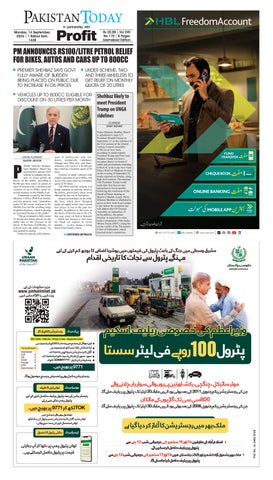
PM ANNOUNCES RS100/LITRE PETROL RELIEF FOR BIKES, AUTOS AND CARS UP TO 800CC
g
g
PREMIER SHEHBAZ SAYS GOVT g UNDER SCHEME, TWOFULLY AWARE OF BURDEN AND THREE-WHEELERS TO BEING PLACED ON PUBLIC DUE GET RELIEF ON MONTHLY TO INCREASE IN OIL PRICES QUOTA OF 20 LITRES
VEHICLES UP TO 800CC ELIGIBLE FOR DISCOUNT ON 30 LITRES PER MONTH
Shehbaz likely to meet President Trump on UNGA sidelines ISLAMABAD
STAFF REPORT
P
LAHORE/ISLAMABAD SALEEM JADOON
RIME Minister Muhammad Shehbaz Sharif has announced a special relief scheme to mitigate the impact of rising global oil prices on the public, providing a Rs100 per litre relief on petrol to users of motorcycles, rickshaws and vehicles of up to 800cc amid renewed tensions in the Middle East. A statement issued by the Prime Minister’s Office (PMO) on Sunday said the premier took “immediate notice of the recent tensions in the Middle East and the resulting surge in global oil prices, which is placing an increased burden on the public”. “The government is fully aware of the burden being placed on the public due to the increase in oil prices. In this hour of difficulty, we will not leave the public alone,” he was quoted as saying. Under the special relief scheme,
users of motorcycles, auto rickshaws, motorcycle rickshaws, Qingqis and other two- and threewheelers will receive a Rs100 per litre relief on a monthly quota of 20 litres. Owners of small vehicles with engine capacities of up to 800cc will receive the same relief on a monthly quota of 30 litres. The PMO said the scheme was being initiated to provide relief to the public, particularly those most affected by the rise in fuel prices. Renewed hostilities in the Middle East, which have disrupted major oil supply routes, have caused fuel prices to rise in the past two months. In addition to the crisis in the Strait of Hormuz due to the USIran war, trade via Bab al-Mandab — which has become a vital route for Saudi oil exports in recent months — is also facing a rising threat from Houthi rebels.
CONTINUED ON PAGE 03
Prime Minister Shehbaz Sharif is scheduled to meet US President Donald Trump on September 23 on the sidelines of the 81st session of the United Nations General Assembly (UNGA) in New York, according to media reports. President Trump and First Lady Melania Trump will host a reception dinner for heads of states and governments attending UNGA 81 at the Lotte New York Palace Hotel on Madison Avenue on the evening of September 23, media reported on Sunday, citing high-level sources. The meeting with President Trump would mark their first face-to-face interaction in seven months following the conclusion of the Board of Peace meeting in Sharm el-Sheikh, Egypt. Prime Minister Shehbaz is scheduled to arrive in New York from London a day before the reception and will address the UN General Assembly on September 25. In his address, the prime minister is expected to raise India’s suspension of the Indus Waters Treaty (IWT), citing the recent verdict of the Permanent Court of Arbitration, which rejected India’s contention.
02 NEWS
PM DEFENDS MOVE TO EXPORT REMAINING IMPORTED SUGAR STOCKS
P
PROFIT
WEB DESK
RIME Minister Shehbaz Sharif has defended the government's move to export around 108,000 metric tonnes (MT) of previously imported sugar, saying the decision is aimed at avoiding losses on stocks approaching the end of their shelf life. The prime minister rejected criticism of the move as “fallacious”, maintaining that the sugar had originally been imported when domestic production was declining and prices were rising. The government had authorised imports of up to 500,000 MT of white sugar in June 2025 to improve domestic availability and contain price pressures. The Trading Corporation of Pakistan (TCP) subsequently imported 300,000 MT between September and November 2025. Around 192,000 MT of the imported quantity has since been sold domestically, leaving approximately 108,000 MT in stocks.
The government is now seeking to dispose of the remaining quantity through exports as continued storage adds to costs and the commodity moves closer to the end of its two-year shelf life. Higher international sugar prices have also improved the prospects of recovering the cost of the remaining stocks
through exports. The import followed a deterioration in Pakistan's domestic sugar supply position after sugarcane production declined by around 15% during the 2024-25 crushing season amid heatwaves, crop diseases and other factors. Retail sugar prices subsequently
climbed to around Rs220 per kg in some markets, prompting the government to turn to imports to supplement domestic supplies. The shortage followed an earlier period in which the government had allowed exports of around 790,000 MT of sugar during 2024-25 after the industry reported surplus stocks. The subsequent move from exports to imports, and now towards exporting the remaining imported stocks, has renewed questions over the accuracy of Pakistan's sugar supply and demand projections. The government has called for future assessments of sugar and other food commodities to be based on stronger data, realistic estimates of domestic demand and supply, and prevailing market conditions. Shehbaz maintained that the circumstances surrounding the proposed export were different from those prevailing when the sugar was imported, with the government now seeking to avoid losses on stocks that remain unsold.
FBR imposes Rs80 per litre FED on three petroleum products PROFIT
WEB DESK
FBR extends sales tax exemption on EV CKD kits till June 2027, imposes FED on luxury EVs PROFIT
MONITORING REPORT
The Federal Board of Revenue (FBR) has extended the sales tax exemption on imports of completely knocked down (CKD) kits for specified electric vehicles (EVs) by another year, until June 30, 2027, while introducing federal excise duty of up to 40% on higher-value luxury EVs. The changes were detailed in the FBR's budget instructions for 2026-27 issued to field formations on Friday. According to the FBR, S. No. 157 of Table-I of the Sixth Schedule to the Sales Tax Act provided an exemption on the import of CKD kits for specified electric vehicles until June 30, 2026. The exemption has now been extended for another year to June 30, 2027. Specified electric vehicles are currently subject to a reduced sales tax rate of 1%. The FBR said the reduced sales tax regime has also been extended until June 30, 2027, to ensure policy continuity. The reduced sales tax rate has also been extended to electric trucks imported in completely built-up (CBU) condition, alongside electric buses. According to the FBR, the measure is aimed at supporting clean mobility. Separately, the FBR said S. Nos. 55 and 55(1) of Table-I of the First Schedule to the Federal Excise Act, 2005 provide for the imposition of federal excise duty (FED) on imported and locally manufactured vehicles. Electric vehicles had been excluded from the levy until June 30, 2026. The timeline for this exemption or exclusion has now been extended by another year to June 30, 2027. However, the FBR has introduced FED on luxury electric vehicles based on their value. Electric vehicles, including electric cars, SUVs and other EVs, valued at more than $75,000 and up to $110,000 will now attract FED at a rate of 30%. For electric vehicles valued above $110,000, the FED rate has been set at 40%. Luxury vehicles are otherwise subject to FED rates of up to 40%, while electric vehicles had previously been excluded from the chargeability of FED, according to the FBR.
The Federal Board of Revenue (FBR) has imposed Federal Excise Duty (FED) of Rs80 per litre on three petroleum products from July 1, 2026, under changes introduced through the Finance Act 2026. The new duty applies to petroleum top naphtha, white spirit or mineral turpentine oil (MTT), and solvent oil, which are not subject to the petroleum development levy (PDL). The measure is aimed at discouraging the use of these products for adulterating petroleum products
that are subject to PDL. Under the revised framework, the Rs80-per-litre FED will be collected in sales tax mode, allowing registered persons to adjust the duty against their output sales tax. The change has been incorporated into the Federal Excise Act, 2005, with the three petroleum products included in the relevant schedules governing the imposition and adjustment of FED. Conditional relief has also been provided for industries that use the affected petroleum products as inputs in manufacturing. Exemption or exclusion may be available where the final product is
exempt from sales tax or where the supplier and manufacturer are integrated with the FBR's digital invoicing system, subject to applicable conditions. Separately, sales tax relief has been provided on specified machinery, equipment and other items required for refinery upgrades, scheduled turnarounds, maintenance and overhauls. The measure is intended to facilitate refinery upgrades needed to meet cleaner fuel and environmental standards, including improvements in emission controls and reductions in carbon and sulphur intensity.
JURA petroleum rights face revocation or regularisation as share-transfer dispute reaches ECC PROFIT AHMAD AHMADANI
The Petroleum Division has taken JURA Energy’s petroleum rights to the ECC after Law Division cited rules allowing revocation over transfers without prior government consent, while the Petroleum Division has proposed retrospective regularisation as an alternative. Sources familiar with the matter said the Petroleum Division has prepared a summary titled “Disposition of Controlling Shares of JURA Energy Corporation from Phoenix Exploration Limited to IDL Investments Limited Without Prior Consent of the Government” and placed two options before the ECC for consideration. The case relates to the transfer of all 73.3 percent controlling shares of JURA Energy Corporation by Phoenix Exploration Limited, a Bermuda-based company, to IDL Investments Limited, a British Virgin Islands-based investment entity, without obtaining prior government consent. According to sources, Spud Energy Pty Limited and Frontier Holdings (Pvt) Limited are working interest owners in several petroleum rights under Petroleum Concession Agreements with the government. The Petroleum Division has treated the transaction at the ultimate parent-company level as resulting in a change of effective control of the petroleum rights holders. The dispute centres on regulatory provisions governing changes
in ownership and effective control of companies holding petroleum rights. Sources said the Directorate General of Petroleum Concessions had earlier initiated proceedings against the companies over the alleged change in control, following which the matter underwent legal and regulatory scrutiny. The Petroleum Division subsequently sought the opinion of the Law and Justice Division on the legal position. Sources said a meeting was also held between the Minister for Petroleum and the Minister for Law and Justice to seek further clarity regarding the legal opinion. According to sources, Law Division in its subsequent advice maintained that Rule 68 of the 1986 Rules and Rule 69 of the 2001 Rules provide that the government “may revoke” a petroleum right where the prescribed grounds exist and the required procedure has been followed. Law Division further explained that the word “may” is enabling in nature and gives discretionary power to the federal government. Sources said Law Division specifically advised that deciding whether or not to exercise the power of revocation is essentially an administrative and commercial determination for the Petroleum Division, as the concerned authority, after considering all relevant facts, efficacy, financial obligations, contractual obligations and the overall circumstances of the case. According to sources, the legal
advice does not make revocation automatic merely because the prescribed grounds may exist, but recognises the government’s discretion to exercise the revocation power after assessing the relevant administrative, commercial and contractual circumstances. Despite this legal position, the Petroleum Division has not proceeded directly with revocation of the petroleum rights and has instead placed two alternatives before the ECC. Under the first option, the government may revoke all petroleum rights held by Spud Energy Pty Limited and Frontier Holdings (Pvt) Limited on the grounds that shares were transferred from Phoenix Exploration Limited to IDL Investments Limited without prior government consent. Under the second option, the Petroleum Division has proposed that it be authorised to issue a warning to the companies and retrospectively regularise the share transfer. Sources said the Petroleum Division has also highlighted that the disputed transaction occurred at the ultimate parent-company level rather than directly at the parent-company level, while stressing the importance of the existing petroleum rights to the companies’ business. JURA, however, has taken the position that the transfer of Phoenix Exploration Limited’s shareholding in JURA Energy Corporation to IDL Investments Limited did not result in any change in effective control of Frontier Holdings or Spud Energy, which continued to remain under JURA as their parent company.
Monday, 14 September, 2026 | ISLAMABAD
ECC to decide fate of long-delayed refinery upgrade agreements on Sept 14 PROFIT
AHMAD AHMADANI
After more than two years of negotiations, consultations and repeated delays, the draft Upgrade Agreement for Pakistan’s refinery modernisation programme is finally set to go before the Economic Coordination Committee (ECC) of the Cabinet for approval on September 14. The ECC, chaired by the Minister for Finance and Revenue, will take up the agreement as item number two on its four-point agenda at its meeting scheduled for Monday. The agenda also includes restructuring of the ownership and management of the Pakistan National Shipping Corporation (PNSC), settlement of financial issues confronting oil marketing companies (OMCs), and a review of automobile standards and regulations earlier decided by the ECC in September 2025. The proposed approval represents a critical contractual step for implementation of the amended Pakistan Oil Refining Policy for Upgradation of Existing/Brownfield Refineries, 2023, under which existing refineries undertaking major upgradation projects are to receive incentives for producing Euro-V petroleum products, reducing furnace oil production and improving refinery configuration and efficiency. The Cabinet Committee on Energy (CCoE) had approved amendments to the refining policy on July 28, 2026, while the Cabinet ratified those amendments on August 10, 2026. Under the revised framework, refineries are required to execute formal Upgrade Agreements with the Petroleum Division or its designated entity in order to avail themselves of the policy incentives. Inter State Gas Systems (ISGS) has been designated as the implementation entity under the policy. It is responsible for executing the Upgrade Agreements, operating the Refinery Upgradation Accounts, monitoring the progress of upgrade projects, engaging technical consultants and auditors and administering incentive payments. A dedicated committee comprising the Secretaries of the Petroleum Division and Law and Justice Division, the Chairman of the Oil and Gas Regulatory Authority (OGRA), and a representative of the Special Investment Facilitation Council (SIFC) was constituted to finalise the agreement. The committee worked with the Finance Division, National Coordination Committee on Marketing (NCMC), SIFC, ISGS, the refineries and legal counsel M/s Orr Dignam to settle the draft agreement. According to sources, the draft was shared with the Law Division and Finance Division on September 1 for formal comments. The Law Division found the draft aligned with the Refining Policy, while comments from the Finance Division were considered alongside counter-comments before finalisation. The summary signed by Petroleum Division Secretary Hamed Yaqoob Sheikh on September 8 states that the agreement was finalised through a consultative process and was not recirculated for further comments before being submitted to the ECC. The agreement, however, is reaching the ECC against the backdrop of growing frustration among refinery executives over the prolonged delay in completing the contractual process. Usama Qureshi, Vice Chairman of Cnergyico Pk Limited, expressed cautious optimism over the scheduled ECC meeting but also called for reconsideration of the penalty regime in view of the timeline under the revised policy. “We hope the ECC will approve the Draft Upgrade Agreement under the revised Refining Policy, which is an important step towards enabling the industry to proceed with the planned refinery upgrades. We also expect the 2.5% penalty to be withdrawn, at least with effect from the date the CCoE approved the revised policy in early July. Once the revised framework had received CCoE approval, continuation of the penalty beyond that point would be difficult to justify,” he said. Attock Refinery Limited (ARL) CEO Adil Khattak was more critical, questioning why the signing of the agreements had taken so long despite what he described as the strategic importance of the local refin “Inspite of the strategic importance of local refineries, now realised at last by the powers that be, the signing of the Refineries Upgradation Agreements is being delayed on one pretext or another,” Khattak said.
Forensic tests of culprits’ mobiles CITY NOTES M.A. NIAZI
ERHAPS it was the final comment on our cricket, that the new look team which the PCB created after sacking the coach, the bowling coach and seven players, went down to a seven-wicket defeat. It was perhaps not the worst defeat of the series, but it meant that the series whitewash had been accomplished. Frankly, that was not so bad. Whitewashing Pakistan on one’s home soil was not that much of anything to talk about. Even Bangladesh has done it. Heck, they’ve done it in Pakistan. So until England manages it in Pakistan, we can’t accept it as a better team than Bangladesh. Of course, that means that Bangladesh is now a better team than the West Indies, which has a 1-1 record both home and away. Getting beaten by the West Indies is quite a feat, and Shan Masood added that
P
feather to the cap of his captaincy, before he was sacked. He was retained in the Great Massacre, and justified that faith with 95 in the second innings. In fact, that 95 was a glimmer of hope, for if he had scored a century, then Pakistan’s fate would have been sealed. He has this disconcerting habit of scoring centuries when the team is going down to defeat. This time, he should be satisfied that his effort did not go in vain. The funny thing is that all the main batsmen got what would have been considered decent scores. But nobody got the sort of mammoth, legendary, innings, of which people still talk decades later. And which save matches. Like Hanif Mohammad’s legendary 337 almost 70 years ago, which saved the Test for Pakistan. Then there was young Razaullah, who was drafted as a fast bowling talent, and got four wickets on his debut, but the real sparkle was the second-innings fifty. That puts me in mind of Madan Lal, the Indian fast bowler, who twice spared India its blushes against Pakistan in the 1983-4 series, when Pakistan toured Pakistan for
three Tests, with 72 in the First Test and 32 not out in the Third. However, he was dropped, probably because someone on the selection committee spotted that he had not taken a single wicket all series, and that was why India needed its blushes spared. Razaullah took four wickets, and he should not forget that that’s why he was picked. I was interested to see Babar Azam, the whitewashed captain, saying that the team members should examine themselves and correct their mistakes. I suspect that they have done that, and have decided to repeat them. I would suspect that the real reason for our boys to lose so big is the Mumbai Matchfixers. I know they’ve taken phones into custody for forensic examination, but I think a more fruitful area of examination is the bank accounts of players and coaching staff. And instead of going for their phones, it might be more useful to check their social media. CENTCOM has been more thorough than the PCB, and has banned all active-duty personnel from having their mobile phones. It seems that service persons are in the habit of posting combat
videos on their social media accounts. And incidentally, that lets the Iranian intelligence people find out how much damage their drones and missiles have done. Like the Israelis in Gaza. If there are every trials held for the war crimes there, the evidence will overwhelmingly be the social media posts of IDF personnel, who have recorded on their phones the atrocities they perpetrated on Gazans (including how they looted abandoned homes). The cricketers without phones will probably now go to Justin Trudeau’s pro-
duction company. Yes, the former Canadian PM is now going into showbiz. He should get ready to star himself, because one of his main reasons for fame outside of Canada was that he was good-looking. He should get some more good-looking people, like our own Imran Khan. Maybe he should get hold of Shaih Eashid as well, or Rana Sanaullah, and produce a Punjabi film. I don’t know who is ugly enough to replace Sultan Rahi, who enhanced his features with a fright wig. Someone from the judiciary? Or the bureaucracy?
WEEKLY INFLATION RISES 0.23%, REACHES 8.62% YOY AS FUEL PRICES SURGE
Monday, 14 September, 2026 | ISLAMABAD
P
g
PROFIT
newS DeSk
AKISTAN'S weekly inflation, measured by the Sensitive Price Indicator (SPI), increased 0.23% during the week ended September 10, 2026, driven primarily by sharp increases in petrol, high-speed diesel and liquefied petroleum gas (LPG) prices, according to the Pakistan Bureau of Statistics (PBS). On a year-on-year basis, the SPI was 8.62% higher than the corresponding week last year. The combined SPI stood at 364.26 compared with 363.42 a week earlier and 335.35 in the corresponding week of 2025. The index, with 2015-16 as its base year, tracks 51 essential items across 50 markets in 17 cities. FUEL PRICES LEAD WEEKLY INCREASE: Petrol recorded the largest weekly increase among the items tracked, rising 6.18% to an average Rs369.75 per litre from Rs348.24 a week earlier. Compared with Rs265.82 per litre in the corresponding week last year, petrol was 39.10% more expensive. High-speed diesel increased 5.49% week-on-week to Rs394.68 per litre from Rs374.13. Its price was 45.26% higher yearon-year compared with Rs271.71 per litre in the corresponding period last year. LPG prices rose 4.32% during the week, with the average price of an 11.67kg cylinder reaching Rs4,810.14 from Rs4,610.97. The
Kite sellers caught as police intensify zero-tolerance action across Lahore LAHORE
StAFF report
Lahore police have arrested four people for allegedly manufacturing and selling kites despite a ban, as part of a zero-tolerance operation against illegal kite flying and trade. According to the details, the arrests were made by Women Race Course police during an operation in the Hanif Garden area. Police said the suspects were involved in preparing and selling kites despite the restrictions. According to police, the suspects used local transport to move the kites, hiding them in cardboard boxes and sacks to avoid detection. Police recovered 600 ready-made kites and 40 reels of string, collectively worth millions of rupees, from the suspects. The arrested suspects were identified as Talha, Aleeb, Fahad and Areej. A case has been registered against them and they have been handed over to the investigation wing for further investigation.
12 falcons rescued from smugglers released into wild PESHAWAR
StAFF report
The Khyber Pakhtunkhwa Wildlife Department has released 12 falcons into their natural habitat after confiscating the birds from a passenger bus in Peshawar earlier. The falcons were seized on September 10 by wildlife officials deployed at the Peshawar Motorway Toll Plaza, according to the department. The birds were recovered from a bus bearing registration number FSJ-444. The KP Wildlife Department said the enforcement operation was conducted on the directions of DFO Wildlife Peshawar Manahil Wahab as part of intensified efforts to curb the illegal trapping, transportation and trade of protected wildlife species. The birds were subsequently released into their natural habitat by Provincial Minister for Forest, Environment and Wildlife Pir Musavir Khan Ghazi at a ceremony in Peshawar. Conservator Wildlife Central Circle M Israr briefed the minister about the seizure and the department’s enforcement efforts.
PETROL JUMPS 6.18%, DIESEL 5.49% AND LPG 4.32% DURING THE WEEK; SPI INFLATION STANDS AT 8.62% YEAR-ON-YEAR, WITH ONION PRICES UP 125.52%
cylinder cost Rs3,094.86 a year earlier, translating into a 55.42% year-on-year increase.
KITCHEN ITEMS: Among other items recording weekly increases, pulse mash rose 0.79%, washing soap 0.49%, wheat flour 0.47%, pulse masoor 0.46%, mustard oil 0.36%, five-litre cooking oil 0.23%, IRRI6/9 rice 0.18%, 2.5kg vegetable ghee 0.11% and curd 0.03%. The detailed PBS data showed the average price of a 20kg wheat flour bag increasing to Rs2,694.20 from Rs2,681.53 a week earlier and Rs2,069.65 a year ago. Pulse mash increased to Rs459.17 per kg from Rs455.57, while pulse masoor rose to Rs260.47 from Rs259.29. Mustard oil averaged Rs564.35 per kg, five-litre cooking oil Rs3,088.44, IRRI-6/9 rice Rs154.28 per kg, a 2.5kg tin of vegetable ghee Rs1,570.41 and loose curd Rs254.94 per kg.
VEGETABLE PRICES PROVIDE SOME RELIEF: The increase in fuel and some food prices was partly offset by substantial declines in several perishable food items. Bananas recorded the largest weekly decline, falling 7.73%, followed by tomatoes at 5.24%, chicken at 4.22%, onions at 3.72% and potatoes at 1.88%. Egg prices declined 0.68%, garlic 0.44% and sugar 0.42%. PBS's detailed price data showed ba-
nanas declining to Rs159.05 per dozen from Rs172.38, tomatoes to Rs186.58 per kg from Rs196.90 and live broiler chicken to Rs346.24 per kg from Rs361.48. Onions fell to Rs202.61 per kg from Rs210.44, while potatoes declined to Rs55.80 from Rs56.87. Eggs averaged Rs248.30 per dozen, garlic Rs375.34 per kg and refined sugar Rs145.59 per kg. Overall, prices of 14 of the 51 monitored items, or 27.45%, increased during the week. Prices of 10 items, or 19.61%, declined, while 27 items, representing 52.94% of the basket, remained unchanged.
ONIONS REMAIN 125.52% MORE EXPENSIVE THAN LAST YEAR: Despite their weekly decline, onions recorded the largest year-on-year increase among the major items monitored by PBS, with prices up 125.52%. The average onion price stood at Rs202.61 per kg compared with Rs89.84 a year earlier. Other major year-on-year increases included LPG at 55.42%, diesel at 45.26%, petrol at 39.10% and wheat flour at 30.18%. Electricity charges for the lowest consumption quintile were 25.24% higher than a year earlier, while chilli powder increased 16.37%, mutton 15.92%, beef 13.28%, bananas 10.51%, fresh milk 8.12% and plain bread 8.09%. PBS data showed average electricity
charges for the lowest consumption quintile at Rs6.45 per unit compared with Rs5.15 a year earlier. Mutton averaged Rs2,385.55 per kg against Rs2,057.98 last year, while beef stood at Rs1,269.41 per kg compared with Rs1,120.60. Fresh milk averaged Rs218.59 per litre, up from Rs202.18 a year ago, while plain bread stood at Rs119.03 compared with Rs110.12. Several food items, however, remained substantially cheaper than a year ago. Potato prices were down 35.21%, chicken 24.30%, sugar 20.88%, eggs 19.95%, tomatoes 17.65%, powdered salt 13.96%, pulse gram 13.52% and pulse masoor 12.26%.
INFLATION VARIES SHARPLY ACROSS EXPENDITURE GROUPS: The impact of weekly price movements differed across consumption quintiles. For the lowest expenditure group, covering households spending up to Rs17,732, the SPI actually declined 0.30% week-onweek, although it remained 7.38% higher year-on-year. Its index stood at 351.56 compared with 352.61 the previous week and 327.39 a year earlier. The second quintile, covering expenditure of Rs17,733 to Rs22,888, recorded a 0.18% weekly decline and an 8.14% yearon-year increase. The third quintile, covering Rs22,889 to Rs29,517, saw prices decline 0.06% week-on-week while rising
The prime minister said the scheme would be implemented in Islamabad from the night between Monday and Tuesday, while it would be extended across the country, including Azad Kashmir and Gilgit-Baltistan, from the night between Wednesday and Thursday. Registration for the special relief scheme was opened on Sunday, while details of the registration process would be conveyed to the public through an awareness campaign. The prime minister thanked the provinces for their cooperation in providing information about motorcycles, rickshaws and small cars required for registration under the scheme.
DIGITAL SYSTEM ACTIVATED FOR RS100 PER LITRE PETROL RELIEF SCHEME: The government has activated a digital system to provide petrol at a Rs100 per litre discount under the Prime Minister’s special relief scheme. The Ministry of Information Technology and Telecommunication developed the system in collaboration with provincial departments, NADRA and telecom operators.
7.25% year-on-year. For the fourth quintile, covering expenditure between Rs29,518 and Rs44,175, the SPI increased 0.07% during the week and 7.61% from a year earlier. The highest expenditure group, covering spending above Rs44,175, experienced the sharpest weekly increase of 0.47%. Its yearon-year inflation rate was also the highest among the five groups at 8.92%.
WEEKLY INFLATION ACCELERATES AFTER PREVIOUS WEEK'S RISE: The latest 0.23% increase followed a 0.65% rise in the combined SPI during the week ended September 3. The year-on-year rate consequently increased to 8.62% from 8.35% a week earlier. Over the preceding weeks, the combined SPI increased 0.05% in the week ended August 27, 0.49% on August 20, 0.15% on August 13 and 0.28% on August 6. It had declined 0.91% in the week ended July 30 after increasing 0.91% on July 23 and 1.40% on July 16. For the lowest consumption quintile, the monthly SPI stood at 348.70 in August 2026, increasing 0.86% from July and 9.46% from August 2025. In July, the index had stood at 345.72, up 2.39% month-onmonth and 12.04% year-on-year. For fiscal year 2025-26, the lowest quintile's SPI increased 5.68% quarter-on-quarter during July-September, 3.35% during October-December, declined 1.01% during January-March and rose 3.24% during April-June. The corresponding year-on-year changes were 2.08%, 3.82%, 4.55% and 11.62%, respectively. On a half-yearly basis, the SPI for the lowest consumption quintile stood at 322.70 in July-December 2025-26, up 5.65% from the previous half-year and 2.96% year-onyear. It increased to 329.96 during JanuaryJune 2026, representing growth of 2.25% from the preceding half-year and 8.03% from a year earlier.
Govt considers cutting PDL to Rs5-10/litre, replacing Rs1.5 trillion revenue through new taxes, savings: report g
JI PROPOSAL SEEKS GRADUAL LEVY REDUCTION OVER 12 MONTHS AS GOVT EXAMINES TAXES, EXEMPTION WITHDRAWALS, ENFORCEMENT AND EXPENDITURE SAVINGS TO OFFSET REVENUE GAP PROFIT
Monitoring report
The federal government is considering a Jamaat-e-Islami proposal to gradually reduce the petroleum development levy (PDL) to Rs5-10 per litre while replacing an estimated Rs1.45-1.50 trillion annual revenue gap through new taxes, withdrawal of exemptions, expenditure savings and stronger tax enforcement, Business Recorder reported. However, the proposal remains at the consultation stage and has not been approved yet, as the Ministry of Planning sought feedback from the relevant stakeholders. The government collected Rs1.557 trillion under the PDL head in FY2025-26 against a target of Rs1.468 trillion, while the FY2026-27 target is estimated at Rs1.576 trillion. Reducing the levy to a base rate of Rs5-10 per litre over 12 months would leave residual PDL revenue of around Rs96-180 billion. The planning ministry’s document's reconciliation exercise puts the net revenue gap at approximately Rs1.45-1.50 trillion and favours a gradual reduction in the levy rather than immediate elimination. To bridge the gap, the proposal examines higher Federal Excise Duty (FED) and regulatory duties on luxury imports and high-end consumption. A broader luxury basket, combined with FED on firstand business-class air travel and luxury vehicles, is estimated to generate Rs200280 billion once fully phased in. It also proposes an additional surcharge of 5-7.5 percentage points on the largest 200-300 corporations and ultrahigh-income individuals, which could generate another Rs180-250 billion. Banking, exploration and production, fertiliser and cement are among the sectors expected to bear a significant portion of the burden. Withdrawal of tax exemptions forms another major part of the proposed replacement package. Total tax expenditure during FY2025-26 is estimated at around
Rs2.35 trillion, comprising Rs1.27 trillion in sales tax, Rs580 billion in income tax and Rs500 billion in customs-related exemptions. After ring-fencing exemptions relating to food, health, education and defence, the document identifies an addressable pool of around Rs1.2-1.4 trillion. Capturing 3550% of this pool over 24 months could generate an estimated Rs450-650 billion. The proposal also considers lower interest rates as a source of fiscal space. Debt servicing during FY2025-26 stood at around Rs6.9 trillion, including approximately Rs6 trillion in domestic debt. As a substantial portion of domestic debt carries floating rates, the document estimates that a 100-basis-point reduction in interest rates could eventually save Rs350-500 billion annually, while a 200basis-point reduction could create Rs700 billion to Rs1 trillion in fiscal space. It acknowledges that these are expenditure savings rather than additional tax revenue and that they depend on inflation allowing such monetary easing. The proposed package also seeks greater taxation of agricultural income and wealth. Agricultural income taxation is estimated to generate Rs40-80 billion within 12 months and Rs120-200 billion on an annualised basis over 24 months. A proposed 1% wealth levy on documented net movable and immovable assets above Rs100 million, along with a capital value tax on foreign assets, could generate Rs50-90 billion initially and Rs100-160 billion on an annualised basis within 24 months. The document cautions that valuation disputes and litigation could constrain first-year collections. An expanded environmental and carbon levy is estimated to generate Rs130200 billion annually by the 24th month. The proposal envisages the existing climate-support levy of around Rs2.50 per litre potentially rising to Rs5 per litre, alongside carbon pricing of $3-5 per tonne of carbon dioxide on coal, cement, captive
power and large industrial emitters. The proposal also places emphasis on technology-driven tax enforcement through data matching across banks, utilities, travel, property and points of sale. Data-driven audits could generate Rs200350 billion in annualised collections within two years, while reducing leakage in customs and refunds could yield another Rs50-100 billion over time. For the retail sector, it proposes a low fixed levy linked to around 2.5 million commercial electricity connections, alongside mandatory point-of-sale integration for larger retailers. The measure is estimated to generate Rs50-100 billion initially, rising to Rs150-250 billion annually by month 24. Overall, the proposed new revenue measures are estimated to generate Rs774 billion to Rs1.248 trillion. When combined with projected fiscal savings from lower interest rates, total fiscal space could reach Rs1.12-1.94 trillion within 12 months and Rs2.295-3.56 trillion by month 24. This would provide estimated cover-
PM announces Rs100/litre petrol relief for bikes, autos and cars up to 800cc CONTINUED FROM PAGE 01
NEWS 03
The scheme will benefit owners of motorcycles, rickshaws, Qingqi motorcycles and vehicles of up to 800cc. Under the scheme, motorcycle and Qingqi owners will be eligible for the Rs100 per litre relief on up to 20 litres per month, while owners of vehicles up to 800cc can avail the same relief on up to 30 litres. The ministry said vehicle verification had been fully automated in coordination with provincial transport and excise departments. For registration, citizens will have to send an SMS from a SIM registered in their own name in the following format: [CNIC WITHOUT DASHES] [VEHICLE NUMBER WITHOUT SPACES OR DASHES] [PROVINCIAL CODE] [VEHICLE REGISTRATION DATE] A confirmation message will be sent after successful registration. Registered citizens will then have to send TOK to 9771 to obtain a fuel token before visiting a petrol station. The token will be presented at the petrol station and verified before the subsidised petrol is provided. The subsidised petrol facility will begin in Islamabad on the night between Monday and Tuesday and become avail-
able at petrol stations in the rest of the country from the night between Wednesday and Thursday. The IT ministry said the scheme was being implemented on the special directives of Prime Minister Shehbaz Sharif. It aims to provide relief to the public, particularly the working class, and reduce the impact of rising petrol prices on household finances.
OIL PRICES AMID MIDEAST CONFLICT: Petroleum prices have surged since the United States and Israel launched a war against Iran on February 28. Tehran retaliated to US attacks by targeting sites in neighbouring Gulf countries, resulting in brief closures of some oil facilities. The conflict also effectively closed the Strait of Hormuz, through which a fifth of global oil used to flow. After the latest hike on Friday, the price of petrol reached Rs375.82 per litre while high-speed diesel (HSD) cost Rs403.32 per litre. The government continues to levy Rs114 per litre in taxes and duties on petrol and Rs100 per litre on diesel. Saudi Arabia also shut down its EastWest pipeline recently after the vital oil conduit came under aerial attack, threat-
ening to send energy prices even higher. Saudi oil buyers and traders have warned of a loss of up to 4 per cent of global supply if the country does not restart the pipeline within days. The International Energy Agency (IEA) has said that global oil supply and demand will fall further than previously thought this year, as a lack of progress in ending the Iran war delays the return of normal Middle East flows into 2027 and sends fuel prices soaring. In July, following renewed hostilities between Iran and the US, the government announced that fuel prices would now be fixed on a daily basis due to fluctuations in international market prices. Prior to this, the government had been announcing weekly revisions to fuel prices since early March, alongside measures for the conservation of fuel. The federal government had also announced targeted relief measures in April to provide subsidised fuel. The price of HSD has come down from a peak of Rs520.35 recorded on April 3. Its price had started rising from Rs281 per litre after the US-Iran war broke out on February 28. The petrol price had peaked at Rs458.41 on April 3 after beginning its upward trajectory from Rs266 in the first week of March.
age of around 75-130% of the net PDL gap after 12 months and 145-225% by month 24. However, the proposal identifies major fiscal and implementation hurdles. PDL is classified as non-tax revenue and retained entirely by the federal government, whereas most replacement taxes collected through FBR are shared with provinces under the National Finance Commission (NFC) Award. Consequently, gross FBR collections would need to exceed the PDL revenue gap by roughly 2.3 times unless non-tax instruments, levies, surcharges or an NFCside arrangement are used to preserve the federal government's fiscal position. Agriculture income and land and property taxation are also provincial subjects, limiting the federal government's ability to capture their full fiscal benefit without additional arrangements. The document further notes that PDL is treated as a committed revenue line under the existing IMF Extended Fund Facility and Resilience and Sustainability Facility framework. Any reduction would therefore need to be negotiated with the IMF and accompanied by revenue-neutral measures, preferably front-loaded through the Finance Act. Execution risks are particularly high for agriculture taxation, property taxation and retail documentation. The document cites agriculture income tax collection of only Rs5.6 billion against declared potential of more than Rs800 billion and repeated failures of previous retail documentation schemes. Accordingly, its revenue estimates assume collection of only around 10-25% of theoretical potential rather than full realisation. The Ministry of Planning has sought comments from relevant ministries and institutions on the proposal, meaning the PDL replacement framework remains under examination and consultation rather than constituting an approved government policy.
04 COMMENT BRICS Summit
A system that punishes initiative
Monday, 14 September, 2026
No radical departures, no big decisions, just showing that even opponents can sit together
T
When people stop trying
HE BRICS Summit in New Delhi on Saturday and Sunday was noticeable more for what happened on the sidelines rather than what transpired in the Summit itself, even through the latter took a position on the Middle East conflict which called for peace. In keeping with the apparent ethos of the Summit, which seemed to be one of not annoying the USA too much, there was no progress made on the previous summit’s BRICS currency idea, to replace the US dollar as a reserve currency, especially in the oil trade. This had provoked threats of punitive tariffs and other sanctions by US President Donald Trump, who always reacts fiercely to any suggestion that the US dollar be replaced as the world’s reserve currency. Some of the optics of the sideline summiteering were also amazing. Host India managed to achieve some of this, when it received the visit of Chinese President Xi Jinping, the first visit by him in seven years, where he spoke to Indian PM Narendra Modi. However, the focus was on Iranian President Massoud Pezeshkian, who had a meeting with UAE Crown Prince Kaled bin Muhammad. It may be remembered that the USA had used UAE air bases to bomb Iran, and Iran had retaliated with missile strikes which had also hit Emirati civilian infrastructure. However, while the two should that opponents in the Gulf conflict could meet, their not going beyond previously stated positions showed that not much had changed. The desire to appease the USA prevented the gathering from appearing a meeting opposed to the USA, for the presence of Mr Xi and Russian President Vladimir Putin showed that the Summit was not a subordinate to the USA. This will be important in future, for BRICS does include potential rivals for the USA, as well as potential replacements for it. Whether future US Presidents are as petulant as President Trump in their approach to the organization, there can be no doubt that they will continue to view the organization as a rival. Its failure to provide the USA he kind of support it likes to have over the attack on Iran and the war in Ukraine show that BRICS is not the USA’s poodle. It is that independence of action that makes it so unpopular in Washington.
T
Dr Zafar Khan SafDar
HE greatest danger to a country is not a shortage of capable people. It is a system that teaches capable people to stop using their capabilities. When taking initiative becomes risky, questioning an established practice is treated as disloyalty, difficult decisions become a source of personal danger and those who go beyond their assigned duties discover that responsibility can be punished more severely than inaction. Gradually, people learn the lesson the system is teaching them. Do only what is required. Sign nothing that can later be questioned. Raise no uncomfortable issue. Offer no idea that might fail. Take no decision that carries personal risk. Let the file move, let the problem remain and, above all, protect yourself. The most dangerous consequence is not that good people leave. It is that they remain inside the system but quietly stop trying. Pakistan has spent decades talking about institutional reform. We create committees, amend rules, introduce procedures and announce new policies. Yet we rarely ask a more fundamental question: what happens to an organization when its honest and capable people lose the confidence to act? Pakistan does not lack talent. Our universities produce thousands of graduates, while our doctors, engineers, researchers, civil servants, teachers and entrepreneurs repeatedly demonstrate their ability whenever they find an environment where merit is respected and effort has meaning. The remarkable success of Pakistanis abroad is perhaps the clearest evidence that the problem is not our people. Too often, it is the environment in which they are asked to work. In Pakistan, taking responsibility can sometimes become a liability. Making a difficult decision can invite questions that an easier decision would avoid. Speaking openly can create enemies. Challenging an established practice can be interpreted as disloyalty. And when something goes wrong, the person who signed, spoke or acted may find himself standing alone, while those who remained silent are rarely asked why they did nothing. The predictable response is caution. Over time, caution becomes silence, and silence becomes an organizational culture. People begin to learn that the safest way to survive is not necessarily to perform well, but to avoid being noticed. This is particularly damaging in the public sector.
Dedicated to the legacy of late Hameed Nizami
Arif Nizami (Late) Founding Editor
Government organizations exist to make decisions, solve problems and serve citizens. Yet when officers become more concerned about protecting themselves than solving problems, files accumulate, decisions are delayed and responsibility moves from one desk to another. Nobody necessarily breaks a rule, but nobody gets much done either. Pakistan’s governance crisis is therefore not simply a crisis of policies. It is also a crisis of confidence. People need to know that if they act honestly, follow the rules and make a decision in good faith, they will receive a fair hearing if that decision is later questioned. This does not mean protecting anyone from accountability. Strong organizations require rigorous accountability. Corruption, negligence and abuse of authority must be investigated and punished. However, accountability loses its purpose when it fails to distinguish between dishonesty and an honest decision that produced an imperfect outcome, between deliberate wrongdoing and a genuine difference of judgment, or between evidence and assumption. It must examine facts before conclusions and apply the same standard to everyone. Otherwise, accountability can produce the opposite of what it intends. Instead of making people responsible, it makes them afraid. That fear carries a heavy institutional cost. When people become afraid of making decisions, innovation disappears. When they fear asking difficult questions, problems remain hidden. When initiative is treated as a risk, employees retreat into routine. When merit appears uncertain, talented people either leave or emotionally withdraw. Pakistan often speaks about brain drain, but there is another kind of loss that receives far less attention. People can remain physically present in an organization while withdrawing intellectually and emotionally from it. They attend meetings, complete their formal duties and sign what is re-
Babar Nizami Editor Profit
L
Pakistan will also be hit IbrahIm aftab
ONG-TERM government borrowing costs have risen sharply across major economies in 2026, and the effects are set to reach far beyond London, Berlin, Tokyo and Washington— all the way to Islamabad’s next Eurobond issuance. The 30-year UK gilt yield has climbed to its highest level since 1998, touching 5.82 percent at a government bond sale in early September. Germany’s 10-year Bund, the eurozone’s benchmark, has risen to 3.22 percent, a level last seen in 2011. Japan’s 10-year government bond yield crossed 3 percent on September 1— its highest since 1996. In the USA, the 30-year Treasury yield has moved above 5.3 percent, the highest since 2007, even as national debt passed $40 trillion for the first time. These are not four unrelated national stories. They reflect a shared set of pressures: persistent global inflation, unusually large government deficits outside of wartime or recession, and, in the US case, a weakening of investor confidence in fiscal institutions that has pushed up the “term premium” demanded for holding long-dated debt. Layered on top of all this is a fifth, newer force— a debt-financed boom in AI infrastructure spending that some analysts now view as a source of financial risk in its own right.
AN AI BOOM BUILT ON BORROWED MONEY: The five largest US hyperscalers— Microsoft, Amazon, Alphabet, Meta and Oracle— are guiding toward combined capital expenditure of $635–690 billion in 2026, roughly double 2024 levels. Consensus estimates put spending near $870 billion in 2027, and Bank of America projects it could exceed $1 trillion annually thereafter. Historically, US technology firms funded growth largely from their own cash flow. That is changing: capital expenditure by major AI cloud providers is estimated to consume roughly 94 percent of operating cash flow in 2026 and 2027, up from about 40 percent in 2023. The remainder is increasingly financed with debt— Alphabet, Amazon, Meta, Oracle, Nvidia and SpaceX had already issued roughly $244 billion in bonds by early July 2026, more than double all of last year’s issuance. A market already absorbing record government borrowing now has to absorb a growing wave of AI-related corporate debt as well. When Amazon brought a large bond sale to market this year, demand settled at a subscription multiple of roughly 1.6 times— solid, but well below what large technology issuers have typically commanded, with investors notably wary of the longest-dated tranches.
JAPAN’S RATE SHIFT AND THE GLOBAL RIPPLE: Japan’s bond market is where these threads most visibly meet. After three decades of near-zero rates, the Bank of
Japan raised its policy rate to 1 percent in June 2026, and the 10-year JGB yield has more than tripled in two years, crossing 3 percent for the first time since 1996. This threatens the so-called yen carry trade, which for years let investors borrow cheaply in yen to buy higher-yielding assets abroad, including the roughly $1.2 trillion in US Treasuries held by Japanese investors— the largest foreign holding in the world. As the yen weakened to nearly four-decade lows in July, falling to about 163.7 per dollar, Tokyo and Washington carried out their first joint currency intervention since 1998. It is a reminder of how tightly these markets are now linked: a large sale of Japanese-held Treasuries to defend the yen could itself push US borrowing costs higher.
WHAT THIS MEANS FOR PAKISTAN: Pakistan sits far from these markets in scale, but not in exposure. Three channels matter most. The first is the cost of external borrowing. As developed-market government bonds now offer investors yields above 5 percent with minimal risk, the relative appeal of holding riskier Pakistani sovereign debt falls unless Islamabad offers a wider spread to compensate. That raises the effective cost of Pakistan’s next Eurobond or Sukuk issuance, just as the country is trying to re-establish itself in international capital markets following its IMF-anchored stabilization programme. A higher global “risk-free” rate structurally raises Pakistan’s own cost of borrowing, regardless of how its domestic fundamentals are trending. The second is currency and reserve pressure. If existing or prospective holders of Pakistani debt shift toward safer, higher-yielding developed-market bonds instead, the resulting outflows add upward pressure on the exchange rate
The writer has a PhD in Political Science, and is a visiting faculty member at QAU Islamabad. He can be reached at zafarkhansafdar@yahoo.com and tweets @zafarkhansafdar
It needs a culture in which honest people are not afraid to act, capable people are trusted to decide, and accountability is fair enough to command respect. Because when a system teaches its best people to protect themselves instead of serving their purpose, excellence does not disappear overnight. It simply stops trying.
The global bond squeeze is coming M. A. Niazi
Editor Pakistan Today
quired, but the extra effort, creativity and ownership that once distinguished them gradually disappear. Behind every career are years of education, sacrifice, hard work and difficult decisions. A professional reputation is not merely a designation on paper. When sincere service is reduced to allegations or misunderstood decisions, the damage reaches far beyond the workplace. Families suffer, confidence breaks and faith in fairness begins to disappear. And young people are watching. They are learning whether Pakistan rewards honesty, competence and courage, or whether silence and caution are safer. What they see today will shape the institutions they build tomorrow. And that is perhaps the most dangerous form of institutional decline, not when people leave, but when they remain and quietly stop caring. A nation begins to lose its strength when its most capable citizens learn that initiative carries greater risk than indifference, that speaking honestly is more dangerous than remaining silent, and that doing nothing is safer than doing something. Organizations may continue to function on paper, files may continue to move, meetings may continue to take place and positions may continue to be filled, but the spirit that makes an organization effective begins to disappear. Pakistan does not simply need more rules, committees or mechanisms of accountability. It needs a culture in which honest people are not afraid to act, capable people are trusted to decide, and accountability is fair enough to command respect. Because when a system teaches its best people to protect themselves instead of serving their purpose, excellence does not disappear overnight. It simply stops trying.
at a time when reserves remain thin relative to import cover and external debt-servicing needs. The third is imported inflation. This is compounded by oil’s return to around $100 a barrel since July. For an economy that imports the bulk of its energy, a weaker rupee and costlier oil arrive together, squeezing the same current account and inflation numbers the State Bank has spent two years trying to stabilize. None of this is catastrophic in isolation, but the timing is unhelpful. Pakistan’s fiscal space is already constrained by IMF conditionality on tax revenue and subsidy reform. A rise in the global cost of capital narrows that space further, whether through costlier new borrowing or currency-driven inflation.
THE POLICY IMPLICATION: If global borrowing costs are on a structurally higher path— as the divergence between UK, German, Japanese and US yields through 2026 suggests— waiting to term out external debt or lock in financing will likely cost more, not less, next year. Diversifying away from dollar-denominated Eurobonds toward panda bonds, Gulf bilateral financing, or multilateral windows becomes more attractive as Western sovereign yields climb. So does accelerating, rather than delaying, the structural reforms that reduce the country’s recurring need to tap external markets at all. The bond market story of 2026 is, at its core, a story about who absorbs the cost of a world borrowing more than it is willing to tax itself for— governments in the USA, UK, Germany and Japan, and now AI companies financing a trillion-dollar infrastructure bet. Pakistan does not set that story. But it will feel its consequences in the price of its next dollar of debt. The writer is a freelance columnist
Editor’s mail
Send your letters to: Letters to Editor, Pakistan Today, 4-Shaarey Fatima Jinnah, Lahore, Pakistan. E-mail: letters@pakistantoday.com.pk Letters should be addressed to Pakistan Today exclusively
Web of neglect
THE tragic case of a young boy named Ibrahim has unleashed public outrage and a noisy search for someone to blame. The shopping-centre administration is condemned for neglecting safety, the municipal corporation for poor infrastructure, the town nazim for looking the other way, and the police for failing to act. Even parents, vendors and scrapmetal buyers find themselves on the moral charge-sheet. In such an interconnected city, the question is not only “who is guilty?” but “how is responsibility shared?” Institutional accountability must come first. Shopping-centre management has a clear legal and ethical duty to protect visitors through CCTV, proper lighting and swift responses to suspicious activity. When these safeguards are missing, the premises become fertile ground for crime. Similarly, the municipal corporation is responsible for planning and maintaining the urban environment. Dark streets, broken drains and neglected public spaces quietly enable criminal behaviour. Elected representatives, especially the town nazim, are supposed to be guardians of public welfare. Their role is to coordinate agencies, prioritise community safety and ensure that law-enforcement works in practice, not just on paper. Where they are indifferent or absent, insecurity deepens. The police, as the enforcing arm of the state, must register complaints, investigate promptly and uphold due process. Delayed, selective or careless policing not only emboldens offenders but also erodes citizens’ trust. Yet the story does not end with institutions. Ordinary citizens also shape the moral climate of a city. Parents under economic pressure may unintentionally lose track of their children. Vendors and scrap dealers who buy goods “no questions asked” help sustain markets where stolen items disappear without trace. Alone, these acts may seem small; together, they normalise carelessness and weaken social defences against serious crime. Ibrahim’s tragedy therefore cannot be pinned on a single villain. It emerged from a web of failures – some loud, some silent – spread across institutions and individuals. Recognising this shared responsibility is not about diluting guilt; it is about creating the conditions for real change. Stronger oversight, better coordination between agencies and a renewed culture of civic responsibility and vigilance are essential if such tragedies are to be prevented rather than merely mourned. DR SHAMEEL A QADRI DR INTIKHAB ULFAT
Poverty needs a serious plan
The bond market story of 2026 is, at its core, a story about who absorbs the cost of a world borrowing more than it is willing to tax itself for— governments in the USA, UK, Germany and Japan, and now AI companies financing a trillion-dollar infrastructure bet. Pakistan does not set that story.
Lahore – Ph: 042-36300938, 042-36375965
I
Karachi – Ph: 021-32640318 I
Islamabad – Ph: 051-2204545
I
THE people who beg often are those who have suffered from depression, mental confusion and sexual harassment. Doing charity is great, but it is not a permanent solution to begging. Their generations will continue to suffer and beg for money. Moreover, financially and physically sound people can take advantage of this kindness, and cheat their way to earn and steal the rights of those who are actually the needy ones. The government and society have to work together to combat poverty, like a comb that untangles hair. We should not just give money to the poor and the needy; we should give them hope, guidance and support as well. We must help them stand on their own feet and earn with dignity. Society needs to untangle their minds, provide them with education and skills, such as handicraft, labour and computer skills, and guide them to become self-reliant. Instead of feeling pity for them, we must pave the way for their comfortable homes and bright future. As such, the government needs to set up organisations to provide opportunities to the poor and the needy, tackle poverty, and build a selfdependent and prosperous society. Poverty is a pressing issue, and this social evil cannot be resolved through charity alone. Society has to make a beginning now, becasue it is better late than never. MUQADAS QABULIO JAMSHORO
Web: www.pakistantoday.com.pk
I
Email: editorial@pakistantoday.com.pk
COMMENT 05
Pakistan needs a protection screen before it deports
Monday, 14 September, 2026
P
Why one modest administrative reform can make immigration enforcement more lawful, more credible and more secure Zohaib Qaiser
AKISTAN’S debate over Afghan repatriation is often framed as a choice between border security and humanitarian sympathy. That is the wrong legal frame. The immediate problem is narrower and more practical: Pakistan’s immigration system has no reliable protection screen to identify people who may face persecution, torture or other serious harm before deportation is carried out.
THE BLIND SPOT: Pakistan is not a party to the 1951 Refugee Convention or its 1967 Protocol, and it has no dedicated refugee statute or statutory procedure for determining refugee status. Refugees, asylum seekers and other foreigners are managed through the Foreigners Act 1946, administrative policies, documentation schemes and UNHCR arrangements. Nonaccession, however, does not give the State an unlimited power of return. Nonrefoulement, the rule against sending a person to a place where serious and foreseeable harm awaits, must still be considered through customary international law, Pakistan’s human-rights obligations and the Constitution.¹ The scale is substantial, but the categories are not interchangeable. UNHCR’s Pakistan overview for June 30 recorded approximately 768,000 Afghan Proof of Registration card holders, 9,489 registered asylum seekers and 110,613 registered refugees under UNHCR’s mandate. These figures do not include every Afghan national in Pakistan and do not make PoR holders, ACC holders, asylum seekers and undocumented people legally identical. A lawful policy must distinguish them before it decides what to do with them.² The Foreigners Act currently makes that distinction difficult. Section 14(2) provides imprisonment of up to ten years and a fine of up to Rs 10,000 where a person knowingly enters Pakistan illegally. The provision contains no express exception for a person who entered to escape persecution, presented themselves promptly to authorities and had good cause for irregular entry. Article 31(1) of the Refugee Convention contains precisely that protection for refugees. Pakistan is not treaty-bound by Article 31 as such, but the contrast exposes the weakness of a statute that treats a potential asylum seeker as an ordinary immigration offender from the moment of entry.³
THE CONSTITUTIONAL STAKES: The conflict is immediate. Article 4 guarantees protection of law and treatment in accordance with law to every citizen and every other person for the time being within Pakistan. Article 9 protects “no person” from deprivation of life or liberty except in accordance with law. Article 10A requires fair trial and due process in the determination of civil rights and obligations or in a criminal charge. Article 14 protects human dignity.³ These provisions do not create an unconditional right for every foreign national to remain. They do require the State to make removal decisions through lawful, rational and reviewable procedures when the consequences may include detention, family separation or exposure to grave danger. Article 13 of the International Covenant on Civil and Political Rights, ratified by Pakistan, provides a related safeguard for an alien lawfully in the territory: an opportunity to submit reasons against expulsion and review by, and representation before, a competent authority, subject to national-security exceptions. The 2001 Declaration of States Parties to the Refugee Convention and its Protocol described non-refoulement as embedded in customary international law. That declaration is not itself a treaty amendment, but it is important evidence of the international legal position. The minimum proposition is clear: a removal system must be capable of identifying cases in which return would expose a person to prohibited harm. THE PRACTICAL FIX: Pakistan does not need to create a large new commission to begin meeting that minimum. The realistic solution is a Protection Screening Cell within the existing Ministry of Interior structure, with designated officers from the Law Division, Ministry of Foreign Affairs, NADRA, the Federal Investigation Agency
and provincial authorities. UNHCR and accredited legal-aid organizations could provide technical support without replacing the State’s responsibility. The Cell should have five limited functions. First, identify protection claims at border points, police stations, detention centres and deportation facilities. Second, conduct a short initial interview, with an interpreter where necessary. Third, refer credible claims to a fuller risk assessment and uncertain nationality cases to a separate nationality-determination track. Fourth, place a temporary hold on removal while screening is pending. Fifth, issue a brief written decision with reasons and a review route. This is not an argument for uncontrolled
admission. A screening cell would improve security by separating genuine protection cases from trafficking, identity fraud, organized crime and other offences. It would allow expedited action in narrowly defined security cases, provided that the decision is recorded and subject to prompt review. The aim is not to prevent deportation; it is to prevent deportation from occurring before the State knows whether the person is being sent into danger.
A JUDICIAL LESSON: Pakistan’s superior courts have shown why individualized administration matters. In Mst Naureen Masood and others v Government of Pakistan, Writ Petition No 2469-P/2022 with con-
This is not an argument for uncontrolled admission. A screening cell would improve security by separating genuine protection cases from trafficking, identity fraud, organized crime and other offences. It would allow expedited action in narrowly defined security cases, provided that the decision is recorded and subject to prompt review. The aim is not to prevent deportation; it is to prevent deportation from occurring before the State knows whether the person is being sent into danger.
All the Pentagon’s men The Iran war and a crisis of command in the US: what do 12 departures mean?
S
TEHRAN TIMES
Maede ZaMan FashaMi
INCE the beginning of the war against Iran, Donald Trump and his Secretary of War, Pete Hegseth, have repeatedly described the performance of US forces and the results of American military operations in glowing terms, using phrases such as “victory,” “historic success,” and “major military achievements.” According to the administration’s narrative, US operations have been carried out with overwhelming force, their intended targets have been hit, and American forces have demonstrated their superiority on the battlefield. The picture presented by the White House and the Pentagon is that of a highly capable, disciplined, and tightly controlled military machine operating in full coordination with the administration. But alongside that narrative, another important reality has emerged, one that receives far less attention in the political messaging: sweeping changes at the highest levels of the US military and national security establishment. Under Pete Hegseth, a significant number of generals, admirals, and senior civilian officials at the Pentagon have been fired, pushed into early retirement, resigned, or otherwise removed from their positions under unexpected circumstances. These changes have not been limited to mid-level commanders. They have reached some of the most senior positions in the US military. The significance of this development lies not only in the number of people who have left their positions. The timing of these departures is equally important. Some of the changes took place before the war with Iran. Others came amid the escalating tensions with Tehran and in the period immediately preceding military operations. Still others occurred while the United States was already engaged in a full-scale war and extensive military operations in the Middle East. Some of these dismissals came without any clear official explanation. In several cases, the Pentagon simply cited a “loss of confidence.” In others, the officials were removed without any public explanation at all. Reports in the US media have also pointed to disagreements over military strategy, force management, the war in Ukraine, Middle East operations, the future structure of the Army, weapons production, and even how the United States should deal with Iran. One of the most significant examples was the removal of Defense Intelli-
nected petitions, decided by the Peshawar High Court on 1 December 2023, the Court rejected a rigid passport-and-visa prerequisite for Pakistan Origin Card applications by foreign spouses of Pakistani citizens while preserving NADRA’s authority to verify identity, conduct security clearance and give written reasons. The judgment was not a refugee ruling. Its administrative lesson is nevertheless relevant: documentation and status questions should be decided through evidence and reasons, not automatic exclusion. The same discipline should apply when the consequence is removal to a place where a person may face serious harm. The Government’s repatriation policy can therefore be made more lawful without abandoning its objectives. A Protection Screening Cell is modest, capable of using existing institutions and less costly than prolonged litigation. It would give effect to constitutional due process, make customary non-refoulement operational and protect national-security decision-making from the credibility damage caused by avoidable wrongful returns. The choice is not between sovereignty and rights. It is between an unfiltered removal system and one that checks the legal consequences before it acts. Pakistan should choose the screen. The writer is a freelance columnist.
The scale, speed, and timing of these changes—especially their overlap with the Iran war—make them an important indicator of the internal difficulties facing the Trump administration and the Pentagon
gence Agency Director Gen. Jeffrey Kruse, who was dismissed shortly after a controversial intelligence assessment questioned the extent of the damage inflicted on Iran’s nuclear program. The departures of senior commanders during the war have raised even more questions. Gen. Randy George, the Army’s top officer, was forced into retirement in April 2026 while the United States was actively fighting Iran. At the same time, Gen. David Hodne and Gen. William Green were also removed. During the same period, Navy Secretary John Phelan left his post. Several months later, Army Secretary Daniel P. Driscoll resigned amid reports of deep disagreements with Hegseth over the future of the Army, its structural transformation, and the repeated removal of senior commanders. When a large number of senior military and national security officials are replaced within a relatively short period, the pattern itself becomes an important sign of instability, internal disagreements, and profound changes inside the Pentagon. Of course, these departures do not all tell the same story. Some officials were directly fired, others were pressured into early retirement, and some resigned. In certain cases, no clear official reason was ever provided. In others, disagreements over the future of the military, modernization plans, Hegseth’s policies, or intelligence assessments concerning Iran appear to have played a role. The following list is intended to provide a broader picture of what has been happening inside the US military and national security establishment during the Trump-Hegseth era. It helps distinguish between the administration’s official narrative of “victory and success” and the more complicated reality inside the Pentagon, marked by leadership changes, strategic disagreements, personnel turmoil, concerns over ammunition supplies, and political pressure.
1. GEN. RANDY GEORGE, CHIEF OF STAFF OF THE ARMY But on April 2, 2026, roughly five weeks after the war with Iran began, Hegseth asked George to step down and take immediate retirement. The decision came as the United States was actively engaged in the war with Iran and the Army was carrying out extensive military operations in the region. A US official told CBS that Hegseth wanted someone who would implement his and Trump’s vision for the future of the Army. After his departure, George told Army personnel that American soldiers deserved leaders who were courageous and had character.
2. GEN. CHRISTOPHER DONAHUE, COMMANDER OF US ARMY EUROPE AND AFRICA Donahue left his command in July 2026, while the war with Iran was still underway, after only about 18 months in the position. Reports indicated that Hegseth had become dissatisfied with him and that efforts to extend his tenure did not succeed. Donahue had also been involved in efforts to apply lessons from Ukraine’s drone warfare to the modernization of the US Army, a subject that later became part of broader disagreements over the Army’s transformation.
3. GEN. DAVID HODNE, COMMANDER OF ARMY TRAINING AND TRANSFORMATION Hodne was removed in April 2026, at the same time Randy George was pushed out and while the United States was fighting Iran. No specific official reason was given for his removal.
4. GEN. WILLIAM GREEN JR., CHIEF OF THE ARMY CHAPLAIN CORPS Green was also removed in April 2026, during the war with Iran, and the Pentagon did not provide a specific explanation for the decision. Hegseth had previously criticized the Chaplain Corps, accusing it of being influenced by “political correctness” and “secular humanism.” 5. GEN. JAMES MINGUS, VICE CHIEF OF STAFF OF THE ARMY Mingus eventually left the position and formally retired on February 6, 2026. Reports during the Hegseth era indicated that he had been pressured toward early retirement as Hegseth sought to reshape the Army’s senior leadership.
6. JOHN PHELAN, SECRETARY OF THE NAVY John Phelan was a civilian official appointed by the Trump administration to serve as Secretary of the Navy. He was responsible for overseeing the Navy’s civilian leadership, including major issues involving shipbuilding and fleet expansion. His position became particularly important as the Trump administration promised to increase US naval power and dramatically expand the production of warships. Phelan left his position in April 2026, while the war with Iran was underway. Trump later said Phelan had struggled to work effectively with others and that disagreements had emerged over the Navy’s shipbuilding program. 7. DANIEL P. DRISCOLL, SECRE-
TARY OF THE ARMY Driscoll resigned on August 31, 2026, while the war with Iran was still underway. His resignation came after months of tension with Hegseth. People familiar with the matter said Driscoll had raised concerns with the Trump administration about the direction of Army transformation and the removal of senior commanders involved in shaping those reforms.
8. ADM. ALVIN HOLSEY, COMMANDER OF US SOUTHERN COMMAND In October 2025, Hegseth announced that Holsey would retire at the end of that year, well ahead of the expected end of his command. Officially, the retirement was presented as a decision by Holsey, but Reuters, citing US officials, reported that he had effectively been pushed out by Hegseth.
9. LT. GEN. DOUGLAS SIMS II, DIRECTOR OF THE JOINT STAFF In Sims’ case, the key issue involved his expected promotion to four-star general. Media reports said Hegseth blocked the promotion and that Sims was investigated over possible links to leaks of classified information, allegations that were not substantiated. Senior military officials, including the chairman of the Joint Chiefs, defended Sims’ record.
10. ADM. SHOSHANA CHATFIELD, US MILITARY REPRESENTATIVE TO NATO In April 2025, Hegseth removed her from the position. The Pentagon officially said it had “lost confidence in her ability to lead,” but provided few additional details.
11. GEN. JEFFREY KRUSE, DIRECTOR OF THE DEFENSE INTELLIGENCE AGENCY Kruse’s case was one of the clearest examples of Pentagon leadership changes becoming intertwined with Iran. Following the US “Midnight Hammer” operation against Iranian nuclear facilities, an initial DIA as-
sessment reportedly concluded that the strikes had set Iran’s nuclear program back by only a matter of months, an assessment that differed sharply from the Trump administration’s much more optimistic public claims about the extent of the damage. Kruse was removed in August 2025, and multiple reports subsequently linked his departure to the controversy surrounding the intelligence assessment.
12. JOE KENT, DIRECTOR OF THE NATIONAL COUNTERTERRORISM CENTER Kent became one of the most outspoken internal critics of the war with Iran. On March 17, 2026, during the third week of the war, he resigned and said he could not support the continuation of the conflict in good conscience. Kent argued that Iran did not pose an imminent threat to the United States and said he could not support sending another generation of American service members into a war he believed did not serve the interests of the American people. The issue, therefore, is not simply how many commanders have left the Pentagon during Hegseth’s tenure. The more important question is what these departures reveal about the stability of US military decision-making and the disagreements over the future direction of the American armed forces. When the Army chief, senior commanders, cabinet-level officials, and intelligence leaders are removed or depart within a relatively short period, it becomes difficult to dismiss the pattern as routine personnel turnover. The scale, speed, and timing of these changes—especially their overlap with the Iran war—make them an important indicator of the internal difficulties facing the Trump administration and the Pentagon. The central question now is whether this sweeping reshuffling will ultimately produce a more disciplined and coherent military structure, or whether the continued departure of experienced leaders will itself become a source of deeper problems and weaker decisionmaking in Washington.
06 NEWS
P
TRUMP SAYS US COULD STAY IN IRAN AND KEEP OIL, LIKE VENEZUELA DEAL
Monday, 14 September, 2026 | ISLAMABAD
WASHINTON AGENCEIS
RESIDENT DONALD Trump suggested on Sunday the United States could stay in Iran and "keep the oil", drawing a parallel with a US push to take control of a fifth of Venezuela's vast oil reserves. "We'll ultimately get out (of Iran), unless we decide to stay and keep the oil like Venezuela," Trump said, adding that the US revenue from Venezuela had "paid for the war many times." Trump also claimed that Tehran "wants to make a deal" to end the war, forecasting a rapid decline in domestic fuel costs once hostilities ceased. "Look, it could end before the midterms, but it'll end after the midterms," Trump told reporters in Ireland, where he attended the Amgen Irish Open golf tournament hosted at his Trump International Golf Links resort. He added that gasoline prices were "going to drop like a rock" following the conclusion of the hostilities. US gasoline prices averaged $4.31 a gallon on Sunday, up from $4.07 a month earlier and $3.19 a year ago, according to the American Automobile Association (AAA). Trump noted that Iranian officials were "calling constantly" to secure an agreement, though he cautioned that his administration would only accept a favourable settlement, warning: "I'm not going to make a deal that's no good." Meanwhile, Trump also said he did not "care" about a proposed meeting between Iran and Gulf states to discuss the future of the Strait of Hormuz amid the ongoing US conflict with Tehran, Al Jazeera reported. "I don't care. That's up to them. If they are happy, that's fine." Trump told reporters during a visit to Ireland when asked about
the planned meeting in Oman on Monday. Reopening of Strait of Hormuz conditional on US return to Islamabad MoU: Iran’s Araghchi. Iranian Foreign Minister Abbas Araghchi said the reopening of the Strait of Hormuz is conditional on the United States returning to its commitments under the Islamabad MoU, Press TV reported on Sunday. According to the post on X, Araghchi, speaking to The New Arab, said, “Tomorrow’s meeting in Oman will focus on establishing a new maritime route through the Strait of Hormuz.” He further added that we will provide participating countries with details of the agreement with Oman and maps related to the new route and stressed that the agreement with Oman “does not in any way mean that the Strait of Hormuz is being reopened.” “Iran’s condition for reopening the Strait of Hormuz is for the US to return to its commitments under the Islamabad MoU,” he added. Iran believes that “ensuring the security and stability of the region is solely the responsibility of regional countries”, Araghchi said.
NO ISSUE WITH GULF COUNTRIES, PROBLEM IS WITH US BASES BEING USED FOR ATTACKS: Iran's Pezeshkian Iranian President Masoud Pezeshkian has said Tehran has no issue with Gulf countries, but objected to US military bases in the
region, which he said were being used to launch attacks against Iran. “We have no problem with the UAE. We have no problem with any of the countries in the region,” Pezeshkian said in an interview with India Today, PressTV reported in a post on X on Sunday. “Our problem is with the US bases in regional countries, which are being used to launch aggression against our country,” he added. “Iran has never started a war and has only defended itself against US and Israeli aggression, ” Pezeshkian said and further
added that Iran does not seek war, but it "will not surrender in the face of sanctions, restrictions on the delivery of medicine and food, and pressure on its people.” “The only way forward is to end US aggression and unilateralism,” he said.
ARAB LEAGUE CHIEF SAYS GULF CRISIS CANNOT BE SOLVED THROUGH MILITARY ACTION: Arab League Secretary-General Nabil Fahmy has said the conflict in the Gulf region cannot be resolved through military intervention and
China's Xi pushes 'Greater Brics' economic ties to give bloc larger global role NEW DELHI AGENCIES
Chinese President Xi Jinping unveiled on Sunday initiatives in areas ranging from AI to trade to deepen cooperation among the “Greater Brics” emerging economies, as Beijing seeks to weld the grouping into a practical platform for Global South development. Cooperation in areas from politics and security to economics and finance are the main focus areas of the grouping, with 2026 chair India and 2027 chair China seeking wider partnership to boost its global clout. The success of the “Greater Brics Initiative” depends on laying a solid foundation for pragmatic cooperation, Xi told the leaders’ annual summit in New Delhi, the official Xinhua news agency said. “Greater Brics” nations should further co-operate, maintain the stability of industrial and supply chains, and cultivate an integrated market, Xi told the summit’s closing session. China will take the lead in establishing a Brics AI Open Source Zone to promote cooperation on large language models, AI training and an open AI ecosystem, Xi added. He also proposed a Brics Special Economic Zone partnership and said China would host a Brics Service Trade Forum next year to boost trade and investment ties.
ROLE FOR EXPANDED ‘GREATER BRICS’ GROUPING: Brics has expanded to include Iran, Indonesia, Egypt, Ethiopia and the United
Arab Emirates beyond an original membership of Brazil, Russia, India, China and South Africa two decades ago that aimed to transform a world order dominated by the United States. In addition, 10 partner countries span emerging economies across Asia, Africa, Latin America and the Middle East, broadening its reach across the Global South. China and Russia sometimes refer to this larger bloc as “Greater Brics”. Brics helps create fairer world order, Putin says. The benefits of solutions developed within Brics should not stay limited to Brics alone, but should be made adaptable and accessible to meet the needs of the Global South, Indian Prime Minister Narendra Modi said in
remarks earlier. Russian President Vladimir Putin called Brics a powerful driving force towards creating a new, fairer and multipolar world order, urging its members to find ways to combine the competitive advantages of their individual economies. The summit comes amid renewed fighting in the Gulf region, with tit-for-tat attacks by the United States and Iran and Houthis widening the conflict by launching attacks on Saudi Arabia. But the weekend summit scored an important diplomatic goal on Saturday, when it managed to forge consensus on a joint declaration backed by Iran and the UAE. In general terms, the declaration expressed deep concern over the
continued escalation of tension in the Middle East and urged the exercise of maximum restraint. Separately, Iranian President Masoud Pezeshkian also met the Crown Prince of Abu Dhabi on the sidelines, in the highest-level meeting of the two countries’ officials since the start of the conflict. They discussed issues ranging from de-escalation and stability, and efforts to advance regional peace and development. Brics leaders including China, Russia and India, entered a second day of talks in New Delhi on Sunday, discussing “inclusive global growth”, after reaching rare agreement calling for calm in the Middle East. Indian Prime Minister Narendra Modi called for “cooperation” within the bloc, which he has said represents “50 per cent of the world’s population, 40pc of global GDP and more than 25pc of global trade”. “The power of Brics lies in our diversity and cooperation,” Modi told leaders, including Chinese President Xi Jinping and Russian President Vladimir Putin, on the final day of talks. “We have tried to push inclusive global growth,” Modi said. “We may be rooted in different realities, but together we rise through cooperation and blossom for humanity,” he said. Brics was created in 2009 as a forum for major emerging economies seeking greater influence in institutions dominated by Western powers. The group is seeking to bolster its global influence and address conflict, trade turbulence and energy security.
India’s minorities face discriminatory detention, violence and pressure: Report NEW DELHI AGENCIES
An analytical report based on the contents published in a section of the Indian media has highlighted how minority rights in India are being undermined, describing the country’s democracy as one “with exceptions.” The report cited data showing that around 70% of prisoners in India are awaiting trial, with Muslims and Sikhs disproportionately represented. It noted over 40 million cases pending in lower courts and six million in high courts, with delays leaving families and livelihoods in limbo. The case of activist Umar Khalid, arrested in 2020
under counterterrorism laws, was cited as an example of prolonged detention without conviction. The report alleged that Muslims face violence by extremist groups, inadequate police response, and demolition of homes through “bulldozer justice” without court orders. Christians, it said, are affected by restrictive anticonversion laws, some carrying life imprisonment, which blur the line between coercion and voluntary faith. For Sikhs, the report claimed farmers’ protests have been branded “anti-national,” while serious allegations of transnational repression targeting Sikh activists abroad were also flagged. Dalits were described as facing entrenched caste discrimination compounded when they convert to
Saudi foreign minister says kingdom's security 'not open to compromise' RIYADH
AGENCIES
Saudi Foreign Minister Prince Faisal bin Farhan on Sunday said that the kingdom would not accept any threat to its security, warning that continued escalation in the region risks widening the confrontation. In an address to the BRICS summit in the Indian capital New Delhi, Saudi FM Farhan expressed the kingdom’s appreciation for the invitation to participate in the summit, according to Saudi state-run Al Ekhbariya television. “The Kingdom’s security is not open to compromise,” he said. He also warned that “continued escalation in the region is widening the scope of the confrontation.” Earlier, Prime Minister Shehbaz Sharif condemned recent Houthi attacks on Saudi Arabia’s civilian and economic infrastructure and vowed to continue efforts to defuse regional tensions and promote peace during a telephone call with Saudi Crown Prince Mohammed Bin
Salman (MBS). According to the Prime Minister's Office (PMO), PM Shehbaz and Saudi Crown Prince MBS held a telephonic conversation. "During their warm and most cordial conversation, the prime minister reiterated Pakistan’s strong condemnation of the recent attacks by Houthis on Saudi Arabia’s civilian and economic infrastructure," it said. The telephone conversation came amid rising tensions in the Middle East, as a day earlier Saudi Arabia had shut down
Christianity or Islam, leading to loss of affirmative action benefits. The analysis linked the tightening of policies affecting minorities to the Modi government’s tenure since 2014. While the Indian government rejected USCIRF’s assessment in March 2026 as “biased,” the report said diplomatic disagreement does not remove the need to address prolonged detentions, violence and discrimination. It concluded that democratic credibility depends on timely trials, protection from violence, and accountability, asking whether a Muslim can defend their home, a Christian practice freely, a Sikh protest without suspicion, and a Dalit secure justice regardless of caste.
its East-West Pipeline after the vital oil conduit came under aerial attack amid the widening regional conflict. The recent waves of escalation started after Houthis attacked the southern Saudi cities of Abha, Khamis Mushait, Jazan and Najran, injuring 73 people. In response, Saudi-led coalition aircraft carried out several airstrikes on Yemen’s western Al-Hudaydah province. The statement by the PMO said that PM Shehbaz expressed "complete solidarity" with the Saudi leadership as well as the "brotherly people of Saudi Arabia" and stated that the recent Houthi actions threatened regional peace and security and could further disrupt the global economy and energy supplies. "The prime minister added that he, along with the Chief of Defence Forces (CDF) and Chief of Army Staff, Field Marshal Asim Munir and Deputy Prime Minister Ishaq Dar, will continue their efforts to defuse tensions and bring peace to the region," it added.
warned that “the crisis is poised to continue”, Al Jazeera reported. Fahmy said Arab countries needed to “establish clear foundations” for their future relations with Iran. He also said Tehran “must change its policies”, describing Iran’s approach towards some Arab states as “extremely negative”. Iranian president says US, Israeli attacks show economic resilience 'unsustainable' without security. Iranian President Masoud Pezeshkian said on Sunday that US and Israeli attacks on Iran demonstrated that economic resilience cannot be sustained without security, warning that strikes on economic and energy infrastructure can have consequences beyond national borders. Addressing the 18th BRICS Plus Summit, Pezeshkian said the effects of targeting a country’s economic, energy, and development infrastructure can rapidly spill across its borders and have regional and global repercussions. He said Iranians, including women, children, and other civilians, had paid a heavy price for the attacks, while infrastructure built over decades for the country’s development had been damaged. Pezeshkian also pointed to Gaza and Lebanon, urging BRICS to play a greater role in defending national sovereignty and territorial integrity and upholding the prohibition on the use of force.
Trump tells Ukraine's Zelenskiy to stop hitting Russian diesel
Ukrainian drone strikes on Russian oil refineries have cut fuel output, causing gasoline shortages across the country
WASHINGTON REUTERS
US President Donald Trump on Sunday called on Ukrainian President Volodymyr Zelenskiy to stop targeting Russian diesel infrastructure, saying the attacks were causing a shortage of the fuel that is "hurting the world". A wave of long-distance Ukrainian drone attacks on Russian oil refineries in recent months has reduced that country's fuel production, triggering gasoline shortages across the country. Ukraine, which faces regular Russian attacks on its own energy infrastructure, says refineries are legitimate military targets. The US national average price for diesel, which is used by trucks, trains, ships and farm equipment, rose over $6 a gallon for the first time on Thursday, according to price tracker GasBuddy. "Zelenskiy has to do one thing: He has to stop knocking out diesel fuel in Russia," Trump told journalists during a visit to the Irish Open, which is being held in the west of Ireland on a golf course owned by his family. "We spoke to Zelenskiy about it. There are plenty of other targets. Don't hit diesel fuel. That's hurting the world," he said. The global shortage "isn't done by the Middle East, this is done by what's happening with Russia and Ukraine," Trump added. Russia downgraded its oil output forecast for this year to a 17-year low and revised its fuel exports outlook for 2026 and 2027 due to the war, according to a government draft forecast seen by Reuters.
One dead, 102 rescued from stricken ferry off Indonesia's Java: officials JAKARTA
AGENCIES
One person was killed and more than 100 were rescued on Sunday after a ferry sailing between the Indonesian islands of Java and to Borneo was hit by bad weather, rescue officials said. “We have carried out efforts to search for victims to the fullest extent. There were passengers who had already been successfully evacuated by the units at the scene. We can inform you that the total number of evacuated passengers is 103 people,” local search and rescue chief I Putu Sudayana said. However, one of the rescued passengers died, he told reporters in the port city of Banjarmasin, where the vessel was headed. The ferry carrying 243 passengers and crew was earlier reported out of contact while sailing north in bad weather, rescue officials said Sunday. The passenger and cargo ship Virgo Transport 8 departed from Surabaya, East Java, on Saturday before running into bad weather and losing contact with its shipping company early on Sunday. “We have received the report regarding the loss of contact with the Virgo Transport 8 vessel
and have immediately deployed personnel and KN SAR Laksmana 241 to the estimated last known position,” said I Putu Sudayana, head of the Banjarmasin Search and Rescue Office. “Considering the relatively large number of passengers and crew on board, we are optimising coordination with all relevant elements to accelerate the search process and ensure the safety of all passengers and crew.” Search and rescue operations were launched on Sunday morning, involving the navy, police and shipping company, Virgo. The vessel’s last position was detected in the waters of the Java Sea, around 150 kilometres (90 miles) from its destination, Banjarmasin pier, Sudayana said. Marine accidents are a regular occurrence in Indonesia an archipelago of more than 17,000 islands that relies heavily on boat connections for daily transport and tourism. Lax safety standards and unpredictable weather are the main reasons for the disasters. On Monday, a speedboat carrying eight people, including five journalists working for local and international news agencies went missing near a volcano, Mount Anak Krakatau, in Banten province and a search is ongoing.
NEWS 07
Monday, 14 September 2026 | ISLAMABAD
CORPORATE CORNER
BMP urges tariff protection as Nepra clears $58b power plan
ISLAMABAD STAFF REPORT
The Federation of Pakistan Chambers of Commerce and Industry’s Businessmen Panel (BMP) has urged the government and National Electric Power Regulatory Authority (Nepra) to ensure that the proposed $58 billion investment under the 11-year Integrated System Plan (ISP) does not translate into another burden on electricity consumers and the already struggling trade and industrial sector. BMP Chairman and former FPCCI president Mian Anjum Nisar said that expansion of the power generation and transmission system was essential for meeting the country’s future energy requirements, but every new investment must be subjected to strict economic and technical scrutiny to ensure that its cost does not further push up electricity tariffs. He said Pakistan’s industry was already operating under exceptionally high energy costs and could not afford another round of tariff pressures through capacity payments, transmission charges, surcharges or other adjustments. Any long-term power plan, therefore, should focus not only on increasing generation capacity but also on bringing down the overall cost of electricity. His remarks came after Nepra conditionally approved the Integrated System Plan (ISP) 2025, involving an estimated total investment of about $58 billion in power generation and transmission over the 2025-35 planning period. According to Nepra’s decision, the revised base/recommended case envisages addition of 26,045 megawatts of generation capacity, including 17,485MW committed capacity and 8,560MW optimised capacity, while 2,577MW of existing capacity is planned for retirement. The resulting installed capacity is projected at 62,657MW, including 8,120MW of net-metering capacity.
Textile industry expects fresh industrial growth under new PIEDMC leadership
CM MARyAM uRGES PuBlIC fIRST-AID TRAINING, hAIlS 126,284 RESCuERS
P g
PUNJAB CM PAYS TRIBUTE TO RESCUE 1122 TEAMS AND EMERGENCY HOSPITAL STAFF ON WORLD FIRST AID DAY LAHORE
SALEEM JADOON
UNJAB Chief Minister Maryam Nawaz on Saturday paid tribute to rescuers providing Rescue 1122 services and emergency staff at hospitals, stressing the need to raise public awareness about first aid to help build a safe and healthy society. In a message on World First Aid Day, the chief minister said timely first aid was crucial to saving precious human lives. “First aid is indispensable in accidents and emergencies,” she said. Maryam Nawaz said the Punjab government was pursuing a policy of providing all available resources to save precious human lives in emergency situations. She said Punjab was the first province to launch an Air Ambulance
service to ensure timely treatment of patients during the golden hours. “The Punjab government is taking all possible measures to improve emergency
medical services,” she added. The chief minister said first aid and rescue services had also been provided in flood-hit areas through ‘Clinics on
Gilani’s statesmanship strengthens Pakistan’s parliamentary diplomacy ISLAMABAD
Chairman Senate of Pakistan, Syed Yousuf Raza Gilani’s sustained efforts to advance parliamentary diplomacy and strengthen Pakistan’s engagement with legislatures across the world have received appreciation from the Inter-Parliamentary Speakers’ Conference (ISC) for his leadership and contribution to the Second Inter-Parliamentary Speakers’ Conference (ISC-2), held in Phnom Penh, Cambodia, from August 26 to 28, 2026. In a letter addressed to Chairman Senate, ISC Secretary General Ek Nath Dhakal conveyed appreciation on behalf of the ISC and President of the Senate of Cambodia, Samdech Akka Moha Sena Padei Techo Hun Sen, for his esteemed presence and contribution to the Conference. The letter also acknowledged Syed Yousuf Raza Gilani as the Founding Chair of the Inter-Parliamentary Speakers’ Conference. Chairman Senate Gilani’s en-
KARACHI STAFF REPORT
STAFF REPORT
The value-added and export-oriented textile industry has expressed high expectations from newly appointed PIEDMC Chairman Shahzad Azam Khan, saying his extensive experience as an industrialist, exporter and industry association leader can help give fresh momentum to industrial estate development, investment and export-oriented manufacturing in Punjab. Shahzad Azam Khan has taken charge as Chairman of the Punjab Industrial Estates Development and Management Company (PIEDMC), bringing extensive experience in the industrial, export and value-added textile sectors. He has served as Central Chairman of the Pakistan Hosiery Manufacturers and Exporters Association (PHMA), former Chairman of the Pakistan Knitwear and Sweater Exporters Association (PAKSEA) and former Minister for Labour, Government of Punjab. He has also remained associated with PIEDMC and the Faisalabad Industrial Estate Development and Management Company (FIEDMC). After assuming charge, Shahzad Azam Khan said PIEDMC would continue working to facilitate industrialists, promote investment and create an enabling environment for industrial growth in Punjab. He said growing demand from industry presented new opportunities and that PIEDMC would focus on developing industrial estates in a way that supports investors and accelerates industrialisation. Representatives of the valueadded textile and apparel industry said his practical understanding of manufacturing, exports and industrial infrastructure could help address the concerns of the business community and improve coordination between industry and PIEDMC.
LAHORE STAFF REPORT
gagement reflects his statesmanlike approach to parliamentary diplomacy, with a consistent emphasis on dialogue, mutual understanding, peaceful resolution of disputes and cooperation among nations. Through engagement with Speakers, Presiding Officers and parliamentary leaders, he has sought to build bridges and deepen institutional relationships beyond
traditional diplomatic channels. The Second Inter-Parliamentary Speakers’ Conference, convened under the theme “Solidarity for Peace and Shared Prosperity — Strengthening International Law and Resolving Conflicts Peacefully,” brought together parliamentary leaders to deliberate on peace, international cooperation and peaceful resolution of conflicts.
Sindh’s Senior Minister and Provincial Minister for Information, Transport, and Mass Transit Sharjeel Inam Memon stated that the Sindh government has accorded health and education the status of fundamental public rights. The NICVD stands as a practical embodiment of the Sindh government’s “Health for All” vision. In a statement, he noted that 4,740,941 patients have received treatment, with 4,184,950 patients from Sindh alone benefiting from NICVD services. The Sindh government has extended modern, free cardiac care facilities to various cities across the province, while cardiac treatment services are being provided to different regions
through NICVD satellite units. Sharjeel Inam Memon remarked that cancer patients in Sindh are being provided with state-of-the-art treatment through CyberKnife technology. The establishment of such advanced medical facilities in the province is a testament to the government’s commitment to delivering world-class healthcare to the public. SIUT is a source of pride for Sindh, providing free treatment to underprivileged and deserving patients and offering modern medical facilities, including treatment for complex diseases, without discrimination. He stated that SIUT, NICVD, and other institutions are practical examples of the Sindh government’s pro-people health vision, while modern medical facilities are being provided to children and newborns
across the province through SICHN. The Sindh government’s objective is to ensure that no impoverished citizen is deprived of medical treatment due to a lack of funds. Sharjeel Inam Memon added that improvements in the education sector guarantee a bright future for Sindh. The Sindh government has recruited more than 93,000 teachers on merit in the education sector, marking a significant milestone in its educational reforms. He stated that the government’s focus extends beyond merely enrolling children in schools and its objectives also include providing quality education and achieving better learning outcomes. The school in Latifabad, Hyderabad, stands as a prime example of the government’s vision to improve public schools.
ISLAMABAD
The Capital Development Authority (CDA) has launched a comprehensive operation against encroachments, illegal and unauthorized constructions along both sides of Islamabad Expressway to ensure compliance with building by laws, recovery of government dues, and protection of citizens’ lives and property. In this regard, the Building Control Section (BCS) and Enforcement Directorate, CDA in collaboration with the District Administration and Islamabad Police, have formally commenced a sealing and regularization campaign against con-
Reportage Pakistan has commenced construction of its residential project, Reportage Residences, in Block B3, Gulberg III, Lahore, following a groundbreaking ceremony held at the project site on Saturday. The ceremony was attended by company officials, business partners, real estate professionals, stakeholders and other guests. The development marks the latest phase of Reportage Pakistan’s plans for the Lahore real estate market. The company acquired the land for the project on February 12, 2026, and formally introduced Reportage Residences through a soft launch on April 25. Reportage Pakistan CEO Nofal Mughal said the company had committed at the time of the soft launch that construction would begin by midSeptember and that the commitment had now been fulfilled. He said the commencement of construction was an important step for the project and reflected the company’s commitment to its customers, partners and stakeholders. The project also established an on-ground presence with the opening of a dedicated site office on June 5, allowing prospective buyers, investors and partners to engage with the project team. The Lahore Development Authority (LDA) approved Reportage Residences on August 25 under Vide No. LDA/IDTP-III/4517, clearing another key regulatory milestone for the development. Reportage Residences will comprise 100 apartments, including 50 one-bedroom and 50 two-bedroom units. The project is planned with a range of residential and recreational facilities, including an infinity pool, gymnasium, padel court, rooftop restaurant, rooftop barbecue area, children’s play area, prayer area, EV charging facility and dedicated parking.
POA chief elected to ISSA executive board
CAP calls for nationwide ban as energy drinks pose risks to children KARACHI STAFF REPORT
Consumers Association of Pakistan (CAP) Chairman Kaukab Iqbal has called for a nationwide ban on the sale of energy drinks, particularly to children and young people, citing concerns over beverages containing high levels of sugar and caffeine.
Kaukab Iqbal welcomed the Senate Standing Committee on Science and Technology’s approval of a proposed amendment seeking to restrict the sale of energy drinks at educational institutions in Islamabad, but said the measure should ultimately be considered at the national level. He said children’s health must take priority over commercial interests
and called for a comprehensive review of energy drinks, including their caffeine and sugar content, labelling, health warnings, marketing and advertising practices. The CAP chairman also urged the Competition Commission of Pakistan (CCP) to examine energy-drink advertisements, particularly television commercials, for potentially deceptive marketing practices.
CDA continues clean-up drive against encroachments, illegal constructions STAFF REPORT
Reportage Pakistan starts construction of residential project in Gulberg III
STAFF REPORT
Sindh grants fundamental public rights status to health, education: Memon LAHORE
Wheels’, ‘Field Hospitals’ and ‘Clinics on Boats’. Maryam Nawaz said Rescue 1122 was working round the clock to serve humanity and provide immediate medical assistance to victims of accidents. She urged every citizen, particularly young people and students, to acquire basic first-aid training, saying greater public awareness could help save lives during accidents and emergencies. 126,284 rescuers complete first-aid training Meanwhile, Punjab Chief Minister Maryam Nawaz expressed her appreciation following the completion of first-aid training by 126,284 rescuers in connection with World First Aid Day. Maryam Nawaz congratulated the rescuers on achieving the milestone and commended the rescue officials engaged in providing first-aid training. She paid tribute to all those working tirelessly day and night to save precious human lives and provide emergency assistance to people in need.
struction units located along Islamabad Expressway Service Road East. The primary objective of this special campaign is to bring illegal, unauthorized, and non-conforming constructions along Islamabad Expressway Service Road East within the legal framework, ensure uniform enforcement of building by laws, safeguard government revenue, and provide citizens with safe, organized, and quality urban facilities. The operation is an important part of CDA’s policy to maintain Islamabad’s planned development, construction discipline, and a safe urban environment. CDA’s action has so far been taken against more than 50 construction units
found in violation of the applicable building control regulations. These include 34 construction units along the Sohan to Iqbal Town stretch and 24 construction units along the Korang Bridge to Korang Police Station and Gulberg Greens stretch. Furthermore, illegal construction units have been identified for legal action, while the survey of the remaining area and identification of violations are still underway. CDA said, that the commercial buildings sealed during the campaign were found to be in violation of building by laws, involved in non-conforming use, and lacking the required fire safety arrangements. Before initiating action,
notices were issued to the concerned owners and individuals in accordance with the law, providing them with reasonable time to comply with building by laws, rectify unauthorized use, complete fire safety arrangements, and regularize their constructions. They were also repeatedly informed of the requirement to pay applicable government dues and obtain the necessary approvals under the relevant laws. Despite the expiry of the time period specified in the notices issued by CDA, several owners and concerned individuals failed to fulfill the legal requirements, pay the required dues, or rectify the identified violations.
KARACHI STAFF REPORT
Mr. Arif Saeed, President, Pakistan Olympic Association (POA) and President, South Asian Olympic Council (SAOC), has been elected to the Executive Board of the Islamic Solidarity Sports Association (ISSA) as Regional Representative for Asia and Europe for the 2026–2029 term, further strengthening Pakistan’s representation within international and regional sports governance. The election took place during the 15th ISSA General Assembly held in Taif, Kingdom of Saudi Arabia. The ISSA General Assembly comprises 57 member National Olympic Committees. Mr. Saeed brings extensive institutional and leadership experience from the corporate sector, alongside a longstanding contribution to sports administration and initiatives promoting youth development and participation in sport. His election to the ISSA Executive Board provides an important platform for advancing athlete development and welfare, strengthening cooperation among member National Olympic Committees, and contributing to the continued development of sport across the ISSA membership.
Monday, 14 September, 2026
PM ASSURES SAUDI ARABIA OF PAKISTAN’S EFFORTS TO ‘DEFUSE REGIONAL TENSIONS’
PRAYER TIMINGS
NEWS
P
ISLAMABAD
SALEEM JADOON
RIME Minister Shehbaz Sharif on Sunday “reassured” Saudi Crown Prince Mohammed bin Salman that Pakistan would continue its efforts to “defuse” regional tensions, while expressing solidarity with the Kingdom in the wake of recent Houthi attacks. During a telephone call with the Saudi crown prince, the prime minister reiterated Pakistan’s strong condemnation of the recent Houthi attacks on Saudi Arabia, particularly those targeting the Kingdom’s civilian and economic infrastructure, according to a statement issued by the Prime Minister’s Office (PMO). The development comes amid renewed tensions in the region, with Yemen’s Houthi rebels launching attacks on oil installations in Saudi Arabia earlier this week, injuring 73 people. A day earlier, a crucial Saudi oil pipeline was also targeted by drones launched from Iraq.
Prime Minister Shehbaz expressed alarm that the Houthi actions “threatened regional peace and security and could further disrupt the global economy and energy supplies”. He told the Saudi crown prince that he, along with Chief of Defence Forces and Chief of Army Staff Field Marshal Asim Munir and Deputy Prime Minister and Foreign Minister Ishaq Dar, “would
continue their efforts for defusing tensions and bringing peace in the region”. “In this regard, the prime minister lauded the Saudi crown prince for his wise and sagacious leadership throughout the crisis,” the statement said. The prime minister also conveyed his regards to the Custodian of the Two Holy Mosques, King Salman bin Abdulaziz Al Saud.
For his part, the Saudi crown prince appreciated Pakistan’s support and its efforts for regional peace and stability, the PMO said. “The two leaders agreed to continue to remain in close contact, and looked forward to meeting each other at an early date,” the statement added. In August, Pakistan, Saudi Arabia and Turkiye signed a defence pact aimed at strengthening collective deterrence and empowering its signatory states to treat an attack against one of them as an attack against all. Earlier this week, Defence Minister Khawaja Asif cautioned that the agreement could become operational if there was a “spillover” of the conflict in Yemen into Saudi Arabia. The Foreign Office, however, rejected speculation on Thursday that Pakistan was considering joining Saudi Arabia in military strikes against Houthi targets in Yemen, saying the newly signed agreement was still being firmed up and should not yet be viewed in terms of its operationalisation.
PTI backs JI sit-ins as govt-Jamaat talks delayed until Tuesday ISLAMABAD
STAFF REPORT
Sanaullah: PML-N didn’t initiate new provinces plan LAHORE
STAFF REPORT
Prime Minister’s Adviser on Political Affairs Rana Sanaullah on Sunday said all political parties and stakeholders would be free to express their views if the issue of creating new provinces came before Parliament, noting that the matter could lead to discussions on new administrative units or local government elections. Speaking to senior journalists in Lahore, Rana Sanaullah clarified that the Pakistan Muslim League-Nawaz (PML-N) had not initiated any project for dividing provinces, although there might have been discussions between proponents of new provinces and the party. He said if those behind the project had approached the PML-N but the party itself had not introduced the proposal, “we cannot stand there with sticks.” Sanaullah said there was still considerable time before the issue of dividing provinces was taken up. If the matter came before Parliament, he said, everyone would give their opinion, while a parliamentary or standing committee could also be formed to examine the proposal. He said the matter of creating new provinces appeared likely to take six to eight months, adding that the division of existing provinces could also lead to discussions about the creation of new administrative units or bring the issue of local government elections into the debate. Sanaullah reiterated that the PML-N had not initiated the project for dividing provinces and said the party’s position on the matter was clear. He said the PML-N’s local leadership in Punjab did not want to take Bahawalpur along with South Punjab. The PML-N stalwart said the fact that the party had not initiated any discussion on the creation of new provinces made its position on the subject easy to understand. He said proposals existed either to make Bahawalpur a separate province or keep it with Lahore. However, he added, no major statement had emerged from the PMLN in favour of dividing provinces. Sanaullah said the Pakistan Peoples Party had gained political benefit from the issue of provinces. He also said President Asif Ali Zardari had supported the canal project, but it was stopped following public protests. Sanaullah sees possible back-channel talks with PTI Speaking about the Pakistan Tehreek-e-Insaf, Rana Sanaullah said there might be back-channel talks with PTI founder Imran Khan, but added that there would be a price for adopting such a course and that it would have to be paid. He alleged that the PTI was preparing to come to Islamabad while armed. He further alleged that Fitna al-Khawarij, which he claimed was sponsored by India, could target a PTI rally to create distance between the government and the public. He said the PTI’s planned protest would fail. “There are reports that militants, designated as Fitna alKhawarij, plan to attack the party’s rally in order to widen the gulf between the people and the government,” he apprehended. Sanaullah said some people might be talking to former prime minister and PTI founder Imran Khan, but stressed: “This will not come without a price.”
The Pakistan Tehreek-e-Insaf (PTI) on Sunday announced its support for Jamaat-e-Islami’s (JI) ongoing sit-ins against the petroleum levy and inflation, saying it would invite the JI to join its long march for justice and stand by its struggle against rising prices. PTI Chairman Barrister Gohar Khan also welcomed JI Emir Hafiz Naeem-ur-Rehman’s statement regarding the release of PTI founder Imran Khan. “We support JI’s sit-ins and welcome Rehman’s statement regarding Imran Khan’s release,” Barrister Gohar said, adding that the JI would be invited to participate in the long march for justice and that the PTI would support its campaign against inflation. Meanwhile, JI’s countrywide sit-ins against the petroleum levy and inflation entered their 29th day on Sunday, with protest camps and sit-ins continuing at more than 35 locations, including Lahore, Karachi, Peshawar, Rawalpindi, Haripur and Swat. The JI is also continuing preparations for its planned long march towards Islamabad on September 20.
Hafiz Naeem said the longer the government delayed negotiations, the more the sit-ins would expand, stressing that the party’s struggle would continue until relief was provided to the people. He also announced that the sitins would continue alongside the long march. Reacting to Prime Minister Shehbaz Sharif’s announcement of a scheme offering Rs100 per litre relief on petrol for motorcycles, rickshaws and small cars, Hafiz Naeem said the government had been forced to offer the relief as a result of the JI’s campaign against the “unjust” petroleum levy. He said the government’s relief scheme would not affect the JI’s campaign against the petroleum levy, adding that the party would continue its struggle, long march and sit-ins until the levy was completely abolished. Hafiz Naeem said the JI would review the prime minister’s scheme before announcing its formal position on it. According to the JI, protest sit-ins and camps are also continuing in Sukkur, Chitral and Timergara, besides other locations, with more than 35 protest sites operating across the country. Govt-JI talks delayed until Tuesday
Talks between the government and the JI on providing relief to consumers from high petroleum prices have suffered another delay, with the government seeking an additional day to prepare for the third round of negotiations. The talks, originally scheduled for Monday, have been postponed until Tuesday on the directives of Prime Minister Shehbaz. The development came after two rounds of negotiations ended without a breakthrough. Meanwhile, the JI has maintained its pressure campaign, with a long march towards Islamabad scheduled for September 20. Planning Minister Ahsan Iqbal contacted JI Deputy Emir Liaquat Baloch and conveyed the prime minister’s message. According to Baloch, Iqbal said the prime minister wanted the negotiations on the petroleum levy to be held on Tuesday. Baloch said the government had constituted one committee for negotiations with the JI, while two separate committees had been formed to deal with the issues of the petroleum levy and independent power producers (IPPs). He said talks on the petroleum levy would be held on Tuesday, while discussions on IPPs would take place on Wednesday.
FAJR SUNRISE
ZUHR
ASR MAGHRIB ISHA
5:45
1:30
5:00
5:20
6:15
Malaysian PM rejects India’s Pakistan-terror link, demands evidence ISLAMABAD
STAFF REPORT
Malaysian Prime Minister Anwar Ibrahim has declined to endorse an Indian media anchor’s attempt to push an anti-Pakistan narrative over the Pahalgam attack, stressing the need for a balanced, evidence-based approach rather than assigning blame without establishing the facts. Anwar made the remarks during an interview with NDTV journalist Vishnu Som, who repeatedly pressed the Malaysian premier to condemn Pakistan over alleged terrorist attacks in India and specifically sought to draw a parallel between Pakistan and Israel. ‘I wouldn’t go that extent’ The discussion began when Som asked Anwar whether he considered Israel’s actions against Hamas to constitute terrorism. Anwar declined to endorse India’s allegation that Pakistan sponsors terrorism, saying Malaysian intelligence agencies had not provided him with evidence establishing such a link. Responding to a question about India’s concerns following the Pahalgam attack and the subsequent military confrontation between India and Pakistan, Anwar said Malaysia had to base its position on evidence available to its own intelligence establishment. He noted that despite engagement between Malaysian and Indian intelligence agencies, he had not been presented with evidence establishing state-sponsored terrorism by Pakistan. “None of my intelligence establishment … could come back and tell me” that there was evidence of statesponsored terrorism, he said. Anwar’s remarks assume significance as New Delhi has repeatedly sought to link Pakistan to attacks in Indian illegally occupied Jammu and Kashmir and elsewhere, while Islamabad has rejected such allegations and called for credible evidence. Following the Pahalgam attack in April 2025, Pakistan offered to cooperate with an international, transparent, credible and neutral investigation into the incident. During a telephone conversation in May 2025, Prime Minister Shehbaz Sharif also maintained that Pakistan had not been provided evidence linking it to the attack.
NEPRA chief questions power demand forecasts, warns against adding surplus capacity PROFIT
WEB DESK
Climate change, excessive pesticides use threaten KP’s beekeeping sector PESHAWAR AZIZ BUNERI
Climate change, untimely rains, sudden fluctuations in temperature and excessive use of pesticides on crops are creating growing challenges for people associated with beekeeping in Khyber Pakhtunkhwa, affecting bee colonies, honey production and the livelihoods of those dependent on the sector. Beekeepers say unusual changes in weather patterns have disrupted the availability of flowering plants and the natural food supply for honeybees, directly affecting honey production. According to beekeepers, selecting a suitable location according to the season is essential for maintaining healthy bee colonies. During winter, beehives are kept in relatively warm places, while in summer they are shifted to cool, shaded and peaceful locations.
Availability of water is also considered important for the proper rearing and survival of bees. When natural food becomes scarce, beekeepers provide bees with sugar solution according to their requirements. With the onset of the flowering season, hives are shifted to areas with abundant flowers and vegetation, allowing bees to collect nectar and pollen for honey production. Beekeepers say honey obtained from different flowers varies in taste and characteristics, while the availability of natural food plays an important role in maintaining bee health and ensuring better honey production. Beekeeper Fazal Sher said pesticide spraying on crops posed a serious threat to honeybees, warning that failure to take proper precautions during spraying could result in the death of bees and adversely affect the natural pollination process.
He said greater care was needed during pesticide application, particularly when crops were in the flowering stage, to minimise risks to bee colonies and protect the pollination process. Beekeepers have called for greater awareness among farmers about the safe use of agricultural pesticides, particularly during the flowering season, to protect both honeybees and crops from potential damage. People associated with the beekeeping sector said some Afghan nationals had also contributed to the development of beekeeping in Pakistan in the past and helped transfer their experience and skills to local communities. They said following the return of Afghan refugees, some people associated with the sector moved back to Afghanistan, but local beekeepers continued the profession and maintained honey production.
National Electric Power Regulatory Authority (NEPRA) Chairman Waseem Mukhtar has questioned wide variations in electricity demand forecasts submitted by key power-sector entities, warning that unreliable projections could lead to unnecessary generation capacity and higher costs for consumers. Mukhtar raised the concerns in an additional note on NEPRA's approved Integrated System Plan (ISP) 202535, calling for demand assumptions used by the Independent System and Market Operator (ISMO), distribution companies (DISCOs) and Central Power Purchasing Agency-Guarantee (CPPA-G) to be reconciled. He said significant differences emerged between their demand projections during reviews of the ISP, Distribution Investment Plan (DIP) and Power Price Projections (PPP). Since projected demand determines the amount, timing and type of generation capacity required by the system, Mukhtar said differences between forecasts weakened the reliability of the overall planning exercise. He directed that future iterations of the ISP clearly identify the assumptions behind the different forecasts and reconcile projections submitted by the relevant entities. The warning comes as Pakistan already faces surplus generation capacity while electricity consumption from the national grid is declining. Mukhtar said ISMO had indicated during a recent Fuel Charges Adjustment (FCA) hearing that daytime electricity demand had fallen to around 12,000MW, broadly equivalent to generation from must-run power plants. Lower electricity sales and weaker utilisation of existing plants have increased the capacity-cost burden per unit, he said. At the same time, higher grid tariffs are encouraging consumers to shift towards comparatively cheaper alternative sources while maintaining grid connections primarily for backup.
Pakistan faces fresh EU GSP+ test as current access guaranteed only through 2028 PROFIT
WEB DESK
Pakistan's preferential trade access to the European Union beyond 2028 will depend on a fresh application and compliance with an expanded set of 32 international conventions, as existing GSP+ beneficiaries will not automatically qualify under the bloc's revised trade regime. The new Generalised Scheme of Preferences Plus (GSP+) framework will take effect on January 1, 2027, replacing the existing arrangement under which Pakistan is required to comply with 27 conventions. An EU spokesperson told Arab News that Pakistan would continue receiving its existing preferences during a two-year transition period until the end of 2028, provided it continues meeting its current obligations. Beyond that period, Islamabad will have to formally reapply under the new system.
8:00
The application will require a forwardlooking action plan covering implementation of commitments related to human rights, labour rights, environmental protection, climate and governance. The transition is significant for Pakistan's export sector, particularly textiles and garments, given the country's reliance on preferential access to the EU market. Pakistan exported around €7.5 billion worth of goods to the bloc under duty-free or reduced-tariff arrangements in 2024, with the preferences estimated to have provided around €732 million in tariff savings. The revised framework will also increase scrutiny of how beneficiary countries implement their international commitments rather than focusing primarily on ratification and domestic legislation. EU Ambassador to Pakistan Raimundas Karoblis recently warned that Pakistan's continued access under GSP+ was not guar-
anteed and said the country had reached a critical stage in its trade relationship with the bloc. The European Commission's latest GSP monitoring assessment has meanwhile identified continuing concerns over Pakistan's performance in several areas covered by the preferential trade arrangement. Its 2023-25 assessment cited issues including human rights, prison reforms, enforced disappearances, freedom of expression, child labour and protection of minority rights, while also recognising progress in some areas. Pakistan's Ministry of Foreign Affairs has expressed reservations over parts of the assessment, arguing that the country's performance on human rights and rule-oflaw indicators was presented in an unbalanced manner. Under the revised regime, Pakistan will therefore have until the end of the transition
period to maintain existing compliance while preparing a new application against
Published by Asad Nizami at Plot # 7, Al-Baber Centre, F/8 Markaz, Islamabad, for PT Print (Pvt) Limited. Ph: 051-2204545. Email: newsroom@pakistantoday.com.pk
the expanded requirements for continued preferential access from 2029.