In partnership with
PM LANDS IN SAUDI ARABIA AS MIDDLE EAST CONFLICT SHOWS ‘NO SIGN OF CESSATION’
Profit
Friday, 13 March, 2026 | 23 Ramazan, 1447
g
g
PREMIER SHEHBAZ SCHEDULES TO MEET CROWN PRINCE MOHAMMED BIN SALMAN AL SAUD FOR STRATEGIC TALKS IN JEDDAH DISCUSSIONS TO FOCUS ON REGIONAL SECURITY, BILATERAL RELATIONS AND EARLY CESSATION OF HOSTILITIES
P
JEDDAH/ISLAMABAD
g
g
Rs 20.00 | Vol XVI No 248 | 8 Pages | Lahore Edition
FO STRESSES PAKISTAN’S CALL FOR RESPECT OF SOVEREIGNTY, ADHERENCE TO UN CHARTER AND RESUMPTION OF DIALOGUE
PM’S SPOKESPERSON ZAIDI: PAKISTAN WILL SUPPORT SAUDI ARABIA 'BEFORE IT IS NEEDED' WHILE PREVENTING ESCALATION
g
VISIT HIGHLIGHTS PAKISTAN’S ACTIVE DIPLOMATIC ROLE AMID ONGOING GULF ESCALATION
pakistan facilitating regional dialogue amid iran war: Fo
saleem jadoon
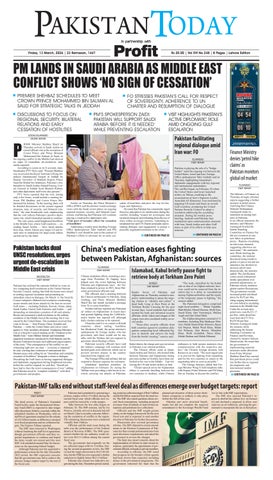
RIME Minister Shehbaz Sharif on Thursday arrived in Saudi Arabia on a brief official visit at the invitation of Crown Prince and Prime Minister Mohammed bin Salman Al Saud, as the ongoing conflict in the Middle East showed no signs of immediate de-escalation, state media reported. According to a post on its X account, statebroadcaster PTV News said, “Premier Shehbaz was received at the Royal Terminal of King Abdulaziz International Airport in Jeddah by Deputy Governor of Makkah Region Prince Saud bin Mishal bin Abdulaziz. Pakistan’s Ambassador to Saudi Arabia Ahmad Farooq, Consul General in Jeddah Syed Mustafa Rabani, and other diplomatic staff were also present.” PTV News reported that the visit, lasting only a few hours, would include a meeting between PM Shehbaz and Crown Prince Mohammed bin Salman. “In the meeting, there will be detailed discussions on the current regional situation, state of security, and bilateral relations,” the state broadcaster said, emphasizing that the visit reflects Pakistan’s positive diplomatic role, which Islamabad intends to continue. The visit comes amid heightened hostilities in the Middle East, where Gulf countries — including Saudi Arabia — have faced attacks from Iran, which Tehran says target US and Israeli sites in retaliation for large-scale strikes carried out by the latter.
ISLAMABAD
staff report
Earlier on Thursday, the Prime Minister’s Office (PMO) said the premier would exchange views with the Saudi crown prince on ongoing regional tensions, security, and bilateral cooperation, reaffirming that Pakistan will continue playing a constructive diplomatic role. ‘Visit part of broader effort for cessation of hostilities’ Addressing a weekly press briefing, Foreign Office Spokesperson Tahir Andrabi said PM Shehbaz’s visit should be seen in the context of Pakistan’s efforts to advocate for an early ces-
Pakistan backs dual UNSC resolutions, urges urgent de-escalation in Middle East crisis WASHINGTON
staff report
Pakistan has outlined the rationale behind its votes on two competing draft resolutions at the United Nations Security Council, stating that both decisions were aimed at curbing regional escalation and promoting an immediate return to dialogue. On March 11, the Security Council adopted a Bahrain-led resolution condemning recent missile and drone attacks by the Iran on several Gulf states — including Bahrain, Kuwait, Oman, Qatar, Saudi Arabia, United Arab Emirates and Jordan — and demanding an immediate cessation of all such attacks. Russia also presented a draft resolution on the military escalation in the Middle East at the meeting, but it was vetoed by the United States. The resolution received four votes in favour — from Russia, China, Somalia and Pakistan — while the United States and Latvia voted against it. Nine members abstained. Explaining Pakistan’s vote at a Security Council meeting on the “Situation in the Middle East,” Asim Iftikhar Ahmad said Islamabad supported resolutions introduced by both Bahrain and the Russian Federation because each addressed urgent aspects of the crisis. “The consequences of the conflict we are witnessing right now are clear — everyone is impacted,” he said, warning that violations of international law threaten peace and calling for an “immediate and complete cessation of hostilities” alongside a return to dialogue. Describing the Gulf states as having supported dialogue and diplomatic engagement during heightened tensions before the conflict erupted, he said they “should not have had to face the worst consequences of war,” adding that Pakistan stood in “complete solidarity” with their governments and peoples.
sation of hostilities and pave the way for dialogue and diplomacy. He noted that Pakistan has consistently urged three key principles to its interlocutors during the conflict, including “respect for sovereignty and territorial integrity and refraining from the use of force within sovereign territory; Upholding international law and UN Charter principles and resuming dialogue and engagement to pursue a peaceful, negotiated resolution to the crisis.”
Pakistan is playing the role of a “bridge builder” amid the ongoing war between the United States, Israel and Iran, Foreign Office spokesperson Tahir Andrabi said on Thursday, highlighting Islamabad’s diplomatic engagements with key regional and international stakeholders. The conflict began on February 28 when the United States and Israel launched strikes on Tehran, resulting in the assassination of Iran’s Supreme Leader, Ayatollah Ali Khamenei. Iran retaliated by targeting US assets and bases in several Gulf countries, prompting the United Nations Security Council to adopt a resolution addressing the escalating situation. During his weekly press briefing, Andrabi said Pakistan had maintained open communication channels with Iran, Saudi Arabia and other Gulf states as part of its efforts to help ease tensions.
Continued on page 03
Continued on page 03
China's mediation eases fighting between Pakistan, Afghanistan: sources ISLAMABAD
staff report
Chinese mediation efforts, including a message from President Xi Jinping, have helped ease the worst fighting between Pakistan and Afghanistan since the Taliban returned to power in 2021, three Pakistani government officials said. The officials said a meeting between the Chinese ambassador to Pakistan, Jiang Zaidong, and Prime Minister Shehbaz Sharif late last month included a message from Xi to cease hostilities. Neither side has reported any Pakistani air strikes on Afghanistan in recent days and ground fighting along the 2,600-kilometre border has tapered off, although daily clashes continue to be reported. China has said it is in contact with both countries about ending hostilities but Mosharraf Zaidi, the prime minister's spokeperson for foreign media, who has previously said there would not be any talks with the Taliban, did not respond to questions about Beijing's efforts. Pakistani security officials have said the military campaign will continue until desired goals were achieved, which was to prevent terrorist attacks in the country launched from Afghan soil. The Foreign Office and military did not respond to Reuters requests for comment. Islamabad launched airstrikes on Afghanistan on February 26, saying the Taliban were providing a safe haven to terrorists carrying out attacks in Pakistan.
islamabad, Kabul briefly pause fight to retrieve body at torkham Zero point Border forces of Pakistan and Afghanistan on Thursday reached a temporary understanding to pause the ongoing clashes to “identify and collect” a dead body lying at Zero Point at the Torkham Border Crossing for the past several days. Local residents had earlier spotted the body and informed security officials, while videos and images of the corpse were also circulated widely on social media. “Soon after, security officials from both countries agreed to constitute delegations comprising local influential figures to identify and remove the body from the border crossing,” sources said.
“The body, identified by the Kabul side as that of an Afghan national, however, could not be removed from the location due to a delay in consultations among Afghan authorities and the expiry of the temporary pause in fighting,” the sources added. The Pakistani delegation comprised eight local notables — Malak Tajuddin, Shah Khalid, Murad Hussain, Mufti Ejaz, Saeed Khan, Qari Nazeemgul, Mulana Aaqib and Qari Jihad Shah. The Afghan delegation consisted of 11 members, including Haji Madtyaar Shinwari, Malak Maula Khan Shinwari, Raees Gul Majeed, Malak Waali Khan, Malak Gul Rehman, Qari Baseer, Mautabar Khan, Mufti Asadullah, Darya Khan, Malak Shahzar and Malak Hilmand.
Kabul denies the charge and says terrorism in Pakistan is an internal problem. The Chinese efforts came as Qatar, Saudi Arabia and Türkiye, who hosted talks between Pakistan and Afghanistan during previous clashes in October, have been embroiled in the war in the Middle East following the US and Israeli strikes on Iran. "China's special envoy for Afghanistan affairs is currently shuttling between the two countries to mediate, while Chinese
embassies in both nations maintain close communication with the respective parties," the Chinese foreign ministry told Reuters in an e-mail. "The most urgent task is to prevent the fighting from expanding and for the two countries to return to the negotiating table as soon as possible." The foreign ministry added that Foreign Minister Wang Yi held telephone talks with Deputy Prime Minister and FM Ishaq Dar on Tuesday to discuss the conflict.
KHYBER
staf report
Finance Ministry denies ‘petrol hike claims’ as Pakistan monitors global oil market ISLAMABAD
staff report
The Ministry of Finance on Thursday strongly rebutted reports suggesting a further increase in petrol prices, clarifying that Finance Minister Muhammad Aurangzeb made no statement on raising fuel rates in Pakistan. In an official statement, the ministry said Minister Aurangzeb briefed the Senate Standing Committee on Finance but did not comment on any new hikes in petroleum prices. “Reports circulating on television channels suggesting otherwise are inaccurate,” the statement said. While briefing the committee, the minister discussed rising trends in global oil prices but did not announce any decision to increase petrol rates domestically, the ministry added. The clarification comes amid widespread media speculation over potential adjustments, as Pakistan closely monitors global market fluctuations. The government recently increased petrol and diesel prices by Rs55 per litre, citing surging international oil costs linked to escalating tensions in the Middle East. Under the revised rates, petrol now costs Rs321.17 per litre, while diesel has risen from Rs275.70 to Rs335.86 per litre. Minister Aurangzeb made the remarks while addressing the Senate Standing Committee on Finance and Revenue, chaired by Senator Saleem Mandviwala. He noted that the government is implementing austerity measures under directions from Prime Minister Shehbaz Sharif but warned that petroleum prices could rise further due to regional developments and international market pressures.
Continued on page 03
pakistan-iMF talks end without staff-level deal as differences emerge over budget targets: report PROFIT
staff report
The third review of Pakistan’s Extended Fund Facility under the International Monetary Fund (IMF) is expected to take longer after discussions failed to conclude within the scheduled timeline on Wednesday, with no staff-level agreement reached for the release of a $1 billion tranche as differences emerged over fiscal projections and tax collection targets, The Express Tribune reported. The IMF team returned to Washington without finalising the staff-level agreement, though government officials said they expected negotiations to continue and hoped the delay would not extend until the next IMF visit scheduled around May for discussions on the upcoming federal budget. Although Pakistan met the quantitative performance criteria for the July–December 2025 period, the IMF expressed concerns that the government may fail to achieve the primary budget surplus target by the end of the fiscal year.
Pakistan had committed to generating a primary surplus of Rs3.15 trillion during the current fiscal year, which officials now expect could be missed by a wide margin. Talks between the two sides began on February 26. The IMF mission, led by Iva Petrova, initially arrived in Karachi but left on March 2 due to security concerns following the escalation of conflict in the region. The remaining discussions were conducted virtually from Türkiye. Officials said the main issue during the talks was the performance of the Federal Board of Revenue (FBR). The IMF questioned whether the tax authority could collect even Rs13.5 trillion during the current fiscal year. The government had originally set the tax collection target at Rs14.13 trillion. During the second programme review, the IMF revised the target downward to Rs13.98 trillion, but the FBR has now requested a further reduction to slightly below Rs13.5 trillion. Pakistan also missed two indicative targets during the July–December period, includ-
ing a total tax collection target of Rs6.5 trillion and Rs366 billion expected from the retail sector. The IMF also raised questions about several fiscal assumptions, including projected revenues from dividends of state-owned enterprises and petroleum levy collections. Officials said the IMF sought greater clarity on the budget framework for the next fiscal year and is expected to send another mission to Pakistan for further discussions. Discussions also covered governance reforms. The IMF objected to recent amendments to the Election Commission of Pakistan Act that exempt parliamentarians from asset disclosure requirements and asked the government to reverse the changes. The fund also raised concerns about the implementation of reforms in state-owned enterprises, particularly the appointment of government officials on boards as private members. According to officials, the IMF noted that progress on the broader reform agenda had been slower than expected, including delays in the privatisation programme. The government informed the fund that the
planned privatisation of three power distribution companies is unlikely to take place before the fall of this year. Pakistan met most structural benchmarks but did not complete the required amendment to the Sovereign Wealth Fund
Act in line with IMF expectations. The IMF also rejected Pakistan’s request to abolish the carbon levy on furnace oil and declined a proposal to allow zero sales tax on oil refineries, advising the government to incorporate the tax in fuel prices.
02 NEWS
T
Friday, 13 March, 2026 | LAHORE
PUNJAB ASSEMBLY CUTS SALARIES, LIMITS VEHICLES UNDER AUSTERITY PLAN
PROFIT
News Desk
HE Punjab Assembly Secretariat has introduced a series of austerity measures as part of the government’s cost-reduction campaign, according to an official notification. Under the measures, the speaker has relinquished his salary and official benefits, including government-provided fuel. The salaries and allowances of Members of the Punjab Assembly will be reduced by 25% for a period of two months. The austerity plan includes restrictions on the use of government vehicles, with 70% of official vehicles to remain off the road and only 30% to be used for official duties. Protocol vehicle squads have also been banned. Assembly sessions and standing committee meetings will be scheduled before sunset.
g
speaker gives up salary anD perks; mpas salaries anD allowances cut by 25% for two months as austerity plan restricts official vehicle use, keeps 70% of official fleet off roaD anD bans protocol squaDs
If necessary, committee meetings may be conducted online, and their number will be kept limited. The Punjab Assembly Secretariat will remain closed on Fridays, Saturdays and Sundays, except during assembly session days when routine work will continue. During Ramazan, office hours will be
paperless operations. New procurement has been suspended, with only essential purchases allowed for daily operational needs. A ban on the purchase of new government vehicles will remain in place until June 2026. Official dinners and Iftar gatherings have also been prohibited except for events
from 9am to 3pm, while after Ramazan the working schedule will be from 9am to 5pm. The notification also directs departments to reduce electricity consumption by 70%, with instructions to switch off unnecessary lights and electrical appliances. The secretariat has also decided to shift towards
Fuel price hike triggers transport fare increases, food inflation across cities g
petroleum Dealers report that fuel consumption DeclineD after price increase PROFIT
News Desk
The recent Rs55 per litre increase in petrol and diesel prices is affecting transport costs, food prices and household budgets across several cities, with traders, commuters and transporters reporting immediate economic pressure. Residents and workers in different sectors said the fuel price increase has made it more difficult to manage daily expenses during the holy month of Ramazan. Economists said increases in oil prices typically affect multiple sectors of the economy. Higher fuel costs increase transportation expenses, raise prices of essential goods and reduce purchasing power,
Textile exporters raise tax disparity, refund delays in meeting with finance minister
which can slow economic activity. In local wholesale markets, traders reported that prices of fruits and vegetables rose shortly after the fuel price adjustment. A vegetable trader at Lahore’s Ravi Road wholesale market said prices of several items increased by around 20% to 25% within hours of the announcement. He said vegetable sales remained steady but demand for fruit had declined. Transport operators also indicated that fares were likely to rise. Drivers working with app-based ride services said operating costs had increased due to higher petrol prices. A driver associated with a ride-hailing platform said each fuel price increase typically leads to higher fares while also re-
ducing passenger demand. In Karachi, passengers using buses, Qingqi rickshaws and ride-hailing services reported increases in transport fares. Commuters said fares for some routes had increased by Rs10 to Rs30. Some passengers also reported paying higher rickshaw fares, with trips that previously cost about Rs200 rising to around Rs300. Drivers working with ride-hailing platforms said higher fuel costs had reduced demand for app-based services as some commuters shifted to buses and other public transport options. In Peshawar, traders and transporters said the increase in petroleum prices had also pushed up prices of basic commodities. According to representatives of the
grain trade, the price of a 20kg bag of flour increased by Rs50 to Rs100 following the rise in transportation and milling costs. Transport operators in the province said inter-city fares had also been revised. According to representatives of the transport owners’ association, the fare for travel between Peshawar and Lahore increased from Rs2,000 to Rs3,000, while the Peshawar–Karachi fare rose from Rs3,000 to Rs5,000. Petroleum dealers reported that fuel consumption had declined after the price increase. A representative of the petroleum dealers association said daily sales at one fuel station fell from about 8,000 litres to around 3,000 litres after the adjustment in fuel prices.
Pakistan commits to tax simplification strategy with IMF by May 2026 g
PROFIT
News Desk
Leading textile and clothing exporters have raised concerns over the current tax and regulatory framework, saying it places export-oriented businesses at a disadvantage compared with domestic firms. The issue was discussed during a meeting with Finance Minister Muhammad Aurangzeb, where exporters said the existing system requires them to pay a two percent advance tax on every transaction, while domestic businesses settle tax liabilities on a quarterly basis. Exporters said the system also ties up a significant portion of their capital in pending refund claims, creating liquidity constraints for companies operating in international markets. Industry representatives told the finance minister that despite remaining compliant with tax requirements, the sector continues to face high operating costs and regulatory challenges. They urged the government to simplify the tax framework, ensure equal treatment for export-oriented and domestic businesses, and address delays in refund processing. During the meeting, exporters informed the government that value-added textile exports are projected to reach about $15.6 billion in fiscal year 2025–26. They said the value-added segment is expected to account for 80% to 85% of total textile exports and around 51% of Pakistan’s overall exports. The finance minister acknowledged the concerns raised by exporters and said the government would examine possible reforms within available fiscal space. Both sides agreed to continue consultations after the Eid holidays to discuss potential policy adjustments. Officials said strengthening export-oriented sectors remains a key part of Pakistan’s economic strategy. Aurangzeb said improving productivity, encouraging innovation and increasing global competitiveness of key industries are important for expanding exports and supporting employment and economic growth. He added that the government would continue engagement with industry stakeholders while refining policy frameworks to promote investment, remove procedural bottlenecks and maintain macroeconomic stability.
plan to reDuce tax rates, special regimes anD exemptions while limiting aDvance anD withholDing taxes; finance ministry to establish criteria to review structural rules; tax policy office to give final approval PROFIT
MoNitoriNg Desk
Pakistan has committed to publishing a tax simplification strategy by May 2026 as part of its reform programme with the International Monetary Fund (IMF). The proposed strategy aims to streamline the tax system by reducing multiple rate schedules and special regimes, limiting advance and withholding taxes and rationalising tax exemptions, The News reported. Officials said the plan will also include an annual report detailing progress on implementation and the impact of the reforms. Under the proposed framework,
the Ministry of Finance will establish criteria to review structural tax rules and ensure that any statutory regulatory orders affecting tax policy or administration are submitted to the Tax Policy Office (TPO) for review and approval. The review process will apply to orders issued by government ministries, authorities and institutions, including the Special Investment Facilitation Council and the Board of Investment. To align institutional roles in tax policymaking, amendments have been introduced to distinguish the mandate of the Tax Policy Office from other bodies such as the Federal Board of Revenue’s International Centre for Tax
Excellence and the Tax Policy Board. The government has also set key performance targets for the reform process. These include amendments to the Federal Board of Revenue Act 2007 to remove the Policy Board’s policymaking role and changes to the Income Tax Ordinance 2001 to eliminate policymaking provisions related to the International Centre for Tax Excellence. Authorities also plan to enact legislation giving the Tax Policy Office statutory status, outlining its responsibilities, transparency requirements and reporting framework. Rules and regulations for the office are expected to be notified by June 2026.
IMF says ‘considerable progress’ made in Pakistan programme review g
Discussions to continue in coming Days, incluDing to more fully assess impact of recent global Developments on pakistan’s economy, says imf mission chief PROFIT
News Desk
The International Monetary Fund (IMF) has said that considerable progress was made in the discussions on the thrid review under the Extended Fund Facility (EFF) and the second review under the Resilience and Sustainability Facility (RSF) and these discussions will continue in the coming days, including to more fully assess the impact of recent global developments on Pakistan’s economy and the EFF-supported program. An IMF team, led by Iva Petrova, held discussions on the third review under the EFF and the second review under the RSF in Karachi and Islamabad, as well as virtually, from February 25 to March 11, 2026. At the conclusion of the discussions, Ms. Petrova issued the following statement:
“The IMF mission and the Pakistani authorities held discussions on the third review of the 37-month Extended Arrangement under the Extended Fund Facility (EFF) and the second review of the 28-month arrangement under the Resilience and Sustainability Facility (RSF). While considerable progress was made in the discussions, these will continue in the coming days, including to more fully assess the impact of recent global developments on Pakistan’s economy and the EFF-supported program. “Program implementation under the EFF remained broadly aligned with the authorities’ commitments through endFebruary 2026. Considerable progress was made in the discussions on policies ahead, including on sustaining the fiscal consolidation to strengthen public finances; maintaining a sufficiently tight
monetary policy to ensure inflation remains durably within the State Bank of Pakistan’s target range; and advancing reforms to improve the viability of the energy sector. Particular attention was paid to deepening structural reforms, given the authorities’ emphasis on accelerating growth, alongside efforts to strengthen social protection and rebuild health and education spending. These discussions are ongoing. “The authorities have also made good progress in the implementation of their reform agenda to strengthen climate resilience, including through the completion of reform measures under the RSF. “Discussions also covered the impact of the conflict in the Middle East on Pakistan’s economic outlook, the balance of payments and external financing needs amid volatile and rising energy prices and tighter global financial conditions.
involving foreign delegations. The secretariat further directed that 80% of its staff will perform their duties from home, with employees required to report to the office on one hour’s notice if needed. Staff working remotely will not receive honoraria or session allowances.
CCoP approves Fauji Fertilizer’s entry into consortium acquiring PIA stake
fauji fertilizer to acquire 33.99% stake in pia equity limited, special-purpose vehicle created for airline privatisation PROFIT
MoNitoriNg Desk
The Cabinet Committee on Privatisation (CCoP) has approved the inclusion of Fauji Fertilizer Company Limited in the consortium acquiring a majority stake in Pakistan International Airlines. The committee endorsed the proposal and forwarded it to the federal cabinet for final approval, The News reported. The decision was taken during a meeting chaired by Deputy Prime Minister and Foreign Minister Ishaq Dar on Wednesday. Under the arrangement, Fauji Fertilizer will subscribe to 33.99% ordinary shares in PIA Equity Limited, the specialpurpose vehicle established to complete the airline’s privatisation. The move follows earlier approval by the Privatisation Commission Board for the company to join the consortium that secured the winning bid for the airline. The investor group, led by Arif Habib Corporation Limited, won the bid of Rs135 billion, equivalent to about $480 million, for a 75% stake in the national carrier after competing against a consortium backed by Lucky Cement. Despite the inclusion of additional partners, Arif Habib Corporation will continue as the lead member of the consortium under the terms agreed with the government. PIA Equity Limited will function as the holding vehicle for the acquisition. The investor group includes Fatima Fertilizer, AKD Group, City Schools and Lake City Holdings along with the newly added Fauji Fertilizer stake. According to officials, the first financial closing of the transaction is expected by the end of April. At that stage, the consortium will be required to pay about twothirds of the bid amount, estimated at Rs83.3 billion. The investor group will also indicate whether it intends to exercise the option to purchase the government’s remaining 25% stake in PIA at a premium of 12%. As part of the agreement, the consortium plans to inject Rs124.875 billion into the airline as part of the restructuring process.
Pakistan Refinery appoints Mohsin Ali Mangi as managing director and CEO appointment for three-year term effective april 30, replacing interim chief Zafar ul islam usmani PROFIT
News Desk
Pakistan Refinery Limited (PRL) has approved the appointment of Mohsin Ali Mangi as the company’s managing director and chief executive officer for a three-year term starting April 30, 2026. The decision was taken by the company’s board of directors in a meeting held on March 12, according to a notice submitted to the Pakistan Stock Exchange. Mangi will replace Zafar Ul Islam Usmani, who is currently serving as interim managing director and chief executive officer. The appointment follows an earlier announcement made by the company on December 23, 2025 regarding the leadership transition.
Aurangzeb calls for corporate bond market reforms to boost private sector financing PROFIT
News Desk
Federal Minister for Finance and Revenue Muhammad Aurangzeb on Wednesday chaired a meeting of the Capital Market Development Council (CMDC) to review progress on reforms aimed at strengthening Pakistan’s capital markets. The meeting focused on expanding the corporate debt market and increasing the role of capital markets in financing economic activity. In his remarks, the finance minister said capital markets should complement the banking sector by providing longterm financing options for businesses while offering investment opportunities for institutional and retail investors. He said the development of a corporate bond market would help mobilise domestic
g
finance minister calls for reforms in issuance rules, regulation anD seconDary market liquiDity while reviewing regulatory changes to boost Debt issuance anD investor participation
savings and support private sector investment. Aurangzeb said reforms should address issues across the capital market framework, including issuance procedures, regulatory requirements, market infrastructure and liquidity in the secondary market. He directed the Securities and Exchange Commission of Pakistan to expand outreach efforts so that companies and financial institutions are aware of recent regulatory changes aimed at facilitating corporate bond issuance. The meeting also discussed the importance of reviewing international practices in capital market development and adapting relevant measures to Pakistan’s market structure. Participants reviewed policy
measures designed to encourage companies to raise funds through capital markets rather than relying solely on bank financing. Officials from the Tax Policy Office informed the meeting that consultations had begun to examine tax-related issues affecting investors and issuers, with the aim of rationalising the tax structure and considering incentives to increase participation in capital markets. Representatives from the Pakistan Stock Exchange, Securities and Exchange Commission of Pakistan, State Bank of Pakistan, Central Depository Company, National Clearing Company of Pakistan Limited, Pakistan Banks Association and Pakistan
Business Council briefed the meeting on steps taken to facilitate corporate bond issuance and improve market operations. Participants said recent reforms include simplified prospectus requirements, streamlined documentation procedures, reduced regulatory fees and digitisation of the issuance process. The meeting also discussed structural challenges affecting the corporate bond market, including delays in approval processes and the need for improved coordination among regulators and market participants. Participants emphasised the need to strengthen secondary market liquidity, noting that limited market-making arrange-
ments currently restrict trading activity in corporate debt instruments. The council also reviewed broader reform plans aimed at improving coordination among regulators, market infrastructure institutions and private sector participants. Under the reform framework, specialised working groups will be formed to focus on areas including tax policy, debt issuance frameworks, market infrastructure and investor protection. The finance minister said the government remains committed to developing a stronger capital market to mobilise investment, improve financial stability and support private sector-led economic growth.
NEWS 03
Friday, 13 March, 2026 | LAHORE
FINANCE MINISTER MEETS BANKS TO REVIEW ECONOMIC RISKS FROM REGIONAL DEVELOPMENTS
F
PROFIT
News Desk
EDERAL Minister for Finance and Revenue, Senator Muhammad Aurangzeb, holding a virtual meeting with Chairman Pakistan Banks Association Zafar Masud and senior leadership of leading banks at the Finance Division, Islamabad on March 11, 2026. Federal Minister for Finance and Revenue Muhammad Aurangzeb held a virtual meeting on Wednesday with the Pakistan Banks’ Association and senior leadership of major banks to review the evolving economic and financial situation amid regional developments. According to an official statement, the meeting focused on coordination between the
Finance Ministry denies ‘petrol hike claims’ as Pakistan monitors global oil market CONTINUED FROM PAGE 01
A ministerial committee, he added, has been formed to monitor petroleum product prices and supply on a daily basis. “The situation in the region is changing moment by moment, so quick decisions are required regarding the purchase of petroleum products,” he said. Aurangzeb also informed the committee that Qatar has declared force majeure amid the ongoing war situation, disrupting LNG imports. He noted that an LNG cargo that previously cost around $25 million is now being purchased for nearly $100 million. The minister further said the government is considering shutting down six urea fertilizer plants due to surplus supply, as current stock levels exceed those of last year. He also highlighted that fuel rationing is being implemented in countries like Sri Lanka and Bangladesh, where the situation is reportedly more severe.
OPPOSITION VOICES CONCERN OVER RISING FUEL COSTS: Meanwhile, opposition leaders strongly criticised the federal government over the massive increase in petroleum prices, warning that it could further drive inflation and deepen poverty. In a statement on X, Jamaat-e-Islami chief Hafiz Naeemur Rehman called the hike “unacceptable,” arguing that when global oil prices had recently fallen to a five-year low, the government increased the petroleum levy instead of providing relief to citizens. With prices now rising again, he said, “the burden is once more being shifted onto the public.”
PM lands in Saudi Arabia as Middle East conflict shows ‘no sign of cessation’ CONTINUED FROM PAGE 01
Just a day earlier, PM’s Spokesperson for Foreign Media Mosharraf Zaidi said Pakistan would stand by Saudi Arabia “before it is needed.” On March 7, a week after US-Israeli strikes on Iran escalated the conflict, Chief of Defence Forces and COAS Field Marshal Asim Munir visited Saudi Arabia to meet Defence Minister Khalid bin Salman Al Saud. They discussed the gravity of the security situation arising from Iranian missile and drone attacks on the Kingdom and explored joint measures under the framework of the “Strategic Mutual Defence Agreement” signed last year. Days earlier, Deputy Prime Minister and Foreign Minister Ishaq Dar revealed that Pakistan’s diplomatic interventions had helped deter heavier Iranian strikes on Saudi Arabia.
‘DON’T LIKE OUR FRIENDS GETTING INTO QUARRELS’: In an interview with Bloomberg TV, the premier’s spokesperson was asked whether Pakistan would come to Saudi Arabia’s aid militarily or otherwise. Zaidi said, “The question is not whether Pakistan might come to Saudi Arabia’s aid. Both countries, even before the strategic mutual defence agreement, have operated on a principle of being there for the other before they need the other. So, there is no question — we will. No matter what, no matter when.” He emphasized that Pakistan is striving to prevent escalation that could embroil close partners in conflicts undermining regional stability and prosperity.
g
GOVT, SBP AND BANKING SECTOR DISCUSS COORDINATION TO MAINTAIN FINANCIAL STABILITY
government, the State Bank of Pakistan and the banking sector to maintain financial stability and ensure uninterrupted financial services. The finance minister briefed participants on the government’s monitoring of the situation and the steps being taken to assess its potential economic impact. He said a highlevel coordination mechanism involving key economic ministries and institutions had been established to review developments on a continuous basis. The mechanism is examining changes in global markets, including supply chains and energy markets, and evaluating their possible effects on key macroeconomic indicators. Aurangzeb said the government is con-
ducting regular scenario analysis to assess possible implications for inflation, external accounts and overall economic stability. He said authorities remain focused on ensuring the availability of essential supplies and maintaining macroeconomic stability while responding to changing conditions. The finance minister also stressed the importance of coordination with the financial sector during periods of uncertainty and acknowledged the role of banks in supporting financial markets and economic activity. He urged banks to continue supporting businesses and customers while maintaining risk management standards and operational resilience to ensure continuity of financial
services. Aurangzeb said the government would maintain close communication with the banking industry and continue working with the State Bank of Pakistan to respond to developments in a coordinated manner. During the meeting, Pakistan Banks’ Association Chairman Zafar Masud briefed the minister on consultations held within the banking sector to review possible implications for financial markets and operational continuity. He said banks had established a coordination framework to enable timely information sharing among financial institutions and to ensure uninterrupted services for cus-
Govt shifts to weekly oil price review amid Gulf supply tensions: report PROFIT
MoNitoriNg Desk
The federal government has approved a proposal to review petroleum prices on a weekly basis in response to supply risks and rising import costs linked to tensions in the Gulf region, The Express Tribune reported, citing officials. The Petroleum Division warned of potential disruptions in oil supplies due to regional tensions affecting shipping routes, prompting the government to adopt a new pricing mechanism to reduce financial risks for the oil industry. Under the revised system, domestic
T
fuel prices will be calculated using a fiveday average of international benchmark prices from Monday to Friday based on the Gulf Arab Platts assessment. The formula will also incorporate the weighted average premium of Pakistan State Oil (PSO) cargoes discharged or partially discharged with volumes available for sale in the following week. If no cargoes are available, the most recent weighted average premium will be used. Officials said the new system would help narrow the gap between movements in international crude benchmarks and domestic price adjustments. It is also expected to reduce speculative hoarding and improve
alignment between import costs and cash flows for oil marketing companies. The pricing calculation will include the weighted average of PSO import-related charges and customs duties linked to the cargoes used in determining the premium. The existing exchange rate adjustment mechanism based on PSO imports will continue. However, for high-speed diesel imports by other oil marketing companies, the weighted average exchange rate applied to PSO motor spirit imports will be used as the benchmark for calculating exchange losses. Any exchange rate differentials for other oil marketing companies will be set-
He noted that Pakistan’s stance on sovereignty, adherence to international law and the UN Charter, as well as its consistent advocacy for dialogue and diplomacy, had earned respect across regional capitals. “There is a level of exchange of communication and Pakistan is playing the role of a bridge builder,” Andrabi said, adding that the country’s diplomatic outreach allowed it to facilitate dialogue among relevant stakeholders. He pointed out that Prime Minister Shehbaz Sharif and Deputy Prime Minister and Foreign Minister Ishaq Dar had held multiple phone calls with leaders and officials from various countries in recent days to discuss the worsening crisis and urge de-escalation.
tled through the inland freight equalisation margin (IFEM). Companies that do not have cargoes in a given week may recover adjustments through the same mechanism. Under the new process, the Oil and Gas Regulatory Authority (Ogra) will submit an indicative price calculation every Friday for review by the relevant committee. Following the committee’s decision, Ogra will finalise the prices based on the latest Platts assessments and updated PSO pricing data. Any change in the petroleum levy or climate support levy will be notified by the Petroleum Division on the advice of the Finance Division before the final price announcement.
Diplomatic relations between Islamic Republic of Pakistan and the Holy See Dr Joseph ArshAD
HE Pope, as head of the Catholic Church, has had for many centuries’ good relations with Governments and civil authorities, through His representatives. These representatives are called “Papal Representatives” or “Apostolic Nuncios”. The word “Nuncio” comes from the Latin word “Nuntius” (messenger, ambassador). This title was maintained in order to distinguish the “Nuncio” from the Ambassadors because his brief also included the promotion of Christian spiritual values. The Apostolic Nunciature (Embassy of the Holy See) is the diplomatic permanent mission of the Holy See, established in order to encourage normal and friendly relations with the States. The Papal Representative also has the role of maintaining links between the Pope and the local Catholic Church. The term “Holy See” is derived from the Latin words "Sancta Sedes", which means "holy chair" or "holy seat". It refers to the seat or chair of St. Peter, occupied by the Bishop of Rome (the Pope). St. Peter is one of the disciples of Jesus Christ who is considered to be the first Pope in the Catholic Church. The diplomacy of the Holy See focuses on humanitarian and ethical objectives rather than material gain. Unlike nations that negotiate to secure borders, trade advantages, or
military alliances, the Holy See engages with the international community to promote human rights, religious freedom, and peace. At present, the Holy See enjoys full diplomatic relations with about 200 countries of the world, of which more than 90 have missions in Rome. The Holy See maintains bilateral diplomatic relations, signs concordats and treaties, and performs multilateral diplomacy with multiple intergovernmental organizations, including the United Nations and its agencies, the Council of Europe, the European Communities, the Organization for Security and Co-operation in Europe, and the Organization of American States. The Diplomatic relations between the Islamic Republic of Pakistan and the Holy See were initiated with the establishment of the Apostolic Delegation to Pakistan (initially covering West and East Pakistan) on 17 July 1950, marking the formal beginning of Vatican diplomatic engagement in the region shortly after Pakistan's independence. This delegation served as the primary channel for communication with the Holy See. In August 1952 the Delegation became an Internunciature (cfr. Pius XII, Apostolic Letter, Maxime Nobis, AAS 46, 1952) signifying and strengthening of ties and diplomatic reciprocity, reflecting the growing mutual recognition, with Pakistan's Ambassador in Switzerland later also accredited to the Holy See. A further milestone occurred on 27 December 1965, when Pope Paul VI raised the Internuncia-
ture to full Apostolic Nunciature (Embassy of the Holy See) status, elevating the diplomatic mission to its highest rank (cfr. Paulus VI, Apost. Let, Quae Omnia. AAS 68, 1966) and underscoring the Holy See's commitment to sustained engagement amid Pakistan's evolving geopolitical context. These elevations paralleled broader Holy See efforts to formalize relations with Pakistan, prioritizing ecclesiastical oversight and promoting interfaith harmony, and humanitarian cooperation. The Holy See maintains an Apostolic Nunciature (Vatican Embassy) in Islamabad and has an Apostolic Nuncio (Ambassador) in Islamabad. While Pakistan’s Ambassador in Bern, Switzerland is accredited as Ambassador to the Holy See. These diplomatic ties play a crucial role in facilitating communications between the Holy See (Vatican) and the Pakistani government, addressing matters of mutual interest, understanding and cultural exchange, working closely for human dignity, social justice, environment and humanitarian areas. Several Pakistani leaders have visited Vatican, including Prime Minister Nawaz Sharif (1998), President Musharraf (2004) and President Asif Ali Zardari (2009). Besides there have been visit on ministerial levels by different Ministers. There are also various renowned personalities of Vatican that have visited Pakistan. His Holiness Pope John Paul II visited Pakistan on Feb-
SBP allows crude oil imports on Cost, Insurance and Freight basis for 60 days g
OIL INDUSTRY SAYS MOVE WILL GIVE IMPORTERS GREATER FLEXIBILITY IN SECURING PETROLEUM CARGOES AS CENTRAL BANK RELAXES FOREIGN EXCHANGE RULES TO ENSURE TIMELY SUPPLIES AMID GLOBAL MARKET VOLATILITY PROFIT
News Desk
The State Bank of Pakistan (SBP) has allowed the import of crude oil and petroleum products on a Cost, Insurance and Freight (CIF) basis for 60 days to facilitate supplies amid volatility in global oil markets. In a circular issued to authorised dealers, the central bank said the temporary measure had been taken in view of the global situation and the importance of crude oil and petroleum products for the country’s energy needs. The SBP directed authorised dealers to note that existing instructions under the Foreign Exchange Manual generally permit imports into Pakistan on Free on Board (FOB), Free Carrier (FCA), Free Alongside Ship (FAS),
Cost and Freight (CFR) and Carriage Paid To (CPT) terms. However, citing fluctuations in international oil markets and limited import options, the central bank said crude oil and petroleum products could temporarily be imported on a CIF basis. According to the circular, the permission will remain valid for 60 days from the date of issuance. Authorised dealers have been instructed to inform their clients of the revised arrangement and ensure compliance with the guidelines. Industry participants said the decision would provide importers with greater flexibility in securing petroleum cargoes during periods of market uncertainty. Under CIF arrangements, the seller covers freight and insurance costs up to the buyer’s designated port, while the risk transfers to the buyer once the goods are loaded onto the vessel.
Pakistan facilitating regional dialogue amid Iran War: FO CONTINUED FROM PAGE 01
tomers and businesses. Masud said the banking industry was also engaging with key stakeholders in the financial system to support the functioning of payment infrastructure and financial services. He added that banks would remain in close coordination with the State Bank of Pakistan and other institutions while continuing internal consultations to monitor developments. The PBA chairman also highlighted the importance of cooperation between the government, the central bank and the banking sector to maintain financial market stability and facilitate trade and financial flows. Masud reaffirmed the banking sector’s commitment to working with regulators and government authorities to address emerging challenges.
Andrabi also confirmed ongoing diplomatic engagement with the United States, noting that Pakistan’s foreign secretary had spoken with the US under secretary of state and that contacts continued at multiple diplomatic levels. He added that Pakistan remained in close communication with the US State Department through its embassy in Washington, while the US embassy in Islamabad was also actively engaged. The spokesperson said Prime Minister Shehbaz Sharif held a telephone conversation with Iranian President Masoud Pezeshkian on Wednesday, during which the two leaders exchanged Ramazan greetings. The prime minister also conveyed condolences over the martyrdom of Ayatollah Khamenei and congratulated Mojtaba Khamenei on assuming
the responsibilities of Iran’s new supreme leader. According to Andrabi, the prime minister expressed hope that Iran would enjoy peace, stability and prosperity in the years ahead. Responding to questions about a social media post by President Pezeshkian outlining conditions for ending the war, Andrabi said Pakistan had taken note of the statement as part of the broader diplomatic discourse. He said such positions were aimed at the international community and would form part of ongoing diplomatic exchanges. The spokesperson also addressed concerns about disruptions in maritime traffic through the Strait of Hormuz, which have contributed to a fuel crisis. He confirmed that Pakistan had been in contact with Iranian authorities to ensure
the safe passage of Pakistani ships through the strategic waterway. Separately, Andrabi clarified that a delegation reportedly visiting Afghanistan to engage with the Afghan Taliban was not part of any official initiative by the Pakistani government. He said the individuals were travelling in a non-official capacity and the Foreign Office had no detailed knowledge of their engagements. On Pakistan’s engagement with China regarding Afghanistan, Andrabi confirmed that Foreign Minister Ishaq Dar had recently held a telephone conversation with Chinese Foreign Minister Wang Yi. He noted that Pakistan and China shared a long-standing strategic partnership based on mutual trust and had similar views on regional issues, including Afghanistan.
ruary 16, 1981, marking the first-ever papal visit to the country. Upon arriving at Karachi airport, Pope John Paul II kissed the Pakistani soil, a gesture of respect and love. Moreover, Several key figures of Vatican have also visited Pakistan: H.E. Cardinal Joseph Tomko (30 November-5 December 1994), H.E. Archbishop Paul Josef Cordes (25-30 October 2001), H.E. Cardinal Jean-Louis Tauran (25 November 2010) and H.E. Cardinal Fernando Filoni also visited Pakistan on the occasion of the Episcopal Consecration of Archbishop Joseph Arshad on 1 November 2013 who is the first Pakistani priest who served as a diplomat of the Holy See. This year the Holy See (Vatican) and Pakistan enjoy 75 years of diplomatic relations. The decades of these relations, mark the great contribution of the mission of the Catholic Church in the country, and his vision for promoting education, dialogue, and mutual understanding among all faiths in the society. The diplomacy of the Holy See, one of the oldest and most respected in history, seeks to promote the common good through understanding and peaceful coexistence, focused on strengthening bilateral ties between the Holy See and the Islamic Republic of Pakistan, while supporting the Catholic Church’s humanitarian and educational work in the country.
(Archbishop Dr. Joseph Arshad, Bishop of Islamabad-Rawalpindi)
04 COMMENT
Spiralling out of control
The world watches
I
A
Iran sounds more defiant than conciliatory as the USA gets antsy
Trump may not know how to get out
RANSET out terms to the end of the war on Wednesday which do not include any reference to the kind os surrender that the USA wants, but the USA can be quietly self-congratulatory, because the Iran has set out terms for an end to hostilities which is not a peremptory demand that they simply cease. However, even now, the demand by President Masoud Pezeshkian that Iran’s legitimateb rights be recognized, that reparations be paid and that there be firm international guarantees against future aggression. Meanwhile, US President Donald Trump has said that the war would come to an end soon, and that the USA was running out of targets. From a quick glance, it would seem that Iran has lost, but the resolve of its leadership does make that dubious. The US calculation that it could foment a popular uprising against the government does not seem to have worked. The only thing left is to carry the war to the Iranian people. The USA has historically not baulked at this. The bombing of Dresden in February 1945 killed 1900 people and destroyed 1600 acres of the city centre, using conventional weapons. It was specifically designed to break the German people’s will to resist. Then came Hiroshima and Nagasaki in August the same year, following which Japan surrendered. How far will Mr Trump go to break Iranian defiance? Or is he willing at last to see reason and bring an end to what has proved an unwinnable war. That the world is increasingly uncomfortable is to be seen from the International Energy Agency’s release of 400 million barrels of oil from its strategic reserves. That is the equivalent of four days total production, or 16 days of what passes through the Strait of Hormuz. IEA members hold strategic stocks of 1.2 billion barrels, while industry has a reserve of about 600 million barrels under government control. That amounts to 72 days of what passes through the Strait.The USA should realize that its inability to keep the Strait open will lead to the failure of its strategy. Apart from other things, Iran has made demands that are only made by victors, such as for reparations. If it hasn’t lost, it hasn’t won either. True, the war was imposed on it, and worse, after the USA and Israel triedit on last year. Neither the vUSA nor Israel can be controlled, so that while many guarantors will be found willing to end the madness and futility, how many of those guarantees will be worth anything?
At Penpoint M A NIAZI
S the US-Israeli attack on Iran continued for a second week, the conflict started to spin out of control, and to grow wider, dragging in other countries of the region. The war caused global pain because it threatened oil and gas supplies, thus sending up the global oil price, with the effect that that would have on economic growth not just for developing countries, but those already industrialized. Iran is for the time being not showing any signs of giving in to the demands by Israel and the USA, even though one of the first ascites of this campaign was the killing of the Iranian Supreme Leader. The fatal flaw in the US-Israel calculation was that the Iranian people would rise against the regime. They did not, because there was no clear alternative. Well, not so much a clear alternative as any alternative at all. It should not be forgotten that the Iranian people rose against Raza Shah with the alternative of Ayatollah Khomeini in sight. Even then, it was not a clean transition, mainly because the Shah did not give up until many had died. More important, there was, as there almost never is for any regime change, no constitutional path. Though Ayatollah Khamenei has been killed, he has been replaced by his son Mojtaba. A council did exercise his functions, but the Assembly of Experts has now met and elected him. Trump has already ‘vetoed’ Mojtaba, thus indicating that he is not so much interested in regime change as ensuring that the present regime follows his dictates. However, the regime has indicated by its choice that it has no intention of compromise. The war may spin out of control. One of the largest, but least followed, developments is how Israel has used the attack on Iran to prosecute a war on Lebanon. It has so far killed about 400 people through air attacks, with no end in sight. There has also been an exchange of attacks on desalination plants, in Iran and in Bahrain. This is despite the Iranian declaration that it would only attack countries where attacks originated from. This would increase pressure on the USA not to use all the bases it had in the area, even though it had developed the network precisely because it anticipated an attack on Iran. The attack on Bahrain might be because of its role as the main US naval base in the region in servicing the aircraft carriers from which attacks were being launched on Iranian targets. The Iranian declaration is unlikely to be accepted by either the insurers who now refuse to insure ships using the Straits of Hormuz, or the shipping lines which have suspended using the Straits. There has been no formal blockade by Iran of the Straits of Hormuz, but as events have transpired, its being in a war zone means that the effects are the same. However, there are other prospects of the war spreading. One of them is the fomenting of trouble among the Kurds. Iranian Kurds have been less militant than those of Turkey, Syria or Iraq.
Dedicated to the legacy of late Hameed Nizami
Arif Nizami (Late) Founding Editor
Afghan soil and the global challenge of terrorism M. A. Niazi
Babar Nizami
Editor Pakistan Today
Editor Profit
F
Not just a local problem TArIq KhAN TAreeN
OR more than two decades, the issue of terrorism emanating from Afghan territory has remained a persistent and deeply complex challenge for regional and global security architectures. The resurgence of militant sanctuaries following the geopolitical transformations in Afghanistan has once again revived a debate that the international community had previously acknowledged but has struggled to resolve in a sustainable manner. From South Asia to Central Asia and beyond, the threat landscape shaped by transnational militant networks operating from Afghan soil continues to cast a long shadow over regional stability. International security assessments have repeatedly highlighted the presence of multiple militant organizations within Afghanistan’s territory. Among these are factions affiliated with Tehrik-e-Taliban Pakistan, remnants of AlQaeda, and the increasingly active Islamic State Khorasan Province (ISKP). These groups have not confined their operational ambitions to Pakistan alone. Rather, their ideological outreach and operational networks extend across borders, posing potential risks to Central Asian republics, China, Russia, and other states concerned with the spread of extremist militancy. Security authorities in Russia and several Central Asian countries have also issued warnings regarding the concentration of thousands of armed fighters linked to various extremist groups in Afghanistan. These concerns are not merely speculative. They are rooted in intelligence assessments suggesting that militant ecosystems in ungoverned or weakly governed spaces often evolve into hubs for recruitment, training, and cross-border operations. The implications of such developments are profound, particularly in a region already marked by fragile political and security dynamics. The global experience of counterterrorism operations further underscores the complexity of confronting militant networks embedded within volatile environments. During the Iraq war, international human rights organizations reported that civilian casualties exceeded 200,000, with countless incidents of destruction affecting schools, residential areas, and public infrastructure. These tragic statistics reflect the harsh realities of modern conflict, where the distinction between combatants and civilians often becomes dangerously blurred in asymmetric warfare. Over the past two decades, the international community itself recognized the threat emanating from Afghan territory. This recognition was evident in the nearly 20-year military engagement of the USA and NATO forces in Afghanistan, primarily aimed at dismantling terrorist networks responsible for global attacks. The war was, at its
core, a response to the belief that unregulated militant sanctuaries could evolve into launchpads for transnational violence. Empirical research further illustrates the human cost of these conflicts. According to the “Costs of War” project at Brown University, the post-9/11 wars have resulted in more than 432,000 civilian deaths worldwide. Within Afghanistan alone, over 46,000 civilians lost their lives during the prolonged conflict. These figures not only reveal the devastating toll of counterterrorism campaigns but also highlight the intricate dilemmas that states confront when addressing security threats embedded within complex socio-political environments. Within this broader context, Pakistan’s security policy must be understood as part of a wider regional struggle against terrorism. Certain segments of the international media have attempted to portray Pakistan’s cross-border security actions as indiscriminate or directed against civilian populations. Such portrayals, however, overlook the fundamental reality that these operations are primarily aimed at dismantling militant infrastructure responsible for orchestrating attacks inside Pakistan. For Islamabad, the issue is neither ideological nor expansionist. It is fundamentally a matter of national security and the protection of civilian lives from militant violence. Armed groups operating from across the border have
It may be noted that those in Iraq and Turkey were under Ottoman rule, while those in Iran were under Persian rule. The USA has been paying attention to the Kurds in Turkey and Iraq since the end of World War I, but it has not paid those in Iran the same attention, until now. The Syrian Kurds have warned the Iranian Kurds of cooperating with the USA, pointing to their own example, when they were not given support against the forces of Syrian President Ahmad Al-Sharaa, but instead told to join him. For the time being, though, Trump has ruled out their use. However, he is a notoriously unreliable character, and this may not be his final word. The USA made good use of the Kurds of Iraq, giving them a separate region of their own, which combined with Iranian, Syrian and Turkish Kurd areas would make up a possible state. However, at the moment, the Kurds are working with the USA, and in three countries acting as a check on the pro-US leadership, while in Iran it is a possible way of attacking the regime. Another dimension that Iran might want to watch out for is a link-up between the Americans and the Iranian Baloch nationalists, which might be facilitated by India, which is closely associated with Pakistan’s Baloch separatists, and through them should be able to get in touch with Iran’s. That could create a problem for Iran in its south-east, which would be a grisly complement to any Kurd activity, which would be in the north-west. Meanwhile, there is the Pakistan conundrum. In principle, Pakistan should support Iran fully. Not only has Iran always supported Pakistan in its conflicts with India, the latest example being during last year’s Pehelgam confrontation, but there is a sectarian element. Pakistan does not want to go down that particular road. The problem lies in Pakistan’s mutual defence agreement with Saudi Arabia. It could be invoked if Iran was to attack Saudi soil. Saudi Arabia is vulnerable to Iranian attack because it hosts more than one US base. There has been a Pakistani killed, but in UAE. The defence agreement is not binding, and can only be enforced if the governments agree. Pakistan has long had a policy of avoiding any embroilment in Middle Eastern quarrels, but this would require going against Saudi Arabia, as well as the USA, with which it has recently been trying to curry favour with. One of the main difficulties faced by the USA is
I
Karachi – Ph: 021-32640318 I
the worsening of the economy because of the rising oil prices. With the midterm polls due in less than eight months, Trump is on a schedule. The war has already lasted long enough for Trump to lose control of both Houses of Congress, and he now needs a takeaway that will show the US electorate that the war was worth it. So far, there are no voices pointing out that if he stops the attacks, things would probably go back to normal for the world within days: oil prices would go down, disrupted supply chains would be restored. However, as time goes on, destruction will increase, which will mean that post-war reconstruction costs will rise in Iran and the Gulf. Trump has made noises about the war being over, which indicates either a desire to get out of a mess he has himself made, or simply a loss of attention, a certain boredom. The strategy of declaring victory and getting out seems at work, but the problem is that at this point, the USA has achieved nothing. Part of the problem is that Trump seems to have been seduced by the promise of air power. Back in 1999, the NATO bombing of Yugoslavia compelled Yugoslavia to surrender, providing the first example of a war won by air power. Has Trump ignored the fact that the USA had to use ground troops in its invasions of Afghanistan and Iraq? Without sending in ground troops, the task cannot be accomplished. Killing the leader has a stiffening effect on successors, and removes someone who might have some stake in remaining in office and making concessions for that. Trump got into this war because Israel wanted him to, and Israel did so because it did not know what else to do. It has given Netanyahu a new lease of life in office, in which he had become shaky after the wind-down in Gaza. However, Trump does not realise that Iran is not the problem, but Israel. So long as it remains, there will be trouble in the Middle East. The writer is a member of staff
Trump got into this war because Israel wanted him to, and Israel did so because it did not know what else to do. It has given Netanyahu a new lease of life in office, in which he had become shaky after the wind-down in Gaza. However, Trump does not realise that Iran is not the problem, but Israel. So long as it remains, there will be trouble in the Middle East.
repeatedly carried out attacks against Pakistani citizens, security personnel, and public institutions. In this context, the principle of self-defence under international law becomes a critical framework through which Pakistan’s actions must be interpreted. At the same time, Pakistan’s official position consistently emphasizes that the Afghan people are not adversaries but rather brothers bound by shared history, culture, and geography. Islamabad has repeatedly expressed its desire for a peaceful, stable, and economically integrated Afghanistan. The pursuit of counterterrorism objectives, therefore, is not directed against the Afghan populace but against militant entities that exploit ungoverned spaces to perpetuate violence. Ultimately, the phenomenon of terrorism emerging from Afghan territory cannot be reduced to a bilateral dispute between two neighbouring states. It is, in essence, a regional and global security concern. The networks operating within this space have demonstrated their capacity to transcend borders, ideologies, and political systems, thereby transforming localized conflicts into broader geopolitical challenges. Pakistan’s ongoing security measures should therefore be viewed within the context of this global struggle against terrorism. The objective is not confrontation but stabilization— eliminating militant sanctuaries, preventing cross-border violence, and fostering an environment where regional cooperation can replace cycles of insecurity. Only through coordinated international engagement, responsible governance, and sustained counterterrorism efforts can the vision of lasting peace in the region eventually be realized. The writer is a freelance columnist
Ultimately, the phenomenon of terrorism emerging from Afghan territory cannot be reduced to a bilateral dispute between two neighbouring states. It is, in essence, a regional and global security concern. The networks operating within this space have demonstrated their capacity to transcend borders, ideologies, and political systems, thereby transforming localized conflicts into broader geopolitical challenges.
Lahore – Ph: 042-36300938, 042-36375965
Friday, 13 March, 2026
Islamabad – Ph: 051-2204545
I
Editor’s mail
Send your letters to: Letters to Editor, Pakistan Today, 4-Shaarey Fatima Jinnah, Lahore, Pakistan. E-mail: letters@pakistantoday.com.pk Letters should be addressed to Pakistan Today exclusively
Modernity or moral stunt?
WHEN the trailer for the recently launched reality dating show dropped, it was clear that controversy was part of the plan. Marketed as Pakistan’s first reality dating show, it promised something bold and new. What it delivered, instead, was a noisy cultural collision, a borrowed idea repackaged for shock value. Adapted from international formats, the show places men and women together in a villa to ‘find love’. For a society like ours, where the idea of public intimacy still invites scrutiny, this was bound to provoke outrage. And perhaps that was the whole point. In today’s media economy, outrage sells. But was the show ever really necessary? Pakistan does not need imported controversies to appear modern. What our entertainment industry needs are stories that mirror our evolving values, not mimic someone else’s chaos. Instead of challenging stereotypes, the TV show reinforces the notion that modernity means moral rebellion, that freedom often comes wrapped in spectacle. While the creators may call it creative experimentation, it feels more like calculated provocation, a reminder that visibility often outweighs value in modern media landscape. The show has made people talk, yes, but about the wrong things. At a time when storytelling could be a force for empathy, we have chosen to focus on love as a contest. It is not progress; it is just performance. TOOBA TARIQ KARACHI
Food makers starving
THE farmers of Pakistan are suffering. Those who feed the entire nation are not able to feed their own families. Farming has turned into a total loss. The prices if fertiliser, seed and fuel have risen sharply, and keep increasing. Sadly though, the rates of wheat and other crops remain very low. How can farmers survive in such a situation? They put in their time and energy in producing crops, only getting losses in the end. In my area people have stopped farming. Some people have sold their land and moved to cities to find some other work. Even landowners are afraid to produce and lose their money every year. If this keeps happening, who will produce food for the country? If our famers stop working, the prices of even staple food items will rise — something that will have a significant impact on the country’s economy as well. It hurts me to see that the hands that work for feeding the whole nation remain empty. No one thinks about them, their rights and the problems they are facing. That is why the government must come up with favourable, long term policies to help the farming community. Our farmers need hope, support and polices to turn farming worth the hardwork that it requires. AQSA PAHORE JACOBABAD
Where doctors never arrive
THERE are many villages of Balochistan where even a single proper doctor is not available – even to treat a simple fever. This clearly reflects the failure of the authorities in providing basic healthcare facilities. People in these backward areas suffer the most during emergencies. They are forced to travel long distances to far-flung cities for treatment — an exhausting, time-consuming and costly ordeal. Over time, the residents of these regions have lost hope. Most of these areas do not even have ambulance services. Patients are transported in private cars or, worse, on motorcycles, which often worsens their condition. Small healthcare centres that are available lack even the most basic necessities such as medicines, first-aid kits, electricity and clean drinking water. The situation is even more alarming for pregnant women, who face life-threatening risks due to the absence of trained nurses and midwives. M ASIF DASHT
Web: www.pakistantoday.com.pk
I
Email: editorial@pakistantoday.com.pk
COMMENT 05
Defence first or economy first?
Friday, 13 March, 2026
Strategic lessons from Iran
P
Abdul bAsit Alvi
AKISTAN’S grief over developments in Iran is both an emotional moment and a strategic wake-up call. When Iran’s challenges are considered alongside Venezuela’s prolonged crisis and the missile scare that unsettled the UAE, the central lesson is clear: vast natural resources and economic prosperity alone do not guarantee sovereignty or security. Without strong governance and credible defence capabilities, wealth can become a source of vulnerability. This assessment of global realities, brings us directly to the central, existential appreciation Pakistan’s strategic posture. In a neighbourhood characterized by a volatile cocktail of historical animosities, unresolved conflicts, great power competition, and constantly evolving military technologies and doctrines, Pakistan possesses a defence capability that is not merely symbolic, but is proven, tested, formidable, and, most importantly, a genuine, tangible, and universally acknowledged source of national tranquility and strategic depth. The nuclear assets, the crown jewels of this defensive posture, are not just weapons of war in the conventional sense; but the ultimate, non-negotiable guarantors of the nation’s geographical integrity, a final backstop against the kind of existential threats that have swallowed other nations whole. They are the profound, strategic reason why the sleep of millions of Pakistanis is undisturbed by the ever-present spectre of foreign invasion, military coercion, or strategic blackmail that haunts less protected, less capable nations. This peace of mind, this profound and often underappreciated ability to plan for the future, to send children to school without the immediate fear of foreign conquest, to invest in businesses and long-term projects, to participate in the civic and political life of the nation, is a direct, tangible dividend of the immense sacrifices and sustained investments over decades in building a credible national defence. This defence force is the ultimate public good, an invisible but impenetrable shield that creates the very conditions necessary for the nation to exist. The armed forces of Pakistan are not an abstract concept, a line item in a budget, or a paradeground spectacle; but the living, breathing, ever-vigilant guardians who stand, day and night, in the crucial space between the nation and the kind of profound, existential vulnerability that has been so painfully and publicly witnessed in other resource-rich but defence-poor countries. Moreover, and this is a point of paramount importance for national morale and international credibility, this defense capability
is not untested, not a paper tiger, not a bluff that could be called by an adventurous adversary. It has been proven, tempered, and validated in the crucible of actual conflict, most recently, most decisively, and most emphatically in the series of operations and confrontations with India, a larger neighbour with its own significant military capabilities. The term that has entered the national lexicon, “Marka Huq,” or the “Battle of Truth,” resonates so powerfully within the national consciousness because it represents a moment in time where the decades of rhetoric about national defence, the assurances of capability, were abruptly and convincingly validated. It was a clear demonstration to the world, that Pakistan’s military posture is not a hollow boast, but a reality backed by professional excellence, a clear-eyed understanding of strategic depth, and an unshakeable national will forged in the fires of history. This proven strength is the solid rock upon which Pakistan’s foreign policy now confidently stands globally and regionally. Because of this defence Pakistan can condemn acts of aggression and violations of international law, without the fear of retaliation that paralyzes weaker nations. Because of this established strength Pakistan can genuinely and effectively advocate for peace, for dialogue, for the peaceful resolution of conflicts, and for the establishment of a just regional order. A weak nation sues for peace out of fear of annihilation; a strong nation advocates for peace out of principle, and out of a desire for stability. Pakistan’s independent voice in the region, its consistent calls for dialogue and restraint, its principled stances on issues of justice and self-determination, are all made credible by the universal acknowledgment that it possesses the strategic and military wherewithal to back up its words with actions. Therefore, the complex and deeply saddening situation unfolding in Iran, viewed through the clarifying lens of strategic analysis, should serve as the ultimate eye-opener for the entire nation. It must function as a final wake-up call for those ho persist in advocating a false, dangerous, and ultimately suicidal choice. There is a persistent, often naive, and sometimes deliberately misleading narrative
that posits a fundamental, zero-sum trade-off between building a strong economy and maintaining a strong defenCe. This narrative argues, with a veneer of pseudo-sophistication, that the vast resources allocated to the military and national defense are resources effectively stolen from the people, resources that could have been spent on schools, hospitals, roads, and social welfare programmes. This is not merely a flawed or incomplete argument; it is an insidious fallacy, a line of thinking recent regional events have utterly debunked. The argument that “we need a strong economy at the price of our strong defence” is not just strategically unwise; but a blueprint for eventual national suicide. The examples of nations that prioritized economic prosperity over defensive capability are now written indelibly in the terrified alerts of the UAE’s population fleeing their skyscrapers and in the tragic, humiliating political turmoil and compromised sovereignty of Venezuela. Their immense, resourcebased wealth could not purchase them genuine security when the moment of strategic truth arrived, when the missiles were in the air or the foreign operatives on the ground. They were forced to learn the hardest
Painful lesson their experiences offer, and dedicate ourselves, our resources, and our collective will, to the perpetual, unwavering, and sacred task of strengthening the shield, the mighty defense, that guarantees our survival, our cherished sovereignty, and our ability to sleep peacefully, securely, and proudly under the starry skies of our beloved homeland.
and most bitter lesson of all: that a massive bank account, a thriving stock market, and a portfolio of global investments are rendered completely and utterly meaningless if the nation itself is not alive, not sovereign, and not in control of its own destiny to spend, enjoy, or leverage that wealth. In the current era, an era characterized by the proliferation of missile technology, the complexities of hybrid warfare involving state and non-state actors, and the ever-present reality of cyber and information warfare, a strong economy is not a fortress; it is a hostage, a prize waiting to be claimed, if it is not protected by a strong, credible, and modern defence apparatus. The economy provides the essential resources for the well-being and prosperity of the people, but it is the national defence that provides the fundamental, non-negotiable precondition for the very existence of the people, and the nation itself, to be in a position to enjoy those resources in peace and freedom. This is the lesson for Pakistan, a lesson that demands not a reduction in defence preparedness in a naive pursuit of short-term economic gains, but an even greater, more focused, and more sustained national effort to strengthen and modernize it. The rapidly evolving, increasingly volatile, and unpredictable situation in the region, with its dizzying shifts in alliances, its intensifying great power rivalries, its persistent and evolving threats from both state and nonstate actors, and its rapid technological advancements in weaponry, necessitates that Pakistan’s defence and deterrence posture is not merely maintained at its current level, but continuously, relentlessly, and strategically reviewed, upgraded, upgraded further, and reinforced to meet the challenges of tomorrow, not just the challenges of yesterday. Complacency, in the realm of national security, is not just an attitude; it is the most dangerous and unforgivable enemy of long-term survival. The peace, relative stability, and se-
cure environment that the people of Pakistan enjoy today are not a gift of geography or a historical accident; they are the direct, earned, and continually maintained product of vigilance. To ensure, with any degree of confidence, the peace, the security, and the sovereignty of Pakistan for the generations yet to come, the national investment in defence, in all its dimensions, must be viewed not as a burdensome expenditure that competes with development, but as the single most critical, most essential, and most non-negotiable insurance premium that the nation can possibly pay. The national narrative, the public discourse, and the strategic thinking of the elite must fundamentally and permanently shift from questioning the utility and the cost of the armed forces to celebrating, supporting, and strengthening them. The tears of solidarity and sorrow that are shed for the martyrs and the suffering of brotherly nations like Iran must not be allowed to remain as mere expressions of transient grief. They must be transformed, through conscious national effort, into a hardened, unshakeable, and permanent national resolve, a sacred commitment to never allow Pakistan, through neglect, naivety, or false economic priorities, to ever find itself in a position of similar vulnerability, where its wealth becomes a curse and its people are left exposed. We must learn, with deep humility and unflinching honesty, from their sorrows, internalize every painful lesson their experiences offer, and dedicate ourselves, our resources, and our collective will, to the perpetual, unwavering, and sacred task of strengthening the shield, the mighty defense, that guarantees our survival, our cherished sovereignty, and our ability to sleep peacefully, securely, and proudly under the starry skies of our beloved homeland.
How Russia and China help Iran see the battlefield China has spent years reshaping Iran’s electronic warfare landscape
W
AL JAZEERA
JAsim Al-AzzAwi
HEN three senior American officials told The Washington Post that Russia was providing Iran with sensitive intelligence, including the precise locations of US warships and aircraft operating across the Middle East, they revealed more than a tactical alliance. They exposed the architecture of a new kind of war. A war without front lines. A war fought not with tanks or missiles, but with radar beams, satellite feeds and encrypted coordinates. In the Gulf today, the battlefield is the electromagnetic spectrum, and both sides are fighting, above all else, to blind the other. Russian President Vladimir Putin reportedly denied that Moscow was sharing such intelligence with Iran during a call with US President Donald Trump. The denial, however, changes little. Russia has received Iranian drones and munitions for its war in Ukraine. It has watched the US supply Ukraine with targeting intelligence used to strike Russian positions, including, reportedly, locations near Putin’s residences. Moscow’s calculus is not hard to read. Intelligence is a currency. Putin is simply spending it. As former CIA officer Bruce Riedel once observed, in modern warfare, coordinates are often more valuable than bullets. Whoever knows where the enemy is wins. That axiom is now playing out in real time across the Gulf. Russia’s intelligence pipeline has allowed Iran to locate US and Israeli assets with a precision Tehran could not achieve alone. Iran operates only a limited constellation of military reconnaissance satellites — wholly insufficient for tracking fast-moving naval assets across open water. Russia does not share that limitation. Its advanced overhead surveillance network, including the Kanopus-V satellite — re-designated “Khayyam” upon transfer to Iranian operational use — provides Tehran with round-the-clock optical and radar imagery. For Iran, this is not a supplement to its military capability. It is the nervous system of its precision-strike doctrine. The drone that slammed into a US mili-
tary facility in Kuwait, killing six American service members, did not find its target by accident. Pentagon officials, speaking on condition of anonymity, noted that several recent Iranian strikes hit facilities directly associated with US operations — targets whose coordinates do not appear on any public map. The sourcing is not hard to trace.
CHINA’S SILENT HAND: Beijing’s role is quieter. But it is no less consequential. China has spent years reshaping Iran’s electronic warfare landscape — exporting advanced radar systems, transitioning Iranian military navigation from US GPS to China’s encrypted BeiDou-3 constellation, and drawing on its expanding satellite network to support signals intelligence and terrain mapping for Iranian forces. Retired Israeli air force Brigadier-General Amos Yadlin once put it plainly: every second counts. If Iran can shave minutes off detection and targeting, it changes the balance in the skies. China has done more than shave minutes. It has reshaped the entire kill chain. The YLC-8B anti-stealth radar — a Chinese-supplied UHF-band system — uses low-frequency waves designed to reduce the effectiveness of radar-absorbent coatings on US stealth aircraft. The B-21 Raider and the F-35C were engineered to be invisible. Against a YLC-8B, they are considerably less so. And now, Reuters reports that Iran is nearing a deal to acquire 50 CM-302 supersonic antiship missiles — the export variant of China’s YJ-12, capable of travelling at Mach 3 and sea-skimming at altitudes that compress a ship’s reaction window to seconds. Military analysts call them “carrier killers”. The USS Abraham Lincoln and USS Gerald R Ford are currently operating within their engagement envelope.
US-ISRAELI COUNTERMOVES: The US and Israel are not passive. They are hunting. US and Israeli intelligence teams have been tracking Iranian leadership movements, mapping Islamic Revolutionary Guard Corps (IRGC) command nodes, and — in the opening phase of Operations Roaring Lion and Epic Fury — destroying Iranian radar infrastructure with a speed and precision that exposed how brittle Tehran’s defensive integration actually was. As former Israeli air force commander Major-General Eitan Ben-Eliyahu has noted, destroying a radar is not just about knocking out a machine; it blinds the enemy. In the war’s first
The writer is a freelance columnist
Several recent Iranian strikes hit facilities directly associated with US operations — targets whose coordinates do not appear on any public map
hours, they erased many of them. Yet the IRGC’s spokesman, Ali Mohammad Naeini, claimed that Iran had destroyed nearly 10 advanced US radar systems across the region — a statement that, if even partially accurate, offers a partial explanation for how Iranian missiles reached targets in Israel, the Gulf capitals and beyond. US Defense Secretary Pete Hegseth, asked directly about Russia’s intelligence assistance on CBS’s 60 Minutes, answered with studied brevity: “We’re tracking everything.” That is either a reassurance or a warning. Possibly both. For decades, the Gulf was a theatre of overwhelming US-Israeli technological dominance. That dominance has not vanished. But it has been eroded, quietly and deliberately, by years of Chinese hardware transfers and Russian intelligence sharing. As a senior US military commander recently acknowledged, signals are the new bullets: whoever controls the spectrum controls the fight. Neither side controls it decisively. That, in itself, is a profound shift. This struggle also has precedent, though not a comforting one. In 1991, coalition forces jammed Iraqi radar networks and misled Saddam Hussein’s defences so thoroughly that US aircraft struck with near-impunity. Electronic countermeasures were decisive. Baghdad fought blindly, and it lost. Iran has studied that war closely for three decades. It has studied every subsequent conflict in which a technologically inferior force was dismantled from the air. Russia’s satellite feeds and China’s radar architecture are, in part, Iran’s answer to those lessons. Tehran is determined not to become the next Baghdad. There is a deeper strategic logic at work that goes beyond Iran’s immediate survival. China is not arming Tehran out of ideological solidarity. It is treating the conflict as a live-fire laboratory. Every potential CM-302 engagement against a US carrier strike group can generate targeting and intercept data that Beijing’s military planners will study exhaustively, refining doctrine for the one scenario China actually cares about: Taiwan. Russia, meanwhile, has watched Western sanctions and Ukrainian targeting intelligence hollow out its own military credibility. Enabling Iran to bleed US forces and drain their interceptor stocks in the Gulf is not merely transactional. It is a form of strategic debt collection. The implications are not abstract. The Gulf is becoming the first theatre where elec-
tronic warfare may prove more decisive than conventional firepower. Alliances are being redrawn not by troop deployments or treaty signings, but by intelligence flows and satellite constellations. Russia and China are not sending divisions to Tehran’s aid. They are doing something more durable: they are teaching Iran how to see. Radar beams are now as lethal as missiles. Intelligence is the decisive currency. In this signals war, Iran is fighting for parity it
has never had — and for the first time, it has partners capable of providing it. For the US and Israel, the challenge is no longer simply to outgun Tehran. It is to ensure that when the trigger is pulled, Iran is the one firing blind.
Jasim Al-Azzawi is a news anchor, programme presenter, and media instructor. He presented a weekly show called Inside Iraq.
06 NEWS
Friday, 13 March 2026 | LAHORE
IRAN’S NEW SUPREME LEADER AFFIRMS IMPORTANCE OF HORMUZ CLOSURE, VOWS ATTACKS ON US BASES IN GULF TO CONTINUE Iranian president calls for reparations and guarantees to end conflict ISLAMABAD agencies
I
TEHRAN
reuters
RANIAN Supreme Leader Mojtaba Khamenei said on Thursday that all United States bases in the region should be immediately closed and warned they would be attacked if they remained open. In his first official message as Iran's new supreme leader, he added that the “closure of the Strait of Hormuz should be continued as a tool to pressure the enemy.” He said the "will of the popular masses" was the continuation of "effective and deterrent defence". The supreme leader said that studies were conducted regarding opening other fronts where "the enemy lacks experience and will be extremely weak, and this will be activated if the state of war continues and as interest dictates". Thanking Iran's allies in the form of regional groups that have taken to attack-
ing Israel, he said: "We consider the countries of the Resistance Front our best friends, and the cause of resistance is an integral part of the values of the Islamic revolution. There is no doubt that the cooperation of this front's components together shortens the path to salvation from the Zionist sedition. We have seen how brave, faithful Yemen did not abandon the defense of the oppressed people of Gaza, and how the self-sacrificing Hezbollah supported the Islamic republic despite all obstacles, and likewise, the resistance of Iraq marched bravely on this path." Khamenei vowed “revenge for the blood of the martyrs”, specifically referencing the attack on the school in Minab, and condemned attempts by foreign powers to dominate Iran’s territory. "This revenge is not limited to the martyrdom of the leader of the revolution alone; rather, every individual of our people martyred at the hands of the enemy constitutes an independent case in the ret-
Foreign hacker in 2023 compromised Epstein files held by FBI, source and documents show WASHINGTON agencies
A foreign hacker compromised files relating to the FBI’s investigation of the late sex offender Jeffrey Epstein during a break-in at the bureau’s New York Field Office three years ago, according to a source familiar with the matter and recently published Justice Department documents reviewed by Reuters. The details of who accessed a server at the FBI’s New York Field Office, including the allegation that a foreign hacker was involved, are being reported here for the first time. In a statement, the FBI said what it described as a “cyber incident” was “an isolated one”. “The FBI restricted access to the malicious actor and rectified the network. The investigation remains ongoing, so we do not have further comments to provide at this time.” Although the source said the intrusion appeared to have been carried out by a cybercriminal rather than a foreign government, the incident underscores the files’ potential intelligence value, one academic said. The legally mandated publication of US Justice Department documents has exposed the dead financier’s ties to prominent people in politics, finance, academia and business, triggering investigations in numerous countries around the world. “Who wouldn’t be going after the Epstein files if you’re the Russians or somebody interested in kompromat?” said Jon Lindsay, who researches the role of emerging technology in global security at the Georgia Institute of Technology. “If foreign intelligence agencies are not thinking seriously about the Epstein files as a target, then I would be shocked.” The breach was reported contemporaneously by CNN and Reuters on Feb 17, 2023; the connection to Epstein materials was made by the French magazine Marianne.
Iranian President Masoud Pezeshkian has stated that reparations and firm international guarantees against future aggression are essential to ending the ongoing war, which he described as being "ignited by the Zionist regime [of Israel] & US." President Pezeshkian made these remarks in a late-night tweet on Wednesday, following discussions with leaders from Pakistan and Russia. He acknowledged the proposals put forward by both Pakistan and Russia aimed at de-escalating the conflict, which has now entered its second week. In his message, President Pezeshkian said he had "reaffirmed Iran’s commitment to peace in the region," and emphasized that the only viable solution to the war involves
ribution file. A limited part of this revenge has been achieved so far, but it will remain open until it is fully realised, especially regarding the blood of our children." He further stressed that, despite attacks originating from neighbouring countries, “war against Iran must not affect our relationship with our neighbours.” Mojtaba said that Iran shared land or sea borders with 15 countries and had always desired "warm and constructive relations with everyone".
"recognising Iran’s legitimate rights, payment of reparations, and firm int’l guarantees against future aggression." The Iranian leader’s statement came after Prime Minister Shehbaz Sharif held a conversation with President Pezeshkian to discreetly explore the possibility of a ceasefire and an end to hostilities. Diplomatic sources noted that the dialogue between the two leaders was part of ongoing efforts to seek a peaceful resolution to the crisis. Meanwhile, a senior aide to the Pakistani prime minister reiterated Islamabad’s support for Riyadh, stating that Pakistan continues to stand by Saudi Arabia "no matter what." The situation remains tense as regional and international actors work to find a diplomatic off-ramp to the conflict. President Pezeshkian’s demand for reparations and guarantees highlights the conditions Tehran views as necessary for a sustainable peace.
However, he added that "the enemy established military and financial bases in some of these countries years ago to ensure his hegemony over the region. In the recent attack, some of these bases were used; therefore — as we warned previously — we targeted those bases only without aggressing against those countries. We will be forced to continue this matter if the use of those bases continues, while always emphasising our desire for friendly relations with our neighbors.
China-North Korea passenger train service to resume after six-year suspension BEIJING
agencies
Passenger train operations between China and North Korea are set to restart on Thursday, marking the end of a six-year suspension. The service had been halted due to the COVID-19 pandemic, which led North Korea to close its borders as a precautionary measure. According to reports, a train displaying the North Korean flag was seen in Beijing, believed to be carrying North Korean leader Kim Jong Un, as it arrived in the Chi-
nese capital on September 2, 2025. The resumption of the train service is seen as a significant step towards restoring cross-border travel and trade between the two countries. Passenger rail links between China and North Korea had been suspended since 2020, when North Korea implemented strict border controls to prevent the spread of the coronavirus. The reopening of the route is expected to facilitate increased exchanges and cooperation between Beijing and Pyongyang. China is North Korea’s main
trading partner and a key diplomatic ally. The restoration of the train service is anticipated to boost economic activities and people-topeople contacts that had been severely limited during the pandemic-related border closure. Officials have not provided details regarding the frequency of the resumed train service or the specific protocols in place for travelers. However, the move is being closely watched by regional observers as a sign of North Korea’s gradual reopening to the outside world following years of isolation.
South Korea says it can deter North Korean threats if US shifts military assets to Middle East SEOUL
agencies
South Korea stated on Wednesday that it is capable of deterring threats from North Korea, even if the United States decides to redeploy some of its military assets to the Middle East amid ongoing tensions involving Iran. The United States, a key security ally of South Korea, currently maintains approximately 28,500
troops in the country, along with a variety of air and missile defense systems, to help counter potential aggression from North Korea, which possesses nuclear capabilities. Earlier this week, The Washington Post reported, citing unnamed officials, that the US was moving parts of its Terminal High Altitude Area Defence (THAAD) system from South Korea to the Middle East. The report did not specify which components or how
many would be relocated. Responding to these reports, South Korea's defence ministry said in a statement on Wednesday, "Regardless of whether certain USFK assets are deployed overseas, there is no issue whatsoever with our deterrence posture against North Korea, given the level of our military capabilities." The ministry was referring to the United States Forces Korea (USFK) command.
China adopts National Development Planning Law to strengthen Five-Year Plan System BEIJING
Mian abrar
Lawmakers in China on Thursday adopted the National Development Planning Law at the closing meeting of the fourth session of the National People's Congress (NPC), aiming to strengthen the country’s longstanding development planning framework. The legislation seeks to cement China’s planning mechanism as a central pillar of national development. Over the decades, the country has implemented 14 fiveyear plans, which officials say have played a crucial role in driving its rapid economic transformation. At the same session, lawmakers also approved the outline of the 15th Five-Year Plan (2026-2030) for national economic and social development. Officials described the new law as a significant step toward institutionalising China’s established practice of guiding economic growth and development through five-year planning cycles. The legislation is also designed to enhance coordination among various planning policies by strengthening toplevel design and strategic alignment. Tong Weidong, director of the State Law Department at the NPC Standing Committee’s Legislative Affairs Commission, said the law would provide a legal framework ensuring the continuity, stability and authority of national development plans. He added that such legal certainty would help create stable expectations for social capital, including foreign investors, by reinforcing confidence in China’s longterm economic planning system. China's national legislature holds closing meeting of annual session The 14th National People's Congress, China's national legislature, held the closing meeting of its fourth session on Thursday. Xi Jinping and other Party and state leaders attended the meeting at the Great Hall of the People in Beijing.
UK govt bans Al Quds Day march, citing public disorder concerns LONDON
agencies
The United Kingdom government has prohibited the annual Al Quds Day march, which was scheduled to take place on Sunday, following concerns raised by the London Metropolitan Police regarding potential public disorder and alleged links to the Iranian regime. On Tuesday, Interior Minister Shabana Mahmood announced that she had approved a rare request from the police to ban the procession. Mahmood stated that she was “satisfied” a ban was “necessary” due to “the scale of the protest and multiple counter-protests, in the context of the ongoing conflict in the Middle East.” She further emphasized her expectation to see “the full force of the law applied to anyone spreading hatred and division.” This marks the first time since 2012 that a protest march has been banned in the UK. However, authorities have clarified that a static demonstration will still be permitted, according to the Metropolitan Police. The annual Al Quds Day march is organized by the Islamic Human Rights Commission (IHRC), a nongovernmental organization. In response to the ban, the IHRC issued a statement strongly condemning the decision, describing it as “politically charged.” The organization said, “We are deeply disappointed by the government’s move to restrict our right to peaceful assembly and protest.” London police have claimed that the group behind the march is “supportive of the Iranian regime.” The government’s decision comes amid heightened tensions and increased demonstrations related to the ongoing conflict in the Middle East. While the march itself will not proceed, participants are still allowed to gather for a stationary protest. The authorities have indicated that law enforcement will be present to ensure that any demonstration remains peaceful and within the bounds of the law.
Saudi Arabia activates Petroline to bypass Strait of Hormuz amid regional crisis RIYADH
agencies
In response to a severe disruption in its oil export routes, Saudi Arabia has initiated the use of a long-standing contingency plan by activating the Petroline pipeline, which transports oil across the kingdom’s desert to the Red Sea. The move comes as the Strait of Hormuz, a critical maritime passage for global oil shipments, has become nearly impassable due to ongoing conflict in the Middle East. According to Saudi state energy company Aramco, the decision to ramp up the Petroline’s operations was discussed during an earnings call this week. The pipeline, which runs east to west across Saudi Arabia, is being utilized to move millions of gallons of oil to Red Sea ports, allowing the kingdom to continue supplying international clients despite the blockade at Hormuz. The current crisis follows a series of Iranian attacks in retaliation for US-Israeli military actions that ignited the conflict. These attacks have targeted both US assets and civilian infrastructure in the Gulf region.
NEWS 07
Friday, 13 March 2026 | LAHORE
PUNJAB CM UNVEILS AMBITIOUS AI ROADMAP IGP Islamabad briefs CTD TO BECOME SOUTH ASIA’S TECH LEADER BY 2029 officers on security and
CORPORATE CORNER public safety
ISLAMABAD
staff RepoRt
Inspector General of Police (IGP) Islamabad Syed Ali Nasir Rizvi conducted the special briefing for CTD officers at the Police Lines Headquarters. DIG Headquarters Malik Jamil Zafar, SSP CTD Saud Khan, and other senior police officers were also present on the occasion.During the briefing, IGP Islamabad discussed the ongoing security arrangements and strategies for ensuring the safety of citizens in the federal capital, directing all officers to make efficient and timely use of existing resources and measures and to be prepared for immediate response in any situation.Meanwhile, IGP Islamabad Syed Ali Nasir Rizvi reviewed security arrangements during processions at Sain Bota Darbar and Ali Masjid G-7/2. He instructed all officers to ensure timely and effective implementation of all measures related to public safety and security.IGP Islamabad also held a key meeting with DIG Headquarters and SSP Special Protection Unit (SPU) to review security related matters, instructing officers to maintain effective coordination, combat crime, and ensure the protection of citizens lives and property under all circumstances.Furthermore, IGP Islamabad met with SP Soan zone and the SHOs of the zone. The meeting focused on crime prevention, police station performance, and the provision of improved police services to citizens. IGP Islamabad directed all officers to carry out effective operations against criminal elements, improve patrol systems, and ensure the prompt resolution of citizens’ issues.
Randhawa reviews progress being made in sector development
ISLAMABAD
staff RepoRt
A meeting was held on Thursday at CDA Headquarters regarding the progress being made in sector development under the chairmanship of Chairman Capital Development Authority (CDA) and Chief Commissioner Islamabad, Muhammad Ali Randhawa. The meeting was attended by CDA Member Administration and Estate, Talat Mehmood, Member Finance Tahir Naeem, Member Planning and Design, Dr. Khalid Hafiz, Member Engineering Syed Nafasat Raza, Member Environment Esfandyar Baloch and other senior officers. Discussions were held in the meeting regarding development work in new sectors and the handing over of possession to plot owners.During the meeting, Chairman CDA and Chief Commissioner Islamabad, Muhammad Ali Randhawa, while reviewing the progress in sector development, directed that possession of developed plots be handed over at the earliest.Briefing the Chairman CDA on the progress of development works in Sector C-14, the relevant officers informed that the work on basic infrastructure in Sector C-14 has been completed.
Huawei announces AESOLAR as official VAP partner for commercial, industrial solutions
CM MARYAM NAWAZ APPROVES PROVINCE’S FIRST COMPREHENSIVE AI ROADMAP, EXPECTED TO GENERATE OVER 100,000 JOBS WITHIN THREE YEARS
P
g
LAHORE
saleem jadoon
UNJAB Chief Minister Maryam Nawaz on Thursday approved the province’s first Artificial Intelligence (AI) Roadmap, setting an ambitious target to transform Punjab into South Asia’s leading AI-driven region by 2029, according to a handout issued by the Punjab DGPR. The chief minister also approved the establishment of an AI Technical Advisory Board and directed that leading experts in the field be included to guide the initiative and provide strategic oversight. Under the plan, the world’s first AI Delivery Unit will be established in Punjab to accelerate the adoption of artificial intelligence across governance and public services. The chief minister will serve as chairperson of both the AI Delivery Unit and the Special Project Team tasked with overseeing the roadmap’s implementation, according to a statement issued by the Chief Minister’s Office (CMO). During a briefing on the roadmap, Provincial Adviser on AI Ali Dar informed the meeting that the initiative is expected to generate more than 100,000 employment opportunities over the next three years. He said the programme could also increase Punjab’s GDP by 5 to 10 percent and potentially boost foreign exchange reserves by $10 to $20 billion
through technology-led growth. The roadmap outlines the development of key pillars, including AI infrastructure, AI administration, AI-based citizen services, job and skills development, AI-driven economic expansion and AI governance. To support implementation, four cross-functional teams will be established focusing on special projects, data management, strategic operations and strategic communications. According to the implementation timeline, the Punjab AI Roadmap Manifesto will be launched in March, followed by the international launch of the AI Delivery Unit in June. An AI Governance Policy will be introduced in July, while a
32 nations agree to release 400m barrels oil from strategic stockpiles amid supply disruptions PARIS/LONDON ReuteRs
The International Energy Agency on Wednesday agreed to release a record 400 million barrels of oil from strategic stockpiles to combat a spike in global crude prices since the start of the U.S.-Israeli war with Iran, with the U.S. contributing the bulk of the supply. The IEA said all 32 member countries backed the move, the sixth coordinated stockpile release since the agency’s creation in the 1970s. The United States will take a lead role by contributing 172 million barrels, according to U.S. Energy Secretary Chris Wright. “President Trump promised to protect America’s energy security by managing the Strategic Petroleum Reserve responsibly and this action demonstrates his commitment to that promise,” he said in a press release announcing the contribution. The release is aimed at combatting a spike in oil prices caused by disruptions to around a fifth of global oil and gas supply along the Strait of Hormuz since the war began on February 28, according to the IEA. Iran said on Wednesday the world should be ready for oil at $200 a barrel as its forces continue to hit merchant ships on the strait. “The oil market challenges we are facing are unprecedented in scale, I am very glad that IEA member countries have responded with an emergency collective action of unprecedented size,” said IEA Executive Director Fatih Birol. Oil prices gained nearly 5% on Wednesday despite the announcement, as further attacks on ships in the Strait of Hormuz worsened supply-disruption fears, and analysts said the release of reserves was inadequate to ease those concerns.
The 400 million barrel release would cover only about 20 days of supply lost due to the disruptions along the Strait of Hormuz, and will take weeks or months to reach markets. “I’m not surprised that the market is reacting like this given that the announcement was priced in,” said Gary Ross, CEO of Black Gold Investors and a veteran oil market analyst. “This situation is not manageable without some demand destruction and much higher prices, unless the conflict ends.” Trump, facing political pressure due to surging energy prices ahead of the November midterm elections, was shown at the end of a video of the G7 meeting chaired by Macron saying: “I think we are having a tremendous impact on the world.” Later on Wednesday, Trump said he expected the coordinated global release of crude stockpiles to “substantially reduce oil prices as we end this threat to America and the world.” Energy Secretary Wright said the U.S. contribution would 120 days to deliver, and that the Department of Energy intended quickly refill the reserve afterward. “Unlike the previous administration, which left America’s oil reserves drained and damaged, the United States has arranged to more
PHA tells district horticulture agencies to increase own-source income LAHORE
staff RepoRt
LAHORE
staff RepoRt
In a landmark development set to transform Pakistan’s Commercial & Industrial (C&I) solar sector, Huawei Pakistan has officially announced AESOLAR as its Official Value-Added Partner (VAP) for C&I solutions. The announcement was made during Power Alliance 2026, an executivelevel industry forum attended by EPC leaders, commercial stakeholders, and key decision-makers from the energy sector. This strategic collaboration marks a significant step forward in strengthening Huawei’s C&I technology deployment in Pakistan, while positioning AESOLAR as a key commercial channel partner for accelerating market growth and advancing smart solar adoption across the country. The partnership will focus on: Advanced inverter and smart energy integration Expansion of commercial rooftop and industrial solar solutions Enablement and support of the EPC ecosystem Speaking on the occasion, Mr. Kevin, Managing Director, Huawei Pakistan.
Global Tech Partnership and Citizen Portal will be unveiled in August to coincide with Independence Day celebrations. Further milestones include the launch of a Health Board App in September, integration of AI-based systems for smog monitoring and mitigation in October, and the introduction of the Kissan AI Board in November. The chief minister also directed that agriculture interns be integrated into the Kissan AI Bot to support farmers with modern advisory tools. Officials informed the meeting that an AI curriculum has already been introduced in 100 schools across Punjab, while an additional 155 schools will begin teaching artificial intelligence from April.
In a bid to reduce reliance on government funding, district horticulture agencies working under the Punjab Horticulture Authority (PHA) will step up efforts to generate revenue from available assets, including outdoor advertising, a spokesperson said Thursday.Directions have been issued to the agencies to submit consolidated proposals outlining potential revenue streams. Traditional avenues include outdoor commercial advertising through billboards, digital screens and banners.At a meeting of district managing directors, which Additional Director General Mirza Waleed Baig chaired, additional revenue measures were discussed, including commercial nurseries and flower shops.The spokesperson said revenues earned through marketing wings would help agencies overcome financial constraints and create fiscal space to execute horticultural plans with greater flexibility.He emphasised that the authority was committed to ensuring a clean and green Punjab, with particular focus on remote districts. Chief Minister Maryam Nawaz had placed special emphasis on urban beautification, he added."Under Director General Raja Mansoor Ahmad, PHA is working tirelessly to optimise our resources and maximise our revenue potential, ensuring we are not solely dependent on government funding.
than replace these strategic reserves with approximately 200 million barrels within the next year—20% more barrels than will be drawn down— and at no cost to the taxpayer. Analysts have said the pace of daily IEA stock releases matter as much as, if not more than, the overall size. The last major release of global oil stockpiles was in 2022 after Russia launched its full-scale invasion of Ukraine. At that time, IEA member countries released 182.7 million barrels of oil and oil products – then the largest in IEA history. Washington was a key driver in the latest IEA decision, one EU diplomat said. “Pressure came mainly from the U.S. government which wants this release.” Japan To Move Swiftly G7 member Japan, which relies heavily on Middle Eastern oil, said it planned to release around 80 million barrels from its private and national oil reserves as its contribution. “Rather than wait for formal IEA approval of a coordinated international reserve release, Japan will act first to ease global energy market supply and demand, releasing reserves as early as the 16th of this month,” Prime Minister Sanae Takaichi said in a broadcast statement.
64 suspects, 15 proclaimed offenders nicked as Lahore Police continues combing operations LAHORE
staff RepoRt
Lahore Police have continued search and combing operations across the provincial capital to maintain law and order and curb criminal elements. During various operations conducted this month, 64 suspicious individuals and 15 proclaimed offenders have been taken into custody.This was stated by the Lahore Police spokesperson in a statement issued here on Thursday. The spokesperson said that a total of 74 search and combing operations have been carried out in different parts of the city during the current month.During these operations, more than 6,500 houses were searched while over 10,500 individuals were checked. Similarly, 285 shops, 23 guest houses, six bus stands and the railway station were also inspected as part of the search and combing operations.Capital City Police Officer Bilal Siddique Kamyana has directed police officers to further intensify combing operations against criminal elements. He also ordered that foolproof security arrangements be ensured during the hours of Sehri, Iftar and Taraweeh.He added that search and combing operations would be made more effective to ensure the peaceful observance of the holy month and indiscriminate action against criminal elements would continue.
CM Maryam Nawaz said the government aims to enhance the capacity and efficiency of every sector through the use of artificial intelligence. She emphasised that the AI roadmap would help harness the potential of the youth and bring young talent together under a unified technological vision for the province. Condolence message Meanwhile, Punjab Chief Minister Maryam Nawaz expressed deep sorrow over the passing of senior actor Asim Bukhari. In her condolence message, the chief minister extended heartfelt sympathies to the bereaved family and prayed for strength and patience for them during this difficult time.
LUMS Energy Institute Technical Report Charts Pakistan’s Path to a Fully Decarbonised Electricity System by 2040
ISLAMABAD
staff RepoRt
A new technical study released by the LUMS Energy Institute (LEI) concludes that Pakistan can transition to a clean and largely fossil-free electricity system by 2040 while maintaining affordability, reliability, and long-term energy security. Titled ‘The Net Zero Transition: A Pathway to Clean and Sustainable Electricity by 2040’, the report is based on detailed power system modelling, demand projections, generation optimisation, and transmission analysis, making it one of the most comprehensive system studies undertaken on Pakistan’s electricity sector. The analysis shows that share of fossil fuel generation, which currently accounts for nearly half of electricity generation, could effectively be reduced to below one percent by 2040 through renewable energy expansion, energy storage deployment, and grid modernisation. The transition pathway is projected to avoid approximately 78 million tons of carbon emissions, positioning the power sector as a central driver of Pakistan’s climate objectives.
Iran tells world to get ready for oil at $200 a barrel as it fires on merchant ships DUBAI/TEL AVIV/WASHINGTON ReuteRs
Iran said the world should be ready for oil at $200 a barrel as its forces hit merchant ships on Wednesday and the International Energy Agency recommended a massive release of strategic reserves to dampen one of the worst oil shocks since the 1970s. The war unleashed with joint U.S. and Israeli airstrikes nearly two weeks ago has so far killed around 2,000 people, mostly Iranians and Lebanese, as it has spread into Lebanon and thrown global energy markets and transport into chaos. Despite what the Pentagon has described as the most intense airstrikes since the start of the war, Iran also fired at Israel and targets across the Middle East on Wednesday, demonstrating it can still fight back. On Wednesday, three vessels were reported to have been hit in Gulf waters as Iran’s Revolutionary Guards said their forces had fired on ships in the Gulf that had disobeyed their orders. U.S. President Donald Trump, who has not committed to a timeline for military operations, suggested on Wednesday he was not yet ready to call an end to the war. At a rally in Kentucky, he said “we won” the war, but the United States didn’t want to have to go back every two years. “We don’t want to leave early, do we?” he said. “We got to finish the job.” Trump said U.S. forces had knocked out 58 Iranian naval ships and that oil prices would come down and told reporters in Washington that Iran was “pretty much at the end of the line.” “Doesn’t mean we’re going to end it immediately, but … They’ve got no navy, they’ve got no air force, they’ve got no anti-air traffic anything. They have no systems of control. We’re just riding free range over that country,” he said.
PRESIDENT APPROVES APPOINTMENT OF NEHAL HASHMI AS SINDH GOVERNOR NEWS
Farooq Sattar urges MQM-P to quit federal govt after Sindh governor change KARACHI
staff report
P
ISLAMABAD
staff report
RESIDENT Asif Ali Zardari on Thursday approved the appointment of Nehal Hashmi of the Pakistan Muslim LeagueNawaz (PML-N) as the new governor of Sindh, replacing Kamran Tessori of Muttahida Qaumi Movement– Pakistan (MQM-P). According to a statement posted on the Presidency’s official X account, the president approved Hashmi’s appointment on the advice of Prime Minister Shehbaz Sharif under Articles 48 and 101 of Pakistan’s Constitution. “The Commission of Appointment has been signed. He will take oath before the Chief Justice of the Sindh High Court,” the statement added.
Earlier in the day, the Prime Minister’s Office Pakistan said that Prime Minister Shehbaz Sharif had decided to nominate Hashmi for the post and forwarded a summary to President Zardari for final approval. According to the PMO, the premier met Hashmi at the Prime Minister House earlier this week and decided to recommend his name for the governorship. A video of the meeting showed Deputy Prime Minister Ishaq Dar and the prime minister’s political adviser Rana Sanaullah present on the occasion. The move triggered strong reactions from MQM-P leaders. Speaking to Geo News, senior MQM-P leader Farooq Sattar said the party had not been taken into confidence regarding the removal of Tessori and described the decision as a “clear message” that the federal government no
US decides to permanently close Peshawar Consulate ISLAMABAD
staff report
The United States Department of State has decided to permanently shut down its consulate in Peshawar, the American diplomatic mission located closest to the Afghan border, according to a report by The Independent. The Peshawar consulate had served as a major operations and logistics hub for the United States before, during and after the United States invasion of Afghanistan, particularly due to its proximity to Afghanistan. According to the report, the State Department has formally notified the US Congress of its plan to close the mission, estimating annual savings of about $7.5 million. Officials said the decision had been under consideration for more than a year and was not linked to the ongoing tensions involving Iran. The move also comes amid security concerns following protests in several Pakistani cities triggered by the joint US-Israeli strikes on Iran launched on February 28. Demonstrations in Karachi earlier forced the temporary suspension of operations at the US consulate there after an incident that left 11 people dead. The Peshawar mission currently employs 18 American diplomats and staff members along with 89 local employees. The closure is expected to cost around $3 million, including approximately $1.8 million to relocate armored trailers that had been used as temporary office space.
KP puts hospitals on high alert as Mpox cases rise
longer required the party’s support. Sattar said the party leadership, including chairman Khalid Maqbool Siddiqui, learned about the development through the media and had not received any prior information or consultation
from the government. “This was a clear message to us by PM Shehbaz that they don’t need us anymore,” Sattar said, adding that the party would soon decide its response to the development.
OGRA announces significant 19-22% hike in RLNG prices for March ISLAMABAD
staff report
The Oil and Gas Regulatory Authority (OGRA) on Thursday announced a substantial increase of 19 to 22 percent in the price of regasified liquefied natural gas (RLNG) for March, applicable at the distribution stage for the two Sui gas companies. This sharp rise follows less than a week after the government raised petroleum product prices by Rs55. According to Ogra's data, the main factors behind the RLNG price hike are higher terminal charges due to lower imported gas volumes and a minor uptick in the import price. The latest increase is notably higher compared to recent months. In February, RLNG prices had seen a marginal 0.5 percent rise, while December and January recorded consecutive monthly re-
ductions of 6 percent and 5 percent, respectively. October and November had together seen a cumulative increase of 4.4 percent. The Karachi-based Sui Southern Gas Company Limited (SSGCL), which supplies gas to consumers in Sindh and Balochistan, reported system losses at the distribution stage of 12.55 percent, up from 10.6 percent two months ago. On the other hand, the Sui
Northern Gas Pipelines Limited (SNGPL) serves Punjab and Khyber Pakhtunkhwa. The new RLNG prices will impact both companies' consumers for the month of March. The notification comes at a time when energy costs are already under scrutiny due to recent hikes in petroleum prices. The rare scale of the RLNG price increase is expected to have a significant effect on end-users in the coming month.
IHC orders medical board formation to review Imran Khan's treatment ISLAMABAD
PESHAWAR
staff report
Senior Muttahida Qaumi Movement– Pakistan (MQM-P) leader Farooq Sattar on Thursday criticised the federal government’s decision to replace the Sindh governor, suggesting that his party should consider withdrawing from the ruling coalition. Speaking to a television channel, Sattar said there was no justification for MQM-P to remain part of the federal government after what he described as a unilateral decision. “There is no justification for the party to remain in the federal government after such a unilateral decision, and we should immediately withdraw from the federal government,” he said. His remarks came after Prime Minister Shehbaz Sharif decided to appoint senior Pakistan Muslim League-Nawaz (PML-N) leader Nehal Hashmi as the new governor of Sindh and sent a summary to President Asif Ali Zardari for approval. Sattar said MQM-P remains an ally of PML-N but argued that the constitu-
tional office of the Sindh governor has traditionally been held by his party. “It has been a tradition that the governor of Sindh comes from MQM Pakistan,” he said, adding that the party should reassess its position in the federal government following the decision. Earlier, the MQM-P said in a statement that it had not been taken into confidence regarding the change. The party spokesperson said the leadership learned about the decision through media reports and that the federal government had not consulted MQM-P before making the move. The spokesperson added that the party leadership would soon determine its response to the development. The development follows mounting criticism of incumbent Sindh Governor Kamran Tessori from legal bodies and political figures over alleged political activities at the Governor House. Last month, the Sindh Bar Council demanded Tessori’s immediate removal, calling his political engagements at the Governor House a violation of the Constitution.
staff report
The Khyber Pakhtunkhwa Health Department on Thursday placed all public and private hospitals across the province on high alert following a noticeable increase in Mpox cases. Health officials said that 26 mpox infections have been reported in the province over the past 12 months. Among the confirmed cases, 18 patients were men and six were women. Authorities issued an advisory directing hospitals to ensure prompt isolation of suspected cases and rigorous testing to prevent further spread of the virus. The alert was issued after an increase in referrals of suspected patients and a growing number of laboratoryconfirmed cases detected through the province’s surveillance and diagnostic systems. Officials noted that cases rose significantly during 2025 compared with the previous year and that additional infections have continued to surface in early 2026.
The Islamabad High Court (IHC) on Thursday directed the formation of a medical board to review the health condition of Imran Khan while disposing of a petition seeking his transfer to Shifa International Hospital for specialised treatment. A division bench comprising Justice Arbab Muhammad Tahir and Justice Khadim Hussain Soomro issued the order during proceedings on the plea filed by the incarcerated former prime minister. The court directed Islamabad Chief Commissioner Muhammad Ali Randhawa to constitute the medical board and include Dr Muhammad Arif and Dr Nadeem Qureshi among its members. Dr Qureshi, a retina specialist from Al-Shifa Trust
Eye Hospital in Rawalpindi, is also part of a medical board earlier constituted on the orders of the Supreme Court of Pakistan. Dr Arif heads the ophthalmology department at the Pakistan Institute of Medical Sciences (PIMS) in Islamabad. In its written verdict, the court directed the authorities to ensure that Imran Khan is allowed to meet his lawyers and family members. It also instructed Dr Qureshi to remain in contact with the PTI founder’s family regarding his medical treatment. The order stated that the petition had been disposed of and that the medical board must submit its recommendations to the Islamabad chief commissioner at the earliest. The commissioner, the court noted, would then decide in accordance with the law and prison rules whether the former
premier should be shifted to a hospital outside the prison premises. The bench observed that under Rule 795 of the Pakistan Prison Rules, prison authorities are obligated to inform relatives when a convicted prisoner develops a serious medical condition. It also emphasised that under Rule 197 of the rules, the power to transfer a convicted prisoner for special treatment outside the jail lies with the government. Therefore, the court ruled that its jurisdiction under Section 561-A of the Code of Criminal Procedure could not be invoked to interfere with powers vested in the executive. It also noted that the report submitted by the Adiala jail superintendent indicated that substantial steps had already been taken to ensure proper treatment for the former prime minister and that his condition had shown improvement.
Friday, 13 March, 2026
prayer timings FAJR SUNRISE
ZUHR
ASR MAGHRIB ISHA
6:13
1:30
4:45
Police seize statue alleged to depict satanic figure BAAL in Karachi’s Korangi area 5:20
8:00
KARACHI
staff report
Police in Karachi have confiscated a statue that was reportedly intended to represent a satanic figure, following the circulation of videos showing the effigy on social media platforms. According to a senior police officer who spoke on condition of anonymity, the statue was seized from Mehran Town in the Korangi Industrial Area on Wednesday night. The action was taken after videos depicting the large white statue, which appeared to show a human male body with a bull’s head in a seated position, began to spread widely online. The official stated that the statue was allegedly meant to be burned during a rally marking Youm Al Quds in Karachi. However, no arrests have been made in connection with the incident, and no case has been registered so far, the officer confirmed. In the videos that went viral, the effigy drew significant attention due to its unusual appearance and size. The police intervention came amid concerns over the statue's symbolism and its planned use during a public event. This incident recalls a similar controversy in 2019, when a 20-feet-high sculpture described as ‘satanic’ was displayed at the Lahore Museum. That artwork was criticized for its alleged depiction of the devil and for being inappropriate for the museum’s historic setting. Following public backlash, the sculpture was removed from the venue. Authorities have not provided further details regarding the origin of the statue seized in Karachi or the individuals responsible for its creation and intended display. The police continue to investigate the matter.
Senators raise concerns over possible Israeli links to Islamabad Safe City system ISLAMABAD
staff report
Members of the Senate have voiced concerns regarding the security of the Islamabad Safe City surveillance system, questioning whether there may be Israeli connections to the software used in the project. During a recent meeting of the Senate Standing Committee on Interior, senators from the Pakistan Muslim League-Nawaz (PML-N) and Jamiat Ulema-eIslam Pakistan (JUI-P) expressed apprehensions about the origins and security of the surveillance technology deployed in the federal capital. The senators specifically sought clarification on whether any software or components linked to Israel had been incorporated into the Safe City system. Officials present at the meeting assured the committee that the Islamabad Safe City system is protected by robust cybersecurity measures. They stated that the system is equipped with safeguards designed to prevent unauthorized access and to ensure the integrity of its operations. The Senate committee has requested a comprehensive list of all software and technologies currently in use within the Safe City project. This move aims to provide greater transparency and address the concerns raised by the senators regarding potential foreign involvement in the system's infrastructure. The Islamabad Safe City project, which involves extensive surveillance and monitoring across the city, has been a subject of public interest and scrutiny since its inception. The recent concerns highlight ongoing debates about data security and the importance of ensuring that critical national infrastructure remains free from foreign influence. The committee is expected to review the detailed list of software and conduct further discussions in upcoming sessions to ensure the continued security and reliability of the Safe City system.
CPJ warns of self-censorship risk after Tarar's 'red lines' warning to journalists ISLAMABAD
staff report
The Committee to Protect Journalists (CPJ) on Thursday expressed concern over remarks by Law Minister Azam Nazeer Tarar warning journalists and commentators of possible legal action if they crossed “red lines” while discussing Pakistan’s foreign policy amid escalating tensions in the Middle East. Beh Lih Yi, CPJ’s Asia-Pacific regional director, voiced alarm over the minister’s statement in a post on X, saying the warning could discourage critical reporting. “We are alarmed by Minister Azam Nazeer Tarar's warning that Pakistani journalists and commentators could face legal action for critical coverage of foreign policy,” she said.
PAC told Rs1.27b embezzlement detected in CDA land compensation payments g
6:11
43 PLOT ALLOTMENTS CAUSE RS1 BILLION LOSS; FIRS REGISTERED AGAINST 57 OFFICIALS AND PRIVATE INDIVIDUALS PROFIT
staff report
The Public Accounts Committee (PAC) was informed on Wednesday that irregularities worth Rs1.27 billion had been detected in land compensation payments made by the Capital Development Authority (CDA), including payments issued to fictitious and deceased affectees, The News reproted. The committee reviewed the CDA’s audit report for 2023–24 during a meeting chaired by a committee member and examined several audit observations referred to the Federal Investigation Agency. Audit officials told the committee that
Rs305.8 million had been paid to non-genuine affectees, while Rs59.4 million was issued in the names of deceased individuals. They also reported overpayments amounting to Rs380 million. Officials said a separate case involving the allotment of 43 plots in Islamabad caused an estimated loss of around Rs1 billion to the national exchequer. The Federal Investigation Agency informed the committee that FIRs had been registered against 57 CDA officials, employees and private individuals in connection with the case. Authorities have so far arrested 37 suspects. The CDA chairman told the committee that criminal proceedings had been initiated
against those involved and several individuals were already in custody. Members of the committee raised concerns over the compensation system and the handling of land allotments. Questions were also raised regarding recruitment practices within the authority and the safeguards in place to prevent irregularities. The committee was further informed that compensation to affectees in some cases was still being calculated at the 2008 rate of Rs800,000 per kanal, while land prices in the same areas have risen significantly. Officials also told the committee that some of the affected individuals in the case included orphans and persons with disabilities.
Published by Asad Nizami at Qandeel Printing Press, 4 Queens Road, Lahore, for PT Print (Pvt) Limited. Ph: 042-36300938, 042-36375965. Email: newsroom@pakistantoday.com.pk