In partnership with
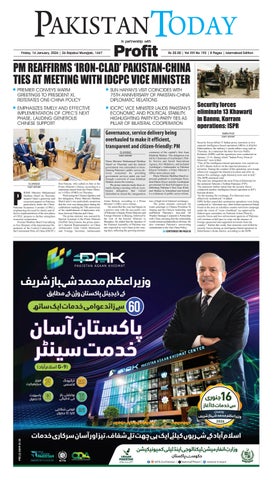
PM REAFFIRMS ‘IRON-CLAD’ PAKISTAN-CHINA TIES AT MEETING WITH IDCPC VICE MINISTER
Profit
Friday, 16 January, 2026 | 26 Rajabul Murajjab, 1447
g
g
PREMIER CONVEYS WARM GREETINGS TO PRESIDENT XI, REITERATES ONE-CHINA POLICY
EMPHASIZES TIMELY AND EFFECTIVE IMPLEMENTATION OF CPEC’S NEXT PHASE, LAUDING GENEROUS CHINESE SUPPORT
g
g
Rs 20.00 | Vol XVI No 192 | 8 Pages | Islamabad Edition
SUN HAIYAN’S VISIT COINCIDES WITH 75TH ANNIVERSARY OF PAKISTAN-CHINA DIPLOMATIC RELATIONS
IDCPC VICE MINISTER LAUDS PAKISTAN’S ECONOMIC AND POLITICAL STABILITY, HIGHLIGHTING PARTY-TO-PARTY TIES AS PILLAR OF BILATERAL COOPERATION
Governance, service delivery being overhauled to make it efficient, transparent and citizen-friendly: PM ISLAMABAD
staff report
P
ISLAMABAD
staff report
RIME Minister Muhammad Shehbaz Sharif on Thursday lauded China’s generous and consistent support to Pakistan, particularly under the ChinaPakistan Economic Corridor (CPEC), emphasizing the need for timely and effective implementation of the next phase of CPEC projects to further strengthen economic cooperation. Premier Shehbaz Sharif was talking to Vice Minister of the International Department of the Central Committee of the Communist Party of China (IDCPC)
Sun Haiyan, who called on him at the Prime Minister’s House, according to a statement issued from the Prime Minister’s Office (PMO) on Thursday. Welcoming the Chinese dignitary and her delegation, Prime Minister Shehbaz Sharif said it was particularly auspicious that the visit was taking place during the celebrations marking the 75th anniversary of the establishment of diplomatic relations between Pakistan and China. The prime minister was assisted by Special Assistant to the Prime Minister (SAPM) Tariq Fatemi, the prime minister’s Special Representative on China Ambassador Zafar Uddin Mahmood, and Foreign Secretary Ambassador
Prime Minister Muhammad Shehbaz Sharif on Thursday said the federal government was committed to transforming Pakistan’s public service delivery ecosystem by providing government services under one roof through a network of Asan Khidmat Markaz across the country. The prime minister made these remarks during a meeting with an Azerbaijani delegation that visited Islamabad to attend the inauguration
Amna Baloch, according to a Prime Minister’s Office news release. He noted that the year had begun on a positive note with the successful visit of Pakistan’s Deputy Prime Minister and Foreign Minister to Beijing, followed by the visit of the Interior Minister to Shanghai. He added that the Speaker of the National Assembly of Pakistan was also expected to visit China in the coming days, reflecting the growing momen-
ceremony of the capital’s first Asan Khidmat Markaz. The delegation was led by Chairman of Azerbaijan’s Public Service and Social Innovations Agency, Alvi Mehdiyev, and included Azerbaijan’s Ambassador to Pakistan Khazar Farhadov, a Prime Minister’s Office news release said. Prime Minister Shehbaz Sharif expressed gratitude to Azerbaijan President Ilham Aliyev and the Azerbaijani government for their full support in establishing Pakistan’s first Asan Khidmat Markaz in Islamabad and termed it a milestone in public sector reform. tum of high-level bilateral exchanges. The prime minister conveyed his warm greetings to Chinese President Xi Jinping and the Chinese leadership, and reaffirmed Pakistan’s iron-clad All Weather Strategic Cooperative Partnership with China, stressing that the relationship would remain unshakeable at all times. He also reiterated Pakistan’s unwavering commitment to the One China Policy.
CONTINUED ON PAGE 03
Security forces eliminate 13 Khawarij in Bannu, Kurram operations: ISPR RAWALPINDI
staff report
Security forces killed 13 Indian proxy terrorists in two separate intelligence-based operations (IBOs) in Khyber Pakhtunkhwa, the military’s media affairs wing said on Thursday. In a statement the Inter-Services Public Relations (ISPR) said the operations were conducted on January 13-14, during which “Indian Proxy Fitna alKhawarij” were killed. “One of the intelligence-based operations was carried out in KP’s Bannu district on the reported presence of terrorists. During the conduct of the operation, own troops effectively engaged the khawarij location and after an intense fire exchange, eight khawarij were sent to hell,” The ISPR statement said. The state has designated the term Fitna al-Khawarij for the outlawed Tehreek-i-Taliban Pakistan (TTP). The statement further stated that the security forces conducted another intelligence-based operation in KP’s Kurram district. “In the ensuing fire exchange, five khawarij were effectively neutralised,” it added. ISPR further stated that sanitisation operations were being conducted to “eliminate any other Indian-sponsored kharji found in the area as relentless counter-terrorism campaign under the vision of “Azm-i-Istehkam” (as approved by federal apex committee on National Action Plan) by security forces and law enforcement agencies of Pakistan will continue at full pace to wipe out the menace of foreign sponsored and supported terrorism from the country”. Earlier this week, four terrorists were killed by security forces during an intelligence-based operation in Balochistan‘s Kalat district, according to the ISPR.
02 NEWS
PSX REVERSES EARLY RISE, SLIDES MORE THAN 1,100 POINTS AS SELLING RETURNS
B
PROFIT
News Desk
EARS dominated the Pakistan Stock Exchange (PSX) on Thursday, as the benchmark KSE-100 Index dropped over 1,100 points, mainly due to persistent selling pressure. According to the PSX website, the market opened with buying interest, lifting the key index by over 900 points, but this advance faded as profit-taking emerged and investors adjusted positions. By the time markets neared the mid-day break, the benchmark had retreated into negative territory, reflecting broad-based selling across major sectors.
Customs seizes smuggled, non-duty paid Rolls-Royce, 19 heavy bikes in Islamabad
g
SELL-OFF WAS BROAD-BASED, WITH LOSSES RECORDED ACROSS KEY SECTORS
During the intraday trade, the benchmark index fell to the day’s lowest level of 180,783.62, plunging over 1700 points. The market closed at 181,456.33 points, down by 1,113.48 points, or 0.61%, from the previous close of 182,569.81. The sell-off was broad-based, with declines seen across automobile assemblers, cement, commercial banks, fertiliser, oil and gas exploration companies, oil marketing companies, power generation and refinery stocks. Index-heavy names, including ARL, MARI, POL, SSGC, HBL, MCB, MEBL and UBL traded in the red
g
PROFIT
Karachi wedding sector adds Rs33b to local economy in 2025 PROFIT
News Desk
Karachi’s wedding industry generated an estimated Rs33 billion for the city’s economy in 2025, driven by spending across multiple service and retail sectors during peak wedding months. Representatives of event organisers and wedding venue associations said the economic impact covered direct spending on banquets, catering, clothing and transport, as well as ancillary demand in renovation, décor, photography and hospitality services. Rana Rais Ahmed, president of the All Karachi Marriage Hall Lawn Banquet Owner Association, talking to Business Recorder, said the sector touches “between 80 and 100 direct industries involved in wedding ceremonies,” noting that a further “around 250 allied industries” benefit indirectly from wedding-related demand. Ahmed explained that while wedding activity earlier in the year—between March and November—was relatively quiet, demand accelerated sharply from December 2025 into January 2026, with halls in many areas reaching significantly higher occupancy. He contrasted current patterns with past years explaining that winter weddings are now preferred because of the cooler weather and holidays of families returning from abroad. Event planners also reported rising interest. Shadiyana CEO Izzah Zaman told Business Recorder that enquiries increased by nearly 25% between October and December 2025, driven by couples planning events later in the year.
In Asia, markets were uneven, with tech stocks facing additional pressure. Japan’s Nikkei eased 0.9% after hitting an all-time peak in the previous session, while the broader Topix rose 0.4% to extend its own record high. Taiwan’s TAIEX was down 0.5%, Hong Kong’s Hang Seng down 0.4%, mainland Chinese blue chips flat, and South Korea’s KOSPI up 0.3% to a fresh record high. In US markets, S&P 500 Emini futures were down 0.1% after the cash index fell 0.5%, while the Nasdaq Composite dropped 1% overnight, the report added.
Govt moves to amend laws, shifting NEPRA under Power Division AMENDMENTS COME AMID LONG-RUNNING DIFFERENCES BETWEEN POWER DIVISION AND NEPRA OVER TARIFF DETERMINATIONS AND REGULATORY AUTHORITY iffs, rates and charges for electricity generation, transmission and distribution companies, but the responsibility for notifying these decisions in the official Gazette will rest with the relevant division. The amended law requires the division to notify NEPRA-approved tariffs within 30 days or refer them back for reconsideration. If no action is taken within that period, NEPRA would be allowed to direct immediate application of its approved tariff, subject to any later adjustments. The proposed amendments also allow the division to seek reconsideration of NEPRA’s tariff determinations for public-sector distribution companies within a defined timeframe. NEPRA would be required to complete such reconsideration within 30 days. For quarterly tariff adjustments related to capacity charges, losses, operational costs and policy guidelines, the Authority would intimate the division before
PROFIT
News Desk
The Collectorate of Customs Enforcement, Islamabad, has seized smuggled and nonduty-paid vehicles, motorcycles and electronic goods valued at Rs412.2 million during intelligence-based operations conducted late at night in Islamabad and surrounding areas. According to an official statement, the seizures included one RollsRoyce luxury car, 19 heavy bikes of the Suzuki and Kawasaki brands, and a large quantity of laptops and other electronic devices. Customs teams acted on credible intelligence about the movement and concealment of illicit goods and carried out multiple targeted raids as part of an ongoing drive to curb smuggling and enforce customs laws. Subsequent examination confirmed that the items were brought into the country without payment of applicable duties and taxes. All seized goods were shifted to a designated Customs warehouse for detailed examination and safe custody. The consignments were seized under relevant provisions of the Customs Act, 1969, and further legal proceedings have been initiated. Investigations are underway to identify those involved and to trace the wider smuggling network. The Federal Board of Revenue said it remains committed to combating smuggling and illicit trade through intelligence-led enforcement and strict implementation of customs laws.
during the session. On Wednesday, the Government of Pakistan and SC Financial Technologies LLC signed a memorandum of understanding to collaborate on next-generation digital payment systems and cross-border financial innovations. SC Financial Technologies is an affiliate of World Liberty Financial USA (WLF), described as the primary cryptocurrency business of the Trump family. Oil and gold prices eased on Thursday after a sharp increase the day before, which was caused by President Trump’s threats to Iran.
moNitoriNg Desk
The federal government has finalised draft amendments to the NEPRA Act, 1997, and the Electricity Act, 1910, aimed at transferring key regulatory powers from the federal government to the Power Division, a move that could significantly alter the balance between the power sector regulator and the executive, Business Recorder reported. The proposed changes replace references to the “Federal Government” with the “Power Division” or “division concerned” for the approval and notification of various regulatory decisions. The amendments come amid long-running differences between the Power Division and National Electric Power Regulatory Authority over tariff determinations and regulatory authority. Under the revised framework, NEPRA will continue to determine tar-
notification, with limited time allowed for reconsideration requests. In addition, the draft changes permit the division to file an appeal instead of seeking reconsideration, but once reconsideration is requested, the right to appeal would lapse. No changes have been proposed to certain existing appeal provisions. Parallel amendments to the Electricity Act, 1910, also replace references to the federal government with the “appropriate authority” or “division concerned.” These include provisions relating to disputes over electric supply lines and the service of official notices and orders. Power sector observers say the amendments appear designed to bring the regulator more directly under the administrative control of the Power Division. Critics argue that such changes could weaken NEPRA’s independence and affect its ability to make autonomous tariff and regulatory decisions.
Cabinet approves amendments to PPRA Ordinance to streamline public procurement g
CHANGES TO PAKISTAN’S PROCUREMENT LAW FOLLOW INTERNATIONAL REVIEW AND AIM TO REFINE TENDERING PROCEDURES the law with current procurement needs. These recommendations were first considered by the PPRA Board in early 2025, where the proposed changes were agreed upon unanimously. Under the revisions approved by the cabinet, several technical adjustments will be made to specific sections of the ordinance to clarify terms and strengthen procedural provisions. Among the proposed changes are revisions in definitions and procurement categories, and new procedures to distinguish between minor and major procurements, along with adjustments to bidding and annulment processes. The final draft of the Public Pro-
PROFIT
News Desk
The federal cabinet has given in-principle approval to a set of amendments to the Public Procurement Regulatory Authority (PPRA) Ordinance, 2002, aimed at improving how government contracts and procurements are regulated and executed. The move follows directives from the prime minister and a comprehensive review of the existing legal framework. The Cabinet Division told officials that an international consultant was engaged by the PPRA to assess the ordinance and recommend updates to align
curement Regulatory Authority Ordinance (Amendment) Bill, 2025 was prepared after further input and corrections directed by the prime minister and then submitted to the cabinet for approval. A certification from the PPRA managing director confirmed that the prime minister’s directives were incorporated into the final version. Officials say the amendments aim to modernise procurement rules, reduce ambiguity in key sections of the law, and ensure clearer procedures for transparent government contracting. Once finalised and legislated, the changes are expected to support better governance and oversight of public spending.
Friday, 16 January, 2026 | ISLAMABAD
Pakistan’s liquid forex reserves climbs to $21.25b with a $16 million increase last week PROFIT
News Desk
Pakistan’s total liquid foreign exchange reserves reached $21.25 billion as of January 9, 2026, official data from the State Bank of Pakistan (SBP) shows. This figure combines reserves held by the central bank and those held by commercial banks operating in the country. The SBP’s own reserves stood at $16.07 billion, the highest it has been since FY21, while commercial banks held $5.18 billion in net foreign exchange assets, according to the SBP’s weekly foreign exchange reserve bulletin. During the reporting week, the SBP’s reserves rose modestly, increasing by $16 million since last week, indicating continued accumulation of foreign currency assets as part of the central bank’s reserve management strategy. This follows recent trends of reserve growth driven by higher remittance inflows and central bank operations in the foreign exchange market. Holding stronger reserves is crucial for debt servicing and import stability, particularly given Pakistan’s external financing obligations. The country paid $26 Billion in debt servicing in the Financial Year 2025 and will have to pay approximately the same amount in Financial Year 2026. Foreign exchange reserves represent the stockpile of foreign currencies held by a country’s central bank and commercial banks to support external payments, manage exchange rate stability and meet international obligations. For Pakistan, these reserves are vital for financing imports, servicing external debt and maintaining confidence in the financial system.
Upcoming spectrum auction seen as turning point for Pakistan’s internet capacity PROFIT
News Desk
Pakistan’s long-standing internet quality issues could begin to ease once the upcoming spectrum auction is completed, as additional frequencies would allow mobile operators to expand network capacity and reduce congestion, according to the chief executive of Jazz. Speaking on the sidelines of an industry discussion, the Jazz CEO said Pakistan’s mobile networks have been operating under severe spectrum constraints for years, limiting the ability of operators to deliver faster and more reliable data services despite rising demand. He said the auction, expected later this year, would enable telecom companies to deploy modern technologies more effectively and improve user experience across urban and rural areas. He noted that data consumption in Pakistan has increased sharply, but spectrum availability has not kept pace, resulting in slower speeds and network congestion, particularly during peak hours. According to him, acquiring new spectrum would allow operators to widen bandwidth, stabilise connections and improve overall service quality. The executive also stressed that spectrum alone would not be enough, pointing to the need for supportive policy measures, predictable taxation and longterm regulatory clarity to encourage sustained investment in telecom infrastructure. He said Pakistan’s telecom sector has continued to invest despite financial pressures, but further progress depends on a more enabling environment.
Over 63% of PRs locomotives exceed 20-year lifespan, NA committee told PROFIT
saDDam HussaiN
The National Assembly Standing Committee on Railways was informed on Wednesday that more than 63% of locomotives in service have crossed 20 years of operation, a factor contributing to engine failures, service disruptions and train delays across the network. The committee met to review operational challenges facing Pakistan Railways, with a focus on locomotive reliability and passenger service quality. The session was presided over by MNA Ramesh Lal in the absence of the committee chairman, in line with parliamentary procedure.
Officials told the committee that incidents of locomotive breakdowns have risen slightly in recent years due to the aging fleet. To address the issue, the Railways management outlined corrective measures, including improved maintenance schedules, higher budget allocations, specialised technical training, third-party inspection of procured materials and technical support from original equipment manufacturers. The committee was also briefed on plans to overhaul and modernise dieselelectric locomotives, alongside updates on passenger coach availability. Officials said a shortage of coaches that emerged in June 2025 had largely been resolved
through improved workshop efficiency and the restoration of units previously under repair. Coach availability has increased from 1,016 in September 2025 to 1,105 against a requirement of 1,100, and is projected to reach 1,150 by June 2026, the committee was told. On financial performance, officials reported that passenger earnings reached Rs48.832 billion in FY2024–25, while revenue in the first half of the current fiscal year rose by 7% compared with the same period last year. The Secretary Pakistan Railways also briefed members on ongoing restructuring efforts, including plans to outsource certain functions to improve efficiency
and passenger services. The committee reviewed complaints regarding non-functional air-conditioning units in passenger coaches. Officials said failures had increased due to the age of existing units, but replacement was underway. Of 153 new AC units procured, 85 have been installed, with the remainder expected to be fitted by March 2026. Updates were also shared on power van overhauls and spare parts procurement. Following the discussion, the committee formed a sub-committee to examine the issues in greater detail. The meeting was attended by several MNAs and senior officials from the Ministry of Railways and Pakistan Railways.
Dar says IMF programmes curb growth as govt shifts focus to economic expansion g
DEPUTY PRIME MINISTER SAYS POST-STABILISATION PHASE WILL PRIORITISE JOBS, OUTPUT AND EXPORTS WHILE CONTINUING ENGAGEMENT WITH IMF PROFIT
moNitoriNg Desk
Deputy Prime Minister Ishaq Dar on Wednesday said International Monetary Fund programmes are generally antigrowth, as the government signalled a policy shift from prolonged economic stabilisation toward expanding output and job creation. Speaking at the Pakistan Policy Dialogue, Dar said the government had achieved macroeconomic stability and would now focus on growth, while continuing to engage with the IMF. He said employment generation was not possible without higher growth and added that Prime Minister Shehbaz
Sharif would prioritise economic expansion for the remainder of his tenure. Dar said discussions with the prime minister had concluded that growth below 2.6% effectively translated into negative growth, given Pakistan’s annual population increase of around 2.6%. He reiterated that IMF-supported programmes typically constrain growth and stressed the need to rebalance policy priorities. Finance Minister Muhammad Aurangzeb, speaking at the same event, said Pakistan could not sustain development with current population growth and underlined the need to bring the rate down. He said the government now viewed sustainable growth
as the correct path forward. The remarks highlighted differing views within the government, with some policymakers continuing to argue for caution after stabilisation, while others see limited room for further restraint given high unemployment, rising poverty and weak investment. Former finance secretary Younus Dagha said stabilisation policies had resulted in record unemployment, increased poverty, a sharp rise in the tax burden on salaried individuals, stalled investment and capital flight. He criticised monetary tightening, arguing inflation had eased largely due to falling global commodity prices rather than high interest rates.
Dar said the policy rate had risen from 5.25% in 2017 to 22%, pushing annual debt servicing costs from under Rs2 trillion to about Rs10 trillion. Aurangzeb said interest expenses in the current fiscal year were projected to be Rs850 billion lower than initially budgeted. Planning Minister Ahsan Iqbal said Pakistan could reach 6% growth quickly but warned that without structural reforms, such expansion could trigger a balance-of-payments crisis within two years. Dar said the government was not aiming for immediate acceleration to that level and expected growth to build gradually over two to three years. On privatisation, Dar said bidding for
Pakistan International Airlines was expected to reach Rs150 billion. The government has sold a 75% stake for Rs135 billion, with Rs10 billion in cash and Rs125 billion earmarked for investment in the airline. As chairman of the Cabinet Committee on Privatisation, he said the next phase would focus on privatising power distribution companies. Dar said the external sector remained a challenge but urged patience, adding that a committee under his leadership was already working on a plan to raise exports to $60 billion within three years. He said Pakistan could add $10 billion each in goods exports and services exports and raise remittances to $110 billion over four years.
NEWS 03
Friday, 16 January, 2026 | ISLAMABAD
PAKISTAN REQUIRES $565B BY 2035 TO DELIVER ON CLIMATE PLEDGES
P
PROFIT
staff report
AKISTAN will require an estimated $565.7 billion in investment by 2035 to meet its Nationally Determined Contributions (NDC) 3.0 climate targets, participants were told at a business forum focused on sustainable finance and climate reporting. The estimate was shared during a session on the Pakistan Green Taxonomy and Environmental, Social and Governance (ESG) disclosure frameworks, hosted by the Overseas Investors Chamber of Commerce and Industry. The discussion brought together corporate leaders and industry stakeholders
to examine how sustainable finance and improved ESG reporting can help mobilise capital and strengthen climate resilience. The session followed the issuance of revised ESG Disclosure Guidelines by the Securities and Exchange Commission of Pakistan, which are now aligned with the Pakistan Green Taxonomy. Speakers said the updated framework is intended to improve transparency, standardise sustainability reporting and support the country’s climate transition. Participants noted that Pakistan’s NDC 3.0 targets include an unconditional 17 percent and a conditional 33 percent reduction in greenhouse gas emissions, a 30 percent increase in electric vehicle adoption and a shift to 60
percent renewable energy. Achieving these goals, they said, will depend heavily on attracting green-aligned investment, making clear taxonomies and consistent ESG disclosures essential. Introduced by the State Bank of Pakistan in 2024, the Pakistan Green Taxonomy classifies economic activities that support environmental objectives such as climate mitigation, sustainable water use, ecosystem protection, pollution control, circular economy practices and sustainable land management. The ESG Disclosure Guidelines, which will be phased in as mandatory between 2029 and 2031, provide standardised metrics for sustainability reporting. The session was conducted by Farrukh Rehman, former president of the
Institute of Chartered Accountants of Pakistan, who said integrating the green taxonomy into ESG reporting offers businesses a clear pathway to align with national climate goals and attract sustainable investment. OICCI Secretary General M Abdul Aleem said accountability and sustainability are increasingly central to corporate strategy, adding that adoption of ESG disclosures and taxonomyaligned practices can help companies manage climate risks while improving access to capital. The discussion also covered technical criteria for taxonomy alignment, including contribution thresholds, the “do no significant harm” principle and minimum social safeguards.
Punjab bans purchase of new petrol, diesel vehicles; shifts to EVs, hybrids for government use g
provIncIal departMents to procure only electrIc or hybrId vehIcles as clean transport push expands; noc for new petrol statIons Made condItIonal on InstallatIon of ev chargIng unIts PROFIT
staff report
The Punjab government has decided to impose a complete ban on the purchase of new petrol and diesel vehicles across provincial government departments, as part of a policy shift aimed at reducing emissions and promoting clean transportation. Under the decision, all government departments will be allowed to procure only electric or hybrid vehicles, while vehicles used for field duties have been exempted. Punjab Chief Secretary Zahid Akhtar Zaman said the move reflected the government’s commitment to environmental protection and added that a comprehensive provincial electric vehicle pol-
Rs3.23 per unit electricity debt surcharge to remain for up to six years
government retains uniform base tariff, links surcharge withdrawal to clearance of circular debt PROFIT
staff report
The government has decided to continue charging a Rs3.23 per unit debt surcharge on electricity consumers for up to six years, as it notified a revised uniform national base tariff for the current year without any change, linking the withdrawal of the surcharge to the clearance of circular debt under a settlement plan aimed at eliminating liabilities within five to six years. The Power Division said the surcharge would be withdrawn once the circular debt is cleared. A circular debt settlement plan has been launched, with the government targeting the elimination of outstanding liabilities within five to six years. The division acknowledged that the expansion of off-grid solar usage has altered subsidy dynamics, noting that the number of protected consumers has doubled from 11 million in 2021 to 22 million due to hybrid consumption patterns. It said this shift has increased fiscal pressure and raised the cross-subsidy burden on industrial and commercial users, affecting competitiveness.
icy would be announced soon. As part of the same initiative, the issuance of noobjection certificates for new petrol pumps has been made conditional on the installation of electric vehicle charging units. Officials said no new petrol pump would be allowed to operate without EV charging facilities. Authorities disclosed that NOCs have already been issued through the e-Biz Portal for 170 new petrol pumps across 31 cities in Punjab, all of which are required to install EV chargers. These include 29 petrol pumps in Faisalabad, 14 in Lahore, 10 in Bahawalpur, nine each in Khanewal and Bahawalnagar, eight each in Rawalpindi and Jhang, and seven each in Toba Tek Singh, Mianwali, Kasur and Chiniot.
Zardari pitches Pakistan as regional economic bridge, seeks deeper investment ties with Bahrain MANAMA
staff report
President Asif Ali Zardari on Thursday presented Pakistan as a strategic economic gateway connecting South Asia, Central Asia, China and the Middle East, saying this natural geographic advantage, combined with Bahrain’s financial expertise and strong regulatory framework, could unlock a new phase of mutually beneficial investment and economic cooperation between the two countries. Addressing a reception at the headquarters of Bahrain’s Economic Development Board (EDB), the president underscored Pakistan’s commitment to expanding economic cooperation, investment partnerships and institutional linkages with Bahrain. He said Pakistan was actively pursuing economic stability, digital modernisation and investment-led growth, supported by ongoing structural reforms aimed at creating a predictable and investorfriendly environment. Highlighting the role of the EDB, President Zardari noted that
the board played a central part in shaping Bahrain’s economic strategy, attracting foreign investment and supporting diversification across key sectors. He observed that the EDB’s close coordination with government institutions and the private sector had strengthened Bahrain’s competitiveness, promoted innovation and helped create an enabling climate for investors. The president said the EDB’s model of policy coherence and investor facilitation offered a valuable reference point for countries seeking sustainable and inclusive growth. He added that Pakistan followed Bahrain’s development journey with “admiration” and saw strong complementarities between the two economies, particularly in areas where Pakistan’s market size and connectivity could align with Bahrain’s financial services strength. Outlining Pakistan’s economic priorities, President Zardari pointed to the Special Investment Facilitation Council as a streamlined platform designed to facilitate and protect foreign investment. He said priority sectors for in-
vestment included agriculture, information technology, energy, minerals, logistics and tourism, while identifying agriculture and food security, IT and digital services, renewable energy and logistics as especially promising areas for Pakistan-Bahrain collaboration. While focusing on economic opportunities, the president also referred to regional security challenges and their impact on development. He reaffirmed Pakistan’s resolve to counter extremism, strengthen internal security and pursue peaceful relations with its neighbours, while safeguarding national interests and ensuring the protection of foreign investments. During the visit, President Zardari met Bahrain’s Interior Minister Lt Gen Shaikh Rashid bin Abdullah Al Khalifa in Manama, where both sides pledged closer cooperation in the fields of security, counter-terrorism and counter-narcotics. The meeting reaffirmed the strength of bilateral ties and the shared commitment to addressing regional and transnational security challenges.
PNSC inducts 109,990 DWT Aframax tanker MT Karachi into managed fleet g
InductIon alIgns wIth fleet expansIon plan as natIonal carrIer targets growth In tanker capacIty PROFIT
staff report
Pakistan National Shipping Corporation (PNSC) has inducted an Aframax tanker, MT Karachi, into its managed fleet, according to a disclosure submitted to the Pakistan Stock Exchange (PSX). The vessel, with a deadweight tonnage of 109,990, has been inducted
through PNSC’s subsidiary, Karachi Shipping (Private) Limited. The disclosure was made in compliance with Section 96 of the Securities Act, 2015, and Clause 5.6.1(a) of the PSX rule book, following an earlier announcement issued in October 2025. The induction is part of PNSC’s broader fleet expansion strategy focused on increasing tanker capacity.
Aframax-class tankers are commonly deployed for medium-range crude oil transportation and play a key role in regional and international energy trade. PNSC has been steadily expanding its fleet over the past year. In August 2025, the national shipping line increased its fleet to 12 vessels with the induction of two Aframax-class tankers, Swan Lake and P. Aliki, and announced plans to raise the fleet size to 20 ships by
the end of the year. Subsequently, in October 2025, PNSC disclosed that its wholly owned subsidiaries had signed Memorandums of Agreement for the purchase of two additional Aframax tankers. These included tanker LORAX, with a deadweight of 109,990 tonnes, and NAFSIKA, with a deadweight of 112,051 tonnes, to be acquired through Lahore Shipping (Private) Limited.
Govt prepares four global RFPs for Panda, dollar bond issuance as debt strategy shifts to longer tenors g
Move aIMed at strengthenIng debt ManageMent and dIversIfyIng external fundIng sources; governMent launches global roadshows, targets over 100 long-terM overseas Investors to attract stable foreIgn fundIng PROFIT
staff reoport
The federal government is preparing to issue four Requests for Proposals (RFPs) in international markets for the launch of Panda bonds and dollar-denominated bonds, as part of a broader strategy to strengthen debt management and diversify funding sources. The plan was outlined during a briefing by the Debt Management Office (DMO) of the Ministry of Finance with financial market participants at the Pakistan Stock Exchange (PSX), ac-
cording to a news report. Officials said the government expects pricing on new issuances to remain within prevailing secondary market yields for Pakistan’s bonds, with Panda bonds likely to offer more competitive rates. They noted that 10-year Chinese bonds currently yield below 2 percent, compared with 4–4.5 percent on US bonds of similar tenor. Alongside external borrowing, the DMO is working on exchange rate– linked notes and bonds for local investors, aimed at attracting dollar liquidity within Pakistan and meeting de-
mand from investors holding foreign currency. To strengthen international participation, the government has begun global roadshows and finalized a list of more than 100 overseas investors, focusing on long-term “real money” investors rather than short-term hedge funds. The DMO also briefed participants on upcoming external obligations, noting that the next Eurobond maturity of $1.3 billion falls due on April 8, 2026. Officials said the previous Eurobond repayment in September 2025 was met smoothly due to adequate liquidity. On the domestic front, the govern-
ment plans to issue more fixed-rate and longer-term instruments to reduce refinancing risks. The average time to maturity (ATM) of domestic debt improved to 4.02 years in December 2025 from 3.8 years in June 2025, with a target of 4.25 years by 2028. Net issuance will increasingly be skewed toward Pakistan Investment Bonds, including fixed-rate and zero-coupon bonds, while limiting reliance on short-term treasury bills. The share of fixed-rate instruments has risen to 24.75 percent as of December 2025 from 18 percent in June 2024, with a target of over 30 percent by 2028.
PM reaffirms ‘iron-clad’ Pakistan-China ties at meeting with IDCPC vice minister CONTINUED FROM PAGE 01
Prime Minister Shehbaz Sharif lauded China’s generous and consistent support to Pakistan, particularly under the China-Pakistan Economic Corridor (CPEC), and emphasized the need for timely and effective implementation of the next phase of CPEC projects to further strengthen economic cooperation. He also renewed his most cordial invitation to President Xi Jinping to undertake an official visit to Pakistan this year, noting that the milestone year held special significance for both countries. Vice Minister Sun Haiyan thanked the prime minister for his warm and hospitable welcome and reaffirmed China’s commitment to further strengthening its long-standing, time-tested relationship with Pakistan across all spheres. She congratulated Prime Minister Shehbaz Sharif on bringing economic as well as political stability to the country, and said that the Chinese nation took great pride in Pakistan’s diplomatic achievements. She briefed the prime minister that the Communist Party of China maintained excellent relations with a wide spectrum of political parties in Pakistan, and appreciated the prime minister’s leadership role in fostering unity among political forces for effective governance. Emphasizing the importance of party-toparty engagement, the Chinese vice minister expressed the Communist Party of China’s firm commitment and resolve to further deepen collaboration with political parties in Pakistan through established inter-party mechanisms.
Government raises Rs492b from PIB auction as yields fall PROFIT
staff report
The government raised Rs492 billion through an auction of fixed-rate Pakistan Investment Bonds (PIBs) on Wednesday, exceeding its Rs450 billion target, as yields declined sharply across all accepted maturities amid strong investor demand. Total participation in the auction reached Rs2.06 trillion, according to results released by the State Bank of Pakistan. Cut-off yields fell by 60–70 basis points across most tenors. The two-year PIB yield declined by 59 basis points to 10.19%, while the three-year yield dropped by 70 basis points to 10.14 percent. The five-year bond cleared at 10.525% after a 67basis-point decline, and the 10-year yield fell by the same margin to 11%. The government rejected bids for the 15-year tenor. Market participants said the auction reflected expectations of further monetary easing. Demand was concentrated in the three- to 10-year segment, where acceptances exceeded targets and yields cleared at or below prevailing benchmarks, indicating confidence in a supportive liquidity environment.
04 COMMENT
Human rights and drugs
Punjab going green
T
T
Decision to buy only green vehicles should be seen as starting a process
The new tools of US policy?
HE Punjab has thrown its hat in the ring of greening government by deciding that it will not buy any more petrol vehicles, and will only allow the purchase of electric or hybrid vehicles. This initiates a process by which it will replace its fleet in coming years, as well as create a demand for EVs and hybrids, thus giving a boost to their manufacturers. The Sindh government has also launched a similar scheme, planning to replace petrol and diesel vehicles for commissioners and DCs, as well as a ‘Pink Scooty’ scheme to give free e-scooters to working women and women students. The example of these two governments can be followed with profit by the other governments in the federation. Clearly the Punjab government is trying to avoid the dilemma the Sindh government found itself in, where it had to allocate Rs 526 million for the changeover, and manage the transition slowly, but using no extra funds. The major advantage to the government will be the fuel savings, but this initiative should not be viewed as any sort of final goal. While savings would be welcome, the Punjab government must not hesitate in taking the next step, which is to install solar power in its offices, which mostly have extensive roofs and can easily adapt to this. An additional advantage is that government offices are almost never open at night, so there is little need to install any battery storage, which is not only expensive, but needs maintenance. There has already been some movement in this regard, as the Lahore High Court. It is true that the distribution companies might find themselves in financial difficulties because of a switchover, but it makes economic sense, quite apart from the environmental benefits. As the province taxes the citizenry, and receives money from the divisible pool of federal taxes, levied again from the citizenry, prudence by the provincial government is essential. The Punjab government has the advantage that, l unlike private vehicle owners, it is not interested in resale value, which is one of the main barriers to EV adoption. Another barrier is the absence of charging stations. Along with the decision to buy only EVs and hybrids, the Punjab government, while issuing permits for 170 new petrol pumps, has made setting up a charging station a condition. While it will not solve the problem, it will help, particularly as 31 cities are involved.
At Penpoint M A NIAZI
HE kidnapping of Venezuelan President Nicolás Maduro may have caused all sorts of convulsions of international law, but the charges against him have made the use of two favourite US weapons more and more unbelievable, even though they are still serious concerns in their own: human rights and drugs. Even if one was to concede all the charges made against Maduro, and not just in the indictments against him in the New York courts which were levied against him, it becomes clear that the US Administration is not concerned with violations of human rights or by drug-related offences, except as a stick to beat some Third World leader over the head with. Human rights are important. For the USA, they are all-important. They are the nearest to a state ideology it has, and it was on their basis that it fought the Cold War. The main contention of the USA was that the USSR and its satellites consistently violated human rights, such as the right to property and to life and liberty. However, the USA, while proclaiming its devotion to numerous freedoms, has also been seen to ignore human rights violations by allies when it suits it. The most glaring evidence comes from the Middle East, where the USA has ignored human rights abuses by such a;;ies as Saudi Arabia, the UAE and Qatar. One of the main abuses is the provenance of governments. The sheikhdoms became almost proverbial in describing the sort of autocratic, antifreedom, government that the USA opposed so vehemently when it referred to the USSR, any of its satellites or China. However, perhaps the most complete carte blanche given by the USA to an ally is that given to Israel. In other cases, the denial of rights is to the States’ own citizens. The nearest to an international dimension was the 2018 killing of dissident Saudi journalist Jamal Khashoggi in Istanbul, but since the crime was allegedly committed at the Saudi consulate there, even that violation of Khashoggi’s right to remain alive seems to have occurred on Saudi soil. That was not criticised by the USA, just as much as its recent attempts at genocide in Gaza, which have culminated with the present campaign. (It must not be forgotten that the last year’s events in Gaza come after several years of annual bombings, and must be seen as a ‘last push’ by Israel.) Drugs are another charge which the USA may have bandied about without sufficient reason. In 1989, Panamanian strongman Gen Manuel Noriega was similarly abducted by US special forces from Panama City, even though he was a four-star officer and commander of the Panamanian Defense Forces. He had been paid by the CIA since 1953, even before he had joined the military, coming onto the payroll after becoming head of military intelligence. Ever since the death of Gen Omar Torrijos in 1981, he had ruled from behind the scenes, and had used his position as head of the military not just to rule through puppet civilian Presidents. His use of the military in drug smuggling, as well as selling to the
Dedicated to the legacy of late Hameed Nizami
Arif Nizami (Late) Founding Editor
drug cartels of military equipment drew enough US ire to make the operation against him feasible. However, the charge against Maduro is a little different. He is President of his country, which Noriega was not, though he ruled Panama de facto. Second, there is an obvious interest in Venezuela, in its oil reserves, which makes the drug charge dubious. Drugs are a serious problem for the USA, but the way they are being used makes them dubious. Maduro and his son may have been involved in drug smuggling. However, Maduro was also head of a regime which had nationalized US oil companies, so the drug smuggling would probably not be the primary motivation, just as it was not in the case of Noriega. Though Noriega was helpful to the USA in its activities against the Sandinistas in neighboring Nicaragua, he was also selling intelligence to Cuba. Venezuela was supporting Cuba too, with oil as well as money, which Trump has ordered stopped. That seems to have been more of a problem for the Trump Administration than drug smuggling, but the latter has become the formal charge. Though drugs are a serious problem for the USA, while Trump has made noises against Mexico and Collombia, it is noteworthy that he has not launched any initiative against drugs domestically. The last time the USA launched an attack on drugs was in the 1980s, when US special forces are reported to have operated in South America against the drug cartels, But this was accompanied by a ‘Just Say No’ campaign in the USA, which was spearheaded by then First Lady Nancy Reagan. That seemed to recognize that the drug trade was powered by demand from users in the USA. One problem seems to be that the USA is apparently moving towards a legalizing of drugs. Already, most states have made the use of marijuana legal, including for ‘recreational use’ in some states. The next step will be to legalize cocaine and heroin. After all, they are both originally painkillers. It is no coincidence that the most recent drug epidemic in the USA, the fentanyl epidemic, is due to the use of a very powerful painkiller. The story of marijuana resembles that of alcohol, which was first prohibited by constitutional amendment bin 1920, but which was then repealed in1933. Marijuana has not been legalized by any federal law, but it is on its way. As for narcotics like cocaine and
The last time the USA wanted to help out its oil companies, it overthrew Muhammad Mossadegh in 1953 in Iran in a coup led by the Shah. Now, almost 73 years later, it is once again trying to destabilize Iran. However, in Venezuela, it has kidnapped the President.
2025: Rising crime and growing insecurity in Karachi M. A. Niazi
Babar Nizami
Editor Pakistan Today
Editor Profit
The city stayed unsafe
I
Dr MuhAMMAD TAyyAb KhAN SINghANvI
T is not without reason that a great city is said to be defined not only by its towering buildings, bright lights, and bustling markets, but also by the pulse of its streets, the records in its courts, and the statistics emerging from its hospitals. Karachi, in the year 2025, once again etched this bitter truth into its urban memory, a year in which crime and fear hovered over the city’s skyline, and life moved forward under the constant shadow of insecurity within one’s own homeland. The relentless continuity of crime, the surge in street offences, the widening social apathy, systemic weaknesses in policing and justice, and moral decay across sections of society collectively weighed down upon the city’s psychological fabric. By the end of the year, when the incidents were compiled, the landscape revealed a deeply unsettling picture. Extortion resurfaced as a persistent threat to the city’s commercial heartbeat from small traders to large business centres, fear and pressure remained the dominant reality. During the same period, a highly sensitive case emerged when police arrested a young female student who had been radicalized online and was prepared for a suicide attack. The incident exposed how extremist organizations continue to operate silently within digital spaces, with young minds still within their crosshairs and had timely intervention not taken place, the city might have faced a catastrophic tragedy. The murder of young Mustafa Aamir in Defence and the arrest of the accused sent waves of grief and outrage across the country. Likewise, the mysterious death of actress and model Humaira Asghar sparked another public debate. Though initial inquiry declared it a natural death, questions lingered in public consciousness, a reminder of how legal interpretations and public perceptions often move in separate directions. One of the most alarming episodes of the year was the escape of more than two hundred inmates from Malir Jail, which was not merely a security failure, but a glaring institutional collapse that raised deeply serious questions
regarding the rule-enforcement framework. Deaths in police custody and repeated jailbreak incidents further reinforced the perception that cracks within the administrative structure were widening. Among the darkest chapters of the year was the horrifying case from Qayyumabad, where innocent young girls were subjected to sexual exploitation. The recovery of hundreds of videos from the accused did not merely expose one individual’s criminality; it symbolized a broader moral breakdown. This incident was not only a call for action for law-enforcement authorities, but a moment of reckoning for parents, educational institutions, and social organizations alike. Throughout the year, incidents of killings during robberies and resistance to theft increased sharply. Statistics testify that even the smalles, andt ordinary moment could suddenly turn into tragedy while walking on the street, standing at one’s doorway, or stopping at a traffic signal. The overwhelming spread of street crime filled the city’s environment with silence and fear; the same city once known for its energy and pace now echoed with distrust and uncertainty. Cases of firing, domestic violence, so-called “honour killings,” and deaths linked to drug abuse together pointed toward a distressing social reality where violence is no longer merely an act of crime, but gradually becoming a behavioural pattern. The rise in suicides reflected the same psychological and economic pressures of unemployment, poverty, household conflicts, and mental stress silently consumed dozens of lives. These deaths enter statistical records, yet the human stories behind them rarely find a place anywhere. Traffic accidents emerged as a separate tragedy altogether. Thousands injured, hundreds losing their lives on the roads because of reckless heavy-vehicle driving, violations of traffic rules, and weak monitoring systems formed the backbone of this bloody cycle. In some instances, enraged citizens set vehicles ablaze; elsewhere, mobs took the law into their own hands and lynched suspected robbers reflecting a dangerous drift toward a parallel, self-styled justice system. Deaths caused by collapsing drains and open manholes, falling structures, factory ex-
I
Karachi – Ph: 021-32640318 I
plosions, gas leaks, and cylinder blasts all exposed the failure of urban planning and safety standards. Whether it was the collapse of a residential building in Lyari or the explosion at a fireworks factory in Saddar every tragedy left behind unanswered questions and grieving families. Meanwhile, the dismantling of cybercrime networks, the arrest of foreign suspects, and the recovery of numerous unidentified bodies linked to drug overdose underscored another harsh reality that the city’s criminal structure is no longer confined to traditional boundaries. It is evolving, modern, organized, and increasingly transnational. The involvement of some police personnel in criminal activities made the crisis even more complex for when protectors themselves begin to stand among the accused, the last line of public trust begins to fade. Amidst all this, one constructive development appeared in the form of the e-ticketing system for traffic violations. If advanced with transparency, consistency, and unbiased implementation of law, such initiatives may help strengthen civic discipline but systems only gain strength when they transform into longterm policy, not short-term experiments. The harshest lesson of 2025 was this: crime is never merely an individual act, it is a reflection of collective social weaknesses. Whether extremism, street crime, domestic violence, or traffic fatalities, every incident reminds us that public safety is not solely the responsibility of the police or judiciary. It is a shared chain shaped by social attitudes, institutional capacity, and collective civic awareness. Karachi remains a vibrant and living city yet today, that life breathes beneath the shadow of fear. If we truly seek to restore confidence, peace, and a sense of protection, we must move beyond compiling statistics and confront the deeper forces that allow crime to grow: economic disparity, fragile governance, social indifference, and the rise of digital radicalization. The real question is whether we will continue to treat these tragedies as fleeting news headlines or transform them into a collective responsibility, carving out a safer path for the future of this city and its people. The writer is a freelance columnist
Islamabad – Ph: 051-2204545
heroin, they were initially purely medicinal in use, and were used recreationally only later. If they are legalized, whatever the consequences for US society, Trump would end up looking rather silly for going after Maduro. Oil companies have told Trump they are not willing to go back into Venezuela after their experiences, so the castle in Spain Trump was making of oil companies investing in Venezuela to bring its oil to the USA seems to be going up, as castles in Spain do, in a puff of smoke. The consequences of the debasing of the currency of human rights has become visible with Maduro’s case. The perception was that he was at the head of a heavyhanded government which did not pay much attention to observing human rights. That has been taken off the table. So have the accusations of drug trafficking. There is too much association of Venezuela with Big Oil for these charges to be believed. This means that Maduro will be considered innocent in the court of public opinion, even if he is convicted by a court of law. This episode has caused much loss of US credibility. The USA was once seen as standing for something. It was, after all, founded as a republic wheals of the Enlightenment could be practised. Human rights were embedded in its constitution, The communist USSR was also a result of that same Enlightenment, though it included a critique of capitalism. It also included a claim that it respected human rights, though it defined them differently. Communism did not accept the right to property, for example, which was central to the US conception. It is the zeitgeist which has got religious leaders claiming the existence of human rights in their particular faith. Human rights has assumed the place of religion, it seems, in the Western worldview. However, just as religion has been used to justify all kinds of bad behaviour, it seems human rights is being used for the same purpose. It almost seems as if human rights are reduced to be merely a tool of US foreign policy. The last time the USA wanted to help out its oil companies, it overthrew Muhammad Mossadegh in 1953 in Iran in a coup led by the Shah. Now, almost 73 years later, it is once again trying to destabilize Iran. However, in Venzuela, it has kidnapped the President. One difference is that in Iran in 1953, there was no nonsense about human rights or drugs. And the oil companies were grateful. The writer is a member of staff
Editor’s mail
If we truly seek to restore confidence, peace, and a sense of protection, we must move beyond compiling statistics and confront the deeper forces that allow crime to grow: economic disparity, fragile governance, social indifference, and the rise of digital radicalization.
Lahore – Ph: 042-36300938, 042-36375965
Friday, 16 January, 2026
I
Send your letters to: Letters to Editor, Pakistan Today, 4-Shaarey Fatima Jinnah, Lahore, Pakistan. E-mail: letters@pakistantoday.com.pk Letters should be addressed to Pakistan Today exclusively
Flush the failure
THE severe sewerage problem faced by the residents of State Bank Society and the surrounding areas has now become a persistent phenomenon, which has become a nuisance for the entire locality. The 48-inch main sewerage line running the length of Gulzar-i-Hijri Road has far outlived its lifespan and now requires urgent attention. This aging infrastructure has developed a disturbing tendency to break down every couple of months. These frequent breakdowns have serious consequences for the entire area. The blockage and overflow of sewer often affect neighbouring societies, including Gwalior Society, Madras Society, PCSIR Society and even Karachi University. One of the most alarming issues is the contamination of freshwater lines, as sewer, after seeping into the ground, mixes with the potable water supply. This contaminated water eventually reaches the underground tanks of house-holds, putting the health and safety of the residents at risk. Although the Karachi Water and Sewerage Corporation (KWSC) has been making temporary repairs, these measures are short-term and fail to address the root cause of the problem. The repairs are ineffective, often lasting only a few months before the issues resurface. This cycle of temporary fixes has left the residents frustrated and in constant fear of another breakdown. The situation has reached a point where the need for a permanent solution is undeniable. The sewerage line must be replaced entirely with new piping that meets the highest standards of quality. AHMED SAAD KARACHI
Reality on trial
ARTIFICIAL intelligence (AI) is speedily becoming very popular as more and more people use it to save time. However, it is now impossible to say with certainty whether a particular video clip is fake or real. We know that there are many people who go berserk when they see videos of their womenfolk dancing or even photos in which they are seen seated next to men who are not their close relatives. What if someone posts a fake video or obscene photo of a woman (who has rejected his advances) on social media and sends it to her relatives? Things have got so bad that it is now impossible to even talk to others without getting into an argument. If, for example, I mention a video of a cult leader saying something controversial, the immediate response is, “It’s probably AI-generated”. Neither side is in a apposition to establish authority of the claim in such cases. Of course, there is a positive side to it also. In school, we were taught that politics and religious topics should be avoided when talking to friends or strangers. So the only safe thing left is sports, like, say, cricket. I know for sure that I would not be lynched if I say that a particular cricketer should not be selected for the next tour. Certainly, a more serious problem is likely to surface in a few decades from now, when, fortunately I have no chance of being alive. When robots become increasingly like humans in appearance, how will someone know if the man or woman talking to them is real? SHAKIR LAKHANI KARACHI
Death trap bridge in Turbat
I visited the University of Turbat recently to meet my friends, and on my way had to cross the D-Baloch Bridge. The bridge is in a disastrous condition, posing a serious risk to the life of students who have to use it every day to reach the campus. Obviously, the life of everyone who uses it is in danger. Iron and steel bars are seen through the concrete. The situation is so bad that a police official stands there to warn the commuters of the hazard ahead. Instead of deploying constables, the government should reconstruct the bridge. YASIR KHALIL KARACHI
Web: www.pakistantoday.com.pk
I
Email: editorial@pakistantoday.com.pk
A silent national emergency
Friday, 16 January, 2026
P
COMMENT 05
Because of the brain drain, the country is not merely losing people; but also the institutions that keep it functional AmnA HAmid
AKISTAN is going through a silent but catastrophic crisis. In 2023 alone, over 800,000 Pakistanis left the country for overseas employment, which will only continue to increase over the next several years. While migration has always been part of Pakistan’s economic story, the current wave is different in scale, composition, and consequence. Skilled categories such as healthcare, IT, and engineering are increasingly represented among recent migrants, particularly to OECD and Gulf healthcare systems. It is no longer a narrative of labour mobility or remittances. It is a story of gradual loss of human capital of the country, which is threatening the capabilities of the state to educate, heal, govern, and innovate. Central to this crisis is a constant brain drain of young professionals, educated, skilled, in the form of doctors, nurses, engineers, academics, and technology professionals. Their exit is not just symbolic. It attacks the very base of the already fragile public institutions in Pakistan. The official data tends to pool together all the emigrants concealing a significant reality. Although professional migrants make up a small percentage of the total number of migrants, their loss is disproportionately harmful. Professionals form less than 10 percent of total emigrants, but account for a much larger share of public service capacity loss. The depth of the public systems in Pakistan, healthcare, higher education, research, and governance, is low. When even a small number of trained professionals exit, the impact ripples through entire institutions. The migration of a senior doctor does not merely decrease the number of physicians as Pakistan has around 1 doctor per 1000 people. It undermines teaching hospitals, curbs specialist education, and degrades mentorship of junior employees. Equally, when long-established academicians leave, the universities are left with few supervisors, researchers, and research outputs. Gradually, institutions become empty and are no longer able to develop the same talent that they lose. This is a vicious cycle; the weakening of institutions is encouraging more professionals to leave and this weakens the system they are leaving. Public debate often reduces brain drain
to inflation, unemployment, or political instability. While these matter, deeper structural factors are driving the exodus. One such factor is the collapse of career predictability. To most professionals, especially those in academia and the government, career advancement in Pakistan is unpredictable and obscured. Promotions are delayed, rules change midstream, and merit is frequently overshadowed by connections. In contrast, foreign systems are clear: they have set ladders, transparent grading, and schedules. The other driver that is not well discussed is chronic underinvestment in institutions of knowledge. The budget of higher education has remained stagnant in the last couple of years, with repeated cuts in PSDP allocations. The development grants alongside research funding have also been cut several times. To the young researchers and scholars, this gives a clear signal: ambition does not have an institutional home. When doctoral scholarships dry up and laboratories remain underfunded, departure becomes a rational choice, not an emotional one. In the technology sector, the crisis takes a subtler form. Many skilled professionals no longer need to physically migrate to exit Pakistan’s economy. Remote working, freelancing, and offshore incorporation allow talent to be physically present in one place and be economically and institutionally unlinked. The unpredictability of the policies, uneven taxation and lack of understanding of the regulations have encouraged most of the technology experts to store income in foreign countries or have companies registered abroad. The consequence will be a form of virtual brain drain, skills stay on the one hand, economic value on the other. This undermines the tax foundation, negatively impacts reinvestment, and separates innovation and national development. Unlike traditional migration, this form of brain drain is harder
to measure, and easier to ignore. Nowhere is the contradiction more visible than in healthcare. Pakistan has been experiencing a long-term shortage of qualified nurses and specialized doctors especially in state hospitals and in the countryside. Pakistan already has fewer than one nurse per 1,000 people, far below WHO recommendations. Simultaneously, Pakistani nurses have become a popular export due to the global need of health care workers. Nurse migration is becoming a topic of policy discourse that is applying an economic opportunity perspective instead of a systemic risk perspective. Although remittances are important, making healthcare workers export commodities is a painful proposition. Can a country with fragile health outcomes afford to optimize its workforce for foreign markets? And if it does, who will train, supervise, and replace those who leave? Devoid of a detailed workforce strategy, Pakistan will end up los-
The issue of brain drain in Pakistan is not that of loyalty or patriotism. It is a crisis of governance and vision. Unless the state begins to value human capital as seriously as it values short-term financial survival, the departure lounge will remain PakistanÊs most efficient export zone. The question is no longer why people are leaving. It is how long the country can function if they keep doing so.
How Israel and the US are exploiting Iranian protests
S
ing the internal capacity to get short-term financial relief. Defenders of migration often point to remittances as compensation for talent loss. This argument is dangerously incomplete. Remittances bring in foreign exchange, but they do not teach the students, run the hospitals, design infrastructure, and reform institutions. State capacity relies on individuals, trained, experienced, and entrenched in systems. Once those individuals are gone, an inflow of foreigners cannot compensate for the damage to the institutions. Successful countries that have used migration like India and China have done so together with long-term investment in local institutions. Pakistan has not. Pakistan cannot find a solution to the brain drain by preventing the migration. It is to provide them with a reason to stay. To start with, the human-capital institutions have to be stabilized. Schools, academic hos-
MIDDLE EAST EYE HAmid dAbAsHi
INCE protests erupted across Iran late last year, more than 500 people have been killed, according to data from the US-based Human Rights Activists News Agency (Hrana), which has been cited by major media outlets worldwide. The agency reports that most of the dead were protesters, alongside more than 45 members of Iran’s security forces. While Hrana and western media are not totally reliable sources in this regard, it has nonetheless become apparent that a significant new cycle of protest is unfolding inside Iran. BBC Persian in particular appears to be on a UK state-sponsored mission to exaggerate the extent of these protests. It systematically ignores a significant part of the Iranian population that both disagrees with state policies, but refuses to take its cues from Israel or its unleashed stooge, Reza Pahlavi. This is yet another example of UK soft power in service of Israel. BBC Persian’s obsessive coverage of the Iranian protests is deeply intertwined with its policy of pathologically ignoring Israel’s genocide in Palestine. While Iranian Supreme Leader Ayatollah Ali Khamenei has publicly acknowledged the ongoing protests, he has noted that there must be a distinction between those who have legitimate economic grievances against the state, and those who are taking advantage of the movement to promote other nefarious goals, such as regime change and the disintegration of Iran. That is the Israeli project. By all accounts, this new cycle of protests is both genuine, and heavily manipulated, at the same time.
ECONOMIC CRISIS: On the first point, the protests are rooted in the deep economic crisis Iran has experienced for decades. At the same time, this particular crisis is mostly (but not entirely) a manufactured distraction led by Israel and the US. Iranians have every right and reason to protest their harsh and untenable economic and political conditions. But Israel’s focus on Iran today is triggered by multiple factors. First and foremost, it is a diversionary tactic, aimed at shifting global attention from the ongoing Israeli genocide of Palestinians, and the state’s systematic theft of what remains of the occupied West Bank. The second, related objective is the disintegration of Iran into smaller ethnic states, similar to Israel’s designs for other regional countries, such as Lebanon and Syria. Tel Aviv wants to remake the whole region in its own image - that of a garrison state. Its wicked recognition of “Somaliland” is a blueprint for this scenario. The issue of the Iranian nuclear programme is a red herring. There was a nuclear agreement between Iran and the outside world, crafted under the Obama administration. Israel consistently opposed that deal.
CRIPPLING SANCTIONS: Meanwhile, the US remains chiefly responsible for using crippling sanctions as a weapon against Iran’s ruling elite and impoverished masses alike. The fact that Israel, while posing as the most ardent nemesis of Iran’s ruling Islamic Republic, is itself a nuclear power engaged in a multi-front battle against its neighbours - particularly against Palestinians, who are trapped in their own homeland - is of course missing from this reading of the region. The current protests are exceptionally violent, and are certainly not led by women. In contrast, the latest protests are irredeemably polluted by Mossad agents, with mosques set ablaze to enrage and agitate, giving a pretext for Islamophobic commentary from the likes of JK Rowling. The protests are also marred by fake news, which Israel has long employed in an attempt to dismantle the Iranian government for its own ends. According to investigations by Haaretz, TheMarker and Citizen Lab, Israeli hasbara is actively engaged in manufacturing support for Reza Pahlavi, the demented son of the last Pahlavi monarch. Top Israeli officials continuously encourage revolt against the Iranian state, even as such instigations discredit the resulting unrest. Still, aspects of the latest demonstrations are real and potentially consequential.
STATE SURVIVAL: The Iranian state is now in survival mode. But wrestling with one crisis after another is in the DNA of the Islamic Republic; it basks in them. In the aftermath of the June US-Israeli attacks on Iran’s nuclear facilities and other civilian targets, the state will ruthlessly crack down on these protests, and it will not hesitate to bring the battle to US regional bases and directly to Israel. The first exchange of missiles in this context will suddenly and radically change the scenario. In the meantime, the protests appear to be unfolding in a blind fury. The state has either detained or forced into exile all legitimate and reasonable voices that could have led these demonstrations in the best interests of the nation. In the absence of peaceful and legitimate options figures like Mir Hossein Mousavi, Zahra Rahnavard, Mohammad Khatami, Mostafa Tajzadeh or Abolfazl Qadiani - the space is open for illegitimate and opportunistic pro-Pahlavi monarchists and the Mojahedin-eKhalq, neither of which have any meaningful popular base inside Iran. And as western media outlets like the BBC and Wall Street Journal continue to manufacture a popular base for the Zionist stooge Pahlavi, the Iranian state is expecting an attack by the US, as Trump has threatened, or Israel, or both. While the protests started at least in part from inside, former US Secretary of State Mike Pompeo is on record as saying that Mossad agents have been involved. It’s not clear whether this is genuine, or a psyop gimmick aiming to unnerve Iranian authorities; either way, it muddies the waters. At its core, this movement is not a revolution, but an attempted disinformation coup crudely masterminded by the US and Israel. Modelled on the CIAMI6 coup of 1953 against an elected prime minister, the Americans can provide the military might, while the British, through outlets like BBC Persian, can supply the fake news. The uprising began for real and legitimate reasons, but Israel is trying to hijack it.
Hamid Dabashi is Hagop Kevorkian Professor of Iranian Studies and Comparative Literature at Columbia University in the City of New York.
pitals and research institutes need regular funds, not occasional ones. The constant scholarship, research grants and training programmes are all indicators of seriousness to young professionals. There should be transparency of career pathways as well. Retention tools like promotion are more effective when a predictable evaluation method is used and the promotion is made based on merit rather than as a salary increment alone. Consistency of policies is also important. Professionals require rules that do not change depending on the budget or administration whether in the healthcare field, education, or technology. Finally, retention must be treated as a national strategy, not an afterthought. Countries do not retain talent by accident; they do so by design. Every young professional who leaves carries more than a passport and a degree. They carry the potential to teach, heal, innovate, and lead. When too many depart, the nation they leave is poorer, not only economically, but also institutionally and intellectually. The issue of brain drain in Pakistan is not that of loyalty or patriotism. It is a crisis of governance and vision. Unless the state begins to value human capital as seriously as it values short-term financial survival, the departure lounge will remain Pakistan’s most efficient export zone. The question is no longer why people are leaving. It is how long the country can function if they keep doing so.
AI fakes and old videos mislead on Iran protests
I
The writer is a freelance columnist
Iran has faced similar protests before, and experts say the regime knows its playbook for disinformation and manipulation DEUTSCHE WELLE AnwAr AsHrAf
RAN’S protests face an information blackout, fueling a surge of AI-generated videos and recycled footage online. DW Fact check investigates how disinformation thrives when truth is hard to verify. Iran has been witnessing anti-regime protests for more than two weeks, with demonstrations reported in several cities and towns. Verifying protest-related content has become increasingly challenging. Internet restrictions and tight control over information flows have created an information vacuum, meaning much of the footage circulating online cannot be independently confirmed. Access to reliable information from inside Iran remains extremely limited. Foreign media outlets can barely report from within the country, and citizens documenting protests face serious risks. The US-based Human Rights Activists News Agency reported on Wednesday that at least 2,400 people have been killed in a bloody security crackdown during the latest wave of protests, while some rights groups claim the number is even higher. Experts say this lack of access is not new but part of a long-standing strategy by the Iranian regime. Sara Bazoobandi, a senior researcher and non-resident fellow at the Institute for Security Policy at Kiel University in Germany, explains that internet shutdowns are a deliberate tactic to create doubt when people cannot share information. “And for us to be confused with who is telling the truth,” Bazoobandi tells DW. Authorities have imposed an almost total shutdown of internet and phone services. International calls were possible only intermittently after days of disruption. These constraints shape which images and videos reach audiences inside and outside the country, opening the door for disinformation and misinformation. DW Fact check examined some examples.
AI-GENERATED VIDEOS FILL THE VACUUM
CLAIM: A video circulating online shows large crowds of people marching at night, flashing mobile phone lights, allegedly during current protests in Iran. The caption reads: “The government shut down street lights to hide the massive scale of protesters but everyone used their phone lights to show they are out there.” The video has more than 750,000 views. Others have shared it with similar claims widely.
DW FACT CHECK: FAKE Visual indicators like bird’s-eye view, lack of visible faces and patterned flashlights are consistent with AIgenerated imagery. In the second part of the video, hands and mobile phones appear unnaturally distorted. A user who posted the video on Instagram claimed she created it using AI tools, confirming this is not real and she created it because she was “inspired” by the protests taking place in Iran. This post was seen more than 60 million times. However, many who downloaded and reshared the video failed to label it as AI-generated. There are indeed some other videos making the rounds on the internet claiming to have been taken during the Iranian protests, but they are hard to verify due to the communication blackout. “It’s a complete shutdown,” says Farhad Souzanchi, editor-in-chief of Factnameh, a
fact-checking platform run from Canada that verifies Iran-related claims. “It’s very hard to verify certain videos that make their way outside. Because you need to cross-match and cross-reference them.” This scarcity of authentic material often leads to old footage being presented as new — a common pattern during crises. RECYCLED FOOTAGE FROM PRESENTED AS IRAN PROTEST
NEPAL
CLAIM: A video shows a man tearing down a flag from a building, shared as a current protest in Iran. “Protesters, brave patriots in Iran, have taken control of an IRGC headquarters and lowered the republic’s flag,” the user wrote in Spanish on X. DW FACT CHECK: FALSE A reverse image search shows the footage is older. It was shared in the context of protests in Nepal in September 2025. People in the video are wearing summer clothes, and older captions identify the location as the headquarters of the Communist Party of Nepal. The video resurfaced amid renewed unrest in Iran, illustrating how old footage is misrepresented when new material is scarce.
VERIFICATION IMBALANCES AND PRO-REGIME VISUALS While anti-regime protest visuals are often difficult to verify, images and videos of pro-regime rallies are easier to authenticate. Many such rallies were held openly, sometimes with visible security presence, and their coverage was shared by Iranian State media and international photo agencies. However, these images and videos of a pro-regime demonstration don’t reveal how these gatherings are organized. “These are government-arranged gatherings and government-sanctioned gatherings with full protection, with people being provided with placards and everything. There are even means of transportation for them,” claims fact-checker Souzanchi, calling them highly propagandized. Apart from that, social media also features pro-regime videos that distort reality.
PRO-REGIME AI-GENERATED VIDEO CLAIM: A video circulating online shows a massive crowd holding a large Iranian flag, presented as a progovernment demonstration in multiple languages, including Hindi and Arabic. DW analysis confirms the video is digitally generated. Many faces are indistinct, and at one point, a person appears to emerge from the flag itself. The footage uses wide-angle views to exaggerate scale — a common feature of AI-generated videos. This example shows that synthetic content can appear on both sides of the protest narrative. A REGIME FAMILIAR WITH DISINFORMATION Iran has faced similar protests before, and experts say the regime knows its playbook for disinformation and manipulation. However, the Iranian regime was surprisingly quiet at the beginning of the recent protests, according to Souzanchi. He says it was a situation “as if you could sense a certain confusion” and “a lack of strategy” among the authorities. Bazoobandi echoes this, saying that some of the methods the regime used in this particular episode were very flawed, “and in my opinion, were selected hurriedly.” Kathrin Wesolowski contributed to this report.
06 NEWS
Friday, 16 January 2026 | ISLAMABAD
TRUMP SEES IRANIAN CRACKDOWN EASING; TEHRAN DENIES MAN TO BE EXECUTED
U
WASHINGTON Agencies
S President Donald Trump said he had been told that killings in Iran’s crackdown on protests were easing and that he believed there was no current plan for largescale executions, adopting a wait-and-see posture after earlier threatening intervention. After Iran’s foreign minister said Iran had “no plan” to hang people, Iranian state media on Thursday reported that a 26-yearold man arrested during protests in the city of Karaj would not be given the death sentence. Rights organisation Hengaw, which reported earlier this week that Erfan Soltani was due to be executed on Wednesday, said a previously communicated order for his execution had been postponed, citing his relatives. In a social media post on Thursday, Trump responded to a news report that an Iranian protester was no longer being sentenced to death, writing: “This is good news. Hopefully, it will continue!” Iranian state media said that while Soltani was being charged with colluding against “internal security and propaganda ac-
tivities against the regime”, the death penalty does not apply to such charges. Trump’s comments on Wednesday led oil prices to retreat from multi-month highs and gold eased from a record peak on Thursday. Trump has repeatedly threatened to intervene on behalf of protesters in Iran, where the Iranian leadership has cracked down hard on nationwide unrest since December 28. PROTESTS APPEAR TO ABATE People inside the country, reached by Reuters on Wednesday and Thursday, said the protests appear to have abated since Monday. Information flows have been hampered by an internet blackout for a week. Tensions had escalated on Wednesday, with Iran saying it had warned neighbours it would hit American bases in the region in the event of US strikes, and a US official saying the United States was withdrawing some personnel from bases in the region. Trump, speaking at the White House, said he has been told that killings in the crackdown were subsiding. Asked who told him that the killings had stopped, Trump described them as “very important sources on the other side”. The president did not rule out potential
US military action, saying “we are going to watch what the process is” before noting that his administration had received a “very good statement” from Iran. In separate comments to Reuters, Trump expressed uncertainty over whether Reza Pahlavi, the son of the late shah of Iran and a prominent figure in Iran’s fractured opposition, would be able to muster support within Iran to eventually take over. Trump told Reuters it is possible the government in Tehran could fall due to the protests but that in truth “any regime can fail”. Turkiye, one of several states in the region where the US has forces, expressed opposition to the use of violence against Iran, with Foreign Minister Hakan Fidan saying at a press conference in Istanbul that the priority is to avoid destabilisation. Saudi FM Prince Faisal bin Farhan held a phone call with Iranian Foreign Minister Abbas Araghchi on Thursday and discussed ways to support security and stability in the region, the Saudi foreign ministry said. Qatar said on Wednesday that drawdowns from its Al Udeid air base, the biggest US base in the Middle East, were “being undertaken in response to the current regional tensions”.
Iran launched missiles at Al Udeid last year in response to US airstrikes on its nuclear installations during the 12-day war between Tehran and Israel. Ali Shamkhani, a senior advisor to Supreme Leader Ayatollah Ali Khamenei, warned Trump that the strike showed “Iran’s will and capability to respond to any attack”. ‘FULL CONTROL’ Iranian Foreign Minister Abbas Araghchi said there would be “no hanging today or tomorrow”, in an interview with US network Fox News. “I can tell you, I’m confident that there is no plan for hanging,” Araghchi said, also accusing Israel of orchestrating violence. But Araghchi said the Iranian government was “in full control” and reported an atmosphere of “calm” after what he called three days of “terrorist operation”. The British government said its embassy in Tehran had been “temporarily closed”, while the US embassy in Saudi Arabia urged staff to exercise caution and avoid military installations. Iran’s judiciary chief vowed to fast-track trials for those arrested, stoking fears authorities will use capital punishment as a tool of repression.
‘Acting for Indian govt’, Bishnoi runs global crime network from jail: Canada OTTAWA
Agencies
A classified Canadian police report has revealed that jailed Indian gangster Lawrence Bishnoi is operating a transnational criminal network from inside an Indian prison and is “acting on behalf of the Indian Government”. The classified Royal Canadian Mounted Police (RCMP) report, obtained and published by Global News, states that Bishnoi, the head of an India-based criminal syndicate, has been directing extortion, drug trafficking and contract killings while incarcerated in India. The report claims that the Bishnoi gang has significantly expanded its violent activities in Canada and was allegedly used to target Sikh Khalistan leaders and other perceived opponents. The disclosure comes at a sensitive moment, with India and Canada preparing to resume stalled trade negotiations.
Lawrence Bishnoi has been imprisoned since 2015 and is currently lodged in Sabarmati Jail in Gujarat. Despite his incarceration, the RCMP says that he continues to control his organisation through close associates, including Canada-based Goldy Brar, overseeing a
network of nearly 700 operatives spread across India, North America, Europe and other regions. Canadian authorities first publicly accused Indian agents of collaborating with the Bishnoi network on October 15, 2024. At the time, the RCMP said it
had “significant information” linking Indian government agents to criminal activities carried out in coordination with the gang. The RCMP has linked the network’s operations in Canada to extortion rackets, targeted shootings, money laundering and murder-for-hire schemes, warning that its growing influence poses a serious threat to public safety. Meanwhile, India’s High Commissioner to Canada, Dinesh Patnaik, has accused successive Canadian governments of allowing extremist networks to operate freely for decades. In an interview with Canada’s public broadcaster CBC, he said Ottawa had failed to act against extremism for nearly 40 years. Observers say the sharp exchange of allegations has further strained already tense India–Canada relations, highlighting deep mistrust and raising serious concerns over cross-border crime, state accountability and the politicization of law enforcement.
Australian writers’ festival cancelled after mass boycott over Palestinian author ban MELBOURNE Agencies
One of Australia’s top writers’ festivals was cancelled on Tuesday, after 180 authors boycotted the event and its director resigned, saying she could not be party to silencing a Palestinian author and
warned moves to ban protests and slogans after the Bondi Beach mass shooting threatened free speech. Louise Adler, the Jewish daughter of Holocaust survivors, said on Tuesday she was quitting her role at the Adelaide Writers’ Week in February, following a decision by the festival’s board to disin-
vite a Palestinian-Australian author. The novelist and academic Randa Abdel-Fattah said the move to bar her was “a blatant and shameless act of antiPalestinian racism and censorship”. Prime Minister Anthony Albanese on Tuesday announced a national day of mourning would be held on January 22 to remember the 15 people killed in last month’s shooting at a Jewish Hanukkah celebration on Bondi Beach. Police say the alleged gunmen were inspired by the Islamic State militant group, and the incident sparked nationwide calls to tackle antisemitism and prompted state and federal government moves to tighten hate speech laws. The Adelaide Festival board said on Tuesday its decision last week to disinvite Abdel-Fattah, on the grounds it would not be culturally sensitive for her to appear at the literary event “so soon after Bondi”, was made “out of respect for a community experiencing the pain from a devastating event”. “Instead, this decision has created more division, and for that we express our sincere apologies,” the board said in a statement. The event would not go ahead, and the remaining board members
will step down, it added. Former New Zealand Prime Minister Jacinda Ardern, British author Zadie Smith, Australian author Kathy Lette, Pulitzer Prize-winning American Percival Everett and former Greek finance minister Yanis Varoufakis are among the authors who said they would no longer appear at the festival in South Australia state, Australian media reported. The festival board on Tuesday apologised to Abdel-Fattah for “how the decision was represented”. “This is not about identity or dissent but rather a continuing rapid shift in the national discourse around the breadth of freedom of expression in our nation following Australia’s worst terror attack in history,” it added. Abdel-Fattah wrote on social media that she did not accept the apology, saying she had nothing to do with the Bondi attack, “nor did any Palestinian”. Adler earlier wrote in The Guardian that the board’s decision to disinvite Abdel-Fattah “weakens freedom of speech and is the harbinger of a less free nation, where lobbying and political pressure determine who gets to speak and who doesn’t”.
IRAN REOPENS AIRSPACE Iran reopened its airspace after a nearly five-hour closure amid concerns about possible military action between the US and Iran that forced airlines to cancel, reroute or delay some flights. Iran closed its airspace to all flights except international ones to and from Iran with official permission at 10:15pmGMT (3:15amPKT) on Wednesday, according to a notice on the US Federal Aviation Administration website. The notice was removed shortly before 3amGMT (8am PKT), according to tracking service Flightradar24, which showed five flights from Iranian carriers Mahan Air, Yazd Airways and AVA Airlines were among the first to resume over the country. Missile and drone barrages in a growing number of conflict zones represent a high risk to airline traffic. INDIAN AIRLINES AMONG THOSE AFFECTED India’s largest airline IndiGo said some of its international flights would be impacted by Iran’s sudden airspace closure. Air India said its flights were using alternative routes that could result in delays or cancellations. A flight by Russia’s Aeroflot bound for Tehran returned to Moscow after the closure, according to Flightradar24 data. Earlier on Wednesday, Germany issued a new directive cautioning the country’s airlines from entering Iranian airspace, shortly after Lufthansa rejigged its flight operations across the Middle East amid escalating tensions in the region.
Canada to change permanent residency rules from 2026 TORONTO Agencies
Canada is preparing to introduce wide-ranging changes to its permanent residency system, with 2026 expected to bring new pathways for workers already in the country as well as highly skilled professionals abroad. The planned overhaul is aimed at retaining talent already contributing to the economy while attracting workers who can integrate quickly into the labour market. Officials have signalled that the focus will be on practical work experience, economic participation, and long-term settlement potential. One of the key changes will prioritise temporary residents currently living and working in Canada. A new fast-track route is expected to allow up to 33,000 work permit holders to transition to permanent residency during 2026 and 2027. The pathway is likely to favour applicants with Canadian employment, tax records, and established community ties. While detailed eligibility criteria have not yet been released, the initiative could take the form of a new permanent residency stream, accelerated processing under existing programs, or targeted selection rounds. The process is expected to be managed internally by Immigration, Refugees and Citizenship Canada rather than through a public application intake. Another major route under consideration targets H-1B visa holders currently working in the United States, particularly those employed in technology,
US cancels more than 100,000 visas in sweeping immigration action WASHINGTON Agencies
The United States has cancelled more than 100,000 visas in a large-scale enforcement drive, affecting tourists, students, and skilled workers, according to the US Department of State. The figure marks a sharp increase from around 40,000 visa revocations recorded in 2024 and reflects tighter enforcement of immigration rules under President Donald Trump during his second term. Business and tourist visa holders form the largest group affected, particularly those holding B1, B2, and combined B1/B2 visas. Authorities cited overstays and violations such as unauthorised employment, indicating that even minor breaches are now prompting cancellation. International students have also been impacted, with around 8,000 student visas revoked. Nearly 500 of these cases were linked to drug possession or distribution, while officials said closer monitoring means minor legal issues can now threaten student visa status. Visas issued to specialised and skilled workers have not been spared. Around 2,500 visas, likely including H-1B category holders, were cancelled as authorities reviewed compliance and acted on violations of visa conditions. Travellers with criminal records have faced revocations as well, including cases involving DUI, assault, theft, fraud, child abuse, and drug-related offences. US authorities are increasingly relying on police and court data to assess eligibility and take enforcement action.
China willing to work with Canada to foster new growth drivers: Premier Li BEIJING
stAff correspondent
China is willing to strengthen cooperation with Canada in areas such as clean energy, digital technology, modern agriculture, aerospace, advanced manufacturing, and finance to foster more new drivers of economic growth, Chinese Premier Li Qiang said during talks with Canadian Prime Minister Mark Carney in Beijing on Thursday. China welcomes more Canadian companies to invest in China and hopes that Canada will provide a fair and non-discriminatory business environment for Chinese enterprises investing in the country, said Li. Through the joint efforts of both sides, the China-Canada relationship has turned around, which has been widely welcomed by people across all sectors of both countries, he said. Noting that maintaining the healthy and stable development of China-Canada relations aligns with the common interests of
both nations, Li said China is willing to work with Canada to uphold the strategic partnership, enhance political mutual trust, respect each other’s core interests, continuously expand practical cooperation, and inject momentum into the development of both countries. China and Canada enjoy strong economic complementarity, and their bilateral cooperation is driven by robust endogenous dynamism and holds vast potential, said Li, noting that China is ready to strengthen the alignment of development strategies with Canada, advance exchanges across various fields and levels, make effective use of bilateral governmental dialogues on economy, trade, science and technology, agriculture and other areas, promote stable growth in bilateral trade and enhance the level of trade facilitation. He called on both sides to continue to support exchanges and cooperation in education, culture, tourism, sports, youth affairs,
and subnational engagements, and to facilitate people-to-people exchanges. China is willing to enhance cooperation with Canada within frameworks such as the United Nations, the World Trade Organization, the Group of 20, and the Asia-Pacific Economic Cooperation, jointly upholding multilateralism and free trade, added Li. For his part, Carney said that since the establishment of diplomatic relations, the Canadian government has firmly adhered to the one-China policy. Canada is willing to strengthen dialogue with China across various fields based on mutual respect, leverage complementary advantages, and promote cooperation in areas such as economy, trade, energy, green economy, agriculture, and people-to-people exchanges, he said. Chinese companies are welcome to invest and conduct business in Canada, and Canadian enterprises are confident in further deepening cooperation with China,
the prime minister said. He noted that in light of the profound changes in the current international situation, Canada is willing to enhance communication and collaboration with China to jointly support the United Nations in playing a central role in international affairs.
Following the talks, Li and Carney witnessed the signing of multiple cooperation documents covering trade, customs, energy, construction, culture, and public security. Prior to the talks, Li held a welcome ceremony for Carney in the Great Hall of the People.
NEWS 07
NAWAZ SHARIF, CM MARYAM INAUGURATE Ch Salik formally inaugurates five state-of STATE LOUNGE AT LAHORE AIRPORT art workers’ hospitals
Friday, 16 January 2026 | ISLAMABAD
CORPORATE CORNER
ISLAMABAD
Staff RepoRt
Federal Minister for Overseas Pakistanis and Human Resource Development, Chaudhry Salik Hussain has formally inaugurated five modern, fully equipped 25-bed Workers’ Hospitals established in the remote and key mining areas of Pishin, Dalbandin, Nokundi, Chamalang, and Muslim Bagh in Balochistan.The inauguration ceremony was attended by provincial ministers, Members of the Provincial Assembly from Pishin, Labour Advisor Balochistan Sardar Ghulam Rasool Umrani Provincial Minister Noor Muhammad Dummar, Federal Secretary Nadeem Aslam Chaudhry Secretary Workers Welfare Fund Zulfiqar Ahmed, senior officials of the Balochistan Health Department, officers of the Workers Welfare Fund Balochistan, representatives of workers’ organizations, and a large number of workers. He informed that these hospitals have been constructed in accordance with the guidelines of the International Labour Organization (ILO) to provide safe, dignified, and free medical facilities to industrial and mining workers. He further stated that although these hospitals were constructed in 2018, they remained non-functional due to the lack of medical equipment and the absence of MoUs. However, through the joint efforts of the Ministry of Overseas Pakistanis and Human Resource Development and the Government of Balochistan, these hospitals have now been fully activated and handed over to the Balochistan Health Department.
NRE a standard examination: No compromise on transparency to ensure patient safety in country ISLAMABAD
Staff RepoRt
The National University of Medical Sciences (NUMS), Rawalpindi, has been entrusted with the conduct of the NRE to ensure credibility, integrity, and transparency. NUMS has been conducting the NRE for the past two years and is responsible for paper setting, compilation, and declaration of final results. The NRE is conducted in two steps, at least twice a year, in accordance with the approved NRE Standards, Structure, and Syllabus, which are available on the official website PM&DCThe NRE is conducted on the curriculum at par with the MBBS /BDS in Pakistan. Candidates are encouraged to submit any complaints or concerns through the online portal. The National Registration Examination (NRE) is conducted exclusively by the National University of Medical Sciences (NUMS), Rawalpindi. NUMS is responsible for the NRE examination, including paper setting, examination conduct, evaluation, compilation, and declaration of results for NRE Step-I. The Pakistan Medical and Dental Council (PM&DC) has no direct role in the paper development, conduct, or result preparation of the NRE examination.The policy governing NRE results is well-defined. NUMS declares the conduct and results of the examination in a timely manner. The results of the most recent NRE Step I have been published on the PM&DC website, and detailed marks are available through the official online portal of PM&DC as well.
IGP Islamabad reviews crime control, anti-drug operations
ISLAMABAD
Staff RepoRt
According to the details, Inspector General of Police (IGP) Islamabad, Syed Ali Nasir Rizvi, chaired important meetings. The meetings were attended by DIG Islamabad Muhammad Jawad Tariq, AIG Special Branch Muhammad Sarfaraz Work, AIG Operations/Establishment Shoaib Masood, AIG Investigation/Development Syed Inayat Ali Shah, SSP CTD Arslan Shahzaib, along with other senior police officers.During the meetings, the IGP Islamabad conducted a detailed review of measures for the effective prevention of crime in the federal capital, strict and indiscriminate action against drug trafficking groups, intelligence-based operations, the arrest of wanted and proclaimed offenders, and further strengthening coordination among law enforcement agencies.While issuing directives to senior police officers, the IGP Islamabad stated that drugs are a serious menace and that uninterrupted and effective measures must be taken for their complete eradication. He also directed that ongoing operations against criminal elements be further accelerated and made more transparent. He emphasized that the protection of the lives and property of citizens must be ensured at all costs.Furthermore, the IGP Islamabad also reviewed ongoing development projects of the Islamabad Police, the welfare of police officers and personnel, and overall administrative matters.
DEFENSE MINISTER KH ASIF ALSO ATTENDS INAUGURATION OF RENOVATED STATE LOUNGE AT ALLAMA IQBAL INTERNATIONAL AIRPORT
P g
LAHORE
Staff RepoRt
AKISTAN Muslim LeagueNawaz (PML-N) President Muhammad Nawaz Sharif, Defence Minister Khawaja Muhammad Asif and Punjab Chief Minister Maryam Nawaz Sharif on Wednesday inaugurated the newly renovated State Lounge at Allama Iqbal International Airport. Following the inauguration, the dignitaries toured the State Lounge after the completion of renovation work. Defence Secretary Muhammad Ali welcomed the guests and participants at the ceremony. Director General Pakistan Airports Authority, Air Vice Marshal Zeeshan Saeed, briefed the attendees on the airport upgradation project, outlining key improvements carried out under the scheme. He said that the Ravi Lounge, entrance lobby, main hall and several other sections of the State Lounge had been reconstructed as part of the renovation. According to the briefing, the State Lounge has been given a modern and aes-
thetically enhanced look aimed at improving facilities and services for state guests and visiting dignitaries. Stroke Management Programme Helps Over 700 Patients Recover in a Year Meanwhile, under the vision of Punjab Chief Minister Maryam Nawaz Sharif, the Stroke Management Programme launched in public sector hospitals has emerged as a major relief initiative for
stroke patients, enabling hundreds to recover and avoid lifelong disability. According to official data, more than 700 patients across Punjab have recovered after suffering stroke attacks during the past year under the programme. The initiative ensures the free provision of the life-saving TNK injection, which costs approximately Rs300,000 per dose. A 70-year-old patient, Sharifa Bibi of
Thokar Niaz Baig, was recently shifted to Services Hospital after suffering a severe stroke that paralysed the right side of her body and impaired her speech and hand movement. She was immediately treated at the Chief Minister Stroke Management Centre established at the hospital. Doctors administered the clot-busting TNK injection, after which the patient regained her speech within a few hours and fully recovered movement in her affected limbs. Expressing gratitude, Sharifa Bibi said the initiative had given her a new lease on life. Her son said that without the timely administration of the injection, his mother would have faced permanent disability, and he expressed deep appreciation for the initiative taken by Chief Minister Maryam Nawaz Sharif. On the directions of the chief minister, free TNK injections are currently being provided at 14 stroke management centres across Punjab. Fully functional centres have been established at Services Hospital, General Hospital, and Mayo Hospital in Lahore, Nishtar Hospital Multan and Sheikh Zayed Hospital Rahim Yar Khan.
JazzWorld recognised as Punjab Police cautions public against a top employer for 2026 spreading fake news, AI memes, content in Pakistan ISLAMABAD
LAHORE
Staff RepoRt
Staff RepoRt
Punjab Police on Thursday cautioned citizens against sharing, retweeting, reposting, forwarding or promoting false, fabricated or misleading news and content on social media, warning that such acts fall under the category of spreading fake news and constitute a punishable offence under the law. A Punjab Police spokesperson said that while Article 19 of the Constitution of Pakistan guarantees freedom of expression, this right cannot be misused as a pretext to malign the judiciary, the state, national security or security institutions through slander, defamation or character assassination. He clarified that the circulation of character-assassinating material against any individual or institution through AI-generated memes, posts, videos or any other digital content on social media is not only ethically wrong but also a criminal offence liable to legal action. The spokesperson warned that individuals who resort to spreading fake news, false posts, AI-generated memes or videos merely to gain popularity, increase viewership or seek personal fame would be dealt with strictly in accordance with the law. He said that in cases involving
the circulation of fabricated, unverified or false information on social media platforms, law enforcement agencies would take immediate action. The spokesperson appealed to citizens to exercise responsibility and refrain from sharing, forwarding or promoting any form of fake news, false posts, AI memes or videos to avoid legal consequences. Sub-Inspector Aamir Rizwan Martyred in the Line of Duty Meanwhile, another brave officer of Punjab Police laid down his
life in the line of duty. Sub-Inspector Aamir Rizwan, Station House Officer (SHO) of Thana Laksian, Sargodha, was martyred while responding promptly with his team to a report of aerial firing. According to the Punjab Police spokesperson, police conducted a raid in the Kot Momin area to apprehend the suspects involved in the firing. During the operation, the suspects opened indiscriminate fire on the police party, critically injuring Sub-Inspector Aamir Rizwan.
Today, JazzWorld is pleased to announce it has been recognised as a Top Employer in Pakistan for 2026 by Top Employers Institute. The Certification demonstrates JazzWorld’s ability to create a highperforming workplace through data-driven people strategies, independent validation, and a clear focus on practices that drive business performance, employee engagement, and growth. Active in 125 countries/regions, Top Employers Institute is the global authority in HR certification, benchmarking and advisory. Its Programme certifies organisations based on the results of its HR Best Practices Survey which covers six domains including People Strategy, Work Environment, Talent Acquisition, Learning, Diversity, Equity & Inclusion, and Wellbeing.Speaking on the achievement, Tazeen Shahid, Chief People Officer, JazzWorld, said: “This recognition is a milestone that belongs to every member of the JazzWorld team. It reflects the trust we place in our people, the leaders who invest in their teams, and a culture built on collaboration and purpose. The award reinforces that our people practices are not only robust, but consistently aligned with the highest standards of excellence, both domestically and internationally.”Top Employers Institute CEO Adrian Seligman commented: “Achieving a Country Top Employer Certification for 2026 reflects JazzWorld’s dedication to building an outstanding workplace that enables sustained business performance. Their strong alignment between people strategy and organisational goals, combined with a commitment to continuous improvement, demonstrates the impact of their transformative practices. We are proud to recognise JazzWorld for their meaningful contribution to a better world of work in Pakistan.”
Phygital literacy model set to impact learning Honda to Adopt New ‘H across 17,000 universities worldwide mark’ as Symbol of Honda LAHORE
Staff RepoRt
Pakistan is poised to make a landmark contribution to the global future-of-education discourse with the introduction of the Deca-Archic Phygital Literacy Model, a comprehensive framework designed to guide educational reform, research orientation, and literacy policy worldwide from 2025 to 2050. The model is projected to influence learning ecosystems across more than 17,000 universities globally as education systems adapt to rapidly evolving hybrid realities that merge physical and digital domains. According to a press release issued by the Asia & Oceania PostDoctoral Academia (AOPDA) here on Thursday, the AZH Deca-Archic Phygital Literacy Model was presented at leading international academic and policy platforms following a detailed discussion between Minister of State for Federal Education and Professional Training Wajiha Qamar and Prof Dr Aurangzeb Hafi, the author of the framework model. The model has been showcased
at UNESCO, the National Postdoctoral Academia (NPA-US), the Asia & Oceania Post-Doctoral Academia (AOPDA), South Asian Interdisciplinary Research Initiative (SAIRI) and other planetary-level forums. These high-level presentations have positioned the framework as a human-centric, comprehensive, practical and policy-relevant roadmap rather than a purely theoretical abstraction, highlighting its applicability to real-world educational systems. At this defining juncture between the first and second quarters of the twenty-first century, Pakistan’s polymath researcher Prof Dr Aurangzeb Hafi has inscribed a notable global milestone in the evolving architecture of education. The Deca-Archic Phygital Literacy Model responds directly to a fundamental transformation in how knowledge is produced, accessed, and validated in an era where physical environments and cyberspace are increasingly inseparable. Phygital literacy, as articulated in the model, is neither a passing trend nor a technological accessory. It represents a new epistemology of learning — a systematic understanding of
how human beings perceive, evaluate, and generate knowledge simultaneously across real-life environments and digital spaces. The framework conceptualises learning through ten integrated “arches”, and ten corecomponents harmonising cognition, ethics, technology, culture, governance, interface synchrony and human agency into a unified educational structure. The model comprises of ten arches: existential, experiential, definitional, differential, circumstantial, contextual, longitudinal, latitudinal, sequential, and cross-sectional. It also offers a unification of five scientific realms with the five paradigmic frames of arts. At its analytical core is a pioneering construct known as ‘Phygital Differential Calculus’, designed to measure, compare, and balance learning outcomes derived from Real-Life Data (RLD) systems and Cyberspace Data (CSD) systems. This construct offers policymakers, educators, and researchers a robust empirical tool to assess not only performance and outcomes, but also the cognitive and ethico-moral equilibrium of learning in hybrid environments.
Interior Minister, Balochistan CM visit family of Shaheed Major Anwar Kakar in Quetta ISLAMABAD
Staff RepoRt
Federal Interior Minister Mohsin Naqvi and Balochistan Chief Minister Sarfraz Bugti on Thursday visited the residence of Major Anwar Kakar, who was recently lost his life in a terrorist bombing in Quetta attributed to India-sponsored militants. The two leaders met the martyr’s mother, brothers, and young sons at their home on Spiny Road, Kakar Town, offering condolences and expressing solidarity with the bereaved
family. They paid tribute to Major Kakar’s “supreme sacrifice,” and offered prayers for the departed officer. Naqvi and Bugti praised the courage of Major Kakar’s mother, who told the visitors she was proud of her son’s martyrdom, adding that two more of her sons were ready to serve the country. Interior Minister Naqvi expressed affection and support for the late officer’s children and announced that another son of Major Kakar would be admitted to Aitchison College. Chief Minister Bugti an-
nounced a government job for the martyr’s brother, Khudaidad Khan, and said that a school would be named after Major Kakar. Naqvi lauded the strength and resolve of the martyr’s mother, calling her “a symbol of national courage,” and stating that the determination of families like theirs strengthened the nation’s spirit. Bugti said the nation salutes Major Kakar’s sacrifice, adding that martyrs are the “pride and honour of the country” and will always be remembered.
Automobile Business
TOKYO, JAPAN Staff RepoRt
Honda Motor Co., Ltd. today announced that it will adopt a new H mark with refreshed design as the new symbol representing Honda automobile business. Since its first adoption in 1963 as a symbol to represent Honda automobiles, the H mark has always been used for Honda automobile products and business activities, while undergoing several design changes over the years. The H mark design was refreshed in conjunction with the development of next-generation EVs, including the Honda 0 Series, which are being developed with the determination to “create new EVs from ‘zero’ by going back to the starting point of Honda as an automaker.” Honda refreshed the H mark design to express its commitment to the transformation of the company as well as its corporate attitude of going beyond the origin of Honda and constantly pursuing new challenges and advancements. The new design expression, like two outstretched hands, represents the commitment of Honda to augment the possibilities of mobility and sincerely serve the needs of the customers of Honda automobile business. The new H mark is scheduled to be applied to nextgeneration EVs, and next-generation hybrid-electric (HEV) models starting with the models to be introduced to the market in 2027 and beyond. Moreover, Honda will expand the use of the new H mark to represent Honda automobile business as a whole, including not only automobile products but other customer touchpoints such as dealership locations, communication initiatives and automobile motorsports activities.
PAKISTAN-SAUDI-TURKIYE DEFENCE DEAL IN PIPELINE, MINISTER CONFIRMS NEWS
P
ISLAMABAD
staff report
AKISTAN, Saudi Arabia and Turkiye have prepared a draft defence agreement after nearly a year of talks, Defence Production Minister Raza Hayat Hiraj confirmed following a statement by the Turkish foreign minister about the potential deal. Hiraj told Reuters the potential deal between the three countries was separate from a bilateral Saudi-Pakistani accord announced last year. “A final consensus between the three states is needed to complete the deal,” he said. “The Pakistan-Saudi Arabia-Turkey trilateral agreement is something that is already in pipeline,” Hiraj said in an interview. “The draft agreement is already available with us. The draft agreement is already with Saudi Arabia. The draft agreement is already available with Turkey. And all three countries are deliberating. And this agreement has been there for the last 10 months.”
Asked at a press conference in Istanbul about media reports on negotiations between the three sides, Turkish Foreign Minister Hakan Fidan said talks had been held but that no agreement had been signed. Fidan pointed to a need for broader regional cooperation and trust to overcome distrust, which he said created “cracks and problems” that led to the
emergence of external hegemonies or wars and instability stemming from terrorism, in the region. “At the end of all of these, we have a proposal like this: all regional nations must come together to create a cooperation platform on the issue of security,” Fidan said. Regional issues could be resolved if relevant countries would “be sure of
each other,” he added. “At the moment, there are meetings, talks, but we have not signed any agreement. Our President (Tayyip Erdogan)’s vision is for an inclusive platform that creates wider, bigger cooperation and stability,” Fidan said, without naming Pakistan or Saudi Arabia directly. Bloomberg, citing people familiar with the matter, reported last week that Turkiye was seeking to join the Pak-Saudi defence pact signed in September 2025. The report said Turkiye viewed the pact “as a way of strengthening security and deterrents when there are questions over the reliability of the US, which has strong military ties with all three countries, and President Donald Trump’s commitment” to the North Atlantic Treaty Organisation (Nato). Saudi Arabia brings financial clout, Pakistan has nuclear capability, ballistic missiles and manpower, while Turkiye has the military experience and has developed a defence industry, Bloomberg quoted Nihat Ali Ozcan, a strategist with Ankarabased think tank TEPAV, as saying.
Friday, 16 January, 2026
prayer timings
At UNSC, Pakistan urges inclusive political settlement to end Yemen conflict Fajr SunriSe
Zuhr
aSr MaghriB iSha
7:02
1:30
4:15
6:20
5:25
7:00
UNITED NATIONS app
Pakistan has called for an inclusive political settlement to end Yemen’s protracted conflict, warning that millions of people continue to suffer due to the collapse of basic services and demanding the immediate release of detained United Nations and humanitarian personnel. Addressing the UN Security Council on Wednesday, Pakistan’s Permanent Representative Ambassador Asim Iftikhar Ahmad urged all Yemeni stakeholders and regional partners to engage constructively towards a durable political solution that reflects the aspirations of the Yemeni people and safeguards regional peace and stability. He expressed concern over the recent resurgence of violence and welcomed the call by Yemen’s internationally recognised Presidential Leadership Council, based in Aden, to convene comprehensive talks in Riyadh under Saudi facilitation. He urged all parties to negotiate a political settlement based on agreed international parameters. Ambassador Asim reaffirmed Pakistan’s support for Yemen’s unity, sovereignty, independence and territorial integrity, while strongly opposing unilateral actions by any Yemeni party that could deepen divisions, escalate tensions and undermine peace efforts. He reiterated Pakistan’s backing for a Yemeni-owned and Yemeni-led political process grounded in respect for Yemen’s institutions and the internationally recognised political framework, and expressed support for the active role of the United Nations and its Special Envoy.
CDWP clears five health Bilawal proposes devolution of sales tax collection sector projects under to provinces to address country’s fiscal challenges PDMA warns of further The event was attended by Act- the Shaheed Mohtarma Benazir ISLAMABAD Uraan Pakistan initiative, temperature drop ing President Syed Yousaf Raza Gi- Bhutto Institute of Trauma (SMBlani, members of the Sindh cabinet, BIT) treats over 175,000 trauma two referred to ECNEC Pakistan Peoples Party (PPP) parliamentarians, diplomats, repre- patients annually. Bilawal Bhutto across Punjab Chairman Bilawal Bhutto-Zardari sentatives of the business commu- said Sindh’s infant mortality rate staff report
ISLAMABAD
staff report
Five major health sector projects have been approved under the government’s Uraan Pakistan social sector initiative, as the Central Development Working Party cleared proposals worth over Rs69 billion, officials said on Thursday. The approvals came during a meeting of the CDWP chaired by Federal Minister for Planning, Development and Special Initiatives and Deputy Chairman Planning Commission Ahsan Iqbal. Three projects with a combined cost of Rs12.524 billion were approved at the CDWP level, while two large schemes worth Rs56.823 billion were referred to the Executive Committee of the National Economic Council for final approval. Federal Minister for National Health Services, Regulation and Coordination Mustafa Kamal attended the meeting and presented the health sector proposals. Among the key initiatives reviewed was the revised Sehat Sahulat Programme, approved at a cost of Rs40.188 billion and forwarded to ECNEC. The programme, part of the Social Health Protection Initiative, aims to provide inpatient health insurance coverage to all permanent resident families in Islamabad, Azad Jammu and Kashmir, and GilgitBaltistan based on national identity records.
Pipri freight corridor launched to link Karachi port with China, Central Asia
nity, and media persons. Highlighting improvements in healthcare, Bilawal Bhutto said Sindh’s health budget had increased from 2.9 percent in 2008 to nearly 10 percent currently. He said the bed capacity at Jinnah Postgraduate Medical Centre (JPMC) had doubled from 1,100 to 2,200 by 2025, with a target of 3,100 beds by 2028. He said the National Institute of Cardiovascular Diseases (NICVD) now operated 11 specialised hospitals and 30 chest pain units across the province, while more than 35 million patients had benefited from services at the Sindh Institute of Urology and Transplantation (SIUT) since 2008. The Gambat Institute of Medical Sciences (GIMS) has carried out 1,362 liver transplants, while
stood at 2.9 percent, well below the national average of 5.45 percent. In education, he said the number of public universities had increased from 10 in 2008 to 30, with 18 additional campuses established across the province. On poverty alleviation, he said the Sindh Rural Support Organisation programme had helped lift 1.4 million women out of poverty through soft loans. Referring to the 2022 floods, he said 2.1 million climate-resilient homes were planned, with 750,000 completed and 1.5 million under construction, creating nearly one million jobs. He said agricultural support measures had led to a wheat harvest of 4.5 million tonnes, while infrastructure development expanded the provincial road network to 57,000 kilometres.
LAHORE
staff report
The Provincial Disaster Management Authority Punjab has issued a weather alert forecasting rain and a further drop in temperatures across most districts of the province over the coming days. According to the authority, a western weather system is expected to enter Punjab between January 16 and 19. Heavy rain and snowfall are likely in Murree, the Galiyat, and other hilly areas from January 20 to 23, while widespread rainfall is expected across the province during the same period. Rain has been forecast for the Lahore, Sargodha, Gujranwala, Sahiwal, Multan, Faisalabad, Dera Ghazi Khan, and Bahawalpur divisions. The PDMA said alerts have been issued to local government departments, the health department, Rescue 1122, police, and the transport department. PDMA Director General Irfan Ali Kathia said all relevant agencies have been directed to complete precautionary arrangements in advance, in line with instructions issued by the Punjab chief minister. Emergency control rooms have been instructed to remain operational round the clock, while disaster response teams have been placed on high alert. The authority advised citizens to avoid unnecessary travel during adverse weather conditions. Tourists travelling to Murree have been urged to follow official guidelines, with facilitation centres established at various locations in the hill station to assist visitors.
Court cancels bail of Imaan Mazari, husband after repeated absence, courtroom chaos IHC seeks report on ISLAMABAD
staff report
ISLAMABAD
staff report
on Thursday outlined the Sindh government’s performance since 2008, citing progress in healthcare, education, poverty alleviation, infrastructure, industry, agriculture, and revenue generation, while proposing the devolution of sales tax collection to provinces to address the country’s fiscal challenges. Delivering a detailed presentation on provincial governance at the Presidency, Bilawal Bhutto said Sindh was often portrayed as a “glass half empty” province but maintained that the PPP-led government had strengthened institutions and expanded public service delivery over the years. He added that since assuming office in 2008, the party had received a larger mandate in every subsequent provincial election.
Pakistan has formally launched construction of the Pipri Dedicated Freight Corridor and Multimodal Logistics Park, a major CPEC-aligned infrastructure project aimed at improving freight connectivity between Karachi’s ports, domestic markets and onward routes to China and Central Asia, officials said on Thursday. The construction follows a groundbreaking ceremony at the project site attended by Federal Minister for Railways Hanif Abbasi, DP World Group Chairman and CEO Sultan Ahmed bin Sulayem, and senior representatives of the National Logistics Corporation, Pakistan Railways and port and terminal operators, according to a report by Gwadar Pro.
A district court on Thursday cancelled the bail of lawyer and activist Imaan Mazari-Hazir and her husband Hadi Ali Chattha in a case related to controversial social media posts, citing repeated nonappearance of the accused and disorderly scenes during the proceedings. The case, registered under the Prevention of Electronic Crimes Act (Peca) 2016, alleges that the accused used social media to incite divisions on linguistic grounds and to create the impression that the armed forces were involved in acts of terrorism within the country.
The hearing was conducted by Additional District and Sessions Judge Mohammed Afzal Majoka, with Prosecutor Rana Usman appearing on behalf of the state. At the outset of the proceedings, neither Mazari nor Chattha appeared before the court. An assistant counsel sought an exemption for Mazari, informing the court that Chattha was engaged in contempt proceedings before the Islamabad High Court. Expressing displeasure over the absence of the accused, the judge observed that the request for exemption would be considered later and warned that continued non-appearance could result in the revocation of their right to crossexamination. The court then ad-
journed the hearing until 12 noon. When proceedings resumed, Chattha appeared and informed the court that Mazari wished to personally cross-examine the prosecution witness, Shahroz, insisting that she intended to put questions herself rather than through counsel. Judge Majoka directed the defence to proceed with the cross-examination and warned that failure to do so would lead to termination of that right. During the hearing, Islamabad District Bar Association President Chaudhry Naeem Gujjar also appeared before the court and requested that the case be fixed for Monday, assuring the judge that no further adjournment would be sought.
failure to remove Fawad Ch name from ECL ISLAMABAD
staff Correspondent
The Islamabad High Court (IHC) has sought a report from the Ministry of Interior over its failure to remove former federal minister Fawad Chaudhry’s name from the travel ban list, despite clear court orders. Justice Inam Amin Minhas heard the contempt of court petition filed by Fawad Chaudhry, while his counsel, Faisal Farid Chaudhry Advocate, appeared before the court. During the hearing, the petitioner’s lawyer argued that the court had already directed the authorities to remove Fawad Chaudhry’s name from the travel restriction list. However, despite the passage of time and explicit judicial orders, his name still remains on the list, which constitutes a violation of the court’s directives.
Published by Asad Nizami at Plot # 7, Al-Baber Centre, F/8 Markaz, Islamabad, for PT Print (Pvt) Limited. Ph: 051-2204545. Email: newsroom@pakistantoday.com.pk