In partnership with Wednesday, 7 January, 2026 | 17 Rajabul Murajjab, 1447
Profit
Rs 20.00 | Vol XVI No 183 | 8 Pages | Lahore Edition
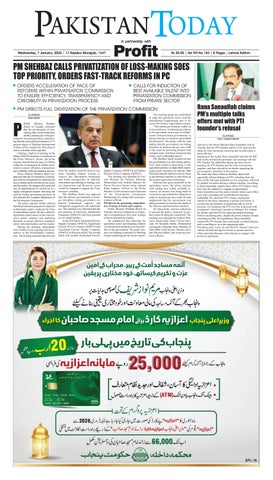
PM SHEHBAZ CALLS PRIVATIZATION OF LOSS-MAKING SOES TOP PRIORITY, ORDERS FAST-TRACK REFORMS IN PC
g
ORDERS ACCELERATION OF PACE OF REFORMS WITHIN PRIVATISATION COMMISSION TO ENSURE EFFICIENCY, TRANSPARENCY AND CREDIBILITY IN PRIVATIZATION PROCESS
P
g
g
CALLS FOR INDUCTION OF BEST AVAILABLE TALENT INTO PRIVATIZATION COMMISSION FROM PRIVATE SECTOR
PM DIRECTS FULL DIGITIZATION OF THE PRIVATIZATION COMMISSION ISLAMABAD Mian abrar
RIME Minister Shehbaz Sharif on Tuesday reiterated that the privatization of lossmaking state-owned enterprises (SOEs) remains one of the government’s foremost priorities, underscoring that the successful privatization of 75 percent shares of Pakistan International Airlines (PIA) marked the first drop of rain in a broader reform agenda. Chairing a high-level meeting on the affairs of the Privatization Commission at the Prime Minister’s House, the prime minister directed that the pace of reforms within the Commission be further accelerated to ensure efficiency, transparency and credibility in the privatization process. Prime Minister Shehbaz Sharif emphasized that the Privatization Commission must be strengthened by inducting the best available talent from the private sector and the market. He categorically instructed that all appointments be carried out in a highly transparent manner. Stressing the need for modern governance practices, he also directed the complete digitization of the Privatization Commission. The prime minister further ordered that all privatization projects be subjected to third-party audits conducted by firms of international repute. He also called for significant improvement in the Commission’s public relations and marketing functions to ensure effective communication with stakeholders and the market. During the meeting, participants were briefed on the ongoing reform initiatives in the Privatization Commission. The briefing informed that advisers
from the market would be hired in key areas including finance, human resources, law, information technology and media management. In addition, consultants specializing in strategy, policy, transactions and the power sector would be engaged to support the Commission’s mandate. PM Shehbaz Sharif was apprised that the reforms are anchored in strategic discipline, strong governance, enhanced institutional capacity, and transparent engagement with stakeholders. The meeting was informed that the privatization of electricity distribution companies (DISCOs) has been planned in two initial batches. In the first batch, Islamabad Electric Supply Company (IESCO), Gujranwala Electric Power Company (GEPCO) and Faisalabad Electric Supply Company (FESCO) will be privatized. The second batch will include Hyderabad Electric
Supply Company (HESCO) and Sukkur Electric Power Company (SEPCO). The meeting was attended by Federal Minister for Defence Khawaja Muhammad Asif, Federal Minister for Power Division Sardar Awais Ahmad Khan Leghari, Adviser to the Prime Minister on Privatization and Chairman of the Privatization Commission Muhammad Ali, along with senior government officials. PM directs for preparing comprehensive strategy to boost agri exports Prime Minister Shehbaz Sharif on Tuesday directed authorities to formulate a comprehensive five-year strategy to boost agricultural exports. He emphasized that reforming the agriculture sector and educating farmers on international standards were top priorities of the government. The prime minister was chairing a meeting of a Working Group comprising private sector experts.
The working group was established to align the agriculture sector with the international requirements and to increase the country’s agriculture exports. “The federal government, within its own jurisdiction, is undertaking reforms in the agriculture sector and, in collaboration with provincial governments, is taking measures to promote agricultural development,” the prime minister said adding that the government was taking measures to increase the per acre yield of the crops by providing farmers with standard seeds, fertilizers and pesticides timely and at affordable prices. PM Shehbaz Sharif pointed out that the government was also taking policylevel steps aimed at processing of the agriculture produce to make them exportready goods. Recently, he said the 1000 Pakistani students had been sent to China at government expenses to train them on the modern agriculture technology. Pakistan has great potential in the agriculture sector, the prime minister said, adding that, within available resources, investment was being made in research for agricultural development in order to increase per-acre yield. He also emphasized that the government was taking measures to increase the export of the fisheries and horticulture products. He directed the relevant authorities to present the policy measures to produce palm oil along the coastal belt. The meeting was attended by Federal Ministers Ahsan Iqbal, Rana Tanveer Hussain, Dr Musadik Malik, Muhammad Aurangzeb, Attaullah Tarar, Minister of State Bilal Azhar Kayani, Special Assistant Haroon Akhtar, and senior government officials.
Rana Sanaullah claims PM’s multiple talks offers met with PTI founder’s refusal ISLAMABAD
Staff CorreSpondent
Adviser to the Prime Minister Rana Sanaullah said on Tuesday that the PTI founder and his wife must strictly abide by court decisions, stressing that no individual is above the law. Speaking to the media, Rana Sanaullah said that the IHC had clearly defined the procedure for meetings with the PTI founder. He added that during the most recent meeting, the PTI founder and his wife were present together, and there should be no doubts regarding the government’s intentions in this matter. He stated that Prime Minister Shehbaz Sharif had repeatedly offered dialogue to PTI, including from the floor of the National Assembly on two occasions, followed by another invitation during a cabinet meeting. According to Rana Sanaullah, despite these offers, PTI leaders claim they lack the authority to engage in negotiations. Rana Sanaullah said the prime minister makes such offers only after consulting the establishment and party leadership. He criticised PTI’s stance, saying that whenever the party announces a protest movement, it accuses the government of proposing talks to avoid pressure. He remarked that PTI was free to proceed with its planned “wheel-jam” protest in February if it wished. He further said that PTI has again demanded meetings before considering talks, despite the prime minister already extending an offer for negotiations. Rana Sanaullah claimed the PTI founder has consistently avoided dialogue and is unwilling to sit at the negotiation table. Recalling past events, he said the PTI founder showed a similar attitude during his tenure as prime minister, often rejecting dialogue and refusing to engage with political opponents.
02 NEWS
Wednesday, 7 January, 2026 | LAHORE
FOREIGN INVESTORS PULL $393 MILLION FROM PSX DESPITE STRONG 2025 MARKET RETURNS
P g
SBP DATA SHOW EQUITY OUTFLOWS EXCEED INFLOWS IN JULY–DECEMBER FY26 AS KSE-100 RISES NEARLY 39% AMID WEAK EXTERNAL INDICATORS PROFIT
news desk
AKISTAN’S equity market posted strong gains in 2025 but failed to attract sustained foreign investment, as overseas investors recorded net outflows despite a sharp rise in share prices. Data from the State Bank of Pakistan show that foreign investors withdrew $393 million from the equity market during the first half of FY26, compared with inflows of $142 million, re-
UBL becomes Pakistan’s largest listed company with $4b market cap PROFIT
sulting in net outflows of $251 million. This trend persisted even as the benchmark KSE-100 Index rose 38.8% during July–December FY26 to close at 174,472 points on December 31, compared with 125,627 points at the start of the fiscal year. On a calendar-year basis, the index delivered an annual return of around 51%, reflecting strong participation from domestic investors. Market participants noted that local investors continued to channel funds into equities despite weak macroeconomic
Pakistan’s services exports rise 16.8% to $3.83b in July– November FY26 PROFIT
news desk
Pakistan’s exports of services increased by 16.77% during the first five months of FY26, reaching $3.833 billion in July–November, largely driven by higher earnings from information technology and telecom-related services, official data showed. Figures compiled by the Pakistan Bureau of Statistics indicate that services exports have recorded consistent year-on-year growth since the start of the fiscal year, in contrast to mixed trends in commodity exports. Growth was recorded in each month, with services exports rising 18.27% in July, 8.41% in August, 14.85% in September, 17.61% in October and 22.26% in November. In rupee terms, services exports increased by 18.42% to Rs1.081 trillion during July–November FY26, compared with Rs913.15 billion in the same period last year, reflecting steady expansion in the sector. During November alone, services exports rose to $814.25 million, up from $666.01 million a year earlier, marking a year-on-year increase of 22.26%. On a month-on-month basis, exports edged up by 0.41%. Data from the State Bank of Pakistan show that exports of telecommunications, computer and information services grew by 18.51% to $1.799 billion in the first five months of FY26, compared with $1.518 billion a year earlier. Exports of other business services increased by 24.01% to $816 million, while transport services exports rose 2.76% to $372 million. Travel services exports also increased by 9.15% to $322 million during the period. At the same time, imports of services rose by 12.78% to $5.146 billion in July–November FY26, compared with $4.563 billion in the corresponding period last year. On a monthon-month basis, however, services imports declined by 9.04%. Transport services accounted for the largest share of services imports, increasing by 6.35% to $2.093 billion, followed by travel services, which rose sharply by 54.27% to $1.487 billion.
draw foreign interest. The sale of Pakistan International Airlines attracted only a local consortium, despite incentives such as debt restructuring and the airline’s extensive international route network. Similar outcomes were observed in other privatisation initiatives. Analysts attributed foreign investors’ reluctance to pressures on Pakistan’s external accounts and trade performance. The trade deficit widened to $3.7 billion in December 2025, up 24% year-on-year and 28% monthon-month. Cumulatively, the trade gap expanded by 34.57% to $19.204 billion during
Pakistan’s National CERT, Kaspersky sign MoU to strengthen cybersecurity cooperation g
news desk
United Bank Limited (UBL) became Pakistan’s largest listed company on Tuesday after its market capitalisation reached Rs1.28 trillion, or about $4.6 billion, overtaking Oil & Gas Development Company (OGDC), which stood at Rs1.26 trillion, or about $4.53 billion. The bank’s share price surged to Rs514.49, reflecting a 37% increase from Rs375.57 recorded in early December 2025. Analysts attribute UBL’s remarkable growth to the favorable interest rate environment, which has benefitted banks in recent months. The interest rate has significantly reduced from 22% in April 2024 to 10.5% in December 2025, providing relief to financial institutions. UBL’s latest financial results show a 36% year-onyear increase in profit, with a post-tax profit of Rs34.7 billion for the first nine months of the current calendar year. The bank also announced an interim cash dividend of Rs8 per share, bringing its total payout for the year to Rs27.5 per share. UBL, a subsidiary of Bestway (Holdings) Limited, continues to lead the market, with OGDC trailing closely in terms of market capitalisation.
conditions, while foreign investors remained cautious. Analysts pointed out that the equity market’s performance has increasingly diverged from broader economic indicators, including subdued growth and rising poverty levels. Foreign investment weakness extended beyond equities. SBP data show that foreign direct investment declined by 25% during the first five months of FY26, indicating a broader hesitation among overseas investors across sectors. Privatisation efforts have also failed to
AGREEMENT FOCUSES ON THREAT INTELLIGENCE SHARING, TRAINING AND IMPROVED INCIDENT RESPONSE PROFIT
news desk
The National Computer Emergency Response Team of Pakistan and global cybersecurity firm Kaspersky have signed a memorandum of understanding aimed at strengthening Pakistan’s national cybersecurity framework through closer collaboration on threat detection and mitigation. Under the agreement, the two sides will work together to enhance cyber resilience by improving operational readiness across government, in-
dustry and academia. The partnership includes training initiatives to develop skilled cybersecurity professionals aligned with international standards, alongside timely sharing of actionable threat intelligence. Officials said the collaboration is intended to address growing cyber risks facing the country, including cyber espionage, ransomware attacks, data breaches, hacktivism and disinformation campaigns, which have expanded alongside the increased use of information and communication technologies.
As part of the MoU, the organisations will cooperate on legislative and regulatory matters, incident response mechanisms, research activities and professional exchanges. They will also share technical information and data feeds related to cyber threats affecting citizens, businesses and government institutions. The agreement is expected to support Pakistan’s efforts to improve coordination in responding to cyber incidents and strengthen its overall cybersecurity posture amid rising digital risks.
PSX rally powers ahead, KSE-100 closes above 185,000 mark g
INDEX CLOSES AT AN INCREASE OF MORE THAN 2600 POINTS FROM PREVIOUS CLOSE AS BUYING BROADENS ACROSS BANKS, ENERGY, CEMENT AND FERTILISERS PROFIT
news desk
The buying rally at the Pakistan Stock Exchange continued on Tuesday, with the benchmark KSE-100 Index crossing the 185,000 level for the first time, extending the market’s record-setting run. According to the PSX website, the market closed at 185,062.10 points, with an increase of 2,653.87 points, or 1.45%, from the previous close of 182,408.23. Widespread gains were recorded across a wide range of sectors, including automobile assemblers, cement, commercial banks, fertiliser, oil and gas exploration companies, oil marketing companies, power generation and refiner-
ies. Index-heavy stocks such as ARL, HUBCO, MARI, POL, PSO, SNGPL, SSGC, HBL, MCB, MEBL, NBP and UBL were trading in positive territory. During the intraday rally, the KSE100 Index touched the highest level of 185,254.47 at around 01:30 pm, climbing up over 2,800 points. The rally followed a strong start to the week, when the PSX opened the New Year with heavy buying led by local institutional investors, particularly mutual funds. On Monday, the benchmark index surged 3,373.31 points, or 1.88%, to close at 182,408.24. Global markets were also supportive, with Asian equities extending gains on Tuesday after Wall Street ended at record levels. In the United States, oil and finan-
cial stocks helped lift the Dow Jones Industrial Average to an all-time high. MSCI’s broadest index of Asia-Pacific shares outside Japan rose 0.4% to a record high. Japan’s Topix index jumped 1.3% to a fresh peak, while Hong Kong’s Hang Seng added 0.7%, Chinese blue chips gained 0.3% and Australia’s benchmark index rose 1%. South Korea’s KOSPI eased 0.4% after hitting record levels a day earlier. US S&P 500 futures were up 0.1% following overnight gains in the cash market, where shares of major oil companies advanced sharply. US President Donald Trump said he plans to meet executives from American oil companies later this week to discuss boosting Venezuelan oil production.
US-based Nova Minerals confirms exploratory talks with Pakistan on antimony sourcing PROFIT
news desk
Nova Minerals Limited, a US-based, NASDAQ- and ASX-listed exploration-stage company focused on gold and critical minerals, has clarified that it has held preliminary discussions with Pakistan regarding the sourcing of antimony concentrate for testing purposes, primarily to assess plant capability, and that all such discussions remain exploratory in nature. The clarification followed media reports suggesting that the company was pursuing arrangements to acquire antimony from Pakistan. In a press release, Nova Minerals Limited said it had become aware of media coverage speculating about its potential acquisition of Pakistani antimony, including a December 29, 2025 article published by the Financial Times. The article cited comments attributed to the company’s chief executive regarding a
possible purchase of more than 100 tonnes of antimony from Pakistan. Read This: FT reports US turns to Pakistan for antimony supply despite ‘limited’ reserves; experts claim otherwise. “The company wishes to clarify that, while preliminary discussions have been held in relation to sourcing antimony concentrate for testing purposes principally to assess plant capability, all discussions remain exploratory in nature,” Nova Minerals stated. Nova said it would disclose the terms of any arrangement that becomes binding and material in accordance with applicable exchange listing rules, if and when such an agreement is concluded. The company added that its primary focus in 2026 remains the completion of the feasibility study for its gold assets and the commencement of production of military-grade antimony trisulfide, supported by a recent $43.4 million award from the U.S. Department of Defence.
Last month, Pakistan-based Himalayan signed a “strategic partnership” with Nova Minerals, a company dual listed in Australia and the US, to “strengthen US-Pakistan economic ties” through exploring for antimony, FT reported. FT quoted Nova’s CEO Christopher Gerteisen as saying that his company will buy “over 100 tonnes” of Pakistani antimony concentrate for about $2 million early next year for testing and processing in Alaska. It may eventually set up “downstream processing” of the ore in Pakistan. “The Department of War encouraged us to go out in the world and find whatever we can,” he added, using the Trump administration’s preferred name for the defence department. Earlier, in September 2025, Missouri-based US Strategic Metals agreed with Pakistan’s military and political leaders to collaborate on “critical minerals essential for the defence, aerospace and technology industries”.
July–December FY26, compared with $14.271 billion in the same period last year. The current account position also weakened. During July–November FY26, Pakistan recorded a current account deficit of $812 million, reversing a surplus of $503 million in the corresponding period of the previous fiscal year. Market observers said that while equity returns remain strong, concerns over external balances, trade performance and overall economic momentum continue to weigh on foreign investor sentiment.
Startup funding in Pakistan rises to $36.6m in 2025 PROFIT
news desk
Funding for startups in Pakistan increased to $36.6 million in 2025, up from $22.5 million in 2024. However, this figure remains significantly below the record highs seen in 2021 and 2022, according to a recent report from Data Darbar. The 2025 total was spread across approximately 10 disclosed funding rounds, with several others occurring without public disclosure of the amounts. The funding environment continued to be concentrated in larger rounds, rather than being spread out across a larger number of smaller investments. The fintech sector dominated the investment landscape, securing the largest share of funding. This was highlighted by a major Pre-Series A raise and a seed round focused on digital financial infrastructure. Healthtech also saw significant activity, with a $6 million Series A round being one of the largest disclosed deals in the sector. On average, the disclosed deals in 2025 were worth around $3.7 million, a notable increase from the previous year, which signals larger funding commitments. Female-led startups accounted for around $8.8 million of the total funding, making up about one-quarter of the capital raised. While there was a positive increase in funding this year, it still falls short of the $347 million raised in 2021 and $331 million in 2022, highlighting ongoing challenges for Pakistan’s startup ecosystem in attracting capital.
AGP seeks overhaul of SOE buyer selection process PROFIT
news desk
Auditor General of Pakistan (AGP) has recommended changes to how Privatisation Commission selects buyers for privatisation of state-owned enterprises, calling for revisions in bidder pre-qualification rules. Audit officials raised issue during a Public Accounts Committee (PAC) sub-committee meeting that examined Ministry of Privatisation audit reports for FY2010-11 and FY2013-14, arguing bidder technical competence should carry more weight than immediate financial offer. An official of Public Procurement Regulatory Authority backed audit position and said technical competence should be given more weightage than financial valuation, according to meeting details. Committee also asked Privatisation Commission to review Privatisation (Modes and Procedure) Rules, 2001, saying rules need more clarity at implementation stage, while audit flagged procedural issues in past privatisations including Kot Addu Power Company, Javedan Cement, Mustehkum Cement, Faletti’s Hotel, and Pak American Fertilizer Limited. Audit said privatisation record for Javedan Cement did not include a pre-qualification process aligned with financial, operational, and technical aspects, and that only earnest money submission was used as a qualifying condition for bidding. In Mustehkum Cement case, audit cited a similar approach where bidders were directed to deposit earnest money and only a limited number qualified by due date. Privatisation Division told committee transactions were carried out under laid down rules and after approvals by relevant forums, and said past deals generated market-based revenue for government. Audit also raised issue related to Kapco privatisation, referring to an escrow arrangement and reconciliation of stores, spares and fuel stocks, and said record gaps remain on the matter.
Pakistan turns to Saudi Arabia for joint vaccine production after Indian supply disruption g
MOVE TARGETS EXPANDED PROGRAMME ON IMMUNISATION SELF-RELIANCE AS FOREIGN FUNDING ENDS BY 2030 AND ANNUAL VACCINE NEEDS RISE; A HIGH-LEVEL SAUDI DELEGATION IS EXPECTED TO VISIT PAKISTAN ON JANUARY 28 PROFIT
news desk
The federal health minister briefed the Senate Standing Committee on National Health Services that Pakistan has decided to pursue joint local production of vaccines under its Expanded Programme on Immunisation (EPI) with Saudi Arabia, after Indian manufacturers declined to supply vaccines through global partners amid recent bilateral tensions. According to media reports, a high-level Saudi delegation is expected to visit Pak-
istan on January 28 to advance discussions. Officials said Pakistan had historically sourced EPI vaccines from Indian manufacturers via international partners rather than direct government purchases. Following recent hostilities, Indian suppliers refused to sell vaccines intended for Pakistan even through third-party channels, disrupting supply chains and underscoring Pakistan’s dependence on imports. Pakistan currently procures vaccines worth about $350–400 million annually. Around 51% is financed domestically, while the remainder is covered by development
partners, including Gavi, the Gates Foundation, UNICEF, the World Health Organisation and Rotary International. This external support is expected to end by 2030, after which Pakistan will need to fully finance its immunisation programme. Officials told the committee that as international funding phases out, Pakistan’s vaccine bill could rise to an estimated $1.2 billion annually, making continued reliance on imports financially and strategically difficult. To address this, the government has moved toward local vaccine production. A National Vaccine Policy has been submitted
to the prime minister, proposing the creation of a National Vaccine Alliance to develop domestic manufacturing capacity through public-private partnerships. Pakistan explored potential collaborations with several countries, including China and Indonesia, before opting to work with Saudi Arabia, which has been developing its own vaccine manufacturing capabilities for nearly a decade. Talks are described as advanced, with the upcoming visit expected to focus on timelines, investment structures and regulatory pathways. The proposed approach would begin with packaging and fin-
ishing, before moving toward full-scale manufacturing. Pakistan requires about 140 million EPI doses annually, but officials noted that financial viability typically requires production volumes of around 400 million doses per year, making joint or regional production models necessary. Members of the Senate committee welcomed the initiative, calling it an important step to protect Pakistan’s immunisation programme from geopolitical disruptions, and assured the ministry of legislative support. The meeting also reviewed other healthrelated matters, including proposed legislative amendments, medicine prices, regulation of electronic nicotine delivery systems and administrative issues at the Pakistan Institute of Medical Sciences.
NEWS 03
ADB URGES TAX REFORMS, SIMPLER COMPLIANCE TO UNLOCK FINTECH GROWTH IN PAKISTAN
Wednesday, 7 January, 2026 | LAHORE
A
PROFIT
g
news desk
SIAN Development Bank has said that clearer tax laws, lower rates, and simplified compliance are essential for Pakistan to emerge as a regional fintech leader, warning that tax complexity remains a major bottleneck for the sector’s growth. In its latest report, Unlocking the Potential of Fintech in Central Asia, the ADB said Pakistan has significant scope to use fintech to expand financial inclusion and support economic growth, but progress will depend on addressing fiscal constraints alongside regulatory and capacity challenges. The report recommended reforms to
REPORT CALLS FOR CLEARER TAX LAWS, LOWER RATES AND COORDINATED REGULATION TO BOOST FINANCIAL INCLUSION
make the tax system more fintech-friendly, including clearer tax obligations, targeted tax reductions, and streamlined compliance procedures such as online filing. It also highlighted the need to improve tax awareness through training programmes, incubators, and academic institutions to strengthen compliance within the fintech ecosystem. The ADB stressed that closer coordination among the Federal Board of Revenue, the State Bank of Pakistan, and the Securities and Exchange Commission of Pakistan would be critical to ensure consistency in
Privatisation drive advances as sell-side due diligence begins for Pakistan’s five power distributors
policy and regulation. Beyond taxation, the report called for an adaptive regulatory framework tailored specifically to fintech firms. It recommended fintech-specific licensing categories that reflect different business models and risk profiles, along with proportional licensing fees to lower entry barriers for start-ups while supporting competition and innovation. A collaborative regulatory approach was identified as another priority, with the ADB urging stronger coordination and informa-
tion-sharing among regulators to avoid overlaps, close regulatory gaps, and support innovation, while also facilitating regional cooperation. On financial inclusion, the report said Pakistan should streamline licensing for innovative products and provide regulatory guidance and technical support to fintech firms. Grants, funding mechanisms, and structured capacity-building programmes were highlighted as tools to accelerate innovation and expand access to finance. The ADB noted that Pakistan trails several regional peers on key fintech indicators and warned that internal capacity constraints could continue to slow progress. It recommended investments in education and skills, including fintech-focused academic courses,
Pakistan’s total contingent liabilities from public-private partnership projects exceed Rs472b, Sindh accounts for over 70% g
FINANCE MINISTRY FLAGS RISING FISCAL RISKS FROM PPP PROJECTS UNDER IMF-LINKED MONITORING FRAMEWORK PROFIT
news desk
PROFIT
news desk
Pakistan has stepped up preparations to privatise five state-owned power distribution companies, with financial advisers commencing sell-side due diligence in line with commitments under the International Monetary Fund programme, The News reported. The Power Division is simultaneously working to complete the condition precedents required for the privatisation of Islamabad Electric Supply Company (Iesco), Faisalabad Electric Supply Company (Fesco), Gujranwala Electric Power Company (Gepco), Hyderabad Electric Supply Company (Hesco) and Sukkur Electric Power Company (Sepco). A Financial Advisory Services Agreement for the privatisation of Iesco, Fesco and Gepco was signed on February 11, 2025, with a consortium led by Alvarez & Marsal Middle East Limited, enabling detailed due diligence and transaction structuring to proceed. Separately, the government signed a Financial Advisory Services Agreement with Raiffeisen Investment Finansal Danismanlik Hizmetleri Limited Sirketi on November 27, 2025, for the privatisation of Hesco and Sepco. Two utilities, Quetta Electric Supply Company and Tribal Areas Electric Supply Company, have been excluded from the current phase of privatisation due to security concerns and structural constraints, the documents noted. Power sector reform remains a core component of Pakistan’s IMF-supported programme, which aims to restructure state-owned enterprises, strengthen governance and reduce fiscal pressures. The World Bank has also linked future energy-sector financing to measurable progress on reforms, increasing pressure on the government to deliver on its commitments
Pakistan’s total contingent liabilities arising from public-private partnership (PPP) projects exceeded Rs472 billion by the end of December 2025, with Sindh accounting for more than 70% of the exposure, the Ministry of Finance’s Debt Management Office revealed in its first-ever Fiscal Risk Monitoring Framework for Contingent Liabilities of PPP Projects. The framework was developed in line with commitments made under the International Monetary Fund (IMF) programme. Sindh emerged as the largest contributor, with contingent liabilities amounting to Rs335.6 billion, or over 71% of the national total. The province also has the largest PPP portfolio, with 17 projects out of the 36 qualifying PPP projects nationwide. The federal government’s contin-
gent liabilities stood at Rs90.6 billion, representing 19.3% of the total, followed by Punjab at Rs26.5 billion (5.6%) and Khyber Pakhtunkhwa at Rs19.6 billion (4.2%). Balochistan reported no contingent liabilities, although it has five PPP projects included in the national portfolio. According to the report, Rs368.3 billion of the total exposure relates to contingent fiscal obligations that could arise from cost escalation, minimum revenue guarantees, interest rate fluctuations, or termination liabilities. An additional Rs104 billion has been classified as financial guarantees. Sindh’s exposure is largely driven by cost escalation and minimum revenue guarantees. The province’s contingent liabilities from cost escalation alone were estimated at Rs146.6 billion, followed by Rs61 billion in minimum revenue guarantees and significant termination-related obliga-
tions. These are in addition to around Rs80 billion in financial guarantees. For the federal government, PPPrelated liabilities included Rs83.7 billion in termination liabilities and Rs7 billion in financial guarantees. Financial guarantees typically cover commitments such as viability gap funding and other agreed public sector support. The framework also assessed the likelihood of contingent liabilities materialising, flagging a high risk for cost escalation and termination liabilities of around Rs150 billion each, Rs104 billion linked to financial guarantees, and approximately Rs66 billion tied to minimum revenue guarantees, largely driven by Sindh. The Finance Ministry said the framework was introduced to establish a consistent system for identifying, quantifying, and reporting fiscal risks associated with PPP projects at both federal and provincial levels. PPP contracts can create obligations that do not immediately appear in budget or debt figures but may later materialise through guarantee calls, indexation adjustments, or termination payments.
SECP registers 21,668 new companies in first half of the financial year PROFIT
news desk
Securities and Exchange Commission of Pakistan (SECP) said it registered 21,668 new companies in the first six months of the current financial year, compared with 16,839 incorporations in the same period last year, taking the total number of registered companies to 279,724. SECP said the newly incorporated companies brought paid-up capital of Rs30.7 billion during the period, re-
flecting a 29% increase from the previous year. Incorporations were led by IT and ecommerce with 4,277 new companies, followed by trading with 2,997, services with 2,686, and real estate development and construction with 2,031, according to the regulator’s sector-wise data. SECP said the top 10 sectors together accounted for a large share of new registrations during the half-year, with the distribution indicating continued activity across technology, services, and trading-linked segments.
On foreign participation, SECP said 524 newly incorporated companies received foreign investment of Rs1.26 billion during the period, with 731 foreign investors taking part. China was the largest source of foreign inflows, accounting for 71% of the total, followed by Afghanistan at 8% and the United States at 2%, while the United Kingdom, Germany, South Africa, South Korea, Norway, Vietnam, Nigeria, and Bangladesh each contributed 1%. The remaining 11% came from other countries, SECP said.
Govt housing finance scheme sees muted uptake as Rs3.5m loan cap falls short of market prices PROFIT
news desk
Commercial banks have reported a weak response to the government’s recently relaunched housing finance scheme, citing a mismatch between the maximum loan size on offer and prevailing property prices, particularly in major cities. According to a news report, to address Pakistan’s growing housing shortage, the government allocated a subsidy of Rs5 billion for the current fiscal year, following which the State Bank of Pakistan (SBP) introduced a subsidised housing finance scheme. The scheme allows financing of up to Rs3.5 million for the purchase of
houses and plots, as well as for construction and renovation. However, market participants say the cap is well below actual housing prices in cities such as Karachi, Lahore, and Islamabad, limiting its appeal to prospective buyers. Banking, real estate, and construction sector experts said that even small apartments in large urban centres are priced significantly higher than the scheme’s ceiling, resulting in low uptake and undermining the programme’s objective of promoting home ownership and stimulating construction activity. Industry stakeholders have urged the government and the central bank to revisit the scheme’s structure and align financing
limits with market realities, particularly for middle-income households. They have also called for broader reforms to revive the construction sector, which supports employment and several allied industries. According to the World Population Review, Pakistan’s housing affordability index has declined to 0.4 from 0.5, reflecting reduced affordability amid rising property prices, higher borrowing costs, and a persistent housing shortage. The index places Pakistan below regional peers, with Bangladesh at 0.7 and India at 0.8. Market participants argue that without a substantial increase in the financing limit, the scheme is unlikely to gain traction. They point to the earlier subsidised
housing finance programme launched in October 2020, under which banks received applications worth Rs514 billion within 18 months. That scheme allowed loans of up to Rs10 million at subsidised markup rates with repayment tenures of up to 20 years, and was credited with boosting construction activity and formal mortgage penetration. The earlier programme was discontinued due to fiscal constraints and rising policy rates. When the current government revived the initiative in September 2025, it did so with a significantly lower loan cap, which analysts say has reduced its effectiveness in addressing Pakistan’s expanding housing deficit.
improved digital literacy, specialised training for policymakers, and stronger research and development collaboration. Open data governance and institutional strengthening were also identified as important for accountability and long-term growth. The report further emphasised the need to deepen regional cooperation within the CAREC region through investor meetings, conferences, and joint initiatives, particularly to extend digital financial services to underserved and remote populations. While acknowledging some progress, the ADB said sustained reforms, technical assistance, and closer regional collaboration would be necessary for Pakistan to close the fintech gap and fully realise the sector’s potential.
Treet Corp delays Genesis, Estela personal care brands launch to after first week of Ramadan PROFIT
news desk
Treet Corporation Limited has rescheduled the launch timeline for its personal care brands Genesis and Estela, which had been planned for January 1, 2026. In a notice to the Pakistan Stock Exchange (PSX) on Tuesday, the company said that its management decided to move the timeline to align the introduction of brands with a more suitable market window. “The Company wishes to inform its shareholders and the market that management has decided to reschedule the launch timeline to align the introduction of the brands with a more suitable market window,” read Treet Corporation’s notice. The company said it now intends to proceed with a simultaneous nationwide launch of Genesis and Estela after the first week of Ramadan, adding that other aspects of previously disclosed material information remain unchanged. Treet Corporation Limited was incorporated on January 22, 1977, as a Public Limited Company under the Companies Act 1913 (now Companies Act, 2017). The principal activity of the Company is to manufacture and sell razors and razor blades, along with other trading activities.
Sui Southern Gas Company appoints Asif Inam as board chairman PROFIT
news desk
Sui Southern Gas Company Limited (SSGCL) has appointed Asif Inam as chairman of its board of directors with effect from January 5, 2026, according to a notice submitted to the Pakistan Stock Exchange on Tuesday. The company informed the exchange that the appointment has been made in compliance with applicable listing regulations and requested dissemination of the information to TRE Certificate Holders. According to information available on the company’s website, Asif Inam is a Pakistani businessman and industrialist with longstanding involvement in the textile sector. He has extensive international exposure, having travelled across the United States, United Kingdom, European Union, Canada, Middle East and Far East. Inam is regarded as a subject-matter specialist in cotton and textiles, with experience spanning research, production and trade across cotton varieties. He is also familiar with national energy-related challenges, particularly those affecting energy-intensive industries, including textiles, and his views on economic, trade and industrial matters are frequently cited in national media.
Govt to impose penalties, suspend import licences over non-compliance with localisation targets under new mobile policy PROFIT
news desk
The federal government has decided to withdraw incentives and impose penalties on mobile and electronics manufacturers in cases of non-compliance with localisation targets, reporting requirements and operational obligations under the proposed Mobile and Electronic Device Manufacturing Policy. The decision was taken during a high-level meeting chaired by Special Assistant to the Prime Minister on Industries and Production Haroon Akhtar Khan on Monday, where officials reviewed progress on the policy and agreed on strict enforcement mechanisms, including suspension of import licences and financial penalties for violations. The policy framework aims to shift Pakistan’s electronics sector from assembly-based operations toward deeper
localisation and export-oriented manufacturing, with compliance linked to continued access to incentives. The meeting was attended by Secretary Industries and Production Saif Anjum, Engineering Development Board (EDB) Chief Executive Hammad Mansoor, and representatives of mobile phone manufacturers. A detailed presentation outlined the transition from complete imports to phased local manufacturing, focusing on employment generation and industrial capacity building. Under the policy framework, mandatory export targets have been ruled out, with officials noting that forced export benchmarks have proven counterproductive in other sectors, including automobiles. Instead, export performance will be encouraged through fiscal instruments, with export outcomes proposed to be linked directly to Tax Increment Financing (TIF). Quality certification has been made
mandatory for exports, though officials clarified that compliance will not be enforced coercively. The government plans to establish local testing and certification laboratories to support exporters in meeting international standards. The policy also introduces defined performance benchmarks for localisation. The EDB has been tasked with specifying minimum component thresholds, including at least 40 parts per semiknocked-down (SKD) kit for smartphones and 15 parts per SKD kit for feature phones. Penalties will apply in cases of underperformance against these benchmarks. To address valuation and under-invoicing risks, officials agreed that valuation rulings will be institutionalised with joint participation from the EDB, the Pakistan Mobile Phone Manufacturers Association and the Customs valuation directorate. In addition, both completely built units (CBU) and locally
manufactured mobile phones are proposed to be placed under the Third Schedule of the sales tax regime to curb misdeclaration. The policy also sets a minimum tariff gap of 30% between CBU and SKD imports to protect local manufacturing, while a Tax Increment Financing levy may be applied on both CBU and SKD imports. Officials noted that e-waste management remains a complex area and will be addressed through a separate, structured framework. Manufacturers informed the meeting that global brands including Samsung, Xiaomi, Oppo, Vivo and Nokia have shown interest in expanding manufacturing operations in Pakistan under the new policy. Officials said the policy will be presented to the prime minister after final alignment with stakeholders, with implementation focused on compliancedriven incentives, localisation discipline and export-linked growth.
04 COMMENT
Still disconnected from realities
Wednesday, 7 January, 2026
Saving textiles
A
The government will have to step in
fter a report looking at the problems affecting the textile industry, this newspaper’s Profit magazine details the solutions proposed by those involved in the supply chain, ranging from growers to manufacturers to exporters. these solutions to the various problems are not particularly difficult, and require only a certain level of attention from the government. However, the government must also realize that its job is to assist the industry by facilitating it, and must not get in the business of subsidising it. It is a little facile to dismiss textiles as ‘over’, though it may seem that way, but the government should realise that it is unlikely to get much more out of textiles. It is unlikely to show any extraordinary growth, but is likely to continue to exist, simply because people need to be clothed, and use bedsheets, towels and all sorts of textile goods. It should be remembered that textiles begin with growing cotton, and that is where the tale of neglect begins. Not only do new varieties of drug-resistant seed need to be developed (or imported for immediate use), but farmers now turning from cotton to sugarcane must be made to come back. It is not that the conversion is natural; it is the result of many incentives, large and small, which ensure that sugarcane simply makes more sense. then the manufacturers, whether spinners, weavers or makers, must be guaranteed electricity at a price that is comparable with competing countries like Bangladesh and Vietnam. In turn, manufacturers must engage in seeking value addition and trying to export finished goods as far as possible. A tried and tested method has not been fully exploited in textiles, which has been to use production for the domestic market as the basis for the export market, based on the assumption that the domestic customer is more discerning and more costconscious, than the foreign. Apart from power, the government also controls taxation, and it must convert its attitude from that of a racketeer getting in on the action and gouging out his share to one of a careful shepherd who takes care of his animals while he exploits them for food and clothing. this indeed involves the government deciding if the textile industry has reached a point where it will not grow further. even then, it involves the livelihoods of too many people along the supply chain to be ignored, but this will determine if the government wishes to devote resources to its rescue.
A
US press coverage of Gaza
WaSHINGToN WaTCH Dr JameS J ZoGby
fter more than two years of Israel’s assault on Gaza, one might think that there would be appreciable improvement in the way the Israeli/Palestinian issue is understood and presented. But US press treatment of last week’s meeting between President Donald trump and Israeli Prime Minister Benjamin Netanyahu made it clear we still have a long way to go. to be sure, in recent months we’ve seen increased coverage of the suffering of Palestinians, focusing on individual stories of the trauma Israel has inflicted on hundreds of thousands who’ve lost family members, homes, and so much more. In fact, in the past week, there have been a number of such accounts including long-form pieces on: malnutrition in Gaza, tens of thousands of homeless Palestinians enduring cold winter rains, Jewish settler terrorist raids on West Bank villages, and even a pictorial on the enduring hope to return expressed by Palestinian refugees living in several Arab countries. this sensitivity to Palestinian humanity is new and important. even during much of the two-year long Israeli assault, Palestinians received short shrift. While tens of thousands of Palestinians were being slaughtered, most US reporting struggled to maintain a “balance” by allowing official Israeli sources to dissemble or obfuscate. for example, after bombing a hospital or an apartment building killing scores of Palestinian civilians, the Israelis would suggest that those killed were actually Hamas operatives, or were innocents being used as shields by Hamas, or that the body counts were inflated, or that reports were premature and should await the results of an Israeli investigation (which, invariably, would never be forthcoming). Operating out of this same playbook day after day, the Israelis created sufficient distraction to carry them through to the next outrage. their arguments that “we wouldn’t do anything like that” or “our enemies lie and are trying to harm us,” or “Hamas started this war and are responsible for everything that has happened since October 7,” worked well enough to hold their supporters in check and shield them from official condemnation or sanctions. Pro-Israel advocates in Congress and media analysts latched onto these arguments not only to defend Israel from charges of war crimes, but also to accuse the countries, groups, or individuals making the charges of engaging in antisemitism. After many months, this only began to change well into the war’s second year. Stories began to appear in which Palestinians were treated as victims. Importantly, many of these pieces focused on individuals or families, allowing Palestinians to be seen in their full humanity, and not simply as a number or part of
Dedicated to the legacy of late Hameed Nizami
Arif Nizami (Late) Founding Editor
an anonymous mass. this is where we are today. After a century of being reduced to a problem to be solved or an obstacle to Israel’s security, individual Palestinian stories are now being told and the Palestinian side of the equation is being humanized. Nevertheless, significant problems remain in how the media covers Israeli/Palestinian issues. for example, too often stories about tragedies inflicted on innocent Palestinian are written in the passive voice, with Palestinian children dying from hypothermia, hunger, or lack of medical treatment, as if these were natural occurrences. In this construction, no one is deemed responsible for creating Palestinian homelessness, the lack of food, the destruction of hospitals or refusal to allow the entry of adequate medical supplies. A second problem in US media coverage of Israel/Palestine is the disconnect between what we know Israel is doing to Palestinians and what is being done to address it. this was in evidence in the treatment given to the Netanyahu/trump meeting in Mara-Lago, much of which was, at best, delusional. the pre-summit coverage in The Washington Post and The New York Times was clear about what Israel is doing with recent articles on: Israel’s continuing attacks on Palestinians in Gaza (over 400 killed since the “ceasefire”); refusal to accelerate food, shel-
Babar Nizami Editor Profit
The solution is not what is being done
T
Noor Zafar
He news reports about Nicolás Maduro being apprehended by US authorities, whether ultimately confirmed, contested, or politicized, took me back instantly to 2019. Not to headlines or sanctions lists, but to a classroom where, as part of a rigorous academic exercise, different student groups were each assigned a country facing mass human rights violations. My group was assigned Venezuela, and with that assignment came the responsibility to grapple seriously with one of the most complex political and humanitarian crises of our time. that year, in my course Accountability for Gross Violations of Human rights, Venezuela became more than a case study. We were tasked with negotiating a political and legal settlement as if the stakes were real, because for millions of Venezuelans, they were. I represented the opposition alongside an extraordinary group of peers shaped by Latin America, europe, and the international human rights system itself. Carlos Marcos Cremadas from Spain brought the precision of someone working within the United Nations and a shared grounding in international human rights law. Carlo Novero, an exchange student from Italy, added a comparative perspective. Leslie Mendez, my batchmate, a fierce and principled voice from Belize, reminded us constantly that courage and compassion are not mutually exclusive. Across the table sat the interim government, represented by three remarkable women. Mariana Brocca of Argentina and Nancy Bautista of Mexico were my LLM batchmates, and María José Daza was then studying international peace studies at Notre Dame’s Keough School of Global Affairs. their clarity and restraint helped me understand Venezuela not as a binary conflict, but as a layered crisis of institutions, legitimacy, and human suffering. We also sought guidance from Bernardo, an SJD student from Venezuela, whose lived knowledge grounded our abstractions. He did not need to dramatize the situation. reality did that on its own. What distinguished our Venezuela negoti-
ations was not just what we discussed, but how we engaged. While some groups assigned to other countries approached their negotiations with visible tension and, at times, open confrontation, our group chose a different path. We negotiated peacefully. We listened. We drafted. the result was an Agreement for Democracy and National reconciliation in Venezuela, symbolically concluded in Montevideo, Uruguay, a neutral space far from coercion or spectacle. the agreement reflected a belief that accountability and peace are not opposites, but sequential necessities. We proposed a National Unity Government with equal representation, ensuring continuity of governance while preventing exclusion. We insisted on free and fair elections with guarantees for both winners and losers, recognizing that democracy cannot survive if defeat equals political death. We reimagined the Supreme tribunal of Justice, breaking institutional capture through balanced appointments. We called for depoliticization of the armed forces, an often overlooked prerequisite for civilian rule. Crucially, we rejected vengeance masquerading as justice. Instead, we proposed an Ad Hoc Criminal tribunal, Venezuelan in composition and supported by the United Nations, focused on those most responsible for crimes since 2014 and grounded in truth telling and reparations rather than extradition or punitive excess. Alongside it, a truth Commission would examine the economic and political roots of the crisis, acknowledging that collapse does not emerge in a vacuum. We demanded the release of political prisoners, the entry of humanitarian aid through neutral actors such as the International Committee of the red Cross, and the lifting of economic sanctions, not as concessions to power, but as
Editor’s mail
Send your letters to: Letters to Editor, Pakistan today, 4-Shaarey Fatima Jinnah, Lahore, Pakistan. E-mail: letters@pakistantoday.com.pk Letters should be addressed to Pakistan today exclusively
obligations to people. We envisioned a comprehensive reparations framework, including youth employment, restitution of expropriated property, and pathways for migrants and refugees to return home with dignity. Looking back now, amid renewed talk of arrests, indictments, and foreign enforcement, that exercise feels less academic than prophetic. International law is clear on one point that is often conveniently forgotten. State sovereignty matters. Not because governments are beyond reproach, but because the violation of sovereignty through unilateral coercion, regime engineering, or selective enforcement rarely produces justice. It produces precedent, and precedent, once set, rarely stops where its authors intend. Our Venezuela negotiations underscored a harder, less glamorous truth. Durable accountability must be negotiated within the state, supported but not supplanted by the international community. Neutral mediation conducted in a neutral country allows parties to preserve dignity, protect civilians, and maintain the possibility of future coexistence. Without that, even victory becomes unstable. that project reaffirmed for me the enduring relevance of peaceful dispute resolution, not as idealism, but as pragmatism rooted in human rights. Violence hardens positions. Humiliation entrenches resentment. Dialogue, however slow and imperfect, creates ownership. As headlines continue to shift and power changes hands, or claims to, my memory returns not to the spectacle of enforcement, but to a classroom where students assigned different countries chose to take their responsibilities seriously. In our case, Venezuela was not a theoretical problem to be solved, but a reminder that peace does not announce itself with sirens. It begins quietly, often in rooms where people decide to listen. The writer is a lawyer (L.L.B LUMS, L.L.M. Notre Dame Law School) practising in Multan
As headlines continue to shift and power changes hands, or claims to, my memory returns not to the spectacle of enforcement, but to a classroom where students assigned different countries chose to take their responsibilities seriously. In our case, Venezuela was not a theoretical problem to be solved, but a reminder that peace does not announce itself with sirens. It begins quietly, often in rooms where people decide to listen.
Lahore – Ph: 042-36300938, 042-36375965
I
Karachi – Ph: 021-32640318 I
The writer is President, Arab American Institute
Given the articles both papers have recently run detailing what Palestinians are enduring and IsraelisÊ clearly declared intentions in Gaza and the West Bank, they must know that their coverage and analysis of the Mar-a-Lago summit did not reflect reality.
Beyond arrests: Remembering a negotiated vision for Venezuela M. A. Niazi
Editor Pakistan Today
ter, and medical supplies into the area; plans by trump officials to begin “reconstruction” in the Gaza area under Israel’s control; and Israel’s rejection of any role for the Palestinian Authority in Gaza. the logical conclusions from these Israeli actions are that there’s no real ceasefire and that continued haggling about the “plan’s” still-undefined terms is merely a distraction. Meanwhile Israel creates “established facts” in the half of Gaza they control, while making life impossible for Palestinians in the remaining half. But The New York Times and The Washington Post did not cover the trump/Netanyahu summit this way. Instead, both outlets presented the meeting as an opportunity for the two leaders to project unity and “express their deep appreciation” for each other. the papers noted rumours of rifts between the men and concern that division would stall or set back implementation of the “fragile” (their word) Gaza ceasefire and peace plan. Given the articles both papers have recently run detailing what Palestinians are enduring and Israelis’ clearly declared intentions in Gaza and the West Bank, they must know that their coverage and analysis of the Mar-a-Lago summit did not reflect reality. It also provides both leaders the opportunity to stall, allowing them to pursue their own agendas in Gaza, while ignoring the continued unbearable suffering being imposed on innocent Palestinians.
Islamabad – Ph: 051-2204545
I
On the brink
It is quite clear that the main opposition party in Pakistan is currently passing through one of the most critical and challenging phases of its political journey. the incarcerated leader has been behind the bars on corruption charges. He is still facing cases in which hearings and bail petitions often remain pending for months. restrictions on meetings and the exchange of harsh statements have further intensified political and institutional tensions in the country. His sister’s recent media talks, including the ones with some Indian news channels, followed by a stern and charged press conference by the army spokesperson, clearly reflect the widening gulf between the state and the party. In such an atmosphere, bitter exchanges and avoidable allegations not only damage national unity, but also negatively impact Pakistan’s international image. the party’s social media networks, their irresponsible narratives, and the rather provocative interpretations by certain partisan journalists and Youtubers are further complicating the situation, putting both the party’s internal discipline and its political future at risk. At this juncture, Pakistan clearly needs reconciliation more than confrontation. responsible elements within the party leadership must step forward and open the door for dialogue with state institutions to prevent the political system from descending into further turmoil. HAYAN AHMED KHAN ISLAMABAD
Distracted, not slow
SLOW-MOVING cars are a new nuisance on the roads of Lahore, creating an uncertain situation for the other vehicles commuting on the road. Using mobile phones while driving is supposed to be a violation, but careless drivers use social media and watch reels and videos while driving. they are totally unaware of traffic lanes and the speed of their vehicles. traffic police need to seriously monitor this issue. there should be zero tolerance on usage of phones while driving cars as this can lead to serious accidents and loss of lives. DR MAJID RAUF AHMAD LAHORE
When school runs long
tHe Punjab government has prescribed teaching hours for all schools in the province from 8.30am to 1.30pm. However, some private schools have set their timings from 8.30am to 2.40pm. Children who travel 20-25km to their school have to leave home early and wake up earlier to get ready. Closure at 2.40pm means it takes them an additional two hours to reach their homes because the roads are heavily congested at that time. When will they get to rest and complete their homework? Such schools must follow the timings prescribed by the government. MUHAMMAD NAEEM MIRZA LAHORE
Waiting in vain
tHOUSANDS of vehicle-owners have been waiting to get the new number plates for the last many months. In several cases, the number plates were shown online as ‘printed’ on Nov 5, but even after multiple visits to the office, the applicants have not received them. Besides the delay in receiving the new number plates, the staff remains uncooperative while dealing with the applicants. Moreover, the distribution timings are also severely limited, making it extremely inconvenient for working individuals to have multiple visits for the purpose. As a result, people are forced to drive without proper number plates, increasing the risk of fines and legal complications. MUHAMMAD ANWAR UL HAQUE KARACHI
Web: www.pakistantoday.com.pk
I
Email: editorial@pakistantoday.com.pk
COMMENT 05
2035 and the new World order
Wednesday, 7 January, 2026
T
The context of Maduro’s capture
azhar dogar
He images real or imagined are arresting, a superpower reaching deep into a resource rich state, neutralizing an entrenched strongman and reminding the world that hard power still matters. the USA referenced the Monroe Doctrine dating back to 1823 for capture of Venezuela’s strongman nicolas Maduro. In recent months, speculation and heated debate about Washington’s leverage over Venezuela’s embattled leadership have resurfaced a larger truth about the international system. the era of American dominance is not ending because power has vanished. It is ending because power is fragmenting. Almost ten years from now, the world of 2035 will not be defined by a single hegemon, nor by the comforting illusion that globalization has made geopolitics obsolete. It will be shaped instead by rivalry over energy, minerals, data, artificial intelligence demographics, climate resilience and even rivalries in space. the transition away from a unipolar order is already underway, and history suggests that such moments are rarely smooth. Since the end of the Cold War, the USA has stood at the centre of a unipolar world. Its military reach, financial system, technological leadership and alliance networks were unparalleled. from the Gulf War to the global financial system anchored by the dollar, US primacy structured international life. Yet history is unforgiving to permanence. the British empire once seemed invincible, its navy policing global trade routes, its currency anchoring markets. Within decades, war, debt and demographic decline reshaped its role. the roman em-
pire, too, discovered that dominance can erode slowly through overextension, internal division and the rise of capable rivals before seemingly collapsing suddenly. the USA today is not rome in decay, but it is a power confronting limits. Its ability to project force remains formidable, but legitimacy, cohesion and uncontested influence have weakened. Allies hedge. rivals test boundaries. And the costs of sustaining global order increasingly fall on a polarized domestic polity. energy has always been central to world order. Control of oil shaped the 20th century, from Churchill’s decision to convert the British navy to oil, to America’s postwar security architecture in the Middle east. today, energy leverage remains potent whether through sanctions, supply manipulation or strategic access. Venezuela, with the world’s largest proven oil reserves, sits at the intersection of energy scarcity and political instability. Any credible demonstration of external power over such resources whether real or rumored signals something deeper, that as energy transitions accelerate unevenly, fossil fuels will still be fought over, not abandoned at least for now. At the same time, the new energy economy is birthing new chokepoints. Lithium in Chile and Bolivia, cobalt in the Congo, rare earths in China; these are the oil fields of the future. As in the past, states will compete to secure supply chains critical to their economic and military futures. no discussion of 2035 is complete without China. Its rise is not merely economic, it is civilizational. With a population four times that of the USA, a long historical memory and a state capable of strategic planning, China is reshaping global balances. Beijing’s ambitions in technology, infrastructure, space and military power signal not just a challenge to US dominance, but an alternative model of governance and development. the Belt and road Initiative, investments in artificial intelligence, and advances
The world of 2035 is being shaped now, by choices made in Washington, Beijing, Brussels and beyond. Whether it becomes an age of managed competition or cascading conflict will depend less on technology than on wisdom. History is watching.
Intelligence agencies’ reform is a national priority
G
They need protection from misuse and a clearly codified mandate THE DAILY STAR Editorial
IVen our past experiences, intelligence agencies, including the Directorate General of forces Intelligence (DGfI) and the national Security Intelligence (nSI), need urgent reform as recommended by the Commission of Inquiry on enforced Disappearances, which demands the immediate attention of both the interim government and political actors vying for power in the forthcoming election. the assessment by the commission’s chief, Justice Moyeenul Islam Chowdhury, requires urgent consideration. for decades, successive governments—both elected and militarybacked—have misused intelligence agencies to meddle in politics, directly and indirectly. this abuse reached unprecedented levels during the previous Sheikh Hasina regime. Intelligence agencies were allegedly tasked with fragmenting opposition parties, bribing compromised politicians to form splinter groups, controlling the media, and intimidating or eliminating prominent dissenting voices. Such practices have hollowed out democratic institutions and eroded public trust in the state. It is therefore imperative that the mandates of these agencies be clearly codified to prevent their involvement in political affairs on behalf of any ruling party. this must include explicit prohibitions against political use of intelligence agencies. equally important is providing legal protection for intelligence bodies and officials who refuse to carry out unlawful orders, shielding them from retaliation or punitive measures for upholding the law. the commission’s recommendation against the routine engagement of armed forces in policing duties must also be heeded. the armed forces should be deployed only under extraordinary circumstances, such as when national security is genuinely at risk. the practice of
seconding military personnel to civilian law enforcement bodies— most notably the rapid Action Battalion (rab)—has proven deeply problematic. the commission’s finding that rab accounts for 25 percent of enforced disappearances lends strong support to longstanding demands from both national and international human rights advocates for the force to be disbanded. the commission has also rightly highlighted the widespread misuse of the Anti-terrorism Act, 2009, recommending its fundamental overhaul or outright abolition. We commend its progressive approach to counterterrorism, including proposals for community-based preventive strategies, mandatory human rights training for law enforcement agencies, and the establishment of a victim-centred justice framework. We share the commission chief’s view that the country requires an intelligence apparatus, but one that operates within a robust legal and ethical framework. Comprehensive organisational reforms, coupled with strong legislative safeguards, are essential to ensure accountability and to provide legal cover for officials who resist unlawful political directives. We also fully endorse the commission’s call for enacting the enforced Disappearance Prevention and redress Ordinance, 2025, and for amending the national Human rights Commission Ordinance, 2025, to prevent the recurrence of such grave abuses. the interim government must seriously consider these recommendations in full and initiate the reform process without delay by introducing the necessary ordinances. At the same time, all political parties must unequivocally commit themselves to implementing these reforms. Without such collective resolve, the cycle of abuse will persist, undermining democracy, the rule of law, and fundamental human rights. We want highly efficient intelligence agencies guided and protected by law, and not one that can be politically misused by the ruling party of the day.
in hypersonic weapons and space capabilities all point to a future where power is more distributed and more contested. History offers a cautionary tale. thucydides, the Athenian general and author of History of the Peloponnesian War, famously argued that war becomes likely when a rising power threatens to displace a ruling one. Avoiding that fate will require restraint and imagination on both sides, qualities not always abundant in great powers. If oil shaped the 20th century, data and algorithms will define the 21st. Artificial intelligence is already transforming warfare, surveillance and economic competition. Autonomous weapons, cyber operations and information warfare blur the line between peace and conflict. Space, once the domain of scientific cooperation, is becoming militarized. Satellites underpin communications, navigation and financial systems. their vulnerability creates incentives for preemptive strikes in orbit, a scenario that strategists increasingly consider plausible. Wars in the coming decade may not resemble the trenches of World War I or even the shock and awe campaigns of the 1990s. they may unfold invisibly, through disrupted supply chains, crippled power grids or contested orbits above the earth. Climate change is not just an environmental crisis, it is a geopolitical accelerant. rising temperatures, water scarcity and extreme weather will displace millions and strain fragile states. History shows that resource scarcity often precedes conflict, from ancient Mesopotamia’s water disputes to modern tensions over the nile and Indus rivers.
No discussion of 2035 is complete without China. Its rise is not merely economic, it is civilizational. With a population four times that of the USA, a long historical memory and a state capable of strategic planning, China is reshaping global balances. Demographics add another layer of instability. Aging societies in europe, Japan and China will struggle to sustain growth and social cohesion. Meanwhile, youthful populations in parts of Africa and South Asia will demand jobs, dignity and political voice. Where those demands are unmet, unrest will follow. By 2035, migration pressures, food insecurity and climate shocks may matter as much to global stability as tanks and missiles. taken together, these forces point toward a more volatile world. the decline of unipolarity does not automatically yield peace. Multipolar systems, as europe learned before 1914, can be unstable when rules are unclear and trust is thin. Conflicts over energy, minerals, water and technological dominance are not hypothetical; they are already emerging. the risk may not just be one catastrophic global war, but a series of overlapping crises that erode norms and institutions. Yet history also offers hope. the postWorld War II order, however flawed, demon-
strated that visionary leadership can tame anarchy. Institutions like the United nations, imperfect as they are, prevented great power war for decades. Avoiding a descent into chaos will require leaders with maturity and sanity, qualities that transcend ideology. It will require renewed commitment to arms control in space and cyberspace, cooperation on climate adaptation, and rules governing AI and emerging technologies. Most of all, it will require humility from great powers, an acceptance that dominance is temporary, but responsibility endures. the world of 2035 is being shaped now, by choices made in Washington, Beijing, Brussels and beyond. Whether it becomes an age of managed competition or cascading conflict will depend less on technology than on wisdom. History is watching.
The author is a senior international banker, with degrees in economics and political science from University of Pennsylvania and Brown University
If the US tries to dominate the Americas, a lot of violence will result
I
GLOBAL TIMES
n a written interview with Global times (Gt) reporter Wang Wenwen, Jeffrey Sachs (Sachs), a renowned US scholar and director of the Center for Sustainable Development at Columbia University, said that US foreign policy works through wars, covert regime-change operations, economic sanctions and other hostile actions. He noted most of the rest of the world desires sovereignty and peace, not US domination. GT: The US actions against Venezuela demonstrate that certain big powers can still place themselves above international law. Some believe that for such big powers, international law doesn’t even exist. What’s your take? Sachs: I believe that the US is a particularly egregious case. the US is the country in the world least aligned with the Un Charter. US foreign policy works through wars, covert regimechange operations, economic sanctions and other hostile actions. this is all in violation of the spirit of the Un Charter and international law. GT: Do you think “might makes right,” as shown by the US actions, will prevail? Sachs: I hope that the rest of the world resists this approach and reinforces support for the Un Charter. Perhaps europe is too much of a US vassal, but other parts of the world, no-
tably the emerging and developing economies (85 percent of the world population, and around 150 countries), will stand with international law. GT: The US actions are believed to amount to US imperialist aggression, which is rooted in the outdated Monroe Doctrine. The US president has even coined the term “Donroe Doctrine.” How do you analyze this? What’s the difference between the two? How is this different from the historical colonization by the US and other Western countries? Sachs: the Monroe Doctrine stated that european imperial powers should not create new colonies in the Americas or exercise military options in the Americas. It was not a license for the US to invade other countries in the Americas. the “Donroe Doctrine” is a
brazen claim that the US will dominate the Americas, by force if necessary. theodore roosevelt had a roosevelt Corollary that the US would police the Americas, but even roosevelt’s Corollary was nowhere near as crude and violent as the current US government’s. the Donroe Doctrine is different and new. GT: To what extent will what happened in Venezuela have a spillover or domino effect? Do you think the US will achieve its goal of dominating the Western hemisphere at the cost of the sovereignty of Latin American countries? Sachs: I do not believe the US will dominate the Americas. If it tries, a lot of violence will result. GT: As you see it, what awaits the Latin American region, the law of the jungle or collective awakening? What should the rest of the world do? Sachs: I believe that the US is reckless, but that most of the rest of the world desires sovereignty and peace, not US domination. I think most of the rest of the world will resist the US attempt at hegemony. GT: After the US actions, what is the real reaction from the US political and academic circles? What worries you most? Sachs: the US is no longer a constitutional system. It is run by a military-security apparatus, unfortunately. Congress plays a small role. the US public plays no role in US foreign policy. It is all very worrisome.
The junk food advertising ban
A
Weight-loss drugs cannot solve the problem of poor diet THE GUARDIAN Editorial
fter years of wrangling, from this week new rules shield children in the UK from junk food advertisements. those featuring processed food and drink products in 13 categories – including soft drinks with added sugar, crisps, chocolate and sweets – are now banned online, and can only be shown on broadcast tV after 9pm. In a month already strongly associated with the giving up of bad habits and turning over of new leaves, restraint on the part of advertisers has been made compulsory. rising childhood obesity is the reason. Our exclusive report last week, on calls by doctors for children’s blood pressure testing, hammered home the dangers of obesity and the case for preventing it. the longer-term trend, both nationally and internationally, is widely recognised as alarming. Since the national child measurement programme was launched 20 years ago, the proportion of primary‑age children in england who are obese has risen from 17.5% to 22.1% (although since 2020-21, when
a record proportion of children were obese or overweight, there has been some improvement). Obesity deepens inequality, with the prevalence of childhood obesity in the most deprived areas around twice as high as in the wealthiest ones. the worse health associated with poor diet and excess weight, including type 2 diabetes and the risk of stroke, is thus added to other hardships. this concentration of obesity, and particularly its most severe forms, in the most deprived neighbourhoods is one reason why the new restrictions on advertising should be welcomed. As with gambling, smoking and other harmful consumer goods, the uneven impact of unhealthy processed foods, and the risks they present to already-vulnerable households, is arguably the single most damaging thing about them. While adults can be expected, in a liberal society, to take a share of responsibility for their choices – just as businesses run by adults should be expected to take responsibility for theirs – the same is not true of children, who in many cases do not have the information, let alone the maturity, to make decisions about how much fat, sugar and salt to eat. for a Labour government, narrowing the gaps that re-
strict the life chances of disadvantaged children must always be a priority. Public debate about obesity has become dominated by new weight-loss drugs to a remarkable extent. But in the UK they have been offered only to a tiny minority of severely obese children – making it all the more essential that prevention and public health work around food are not disregarded. While the jabs’ long-term effects remain unknown, the importance of a healthy lifestyle is in any case not reducible to body weight but encompasses exercise and nutrition. In a wealthy country such as the UK, every child should have the chance to acquire such habits. Charities including Sustain have strongly criticised concessions granted on the back of industry lobbying, including a decision that brand advertising will still be allowed as long as products aren’t displayed. they are right to be wary. Ominously, last year was a bumper year for sales of snack foods, and spending on billboard and poster sites, where rules are less strict, is already up. But while the new rules will not end childhood obesity – and should have been in place sooner – as with other half measures, they are much better than none at all.
06 NEWS
‘SECURITY A RED LINE’: IRAN VOWS ‘DECISIVE’ RESPONSE TO INTENSIFIED THREATS
I
TEHRAN
agencies
RAN’s Defense Council has condemned escalating threats, rhetoric and meddlesome remarks – particularly on the part of the United States – against Iran, warning that any attack on the country’s security, independence, or territorial integrity will trigger a proportionate and decisive response. In a statement on Tuesday, the Defense Council denounced intensified threats and rhetoric against Tehran, stressing that the Islamic Republic’s security, independence, and territorial integrity are absolute red lines and that any aggression or continuation of hostile behavior would be met with a firm response. “By repeating and intensifying threatening rhetoric and meddlesome remarks, and in clear contravention of the accepted principles of international law, the long-standing enemies of this land, who have repeatedly and explicitly assumed responsibility for the killing of Iranian women and children, are pursuing a purposeful approach aimed at the disintegration of Iran and inflicting dam-
age on the country’s very foundations; a path that is not merely the manifestation of political positions, but part of a pattern of pressure and intimidation, and which cannot be regarded as unanswered, costfree, or outside current equations.” The statement comes as a clear response to US President Donald Trump, who in meddling remarks just recently, threatened Iran in a social media post and again during a brief interview, saying the US would support those spreading inse-
curity and causing possible riot, and that he would come to save them. Protests erupted last week after shopkeepers in Tehran temporarily closed their businesses to protest the sharp fall of the national currency, which plunged to record lows against the US dollar. Iranian officials have acknowledged the economic pressure facing the public and said peaceful protests are legitimate. At the same time, they have warned that foreign-backed elements are seeking to exploit the situation and fuel violence. Furthermore, Iran’s Judiciary chief, for his part, has already warned that the United States and Israel have openly
“supported insecurity” in the Islamic Republic, adding that “rioters” taking advantage of the economic protests will be dealt with firmly and without leniency. “While relying on national cohesion, comprehensive deterrent capabilities, and full defensive readiness, the Islamic Republic of Iran once again affirms that the country’s security, independence, and territorial integrity are an inviolable red line,” the council said. “Any act of aggression against national interests, interference in domestic affairs, or action against Iran’s stability will be met with a proportionate, targeted, and decisive reaction. Within the framework of legitimate defense, the Islamic Republic of Iran does not confine itself to responding only after an action has occurred, and it considers tangible signs of threat as part of the security equation,” the statement stressed. Missiles with strike radius beyond Persian Gulf length used in IRGC naval drill: Parliament speaker In conclusion, the Iranian Defense Council, established following the 12day Iran-Israel war in June, emphasized that threats and interference amount to hostile conduct, warning that continued pursuit of such a path would bring about significant consequences for which the initiators would bear full responsibility.
China-ROK ties take off: First direct Xiamen Busan flight boosts trade, tourism, and strategic cooperation ISLAMABAD Mian abrar
The first-ever direct passenger flight between Xiamen in southeast China and Busan, the Republic of Korea (ROK), was inaugurated on January 4, ushering in a new phase of connectivity that promises to boost people-to-people exchanges, tourism, and bilateral trade. The route, launched amid warming relations and increasing strategic dialogue, is expected to further deepen economic, technological, and cultural cooperation between the two nations. The Xiamen–Busan route comes on the heels of significant developments in China-ROK relations over the past year. Following mutual visa exemption policies implemented in November 2024 for Chinese citizens and September 2025 for South Koreans, cross-border exchanges have surged, with more than 7.28 million travelers moving between the countries in the first 11 months of 2025—a 24.7% increase compared with the previous year. The timing of the flight launch coincides with the first official visit of South Korean President Lee Jae Myung to China in 2026. During his meeting with Chinese President.
Wednesday, 7 January 2026 | LAHORE
Somalia calls Israeli FM visit to Somaliland an ‘incursion’ SOMALIA
agencies
The Israeli foreign minister arrived in Somaliland on Tuesday in a high-profile visit, condemned by Somalia as an “unauthorised incursion”, after Israel recognised the breakaway region in the Horn of Africa. Israel announced last month it was officially recognising Somaliland, a first for the self-proclaimed republic since it declared independence from Somalia in 1991. Somaliland enjoys a strategic position on the Gulf of Aden and has its own currency, passport and army, but has struggled to win international recognition, amid fears of provoking Somalia and encouraging other separatist movements in Africa. Israeli Foreign Minister Gideon Saar, whose delegation was welcomed at the airport by senior government officials, said recognising Somaliland had been “the moral thing to do”.
NEWS 07
Wednesday, 7 January 2026 | LAHORE
CORPORATE CORNER
CCPO reviews performance of Iqbal Town and Sadar divisions, reiterates zero tolerance for corruption
LAHORE
Staff RepoRt
The drive to build a corruption-free society remains a priority of the Punjab government and the Lahore Police were working relentlessly to turn this vision into reality, said Capital City Police Officer Lahore Bilal Siddique Kamyana. Presiding over a meeting at his office, the CCPO reviewed the overall performance, professional conduct and administrative affairs of the Iqbal Town and Sadar divisions.The CCPO emphasized that the Chief Minister’s zero-tolerance policy against corruption was being enforced strictly across all ranks of the police force. “There will be no compromise on integrity,” he said, warning that strict legal action would be taken without discrimination against any police officer or official found involved in corrupt practices.Highlighting the role of police stations as the public’s first point of contact, the CCPO stressed that they must function as genuine centres of relief for aggrieved citizens. He directed police to deal with complainants courteously, listen attentively to their concerns and ensure timely redress of grievances.“There is no place in the department for those who fail to serve the public with honesty and respect,” he asserted, making it clear that negligence would not be tolerated.DIG (Administration) Imran Kishore, DIG (Investigation) Zeeshan Raza, DIG (Operations) Faisal Kamran, SSP (Investigation) Muhammad Naveed, SSP (Operations) Tauqeer Muhammad Naeem, along with SPs, ASPs, circle officers, SHOs and investigation Incharges from the Iqbal Town and Sadar divisions attended the meeting.
A First for Pakistan’s Ride-Hailing Sector: Yango Integrates Real-Time 15 Police Helpline Emergency Services with PSCA
CM PUNJAB MARYAM NAWAZ APPROVES SIX BIOGAS PLANTS TO ADVANCE CLEAN ENERGY AGENDA
C
LAHORE
Staff RepoRt
HIEF Minister Punjab Maryam Nawaz Sharif has approved the establishment of six biogas plants in the province, marking the practical launch of clean energy initiatives, with four plants to be set up in Lahore and two in Faisalabad. The approval was granted during a special meeting on clean energy chaired by the chief minister, in which officials presented a comprehensive briefing on Punjab’s clean energy future. The meeting was told that biogas plants would play a key role in promoting environment friendly solutions while supporting the farmers as well. According to the briefing, biogas plants will provide affordable gas for household use, while also producing biofertiliser for agricultural crops. The chief minister sought a workable plan for small-scale biogas plants and approved a feasibility study for establishing a multiple-fuel biorefinery. The meeting also decided to launch a waste-to-energy project in Lahore. Officials said the project would generate lowcost electricity to power electric buses and the metro bus system. Chief Minister Punjab directed that the waste-to-energy project be completed at the earliest. In addition, she approved the inclusion of three pilot biogas plant projects under the Model Village programme, aimed at integrating clean energy solutions into rural development initiatives. The chief minister was briefed that the proposed projects would help reduce reliance on conventional fuels, promote sustainable waste management and contribute to a cleaner environment across the province. CM Punjab Maryam Nawaz unveils Model Village initiative, orders province-
UNFPA Country Director Visits KP Women Commission, Pledges Continued Support
LAHORE
Yango Ride, part of the global tech company Yango Group, has introduced a major safety advancement for its customers and partner drivers through a new partnership with the Punjab Safe City Authority (PSCA). The in-app integration marks the first of its kind in Pakistan’s ride-hailing sector, setting a new benchmark for safety, accountability, and realtime emergency support.With this integration, customers will be able to call the official 15 emergency police helpline directly from within the Yango app. The call will be routed to the Emergency Response Centre under a priority flag to ensure immediate attention during any unforeseen situations during rides. The integration was developed factoring in common yet crucial steps in emergencies, such verbally sharing location verbally and identifying vehicle details, etc that can delay emergency response time.
SHINE Humanity Expands Family Planning Services Through Strategic Partnerships in Rural Sindh KARACHI
Staff RepoRt
SHINE Humanity is proud to announce the expansion and strengthening of its Family Planning Program through strategic collaborations aimed at improving access to reproductive health services in underserved communities across rural Sindh.The Family Planning Program is currently being implemented across seven clinics in Gharo, Koohi Goth, Sujawal, Chilya, New Jatoi, Diplo, and Nagarparkar, alongside extensive communitybased outreach led by trained Community Health Workers (CHWs). Through door-to-door engagement and community sessions, CHWs provide awareness, counseling, and family planning services, including rubber condoms and medications, directly within communities, ensuring access beyond clinical settings.
with a lifespan of up to 100 years. Chief Minister Punjab directed the establishment of a live dashboard to personally monitor the progress of development projects. She was informed that the first phase of the Lahore Development Project had been completed, while the second phase would be finalised by April 30 2026. She also ordered the completion of the Punjab Development Project in seven cities by April. Briefing participants said that PHAs had been established in 11 additional districts, raising the total to 21. The chief minister sought a workable plan for setting up PHAs across the entire province and directed officials to submit details of existing PHAs’ manpower and assets. She also instructed the preparation of a resource-generation plan to ensure their financial autonomy. During the meeting, the chief minister ordered the immediate release of the second instalment under the ‘Apni Chhat, Apna Ghar’ housing scheme and directed the issuance of allotment letters to beneficiaries of the ‘Apni Zameen, Apna
Pakistan Navy Facilitates Pakistan–China Joint Oceanographic Cruise
Pakistan Stock Exchange Announces Election of New Chairman and Pays Tribute to the Late Chairperson KARACHI
Staff RepoRt
KARACHI
PESHAWAR
Staff RepoRt
Staff RepoRt
wide upgrades in water and sanitation Chief Minister Punjab Maryam Nawaz Sharif has rolled out the Model Village project, under which development work has begun in 224 villages across the province, while approving wide-ranging measures to improve water supply, sanitation, roads and urban services. The chief minister chaired a threehour-long meeting to review progress on the Punjab Development Programme, Lahore Development Programme, Model Village initiative, Parks and Horticulture Authorities (PHAs), clean drinking water schemes and rural road projects. Officials briefed the meeting that in the first phase of the Model Village project, 469 villages will be provided with improved water supply, drainage systems, children’s parks, footpaths and streetlights. To minimise disruption, it was decided that sewerage lines would be laid in green belts instead of roads, while manholes would be constructed along road edges. To ensure long-term sustainability of drainage and sewerage infrastructure, the meeting approved the use of HOPE sewerage pipes
Ghar’ initiative. Officials reported that loans worth Rs155 billion had been disbursed to 121,477 beneficiaries, with 65,000 houses already completed and around 700 houses being built daily. Recoveries amounting to Rs5.15bn had been made so far through instalments. The chief minister also ordered that project completion timelines be clearly displayed on publicity boards. She expressed displeasure over roads and streets being dug up and left unattended, directing authorities to ensure immediate completion of sewerage, repair and construction work to minimise public inconvenience. She said the government apologised to citizens for difficulties caused due to road excavations. Officials informed the meeting that development, repair and rehabilitation projects worth Rs204bn in 52 cities would commence by February 22. Under 1,529 road rehabilitation projects, 4,031 kilometres of roads have already been constructed or repaired. A detailed review of wastewater treatment plants was also conducted. Chief Minister Punjab termed public complaints regarding filtration plants as “regrettable” and ordered that areas with contaminated water be prioritised for the installation of water filtration plants. A target was set to complete the construction and rehabilitation of water bottling and filtration plants by June 30. She announced that residents of DG Khan, Khushab, Rahim Yar Khan and Bahawalpur—who are forced to fetch water from distant sources—would be provided bottled water at their doorsteps. The chief minister further directed the early completion of desilting and cleaning of the Lahore Canal, set targets for swift drainage of rainwater after downpours, and ordered proper lane marking on new roads along with the installation of aesthetically designed tough tiles along road margins.
Staff RepoRt
Country Director of the United Nations Population Fund (UNFPA), Dr. Luay Shabaneh, visited the office of the Khyber Pakhtunkhwa Commission on the Status of Women (KPCSW), where he met Chairperson Dr. Sumera Shams and discussed matters of mutual interest, with a focus on women’s rights and gender equality.During the visit, an important consultative meeting was held to deliberate on challenges in the implementation of laws related to women’s rights, gender equality, and reproductive health and rights, as well as to outline a future joint course of action.Participants emphasized the revitalization of the Women Commission after a hiatus of more than four years, strengthening institutional mechanisms, and ensuring effective oversight of legislation concerning women’s rights—particularly laws addressing gender-based violence and reproductive health rights. Special attention was also given to addressing issues faced by women in rural and marginalized areas on a priority basis.
Pakistan Navy, through National Hydrographic Office (NHO), is facilitating a Pakistan–China Joint Oceanographic Cruise being conducted by National Institute of Oceanography (NIO) in collaboration with China’s Second Institute of Oceanography (SIO).Pakistan Navy’s survey vessel, PNS BEHR MASAH, has been deployed in support of this scientific mission, underscoring Pakistan Navy’s commitment to promote maritime awareness and facilitate marine scientific research in Pakistan.The Joint Oceanographic Cruise represents a significant scientific collaboration between Pakistan and China, aimed at enhanced understanding of the marine environment in Pakistani waters. The research outcomes are expected to increase awareness of coastal and offshore marine dynamics, enabling better assessment of environmental patterns and supporting informed maritime planning and policymaking.This Pakistan–China Joint Oceanographic Cruise exemplifies a continued cooperative partnership between the two countries and contributes to a broader regional understanding of oceanographic conditions in the North Arabian Sea.
Aror University Sukkur Ranks 1st across Pakistan
ISLAMABAD: Aror University of Art, Architecture, Design & Heritage, Sukkur has secured 1st position across Pakistan among 25 universities for the successful implementation of MAKTAB (ERP, SLcM & LMS–Blackboard) under the HEC’s HEDP project.At a ceremony held at the Higher Education Commission, Islamabad, Chief Guest Mr. Ahsan Iqbal Chaudhary, Federal Minister for Planning, Development & Special Initiatives, praised Aror University for leading the transition toward a paperless and digitally efficient university system. The achievement reflects the university’s commitment to innovation, good governance, and academic excellence. S ta f f R e po Rt
ISLAMABAD
Staff RepoRt
itoring system. The Government of Pakistan reiterates its zero-tolerance policy against tax evasion and non-compliance in the sugar sector. These enforcement actions form part of a broader campaign to strengthen tax compliance, safeguard government
45TH MCMC officers of NIPA Peshawar visit BISP headquarters for field research
ISLAMABAD
FBR Seals Two Chutes of Chanar Sugar Mill Over Track and Trace System Violation Pursuing its zero-tolerance policy against tax evasion in the sugar sector, the Federal Board of Revenue (FBR) has continued its stern enforcement actions against sugar mills found involved in violation of the Track and Trace System and the electronic monitoring system of FBR. In continuation of these efforts and ongoing monitoring of sugar mills, on 05 January 2026, FBR staff stationed at Chanar Sugar Mill, Samundri, Faisalabad, sealed two chutes due to violation of the Track and Trace System. Similarly, on 06 January 2026, Safina Sugar Mills, Lalian, Chiniot, has been sealed for violations of FBR’s electronic mon-
Pakistan Stock Exchange Limited (PSX) today announced that its Board of Directors has elected Mr. Ruhail Mohammad as Chairman of the Board for the remainder of the Board’s term, following the sad demise of the former Chairperson, Dr. Shamshad Akhtar.The Board’s election of Mr. Ruhail Mohammad was made in accordance with applicable legal and regulatory requirements and took place at a Board meeting held today at 11:30 a.m. (PST).The Board placed on record its highest appreciation for the exemplary leadership of Dr. Shamshad Akhtar during her tenure as Chairperson of PSX. The Board acknowledged that she steered the Exchange through a period marked by significant challenges with exceptional courage, wisdom, and grace, and that she upheld the highest standards of governance, integrity, and professionalism across the capital market ecosystem.The Board also recognized Dr. Akhtar’s visionary contributions to policy formulation and strategic initiatives that materially advanced Pakistan’s fixed income market, including enabling the Government of Pakistan to access Shariah compliant government securities. The Board expressed deep regret at her passing and affirmed that she leaves a strong and enduring legacy of leadership and service.
revenue, and ensure transparency within the sugar industry. Strict monitoring and swift enforcement actions will continue, even after the close of the crushing season, to ensure regular supply of sugar to end consumers after recovery of due taxes.
Staff RepoRt
Officers of the 45th Mid-Career Management Course (MCMC) of the National Institute of Public Administration (NIPA), Peshawar, comprising 35 officers from various departments, visited the Benazir Income Support Programme (BISP) Headquarters for field research to gain first-hand insight into BISP’s mandate and key initiatives.Secretary BISP, Mr. Amer Ali Ahmad, welcomed the delegation and briefed them on BISP’s major reforms and achievements. He highlighted the launch of Social Protection Wallets for 10 million deserving women, along with free SIMs, terming it one of the largest social protection transformations in Pakistan’s history aimed at ensuring secure, transparent, and convenient payments. He informed that approximately 5.6 million free SIMs have already been distributed nationwide for activation of social protection wallets under the PM’s cashless/ digitial initiative.The Secretary shared that BISP supports the poorest households living below the poverty line, with a special focus on women as the primary beneficiaries, promoting financial inclusion, mobility, and economic empowerment.
KP TERROR SURGE LINKED TO POLITICAL, MILITANT NEXUS, SAYS DG ISPR
Wednesday, 7 January, 2026
prayer tiMings
NEWS
D
RAWALPINDI Mian abrar
IRECTOR-General of the Inter-Services Public Relations (ISPR) Lt. General Ahmed Sharif Chaudhry on Tuesday said that Khyber Pakhtunkhwa (KP) emerged as the epicenter of terrorism in Pakistan in 2025, accounting for 71% of all attacks nationwide, warning that a politically permissive environment in the province had enabled militants to operate and build networks. Addressing a press conference here at the ISPR, Gen Chaudhry highlighted increasing wave of terrorism as an “unprecedented security challenge,” citing foreign-backed support from India and terrorist safe havens in Afghanistan. The military chief also strongly criticised Pakistan Tehreek-e-Insaf (PTI) leadership over counterterrorism narratives and stressed that the fight against terrorism was a national struggle requiring unity, not political interference. The DG ISPR said that the fight against terrorism is a collective struggle of the entire nation and that Pakistan remains fully determined to eradicate this menace. He said the purpose of the briefing was to provide a comprehensive overview of the counter-terrorism measures undertaken over the past year. Lt Gen Ahmed Sharif said that the past year witnessed an “unprecedented intensity in counter-terrorism efforts.” In 2025, both the state and the people of Pakistan achieved complete clarity regarding the threat of terrorism, he added. Sharing details, the DG ISPR said that a total of 75,175 intelligence-based operations (IBOs) were conducted in 2025. Of these, 14,658 operations were carried out in Khyber Pakhtunkhwa (KP), 58,778 in Balochistan, and 1,739
in other parts of the country. He said that 2,597 terrorists were killed during the year, including 1,800 in KP, 784 in Balochistan, and 10 in other areas. Moreover, he said that 1,235 law enforcement personnel and civilians embraced martyrdom in the war against terrorism during 2025. Regarding suicide bombing, Ahmed Sharif said that a total of 27 took placed in 2025. Of them, 16 took place in KP, 10 in Balochistan and one in Islamabad, at the judicial complex. He said 3,811 terrorism-related incidents occurred in KPK, raising the critical question of why 80 percent of terrorist incidents are happening in the province. Recalling past developments, the DG ISPR warned that similar political rhetoric in the past had led to the army’s withdrawal from Swat, with grave consequences. “What followed was not a small price — hundreds, even thousands of children and civilians in Swat, Matta and across KP paid with their lives, along with soldiers,” he said, questioning whether there was now an attempt to once again oppose operations and allow militant control, thereby enabling the spread of a terrorism nexus across the region.
Pakistan formally requests UAE to roll over $3b loan
Bangladesh eyes JF-17 deal with Pakistan as defence ties deepen ISLAMABAD
ISLAMABAD
staff report
staff report
Pakistan has formally requested the United Arab Emirates (UAE) to roll over a $3 billion loan before its maturity. According to sources in the Ministry of Finance, Prime Minister Shehbaz Sharif sent a letter to UAE leadership requesting the rollover of the loan, which is due for repayment in two installments — $2 billion this month and $1 billion in July. The $3 billion loan was deposited with the State Bank of Pakistan in 2021, with $1 billion due in the second week of January and another $1 billion installment due in the third week of January. Sources confirmed that the government is seeking a rollover for all three installments before their maturity, and it is expected that the roll-over process will be completed on time. Furthermore, Pakistan has assured the International Monetary Fund (IMF) that the UAE will honour the roll-over commitment throughout the loan program. This year, Pakistan expects to roll over a total of $12 billion in loans from the UAE, Saudi Arabia, and China.
Punjab Bar Council restores licence of lawyer Mian Ali Ashfaq LAHORE
staff report
He accused terrorist groups operating from Afghanistan and alleged Indian support of fuelling terrorism inside Pakistan, saying the country faced an unprecedented security challenge in 2025. DG ISPR said militant organisations were using Afghan territory as their operational base, while funding and support were coming from India. Referring to what he described as new investment patterns linked to terrorism, Chaudhry said, “The most prominent pattern affecting Pakistan points towards India.” He added that Afghanistan remained the base of operations for militant groups targeting Pakistan. The DG ISPR said a “war economy” was a major driver of terrorism. Citing reports, he said around $147 billion was spent on Afghanistan’s reconstruction, raising questions about where the money went. He said when such financial flows stopped, groups dependent on conflict sought to sustain themselves by spreading terrorism across the region. He also said $7.2 billion worth of US military equipment, including advanced weapons, was left behind in Afghanistan,
adding that political and internal facilitation had taken place during the same period. Pakistan, he said, took a firm stand against these elements in 2023. Chaudhry said developments in Afghanistan since 2021 had reshaped the terrorism landscape. He referred to the Doha agreement between the Afghan Taliban and the United States and its international partners, which committed to forming an inclusive government, preventing the use of Afghan territory for terrorism and protecting women’s rights. However, he said those commitments were not fulfilled. “An inclusive government did not form, Afghan territory was used by multiple terrorist organisations, and groups such as the Balochistan Liberation Army (BLA) and Tehreek-e-Taliban Pakistan (TTP) began operating from Afghanistan,” he said. He added that due to the situation in Syria, around 2,500 militants had recently moved to Afghanistan, saying they were neither Afghan nor Pakistani. The military spokesperson said 2025 was a “landmark and consequential year in our fight against terrorism,” as security forces launched an extensive nationwide campaign amid a sharp rise in attacks. “This is the only purpose of this press conference, and I would request that we remain focused on counter-terrorism, as terrorism is the biggest threat being faced by the state of Pakistan right now,” he said. According to the DG ISPR, security forces conducted an average of more than 206 intelligence-based operations (IBOs) daily in 2025. By the end of the year, the total number of IBOs reached 75,175. Most operations were carried out in Balochistan, where 58,778 IBOs were conducted. Khyber-Pakhtunkhwa followed with 14,658 operations, while 1,739 took place in the rest of the country.
The Punjab Bar Council (PBC) on Tuesday reinstated the practicing licence of Advocate Mian Ali Ashfaq, who is representing YouTuber Rajab Butt in ongoing legal matters. The decision came a day after Justice Malik Awais Khalid of the Lahore High Court heard Ashfaq’s petition challenging the suspension of his license. The court had also requested the full record from the PbBC regarding the suspension. In its order, PBC Vice Chairman Muhammad Ashfaq Kahooti stated, “Considering the facts and circumstances, and particularly the violation of Article 10-A of the Constitution of Pakistan, 1973, the license of Ali Ashfaq to practice law is hereby restored.” Ashfaq’s licence had been suspended on December 31 following a complaint from the president and general secretary of the Karachi Bar Association (KBA). The PBC initially acted without providing Ashfaq an opportunity for a proper hearing. The order further noted that while Ashfaq’s claim regarding the lack of authority of the PBC’s executive committee was dismissed as “misconceived,” the council emphasized it has the power to reprimand, suspend, or impose penalties on any advocate found guilty of professional misconduct under Section 41(1) and (2) of the Act. Ashfaq had argued in his petition that the December 31 suspension violated Article 10-A and the principles of
Bangladesh is in discussions with Pakistan to procure JF-17 Thunder fighter jets, signalling a potential defence deal as Islamabad capitalises on rising international interest in its combat aircraft following the May 2025 conflict with India. The possible acquisition was discussed during a visit by a highlevel Bangladesh Air Force (BAF) delegation led by Air Chief Marshal Hasan Mahmood Khan, who called on Pakistan Air Force (PAF) Chief Air Chief Marshal Zaheer Ahmed Baber Sidhu at Air Headquarters in Islamabad. The visiting air chief was accorded a Guard of Honour on arrival. During the meeting, both sides held detailed discussions on strengthening operational cooperation, training, capacity building, and collaboration in aerospace and emerging technologies. Air Chief Marshal Sidhu briefed the Bangladeshi delegation on the PAF’s recent operational advancements and reaffirmed Pakistan’s commitment to supporting the BAF through a comprehensive training and support framework. The JF-17 Thunder, jointly developed by Pakistan and China, has emerged as one of Pakistan’s most successful defence exports. International interest in the aircraft surged after reports that the PAF shot down multiple Indian combat aircraft — including
French-made Rafale jets — during the May 2025 conflict. Following those reports, shares of China’s Chengdu Aircraft Corporation (CAC), which manufactures the jet, reportedly rose by more than 17%. Pakistan’s growing footprint in the global arms market was further underscored in December 2025, when Islamabad and Tripoli concluded a multi-billion-dollar defence export deal, including the sale of 16 JF-17 Thunder fighter jets and 12 Super Mushshak trainer aircraft to Libya — one of the largest weapons export agreements in Pakistan’s history. During the talks, Air Chief Marshal Sidhu also assured the visiting delegation of fast-tracked delivery of Super Mushshak trainer aircraft, along with a complete training and long-term support ecosystem. The Super Mushshak is a Pakistani-manufactured basic trainer widely used
for pilot training. The Bangladeshi Air Chief praised the PAF’s combat performance and sought Pakistan’s assistance in maintenance support for BAF’s aging fleet, as well as in the integration of air defence radar systems to enhance air surveillance capabilities. The delegation also visited key PAF facilities, including the National ISR and Integrated Air Operations Centre, PAF Cyber Command, and the National Aerospace Science and Technology Park, where they were briefed on Pakistan’s capabilities in intelligence, surveillance and reconnaissance (ISR), cyber and space domains, electronic warfare, and unmanned systems. The visit highlighted the longstanding defence ties between Pakistan and Bangladesh and reflected a shared resolve to deepen military cooperation and build a long-term strategic partnership.
PESHAWAR
An election tribunal in Peshawar, headed by Justice (retd) Lal Jan Khatak, on Monday dismissed the election petition filed by Taimur Saleem Jhagra, the Pakistan Tehreek-e-Insaf
(PTI)-backed candidate for PK-79 (Peshawar-8), and upheld the victory of Pakistan Muslim League-Nawaz (PML-N) candidate Jalal Khan in the provincial assembly elections. The tribunal concluded hearings in the case and rejected Jhagra’s plea, which challenged the election results.
ZUHR
ASR MAGHRIB ISHA
7:00
1:30
4:00
5:15
7:00
Raja rejects Gohar as PTI Chief, insists Imran Khan is sole party Chairman RAWALPINDI
staff Correspondent
Pakistan Tehreek-e-Insaf (PTI) leader Salman Akram Raja on Tuesday flatly refused to recognise Barrister Gohar Ali Khan as the party’s chairman, declaring that “Imran Khan is the chairman of PTI — and no one else”. Speaking to reporters at the Gorakhpur checkpoint in Rawalpindi, a designated day for meetings with the incarcerated PTI founder at Adiala Jail, Raja said the Election Commission’s treatment of PTI amounted to “coercive rule-making”. He was responding to questions about Barrister Gohar’s marginalisation and speculation over a new party head. Heavy police deployment was witnessed as PTI workers gathered at multiple checkpoints after authorities blocked all routes leading to Adiala Jail. Meanwhile, Barrister Gohar Ali Khan announced a nationwide shutdown and wheel-jam strike on February 8, with protests planned across the country. Addressing the media at the Dahgal checkpoint, he said the continued denial of meetings between the PTI founder, his family and lawyers was obstructing any political normalisation. “If negotiations are reduced to a meeting of ‘five elders’, then it is not negotiations at all,” Gohar said, questioning how talks could move forward when court-ordered meetings were not being allowed. He added that PTI leaders had been returning every Tuesday without meeting Imran Khan for over a month. Clarifying his earlier remarks about “begging”, Gohar said his words had been misconstrued. “When meetings are denied despite court orders, SOPs and the law, it amounts to begging,” he said, adding that the party leadership had effectively been cut off from its founder since February last year. The last recorded meeting with Imran Khan was held on December 2, when his sister Dr Uzma Khanum met him for 37 minutes. She later told reporters that the former prime minister was in good health and recovering. Gohar said PTI was paying a “heavy price” for attempting to stabilise the political situation, while the other side continued to harden its stance. He stressed that the party’s real strength lay in its workers, who had endured severe state pressure. Addressing internal party matters, Gohar said PTI would not participate in a conference organised by Imran Ismail, citing reservations, but added he avoided commenting publicly on internal disputes. He maintained that all party committees were bound by the PTI founder’s directives, including those related to the street movement. Separately, Raja rejected suggestions that Aleema Khan, despite holding no formal party position, was answerable to PTI leaders. He said decisions attributed to her — including remarks about negotiations — were, in fact, orders from Imran Khan himself. The political impasse persists despite Prime Minister Shehbaz Sharif’s offer of dialogue earlier this month. Although the Tehreek-e-Tahafuz-e-Aeen Pakistan (TTAP) accepted the offer on December 24, no formal engagement has followed, leaving the process stalled. As the allotted time for meetings at Adiala Jail expired without permission being granted, Imran Khan’s sisters — Aleema Khan, Noreen Niazi and Uzma Khan — along with PTI leaders and workers, continued a sit-in at Factory Naka.
Internet still down in Pakistan after over 48 hours ISLAMABAD
staff report
Pakistan is experiencing a major internet outage that has now lasted for more than 48 hours, with users across the country facing degraded services. Nayatel, one of the largest ISPs, confirmed the ongoing issue on its official X account, stating that upload speed problems began two days ago and are still unresolved. Since Nayatel relies on Transworld for its fiber backbone, many other ISPs, including PTCL, Zong, and Ufone, are also affected. There is no clear timeline for when the issue will be fixed, and users will have to wait for official updates from major ISPs like Nayatel and PTCL.
Election tribunal rejects Jhagra’s plea, upholds PML-N’s Jalal Khan’s win in PK-79 staff report
FAJR SUNRISE 6:20
Barrister Yaseen Raza appeared on behalf of Jalal Khan. In his petition, Jhagra had contended that, as per Form-45, he had secured a decisive majority, but Jalal Khan was declared the winner on the basis of Form-47 despite allegedly receiving fewer votes. His counsel ar-
gued that the election process was marred by massive rigging and manipulation of results, claiming that evidence supporting these allegations was available in the official record. Jhagra further told the tribunal that judicial files clearly showed his lead under Form-45, but the final notification was issued in favour of Jalal Khan. He said that his request to the Returning Officer for rectification was turned down, leaving him with no option but to approach the tribunal. He sought the nullification of Khan’s victory and a declaration in his own favour.
Amnesty warns 27th Amendment ‘undermines’ judicial independence, rule of law ISLAMABAD
staff report
Amnesty International has sounded the alarm over Pakistan’s 27th Constitutional Amendment, warning that it poses a grave threat to judicial independence and entrenches executive control over the courts while shielding key state officials from accountability. In a statement issued a day earlier, the rights organisation said the amendment further weakens an already fragile judiciary by creating a Federal Constitutional Court that lacks independence and erodes judges’ security of tenure.
Amnesty noted that despite its far-reaching implications, the amendment was rushed through parliament without meaningful consultation with civil society or opposition parties. The organisation pointed to the resignation of two senior Supreme Court judges on November 13, 2025 — the day the amendment became law — followed by the resignation of a Lahore High Court judge two days later. Amnesty described these developments as part of a sustained pattern of attacks on judicial independence in the country. According to the statement, the 27th Amendment builds on changes introduced under the 26th Constitutional Amendment in
October 2024, which altered the composition of the Judicial Commission of Pakistan by increasing parliamentary representation. International bodies, including the UN Human Rights Committee, have previously cautioned that these changes risk politicising judicial appointments. The rights group said the new amendment allows the president, acting on the advice of the prime minister, to appoint the first chief justice and judges of the Federal Constitutional Court, bypassing established judicial appointment mechanisms. Amnesty warned that this opens the door to direct political interference.
It added that decisions of the new court will be binding on all other courts, including the Supreme Court, while the Federal Constitutional Court itself will not be bound by past Supreme Court judgments. Amnesty also expressed concern over the transfer of the Supreme Court’s original and advisory jurisdiction — including cases related to constitutional interpretation and fundamental rights — to the new court. The shift of powers to review bans on political parties was flagged as particularly troubling amid repeated government statements about banning the opposition Pakistan Tehreek-eInsaf (PTI).
Published by Asad Nizami at Qandeel Printing Press, 4 Queens Road, Lahore, for PT Print (Pvt) Limited. Ph: 042-36300938, 042-36375965. Email: newsroom@pakistantoday.com.pk
The organisation further criticised provisions allowing the president to transfer high court judges without their consent, warning that such transfers could be used punitively against judges who issue unfavourable rulings. Judges who refuse transfers now face suspension and possible removal. Concluding its statement, Amnesty said the amendment represents the culmination of a concerted assault on judicial independence and called for an urgent review of the law. It urged the authorities to safeguard judicial impartiality, uphold the separation of powers and ensure accountability in line with international human rights standards.