In partnership with
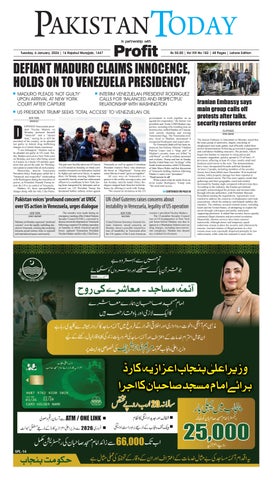
DEFIANT MADURO CLAIMS INNOCENCE, HOLDS ON TO VENEZUELA PRESIDENCY Tuesday, 6 January, 2026 | 16 Rajabul Murajjab, 1447
g
MADURO PLEADS ‘NOT GUILTY’ UPON ARRIVAL AT NEW YORK COURT AFTER CAPTURE
D
g
g
Profit
Rs 50.00 | Vol XVI No 182 | 48 Pages | Lahore Edition
INTERIM VENEZUELAN PRESIDENT RODRIGUEZ CALLS FOR ‘BALANCED AND RESPECTFUL’ RELATIONSHIP WITH WASHINGTON
US PRESIDENT TRUMP SEEKS ‘TOTAL ACCESS’ TO VENEZUELAN OIL NEW YORK agencies
EPOSED Venezuelan president Nicolas Maduro on Monday declared himself “innocent” and a “decent man,” saying he is still the president of his country, as he pleaded not guilty to federal drug trafficking charges in a United States courtroom. “I was kidnapped,” Maduro said as he pleaded not guilty in US court. Earlier, Maduro arrived at a New York court on Monday, just days after being seized in Caracas in a shock US military operation that paved the path for Washington’s plans to control the oil-rich country. Meanwhile, Interim Venezuelan President Delcy Rodriguez called for a “balanced and respectful” relationship with Washington during the transition of power, as President Donald Trump insists the US is in control of Venezuela. Maduro, 63, faces narcotrafficking charges along with his wife, Cilia Flores.
The pair were forcibly taken out of Caracas in a US assault on Saturday, in which commandos swooped in on helicopters, backed by fighter jets and naval forces, to capture them. On Monday morning, Maduro was escorted by heavily armed law enforcement officers to a courthouse in New York, having been transported by helicopter and armoured car. US President Trump has threatened further military action against
Pakistan voices ‘profound concern’ at UNSC over US action in Venezuela, urges dialogue NEW YORK
staff report
Pakistan on Monday expressed “profound concern” over the rapidly unfolding situation in Venezuela, warning that escalating tensions posed serious risks to regional and international peace and security.
The remarks were made during an emergency meeting of the United Nations Security Council (UNSC), convened to discuss recent developments in Venezuela following a surprise US military operation on Saturday in which American special forces captured Venezuelan President Nicolas Maduro and his wife, Cilia Flores.
Venezuela as well as against Colombian President Gustavo Petro, who dismisses the threat as “illegitimate”. Trump also warns Mexico it must “get its act together”. All eyes were on Venezuela’s response to the swiftly moving events, and late Sunday, interim leader Delcy Rodriguez stepped back from her initial defiance by offering to work with Trump. “We extend an invitation to the US
government to work together on an agenda for cooperation,” the former vice president said. Some 2,000 Maduro supporters, including rifle-wielding men on motorcycles, rallied Sunday in Caracas, with crowds shouting and waving Venezuelan flags. The Venezuelan military, loyal to Maduro, announced it recognised Rodriguez and urged calm. No Venezuela death toll has been announced, but Defence Minister Vladimir Padrino Lopez said a “large part” of Maduro’s security team was killed “in cold blood”, as well as military personnel and civilians. Trump said late on Sunday that the United States was “in charge” of the South American nation, while US Secretary of State Marco Rubio said that discussions of Venezuela holding elections following Maduro’s ouster were “premature.” ‘Need access to oil’ When asked what he needs from interim leader Rodriguez, Trump said, “We need total access.
CONTINUED ON PAGE 03
UN chief Guterres raises concerns about instability in Venezuela, legality of US operation NEW YORK reuters
United Nations Secretary-General Antonio Guterres raised concerns on Monday about a possible intensification of instability in Venezuela after the US capture of the Latin American
country’s president Nicolas Maduro. The 15-member Security Council met at UN headquarters in New York just hours before Maduro was due to appear in a Manhattan federal court on drug charges, including narco-terrorism conspiracy. Maduro has denied any criminal involvement.
Iranian Embassy says main group calls off protests after talks, security restores order ISLAMABAD Mian abrar
The Iranian Embassy in Islamabad on Monday stated that the main group of protesters, largely consisting of shopkeepers and trade guilds, had officially ended their lawful demonstrations following government engagement and confidence-building measures. The protests, which began last Sunday in response to rising prices and economic stagnation, quickly spread to 25 of Iran’s 31 provinces, affecting at least 45 cities, mostly small and medium-sized towns in the west. The demonstrations have since incorporated broader political demands. At least 12 people, including members of the security forces, have been killed since December 30 in localized clashes, while property damage has been reported in several western towns. The Fars news agency noted that gatherings and their geographic reach had notably decreased by Sunday night compared with previous days. According to the embassy, the Iranian government promptly acknowledged the protests and initiated talks through relevant authorities, with President Masoud Pezeshkian leading the negotiations. Agreements were reached to address the concerns of shopkeepers and trade associations, which the embassy said helped stabilise the situation. The embassy accused external actors, including Israel and the United States, of attempting to exploit the unrest through cyberspace and public statements supporting protesters. It added that security forces quickly contained illegal elements and prevented escalation. Meanwhile, internet services have been restored nationwide, although minor and temporary speed reductions remain in place for security and cybersecurity reasons. Limited clusters of illegal protests in a few remote areas were reportedly dispersed promptly by law enforcement, while calm has returned to most cities.
02 NEWS
PSX eXtendS recOrd run aS KSe-100 breaKS PaSt 182,000
P
PROFIT
g
news desk
One in four households in Pakistan face moderate or severe food insecurity; KP reports lowest level: Survey Food insecurity highest in Balochistan at 30.26%, followed by Sindh at 29.42%; Punjab at 22.58% and KP lowest at 21.54%; Overall, 24.35% of households face moderate or severe food insecurity in 2024–25, up from 15.92% in 2018–19
Market participants attributed the rally to a combination of supportive macroeconomic indicators, including a softer-thanexpected inflation reading of 5.6% for December 2025, real GDP growth of 3.7% year-on-year in the first quarter of FY26, strong sectoral performance, and expectations of further monetary easing by the central bank. Pakistan recorded its strongest firstquarter real GDP growth in four years at 3.7% YoY, exceeding the eight-year average quarterly growth of 3.3%. The expansion was driven primarily by robust industrial output, which rose 9.4%, the highest first-
quarter industrial growth in eight years. During the previous week, the KSE-100 Index gained 6,634 points, up by 3.8% week-on-week, and settled at an all-time high of 179,035 points. The rally was supported by easing inflationary pressures, strong sectoral performance, and rising investor participation. Topline Securities noted that buying of local mutual funds also played a key role in the market’s advance in 2025, with net purchases amounting to $298 million (Rs84 billion), the highest level since 2016. This buying was mainly driven by a shift from fixed-income instruments to equity funds
SECP revises REIT regulations to fast-track listings, enhance transparency g
AMENDMENTS CLARIFY ASSET RULES, TIGHTEN OVERSIGHT OF MANAGERS AND TRUSTEES AND STREAMLINE REGISTRATION PROCESSES PROFIT
news desk
The Securities and Exchange Commission of Pakistan has notified amendments to the Real Estate Investment Trust Regulations, 2022, aimed at accelerating the development of REITs by simplifying procedures, strengthening governance standards and improving regulatory clarity. The regulator said the revised framework introduces defined timelines for the
PROFIT
transfer of real estate assets and shares of special purpose vehicles, a step intended to enable earlier listing of REIT schemes and enhance their visibility as a capital market asset class. Under the amendments, the roles and responsibilities of REIT Management Companies and trustees have been reinforced, while regulatory arbitrage across different REIT structures has been addressed. The updated rules also improve alignment with the Shariah governance
framework. The SECP said procedures for the registration of trust deeds and the approval of REIT schemes have been streamlined to reduce processing delays. Key regulatory changes include a refined definition of real estate to clearly distinguish between passive and active components, along with the introduction of income and asset test requirements consistent with international best practices. These measures are intended to ensure REIT schemes remain primarily invested
news desk
Food insecurity in Pakistan has worsened sharply despite signs of post-crisis economic stabilisation, with around one-fourth of households nationwide facing moderate or severe food insecurity, according to the Household Integrated Economic Survey (HIES) 2024–25. The report highlights wide disparities across provinces and income groups, pointing to persistent pressure on household purchasing power. At the national level, the proportion of households experiencing moderate or severe food insecurity increased to 24.35% in 2024–25, up from 15.92% in 2018–19. Severe food insecurity more than doubled during the period, rising to 5.04% from 2.37%, pointing to sustained pressure on household purchasing power. The survey shows that food insecurity has intensified in both urban and rural areas. In urban centres, moderate or severe food insecurity rose sharply from 9.22% in 2018– 19 to 20.58% in 2024–25, while severe food insecurity increased from 1.24% to 5.12%. Rural areas also saw a rise, with moderate or severe food insecurity increasing from 19.96% to 26.72%, and severe cases rising from 3.05% to 4.99%. Provincial data show that Balochistan recorded the highest share of households facing moderate or severe food insecurity at 30.26%, followed by Sindh at 29.42%. Punjab reported food insecurity affecting 22.58% of households, while Khyber Pakhtunkhwa recorded the lowest level among provinces at 21.54%. The lowest income quintile was the most vulnerable, with 45.97% of households experiencing moderate or severe food insecurity in 2024–25, compared to 8.95% in the highest income quintile. The survey noted that food insecurity increased across all income groups compared to 2018–19. It attributed the worsening trend to a series of economic shocks, including the COVID-19 pandemic, the 2022 floods, and prolonged high inflation.
Court grants bail to key suspect in Mustafa Amir case linked to illegal call centre KARACHI
sTAFF RePORT
A judicial magistrate in Karachi has granted post-arrest bail to Armaghan Qureshi, the main suspect in the Mustafa Amir murder case, in a separate matter involving an alleged illegal call centre and credit card data theft. Mustafa Amir, 23, was allegedly abducted and killed by his friends Armaghan and Sheraz in Karachi’s Defence Housing Authority on January 6, 2025. Police said the suspects placed his body in the trunk of his car and later set it on fire in the Hub area of Balochistan. A final charge sheet in the murder case was submitted against Armaghan in August. In addition to several other cases, he was also nominated in a data theft case registered by the Federal Investigation Agency on April 16, 2025. The judicial magistrate (South) heard Armaghan’s bail application on Monday. His counsel, Advocate Khurram Abbas, told the court that the investigation in the illegal call centre case had already been completed in 2025. The defence argued that no incriminating material had been produced against the suspect, adding that there was neither a complainant nor any private witness to support the allegations. After hearing the arguments, the magistrate approved Armaghan’s bail against surety bonds of Rs100,000. Despite the relief, Armaghan will re-
PROFIT
Pakistan International Airlines, recently auctioned as part of the government’s privatisation drive, plans to pursue strategic and technical partnerships to modernise operations and improve competitiveness, according to Arif Habib, Chief Executive of Arif Habib Corporation Limited (AHCL). Speaking on Aaj News programme
Rubaroo, Arif Habib said efforts were under way to induct a technical partner at the airline level. He added that the government retains an option on its remaining 25 percent shareholding in PIA, which could eventually be exercised and transferred to a new partner. His remarks come after a consortium led by AHCL emerged last month as the successful bidder for a 75 percent stake in the national carrier, submitting a top bid of Rs135 billion. The bid exceeded both the
Government forms high-level committee to strengthen economic governance after IMF review
PROFIT
news desk
names, debit and credit card details, and social security numbers. The FIA further alleged that illegal transactions were carried out on Armaghan’s instructions, identifying him by the alias Alex Boss. It said the suspect used the website [www.oet.com](http://www.oet.com) to verify financial data, after which credit cards were charged without providing any legitimate service. In July 2025, an investigating officer of the National Cyber Crime Investigation Agency informed a judicial magistrate that Armaghan had rented two properties to establish call centres in Lahore and Islamabad following Amir’s murder.
main behind bars as several other cases against him are still pending. These include the murder case, as well as FIRs related to injuring policemen during a February shoot-out that led to his arrest, possession of illegal imported weapons, and alleged money laundering. According to the FIA’s FIR, Armaghan was accused of running an illegal call centre in Karachi’s DHA. The agency alleged that the operation was involved in harassment, fraud, identity impersonation, cheating, spoofing, phishing, and extortion. Investigators claimed that call centre employees were trained to pose as officials from international agencies to obtain sensitive information, including
AHCL CHIEF SAYS FLEET TO EXPAND TO 38 AIRCRAFT IN THREE YEARS; FLAGS POWER TARIFFS, TAXES AS KEY ECONOMIC RISKS news desk
in real estate and derive income mainly from such assets. According to the regulator, the amendments were finalised after an extensive consultation process involving REIT management companies, trustees, banks, mutual funds, law firms and consultants. The process included the issuance of a consultation paper, multiple in-person and virtual meetings, further engagement on draft amendments and a concluding session held in Karachi. REIT Regulations establish the legal framework for the formation, operation and management of REIT schemes, under which REIT management companies pool investor funds to invest in real estate projects, enabling unitholders to gain proportional ownership in income-generating properties and benefit from rental income and potential capital gains. The SECP said the notification of the amended REIT Regulations has been uploaded on its official website.
Finance minister–led 15-member panel to submit quarterly reports to the prime minister on institutional reforms and oversight
PIA to seek airline-level technical partner after Rs135b privatisation deal g
amid lower interest rates. AKD Research has forecast that the positive momentum in the KSE-100 Index will extend through 2026, projecting a 53% return for the year and a historic market capitalisation of $100 billion. The brokerage firm expects the benchmark index to reach 263,800 points by December 2026. Global cues were also largely supportive. Asian equity markets advanced on Monday, while oil prices remained volatile as investors assessed geopolitical developments in Venezuela ahead of a busy week of global economic data releases. MSCI’s Asia-Pacific index excluding Japan rose 1.2%, while S&P 500 e-mini futures edged up 0.1%. Japan’s Nikkei 225 climbed 2.8%, nearing a record high, after data showed manufacturing activity stabilising in December. Equity markets in South Korea and Taiwan rose more than 2% each to hit fresh record levels. In contrast, Chinese markets remained subdued. Hong Kong’s Hang Seng Index was marginally higher, weighed down by losses in energy stocks, while Australian shares posted modest gains.
INDEX CLOSES AT AN INCREASE OF MORE THAN 3300 POINTS FROM PREVIOUS CLOSE
The index closed at 182,408.23, an increase of 3,373.30 points or 1.88% from the previous close of 179,034.93. Buying interest was seen across major sectors, including automobile assemblers, cement, commercial banks, oil and gas exploration, oil marketing companies, and power generation. Index-heavy stocks traded firmly in positive territory, contributing to the early surge and reinforcing bullish sentiment that has carried over from last week’s strong close. Read This: PSX set for further growth, KSE-100 expected to reach 263,800 by end of 2026: report
AKISTAN’S equity rally scaled a new milestone on Monday as the benchmark KSE-100 Index breached the 182,000 mark for the first time in its history during intraday trading, supported by expectations of further monetary easing, an improving external account position, and rising investor optimism amid ongoing reforms and political stability. According to the Pakistan Stock Exchange (PSX) website, the market opened on a positive note. The benchmark index surged to the day’s highest level of 183,964.37 at 02:38 PM.
Tuesday, 6 January, 2026 | LAHORE
government’s minimum asking price of Rs100 billion and the base price of Rs115 billion set at the start of the auction. Arif Habib said the privatisation transaction allocates Rs125 billion for the rehabilitation and development of PIA. This includes Rs10 billion in cash, while Rs45 billion worth of shares will be transferred to the government as part of the deal. Detailing the airline’s operational challenges, he said only 14 to 15 aircraft are currently serviceable, with several
grounded due to shortages of engines and spare parts. Under the recovery plan, the fleet is expected to expand to 38 aircraft over the next three years. Commenting on the broader economy, Arif Habib said Pakistan had moved onto a more stable macroeconomic path, pointing to easing inflation, higher foreign exchange reserves, improved government revenues, rising remittances and a reduction in the trade and current account deficits, particularly the latter.
The federal government has constituted a 15-member high-level committee to improve economic governance following concerns raised by the International Monetary Fund (IMF) over weaknesses in institutional performance and oversight, The News reported. The move follows the release of the IMF’s Governance and Corruption Diagnostic Assessment Report in November 2025, which highlighted gaps in Pakistan’s economic governance framework. The report noted that effective implementation of governance reforms could lift Pakistan’s gross domestic product by an estimated 5 to 6.5% over the medium term. The committee, to be chaired by the federal finance minister, has been formed as part of a broader economic governance reform agenda aimed at strengthening institutional capacity, improving coordination, and enhancing accountability across key sectors of the economy. The panel will submit its findings and recommendations to the prime minister on a quarterly basis. Members of the committee include senior officials from the finance, law, planning, information technology, and establishment divisions, along with representatives from the Special Investment Facilitation Council, the Law and Justice Commission, the Board of Investment, and key regulatory bodies. These include the Securities and Exchange Commission of Pakistan, the State Bank of Pakistan, the Competition Commission of Pakistan, and the Public Procurement Regulatory Authority. Officials from the Tax Policy Office and the Auditor General’s office are also part of the panel. The additional secretary of finance will serve as secretary to the committee, while the Ministry of Finance will provide secretarial support.
Zong seeks industrial power tariff, fiscal parity for cloud and data centre operations g
CHINA MOBILE PAKISTAN CITES HIGH ENERGY COSTS AS A KEY FACTOR UNDERMINING THE COMPETITIVENESS OF LOCAL DATA CENTRES AND DISCOURAGING GLOBAL CLOUD PROVIDERS FROM SETTING UP INFRASTRUCTURE IN PAKISTAN PROFIT
news desk
China Mobile Pakistan (CMPak), which operates under the brand name Zong, has requested the application of industrial electricity tariffs for its cloud and integrated data centre (IDC) facilities, citing high energy costs as a key factor undermining the competitiveness of local data centres and discouraging international cloud providers from setting up infrastructure in Pakistan, Business Recorder reported. In a formal communication to the Min-
istry of Information Technology and Telecommunication, the company said it has expanded beyond traditional telecom services into cloud computing and data centre operations in line with the government’s Digital Pakistan objectives. CMPak has already established a TierIII data centre at its Islamabad facility and plans to develop similar cloud and IDC infrastructure in Lahore and Karachi. The company noted that despite competing for the same government cloud and hosting projects, telecom operators face a structural disadvantage compared to IT companies and firms operating in Special
Technology Zones, which benefit from tax holidays, rebates, and customs exemptions. Under the existing framework, telecom operators are not eligible for Special Technology Zone developer or enterprise status, even when offering identical cloud and data centre services. CMPak argued that cloud and IDC operations should be assessed based on the nature of services provided rather than the licensing category of the parent company. It said its cloud and data centre businesses are separate from core telecom operations and directly support national priorities such as
data sovereignty, e-government platforms, local content hosting, foreign investment, and job creation in digital services. The company has sought policy support to grant fiscal parity to telecom operators engaged in cloud and IDC activities, including tax incentives similar to those available to IT companies and Special Technology Zone enterprises, at least for their cloud and data centre verticals. According to CMPak, such measures would help level the playing field in government tenders and accelerate the development of Pakistan’s digital infrastructure. CMPak also highlighted electricity pric-
ing as a critical challenge for data centres, noting that energy costs are central to their commercial viability. Although the telecom sector has been declared an industry, operators have been unable to access industrial electricity tariffs due to longstanding regulatory and legal issues. The company warned that without industrial power tariffs for cloud and integrated data centrs, Pakistan’s cloud ecosystem would struggle to scale, limiting local capacity and reducing the country’s attractiveness for global cloud providers. CMPak has urged the IT ministry to support the application of industrial electricity tariffs for cloud and data centre operations and to promote fiscal and regulatory backing for cloud infrastructure as a strategic component of Pakistan’s digital economy.
NEWS 03
Tuesday, 6 January, 2026 | LAHORE
GOvt PlanS advanced MeterInG InFraStructure rOllOut In FIve dIScOS tO cut $1b annual POwer lOSSeS
t
PROFIT
news desk
HE federal government is planning to install Advanced Metering Infrastructure (AMI) in five power distribution companies to modernise the electricity distribution system and curb transmission and distribution losses, which are estimated to cost around $1 billion annually, Business Recorder reported, citing sources. To support the initiative, the government has approached the World Bank to serve as transaction advisor for the project. The move comes as the power sector con-
customs enforcement Quetta seizes smuggled goods worth rs183.23 million
g
WORLD BANK APPROACHED AS TRANSACTION ADVISOR FOR PPP-BASED SMART METERING PROJECT
tinues to face operational and financial pressures due to high technical and commercial losses, weak recoveries, outdated metering systems, and limited visibility of electricity consumption. Transmission and distribution losses currently stand at about 18% of total power supply, translating into an annual financial loss of approximately Rs265 billion. These losses continue to strain the sector, add pressure on consumers, and limit fiscal space for new investments. Under the proposed plan, the Private
g
Collectorate of Customs Enforcement Quetta has seized smuggled goods worth Rs183.23 million in a series of intelligence-based operations conducted in Quetta and Mangochar, District Kalat, with assistance from the Intelligence Bureau and the Frontier Corps. According to officials, the recovered consignments included foreign-origin betel nuts, cigarettes, tyres, cloth, and computer servers. The tentative CIF value of the seized goods has been assessed at Rs183.23 million. Authorities said the operations were carried out on the basis of actionable intelligence and aimed at curbing smuggling and illegal trade. The seizures were made during coordinated actions across multiple locations in Balochistan. The Federal Board of Revenue said enforcement actions against smuggling and unlawful trade would continue to ensure compliance with the law and protect national economic interests.
40,000 tourists head to snow-hit Galyat during last two days GALYAT
news desk
REGIONAL TAX OFFICE-II KARACHI, IN COORDINATION WITH INLAND REVENUE INTELLIGENCE & INVESTIGATION, SEIZES 1,800 SUGAR BAGS AT SASSI TOLL PLAZA, ALLEGEDLY ORIGINATING FROM CHAMBAR SUGAR MILLS PROFIT
news desk
news desk
As many as 40,000 tourists visited Galyat near Abbottabad during the last two days after heavy snow hit the region during last week. Galyat Development Authority (GDA) Director General (DG) Shah Rukh Ali said on Sunday that more than 10,000 vehicles entered Galyat during the aforementioned period. He further said that no accident had been reported from the area so far. Shah Rukh informed that snow had been removed from all roads of Galyat and Abbottabad so that tourists and locals could have a safe journey. It is worth-mentioning here that the GDA DG is himself monitoring the situation in Galyat. On the other hand, snowfall stopped in Galyat on Monday. However, the weather was overcast and extremely cold as bitterly cold winds were blowing. Tourists have flocked to these hill stations in large numbers. And despite the fact that snow has been removed from the roads, they are still slippery. On Thursday, Rescue 1122 Abbottabad retrieved several tourists’ vehicles, which got trapped in heavy snow near Chham area close to Galiyat amid severe cold condition. Despite the fact that roads were blocked after Abbottabad and surrounding areas received up to three feet of snow, still a large number of tourists thronged the region to enjoy the weather. The rescue team demonstrated professionalism to retrieve the vehicles and safely evacuate the tourists. The affected families expressed deep gratitude and paid tributes to the rescue teams for their efforts. The district administration warned people of an increased risk of landslides on snowcovered roads. Travelers heading to hilly regions were advised to use tire chains and avoid unnecessary travel.
distribution companies. As this will be the first AMI project executed under the PPP framework, the government has decided to engage an international financial institution as transaction advisor to provide end-to-end advisory support. The transaction advisor will conduct technical, commercial, and legal due diligence, develop the business case, structure the PPP framework, manage the procurement process, assist with bid documentation, and support contract finalisation and financial close.
Three trucks carrying 1,800 bags of sugar with fake track-and-trace stamps seized in Karachi
Foreign-origin items recovered in an intelligence-based operations in Quetta and Kalat with support from IB and FC PROFIT
Power and Infrastructure Board (PPIB) has been tasked with hiring a private AMI Services Provider to install and operate the smart metering system in Lahore Electric Supply Company, Multan Electric Power Company, Peshawar Electric Supply Company, Hazara Electric Supply Company, and Quetta Electric Supply Company. The project will be implemented under a public-private partnership model in coordination with the Power Planning and Monitoring Company, Power Information Technology Company, and the concerned
The Regional Tax Office-II Karachi, in coordination with Inland Revenue Intelligence & Investigation, has detained three trucks transporting sugar after discovering counterfeit Track & Trace System (TTS) stamps during an enforcement operation. The interception took place at Sassi Toll Plaza on the National Highway, where officials found 1,800 sugar bags allegedly originating from
Chambar Sugar Mills. The vehicles detained included trucks with registration numbers TKA-042, SDA-899, and AE-1488. Following the detection of fake TTS stamps, the trucks were seized and shifted to the NIPA premises of RTO-II Karachi for further investigation. Authorities said the action was part of ongoing efforts to enforce the Track & Trace regime, curb tax evasion, and prevent the illegal movement of essential commodities. FBR seals two chutes at Safina
FBR denies active taxpayer status to manual filers g
TAX EXPERTS SAY MOVE VIOLATES FTO DIRECTIONS AND FBR’S OWN CIRCULAR EXTENDING FILING DEADLINE PROFIT
news desk
The Federal Board of Revenue (FBR) has denied “Active Taxpayer” status to individuals who filed manual income tax returns for Tax Year 2024, raising concerns from tax experts over compliance with binding directives and internal regulations, according to a news report.
Tax professionals say the decision runs contrary to directions issued by the Federal Tax Ombudsman (FTO) as well as FBR Circular No. 6 of 2025–26, which acknowledged the position of manual return filers and provided regulatory relief. According to experts, the circular explicitly extended the filing deadline for such taxpayers until November 30, 2025, under Section 214A,
Sugar Mills over track-and-trace violations. Officials said further proceedings will be initiated in accordance with applicable laws and regulations. On Sunday, an FBR team sealed two chutes at Safina Sugar Mills in Lalian, District Chiniot, after the mill management failed to install the required Digital Eye cameras and Network Video Recorder (NVR) systems. The FBR stated that mill operations would remain suspended until the required Digital Eye cameras and NVR systems are installed. and instructed field offices to provide free legal and technical assistance to facilitate compliance. Despite these provisions, manual filers have reportedly been blocked from attaining active taxpayer status. Experts argue that field formations have failed to implement both the FTO’s binding directions and the FBR’s own circular, resulting in the denial of statutory rights to compliant taxpayers. They contend that the issue reflects administrative non-compliance rather than a technical or procedural lapse, with taxpayers facing penalties despite acting within the legal framework. Tax experts have urged the FBR to immediately restore filer status for affected individuals and ensure uniform implementation of statutory orders, circulars, and ombudsman directives to prevent further disputes.
India’s apex court refuses bail to detained student activist Umar Khalid
DELHI
Agencies
India’s Supreme Court has rejected a bail plea filed by former student leader Umar Khalid, who has been in custody for more than five years over allegations that he conspired to incite deadly communal violence. Khalid, 38, was arrested in September 2020 under the country’s stringent anti-terrorism law and has remained jailed since then, apart from short-term releases to attend family weddings. His prolonged detention has drawn criticism from rights groups and has become emblematic of broader concerns about the treatment of Muslims in India. The case stems from the February 2020 riots in New
Delhi, which left 53 people dead, most of them Muslims, along with several Hindus. Prosecutors accuse Khalid of playing a role in orchestrating the unrest. While dismissing his appeal, the Supreme Court ruled that prolonged incarceration alone could not be grounds for granting bail. The court issued a similar ruling in the case of another student activist, Sharjeel Imam, but approved bail for five other accused in the same matter. A former student of Jawaharlal Nehru University, Khalid faces multiple charges, including rioting with a deadly weapon, attempted murder, sedition and promoting enmity between groups. He has consistently denied all accusations and has rejected claims that he delivered provocative speeches ahead of the violence. In an open letter written from jail in 2022, Khalid said that those accused could be kept behind bars for years without investigators being required to prove their case. His partner has described his detention as a bitter irony, saying he became a victim of the injustice he had long opposed. Amnesty International and several other human rights organisations have repeatedly called for Khalid’s release, arguing that his continued imprisonment violates international human rights standards and undermines the rule of law. Khalid’s arrest followed months after nationwide protests against the Citizenship Amendment Act, a controversial law passed in 2019 that eases citizenship for non-Muslim minorities from neighbouring countries while excluding Muslims.
Defiant Maduro claims innocence, holds on to Venezuela Presidency CONTINUED FROM PAGE 01
We need access to the oil and other things in their country that allow us to rebuild their country.” Venezuela has the world’s largest proven oil reserves, and more Venezuelan crude in the market could exacerbate oversupply concerns and add to recent pressure on prices. But analysts say that alongside other major questions about the South American country’s future, substantially lifting its oil production will not be easy, quick or cheap. Oil dipped as investors weighed the impact. The Trump administration says it retains economic leverage by blockading oil tankers from Venezuela. Trump has also threatened additional military attacks. While there are no known US forces left inside Venezuela, a huge naval pres-
ence, including an aircraft carrier, remains off the coast. Leading opposition figure Edmundo Gonzalez Urrutia said that while the US intervention was “important,” without the release of political prisoners and acknowledgement that he won the 2024 election, it was simply “not enough.” Details of the US operation were still emerging Monday, with Havana saying 32 Cubans were killed in the attack and Trump adding that Cuba itself was ready to fall after Maduro’s capture. “I don’t think we need any action. It looks like it’s going down,” Trump said. The UN Security Council will hold an emergency session on Monday at Venezuela’s request. MADURO ALLIES REMAIN DEFIANT: The White House indicated
Sunday that it does not want regime change, only Maduro’s removal and a pliant new government — even if it is filled with his former associates. Anointed by his mentor Hugo Chavez before the latter’s 2013 death, Maduro kept a tight grip on power until his capture by US forces on Saturday. He ruled alongside Flores and three other powerful figures: Rodriguez, now Venezuela’s interim leader, her brother Jorge, and their rival, hardline Interior Minister Diosdado Cabello. “It’s like a club of five,” a diplomatic source in Caracas told AFP under the condition of anonymity. The US position leaves the Venezuelan opposition, which the Trump administration says was robbed of victory by Maduro, out in the cold. China, Russia and Iran, which have
longstanding ties with Maduro’s government, were quick to condemn the operation. Some US allies, including the EU, expressed alarm. China called for Maduro to be “immediately released” in a condemnation of the US operation, which its foreign ministry said was a “clear violation of international law.” Iran said on Monday that its relations with close ally Venezuela remained unchanged and called for Maduro’s release. Colombian President Gustavo Petro, whose country neighbours Venezuela, called the US action an “assault on the sovereignty” of Latin America, which would lead to a humanitarian crisis. Petro rejected threats on Sunday of military action in Colombia made by Trump, who also accused the South American leader of drug trafficking.
Approval for direct contracting of an international financial institution as transaction advisor was granted by the PPP Authority Board in December 2025 under the applicable PPP regulations. The advisory engagement is expected to last up to 12 months and will follow a success-based fee structure, with milestone-linked payments and a larger component payable at financial close. The scope of work will cover diagnostics and data validation, transaction structuring and market sounding, procurement support, and contract execution. Given the World Bank’s experience in similar projects, PPIB has requested the institution to submit its proposal by January 14, 2026.
KP traders urge lifting ban on wheat movement from Punjab to avert flour shortage Business community calls for consultation on policy decisions and removal of double taxation PROFIT
news desk
Members of the business community have urged the Khyber Pakhtunkhwa government to take up the issue of the ban on wheat movement from Punjab with the federal authorities, warning that continued restrictions could trigger a flour shortage in the province. As per reports, the traders stressed that policy decisions, particularly those involving enforcement measures, should be made in consultation with stakeholders to avoid disruption, confrontation, and harassment of businesses. The concerns were raised during a meeting between representatives of the SCCI and the Peshawar administration. Participants called for the removal of what they described as unconstitutional restrictions on wheat movement and sought pragmatic steps to facilitate trade. The business community also demanded the abolition of double taxation at the provincial level and the adoption of business-friendly policies to support commercial activity in the province. In addition to wheat supply issues, the meeting discussed a range of matters affecting trade and industry, including the closure of the PakAfghan border, local administration and policing, local government issues, and service delivery by utility and public sector entities. Participants said resolving these issues through coordination between provincial and federal authorities was necessary to ensure uninterrupted supply chains and maintain economic stability in the province.
04 COMMENT
Safety beyond Borders: PNRA’s contribution to a safe and secure world
Tuesday, 6 January, 2026
Principle over power in Venezuela
P
AKISTAN’S intervention at the United Nations Security Council this week was a timely reminder that international order, already frayed by wars and widening rivalries, cannot afford further erosion by expediency. By expressing profound concern over the escalating tensions in Venezuela and urging de-escalation through dialogue, Islamabad placed itself firmly on the side of international law and restraint. That stance deserves not only endorsement but amplification. The crisis in Venezuela has become a familiar test case for how power is exercised in the global system. Economic hardship, political polarization and governance failures are real and painful for the Venezuelan people. Yet history shows that external pressure, coercive measures and unilateral political recognition rarely alleviate such suffering. More often, they harden divisions, undermine institutions and entrench instability that spills beyond borders. Pakistan’s emphasis on the principles of the UN Charter is not rhetorical. The obligation to respect sovereignty, refrain from the threat or use of force, and avoid interference in internal affairs is the thin line separating a rules-based order from a world governed by might. When powerful states unilaterally decide who should or should not govern another country, they cross that line. The recent U.S. posture toward Venezuela, including the practice of politically misnaming leadership through unilateral recognition, stands in clear violation of these norms, irrespective of the individual or faction involved. Legitimacy cannot be outsourced, nor can it be conferred by external fiat. Such actions also carry wider consequences. Latin America and the Caribbean have long been recognized as a Zone of Peace, a hard-won status achieved through regional consensus and restraint. Injecting great-power rivalry into this space risks reversing decades of progress. Instability in one country can rapidly metastasize, disrupting migration patterns, economic ties and regional security. In a world already stretched by conflicts in Europe, the Middle East and beyond, opening another front of confrontation is reckless. Pakistan’s call for dialogue and diplomacy is therefore not an abstract appeal but a practical one. Sustainable political solutions emerge from inclusive processes that reflect the will of the people concerned. External actors can support such processes through mediation, humanitarian assistance and respect for international mechanisms, but they cannot substitute themselves for domestic consent. Sanctions, recognition games and political pressure masquerading as moral clarity often do more harm than good. By urging restraint at the Security Council, Pakistan has aligned itself with a growing chorus of states that see the preservation of international norms as essential to global stability. The message is clear: principles must not be bent to suit power, and legality must not be sacrificed for convenience. Venezuela’s future, like that of any sovereign nation, should be shaped by its people, not scripted in foreign capitals.
T
Nazia Sheikh
HE Pakistan Nuclear Regulatory Authority promotes nuclear safety and security internationally through adherence to international standards, collaborations, and knowledge exchange with other countries. The institution ensures that Pakistan’s nuclear program is run safely and transparently by actively participating in international forums to support the highest standards of nuclear safety. In order to maintain national and international standards, it performs regulatory monitoring, licensing, inspection, and enforcement. According to Pakistan, International cooperation is a vital tool for advancing peaceful nuclear activities, a nation with a developing nuclear energy program and a pioneering member of the IAEA. Being among the pioneers in implementing “Atoms for Peace, “Since its inception in the 1960s, Pakistan’s peaceful nuclear program has progressively expanded from the operation of a single research reactor to the development of several nuclear power reactors, as well as from its limited number of applications to its broader use in industry, agriculture, and medicine. Currently, Pakistan uses nuclear technology extensively in several industries. However, while using nuclear technology for civilian purposes, Pakistan’s national nuclear regulator, the PNRA, which was established in 2001, is dedicated to making sure that nuclear safety continues to be a primary concern. PNRA has recognized the significance of international cooperation among nuclear regulatory bodies in the interconnected world and understood that harnessing shared opportunities and managing shared dangers requires a collective effort. To accomplish this, PNRA has set up an institutional framework for international cooperation and is actively working with the global community by creating a dedicated wing, fulfilling the nation’s obligations under various nuclear-related conventions, signing cooperation agreements with other nations’ regulatory bodies, sending its experts to training sessions organized by the IAEA, and submitting itself for peer reviews. In order to promote collaboration and deal with everyday issues, PNRA regularly participates in multilateral forums, especially those of the IAEA. PNRA
Dedicated to the legacy of late Hameed Nizami
Arif Nizami (Late) Founding Editor
Degrees of deceit M. A. Niazi
Babar Nizami
Editor Pakistan Today
Editor Profit
How India exported fakery to the world
I
Naveed Safdar
NDIA has long been under the global spotlight for reasons that are far from flattering. Once branded as the “rape capital of the world” due to its alarming record of sexual violence, the country now finds itself earning another dubious distinction—that of the “fakery capital of the world.” The recent exposure of a massive fake degree racket in Kerala has once again reminded the international community of the rot that continues to emanate from India, spreading its tentacles far beyond its borders. The racket, reportedly involving over 100,000 forged certificates from 22 universities, is believed to have facilitated the use of more than one million fake degrees abroad. This revelation is not just a domestic scandal; it is a global concern. The forged documents were allegedly used by Indians seeking employment opportunities overseas, particularly in countries where academic qualifications are a prerequisite for professional advancement. The scale of this fraud is staggering, and its implications are profound. It raises serious questions about the credibility of Indian educational institutions and the integrity of the Indian workforce abroad. No wonder, then, that the United States government has been tightening its grip on H1B visas for Indian applicants. For years, the H1B program has been a gateway for Indian professionals to secure lucrative jobs in the American tech and service sectors. However, the proliferation of fake degrees has cast a long shadow over the legitimacy of these applicants. Employers in the U.S. and elsewhere are increasingly wary of hiring individuals whose qualifications may not withstand scrutiny. The clampdown is not merely a bureaucratic hurdle; it is a direct response to the erosion of trust caused by such fraudulent practices. The Indian diaspora, one of the largest in the world, is now under suspicion. While many Indians abroad are hardworking and genuinely qualified, the exposure of widespread fakery taints the entire community. Employers, governments, and international organizations are likely to adopt stricter verification mechanisms, which could disproportionately affect even those with authentic credentials. The reputational damage
is immense, and it will take years—if not decades—for India to rebuild credibility in the eyes of the world. This scandal also underscores a deeper malaise within India’s governance and institutional framework. The fact that such a racket could thrive across multiple universities suggests systemic corruption and complicity. It is not merely the work of a few unscrupulous individuals; it reflects a culture where deceit and shortcuts are tolerated, if not encouraged. The consequences, however, are borne not just by India but by the global community that interacts with its workforce. In stark contrast, Pakistan has managed to establish a far more credible system for academic verification. The Higher Education Commission (HEC) of Pakistan has instituted a well-organized mechanism for the award and authentication of degrees. This system ensures that Pakistani graduates enjoy respect and recognition across the world. Employers and institutions abroad can rely on the authenticity of Pakistani qualifications, which enhances the country’s reputation and provides its citizens with genuine opportunities for advancement. The difference between the two systems is not just administrative; it is moral. Pakistan’s commitment to integrity in education stands out against India’s culture of fakery.
representatives are members of several IAEA Safety Standard Committees, such as the Nuclear Safety Standards Committee, Transport Safety Standards Committee, Waste Safety Standards Committee, Radiation Safety Standards Committee, Emergency Preparedness and Response Standards Committee, Nuclear Security Guidance Committee, and Commission on Safety Standards, to create technical standards and guidance documents. The Pakistani government has designated PNRA as the national point of international collaboration. Pakistan is a party to several conventions and is carrying out the country’s commitments under such agreements. Conventions on Nuclear Safety, Early Notification of a Nuclear Accident, Assistance in the Case of a Nuclear Accident or Radiological Emergency, Physical Protection of Nuclear Materials, and its amendment are among them. PNRA is carrying out its national responsibilities in accordance with the emergency-related treaties, whether it is by compiling a country report for submission in the CNS review meeting or hosting IAEA emergency exercises. In addition to its mandatory duties, PNRA is also responsible for the non-mandatory requirements originating from Pakistan’s subscription concerning the security and safety of radioactive sources, as well as the safety of research reactors. Additionally, it takes part in the United Nations Scientific Committee on the Effects of Atomic Radiation (UNSCEAR), Response and Assistance Network (RANET), Global Nuclear Safety and Security Network (GNSSN), Regulatory Cooperation Forum (RCF), Radiation Safety Information Management System (RASIMS), International Generic Ageing Lessons Learnt (IGALL), Technical Support Organisation Forum (TSOF), National Nuclear Security Support Centre (NSSC), and International Nuclear Security Education Network (INSEN). The first-ever NSSC meeting outside of Vienna, Austria, in 2016, held in Pakistan, was an honor. Furthermore, PNRA has held meetings for CANDU Senior Regulators twice, in 2005 and 2022. Additionally, the IAEA has created a number of non-binding reporting channels that allow member states to report on pertinent concerns and benefit from each other’s experiences. To establish and maintain an efficient nuclear security mechanism, Pakistan and the IAEA have inked an agreement for nuclear security
The international community must now grapple with the fallout of India’s degree scandal. Employers who have unknowingly hired individuals with fake qualifications will face difficult decisions. Governments may impose stricter immigration and employment checks, particularly targeting Indian applicants. Professional bodies may introduce new layers of verification, adding costs and delays to recruitment processes. The ripple effects will be felt across industries and continents, as trust once broken is not easily restored. For India, the challenge is existential. A nation that aspires to be a global leader cannot afford to be known for deceit and corruption. Yet, the repeated exposure of scams—whether in education, business, or politics—suggests that the rot runs deep. Unless India undertakes radical reforms to cleanse its institutions, it risks being permanently branded as a producer of fraud and fakery. The world is watching, and patience is wearing thin. Pakistan, meanwhile, must continue to strengthen its systems and uphold its reputation. In a globalized world where credibility is currency, Pakistan’s emphasis on integrity in education provides its citizens with a competitive edge. It is a reminder that respect is earned not through numbers or noise but through trust and authenticity. The contrast between the two nations could not be sharper. India, with its sprawling diaspora, now faces suspicion.
The writer is a freelance columnist who writes on current affairs, geopolitics, and disaster management, aiming to contribute informed insights to national discourse. He can be reached at naveedsafdar13@gmail.com
The international community must now grapple with the fallout of IndiaÊs degree scandal. Employers who have unknowingly hired individuals with fake qualifications will face difficult decisions. Governments may impose stricter immigration and employment checks, particularly targeting Indian applicants. Professional bodies may introduce new layers of verification, adding costs and delays to recruitment processes.
Lahore – Ph: 042-36300938, 042-36375965
I
Karachi – Ph: 021-32640318 I
Islamabad – Ph: 051-2204545
I
cooperation. The Karachi Nuclear Power Plant Units 1 and 27 nuclear medical facilities have reinforced their physical security measures, and PNRA personnel’s capacity building in nuclear security has been strengthened as part of this collaboration initiative. The head of Pakistan’s delegation announced at the International Conference on Nuclear Security (ICONS): Shaping the Future, which took place in Vienna from May 20–24, 2024, that Pakistan will host IAEA IPPAS in 2026 following the successful conduct of the internal IPPAS.PNRA has signed bilateral cooperation agreements with the People’s Republic of China’s National Nuclear Safety Administration, Nuclear Safety and Radiation Protection Centre, and China Nuclear Power Operations Technology Corporation Ltd. for professional development, regulatory experience sharing, and regulatory support. Additionally, under the IAEA’s auspices, PNRA and the Nigerian Nuclear Regulatory Authority (NNRA) have signed a Memorandum of Understanding for the capacity building of NNRA regulatory professionals through fellowships and research visits. The PNRA uses a set of performance measures to assess its credibility. The IAEA International Regulatory Review Team and the IAEA Radiation Safety Infrastructure Appraisal mission are two examples of these peer reviews. To help with self-evaluations and encourage transparency, the PNRA regularly consults with other outside partners. PNRA is a reflection of the country’s larger commitment to responsible nuclear stewardship, as it is the driving force behind Pakistan’s commitment to nuclear safety and security. While promoting collective security through robust regulatory frameworks, efficient management of nuclear and radioactive materials, and active engagement with international partners, PNRA exemplifies how national institutions can maintain global standards. Its work demonstrates that nuclear governance is a shared duty that protects people, the environment, and regional stability rather than just being a technological need. By doing this, PNRA upholds the idea of “safety beyond borders,” highlighting Pakistan’s contribution to the development of a more secure and safe nuclear world.
The writer is a Research Officer at Centre for International Strategic Studies, AJK. She can be reached at Nsheikh536@gmail.com
Editor’s mail
Send your letters to: Letters to Editor, Pakistan Today, 4-Shaarey Fatima Jinnah, Lahore, Pakistan. E-mail: letters@pakistantoday.com.pk Letters should be addressed to Pakistan Today exclusively
Generations United
THIS is with references to letters published recently — The discourse surrounding generational differences, particularly between the Millennials (Gen Y) and Generation Z, often devolves into oversimplified stereo-types. While it is tempting to romanticise the past or critique the present, a nuanced perspective is essential to foster inter-generational empathy. I wish to reframe the debate by highlighting the unique strengths and challenges of both cohorts, as well as the shared humanity that binds them. Born in the 1980s and ’90s, the Millennials are the bridge between tradition and modernity. They inherited a world in transition. Shaped by analogue childhoods and digital adolescences, they are often praised for their research-oriented mindset and respect for elderly footprints — the wisdom of prior gene-rations. Their moral consciousness, rooted in community-driven values, emphasises stability and incremental progress. This generation’s ability to balance tradition with emerging technologies allowed the Millennials to navigate early globalisation and economic shifts. However, critics argue that some of them cling to outdated norms, resisting critical change in favour of nostalgic ideals. Gen Z, born into a hyper-connected, post-recession world, thrives on adapt-ability. Fluency in emerging digital trends and emphasis on individualism reflect a pragmatic response to rapid technological and social change. While older generations may perceive them as emotionally driven or dismissive of tradition, Gen Z’s focus on inclusivity, mental and emotional health awareness, and climate activism reveals a profound, albeit different, moral compass. The willingness of Gen Z to challenge wellentrenched systems — from workplace hierarchies to societal norms — can be misread as irreverence, but it often stems from a sincere desire to redefine values in a fractured world. The tendency to label the Millennials as ‘the last moral generation’, and Gen Z as the ‘spiritually shattered’ generation ignores the broader context. Both these generations have faced unprecedented pressures: Millennials grappled with crises and shifting job markets, while Gen Z is confronting algorithmic polarisation and climate anxiety. Nostalgia for the ‘human nature of the 1990s’ overlooks that era’s own flaws — rigid social hierarchies, environmental neglect and stifled dialogue on inequality. Rather than lamenting a loss of values, we must recognise that ethics evolve. Millennials’ reverence for tradition and Gen Z’s trend-driven innovation are not mutually exclusive. The former can mentor resilience and long-term thinking, while the latter can revitalise institutions with fresh perspectives. Let us move beyond divisive narratives, and create spaces where both generations collaborate — honouring the past without fetishising it, and embracing the future without fear. ABDUL MATEEN RAHIM KARACHI
Hate season
AS happens every year, as soon as the month of Muharram began this year, online platforms and WhatsApp turned into battlegrounds, with sectarian lines drawn rather harshly. As a matter of routine, the ‘season’ is marked by comment sections overflowing with hate, old friends cutting ties, and neighbours becoming strangers. While respected scholars on both sides of the aisle have for long promoted harmony, there are many across social media platforms who are clearly more interested in fuelling such divisions. Encouraged by the divisive rhetoric of a few, many young minds begin to view ‘others’ with negativity, deepening sectarian misunderstandings. The initiative taken by the government in Punjab to form a cyber force for monitoring online hate during Muharram was, indeed, a timely step, but laws alone are not enough. The people — all of us — need to re-member that Karbala and its message are universal in nature. It is about truth, courage and humanity; not sectarianism. The teachings of Karbala should reflect in both our actions and words — online and offline. This is not too difficult a task. SHAFAQ ALTAF KAZMI KARACHI
Web: www.pakistantoday.com.pk
I
Email: editorial@pakistantoday.com.pk
COMMENT 05
Oil: Wealth, Curse — and the price of defiance
Tuesday, 6 January, 2026
F
Qamar baShir
OR nations blessed with oil, the central question is never geological. It is political. Oil can finance schools, hospitals, roads, dignity, and independence—or it can finance coups, client rulers, sanctions, wars, and broken states. The difference is not the size of the reserves under the sand. The difference is whether the owners of that oil are allowed to own it in practice. Before 1953, Iran’s petroleum was not simply an export commodity. It was an imperial system. Britain’s Anglo-Iranian Oil Company dominated production and refining, and Iran’s share of value was widely viewed inside Iran as humiliating—wealth extracted from Iranian soil, feeding foreign prosperity while ordinary Iranians remained poor. In 1951, Prime Minister Mohammad Mosaddegh took the step that shook the entire post-war order: he pushed legislation to nationalize Iran’s oil industry. That single principle—“Iranian oil is for Iranian people”—was treated in London and Washington not as a commercial dispute but as a strategic revolt. In August 1953, Mosaddegh was removed in a coup funded by the United States and the United Kingdom, and the Shah’s rule was restored. From the Iranian public’s perspective, this was not merely regime change; it was a message to every oil-producing nation: ownership is tolerated only until it threatens the architecture of Western control. This is how the “oil curse” is manufactured. The curse is not oil itself. The curse is what happens when a nation tries to convert oil into sovereignty. Look at the sheer scale of what is at stake. Venezuela sits on roughly 303 billion barrels of proven reserves; Saudi Arabia about 267 billion; Iran about 208.6 billion; Iraq about 145 billion; Kuwait about 101.5 billion; Libya about 48.4 billion; and even gas-rich Qatar holds about 25.2 billion barrels of proven crude reserves. In today’s prices, this is not “re-
source wealth.” It is civilizational leverage—trillions upon trillions of dollars in potential value across generations. So the key fight is not only over barrels in the ground, but over the entire chain that converts those barrels into money: drilling technology, service contracts, shipping insurance, tankers, refining capacity, trading houses, dollar clearing, and finally the security umbrella that protects friendly producers and suffocates defiant ones. That chain is where American and British power has historically lived. In the Gulf monarchies, the relationship evolved into a bargain: security and survival in exchange for strategic alignment. The U.S. became the guarantor of maritime routes and regime stability, and in return the Gulf became the world’s most important energy reservoir within an Americanled order. The United States itself is also a giant producer—about 21.91 million barrels per day in 2023, the largest share of world production—so “control” is not only about imports; it’s also about shaping global pricing, shipping lanes, sanctions enforcement, and who can sell to whom. But when a producer refuses alignment, the logic flips: oil stops being “their national asset” and becomes “the world’s problem”—a justification for pressure. Iran is the classic case. After the Shah was imposed back into power with Western backing, Iran became a central pillar of Western strategy—until popular resistance exploded into the 1979 revolution. The hostage crisis was a symptom, not the root: the deeper driver was the belief among millions of Iranians that their wealth had been managed for outsiders and for a domestic elite seen as subordinate to foreign interests. The revolution survived because it was
not merely a government; it became a public identity—built on defiance and sacrifice. That is why decades of pressure did not dissolve it. Then came the region’s great furnace: The Iran-Iraq war. Saddam Hussein was treated as a counterweight to revolutionary Iran; the result was catastrophic human loss and the militarization of the entire Middle East. Even when that era ended, the template remained: defy the Western order and you face isolation, sanctions, and, if the moment suits, destruction. Iraq’s later destruction was sold to the public with dramatic claims. But the deeper strategic obsession was always the same: who commands the oil state, and whose system the oil state finances. And now, in December 2025, the pattern is unfolding—loudly—in Venezuela. Reuters reports that on December 20,
This is the modern oil empire: not necessarily ownership of the wells, but command over the rules of extraction, trade, and cashflow. Across the region, Western majors remain embedded where states permit them·often through partnerships, service contracts, or joint ventures. Iraq, for instance, is again signing major deals with U.S. and European firms; Reuters reports ExxonMobilÊs return via an agreement tied to the giant Majnoon field. LibyaÊs National Oil Corporation is engaging BP and Shell to study major fields, a sign of how foreign expertise re-enters when political conditions allow. QatarÊs North Field expansion, the backbone of future global gas supply, includes partnerships with ExxonMobil and other Western companies.
US invasion act of imperialist aggression
T
Sovereign governments are first delegitimized, then destroyed by force, after which foreign capital moves in to carve up natural resources CHINA DAILY editorial
HE international community is deeply shocked by the United States’ blatant use of force against Venezuela, including large-scale air strikes on the country and the forcible seizure of its president and his wife. Its actions should be condemned as they constitute a naked act of armed aggression against a sovereign state and flagrantly violate international law and the basic norms governing international relations, as well as the purposes and principles of the UN Charter. By any definition, the US military operation amounts to an invasion. It dangerously escalates the so-called “Monroe Doctrine” from a 19th-century, isolationist-era concept into a 21st-century doctrine of force and coercion. This sets an alarming precedent for Latin America and the Caribbean, posing a direct threat to the sovereignty and security of countries across the region and shaking the foundations of the international order established after World War II. Washington’s justification of it being a “counter narcotics” action is neither credible nor legitimate. No such pretext can justify the bombing of a sovereign country or the abduction of its head of state. If such reasoning were to be accepted, it would effectively grant powerful nations a license to intervene militarily wherever they see fit, under a pretext given by themselves, hollowing out international law and replacing it with the law of the jungle. The true motivation behind the US’ aggression was laid bare by the US administration, which triumphantly announced that Nicolas Maduro and his wife had been “captured and flown out of the country” and that the US would “run” Venezuela on a “temporary basis” to “get the oil flowing”. These remarks tore away the already thin veil of moral pretense, exposing the operation for what it was: a resource-grabbing power play. Any veneer of pursuing justice or stability was blasted away in a blatant demonstration of lawless hypocrisy. The pattern is disturbingly reminiscent of the Iraq War — another chapter in Washington’s long record of seizing other countries’ resources under false pretenses.
2025, the United States intercepted an oil tanker near Venezuela. The vessel was reportedly carrying 1.8 million barrels of Venezuelan crude bound for China. Reuters also reports that U.S. authorities are pursuing additional vessels, describing an expanding crackdown and blockade concept aimed at sanctioned flows. This is not symbolic enforcement. It attacks the bloodstream of the Venezuelan economy, which relies heavily on oil revenue. Reuters notes exports falling sharply (from over 1 million bpd in September to an estimated ~702,000 bpd in December), implying severe fiscal strangulation. And notice the exception that exposes the logic: even as “dark fleet” shipping is disrupted, Chevron continues operating under a U.S. license structure. The Wall Street Journal describes Venezuelan shipping
Washington’s claim of “strategic retrenchment” thus rings hollow. For other countries in the Americas, this is not retrenchment but imperialist expansion — an aggressive reassertion of arrogant conceit. Venezuela is unlikely to be the last victim if this logic is allowed to prevail. The military action also aims to intimidate regional countries and deter them from deepening cooperation with other partners in the fields that the US is trying to dominate. The news conference held by US officials shortly after the operation only underscored this intent. The brazen boasting about “Operation Absolute Resolve”, including lurid details of how US special forces seized the Venezuelan president from his bedroom, was designed to instill fear rather than convey transparency. It revealed the extent to which the US is prepared to turn its military superiority into an instrument for imposing its will on others. From fabricated charges to military strikes and regime change, the operation follows a familiar and deeply troubling script — one that reflects the logic of state piracy. Sovereign governments are first delegitimized, then destroyed by force, after which foreign capital moves in to carve up natural resources. This behavior drags the world back toward a barbaric colonial era of plunder, in open defiance of international law. Such egregious conduct has not gone unchallenged even within the
US. Some observers bluntly stated that the US has become a bully of the world. No wonder even some in the US political circle said they never again wanted to hear US leaders preach about a so-called “rules-based” international order. International reaction has been equally blunt. UN Secretary-General Antonio Guterres expressed grave concern over Washington’s disregard for international law. Russia said it was “extremely alarmed” by the act of armed aggression. The European Union called for respect for international law and the UN Charter “in all circumstances”. These voices reflect a shared global anxiety that when might replaces law, no nation is safe. History has repeatedly shown that while wars may be easy to start, they are far harder to end. Although Washington boasts of the supposed efficiency and low cost of its operation, the true price will be paid over time by the entire region — and ultimately by the US itself. Power politics may yield short-term gains, but they cannot bring lasting peace or stability. China has urged the US to ensure the personal safety of Maduro and his wife, immediately release them, cease attempts to subvert the Venezuelan government, and resolve differences through dialogue and negotiation. What the world is witnessing is not a “rules-based” order, but colonial pillaging. Upholding sovereignty, equality and noninterference is not optional. It is the foundation of global stability — and it must be defended.
largely stalling “except Chevron,” underscoring how sanctions enforcement can separate “illegal oil” from “licensed oil”—meaning the barrel is acceptable when it flows through approved channels. Reuters similarly describes Chevron’s continued role under restricted authorization. This is the modern oil empire: not necessarily ownership of the wells, but command over the rules of extraction, trade, and cashflow. Across the region, Western majors remain embedded where states permit them—often through partnerships, service contracts, or joint ventures. Iraq, for instance, is again signing major deals with U.S. and European firms; Reuters reports ExxonMobil’s return via an agreement tied to the giant Majnoon field. Libya’s National Oil Corporation is engaging BP and Shell to study major fields, a sign of how foreign expertise re-enters when political conditions allow. Qatar’s North Field expansion, the backbone of future global gas supply, includes partnerships with ExxonMobil and other Western companies. Even in the Saudi-Kuwait “Neutral Zone,” Chevron’s legacy role appears in joint operations alongside state entities. So when the West “benefits,” it is not always by directly stealing national revenue in one crude transaction. It benefits by sitting at multiple toll booths: technology and services, project equity stakes, shipping and trading, refining margins, finance and insurance, and—most importantly—strategic power: the ability to punish a seller, freeze a buyer, choke a port, or seize a ship. That is why oil becomes a curse precisely at the moment a nation tries to treat it as democratic wealth. The moment leaders say, “this belongs to our people,” the system asks: will you still obey? If yes, you are protected. If not, your “resource blessing” is recast as a reason you must be disciplined. This is the real warning to oil nations— whether in the Gulf, in Africa, or in Latin America. Oil is wealth only if you are allowed to keep it wealth. If you attempt to convert it into independence against the priorities of great powers, oil becomes the trigger for destabilization, sanctions, and war. And that is why the same barrel can build prosperity in one country and produce ruin in another. The difference is not the oil. The difference is who is permitted to command the oil.
The writer retired as Press Secretary the President, and is former Press Minister at Embassy of Pakistan to France and former MD, Shalimar Recording & Broadcasting Company Limited
Trump has turned the world’s superpower into a rogue state
A
The illegal abduction of Venezuela’s president, and threat to ‘run’ his country, is a dangerous act. Its repercussions will be felt far beyond the region THE GUARDIAN editorial
mid the immense confusion surrounding the US strikes on Venezuela, the seizure of the president, Nicolás Maduro, and Donald Trump’s announcement that the US will “run” the country and “take back the oil”, one thing is clear – they set a truly chilling precedent. The US has a grim history of interference, invasion and occupation in the region, but the early hours of Saturday saw its first major military attack on South American land. “American dominance in the western hemisphere will never be questioned again,” Mr Trump declared. The decision to unilaterally attack another country and abduct its leader – days after he publicly sought an off-ramp – has still wider repercussions. It should alarm us all. Venezuelans have endured a repressive, kleptocratic and incompetent regime under Mr Maduro, widely believed to have stolen the last election. They now face profound uncertainty at best. Mr Trump has suggested that Mr Maduro’s deputy, Delcy Rodríguez, would follow US instructions, and dismissed the rightwing opposition leader and Nobel prize-winner María Corina Machado as a plausible replacement. But Ms Rodríguez, now interim president, has so far struck a defiant tone – and other parts of the decapitated regime are more hardline. A man who won power promising to abandon foreign wars now says he is “not afraid of boots on the ground”. Rebranding the Department of Defense as the Department of War was more than posturing. He does not see the world’s superpower as policeman; he is turning it into a rogue state. He believes the US’s might allows it to do as it wishes with minimal cost: witness the strikes on Nigeria,
on Iran’s nuclear facilities and elsewhere. He promises that Venezuelan oil means this latest episode “won’t cost us a penny”. George W Bush invaded Iraq on a lie. But this illegal attack came without UN resolutions of any kind or congressional approval; Democrats were not even informed and say they were actively misled in briefings. Mr Trump doesn’t seek to bend international norms, but to destroy them. Put aside the message this sends to Vladimir Putin, Xi Jinping and others, and ask where the US itself is heading. While the raid reportedly killed 40 Venezuelans, including civilians, no US personnel died. Mr Trump’s growing sense of invincibility will surely embolden further adventurism. He has not ruled out military action over Greenland and told Fox News: “Something is going to have to be done with Mexico.” No one buys the pretext that this is about drugs. Venezuela is only a minor conduit for cocaine; Mr Trump recently pardoned the former Honduran president Juan Orlando Hernández for drugs and weapons crimes. And Mr Trump himself made it clear that he is driven by the lure of oil as well as machismo, the ideology of some in his administration, and the desire for glory as domestic popularity wanes. The global reaction, especially in Europe, has – with honourable exceptions – been shockingly muted. That’s not due to Mr Maduro’s sins, but fear of Mr Trump’s wrath. The strong reaction from the UN’s secretary general, António Guterres, was welcome, but this episode underscores the institution’s growing irrelevance. Mr Trump’s anti-interventionist domestic base could yet press him to turn attention back home – but soaring healthcare premiums, economic unhappiness and the Epstein files increase his appetite for distraction. We are not yet 12 months in to his four-year term. Sir Keir Starmer and others may regret it if they stay silent now, given what – and who – could be next.
US General admonished for not returning with ‘whole of Venezuela’ SATIRE
A
NEWS BISCUIT Steveb
MERICAN President and unhinged Kmart trolley Donald Trump threw a wobbly when US military forces returned from a mission without the entirety of Venezuela. Respected political analysts have been nodding in agreement that the President had made it clear that he wanted all of Venezuela brought to the White House and placed on the Oval Office desk next to his breakfast Bigly Mac. And then all of that painted gold and instantly flown to his bed in Mar-a-Lago on the back of a swan in time
for wakey-wakeys. ‘Returning with just the President of Venezuela and his wife is unacceptable,’ barked US Chief of Strategic Fox Newses. ‘If you send your top guys in to take a country, then they better goddamn well come back with that country. ‘General MacGyver needs to get his a** back over there with a bigger bag this time. A bit of Caracas and Angel Falls ain’t gonna cut it. It has to be the whole lot, including all the oil underneath. ‘The scale of this operation cannot be misunderestimated.’ Doctors paid to insist Trump is mentally stable have confirmed that only the President is genius enough to know that the outline of Venezuela will fit in the star-shaped hole.
06 NEWS
IRAN JUDICIARY CHIEF SAYS ‘NO LENIENCY’ TOWARDS ‘RIOTERS’
I
TEHRAN
Agencies
RAN will offer no leniency to “rioters,” though the public has a right to demonstrate, the head of the judiciary said on Monday, following more than a week of protests. The demonstrations began last Sunday in Tehran when shopkeepers staged a strike over high prices and economic stagnation, but they have since spread to other regions and expanded to include political demands. “I instruct the attorney general and prosecutors across the country to act in accordance with the law and with resolve against the rioters and those who support them… and to show no leniency or indulgence,” Gholamhossein Mohseni Ejei said, according to the judiciary’s Mizan news agency. He added that Iran “listens to the protesters and their criticism, and distinguishes between them and rioters”. Protests have taken place in 25 out of Iran’s 31 provinces and affected, to vary-
ing degrees, at least 45 different cities, most of them small or medium-sized and concentrated in the west, according to an AFP tally based on official statements and media reports. At least 12 people have been killed
since December 30 in localised clashes, including members of the security forces, according to a tally based on official announcements, and there have been media reports of episodes of property damage in the west.
The Fars news agency said on Monday that “the trend observed on Sunday night shows a notable decrease in the number of gatherings and their geographic reach compared to previous nights”. Local media’s accounting of the protests is not exhaustive, and state-run outlets have downplayed their coverage of the demonstrations, while videos flooding social media are often impossible to verify. The national currency, the rial, has lost more than a third of its value against the US dollar over the past year, while double-digit inflation has been undermining Iranians’ purchasing power for years. The rial was depreciating again on Monday against the greenback after strengthening in recent days, according to the informal black-market rate, which stands at around 1.4 million rials, compared with about 770,000 a year earlier. Publicly, officials have struck a conciliatory tone when it comes to protesters’ economic demands, while vowing to take a hard line against any chaos and destabilisation.
Address of President of Uzbekistan: Strategic vector of the country’s future development ELDOR ARIPOV
‘We can revise tariffs very quickly’: Trump warns of higher tariffs on India over Russian oil purchases WASHINGTON Agencies
The United States could raise tariffs on India if New Delhi does not meet Washington’s demand to curb purchases of Russian oil, US President Donald Trump told reporters aboard Air Force One. “Modi is a good guy. He knew I was not happy, and it was important to make me happy,” Trump said on Sunday. “They do trade, and we can raise tariffs on them very quickly,” Trump said in response to a question on India’s Russian oil purchases. India’s commerce ministry did not immediately respond to a request for comment. The US doubled import tariffs on Indian goods to 50 per cent last year as punishment for its heavy buying of Russian oil. Despite the hefty tariffs, India’s exports to the US leapt in November. Encouraged by the improved trade data, Indian officials have maintained a firm stance against US trade demands, signalling limited flexibility in areas such as agricultural imports, while data shows India’s oil purchases from Russia have declined. India is asking refiners for weekly disclosures of Russian and US oil purchases, people familiar with the matter told Reuters last week, adding that they expect Russian crude imports to dip below 1 million barrels per day as New Delhi seeks to clinch a trade deal with Washington. Modi has spoken to Trump at least three times over the phone since he imposed tariffs, but the discussions remain inconclusive. India’s Commerce Secretary Rajesh Agrawal met US Deputy Trade Representative Rick Switzer to discuss bilateral trade and economic ties last month in Delhi.
The Address of President Shavkat Mirziyoyev to the Oliy Majlis and the people of Uzbekistan goes far beyond the scope of a routine annual political speech in its significance. It constitutes a strategic policy document that marks the country’s transition to a qualitatively new stage of development – the institutional consolidation of reforms and the formation of a sustainable growth model oriented toward the long term. Over the past decade, Uzbekistan’s economy has undergone an accelerated process of qualitative and systemic transformation. While in the mid-2010s the country’s nominal gross domestic product stood at approximately USD 60-65 billion, it has now reached USD 145 billion, as noted in the President’s Address. In practical terms, this represents more than a twofold expansion of the nation’s economic scale over an unprecedentedly short historical period. In recent years, average annual economic growth has consistently remained at around six percent. This reflects not only the preservation of positive momentum, but also the economy’s capacity for sustained growth amid external shocks – including the pandemic, disruptions to raw material supplies and logistics chains, and global inflationary pressures. Sectoral indicators corroborate this assessment. Over the past decade, industrial output has more than doubled, whereas in the early 2010s industry played a largely auxiliary role relative to the commodity-based and agricultural sectors. Today, mechanical engineering, the electrical equipment industry, and the chemical sector make a stable contribution to the economy, while the share of processing and manufacturing activities in the GDP structure has already exceeded 80 percent. The dynamics of the agricultural
sector are equally indicative. Whereas ten years ago production volumes remained the primary benchmark, today – as emphasized in the President’s Address – the priority has shifted toward processing and the export of finished products. The expansion of fruit and vegetable processing and the growth of food exports are shaping a more resilient development model, reducing the economy’s dependence on fluctuations in harvest yields and prices. Investment dynamics also reflect qualitative change. In recent years, investment in fixed capital has been growing at a rapid pace and has reached levels well above historical averages, whereas in the early 2010s this indicator was significantly lower. At the same time, the composition of investment has shifted: while previously it was concentrated primarily in infrastructure and state-led projects, a substantial share is now being directed toward industry, energy, transport, and digital solutions. As a result, investment is beginning to support not only current growth, but also the formation of the country’s future productive base. External trade dynamics further reinforce this picture. Over the past decade, Uzbekistan’s export revenues have more than doubled: whereas in the mid-
2010s exports of goods and services stood at approximately USD 12–13 billion, in recent years they have consistently exceeded USD 24–25 billion. Crucially, this growth has been driven not only by favorable price conditions, but also by changes in the structure of export supplies. This transformation is most clearly visible in the manufacturing and processing industries. Over the past decade, exports of textile products have increased more than threefold – from less than $1 billion to around $3 billion and above – reflecting a shift from raw-material exports to finished goods. A similar trajectory can be observed in the electrical engineering, chemical, and food industries, where export volumes have risen several times over as a result of expanded production chains and access to new markets. Macroeconomic balance warrants particular attention. Economic and investment growth has been accompanied by the maintenance of a controlled level of public debt and overall financial stability. This is especially significant, as recent experience shows that rapid growth without adequate balance often leads to the accumulation of constraints on future development.
Building on the Past, Embracing the Future: Celebrating 75th Anniversary of Establishment of Diplomatic Relations between China and Pakistan ISLAMABAD
AmbAssAdor JiAng ZAndong’s new YeAr messAge
The turn of the year renews all nature. At the dawn of 2026, on behalf of the Embassy of the People’s Republic of China in the Islamic Republic of Pakistan, I would like to extend our most sincere and best wishes to the government and people of Pakistan. The year 2025 was extraordinary. China’s 14th FiveYear Plan has concluded with a full success. Despite pressures, the economy has forged ahead and advanced toward a more innovative and high-quality direction, with continued progress in building a modern industrial system. The journey of Chinese modernization has taken steady strides forward. The total economic output has reached a new milestone, reaching an estimated 140 trillion yuan. Large AI models are racing neck and neck, humanoid robots have showcased their kung fu kicks, the Tianwen-2 probe began its star-chasing journey to explore asteroids and comets, and the production and sales of new energy vehicles both exceed ten million units. In the face of accelerating changes unseen in a century, China has always stood firm on the right side of history, joining hands with nations
around the world to promote peace and development, and advanced the building of a community with a shared future for humanity. The SCO Summit in Tianjin and the Global Leaders’ Meeting on Women have been successfully hosted, the newly proposed Global Governance Initiative has got support from over 150 countries and international organizations, the International Organization for Mediation has been established, and the islandwide special customs operations in the Hainan Free Trade Port have been launched. The grand commemoration marking the 80th anniversary of the victory of the Chinese People’s War of Resistance Against Japanese Aggression and the World Anti-Fascist War was held with great solemnity, together with Pakistan and other peaceloving countries around the world, China has delivered a powerful message of our times: “The noble cause of human peace and development will surely prevail.” We are also delighted to note that the Pakistani government has demonstrated proactive and effective governance, with its economy showing stable growth with progress, reforms have been steadily advanced, counterterrorism efforts have yielded significant results, and national unity has been further strengthened. Particularly in the diplomatic arena, Pakistan has actively pursued engagement on multiple fronts, opening up new prospects, expanding circle of friends, and significantly enhancing international voice and influence. As iron-clad friends and all-weather strategic cooperative partners, we sincerely rejoice in these achievements. The positive development trajectories of both countries have injected strong momentum into the ChinaPakistan all-weather strategic cooperative partnership. High-level mutual visits have been frequent and cordial.
Tuesday, 6 January 2026 | LAHORE
Damascus seeks withdrawal of Israeli troops as US-mediated security talks with Syria resume DAMASCUS Agencies
US-mediated talks between Syria and Israel have resumed after an interruption of several months, Syria’s state news agency SANA reported on Monday, with Damascus seeking the withdrawal of Israeli troops from territory seized after the fall of Bashar al-Assad. Two diplomatic sources told AFP that the US-mediated talks were being held in Paris. SANA, citing a Syrian government source, said the Syrian delegation was led by Foreign Minister Asaad alShibani and intelligence chief Hussein al-Salama. The resumption of the talks reflects a push by Damascus to reclaim what it describes as its non-negotiable national rights, the source said. The discussions are focused on reviving a 1974 disengagement agreement that established a UNmonitored buffer zone between Israel and Syria after the 1973 Middle East war, SANA said. The United States has been pushing Syria and Israel to reach an agreement that would halt hostilities between the two countries, technically at war since 1948. Israeli troops advanced deeper across the border after Assad was toppled on Dec 8, 2024 by rebel fighters who assumed Syria’s leadership. Israel has also intervened in what it calls missions to protect the ethnic minority Druze in southwestern Syria. Syria is seeking an Israeli withdrawal to positions held before Assad was toppled, and wants a reciprocal security framework guaranteeing its sovereignty and preventing interference in its internal affairs. A Syrian official told Reuters last month that talks had been stalled since October, but that Syria expected a possible shift following a December 29 meeting between US President Donald Trump and Israeli Prime Minister Benjamin Netanyahu. The Syrian official said Damascus considered Israel’s withdrawal from territory it took after Assad’s fall to be a “red line” and that Syria had been asked to consider a phased withdrawal by Israeli troops. “We’re not going to legitimise an Israeli presence in Syria or the Golan Heights for that matter,” the official said. Officials have met on several occasions, most recently in September, but Israel’s insistence on a demilitarised zone in southern Syria has been a major stumbling block. Last month, Syrian President Ahmed al-Sharaa said the demand would endanger his country and urged Israel to respect the 1974 deal, which separated forces and maintained a ceasefire for decades, though formal peace was never achieved. Syria’s leadership has also sought an end to Israeli air strikes and incursions. Israel has said it would conclude an agreement only on terms safeguarding its security interests, including demilitarisation of parts of southwestern Syria and protection for minority communities. It has yet to publicly commit to a full withdrawal to pre-2024 lines. EU chief to visit Syria this week Separately, EU chief Ursula von der Leyen will visit Syria later this week on her first trip to the country since the fall of Assad, spokeswoman Paula Pinho said today. Von der Leyen will head to Syria as part of a tour of the Middle East that will also see her visit Jordan and Lebanon, Pinho said. Von der Leyen’s visit to the devastated country comes as the international community seeks to bolster fragile efforts to rebuild a year after Assad’s downfall. Syrian President Ahmed al-Sharaa, a former fighter who led Assad’s ouster, has been scrambling to boost support from abroad and shore up security. But the country remains in a perilous position and is still grappling with sectarian violence and the threat of the militant Islamic State group.
NEWS 07
Tuesday, 6 January 2026 | LAHORE
CORPORATE CORNER
Pakistan Targets Global Brands, Export-Led Growth Through Mobile Manufacturing Policy
ISLAMABAD
Staff RepoRt
A high-level meeting on the Mobile and Electronics Device Manufacturing Policy was chaired by the Special Assistant to the Prime Minister, Mr. Haroon Akhtar Khan, to review progress and align stakeholders on the policy’s objectives and implementation framework.The meeting was attended by Secretary Industries and Production Mr. Saif Anjum, CEO Engineering Development Board (EDB) Mr. Hammad Mansoor, and representatives of mobile phone manufacturers. A detailed presentation on the Mobile and Electronics Manufacturing Policy was given, including an assessment of the comparative benefits of local assembly versus complete imports.Addressing the meeting, Mr. Haroon Akhtar Khan stated that the primary objective of the policy is to create employment opportunities at the local level and to strengthen Pakistan’s industrial base. He emphasized that phased localization will be adopted to encourage foreign investment in high-tech manufacturing, ensuring sustainable industrial growth.
BoK Islamabad Women League U-19 Concludes with a Thrilling Final Thunder Crowned Champions
ISLAMABAD
Staff RepoRt
The BoK Islamabad Women League U-19 came to an exciting conclusion today as Thunder lifted the championship trophy after defeating Striker by 29 runs in a thrilling final at the COMSATS University Cricket Stadium, Islamabad.A total of 56 young players participated in the tournament and were divided into four competitive teams, highlighting the growing depth of female cricketing talent in the country.The final match showcased exceptional skill, passion and competitive spirit, reflecting the bright future of women’s cricket in Pakistan. Batting first Thunder posted a total of 105 runs for the loss of 5 wickets. In response, Striker were all out for 76 runs. The champions demonstrated outstanding teamwork and resilience throughout the tournament, setting a strong example for aspiring young female cricketers nationwide.Rozina Akram was named Player of the Match for her stellar performance, scoring 30 runs in 30 balls while she took 3 wickets for 10 runs in 3.3 overs. Nosheen Khushal was adjudged Player of the Tournament for her consistent performances. The BoK Islamabad Women League U-19 proved to be a resounding success and marked a significant milestone in the development and promotion of women’s cricket in Pakistan. The tournament was organized by Cric19.com and sponsored by Bank of Khyber, Qabeelah and Lake Shore City.
FIA LAUNCHES PRE-DEPARTURE FACILITATION DESKS TO ASSIST OUTBOUND PASSENGERS NEW DESKS TO GUIDE TRAVELLERS ON IMMIGRATION PROCEDURES AMID CONCERNS OVER OFFLOADING
T g
PROFIT
Staff RepoRt
HE Federal Investigation Agency (FIA) has launched “Pre-Departure Facilitation Desks” to assist passengers travelling abroad, aiming to provide guidance on immigration procedures and help ensure smoother departures. According to an official announcement on Sunday, the desks will offer support on immigration clearances and related requirements. The service is available in person, as well as through dedicated helplines and email support, with relevant information displayed at airports, border points, and on the FIA’s website. The initiative comes amid recent re-
ports and social media claims regarding passengers being offloaded from out-
FBR holds a Tax Awareness Outreach Seminar at Al Rahim Group of Companies
ISLAMABAD
Staff RepoRt
On the instructions of Chairman FBR, Mr Rashid Mahood Langrial, Taxpayers’ Services Wing of FBR under the supervision of Member TPS Wing Ms. Tehmina Aamer, organised an informative Tax Awareness Outreach Seminar at Al Rahim Group of Companies, Karachi. The seminar aimed at enhancing tax compliance and raising awareness on the importance of broadening the national tax base.The FBR delegation included Mr. Abdul Hameed Abro, Secretary Taxpayers’ Services Wing (TPS), and Mr. Tariq Asad, Second Secretary Taxpayers’ Services Wing.Mr. Abro delivered a comprehensive presentation on the significance of timely and voluntary tax compliance, emphasizing that such practices are fundamental duties of both individuals and corporate entities. He urged all taxpayers to be transparent and responsible while filing their sales tax and income tax returns, highlighting that dishonesty and delays in tax filings are detrimental to the state’s economic health and long-term interests. In his address, Mr. Abro elaborated on various tax laws and regulations, encouraging participants.
bound flights over documentation issues. In response to such concerns, the
FIA has previously clarified that passengers with complete and valid travel documents are facilitated and not stopped from travelling. The agency has maintained that action is taken only against individuals attempting to travel abroad through illegal means, following profiling and verification, as part of the government’s broader efforts to curb human smuggling and illegal migration. Separately, authorities have reiterated the need to ensure that travellers holding valid documents are not inconvenienced. Directions have also been issued to improve coordination among relevant institutions to facilitate Pakistanis travelling abroad legally, particularly for employment purposes.
MG offers Start Smart For Consumers! LAHORE
Staff RepoRt
MG Motor Pakistan has announced the launch of its new consumer initiative, “Start Smart This Year,” aimed at making advanced hybrid vehicle technology more accessible to Pakistani customers at a time when affordability and fuel efficiency are top priorities for car buyers. As part of the campaign, MG Pakistan is offering value benefits of up to PKR 600,000 on its MG HS Plug-in Hybrid Electric Vehicle (PHEV). The initiative includes a combination of wave-off registration charges, a fuel card, and complimentary charging solutions, reflecting the company’s broader effort to lower the entry barrier to new-energy vehicles in Pakistan. Industry observers note that hybrid and plug-in hybrid vehicles are increasingly being viewed as a practical transition technology in Pakistan, offering fuel savings and reduced emissions without relying entirely on charging infrastructure. MG Pakistan’s latest campaign aligns with this shift by supporting consumers through both cost relief and technology enablement. Under the “Start Smart” campaign, customers purchasing the MG HS PHEV will receive free vehicle registration worth 250,000, reducing upfront ownership costs, a fuel card worth Rs. 100,000, to support immediate driving needs, a 7kW home charger with installation, along with a portable charger, enhancing day-to-day usability. Commenting on the initiative, MG Pakistan emphasized that the campaign reflects the brand’s customer-centric approach and its long-term commitment to introducing globally relevant automotive technologies to the local market. By combining hybrid innovation with practical ownership support, the company aims to encourage wider adoption of environmentally responsible mobility solutions. The MG HS PHEV combines electric driving capability with a conventional engine, offering flexibility for urban commuting as well as longer journeys. The model has gained attention for blending performance, connectivity, and safety features with improved fuel efficiency.
Saquib Ahmad Takes on Global Chief Growth Officer Role at Systems Limited
KARACHI: Saquib Ahmad has assumed the role of Global Chief Growth Officer at Systems Limited, a leading global technology and business process outsourcing company. In this capacity, he will focus on accelerating international growth, strengthening market presence, and advancing strategic expansion across both established and emerging markets.With more than 27 years of leadership experience across the telecom and IT sectors, Saquib brings a strong track record in enterprise sales, business development, and large-scale growth strategy. His career spans senior roles across Pakistan, the Middle East, Europe, and Asia, where he has led high-performing teams and delivered sustained, multimillion-dollar revenue growth.Prior to this role, Saquib served as Country Managing Director for SAP across Pakistan, Afghanistan, Iraq, and Bahrain. His earlier leadership positions include tenures at Oracle, Comptel, Nokia Siemens Networks, and Siemens in markets including the UAE, Spain, and Germany.A recipient of the Presidential Award Aizaz-e-Sabqat for academic excellence, Saquib has also contributed to leading business and industry platforms such as TIE Islamabad, OICCI, and the Pakistan Business Council. S ta f f R e po Rt
Ambassador of UAE to Pakistan, H.E. Mr. Salem Mohammed Salem Al Bawab Al Zaabi called on Chief of the Naval Staff, Admiral Naveed Ashraf at Naval Headquarters Islamabad. pR
Chairperson BISP visits Tehsil Office Aram Bagh and Dynamic Registry Center In Karachi
KARACHI
Staff RepoRt
BISP is Pakistan’s largest social protection programme; for the first time in history, digital accounts of 10 million women are being opened; this initiative will eliminate fraud and corruption and ensure transparency in the payment system; SIMs for the Social Protection Wallet are being provided absolutely free of cost; under the Benazir Hunarmand Programme, members of deserving families will be made economically independent; women should be brave like Bibi Shaheed and identify corrupt elements, strict action will be taken; the world is learning from the experiences of BISP; the survey will be conducted every three years to include more deserving beneficiaries in the programme: Senator Rubina Khalid remarked during a media briefing in KarachiChairperson Benazir Income Support Program (BISP), Senator Rubina Khalid, visited the Tehsil Office Aram Bagh, District South, and the Dynamic Registry Center in Karachi today. On this occasion, Deputy Mayor Karachi Salman Abdullah Murad and BISP officers welcomed her.During the visit, Senator Rubina Khalid directly interacted with women present at the Dynamic Registry Center, listened to their concerns, and provided satisfactory answers to their questions. She advised women to obtain the free SIMs issued for the Social Protection Wallet at the earliest to ensure transparency and convenience in the payment process.
Book Review: A valuable archive and an engaging collection of Urdu ‘Mahiye’ SYED AFSAR SAJID
‘Officers of the Punjab Commission’ compiled and edited by Ch. Muhammad Ashraf ‘Dhoop ki Cha’oN (Urdu Mahiye)’ by Anwar Jamal Ch. Muhammad Ashraf is an eminent former bureaucrat and a man of letters at heart. Back in the year 1995, while in service, he compiled and edited an archival publication covering ‘images of day-to-day life of the district officers of the Raj as reflected in their private (as also official) correspondence’ spanning a period of 30 years from 1849 to 1879, entitled ‘Officers of the Punjab Commission’. Anwar Jamal is a veteran poet, critic, and educationist from Multan. His latest book ‘Dhoop Ki Cha’oN’ (The Sun Shade), is a collection of his Urdu ‘Mahiye’. ‘Officers of the Punjab Comission’ The learned compiler and narrator of the book preambles it with this introduction: “When the British ‘annexed’ the Punjab they picked up the best administrators, both European and ‘native’, to run the affairs of the newly acquired territories”, and “All the officers thus engaged in the administration of the Punjab constituted the Punjab Commission.” The inner flap of the book serves to explain its object and scope:
“Contained in this small collection is a wealth of information, hitherto little known, about the lives and times of the early British Civilians in the Punjab. The image which emerges quite vividly from their own letters, is both exciting and melancholic — - but never dull. Herein, the founders of the Raj are to be seen under a spot-light, which shows them aglow with all the colours of the rainbow, the dark spots notwithstanding. This book should be of immense interest to the students of British Indian History, especially those interested in studying the historical dynamics and evolution of the colonial administration in the ‘Punjab and its dependencies’. The endeavours of the young colonial administrators were to form the building-blocks of the future administrative set-up of British India. Its legacy was impossible to repudiate for the new sovereign states of India and Pakistan. Believe it or not, it is still with us and we don’t seem to do without it.” Besides the introduction, the contents of the book relate to the working of the Board of Administration for the affairs of the Punjab, general correspondence on the daily official routine of the officers of the Commission such as leave, vacations, health, family matters, posting/transfer, pay and perks,
departmental examinations, governance and empire building, situation reports, abuse of power, DC’s general ‘vade mecum’ (a guide book), internecine rivalries amongst different cadres of officers e.g. DC and Commissioner, and DC and SP. Thus the book is a kind of compendium of a wide range of impressionistic information, as it were, on culture, creed, customs, economy,
health, industry, business and commerce, crime and punishment, demeanour of civil servants in a purely British prototypal tradition, decision-making, contemporary moods and manners, inter-services jealousies et al, with specific reference to the territorial limits of the Punjab, during the time span of almost thirty years (1849-1879) of the Raj. To quote the learned compiler,
who is himself an erstwhile civil servant of remarkable knowledge, competence, efficiency and integrity, “The saga of British rule in India is a fascinating kaleidoscope of events, incidents, intrigues, treacheries and sacrifices. This was a panorama of alien men fired with idealism, heady with the romance and dreams of glory in a distant land, endeavouring to build a brave new world on the ruins of once mighty empires.” The archival significance of the letters therefore cannot be gainsaid. They are written in a Victorian style with archaic spellings of some locales. The book itself is a prized archive now for the civil servants of today to seek guidance from the information that richly abounds in its pages albeit obsoletion of some material in terms of time and place. The writer’s ‘Introduction’ to the book is a classic piece of idiomatic prose — lucid, racy, and syntactically coherent. ‘Dhoop Ki Cha’oN (Urdu Mahiye)’ Anwar Jamal is a talented writer, widely renowned for his versatility and literary craftsmanship. The book contains a collection of his ‘mahiye’ preceded by a detailed foreword aimed to explain the mechanics of the genre of ‘mahiya’ as for example, its raison d’etre, prosody, history, and tradition. The ‘Muqaddama’ (foreword) is itself a scholarly exercise exploring the aforementioned
dimensions of ‘mahiya’ as a literary term being practised by a growing number of its enthusiasts, in both Punjabi and Urdu. The common themes of these ‘mahiyas’ composed in a lyrical strain, relate to spirituality, pastoral romance and love, a passionate yearning for union and pain of separation, psycho-philosophical issues, marital and other festivities of sorts, and last but not least, the mirth and ‘masti’ of rural life. Today ‘mahiyas’ exist mostly in a tri-linear form (aba). Waris Shah, Khawaja Ghulam Farid, Bulhe Shah, Sultan Bahu, Shiv Kumar Batalvi, Amrita Pritam, Sharif Kunjahi, Charagh Hassan Hasrat, Himmat Rai Sharma, Abdul Majeed Bhatti, Roshan Lal Ahuja, Amin Khayal, Farigh Bukhari, Qamar Jalalvi, Sahir Ludhianvi, Haider Qureshi, and Anwar Jamal are some of the well-known ‘mahiya-nigar’ in Punjabi and Urdu. Anwar Jamal has included as many as ninety of his ‘mahiyas’ in this book. They display a unique lyrical felicity and contextual diversity —- configuring themes like love, uncertainties of life, disparity between dream and reality, nature in its primeval beauty, nostalgia, grief and gaiety etc. —- which set their tone and tenor and carve them into a veritable mosaic of beauty.
Tuesday, 6 January, 2026
NEWS PAKISTAN, CHINA TO LAUNCH CPEC 2.0 TO DEEPEN STRATEGIC, ECONOMIC PARTNERSHIP: JOINT COMMUNIQUÉ
P
ISLAMABAD Mian abrar
AKISTAN and China on Monday agreed to align their national development strategies and jointly launch CPEC 2.0, an upgraded phase of the China-Pakistan Economic Corridor, marking a renewed push to deepen their all-weather strategic partnership amid shifting regional and global dynamics. The decision was announced following the Seventh Round of the Pakistan-China Foreign Ministers’ Strategic Dialogue held in Beijing on January 4, co-chaired by Chinese Foreign Minister Wang Yi and Pakistan’s Deputy Prime Minister and Foreign Minister Mohammad Ishaq Dar, who was visiting China from January 3 to 5 at Wang’s invitation. According to a joint press communiqué issued at the conclusion of the talks, the two sides held comprehensive discussions covering political ties, defence and security cooperation, economic engagement, and regional and international issues, reaffirming their commitment to strengthening strategic communication, mutual trust and coordination at all levels. A central outcome of the dialogue was the agreement to build an upgraded CPEC, a flagship project of China’s Belt and Road Initiative, with a renewed focus on industrial development, agriculture modernisation and mining, alongside improved connectivity and lo-
gistics. The new phase will prioritise the development and operation of Gwadar Port, ensure smooth and secure movement along the Karakoram Highway, and enhance Pakistan’s capacity for sustainable, export-oriented growth. Both sides agreed to expand cooperation in trade and investment, information technology, science and technology, cybersecurity, finance and banking, as well as technical and vocational education and training, aimed at job creation and technology transfer. They also welcomed the year-round opening of the Khunjerab Pass, describing it as a major step to facilitate bilateral trade and strengthen people-to-people contacts. Pakistan and China reiterated open-
ness to third-party participation in CPEC projects, in line with mutually agreed modalities, while underscoring the importance of high-quality, secure and sustainable development under CPEC 2.0. The talks also reviewed preparations for commemorative activities in 2026, marking the 75th anniversary of Pakistan-China diplomatic relations. Both sides reaffirmed that they are allweather strategic cooperative partners and committed to implementing the Action Plan to Foster an Even Closer Pakistan-China Community with a Shared Future (2025–2029). The two countries reaffirmed mutual support on issues related to their core national interests and expressed
readiness to further strengthen cooperation in counter-terrorism, law enforcement, space cooperation and coordination at multilateral forums, including the United Nations and the Shanghai Cooperation Organisation. The joint communiqué said the next round of the Pakistan-China Foreign Ministers’ Strategic Dialogue will be held in Islamabad next year on mutually convenient dates, underscoring the continuity of high-level engagement between the two close partners. FM Ishaq Dar conveyed the warm greetings of the Pakistani leadership to the Chinese leaders and congratulated the Communist Party of China on the adoption of the proposals for the 15th FiveYear Plan at the Fourth Plenary Session of the 20th CPC Central Committee, stressing that China’s path to modernization is an important force for safeguarding world peace and development. He said that friendship with China is the cornerstone of Pakistan’s foreign policy and a consensus shared by all political parties and all sectors of Pakistani society. This year, the two sides will jointly witness 75 years of brotherly and iron-clad friendship. Ishaq Dar said that Pakistan is willing to carry forward the historic friendship with China, strengthen alignment of development strategies, deepen practical cooperation, and promote the continuous advancement of the Pakistan–China all-weather strategic cooperative partnership.
PM for expediting measures to provide loans to SMEs on easy terms ISLAMABAD
Staff CorreSpondent
ATC rejects Aleema Khan’s acquittal plea in Nov 26 D-Chowk protest case RAWALPINDI
Staff CorreSpondent
The Rawalpindi Anti-Terrorism Court (ATC) on Monday rejected the acquittal petition filed by Aleema Khan in connection with a case registered against her over the November 26, 2024, protest at D-Chowk. ATC Judge Amjad Ali Shah announced the reserved verdict after hearing detailed arguments from lawyers representing both sides, concurring with the prosecution’s stance. During the hearing, Aleema Khan’s counsel, Advocate Faisal Malik, argued that his client’s only role during the protest was meeting her brother, former prime minister and PTI founder Imran Khan, in jail and conveying his message to the party leadership and the public. He maintained that peaceful protests were protected under the Constitution and democratic norms, adding that Aleema Khan communicated the protest message through the media. The defence pointed out that no journalist or media outlet had been named or examined as a witness in the case. When the court questioned whether this implied the media should also be implicated, Malik clarified that his argument was limited to the fact that both Aleema Khan and journalists relayed the same message and that there were no witnesses to the conversation that allegedly took place during the jail visit. Advocate Malik contended that merely conveying a message did not make a person criminally liable, arguing that the charges framed under Section 6 of the Anti-Terrorism Act (ATA) failed to establish the accused’s guilt. He termed the case politically motivated and lacking legal merit. Opposing the plea, prosecutor Zaheer Shah told the court that Aleema Khan had been charged under five clauses of the ATA based on the investigation report. He argued that organisers of political protests exercised control over their conduct and consequences, invoking the “theory of control”. “The media has no link to this case. They did not appoint their own prime minister,” the prosecutor said, adding that protesters did not take to the streets at the media’s behest. He questioned the need to make journalists witnesses when, according to the case record, the organisers themselves had acknowledged their role in mobilising the protest. The prosecutor read out transcripts of Aleema Khan’s media statements, arguing that the Constitution required protests and rallies to remain within the bounds of the law.
Prime Minister Muhammad Shehbaz Sharif on Monday directed the relevant institutions to expedite measures for providing loans to small and medium enterprises on easy terms through banks and other financial institutions. Chairing a meeting regarding Small and Medium Enterprises Development Authority (SMEDA) here at the PM House, the prime minister commended Special Assistant Haroon Akhtar and SMEDA’s newly elected Board of Directors for formulating a practical and effective plan. “Small and medium enterprises are the backbone of the country's economy,” the prime minister said adding that, “There is immense potential to increase the country’s exports through the development of small and medium enterprise”. A three-year roadmap for the promotion of small and medium enterprises was presented in the meeting besides a detailed briefing on the problems faced by SMEs and the plan of action to address them, the strategy to include SMEs in the country’s exports, and other measures included in the business plan. A briefing was also given on ongoing measures to further enhance the existing cooperation with various countries to
introduce Pakistan’s SME sector on a competitive basis in the global market. The meeting was briefed on enhancing the capacity of domestic SMEs, multiple workshops have recently been organized in 6 cities. It was informed that work was also ongoing on several training programs to prepare small and medium enterprises for global competition. The prime minister was also informed about the measures regarding the participation of women and their full role in the SME sector. The meeting was attended by Minister for Information and Broadcasting Attaullah Tarar, Special Assistant Haroon Akhtar, Governor State Bank of Pakistan Jameel Ahmed, Chief Secretaries
of all four provinces and Azad Jammu & Kashmir and Gilgit-Baltistan, newly elected board members of SMEDA, and officers from relevant institutions. PM visits Bangladesh High Commission to condole Khaleda Zia’s death Prime Minister Shehbaz Sharif on Monday visited the Bangladesh High Commission here to express his condolences on the passing away of Begum Khaleda Zia, former Prime Minister of Bangladesh and Chairperson of the Bangladesh Nationalist Party. The prime minister conveyed his condolences to the Charge d’Affaires of Bangladesh, recorded a message in the condolence book, and also offered Fateha for the departed soul.
Sohail Afridi urges lawyers to stand for ‘independence of judiciary’ ISLAMABAD
Staff report
Khyber Pakhtunkhwa Chief Minister Sohail Afridi on Monday urged lawyers in Islamabad to rise in defence of an independent judiciary, as he continued efforts to mobilise support for Pakistan Tehreek-eInsaf’s (PTI) street movement. Addressing the legal fraternity at an event organised by the Islamabad Bar Association, Afridi warned that silence on constitutional supremacy and judicial independence would haunt future generations. Following a three-day
visit to Lahore, the chief minister announced Karachi as his next stop in the political outreach campaign. “If you do not stand up for the supremacy of the Constitution, the rule of law and an independent judiciary, future generations will spit on us and you as well,” Afridi said, calling on lawyers to launch a nationwide movement. He added that the youth would stand shoulder to shoulder with them, declaring: “Long live resistance.” The chief minister urged lawyers to support PTI founder Imran Khan against what he described as oppression and injus-
tice, opposing the 26th and 27th Constitutional Amendments, alleged unfair trials of journalists and politicians, and the continued detention of political workers. Afridi said Imran Khan was not seeking any favours but only a fair trial, while contrasting his situation with the return of a “convicted person” to the country, an apparent reference to former prime minister Nawaz Sharif’s arrival in October 2023. During his address, the KP chief minister praised Advocate Imaan Zainab Mazari-Hazir, saying her stance had inspired a new
prayer tiMingS FAJR SUNRISE
ZUHR
ASR MAGHRIB ISHA
7:00
1:30
4:00
6:20 IN TODAY’S ISSUE
DELHI
India’s Supreme Court has rejected a bail plea filed by former student leader Umar Khalid, who has been in custody for more than five years over allegations that he conspired to incite deadly communal violence. Khalid, 38, was arrested in September 2020 under the country’s stringent anti-terrorism law and has remained jailed since then, apart from short-term releases to attend family weddings. His prolonged detention has drawn criticism from rights groups and has become emblematic of broader concerns about the treatment of Muslims in India. The case stems from the February 2020 riots in New Delhi, which left 53 people
dead, most of them Muslims, along with several Hindus. Prosecutors accuse Khalid of playing a role in orchestrating the unrest. While dismissing his appeal, the Supreme Court ruled that prolonged incarceration alone could not be grounds for granting bail. The court issued a similar ruling in the case of another student activist, Sharjeel Imam, but approved bail for five other accused in the same matter. A former student of Jawaharlal Nehru University, Khalid faces multiple charges, including rioting with a deadly weapon, attempted murder, sedition and promoting enmity between groups. He has consistently denied all accusations and has rejected claims that he delivered provocative speeches ahead of the violence.
7:00
ATTENTION Some readers have complained that they are not getting the magazine with their newspaper copy. Please call or WhatsApp us at the following number to register a complaint. Contact: 0307-7338168
Leaders demand UN supervised plebiscite to decide Kashmir’s future on Self-Determination Day irfan.farooq@pakistantoday.com.pk
ISLAMABAD
Staff report report
Pakistan on Sunday marked Jan 5 as Right to SelfDetermination Day, with the country’s top leadership renewing demands for the implementation of United Nations resolutions and a UN-supervised plebiscite to decide the future of Jammu and Kashmir. In separate messages, President Asif Ali Zardari, Prime Minister Shehbaz Sharif, Balochistan Chief Minister Sarfraz Bugti, and the president and prime minister of Azad Jammu and Kashmir reaffirmed Pakistan’s moral, political and diplomatic backing for the Kashmiri people. They also urged the international community to compel India to roll back its unilateral steps taken on Aug 5, 2019. President Zardari said the observance of Jan 5 symbolised solidarity with the people of Jammu and Kashmir and commemorated the 1949 UN resolution that acknowledged the disputed nature of the territory and guaranteed Kashmiris the right to determine their destiny through a free and impartial plebiscite. He said that despite the passage of more than seventy years, the UN’s commitment remained unrealised. The president added that time had neither eroded the legal standing of UN resolutions nor weakened the Kashmiri people’s claim to self-determination, describing the continued denial of this right as a breach of international law and the UN Charter. Peace in South Asia Prime Minister Shehbaz Sharif said a fair and lasting settlement of the Jammu and Kashmir dispute was indispensable for enduring peace in South Asia. Calling on the global community to act, he urged India to end what he described as serious human rights violations in Indian Illegally Occupied Jammu and Kashmir (IIOJK), revoke its Aug 5, 2019 measures, repeal repressive laws and allow Kashmiris to exercise their right to self-determination in line with UN Security Council resolutions. The prime minister reiterated that Pakistan would continue to raise the Kashmiri cause at all international forums and extend consistent moral, political and diplomatic support to the Kashmiri people.
Cross-examination of key NCCIA witness concludes in social media posts case against Imaan-Hadi ISLAMABAD
Staff CorreSpondent
The cross-examination of Anisur Rehman, an official of the National Cyber Crime Investigation Agency (NCCIA) and a key witness in the controversial social media posts case, was completed on Monday. The case involves lawyer Imaan Zainab Mazari-Hazir and her spouse Hadi Ali Chattha, who are accused of attempting to incite divisions on linguistic grounds and portraying the armed forces as engaged in terrorism. During the proceedings, Rehman repeatedly declined to comment on statements made by government ministers and a former army official regarding missing persons, negotiations with rights activists, and criticism of the military. These statements were cited by Chattha and Mazari during their cross-examination. The FIR, registered under the Prevention of Electronic Crimes Act (Peca), alleges that the couple held the security forces responsible for missing persons in Khyber Pakhtunkhwa and Balochistan and portrayed the armed forces as ineffective against proscribed groups including the Balochistan Liberation Army (BLA) and Tehreek-iTaliban Pakistan (TTP). During the hearing, several reports and videos were presented, including a Dawn report from July 31, 2025, and clips of speeches by Punjab Chief Minister Maryam Nawaz. Rehman admitted he could not determine whether such content amounted to anti-state activity without reviewing it formally in his official capacity. He also acknowledged being unaware of the state’s policy on enforced disappearances, the existence of a commission on missing persons, or the banned status of certain groups shown in the videos. Rehman testified that while he had undergone training on Peca, cybercrime, and the Criminal Procedure Code, he had received no training related to enforced disappearance cases. He also conceded that the social media posts under scrutiny did not explicitly name banned outfits like the BLA or TTP, though he maintained they were “against the state.”
India’s apex court refuses bail to detained student activist Umar Khalid agenCieS
5:15
In an open letter written from jail in 2022, Khalid said that those accused could be kept behind bars for years without investigators being required to prove their case. His partner has described his detention as a bitter irony, saying he became a victim of the injustice he had long opposed. Amnesty International and several other human rights organisations have repeatedly called for Khalid’s release, arguing that his continued imprisonment violates international human rights standards and undermines the rule of law. Khalid’s arrest followed months after nationwide protests against the Citizenship Amendment Act, a controversial law passed in 2019 that eases citizenship for non-Muslim minorities from neighbouring countries while excluding Muslims.
Published by Asad Nizami at Qandeel Printing Press, 4 Queens Road, Lahore, for PT Print (Pvt) Limited. Ph: 042-36300938, 042-36375965. Email: newsroom@pakistantoday.com.pk