Thursday, 14 August, 2025 | 19 Safar, 1447
In partnership with
Profit
Rs 20.00 | Vol XVI No 37 | 12 Pages | Islamabad Edition
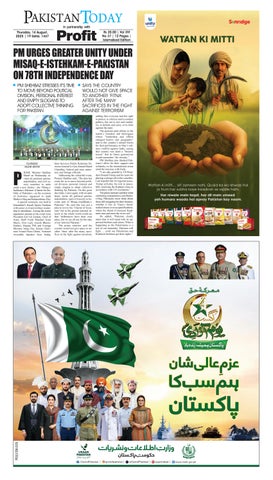
PM URGES GREATER UNITY UNDER MISAQ-E-ISTEHKAM-E-PAKISTAN ON 78TH INDEPENDENCE DAY
g
PM SHEHBAZ STRESSES IT’S TIME TO MOVE BEYOND POLITICAL DIVISION, PERSONAL INTEREST AND EMPTY SLOGANS TO ADOPT COLLECTIVE THINKING FOR PAKISTAN
P
ISLAMABAD
saleem jadoon
RIME Minister Shehbaz Sharif on Wednesday invited all political parties, stakeholders, and civil society members to unite under a new charter—the ‘Misaq-iIstehkam-i-Pakistan’ (Charter for Stability of Pakistan)—on the occasion of festivities organised to mark Marka-e-Haq and Independence Day. A special ceremony was held in Islamabad’s Jinnah Sports Stadium with senior civil and military leadership in attendance. Among the senior dignitaries present at the event were President Asif Ali Zardari, Chief of Army Staff Field Marshal Asim Munir, First Lady Aseefa BhuttoZardari, Deputy PM and Foreign Minister Ishaq Dar, Senate Chairman Yousuf Raza Gilani, National Assembly Speaker Ayaz Sadiq,
g
SAYS THE COUNTRY WOULD NOT GIVE SPACE TO ANOTHER ‘FITNA’ AFTER THE MANY SACRIFICES IN THE FIGHT AGAINST TERRORISM
Inter-Services Public Relations Director-General Lt Gen Ahmed Sharif Chaudhry, federal and state ministers, and foreign officials. Addressing the colourful event, Premier Shehbaz said, “The time has come for us to move beyond political division, personal interest and empty slogans to adopt collective thinking for Pakistan. On this great day today, I once again, with an open heart, invite all political parties, stakeholders, and civil society to become part of Misaq-i-Istehkam-iPakistan.” He said this was not a plan to revive the ‘Charter of Economy’ but in the greater national interest so the whole world could see that “differences have their own place, but we are all one for the sake of our beloved Pakistan.” The prime minister said the country would not give space to another ‘fitna’ after the many sacrifices in the fight against terrorism,
adding that everyone had the right to protest, to criticise and to conduct politics, but not to riot and vandalize, to defame and curse, or to rebel against the state. The premier paid tribute to the nation’s founders and ideologues whose “leadership and efforts changed history and geography” and to the country’s armed forces for their performance in May’s military conflict against India, saying that country was dealt a “historic lesson” that its future generations would remember “for eternity.” PM Shehbaz also thanked Pakistan’s allies for their support and solidarity on the international arena amid the tensions with India. “I am also grateful to US President Donald Trump and his team for playing a strong role in the ceasefire. I am hopeful that for regional peace, Trump will play his role in peacefully resolving the Kashmir issue in accordance with UN resolutions.” The prime minister said that while celebrating independence and Markae-Haq, Pakistanis must think about those still struggling for their freedom, whether it was in “Gaza’s bloodsoaked streets or in occupied Kashmir, where the blood of innocent Kashmiris runs and turns the rivers red.” He added, “Pakistan clearly states that it will stand with its oppressed brothers and sisters. What is happening to the Palestinians is a test of our humanity. Pakistan will fight … until our Palestinian and Kashmiri brethren get their rights.”
02
Thursday, 14 August, 2025 | ISLAMABAD
NEWS 03
Thursday, 14 August, 2025 | ISLAMABAD
PAKISTAN NEEDS $40B-$50B ANNUALLY TO TACKLE CLIMATE RISKS, SAYS OICCI REPORT
P
PROFIT
staff report
AKISTAN requires $40 billion to $50 billion each year to address rising
climate threats, according to the Overseas Investors Chamber of Commerce and Industry’s (OICCI) 3rd Pakistan Climate Conference Report. The report warns that the country is already facing billions in
damages, increasing health costs, and declining productivity. Despite contributing less than 0.9% to global greenhouse gas emissions, Pakistan ranks first on the 2025 Climate Risk Index. In 2022, cli-
mate-related disasters caused over $30 billion in losses, with recovery needs exceeding $16.3 billion. Air pollution results in more than 128,000 premature deaths annually, while agricultural productivity has dropped 10–20% due to climate variability. The report, titled Creating an Enabling Environment for Private Sector Participation in Climate Resilience, stresses the urgency of mobilising climate finance at scale, positioning the private sector as a key partner in resilience-building. Speaking at the launch, Secretary of the Ministry of Climate Change and Environmental Coordination, Aisha Humera Chaudhry, said Pakistan must channel substantial and timely climate finance to local solutions, with the private sector playing a central role. OICCI Secretary General M Abdul Aleem noted that Pakistan’s reliance on fossil fuels and carbon-intensive practices threatens exports under global frameworks like the EU Carbon Border Adjustment Mechanism, making decarbonisation and green finance essential for economic growth and competitiveness. SDPI Executive Director Dr. Abid Suleri highlighted the importance of market-based solutions and private sector participation, arguing that climate crises are an immediate socioeconomic challenge requiring policy support, data transparency, and accessible financing instruments. The 3rd PCC Report outlines actionable strategies in regenerative agriculture, industrial decarbonisation, plastic circularity, and carbon market development, emphasising that effective climate finance must be paired with supportive policies and capacitybuilding to bridge Pakistan’s climate funding gap.
04 ADVERTISEMENT
I
N my capacity as Executive Director COMSATS, an Intergovernmental Organization of Science, Technology and Innovations, I extend heartiest congratulations to the Government of Pakistan and the Pakistanis Nation, on behalf of COMSATS fraternity, on the auspicious occasion of their
C
MESSAGE
Thursday, 14 August, 2025 | ISLAMABAD
Independence Day. I am honoured to represent this multilateral forum that pursues developments in the field of S&T and facilitates knowledge and technology sharing among member states. We develop tech-based solutions, training courses in emerging technologies, offer
policy inputs and connect with significant S&T Institutions, globally and the important international forums to the Member States’ benefit. I wish Pakistan and its people a very prosperous and bright times ahead. COMSATS – Pakistan Cooperation Paindabad!
Amb Dr M Nafees Zakaria Executive Director COMSATS
COMSATS - Empowering Global South with Science & Technology
OMMISSION on Science and Technology for Sustainable Development in the South (COMSATS) established in 1994 was brainchild of Prof Abdus Salam, the Nobel Laureate Pakistani Scientist and Theoretical Physicist. It is an intergovernmental organization of 27 developing countries from Asia, Africa, Middle East and Latin America. The over-arching objective was bridging technology & knowledge gap between Global South and Global North through Intra-COMSATS cooperation. COMSATS draws its strength from its Network of 25 International S&T Centres of Excellence. Major Organs (Statutory Bodies) of COMSATS are: • General Meeting: comprises Heads of State/Government of the Member Countries. Current Chairman of the Commission is the President of Republic of Ghana. • Consultative Committee: consists of Ministers/ Ministerial representatives of the relevant focal ministries/ government departments of the Member States. • COMSATS Network: serves as technical resource base for the organization’s S&T programs and innovations. It consists of: Coordinating Council: Heads of Centres of Excellence. Technical Advisory Committee: comprising Scientists/Technology Experts support the organization with their valuable advice. • Secretariat: Headed by the Executive Director. Hosted in Islamabad by the Government of Pakistan. COMSATS Network of Centres of Excellence (CoEs) & National Focal Points: Program Directorate of COMSATS Secretariat coordinates with the CoEs, which is the fountainhead of scientific innovations and activities. The Dte.designs and develops activities in diverse fields of the Network’s expertise. The activities include capacity building, knowledge sharing, collaboration among CoEs, offers of scholarships & fellowships, CoEs products, technologies and services for the Member States, cooperation with International Partners such as ANSO, UNESCAP, NSTDA, INSME, TWAS, etc. Or-
ganizes meetings of COMSATS’ statutory bodies, particularly the Coordinating Council and National Focal Points and liaises with their members, facilitates collaborative R&D under COMSATS International Thematic Research Groups, and COMSATS’ Series of S&T Publications, etc. Establishment of COMSATS Joint Centre for Industrial Biotechnology (CCIB) in China was a significant milestone. International Cooperation/ Partnerships - Centre for Climate and Sustainability (CCCS):
Owing to the global ever-growing focus on Climate Change, COMSATS established in 2019 a dedicated Centre for Climate and Sustainability (CCCS) to serve as a pivotal hub of scientific and policy collaboration across the Global South. Achieved affiliation of Centres of Excellence from 20 developing countries. CCCS enables seamless inter-institutional synergy, coordinated research, informed policy dialogue, and deployment of technology-driven solutions. As an accredited Observer Organization to the United Nations Framework Convention on Climate Change (UNFCCC)_ a significant milestone achieved by COMSATS, the CCCS as operational arm of COMSATS Directorate for International Partner Organizations (IPOs), effectively advocates for the Global South at the annual Climate Change Conferences of the Parties (COPs). At COPs, IPOs Dte. Pursues South–South and Triangular cooperation, and mobilizes the intellectual capital, research infrastructure, and policy expertise of its member institutions, covering diverse areas including climate-smart agriculture, renewable energy, biodiversity conservation, water security, sustainable transportation, carbon markets, net-zero industry and more. At the national level, IPOs/CCCS collaborates with Ministries of Climate Change and Environmental Coordination, IT & Telecommunication, Planning, Development and Special Initiatives, and Science and Technology (COMSATS’ focal point in Pakistan). Nurtures relations with NDMA, NIDM, NDRMF, Pakistan Science Foundation, Pakistan Academy of Sciences, NIMA, Food Security and Agriculture Centre of Excel-
lence (FACE), SDPI, Living INDUS Initiative; Climate Resourcing Coordination Center (CRCC), International and Intergovernmental Organizations, including UNESCO, UN-ECOSOC, UNIDO, UNEP, South Center, COMSTECH, IOFS, ECO-SF, IPO-Pakistan, WWF, TWAS, ICGEB, etc. Diplomacy in Science: COMSATS engages Ambassadors of Member States and other partner countries for COMSATS’ events and they reciprocate keenly. Ministerial Visits to COMSATS Secretariat: Several ministerial visits recently underscores growing recognition of COMSATS as a key platform for South-South cooperation in STI. SG Commonwealth, Rt. Hon. Patricia Scotland KC; Minister for S&T Minister for Education and Professional Training, Dr. Khalid Maqbool; former PM of Jordan, currently, the President of the Islamic World Academy of Sciences (IAS), Hon. Prof. Adnan Badran; President of COP-29, H.E. Mukhtar Babayev, Azerbaijan’s Minister of Ecology and Natural Resources; Ex PM Kyrgyz Republic, Syrian Deputy Minister of Education, Dr. Rami Waheed Al-Dhulli; Baroness Sayeeda Hussain Warsi and Lord Qurban Hussain, members British House of Lords, and MP Naz Shah of House of Commons. Visits enabled converging interest in IT, AI, Cyber Security, Fintech, Tech-enabled Health Clinics, EV and Climate Change, and application of emerging technologies for progress of developing countries. ACCOMPLISHMENTS: EV: COMSATS is a proponent of eco-friendly innovations. The technology partner of COMSATS, AGECO with its IPO patents, has developed indigenous technology to convert the Internal Combustion Engine (ICE) vehicles to Electric Vehicles (EVs). A multi-dimensional initiative of Social, Economic, Health and Environmental benefits for the people and the country of its adoption. Nanotech: COMSATS Secretariat’s ISO Certified Nanotechnology Lab, aims at providing research facility for PhD students, training courses, material testing and much more. Telehealth: Using technology to overcome geographical barriers COMSATS successfully developed Tech-enabled health clinics to provide primary and secondary health care to the people in remote areas. IT & AI Trainings: COMSATS pursues digital transformation, runs skill development programs in Web Design and Development, Graphics Design, Mobile App Development, Business Intelligence, and eCommerce, equipping young people with the tools to thrive in the digital economy. Conducted Bootcamps in Artificial Intelligence and Software Quality Assurance for Azerbaijan. Data Centre & Cloud Computing Services: COM-
SATS is a pioneer in Internet services in Pakistan. Established Cloud Computing, Proxmox Virtual Environment (PVE) at Data Centre, robust security features. Software Solutions: COMSATS Software Solutions (CSS) has developed ComSoft ERP based Campus Management System, Hospital Management Information System, Pakistan Investment Portal on Prime Minister of Pakistan’s call, Biosafety. Clearing House application for Environmental Protection Agency (EPA); and Weather web-portal for Pakistan Meteorological Department (PMD) and many more. Offer of Scholarships and Certified Courses: Scholarships: COMSATS facilitates Graduate (MS and PhD) fully covered Scholarships offered by its CoEs and Partner Organizations, in key fields Bioinformatics, Biotechnology, Computer Engineering, Electrical Engineering, Civil Engineering, Energy Systems Engineering, Chemical Engineering, Mechanical Engineering, Cyber Security, Artificial Intelligence, Environmental Sciences, and Remote Sensing & Geographic Information System. Certified Courses: COMSATS organizes online training program aimed at benefiting nationals of its Member States, particularly young professionals, by enhancing their skills and technical expertise in critical domains of technology.
Thursday, 14 August 2025 | ISLAMABAD
Uzbekistan to equip all irrigated lands with water-saving technologies by 2030 SHAVKAT KHAMRAYEV
Just a decade ago, during meetings with international experts, an alarming question was raised: How will climate change, reduced rainfall, and the melting of ancient glaciers affect Central Asia? It was predicted that by 2025, the region’s water resources could decrease by 5%, and by 2030 – by 10%, leading to water shortages for the population. The President of Uzbekistan has set a crucial task for the water management system – to provide people with water and offset the deficit caused by climate change and other factors. Thanks to ongoing measures, in 2023 the country saved 7 billion cubic meters of water, in 2024 – 8 billion, and in 2025 this figure is expected to reach 10 billion cubic meters. This matches the volume of water shortages previously forecast. By 2030, Uzbekistan plans to save up to 15 billion cubic meters annually. Once, in Nukus, because of groundwater and salts, even grass barely grew along the roadsides – let alone flowers. At the initiative of the President of Uzbekistan, in 2017 the concrete lining of the Dustlik Canal, which passes through the city, began. The phased construction of the “Nukus” collector also started. In a short time, tangible results were achieved: water seepage in the canal decreased, and groundwater levels dropped. Today, Nukus streets are unrecognizable – blooming with flowers. Previously, due to excessively high groundwater levels in Gulistan, there was even discussion about relocating the administrative center of the Syrdarya Region to the city of Yangiyer. The country’s leader personally took control of the issue, and the necessary funds were found. As a result of reconstructing and lining the canal passing through Gulistan, water seepage decreased, vertical drainage wells were built, irrigation and reclamation work was carried out, and groundwater levels significantly dropped. There are many such examples. In Urgench, thanks to lining the Shovot Canal, and in the almost swampy Naryn district, through the construction of vertical wells, long-standing problems associated with high groundwater levels were resolved. On the President’s initiative, major investments have been attracted into the water management sector. With the participation of the Islamic Development Bank (IsDB), the Toshsoqa canal system in Khorezm Region is being modernized; with World Bank funds, canals in the Fergana Valley are being reconstructed; in cooperation with the Asian Development Bank – in Bukhara Region; and through IsDB loans – in Surkhandarya Region. As a result, groundwater levels in these areas have dropped by 0.3-0.5 meters compared to long-term averages, and canal efficiency has significantly improved. Most importantly, water supply to irrigated lands has improved. In many places, thousands of small pumping stations are no longer needed, as water now flows by gravity. This has saved electricity and operating costs. On November 29, 2023, during a video conference on rational water use and reducing water losses, the head of state stressed the importance of lining canals and ditches. According to calculations, irrigation systems with natural (unlined) channels lose about 14 billion cubic meters of water annually (36%) without any economic benefit. That is why 2024 was declared a “breakthrough year” for canal lining in the water management sector. From the state budget, 676.7 billion soums were allocated to reconstruct 555 km of canals. Clusters and farms rehabilitated and lined 13,500 km of internal irrigation networks. These are not just dry numbers – behind them lies the well-being of the people and abundance on every dastarkhan (Uzbek family table). Until recently, there was a mistaken belief that drip irrigation was unsuitable for Uzbekistan’s conditions, and that in our hot climate the traditional method of furrow irrigation was optimal. The author is Minister of Water Management of Uzbekistan.
NEWS 05
INDIAN PM MODI LIKELY TO MEET TRUMP IN US NEXT MONTH, NEWSPAPER REPORTS
I
WASHINGTON agencies
NDIAN Prime Minister Narendra Modi is likely to meet President Donald Trump during a visit to the United States next month to attend the UN General Assembly meeting, the Indian Express newspaper reported on Wednesday, citing sources. India’s foreign ministry did not immediately respond to a request for comment. An Indian official familiar with the matter said a decision has not yet been taken, and that countries usually reserve slots for the General Debate at the assembly, which is why India’s “head of government” features in a provisional list of speakers on September 26. “The list will go through revisions,” the official said, adding that it had not yet been decided if Modi would be going to the assembly. The General Assembly kicks off on September 9, but the debate, the annual meeting of heads of state and
government, will be held from September 23-29. Although the reason for the potential visit will be to attend the UN meeting in New York, a key objective will be to hold talks with Trump and iron out trade and
New policies to boost Presidential hopeful dies in personal and service Colombia after June rally shooting consumption: China’s State Council
BOGOTA
BEIJING
agencies
Colombian presidential candidate Miguel Uribe has died two months after being shot at a campaign rally, his family said on Monday, as the attack rekindled fears of a return to the nation’s violent past. The 39-year-old conservative senator, a grandson of former president Julio Cesar Turbay (19781982), was shot in the head and leg on June 7 at a rally in the capital Bogota. Despite signs of progress in recent weeks, his doctors on Saturday announced he had suffered a new brain hemorrhage. “Rest in peace, love of my life,” his wife Maria Claudia Tarazona wrote on Monday morning in a post on Instagram. “Thank you for a life full of love.” Authorities have arrested six suspects linked to the attack, including the alleged shooter, a 15-year-old boy captured at the scene by Uribe’s bodyguards. Following a nationwide manhunt, police announced the arrest of an alleged mastermind behind the attack, Elder Jose Arteaga Hernandez, alias “El Costeno.” Police have also pointed to a dissident group of the defunct FARC guerrilla group as being behind the assassination. The attack on Uribe, a leading candidate ahead of the 2026 presidential election, has reopened old wounds in a country wracked by violence. His own mother, journalist Diana Turbay, was killed in a botched 1991 police operation to free her from cocaine kingpin
staff report
Pablo Escobar’s Medellin cartel. Four presidential candidates were assassinated during the worst phase of violence in the 1980s and 1990s under Escobar, who terrorised citizens of Bogota, Medellin and elsewhere with a campaign of bombings. ‘Evil destroys everything’ “Today is a sad day for the country,” Colombian Vice President Francia Marquez said on social media. “Violence cannot continue to mark our destiny. Democracy is not built with bullets or blood, it is built with respect, with dialogue.” Uribe has been a strong critic of Colombia’s first left-wing president, Gustavo Petro, who has sought in vain to make peace with the country’s various remaining armed groups. He announced in October that he would seek to succeed the termlimited Petro in the May 2026 presidential election. Uribe was elected to Bogota’s city council at age 26,
Wang Yi to chair 10th Lancang-Mekong Cooperation Foreign Ministers’ Meeting
BEIJING
staff report
Chinese Foreign Minister Wang Yi, also a member of the Political Bureau of the Communist Party of China Central Committee, will chair the 10th Lancang-Mekong Cooperation (LMC) Foreign Ministers’ Meeting in Anning, southwest China’s Yunnan Province, from Thursday to Friday, a Chinese Foreign Ministry spokesperson announced on Wednesday. The spokesperson said the LMC is an innovative type of regional cooperation mechanism among China, Cambodia, Laos, Myanmar, Thailand and Vietnam featuring collaboration, consultation and shared benefit. Under the strategic guidance of the leaders of the six countries, the Mekong countries have succes-
tariff issues that have led to some souring of ties between the two countries, the newspaper reported. News of a possible Modi trip to the US comes days after Trump announced an additional 25 per cent tariff on Indian
goods to penalise New Delhi for continuing to buy Russian oil. The penalty took the total levy on Indian goods exported to the US to 50pc, among the highest levied on any US trading partner. Trade talks between New Delhi and Washington collapsed after five rounds of negotiations over disagreement on opening India’s vast farm and dairy sectors and stopping Russian oil purchases. On Tuesday, US Treasury Secretary Scott Bessent said several large trade agreements were still waiting to be completed, including with Switzerland and India, but New Delhi had been “a bit recalcitrant” in talks with Washington. Bessent told Fox Business Network’s Kudlow he hoped the Trump administration could wrap up its trade negotiations by the end of October. “That’s aspirational, but I think we are in a good position,” he said, adding, “I think we can be, we will have agreed on substantial terms with all the substantial countries.”
sively announced with China the building of a community with a shared future, which means that countries in the region have all been committed to building a community with a shared future both bilaterally and multilaterally under the LMC mechanism, the spokesperson said. “Connectivity across land, sea, air and the cyberspace has been enhanced; cross-border trade, investment, and industrial and supply chain cooperation continued to deepen; and cultural and peopleto-people exchanges have flourished, fostering ever-closer bonds among our peoples,” the spokesperson said. The six countries have cultivated the Lancang-Mekong spirit of development first, equal consultation, practicality and high efficiency, and openness and
inclusiveness, and worked together to build a Lancang-Mekong home that shares weal and woe in solidarity, according to the spokesperson. Noting this year marks the 10th anniversary of the LMC mechanism, the spokesperson said all Lancang-Mekong countries are now at a crucial stage of accelerated development. Facing a volatile international landscape and the rise of unilateralism, hegemony and protectionism, the Lancang-Mekong countries need to strengthen unity, enhance cooperation, and promote common development, the spokesperson said. China hopes to work with the Mekong countries at the LMC Foreign Ministers’ Meeting to review the outcomes of cooperation, take stock of success experience and plan for future development of the mechanism so as to build a more resilient Lancang-Mekong Economic Development Belt and an even closer Lancang-Mekong community with a shared future, providing greater stability and new driving forces for improving the well-being of people and promoting sustainable development in the region, according to the spokesperson. On the sidelines of the LMC meeting, as proposed by Thailand, the co-chair of the LMC, the Informal Discussion Between the Foreign Ministers of China, Laos, Myanmar and Thailand will be held for an in-depth exchange of views on the regional situation, jointly combating cross-border crimes and other issues of mutual interest and concern, the spokesperson said.
later becoming its youngest-ever chairperson and then the mayor’s right-hand man. In 2019, he unsuccessfully ran for mayor of Bogota, but three years later, he was elected a senator — receiving the most votes of any candidate in the country. He took a seat with the conservative Democratic Center party, founded by former president Alvaro Uribe, no relation. “Evil destroys everything, they killed hope. May Miguel’s struggle be a light that illuminates Colombia’s rightful path,” former president Uribe wrote on X. In recent months, Petro, a former left-wing guerrilla, has been accused of dialing up the political temperature by labelling his rightwing opponents “Nazis.” US Secretary of State Marco Rubio, a frequent critic of the leftist Petro government, demanded justice following the announcement of Uribe’s death.
China will see the implementation of new financial policies to strengthen fiscal and financial coordination, outlined Liao Min, Vice Minister of Finance, during a press conference held by China’s State Council Information Office (SCIO) on Wednesday. Liao detailed the two new policies: first, an interest subsidy for personal consumer loans, and second, subsidized loans for businesses in the services sector. The interest subsidy for personal consumer loans will directly benefit the general public, said Liao, highlighting that the policy will cover single consumptions of less than 50,000 yuan ($6,965), or exceeding such in a number of specific areas, such as education, elderly care and healthcare, among others. Meanwhile, businesses eligible for subsidized loans will come from eight major consumer services areas: catering and accommodation, health, elderly care, childcare, housekeeping, culture and entertainment, tourism and sports. With a maximum loan threshold of 1 million yuan, at an interest rate subsidy of 1 percentage point for such businesses. The focus of the two policies is for wide coverage at low thresholds, said Yu Hong, director of the finance department at the Ministry of Finance. Only basic conditions have to be met for people to receive financial support, Yu added. China’s six major state-owned commercial banks – including the Agricultural Bank of China, Industrial and Commercial Bank of China, and Bank of China – have announced plans to implement the newly introduced interest subsidy policy for personal consumption loans, following the policy release on Tuesday. Several national joint-stock commercial banks, such as China Merchants Bank, China Guangfa Bank, and Industrial Bank have also announced that they will offer interest subsidies to eligible loans. The policies focus on both the supply and demand sides of consumption, Liao noted, shifting more fiscal and financial policy focus toward benefitting people’s livelihoods and promoting consumption.
06 COMMENT
Pakistan’s new dawn
At 78
P
Where does the country stand on the 78th anniversary of its creation?
Today is Independence Day
AKISTAN is special. It did not exist before it became independent, and yet half of it went on to create another country a quarter of a century after its first coming into existence. It was also created on the basis of religion, but it was not envisaged by its founders as a religious state. Perhaps one reason was that the entity which brought about its creation, the AllIndia Muslim League, was more a national movement than a political party. Both the leftist Mian Iftikaruddin and the rightist Maulana Abdus Sattar Niazi found space to be in the same party as those representatives of feudalism, Iftikhar Mamdot and Mumtaz Daulatana. It was perhaps inevitable that, once the country was created, both Mian Iftikhar and Maulana Niazi would slope off and join other parties. That is perhaps the essence of the political problem that has faced Pakistan. The existence of many parties is not acceptable. Parties are supposed to exist as part of a multitude rather than in splendid isolation, and need not be so grudging about the existence of other parties. The all-too-familiar cycle of suppression in opposition and administering suppression while in government is visible now, as the opposition PTI is put through the hoops it used on the PML(N) and PPP when positions were reversed. Much is made of the fact that there have been three martial laws, but one of the main reasons has been that parties have not operated the system so that they maintained a monopoly over power. Martial laws have been seen as a means to ousting the government in power, in place of elections. Perhaps of more relevance is the economic problem. The whole idea of independence was that the colonial power was not acting in line with the wishes of the people, and was not providing them the benefits they wanted. It was hoped that independence would lead to governments more responsive to people’s wishes. People all over the world have relatively simple needs, though their wishes may be unlimited, and Pakistanis are no exception. However, providing those needs has become a problem because of the cupidity of officials, politicians and other stakeholders. The need of the day seems to be getting under one big tent, not of a single party, but of a single national identity. Unless we all pull together, we will arrive nowhere.
T
Dr Zafar Khan SafDar
HE emergence of Pakistan in 1947 was no stroke of fortune, but the consummation of a profound political vision, steeled by the intellect, resolve, and moral rectitude of Quaid-i-Azam Muhammad Ali Jinnah. Anchored in the creed of Unity, Faith, and Discipline, he transformed a dispersed yearning into a disciplined national movement, culminating in the establishment of the world’s second-largest Muslim state. This was not a mere division of territory, but the creation of a sovereign homeland where Muslims could safeguard their faith, culture, and political rights. That vision did not end with independence, it has been carried forward through decades of sacrifice and service. In the war against terror, over 80,000 Pakistanis, soldiers, police, and civilians, laid down their lives so the nation could endure in peace. Every day, our brave men embrace martyrdom on the frontlines, defending the green and white flag. Yet, the defence of Pakistan is not confined to the battlefield; it lives in the students striving for knowledge, the teachers shaping the nation’s conscience, the doctors and nurses healing the sick, and the engineers, farmers, and labourers building the backbone of our economy. They are the inheritors of the Quaid’s dream, proving that the spirit of patriotism is as vital in classrooms, hospitals, factories, and fields as it is in the line of fire. Seventy-eight years later, the ideals that inspired our creation remain as relevant as ever. Our journey has been marked by moments of pride and achievement, becoming a nuclear power, expanding our cities, growing our industries, yet also by missed opportunities, political instability, and governance failures. Too often, national interest has been clouded by personal ambition, and the promise of equality has been unevenly fulfilled. The result has been a political and economic order where many citizens have yet to feel the full benefits of independence. This year brought a defining moment. In the face of unprovoked Indian aggression, Pakistan responded with unity, resolve, and strategic brilliance. Our armed forces, led by General Asim Munir, now honoured with the rare rank of Field Marshal, defended not only our borders but also our national dignity. The victory was decisive, brief, and symbolically powerful, earning global respect and reaffirming our sovereignty. It reminded the world, and ourselves, that Pakistan’s strength lies as much in
Dedicated to the legacy of late Hameed Nizami
Arif Nizami (Late)
America’s Debt Binge Founding Editor
M. A. Niazi
Babar Nizami
Editor Pakistan Today
Editor Profit
O
Dr IMran KhaLID
n the Fourth of July, while Americans were watching fireworks light up the sky, President Donald Trump was lighting a fuse of a different kind. With the stroke of a pen, he signed the One Big Beautiful Bill Act- a name that sounds like a marketing gimmick for a Vegas casino- raising the U.S. federal debt ceiling by $5 trillion. That’s right: not million, not billion, but trillion, pushing the total debt to an eye-watering $41.1 trillion. Happy Birthday, America. The irony is almost poetic. This bill isn’t just a number on a balance sheet- it’s a flashing red warning light on the dashboard of the global economy. And the real question isn’t if we hit the wall, but when. Let’s take a step back. In 2019, the U.S. debt stood at $23.2 trillion. Today? It’s soared to $36.1 trillion, and counting. That’s nearly a $13 trillion spike in just five years- more than the combined GDP of Japan and Germany. For a country that likes to lecture others on fiscal prudence, America’s borrowing binge makes a drunken sailor look disciplined. What’s broken is not just the budget. It’s the whole idea of a debt ceiling. Originally intended as a check on reckless spending, it has become a ritual of political theatre- a rubber stamp wrapped in a partisan cage match. Since 1939, Congress has raised the debt ceiling 108 times. That’s once every nine months. The debt ceiling is a political inventiononce designed as a fiscal guardrail, now warped into a partisan tug-of-war. We’ve seen this circus before. Remember 2011? That standoff nearly triggered a default, tanked markets, and cost America its AAA credit rating. That eleventh-hour scramble nearly froze $62 billion in Social Security checks and crashed corporate bond markets. Global lending dropped off a cliff. And paradoxically, investors still ran toward US debt, like passengers flocking to the Titanic because it had better food. But gravity always wins. By May 2025, Moody’s downgraded US debt, stripping away its final triple-A rating. That’s right- the world’s biggest economy is now a credit risk. And here’s where it gets scary: interest payments on that debt are exploding. In fiscal 2024 alone, America paid $1.1 trillion just to service its debt. That’s more than the entire GDP of Indonesia.
Historically, we’ve been able to finesse this by relying on what economists call the “r-g” rule - as long as economic growth (g) outpaces interest rates (r), debt stays manageable. But that magic trick is fading. Growth has slowed, interest rates have climbed, and the math no longer works. The U.S. is now spending over 13 percent of its budget just to pay interest. That’s not investment - that’s treading water with lead shoes. The U.S. doesn’t just lack the will to repay its debt- it lacks the capacity. Put simply, maxed-out credit cards are being juggled by opening new ones. It’s fiscal hopscotch with no exit strategy. Now, here’s where this shifts from being a domestic budget story to a global alarm bell. The US dollar has long been the linchpin of the global financial system - the world’s reserve currency. Countries stockpile our debt not because they love us, but because they trust the stability of our institutions and the depth of our markets. Even in the darkest moments of 2008, US Treasuries were seen as a safe haven. But safe havens can crumble. This past April, we witnessed a rare “triple kill”- simultaneous drops in U.S. stocks, bonds, and the dollar. Investors ran for the exits. The USA repurchased $10 billion in Treasuries in a single month- a historic move. Central banks slashed their US bond holdings by $1.2 trillion last year alone. Meanwhile, gold- that ancient fallback- soared to a post-Bretton Woods high. When gold rises and Treasuries fall, it means trust is eroding. And now there is something called the Mara-Lago Agreement- a plan floated to issue “Century Bonds” in exchange for debt relief. Translation: the USA is toying with the idea of
unity of purpose as in military capability. Crucially, this victory has opened new diplomatic avenues. The USA has expressed readiness to deepen engagement with Pakistan, while our stature in the international community continues to rise. Such moments are rare, and if met with vision and determination, they can redefine our place in the world, not merely as a security state, but as a dynamic economic force. The way forward lies in economic revival, for without strong economic foundations, sovereignty remains vulnerable and the aspirations of our people unmet. This demands bold reforms to enhance industrial and agricultural productivity, integrate advanced technologies, and foster an investment climate that attracts both domestic and foreign capital. Expanding our export base beyond textiles and primary commodities will strengthen economic stability, while participation in global value chains can open new frontiers for revenue, employment, and innovation. Strategic partnerships should be forged to open new markets, secure favourable trade agreements, and access expertise that can modernise our infrastructure and energy systems. Long-standing challenges, energy shortages, water mismanagement, and outdated logistics, must be addressed decisively through sustainable power projects, modern irrigation, and smart infrastructure, laying the foundation for durable growth. True economic strength rests on human capital. Quality education, vocational training, and advanced research must be prioritised to boost productivity and competitiveness. Women should have equal opportunities to participate and lead, while minority rights must be safeguarded as a reflection of national dignity. A stronger health system, capable of reaching even the most remote communities will create a healthier, more produc-
Thursday, 14 August, 2025
tive population. Governance reform is indispensable. Public institutions must function with transparency, accountability, and respect for the rule of law, giving investors confidence that contracts will be honoured, corruption punished, and policies kept stable. Political stability is not simply about order, it is the foundation on which lasting economic progress rests. Foreign policy, reinforced by recent credibility, should prioritise constructive regional engagement. Trade, joint ventures, and cultural exchanges can transform historic rivalries into opportunities for cooperation. While remaining vigilant against extremism, Pakistan must present itself as a stabilising force in South Asia, championing peace, economic connectivity, and mutual respect. Shaping the future will require more than sound policy, it will call upon the very strength of our national character. Integrity, responsibility and service must guide leadership and citizens alike. Our diversity in language, ethnicity, and faith should be celebrated as a source of strength, not division. Politics must move beyond personal gain toward dialogue, consensus, and long-term vision. The lesson of our journey is clear: Pakistan flourishes when it remains true to its founding ideals. The victory of the past year proved that no challenge is insurmountable when we stand united. Today, with renewed global recognition, we have the chance to move beyond crisis management toward genuine nation-building, creating a just economy, an inclusive society, and a confident, respected Pakistan. Our forefathers dreamed of a homeland built on dignity, opportunity, and justice. It is now our duty to complete that mission. The next chapter of our story is ours to write, let it be one of courage, wisdom, and unwavering pride in who we are.
The writer is Ph.D in Political Science and visiting faculty at QAU Islamabad. His area of specialization is political development and social change. He can be reached at zafarkhansafdar@yahoo.com and tweet@zafarkhansafdar.
Today, with renewed global recognition, we have the chance to move beyond crisis management toward genuine nation-building, creating a just economy, an inclusive society, and a confident, respected Pakistan. Our forefathers dreamed of a homeland built on dignity, opportunity, and justice. It is now our duty to complete that mission.
Editor’s mail
issuing IOUs that won’t mature until 2125. That’s not a plan. That’s a prayer. Bridgewater founder Ray Dalio has repeatedly warned that we are entering a once-in-alifetime financial breakdown. He is not alone. The USA share of the global economy has dropped from 33 percent in 2000 to 25 percent today. The margin of error is shrinking fast. This isn’t just about numbers. It’s about credibility. The Bretton Woods system that crowned the dollar king in 1944 is slowly unraveling. As more countries turn to digital currencies, regional alliances, and barter arrangements, the foundations of dollar dominance- and by extension, US power- are under siege. And yet, Washington fiddles. Look, I get it. Infrastructure is crumbling. Social programmes are under strain. Geopolitical competition with China is heating up. But the solution is not to keep maxing out the national credit card with glittery slogans and no repayment plan. What we need is a new bipartisan compactone that recognizes that fiscal discipline is not a constraint, but a form of strength. That understands real patriotism is about building something sustainable, not just signing whatever gets the crowd cheering. Because here’s the hard truth: empires don’t fall because of external invasions. They fall because they rot from the inside. And if we keep treating the global financial system like a casino where the house never loses- we may soon find out that the house can, in fact, go bankrupt. The writer is a freelance columnist
Send your letters to: Letters to Editor, Pakistan Today, 4-Shaarey Fatima Jinnah, Lahore, Pakistan. E-mail: letters@pakistantoday.com.pk Letters should be addressed to Pakistan Today exclusively
No country for young graduates
PAKISTAN is home to one of the largest youth populations in the region, yet the economic policies in place fail to reflect this reality. Despite acquiring higher education and technical skills, a vast number of young individuals are either unemployed or underemployed — with limited access to meaningful career pathways. This disconnect between education and the job market is alarming. Young graduates face a saturated job market, rising inflation, lack of meritbased recruitment and minimal state support for entrepreneurship or freelance growth. Many are pushed into unpaid internships, irrelevant jobs or long periods of economic inactivity. These conditions are not only demoralising but also waste the potential of an entire generation. Job placement assistance for graduates Food delivery service partnering with local restaurants The absence of a youth-centric economic roadmap is deeply concerning. The frustration is now visible in increasing brain drain, growing mental health issues and a loss of trust in national systems. If this trend continues, Pakistan risks losing its most critical asset — its human capital. Policymakers must prioritise youth inclusion in economic planning by investing in skill development, supporting startups, ensuring transparency in hiring processes and creating platforms for young professionals to contribute meaningfully to. The nation cannot afford to leave its future in uncertainty. HASMA ANJUM SIALKOT
Constitution for few
ACCORDING to media reports, acting Sindh governor could not preside over a recent meeting at the Governor House because the governor, while proceeding on a foreign visit, took keys of the office with himself. There was uproar in Sindh Assembly as some members declared it a constitutional violation, and the acting governor subsequently approached the Sindh High Court. While all this was happening, no one among the legislators bothered to talk about the various constitutional violations that take place in the province on a daily basis. For instance, Article 25 guarantees free education, but 7.8 million children aged 5-16 years are out of school. Likewise, Article 9 guarantees security of life and liberty, but hundreds of underprivileged lose their lives due to crimes, from preventable diseases, and because of a lot of other reasons. There is no hue and cry among the legislators, and no swift action is taken by the state and its functionaries to resolve the matter like it was done in the case cited above. It is only when the ego of the powerful is hurt, like that of the acting governor, the entire system springs into action. Public funds and services of best lawyers from public tax money are availed and the courts are approached on an urgent basis. GULSHER PANHWER JOHI
Pitch for unity
Because hereÊs the hard truth: empires donÊt fall because of external invasions. They fall because they rot from the inside. And if we keep treating the global financial system like a casino where the house never loses- we may soon find out that the house can, in fact, go bankrupt.
Lahore – Ph: 042-36300938, 042-36375965
I
Karachi – Ph: 021-32640318 I
Islamabad – Ph: 051-2204545
I
A cricket-related initiative taken by the youth of Parachinar in Kurram district is highly commendable. A group of local players recently organised the Parachinar Super League (PSL), a grassroots cricket tournament aimed at promoting peace, harmony and youth engagement in the region. In a place that has faced years of unrest, such efforts offer a constructive and unifying outlet for young people. Through this tournament, players are not only showcasing their talents but also sending a strong message: that the youth of Parachinar want peace, prosperity and positive change. It is essential for the local government and the Khyber-Pakhtunkhwa provincial authorities to recognise and support this initiative. Encouragement in the form of funding, sports facilities and recognition could further empower these youth to become ambassadors of hope in their community. SIBT-E ALI TURI PARACHINAR
Web: www.pakistantoday.com.pk
I
Email: editorial@pakistantoday.com.pk
COMMENT 07
Where history demands a second beginning
Thursday, 14 August, 2025
Pakistan at 78
S
Majid naBi Burfat
OMETIMES a nation reaches an age where celebration alone feels hollow, where the candles on the cake flicker less with joy and more with questioning. Seventy-eight years is long enough to have written a full story— yet here we are, still trapped between the promise of 1947 and the unfinished chapters of today. History, with its unblinking eyes, now demands not mere remembrance, but renewal; not just survival, but a second beginning worthy of the first dream. Seventy-eight years on, Pakistan stands not as a finished portrait framed neatly on a wall, but as a living canvas— colours still wet, brushstrokes still uncertain, the artist’s hand trembling between boldness and hesitation. August 14 is not just a date etched in our calendars; it is a reminder that nations, like people, are forever becoming. We are a country that has tasted both glory and grief, whose victories often walk hand in hand with our failings. And this year, the drums of celebration beat alongside the drumbeat of urgency: the knowledge that freedom is not a static possession, but a fire we must tend, lest it burn low and cold. We must begin by saluting the martyrs and visionaries who gave us a homeland— one meant to be a sanctuary of justice, equality, and dignity. That ideal, immortalised in the speeches of the Quaid-e-Azam and kept alive in the whispered prayers of ordinary Pakistanis, still flickers in the determination of our farmers, the ingenuity of our youth, and the grit of our entrepreneurs. Yet it remains a promise half-kept, suspended between lofty aspiration and structural neglect. Our socio-economic reality is sobering to the point of indictment. Nearly 45 percent of
our population survives below the poverty line. Inflation may have eased from crisis levels, but it still bites into the very marrow of working-class households. Our Human Development Index— a meagre 0.544, ranking 164th worldwide— mocks our potential. Literacy is stuck at just over 72 percent, and no Pakistani university stands among the top 300 globally. Every year, millions of our children walk away from classrooms, not because they lack intelligence, but because the state has failed to keep the door of opportunity open. The rot runs deeper than economics. Our civic and political space is shrinking at an alarming rate. Political pluralism is throttled; dissent is criminalised; and journalism is treated not as a pillar of democracy but as a threat to it. Corruption, entrenched and systemic, has pushed us to 135th on Transparency International’s index— a grim testimony to elite impunity and institutional decay. Independence without integrity is an empty vessel; a flag without wind, colour, or lift. And yet, patriotism, as I see it, is not the art of turning away from such truths, but of meeting them head-on. It is a fire tested in the furnace of adversity, a love made fierce by its refusal to ignore flaws. As Friedrich Nietzsche observed, “A man’s worth is determined by how much truth he can bear.” To love Pakistan is to shoulder the burden of its truths— to cherish its victories while demanding redress for its failings. True devotion requires both loyalty to the ideals that forged this nation and rebellion against anything that betrays them. Against this troubled domestic canvas, Pakistan’s foreign policy has been a study in calculated precision. During the recent fourday armed conflict with India, our armed forces displayed a rare blend of operational mastery and strategic restraint. They safeguarded sovereignty without succumbing to reckless escalation— a posture that earned both deterrence and diplomatic respect.
On the world stage, Islamabad’s unwavering advocacy for Palestine— especially at the UN Security Council — has been more than symbolic. By coupling moral rhetoric with tangible aid, medical asylum offers, and coordinated relief efforts, Pakistan has signalled that its conscience is not for sale. In an age where expediency often trumps ethics, this consistency has bolstered our moral standing across the Muslim world and the Global South. Ties with key Muslim states have deepened: Iran’s state visit yielded concrete agreements in trade, energy, and border management; Turkey continues its steadfast diplomatic partnership. Even the United States, once cool and detached, has edged back into strategic engagement— a revival that is neither accidental nor sudden. It is the fruit of deliberate, behind-the-scenes diplomacy by Pakistan’s leadership, especially the military command, which has skillfully positioned us as indispensable in South and Central Asian geopolitics. Our geostrategic location, already in-
valuable, has gained new weight with the discovery of rare earth mineral reserves— resources critical to the future of technology, defence, and clean energy. This mineral leverage, combined with our role as a bridge between China, the Gulf, and Central Asia, has given Islamabad a bargaining chip few can ignore. The China-Pakistan Economic Corridor (CPEC) remains a lynchpin in Beijing’s Belt and Road Initiative, while our outreach to Central Asian republics offers fresh economic and energy corridors. Economically, the indicators are modestly encouraging. Under the IMF’s Extended Fund Facility, GDP has rebounded to 2.5 percent, inflation has cooled to 4.6 percent, the current account shows a surplus, reserves have reached $9.4 billion, and remittances have soared by 31 percent. Credit rating upgrades by Moody’s and Fitch have given investors reason to look twice. The rupee, for once, has held its ground. But here is the inconvenient truth: diplomatic prestige and macroeconomic stability
We are the custodians of a story still unfolding. Let us write it with conviction, with the ink of reform and the paper of unity. Let the world see a Pakistan that is not only strong abroad but whole at home · a Pakistan that carries its flag not just in its hands, but in its conduct. HistoryÊs pen is still in our hands. May we, for once, script a chapter worthy of the blood that won our freedom.
Why has India banned my book on Kashmir? Through this ban, there is an attempt to erase every trace of a counternarrative and alternate memory
O
AL JAZEERA
anuradha Bhasin
N August 5, 2019, the Indian government stripped the erstwhile Indian occupied Jammu and Kashmir state of its special status under Article 370 of the Indian Constitution, split it into two entities and demoted the two units to Union Territories under New Delhi’s direct control. As the sixth anniversary approached, the region was caught in the grip of rumours of a probable further division, or other administrative changes. Reports of unusual jet activity over Srinagar triggered widespread panic among residents. This evoked harrowing memories of similar aerial activity coupled with a similarly bizarre set of rumours in the tense days leading up to August 5, 2019. People waited anxiously. The bombshell that came on the sixth anniversary was an official order banning 25 books that focus on Jammu and Kashmir’s history and politics – all accused of promoting “false narratives” and “secessionism” – a sweeping judgement that does not stand the test of scrutiny and is not based on any evidence. My book A Dismantled State: The Untold Story of Kashmir After Article 370, published in December 2022 by HarperCollins, is one of them. The book is a rare chronicle of the day-to-day reality in Jammu and Kashmir after 2019. Based on ground research, extensive interviews and the collation of data from other primary and secondary sources, it punctured the Indian government’s claims of “normalcy” in Jammu and Kashmir. The government justified the actions of August 5, 2019 on the grounds that they would usher in peace and development in the region, while glossing over the unprecedented physical and cyber-restrictions imposed across the erstwhile state, during which thousands of people, including pro-India politicians (three former chief ministers included), were arrested. Barbed wire and military barricades turned the region, particularly the Kashmir Valley, into a curfewed zone, and communication channels – from internet to telephone lines – were pushed into some black hole. Six months later, when some of these restrictions were slightly eased and the internet was partially restored, the stranglehold of the Indian state became even more oppressive, with an exacerbation of raids and crackdowns against journalists, political and social activists, and civil rights defenders. The policy of widespread detentions under laws like the Public Safety Act, which allows the government to detain anyone without charge for up to two years, was ramped up significantly. These realities were hardly ever reported. Journalism was severely curtailed under the state’s clampdown, particularly affecting local publications.
Newspapers that refused to fall in line were choked financially until they were out of print. Those that did comply were rewarded with lavish government advertisements that kept the businesses going, minus the journalism. Either co-opted or terrorised, the newspapers were no longer daily chroniclers of the events, developments and incidents in the region. Community voices were silenced while journalists no longer asked questions. The rich archives of some newspapers, showcasing the complex day-to-day history of the region, became inaccessible or were removed. In the last six years, the government has been extremely intolerant of any criticism. Any word of dissent invites punitive measures ranging from mere intimidation and interrogation to confiscation of devices, and from the slapping of income tax and money laundering cases to terrorism accusations, sometimes accompanied by short detentions or prolonged arrests. While local journalism was reduced to an extension of the government’s public relations department, all civil society voices were throttled by intimidation, leaving major gaps in information. It was this vacuum that my book aimed to fill. Focused on the first two years of the revocation of Article 370, and in 12 chapters, I documented what was happening on the ground – the increased suppression of the masses, the lack of space for freedom of expression, the shrinking space for civil society and political activism, the criminalisation of dissent, the continuation of terrorism as opposed to the claims of peace and normalcy, and the hollowness of the development claims by the government even as the new policies and actions robbed the people of their homes and agricultural lands. The book is a pursuit of truth – the naked truth, which challenged everything the Indian state was saying. A paranoid state whose only method of engagement in Jammu and Kashmir is through increasing its military footprint, merciless subjugation of the residents and silencing of all voices of dissent was obviously uncomfortable with what I documented. The book was a warning to the government that its methods of control, creation of a police and surveillance state, and misplaced development models were unsustainable and would fail. In the last six years, the government has been pulling the wool over the eyes of the world by trumpeting its achievements of bringing peace, normalcy, tourism and development. The April 22 killings this year of 26 innocent civilians punctured this bubble. It was a wake-up call for the government to sit back and review its policies in Kashmir and begin course correction. Instead, it clamped down even further with a horrific scale of demonisation of Kashmiris, ruthless detentions and even more brutal demolitions of houses. This, even as there was widespread public condemnation of terrorism, including vigils and calls to reject violence – something unprecedented in the more than three-decade-long history of rebellion in the region – and even as the investigators indicated foreign militants, not locals, were involved in the killings. In the last three months, the government has demonstrated that its policy of control through harsh security measures and pervasive surveillance would be
are hollow victories if they fail to touch the lives of ordinary Pakistanis. The farmer in Sindh, the labourer in Balochistan, the teacher in Khyber Pakhtunkhwa — they cannot eat geopolitical relevance. They need functioning schools, accessible hospitals, safe streets, and jobs that pay a living wage. Global goodwill is fickle. If we do not turn this moment of strategic advantage into a long-term plan for institutional reform and equitable growth, this much-touted “resurgence” will dissolve into another cautionary tale of squandered opportunity. Pride must be matched with purpose; applause with action. So let us not mistake the waving of flags for the work of nation-building, nor the warmth of foreign applause for the steady glow of selfreliance. Nations, as the poet Faiz Ahmed Faiz once implied, are not merely inherited— they are remade each day by the courage, honesty, and sacrifice of their people. The sacrifices of 1947 demand that we rise beyond ceremony, that we convert strategic advantage into social justice, that we match the poetry of our ideals with the prose of hard governance. We are the custodians of a story still unfolding. Let us write it with conviction, with the ink of reform and the paper of unity. Let the world see a Pakistan that is not only strong abroad but whole at home — a Pakistan that carries its flag not just in its hands, but in its conduct. History’s pen is still in our hands. May we, for once, script a chapter worthy of the blood that won our freedom. Pakistan Zindabad. The writer is a freelance columnist
Proposition to ban student politics What is problematic in the whole debate is that it denies the political agency of the students, who were at the forefront of all democratic movements in the country
T
further accelerated. The ban on 25 books, many of which provide rich, well-researched, and layered historical, political and legal narratives about the complex and trouble-torn region, is an extension of the pattern. Through this ban, there is an attempt to erase every trace of a counter-narrative and alternate memory. By branding all criticism of the state and narratives that are out of sync with the official version as “seditious”, the government can now seize and destroy these books. Not only are the written words being criminalised – even the act of reading will be wrongfully deemed a threat to the security and integrity of the nation. While this may not stop ideas and memory from being suppressed, policing what people write and read is likely to be further intensified. Though senseless, shocking and irrational in scale and scope, the ban, which ironically coincides with a government-backed Chinar Book Festival in Srinagar, sends a chilling message: Knowledge and information will be regulated by the state. What people write and read will be decided by the state. The thought police will penetrate deeper. Last year, during Jammu and Kashmir’s first assembly elections as a Union Territory, India’s home minister, Amit Shah, took a dig at the regional political parties and alleged that while “they (local politicians) gave the youth stones in their hands”, his government had given them “books and laptops”. The hollowness of such claims is laid bare when the daily reality is one of confiscation of digital devices, including laptops, during raids and interrogations, alongside a blanket book ban that only reinforces the central message of my work: Kashmir is anything but normal.
Anuradha Bhasin is the Managing Editor of the Kashmir Times.
NEW AGE
Editorial
HE proposition to ban student politics in universities is ahistorical and not only disregards the glorious contributions of student politics in the country’s history but also seeks to rob students of their democratic voice. While such a proposition has long been put forward by a section of people, the controversy surrounding student politics appears to have resurfaced following the political changeover in August 2024. Recently, a section of students and student organisations affiliated with different political parties at the University of Dhaka engaged in heated debates on the issue after the authorities banned student politics in halls of residence on the night of August 8. The decision apparently came after the Dhaka University unit of the Bangladesh Jatiyatabadi Chhatra Dal, the student wing of the Bangladesh Nationalist Party, announced its new convening committees for 18 residential halls of the university. The decision was met with mixed reactions, with some organisations welcoming it and others rejecting it. Some organisations also alleged that certain student organisations, especially those affiliated with rightwing political parties, have been running covert and clandestine activities in halls of residence. The authorities, on August 10, held dialogues with different student organisations, without reaching any consensus. What is problematic in the whole debate is that it denies the political agency of the students, who were at the forefront of all democratic movements in the country, including the Language Movement in 1952, the 1969 mass uprising, the Liberation War, the 1990 mass uprising and the July Uprising of 2024. The proposition to ban student politics is a reactionary one, not a carefully conceived political proposition. Such a reactionary stance has largely arisen from the criminal activities of ruling party student activists in the past, which became particularly vicious and disrupted the academic environment during the authoritarian Awami League regime. Campus violence and the tyranny of ruling party student leaders became causes of concern for students and their guardians. In all public universities, seat allotment in the halls of residence was completely controlled by the Chhatra League, the student wing of the Awami League, while its leaders and activists were involved in extortion, murder and even rape. It is understandable that there is a fear among many students and guardians that such a scenario might recur in the future. Even then, the proposition to ban student politics is unfounded as it is a reaction against criminal activities, not political activities. The university administration and the students should, therefore, mobilise to restore democratically elected student unions and raise their voices against criminal activities and politics pursued for partisan and personal gains on campus.
08 NEWS SENATORS SHOCKED BY RS335M IN PERKS RECEIVED BY CEO OF STATE-OWNED ENTITY, CALL FOR ACCOUNTABILITY
T
g
FINANCE MINISTER PLEDGES RECOVERY OF PUBLIC FUNDS AND COMMITTEE FORMATION AFTER CONCERN OVER EXCESSIVE CEO PRIVILEGES AT PAKISTAN REINSURANCE COMPANY PROFIT
staff report
HE Senators were surprised when the issue of excessive perks for the CEO of Pakistan Reinsurance Company was raised on Tuesday, with Finance Minister Muhammad Aurangzeb assuring that accountability would be pursued and funds recovered, The News reported. PPP parliamentary leader Sherry Rehman brought up the matter during the session, referring to a news report. She highlighted that while austerity measures were being implemented, the CEO had received Rs335 million in perks and privileges in under three years.
Rehman accused the company’s board members of colluding to misappropriate public funds, questioning
Crescent Star Insurance to acquire 38% stake in SG Power Limited
g
CRESCENT STAR INSURANCE PLANS TO ACQUIRE 6.78 MILLION SHARES OF SG POWER LIMITED, SUBJECT TO REGULATORY APPROVALS PROFIT
staff report
Crescent Star Insurance Limited (CSIL) announced its intention to acquire 6.78 million shares, amounting to 38.05% of the issued and paid-up capital of SG Power Limited, according to a notice filed with the Pakistan Stock Exchange (PSX) on Wednesday. The acquisition, which is subject to regulatory approvals, will be managed by Intermarket Securities Limited. CSIL also reserved the right to withdraw the offer, depending on the necessary approvals from the Securities and Exchange Commission of Pakistan (SECP). Crescent Star Insurance, a registered insurer with a paid-up capital of Rs1,077 million, has been underwriting various types of general insurance across Pakistan since its establishment in 1957. Meanwhile, SG Power Limited, incorporated in 1994, specializes in the generation and supply of electric power to its associated company, SG Allied Businesses Limited.
Meezan Bank reports Rs47.14b half-year profit, down 9.6% YoY
g
Thursday, 14 August 2025 | ISLAMABAD
DESPITE A DECLINE IN PROFITS, MEEZAN BANK MAINTAINS STRONG FEE INCOME AND REDUCES OPERATING EXPENSES, ANNOUNCES CASH DIVIDEND OF RS7 PER SHARE PROFIT
staff report
Meezan Bank Limited (PSX: MEBL) reported a profit after tax of Rs47.14 billion for the half-year ended June 30, 2025, showing a 9.6% decline compared to Rs52.12 billion in the same period last year. The bank declared an interim cash dividend of Rs7 per share, with an earnings per share (EPS) of Rs25.97, marking a 10.2% decrease from Rs28.92 in 1HF24. Contrary to the market trend, the bank’s share price went up by almost Rs 5, or 1.27% on the back of the announcement. The bank’s profit/return earned from Islamic financing and related assets, investments, and placements dropped by 16.1%, while profit/return on deposits and other dues expensed decreased by 25.3%. Net profit/return stood at Rs125.74 billion, down 8.6% YoY. However, Meezan Bank’s fee and commission income rose by 23.8% to Rs14.02 billion, and foreign exchange income grew significantly by 459.2% to Rs3.24 billion. Other income surged by 32.3% to Rs804 million. Operating expenses decreased by 16.5%, contributing to a slight improvement in profit before taxation, which fell by 2.9% to Rs104.33 billion. Taxation expenses rose by 3.4% to Rs57.19 billion. Despite challenges in core income areas, Meezan Bank continues to generate positive non-markup income, showing resilience amid the broader market trends.
why such substantial sums were spent on a CEO while politicians were held accountable for smaller amounts.
She emphasised the need for accountability but also expressed concern about creating a hostile environment for honest civil servants. Rehman also called for greater parliamentary oversight and empowerment to audit boards and address issues in audit and accounts. In response, the Finance Minister stated that the prime minister had taken notice of the issue and set up a committee. He assured that the identity of the responsible individuals would be revealed, and recovery would be pursued. The minister stressed the importance of government nominees on boards being well-prepared and thorough in their review of documents.
Audit reveals $304.5m owed to Pakistan by five countries
g
SECP issues final amendments to public offering regime to enhance IPO process g
NEW REGULATIONS, EFFECTIVE AUGUST 6, INTRODUCE KEY CHANGES TO IMPROVE TRANSPARENCY AND COMPETITION IN PUBLIC OFFERINGS PROFIT
staff report
The Securities and Exchange Commission of Pakistan (SECP) has announced the final amendments to the public offering regime, which governs the issuance of equity securities, debt instruments, and units of Real Estate Investment Trusts (REITs) to the public. The amendments, effective from August 6, 2025, aim to optimise the initial public offering (IPO) process by promoting competition, increasing transparency, and leveraging technology for better investor participation. The updated regulations introduce a more inclusive price discovery mechanism and replace the single book
runner model with the concept of “Eligible Participant,” allowing broader investor involvement. Additionally, banks and Development Finance Institutions (DFIs) are now permitted to act as Consultants to the Issue for equity offerings, enhancing flexibility in
the process. The SECP has stated that these changes come after extensive consultations with stakeholders, and future IPO transactions will follow these amended regulations. Further details are available on the SECP website.
Pakistan forms committee to boost auto exports following US tariff reduction g
MINISTER OF COMMERCE UNVEILS PLANS TO ADDRESS AUTO SECTOR CHALLENGES AND ENHANCE EXPORTS, WITH A FOCUS ON THE US MARKET PROFIT
staff report
Minister of Commerce Jam Kamal Khan announced on Wednesday that a high-level committee has been formed to address challenges in Pakistan’s auto industry, following the recent reduction in US tariffs on Pakistani exports. The committee, which includes representatives from the Ministry of
Commerce, Federal Board of Revenue (FBR), and the Ministry of Industries and Production, will work on a strategy to develop the sector and enhance exports. Kamal emphasized that the recent tariff reduction agreement with the US, which lowered reciprocal tariffs from 29% to 19%, provides significant opportunities for Pakistani auto exports. He further highlighted that, following suc-
cessful exports of tractors and motorcycles, cars will now be added to the list of exportable products. The minister also addressed concerns raised by industrialists regarding the impact of old vehicle imports and increased production costs due to new technology. Kamal assured that the government would reduce tariffs on the auto sector gradually over the next five years to foster growth and competitiveness.
Planning Ministry approves Rs141b release for PSDP projects in Q1 FY26 PROFIT
staff report
The Ministry of Planning and Development has authorised the release of Rs141 billion for federal ministries and divisions under the Public Sector Development Programme (PSDP) for the first quarter of the current fiscal year. According to the Ministry’s Monthly Development Update for August 2025, the release is part of the strategy to ensure steady project execution, with a focus on timely fund disbursements. For
Azad Jammu and Kashmir (AJK) and Gilgit-Baltistan, funds will be provided biannually due to seasonal constraints. The Ministry of Finance has outlined a new disbursement strategy for the fiscal year, allocating 15% of the Rs1 trillion PSDP for the first quarter, followed by 20% in the second, 25% in the third, and the remaining 40% in the last quarter. The Ministry of Planning, however, has challenged the low first-quarter release, suggesting an increase to 20% to improve project off-take. The Finance Minister has been
directed to adjust the disbursement strategy to allow more funds in the first quarter and reduce the final quarter’s allocation, ensuring smoother project implementation throughout the year. Minister Ahsan Iqbal highlighted the positive economic indicators, including GDP growth, easing inflation, and a current account surplus of $2.1 billion for FY25. Exports in July grew by 17%, while remittances rose by 7.4%, signaling confidence in the government’s economic management.
SRI LANKA, BANGLADESH, IRAQ, SUDAN, AND GUINEABISSAU OWE PAKISTAN MILLIONS IN UNPAID LOANS FROM EXPORT CREDIT AGREEMENTS IN THE 1980S AND 1990S; RECOVERY EFFORTS ONGOING PROFIT
staff report
An audit has revealed that five countries owe Pakistan a total of $304.5 million, with the Auditor General of Pakistan (AGP) recommending that the matter be addressed through diplomatic channels for recovery. The defaulters include Sri Lanka, Bangladesh, Iraq, Sudan, and Guinea-Bissau, which have failed to repay loans extended by Pakistan in the 1980s and 1990s as part of export credit agreements. In Pakistani rupees, the total unpaid amount exceeds Rs86 billion. Iraq holds the largest outstanding debt, amounting to $231.3 million, followed by Sudan with $46.6 million. Bangladesh owes $21.4 million, linked to sugar plant and cement projects, while Guinea-Bissau’s debt stands at $3.653 million. Officials from the Ministry of Economic Affairs confirmed that efforts are underway to recover the funds through the Foreign Office, utilising diplomatic routes and joint ministerial committees. Reminder letters and demand notices have been sent to the defaulting countries. The AGP had previously flagged these unpaid amounts in the 2006-07 audit, with demand letters and notices sent at that time as well.
Habib Metropolitan Bank reports stable half-year profit with strong non-mark-up income
g
DESPITE A SLIGHT DECREASE IN EARNINGS PER SHARE, PROFIT AFTER TAX SHOWS MARGINAL GROWTH, SHARE PRICE DROPS BY OVER 3% PROFIT
staff report
Habib Metropolitan Bank Limited (HMB) reported a marginal increase of 0.36% in its profit after tax for the half-year ended June 30, 2025, amounting to Rs12.01 billion, compared to Rs11.96 billion in the same period last year. The bank declared an interim cash dividend of Rs2.5 per share, maintaining its previous payout rate. The basic and diluted earnings per share (EPS) slightly decreased by 0.09% to Rs11.11, down from Rs11.12 in FY24. Following the announcement, the bank’s share price has fallen by over Rs 4.3 (3.7%). Opening today at Rs 117, at the end of the trading session, the HMB stock was trading at around Rs 112.17. HMB’s net mark-up/interest income grew by 11.88%, reaching Rs36.03 billion, driven by a reduction in mark-up/interest expense, which fell by 47.21%. Nonmark-up/interest income also showed growth, increasing by 24.04% to Rs11.73 billion, primarily supported by a 102.27% rise in gains on securities and a 22.52% increase in foreign exchange income. Operating expenses rose by 23.07% to Rs19.89 billion, while credit loss allowance declined by 45.74%, resulting in a 13.24% increase in profit before taxation to Rs25.93 billion. Taxation grew by 27.32% to Rs13.92 billion. The bank’s overall performance reflects growth in key revenue segments, particularly non-mark-up income, despite challenges in mark-up/interest income.
PSX ends Wednesday in the red as KSE-100 drops 476 points amid profit-taking g
PROFIT-TAKING DRAGGED THE KSE-100 INDEX LOWER DESPITE STRONG GAINS EARLIER IN THE SESSION, WHILE MOODY’S CREDIT RATING UPGRADE SIGNALS POSITIVE MARKET OUTLOOK PROFIT
agencies
The Pakistan Stock Exchange (PSX) closed on a negative note on Wednesday, as profittaking wiped out earlier gains, with the benchmark KSE-100 Index falling 476.02 points or 0.32% to settle at 146,529.30. The index reached an intra-day high of 147,892.25, up by 886.93 points, but was unable to hold on to those gains, closing
lower at 146,529.30. The total volume of KSE-100 shares traded was 298.88 million. While 40 of the 100 index companies closed in the green, 60 closed lower. Major losers included PGLC (-9.88%), HMB (-3.74%), and EFERT (-2.71%), while top gainers included AIRLINK (+10.00%), PKGP (+3.29%), and TPLRF1 (+3.14%). Sectors such as Fertilizer, Oil & Gas Exploration Companies, and Food & Per-
sonal Care Products weighed heavily on the index, while sectors like Cement and Commercial Banks provided support. The market’s negative close came despite Moody’s credit rating upgrade for Pakistan, which was seen as a positive development for the country’s external position. However, analysts remain cautious, stating that sustained investor confidence requires continued fiscal prudence and careful management of the external account.
Thursday, 14 August, 2025 | ISLAMABAD
PAKISTANIS WILL NEVER COMPROMISE ON COUNTRY'S SOVEREIGNTY: CH SALIK
M
INISTER for Overseas Pakistanis and Human Resource Development Chaudhry Salik Hussain has reiterated the pledge that the people of Pakistan will never compromise on country's sovereignty. Addressing a seminar, in connection with Marka-e-Haq, organized by the Workers Welfare Fund in Islamabad today, he said the nation will continue its unconditional support to the armed forces in defence of the motherland. The Minister said the historic event of Marka-e-Haq marks a fresh chapter in the long saga that began in 1947 and con-
tinues to be written today. It serves as a powerful reminder that Pakistan's survival and honour are not merely defined by borders, but by the continuity of a living ideology. Chaudhry Salik Hussain recalled that a few months ago, Pakistan once again made history, when armed forces of the country, under the leadership of Field Marshal Asim Munir, thwarted Indian aggression. He said it was not just a military triumph but a victory of the very ideology upon which Pakistan was founded. The Minister also commended the Workers Welfare Fund for providing quality education, better healthcare, and development
opportunities to labour class. On the occasion, Minister of State for Overseas Pakistanis and Human Resource Development Mohammad Awn Saqlain appreciated efforts of the Workers Welfare Fund for the betterment of the industrial workers. Secretary WWF Zulfiqar Ahmad presented the welcome address. Director General NUML Brigadier Shahzad Munir said the valiant armed forces are always ready to defend every inch and corner of the motherland. Students of the WWF sponsored educational institutions also presented patriotic songs and performances to mark the event. At the conclusion of the ceremony,
A
Celebrating progress through economic impact
S we celebrate Pakistan's 78th Independence Day, we reflect not only on our nation's history but also on the forces that are shaping its future. While the sacrifices of our past brought us national sovereignty, a new kind of independence is taking root today in the form of economic empowerment through digital innovation. In this new era, platforms like foodpanda have become enablers of progress, helping to create new opportunities and build a stronger, more prosperous nation. The true impact of digital commerce can be seen in the lives it touches. This is the story of a new generation of entrepreneurs and workers gaining the freedom to create their own livelihoods. This is particularly manifested in a recent study independently undertaken by the Lahore University of Management Sciences (LUMS) which found that foodpanda - a leading digital commerce platform - contributed an impressive USD1.2 billion (PKR 335 billion) to Pakistan's economy in FY 2023-24. Moreover, the eco-
nomic impact is on an upward trajectory over the last three years - increasing from USD 751 million in FY2021/2022 to USD 1.2 billion in FY 2023/2024. This unique study that showcases the significant contribution to the GDP of Pakistan by foodpanda is the sum of countless individual success stories, including more than 13,000 partner restaurants that saw a 100% growth in income. This is more than just a statistic -t's the freedom to expand, take risks and create a better future for their businesses. This independence is also being experienced by those on the front lines of the gig economy. With a network of over 100,000 freelance riders, foodpanda pro-
vides flexible freelance work that allows individuals to choose their own work schedules.. The LUMS study revealed that 57% of these riders reported a significant increase in their income, giving them the financial freedom to support their families and pursue their ambitions. Similarly, the HomeChefs initiative is a beacon of independence for women entrepreneurs, empowering them to launch and scale their businesses from their own kitchens - on average earning a monthly income of PKR 120,000. In addition to the direct economic contributions, foodpanda is also investing in a more sustainable and responsible future for Pakistan. The
Chaudhry Salik Hussain distributed prizes and shields among the students. Federal Secretary for Overseas Pakistanis and Human Resource Development Nadeem Aslam Chaudhary and a large num-
company is exploring e-mobility solutions and pioneering solar-powered pandamarts, initiatives that reflect a commitment to environmental freedom by reducing fuel consumption and carbon footprint. Its efforts to promote plastic-free packaging among partners and its participation in tree plantation drives are also significant steps toward creating a healthier, greener nation. As we celebrate our independence, we recognize that the journey to a prosperous future is ongoing. Digital commerce, in conjunction with other sectors, provides the foundations for the modern-day struggle towards a more equitable and empowered society. By enabling a connected ecosystem that links businesses, riders, and customers, platforms like foodpanda are not just facilitating transactions, but building a foundation of economic independence for countless Pakistanis. This Independence Day, we can celebrate not only our past, but also this new dawn of freedom that is helping to create a stronger, more inclusive Pakistan for generations to come.
NEWS 09
ber of foreign and national diginatories also attended the seminar.
10 NEWS
Thursday, 14 August, 2025 | ISLAMABAD
PAC TO INVESTIGATE BUREAUCRATS’ PROPERTY PURCHASES IN PORTUGAL AFTER DEFENCE MINISTER’S REMARKS
T
PROFIT
STAFF REPORT
HE Public Accounts Committee (PAC) of the National Assembly took serious note of Defence Minister Khawaja Asif’s recent statement about Pakistani bureaucrats purchasing property in Portugal. Following the minister’s remarks, the PAC, chaired by Junaid Akbar, decided to summon officials from the Ministry of Interior, the State Bank of Pakistan, the Federal Board of Revenue (FBR), and other relevant authorities in the next session to provide a
detailed briefing on the issue. “We will obtain complete records to determine which bureaucrats have acquired plots,” stated the PAC chairman. Earlier, on August 5, Defence Minister Khawaja Asif had criticized the bureaucracy, claiming that over half of its members were investing in properties in Portugal and planning to acquire citizenship there. In a statement on social media platform X, Asif claimed that several prominent bureaucrats are purchasing property in Portugal as part of their plans to settle abroad after accumulating wealth through alleged corruption. He specifically mentioned a bureaucrat, reportedly close to
Audit reveals loss of Rs360m worth of tablets in Khyber Pakhtunkhwa education department PROFIT
Aziz BunERi
An official audit has uncovered that over 13,000 computer tablets, worth more than Rs360 million, are missing from the Khyber Pakhtunkhwa Elementary and Secondary Education Department. The audit report reveals that 13,221 tablets issued for teacher training have not been returned, while only 1,779 out of the total 15,000 devices were recovered. Additionally, 79 of the returned tablets were found to be defective, and several missing devices had accessories, such as hands-free sets, SD cards, and chargers, unaccounted for. Each tablet was purchased for Rs28,314. The report further states that if the missing devices are not recovered, the department will need to procure new units to continue its training programs. The Auditor General has recommended the immediate recovery of the tablets and called for disciplinary action against those responsible for the loss. The Khyber Pakhtunkhwa government has previously faced allegations of financial irregularities in major projects, including the Kohistan case, with an estimated loss of Rs40 billion, the Citizen Improvement Project with Rs32 billion in questionable spending, and reported irregularities worth Rs28 billion in the Peshawar Bus Rapid Transit project. The audit has raised concerns regarding the oversight of public resources, particularly in the distribution and recovery of educational equipment. However, officials have yet to issue a public statement in response to the findings of the latest audit.
former chief minister Usman Buzdar, who allegedly received Rs4 billion in “Salami” at his daughter’s wedding. Asif emphasised that while bureaucrats are preparing for a comfortable life abroad, politicians are unfairly blamed for the country’s issues. The defence minister argued that politicians, who face the electorate in regular elections, are often denied the same privileges as bureaucrats. He pointed out that most politicians do not own foreign property or hold foreign citizenship due to their public accountability. He condemned the actions of the bureaucracy, saying, “This bureaucracy is polluting our land.”
Shaza Fatima unveils AI, digital transformation drive to shape Pakistan’s future PROFIT
STAFF REPORT
Federal Minister for Information Technology and Telecommunication Shaza Fatima Khawaja has declared that equipping Pakistan for the challenges and opportunities of artificial intelligence (AI) is among the government’s foremost priorities. Speaking at the Years Strong, Tech-Driven & Future Ready ceremony held in connection with Pakistan’s 78th Independence Day, she said the world had entered an “intelligent era” that was reshaping every sphere of life. “In the past, we transitioned from the analog to the digital age, and now we are moving from the digital to the intelligent era, which is transforming lifestyles, jobs, industries, education, and economies,” she noted. Highlighting the global impact of AI, Shaza Fatima pointed out that rapid technological advances were altering the labour market, with leading multinational companies laying off thousands in recent months. In this context, she stressed, Pakistan must harness its greatest asset — its youth — by equipping them with skills for the future. She said a comprehensive AI policy had been developed around six strategic pillars, and nationwide training programmes were already underway. These initiatives, she added, had made AI-related skills essential for sectors such as industry, finance, health, education, and agriculture to stay globally competitive. So far, three million young people have benefited from various training programmes. The minister urged individuals to take personal responsibility for upskilling by investing even 15 to 30 minutes a day in learning through available resources and technology.
“The digital age created equal opportunities for all, but in the intelligent age, only those with knowledge and skills will lead,” she said. Shaza Fatima noted that, despite economic constraints and IMF requirements, Prime Minister Muhammad Shehbaz Sharif’s government had provided special tax protection to the IT sector. She also acknowledged the Special Investment Facilitation Council (SIFC), Pakistan Software Export Board (PSEB), and Pakistan Freelancers Association (PAFLA) for their contributions in supporting industry players and addressing freelancers’ concerns. According to the minister, the IT sector expanded nearly 19 percent in the last financial year, reaching $3.8 billion in exports, while freelancers posted an unprecedented 91 percent annual growth. Calling the industry “the future of our economy,” she pledged sustained government backing. She said official operations had been digitized through the e-Office system in 98 percent of ministries and departments within six months. Currently, all federal ministries and over 50 affiliated departments operate paperless, with file progress visible on the Prime Minister’s master dashboard. This shift, she explained, had cut red tape, ensured transparency through complete digital trails, and saved significantly on human resources, paper, and printing costs — prompting the government to explore claiming carbon credits. Citing international recognition, she said the Global System for Mobile Communications Association (GSMA) ranked Pakistan as the top country in reducing the gender gap in mobile internet usage, bringing it down from 36 percent to 25 percent. Nearly eight million women came online for the first time during 2024-25.
NAB arrests former bank manager in Rs40b corruption scandal PROFIT
STAFF REPORT
The National Accountability Bureau (NAB) has arrested Zahoor Ahmed, the former manager of a bank branch in Dasu, Upper Kohistan, for his alleged involvement in a Rs 40 billion corruption scandal, The News reported. Ahmed is accused of bypassing key banking oversight measures between 2019 and 2022, which facilitated the fraudulent encashment of treasury cheques in collaboration with contractors and officials from the Communication and Works Department. NAB sources revealed that call-up notices have been issued for additional suspects in the case, including two members of parliament. Investigators further allege that Ahmed opened a company account under his brother’s name, “A. Q. Construction,” to launder over Rs 1 billion in embezzled funds, thereby concealing the fraud and ensuring its continued operation. With Ahmed’s arrest, the total number of arrests in the case has risen to nine, with NAB confirming that more arrests are expected. The Accountability Court has granted NAB an eight-day physical remand of the suspects as the investigation into what officials are calling one of the largest financial frauds in Khyber Pakhtunkhwa’s history continues.
Thursday, 14 August, 2025 | ISLAMABAD
11
COAS ASIM MUNIR HONOURED WITH AZERBAIJAN’S PRESTIGIOUS WAR MEDAL
Thursday, 14 August, 2025
prayer timings
NEWS
C g
AZERBAIJAN DEFENCE CHIEF CALLS ON COAS ASIM MUNIR, DISCUSSES REGIONAL SECURITY ISSUES RAWALPINDI
staff report
HIEF of Army Staff Field Marshal Asim Munir has been honoured with a prestigious war medal by Azerbaijan’s defence minister in recognition of his exceptional contributions in Azerbaijan-Pakistan bilateral military cooperation, the military’s media wing said on Wednesday. According to a statement by the Inter-Services Public Relations (ISPR), Azerbaijan’s defense minister, Colonel General Karim Valiyev called on COAS Munir at the General Headquarters in Rawalpindi to discuss “matters of mutual interest, with particular focus on the prevailing global and regional security landscape.” “On the occasion, Colonel General Karim Valiyev conferred upon Field Marshal Asim Munir, Azerbaijan’s prestigious Patriotic War Medal for ‘Services in the Field of Military Cooperation,’ on behalf of President Illham Aliyev, in recognition of his exceptional contributions in Azerbaijan-Pakistan bilateral military
cooperation,” the ISPR statement said. Established on May 17, 2002, the medal is a state award of Azerbaijan, awarded to servicemen of the country and foreign states, and other persons for merits in strengthening military cooperation with the Azerbaijani Armed Forces. The statement said that Gen Valiyev commended Pakistan’s unwavering efforts in combating terrorism and reaffirmed Azerbaijan’s determination to enhance
collaboration in defence and security. The Azerbaijani leader was presented with the guard of honour by the army upon his arrival, the statement said. The ISPR said that both leaders discussed “matters of mutual interest, with particular focus on the prevailing global and regional security landscape.” “COAS reaffirmed Pakistan’s deep fraternal bonds with Azerbaijan and reiterated the resolve to further consolidate bilateral
relations. The COAS also congratulated the visiting dignitary on the successful conclusion of the peace agreement between Azerbaijan and Armenia,” it added. Azerbaijan’s Valiyev praised the armed forces for their “professionalism and success” in Marka-e-Haq and Operation Bunyanum Marsoos, the statement said, adding that the delegation extended best wishes for the upcoming Independence Day and Victory celebrations. It continued, “COAS thanked Azerbaijan’s leadership and people for standing together with the people of Pakistan during Marka-e-Haq and also for sending the Azeri Contingent for participating in the Independence Day ceremony.” “Both military leaders expressed a shared commitment to advancing defence cooperation and promoting joint efforts for regional peace and stability,” the statement added. Both Islamabad and Baku have been enjoying robust military cooperation and in 2023, COAS Munir visited Azerbaijan to strengthen militaryto-military cooperation and defence collaboration between the two nations. Last year, Azerbaijan signed a massive $1.6 billion deal with Pakistan to acquire JF-17 Block III fighter jets, developed by Pakistan Aeronautical Complex and China’s Chengdu Aircraft Industry Group.
FAJR SUNRISE
ZUHR
ASR MAGHRIB ISHA
5:27
1:30
5:15
4:50
6:50
STALWART OF THE NATION'S DESTINY HAMEED NIZAMI (1915 – 1962)
Hameed Nizami was born in 1915 in Sangla Hill, District Nankana Sahib, Faisalabad. He was a prominent leader of the Pakistan Movement and journalist. In 1934, he enrolled at Islamia College, Lahore. In 1937, he was elected as the Secretary of the College Union, and in the same year, he actively worked for the reorganization of the Punjab Muslim Students Federation and was elected as its first president. Through his efforts, branches of the Federation were established throughout the province, and students were organized and mobilized for the Pakistan Movement. On the occasion of the historic session of 23 March 1940, under the instructions of Quaid-e-Azam, he launched “fortnightly newspaper Nawa-i-Waqt,” which became a daily four years later. This newspaper, as the mouthpiece of the Muslim League, played a vital role in nurturing and advancing the Pakistan Movement.
NA amends ATA to allow 3-month ‘preventive detention’ of ‘suspicious individuals’ ISLAMABAD
staff report
The National Assembly on Wednesday passed the ‘contentious’ amendment (preventive detention for inquiry) to the Anti-Terrorism Act (ATA), 1997, to empower the law enforcement authorities and the armed forces to detain “suspicious” individuals for up to three months. Minister of State for Interior and Narcotics Control Tallal Chaudhry moved the bill to amend the act in parliament. Back in 2014, Section 11EEEE (preventive detention for inquiry) of the ATA was amended, granting the government, the civil and armed forces the authority to conduct preventive detention of individuals suspected of involvement in terrorism-related activities. However, this amendment was subject to a sunset clause, limiting its validity to two years, which expired in 2016.
In November 2024, the government quietly introduced the bill in the NA, seeking to grant military and civil armed forces the authority to keep individuals facing terrorism charges in ‘preventive’ detention for up to three months. The bill read that Section 11EEEE was amended in 2014, and was designed to empower law enforcement agencies to pre-emptively address security threats by detaining suspects for a period not exceeding three months to conduct thorough inquiries “However, this amendment was subject to a sunset clause, limiting its validity to a period of two years, which expired in 2016,” the bill read. “Further, the current security situation requires a robust response that goes beyond the existing legal framework. The erstwhile amendment of Section 11EEEE of the act, ibid, are required to be re-inserted to empower the government, armed forces, and civil armed forces with the necessary author-
ity to detain individuals who pose a significant threat to national security,” it added. “This provision would allow for the preventive detention of suspects based on credible information or reasonable suspicion, thereby disrupting terrorist plots before they can be executed. This will also provide law enforcement agencies with the legal backing to conduct more effective operations against terrorism,” the bill read. “It would facilitate the use of Joint Interrogation Teams (JITs), composed of members from various law enforcement and intelligence agencies, to conduct comprehensive inquiries and gather actionable intelligence.” According to the Associated Press of Pakistan, the House passed the bill through a clause-by-clause read. Earlier, the House adopted a motion to consider the bill with 125 votes in its favour and 59 against it. The bill stated that in sub-section (1), the
8:45
detention of a person arrested under Section 11EEEE, including detention exceeding three months, would be subject to the provisions of Article 10 (safeguards as to arrest and detention) of the Constitution. The bill outlined an amendment to subsection (1) of Clause 2 of Section 11EEEE, which reads as follows: “The Government or, where the provisions of section 4 have been invoked, the armed forces or civil armed forces, as the case may be subject to the specific or general order of the Government in this regard, for a period not exceeding three months and after recording reasons thereof, issue order for the preventive detention of any person who has been concerned in any offence under this act relating to the security or defence of Pakistan or any part thereof, or public order relating to target killing, kidnapping for ransom, and extortion, bhatta, or the maintenance of supplies or services, or against whom
Published by Asad Nizami at Plot # 7, Al-Baber Centre, F/8 Markaz, Islamabad, for PT Print (Pvt) Limited. Ph: 051-2204545. Email: newsroom@pakistantoday.com.pk
a reasonable complaint has been made or credible information has been received, or a reasonable suspicion exists of his having been so concerned, for purpose of inquiry.” Meanwhile, in sub-section 2, the following amendments were proposed: “In sub-section (2), for the proviso, the following shall be substituted, namely: provided that where the detention order has been issued by the armed forces or civil armed forces under sub-section (1), the inquiry shall be conducted by the JIT comprising of a police officer not below the rank of superintendent of police, intelligence agencies, civil armed forces, armed forces, and other law enforcing agencies and for sub-section (2A), the following shall be substituted, namely: (2A) The provisions of sub-sections (1) and (2) shall remain in force for a period of three years from the commencement of the AntiTerrorism (Amendment) Act, 2025.”