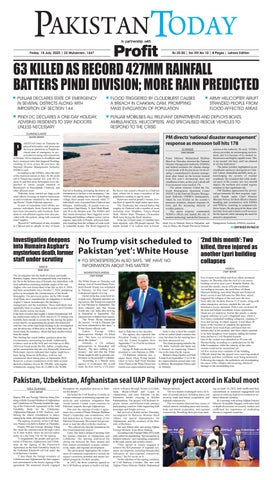
63 KILLED AS RECORD 427MM RAINFALL BATTERS PINDI DIVISION; MORE RAIN PREDICTED In partnership with
Profit
Friday, 18 July, 2025 | 22 Muharram, 1447
g
g
PUNJAB DECLARES STATE OF EMERGENCY IN SEVERAL DISTRICTS ALONG WITH IMPOSITION OF SECTION 144
PINDI DC DECLARES A ONE-DAY HOLIDAY, ADVISING RESIDENTS TO STAY INDOORS UNLESS NECESSARY
P
g
g
ISLAMABAD/LAHORE
Rs 20.00 | Vol XVI No 10 | 8 Pages | Lahore Edition
FLOOD TRIGGERED BY CLOUDBURST CAUSES A BREACH IN CHAKWAL DAM, PROMPTING MASS EVACUATION OF POPULATION
PM directs ‘national disaster management’ response as monsoon toll hits 178 ISLAMABAD
staff report
that led to flooding, prompting the district administration to declare a rain emergency,” the NDMA said, adding that in the Chakri Rajan village, three people were rescued, while 27 individuals were evacuated from Chakwal and Khanpur. Additionally, 10 people were rescued from Chak Monjo, 31 from Dhok Bhadr, and 38 in the Darapur area. The NDMA said that recent downpours have triggered severe flooding and building collapses across various regions, especially in Punjab, with most fatalities resulting from the collapse of weak roofs in vulnerable homes. The flood triggered by
Investigation deepens into Humaira Asghar’s mysterious death, former staff under scrutiny KARACHI
news desk
ARMY HELICOPTER AIRLIFT STRANDED PEOPLE FROM FLOOD-AFFECTED AREAS
PUNJAB MOBILISES ALL RELEVANT DEPARTMENTS AND DEPLOYS BOATS, AMBULANCES, HELICOPTERS, AND SPECIALISED RESCUE VEHICLES TO RESPOND TO THE CRISIS
saleem jadoon
AKISTAN Army on Thursday deployed helicopters and personnel for rescue operations as Punjab declared state of emergency in several districts along with imposition of Section 144 in response to cloudburst and heavy monsoon rains that triggered flooding, claiming 63 lives across the province, the National Disaster Management Authority (NDMA) said. According to the NDMA, since the start of the monsoon season on June 26, the death toll in Punjab has reached 103, with 393 injured. It said that army helicopters were dispatched to rescue people stranded in floodwaters in Rawalpindi, Chakwal, and other affected areas. “Pakistan Army carried out large-scale relief efforts, focusing on hard-to-reach areas to assist residents stranded by the devastating floods,” Radio Pakistan reported. As part of immediate relief efforts, numerous individuals from flood-hit regions have been relocated to safer locations. Residents in rain-affected regions were also provided with life jackets, along with essential relief supplies. “Record 427 millimeters of rain, recorded in Chakwal and its suburbs in only 10 hours
g
The investigation into the death of actress and model Humaira Asghar, whose decomposed body was found in her flat in the Defense area of Karachi, has intensified, with local authorities examining multiple angles of the case. Asghar, who was found dead in her flat on July 8, 2024, had been unreachable since October 7, 2024, prompting police to investigate the circumstances of her death thoroughly. The provincial police, led by DIG South Asad Raza, have expanded the investigation to include Asghar’s former housekeeper, the building’s management, and the watchman. These individuals had reportedly been in contact with the actress until October 2024, shortly before her death. It has been revealed that Asghar’s former housekeeper left her employment earlier in 2024, and no CCTV footage was available from outside or around the flat, leaving the police to rely heavily on questioning the people who interacted with her. One of the significant findings in the investigation was the discovery of three keys to the flat’s main door, all found inside the residence, which had been double-locked from the inside. This finding has raised further questions about the circumstances surrounding her death. Additionally, evidence such as utility bills and rent slips up to May 2024 was found inside the flat, further complicating earlier assumptions that she was financially distressed. Preliminary reports indicated that Asghar might have been facing financial difficulties, with her last commercial shoot taking place in September 2024. However, a closer examination of her bank account showed a balance of over Rs 398,000, with regular withdrawals ranging from Rs 25,000 to Rs 50,000.
the heavy rain caused a breach in a Chakwal dam, which led to mass evacuation of the population residing in nearby areas. Rainwater entered people’s homes, forcing them to spend the night under open skies. The floodwater has entered Kattas Raj temples in Chakwal with a number of areas including Ararr Mughlan, Takiya Murad Shah, Mohra Mast, Khanpur, Choasaidan Shah were facing the flood situation. In the last 24 hours alone, 63 fatalities have been reported, with 290 people injured. The deaths include 15 in Lahore, nine in Faisal-
Prime Minister Muhammad Shehbaz Sharif on Thursday directed the National Disaster Management Authority (NDMA) and federal ministers for climate change to join heads with the provinces for developing a comprehensive disaster management plan based on the lessons learned from this year’s devastating rains and cloudburst events, as this year’s death toll from monsoon rains reached 178. The prime minister visited the National Emergencies Operation Centre (NEOC) at the National Disaster Management Authority (NDMA) headquarters, where he was briefed on the country’s monsoon situation, disaster response efforts, and the increasing intensity of weather patterns. The prime minister commended NDMA’s efforts and lauded the role of modern technology and skilled human re-
abad, five in Sahiwal, three in Pakpattan, and nine in Okara, the Punjab Provincial Disaster
No Trump visit scheduled to Pakistan ‘yet’: White House g
FO SPOKESPERSON ALSO SAYS, ‘WE HAVE NO INFORMATION ABOUT THIS MATTER’ WASHINGTON/ISLAMABAD
sources at the authority. He said, “NDMA always provides an encouraging environment, and it is because of its modern infrastructure and highly capable team. This is my second visit here, and I am pleased to see the dedication.” The prime minister highlighted recent cloudbursts and heavy downpours in Chakwal, Lahore, Islamabad, and hilly areas, acknowledging the severity of weather conditions. He remarked that while southern parts of the country saw less rainfall impact, the northern and central regions continue to face significant risk. PM Shehbaz appreciated the provincial governments for their response, especially Punjab under Chief Minister Maryam Nawaz, for their effective disaster handling and coordination with NDMA and PDMAs, resulting in comparatively fewer losses. He also prayed for those who lost their lives and wished a swift recovery for the injured, while stressing the need for proactive preparations.
Management Authority (PDMA) reported.
CONTINUED ON PAGE 03
‘2nd this month’: Two killed, three injured as another Lyari building collapses KARACHI
staff report
staff report
The White House on Thursday said that no visit of United States President Donald Trump was scheduled to Pakistan “at this time” after widespread reports of a trip. Earlier in the day, some local television news channels reported, citing sources, that Trump was expected to visit Pakistan in September. The news channels said that Trump would also visit India after arriving in Islamabad in September. The channels later withdrew their reports. The White House dismissed the rumors. “A trip to Pakistan has not been scheduled at this time,” a White House official said. Earlier, Foreign Office Spokesperson Shafqat Ali Khan said, “We have no information about this matter.” Similarly, a US embassy spokesperson in Islamabad told Reuters, “We have nothing to announce,” and said that the White House might be able to provide confirmation on the president’s schedule. According to a British news agency, if confirmed, this would mark the first visit by a US presi-
dent to Pakistan in two decades. The agency also reported that President Trump is scheduled to visit the United Kingdom from September 17 to 19 at the invitation of King Charles. George W Bush was the last US president to visit Pakistan in 2006. US-Pakistan relations saw a major boost when Trump hosted Chief of Army Staff Field Marshal Asim Munir at the White House last month in an unprecedented meeting.
India is due to host the summit of the so-called Quad countries this year, but dates for the meeting have not been announced yet. The Quad grouping includes the US, India, Australia and Japan and is focused on countering China’s rise in the Indo-Pacific region. Britain’s King Charles will host Trump from September 17 to 19 for his unprecedented second state visit to Britain, Buckingham Palace said on Monday.
Two women were killed and three others sustained injuries on Thursday after the roof of a six-storey building caved in near Lyari’s Khadda Market, the second this month, rescue officials confirmed. According to rescuers, the sixth floor of Ghani Mansion building, near Bilal Masjid and Peshawari Hotel, caved in and fell onto the fifth floor, which triggered the collapse of the roof onto the next. Soon after the incident, Rescue 1122 teams, along with other emergency services, reached the site and launched a rescue operation. Police also cordoned off the area and helped coordinate rescue operations, which are yet underway. Earlier this month, a similar tragedy unfolded in Lyari’s Baghdadi area, where a five-storey residential building collapsed, claiming 27 lives and leaving 10 others injured. It had taken 50 hours of the rescuers to complete the operation. DIG South Syed Asad Raza confirmed that two women died in the incident, and three others reported to be their daughters were injured, adding the bodies were shifted to Civil Hospital Karachi. One of the victims was identified as 45-year-old Hurmat Rafiq, according to a spokesperson for the Edhi Foundation, while the identity of the other woman could not be ascertained yet. All five victims were residents of the building. Officials stated that the injured were receiving medical treatment, and their conditions were being monitored. Following the tragedy, the authorities are investigating the cause of the collapse and assessing structural damage to the surrounding area.
Pakistan, Uzbekistan, Afghanistan seal UAP Railway project accord in Kabul moot KABUL/ISLAMABAD staff report
Deputy PM and Foreign Minister Ishaq Dar, along with the Foreign Ministers of Afghanistan and Uzbekistan, on Thursday headed the signing of the Framework Agreement on the Joint Feasibility Study for the UzbekistanAfghanistan-Pakistan (UAP) Railway, reaffirming the shared commitment to peace, connectivity, trade, and regional development. The signing ceremony of the UAP Railway Project was held in Kabul on Thursday. Deputy PM and Foreign Minister Ishaq Dar made the announcement through a post on X from Kabul, where he arrived earlier today on a day-long visit for the signing. “I congratulate the people and governments of Pakistan, Afghanistan, and Uzbekistan on the signing of the Framework Agreement on the Joint Feasibility Study for the Naibabad–Kharlachi rail link under the UAP Railway Corridor. “I also thank the foreign ministers of Uzbekistan and Afghanistan for their support and commitment to the timely signing of the agreement. We remained closely engaged
throughout the negotiation process to finalize the details.” He hailed the UAP Railway Corridor as a major milestone in advancing regional connectivity and economic integration that would connect Central Asian countries to Pakistani seaports through Afghanistan. Dar said the signing of today’s agreement was a result of Prime Minister Shehbaz Sharif’s leadership and commitment, who had tasked him as finance minister of the Pakistan Democratic Movement-led government to lead the effort with the countries. “We collectively laid the foundation for this transformational project.” Later, Dar held a trilateral meeting with the foreign ministers of Afghanistan and Uzbekistan. The meeting reinforced the strong ties between the three nations and their mutual commitment to peace, connectivity, trade, and regional development. The participants highlighted the importance of continued cooperation to unlock the region’s economic potential and ensure sustained prosperity for their peoples. In 2023, the three countries agreed on the UAP Railway project to build a rail link,
which will pass through Termiz in Uzbekistan, Mazar-i-Sharif and Logar in Afghanistan, and enter Pakistan via the Kharlachi border crossing in Khyber Pakhtunkhwa. The project will facilitate regional, transit, and bilateral trade amongst participating countries while supporting both passenger and freight services. Dar arrived in Kabul earlier Thursday, accompanied by Railways Minister Hanif Abbasi, the special representative for Afghanistan, and the secretary of the Ministry of Railways. Dar and Abbasi later met acting Afghan Foreign Minister Amir Khan Muttaqi. According to the Foreign Office (FO), both sides called for maintaining “the momentum in bilateral relations” and expanding cooperation in the trade, transit, and security sectors. “They agreed to remain engaged to achieve the full potential of regional economic development, including through [the] realization of trans-regional connectivity projects,” the FO wrote on X. On the sidelines of the signing ceremony of UAP Railway Corridor, Dar met with Afghan Prime Minister Mullah Muhammad
Hassan Akhund. The two leaders exchanged views on issues of mutual interest, including peace and security, trade and transit cooperation, and regional connectivity. The two leaders discussed key issues of mutual interest, including peace and security, trade and transit cooperation, and regional connectivity. Recalling their previous meet-
ing on April 19, 2025, both reaffirmed their commitment to sustained engagement and agreed to continue high-level contacts to enhance bilateral relations. In a meeting with acting Afghan Interior Minister Sirajuddin Haqqani, both sides held in-depth discussions on security matters and reaffirmed the importance of eradicating threats to regional countries.
02 NEWS
Friday, 18 July, 2025 | LAHORE
NO ACCOUNTABILITY AS PIA FACES RS200B LOSS DUE TO 2020 FAKE PILOT LICENCE SCANDAL: REPORT
P
PROFIT
g
MoNitoriNg Desk
AKISTAN International Airlines (PIA) incurred a loss exceeding Rs200 billion as a result of a 2020 statement made by a federal minister from the Pakistan Tehreek-e-Insaf (PTI) government, which claimed that many of PIA’s pilots held fake licences. The News reported, citing sources within the Ministry of Defence, that the repercussions of the statement, which led to immediate flight bans in the UK, Europe, and the US, were significant. The losses include an estimated Rs200 billion
DESPITE RECENT LIFTING OF BAN BY US AND UK, AIRLINE CONTINUES TO FACE REPUTATIONAL AND FINANCIAL DAMAGE FROM CLAIMS OF FORMER AVIATION MINISTER
in revenue, with at least Rs12.7 billion in direct profit losses. Many Pakistani pilots working abroad were either suspended or lost their jobs. Additionally, the airline faced rising insurance premiums, operational costs, and a decline in Pakistan’s international aviation risk rating. The credibility of the Civil Aviation Authority (CAA) was also undermined by the allegations. A senior official described the incident as a “textbook case” of mishandling a national issue glob-
Planning ministry rejects ECC’s Rs50bn subsidy request for power sector
ally. Despite the scale of the damage, no one has been held accountable, and the promised inquiry has not been made public. Following the European Union’s decision, the UK lifted its four-year ban on PIA, a step welcomed as it aids the national carrier’s return to global markets. This will likely improve PIA’s standing in the ongoing privatization process, boosting its commercial value. However, as PIA re-enters some of its most profitable routes, questions still linger about the fi-
nancial and reputational toll of the socalled “fake pilot licence” scandal. These questions include who will be held accountable for the damage caused. The crisis began in June 2020 when Aviation Minister Ghulam Sarwar Khan claimed a significant number of pilots were flying with fraudulent or questionable licences, a statement made without verification or a completed inquiry. This led to swift global action, including bans by aviation regulators in major markets.
CDNS targets Rs1.3trn in savings inflows for FY 2025-26, focuses on islamic investment growth g
PROFIT
MoNitoriNg Desk
CDNS AIMS FOR RS 50 BILLION IN ISLAMIC INVESTMENTS AND TARGETS RS 1.4 TRILLION IN SAVINGS FOR THE CURRENT FISCAL YEAR get of Rs 106 billion for the current fiscal year, 2024-25, a move that aims to encourage a savings culture in the country. The official further noted that National Savings had set an annual target of Rs 1.7 trillion for FY 2023-24, and the target was exceeded, reaching Rs 1.6 trillion in fresh bonds in the previous fiscal year, 2022-23. This was an increase of Rs 200 billion over the original target of Rs 1.3 trillion for FY 2021-22. The CDNS has now revised the savings target for FY 2021-22 to Rs 1.4 trillion, which will further promote the savings culture in the country, the official added. Given the current market
PROFIT
The Ministry of Planning, Development, and Special Initiatives has declined to comply with the Economic Coordination Committee’s (ECC) decision to allocate Rs50 billion in additional subsidies for the power sector, citing the Public Finance Management (PFM) Act 2019, which restricts the allocation of funds under the Public Sector Development Programme (PSDP) to approved development projects. According to a news report, the request for the subsidy stems from the ECC’s decision on May 5, 2025, to waive tariff rebasing for up to 200 units of electricity, aiming to reduce the burden of circular debt as per agreements with the International Monetary Fund (IMF). However, the Planning Ministry has argued that after a reduction of Rs300 billion in the PSDP for FY2024-25, it cannot surrender an additional Rs50 billion, although it has no objection to reallocating the amount from funds already surrendered by other ministries. In response, the Planning Ministry advised the Power Division to approach the Finance Division for the reallocation of the necessary funds. The Finance Division had initially approved the Rs50 billion reallocation for the power subsidy in a Cabinet meeting on July 8, 2024, but due to a downward revision in PSDP allocations, the ministry was unable to accommodate the request. The funds are part of the government’s efforts to meet circular debt targets set with the IMF, with the Power Division also requesting a Technical Supplementary Grant of Rs24.5 billion for solarization projects in Balochistan.
News Desk
The Central Directorate of National Savings (CDNS) has set a target of Rs 1.3 trillion in savings inflows for the fiscal year 2025-26. In addition, the CDNS has set a target of Rs 50 billion for Islamic investments in the same fiscal year, which is expected to promote the growth of the Islamic economy in Pakistan, a senior CDNS official told APP on Wednesday. The CDNS achieved a net target of Rs 255 billion for the fiscal year 2024-25, from July 1 to June 30, 2024-25, the official said. The CDNS met its annual tar-
trends, the target is ambitious, aiming to further improve the savings culture. In response to a question, the official also stated that the CDNS has reduced the profit rate on Defence Saving Certificates from 11.91% to 11.76%. Additionally, the profit rate on Special Saving Certificates has been lowered from 10.90% to 10.60% starting the last week of June 2025. The official also confirmed that the profit on the Shuhada Family Welfare Account has been reduced by 20 basis points, and the rate on Islamic Savings Accounts has decreased by 59 basis points, bringing the current rate to 9.75%.
Yamaha, Unique raise motorcycle prices following new tax measures in budget 2025-26
g
FOLLOWING SIMILAR PRICE HIKES BY PAK SUZUKI AND ATLAS HONDA, LATEST ADJUSTMENTS REFLECT ONGOING TRENDS IN MOTORCYCLE INDUSTRY PROFIT
Model....................................... Base Price ..... Sales Tax ..... NEV Levy .. New Retail Price ..................................................(PKR)...............(18%)............. (1%).............(PKR)
YB125Z (Red/Black)................. 359,502............65,441............4,057........... 429,000
News Desk
Yamaha Motor Pakistan and Unique (D.S. Motors Pvt Ltd) have announced hikes in motorcycle prices, citing new taxation measures introduced in the federal budget 2025–26, including the New Energy Vehicle (NEV) levy, increased production costs, and import duties.
Gender pay gap in Pakistan remains at 25%, women earn 30% less than men: ILO report
YB125Z DX (Red/Black/Gray).. 385,063............73,093............4,544........... 459,500
YBR125 (Red/Gray/Black)........395,114............ 71,924............4,462........... 471,500
YBR125G (Black)..................... 411,037............ 74,822............4,541........... 490,500
YBR125G (Matt)....................... 413,541............77,280............4,679........... 493,500
Meanwhile, Unique, known for its budget-friendly bikes, has also raised the prices of its UD-70cc models by Rs3,000 across the board. The new rates will be effective July 18, 2025.
YAMAHA RAISES PRICES ACROSS ALL MODELS: Effective July 1, 2025, Yamaha has released a revised price list for its entire lineup. The updated retail prices include an 18% sales tax and a 1% NEV levy introduced under the Finance Act 2025.
THE UPDATED MODELS INCLUDE:
UD-70cc 2025–26 UD-70cc Extreme Plus 2025–26 n UD-70cc Extreme Plus Special Edition n UD-70cc Extreme Plus With Alloy Rim n UD-70cc Extreme Plus Self-start Alloy Rim The company, in its circular to dealers, attributed the hike to the new n n
Here’s the detailed breakdown: The YBR125G Matt is now Yamaha’s most expensive offering at nearly half a million rupees.
PROFIT
News Desk
A recent report by the International Labour Organization (ILO) reveals that women in wage employment in Pakistan are paid less than their male counterparts, with a gender pay gap of 25% based on hourly wages and 30% based on monthly wages. The gender pay gap in Pakistan is notably higher compared to the global average for lower-middle-income countries, where the gap stands at 21% based on monthly wages and 17% based on hourly wages. The report also underscores that women’s participation in the workforce remains low. In 2021, women’s employment rate stood at just 23%, compared to 79% for men, reflecting a gender gap of 56 percentage points. This gap is larger than in other South Asian countries. Additionally, the report reveals that women make up only 13.5% of Pakistan’s workforce. Interestingly, women in wage employment are more likely to have higher levels of education and are more likely to work in the public sector, formal jobs, and larger firms with permanent contracts. However, despite these advantages, they continue to face substantial wage disparities compared to men. During the launch of the ‘Pakistan Gender Pay Gap Report 2025’, Nadeem Aslam Chaudhary, Secretary of the Ministry of Overseas Pakistanis, emphasised the government’s commitment to ensuring equal pay for equal work. He noted that the report and its action plan are essential for addressing the challenges that prevent women from fully participating in the economy.
UNIQUE HIKES PRICES BY RS3,000 ACROSS VARIANTS:
budgetary tax measures, rising raw material costs, and economic conditions impacting production and distribution. These price adjustments follow similar moves by Pak Suzuki Motor Company, which also revised its motorcycle rates recently, and Atlas Honda, which raised prices by Rs2,000–6,000 per unit earlier this month. The NEV levy, introduced in the Finance Act 2025, has had a widespread impact across the auto sector. It applies to all internal combustion engine (ICE) vehicles—including motorcycles—but exempts electric and hybrid vehicles, export-only units, and vehicles used by diplomats and international organizations.
NHA to receive Rs100b from petroleum development levy for highway projects in Balochistan PROFIT
News Desk
The National Highways Authority (NHA) will receive Rs100 billion from the petroleum development levy for three major highway projects in Balochistan. However this allocation still falls short of its Rs 160 billion request for the ongoing financial year. According to NHA documents, the authority had asked for Rs 160.2 billion under the Public Sector Development Programme (PSDP), but the federal government allocated Rs 100 billion. Among the projects, Rs 34 billion has been allocated for the dualisation of the 330.52 km Khuzdar-Kuchlak Section (N-25), against the demanded Rs 50.8 billion. For the dualisation and rehabilitation of the KarachiQuetta-Chaman Road (N-25), covering 273 km, Rs 33 billion has been allocated, although Rs 52.5 billion was requested. Similarly, Rs 33 billion has been allocated for the dualisation of the 187 km Kararo-Wadh and KuchlakChaman Sections, against the requested Rs 56.9 billion. Currently, NHA is managing a portfolio of road and highway projects worth Rs 2,200 billion. In the PSDP for FY26, NHA submitted 161 project proposals but received approval for only 105, with allocated funds amounting to Rs 227 billion. Due to limited funding, NHA generated Rs 64.8 billion in FY25 from toll taxes and other sources, a significant increase from Rs 32 billion in FY24. In April, Prime Minister Shehbaz Sharif decided to use savings from reduced oil prices to fund the reconstruction of the N-25 highway and complete Phase II of the Kachhi Canal project in Balochistan, aiming to improve the infamous “deadly road” connecting Karachi to Chaman. The Rs 300 billion project was approved in FY22-23, but progress stalled due to funding gaps.
AKD Group acquires 27.95% stake in Pearl Continental Hotels operator, Pakistan Services Limited PROFIT
News Desk
AKD Group Holding (Private) Limited— formerly M/S Aqeel Karim Dhedhi Securities (Private) Limited has acquired 27.95% of voting shares in Pakistan Services Limited (PSEL), the operator of Pearl-Continental Hotels, according to a filing at the Pakistan Stock Exchange (PSX) on Thursday. “The Company has received a letter dated July 15, 2025 from AKD Group Holding (Private) Limited [formerly M/S Aqeel Karim Dhedhi Securities (Private) Limited] wherein they have made disclosure in term of Section 110 of the Securities Act, 2015 read with regulation 4 (2) of the Listed Companies (Substantial Acquisition of Voting Shares and Takeovers) Regulations, 2017 with respect to the acquisition of 27.95% voting shares of the Company,” read Pakistan Services Limited’s notice sent to the PSX. The acquisition, completed on July 14, 2025, involved the purchase of 9,089,651 shares at a rate of Rs. 700 per share, bringing the total transaction value to Rs 6.36 billion.The shares were acquired through AKD Group Holdings and its subsidiary, AKD Securities Limited. AKD Group Holdings now holds 24.26% of the shares, amounting to 7,889,651 shares, while AKD Securities Limited holds 3.69%, equivalent to 1,200,000 shares.
Honda Atlas exports first batch of cars to Japan PROFIT
MoNitoriNg Desk
g
Honda Atlas Cars (Pakistan) Ltd has made an entry into international markets by exporting 38 units of its 1.2L Honda City to Japan. Despite this achievement, the company has expressed concerns over high input costs and the absence of supportive government policies that hinder largescale exports. During its analyst briefing on Wednesday, the company said that while discussions with authorities are ongoing, Pakistan lags behind regional competitors like Thailand and Indonesia, which have more favorable conditions for automotive exports. This makes it challenging for Pakistan to compete effectively in the global automotive market. According to AKD Securities, Honda Atlas reported a 42% year-on-year increase in its topline for the fiscal year
COMPANY EXPORTS 38 UNITS, REPORTS 42% INCREASE IN REVENUE, BUT WARNS OF HIGH COSTS AND LACK OF GOVERNMENT SUPPORT FOR LARGE-SCALE EXPORTS
MY25, reaching Rs78 billion, up from Rs55 billion in the previous year. The growth was driven by a 53% rise in unit sales, reaching 16,100 units compared to 10,534 in MY24. The company’s gross margins also showed improvement, rising to 8.5% in MY25 from 8.2% in MY24, aided by currency stability during the period. Honda Atlas posted a profit of Rs2.7 billion (EPS: Rs19.0), up from Rs2.3 billion (EPS: Rs16.3) in MY24, marking a 16.6% increase. The company’s sales mix for the Honda City model comprises 75% of the 1.2L variants and 25% of the 1.5L variants. It reported a 67% increase in overall passenger car market volumes, reaching
125,533 units compared to 75,227 units in MY24, reflecting improving macroeconomic conditions. The company’s management forecast a 40-50% increase in sales volume for MY26. The company has also pre-launched a hybrid version of the HR-V, offering test
drives at dealerships. The management expects to sell 400-500 units of the HR-V hybrid per month and is absorbing the NEV levy tax to keep the price competitive. Localization levels for Honda’s models stand at 64% for Civic, 74% for City, 52% for BR-V, and 61% for HR-V. However, management expects margins to face pressure due to currency devaluation and the exclusion of hybrid vehicles from the upcoming NEV policy, which offers incentives only for electric vehicles (EVs) and plug-in hybrid electric vehicles (P-HEVs). Honda Atlas also noted that the recent tariff rationalization will have little impact on its sales volume, as 90% of its imports are in the 1000cc segment.
US firms explore opportunities in Pakistan’s maritime sector PROFIT
News Desk
Over 65 US companies participated in a webinar on Tuesday, exploring commercial opportunities within Pakistan’s maritime sector. The event, co-hosted by the US Department of Commerce’s International Trade Administration and the State Department, in partnership with Pakistan’s Ministry of Maritime Affairs, focused on Karachi Port and Port Qasim as key drivers for bilateral trade and investment. The webinar, part of the ‘Gateways to
g
WEBINAR HIGHLIGHTS KARACHI PORT AND PORT QASIM AS POTENTIAL HUBS FOR TRADE AND INVESTMENT
Growth: South Asia Port Opportunities’ series, featured senior officials from Pakistan’s port authorities, including the Ministry of Maritime Affairs, Port Qasim Authority, and key terminal operators like Abu Dhabi Ports (Karachi Gateway Terminal Ltd) and Dubai Ports World (Qasim International Container Terminal). US Consul General Scott Urbom highlighted the significant potential of the maritime sector for both nations, emphasizing the role of US investors in supporting Pak-
istan’s infrastructure growth. Urbom reaffirmed the US Mission’s commitment to facilitating American businesses through local partnerships and navigating Pakistan’s regulatory landscape. The webinar also discussed how US companies can contribute to Pakistan’s infrastructure goals, particularly in enhancing port operations, improving trade flows, and strengthening supply chains. Ean Hundley, from the US International Development Fi-
nance Corporation, stated the initiative was designed to equip US firms with the resources to access South Asia’s port-related development projects. Pakistani officials shared insights on the country’s infrastructure priorities and ongoing reforms, including port capacity improvements and efforts towards digitalisation. The session underscored the role of public-private partnerships in advancing terminal operations. Alia Shahid, Director General for Ports
and Shipping, along with other industry representatives, provided direct input on Pakistan’s maritime sector, showcasing the nation’s growing potential in port development. Urbom concluded by urging American businesses to engage and explore opportunities in Pakistan’s evolving maritime infrastructure, with the US government committed to supporting their efforts through advocacy, trade promotion, and commercial diplomacy.
NEWS 03
Friday, 18 July, 2025 | LAHORE
IMF URGES MINISTRY OF FINANCE, SBP TO FIND SOLUTION FOR PAKISTAN REMITTANCES INITIATIVE FINANCING
S
g
NA STANDING COMMITTEE ON FINANCE RAISES CONCERNS OVER REWARD STRUCTURE FOR REMITTANCE FACILITATION, CALLS FOR REVISIONS about the growing circular debt issue related to the reward paid to banks and exchange companies for facilitating remittances. The finance secretary informed the committee that, due to fiscal constraints, no funds had been allocated for the PRI in the current fiscal year, compared to the Rs89 billion allocated in the previous fiscal year. Despite this, the actual expenditure on the scheme had exceeded Rs100 billion. He added that any funding provided by SBP would result in an indirect payment by the Finance Ministry. The ministry is in talks with SBP to identify a solution for financing PRI, and it has been decided to revise the scheme. The finance secretary also shared details of changes to the reward structure under PRI, with a new flat rate of 20 riyals for all transaction sizes. Additionally, the minimum
PROFIT
staff report
BP boosts cash incentives for financial institutions to drive remittance inflows. The International Monetary Fund (IMF) has instructed the Ministry of Finance and the State Bank of Pakistan (SBP) to collaborate on finding a solution for the financing of the Pakistan Remittances Initiative (PRI), a scheme designed to encourage remittances through official channels. According to a news report, this was disclosed by the finance secretary during a briefing to the National Assembly Standing Committee on Finance and Revenue on Wednesday, which was chaired by Syed Naveed Qamar. The committee highlighted concerns
transaction threshold for eligibility has been raised from $100 to $200. The committee further discussed the “Parliamentary Budget Office Bill 2025,” which aims to establish a parliamentary budget office to improve fiscal oversight and transparency. The finance secretary expressed doubts about the need for such legislation and suggested that if the office were to be established, it should be a lean one. A sub-committee, led by Dr. Nafisa Shah, was formed to further deliberate on the bill and submit its report in 30 days. In the meeting, the committee also deferred discussions on other agenda items, including the new electric vehicle policy, the non-implementation of minimum wages in federal departments, and issues regarding Islamic banking.
Pakistan, El Salvador sign partnership on Bitcoin and digital assets g
AGREEMENT MARKS COLLABORATION IN DIGITAL FINANCE AND BLOCKCHAIN TECHNOLOGY PROFIT
SBP reports Rs4.66b in digital transactions for cattle markets during Eid-ul-Adha
News Desk
STAFF REPORT profit
The State Bank of Pakistan (SBP) reported that digital payments in cattle markets across the country reached Rs4.656 billion through 64,553 transactions during Eid-ul-Adha, which took place in the first week of June. This marks a significant increase compared to Eid-ul-Adha 2024, when just 13,000 digital transactions worth Rs560 million were reported. The rise in digital payments this year is attributed to the SBP’s ‘Go Cashless’ campaign, which was implemented in collaboration with 24 partner banks in 54 major cattle markets across Pakistan. To support this initiative, the SBP temporarily lifted daily transaction limits and raised the monthly limit to Rs5,000,000 for specific accounts from May 19 to June 15, 2025. The ‘Go Cashless’ campaign, aimed at promoting Digital Financial Services (DFS) and reducing reliance on cash transactions, received positive feedback from market participants. Buyers and sellers appreciated the convenience and security of digital payments. On Wednesday, the SBP held an award ceremony in Karachi to recognize banks that contributed to the success of the campaign, with regional recognition ceremonies also conducted by SBP field offices. The SBP emphasized that digital payment systems help reduce fraud risks, enhance transparency, and provide secure access to financial services, contributing to the growth of Pakistan’s digital economy.
Pakistan and El Salvador have signed a letter of intent (LoI) to collaborate on initiatives involving Bitcoin and digital assets. The agreement was finalised during a meeting in San Salvador between Bilal Bin Saqib, Minister of State for Crypto and Blockchain, and Salvadoran President Nayib Bukele. Saqib, also the CEO of the Pakistan Crypto Council, led discussions centered on Bitcoin and broader digital asset collaboration. This development is being referred to as ‘Biplomacy,’ a blend of
Bitcoin and diplomacy, reflecting the growing role of decentralized technologies in global relations. The agreement signals Pakistan’s interest in adopting strategies from El Salvador, which became the first country to make Bitcoin legal tender. El Salvador’s initiative, which aims to promote financial inclusion, investment, and economic growth, has seen success, with the country’s Bitcoin reserves surpassing $760 million, nearly tripling in value after the recent price surge. The signed LoI outlines plans for bilateral collaboration in areas such as public-sector adoption of digital assets, blockchain-based financial in-
clusion, and the creation of policies for emerging economies. Saqib expressed that El Salvador’s bold experiment with Bitcoin has inspired nations worldwide, emphasizing the shared vision of innovation and inclusion. In response, Bukele welcomed the partnership and reiterated El Salvador’s support for countries exploring Bitcoin as a tool for financial sovereignty. This agreement comes at a time when Pakistan is taking steps to formalize its position on digital assets, including the establishment of the Pakistan Virtual Assets Regulatory Authority (PVARA) and plans for a strategic Bitcoin reserve.
SBP reserves rise to $14.53b, but total forex holdings dip to $19.96b PROFIT
staff report
The State Bank of Pakistan’s (SBP) foreign exchange reserves rose by $23.4 million or 0.16% week-on-week (WoW), reaching $14.53 billion during the week ending July 11, 2025, according to the latest data issued by the central bank on Thursday. However, the country’s overall liquid foreign exchange reserves declined by $71.6 million or 0.36% WoW, settling at $19.96 billion. This drop was primarily due to a significant decrease in the reserves held by commercial banks, which fell by $95 million or 1.72% to $5.43 billion. As of July 11, 2025, the foreign exchange reserves held by the SBP stood at $14,525.6 million, up from $14,502.2 million the previous week—an increase of $23.4 million or 0.16%. Meanwhile, commercial banks’ net foreign reserves dropped to $5,431.5 million from $5,526.5 million, marking a decline of $95 million or 1.72%. Consequently, the country’s total liquid reserves decreased to $19,957.1 million, down from $20,028.7 million a week earlier—a net drop of $71.6 million or 0.36%.
Govt confirms ongoing talks with IMF over sugar import tax exemptions g
FBR EXEMPTS DUTIES ON 500,000 METRIC TONS OF SUGAR, BUT CONCERNS ARISE OVER RATIONALE FOR IMPORTS AMID ADEQUATE DOMESTIC STOCKS PROFIT
staff report
The federal government confirmed that it is in discussions with the International Monetary Fund (IMF) regarding the exemption of duties and taxes on sugar imports. Speaking at a meeting of the National Assembly Standing Committee on Finance, Finance Secretary Imdadullah Bosal said that one of the agreed structural benchmarks between the IMF and Pakistan is the avoidance of tax exemptions or amnesty schemes. However, he confirmed that consultations with the IMF are ongoing on the matter of sugar import tax exemptions. The Federal Board of Revenue (FBR) had previously granted customs duty exemptions on the import of 500,000 metric tons of sugar, alongside reducing the sales
tax rate from 18% to 0.25% and withholding tax to 0.25%. Furthermore, the FBR also waived a 3% minimum VAT on the sugar import. Despite these exemptions, FBR Chairman Rashid Mahmood Langrial clarified that the FBR had not proposed any summary to the federal cabinet regarding these exemptions. The cabinet had instead made the decision based on a summary from the Ministry of National Food Security and Research (MNFSR). Langrial further stated that while taxes on sugar typically total 54%, including a 20% import duty, high import tariffs on the commodity should be reconsidered, given that sugar prices had previously dropped to Rs 130 per kg. However, Committee Chairman Naveed Qamar raised concerns, asserting that there is no sugar shortage in the country, questioning the need for imports given the existing adequate stock.
FBR directs ministries to submit details of autonomous bodies’ pay structures for ad hoc allowances Finance Division urges ministries to comply with pay structure and allowance approval requirements for autonomous and semi-autonomous bodies by July 30, 2025 PROFIT
staff report
63 killed as record 427mm rainfall batters Pindi division; more rain predicted CONTINUED FROM PAGE 01
Meanwhile, Punjab Chief Minister Maryam Nawaz announced an emergency in multiple districts, including Rawalpindi and Chakwal, due to the deteriorating weather conditions. In a post on X, she said: "An emergency has been declared in various areas of Punjab due to unprecedented stormy rains and flooding. Government institutions are working with zeal and utmost effort." Due to weather conditions, the deputy commissioner declared a one-day holiday in the Rawalpindi District and advised residents to stay indoors unless necessary. The provincial government has mobilised all relevant departments, including district administrations, police, and Rescue 1122, to respond to the crisis. Boats, ambulances, helicopters, and specialised rescue vehicles have been deployed to flood-affected areas where road access is blocked. Rescue 1122 continues to operate under extreme conditions, with many roads submerged and communication lines disrupted. Field hospitals and emergency medical teams remain on high alert. Public hospitals across Punjab have been placed on standby, with 24/7 control rooms set up to manage flood response operations. Traffic police have been instructed to arrange alternative routes, and the public has been advised to avoid canals, rivers, low-lying areas, and unnecessary travel. Moreover, the water level in Nullah
Leh is rising and currently measures approximately 21 feet at Katarian and 20 feet at Gawalmandi. According to the Pakistan Meteorological Department, over 230 mm of rain has fallen in the twin cities, a spokesman for WASA Rawalpindi said. The Pakistan Meteorological Department reported rainfall measurements of 132 mm at Saidpur Village, 164 mm at Golra (near E-11), 185 mm at Bokra (CTTI I-12), 152 mm at PMD (H-8/2) in Islamabad, and 158 mm at Shamsabad (RAMC). In Rawalpindi, 235 mm was recorded at Katcheri (near Chaklala), 196 mm at Pirwadhai, 220 mm at Gawalmandi, and 200 mm at New Katarian. The Water and Sanitation Agency (WASA) deployed over 400 pumps to clear accumulated rainwater from roadways. Waterlogging was reported along several sections of Murree Road, particularly at Committee Chowk underpass, Murree Chowk, Banni Chowk, Jamia Masjid Road, Iqbal Road, and other key arteries, causing major traffic disruptions. A WASA spokesperson stated that teams equipped with heavy machinery are working continuously to drain water from roads and low-lying areas. Emergency response teams, including Rescue 1122, are engaged in clearing debris and restoring access in major cities. Further intermittent rain is forecast over the next 12 to 20 hours, though a reduction in intensity is expected. However, thunderstorms and strong winds remain likely in Islamabad, Pothohar, upper Khyber-Pakhtunkhwa, GilgitBaltistan, and parts of Balochistan and
central and southern Punjab. CM Maryam has urged the public to cooperate with authorities, follow safety guidelines, and avoid high-risk areas to prevent further loss of life. She appealed to residents to observe official instructions, comply with evacuation orders, and take all necessary precautions. CHAKWAL CLOUDBURST Heavy monsoon rains lashed Chakwal and nearby areas, dropping a record 470mm in 24 hours and triggering floods after dam breaches, leaving at least four dead and several injured. Over 400mm fell in just 10 hours, described as a cloudburst by the Meteorological Department and PDMA. Authorities declared a district-wide emergency as floodwaters engulfed Bikhari Kalan, Panwal, Maswal, and Khanpur Bazaar. Dam failures sent powerful floodwaters into residential zones, destroying homes and submerging entire neighbourhoods. Hospitals declared emergencies, and all agencies were placed on high alert. PDMA Director General Irfan Ali Kathia toured the affected district, assuring deployment of all resources to limit casualties and damage. Historic sites, including the Katas Raj Temple, were also affected by floodwaters, with parts suffering damage as waters surrounded the complex. Power system badly damaged in Rawalpindi, Chakwal and Jhelum Amid heavy rains, power system was badly damaged in Rawalpindi, Chakwal and Jhelum districts on Thursday leaving around forty nine thousands power consumers in lurch.
The heavy rain and flash floods washed away several transformers, electricity poles and wires in various areas. 47 high-voltage poles of ISCO were destroyed and 7 LT poles and wires were also washed away by rain and flash floods. In Chakwal, five feeders were damaged which led to power outages in various areas. Power supply severely affected in Talagang, Dhadial, PD Khan and Chakwal tehsils. Rain also wreaked havoc in Jhelum too as power system down in Dumeli, Sangoi areas. HOLIDAY DECLARED IN RAWALPINDI On the other hand, inclement weather forced the district administration to declare a holiday in Rawalpindi. The deputy commissioner issued a notification in this regard and directed the people to stay indoors. Fateh Jang-Rawalpindi road closed The road connecting Fateh Jang to Rawalpindi was closed following intermittent rainfall since last night. Rain drains and streams burst their banks while the Shahpur Dam was filled with water. Two kids die in Muridke Two children drowned in water accumulated near Sultan Park in Muridke. Rescue 1122 employees fished out their bodies and handed them over to their families. TORRENTIAL RAIN IN RAWALAKOT Heavy rain in and around the AJK city of Rawalakot turned the weather chilly at higher elevations while pleasant at lower elevations.
Several ministries and divisions have yet to provide the necessary details on the pay structures and ad hoc allowances for autonomous and semiautonomous bodies under their control, despite a request from the Finance Division, according to a news report. In an official document, the Finance Division revealed that a notification was issued for the grant of Ad hoc Relief Allowance2025 to employees of these bodies, contingent on their compliance with federal government pay scales. The new allowance, set at 10% of the basic pay, will be applicable from July 1, 2025, to those bodies that fully adopt the federal government’s pay scale system. However, bodies with different pay structures will need approval from the Standing Committee of the Finance Division, based on recommendations from their respective boards of directors or governors. The Finance Division emphasized that all administrative ministries and divisions must comply with the Rules of Business, 1973, and ensure that any changes in pay, allowances, and privileges of staff in these bodies are processed in accordance with established procedures. Ministries were asked to submit details of their autonomous bodies, along with any pending requests for allowances, by July 30, 2025. This directive follows previous requests for information, with ministries required to submit reports on the pay structures and allowance approval status of the bodies they oversee.
Fact or fiction?
04 COMMENT
Killings in Kalat
T
Balochistan is far from settled
HE killing of three members of the Sabri qawwali troupe, who were an route to Quetta from Karachi, and the injuring of another 13, when their bus was attacked, was not the only fatal incident in Balochistan on Wednesday, as a major of the Pakistan Army was martyred while leading an intelligence-based operation in Awaran. Indeed, the terrorist activity in the country was not restricted to Balochistan, for two policemen were martyred in Dera Ismail Khan district of Khaiber Pakhrunkhea, while a gas pipeline was blown up in Lakki Marwat district. Clearly, the country’s two westernmost provinces are out of control, with the administration unable to guarantee that most basic right, that of free movement. People simply cannot go about their occasions. This is especially true for Balochistan, where this was part of a long series of bus attacks, the last one being attacks on buses in Zhob and Lorelai hardly a week ago, in which nine travellers were offloaded from buses bound for Ders Ghazi Khan and killed. Balochistan also was witness to the Jaafer Express outrage, which again was an attack on movement. It is not enough to airily dismiss this terrorism as Fitna-i-Hindustan, and blame the recent upsurge on Indian chagrin at being bested in the recent encounter between the two countries. That does not absolve the Pakistani state from its basic responsibilities, which include protecting free movement. IBOs must be conducted so that loss of life or limb are minimised. While taking the fight to militants is positive, it is perhaps more important to get prior information of such activity as bus attacks. That they have been the result of ambushes, indicates that the local law enforcement agencies indicates either incompetence or a decision that discretion is the better part of valour. These are merely temporary. The real challenge is to dry up the supply of recruits, both for separatist and sectarian terrorists, which means both patience and providing better governance. That applies to the whole country. Or does the government want to wait until the remaining two provinces also explode? It must be realized that sectarianism and separatism are two sides of the same coin of misgovernance throughout the country. There is no guarantee that a hungry, illiterate youth subject to official contumely will become a terrorist. Indeed most do not. Theater is no guarantee that a well-fed, well educated member of the elite will not. But we do know who has a greater chance of taking up arms.
A
Or somewhere in between? At Penpoint M A NiAZi
recent meeting chaired by Finance Minister Muhammad Aurangzeb was told something that everybody claimed, and which had done so much to damage the credibility of the government: that it didn’t have reliable figures. Aurangzeb saw this as something that hampered him in the execution of his functions, and well he might, for as a banker of great experience, he must have relied on figures and statistics to get his work done. To be Finance Minister, to be asked to manage a Third-World economy, to achieve political results, and not merely not have figures to guide him, but incorrect ones, must be galling. However, apart from its applicability to him, to his ministry, to his entire government, its application to the country and its people is devastating. It means that the nay-sayers are right. The government does lie. Not necessarily because it wants to, but because its figures are unreliable. It cannot admit that it does not know, so it relies on whatever it has. It as figures are not falsified. They are just outdated. That provides a temptation to which government statisticians probably fall victim. They extrapolate. The possibility of manipulating old data is what gives the government a bad name. It should be realized that it is not merely obtaining the data which is the issue/ The next stage is determining whether this is good or bad. For example, if it is found that Balochistan and Punjab have the same number of hospitals, does that mean the two provinces are equally well-served? Only if they had the same populations would this be true. So that means you need to count the people. As a matter of fact, there is a National Census Organization embedded within the Bureau of Statistics, which is part of the Planning Ministry. Once you have counted the people, you can determine all sorts of things/ For example, are there roads between where people live? If you built a road between Points A and B, how many people would get access (and remember, people living in village C and D would also gain access). It is the census result which makes planners make the road swing through to pass by villages C and D, but not by village E, because it is too far to virtually double the road length to take it in. Well, you can, from a purely engineering perspective, but the Finance Department will never release the funds, nor the Planning Department approve the project. Well, unless the local MPA or MNA gets the CM to give him a directive for the road. Of course, one of the problems that have to be faced is political interference. That usually makes nonsense of any figures-based criteria. It is said that a Martial Law Administrator once directed that his village be connected to the main highway. Bureaucrats patiently explained to him that the village was low on the figures-based priority list, and was not due a road. The MLA roared that the village had produced
Dedicated to the legacy of late Hameed Nizami
Arif Nizami (Late)
The Taliban-ISKP Nexus Founding Editor
M. A. Niazi
Babar Nizami
Editor Pakistan Today
Editor Profit
A façade of rivalry
T
AsAd Ali
HE dynamics of security in the region has been changing especially with regards to the actions of the Islamic State Khorasan province (ISKP) following the takeover by the Taliban of power in Afghanistan in October 2021. Although at first sight the Taliban and the ISKP seem to be archenemies in a bloody turf war, recent trends, intelligence, and tactical realities of the conflict are much more complicated and darker. Surgical precision amid beheadings of two ISKP operatives by the Taliban is evidence of the severe tactical confusion between the two organizations. Quite contrary to being harsh adversaries, there is also mounting evidence that the Taliban and ISKP have similar ends, common origins, and even, in some cases, even a common operating agenda, at least to strike back against Pakistan. The Taliban and ISKP share the same breeding grounds based on the ideology of Islam radicalism that thrived once under the seal of regional instability. ISKP has many fighters who were former Taliban fighters who left because of internal gaps or strategy, not because of ideological differences. Their perspectives of the world, interpretations of religion, and their final aim to have an Islamic Emirate in the region are very close to each other. This overlap of ground makes it very easy where the operatives can turn coat or have multiple memberships, therefore making the demarcation between the two extremely blurred. Such dynamics of recruitment as one of the greatest pointers of their common ecosystem is truly telling. The two groups are heavily reliant on the descent of similar tribal belts of eastern Afghanistan and western Pakistan. There is a fertile environment of radical indoctrination, recruitment and training in such porous and ungoverned border regions. A combatant in Nangarhar or Kunar can alternatively ally with and defect against Taliban or ISKP without physically relocating (and vice versa). This interchangeability indicates that the two entities only differ in their operating domains, but not their ideologies. The Taliban leadership has told numerous falsehoods that they are fighting ISKP insurgents but the situation on the ground indicates the contrary. Following its reinstatement, the Taliban has failed to succeed in eliminating the working structures of ISKP. Rather, a number of United
Nations and independent intelligence reports refer to the ongoing presence and actions of ISKP in Taliban territories, especially Nangarhar and Kunar. Such act of passive tolerance begs some serious issues of what the actual motives of the Taliban are and whether there is any secret agreement between the Taliban and ISKP to keep certain things going free of any interference. There is no better example of such duplicity than that of the posturing between the Taliban and Pakistan. The two groups despise Pakistan with great intensity though with some certain distinctions. ISKP has continuously attacked Pakistani diplomatic, military and civilian interests. At the same time, Pakistan has little chance to improve internal security efforts due to the fact that the Taliban tacitly support Tehrik-i-Taliban Pakistan (TTP), or an outlet of cross-border attacks. There has been a growing intelligence threat that TTP and ISKP cells have been working together and this is primarily enabled by the Taliban islands. The existence of this triangular military relationship between the Taliban, ISKP, and TTP is also a multidimensional threat to Pakistan in the pretext of separate brands. This hypocrisy is an extended Taliban policy of media mastering. Since 2021, the group has attempted to rebrand itself from a moderate insurgency movement into a government of merit and international significance. The fact that the Taliban engages in occasional skirmish with ISKP is being used to supplement this narrative, as a measure against more extreme forces. The illusion however gives both factions some leeway to act with impunity. Whereas Taliban obtains ad-
one provincial ruler in 5000 years, and would not produce another for 5000 years. If the road was not built now, it never would. The village got its road. While that was a martial-law governor, it should not be assumed that elected leaders are any better. In fact, they are much worse. The problem is that there is too much anecdotal evidence flying around, which are figures of sort. But you don’t run any state that way. (In fact, that is one explanation of the origin of writing: one couldn’t remember the details of tax collection, so it was recorded, very crudely, true, but still recorded. Thus writing had to be invented, for economic reasons.) The recent meeting saw holes in the specific areas of unemployment, GDP growth, per capita income, poverty and labour migration. The particular problem seems to have been either the failure to conduct a recent survey, or if conducted, results not to be available. For example, GDP growth was calculated on the basis of livestock constituting a third of agricultural production. There had been an agricultural census, but the results were still being tabulated. Present figures for livestock were based on the offtake of fodder. Because the GDP figure was doubtful, the per capita income figure was also doubtful. Similarly, the poverty number could not be reliably pitched, because the Household Integrated Economic Survey was last conducted in 2018-2019. The current poverty figure, of 21.3 percent, was based on this. The 2024-2025 Survey had been completed, and was being tabulated, with results to be ready in December. The Punjab Labour Force Survey has also been conducted, with results to come in December. Meanwhile, planners can use five-year-old data. The Pakistan Social and Living Standards Measurement Survey is supposed to be the basis of planning about education, healthcare, housing, water and sanitation, information technology, food insecurity, disability and migration. Only there are only old figures. The Survey is planned for next year, and as usual the results will be available only later in the year. The collection of data has traditionally been done by the patwaris. In urban areas, surveys must be conducted. The latter cost money. For the census, the Army has been used, as well as a vast array of government servants. However, for other surveys, governments often have a lower priority. The survey mechanisms go back to the Raj, when first statistics were compiled so that they could inform economic decisions. In fact, the British introduced the concept of collecting statistics. It is not that their predecessors
I
Karachi – Ph: 021-32640318 I
did without, but the elaborate structure of surveys and analysis represented by the PBS was developed by the British at the same time that economics was developing as a discipline dependent on statistics. Though the collection of data is a major task (with the development of survey questions an art in itself), interpretation is also major. For policymakers, its is more important. There is a positive correlation in New Zealand between the sales of make-up and the divorce rate. But is it relevant to either make-up sales or the divorce rate. Now there is a positive correlation in Pakistan between fertilizer sales and wheat production. But there is no point in pushing fertilizer use if no wheat is being grown. That is where the patwari comes in. He has already recorded how much acreage is under wheat cultivation, so getting the information from him is not an issue. As far as computing went, the government’s statisticians were leaders, and if not at the cutting edge, were far ahead of the rest of the government. Now it is to be seen how they adapt to the age of Artificial Intelligence. It should be useful, but there are worrying signs that it may well lie, even manufacturing evidence to back its contentions. It seems that, as it is learning from a vast database, the lies in that database are teaching AI to lie. It also has no ethical core which would stop it from lying. Adopting AI would bring many advantages, as well as using cloud storage. The former was developed precisely to handle large amounts of data; the latter so that there could be large amounts available to handle. However, the government will have to go that extra mile to convince the public that its figures are correct, and that its data is secure. A politician once said, “There are lies, damned lies and statistics.” The government must disprove this, or else no one will believe it has done anything. The writer is a member of staff
However, the government will have to go that extra mile to convince the public that its figures are correct, and that its data is secure. A politician once said, „There are lies, damned lies and statistics.‰ The government must disprove this, or else no one will believe it has done anything
Editor’s mail
ministrative control, ISKP aims at creating havoc in the region, especially in Pakistan. The fact that the Taliban are not decisive against the ISKP and TTP networks adds to the dilemma facing Pakistan. Though Islamabad has tried to seek diplomatic advances and intelligence-sharing by many means, these have been to no avail for the major part. The Taliban has done very little to answer that call and what they did do was heartless at the least. The resultant effect is the aggravation of the security situation in the Pakistan border areas and the escalation of the number of terrorist attacks due to the cooperation of TTP and ISKP. The world community should no longer approach the Taliban and the ISKP in a different kind of manner. The new evidence is pointing to the emergence of a very tangled symbiotic relationship taking advantage of ideological compatibility, geographical and physical propinquity, and mutual hostility toward Pakistan. There is some rivalry between the Taliban and ISKP, which is a well-tailored hoax. Just behind this smokescreen is a convergence of strategy by which the two groups could simultaneously achieve their respective interests and destabilize Pakistan and the region. The policymakers, intelligence agencies, and regional powers now are at the point of re-assessment of the assumptions and facing this threatening nexus with clarity and determination. Doing this will just equip the same forces that they are trying to suppress. The writer is a freelance columnist
There is some rivalry between the Taliban and ISKP, which is a well-tailored hoax. Just behind this smokescreen is a convergence of strategy by which the two groups could simultaneously achieve their respective interests and destabilize Pakistan and the region.
Lahore – Ph: 042-36300938, 042-36375965
Friday, 18 July, 2025
Islamabad – Ph: 051-2204545
I
Send your letters to: Letters to Editor, Pakistan Today, 4-Shaarey Fatima Jinnah, Lahore, Pakistan. E-mail: letters@pakistantoday.com.pk Letters should be addressed to Pakistan Today exclusively
Medicine or meal?
THE skyrocketing prices of essential medicines in Pakistan have made healthcare a luxury for the poor. While inflation affects all sectors, the unaffordability of life-saving drugs is particularly alarming, pushing millions toward suffering and even premature death. The government must take urgent action to regulate drug prices and ensure accessible healthcare for all. In recent years, pharmaceutical companies have repeatedly increased medicine prices, citing rising production costs and currency devaluation. However, these justifications offer little solace to a daily wage labourer who cannot afford basic antibiotics or diabetes medication. Many patients are forced to choose between buying food or medicines, while others resort to substandard or counterfeit drugs, risking their lives. The government’s Drug Regulatory Authority of Pakistan (DRAP) has failed to enforce strict price controls, allowing pharmaceutical giants to exploit the public. While some essential drugs are supposed to be pricecapped, enforcement remains weak, and many pharmacies sell them at inflated rates. Additionally, public hospitals often face shortages, forcing patients to buy expensive medicines from private sellers. The situation demands immediate intervention. The government should: strictly monitor and penalise pharmacies selling medicines above official rates; provide free or low-cost medicines through government hospitals and health centers; encourage domestic pharmaceutical manufacturing to reduce reliance on expensive imports; and expand health insurance, ensuring that programs like Sehat Card should cover a wider range of medicines for the poor. Healthcare is a fundamental right, not a privilege. If the state continues to neglect this crisis, the suffering of the poor will only worsen. Authorities must act now before more lives are lost due to unaffordable treatment. HASAN ZAHID WAH CANTT
Trillion rupee bandage
A week ago, SBP injected a staggering Rs1.72 trillion into the banking system through both conventional and Shariah-compliant open market operations (OMOs). While this move may appear to be a pragmatic response to short-term liquidity pressures, it also raises important questions about the structural health of Pakistan’s financial system and the underlying causes of persistent liquidity shortages. From a technical standpoint, the dual-mode liquidity injection — spanning both conventional and Islamic banking systems — demonstrates the SBP’s commitment to inclusivity and financial parity. It recognises the growing importance of Shariah-compliant instruments in the country’s banking sector, which continues to expand as more institutions and customers seek ethical finance alternatives. However, the sheer magnitude of the injection — Rs1.72 trillion — signals more than just a seasonal liquidity crunch. It points to systemic imbalances that require deeper scrutiny. High government borrowing, weak private sector credit demand and ongoing fiscal deficits continue to strain the banking system. In such an environment, OMOs risk becoming more of a recurring firefighting tool rather than a strategic monetary lever. Moreover, persistent liquidity support can dull market discipline, especially if banks come to rely on central bank interventions instead of prudent asset-liability management. There is also the broader macroeconomic context to consider: inflation remains high, and the rupee under pressure. Injecting such massive liquidity could undermine monetary tightening efforts, especially if not carefully sterilized. That said, one cannot ignore the necessity of the SBP’s move. In the face of mounting debt servicing needs, delayed fiscal reforms, and uncertain external financing, the central bank must ensure that financial institutions remain functional and credit markets stable. A sudden liquidity freeze could trigger panic, jeopardising both banking confidence and economic activity. So, while the SBP’s Rs1.72 trillion liquidity injection may be necessary to address immediate banking sector needs, it also serves as a reminder of the deeper, unresolved economic issues. RUKAIYA ASHRAF ABBASI KARACHI
Web: www.pakistantoday.com.pk
I
Email: editorial@pakistantoday.com.pk
COMMENT 05
Emergence of the Fourth Reich in India Friday, 18 July, 2025
After Hitler’s Third, the BJP’s Fourth
I
Safia Malik
N the aftermath of the Pahalgam incident and the four-day war initiated by India against Pakistan, the Indian media widely practiced deception through fake news, propaganda and disinformation. Indian media anchors, reporters, analysts and politicians acted like disciples of Dr Josef Goebbels, Minister for Propaganda and Public Enlightenment in Nazi Germany, who disseminated the Nazi ideology through mass media and manipulated information to control public opinion. Goebbels famously said, “Repeat a lie often enough and it becomes the truth”. Just as Goebbels glorified Hitler and his Nazi ideology through propaganda, the Indian media has glorified Modi and his Hindutva-driven extremist ideology. The “Three Reichs” was a concept used by the Nazis to frame their regime as the peak of German history. The First Reich referred to the Holy Roman Empire (962-1806), the Second Reich to the German Empire under the Kaisers (1871-1918), and the Third Reich to Nazi Germany (1933-1945). The Fourth Reich is commonly used to refer to a hypothetical successor to Adolf Hitler’s Third Reich and the possible resurgence of Nazi ideas. Some scholars believe that India’s inclination toward fascism and Nazi-style propaganda techniques under Prime Minister Narendra Modi are akin to the emergence of the Fourth Reich in the 21st century, with Hindutva replacing Nazism. Hindutva shares doctrines, belief systems and radical mindset with Nazism. Hitler believed in the concept of Lebensraum (living space, which was primarily developed and popularized between the 1890s and 1940s. The concept gained prominence around 1901 and became a geopolitical goal for Imperial Germany during World War I. Lebensraum was a policy of Nazi Germany that involved expanding German territories to the East to provide land and material resources for the
German people, while driving out Jewish and Slavic people. Fouad Hafeez in his book Hindutva: The Rise of the Fourth Reich mentioned that Vinayak Damodar Savarkar in his book Essentials of Hindutva, published in 1923, advocated for the application of Lebensraum as part of the concept of Akhand Bharat, which envisions a Pan-Indian empire with the inclusion of present day Pakistan, Bangladesh, Afghanistan, Sri Lanka, Nepal, Bhutan and Myanmar. There are a number of similarities between Nazi Germany’s Schutzstaffel (SS) and the Indian right-wing Hindu nationalist volunteer paramilitary organization Rashtriya Swayamsevak Sangh (RSS). The SS was formed in April 1925, and the RSS was founded a few months later in September 1925, possibly drawing organizational ideas from the SS. The SS was originally a paramilitary organization that provided security to the Nazi Party. Later, it expanded to become a deep state in Nazi Germany responsible for enforcing Nazi racial policies, and persecuting political and other opponents of the Nazi regime. Initially, the RSS presented itself as a cultural and apolitical organization promoting Hindu unity, but gradually evolved into a key driver of Hindu nationalist ideology in India. Since the 1980s, the RSS and its affiliates have been increasingly involved in communal violence in India, culminating in the 1992 demolition of the Babri Masjid in Ayodhya and the 2002 Gujarat riots in which about 2000 people were killed, mostly Muslims. These events marked a clear shift in the RSS’s role from cultural advocacy to active involvement in shaping a majoritarian political narrative that has marginalized and brutalized religious minorities in India. The establishment of the Bharatiya Janata Party (BJP) in April 1980, the political face of the RSS, gave Hindu nationalists
a license to abuse Indian minorities with impunity. Like the SS, the RSS is involved in systematic violence against minorities in India, echoing the organized persecution of minorities seen in Nazi Germany. Nazi Germany’s model of an Aryan majority and the extermination of minorities finds its application in Modi’s India, where Hindu supremacy and majoritarianism is being promoted alongside targeting of minorities, particularly Muslims. In February 2025, a Washington-based research group mentioned that instances of hate speech against minorities in India, including Muslims, increased by 74 percent in 2024. The Nazi-Hindutva ideological alignment is not new: as early as 1938, Hindutva ideologue V.D. Savarkar stated, “If we Hindus in India grow stronger in time, these Muslim friends will have to play the part of German Jews.” This mindset is unmistakably reflected in the policies and actions of the BJP government led by Modi and his ilk. The Citizenship Amendment Act (CAA) of 2019, for instance, provided a path to Indian citizenship for non-Muslim refugees from Pakistan, Bangladesh, and Afghanistan, explicitly ex-
cluding Muslims and thus institutionalizing religious discrimination. Human rights abuses by Indian forces in occupied Kashmir further exemplify the targeting of Muslims in areas under Indian occupation. The use of bulldozer justice, crackdown on dissenting journalists, and the restrictions on the international media’s access to Indian occupied Kashmir reinforce the pattern of state-driven suppression and terrorism. Collectively, these actions prove that India is pursuing a governance model increasingly aligned with the ideology and methods of Nazism. Controlling the media and spreading disinformation was a central strategy of Hitler’s Nazism and this approach has been fully replicated in India. In view of India’s systematic propaganda campaign against other countries, the World Economic Forum’s Global Risks Report 2024 identified India as the most vulnerable country to disinformation among 34 nations they studied. Furthermore, according to the 2024 World Press Freedom Index, India ranked 161st among 180 countries in terms of press freedom. The
IndiaÊs military aggression against nuclear-armed Pakistan in February 2019 and May 2025 and PakistanÊs befitting response under its Quid Pro Quo Plus policy have heightened tensions between the two nuclear-armed neighbours. It is pertinent to recall that the Nazi invasion of Poland in 1939, which triggered World War II and led to the death of an estimated 70–85 million people worldwide, serves as a reminder that any Indian miscalculation and irresponsible action could escalate into a nuclear war with catastrophic consequences not only for South Asia but also the entire world.
The secret super stimuli behind your bad habits
W
Public media can be a lifeline. Gutting it hurts everyone Editorial Board
S
DAILY MAIL
O why do we form bad habits – and deliberately do so, too, when we are meant to be creatures intelligent enough to know better? As the young Danish scientist Nicklas Brendborg has it, few will opt for plain vanilla ice cream if the alternative is a bowl of ice cream covered with caramel sauce, chocolate chips, brownie pieces and marshmallows. Unerringly, we are drawn to the big, the brash, the shiny – allyou-can-eat buffets, mounds of popcorn. We are less physically active, so burn fewer calories. One consequence is that we are approximately 18kg heavier than we were in the mid-1800s and twothirds of all adults are overweight. Though our bodies evolved in times of scarcity, and are ‘attuned for conserving energy,’ we now live in times of abundance and the blubber simply piles on – big bellies, extra chins, wobbly bottoms – resulting in diabetes, cardiovascular diseases ‘and general metabolic dysfunction’. Brendborg places the blame squarely on food manufacturers and supermarkets, who ‘want to make as much money as possible’, and accomplish this by manipulating our ‘appetite regulation’. Customers’ willpower and a sense of feeling stuffed and replete ‘are some of the manufacturers’ greatest enemies’, so billions – much more than is spent on life-saving medicines – are invested in ‘designing super stimuli’ in the laboratory. That is to say, emulsifiers, flavour enhancers, artificial sweeteners and colourings, and additives by the bucket. The objective is to get us addicted to ultra-processed food – greasy chips, biscuits, microwave meals, frozen pizza, soda pop, energy drinks, sausages, cereals, packaged snacks, from which natural fibre has been extracted, so we never feel full. Big business is intent on ‘the careful optimisation’ of the precise shade of yellow for crisps. Though 60 strawberries contain the same number of calories as a single Mars bar, we are steered by advertising away from fresh fruit, organic meat, vegetables and rice, and made to crave anything containing sugar, ‘the cheapest source of calories in existence’, and which doesn’t require much digestion. A sugar rush is instant, ‘and the brain screams for more’. Manufacturers disguise the levels of sugar they feed us by giving it a variety of pseudonyms: dextrose, glucose, sucrose, fructose, or evaporated cane juice. As a rose by any other name would smell as sweet, this doesn’t alter the fact that ‘sugary drinks are one of the most efficient ways to fatten up a human’. The science is cynical: ‘identify the pleasurable compound, isolate it and add tons of it in concentrated form’. The same principle goes for cocaine and heroin. Sugar is added to pizza dough, tomato sauce and burger buns. The tobacco industry adds sugar to cigarettes. Sandwiches at Subway contain so much sugar, legally they don’t qualify as bread in Ireland. The other component to which we have become addicted is salt. Westerners now ‘eat enough salt to make a mermaid feel at home’. Salt increases shelf-life and enhances the appearance and texture of food. Saline solutions are routinely pumped into frozen meat, for example. Yet though our taste buds do enjoy salty tastes – try to con-
fine yourself to a single salted peanut – the upshot is high blood pressure, kidney stones, and ‘a host of autoimmune diseases’. Having discussed how one way or another we ‘knock out our natural control mechanisms, causing overconsumption,’ Super Stimulated turns to other areas where overindulgence causes problems, e.g. modern dating, sex addiction and pornography. ‘An abundance of dating options breeds indecisiveness and more unstable relationships.’ To try to make themselves more attractive (though in my opinion it looks grotesque), everyone wants plastic surgery – trout pouts, puffy facial fillers, Botox jabs. Brendborg says there were six times more breast-enhancement procedures and 20 times more facelifts in 2022 than there were in 2005. But the villain here is social media, Instagram, TikTok and the rest, with people no longer knowing where the real world begins and ends, what’s fantasy, what isn’t. ‘Once social media has got you hooked, it’s dead set on keeping your attention,’ the algorithms, having already decided your likes and dislikes, tailoring content. As Brendborg says in his highly readable book, by scrolling on their phones for hours on end, allowing themselves to become completely engrossed, youngsters, in particular, are in the midst of a mental health crisis, everyone dissatisfied, suffused with feelings of inferiority, grief and depression, and with tiny attention spans. Smartphones are another form of endless snacking, and there are more people on the planet with a smartphone than there are with access to a functional toilet. Maybe the frantic search for stimulation has something to do with an avoidance of boredom. We want ‘shortcuts to euphoria’. Except they are shortcuts to oblivion. There is too much of everything: too many streaming channels, too many action movies, too many angry people, too much ill health and dementia, too many bombs. Brendborg points out that nuclear warheads today are 1,600 times more powerful than the ones dropped on Hiroshima and Nagasaki combined. It’s not going to end well. Looking for tranquillity – somewhere, anywhere – Brendborg is impressed only by innocent jungle tribes and Amazonian hunter-gatherers, who are slim and healthy, with tiptop cholesterol and blood pressure figures. Unfortunately, they die of infections from monkey bites at the age of 34. Nevertheless, their ways can’t be emulated, though Brendborg admits, ‘your neighbours might look at you strangely if you start hunting for local squirrels for food’. In Denmark, maybe, but in my beloved South Wales, no one will bat an eyelid. Super Stimulated by Nicklas Brendborg (Hodder £22, 304pp)
The writer is Research Officer at Center for International Strategic Studies Sindh (CISSS)
This is why America needs public media NEW YORK TIMES
roGEr lEWiS
report noted that the Indian media had fallen into an unofficial state of emergency since Narendra Modi came to power in 2014. During the recent four-day war initiated by India against Pakistan, to keep the Indian people in the dark and unaware of facts, the Indian government sent executive orders to X, demanding that the platform block over 8,000 accounts in India. As per the platform’s statement, the orders included demands to block access to accounts belonging to international news platforms and prominent X users in India. Notably, accounts of Chinese state-run media outlets such as Xinhua News Agency and Global Times, as well as Türkiye’s TRT World, were among those restricted on X. These actions were part of India’s broader efforts to control the narrative and limit external influence during the heightened tensions with Pakistan following the Pahalgam false flag operation and hide losses suffered during Pakistan’s counterpunch in response to Indian attacks between 7-10 May 2025. India’s military aggression against nuclear-armed Pakistan in February 2019 and May 2025 and Pakistan’s befitting response under its Quid Pro Quo Plus policy have heightened tensions between the two nucleararmed neighbours. It is pertinent to recall that the Nazi invasion of Poland in 1939, which triggered World War II and led to the death of an estimated 70–85 million people worldwide, serves as a reminder that any Indian miscalculation and irresponsible action could escalate into a nuclear war with catastrophic consequences not only for South Asia but also the entire world. The global capitals must therefore be alarmed at India’s irresponsible behaviour as a nuclear weapon state.
HEN the private sector doesn’t provide an important service, the government often steps in. That is why the framers established the U.S. Postal Service; they believed no one else would deliver the mail to the entire country. Many places in America, especially in rural communities, would not have a library without public funding. Police departments, the military, Medicare, Social Security and public education offer other examples. So does public media, including PBS, NPR and their local affiliates. As newspapers and television stations across the country fold, public radio and TV stations can be among the few sources of local news in rural areas. During storms and floods, radio can be the sole source of information when electricity goes out. After floods in Kentucky this year, a listener in the city of Hazard who had been without power and cellphone service wrote to her local public radio station to thank it for being her lifeline. At its best, public media is a classic public service — something that provides large benefits and that the private sector often fails to provide. Unfortunately, the Trump administration and many congressional Republicans are considering a plan to gut public media. The White House has requested cuts to funding that Congress allocated, through a budget process known as rescission. The Corporation for Public Broadcasting, which funds public media, would lose the $1.1 billion that Congress appropriated for two years. The Senate is planning to vote this week on the proposal. If the rescission bill becomes law, hundreds of cities and towns, especially those outside major metropolitan areas, will be affected. Nearly one in five NPR member stations could close down without federal funding, one analysis found. Listeners in the Midwest, South and West would be the hardest hit, becoming less informed about their communities. An NPR station in Petersburg, Alaska, which was the subject of a recent episode of the Times podcast “The Daily,” is an example: It and a station run by a local Lutheran church are the only radio stations that residents reliably receive. It gets 30 percent of its funding from the federal government and would have to lay off most of its staff, if not shut down, without the money. The cut would also hasten the decline of America’s once robust media ecosys-
tem. The number of local journalists has declined by 75 percent since 2002, and a third of American counties don’t have a single full-time local journalist, a study last week found. The United States spends less per person on public media than other wealthy countries, but even that limited funding has helped make public radio a resilient part of local news. To abandon it would be to accelerate a dangerous trend straining civic health. Republicans complain, not always wrongly, that public media reflects leftleaning assumptions and biases. And they can fairly tell NPR and PBS to do a better job of reflecting the citizenry that is subsidizing them. Yet the “national” part of NPR (or National Public Radio, as it used to call itself) that chafes conservatives may well be just fine without federal funds. Only about 2 percent of its budget comes directly from the federal government, and it may have an easier time raising money from its many dedicated listeners if Congress punishes it. A funding cutoff would damage valuable services that have little to do with ideology. Broadcasting local government meetings, as some public radio stations do, is neither liberal nor conservative. The same is true about public television shows like “Sesame Street” that help teach young children how to read and count. Local affiliates largely cover community and state issues that do not neatly fit national leftright divides, and they would suffer most. That’s one reason a number of conservative Republicans, such as Senator Mike Rounds of South Dakota, warn of the bill’s impact. We are reminded of the excesses of the “defund the police” and “abolish ICE” movements on the other side of the ideological spectrum. They adopted a fatalistic view of vital government services, suggesting that their imperfections justified their elimination. They were wrong, and so are the conservatives who want to defund public media. The same applies to separate Republican plans for shrinking Voice of America, the government service that broadcasts in other countries. In some places, it is the only source of news that is not hostile to the United States or democracy. In China and Iran, residents who hear Voice of America get news and views that they may get nowhere else. Already, some networks that previously broadcast Voice of America have replaced it with Chinese state media, The Wall Street Journal reported. It is telling that supporters of the Chinese Communist Party are celebrating cuts to Voice of America. Public media, like every other major institution, is imperfect. But it improves the lives of millions of Americans, and it strengthens American interests.
06 NEWS
Friday, 18 July 2025 | LAHORE
AT LEAST 22 PALESTINIANS KILLED IN ISRAELI ATTACKS ACROSS GAZA DURING PAST 24 HOURS
P g
GAZA HEALTH MINISTRY LISTS ALL WAR DEATHS, INCLUDING 953 INFANTS—NINE KILLED THE DAY THEY WERE BORN GAZA
aGenCIeS
ALESTINIAN Ministry of Health in Gaza has released a 2,086 page list of 58,380 Palestinians killed since October 7, 2023, including the names, ages, genders and ID numbers of victims, on Thursday. About 953 of those listed were infants under one year old, with nine reportedly dying on the day they were born. The ministry announced that trucks carrying medical supplies and childhood vaccinations are expected to arrive “later today” at Gaza hospitals via the World Health Organization and UNICEF. The statement urged “all concerned parties” to ensure safe passage for the convoy. Aid group Gaza Humanitarian Foundation (GHF) said its Khan Younis distribution centre will remain closed for maintenance on Thursday. On Wednesday, 20 people were killed there—15 in a stampede and suffocation following tear gas use—according to Gaza health officials. GHF confirmed the deaths but blamed Hamas affiliated individuals for stirring unrest and denied firing tear
gas. UN reports have criticised GHF’s sites as “death traps,” with over 870 fatalities near its aid distribution points since late May. ISRAELI STRIKE ON CATHOLIC CHURCH Italian Prime Minister Giorgia Meloni condemned an Israeli strike on Gaza’s only Catholic church, saying it was “unacceptable” after at least six people, including parish priest Gabriel Romanelli, were wounded. The Latin Patriarchate of Jerusalem confirmed the Holy Family Church was hit by a military raid this morning. “Currently, there are no fatalities confirmed,” the Patriarchate said in a statement, adding that further details would be provided once available. DISABLED, ELDERLY, CHILDREN WORST HIT BY WAR The UN agency for Palestinian refugees (UNRWA) warned Thursday that Israel’s ongoing military offensive in Gaza is disproportionately affecting vulnerable groups, including people with disabilities, the elderly and children. In a statement posted on X, the agency said over 83 percent of individuals with disabilities have lost access to assistive devices, while 80 percent of elderly residents are in
urgent need of life-saving medication. Meanwhile, Pakistan’s permanent representative to the UN, Ambassador Asim Iftikhar Ahmad, renewed Islamabad’s demand for an “immediate, unconditional and permanent ceasefire” in Gaza during a UN Security Council briefing on the humanitarian situation. “The world cannot stand by as Gaza is starved and shattered,” the ambassador said in a post on X. “Behind each number is a life: a person with a story, a dream
extinguished & a family torn apart.” Ahmad reiterated that a just and lasting peace requires the realisation of a two-state solution based on pre-1967 borders, with East Jerusalem as the capital of a sovereign Palestinian state. ISRAELI TROOPS WOUNDED, WEST BANK RAIDS INTENSIFY Two Israeli soldiers from the elite Battalion 202 paratrooper brigade were seriously injured during combat operations in
SCO FM’s Council makes sound preparations for Tianjin Summit: Wang Yi TIANJIN
Staff CorreSpondent
On July 15, 2025, Member of the Political Bureau of the CPC Central Committee and Foreign Minister Wang Yi chaired the Meeting of the Council of the Ministers of Foreign Affairs of Shanghai Cooperation Organization (SCO) Member States in Tianjin. When meeting the press with SCO Secretary-General Nurlan Yermekbayev after the meeting, Wang Yi said that President Xi Jinping attaches great importance to this meeting and has made a special arrangement to meet with the foreign ministers of SCO member states and heads of its permanent bodies. Xi Jinping stressed that the SCO should remain true to its founding mission, meet the expectations of the people, and shoulder its mission of the times, which has provided guidance for the highquality development of the SCO. Wang Yi said that since assuming the
rotating presidency, China has planned over 110 important events covering various fields, including dozens of ministerial-level meeting mechanisms. These activities have made SCO’s security cooperation more productive, injected greater impetus into development, improved institutional building, and greatly enhanced physical connectivity, institutional connectivity and people-to-people connectivity among member states. At this meeting, foreign ministers had thorough exchanges on various topics, achieved the expected goals, and made full political preparations for the upcoming Tianjin Summit. The foreign ministers agreed to take concrete actions in the following five aspects: First, carry forward the Shanghai Spirit. The Shanghai Spirit, which originated at the turn of the century, is the very root and soul of the SCO and has demonstrated timeless value throughout its development course. All parties agreed that the more turbulent and changing the in-
ternational situation becomes, the more the member states should be guided by the Shanghai Spirit, strengthen solidarity, deepen mutual trust, continuously enrich the profound substance of the Shanghai Spirit and make it a basic norm governing international relations. Second, improve security mechanisms. All parties reaffirmed the need to fully implement the important common understandings reached by the leaders of member states and continuously enhance the SCO’s ability to respond to security threats and challenges, including combating the “three forces” of terrorism, separatism and extremism, transnational organized crime, drug trafficking, and safeguarding information security. All parties decided to accelerate the building of “four security centers”, including a universal center and its branches to address the challenges and threats to the security of SCO member states and the Anti-Drug Center. These efforts will become an
important part of improving the SCO’s operational mechanisms. Third, create development opportunities together. All parties agreed that the SCO should seek greater synergy of member states’ development strategies, enhance the resilience of industrial and supply chains, and foster new growth drivers in such fields as economy, trade, investment, energy, connectivity, scientific and technological innovation, green industries and the digital economy. All parties also discussed the establishment of an SCO development bank and other financing support mechanisms, and reached a principled consensus. Fourth, consolidate good-neighborliness and friendship. An important source of the SCO’s enduring vitality lies in understanding and affinity among the people of its member states. All parties advocated for fully leveraging various mechanisms, platforms and non-governmental channels to continue the friendship from generation to generation.
Ukraine names new prime minister amid cabinet shakeup UKRAINE
aGenCIeS
Yulia Svyrydenko, 39, has been tasked by President Volodymyr Zelensky with boosting domestic weapons production and reviving Ukraine’s loan-dependent economy. In a speech to parliament, Zelensky said he expected his new government to increase the share of domestic weapons on Ukraine’s battlefield to 50 per cent from 40pc within six months.
He also singled out deregulation and expanding economic co-operation with allies as other key aims of the biggest government reshuffle since Russia’s February 2022 invasion. Svyrydenko, an experienced technocrat who had served as first deputy prime minister since 2021, pledged to move “swiftly and decisively”. “War leaves no room for delay,” she wrote on X. “Our priorities for the first six months are clear: reliable supply for the army, expansion of domestic weapons pro-
duction, and boosting the technological strength of our defence forces.” Svyrydenko is also well known to the Trump administration, having negotiated a deal giving the US preferential access to Ukraine’s mineral wealth. It was considered crucial to bolster relations between Kyiv and Washington. Addressing lawmakers on Thursday, Zelensky said further deals with the US would be forthcoming but did not offer any specific details. Parliament also appointed former prime minister Denys Shmyhal, Ukraine’s longest-serving head of government, as defence minister and Svitlana Hrynchuk as energy minister. Former Svyrydenko deputies Oleksiy Sobolev and Taras Kachka will serve as minister of economy, environment and agriculture and deputy prime minister for European integration, respectively. “This team is timetested,” Shmyhal wrote on Thursday. “Ahead are new tasks, challenges and a high level of responsibility.” Svyrydenko takes over the government as Russian forces press a grinding offensive across the sprawling, more than 1,000-kilometre front line and intensify air strikes on Ukrainian cities.
northern Gaza, the Israeli military said. The wounded soldiers were evacuated to Israel for treatment, and their families have been notified. Further details were not disclosed. Meanwhile, Israeli forces arrested at least eight Palestinians during overnight raids across the occupied West Bank, according to Al Jazeera Arabic and the Palestinian news agency Wafa. In Bethlehem, a 58-year-old man and a 23-year-old were detained in separate operations. In Tubas, a Palestinian youth was injured by Israeli troops during a raid. In Qabatiya, near Jenin, one person was arrested and the homes of two Palestinians killed in previous encounters with Israeli forces were rigged with explosives for punitive demolition, Wafa reported. Raids also occurred in Kafr Jamal and Kafr Zibad, southeast of Qalqilya. In Washington, US President Donald Trump’s Middle East envoy, Steve Witkoff, said ceasefire negotiations between Israel and Hamas are “going well,” according to Reuters. He did not offer specifics but indicated cautious optimism over the ongoing talks. ISRAEL'S WAR ON GAZA The Israeli army has launched a brutal offensive against Gaza since October 2023, killing at least 57,481 Palestinians, including 134,592 children. More than 111,588 people have been injured, and over 14,222 are missing and presumed dead. Last November, the International Criminal Court issued arrest warrants for Israeli Prime Minister Benjamin Netanyahu and his former Defence Minister Yoav Gallant for war crimes and crimes against humanity in Gaza. Israel also faces a genocide case at the International Court of Justice for its war on the enclave.
CORPORATE CORNER
Meesaq Centers best platform to providing legal services to religious minorities: CCPO LAHORE
Staff report
Meesaq Centers in Lahore are a vital platform for delivering legal and policing services to religious minorities. According to a spokesman for Lahore Police, more than 1,729 members of minority communities have benefitted from various legal services provided through these centers, so far, this year. The spokesman shared that 342 character certificates were issued to the non-Muslim citizens, while 1,022 general police verifications were conducted. Additionally, the centers registered 33 missing person reports, 32 criminal reports and 31 reports from underprivileged individuals. Copies of FIRs were also provided to 25 applicants, he noted. Meesaq Centers are currently operational in Liberty, Kahna and Mozang areas where nonMuslim police staff has been posted to facilitate the visitors. Meanwhile, Capital City Police Officer Bilal Siddique Kamyana maintained that the Meesaq Centers are best serving the nonMuslim Pakistanis by protecting their legal rights. these centers offer one-window services for all policing-related needs of minority citizens, he added.
US ‘fentanyl tariffs’ undermine China-US anti-drug cooperation: spokesperson
BEIJING (STAFF CORRESPONDENT): A Chinese Foreign Ministry spokesperson on Thursday said the U.S. insists on imposing “fentanyl tariffs,” which seriously undermines dialogue and cooperation between the two countries in the field of drug control. Spokesperson Lin Jian made the remarks at a regular press briefing in response to a related query. China has made it clear more than once that fentanyl is the U.S.’s problem, not China’s, said Lin, noting that the responsibility lies in the U.S. side. Ignoring China’s goodwill, the U.S. insists on imposing “fentanyl tariffs,” which seriously undermines bilateral anti-drug cooperation, and jeopardizes China’s interests, he said.
Friday, 18 July 2025 | LAHORE
CORPORATE CORNER
NESPAK completes Pakistan’s first large-scale geotagging of urban trees
LAHORE
staff report
NESPAK, Pakistan’s premier engineering consultancy, has achieved a landmark milestone by completing the geo-tagging of trees across a 22.5kilometer stretch of Lahore Canal — the first large-scale digital mapping of urban green cover ever undertaken in the country, it was stated by Mr. Zargham Eshaq Khan, Managing Director NESPAK, here on Thursday.The effort is a part of the upcoming Lahore Yellow Line Project being launched by Government of the Punjab. The initiative involved the precise identification of each tree using GPS-enabled surveying equipment, with coordinates and tree-specific metadata integrated into a centralized GIS database. This structured dataset enables spatial analysis, supports condition monitoring, and provides a critical decision-making tool for authorities, urban foresters, and environmental planners.Strategically located, the Lahore Canal green belt functions as one of Lahore’s primary ecological corridors — mitigating air pollution, regulating microclimate, and enhancing urban biodiversity. NESPAK’s intervention equips this corridor with a robust digital inventory, facilitating data-backed management without disrupting the integrity of the ecosystem.More than a technological deliverable, this initiative reflects NESPAK’s expanding role in climate-conscious infrastructure development.
Summer Sorted: Dubai Delivers, Emirates Elevates
NEWS 07
CM MARYAM PUTS ADMINISTRATION ON HIGH ALERT TO COPE WITH MONSOON RAINS
P g
PUNJAB CM DIRECTS CIVIL DEFENSE, VOLUNTEERS TO BE READY TO TACKLE ANY EMERGENCY LAHORE
staff report
UNJAB Chief Minister Maryam Nawaz on Thursday directed the commissioners and deputy commissioners to remain alert in view of unusual monsoon rains. She directed the commissioners and deputy commissioners of the Rawalpindi, Chakwal, Talagang, and Jhelum districts to continuously monitor the rain situation. She directed the relevant stakeholders to keep the air ambulance in take-off position in view of torrential rains and further directed the Rescue 1122 teams to remain present in the field at all times. She directed them to review the situation of flooding in torrential rains, rivers, and streams and also directed the Civil Defense volunteers to be ready in order to cope with any emergency situation. She also directed the deputy commissioners to fully cooperate with the Punjab Disaster Management Authority (PDMA). In her message on the social networking website ‘X’, Chief Minister Maryam Nawaz said that rescue operations are underway in the rain-affected areas. She outlined that people trapped in the rainwater are being shifted to safer places, and citizens are also being res-
cued by airlift. She highlighted, “It is a matter of great satisfaction that no loss of life occurred due to any kind of negligence or carelessness committed by the relevant stakeholders.” She commended the administration and rescue teams and urged them to continue providingrelief activities to the rain-affected people with the same amount of spirit and dedication. CM Maryam Nawaz Monitors Rescue Operation Meanwhile, Chief Minister Maryam Nawaz digitally monitored the rescue operation carried out to save 16 people stranded in floodwater in Ladian, in the
Chairman SOGO Group of Companies honored for contribution to solar industry
KARACHI
staff report
KARACHI
As summer temperatures rise, Emirates invites travellers to reimagine their plans with Dubai - a city purpose-built for comfort, discovery, and world-class experiences all year round. With exclusive benefits for Emirates passengers and seamless connections through the airline’s extensive global network, Dubai is not only a rewarding summer destination, but also an ideal stopover for travellers.Dubai is one of the few global cities engineered for year-round travel. With wide-scale air-conditioning, temperature-controlled pools, and an abundance of indoor entertainment, visitors can explore, unwind, and spend time comfortably - even during peak summer. From indoor theme parks and immersive museums to shopping festivals, live events, and family-friendly experiences, Dubai offers more than just a place to stay - it’s a city that thrives in every season.Emirates customers can also take their planning to the next level with Dubai Experience, Emirates’ intuitive booking platform that lets them create customised itineraries including flights, hotels, attractions, and transport, all in one place. staff report
Daraz Pakistan, JGI launch device protection to safeguard your gadgets
KARACHI
staff report
As digital devices become indispensable to everyday life, Daraz Pakistan has partnered with Jubilee General Insurance to launch a seamless Device Insurance solution that safeguards customers’ investments from unexpected risks. This new offering is designed to provide customers with complete peace of mind when purchasing electronic devices online by protecting their investment from unforeseen and sudden risks. This initiative reflects Daraz’s continued commitment to customer-centric innovation and post-purchase care.The Device Insurance plan is secured through Jubilee General Insurance’s comprehensive All Risk Policy. It offers financial protection against accidental physical loss or damage and theft, making it one of the most extensive protection plans available to online shoppers in Pakistan. Whether a device is damaged, lost, or rendered unusable due to a sudden incident, customers can rely on a trusted claims process facilitated through Jubilee General’s insurance framework.
Mr. Khalique Jafrani, Chairman of SOGO Group of Companies, was honored with a shield by Chief Minister Sindh, Mr. Murad Ali Shah, for his contributions to the solar industry.The event was also attended by Energy Minister Mr. Nasir Hussain Shah, Minister for Local Government Mr. Saeed Ghani, and the Consul General of UAE, His Excellency Dr. Bakheet Ateeq Al Remeithi.A panel discussion on “Solar Local Manufacturing & Taxation Challenges” was held under the chairmanship of Mr. Mushtaq Ahmed Sumroo, Secretary Sindh Energy Department.
ABHI partners with Younus Textile Mills to roll out EWA
KARACHI
staff report
ABHI, an embedded finance platform, has partnered with Younus Textile Mills (YTM), one of the country’s largest vertically integrated textile manufacturers, to roll out Earned Wage Access (EWA) for its workforce. This collaboration represents a shared commitment to improving the financial health of employees across Pakistan’s textile industry.With ABHI’s EWA solution, Younus Textile Mills employees can instantly access a portion of their earned wages before payday, anytime, anywhere, through the ABHI app or SMS, with funds disbursed in under 30 seconds. By enabling realtime access to salaries, the initiative helps employees cover urgent expenses, avoid loans, and reduce financial stress, without waiting for the end of the month.“Our partnership with Younus Textile Mills reflects ABHI’s continued commitment to enabling financial flexibility for the workforce,” said Rayaan Sayeed, Head of Sales at ABHI. “Earned Wage Access has consistently driven measurable outcomes—improving employee satisfaction, reducing turnover, and enhancing productivity.”
suburb of Rawalpindi. Owing to severe flooding in the River Soan, 16 people near Ladian were swept away by the floodwater. The Deputy Commissioner Rawalpindi immediately dispatched a rescue team under the supervision of the AC Saddar. The rescue team immediately launched an operation to rescue the people trapped in the flood. It rescued 12 people trapped in the flood and shifted them to a safe place. They also rescued 5 more people from the flood havoc in Ladian. 40 precious human lives saved in Chakwal & Jhelum
AkzoNobel Pakistan partners with WCLA to revitalize Lahore’s iconic Food Street
LAHORE
staff report
AkzoNobel Pakistan the maker of Dulux paints has signed a Memorandum of Understanding (MoU) with the Walled City of Lahore Authority (WCLA) to revitalize the historic Fort Road Food Street located in the heart of old Lahore. Gracing the MoU signing ceremony of this transformative Let’s Colour Food Street initiative were Ms. Maleeha Rashid, Director General of WCLA, and Mr. Mubbasher Omar, Chief Executive Officer, AkzoNobel Pakistan Limited. Under this landmark partnership, AkzoNobel will bring its global “Let’s Colour” initiative to the Food Street.
Federal Minister for Poverty Alleviation visits BISP Central Zonal Office Lahore
LAHORE
On the other hand, 40 precious human lives were saved by timely rescue operations in the villages of Chakwal and Jhelum. The river overflowed due to torrential rains in the border village of Dhok Badar and other villages. A huge water torrent also reached the Chakwal side due to a cloudburst. At the request of the deputy commissioner, the army helicopter immediately reached the site. The army helicopter carried out a rescue operation in Dhok Badar and Nakka Kalan and airlifted 40 people stranded in the floodwater. The entire rescue operation was completed in a few hours, and there was no loss of life. All the villagers were shifted to safe places. Due to torrential rains, flooding, and a huge water torrent, the land route to Dhok Badar and other villages had been cut off. The residents of the villages thanked the Punjab government and the army team for carrying out a timely rescue operation. The affected people said that if the administration had not timely carried out the rescue operation, they would have faced severe difficulties and their rescue would have become impossible. The people expressed gratitude to the Punjab government and Pakistan Army over being rescued to a safe and secure place.
CDA sells out 8 Plots and 4 Shops for Rs19.56b through open auction
ISLAMABAD
The Capital Development Authority's (CDA) landmark and historic commercial plots auction concluded successfully on its third day on July 17, 2025. Chairman CDA and Chief Commissioner Islamabad Muhammad Ali Randhawa personally supervised the transparent auction process. Investors shown full confidence upon CDA by participating in large numbers on the final day, showing particular interest in purchasing of shops at Blue Area Parking Plaza. During three day’s auction, 8 commercial plots and 4 shops were auctioned for PKR 19.56 billion.Details of the third day include the auction of shop number 8A in the Blue Area Parking Plaza for Rs. 14.57 crore, shop number 10A for Rs. 14.32 crore, shop number 12A for Rs. 14.67 crore and shop number 8C for Rs. 9.43 crore.Additionally, on the second day, plot number 20 in Sector I-14 (petrol pump category) was sold for Rs. 1.64 billion. Plot number 1-E in Sector F-11/1 was auctioned for approximately Rs. 25.13 crore.On the first day, plot number 13 in Blue Area (G-8) was auctioned for around Rs. 7.24 billion, plot number 14 for Rs. 4.16 billion and plot number 12 for Rs. 3.60 billion. staff report
5 Mega Projects: Work on M-6, M-10, Kaghan & Naran Highways to be expedited: Minister
staff report
Federal Minister for Poverty Alleviation & Social Safety, Syed Imran Ahmed Shah, paid a pivotal visit to the Benazir Income Support Programme (BISP) Central Zonal Office in Lahore to review the progress of ongoing initiatives and reinforce the government’s commitment to transparency, accountability, and efficiency in service delivery.Upon arrival, the Minister was warmly welcomed by Director General BISP Punjab, Muhammad Nasir Khalily. During the meeting DG BISP Punjab provided a comprehensive briefing on BISP’s operations across the Punjab region. DG Punjab highlighted that under the Unconditional Cash Transfer (UCT) initiative — the Benazir Kafaalat Programme — financial assistance is currently being disbursed to around 4.7 million deserving families of Punjab. The briefing also covered the impact of the Conditional Cash Transfer (CCT) programme for education, Benazir Taleemi Wazaif, which has significantly contributed to the enrollment and retention of children in schools.
Bestway celebrates 50 years with star-studded tribute to founder Sir Anwar Pervez
LONDON: In a glittering celebration befitting a visionary entrepreneur, Bestway Group welcomed 800 distinguished guests to the Royal Albert Hall on Thursday evening to celebrate the 50th anniversary of Bestway’s founding and to pay tribute to its revered founder, Sir Anwar Pervez OBE, H Pk. Hosted by Dermot O’Leary, the night paid tribute to one of Britain’s most inspiring entrepreneurs, with a line-up of worldclass performers and heartfelt speeches that reflected the remarkable journey of a man who arrived in the UK with little more than determination, going on to build a business empire that today employs over 50,000 people worldwide. The Royal Albert Hall was transformed into a stage for celebration, including dignitaries, parliamentarians and friends of the Bestway family, gathered to honour the man behind one of the UK’s most successful and socially responsible business groups. staff report
ISLAMABAD
staff report
The National Highway Authority (NHA) has been given task to accelerate progress and construction work on 5 mega infrastructure projects across the country. Including M-6 Sukkur-Hyderabad Motorway, M-10 Northern Bypass and the Kaghan-Naran roads, recent projects would be expedited, Abdul Aleem Khan told the meeting. Chairing a highlevel meeting, Federal Minister for Communications Abdul Aleem Khan emphasized that all four Provinces are of equal importance and NHA must complete its developmental initiatives in line with national priorities without any delay. Federal Minister Communications announced that Rs. 100 billion has been allocated this year for development work in Balochistan with swift action to commence on N-25 and other key road projects in the province. He directed that new Motorways should be constructed under Public-Private Partnership (PPP) model and that projects nearing 90% completion must be finalized with specific deadlines to enable inauguration by the Prime Minister. Highlighting the significant increase in NHA revenue, Abdul Aleem Khan appreciated the performance of the officers of NHA and issued new targets for the next fiscal year. He directed the NHA to invest Rs. 150 billion collected from its own resources into the construction of new Highways. Federal Minister Abdul Aleem Khan also approved recommendations for development schemes in all four provinces and given sanction all the proposed new projects for Gilgit-Baltistan.
PAKISTAN, EU AGREE TO BOLSTER SECURITY, COUNTERTERRORISM COOPERATION NEWS
P
BRUSSELS/ISLAMABAD staff report
AKISTAN and the European Union (EU) on Thursday agreed on bolstering cooperation in security and counterterrorism, among other sectors, during a bilateral dialogue. According to a press release issued by the Foreign Office (FO), the development comes at the 10th Political Dialogue between Pakistan and the EU held in Brussels. Foreign Secretary Amna Baloch led the Pakistani delegation, while the EU delegation was headed by Olof Skoog, Deputy Secretary General of the European External Action Service. Both sides discussed key regional and international issues, including multilateral cooperation. Both sides agreed to deepen dialogue and discussions on security during the event, the statement stated. “The EU and Pakistan reaffirmed their commitment to the implementation of the Strategic Engagement Plan (SEP) signed in 2019,” the FO stated. “Both sides aim to further deepen cooperation in all areas covered under the SEP.” “Both sides also agreed to continue
close engagement under the GSP+ framework, besides acknowledging meaningful cooperation on various aspects of migration, with the third Comprehensive Migration and Mobility Dialogue slated for later in 2025,” the FO stated. In March, EU Ambassador to Pakistan Dr Riina Kionka had announced that European companies recognized
Over 50 children hospitalized after consuming toxic cake ISLAMABAD
Pakistan as a potential business destination and were exploring new avenues for economic partnership. The EU is Pakistan’s second-largest trading partner, with the GSP+ status allowing the country to enjoy duty-free or minimum duty on European exports. According to the FO, the EU and Pakistan acknowledged the importance
of multifaceted cooperation on security matters, including counterterrorism and counternarcotics. “They condemned all forms of terrorism,” the press release read. “Both sides agreed on the need for efforts based on dialogue and diplomacy in order to solve contentious issues and underscored the importance of upholding international law and the sanctity of international agreements [and] treaties.” The FO stated that both sides also exchanged views on the situation in Ukraine and Indian-occupied Kashmir and stressed the need to pursue peaceful solutions to conflicts in respect of the principles of international law and the UN Charter. “They agreed on the urgent need to improve the humanitarian situation in Gaza,” the statement read. “Both sides called for the resumption of a ceasefire and expressed support for initiatives that contribute to a just, lasting, and comprehensive peace in Palestine, in accordance with the two-state solution.” Pakistan and the EU reaffirmed their aspiration to convene the 7th Strategic Dialogue in 2025 to strengthen PakistanEU cooperation. According to the FO, they agreed to hold the next Political Dialogue meeting in Islamabad next year.
PIA resumes UK flights after five-year hiatus ISLAMABAD
staff report
News Desk
More than 50 children were hospitalized after consuming a toxic cake in the village of Ghulam Muhammad Laghari, near Shahdadpur. The children, aged between three and ten years, began falling ill after purchasing the cakes from a street vendor on Monday evening. Among the affected were Mohsin, Hasan, Huzaifa, Nageen, Sonia, Suhail Laghari, Mushahid Abbas, Yaseen, Falak Laghari, and Bilal. The children were rushed to the Children’s Ward at Shahdadpur’s SMS Hospital, with many in critical condition. Others were treated at hospitals in Hala. Doctors reported symptoms such as food poisoning, vomiting, diarrhea, and dehydration. Fortunately, all children have since been stabilized. Authorities have launched an investigation to identify those responsible for selling the contaminated cakes.
IED explosion targets MPA Dr Hamid’s residence in Bajaur BAJAUR
News Desk
An improvised explosive device (IED) exploded at the residence of Pakistan Tehreek-e-Insaf (PTI) Member of Provincial Assembly (MPA) Dr Hamid ur Rehman in Bajaur’s Khar area early Thursday morning, causing significant damage but no loss of life, police confirmed. The blast occurred around 4:50 am at the entrance gate of Dr Rehman’s home, which is situated near the District Headquarters (DHQ) Hospital. Dr Rehman, who is also the Chairperson of the District Development Advisory Committee (DDAC) from PK19, was not present at the time of the explosion. Police sources confirmed that the powerful blast completely destroyed the entrance gate of the house. Forensic teams were dispatched immediately to the site to collect evidence, and a formal investigation has been launched to determine the perpetrators behind the attack. Dr Rehman expressed relief that no one was harmed in the explosion. In a statement to the media, he said, “Thank God everyone is safe. The One who protects is greater than those who wish to harm. May Allah keep us safe from such incidents.” He further pledged to continue his public service efforts, stating, “God willing, I will keep working for peace and development in my area.” The incident comes as security forces in Bajaur have pledged to carry out intelligence-based operations (IBOs) to eliminate militant threats in the region. The decision was announced in a gathering held yesterday in response to a recent surge in terrorist attacks in Bajaur that have resulted in the deaths of several civilians over the past two months. A jirga, attended by senior government and police officials, military representatives, political figures, tribal elders, and religious scholars, was convened to discuss the worsening security situation.
Pakistan International Airlines (PIA) has been cleared to resume flights to the United Kingdom after a five-year ban, which was imposed in 2020 following an investigation into the validity of pilot licenses. This move marks a significant milestone for PIA, as it prepares to restart services to British cities, including the highly profitable routes to London and Manchester. The ban had severely impacted PIA, causing the airline to lose approximately Rs40 billion (\$144 million) in annual revenue. The UK’s decision to lift the ban follows significant improvements in aviation safety standards by Pakistani authorities, a development that was praised by British High Commissioner Jane Marriott. She acknowledged the collaborative efforts between the UK and Pakistan’s aviation experts in achieving international safety standards. The resumption of flights comes as a relief to over 1.6 million British residents of Pakistani heritage, as well as thousands of British nationals living in Pakistan. It is expected to strengthen people-to-peo-
ple ties and boost bilateral trade between the two countries, which currently stands at £4.7 billion. PIA is set to launch the Islamabad-Manchester route with three weekly flights, pending approval of the schedule. The airline’s spokesperson confirmed that preparations for the UK flight resumption are underway, with plans for more routes to follow. The timing of this development is also significant as the government intensifies efforts to privatize PIA. Earlier this month, the Privatisation Commission approved four groups to bid for a majority stake in the airline, with final bids ex-
pected by the end of the year. The government hopes that the resumption of international flights, along with the airline’s first operating profit in 21 years, will attract potential buyers. Defence Minister Khawaja Muhammad Asif welcomed the lifting of the ban and criticized the previous aviation minister’s statements, which contributed to the disruption of PIA’s operations in the UK and Europe. He also emphasized that the resumption of international routes, including to New York, would improve the airline’s value ahead of the privatization process.
Punjab govt, opposition reach consensus on assembly conduct; 26 MPAs to be reinstated LAHORE
staff report
A negotiation committee formed to address the suspension of 26 opposition members from the Punjab Assembly has successfully reached a consensus after its third meeting on Thursday. Punjab’s provincial minister, Mujtaba Shujaur Rehman, confirmed the outcome to the media, stating that both the government and opposition had agreed on a code of conduct to maintain decorum during assembly sessions. Shujaur Rehman emphasized that moving forward, there would be no use of abusive language, slogan chanting, or disruptions during sessions. “When the opposition leader speaks, there will be no sloganeering, and the same will apply
to the Punjab Chief Minister’s speech,” he explained. He added that the assembly will follow the recommendations of the Business Advisory Committee to ensure smooth proceedings. The Ethics Committee, Shujaur Rehman announced, will be
reactivated and will review any violations of assembly rules after each session. The committee’s decisions will ensure the sanctity of the House is maintained. While the opposition did not demand the reinstatement of the suspended members, it was agreed that the Speaker of the Punjab Assembly would address the matter. The 26 suspended members will still be allowed to vote in the upcoming Senate elections. In a separate development, Speaker Malik Muhammad Ahmad Khan confirmed that the committee’s decisions on the reinstatement of the suspended members are final and binding. “Disrespectful behaviour will no longer be tolerated,” he said, adding that while the opposition retains the right to protest, it must do so within constitutional limits.
Friday, 18 July, 2025
prayer timiNgs FAJR SUNRISE
ZUHR
ASR MAGHRIB ISHA
5:10
1:30
5:15
4:30
9:15
PAF’s JF-17 Thunder and C-130 Hercules to feature at UK’s RIAT 2025 LONDON
News Desk
A contingent from the Pakistan Air Force (PAF), including the JF-17 Thunder Block-III fighter jets and the C-130 Hercules transport aircraft, has arrived in the United Kingdom to participate in the Royal International Air Tattoo (RIAT) 2025, set to begin on July 18. This participation was confirmed by the InterServices Public Relations (ISPR) on Thursday. PAF’s involvement in RIAT, one of the world’s largest military airshows, highlights the Air Force’s commitment to showcasing its operational capabilities, professional excellence, and the strength of its indigenous aviation industry. Notably, the JF-17 Thunder Block-III fighter jets performed successful air-to-air refueling operations en route to the UK, aided by a PAF IL-78 aerial refueling tanker. This operation underscores PAF’s long-range operational capabilities and the high level of proficiency of its air and ground crews in executing extended operations beyond national borders. The JF-17 Thunder Block-III, a fourth-generation multi-role fighter equipped with an EASA Radar and long-range BVR (Beyond Visual Range), is capable of a wide variety of combat missions. Its combat-ready features bolster the airpower capability of Pakistan’s armed forces and contribute to national security. The arrival of the JF-17 Thunder has generated significant enthusiasm in the UK, especially in light of the recent Pakistan-India conflict, with aviation enthusiasts and defense observers eager to see the capabilities of PAF’s fighter aircraft. The JF-17’s combat-proven excellence has garnered global attention, making its appearance at RIAT a highly anticipated event in the aerospace and defense community. As part of RIAT’s tradition of themed artistic displays, the PAF’s C-130 Hercules has been adorned with a special livery inspired by this year’s theme, “Eyes in the Skies.” The design symbolizes vigilance, situational awareness, and the technological edge maintained by modern air forces in ensuring global security. This artistic livery is expected to attract significant attention, reflecting Pakistan Air Force’s creativity and its operational heritage. The participation of PAF’s advanced fighter aircraft and the creatively painted C-130 Hercules at RIAT 2025 is not only aimed at sharing aviation experiences but also at enhancing PAF’s global image as a modern, technologically advanced air force contributing to global peace and security.
Former Minister Durrani, Senator Irfan Siddiqui agree to carry on dialogue for resolving political issues ISLAMABAD
staff CorrespoNDeNt
Pakistan Muslim League-Nawaz Senior leader and Chairman of the Senate Standing Committee on Foreign Affairs, Senator Irfan Siddiqui, was called on by former Federal Minister for Information, Muhammad Ali Durrani here in Islamabad on Thursday. The two leaders held an in-depth discussion on the prevailing political situation in the country. Senator Durrani referred to internal and external challenges and said Pakistan needs political stability and for that matter dialogue is the way forward. He said that politics is the art of opening closed doors and moving forward despite differences. “The doors of dialogue must be opened, and the government should show magnanimity in this regard,” Durrani said. He further urged seasoned and mature political leaders to step forward and play a constructive role in bridging political divides. Senator Siddiqui reiterated that under the leadership of Muhammad Nawaz Sharif, the PML(N) has always kept the door open for dialogue. “Our leadership’s democratic ethos does not believe in shutting down communication channels,” he said. He referred to the offers made by Prime Minister Shehbaz Sharif and said the PTI always chose to go for violent protests. “It’s unfortunate and discouraging that PTI repeatedly chooses the path of confrontation over engagement,” he said.
PM orders agri-loan policy by month-end to uplift small farmers g
7:10
SHEHBAZ SHARIF CALLS FOR REFORMS, MODERN TOOLS, AND SMALL-SCALE PROCESSING UNITS TO DRIVE AGRICULTURAL REVIVAL PROFIT
staff report
Prime Minister Shehbaz Sharif on Thursday directed authorities to draft and present a policy framework by the end of this month to facilitate easy access to loans for small and medium-scale farmers across the country. Chairing a high-level review meeting on agricultural planning and agri-financing, the premier emphasized that the policy should be aligned with modern financing systems, aimed at meeting the evolving needs of the agriculture sector. He stressed that priority must be given to farmers owning less than 12 acres of land, ensuring they receive modern agricultural tools and support. The prime minister reiterated that Pakistan’s development is closely tied to the growth of its agriculture sector and the
value addition of agri-products. He called for comprehensive planning to equip farmers with small-scale industrial machinery to process produce into exportable goods. The meeting was attended by Deputy Prime Minister and Foreign Minister Ishaq Dar, Federal Ministers Ahad Khan Cheema and Rana Tanveer Hussain, Advisor to the PM Muhammad Ali, Ministers of State Bilal Azhar Kiani and Abdul Rehman Kanju, Special Assistant Haroon Akhtar, State Bank Governor Jameel Ahmed, Chief Coordinator Musharraf Zaidi, and other senior officials. PM Shehbaz also highlighted that the government is fast-tracking reforms to provide farmers with modern equipment, certified seeds, artificial intelligence applications, efficient irrigation solutions, and support for on-farm industries. He noted that training and infrastructure to boost ex-
port-oriented processing of agricultural produce are being integrated into the broader reform agenda. A detailed briefing was given during the session on ongoing agricultural reforms, the performance of the Agricultural Development Bank Limited, and the current status of loans being extended to farmers. Earlier this month, the prime minister launched a soft loan scheme under a Public-Private Partnership (PPP) model to support agricultural financing. Back in March, PM Shehbaz had pledged a full-scale revival of the agriculture sector, aiming for food self-sufficiency and increased exports. He had expressed confidence that Pakistan could witness an agricultural revolution within a few years if the federal and provincial governments work together to ensure affordable inputs for farmers.
Published by Asad Nizami at Qandeel Printing Press, 4 Queens Road, Lahore, for PT Print (Pvt) Limited. Ph: 042-36300938, 042-36375965. Email: newsroom@pakistantoday.com.pk