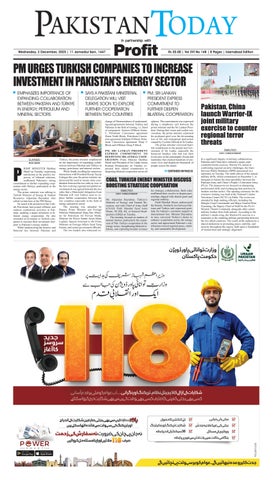

PM URGES TURKISH COMPANIES TO INCREASE INVESTMENT IN PAKISTAN’S ENERGY SECTOR
TURKIYE SOON TO EXPLORE
FURTHER COOPERATION BETWEEN TWO COUNTRIES
COAS,
g PM, SRI LANKAN PRESIDENT EXPRESS COMMITMENT TO FURTHER DEEPEN BILATERAL COOPERATION
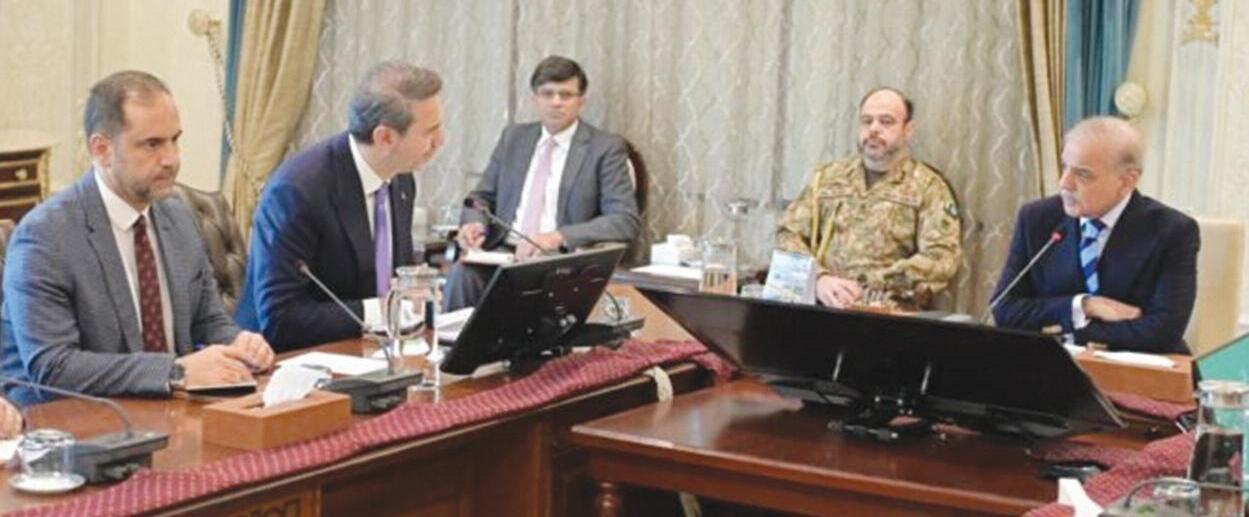
TURKISH ENERGY MINISTER DISCUSS BOOSTING STRATEGIC COOPERATION

CCP ATTRIBUTES SUGAR CRISES
B a gga ge S
estima tes show lo cal vendor industr y lost rs 50b due to used car influx, with significant foreign- exchange impac t
The Board of the Privatisation Commission (PC) has recommended the inclusion of three state-owned enterprises (SOEs) in the privatisation programme and the removal of two others from the active list
Following a review by its Investment Committee the board cleared Saindak Metals Ltd (SML), Pakistan Minerals Development Corporation (PMDC), and National Insurance
The


OIL MARKETING ASSOCIATION URGES SIFC TO TAKE ACTION AGAINST GROUPS SABOTAGING

TThe court then ruled that a new procedure could be notified by the FBR CGO-08/2025 reinstates the regulatory framework, ensuring secure movement of imports to designated tribal area units under the 2023 Tracking and Monitoring of Cargo Rules with mandatory clearance through Azakhel Dry Port addressing concerns from competing industries in settled regions FBR notifies
without
relief operations in Sri Lanka After the search and rescue phase Pakistan will also play an active role in the rehabilitation and reconstruction of the affected areas the prime minister said The meeting was briefed on Pakistan s ongoing relief operations in the cyclone-hit areas of Sri Lanka According to the briefing,
held with the private-sector experts working groups aimed at national economic reforms, PM Office Media Wing in a press release said During the meeting the prime minister said the government held the tax-paying businesses and companies in high regard adding only strong businesses and a robust economy could generate tax

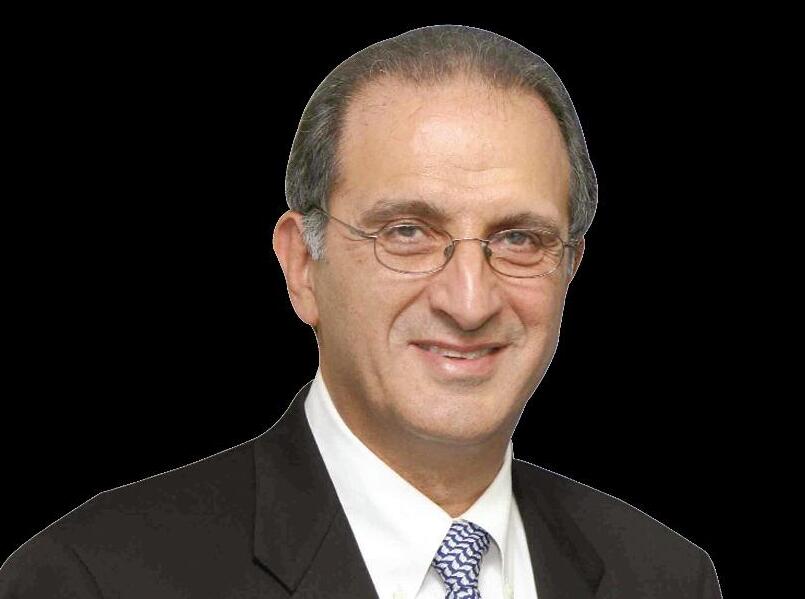

ITn the span of a week, the Trump Administration succeeded in passing a United nations Security Council resolution on Gaza (based on its earlier 20-point plan to end the conflict) and also released a 28-point peace plan for Ukraine Commentators and critics have noted some similarities between the two initiatives There are also profound differences that are important to note In the first place, the intention of both plans appears to be driven by the simple and commendable goal of ending the ongoing violence in Gaza and Ukraine While trying to do this however critics note that aggressors have been given undue deference In the case of Ukraine, it was deemed that the way forward was in rewarding Russia’s land grab in eastern and southern Ukraine In the case of Gaza, no attention was paid to Israel’s genocidal crimes against Palestinians with the assumption that the victims should make do with aid and some form of recovery even though it appears from the plan that their future remains indeterminate and subject to the will of others The problems with both plans owe to the fact that they were initially drafted without the input of either the Palestinians or Ukrainians The exact origins of the Gaza plan remain somewhat murky but what’s clear is the absence of Palestinian participation The Un resolution s only mention of the Palestinian Authority is a reference to their possible future involvement should they meet unspecified reforms, at which point the PA “may” be allowed to assume a role in Gaza on terms approved by Israel and the international bodies the resolution has established to govern Gaza controlling the funds and making the plans to help Gaza recover The Ukraine plan s origins have been a subject of some controversy At first the USA claimed it had been developed with the Russians, based on a Russian draft Then they denied any US involvement, only later to “clarify” that it had been a joint US-Russian effort After pushback from Europeans and some Republican senators the USA engaged with the Ukrainians making some changes which may or may not be acceptable to the Russian side Herein lies one of the differences between the two plans Ukraine is recognized as a sovereign entity, despite the draft plan’s allowing for violations of Ukraine’s sovereignty The plan for Gaza on the other hand not only doesn t acknowledge Palestinian sovereignty but also goes to great lengths to erase it It subjects Palestinians to the whims of Israel and the international bodies led by the USA which will be positioned to serve as sovereigns over decisions that will shape the future of the Palestinian people
The Gaza and Ukraine plans compared
There are, to be sure, what appear to be feints toward Palestinian sovereignty a “tip of the hat” to the Saudi-French Proposal, references to a Palestinian police force and the idea that a reformed PA “may” be involved in the future But these are conditioned on terms established by others rather than as rights All of this seems to pour cold water on the giddiness accompanying the Special Session on Palestine that preceded the opening of this year s General Assembly when a number of states recognized Palestinian statehood Especially concerning in this slighting of the PA is the lack of acknowledgement or understanding by the Gaza plan s architects that Israel has for three decades done its best to ensure the PA s failure From the first years after Oslo, Israel denied Palestinians the freedom to develop an independent economy, guaranteeing the Palestinians would remain dependent on Israel Israel circumscribed the areas in which the PA could govern frequently violating even that by invading areas nominally under PA control Israel also continued to build Jewish-only settlements and infrastructure and played games with Hamas in Gaza often elevating their stature at the expense of the PA Today, the PA, while still conceptually representing the promise of Palestinian statehood, is increasingly seen in the West Bank more as a subordinate acting on behalf of Israel than as an independent selfgoverning entity representing Palestinian aspirations While it s clear that Hamas has fallen into great disfavour among Palestinians in Gaza, the PA polls well behind Hamas in the West Bank So when the Gaza plan insists that the PA reform, the questions that must be asked are: “What
ItÊs not too late for Arabs to demand better terms, for Palestinians to put their house in order creating a unified national plan of governance for the West Bank and Gaza, and for Arabs and Palestinians to insist that those nations who have recognized Palestinian statehood call for reopening the debate on PalestineÊs future .
in fewer conventional job structures

Tevident from the orientation of our people towards reproducing large numbers of children without thinking of their future contingencies or their health education and other basic needs
The conservative narrative is still in vogue especially in the rural areas that sons are guns reproducing children to show their male supremacy to opponents and others living nearby Though this concept is quite traditional and now the states need a skilled human resource Consequently the unchecked population growth is proving a liability and exacerbating the national burden regrettably Additionally there are a number of our cultural patterns, which have become completely obsolete in developed countries but which we are still practising, that definitely lead society towards ignorance and poor development
Culturally the people still favour the joint family system though it has been discarded by
the socially and technologically advanced countries sometime before Similarly, endogamous marriages are common, however, scientifically such marriages carry incredible genetic disorders in the offspring with itself Moreover patriarchal and autocratic family structures are still very common letting the young educated members be kept away from the family decisions; which resultantly have unpleasant impacts on the family relations In addition, the tribalism and caste system is practised with full vigour, rejecting merit and personal achievements Furthermore women though half of the population have been confined to the four walls of the house This is another traditional practice and still continues This practice is very old and had been a feature of the pre-technological era, when hectic work used to be carried out through physical power Definitely men are physically stronger than women but in the technological era when the entire system is operated through a click of a button or key there is no need for strong men So in this context carrying such temperament and considering women as inferior is quite pathetic A question that always arises in this domain is what a man can do and woman cannot in this post-industrial era?
In the same way our thinking about getting an education and job obtainability is yet quite outdated The world is transforming its education system and nurturing their youth to become job creators, but we are still thinking in the conservative way and getting education for job seeking rather than to become job creators ironically Additionally the developed world is searching for new job opportunities and we are still trapped
Moreover, in the political arena our thoughts and targets are so traditional that so far we could not understand the true meaning of politics Our demands from our political representatives are still the same as they were decades ago The people do not demand for collective interest but ask for personal gain and temporary interest which as a result spoils society and that can best be observed in our social settings
Furthermore, such traditional practice is common in our daily interactions People frequently communicate that “no one dies of hunger” but the Un reports that around 25000 individuals die of hunger per day nevertheless the fantasy remains between the layman and expert regarding the definition of the concept
Religiously there are a number of beliefs and rituals, practiced strictly but in a literal way they are not part of religion, but our traditional cultural traits Thus in this context these practices and the many other practices should be revisited through the golden revelations of Islam like ijma ijtihad and qiyas so that to present a true and updated picture of Islam to the world Lack of social adaptability is the root cause of all social evils in our society Maximum issues can be resolved if the people change their behavior and come out from the existing thoughts and view their immediate world in the prism of modern trends and adaptability change their lifestyles and accept the realities of the modern world Such practices and experiences will definitely guarantee long-lasting and permanent ease, please and development in the society
The writer has a PhD in sociology is on the faculty in the department of sociology University of Balochistan Quetta and can be reached at rahimnasar83@gmail com

access hurdles
T V losing meaning
Vanishing winter
We must escape the meshes of tradition
Dr M rahiM Nasar
The pattern of placing self ahead of the nation recurs
have been tragically killed in repeated attacks

TH E Economist published a highly scrutinized report alleging that Bushra Bibi, the wife and former spiritual guide of ex–Prime Minister Imran Khan exerted unusually deep spiritual and political influence over key decisions during his tenure According to the magazine, her purported role extended far beyond that of a private spouse, shaping major government appointments, policy choices and even routine state operations The report claims that intelligence briefings were allegedly routed to her that policy was swayed by her dreams and visions and that Khan s marriage to her may have been politically motivated These allegations raise troubling questions about the intrusion of mysticism, personal loyalty, and informal power networks into the core machinery of Pakistan s governance If true the claims carry wide-ranging implications for Pakistan s political stability and global reputation They reinforce concerns that national decision-making may have been influenced by unverified spiritual counsel rather than institutional merit or strategic reasoning potentially weakening public trust and international confidence The controversy has intensified Pakistan s already polarized political climate, contributing to public frustration and fears that key institutions were strained rather than strengthened during PTI’s tenure For many citizens the ongoing disputes involving Bushra Bibi Farah Khan and PTI leadership deepen the sense that personal influence and irregular practices overshadowed national interests, leaving behind greater division, instability, and institutional fragility
Citizens across Pakistan distinctly recall how during the PTI government’s period in office the names of Bushra Bibi and Farha Gogi were in constant circulation across media discussions political rally speeches and private drawing-room conversations
Critics frequently argued that figures personally close to Imran appeared far too often in
politically sensitive discussions for the comfort of institutionalists, and these critics claimed that the distinct impression created was that informal unverified networks were systematically acquiring far greater significance than the established official channels of governance The prevailing perception is that such figures became symbols of unaccountable and arbitrary influence The PTI’s years in government are often remembered not for foundational institutional strengthening but for a torrent of controversies including disputes over appointments perceived governance paralysis and continuous highpitched political confrontation, whose lingering shadow continues to influence politics The most troubling aspect is not any single incident but rather how deeply personal relationships narrow goals and personal political survival consistently appeared to take precedence over the country s broader wellbeing In public conversations, heated television debates, and prolific social media engagement, it is frequently asserted that the PTI’s political strategy, both during its time in government and its subsequent period in opposition has consistently revolved around confrontation with the state the judiciary and the military establishment rather than institutional cooperation People commonly say the PTI often framed simple political disagreements as existential, thereby polarizing the country further Furthermore instead of delivering meaningful reforms or stability PTI s governance was perpetually overshadowed by internal conflicts administrative uncertainty, and a growing divide between government and key national institutions In the current volatile political climate, Pakistanis commonly express alarm at the PTI’s continued reluctance to align itself unequivocally with the national security consensus particularly on counter-terrorism The most sensitive concern relates directly to KP whose population is again facing intensifying terrorism Civilians, policemen and soldiers
The people of KP have endured two continuous decades on the frontline of the long war against various militant groups and for them national unity in the face of terrorism is not merely an abstract political slogan but a matter of survival They rightfully expect every single political actor, regardless of affiliation, to fully support the state, the military, and all law-enforcement agencies
However the PTI’s public positions on counter-terrorism operations appear evasive contradictory or outright obstructive People believe it is actively resisting actions essential for restoring stability The citizens commonly interpret the PTI s approach as being primarily politically motivated Criticism intensified dramatically when the KP provincial government led by CM Sohail Afridi decided to oppose the regulations associated with the Action in Aid of Civil Power This 2011 ordinance had been carefully designed to provide necessary legal backing for the sustained presence of security forces within the tribal areas during the absolute height of the militancy Crucially it established structured mechanisms for the detention of individuals clearly linked to terrorist organizations in specially designated centres, while simultaneously ensuring vital oversight measures such as the establishment of civilian-military boards defined time limits for detention and rules prohibiting any torture Its entire purpose was to create a legally defined structured and accountable framework for counter-terrorism operations devastated by extremist violence The ordinance was correctly viewed as essential when militant networks had embedded themselves, rendering conventional law-enforcement methods insufficient For most Pakistanis particularly for KP inhabitants who personally endured the bomb blasts, suicide attacks, assassinations, and kidnappings, the abolition of this legal framework
seemed irresponsible The ordinance provided the state with the necessary legal ability to respond swiftly and decisively against emerging militant cells before they could regroup Removing this legal tool severely handicaps the security forces at a time terrorism is resurging Abandoning this ordinance may grant hostile elements greater operational space, and people suspect the provincial leadership is consciously prioritizing narrow political grievances over the safety of its citizens The citizenry expresses deep frustration arguing that at a time when security forces are making the ultimate sacrifice in the line of duty, the political leadership should be standing with the state rather than weakening the legal apparatus specifically designed for terrorism More broadLY the CM’s actions are viewed as representative of a more extensive PTI trend Just as Imran was perceived to place personal loyalty and goals above the national interest, Afridi is alleged to be aligning provincial policies with the PTI s narrow political strategy rather than with paramount national security needs Much of the PTI’s current political energy appears focused on the sole goal of relief for Imran Khan and this focus has in the public view severely overshadowed their fundamental responsibility toward effective governance Citizens believe that PTI leaders are intentionally adopting confrontational stances not because they genuinely benefit the people of KP but because they increase political pressure on national institutions This approach is widely interpreted as dangerous and misaligned with the country s security threats A clear sentiment has now emerged across the country: the public perceives a worrying consistent pattern extending from the actions of Imran Khan to Bushra Bibi to Farah Gogi and now to Sohail Afridi of persistently prioritizing personal agendas over collective national priorities The PTI s leadership frequently presents itself as a victim of political persecution while concurrently failing to
The time has definitively come for the public to demand rigorous accountability, not merely for traditional corruption or administrative incompetence, but also for political behaviour that undermines national cohesion. Whether these concerns will ultimately shape future politics remains crucial, but the sentiment is unequivocally clear: people desire stability, unity, and a leadership firmly grounded in responsible action, not self-serving personal agendas
consensus-building on political spectacle rather than substantive reform, and on confrontation rather than cooperation Pakistanis are insisting the nation can no longer afford a style of politics solely built upon bitter personal rivalries a charisma cult or the continuous assertion of unverified claims They emphasize that Pakistan s current
S ushma Swaraj took on Manmohan S ingh with Shahab Jafari ’s immemorable lines, ‘ Tu idhar udhar ki na baat k ar, yeh bata ki k afila kyun luta, humein rahzano se gila nahi, teri rahbari k a sawal hai ’

events of October 7 under the guise that doing so during wartime is not appropriate loses strength now that he is in favor of an inquiry appointed by the Knesset rather than the Supreme Court even though we are still at war Yes his trial on the misconduct charges has inexcusably gone on for far too long However the legal specialists who represent the interests of the state clearly believe they have a case, or else they would have abandoned the prosecution long ago You can bet that the prime minister is not the only one who does not want to be in court three times a week on this issue
during the world economic downturn of 2008, for representing us well on the world stage, and, lest we forget, for his earlier serv i c e i n t h e I D F
e United Nations Nevertheless polls show that about 70% of the country believes it is time for new leadership
Although he deserves praise for his accomplishments, there have been failures as well He can say whatever he wants about who is responsible for our unpreparedness on October 7, but in Harry Truman’s parlance: “The buck stops here ” and Netanyahu was the prime minister at the time Therefore ultimate responsibility is his to bear whether or not he wants to own up to it TIME FOR CONDITIONAL PARDON AND LEADERSHIP CHANGE: Further, his continued objection to authorizing a formal state commission of inquiry regarding the
Finally his remarks this week that it is important for him to be relieved of the charges so that he and President Donald Trump can, together, continue the work to complete the job in Gaza are as close to fiction as reality ever gets Trump will try to do what he wants with or without Bibi as prime minister and his earlier inappropriate suggestion to Herzog during Trump s Knesset address was just him trying to bully yet another national leader as he does with so many countries in the world, more often than not unsuccessfully In addition, this week’s remarks by the prime minister – that he will not admit guilt to receive a pardon – totally begs the question: If there is no guilt there is no reason to request a pardon and in that case the court would simply decide innocence Nevertheless, it would be in the best interests of the country to close the Bibi chapter of our history by granting the pardon if, and only if, he agrees not to run for public office after his current term runs out in October of next year Doing so would be applauded by the great majority of Israelis; it would create an opportunity for new and, hopefully younger leadership to take over, and Netanyahu s legacy as a successful and sensible leader of Israel would be assured The poet Henry Wadsworth Longfellow wrote: “Great is the art of beginning but greater is the art of ending Bibi should internalize this and Herzog should make the conditional offer We will all be better for the change The writer, an international business development consultant is a former national president of the Association of Americans and Canadians in Israel a past chairperson of the board of the Pardes Institute of Jewish Studies and the current chair of the Executive Committee of Congregation Ohel Nechama in Jerusalem

while the Rajya Sabha was a smidge better at 34 percent In the entire session the Lok Sabha spent just about 37 hours on legislative business, while the Rajya Sabha spent 42 hours
Things weren’t much better last year In the Winter Session, while the productivity of the Lok Sabha was 52 percent that of the Rajya Sabha was 39 percent Sitting days in LS have declined from an annual average of 121 days during 1952-70 to 68 days since 2000 Fewer
Bills are being passed by Parliament over the past few years Of all Lok Sabhas that have had a five year term maximum number of Bills were passed during the 8th LS (355) the least during 15th LS (192) found PRS Legislative Research in its analysis of 70 years of Parliament in 2022 While the 15th Lok Sabha refers to the period of 2009 to 2014, the 8th Lok Sabha refers to the period from 1984 to 1989 In fact in its data crunching of the 15th Lok Sabha which coincided with the second term of the Congress-led United Progressive Alliance (UPA) government, PRS found a startling fact The productive time of the Lok Sabha in the past five years stands at 61% This has been the worst performance of the lower house in more than fifty years it said
The statistics since then may have improved marginally in some sessions and worsened in others, but the fact remains that Parliament’s functioning has been in free fall Numbers clearly demonstrate the extent of the downfall witnessed in the productivity of Parliament and the slide in the conduct of crucial legislative business
floor for political battles than for policy making The opposition revels in stalling House proceedings and the government in bulldozing its way through Backchannel talks deft negotiations and polite outreach seem to have become a thing of the past with neither the government nor the opposition interested in digressing from their obstinacy to focus on productive legislative business THE DECLINE IN NUMBERS: Data does well to tell this story According to PRS Legislative Research which does some outstanding work in this area in the Monsoon Session of Parliament earlier this year, the Lok Sabha functioned for just 29 percent of the planned time
THEN AND NOW: If prolific legislative business is the purpose of Parliament then fruitful knowledge-laden and fierce yet congenial debates are its very soul The essence of India s Parliament has been the glorious speeches the spirited debates and memorable banter Even the most ardent of critics and most vociferous of opponents have displayed great statesmanship inside the House, engaging in meaningful and respectful debates and often memorable banter Just the other day I came
KATHMANDU POST

Kyrgyz President’s historic visit to Pakistan after 20 years to boost bilateral ties
The forthcoming visit of the President of the Kyrgyz Republic the first in two decades is poised to mark a pivotal moment in bilateral relations with both nations aiming to significantly advance cooperation in trade, connectivity, and parliamentary affairs This development was a central theme during a high-level diplomatic meeting at Parliament House on Tuesday Rana Iradat Sharif Khan the Convener of the Pakistan–Kyrgyz Republic Parliamentary Friendship Group (PFG), met with Kylychbek Sultan, the Kyrgyz Ambassador to Pakistan, to lay the groundwork for the landmark presidential trip During their discussion Convener Khan reaffirmed the deep-rooted brotherly connections between the two countries, citing a shared history and cultural affinity as the foundation of their mutual goodwill
A key focus of the dialogue was the enhancement of inter-parliamentary linkages Both officials underscored the im-
portance of closer coordination between their respective friendship groups, especially following the recent reconstitution of the Kyrgyz Parliament Ambassador Sultan confirmed that the visiting President s agenda includes a scheduled meeting with the Speaker of Pakistan s National Assembly The conversation also touched upon the growing educational and cultural exchanges The Convener noted the substantial presence of Pakistani students pursuing studies in Kyrgyz academic institutions In response, Ambassador Sultan expressed a keen interest in exploring avenues for Kyrgyz students to undertake their education in Pakistan, signaling a desire for a more reciprocal academic relationship
Concluding the meeting both representatives agreed on the necessity of maintaining close and continuous engagement They resolved to schedule a dedicated session between the Ambassador and the full Parliamentary Friendship Group at a mutually convenient time to further solidify their collaborative efforts
Trump to attend FIFA World Cup draw this week





ISLAMABAD
CORPORATE CORNER

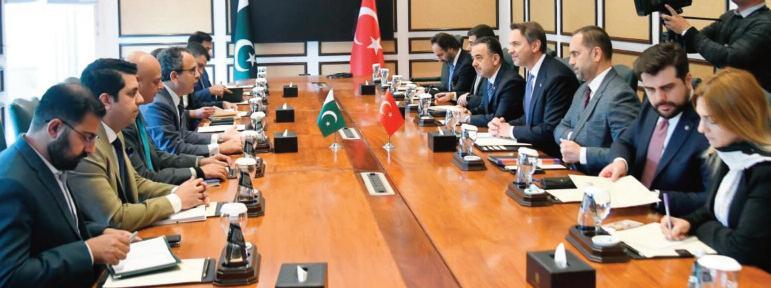
Turkish investor keen in privitization of power sector entities
OGDCL I ttehad Union delegation meets secretar y workers welfare fund
A delegation of the OGDCL Ittehad Union of All Pakistan Employees (Registered CBA) led by Mr
CDA chairman, Bahraini ambassador explore ways to boost bilateral ties
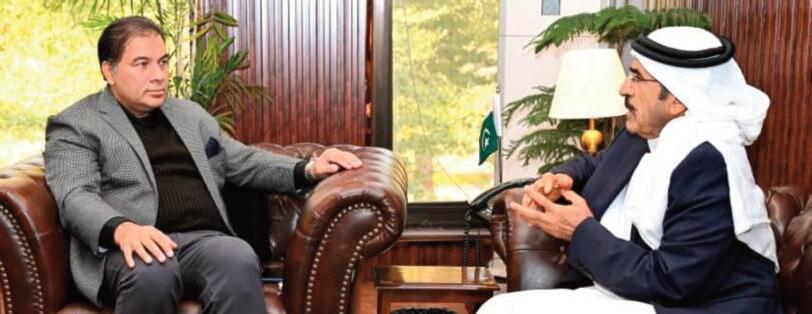
The Ambassador of Bahrian H E Mohamed Ebrahim Mohamed Abdulqader called on Chairman Capital Development Authority (CDA) and Chief Commissioner Islamabad, Muhammad Ali Randhawa, at the CDA Headquarters on Tuesday The meeting involved discussions on matters of mutual interest and further enhancing bilateral cooperation On this occasion both sides reiterated their commitment to strengthening relations and mutual cooperation Chairman CDA Muhammad Ali Randhawa said that Pakistan holds its brotherly country Bahrain in the highest esteem and respect Bahrain s Ambassador, H E Mohamed Ebrahim Mohamed Abdulqader, appreciating the efforts made by the CDA for the beauty and development of Islamabad said that Islamabad is ranked among the extraordinarily green lush and most beautiful cities Chairman CDA Muhammad Ali Randhawa said that efforts are ongoing to make Islamabad an even more beautiful and modern city The meeting also discussed the possibilities of relocating embassies and diplomatic missions to the Diplomatic Enclave Chairman CDA Muhammad Ali Randhawa said that they are prepared to provide all kinds of facilitation for relocating embassies to the Diplomatic Enclave He also apprised about the beautification and uplift project for the Diplomatic Enclave Chairman CDA said that along with the beautification of the Diplomatic Enclave recreational and sports facilities are being increased He further added that to make the Diplomatic Enclave more beautiful, aesthetically pleasing landscaping and horticultural work is also being carried out at various locations

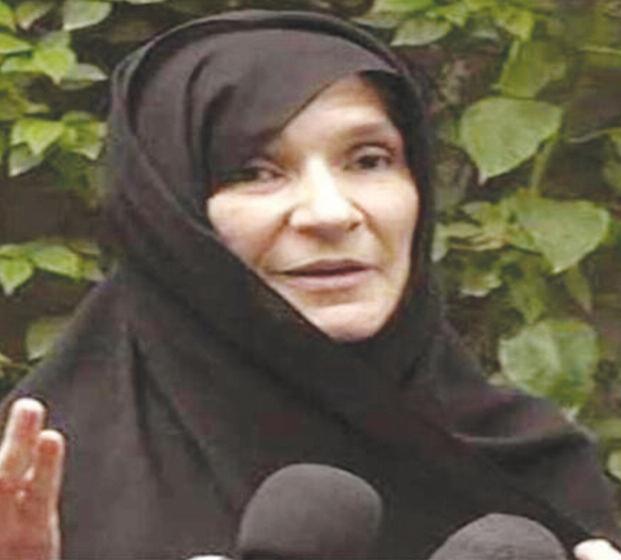
IMRAN KHAN DECRIES ‘MENTAL TORTURE’ AS SISTER FINALLY GRANTED JAIL VISIT
in North Waziristan district of Khyber-Pakhtunkhwa, the military s media wing said on Tuesday According to the Inter-Services Public Relations (ISPR), an intelligence-based operation was carried out in the Mir Ali area on December 1 after reports of the presence of Khawarij During the conduct of the operation own troops effectively engaged the Khawarij location and, after an intense exchange of fire, six Khawarij were sent to hell,” the statement said A second intelligence-based operation was conducted in the Spinwam area where “one more Khawarji was effectively neutralised by the security forces ISPR added Weapons and ammunition were recovered from the killed terrorists, who had been involved in multiple attacks on security forces, law enforcement agencies and in target killings of civilians The ISPR said sanitisation operations were under way to eliminate any other Indian-sponsored terrorists present in the area
In a historic move the Khyber Pakhtunkhwa (KP) Assembly has unanimously passed a resolution calling for the creation of Hazara as a separate province
The resolution urges the provincial government to initiate all constitutional and legal processes necessary to forward the proposal to the federal government This resolution seeks to fulfill the long-standing demand of the Hazara people for a distinct administrative and political entity Presented by Nazir Abbasi, a member of the ruling party, the resolution emphasizes the immediate implementation of the constitutional process under Article 239 of the Constitution which is required for the creation of a new province It also calls for the provincial government to finalize the administrative structures, boundaries, and other necessary
arrangements efficiently to ensure the process is not delayed
Alongside the resolution on Hazara, the assembly also passed a motion recognizing the late former prime minister Zulfikar Ali Bhutto as a national martyr The resolution acknowledged Bhutto s significant contributions to the nation and recommended that the federal government formally recognize him as such
The assembly further passed a resolution calling for restrictions on the use of the Maintenance of Public Order (MPO) ordinance against political workers a measure often criticized for being used retaliatory against political activists Provincial Minister Meena Khan Afridi stated that the government is preparing amendments to prevent punitive actions against political workers regardless of their party affiliation
In response to concerns raised by local farmers the assembly also passed a resolution demanding the maintenance of last year s tobacco
quota of 30 million tons after the Pakistan Tobacco Board proposed a reduction to 15 million tons The upcoming National Finance Commission (NFC) meeting on December 4 also saw K-P government members and opposition parties united in their call for a larger share of federal resources The government is pushing for an increase in KP s allocation from 14 6% to 19 4%, including a one percent allocation for counter-terrorism efforts, reflecting the province’s increased population and the integration of former tribal areas Minister Meena Khan Afridi emphasized that K-P is asserting its constitutional rights, citing the province s significant financial contributions, including Rs 80 billion for the merged districts The session, led by Speaker Babar Saleem Swati concluded with the unanimous passage of all resolutions signaling a unified stance on various political administrative and financial issues
ISLAMABAD