In partnership with
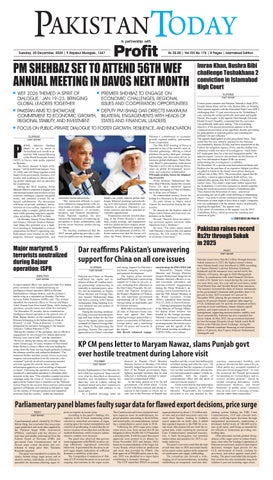
PM SHEHBAZ SET TO ATTEND 56TH WEF ANNUAL MEETING IN DAVOS NEXT MONTH
Profit
Tuesday, 30 December, 2025 | 9 Rajabul Murajjab, 1447
g
g
WEF 2026 THEMED ‘A SPIRIT OF DIALOGUE,’ JAN 19–23, BRINGING GLOBAL LEADERS TOGETHER
PREMIER SHEHBAZ TO ENGAGE ON ECONOMIC CHALLENGES, REGIONAL ISSUES AND COOPERATION OPPORTUNITIES
g PAKISTAN AIMS TO SHOWCASE DEPUTY PM ISHAQ DAR DIRECTS MAXIMUM COMMITMENT TO ECONOMIC GROWTH, BILATERAL ENGAGEMENTS WITH HEADS OF REGIONAL STABILITY, AND INVESTMENT STATES AND FINANCIAL LEADERS
P g
g
Rs 20.00 | Vol XVI No 175 | 8 Pages | Islamabad Edition
FOCUS ON PUBLIC-PRIVATE DIALOGUE TO FOSTER GROWTH, RESILIENCE, AND INNOVATION ISLAMABAD
staff report
RIME Minister Shehbaz Sharif is set to travel to Switzerland next month to attend the 56th Annual Meeting of the World Economic Forum (WEF) in Davos, state media reported on Monday. The forum, themed “A Spirit of Dialogue,” will be held from January 19 to 23, 2026, and will bring together world leaders from government, business, civil society, and academia to discuss pressing global challenges and set priorities for cooperation. During the WEF meeting, Prime Minister Sharif is expected to engage with international leaders and investors on key economic challenges, regional and global issues, and potential avenues for enhanced collaboration. The discussions will focus on growth, resilience, and innovation as cross-cutting imperatives to address today’s complex global environment while pursuing long-term opportunities, according to the WEF website. On Monday, Deputy Prime Minister and Finance Minister Senator Mohammad Ishaq Dar presided over a highlevel meeting in Islamabad to oversee preparations for Sharif’s upcoming visit. Participants were briefed on the WEF program, bilateral engagements, and
scheduled media interactions. “Dar instructed officials to maximize substantive engagements with visiting heads of states, governments, and senior representatives of economic, business, and financial institutions,” Radio Pakistan reported. He also stressed the importance of exploring opportunities to foster collaboration with private sector business entities during the forum. The meeting emphasized that the WEF annual gathering provides a platform for public-private dialogue, where
Major martyred, 5 terrorists neutralized during Bajaur operation: ISPR RAWALPINDI
staff report
A major-ranked officer was martyred while five Indian proxy terrorists were neutralized during an intelligence-based operation (IBO) in Khyber Pakhtunkhwa‘s Bajaur district, said the military’s media wing in a statement on Monday. The InterServices Public Relations (ISPR) said, “The military identified the martyred officer as 36-year-old Major Adeel Zaman from Dera Ismail Khan, while during the operation, security forces also killed five terrorists.” “On December 29, security forces conducted an intelligence-based operation in the general area of Khar, Bajaur district, on the reported presence of Khwarij belonging to the Indian proxy, Fitna alKhwarij,” it said. “Fitna al-Khwarij” is a term designated for terrorists belonging to the banned Tehreek-i-Taliban Pakistan (TTP). “During the conduct of the operation, due to effective engagement by own troops five Indian-sponsored khwarij were sent to hell,” said the statement. “However, during the intense fire exchange, Major Adeel Zaman (age: 36 years, resident of Dera Ismail Khan District), a brave officer who was leading his troops from the front, having fought gallantly, rendered the ultimate sacrifice and embraced shahadat.” The statement further said that security forces recovered weapons and ammunition from the terrorists, who remained “actively involved in numerous terrorist activities against the security forces and law enforcement agencies as well as killing of innocent civilians”. Following the operation, security forces conducted a sanitisation operation to eliminate other terrorists in the area. “The relentless counter-terrorism campaign under the vision of ‘Azm-e-Istehkam’ (as approved by Federal Apex Committee on the National Action Plan) by the security forces and law enforcement agencies of Pakistan will continue at full pace to wipe out the menace of foreign-sponsored and supported terrorism from the country,” added the statement.
leaders can jointly address global challenges. Bilateral meetings and networking with international stakeholders are expected to advance Pakistan’s economic interests and attract potential investment opportunities. Preparations include detailed planning of the Prime Minister’s interactions, media strategy, and engagement with key global decision-makers, ensuring that Pakistan effectively projects its economic and diplomatic priorities. Officials underscored that the forum will allow the Prime Minister to highlight
Pakistan’s commitment to economic growth, regional stability, and international cooperation. The 56th WEF meeting in Davos is regarded as one of the world’s most influential gatherings, offering a critical platform for policy dialogue, strategic partnerships, and innovation-driven solutions to global challenges. Prime Minister Sharif’s participation underscores Pakistan’s active role in shaping discussions on global development, investment, and economic collaboration. PM lauds security forces for eliminating terrorists Prime Minister Muhammad Shehbaz Sharif Monday lauded the security forces for their operation against Khawarij belonging to Fitna ul Hindustan in Khar area of Bajaur. He commended security forces for killing five Khawarij in the operation. He paid tribute to Major Adeel Zaman for martyrdom during the operation. He prayed for the highest ranks of Major Adeel Zaman and expressed condolences to his family. He said, “Security forces are achieving successes against terrorism under Operation Azm e Istehkam.” He said, “The entire nation stands with Pakistan’s forces in this war against terrorism. We will cleanse the country of all forms of terrorism.”
dar reaffirms pakistan’s unwavering support for China on all core issues ISLAMABAD
staff report
Pakistan and China on Monday reaffirmed the depth and resilience of their all-weather strategic partnership, underscoring its centrality to regional peace, security and development, as Deputy Prime Minister and Foreign Minister Senator Mohammad Ishaq Dar held a meeting with Chinese Ambassador Jiang Zaidong to review bilateral ties and matters of mutual interest. During the meeting, Ambassador Jiang conveyed seasonal greetings and best wishes for the New Year to the deputy prime minister on behalf of Chinese Foreign Minister Wang Yi. Reciprocating the greetings, Senator Dar expressed appreciation for China’s consistent
and strong support for Pakistan’s territorial integrity, sovereignty and national development. The deputy prime minister reaffirmed Pakistan’s unwavering support for China on all core issues, including firm adherence to the One-China Principle. He reiterated that Pakistan recognizes the People’s Republic of China as the sole legitimate government representing all of China, with Taiwan being an inalienable part of Chinese territory. Both sides reviewed the overall state of Pakistan-China relations and agreed that their enduring strategic partnership remains a cornerstone of Pakistan’s foreign policy and a stabilising factor for peace and security in the region. Dar directs enhanced engage-
ment strategy for PM’s WEF visit Meanwhile, Deputy Prime Minister and Foreign Minister Senator Mohammad Ishaq Dar on Monday directed officials to ensure maximum substantive and outcome-oriented engagements during the Prime Minister’s upcoming visit to Switzerland to attend the 56th Annual Meeting of the World Economic Forum (WEF), scheduled from January 19 to 23, 2026, in Davos-Klosters. Chairing a preparatory briefing at the Ministry of Foreign Affairs, the deputy prime minister was briefed by the foreign secretary, Pakistan’s permanent representative to Geneva and senior officials on arrangements, the tentative programme and the agenda of the WEF annual meeting, according to a DPM’s Office news release.
Imran Khan, Bushra Bibi challenge Toshakhana 2 conviction in Islamabad High Court ISLAMABAD
staff report
Former prime minister and Pakistan Tehreek-e-Insaf (PTI) founder Imran Khan and his wife, Bushra Bibi, on Monday filed separate appeals with the Islamabad High Court (IHC) challenging their 17-year convictions in the Toshakhana 2 case, terming the verdict politically motivated and legally flawed. The couple, in the appeals filed through Advocate Khalid Yousaf Chaudhry, contended that the conviction was politically motivated, stating: “The overarching objective of the present prosecution appears to be the continued incarceration of the appellant, thereby preventing his participation in national politics and curtailing his political role and influence.” The appeals highlighted several procedural flaws. They noted that the case, initially initiated by the National Accountability Bureau (NAB), had been transferred to the Federal Investigation Agency (FIA), and the challan was submitted within two days of investigation. “Such haste left inadequate time for a fair and transparent probe,” the appeals argued. Lawyers also pointed out the absence of any First Information Report (FIR) on record, undermining the investigation’s credibility. On December 20, a special court had sentenced Imran and Bushra over the purchase of an expensive Bulgari jewellery set gifted to Imran by the Saudi crown prince during an official visit in May 2021. The prosecution argued that the jewellery, valued at approximately Rs80 million, was retained after paying only Rs2.9 million, a fraction of its market value. The couple’s legal team further argued that the Toshakhana 2 conviction amounted to double jeopardy, being the fourth prosecution related to Toshakhana gifts. They claimed the bifurcation of cases—selectively prosecuting one set of gifts while deferring or abandoning others—was done to ensure continued incarceration. “The bifurcation of what ought to have been a single, composite trial was undertaken with the ulterior motive of politically targeting the appellant,” the appeals read. A key point of contention in the appeals was the 2018 Toshakhana Policy, which governs the reporting and retention of gifts.
Pakistan raises record Rs2tr through Sukuk in 2025
Continued on page 03
PROFIT
staff report
Pakistan raised more than Rs2 trillion through domestic Sukuk issuances in 2025, the highest annual volume since Islamic bonds were introduced in 2008, according to Finance Minister’s advisor Khurram Schehzad. Schehzad said the issuances were carried out by the Ministry of Finance, through its Debt Management Office, in coordination with Joint Financial Advisors. A total of 61 Sukuk were issued during the year across one year, three year, five year and ten year tenors, under Fixed Rental Rate and Variable Rental Rate structures. The issuance increased the share of Islamic instruments in the government’s domestic debt portfolio from 12.6 percent in June 2025 to around 14.5 percent by December 2025, placing the government on track to meet its 20 percent Shariah compliant debt target by FY28, Schehzad said. He said the development reflects growing investor confidence, deeper Islamic capital markets, and improvements in sovereign debt management, supporting macroeconomic stability and fiscal sustainability. Pakistan has also expanded into Green Sukuk. In May 2025, the government launched its first Sovereign Domestic Green Sukuk worth Rs30 billion at the Pakistan Stock Exchange, raising the share of Shariah compliant financing in total domestic debt to 14 percent, then Finance Minister Muhammad Aurangzeb said.
Kp CM pens letter to Maryam nawaz, slams punjab govt over hostile treatment during Lahore visit PESHAWAR
staff report
Khyber Pakhtunkhwa Chief Minister Sohail Afridi has expressed “deep concern” over what he described as discourtesy, hostility, and intimidation during his three-day visit to Lahore, calling the treatment meted out to him “undemocratic, reprehensible, and contrary to national unity.” In a detailed two-page letter ad-
dressed to Punjab Chief Minister Maryam Nawaz on Monday, CM Afridi formally lodged his protest over the conduct of the Punjab government, highlighting multiple incidents that he said reflected a deliberate attempt to undermine his constitutional office. In the letter, posted on X by the KP government, CM Afridi stated, “I write to you with deep concern and strong exception to the manner in which my recent visit to the Province of Punjab was
handled and the events that deliberately unfolded during and after the visit.” He emphasized that the sequence of actions was neither accidental nor administrative but represented conduct “wholly incompatible with the dignity of constitutional office and the spirit of inter-provincial respect.” Afridi noted that he had undertaken the visit in his capacity as KP Chief Minister. “Regrettably, the treatment accorded to me was marked by dis-
courtesy, unnecessary hostility, and protocol deviations that cannot be justified under any accepted standard of inter-provincial engagement,” he said. He criticized the Punjab government for adopting an “extraordinary and excessive security posture,” which included sweeping detentions, visible enforcement theatrics, and forced blackouts in public areas—measures that, he said, sent “a message of intimidation rather than cooperation.”
parliamentary panel blames faulty sugar data for flawed export decisions, price surge PROFIT
staff report
A parliamentary panel, chaired by Dr Mirza Ikhtiar Baig, has concluded that inaccurate sugar production and stock data supplied by the Pakistan Sugar Mills Association (PSMA), combined with the absence of real-time and reliable information from the Federal Board of Revenue (FBR) and provincial Cane Commissioners, led to flawed sugar export decisions and contributed to sharp price hike, Business Recorder reported. The panel was mandated to examine the causes behind rising sugar prices and to identify entities, individuals, or officials responsible for decisions allowing sugar ex-
ports or imports in recent years. According to the panel’s findings, disruptions in the S-Track monitoring portal resulted in untracked movement of sugar, creating space for market manipulation and retail-level profiteering. It noted that the selective issuance of no-objection certificates enabled distortions, while excessive administrative controls were misused. The panel also observed that government engagement with PSMA on price-setting effectively legitimised cartel-like behaviour. It questioned the decision to import sugar despite indications of sufficient domestic availability at the time. The Competition Commission of Pakistan (CCP) briefed the panel on its past and ongoing interventions in the sugar sector.
The Commission said it has conducted multiple inquiries since its establishment, imposed penalties amounting to Rs44 billion, and issued policy recommendations, including a comprehensive sector study in 2018. Following the 2025 sugar price surge, when prices rose from around Rs120 per kilogram to above Rs200, the CCP launched a detailed probe. It told the panel that export approvals were granted in six phases between November 2023 and January 2025, based on recommendations of the Sugar Advisory Board, which relied on production and stock data provided by PSMA. The final approval of 500,000 metric tons in January 2025 was identified as a major factor contributing to domestic shortages. The CCP stated that PSMA overstated
sugar production by about 1.33 million metric tons and provided inaccurate carry-forward stock figures, leading to multiple export approvals on faulty data. It added that repeated requests to the FBR for accurate stock information did not yield the required data, while reporting by provincial Cane Commissioners remained inconsistent. A fresh investigation into potential market abuse and penalties for 2025 is currently underway. The panel’s convener noted that the lack of real-time data in 2025 prevented timely enforcement action against mills suspected of cartelisation and supply withholding. The committee put forward a wideranging set of recommendations, including establishing an integrated, real-time data-
sharing system linking the FBR, Cane Commissioners, CCP and relevant ministries; verifying export decisions through independent assessments; maintaining a minimum buffer stock of 540,000 metric tons at all times; and fixing accountability for officials or institutions providing misleading data. Other proposals include gradual deregulation of the sugar sector to reduce distortions, clear rules for Trading Corporation of Pakistan procurement, audits of past import decisions, stronger legal powers for the CCP, enforcement of timely crushing by provinces, and action against retail profiteering. The panel concluded that deregulation remains the only sustainable long-term solution to prevent recurring sugar crises.
02 NEWS
PRECIOUS METALS RETREAT, SILVER HOLDS NEAR $80 PER OUNCE
P
PROFIT
g
news desk
RECIOUS metals pulled back on Monday, with silver trading near the $80 per ounce mark after hitting a record high earlier in the day and gold easing from near record highs, on profit-booking and geopolitical tailwinds cooling safe-haven demand. Spot gold was down 0.4% at $4,512.30 per ounce, as of 0426 GMT, after hitting a record high of $4,549.71 on Friday. U.S.
KSE-100 surges nearly 1,500 points to new record-high PROFIT
news desk
Buying momentum continued at the Pakistan Stock Exchange on Monday, with the benchmark KSE-100 Index closing at a new all-time high amid strong investor sentiment. The index opened sharply higher and climbed rapidly during early trade, reaching an intra-day high of 174,411.72 points on aggressive buying. At close, the KSE-100 settled at 173,896.34 points, up 1,495.61 points, or 0.87%, from the previous session. Market participants linked the bullish tone to expectations of fresh investment inflows from the United Arab Emirates. Deputy Prime Minister and Foreign Minister Mohammad Ishaq Dar said on Saturday that the UAE would acquire shares in Fauji Foundation companies as part of ongoing economic cooperation between the two countries. Analysts said the development helped reinforce confidence, particularly after the market ended the previous week at record levels. Meanwhile, equities are expected to remain the best-performing asset class in 2026, supported by improving macroeconomic conditions, easing inflation and sustained domestic liquidity, according to a report by Arif Habib Limited. Advisor to the finance minister Khurram Schehzad said on Monday that the PSX delivered returns of more than 50% in US dollar terms during the outgoing year, placing it among the topperforming markets in Asia. He said the equity investor base has crossed 450,000, reflecting an increase of over 120,000 investors, or 37%, over the past 18 months. He added that record market levels reflect rising investor confidence supported by macroeconomic stability, reforms and improved growth prospects. During the previous week, the KSE-100 had closed at 172,400.73 points, posting a week-on-week gain of 0.6% and extending its recordbreaking rally as the market wrapped up the year-end phase at an all-time high. In the currency market, the Pakistani rupee recorded a marginal gain against the US dollar in the interbank market, closing at 280.16, up Re0.01. Trading activity remained strong, with all-share index volume rising to 858.05 million shares from 797.99 million in the previous session. Traded value increased to Rs42.87 billion from Rs38.06 billion. WorldCall Telecom led volumes with 52.85 million shares, followed by Dost Steels Ltd with 51.36 million shares and PTCL with 42.55 million shares. A total of 485 companies were traded during the session, with 177 stocks closing higher, 272 declining and 36 ending unchanged.
gold futures for February delivery lost 0.4% to $4,535.10 per ounce. Spot silver was up 0.7% at $79.68 per ounce, after retreating from an all-time high of $83.62 hit earlier in the session. “A combination of profit-taking and seemingly productive talks between Trump and Zelensky regarding a potential peace
deal have put gold, silver on the back foot,” said KCM Trade Chief Market Analyst Tim Waterer. U.S. President Donald Trump said on Sunday that he and Ukrainian President Volodymyr Zelenskiy were “getting a lot closer, maybe very close” to an agreement to end the war in Ukraine. Silver has gained 181% year-to-date,
outshining gold, propelled by its designation as a critical U.S. mineral, supply constraints and low inventories amid rising industrial and investment demand. Bullion has also staged a stellar rally in 2025, climbing 72% so far and shattering multiple record highs. Gold has been helped by a cocktail of
Gold, equities emerge as top-performing assets in Pakistan in 2025 as bullion jumps 73%, stocks up 48% g
PROPERTY PRICES INCREASED 8–18%, RDA CERTIFICATES RETURNED UP TO 22%, AND FIXED-INCOME INSTRUMENTS DELIVERED 9–14% RETURNS; US DOLLAR REMAINS A WEAK PERFORMER FOR LOCAL INVESTORS PROFIT
news desk
Gold and equities emerged as the top-performing asset classes in Pakistan in 2025, delivering significantly higher returns than fixed-income instruments, real estate, and foreign currency holdings, according to a review by Topline Pakistan Research. Gold recorded the strongest performance, posting a return of 73% between January 1 and December 24, 2025. Local gold prices rose from Rs233,711 per 10 grams to Rs405,402 per 10 grams during the period. In the international market, gold prices increased from $2,612 per ounce at the end of 2024 to $4,503 per ounce by
December 26, 2025. The KSE-100 Index ranked as the second-best performing asset class, rising 48% from January 1 to December 24, 2025, with four trading sessions still remaining in the year. The return includes dividends paid during the period. Real estate, traditionally viewed as a preferred investment option in Pakistan, delivered comparatively moderate gains. According to Zameen.com data cited by Topline, average prices of commercial and residential plots increased by 18% in DHA Karachi and 15% in DHA Lahore. House prices in both cities rose by an average of 8%. Returns on Naya Pakistan Certificates
under the Roshan Digital Account were mixed. The PKR-denominated certificate generated a return of 22% in 2025, although profit rates were revised downward to 13% in March. The US dollar-denominated certificate delivered a return of 10% during the year. The US dollar remained a weak performer for local investors. Similar to 2024, returns stood at around 1% , as the interbank exchange rate moved from Rs278 to Rs280, while the open market rate increased from Rs280 to Rs281. The brokerage firm noted that a one-year US dollar term deposit could have yielded a higher return of 3 to 4%, assuming deposit rates of 2 to 3%. Fixed-income and low-risk investment
Traders suffer huge financial loss due to prolonged border closure: SCCI g
PAKISTAN RELATIONS WITH VARIOUS COUNTRIES ADVERSELY AFFECTED DUE TO CLOSURE OF BORDERS, TRADERS AND IMPORTERS PESHAWAR
aziz buneri
Sarhad Chamber of Commerce and Industry said over 10,000 Pak-Afghan and Transit Trade trucks have stuck at Karachi seaport due to the prolonged border that had caused massive financial losses to both side traders. The SCCI urged government and relevant authorities to promptly resolve border issues and allow a one-time clearance of transit cargo to Afghanistan and Central Asia to prevent traders from further monetary loss and waive of demurrage charges as well. Junaid Altaf, President of the Sarhad Chamber of Commerce and Industry in a statement issued here on Monday informed from 10,000 to 12, 000 Pak-Afghan and transit trade containers have stuck at Karachi port, while thousands of containers of traders from the both countries, especially those laden with perishable items had also stranded at Ghulam, Spin Boldak,
tions with many countries from where the cargo has been exported. The SCCI chief urged the Ministry of Commerce to provide options for Afghan commercial transit cargo (All containers) as were given to the stranded cargo of Central Asian Republics transit cargo. Pakistan’s trade with the five Central Asian countries (CACs) weakened during July–October FY26, according to which imports plunged 63.59pc to $15.80m from $43.39m, said President Junaid Altaf while sharing the official figures. SCCI chief said according to official data, the decline underscores that Pakistan’s trade with the region—estimated at $400–500m annually via Afghanistan—remains well below its potential despite frequent high-level engagements. President Junaid Altaf said the estimates from 50 to 60 million dollars of the current peak season of medicine, cement, and kinnow had been completely vanished and per day loss of bilateral trade has touched to $5million.
Kharlachi and Torkham border, inflicting massive financial loss to trading community owing damaged of the food and perishable items. He went on to say that the closure has disrupted perishable exports, raised unemployment, and inflicted severe socio-economic hardship on border communities dependent on cross-border trade, emphasizing to acknowledge the gravity of the situation and this issue must be addressed on priority grounds. Furthermore, he informed that stakeholders report losses of millions of dollars per day from container detention and billions blocked in bank guarantees and container security deposits. The liquidity of clearing agents and bonded carriers has been exhausted, while foreign shipping lines continue to accrue charges. President Junaid Altaf and Shahid Hussain continued to say that vagueness about allowing Afghan Transit Trade containers has created great unrest among the traders, besides it had also adversely affected Pakistan’s rela-
GAS DISTRIBUTOR POSTS RS271M PROFIT IN 1QFY26, COMPARED TO RS4.9BN A YEAR EARLIER PROFIT
news desk
Sui Southern Gas Company (SSGC) reported a steep decline in profitability for the quarter ended September 30, 2025, as higher unaccounted-for-gas (UFG) disallowances and rising gas acquisition costs strained its margins. The company posted a profit after tax of Rs271 million, sharply lower than Rs4.87 billion in the same quarter last year, translating into earnings per share of Rs0.31, down from Rs5.53. Profit before tax fell to Rs1.33 billion, compared with Rs4.91 billion in September 2024. The contraction was
factors including bets of further U.S. rate cuts, geopolitical tensions, robust demand from central banks and rising holdings in exchange-traded funds. Waterer said $5,000 looked to be a viable target for gold next year provided the next Federal Reserve chairman adds a more dovish lean to Fed policy. “Rate cuts and a continuation of robust industrial appetite paired with supply shortages could have silver primed for a run towards $100 in 2026,” Waterer said. Traders still expect two U.S. rate cuts next year as they await the release of the Fed’s December meeting minutes for clues further policy cues. Non-yielding assets tend to do well in a low-interest-rate environment. Spot platinum fell 1.5% to $2,421.35 per ounce, after rising to an all-time high of $2,478.50 earlier in the day, while palladium lost 6% to $1,807.59 per ounce.
SPOT GOLD FALLS 0.4% AT $4,512.30 PER OUNCE, SILVER HITS ALL-TIME HIGH AT $83.62/OZ; PLATINUM HITS RECORD HIGH AT $2,478.5/OZ
SSGC quarterly profit drop 94% amid rising costs g
Tuesday, 30 Deceember, 2025 | ISLAMABAD
driven largely by regulatory adjustments under OGRA’s Final Revenue Requirement determination, which imposed significantly higher UFG disallowances. SSGC absorbed Rs4.68 billion in UFG disallowances during the quarter, up
sharply from Rs1.74 billion in the corresponding period. The company’s cost structure also remained under pressure as the Weighted Average Cost of Gas (WACOG) increased 3.5%, rising from Rs1,108.38 per MCF to Rs1,147.03 per
MCF, adding another Rs158 million to UFG-related losses. Finance costs eased slightly to Rs3.30 billion, compared with Rs3.42 billion last year. While the company prepares its accounts using OGRA’s prescribed return of 21.25% on average net operating fixed assets, adjustments for efficiency benchmarks, particularly UFG, human-resource benchmarks, and doubtful-debt provisions continued to weigh on the bottom line. SSGC noted that although it is contesting recent regulatory decisions, the quarterly results incorporate the pro-rata impact of OGRA’s determinations currently in effect.
avenues posted relatively lower returns amid easing monetary conditions. The average bank savings rate remained around 9%, while National Savings’ three-year Special Savings Certificate offered a return of 12%. Money market funds managed by local asset management companies generated an average return of 11% during the year. Government securities also delivered moderate returns. Pakistan Investment Bonds provided a return of 14%, while Tbill investors earned around 12%. The estimate assumes investment in actively traded three-month T-bills with quarterly reinvestment, while one-year T-bill investors also recorded returns of about 12% in 2025.
Pakistan Banks Association elects Zafar Masud as chairman, forms 16-member Executive Committee Nassir Salim named senior vice chairman, Yousaf Hussain vice chairman; Muneer Kamal to serve as secretary general PROFIT
news desk
The Pakistan Banks Association (PBA) has elected a new 16-member Executive Committee, including two female members and representatives from eight newly inducted banks, as part of efforts to broaden industry representation. Following the elections, the committee unanimously elected Zafar Masud, President and Chief Executive Officer of The Bank of Punjab, as chairman of the association. Masud said the new Executive Committee reflects an evolution in the PBA’s governance structure and strengthens its capacity to support a national economic agenda. He said priorities include addressing credit gaps in key sectors, expanding financial inclusion through digital channels, and supporting economic recovery. The leadership team also includes Nassir Salim, President and CEO of Habib Bank Limited, as senior vice chairman, and Yousaf Hussain, President and CEO of Faysal Bank Limited, as vice chairman. Salim highlighted the need for resilience and strong compliance frameworks amid global challenges, while Hussain said modernisation, technology adoption and agility would be central to maintaining competitiveness. PBA Chief Executive Officer and Secretary General Muneer Kamal said the expansion of the Executive Committee, including female representation, reflects the association’s focus on diversity and modern governance. Under the new leadership, the PBA said it plans to strengthen engagement with the State Bank of Pakistan, the Ministry of Finance and the federal government to support infrastructure development, expand private-sector credit for agriculture and small and medium enterprises, and advance digital transformation.
CCP wraps up 2025 with over Rs2b in fines against cartels in key sectors g
FINES TOTAL RS2.1B, INCLUDING RS1.56B ON STEEL MILLS, RS375M ON FERTILISER FIRMS, RS155M ON POULTRY HATCHERIES AND RS10M ON TRANSPORT ASSOCIATIONS PROFIT
news desk
The Competition Commission of Pakistan (CCP) took strong enforcement action in 2025 against cartelisation, price-fixing and other anti-competitive practices across key sectors, including sugar, steel, poultry, fertiliser, education, transport, advertising, power supply and manufacturing, to protect consumers and ensure fair markets. In the sugar sector, the CCP issued showcause notices to ten sugar mills in Punjab for colluding on the start of the crushing season and fixing the sugarcane procurement price at Rs400 per maund. The commission found that the mills jointly decided to delay crushing during a meeting held on November 10,
2025, in violation of Section 4 of the Competition Act, 2010, according to a press release issued by the CCP on Sunday. In a major enforcement action, the CCP imposed heavy penalties on Aisha Steel Mills Limited and International Steels Limited for cartelisation and price-fixing. Aisha Steel Mills was fined Rs648 million, while International Steels was penalised Rs914 million. The inquiry found coordinated pricing, exchange of sensitive information and an average steel price increase of 111% over three years. To protect parents and students, the CCP issued show-cause notices to 17 major private school systems for abusing their dominant position by forcing parents to purchase expensive logo-branded notebooks, work-
books and uniforms from selected vendors. In the poultry sector, the CCP imposed a collective fine of Rs155 million on eight major poultry hatcheries for cartelisation and price-fixing of day-old broiler chicks, which contributed to higher poultry prices. In the fertiliser sector, the CCP imposed penalties of Rs50 million each on six major urea manufacturers and Rs75 million on a leading industry association, totalling Rs375 million, for coordinated conduct that restricted competition. The CCP also fined the Transporters of Goods Association and the Local Goods Transport Association Rs5 million each for rate-fixing through collective decisions that restricted independent pricing by transporters. Strong enforcement actions were also
taken through raids and inspections. The CCP conducted raids in Lahore on entities linked to cartelisation in the out-of-home advertising market over alleged price-fixing and bid coordination. Similar raids were carried out on suppliers involved in transformer reclamation materials for power distribution companies over suspected bid-rigging. In Gujrat, the CCP conducted search and inspection operations at the premises of two electric fan manufacturers and their industry association over suspected cartelisation and price-fixing, securing documents and digital evidence. Significant progress was also made on the litigation front, as the Competition Appellate Tribunal (CAT) upheld key cartelisation cases. The CAT disposed of the
long-pending Pakistan Poultry Association cartel case, upheld the CCP’s findings and ordered recovery of a reduced penalty of Rs25 million. The tribunal also upheld the CCP’s order against the Pakistan Flour Mills Association for fixing wheat flour prices and directed payment of a Rs35 million fine. In the poultry sector, the CAT admitted and fixed for hearing the appeals of eight hatcheries fined Rs155 million for cartelisation in dayold chick prices, while attempts to stall the proceedings were rejected by the Lahore High Court. Through these actions in 2025, the CCP reinforced its zero-tolerance approach to cartelisation and its commitment to fair, transparent and competitive markets.
NEWS 03
KSE-100 juMPS PAST 174,000 AS SToCKS oPEn FInAL wEEK on STRonG noTE
Tuesday, 30 Deceember, 2025 | ISLAMABAD
P
PROFIT
news desk
AKISTAN Stock Exchange (PSX) continued its upward rally for the final trading week of the year on a strong footing, with the benchmark KSE-100 Index crossing the 174,000 mark in early trade on Monday. According to the PSX website, the benchmark index surged to 174,401.54, with an increase of 2000.81 points as of 09:43 am, as buying interest emerged across key sectors. At 12:00 pm, the market was hovering at 173,772.98 level, up by 1372.25 points or 0.8% from the previous close of 172,400.73 point. Gains were seen in automobile assem-
Govt shifts cotton export oversight from TDAP to State Bank New rules introduce 1% security deposit, LC requirement for cotton exporters PROFIT
g
INDEX UP 1% IN EArLy TrADE; EqUITIES AMoNg ToP-PErforMINg ASSETS IN 2025
blers, cement, commercial banks, fertilisers, oil and gas exploration companies, oil marketing companies, power generation and refineries. Heavyweight stocks, including ARL, HUBCO, MARI, OGDC, PPL, POL, HBL, MEBL and MCB traded higher. The upbeat opening follows a strong close last week, when the benchmark index settled at a record 172,400.73 points, posting a week-on-week gain of 0.6% and ending the year-end phase at an all-time high. According to Arif Habib Limited, the PSX is expected to remain the best-performing asset class in 2026, supported by improving macroeconomic stability, easing inflationary pressures and sustained domestic liquidity.
A separate note by Topline Securities showed that both equities and gold delivered strong returns in Pakistan during 2025. Gold prices rose 73% between January 1 and December 24, 2025, increasing from Rs233,711 to Rs405,402 per 10 grams. In the international market, gold climbed from $2,612 per ounce at the end of 2024 to $4,503 per ounce by December 26, 2025. The KSE-100 Index posted the secondhighest return among major asset classes, rising 48% during the same period, inclusive of dividends, with four trading sessions remaining in the year. Real estate also posted more moderate gains. Returns on savings-linked instruments were lower. Naya Pakistan PKR cer-
Govt finalises three-year SME business plan, PM to review proposal g
roADMAP DEvELoPED wITh A.T. KEArNEy, ProPoSES AN ovErALL oUTLAy of AroUND rS18 BILLIoN UP To 2028 ISLAMABAD
news desk
Ghulam abbas
port promotion, value-chain integration, access to finance, women entrepreneurship, climate resilience and institutional strengthening of SMEDA. The plan projects that, if fully implemented, SME contribution to GDP could rise to over Rs50 trn, while employment in the sector could increase to 26m by 2028. SME exports are projected to grow from existing around $3 bn to $4bn over the same period. A key component of the roadmap is the expansion of the national SME registry and the rollout of one-window regulatory and facilitation mechanisms, aimed at bringing a larger number of informal enterprises into the documented economy. The plan also proposes preferential public procurement options to increase SME participation in government contracts, alongside the development of a new MSME Policy framework focusing on productivity and competitiveness. Access to finance remains a central focus, with proposals for SME credit scoring models, financial literacy programmes and targeted grants. Clusterbased lending assessments and partnerships with banks and microfinance institutions are also envisaged. The strategy places particular emphasis on women-led enterprises, with
The federal government has transferred responsibility for regulating cotton exports from the Trade Development Authority of Pakistan (TDAP) to the State Bank of Pakistan (SBP), introducing stricter financial conditions for exporters. The change was notified through S.R.O. 2486(I)/2025 issued by the Ministry of Commerce, amending the Export Policy Order, 2022 under the Imports and Exports (Control) Act, 1950. Under the revised framework, cotton exporters will be required to place a security deposit equivalent to 1% of the contract value with the State Bank of Pakistan. Exporters must also present a confirmation letter issued by the SBP to customs authorities along with shipping documents. In addition, buyers will be required to open an irrevocable letter of credit, and exporters must complete shipment of the contracted quantity within 180 days of opening the LC. The notification states that in cases where exporters fail to ship the full contracted quantity within the stipulated period, the SBP will forfeit the security deposit in proportion to the quantity that remains unshipped. Previously, cotton export matters were handled by the Trade Development Authority of Pakistan. The revised arrangement places greater regulatory and financial oversight with the central bank, aimed at ensuring contract compliance and timely execution of exports.
The government has finalised a comprehensive three-year business plan for the small and medium enterprises (SME) sector, envisaging wide-ranging reforms aimed at formalisation, export growth, access to finance and productivity enhancement, with the plan set to be presented to Prime Minister Shehbaz Sharif in the coming days. The roadmap, prepared by the Small and Medium Enterprises Development Authority (SMEDA) with technical support from international consultancy A.T. Kearney, proposes an overall outlay of around Rs18 billion up to 2028. The plan was reviewed on Monday at a high-level meeting chaired by Special Assistant to the Prime Minister on Industries and Production Haroon Akhtar Khan, attended by members of the SMEDA Board and officials involved in drafting the strategy. Officials said the business plan was developed following consultations with stakeholders across sectors and regions, and seeks to address long-standing structural constraints faced by SMEs. According to available documents, the strategy outlines eight broad reform areas, including SME formalisation, ex-
Trading to begin December 29 under ‘BLUEX’ symbol; company included in KMI Islamic index
Several residential and commercial properties in different parts of the city were sealed for nonpayment of long-pending dues
Blue-Ex Limited migrates to PSX main board from GEM
PROFIT
KP Excise intensifies enforcement against property tax defaulters in Peshawar
PESHAWAR
news desk
Blue-Ex Limited has been migrated from the Growth Enterprise Market (GEM) Board to the Main Board of the Pakistan Stock Exchange, with trading set to commence on December 29, 2025. According to a notice issued by the PSX on Monday, trading in Blue-Ex shares on the Main Board will be settled on a T+2 basis, with the first settlement scheduled for December 31, 2025. The market lot has been set at one share with a face value of Rs10. The National Clearing Company of Pakistan Limited has assigned “BLUEX” as the company’s trading symbol, while the opening price on the Main Board will be the closing price recorded on December 26, 2025, when the shares last traded on the GEM Board. The company will be listed under the Transport sector in the PSX daily quotation. Its share registrar is CDC Share Registrar Services Limited. Following a review of its financial statements and business profile, Blue-Ex has been classified as Shariah compliant and will be included in the PSX-KMI All Share Islamic Index from the date of its migration to the Main Board.
tificates under the Roshan Digital Account generated a 22% return in 2025, while US dollar certificates yielded 10%. The US dollar itself posted gains of about 1% in both interbank and open markets. Government securities also posted moderate gains amid monetary easing. Pakistan Investment Bonds returned about 14%, while T-bill investors earned around 12% during 2025, based on reinvestment in actively traded three-month instruments. Globally, Asian stocks were at six-week highs on Monday, while the dollar hovered near its lowest in almost three months on expectations of the Federal Reserve cutting interest rates next year, which has also sparked a fierce rally in precious metals.
multiple programmes proposed for digital outreach, skills development, grant support and dedicated facilitation centres. Donor-supported initiatives involving the Asian Development Bank, FCDO and JICA form a significant part of this inclusion agenda. As per the documents, the export promotion measures include an SME export assistance programme, international B2B networking platforms, participation in regional and global trade events, and the development of sectorspecific value chains, particularly in agro-processing. The plan also incorporates climate-focused interventions to help SMEs meet emerging environmental compliance requirements in export markets. Addressing the meeting, Mr Khan said the business plan aims to formalise SMEs, improve productivity and unlock the sector’s economic potential, adding that issues such as limited access to credit, low competitiveness and climate-related risks had been prioritised. He said the government, under the prime minister’s supervision, intended to ensure full implementation of the plan over its three-year duration. While the roadmap includes detailed targets and performance indicators, officials acknowledged that its success would depend on timely funding, coordination with provinces and regulators, and strengthening SMEDA’s delivery capacity at the regional level.
FBR seals two sugar mills in Punjab over sales tax violations Action taken under Sales Tax Act as authority reiterates zero tolerance for non compliance PROFIT
staff report
The Khyber Pakhtunkhwa Excise, Taxation and Narcotics Control Department has intensified its property tax recovery drive, taking action against persistent defaulters in Peshawar. Under the supervision of Excise and Taxation Officer (ETO-VI) Peshawar, Ejaz Khan, an operation was carried out during which several residential and commercial properties in different parts of the city were sealed for non-payment of long-pending dues. According to the department, indiscriminate action against tax defaulters will continue, and no one will be considered above the law. Officials said the drive aims to ensure the timely recovery of government revenue and improve transparency in the tax system. Citizens were urged to clear outstanding liabilities promptly to avoid penalties, legal proceedings or sealing of premises. Meanwhile, Director Excise and Taxation, Peshawar Region, Syed ulAmin, visited Property Tax Offices Peshawar-II and Peshawar-VI, where he chaired a joint meeting to review the pace of property tax collection. During the meeting, officials were directed to formulate a comprehensive recovery strategy and improve staff performance. Emphasis was placed on courteous behaviour and facilitation-based engagement with taxpayers. Excise officials were also briefed on the ongoing GIS-based property tax survey in Peshawar. The regional director instructed that monitoring of GIS associates be further strengthened and systematised to align departmental operations with modern practices and enhance transparency and convenience in the tax system.
news desk
The Federal Board of Revenue (FBR) has sealed two sugar mills in central Punjab after detecting serious violations of tax laws, the authority said on Monday. In a statement, the FBR said the action was taken for breaches of Section 40C of the Sales Tax Act, 1990, read with relevant provisions of the Sales Tax Rules, which require monitoring, control and compliance mechanisms in the sugar sector. The authority said the enforcement drive reflects the government’s policy of zero tolerance towards non compliance, particularly in sectors considered high risk for revenue leakage. According to the FBR, all enforcement actions were conducted in line with due process and transparency to safeguard government revenue and ensure a level playing field for compliant taxpayers. It added that while the tax authority continues to encourage voluntary compliance, strict legal action will be pursued against willful violations of sales tax laws.
Imran Khan, Bushra Bibi challenge Toshakhana 2 conviction in Islamabad High Court CONTINUED FROM PAGE 01
Clause I mandates that all gifts received must be reported and deposited, while Clause VI allows retention of gifts above Rs30,000 after paying 50% of the value exceeding the exemption. The appeals argued that Imran and Bushra had complied fully with these rules, making the conviction legally untenable. The appeals also addressed the alleged criminal breach of trust charges. Lawyers argued that such charges re-
quire dishonest misappropriation of property entrusted to a person acting as a public servant, which they asserted did not apply to Imran Khan or Bushra Bibi. The appeal noted that Imran did not fall under the definition of a public servant as per Section 21 of the Pakistan Penal Code (PPC), and that Bushra, as a housewife, had never held public office. “The learned trial court misread and misapplied the Toshakhana Policy and Rules,” the appeals argued, adding that the prosecution had failed to estab-
lish guilt beyond reasonable doubt. Paragraphs in the judgment that sought to categorize Imran as a public servant relied on vague precedents from 1957 and 1961, which the appeals described as legally unsustainable. Imran and Bushra requested the IHC set aside the December 20 judgment and acquit them of all charges in the Toshakhana 2 case. The appeals come after the couple was indicted last December, and in October 2025, they had denied all allegations, calling the case a fabricated political attempt to
disqualify Imran from politics. Imran Khan, imprisoned since August 2023, is serving a 14-year sentence in a £190 million corruption case and faces additional trials under the Anti-Terrorism Act related to the May 9, 2023 protests. Bushra Bibi is also serving a seven-year sentence in the same corruption case. The couple’s legal team has emphasized that the Toshakhana 2 case should not be allowed to impede Imran Khan’s political participation or violate fundamental legal principles.
Silver climbed above the $80-perounce-mark for the first time before sliding sharply lower in volatile trading on Monday, while platinum and palladium also fell sharply after hitting all-time highs. Gold eased nearly 1% but has repeatedly breached record highs this year on dollar weakness, safe-haven demand and rate cut wagers. MSCI’s broadest index of Asia-Pacific shares was 0.27% higher, hitting its highest since October 3 in a strong start to the last week of the year. The index has risen over 25% this year, boosted by technology stocks as AI mania firmly took hold of investors. South Korea’s Kospi rose 1.5% to a near two-month peak, taking its yearly gains to an eye-popping 74%, on pace for its strongest annual gain since 1999. Japan’s Nikkei slipped 0.4%, while Taiwan stocks rose 0.3% to a record high.
Steel industry urges FBR to seek advance tax guarantees on duty-free Chinese imports via Sost
Producers warn of diversion risk, oppose tax-free entry of finished steel goods PROFIT
news desk
The Pakistan Association of Large Steel Producers has urged the Federal Board of Revenue (FBR) to demand advance pay orders from importers of duty-free Chinese steel products cleared through the Customs Dry Port at Sost for consumption in GilgitBaltistan. The demand follows FBR’s notification of S.R.O. 2488(I)/2025 on December 24, 2025, allowing over 2,403 Chinese goods to be imported duty- and taxfree through Sost. The industry has opposed the exemption, citing risks of misuse and diversion to taxable areas. In a letter to FBR, the association proposed that importers submit advance pay orders as collateral to the FBR, to be released only after consumption certificates are issued by Gilgit-Baltistan tax authorities. The association warned that failure to introduce safeguards could harm local industry, particularly steel, as duty-free goods may be sold outside Gilgit-Baltistan. It said Pakistan has surplus steel production capacity and can meet Gilgit-Baltistan’s construction steel needs domestically. The industry suggested that if the objective is to boost economic activity in Gilgit-Baltistan, tax exemptions should be limited to raw materials or scrap, while finished and intermediate goods should be excluded due to past misuse of similar concessions in other regions. The steel producers urged the FBR to consult local industry stakeholders before implementing or expanding tax-free import schemes through the Sost Dry Port.
Meritorious service rewards for Inland Revenue officials capped at 24 salaries PROFIT
news desk
The Federal Board of Revenue has formally capped rewards for meritorious services for Inland Revenue officials at a maximum of 24 salaries per financial year for each employee. The clarification follows the issuance of S.R.O. 2485(I)/2025, through which the FBR amended the Inland Revenue Reward Rules, 2021. Under the revised rules, rewards for meritorious performance cannot exceed 24 salaries in a single financial year. Last month, the FBR had approved an increase in the reward ceiling from 18 to 24 salaries. The board unanimously endorsed the amendment, which applies to employees covered under Rule 6 of the Inland Revenue Reward Rules. The FBR also noted that it has introduced a revised evaluation mechanism for ex-cadre officers and staff as part of the updated framework. Separately, the board observed that the Customs Reward Rules, 2012 already allow rewards of up to 36 months’ basic salary and therefore do not require any amendment.
04 COMMENT
The silent crisis of public safety in Pakistan
Federal Civility Erodes
T
HE letter sent by Khyber Pakhtunkhwa Chief Minister Sohail Afridi to Punjab Chief Minister Maryam Nawaz marks more than a dispute over protocol. It exposes how deeply the political divide between the PTI and the PMLN has corroded basic norms of governance. When the courtesies once extended even to rival provincial leaders are abandoned, the damage reaches beyond party rivalry and into the foundations of the federation itself. Inter provincial relations in Pakistan have always carried an element of tension, yet they have historically been tempered by an understanding that constitutional office demands restraint. Chief ministers, regardless of party, were received with minimum dignity because they represented not merely themselves but millions of citizens. The account of Afridi visit to Lahore suggests that this tradition is under strain. Heavy handed security measures, visible disruption of daily life, and an atmosphere of confrontation projected a message of political hostility rather than administrative prudence. The troubling aspect is not simply that Afridi faced inconvenience. It is that a sitting chief minister was treated as an adversary to be managed rather than a constitutional counterpart to be engaged. Such behavior risks normalising a politics where provinces governed by rival parties become arenas for point scoring. In a federal system already marked by mistrust, this is a dangerous path. It is also necessary to acknowledge context. Afridi did not arrive in Punjab as a neutral visitor. He came amid heightened political mobilisation and carried the posture of a protest leader as much as that of a provincial executive. That choice inevitably raised security concerns and political sensitivities. Yet federal maturity is tested precisely in such moments. One party, particularly the one exercising authority in the host province, must take the higher road. Punjab, as the largest and most influential province, carries a special responsibility. Its conduct sets a tone for the rest of the country. When Punjab appears to weaponise administrative power or allow digital mudslinging to flourish, it legitimises similar behavior elsewhere. Smaller provinces then read such actions as confirmation that power, not principle, governs inter provincial dealings. The allegations of coordinated online vilification linked to provincial authority add another layer of concern. Even the perception that state aligned platforms are used to tarnish a rival chief minister erodes institutional credibility. Political contestation belongs in assemblies, courts, and elections, not in insinuation campaigns that blur the line between party and state. At stake is the integrity of the federation. Pakistan constitutional structure relies on mutual respect among its federating units, especially when political control is divided. When hostility replaces courtesy, cooperation on security, economy, and governance becomes harder. Citizens ultimately pay the price as provincial leaders retreat into siege mentalities. The episode should serve as a warning. Political rivalry between the PTI and the PML-N has reached a level where even routine inter provincial engagement is treated as a zero sum contest. Reversing this trend requires deliberate restraint. Disagreement is inevitable, but dignity must remain non negotiable if the federation is to endure.
P
Suleman Zia
AKISTAN loses thousands of citizens every year to incidents that are neither natural nor unavoidable. They are the result of structural neglect, weak regulation, and a national mindset where public safety rarely enters policy debates. From factory fires and school collapses to electrocutions during monsoon rains and road accidents caused by missing signboards, these deaths are not accidents. They are predictable outcomes of a governance system that treats safety as an afterthought. Public safety is framed as a sectoral issue rather than a national priority. When a tragedy occurs, inquiries are launched, and responsibility is temporarily discussed, but the policy cycle ends once public attention moves on. Pakistan has no unified national framework on safety standards across transport, construction, utilities, or public infrastructure. This institutional gap carries measurable consequences. The Pakistan Bureau of Statistics reported more than 27,000 road accident fatalities in 2023, while the National Electric Power Regulatory Authority recorded over 150 preventable electrocution deaths caused by inadequate insulation, exposed wiring, or outdated grids. These numbers rarely make headlines beyond the immediate event. The pattern is visible across daily life. Building safety remains loosely monitored despite rapid urban expansion. Local governments rely on outdated bylaws that are inconsistently enforced. Collapses of under-construction plazas in Lahore, Karachi, and Quetta reflect the result of weak inspections and informal contracting. Fire incidents tell a similar story. Pakistan lacks a national fire code, and municipal departments are underfunded and undertrained. The Baldia factory fire in Karachi, which claimed more than 250 lives, became a turning point in discussions about workplace safety, yet subsequent audits by labour departments show that thousands of industrial units continue to operate without emergency exits, alarms, or compliance certifications. Even the spaces meant to serve the public are not
Dedicated to the legacy of late Hameed Nizami
Arif Nizami (Late)
exempt. Railway crossings without barriers, footpaths that disappear into open drains, and pedestrian bridges that remain unusable due to poor design create daily risk. Public-sector transport fleets are rarely inspected, and most provincial authorities do not publish annual safety audits. These are not gaps in infrastructure alone. They reflect an underlying assumption that safety is optional, not mandatory. The absence of accountability mechanisms reinforces this mindset. When fatalities occur due to collapsed infrastructure, faulty grids, or malfunctioning public services, institutional responsibility rarely translates into structural reform. Inquiry commissions often lack enforcement authority. Families of victims face procedural hurdles that discourage claims. The issue is compounded by limited public data. Pakistan does not publish consolidated annual reports on safety-related deaths across sectors. This lack of transparency weakens public understanding and policymaking. Without data, safety cannot be treated as a measurable policy outcome. Economic pressures also shape this environment. Pakistan’s informal economy employs more than 70 percent of the workforce. Most of these jobs operate without regulatory oversight or worker protections. Daily-wage labourers climb unsafe scaffolding, construction workers operate machinery without training, and domestic workers handle electrical appliances without safeguards. The cost of safety is often viewed by small businesses as unaffordable, while regulators lack the resources to monitor compliance. The result is a system where economic survival overrides institutional responsibility. Public attitudes also play a role. Years of exposure to unmanaged risks have normalised danger. Citizens expect potholes, open ditches and dangling wires. Fatal incidents are perceived as
Pakistan’s youth are entering the stock market — why it matters Founding Editor
M. A. Niazi
Babar Nizami
Editor Pakistan Today
Editor Profit
F
ibrahim agha
or decades in Pakistan, the stock market was seen as a playground for the privileged few. Now, social media influencers are breaking norms, teaching young people to invest and making the market accessible to all. As a child growing up, like many Pakistanis, I dreamt of emulating global investors like Warren Buffett. Many of us were fascinated by the idea of saving, investing, and letting compounding turn our eidi into a fortune. But for most, this dream remained a distant fantasy. The capital markets were complex, hard to access, and poorly understood. Today’s youth no longer face those barriers. The Pakistan Stock Exchange has recently allowed minors to open supervised accounts, marking a significant step towards inclusiveness and participation in Pakistan’s capital markets. Along with this, Content creators on TikTok, Instagram, and YouTube, like ‘Malik Dollar’ and ‘Mashal Verse’ have been actively educating the masses online about the Stock Exchange and how to start investing. The tide is turning, and the huge knowledge gap that once existed when it came to investing is gradually being closed. Take Malik Dollar, for example, whose viral videos show how a modest investment in the KSE-100 index years ago could have doubled or tripled by now. For his primarily younger audience, investing is becoming a simpler concept and a tool for building financial independence and wealth. Over the past year, the Pakistan Stock
Exchange has quietly tripled its value. Fund managers were reporting unprecedented tripledigit returns in their stock market funds’ annual reports. It seemed like every other day, there was a headline of the KSE-100 index breaking another personal record. Pakistan is now expecting 16 IPOs in 2026 — it’s strongest pipeline in years. This is exactly the kind of wealth creation cycle the younger generation does not want to miss. There has been a clear shift in the younger generation’s interest in the stock market as more young Pakistanis begin paying attention to opportunities in investing. This shift matters because youth participation has the power to transform Pakistan’s economy. Nearly 64% of our population is under the age of 30. If even a fraction of them were to invest in the country’s capital markets, it would yield
substantial benefits. In simple terms, if that 64% started investing, even modest amounts, it would mobilize trillions of rupees into firms. Those firms could then use that money to invest in machinery, technology, or expansion, which would drive productivity and stimulate economic growth. Historically, financing has always been limited in Pakistan due to low FDI and investor sentiment. This rise in youth participation could solve the problem. By teaching the next generation to invest back into Pakistan’s capital markets, we’re shifting a decades-old mindset that investing in Pakistan is dangerous. If this trend continues, it could reshape how an entire generation thinks about money and investing. The writer is a freelance columnist
TodayÊs youth no longer face those barriers. The Pakistan Stock Exchange has recently allowed minors to open supervised accounts, marking a significant step towards inclusiveness and participation in PakistanÊs capital markets. Along with this, Content creators on TikTok, Instagram, and YouTube, like ÂMalik DollarÊ and ÂMashal VerseÊ have been actively educating the masses online about the Stock Exchange and how to start investing.
Lahore – Ph: 042-36300938, 042-36375965
I
Karachi – Ph: 021-32640318 I
Islamabad – Ph: 051-2204545
I
Tuesday, 30 December, 2025
individual misfortunes rather than systemic failures. This cultural desensitisation allows negligence to persist without political urgency. Countries that have reduced preventable deaths, from Turkey to Malaysia, did so by recognising safety as a core governance responsibility rather than a discretionary public service. There are examples of improvement. Punjab’s building control authorities have expanded inspections in major cities, and the National Highway and Motorway Police continues to earn recognition for its professionalism. Karachi’s rescue and fire department, after years of neglect, received new equipment and training through public-private partnerships. These initiatives show that progress is possible, but they also reveal a key lesson: safety improves where institutions receive stable leadership, dedicated budgets, and legal authority. Ultimately, the issue is not that Pakistan lacks the ability to enforce safety standards. It is that public safety has not been framed as a political priority. It does not shape electoral debates, budgetary allocations, or annual performance metrics. Without making safety a measurable governance target, preventable deaths will continue to be recorded as isolated tragedies rather than indicators of systemic failure. Pakistan’s crises often dominate headlines, from economic pressures to political contestation. Yet the quieter crisis of preventable deaths demands equal attention. A society’s commitment to safety reflects its commitment to life. Until public safety becomes a core pillar of national planning, Pakistan will continue to lose citizens to dangers that every functioning state has the capacity to prevent. Suleman Zia educational consultant
is
a
transnational
Editor’s mail
Send your letters to: Letters to Editor, Pakistan Today, 4-Shaarey Fatima Jinnah, Lahore, Pakistan. E-mail: letters@pakistantoday.com.pk Letters should be addressed to Pakistan Today exclusively
When free is costly
THE Sindh government often complains about not getting its due share in federal resources. It does so as a shield against criticism over its lack of focus on development projects in the province. In this context, the budget of Rs14 million allocated to the Lahooti Melo is not a trivial matter. This sum alone could facilitate the organisation of multiple festivals annually without requiring an admission fee. The founder of the said event, in a social media post, revealed that the government of Sindh gives Rs14 million to the organisers, while the remaining 70-80 per cent of the total expenditure comes from sponsors, concerts and public support. The majority of festivals in Sindh are organised by individuals from various backgrounds, and these events are open to anyone who wishes to attend. The government also provides support through funding. While the arts councils do charge for certain activities, major events, such as the World Cultural Festival, are completely free of charge. Similarly, the Karachi Literature Festival (KLF), Sindh Literature Festival, Ayaz Melo and the Adab Festival are also free. The aforementioned events are not simple and easy to organise. They require security, manpower and resources. I wonder when all these events can be organised and are free to attend, why the Lahooti Melo is an exception in terms of charging an entry fee. The official grant of Rs14 million for the event should not be underestimated, especially considering the dire circum-stances faced by people across the province. Organising a festival with an admission fee using public funds seems unfair and incomprehensible. It should be conducted free of charge, similar to other festivals. DR ASHRAF ALI JAFRANI SUJAWAL
Healing hearts first
IN an age ruled by algorithms and dopamine-driven digital gratification, education is facing a quiet crisis of purpose. Our children sit in classrooms where attention is constantly fractured by screens, and success is too often reduced to grades, test scores and CV lines. We are producing a generation adept at swiping, scrolling and searching, yet frequently ill-equipped to regulate emotions, cope with frustration or experience genuine gratitude. Neuroscience is unambiguous: relentless stimulation from video games, social media notifications and endless feeds over-activates the brain’s dopamine pathways. Young minds become wired for instant reward, making it harder to focus, wait or persist through difficulty. By contrast, practices that cultivate reflection and emotional regulation strengthen the prefrontal cortex — the seat of focus, empathy, selfcontrol and wise decision-making. The good news is that the remedies are neither exotic nor expensive. “Gratitude circles”, where students spend a few minutes each morning acknowledging people and experiences they appreciate, have been linked to calmer classrooms and stronger peer relationships. Emotion diaries and nature journals, woven into language or science lessons, have been shown to enhance mood, deepen observation and improve academic engagement. These are not soft add-ons; they are evidence-based tools for building emotional resilience and cognitive strength. In Pakistan, where mental health challenges among youth are rising and social pressures are intensifying, such practices are not optional — they are urgent. A truly 21st-century education must teach students not only how to think, code and compute, but also how to feel, pause, reflect and live with balance. If we are serious about preparing minds for the future, we must begin by healing hearts in the present. Only then can we claim that we are teaching minds — not just machines. DR SADAF AHMED & DR INTIKHAB ULFAT KARACHI
Web: www.pakistantoday.com.pk
I
Email: editorial@pakistantoday.com.pk
Why would a nation glamorize those who seek to destroy it?
Tuesday, 30 December, 2025
T
mazin jawed
“The propagandist’s purpose is to make a set of people forget that certain other sects of people are human” —Aldous Huxley
HIS quote from Aldous Huxley, the same writer who foretold a dystopian future in the classic novel, “Brave New World”, rings ever true in the case of the Indian film industry of late. Dhurandhar is just the latest example of Bollywood’s constant tirade against Pakistan, Pakistanis and even Indian Muslims. Dhurandhar revolves around RAW agents infiltrating the Lyari gang wars, in a bid to “strike terrorism at its very core”. It is bereft with the distortion of facts, and insulting portryals of Pakistan and Pakistanis. Meaningful storytelling has become a long forgotten concept, lost in the colossal wave of Modi’s bigoted hyper-nationalistic Hindutva rhetoric. Powerful films about cultural and historic identity that transcend borders and politics, promoting peace in a divided region, appear to be a vestige of a bygone era. Today’s Bollywood movies revolve around jingoistic storylines, where some RAW operative or the other is heroically putting a halt to the nefarious designs of the evil Pakistanis, who are always portrayed as deceitful yet extremely gullible radicals obsessed with India and hell-bent upon destroying it. Furthermore, recent Bollywood films appear to be following a trend. The hero is a nationalistic hyper-masculine figure, and the villains are always Muslims or Pakistanis, who are always terrorists and their backers. (It should also be noted that India aggressively supported the LTTE Tamil separatist terror group in Sri Lanka, who were at the time the world’s largest perpetrators of suicide bombings). I analyzed the list of major Hindi films in the 2023-2026 release years, and made a startling discovery. In these 3 years alone, (with the 2026 list not fully formed), there were over 46 major films, all of which were among the largest box office hits in India, that had a plot directly against Pakistan or highly supportive of Islamophobia. That’s close to half of the major productions, with all of these films starring Bollywood’s biggest and brightest actors. This extremely high number of propaganda films fuelling Modi’s fascist Hindutva nar-
T
rative must be treated as an incredibly concerning matter. These jingoistic films are gradually changing complete propaganda into fact, as if a lie is repeated enough times in the right places it becomes truth.
THE CONTENT Portrayals of the country itself are always woefully inaccurate, with world famous landmarks misplaced hundreds of miles away ( in 2023’s “Mission Majnu”, the Wazir Khan masjid and surroundings were captioned in huge block letters Rawalpindi), and there are plenty of comical attempts at showing how ordinary Pakistanis dress and speak. Bollywood appears to have spent countless amounts of time and money trying to rewrite and distort history and reality to suit Modi’s agenda, and this is a deeply concerning development for multiple reasons. These films appear to be fully aligned with the BJP government’s war on history that doesn’t toe the line with its Hindu supremacist narrative. Dhurandhar is following the same playbook, with the film vilifying Pakistani police and glorifying gangsters and criminals who fought against them, since of course, anyone against the evil Pakistanis deserves a Bharat Ratna.
DHURANDHAR In just a few short weeks since its release, Dhurandhar has become the biggest commercial success of the Indian film industry in 2025. It too follows the usual pattern of vilifying Pakistan and portraying the country in a stereotypical, negative and insulting manner. As reported in a BBC news article, Dhurandhar blends its falsehoods
with real events, such as multiple terror incidents in India such as the 26/11 attacks, which greatly contribute to the distortion of history against Pakistan and the portrayal of Pakistanis as terrorists. The film portrays Pakistan at large as a lawless barbaric country endlessly hostile towards India. The movie also hits on religion as the sole driver behind the India-Pakistan conflict, fuelling misinformation, Islamophobia and even more discrimination against Muslims in India just to fulfil Modi’s fascist ideological aims. The distortion of history goes to the extent as to draw the India-Pakistan conflict where it had no role, in the Lyarigang wars, and it glorifies violent criminals such as Rehman Dakait as macho heroes fighting against the “evil” Pakistani police and security forces, who it paints as terrorist supporters instead of de-
THE DAILY STAR
HERE is a tragicomedy in watching two neighbouring countries bound by geography drift apart like two sailors jumping ship in different directions, each convinced the other is sinking faster. This applies to both Bangladesh and India that have apparently decided, one more than the other, that centuries of shared culture, cuisine, and history are insufficient grounds to maintain even basic norms of engagement. What we are witnessing today is not merely a diplomatic crisis. It is a masterclass in how not to conduct foreign policy politically. At the heart of prevailing tensions lies the narrative of extremism, a trusted old poison that keeps on giving. As Shakespeare would say, “A plague o’ both your houses!” Mercutio’s dying curse feels uncomfortably apt for what we are witnessing. Two nations seem determined to forgo civility in their relations, while extremists on both sides profit from the carnage. It is a show in which mobs replace politicians, and media and WhatsApp gladiators substitute for statesmen. In India, saffron extremists and propaganda machines have found Bangladesh to be a convenient punching bag—a replacement for the increasingly inconvenient Pakistan or China cards. The “termites” rhetoric, periodic stray comments on Bangladesh’s sovereignty, BJP’s Mamata factor, and prime-time studio shouting champions have together achieved what decades of politics could not: they have united Bangladeshis across party lines in irritation with Delhi politics. But let us not pretend that extremism flows only downstream from the Ganges. Bangladesh’s interim government today presides over a landscape where the mob culture has become a lived reality, displaying a persistent inability to counter violence effectively. Whether helpless or an accomplice in this episode, the government cannot escape responsibility for the rise of these violent forces. To be fair, postuprising volatility is hardly unprecedented. But prolonged inaction only emboldens those who thrive on chaos. India’s predicament, on the other hand, is self-inflicted. Having bet heavily on Awami League for so long, Delhi now faces genuine anti-Indian sentiment—not propaganda, just conse-
fenders of civilians and the law. The film portrays the hero and martyr SSP Chaudhry Aslam as a villain, when in reality he fought valiantly against criminals like Rehman Dakait whom the film turns into heroes. This proves that Dhurandhar is a propaganda film which is defaming Pakistan, its people, and its history. HOW DO THESE FILMS IMPACT THE REAL SITUATION ON THE GROUND? Modi’s BJP stems from the Rashtriya Swayamsevak Sangh, (RSS), a Hindu extremist far right paramilitary organisation. It’s ideology is in synthesis with the puritanical Nazi concept of an “Aryan race” a concept the Nazis themselves gained from extremist Hindu groups. Much like the Nazis, the RSS and BJP seek to purify India from those who
ModiÊs BJP stems from the Rashtriya Swayamsevak Sangh, (RSS), a Hindu extremist far right paramilitary organisation. ItÊs ideology is in synthesis with the puritanical Nazi concept of an „Aryan race‰ a concept the Nazis themselves gained from extremist Hindu groups. Much like the Nazis, the RSS and BJP seek to purify India from those who do not adhere to the „superior‰ Hindu religion and culture. They follow the ideology of Hindutva, an ideology seeking to establish Hindu supremacy in India and even the subcontinent and beyond.
Bangladesh-India ties: A tragicomedy
Shahab enam Khan
COMMENT 05
quences. Meanwhile, India’s political and social hysteria since July 2024 continues to feed on narratives repeatedly debunked by objective media, yet the religious card keeps being played. Of course, we cannot deny that minorities face some threats, but so do the general public. Delhi’s selective amnesia in this regard are almost amusing. It conveniently forgets that the demands of the July 2024 uprising were apolitical and met with state bullets before the eventual ouster of the Awami regime. Saffron politicians might do well to tally their own cards, assuming that they are still capable of moral self-reflection. The absurdity has peaked most recently when Siliguri hoteliers imposed a ban on Bangladeshi tourists. Apparently, extremism now checks passports at reception. One doesn’t need to imagine what the Indian public have been fed about Bangladeshis all this time. It is also evident that Indian politics is experiencing what diplomats might politely call “challenges.” These challenges relate to some harsh reality checks. The Trump administration delivered reality check number one: Washington, it turns out, has little patience for hegemonic ambitions unsupported by regional clout. The trade imbalance with China offered reality check number two, as fiery anti-China rhetoric at domestic rallies does not equal decoupling. The Pahalgam fallout brought reality check number three, as political choruses solve nothing. And the fourth is a classic: Dhaka, once the BJP’s favourite electoral dish, has left the table. Is blaming Bangladesh fair, then? Let us not forget that Professor Muhammad Yunus had wanted to visit Delhi before Beijing, and has tried to engage politically on various occasions. Delhi’s response? Continued disengagement, suggesting a preference for sulking over statesmanship until Bangladesh holds the elections. Diplomacy requires reading the room, but Delhi appears content to wait outside. This inaction enabled mobs in Delhi’s security heartland, Chanakyapuri, to stage an arrogant spectacle against the Bangladesh High Commission, following similar incidents in Agartala and Kolkata. High Commissioner Riaz Hamidullah’s professional response to denial of mob activities by his counterparts deserves to be studied in diplomatic academies, as do the political failures that made such scenes possible in the first place. Indian High Commissioner Pranay Verma, it should be acknowledged, also showed professionalism, refraining from publicly sensationalising diplomatic summons. Yes, some protesters attempted to march towards Indian diplomatic mis-
sions in Bangladesh. There have been regrettable incidents of stone-pelting as well. But the Indian response came from the same crowd peddling Akhand Bharat, while periodically questioning Bangladesh’s sovereignty. Sanity has, however, prevailed for now. Both governments have taken steps to prevent further escalation and to protect diplomatic premises. The question worth asking is this: what did those who mobilised mobs against diplomatic missions expect to achieve? Indians must accept the reality that they will have to maintain even-handed relations with Bangladesh regardless of which party governs in Dhaka. Bangladeshis, for their part, must accept that India cannot, and will not, de-securitise its relationship with its eastern neighbour given its national security compulsions. But there lies a political lesson, too. Delhi, having lectured Bangladesh on extremism for years, now finds itself courting the Taliban. When your diplomatic dance card includes the very extremists that your own rhetoric previously vilified, your moral high ground starts to look suspiciously like quicksand. Meanwhile, Beijing and Washington watch from the balcony as two key partners in their respective Asian strategies squabble over the last samosa while the restaurant burns. Both know this antagonism serves neither their interests nor regional stability.
WHAT, THEN, MUST BE DONE? Bangladesh must ensure its domestic security ahead of the 2026 elections, which will determine its future stability. The armed forces, bureaucracy, and political parties must forge an immediate consensus to maintain order and neutralise extremism, wherever it originates. Bangladesh should remain open to normalisation with Delhi. Reciprocity, naturally, is non-negotiable. India, meanwhile, should seriously consider whether its current approach serves any purpose beyond feeding nationalist television. Minority persecution in India, documented year after year in international religious freedom reports, has not gone unnoticed, while restricting people-to-people contact has only proved counterproductive. Walls may make headlines, but bridges make progress. For Delhi, the homework is simple: It has to understand where Dhaka’s red lines on sovereignty, autonomy, and foreign policy now stand.
Professor Shahab Enam Khan is executive director of Bangladesh Center for Indo-Pacific Affairs at Jahangirnagar University, and teaches at the Bangladesh University of Professionals.
do not adhere to the “superior” Hindu religion and culture. They follow the ideology of Hindutva, an ideology seeking to establish Hindu supremacy in India and even the subcontinent and beyond. The ideology also has deep links with Zionism and Israel, with many of its founders and propagators admiring Zionist philosophy and methods such as the construction of illegal settlements to achieve ethnic cleansing, a practice carried out by Israel on Palestinian land for over 75 years, and a practice that the BJP government in particular has been carrying out in occupied Kashmir. It is this Hindutva ideology that is behind incidents such as the Babri Masjid demolition, or even the assassination of Gandhi in 1948 by an RSS member. All of this ideological background is key to understanding the poison being spread by Bollywood in recent years, as this is what it is attempting to promote. A key recent example of this point is 2023’s The Kerala story, which revolves around the Hindutva conspiracy theory of “Love Jihad” and likens all Muslims to ISIS terrorists. The film even attempted to present itself as a factual documentary, when in reality it was a bigoted conspiracy theory film which was made to further push Modi’s vile agenda and further generate hate against Indian Muslims and Pakistan. The greatest tragedy of Bollywood’s perverted narratives however is that Pakistanis appear to be content with it. Indian actors, singers and producers retain colossal followings in Pakistan, regardless of the warmongering statements they all released supporting India’s unjustified and murderous crusade against Pakistan in the so called “Operation Sindoor”. (It will be interesting to see if there’s ever going to be a Bollywood film showcasing the 7 Indian planes that fell from the sky). Every big Indian film finds its way into millions of Pakistani households, even if it’s entire premise is on slandering Pakistan with lies. It is also paramount that we tell the lesser known stories, such as that of Aitzaz Hasan, the 15-year-old who sacrificed his life to save his school from a heinous terror attack, or the selfless strive of humanitarian Abdul Sattar Edhi, or a film retelling of the story of the “Cornered Tigers” who brought home the World Cup in one of the greatest sporting underdog stories ever. There is no doubt that Pakistan’s rich history and legendary heroes provide near limitless avenues for excellent productions, and we must strive to tell these stories. However, the first step to achieving this must be taken in living rooms and cinemas across Pakistan. Stop giving your valuable time, money and attention to those who want to destroy you and your country, and instead delve into the incredible film and TV projects undertaken by our greatly talented Pakistanis. In the battle for hearts, minds and the truth, we are all frontline soldiers. Mazin Jawed is an aspiring journalist
The moral and geopolitical cost of India-Israel military ties
I
MIDDLE EAST MONITOR Ranjan Solomon
NDIA’S emergence as one of Israel’s most reliable arms partners is not merely a story of defence procurement or strategic pragmatism. It marks a deeper moral and geopolitical shift—one that signals how India’s foreign policy has moved away from ethical positioning and non-alignment toward transactional power alignment, even when that alignment implicates it in grave violations of international law. For decades, India cultivated a carefully balanced foreign policy identity. Strategic realism coexisted with a rhetorical—and often principled—commitment to anti-colonialism, international law, and Palestinian self-determination. That equilibrium is now visibly fractured. As European governments confront legal challenges, parliamentary resistance, and mass public pressure over arms exports to Israel amid the devastation in Gaza, India has quietly filled part of the vacuum— not only as a buyer of Israeli weapons, but increasingly as a co-producer and supply-chain partner. This distinction matters. Arms trade is one thing; arms integration is another. Joint ventures, technology transfers, and domestic manufacturing under the “Make in India” framework collapse ethical distance. When Israeli drones, surveillance systems, or missile components are partially manufactured in India—or when Indian firms supply components to Israeli defence companies—responsibility is no longer abstract. India ceases to be a passive recipient of military technology and becomes embedded in the infrastructure of Israel’s war economy. Geopolitically, the alignment is justified as realism. Israel offers high-end military technology, battlefield-tested systems, and privileged political access to Washington. India offers scale, manufacturing capacity, diplomatic cover, and a vast, dependable market. The partnership is efficient, mutually beneficial—and profoundly political. But realism without restraint carries costs. India’s growing defence intimacy with Israel has coincided with a striking diplomatic silence on Gaza. Abstentions at the United Nations, carefully calibrated statements, and the avoidance of legal language around occupation, collective punishment, and war crimes reflect not neutrality but risk management. Arms relationships constrain speech. They narrow moral space. They recalibrate what can and cannot be said. This silence has consequences for India’s standing in the Global South. India has long claimed leadership among post-colonial nations, many of which view Palestine not as a peripheral issue but as a living symbol of unfinished decolonisation. By materially supporting Israel’s defence sector at a moment of unprecedented civilian suffering, India risks being seen not as a balancing power but as an enabler of impunity. The comparison with Europe is instructive. European governments are hardly innocent actors, but they are constrained—by courts, civil society, investigative journalism, and international legal scrutiny. Arms export licences are challenged. Parliamentary debates erupt. Transfers are delayed, suspended, or reviewed. India faces no comparable domestic pressure. Its arms relationship with Israel
operates in an opaque political space, largely insulated from parliamentary scrutiny and sustained media interrogation. This very absence of constraint makes India uniquely valuable to Israel at a time of growing global isolation. Equally significant is the ideological convergence beneath the hardware. Israel is admired within sections of India’s ruling establishment not only for its military prowess but for its model of securitised nationalism—one that fuses religion, territory, surveillance, and permanent emergency. Defence cooperation thus operates on two levels: material capacity abroad, ideological reinforcement at home. Technologies perfected in occupied territories circulate globally, normalising practices of population control, digital surveillance, predictive policing, and militarised governance. From Indian Occupied Kashmir to urban policing, from drone surveillance to datadriven security systems, Israeli technologies and doctrines are increasingly embedded within India’s internal security architecture. What is imported as “counter-terror expertise” often returns as countercitizen governance. This is where the ethical rupture becomes unavoidable. Supporters of the India–Israel defence relationship often argue that India does not directly supply “lethal” weapons for use in Gaza. This is a narrow and misleading defence. Modern warfare does not distinguish cleanly between lethal and enabling systems. The costs to India are not merely reputational; they are structural and long-term. First, India’s credibility as a voice of the Global South is being quietly hollowed out. You cannot credibly invoke anti-colonial solidarity while partnering militarily with one of the world’s most entrenched settler-colonial regimes. Second, India’s Middle East policy risks becoming dangerously unbalanced. While economic ties with Arab states remain strong, strategic intimacy with Israel alienates popular opinion across West Asia—particularly among younger generations and civil society actors. Governments may remain pragmatic; publics remember. Third, there is domestic blowback. The normalisation of Israeli security practices—profiling, surveillance saturation, militarised responses to dissent—feeds directly into India’s democratic erosion. Technologies developed under occupation do not remain neutral when imported; they reshape political culture. Finally, there is the question of historical judgment. Arms relationships forged during moments of mass atrocity do not age well. They leave archives, trails, and responsibilities. Today’s commercial rationalisations become tomorrow’s moral reckonings. None of this requires hostility toward Israel’s existence, nor denial of India’s legitimate security needs. It requires something far simpler and far more demanding: moral coherence. India has not replaced Europe as Israel’s arms partner because it is stronger or wiser. It has replaced Europe because it is less constrained—ethically, politically, and institutionally. That is not a compliment. It is a warning. The question is not whether India has the right to pursue its interests. It does. The question is what kind of power India seeks to become: one that merely substitutes for Europe in Israel’s war economy, or one that understands restraint as a form of strength. History is unforgiving to those who confuse strategic gain with moral silence. Arms deals fade from balance sheets; complicity lingers in memory.
06 NEWS
TRUMP-ZELENSKY TALKS YIELD NO PROGRESS ON UKRAINE-RUSSIA TERRITORIAL ISSUES
R
WASHINGTON agencies
USSIA and Ukraine on Monday remained far apart on territorial issues that are blocking a peace deal, despite progress on security guarantees for Kyiv at talks between US President Donald Trump and Ukrainian leader Volodymyr Zelensky. Trump said after his talks with the Ukrainian president on Sunday that they were “getting a lot closer, maybe very close” to an agreement to end Russia’s war in Ukraine, but that “thorny issues” were still there. Zelensky said two main issues outlined in a 20-point peace proposal remained to be resolved – control of Ukraine’s Zaporizhzhia nuclear power station, which is in Russian hands, and the fate of the Donbas area of eastern Ukraine. “Two questions remain: the station – how will the station operate? – and the territory,” Zelensky told re-
porters on Monday. Underlining how far apart Kyiv and Moscow are on territory, Kremlin spokesman Dmitry Peskov said Ukraine must withdraw its troops from the small part of Donbas that it still controls, and that Kyiv would lose more land if it did not agree to a deal. “We are talking about the withdrawal of the regime’s armed forces from the Donbas,” Peskov said. He said a call was planned soon between Trump and Russian President Vladimir Putin, but did not say when. Security Guarantees Trump’s decision to hold talks with Zelensky in Florida on Sunday had widely raised hopes of at least some progress being made towards ending what has become Europe’s deadliest conflict since World War Two. Russia controls about a fifth of Ukraine, including the Crimean peninsula, which it annexed in 2014. It claims Donbas – comprising the Donetsk and Luhansk regions – as well as the Zaporizhzhia and Kherson re-
gions, although they are all internationally recognised as Ukraine’s sovereign territory. Russia wants Kyiv to withdraw troops from parts of the Donetsk region it has failed to occupy in four years of war since its invasion of Ukraine in February 2022. Kyiv wants fighting halted along the current front lines, and Washington has proposed a free economic zone if Ukraine pulls troops back. “There is no detailed concept for a free economic zone yet,” Zelensky said. Russia has rejected the idea of a ceasefire to allow a referendum to be held on any territorial concessions by Ukraine. One sign of progress on Sunday came when Zelensky said a bilateral agreement had been reached on security guarantees for Kyiv, although Trump said they were only 95pc ready. “I told (Trump) that we have been at war for almost 15 years, and would very much like the guarantees to be for longer,” Zelensky said, adding that he had asked Trump to consider a security deal for up to 50 years.
Hamas confirms death of spokesman Abu Obeida, says he was killed by Israel in August GAZA STRIP agencies
Hamas’s armed wing confirmed on Monday the death of its spokesperson, Abu Obeida, months after Israel announced he had been killed in an air strike in Gaza. The Ezzedine Al-Qassam Brigades released a video statement on its Telegram channel, saying: “We pause in reverence before … the masked man loved by millions … the great martyred commander and spokesperson of the Qassam Brigades, Abu Obeida.”
Israel previously announced it had killed Abu Obeida in a strike on Gaza on August 30. During the war, Abu Obeida, whose real name was Hudhayfa Samir alKahlout, emerged as a central figure eagerly awaited by Palestinians in Gaza, as well as by Arab and international media, for official statements from Hamas’s military wing, particularly those related to prisoner-exchange operations. Born on February 11, 1985 and raised in the Jabalia refugee camp in northern Gaza, Abu Obeida joined Hamas at an early age before becoming a member.
Oil prices rise as Middle East tensions stoke supply concerns, Russia–Ukraine talks stall PROFIT
staff report
Oil prices rose on Monday as investors weighed Middle East tensions that could disrupt supply, while a major hurdle remains in the Russia–Ukraine peace talks. Brent crude futures rose 56 cents, or 0.92%, to $61.20 per barrel at 0236 GMT, while U.S. West Texas Intermediate crude was up 51 cents, or 0.9%, to $57.25. Both benchmark prices fell more than 2% on Friday as investors weighed a looming global supply glut and the possibility of a Ukraine peace deal ahead of weekend talks between Ukrainian President Volodymyr Zelenskiy and U.S. President Donald Trump. “The main reason prices are rising is that geopolitical tensions remain elevated, as Russia and Ukraine continued striking each other’s energy infrastructure over the weekend,” said Yang An, a China-based analyst at Haitong Futures. “The Middle East has also been unsettled recently, with Saudi air strikes in Yemen and Iran saying the country is in a ‘full-scale war’ with the U.S., Europe, and Israel. This may be what’s driving market concerns about potential supply disruptions,” Yang added. U.S. President Donald Trump said on Sunday that he and Ukrainian President Volodymyr Zelenskiy were “getting a lot closer, maybe very close” to an agreement to end the war in Ukraine, though both leaders acknowledged that some of the thorniest details remained unresolved. The two leaders spoke at a joint press conference late Sunday afternoon after meeting at Trump’s Mar-a-Lago resort in Florida. Trump said it will be clear “in a few weeks” whether negotiations to end the war will succeed. While the peace talks were positive, there was no breakthrough and a significant hurdle remained in terms of territorial control over the Donbas region, IG analyst Tony Sycamore said. WTI is expected to trade within a $55-$60 range with an eye also on U.S. enforcement actions against Venezuelan oil shipments and any fallout from the U.S. military strike against ISIS targets in Nigeria, which produces about 1.5 million barrels per day, Sycamore said in a note.
Tuesday, 30 December 2025 | ISLAMABAD
PLA Eastern Theater Command conducts joint drills around Taiwan BEIJING
agencies
Multiple forces of the Eastern Theater Command of the Chinese People’s Liberation Army (PLA) started drills code-named “Justice Mission 2025” around Taiwan Island Monday, said Shi Yi, spokesperson for the theater command. The PLA Eastern Theater Command is dispatching its Army, Navy, Air Force and Rocket Force troops to conduct drills in the Taiwan Strait and areas to the north, southwest, southeast and east of Taiwan Island, Shi said. The drills will focus on subjects of sea-air combat readiness patrol, joint seizure of comprehensive superiority, blockade on key ports and areas, as well as all-dimensional deterrence outside the island chain, CGTN quoted Shi as saying. “With vessels and aircraft approaching Taiwan Island in close proximity from different directions, troops of multiple services engage in joint assaults to test their joint operations capabilities,” he said. It is a stern warning against “Taiwan Independence” separatist forces and external interference, and a legitimate and necessary action to safeguard China’s sovereignty and national unity, he said.
NEWS 07
Tuesday, 30 December 2025 | ISLAMABAD
CORPORATE CORNER
BISP chief reviews free SIMS distribution for social protection wallet during Sheikhupura school visit
ISLAMABAD
staff report
Chairperson Benazir Income Support Programme (BISP), Senator Rubina Khalid, today visited the campsite established at Government Jamia High School, Sheikhupura, where she reviewed the process of providing free SIMs for the Social Protection Wallet to eligible women. Chairperson BISP informed the women that the SIM provided for the Social Protection Wallet is absolutely free, and no deduction or fee is allowed. She emphasized that this SIM serves as their digital wallet, and therefore it is the responsibility of each beneficiary to keep it safe. Addressing the women, she said that the programme is named after Shaheed Mohtarma Benazir Bhutto, a brave leader who made great sacrifices for her country and people. She urged the women to draw strength from Bibi Shaheed’s struggle, remain courageous, and stand firm against any injustice. She advised them to immediately report any complaint through the relevant channels. During the visit, Senator Rubina Khalid interacted with the deserving women present at the campsite, listened to their concerns, and directed the concerned officials on the spot to ensure the immediate redressal of their issues. She further instructed the staff to ensure complete transparency in the free SIM distribution process and to strengthen awareness efforts so that eligible women are fully informed of their rights and can receive their funds through the Social Protection Wallet in a safe and dignified manner. She reiterated her commitment that the Benazir Income Support Programme will continue its efforts to empower deserving women, promote a transparent payment system, and ensure accountability at all levels.
PBA contextualizes discussion on ADR, IDR trends, calls for structural reforms KARACHI
staff report
The Pakistan Banks Association (PBA) acknowledges the recent spotlight by the press on the banking sector’s role in the economy. While appreciating the media’s recognition of the industry's efforts in digitization and boosting private sector credit, the PBA clarified that certain headlines relying on dated statistics offer an incomplete picture of the sector's current trajectory. The Association emphasized that relying on June 2025 data to define the sector’s performance in December creates a misnomer, as the reality on the ground has shifted significantly since the close of the last fiscal year. Addressing the specific statistics circulating in the media, the PBA highlighted that reports citing an Advance-to-Deposit Ratio (ADR) of 35% are based on obsolete data from June 2025. In the months since, the sector has witnessed a consistent uptick in lending activity, with the ADR rising to approximately 38% by November 2025. This month-onmonth increase is driven by a massive Rs 1.5 trillion injection into private sector credit over the current fiscal year, a momentum that proves banks are actively deploying liquidity as fast as conditions allow. The Association also responded to comparisons between Pakistan’s lending ratios and those of regional peers like India and Bangladesh, calling them unfair unless the underlying fiscal architectures are also compared. Unlike its neighbors, the Government of Pakistan relies almost exclusively on commercial banks to fund its operations, borrowing nearly 99.8% of its deficit financing directly from the banking sector. The PBA noted that it is structurally impossible to expect banks to maintain lending ratios comparable to regional economies when they are carrying a fiscal burden that their regional counterparts do not. Furthermore, the comparison is severely distorted by the massive scale of Pakistan's informal economy. The PBA pointed to the staggering volume of Currency in Circulation (CIC), which stood at approximately Rs 11 trillion as of November 2025. This equates to roughly 34% of the country's GDP—a ratio that is more than double the levels seen in neighboring India and Bangladesh.
CM MARYAM SPEARHEADING TRANSFORMATIVE SHIFT IN PUNJAB’S AGRICULTURAL LANDSCAPE
P
LAHORE
staff report
UNJAB is witnessing what officials describe as a transformative shift in its agricultural landscape, as a farmer-centric reform drive launched under the vision of Pakistan Muslim League-N President Muhammad Nawaz Sharif and spearheaded by Chief Minister Maryam Nawaz gains unprecedented momentum. The initiative aims to empower cultivators, modernise farming practices and decisively break the long-standing grip of exploitative middlemen. According to official figures, more than 800,000 farmers across Punjab have received Kissan Cards—a first-of-itskind initiative in the country’s history— while Rs250 billion in interest-free agricultural loans has been disbursed within a single year, marking a historic milestone in farm financing.
Under the Kissan Card scheme, farmers can directly purchase fertiliser, certified seed and pesticides from registered dealers, eliminating reliance on intermediaries. Hundreds of dealers have been registered across the province, a
move that has not only enhanced transparency but also stimulated agricultural business activity. Officials said that nearly 20 percent of cardholders have also utilised the facility to purchase diesel, helping them avoid debt traps and
25,000 officers to be deployed as Punjab Police fine-tunes New Year Night security LAHORE
staff report
Punjab Police, on the directions of Inspector General of Police Dr Usman Anwar, has finalised a comprehensive province-wide security plan for New Year Night, deploying 25,000 police officers and personnel to ensure enhanced law and order across Punjab, including more than 5,000 officers in Lahore alone. According to a spokesperson for Punjab Police, a total of 419 Inspectors, 1,267 Sub-Inspectors, 2,189 Assistant Sub-Inspectors, 1,408 Head Constables, and 16,977 Constables and other personnel will perform security duties across the province on New Year Night. In Lahore, over 5,000 officers and personnel will be deployed. All activities in Lahore and other parts of Punjab will be monitored through CCTV cameras and the Safe City system. The IG Punjab directed police formations to remain on high alert and maintain a close watch on anti-state elements, ensuring proactive policing throughout the night. Dr Usman Anwar made it clear that there would be zero tolerance on New Year Night for one-wheeling,
LAHORE
aerial firing, the display of weapons, and hooliganism. He warned that strict action would be taken against miscreants involved in harassing women and citizens, and that such elements would be sent to lockups. The IG Punjab also ordered the police to ensure coordinated traffic arrangements across the province. He directed the Dolphin Squad, Police Response Unit (PRU), Elite Force, and Punjab Highway Patrol (PHP) to further intensify patrolling on roads and highways. He further instructed that search and sweep operations be conducted on a regular basis in Lahore and all
LAHORE
staff report
other cities, and that surety bonds be obtained from individuals previously identified for one-wheeling and aerial firing during last year’s celebrations. Dr Usman Anwar said that the CCPO Lahore, RPOs, and DPOs would personally supervise all arrangements to maintain law and order. He also directed the CTO Lahore and all District Traffic Officers to deploy additional personnel to ensure smooth traffic flow. Appealing to the public for cooperation, the IG Punjab urged citizens to report incidents of one-wheeling, aerial firing, and the display of weapons by calling 15.
Assembly premises — the Assembly is not a public crossroad where anyone may force their way in. She revealed that those who accompanied Sohail Afridi pushed aside the security guard, broke doors, and forced an unlawful entry inside the Assembly premises. “Why can these people not engage in political activities like civilized human beings?” the
Information Minister asked. Azma Bokhari further said that despite the inappropriate language used within the Assembly limits, the Punjab government refrained from reacting. She noted that in the service area, Shafi Jan used unsuitable language against Mohsin Naqvi, yet the government still showed restraint. She clarified that had the government taken action, it would have been accused of disrespecting guests — and if it chose to ignore the incident, that too would be portrayed as a fault. The Information Minister added that these individuals came to Lahore on what was essentially a study tour — they have no interest in dialogue or transparent political conduct, but seek nothing more than an NROstyle concession.
PNAC hosts 5-day training course on ISO/IEC 17065 for product certification ISLAMABAD
staff report
Pakistan National Shipping Accreditation (PNAC) hosted a five-day training course on ISO 17065 for Product Certification and Global GAP from December 22-26, 2025, in
Lahore Police steps up swoop on criminal gangs, recovers goods worth over Rs1.61b during 2025 staff report
Punjab fully prepared for LB polls, only awaiting ECP date announcement: Azma Punjab Minister for Information and Culture Azma Bokhari has said that the Punjab government is fully prepared to conduct local body elections and is only waiting for the Election Commission to announce the date. Speaking on GEO News program Geo Pakistan, she said that the Pakistan Muslim League-N had won all recent by-elections across Punjab, and the government wants local body elections to be held as soon as possible so that people can express their political will at the grassroots level. Azma Bokhari said that Pakistan Tehreek-e-Insaf has every right to exercise its democratic freedoms, but only a list of 30 individuals had been submitted for entry into the Punjab
Marriot Hotel, Islamabad. The course aimed at enhancing professionals' skills in product certification and global good agricultural practices (GAP). The training covered requirements of ISO 17065, product certification processes, and best practices
for global market access. Industry experts led different sessions and shared insights on ensuring compliance and improving export potential. Resource person the training course Ateequr Rehman Memon, DG (PNAC) Hamza khan & Tariq Qamar
The Lahore Police intensified operations against criminal elements during the current year, arresting 7,049 suspects belonging to 3,224 criminal gangs. This was stated by the spokesperson for the Lahore Police in a statement issued here on Monday. The spokesperson said the operations led to the recovery of stolen property worth more than Rs1.61 billion. The recovered items, taken into official custody during the operations, included 21 cars, 4,043 motorcycles, 127 other vehicles, 314 tolas of gold, 8,057 mobile phones and 69 laptops. Capital City Police Officer Lahore Bilal Siddique Kamyana said operations against criminal gangs were continuing uninterrupted under a zerotolerance policy. He added that the recovered stolen property was being returned to its rightful owners after completion of legal formalities. The CCPO directed officers to keep strict surveillance on active gangs and previously convicted criminals. He also ordered further intensification of operations against criminal groups to ensure exemplary punishment for offenders, reaffirming that the Lahore Police remained fully committed to upholding the rule of law and ensuring the safety of the citizens.
ICT admin imposes complete ban on kite flying, sale ISLAMABAD
DERA BUGTI
In a moment of historic continuity blending centuries-old tribal tradition with contemporary political leadership, Balochistan Chief Minister Mir Sarfraz Ahmed Bugti on Monday formally assumed responsibility as the Eighth Chief of the Bugti Tribes, reaffirming the enduring legacy of tribal governance in the region. According to historical records, the title of Chief of Bugti was first conferred on Mir Sarfraz Bugti’s grandfather in 1800, symbolising a deep-rooted tradition of leadership, authority and stewardship within the tribe. The traditional turban-tying (Dastar Bandi) ceremony was held in Bekar, Dera Bugti district, where Mir Sarfraz Ahmed Bugti was formally crowned as the Chief of
the Bugti tribes in accordance with longstanding customs. The ceremony was attended by all major Bugti tribal chiefs, elders and prominent figures, reflecting the collective recognition of his leadership. Members of the Nawab Bugti family, including Nawabzada Zamran Saleem Akbar Bugti also participated, underscoring the significance of the occasion. In line with tribal traditions, several leading chiefs were present, including Chief Wadera Ghulam Nabi Shambani Bugti of the Shambani tribe, Chief Wadera Jalal Kalpar Bugti, Chief Wadera Muhammad Bakhsh Mundrani Bugti, Chief Wadera Mir Gul Pirozani Bugti, Chief Wadera Bahar Khan Nothani Bugti, and Chief Wadera Manzoor Domb Bugti. Mir Sarfraz Ahmed Bugti was born on June 1, 1980, in Bekar, Dera Bugti district.
He received his early education in his native area and later graduated from Lawrence College, Murree. He entered politics in 2013 after being elected as a member of the Balochistan Provincial Assembly, subsequently serving in key roles including Provincial Minister for Home and Tribal Affairs, Prisons, and Chairman of the Provincial Disaster Management Authority (PDMA). From 2018 to 2023, he served as a Member of the Senate of Pakistan, participating in several parliamentary committees. Between August and December 2023, he was part of the Federal Caretaker Cabinet, holding portfolios of Interior, Narcotics Control, Overseas Pakistanis and Human Resource Development, and Human Rights. Since March 2024, Mir Sarfraz Ahmed Bugti has been serving as the Chief Minister of Balochistan and is widely regarded as a
staff report
The Islamabad Capital Territory (ICT) administration has strictly banned kite flying and the sale of kites within city limits. The decision has been taken to prevent risks linked to kite strings and unregulated activity in residential and commercial areas. Authorities have made it clear that the ban applies to all sectors of Islamabad without exception. According to officials on Monday, any individual involved in kite flying, manufacturing, storage, transportation, or sale will be dealt with under the law. The administration has directed enforcement teams to ensure full compliance and to take immediate action against violators. Legal proceedings will be initiated against those who ignore the ban. Assistant Commissioners have started raids in various parts of the city to implement the orders. These operations include inspections of markets, shops, warehouses, and open spaces where kites or related material may be stored or sold. Officials said the raids will continue on a regular basis to discourage illegal activity and to ensure the ban remains effective. The administration has directed officers to coordinate with law enforcement agencies during these operations. Police support has been made available to assist Assistant Commissioners in maintaining order and carrying out inspections. Confiscated items will be taken into custody, and cases will be registered against those found involved. Residents have been urged to cooperate with the authorities and to refrain from any activity related to kite flying. Officials stressed that public cooperation is necessary for the successful enforcement of the ban. Citizens have also been asked to report any violations they observe in their neighborhoods so that prompt action can be taken.
Mir Sarfraz Bugti crowned Eighth Chief of Bugti Tribes staff report
interest-based borrowing. Chief Minister Maryam Nawaz said Punjab’s farmers were the backbone of the national economy and their contribution could never be fully repaid. “All resources are available for our farmers. We want to take agricultural development to its peak,” she said, adding that seeing prosperous farmers in Punjab remained her foremost goal. CM Expresses Grief Over Nankana Accident Meanwhile, Chief Minister Maryam Nawaz expressed deep sorrow and grief over the loss of precious human lives in a road accident near Nankana Sahib. She extended heartfelt sympathies and condolences to the bereaved families and prayed for the departed souls. The chief minister urged citizens to strictly observe traffic and safety regulations during unavoidable travel and appealed to the public to avoid travelling in dense fog unless absolutely necessary.
leader who bridges traditional tribal authority with modern governance, playing a piv-
otal role in both tribal leadership and provincial development.
Tuesday, 30 December, 2025
pRayeR timingS
NEWS AHSAN IQBAL STRESSES URGENT ACTION AS RS1TR THROW FORWARD LOOMS OVER POWER, WATER PSDP PROJECTS
F
ISLAMABAD STAFF REPORT
EDERAL Minister for Planning, Development and Special Initiatives Professor Ahsan Iqbal on Monday highlighted a massive financial throw-forward exceeding Rs1 trillion in critical projects under the Power and Water Resources Divisions, during a high-level review meeting of the Public Sector Development Programme (PSDP) 2025-26. The total allocation for these sectors in the current PSDP stands at Rs122 billion, underscoring a significant gap between planned expenditure and actual financial commitments, according to a government news release. The minister expressed serious concern over low fund utilization, which currently stands at just 10% for Power Division projects and 6% for hydel power projects under the Water Resources Division. Emphasizing that these sectors are major consumers of the development budget, Ahsan Iqbal directed officials to expedite progress on ongoing projects to prevent further delays and cost escalations. To manage fiscal pressure effec-
tively, the minister advised prioritizing the completion of ongoing projects that are in advanced stages rather than initiating new projects with zero progress, unless deemed critically essential. He also instructed the Power Division to identify and prioritize the most critical projects, proposing minimum required funding for the next three years, including a year-wise breakdown. Among the key power sector projects reviewed were: the 2x660MW coal-fired power plant at Jamshoro (Rs177 billion); the Power Distribution Enhancement Investment Programme (Tranche-I) Ad-
vanced Metering Infrastructure project (Rs 16.9 billion); the Electricity Distribution Efficiency Improvement Projects in MEPCO (Rs10.2 billion) and HESCO (Rs 8.1 billion); the 500kV Matiari– Moro–Rahim Yar Khan transmission line (Rs188.5 billion); and another Electricity Distribution Efficiency Improvement project costing Rs11.7 billion. Major hydel and transmission-related projects were also discussed, including the Dasu transmission lines, Ghazi-Barotha Hydropower Project, the upgradation and extension of NTDC’s telecommunications and SCADA system at the National Power
Control Centre, and the evacuation of power from the 2,160MW Dasu Hydropower Project (Stage-I). The meeting directed the Secretary Power Division to resolve fund utilization issues in closer coordination with the Secretaries of Finance and Planning, ensuring that public investments are converted into operational assets and energy security without further delays or additional costs. Population growth, climate change pose major threats to food security Separately, Federal Minister for National Food Security and Research Rana Tanveer Hussain warned that rapid population growth and climate change are emerging as the most serious challenges to Pakistan’s food security. He cautioned that failure to increase crop production could prevent the country from meeting its future food requirements. Speaking at a meeting on the National Food Security Policy held at the Centre of Excellence in Molecular Biology (CEMB), Punjab University, the minister was joined by Chairman Pakistan Academy of Sciences Professor Dr Kausar Abdullah Malik, Director CEMB Dr Muaz ur Rehman, leading scientists, food security experts, policymakers, and researchers.
Sherry decries: ‘Weaponisation of water is neither sane nor acceptable’ ISLAMABAD
Staff RepoRt
Lahore to celebrate Basant as govt allows manufacturing of kites and string LAHORE
Staff RepoRt
The government has allowed the manufacture of kites and string in Lahore from December 30, while permitting their sale only between February 1 and February 8, under a conditional approval framework for celebrating Basant in 2026. According to an official notification issued by Deputy Commissioner Lahore Syed Musa Raza, the festival will be observed on February 6, 7 and 8, 2026, subject to strict safety measures and regulatory controls aimed at preventing accidents and loss of life. The notification states that standard operating procedures have been issued for the district administration, police, kite-flying associations, and the general public. It clarifies that Basant celebrations will be confined strictly within the limits of Lahore district and that kite flying will only be allowed on the designated dates under regulated conditions. Authorities have fixed the sale period for kite-flying material from February 1 to February 8. Business owners and manufacturers have been permitted to begin preparations and related work from December 30, ahead of the restricted sales window. However, the manufacturing and sale of spools, commonly known as charkhis, has been completely banned. Only string in the form of a “pana”, wound around a large paper ball, will be allowed. The use of nylon, plastic or metallic wire has been strictly prohibited. The district administration has been directed to adopt a zero-tolerance policy against the production, sale or use of hazardous kite string. Officials have been instructed to take legal action against violators without exception. To regulate the process, the government has activated the e-Biz app and an online portal for the digital registration of kite and string manufacturers and sellers. Registration through the system has been made mandatory for all those involved in the business. The notification also makes it compulsory for motorcyclists to install safety wires on their motorcycles to reduce the risk of throat injuries caused by stray kite strings during the festival period. Limits have been imposed on the size of kites, and the notification warns that violations will lead to legal action. Police and district officers have been instructed to conduct crackdowns against the sale of banned kite sizes and prohibited string. Speaking on the occasion, Deputy Commissioner Syed Musa Raza said Basant was a cultural festival associated with Lahore and that ensuring public safety was the administration’s responsibility. He said that the use of chemical-coated or sharp string would not be allowed under any circumstances. He added that while business owners had been allowed to begin work from December 30, the protection of human life remained the government’s priority and no negligence would be tolerated.
Senator Sherry Rehman on Monday said that the weaponisation of water was “neither sane nor acceptable” after reports emerged that India had approved a new hydropower project on the Chenab River. In a statement posted on social media platform X, the Pakistan Peoples Party (PPP) leader said India’s approval of the Dulhasti Stage-II hydropower project on the Chenab River amounted to a violation of the Indus Waters Treaty (IWT). She said the project had been approved in Indian Illegally Occupied Jammu and Kashmir and accused New Delhi of acting in disregard of the treaty’s provisions. Rehman said the IWT could not be unilaterally revoked, citing confirmations by United Nations rapporteurs. Under the Indus Waters Treaty, Pakistan has rights over the waters of the Indus, Jhelum and Chenab rivers, while India controls the Ravi, Beas and Sutlej rivers. Rehman said that despite this framework, India had moved to fast-track multiple hydropower projects in the Indus Basin after placing the treaty in abeyance. She said these projects included Sawalkot, Ratle, Bursar, Pakal Dul, Kwar, Kiru and Kirthai-I and II, adding that Dulhasti Stage-II formed part of the same approach. Rehman warned that the use of
water as a political or strategic tool would escalate tensions between the two countries. She said such actions were especially concerning in a region already facing climate stress and environmental pressures. “This weaponisation of water is neither sane nor acceptable,” she said, adding that it could further strain relations marked by hostility and mistrust. Indian media reports said a panel of India’s environment ministry had approved the Dulhasti Stage-II hydropower project in the Kishtwar district of occupied Kashmir. According to the Times of India, the project will have a capacity of 260 megawatts and was approved around two months after clearance was granted for the 1,856-megawatt Sawalkot hydroelectric project on the same river. The report said both projects were aimed at harnessing the hydropower potential of the Chenab River.
A similar report published by The Hindu said that with the Indus Waters Treaty currently in abeyance, India was moving ahead with several hydropower projects in the Indus Basin. It listed Sawalkot, Ratle, Bursar, Pakal Dul, Kwar, Kiru and Kirthai-I and II among the projects being pursued. The latest development follows concerns raised by United Nations experts over India’s recent actions related to Pakistan. In a correspondence dated October 16 and made public on December 15, UN special rapporteurs said India’s use of force on Pakistan’s territory in response to the April 22 Pahalgam attack in occupied Kashmir appeared to have violated the rights to life and security of persons. The experts also observed that India’s actions could disrupt the flow of water to Pakistan under the Indus Waters Treaty.
US eyes Pakistan as alternative to China in missile mineral supply
ISLAMABAD
Staff RepoRt
Pakistan has emerged as an unexpected point of interest for the United States as Washington looks to reduce its reliance on China for antimony, a critical mineral used in missiles, batteries, and flame retardants, according to a report by the Financial Times.
US buyers are increasingly seeking to diversify supply chains that are heavily dominated by China, particularly as prices of antimony trioxide have surged to nearly $40,000 per tonne, up sharply from around $26,000 in September 2024. The price spike has intensified efforts by Western governments and defence-linked
companies to secure alternative and reliable sources. Although Pakistan currently produces only a limited amount of antimony and holds about one percent of global reserves, as estimated by the United States Geological Survey, interest from US buyers has been growing. Pakistan-based Himalayan Earth Exploration has reportedly seen increased inquiries from American firms looking to source antimony from the country. The opportunity has gained traction at senior levels, with intermediaries proposing the construction of a dedicated export terminal to ship antimony directly from Pakistan to the United States. In addition, US-based Strategic Metals has agreed to collaborate with Pakistan on critical minerals needed for defence, aerospace, and advanced technology sectors.
FAJR SUNRISE
ZUHR
ASR MAGHRIB ISHA
7:00
1:30
4:00
6:20
5:15
7:00
KP bans illegal gold mining in four districts under Section 144 to protect river ecosystems PESHAWAR
Staff RepoRt
The Khyber Pakhtunkhwa government has imposed a ban on illegal gold mining in Swabi, Nowshera, Kohat and Karak under Section 144 to curb unregulated extraction and protect river ecosystems. According to an official notification issued by the Home Department, gold mining and extraction activities along the banks of the Indus and Kabul rivers have been strictly prohibited. The order aims to safeguard natural resources, maintain ecological balance and prevent environmental damage caused by illegal mining. District administrations and police have been authorised to enforce the ban and seize machinery, vehicles, tools and other equipment used in unlawful mining operations. Officials said the measure was necessary to strengthen oversight, protect public safety and prevent damage to property and the environment. Authorities warned that violators would face action under Section 188 of the Pakistan Penal Code, which includes confiscation of equipment, fines, imprisonment or both. They noted that illegal mining often contributes to river degradation and is frequently linked to smuggling networks and law and order concerns. The latest decision follows an earlier crackdown in Karak on September 22, when the provincial government imposed a 60-day ban on mining activities in the district after a rise in illegal operations. That order was also enforced under Section 144. According to reports circulating on social media, gold mining in Karak largely involves illegal placer mining along riverbeds in areas such as Zarra Khel. Despite repeated crackdowns and seizures of heavy machinery, such activities have continued, prompting renewed enforcement.
Food inflation bites again as chicken, vegetables sell far above official rates in Lahore PROFIT
Staff RepoRt
Lahore consumers faced another difficult week as food inflation tightened its grip, with sharp increases in poultry and several vegetables, as market surveys showed widespread overcharging and weak enforcement of government-notified rates. Chicken prices led the surge during the week, with live chicken officially fixed at Rs379–393 per kg after a Rs20 increase but largely unavailable at those rates, while chicken meat rose by Rs29 to Rs569 per kg and sold between Rs600 and Rs680 per kg; boneless chicken continued to retail at Rs900–1,100 per kg. Vegetable prices showed mixed movement on paper but remained elevated for buyers. Soft-skin new potatoes were fixed at Rs27–30 per kg but sold at Rs50–80 per kg, while sugar-free store potatoes retailed at Rs30–40 per kg despite lower official rates. Onion prices were reduced by Rs18 to Rs57– 62 per kg, yet sold at Rs80–100 per kg, while tomatoes increased by Rs30 to Rs75–80 per kg and retailed between Rs100 and Rs150 per kg. Garlic prices remained high, with local garlic fixed at Rs157–165 per kg but sold at Rs200–250 per kg, Harani garlic at Rs315–330 per kg selling around Rs400 per kg, and Chinese garlic reduced to Rs430– 450 per kg but retailing near Rs600 per kg. Thai ginger fell by Rs70 to Rs275–290 per kg, though it continued to sell at Rs400–450 per kg. Several vegetables recorded nominal official reductions but continued to trade well above notified rates, including bitter gourd fixed at Rs66–70 per kg and sold near Rs200 per kg, peas fixed at Rs66–70 per kg and sold at Rs100–120 per kg, and spinach fixed at Rs28–30 per kg but sold at Rs50–70 per kg. Turnip, methi and mustard leaves also remained costlier at retail. Fruit prices showed similar gaps, with apples fixed at Rs200–395 per kg but sold at Rs250–600 per kg, bananas fixed at Rs135–150 per dozen and sold at Rs120–180, and guava reduced to Rs100–105 per kg but sold at Rs120–140 per kg. Pomegranates remained expensive, with Kandhari variety fixed at Rs568–595 per kg but sold at Rs700– 1,000 per kg, while danedar pomegranates fetched Rs1,200–1,400 per kg against official rates of Rs942–985. Papaya rose to Rs240–250 per kg and sold at Rs250–350 per kg, while citrus fruits also traded above notified prices across most markets. Traders cited supply disruptions and higher input costs, while consumers complained that weekly price lists have increasingly become irrelevant in daily market transactions.
Pakistan, Bangladesh to resume direct flights with Karachi–Dhaka route in January PROFIT
Staff RepoRt
Direct flights between Pakistan and Bangladesh are set to resume next month, with Karachi–Dhaka operations expected to begin in January, as the two countries move towards restoring full aviation connectivity, according to a news report. As per officials, aviation authorities in both countries have authenticated the resumption of flight services, reflecting an improvement in bilateral relations after years of reliance on connecting routes. Pakistan’s High Commissioner to Bangladesh, Imran Haider, conveyed the
development during a meeting with Bangladesh’s Chief Adviser, Muhammad Yunus, at the State Guest House in Dhaka on Sunday. The high commissioner informed the Bangladeshi leadership that direct Karachi–Dhaka flights would commence in January. During the meeting, both sides discussed expanding cooperation in trade, investment and aviation, alongside strengthening cultural, educational and medical exchanges. Haider said bilateral trade had increased by around 20pc compared to last year, with business communities in both countries exploring new investment opportunities.
Chief Adviser Yunus welcomed the increased engagement and underscored the need to promote travel among SAARC member states. He stressed the importance of boosting Pakistan–Bangladesh trade and expressed hope that new avenues for investment and joint ventures would be explored during Haider’s tenure. Currently, travellers between Pakistan and Bangladesh rely on connecting flights via hubs such as Dubai or Doha. Officials said the decision to restore direct air links follows recent steps to strengthen bilateral ties, including the launch of a direct shipping line between Karachi and Bangladesh’s Chittagong port.
Published by Asad Nizami at Plot # 7, Al-Baber Centre, F/8 Markaz, Islamabad, for PT Print (Pvt) Limited. Ph: 051-2204545. Email: newsroom@pakistantoday.com.pk