In partnership with
Profit
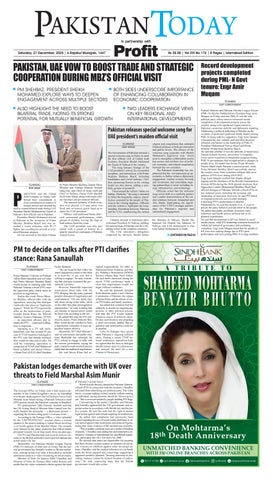
PAKISTAN, UAE VOW TO BOOST TRADE AND STRATEGIC COOPERATION DURING MBZ’S OFFICIAL VISIT Saturday, 27 December, 2025 | 6 Rajabul Murajjab, 1447
g
g
Rs 20.00 | Vol XVI No 172 | 8 Pages | Islamabad Edition
g PM SHEHBAZ, PRESIDENT SHEIKH BOTH SIDES UNDERSCORE IMPORTANCE MOHAMED EXPLORE WAYS TO DEEPEN OF ENHANCING COLLABORATION IN ENGAGEMENT ACROSS MULTIPLE SECTORS ECONOMIC COOPERATION
ALSO HIGHLIGHT THE NEED TO BOOST BILATERAL TRADE, NOTING ITS STRONG POTENTIAL FOR MUTUALLY BENEFICIAL GROWTH
g
TWO LEADERS EXCHANGE VIEWS ON KEY REGIONAL AND INTERNATIONAL DEVELOPMENTS
pakistan releases special welcome song for uae president’s maiden official visit ISLAMABAD
staff report
P
ISLAMABAD Mian abrar
AKISTAN and the United Arab Emirates on Friday reaffirmed their commitment to close coordination on matters of mutual interest and stressed the need to expand bilateral trade during UAE President Sheikh Mohamed bin Zayed Al Nahyan’s first official visit to Pakistan. President Sheikh Mohamed arrived in Pakistan at the invitation of Prime Minister Shehbaz Sharif and was accorded a warm welcome, with JF-17 fighter jets escorting his aircraft as it entered Pakistani airspace. He was received at Nur Khan Airbase
by Prime Minister Shehbaz, Deputy Prime Minister and Foreign Minister Senator Ishaq Dar, and Chief of Army Staff and Chief of Defence Forces Field Marshal Syed Asim Munir, along with senior cabinet members and government officials. The national anthems of both countries were played, a 21-gun salute was fired, and an honour guard lined up to salute the UAE president. Military and traditional bands delivered ceremonial performances, while groups of children waving the flags of both nations lined the route. The UAE president was also presented with a guard of honour by a smartly turned-out contingent of Pakistan Armed Forces.
The Government of Pakistan released a special welcome song on Friday to mark the first official visit of United Arab Emirates President Sheikh Mohamed bin Zayed Al Nahyan to the country. The song features footage of the UAE president’s arrival, his ceremonial reception, and interactions with Prime Minister Shehbaz Sharif, including handshakes and a brief embrace. Children presenting flowers to the visiting leader are also shown, adding a symbolic gesture of goodwill. Titled around the refrain “Ahlan wa Sahlan, Marhaba,” the song is intended to reflect the hospitality, respect, and affection extended by the people of Pakistan to the visiting dignitary. Officials said the initiative highlights the longstanding friendship between Pakistan and the UAE, emphasizing the mutual Children dressed in traditional attire welcomed President Al Nahyan, holding the national flags of Pakistan and the UAE, adding colour to the reception ceremony. The UAE president’s delegation comprised his advisers, Sheikh Sultan
pM to decide on talks after pti clarifies stance: Rana Sanaullah ISLAMABAD
staff Correspondent
Prime Minister’s Adviser on Political Affairs Rana Sanaullah said on Friday that Prime Minister Shehbaz Sharif would decide on initiating talks with Pakistan Tehreek-e-Insaf (PTI) once the opposition party clearly states its position on negotiations. Earlier this week, Prime Minister Shehbaz offered talks with the opposition, stressing that dialogue could only take place on “legitimate matters”. While the PTI rejected the offer on the instructions of party founder Imran Khan, the Tehreek Tahafuz Ayeen-i-Pakistan (TTAP) — an opposition alliance that includes the PTI — expressed willingness to negotiate. Speaking in a TV talk show, Sanaullah said that around 85 per cent of TTAP members belonged to the PTI, who had already declared they would not take part in talks. He said the remaining opposition is comprised of TTAP chief Mahmood Khan Achakzai and Jamiat Ulemae-Islam-Fazl (JUI-F) chief Maulana
Fazlur Rehman. “We are hopeful that either the entire opposition comes to the table or at least the 15 per cent that is willing to engage,” he said, reiterating that dialogue remained the government’s priority. However, Sanaullah expressed reservations about talks with the PTI, alleging that the party pursued parallel strategies of negotiation and confrontation. “On one hand, they talk about sitting at the table, while on the other they plan street agitation and marches,” he said, warning that any attempt to spread unrest would be dealt with according to the law. He added that once the PTI clarified its stance, Prime Minister Shehbaz would decide whether to form a negotiation committee or meet opposition leaders directly. Meanwhile, KP Chief Minister’s aide on information and public relations Shafiullah Jan reiterated the PTI’s refusal to engage in talks with the current government, saying the party wanted a result-oriented process rather than unconditional negotiations. Jan said Imran Khan had as-
signed responsibility for talks to Mahmood Khan Achakzai and Majlis Wahdat-e-Muslimeen (MWM) Senator Allama Raja Nasir Abbas. He said drafts discussed during the recent TTAP conference made it clear that negotiations would not begin without conditions. He said the demands included fresh elections under a new Election Commission of Pakistan, the release of Imran Khan, and the release of senior PTI leaders and family members. Jan added that Achakzai had full authority to decide on negotiations, protests or other political actions, and that the PTI would support whatever course of action he chose. He also said the party was preparing a street movement, adding that negotiation and mobilisation could run in parallel. Calls for dialogue have grown amid Pakistan’s ongoing political crisis. During a recent TTAP national conference, opposition leaders agreed that the door to dialogue should remain open in a democracy and stressed the need for a new Charter of Democracy.
pakistan lodges demarche with uK over threats to Field Marshal asim Munir ISLAMABAD
staff Correspondent
The Foreign Office on Friday said it had issued a demarche to the United Kingdom’s envoy in Islamabad over threats made against Chief of Defence Forces Field Marshal Asim Munir during a Pakistan Tehreek-e-Insaf (PTI) protest outside the Pakistani consulate in Bradford. FO spokesperson Tahir Hussain Andrabi said that the UK Acting Head of Mission Matt Cannell was formally handed the demarche — a diplomatic protest — regarding the former ruling party’s overseas event. According to the Foreign Office, a video uploaded by the “UKPTIOFFICIAL” account shows a woman speaker at the protest making a violent threat involving a car bomb against Field Marshal Munir. The remarks were likened to the plane explosion that killed former president General Zia ul Haq nearly three decades ago. The FO said Pakistan had conveyed its serious concerns to the British authorities and expected appropriate action under UK law. Meanwhile, two Pakistan Muslim League–Nawaz (PML-N) ministers of state said on Friday that the federal government has formally written to British authorities, seeking action over what it described as inciteful statements made in a video circulating on social media. Minister of State for Interior Tallal Chaudhry and Minister of State for Finance Bilal Azhar Kayani told media that the video contained a threat against the head
of Pakistan’s armed forces. While Kayani directly named the Pakistan Tehreeke-Insaf (PTI) in connection with the incident, Chaudhry refrained from identifying any political party. The video shows a woman making violent remarks without naming an individual, saying someone should be “blown up in a car.” She is seen surrounded by people holding PTI flags. Commenting on the matter, Chaudhry said Pakistan had formally approached the UK government and expected action in accordance with British law and the justice system. He said the state had the right to pursue legal action against individuals targeting its institutions. He added that complaints had previously been raised regarding the use of social media platforms to incite hatred against state institutions and political figures, noting that video evidence of the incident was available. “This is neither a political issue nor a matter of freedom of speech,” Chaudhry said, adding that such statements constituted a violation of international law and British legislation, particularly the UK’s Terrorism Act 2006. He stressed that states are responsible for ensuring that their citizens, asylum seekers or residents do not incite violence or rebellion against other sovereign nations. Chaudhry said the explicit reference to a car bomb made the threat targeted and concerning, suggesting it appeared carefully planned. “Inciting terrorism or provoking violence cannot be termed freedom of expression,” he said, expressing hope that the British government would take action.
respect and cooperation that underpin bilateral relations at both governmental and public levels. The release of the welcome song coincides with Sheikh Mohamed’s high-level visit, which aims to strengthen collaboration across key sectors and reinforce ties of political, economic, and cultural cooperation between the two countries. The Pakistani leadership has emphasized that the visit represents an opportunity to further enhance diplomatic engagement, explore avenues for trade and investment, and consolidate ongoing partnerships in areas including energy, infrastructure, and technology. Officials noted that the welcome song serves both as a symbolic gesture and a public demonstration of the cordial relations between Islamabad and Abu Dhabi, highlighting the significance of the UAE’s strategic partnership for Pakistan’s regional and international engagement.
bin Hamdan Al Nahyan, Sheikh Mohammed bin Hamad bin Tahnoun Al Nahyan, and UAE Ambassador to Pakistan Salem Mohammed Al Zaabi.
Continued on page 03
Record development projects completed during PML- N Govt tenure: Engr Amir Muqam PESHAWAR
staff Correspondent
Federal Minister and Pakistan Muslim League-Nawaz (PML-N) Khyber Pakhtunkhwa President Engr Amir Muqam on Friday said that PML-N was the only political party whose tenures witnessed record completion of development projects across the country, along with significant improvement in Pakistan’s economic stability and diplomatic standing. Addressing a political gathering in Mardan on the occasion of prominent politician Malik Bashir joining PML-N along with his supporters, Engr Amir Muqam welcomed the new entrants and said their decision reflected confidence in the leadership of PML-N President Muhammad Nawaz Sharif and Prime Minister Muhammad Shehbaz Sharif. He said that whether it was the network of motorways, Danish Schools System, universities or hospitals, every sector experienced remarkable progress during PML-N governments that brought positive changes in people lives. He added that former Prime Minister Nawaz Sharif made Pakistan a nuclear power, while Prime Minister Shehbaz Sharif successfully steered the country away from economic collapse after poor policies of PTI Govt during 2018-2022. Engr Amir Muqam recalled that despite alleged rigging and the shutdown of the Results Transmission System (RTS) during the 2018 general elections, then Opposition Leader Muhammad Shehbaz Sharif had offered dialogue to Pakistan Tehreek-e-Insaf (PTI) on key national issues, including the economy and eradication of terrorism. However, he said PTI failed to respond positively and avoided dialogue. Criticizing PTI’s performance in Khyber Pakhtunkhwa, he said that despite over 12 years in power, the party failed to provide relief to the people. He added that public problems increased while education and health sectors suffered due to illplanned experiments. He said that development in KP was limited to social media claims, while PTI leadership remained focused on Adiala Jail instead of governance and combating corruption. Engr Amir Muqam stated that the people of KP were now seeking change due to PTI’s poor performance and were joining PML-N in large numbers.
02 NEWS
BETEL NUTS IMPORT DISPUTE INTENSIFIES AS MNFSR SUSPENDS DPP CHIEF, SENIOR OFFICIALS
T
Saturday, 27 December, 2025 | ISLAMABAD
inquiry, the preliminary report was submitted on December 22, after a virtual meeting chaired by the Prime Minister and subsequent consultations with the Ministry of Commerce over prolonged delays in enforcing revised betel nut import protocols. The report traced the controversy back to meetings held on August 25, where the existing import regime was reviewed and found wanting due to weak local testing capacity, contradictory laboratory results and repeated litigation. To address these gaps, revised phytosanitary protocols were drafted on September 29 under the Pakistan Plant Quarantine Rules, 2019, aligned with International Plant Protection Convention (IPPC) standards and the Import Policy Order 2022. The proposed framework envisaged a shift towards offshore compliance mechanisms, including exporter registration by exporting countries’ na-
ISLAMABAD
staff report
HE dispute over delays in implementing revised import conditions for betel nuts from Indonesia escalated sharply on Monday after the Ministry of National Food Security and Research (MNFSR) suspended the Plant Protection Adviser and Director General of the Department of Plant Protection (DPP), Dr Attaullah Khan, along with other senior officials. Those placed under suspension include Director Technical (Quarantine) Dr Muhammad Basit and several entomologists, following submission of a preliminary inquiry report that pointed to administrative resistance, internal disagreements and alleged procedural irregularities within the department. According to officials familiar with the
tional plant protection organisations, testing through ISO-17025 accredited laboratories, improved packaging and labelling requirements, time-bound consignments and risk-based clearance through the Pakistan Single Window (PSW). However, the inquiry found that the version of the protocol notified by the DPP on October 17 differed materially from the one approved by the MNFSR. During later discussions on integration with PSW’s Integrated Risk Management System (IRMS), it emerged that the notified conditions retained mandatory routine onshore inspection and testing, making digital risk-based processing impractical. The report noted that senior officials opposed exemptions from routine onshore testing on the grounds of quarantine rules and pest-risk considerations, despite proposals for a system-driven approach involving electronic treatment certification, PSW-
based declarations, automated release orders and selective inspections triggered through risk profiling. The disagreement led to prolonged delays and prompted an administrative reshuffle on October 31. However, the move was followed by litigation, absenteeism and further disruption in departmental operations. The inquiry also flagged a range of alleged irregularities, including mishandling of official correspondence with Indonesia over renewal of citrus export arrangements, reportedly resulting in expanded pesticide residue testing requirements, delays in communication with other trading partners, irregularities in pesticide registrations, continuation of registrations of banned products, alleged fee mismanagement and preparation of disputed court submissions. Trade bodies, including the Rice Exporters Association of Pakistan (REAP), had lodged repeated
Pakistan’s digital payments lag regional peers despite rapid growth: PwC g
LOCAL NURSERIES REPLACE IMPORTS AS OFFICIALS PUSH FOR INTERNATIONAL OLIVE COUNCIL MEMBERSHIP ISLAMABAD
staff report
Pakistan’s push toward a cashless economy has picked up pace, but digital payments continue to lag behind regional and global peers due to structural constraints, according to PwC Pakistan’s Banking Publication 2025. The report notes that Pakistan remains one of the most cash-reliant economies in the region, with cash in circulation accounting for around 34% of GDP as of June 2025 more than double the levels seen in countries such as India and Bangladesh. This heavy reliance on cash reflects the large size of the undocumented economy. Despite this, recent regulatory initia-
tives are showing progress. The State Bank of Pakistan’s instant payment system Raast recorded 45 million registered IDs by June 2025 and processed 1.3 billion transactions worth Rs29.6 trillion, more than doubling in both volume and value compared to the previous year. The number of QR-enabled merchants also crossed one million, twice as many as a year earlier. However, adoption remains uneven across the economy. Only about 159,000 merchants currently use point-of-sale terminals, far fewer than in comparable emerging markets, while mobile banking penetration stands at roughly 15% of total bank accounts, the report said. Commenting on the findings, Aamir Ibrahim, Chairman JazzCash Interna-
PSX sees seven IPOs raising Rs4.3b in 2025 despite smaller deal sizes
ALL OFFERINGS OVERSUBSCRIBED AS KSE-100 GAINS NEARLY 48% AMID IMPROVING MARKET SENTIMENT, MACROECONOMIC STABILITY PROFIT
staff report
Initial public offering (IPO) activity at the Pakistan Stock Exchange (PSX) remained steady in 2025, with seven IPO-related transactions raising Rs4.3 billion, unchanged in count from last year but lower in value compared with Rs8.4 billion raised in 2024, reflecting smaller issue sizes rather than weaker demand, according to data compiled by Topline Securities. Despite lower proceeds, all offerings were oversubscribed, indicating sustained investor participation in the equity market. New main board listings during the year included Zarea Ltd, Barkat Frisian Agro Ltd, Image REIT and Pak Qatar Family Takaful Ltd. BlueEx migrated from the GEM Board to the main board, while Nets International Communication and Pakistan Credit Rating Agency were listed on the GEM platform. Among the new listings, Zarea Ltd recorded the strongest performance, delivering a return of 202p% during 2025 to date.
tional, said Pakistan’s digital payments ecosystem continues to trail benchmarks due to merchant economics and entrenched usage habits. He stressed that digital payments must become cheaper, simpler, and safer than cash to gain widespread acceptance. “As transaction volumes rise, strengthening security and customer education is critical to maintaining trust in the system,” Ibrahim said, adding that the industry must rethink monetisation models to ensure affordability for merchants without hurting banks and payment service providers. The State Bank of Pakistan has also flagged the economic cost of cash-heavy transactions. According to Saleem Ullah, Deputy Governor SBP, about Rs11.5 tril-
lion remains outside the formal banking system. Diverting even 20–30% of this cash into banks could significantly improve liquidity and expand lending to priority sectors. PwC estimates that digitising even a modest portion of cash-based transactions could save around Rs164 billion annually and help reduce the undocumented economy, which is estimated at nearly 40% of GDP. While digital payments are expanding rapidly, industry experts caution that technology alone will not be enough. Coordinated efforts by banks, fintech firms, telecom operators and regulators will be required to change behaviour, expand merchant acceptance and convert growth into sustainable economic gains
KP Excise, Taxation & Narcotics Control Department conducts major operation in Peshawar PROFIT
staff report
The Khyber Pakhtunkhwa Excise, Taxation and Narcotics Control Department achieved a major success in its anti-narcotics campaign when a team of the Excise Police Station, Peshawar Region conducted a raid on a warehouse in Peshawar and recovered 100,000 grams (100 kg) of recreational drug powder. A case has been registered against two accused persons and investigation has been initiated. The operation was carried out in continuation of the provincial government’s zero-tolerance policy against drugs and in light of the directives of Minister for Ex-
cise, Syed Fakhar Jehan. The operation was supervised by Excise & Taxation Officer Majid Khan, while SHO Excise Police Station Peshawar Dr. Hameed Khan, Additional SHO Amjad Pracha and other staff members participated. According to the department, the seized powder is used by mixing it with heroin, ice and other dangerous narcotics to multiply their effects, posing a serious threat to public health. The Excise, Taxation and Narcotics Control Department has reiterated that strict, indiscriminate actions against drug traffickers and those endangering public health will continue and no leniency will be shown to anyone involved.
Dynea Pakistan approves 2.5MW wind power project at Hub, replacing 1.1MW plan g
BOARD CITES EFFICIENCY AND ECONOMIES AS COMPANY SHIFTS TO LARGER RENEWABLE ENERGY PROJECT IN BALOCHISTAN PROFIT
staff report
Dynea Pakistan Limited has approved the installation of a 2.5 megawatt wind power project at Hub in Balochistan, replacing its earlier plan for a 1.1MW facility, the company informed the Pakistan Stock Exchange (PSX) in a disclosure on Friday. According to the notice, the decision was taken by the company’s board of directors to achieve better operational effi-
ciency and economies of scale. The project will be implemented subject to the required regulatory approvals and completion of contractual arrangements. The company stated that the wind power project is aligned with its long-term sustainability objectives, as it seeks to increase reliance on renewable energy sources. Work on finalising the engineering, procurement and construction agreement is currently under way. Dynea Pakistan had earlier dis-
closed plans for a smaller wind power installation at the same location in June 2025. The revised project significantly increases the planned generation capacity at the Hub site. Dynea Pakistan was incorporated as a public limited company, under the repealed Companies Act 1913 (now the Companies Act, 2017) on June 20, 1982. The company is engaged in the manufacture and sale of formaldehyde, urea/melamine formaldehyde and moulding compound.
complaints, some of which resulted in disciplinary proceedings. Despite the setbacks, the department had initiated steps to move betel nut imports to an IRMS Green Channel regime. Officials said progress remains dependent on issuance of electronic phytosanitary certificates by Indonesia, availability of approved pre-shipment inspection agencies and further system enhancements by PSW. As an interim arrangement, manual ex-bond filing of goods declarations was halted earlier this month, while Pakistan Customs was directed to process all declarations exclusively through PSW. Import permits issued under earlier conditions were also withheld pending consensus with Indonesian authorities, a step officials described as necessary to safeguard Pakistan’s Kinnow exports, for which Indonesia remains a key market.
ASO intercepts smuggled mobile phones worth Rs62 million in Karachi
The Anti-Smuggling Organization of the Collectorate of Customs Enforcement has seized a consignment of smuggled mobile phones worth around Rs62 million during an intelligence-based operation in Karachi, according to the Federal Board of Revenue. The FBR said ASO teams deployed plainclothes squads at selected locations after receiving information about a Mazda truck transporting smuggled mobile phones. During inspection, officials recovered 803 mobile phones of assorted brands, including iPhone, Vivo, Google Pixel, Infinix, and Spark, concealed in a specially built cavity inside the vehicle. The FBR said the seized mobile phones were valued at approximately Rs62 million, while the Mazda truck was estimated to be worth around Rs25 million, taking the total value of the case to about Rs87 million. According to the statement, the driver and helper were taken into custody, and further legal proceedings are under way. An FIR is being registered under the relevant provisions of law, the FBR said.
Pakistan foreign exchange reserves slip despite SBP uptick PROFIT
staff report
Pakistan’s total liquid foreign exchange reserves stood at $21.02 billion for the week ended December 19, 2025, slightly lower than $21.09 billion recorded a week earlier, according to data released by State Bank of Pakistan on Thursday. SBP-held reserves increased by $16 million to $15.90 billion, compared with $15.89 billion in the previous week, marking a 0.10% week-on-week rise and extending gains recorded in the preceding period. In contrast, net foreign assets held by commercial banks declined to $5.12 billion from $5.20 billion, offsetting the increase in central bank reserves and resulting in a marginal overall drop. The latest movement follows a sharp increase in reserves last week, driven by inflows linked to bilateral financing and improved market sentiment, while this week’s change reflects routine fluctuations linked to external payments and rollover requirements.
PSX closes week at record high as KSE-100 gains over 1,500 points PROFIT
staff report
Strong buying interest lifted equities at the Pakistan Stock Exchange on Friday, with the benchmark KSE-100 Indexclosing at a new all-time high amid improved investor sentiment. The index remained positive throughout the session and touched an intra-day high of 172,582.95 points. At close, the KSE-100 settled at 172,400.73, up 1,570.51 points or 0.92% from the previous close. Earlier in the week, trading remained subdued. On Wednesday, cautious sentiment during the rollover week led to selective selling in heavyweight stocks, pulling the benchmark index down by 243.51 points, or 0.14%, to 170,830.22.
Crescent Star Insurance, SG Power plan digital and virtual assets venture; SGPL to acquire 51% stake g
BOARDS OF BOTH COMPANIES APPROVE IN-PRINCIPLE JOINT VENTURE VIA CRESCENT STAR TECHNOLOGIES, SG POWER TO EXPAND BUSINESS SCOPE AND RAISE CAPITAL TO RS10 BILLION PROFIT
staff report
Crescent Star Insurance Limited and SG Power Limited have approved a series of strategic initiatives, including a proposed joint venture in digital and virtual assetrelated activities through Crescent Star Technologies (Private) Limited, as both companies move to reposition their businesses for long-term growth. In separate disclosures to the Pakistan Stock Exchange on Friday, the two companies said their respective boards held emergent meetings on December 24, 2025, to review investment strategy, business direction, and capital structure. Crescent Star Insurance Limited said
its board approved, in principle, a review of the company’s investment position in SG Power Limited with the objective of optimising investment returns. The board also approved the activation of Crescent Star Technologies, a wholly owned subsidiary of Crescent Star Insurance, through a proposed joint venture arrangement with SG Power. Under the proposed structure, SG Power Limited is expected to acquire a 51% equity stake in Crescent Star Technologies, while the remaining 49% will be retained by Crescent Star Insurance, subject to regulatory and other required approvals. Separately, SG Power Limited disclosed that its board approved, in princi-
ple and subject to shareholder approval, a change in the company’s principal line of business. The revised scope would include investment and holding activities, development and operation of technology-driven platforms, and the provision of digital, fintech, and innovation-based services through joint ventures and allied businesses, as permitted under applicable laws. To support its revised business objectives, SG Power’s board also approved, in principle, an increase in the company’s authorised share capital to Rs10 billion. The increase will be carried out in phases, as and when required, with the timing to be determined by the board. Both companies said Crescent Star Technologies, operating under the um-
brella of Crescent Star Insurance and SG Power, will prepare a detailed proposal to apply to the Pakistan Virtual Assets Regulatory Authority or any other relevant authority, as required, to enable the subsidiary to undertake digital and virtual asset-related activities. The boards of both companies have authorised their respective chief executive officers and company secretaries to carry out preparatory work and submit the necessary applications to regulators and other authorities. No timeline or financial details of the proposed digital and virtual asset activities were disclosed in the filings. In an earlier regulatory disclosure dated August 13, 2025, Crescent Star Insurance Limited informed the PSX that it intended to acquire 6,785,236 ordinary shares of SG Power Limited, a move that would result in the acquisition of control.
NEWS 03
Saturday, 27 December, 2025 | ISLAMABAD
GOVT SEEKS 15-YEAR BANKING RECORDS OF HALMORE POWER AMID $80M ARBITRATION CASE: REPORT
T
g
PMO DIRECTS ACTION AS LENDERS ASKED TO DISCLOSE WORKING CAPITAL FACILITIES, LIENS AND SECURITY INTERESTS SINCE 2010 PROFIT
staff report
HE federal government has sought complete details of all working capital and short-term finance facilities availed by Halmore Power Generation Company Limited over the past 15 years, as it moves to safeguard its position in an international arbitration initiated by the power producer, Business Recorder reported, citing official sources. The dispute follows a notice of arbitration issued by the claimant, who owns the 225-megawatt Halmore Power project, and has initiated proceedings before the London Court of International Arbitration. The case re-
lates to alleged breaches by Pakistan under the UK–Pakistan Bilateral Investment Treaty. Earlier, the Prime Minister’s Office directed the Power Division and the Attorney General for Pakistan to take proactive steps to protect the government’s interests in the arbitration proceedings filed by Halmore’s owner, Mian Karim-ud-Din. In this context, Managing Director of Private Power and Infrastructure Board, Shah Jahan Mirza, has written to several commercial banks seeking detailed records of all working capital facilities extended to Halmore since 2010. The letters, issued on December 22, 2025, require banks to respond within five working days. Banks approached for information include UBL,
Allied Bank Limited, Meezan Bank Limited, MCB Bank, Samba Bank Limited, Askari Bank Limited, Bank Al Habib Limited, Habib Bank Limited, Dubai Islamic Bank Pakistan Limited, and Soneri Bank Limited. According to the PPIB, the request is linked to the Implementation Agreement signed on October 23, 2007 between Halmore Power Generation Company and the President of Pakistan, acting on behalf of the government, for the establishment of a 225MW dual-fuel power plant based on gas and high-speed diesel at Bhikki in Punjab. The government has already issued a formal notice of continuous breach to the company on December 4,
NA panel urges Pakistan Railways to present sustainable pension relief plan g
LAWMAKERS FLAG RISING PENSION LIABILITIES AS RAILWAYS CONTINUES PAYING RETIREES FROM OWN RESOURCES PROFIT
staff report
The National Assembly Standing Committee on Parliamentary Affairs has called on Pakistan Railways to formulate a sustainable mechanism to provide relief to its pensioners, including those covered under the Prime Minister’s assistance package. The issue was taken up during a meeting chaired by MNA Rana Iradat
Sharif Khan, where members emphasised that any proposed framework should balance the protection of pensioners’ entitlements with the organisation’s long-term financial capacity. During the briefing, officials informed the committee that Pakistan Railways, an attached department of the Railways Division, remains the only government organisation that finances pension payments for its retired employees entirely from its own resources, with-
Cyber fraud network used fake cryptocurrency and foreign exchange trading platforms to target victims worldwide PROFIT
staff report
The National Cyber Crime Investigation Agency (NCCIA) has uncovered an international cyber fraud network involved in cryptocurrency and foreign exchange trading scam worth an estimated $60 million, arresting 15 foreign nationals during raids in Karachi, Sindh Home Minister Zia-ul-Hassan Lanjar said.Addressing a press conference alongside NCCIA Additional Director Tariq Nawaz, the minister said the suspects were operating online investment scams through social media and messaging platforms, luring victims with promises of high returns from crypto and forex trading. He said that a joint operation by NCCIA and other intelligence and law enforcement agencies was carried out last week in Defence Housing Authority Phases 1 and 6 in Karachi. The raids led to the arrest of 15 foreign nationals, including three women, and 19 Pakistani citizens. Authorities seized 37 computers, 40 mobile phones, more than 10,000 international SIM cards, and six illegal gateway exchange devices.
out support from a central pension fund. The Member Finance of Pakistan Railways told lawmakers that the organisation is facing steadily rising pensionrelated obligations, including commutation, leave encashment, Prime Minister’s Assistance Package claims, and benevolent fund payments. These liabilities, officials said, have been increasing in the absence of a dedicated pension fund. The committee was also told that
pension expenditure has been growing at a rate far exceeding operational revenues, creating sustained pressure on Pakistan Railways’ budget and restricting its ability to invest in core operational needs. Members of the committee stressed the need for a structured and financially viable pension model to address the growing burden while ensuring that the welfare and rights of pensioners remain fully protected.
Govt borrows Rs672b from banks in first half of FY26 after retiring Rs1.7tr last year g
BANKERS EXPECT HEAVIER BORROWING IN SECOND HALF AMID REVENUE SHORTFALLS AND FISCAL PRESSURES
The federal government borrowed Rs672 billion from banks during the first half of FY26, marking a sharp reversal from the same period last year when it had retired around Rs1.7 trillion in net debt, according to latest data released by the State Bank of Pakistan (SBP). Financial market experts said the government continues to rely heavily on the banking sector to remain within its targeted fiscal space. They noted that large dividend payouts by the SBP in FY25, amounting to around Rs2.7 trillion, had provided temporary fiscal relief. Another SBP report showed that banks’ total investments stood
at Rs36.7 trillion by the end of June 2025, highlighting the continued dependence on domestic banks for deficit financing. Bankers estimate that around 86% of the fiscal deficit is currently financed through bank borrowing, which they say limits credit availability for the private sector. In FY25, about 91% of the total fiscal deficit was financed from domestic sources, while domestic borrowing accounted for nearly 88% of financing in FY24. External financing shortfalls have remained a persistent issue, pushing the government to rely on banks, particularly during FY23 when external inflows fell sharply.
Bankers expect borrowing to accelerate in the second half as revenue collections remain below targets and liquidity pressures mount. Separately, a World Bank report issued on December 19 said Pakistan’s transition to inclusive and sustainable growth requires stronger mobilisation of domestic resources and more efficient use of public funds. The World Bank Board has approved $700 million under the Pakistan Public Resources for Inclusive Development – Multiphase Programmatic Approach, with total financing of up to $1.35 billion planned over multiple phases.
FBR deploys tax officers at 50 private hospitals amid low compliance by doctors: report g
OF 319,572 REGISTERED DOCTORS, ONLY 130,243 ARE ON TAX ROLLS, WHILE JUST 56,287 FILED INCOME TAX RETURNS IN TY2025, FBR DATA SHOWS
The Federal Board of Revenue (FBR) has intensified its enforcement drive against tax evasion in the private healthcare sector by deploying Inland Revenue Service (IRS) officers directly at commercial hospitals and clinics across the country, marking a shift to on-site monitoring after data showed widespread underreporting of income and poor tax compliance by doctors in the tax year 2025, Dawn reported. Official FBR data shows that of the 319,572 registered doctors nationwide, only 130,243 are registered with the income tax authorities, representing 40.75% of the total. Among those registered, just 56,287 doctors filed income tax returns for TY2025, accounting for about 43% of doctors on the tax rolls. Further analysis of TY2025 returns shows that of the 56,287 doctors who filed returns, 48,704 declared
some level of income, while 7,583 reported zero income. Among those who declared income, around 30,000 doctors, or nearly 62%, reported annual earnings below Rs2 million. This figure rises to about 65% when measured against total return filers. Within the below-Rs2 million bracket, 341 doctors reported income between Re1 and Rs100,000, 17,647 declared income between Rs100,000 and Rs1 million, and 12,959 reported earnings between Rs1 million and Rs2 million. The data also show a sharp decline in the number of doctors as declared income levels increase. Only 6,655 doctors reported annual income between Rs2 million and Rs3 million, 6,959 fell in the Rs3 million to Rs5 million range, and 3,093 declared income between Rs5 million and Rs10 million. At the highest end, just 1,050 doctors reported annual income ex-
ceeding Rs10 million in TY2025. Dawn cited a senior tax official as saying that the FBR has begun posting IRS officers at the premises of private hospitals and clinics under Section 175-C of the Income Tax Ordinance. In the first phase, officers have been deployed at 50 commercial hospitals to observe medical services and revenue collection in real time. The official said the focus is on identifying underreported revenues, particularly from high inpatient charges that, in some cases, exceed rates charged by five-star hotels. Based on these observations, the FBR is issuing private notices to non-compliant doctors to encourage voluntary compliance, which, the official said, has already begun. According to the FBR, the figures highlight two major gaps: the difference between registered doctors and those filing returns, and the disparity between the size of the profession and the low income levels being declared. The authority said on-site monitoring is intended to address both issues and improve compliance in the private healthcare sector.
Pakistan, UAE vow to boost trade and strategic cooperation during MBZ’s official visit CONTINUED FROM PAGE 01
The UAE delegation also included several federal ministers and senior officials. According to the Foreign Office, this was Al Nahyan’s first official visit to Pakistan as the UAE president. He had earlier visited Pakistan on a private trip in January this year. Sheikh Mohamed later held detailed talks with Prime Minister Shehbaz, focusing on further strengthening the longstanding fraternal ties between the two countries. According to an official statement, the leaders reviewed progress in existing areas of co-
operation and explored ways to deepen engagement across multiple sectors. Both sides underscored the importance of enhancing collaboration in economic cooperation, investment, energy, infrastructure development, information technology, technology, and people-topeople exchanges. They also highlighted the need to boost bilateral trade, noting its strong potential for mutually beneficial growth. The two leaders exchanged views on key regional and international developments and reaffirmed their shared commitment to maintaining close coordination on issues of mutual con-
cern. Expressing satisfaction with the positive trajectory of bilateral relations, they reiterated their resolve to work together to promote peace, stability, and sustainable development. The statement said the visit would further strengthen the deep brotherly ties between Pakistan and the UAE and help consolidate their strategic partnership. This is President Sheikh Mohamed’s second visit to Pakistan this year, following his earlier meeting with Prime Minister Shehbaz in Rahim Yar Khan in January. During the current visit, the two leaders are expected to discuss the full
spectrum of bilateral relations, including cooperation in the minerals sector, according to the Foreign Office. Punjab Chief Minister Maryam Nawaz welcomed the UAE president’s visit, describing Pakistan-UAE relations as “timeless and exemplary,” and said it was a matter of pride that Pakistan was chosen for his first official foreign visit. Pakistan and the UAE enjoy strong diplomatic, economic, and cultural ties, supported by a large Pakistani diaspora in the Emirates. The UAE remains one of Pakistan’s major trading partners and a key source of remittances.
2025. As part of its response, banks have been asked to provide details of the total amounts sanctioned and availed, the purpose of each facility, and particulars of the liens or security interests created. Where facilities were rolled over, renewed, or restructured, full documentation has also been sought. According BR report, the arbitration was formally triggered on October 8, 2025, when Mian Karim-ud-Din served a notice of arbitration on Pakistan. While the claim has not been formally quantified, it is estimated at around $80 million. The claimant has sought declaratory relief for alleged treaty violations, injunctive relief to prevent further breaches, and compensation along with interest and legal costs. Under the dispute resolution provisions of the bilateral investment treaty, the arbitration will proceed under the UNCITRAL Arbitration Rules 2021, which require Pakistan to submit its response within one month of receiving the notice of arbitration.
PTA warns SIM owners against misuse as mobile fraud cases rise
Regulator says SIMs must be registered and used only by their owners PROFIT
staff report
The Pakistan Telecommunication Authority has issued a warning to mobile users, stressing that SIM cards must be registered in the user’s own name and that misuse of a SIM will be the responsibility of the registered owner. In a statement issued on Thursday, the regulator said using SIMs registered in another individual’s name violates applicable regulations. The PTA emphasised that users are individually accountable for all calls, messages, and data usage made through their SIMs or connected devices. The authority urged consumers to ensure responsible use of their telecommunications connections and to comply with all relevant rules. It warned that enforcement action may be taken in cases of violations. The warning comes amid a rise in mobile-based financial fraud and harassment cases, which have placed additional strain on complaint and redress mechanisms. In many such cases, PTA officials said, registered SIM owners were not directly involved in illegal activity. Pakistan has issued around 196 million SIMs in a population exceeding 250 million, indicating that many individuals hold multiple SIMs. Under current regulations, a maximum of five voice SIMs and three data SIMs may be registered against a single CNIC for personal use.
Cement sector records over 100% increase in excise duty collection in FY25 PROFIT
staff report
The Federal Board of Revenue has reported a significant increase in Federal Excise Duty (FED) collection across multiple sectors during FY25 compared with the previous fiscal year, according to official data released by the tax authority. FED collection from cement manufacturers rose by 101.8% during FY25 compared with FY24. The data also showed a 109.6% increase in excise duty collected from domestic air travel. Similarly, FED collection from air travel, including international flights, increased by 103.2% during the period under review. The motor car sector recorded a 63.6% rise in excise duty collection. The FBR also reported a 27% increase in FED collected from concentrates during FY25. The authority did not provide sector-wise volume data but said the figures reflect higher compliance and improved enforcement.
04 COMMENT
Saturday, 27 December, 2025
Gaza Abandoned: Justice for Ukraine, Silence for Palestine
Unsafe in India
C
Attacks on Christians in India reflect Hindutva intolerance
Why the double standard?
HRISTMAS saw the USA’s Africa Command launch what US President Donald Trump called ‘powerful and deadly’ strikes against the Islamic State in Nigeria's Sokoto state, assuming a posture reminiscent of European states in the 19th century, even as there was no reaction to a slew of anti-Christian incidents in India, including a mall attack in Chhatisgarh, on a school in Assam, and raising of ‘Jai Sri Ram’ slogans in front of a church in Rae Bareilly in UP. This is not to mention the Kerala Education Minister getting schools intending to celebrate Christmas cancel the festivities. In the 19th century, Russia and France made a big issue of protecting Christian minorities in Ottoman Turkey, especially in the Levant, against the so-called oppression of the Ottoman government. Now, it seems, the USA has arrogated that role to itself, as Mr Trump had earlier accused Muslims of persecuting Christians in Nigeria. It is to be noted that the Africa Command did not claim to have targeted the Boko Haram, the militant group which had carried out the most highly publicized attacks in the past, mainly mass kidnappings from boarding schools. While Mr Trump was playing to his Evangelical supporters, he ignored the increasingly targeted attacks on Christians in India. It is almost as if the BJP government, led by Narendra Modi, who was labelled as the ‘Butcher of Gujarat’ for his role in the anti-Muslim pogrom with which his Chief Minstership began, has turned from Muslims, which it has been busy suppressing, to other non-Hindu minorities, in this case Christians, against whom there have been other incidents. Looking at the incidents in India through a Muslim lens, these incidents are condemnable, even if no Muslims are harmed, because non-Muslims are supposed to be protected by the state. While Christians have had the experience of being freely allowed the celebration of Christmas in Pakistan, Hindus here earlier experienced the same freedom in the recent Diwali celebration. Whereas the USA did not spare Nigerian sovereignty while conducting the attack, with government permission the result of behind-the-scenes armtwisting, its failure to engage with India is symp;tomatic of the innate racism of the Trump Administration. Though India has sqwuacked because of the tariffs imposed by the USA, and though the riots are suspiciously close to that, the USA still continues to deal with India with kid gloves, with the recent minister-level defence agreement showing that the USA still slavers for Indian friendship, no matter how many Christians it kills.
E
UROPE has recently taken a historic step, launching an International Claims Commission to assess and compensate damages caused by the war in Ukraine. The scale of mobilisation has been unprecedented: tens of thousands of claims registered, governments committing legal, financial, and political support, and plans already underway to consider reparations, even from frozen assets. This structured, multilateral effort signals a firm belief that victims of war —regardless of nationality —deserve recognition, accountability, and justice. Yet, while Europe acts decisively for Ukraine, the same principle of accountability appears absent for Gaza. Gaza has endured devastation of staggering proportions: thousands of civilians killed, tens of thousands displaced, homes, schools, and hospitals destroyed, and its already fragile infrastructure reduced to rubble. Entire communities live without water, electricity, or medical services. Economically, the Strip faces near-total collapse. The destruction rivals, and in some respects surpasses, that witnessed in Ukraine. And yet, there is no formal international mechanism to assess, validate, or compensate for these damages. No commission, no claims process, no structured accountability framework —nothing approaching the scale or seriousness of Europe’s efforts for Ukraine. Humanitarian aid flows intermittently, but aid alone cannot replace destroyed lives, homes, or livelihoods, nor can it address the structural injustice inflicted on Gaza’s population. This glaring disparity raises the big question: If Europe and its partners can mobilise resources, legal
Arif Nizami (Late) Founding Editor
M. A. Niazi
Babar Nizami Editor Profit
“T
frameworks, and political will to create a structured compensation mechanism for Ukraine, why is Gaza left without a similar system despite equal or even greater devastation? Why does the international community —and particularly the Muslim world, which shares historical, cultural, and religious bonds with the Palestinian people —remain largely silent or ineffective in translating outrage into actionable accountability? The silence is deafening. Regional organisations, Muslim-majority states, and global institutions have repeatedly condemned violence in Gaza, but these condemnations rarely translate into enforceable mechanisms of justice. Meanwhile, Western powers, citing geopolitical calculations, continue to prioritise conflicts closer to their strategic spheres, leaving Gaza trapped in cycles of destruction and neglect. This selective application of justice exposes a stark double standard: some victims of war receive immediate recognition, structured legal redress, and global attention, while others, equally deserving, are left in the shadows. The moral and legal implications are profound. International law, human rights conventions, and humanitarian norms are intended to be universal, yet their application is uneven. The people of Gaza have a right to recognition, redress, and compensation. The absence of a formal mechanism not only perpetuates injustice but also erodes faith in international institutions and norms. If accountability is to be meaningful,
The time to act is now. Structural, enforceable mechanisms of accountability for Gaza must be pursued with the same energy, seriousness, and political will that Europe has shown for Ukraine. Anything less is not only morally inadequate but legally and ethically indefensible. The world cannot cotinue to turn a blind eye. Gaza’s tragedy deserves more than rhetoric — it demands justice
Dedicated to the legacy of late Hameed Nizami
Editor Pakistan Today
Majid NaBi Burfat
HE dream of reason produces monsters,” wrote Francisco de Goya, warning future generations about ambition unrestrained by wisdom. Hannah Arendt later observed that political power often compensates for inner weakness through spectacle rather than substance. These two ideas illuminate India’s latest legislative move in the energy sector, a move that is being sold as progress but risks becoming a symbol of institutional overreach. This move also reminds us that grand state projects often reveal more about ambition than about public good. That warning resonates today. India’s parliament has approved a controversial nuclear energy bill. This is not a routine legal act. It is a political declaration. It reflects a state of mind. It displays a dream detached from material limits. The target of producing 100 GW of nuclear power by 2047 sounds majestic. It sounds historic. Yet large targets do not always prove large capacity. Often, they soothe the ego. Often, they serve spectacle. The Shanti Bill 2025 is being sold as a guarantee of progress. The ruling party frames it as a ladder toward energy self-reliance. The opposition calls it a reckless gamble. Parliament witnessed a walkout. Demands to send the bill to a standing committee were ignored. Speed replaced scrutiny. This haste raises doubts about intent. If the law is truly safe, debate should not threaten it. Fear of discussion is revealing. For the first time, India openly allows private sector investment in nuclear energy. Here the real problem begins. Nuclear energy is not just another power plant. It is a sensitive system. It demands civilizational discipline. Profit pressure matters. Cost cutting instincts matter. Corporate shortcuts matter. In this domain, they become existential risks. Markets reward speed. Nuclear systems punish haste. Chernobyl and Fukushima are not dusty textbook cases. They are living memories. They occurred in advanced states. Strong institutions existed. Regulations were present. Even there, a moment of failure poisoned generations. India
Send your letters to: Letters to Editor, Pakistan Today, 4-Shaarey Fatima Jinnah, Lahore, Pakistan. E-mail: letters@pakistantoday.com.pk Letters should be addressed to Pakistan Today exclusively
Brains versus bots
India shows more nuclear irresponsibility
already struggles with infrastructure gaps and regulatory fragility. Transparency is contested. Allowing private players into this sphere is a warning bell. It should not be ignored. Energy expert Narendra Taneja defends nuclear power with logic. He compares nuclear systems to aircraft maintenance. No compromise is possible. That is correct. Zero tolerance is essential. But another question remains. Will India’s private sector act with that ethic? Or will it repeat patterns seen in bridges and dams? Highways and factories tell stories. Not reassuring ones. Many Indian nuclear plants are aging. The absence of a major accident so far is fortunate. It is not a guarantee. Especially when private capital enters. Profit becomes primary. Shareholders demand returns. Safety then faces pressure. It always does. History confirms this pattern. Radioactive waste is another silent threat. It cannot be seen. It lasts for centuries. It contaminates land and water. Opposition voices raised this issue. The government cited IAEA oversight. On paper, the argument looks solid. In practice, IAEA supervision is limited. It depends on state cooperation. Internal corporate decisions remain outside its reach. Paper assurances do not neutralize physical risk. Global data shows nuclear power is dominated by a few states. The USA. France. China. Russia. South Korea. They possess decades of experience. They have deep research capacity.
This bill is not a symbol of progress. It is a narrative. A story told to the world. Hollow inside. It soothes a false national ego. Energy security does not emerge by ignoring risk. It emerges by accepting reality. India today lacks the capacity to safely advance nuclear energy with private partners. This decision may trigger political, environmental, and regional crises. Passed in the name of Shanti, the bill brings unease. That may be its deepest truth
Lahore – Ph: 042-36300938, 042-36375965
I
Karachi – Ph: 021-32640318 I
The writer is a freelance columnist
Editor’s mail
A Shiny Nuclear Mirage Mustafaa safdar Baig
it cannot be selective. The world must confront this paradox. Gaza’s suffering is not a distant or abstract issue; it is a litmus test of the credibility of international justice. The comparison with Ukraine serves as a mirror, reflecting the inequities of a system where geopolitics often trumps principle. It compels the Muslim world, civil society, and international actors to ask difficult questions: Are we upholding the principles we profess? Are we willing to mobilise legal, political, and financial mechanisms to ensure that Gaza’s destruction is recognised, assessed, and addressed? There is precedent, and there is possibility. The International Claims Commission for Ukraine demonstrates that it is feasible to establish structured, multilateral mechanisms to quantify war damage, validate claims, and pursue reparations. If such a framework can be instituted for Europe, why not for Gaza? The absence of action is not due to lack of options, but rather a lack of prioritisation, political courage, and collective will. Gaza deserves more than temporary humanitarian relief. It deserves justice, recognition, and accountability —in line with the same principles being applied elsewhere. The big question must echo loudly in diplomatic halls, international forums, and the corridors of power: If Ukraine’s destruction can trigger rapid institutionalised justice, why does Gaza’s devastation not command the same response? Until this question is answered, the credibility of international justice remains compromised, and Gaza’s people remain the invisible victims of a selective system. The time to act is now. Structural, enforceable mechanisms of accountability for Gaza must be pursued with the same energy, seriousness, and political will that Europe has shown for Ukraine. Anything less is not only morally inadequate but legally and ethically indefensible. The world cannot continue to turn a blind eye. Gaza’s tragedy deserves more than rhetoric — it demands justice.
They have trained human capital. India desires entry into this club. Desire alone is insufficient. Capability matters. The gap is real. China is often cited. China expanded nuclear energy rapidly. But China operates under strict state control. Private capital does not dictate policy. Decisions follow central command. India differs. Here, politics, capital, and media intersect. Safety norms often retreat under that pressure. This is structural. Not hypothetical. This bill is less about energy. It is about image building. A new edition of the Shining India narrative. Global power rhetoric continues. G20 glamour persists. Space missions are marketed. Everything aligns. Yet the ground reality remains stark. India still relies heavily on coal. Millions lack clean electricity today. Present deprivation is real. Energy self-reliance demands balance. Solar power matters. Wind matters. Water matters. Grid upgrades matter. Line loss reduction matters. India has not pursued serious reform here. Instead, it has chosen a risky and expensive path. Because it looks grand. Because it photographs well. Regional implications are serious. South Asia is already fragile. Nuclear weapons exist. Border disputes persist. Political instability endures. Nuclear energy expansion raises accident risk beyond borders. Air ignores boundaries. Water ignores maps. One incident can affect an entire region. Pakistan, Bangladesh, Nepal, and Sri Lanka should be concerned. They lack access to information. They lack oversight mechanisms. Distrust will deepen. A new arms-style competition may emerge under an energy label. This bill is not a symbol of progress. It is a narrative. A story told to the world. Hollow inside. It soothes a false national ego. Energy security does not emerge by ignoring risk. It emerges by accepting reality. India today lacks the capacity to safely advance nuclear energy with private partners. This decision may trigger political, environmental, and regional crises. Passed in the name of Shanti, the bill brings unease. That may be its deepest truth.
The writer is a freelance columnist
Islamabad – Ph: 051-2204545
I
THIS is with reference to the article ‘Almighty algorithms’ (Nov 17, Dawn) which certainly raised some pertinent questions, especially regarding enslavement to artificial intelligence (AI) algorithms. Undoubtedly, AI may provide a competitive edge in terms of both speed and cost-effectiveness in the industrial world, but there are some challenges that should not be ignored. Take the case of education as an example. A research conducted at the Massachusetts Institute of Technology (MIT) offered revealing conclusions. The research was based on an experimental and a control group. The experimental group was given an AI-based assignment, whereas the control group was given a non-AI based assignment. The result, not surprisingly, indicated that the critical cognitive ability was low in the AI-based group compared to the non-AI-based control group. It is important that AI ought to be used with great care to avoid counter dependence of students to keep their enslavement to the machine at bay. Besides, if AI is used for organisational efficiency, it can result in unemployment with serious social consequences. DR ZAFAR IQBAL QURESHI LAHORE
Bribes from the bottom
I RECENTLY had a troubling experience at an institution that operates at the grass-roots level, highlighting that the menace of corruption is not anymore the exclusive domain of the elite. I visited the office of the Town Municipal Corporation, Jinnah, (TMC Jinnah) near the Quaid’s mausoleum. I went there to enquire about the procedure for correcting my name on the property tax challan. After being directed from one desk to another, an officer questioned me harshly about documents’ copies even though I had clearly stated that this visit was only to understand the process. I was then asked to speak to another staff member outside the hall, who informed me that the ‘charges’ for updating the records would be Rs50,000 per case. When I asked why at all any payment was needed for a routine correction fully supported by complete documentation, I was told that nothing could be processed without such ‘payments’. Apart from the elite-led capture and corruption at top level that has plagued the country, we must realise that this malaise has eaten up the whole social fabric right from the very top to the very bottom. Is there anyone in tehcountry who can ensure that citizens have their records corrected through proper legal procedures in a seamless manner without being at all compelled to pay unlawful charges? My documents are in order, and I have never paid a bribe to any official in my life. I just want to maintain my clean record. MOHAMMAD FAYYAZ KIRMANI KARACHI
Tastelessly Instagrammed
ACROSS cities in Pakistan, new restaurants and cafes pop up every other day, each competing to outdo the other with striking interiors, neon lights, flower walls, and picture-perfect plating. These places are often designed less for dining and more for photographing, where the aesthetic is the real product on sale. Yet, what is consistently overlooked is the very essence of a restaurant: its food. Too often the dishes are bland, repetitive and tasteless, but the crowds still pour in, not drawn by flavour but by the promise of an aesthetic experience worth posting online. Dining out has quietly shifted from being about taste and quality to becoming an exercise in branding oneself through curated images. This fixation risks hollowing out our food culture. Pakistan has a rich and diverse culinary heritage, full of depth, spice and history. It is disheartening to see this richness sidelined in favour of style over substance. A restaurant’s ambience should complement its food, not overshadow it. Perhaps it is time we, as diners, realigned our expectations. If we reward originality, taste and authenticity as much as we do aesthetics, the industry will have to follow suit. ABDUL QADIR QURESHI KARACHI
Web: www.pakistantoday.com.pk
I
Email: editorial@pakistantoday.com.pk
COMMENT 05
Saturday, 27 December, 2025
From Gaza to Bondi Beach How Israel’s War Fuels Global Rage?
O
QamaR BashiR
N December 14, Australia was jolted out of its sense of safety. At Bondi Beach in Sydney, a space synonymous with openness, community, and peaceful coexistence, gunmen opened fire on members of the Jewish community gathered to celebrate Hanukkah. Eleven people were killed and many more injured. Families, children, and elders— people with no role in war, policy, or geopolitics— were turned into victims of terror. The attack was immediately and rightly condemned by Australia and the world. There can be no ambiguity: the killing of civilians anywhere is criminal, immoral, and indefensible. No grievance, no ideology, no historical wound justifies such an act. The Jewish community in Australia, like Jewish communities everywhere, deserves safety, dignity, and protection. Yet condemnation alone does not prevent recurrence. If the world wishes to stop
such horrors from repeating, it must confront a harder truth: violence does not arise in isolation. It is shaped, amplified, and redirected by global political behaviour— especially when power is exercised without accountability. The Bondi Beach massacre occurred in a world already saturated with unresolved wars, mass civilian suffering, and a growing perception that international law is applied selectively. This perception— whether ignored or dismissed by those in power— has consequences. When pain is denied in one place, it does not disappear. It travels. It mutates. And it eventually erupts where the innocent live. The Hamas attack of 7 October 2023, which killed Israeli civilians and took hostages, was universally condemned. That condemnation was justified. What followed, however, shattered moral balance. Israel’s military response in Gaza resulted in the deaths of tens of thousands of Palestinian civilians, the destruction of homes, hospitals, schools, and the deliberate deprivation of food, water, and medical aid. International legal institutions and humanitarian organizations warned that collective punishment and starvation had become tools of war. This matters not to excuse terrorism or antisemitism— both are crimes— but to understand how unchecked state violence creates global insecurity. When a state presents itself as above scrutiny, when it dismisses civilian deaths as necessary or inevitable, it sends a message to the world that human life is conditional. That message does not stay
If humanity continues to normalize collective punishment, regimechange wars, and selective morality, the violence will keep returning— again and again— against people who never chose these conflicts. Peace is not a moral luxury. It is a strategic necessity. Only by choosing introspection over arrogance, law over impunity, and dialogue over domination can the world hope to prevent the next Bondi Beach—and the next innocent life lost to a war they never owned
T
confined to Gaza. It seeps into streets, minds, and communities across continents. The Jewish community worldwide has increasingly been placed in an impossible position. Jews in Australia, Europe, or North America do not command armies, blockade borders, or authorize bombardments. Yet they increasingly find themselves vulnerable to backlash generated by actions taken by a government thousands of miles away. This conflation is unjust, dangerous, and morally wrong— but it is fuelled by the refusal of powerful leaders to acknowledge the global consequences of their conduct. This refusal was starkly illustrated in the aftermath of the Bondi Beach killings. Instead of engaging in self-reflection or acknowledging how Israel’s actions in Gaza have heightened global tensions and endangered Jewish communities abroad, Israeli Prime Minister Benjamin Netanyahu publicly criticized the Australian government, accusing it of failing to provide adequate security to the Jewish community. In doing so, Netanyahu acted not as a statesman grappling with consequences, but as if he were a ruler passing judgment on sovereign nations— assigning blame outward while absolving himself entirely. There was no acknowledgment that the relentless violence in Gaza, the images of starving children, and the dismissal of international law have contributed to an environment in which rage is exported globally. There was no recognition that leadership carries responsibility not only for battlefield outcomes, but for the safety of one’s people everywhere. By placing the burden solely on Australia’s security apparatus, Netanyahu effectively treated the Bondi Beach massacre as an isolated policing failure— rather than as a symptom of a wider moral and political breakdown. This posture is not only arrogant; it is dangerous. It ignores the simple reality that actions taken in the Middle East now reverberate instantly across the world. A similar warning emerged just one day earlier, on December 13, in Palmyra, Syria. A lone suspected Islamic State gunman attacked a convoy of US and Syrian partner forces during a key leader engagement. The assault killed two US Army soldiers and a civilian interpreter, and wounded three others. Partner forces killed the attacker at the scene. President Donald Trump vowed serious retaliation. That attack, like Bondi Beach, underscored the same truth: wars fought far from home do not remain distant. They return— sometimes as direct attacks, sometimes as
unpredictable consequences. Soldiers, interpreters, and civilians pay the price for conflicts whose political roots remain unresolved. This reality struck even closer to home in Washington, DC, where a lone Afghan gunman killed one US soldier and critically wounded another. His act was criminal and indefensible. But it was also a reminder that decades of war leave behind trauma and grievances that do not end with troop withdrawals. When conflicts are managed through force rather than resolution, the aftershocks linger in human lives. Today, the same pattern threatens to repeat itself in the Western Hemisphere. Tensions between the USA and Venezuela, and increasingly involving Colombia, are escalating. Once again, familiar language is resurfacing— delegitimization, sanctions, pressure, and whispers of regime change. The narrative being constructed against Venezuela echoes the one once built against Iraq: moral urgency, existential threat, inevitability of action. We know how that story ended. Iraq was destabilized. Libya collapsed. Syria fractured. The Middle East was turned upside down. Millions were displaced. Extremism flourished. And the consequences spilled into Europe, North America, and beyond. Venezuela may be weaker than the USA militarily, but modern conflict teaches a clear lesson: retaliation does not strike power centers; it strikes soft targets. It does not reach presidents; it reaches soldiers, worshippers, commuters, and children. Innocent Americans— both civilians and service members— become exposed to the
revenge of those whose loved ones were killed far away. This is not justification. It is historical reality. Violence creates memory. Memory creates resentment. Resentment seeks release— often against those least responsible. The tragedies at Bondi Beach, in Palmyra, in Washington, and the looming risks in Venezuela and Colombia, all point to the same conclusion: when leaders refuse accountability, insecurity becomes global. No border, no ocean, no alliance can contain the consequences. The only alternative is restraint, diplomacy, and genuine multilateral engagement. Institutions like the United Nations exist to prevent this chain reaction—to replace unilateral force with collective responsibility. They are imperfect, but bypassing them guarantees repetition of failure. If humanity continues to normalize collective punishment, regime-change wars, and selective morality, the violence will keep returning— again and again— against people who never chose these conflicts. Peace is not a moral luxury. It is a strategic necessity. Only by choosing introspection over arrogance, law over impunity, and dialogue over domination can the world hope to prevent the next Bondi Beach—and the next innocent life lost to a war they never owned.
The writer retired as Press Secretary the the President, and is former Press Minister at Embassy of Paikistan to France and former MD, Shalimar Recording & Broadcasting Company Limited
Japan has become a troublemaker in international community GLOBAL TIMES editoRial
HE Japanese government has been sending out dangerous signals one after another. Japanese Prime Minister Sanae Takaichi has publicly stated that Japan will not rule out the possibility of introducing nuclear submarines and is preparing to push forward the revisions of the three documents on security and defense to "be prepared for possible long military conflict." Her close associate, Koichi Hagiuda, led a group of Japanese lawmakers who visited the Taiwan region and met with Lai Ching-te. Japanese media also revealed that Takaichi's another close associate, Oue Sadamasa, was the one who previously made statements in favor of Japan possessing nuclear weapons. This series of words and actions is by no means accidental or isolated incidents. Japan is transforming from a constrained nation in the post-war international order into a "troublemaker" for peace and stability in the AsiaPacific region and even the world. The root cause of Japan's role as a "troublemaker" lies in its persistent failure to thoroughly liquidate militarism, which poses a direct challenge to the international order established on the fruits of victory in World War II. This year marks the 80th anniversary of the victory of World War II, a time when Japan should have deeply reflected on its history. However, the Takaichi administration has instead moved against the tide. Its cabinet members had repeatedly visited the Yasukuni Shrine, glorified the history of aggression as a "war of self-defense," and referred to Class-A war criminals as "heroic spirits," constituting an insult and harm to the people of nations that suffered from Japanese colonial aggression. More danger-
T
THE MAIL AND GUARDIAN Jenny Ricks
HE problem is hiding in plain sight when the world’s richest openly admit they see climate breakdown coming — but only as a problem for others. A new global report, Billionaire Ambitions Report 2025, is a revealing read. It shows super-rich wealth has hit an all-time high of $15.8 trillion, up 13% in a single year. And to future-proof this dystopia, they plan to transfer nearly six trillion dollars of dynastic power to their nepobaby kids to lock wealth into bloodlines while the 99% face floods, hunger, and repression today. THE RICH SEE COLLAPSE COMING — BUT NOT FOR THEMSELVES It is a tale of two realities — Gen Z versus the billionaires. While billionaires publicly admit they know climate collapse is a “challenge for young people”, just 14% of them think it will threaten their own wealth anytime soon. More than half say climate change will be one of the biggest challenges young people must overcome, while the same billionaires say that their worries are about tariffs, taxes and market volatility hurting their prof-
Takaichi swiftly increased defense spending to over 2 percent of GDP and continuously relaxed restrictions on arms exports
ously, this misguided view of history has transformed into specific policies: the Takaichi administration has attempted to revise the "Three Non-Nuclear Principles," promoted the loosening of military restrictions, and even openly questioned the validity of international legal documents such as the Cairo Declaration and the Potsdam Proclamation. The Japanese Instrument of Surrender pledges to "carry out the provisions of the Potsdam Declaration in good faith." However, the actions of the Takaichi administration today represent an attempt to overturn the political foundation of Japan's surrender and constitute an open betrayal of
international justice. The shift from historical revisionism to military adventurism is an extension of Japan's path as a "troublemaker," which is primarily manifested in the systematic loosening of its nuclear policy. After assuming office, Takaichi swiftly increased defense spending to over 2 percent of GDP and continuously relaxed restrictions on arms exports. From deploying long-range missiles on the Southwest Islands to hinting at the intention to acquire nuclear weapons, Japan's so-called "counterattack capability" exhibits clear preemptive and offensive characteristics. It has also been
revealed that Japan's Liberal Democratic Party has reached internal agreement on revising the "Three Principles on Defense Equipment Transfers," aiming to fully liberalize the export of lethal weapons. On the nuclear issue, Tokyo's blatant disregard for the Treaty on the Non-Proliferation of Nuclear Weapons (NPT) is becoming the greatest threat to nuclear security in East Asia and even globally. Japan's role as a "troublemaker" is also reflected in its deceptive, two-faced diplomacy. While the Takaichi government claims to be "open to dialogue" with China, it has repeatedly provoked tensions on the Taiwan question. From late December to early January 2026, nearly 30 Japanese lawmakers are expected to visit Taiwan, and Iwasaki Shigeru, the former chief of the Joint Staff of Self-Defense Forces of Japan, has taken up the post of a "political consultant" for the Taiwan authorities, crossing the red line of governmental exchanges. This pattern of saying one thing and doing another mirrors the deceptive tactics Japan employed before launching wars in history. For decades after World War II, Japan cultivated an international image as a "peaceful nation" and a benevolent contributor, leading some countries even today to regard it as a "successful example of democratic transformation by the West." The Takaichi administration is now trying to portray itself internationally as a "victim" and to hype a false narrative of "Chinese bullying," with the real aim of using deception to conceal its expansionist nature. Japan's provocations go far beyond self-armament. They are also evident in its
The billionaire house of cards Billionaire Ambitions Report 2025 shows super-rich wealth has hit an all-time high of $15.8 trillion, up 13% in a single year
its. Same world — different problems. The elite know the world is burning, and are betting they will be dead or safe behind high gates when the flames reach them. Climate collapse hits hardest in places drained by colonial extraction. Those most responsible build bunkers and monetise “solutions” to sell back to us at a profit. Democracies are under attack as corporate money and authoritarian strongmen team up to crush our rights, our power and try to end hope. DEBT IS KILLING PEOPLE SO BILLIONAIRES CAN THRIVE Rigged economies keep the 99% under the yoke of the 1%, while the ultra rich get record returns from our pain. This is organised looting. But hope can’t be crushed. Gen Zs in Kenya, Indonesia, Peru, Mexico, Nepal and beyond are rising to show that they will not be silent while their futures are stolen. Multinationals from the Global North suck the world dry and stash their profits offshore while public services are underfunded from
austerity measures and slowly privatised. Meanwhile, Global South governments are forced to pay rich lenders. Global South countries paid a record $921 billion in interest — money stolen from public hospitals, schools and clean water. Twenty-two African governments spend more on servicing debt than on healthcare. People are dying so billionaires can hoard more. MULTILATERALISM HAS BECOME A WEAPON OF THE 1% How did we get here? By design, not by accident. Right now the world’s biggest economic power is making it worse — President Donald Trump has erased every scrap of G20 work on inequality and climate as the US political theatrics over assuming the G20 Presidency continue. Multilateralism was failing, now it is dissolving. For decades, global institutions pretended to be fixing problems while creating new ones, imposing structural reforms plus debt which drive economies into chaos, forcing governments
to cut support for public goods everyone needs. We the 99% say enough — we are drawing the redline against the 1%. Our economies and the international system must not be a chessboard for billionaires and multinationals. The Global North uses multilateralism to enforce a system of economic, social and ecological violence. The 1% hoard while the 99% struggle. We have heard enough lies from the International Monetary Fund (IMF), World Bank, G20 and their friends. Because of the rigged system they uphold, the 99% cannot afford basic healthcare, dignity, education. Our democracies are under threat while the planet is pushed past its limits. WE, THE 99%, ARE DONE WAITING — WE HOLD THE FUTURE In the midst of these crises, youth-led street protests are erupting across continents as hope refuses to die. From Chiapas to Karachi, Nairobi to Soweto, Manila to Belém the 99% are rising. Young people are re-
deliberate undermining of regional unity and its role as a frontline proxy for external forces seeking to intervene in the region. The Takaichi government has repeatedly stirred up trouble, provoking neighboring countries on issues such as Dokdo and the Southern Kuril Islands. South Korean political commentator Hanjin Lew wrote in Asia Times that in just two months since taking office, Sanae Takaichi's hawkishness has accelerated regional crisis situation while isolating her own country. By manufacturing and amplifying divisions, Japan seeks to pursue its geopolitical interests amid turmoil and revive old dreams of regional dominance. Such practices seriously poison the atmosphere for resolving disputes through dialogue and cooperation among regional countries, turning Japan into an obstacle to peace and cooperation in the Asia-Pacific. History shows that once the specter of militarism returns, it brings grave disaster to the region and the world. By backtracking on historical issues, racing down the path of military expansion, and sowing division among regional countries, Japan's authorities are cementing their role as an "international troublemaker." The Japanese government should recognize the trend of the times, immediately stop all dangerous actions that undermine regional peace and stability, sincerely reflect on its history of aggression, uphold the spirit of the "pacifist constitution" and its "Three Non-Nuclear Principles," and build trust with its Asian neighbors and the international community through concrete actions. Peace and development in the Asia-Pacific must not be undermined, and any attempt to overturn the postwar order or revive militarism will be firmly opposed and jointly resisted by all peace-loving countries and peoples. claiming their economies, bodies, lands and futures. The system is rigged, so we are taking back control. We do not need more acknowledgement that inequality is a problem like the G20’s statements in Johannesburg. The Declaration from the We The 99 People’s Summit, held as a counterpoint to the G20 last month, is a 10 point roadmap to the future: *Build a new system accountable to people and the planet — not the 1%. *Tax the super-rich, Big Tech and multinationals. *Stop the theft — close tax havens and shell companies. *Cancel illegitimate debt. *Enforce corporate accountability. *Make polluters pay for the damage they’ve caused. *Invest in climate justice — not false solutions. *Value and redistribute care work as the foundation of our societies. *Secure food sovereignty. *Protect civic space and cultural rights. *End occupation and genocide. The elites built a world to bleed us dry. They have had their turn. Now We The 99 Percent are taking back the power. The future belongs to the many, not the few. Jenny Ricks is the general secretary of Fight Inequality Alliance.
06 NEWS
US conDUcTS AIrSTrIke on DAeSh poSITIonS In norThweST nIgerIA
T
NIGERIA
AGENCIES
HE United States carried out an airstrike against Daesh militants in northwest Nigeria at the request of the Nigerian government, according to statements from US President Donald Trump and the US military. The operation was described as part of ongoing security cooperation between the two countries. Trump said the strike targeted Daesh fighters accused of attacking civilian communities, particularly Christians, in the region. In a message posted on Truth Social, he said the action was ordered under his authority as commander in chief and described it as a decisive blow against the militant group. US Africa Command confirmed that the strike took place in Sokoto state and resulted in the deaths of multiple Daesh militants. Nigerian authorities were said to have requested the operation as part of joint efforts to counter extremist violence. Nigeria’s foreign ministry said the
airstrikes were conducted through intelligence sharing and strategic coordination with the United States, leading to what it described as precision attacks on terrorist targets in the country’s
Uzbekistan gDp hits record €123 billion as Mirziyoyev hails reforms TASHKENT AGENCIES
Uzbekistan closed the year with its strongest economic performance on record, reporting a GDP of €123 billion, as President Shavkat Mirziyoyev said the effects of reforms are increasingly visible in everyday life. In his annual address to parliament and the nation, the president noted steady growth despite global economic turbulence, disrupted supply chains and rising commodity prices. For the first time in the country’s history, he said, GDP exceeded €123.25 billion, exports grew by 23%, and foreign investment reached nearly €37 billion, accounting for almost a third of the economy. Additionally, Uzbekistan’s gold reserves surpassed €51 billion for the first time. “The results of our reforms are felt in every mahalla (community), every family, and in daily life,” Mirziyoyev said, adding this was down to job creation, infrastructure upgrades and expanded access to basic services. International confidence has strengthened alongside domestic growth. Leading rating agencies upgraded Uzbekistan’s sovereign credit rating from BB- to BB, a move expected to cut external borrowing costs by up to €250 million a year. The World Bank’s Technology Readiness Index saw the Central Asian country climb 71 places, putting Uzbekistan among the global top 10. Infrastructure, incomes and poverty reduction The government says economic growth has translated into measurable improvements in living standards. Electricity production rose to 85 billion kilowatt-hours, supporting a population of more than 38 million and an expanding industrial base. Irrigation infrastructure reached 470,000 households in previously underserved areas, allowing around 3 million people to generate income from household plots several times a year.
northwest. The strike follows repeated warnings by Trump since late October that Christian communities in Nigeria face serious threats, along with reports that the US
had increased intelligence-gathering flights over large areas of the country in recent weeks. US Defence Secretary Pete Hegseth thanked the Nigerian government for its cooperation and indicated that further actions could follow. Nigeria’s government has maintained that militant violence affects both Muslims and Christians and has cautioned against oversimplifying the country’s complex security challenges. Officials have nevertheless expressed willingness to deepen cooperation with the US to strengthen counterterrorism efforts. The development comes amid continued instability across Nigeria, including a deadly attack earlier on Thursday in the northeast, where police said a suspected suicide bomber killed at least five people and wounded dozens more. In a Christmas message, President Bola Ahmed Tinubu urged peace and tolerance among Nigerians of different faiths and reaffirmed his commitment to protecting religious freedom and safeguarding all citizens from violence.
US citizenship under threat as Trump administration sets monthly denaturalisation quotas
WASHINGTON AGENCIES
The Trump administration is preparing to significantly increase the revocation of US citizenship among naturalised Americans, generating concern among immigration groups and criticism from Democratic lawmakers. Internal instructions obtained by The New York Times indicate that US Citizenship and Immigration Services (USCIS) has been asked to provide the Office of Immigration Litigation with 100 to 200 cases of denaturalisation per month during the 2026 fiscal year. If implemented, this would represent an unprecedented scale compared to previous years, when just over 120 denaturalisation cases were filed between 2017 and 2025. The new targets could result in up to 2,400 cases annually. USCIS spokesperson Matthew J. Tragesser said
the agency’s focus will be on individuals found to have committed fraud in the naturalisation process. “We will prioritise denaturalisation for those who misrepresented themselves during the process,” Tragesser told NPR. He added that USCIS will work with the Department of Justice to uphold the integrity of the immigration system. Legal experts emphasised that denaturalisation is historically rare and used only under limited circumstances. Elizabeth Taufa of the Immigrant Legal Resource Centre said previous administrations have used digital tools to detect potential naturalisation fraud, but setting numeric goals for revoking citizenship is a new approach. She warned that the plan could create anxiety among naturalised citizens and those seeking citizenship, noting that achieving the quota could be difficult without compromising legal standards. The proposal has drawn strong responses from Congress. Representative Pramila Jayapal, ranking member of the House Immigration Integrity, Security, and Enforcement Subcommittee, said the plan would “target immigrants across the country, including naturalised citizens.” She described the numeric goals as arbitrary and warned that the policy could undermine the security of all Americans. Jayapal, herself a naturalised citizen, said the proposal threatens the stability of citizenship as a legal bond. She said that actions undermining the status of naturalised Americans could have consequences beyond immigrant communities, affecting public confidence in government guarantees and legal protections. The denaturalisation guidance is part of a wider set of immigration measures implemented by the administration. These include new limits on asylum applications at the US-Mexico border, a suspension of domestic asylum claims, and entry restrictions on travellers from selected African and Middle Eastern countries. Officials said the measures aim to protect national security and maintain the integrity of the immigration process.
Saturday, 27 December 2025 | ISLAMABAD
Deadly border clash leaves five dead along Tajikistan-Afghanistan frontier TAJIKISTAN AGENCIES
Five people were killed during an armed confrontation on the border between Tajikistan and Afghanistan, Tajik state media reported on Thursday. According to a statement from the Border Troops of Tajikistan’s State Committee for National Security, three individuals crossed into Tajik territory late Tuesday in the Shamsiddin Shohin district of the southwestern Khatlon region and were located the following day. The statement said the intruders ignored orders from Tajik border guards to surrender and opened fire, allegedly planning an attack on a border post. Tajik forces responded with a combat operation in which all three assailants were killed. Two Tajik border officers also lost their lives in the exchange. Authorities described the incident as the third armed border crossing and attempted attack originating from Afghanistan in the past month. The statement accused Afghan authorities of failing to meet international commitments to maintain security along the shared border and called for stronger measures to prevent future incidents. Tajik officials said they expect the Afghan administration to take responsibility and improve border security. Afghanistan has not issued an immediate response. Earlier this month, Tajikistan reported that five people were killed and five injured in two similar cross-border attacks. On Wednesday, President Emomali Rahmon inaugurated four new border outposts and a tank training facility near the frontier as part of efforts to strengthen security amid rising concerns over crossborder violence.
Awami League will not be allowed to participate in Bangladesh election: Interim govt DHAKA
AGENCIES
The interim government of Bangladesh has confirmed that the Awami League, led by ousted prime minister Sheikh Hasina, will not participate in the February 2026 national parliamentary elections due to a ban on its activities. The Press Secretary to the Chief Adviser of the interim government of Bangladesh, Shafikul Alam, announced that the Awami League, whose political activities are currently banned in the country, will not be able to participate in the upcoming national polls. During a press conference, following a meeting of the Advisory Council of the interim government, Shafikul Alam, in response to a reporter’s question about a letter reportedly sent to the Chief Adviser by US lawmakers expressing concern over the ban on the Awami League, made this remark.
NEWS 07
Saturday, 27 December 2025 | ISLAMABAD
CORPORATE CORNER
Lahore Police Crack Down on Tenancy Act Violations; 2,722 Arrested LAHORE
Staff report
Lahore Police have stepped up enforcement of the Punjab Tenancy Act across the provincial capital, arresting 2,722 individuals and registering 1,785 cases during the current year for violations of the law.According to a police spokesperson, the crackdown is part of the “Safe Lahore” initiative aimed at strengthening internal security. Capital City Police Officer Bilal Siddique Kamyana said the verification of tenant data submitted under the Tenancy Act was being conducted on a continuous basis to ensure effective monitoring.The CCPO emphasised that proper tenant registration plays a critical role in the timely identification of individuals with criminal backgrounds.He urged homeowners, tenants, property dealers and other stakeholders to strictly comply with the Tenancy Act, making it clear that legal action would be taken without delay against violators.Appealing to the citizens, CCPO Kamyana called for responsible conduct and stressed the importance of timely tenant registration through the official police tenant registration system to help maintain law and order in Lahore.
GTR Tyre Hosts Drive to Excellence Awards 2025 to Honor Top Dealers KARACHI
Staff report
GTR Tyre proudly hosted the Drive to Excellence Awards 2025 at the local hotel, honoring exceptional performance and long-standing commitment across its nationwide dealer network. The award ceremony, held on 15th December, brought together leading dealers of GTR Tyre products from all parts of Pakistan in an inspiring and professionally organized setting.The event was designed to recognize dealers who demonstrated outstanding dedication, strong business performance, and a consistent focus on quality and customer satisfaction. Hussain Kuli Khan, Chief Executive Officer of GTR Tyre appreciated the vital role played by dealers in strengthening the brand’s market presence and building trust with customers nationwide. Their contributions were highlighted as a key factor behind the company’s continued growth and success.Following the awards, guests enjoyed a warm and celebratory gathering that encouraged networking and closer collaboration among industry partners. The evening became even more memorable with a special musical performance by renowned singer Naeem Abbas Rufi, who enthralled the audience with his live show and added energy to the celebrations.The Drive to Excellence Awards 2025 once again reflected GTR Tyre’s commitment to recognizing success, strengthening partnerships, and motivating its dealer network to achieve even greater milestones in the future.
CAIDS-2025 Concludes Successfully at Riphah International University Islamabad
ISLAMABAD
Staff report
The 3rd International Conference on Recent Advances in Computing, Artificial Intelligence, and Data Science (CAIDS-2025) concluded successfully at Riphah International University (RIU), Islamabad, bringing together national and international experts to discuss emerging trends in computing, artificial intelligence, and data science.The conference was formally inaugurated by Prof. Dr. Anis Ahmad, Vice Chancellor, Riphah International University, alongside Dr. Najeebullah Marwat, Member (Science, Technology & ICT), Planning Commission of Pakistan. The event was further graced by the presence of Dr. Muhammad Israr, Secretary, Higher Education Department (HED), Khyber Pakhtunkhwa.CAIDS-2025.
Infinix Partners with Qist Bazaar, Aiming Towards a Digitally Connected World KARACHI
GOVT TO EXIT WHEAT PROCUREMENT UNDER IMF PROGRAMME, SCRAP SUPPORT PRICE FROM NEXT SEASON
T g
WHEAT PRICES TO BE LINKED TO GLOBAL MARKETS; PRIVATE FIRMS TO MANAGE PROCUREMENT AND STORAGE OF 6.2M TONNES PROFIT
newS deSk
HE federal government has decided to withdraw from wheat procurement and discontinue the support price mechanism from the next crop season, in line with a condition agreed with the International Monetary Fund, The Express Tribune reported, citing official sources. Officials said that under the new system, both the federal and provincial governments will limit their role to maintaining emergency and strategic wheat reserves. Collectively, the federation and provinces will hold 6.2 million metric tonnes of wheat annually. According to the new allocation, the federal government will maintain 1.5 million tonnes, Punjab 2.5 million tonnes, Sindh 1 million tonnes, Khyber Pakhtunkhwa 0.75 million tonnes, and Balochistan 0.5 million tonnes. Private companies, rather than government
agencies, will carry out procurement of these reserves. Under the revised framework, the federal government will also no longer set a guaranteed minimum price for wheat, and domestic prices will instead be determined in line with international
market benchmarks. The Ministry of National Food Security and Research will notify indicative prices based on global trends rather than announcing a fixed support price. The wheat support price has traditionally been used to protect farmers
Completion of modern Convention Center in Federal Capital in time top priority: Randhawa ISLAMABAD
Staff report
An important meeting regarding various development projects was held at the CDA Headquarters on Friday, chaired by Chairman Capital Development Authority (CDA) and Chief Commissioner Islamabad, Muhammad Ali Randhawa. The meeting was attended by CDA Board members including Member Administration Talat Mehmood, Member Finance Tahir Naeem, Member Engineering Syed Nafasat Raza, Member Planning and Design Dr. Khalid Hafiz, Member Environment Esfandyar Baloch and other concerned officers. The meeting reviewed the establishment of a modern Convention Center and Expo center in the Federal Capital, Islamabad. Chairman CDA Muhammad Ali Randhawa said that the completion of this project in the Federal Capital, Islamabad, must be ensured prior to hosting international conferences, in-
cluding upcoming SCO meetings. During the briefing, it was informed that proposals regarding the selection of a suitable location for the construction of the convention and expo center are under consideration. Chairman CDA Muhammad Ali Randhawa said that a location should be chosen for the convention and expo center that ensures easy public access and provides better parking facilities. He said that international standards must be considered in the
UAE President Sheikh Mohamed bin Zayed’s Visit to Strengthen Pakistan–UAE Ties: Maryam Nawaz Sharif LAHORE
Staff report
Chief Minister Punjab Maryam Nawaz Sharif has warmly welcomed the President of the United Arab Emirates, Sheikh Mohamed bin Zayed Al Nahyan, on his visit to Pakistan, describing it as a moment of pride and a significant step towards further strengthening bilateral relations.Extending greetings on behalf of the people of Punjab, the Chief Minister said that Pakistan–UAE relations are enduring, exemplary, and founded on mutual trust, respect, and brotherhood. She termed President Al Nahyan’s first official visit to Pakistan as a matter of honor for the country.Maryam Nawaz Sharif expressed confidence that the UAE President’s visit would further deepen cooperation between the two nations and open new avenues for partnership across multiple sectors.She reaffirmed Pakistan’s appreciation for the UAE’s longstanding support and emphasized the shared commitment of both countries to enhancing mutual ties and promoting regional stability.
Government Is Committed to Resolving Traders’ Issues; Pakistan Has Achieved Major Diplomatic Successes: Federal Minister Rana Tanveer Hussain
construction of the convention center and expo center. Chairman CDA said that this project is a significant step towards making the city a modern and world-class Capital. The meeting also reviewed the construction of a luxury hotel in Islamabad to promote the hospitality industry in the Federal Capital. Chairman CDA directed that the tendering process for this project be expedited so that its formal commencement can be made possible next year.
Punjab Welcomes KP CM Sohail Afridi, Political Decency, Mutual Respect and Hospitality Define Our Democratic Values: Azma Bokhari LAHORE
Staff report
Punjab Minister for Information and Culture Azma Bokhari welcomed Khyber Pakhtunkhwa Chief Minister Sohail Afridi to Lahore, stating that the Punjab government remains firmly committed to a tradition of political civility, mutual respect and hospitality. She said that exchange visits between provincial leaderships strengthen national unity and reinforce democratic culture. “We want the KP Chief Minister to gain comprehensive insight into Lahore’s historical, cultural and development models,” she added.Azma Bokhari said Lahore represents Pakistan’s cultural identity, urban development and civic aesthetic, and many of the improvements achieved here can serve as positive examples for implementation in KP. She encouraged the Chief Minister to observe Lahore’s administrative systems, urban planning, public spaces and cultural heritage so that effective practices may be adopted for the welfare of citizens in his own province. She added that even senior officials within KP have acknowledged civic and cleanliness challenges in Peshawar, “so if the KP Chief Minister learns from Lahore’s experience, it will ultimately benefit the country.
National Games Ceremony Held in Honor of KP Heroes
Staff report
Infinix announced its partnership with Qist Bazaar through a nationwide launch event, reinforcing the brand’s commitment to expanding its smart ecosystem. The event took place from December 26 to 28 at the Karachi Expo Center.Through structured installment plans, consumers can explore Infinix’s latest smartphones, smart TVs, and IoT devices. By integrating Infinix’s ecosystem with Qist Bazaar’s Buy Now Pay Later platform, the collaboration broadens consumer engagement with connected technology.“At Infinix, innovation holds true value only when it is accessible. Our partnership with Qist Bazaar reflects a shared vision to expand access to smart technology and strengthen participation in an increasingly connected digital world,” said Simon Feng, CEO of Infinix Pakistan.This collaboration focuses on making technology more accessible. By combining Infinix’s innovation with Qist Bazaar’s flexible financing solutions, it supports digital inclusion and encourages wider adoption of connected technology.
PESHAWAR
Staff report
LAHORE
Staff report
Federal Minister for National Food Security and Research Rana Tanveer Hussain has said that a strong export-oriented economy is the foundation of national economic stability. The government is fully committed to promoting exports and resolving the issues faced by exporters, while the role of overseas Pakistanis in the country’s development is unforgettable. Under the prudent leadership of Prime Minister Muhammad Shehbaz Sharif, Pakistan has achieved numerous successes.
A prestigious ceremony was held at the Peshawar Sports Complex to honor Khyber Pakhtunkhwa athletes who delivered outstanding performances at the 35th National Games held in Karachi. The Special Guest on the occasion was Advisor to the Chief Minister for Sports and Youth Affairs Taj Muhammad Tarand.Addressing the gathering the Special Guest announced cash awards on behalf of the provincial government,Rs 600,000 for gold medalists, Rs 400,000 for silver medalists and Rs 300,000 for athletes who won bronze medals.Among those present were Secretary Sports Muhammad Asif, Director General Sports Tashfeen Haider, President of the Provincial Olympic Association.
from sharp price fluctuations by guaranteeing government purchases at a fixed rate during the procurement season. If market prices fell below the support price, the government would intervene to buy wheat; if prices were higher, farmers could sell freely in the open market. Sources said private firms will be responsible for purchasing, financing, and storing wheat on behalf of the federation and provinces. The government will pay service charges for these functions but will not provide procurement financing. The Ministry of Industries and Production estimates annual savings of around Rs570 billion under the new arrangement, while Rs30 billion has been allocated for service charges. Earlier, the federal cabinet had approved the wheat policy for 2025–26 on October 20, setting a procurement price of Rs3,500 per 40 kilograms. However, sources said the latest move effectively reverses the procurement role outlined in that policy, aligning wheat pricing and procurement with IMF-mandated reforms aimed at reducing fiscal pressure and limiting government intervention in commodity markets.
Pak Suzuki partners with K-Electric for 20 MW Dedicated Grid Station To Meet Enhanced Power Requirements
KARACHI
Staff report
In another move to bolster demand for the national grid, K-Electric (KE) and Pak Suzuki Motor Company Ltd. entered into an agreement under which a dedicated 132 kV grid station will be constructed at the auto manufacturer’s facility in Karachi. This initiative will ensure reliable and efficient power supply of up to 20 MW, supporting Pak Suzuki’s growing production needs. The collaboration reinforces KE’s mission to drive industrial growth through dependable, and high-quality power solutions. A number of recent agreements including with DP World and PSRM also represents growing confidence in KE system’s reliability and cost competitiveness especially for industries with expanding operations. Moonis Alvi, CEO of KElectric, said, “This project is more than just a power connection, it’s about delivering solutions that anticipate the evolving needs of Pakistan’s automotive sector. Through this collaboration, K-Electric is demonstrating how partnerships between the energy and industrial sectors can unlock sustainable economic growth for Karachi and beyond while strengthening grid demand.” Hiroshi Kawamura, Managing Director at Pak Suzuki, said, “Pak Suzuki is playing a pivotal role in meeting the country’s mobility needs and supporting economic growth. Hence, reliable energy is critical for our operations and future plans. This partnership with K-Electric to install a dedicated grid station will enable us to maintain production efficiency.”
PCB Naya Nazimabad Inter School Cricket Tournament
KARACHI
Staff report
The first semi-final of the PCB Naya Nazimabad Inter-School Cricket Tournament organized by the Pakistan Cricket Board and in collaboration with Naya Nazimabad has been decided. Five Star School Tariq Road defeated Standard School Buffer Zone by nine runs in a thrilling match.At the KCCA Stadium North Nazimabad, the Five Star School team batted first and were bowled out for just 128 runs. Haider Ali scored 35 and Muhammad Zaid Ahmed scored 25 runs. Faisal Qurban took four wickets. Ash Malik and Shah Mir Khan took two wickets each.In reply, the Five Star bowlers bowled brilliantly and restricted Standard School to 120 runs and sent all the players to the pavilion. Captain Soman Kabir scored 40 runs but he failed to lead his team to victory. Mohammad Murtaza Taqi took four wickets while Ahmed Abdullah Butt took three wickets.Murtaza Taqi was declared the Man of the Match for his outstanding performance. The special guest, President New Nazimabad Gymkhana Syed Muhammad Talha, distributed prizes among the players. According to PCB Coordinator Sindh Rahat Ali Shah, the second semifinal of the tournament will be played on Monday, December 29 between Beacon House School and Oasis School. While the grand day and night final will be held on January 1 at the Naya Nazim Cricket Stadium.
KP CM SOHAIL AFRIDI LEADS PTI RALLY AT LAHORE’S LIBERTY CHOWK NEWS
K
LAHORE
staff CorrespoNDeNt
HYBER Pakhtunkhwa Chief Minister Sohail Afridi, who arrived in Lahore earlier on Friday along with PTI leaders and workers, led a rally at Liberty Chowk as part of the party’s plan to launch a street movement. Afridi reached the provincial capital to mobilise party workers and hold meetings with PTI’s local leadership. Late on Friday night, PTI supporters gathered at Liberty Chowk, where the KP chief minister joined them in chanting slogans. Videos shared by the party on social media showed Afridi raising his fist and sloganeering amid a crowd of supporters. Earlier, PTI’s Lahore chapter posted footage showing Afridi leaning out of his vehicle and chanting slogans as party workers showered the convoy with flowers. KP Minister for Higher Education and Local Government
Meena Khan Afridi was also seen accompanying him. Another video showed Afridi mingling with supporters at the rally, where PTI founder Imran Khan’s sisters, Aleema Khan and Noreen Khan Niazi, were also present. PTI Secretary General Salman Akram Raja said in a post on X that he and Afridi were at Liberty Chowk but
Suspect confesses to crime in Dr Warda murder case ABBOTABAD
ECP grants two-day extension for nomination papers in Islamabad LG polls ISLAMABAD
staff report
staff report
A key suspect in the murder of Dr Warda has confessed to the crime, police said, as investigations into the high-profile case continue in Abbottabad. According to police, the suspect, identified as Adil, admitted that the murder was planned at a house in Shahzman Colony. He told investigators that on the day of the crime he was instructed by an accomplice, Shamraiz, to dig a pit, which he later used to bury Dr Warda’s body with the help of another individual named Faisal. Police said Adil was produced before a local court and subsequently sent on judicial remand. Acting on information provided by the suspect, authorities recovered several of Dr Warda’s personal belongings, including her mobile phone, ATM card, vehicle documents and a photograph. Investigators confirmed that five suspects have so far been arrested in connection with the case, while one accused was killed during an alleged police encounter. Earlier, police had also arrested Adil as a key suspect in the abduction and murder of Dr Warda Mushtaq. Superintendent of Police Ayaz Khan said the accused confessed to digging the pit and burying the victim. He added that a large cache of weapons, including rocket launcher ammunition, multiple rifles and other arms, was recovered from the house of another accused, Shamraiz, on Adil’s identification. The suspect was later presented before an Anti-Terrorism Court, which granted a sevenday physical remand for further interrogation. District Police Officer Haroon Rasheed said all suspects in the case have now been apprehended, while the prime accused, Shamraiz, was killed in a police encounter. He said Dr Warda’s disappearance was reported on December 4, and her body was recovered four days later, triggering an intensive investigation.
Shahzad Akbar dismisses viral image as police probe Cambridge attack CAMBRIDGE
MoNitoriNg report
alleged that Punjab Police were blocking their movement. Earlier in the evening, a scuffle broke out at the Punjab Assembly involving visiting PTI members and assembly guards. A video shared by the PTI showed pushing and shouting in a crowd that included Meena Khan, KP CM’s aide Shafiullah Jan and security staff.
Former special assistant on accountability to ex-prime minister Imran Khan, Mirza Shahzad Akbar, has dismissed a widely shared image of his injured face as artificial intelligence-generated, while confirming he was hurt in a targeted assault near his home in the British city of Cambridge, police and Akbar said. sAkbar said the viral photograph circulating on social media was fake and part of a misinformation campaign. He confirmed that he suffered a fractured nasal bone and other facial injuries after being attacked on Wednesday. According to Akbar, the assailant confirmed his identity before striking him and fleeing the scene. He later described the attacker as appearing to be either a construction worker or a waste collector. He said the assault would not intimidate him and that his resolve had only strengthened. Cambridge police said they are investigating the incident as a targeted attack and are collecting forensic evidence while reviewing CCTV footage from the area. No arrests have been announced so far, and the suspect has not been identified. Police have assured Akbar that efforts are under way to trace both the attacker and anyone who may have orchestrated the assault.
During his visit to the Punjab Assembly, Afridi addressed PTI lawmakers, thanking the people of Punjab for their hospitality while criticising the police’s conduct during the delegation’s journey to Lahore. He alleged that PTI workers and leaders were harassed and arrested at several locations, including Chakri Interchange, Bhera, Sargodha and Mandi Bahauddin. The KP chief minister also criticised the federal government over economic issues, including inflation, unemployment and declining industrial growth. He accused the authorities of prioritising political suppression over governance, citing restrictions on PTI rallies and meetings. Earlier, Afridi visited the residence of senior PTI leader Latif Khosa, where party workers welcomed him by showering his vehicle with flowers. Addressing reporters there, Afridi said the people of Punjab stood with PTI founder Imran Khan, who remains incarcerated in Adiala jail.
The Election Commission of Pakistan has extended the deadline for submission of nomination papers by two days for candidates contesting the upcoming local government elections in Islamabad, setting December 30 as the new last date, officials said. According to an ECP spokesperson, the extension was granted for the convenience of candidates, as the earlier deadline of December 27 coincided with official holidays and administrative constraints. The decision follows a formal request by Pakistan Tehreek-eInsaf, which approached the commission seeking additional time for filing nomination papers. In an application submitted by Baldiat Committee Secretary Anjum Shahzad Tanoli, the party cited logistical difficulties arising from
a government-declared holiday on December 26, warning that the schedule could create congestion at returning officers’ offices. The ECP has already announced the full election schedule for the Islamabad Capital Territory, where local government terms expired in February 2021 but polls were delayed due to legislative changes. Under the revised timetable, nomination papers were issued on December 19, while filing is now scheduled from December 22 to December 30, excluding Quaid-i-Azam Day on December 25. Scrutiny of nomination papers will take place from December 30 to January 3, 2026, with the names of nominated candidates to be published on December 29. Appeals against returning officers’ decisions may be filed from January 5 to 8 and will be decided between January 9 and 13. The final list of contesting candidates will be published on
January 15 after withdrawals and allocation of election symbols. Polling for the Islamabad local government elections is scheduled for February 15, with results to be consolidated between February 16 and 19. Polling will be held from 8am to 4pm, the ECP said. Islamabad comprises 125 union councils, each requiring at least nine councillors. PTI regional president Amir Mughal said the nomination process remained challenging due to the scale of the elections and criticised recent amendments to the Local Government Act 2015, alleging they could affect transparency. Mughal also said PTI candidates would submit nomination papers under the banner of the Sunni Ittehad Council following the revocation of the party’s election symbol, adding that the party remained committed to participating fully in the local polls.
LHC CJ strikes down DC Committees’ property possession orders in 10 Punjab districts LAHORE
staff report
Lahore High Court Chief Justice Aalia Neelum on Friday set aside decisions of deputy commissioner-led committees that had granted possession of disputed properties to individuals in 10 districts of Punjab. The chief justice overturned the orders while hearing petitions challenging the Punjab Protection of Ownership of Immovable Property Act, 2025, which authorises deputy commissioner-led committees to decide land dispute cases. During the proceedings, Justice Neelum observed that many such disputes would not arise if patwaris performed their duties efficiently. Rejecting claims about
prolonged civil litigation, she said she was fully aware of the pendency of old cases in courts. She ruled that commissioners and deputy commissioners had no authority to remove or restore possession of properties on their own, questioning how many laws the government intended to sideline. The chief justice expressed concern that DCs had ordered dispossession despite the matters being sub judice before civil courts. A citizen from Depalpur, who had obtained possession of property under the new law, appeared before the court but was directed to surrender possession. His counsel conceded that the DC-led committee had acted beyond its legal authority. Justice Neelum remarked that since the lawyer had admitted the
committee exceeded its mandate, action could be initiated against its members. When the lawyer argued that people were forced to seek alternative forums due to delays in the judicial system, the chief justice cautioned him against making sensational remarks aimed at media headlines. She clarified that the core issue before the court was not ownership of the property but whether deputy commissioners had the authority to decide such disputes, adding that such powers rested with tribunals constituted under the law. Suspending the implementation of the disputed orders, the chief justice referred the petitions to a full bench yet to be constituted for further hearing.
Saturday, 27 December, 2025
prayer tiMiNgs
Bilawal remembers his mother on her 18th martyrdom anniversary FAJR SUNRISE
ZUHR
ASR MAGHRIB ISHA
6:55
1:30
4:00
6:20
5:10
7:00
KARACHI
News Desk
Pakistan Peoples Party (PPP) chairman Bilawal Bhutto Zardari paid a profound and glowing tribute to Shaheed Mohtarma Benazir Bhutto on the eve of her 18th martyrdom anniversary . H:e said that the Daughter of the East’s life was a rare fusion of courage and compassion, and that her supreme sacrifice was a pledge written in blood that democracy in Pakistan would never surrender. The PPP Chairman said that December 27 is a day of collective mourning, reflection and renewed commitment. “Shaheed Mohtarma Benazir Bhutto was not just a leader; she was the fearless voice of democracy, the hope of the oppressed and an unyielding symbol of resistance against dictatorship, extremism and intolerance,” he said. Highlighting her historic national and global role, Chairman Bilawal Bhutto Zardari said her vision of a peaceful, democratic and inclusive Pakistan continues to inspire generations, especially women and youth. He said that as Prime Minister, despite immense challenges, she pursued people-centred policies, strengthened Pakistan’s defence, safeguarded national sovereignty and restored the country’s progressive and dignified image internationally. Recalling her unmatched personal sacrifices, he said that despite losing her father, brothers and enduring years of persecution, Shaheed Mohtarma Benazir Bhutto remained steadfast and fearless until she embraced martyrdom in the struggle for democracy. Reaffirming the PPP’s unwavering commitment to her mission, Chairman Bilawal Bhutto Zardari said the Party will continue to fight for social and economic justice, constitutional supremacy, women’s empowerment and the protection of minorities.
Lahore ATC issues written verdict in May 9 cases LAHORE
staff report
The Anti-Terrorism Court (ATC) Lahore has issued its written verdict in two cases related to the events of May 9, sentencing Mehmood ur Rashid to 33 years in prison, while Dr Yasmin Rashid, Ejaz Chaudhry, and Umar Cheema have each been sentenced to 10 years. The court awarded Rashid a cumulative sentence of 33 years’ imprisonment along with a fine of Rs600,000. Dr Yasmin Rashid, Omer Sarfraz Cheema, and Ijaz Chaudhry were each sentenced to 10 years in prison. Mahmood Rashid received separate sentences under different sections of the law. The court acquitted 23 accused due to lack of evidence. It held that the presence of Dr Yasmin Rashid, Ejaz Chaudhry, and Omer Sarfraz Cheema at conspiracy meetings was proven. In total, seven accused, including political leaders, were sentenced after the charges were established. According to the verdict, the prosecution stated that four leaders, including Dr Yasmin Rashid, incited unrest among the public to fuel arson and violence across the country. The prosecution presented details of various WhatsApp messages and 70 social media accounts, and forensic reports were also submitted in court. The verdict further noted that the JIT investigation team found the accused guilty, and that the accused did not challenge the JIT report before any forum. While the accused maintained their innocence in their final statements, the prosecution successfully proved its case.
FIA nets 257 suspects using illegal sea route to Iran ISLAMABAD
staff report
The Federal Investigation Agency’s Composite Circle Gwadar has arrested 257 people during December 2025 for attempting to travel illegally to Iran by sea. An FIA spokesperson said the suspects were residents of various districts across Punjab, Sindh, Khyber Pakhtunkhwa and Balochistan. Among those detained were 34 foreign nationals, including 30 from Afghanistan, two from Bangladesh and two from Iran. Of the total arrests, 142 suspects belonged to Punjab, 12 to Sindh and 63 to Khyber Pakhtunkhwa. All were taken into custody from the coastal area of Jiwani. Preliminary investigations indicate that the suspects had used Iran as a transit point to reach other countries through illegal means. Cases have been registered against those arrested, and further investigation is under way.
Five ‘Fitna al-Hindustan’ terrorists killed in Kohlu IBO: ISPR RAWALPINDI
staff report
Security forces have killed five terrorists belonging to the Indian proxy group “Fitna al Hindustan” during an intelligence-based operation (IBO) in Balochistan’s Kohlu district, the Inter-Services Public Relations (ISPR) said on Friday. According to the military’s media
wing, the operation was conducted on Thursday after intelligence reports indicated the presence of terrorists in the area. “During the operation, troops effectively engaged the terrorists, and after an intense firefight, five Indian-sponsored terrorists were sent to hell,” the ISPR said. Weapons, ammunition and explosives were recovered from the terrorists’ hideout. The ISPR said the killed militants were ac-
tively involved in multiple terrorist activities in the region. Sanitisation operations are underway to eliminate any remaining terrorists in the area, the military said, adding that the counterterrorism campaign under the vision of Azm-e-Istehkam would continue at full pace to eradicate foreignsponsored terrorism from the country. A day earlier, security forces had also killed 10 terrorists, including a high-value
target, in separate intelligence-based operations in Balochistan’s Kalat district and Khyber Pakhtunkhwa’s Dera Ismail Khan district. According to the ISPR, an IBO was carried out on December 24 in the general area of Kulachi in Dera Ismail Khan following reports about the presence of Khwarij. During the operation, troops engaged the militants, killing two Khwarij, including their ringleader, Dilawar, the statement said.
Lahore doctor alleges coercion by ASP Shehrbano Naqvi over disputed medical case LAHORE
staff report
A Lahore-based doctor has accused Superintendent of Police Shehrbano Naqvi of pressuring him into paying millions of rupees to a patient following a medical dispute, allegations the officer has categorically denied, reported by ARY news. Dr Ali Zain-ul-Abideen claimed he was forced to make repeated payments to a female patient who underwent laser eye surgery at his clinic earlier this year. According to the doctor, the procedure, carried out in April, was medically successful and completed without complications. He alleged that he was summoned to a police station on the instructions of SP
Naqvi, who was serving as ASP Defence at the time, and was told that the surgery had been improperly performed. Dr Ali Zain said he was instructed to refund the patient so she could seek treatment elsewhere. The doctor further claimed the patient had already taken Rs400,000 from his clinic, despite paying Rs150,000 for the procedure. He said that even after informing the officer that the amount had been returned, he was allegedly told to pay again. According to Dr Ali Zain, sustained pressure led him to hand over three cheques totalling Rs10 million to the patient. He said one cheque had already been encashed, while legal steps were taken to stop payment on the remaining two. He added that the total amount taken from him so far
stood at Rs7.5 million and alleged the patient appeared to have close links with police officials. The doctor also accused SP Naqvi of sending SHO Khurram to his clinic to summon him again, claiming that during the visit his security guard was unlawfully detained and locked up. He argued that police had no authority to determine the outcome of a medical procedure without an assessment by a qualified medical board. Responding to the accusations, SP Shehrbano Naqvi rejected all claims, stating that Dr Ali Zain visited her office only once and was merely advised to resolve the issue amicably with the patient. She denied using force or harassment and said no abuse or coercion was involved in the matter.
Published by Asad Nizami at Plot # 7, Al-Baber Centre, F/8 Markaz, Islamabad, for PT Print (Pvt) Limited. Ph: 051-2204545. Email: newsroom@pakistantoday.com.pk