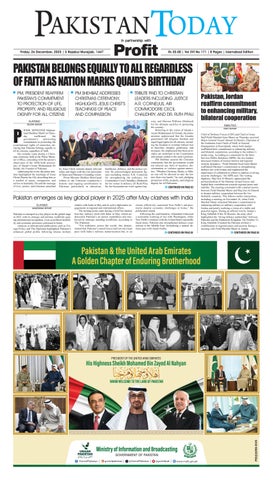
In partnership with
Profit
PAKISTAN BELONGS EQUALLY TO ALL REGARDLESS OF FAITH AS NATION MARKS QUAID’S BIRTHDAY Friday, 26 December, 2025 | 5 Rajabul Murajjab, 1447
g
PM, PRESIDENT REAFFIRM PAKISTAN’S COMMITMENT TO PROTECTION OF LIFE, PROPERTY, AND RELIGIOUS DIGNITY FOR ALL CITIZENS
P
ISLAMABAD
g
PM SHEHBAZ ADDRESSES CHRISTMAS CEREMONY, HIGHLIGHTS JESUS CHRIST’S TEACHINGS OF PEACE AND COMPASSION
g
TRIBUTE PAID TO CHRISTIAN LEADERS INCLUDING JUSTICE A.R. CORNELIUS, AIR COMMODORE CECIL CHAUDHRY, AND DR. RUTH PFAU
SaleeM Jadoon
RIME MINISTER Muhammad Shehbaz Sharif on Thursday reaffirmed the government’s unwavering commitment to protecting the constitutional rights of minorities, declaring that Pakistan belongs equally to all its citizens, regardless of faith. His remarks came during a Christmas ceremony held at the Prime Minister’s Office, coinciding with the nation’s observance of the 149th birth anniversary of Quaid-i-Azam Muhammad Ali Jinnah, the Founder of Pakistan. Addressing the event, the prime minister highlighted the teachings of Jesus Christ (Hazrat Isa AS), describing him as a symbol of peace, compassion, and service to humanity. He said the message of love, justice, and tolerance preached
by Jesus Christ remains deeply relevant today and aligns with the core principles of Islam and Pakistan’s founding vision. Prime Minister Shehbaz Sharif paid tribute to the Christian community’s historic and ongoing contributions to Pakistan, particularly in education,
Rs 20.00 | Vol XVI No 171 | 8 Pages | Islamabad Edition
rosy, and Haroon William (Shaheed) for his ultimate sacrifice in protecting the country. Referring to the vision of Quaid-iAzam Muhammad Ali Jinnah, the prime minister underscored that the founder guaranteed full religious freedom and equal legal rights for all citizens, including the freedom to worship without fear in churches, temples, gurdwaras, and mosques. He emphasised that these principles are enshrined in the Constitution and remain central to the state’s policies. PM Shehbaz assured the Christian community that the government would not tolerate any form of injustice, discrimination, or violence against minorities. “Whether Christian, Hindu, or Sikh, no one will be allowed to take the law into their own hands,” he said, pledging protection of life, property, and religious dignity for all Pakistanis.
ISLAMABAD
extent, effectively countered New Delhi’s advancements despite economic challenges at home,” the publication noted. Following the confrontation, Islamabad witnessed a noticeable warming of ties with Washington, while New Delhi’s relations with the United States reportedly faced strain. Pakistan also strengthened defence cooperation in the Middle East, formalising a mutual defence pact with Saudi Arabia.
CONTINUED ON PAGE 03
CONTINUED ON PAGE 03
healthcare, defence, and the justice system. He acknowledged prominent figures including Justice A.R. Cornelius for strengthening the judiciary, Air Commodore Cecil Chaudhry (Shaheed) for his valour in defence, Dr Ruth Pfau for her humanitarian work against lep-
Pakistan re-emerged as a key player on the global stage in 2025, with its strategic and military credibility gaining international recognition, even as political instability and economic pressures continued at home. Analysts in international publications such as Foreign Policy and The Diplomat highlighted Pakistan’s enhanced global profile following intense military
clashes with India in May and its active diplomatic engagements in regional and international affairs. The turning point came during a brief but intense four-day military clash with India in May, which underscored Pakistan’s air power capabilities and reinforced its strategic standing worldwide, according to The Diplomat. “For militaries across the world, this demonstrated that Pakistan’s armed forces had not only kept pace with India’s military modernisation but, to an
RAWALPINDI
Staff RepoRt
Chief of Defence Forces (CDF) and Chief of Army Staff Field Marshal Asim Munir on Thursday received Major General Yousef Ahmed Al Huneiti, Chairman of the Jordanian Joint Chiefs of Staff, at General Headquarters in Rawalpindi, where both leaders reaffirmed their commitment to enhancing military and bilateral cooperation, according to the military’s media wing. According to a statement by the InterServices Public Relations (ISPR), the two leaders discussed matters of mutual interest and regional security dynamics. “Field Marshal Syed Asim Munir reaffirmed Pakistan’s commitment to strengthening defence ties with Jordan and emphasised the importance of collaborative efforts to address evolving security challenges,” the ISPR said. The visiting dignitary, Maj Gen Al-Huneiti, appreciated the professionalism of the Pakistan Armed Forces and lauded their contributions towards regional peace and stability. The meeting concluded with a shared resolve between Field Marshal Munir and Maj Gen Al-Huneiti to deepen military cooperation between the two brotherly countries. This follows earlier interactions, including a meeting on November 16, when Field Marshal Munir reiterated Pakistan’s commitment to enhancing military-to-military cooperation with Jordan and jointly realising a vision of a stable and peaceful region. During an official visit by Jordan’s King Abdullah II ibn Al Hussein, the army chief highlighted the “strong defence partnership” between Pakistan and the Hashemite Kingdom. On October 23, King Abdullah II lauded the Pakistan military’s contributions to regional peace and security during a meeting with Field Marshal Munir in Jordan.
CONTINUED ON PAGE 03
Pakistan emerges as key global player in 2025 after May clashes with India MonitoRing RepoRt
Pakistan, Jordan reaffirm commitment to enhancing military, bilateral cooperation
02 NEWS
Friday, 26 December, 2025 | ISLAMABAD
PAKISTAN’S SEAFOOD EXPORTS TO EU DELAYED FOR ANOTHER YEAR AS INSPECTION PLAN OMITS THE COUNTRY
A g
EU’S INSPECTION PLAN FOR 2026 DOES NOT INCLUDE PAKISTAN, EXTENDING THE BAN FOR AT LEAST ANOTHER YEAR should read NOAH SEELAM/AFP/Getty Images) Pakistan’s seafood exports to European Union (EU) countries are unlikely to resume next year, as the EU’s inspection plan for 2026 does not include Pakistan, effectively extending the ban for at least another year, sources revealed on Wednesday. Since 2007, Pakistan’s seafood exports to the EU have remained delisted, but government officials have remained hopeful that an EU inspection team could visit Pakistan next year, most likely in the first quarter. Several rounds of meetings have been held in an attempt to resolve the issue. However, Business Recorder reported,
PROFIT
staff report
vendor arranges fish for sale at a market in Hyderabad on November 4, 2011. Indian Finance Minister Pranab Mukherjee admitted late last month that food inflation had risen to dangerous levels as prices surged more than 12 percent year on year. The rate of 12.21 percent in the week ended October 22 was up from the previous week, when it stood at 11.43 percent, according to data from the government. AFP PHOTO/Noah SEELAM (Photo credit
citing sources, that the EU’s proposed inspection plan for 2026 does not feature Pakistan for the evaluation of seafood facilities, particularly those at Karachi Fish Harbour. This exclusion means the possibility of adding more seafood processing companies to the approved list has been hindered. Despite this, exporters seem largely unaffected by the delay. Saeed Farid, Senior Vice Chairman of the Pakistan Fisheries Export Association (PAKFEA), stated, “There are already four companies exporting seafood to EU countries, and most others are not prepared to seek enlistment because EU regulations are
extremely strict and difficult to maintain.” He also criticised the Sindh government for its poor management of fish harbour maintenance and fisheries management, emphasising that the core issue lies in the lack of effective support from official partners to facilitate EU inspections. Farid also pointed to a decline in fisheries landings over time, which he linked to limited exports to the EU. He noted that new entrants are less interested in entering the EU market, but expressed satisfaction that China has emerged as Pakistan’s largest seafood importer, accounting for about 65% of the country’s total seafood exports.
Ruling party’s lawmaker accuses FBR of fostering ‘hostile environment’ for businesses g
NA COMMITTEE DISCUSSES IMPACT OF FBR'S ACTIONS ON BUSINESS CLIMATE, WITH FOREIGN COMPANIES STRUGGLING TO REPATRIATE PROFITS PROFIT
staff report
During a meeting of the National Assembly Standing Committee on Commerce on Wednesday, Shaista Pervaiz Malik, member of the National Assembly from the ruling PML-N, criticised the Federal Board of Revenue (FBR) for ‘creating a hostile environment’ for businesses, which has contributed to the exit of multinational companies and local businesses from Pakistan, according to a news report. The committee, chaired by Jawed Hanif Khan, discussed recent trends of multinational firms scaling back or shutting down operations in Pakistan. Malik expressed strong disapproval of the FBR’s actions, accusing the tax authority of “harassment” and highlighting
the difficulties faced by foreign companies in repatriating their profits. “FBR has made the business community hostile. As a result, not only are multinational companies shutting down their operations and leaving the country, but local businessmen are also being
Govt raises Rs900 billion as T-bill yields fall sharply after SBP rate cut
Federal Cabinet approves gas allocation for three fertiliser plants to ensure uninterrupted urea production
First auction following SBP’s rate cut sees yields drop by 79bps, with non-competitive bids accounting for large portion of funds raised PROFIT
staff report
forced out,” she said. During the meeting, a representative from the Board of Investment (BoI) briefed the committee on Pakistan’s open investment policy, stating that foreign investors do not need pre-screening or prior approval, unless restricted for
national security or public safety reasons. Restricted sectors include arms, explosives, and media, among others, with foreign direct investment not permitted in the media sector. The BoI representative also acknowledged that the recent scaling back or exit of some MNCs should be viewed in the context of broader global trends, including global inflation, high interest rates, and supplychain adjustments. He noted that many multinational firms are adjusting their operations globally, with some shifting to asset-light models or consolidating operations due to external pressures such as inflation and shareholder demands. However, he also acknowledged that domestic structural constraints, such as macroeconomic volatility, regulatory complexity, delays in profit repatriation, and high business costs due to energy prices and taxation, have played a role in influencing investment decisions.
g
FAUJI FERTILISER TO RECEIVE 104 MMCFD OF RAW GAS, FATIMA FERTILISER 68 MMCFD, AND AGRITECH 50 MMCFD, WITH PROCESSED GAS AMOUNTS AT 80 MMCFD, 52 MMCFD, AND 38 MMCFD, RESPECTIVELY PROFIT
staff report
In a Treasury Bills (T-bills) auction held on Wednesday, the government successfully raised over Rs900 billion, with cut-off yields falling by as much as 79 basis points. This marked the first Tbills auction after the State Bank of Pakistan (SBP) reduced the benchmark interest rate by 50bps, bringing it down to 10.5% from 11%, after maintaining the rate unchanged since May 2025. The government raised Rs493.3 billion through threemonth T-bills at a cut-off yield of 10.48%. Additionally, Rs276.6 billion was mobilized through 12-month T-bills, with the cut-off yield decreasing to 10.48% from 11.27% in the previous auction. The lowest amount raised was Rs34 billion through six-month T-bills, which also carried a cut-off yield of 10.48%. A significant feature of the auction was the large volume of non-competitive bids, through which the government raised Rs408 billion. Competitive bids accounted for Rs503 billion. Bankers considered the scale of non-competitive borrowing unconventional. The total amount of bids amounted to Rs1.685 trillion, indicating excess liquidity in the banking system. Separately, the government also raised Rs105 billion through 10year Pakistan Investment Bonds, bringing the total amount mobilized on Wednesday to Rs1.016 trillion. Market experts had anticipated a decline in Tbill yields following the SBP’s rate cut, but the 12-month T-bill yield fell more sharply than expected, dropping by 79bps, which was greater than the reduction in the policy rate.
The federal cabinet has approved, on the proposal of the Economic Coordination Committee (ECC), a gas allocation plan for three fertiliser plants, transitioning them to a Mari-based standalone gas supply system to ensure the long-term sustainability of domestic fertiliser production. According to a news report, this decision will help protect farmers from price volatility, strengthen national food security, and support overall economic stability. Under the approved plan, new gas supplies from Ghazij/Shawal off-spec raw gas discoveries will be allocated to three fertiliser plants: Fauji Fertiliser Company (Port Qasim) will receive 104 mmcfd of raw gas (80 mmcfd processed), Fatima Fertiliser (Sheikhupura) will get 68 mmcfd of raw gas (52 mmcfd processed), and Agritech (Daudhkhel) will receive 50 mmcfd of raw gas (38 mmcfd processed). The gas will be delivered to the Mari gas field, where fertiliser companies will set up processing and compression facilities. To accommodate these changes, up to 110 mmcfd of gas earlier allocated from HRL to GENCO-II will be deallocated, with up to 105 mmcfd allocated to Engro Fertiliser’s Mari plant. The required investment for processing low-BTU, high CO2 gas is estimated at over USD 200 million, which will be fully funded by the fertiliser industry. This policy intervention addresses a major risk in the fertiliser sector. Before this decision, around 32% of domestic urea production capacity, over two million tonnes annually, faced uncertainty due to a lack of assured gas
allocation. Without this move, the fertiliser sector would have relied on volatile international markets, with an estimated annual import bill of USD 2–3 billion, putting pressure on foreign exchange reserves and domestic fertiliser prices. The new allocation system will stabilise fertiliser supply and ensure that farmers continue to access urea at prices well below international benchmarks. The policy also supports the import substitution of USD 2–3 billion annually without fiscal costs, helping conserve foreign exchange without burdening the national exchequer. Additionally, the decision optimises national energy use by utilising low-quality gas that would otherwise remain underused, channeling it into productive fertiliser manufacturing. The fertiliser industry is also set to continue investing private capital in infrastructure, such as pipelines and processing facilities, improving plant efficiency and ensuring long-term supply security.
PM sets Dec 31 deadline for provincial govts to clear Rs166b in Discos’ dues PROFIT
Prime Minister Shehbaz Sharif has set a deadline of December 31, 2025, for provincial chief secretaries to clear the outstanding electricity dues of power distribution companies (DISCOs), Business Recorder reported. The Minister for Power was mandated to contact the chief secretaries of the provinces and ensure the clearance of pending bills from provincial departments. A finalised report on the issue is to be submitted to the prime minister within two weeks. Minister for Power Sardar Awais Ahmad Leghari confirmed that the current stock of outstanding dues against provinces stands at Rs166 billion. He added that, under a decision by the Council of Common Interests (CCI), the federal government had already deducted Rs20 billion at source last year, equivalent to 25% of the reconciled amount. The issue of unpaid electricity dues by the Sindh government was also discussed, with the CEO of Sukkur Electric Power Company (SEPCO) highlighting that the company was supplying electricity to areas under the jurisdiction of the Irrigation Department, where losses exceeded 90%. These areas had seen transformers reinstalled on the instructions of a standing committee and a local MNA but were later removed with the support of Rangers. Taking serious note of this situation, the Minister for Power instructed that transformers should not be reinstalled if removed with the support of Rangers. He further stated that the Irrigation and Police Departments in Sindh were not paying their electricity bills despite the installation of Automated Meter Reading (AMR) meters. Sindh government officials responded by noting that SEPCO had not provided cost estimates for replacing bulk meters with individual meters. An additional secretary from the Sindh Finance Department also informed the meeting that the federal government had directly deducted Rs8 billion at source from the province for electricity arrears, a measure taken in line with the CCI’s decision. Confirming the deduction, Minister Leghari emphasised the need for provinces to make timely payments to prevent further financial strain. Secretary of Power Dr. Fakhre Alam Irfan added that while provinces pay their original reconciled amounts, the federal government has to borrow from banks to cover the gap, which results in interest payments that contribute to the circular debt. The Standing Committee on Energy also expressed concern over the non-payment of electricity bills by the irrigation and power departments of Sindh, causing recurring losses to DISCOs in the province.
Malaysia, Saudi Arabia and Tajikistan interested in importing meat and rice from Pakistan, says food minister g
RANA TANVEER HUSSAIN STRESSES THE NEED TO ALIGN PAKISTAN'S PRODUCTION, PROCESSING, AND REGULATORY SYSTEMS WITH INTERNATIONAL STANDARDS TO CAPITALISE ON EXPORT OPPORTUNITIES PROFIT
staff report
Federal Minister for National Food Security & Research, Rana Tanveer Hussain, highlighted key sectors with significant export potential, such as meat, livestock, and rice, revealing that Malaysia, Saudi Arabia, Iran, and other Gulf countries are ready to import Pakistani fresh meat and rice, while Tajikistan alone has expressed interest in importing nearly 100,000 tonnes of meat. To capitalise on these opportunities, the food minister stressed the importance of aligning Pakistan’s production, processing, and regulatory systems with international standards.
This was discussed during a high-level interactive meeting with agricultural exporters and key stakeholders at the Federation of Pakistan Chambers of Commerce & Industry (FPCCI). The meeting was convened on the special instructions of Prime Minister Imran Khan to analyze the causes behind the recent dip in exports, particularly in the agriculture sector. The session, led by FPCCI Vice President Tariq Jadon, was attended by exporters and stakeholders from various sectors, including agriculture, livestock, meat, rice, fruits, and vegetables. Acting FPCCI President Saqib Riaz welcomed the Federal Minister. Minister Hussain discussed Pak-
istan’s recent successes in economic and political diplomacy, particularly regional engagement with India, but pointed out that the country’s exports still hover around $30–32 billion. He stressed the need for a fundamental shift toward an export-driven economic model to ensure long-term growth. “Exports are the backbone of our economy,” said Minister Hussain, emphasizing that remittances, while valuable, are not sufficient to sustain economic growth. He advocated for empowering local farmers and domestic industries to strengthen the export sector rather than increasing dependence on imports. Acting FPCCI President Saqib Riaz
staff report
pointed out that exports offer significant growth potential without heavy reliance on imported inputs but noted challenges such as high tax rates, complex policies, and the conversion of agricultural land into housing schemes. He emphasized the need to protect agricultural land and
limit its conversion to agriculture-based industries. FPCCI Vice President Tariq Jadon raised concerns about the lack of balanced benefits from Free Trade Agreements (FTAs) with partner countries and the losses faced by exporters due to the closure of the Afghanistan border, which has disrupted regional trade. Representatives from the Fruit and Vegetable Association voiced concerns over market access for key products like potatoes and kinnow, calling for improved logistics and supportive policies to enhance exports of these items. In response, Minister Hussain assured exporters of the government’s support and directed FPCCI and stakeholders to prepare a consolidated list of challenges and recommendations. He announced that a follow-up meeting would be scheduled to address the issues raised and ensure effective implementation. Hussain reaffirmed his commitment to resolving exporters’ concerns and aligning national policies to transform Pakistan into a competitive, export-oriented economy driven by agriculture, livestock, and valueadded production.
NEWS 03
BANK LENDING TO PRIVATE SECTOR HITS RECORD RS1.5TR, FUELING INDUSTRIAL GROWTH
Friday, 26 December, 2025 | ISLAMABAD
B
g
vate sector credit flows amounted to Rs1.08 trillion. Meanwhile, the government’s borrowing from the banking system, including the SBP and commercial banks, was negative during the same period, with Rs166 billion repaid. This marked a contrast to the previous year when the federal government repaid Rs1.662 trillion. The PBA also emphasized the banking sector’s liquidity and capitalization, noting that deposits have reached Rs35.1 trillion. The association stated that the recent surge in lending is a direct result of reduced government reliance on domestic banking deposits and structural reforms that have allowed banks to better serve the private sector. Muneer Kamal, CEO and General Secretary of the PBA, added that risk-sharing
PBA REPORTS RECORD PRIVATE SECTOR CREDIT DRIVES 8.33% GROWTH IN LARGE-SCALE MANUFACTURING, WITH INCREASED FOCUS ON SMES AND AGRICULTURE crucial role in driving industrial output and job creation. PBA Chairperson Zafar Masud highlighted the positive shift, stating, “When government borrowing moderates, banks promptly deploy capital into business, industry, and agriculture.” This shift in lending reflects the banking sector’s ability to pivot liquidity from sovereign debt into productive areas of the economy, contributing to the recent industrial recovery. The State Bank of Pakistan (SBP) reported that private sector credit expanded by
PROFIT
staff reprot
ANK lending to Pakistan’s private sector has reached a record Rs1.5 trillion in FY26, marking a significant rise due to reduced government borrowing from the banking system, according to the Pakistan Banks Association (PBA). This surge in financing has led to an 8.33% growth in Large-Scale Manufacturing (LSM), underlining the private sector’s
Rs187 billion between July and November FY26, driven by easing financial conditions and improved consumer sentiment. However, on a year-over-year basis, private sector credit saw a slight decline of 0.3% due to the high base effect from extraordinary credit expansion in the previous fiscal year. The latest SBP figures show bank lending to private businesses reached Rs135.3 billion between July 1, 2024, and December 12, 2025, down from Rs1.47 trillion in the same period last year. For FY25, total pri-
IMF closely monitored PIA sale as key test for Pakistan’s privatisation reforms, says advisor g
COUNTRY TARGETS HANDOVER OF AIRLINE BY APRIL; DEAL INCLUDES RS 10 BILLION CASH UPFRONT FOR GOVT, 25% STAKE RETAINED PROFIT
staff report
Privatisation was a key test of Pakistan’s reform credibility with the IMF, failure to offload loss-making state firms risked renewed pressure on public finances, says Muhammad Ali Pakistan’s advisor for privatisation, Muhammad Ali, said that the sale of Pakistan International Airlines (PIA) was closely watched by the International Monetary Fund (IMF), which has pressed Pak-
istan to halt losses at state-owned enterprises. Muhammad Ali told Reuters in an online interview that the privatisation was a key test of Pakistan’s reform credibility with the IMF, adding that failure to offload loss-making state firms risked renewed pressure on public finances. He said closing the deal would signal momentum on reforms and privatisations, adding that the government was working through a pipeline of future transactions once PIA closes. The advisor said that the PIA is expected to be run by a new owner
NA committee urges Sindh govt to clear Rs742m electricity dues PROFIT
staff report
The National Assembly Standing Committee on Energy (Power Division) has raised concerns over the non-payment of electricity bills by the Sindh government’s irrigation and power departments, which has resulted in significant financial losses for power distribution companies in the province. During a meeting on Wednesday, the committee directed the chief executive officers of Sukkur Electric Supply Company (SEPCO) and Hyderabad Electric Supply Company (HESCO), along with secretaries from the finance, irrigation, and power departments of the Sindh government, to work together to reconcile the outstanding amounts and arrange payments to prevent further losses. The committee was informed that the Sindh Irrigation Department owed Rs617 million to SEPCO and Rs125 million to HESCO for electricity supplied to Salinity Control and Reclamation Project (SCARP) tube wells, offices, and irrigation colonies. However, the secretaries of the irrigation and power departments contested the bills for irrigation colonies, claiming that both power companies had been repeatedly urged to bring residents of these colonies into the metering network, but no action had been taken. The committee was also informed that individual meters had been installed in only two irrigation colonies within the HESCO region. Despite this, the Sindh government expressed readiness to reconcile the figures and settle the outstanding amounts.
from April next year and receive fresh capital under a deal to privatise the flag carrier. A consortium headed by the Arif Habib Corporation emerged as the top bidder in a live-televised auction for a 75% stake in PIA on Tuesday, marking a breakthrough for the government’s long-delayed privatisation of the carrier. The Arif Habib consortium offered 135 billion rupees ($482.14 million), surpassing a government reserve price of 100 billion rupees, in a sharp turnaround from last year’s failed sale attempt.
Muhammad Ali said that the state expects a new owner to be running the airline by April, subject to approvals. The process now moves to final approvals by the Privatisation Commission board and the cabinet, expected within days, with contract signing likely within two weeks and financial close after a 90-day period to meet regulatory and legal conditions. Ali said the government would receive about Rs 10 billion in cash upfront and retain a 25% stake valued at around Rs 45 billion. The deal was structured to inject fresh capital into the airline rather than simply transfer ownership, he said. “We did not want a situation where the government sells the airline, takes its money and the company still collapses,” Ali said.
Punjab govt establishes property tribunals across districts; LHC issues stay on property possession orders g
LHC REFERS 18 PETITIONS TO FULL BENCH WHILE QUESTIONING VERBAL POSSESSION ORDERS AND TRIBUNAL OPERATIONS UNDER PUNJAB PROPERTY OWNERSHIP ACT PROFIT
staff report
The Punjab government has established property tribunals in all districts under the Punjab Protection of Ownership of Immovable Property Ordinance, 2025. This decision, effective immediately, was confirmed through notifications issued by the Board of Revenue, Public Prosecution Department, and the Services and General Administration Department. Accoridng to media reports, the newly created tribunals will cover a broad range of districts, including Lahore, Kasur, Sheikhupura, Nankana Sahib, Gujranwala, Sialkot, Narowal, Gujrat, Hafizabad, Mandi Bahauddin, Wazirabad, Rawalpindi, Murree, Chakwal, Attock, Jhelum, Talagang, Multan, Lodhran, Vehari, Khanewal, Sahiwal, Pakpattan, Okara, Bahawalpur, Bahawalnagar, Rahim Yar Khan, Dera Ghazi Khan, Taunsa, Rajanpur, Layyah, Muzaffargarh, Kot Addu, Faisalabad, Jhang, Chiniot, Toba Tek Singh, Sargodha, Khushab, Mianwali, and Bhakkar.
Each tribunal will have jurisdiction over its respective district, with temporary arrangements for some areas until nominations are finalised. Rawalpindi will manage Murree cases, Gujrat will oversee Wazirabad cases, Chakwal will handle Talagang, and Dera Ghazi Khan will cover Taunsa. The Punjab government has appointed retired district and sessions judges as members of these tribunals to ensure fair and efficient handling of property cases. Prosecutors have been assigned to provide necessary legal support, while administrative functions will be managed by Assistant Commissioners (HR & Coordination), who will also serve as Registrars. The creation of these tribunals comes after the Lahore High Court (LHC) emphasised the need for specialised forums to handle property possession cases, ensuring swift resolution while protecting the rights of lawful property owners. The LHC recently expressed concerns over the practices under the Punjab Property Ownership Act (PPOA), particularly regarding the issue of verbal possession orders.
In a separate development, the LHC has sent 18 petitions challenging property possession under the PPOA to a full bench. The court issued a stay order and questioned the legality of verbal possession orders issued by deputy commissioners (DCs) during the interim period before tribunals were fully established. Chief Justice Aalia Neelum pointed out that the tribunals were not operational for over two months after the law’s notification, raising concerns about the legal validity of possession granted during this time. Further, the chief justice criticized the practice of granting possession without written orders, asking whether such actions could be legally accepted. The LHC also took serious note of allegations that a DC had granted possession despite a pending case in the high court, labeling this as “defiance of high court orders.” The state counsel acknowledged that the rules under the PPOA were still being formulated, but the court stressed that proceedings should not have started without clear guidelines in place.
Pakistan belongs equally to all regardless of faith as nation marks Quaid’s birthday CONTINUED FROM PAGE 01
He further stressed that Islam teaches respect for all religions, making interfaith harmony and mutual respect essential for national unity and progress. Extending warm greetings on Christmas, the prime minister highlighted the special significance of December 25, which marks both the birth of Jesus Christ and Quaid-i-Azam Muhammad Ali Jinnah, praying for peace, prosperity, and harmony in the country. The ceremony was attended by Archbishop Dr. Joseph Arshad, bishops, clergy members, diplomats including the
Ambassador of the Vatican, federal ministers, parliamentarians, and other dignitaries. PRESIDENT REAFFIRMS COMMITMENT TO RELIGIOUS FREEDOM AND HARMONY Meanwhile, President Asif Ali Zardari extended Christmas greetings to the Christian community in Pakistan and worldwide, describing the festival as a message of hope, peace, and compassion. In his message, he said Christmas symbolises love, tolerance, and empathy, values crucial for promoting harmony and peaceful coexistence in society. President Zardari recalled that Quaid-iAzam guaranteed complete religious free-
dom, allowing citizens to practice their beliefs without fear or discrimination. He also paid tribute to the Christian community’s contributions in politics, defence, education, and healthcare, highlighting the services of S.P. Singha and Air Commodore Cecil Chaudhry. The president reaffirmed the government’s resolve to promote religious harmony, tolerance, and peaceful coexistence, noting that diversity is Pakistan’s strength. He concluded by praying for peace, good health, and prosperity for the Christian community, expressing hope that the festive occasion would strengthen bonds of harmony nationwide.
NATION OBSERVES QUAID-I-AZAM’S 149TH BIRTH ANNIVERSARY The nation also celebrated the 149th birth anniversary of Quaid-i-Azam Muhammad Ali Jinnah with patriotic zeal, paying tribute to his visionary leadership and renewing the pledge to uphold his principles of faith, unity, and discipline. President Zardari and Prime Minister Shehbaz Sharif highlighted the enduring relevance of Jinnah’s leadership, urging citizens to follow his vision of democracy, constitutionalism, social justice, and religious harmony to guide Pakistan toward stability and progress.
Pakistan, ADB seal $730m deals for power grid expansion and SOE reforms g
FINANCING INCLUDES $330M FOR TRANSMISSION UPGRADES AND $400M TO ACCELERATE STATE OWNED ENTERPRISE RESTRUCTURING PROFIT
staff report
Pakistan and the Asian Development Bank have signed financing agreements worth $730 million for two projects aimed at strengthening the national power transmission system and accelerating reforms in state owned enterprises, the Economic Affairs Division said on Tuesday. The agreements
cover the Second Power Transmission Strengthening Project, valued at $330 million, and the $400 million Accelerating State Owned Enterprise Transformation Programme. Officials said the transmission project will facilitate the reliable evacuation of 2,300 megawatts of electricity from upcoming hydropower projects. It is also expected to reduce overloading on
existing transmission lines and enhance the resilience of the national grid under contingency conditions. Secretary Ministry of Economic Affairs Muhammad Humair Karim acknowledged ADB’s role as a key development partner and said the project would help reinforce the backbone of the national grid, contributing to long term energy security. On the reform side, Karim
said the SOE Transformation Programme would support implementation of the SOE Act 2023 and the SOE Policy 2023, while improving efficiency and governance across state owned enterprises, with a particular focus on
the National Highway Authority. ADB Country Director Emma Fan welcomed the government’s commitment, saying the transmission investment was critical for strengthening Pakistan’s energy infrastructure.
frameworks and market-led mechanisms are essential to making private sector lending more attractive and sustainable. Addressing long-standing criticisms, the PBA pointed out that banks have shifted focus toward sectors that traditionally struggled to access credit. Record liquidity has been channeled into small and medium enterprises (SMEs) and agriculture, ensuring more equitable distribution of financing across various sectors. The number of SME borrowers increased by 56.9%, rising from 176,246 in June 2024 to 276,578 in June 2025. SME financing jumped by 40.7% to Rs691 billion. Additionally, agricultural credit saw a historic turning point, with the number of farmers accessing credit rising by 7.3% to nearly 2.9 million.
Pakistan, Jordan reaffirm commitment to enhancing military, bilateral cooperation CONTINUED FROM PAGE 01
During that visit, Munir also called on Maj Gen Al-Huneiti at General Headquarters in Amman, where he was welcomed with a guard of honour. ATTEMPTED AMBUSH THWARTED IN NORTH WAZIRISTAN’S MIR ALI The security situation in Mir Ali, North Waziristan, turned tense on Thursday following an hour-long exchange of heavy fire between security forces and militants, leaving three security personnel and at least 20 civilians injured. According to security sources, Fitna al-Khawarij militants—a term used by the state for banned Tehreek-iTaliban Pakistan (TTP) operatives—attempted to attack a convoy on the main highway. Clashes erupted around noon in adjoining areas of Mir Ali, with mortar shells landing on residential houses in Hasokhel, Muski, and Ippi areas, injuring civilians, including women and children. Security forces cordoned off Mir Ali Bazaar and surrounding areas, while intermittent aerial firing triggered panic among residents. Commercial activities were suspended as people stayed confined to their homes amid fear and uncertainty. The Bannu–Miranshah main road was completely closed at Khajori checkpost, resulting in long queues and severe inconvenience to travelers. A loud explosion was reported near the Muski area, while a security check post at Hasokhel Bridge came under heavy weapon attack. Intense gunfire left three security personnel injured, who were shifted to a nearby hospital for treatment. Medical Superintendent of Mir Ali DHQ Hospital, Dr Munir Aslam, confirmed that 20 injured persons were brought to the hospital, seven of whom were referred to Khalifa Gul Nawaz Hospital in Bannu due to their critical condition, while treatment of the remaining injured is underway. Local residents, carrying white flags, assisted in transporting the injured to hospitals despite the dangerous situation. Following the incident, security forces launched a search operation in the area, which remained tense at the time of reporting. Multiple incidents of terrorism and violence have been reported from Mir Ali in recent weeks, highlighting ongoing security challenges in the region.
Pakistan emerges as key global player in 2025 after May clashes with India CONTINUED FROM PAGE 01
China welcomed the battlefield validation of its defence systems deployed by Pakistan, a development that also helped revive momentum for the second phase of the China-Pakistan Economic Corridor (CPEC). Pakistan further expanded its diplomatic footprint through active involvement in international discussions on Gaza’s stabilisation, positioning Islamabad to play a more influential role in regional and global affairs heading into 2026. On the western front, Pakistan adopted a tougher posture towards Afghanistan, applying sustained pressure to counter the Tehreek-e-Taliban Pakistan (TTP), including cross-border strikes and the suspension of trade, The Diplomat reported. Foreign Policy highlighted Pakistan’s role in the arrest of the mastermind behind a major terror attack on US forces in Afghanistan, noting that this has helped Islamabad secure early goodwill with US President Donald Trump. “Our relationship looks good, as good as it has ever been,” Pakistan’s ambassador to Washington, Rizwan Saeed Sheikh, told Foreign Policy earlier this year. The publication added that Pakistan’s improving standing in Trump’s eyes coincided with a visible downturn in US-India relations. India’s refusal to credit Trump for brokering the cease-fire in May, combined with US frustration over India’s trade policies and purchases of Russian oil, has resulted in some of the world’s highest Trump tariffs for New Delhi. “But as 50 percent tariffs remain in place and a trade deal remains elusive, those who look at the optics cannot help but concede that they don’t look good,” Foreign Policy observed.
04 COMMENT
Banking on disruption
To talk or not to talk?
T
The PTI wants to talk, but to be seen as not doing so itself
T
Imran Khan and his party seem to face tough days ahead
HE recent meeting of the main opposition alliance, the Tehrik Tahaffuz Ain Pakistan failed to give what its chairman, Mahmud Khan Achakzai, had recommended, that it engage in talks with the government, because the Tehrik’s main component, the PTI, refused to do so. Indeed, the PTI repeated its main plank, its refusal to allow political stability to develop, by vowing that a future PTI government reserved the right to reverse the PIA privatization on Tuesday. The PTI has allowed Mr Achakzai to take up the government’s offer of talks, but has refused to be bound by him, and or by the outcome of the talks. Mr Achakzai had suggested that talks with the government should take place, and that PML(N) President and JUI(F) chief Maulana Fazlur Rehman should also use their good offices in the matter. The PTI’s stance seems to be that talks should take place, but that it should not be seen as taking part in them, because it would be embarrassing. That might explain why the TAP has moved away from the PTI’s constant drumbeat of demanding the release of Imran Khan. The advantage of the TTAP taking part in the talks is that the PTI can say that it did not sully itself by this activity. It seems that it had adopted the rather casual dismissal of attempts at talks as surrender. Talks have often been accompanied by threats of a street movement. The threat has been made, but it does seem to have been seen by the government as much of one. The government has been riding high on the results of the recent by-election results, which saw the PTI lose all the seats it had won in the general election. Perhaps most encouraging for the government was the defeat of the PTI-backed candidate on the Haripur seat, despite the party being in office in the province. The PTI has got a real dilemma on its hands. It has so far not been able to spring Mr Khan from jail. However, its base still rejects the idea of talking to those who are keeping him imprisoned. Mr Achakzai has also got to handle the question of Mr Khan’s release. The activities of the National Dialogue Committee, of former PTI leaders led by Mr Fawad Chaudhry, is also significant, for though excoriated by the PTI leadership, it does represent a strand of thinking with the PTI, which is no longer the monolith it likes to think itself to be.
At Penpoint M A NIAZI
HE conviction of PTI founder Imran Khan in the second Toshakhana case might well be compared to a tightening of the screws, prior to the really big blow to him, his trial for the 9 May 2023 incidents, which had provided the worst blow to the party it has suffered, before or since. The government seems to be running out of charges on which to try him, but the question of whether he should be tried by a military or civilian court now seems moot. The procession of those convicted by civilian anti-terrorist courts is long enough for prosecutors to feel that they might be able to get a conviction even he was tried before a civilian court. Another strand of the noose that is being woven for him was revealed in the statement by the DG ISPR that Lt Gen (retd) Faiz Hameed, the former DG ISI and Corps Commander Peshawar, was yet to face a court martial for his role in the May 9 incidents. After that court martial takes place, the evidence may then become available of what is called by Imran’s opponents, that the protests against Imran’s arrest were actually a cover for an attempted coup against the leadership of the Army and the government. The most common defence offered is that Imran was in jail when the protests took place, and that the protests were spontaneous. The counter to that is that the arrest was actually a signal for certain planned actions to be carried out. That planning is supposed to have had Imran’s participation. If proved, it would make him part of a criminal conspiracy, and would leave him liable to even more sentences. If his sentences run concurrently, as they should, every fresh sentence has to commence when it is delivered. Up to one-third of sentences are remitted because of remissions by the President for all prisoners on such special occasions as Eid or Independence Day. Assuming that Imran was not excluded from such remissions (as could be done by the President), and assuming the usual remissions for good conduct (which could only be denied if there was evidence of bad conduct, such as an escape attempt, disobeying the jail staff or fighting with other prisoners), he would not get out of fail until he had served about two-thirds of his last sentence, provided it did not overlap with an earlier but longer sentence. The latest sentence, delivered this month, at 17 years is the longest he has been given so far, which means he could be in jail for the next 11 years, so that he would have served out all his sentences. As he has not been tried for the May 9 cases, he may end up spending a really long time in jail. His trial may not be over till the end of next year. He might then have to serve a 10-year sentence, which has been the standard sentence handed down to PTI leaders so far in May 9 cases. That means just under seven years would have to be served, which means completion of the sentence before the latest anti-corruption court sentence. On the other hand, it is possi-
Dedicated to the legacy of late Hameed Nizami
Arif Nizami (Late) Founding Editor
ble that Imran might get a heavier sentence than 10 years, and he might receive separate sentences for different incidents. There would still be some grounds which would allow him to claim concurrent serving of the sentence, but just because a case can be made out does not mean it has to be accepted. If cases can be brought to trial when he is nearing release, he can probably be kept imprisoned virtually indefinitely, with a new sentence handed down as soon as he approaches release. However, even if that tactic is not used, he is likely to spend some years in jail. If he does serve another 11 years, he will be 83 when he is finally released. That assumes he does not get more than 10 years in any May 9 case. It is possible that he will get life sentences, which are treated as a 20-year sentence, meaning he would have to serve 14 years from the date of sentencing. Assuming sentencing in 2026, that would mean release in 2040, at which point he will be 87. Apart from his vast age at that point, it is not a safe assumption that he will still be alive. He is very fit for a jailbird of his age, because he has spent his lifetime taking care of himself, and has continued to maintain a rigorous fitness regime in jail, that should be the envy of free men half his age, It is a tribute to both his exercise and diet regimens that the possibility of his being alive at that age not only exist, but are quite bright. However, in this time, there will have been three general elections, assuming that the present trend of elections being held only on the expiry of the fiveyear term continues. In fact. In 2040, when Imran reemerges back into the cold harsh daylight, a general election will have been held the year before, and the PTI might well be in the opposition. The example of Mian Nawaz Sharif should illustrate that legal bars to contesting elections are removed without too much difficulty. However, there will then be the tough choice of waiting it out till 2044, at which time Imran will be over 90, or allowing someone else become Prime Minister. The PTI may have become reduced to a political platform for Imran, but it should not be forgotten it remains an electoral party, with its leadership cadres at least using it to obtain access to political power and elected offices. These people do not have patience to remain in the opposition for a long time, and need a
Babar Nizami Editor Profit
A
FAhAd BIN TArIq
cruel irony permeates the air we breathe in Lahore: a city that once welcomed winter fogs is now drowning in toxic air. Every exhalation is a borrowed breath, and every breath of air is a cocktail of chemicals, smoke, and dust. Smog is now a plague that keeps returning rather than a summertime annoyance. For years, our sky had been gray with little thought. Brick kilns, burning crop residue, vehicles, dusty unpaved roads, and industrial smoke all blended together to gradually poison the air. In actuality, what we had referred to as winter smog was actually a time bomb that had steadily accumulated and turned our lungs into landfills. Over the years, the disdain for the environment developed. But suddenly something is different. It appears that the Punjab administration is the first to view smog as a structural challenge that needs to be handled with systems rather than words, rather than as a periodic annoyance that should only be partially addressed. At the heart of this change is measurement. After starting with just three operational monitoring stations, the province now has 75 fixed stations, 10 mobile units, and plans to add 25 more by the end of the year. Authorities will now be able to identify the enemy thanks to improved information. Measurement led to prediction, which in turn led to preparation. With the help of satellite data, a newly created AI-based predictive model can now forecast smog waves up to one week in advance. Together with a central Smog War Room connected to divisional weather centers, law enforcement organizations, and dashboards to manage real-time data, this network can detect threats and take preventative action. Smog is not produced by a single source. Unpaved road dust, open construction fugitive dust, and loose public works fugitive dust are major contributors to wintertime particle pollution, according to recent studies that included a source apportionment exercise. In order to combat this, Punjab erected 15 truck-mounted dust suspension devices, or high-capacity mist cannons, each of which can suppress dust across a distance of 120 meters. In construction zones, dust-control SOPs including installing fences and sprinkling water are now mandatory. Vehicle and industrial emissions are also receiving attention. To evaluate the quality of fuel sold, the province has set up fuel-testing laboratories in major cities for the first time, with the help of mobile units. Over 260,000 cars have been screened this year using its new emission-testing system, which comprises 100 analyzers and multiple fixed sites across Lahore. The concept of symbolic and uneven enforcement is being revised. A network of quickresponse centers and AI-connected surveillance services operate along with a new Environmental Protection Force of 250 cops on electric bikes, equipped with cameras on their bodies and digital reporting. Through a green app, a
How Punjab is learning to breathe again
bilingual hotline, or a WhatsApp chatbot, citizens may file complaints, and over 96% of the cases have now been resolved. Agriculture and industry, which have received little attention in smog debates, have been included in the proposal. Additionally, drone surveys, digital mapping, ID assignments, and requests to improve clean-production techniques are being made for the brick kilns that are prone to fire. Over 13,500 industries have now been identified, and many of them have received low-interest loans to update their emission control systems. As part of the new Climate Resilient Punjab Vision and Action Plan 2024, stubble burning, a traditional but detrimental agricultural practice, is being tackled via satellite notifications, mechanized harvests, subsidized machinery, and incentives. Instead of using ad hoc fixes, we are witnessing a systemic solution rather than a bandaid one. Boilers or dumping water on them do not result in environmental recovery. It happens gradually; all dusty roads are paved, all trees are planted, and all filthy fuels are prohibited. It takes place on a regular basis with people’s participation and clear regulations. It is training, not acting. However, there remains opposition to this notwithstanding the implementation of these measures. The amount of harmful air quality in cities like Lahore keeps rising. Opponents also point out that some options, like mist cans, are water-intensive and may only be a temporary solution rather than a long-term one. However, temporary discomfort should not
be mistaken for failure. The fact that fuel testing didn’t exist until a year ago, that dust suppression, which was previously thought of as cosmetic, is now part of official policy, and that vehicle emission testing has screened hundreds of thousands of vehicles are all indicators of intent, capability, and most importantly, seriousness. The only thing left for citizens, business, and policymakers to do is make a commitment. It is undeniable that environmental recovery is not a glamorous process. It doesn’t garner media attention. However, it restores respect to our skies, heals lungs, and saves lives. We are forced to spend time because it takes time. Because each breath of contaminated air costs us not just a little discomfort but also our productivity, health, and the lives of future generations. We will eventually look back and say, “That was the time we reclaimed our air,” if Punjab continues on this path of scale, forecast, imposition, reform, and citizen participation. At this point, the promise of pure air began to define our winters instead of pollution. It won’t happen quickly. However, it has to be genuine. None of the parties are present in the air we breathe today. Every citizen, every child, and every future generation has it. Additionally, clean air is no longer a luxury, even though it used to be a privilege.
The author is a final-year law student at Government College University Lahore. He currently serves as the Secretary General of the Youth General Assembly and President of the Youth Development Center, GCU Lahore.
It wonÊt happen quickly. However, it has to be genuine. None of the parties are present in the air we breathe today. Every citizen, every child, and every future generation has it. Additionally, clean air is no longer a luxury, even though it used to be a privilege
Lahore – Ph: 042-36300938, 042-36375965
I
Karachi – Ph: 021-32640318 I
pathway back to power quickly. While a lot of PTI supporters are those who felt Imran had the solution to the country’s problems, a lot of them were ‘electables’, who followed the PTI because it afforded them a path to power. Those are the people who are creating the pressure on Imran to find a solution that takes them out of the opposition. It should be noted that the PTI brought a large number of neophytes into politics, and they are now seeking a continued presence in politics. They are also the ones who want Imran to find a way back. The kind of traditional politicians now in the tehrik Tahafuz Ain Pakistan, like Mahmud Khan Achakzai and MustafaNawaz Khokhar, have pressed for talks. There is some movement towards talks, which is the political way of resolving matters. However, the PTI is trying to avoid them, with Imran leading the way. The PTI seems to feel that its success so far has lain in its obduracy. His refusal to talk has so far served him well, and has united his base behind him. It has led to criticism when he was in office, and to talk now would mean having to walk back on many of the narratives which the PTI is using to keep its base together: the anti-politician, anti-Army narrative which vociferously claims the May 9 incidents were committed by agents provocateurs, that the Army and the military conspired to throw the PTI out of office. The PTA proposal that Imran’s release is not an essential must be taken note of, as a sort of acknowledgement of a kind of failure, that the pressure for his release has not been built up. The PTI has found itself being painted into a corner, or perhaps rather painting itself. One of the main fears is that just as the year now ending has failed to produce any good news, the coming year might not either, unless it does something different. Though its trademark has been disruption, it has not achieved any of its own goals. Worst of all, not only has Imran remained in jail, but the government seems to have thrown away the key. The writer is a member of staff
The PTI has found itself being painted into a corner, or perhaps rather painting itself. One of the main fears is that just as the year now ending has failed to produce any good news, the coming year might not either, unless it does something different. Though its trademark has been disruption, it has not achieved any of its own goals. Worst of all, not only has Imran remained in jail, but the government seems to have thrown away the key.
The crisis that lives in every breath M. A. Niazi
Editor Pakistan Today
Friday, 26 December, 2025
Islamabad – Ph: 051-2204545
I
Editor’s mail
Send your letters to: Letters to Editor, Pakistan Today, 4-Shaarey Fatima Jinnah, Lahore, Pakistan. E-mail: letters@pakistantoday.com.pk Letters should be addressed to Pakistan Today exclusively
Climate funds overdue
THE world’s largest non-polar glacial reserves in Gilgit-Baltistan (GB) face an existential climate crisis amplified by recurring floods and glacial retreat, making the pursuit of net zero emissions not just a global obligation, but a survival strategy. Drawing from the Oxford Net Zero framework, which advocates for effective and immediate emission reductions, strategic carbon dioxide removal (CDR) and equitable financing, Pakistan’s Nationally Determined Contribution (NDC) 3.0 targets a 50 per cent greenhouse gas (GHG) emissions cut by 2035, blending domestic efforts with international support. However, financial gaps — estimated at $565.7 billion by 2035 — underscore the need for global solidarity under principles like common but differentiated res-ponsibilities, ensuring that low-emission nations like Pakistan can leverage renew- ables and geological storage for a balanced transition towards sustainability. I grew up along the Indus River’s banks, where melting glaciers feed the lifeblood of 90pc of Pakistan’s people, only to witness devastating floods in 2010, 2022 and 2025. The path forward entails front-loading cuts in industrial and agricultural emissions, and cautiously scaling CDR through geo-logical means. Yet, in boardrooms far from Sindh’s floodplains or Punjab’s heatwaves, equity falters; with 90pc of funds funnelled to mitigation over adaptation. Communities bear the brunt while waiting for inter-national finance to turn vulnerability into opportunity through green jobs and resilient ecosystems. In the context of Pakistan’s climate vulnerability, rapid emission reductions are essential, focusing on efficiency, electrification and a 30pc renewable mix by 2030. Besides, CDR must be permanent, prioritising geological over biogenic storage to avoid transient risks. Equity demands international aid to bridge the massive gap, aligning with plans for socioeconomic growth. Pakistan needs a strategy of multifaceted action for a resilient future. MAQSOOD SHAHI GILGIT-BALTISTAN
Unity over venom
WITH Pakistan facing a myriad of issues, including internal and external security threats, and at a time when the nation needs unity and harmony for the sake of the country’s stability and future, there are politicians spewing venom against state institutions, polarising the already polarised society. This is regrettable. Such politicians are increasingly being seen as figures whose actions seem to exacerbate problems rather than offering solutions. Instead of fostering constructive measures and serving the people, their frequent confrontational statements and unnecessary and inflammatory speeches are contributing to the rising level of tension in society. The spread of inaccurate reports and misleading information is damaging the country’s overall stability. The armed forces are one of the most important pillars of the state. In this context, speaking against them or adopting a confrontational tone sends the wrong message, and can encourage hostile narratives from outside. Pakistan’s survival, political stability and democracy require patience, responsibility and sensible behaviour by all concerned. Difference of opinion is natural and everyone has the right to disagree, but when it comes to national matters, unity, careful planning and collaboration are essential elements. A practical political strategy can provide real solutions, not threats to state insti-tutions. We need politicians who may have the capacity and the desire to build bridges. The preferred option should be diplomacy and dialogue, not daily confrontation. This is the only approach and the way forward that will lower political tensions, protect democracy, and benefit the country. HAYAN AHMED KHAN ISLAMABAD
Web: www.pakistantoday.com.pk
I
Email: editorial@pakistantoday.com.pk
COMMENT 05
Why India is losing to China in South Asian diplomacy
Friday, 26 December, 2025
I
India keeps shooting itself in the foot Shahidul alam Swapan
N the shifting geopolitics of South Asia, a region long considered India’s natural sphere of influence, Beijing’s steady diplomatic gains have become impossible to ignore. From Kathmandu to Colombo, from Thimphu to Dhaka, China’s presence is now deeply woven into the region’s economic aspirations and political recalibrations. India, despite its geographic centrality and cultural affinity with its neighbours, finds itself struggling to match China’s momentum. Understanding why this is happening requires looking beyond simplistic binaries or familiar narratives of “chequebook diplomacy.” The story is deeper, more structural, and ultimately tied to India’s strategic choices, domestic challenges, and an often outdated diplomatic posture. At the heart of the matter lies India’s hesitation to fully embrace its role as a regional economic engine. While China has spent the last two decades deploying its vast capital through the Belt and Road Initiative, Asia Infrastructure Investment Bank, and a slew of bilateral loans, India’s economic engagement with South Asia has remained cautious and fragmented. For smaller economies in the region, many of which are desperate for infrastructure, energy, and connectivity, China offers what India cannot: scale, speed, and a clear economic proposition. The result is that highways in Pakistan, ports in Sri Lanka, energy grids in Nepal, and industrial zones in Bangladesh increasingly carry Beijing’s imprint. To be fair, South Asian states are not blind to the risks of overdependence on China. The troubled trajectory of Sri Lanka’s Hambantota port, often cited as an example of debt distress, has become a cautionary tale for governments across the region. Yet even with these concerns, South Asian capitals continue turning to China because the alternatives are either insufficient or too slow. India’s bureaucratic pace, coupled with limited financial bandwidth, has left it unable to compete head-on. While New Delhi has found success in delivering small to medium-scale development projects, these are rarely transformative enough to shape national political narratives in the way Chinese megaprojects do. Another factor eroding India’s diplo-
matic advantage is the perception, sometimes exaggerated, sometimes earned, that New Delhi behaves like an overbearing elder sibling. The term “big brother attitude” surfaces with regularity in political debates across Nepal, Bangladesh, and Sri Lanka. Much of this resentment stems from past grievances: trade restrictions, border disputes, perceived political meddling, and asymmetries in riverwater agreements. Even when India means well, its actions are sometimes communicated or implemented in ways that fuel suspicion. Smaller states often find India’s proximity more intimidating than reassuring. China, by contrast, benefits from being the distant power with no shared borders and fewer historical complications. Beijing’s rhetoric, centered around “win-win cooperation” and “non-interference”, is crafted to appeal to nations wary of hegemonic behavior. Whether China lives up to those principles is another matter, but the diplomatic packaging is effective. In many cases, China’s ability to provide large-scale economic incentives allows it to sidestep complicated political conversations altogether. For governments under domestic pressure, this is often a welcome relief. Domestic politics within India also shape its external limitations. India’s strategic bandwidth has become increasingly absorbed by internal polarization, economic recalibration, and border tensions with China itself. The ongoing military standoff in Ladakh has heightened New Delhi’s security anxieties and diverted diplomatic energy. Meanwhile, India’s aspiration to become a global power through forums like the Quad or partnerships with the West has sometimes come at the cost of regional attentiveness. Smaller South Asian states often complain privately that India looks past them rather than at them, especially when New Delhi’s focus shifts to
Ultimately, the question is not why India is losing to China in South Asian diplomacy, but how India can regain its footing by reimagining its role. ChinaÊs rise in the region reflects not just BeijingÊs ambition but also New DelhiÊs missed opportunities.
Why children should be kept off social media
R
RT
anaStaSia mironova
UDENESS, advertising, and pedophilia. That is the short list of reasons why children should not be on social media. The longer list barely fits into one column. The wisest people on Earth, I have concluded, live where kangaroos, koalas, and wombats roam. Australia has banned children under 16 from registering on social media. Platforms are now required to delete children’s accounts, even those pretending to be adults, and to pay fines for harm caused to minors. From January, Malaysia will introduce a similar ban. The European Parliament is openly discussing following Australia’s example. Well done. The ideal parental world is one where children do not have access to social media. Or Roblox, for that matter. This idea is not exotic or radical. France already requires parental consent for children under 15 to join social networks. Belgium bans social media for children under 13. Norway and Germany have introduced various forms of parental control. The trend is obvious. Within a year or two, children may largely disappear from social media. I am convinced that some countries will go further and restrict children’s access to the internet altogether. Russia, however, is unlikely to follow this path. Our internet regulation remains extremely liberal. The infamous Yarovaya laws, channel registration, and server localization all arrived later than in the West. And there is another reason: money. We are a country of overdeveloped capitalism. Children represent billions in revenue. Who here would willingly shut off such a golden stream? The Australian scenario will not work in Russia. Still, any parent who actually raises their child, rather than handing them a smartphone at six months and forgetting about them, understands why children should be kept off social media and why internet use must be strictly limited. The problem has two sides. The first is wasted time. A child glued to a phone is not developing. It does not matter whether they are gaming, chatting, or watching brainless bloggers who resemble them in every way. The result is the same: time is squandered. Years meant for learning and growth are spent on Roblox, TikTok, and endless chatter with strangers. We already see the consequences of growing up with phones. There is no need to list them again. Parents who spend all day scrolling while ‘raising’ children should be ashamed. Yet instead of admitting this, many boast: “I’m teaching my child technology early!” Or: “They used to chat in the yard, now they chat online. What’s the difference?” They accuse critics of being stuck in the past, while proudly presenting their laziness as progress. There is a quote attributed to Steve Jobs. He allegedly said his children were not allowed to use computers, because it takes two weeks to become an advanced user, but a childhood spent staring at screens costs something far more valuable: time for real development. The second argument, that online commu-
countering China at the global stage. Moreover, India’s economic slowdown in the past decade has diminished its ability to project influence through trade and investment. While India remains the largest economy in South Asia, its capacity to act as a regional growth driver is still below its potential. Policies such as sudden export bans on essential commodities have also damaged trust, particularly in countries like Nepal and Bangladesh. When governments in the region feel economically vulnerable, they naturally diversify their partnerships and China stands ready to fill any vacuum. Yet it would be misleading to suggest that China’s rise in South Asia is inevitable or that India’s position is irreversibly in decline. In recent years, New Delhi has taken steps to recalibrate. India’s Line of Credit
nication simply replaces yard games, is false. We did not sit in courtyards for ten hours straight. We did not chat endlessly. Even the worst hooligans knew how to occupy themselves. Today’s children spend hours every day messaging about nothing. These are often children who do not read, do not study well, and narrow each other’s intellectual horizons. It would be better to go to the swings or comb a cat than to spend evenings in digital chatter with the equally ignorant. Unlimited communication is disastrous. Children degrade not because they fail to go outside, but because they now spend all their time among underdeveloped, tongue-tied interlocutors. I am speaking, of course, about children addicted to the internet. The dangers are not theoretical. Yes, there are paedophiles and scammers. Anyone who still doubts this is naïve. I hear such stories constantly. Recently, a subscriber told me that his daughter was asked by a “donor” on Roblox to photograph her sleeping father naked. She went straight to him. Another man mocked this story in the comments. The next morning, he wrote privately: his own son had been asked to send a photo in his underwear to gain access to a Telegram chat. I remember a woman describing how a recruiter joined a children’s hockey team chat and invited ten-year-old boys to auditions. They were instructed to film full-body videos – in underwear. These stories are endless. Even a smart teenager can be confused. A greedy, weak, or frightened child may comply for a promised $60. And yet, this is not even the biggest danger. Far more common are rudeness, humiliation, and cruelty. My daughter once secretly created a Telegram account. It was with her father’s knowledge, but not mine. I discovered it by accident. She had joined chats devoted to a husky named Bandit. Children aged seven to ten were arguing whether the dog in recent videos was the same one. My daughter expressed an opinion. In response, she was told: “You stupid creature, wash the pus out of your eyes!” This abuse continued relentlessly. Over a dog. Another time, I discovered that my daughter had been posting videos on Likee for six months. I cried all night. The content was awful: messy hair, chaos in her grandmother’s house, dogs jumping around, everything upside down. She pretended to be an actress. Hundreds of subscribers appeared and some were adults. Others insulted her appearance daily. Her self-esteem collapsed. Then there is consumption and distorted beauty standards. Eight-year-old girls in makeup and heels. Filters. Videos explaining that a girl should only date boys with sports cars and giant bouquets. I saw a child declare that she would never clean, because her future husband would pay for services. This is not innocence. This is marketing. And marketing knows exactly how to find children. Social media today is a wild frontier where even adults struggle to orient themselves. Why should children roam there? Why should they face pedophiles, scammers, malicious peers, aggressive advertising, and constant humiliation. Especially when they could be studying, playing, or simply growing up? There is no convincing answer to that question.
programmes have expanded; connectivity projects like the India-Bangladesh rail links and the India-Nepal cross-border petroleum pipeline have shown that India can deliver efficiently when political will aligns with strategic vision. India’s vaccine diplomacy during the early phase of the Covid-19 pandemic was widely appreciated, showcasing the country’s capacity for meaningful and compassionate leadership. Still, these successes are not enough to offset structural disadvantages unless India adapts its diplomatic philosophy. First and foremost, New Delhi must embrace a more cooperative rather than protective stance toward South Asia. This means recognizing that influence is earned, not assumed. India’s neighbours want partnerships founded on respect for sovereignty, predictability in commitments, and sensitivity to domestic political contexts. The days when South Asian relationships could be managed through personal rapport between leaders are long gone; today’s diplomacy demands institutional strength, continuity, and clarity. India could also benefit from aligning its regional diplomacy with its own economic reforms. If New Delhi accelerates domestic infrastructure, manufacturing capacity, and investment flows, it will naturally become a more attractive partner. Its large market remains a massive asset— something China cannot replicate in South Asia; but market access must be made predictable and strate-
gically targeted. India’s soft power, too, continues to be formidable, from Bollywood to yoga to its democratic credentials. These strengths, however, require consistent nurturing and must be accompanied by goodwill on the ground. The region’s political elites are increasingly pragmatic; they seek balanced relationships rather than exclusive alignments. This means that India’s goal should not be to outbid China project by project. Instead, India must offer what China cannot: sustainable partnerships, transparent development, cultural familiarity, and truly reciprocal diplomacy. Such an approach requires patience, confidence, and a willingness to view South Asian neighbors as equal stakeholders. Ultimately, the question is not why India is losing to China in South Asian diplomacy, but how India can regain its footing by reimagining its role. China’s rise in the region reflects not just Beijing’s ambition but also New Delhi’s missed opportunities. If India chooses to act boldly economically, diplomatically, and politically it can not only reclaim influence but reshape the future of South Asia on its own terms. The region is not turning away from India; it is simply waiting for India to show up with the vision and humility that the moment demands.
The writer is a Switzerland-based Private Banking Financial Crime Specialist and Columnist
Why Nepal is launching a system to track foreign nationals
A rise in visa misuse, illegal activities and gaps in tourist data lead to enforcement of Foreign Nationals Management Information System
O
THE KATHMANDU POST Sangam praSain
VER the past year, Nepal’s immigration authorities have dealt with a growing number of cases where foreign nationals entered the country for one declared purpose but engaged in entirely different—and often illegal—activities. These cases have ranged from religious teaching and business operations under the wrong visa category to organised online fraud and unregistered commercial ventures. In one instance, four Indonesian nationals arrived in Nepal on student visas and enrolled at Bishwa Bhasa Campus (language school) in Kathmandu. Investigations later found that they were not pursuing academic studies but were instead teaching the Quran at a private institution. They were detained and deported. In another case, a French national running a hotel and a bakery was found to be staying on a tourist visa and later tried to get a student visa to prolong her stay. She too was deported. Likewise, a retired US Army officer living in Lalitpur was found printing and teaching the Bible from a rented house while staying in Nepal for three years on a business visa. Authorities said the activity did not match the visa purpose, leading to his deportation. Similarly, in July, Nepal Police’s Central Investigation Bureau arrested 52 people, including six Chinese nationals, for allegedly operating a cryptocurrency and dating-app scam under the cover of a registered technology company. Officials say these cases are not isolated. Combined with reports of missing tourists, undocumented movements and weak coordination among service providers, they expose major gaps in how Nepal monitors foreign nationals once they enter the country. Against this backdrop, the government is all set to implement the first phase of the Foreign Nationals Management Information System, or FNMIS, from January 1 at the star hotels in the Kathmandu Valley. The system, first envisioned eight years ago, is being introduced as a central digital platform to record, verify and track the stay, movement and activities of foreign nationals across Nepal. Here’s how the system works, who it applies to, and why authorities say it is necessary.
WHAT IS THE FOREIGN NATIONALS MANAGEMENT INFORMATION SYSTEM? The FNMIS is a nationwide digital database designed to collect real-time information on foreign nationals from the moment they apply for a visa to the time they leave Nepal. It links immigration authorities with hotels, airlines, travel and trekking agencies, money exchange counters and other service providers that routinely interact with foreign visitors. According to the Department of Immigration, the system will ensure that foreigners are engaging only in activities permitted under their visa category, while also improving visitor safety, emergency response and tourism data management.
WHY IS NEPAL INTRODUCING IT NOW? Officials cite three reasons. First is the rising misuse of visas, where individuals enter Nepal as tourists or students but engage in religious teaching, business operations or other restricted activities. Second is security and law enforcement concerns, particularly after the exposure of cross-border online scams and organised fraud operating from within Nepal. Third is the lack of reliable data, especially on overland visitors, which has long undermined tourism planning and emergency response. In the previous fiscal year alone, Tourist Police recorded nine cases of missing tourists. Authorities argue that a real-time, integrated tracking system could significantly improve search and rescue operations in such cases.
HOW WILL THE ROLLOUT HAPPEN? The system will be rolled out in phases. From January 1, implementation begins in the Kathmandu Valley, where all starrated hotels are required to integrate with the platform. From March 1, the system will expand nationwide and become mandatory for all hotels, airlines, trekking and travel agencies, guest houses and licensed money exchange counters. “This is not optional,” said Tikaram Dhakal, spokesperson for the Department of Immigration. “All service providers dealing with foreign nationals must comply.”
HOW DOES THE SYSTEM WORK FOR FOREIGN NATIONALS? Foreign visitors can register themselves in the system while applying for a Nepali visa. Through the immigration portal or mobile application, they are required to upload personal details, visa information and travel plans. Once submitted, a sixdigit token is sent to the registered mobile number, allowing the applicant to generate login credentials.
The Department of Immigration then verifies the documents and approves the account. After approval, the system generates a QR code linked to the individual’s visa and identity. This QR code becomes the key reference point for all future interactions in Nepal. Upon arrival, foreign nationals present the QR code at their hotel, which scans it and automatically updates the central database. The same process applies when booking domestic flights, trekking packages, exchanging currency or checking into hotels in other destinations. If a foreign national has not registered in advance, hotels are required to manually enter their details into the system during check-in.
WHAT HAPPENS AFTER REGISTRATION? The system tracks movements across locations and services. If a visitor checks out of a Kathmandu hotel and flies to another city, the airline records the travel. If the visitor later stays in Chitwan, joins a trek or exchanges money, each service provider updates the system. Automated alerts are sent to foreign nationals via SMS and mobile notifications seven days and two days, respectively, before visa expiry, along with instructions for extension or departure. Immigration officials say this feature will help reduce overstays and unintentional violations. Service providers, meanwhile, can access compliance reports, check-in histories and alerts related to visa irregularities or overstays. DOES ITAPPLYTO INDIAN VISITORS? Yes. This marks a significant shift in how Nepal records Indian nationals entering the country. Until now, only Indians arriving by air were counted as tourists, while overland arrivals were largely undocumented. Studies before the 2015 earthquake estimated around 1.2 million Indians entered Nepal by land each year. Officials now believe the number could be closer to two million annually. By contrast, 317,773 Indian tourists arrived by air last year. From March 1, Indian visitors staying overnight in Nepal will be recorded under the new system, even if they enter by land. Passport, voter ID or Aadhaar cards will be accepted as identification. Authorities say only same-day returnees will be excluded. Sangam Prasain is Business Editor at The Kathmandu Post, covering tourism, agriculture, mountaineering, aviation, infrastructure and other economic affairs.
06 NEWS
Friday, 26 December 2025 | ISLAMABAD
14 COUNTRIES, INCLUDING BRITAIN, CANADA AND FRANCE, CONDEMN NEW SETTLEMENTS IN OCCUPIED WEST BANK
F
mark, France, Italy, Iceland, Ireland, Japan, Malta, the Netherlands, Norway and Spain. Such unilateral actions, they said, “violate international law”, and risk undermining a fragile ceasefire in Gaza in force since October 10. They also reaffirmed their “unwavering commitment to a comprehensive, just and lasting peace based on the two-state solution … where two democratic states, Israel and Palestine, live side-by-side in peace and security”. “We recall that such unilateral actions, as part of a wider intensification of the settlement policies in the West Bank, not only violate international law but also risk fuelling instability,” the statement said. Israeli Foreign Minister Gideon Saar rejected the statement by foreign countries in an X post late on Wednesday, saying the decision aimed to help address security threats faced by Israel. “Foreign governments will not restrict the right of Jews to live in the Land of Israel, and any such call is morally wrong and discriminatory against Jews,” Foreign Minister Gideon Saar said. “The cabinet decision to
LONDON
agenCieS
OURTEEN countries including Britain, Canada, France and others have condemned the Israeli security cabinet’s approval of 19 new settlements in the occupied West Bank, prompting strong criticism from Tel Aviv. On Sunday, Israel’s far-right Finance Minister Bezalel Smotrich announced that authorities had greenlit the settlements, saying the move was aimed at preventing the establishment of a Palestinian state. “On the ground, we are blocking the establishment of a Palestinian terror state,” said Smotrich, a vocal proponent of settlement expansion and a settler himself. Subsequently, fourteen countries, including Britain, France, Germany, Spain and Canada, issued a statement late on Wednesday urging Israel to reverse its decision. “We call on Israel to reverse this decision, as well as the expansion of settlements,” said a joint statement released by Britain, Belgium, Canada, Germany, Den-
establish 11 new settlements and to formalise eight additional settlements is intended, among other things, to help address the security threats Israel is facing.” Since the start of Israel’s assault in Gaza
in October 2023 following Hamas’s attack on Israel, calls for the establishment of a Palestinian state have multiplied, with several countries moving to formally recognise such a state. Among those countries were
some of those that condemned the settlement expansion drive. Israel has occupied the West Bank since the 1967 Arab-Israeli war. Excluding east Jerusalem, which was occupied and annexed by Israel in 1967, more than 500,000 Israelis live in the West Bank, along with about three million Palestinian residents. Earlier this month, the United Nations said the expansion of Israeli settlements in the West Bank, all of which are illegal under international law, had reached its highest level since at least 2017. The latest approvals bring to 69 the total number of settlements approved over the past three years by Prime Minister Benjamin Netanyahu’s government, one of the most right-wing in Israel’s history. The Ramallah-based Palestinian Authority has also condemned the latest approvals, accusing Israel of tightening its control over Palestinian land. It said the approvals were a continuation of “apartheid, settlement, and annexation policies that undermine the inalienable rights of the Palestinian people”.
In first Christmas sermon, Pope Leo decries conditions for Palestinians in Gaza VATICAN CITY agenCieS
Pope Leo decried conditions for Palestinians in Gaza in his Christmas sermon on Thursday, in an unusually direct appeal during what is normally a solemn, spiritual service on the day Christians across the globe celebrate the birth of Jesus. Leo, the first US pope, said the story of Jesus being born in a stable showed that God had “pitched his fragile tent” among the people of the world. “How, then, can we not think of the tents in Gaza, exposed for weeks to rain, wind and cold?” he asked. Leo, celebrating his first Christmas after being elected in May by the world’s cardinals to succeed the late Pope Francis, has a more quiet, diplomatic style than his predecessor and usually refrains from making political references in his sermons.
But the new pope has also lamented the conditions for Palestinians in Gaza several times recently and told journalists last month that the only solution in the decades-long conflict between Israel and
the Palestinian people must include a Palestinian state. Israel and Hamas agreed to a ceasefire in October after two years of intense Israeli bombardment and military opera-
tions in the besieged enclave, but humanitarian agencies say there is still too little aid getting into Gaza, where nearly the entire population is homeless. In Thursday’s service with thousands in St. Peter’s Basilica, Leo also lamented conditions for the homeless across the globe and the destruction caused by the wars roiling the world. “Fragile is the flesh of defenseless populations, tried by so many wars, ongoing or concluded, leaving behind rubble and open wounds,” said the pope. “Fragile are the minds and lives of young people forced to take up arms, who on the front lines feel the senselessness of what is asked of them and the falsehoods that fill the pompous speeches of those who send them to their deaths,” he said. Later on Thursday, the pope will deliver a twice-yearly “Urbi et Orbi” (to the city and the world) message and blessing, which usually addresses global conflicts.
Malaysia’s Islamic body ‘gravely alarmed’ over anti-Muslim crimes in India KUALA LUMPUR agenCieS
Senior IS leader killed in coordination with US-led coalition, Syrian officials say DAMASCUS agenCieS
Syrian authorities on Thursday said they killed a senior leader in the Islamic State group in coordination with the US-led coalition, hours after the arrest near Damascus of another leader. Syrian security and intelligence forces, working in coordination with the international coalition, conducted what the interior ministry described as a “precise security operation”. “The operation resulted in neutralising the terrorist Mohammad Shahada, known as Abu Omar Shaddad, who is considered one of the prominent IS leaders in Syria,” it added. “This operation comes as confirmation of the effectiveness of joint coordination between the national security agencies and international partners.” Hours earlier, authorities said they captured Taha al-Zoubi, also known as Abu Omar Tabiya, an IS leader in Damascus, along with several of his men on Wednesday. A December 13 attack killed two US soldiers and an American civilian. Washington blamed the attack on a lone IS gunman in Syria’s Palmyra. In retaliation, US forces conducted strikes on scores of IS targets in Syria. The strikes killed five members of the terrorist group, according to the Syrian Observatory for Human Rights. In November, during a visit by interim President Ahmed al-Sharaa to Washington, Syria officially joined the US-led coalition against IS. Sharaa was formerly affiliated with Al Qaeda and fought IS at the height of his country’s civil war.
Escalation of anti-Muslim hate campaigns across India is gravely alarming, the Majlis Perundingan Pertubuhan Islam Malaysia (MAPIM) has said. According to Kashmir Media Service, the MAPIM, also known as Malaysian Consultative Council of Islamic Organisations, plays an active role in championing issues of social justice, community welfare, and human rights at the domestic and international levels. In a press release, the organisation, headquartered in Selangor Darul Ehsan on the west coast of Peninsular Malaysia, raised serious concerns over a “rapidly deteriorating situation for Muslims in India, marked by rising Islamophobia, vigilante violence, and systematic discrimination.” According to the organisation, recent incidents indicate that violence and discrimination against Muslims are no longer isolated events but part of a broader pattern driven by extremist narratives, public incitement, and weak accountability. It cited multiple documented cases from October 2025, including assaults linked to so-called “cow protection” vigilantism. One such case involved the reported attack on cattle transporters in Jalna district of Maharashtra, where mobs allegedly acted with impunity, using allegations of cattle slaughter to justify violence and public humiliation.
The organisation also highlighted the normalisation of hate speech at public gatherings. According to MAPIM, inflammatory speeches branding Muslims as “terrorists” and calling for economic boycotts are being delivered openly at religious and community events, contributing to an environment of fear and dehumanisation. The MAPIM also flagged systematic economic exclusion of Muslims, pointing to campaigns portraying Muslim-owned businesses as “impure” or “undesirable.” It warned that such efforts extend discrimination into everyday economic life. A reported “certification sticker” campaign during Chhath Puja celebrations in Delhi was cited as an example of communal segregation being promoted through market pressure and intimidation.
FPCCI Public relations and communication committee event KARACHI
Staff RepoRt
A grand ceremony was organized by the FPCCI Public Relations and Communication Committee to mark the 149th birth anniversary of the founder of Pakistan, Quaid-e-Azam Muhammad Ali Jinnah, at the Quaid-e-Azam House Museum. The event was led by the committee's convener, Shujaat Ali Baig, and deputy convener, Syed Turab Shah. During the ceremony, a documentary video titled “Jinnah’s Anthology” was shown at the annex of the Quaid-e-Azam House Museum to pay tribute to the Quaid-e-Azam, which was watched with great interest and devotion by the participants. The organizers specially thanked the Senior Vice Chairman Liaquat Merchant, Vice Chairman Ikram Sehgal and Secretary General Commodore (R) Sadid A. Malik of the Board of Management of Quaid-e-Azam House Museum for allowing the event to be held at this historic venue. The special guest of the event, Aftab Imam Executive Director of State Life Insurance, former Regional Tax Commissioner, former Governor Rotary International 3271, said in his address that as a Pakistani, we all have to unite and make the country strong and empowered, because the vision of the Quaid-e-Azam is the guiding light for us. On this occasion, Shujaat Ali Baig also expressed his determination that more activities related to national development and progress would be organized so that the nation could remember the teachings and ideals of its great leader Quaid-eAzam Muhammad Ali Jinnah. Shujaat Ali Baig and Syed Turab Shah expressed special gratitude to Executive Secretary Quaid-e-Azam House Irum Fawad for his cooperation in organizing the event. He appreciated the large number of students of ILMA University participating in the ceremony and paid tribute to the Registrar of the University, Syed Kashif Rafi. The ceremony was attended by Executive Secretary Quaid-e-Azam House Iram Fawad, Secretary Farhan Ahmed, Members Farzana Khan, Sohail Ahmed Siddiqui, Zahid Iqbal, Waheed Jamalam, Mudassar Alam, Member and Senior Area Manager of Al-Falah Investment Syed Bilal Sabzwari and others, while a cake cutting ceremony was held at the end of the ceremony.
Punjab Police on high alert to guard Quaid-i-Azam Day, Christmas celebrations LAHORE
Staff RepoRt
Marking the simultaneous observance of Quaid-e-Azam Day and Christmas worship and celebrations, the Punjab Police remained on high alert across the province, including Lahore, implementing extensive and foolproof security arrangements to ensure peaceful festivities. In a statement, Punjab Inspector General of Police Dr. Usman Anwar extended heartfelt greetings to the nation on Quaid-i-Azam Day and to the Christian community on Christmas, while also conveying special
Christmas wishes to Christian officers and personnel serving in the Punjab Police. IGP Dr Anwar stated that Punjab Police stood shoulder to shoulder with the Christian community in their festivities, adding that comprehensive security arrangements were provided at Christmas worship services, ceremonies, parks, and recreational places. He said that, in consultation with church administrations, foolproof security measures were ensured across the province. On the other hand, a spokesperson for the police said that security remained on high alert, with more than 30,000 police officers and personnel deployed to perform
security duties at 3,583 churches, sensitive locations, parks, and recreational spots throughout Punjab. In the provincial capital Lahore, over 6,000 police officers and personnel were deployed for the security of more than 600 Christian places of worship. Dolphin Squad, Police Response Unit (PRU), and Elite Force teams conducted effective patrolling around churches and recreational areas. According to the Punjab Police spokesperson, 2,832 CCTV cameras were installed for monitoring sensitive churches, while 4,546 metal detectors were used to check individuals entering Christian places of worship.
Xi chairs CPC leadership meeting on Party conduct, anti-corruption work BEIJING
Staff CoRReSpondent
The Political Bureau of the Communist Party of China (CPC) Central Committee convened a meeting on Thursday to discuss and plan the Party’s efforts to improve conduct, build integrity, and combat corruption for the year 2026. Xi Jinping, general secretary of the CPC Central Committee, presided over the meeting. In 2025, under the strong leadership of the CPC Central Committee with Xi at its core, discipline inspection and supervision authorities at all levels intensified their efforts to improve conduct, build integrity, and
combat corruption, maintaining a tough stance against corruption, said the meeting, noting that new progress and results had been achieved. The meeting said discipline inspection and supervision bodies in 2026 must advance full and rigorous Party self-governance with higher standards and more effective measures to provide a strong guarantee for the economic and social development during the 15th Five-Year Plan period (2026-2030). Prior to the meeting, Xi presided over a meeting of the Standing Committee of the Political Bureau of the CPC Central Committee, where reports were heard on the
work of the CPC Central Commission for Discipline Inspection and the National Commission of Supervision for 2025, as well as preparations for the Fifth Plenary Session of the 20th CPC Central Commission for Discipline Inspection. The session is scheduled for Jan. 12-14, 2026. China strongly urges U.S. not to implement negative China-related provisions in defense policy bill China strongly urges the United States to abandon zero-sum mindset and ideological bias and refrain from implementing the negative China-related provisions in its defense policy bill, a spokesperson for the Foreign Affairs Committee of the National
People’s Congress said on Thursday, in response to the U.S. side recently signing into law the “National Defense Authorization Act for Fiscal Year 2026.” Noting that the Act passed by the U.S. Congress was signed into law, spokesperson Xu Dong expressed China’s strong dissatisfaction and firm opposition to the negative content targeting China. He criticized the Act for continuing the usual tune of containing China, hyping up “China threat,” blatantly interfering in China’s internal affairs, and undermining China’s core interests. “We urge the U.S. side to view China’s development and China-U.S. relations ob-
jectively and rationally, work with China in the same direction, and jointly implement the important consensus reached by the Chinese and U.S. heads of state at the Busan meeting,” Xu said. He added that should the United States insist on proceeding unilaterally, China will take firm measures in accordance with the law to resolutely safeguard its national sovereignty, security and development interests.
newS 07
Friday, 26 December 2025 | ISLAMABAD
CM MARYAM CALLS FOR UNITY BEYOND MAJORITY–MINORITY DIVIDE
CORPORATE CORNER
g
PUNJAB CM ADDRESSES CHRISTMAS FUNCTION, PLEDGES FOOLPROOF PROTECTION AND EQUAL RESOURCE SHARE LAHORE
Staff report
LAHORE: Renowned analyst and Group Editor of 92 News, Irshad Ahmed Arif, has recently published his new book. The book, Wisdom of Prophet Muhammad: How to Live, is a collection of selected Hadiths in English that guide Muslims in everyday matters. This book is particularly useful for individuals, students, and expatriates who seek solutions to modern issues and guidance on life’s etiquettes through the teachings of Prophet Muhammad in English. The book has been published by Progressive Books, Urdu Bazar, Lahore.
Chairman NAB addresses anti-bribery awareness seminar at UMT LAHORE
Staff report
The University of Management and Technology (UMT), in collaboration with the National Accountability Bureau (NAB) Lahore, organized an Anti-Bribery Awareness Seminar. Chairman NAB, Lt. Gen. (R) Nazir Ahmed, attended the seminar as the Chief Guest. The event was attended by Director General NAB Lahore, Mirza Faran Baig, former Provincial Minister and President UMT, Ibrahim Hasan Murad; Rector UMT, Dr. Asif Raza ; Chief Advisor Lt. Gen. (R) Javed Hasan; along with senior NAB officers. A large number of students and faculty members participated in the seminar. During his welcome address, President UMT Ibrahim Hasan Murad stated that youth are the future of the nation and their moral development is a critical need of the time. He emphasized that integrity and transparency form the foundation of strong national leadership and he added that the complete elimination of bribery and corruption is essential for sustainable national development. He also appreciated NAB’s role in ensuring the rule of law and effective accountability. DG NAB Lahore Mirza Faran Baig highlighted that NAB Lahore is actively implementing preventive initiatives, including awareness seminars, engagement with educational institutions and an effective complaint redressal mechanism, which have produced encouraging results.
Alibaba.com’s ‘New Power Award’ wraps in Hangzhou as Pakistani exporter impex Pakistan reaches Global Top 20 KARACHI
Staff report
Punjab Chief Minister Maryam Nawaz, while extending Christmas greetings to the Christian community, on Thursday reaffirmed that all citizens are equal Pakistanis, calling for rising above any majority–minority divide and underscoring the provincial government’s commitment to making Punjab a safe, inclusive and minority-friendly province. The chief minister was addressing a Christmas ceremony at the Cathedral Church, Lahore, where she participated in a cake-cutting ceremony alongside Christian and Muslim leaders and distributed Christmas cakes among Christian families. She praised a Kinnaird College student who performed the national anthem on the violin, describing the event as a vivid reflection of interfaith harmony. Announcing key initiatives, Maryam Nawaz said the number of Minority Cards was being increased from 75,000 to 100,000, and directed authorities to take immediate steps to resolve issues related
cies and conferred on her the title “Daughter of Punjab,” while Bishop of Lahore Nadeem Kamran thanked her for attending the ceremony. Provincial Minister for Minorities Affairs Ramesh Singh Arora welcomed the guests and addressed the gathering. During the ceremony, the chief minister distributed Minority Cards among members of the Christian community and handed over Christmas grant cheques to deserving beneficiaries. She also personally
Randhawa visits under-construction ‘Assan Khidmat Markaz’ project ISLAMABAD
Chairman Capital Development Authority (CDA) and Chief Commissioner Islamabad, Muhammad Ali Randhawa, visited the under-construction "Assan Khidmat Markaz" project along with Member Engineering Syed Nafasat Raza and concerned officers. He inspected the progress of the construction, renovation work of the project. While being briefed, Chairman CDA Muhammad Ali Randhawa was informed that the construction work related to the main building included in the project has reached out its completion stage, and finishing and renovation works are progressing rapidly. Chairman CDA was further apprised that attractive landscaping and horticulture work around the "Assan Khidmat Markaz" project has been completed. Expressing satisfaction with the progress and high quality of the development and beautification works, Chairman CDA directed that upon completion of the construction works, the "Assan Khidmat Markaz" should be handed over to the Ministry of IT and relevant departments. He said that the remaining work of the project should be completed as
TEXAS
Staff reprt
soon as possible and opened for the general public. Chairman CDA said that the establishment of the "Assan Khidmat Markaz" will enable the citizens of the Federal Capital, Islamabad, to access hundreds of services and facilities from multiple departments under one roof. He said that all services and facilities of CDA's One-Window Facilitation Center will also be provided at the "Assan Khidmat Markaz". He further directed that the highest standards of quality must be ensured in the completion of the "Assan Khidmat Markaz" project.
The Shrinking Life: The Human Cost of Pakistan’s Inflationary Crisis CHAKWAL, PAKISTAN
In the heart of districts like Chakwal, the definition of a "standard of living" is undergoing a quiet, painful transformation. What once constituted the bedrock of a stable life i.e. food, fuel, and healthcare, has now migrated from the category of basic rights to that of hard-won luxuries. In Pakistan today, the struggle is no longer about upward mobility but it is about the exhausting effort required just to stand still. While macroeconomic indicators and debt restructuring dominate the headlines in our urban centers, the real story is written on the kitchen tables of the middle class. The impact of the current inflationary spiral isn’t always loud or dramatic; it is found in the hushed conversations of parents and the calculated silence of households. Daily decision-making has shifted from a matter of preference to a strategy of survival. We see families across our regions planning meals around the volatility of market
prices rather than the nutritional needs of their children. The hum of an appliance is no longer a sign of modern convenience but a source of anxiety, as electricity meters are watched with a vigilance born of fear rather than conservation. This is the "new normal", a cycle where medical check-ups are treated as optional and home repairs are indefinitely shelved. The most taxing element of this economic climate is the total evaporation of predictability. When utility bills arrive with unexplained surcharges and the price of staples fluctuates by the hour, the human psyche suffers. For the people of Pakistan, it isn't just about paying more; it is about the mental fatigue of constant adjustment. Incomes have remained largely stagnant while the ground beneath us continues to shift. This creates a profound sense of "future-blindness." It is nearly impossible to dream or plan for a child’s education when the immediate cost of the present is so uncertain. The middle class has long been the stabilizing force of the Pakistani
social fabric. However, this demographic is now facing a crisis of identity. Households that once prided themselves on self-sufficiency are being forced into precarious positions. In areas like Chakwal, where community and family ties are strong, we see a rise in informal "survivalism", borrowing from kin, depleting life savings, and drastically reducing consumption. These are the desperate maneuvers of a class that is slipping through the cracks of a non-existent social safety net. We must recognize that "expensive basics" are not just a fiscal hurdle but also they are a threat to our social cohesion. When a population is pushed to the brink of survival, productivity wanes, and the collective spirit begins to fray. Economic recovery is a hollow phrase if it does not translate into affordability at the local grocery store. For Pakistan to find its footing, the cost of an ordinary life must be brought back within reach. Until the "basics" are no longer a burden, the promise of a stable and prosperous society will remain an unfinished sentence.
Christmas in Punjab: Inclusion as Statecraft QUDRAT ULLAH
Christmas 2025 in Punjab stands out as a significant moment in Pakistan’s civic and political life. This year, the festival has moved beyond the confines of a religious occasion to assume the character of deliberate state policy. Through twelve days of official, province-wide celebrations, the Punjab government has sent an unambiguous message: the recognition and protection of religious minorities are not ceremonial gestures but constitutional responsibilities. Under the Chief Minister Punjab Maryam Nawaz Sharif, Christmas has been framed as an expression of inclusive governance, rooted in Pakistan’s founding ideals and responsive to contemporary social realities. The historical resonance of this approach is difficult to miss. Pakistan itself emerged from a movement led by a Muslim minority in undivided India, driven by the demand for political equality, security, and dignity. Quaid-e-Azam Muhammad Ali Jinnah’s address of August 11, 1947, remains the clearest articulation of that founding vision. In it, he declared that religion would not determine a citizen’s relationship with the state, and that all Pakistanis, irrespective of faith, would enjoy equal rights. This was not merely an
abstract principle but a constitutional promise that defined the moral basis of the new country. The decision to align Christmas celebrations with Quaid-e-Azam Day in 2025, therefore, carries deep symbolic weight, linking the Punjab government with the country’s promise of equal citizenship. For much of Pakistan’s history, minority religious festivals have largely been observed within community spaces, often marked by restraint rather than visibility. Christmas, while celebrated with devotion and cultural warmth by Christian citizens, rarely occupied a prominent place in the public or official calendar. The shift witnessed this year is, therefore, notable. Christmas celebrations have entered civic spaces, heritage sites, and public venues across Punjab. Streets have been illuminated, official events organised, and cultural activities encouraged in a way that normalises minority presence in public life. This visibility is not cosmetic. It represents a political choice to acknowledge minorities as an integral part of the social mainstream, reinforcing a sense of belonging that is essential for national cohesion. One of the telling events during the twelve-day programme was the Christmas Interfaith Cycling Heritage Ride. Citizens from different religious backgrounds cy-
assisted an elderly woman onto the stage, a gesture warmly received by the audience. Referring to Christmas celebrations, Maryam Nawaz said cities were decorated with “Merry Christmas” banners, while a large Christmas tree and Santa Claus had been installed at Liberty Chowk. She said she felt pleased that her father and mentor, PML-N President Muhammad Nawaz Sharif, was repeatedly acknowledged for his role in promoting minority welfare.
Houston: Reception held in honor of consumer Association of Pakistan Chairman Kaukab Iqbal
Staff report
Syeda Zahra haSSan
Alibaba.com, a leading global B2B e-commerce platform, today announced the conclusion of the 2025 New Power Award in Hangzhou, China. Often referred to as the “Oscars of Digital Trade,” the event is dedicated to identifying and celebrating pioneering B2B sellers who are shaping the future of digital trade. This year’s competition opened for the first time to sellers worldwide, and among the Global Top 20 finalists is Impex Pakistan, a Pakistani export company recognized for its innovative 'AI Commander' approach and its pioneering use of AI-driven tools to transform a traditional stone business into a high-efficiency global operation." Created to recognize pioneering suppliers and export enterprises worldwide, the New Power Award celebrates B2B businesses that combine strong export performance, digital operational excellence, and innovative business thinking while also telling authentic, inspiring stories of global trade. Each year, around 500 qualified candidates compete through multiple rounds of evaluation before approximately 20 finalists take the stage to vie for top honors.
to minority graveyards across the province. She stressed that a “minorityfriendly Punjab” was not only her vision but a shared dream of every Pakistani. The chief minister said the responsibility of protecting minorities rested particularly on the majority community, adding that as chief minister she ensured minorities received an equal share of Punjab’s resources. She noted that minority festivals were now being celebrated freely and without fear, just like those of the Muslim majority, terming it a matter of pride for the province. The ceremony was attended by leaders of various faiths as well as diplomats from the United States, Britain and other countries. Children dressed as Santa Claus drew particular attention. Proceedings began with recitations from the Holy Quran and the Bible, followed by a traditional choir performance by Kinnaird College students. A documentary highlighting the Punjab government’s minority-focused initiatives was also screened. Bishop Alexander John Malik praised the chief minister’s people-centric poli-
cling together through shared urban spaces offered a simple yet powerful image of coexistence. While the participation of Provincial Minister Minority Affairs Ramesh Singh Arora reflected institutional endorsement, the real significance lay in the act itself: interfaith harmony expressed through shared civic activity rather than formal declarations. It was a reminder that social unity is often built through everyday interactions in common spaces. Equally important has been the state’s emphasis on security. Quaid-e-Azam’s promise of equality was inseparable from the assurance of protection. Without safety, rights remain fragile. The Punjab government’s security arrangements for Christmas and Quaid-e-Azam Day reflect a clear understanding of this reality. Police implemented a comprehensive, province-wide plan, deploying more than 30,000 policemen to secure over 2,900 churches. In Lahore alone, more than 5,000 policemen are assigned to protect over 600 Christian places of worship, alongside additional deployments for Quaid-e-Azam Day events. These measures convey a strong message: minority celebrations are not merely recognised but actively safeguarded by the state. The scale and coordination of these
A gracious reception was hosted today at a local restaurant in Houston by Mr. Siraj Narsi, President of the Pakistan Association of Greater Houston (PAGH), in honor of Mr. Kaukab Iqbal, Chairman of the Consumer Association of Pakistan. The event was attended by prominent social, business, and political figures from the Pakistani-American community in Houston. Distinguished guests included renowned social, political, and business leader Rehman Patel, Ilyas Chaudhry of Helping Hand Houston, active social and business leader Moez Khan, Pakistan’s wellknown cricketer and coach Sajid Khan, former Member of the National Assembly Rashid Godil, and Najeeb Ahmad, President of the Houston Garden Community, along with several other respected community leaders. While addressing the gathering, Siraj Narsi, President of PAGH, highlighted the important role of the Consumer Association of Pakistan in protecting public rights, promoting consumer awareness, and encouraging responsible business practices.
Jinko Solar celebrates 20 years of global solar leadership LAHORE
Staff report
Jinko Solar marked 12 years of successful operations in Pakistan by hosting its Annual Success Event, “12+.12+ Legacy Celebrations,” on December 23, 2025, at The Nishat Hotel, Emporium Mall, Lahore. The prestigious gathering brought together key stakeholders from across the solar industry to celebrate the company’s sustained growth and leadership in Pakistan’s renewable energy sector. Senior leadership from Jinko Solar attended the event, including Mr. Gener Miao, Chief Marketing Officer; Mr. Daniel, General Manager INP; Mr. Jimmy Pu; Ms. Lynette; and Mr. Shehan Talagala, Sales Director, along with the dedicated Jinko Solar Pakistan team. The presence of global and regional leadership underscored the company’s long-term commitment to Pakistan’s solar market. A major highlight of the event was the launch of Jinko Solar’s latest high-efficiency PV module, Tiger Neo 3.0, featuring module efficiency of up to 24.8%. The newly introduced module represents a significant technological advancement, offering higher energy yield, improved reliability, and optimized performance, particularly suited to Pakistan’s climatic conditions. During the event, Jinko Solar also commemorated the milestone of supplying more than 12 gigawatts (GW) of highefficiency PV modules across Pakistan over the past 12 years.
arrangements point to institutional commitment rather than an ad-hoc response. Security planning has been intelligence-led and carried out in coordination with church administrations, balancing vigilance with respect. Beyond deterrence, the visible presence of law enforcement offers reassurance to Christians that their worship and celebrations are valued on equal terms within the national framework. The role of the Human Rights & Minorities Affairs Department has also been central to embedding inclusion within good governance. The HR&MAD’s work spans four key areas: promotion and protection of human rights, advancement of minorities' affairs, implementation of constitutional and international treaty obligations, and strengthening of interfaith harmony. This policy-driven approach ensures that Christmas and similar occasions are not isolated gestures but part of a sustained effort to improve minority welfare, legal protection, and social integration. Inclusion, in this sense, is treated as an institutional process rather than an occasional display. Chief Minister Maryam Nawaz Sharif’s leadership has been pivotal in shaping this narrative. By prioritising minority inclusion and interfaith engagement, her government
has approached diversity as a strength to be managed through policy, not a fault line to be obscured. In South Asia, where religious identity is often politicised for division, this stance reflects political maturity and an understanding that long-term stability rests on justice, recognition, and equal citizenship— principles firmly aligned with Quaid-eAzam’s vision. Christmas 2025 in Punjab thus represents a convergence of celebration, security, and constitutional values. It affirms that public recognition of minority faiths strengthens national unity rather than weakening it. Christian citizens, like all Pakistanis, have made lasting contributions to the country’s defence, education, healthcare, and social development. Recognising their faith at the state level is not an act of benevolence but an acknowledgement of shared ownership of the republic. The lasting significance of this moment will depend on continuity. If the commitment demonstrated this year is maintained, Punjab can offer a credible model of inclusive governance for the rest of South Asia. In doing so, it would not be charting a new course, but reaffirming an old promise made at the birth of the nation: that Pakistan belongs equally to every citizen who calls it home. The writer is a Lahore-based public policy analyst and can be reached at qudratu@gmail.com
NO REST UNTIL STREET MOVEMENT SUCCEEDS AS WORKERS FULLY CHARGED, MOBILIZED: CM AFRIDI NEWS
K
KHYBER
Staff report
H Y B E R - PA K H T U N K H WA Chief Minister Sohail Afridi has said that the founder of Pakistan Tehreek-e-Insaf (PTI) has delegated all authority regarding negotiations with the government or launching a political movement to Mahmood Khan Achakzai and Senator Allama Nasir Abbas, declaring that {they} will not rest until the street movement succeeds as party workers are fully active and mobilized. Speaking to the media during his visit to Jamrud, the chief minister stated that the party’s future political strategy would now be formulated in consultation with these leaders. He added that another key directive from the PTI founder pertains to launching a street movement, for which practical
PM sends advice to appoint Justice Khalid Yousuf as permanent judge of AJK SC ISLAMABAD
Staff CorreSpondent
Prime Minister Muhammad Shehbaz Sharif has sent advice to President Azad Jammu and Kashmir Barrister Sultan Mahmood Chaudhry to appoint Justice Khalid Yousuf Chaudhry as a permanent judge of the Supreme Court of Azad Jammu and Kashmir.
Field Marshal Munir attends Christmas celebrations at Christ Church in Rawalpindi RAWALPINDI
Staff CorreSpondent
Chief of Defence Forces (CDF) and Chief of Army Staff Field Marshal Asim Munir on Thursday attended the Christmas celebrations at Christ Church in Rawalpindi, joining the Christian community in commemorating the joyous occasion, said ISPR. He extended heartfelt Christmas greetings and best wishes for peace, harmony, and prosperity to the community. Paying tribute to founding father Quaid-eAzam Muhammad Ali Jinnah, the Field Marshal highlighted the Quaid’s vision of equality, freedom, and religious tolerance, emphasising the protection of minorities’ rights as a cornerstone of Pakistan’s ideology. Interacting with the congregation, the top military commander highlighted the enduring contributions of Pakistani Christians to national development and security, including their proud and distinguished service in the Pakistan Armed Forces across generations. He also stressed the importance of interfaith harmony, mutual respect, and unity, stating that Pakistan’s strength lies in its diversity, equal opportunities, and shared constitutional values beyond religion, ethnicity, caste, and creed. Gen Asim reaffirmed the Pakistan Armed Forces’ commitment to upholding the dignity, security and equal rights of all citizens, as enshrined in the Constitution of Pakistan. The Christian community leaders expressed gratitude for the Field Marshal’s visit, acknowledging the Pakistan Armed Forces’ role in the protection of the homeland, inclusivity, religious harmony, and national unity in Pakistan.
preparations have already begun. Commenting on the situation in Tirah Valley, the chief minister said he had no knowledge of any displacement taking place in the area. However, he expressed serious concern over reports that local residents were being forced to sign agreements under pressure. “This is a disturbing development,” he remarked. He said that if any formal matter regarding the hardships faced by the people of Tirah Valley was brought to him, he would raise the issue and ensure the protection of public rights. Afridi further clarified that no government official had contacted him so far regarding any possible operation in the area. Referring to the development of the merged tribal districts, the chief minister recalled that he had already announced a Rs1,000 billion development package for
consultation and within the constitutional framework, stressing that no compromise would be made on the interests of the people of the province.
these areas. He said the government was taking serious steps to bring the merged districts into the national mainstream and provide basic facilities to their residents. CM Afridi reaffirmed that all decisions aimed at resolving public issues and ensuring political stability would be made through
QAISER CALLS FOR OBSERVING ‘BLACK DAY’ ON FEB 8: Pakistan
ISLAMABAD
Pakistan Tehreek-e-Insaf (PTI) on Thursday formally approached the Election Commission of Pakistan (ECP) and requested a three-day extension in the date for the submission of nomination papers for the upcoming local body elections in Islamabad, citing logistical challenges due to a government-declared holiday. Baldiat Committee Secretary Anjum Shahzad Tanoli submitted the application with the ECP’s Diary, urging the chief election commissioner to extend the deadline to December 27. “With due respect, this is to draw your kind attention towards the schedule of local body elections in Islamabad, wherein the last date for submission of nomination papers has been fixed as 27th December,” the application stated. It noted that the govholiday on ernment-declared December 26 would significantly affect the filing process. The ECP has already announced the schedule for local government elections in Islamabad Capital Territory, where the term of the local government expired in February 2021, but elections were delayed due to “new legislation.” According to the notification, nom-
ISLAMABAD
Staff CorreSpondent
PROFIT
A subcommittee of the National Assembly’s Standing Committee on Commerce has uncovered irregularities in the sugar sector, including the misreporting of stock quantities, the creation of artificial shortages, and discrepancies in official records. The sub-committee’s report, submitted on Wednesday, also highlighted weak monitoring systems, lapses in verification, temporary disruptions in tracking technology, and unresolved legal and administrative challenges as major contributors to market distortions. The Standing Committee on Com-
FAJR SUNRISE
ZUHR
ASR MAGHRIB ISHA
6:55
1:40
4:10
6:30
5:22
7:10
Tehreek-e-Insaf (PTI) leader and Secretary General of the Tehreek Tahaffuz-e-Aain Pakistan Asad Qaiser has appealed to transporters and the business community to help observe a “Black Day” on February 8. In a statement, Qaiser said that February 8 will be marked as a Black Day under the banner of the Tehreek Tahaffuz-e-Aain Pakistan to protest what he described as the denial of the people’s constitutional and democratic rights in the general elections held on February 8, 2024. He said the basic and constitutional right of the people to vote was taken away in those elections, terming it a serious attack on democracy.
Tehreek Tahaffuz-e-Aeen Pakistan (TTAP), Pakistan Constitutional Protection Movement, has expressed its willingness to accept the Prime Minister’s offer for negotiations, saying a new charter is an absolute necessity in the negotiations. According to a statement issued here on Thursday, TTAP leaders said that the Prime Minister’s invitation for talks was considered in the
meeting, and it was agreed on the urgent need for a new charter to get the country out of the political and economic crisis. The participants of the meeting said that they are ready for dialogue to strengthen the rule of law, respect for human rights, and constitutional and democratic values. The meeting of the alliance was held under the chairmanship of Mahmood Khan Achakzai. The meeting was attended by Vice Chairman Senator Allama Raja Nasir Abbas and Asad Qaiser. The two-day national conference of the opposition was declared a success in the meeting.
ination papers will be issued by returning officers (ROs) on December 19, while filing with ROs is scheduled from December 22 to 27, excluding Quaid-i-Azam Day on December 25. Names of nominated candidates will be published on December 29, and scrutiny of nomination papers by ROs will take place from December 30 to January 3, 2026. Appeals against RO decisions can be filed from January 5 to 8, to be decided by the Appellate Authority from January 9 to 13, with the revised candidate list published on January 14. Candidates can withdraw by January 15, after which election symbols will be allotted and the final list of contesting candidates published. Polling is scheduled for February 15, with results consolidated between February 16 and 19. The ECP noted that polling hours will be observed from 8am to 4pm, with all election activities conducted during office hours. The application highlighted that Islamabad comprises 125 union councils (UCs), with at least nine councillors required in each UC to submit their nomination papers. Tanoli warned that the holiday could cause serious administrative and logistical difficulties, leading to congestion and unnecessary hardship for candidates, proposers, and
election offices. He requested that the deadline for filing nomination papers be extended by at least three days, emphasizing that the move would serve the larger interest of transparency, fairness, and effective participation in the democratic process. Meanwhile, PTI Regional President Amir Mughal said the timeframe for the nomination process in the first phase of local government elections was insufficient, given that the poll covers 125 UCs and 1,125 councillors. Mughal also criticised recent amendments to the Local Government Act of 2015, alleging that the changes were made with “malicious intent” to facilitate **rigging and horse-trading.” He added that direct elections for chairman and vice-chairman posts had been abolished, introducing a system that could manipulate councillors’ loyalty after election victories. “Despite these challenges, PTI is committed to actively participating in local elections, as the people of Islamabad have historically supported PTI and rejected the PML-N,” he claimed. Due to the ECP’s decision to revoke PTI’s election symbol, Mughal said party workers had been instructed to declare themselves as candidates under the ‘Sunni Ittehad Council’ banner in their nomination papers.
Parliamentary committee uncovers irregularities in sugar stock reporting, calls for reforms newS deSk
prayer timingS
OPPOSITION ALLIANCE WILLING TO ACCEPT PM’S TALKS OFFER
PTI seeks extension in submission of nominations for Islamabad LB polls Staff report
Friday, 26 December, 2025
merce, after reviewing the findings, has made several key recommendations for reforms and improved oversight of the sector. It directed the Ministry of National Food Security and Research to submit a formal response to the findings within one month. The sub-committee, chaired by MNA Jawed Hanif Khan, conducted extensive consultations with relevant stakeholders before compiling the report. The committee underscored the importance of structural reforms, better governance, and greater transparency and accountability in ensuring market stability and protecting consumers from future disruptions. In addition, the committee discussed the need to gather detailed in-
formation from the Finance Division and the Trading Corporation of Pakistan (TCP) regarding outstanding receivables and pending recoveries related to public sector procurement. The standing committee also addressed concerns regarding multinational companies scaling back or exiting operations in Pakistan. The ministry cited factors such as over-taxation, inflation, and high operating costs as key reasons. To address these issues, the prime minister has formed private-sectorled committees to propose solutions, and the standing committee has recommended further engagement with the business community to mitigate challenges.
Published by Asad Nizami at Plot # 7, Al-Baber Centre, F/8 Markaz, Islamabad, for PT Print (Pvt) Limited. Ph: 051-2204545. Email: newsroom@pakistantoday.com.pk
Security forces kill 10 terrorists in KP, Balochistan operations RAWALPINDI
Staff CorreSpondent
Security forces neutralised 10 terrorists, including a high-value target, in separate intelligence-based operations (IBOs) in Khyber Pakhtunkhwa’s Dera Ismail Khan district and Balochistan’s Kalat district, the military’s media wing said in separate statements on Thursday. According to the Inter-Services Public Relations (ISPR), two khawarij were killed during an IBO conducted on December 24 in the Kulachi area of Dera Ismail Khan. The term khawarij is used by the state to designate members of the banned Tehreek-i-Taliban Pakistan (TTP). “During the conduct of the operation, own troops effectively engaged the khawarij location. Resultantly, two khawarij, including kharji ringleader Dilawar, were sent to hell,” the statement said. The ISPR said Dilawar was a high-value target wanted by law enforcement agencies for his involvement in terrorist activities, adding that the government had announced a bounty of Rs4 million on his head. Weapons and ammunition were recovered from the terrorists, who had been actively involved in attacks against security forces and civilians, the statement added. In a separate statement, the ISPR said security forces conducted another IBO in Kalat district on December 24 following reports of the presence of terrorists belonging to Indian proxy group Fitna al-Hindustan. The state has designated Balochistan-based terrorist groups as Fitna al-Hindustan to highlight India’s alleged role in terrorism and destabilisation activities in Pakistan. During the operation, security forces effectively engaged the terrorists’ hideout, and after an intense exchange of fire, eight Indian-sponsored terrorists were killed, the ISPR said. “Weapons, ammunition and explosives were also recovered from the terrorists, who remained actively involved in numerous terrorist activities in the area,” the statement added. The ISPR said a sanitisation operation was under way to eliminate any remaining terrorists in the area, stressing that counterterrorism operations by security forces and law enforcement agencies would continue at full pace to eradicate “foreign-sponsored and supported terrorism” from the country. Earlier this month, 12 terrorists were killed during an IBO in Kalat. In March, Pakistan ranked second in the Global Terrorism Index 2025, with deaths from terrorist attacks rising by 45 per cent compared to the previous year. In October, the Islamabadbased think tank Centre for Research and Security Studies reported that violence surged in the third quarter of 2025 due to an increase in militant attacks and intensified counterterrorism operations.