In partnership with
A
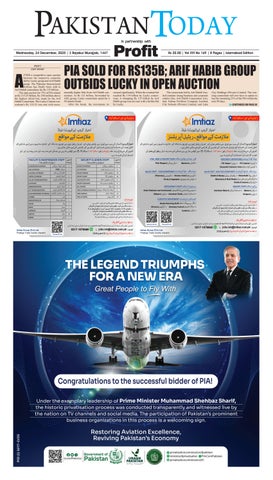
PIA SOLD FOR RS135B; ARIF HABIB GROUP OUTBIDS LUCKY IN OPEN AUCTION
Wednesday, 24 December, 2025 | 3 Rajabul Murajjab, 1447 PROFIT
staff report
FTER a competitive open auction between the respective consortia led by Lucky group and Arif Habib group. The Pakistan International Airlines has finally been sold to Arif Habib consortium for Rs 135 billion. The open auction for 75% of PIA started at Rs 115.25 billion, Rs 250 million above the highest initial bid, made by the Arif Habib Consortium. The Lucky Cement consortium’s Rs 115.25 was met with incre-
mentally higher bids from Arif Habib consortium. At Rs 121 billion, forwarded by AHL group, Lucky consortium opted for a 30 minute break. After the break, the increments in-
Profit
creased significantly. When the eventual bid reached Rs 134 billion by Lucky consortium. A whopping Rs 135 billion by Arif Habib group was not met with a further bid by Lucky.
Rs 20.00 | Vol XVI No 169 | 8 Pages | Islamabad Edition
The consortium led by Arif Habib Limited contains strong business and corporate entities like, Arif Habib Corporation Limited, Fatima Fertiliser Company Limited, City Schools (Private) Limited, and Lake
City Holdings (Private) Limited. The winning consortium will now have to option to buy the remaining 25% of the PIA within the next 90 days.
CONTINUED ON PAGE 03
02 NEWS
Wednesday, 24 Deceember, 2025 | ISLAMABAD
NAB to LEAd ACtIoN PLANS AddRESSINg vULNERABILItIES IN PAkIStAN’S hIgh-RISk PUBLIC INStItUtIoNS
t g
FUND REPORT HIGHLIGHTS CHALLENGES IN ANTI-CORRUPTION EFFORTS, URGES STRENGTHENING OF INSTITUTIONS, ENFORCEMENT MECHANISMS, AND JUDICIAL INDEPENDENCE the need for stronger enforcement, independence, and oversight in the country’s anti-corruption efforts. It highlights persistent gaps despite Pakistan’s established legal framework to prevent corruption. The UNCAC review, available on the Ministry of Law and Justice website in December 2025, noted that Pakistan’s treaties are not self-executing and must be incorporated into domestic law, but implementation remains inconsistent. The IMF’s second EFF report outlined several key concerns, including the lack of
Recorder reported, citing an IMF report. The decision, outlined in the second review of Pakistan’s Extended Fund Facility (EFF) and the first review of the Resilience and Sustainability Facility (RSF), comes as part of ongoing efforts to meet Pakistan’s anti-corruption goals under international frameworks. However, the names of the 10 agencies had not been disclosed. The report, which also referenced Pakistan’s United Nations Convention Against Corruption (UNCAC) review, emphasises
PROFIT
NEWS DESK
HE National Accountability Bureau (NAB) will spearhead the creation of action plans to address vulnerabilities within Pakistan’s public institutions, as part of a broader effort to reduce corruption risks in the country. This initiative focuses on the 10 government agencies identified as having the highest levels of risk, based on a recent institutional-level assessment, Business
Cnergyico Pakistan imports $300m worth of US crude oil
a formal monitoring and reporting mechanism for the national anti-corruption strategy. It also criticised the independence and resourcing of NAB and other anti-corruption bodies. The IMF urged Pakistan to strengthen institutional independence, ensure adequate resources for anti-corruption bodies, and improve conflict-of-interest management. In addition, the report stressed the importance of a robust public procurement system, judicial independence, and expanded public participation in decision-making.
ECC approves largest-ever spectrum auction, paves way for 5G rollout in Pakistan
PROFIT
g
NEWS DESK
Cnergyico Pakistan Limited, the country’s largest private-sector oil refinery, has imported $300 million worth of crude oil from the United States. The company secured four shipments of US-origin crude, totaling 4 million barrels, in a strategic initiative to bolster trade and energy security. According to a news report, two shipments, transported aboard MT Pegasus and MT Albany, have already arrived, delivering two million barrels that have been successfully processed at Cnergyico’s refinery. A third shipment, containing one million barrels of West Texas Intermediate (WTI) crude, is en route and expected to arrive by January 11, 2026. The fourth shipment, also with one million barrels, is slated for arrival by February 10, with the final loading arrangements underway. Usama Qureshi, Vice Chairperson of Cnergyico, stated that this initiative underscores the crucial role of the private sector in contributing to Pakistan’s economic goals. He added that enhanced trade with the US could ease tariff pressures on Pakistani goods, improve market access for exporters, and positively impact employment, industrial activity, and overall economic stability. From October 2025 to January 2026, Cnergyico plans to process only low-sulfur crudes, such as WTI and Bonny Light from Nigeria, emphasizing both economic and environmental performance.
ECC’S DECISION FOLLOWS CONSULTATIONS WITH STAKEHOLDERS; PTA TO INITIATE TELECOM OPERATOR NEGOTIATIONS POST-CABINET APPROVAL PROFIT
NEWS DESK
The Economic Coordination Committee (ECC), chaired by Finance Minister Muhammad Aurangzeb, on Tuesday greenlighted key recommendations for Pakistan’s largest spectrum auction, which will pave the way for the country’s first commercial 5G services. This approval follows the Spectrum Advisory Committee’s proposals after extensive consultations with stakeholders, including users, the Pakistan Telecommunication Authority (PTA), and a review of global spectrum pricing and auction standards. Federal Minister for Information Technology and Telecommunication, Shaza Fatima, emphasized that the decision clears a major policy hurdle, with the recommendations now set to go before the federal cabinet for final
has hindered service quality, with Pakistan’s 240 million people relying on just 274 MHz of spectrum, far below regional peers. The additional spectrum is expected to alleviate congestion, enhance 3G and 4G services, and introduce 5G for the first time. The PTA will impose rollout obligations on winning bidders, requiring network deployment within four to six months. The auction is part of Pakistan’s broader digital transformation plan under the Digital Nation Pakistan Act and the “Connect 2030” initiative, aiming for average internet speeds of 100 Mbps over the next five years and improved international connectivity rankings within three years. Fatima also revealed that the government has removed Right of Way charges to incentivize investment in fiber infrastructure, with only five percent of the country currently fiberized.
approval. Once approved, the PTA will issue an Information Memorandum to kick off formal discussions and negotiations with telecom operators. The government aims to complete the auction by the end of January or early February 2026. The auction will involve nearly 600 megahertz (MHz) of spectrum, in addition to the 274 MHz currently in use, making it the largest spectrum sale in Pakistan’s history. Notably, except for the 1800 MHz and 2300 MHz bands, all frequency bands will be auctioned for the first time. Minister Aurangzeb highlighted that the pricing and payment structures were designed with a “Pakistan-first” approach to balance fiscal needs and the telecom sector’s investment capacity. Addressing the country’s internet quality challenges, Fatima acknowledged that limited spectrum availability
Pakistan’s solar market holds $2.8b lending potential, but financial barriers persist
PSX remains range bound as cautious sentiment persists; PIA stake bids in focus
g A NEW STUDY REVEALS THAT PAKISTAN’S DISTRIBUTED SOLAR MARKET
REMAINS UNTAPPED DUE TO STRUCTURAL FINANCING CONSTRAINTS, DESPITE SIGNIFICANT OPPORTUNITIES IN MAJOR CITIES PROFIT
PROFIT
NEWS DESK
NEWS DESK
A new study released by Renewables First has highlighted that Pakistan’s distributed solar market holds an estimated Rs800 billion ($2.8 billion) in untapped lending potential across just three major cities. However, millions of households and small businesses remain excluded from this opportunity due to persistent structural financing barriers. The study reveals that, despite significant growth in solar adoption in the country, the benefits have been largely concentrated among affluent households and large businesses that can self-finance installations. Meanwhile, Pakistan’s banking sector, which holds around $131 billion in deposits, allocates only $50 billion for lending, with nearly 63% of banking assets tied up in government securities. According to the study, the perceived risk rather than actual risk is the primary barrier preventing banks from lending for solar installations. The report highlights the paradox of rising electricity tariffs, over 200% since 2012,
The Pakistan Stock Exchange (PSX) experienced a largely range-bound session on Tuesday, as investor caution kept the benchmark KSE-100 Index trading within a narrow band. The session opened on a positive note, but after midday, the market saw a gradual decline as profit-taking and cautious trading set in. The KSE-100 Index closed at 171,073.73, down by 130.44 points or 0.08%. Investor attention was focused on the ongoing bidding process for a 75% stake in PIA, with three consortia submitting sealed bids to take control of the national carrier. On the previous day, the market had already faced pressure as the roll-over week dampened investor sentiment, resulting in a volatile session where the KSE-100 Index dropped by 200.31 points, or 0.12%, to settle at 171,204.18 points.
against the backdrop of a 73% reduction in solar panel costs since 2017, which has made solar energy a cost-effective solution for many. However, small and medium-sized enterprises (SMEs) and households, who spend a large portion of their income on energy, face challenges in accessing solar financing due to banks’ rigid collateral requirements. The study also points to an advances-to-deposits ratio below 40% in banks, which are demanding double collateralization for solar loans, despite solar portfolios showing default rates of under 2%, far lower than the over 10% default rates for traditional SME loans. The study also proposed several financing models to address the gap, such as anchor-based financing, vendor-linked financing, and securitization of solar loan portfolios. However, it pointed out the lack of credit bureaus for informal borrowers and the need for standardized documentation for small loans. Experts suggested that battery energy storage systems could be the next phase of innovation for the solar market, building on the momentum of distributed solar.
SNGPL warns Liberty Daharki Power of gas supply suspension over Rs20 billion in unpaid dues PROFIT
NEWS DESK
Sui Northern Gas Pipelines Limited (SNGPL) has issued a final warning to Liberty Daharki Power Limited (LDPL), demanding the clearance of Rs20 billion in outstanding dues, or it may face a suspension of gas supply, Business Recorder reported. In a formal notice sent to LDPL’s CEO, SNGPL referred to prior communication on November 18, 2025, highlighting the company’s failure to adhere
g
SNGPL URGES LIBERTY DAHARKI POWER TO CLEAR OVERDUE DUES, THREATENING SUPPLY DISRUPTION DUE TO NON-PAYMENT OF RS20 BILLION BY DECEMBER 9, 2025
to the agreed payment schedule. As of December 9, 2025, the accumulated dues stood at Rs20.029 billion, which far exceeded the cash security deposit of Rs3.085 billion held by the gas utility. SNGPL outlined the overdue amounts, which include Rs17.812 billion in gas arrears, Rs2 billion in unpaid upfront payments, and additional unpaid in-
stalments and bills from the period June to October 2025. The gas utility stressed that LDPL had missed five instalments, with a total shortfall of Rs7.297 billion. Furthermore, the November 25, 2025 gas bill of Rs1.92 billion remains unpaid, alongside the sixth instalment, due on December 10, 2025, under the existing payment plan. According to the gas supply con-
tract, LDPL is obligated to clear all invoices within 30 days. SNGPL has warned that, in the event of non-payment, it will exercise its right to suspend gas supply to the power plant after a seven-day notice. The power plant is urged to settle the outstanding dues promptly, as SNGPL has reiterated that any delay could lead to an immediate suspension of gas supply.
On asset recovery, the IMF’s review acknowledged Pakistan’s legal frameworks but called for better utilisation of international cooperation mechanisms and digitalisation of asset declarations. The report also recommended introducing non-convictionbased confiscation and strengthening the verification process for asset declarations. The ongoing reform process is expected to improve Pakistan’s anti-corruption infrastructure, although significant challenges remain in overcoming institutional weaknesses and gaps in enforcement.
IFC signs Rs 33.6b guarantee to boost Engro Fertilizers and Pakistan’s agri finance landscape PROFIT
NEWS DESK
The International Finance Corporation (IFC), Standard Chartered Bank Pakistan, and Engro Fertilizers have collaborated on a financing arrangement designed to mobilize long-term local lending for Pakistan’s agriculture sector. The deal involves an unfunded partial credit guarantee of up to PKR 33.6 billion from IFC, which reduces credit risk for Standard Chartered as it provides long-tenor rupee financing to Engro. This innovative mechanism aims to lower borrowing costs for Engro, which will use the funds for capital expenditures, including plant maintenance, and ensure stability in urea supply during peak agricultural demand. The arrangement is significant as it marks IFC’s first localcurrency investment in Pakistan, allowing Engro to secure long-term financing without the need for foreign-currency debt, a key benefit given the current volatility in exchange rates and external financing conditions. The financing structure is also supported by the IFC-Canada Facility for Resilient Food Systems, which absorbs initial risk, making the arrangement more attractive to commercial lenders. While the deal does not address broader structural issues in Pakistan’s agriculture, such as inefficient logistics or low productivity, it demonstrates the potential of risk-sharing tools to attract domestic capital for long-term infrastructure investment. Market analysts expect similar financing models to become more common as local-currency financing gains favor over foreign debt in the current macroeconomic climate.
PPL announces hydrocarbon discovery at LAL X-1 well in Sindh PROFIT
NEWS DESK
Pakistan Petroleum Limited (PPL) announced on Tuesday a significant hydrocarbon discovery from its exploratory well LAL X-1, situated in the Kashmore district of Sindh. This discovery, shared through a notice to the Pakistan Stock Exchange (PSX), marks the first unconventional gas find from the Lower Alabaster Formation in the Kandhkot Development and Production Lease (D&PL), where PPL holds a 100% working interest. The unconventional gas was found trapped in tight rock formations, such as shale or sandstone, requiring advanced extraction techniques like hydraulic fracturing (fracking) and horizontal drilling. The LAL X-1 well, spudded on June 30, 2025, reached a depth of 1,408 meters to assess the hydrocarbon potential of interbedded limestone beds within the Lower Alabaster Formation. During post-completion testing, the well flowed at a rate of 0.138 MMscfd gas at a wellhead flowing pressure of 33 psig with a 64/64” choke. PPL confirmed that the well’s results indicate significant hydrocarbon potential in the formation. However, the commercial viability of the find will be determined through post-well analysis and further exploration. Last month, PPL also announced the discovery of hydrocarbon reserves from its well Sawan North Deep-1 ST-1 (SND-1 ST-1) in Khairpur, Sindh.
Senate panel flags delays in pre-shipment testing, seeks FIA report on Rs135b Quetta petroleum scam ISLAMABAD NEWS DESK
The Senate Standing Committee on Science and Technology on Monday expressed concern over delays in implementing pre-shipment testing at borders and directed the Federal Investigation Agency (FIA) to submit a response within 10 days on the Rs135 billion hazardous petroleum products scandal in Quetta. The committee, chaired by Senator Kamil Ali Agha, was informed that while the federal cabinet has approved pre-shipment testing, the operational mechanism has yet to be finalised. Federal Minister for Science and Technology Khalid Hussain Magsi said consignments should be cleared within 15 to
25 days once testing begins, noting that delays could cause financial losses and health risks, particularly for sensitive materials. Members cautioned against prolonged detention of consignments. The committee was also briefed on the smuggling of substandard betel nut (supari) and gutka through sea and land routes. Members warned that spoiled supari and gutka pose serious public health risks, including cancer. Senator Dr Afnan Ullah Khan called for a complete ban on gutka, while the chairman of the Pakistan Council of Scientific and Industrial Research (PCSIR) stressed the need for stringent checks at the supply stage to prevent illegal consignments from reaching factories and consumers.
On the Quetta petroleum scandal, the secretary of the Ministry of Science and Technology said investigations had been completed. Disciplinary proceedings were initiated against two serving officers, while cases against two retired officers were referred to the FIA on October 15. The committee voiced concern over delays and sought a time-bound response from the FIA. Members raised issues regarding weak enforcement by the Pakistan Standards and Quality Control Authority (PSQCA), alleging that inspections often lead to clearance rather than action against illegal materials. The committee was informed about adulteration in spices such as turmeric and the presence of harmful substances in products like kohl (surma).
Briefing the committee on institutional reforms, Chairman Pakistan Engineering Council (PEC) Engineer Waseem Nazir said all transfers were made on merit and “Smart PEC” initiatives had been launched. Digital services, developed with NADRA, now allow online registration and issuance of engineering cards, while entire university batches are being registered online. He said PEC has trained 15,000 engineers under a generative artificial intelligence programme, with a target of 45,000, and will launch a Chartered Project Directors course in March–April 2026. Mutual recognition agreements have been signed with China, with similar accords planned with Kuwait and Saudi Arabia. A Graduate Engineer Trainee Programme offering six-month paid
training with a monthly stipend of Rs50,000 has also been launched. The committee also discussed mandatory testing of solar panels. Officials said a Korea-assisted laboratory would soon become operational, capable of conducting 46 tests. Members warned that the influx of substandard solar panels, inverters and batteries poses environmental and consumer safety risks. PSQCA officials said standards for food, non-food and electrical items were being enforced, with licenses suspended or cancelled in case of violations. They added that nicotine testing standards had been introduced and clarified that tea whitener meets PSQCA standards, has no nutritional value, and does not pose health risks within approved limits.
news 03
FINANCE MINISTRY REVISES STANCE ON THIRD-PARTY AUDIT FOR TCP LOANS
wednesday, 24 December, 2025 | IsLAMABAD
T
g
MINISTRY SUGGESTS THAT TCP CONDUCT AUDITS ONLY FOR DISPUTED AMOUNTS BETWEEN THE CORPORATION AND THE RELEVANT ENTITIES PROFIT
staff report
HE Ministry of Finance (MoF) has decided to revise its earlier stance on a third-party audit of loans raised by the Trading Corporation of Pakistan (TCP) from commercial banks. Instead of a comprehensive audit, the ministry
has now suggested that TCP conduct audits only for disputed amounts between the corporation and the relevant entities, BR reported. Currently, TCP is paying approximately Rs143 million daily in interest on loans taken for the import of wheat, sugar, and fertiliser. This is due to non-payment by the Utility Stores Corporation (USC), National Fertiliser Marketing Limited (NFML), and the Pakistan
Agricultural Storage and Services Corporation (PASSCO). According to official data, TCP is incurring Rs48.5 million daily in interest on Rs73.7 billion receivables from USC, Rs63.84 million on Rs97 billion from NFML, and Rs30 million on Rs46 billion from PASSCO. In its latest communication, the Finance Ministry acknowledged TCP’s position and agreed to reconsider the need for a full audit, stating that a third-party audit would be required only for disputes related to quantities of goods supplied or received. In such cases, either mutual reconciliation would be conducted by TCP and the recipient agencies or a third-party audit would be carried
‘Promise fulfilled’: PM hails PIA privatization as milestone for ‘economic overhaul’ ISLAMABAD
staff report
Prime Minister Muhammad Shehbaz Sharif on Tuesday congratulated the nation on the successful conduct of bidding for the privatization of 75% shares of Pakistan International Airlines (PIA), terming the process a landmark achievement and reaffirming the government’s commitment to transparency, economic reform, and strengthening investor confidence. He described PIA’s privatization as a crucial milestone in the broader agenda of reforming state-owned enterprises and stabilizing the national economy. “Upon assuming office, I had promised the nation that steps would be taken for the privatization of state-owned enterprises; this process of PIA’s privatization is a very important milestone in this regard,” the prime minister said in a statement issued by the Prime Minister’s Office (PMO). He added that, “By the grace of Allah, the bidding process was extremely transparent,” emphasizing that privatization of PIA and other state-owned enterprises would play a pivotal role in restoring investor confidence and further stabilizing the economy. The prime minister credited the smooth conduct of the process to the cooperation
of all state institutions and commended the efforts of Deputy Prime Minister and Finance Minister Ishaq Dar, Chief of Army Staff and Chief of Defence Forces Field Marshal Syed Asim Munir, Defence Minister Khawaja Asif, Adviser on Privatization Muhammad Ali, the Privatization Commission, and other relevant officials. He underlined the government’s determination to ensure national development, prosperity, and public welfare through strategic engagement with the private sector. Earlier on Tuesday, a special meeting of the federal cabinet, chaired by PM Shehbaz Sharif at the Prime Minister’s House, formally endorsed decisions taken by the Cabinet Committee on Privatization regarding PIA. The cabinet reiterated its commitment to transparency, political dialogue, and economic reform, while offering prayers for the smooth and successful completion of all stages of the privatization process, a PMO statement said. Addressing cabinet members, the prime minister stressed that the PIA privatization would be conducted in a transparent, credible, and reliable manner, with all stages of the bidding process broadcast live on television. He explained that sealed bids would be placed in see-through boxes, envelopes opened only after price determi-
nation, and awards made to the highest bidder through a competitive process. “This is one of the largest financial transactions in Pakistan’s history, and therefore the entire process must be transparent and credible,” he added, noting that the results would be brought back to the cabinet for final approval. PM Shehbaz also praised the active participation of the relevant ministries and cabinet members in advancing the privatization agenda, particularly highlighting the roles of the deputy prime minister, finance minister, and defence minister. He described the day as significant for PIA’s future and expressed confidence that a transparent process would not only improve economic management but also strengthen private-sector confidence in Pakistan’s reform agenda. The prime minister reaffirmed the government’s commitment to peaceful dialogue with all political parties, stressing that national development, prosperity, and political harmony were contingent on collective engagement. He made clear, however, that no attempts to disrupt law and order under the guise of political dialogue would be tolerated. “Dialogue can only move forward on the basis of legitimate demands and constitutional principles,” he said, highlighting the importance of political stability for Pakistan’s progress. In addition to
PIA-related deliberations, PM Shehbaz Sharif congratulated the nation on Pakistan’s victory in the Under-19 cricket championship, calling it a moment of national pride. He also highlighted the recent conferment of the King Abdulaziz Award on Pakistan’s field marshal in Saudi Arabia, noting that the honour reflected the country’s collective dignity rather than individual recognition. The federal cabinet also approved several key policy and legislative measures. On the recommendation of the Petroleum Division, the cabinet extended the Off-Grid Power Plants Levy Act 2025 to include the sale of gas to captive power plants by third parties. To modernize procurement, amendments to the Public Procurement Regulatory Authority (PPRA) Ordinance 2002 were approved, aligning tendering and procurement processes with contemporary requirements. Other approvals included the repeal of the National University for Security Sciences Islamabad Bill 2025, establishment of a committee to ensure effective consultation on private members’ bills in the National Assembly, and the National Cannabis Control and Regulatory Policy 2025, promoting regulated use of plantbased resources in the pharmaceutical and textile sectors.
PIA sold for Rs135b; Arif Habib group outbids Lucky in open auction CONTINUED FROM PAGE 01
The Bidding Process:Earlier, the sealed bids for the sale of 75% stake in PIA were opened and minimum expected price of the government was revealed at the public event held in Islamabad. The bidding for the national carrier was then supposed to go into open auction. Starting at a high, the initial bid price offered by Lucky Cement consortium, was Rs 101.5 Billion. The bid price offered by Air Blue, was a significantly low Rs 26.5 billion. Meanwhile, Arif Habib consortium took the cake in initial bids by bidding Rs 115 billion for the national carrier. Meanwhile the minimum expected price of the government, as approved by the Cabinet Committee on Privatisation (CCOP), was Rs 100 billion. The bidding process then entered an open auction phase, wherein the base price was set at Arif Habib’s Rs 115 billion and minimum increment set at Rs 250 million. The opening of bids happened at a revised time of 4:30 pm. The submission and opening of bids scheduled for today, December 23, 2025, will decide the fate of the national carrier, which has long been a subject of political debate and financial strain. The federal cabinet had also formally endorsed the recommended reference price for 75% of PIA, set by the Privatisation Commission Board. Earlier, the three consortia, led by Lucky Group, Air Blue, and Arif Habib Limited, respectively, submitted their sealed bids to acquire control of PIA. The bids were initially scheduled to be opened at 3:30 pm, but the timing was later revised to 4:30 pm, with the process set to be broadcast live for transparency. Following the submission of bids, the matter was referred to the Privatisation Commission and CCOP for consideration of the minimum expected price for the divestment of PIACL. If more than one bid exceeded the reference price, an open auction was to take place. The Privatisation Commission emphasized that today’s bidding process is designed with transparency, efficiency, and responsibility, aiming to build public trust and ensure fairness and accountability in the privatization of PIA. After years of failed attempts, PIA’s privatisation is now at a critical juncture, and the pressure is mounting as the clock ticks toward the deadline. Muhammad Ali, confirmed in a recent interview that the Fauji Foundation, a key player in the bidding, had withdrawn from the race, leaving three bidders to compete for the 75% stake in PIA. The push for privatising PIA has been ongoing for over a decade, with successive governments attempting to streamline operations and reduce the na-
tional carrier’s massive losses. PIA’s financial woes are well documented. The airline has accumulated staggering debts, and for years, it has been struggling with negative cash flow, mounting liabilities, and an underperforming fleet. The government has previously taken steps to address the airline’s issues by restructuring its debt and offloading bad assets into a holding company, but has neither been able to turn it around , nor been able to sell it off. Despite repeated efforts, political hurdles, bureaucratic delays, and strong opposition have repeatedly derailed the process. However, the tables have turned this time, and the latest round of privatisation is seen as a critical step towards resolving the airline’s financial crisis and boosting Pakistan’s aviation sector. The government has finally been able to find buyers for the national carrier. The current bidders include two major consortia and one independent airline. The first consortium is led by Lucky Cement Limited, Hub Power Holdings Limited, Kohat Cement Company Limited, and Metro Ventures (Private) Limited, while the second consortium consists of Arif Habib Corporation Limited, Fatima Fertiliser Company Limited, City Schools (Private) Limited, and Lake City Holdings (Private) Limited. The third bidder is Air Blue (Private) Limited, which is competing independently. M. Ali stated, “Bidders can add a maximum of two more entities in their consortium after winning the bid. The condition is stringent. It could be a leading and strong local group, or otherwise an international airline.” PIA currently operates 18 out of a fleet of 34 aircraft and has air service agreements with 97 countries. The airline also holds landing rights in more than 170 countries, making it an attractive proposition for the right bidder. The winner of the privatisation bid will acquire a 75% stake in PIA, with the government retaining the remaining 25%. Of the proceeds, 92.5% will go to PIA, while the remaining 7.5% will be transferred to the national exchequer. The successful bidder will also have the option to acquire the remaining 25% of the airline after the transaction is finalised, although this decision must be made within 90 days of the deal’s completion. As revealed by Muhammad Ali, 2 of the initial four bidders wanted to bid for the entire 100% of the airline. The bidders will also need to deposit two-thirds of the bid amount within 90 days, with the remaining one-third payable within one year. The government has structured the deal to ensure that no asset owned by PIA, such as its real estate, is included in the transaction. This ensures that the privatised airline can focus on its aviation business without being weighed
down by non-core assets. Has Fauji Foundation actually exited? Many may find the withdrawal of the Fauji Foundation from the bidding process as a surprise. But to those who have followed the pre-bidding drama of PIACL, it does not seem odd. The foundation, as is well-known, is a very powerful conglomerate, with interests spanning across various sectors. It meets the necessary bidding criteria and had initially shown strong interest in acquiring PIA. However, its exit from the bidding process has the potential of being construed as such. Concurrently, Muhammad Ali, in an interview, clarified that Fauji Foundation’s exit does not signal a lack of interest, hinting at the possibility of a post-bidding merger with the successful bidder. A repeated mention by the government of consortia being allowed to add entities to their consortium, postbidding, also points towards this likely possibility. It was important to note that while all the consortia’s openly did not want to join hands with each other, with the Lucky group going as far as rejecting a joint-venture proposal pitched by Arif Habib Group at a PM-led meeting last week, there was but one company that all the bidders wanted on their side. The erstwhile Fauji Foundation, a charitable trust that supports the welfare of martyrs and ex-servicemen. This sets the stage for an intriguing development where Fauji might still become a player in PIA’s future, albeit not directly through the privatisation process, but joining any of the players who might win the bid. The Airline’s Debt and Liabilities and Key Considerations for the Winning Bidder While the bidding process may seem straightforward, potential buyers will need to grapple with PIA’s immense financial challenges. PIA’s negative equity is a major concern. As of June 2023, the airline’s liabilities totaled over Rs 825 billion, and its negative equity had ballooned to Rs 649 billion. The government has addressed this by creating the PIA Holding Company, which will absorb the majority of the airline’s bad debts, but the remaining liabilities of Rs 26 billion will stay with PIA and be paid off over five years. With the debt restructured, the successful bidder will have the chance to operate a leaner airline, with a reduced burden of liabilities, but the restructuring also includes a provision to allow banks to renegotiate the deal if the privatisation does not occur within the next three years.
For the winning bidder, the main attraction lies in the opportunity to revamp PIA’s operations while inheriting its vast network of routes and established market presence. The airline’s international and domestic routes, as well as its brand recognition, make it a prime candidate for expansion. Moreover, the government’s efforts to restructure PIA’s debts make it a more manageable investment than it would have been just a few years ago. However, the process will not be without challenges. The new owner will need to address PIA’s legacy issues, including its tarnished reputation, inefficient operations, and high overhead costs. The airline’s workforce, once bloated with over 11,000 employees, has already been reduced to 6,500, but labor concerns will remain a crucial issue. The privatisation terms include protections for employees, ensuring no layoffs for one year and securing their pensions and benefits. And by far the biggest consideration to keep in mind is airline’s financial history. The sole reason for why the state has been adamant on selling it. While the new entity formed as a result of restructuring PIA’s debts, to make it a more attractive asset, brings in a different set of considerations; the operational efficacy of the airline is thoroughly captured by a decade of financial rot. PIA’s financial position between 2017 and the first half of 2023 shows persistent operating stress, reflected in consistently negative operating cash flows and a steadily widening equity deficit. Cash-flow data indicates that the airline generated negative operational cash flows in every year from 2017 to 2022; ranging between Rs 22 billion and Rs 24 billion, annually. In the first half of 2023, operating cash flow briefly turned positive at Rs 15 billion, but this came alongside a sharp rise in financing and investment outflows. Over the full period, operating deficits were largely financed through continued borrowing, shown by the consistently large financing inflows: Rs 33 billion in 2017, Rs 32 billion in 2018, Rs 19 billion in 2019, Rs 31 billion in 2021, and Rs 4 billion in 2022.
out on a need basis. The Finance Ministry also highlighted concerns regarding TCP’s outstanding receivables, noting that formal memoranda of understanding (MoUs) between TCP and the recipient agencies were lacking, especially with regard to the payment of mark-up on delayed payments. The Ministry has tasked the Ministry of Commerce to review and resolve these issues with the relevant stakeholders. Earlier in August 2025, the Finance Ministry expressed concerns about the high interest rates on loans secured by TCP from commercial banks and recommended a third-party audit.
CDF Field Marshal Munir warns against ‘subtle tactics’ employed by hostile actors RAWALPIND
Istaff report
Chief of Defence Forces (CDF) and Chief of Army Staff Field Marshal Asim Munir on Tuesday warned of “indirect and ambiguous approaches” employed by actors hostile to Pakistan, including the use of proxies, stressing that future leaders must be trained and remain alert to recognize, anticipate and counter such multi-layered cognitive challenges, said the military’s media wing.According to a statement by the Inter-Services Public Relations (ISPR), the CDF was briefed by civil and military participants of the ongoing national security and war course about their academic perspectives on challenges to national security during a visit to Islamabad’s National Defence University (NDU). “The field marshal highlighted that hostile elements increasingly employ indirect and ambiguous approaches, including the use of proxies to exploit internal fault lines, rather than overt confrontation,” the ISPR said. According to the ISPR, the field marshal outlined the complex and evolving global, regional and internal security environment, noting that Pakistan faces broad and persistent challenges in multiple domains. “He noted that these challenges span conventional, sub-conventional, intelligence, cyber, information, military, economic and other domains, requiring comprehensive multi-domain preparedness, continuous adaptation and synergy amongst all elements of national power,” the statement read. Field Marshal Munir also highlighted that clear decisionmaking amid uncertain conditions and mental resilience are critical for operating in today’s contested and diffused security environment. He also lauded NDU’s role in developing strategic thinkers capable of translating rigorous training and academic insight into effective policy formulation and operational outcomes. The field marshal “underscored that professional military education remains central to strengthening institutional capacity, fostering indigenous capability, and ensuring long-term national resilience,” the statement added. He also appreciated the panel’s analysis and conclusions, urging students to “remain vigilant, adaptive, and steadfast in upholding the values of integrity, discipline and selfless service.”
Commerce ministry pushes for Gems Authority to address supply issues in Pakistan’s gemstone sector PROFIT
staff report
The Ministry of Commerce has called on the National Assembly Standing Committee on Commerce to facilitate the creation of a new Gems Authority aimed at addressing the growing challenges within Pakistan’s gemstone sector, Business Recorder reported. This proposal comes after the Competition Commission of Pakistan (CCP) highlighted the absence of proper regulatory oversight and widespread undocumented activities in the market. Currently, the Trade Development Authority of Pakistan (TDAP) handles market development and trade facilitation for gemstones. However, supply-side issues such as exploration and extraction fall under the jurisdiction of the Petroleum Division. The Ministry of Commerce has therefore requested that the Petroleum Division develop a comprehensive plan for the establishment of the Gems Authority, which would focus on regulating the sector from exploration to trading.
04 COMMENT
The challenge of the Christmas story
Wednesday, 24 December, 2025
Power problems
N
Moves against solarization coming again
EPRa has proposed switching the present net metering offered to solar power producers who have retained their grid connections to gross metering, and that the tariff offered to these producers should come down to Rs 11.30 per unit. Presently, the amount paid to consumers is set off against their bill the very same month, based on the units consumed. the new system might allow for a lag in billing, which one can be sure will not be exploited by the consumer. the tariff offered to the consumer is to be good for five years, following which there could be an enhancement. all that is being done is to make it more feasible for the consumer to turn to a storage solution, which would allow him independence of expensive grid electricity, at present, solar power consumers may stay on the grid because they want the back-up provided for times the sun is not out (like the night-time), but storage solutions are becoming more easily available. they no longer cost an astronomical sum, and despite their maintenance issues, will begin to look more feasible the higher the tariff that the DiScos charge. WaPDa, the DiScos and the Power Division seem to be persisting in the mistake they made when solar power first started gaining traction. they did not seem to realize that consumers were making the switch because it was economically beneficial. true, solar power is not dependable, especially in winter or in the monsoon, but once the storage problem is licked, the present high tariffs will drive consumers away. instead of behaving competitively, and lowering tariffs so that only dedicated environmentalists (of which there is shortage inPakistan) opt for solar power, NEPRa and the rest try to use main force, in the shape of solar buyback tariffs, to force the consumer into an inequitable arrangement. the pity of it all is that this insistence of grid power is keeping up the import bill. Prime Minister Shehbaz Sharif has stressed the need to lower tariffs for industry to the level prevailing throughout the region. there is thus an urgent need to move away from expensive thermal energy to cheap renewables (which have no import costs). So far, industries have not opted for solar power in a big way. the DiScos need to lower tariffs before there is an exodus off the grid of industrial consumers, which have been forced for economic rather than environmental reasons.
C
The true meaning of the Nativity
WaShinGTOn WaTCh Dr JameS J ZOGby
atholic churches have traditionally erected Nativity scenes outside at christmas time. to represent the birth of Jesus, the scenes include the baby, his mother and father, Mary and Joseph, together with the shepherds, their animals, and the “wise men from the East” who came to witness the birth. Despite the fact that the story is rich in meaning and symbolism, these Nativity scenes have been stripped of their deeper meaning and have become quite two-dimensional and shallow. like the anodyne carols that have come to define the season, the portrait of the birth that emerges is “peaceful,” “calm,” and “bright.” there is no hint of the oppressive Roman occupation that forced this couple to travel across the country to register in a new census mandated by the empire. Nor is there a recognition of the many ironies underlying the story: that this Jewish baby, who is to be a savior, is born in a cave surrounded by animals, or that the first to come to pay homage are lowly sheep herders and non-Jewish travelers from afar. in fact, it is these various ironies and others like them that truly define the biblical christian narrative. it is, in reality, an upside-down faith. in Jesus’ own words, it is a faith where the first shall be last and the last shall be first. it is meant not for the rich, the satisfied, and the powerful. Rather it is first intended for the poor, the hungry, the downtrodden, and the rejected. and it is for those who recognize this and who therefore commit themselves to serving “the least of these.” With this in mind, it is fascinating to see how in recent years some christians have taken to reclaiming the challenge inherent in their faith. Just two years ago a Palestinian clergyman in Bethlehem replaced the stable in the Nativity scene with rubble in order to portray what was unfolding in Gaza. his setting of “Jesus in the rubble” eloquently told the story of the Palestinian people: vulnerable, stripped of their humanity, and subjected to indignities. as if to more deeply develop this identification, last year, Pope Francis was shown in quiet prayer before a manger scene in which the baby Jesus was wrapped in a Palestinian keffiyeh. in somewhat the same vein, this year, a catholic community in Massachusetts, given the threats faced by migrants and refugees in the USa, found their own deeper meaning in the christmas story. in the Nativity scene they erected outside their church, there is no Jesus, Mary, or Joseph. instead, there is a sign noting that because of concern that icE (the immigration enforcement police) would be conducting one of their raids, the family had gone into hiding and was
Dedicated to the legacy of late Hameed Nizami
Arif Nizami (Late) Founding Editor
Two nations, one struggle M. A. Niazi
Babar Nizami
Editor Pakistan Today
Editor Profit
T
Pakistan and Bangladesh reclaim a shared historical truth Tariq Khan Tareen
hE assertion that the two-Nation theory has been rendered obsolete is not merely a misreading of history; it is an exercise in intellectual complacency. its core proposition— that Muslims of the subcontinent constitute a distinct political, cultural, and civilizational community— has endured across time, geography, and political upheaval. Despite repeated attempts to suppress or caricature it, the theory continues to assert itself in lived realities across South asia. the evolving posture of Bangladesh, reclaiming its historical narrative amid persistent external interference, underscores that the two-Nation theory was never buried in 1971; it was merely obscured by expedient storytelling. Pakistan and Bangladesh are siblings shaped by a common crucible of history— colonial exploitation, hindu majoritarian domination, and the struggle for dignity and self-rule. their separation did not negate the two-Nation theory; it exposed the perils of centralized power that ignored regional voices and democratic pluralism. language differences, while politically instrumentalized, never erased shared faith, values, and aspirations. Rather, they highlighted the necessity of respecting diversity within unity. today, as separate nation-states, Pakistan and Bangladesh remain bound by civilizational ties, people-to-people connections, and a shared experience of resisting domination. Brotherhood is not measured by borders alone; it is sustained through common struggles and mutual respect. india’s enduring discomfort with this reality explains its persistent interference in Bangladesh’s internal affairs. a stable, sovereign Bangladesh that asserts an independent foreign policy and reconnects with its Muslim identity challenges New Delhi’s baselessly constructed narrative that 1971 permanently interred the two-Nation theory. For decades,
india has sought to freeze history at a convenient moment, portraying Bangladesh’s independence as proof of ideological failure rather than as a complex outcome shaped by regional inequities and external machinations. that narrative is now fraying as Bangladesh revisits its past without indian mediation. New Delhi’s strategy has been consistent and calculated: political engineering, media influence, economic pressure, and selective diplomacy— an unvarnished carrot-and-stick policy designed to keep Bangladesh within a narrow strategic orbit. Whenever Dhaka asserts autonomy, questions indian intervention, or recalibrates its historical understanding, it is swiftly labeled “unstable.” this branding is not concern; it is coercion by narrative. the objective is clear— to manufacture uncertainty and deter independent decision-making. india fears a Bangladesh that refuses to be a junior partner, that engages Pakistan without preconditions, and that remembers history on its own terms. attempts to influence Bangladesh’s politics and frame internal dissent as security threats are not acts of regional stewardship; they are instruments of control. Sovereignty diluted by pressure is sovereignty denied. Such tactics aim to ensure that Bangladesh’s independence remains conditional, tethered to indian preferences rather than Bangladeshi interests. the warmth between Pakistanis and Bangladeshis— rooted in shared faith, cultural
seeking sanctuary inside the church. there are reports of other similar efforts by churches to capture the challenge of the christmas narrative— with references to icE, the detention of immigrants, and the mistreatment of immigrant children figuring prominently in many of these portrayals. in the case of the Massachusetts church, catholic leaders in the state rebuked the church in question, accusing them of playing politics. the Nativity scene, they said, was to provide opportunities for quiet prayerful reflection, not divisive politics. What these church leaders miss, of course, is that if they strip the birth story (and, one might add, the rest of the biblical narrative and for that matter the rest of the New testament and the many radical injunctions Jesus gives to his followers) of its essential content, then it is they who are playing divisive politics. By not grounding the Nativity in its real-world context, there is the danger that the “contemplative prayer” the leaders are advocating can become shallow and contentless. after all, the writers of the biblical stories had a point to convey. they weren’t just painting a pretty picture to someday appear in pastel tones on a holiday card. there are reasons why the child was born in a
cave and first welcomed not by the high priests but by the lowest and foreigners. Why, in the face of repression, his parents had to take him and flee into Egypt. and why, as he grew, he made every effort to challenge the stale and corrupt religious hierarchy of his day, providing his followers with a challenging message of service to the rejected, the vulnerable, and those in need. Every year around this time, our mailboxes are filled with mostly brightly decorated holiday greeting cards. about a decade ago, i was shocked to open one from a friend in lebanon. it featured the anguished and dirtied face of a young boy in a tattered t-shirt staring out from behind a wire fence. inside it read “holiday Greetings.” at first, i was confused. “Why this card, with this incongruous message? and why now?” after reflection, i realized that the plight of this young Syrian refugee, forced to flee his homeland, and now trapped in a camp living in squalor, hungry and dirty, is the perfect image to convey the meaning and challenge of the christmas story. that story wasn’t written to give comfort to the rich, powerful, and clean. it was to give hope to the destitute and the powerless. and to challenge the rest of us to recognize that. The writer is President, Arab American Institute
I realized that the plight of this young Syrian refugee, forced to flee his homeland, and now trapped in a camp living in squalor, hungry and dirty, is the perfect image to convey the meaning and challenge of the Christmas story. That story wasnÊt written to give comfort to the rich, powerful, and clean. It was to give hope to the destitute and the powerless. And to challenge the rest of us to recognize that.
Editor’s mail
affinities, and mutual empathy— is perceived in New Delhi as a strategic threat. People-to-people goodwill defies managed estrangement. it undermines the premise that these brotherly nations must remain apart, suspicious, and severed by curated histories. Yet this affinity persists, resilient and organic, precisely because it is not manufactured by states but sustained by societies. Efforts to destabilize Bangladesh through conspiracies and targeted violence will not succeed. Such designs, including the recent killing of student leader osman hadi, starkly signal attempts to foment fear and fracture social cohesion. history, however, offers a lesson india seems unwilling to heed: coercion breeds resistance, not compliance. Bangladesh’s trajectory toward sovereign self-definition cannot be derailed by intimidation or subterfuge. With firm support from Pakistan and a shared resolve against hindutva-driven interference, Pakistan and Bangladesh are poised to corner an ideology that thrives on division and dominance. hindutva’s mechanization of state power—exported through proxies, pressure, and propaganda—stands exposed as an anachronism in a region yearning for equitable coexistence. the two-Nation theory has not only succeeded; it endures as a living framework of identity and solidarity. as Pakistan and Bangladesh reaffirm their bonds, they do so not to relitigate the past, but to secure a future anchored in dignity, sovereignty, and mutual respect—two nations, one enduring struggle. The writer is a freelance columnist
The Two-Nation Theory has not only succeeded; it endures as a living framework of identity and solidarity. As Pakistan and Bangladesh reaffirm their bonds, they do so not to relitigate the past, but to secure a future anchored in dignity, sovereignty, and mutual respect·two nations, one enduring struggle.
Send your letters to: Letters to Editor, Pakistan today, 4-Shaarey Fatima Jinnah, Lahore, Pakistan. E-mail: letters@pakistantoday.com.pk Letters should be addressed to Pakistan today exclusively
On the brink
it is quite clear that the main opposition party in Pakistan is currently passing through one of the most critical and challenging phases of its political journey. the incarcerated leader has been behind the bars on corruption charges. he is still facing cases in which hearings and bail petitions often remain pending for months. Restrictions on meetings and the exchange of harsh statements have further intensified political and institutional tensions in the country. his sister’s recent media talks, including the ones with some indian news channels, followed by a stern and charged press conference by the army spokesperson, clearly reflect the widening gulf between the state and the party. in such an atmosphere, bitter exchanges and avoidable allegations not only damage national unity, but also negatively impact Pakistan’s international image. the party’s social media networks, their irresponsible narratives, and the rather provocative interpretations by certain partisan journalists and Youtubers are further complicating the situation, putting both the party’s internal discipline and its political future at risk. at this juncture, Pakistan clearly needs reconciliation more than confrontation. Responsible elements within the party leadership must step forward and open the door for dialogue with state institutions to prevent the political system from descending into further turmoil. HAYAN AHMED KHAN ISLAMABAD
Distracted, not slow
SloW-MoviNG cars are a new nuisance on the roads of lahore, creating an uncertain situation for the other vehicles commuting on the road. Using mobile phones while driving is supposed to be a violation, but careless drivers use social media and watch reels and videos while driving. they are totally unaware of traffic lanes and the speed of their vehicles. traffic police need to seriously monitor this issue. there should be zero tolerance on usage of phones while driving cars as this can lead to serious accidents and loss of lives. DR MAJID RAUF AHMAD LAHORE
When school runs long
thE Punjab government has prescribed teaching hours for all schools in the province from 8.30am to 1.30pm. however, some private schools have set their timings from 8.30am to 2.40pm. children who travel 20-25km to their school have to leave home early and wake up earlier to get ready. closure at 2.40pm means it takes them an additional two hours to reach their homes because the roads are heavily congested at that time. When will they get to rest and complete their homework? Such schools must follow the timings prescribed by the government. MUHAMMAD NAEEM MIRZA LAHORE
Waiting in vain
Lahore – Ph: 042-36300938, 042-36375965
I
Karachi – Ph: 021-32640318 I
Islamabad – Ph: 051-2204545
I
thoUSaNDS of vehicle-owners have been waiting to get the new number plates for the last many months. in several cases, the number plates were shown online as ‘printed’ on Nov 5, but even after multiple visits to the office, the applicants have not received them. Besides the delay in receiving the new number plates, the staff remains uncooperative while dealing with the applicants. Moreover, the distribution timings are also severely limited, making it extremely inconvenient for working individuals to have multiple visits for the purpose. as a result, people are forced to drive without proper number plates, increasing the risk of fines and legal complications. MUHAMMAD ANWAR UL HAQUE KARACHI
Web: www.pakistantoday.com.pk
I
Email: editorial@pakistantoday.com.pk
COMMENT 05
The ISF for Gaza: Legitimacy before logistics Wednesday, 24 December, 2025
Fools rush in where angels fear to tread
T
majid nabi burfat
he idea of deploying an international stabilisation force in Gaza may sound reassuring to a world exhausted by images of destruction, displacement and despair. On paper, it promises security, humanitarian access and a path toward rebuilding shattered institutions. But history urges caution. A stabilisation force cannot succeed merely because it is authorised; it succeeds only when it is legitimate, adequately supported and politically sustained. Without these elements, such missions risk becoming symbols of international failure rather than instruments of peace. The recent proposal discussed at the United Nations already carries heavy baggage. Analysts, diplomats and regional observers have raised serious concerns about legitimacy, mandate, funding and political commitment. These are not procedural technicalities. They are fundamental questions that determine whether an international force stabilises a conflict or quietly collapses under its own contradictions. At the heart of the debate lies the issue of legitimacy, a foundation that cannot be skipped or improvised. Who asked for such a force? Who accepts it? And on whose behalf will it operate? International forces work only when local populations see them as protectors, not overseers. In Gaza’s case, this legitimacy gap is glaring. Palestinians have not been meaningfully consulted on the structure, role or political framework of such a force. Without clear Palestinian consent and representation, any external deployment risks being viewed as imposed rather than invited. Security without political ownership rarely brings peace. Instead, it deepens resentment. Gaza’s people have lived through repeated cycles of external control, broken promises and abandoned reconstruction plans. Introducing another international presence without addressing governance, representation and self-determination would repeat a familiar mistake: treating symptoms
while ignoring causes. History, moreover, is warning loudly. International stabilisation missions have failed repeatedly when political backing from major powers faded. Afghanistan stands as a stark example. Billions were spent, institutions were built, and security forces were trained— only for the entire structure to collapse once international attention shifted and funding dried up. The lesson is simple and unforgiving: a stabilisation force cannot succeed if it becomes politically isolated or underfunded. Grand mandates mean little without long-term commitment. Complex environments like Gaza require sustained engagement measured in years, not months. Yet there is little evidence so far that major powers are prepared to make such enduring commitments. Launching a mission is easy. Sustaining it is not. History shows that the international community excels at the former and struggles with the latter. This leads to another troubling aspect: selective commitment by major powers. Many support the idea of stabilisation rhetorically, but hesitate when it comes to deploying troops, guaranteeing funding or assuming political responsibility. The result is a dangerous gap between ambition and capacity. Stabilisation cannot be outsourced to vague coalitions or under-resourced contingents. It requires clear command structures, robust financing and credible enforcement mechanisms. Stabilisation without sacrifice is not strategy; it is avoidance. Major powers cannot expect stability in Gaza while remaining unwilling to bear the costs of achieving it. Pakistan’s own response to the proposed stabilisation force highlights these political complexities. Islamabad supported the recent Security Council resolution that authorises the force, but only after insisting that key concerns be addressed; Foreign Minister Ishaq Dar has publicly said Pakistan is ready to contribute troops under a clearly defined peacekeeping mandate, yet firmly rejected any role in disarming Palestinian groups— insisting that
such tasks belong to Palestinian authorities themselves and not international troops. Pakistan’s position reflects both its principled support for Palestinian self-determination and the domestic political sensitivities of sending troops to a theatre involving Israel, a state Pakistan does not recognise. Pakistan is reportedly under pressure as Washington urges Islamabad to contribute troops, a move that analysts warn could provoke significant backlash at home from pro-Palestinian and anti-US constituencies. Their stance illustrates how fragile international political backing can be when broader strategic and domestic factors collide. Meanwhile, the humanitarian reality on the ground continues to deteriorate. Gaza’s crisis is immediate and overwhelming. Millions remain displaced. Basic services have collapsed. Disease, hunger and insecurity are daily realities. Any stabilisation effort that does not place humanitarian access and rapid reconstruction at its core will fail both morally and politically. There is also a real danger that a poorly designed, security-first mission could actually hinder humanitarian work. Confused
The real question is not whether the world should help Gaza, but how. If major powers are serious, they must demonstrate it through sustained commitment, political courage and respect for Palestinian agency. Anything less risks repeating a familiar and costly pattern: ambitious beginnings followed by silent withdrawal. Gaza does not need another temporary fix. It needs a credible path toward dignity, security and self-determination.
How the Middle East can escape the cycle of conflict in 2026 Implementing the two-state solution and establishing a comprehensive US-Iran dialogue would mark major steps towards this goal
T
chains of authority, militarised aid corridors and overlapping mandates risk slowing relief rather than enabling it. Stabilisation must facilitate humanitarian action, not complicate it. If the international presence is perceived as prioritising control over care, public trust will evaporate quickly. Regional and political realities further complicate the picture. No stabilisation effort can succeed in isolation from its neighbourhood. Neighbouring states, particularly Egypt, will play decisive roles in border management, humanitarian access and political coordination. Without regional buy-in, the operational space for any international force will remain constrained and fragile. Equally unresolved is Gaza’s political future itself. A stabilisation force cannot substitute for a political settlement. It cannot determine governance structures, resolve internal Palestinian divisions or impose legitimacy from outside. At best, it can create space for a political process. At worst, it can freeze an unjust and unstable status quo. Security imposed without a political roadmap becomes containment, not resolution.
MIDDLE EAST EYE
Seyed HoSSein mouSavian
HE past year has been one of the most consequential in the modern history of the Middle East. A series of interconnected military escalations - from Gaza to Iran - has reshaped the regional order, revealed deep strategic anxieties, and exposed the limits of American and Israeli power in a volatile geopolitical landscape. Across the region, Israeli military operations have dramatically widened. In Gaza, the continued devastation since October 2023 has led to unprecedented humanitarian suffering and political fragmentation. Israeli air strikes have also targeted Iranian and Hezbollah positions in Syria, while similar operations have expanded in Lebanon, threatening a broader regional war. In Yemen, Israeli strikes aimed at disrupting Houthi capabilities added yet another front to an already overstretched conflict map. Most stunning was Israel’s attack this past September on Qatar, a US ally hosting the biggest American military base in the Middle East. Justified by Israeli officials as an attack on Hamas leaders who were negotiating in Doha, the strike missed its target, and Qatar condemned the move as a violation of its sovereignty, amid widespread international outrage. These actions unfolded alongside Israeli Prime Minister Benjamin Netanyahu’s renewed public endorsement of the “Greater Israel” concept. Supported by ultranationalist Israelis, this expansionist vision is widely understood to encompass the occupied West Bank, Gaza, Lebanon and Jordan, along with parts of Syria, Egypt, Iraq and Saudi Arabia.
‘HISTORIC’ STRIKES ON IRAN: In mid-2025, the US and Israel launched coordinated strikes on Iranian military and nuclear infrastructure. While Washington framed the operation as an “intentionally limited” and preventive action, Iran’s response surprised many observers, as it rained missiles onto Israeli cities. US President Donald Trump subsequently appeared to praise the Iranian strikes, acknowledging their significant impact: “Israel was hit really hard, especially in the last couple of days. Those ballistic missiles, boy, they took out a lot of buildings.” The regional situation was further complicated when, under a UN-backed plan, Gaza was removed from Palestinian administrative control and placed under an international authority led by the US president. While supporters argued this was necessary to prevent renewed militancy, critics called it a dangerous precedent that effectively legitimises external trusteeship over occupied populations. Recent developments echo a famous admission by US
General Wesley Clark in 2007, recalling a 2001 Pentagon plan to “take out seven countries in five years, starting with Iraq, and then Syria, Lebanon, Libya, Somalia, Sudan and, finishing off, Iran”. But despite the Trump administration’s insistence that the 2025 strikes on Iran marked a “historic success”, the long-term consequences for the US are far more severe. Washington has now placed itself in the category of powers that have launched direct military aggression against the Iranian homeland - alongside invaders such as Genghis Khan and Saddam Hussein. This is a mark that will not fade from Iran’s civilisational memory; it will shape Iranian nationalism and the country’s regional posture for generations. If US policies continue unchanged into 2026, the Middle East will witness more war, instability and economic disruption. The US risks becoming further entangled in a region from which every administration has sought to pivot. Washington’s ability to focus on the critical priorities identified in its 2025 National Security Strategy - the Western Hemisphere, China, technological competition and global economic resilience - will be severely undermined. The attack on Iran thus represented a strategic setback for both the region and the US.
THE PATH TO STABILITY: As long as Tel Aviv continues pursuing its “Greater Israel” vision, and as long as the US-Israeli military confrontation with Iran persists, there will be little hope for lasting peace. Regional mistrust between Iran and its neighbours remains high, and the geopolitical architecture of West Asia is fragile. Peace and stability depend on several steps: firstly, the US must move away from rhetorical support to active implementation of UN resolutions on Palestinian statehood. Without resolving the eight-decade Israel-Palestine conflict, no regional framework can endure. Secondly, in June 2025, Iran threatened to wipe out Israel from the face of the earth’ if Iran is attacked again. In October 2025, the Israeli officials threatened to wipe Iran, Lebanon off the face of the earth. Given their influence, the US and China are uniquely positioned to mediate between Israel and Iran to prevent further military escalation - and they should do so. Thirdly, the eight countries bordering the Gulf should take steps towards a regional security and cooperation system, reducing reliance on external powers and building predictable, institutionalised dialogue. Fourthly, the Eurasian Economic Cooperation Organization should progress beyond the economic front towards collective political and security mechanisms, integrating Turkey, Iran, Pakistan, and Central Asian and Caucasus states. Finally, Washington and Tehran need to shift from frozen diplomacy to renewed negotiations. This could enable them to reach a sustainable nuclear agreement, while also addressing mutual interests and areas of cooperation, and engaging on disputes that have fuelled decades of hostility. The past year has exposed the dangers of unilateralism, militarised regional strategies and maximalist ideological projects. Only by implementing UN resolutions, establishing regional security mechanisms and pursuing a comprehensive US-Iran dialogue can the Middle East escape its cycle of conflict. Without such steps, 2026 may bring deeper instability - at great cost to both the region and the US.
This does not mean international involvement should be dismissed. Gaza urgently needs support. But the sequence matters. Legitimacy must come before deployment. Palestinian voices— political representatives, civil society and local institutions— must be central rather than symbolic. Commitments must be genuine and long-term, backed by multi-year financing and sustained diplomatic engagement. The mission’s objectives must also remain realistic. A phased approach that begins with humanitarian stabilisation and reconstruction, rather than ambitious security engineering, may prove more credible. Transparency, accountability and independent monitoring are essential to prevent quiet mission drift and political abandonment. The debate over a Gaza stabilisation force should therefore be approached with caution, not haste. Good intentions cannot compensate for weak foundations. An underfunded, politically fragile and locally contested mission will not stabilise Gaza; it will deepen mistrust and prolong suffering. The real question is not whether the world should help Gaza, but how. If major powers are serious, they must demonstrate it through sustained commitment, political courage and respect for Palestinian agency. Anything less risks repeating a familiar and costly pattern: ambitious beginnings followed by silent withdrawal. Gaza does not need another temporary fix. It needs a credible path toward dignity, security and self-determination. Stabilisation, if it is to mean anything at all, must serve that goal— not replace it. The writer is a freelance columnist
South Asian states seek cooperation—without India
A proposed Bangladesh-ChinaPakistan nexus could raise concerns in New Delhi
O
FOREIGN POLICY Sumit GanGuly
N a visit this month to Dhaka, Bangladesh, Pakistani Foreign Minister Ishaq Dar reiterated his government’s interest in forging a new regional organization that included Bangladesh, China, and Pakistan. The idea was first discussed during a trilateral meeting in Kunming, China, in June. If it materialized, the proposed grouping would sidestep the all-but-moribund South Asian Association for Regional Cooperation (SAARC). The brainchild of former Bangladeshi President Ziaur Rahman, SAARC was created in Dhaka in 1985 with the aim of fostering regional cooperation. The organization was partly styled after the successful Association of Southeast Asian Nations. Its original members were Bangladesh, Bhutan, India, the Maldives, Nepal, Pakistan, and Sri Lanka; Afghanistan joined in 2007. Despite joining SAARC, India was an early skeptic. The leadership in New Delhi feared that smaller states would use the new institution to gang up against the region’s principal power. India ensured that the organization’s charter asserted that “bilateral and contentious issues” would remain outside its remit. Nevertheless, over the years, policymakers from India and Pakistan held informal meetings on the sidelines of SAARC summits that helped ameliorate tensions. Unfortunately, for most of the last decade, SAARC has not provided a venue for such discussions and has become mostly defunct. The organization held its last summit in 2014 in Kathmandu, home of the SAARC Secretariat. The next meeting was scheduled for 2016 in Islamabad, but it was called off after a terrorist attack in India caused a few members to pull out. Since then, the organization has been in the doldrums—mostly held hostage by the steady deterioration of India-Pakistan relations. And in recent years, India’s ties with Bangladesh and China have also taken a turn for the worse, leaving it with nettlesome neighbors on three sides and further shifting regional dynamics. This year, a series of terrorist attacks on Indian soil attributed to various organizations based in Pakistan and the brief but intense military conflict between the two countries in May have led to a virtual impasse. Furthermore, though India-China relations have resumed a semblance of normalcy, they remain fraught since the major border clash in the Galwan Valley in 2020. Finally, India has found itself at odds with the interim government in Bangladesh since the ouster of Prime Minister Sheikh Hasina last year. The current leadership in Dhaka under Nobel laureate Muhammad Yunus has set aside Bangladesh’s historic grievances with Pakistan. It has not only restored a
normal diplomatic relationship with Islamabad but also moved closer to it, including by reviving military-to-military ties. The move to forge a trilateral regional organization therefore must be seen against this political backdrop. Formalizing a larger grouping that would enhance connectivity and economic cooperation ties doesn’t seem realistic in the near future. It’s also far from certain that other South Asian states would readily join this proposed entity even if they were disillusioned with SAARC’s dysfunction; their ties to India, after all, remain robust. Still, India has considerable reason to be concerned about the effort to create a new regional organization. China and Pakistan are its two principal adversaries, and India’s relations with Bangladesh are now far from cordial. Based on statements released so far, there are preliminary indications that New Delhi would likely be excluded from the grouping. India can ill-afford to see its other, smaller neighbors turn toward the new entity. Such a prospect bodes ill both for the future of SAARC and for India’s standing in the region. Despite its current irrelevance, the existing organization still has the potential to foster unofficial dialogue. Since 1992, it enabled visa-free travel for certain individuals, an important first step toward regional integration; it was also instrumental in creating the South Asian University in New Delhi that allows students from the region to enjoy a common educational experience. These steps were not extraordinary, but they constituted small moves toward promoting regional amity and understanding. A more exclusive organization that seeks to keep India at bay would amount to a regressive development. SAARC aside, if efforts to create a new regional organization take flight, India will find itself more isolated than it already is. A Bangladesh-China-Pakistan nexus could also have implications for Indian security. China and Pakistan have long had a robust security partnership and occasionally colluded against India, as during the May crisis. Ultimately, India’s options to counter this development are limited. Given the asymmetry of the material resources that India has at its command compared with China, it will need to find ways to prevent the continued erosion of its influence in smaller South Asian states. To that end, India must assuage the misgivings among its neighbors that have undermined bilateral ties, such as New Delhi’s seeming insensitivity toward trade liberalization. India will also need to fashion a diplomatic strategy that addresses its neighbors’ fears, both real and imagined—and it will need to do so with alacrity. For some time, China has sought to expand its footprint in South Asia at India’s expense, and by some measure, it has already succeeded. A new initiative with Bangladesh and Pakistan—and the prospect of bringing more states on board—could enable Beijing to achieve its goal. Sumit Ganguly is a columnist at Foreign Policy and senior fellow at Stanford University’s Hoover Institution, where he directs the Huntington Program on Strengthening U.S.-India Relations.
06 NEWS
CHINA OFFERS PLATFORM FOR DIALOGUE BETWEEN CAMBODIA, THAILAND
C
BEIJING
stAff correspondent
HINA is willing to create conditions and provide a platform for dialogue and negotiations between Cambodia and Thailand, said Deng Xijun, special envoy for Asian Affairs of the Chinese Foreign Ministry, during his visit to the two countries from December 18 to 23. Deng’s shuttle diplomacy follows recent border clashes between Cambodia and Thailand. In Cambodia, he met with Prime Minister Hun Manet, Deputy Prime Minister and Foreign Minister Prak Sokhonn, Deputy Prime Minister and Minister of National Defense Tea Seiha, and Royal Cambodian Army Commander Mao Sophan. In Thailand, he met with Thai Prime Minister Anutin Charnvirakul, Defense Minister Nattaphon Narkphanit, Supreme Commander Ukrit Boontanon, and Eksiri Pintaruchi, permanent secretary of foreign affairs. Deng said China is highly concerned about the current situation along the Cambodia-Thailand border and is deeply saddened by the casualties and displacement caused by the conflict, to which it extends its sincere sympathies.
He stressed that the most urgent priority is to achieve an immediate ceasefire, restart dialogue and resolve the dispute through peaceful means. China supports ASEAN’s mediation efforts and the important role of the ASEAN observer mission in monitoring a ceasefire, Deng added. He expressed hope that Cambodia and Thailand will meet each other halfway, work together to restore mutual trust and rebuild peace along the border. Both Cambodia and Thailand expressed appreciation for China’s continued efforts to promote peace talks in a manner acceptable to all parties. Reaffirming their commitment to peace, both sides expressed hope for achieving a sustainable ceasefire, and their willingness to maintain close communication with China to de-escalate tensions and restore peace and stability in the border areas at an early date. Thai Foreign Ministry spokesperson Nikorndej Balankura stated on Tuesday that Thailand appreciates China’s role in facilitating the de-escalation of tensions along the Thailand-Cambodia border, commending China for upholding an objective and impartial position. China has been actively mediating to de-escalate the situation, encouraging peace talks and supporting ASEAN’s mediation efforts.
During phone talks with Cambodian Deputy Prime Minister and Foreign Minister Prak Sokhonn and Thai Foreign Minister Sihasak Phuangketkeow on December 18, Chinese Foreign Minister Wang Yi said China will continue to play a constructive role in promoting peace between the two countries. As a friend and close neighbor of both Cambodia and Thailand, China does not want to see the two countries engage in military conflict and is deeply saddened by the civilian casualties caused by the clashes, Wang said. He noted that the top priority is to make a decisive move, cease fire as soon as possible, prevent further losses and rebuild mutual trust. Deng Xijun (L), special envoy for Asian Affairs of the Chinese Foreign Ministry, meets with Thai Prime Minister Anutin Charnvirakul. /Chinese Foreign Ministry Deng Xijun (L), special envoy for Asian Affairs of the Chinese Foreign Ministry, meets with Thai Prime Minister Anutin Charnvirakul. /Chinese Foreign Ministry The border dispute between Cambodia and Thailand has historical roots in unresolved territorial claims dating back to the colonial era, with the Preah Vihear Temple area long being a focal point of contention. The latest round of clashes erupted on
Wednesday, 24 December 2025 | ISLAMABAD
December 7, following months of intermittent tensions and a peace declaration signed in October that failed to address core disputes. A Cambodian defense spokesperson said on Tuesday the civilian death toll in Cambodia has risen to 21 after 17 days of conflict. According to the latest figures released by the Cambodian Ministry of Interior, about 545,000 Cambodians have been displaced. Thailand’s military announced that 22 Thai soldiers have been killed in the border clashes. Separately, data from Thailand’s Ministry of Public Health showed 38 Thai civilians had also been killed.
The Special ASEAN Foreign Ministers’ Meeting to address the conflict was held on Monday in Kuala Lumpur, as the regional grouping seeks to promote de-escalation. The meeting called on both countries to restore mutual trust and confidence, and to return to dialogue, including through bilateral mechanisms. Thai Foreign Minister Sihasak Phuangketkeow said on Monday that Thailand welcomed the resumption of discussions on a Thailand-Cambodia ceasefire and will further discuss the details of the ceasefire at another meeting with Cambodia on December 24.
Rahul exposes electoral manipulation, institutional capture under BJP rule BERLIN
Agencies
India’s democratic crisis came under sharp global scrutiny as Leader of Opposition in the Lok Sabha, Rahul Gandhi, accused the Bharatya Janata Party-led regime of systematically rigging elections, crippling democratic institutions and weaponising state agencies to perpetuate its grip on power. Rahul Gandhi, while addressing a lecture titled “Politics Is the Art of Listening” at the Hertie School in Berlin, said there was a fundamental problem with India’s electoral machinery. He alleged large-scale “vote theft” and manipulation of voter lists, asserting that the Congress party had effectively won the Haryana Assembly elections in 2024 and that the Maharashtra elections were “not fair.”
He said the Congress had presented irrefutable evidence to the Election Commission of India, including cases of duplicate and bogus voters, but received no response. Citing a glaring example, Gandhi said a Brazilian woman’s name appeared 22 times on the voter list in Haryana, exposing the scale of electoral fraud under the BJP regime. “We fundamentally believe that there is a serious problem with the electoral system in India,” he said. Rahul Gandhi warned that India was witnessing a full-scale assault on its institutional framework. He accused the Modi-led government of capturing constitutional bodies meant to safeguard democracy, turning them into instruments of political control. He said agencies such as the Enforcement Directorate (ED) and Central Bureau of Investigation (CBI) had been weaponised to intimidate opposition leaders and silence dissent.
He alleged a clear pattern of selective targeting, noting that investigative agencies have “zero cases” against BJP leaders, while the bulk of cases are directed at opposition figures. Gandhi also accused the regime of coercing businessmen, claiming that those who financially support opposition parties face harassment, while those backing the BJP receive protection. “The BJP uses institutions to build political power and accumulate enormous financial resources, leaving the opposition systematically weakened,” he said. The Congress leader said the situation reflected a broader attack on India’s democratic foundations, where elections, institutions and investigative bodies were being subordinated to the ruling party’s interests. He announced that the Congress would build a “system of resistance” to counter what he described as the BJP’s capture of the Indian state.
Xi urges central SOEs to contribute more to Chinese modernization BEIJING
stAff correspondent
Chinese President Xi Jinping has called on the stateowned enterprises (SOEs) directly administered by the central government to better serve the overall work of the Party and the country and contribute more to Chinese modernization. Xi, also general secretary of the Communist Party of China (CPC) Central Committee and chairman of the Central Military Commission, made the remarks in an instruction conveyed at a meeting of heads of central SOEs held on Monday and Tuesday. While affirming their pivotal role in the economy, Xi said central SOEs should serve high-quality economic and social development and the improvement of people’s livelihoods, further deepen reform, and effectively prevent and defuse risks.
Central SOEs should enhance their core competitiveness and work to build world-class enterprises, Xi said, calling on them to stay rooted in the real economy and strive to achieve breakthroughs in key and core technologies. He also underscored the importance of upholding and strengthening the Party’s overall leadership over central SOEs, improving institutional frameworks, tightening supervision and resolutely combating corruption. Chinese Premier Li Qiang, who is also a member of the Standing Committee of the Political Bureau of the CPC Central Committee, also attended the meeting and delivered a speech. During the 15th Five-Year Plan period (2026-2030), central SOEs must provide strong support for advancing major infrastructure projects, and accelerate the upgrading of traditional infrastructure with digital and intelligent technologies, Li said. He urged central SOEs to develop emerging and fu-
ture industries in line with their core functions and businesses, while ensuring stable energy and resource supplies. Li called on them to strengthen applied basic research and play an active role in serving major national strategies.
Mountains turn icy white as Saudi cities receive snowfall RAYYADH Agencies
Snowfall across parts of Tabuk and the Trojena Mountains has transformed the Saudi regions into an unexpected winter playground, prompting residents to step outside to ski, play, and capture the rare icy scenes.The Trojena Highlands were draped in white, turning the rugged northern mountains into a striking winter landscape. Visitors shared videos and photos on social media, capturing snow settling on rocky slopes.White blankets also spread across the mountains of Tabuk, drawing locals and tourists outdoors to witness the unusual sight. Cold conditions at higher elevations offered a stark contrast to the Kingdom’s typical desert climate, highlighting Saudi Arabia’s diverse and dramatic landscapes.Visitors gathered in picnic areas atop the mountains, taking photos and enjoying the snowy conditions. The Saudi Press Agency (SPA) captured the joy on the faces of those exploring the snow-covered peaks. Social media clips have gone viral, including one showing a group of camels standing in a snow-covered desert beneath dark clouds — an extraordinary scene for the Kingdom. The Trojena Mountains, part of NEOM, include some of Saudi Arabia’s highest peaks, rising around 2,600 meters above sea level. They are located about 50 kilometres from the Gulf of Aqaba, providing an accessible escape for residents and tourists eager to experience a rare winter scene in the Kingdom. On Tuesday, several regions are expected to experience thunderstorms, rain, and gusty winds. The most affected areas include Jazan, Asir, Al-Baha, Makkah, and Madinah, with fog possible in these regions as well as Riyadh, Eastern, Northern Borders, Al-Jawf, and Tabuk. Residents and visitors are advised to exercise caution, especially in coastal areas and regions prone to fog, heavy rainfall, or strong winds.
Bangladesh suspends all visa services in India as diplomatic ties sink further NEW DELHI Agencies
Diplomatic relations between India and Bangladesh have sharply deteriorated as Dhaka suspended all visa and consular services across its missions in India, citing “unavoidable circumstances,” amid shooting of another student leader in Bangladesh. Visa services at the Bangladesh High Commission in New Delhi and the Assistant High Commission in Agartala have been halted, effectively freezing people-to-people contacts, business travel, academic exchanges and family visits, particularly affecting India’s northeastern region. Notices offered no timeline for resumption. Tensions intensified further with the shooting of Bangladeshi student leader and labour organiser Motaleb Sikder in Khulna on Monday. Sikder, affiliated with the National Citizens Party-linked labour wing, was attacked near Al Aqsa Mosque Road in the Sonadanga area. Though he survived, Bangladesh sees India’s hand in growing attacks inside the country. The worsening situation has drawn international attention, with Russia urging both sides to de-escalate. Russian Ambassador Alexander Grigoryevich Khozin called for restraint and stability ahead of Bangladesh’s upcoming elections, stressing that further deterioration in ties would have regional repercussions. Observers say the suspension of visa services signals a serious diplomatic rupture and reflects deepening mistrust between the two neighbours.
US president unveils plan for ‘Trump-class’ battleships to boost American sea power WASHIHNGTON Agencies
President Trump on Monday announced plans for a new “Trump class” of battleships, marking the start of an expanded naval buildup and signalling increased scrutiny of defence contractors over production delays and cost overruns. The announcement represents the latest example of the president rebranding an aspect of the federal government in his image. Trump — who has previously criticised the appearance of US warships — will be personally involved in the designs. He said the ships will weigh more than 30,000 tonnes, larger than current destroyers, and be equipped with the latest technology, including artificial intelligence and directed energy lasers. “We haven’t built a battleship since 1994. These cutting-edge vessels will be some of the most lethal surface warfare ships… other than our submarines,” Trump said. Some US officials have warned that a failure to build new battleships in recent years has handed an advantage to economic and military rival China. Trump downplayed China’s influence on the decision, saying the expansion was “a counter to everybody.” He said the naval expansion would also be paired with renewed pressure on defence contractors to speed up production and rein in costs. He said he will meet with major de-
fence firms next week to address delays and overruns, and to examine whether executive compensation, stock buybacks and dividends are contributing to missed production targets. “We don’t want to have executives making $50 million a year, issuing big dividends to everybody, and also doing buybacks” while production of F-35s and other jets languishes, Trump said. Reuters reported last week that the administration was planning an executive order to limit dividends, buybacks and executive pay for defence contractors whose projects are overbudget and delayed. Trump and the Pentagon have been complaining about the expensive, slow-moving and entrenched nature of the defence industry, promising dramatic changes that would make the production of war equipment more nimble.
Wednesday, 24 December 2025 | ISLAMABAD
CORPORATE CORNER
SSGC shareholders elect new Board of Directors for three-year term KARACHI
Staff report
Sui Southern Gas Company Limited (SSGC) held an Extraordinary General Meeting (EOGM) today in Karachi to elect its Board of Directors for a three-year term, effective December 24, 2025.During the meeting, shareholders passed two key resolutions:• Minutes Confirmation: Approval of the minutes from the 71st Annual General Meeting held on November 27, 2025.• Election of Directors: Under Section 159 of the Companies Act, 2017, eleven members were elected to the Board.The newly elected Directors are:1. Zuhair Siddiqui | 2. Asif Inam | 3. Saira Najeeb Ahmed | 4. Usman Ahmed Choudhry | 5. Muhammad Dawood Bazai | 6. Muhammad Akram | 7. Muhammad Rehan Hashmi 8. Mohammad Ali Khan | 9. Khalid Rehman | 10. Salima Feerasta | 11. Navaid Malik
Unity Foods announces Leadership Transition with continued support from Wilmar International KARACHI
Staff report
Unity Foods Limited today announced a planned leadership transition, reaffirming its commitment to strong governance, stability, and long-term value creation, undertaken with the full support and cooperation of Wilmar International. Mr. Farrukh Amin has transitioned into the role of NonExecutive Director and stepped down as Chief Executive Officer. He will continue to serve the Company on the board as Non-Executive Director ensuring continuity and ongoing contribution to Unity Foods’ strategic direction and growth journey. During his tenure as CEO, Mr. Farrukh Amin played a pivotal role in strengthening Unity Foods’ operational foundations, driving key strategic initiatives, and reinforcing stakeholder confidence. Wilmar International has formally expressed its appreciation for his leadership, professionalism, and valuable contributions to the Company’s progress and the strength of the partnership. Effective December 23, 2025, the current Chairman of the Board, Mr. Amir Shehzad, has assumed the role of Chief Executive Officer.
Pakistan, Brazil move toward partnership in livestock, dairy and meat processing sectors
NEWS 07
LHC SUSPENSION OF LAND LAW ‘TO AID LAND-GRAB MAFIAS,’ SAYS PUNJAB CM
P g
MARYAM NAWAZ WARNS MOVE COULD EMBOLDEN LAND-GRAB MAFIAS, WEAKEN PUBLIC CONFIDENCE IN JUSTICE SYSTEM LAHORE
Staff report
UNJAB Chief Minister Maryam Nawaz Sharif on Tuesday voiced strong displeasure over the Lahore High Court’s (LHC) decision to suspend the Punjab Protection of Ownership of Immovable Property Act 2025, warning that the move could embolden land-grab mafias, weaken public confidence in the justice system and deal a serious blow to the hopes of poor and vulnerable citizens seeking legal protection for their property. In a statement, the chief minister cautioned that the LHC’s decision would directly benefit powerful land mafias while undermining years of effort to provide relief to ordinary citizens. She said the suspension of the law was not in line with the principles laid down by the superior judiciary and would be perceived by the public as judicial backing for illegal land grabbers. CM Maryam said the legislation had
been carefully designed to offer comprehensive legal and administrative protection to vulnerable segments of society and, for the first time, empowered citizens to safeguard their legally owned land and property. She stressed that lawmaking was a constitutional right of the provincial assembly and could not be curtailed in such a manner.
Legal loopholes always benefit mafias, deprive widows and orphans of justice: Azma Bokhari LAHORE
Staff report
Punjab Minister for Information and Culture Azma Bokhari has said that the Punjab Property Ownership Ordinance against the land-grabbing mafia is not a declaration of war against anyone, but a safeguard for the legal rights of common citizens, widows, orphans, and overseas Pakistanis. She said it is the government’s responsibility to present the other side of the picture before the public. She said that those who today are displaying extraordinary affection for the judiciary were the same individuals who harshly criticized it in the past. “Chief Justice’s pictures
were used for spectacle, the Toshakhana was taken home, and now questions are being raised about what a judge should do,” she added. She expressed these views during her address to the Punjab Assembly on the Property Ordinance. Azma Bokhari said that legal loopholes are always found for the powerful, but when the land of a widow, an orphan, or a sister is forcibly occupied, justice remains elusive for years. In many cases, brothers occupy their sisters’ property, or after a father’s death, uncles seize the land of orphaned children. Providing justice to such oppressed individuals, she emphasized, is the core purpose of this law. She clarified that the Punjab
KU Senate approves annual statement for 2023-24, proposed budget for FY 2025-26
KARACHI
The 23rd Senate meeting of the University of Karachi was held at the Chinese Teachers Memorial Auditorium on Tuesday. The Senate meeting was chaired by the Provincial Minister for the Universities and Boards Department, Muhammad Ismail Rahoo. During the session, the proceedings of the 22nd Senate meeting held on December 23, 2024, were formally approved. The meeting unanimously approved the Annual Statement for 2023– 24, the Revised Budget for 2024–25, and the Proposed Budget for the financial year 2025–26, presented by KU’s Finance Director, Syed Jahanzeb. The Senate also approved the statutes for the Karachi University Endowment Fund and the Karachi University Pension Endowment Fund. The KU’s DF Jahanzeb informed the meeting that these statutes aim to manage the University’s financial resources effectively, transparently, and sustainably, ensuring stronger support for academic, research, welfare activities, and pension-related matters of employees. Staff report
ISLAMABAD
Staff report
Federal Minister for National Food Security & Research, Mr. Rana Tanveer Hussain, held a high-level meeting with the Ambassador of Brazil to Pakistan, H.E. Mr. Olyntho Vieira, to explore avenues for strengthening bilateral cooperation in the livestock, dairy, meat processing, and agri-food sectors. Special Assistant to the Prime Minister, Mr. Tariq Fatimi, was also present during the meeting. The engagement reflected the Prime Minister of Pakistan’s special interest in the livestock sector and his direction to draw lessons from Brazil’s globally recognized experience.The Federal Minister highlighted that Brazil is internationally acknowledged as a global leader in livestock production, meat processing, dairy development, and agri-food exports. Brazil possesses the world’s largest commercial cattle herd, exceeding 230 million head, and is the largest exporter of beef and poultry, with beef exports reaching approximately 2.9 million metric tonnes valued at over USD 12 billion in 2024.
Police Khidmat Marakaz emerge as key digital public service centres
CDA auctions Rs14.809b worth of plots in two days
LAHORE
Property Ownership Ordinance empowers authorities to act against the land-grabbing mafia—an organized network that has long been occupying land through fake mutations and bogus documents. Action against such illegal occupations, she said, cannot be termed wrong. The Information Minister further said that once illegal occupation is proven, the law mandates a decision within 90 days on a single application. So far, 5,044 cases have been decided, and properties have been restored to their rightful owners. In several instances, possession was retrieved within hours, providing immediate relief to widows and oppressed citizens.
IGP Islamabad focuses on crime prevention, counter-terrorism
ISLAMABAD
Staff report
Inspector General of Police (IGP) Islamabad Syed Ali Nasir Rizvi, inspected the ongoing drills at the Police Lines Headquarters. Along with him were DIG Headquarters Malik Jameel Zafar, AIG Logistics Abdul Haque Umarani, and other senior police officers. During the drills, the police contingents presented a disciplined and determined march past. IGP Islamabad praised the discipline, coordination, and professional skills of the officers and stated that such drills promote discipline, physical fitness, and teamwork within the force. He also provided necessary instructions for further improvement. Furthermore, under the chairmanship of IGP Islamabad, an important meeting was held with DIG Islamabad Muhammad Jawad Tariq, DIG Headquarters, and other police officers. During the meeting, IGP Islamabad reviewed the law and order situation in the capital, the enforcement of law, patrols, search operations, and target operations for crime prevention, as well as measures against drugs and illegal weapons.
Imran Raza Jaffry Releases His Second Book ‘Blueprint of General Insurance: Concepts, Practices, and Global Perspectives’ KARACHI
Staff report
Police Khidmat Marakaz have emerged as an effective digital platform for the delivery of public services, with more than 1.85 million citizens availing various facilities during the current year, officials said on Tuesday.According to the spokesperson for the Lahore police, over 138,000 police character certificates were issued through the centres, while more than 285,000 citizens benefited from different verification services. During the same period, 450 crime reports were lodged and over 16,000 lost reports were registered. In addition, more than 15,000 copies of first information reports (FIRs) were provided to applicants.The spokesperson said the centres also facilitated driving license-related services, issuing more than 823,000 learner driving licenses and 369,000 driving license. Besides, over 164,000 licenses were renewed, around 8,000 duplicate licenses issued and 24,000 international driving licenses processed. A total of 2,206 tenants registered their tenancy information, while 1,026 citizens availed vehicle verification services.Capital City Police Officer Lahore Bilal Siddique Kamyana said Police Khidmat Marakaz were playing a vital role in providing prompt relief to citizens.
Highlighting the importance of the Act, she said it introduced a 90-day timeframe for the resolution of land and property disputes that had historically lingered for years and, in many cases, generations. She noted that land cases often remained entangled in stay orders for decades, and the new law had been drafted on the basis
ISLAMABAD
Staff report
The auction process for residential and commercial plots in the Federal Capital, Islamabad, organized by the Capital Development Authority (CDA), continued on the second day at the Jinnah Convention Centre. A total of PKR 14.809 billion worth of plots have been auctioned in the first two days of the auction. The process is being supervised by the Chairman of the Auction Committee, Member Finance Tahir Naeem, and the members of the Auction Committee.According to details, on the second day of the public auction, Plot No. 12 in Sector D-12 Markaz was auctioned for PKR 1.04 billion. Similarly, Plot No. 284ـA in Sector F-10/3 was auctioned for PKR 24.60 crore. Thus, a total of PKR 1.28 billion worth of plots were sold on the second day of the auction.Furthermore, on the first day of the public auction, Plot No. 15 in the Blue Area (F-8/G-8) was auctioned for PKR 3.52 billion, while Plot No. 17, also in the Blue Area (F-8/G-8).
Staff report
Prominent insurance professional and author Imran Raza Jaffry has officially released his latest book, Blueprint of General Insurance: Concepts, Practices, and Global Perspectives, today through Lulu with global distribution, making it accessible to readers worldwide.The publication marks Jaffry’s second major contribution to insurance literature, following his earlier book, Navigating the Insurance Spectrum: An Overview Analysis of Types. The new title offers a clear, structured, and practice-oriented framework for understanding general insurance within both local and international contexts.Speaking on the release, Imran Raza Jaffry stated:“This book is the outcome of years of hands-on professional experience and continuous engagement with students and practitioners seeking clarity in insurance concepts. My objective with Blueprint of General Insurance is to simplify complex practices and align them with real-world applications.”Bridging Theory with Real-World PracticeThe book comprehensively.
of evidence to address these long-standing injustices. The chief minister said the legislation was enacted to assist millions of people across Punjab who had suffered for decades at the hands of influential land mafias. She clarified that the law was neither enacted for her personal benefit nor had its suspension caused her any personal loss. Instead, she said, the real harm would be suffered by poor, destitute, helpless and oppressed citizens, including widows, whose cases had finally begun to see progress under the new legal framework. She warned that halting the law would shatter the fragile hope of justice that many vulnerable citizens had recently begun to feel. Meanwhile, Punjab Chief Minister Maryam Nawaz has approved sweeping reforms to modernise forestry and environmental governance, replacing century-old colonial procedures under the Forest Act with a fully digitised system aimed at eliminating corruption and human intervention.
BISP marks Christmas, Quaid-e-Azam Muhammad Ali Jinnah’s Birthday
KARACHI
December 25 is a day of joy for all as it marks both Quaid-e-Azam’s birthday and Christmas; there is an urgent need to implement Quaid-e-Azam Muhammad Ali Jinnah’s vision of an independent, strong, and prosperous Pakistan; collective thinking is essential for national development; Pakistan is our first priority and a matter of pride; discrimination based on color, race, language, or religion leads to destruction; true success in the Hereafter lies in serving Allah Almighty’s creation and humanity: Senator Rubina KhalidWe are celebrating Christmas with our Christian beneficiary mothers, sisters, and their children; solidarity reflects the true spirit of love and unity in Pakistan; the seeds of hatred must be uprooted; 2026 should be a year of peace, love, brotherhood, and tolerance: Senator Rubina KhalidChristmas and Quaid-e-Azam Muhammad Ali Jinnah’s birthday cake cut; Senator Rubina Khalid distributes gifts among children of Christian familiesA grand ceremony was organized today at the BISP Headquarters under the Benazir Income Support Programme on the occasion of Christmas and the birthday of the Founder of Pakistan, Quaid-e-Azam Muhammad Ali Jinnah. The event was attended by BISP employees belonging to the Christian community, beneficiary women and their families, media representatives, as well as BISP officers and staff. Addressing the birthday celebration of Quaid-eAzam Muhammad Ali Jinnah, Chairperson BISP, Senator Rubina Khalid, said that as a nation, there is an urgent need to implement Quaid-e-Azam’s vision of a free, strong, and prosperous Pakistan. Staff report
IG Motorway Police holds live E-Katchery on FM-95 Radio, Facebook page
ISLAMABAD
Staff report
The National Highways & Motorway Police (NHMP) regularly organizes live E-Khuli Katcheries on a monthly basis to strengthen public outreach and responsiveness. After assuming the office of Inspector General, IG Sultan Ahmed Chaudhry participated for the first time in a live EKhuli Katchery broadcast simultaneously on FM-95 Radio and the official NHMP Facebook page. During the session, IG Sultan Ahmed Chaudhry listened to the concerns of citizens and employees through live calls and issued clear and prompt instructions to the concerned officers for immediate redressal. On the occasion, he emphasized that the foremost priority of the National Highways & Motorway Police is to provide timely assistance to the public and to ensure that travel remains safe and convenient. He reiterated that no compromise would be made on the safety of travelers or the provision of swift assistance on national highways and motorways. The Inspector General stated that, in terms of performance and professionalism, the Motorway Police enjoys a distinguished reputation at both national and international levels, and that leading such an exemplary force is a source of pride for him. Citizens also shared their valuable suggestions during the E-Khuli Katchery, which were appreciated by the IG. He further highlighted that effective policing and the dedicated efforts of NHMP officers have resulted in a significant reduction in traffic accidents on motorways and national highways.
PM REAFFIRMS ENDURING COMMITMENT TO STRENGTHEN BILATERAL TIES WITH UAE
Wednesday, 24 December, 2025
pRayeR timings
NEWS
P
ISLAMABAD
staff RepoRt
RIME Minister Muhammad Shehbaz Sharif on Tuesday reaffirmed Pakistan’s strong and enduring commitment to strengthening bilateral ties with the United Arab Emirates (UAE) and invited enhanced UAE investments in key sectors to support Pakistan’s economic growth and stability. The prime minister expressed these views during a meeting with UAE Ambassador to Pakistan, Salem Mohammed Salem Al Bawab Al Zaabi, who paid a courtesy call at the Prime Minister’s House. The meeting was attended by Special Assistant to the Prime Minister Tariq Fatemi and Foreign Secretary Amna Baloch, according to a press release from the PM Office Media Wing. PM Shehbaz highlighted the longstanding brotherly relations between Pakistan and the UAE, underlining decades of friendship, mutual respect, and close cooperation that have shaped
bilateral ties. He expressed satisfaction with the current volume of bilateral trade and emphasized the need for both sides to further enhance economic cooperation, expand investment opportunities, and collaborate in strategic sectors such as energy, minerals, information technology, railways, and aviation. The prime minister also acknowl-
LHC upholds dismissal of govt official for harassing female teacher LAHORE
staff CoRRespondent
The Lahore High Court (LHC) on Tuesday upheld the dismissal of Umer Shahzad, a former director of management at the Government Girls Vocational Institute in Jhang, for harassing a female teacher, ruling that workplace harassment is not limited to conduct within office premises. In a 17-page written judgment, Justice Raheel Kamran dismissed Shahzad’s petition seeking reinstatement and affirmed earlier decisions by the Punjab Ombudsperson and the governor, finding no illegality in their orders. The case arose from a complaint filed by Mehwish Riaz before the Punjab Ombudsperson. Riaz, who was serving as an ad hoc teacher at the institute, alleged that Shahzad subjected her to harassment by making inappropriate advances, sending messages aimed at establishing illicit relations, and claiming he had done her favours for which he demanded reciprocation. She further alleged that Shahzad threatened to cancel her appointment if she refused. According to the complaint, Shahzad later went to Riaz’s house in September 2022 and attempted to rape her, forcing her to call Rescue15, after which he fled. Riaz said Shahzad continued to threaten her following the incident, causing severe mental distress to her and her family. Shahzad’s counsel argued that the provincial ombudsperson lacked jurisdiction as the alleged incident took place at a private residence rather than the workplace. It was also contended that disciplinary action could not be taken while criminal proceedings were pending.
Aleema Khan, PTI workers stage sit-in after barred from meeting Imran at Adiala Jail
Eight terrorists killed in joint operation following martyrdom of five cops in Karak attack LAKKI MARWAT staff RepoRt
Eight terrorists were killed in a swift joint operation following the martyrdom of five policemen when their mobile came under attack in the Gurguri area of Karak in Khyber Pakhtunkhwa, on Tuesday, the police authorities said. The swift joint counter-operation saw eight terrorists were killed,” confirmed district police spokesman, Shaukat Khan. He also confirmed identities of the martyred constables as Shahid Iqbal, Samiullah, Arif, Safdar, and Muhammad Abrar, who was also the driver of the mobile. “All martyred personnel were constables serving on the frontlines,” Khan added. Following the attack, the Kohat Regional Police Office and the Karak district police officer directed a joint operation between the Karak Police and Counter-Terrorism Department (CTD) in the mountainous terrain of the area. “Eight terrorists were killed while
ISLAMABAD
PTI founder Imran Khan’s sister, Aleema Khan, along with party workers, staged a sit-in at Factory Naka on Adiala Road on Tuesday after being stopped by police from proceeding towards Adiala Jail to meet the jailed former prime minister. The protest came amid continued restrictions on meetings with Imran Khan, who has been denied access to his family, party leaders and lawyers for several weeks despite court orders allowing visits on Tuesdays and Thursdays. PTI supporters have responded by holding regular sit-ins near the prison, which have at times been dispersed by police using water cannons and baton charges. PTI livestreams showed supporters marching towards the jail before being halted at a riot fence, where they chanted slogans and waved national and party flags. Police in riot gear were deployed at the site. Addressing the gathering and speaking to reporters, Aleema Khan alleged that Imran was being kept in solitary confinement, claiming the government had “resorted to breaking the law” out of fear of dissemination of Khan’s message. She said the authorities were afraid of Imran, which was why he had been jailed.
being pursued through tricky terrain,” Khan said. “The bodies have been shifted to the hospital for post-mortem, while identification is underway.” Images shared by the police showed charred remains of the targeted vehicle. The Karak press release stated that funeral prayers for the martyrs were held with full honours while a decorated contingent of police offered a salute, and the bodies, draped in the national flag, were adorned with flowers. The ceremony was attended by KP Chief Minister Sohail Afridi, Chief Secretary Shahab Ali Shah, and KP Inspector General of Police Zulfiqar Hameed, along with other officials. IG Police Zulfiqar Hameed said the martyred officers had sacrificed their lives for public protection and law enforcement, pledging that the KP police would continue their fight against terrorism with full professionalism. The KP CM and chief secretary “met the relatives of the martyrs, expressed their grief and sorrow
and paid tribute to their great sacrifice”, the press release added. “The senior officers also assured the relatives of all possible cooperation, government benefits and welfare facilities.” The statement further said that IG stated that the martyred police personnel sacrificed their lives for the maintenance of law and order and the protection of the public, which will never be forgotten. He further clarified that the KP police would continue its fight against terrorism with full force, professionalism and determination, vowing retaliation for martyrs’ blood. CM Afridi was quoted as saying that the sacrifices of martyrs are expensive and that the police have always been on the front line in combating terrorism. He added that the government stands by the police, who are being provided with modern equipment. “Elements hostile to peace will not be forgiven under any circumstances.
PTI rejects PM’s dialogue overture as ‘pure duplicity’ staff CoRRespondent
RAWALPINDI
staff CoRRespondent
edged the UAE’s consistent support for Pakistan during times of need, including humanitarian assistance and developmental projects, noting that such support has significantly strengthened the bond between the two countries. While conveying warm regards to the UAE leadership, he expressed anticipation for the upcoming visit of President of the UAE and
Ruler of Abu Dhabi, Sheikh Mohamed bin Zayed Al Nahyan, to Pakistan. Extending a warm welcome to Ambassador Al Zaabi, PM Shehbaz Sharif also congratulated him on his recent appointment, appreciating his efforts to further deepen bilateral relations. In response, Ambassador Al Zaabi thanked the prime minister for the reception and conveyed greetings and best wishes from President Sheikh Mohamed bin Zayed Al Nahyan. He reaffirmed the UAE’s firm commitment and keen interest in strengthening its partnership with Pakistan across political, economic, and social spheres. The ambassador assured the prime minister that he would work diligently to explore new avenues for cooperation that would deliver tangible benefits to both nations and contribute to regional stability and prosperity. The meeting underscored the shared resolve of Pakistan and the UAE to expand strategic, economic, and cultural collaboration, while reinforcing the longstanding friendship that continues to underpin one of Pakistan’s most valued bilateral relationships.
Pakistan Tehreek-e-Insaf (PTI) categorically stated that PTI unlawincarcerated founding fully chairman Imran Khan authorized Mehmood Khan Achackzai and Allama Raja Nasir Abbas to hold dialogue; hence PTI will not engage in any form of talks with the mandate-stolen regime under any circumstances. PTI Central Information Secretary Sheikh Waqas Akram called Shehbaz Sharif’s dialogue offer with strings attached exposed regime’s duplicity and self-contradictory stance. He said that the fascist government relentless continued its policy of suppression to push the country’s most popular political party and its founder Imran Khan against the wall, keeping him in solitary confinement under deplorable conditions and depriving him of his legal and constitutional rights in a blatant act of political vendetta. Waqas stated that the government could approach the leadership of Tehreek Tahafuz-e-Ayeen-i-Pakistan (TTAP), Mehmood Khan
Achakzai and Allama Raja Nasir Abbas for dialogue to find out negotiated settlement to the current crises. However, PTI CIS said that the imposed regime was not sincere in pursuing a negotiated settlement to the current stalemate, as the government was merely using dialogue as a facade and a deceptive act for public consumption. PTI CIS emphasized that the double-faced nature of the unrepresentative regime was evident from the fact that it unleashed its cronies to resort to mudslinging and spewing venom against PTI and its leadership, while blatantly disregarding court orders to deny court-permitted bi-weekly meetings with PTI founder. He stated that the absurd demand that PTI should apologize exposed the government’s political panic and intellectual bankruptcy, as forcing the country’s most popular political party to apologize over fabricated narratives is not democracy—it is authoritarianism. He reaffirmed that PTI remained committed to reclaiming its stolen mandate and would not compromise on its core principles of civilian supremacy, an independent
judiciary, and parliamentary sovereignty come what may. Waqas stated that the imposed rulers should not call for preconditionladen dialogue, as they seized power fraudulently and stole PTI’s public mandate in broad daylight. He added that PTI would set the terms for any parleys. He questioned how the imposed prime minister could facilitate meaningful dialogue when he could not even arrange a meeting between KP Chief Minister Sohail Afridi and PTI’s founding chairman. PTI CIS asserted that Form-47 ministers are in open contempt of court for defying judicial directives on visitation rights for Imran Khan’s family and legal team. He lamented the judiciary’s inability to enforce its own orders while fasttracking concocted cases against PTI leaders, adding that unfortunately the courts are effectively aiding the regime. Waqas stated that the fake ministers, terrified of Imran Khan’s popularity, remained obsessively focused on PTI, launching relentless attacks on its leadership to hide their own incompetence and illegitimacy.
FAJR SUNRISE
ZUHR
ASR MAGHRIB ISHA
6:55
1:30
3:45
6:20
5:05
7:00
Signal lost with jet carrying Libyan army chief over Ankara, says Turkey ANKARA
ReuteRs
Radio contact was lost with a jet carrying Libya’s army chief of staff, Mohammed Ali Ahmed Al-Haddad, shortly after takeoff from the Turkish capital Ankara en route to Tripoli, Turkish Interior Minister Ali Yerlikaya said on Tuesday. Yerlikaya said on social media platform X that the jet had taken off at 1710 GMT and radio contact was lost at 1752 GMT. He said the flight had made a request for an emergency landing while over the Haymana district of Ankara, but that no contact was established after. Four others were on the jet, he added, while flight tracking data showed other flights being diverted away from Ankara’s Esenboga Airport. Turkey’s defence ministry had announced the Libyan chief of staff’s visit earlier, saying he had met with Turkish Defence Minister Yasar Guler and Turkish counterpart Selcuk Bayraktaroglu, along with other Turkish military commanders. While officials did not say whether the plane had crashed, footage on Turkish broadcasters showed a flash of light where the jet was said to have lost radio contact. There was no immediate comment from Libyan officials.
Islamabad court orders Airblue to pay Rs5.41b compensation to 2010 crash victims ISLAMABAD
staff CoRRespondent
An Islamabad court has ordered private airline Airblue to pay Rs5.41 billion in compensation to the victims of its 2010 plane crash, rejecting all appeals filed by the carrier and imposing additional fines for wasting judicial time. The verdict was issued by the District and Sessions Court in Islamabad, which dismissed eight appeals submitted by Airblue and imposed a fine of Rs1 million on each appeal, amounting to a total penalty of Rs8 million. The court ruled that the compensation must be paid to the families and individuals affected by the July 2010 crash near Islamabad, in which dozens of passengers lost their lives. Under the ruling, compensation will be paid as follows: Rs143.189 million to Sumera Naveed Choudhry and two others; Rs630.94 million to Rashid Zulfiqar and four others; Rs1.101 billion to Muhammad Ilyas; Rs507.348 million to Gohar Rehman; Rs996.048 million to Junaiduz Zaman Hamid; Rs857.025 million to Muhammad Javed Khan; Rs572.666 million to Mst Salima Rajput; and Rs606 million to retired Colonel Shamim Akhtar. The decision arose from a civil claim filed against Airblue over its role in the crash. Families of the victims had challenged an earlier ruling by a civil judge that awarded partial compensation of up to Rs10 million per person. In its judgment, the court criticised Airblue for repeatedly filing appeals, observing that the airline had unnecessarily consumed court time by contesting compensation meant for the victims’ families.
KP plans new industrial zones to utilise surplus electricity PESHAWAR
staff RepoRt
The Khyber Pakhtunkhwa government has decided to establish new industrial zones across the province to ensure effective utilisation of surplus electricity and stimulate industrial activity. Under the plan, four new industrial zones, including Special Economic Zones, will be developed in different parts of the province, officials said. The decision comes as provincial low-cost power generation projects have progressed faster than industrial expansion, leaving authorities facing difficulties in absorbing the additional electricity being produced. At present, industries in Khyber Pakhtunkhwa consume around 400 megawatts of electricity, while ongoing and planned power projects are expected to generate nearly 1,000 megawatts of additional low-cost power. Officials said the lack of major industrial units in areas linked to the new power projects had created challenges for electricity
Religious groups condemn life-time immunity under 27th Amendment KARACHI
staff RepoRt
A storm of controversy has surrounded the recent approval of the 27th Amendment to Pakistan’s Constitution, prompting strong reactions from religious leaders and scholars across the country. In a gathering held in Karachi on December 22, 2025, under the auspices of Masjlis Islamic Ulema Pakistan, attendees vehemently condemned one of the key provisions of the amendment, which grants Pakistan’s president and top military officials lifetime immunity from military investigation—even in cases of criminal activity. The amendment, which was passed with little public consultation, has sparked outrage among religious and justice advocates who argue that it is in direct violation of Is-
lamic principles and the spirit of justice. According to the new clause, the president and top army officials are exempt from legal accountability during their tenure and beyond, raising concerns about the potential for abuse of power and lack of justice for those in positions of authority. “We acknowledge the immense sacrifices made by the army, especially their role in the defense of our nation, and we commend them for their bravery,” said a senior cleric at the gathering. “However, granting lifetime immunity to top military officials is not only unjust but also tarnishes the honor of our armed forces. It goes against the fundamental principles of accountability and justice in Islam.” The religious leaders emphasized that such immunity is incompatible with Islamic teachings, which place a strong emphasis on
fairness, equality before the law, and accountability for all, regardless of status. “Islam teaches that no one, not even a leader or military official, is above the law,” one cleric stated. “This exemption not only undermines the foundations of justice but also creates an environment of unchecked power, which is dangerous for any society.” In light of these concerns, the gathering called for either the immediate nullification of the 27th Amendment or significant amendments to remove the lifetime immunity provision. “We demand that the government correct this unjust clause, either by nullifying the 27th Amendment or by revising it to ensure that all individuals, regardless of their position, are held accountable under the law,” the statement concluded. As the debate over the 27th Amendment
heats up, the government is now under increasing pressure to reconsider this contro-
Published by Asad Nizami at Plot # 7, Al-Baber Centre, F/8 Markaz, Islamabad, for PT Print (Pvt) Limited. Ph: 051-2204545. Email: newsroom@pakistantoday.com.pk
versial provision and its potential impact on justice and accountability in the country.