In partnership with
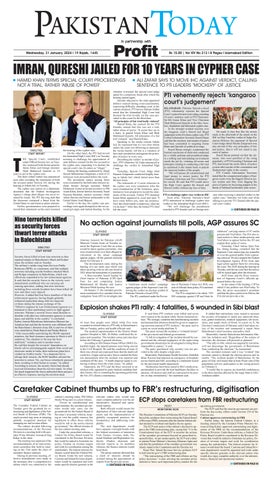
IMRAN, QURESHI JAILED FOR 10 YEARS IN CYPHER CASE
Profit
Wednesday, 31 January, 2024 I 19 Rajab, 1445
g
HAMID KHAN TERMS SPECIAL COURT PROCEEDINGS NOT A TRIAL, RATHER ‘ABUSE OF POWER’
T
RAWALPINDI STAFF REPORT
HE Special Court, established under Official Secrets Act, on Tuesday sentenced both former premier Imran Khan and foreign minister Shah Mahmood Qureshi to 10 years in jail in the cypher case. The short verbal verdict was announced soon after recording the statements of both the accused under Section 342 during the hearing at Adiala Jail on Tuesday. The cypher case centres on a diplomatic document that the Federal Investigation Agency’s charge sheet alleges was never returned by Imran. The PTI has long held that the document contained a threat from the United States to oust Imran as prime minister. Earlier, questionnaires were prepared to record their statements as the court resumed
the hearing of the cypher case. On the other hand, the PTI had moved the Islamabad High Court (IHC) on Tuesday morning to challenge the appointment of state defence counsel for the two accused in the cypher case, requesting it to declare the special court’s Jan 26 orders as “illegal.” During the hearing conducted by Abual Hasnat Muhammad Zulqarnain, a total of 25 witnesses were presented before the court. The prominent names among those cross-examined by the both sides lawyers include former foreign secretary Sohail Mehmood, former principal secretary to PM Azam Khan, former Interior Secretary Yusuf Naseem Khokhar, interior secretary Aftab Akbar Durrani and former ambassador to the United States Asad Majeed. Earlier in the day, the cypher case proceedings were again disrupted as the two accused got angry and started shouting. As the
Nine terrorists killed as security forces thwart terror attacks in Balochistan RAWALPINDI
STAFF REPORT
Security forces killed at least nine terrorists as they repulsed attacks in Balochistan’s Mach and Kolpur areas, the military said on Tuesday. The military’s media wing Inter-Services Public Relations (ISPR), in a statement, said that multiple terrorists including suicide bombers attacked Mach and Kolpur complexes in Balochistan, which was effectively responded to by law enforcement agencies. It said that the security forces in the vicinity were immediately mobilised who are carrying out ensuing operation, adding that nine terrorists including three suicide bombers have been killed till now and three were injured. However, it added that four brave members of the law enforcement agencies, having fought gallantly, embraced martyrdom along with two innocent civilians during the intense exchange of fire. “Effective response by Law Enforcement Agencies is a testament to their unrelenting resolve in fight against terrorism. Pakistan’s security forces stand shoulder to shoulder with other law enforcement agencies to ensure peace and stability in the country,” it concluded. Earlier, Interim Balochistan Information Minister Jan Achakzai had said that the terrorists were affiliated with the Balochistan Liberation Army (BLA) and two of them were identified as Doda Baloch and Pardan Baloch. “After successfully neutralizing the #RAW-operated attackers, the final clearance operation in Mach is still underway. The situation in the area has been stabilized,” Achakzai said in another tweet. He said that despite the terrorists’ dependence on kinetic advice and propaganda support from social and electronic media in India, their malicious plans have yielded no fruitful results. “In a desperate bid to salvage their mission, the RAW handlers advised the terrorists to retreat. Yet, our forces relentlessly pursued them, resulting in their failure to escape,” he added. According to sources, the security forces had already received information about the terrorist attack. So when the attack happened the forces ambushed them and gave an effective response, leaving the terrorists dead.
g
Rs 15.00 | Vol XIV No 213 I 8 Pages I Islamabad Edition
ALI ZAFAR SAYS TO MOVE IHC AGAINST VERDICT, CALLING SENTENCE TO PTI LEADERS ‘MOCKERY’ OF JUSTICE
situation worsened, the special court judge opted for a temporary break after which the hearing started again. Qureshi objected to the state-appointed defence counsel during cross-examination, expressing difficulty attending court in the current situation. PTI lawyer Salman Safdar noted that the Islamabad High Court had deemed the trial invalid, yet the case persisted in this court for the third time. ‘All principles of fair trial badly violated’ Hamid Khan, the counsel for the PTI founder, termed that this was not a trial, rather abuse of power. “It seems they are in a hurry to punish Imran Khan and Shah Mahmood Qureshi. All principles of a fair trial violated,” said Hamid Khan. Speaking to the media outside Adiala Jail, he expressed that it’s not clear whose orders the court was following to announce the verdict hastily. All this is a violation of laws and constitution and against the principles of justice in every way. Describing the verdict ‘as murder of justice’, PTI’s Barrister Ali Zafar announced to challenge the verdict in Islamabad High Court. Yesterday, Special Court Judge Abul Hasanat Zulqarnain conducted lengthy hearing in Adiala Jail, which lasted more than thirteen hours. The statements of 11 more witnesses in the cypher case were completed. After the cross-examination of the witnesses, questionnaires were prepared to record the statements of the accused. Former PTI chairman Imran Khan appeared in court and said, “I have come before you, note my presence. Now this fixed match is underway, what am I to do here?” After that, the former PTI chief left the court.
PTI vehemently rejects ‘kangaroo court’s judgement’
ISLAMABAD: Pakistan Tehreek-e-Insaf (PTI) vehemently rejected the Special Court’s unlawful and cruel ruling awarding 10 years’ sentence each to PTI Chairmanfor-life Imran Khan and Vice Chairman Shah Mehmood Qureshi in the fake, baseless, fraudulent and fabricated cypher case. In his strongly-worded reaction over the kangaroo court’s flawed and illegal judgement in the frivolous cypher case, PTI Central Information Secretary Raoof Hasan said that the mockery and murder of justice had been committed to targeting Imran Khan and Qureshi of political revenge. Raoof Hasan strongly condemned the hurried conclusion of sham trial conducted by a visibly partisan and prejudiced judge in a stifling and intimidating environment inside the jail by violating all norms and principles relating to conducting a fair trial as enshrined in the statute book to punish the innocent leaders of the people. “We will pursue all constitutional and legal means to secure justice for PTI Founding Chairman and Vice Chairman,” he vowed. He said that PTI would move the High Court against the biased and flawed verdict without any loss of time.
PTI to challenge cipher case verdict in IHC Soon after, Pakistan Tehreek-e-Insaf (PTI) announced to challenge cypher case verdict in the Islamabad High Court (IHC). “We will challenge the punishment awarded to PTI founder and ex-foreign min-
He made it clear that like the arrests made in the aftermath of the attack on the IHC on May 9 and the verdict of Judge Humayun Dilawar, the jugement of Special Court Judge Abual Hasnat Zulqarnain was also devoid of the very principles of law and justice, thus it will not stand in any court of justice. Raoof Hasan pointed out that the elements, who were petrified of the rising popularity of PTI Founding Chairman and PTI, had ruined the entire fabric of justice system after murder of the constitution and fundamental rights in the country. PTI Central Information Secretary stated that the compromised judges of kangaroo courts were the biggest threat to justice system and they were digging the grave of justice by becoming puppets in the hands of habitual lawbreaker state actors.
ister after receiving a detailed verdict in the cipher case,” Barrister Ali Zafar said while talking to a private TV Channel after the special court verdict.
CONTINUED ON PAGE 03
No action against journalists till polls, AGP assures SC ISLAMABAD
STAFF REPORT
Attorney General for Pakistan (AGP) Mansoor Usman Awan on Tuesday assured the Supreme Court that no action would be taken against journalists, who were issued notices over their alleged involvement in the smear campaign against judges, till the general elections slated for February 8. The development came during the hearing of a suo motu case which was taken up along with an old case heard in 2021 about the harassment of journalists. A three-member bench headed by Chief Justice of Pakistan (CJP) Qazi Faez Isa and comprising Justice Muhammed Ali Mazhar and Justice Mussarat Hilali hearing the case. On January 17, the caretaker government constituted a five-member Joint Investigation Team (JIT) to investigate into
a “malicious social media” campaign against judges of the Supreme Court following the verdict on election symbol of Pakistan Tehreek-e-Insaf (PTI). The JIT, constituted under the Preven-
tion of Electronic Crimes Act 2016, consists of officials from police, FIA and intelligence agencies. The FIA compiled a list titled: “JITSM campaign against CJP and State In-
stitutions” carrying names of 47 media persons and YouTubers. The FIA also issued notices to these media persons and YouTubers to appear before the JIT and explain their point of views. Yesterday, Chief Justice Qazi Faiz Isa, during hearing, remarked that the Supreme Court cannot stop any journalist or even the general public from expressing criticism. He also stopped the Federal Investigation Agency (FIA) from take legal action against them for criticising the court. The AGP, during the hearing on Tuesday, told the top court that the notices will be issued again after the elections. AGP Awan and the Press Association of Supreme Court’s officials appeared before the court. At the outset of the hearing, CJP Isa asked if any petition was filed today. To this, the press association’s president said that the plea could not be filed as the FIA did not provide a list.
Explosion shakes PTI rally: 4 fatalities, 5 wounded in Sibi blast ISLAMABAD
STAFF REPORT
At least four people were killed while five were wounded in a bomb blast at a PTI rally in Balochistan’s Sibi on Tuesday, police and health officials said. The medical superintendent of the District Headquarters Hospital in Sibi, Dr Babar, confirmed the injuries and casualties. The incident comes just nine days before the February 8 general elections. According to Sibi Station House Officer (SHO) Zakaullah Gujjar, the injured persons were being moved to the Civil Hospital. He said the condition of most of them was critical and expressed fears that the death toll could rise. Gujjar said security forces reached the blast site immediately after the incident was reported and cordoned off the area. “A bomb disposal squad is collecting evidence from the crime scene,” he added. Separately, the PTI said the blast occurred at an election rally organised by party-backed candidate Saddam Tareen, who is contesting the upcoming polls from the NA-253 (Ziarat) constituency.
It said three PTI workers were killed and seven were injured in the incident while Tareen remained unhurt. “We strongly condemn this heartbreaking incident and demand that attention should be given to suppressing terrorists instead of PTI workers,” the party said in a post on social media platform X. The party termed the incident a “criminal failure” of the provincial and federal governments. “A full investigation of the incident should be conducted and the criminal negligence of the supervising governments should also be investigated to bring those responsible to justice,” it said. The party questioned why security was not provided to the rally despite a high alert. Meanwhile, Balochistan Health Secretary Abdullah Khan Noorzai had imposed an emergency at hospitals across Quetta and Sibi, according to a statement issued by the provincial health department. “Instructions have been issued to Sibi’s medical superintendent to provide the best healthcare facilities to patients. All doctors and staff are instructed to be present on duty immediately,” the statement said.
It added that instructions were issued to increase the security of hospitals to tackle any untoward situation, gather medicines, medical equipment, lab necessities, and ample stock of blood. In a post on X, the Election Commission of Pakistan said it had taken notice of the incident and summoned a report from Balochistan’s chief secretary and police chief. Meanwhile, Interim Balochistan Information Minister Jan Achakzai said: “Regardless of the actions of terrorists, the elections will proceed as planned.” “The rally in Sibi, which was targeted by terrorists, will not discourage the government of Balochistan from conducting the elections,” he maintained. The caretaker minister said it was “evident” that terrorists aimed to disrupt the election process and its results. “The resilient people of Balochistan, by the grace of God, will ensure that at least 50 per cent of the population actively participates in the voting process on February 8. “I would like to express my heartfelt condolences to the three families affected by the tragic blast in Sibi,” Achakzai added.
Caretaker Cabinet thumbs up to FBR’s restructuring, digitisation ISLAMABAD
STAFF REPORT
The Caretaker Federal Cabinet on Tuesday gave the go-ahead for restructuring and digitization of the Federal Board of Revenue (FBR). The much-awaited step aims at adopting globally recognized practices for managing tax and revenue affairs. The cabinet decided following recommendations of the Revenue Division in a meeting held with caretaker Prime Minister Anwaarul Haq Kakar in the chair. The meeting was apprised of the recommendations of an inter-ministerial committee that held its meeting on the 23rd under the chair of caretaker finance minister. During its previous meeting, effective amendments were made in the summary after a comprehensive debate which was submitted in the
cabinet’s meeting today, PM Office Media Wing said in a press release. “Given its constitutional and legal mandate, the caretaker government would only carry out the groundwork for the Federal Board of Revenue’s structural reforms, keeping in view the public interest, but legislation to effect these reforms would be left to the newly-elected government,” the official minutes of the last cabinet meeting state. Under the prescribed reforms, a Federal Tax Policy Board would be constituted in the Revenue Division that would be tasked to formulate tax policy, fixation on revenue targets and work for coordination among the stakeholders. The federal minister for finance would head the Federal Policy Board. Under the new scheme, Customs and Inland Revenue departments would be separated and work under specific director generals in the
relevant cadres who would also enjoy complete authority over the administrative, financial and operational matters. Both officials would ensure the digitisation of their relevant departments and the implementation of globally recognised practices for transparency and addressing complaints. The said departments would have separate oversight boards with the federal secretaries of ministries from finance, revenue, trade, National Database and Registration Authority (Nadra) chairman and relevant experts as its members whereas, the finance minister would head them. The prime minister directed that a clash of interests should be avoided during the appointment of experts from the private sector.
CONTINUED ON PAGE 03
ECP stops caretakers from FBR restructuring PROFIT
MONITORING DESK
The Election Commission of Pakistan (ECP) on Tuesday barred the caretakers from restructuring the Federal Board of Revenue (FBR), moments after the interim federal cabinet decided to overhaul and digitize the tax agency. The ECP took notice of the cabinet’s decision to approve the FBR restructuring plan, saying that “it is the Constitutional duty of the ECP to monitor the actions of the caretaker government beyond its prescribed responsibilities. As per media reports, the ECP sent a letter to interim Prime Minister’s Secretary Khurram Agha and said that the jurisdiction of the caretaker government was clearly stated in the Constitution and the Election Act. Read This: Inland Revenue Service petitions ECP to halt interim govt’s FBR restructuring plan “The restructuring of the FBR and reforms are big policy decisions,” it said, advising the caretaker prime minister to leave such important policy matters for the
upcoming government. The ECP said that the interim government can perform the day-to-day affairs under Section 230 of the Election Act. Cabinet approves restructuring in FBR Earlier today, the Interim Federal Cabinet, in a meeting chaired by the Caretaker Prime Minister Anwaar-ul-Haq Kakar, approved restructuring and digitisation of the FBR on the recommendations of the Revenue Division. Under these reforms, a Federal Tax Policy Board would be constituted in the Revenue Division that would be tasked to formulate tax policy, fixation of revenue targets and work for coordination among the stakeholders. The federal minister for finance would head the board. Customs and Inland Revenue departments would be separated and work under specific director generals in the relevant cadres who would also enjoy complete authority over the administrative, financial and operational matters.
CONTINUED ON PAGE 03
02
DISCOS SEEK COLLECTION OF RS81.5B FROM ALREADY BURDENED POWER CONSUMERS neWs
Power consumers all across Pakistan should get ready to bear a heavy jolt in form of tariff hike
P g
Wednesday, 31 January, 2024 | IsLAMABAD
ISLAMABAD
AhmAD AhmADANi
OWER Distribution Companies (DISCOs) have sought from National Electric Power Regulatory Authority (NEPRA) to approve collection of Rs 81 billion and 50 crore from the power consumers of the country on account of quarterly adjustments. Shockingly, already burdened power
consumers across the country who were already paying electricity bills regularly should get ready to bear an additional heavy burden of Rs 81.5 billion on account of quarterly adjustments for the 2nd quarter of financial year 2023-24. And, if NEPRA grants its necessary approval, the major amount out of Rs 81.5 billion will go to those idle power plants which remained shut down and did not produce electricity. As per details, power consumers should get ready to bear a heavy jolt in the form of
power tariff hike as DISCOs have submitted an application with NEPRA for the quarterly adjustment for October to December 2023. According to DISCOs plea, the DISCOs sought total Rs 81,498 million on account of capacity charges, UoSC & MoF, impact of T&D losses on monthly FCA. DISCOs sought a total Rs 75,139 million on account of capacity charges, Rs 10,818 million under the head impact of T&D losses on monthly Fuel Charges
Budget deficit rises to 2.3% of GDP in H1 FY2024 despite provincial surplus PROFIT
News Desk
The budget deficit for the first half of the current fiscal year has risen to 2.3% of the GDP or Rs 2,407.768 billion, according to data released by the Finance Division on Monday. Despite a provincial surplus of over Rs 289 billion, total expenditures amounted to Rs 9,261.764 billion, while total revenues stood at Rs 6,853.996 billion, resulting in a deficit. The deficit of Rs 2,407.768 billion was financed through external borrowing of Rs 608.381 billion and domestic borrowing of Rs 1,799.387 billion. This domestic borrowing included non-bank borrowing of Rs 251.611 billion and bank borrowing of Rs 2,050.998 billion. The primary balance during this
period was 1.7% of the GDP, amounting to Rs 1,812.211 billion. Current expenditures of Rs 8,564.632 billion included markup payments of Rs 4,219.979 billion (domestic Rs 3,717.821 billion and foreign Rs 502.158 billion). Defence Affairs and Services expenditures were Rs 757.602 billion, pension Rs 404.422 billion, running of civil government Rs 302.443 billion, subsidies Rs 375.262 billion, and grants to others Rs 469.488 billion. Development expenditure under the Public Sector Development Programme (PSDP) for July-December 2023-24 was Rs 673.216 billion, comprising federal Rs 130.408 billion and provincial Rs 542.808 billion. Net lending to the Public Sector Enterprises (PSEs) was negative at Rs 12,002 billion, and a statistical
Pakistan’s telecom sector generates Rs850b in FY2022-23: PTA report PROFIT
News Desk
The country’s telecom sector recorded revenues of Rs850 billion in the fiscal year 2022-23, reflecting a 17% growth from the previous year, according to the Pakistan Telecommunication Authority’s (PTA) annual report. Despite facing challenges such as inflation, high business costs, and economic slowdown, the sector showcased resilience. The report highlights substantial investment potential, with local industry investments totaling $5.7 billion and Foreign Direct Investment (FDI) reaching $1.4 billion over the last five years (2018-19 to 202223). The telecom sector contributed Rs1.27 trillion to the national treasury during this period. While the industry sources indicate a decline in revenue from $4.84 billion in 2018-19 to $3.03 billion in 2022-23 in real terms, the PTA report attributes it to the decline in the rupee value. The PTA is actively working on integrating satellite broadband, particularly through the High Throughput Satellite (HTS) system, to bridge the digital divide in the country and provide high-speed satellite internet. Acknowledging the industry’s low Average Revenue Per User (ARPU) and financial stress, the report suggests measures such as infrastructure sharing and cost-effective strategies to meet capacity demand and extend connectivity to underserved areas. Mobile broadband has seen significant growth over the past five years, with 65% of mobile subscribers in 2022-23 compared to 37% in 2017-18. Currently, 90% of mobile broadband subscribers use 4G, a substantial increase from 17% five years ago. The report mentions four telecom operators in the country, led by Jazz, followed by Zong, Telenor, and Ufone. Jazz leads with a 37% cellular subscriber share, the largest 4G subscriber base, and the highest revenue market share.
discrepancy of Rs 35.918 billion was noted. Total revenue mobilization was Rs 6,853.996 billion, with tax revenue at Rs 4,834.306 billion and non-tax revenue at Rs 2,019.690 billion. Federal Board of Revenue (FBR) tax contributed Rs 4,469.241 billion, and the provincial share in tax collection was Rs 365.065 billion. Direct taxes in tax revenue were Rs 2,148.891 billion, and indirect taxes were Rs 2,320.350 billion. Indirect taxes included Customs duties collection of Rs 540.504 billion, sales tax Rs 1,515.266 billion, and federal excise of Rs 264.580 billion. Provincial share in tax included sales tax on services Rs 230.025 billion, excise duty Rs 5.952 billion, stamp duties Rs 30.346 billion, motor vehicles tax Rs 16.017 billion, and others Rs 82.725 billion.
Non-tax revenue of Rs 2,019.690 billion included the federal share of Rs 1,940.520 billion and provincial Rs 79.170 billion. Federal non-tax revenue included mark-up of Public Sector Enterprises (PSEs and others) Rs 202.625 billion, dividends Rs 50.465 billion, profit of PTA and others Rs 3.734 billion, surplus profit of SBP Rs 972.183 billion, defence receipts Rs 14.235 billion, passport fee Rs 25.739 billion, discount retained on crude oil Rs 13.184 billion, royalties on oil and gas Rs 87.464 billion, windfall levy against crude oil Rs 13.724 billion, petroleum levy on LPG Rs 1.736 billion, GIDC Cess Rs 1.099 billion, Natural Gas Development Surcharge Rs 4.504 billion, petroleum levy 472.772 billion, others, Rs 77.056 billion, and provincial non-tax collection was Rs 79.170 billion. The data also revealed that out of the gross revenue receipts of Rs 6,448,362 billion, provinces received transfers of Rs 2,435,349 billion during the first six months of the ongoing fiscal year.
PTCL launches first neutral internet exchange g
Exchange is poised to become a pivotal hub for regional connectivity, facilitating localisation of global content PROFIT
News Desk
Pakistan Telecommunication Company Limited (PTCL), the country’s largest integrated Information Communication Technology (ICT) company, has joined hands with DE-CIX, the world’s leading Internet Exchange (IX) operator, to inaugurate the Pakistan Internet Exchange (PIE) powered by DE-CIX. PIE powered by DE-CIX is poised to become a pivotal hub for regional connectivity. It enables local networks to benefit from low-latency interconnection and facilitates the localisation of global content. The inauguration ceremony held on Monday celebrated the launch of the first carrier-neutral IX in Pakistan. Housed within the PTCL data center in Karachi, this groundbreaking exchange is operated by DE-CIX under the DE-CIX as a Service (DaaS) model. It is built upon DE-CIX’s award-winning interconnection infrastructure, offering local peering and
decided to conduct a hearing on the matter on 14th February 2024 at NEPRA headquarter and online. NEPRA in a public hearing notice has invited all the interested /affected parties to submit written/oral comments or objections as permissible under the law at the hearing. Pursuant to the notified tariff, the DISCOs have filed their requests for adjustments on account of capacity charges, transmission charges and market operator fee, the impact of incremental units and impact of T&D losses on FCA and variable operations & maintenance charges for the 2nd quarter of FY 2023-24 i-e OctoberDecember 2023, in line with the notified mechanism in this regard.
Adjustment (FCA). FESCO seeks total Rs 9,446 million, GEPCO Rs 2,663 million, HESCO Rs 3,524 million, IESCO Rs 6,921 million, LESCO Rs 15,105 million, MEPCO Rs 14,884 million, PESCO Rs 11,583 million, QESCO Rs 10,983 million, SEPCO Rs 2,879 million, TESCO Rs 3,510 million According to the policy guidelines issued by the federal government for of uniform quarterly application adjustments, the 2nd quarter adjustment for Financial Year 2023-24 of DISCOs to be determined by the NEPRA, shall be applicable on the consumers of K-Electric. To proceed further and to arrive at a just and informed decision, the NEPRA has
remote access to DE-CIX Frankfurt (Germany), one of the world’s largest IXs. “With a population of over 200 million people and Internet usage growing incredibly fast, Pakistan needs local interconnection, and its Internet connectivity will be strongly enhanced through this partnership. We want to serve the great demand for increasing the speed, quality, and stability of Internet connectivity to guarantee the best experience possible for end users and businesses in the market,” Ivo Ivanov, CEO of DE-CIX. Speaking at the inauguration, Federal Interim Minister of IT & Telecommunication Dr Umar Saif highlighted the significance of Pakistan’s digital market, emphasizing its vast potential. He noted the country’s substantial progress in advancing fiber connectivity, including multiple submarine cables making landfall in Karachi. Dr Saif underscored the pivotal role of PIE powered by DE-CIX in positioning Pakistan as a regional digital connectivity hub. He projected substantial annual revenues ranging from $200-400 million through transit traffic, significantly contributing to the national economy.
Political upheaval pushes PSX 1.48% down g
Stock market continues negative momentum amid political uncertainty, monetary policy announcement PROFIT
News Desk
The Pakistan Stock Exchange (PSX) on Tuesday experienced a bearish trend due to political uncertainty and the SBP’s announcement of monetary policy. According to the PSX website, the KSE-100 index lost 932 points or 1.48% and was closed at the 61,841.74 level. During the intraday trading, the index plummeted by over 1100 points. However, there were clear visible crests and troughs patterns in trading. Fluctuations in equity market performance are a significant concern for market analysts, particularly as people prepare to cast their votes on February 8. Additionally, the founding chairman of Pakistan Tehreek-e-Insaf (PTI) Imran Khan was sentenced to 10 years imprisonment in the cipher case. Even the government’s performance figures are not very satisfying. “Pakistan’s fiscal deficit increased by 43% YoY to Rs 2.4 trillion during 1HFY24,” said Arif Habib Limited. “Continued foreign selling extracted a toll on the KSE100 yesterday. It may lead to a week open again, especially after the SBP held interest rates unchanged at 22%. However, support should come from value buying in banks that will continue to benefit from high margins and should deliver strong results. We remain positive and view dips as buying opportunities,” said Intermarket Securities Limited. Therefore, investors with an eye for identifying the right opportunity can maximise benefits or even diversify their investment portfolio during the current dips observable in the stock market after a good healthy period of peaks. A combination of different factors including political uncertainty, monetary policy announcements, the issue of energy circular debt, and even the financial figures for the first six months of the current fiscal year is impacting stock market trends.
WAPDA seeks global partners for Pakistan’s first 300 MW floating solar project PROFIT
News Desk
The Water & Power Development Authority (WAPDA) conducted a road show in Bangkok to attract international bidders for its groundbreaking 300megawatt (MW) floating solar project, marking the first of its kind in Pakistan. The initiative aims to leverage floating solar panels on two reservoirs within the Tarbela-Ghazi Barotha hydropower complex, contributing clean and cost-effective electricity to the national grid. Attended by 58 delegates from 50 international firms, the
road show featured presentations by WAPDA officials and consultants, detailing the financial, technical, and bidding aspects of the project. Bidding documents were released in October 2023 following World Bank procurement guidelines, with a submission deadline set for March 12, 2024. The World Bank has signaled interest in providing 95 percent financing for the approximately $300 million project. Notable attendees at the event included Chairman WAPDA Engr (retd) Lt Gen Sajjad Ghani, Pakistan’s Charge d’ Affairs in Thailand Yasir Hussain, World Bank representatives, and WAPDA high-ranking officials. Chairman Ghani underscored the lucrative business opportunities for contracting firms through a transparent international competitive bidding process. He highlighted WAPDA’s robust asset base and extensive professional expertise in implementing mega
projects in the water and power sectors, expressing eagerness to collaborate with renowned firms for the success of Pakistan’s maiden floating solar project. WAPDA’s 300 MW-floating solar project envisions clean energy generation at the Tarbela-Ghazi Barotha Complex through innovative floating solar and hydropower hybrid operations. The initiative involves deploying two 150 MW floating solar plants, strategically located on Ghazi Head Pond at Tarbela Complex and North Pond at Ghazi-Barotha Complex. These plants will be connected to the Switch Yards of Tarbela and Ghazi-Barotha Hydel Power Stations, supplying 484 million units of low-cost electricity to the national grid annually. The road show facilitated an exchange of information between WAPDA officials, consultants, and potential bidders, addressing queries during the question-and-answer session.a
Pakistan climbs seven spots in global corruption ranking in 2023 PROFIT
News Desk
Pakistan’s ranking on the Corruption Perceptions Index (CPI) has seen an improvement, moving up seven spots from 140 out of 180 countries in 2022 to 133 in 2023, as reported by Transparency International on Tuesday. The CPI assesses perceived levels of public-sector corruption based on 13 independent data sources, utilising a scale of zero to 100, where zero represents highly corrupt and 100 signifies very clean. In 2023, Pakistan achieved a CPI score of 29 out of 100, compared to a score of 27 in 2022 when the country held the 140th position. Notably, India’s CPI score dropped from 40 in 2022 to 39 in 2023. Transparency International Pakistan Chairman, Justice (R) Zia Pervez, highlighted
the positive change in Pakistan’s score and attributed it to policies focusing on improved governance, effective law enforcement, and the implementation of recommendations by the global organisation. The report indicated that the majority of countries globally made minimal progress in addressing public sector corruption, maintaining an average CPI score of 43 for the twelfth consecutive year. The Rule of Law Index reveals a decline in the functioning of justice systems worldwide. Countries with low scores in this index also exhibited low scores on the CPI, emphasizing a correlation between access to justice and corruption. Denmark topped the CPI for the sixth consecutive year with a
score of 90, followed closely by Finland and New Zealand with scores of 87 and 85, respectively. Countries experiencing crises, such as Somalia, Venezuela, Syria, South Sudan, and Yemen, occupied the bottom spots. Twenty-three countries, including Iceland, the Netherlands, Sweden, the United Kingdom, Iran, Russia, Tajikistan, and Venezuela, reached historic lows in 2023.
Wednesday, 31 January, 2024 | ISLAMABAD
PAKISTAN RECEIVES $150B IN REMITTANCES IN FIVE YEARS, RANKS FIFTH GLOBALLY IN 2022 In 2022 alone, Pakistan received $29.9b in remittances, contributing significantly to global remittance total of $758b
P g
PROFIT
news Desk
AKISTAN has recorded a substantial influx of remittances, totaling $150 billion from 2017 to 2022, securing its position as the fifth-largest recipient of remittances globally in 2022, according to
the Saleh Kamel Islamic Economy Database. The data was disclosed during the 2nd AlBaraka Regional Conference, focusing on the pivotal role of home remittances and their impact on sustainable development. In 2022 alone, Pakistan received $29.9 billion in remittances, contributing significantly to the global remittance total
of $758 billion. Of this amount, OIC (Organisation of Islamic Cooperation) countries received $193 billion, constituting 25.5% of the overall global remittances. Home remittances play a crucial role in Pakistan’s economic landscape, representing 33% of total imports. This places Pakistan as the second-highest recipient among OIC countries and the
fifth globally in 2022. The 2nd AlBaraka Regional Conference, hosted by the AlBaraka Forum for Islamic Economy in collaboration with the Islamic Chamber of Commerce and Development (ICCD), delved into the importance of these remittances in fostering economic integration and sustainable development. Yousef Khalawi, Secretary-General of the AlBaraka Forum for Islamic Economy, emphasized the need for collaboration between governments and financial institutions to establish secure, user-friendly,
IMF cuts Pakistan’s 2024 growth projection to 2%, raising concerns PROFIT
news Desk
Despite the positive global outlook, the IMF anticipates global growth to remain below the recent historical average of 3.8 percent in 2024. The International Monetary Fund (IMF) has revised down Pakistan’s growth estimate for the fiscal year 2024 to two percent, a 0.5 percent reduction from the October outlook of 2.5 percent, according to the latest World Economic Outlook (WEO) report issued on Tuesday. This downgrade falls short of the government’s target of 3.5 percent GDP growth for the year, signaling economic challenges. In contrast, the IMF raised its
2024 global growth forecast to 3.1 percent, 0.2 percentage points higher than the October forecast, citing unexpected resilience in major economies. IMF Chief Economist Pierre-Olivier Gourinchas noted the global economy’s remarkable resilience, but cautioned about the slow pace of expansion and lingering risks. Despite the positive global outlook, the IMF anticipates global growth to remain below the recent historical average of 3.8 percent in 2024. Among the G7 advanced economies, European countries are expected to face weak growth, while Japan and Canada may fare slightly better. The overall inflation outlook for 2024 remains at 5.8 percent, with significant disparities between richer and poorer
ISLAMABAD: Vice Chief Naval Staff Vice Admiral Ovais Ahmed Bilgrami exchanging views with Secretary General of Iraqi Ministry of Defence, Lieutenant General Ahmed Dawood during his visit to Naval Headquarters.
Caretaker Cabinet thumbs up to FBR’s restructuring, digitisation CONTINUED FROM PAGE 01
He also asked that under the cabinet committee’s recommendations for reforms, a draft should be presented for necessary legislation and approval in the upcoming session of the newly elected parliament. On the occasion, the caretaker prime minister and the cabinet members appreciated the untiring efforts of the ministers concerned, FBR chairman and other relevant authorities for the preparation of these reforms. The meeting also endorsed decisions taken on January 26 by its cabinet committee on legal affairs but deferred amendments recommended by the Ministry of Water Resources concerning the Indus River System Authority (IRSA) Act 1992 and directed to resubmit it in the next meeting of the cabinet after a thorough debate. It is noteworthy to mention here that the International Monetary Fund (IMF) has shared options to transform the FBR into a single national tax authority to administer all federal and progressively provincial taxes or restructure the present tax authority as a federal tax agency with coordinated linkages across all provincial tax agencies. The Fund’s Technical Assistance Report on Revenue Administration Diagnostic, prepared by an expert in its Fiscal Affairs Department Robert Woods, proposed a future for the revenue authority and stated that the task force established by the government has developed different proposals to restructure the revenue administration. It was proposed to revamp the tax authority as a performance-driven semi-autonomous revenue authority with its own service rules, recruitment, and management policies ultimately operating under a single-line budget. It was also urged to ensure strong governance and performance management by appointing an independent tax oversight and administration board. It also recommended a fixed tenure for the head of the tax authority.
Ali Zafar criticized the verdict and termed the sentence to PTI leaders ‘mockery’ of justice. “Jail trial in the cypher case was against Article 10-A,” he claimed. The former law minister was of view that ‘due’ process was not adopted in the case. Earlier, the special court handed down 10 years term in jail each, to the Pakistan Tehreek-e-Insaf (PTI) founder and former foreign minister Shah Mahmood Qureshi. The former premier and the former foreign minister were facing trial in cypher case in Adiala Jail from last year for ‘distorting’ the facts of the diplomatic cypher. Both the PTI leaders were accused of conspiracy to misuse the contents of the cypher fro ‘political purpose’. PTI TOP BRASS VEHEMENTLY REJECTS VERDICT In the aftermath, Pakistan Tehreek-e-Insaf (PTI) top leadership vehemently rejected on Tuesday the verdict handed down by a special court under the Official Secrets Act, which sentenced former premier Imran Khan and exforeign minister Shah Mahmood Qureshi to 10 years in jail in the cypher case. In response to the special court’s decision, Barrister Gohar Ali Khan, a central leader of Tehreek-e-Insaf, addressed the media, urging party supporters to exhibit restraint and avoid expressing anger. He stated that PTI would challenge the Cipher case
trial in court, expressing hope that the punishment meted out to PTI founder Imran Khan would be annulled. PTI stalwart Omer Ayub Khan took to social media platform X (formerly Twitter), declaring his rejection of the verdict, citing political motives behind the decision. In a statement, he called on all PTI members and Pakistanis to remain calm and peaceful in the aftermath of what he referred to as a decision by a “kangaroo court” against PM Imran Khan and Vice Chairman Makhdoom Shah Mehmood Qureshi. Omer Ayub Khan encouraged supporters to concentrate on the upcoming electoral process, emphasizing a high voter turnout. He urged PTI members to rally on February 8, 2024, and cast their votes for PM Imran Khan’s nominated candidates, whose names have been posted on PTI’s official website and social media channels. Earlier in the day, the cypher case proceedings were again disrupted as both Imran Khan and Shah Mahmood Qureshi got angry and started shouting. As the situation worsened, the special court judge opted for a temporary break after which the hearing started again. Qureshi objected to the state-appointed defence counsel during cross-examination, expressing difficulty attending court in the current situation. PTI lawyer Salman Safdar noted that the Islamabad High Court had deemed the trial invalid, yet the case persisted in this court for the third time.
ECP stops caretakers from FBR restructuring CONTINUED FROM PAGE 01
Both the officials would ensure digitisation of their relevant departments and implementation of globally recognised practices for transparency and addressing complaints. These departments would have separate oversight boards with the federal secretaries of ministries from finance, revenue, trade, chairman NADRA and relevant experts as its members whereas, minister for
finance would head them. The meeting was also apprised of the recommendations of an interministerial committee that held its meeting on January 23 under the caretaker finance minister. During its previous meeting, effective amendments were made in the summary after a comprehensive debate which was submitted in the cabinet’s meeting today. The prime minister directed that conflict of interest should be avoided during the appointment of experts
from the private sector. He also asked that under the cabinet committee’s recommendations for reforms, a draft should be presented for necessary legislation and approval in the upcoming session of the newly elected parliament. On the occasion, the caretaker prime minister and the cabinet members appreciated the untiring efforts of the ministers concerned, chairman FBR and other relevant authorities for the preparation of these reforms.
Madad Ali acknowledges PCE’s role in bridging public, private education sector gap ISLAMABAD inp
Caretaker Federal Minister for Education and Professional Training, Madad Ali Sindhi has acknowledged the significant role played by Pakistan Chamber of Education (PCE) in bridging the gap between the government and the private education sector. Speaking during a meeting with delegation of PCE led by its President, Haji Ashfaq Ahmed Warraich which called on him here on Tuesday, the minister said that PCE had played a remarkable role in minimizing the number of out of school children. Acknowledging the positive feedback from the PCE, Madad Ali Sindhi said that these suggestions will be forwarded to the provinces in the next IPEMC. The minister was briefed about the problem of unscheduled holidays in the provinces which has led to reduction of the academic days of the schools. He was told that the
03
and legal channels for remittances while fostering connections with international financial institutions. The event concluded with the presentation of policy frameworks and future outlooks for home remittances. Stakeholders underscored the importance of streamlining remittance flows to contribute to sustainable economic growth. They also explored future trends and emphasized the collective effort needed to develop innovative strategies to enhance the positive impact of remittances on the national economy. The conference aimed to foster dialogue among leading experts, decision-makers, and stakeholders to strengthen Islamic finance tools, align remittance strategies with Sustainable Development Goals (SDGs), and navigate the evolving global remittance landscape.
First online gold trading company to be launched today in Pakistan PROFIT
news Desk
Imran, Qureshi jailed for 10 years in cypher case CONTINUED FROM PAGE 01
NEWS
academic calendar year needed to be revised in such a way that the effects of climate change were addressed. The minister was briefed that due to climate change the weather of different areas was affected differently. For example, the smog hit areas are near the Lahore and Gujranwala districts. Hence, due to fog and smog in these areas, the entire province should not be shut down. Similarly, Madad Ali was told that it was unfair that different provinces had different academic days annually. It was suggested that this needed to be in a uniform manner. PEC also stressed the need for teacher training and offered their services to the government. PEC said that through public private partnership, the number of Out of School Children can be reduced and PEC can contribute to this cause. Madad Ali said that these suggestions were positive and the provinces should focus on materialising these. He said that it was important that policies should be made in such a way that all private institutions should be catered for. The minister said there should not be a single policy for high end and low end private institutions.
Pakistan marks a significant milestone as Zakaria Gold Commodities (Pvt) Limited, the country’s first formal company for online and physical trading of gold, commences operations on Tuesday (today), January 30, 2024. The establishment, approved by the Securities and Exchange Commission of Pakistan and the Pakistan Mercantile Exchange, is poised to address concerns related to speculation and price manipulation in the gold trading market. Dr. Bu Abdullah, Chairman of the Bu Abdullah Group, a prominent business group in the UAE, will officially inaugurate the online bullion trading company. The event will be attended by senior officials from the Federal Board of Revenue and Customs, representatives of the Federal Investigation Agency, and other notable business personalities. Zakaria Gold Commodities (Pvt) Limited is set to engage in both online and physical buying and selling of gold, pioneering this aspect of trade in Pakistan. The company’s approval from the SECP and PMEX is expected to curtail speculation and eradicate the existence of a black market for bullion. Company officials have outlined plans to display daily gold rates on a large screen outside the company’s office. The establishment of this new company is anticipated to bring stability to the market, mitigating speculation and eliminating the black market for gold trading.
JI to steadfastly defend Islamic tenets of Constitution: Siraj LOWER DIR inp
Ameer Jamaat-e-Islami (JI), Sirajul Haq has emphasized that the JI will steadfastly defend the Islamic tenets of the constitution, including Article 62 and 63. Addressing election rallies in Lower Dir on Tuesday, he remarked that the Pakistan Muslim League-Nawaz’s (PML-N) aspiration to annul Article 62 and 63 would never come to fruition. Sirajul Haq said the fact was that the two other former ruling parties have also became supporters of the PML-N manifesto. Transforming Pakistan into a secular state, he said, was their sole agenda. The former rulers aimed to appease the US and Western lobbies, he remarked. He further stated that the JI would resist all conspiracies against the Islamic identity of Pakistan. He said a clear majority in Pakistan was in favour of Islamic system. Yet, he added, their desire was never fulfilled as the ruling two percent elite was afraid of the laws based on Quran and Sunnah. He said the article 62 and 63 guaranteed the presence of honest and capable people in the parliament. Are the former ruling parties wanting presence of corrupt persons in the assemblies, he questioned. Siraj said the country went through different experiences yet Islamic system was never introduced here. He said Islam provides solution to all the problems facing the country and its people.
04 COMMENT
Wednesday, 31 January, 2024
Working for a Ceasefire, From the Bottom Up
A pleasureless sin
T
The SBP’s keeping the policy rate may indicate the lack of any alternative
Attitudes in the USA are changing
HE State Bank of Pakistan’s Monetary Policy Committee has kept the policy rate unchanged at 22 percent, making it the fifth time in seven months that it has done so. This important anti-inflation measure has not really worked, for inflation is not coming down. SBP Governor Jameel Ahmad, in a press conference after the MPC meeting, blamed the government’s raising of power and gas tariffs for the inflation spike, predicting that inflation would remain in the 2225 percent range for the fiscal year. Since SBP had originally projected inflation of 20-23 percent for the year in July. Even that was punitive. He has predicted a decline in inflation, with the 23.7 percent recorded in December as the highest, from March. The high policy rate has two consequences: one is the squeezing out of the private sector from the credit markets, with the corollary that some businesses would be rendered unviable by the high interest rates, the second is that government borrowing would be rendered more expensive. One consequence has been that SBP has made profits like never before. According to the July-December financial report released by the federal Finance Ministry, SBP made profits of Rs 972 billion, up 161 percent on the same period the previous year. However, that same report made it obvious that government machinery was beginning to creak ominously. With Rs 4.22 billion in interest payments exceeding the net income of the federal government by Rs 207 billion, it means that the federal government is now borrowing not just to meet its current expenditures, but also to make those interest payments. Therefore the policy rate is affecting the government adversely, and as it seems to be having no effect on inflation, it seems to be something of a pleasureless sin. In a different universe, presumably, the rate would be cut. However, it has to be kept where it is as dictated by the IMF. The whole MPC mechanism was established to keep the government from dictating to the SBP. Instead, it seems, the IMF is doing the dictation. What is the point of removing one puppetmaster only to replace him by another. The rupee has been in virtual freefall and inflation has raged all the while the policy rate has been kept at the present level. If a measure is not working, then it should be changed.
D
Dr James J. Zogby
ESPITE the Biden Administration’s refusal to back a ceasefire that would help humanitarian aid. Countering this proposal, the USA end Israel’s genocidal assault on Gaza, supported increased aid to Gaza but would not conmomentum is growing across the USA sider the reality that without an end to the bombing calling on the Administration to reverse aid could not be delivered or reach those most in course. What is significant is that the opposition to need. the White House’s position is coming from within the Slowly but surely US public opinion has changed President’s own party. with substantial majorities now wanting a ceasefire The administration’s stubborn aversion to even and voters indicating by a two to one margin that they the use of the term ceasefire remains inexplicable. It are more inclined to support candidates who call for may be recalled that just a few days after the Israeli a ceasefire, with the margin bombings that followed the of support for a ceasefire October 7 attacks, the State greater among Democrats and Department issued a statekey Democratic constituenment calling for a ceasefire cies (young voters and nonthat was quickly taken down Rev. Martin Luther King Jr. white voters). Still the and followed by a guidance Administration resists. often said, “The arc of the memo to diplomats saying This past week, a leading the term was not to be used. moral universe is long, but it Democratic Senator, Chris As the number of civilian caVan Hollen, joined the chorus sualties continued to grow, bends toward justice.” What of legislators calling for a Administration officials receasefire, making him the King didn’t say, but peatedly fell back on the line 68th member of the Senate or that Israel had the right to deunderstood, House of Representatives to was that it didn’t fend itself, that Hamas had to do so. This represents more be eliminated, and that a bend by itself. It required the than one quarter of the Deceasefire would only allow mocrats in Congress and can Hamas to rebuild its capacity. hands of many to push the arc be expected to grow. The Administration atMore significant, and in the right direction. That’s tempted to absolve itself by somewhat unexpected, are coupling this rejection of a what’s happening now. And it the numbers of City Counceasefire with appeals to Iscils who have taken up the rael to avoid civilian casualis to be celebrated call for a ceasefire. Led by ties and with support for grassroots mobilizations of humanitarian aid. Palestinian Americans, proThose arguments have gressive Jewish groups, and failed the test of time. The Black activists, major cities carpet bombing of residential areas of Gaza, the clear like Atlanta, San Francisco, Minneapolis, Detroit, intent to demolish housing and infrastructure, the Seattle, St Louis, and three dozen other municipalforced evacuation of millions, and more have led to ities have passed strong ceasefire resolutions. And Israel being charged with genocide. And leading anwhile a vote on a similar resolution has been dealysts in the USA and Israel have noted that the layed for a few days in Chicago, the USA’s third “elimination of Hamas” is at best “a fool’s errand.” largest city and home of this year’s Democratic NaAs the dimensions of the human tragedy unfoldtional Convention, that city’s Mayor, Brandon ing in Gaza became clearer, the USA has found itself Johnson, this week issued a strong call in support virtually isolated in the world community in its rejecof a ceasefire. tion of a UAE-sponsored Security Council resolution Because the language used by Mayor Johnson calling for a ceasefire that would allow unimpeded was so evocative it warrants consideration. Echoing
Dedicated to the legacy of late Hameed Nizami
Arif Nizami (Late) Founding Editor
Yousaf Nizami Editor M. A. Niazi Umar Aziz
Bullying: exploring the impact on students Joint Editor
“B
Executive Editor
A global phenomenon unfortunately too common aiman sarmaD
ullying builds character like nuclear waste creates superheroes. It's a rare occurrence and often does much more damage than endowment.” By Zack W. Van. With new technological advancements, bullying has been increasing rapidly. The bully likes to target others to either manifest their dominance, aggression, stress or anger. This all has a negative impact on the bully and the victim. Bullying leads to mental health issues, physical problems and academic effects. According to the National Centre for Education Statistics (2017) a research conducted in the USA articulates that 20 percent students aged 12-18 years’ experience bullying globally. I was enthused by the movie Karate Kid, and my best friend who was bullied in school which led me to research on this topic. Bullying leads to mental health problems, which range from stress and worries, experienced as fragments of one’s everyday lifespan to solemn long-term conditions. This involves changes in emotion, behaviour or thinking. They can be associated with distress and problems in social, work or family activities. Untreated mental illness can cause severe emotional, behavioural and physical health problems. Bullying can result in complications linked to mental illness including sorrow, reduced gratification of life, self-harm and harm to others, which includes suicide as well. Children who are bullied tend to miss work at school which results in absenteeism. Bullying has been a quiet, but ongoing problem in Pakistan as well. In many schools, teachers are not able to address the problem of bullying due to lack of knowledge, and burden of workload. Shamsi et al (2019) conducted a cross-sectional study to investigate 153 teachers' knowledge regarding bullying in five private and public schools in Karachi. Of the students who were bullied; 70 percent had headaches, 56 percent backaches, 74 percent were depressed and 68 percent had low self-esteem. Sadly, more than half of the teachers lacked knowledge about bullying, and thus bullying symptoms went unnoticed. Research was carried out to examine mental health, and bullying among Pakistani students. 335 Pakistani university students participated in this survey and the results showed that the students who were bullied showed signs of depres-
sion, were lonely, had sleep problems and suicidal ideation. Another consequence of bullying can be academic problems, resulting due to a disturbed school environment and abnormal social interaction between bully and victim. These issues result in a number of problems like failure in exams and diminishing attendance. If this issue isn’t highlighted it can result in serious consequences as the student might not be able to establish a successful career and might resort to options like suicide. Naveed et al (2019) conducted a cross-sectional study in which they surveyed 2315 children from seven public and private schools in Bahawalpur, Faisalabad, Lodhran, Rahim Yar Khan, Multan, Thatta and Nawabshah. 27 percent of the students were bullied at school which in turn affected their academic performance. Being bullied in the past was a strong indicator of becoming a bully themselves, moreover mothers who were housewives had children who were mentally sound. Working mothers had children with high chances of depression, emotional disturbance, poor school results, which resulted in them becoming victims of bullying. This highlights the patriarchal sys-
Lahore – Ph: 042-36300938, 042-36375965
I
Karachi – Ph: 021-35381208-9
The writer is President of the Arab American Institute
Editor’s mail
Send your letters to: Letters to Editor, Pakistan Today, 4-Shaarey Fatima Jinnah, Lahore, Pakistan. E-mail: letters@pakistantoday.com.pk Letters should be addressed to Pakistan Today exclusively
Citizen's portal
THE Pakistan Citizen’s Portal is not working properly and people are struggling to lodge their complaints. It was the only way out for the people to at least have some hope of getting some relief without official hindrances getting in their way. The portal should be restored so that the people may again benefit from this easy-to-use platform. ASSAD SHAH RAWALPINDI
Challan spree
were bullied. They devised an educational tool for professionals to identify the issue and solve it proactively. This successfully created an activation against bullying (European Commission). “No Bullying Zone” is an anti-bullying campaign in Pakistan. They aim to run workshops for young people and families, understand what bullying is and how to stop it. This will help spread awareness on this not so spoken about issue in Pakistan (Being Women, 2018) In the writing and researching of this article, I gained a heightened sense that bullying is a global issue and is prevalent in individuals due to deficient moral support and overdeveloped superiority-complex which needs rectification. I firmly believe that students should reach out to their parents, teachers and friends so that their moral support system is enriched, and this system must ease out the path carved for the students to express themselves beyond the boundaries of shyness, fear, biases, and social norms so that their confidence can again elevate to an adequate level. The issue of mental health problems was strongly linked to my question as when a student is bullied, he/she suffers with mental health issues which adversely influence student’s academic performance hence my question is answered. Bullying is a global problem which is slowly being highlighted. Bullying is not amusing and for a student it is arduous to face it until he or she speaks out for themselves. We all have to step forward against bullying because until we all speak out it will continue and grow. As Barack Obama once stated that “Each of us deserves the freedom to pursue our own version of happiness. No one deserves to be bullied.”
Bullying is a global problem which is slowly being highlighted. Bullying is not amusing and for a student it is arduous to face it until he or she speaks out for themselves. We all have to step forward against bullying because until we all speak out it will continue and grow. As Barack Obama once stated that “Each of us deserves the freedom to pursue our own version of happiness. No one deserves to be bullied” tem that prevails in Pakistan. The most potent way of countering bullying at schools is to have sessions with students so that they are aware about bullying, its consequences and solutions. Parents should keep a check on their children by asking them about school activities. School Faculty should be vigilant about students' academics and proactive measures should be taken if they see something wrong or different. Counselling facilities should be available to seek help related to any socialbehavioural problem. The anti-bullying campaign in Greece “The Smile of the child” was founded in 2013, to protect children’s rights. For Europe’s Anti-Bullying Campaign (E-ABC), six organizations from Greece, Bulgaria, Estonia, Lithuania, Latvia and Italy worked together to identify students who
the sentiments of his voters, he not only expressed his horror at the loss of life, but also tied the liberation of Blacks with the justifiable need for Palestinian liberation. He said, “I’m not mayor of the city of Chicago if people weren’t pushing the government to recognize the value of liberation —what it means for people, groups, and nations. And, in this instance, people should be liberated.” Just two weeks ago, an Emergency Summit on Gaza was convened in Chicago under the auspices of Rev Jesse Jackson’s Rainbow Push Coalition. During those sessions, prominent Black clergymen similarly connected their struggle for justice with that of the Palestinians living under occupation. They were joined by progressive Jewish rabbis, Protestant church leaders, Arab Americans, and American Muslims —all united in the call for a ceasefire and committed to advancing this effort nationwide. The effort is advancing. I am reminded of a debate I had two decades ago with a PLO representative. We were addressing the convention of a Palestinian American organization on strategies to advance the Palestinian cause. The representative spoke about their successes in securing overwhelming victories in the UN General Assembly and then lamenting their losses in the Security Council because of the US veto. His solution was that they were going to bring yet another resolution before the Security Council the next fall. In my response, I said that since that rhe new resolution would also be vetoed by the USA, the only vote that mattered was the USA’s and that could not be changed or swayed in the court of world opinion. It had to be changed in the USA and the only way to do it was to advance that change through grassroots political activism from the bottom up. Two decades later, that effort is underway. Rev. Martin Luther King Jr. often said, “The arc of the moral universe is long, but it bends toward justice.” What King didn’t say, but understood, was that it didn’t bend by itself. It required the hands of many to push the arc in the right direction. That’s what’s happening now. And it is to be celebrated.
I
The writer is a freelance columnist
Islamabad – Ph: 051-2204545
I
IT appears that officials of the Sindh traffic police are in a race among themselves to see who issues the highest number of challans on the roads. Instead of improving the flow of traffic, constables standing in groups remain sharply focussed on stopping vehicles randomly and creating bottlenecks during rush hours. This practice has to stop as it is creating a lot of inconvenience to the road users. ARSALAN FARUQI KARACHI
Uncontrolled machines
ELON Musk once said that artificial intelligence (AI) is far more dangerous than even the nuclear weapons. True. According to a recent report, a worker in a Tesla factory was severely injured by a robot. The robot pinned him against a surface and pushed its claws into his body, leaving him seriously injured. Has the time arrived when machines will overpower the humans? ADEEL AHMED MALIK RAWALPINDI
Fake promises
WITH elections in the air, politicians of all shades and hues are approaching people, asking for their vote. This is the time when they go above and beyond to make people believe that they will provide them a better future in terms of jobs, education and health. As puppets, we, the people, fall for their fake promises. When these politicians come to ask for vote this time around, we need to ask them important questions, such as what is their understanding of Pakistan’s debt issue, and what do they have in mind with respect to policies and steps to address such challenges. FAKHRA ANSARI SUKKUR
Agricultural revolution
WHILE cotton remains integral to Pakistan’s agricultural landscape, promoting agricultural diversification is a strategic imperative to mitigate risks associated with over-reliance on a single commodity. Encouraging farmers to explore alternative crops bolsters resilience and ensures adaptability to changing climatic conditions. This comprehensive approach, taking into account economic contribution, climate-resilient practices, pest management, quality improvement and economic support, is needed to ensure sustainable growth in the long term. INTIKHAB ULFAT KARACHI
Stray dogs
STRAY dogs that roam the streets of Karachi’s Gulistan-i-Jauhar area have made the lives of citizens miserable. Road accidents and traffic disruptions have become common in the area. Those responsible for running the affairs of Karachi Municipal Corporation (KMC) have clearly failed to deal with the rising population of stray dogs. DANIA FATIMA KARACHI
Web: www.pakistantoday.com.pk
I
Email: editorial@pakistantoday.com.pk
Quetta: Under the shadow of sectarianism Wednesday, 31 January, 2024
Youth organizations have a crucial role
I
saDia Zahra
N the heart of Balochistan lies a city tormented by the brutal games of power; Quetta, a city manipulated by the sinister shadows of divide and rule. As an invisible wall of mistrust tears the community apart, the city becomes a breeding ground for an upcoming disaster that threatens to shatter the bonds that once held people together. The enchanting city of Quetta, is a treasure of cultural and ethnic diversity of Baloch, Pashtun, Hazara, Brahvi, and Punjabi communities intermingling harmoniously. Discovering the unique traditions like the graceful twirls of Balochi dance, the melodious Pashto and Brahvi languages whispered in the air and tasting the aromatic flavors of mouth-watering Hazara and Punjabi cuisine. Quetta is a place where you can immerse yourself in the diverse heritage, where every corner carries a story and welcomes everyone with open arms and friendly smiles. But it has been marked by numerous security challenges and external influences. Quetta has been at the center of various conflicts too, including sectarian violence between Sunni and Shia Muslim groups, and ethnic tensions between the Baloch and Punjabi communities. These incidents have further exacerbated the already existing divisions within the city. In the late 19th and early 20th centuries, Quetta was caught in the British-Russian conflict known as the Great Game. The British saw Quetta's strategic location near Afghanistan and the frontier regions as important and established a military presence
F
FOREIGN AFFAIRS William J. burns
(Part i)
OR as long as countries have kept secrets from one another, they have tried to steal them from one another. Espionage has been and will remain an integral part of statecraft, even as its techniques continually evolve. America’s first spies spent the Revolutionary War using ciphers, clandestine courier networks, and invisible ink to correspond with each other and their foreign allies. In World War II, the emerging field of signals intelligence helped uncover Japanese war plans. During the early Cold War, the United States’ intelligence capabilities literally went into the stratosphere, with the advent of the U-2 and other high-altitude spy planes that could photograph Soviet military installations with impressive clarity. The simple stars etched on the memorial wall at the CIA’s headquarters in Langley, Virginia, honor the 140 agency officers who gave their lives serving their country. The memorial offers an enduring reminder of countless acts of courage. Yet those instances of heroism and the CIA’s many quiet successes remain far less well known to the American public than the mistakes that have sometimes marred the agency’s history. The defining test for intelligence has always been to anticipate and help policymakers navigate profound shifts in the international landscape—the plastic moments that come along only a few times each century. As President Joe Biden has reiterated, the United States faces one of those rare moments today, as consequential as the dawn of the Cold War or the post-9/11 period. China’s rise and Russia’s revanchism pose daunting geopolitical challenges in a world of intense strategic competition in which the United States no longer enjoys uncontested primacy and in which existential climate threats are mounting. Complicating matters further is a revolution in technology even more sweeping than the Industrial Revolution or the beginning of the nuclear age. From microchips to artificial intelligence to quantum computing, emerging technologies are transforming the world, including the profession of intelligence. In many ways, these developments make the CIA’s job harder than ever, giving adversaries powerful new tools to confuse us, evade us, and spy on us. And yet as much as the world is changing, espionage remains an interplay between humans and technology. There will continue to be secrets that only humans can collect and clandestine operations that only humans can conduct. Technological advances, particularly in signals intelligence, have not made such human operations irrelevant, as some have predicted, but have instead revolutionized their practice. To be an effective twentyfirst-century intelligence service, the CIA must blend a mastery of emerging technologies with the people-to-people skills and individual daring that have always been at the
there. However, Quetta also became a battleground for ethnic and tribal groups competing for power. The British exploited these divisions to maintain control. This divide and rule strategy seems to have continued even after Pakistan gained independence. These strategies have hindered the development and progress of the region. Many communities have come and gone from Quetta due to this divisive game. One example is the Parsi community, which thrived in Quetta but eventually migrated due to marginalization and mistreatment. The Parsis are Zoroastrians and descendants of Persian immigrants to the Indian subcontinent. They settled in Quetta during the British colonial era and played a significant role in the city's development. However, as tensions escalated between different religious and ethnic groups in Quetta, the Parsis began to face discrimination and marginalization. This forced many Parsis to leave Quetta and seek safer environments. Similarly, many Punjabis faced similar challenges and also migrated to other parts of the country to escape marginalization and targeting, thus becoming a root cause of division. Furthermore, sectarian killings are also one of the main causes of division among citizens. In the past, Quetta has witnessed numerous incidents of sectarian violence and political manipulation. One particularly notable incident took place in 2013 when a bomb blast targeted the Hazara Shia community in a crowded marketplace, resulting in the deaths of at least 84 people. This attack was widely believed to have been motivated by sectarian differences and was seen as an attempt to incite tensions among religious groups. Various political parties were accused of exploiting these tensions for their own gain and manipulating public opinion. These incidents serve as a stark reminder of the volatile nature of the sectarian divide and the potential for political exploitation in Quetta. It is believed that certain politicians in
Quetta intentionally create divisions within the city to gain power and support. They do this by targeting specific ethnic or religious groups and using them as a voting base. Inflammatory language and the emphasis on people's identities are used to keep the population divided. This includes making negative statements about certain groups and exploiting people's emotions and fears. For instance, there is a prevalent narrative that Mariabad and Hazara Town are more developed and receive more privileges from the government compared to other neighbourhoods. Additionally, there is a claim that Hazaras forbid other ethnic groups from entering their areas due to hatred, which creates tensions between communities. Similarly, other communities refrain from entering each other's areas out of a sense of difference and animosity, with Baloch people avoiding Pashtun areas and vice versa. This division perpetuates hatred in the society. By engaging in such tactics, this strategy only escalates tensions in Quetta and hinders the city from achieving
COMMENT 05
exploit and manipulate different ethnic communities for the sake of gaining votes. This leads to the marginalization of minority communities, as the majority community gains more seats and power. Another form of marginalization is seen through sectarian killings, with the Hazara community being targeted through sectarian violence. All of these factors hinder the overall development of the city, sow seeds of mistrust and hostility, and ultimately undermine efforts for investment and progress. It instils insecurity and uncertainty in potential investors, discouraging them from investing in a divided and discordant region. This lack of investment leads to a dearth of job opportunities and economic growth as businesses are reluctant to establish themselves in such an environment. Furthermore, the absence of social unity impedes collaboration and cooperation across different sectors of society, where Pashtun avoid investing in Baloch areas and Hazaras avoid investing in Pashtun areas due to security reasons and mistrusts, Also they avoid hiring other ethnicities which leads to nepotism and hatred among the citizens and hinders the collective efforts
Such initiatives can help bridge gaps and build understanding among communities, enabling the city to overcome its challenges and tap into its true potential. A united Quetta can foster a sense of belonging, create opportunities for all, and ensure that no community is marginalized. By collectively committing to unity, Quetta can thrive as a diverse, inclusive, and resilient city unity and inclusivity. The marginalization of citizens and neglect by the government have further contributed to divisions and conflicts within the city. Furthermore, ethnic political parties play a role in dividing the citizens, as they
Spycraft and statecraft
The defining test for intelligence has always been to anticipate and help policymakers navigate profound shifts in the international landscape ing the arms flowing will put Ukraine in a There will continue to be secrets that only humans can collect stronger position if an opportunity for serious negotiations emerges. For the United States and clandestine operations that only humans can conduct to walk away from the conflict at this crucial
heart of our profession. That means equipping operations officers with the tools and tradecraft to conduct espionage in a world of constant technological surveillance—and equipping analysts with sophisticated artificial intelligence models that can digest mammoth amounts of open-source and clandestinely acquired information so that they can make their best human judgments. At the same time, what the CIA does with the intelligence it gathers is also changing. “Strategic declassification,” the intentional public disclosure of certain secrets to undercut rivals and rally allies, has become an even more powerful tool for policymakers. Using it doesn’t mean recklessly jeopardizing the sources or methods used to collect the intelligence, but it does mean judiciously resisting the reflexive urge to keep everything classified. The U.S. intelligence community is also learning the increasing value of intelligence diplomacy, gaining a new understanding of how its efforts to bolster allies and counter foes can support policymakers. This is a time of historic challenges for the CIA and the entire intelligence profession, with geopolitical and technological shifts posing as big a test as we’ve ever faced. Success will depend on blending traditional human intelligence with emerging technologies in creative ways. It will require, in other words, adapting to a world where the only safe prediction about change is that it will accelerate. PUTIN UNBOUND The post–Cold War era came to a definitive end the moment Russia invaded Ukraine in February 2022. I have spent much of the past two decades trying to understand the combustible combination of grievance, ambition, and insecurity that Russian President Vladimir Putin embodies. One thing I have learned is that it is always a mistake to underestimate his fixation on controlling Ukraine and its choices. Without that control, he believes it is impossible for Russia to be a great power or for him to be a great Russian leader. That tragic and brutish fixation has already brought shame to Russia and exposed its weaknesses, from its one-dimensional economy to its inflated military prowess to its corrupt political system. Putin’s invasion has also prompted breathtaking determination and resolve from the Ukrainian people. I have seen their courage firsthand on frequent wartime trips to Ukraine, punctuated by Russian air raids and vivid images of Ukrainian battlefield tenacity and ingenuity. Putin’s war has already been a failure for Russia on many levels. His original goal of seizing Kyiv and subjugating Ukraine
proved foolish and illusory. His military has suffered immense damage. At least 315,000 Russian soldiers have been killed or wounded, two-thirds of Russia’s prewar tank inventory has been destroyed, and Putin’s vaunted decades-long military modernization program has been hollowed out. All this is a direct result of Ukrainian soldiers’ valor and skill, backed up by Western support. Meanwhile, Russia’s economy is suffering long-term setbacks, and the country is sealing its fate as China’s economic vassal. Putin’s overblown ambitions have backfired in another way, too: they have prompted NATO to grow larger and stronger. Although Putin’s repressive grip does not seem likely to weaken anytime soon, his war in Ukraine is quietly corroding his power at home. The short-lived mutiny launched last June by the mercenary leader Yevgeny Prigozhin offered a glimpse at some of the dysfunction lurking behind Putin’s carefully polished image of control. For a leader who painstakingly crafted a reputation as the arbiter of order, Putin looked detached and indecisive as Prigozhin’s ragtag mutineers made their way up the road to Moscow. For many in the Russian elite, the question was not so much whether the emperor had no clothes as why he was taking so long to get dressed. The ultimate apostle of payback, Putin eventually settled his score with Prigozhin, who was killed in a suspicious plane crash two months to the day after starting his rebellion. This year is likely to be a tough one on the battlefield in Ukraine, a test of staying power whose consequences will go well beyond the country’s heroic struggle to sustain its freedom and independence. As Putin regenerates Russia’s defense production— with critical components from China, as well as weaponry and munitions from Iran and North Korea—he continues to bet that time is on his side, that he can grind down Ukraine and wear down its Western supporters. Ukraine’s challenge is to puncture Putin’s arrogance and demonstrate the high cost for Russia of continued conflict, not just by making progress on the frontlines but also by launching deeper strikes behind them and making steady gains in the Black Sea. In this environment, Putin might engage again in nuclear saber-rattling, and it would be foolish to dismiss escalatory risks entirely. But it would be equally foolish to be unnecessarily intimidated by them. The key to success lies in preserving Western aid for Ukraine. At less than five percent of the U.S. defense budget, it is a relatively modest investment with significant geopolitical returns for the United States and notable returns for American industry. Keep-
At least 315,000 Russian soldiers have been killed or wounded, two-thirds of Russia’s prewar tank inventory has been destroyed
moment and cut off support to Ukraine would be an own goal of historic proportions. XI’S POWER PLAY No one is watching U.S. support for Ukraine more closely than Chinese leaders. China remains the only U.S. rival with both the intent to reshape the international order and the economic, diplomatic, military, and technological power to do so. The country’s economic transformation over the past five decades has been extraordinary. It is one for which the Chinese people deserve great credit and one that the rest of the world has broadly supported in the belief that a prosperous China is a global good. The issue is not China’s rise in itself but the threatening actions that increasingly accompany it. China’s leader, Xi Jinping, has begun his third presidential term with more power than any of his predecessors since Mao Zedong. Rather than use that power to reinforce and revitalize the international system that enabled China’s transformation, Xi is seeking to rewrite it. In the intelligence profession, we study carefully what leaders say. But we pay even more attention to what they do. Xi’s growing repression at home and his aggressiveness abroad, from his “no limits” partnership with Putin to his threats to peace and stability in the Taiwan Strait, are impossible to ignore. So, too, however, is the impact of Western solidarity on Xi’s calculus about the risks of using force against Taiwan, which elected a new president, Lai Ching-te, in January. For Xi, a man inclined to see the United States as a fading power, American leadership on Ukraine has surely come as a surprise. The United States’ willingness to inflict and absorb economic pain to counter Putin’s aggression—and its ability to rally its allies to do the same—powerfully contradicted Beijing’s belief that America was in terminal decline. Closer to Chinese shores, the resilience of the American network of allies and partners across the Indo-Pacific has had a sobering effect on Beijing’s thinking. One of the surest ways to rekindle Chinese perceptions of American fecklessness and stoke Chinese aggressiveness would be to abandon support for Ukraine. Competition with China is taking place against the backdrop of thick economic interdependence and commercial ties between it and the United States. Such connections have served the two countries and the rest of the world remarkably well, but they have also created critical vulnerabilities and serious risks for American security and prosperity. The COVID-19 pandemic made clear to every government the danger of being dependent on any one country for life-saving medical supplies, just as Russia’s war in Ukraine has made clear to Europe the risks of being dependent on one country for en-
towards development. Without a united front, it is challenging to implement effective policies and initiatives that can drive economic growth and improve living conditions in Quetta. It also hampers economic growth, and impede the overall development of the city. In order to overcome the divide and rule tactics in Quetta, it is essential for the city to prioritize unity and overcome divisions. This can be achieved through various initiatives such as cultural exchange programmes and awareness campaigns. One key avenue for promoting unity is through the involvement of student wings, as they are already educated and aware of the divide and rule tactics prevalent in Quetta. They can actively promote cultural harmony and organize events such as exchange programmes, dialogues, policy-making competitions, and other activities that support the agenda of harmony, tolerance, and togetherness. Such initiatives can help bridge gaps and build understanding among communities, enabling the city to overcome its challenges and tap into its true potential. A united Quetta can foster a sense of belonging, create opportunities for all, and ensure that no community is marginalized. By collectively committing to unity, Quetta can thrive as a diverse, inclusive, and resilient city.
Sadia Zahra is a Researcher Fellow at Balochistan Think Tank Network (BTTN). She can be reached at Sadiaalianjum@gmail.com and Sadia.zahra@bttn.org.pk. She tweets @Sadia_Anjumm ergy. In today’s world, no country wants to find itself at the mercy of a single supplier of critical minerals and technologies—especially if that supplier is intent on weaponizing those dependencies. As American policymakers have argued, the best answer is to sensibly “de-risk” and diversify—securing the United States’ supply chains, protecting its technological edge, and investing in its industrial capacity. In this volatile, divided world, the weight of the “hedging middle” is growing. Democracies and autocracies, developed economies and developing ones, and countries across the global South are increasingly intent on diversifying their relationships to maximize their options. They see little benefit and plenty of risk in sticking to monogamous geopolitical relationships with either the United States or China. More countries are likely to be attracted to an “open” geopolitical relationship status (or at least an “it’s complicated” one), following the United States’ lead on some issues while cultivating relations with China. A FAMILIAR ENTANGLEMENT The crisis precipitated by Hamas’s butchery in Israel on October 7, 2023, is a painful reminder of the complexity of the choices that the Middle East continues to pose for the United States. Competition with China will remain Washington’s highest priority, but that doesn’t mean it can evade other challenges. It means only that the United States has to navigate with care and discipline, avoid overreach, and use its influence wisely. I have spent much of the last four decades working in and on the Middle East, and I have rarely seen it more tangled or explosive. Winding down the intense Israeli ground operation in the Gaza Strip, meeting the deep humanitarian needs of suffering Palestinian civilians, freeing hostages, preventing the spread of conflict to other fronts in the region, and shaping a workable approach for the “day after” in Gaza are all incredibly difficult problems. So is resurrecting hope for a durable peace that ensures Israel’s security as well as Palestinian statehood and takes advantage of historic opportunities for normalization with Saudi Arabia and other Arab countries. Hard as it may be to imagine those possibilities amid the current crisis, it is even harder to imagine getting out of the crisis without pursuing them seriously. Key to Israel’s—and the region’s—security is dealing with Iran. The Iranian regime has been emboldened by the crisis and seems ready to fight to its last regional proxy, all while expanding its nuclear program and enabling Russian aggression. In the months after October 7, the Houthis, the Yemeni rebel group allied with Iran, began attacking commercial ships in the Red Sea, and the risks of escalation on other fronts persist. The United States is not exclusively responsible for resolving any of the Middle East’s vexing problems. But none of them can be managed, let alone solved, without active U.S. leadership.
We study carefully what leaders say. But we pay even more attention to what they do
WILLIAM J. BURNS is Director of the Central Intelligence Agency. (To be continued)
06 NEWS
ISRAEL CHARGES BACK INTO GAZA CITY, US VOWS ‘ALL NECESSARY ACTIONS’ AFTER TROOPS KILLED
I
GAZA
AGENCIES
SRAEL launched an assault on Gaza’s biggest city, weeks after pulling back from it, while Washington vowed on Monday (Jan 29) to take “all necessary actions” to defend its troops after a deadly attack in Jordan, the first US military deaths in the Middle East since the Gaza war began. A day after three US service members in Jordan were killed and at least 34 wounded in what Washington called a drone attack by Iran-backed militants, President Joe Biden’s administration was under pressure to respond firmly without triggering a wider war. “The president and I will not tolerate attacks on US forces and we will take all necessary actions to defend the US and our troops,” Defence Secretary Lloyd Austin said on Monday at the Pentagon. White House National Security spokesman John Kirby said: “We don’t want a wider war with Iran. We
don’t want a wider war in the region, but we got to do what we have to do.” Iran has denied any role. Biden has previously ordered retaliatory attacks on Iran-backed groups but has so far stopped short of hitting Iran directly.
“Have no doubt – we will hold all those responsible to account at a time and in a manner of our choosing,” Biden said on Sunday. In northern Gaza, residents said air strikes on Monday on neighbourhoods
across Gaza City, the enclave’s biggest city, killed and wounded many people. While Israeli tanks shelled eastern areas of the city, naval vessels fired at beachfront areas in the west, they said. Israel said late last year that it had largely completed operations in northern Gaza and has recently aimed the brunt of its might at southern Gaza. The renewed push in Gaza City, where residents reported fierce gun battles near the main Al-Shifa Hospital, suggested that the war was not going to plan. Among those killed were two Palestinian journalists, Essam El-lulu and Hussein Attalah, and several members of their families, health officials and the journalists’ union said. Hamas, for its part, fired its first volley of rockets for weeks into Israeli cities, proving that the militant group running Gaza still had the capability to launch them after nearly four months of war. The Israeli military said it shot down six of 15 rockets. There were no reports of any casualties in Israel, where air raid sirens and explosions of interceptions sounded.
Euro zone economy lags global growth as Germany struggles PROFIT
REUTERS
The euro zone’s economy stagnated last year, underperforming the rest of the world as former powerhouse Germany struggled with an industrial malaise that has no end in sight, data showed on Tuesday. The 20 countries that share the euro barely avoided a recession in the final quarter of last year even as the global economy expanded and the euor zone’s biggest trading partner, the United States, chalked up impressively brisk growth. The euro area’s underperformance was mostly due to weakness in Germany, which has seen its business model relying on cheap energy from Russia and intense two-way trade with China upended by geopolitical events. Europe’s largest economy shrank by 0.3% in the last three months of 2023 while the bloc as a whole saw steady output, helped by expansions in Spain and Italy, Eurostat’s flash or preliminary figure showed.
That marked the sixth consecutive quarter of no or little growth. Economists expect more of the same in the coming months before a timid recovery in the summer, which should lead to another year of meagre growth for the euro area. “Stronger household consumption as the effects of the shock to energy prices subside and inflation falls, supporting real income growth, is expected to drive the recovery,” the International Monetary Fund said on Tuesday in its World Economic Outlook. Still, it downgraded its euro area economic growth forecast to 0.9% this year and 1.7% in 2025. Private-sector economists were also downbeat, with S&P Global Market Intelligence warning of a “challenging” year “amid faltering demand and increasing geopolitical tensions”. LAGGING THE U.S. This was in stark contrast with the United States. While both economies have been subject to a steady diet of interest rate hikes by their central banks in response to a surge in inflation, the U.S. economy
shrugged off dire predictions of recession and grew by 2.5% last year. Eurostat did not provide an annual figure for the euro zone overall with the report, which is subject to change, particularly due to possible revisions in Irish output, but the IMF put it at just 0.5%. The new year kicked off with a wave of strikes and protests over inflation, including several by farmers in Germany and France who oppose plans to gradually reduce subsidies from the European Union. With inflation now falling, workers are likely to regain some purchasing power this year. Meanwhile, anticipated rate cuts by the European Central Bank should also ease pressure on the battered construction sector. But this may prove too little, too late, according to Christoph Weil, an economist at Commerzbank. “A significant upturn is also unlikely for the rest of the year,” he said. “In view of persistently high inflation, the ECB is unlikely to lower its key rates before the summer, and this is unlikely to have a positive impact on the economy until 2025.”
AI companies will need to start reporting their safety tests to US government WASHINGTON AGENCIES
The Biden administration will start implementing a new requirement for the developers of major artificial intelligence systems to disclose their safety test results to the government. The White House AI Council is scheduled to meet Monday to review progress made on the executive order that President Joe Biden signed three months ago to manage the fast-evolving technology. Chief among the 90-day goals from the order was a mandate under the Defense Production Act that AI companies share vital information with the Commerce Department, including safety tests. Ben Buchanan, the White House special adviser on AI, said in an interview that the government wants “to know AI systems are safe before they’re released to the public – the president has been very clear that companies need to meet that bar.” The software companies are committed to a set of categories for the safety tests, but companies do not yet have to comply with a common standard on the tests. The government’s National Institute of Standards and
Technology will develop a uniform framework for assessing safety, as part of the order Biden signed in October. AI has emerged as a leading economic and national security consideration for the federal government, given the investments and uncertainties caused by the launch of new AI tools such as ChatGPT that can generate text, images and sounds. The Biden administration also is looking at congressional legislation and working with other countries and the European Union on rules for managing the technology. The Commerce Department has developed a draft rule on U.S. cloud companies that provide servers to foreign AI developers. Nine federal agencies, including the departments of Defense, Transportation, Treasury and Health and Human Services, have completed risk assessments regarding AI’s use in critical national infrastructure such as the electric grid. The government also has scaled up the hiring of AI experts and data scientists at federal agencies. “We know that AI has transformative effects and potential,” Buchanan said. “We’re not trying to upend the apple cart there, but we are trying to make sure the regulators are prepared to manage this technology.”
China, France to make comprehensive strategic partnership more solid, vibrant BEIJING STAFF CORRESPONDENT
A Chinese foreign ministry spokesperson said Monday that China will work with France to foster a more solid and vibrant comprehensive strategic partnership between the two countries and to jointly contribute wisdom and strength to world peace, security, prosperity and progress. Spokesperson Wang Wenbin made the remarks during a daily press briefing in response to a related query. Noting that France was the first major Western country to establish diplomatic relations at the ambassadorial level with China and 2024 marks the 60th anniversary of diplomatic ties, Wang said the establishment of diplomatic ties six decades ago broke the ice of the Cold War and bridged the divide between different blocs, and has pushed the global landscape to evolve in the right direction of dialogue and cooperation. Wang said over the past 60 years, China and France have adhered to independence, achieved common devel-
opment through mutually beneficial cooperation, promoted mutual learning among civilizations through exchanges on an equal footing, and jointly addressed global challenges through multilateral coordination. “These endeavors have not only benefited the people of both countries, but also played a vital role in maintaining global peace and stability, promoting a multipolar world, and advancing greater democracy in international relations,” Wang added. Noting that China-France relations are on the track of sound development, Wang said that since particularly last year, exchanges between the two countries, at all levels, have rapidly resumed and cooperation in various fields has yielded fruitful results, demonstrating the great vitality of bilateral relations in the post-pandemic era. He added that both countries attach great importance to the 60th anniversary of diplomatic ties, and will jointly host a variety of celebratory activities throughout the year and the Year of Culture and Tourism.
Wednesday, 31 January, 2024 | ISLAMABAD
Xinjiang regional ‘two sessions’ kick off URUMQI
STAFF CORRESPONDENT
Northwest China’s Xinjiang Uygur Autonomous region has entered the local “two sessions”period as the regional committee of the Chinese People’s Political Consultative Conference (CPPCC) opened on Monday. For the first time, international representatives and foreign media outlets were invited to sit in on or cover the “two sessions,” showcasing the region’s openness and confidence, analysts said. The Second Session of the 13th Xinjiang Uygur Autonomous Region Committee of the CPPCC kicked off on Monday. Senior regional officials, including the regional Party chief Ma Xingrui, attended the meeting, local media outlet ts.cn reported. The Second Session of the 14th People’s Congress of the Xinjiang Uygur Autonomous Region is scheduled to be open on Tuesday. The regional foreign affairs office has invited diplomats from the embassies of Shanghai Cooperation Organization (SCO) member states, SCO observer states and dialogue partners, as well as representatives of international organizations such as the SCO Secretariat and the Central Asian Regional Economic Cooperation Institute, to sit in on the meetings, according to a press conference held ahead of the regional “two sessions” on Sunday. Dozens of domestic and international media outlets, including four foreign media organizations, as well as 10 from Hong Kong and Macao, attended the press conference on Sunday. The local “two sessions” are the annual meetings of provincial-level lawmakers and political advisors, during which plans for local economic and social development in the year ahead are discussed. Analysts noted that inviting international friends to attend the local “two sessions” would not only improve the region’s exchanges with related countries, but also expand cooperation and promote political trust. Security and counter-terrorism are core cooperation for SCO members and previously, some high-level meetings of the SCO were held in Xinjiang. Inviting SCO members and observer countries to attend the local “two sessions” is to show the achievements of China’s counter-terrorism as well regional cooperation, Wang Jiang, an expert at the Institute of China’s Borderland Studies at Zhejiang Normal University, told the Global Times on Monday. Moreover, following extended counter-terrorism efforts, Xinjiang is now experiencing accelerated development. The region will take more measures to encourage development and it is taking the initiative to let regional countries to know more about the future trend, said Wang. With a unique geographic advantage, Xinjiang, which sits at China’s westernmost frontier bordering eight countries including Mongolia, Russia, Kazakhstan, Kyrgyzstan, Tajikistan, Afghanistan, Pakistan and India, has become a frontier of opening-up and innovation as well as a significant gateway for China to open up to the Central Asia and an important node along the Belt and Road Initiative. According to data from local customs authorities, in 2023, the import and export between Xinjiang and the five Central Asian countries, namely Kazakhstan, Kyrgyzstan, Tajikistan, Turkmenistan and Uzbekistan, increased by 50 percent year on year, accounting for 79.4 percent of Xinjiang’s total foreign trade.
Wednesday, 31 January, 2024 | ISLAMABAD
CORPORATE CORNER Sindh Bank, Avanza Solutions paving way for digital transformation
Sindh Bank, a prominent commercial bank in Pakistan known for its rapid growth, collaborates with Avanza Solutions (Pvt.) Ltd., a top-tier provider of cutting-edge digital platforms, solutions, and services. This collaboration aims to accelerate the pace of digital transformation in Pakistan's banking sector, with a focus on customercentricity. Together, they strive to revolutionize the banking industry by introducing innovative solutions and services that cater to customers' evolving needs.With this collaboration, Sindh Bank has aimed to improve its customers' experience by prioritizing digital security, customer onboarding, and customer-centricity. The bank intends to offer its customers personalized and secure experiences across all touchpoints, leveraging advanced and next-gen innovations. This collaboration will enable Sindh Bank to ensure the latest security measures are in place to protect customers from potential cyber threats and digital frauds. PR
ACCA celebrates induction of new members with focus on future opportunities
ISLAMABAD: The Association of Chartered Certified Accountants (ACCA) proudly announces the successful conclusion of its New Member's Ceremonies held in Lahore, Karachi, and Islamabad. These events marked a significant milestone, celebrating the induction of a significant number of new members into ACCA's global network, reflecting ACCA's growing influence and commitment to nurturing accounting talent in Pakistan.The events celebrated over xxx newly inducted ACCA members and fellow members who come from diverse backgrounds but follow the same journey as their peers globally. The events also recognised ACCA’s prizewinning students, newly awarded approved employers, Practical Experience Supervisors, and winners of ACCA advocacy awards. PR
Idara-e-Taleem-o-Aagahi appoints Kazim Saeed as board chairman
ITA is a leading civil society organization addressing the profound crisis of education in Pakistan through policy research, service delivery and advocacy. Among ITA’s flagship initiatives, the ASER survey stands out as Pakistan’s largest citizen-led survey, focusing on educational attainment among school-age children. ITA has undertaken programs related to education in emergencies, the Siyani Sahelian 2nd Chance Learning Program for Adolescent Girls, and Digital Safety. ITA’s acclaimed Pakistan Learning Festival (PLF) has witnessed 91 editions across Pakistan, with 100,000 students participating in the most recent PLF held in Islamabad in November 2023. To date, ITA has positively impacted over 17 million beneficiaries across Pakistan and beyond its borders. ITA founder and CEO Baela Jamil said: “We are delighted to welcome Kazim as ITA's Chairman given his extensive work in multiple sectors of the economy with leading public and private institutions, as well as his commitment to evidencebased policy making and public service.”. PR
Fertilizer Industry unites for dealers’ convention in Lahore
Pakistan Fertilizer Industry including Fauji Fertilizer Company Limited (FFC), Fauji Fertilizer Bin-Qasim Limited (FFBL), Engro Fertilizers Limited, Fatima Fertilizer Company Limited and Agritech Limited organized a dealers’ convention on 29th January, 2024 at Flatties Hotel, Lahore. The management of fertilizer companies and fertilizer dealers from all over the country attended the convention. The convention was arranged to apprise the dealers about availability of fertilizers, imports of Urea by Government of Pakistan and to devise a strategy to ensure availability of Urea and all fertilizers as per suggested price of the Company. The Following top management of the fertilizer industry participated in the convention: ● Mr. Ather Javed: Group General Manager Marketing, Fauji Fertilizer Company Ltd ● Mr. Atif Muhammad Ali: Vice President Marketing, Engro Fertilizers Limited ● Ms. Rabel Saduzai: Director Marketing & Sales, Fatima Fertilizer Company Limited ● Mr. Tanveer Raza: Head of Marketing, Agritech Limited ● Mr. Shakeel Ahmad: Advisor Marketing, Fauji Fertilizer Bin-Qasim Limited The other senior management from fertilizer industry also participated in the Dealers’ Convention and shared valuable thoughts to devise the future strategy. PR
07
PAKISTAN, SOUTH KOREA PIONEER REVOLUTIONARY TECHNOLOGY FOR POTATO SEED PRODUCTION NEWS
P g
COLLABORATION MARKS STEP TOWARD AGRICULTURAL ADVANCEMENT IN BOTH COUNTRIES PROFIT
MONITORING DESK
AKISTAN and South Korea are collaborating on Technical Cooperation Projects (TCP), focusing on revolutionizing potato seed production through aeroponics technology. The joint effort between KOPIA and PARC aims to significantly enhance agricultural productivity and create job opportunities. In a recent ceremony at the National Agricultural Research Center, key figures including Dr. Kausar Abdulla Malik, Federal Minister for National Food Security and Research, Park Ki Jun, the Korean Ambassador, and Dr. Ghulam Muhammad Ali, Chairman of PARC, celebrated the successful harvest of potato seeds. Dr. Malik highlighted the adoption of aeroponic technology, emphasizing its potential to boost potato production and ensure virus-free seeds. Currently, only 2% of Pakistan’s potato seed requirement is met locally, with 98% imported. The new technology positions Pakistan to achieve self-sufficiency in potato seed production. Park Ki Jun, the Korean Ambassador, highlighted the swift progress of the project and unveiled plans for upcoming initiatives. Dr. Ghulam Muhammad Ali emphasized the significance of the first aeroponic potato seed production facility in Pakistan, citing its ability to yield 50 to 60 potato seeds per plant compared to five from conventional methods.
Due to low-quality local seeds, Pakistan currently imports 15,000 to 20,000 tonnes of potato seeds annually. Dr. Ali announced projects worth over $8 million for livestock and smart farming in 2025, expressing gratitude to South Korea for its support in Pakistan’s agriculture sector. Dr. Cho Gyoungrae, Director of the KOPIA-Pakistan Center, outlined plans to provide 160,000 tons of
certified seed potatoes over five years through the construction of aeroponic greenhouses and other facilities. Dr. Aish Muhammad, the Project Coordinator, emphasized the initiative’s goal to cut production costs, boost yields, and achieve self-sufficiency. This collaborative effort marks a significant step toward agricultural advancement in both Pakistan and South Korea.
75 years of Netherlands Pakistan diplomatic relations celebrated
KE employees to receive enhanced Healthcare via Sehat Kahani partnership
CBD Punjab, Genesis Properties announce soft launch festival of Lahore Global Village
ISLAMABAD: The 75th anniversary of the enduring diplomatic relationship between the Netherlands and Pakistan was celebrated with great enthusiasm and fervor at the historic Mohatta Palace in Karachi. The event, organized with the generous support of the Consulate General of Karachi, Mr. Tarek Khan, witnessed the gathering of esteemed guests, including the Sindh Caretaker Chief Minister Justice (retd) Maqbool Baqar and the Governor Sindh Kamran Tessori, alongside other dignitaries and community members.Commenting on the occasion, Ambassador Henny de Vries expressed her gratitude for the support and participation of all the distinguished guests and reiterated the importance of fostering and nurturing the enduring bonds between the Netherlands and Pakistan. She further added “This celebration not only highlights the depth of the partnership between our two countries, but also serves as a testament to the power of collaboration and friendship. Together, we will work towards promoting sustainable development, addressing climate change, and fostering innovation. Our shared values of peace, prosperity, and progress will guide us, as we embark on this journey, paving the way for an even stronger and more prosperous future. PR
NCRC concludes consultation process on draft bill to prohibit domestic child labour
ISLAMABAD: The National Child Commission on the Rights of Child (NCRC) successfully conducted the consultations on the Draft Bill on the Prohibition of Child Labour in Domestic Work. The consultation, organized by the NCRC, brought together stakeholders, experts, policymakers, bureaucrats, child rights experts and representatives from civil society organizations. With an aim to get holistic review of the Bill, the NCRC conducted consultations in all provinces Khyber Pakhtunkhwa, Punjab, Sindh, and Balochistan for a detailed deliberation on the draft bill. The event today served as a consolidation workshop, where an improved bill was shared with the audience, reflecting insights gathered from previous consultations. The draft bill condemns the exploitation of children in domestic work and proposes stringent penalties for perpetrators. PR
MQM delegation meets Sindh governor
KARACHI: Governor Sindh Kamran Khan Tessori had said that no one would be allowed to take law in to his hands as all citizen are equal as per constitution and any one involved in any criminal act would be dealt with severely.This he said while talking with a delegation of Mutahida Qaumi Movement led by its convener Dr.Khalid Maqbool Siddiqui.Other members of the delegation were it's senior leaders Syed Mustafa Kamal, Dr.Farooq Sattar and Anis Ahmed Qaimkhani. Governor Sindh said that Nazimabad incident would be investigated thouroughly." Inspector General Sindh Police has been directed to ensure arrest of persons involved in this heinous crime"he added. PR
Sehat Kahani has teamed up with KE to provide improved healthcare and well-being support for KE employees. This collaboration will allow the employees to connect with 24/7 available general physicians within 60 seconds. Moreover, employees can conveniently book online appointments with specialists of their choice for personalized and specialized care. The employees will also benefit from electronic medical records and e-prescriptions. PR
Sangjani police arrested 666 accused; recovered valuables worth Rs24.82m
ISLAMABAD: Islamabad Capital Police Sangjani police stations teams have arrested 666 accused including those involved in a series of criminal activities during the last five months and recovered valuables worth Rs 24.82 million from their possession, a public relations officer said. According to the details, following the special directions of Islamabad capital city police officer (ICCPO) Dr. Akbar Nasir Khan, special tasks were assigned to all zonal DPOs and police teams to arrest those involved in heinous crime and recover the looted items. Following these directions, the Sangjani police teams conducted a massive crackdown against the criminal elements and succeeded in apprehending 666 criminals, 27 absconders and proclaimed offenders during the last five months. Police teams also recovered valuables worth Rs 24.82 million from their possession. The Sangjani police team also arrested notorious gangs involved in blind murder and numerous snatching activities. PR
First formal company for offline and online gold trading inaugurated
KARACHI: In Pakistan the gold buying and selling is not fully regulated, giving way to speculative trading, under and over invoicing, tax evasion, and black marketing. However, officials of the company claimed that online and physical trading would end speculative trading in the gold market due to its integration with network of national tax agency.“The buying and selling will be integrated with the system of Federal Board of Revenue (FBR) and the process will be monitored with tracking system,” Muhammad Shahid Zakariya, Chairman of Zakariya Group of the companies, told journalists after the inauguration. “We are planning to set up 2300 gold labs and 820 franchises across Pakistan. Our calculation shows that Rs2500 billion can be generated from this market within five years.”The company will release gold rate on daily basis in connection with Pakistan Mercantile Exchange Company (PMEX) as compared to the current practice of releasing rates by various tradition bodies. Responding to the speculation and black-marketing, the government took effective action with the assistance of the FIA, FBR, and other law enforcement agencies, cracking down hard on elements involved in speculation and black marketing of gold prices in the local market. PR
LAHORE: The Punjab Central Business Development Authority, known as CBD Punjab, proudly declares the commencement of commercial activities at Lahore Global Village. In collaboration with Genesis Properties, a soft launch festival is scheduled from February 2 to 4, marking a significant milestone in the revival of the project.Formerly known as LDA Walk-and-Shop Arena, this dormant space has been revitalized after nine years of strategic efforts by CBD Punjab, acting on the directives of Chief Minister Punjab, Mohsin Naqvi.Genesis Properties secured the bid for Lahore Global Village with the highest price.Expressing his enthusiasm, CBD Punjab CEO, Imran Amin, stated, "This initiative will give a new direction to the convergence of commerce and culture in Lahore. The active support and guidance of Chief Minister Syed Mohsin Raza Naqvi have been instrumental in kickstarting commercial activities."To celebrate this achievement and raise awareness among. PR
Raqami Bank’s commitment to Islamic Finance strengthened with shariah scholars on board
KARACHI: Raqami Islamic Digital Bank (RIDB) obtained a no objection certificate (“NOC”) and inPrincipal Approval (IPA) from the State Bank of Pakistan (SBP) to establish an Islamic digital retail bank in Pakistan under the Licensing and Regulatory Framework for Digital Banks (the Framework). In keeping with its vision to provide Shariah-compliant financial services, the bank has succeeded in putting together a high-powered Shariah Board, led by Dr. Mufti Muhammad Imran Ashraf Usmani as Chairman and Mufti Hassaan Kaleem as Deputy Chairman. Other members on RIDB’s five-member Shariah Board include Muhammad Ashja Khan, Resident Shariah Board Member; Mufti Azfer Iqbal, Board Member; and Mufti Muhammad Muaz Ashraf, Board Member. Sheikh Dr. Mufti Imran Usmani graduated with a specialization in Islamic Fiqh from Jamia Darul Uloom, Karachi and also holds an LLB and PhD in Islamic finance. Presently, Dr. Imran Usmani serves on the boards of multiple local and international financial institutions and is also a member of the Steering Committee on Implementation of Islamic Banking and Finance, chaired by the Finance Minister and the SBP Governor. PR
Change in lifestyle to deal with climate change: Tessori
KARACHI: People have to change their lifestyle to deal with the climate changes in Pakistan as well as the world, said Sindh Governor Kamran Khan Tessori adding that we are destroying our oceans by throwing thousands of tons of garbage daily.Addressing a conference ‘Believers & Environment’ held at Governor House Karachi, Kamran Tessori said, “we are not only destroying our oceans but also killing marine life. The people must come forward to save not only the marine lives, but also our future climate.On this occasion, well-known scholars Mufti Muhammad Umair, Muddasir Alam, Saba Sabir, Aqsa iqbal, besides Maleeha Abbas, Umbreen Bilal, Dr. Ansar Ali, Dr. Nasira Abid, Alia Saram Birni, Majda Raza, Muhammad Raza, Numan and others also spoke.“Pakistan has all kind of natural resources including Gold, Copper, Coals and others, but we are asking our friendly countries for loans,” the Sindh Governor said. He said we have to choose right direction to come out from the economic challenges. The governor claimed that only five percent people have made the hostage of 95 percent people of this country. Pakistan becomes the top country of worst affected countries of climate hit, he added.The climate changes created a numbers of challenges for our country and there is a need a massive plantation, he said adding that every citizen should grow at least four plants in their areas. PR
wednesday, 31 January, 2024
CABINET COMMITTEE ON ENERGY EXTENDS NEGOTIATIONS WITH HYDEL AND GAS BASED IPPS FOR TARIFF REDUCTION News
T g
SEPARATE CASE BEING PREPARED FOR HYDEL, GAS IPPS WHO HAVE NOT SIGNED MOU ments and PPA amendments with Wind Power Producers (WPPs) dated 25th May, 2023.” In response, the CCoE directed the power division to devise a new strategy for continued engagement with 14 wind power producers (WPPs), with the objective of achieving savings for consumers and cost reduction. According to sources, to implement the decision of CCoE, the Power Division notified a committee consisting of key members, including the Managing Director of the Private Power and Infrastructure Board (PPIB) as the convener, the CEO of CPPA, Joint Secretary (PF) from Power Division, Joint Secretary from Law & Justice Division, and a representative from the Finance Division. During the course of CCoE which was held on 26th January 2024, the Power Division further informed that M/s Chiniot Power Limited, an Independent Power Producer based on bagasse, had previously not agreed to convert its Memorandum of Understanding (MoU)
PROFIT
AHMAD AHMADANI
HE Cabinet Committee on Energy (CCoE) has extended the mandate of the five-member committee to engage with hydel and gas based Independent Power Producers (IPPs) in order to ensure reduction in their tariff, it was reliably learnt on Tuesday. The move is part of the caretaker federal government’s concerted efforts to address escalating electricity prices and providing relief to consumers grappling with exorbitant power tariffs. The decision was made during a meeting of the CCoE which was held on 26th January 2024 where the Power Division submitted a summary titled “Continuing negotiations with Independent Power Producers (IPPs)”. Previously, the CCoE had considered a summary from the power division titled “Implementation of Master Agree-
into a building agreement during the negotiations in 2020-21. However, the company has now expressed its intentions to negotiate and initiate discussions with the Central Power Purchasing Agency (CPPA) to resolve disputes, as conveyed in a letter dated January 1, 2024. The Power Division proposed that the committee engaged with Wind Power Producers could also consider negotiating with M/s Chiniot Power Limited to evaluate the company’s proposal and place its recommendations for the consideration of the CCoE. It is relevant to note that earlier, Memoranda of Understanding (MoUs) were signed with 47 IPPs as a consequence of negotiations during 2020. After a series of negotiations, the then implementation committee succeeded to convert 46 MoUs into initialled agreements as a report for approval by CCoE. Out of these 46 IPPs, binding agreements with 32 IPPs (20 thermal IPPs, 7 bagasse IPPs), 3 wind power
producers (WPPs) and 2 solar IPPs were executed and payments were made after due approval by CCoE and ECC. CCoE authorised the power division to devise a new strategy to continue engaging with 14 wind power producers. As per the sources, during the discussion in the meeting of CCoE, it was observed that the scope of the negotiations should not be restricted to WPPs or bagasse based power plants only as per proposal in summary but remaining hydel and gas based IPPs may also be engaged. It was further observed that since the summary carried a proposal for extending the scope to remaining bagasse based IPPs, therefore, a separate summary would be required for the purpose rather than adding the scope of hydel and other IPPs in the instant summary. The forum (CCoE) agreed to it and also directed the power division to initiate a separate case for engaging with remaining IPPs, including those dealing with hydel power, which did not sign MoUs.
Regional body raises red flag over DG PNAC’s dual role g
ACCREDITATION COUNCIL’S IMPARTIALITY ALLEGEDLY AT STAKE, AS DG IS FOUND HOLDING EXECUTIVE OFFICE IN ANOTHER DEPARTMENT OF MINISTRY PROFIT
GHULAM ABBAS
The Asia Pacific Accreditation Cooperation (APAC), a regional accreditation body, has raised serious concerns about the dual responsibilities held by Ms. Ismat Gul Khatak, the Director General of the Pakistan National Accreditation Council (PNAC). In a recent development, APAC’s Peer Evaluation Committee has questioned Ms. Khatak’s dual role as the head of PNAC and her additional position as the Director General of the Pakistan Standards Quality Control Authority (PSQCA), an attached body of the Ministry of Science and Technology. The appointments at PSQCA have already been under scrutiny by the government bodies, as reported earlier by Profit. Established on January 1, 2019, APAC plays a pivotal role in managing mutual recognition arrangements (MRA) among accreditation bodies in the Asia Pacific region, fostering economic efficiency and facilitating international trade. Ms. Ismat Gul Khatak currently serves as the Director General of PNAC, a key member of APAC. Ms. Khatak assumed the additional role of DG PSQCA in an unprecedented move, approved by the Cabinet and Prime Minister. However, this decision has sparked concerns, potentially violating the MP Scales Policy – 2020 and the principles of impartiality outlined in ISO/IEC 17011. According to ISO/IEC 17011, an accreditation body like PNAC should not provide services that compromise its impartiality. The added responsibility assigned to Ms. Ismat Gul Khatak raises questions about the impartiality of PNAC’s Quality Management Sys-
tem, especially given PNAC’s accreditation of multiple sections of PSQCA as conformity assessment bodies. During a recent peer evaluation by APAC, major non-conformity issues were identified concerning Ms. Ismat Gul Khatak’s dual role as DG PNAC and PSQCA. Sources indicate that APAC has reprimanded Ms. Khatak, urging an immediate relinquishment of her role as DG PSQCA. All actions taken by Ms. Khatak during her tenure as DG PSQCA may need to be reversed to uphold the impartiality clause of ISO/IEC 17011. This development places the Pakistan National Accreditation Council under intense scrutiny, as APAC signals the potential cancellation of their Mutual Recognition Status if documented information fails to align with ISO/IEC 17011:2017 requirements, specifically the impartiality outlined in clause 4.4. The outcome of this evaluation will have significant implications for PNAC’s standing in the international accreditation community. In a response to conflict of interest allegations, Ms. Khatak has earlier claimed to have delegated accreditation-related responsibilities to a senior PNAC official before assuming the role of DG PSQCA. When contacted she claimed that the APAC team agreed to the justification given to them regarding the issue. However, experts argue that, as the organization’s head, she retains ultimate authority, rendering this justification insufficient. The APAC plays a crucial role in managing mutual recognition arrangements among accreditation bodies in the Asia Pacific region. The current situation puts the accreditation status of PNAC at risk, emphasizing the need to promptly address the conflict of interest to maintain international credibility.
It may be mentioned here that both the important institutions, PNAC and PSQCA are the attached bodies of the Ministry of Science and Technology. APAC ‘s primary role is to manage and expand a mutual recognition arrangement (MRA) among accreditation bodies in the Asia Pacific region. The MRA facilitates the acceptance of conformity assessment results (e.g. test reports, test certificates, inspection reports, and certification) across the region and with other regions around the world. Conformity assessment results that are produced by conformity assessment bodies (CABs) that have been accredited by one APAC MRA signatory are accepted by all the other APAC MRA signatories. This mutual recognition and acceptance of conformity assessment results reduces the need to undertake duplicate testing, inspection or certification, thus saving time and money, increasing economic efficiency and facilitating international trade. While this is the first time the APAC has shown concerns, the PSQCA office is not new to allegations of illegal or questionable appointments. Earlier this year, the Ministry of Science and Technology (MoST), the ministry that oversees the PSQCA, was told to form a committee to investigate the appointments of two senior officers. As per the latest report, the ministry has yet to form a committee and initiate an inquiry into the alleged illegal appointments of Ali Bux Soomro and Mr. Ahmad Bablani, both holding crucial positions in PSQCA. This reluctance is likely to raise more questions with the Standing Committee of the upper house. The Ministry was urged to submit the inquiry report within 15 days after the issuance of Standing Committee minutes.
PM Kakar underlines effective legislation to plug loopholes in criminal justice system ISLAMABAD
STAFF REPORT
Emphasizing further reforms in the criminal justice system, Caretaker Prime Minister Anwaarul Haq Kakar on Tuesday said that the Constitution mandated only the parliament to legislate. Speaking during a morning show at a private channel, PM Kakar opined that the conviction rate under the contemporary criminal justice system was very low, reflecting deficiencies and efforts to be made to plug the loopholes through effective legislation. To a question about terrorist groups in Balochistan province, the prime minister said that non-state actors had no right to unleash violence and the State had the responsibility to counter such terrorist acts. About 90,000 people in the country had lost their lives in waves of terrorism, he said, adding whether it was not the onus of political parties and the parliamentarians to improve upon the
criminal justice system to expedite the conviction rate! The prime minister maintained that he was speaking about the whole justice system, especially its lower tiers. “Whose responsibility was to improve it? Carrying out legislative business under the constitution is the onus of parliament,” he reiterated. Elaborating his viewpoint, he said that Baloch, Pashtuns and different settlers had been living in Balochistan for decades. There was no political uniform group while one minority armed group was carrying out violent activities, he said, adding that the US State Department, the UK, EU, and all other democratic countries had declared these groups as terrorists, he added. The prime minister said that he did not differentiate between banned TTP and Ahrar and BLA and BLF, as these terrorist outfits had been using violence as a tool to create terror and kill innocent people. In their terrorist attacks, about 1038
people had been martyred since 2018 in the province, he said, and cited incidents of Coastal Highway and an attack on Turbat police station in which innocent people had been killed and burnt alive. On the other hand, he said the political protests and approach were acknowledged by the world, intelligentsia, and media. The world has declared ISIS a terrorist organization. To a query, Prime Minister Kakar said that the Middle East was a complex challenge. Pakistan had conveyed to different world fora and the international community that the continuation of the situation in Gaza was unacceptable, he added. They had stressed upon opening of humanitarian assistance corridors with immediate ceasefire. Along with the Muslim countries, Pakistan had reaffirmed a joint stance, he said. The prime minister said that the Organization of Islamic Cooperation (OIC), Arab League and the entire world was speaking about the two-state solution
with an independent Palestine based upon pre-June 1967 borders, with Al Quds al Shareef as its capital, adding that it was the unanimous stance of the Muslim world. He regretted that certain elements were criticizing him unjustly for referring to that solution and reiterated that Pakistan had not budged from its principled stance on Palestine. He maintained that his remarks about Quaid e Azam’s views over Palestine were distorted in the past. Responding to questions about his childhood and youth, the prime minister said that from a young age, he had been fascinated with politics and the political leaders. He informed that he was greatly influenced by Quaid-e-Azam Muhammad Ali Jinnah’s oratory and eloquence who was the most inspiring figure for him. Similarly, former British premier Winston Churchill’s wits and linguistic skills also influenced him.
PRAYER TIMINGS FAJR SUNRISE
ZUHR
ASR MAGHRIB ISHA
6:20
1:30
4:15
ECP gives directive to complete printing of ballot papers by Feb 2 6:55
5:35
7:15
ISLAMABAD
STAFF REPORT
As the date of the general elections nears, the Election Commission of Pakistan (ECP) said it will complete the printing of ballot papers by February 2. On the other hand, the electoral body has also begun the delivery of ballot papers through security personnel simultaneously across all provinces in the country. Preparations for the February 8 polls, according to ECP spokesperson, are taking place in full swing. At least three government press institutes are printing ballot papers at the moment, with the process continuing “satisfactorily”, the spokesperson added. “The printing work, which started on January 16 after the allotment of election symbols by returning officers (ROs), will be completed in the next four days, i.e. by February 2,” the ECP official said. He added that returning officers (ROs) and district administrations have started the delivery of ballot papers for the four provinces with the help of security agencies. The papers are being delivered via both road and air. Apart from this, he pointed out that the 8300 SMS service has also been provided to the general public to get information about their polling station among other information from January 29, 2024. Voters will have to send their identity card number to 8300 to get their vote information. All voters have been requested to get details of their and their family’s vote on time so that they do not face any problems in finding polling stations. Meanwhile, the commission has so far completed the training of 970,000 polling staff out of 976,000 required polling staff, which is 96% of the total required number. The training of the remaining 6,000 polling personnel will be completed in the next four days. Separately, taking immediate notice of the news circulating in some sections of media today, according to which a group of Ulema in Kohistan has allegedly issued a fatwa banning women from campaigning, the commission immediately sought a report from the district monitoring officer, Kohistan Upper, who clarified in his report that the news was not true and this was a result of misconception. However, the spokesman said the commission wanted to make it clear that if a woman was prevented from campaigning or voting in the constituency concerned during the upcoming elections, it would take action under Section 9 of the Elections Act and the process of elections in that constituency could also be declared null and void. Meanwhile, the ECP has also taken note of incidents of clashes and firing between two political parties in Karachi over flag hoisting and snatching of postal ballots in the Swabi district. The commission has sought reports from the chief secretary and the IG concerned so that action can be taken against those involved in these incidents under election laws.
Shehbaz takes jibe at Bilawal for water woes of Karachiites LAHORE
STAFF REPORT
The president of Pakistan Muslim League-Nawaz (PML-N) and former prime minister, Shehbaz Sharif, took a veiled swipe at PPP Chairman Bilawal BhuttoZardari during an election rally in the NA-127 constituency in Lahore on Tuesday. Shehbaz responded to the criticism without directly naming Bilawal and drew attention to the waterrelated challenges faced by Karachi, where Bilawal’s PPP ruled for over 15 years. “Karachi is plagued by tanker mafia while water reaches taps here in Lahore,” he remarked. Addressing the rally, Shehbaz announced the PML-N’s endorsement of Attaullah Tarar from the NA-127 constituency, describing him as a brave and courageous ally of Nawaz Sharif. He commended Tarar’s unwavering support for the party, even in the face of legal challenges, stating, “He is a young man who supported and served Nawaz Sharif, me, and the party day and night. He faced the courts but did not lose courage.” Without explicitly mentioning Bilawal, Shehbaz alluded to a ‘kind man’ contesting against Tarar, who claims that Lahore is facing a water scarcity issue. Sharif responded by stating, “I tell my kind friend that drinking water is available in tankers in Karachi, and water for cleaning roads in Lahore is available in tankers.” The PML-N president went on to promise that if Nawaz Sharif were to become the prime minister for the fourth time after February 8 elections, measures would be taken to eradicate the tanker mafia in Karachi, ensuring that water reaches the taps. Highlighting Tarar’s significance in the upcoming elections, Shehbaz referred to him as the lion of Nawaz Sharif. He urged the public to vote for Tarar, emphasising, “When you stamp the lion on February 8, prosperity will come to the country because the sun of February 8 will prove to be the guarantee of the country’s development.”
Imran ‘attacked’ Pakistan after sensing ouster: Nawaz HAROONABAD
STAFF REPORT
In a scathing critique aimed at Pakistan Tehreek-e-Insaf (PTI) founder Imran Khan, supreme leader of Pakistan Muslim LeagueNawaz (PML-N) Nawaz Sharif asserted that Khan, sensing his ouster as prime minister, resorted to undermining national security by what Nawaz described as an “attack” on Pakistan. Addressing a convention of PMLN workers in Haroonabad, Bahawalnagar district, he criticised Imran’s economic policies, accusing him of leading the country towards economic turmoil. “I have personally endured injustice, but despite that, I did not allow any harm to come to Pakistan. I did not compromise on national security, nor did I disclose national secrets. However, after sensing that he was about to lose power, Imran Khan attacked Pakistan,” he added. Nawaz accused Imran of orchestrating a shameful conspiracy against the country and putting national security at risk. Nawaz said that despite facing disqualification, he stands before the public today
with his head high. He said, “Hearing your slogans, my blood boils with passion. Ask the farmers how much a tractor cost during Nawaz Sharif’s era and inquire about its price today. I ended load-shedding and brought cheap electricity. Tell me, does Nawaz Sharif come to your mind now?”
Drawing attention to the rising fuel prices, Nawaz compared the cost of petrol during his tenure to the present, saying, “During Nawaz Sharif’s time, petrol was 60 rupees per litre for motorcycles, cars, buses, and trucks. Today, it stands at 250 rupees per litre. Transparency International’s report has just
been released, stating that corruption in the country had ended during Nawaz Sharif’s era.” Referring to Imran Khan, he questioned former chief justice Saqib Nisar about why he granted the “certificate” of Sadiq and Ameen to a person the world calls the most corrupt. Accusing Imran Khan of seeking foreign aid and compromising the country’s sovereignty, Nawaz said, “We bid farewell to the IMF, and the country stood on its own feet during our tenure. Then, Imran Khan came and went with a begging bowl to other countries. We were the ones conducting nuclear tests but these people torched the statues of the martyrs and disrespected them.” Questioning his own imprisonment, Sharif said, “Why was I put in jail? The judges who sent me to jail are resigning today, well aware of their wrongdoings. They know their actions were unjust.” Addressing the gathering, PML-N Chief Organiser Maryam Nawaz Sharif said that the same treatment should be given to Imran Khan as is done with terrorists. “Does any political party train its workers in terrorism? Does it provide training to attack national security and security institu-
Published by Asad Nizami at Plot # 7, Al-Baber Centre, F/8 Markaz, Islamabad, for PT Print (Pvt) Limited. Ph: 051-2204545. Email: newsroom@pakistantoday.com.pk
tions?” Maryam Nawaz questioned. She said that despite a four-year gap, the love for Nawaz Sharif among the people has not diminished but has, in fact, grown stronger. “Someone showed me a picture where when Nawaz Sharif was punished in the Panama case, Imran Khan was distributing sweets. Today, Imran Khan has received a ten-year sentence, but neither has Nawaz Sharif celebrated nor distributed sweets.” The PML-N leader mocked the reason behind Nawaz Sharif’s conviction in the Panama case, stating, “Nawaz Sharif was sentenced because he did not take a salary from his son. The whole world witnessed this joke, and people will continue to mock decisions like the Panama case.” Maryam further commented on Imran Khan’s alleged crime, contrasting it with Nawaz Sharif’s conduct. She said, “Imran Khan’s crime was not taking a salary from his son, but it was no joke. When he saw that power was slipping away, while being the prime minister, he made false claims, saying there was a conspiracy against him, playing with national security. You tell me, has Imran Khan’s sentence been fair or unfair?”
g