In partnership with
PAKISTAN EXPECTING TO REACH ‘REKO DIQ DEAL’ WITH SAUDI ARABIA BY DECEMBER: PM
Profit
Wednesday, 8 November, 2023 I 23 Rabi us Sani, 1445
C
g
HOPES SIFC WILL BRING IN $60B INVESTMENT DURING NEXT FIVE YEARS
g
ISLAMABAD
SAYS PAKISTAN QUITE EXCITED AT SAUDI OFFER FOR REKO DIQ GOLDMINE
STAFF REPORT
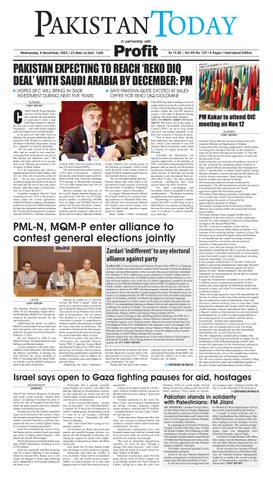
ARETAKER Prime Minister Anwaar-ul-Haq Kakar Tuesday said that the government is expecting to reach a deal with Saudi Arabia by December this year to sell shares in the Reko Diq project — one of the world’s biggest gold and copper mines in Balochistan. In an interview with Arab News on Monday, the premier confirmed that negotiations with Riyadh are underway to sell shares in the Reko Diq project, saying he is “hopeful” of a deal by December. “We are quite excited at the Saudi offer, and we would be very much encouraging their participation, not just in this project but otherwise also,” PM Kakar said when asked if it was acceptable to the Pakistan government to sell its equity to Saudi Arabia. “It is the negotiation part, which is happening between the three parties, and let’s see what sort of outcome comes of that … We are just a government that would encourage the Saudis to be part of this deal and the rest of the nitty-gritty details, when they reach a certain decision, we’ll share the news.” Canadian company Barrick Gold Corporation owns 50% of the project’s shares under the revised agreement, while the Chilean company, Antofagasta, pulled out in return for $900m deposited by three governmental entities including the Oil and Gas Development Company Limited (OGDCL), Pakistan Petroleum
Limited (PPL) and Government Holdings Private Limited (GHPL). The aforementioned entities possess a 25% share in the project — aimed at mining the undeveloped copper-gold deposits in Reko Diq, while the remaining 25% belongs to Balochistan including 15% on a fully funded basis and 10% on a free-carried basis. Barrick considers the mine one of the world’s largest underdeveloped copper-gold areas, with the over $7 billion project capable of producing 200,000 tons of copper and 250,000 ounces of gold a year for more than half a century. Barrick CEO Mark Bristow has repeatedly said the company’s stake wasn’t up for sale but it had no objection if Saudi
Rs 15.00 | Vol XIV No 129 I 8 Pages I Islamabad Edition
Arabia wanted to buy out the equity of the Pakistan government, which would mean the South Asian country would no longer be able to maintain equal shares as the Canadian mining company. “We are still approaching that day,” Premier Kakar said when asked if his government would succeed in meeting the December 25 deadline. “Hopefully [we can expect a deal by December].” In August, Pakistan hosted officials from Saudi Arabia in its inaugural mining conference in Islamabad where Barrick officials were also present. Barrick and Saudi’s state-owned mining company Ma’aden jointly operate a copper project in Jeddah. Saudi Arabia’s Public Investment
Fund (PIF) has been looking to invest in copper projects across the world as part of its drive toward funding energy transition projects. Earlier this year, PIF agreed to acquire a 10% stake in Brazilian mining company Vale base metals business. SIFC TO BRING $60BN INVESTMENT: PM Kakar said in the future, a new Special Investment Facilitation Council (SIFC) set up in July would serve as a “one window operation” to address any concerns of foreign investors. “Two or three areas have already been addressed, like repatriation of dollars, which is the demand of any FDI [foreign direct investment] entity, [that] it’s insured, it’s legally protected,” the PM said. “Secondly, the bureaucratic red tapism has been also addressed, the onewindow opportunity on the platform of SIFC is primarily being designed for this purpose, that we need to cut off all these bureaucratic hurdles and rationalise the entire process of allowing and giving permission to any investment from outside within 15 days.” He said a dispute resolution mechanism had been agreed under the SIFC platform. “It’s quite encouraging and favourable, which is acceptable to all the outside parties … The dispute resolution mechanism has been addressed.” Responding to a question whether reports that SIFC would bring in up to $60 billion in investments in Pakistan in the next five years were realistic, the PM said: “It is indeed. It could be probably more than that.”
PML-N, MQM-P enter alliance to contest general elections jointly
Zardari ‘indifferent’ to any electoral alliance against party
LAHORE STAFF REPORT
The Pakistan Muslim League-Nawaz (PML-N) and Muttahida Qaumi Movement-Pakistan (MQM-P) on Tuesday announced an electoral alliance for the upcoming polls. Addressing the media in Lahore, MQM-P senior leader Farooq Sattar said that both parties will run a joint campaign for the general elections slated for February 8, 2024. He was flanked by PML-N and MQM-P leaders including Khawaja Saad Rafique and Mustafa Kamal. A joint-committee with three representatives from each party will facilitate the alliance, said Sattar. A meeting was held between the senior leadship of PML-N including both the Sharif brothers and the visiting MQM-P delegation prior to the press conference.
Sharing the update on X, formerly Twitter, the PML-N stated: “Both the parties have agreed to adopt a joint strategy to bring the nation out of the current crises and to bring Pakistan back on the path of development. The two parties also decided to set up a six-member committee to prepare a comprehensive charter to address the problems of Sindh province, especially its urban areas. The committee will present the final proposals for cooperation between the two parties to the leadership within 10 days.” The move comes a few days after a conversation was reportedly held between PML-N supremo Nawaz Sharif and Pakistan Peoples Party (PPP) chairperson Asif Ali Zardari, wherein both political bigwigs pledged their commitment to collaborating in order to address the country’s pressing issues and reshape its political future. Addressing the press conference,
KARACHI: Former president and Pakistan Peoples Party (PPP) Co-Chairman, Asif Ali Zardari, has expressed his support for the concept of electoral alliances among various political parties in the run-up to the general elections scheduled for February 8, 2024. Addressing a press conference in Sindh’s Ghotki district, Zardari welcomed the idea of multiple political parties forming alliances to contest elections together, even in the face of reports suggesting a potential electoral alliance by the Pakistan Muslim League-Nawaz (PML-N) against his party in Sindh. Zardari, renowned for his political acumen, did not perceive this development as a threat to the PPP’s election prospects. Instead, he extended a warm welcome to those who intend to compete against his party. During the press conference, he emphasised that the PPP would stay true to the principles and philosophy of its founder, Zulfikar Ali Bhutto, throughout its electoral campaign. The announcement by Zardari comes on the heels of reports indicating that the PML-N is contemplating forming an alliance with several opposition parties to challenge the elections in Sindh. This prospective alliance is expected to encompass parties such as the Muttahida Qaumi Movement-Pakistan (MQM-P), Grand Democratic Alliance (GDA), and Jamiat Ulama-e-Islam (JUI-F). Adding a layer of intrigue to this unfolding political landscape, the PML-N recently appointed Bashir Memon, a former Director General of the Federal Investigation Agency, as its Sindh president. Memon previously headed the Joint Investigation Team (JIT) established by the Supreme Court to investigate Asif Ali Zardari, his sister Faryal Talpur, Anwar Majeed of Omni Group, and former Pakistan Stock Exchange chairman Hussain Lawai for alleged money laundering totaling over Rs35 billion through fake accounts. Reports suggest that seat adjustments are in the works between various opposition parties in Sindh, with a strong intent to contest the elections robustly against the PPP. STAFF REPORT Kamal said that the two parties will work towards taking the economy back to the same position as it was in 2013. “Nawaz Sharif has the experience to deal with all sorts of problems,” he said. “Simply put, the state of the country
right now is not good,” said Kamal. “The International Monetary Fund (IMF) cannot pull the country out of this crisis, Karachi can,” he added.
PM Kakar to attend OIC meeting on Nov 12 ISLAMABAD
STAFF REPORT
Caretaker Prime Minister Anwaar-ul-Haq Kakar will represent Pakistan in Organisation of Islamic Cooperation (OIC) meeting summoned by Saudi Arabia. An emergency meeting of the OIC on the situation in Gaza will be held in Riyadh on November 12. The OIC summit will discuss the Israeli aggression on Gaza and the provision of aid. Saudi Arabia has convened the extraordinary summit of the OIC to discuss the escalating military situation in Gaza, said an official announcement from headquarters of the 57-member bloc in Jeddah. Saudi Arabian Foreign Minister decided to convene the summit after phone call with his Iranian counterpart. Major leaders of the Islamic countries are expected to attend. The Iranian president has already confirmed his participation. The official statement said that the summit to be held in Riyadh would discuss the “brutal aggression against the Palestinian people.” The leaders of the Islamic countries would gather after over a month since Israeli forces launched a brutal assault against the people of Gaza after the unprecedented operation by Hamas. The number of people killed in the Israeli military offensive has crossed 10,000 with almost half of them being children. The Israeli defence forces dropped 30,000 tons of ammunition on the Gaza strip in a month, surpassing even the US, which dropped 15,000 tons of ammunition on Japan in the Second World War. The OIC’s executive committee earlier held an extraordinary session in Saudi Arabia on October 18 in response to the escalating military situation in Gaza. The meeting was co-chaired by Saudi Arabia and Pakistan. It was decided that the council of foreign ministers’ meeting would be convened to discuss practical measures to stop genocide in Gaza. However, since then the situation has further deteriorated, compelling the OIC to convene the summit. The Executive Committee meeting after its extraordinary session last month issued a joint communiqué, accusing Israel for committing “war crimes”. It also strongly criticised the UN Security Council for failing to prevent the humanitarian catastrophe but more importantly launched a broadside against the Israeli backers for their “double standards” and held them responsible for encouraging the Jewish State to commit atrocities with impunity. It urged the international community to act swiftly and to hold the Israeli occupation accountable for these heinous war crimes against the Palestinian people and humanity at large, and called for immediate intervention to halt the massacre. “Israel, the occupying power, bears full responsibility for the fate of civilians in the Gaza Strip and the real tragedy they are subjected to under bombardment, siege, and starvation, without electricity, food, or clean water, while being forced to abandon their homes, and for the policy of indiscriminate collective punishment that it applies in a flagrant violation of international law and international humanitarian law, as well as its legal responsibilities as the occupying power in accordance with the Geneva Conventions,” read the joint communiqué. It stressed the importance of preserving the lives of all civilians, and not targeting them in any way being inconsistent with international law and international humanitarian law, as well as divine laws. The OIC categorically rejected calls to displace the population of Gaza Strip and affirmed its support for the steadfastness of the Palestinian people on their land; stressed the importance for the international community to play its role in preventing any attempt of forced displacement of the Palestinian population from their land, transferring the crisis to the neighboring countries and exacerbating issue of Palestinian refugees. The OIC also wanted to stop the military escalation, lifting the siege on the Gaza Strip, and contributing urgently to the entry of relief and humanitarian aid for civilians.
Israel says open to Gaza fighting pauses for aid, hostages GAZA/JERUSALEM AGENCIES
Israel Prime Minister Benjamin Netanyahu said Israel would consider “tactical little pauses” in fighting to facilitate the entry of aid or the exit of hostages from the Gaza Strip, but again rejected calls for a ceasefire despite international pressure. Having encircled the densely populated Gaza City in the north of the enclave, where the resistance group Hamas is based, Israel’s military claimed it had taken a militant compound and was set to attack fighters hiding in a warren of underground tunnels. Israel has bombarded the enclave since the Hamas raid on southern Israel one month ago, when its fighters killed allegedly 1,400 people and seized 240 hostages. The brutal Israeli assault has killed more than 10,000 Palestinians, including at least 4,100 children. Israel has repeatedly rebuffed mounting calls for a halt in fighting. It says hostages should be released first. Hamas says it will release all hostages if Israel stops bombing Gaza, adding that it will not stop fighting till the attack is on.
Netanyahu said a general ceasefire would hamper his country’s war effort, but pausing fighting for humanitarian reasons, an idea supported by Israel’s top ally the United States, would continue to be considered based on circumstances. “As far as tactical little pauses – an hour here, an hour there – we’ve had them before. I suppose we’ll check the circumstances in order to enable goods, humanitarian goods to come in, or our hostages, individual hostages, to leave,” Netanyahu told ABC News on Monday. “But I don’t think there’s going to be a general ceasefire.” US President Joe Biden discussed such pauses and possible hostage releases in a phone call with Netanyahu on Monday, reiterating his support for Israel while emphasising that it must protect civilians, the White House said. Like Israel, the US fears Hamas would take advantage of a full ceasefire to regroup. Netanyahu said when the conflict is over, he thinks, “Israel will for an indefinite period … have the overall security responsibility (in Gaza) because we’ve seen what happens when we don’t have that security re-
sponsibility.” Calling for an urgent ceasefire, UN Secretary General Antonio Guterres warned on Monday that Gaza is becoming a “graveyard for children”. “Ground operations by the Israel Defense Forces and continued bombardment are hitting civilians, hospitals, refugee camps, mosques, churches and UN facilities – including shelters. No one is safe,” Guterres told reporters. “At the same time, Hamas and other militants use civilians as human shields and continue to launch rockets indiscriminately towards Israel,” he said. International organizations have said hospitals cannot cope with the wounded and food and clean water are running out with aid deliveries nowhere near enough. “We need an immediate humanitarian ceasefire. It’s been 30 days. Enough is enough. This must stop now,” said a statement from the heads of several United Nations’ bodies on Monday. Hundreds of protesters, many from the group Jewish Voice for Peace, staged a sitin on Monday outside New York’s Statue of Liberty, calling for a cease-fire and a free
Continued on page 03
Palestine. Video on social media showed throngs of activists sitting at the base of the statue chanting “Never again for anyone,
never again is now,” echoing a Jewish rallying cry in the aftermath of the Holocaust.
ISLAMABAD: Caretaker Foreign Minister Jalil Abbas Jilani on Tuesday telephoned his Palestinian counterpart Riyad Al Malki to assure that Palestinians aren’t alone in the face of Israeli aggression and that Pakistan stands in solidarity with them. In a message on X (formerly Twitter) on Tuesday, FM Jalil Abbas Jilani said, “I called HE Riyad Al Malki, FM of Palestine to offer condolences of people and govt of Pakistan. The caretaker foreign minister assured Riyad Al Malki that Palestinians aren’t alone in the face of Israeli aggression and that Pakistan stands in solidarity with them. FM Malki expressed gratitude for the humanitarian assistance. Earlier in the day, Pakistan dispatched another consignment of relief goods for the under siege Palestinian brethren of Gaza. It was the second aid consignment sent
by Pakistan for the besieged people of Gaza since Israel started bombing the territory. A month of Israeli airstrikes and artillery bombardment have killed more than 10,000 Palestinians, including 4,000 children, leading to severe shortages of food, fuel and medicines. The second consignment of relief goods for the people of besieged Gaza was dispatched from Islamabad through a special flight. Caretaker Foreign Minister Jalil Abbas Jilani along with the Palestinian ambassador and other officials dispatched the aid consignment for Gaza from Islamabad. On the occasion, the caretaker FM said that on special directives of the Prime Minister, the National Disaster Management Authority is sending the second consignment of humanitarian assistance to the Palestinians. STAFF REPORT
Pakistan stands in solidarity with Palestinians: FM Jilani
Continued on page 03
02 NEWS
PTI: ECP SINDH ‘PLAYING PING PONG’ OVER NOV 12 JALSA
P
ISLAMABAD
staff report
AKISTAN TEHREEK-EINSAF (PTI) Secretary General Omar Ayub Khan has said that Elections Commission of Pakistan (ECP) Sindh is simply playing ping pong, as PTI Karachi wrote to the electoral watchdog Sind on October 16, 2023 for granting permission for holding a Jalsa on November 12, 2023 but not providing a level playing field to PTI. In a statement on Tuesday, the PTI Secretary General said that the ECP did not provide a level playing field to PTI. He
went on to say that ECP Sind has sat on the letter for more than three weeks and has written to the Sindh Chief Secretary on November 4, 2023. “This is an open and shut case of blatant partisanship by the ECP. ECP Sind is simply playing ping pong,” he said, adding, “It appears that ECP is openly engaged in pre poll rigging by not providing a level playing field to PTI.” Omar contended that ECP Sind should publicly give a solid reason for not forwarding PTI Sind’s letter to the government of Sind for granting permission for a Jalsa on November 12 to PTI. He made it clear that one country and two systems was
PSX KSE-100 Index retreats after surging past 54,000 points level
PROFIT
news Desk
After surging past 54,000 points level during intraday trading, profit-taking activities reversed the gains at the Pakistan Stock Exchange (PSX) on Tuesday, causing the benchmark KSE-100 Index to shed 125 points. The KSE-100 index started the day with an upward trajectory by gaining 452 points or a 0.78% increase and reached a peak of 54,312.05 points. However, the market experienced selling pressure before closing hours, causing the KSE-100 to conclude the day at 53,735.73 points, reflecting a decline of 125 points or 0.23%. On Monday, the PSX gained 737.33 points or a 1.39% increase, and closed at 53,860.37 points. Commercial banks, oil and gas exploration companies, and oil marketing companies (OMCs) showed gains, while automobile assemblers, chemical, and fertilizer sectors recorded losses. The driving factors behind recent trajectory at PSX included expectations of a potential rate cut in the monetary policy and the better financial performance of companies listed on the exchange. Additionally, the announcement of upcoming general elections appeared to boost investor confidence, as it signaled the political stability in the country. Bloomberg reported on Monday that Pakistan’s world-beating stock market is approaching overheated levels as a widely tracked measure of momentum rises to the highest in 18 years. The KSE-100 Index 14-day relative strength index exceeded 90 for the first since March 2005. In the previous 14 instances when the metric surpassed this reading, the gauge declined over the next 20 days on eight occasions by an average 4.2%, data compiled by Bloomberg shows. Stocks have rallied to become the best performer globally since July as Pakistan secured a deal with the IMF to avoid a sovereign default. In related development, Pakistan is currently hosting an IMF review mission to carry out the first review under the $3 billion loan program. The outcomes of this review may lead to the release of the second tranche of $700 million by the end of December 2023.
not acceptable. Meanwhile, he strongly condemned the police raid on Farina Aamer, PTIs recently notified District General Secretary Lahore Women Wing held her first meeting yesterday with the PTI District organization. “Last night, Punjab Police raided her house, harassed the family and took away her husband illegally to an unknown location,” he added. Omar said that a moving video of her children wherein they could be seen crying whilst their innocent father was being taken away illegally. “Will the Judiciary take notice or do we have to wait for the time when judges are picked up in the middle of the night by the
Wednesday, 8 November, 2023 | ISLAMABAD
Police and taken to unknown locations for the Judiciary to stir from its deep slumber,” PTI SG asked. He raised question is this the ‘Level Playing Field’ PML-N wants for it to contest in February 8, 2024 general election? “Does PML-N think that by arresting
innocent men and women it will gain support,” he asked. Then why did PML-N delete its survey from its own Twitter/X handle that showed PTI at 81% and PMLN at 16%, Omar questioned. He stated that PML-N should realize that it has lost even before the electoral campaign has started.
Govt to amend OGRA ordinance to empower regulator in gas pricing PROFIT
Monitoring Desk
The federal government has instructed the Petroleum Division to draft a policy proposal aimed at amending the OGRA Ordinance 2002, which would grant the regulatory authority the power to determine and officially announce gas prices in the future. Under the proposed changes, OGRA would be responsible for setting gas prices after consulting with stakeholders, and an appeals process would be established for parties seeking a review of the prices set. The Petroleum Division will be tasked with presenting a policy proposal to the Cabinet Division, following standard procedures. This development was discussed dur-
ing the Economic Coordination Committee (ECC) meeting on October 23, 2023, and later received formal approval from the Federal Cabinet, as reported by BR, citing sources within the Petroleum Division. Additionally, the ECC has directed that revenue from fixed charges should be categorized as ‘non-operating’ income, which would assist Sui Companies in addressing socio-economic challenges, particularly in Balochistan, and the reallocation of RLNG resources for domestic use in the North. The Petroleum Division is actively working with OGRA and the Government of Balochistan to address revenue losses of the Sui Southern Gas Company Limited (SSGC) in Balochistan and is expected to propose recommendations to the ECC.
In an effort to maintain transparency, the ECC has instructed the Minister for Energy (Power and Petroleum) to convene a meeting with representatives from all provinces to discuss the proposed tariff increase and develop a comprehensive communication strategy. It is important to note that under existing regulations, the Federal Government is required to advise OGRA on gas price revisions within 40 days. However, this timeframe has already lapsed, prompting the consideration to empower OGRA to independently set gas prices in line with international best practices, reducing government involvement in pricing matters and addressing past delays in price adjustments. According to a report by Profit, the caretaker government on October 30 ap-
No level-playing field without Imran, says Aitzaz Ahsan LAHORE
it is not in the eyes of the voters,” he opined. If the PML-N continues to restrain the Pakistan Tehreek-e-Insaf (PTI) it will only strengthen Imran’s politics, said the PPP leader. He cited fears of PTI supporters rendering their votes to waste by incorrectly marking the ballot paper if the Imran’s party is deprived of its bat symbol. In response to a query, he accused the Islamabad High Court of favouring the PML-N. Being a proclaimed offender, Nawaz had lost the right to an audience but he was welcomed at the airport, opined Ahsan. He asserted that providing protocol to a convict was an offence. Nawaz cannot be made prime minister for the fourth time unless such an amendment is passed by an elected parliament, he said.
Pakistan ranks third globally in Chinese development finance with $70.3b portfolio PROFIT
Monitoring Desk
A recent report from AidData, a US-based international development research lab, has revealed that Pakistan is the third-largest recipient of Chinese development finance worldwide, with a substantial portfolio of $70.3 billion. This financing primarily comes in the form of loans, with only 2 percent consisting of grants. The report utilized data from over 5,300 sources to draw its conclusions. As per the report, Pakistan constitutes China’s third-largest country-level loan portfolio globally, following Russia and Venezuela, with a total of 161 loans worth $68.9 billion. Rescue lending to Pakistan from China was the highest in the world, highlighting the strong bilateral relationship between the two countries. Pakistan’s public debt exposure to China stands at $67.2 billion, equivalent to 19.6 percent of its GDP. The report notes a shift in Chinese development finance, with a higher proportion now being allocated to rescue loans rather than developmental projects. Furthermore, the post-2017 years have witnessed more common roll-overs of loans, often exceeding new loan commitments since 2019. Out of 127 infrastructure projects worth $38.8 billion, only three projects worth $452 million have been suspended or canceled. The report also points out that more than half of the infrastructure project portfolio, 52 percent, has faced various Environmental, Social, and Governance (ESG) risks. In particular, the energy sector has faced significant ESG challenges, with 51 percent of the portfolio encountering one or more of these issues. Only a quarter of these projects have strong ESG safeguards in place, while 46 percent have faced social risks such as labor violations or community protests. The average interest rate on these loans stands at 3.72 percent, with an average maturity period of 9.84 years and a grace period of 3.74 years. The energy sector received the most significant share of development finance between 2000 and
Chevron eager to establish fuel storage facility in Pakistan PROFIT
Monitoring Desk
staff report
The upcoming general election will remain controversial if ousted premier Imran Khan is not allowed to participate in the polls, said senior lawyer and former Pakistan Peoples Party leader Chaudhry Aitzaz Ahsan on Tuesday. There should be a true level-playing field in the upcoming general elections, he said, speaking to the media outside the Lahore High Court (LHC), objecting to Pakistan Muslim League-Nawaz (PML-N) leader Maryam Nawaz’s demand for party supremo Nawaz’s acquittal. He asked why Imran Khan cannot move freely when thrice ousted former premier Nawaz could do so despite being a convict. Nawaz cannot be made prime minister for the fourth time unless such an amendment is passed by an elected parliament, he said. The former PPP leader also called for a comprehensive policy on Afghan refugees expressing concern that the current situation may lead to anarchy. Maryam was earlier reported as saying that the PML-N would move towards elections after Nawaz is acquitted from all cases and Imran is imprisoned and punished. “There will be no doubt over the controversy of this election if Imran is not given the opportunity to participate in it,” said Ahsan. “Perhaps the PML-N considers the ongoing circumstances as a level-playing field for elections but
proved an increase in natural gas prices for different categories of consumers, effective from November 1, 2023. The decision was made after the Federal Cabinet and the ECC reconsidered the summary submitted by the Petroleum Division, which followed the advice of the OGRA. Defending its decision, the government said that the increase in gas prices was necessary to promote the efficient use of the scarce commodity, ensure the sustainability and affordability of the supply chain, and avoid further accumulation of circular debt. The government also cited the challenges of dwindling natural gas reserves, devaluation of rupee, inflation, and imported liquefied natural gas (LNG) as factors that increased the cost of gas.
2021, amounting to 40 percent or $28.4 billion. General budget support and transport followed closely, receiving 30 percent and 14 percent, respectively. Notably, Pakistan’s energy portfolio of $28.4 billion was the largest in the world, with Angola and Vietnam coming in as the second and third biggest recipients of Chinese development finance for the same period. The report highlights that Pakistan’s energy portfolio represented 10.2 percent of China’s global energy portfolio across numerous countries. A breakdown of Chinese development finance by administration showed that the PML-N government attracted the highest flows, amounting to $36.2 billion during its tenure from 2013 to 2017. The PTI government received $19.6 billion, the PPP government $10.4 billion, and the Musharraf government $4.1 billion. Under the PML-N government, the energy sector was the primary recipient of development finance, accounting for 52.8 percent, while “general budget support” remained the top destination under the PTI government, with 61.3 percent of the flows. Since 2012, China has been Pakistan’s largest foreign development financing provider, surpassing the United States by significant margins in various years. The report indicates that 82 percent of the projects committed untill 2021 were completed, with 13 percent remaining under implementation. Of the 47 projects worth more than $500 million, the majority were in general budget support, followed by energy and banking and financial services.
Chevron Energy Joint, a US-based company, has expressed its interest in storing and selling petroleum products in Pakistan and abroad through public or private bonded warehouses. The News reported, quoting official sources from the Ministry of Energy, that Chevron Energy is the first foreign firm that has shown interest in fuel trade through bonded warehouses since the policy was announced on September 1, 2023. Chevron’s initial interest is focused on utilizing warehouses in the Karachi Port Trust (KPT) area. The policy enables foreign suppliers to store not only crude oil but also petroleum products in Pakistan’s ports and various locations throughout the country, aiming to ensure a consistent and sustainable fuel supply. This policy is designed to prevent potential fuel availability crises in the future. Under the policy guidelines, foreign suppliers or their registered subsidiaries are permitted to maintain an inventory of crude and petroleum products in bulk form. This can be done in their private bonded warehouses or customs public bonded warehouses, without requiring foreign exchange remittances. The stored products can then be sold to local buyers or re-exported to other foreign countries. Foreign suppliers also have the option to establish their registered business or operate through a subsidiary company registered in Pakistan. Such entities must maintain bank accounts in the country and adhere to relevant Pakistani laws for their business activities. Furthermore, these subsidiaries can develop their dedicated storage infrastructure and utilize customs public bonded warehouse facilities for storing crude oil and petroleum products, following the Pakistan Oil (Refining, Blending, Transportation, Storage, and Marketing) Rules of 2016. Consignees will also have the option to establish their dedicated storage infrastructure and utilize customs public bonded warehouse facilities for storing crude oil and petroleum products, either on a rent basis located around port premises or at various locations in Pakistan.
MAXWELL SINGLE-HANDEDLY GUIDES AUSTRALIA TO THRASH AFGHANISTAN Wednesday, 8 November, 2023 | ISLAMABAD
A
ISLAMABAD
Staff RepoRt
USTRALIAN star batsman Glenn Maxwell fought through cramps to smash an unbeaten 201 off 128 balls, single-handedly guiding Australia to an improbable three-wicket win over Afghanistan in a World Cup match on Tuesday and sealing the team’s spot in the semi-finals. The victory has taken Australia to 12 points. They became the third team to reach the semi-finals with India and South Africa having already booked their spots. Afghanistan’s loss has also kept hopes of Pakistan qualifying for the semi-final alive. Afghanistan appeared set for a famous victory against five-time champions Australia at the floodlit Wankhede Stadium, reducing them to 91 for seven wickets after setting them a victory target of 292. But the Afghans then watched in disbelief as Maxwell launched an extraordinary counter-attack. With captain Pat Cummins for company, Maxwell took Australia past Afghanistan’s total of 291
for five wickets with 19 balls to spare. The right-handed batsman suffered cramps after going past his fourth hundred in the 50-over format but laboured on, cutting down on running between the wickets to manage the pain and relying more on big hits. In total, Maxwell hit 21 fours and 10 sixes during his knock — many of them on one leg and the last six brought up the
PTI’s Sanam Javed’s judicial remand extended till Nov 20
victory and also brought up his double century. Cummins remained unbeaten on 12 from 68 balls but more importantly added 202 for the unbroken eighth wicket partnership. Afghanistan held numerous meetings on the ground but were unable to find a way to dislodge Maxwell, who was dropped on 33 by Mujeebur Rahman off Noor Ahmad’s bowling.
ECO Tashkent Summit: a new basis for developing common approaches ISLAMABAD
Staff RepoRt
LAHORE
Staff RepoRt
The Anti-Terrorism Court (ATC) of Lahore on Tuesday extended the judicial remand of Pakistan Tehreek-i-Insaf (PTI) activist Sanam Javed till November 20 in a case pertaining to the burning of the office of Muslim League (N). Judge Abhar Gul heard the petition filed by the police against Sanam Javed, who was produced in court after the completion of her judicial remand. During the hearing, the investigating officer requested the court to extend Javed’s remand as the challan (chargesheet) had been prepared. The court, after hearing the arguments, accepted the police’s plea and extended Javed’s judicial remand till November 20. A case was registered against Javed at Model Town Police Station for her alleged involvement in the burning of the PML-N office.
Bashir Memon appointed president of PML-N Sindh ISLAMABAD
Staff RepoRt
Former Director General (DG) of the Federal Investigation Agency (FIA), Bashir Memon, has been appointed as the President of the Pakistan Muslim League (N) Sindh. On the social communication platform X, the spokesperson for the (N) League and former Federal Information Minister, Maryam Aurangzeb, issued a statement regarding Bashir Memon’s appointment. In her statement, Maryam Aurangzeb mentioned that party president Shehbaz Sharif has appointed Bashir Memon as the President of the Muslim League (N) Sindh, while Shah Muhammad Shah has been designated as the Vice President. Maryam Aurangzeb also shared the official notification for both appointments. It should be noted that Bashir Memon had a meeting with the leader of the Muslim League (N) and former Prime Minister, Nawaz Sharif on Monday.
Maxwell was also adjudged out leg before wicket in the same over against Noor but the batsman managed to successfully overturn the umpire’s decision on appeal. Afghanistan seamers Naveenul Haq and Azmatullah Omarzai had struck early blows with the ball to reduce Australia to 49-4 after opening batsman Ibrahim Zadran’s maiden World Cup hundred helped Afghanistan post a competitive total. With Steve Smith missing from the side due to a bout of vertigo, Australia did not seem to have the batting depth to chase down the target and Rashid Khan’s two quick strikes seemed to have all but sealed the match in Afghanistan’s favour. Zadran anchored the Afghan innings earlier with an unbeaten 129 from 143 balls after the South Asian side won the toss and elected to bat. The 21-year-old Zadran’s fifth hundred in the 50-overs format was studded with eight fours and three sixes. All-rounder Rashid smashed an unbeaten 35 off 18 balls with three sixes and two fours to provide Afghanistan with some quick runs towards the end.
For the first time in history, Tashkent, the capital of Uzbekistan, will host the Summit of the Economic Cooperation Organization. It will be held on 8-9 November, 2023. Our country has been a member of the organization since November 1992, but this is the first time in the history of independent Uzbekistan and this association that a multilateral summit within the framework of the ECO is being held on Uzbek soil. The Economic Cooperation Organization is a regional interstate organization founded in 1985 in Tehran (Iran). The goals and objectives of ECO – development of mutually beneficial trade and economic cooperation and regional interaction in transport and communication sphere fully meet the interests of our republic. At present, the ECO members are Afghanistan, Azerbaijan, Iran, Kazakhstan, Kyrgyzstan, Pakistan, Tajikistan, Turkmenistan, Turkey and Uzbekistan. Since 1995, the ECO has had observer status in the UN and the Organization of Islamic Cooperation (OIC). The ECO activities are coordinated and monitored by the organization’s Secretary General, who is elected and appointed by the Council of Foreign Ministers of the ECO member countries for a period of three years.
In 2022, Uzbekistan chaired the ECO for the first time. Speaking at the 15th ECO Summit in Ashgabat on 28 November 2021, President Shavkat Mirziyoyev put forward proposals for cooperation in trade, investment, transport and “green” economy. “We need to more fully utilize the significant potential of our countries, which have a huge market with a population of over 500 million people, in the spheres of trade and investment,” the head of our state stressed at the summit. Accepting the chairmanship, the President said Uzbekistan favors the development of comprehensive relations within the ECO framework. Our country considers ECO as a platform for discussing ways to improve development and promote trade and investment opportunities in South Asia, Central Asia and the Middle East. Within the framework of ECO, Uzbekistan advocates the creation of interregional transit hubs, the development of modern transport and road infrastructure, the optimisation of transport and transit tariffs, the simplification of conditions for international freight and passenger traffic and the introduction of digitalisation in the transport industry. In addition, at the summit in Ashgabat, President Shavkat Mirziyoyev put forward an initiative on active joint development of “green” economy, wide introduction of resource-saving technologies in industrial sectors, and
achievement of carbon neutrality. Uzbekistan is also in favor of joining efforts to develop common approaches and provide necessary assistance to Afghanistan. In this regard, the head of our state has put forward an initiative to consistently continue the implementation of major trade, transport and energy projects of regional significance jointly with Afghanistan in order to promote the economy of this country and support its people. Today, the ECO countries are the largest trade partners of Uzbekistan. According to the results of 2022, trade turnover between Uzbekistan and ECO countries totalled $12.3 billion, and in January-July 2023 – $5.8 billion. Since May 2018, there has been an intensification of Uzbekistan’s cooperation with ECO. In particular, since 2018, ECO Secretaries General Khalil Akca, Hadi Soleimanpour, Khusrav Noziri, as well as Deputy Secretary General Hussein Burchakli have visited Uzbekistan. At the same time, the participation of the Uzbek side in international events held under the auspices of ECO has been considerably intensified. Official delegations of Uzbekistan take part in the meetings of Prosecutors General, Heads of Maritime Organization s, Ministers of Transport, Tourism and Agriculture, as well as meetings of the ECO Expert Group on Mineral Resources and Heads of Veterinary Organization s of the ECO Member States.
PML-N, MQM-P enter alliance to contest general elections jointly CONTINUED FROM PAGE 01
The former Pak Sarzameen Party leader said that no personal talks were held with the PML-N leadership, only people’s concerns were discussed. Meanwhile, Rafique said that February 8 elections will be contested in a tolerant environment. Referring to Pakistan Peoples Party co-chairperson Bilawal Bhutto Zardari, Rafique said that Bilawal is a free man and cannot be stopped from making statements he wishes too. Earlier, the MQM-P delegation was invited by PML-N President and former prime minister Shehbaz Sharif. Shehbaz had a telephonic contact with MQM-Pakistan Convener Khalid Maqbool Siddiqui and invited him for a meeting in Lahore, and the invitation was accepted. ‘PML-N-MQM alliance will prove to be dead horse of politics’
Following formal announcement regarding the electoral alliance between the PML-N and MQM-P, Pakistan Peoples Party (PPP) leader Saeed Ghani commented that Muttahida Qaumi Movement (MQM) proved it to be dead horse of politics by making alliance with Pakistan Muslim League-Nawaz (PML-N). In a statement issued on Tuesday, he said that MQM always claimed of contesting general election at its own but now its attitude reveals that was not further in position to maintain its status anymore. Saeed Ghani further said that no support can now help MQM to succeed in general elections. He said that perverted collation of MQM-P and PML-N was expected and “we would fully contest elections against them.” The PPP leader claimed that no political party can solely contest elections against his party. Saeed Ghani said that PPP was largest po-
litical party of Karachi and would maintain its position after general elections. PML-N ANNOUNCES ITS MANIFESTO COMMITTEE: Meanwhile, the PML-N has announced name of members of its manifesto committee. The committee will be chaired by senior leader Irfan Siddiqui and will include representation from all four provinces, Azad Kashmir, Gilgit-Baltistan, and minorities. Ahsan Iqbal, Pervaiz Rasheed, Saad Rafiq, Azam Nazir Tarar, Khurram Dastgir, and Maryam Aurangzeb have been appointed as members of the committee. Rana Ehsan Afzal, Rao Ajmal, Riazul Haque, Mossadegh Malik, Barrister Zafarullah, Tariq Fazl, Sabir Shah, Akhtar Wali, Khildas Kohistani, and Bashir Memon are also included in the committee. The committee will be responsible for drafting the party’s manifesto for the upcoming elections.
Israel says open to Gaza fighting pauses for aid, hostages CONTINUED FROM PAGE 01
A Jewish man who fell to the ground in an altercation during dueling pro-Israel and pro-Palestinian street protests in California died on Monday, and his death was determined to be a homicide, law enforcement and a Jewish organization said. GAZA CITY CUT OFF: The Israeli military on Monday released video of tanks moving through bombed-out streets and groups of troops moving on foot. It says it has surrounded Gaza City, cutting off northern parts of the narrow coastal strip from the south. In a press briefing, chief military spokesperson Rear Admiral Daniel Hagari said troops were hunting Hamas field-level commanders to weaken the resistance’s ability “to carry out counter attacks.” The UN Security Council met behind closed doors on Monday. The 15-member body is still trying to agree on a resolution after failing four times in two weeks to take action. Diplomats said a key obstacle is
whether to call for a ceasefire, cessation of hostilities or humanitarian pauses to allow aid access in Gaza. At a meeting of foreign ministers from the G7 leading democracies in Tokyo, Japan’s Foreign Minister Yoko Kamikawa said the group plans to call for a pause in fighting and allowing humanitarian access to Gaza. Biden’s administration has informed the US Congress that it is planning a $320 million transfer of precision bombs for Israel, a source familiar with the plan said on Monday. Israel said on Monday it was striking Hezbollah targets in Lebanon in response to a barrage of rockets fired at northern Israeli cities. The Israeli military said it detected around 30 launches from Lebanon in an hour. The Iran-backed Hezbollah has been exchanging fire with Israeli forces across the Lebanese-Israeli frontier since October 7, in the worst fighting there since Hezbollah and Israel fought a war in 2006. Hamas said it had launched 16 missiles towards Nahariyya and southern Haifa in Israel.
NEWS 03 Al Baraka Bank hosts dinner for its brand ambassador World Junior Squash Champion Hamza Khan
CORPORATE CORNER
PESHAWAR: Al Baraka Bank (Pakistan) Limited hosted a dinner at the Peshawar Club on November 03, 2023, to celebrate the 18th birthday of their brand ambassador, Hamza Khan, World Junior Squash Champion. Squash legend Mr. Jahangir Khan sent a special video message wishing the young champion. Mr. Qamar Zaman and Mr. Jansher Khan graced the event as the guests of honor. The event was attended by dignitaries from KP and Al Baraka Pakistan’s customers from the North Region. On this occasion, Mr. Muhammad Atif Hanif, CEO of Al Baraka Bank, said, “Our brand ambassador, Mr. Hamza Khan, represents the youth of Pakistan. His ambition to raise Pakistan’s stature once again in the mainstream squash world is highly valued by Al Baraka Bank Pakistan. He has today turned 18 years of age. We wish and pray for his great success as he embarks on a new era of professional senior-level tournaments.” He also presented to him Al Baraka Bank’s Platinum Master Debit Card, as his bank account was opened on his 18th birthday. pReSS ReleaSe
IWMB initiates first-ever drive to register captive animals ISLAMABAD
Staff RepoRt
The Islamabad Wildlife Management Board (IWMB) has launched a registration drive to safeguard captive animals and birds in the Islamabad Capital Territory. According to media reports, the initiative aims to protect wild species by ensuring that no captured wildlife is available for sale or possession, either online or in pet shops. The registration process will begin with parrots, including both endemic and migratory species. IWMB will provide identity leg rings to all registered parrots. Registration and leg ring placement for adult birds will be free until December 31, 2023, followed by registration on payment till February 29, 2024. After March 1, 2024, all unregistered adult parrots will be confiscated, and owners will face a fine of Rs 25,000. Parrot chicks will have closed leg rings placed after the current breeding season. Parrot breeders dealing with wild-caught birds after the cutoff date will face a fine of Rs 25,000 per bird. Registration is free until December 31, 2023. From January 1, 2024, to February 29, 2024, owners can obtain rings by paying a registration fee of Rs 5,000 and an annual license renewal fee would be Rs 5,000 (up to 10 birds), Rs 15,000 (up to 40 birds), Rs 25,000 (up to 100 birds), Rs 50,000 (above 100 birds).
R t t e C
04 COMMENT
Can Biden win back Arab American voters?
Wednesday, 8 November, 2023
Tainted elections
T
Recent developments make it doubtful that elections will yield a government able to tackle the nation’s problems
HE announcement of a date by the Election Commission of Pakistan seems to have prodded the parties into kicking off their campaigns, at least those who can do so. The PML(N) started off by forming an alliance with the MQM(P), the day after it had had its first party leaders’ meeting with party Quaid Mian Nawaz Sharif in the chair, in which he told the leaders to prepare fully for the coming election. The PPP meanwhile seems to have continued its sniping at the PML(N) as it tried to set a narrative that would lead it to victory. In the latest episode, which will probably be repeated virtually ad nauseam in the run-up to the poll, PPP co-Chairman Bilawal Bhutto Zardari has said that the next Prime Minister would not be from Lahore, thus ruling out both Mian Nawaz and his brother Shehbaz, who held the office before the present caretaker government took over. The alliance with the MQM(P) should be seen as against the PPP, for the PPP’s capturing of the Karachi mayorship was a great shock for the MQM(P). It should also be seen as another instance of the help being given to the PML(N), which has been tipped as the recipient of the kind of help that would lead towards election victory. The sniping by the PPP should be seen not so much as an expression of distaste as an expression of angry regret that the PPP is not receiving any of the benefits it expected would come its way as a result of its participation in the PDM coalition led by Shehbaz. However, there is also a more basic problem, shown by the death of two policemen in a terrorist attack in Dera Ismail Khan. This follows Friday’s attack, in which five people were killed. Security is already beginning to look shaky, well before election gatherings have begun happening. If the forces which are conducting the election cannot provide the requisite security, then there are remote chances of the election yielding a government which can tackle the country’s problems. The parties are jockeying for position, as they do whenever there is an election, but there is apparently not the same room for the PTI. Even if there was, the election is not going to help the country.
I
Founding Editor
Yousaf Nizami Joint Editor
Executive Editor
Dr James J Zogby
Arab Americans may not be as numerous as some other constituencies, but their hundreds of thousands of voters in Michigan, Ohio, and Pennsylvania were actively courted by the 2020 Biden campaign. For him to win them back in 2024 will be an uphill climb
Arif Nizami (Late) Editor Umar Aziz
Washington Watch
’ve been organizing Arab Americans for almost a half century. For the past three decades, working with my brother, John Zogby, we’ve polled the community’s views on a range of political topics. I’ve learned to value polling because it opens a window and allows you to hear and understand what people are saying and what their views may portend for the future. We knew Arab Americans would be impacted by the devastation and loss of life resulting from the ongoing deadly violence between Israelis and Palestinians. Because we had no idea to what extent the community would respond, we commissioned a poll to get a closer look at how the community is reacting to the conflict, the impact it is having on their lives, how they feel about the Biden Administration’s handling of the conflict, and what their reactions might mean for the 2024 elections. The results, which we released this week, were more striking than we could have imagined. What we learned was that there has been a dramatic decline in Arab American support for President Joseph Biden and that his handling of Israel’s continued devastation of Gaza is the reason for this shift in attitudes. When asked how they would vote in the 2024
Dedicated to the legacy of late Hameed Nizami
M. A. Niazi
His pro-Israel policies may cost Biden re-election
elections, only 17 percent say they would cast a ballot for Biden, in marked contrast to the 59 percent who voted for him in 2020. The president’s approval rating among Arab Americans also plummeted from 74 percent in 2020 to 29 percent in this year’s poll. To find the reason behind this precipitous drop in support, we need to look no further than the twothirds of Arab Americans who say they have a negative view of the president’s handling of the current violence in Palestine and Israel and a similar twothirds who believe the U.S. should call for a ceasefire to end the hostilities. The overall impact of the negative views toward the president and his policies not only shows up in a substantial drop in expected voter support in 2024, but also has a dramatic impact on party preference. This poll marks the first time in our 26 years of polling Arab American voters in which a majority do not claim to prefer the Democratic Party. In 2008 and 2016 Arab American Democrats outnumbered Republicans by two to one. In this year’s poll, 32 percent of Arab Americans identify as Republican as opposed to just 23 percent who identify as Democrats. There has been a steady growth in the percentage of those who identify as Independents— at the expense of the Democratic Party. The poll also demonstrates that Arab Americans worry about the domestic fallout from the war and the heated rhetoric that has accompanied its repercussions at home. Eight in 10 Arab Americans are concerned that the current violence will provoke anti-Arab bigotry, while two-thirds are similarly concerned with the prospect of antisemitism. There are also high levels of concern with publicly expressing views in support of Palestinian rights and fear for their personal safety or acts of discrimination. And six in 10 Arab Americans report experiencing discrimination, an increase of 6 percent since April of
Changing global geopolitical dynamics and the global order
T
Dr muhammaD akram Zaheer
HE global political system’s change over time is a bit like how living things grow and develop. It is a complicated system with different parts that work together. Sometimes, there’s an imbalance in power between different parts of the world, like big countries having more power than others. When power is spread out more evenly in the world, the system can switch big changes for better. The system needs change to keep growing and developing. As it changes, it creates new parts. These new parts make the system work better because they become really good at what they do. One interesting example of this is the Gateway region. Eastern Europe is becoming a place that connects different parts of the world. In the future, the Middle East might also become a Gateway. And in the next few decades, about 30 more Gateway states might appear. These are small countries that will break away from bigger ones to help the world system connect and work together. These gateways help the system to adopt change, interplay and relationship among countries. Today geopolitical tensions have arisen which depend on a complex interplay of different factors. Diplomacy, conflict resolution and international cooperation play important roles in managing and reducing these tensions. Currently, the USA holds the position of the world’s sole superpower. Over the next decades, the country will adopt new strategies to maintain affordable electricity. This strategy bears similarities to isolationism, as the USA will refrain from significant involvement in regional military conflicts. Instead, it will provide support to its allies through supplies, training and limited airpower, opting for a more indirect approach to addressing regional issues in Europe, the Middle East and Asia. This strategic shift is expected to help the USA maintain its global hegemony. In Europe, the European Union (EU) may undergo dissolution or redefinition as a smaller trading zone covering a reduced portion of the continent. The current free trade structure appears unsustainable due to member states, particularly Germany, becoming overly reliant on exports. This dependence leaves their
Editor’s mail
to adopt a new strategy resembling isolationism to maintain its dominance. Europe faces potential challenges as the European Union may redefine itself, while Germany’s economic vulnerability could shift the balance of power in the region. In Russia, weakened oil prices could lead to internal fragmentation, raising concerns about the future of its nuclear arsenal. In Asia, China’s economic decline may usher in a return to regionalism and give rise to Japan as a leading power. Meanwhile, the Middle East continues to grapple with the persistence and expansion of Islamic extremism, with Turkey potentially reasserting itself as a dominant regional force. The evolving geopolitical landscape will demand careful diplomacy, conflict resolution, and international cooperation to address these emerging trends and strains in the years to come. The dominant theme can be see playing out over the course of the next decades is increasing disarray in Europe and Asia. It is expected there will be prolonged stability in North America with US rivals working to increase their footholds in Latin America. Despite the growing instability in Eurasia, also expect to see three regional powers emerge: Japan, Turkey and Poland. These countries will be outliers in an otherwise fragmented Eastern Hemisphere. The changing global geopolitical scene is a dynamic and ever-evolving phenomenon that presents both opportunities and challenges for nations around the world. As new powers rise and traditional alliances shift, the need for diplomacy, cooperation and adaptability becomes increasingly paramount. In this period of interconnectedness and interdependence, it is essential for nations to recognize the importance of multilateral cooperation, embrace sustainable and inclusive policies and work towards a more peaceful and prosperous global future. The complexities of the 21st century demand creative solutions and a commitment to shared values, as we navigate the shifting tides of global geopolitics in a manner that promotes peace, stability and prosperity for all.
The writer has a PhD in Political Science and can be reached at akramzaheer86@yahoo.com
The changing global geopolitical scene is a dynamic and ever-evolving phenomenon that presents both opportunities and challenges for nations around the world. As new powers rise and traditional alliances shift, the need for diplomacy, cooperation and adaptability becomes increasingly paramount.
Lahore – Ph: 042-36300938, 042-36375965
I
Karachi – Ph: 021-35381208-9
I
Islamabad – Ph: 051-2204545
The writer is President, Arab American Institute.
Send your letters to: Letters to Editor, Pakistan Today, 4-Shaarey Fatima Jinnah, Lahore, Pakistan. E-mail: letters@pakistantoday.com.pk Letters should be addressed to Pakistan Today exclusively
The world is heading for great chances
economies highly susceptible to fluctuations in demand beyond their borders. Germany may experience an economic downturn due to inevitable export market fluctuations, leading to its diminished influence in Europe by 2040. This decline may open up opportunities for Central Europe, notably Poland, to become a more significant regional power. Russia will continue to grapple with the repercussions of relatively low oil prices. The income derived from this sector has been essential for maintaining internal stability. With a significant reduction in this income, Russia may either transform into a confederation or experience separatist movements by 2040, raising important questions regarding the future of its nuclear arsenal. In Asia, as China’s competitiveness in export markets wanes, high unemployment will become a major concern for the Chinese government. To prevent an economic downturn, the government may seek to consolidate its power and embrace authoritarian measures. Nevertheless, China’s diverse regional setting will present challenges to such centralized control. Consequently, by 2040, China may experience a return to regionalism marked by a degree of chaos. As China weakens, a power vacuum in East Asia may emerge, which Japan is well-positioned to fill, given its robust economy and significant military capabilities? In the Middle East, it is difficult to foresee an end to or effective control of Islamic extremism. Instead, it may continue to expand its influence and territory. Turkey and Iran are the only regional actors with the potential to counter these extremist groups, but Iran may not take any such action. Given the ambitions of these extremist groups to reinstate the caliphate, Turkey may find itself compelled to intervene militarily to safeguard its borders. This military and economic assertion by Turkey may lead to a resurgence of a regional power reminiscent of the Ottoman Empire, positioning Turkey as the dominant regional force by 2040. The future geopolitical environment is marked by a complex interplay of factors that will shape global dynamics over the next decades. The USA, as the current sole global power, is poised
this year. It is noteworthy that this concern is most prominent among Arab American Muslims (70 percent) and Arab Americans ages 18-34 (74 percent) who report facing discrimination. One-half of all Arab Americans feel concerned about facing discrimination at school, work, and in their local community due to the recent violence in Palestine and Israel. Finally, it is significant to note that both the high levels of support for Palestinian rights and high negatives for the president’s policies are views shared by almost all of the demographic groups covered in the poll— by age, gender, education level, religion, and immigrant vs. native born. This is significant because in our nearly three decades of polling, there have only been two other moments where policy issues have resulted in such a dramatic shift in Arab American views— and neither of them produced such a change over such a short period of time. The first was during the Bush years when over a period of four years Arab Americans moved decisively against the president’s policies in Iraq and his repressive domestic agenda of violating civil liberties and his party’s negative stereotyping of Arab Americans and American Muslims. The second was in 2016 when Arab Americans recoiled in the face of Donald Trump’s campaign rhetoric against Muslims. In the case of President Biden, while Arab American attitudes toward his job performance declined on a par with the rest of American voters, the precipitous drop over a few weeks time in support for his reelection and even his party has been unprecedented. Arab Americans may not be as numerous as some other constituencies, but their hundreds of thousands of voters in Michigan, Ohio, and Pennsylvania were actively courted by the 2020 Biden campaign. For him to win them back in 2024 will be an uphill climb.
I
Toxic academics
THE success of a nation is intimately tied to the strength of its education system, with universities and research institutions serving as the guardians of knowledge and innovation, driving the country’s intellectual capital. However, when toxic behaviours infiltrate academia and the authorities prioritise personal gain over collaboration, the repercussions extend beyond academia itself, impacting the entire nation. The progress of society relies heavily on the quality of education, and it is the dedicated, competent, and respectable faculty members who guide this progress towards excellence. Unfortunately, a corrosive culture is spreading throughout our academic institutions, manifesting as maliciousness and selfcenteredness, which undermine the noble pursuit of knowledge. Regrettably, these toxic individuals are more numerous than we would like to admit, and their actions tarnish the educational landscape. Their cunning tactics often involve animosity, envy, self-promotion, and an utter disregard for universal values and principles. The consequences of their behaviour are severe and far-reaching. Educators who could have made significant contributions to the nation’s future are stifled, demoralised, or even compelled to abandon their careers. The toll on their mental and physical well-being is immeasurable. When dedicated individuals face hostility, arbitrary decisions, and a climate of fear and insecurity, the damage extends beyond personal suffering, corroding the very essence of our educational institutions and the fabric of our society. What makes this crisis even more alarming is the impact it has on talent retention and brain drain. As individuals seek better prospects abroad, they are also turning away from our institutions due to the toxic culture that drives away our brightest minds. These talented individuals find solace in more nurturing academic environments where their contributions are valued and their well-being is safeguarded. Paradoxically, these toxic leaders are inflicting more harm on our homeland than any external threat ever could. Addressing this crisis is imperative for our nation. The first step is to hold toxic individuals accountable for their harmful actions, ensuring that they face the consequences of their decisions. Creating an environment where grievances can be addressed without fear of retaliation is also crucial. It is high time we restored the sanctity of our academic institutions, shielding them from the corrosive influence of toxic and non-collaborative academics. INTIKHAB ULFAT KARACHI
Muslim unity
I would like to draw the attention of the Muslim Ummah to a very important thing: “Unity.” Have you ever wondered why Muslims, with more than 2 billion, are still oppressed and victimized? Have you ever realised that there are 59 Muslim-majority countries, and still the people of Palestine, Burma, Kashmir, Myanmar, Uyghurs, India, France, and across the globe are suffering? No, we never thought about it because we are busy in our own lives, in our very own busy schedules, and in our very own foreign policies. We, being the first Muslim atomic power, observe black days and solidarity days and do nothing. However, on the other hand, western agendas are supporting each other likewise. America donated 8 billion dollars to Israel to support them, and we here are raising voices: “We want peace.” OIC meetings are held with no significant solutions. Our most sacred books are continuously being burned and are labelled “Freedom.” They slaughter Muslims and then call themselves big representatives of human rights. They snatch scarves from our women and present themselves as big supporters of women’s rights. It’s time for us to wake up. It’s time to show unity. It’s time to raise the voice for our sisters and brothers. It’s time to boycott all western products; it’s time to prove yourself a follower of the Prophet SAWW. If we join our hands together and start to feel what, actually, sisters and brothers are suffering, and if we raise the spirit of a true Muslim, then there will be no batil left. SYEDA SUNYA SHAH KARACHI
Web: www.pakistantoday.com.pk
I
Email: editorial@pakistantoday.com.pk
COMMENT 05
Biased western narrative and the Palestinian genocide Wednesday, 8 November, 2023
G
Trying to blot out Palestinian history KhAdijA BilAl
LOBAL media has played quite a role in shaping and influencing public opinions, whether it be about any global conflict or social issue. The subtle media coverage of such conflicts and issues has immensely impacted the changing viewpoints of the general public. However, while doing so, the global media also fooled the public by luring them towards their own constructed reality through misrepresentation and misinterpretation of these crucial issues and conflicts. The continuous omission of political and historical factors that contribute to the understanding of the context of the ongoing violence is an often-used tactic by the global media. Nonetheless, we are perfectly aware of the power that heavily controls the global media, which is none other than the Western powers and the pro-Israeli organizations, which wants the world to perceive the image through the Western lens, manifesting Western ideas and stories. In this process of influencing and inspiring, Western media has left everyone far behind. The Western media has shown complete bias and inconsistency while covering numerous wars and conflicts. The same is the case with the ongoing dreadful ethnic cleansing and butchery of thousands of innocent civilians in Palestine, carried out by savage Israelis. Despite these atrocious circumstances, Western media is demonizing and marginalizing the already oppressed Palestinians, depicting them as pure “villains”. Western media tends to portray Israelis as sinless “victims” of oppression and Palestinians as “terrorists” and “aggressors”. And we are very well familiar with the classically biassed and obstinate tactics of the West. They use deceptive language to construct a fabricated and distorted perception of reality, which baffles the general public. Tragically, this is not it. Western powers may have been able to control and direct the global media according to their “schemes and strategies” but whoever does not follow these strategies faces a dreadful end. Palestinian Journalists, fearlessly exposing vicious acts of human violation, brutal killing, and consistent torture of Palestinians by Israeli forces, had eventually become the target of this dreadful end. More than 34 Palestinian journalists, along with their family members, have been killed since October 7, only because they dared to expose the truth of the Palestinian genocide, ruthlessly carried on by Israeli forces and occupants. This holds the idea of “freedom of speech” accountable, a Western idea that believes that it is “the power or right to express one’s
opinions without censorship, restraint, or legal penalty.” But the West itself seems to refuse to believe in its own established set of ideas and systems. The West tends to inspire and influence the world by beautifying its holy epitome of “Freedom of Speech,” a world where everyone has the ultimate right to express and voice his or her opinions. But these notions are fitting for people like Salman Rushdie, who insults and slanders religious Islamic values and notions while becoming the cause of death for people like Abu Hatab and other Palestinian Journalists who risk their lives to save the gory truth. West, who likes to sing the epic songs of “Humanity and Justice,” simply seems to ignore its very existence. Do humans living in Palestine have no value? Whereas the lives of Israelis and Zionists apparently matter more than anything in the world, even though they are ruthless barbarians who love to mock and exploit the supressed and tyrannized Palestinians who are helplessly seeing their loved ones die in front of their very eyes. Further, the violation of so-called “Freedom of Speech” has reached incomprehensible ends where selfcensorship by social media platforms like Instagram, TikTok, etc. is raising doubts and concerns. Many accounts on these social media platforms are being shadow-banned and deleted, particularly when it comes to content related to the ongoing situation in Palestine. Many individuals and organizations have reported that their posts and accounts have been subjected to restrictions, reduced visibility, or outright removal due to the content they share regarding the Palestinian conflict and the alleged genocide. These actions further raise questions about the pivotal role of social media platforms
Cricket is not a gentleman’s game, and it doesn’t need to be
M
Fans need to understand that calling cricket the ‘gentleman’s game’ has classist connotations in today’s day and age DAILY STAR
Azmin AzrAn
ONDAY’S match between Bangladesh and Sri Lanka, two of the worst performing teams in this year’s World Cup, was as dead as a dead rubber gets. Champions Trophy qualification was still on the line, but in the broader context of the World Cup, few besides Bangladeshis and Sri Lankans would have been paying attention. But the Bangladesh team kept pace with their pre-tournament reputation of creating drama. In fact, they created history this time by invoking the first-ever instance of a “timed out” dismissal in international cricket. Every time a batter gets out in an unconventional manner during a cricket match, some fans are quick to put on their judgemental hats and bring up the dated arguments dominated by two phrases: “the Spirit of Cricket” and “the gentleman’s game.” Cricket’s origins do go back to the English aristocrats, who would sit down at high tea and clap softly as other gentlemen in all-white knocked the ball around a park. But the professionalization and globalisation of the game has changed all this. The epicentre of global cricket is now in South Asia, where the game is competitive at all levels. Players for every national team play under immense pressure, and they are expected to take every legal advantage to win. Beyond all that, fans need to understand that calling cricket the “gentleman’s game” has classist connotations in today’s day and age. The origin of the phrase goes back to the 17th century, when English aristocrats playing it made the game more popular. They decreed that the game should be played in a gentlemanly manner. This decree has meant different things during the different historical periods of the game—as cricket moved from being the game of the nobles and the affluent living on a tiny island on the edge of the Atlantic, to becoming a game played by officers in colonies across the world. The high barrier of entry to the game, the expensive equipment, and the fact that modern cricket had originated from an upper class within a highly stratified English society resulted in the phrase “gentleman’s game” being used to exclude people from the game—an attempt that has failed in our part of the world, where cricket is by far the most popular game across classes. But that didn’t mean the classism and the judgement had left the game of cricket. When Vinoo Mankad first ran someone out at the non-striker’s end, the Australian media had a field day. When the Pakistanis invented the art of swinging the old ball and dominated batters with their skill, they were called cheats and accused of ball tampering. Wasim Akram, the legendary Pakistani bowler, is often heard saying that once the English learned the art themselves, “ball tampering” was conveniently renamed “reverse swing.” Sri Lankan legend Muttiah Muralitharan exploited a unique physical feature on his right elbow to spin the ball around corners and take hundreds of wickets, but no amount of testing his bowling action to prove its legality could dissuade some from claiming he was bending his elbow illegally (also known as “chucking”) while bowling. The dominant West Indians possibly faced the worst of it in the 70s, when the venerated former player and commentator, Tony Greig, said he wanted to make them “grovel.” The word had racist connotations, given that many of the Caribbean players had ancestry going back to enslaved people. Tony Greig, on the other hand, was born in South
Africa during Apartheid. Cricket is played seriously by a very small number of nations across the world, and they can broadly be divided into two categories: countries where the colonists had brought the sport and kept it for themselves, and countries where the colonised fell in love with the sport and made it their own. For the latter category, cricket’s perception is vastly different from the original one championed by the English. In the South Asian subcontinent, for example, cricket is an obsession—the national teams’ wins and losses directly correlate to the national mood. The “gentleman’s game” is hardly a consideration when teams are desperate to win, and when losses mean that a player’s personality and personal life will be lambasted across social media. Sri Lanka and Bangladesh are cut from similar cloths when it comes to how cricket is perceived in our respective societies, and in this year’s World Cup, both teams have struggled to get a win. The desperation was palpable, and the fact that Bangladesh took a legal—albeit rare—advantage understandably rubbed the Sri Lankans the wrong way. But using words like “disgraceful” and “shameful” to describe Shakib Al Hasan’s actions ignores the larger picture of what cricket is to us. Bangladesh needed to win, and here was an opportunity that was perfectly legal. So, the captain took it. It was the batter’s responsibility to be ready to face the ball within the time limit, and he wasn’t. The equipment failure is a non-factor, because the batter never informed the umpires or the opposition captain before walking off looking for a replacement. The “Spirit of Cricket,” in reality, is the preamble to the Laws of Cricket published by the Marylebone Cricket Club (MCC), cricket’s oldest and most respected institution. I own a copy of the MCC’s Laws of Cricket, and took the time to check the literature. It says that respect is central to the Spirit of Cricket. Players are expected to respect their captains, other players, and the umpires. The game is to be played hard, but fair. A positive atmosphere should be created by the players’ conduct, and players must show selfdiscipline. Players are also expected to congratulate and thank the opposition no matter the end result. So, did Angelo Mathews respect the umpires or the Bangladeshi team when he walked off to fix a helmet without facing a ball and without getting a nod of approval from Shakib or the umpires, whereas Bangladesh was behind on over-rate at that point in the game? Did the Sri Lankan team respect the umpire’s decision when Mathews was given out? What about the repeated verbal exchanges between the teams when Bangladesh was batting later on in the evening? And where was the Spirit of Cricket when the Sri Lankan players didn’t even shake hands with the Bangladeshi dressing room at the end of the game? The truth is that the Spirit of Cricket is a loose framework of principles that is broken by most teams on most days, as told by former professionals in the aftermath of this incident. We are at a point where cricket fans, players, and administrators across the world need to think about whether they will foster the principles of competitiveness and professionalism that will drive the game towards becoming a true global phenomenon, or if they want to continue being haunted by the ghost of an English aristocracy that once envisioned the game as one reserved for gentlemen, to be played on sunny days during the English summer, enjoyed alongside a cup of English breakfast tea which, if we’re all being honest, tastes a bit bland. Azmin Azran is a journalist at The Daily Star.
impact and their ability to raise awareness about sensitive and contentious issues. This issue suggests that even social media, controlled by the West, wants to conceal the dark truth, which makes them stand at a critical point. However, this Western bias doesn’t end right here, considering other wars such as the Russia-Ukraine War often reveal the same set of motifs and schemes. Russia is consistently depicted as the villain, while on the other hand, Israeli forces and occupants are represented as helpless creatures. The Western hunger to induce the idea of “the other” had always been a part of the representation of both sides of the conflict. These double standards call into question the impartiality and egalitarianism of Western media outlets in war reporting. Considering a bloodbathed genocide as a war, accusing harmless Palestinian civilians of the use of violence shows how the Western media has even crossed the boundaries of pharisaism. This Western bias has always been there due to their cultural beliefs and thoughts. They may say that they promote diversity in language, culture and thoughts, but they seem to have the most terrible perceptions in such regard. Historically, anti-Semitism and Islamophobia have been well-documented features of Western cultural thought. While anti-Semitism has been widely denounced in Western culture as unacceptable and abhorrent, antiArab and Islamophobic sentiments have not faced the same level of censure. These sentiments have been further fueled by the US-led “War on Terror,” which Israel has used to frame its war with the Palestinians. Such biased coverage of the Palestinian genocide in the media not only misrepresents reality but also perpet-
The media must not favour inhumane and gory acts of Israeli forces and occupants while marginalizing innocent Palestinians who are the victims of a brutal genocide. The media should eradicate the vicious cycle of calamity and dishonesty. Media organizations must be clearer and more honest in their coverage of this dreadful genocide, which reflects the nuanced nature of the situation uates narratives that benefit Israeli occupants and forces while undermining the legitimate concerns of the innocent Palestinian people. The media contributes to the persistence of inequality and hinders the potential for amicable and sustainable peace in the region through the application of different moral and legal standards than in other conflicts. Palestinians, who need global support and a voice of their own, are facing dire consequences because of the Western media’s biased narratives and ideas. Media organizations need to re-evaluate their ethics and professional practices. They must avoid perpetuating harmful narratives and contribute to a more accurate representation of the Palestinian genocide. Diverse perspectives and voices must be included in media coverage, allowing for a more nuanced understanding of the complexities involved. The media must not favour inhumane and gory acts of Israeli forces and occupants while marginalizing innocent Palestinians who are the victims of a brutal genocide. The media should eradicate the vicious cycle of calamity and dishonesty. Media organizations must be clearer and more honest in their coverage of this dreadful genocide, which reflects the nuanced nature of the situation.
A new law is about to kill free speech and democracy in Australia The writer is a freelance columnist
A bill on fighting ‘misinformation and disinformation’ and ‘harm’ aims to empower a government agency to police online expression
T
RT
Augusto zimmermAnn
HE Australian Government has recently introduced in Parliament a new law proposal to ban officially unapproved online content. Digital companies are expected to adopt a code of conduct which will see them censor speech based on broad, vague and far-reaching directives. The Communications Legislation Amendment (Combating Misinformation and Disinformation) Bill 2023 foreshadows the imposition of a legal obligation on digital platforms to police alleged ‘misinformation’ and ‘disinformation’. If that does not work, the law proposal provides for the full empowerment of the Australian Communications and Media Authority (ACMA) to directly intervene for the purpose of preventing ‘harm’. Section 2 of the proposed legislation defines ‘harm’ as follows: (a) hatred against a group in Australian society on the basis of ethnicity, nationality, race, gender, sexual orientation, age, religion or physical or mental disability; (b) disruption of public order or society in Australia; (c) harm to the integrity of Australian democratic processes or of Commonwealth, State, Territory or local government institutions; (d) harm to the health of Australians; (e) harm to the Australian environment; (f) economic or financial harm to Australians, the Australian economy or a sector of the Australian economy. The concept of ‘harm’ peddled by the bill is illusory, and its content would be subjectively determined by a powerful government agency. The definition of what is and what isn’t harm is malleable and can expand and contract depending on ACMA’s prevailing views. Ultimately, any type of speech with which the government is uncomfortable could be deemed ‘harmful’. For example, describing “disrupting social order” as serious harm could be interpreted to stop the organization of legitimate political protests. This could certainly be used to suppress legitimate political speech that should be part of a functioning democracy. Above all, ACMA would gain sweeping powers to require any person to appear at a time and place of its choosing to answer questions about misinformation or disinformation. These powers include infringement notices, remedial directions, injunctions and civil penalties, including fines of up to AU$550,000 (US$358,000) for individuals and AU$2.75 million for corporations. Criminal penalties, including imprisonment, may also apply in
cases of alleged “extreme harm.” The provisions found in this law proposal put the communications and lives of free-thinkers, human rights defenders, independent journalists, and ordinary citizens under constant risk. They go in direct opposition to international human rights experts’ advice that “general prohibitions on the dissemination of information based on vague and ambiguous ideas, including ‘false news’ or ‘non-objective information’, are incompatible with international standards for restrictions on freedom of expression… and should be abolished.” It is noteworthy that the Australian Government is exempted from the proposed legislation. Hence, the content issued by the government is never to be considered ‘misinformation’ but criticisms of the government by ordinary citizens can. It is certainly ironic that views incompatible with the government’s preferred narrative could be deemed to ‘harm’ the integrity of Australia’s democracy since it would disallow speech and expressive conduct that is integral to the maintenance of democratic processes. In its 12-page submission to the Law Council, the Victorian Bar Association explains that this proposed legislation effectively creates an “unlevel playing field between governments and other speakers” that disadvantages government critics in comparison to government supporters. “The bill’s interference with the self-fulfilment of free expression will occur primarily by the chilling selfcensorship it will inevitably bring about in the individual users of the relevant services,” says the Victorian Bar. Above all, ACMA’s enforcement of the proposed legislation will inevitably stymie discussion of controversial topics, especially if they involve criticism of government policy and actions. This scenario is likely to unfold when the impugned speech is incompatible with the government’s official narrative. Thus, the proposed legislation targets those who, merely exercising their right to free speech, critically assess the desirability of government decisions and actions. Other concerns with the proposed ‘misinformation’ legislation include the possibility of suspending the activities of internet companies in Australia if they fail to comply with the obligations created, as well as increased criminal penalties for libel and defamation which are incompatible with international human rights standards. As can be seen, the proposed legislation constitutes a serious attack on the democratic right of Australians to free speech. Digital platforms will be legally obliged to police commentators’ discussion of controversial topics. Under this ‘misinformation’ legislation, any honest and robust debate about government policies will be effectively outlawed. To conclude, our freedom of political communication is under attack in Australia. If the Misinformation and Disinformation Bill is enacted, then the free expression of ideas will be basically outlawed by the Australian Government. In short, the enactment of this law proposal will spell the end of authentic democracy in Australia. Australians are basically witnessing the transformation of their system of representative government into nothing more than a less open, or more disguised, form of elective dictatorship.
Augusto Zimmermann, Professor and Head of Law at Sheridan Institute of Higher Education in Australia, President of WALTA – Legal Theory Association, and former Law Reform Commissioner with the Law Reform Commission of Western Australia.
06 NEWS
China-US armS Control ConSUltationS to bUild on trUSt ahead of aPeC
C
WASHINGTON
STAFF CORRESPONDENT
HINA and the US have broken the ice in the field of arms control and nonproliferation that has been frozen for years, as consultations between the two sides were held on Monday. It carries special significance as the latest in a series of efforts intended to ease tensions and build trust ahead of an expected Xi-Biden meeting next week, but Chinese experts still warned of Washington’s “bandit logic” and a monopolistic thinking that lies behind its intentions. The first of its kind since former US president Barack Obama’s administration, the consultation is part of a broad array of dialogues between the two sides aiming to keep communication channels open and reduce the risk of miscalculation. No statement has been released by the two sides as of press time, but Chinese Foreign Ministry spokesperson Wang Wenbin revealed at Monday’s press briefing that the two sides will exchange views on issues such as the implementation of an international arms control treaties and nonproliferation. A New York Times report said it is “encouraging” for the two militaries to discuss arms control as “those lines of communication are the best way to avoid
the kind of misunderstandings or overreactions that can lead to actual conflict.” The resumption of such consultations, coming at a critical juncture, carries special significance with conflicts taking place in multiple parts of the world, which add to a growing risk of nuclear proliferation and even nuclear war. Therefore, communication between China and the US is crucial in helping alleviate international tensions, Song Zhongping, a Chinese military expert and TV commentator, told the Global Times on Tuesday. “Although China’s nuclear capabilities are nowhere near that of the US, we are still willing to engage in dialogue as we aim to persuade Washington to be a responsible nuclear power. This is not only for us, but is essential for maintaining peace and stability across the world,” Song noted. China and the US have recently resumed contact in a number of areas, including climate, trade and commerce, science and technology, and military. Along with an ongoing trip by China’s special envoy for climate change Xie Zhenhua, He Lifeng, China’s lead person for China-US economic and trade affairs, is visiting the US from Wednesday to Sunday at the invitation of US Treasury Secretary Janet Yellen, the Chinese Foreign Ministry announced on Monday.
home World 2024 US election: old biden wobbles behind indicted trump in ‘swing states’ polls WASHINGTON AGENCIES
One year ahead of the US presidential election, polls show that Democratic President Joe Biden is trailing Republican frontrunner Donald Trump in five out of the six most crucial battleground states. These findings are primarily attributed to American concerns about Biden’s age and dissatisfaction with his handling of the economy. The New York Times and Siena College Polls, released on Sunday, indicate that Trump is leading in Arizona, Georgia, Michigan, Nevada, and Pennsylvania, while Biden maintains an advantage in Wisconsin. In the 2020 election, Biden emerged victorious in all six of these states, which are traditionally considered swing states. However, the current polls show Trump with an average lead of 48% to 44% in these key states. Presidential elections in the United States are often determined by the outcomes in a handful of these swing states. Biden’s wins in these states in the 2020 election were pivotal in securing his victory. To secure re-election, he would likely need to carry many of these states once again. In response to the poll results, a Biden campaign spokesperson, Kevin Munoz, noted that predictions made more than a year in advance can evolve. He pointed to a past Gallup prediction that had incorrectly projected an 8-point loss for President Obama, who ultimately won the election handily. Munoz emphasised the campaign’s focus on reaching and mobilising a diverse coalition of voters, highlighting the choice between their popular agenda and the Republican.
The resumption of consultations between China and the US in multiple important areas indicates that both countries are working to implement the consensus reached by their leaders and turn commitments into actions, Yang Xiyu, a senior research fellow at the China Institute of International Studies, told the Global Times on Tuesday. It shows that despite sharp contradictions, high-level contacts and specialized dialogue mechanisms have become more comprehensive and mature. This progress contributes to the stability of bilateral ties and creates the necessary conditions for meetings between the two leaders, Yang said. Despite warming signs, however, the US government is continuing tirelessly to hype China’s nuclear arsenal “building spree.” The Pentagon claimed in a report in October that China “possessed more than 500 operational nuclear warheads as of May 2023 and is likely to have more than 1,000 by 2030.” Washington has been trying to bring China into the US-Russia nuclear arms control negotiations, but Beijing has not agreed. The reason is simple: China’s nuclear weapons stockpile is only a fraction of those possessed by the US and Russia, thus nuclear arms control is a special responsibility for them, not China, experts said.
According to the Stockholm International Peace Research Institute, the US currently possesses about 3,700 nuclear warheads, trailing Russia’s roughly 4,500, while China only has 410. “Today we are seeing an odd scene, where a power with overwhelming advantages and an offensive strategy accuses the other with fewer warheads and a defensive nature of being a ‘threat,'” Yang said. “This is ‘bandit logic’ fueled by monopolistic thinking, because the threat that Washington feels is not to its security, but to its nuclear monopoly.” The real threat lies in the US’ nuclear capabilities, which are the primary source of global instability, Song noted. By hyping China’s “ambition,” the US finds an excuse to develop more advanced weapons, while the ultimate consequence is a global arms race and the collapse of the global nonproliferation regime. Yang warned of an unprecedented extreme anti-China sentiment among some US officials, who view China’s development through the lens of its own “might makes right” logic, and who also believe that China will eventually replace the US’ position when it’s strong. Such a twisted mind-set has become the biggest challenge to bilateral relationship. “The US should value this window of opportunity, as it does not come easy,” Yang said.
Indian farmers continue stubble burning despite cost to health NEW DELH REUTERS
Small farmer Aashish Sharma has been burning crop stubble in recent days even though he is aware of its impact on air quality nearby and in New Delhi, the world’s most polluted capital located about three hours away by road. The air quality in Sharma’s village in Haryana state is so bad his asthmatic uncle struggles to breathe, meaning he needs a nebuliser to pump medicine directly into his lungs. “We know stubbleburning is harmful, particularly for the health of our parents and children,” said Sharma, 22, in his village in Karnal, known for its rice and wheat cultivation. But for him, the only alternative to burning crop residues is to join the queue to hire machines to clear his field, which would cost him about $100 for his four-acre farm. The average waiting time to rent a machine is about two weeks. Buying one for nearly 300,000 rupees ($3,606) is unaffordable for the small farmers in the village, they said, highlighting the challenge authorities face in trying to improve northern India’s air every winter. More than 85% of Indian farmers are categorised as small, meaning that, like Sharma, they
own about four acres or fewer. Together, they control 47% of the country’s crop area, government figures show. Residents in Delhi and surrounding areas in Haryana, Uttar Pradesh and Punjab states experienced some of the filthiest air in the world in the last week, data from the Central Pollution Control Board (CPCB) showed. Delhi has closed primary schools and restricted road traffic, while international cricketers in the city skipped practice ahead of a World Cup match on Monday. Stubble burning in Punjab and Haryana has typically accounted for 30% to 40% of Delhi’s October-November pollution, according to government air-quality monitoring agency SAFAR. In response to government incentives and fines, the number of fires has declined by 40%-50% this year from a year ago, the government estimates, but nearly a dozen farmers across three Karnal villages told Reuters they would keep burning. “No one in our village has been fined so far though scores have burnt stubble,” said Dharamvir Singh, adding he had cleared out 10 acres that way and would do the same for another 1015 acres of own and leased land. “I am coughing every day and
feel irritation in my eyes but would prefer to take some medicine or a drink in the evening than incur extra costs.” POLITICAL WILL LACKING: Ajay Singh Rana, a Haryana farm official, said the number of farms burning stubble in Karnal had dropped to 96 so far this year from 270 last year. He said fines had been imposed in 73 cases. While the burning continues, Sharma’s uncle, Mukhi Ram Sharma, said he was largely staying home. “I have been feeling breathless and very uncomfortable for the past month,” the 75-year-old said. During the weekend, Reuters saw at least ten farm fires in Samalkha, Barota and Budhanpur villages in Karnal district late in the evening when the risk of detection is considered to be less. The district’s air quality index (AQI) has read “very poor” at over 300 for the last few days, CPCB data shows. The figure has remained well above 400 in Delhi, with low wind speeds also helping to trap other emissions from traffic and industry. Some Haryana residents said authorities hesitated to take tough action against farmers, who represent a sizeable share of the vote, ahead of a general election due early next year.
Wednesday, 8 November, 2023 | ISLAMABAD
bangladesh garment workers reject 56% pay rise DHAKA AFP
Bangladesh raised the minimum monthly pay for the country’s four million garment workers by 56.25 percent on Tuesday, a decision immediately rejected by unions seeking a near-tripling of the figure. The South Asian country’s 3,500 garment factories account for around 85 percent of its $55 billion in annual exports, supplying many of the world’s top fashion names including Levi’s, Zara and H&M. But conditions are dire for many of the sector’s four million workers, the vast majority of whom are women whose monthly pay starts at 8,300 taka ($75). Workers have gone on strike to demand a neartripling of their wages, with violent scenes in recent days, while employers offered 25 percent. The minimum wage is fixed by a state-appointed board that includes representatives from the manufacturers, unions and wage experts. “The new minimum monthly wage for garment factory workers has been fixed at 12,500 taka ($113),” Raisha Afroz, the board secretary, told AFP. The figure was immediately rejected by unions, which have been demanding a 23,000 taka minimum. Unions say their members have been hard hit by persistent inflation, which in October reached nearly 10 percent, and a cost of living crisis partly triggered by the taka depreciating about 30 percent against the US dollar since early last year. “This is unacceptable. This is below our expectations,” said Kalpona Akter, head of the Bangladesh Garment and Industrial Workers Federation. Hundreds of workers staged an angry protest just yards from the labour ministry after the announcement. “I reject this new monthly minimum wage,” said garment worker Sajal Mia, 21. “It is an injustice to us. The authorities didn’t take the situation of the market into the account. They’re only concerned about their own interests,” he added. The panel normally sits every five years and in 2018 raised the basic minimum from 5,000 taka to 8,000. Garment workers also get at least 300 taka per month as an attendance fee. Earlier Tuesday, police fired tear gas at thousands of workers who set a bus on fire outside Dhaka, as tensions rose ahead of the announcement. Police said violence broke out in the industrial city of Gazipur as about 6,000 workers walked out of their plants and staged protests. “They torched a bus. We fired tear gas to disperse them,” Gazipur industrial police unit chief Sarwar Alam told AFP. Police said around 600 factories that make clothing for many major Western brands were shuttered last week and scores were ransacked as the worst wage protest in a decade hit major industrial areas and a suburb of the capital.
China’s Oct imports growth beats forecast, underscoring recovery, internal demand BEIJING MIAN ABRAR
China’s imports and exports returned to growth in the first ten months of 2023, with exports in October falling and imports growth beating expectations, Chinese official data showed on Tuesday, indicating that the world’s biggest trading remains resilient despite a global trade slump and economic downturn. While exports evidently remain under pressure, an unexpectedly strong growth in imports in October underscored the steady recovery in China’s domestic demand, which has become a top priority for Chinese policymakers in boosting high-quality growth and offers a growth spot for global businesses desperately seeking market opportunities amid worldwide downward pressure. Global confidence in China’s economic prospect remains solid, as shown at the ongoing China International Import Expo (CIIE), where thousands of businesses from around the world showcased their products and services in search of opportunities in the Chinese market. International organizations, such as the IMF, also raised forecasts on China’s economic growth citing “strong post-COVID recovery.” Economists noted that while challenges and risks linger, growing positive factors, especially supportive policy measures, will ensure stable growth. “In the first ten months of this year, China’s imports and exports achieved positive growth,” the General Administration of Customs (GAC) said on Tuesday. During the period, total imports and exports grew 0.03 percent year-on-year to 34.32 trillion yuan ($4.71 trillion), with exports increasing 0.4 percent year-on-year and imports falling 0.5 percent. Analysts said that such a result is hard-won given a series of challenges worldwide, including a global slump in trade and the economic downturn, as well as Western attempts for trade decoupling. The World Trade Organization in October significantly cut its forecast for growth in world merchandise trade in 2023 to 0.8 percent from the 1.7-percent forecast in April. “Recent data [of China’s foreign trade] is positive, but global demand is not what it used to be. So we do expect that there will be headwinds more generally for countries from the external demand,” Gita Gopinath, first deputy managing director of the IMF, told the
Global Times on Tuesday. Such headwinds were also shown in China’s October data. During the month, China’s exports dropped by 3.1 percent year-on-year to 1.97 trillion yuan, worse than some forecasts. “In October, as the overall price of China’s export commodities continued to fall, overseas demand slowed down and last year’s high base had a significant impact, exports fell more than expected,” Zhou Maohua, an economist at China Everbright Bank, told the Global Times on Tuesday, noting that policy tightening in advanced economies and weaker economic performances in Europe and the US have exerted pressure on global trade. However, Zhou noted, there are also signs of resilience for China’s exports sector, with exports of cars, equipment and advanced manufactured goods showing relatively strong performance both in terms of volume and value. The GAC data showed that in the first ten months, exports of mechanical and electrical products increased by 2.8 percent year-on-year to 11.43 trillion yuan, accounting for nearly 60 percent of China’s total exports.
Wednesday, 8 November, 2023 | ISLAMABAD
CORPORATE CORNER Philip Morris (Pakistan) welcomes Sarfaraz Ahmed Rehman as board chairman
Philip Morris Pakistan Limited (PMPKL) is pleased to announce the appointment of Mr. Sarfaraz Ahmed Rehman as the new Chairman of the Board. Mr. Rehman's illustrious career spans various sectors, with key roles at Unilever, GSK, Jardine Matheson/Olayan JV, and PepsiCo, where he served as Country Manager for Pakistan and Afghanistan. Notably, he led Engro Foods as CEO, earning the company the G20 Global Top 15 Companies award. His return to Engro Foods in 2015 culminated in the sale of a 51% stake to Royal FrieslandCampina, marking a historic investment in Pakistan. "In welcoming Mr. Sarfaraz Ahmed Rehman as Chairman of the Board, we gain a visionary leader with a rich and diverse background that aligns perfectly with our commitment towards a sustainable future. His impressive track record in driving transformative change will be instrumental as we advance on our journey," said Roman Yazbeck, Managing Director PMI. PR
29th Annual Technical Conference, Exhibition organized by SPE and PAPG kicks off in Islamabad
A
ISLAMABAD
STAFF REPORT
GAINST ongoing global chaos, conflicts, and Middle East turmoil that disrupt peace and stability worldwide, the Belt and Road Initiative (BRI) is a powerful force for hope and unity. The recent Webinar on the Third Belt and Road Forum, themed "Together for Common Development and Shared Prosperity," saw distinguished speakers worldwide passionately emphasize the BRI's transformative potential. They pointed out that amidst the tumultuous landscape of wars and instability, the BRI not only offers a solution to ongoing conflicts but also paves the way for a future marked by universal peace and shared prosperity. Hosted by Friends of BRI Forum and the Centre for BRI and China Studies at the Institute of Peace and Diplomatic Studies (IPDS), the event brought together prominent voices from diverse regions. Dr. Farhat Asif, President of IPDS, opened the proceedings, underscoring the global impact of BRI, with Pakistan serving as a key beneficiary through the China-Pakistan Economic Corridor (CPEC). Dr. Wang Li, Senior Professor at China's School of Law, highlighted the BRI's commitment to prosperity and the common good as intrinsic values. Ulf Sandmark, Chairman of BRI Sweden, emphasized the BRI's role not only in economic development but also in promoting global unity by resolving conflicts, such as the situation in Gaza. Ambassador Igor V. Khalevinskiy, Chairman of the Association of Russian Diplomats, Russia, commended the BRI for its remarkable global impact by fa-
cilitating development and prosperity. Prof. Zhou Rong, Senior Fellow at the Chongyang Institute for Financial Study of Renmin University, China, stressed the importance of collaborative projects like the BRI in a world marred by conflicts, where China is making significant progress and changing lives. Dr. Kurt Grötsch, Founding President of Catedra China and Ambassador of Minzu University, Spain, highlighted the need to focus on the environmental and green impacts of the BRI as it continues to progress. Dr. Katarina Zakic, Head of the Regional Center for Belt and Road Studies, IIPE, Serbia, discussed the positive effects of the BRI on SerbiaChina political relations, trade, and Chinese investments in various sectors. Carlos Martinez, Co-Editor of the Friends of Socialist China Platform, UK, emphasized the BRI's role in achieving and promoting sustainable development, emphasizing its unique and impactful nature compared to initiatives by other countries. Dr.
BISP’s Kafaalat initiative supports Rs9.3m households: Secretary Amer ISLAMABAD INP
Society of Petroleum Engineers (SPE) Pakistan Section and Pakistan Association of Petroleum Geoscientists (PAPG) are holding the 29th Annual Technical Conference (ATC) and Exhibition on 7th and 8th November 2023 at the Serena Hotel, Islamabad. Federal Minister for Energy, Mr Muhammad Ali, was the chief guest at the opening ceremony. The Managing Directors and senior management of all the E&P Companies, Service Companies, international delegates from all over the world including SPE MENA Regional Director & EVP of Abu Dhabi National Oil Company (ADNOC) Mr Mohamed Al Marzouqi and over 1200 delegates attended the Opening session. The theme of this year’s conference is “Exploring the Unexplored: High Risk Plays and Economic Challenges”. PR
Gas theft crackdown: Another 87 connections disconnected in Punjab, KP and Islamabad
Secretary Benazir Income Support Programme (BISP) Amer Ali Ahmad has said that the BISP being a global model of society safety, under its Kalaalat initiative was providing financial assistance to 9.3 million households. He said, “BISP extends its reach to 8.2 million school-going children through stipends and 1.22 million individuals through Nashonuma support, ensuring inclusivity without discrimination.” Amer Ali Ahmad was speaking to a delegation of National Institute of Management (NIM), Peshawar which visited BISP headquarters. Comprising two faculty members and 18 participants from the 38th MidCareer Management Course (MCMC), the delegation gained insights into BISP’s operations and its commit-
ment to uplifting marginalized communities. The Secretary BISP emphasizing inclusive approach of program, highlighted the organization’s efforts to identify beneficiary families and introduce skill development programs for the children of BISP beneficiaries. These initiatives aim to empower individuals and break the cycle of poverty. Additional Secretary Dr. Muhammad Tahir Noor provided an in-depth overview of BISP, encompassing its core initiatives: Kafaalat, Taleemi Wazaif, Nashounuma, Undergraduate Scholarship, and the National Socio-Economic Registry. He elaborated on the payment mechanism for BISP beneficiaries and the challenges faced by the organization. The NIM delegation commended BISP’s remarkable achievements and expressed appreciation for the organization’s dedication to improving the lives of vulnerable Pakistanis.
Reforms in health sector to cover essential services govt’s priority: Dr Nadeem
ISLAMABAD: Caretaker Federal Minister for Health Dr Nadeem has said that introducing reforms in health sector to cover essential primary healthcare services and secondary-level hospital care were top priority of the government. Addressing a press conference in Islamabad on Tuesday, he said, “My mission is to ensure massive reforms in the health sector in the short term.” Dr Nadeem Jan said that without the development of health and education, social development cannot be attained. He said that it is important that the health system of Pakistan be transformed to strengthen all three dimensions of Universal Health Coverage, maximizing the population covered, increasing the range of services offered, and reducing the cost-sharing. INP
40th death anniversary of Ch Muhammad Ashraf observed LAHORE
STAFF REPORT
LAHORE: During the ongoing crackdown against gas pilferers, SNGPL continued raids in Punjab, Khyber Pakhtunkhwa and Islamabad, disconnecting another 87 connections while imposing fine of Rs. 3.47 million and 117 under billing cases processed In Lahore, the regional team disconnected 13 connections on illegal use of gas, another 03 connections on the use of compressor. In Bahawalpur, the regional team disconnected 01 connection on the use of compressor and 30 Under billing cases processed. The company disconnected 03 connections on illegal use of gas and 34 under billing cases have been processed in Multan and amount of Rs 0.067 Million have been booked against gas theft and Under billing cases. PR
The 40th Death Anniversary of AlHaaj Chaudhry Muhammad Ashraf, former Senator (Sindh) as well as renowned industrialist and founder of Ashraf Group of Industries was observed with solemnity. Late Ch Muhammad Ashraf is father of Chaudhry Muhammad Zaka Ashraf, Chairman Ashraf Group of Industries, Chairman Pakistan Sugar Mills Association and Chairman Pakistan Cricket Board. A large number of civil and high officials, politicians, farmers, elected members of national and provincial assemblies, former Nazims and local bodies members, present local
bodies members and a large number of people from Sindh and Punjab along with journalists attended the death anniversary. The speakers paid tribute to late Chaudhry Muhammad Ashraf for his struggle to introduce revolutionary measures in the field of
Lasbela University to host PMNIA Startups under HEC
IIUI Pro-Chancellor stresses role of educational institutions for change in society
ISLAMABAD: Professor Dr. Ahmad Salem Muhammad Al- Ameri , Pro-Chancellor of International Islamic University Islamabad (IIUI) and President, Imam Muhammad Ibn Saud Islamic University has said that it is imperative to follow the speed of technology and contemporary requirements, educational institutions being relevant to the societal needs can become best serving hubs of humanity.This he said during his day long visit at the new and Faisal Masjid campuses of IIUI. He inaugurated the recently shifted Centre for Advanced Electronics & Photovoltaic Engineering (CAEPE) that has been established in newly built block at the new campus. He also inaugurated the smart weather station at the engineering block as well as he had visits to the female campus of the university in addition to an interactive session with the IIUI Vice Presidents, Deans, DGs and Directors.The historic visit of the IIUI Pro-Chancellor is on an important visit to Islamabad where he will attend the 12th convocation of university. PR
07
BRI IS A CATALYST FOR POSITIVE CHANGE, PEACE, AND PROSPERITY, EXPERTS NEWS
Higher Education Commission (HEC) and Lasbela University of Agriculture, Water and Marine Sciences (LUAWMS) sign a Document of Understanding (DoU) to host startups at the LUAWMS. The startups are from the project, Prime Minister's National Innovation Award (PMNIA), an initiative of the Prime Minister's Youth Programme and Prof. Dr. Dost Muhammad Baloch, Vice Chancellor LUAWMS and Mr. Abdullah Soomro, Project Director PMNIA signed the DoU. Prof. Dr. Dost Muhammad Baloch, Vice Chancellor LUAWMS said that we are excited about our role in fostering the entrepreneurial ecosystem in the Country. Mr. Javed Ali Memon, Director/ Incharge HEC Regional Centre Karachi said that HEC since its inception is working for socio-economic development of the Country through focusing on high quality education and access to it along with conceiving and executing creative and innovative projects. PR
agriculture and rebuilding of socioeconomic conditions in the remote areas. They also acknowledged the services offered by late Ch Muhammad Ashraf in the field of social welfare. Special prayers were offered on the occasion for eternal rest of the departed soul.
Cheezious partners with leading universities to support Breast Cancer Awareness during Pinktober
ISLAMABAD: In a commitment to raising awareness about breast cancer, Cheezious, a beloved name in the food industry, has joined forces with esteemed educational institutions, Riphah International University, National University of Sciences and Technology (NUST), and Bahria University. The collaboration aims to make a substantial impact during Pinktober, the annual breast cancer awareness month.This collaboration brings together a diverse range of activities and initiatives aimed at spreading awareness and encouraging proactive health measures. Martin Dow a renowned pharmaceutical company. PR
Hasan Abdullah Al-Dajah, Head of the Department of Media & Strategic Studies at Al-Hussein Bin Talal University, Jordan, shared insights into the ongoing progress and development catalyzed by the BRI worldwide. Martín Rafael López, a researcher at the Center of Chinese Studies at the National University of La Plata, Argentina, delved into the strong ties between Argentina and China and how BRI and economic cooperation are helping both the country and the region grow. Terry M. Kiragu, Co-Founder of the Women, Youth & Children Development Organization, Kenya, emphasized the significant role of the NGO sector in making transformational impacts and facilitating development. The webinar was attended by a large number of participants from different parts of the world. The webinar provided a platform for thought leaders to explore the potential of the BRI in shaping a more peaceful and prosperous future for all.
Emirates celebrate a ‘Decade of Success in Sialkot’
ISLAMABAD: Emirates, the world’s largest international airline and facilitator of vital trade links, is proud to announce a significant milestone in its history in Pakistan. This month, Emirates is celebrating its 10th anniversary of providing customers in Sialkot with passenger and cargo services. Over the past decade, Emirates has firmly established itself as a key player in this dynamic region, supporting travel and movement of goods with unmatched dedication and commitment.For ten years, Emirates has been connecting the industrial city of Sialkot with the world through its direct services to Dubai, the hub city of the airline, and seamless connectivity. With the inaugural flight to Sialkot in November 2013, the city became the fifth Pakistani point in Emirates network. Emirates has had a transformative impact on Sialkot, providing an alternative gateway to the Export Triangle of Pakistan, encompassing Gujrat, Sialkot, and Gujranwala. Sialkot, renowned for its manufacturing excellence in producing sporting goods, clothing, and leather garments, amongst others, has significantly benefited from Emirates' cargo services. Emirates SkyCargo has played a pivotal role in exporting more than 41,000 tonnes of commodities, in addition to imports in excess of 1,400 tonnes. PR
IESCO drive to recover dues from electricity defaulters continues without discrimination
Timely payment of electricity bills is essential for uninterrupted power supply and timely completion of ongoing system upgradation projects. Crackdown of IESCO recovery teams is going on in all operation circles of IESCO for recovery of electricity dues. According to the details, during the ongoing campaign, IESCO's recovery teams recovered more than 266 million from 22618 running defaulters and 296.07 million from 9961 dead defaulters. In total, IESCO has collected 562.07 million from 32579 defaulters in the ongoing campaign. Appreciating the performance of the recovery teams CEO IESCO, Dr. Muhammad Amjad Khan said that in the ongoing campaign of recovery of electricity dues, any laxity and negligence will not be tolerated and the meters and transformers of non-paying consumers should be removed. In case of not receiving electricity bill, customers can get their duplicate bill from Iesco web www.iesco.com.pk or from nearby customer service centers. Timely payment of electricity bill is the guarantee of Roshan Pakistan. PR
PSQCA cracks down on illegal, substandard brands in Lahore zone
Immediately after taking charge as Director General Pakistan Standards & Quality Control Authority PSQCA, Ms. Ismat Gul Khattak, prioritized the issue of elimination of substandard / un-licensed product from the market in order to safeguard the rights of the consumers. In this regard, directives were issued to all Directorates of Conformity Assessment to carry our market surveillance in their respective zones. Director CA Lahore Zone constituted three teams to raid different markets & stores for this task. The teams visited the stores and retail outlets in the areas of Gulberg, Shadman, Airport Road, DHA, Model Town, and Township covering large retail chains such as Imtiaz Mega Store, Al-Fatah Departmental Store, Swera Departmental Store, Euro Store, ANF Mart and other small retail outlets. Furthermore, it was communicated to the store representatives to only stock & sale the products having valid CM License of PSQCA and are marked with duly authorized PS Mark. PR
Wednesday, 8 November, 2023
CARETAKER GOVT SET TO AUCTION 24 OFFSHORE OIL AND GAS EXPLORATION BLOCKS NEWS
T
PROFIT
AHMAD AHMADANI
HE caretaker government is all set to auction 24 offshore oil and gas exploration blocks on November 30, 2023, ostensibly in order to strengthen and ensure country’s energy security. This was stated by the caretaker Energy Minister Muhammad Ali while addressing the annual technical conference (ATC) of petroleum in Islamabad. He said that 24 offshore oil and gas exploration blocks, for the first time in the country’s history, would be auctioned in the country. And, in the first phase, 10 offshore blocks will be auctioned by the end of this month. He said there are pos-
sibilities of finding large oil and gas reserves in the offshore. More measures
are being taken to speed up the country’s energy security, Muhammad Ali, care-
taker energy minister. Muhammad Ali also said that many foreign E&P companies left the country in the past due to non-payment of dues due to circular debt. However, now the work on oil and gas exploration is being accelerated again. We are taking measures to increase the security of oil and gas exploration companies, said caretaker energy minister. Talking about the ongoing talks between Pakistan and IMF, energy minister said that there were very positive talks with the IMF on the energy sector. He said that the IMF targets for the current fiscal year regarding the energy sector have been achieved as all targets of the energy sector have so far been implemented for the first quarter of the current financial year.
Pakistan ready to replicate AMA success story with developing countries: PM COAS lauds Army jawans for excellent standards of marksmanship RAWALPINDI
STAFF REPORT
Closing ceremony of 43rd Pakistan Army Rifle Association (PARA) Central Meet was held today at Army Marksmanship Unit (AMU) Jhelum. General Syed Asim Munir, NI (M), Chief of Army Staff (COAS) graced the occasion as chief guest. The mega shooting event was conducted from 3 October to 7 November 2023. Over 2000 firers from Army, Navy, Air Force, Civil Armed Forces including Rangers (Sindh & Punjab), Frontier Corps and Gilgit-Baltistan Scouts as well as civilians participated in the competition. COAS and Chief of the Air Staff, Air Chief Marshal Zaheer Ahmed Baber Sidhu, NI (M), who was the guest of honor at the ceremony, awarded trophies and medals to the award winners and runners up in each category. In the Inter-Services matches, Pakistan Army won all four contests including CJCSC, COAS, CAS and CNS matches, while Pakistan Navy and Pakistan Air Force achieved 2nd and 3rd positions respectively. Pakistan Army secured overall Championship Trophy while Pakistan Navy and Pakistan Air force achieved 2nd and 3rd positions. The President’s Cup National Challenge match trophy was awarded to Naik Waseem of Army marksmanship Unit. Pakistan Army won the Prime Minister ‘Skills at Arms’ Big Bore National Challenge. Pakistan Rangers Punjab won the first prize in para firing matches (infantry squad). The highest military shooting honor, ‘The Master at Arms’ Trophy was awarded to Lance Naik Banaras of 30 Frontier Force Regiment. The ‘Best Shot Match Trophy’ was awarded to Naik Sher Afzal of 82 (SP) Medium Regiment Artillery. While interacting with the participants, COAS appreciated the firers for their excellent standards of marksmanship. Terming shooting skill as the hallmark of a professional soldier, he said “attaining proficiency at shooting must remain at the heart of basic military training objectives”.
ISLAMABAD
STAFF REPORT
Caretaker Prime Minister Anwaar-ulHaq Kakar on Tuesday highlighting Pakistan’s achievement made through Asaan Mobile Account (AMA) Scheme to enhance women’s financial inclusion, said the country was ready to replicate its success story with the developing countries. Addressing a virtual event on “Bridging the Financial Inclusion Gap in Pakistan” organized by World Economic Forum’s Edison Alliance and the Virtual Remittance Gateway here on Tuesday. Premier Anwaar-ul-Haq Kakar said, “Many developing countries are in touch with us directly through world organizations like the Islamic Development Bank, ADB, the AIIB, UNDP, etc. We stand ready to replicate this unique Pakistani success story with their support for the underprivileged and for the deprived
women anywhere in the world.” He said that his prime objective as the head of the government was to give hope to the poor through this many-to-many platform. He thanked World Economic Forum’s Edison Alliance and its head Claude Dyer for recognising Pakistan’s amazing success story of Asaan Mobile Account (AMA) Scheme on the World Bank’s Financial Inclusion and Women Empowerment Project. PM Kakar said under the National Financial Inclusion Strategy (NFIS), the State Bank of Pakistan (SBP) and Pakistan Telecommunication Authority (PTA), collaborated with various branchless banking providers, banks and telecom operators to introduce Third Party Provider Services in Pakistan to facilitate the unbanked & underbanked population. “The slogan is banking the unbanked. Before the launch of the
AMA Scheme, 80% of the population was unbanked, whereas after the soft launch in Dec 2021 the ratio has improved by 10%. Unfortunately, of the 30% having bank accounts, only 18% (less than 5% of the total banking population) are women. With the launch of the AMA accounts 38% are women,” he told the participants. The prime minister said any Pakistani holding a valid National ID Card could open a bank account digitally anywhere without any hassle in less than two minutes in a swift, easy and affordable manner in any AMA participating bank from a smart or a feature phone using a short code of *2262#. “The account holders can then make transactions without the need for internet connectivity. Already more than 8.5 million Pakistanis without internet facilities have bank accounts and this number is growing by 4000-5000 a day,” he added.
OGRA swoops on illegal LPG cylinder manufacturers; seals four units ISLAMABAD
STAFF REPORT
In a bid to ensure public safety, the Oil and Gas Regulatory Authority’s Enforcement Department has finally carried out a targeted operation in Gujranwala (Punjab) against the illegal manufacturers of LPG cylinders. During the swoop, the OGRA’s officials sealed off four illegal LPG cylinder manufacturing facilities, having as found to be operating with substandard materials and practices, posing a significant
safety risk to the consumers. According to OGRA, prompt action was taken and the illegal facilities were promptly sealed, adding that First Information Reports (FIRs) have been filed against operators of the facilities. This action highlights the authority’s unwavering commitment to ensuring safety and well-being of consumers, said OGRA. Illegal gas cylinder manufacturing has gained prominence, driven by the high demand for this essential household item, especially in regions with a short-
age of piped or natural gas. OGRA is resolute in its mission to eradicate the menace. The Oil and Gas Regulatory Authority (OGRA) is committed to safeguarding public safety by addressing the production of substandard LPG cylinders, which pose a significant safety hazard, including the risk of potential explosions. OGRA has also issued a stern warning to all illegal LPG cylinder manufacturers, urging them to immediately cease all activities prohibited by law, or they will face strict legal consequences.
PRAYER TIMINGS FAJR SUNRISE
ZUHR
ASR MAGHRIB ISHA
5:40
1:30
4:00
Martyrs of Tirah IBO laid to rest with military honours 6:25
5:12
7:00
RAWALPINDI
STAFF REPORT
The funeral prayers of Lieutenant Colonel Muhammad Hassan Haider was offered on Tuesday at Chaklala Garrison, Rawalpindi, said a statement by the Inter-Services Public Relations (ISPR). The army officer and three soldiers were martyred while conducting an intelligence-based operation (IBO) in the general area of Tirah Valley a day before. The martyrs were laid to rest with full military honours. The burial service was attended by interim Prime Minister Anwaarul Haq Kakar, defence minister, CJCSC, COAS and a large number of senior civil and military officers, soldiers, citizens and relatives of the martyr. “Funeral prayers of Naik Khushdil Khan (age 31 years, resident of District Lakki Marwat), Naik Rafique Khan (age 27 years, resident of District Charsadda) and Lance Naik Abdul Qadir (age 33 years, resident of District Murree) were also offered at their respective hometowns.” The military’s media wing added that the armed forces of the country stand resolute and committed to eliminating the menace of terrorism from the motherland at all costs.
Court extends physical remand of Fawad Ch for one day in fraud case ISLAMNABAD
STAFF REPORT
A district and sessions court in the federal capital on Tuesday extended for one more day physical remand of former federal minister Fawad Chaudhry in a financial fraud case. Earlier, Fawad Ch was brought to the court amid tight security. Footage aired on television showed his hands bound and face covered with a black cloth. The hearing was attended by prosecutor Adnan Ali and defence counsels – Ali Bukhari, Faisal Chaudhry and Qamar Inayat. Fawad’s wife Hiba Chaudhry was also in attendance. At the outset of the proceedings, Faisal urged the court to initiate contempt proceedings against the police for covering his client’s face despite orders issued during the previous hearing. “He is a former minister and a Supreme Court lawyer,” he said. Faisal also requested the judicial magistrate to grant Fawad permission to meet his wife and other family members. Meanwhile, the prosecutor told the court that Fawad was not cooperating with the police. Providing the case details, Ali said the former minister had promised the complainant a job in return for Rs0.5 million but never hired him. When asked to return the money, Fawad Ch allegedly threatened the complainant, he added. Ali subsequently sought a five-day extension in the former minister’s remand. “We have to recover a pistol and money from him and also conduct an identification parade,” he said. However, Bukhari objected to the prosecutor’s request. He read out loud the FIR lodged against Fawad in court and highlighted that it didn’t mention anything connected to taking money. “The case registered against my client is blind. There is no witness in this case,” he contended, adding that Fawad was arrested on a mere accusation. The former PTI leader was arrested last week in a police raid on his Islamabad residence and was moved to an undisclosed location, a police claimed, which contradicted by his family, saying Fawad Ch was “abducted by men in plainclothes”.
Tauseef Ahmed appointed interim chief selector LAHORE
STAFF REPORT
Pakistan Cricket Board (PCB) on Tuesday appointed former cricketer Tauseef Ahmed as the interim chief selector for the national team as the post was lying vacant after Inzamam ul Haq’s resignation last month. The PCB said that the first assignment for the selection committee under Ahmed will be the selection of the national squad for the upcoming Australia tour for the three-match Test series after the World Cup 2023. Moreover, ex-cricketer Wajahatullah Wasti has been appointed as the head of the junior selection committee, the cricket govern-
ing body said. Both the new appointees are members of the existing selection committee. On October 30, Inzamam stepped down from the post of chief selector amid the World Cup 2023 after allegations surfaced that he was a partner in a company that manages players. “People speak without research. Questions were raised on me so I decided that it was better I resign,” Inzamam said in a statement. There were allegations that Inzamam held shares in a company owned by players’ agent Talha Rehmani. This disclosure sparked concerns regarding potential conflicts of interest, given that Rehmani represents several of Pakistan’s leading cricketers, including Babar Azam, Mohammad Rizwan, and Shaheen
Shah Afridi. Today, PCB’s Media and Communications head Aalia Rasheed said that Inzamam had the responsibility to inform the cricket body about any potential conflict of interest. The media head also clarified that wicketkeeper-batter Mohammad Rizwan — who is also a director at the UK-based company — is not part of the investigation against Inzamam in the conflict of interest case. “Initially, we thought that the committee would submit its findings soon but that is no longer the case since the legal, audit and finance departments are also involved so it will take some time because we come to a decision,” she said.
At Dubai roadshow, SIFC engages investors for projects in key sectors ISLAMABAD STAFF REPORT
Special Investment Facilitation Council (SIFC) hosted the final day of Pakistan Investment Roadshow in Dubai with prime focus on attracting foreign investments under G2G and G2B frameworks. The event brought together large number of global businessmen and investors representing diverse sectors. The senior leadership of SIFC gave comprehensive brief on SIFC initiative, highlighting huge untapped potential and investment opportunities in key sectors of Agriculture/ Livestock, IT & Telecom, Mines & Minerals and Energy (Power, Oil & Gas). Major policy level interventions, undertaken through SIFC platform to improve the investment ecosystem in the country, were also highlighted. The leadership of SIFC proactively engaged the investors and pitched SIFC’s projects in the key sectors; SIFC welcomed the investments from public and private sectors and assured an all-out support to realise such ventures through a collaborative ‘Whole of the
Government Approach’. The investors’ community lauded the event as an important initiative which afforded opportunities to engage investors across the world. The investors exuded great confidence on SIFC initiative, being a novel approach towards regaining investors’ trust, and exhibited keen interest in the investment opportunities
Published by Asad Nizami at Plot # 7, Al-Baber Centre, F/8 Markaz, Islamabad, for PT Print (Pvt) Limited. Ph: 051-2204545. Email: newsroom@pakistantoday.com.pk
broached by the SIFC. The successful conduct of Pakistan Investment Roadshow helped projecting SIFC initiatives in a great way at global pedestal. The mega event provided great opportunities to the global investors for networking with Pakistani public and private sector, and it is expected to open new vistas of investment collaboration.